Back to Don's Maps
 Back to Archaeological Sites
Viking Museum Haithabu
Hedeby had one of the largest and most modern harbours in Northern Europe. It was the heart of the town because the trade in goods on the landing stages ensured prosperity. The landing stages were not only docking facilities but also marketplaces and meeting places for various ethnic, religious, and professional groups. Large trading vessels and warships from the royal fleet were moored alongside small boats and dugout canoes.
The dumping of waste in the harbour became an increasing problem. From time to time, the jetties must be extended to reach deeper water. In the 11th century, shortly before the city’s decline, the harbour was a single large platform made up of connecting landing stages and stretching far out into the inlet.
Due to the constant attacks, as well as a need for deeper harbours due to a shift to larger ships, most of the functions of Hedeby steadily started to be moved to the nearby town of Schleswig. Hedeby would finally meet its end in 1049 when the Norwegian king "Harald Hardruler" attacked and burned the city down.
Hedeby harbour held great economic and military significance, and not just for the town itself. Over the course of more than 200 years of use, ships sank off the piers, and precious items were lost there. Ballast stones and refuse increasingly filled the harbour basin.
Text above: Wikingermuseum Haithabu and Wikipedia
( Note that Hedeby (Danish / Old Norse root) derives from the Old Norse word Heiðabýr, which translates to 'the settlement on the heath'. Haithabu is the modern standard German spelling and adaptation of the Old Norse name (Heiðabýr / Heidiba), passing through regional Low German forms such as Haddeby.
The town was founded around the 8th century by Danish Vikings and remained a major Scandinavian mercantile hub and Danish royal stronghold for centuries. The region of Schleswig-Holstein changed hands through history. After Denmark lost control of the territory to Prussia and Austria in the Second War of Schleswig in 1864, the German name Haithabu became standard in German scholarship and local usage, while Hedeby remained the traditional Danish and English name. - Don )
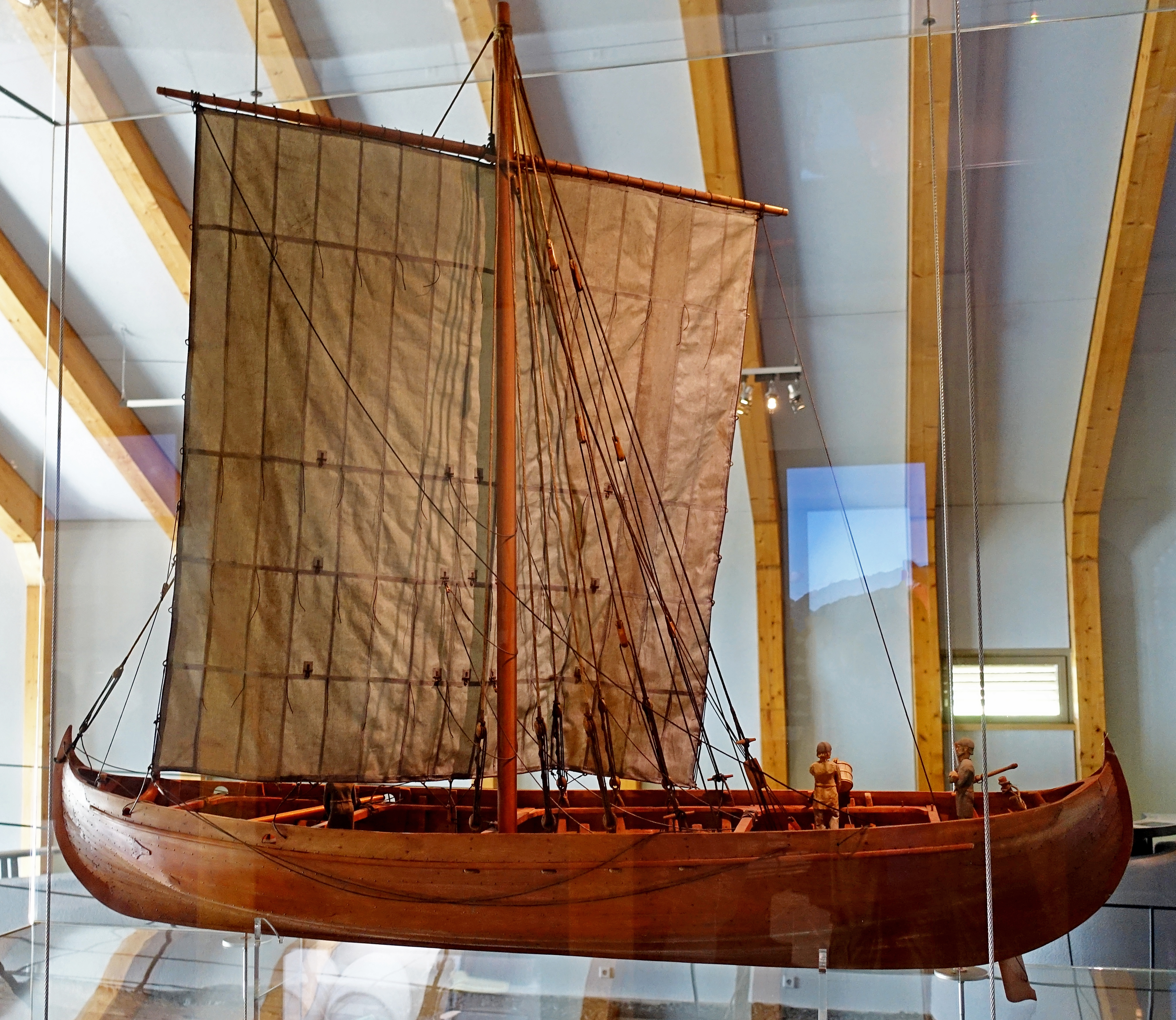
Scale model of a Knarr, a traditional Norse merchant and cargo ship from the Viking Age.
Exhibited at the Viking Museum Haithabu (Wikingermuseum Haithabu) near Schleswig, Germany, which highlights the history of the important Viking trading settlement of Hedeby.
Photo: Don Hitchcock 2018
Source: Wikingermuseum Haithabu
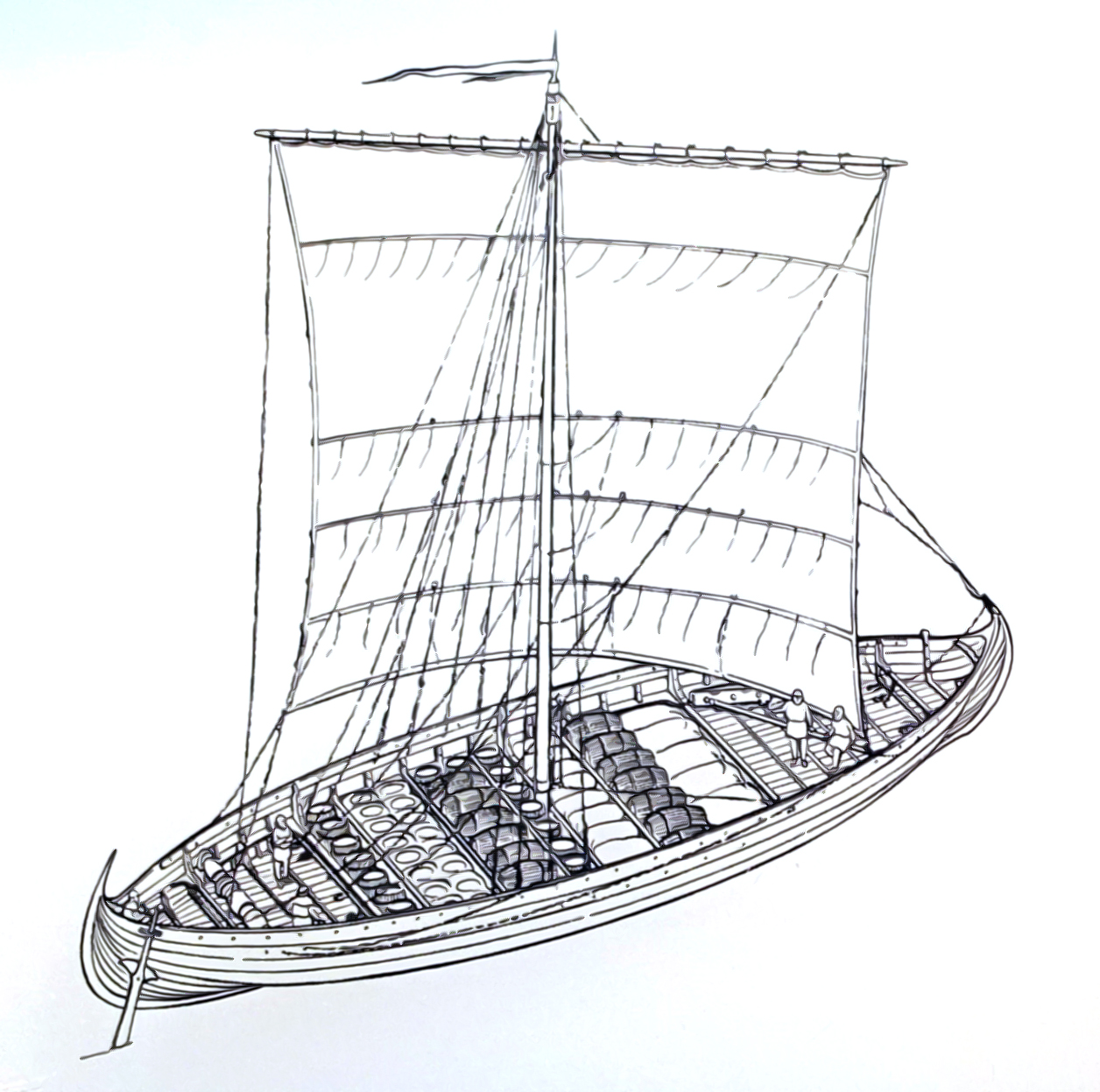
Trading vessels (Knarr) such as the one shown in the sketch here and in the model above are built wider than warships to maximise cargo capacity. They also feature higher sides (gunwales). A large hold amidships pushes the limited number of rowing benches toward the bow and stern. Oars are used almost exclusively for manoeuvering. Propulsion is provided by the wind. Unlike on warships, the mast - equipped with a square sail - cannot be lowered on a trading vessel. A trading vessel carries a crew of no more than 10 men.
Rephotography: Don Hitchcock 2018
Source and text: Wikingermuseum Haithabu
Key Features of the Knarr:
Unlike longships built primarily for speed and warfare, knarrs were wider, deeper, and shorter, designed to haul heavy trade goods like timber, wool, furs, wheat, and livestock. They used the classic Viking clinker-built method (overlapping wooden planks) and relied heavily on a single large square sail, supplemented by a few oars when needed.
Knarrs were used for trade, cargo transport, and colonisation. They were used to carry livestock, wool, timber, and supplies over long ocean routes. The hull shape was short, wide, and deep, and featured a high freeboard (sides) to withstand rough, open-ocean waves and a broad beam for maximum stability.
They were primarily sail-driven, and relied on a single massive square sail. Oars were only used for manoeuvring in harbours or during dead calms. They were half-decked with an open cargo hold (halfrými) in the centre. Crew and passengers sat on small decks at the bow and stern.
They had a deep draft, requiring deeper water to float, they could not easily sail up shallow rivers or land directly on any beach, and had a small crew (typically 10 to 30 people), minimising the food and water needed for long oceanic voyages.
Text above: Various sources
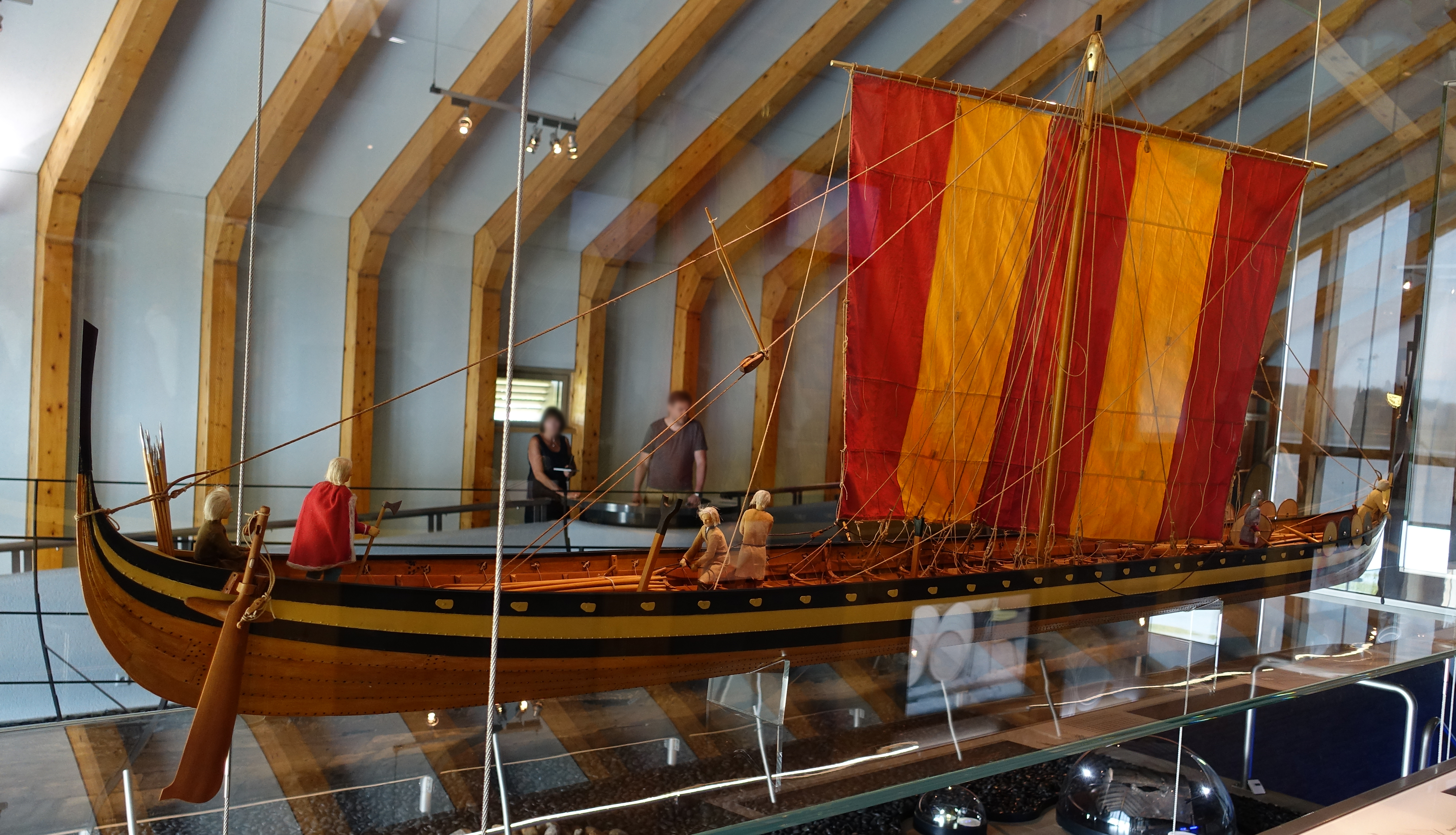
A model of a Viking longship with a red-and-yellow striped sail displayed inside the Wikinger Museum Haithabu (Viking Museum at Hedeby) near Schleswig, Germany.
Longships were used for warfare, raiding, troop transport, and speed. They were designed to move warriors quickly and strike without warning. The hull Shape was long, narrow, and shallow, built sleek to slice through water quickly and maximise hull flexibility in waves.
They were designed to be of dual-propulsion, and were equipped with a large sail but they were heavily reliant on continuous oar power. Oar ports ran down nearly the entire length of the hull.
Longships were fully open or low-decked across the whole length to maximise rowing benches and space for warriors. They were of ultra-shallow draft, making them capable of navigating shallow rivers deep inland and landing directly on beaches for sudden amphibious raids. They had a large crew (ranging from 30 to over 80 warriors/rowers), packed tightly together to form a highly concentrated fighting force.
Photo: Don Hitchcock 2018
Text: Various sources
Source: Wikinger Museum Haithabu
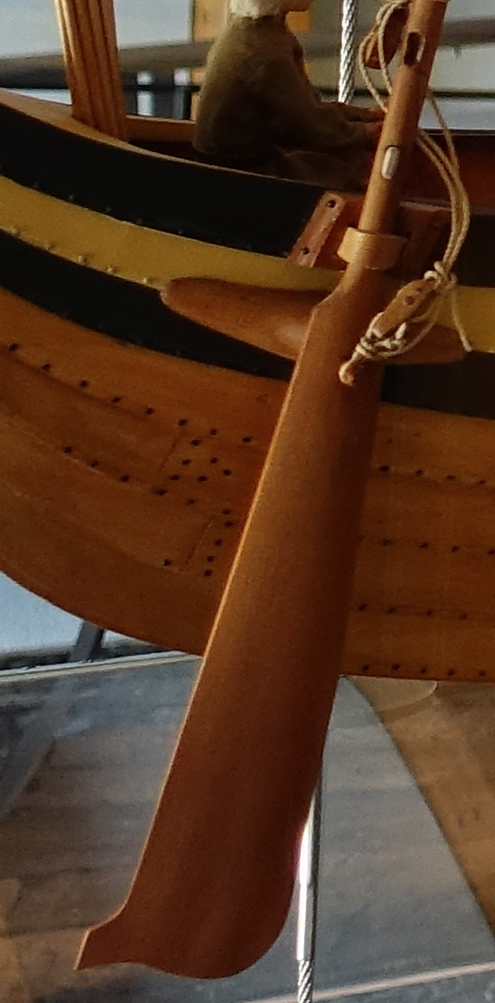
The small, distinct projection or 'fin' on the trailing edge of a Viking ship steering oar (side rudder), shown in a red oval in the image, serves a highly specialised hydrodynamic purpose: it acts as an early form of a balanced rudder to reduce steering torque.
Photo: Don Hitchcock 2018
Text: Various sources
Source: Wikinger Museum Haithabu
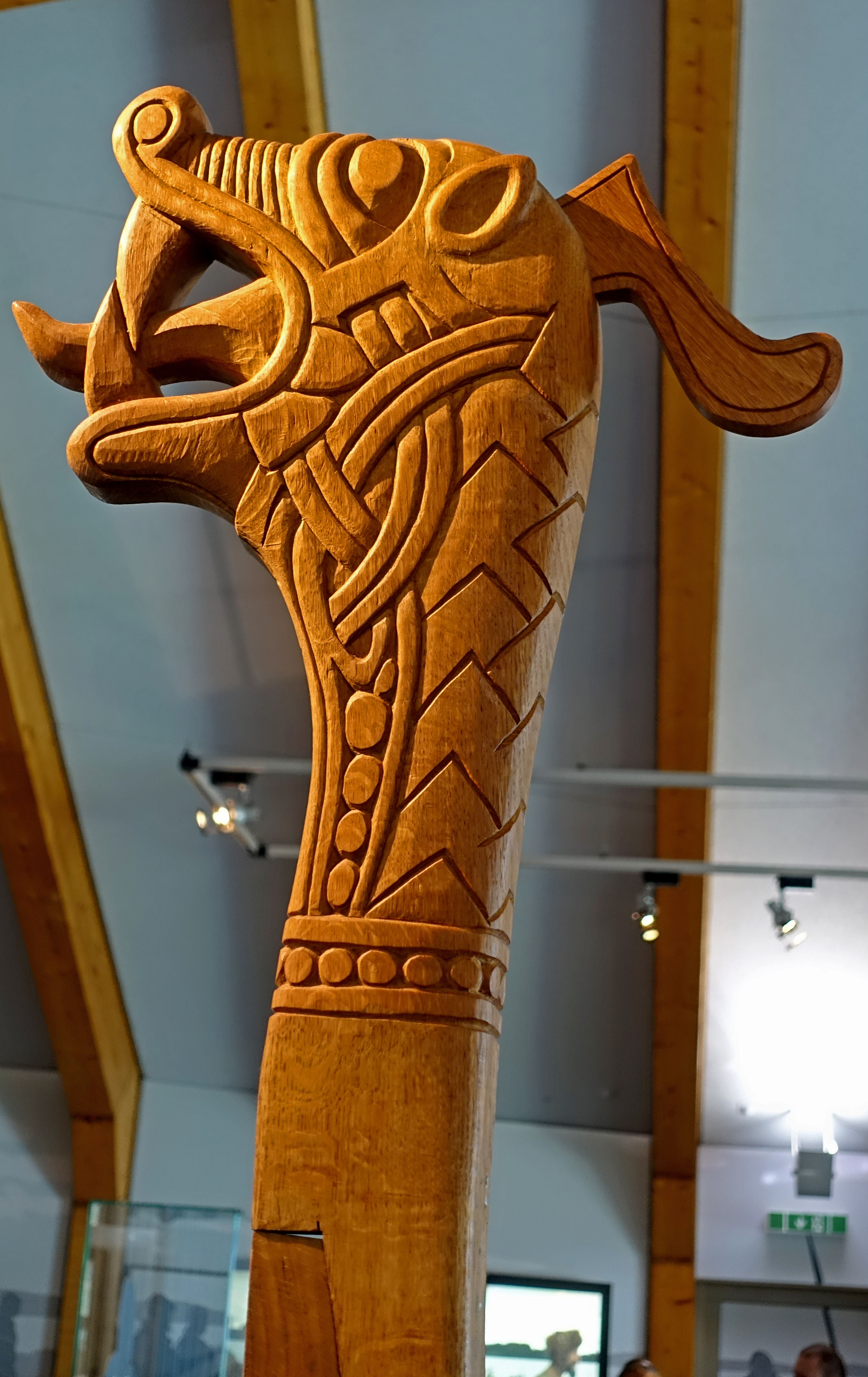
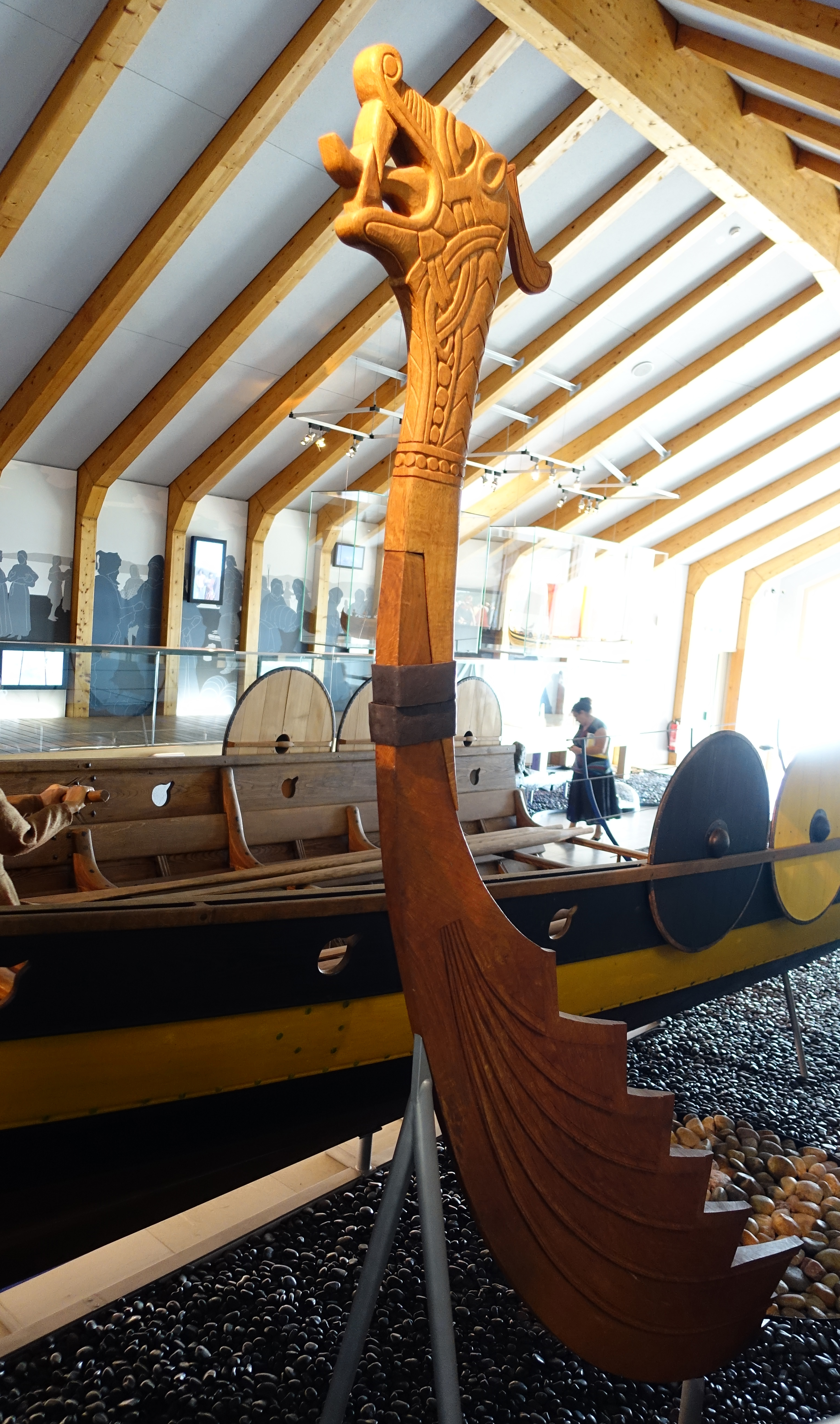
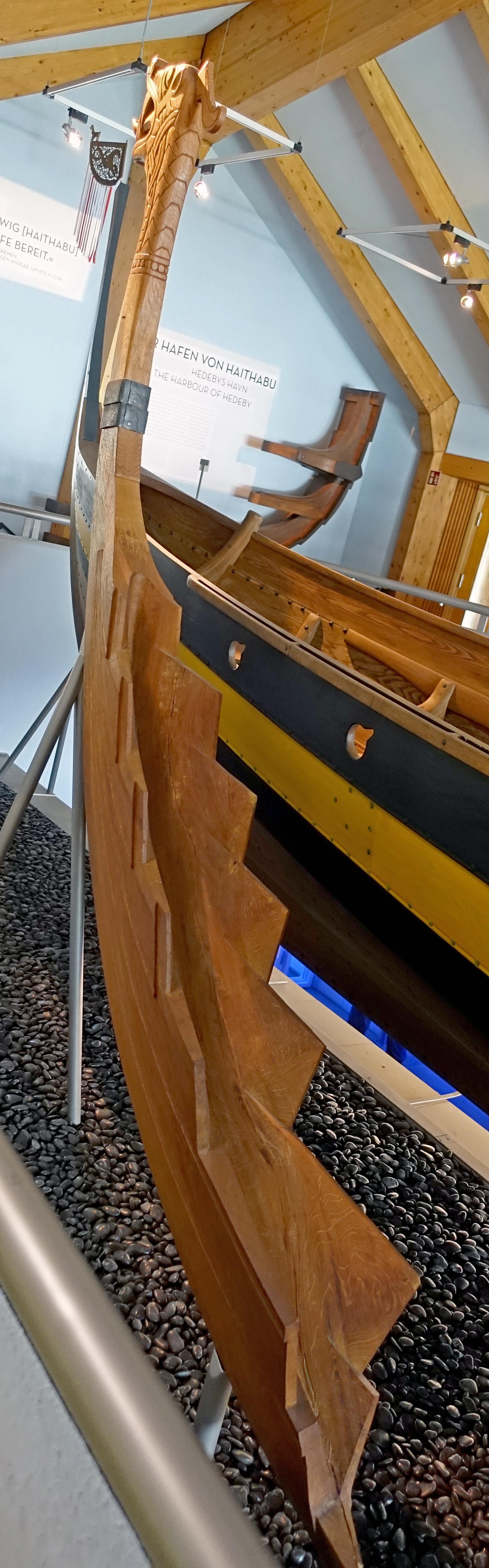
The dragon head prow on a Viking longship, known in Old Norse as a dreki (plural drekar, or "dragonships") - was a prominent carved figurehead mounted at the front of large warships owned by kings and chieftains.
• Apotropaic protection: Vikings believed the fierce wooden head warded off evil sea monsters, stormy elements, and malevolent spirits.
• Intimidation: The menacing appearance was designed to frighten enemies and strike fear into coastal settlements before a raid.
• Status and wealth: Elaborately carved and sometimes gilded heads signaled the high rank, power, and wealth of the ship's owner.
• Removing the head near home: according to mediaeval Norse law and tradition, sailors were required to remove the dragon head when approaching friendly or domestic shores. Leaving it up could frighten or anger the friendly land spirits (landvættir) who protected their own homeland.
These figureheads were not permanently attached, they were slotted into place for voyages, battles, or formal displays.
Not all Viking ships had dragon heads. Smaller or utilitarian vessels (like the karve or standard snekke) often featured simpler post-heads or plain wooden finials rather than full-scale dragons.
Photo: Don Hitchcock 2018
Source and text: Wikinger Museum Haithabu and various other sources, including https://avaldsnes.info/en/viking/drakeskip/ and Wikipedia
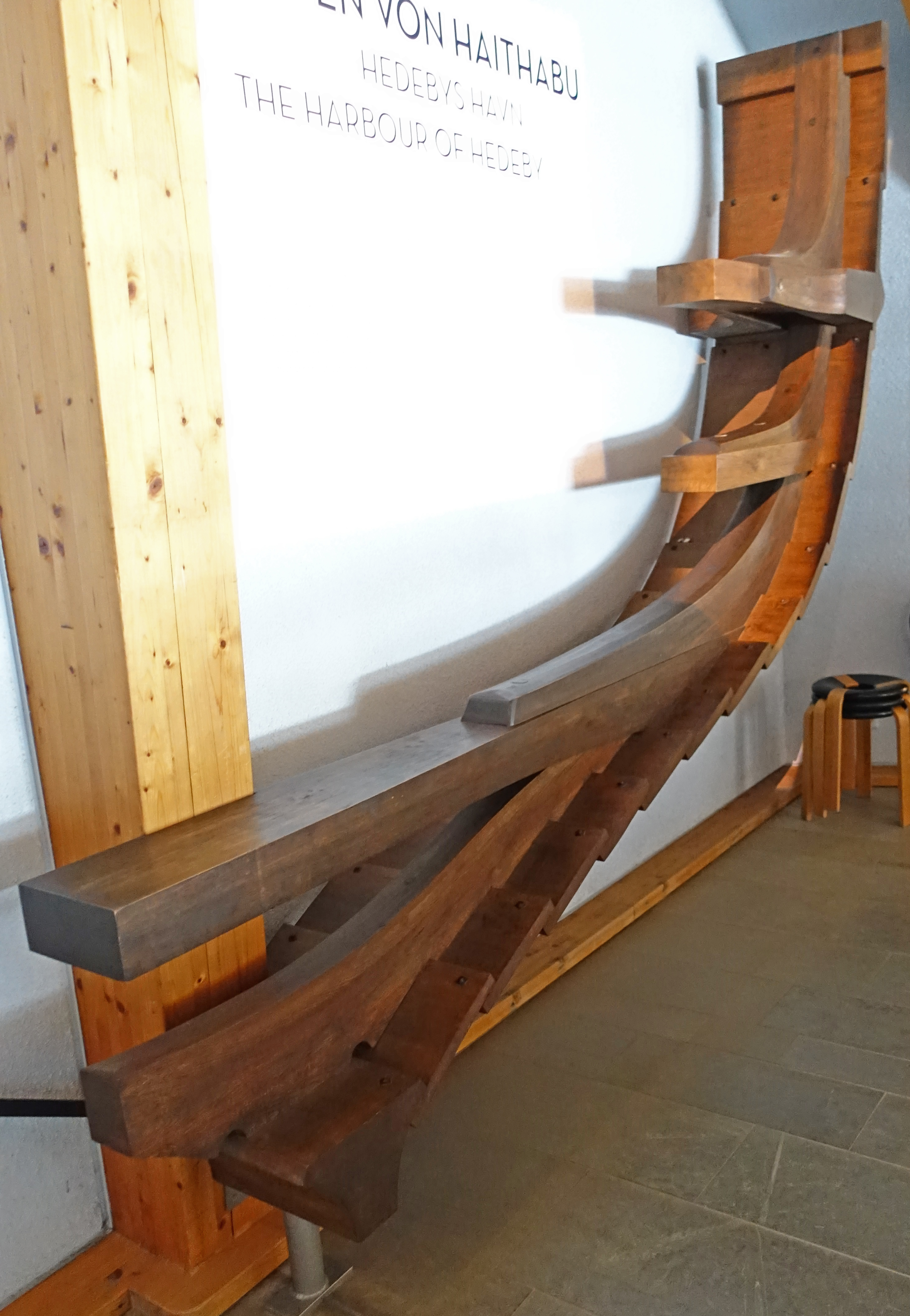
This fragment of the hull of a viking long ship has been reconstructed from measurements of the longship from Haithabu Harbour, 'Haithabu 1', excavated in 1979-80.
While fragments of the ship were originally discovered by divers in 1953, full recovery wasn't possible until decades later. Archaeologists constructed a large cofferdam around the wreck site, drained the water, and safely extracted the ship's timbers from the dry seabed.
Traces of fire on the salvaged vessel remains show that the ship probably ended its days as a fireship: a vessel set ablaze and sent into enemy lines to destroy the ships.
This structure serves as a museum display model demonstrating the construction of a Viking ship's hull.
The model illustrates the clinker (or lapstrake) shipbuilding method used by the Vikings.
Key educational elements of this display include:
• The Stem: The sweeping, curved vertical timber at the far right represents the prow or stern (stem) of the ship.
• Overlapping Planks: It visually breaks down how the hull planks (strakes) overlap each other along their edges, which were traditionally riveted together to create a flexible, watertight hull.
• Internal Framing: It shows how internal ribs (the stepped wooden supports inside the curve) are secured against the planks to give the vessel its structural integrity.
The wall text above the model explicitly titles this section of the museum 'Der Hafen von Haithabu' ('The Harbour of Hedeby'), where the famous 'Wreck 1' Viking longship was discovered and excavated
Photo: Don Hitchcock 2018
Source and text: Wikinger Museum Haithabu and various other sources including https://www.vikingeskibsmuseet.dk/en/professions/education/the-longships/findings-of-longships-from-the-viking-age/the-longship-from-haithabu-harbour
Haithabu 1 wasn't intentionally dismantled — it was turned into a weapon of war and burned to the waterline.
Rather than being taken apart for scrap wood, archaeologists discovered that the longship met a violent end in Hedeby's harbour.
Sometime between 990 AD and 1050 AD, during a siege or raid on the trading hub, the ship was packed with highly combustible materials, set ablaze, and launched directly into the harbour.
This tactic — called a 'fireship' - was designed to drift into enemy lines, causing chaos by igniting other docked vessels, storehouses, and wooden piers. Because it was consumed by fire, the entire upper portion of the ship, its mast, rigging, and top decks were completely destroyed by the flames. The heavy oak timbers of the lower hull burned right down to the water's edge before the remains filled with water and plunged to the muddy seabed.
From the fore section, only the keel - along with several futtocks, knees, beam supports, frames, and planks—has survived. These components provide clues regarding the ship’s dimensions and form.
Analyses of the sunken ship have revealed that it was unusually long and narrow. It measured about 30.9 m from stem to stern, while its greatest width was about 2.7 m and its depth was probably about 1.5 m. With a length more than 11 times its greatest width, this is the narrowest longship ever found. There was probably room for 30 pairs of oars in the ship, i.e. twice as many as the Ladby ship. A single centrally located mast carried a square sail.
The ship had been very skilfully built. The planks were made of radially-cloven oak wood and in some cases they were more than 10 m long. The technique used in their production requires the original wood to be twice as thick as the width of the finished plank. Therefore the plank widths of 25-37 cm mean that the construction of the ship required the felling of trees more than 1 m thick, over 10 m in length and with straight, knot-free trunks.
Photo: Don Hitchcock 2018
Source and text: Wikinger Museum Haithabu and various other sources, including https://www.vikingeskibsmuseet.dk/en/professions/education/the-longships/findings-of-longships-from-the-viking-age/the-longship-from-haithabu-harbour,
This is an alternative scenario to that described above, also from a display at Wikinger Museum Haithabu:
Around 1000 AD, a ship caught fire just off a landing stage and sank. At 31 meters in length, it was one of the largest warships of its time. It was built around 985 AD in the vicinity of Hedeby (Haithabu). It likely belonged to King Harald Bluetooth.
Usable parts of the wreck—most notably the stems - were salvaged as early as the Viking Age using long poles. Only a few planks and frames from the ship's bow survived the centuries that followed. These served as the basis for this reconstruction of the bow. The original shape of the stems can no longer be determined; they may have featured a dragon's head, as shown in this reconstruction.
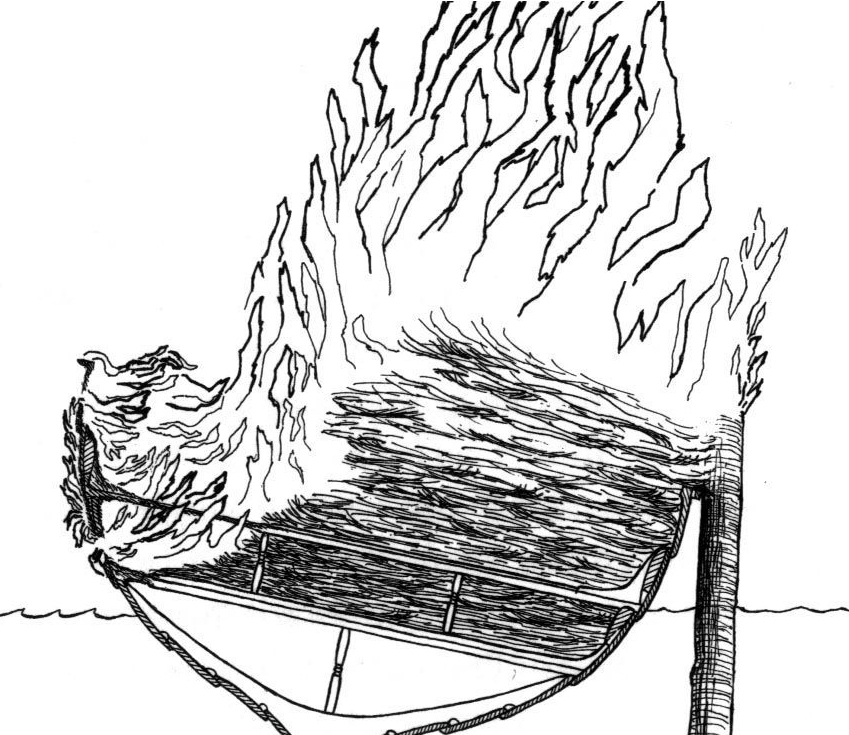
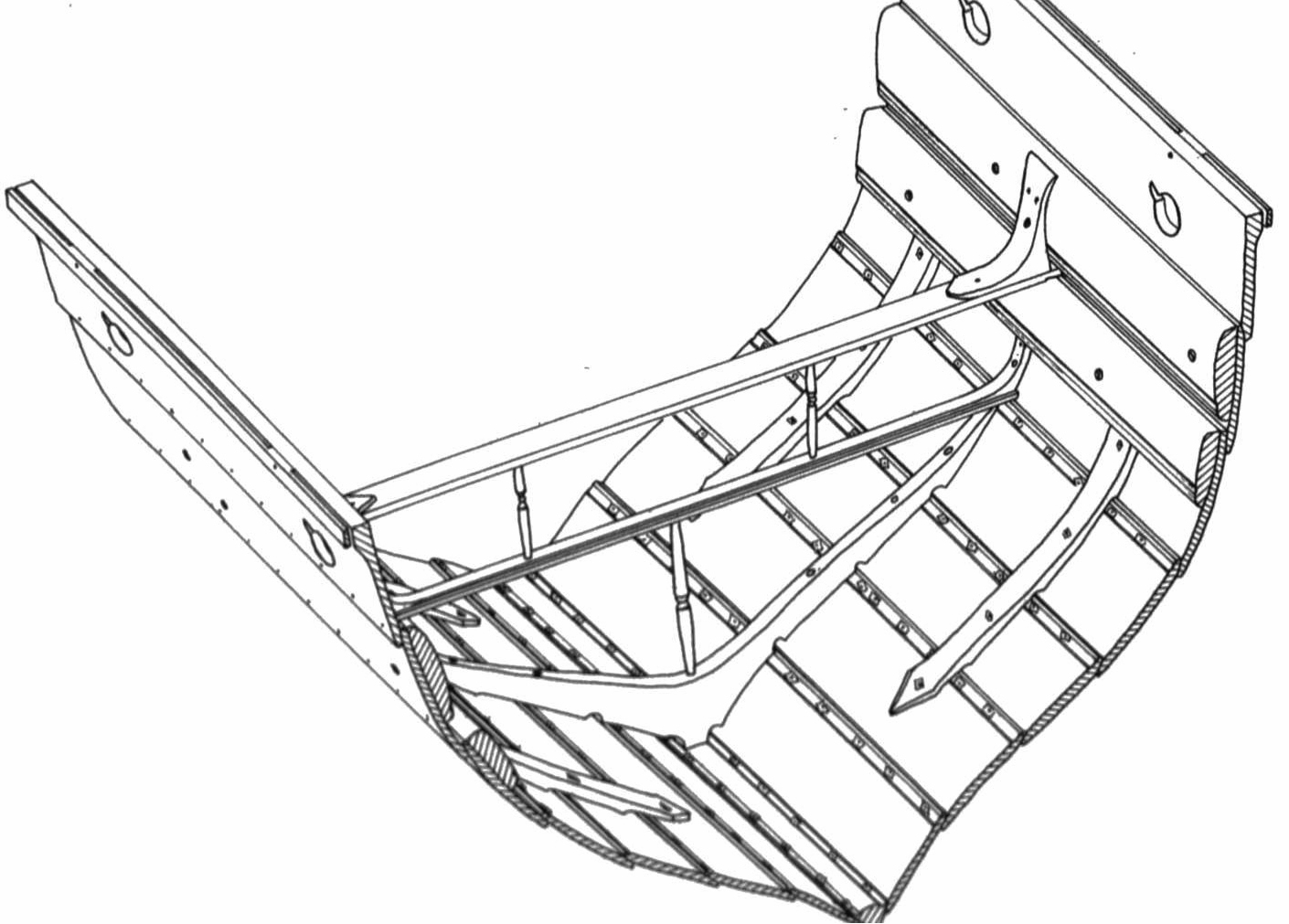
(left) Traces of fire on the salvaged vessel remains show that the ship probably ended its days as a fireship: a vessel set ablaze and sent into enemy lines to destroy the ships.
(right) Reconstructed cross-section of the Haithabu Harbour longship.
Drawings: Sune Villum-Nielsen.
Rephotography: Don Hitchcock 2018
Source and text: https://www.vikingeskibsmuseet.dk/en/professions/education/the-longships/findings-of-longships-from-the-viking-age/the-longship-from-haithabu-harbour
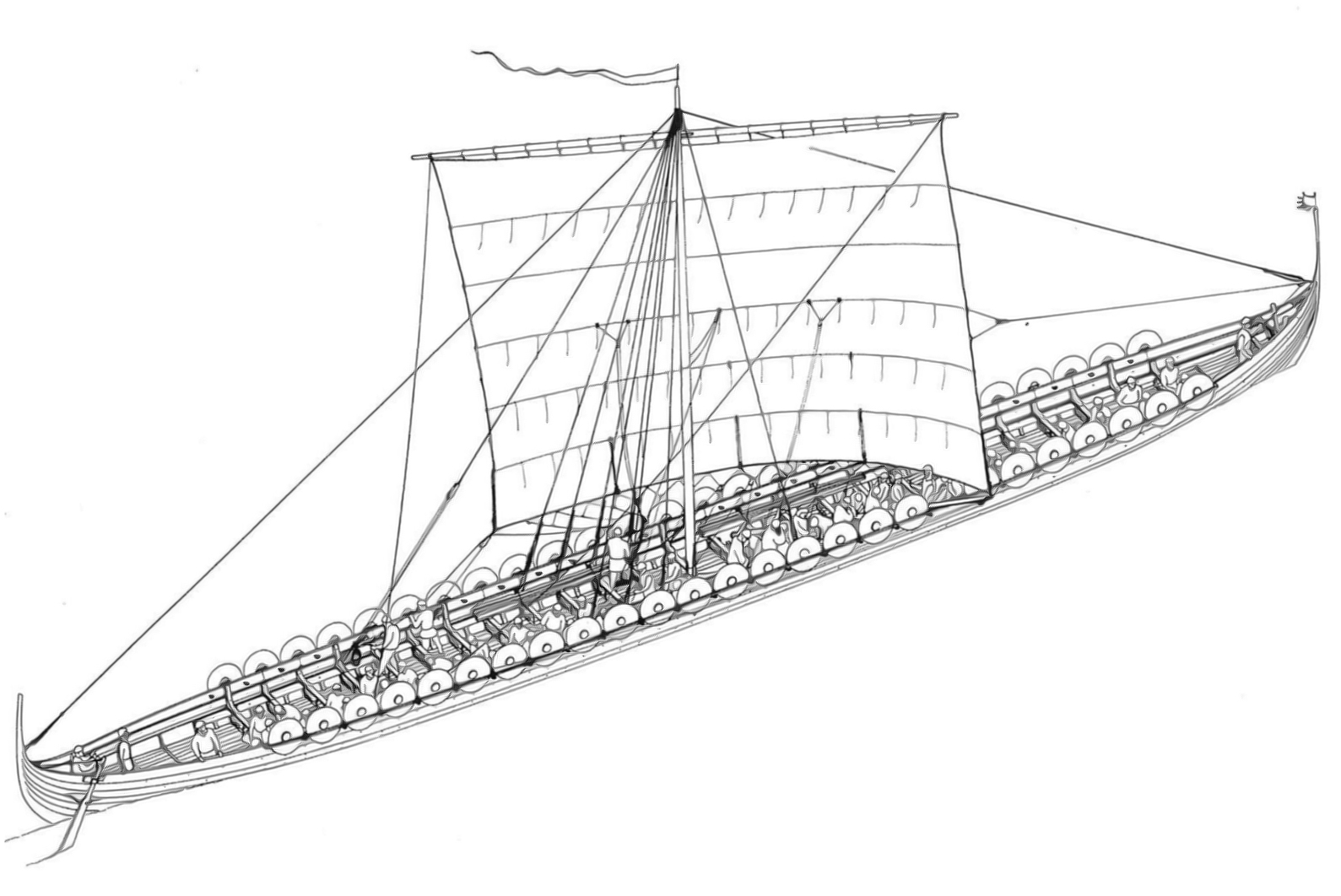
Drawing showing the construction of the long ship.
Drawing: Sune Villum-Nielsen.
Rephotography: Don Hitchcock 2018
Source and text: https://www.vikingeskibsmuseet.dk/en/professions/education/the-longships/findings-of-longships-from-the-viking-age/the-longship-from-haithabu-harbour
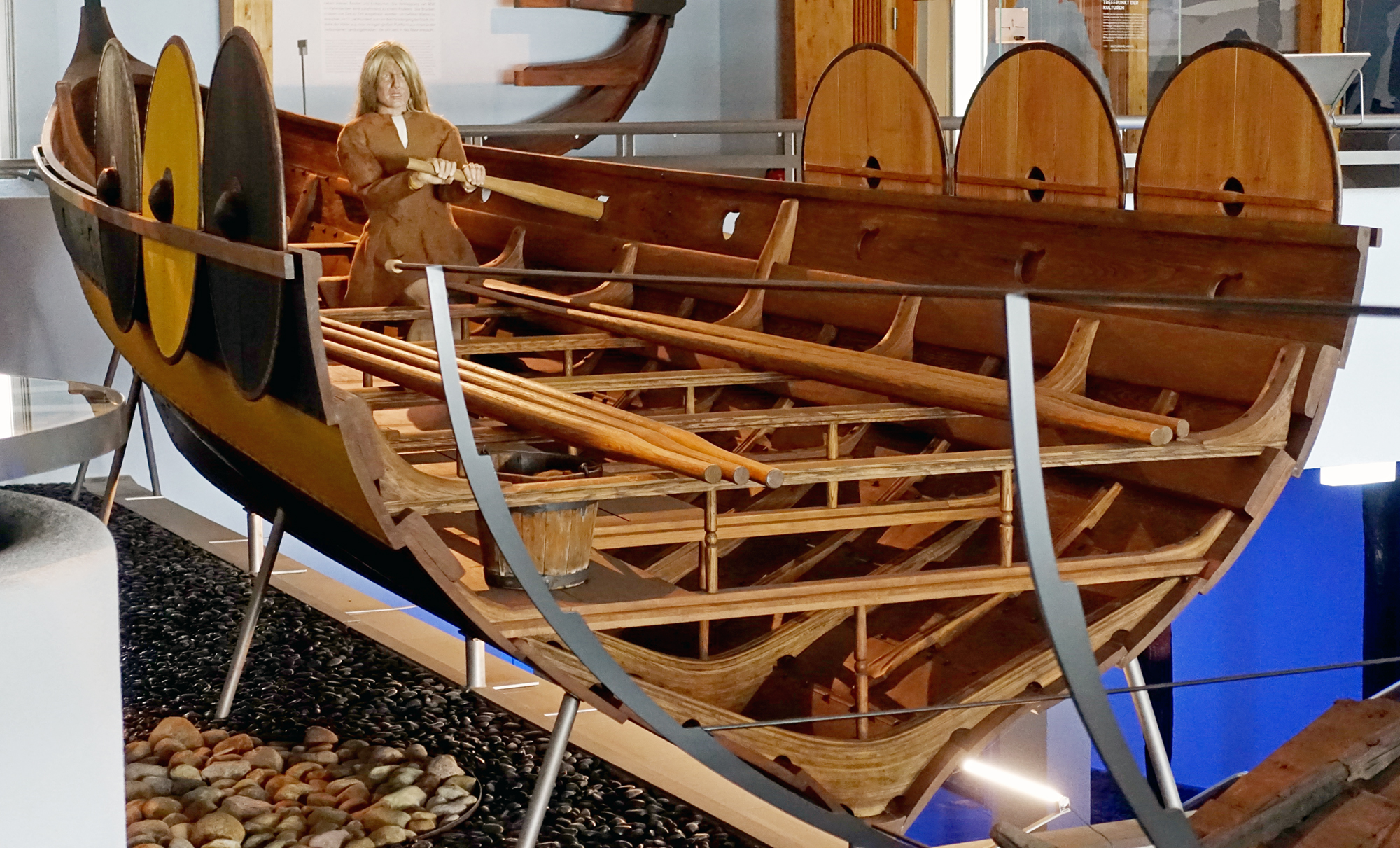
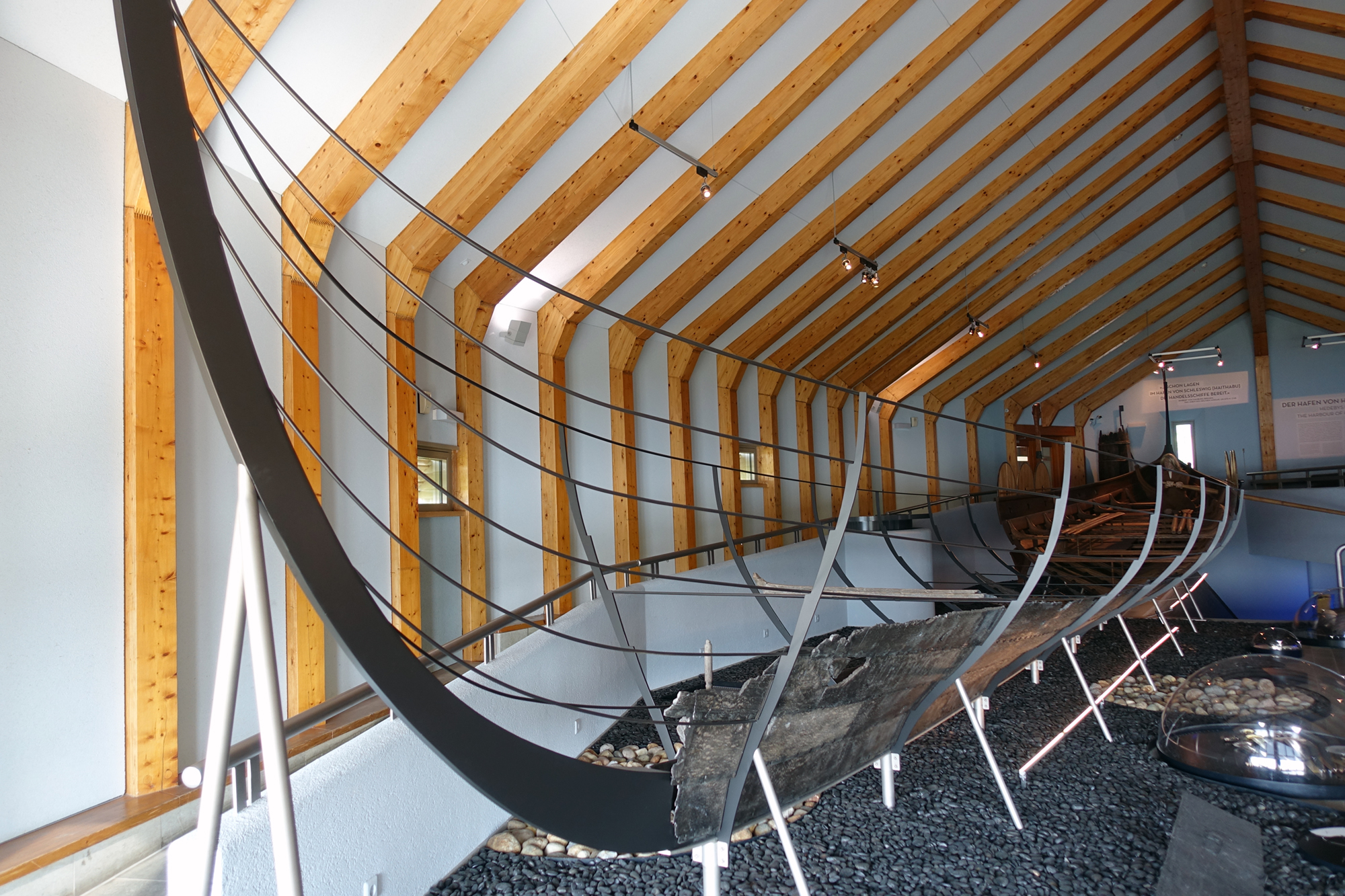
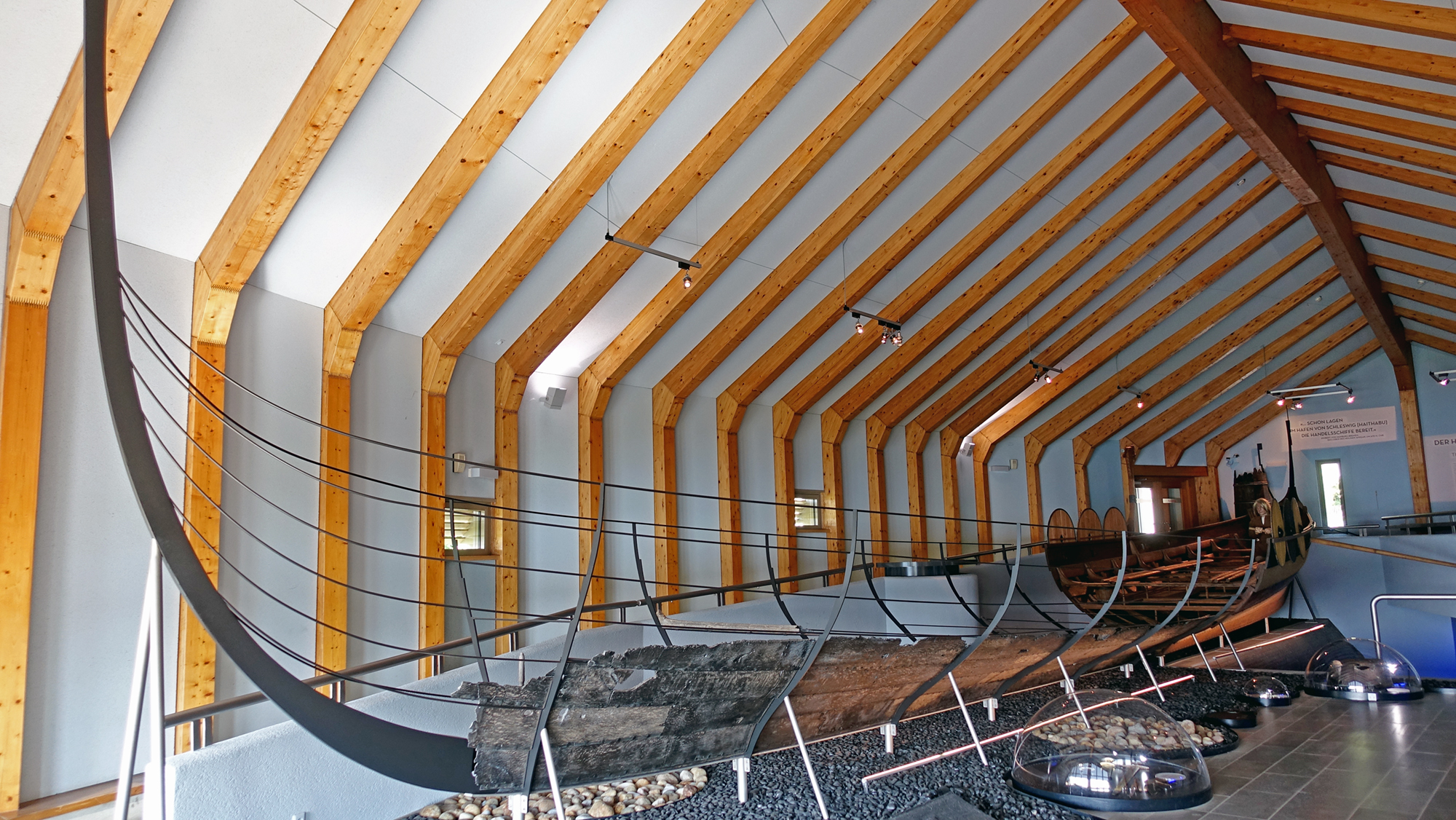
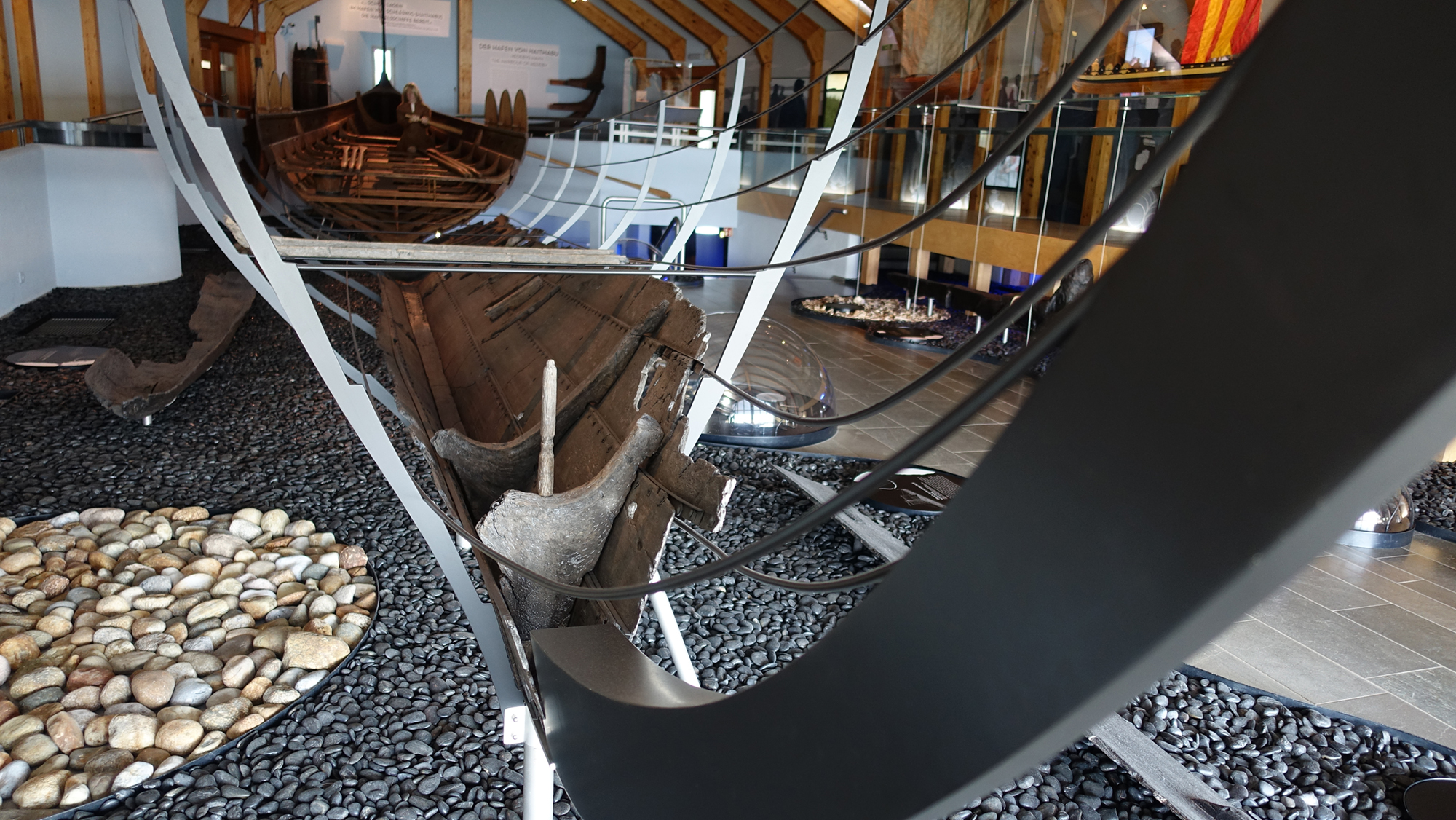
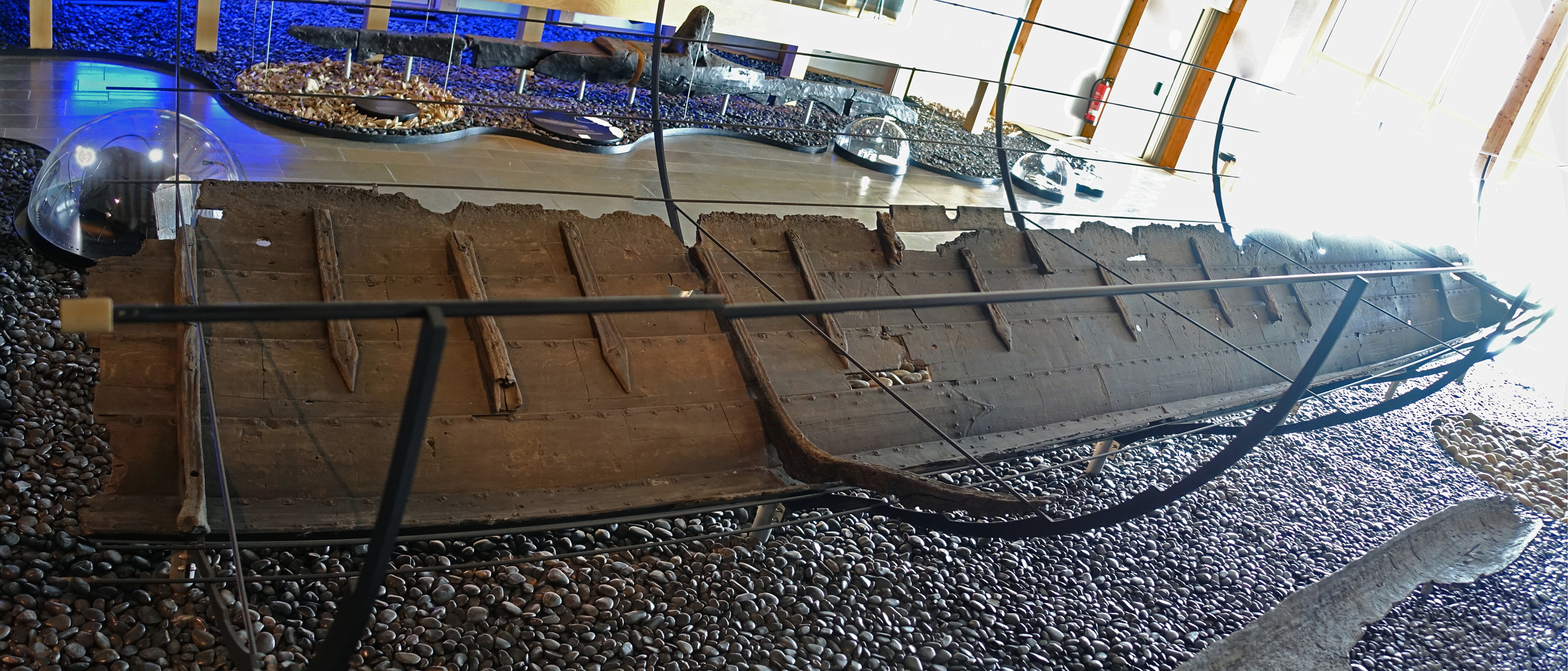
The images show a partial reconstruction of the Haithabu 1 Viking longship displayed at the Viking Museum Haithabu (Wikinger Museum Haithabu) near Schleswig and Busdorf, Germany.
At top left is a modern reconstruction of the prow of the longship, at the bottom is what remains of the stern of the longship, which is also shown at top right and the two middle images.
It was built around AD 985 during the Viking Age, and burned down during an attack and destruction of the trading settlement of Hedeby (Danish) Haithabu (German) around AD 1050.
The wreckage was excavated in 1979 from the harbour area of Hedeby. It originally measured approximately 30.9 meters long and 2.7 meters wide, and was equipped with 24 to 26 pairs of oars. It was long considered the longest known Viking warship until later discoveries.
Photo: Don Hitchcock 2018
Source and text: Wikinger Museum Haithabu
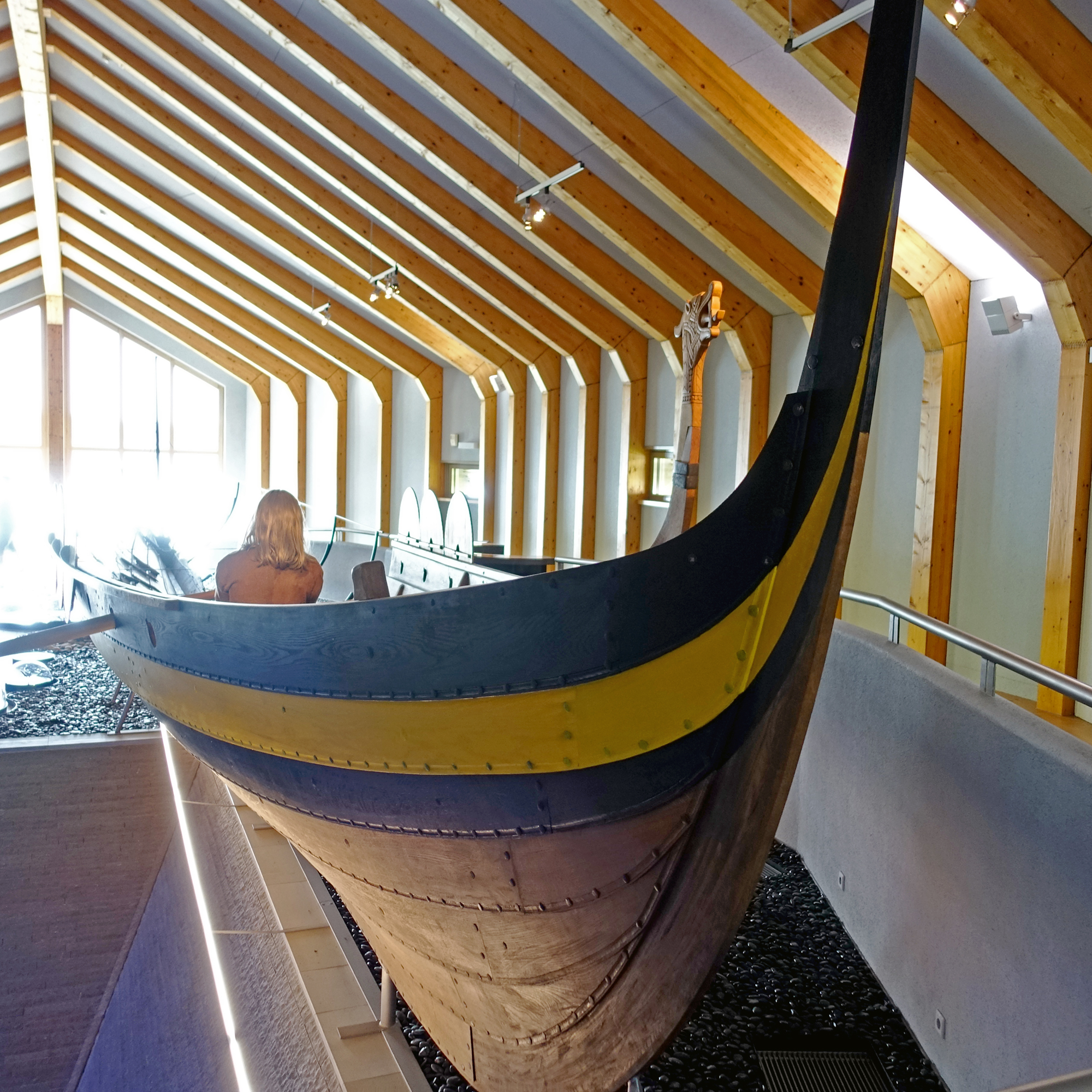
This is an image of a modern reconstruction with new materials of the prow of the longship.
The overlapping wooden planks (strakes) were fastened together using iron rivets or clench nails. The iron nail was driven through both overlapping planks from the outside and secured on the inside with a small iron washer or rove.
While iron rivets fastened the planks to each other, the entire outer hull shell was typically secured to the internal structural frame (the ribs) using heavy wooden dowels called treenails.
The gaps between the overlapping planks were caulked with animal hair (usually wool) or moss dipped in tar to ensure the vessel remained watertight.
Photo: Don Hitchcock 2018
Source and text: Various sources including Wikipedia
The excavation of Haithabu 1
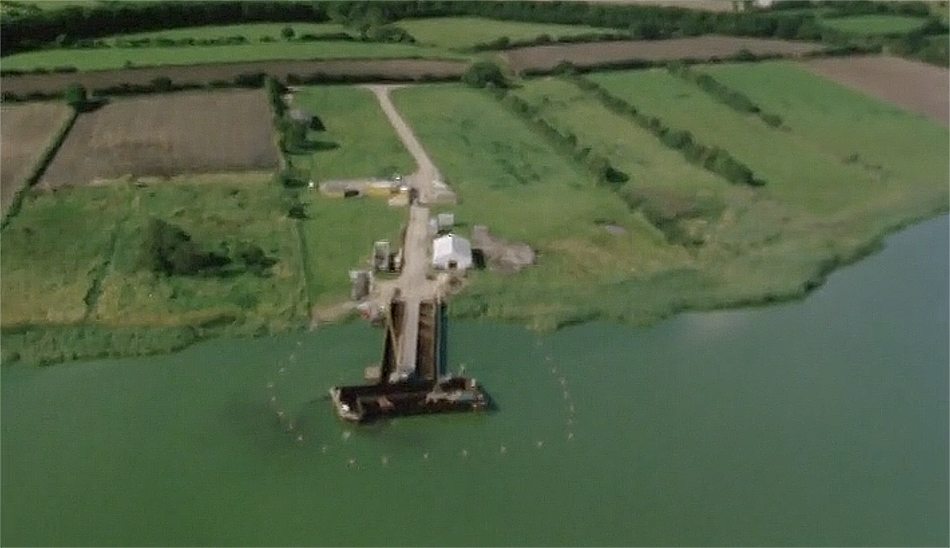
The process of excavation began in 1979.
A coffer dam (a temporary, watertight enclosure built in or across a body of water to pump out the interior and create a dry workspace for underground or foundation excavation) stands out clearly against the landscape in the image above.
In the middle, a service path lead to the excavation structure, which had been pushed out into the open water. On either side of the path were work quarters, field laboratories, and a tent - covered temporary storage area for the finds. Sheet pile walls - some up to 20 metres long - were driven into the bed of the inlet before the water could be pumped out.
Source and text: (video) Hedeby – Investigations in the harbor and the recovery of a Viking ship, https://av.tib.eu/media/19069
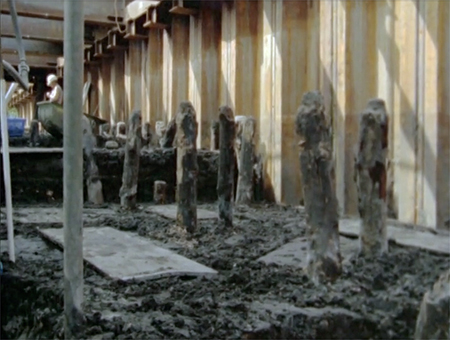
Once excavation within the coffer dam began, a system of oak posts became apparent - the remains of the posts of a landing pier.
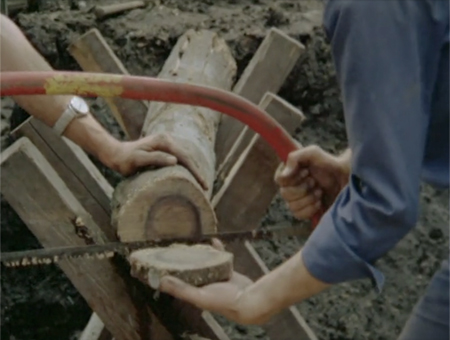
For the dendrochronological dating of the pile supporting the deck of the landing stage, cross-sectional discs were cut from the pile for dendrochronological analysis.
The felling dates of the timbers, determined subsequently in a specialised laboratory, allowed for the dating and classification of all the structural findings of the landing stage.
Source and text: (video) Hedeby – Investigations in the harbor and the recovery of a Viking ship, https://av.tib.eu/media/19069
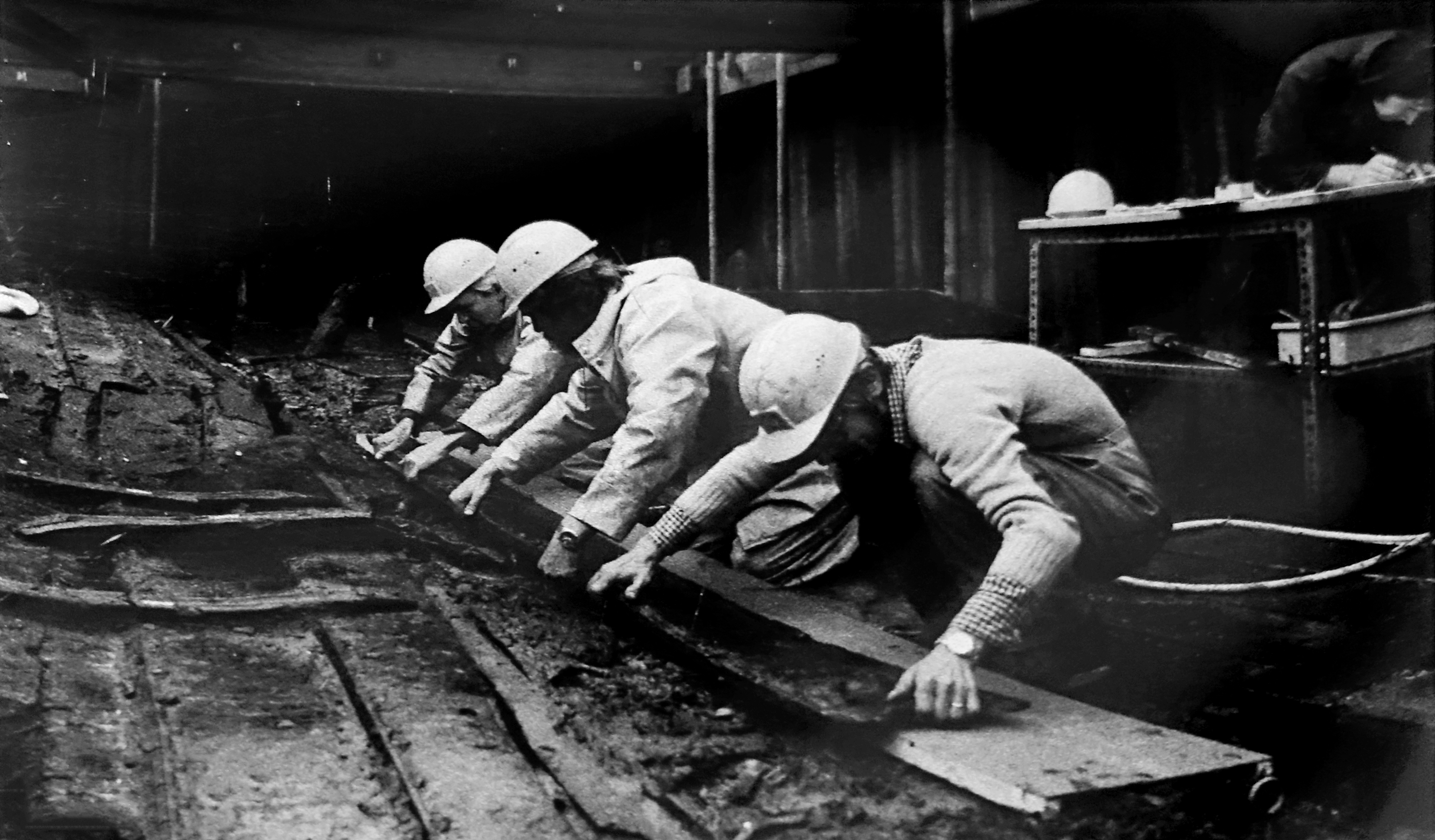
Once uncovered, the ship components were drawn, measured, and photographed on-site. Sprinkler systems were used to keep the wood constantly damp. Special supports were employed to cradle the fragile timbers during recovery. Until the conservation process began, they were stored in a pool of water.
Rephotography: Don Hitchcock 2018
Source and text: Wikinger Museum Haithabu
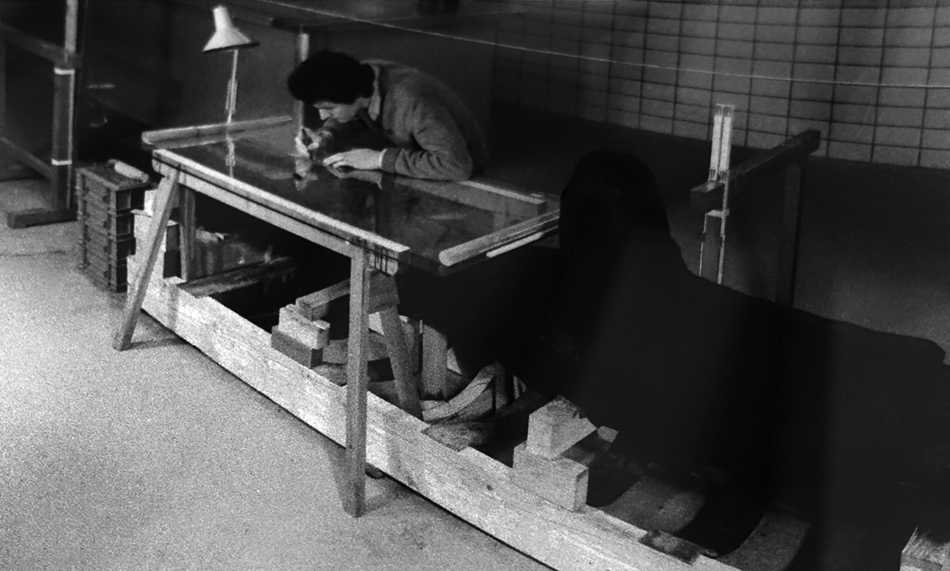
Between 1979 and 1985 the painstaking documentation of construction details took place in the conservation workshop, where each piece of timber was drawn at its actual, full-scale size on a sheet of film.
Rephotography: Don Hitchcock 2018
Source and text: Wikinger Museum Haithabu
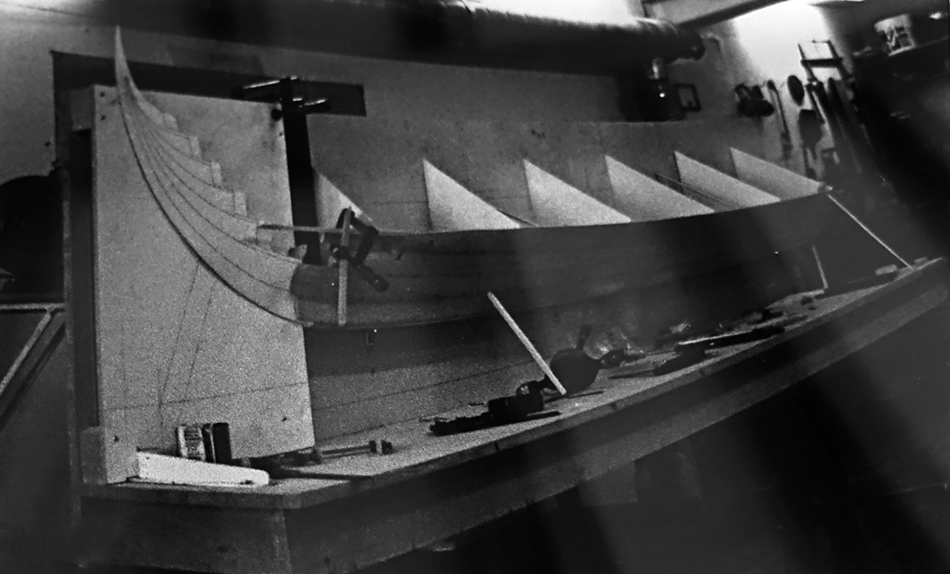
By 1985 based on the drawings, a 1:5 scale model of the ship was able to be created, providing an impression of its original form.
This model also made it possible to verify the position and form of every part of the ship.
Rephotography: Don Hitchcock 2018
Source and text: Wikinger Museum Haithabu
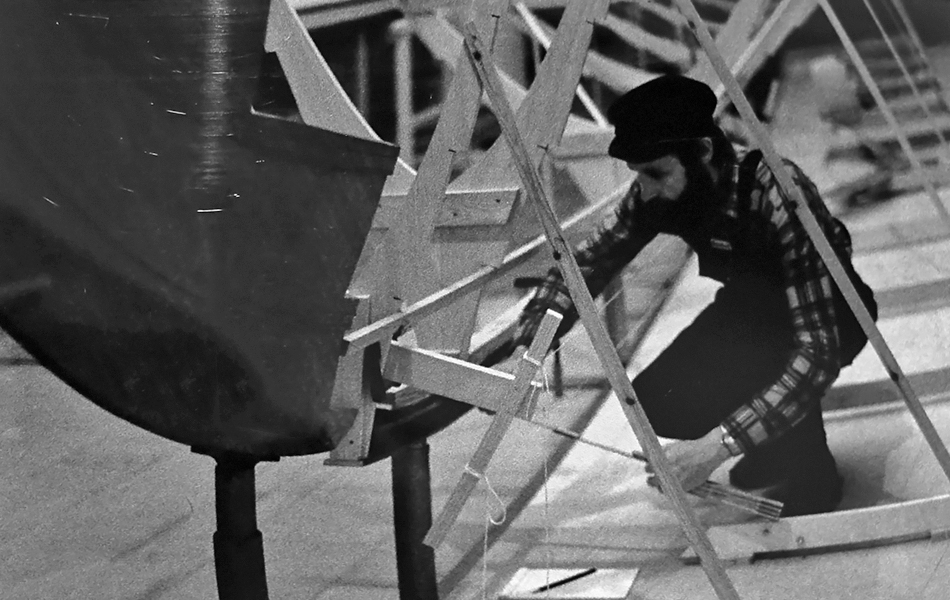
Once the dimensions of the ship had been precisely determined using a lines model, the preserved timbers were fitted and assembled within a supporting framework. The Reconstruction of missing components - such as the stem or stern - remains subject to uncertainty, however, and can only be achieved through comparisons with other archaeological ship finds.
Rephotography: Don Hitchcock 2018
Source and text: Wikinger Museum Haithabu
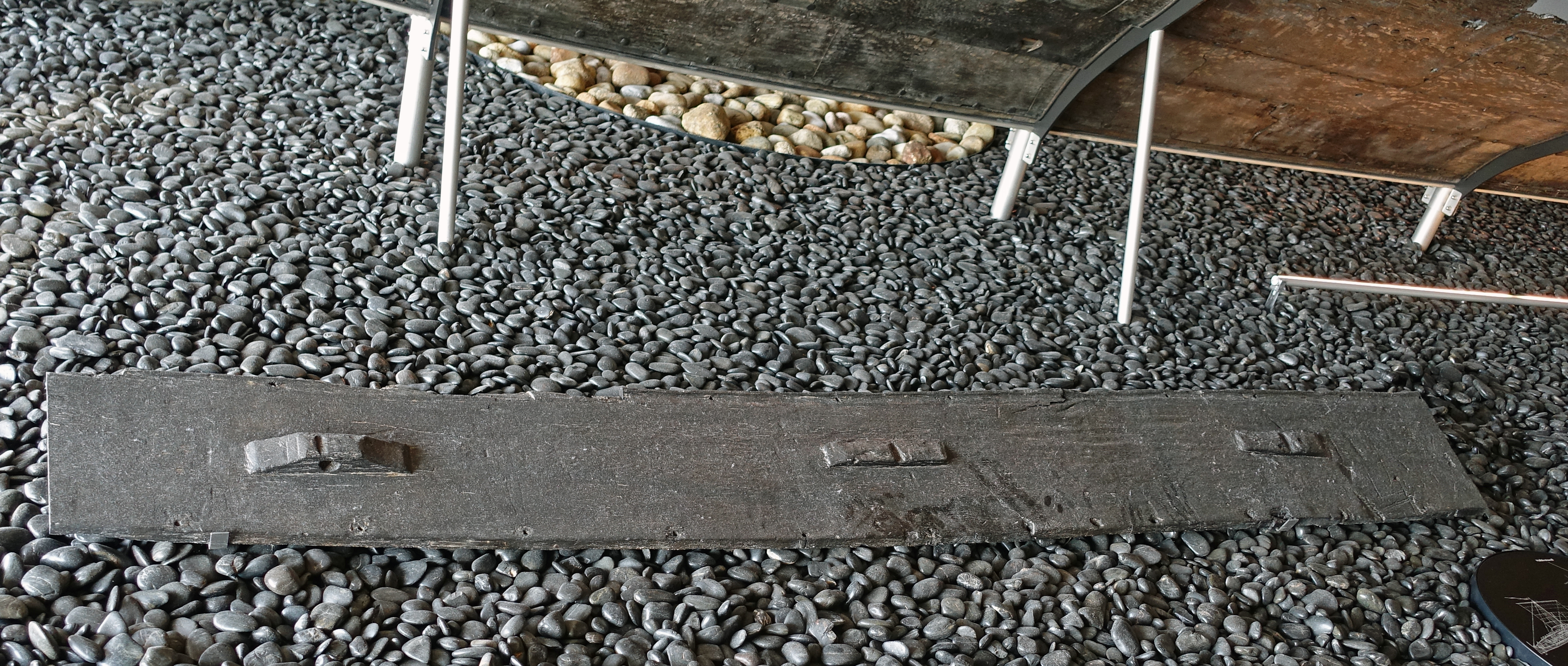
Before the first wharf structures were built, ships would land by running aground on a shallow shore or beach. The shallow Noor (a type of coastal lagoon or inlet) offered ideal conditions for this. To cross the swampy ground while keeping their feet dry, the first settlers used a plank from an old ship - a vessel that had been built as early as 753 AD.
The object above is a split oak hull plank featuring integral raised cleats (or clamps). This artefact demonstrates a masterfully engineered component of early - to - mid Viking Age maritime technology, specifically showing how Norse shipwrights combined flexibility with strength. In traditional Viking clinker construction, the internal ribs (frames) were not rigidly nailed or bolted down to every single plank. Instead, the lower hull strakes were lashed to the ribs using flexible cords made of spruce roots, leather thongs, or whale baleen. These cords were threaded tightly through the holes drilled into the raised cleats seen on the board.
This decoupling method allowed the entire hull to twist, bend, and yield independently to ocean waves. By letting the ship flex rather than rigidly resist, the vessel absorbed the kinetic energy of the sea safely without popping its iron rivets or cracking the wood panels.
Photo: Don Hitchcock 2018
Source and text: Wikinger Museum Haithabu
Additional text: Various sources including www.quora.com

Shipbuilding begins with the selection of the wood.
The demanding construction of a Viking ship requires experience, forward-looking preparation, and skilled craftsmanship. The ships are built wherever suitable timber is available. First, appropriate trees are selected and felled. Immediately afterward, the fresh timber is worked using axes and adzes - but no saws. The reason for this injunction is that sawing cuts across the wood fibres, which made the planks weaker, stiffer, and more likely to snap under stress at sea.
1. The construction of a ship always follows the same sequence of steps. First, the keel and the stems (bow and stern posts) are crafted and joined together. The stems are already prepared to accommodate the attachment of the planks.
2. Planking of the hull begins from the keel. The split oak planks are fastened in an overlapping fashion using iron rivets.
3. Once the hull sides have reached a certain height, the frames are inserted and secured to the planks using wooden pegs. These provide the necessary stability to the boat’s hull.
4. The planking process is completed, crossbeams for rowing benches and decks are installed, and the 'Kielschwein' (mast step timber) is fastened onto the keel. It contains the mast step - a recess that will later hold the mast in place. The term 'Kielschwein' (literally 'keel-pig') derives from the squeaking sounds caused by friction within the mast step.
5 . Finally, the deck planks are laid, the mast - complete with its square sail - is stepped, the rudder is mounted on the starboard side, and the gunwale is fashioned with oar ports.
Rephotography: Don Hitchcock 2018
Source and text: Wikinger Museum Haithabu and various other sources.
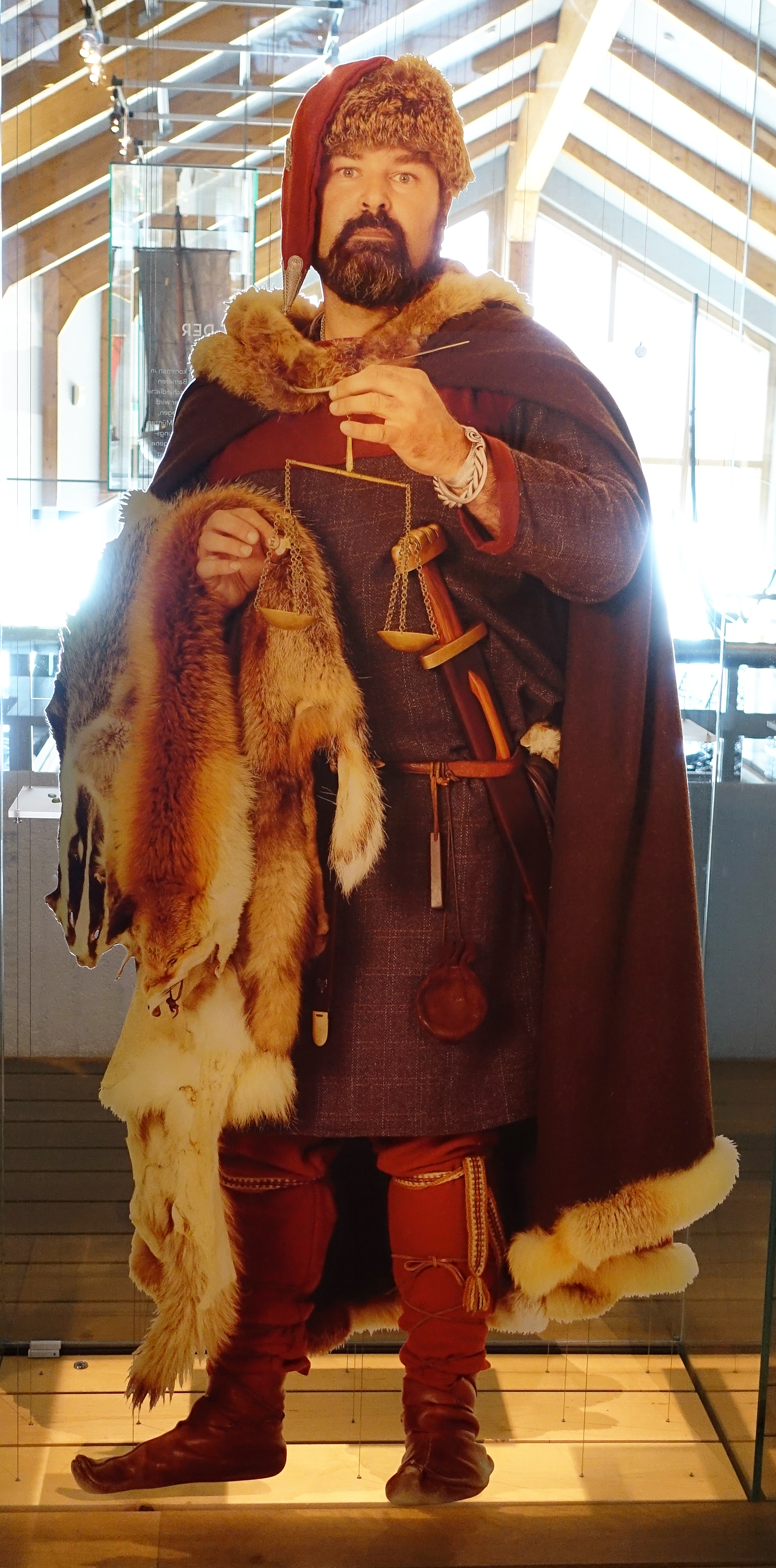
A Viking-age merchant is shown holding a set of scales and furs.
The set of scales is used for weighing precious metals and silver coin.
He is carrying fur pelts and is wearing period-accurate clothing, including a wool tunic, a cloak trimmed or lined with fur, hose/trousers, and a distinctive expensive cap.
Photo: Don Hitchcock 2018
Source and text: Wikinger Museum Haithabu and various other sources.
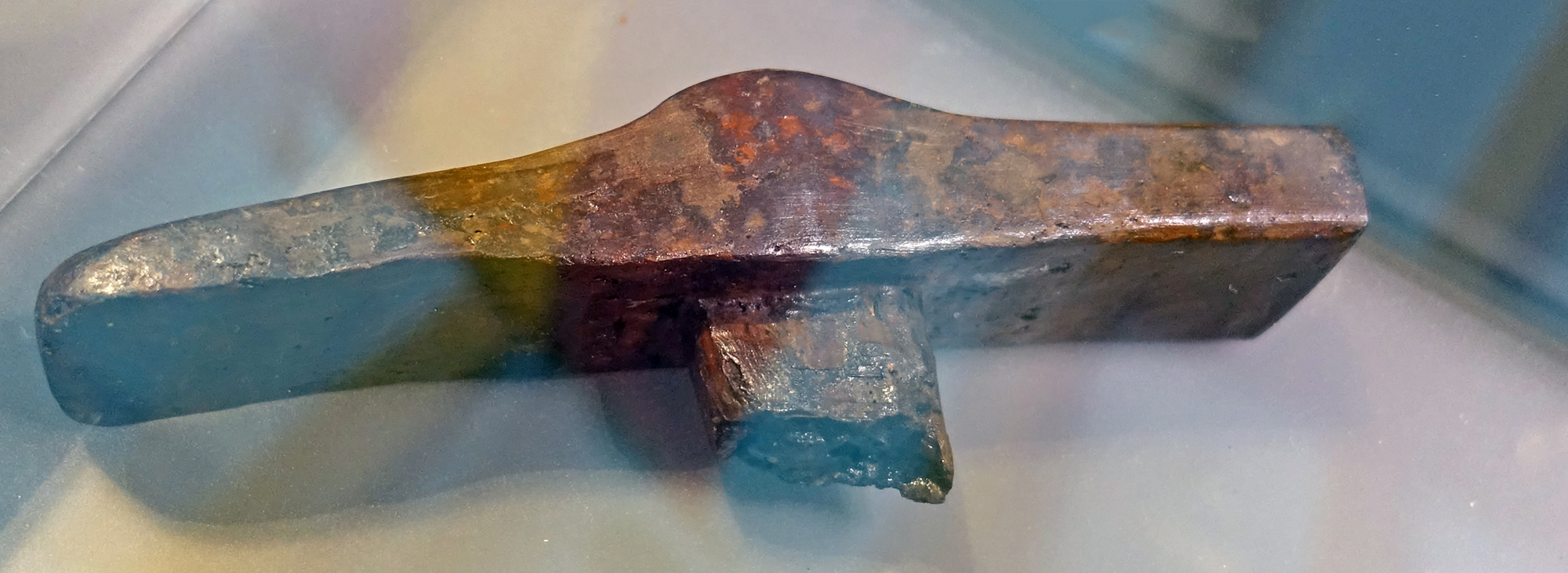
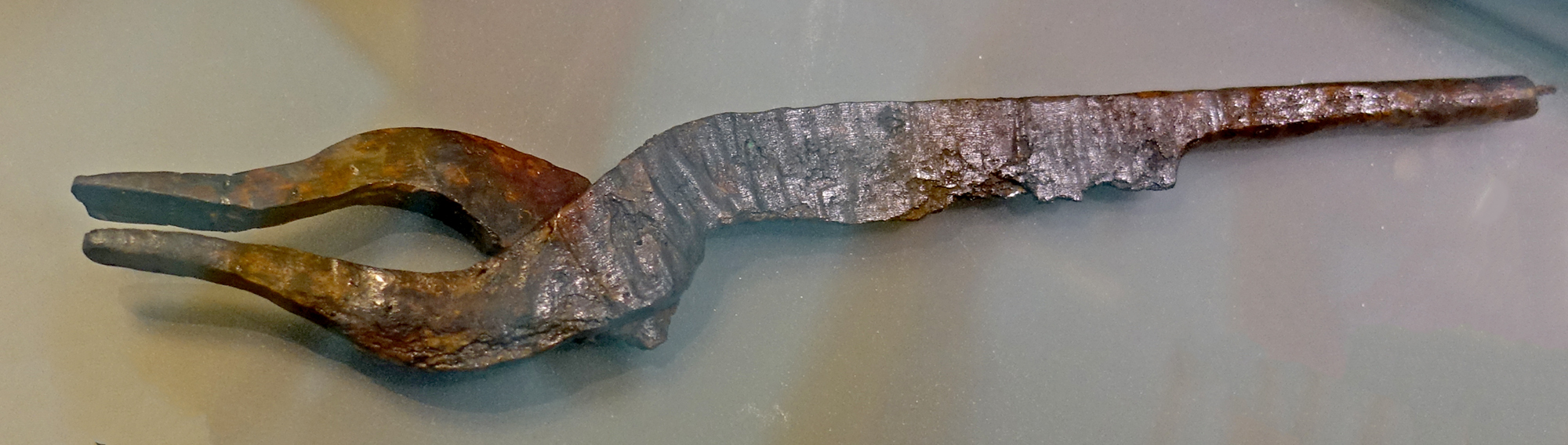
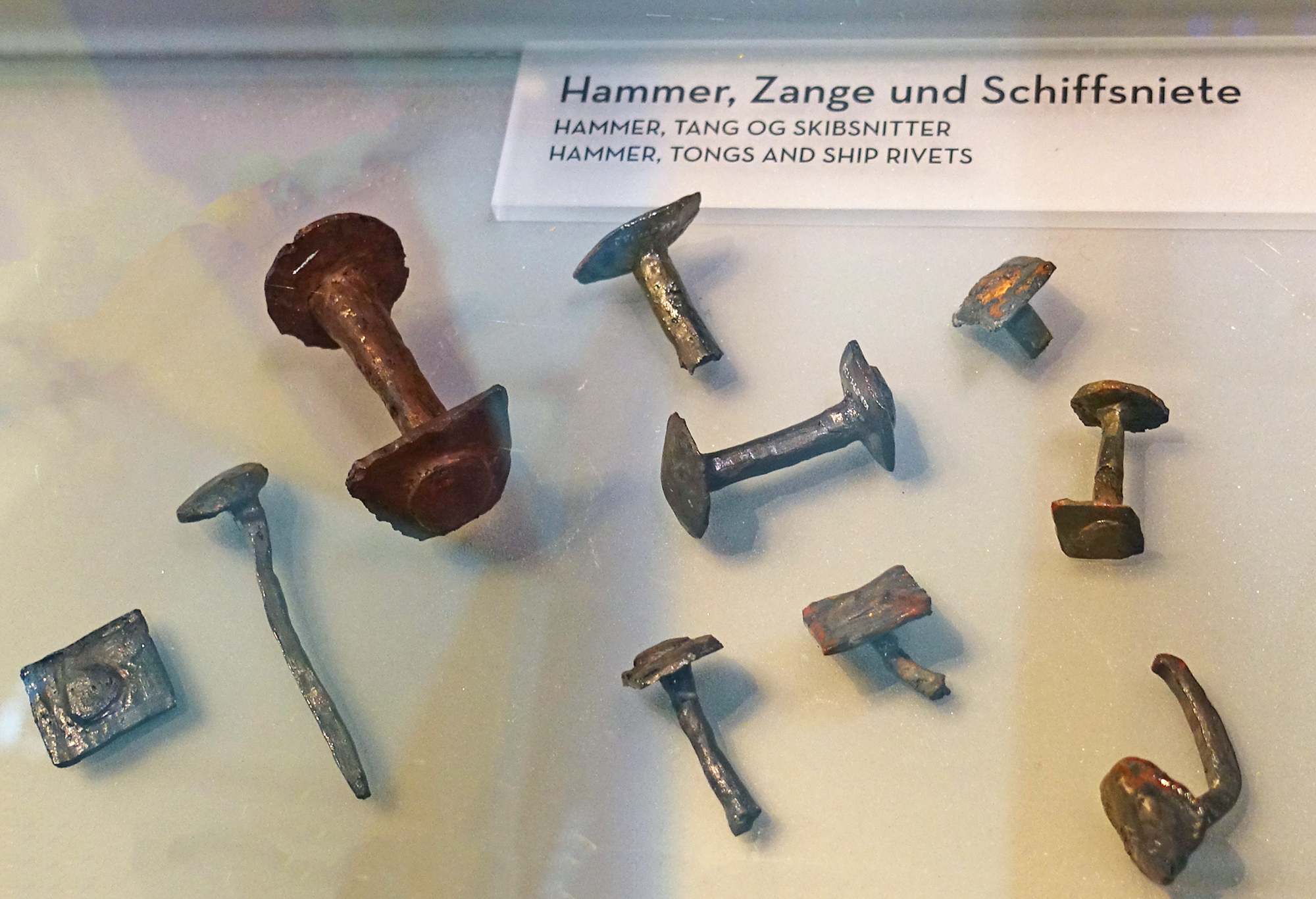
Hammer, tongs, and ship rivets.
Photo: Don Hitchcock 2018
Source and text: Wikinger Museum Haithabu and various other sources.
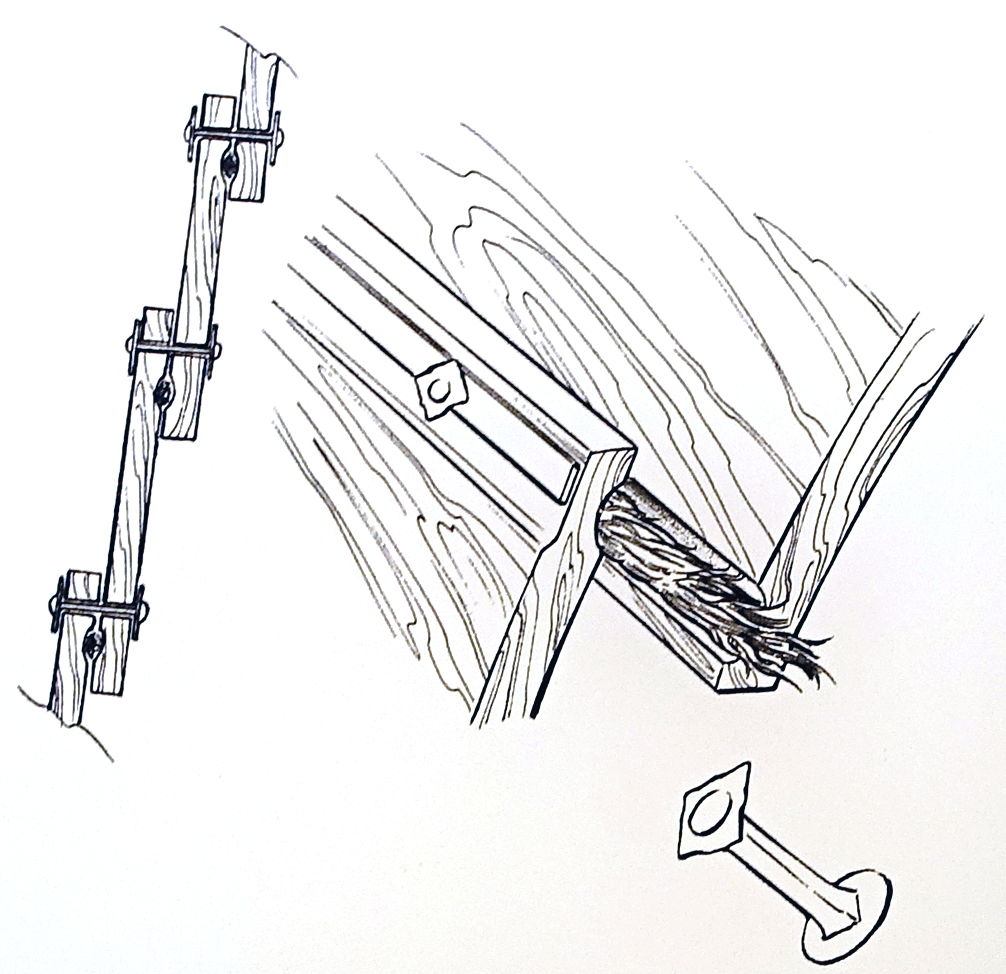
Iron rivets connect the planks
The clinker-built method is characteristic of Scandinavian shipbuilding;
in this technique, the hull is constructed from thin, overlapping
planks. Iron rivets are used to fasten the planks together.
Approximately five rivets are required to join two planks over a
length of one meter. Even in a relatively small boat with a total
length of 14 metres, around 1 000 rivets are used.
Each rivet consists of a shaft with a head, paired with a perforated
rove—a small, typically rhombic-shaped metal plate. During
assembly, the rivet shaft is passed through the planks and the
rove, then hammered over or flattened out to secure the joint.
( Note also the caulking between the planks in this diagram.
Viking longships used tarred wool, animal hair, or moss packed between the overlapping hull planks (strakes) to make the seams watertight - Don )
Photo: Don Hitchcock 2018
Source and text: Wikinger Museum Haithabu and various other sources.
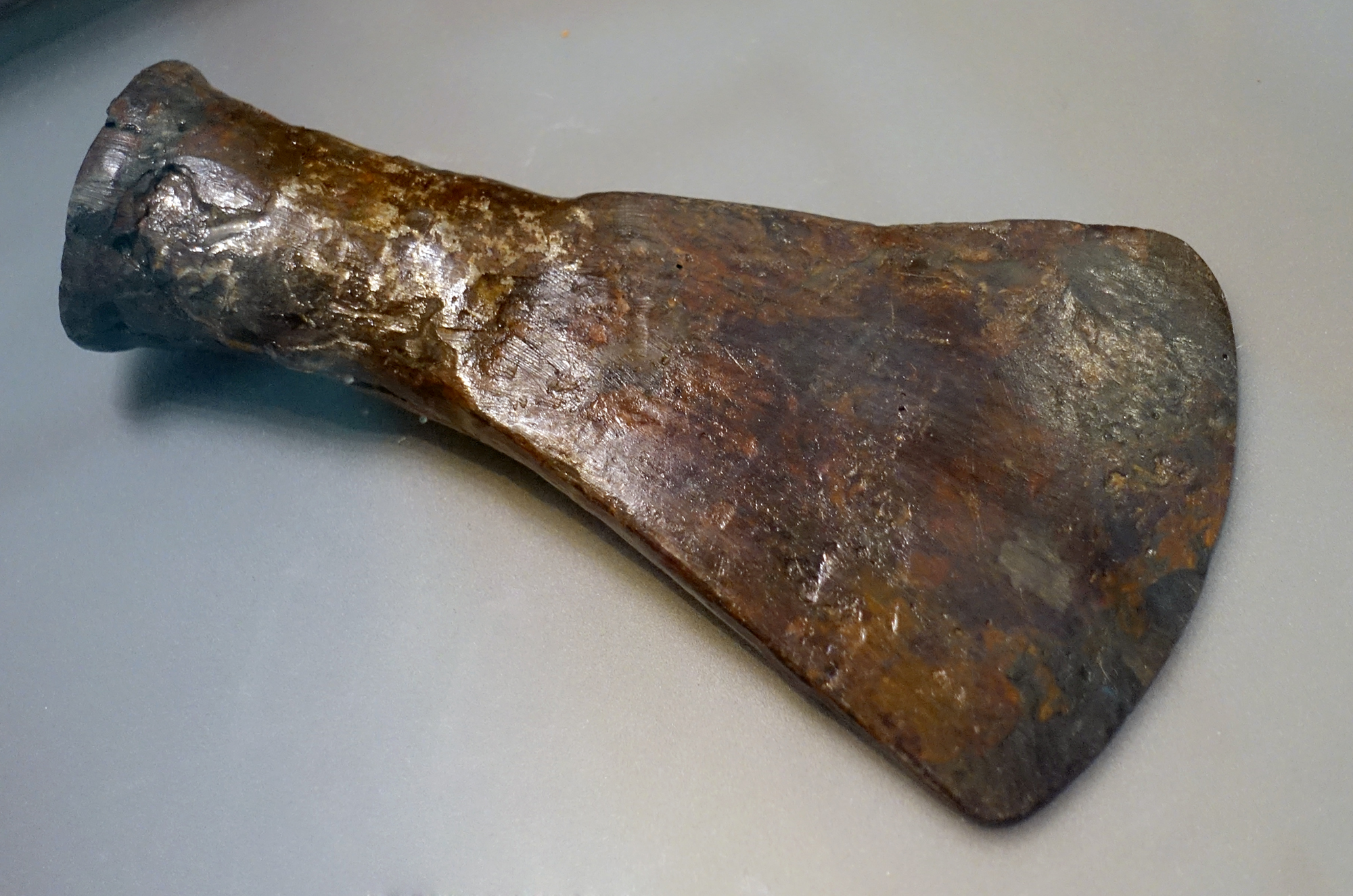
A wood-working iron axe head from Haithabu, circa 15.5 cm long.
Photo: Don Hitchcock 2018
Source and text: Wikinger Museum Haithabu and various other sources including virtualvikings.sites.carleton.edu/uncategorized/viking-axes/
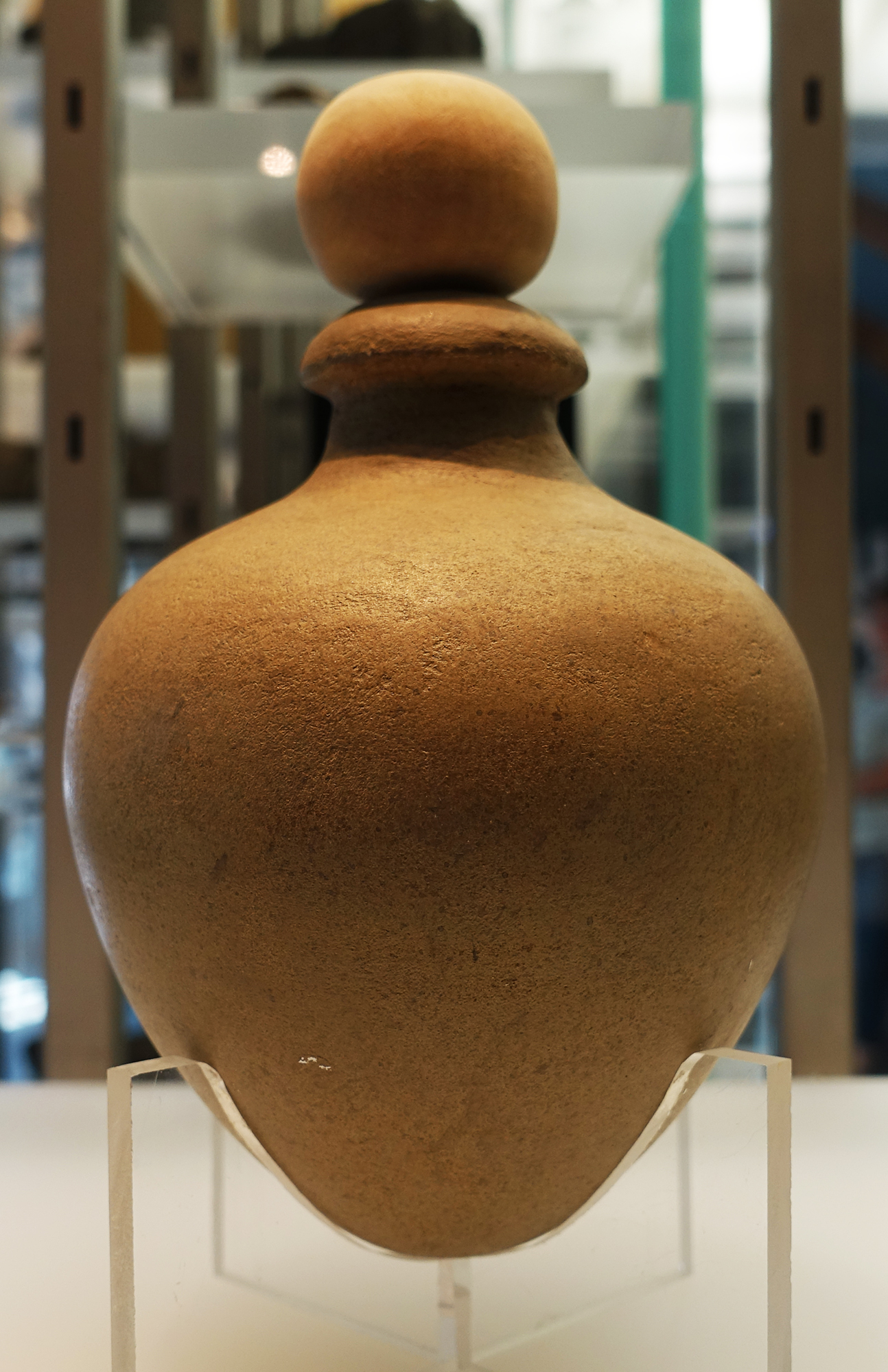
This is an Islamic-style sphero-conical vessel which highlights the incredible reach of Viking trade routes.
Haithabu functioned like a massive hub connecting Northern Europe with the Silk Road and the Islamic world. It is well-documented that quicksilver (mercury) was imported as a luxury commodity from Central Asia.
Viking-age craftsmen highly prized quicksilver for fire-gilding (amalgam gilding), a dangerous metalworking process where gold is dissolved in mercury, brushed onto jewelry or weapons, and heated to evaporate the mercury—leaving behind a beautiful, permanent gold plating.
Microchemical testing on artefacts found at Hedeby - including testing on ancient stone touchstones used to assess precious metals - has directly identified mercury and brass amalgamation residues left behind by local Viking metalworkers.
These thick-walled, heavy clay jars were the perfect choice to transport highly toxic, heavy, and valuable liquid mercury across long and bumpy sea voyages without breaking.
Photo: Don Hitchcock 2018
Source and text: Wikinger Museum Haithabu
Additional text: Various other sources including the London Museum
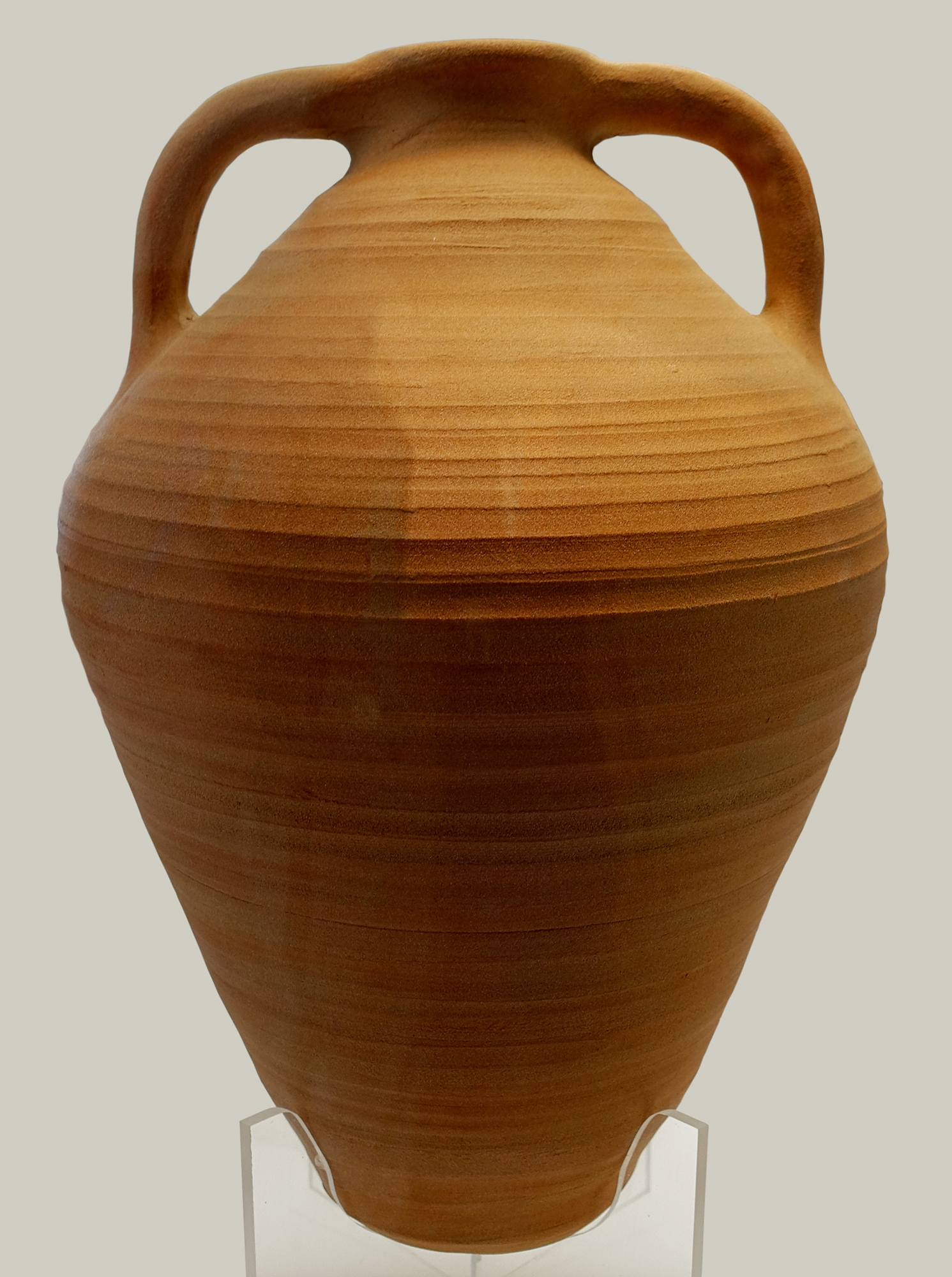
Byzantine Amphora
From the 10th century onwards, workshops in western Asia Minor produced amphorae featuring grooved decoration and a white clay slip. These thick-walled vessels were used to transport wine and oil—via the Dnieper River—as far as Scandinavia.
The Dnieper or Dnepr, also known as the Dnipro, is one of the major transboundary rivers of Europe, rising in the Valdai Hills near Smolensk, Russia, before flowing through Belarus and Ukraine to the Black Sea. From there the amphorae would have been shipped through the Turkish Straits to the Mediterranean Sea, and from there to Scandinavia.
Photo: Don Hitchcock 2018
Source and text: Wikinger Museum Haithabu
Additional text: other sources, including Wikipedia
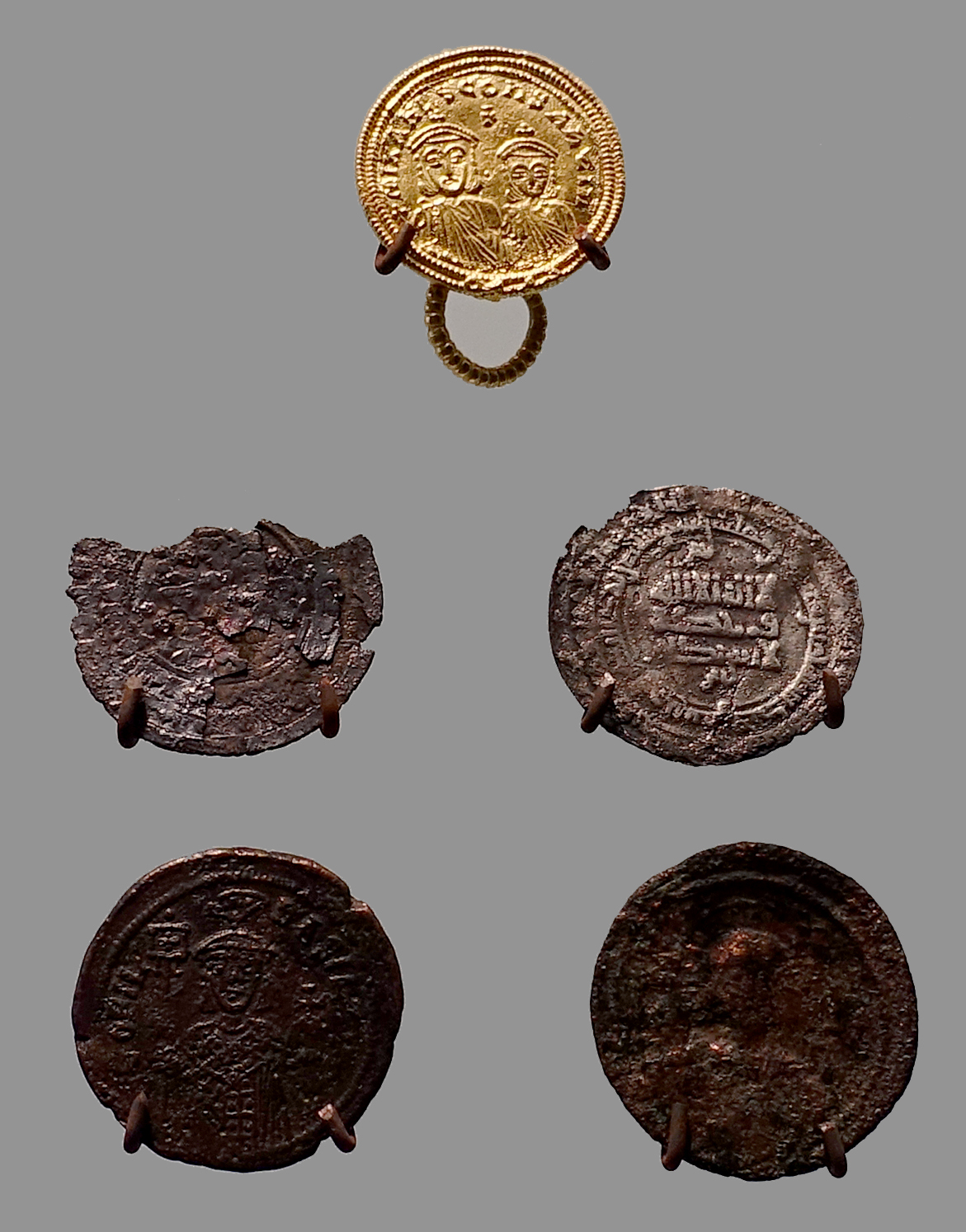
Byzantine and Islamic Coins
Byzantine coins occasionally reached Scandinavia, primarily in the form of gold coins. Copper coins, by contrast, held no significance as a medium of exchange in the region. During the late 9th and 10th centuries, large quantities of Islamic silver coins arrived in the North via Eastern Europe. In Hedeby (Haithabu), the value of these coins was determined primarily by the precious metal from which they were minted. The silver used for these Islamic coins originated from mines in Central Asia.
Photo: Don Hitchcock 2018
Source and text: Wikinger Museum Haithabu
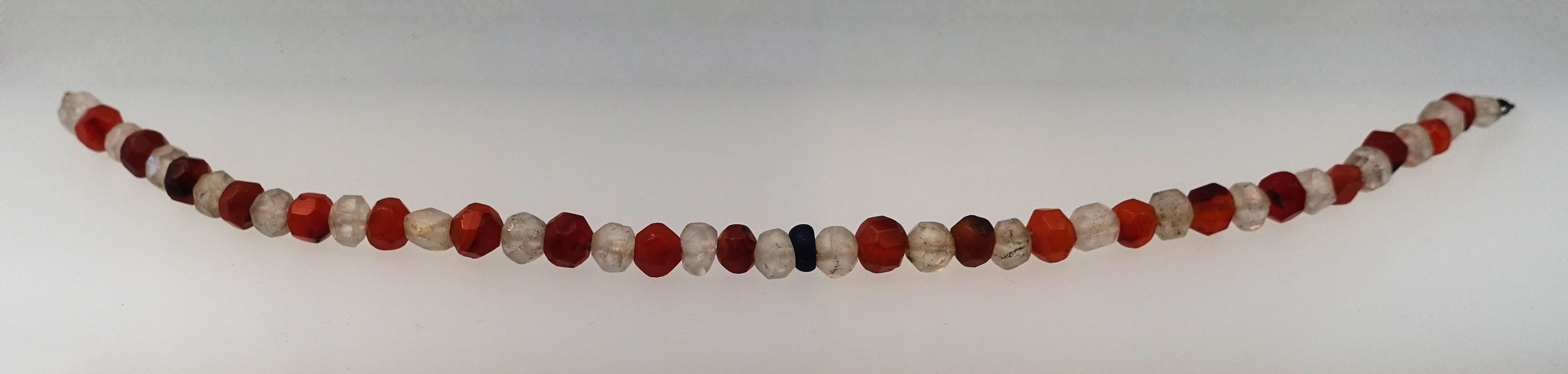
Carnelian and Rock Crystal
Beads made of carnelian and rock crystal were sought-after luxury items and likely also served as a form of currency. Rock crystal is found in many regions of Europe, whereas carnelian was mined only in the Caucasus and in India. Carnelian reached the north via the Silk Road and the rivers of Eastern Europe.
Photo: Don Hitchcock 2018
Source and text: Wikinger Museum Haithabu
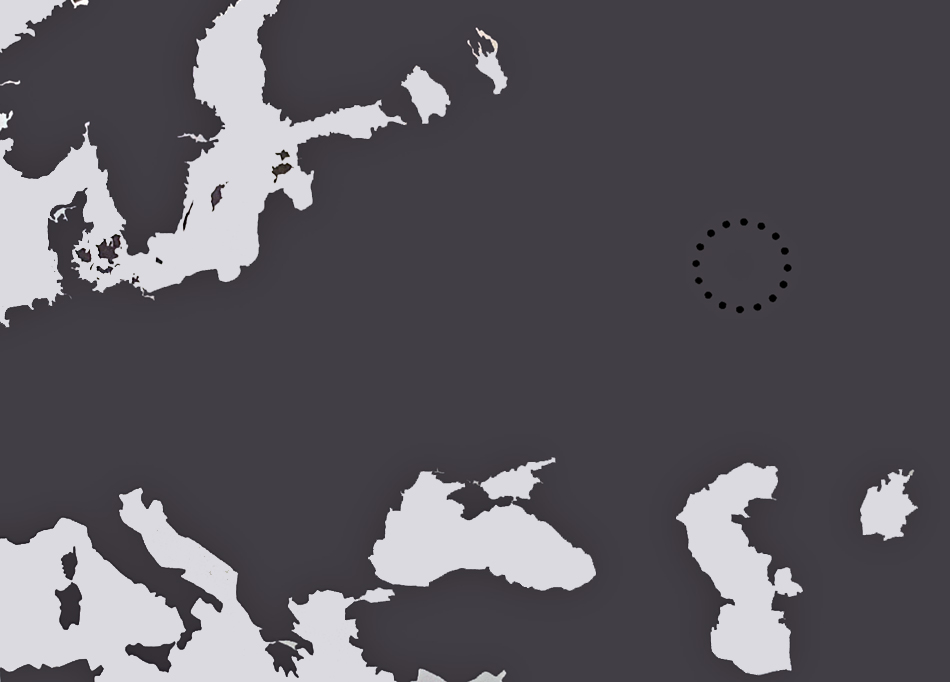
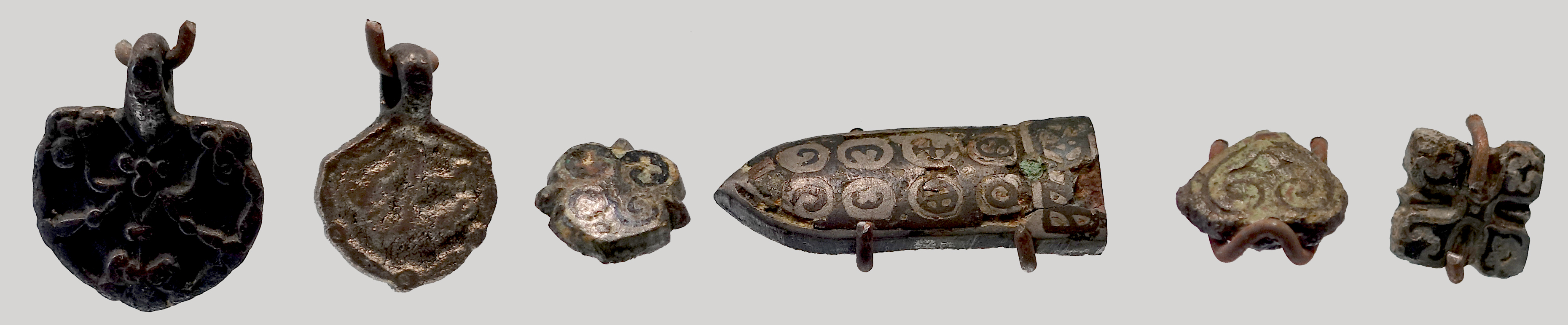
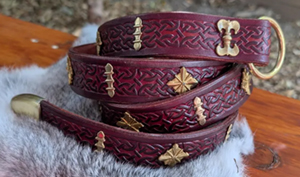
Belt Mounts of the Volga Bulgars (above)
Modern Belt Mounts in a similar style (left)
Volga Bulgars were a medieval Turkic semi-nomadic people who established a flourishing state around the confluence of the Volga and Kama rivers in European Russia (in modern-day Tatarstan, north of the Caspian Sea as shown in the map above) from the 9th to the 13th centuries.
In Eastern Europe and the Caliphate, belts featuring metal mounts were fashionable. The Volga Bulgars decorated these mounts with floral motifs consisting of trefoil-shaped blossoms and stems.
This style of ornamentation shows an Oriental influence and bears a strong resemblance to Islamic art. They were key markers of warrior rank, ethnic identity, and status across the Eurasian steppe and Volga-Kama trade routes. They appear in the archaeological record of Haithabu (Hedeby) as part of broader long-distance trade and cultural exchange networks across the Viking world. Belt mounts of the Volga Bulgars are decorative and functional metal plaques, fittings, and strap-ends used to adorn leather military and status belts during the early mediaeval period (roughly the 10th to 12th centuries).
Photo: (above) Don Hitchcock 2018
Photo: (below) https://www.etsy.com/au/listing/4571766547/
Source and text: Wikinger Museum Haithabu and other sources including Eniosova et al. (1999) and agy.vikingove.cz/en/steps-to-an-authentic-early-medieval-belt/
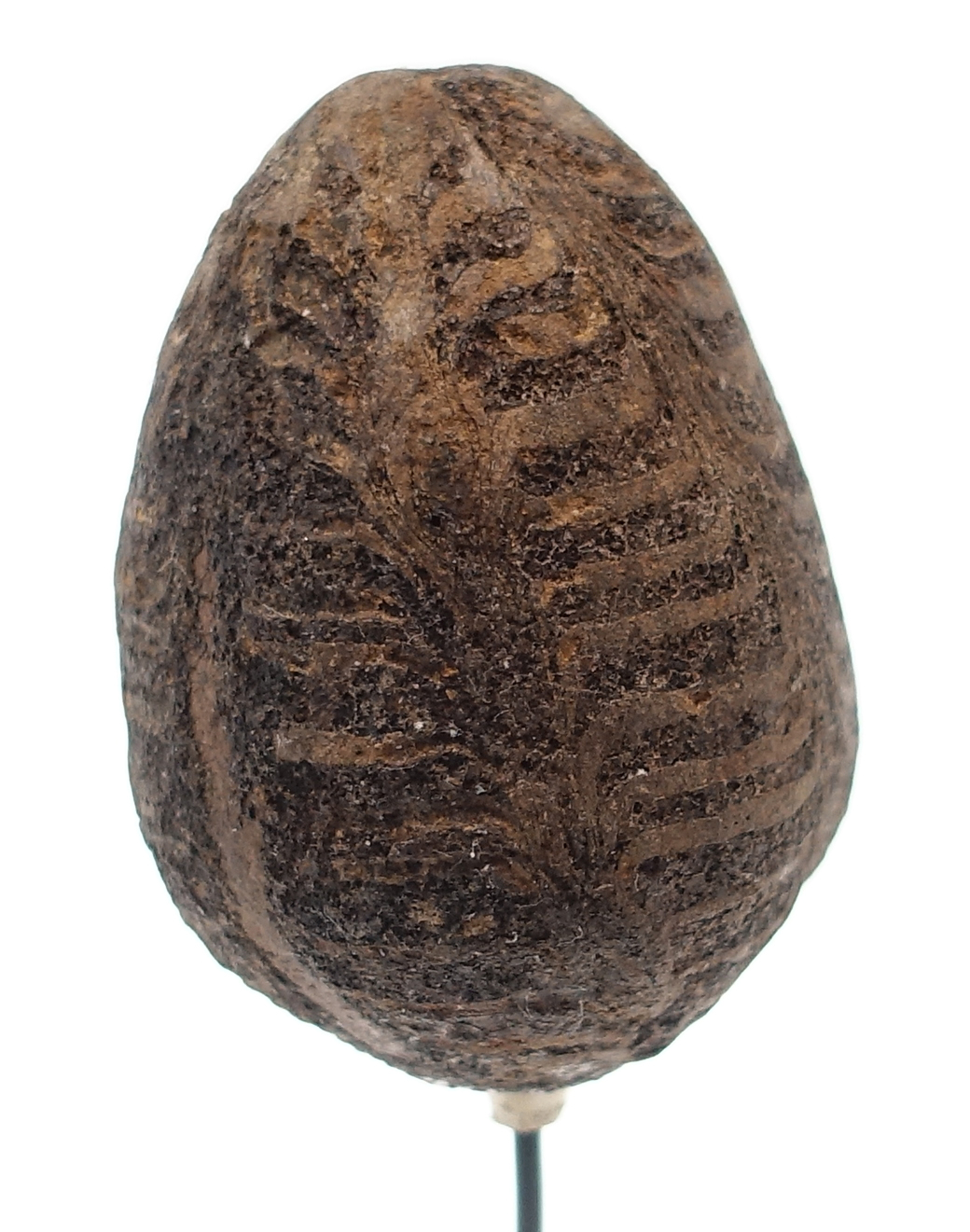
Kyiv Clay Eggs
In Eastern Europe, particularly in the region around Kyiv, small clay eggs have been produced since the 10th century. They are glazed and decorated with spiral or arched patterns. As a symbol of the Resurrection, the egg plays an important role in the Eastern Christian Church.
Artisans shaped these hollow eggs out of ordinary pottery clay. They placed a small clay ball or stone inside before firing, which creates a rattling sound when moved. After an initial firing, the objects were coated in transparent or green, brown, and reddish-yellow glazes.
Using a specialised tubular instrument, artisans painted floral, spiral, or arched patterns using contrasting yellow or green glazes before a second firing.
Originally rooted in pre-Christian pagan spring and vegetation rituals, these objects evolved following the Christianisation of Kyivan Rus' (a medieval federation of East Slavic and Finno-Ugric tribes in Eastern Europe, ruled by the Rurik dynasty from the late 9th to the mid-13th century) in 988 AD to represent the Resurrection of Christ and served as protective amulets or rattles.
Workshops around Kyiv exported these glazed ceramic items along the Varangian-to-Greek trade routes, with discoveries stretching across Eastern and Northern Europe (including Romania, Bulgaria, Poland, and Viking-era sites in Sweden).
Photo: Don Hitchcock 2018
Source and text: Wikinger Museum Haithabu and other sources including Wikipedia
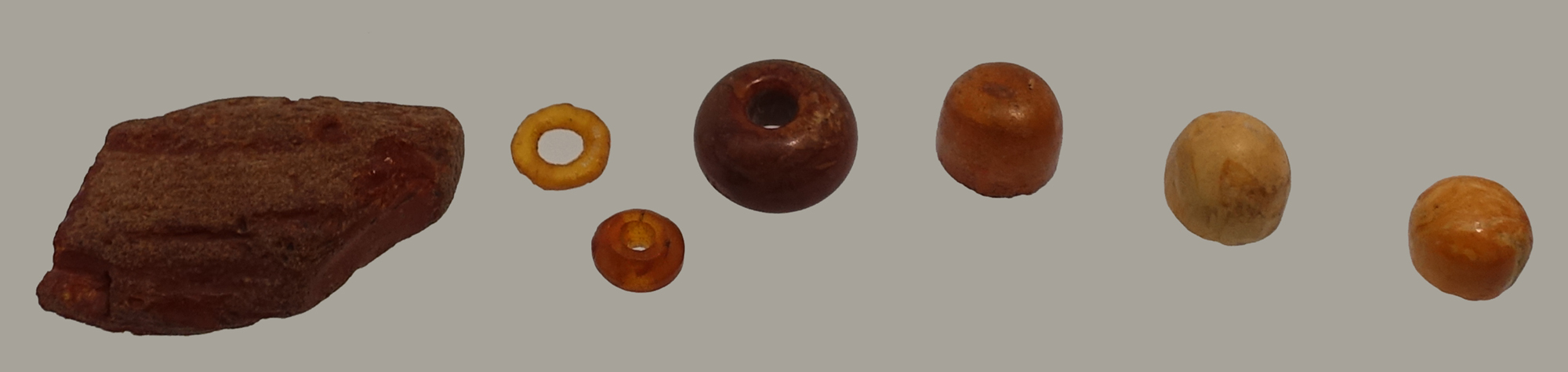
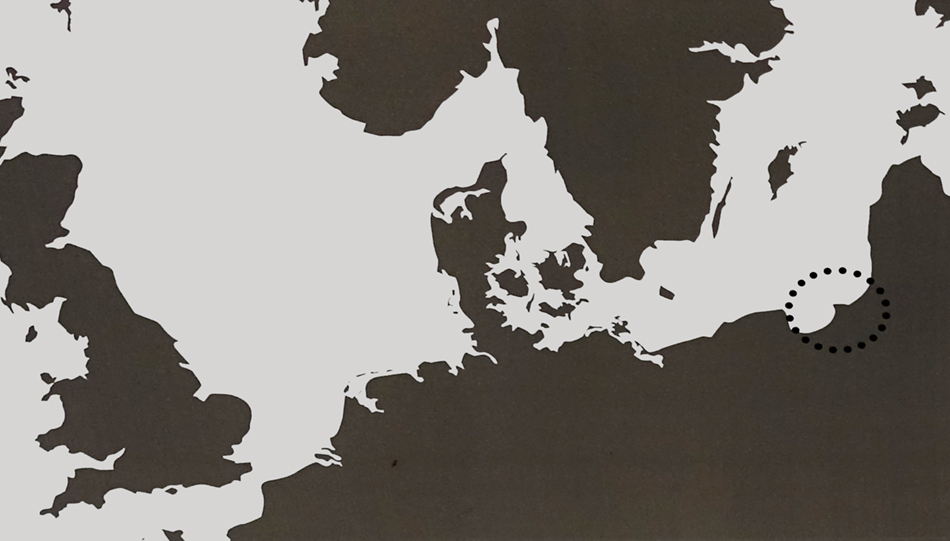
Amber is easy to work with and a popular material for
amulets, beads, and game pieces. Its colour and transparency
are the key factors behind the special fascination exerted by
this fossilised resin.
While amber can also be found along the coasts of Jutland and even in the Schlei (a narrow inlet of the Baltic Sea in Schleswig-Holstein in northern Germany. It stretches for approximately 20 miles from the Baltic near Kappeln and Arnis to the town of Schleswig)
Amber from the Sambian Peninsula on the Baltic Sea is particularly sought after as a raw material.
Photo and rephotography: Don Hitchcock 2018
Source and text: Wikinger Museum Haithabu and other sources including Wikipedia
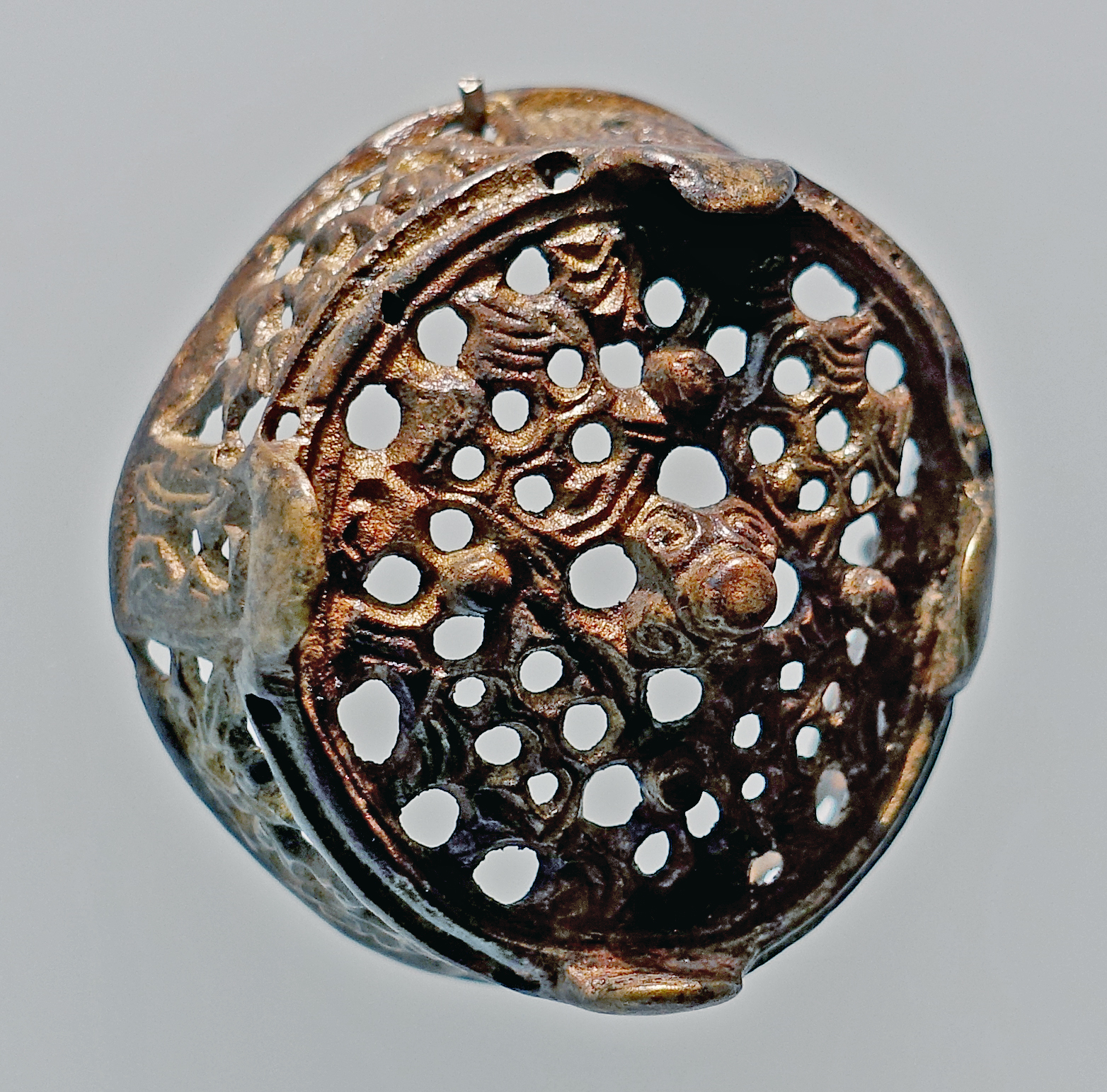
Gotland Jewellery
On the Baltic Sea island of Gotland, women often wore two animal-head brooches in combination with a box brooch. In the rest of Scandinavia, a three-brooch ensemble consisting of a pair of oval brooches and either a disc or a trefoil brooch was the prevailing fashion.
A box brooch (also called a drum brooch) is a unique, hollow, round metal fastener worn almost exclusively by women on the Swedish Baltic island of Gotland during the Viking Age (roughly 700 to 1100 AD).
These brooches are round, cylindrical, or drum-shaped containers cast from bronze, copper alloy, silver, or gold. The top and sides feature intricate openwork or cast patterns, frequently depicting stylised animal interlaced designs.
( This one has the stylised head of an animal, remarkably like a large eyed dog with a big nose, in the central portion - Don )
Women wore them at the collarbone or throat to fasten shawls, cloaks, or heavy outer garments. True to their name, they were hollow and doubled as small storage containers. Archaeologists have found traces of small items inside them, including coins, wool, organic matter, or fragments of fabric.
Photo: Don Hitchcock 2018
Source and text: Wikinger Museum Haithabu, as well as other sources including www.scandinavianarchaeology.com, the Metmuseum, and www.replik-shop.de
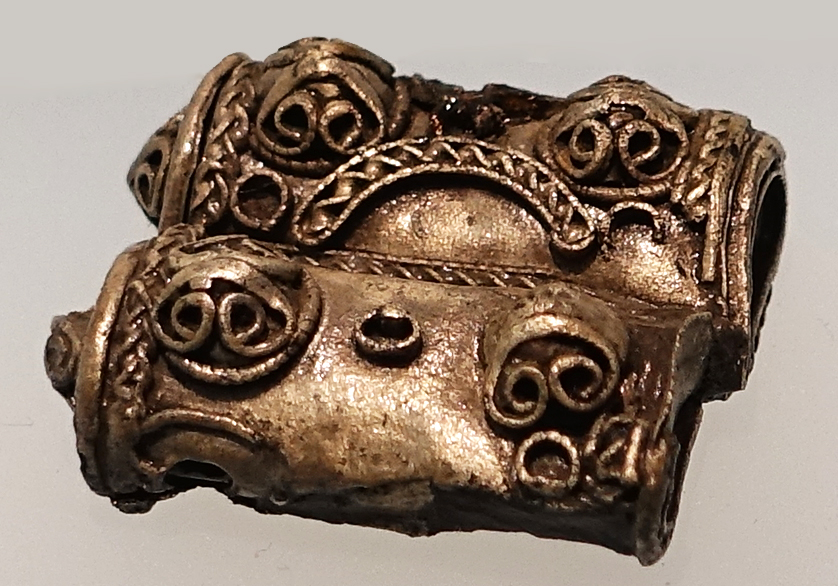
Kaptorgen, capsule shaped pendants made of sheet metal, are widespread in Poland and Pomerania. They are typically crafted from silver and decorated with filigree and granulation. In the Eastern Church, they serve as reliquaries, though they are also suitable for holding aromatic substances.
( Pomerania is an historical region on the southern shore of the Baltic Sea in Central Europe, split between Poland and Germany - Don )
Photo: Don Hitchcock 2018
Source and text: Wikinger Museum Haithabu
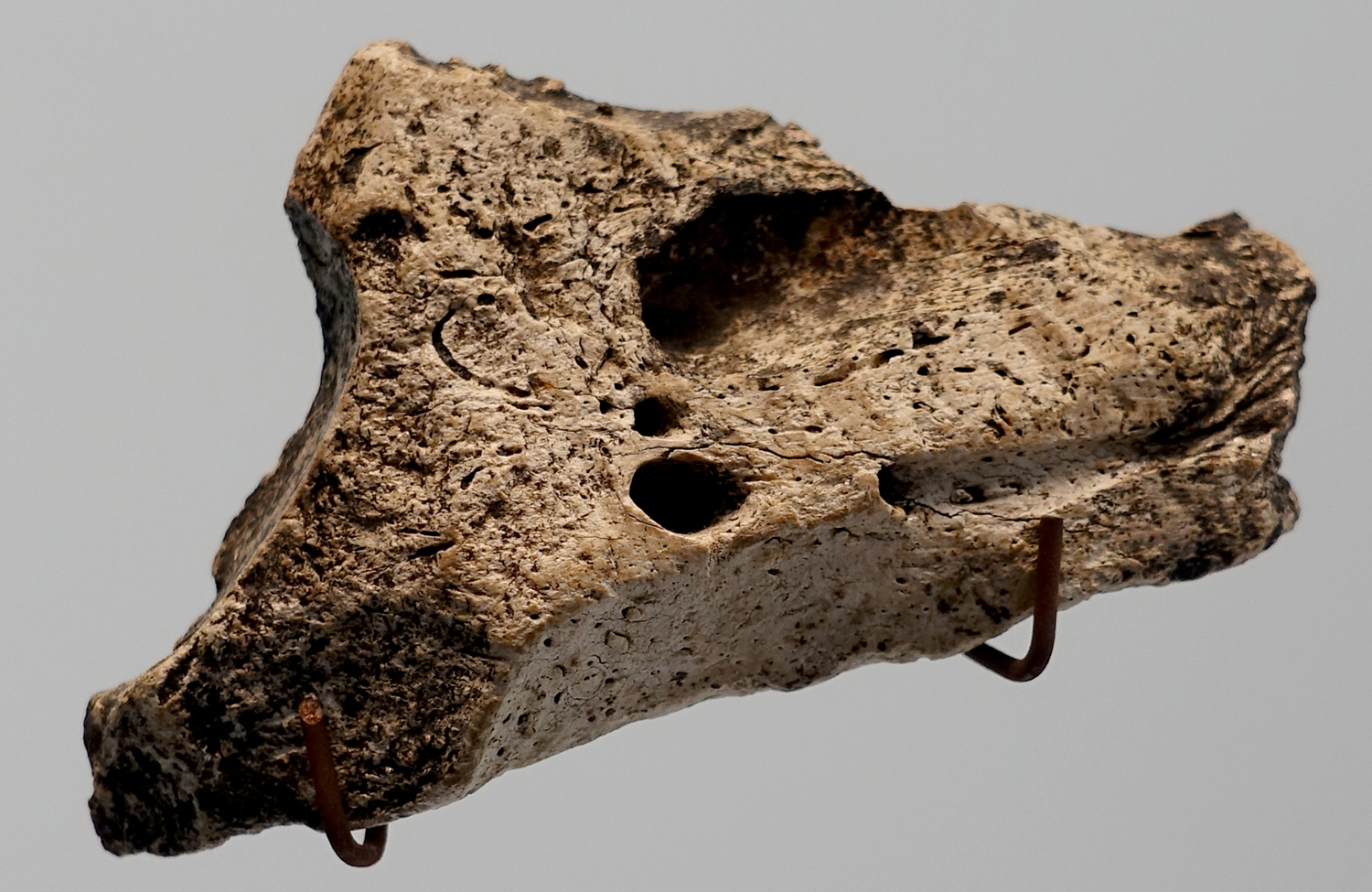
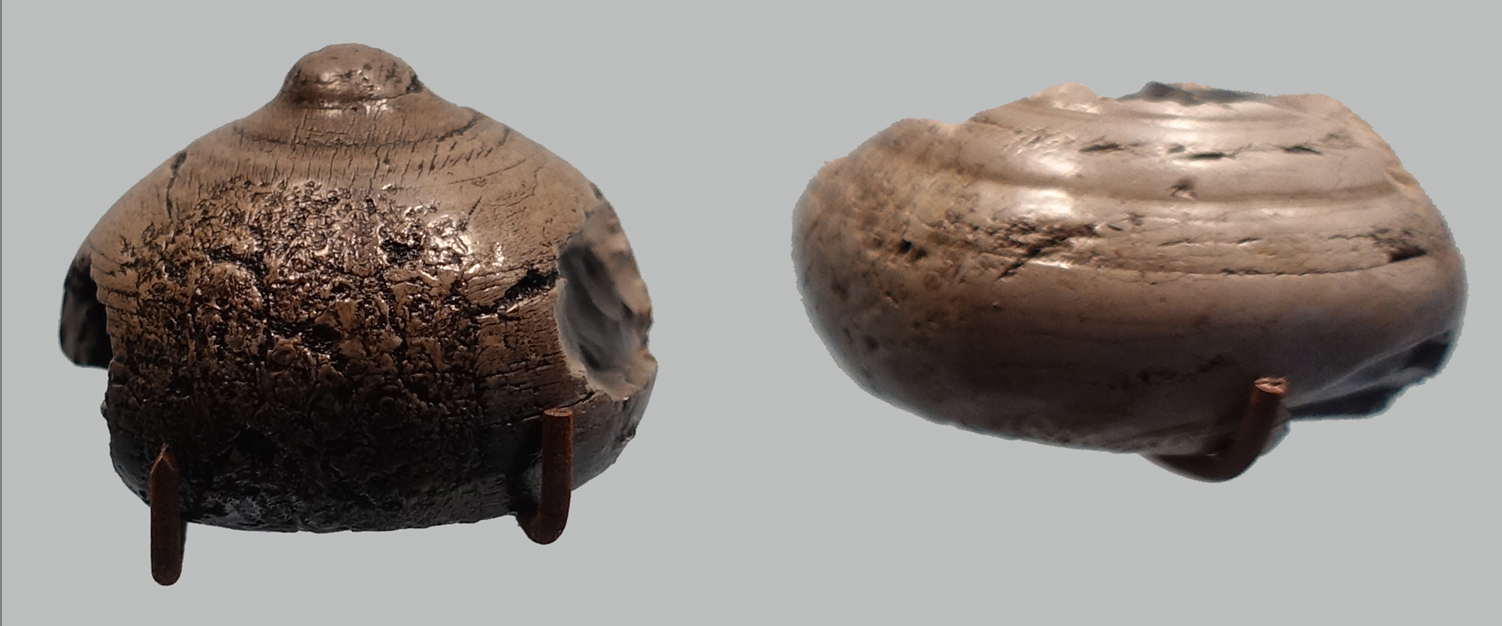
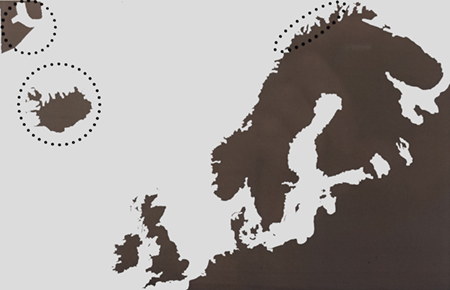
Walrus tusk is among the most valuable commodities from the North, used to create intricate carvings.
Walruses can still be found in the coastal waters of Northern Norway and along the west and north coasts of Iceland. From the 11th century onwards, Greenland became the primary source of walrus tusk. Out of the broader Atlantic walrus total (estimated between 207 000 and 40 000 animals across the Arctic), Greenland and its shared Canadian - Greenlandic stocks account for a major share, with rough regional estimates placing Greenland's local stock around 4 500 individuals alongside the vital Thule and East Greenland groups.
Rephotography and photo: Don Hitchcock 2018
Source and text: Wikinger Museum Haithabu, as well as Garde, Hansen (2021)
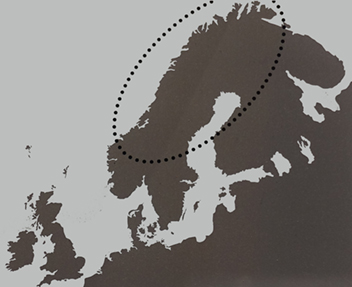

Precious furs
Tundra and taiga covered vast areas of Northern Norway. Reindeer herding,
as well as the hunting of birds and small fur-bearing animals such as
the arctic fox, marten, lynx, and squirrel formed the economic foundation
for the region’s inhabitants. Furs were highly sought-after commodities,
transported southward by sea along the coast.
Rephotography of map: Don Hitchcock 2018
Photo of arctic fox www.panachecruises.com
Source and text: Wikinger Museum Haithabu
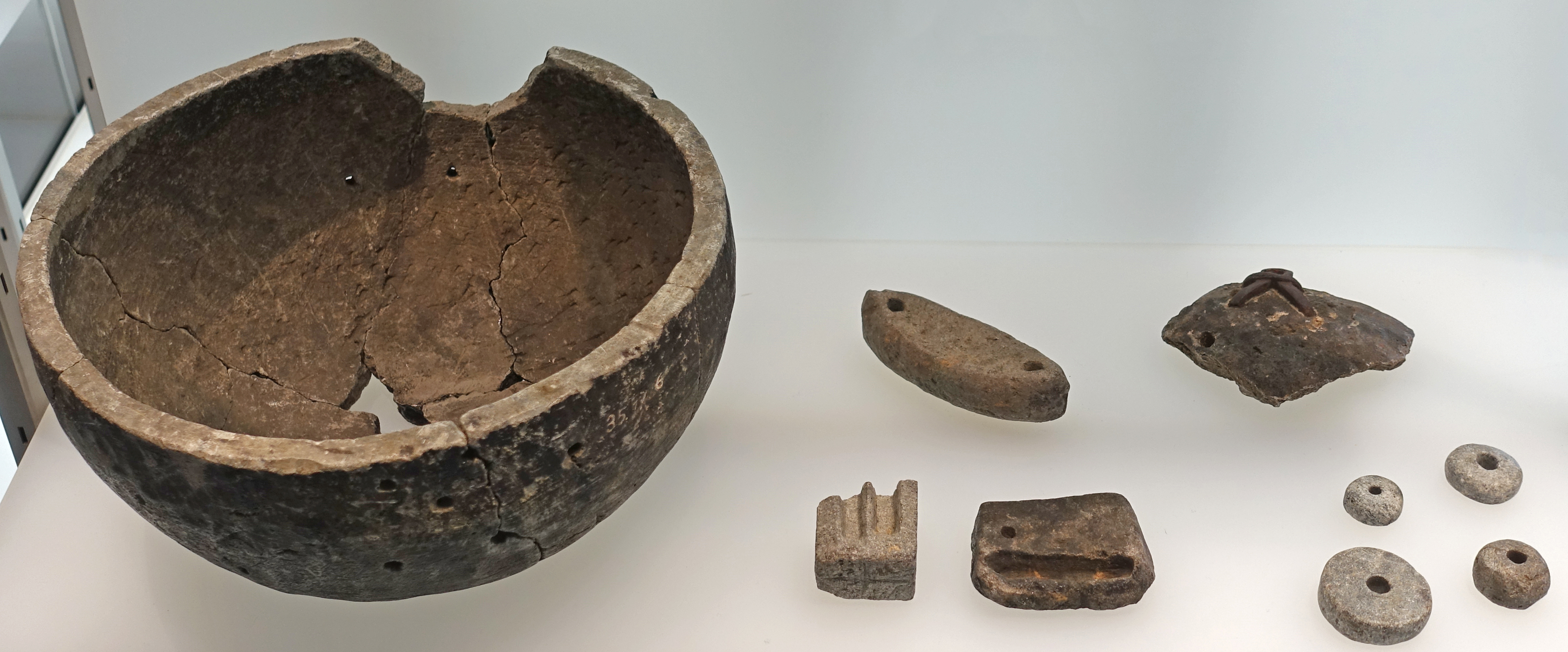
Soapstone
Over the centuries, an estimated 6.5 tons of soapstone were shipped to Hedeby from quarries in eastern Norway and southwestern Sweden. This stone is particularly well-suited for crafting everyday objects—such as cooking vessels or casting moulds because it is soft and easy to work with, yet also heat-resistant.
When creating casting moulds, craftspeople sometimes utilise every surface of a piece of soapstone, incorporating moulds of various sizes onto a single block. This results in a tool that saves on material, weight, and space.
How the Soapstone Mould Process Works:
Material Preparation: A block of soapstone is squared and flattened. Soapstone is soft enough to carve easily with standard knives and chisels, yet thermally stable enough to handle molten metal.
The design is drawn in reverse (mirrored) onto the stone and carved into relief. Undercuts are avoided so the hardened metal can slide out easily.
Open-Face Moulds: A single block of soapstone carved on one side, sometimes paired with a flat backing plate, used for flat items like ingots, axes, or pendants.
Bivalve / Multi-Part Moulds: Two or more matched stone blocks are aligned using registration marks or pins, clamped tightly together, and used to cast 3D objects like rings, pins, or buttons. A funnel shaped pouring channel (called a sprue) is carved at the top to let molten metal flow in smoothly. Small vent paths may also be added to let trapped air escape.
The soapstone must be completely bone dry before use. Any trapped moisture can turn to steam and cause the molten metal to pop or explode. Preheating the mould also stops the metal from chilling too fast and ensures a clean fill.
Molten metal is poured in a steady, continuous stream. Once cooled, the clamps are removed, the stone halves are separated, and the metal cast is pulled out and trimmed of excess flashing or sprues.
( If I were doing this in Viking times, then for a simple open face mould I would make the required shape out of potter's clay, dry it and fire it in a kiln. Then I would create a negative of it by pressing it into potter's clay, then dry and fire the negative shape. Then I would use the negative pottery shape as a guide to carving out the soapstone into the required shape, testing it with the soapstone with the positive shape to see where more material needed to be carved out - though this is not a perfect method, since the firing process probably makes the negative shape smaller than the positive. But having the negative shape as a guide to the carving would be at least an advantage - Don )
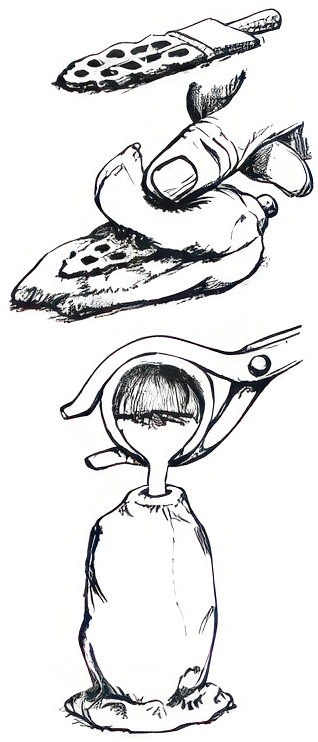
Viking artisans also used the lost wax casting method to make intricate and detailed jewellery.
When doing this they used beeswax. Artisans sculpted the initial design of an ornament, arm ring, or brooch out of beeswax.
The wax model was packed inside a mixture of clay and sand (or tempered-clay mixtures). The clay mould was heated up, causing the beeswax to melt and run out (hence 'lost wax'), leaving an empty, hollow cavity.
Molten metal such as silver (often melted down from Arabic dirhams), bronze, or rarely gold - was poured into the cavity.
Once the metal cooled, the outer clay mould was broken away, and the piece was filed, punched, and polished.
( The disadvantage of the lost wax method is that only one piece could be made from each wax original, while the soapstone method allows multiple exact copies to be made - Don )
Top photo: Don Hitchcock 2018
Drawing and text for the lost wax method: regia.org/research/life/bronzework.htm (artist unrecorded)
Source and text: Wikinger Museum Haithabu, as well as others such as www.instructables.com/Casting-Pewter-in-Soapstone/, ynysfawr.lochac.sca.org/files/pdf/Metal-Casting.pdf, orchid.ganoksin.com/t/casting-improvised-molds/28486, eirny.com/2015/02/16/casting-metal-soapstone-molds-part-1/, regia.org/research/life/bronzework.htm
Slate Whetstones
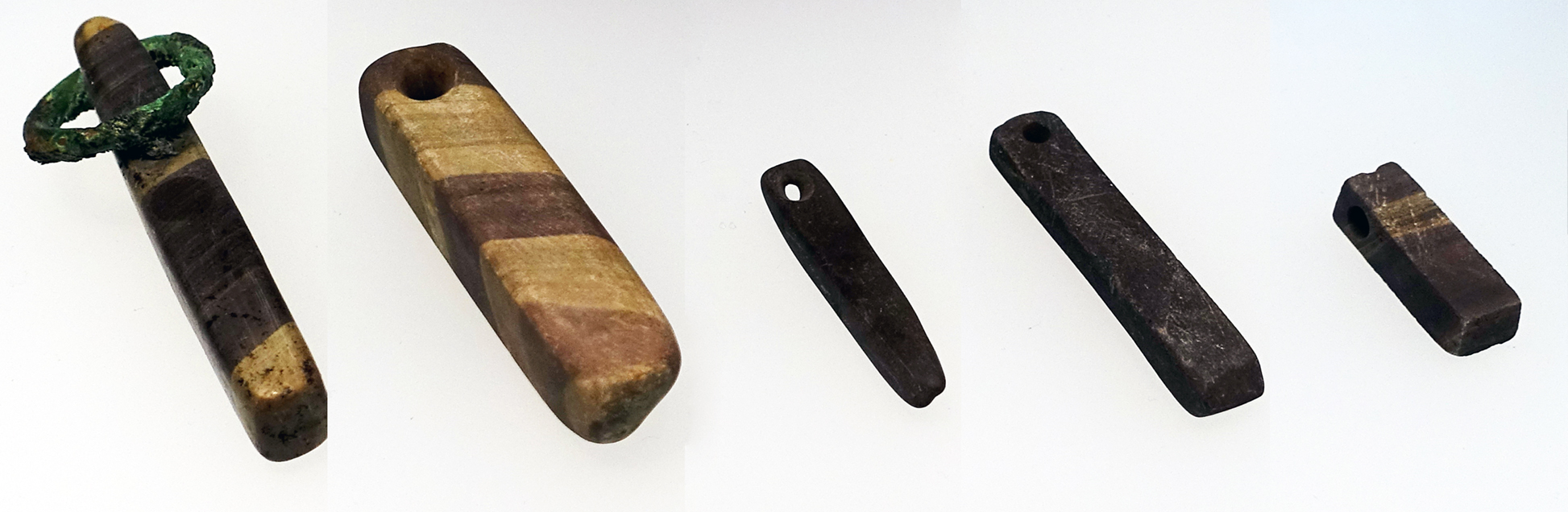
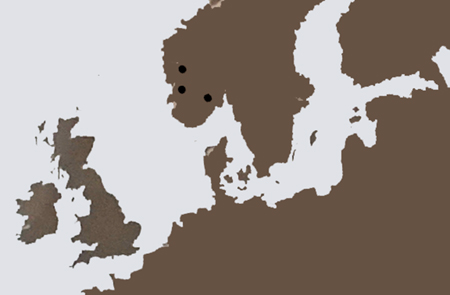
Norwegian slate is highly suitable for sharpening blades of all kinds. It is traded as a bulk commodity in the form of blocks, which are then fashioned into bar-shaped whetstones at their final destination.
Banded Slate is rich in Quartz. High-quality Norwegian slates (such as those traditionally mined from historical areas like Eidsborg or Mostadmarka) are packed with micro-fine, uniform quartz particles. It is this quartz content that gives the slate its hardness and allows it to cut metal efficiently.
Banded slate and similar metamorphic rocks (like purple phyllite or ragstone schists) were primary materials used for 'Viking whetstones'. They were highly valued, heavily traded commodities across Scandinavia and Europe for centuries to maintain weapons and everyday tools.
Top photo: Don Hitchcock 2018
Map: rephotography Don Hitchcock
Source and text: Wikinger Museum Haithabu
Additional text: www.visitnorway.com/listings/whetstones-from-eidsborg/15065/
Millstone
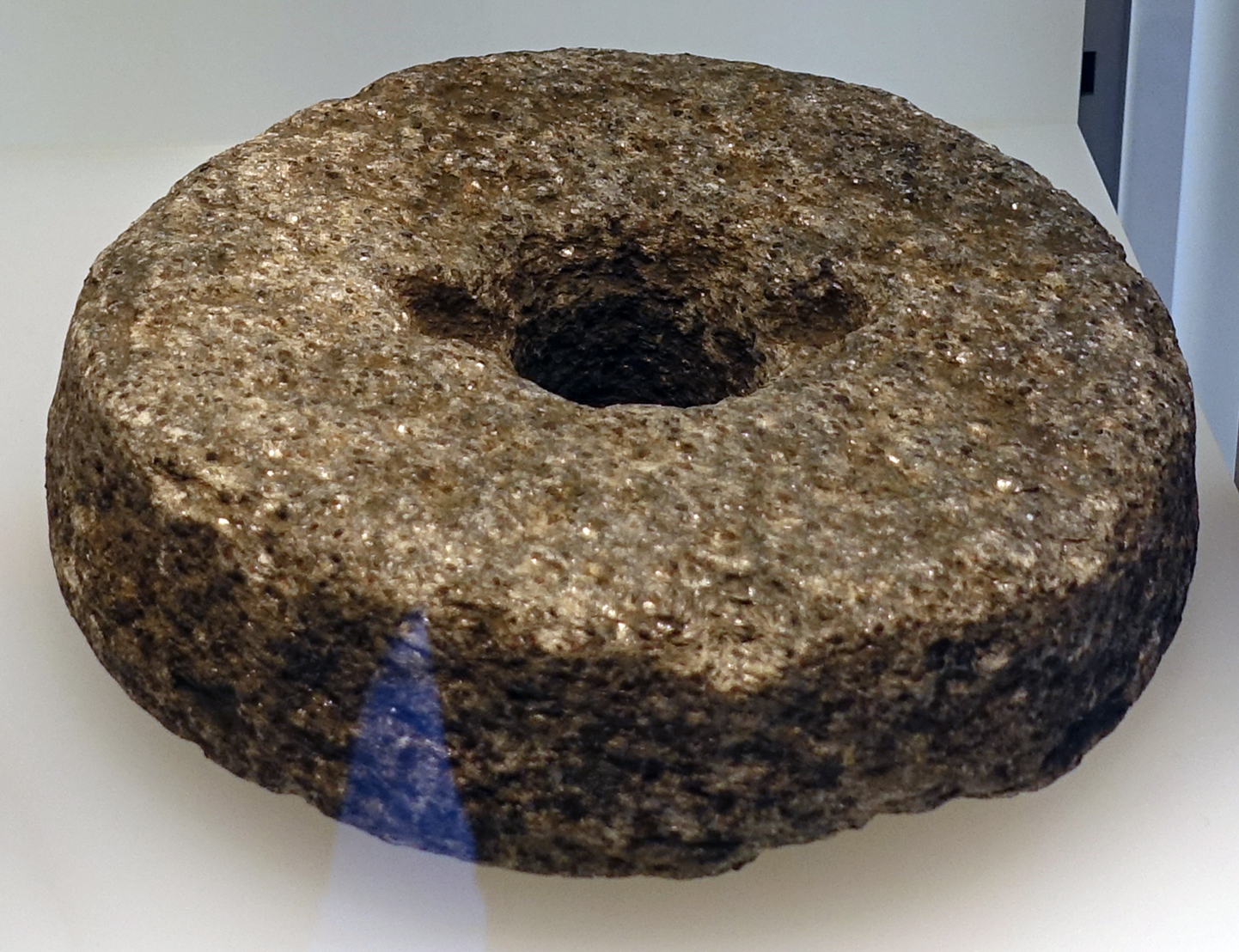
Since at least the 11th century, millstones in the Baltic Sea region have been produced not only from the Eifel basalt but also from Norwegian garnet-bearing mica schist from areas such as Hyllestad, north of Bergen on the west coast Fjordland of Norway. The garnets embedded within the soft mica schist improve its grinding properties.
Photo: Don Hitchcock 2018
Source and text: Wikinger Museum Haithabu
Additional reference: Garde, Hansen (2014)
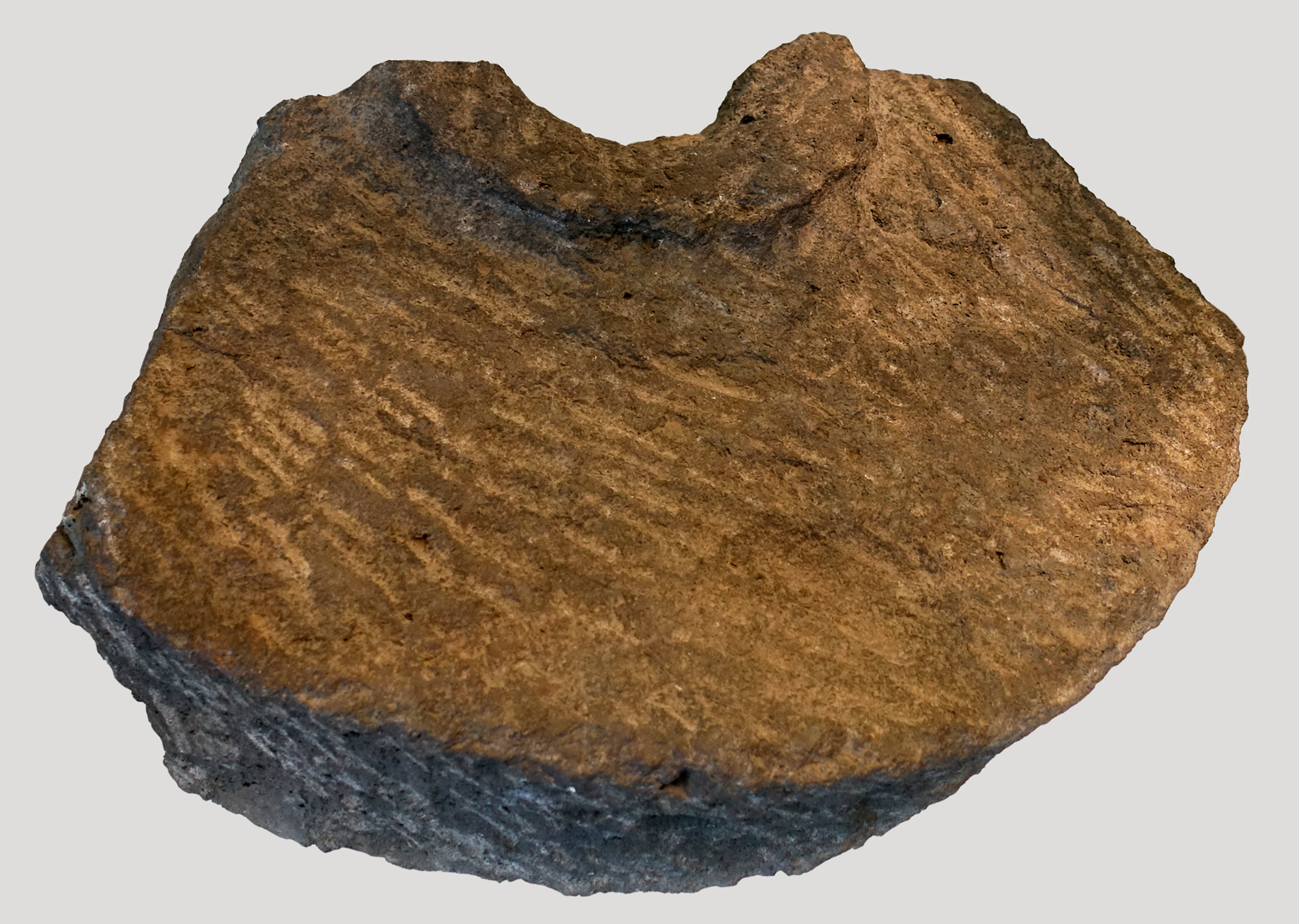
Basalt
Every household used a hand-operated mill for grinding grain. Millstones made from porous basalt lava are particularly well-suited for this purpose.
This rock was quarried in the Eifel region and shipped to Central and Northern Europe via the Rhine port of Andernach. It is only upon reaching their final destinations that the stone was fashioned into ready-to-use mills.
( The Eifel basalt, the Volcanic Eifel (Vulkaneifel), referred to above is located in the state of Rhineland-Palatinate in western Germany, situated southwest of Bonn and west of the Rhine River - Don )
Photo: Don Hitchcock 2018
Source and text: Wikinger Museum Haithabu
Early Medieval and Viking rotary querns typically used a convex (outward-curved) lower stone that fit into a matching concave (inward-curved) upper stone. The facing surfaces of the stones, including the lower stone, frequently featured chiselled or pecked grooves. These channels directed the grain outward from the central hopper and helped guide the crushed flour toward the outer edge where it could be collected.
The Viking hand mill consisted of a stationary bottom stone and a mobile top runner stone turned manually by an eccentric wooden handle. Grains were dropped through a central hole in the top stone and ground via friction as the stone spun. Milling required multiple passes and significant physical effort. roughly 300g of wheat yielded enough flour for two to three small flatbreads. Excavations at sites like Birka in Sweden and rural settlements in Denmark show that these quern stones were standard household tools. Tiny fragments of stone naturally wore off into the flour, which caused heavy wear and damage to Viking teeth over time.
Text above: Various sources, including Wikipedia
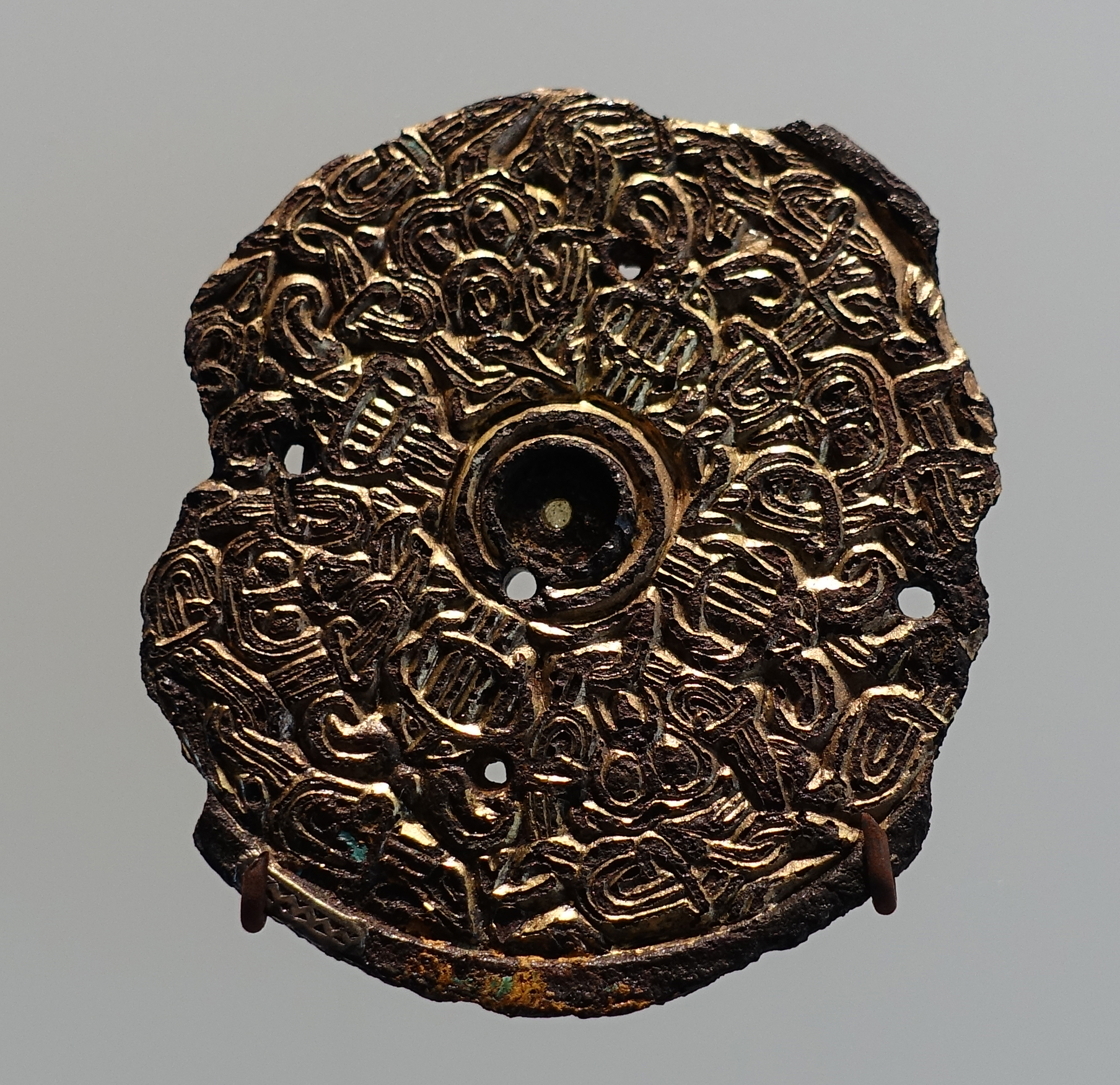
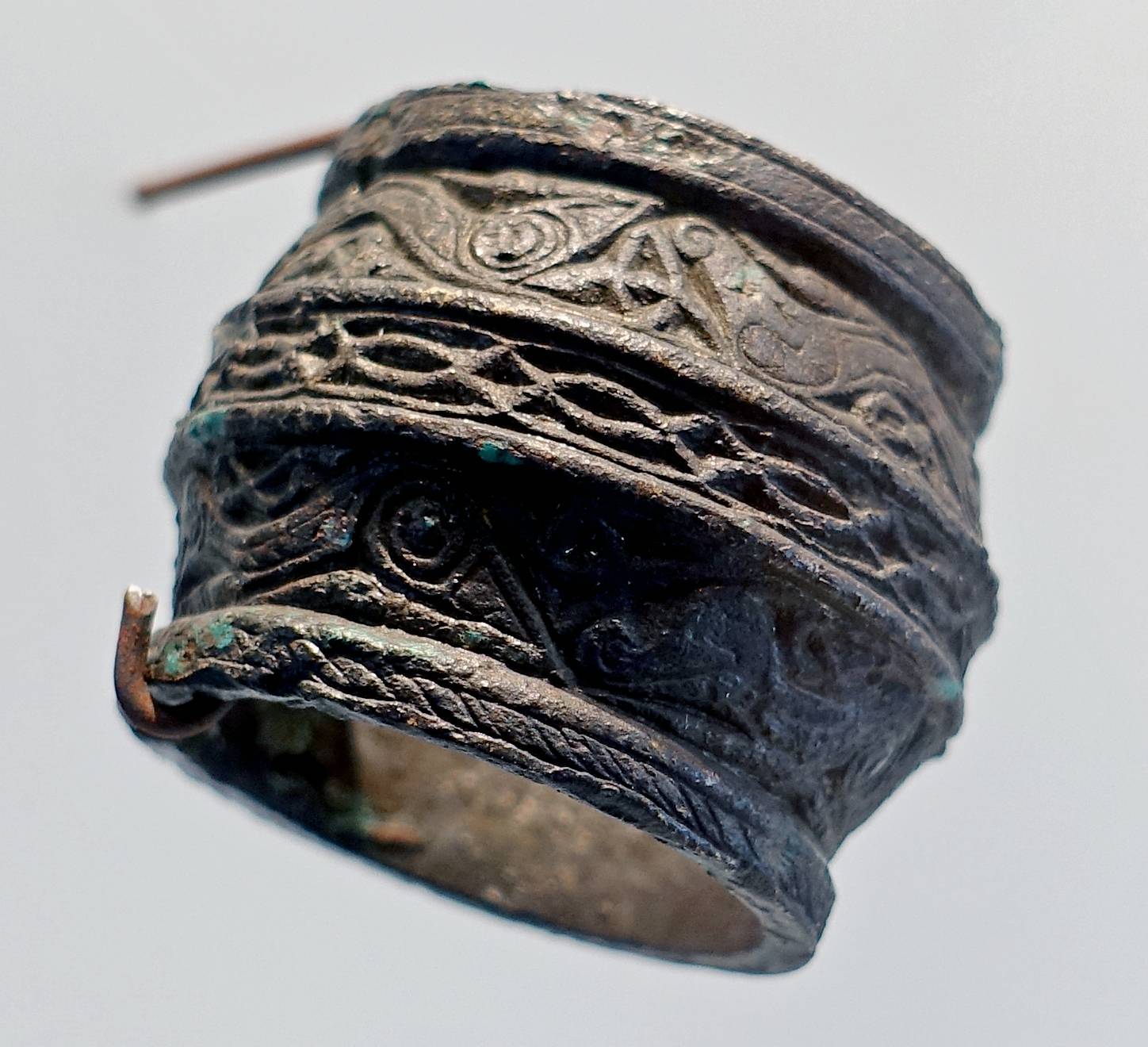
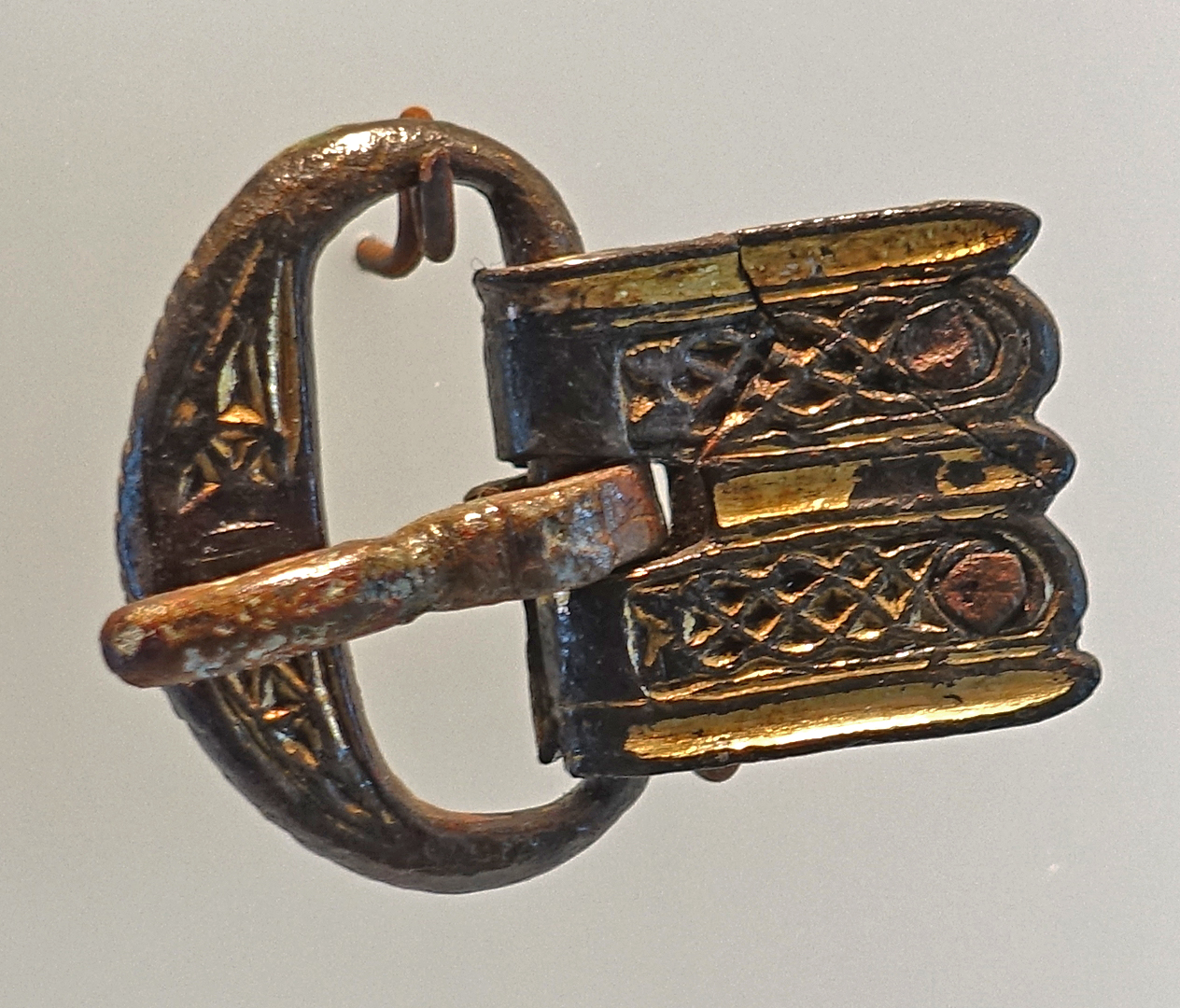
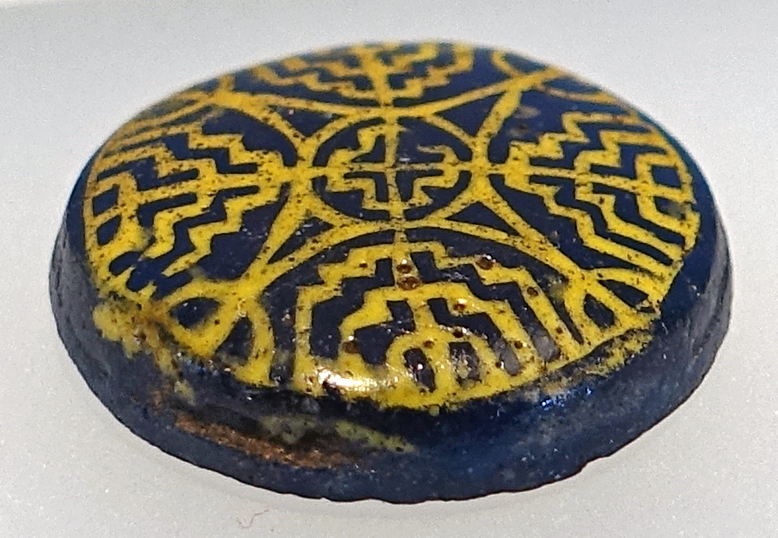
Metal and Enamelwork
The monasteries of the British Isles were centres of craftsmanship,
where objects for sacred use were created at the highest technical and
artistic level. These precious metal and enamel pieces were
coveted plunder for the Vikings.
Photo: Don Hitchcock 2018
Source and text: Wikinger Museum Haithabu
Slave trade
In the lands around the Irish Sea, many small kingdoms
fought amongst themselves. Hostages and slaves were
taken during battle.
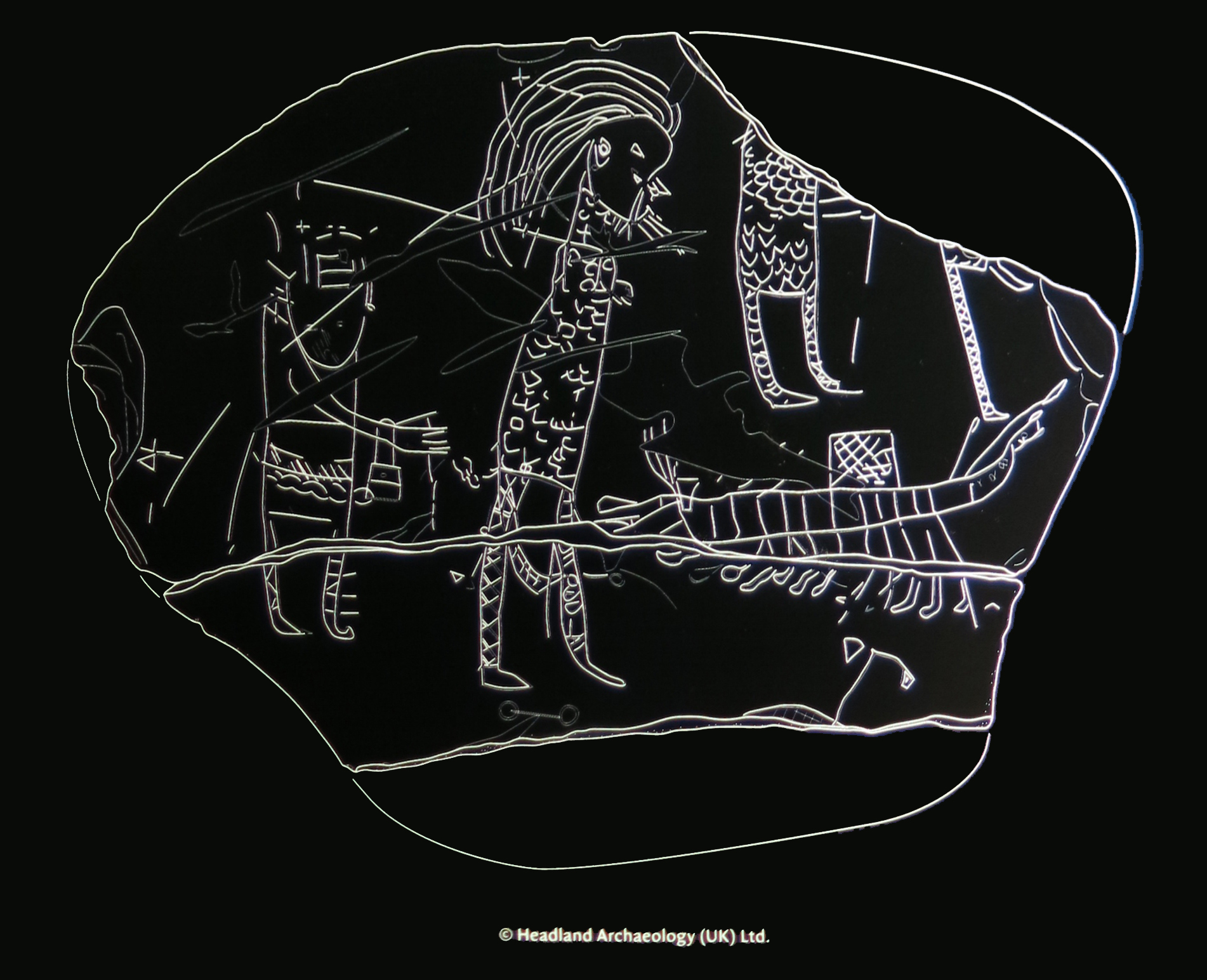
A carved image on a stone slab, found in a monastery
on the island of Inchmarnock in western Scotland,
shows three warriors leading a bound person to a ship.
The slave hunt around the Irish Sea intensifies with the
arrival of Scandinavian seafarers.
The artefact described is known as the Hostage Stone. Scratched into the surface of the slate is a drawing that appears to show three armed, mail-clad figures ahead of a bound/shackled person towards an awaiting ship. One of the armed figures has wild hair.
From the early ninth century, Islamic silver coins began to flow into the Baltic region, reaching Sweden and beyond. Staggering volumes, estimated at more than 100 million coins, were involved, making dirhams the most common objects found across the Norse sphere. The gleaming silver, however, carried a long shadow. The rhythm of its flow to Scandinavia during the ninth and tenth centuries coincided with an intense demand for labour in Islamic lands. It is now understood that each coin and cache was involved, at some stage, in the sale of enslaved people. The trade was big business, and the Silk Roads’ overlapping networks were the arteries that kept it alive.
The Vikings established the town of Dublin, where an
important slave market developed.
Slaves (thralls) flowed to Scandinavia during the ninth and tenth centuries and coincided with an intense demand for labour in Islamic lands. It is now understood that each coin and cache was involved, at some stage, in the sale of enslaved people. The trade was big business, and the Silk Roads’ overlapping networks were the arteries that kept it alive.
Rephotography: Don Hitchcock 2014
Source and text: The Viking Ship Museum, Roskilde, Denmark and many other sources including https://jackie125.substack.com/p/the-silk-road-at-the-british-museum and www.butemuseum.org.uk/1061-2/
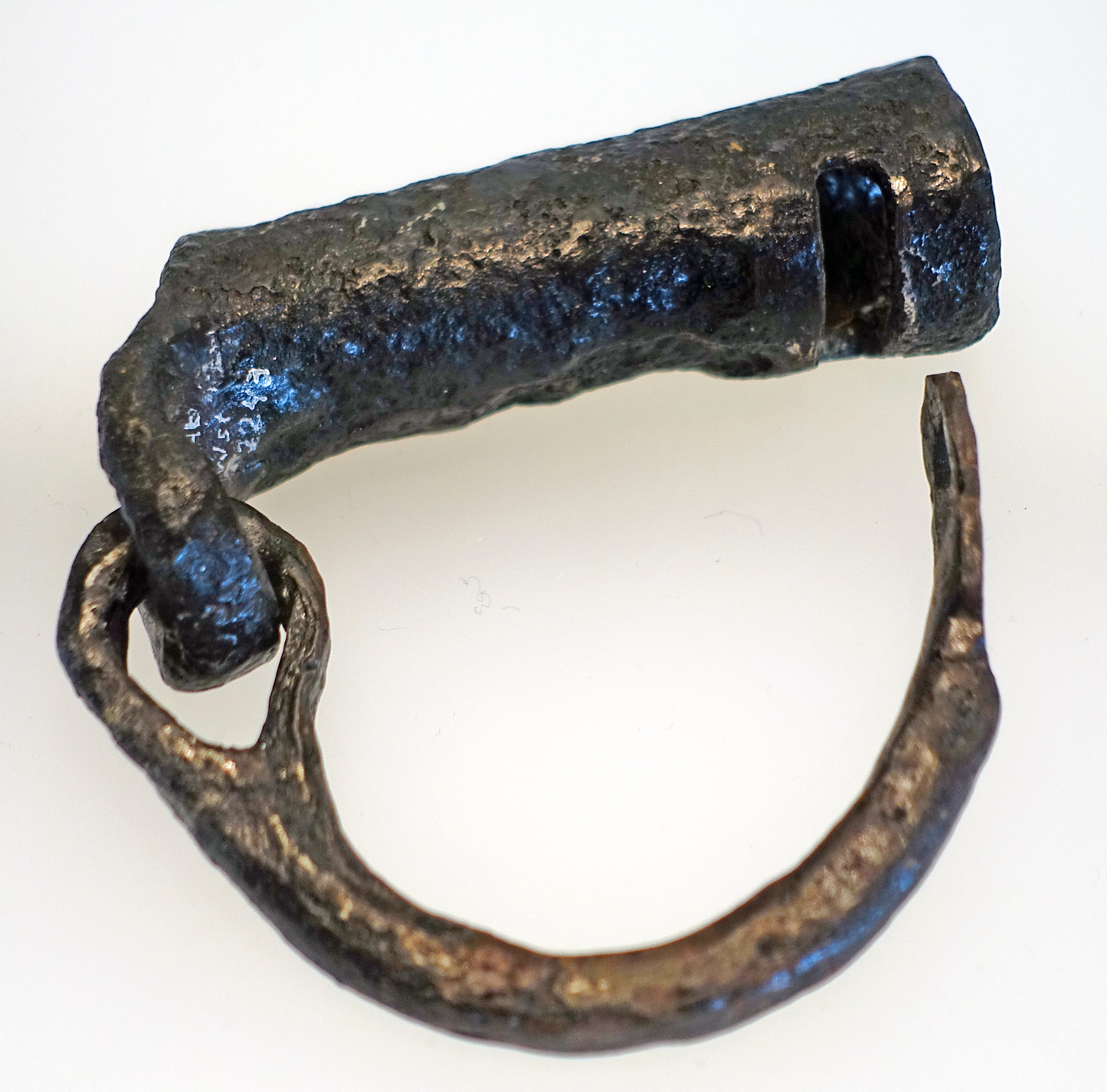
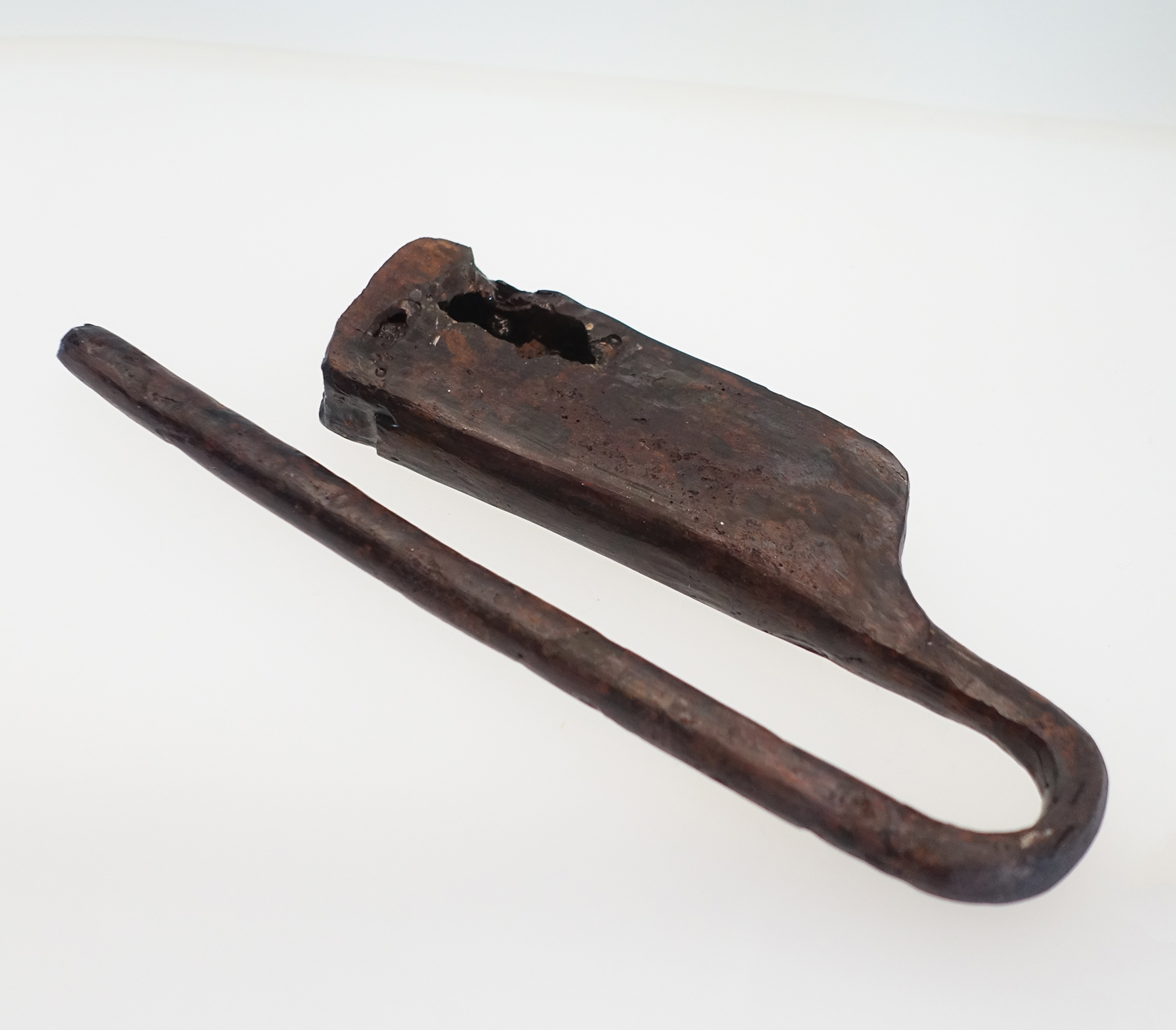
These are shackles used for binding slaves.
Slaves were a profitable commodity. A young slave
cost 426 grams of silver. An old man or a child
fetched half that amount. Hedeby was an important trading
hub for slaves, who were brought here from many directions.
Photo: Don Hitchcock 2018
Source and text: Wikinger Museum Haithabu
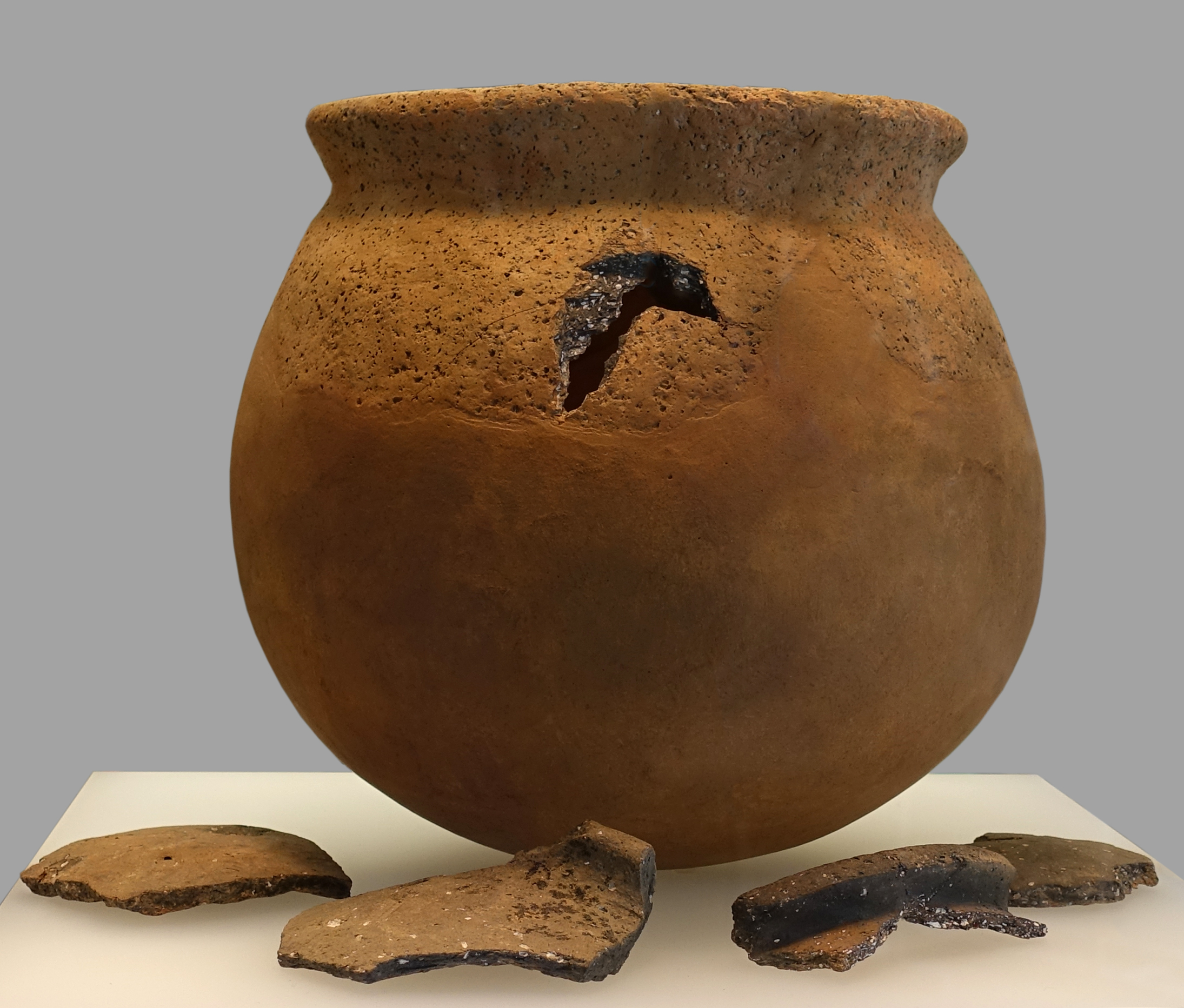
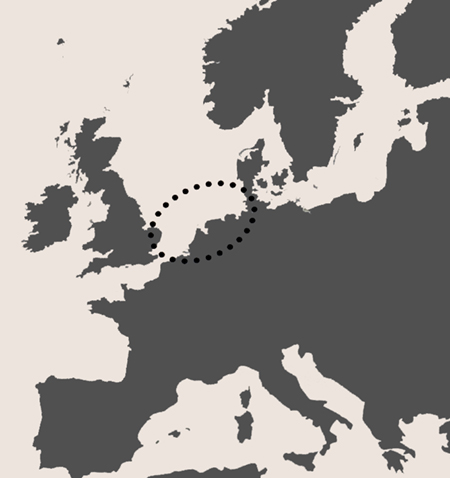
Shell-tempered pottery
In the 9th century, large quantities of egg-shaped cooking pots were produced along the southern North Sea coast, likely at a single production centre. The clay used for this pottery was tempered with crushed seashells.
Tempering clay with crushed seashells (shell-tempered pottery) created thinner, stronger, and more heat-resistant ceramic vessels.
The plate-like (lenticular) structure of crushed shells allowed the pottery to expand and contract smoothly when exposed to sudden temperature changes, preventing cracking during cooking.
Because shell particles distributed well through the paste, potters could build much thinner and stronger vessels than they could with heavier rock or sand tempers.
The improved resistance to thermal stress made the containers able to withstand sustained boiling and were ideal for heavy duty tasks like cooking, food processing, and boiling brine in salt-making.
Photo: Don Hitchcock 2018
Source, map and text: Wikinger Museum Haithabu
Additional text: www.cincymuseum.org/2022/08/09/whats-in-a-pot-lessons-from-native-american-pottery-2/
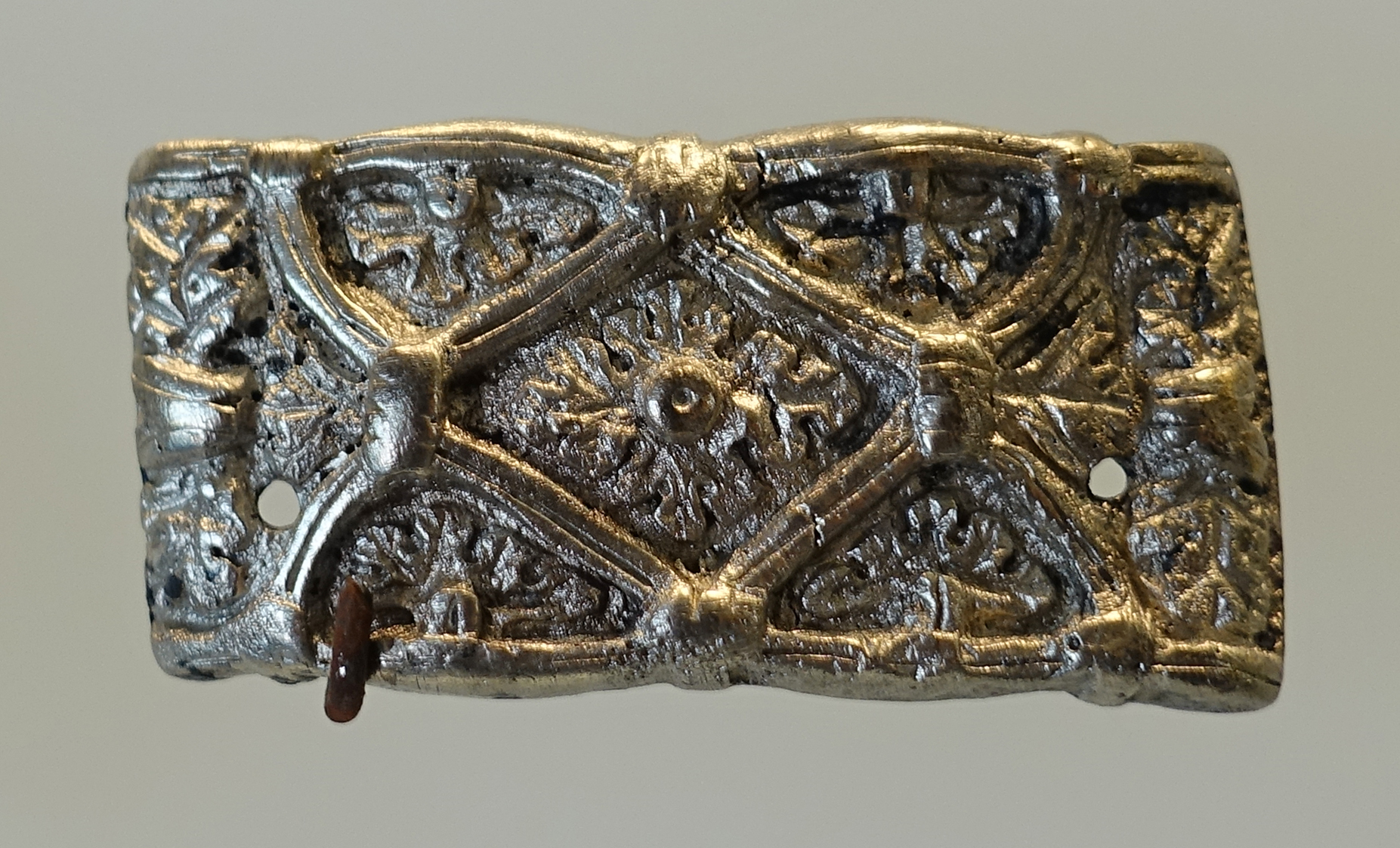
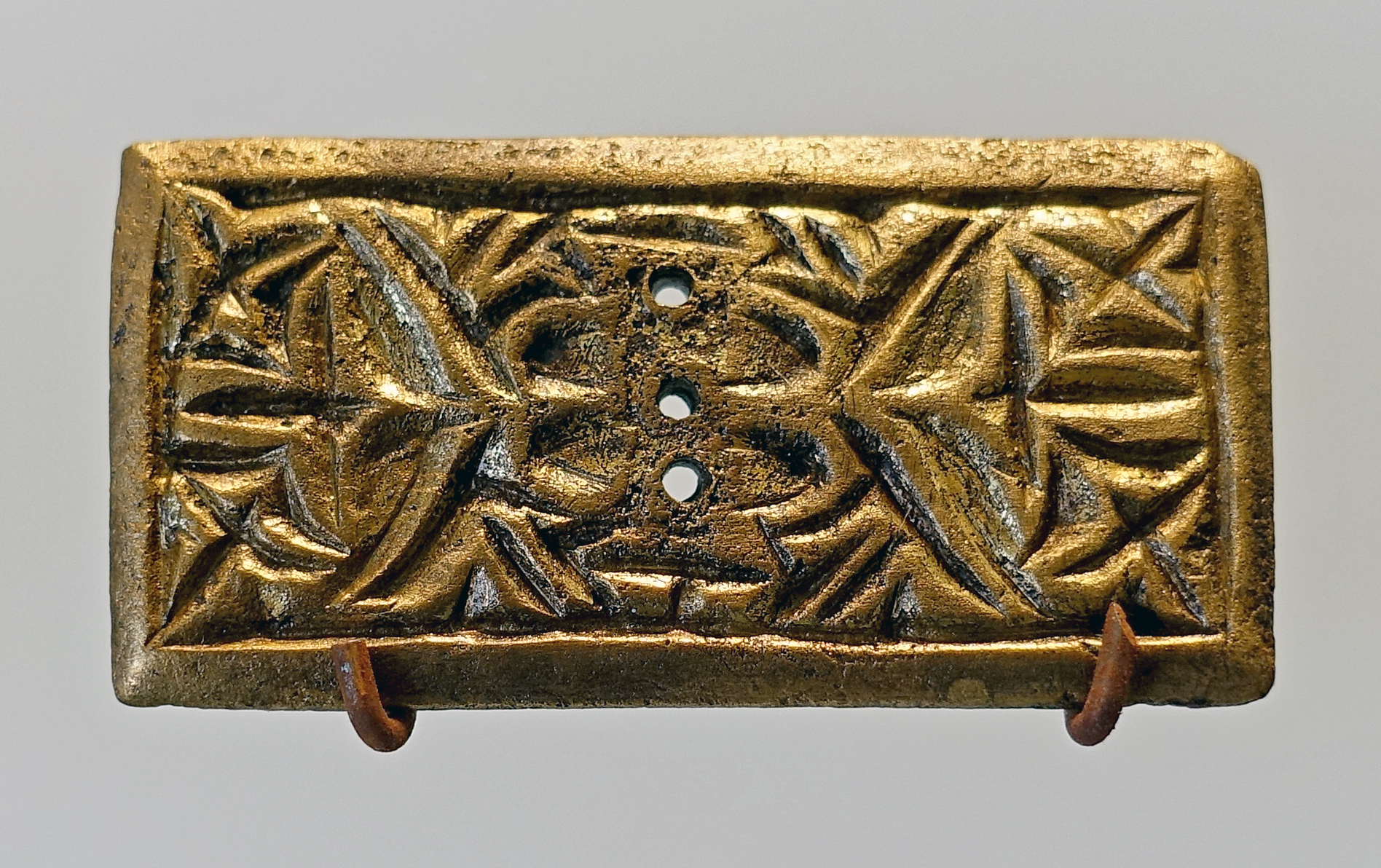
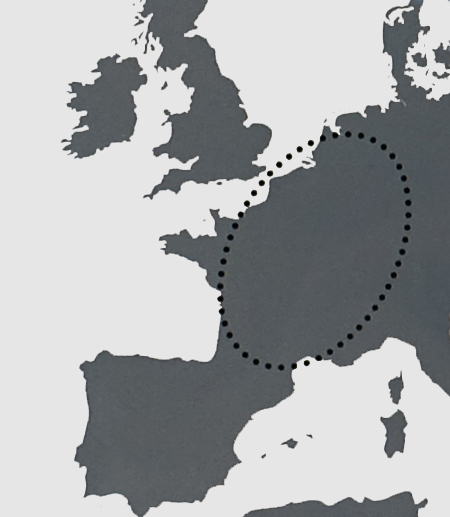
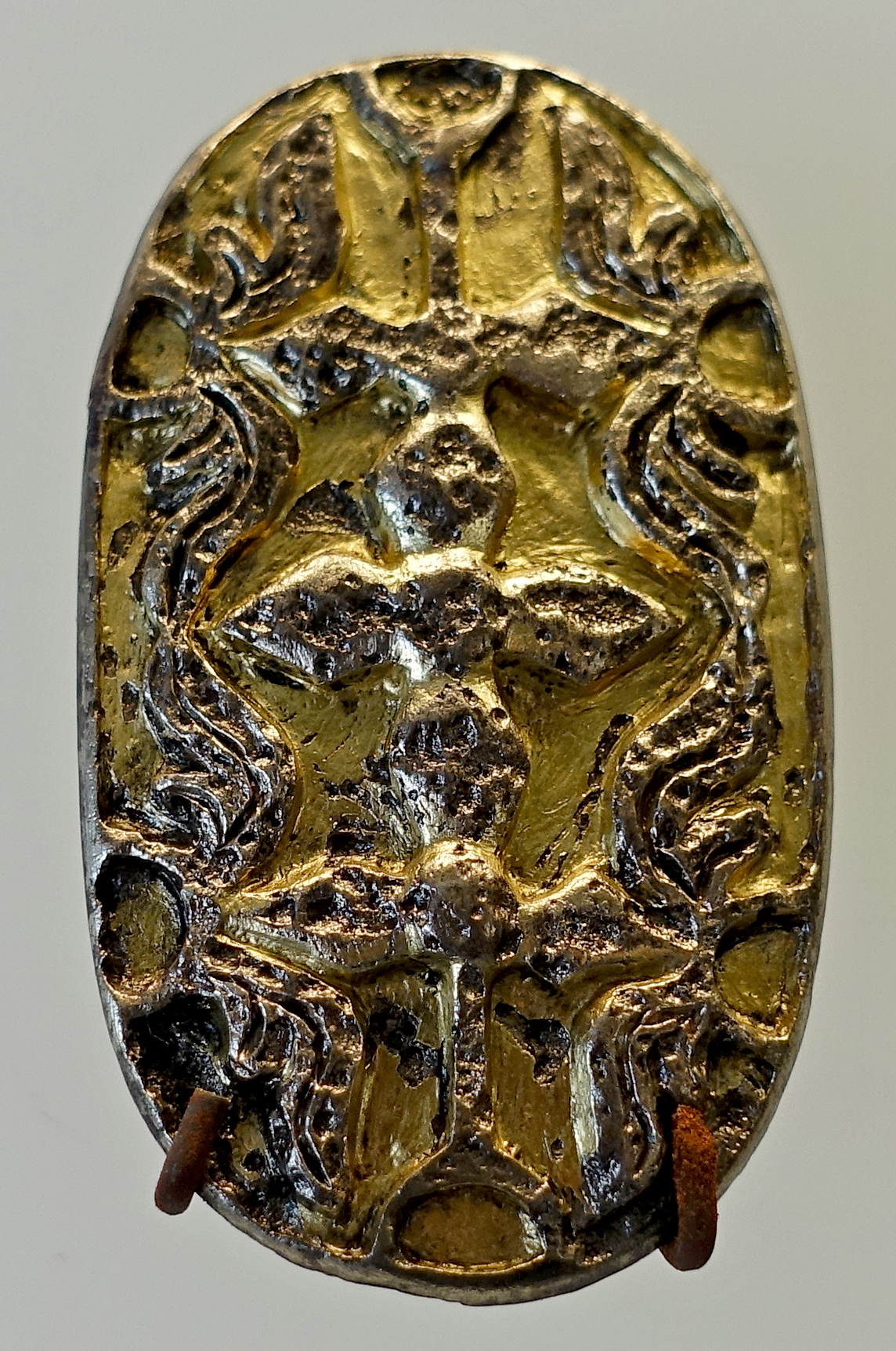
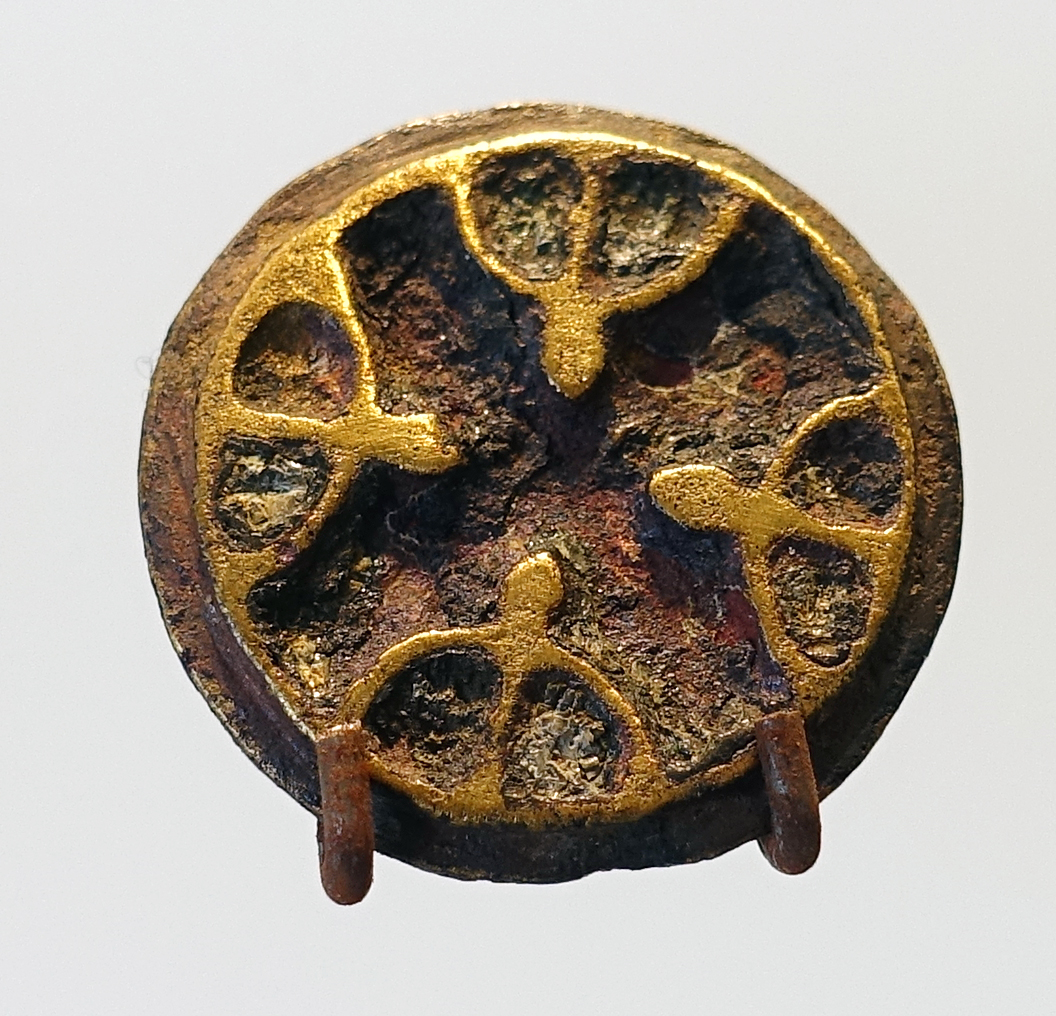
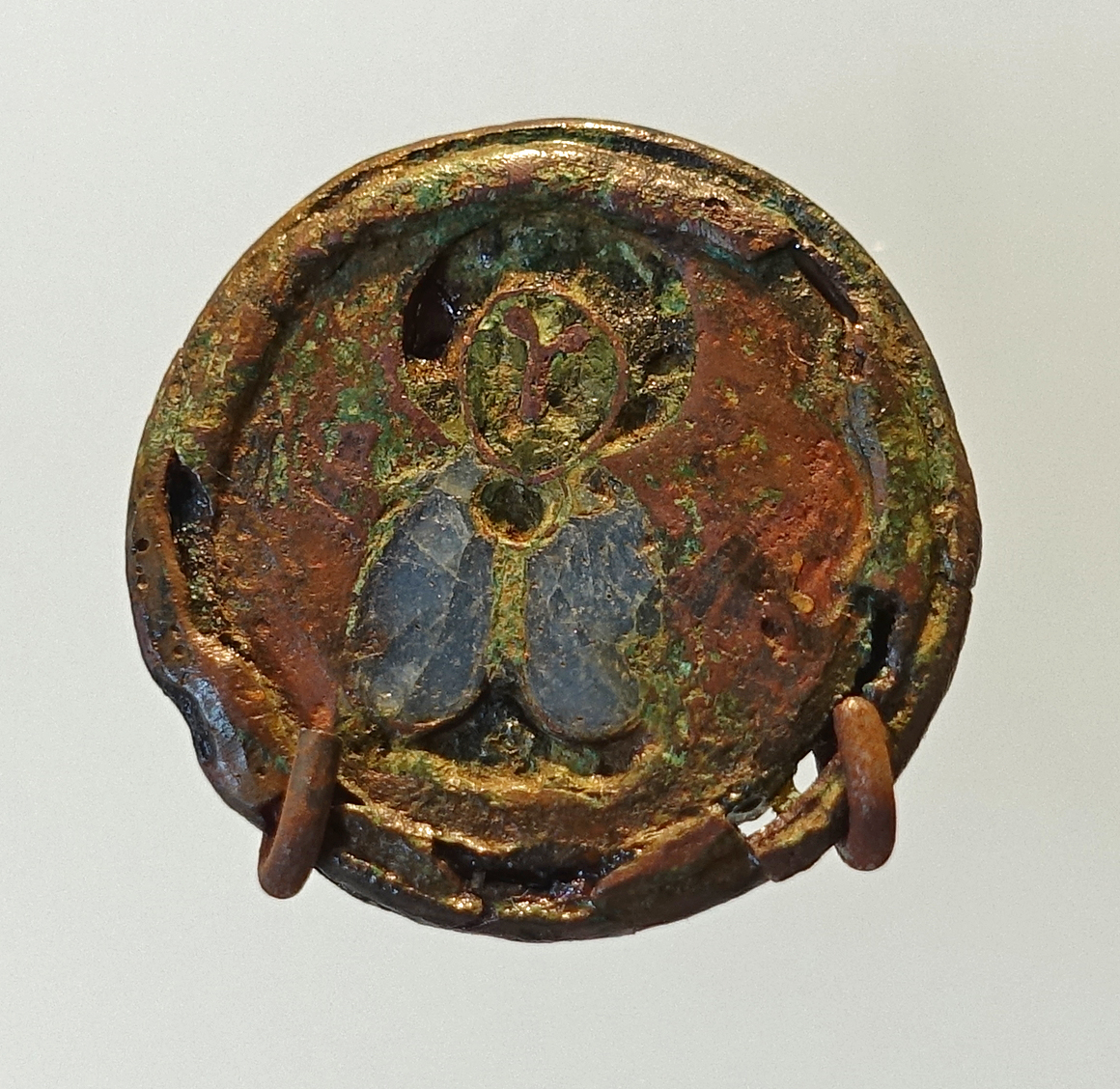
Jewellery made of metal
Jewellery from metal workshops in the Franconian region was highly valued, not only for its quality but also for its ornamentation. Floral motifs and enamel inlays were particularly popular.
Enamelling is a decorative technique in which a coloured vitreous substance (glass paste) is fused onto metal.
Photo: Don Hitchcock 2018
Source, map and text: Wikinger Museum Haithabu
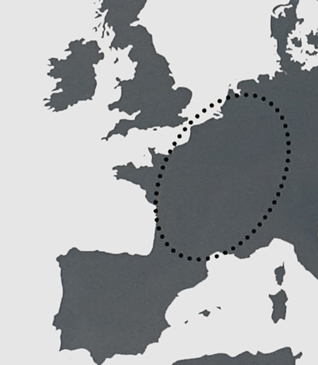
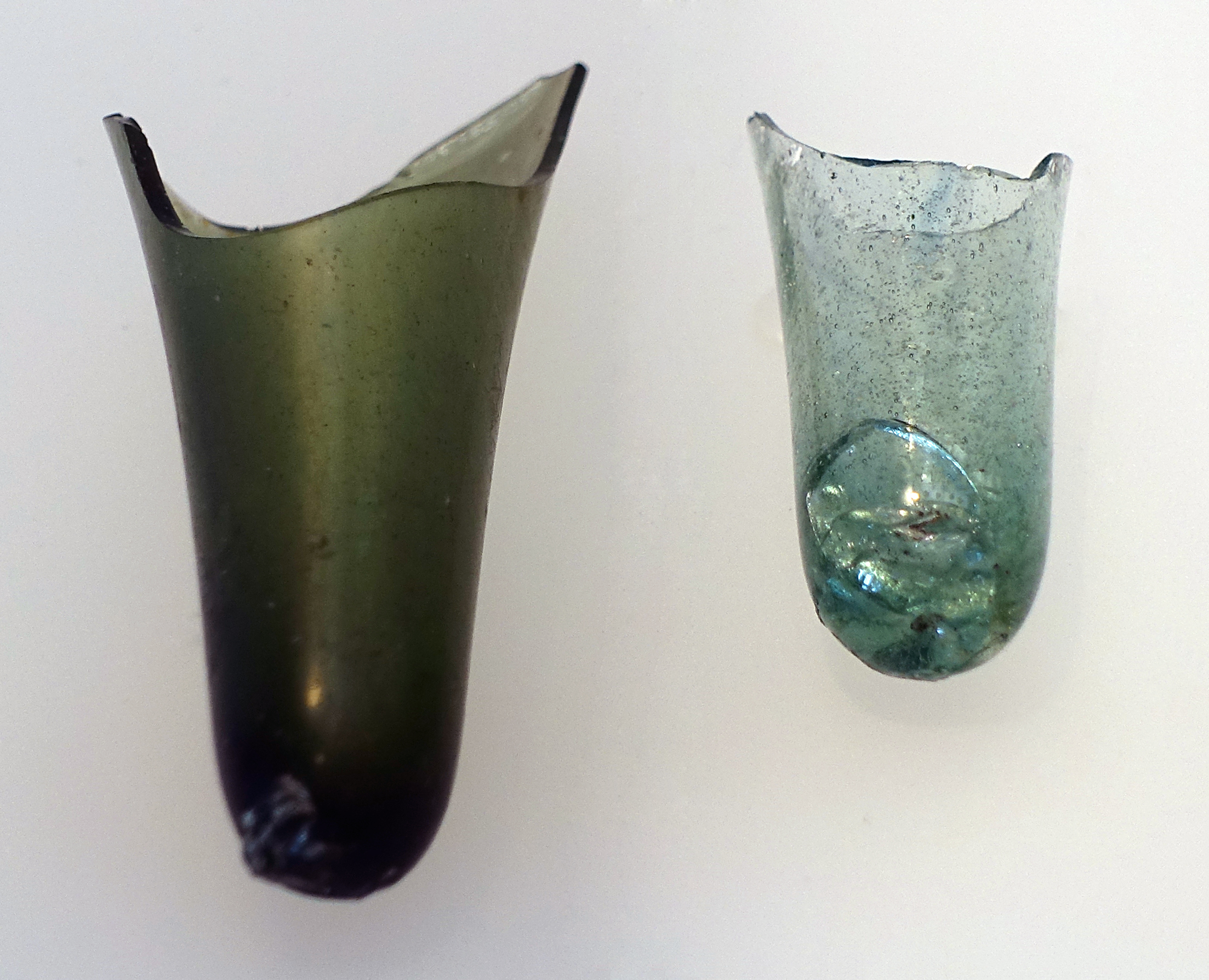
Blown hollow glassware was likely produced in the Rhineland and the Ardennes. Transporting these items is very difficult, as they are highly susceptible to breakage. Consequently, their value increases with the distance from their place of origin.
Particularly popular were pointed-bottom funnel-shaped glasses, grape-motif beakers, and vessels decorated with coloured glass threads.
Photo: Don Hitchcock 2018
Source and text: Wikinger Museum Haithabu
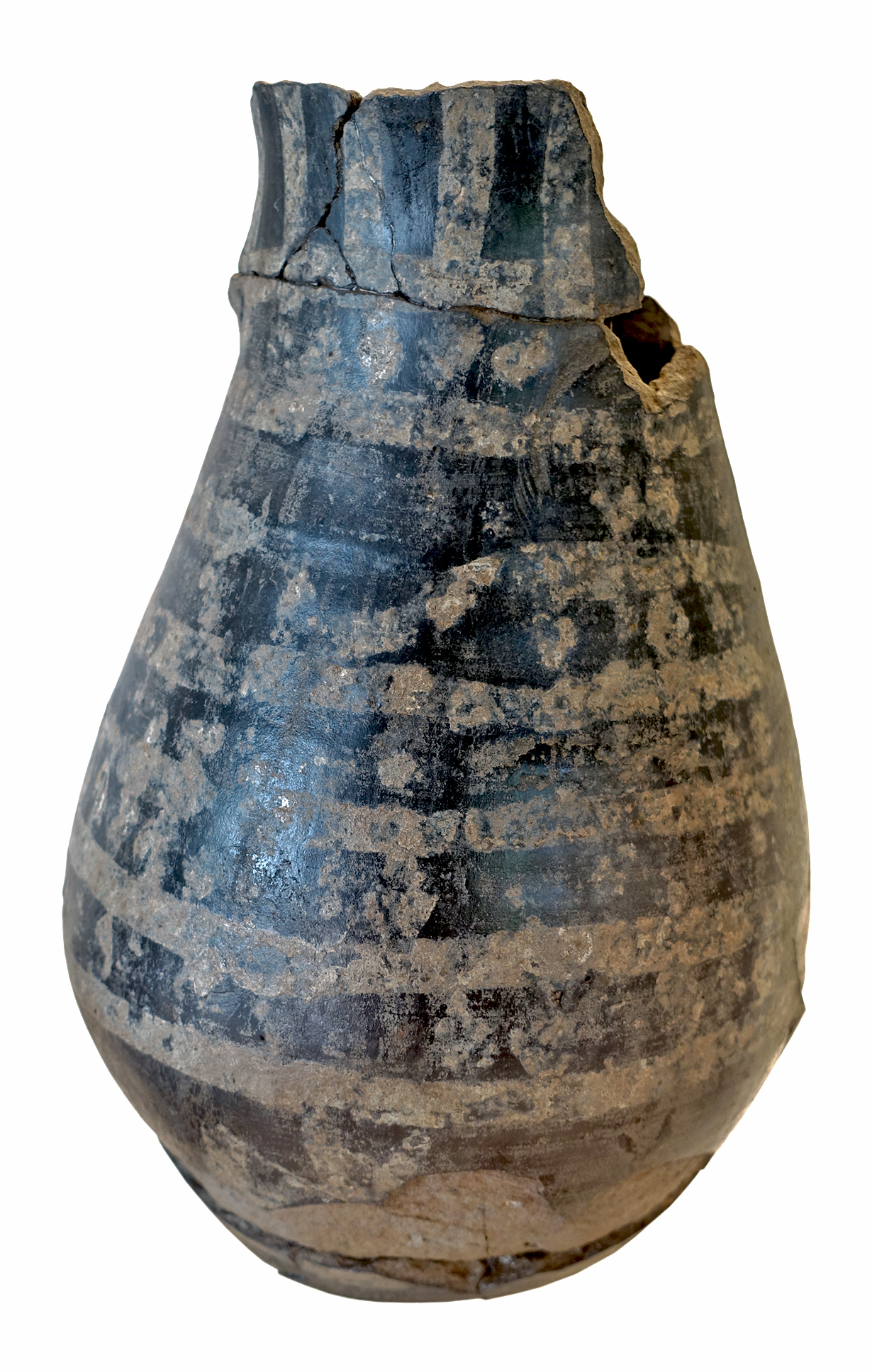
Tating-type Ceramics
From shortly before 800 AD until about 1000 AD, a highly exclusive type of pottery was produced on the potter’s wheel within the Frankish Empire. Patterns made of applied tin foil stand out sharply against the smooth, black surface. This "Tating-type" ware was used primarily to craft jugs.
Tating-type ware (or Tating Ware) is an iconic style of early medieval ceramic pitchers.
It is famously characterised by a dark, glossy, burnished surface adorned with striking geometric patterns made from applied tin foil.
Dating primarily to the 8th to 10th centuries AD, Tating ware is highly valued by archaeologists as it represents the extensive luxury trade networks connecting the Carolingian Empire with the Viking world.
Potters crafted high-quality clay into elegant jugs and pitchers on a potter's wheel. The clay was fired to a dark grey or black color and burnished until it was smooth and shiny.
After firing, artisans applied delicate cut-outs of tin foil, such as bands, triangles, and Christian crosses, onto the dark clay. These were polished to a mirror-like sheen, making the vessels gleam under firelight.
In an era where most everyday pottery was utilitarian and coarse, Tating ware was intentionally 'outlandish' and designed to catch the eye in elite settings.
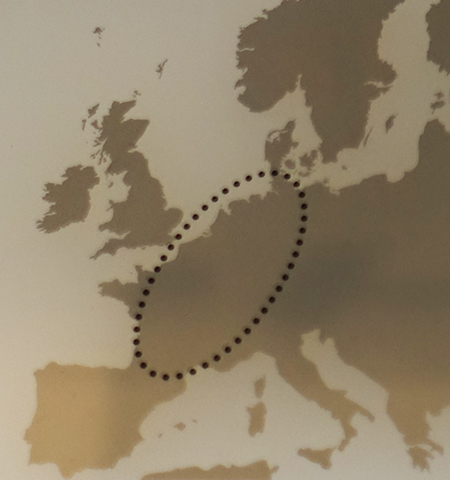
Though popularised by Viking archaeological finds, it was not made by the Vikings. It was manufactured primarily in the Rhineland region of Germany and northern France during the Carolingian Renaissance.
It is named after Tating, a village in northern Frisia (Germany) where early examples were classified. Because of Frisian and Viking maritime trade, Tating ware traveled vast distances.
Fragments have been found at key early medieval emporiums and trading hubs across the North Sea and Baltic regions, including: Ribe (Denmark), Birka (Sweden), Hedeby (Germany), London (England), and Staraja Ladoga (Russia, near St. Petersburg).
Tating ware is typically uncovered in high-status contexts, such as wealthy female pagan burials in Scandinavia and aristocratic settlements. Owning a gleaming Tating pitcher was a clear sign of wealth, sophisticated taste, and active ties to continental European trade networks.
Photo: Don Hitchcock 2018
Source, map and text: Wikinger Museum Haithabu
Additional text: Deckers (2022), tidsskrift.dk/periskop/article/view/134581/179448, projects.au.dk/northernemporium/news-and-events/preview/artikel/studying-tating-ware-from-ribe
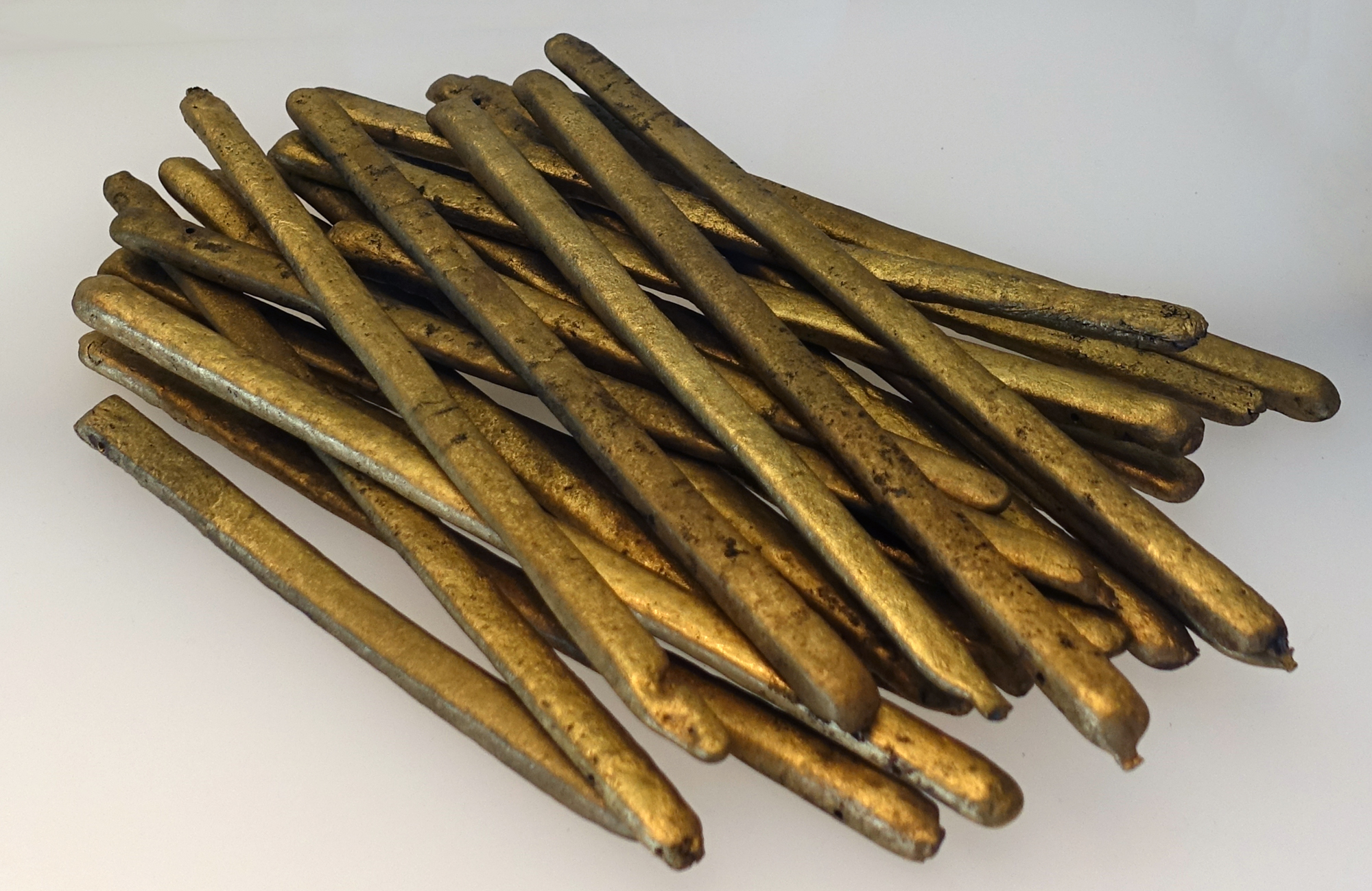
Brass
An early 9th-century hoard of 25 copper alloy bar ingots discovered in the harbour of the Viking period settlement of Hedeby in northern Germany originated from long-distance trade rather than local Rhine sources.
Key Details of the Hedeby Brass Hoard:
• Discovery: Twenty-five bar ingots were found on the edge of the harbour at Hedeby during excavations in the 1980s.
• Date: The typology and context date the hoard to the early 9th century AD.
• Composition: Mass spectrometry shows the bars are made of a freshly produced, standardised, high-quality brass alloy.
• Origin of the copper (Lead Isotope Analysis): The chemical signature does not match copper ore deposits from the Rhine area — the traditional assumption for northern Europe. Instead, the analysis points to possible origins in the Balkans or Andalusia.
• Significance: It proves that Vikings relied on extensive long distance trade networks for raw metallurgical materials in the early Middle Ages.
The area around Aachen is one of the most significant regions in all of Europe for the extraction of calamine. This mineral is found within local zinc deposits and is required for the production of brass, an alloy often preferred over pure copper for the manufacture of various products. For commercial purposes, brass is cast into ingots.
Calamine brass is an ancient copper-zinc alloy created before pure metallic zinc was ever isolated.
Ancient metalworkers packed crushed zinc ore (historically called calamine, consisting of smithsonite, ZnCO3, or hemimorphite, Zn4(Si2O7)(OH)2⋅(H2O) with charcoal and solid copper pieces into a sealed clay crucible.
Heating the crucible to around 900°C – 1 000°C reduced the calamine into an invisible zinc vapour. Pure copper melts at 1 085°C, so the copper itself did not melt.
Because the crucible was sealed, the zinc gas diffused directly into the solid copper fragments, transforming them into brass without melting the copper first.
But as the zinc diffused into the copper, it transformed the metal into brass. Because brass has a lower melting point (900°C to 940°C) than pure copper, the newly formed brass would eventually melt into a liquid pool at the bottom of the crucible.
Metalworkers would physically nudge or gently shake the crucible using long iron tongs. Moving from the dull rattle of solid copper pieces to a silent, shifting liquid signalled to the metalworker that the transformation was complete.
It was first produced in Asia Minor in the Neolithic period, and used extensively by the Roman Empire for coins and military gear.
The method remained the primary way to make brass in Europe for thousands of years, long after chemists like James Smithson studied the ores, until large-scale metallic zinc smelting was developed in the mid-18th century.
Brass offers key advantages over bronze in machinability, electrical and thermal conductivity, formability, cost, and bright golden aesthetics.
Photo: Don Hitchcock 2018
Source and text: Wikinger Museum Haithabu
Additional text: Merkel (2018)
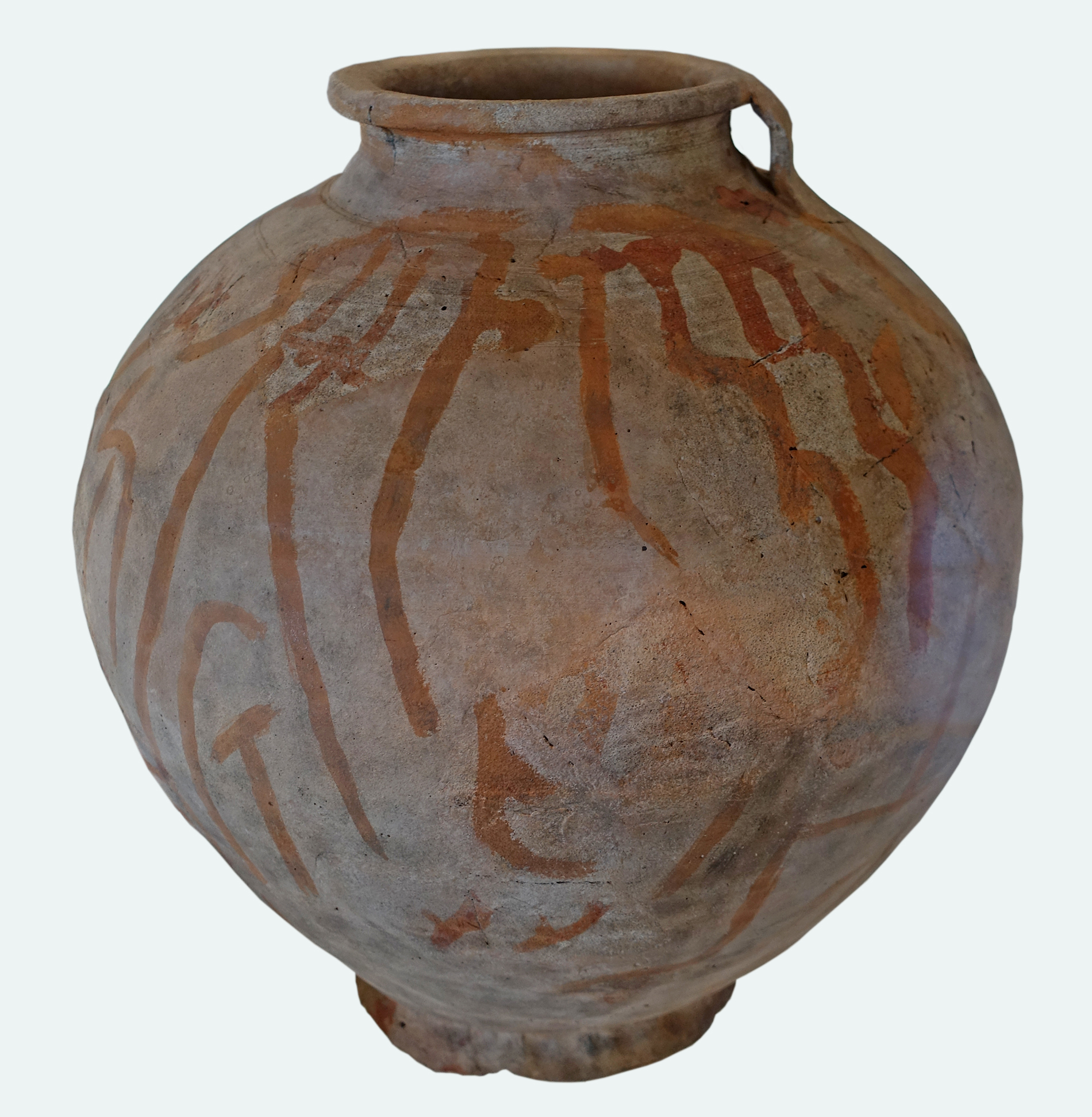
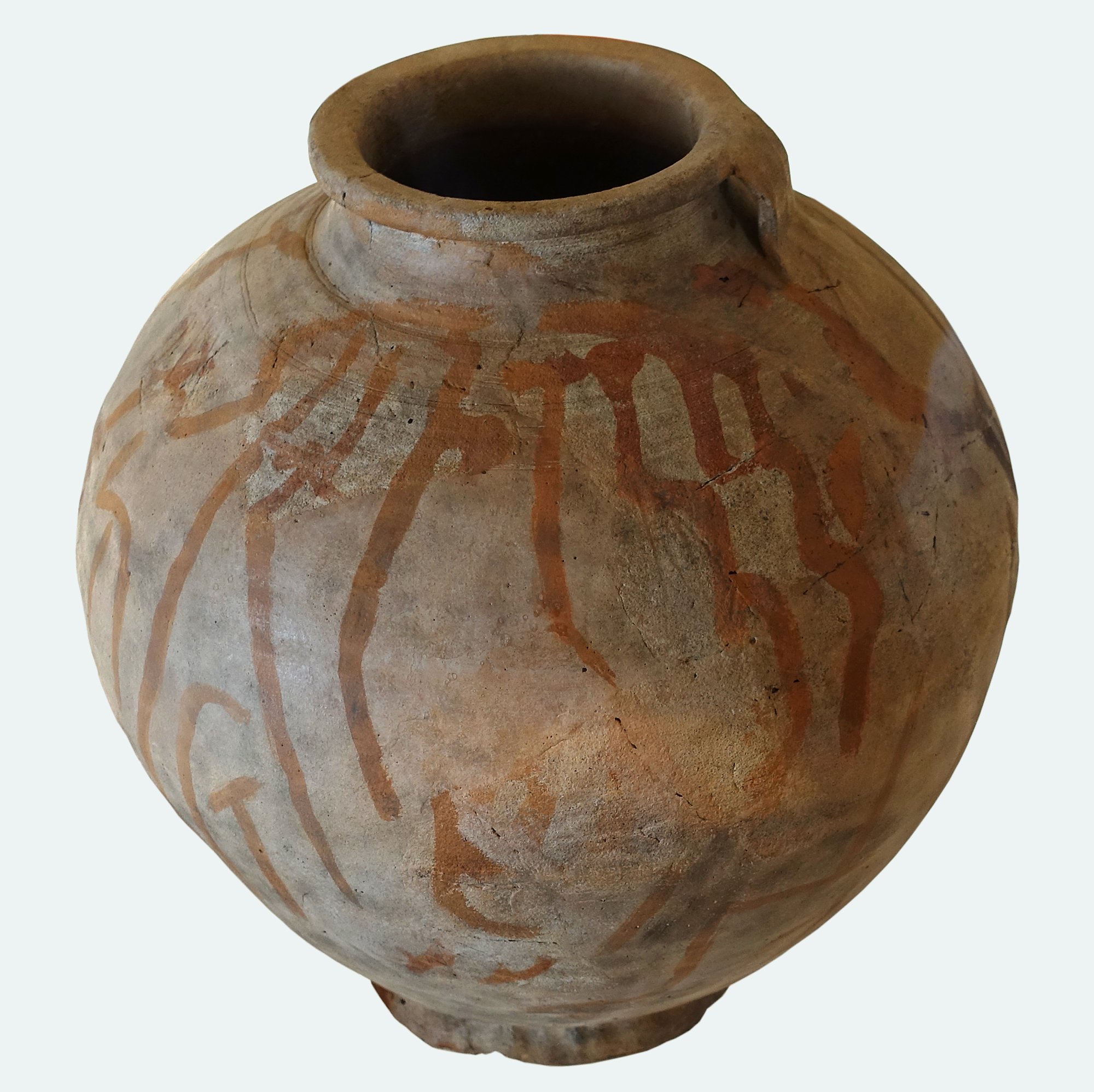
Pingsdorf Ceramic ware
Pingsdorf ware is a high fired earthenware, or proto-stoneware, that was produced between the late 9th and 13th century in different pottery centres on the Eastern margin of the Rhineland as well as the Lower Rhine region. Characteristic features of vessels in Pingsdorf ware are a yellow-coloured fine sand-tempered sherd with red decoration. It is evident within various Medieval settlements of North Western Europe and thus represents an important chronological marker for the Medieval archaeology.
It was a forerunner of the first European stoneware, produced in the same region and exported to much of Europe for the rest of the Middle Ages and Renaissance.
Photo: Don Hitchcock 2018
Source and text: Wikinger Museum Haithabu
Additional text: Wikipedia
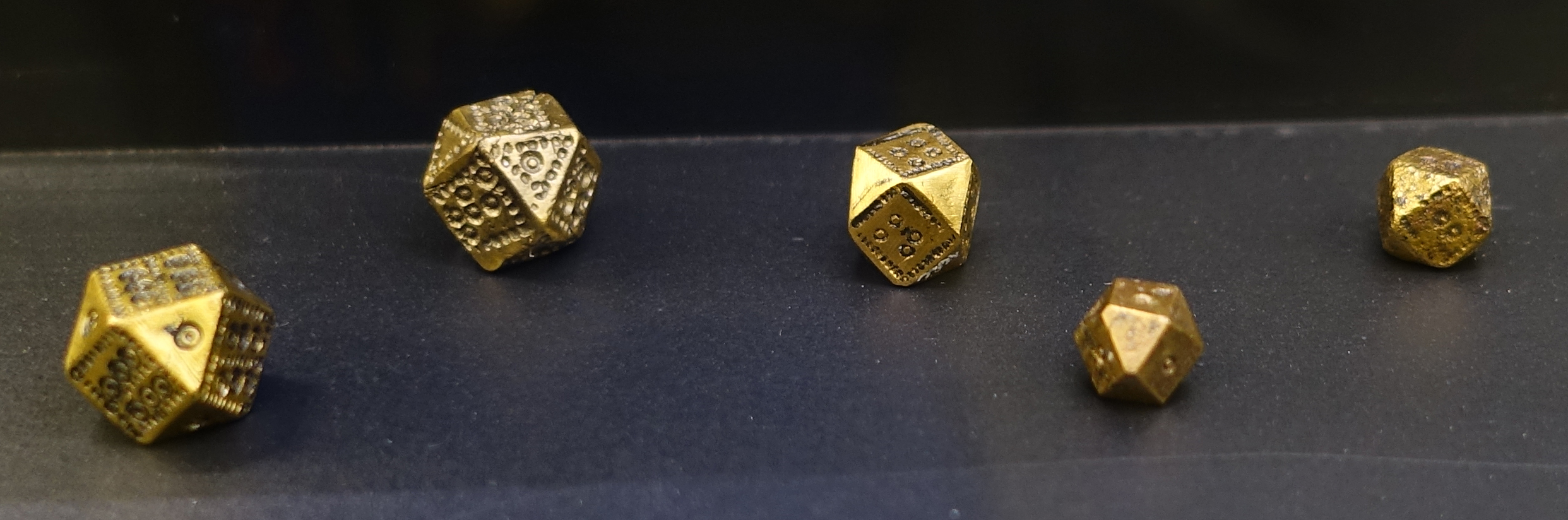
Cubo-octahedral weights
Smaller quantities are weighed using bronze weights in the shape of a cubo-octahedron. Circles or circular markings indicate the standardised weight.
A cuboctahedron is an Archimedean solid with 14 faces (8 equilateral triangles and 6 squares), 12 identical vertices, and 24 identical edges.
Key Properties:
• Face Configuration: Each vertex is surrounded by two triangles and two squares alternating in order.
• Derivation: It can be formed by the rectification (truncating to the edge midpoints) of either a cube or an octahedron.
• Symmetry: It is quasiregular, meaning it is both vertex-transitive (every vertex looks the same) and edge-transitive (every edge looks the same).
• Crystallography & Nature: It appears in mineral crystal structures such as fluorite, galena, and pyrite, and describes closest-packed sphere arrangements (face-centred cubic lattice).
Photo: Don Hitchcock 2018
Source and text: Wikinger Museum Haithabu
Additional text: Wikipedia

The coin mint in Haithabu (also known as Hedeby) produced some of the earliest Viking-Age silver pennies in Scandinavia, starting as early as 825 AD.
For a few decades double sided silver coins, so-called denarii, were minted. Their role models come from Dorestad, a trading centre in the Rhine estuary area at the beginning of the 9th century. These extremely thin coins coming from Hedeby are so-called semi-bractates.
Photo: Don Hitchcock 2018
Source and text: Wikinger Museum Haithabu
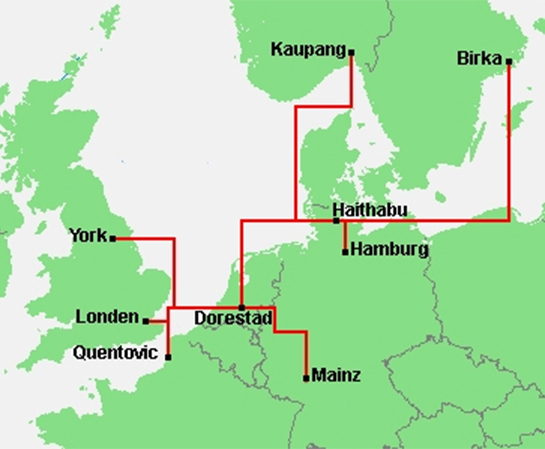
These are imprints from Dorestad. Dorestad was an early medieval commercial centre and trading post, located in the present-day province of Utrecht in the Netherlands, close to the modern-day town of Wijk bij Duurstede.
It flourished during the 8th to early 9th centuries, as an important port on the northeastern shipping routes due to its proximity to the fork in the Rhine, with access to Germany via the Nederrijn (the northernmost branch of the Rhine), to the southern Netherlands, northern France, and England (via the Lek, a continuation of the Nederrijn and which meets the Noord River near Kinderdijk.
The combined stream then continues as the Nieuwe Maas toward the North Sea directly through the heart of Rotterdam), and to the northern Netherlands, northern Germany, and Scandinavia (via the Kromme Rijn, the 'crooked Rhine' which served as a vital maritime shipping corridor was fully connected to the sea in the 9th century AD acting as a natural, active branch of the Rhine delta, a powerful, active, and high volume waterway)
Map: Sonty567, graciously released into the public domain. 
During the 11th and 12th centuries, Europe faced localised silver shortages. To stretch their bullion supply, mints began hammering silver thinner and thinner. Semi-bracteates were an accidental byproduct of trying to mint double-sided coins on metal sheets that were simply too thin to support independent imagery on both sides.
The fundamental problem with the coins known as semi-bracteates is that they were double-sided coins struck on metal blanks that were far too thin, causing the designs from each side to heavily distort, 'bleed through', or ghost onto the other face.
The timeline was:
1050-1059 AD: Semi-bracteates first appeared as mints push the limits of how thin a standard coin can be.
1100–1150 AD: They see usage alongside early single-sided variants in regions like Hiberno-Norse Ireland, Denmark, and Germany.
1125–1140 AD onward: They are almost entirely phased out by true single-sided bracteates, which became the dominant, wafer-thin regional currency across Northern and Central Europe for nearly two centuries.
• First Minting: Petty Danish kings established the initial mint at Haithabu around 825 AD – 830 AD, making them among the earliest native Viking coins.
• Famous Ship Motifs: Some of these rare silver pennies feature a detailed Viking ship design on one side (with shields along the gunwale and a fish below the keel), which is uniquely rare in Norse numismatics (see below).
• Royal Control & Cross Coins: Later, King Harold Bluetooth (c. 975–90 AD) minted managed 'cross coins' in Haithabu as an early state-run regal coinage initiative.
• Transition in Usage: While most Vikings traded silver by weight (cutting, bending, and testing silver bits or using Islamic dirhams), 10th century AD Haithabu operated somewhat as a numismatic enclave where local coins circulated by number rather than weight.
Here is how they fit into monetary history:
( Note that in what follows, a bracteate is a flat, thin, single sided metal disc, usually made of gold or silver, stamped or chased on one side only - Don )
Traditional Coins: Struck using two distinct dies (one for the front/obverse and one for the back/reverse). They were thick enough to easily hold two completely different images.
Semi-Bracteates: Struck using two dies, but the metal blank was rolled so thin that the pressure of the strike caused the obverse and reverse images to bleed into one another. The designs became superimposed or mashed together, making them look somewhat chaotic or hollowed out.
True Bracteates: To solve the messy superimposition of the semi-bracteate, mints gave up on two-sided striking entirely by 1125. True bracteates used only one die pressed against a soft backing (like leather or lead). This produced a crisp design on the front that was mirrored and hollow on the back.
Denarii
Coins from Hedeby
The term 'denarius' — used for the silver coins minted with designs on both sides in the Frankish Empire from the 7th century onwards — derives from Roman precedents.
A denarius was the standard ancient Roman silver coin, introduced around 211 BC during the Second Punic War.
In contrast, the term 'bracteate' did not come into use until the 18th century to describe high-medieval 'pfennigs' (pennies) minted with a design on only one side. The 'half-bracteates' from Hedeby feature designs on both sides. Because the coin blanks consist of very thin silver sheet, the impressions are also visible on the reverse side.
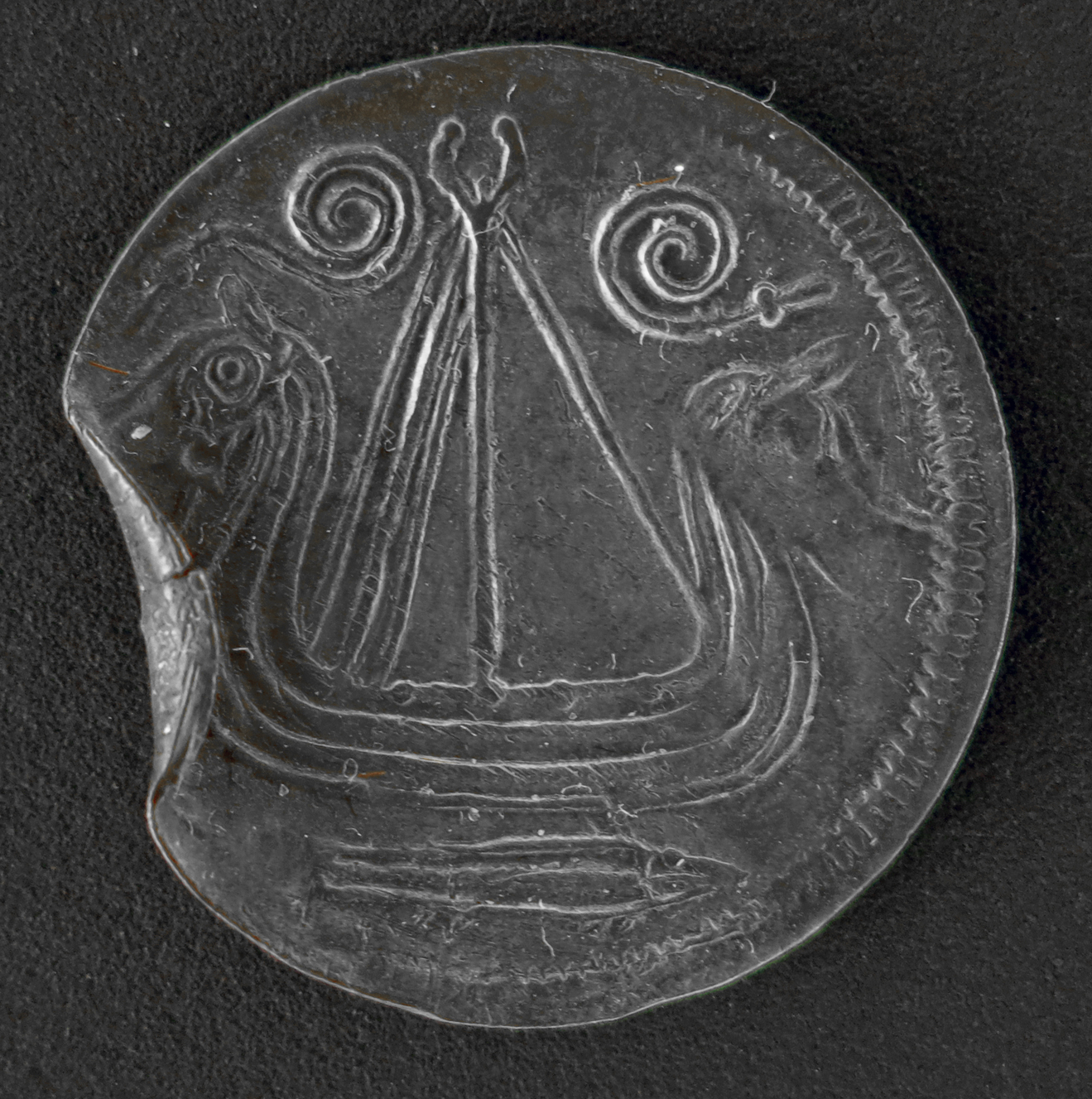
Nordic coin depicting a ship. Possibly struck in Hedesby. Silver, circa 825 AD - 830 AD
Photo: Don Hitchcock 2014
Source and text: Original, The Viking Ship Museum, Roskilde, Denmark
Catalogue Fig. 74
Additional text: https://forums.collectors.com/discussion/478062/is-there-a-particular-color-silver-coins-tone-after-being-cleaned-dipped-etc
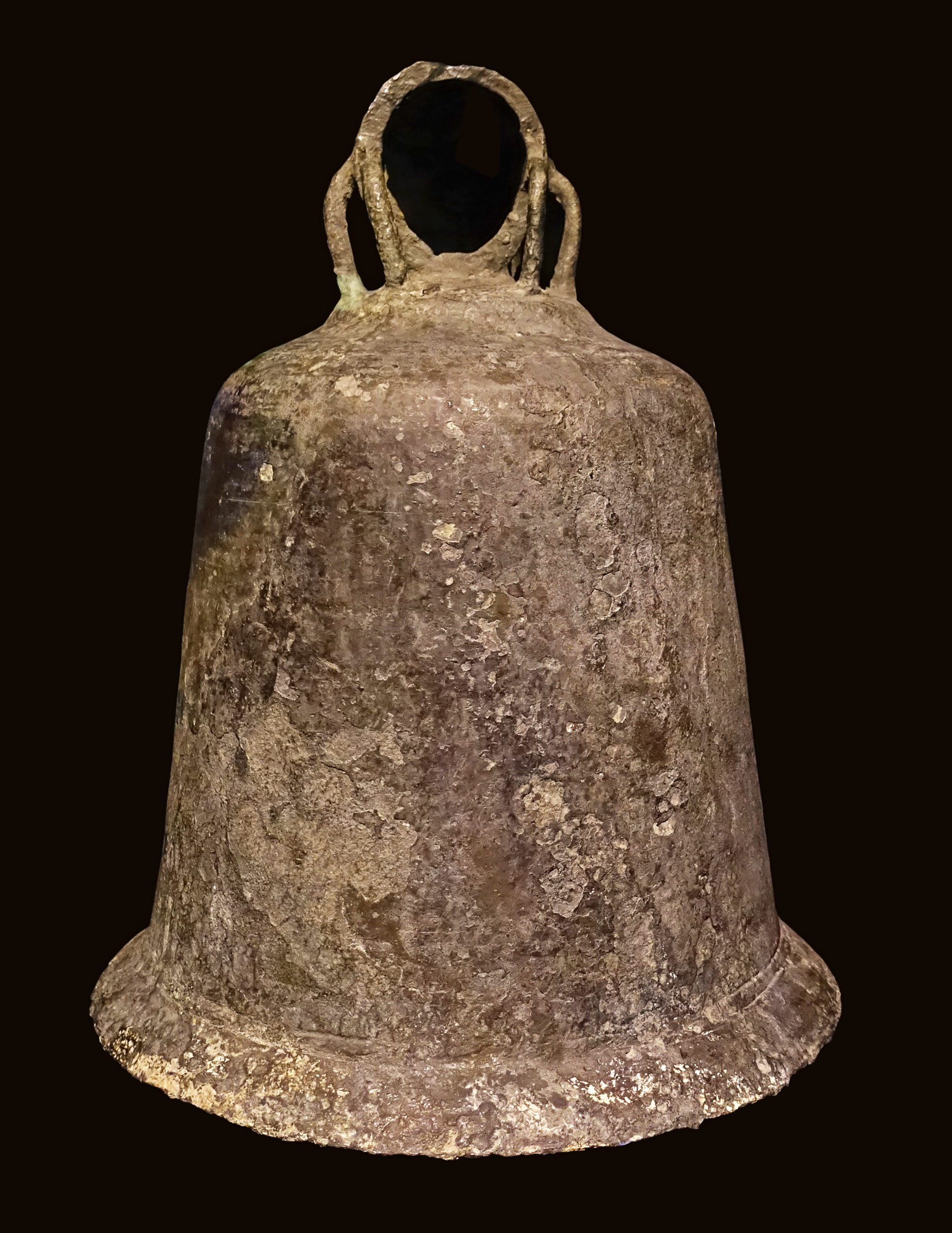
Church Bells Call to Worship
The purpose of church bells is to call the faithful to
worship. In 817 AD, a gathering of bishops and clergy
stipulated that simple parish churches should have two
bells, while a bishop’s church could have up to six.
Established monasteries often sent bells to newly
formed congregations in mission territories. In Hedeby
(Haithabu), the use of a bell was permitted for the first
time around 860 AD. The bronze bell — complete with its
clapper and a semicircular oak headstock — recovered
from the harbour of Hedeby, dates to the 10th century and
is the oldest fully preserved church bell in Northern
Europe. The metal used for its casting came from the
Rammelsberg mine in the Harz mountains.
Photo: Don Hitchcock 2018
Source and text: Wikinger Museum Haithabu
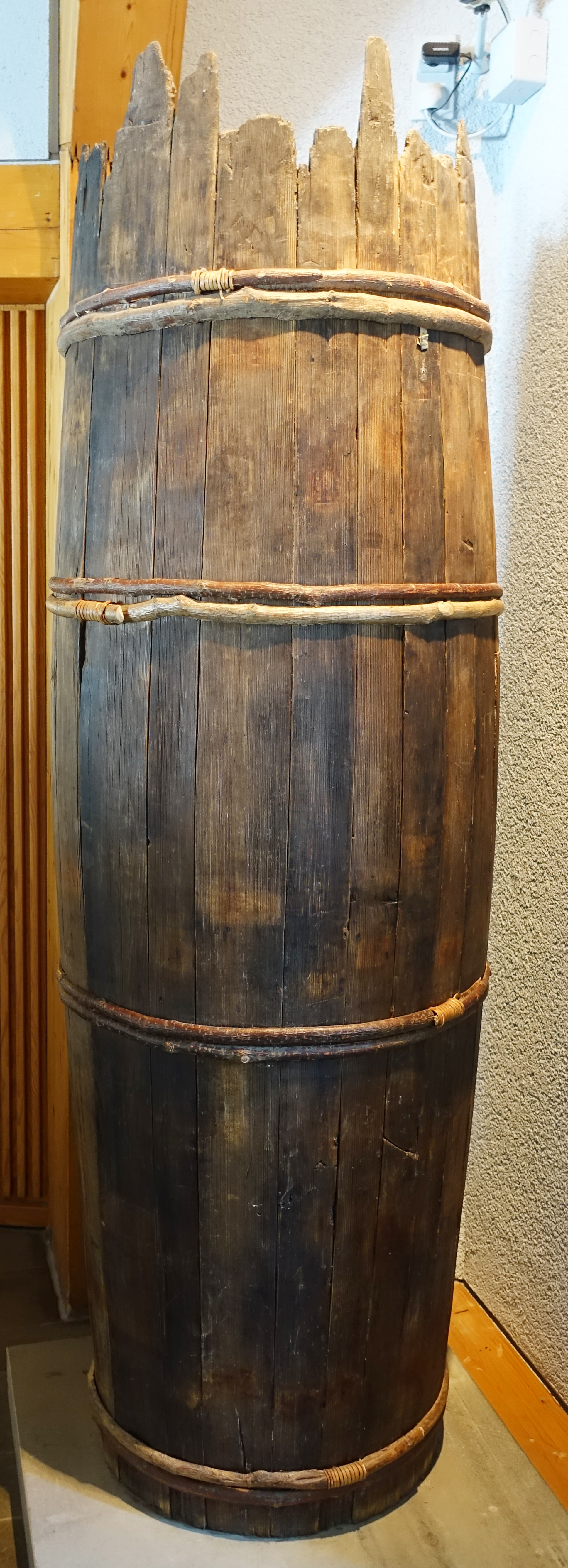
Barrels made of fir served as containers for the transport of goods. They were produced in the Upper Rhine region, where the silver firs (Abies alba) required for their manufacture grow.
The presence of silver fir barrels in Viking-age settlements is one of the most compelling archaeological proofs of early medieval long-distance trade. While the Vikings are famously known for their maritime expansion, their connection to these specific barrels tells a fascinating story of continental supply chains, natural resource limitations, and clever recycling.
The silver fir (Abies alba) is a massive conifer native to the mountainous regions of Central Europe, flourishing particularly in the Black Forest and the Vosges mountains flanking the Upper Rhine region.
Silver fir wood is ideal for cooperage (barrel-making) because it grows with a exceptionally long, straight bole. The wood has a straight grain, lacks resin canals (meaning it won't impart a heavy resinous taste to liquids), and is relatively easy to split into staves.
The Upper Rhine served as a natural transport superhighway. Cooperages in this region manufactured the barrels, filled them with local goods, and floated them down the Rhine River toward major Carolingian emporiums like Dorestad (in the modern-day Netherlands).
The Vikings did not travel to the Upper Rhine to buy empty barrels; rather, the barrels were the high-quality packaging for a highly sought-after luxury asset: Frankish wine.
Elite Norsemen developed a strong taste for continental wines, which were used to display status and wealth at feasts. Through a combination of trade at Frisian market hubs, diplomacy, and raiding along the Frankish coasts, massive quantities of these wine-filled fir barrels made their way into Scandinavian hands. Cargo vessels like the Norse Knarr were specifically designed with wide beams to handle bulk goods like these heavy, bulging cylinders, which could be easily rolled up gangways.
What makes these barrels an archaeological sensation is dendrochronology (tree-ring dating) and dendro-provenancing. Silver fir does not grow naturally in Scandinavia or northern Germany; the climate is too cold and dry in the winter. When archaeologists excavated the major Viking trading hub of Hedeby they uncovered extensive remains of silver fir wood. By matching the tree-ring patterns of this wood against historical chronologies, scientists definitively traced the timber back to the forests of the Upper Rhine, proving it had traveled over 800 kilometres north.
The reason these fir barrels survived for over a millennium to be studied today comes down to Norse resourcefulness. Wood was a precious commodity, and a well-crafted barrel was too valuable to throw away once the wine was finished. Once empty, the Vikings repurposed these large barrels as linings for water wells. They would stack the barrels vertically and sink them deep into the earth until they reached the groundwater level. Because the silver fir wood remained completely submerged in waterlogged, oxygen-depleted soil, it was perfectly preserved from decay, allowing modern archaeologists to unearth them and reconstruct the vast boundaries of the Viking trade network.
Photo: Don Hitchcock 2018
Source and text: Wikinger Museum Haithabu and various other sources, including https://www.conifers.org/pi/Abies_alba.php and Bledý et al. (2024)
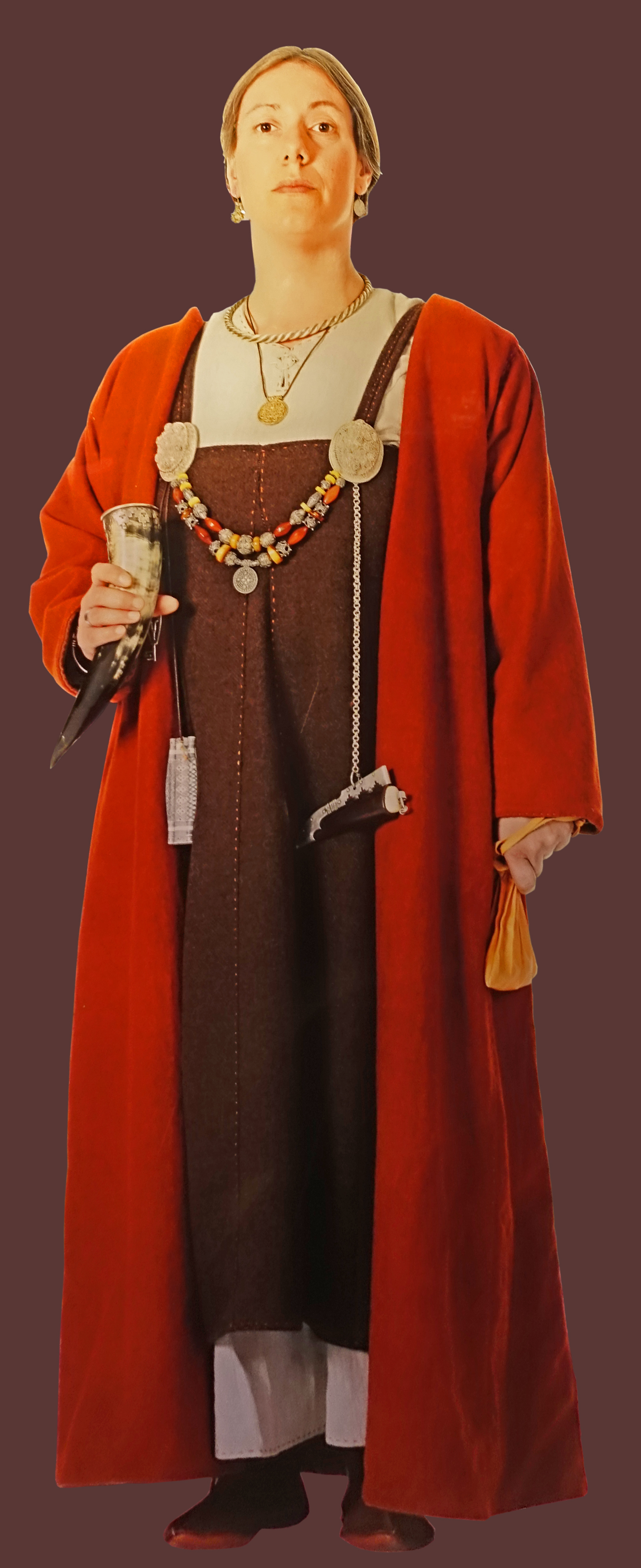
Chamber Grave 5 at Hedeby is a high-status Viking Age female burial from the southern cemetery, dated to around AD 900.
Key Details of the Burial:
Located in the Eastern part of the southern cemetery at Hedeby.
The woman was buried in an unusual coffin constructed from a wagon body, which is one of only two known examples of this specific practice in Hedeby (alongside grave 45).
South of a semicircular wall, in the first half of the 10th century AD a woman with rich accessories was buried in a very elaborate
grave. She is lying on a wooden wagon in the burial chamber lined with carpets and cloths.
For her final journey she wears a gold-encrusted dress and very valuable jewellery made of gold and silver. The
grave goods also included a drinking horn and a game board, a hanging bowl and a chest. Construction and equipment of the
the grave and the rich costume show that she was one of the richest women in Hedeby.
She was buried with exquisite Jewellery and Metalwork
The jewellery in this grave ranks among the most valuable
assemblages found in Viking Age women’s graves.
• Two unique silver oval (tortoise) brooches decorated with delicate filigree and granulation. These are the only surviving
silver oval brooches from the Viking sphere of influence.
• Two gold brooches featuring the earliest known Terslev motif, a distinctive artistic design from the Viking Age, categorised as a subcategory of the Borre style, that features three or four symmetrical, back-to-back volutes (spiral scrolls) bound by a closed ring-knot.
.
• Traces of gold weaving in her textiles.
• A gold pendant and twelve beads made of glass and amber.
Other Grave Goods included a chest, a gaming board, and a bronze basin.
Photo: Don Hitchcock 2018
Source and text: Wikinger Museum Haithabu, Eisenschmidt (2011), and Paterson (2002)
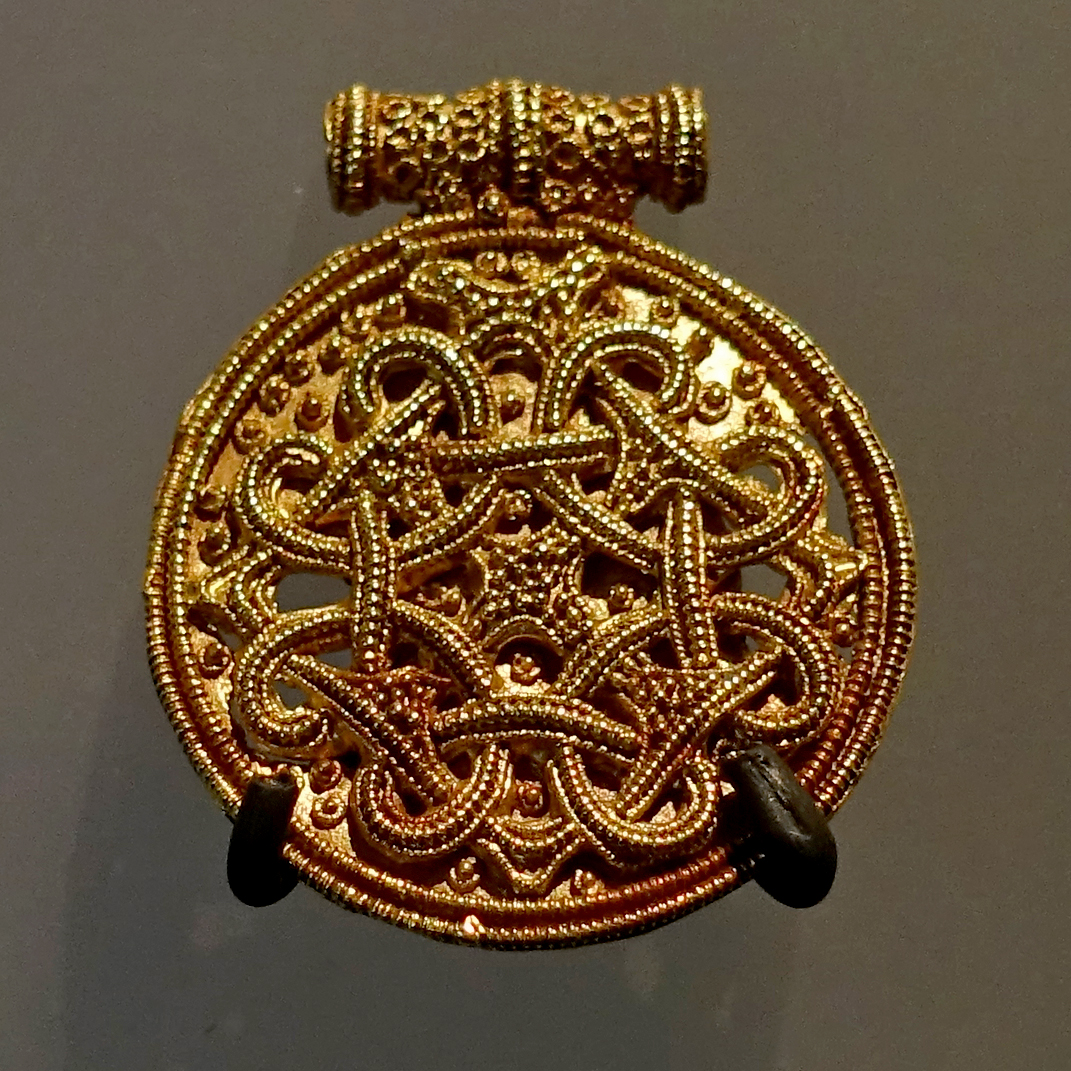
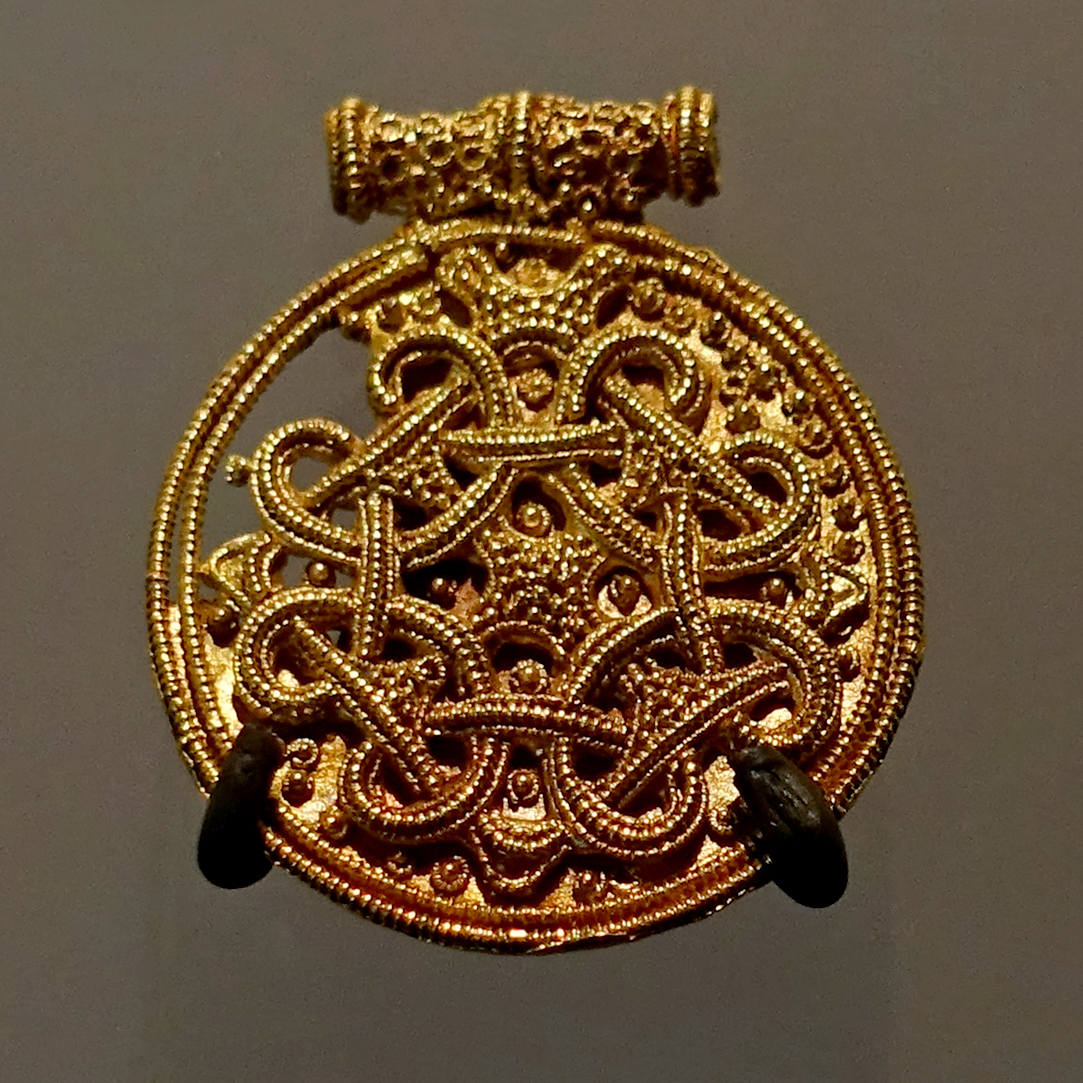
Two gold brooches featuring the earliest known Terslev motif.
Photo: Don Hitchcock 2018
Source: Wikinger Museum Haithabu
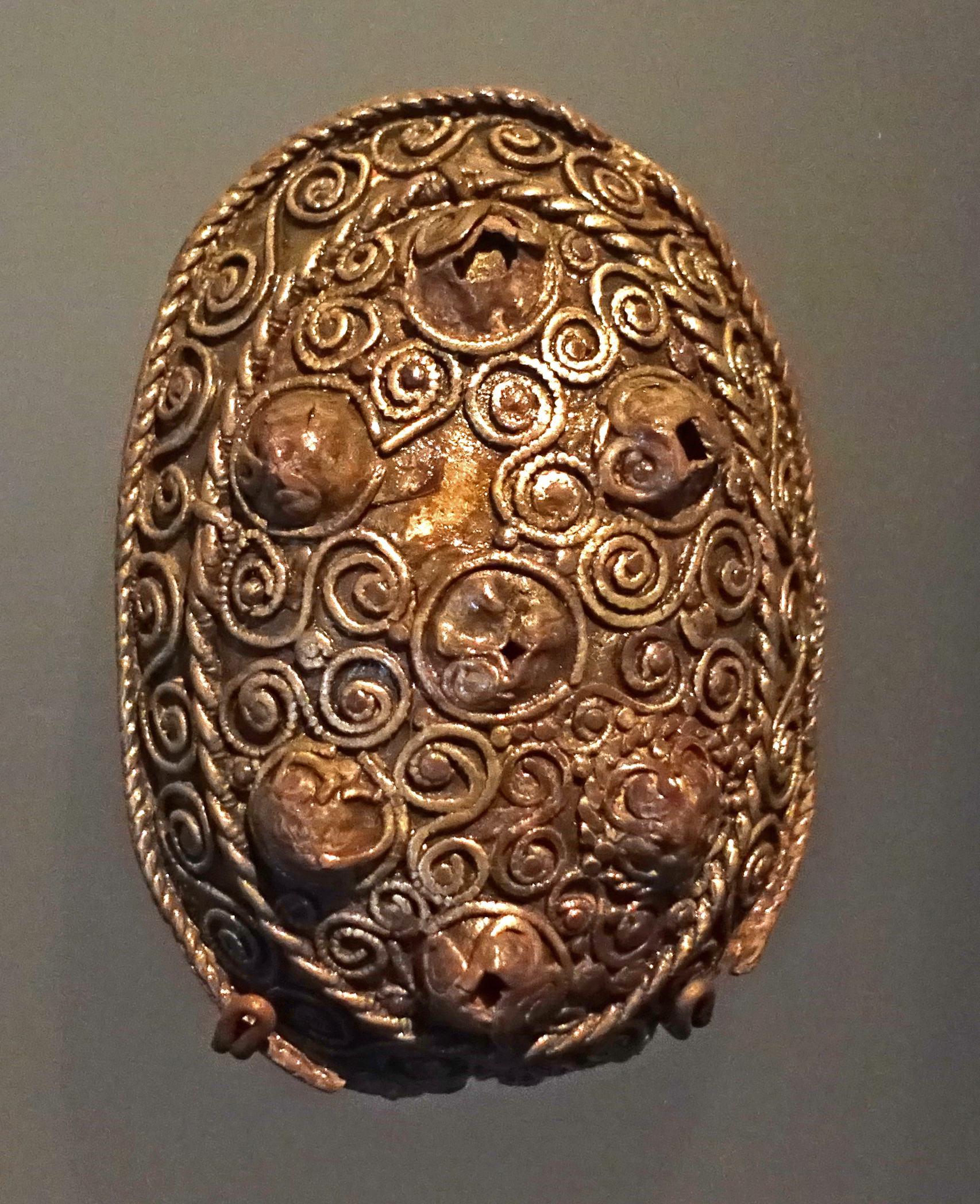
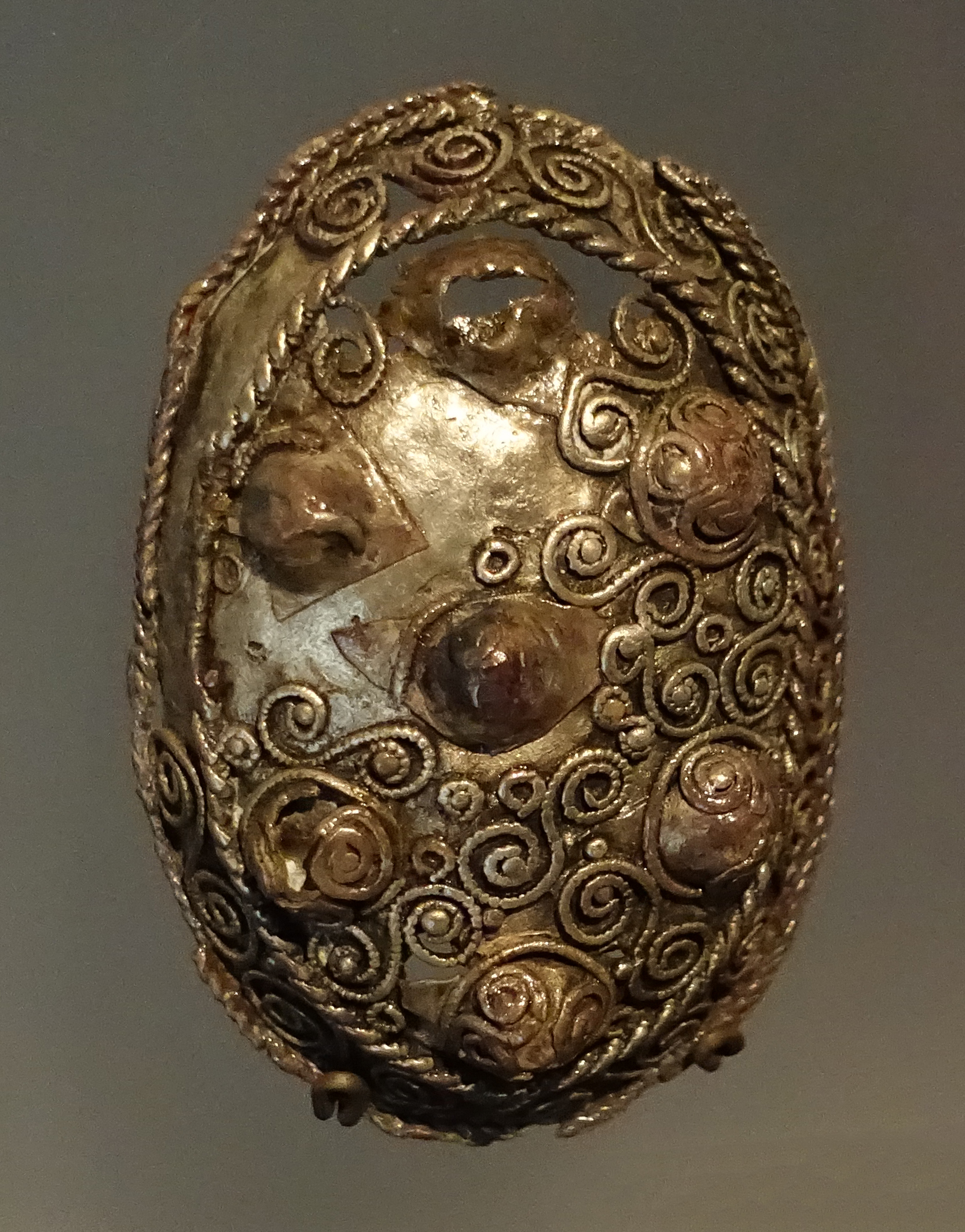
Two silver oval-shaped brooches (tortoise brooches)
Photo: Don Hitchcock 2018
Source and text: Wikinger Museum Haithabu, Eisenschmidt (2011), and Paterson (2002)
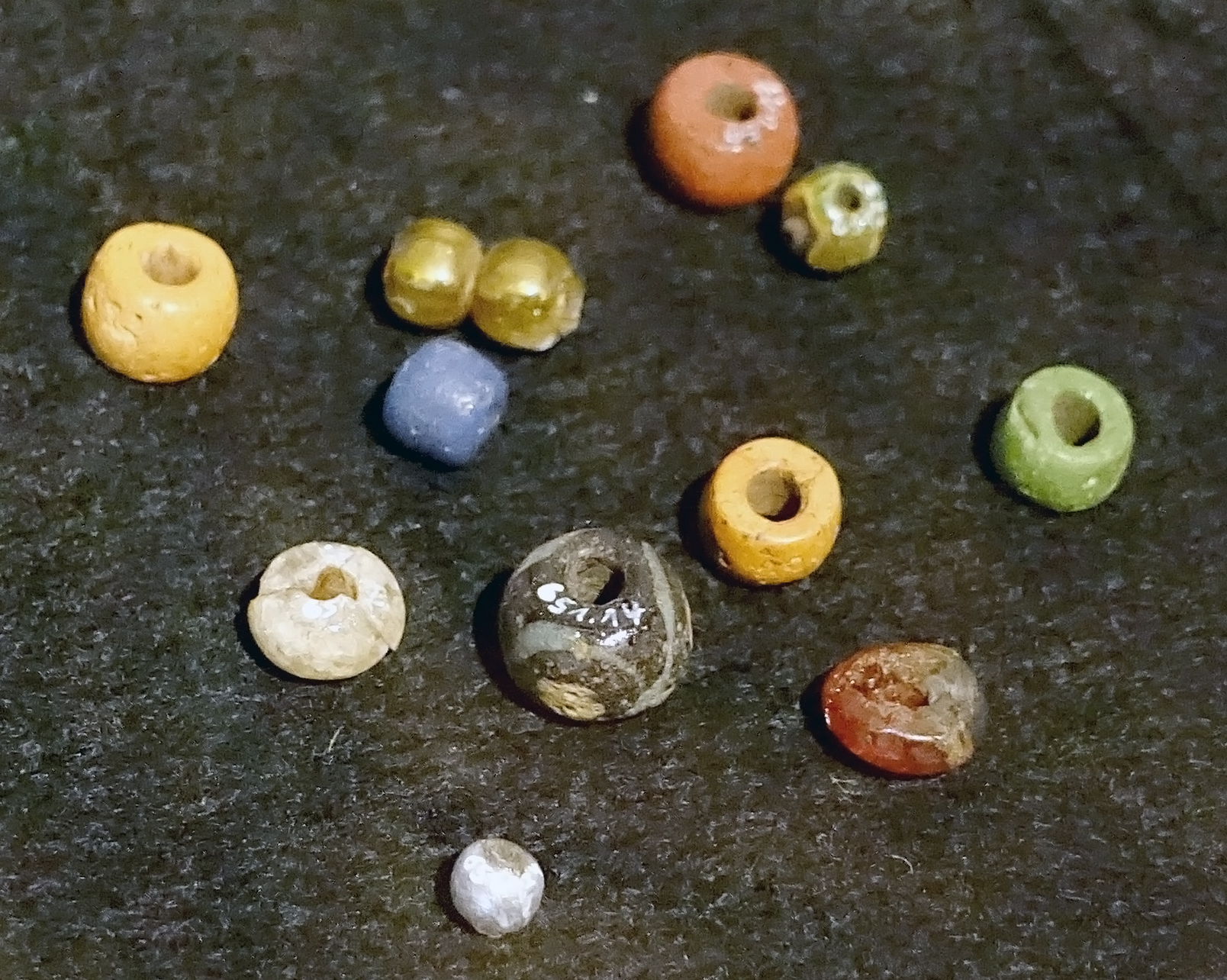
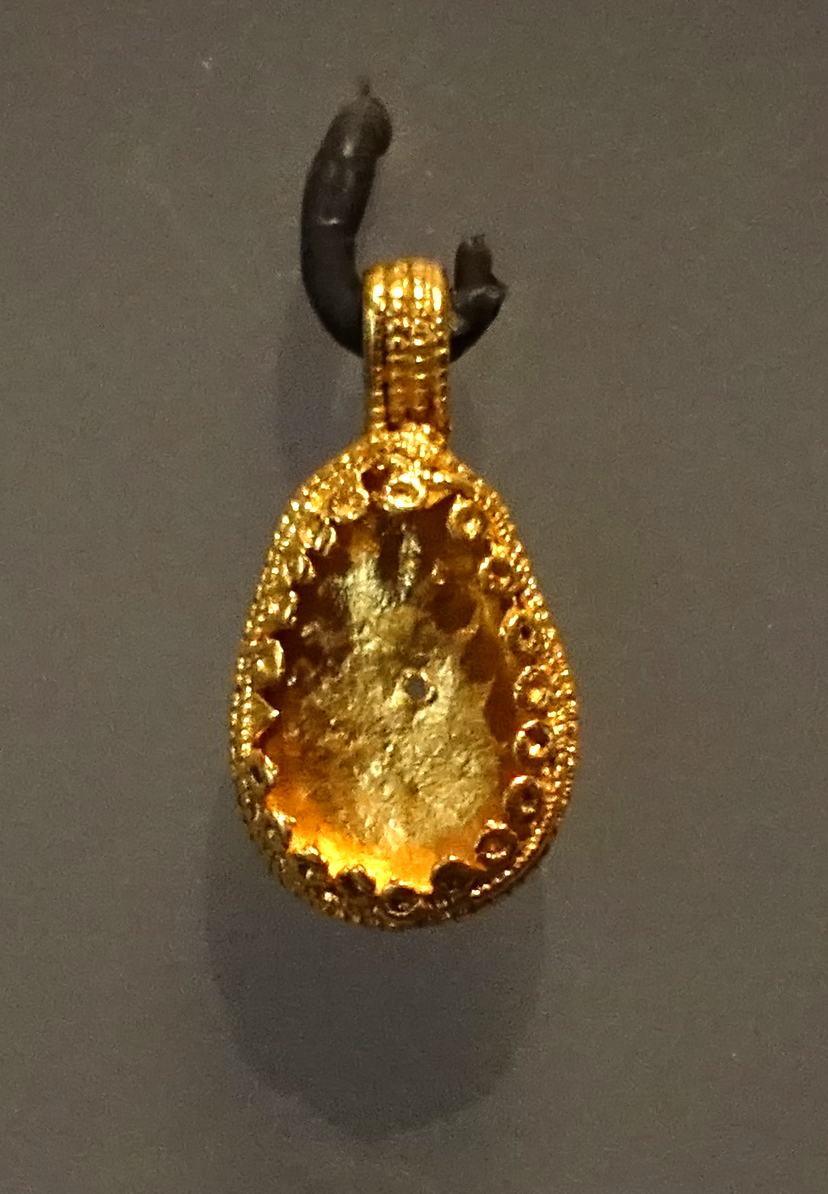
Twelve beads made of glass and amber, and a gold pendant, originally probably containing a bead or precious stone.
Photo: Don Hitchcock 2018
Source and text: Wikinger Museum Haithabu
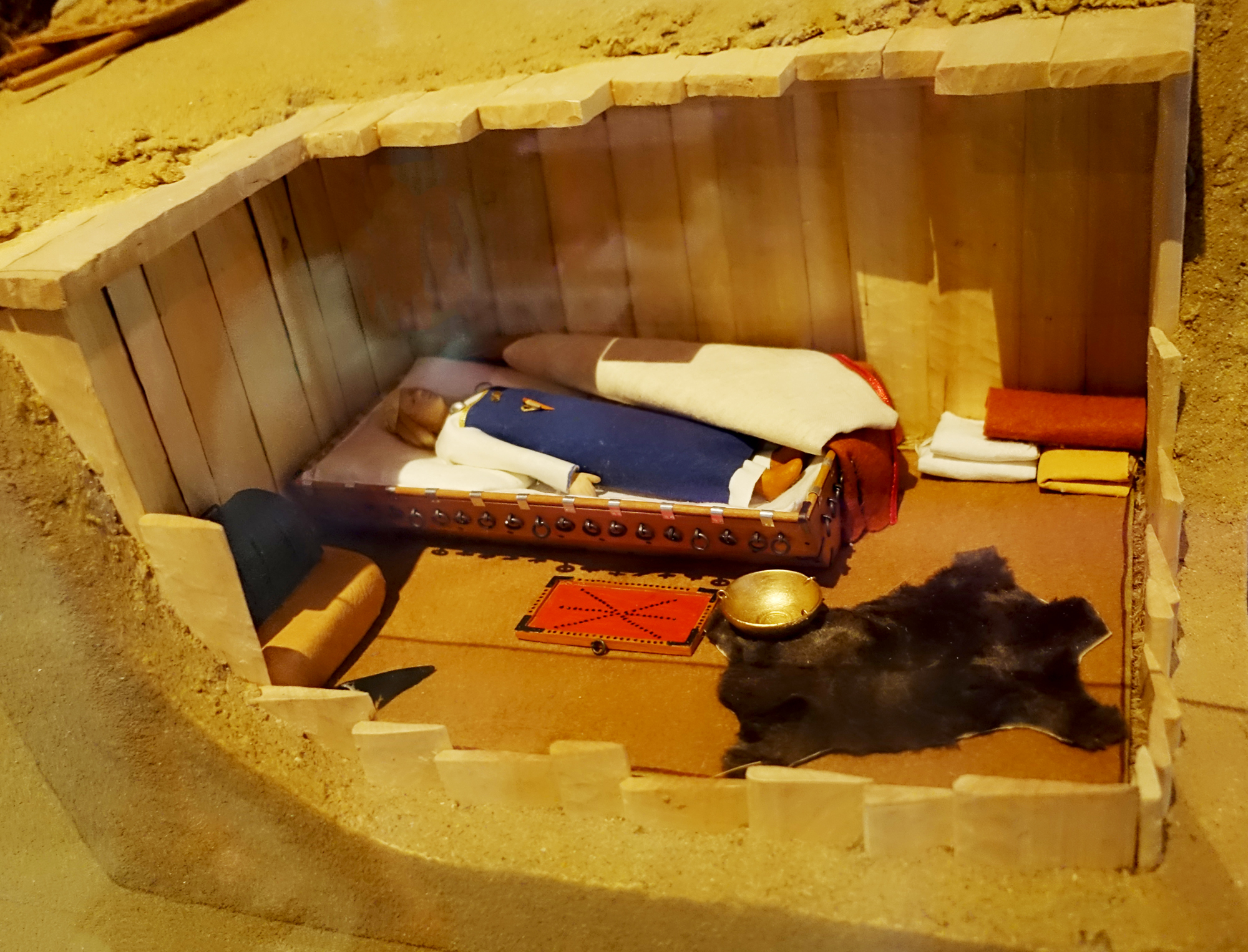
Grave 5 is a rich chamber grave, representing an elite or high-status individual within the settlement. The grave contained the remains of a woman buried with an extensive and valuable collection of precious metal jewellery and personal items.
• Grave Goods: Excavation records and studies by archaeologists (such as Steuer (1984)) list a rich assortment of artefacts:
• Jewellery & Ornaments: Glass and amber beads, a gold pendant, Terslev-style pendants, and silver oval brooches.
• Textiles & Tools: Traces of gold-threaded weaving, shears, and a knife.
• Personal & Household Items: An iron key, a small casket/box, a gaming board, and a bronze basin.
• Other Equipment: A whetstone and a knife.
Photo: Don Hitchcock 2018
Source and text: Wikinger Museum Haithabu
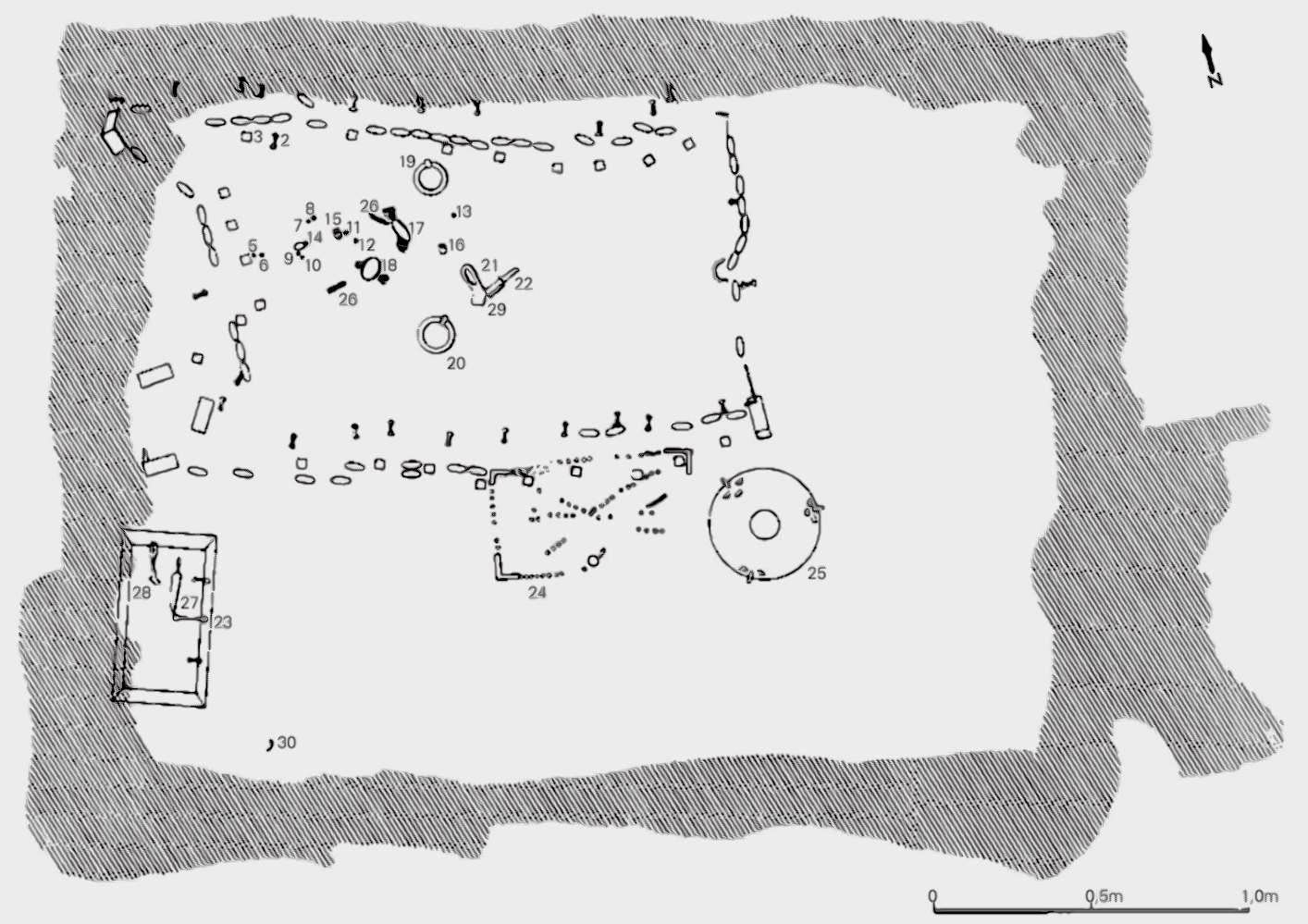
Chamber grave 5 in the Hedeby south cemetery, Schleswig.
5-13. Beads
14. Gold pendant
15-16. Terslev pendants
17-18. Silver oval brooches
21. Iron key
22. Knife
23. Casket
24. Gaming board
25. Bronze basin
26. Traces of gold weaving
27. Knife
28. Shears
29. Whetstone
(after Steuer 1984a).
( i.e. Steuer (1984) as listed below - Don )
Drawing and text: Pedersen (2014)
Key Findings on Chamber Grave 5 (Haithabu/Hedeby)
In the paper Steuer (1984) and related works, Steuer analyses Chamber Grave 5 (located in the southern cemetery near the shore). It is widely celebrated as one of the richest and most significant Viking Age elite female burials ever excavated:
• The Coffin-Wagon: The deceased woman was buried inside a wagon body used as a coffin, a highly distinct ritual for elite women. Dated to around 900 AD, Chamber Grave 5 is one of the oldest known examples of this practice.
• Wealth & Dress: The grave contained exceptional high-status objects, including two unique silver oval brooches, silver Terslev pendants, a gold pendant, glass beads, a bronze basin, and remnants of intricate gold weaving in her clothing.
• Other Artefacts: Additional personal items included an inlaid knife with silver decoration, a wooden casket/chest with iron and bronze fittings, and two bronze keys.
Steuer (1984) notes that Chamber Grave 5 was covered by a massive burial mound situated directly in front of where the later town wall (Ringwall) was constructed.
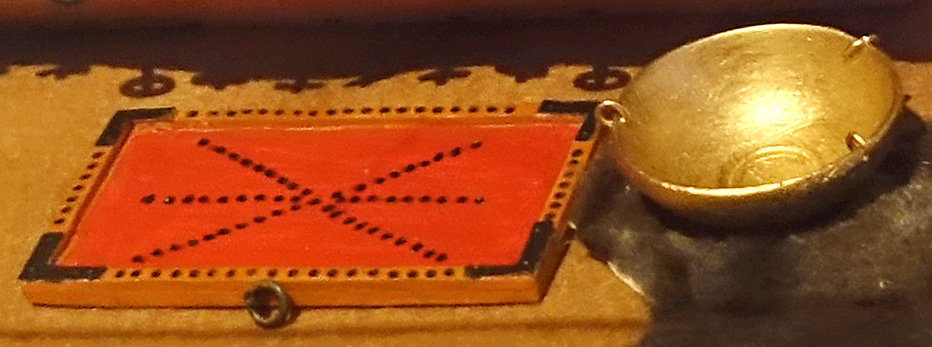
Game board and brass hanging basin in the grave.
Decorative nails divide the board into six playing fields. The edge is raised so that the pieces do not fall off. The board can be hung on an iron ring.
Photo: Don Hitchcock 2018
Source and text: Wikinger Museum Haithabu
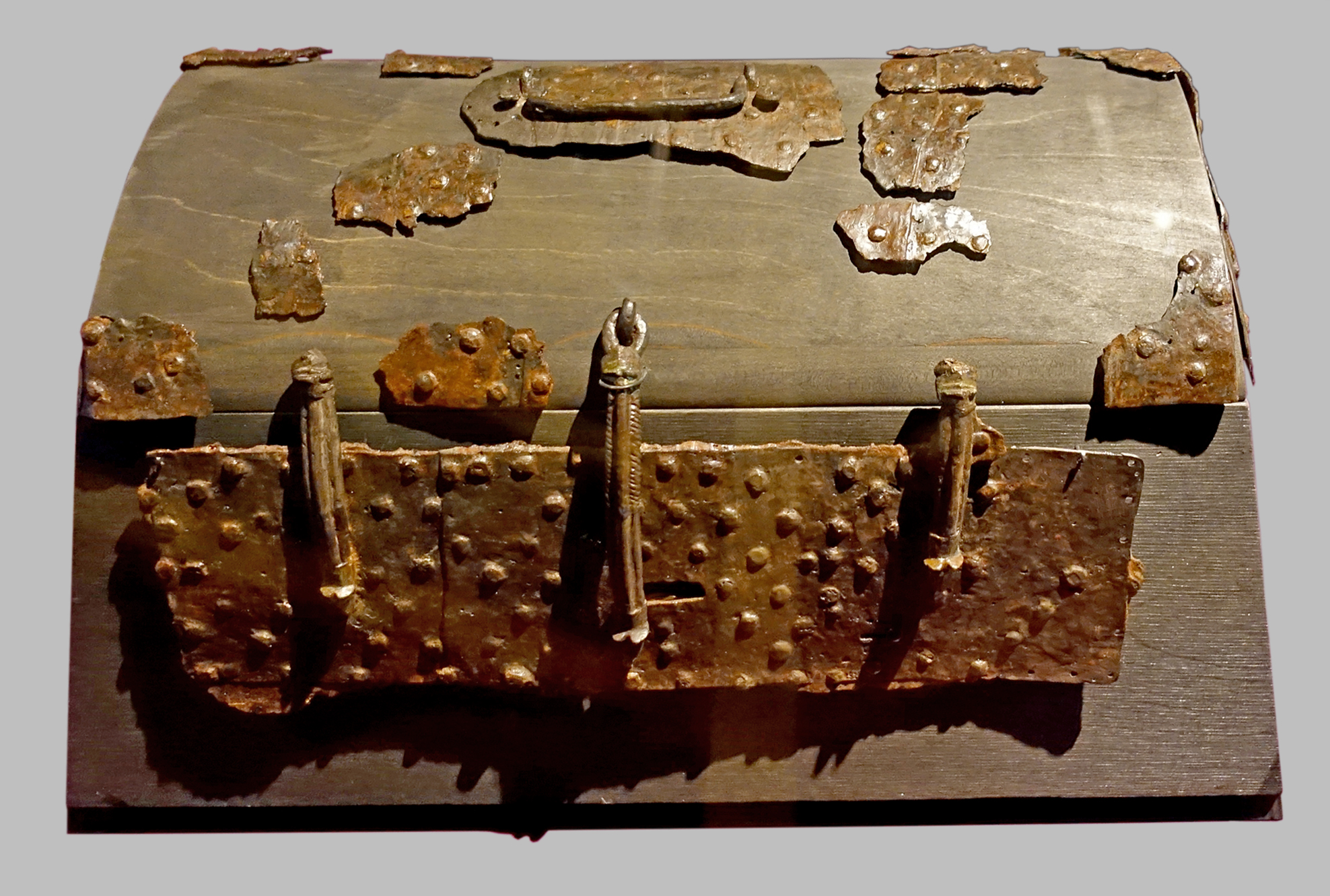
The chest from Kammergrab 5 (Chamber Grave 5) at the Viking-age trading site of Hedeby (Haithabu) is a well-preserved oaken wooden chest reinforced with iron and bronze fittings.
The addition of a chest underlines the high social status of the dead. A lock with a complicated mechanism protects the contents against unauthorised access. The three locking brackets end in bronze animal heads.
It is a domed - lid wooden casket with iron sheeting, decorative nails, 4 hinges, a handle, and 3 iron hasps with copper-alloy animal heads (Birka Group C style).
Length: 54 cm, Width: 30 cm, Height: 20 cm.
Contents Found Inside: A knife and scissors wrapped in textiles, along with beads, pendants, and oval brooches.
Photo: Don Hitchcock 2018
Source and text: Wikinger Museum Haithabu
Additional text: Pedersen (2014)
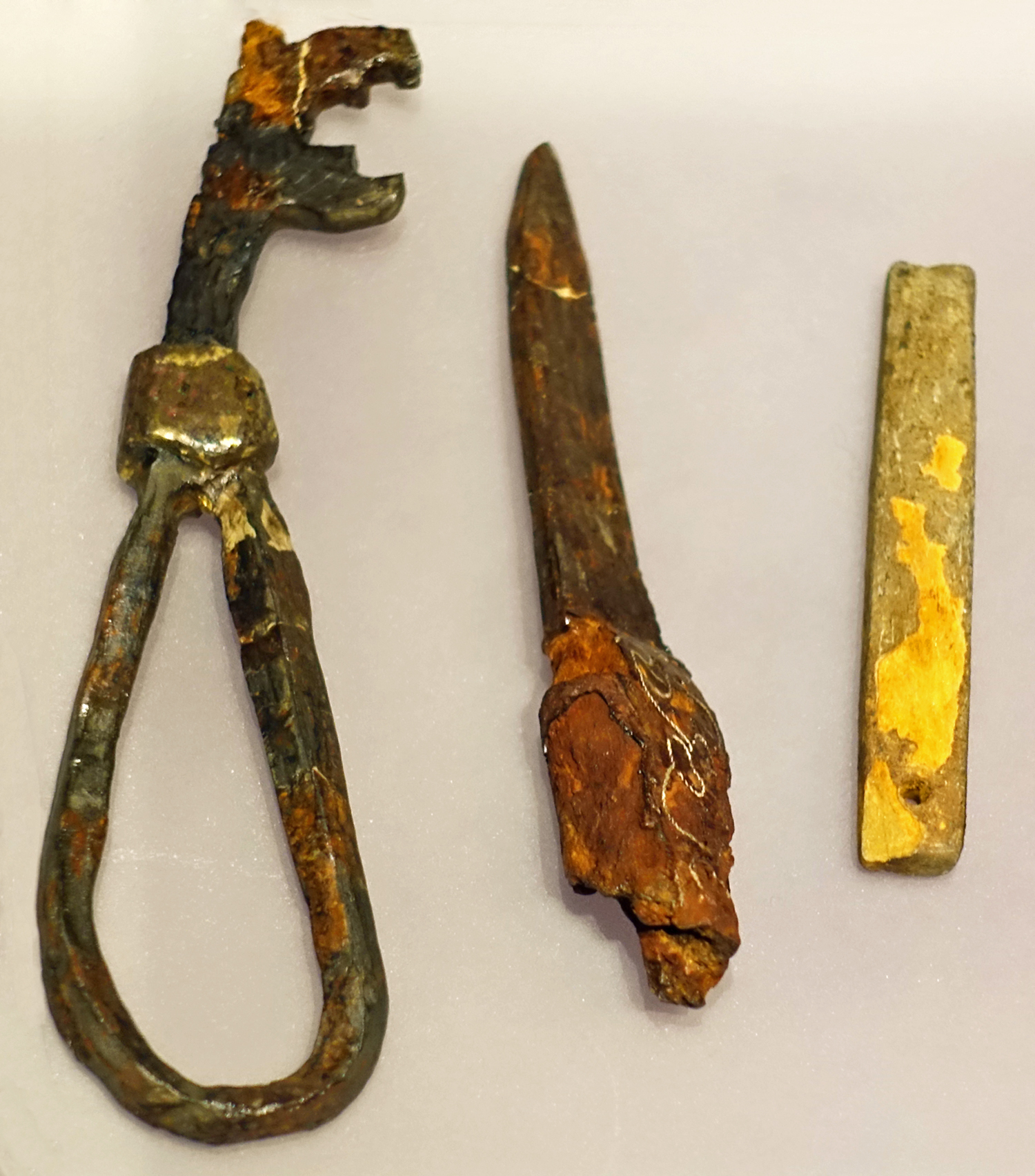
Iron Key with a Large Loop Handle: Married Norse women (husfreyja or lady of the house) wore keys hanging visibly from their clothing or brooches as a potent symbol of authority, ownership, and control over the household's locked chests and treasures.
Viking Knife with Sheath Remains: Knives were essential multi-purpose utility tools carried by almost every individual. High-status graves from Hedeby often feature fine blades accompanied by beautifully crafted, silver-inlaid leather sheaths.
Whetstone (or Touchstone): A small, rectangular sharpening stone used regularly to hone blade edges.
Knives, whetstones, keys, and scissors are among the personal items for daily use that are often placed in the grave with the deceased.
Photo: Don Hitchcock 2018
Source and text: Wikinger Museum Haithabu
Additional text: https://www.reddit.com/r/ArtefactPorn/comments/r6vg8e/a_viking_key_from_the_11th_century_öland_sweden/
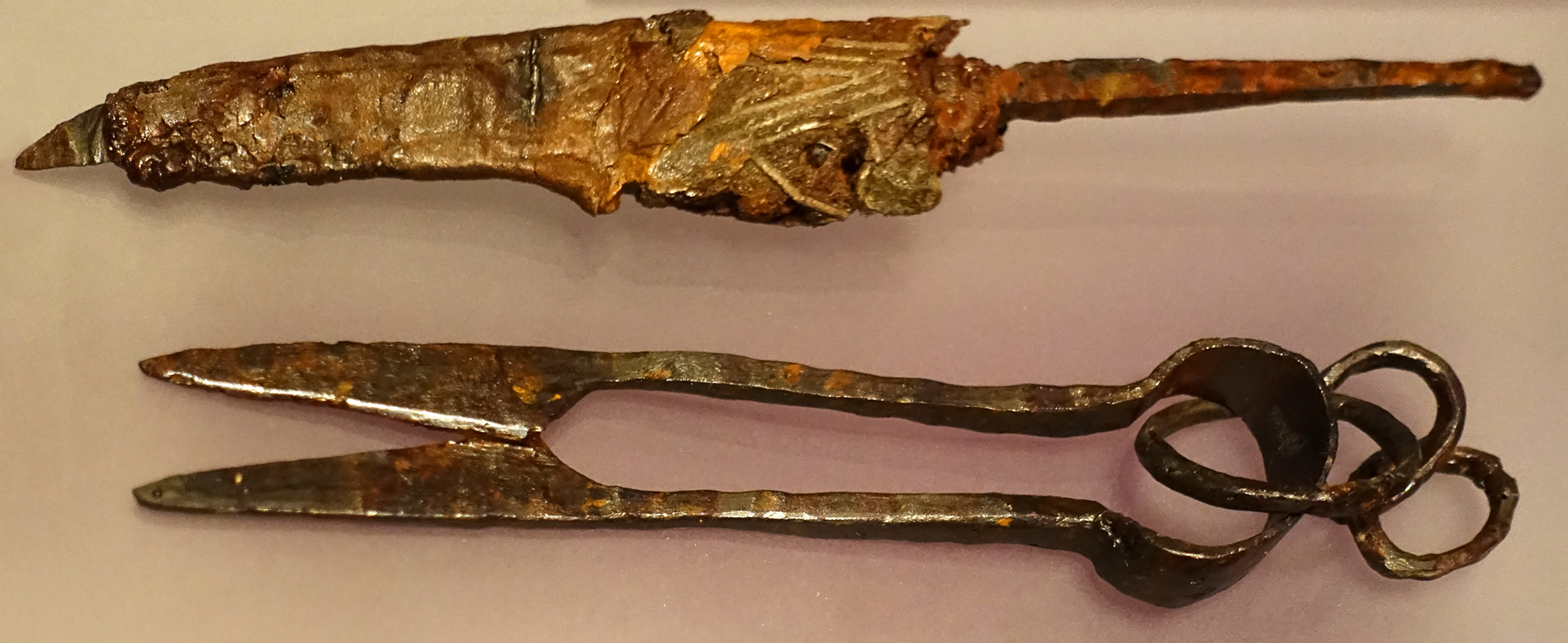
The lower object is a pair of Viking Age iron spring shears found at Hedeby.
Unlike modern pivoted scissors with a centre rivet, these are spring shears (or bow shears) forged from a single piece of iron. The circular bow loop at the back acts as a natural spring. Squeezing the handles brings the blades together to cut, and releasing the grip automatically springs the blades open again.
Tools like these were multi-purpose necessities in the Viking world. They were used for daily tasks such as cutting textiles and leather, trimming hair or beards, and shearing wool from sheep. The interlocking metal rings attached to the spring bow allowed the owner to secure the shears to a belt or a chatelaine, keeping this vital tool easily accessible.
A chatelaine is a decorative belt hook or clasp worn at the waist with a series of suspended chains used to carry everyday household and personal tools. Before women's garments routinely featured pockets, the chatelaine acted as a functional 'Swiss Army knife' or utility belt. Attached tools often included keys, scissors, thimbles, pocket watches, seals, and small vanity items. They were used from ancient and medieval times up through the 17th to 19th centuries. Chatelaines ranged from practical iron or brass instruments to fine sterling silver and gold pieces crafted by jewellers.
The object placed directly above the spring shears is an iron utility knife preserved inside its original leather sheath and metal hardware fittings. On the far left can be seen the surviving triangular tip of the iron blade protruding from the deteriorated sheath body.
On the right, the long, thin rod of iron is the tang. In the Viking Age, this metal rod would have been inserted into a carved handle made of organic material—usually wood, bone, or antler, which has since completely rotted away.
The middle portion consists of heavily corroded leather remnants bound and decorated with decorative bronze or brass metal plates. These metallic reinforcements wrapped around the leather prevent the sharp blade from slicing through the sheath and allow it to be safely suspended from a belt.
Photo: Don Hitchcock 2018
Text: Various sources, including Helén et al. (2021), www.bada.org/features/terms-trade-chatelaine, and the National Museum in Szczecin, Poland.
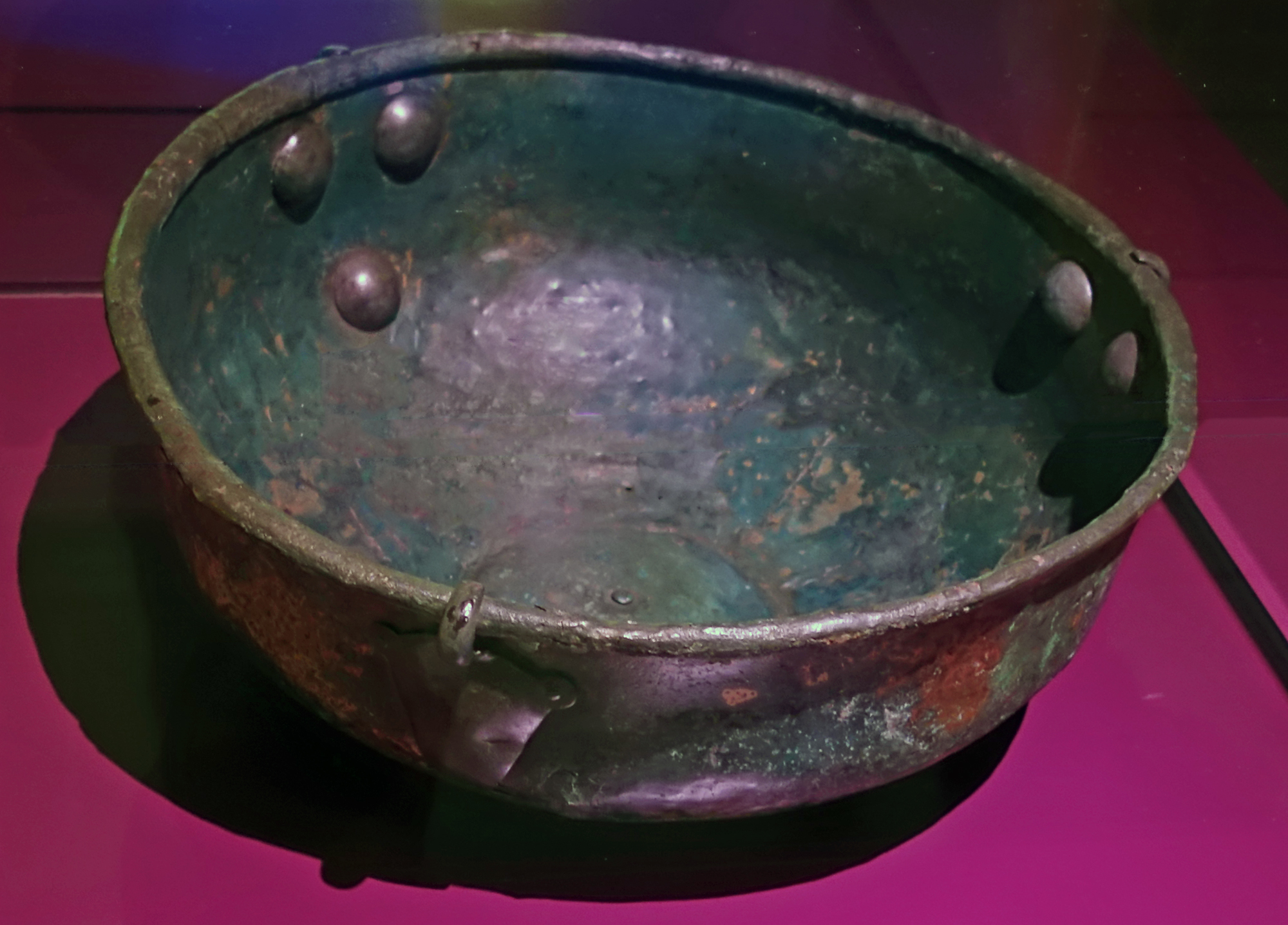
Bronze bowl.
Photo: Don Hitchcock 2018
Source and text: Wikinger Museum Haithabu
References
- Bledý M. et al., 2024: Silver Fir (Abies alba Mill.): Review of Ecological Insights, Forest Management Strategies, and Climate Change Impact on European Forests ResearchGate, DOI:10.20944/preprints202404.1584.v1 License CC BY 4.0.
- Deckers, P., 2022: Glittery Pitchers in Viking Homes. Exploring Sensory Aspects of Tating Pottery. Periskop, Forum for kunsthistorisk debate 2022. 140-147. 10.7146/periskop.v2022i28.134581
- Eisenschmidt, S., 2011: The Viking Age Graves from Hedeby, in: S. Sigmundsson (ed.), Viking Settlements and Viking Society, papers from the Proceedings of the Sixteenth Viking Congress 2009 (Reykjavík 2011) 83-102.
- Eniosova N. et al., 1999: Manufacturing Techniques of Belt and Harness Fittings of the 10th Century AD Journal of Archaeological Science, (1999) 26, 1093–1100
-
Garde E., Hansen R., 2014: Did the North Atlantic region constitute a market for quernstones from Norway during the Viking Age and the Middle Ages?
in the book Seen through a millstone, (2014) pp 245-255, Publisher: University of Stavanger
See: www.academia.edu/8388222/Did_the_North_Atlantic_region_constitute_a_market_for_quernstones_from_Norway_during_the_Viking_Age_and_the_Middle_Ages - Garde E., Hansen R., 2021: The Atlantic Walrus Academic Press, (2021) pp 77-95, ISBN 9780128174302
- Helén A. et al., 2021: Metallurgical Characterization of Two 11th–12th Century Single-Bow Shears from Sigtuna, Sweden Acta Archaeologica, 92(2), pp. 176–183. DOI: https://doi.org/10.1163/16000390-20210032
- Merkel S., 2018: Archaeometallurgical investigations of a Viking brass ingot hoard from the Hedeby Harbor in northern Germany Journal of Archaeological Science, Reports, Volume 20, 2018, Pages 293-302, ISSN 2352-409X, https://doi.org/10.1016/j.jasrep.2018.04.019.
- Paterson C., 2002: From Pendants to Brooches: The Exchange of Borre and Jellinge Style Motifs across the North Sea Hikuin, 2002
- Pedersen A., 2014: Dead warriors in living memory, a study of weapon and equestrian burials in Viking Age Denmark, AD 800-1000 Publications from the National Museum Studies in Archaeology & History, Vol 20:1 Copenhagen 2014
- Steuer H., 1984: Zur ethnischen Gliederung der Bevölkerung von Haithabu anhand der Gräberfelder" (On the Ethnic Structure of the Population of Hedeby, based on the Cemeteries) Offa, Volume 41, 1984, pp. 189–212.
Back to Don's Maps
Back to Archaeological Sites