Back to Don's Maps
 Back to Archaeological Sites
 Back to Egypt Index Page
Ancient Egyptian Culture, Mummies, Statues, Burial Practices and Artefacts
Ancient Egypt from the start of the 23rd Dynasty to the conquest of Egypt by Alexander in 332 BC.
Egyptian Chronology
| Egyptian Chronology | ||
|---|---|---|
| Date | Culture | Duration |
| 11 000 BC | Jebel Sahaba | |
| Before 8 000 BC - Palaeolithic in Europe and Northern Asia | ||
| 8 000 BC - Nominal end of the Ice Age | ||
| 8 600 - 4 400 BC | Nabta Playa Neolithic | 4 200 years |
| 6 100 - 5 180 BC | Qarunian (formerly known as Fayum B) | 920 years |
| 5 200 - 4 200 BC | Fayum A | 1 000 years |
| 4 800 - 4 200 BC | Merimde | 600 years |
| 4 600 - 4 400 BC | El Omari | 200 years |
| 4 400 - 4 000 BC | Badarian | 400 years |
| 4 000 - 3 300 BC | Maadi | 700 years |
| 3 900 - 3 650 BC | Naqada I | 250 years |
| 3 650 - 3 300 BC | Naqada II | 350 years |
| 3 300 - 2 900 BC | Naqada III | 400 years |
| 3 100 - 2 670 BC | Early Dynastic | 430 years |
| 2 670 - 2 181 BC | Old Kingdom | 489 years |
| 2 181 - 2 025 BC | First Intermediate Period | 156 years |
| 2 025 - 1 700 BC | Middle Kingdom | 325 years |
| 1 700 - 1 550 BC | Second Intermediate Period | 150 years |
| 1 550 - 1 077 BC | New Kingdom | 473 years |
| 1 077 - 664 BC | Third Intermediate Period | 413 years |
| 664 - 332 BC | Late Period | 332 years |
| 525 - 404 BC | First Persian Period | 121 years |
| 404 - 343 BC | Late Dynastic Period | 61 years |
| 343 - 332 BC | Second Persian Period | 11 years |
| 332 - 305 BC | Macedonian Period | 27 years |
| 305 - 30 BC | Ptolemaic Period | 275 years |
| 30 BC - 395 AD | Roman Period | 425 years |
| 395 AD - 640 AD | Byzantine Period | 245 years |
| 640 AD - 1517 AD | Islamic Period | 877 years |
| 1517 AD - 1867 AD | Ottoman Period (French Occupation 1798-1801) |
350 years |
| 1867 AD - 1914 AD | Khedival Period | 47 years |
| 1914 AD - 1922 AD | Sultanate under Hussein Kamel, as a British Protectorate |
8 years |
| 1922 AD - 1953 AD | Monarchy | 31 years |
| 1953 AD - Present Day | Republic | |
| List of Egyptian Dynasties from the 21st to the 31st Dynasties | ||||
|---|---|---|---|---|
| Date | Dynasty | Period | Duration (years) |
Comments |
| 1 077 - 943 BC | 21st Dynasty | Third Intermediate Period | 134 | Lower (Northern) Egypt, ruled from Tanis |
| 1 080 - 943 BC | High Priests of Amun | Third Intermediate Period | 137 | Middle and Upper (Southern) Egypt |
| 943 - 716 BC | 22nd Dynasty | Third Intermediate Period | 227 | Meshwesh ancient Libyans ruled from Bubastis and Tanis |
| 880 - 720 BC | 23rd Dynasty | Third Intermediate Period | 160 | Controlled Middle and Upper (Southern) Egypt, including the Western Desert Oases in parallel with the Twenty-second dynasty, shortly before the death of Osorkon II. |
| 732 - 720 BC | 24th Dynasty | Third Intermediate Period | 12 | Short-lived group of pharaohs who had their capital at Sais in the western Nile Delta. |
| 746 - 656 BC | 25th Dynasty | Third Intermediate Period | 90 | Known as the Nubian Dynasty, or the Kushite Empire |
| 664 - 525 BC | 26th Dynasty | Late Period | 139 | Last native dynasty to rule Egypt before the Persian conquest in 525 BC |
| 525 - 404 BC | 27th Dynasty | Late Period | 121 | The First Egyptian Satrapy was effectively a province (satrapy) of the Achaemenid Persian Empire between 525 BC to 404 BC |
| 404 - 398 BC | 28th Dynasty | Late Period | 6 | Amyrtaeus, a native Egyptian, took control of Egypt from the Persians |
| 398 - 380 BC | 29th Dynasty | Late Period | 18 | Ruled from Mendes |
| 380 - 343 BC | 30th Dynasty | Late Period | 37 | This dynasty was the last native dynasty in Egypt |
| 343 - 332 BC | 31st Dynasty | Late Period | 11 | Second Egyptian Satrapy, founded by Artaxerxes III, the King of Persia |
The 23rd Dynasty: 880 BC - 720 BC
The Twenty-third Dynasty of ancient Egypt was a separate regime of Meshwesh Libyan kings, who ruled ancient Egypt. This dynasty is often considered part of the Third Intermediate Period.
The so-called Twenty-Third Dynasty was an offshoot of the Twenty-second dynasty, perhaps based in Upper (southern) Egypt, though there is much debate concerning this issue. All of its kings reigned in Middle and Upper Egypt including the Western Desert Oases.
There is much debate surrounding this dynasty, which may have been situated at Herakleopolis Magna, Hermopolis Magna, and Thebes. Monuments from their reign show that they controlled Upper (southern) Egypt in parallel with the Twenty-second dynasty, shortly before the death of Osorkon II.
| 23rd Dynasty | |||||
|---|---|---|---|---|---|
| Name | Horus (Throne) Name | Consort | Years | Dates | Comments |
| Harsiese A | Hedjkheperre-Setpenamun | Isetweret I | 20 | 880 BC - 860 BC | Independent king at Thebes, ruled during Takelot I's and Osorkon II's reigns. |
| Takelot II | Hedjkheperre-Setpenre | Karomama D Tashep Tabeketenasket A |
25 | 840 BC - 815 BC | Contemporary with the Twenty-second Dynasty king Shoshenq III, who controlled Lower (northern) Egypt. |
| Pedubast I | Usermaatre-Setpenamun | 25 | 829 BC - 804 BC | Involved in a prolonged civil war with King Takelot II/Crown Prince Osorkon B. |
|
| Iuput I | 25 | 829 BC - 804 BC | Co-regent with Pedubast I. | ||
| Shoshenq VI | Usermaatre-Meryamun | 6 | 804 BC - 798 BC | Succeeded Pedubast I at Thebes and ruled Upper (southern) Egypt for 6 years. |
|
| Osorkon III | Usermaatre-Setpenamun | Tentsai A Karoatjet |
29 | 798 BC - 769 BC | Involved in a civil war against Pedubast I and Shoshenq VI. |
| Takelot III | Usermaatre | Kakat Irtiubast |
15 | 774 BC - 759 BC | Osorkon III's eldest son, junior coregent and successor. |
| Rudamun | Usermaatre-Setpenamun | Tadi... | 4 | 759 BC - 755 BC | The younger brother and successor of Takelot III. A poorly attested king. |
| Ini | Menkheperre | 5 | 755 BC - 750 BC | Only controlled Thebes during his reign. | |
| Peftjauawybast | Neferkare | Irbastwedjanefu Tashereniset I |
34 | 754 BC - 720 BC | Rudamun's son-in-law, only controlled Herakleopolis during his reign. |
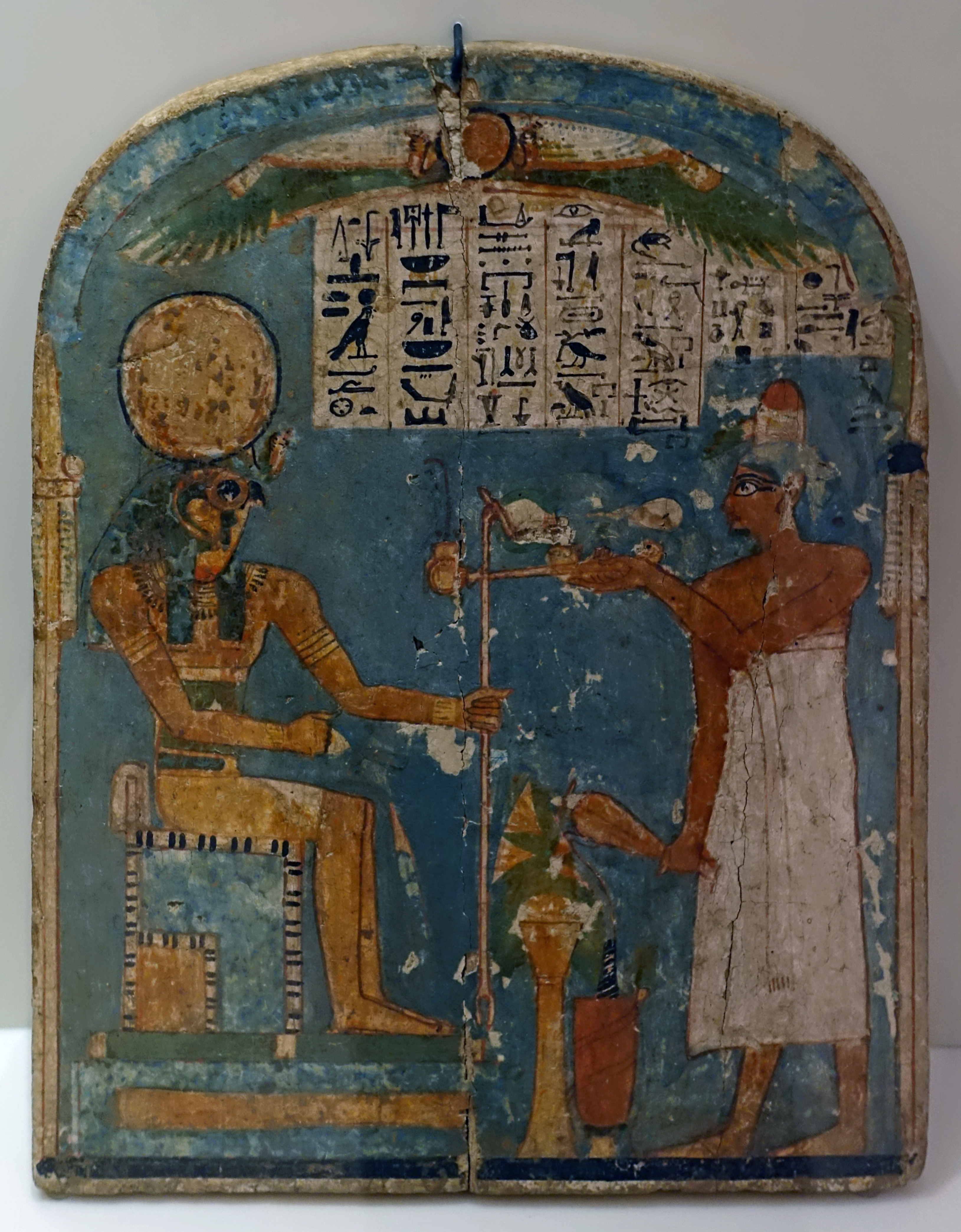
22nd -23rd dynasty: 943 BC - 720 BC
Padichonsu
Stele of Pa-di-khonsu, before the god Re-Harachte, circa 650 BC.
Rê-Harakhte, the horizontal Rê, is considered the morning aspect of the sun god and is one of the most important gods in Egypt. The idea of the cyclical course of the sun was of central importance to all regenerative forces in Egypt. The way of the earth was coupled to the passage of the god Rê, who travels every day in his boat through twelve hours of the day and night.
Catalog: Wood, Thebes, ÄM 10258
Photo: Don Hitchcock 2018
Source: Original, Staatliche Museen zu Berlin, Neues Museum, Germany
Text: © Card at the Staatliche Museen zu Berlin (CC BY-NC-SA 3.0 DE)
Additional text: © http://www.jenseits-des-horizonts.de/wp-content/uploads/2012/06/Stele-des-Padichonsu_%C3%84M10258.pdf
22nd -23rd dynasty: 943 BC - 720 BC
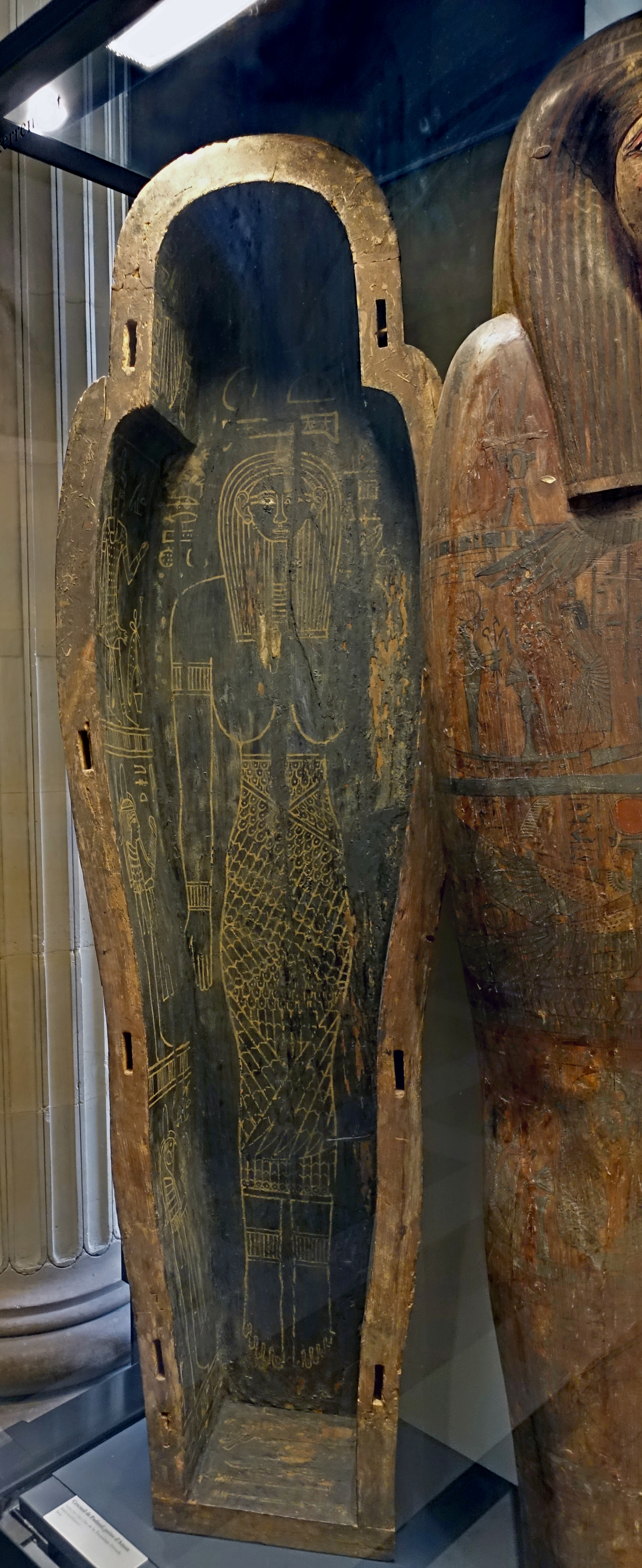
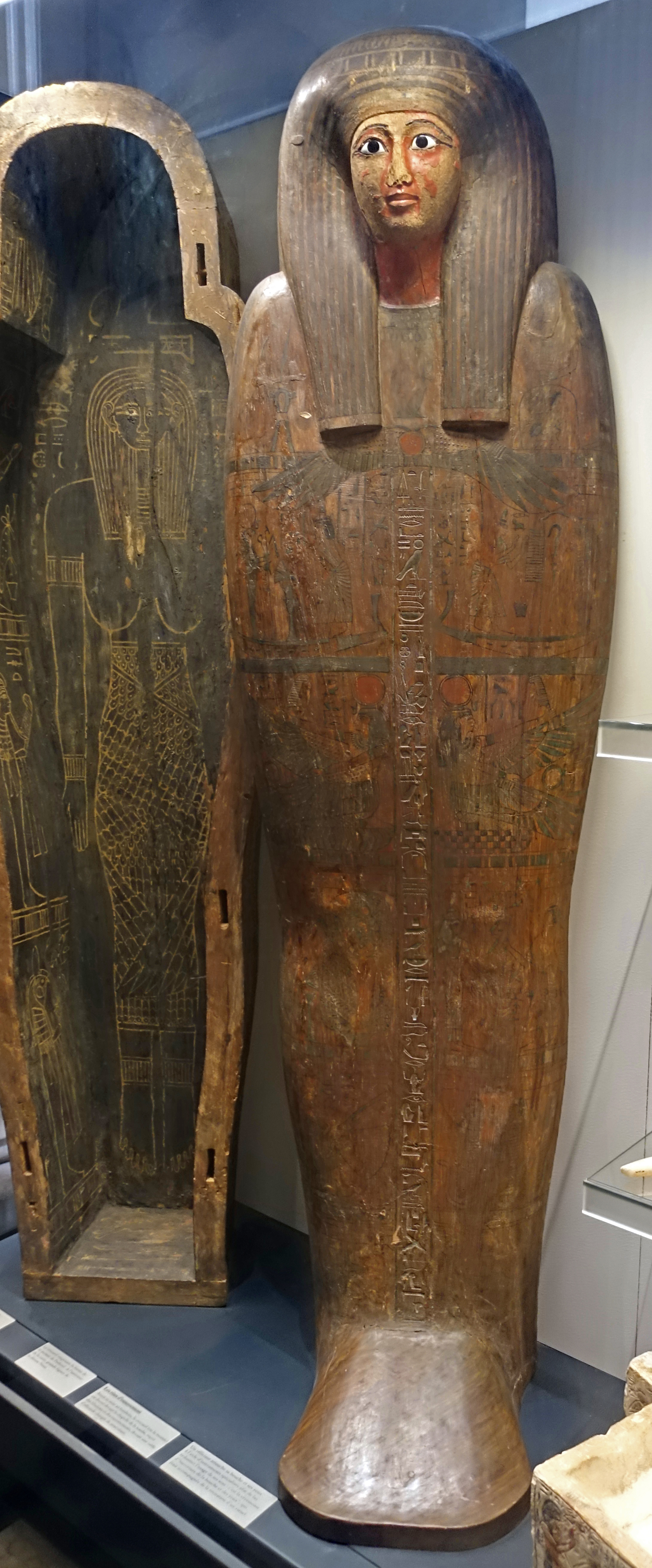
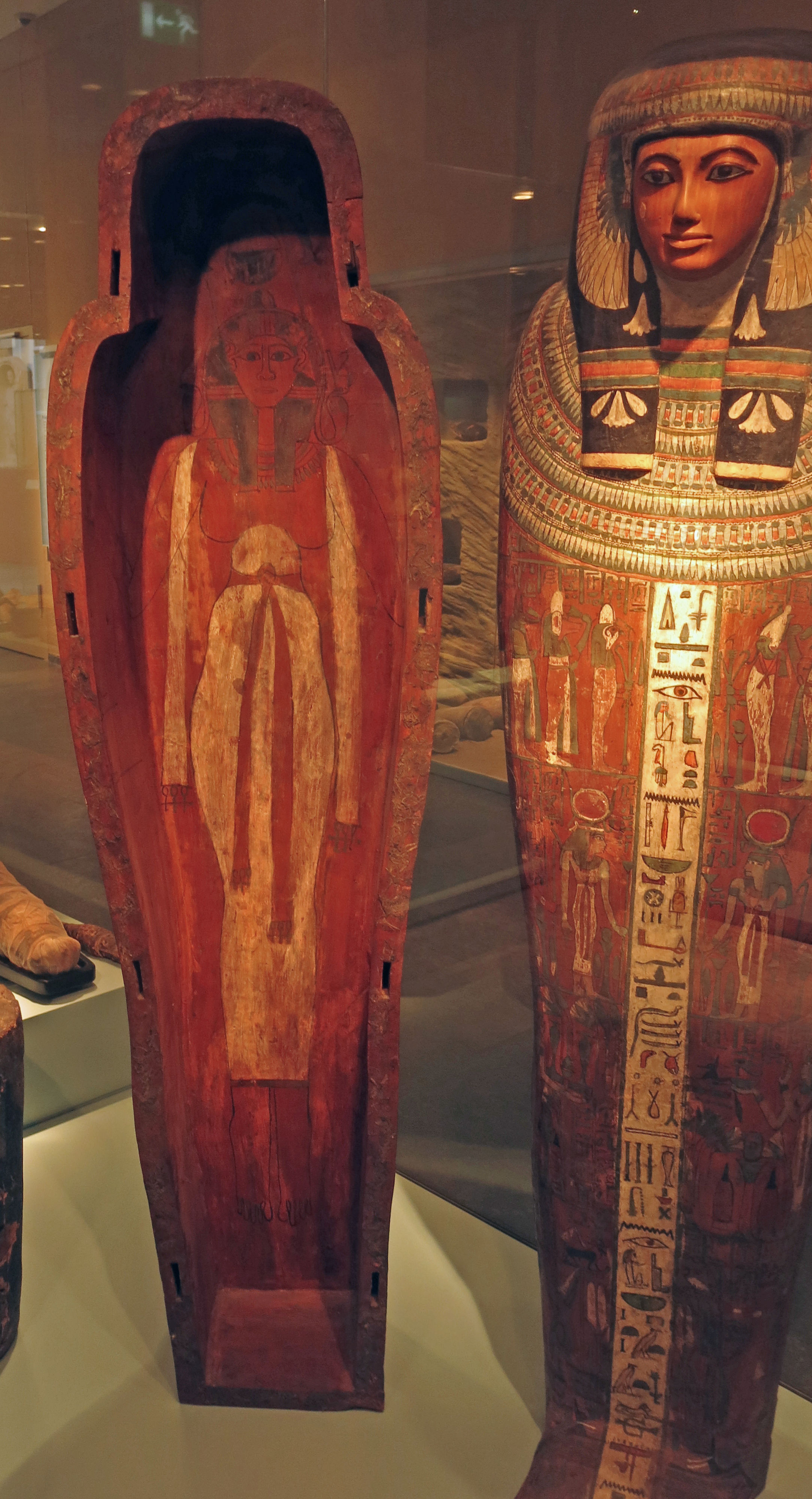
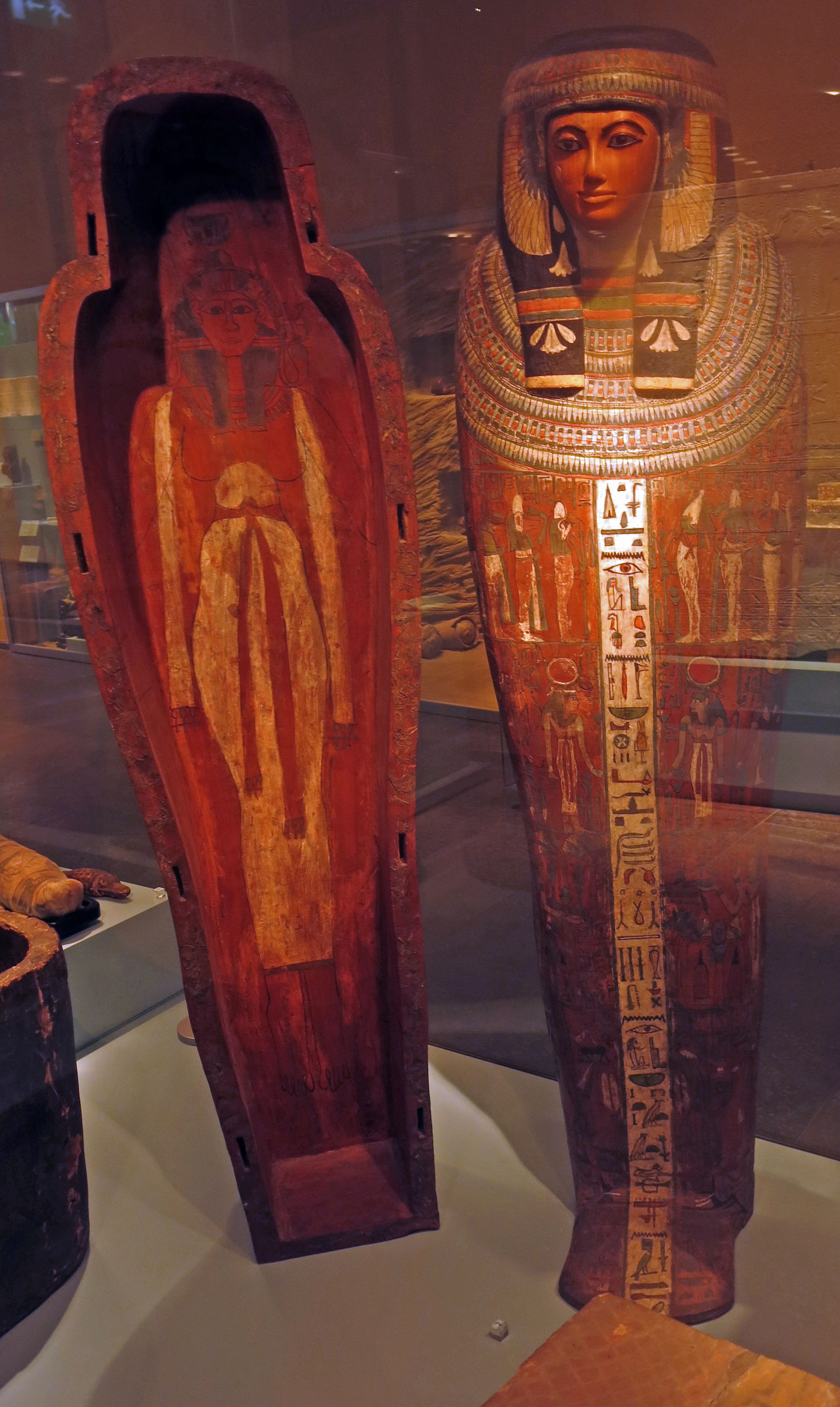
Padiouf
Mummy shaped coffin of Padiouf (priest-it-netjer of Amun, priest-wab initiated at Karnak)
Padiouf wears a shroud, tripartite wig, headband.
Decoration on the lid, exterior: On the shoulders; right: Tuareg; left: goddess (standing); on the neck: Maat.
On the chest: winged solar disk; worship scene (2, symmetrical); man (standing, pleated loincloth, worshipping); Ra (right, standing, in a boat); Ptah (left, standing, in a boat).
On the stomach: Winged goddess (2, symmetrical, crouching, protecting)
on the legs; 1st register; dead being watered by the tree goddess; man (standing, in front); Imentet; 2nd register; Sokar's boat; genie (3, standing, on, serpent); 3rd register; Anubis (2, canid, lying down)
on the lid; inside: Isis (large scale, arms raised, skirt)
on the basin; inside: Nut (large scale, skirt: plumage); the four sons of Horus.
Names and titles: Padiouf (priest-it-netjer of Amun, priest-wab initiated at Karnak); Penpy (father, head of the carpenters of the king of Amun's domain, ?, head of the secrets of Amun's domain); Imenemhat (grandfather); Djedhoriouesânkh (mother, mistress of the house)
Length 2000 mm, width 585 mm.
Technique: Wood, inlay, painting (black interior with yellow decoration - unpainted exterior with black, red, and blue decoration).
Features: Sokar's boat - boat - winged solar disk - Ptah - Ra - worshipping - arms raised - protecting - right - front - in - inside - outside - left - 3rd register - 2nd register - 1st register - large scale - on the basin - on the legs - on the shoulders - on the stomach - on the lid - on the neck - on the chest - on - dead man being watered by the goddess - tree - man - scene of adoration - crouching - lying down - standing - snake - headband - canid 3 - 2 - Maat - Isis - Imentet - Tueris - Nut - symmetrical - winged goddess - goddess - genie - the four sons of Horus - Anubis - shroud - pleated loincloth - tripartite wig - skirt - plumage.
Names and titles: Penpy - Padiouf - Djedhoriouesânkh - Imenemhat - priest-wab initiated at Karnak - priest-it-netjer of Amun - head of the king's carpenters in the domain of Amun - head of the secrets of the domain of Amun - mistress of the house - grandfather - mother - father.
Catalog: Wood, Sully, N579
Photo: Don Hitchcock 2018
Source and text: Original, Louvre Museum, Paris, France, https://collections.louvre.fr/
23rd Dynasty: 880 BC - 720 BC
Tanetcharoe
Tanetcharoe / Tachateroe coffin, 800 BC
Photo: Don Hitchcock 2014
Source: Original, Rijksmuseum van Oudheden, National Museum of Antiquities, Leiden.
23rd Dynasty: 880 BC - 720 BC
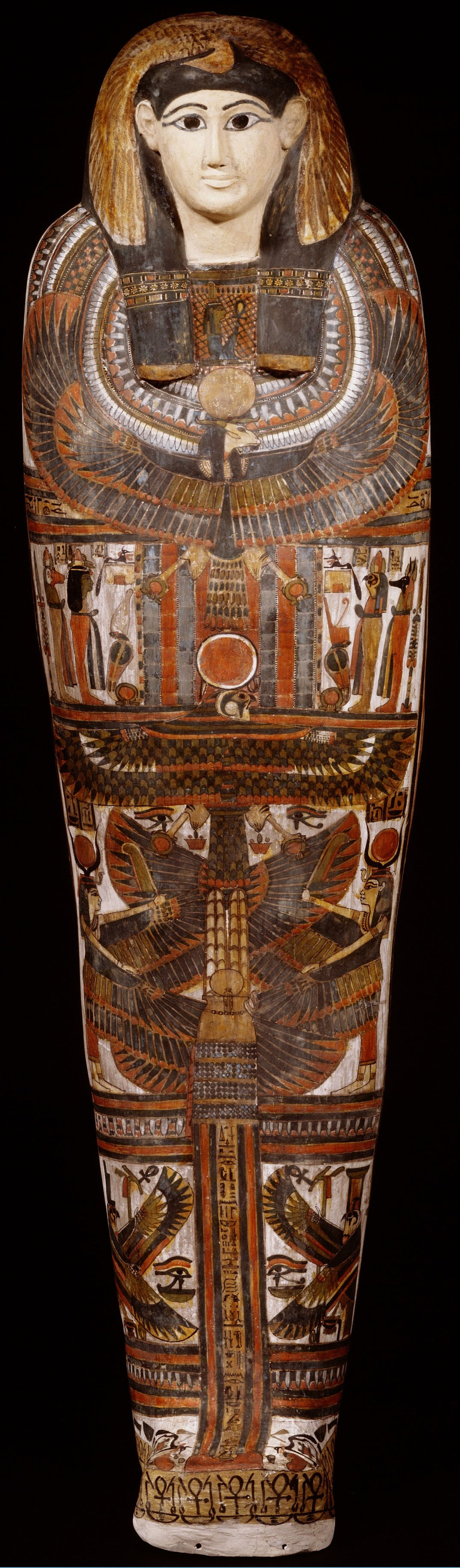
Tanetcharoe
Tanetcharoe / Tachateroe cartonnage.
14 x 43 x 165 cm, 800 BC
Photo: https://www.google.com/culturalinstitute/asset-viewer/cartonnage-of-tanetcharoe/WAFDizeZq9saeQ

23rd Dynasty: 880 BC - 720 BC
Hor
Block statue of Hor, priest of the god Amun in the temple of Karnak, circa 775 BC
Catalog: Greywacke, Karnak Great Temple, ÄM 17272
Photo: Don Hitchcock 2015
Source: Original, Staatliche Museen zu Berlin, Neues Museum, Germany
Text: © Card at the Staatliche Museen zu Berlin, (CC BY-NC-SA 3.0 DE)


23rd Dynasty: 880 BC - 720 BC
Paï-aset-en-ef
Inner coffin of the priest of god Amon Paï-aset-en-ef.
Circa 756 -722 BC
Catalog: ÄM 51
Photo: Don Hitchcock 2015
Source: Original, Staatliche Museen zu Berlin, Neues Museum, Germany
Text: © Card at the Staatliche Museen zu Berlin, http://www.smb-digital.de/ (CC BY-NC-SA 3.0 DE)

23rd Dynasty: 880 BC - 720 BC
Paï-aset-en-ef
Inner coffin of the priest of god Amon Paï-aset-en-ef.
Circa 756 -722 BC
Catalog: ÄM 51
Photo: Photomosaic, Don Hitchcock 2018
Size: 36 Megapixels
Source: Original, Staatliche Museen zu Berlin, Neues Museum, Germany
Text: © Card at the Staatliche Museen zu Berlin, http://www.smb-digital.de/ (CC BY-NC-SA 3.0 DE)

23rd Dynasty: 880 BC - 720 BC
Paï-aset-en-ef
Interior of the Inner coffin of the priest of god Amon Paï-aset-en-ef.
Circa 756 -722 BC
Catalog: ÄM 51
Photo: Don Hitchcock 2015
Source: Original, Staatliche Museen zu Berlin, Neues Museum, Germany
Text: © Card at the Staatliche Museen zu Berlin, http://www.smb-digital.de/ (CC BY-NC-SA 3.0 DE)
23rd Dynasty: 880 BC - 720 BC
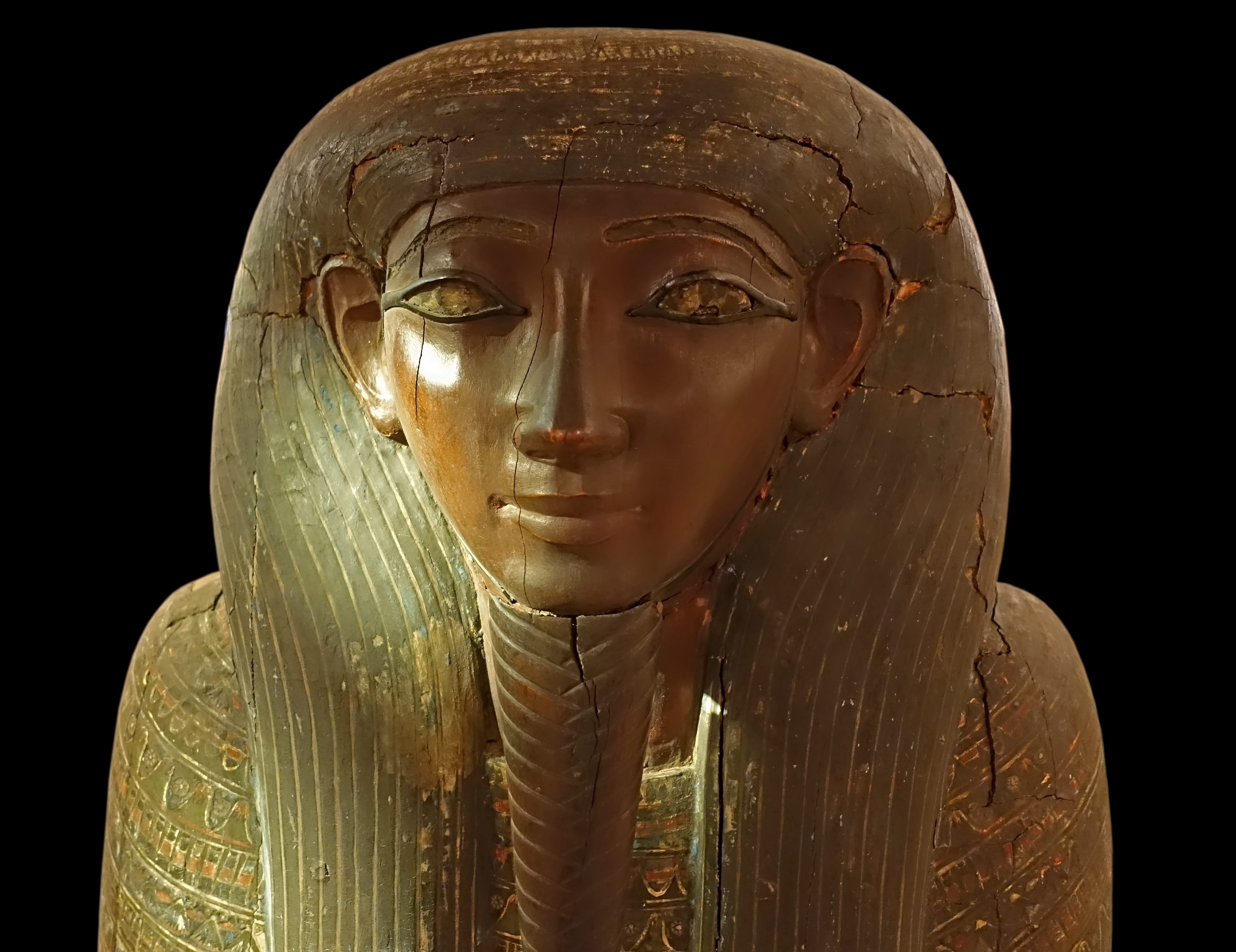
Paï-aset-en-ef
Middle coffin of the priest of god Amon Paï-aset-en-ef.
Circa 756 -722 BC
Catalog: ÄM 51
Photo: Don Hitchcock 2018
Source: Original, Staatliche Museen zu Berlin, Neues Museum, Germany
Text: © Card at the Staatliche Museen zu Berlin, http://www.smb-digital.de/ (CC BY-NC-SA 3.0 DE)
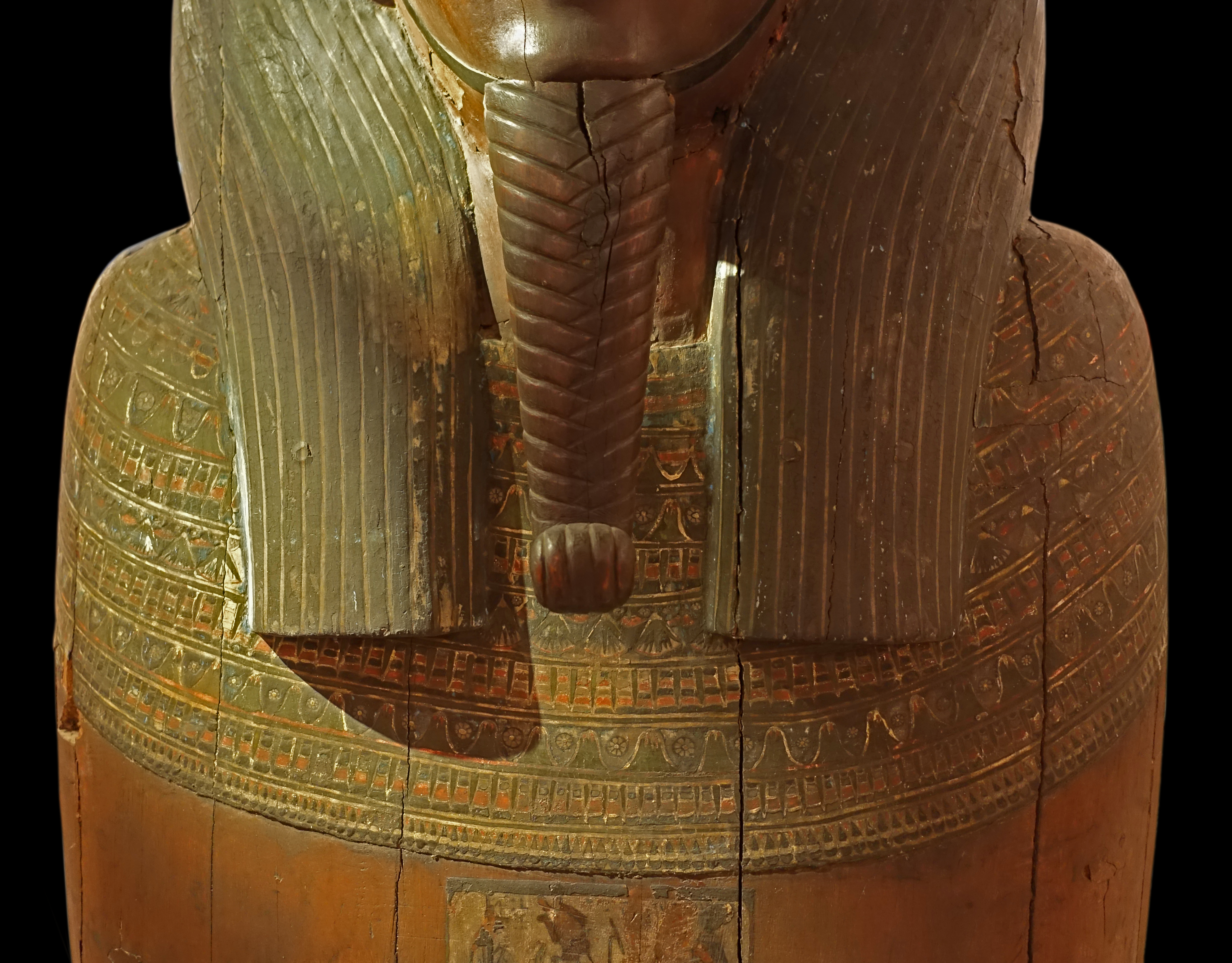
23rd Dynasty: 880 BC - 720 BC
Paï-aset-en-ef
Middle coffin of the priest of god Amon Paï-aset-en-ef.
Circa 756 -722 BC
Catalog: ÄM 51
Photo: Don Hitchcock 2018
Source: Original, Staatliche Museen zu Berlin, Neues Museum, Germany
Text: © Card at the Staatliche Museen zu Berlin, http://www.smb-digital.de/ (CC BY-NC-SA 3.0 DE)

23rd Dynasty: 880 BC - 720 BC
Paï-aset-en-ef
Middle coffin of the priest of god Amon Paï-aset-en-ef.
Circa 756 -722 BC
Catalog: ÄM 51
Photo: © Sandra Steiß / National Museums in Berlin, Egyptian Museum and Papyrus Collection
Source: Original, Staatliche Museen zu Berlin, Neues Museum, Germany
Text: © Card at the Staatliche Museen zu Berlin, http://www.smb-digital.de/ (CC BY-NC-SA 3.0 DE)

23rd Dynasty: 880 BC - 720 BC
Tefnakht Double Ink Well
Rectangular scribe's inkwell, with two round cups, made of Egyptian Blue. Tefnakht was the superior of the draftsmen of Upper and Lower Egypt.
Two symmetrical shen signs encircle the cups.
Height 23 mm, length 60 mm, width 34 mm.
Egyptian Blue, or Cuprorivaite is a pigment with the formula CaCuSi
Catalog: Egyptian blue, Aile Sully, Room 334, Materials and Techniques, Vitrine 6, E 10482
Photo: Don Hitchcock 2015, 2018
Source and text: Original, Louvre Museum, Paris, France, https://collections.louvre.fr/
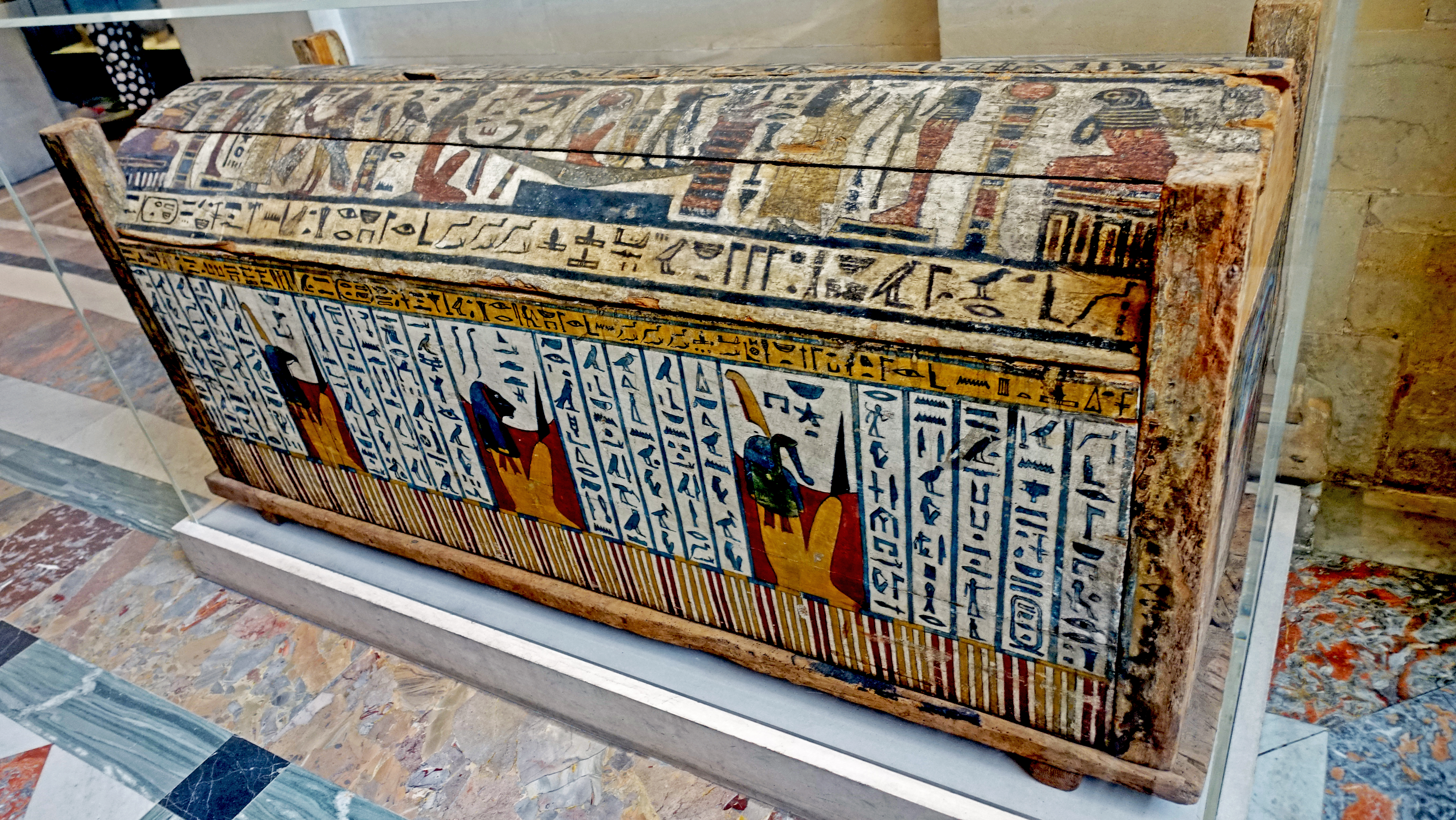
23rd Dynasty: 880 BC - 720 BC
Rectangular coffin with corner posts
Period: Usermaatre Takelot III, Circa 725 BC
Decoration on the lid and on the exterior.
Right side: adoration scene; woman (kneeling, worshipping); Osiris (?, squatting, shroud, white crown); Neith (?, squatting, shroud); Djed pillar (solar disk); falcon (shroud, menat collar); barque of Ra (flanked by); goddess (squatting); Ptah (?, squatting, shroud); goddess (squatting, shroud); Djed pillar (solar disk); falcon (shroud, menat collar)
Left side: adoration scene; woman (standing, worshipping); protective spirit (standing, shroud); falcon (shroud, menat collar); goddess (squatting); barque of Ra; Ba-bird; woman (standing, worshipping); protective spirit (standing); Djed pillar (solar disk); falcon (shroud, menat collar)
On the body; on the exterior
Right side: hippopotamus-headed god (squatting, shroud, holding a knife); crocodile-headed god (squatting, shroud, holding a knife); canid-headed god (squatting, shroud, holding a knife)
Left side: snake-headed god (squatting, shroud, holding, knife); vulture-headed god (squatting, shroud, holding, knife); lion-headed god (squatting, shroud, holding, knife)
on the head; falcon (shroud, *menat* necklace, inside, shrine, flanked by); woman (2, standing); under the feet; funerary meal; woman (seated, in front); offering table; man (standing, panther skin) (interior undecorated)
Names and titles: Iroubastetoudjantchaou (Mistress of the House, King's Daughter); Kakat (mother); Takelot III
Height 87 cm, length 203 cm, width 67 cm
Date: Usermaatre Takelot III (Dating can be refined via stylistic and paleographic criteria and by comparison with other coffins from the same workshop) (mention of reign) (circa 725 BC)
Provenance: Temple of Hatshepsut (Deir el-Bahari -> West Thebes -> Thebes) (tomb of the 'Middle Terrace')
Features: solar barque of Ra - knife - djed pillar - solar disk - Ptah - Osiris - worshipping - holding - flanked by - on the right - in front of - in/inside - on the outside - on the left - on the body (of the coffin) - on the lid - under the feet - on the head - funerary meal - woman - man - scene of adoration - squatting - seated - kneeling - standing - menat necklace - shrine - offering table - white crown - Ba-bird - 2 - falcon - Neith - goddess - genius/deity - crocodile-headed god - hippopotamus-headed god - vulture-headed god - serpent-headed god - lion-headed god - canid-headed god - shroud - panther skin
Names and titles: Iroubastetoudjantchaou - Kakat - Mistress of the House - King's daughter - mother - Takelot III
Nature of text: funerary formulas - birth name
Findspot: Temple of Hatshepsut
Catalog: Painted wood, Sully, Salle 321, Sarcophagi, Level 0 (ground floor)
Photo: Don Hitchcock 2018
Source and text: Original, Louvre Museum, Paris, France, https://collections.louvre.fr/
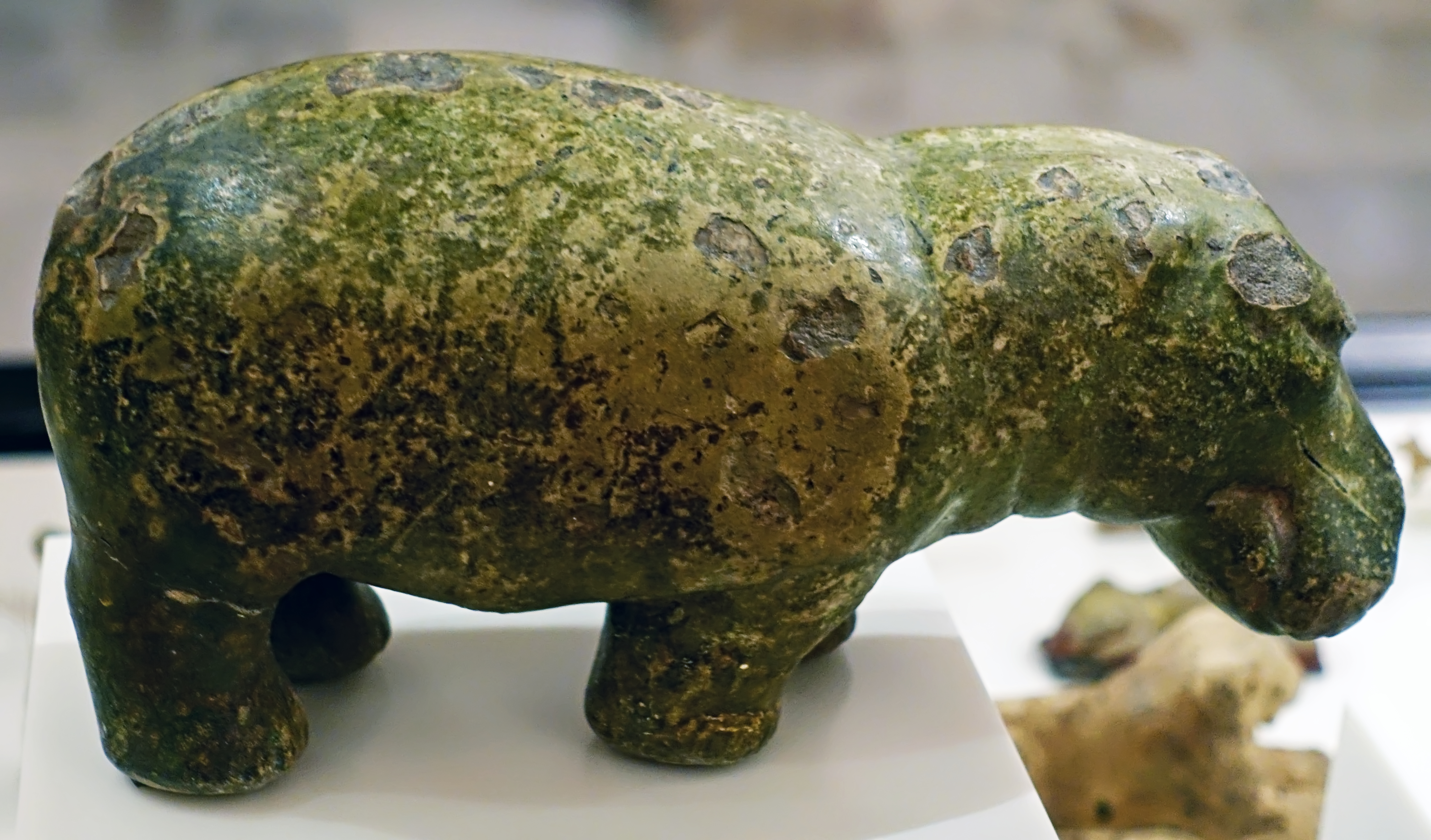
23rd - 31st Dynasty: 880 BC - 332 BC
Standing hippopotamus
Faience, circa 746 - 332 BC.
Catalog: ÄM 10724
Photo: Don Hitchcock 2018
Source: Original, Staatliche Museen zu Berlin, Neues Museum, Germany
Text: © Card at the Staatliche Museen zu Berlin, (CC BY-NC-SA 3.0 DE)
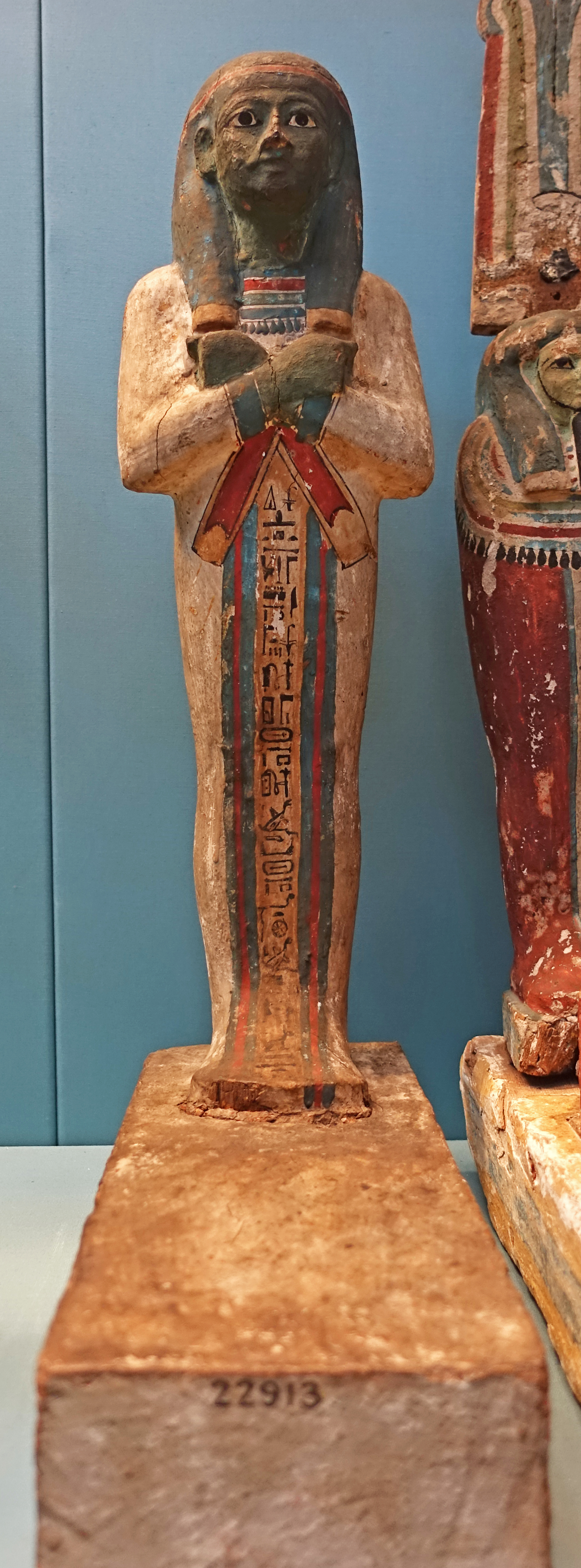
23rd - 31st Dynasty: 880 BC - 332 BC
Ptah-Sokar-Osiris
Painted wooden figure of Ptah-Sokar-Osiris on a pedestal; the headdress is lost.
Inscribed for the Vizier Pamiu.
Mid to late 8th century BC. This is one of the earliest examples of this type of figure.
Height 550 mm, width 146 mm, depth 317 mm, weight 2.196 kg.
Catalog: Painted wood, EA22913
Photo: Don Hitchcock 2018
Source: Original, British Museum
Text: © Card with the display at the British Museum, http://www.britishmuseum.org/ , © Trustees of the British Museum, CC BY-NC-SA 4.0

746 -332 BC
23rd - 31st Dynasty: 880 BC - 332 BC
Bells
Bronze, circa 746 - 332 BC.
Catalog: Batn el-Harit near Faiyum, ÄM 13544, ÄM 15842, ÄM 24265
Photo: Don Hitchcock 2018
Source: Display, Staatliche Museen zu Berlin, Neues Museum, Germany
Text: © Card at the Staatliche Museen zu Berlin (CC BY-NC-SA 3.0 DE)
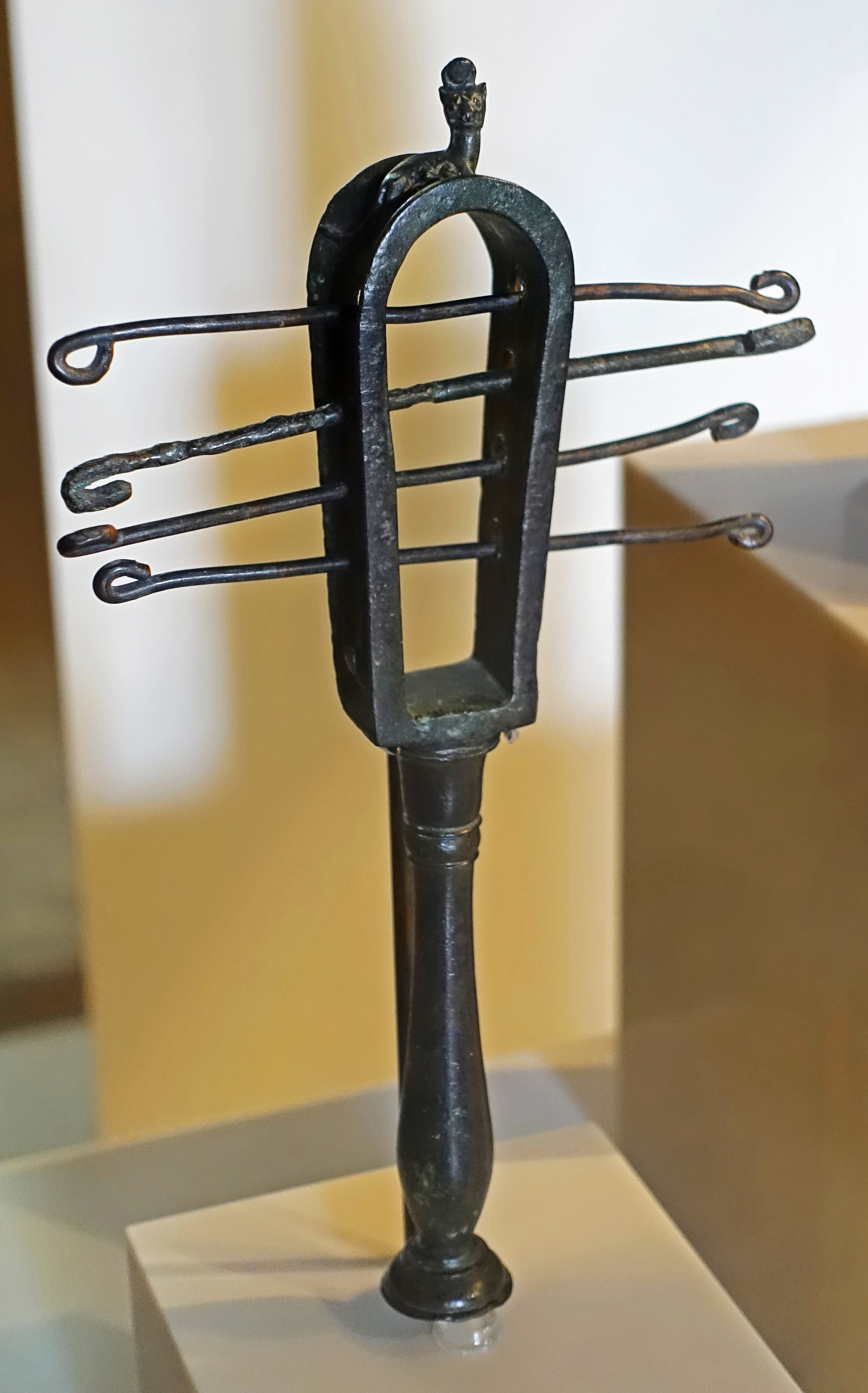
23rd - 31st Dynasty: 880 BC - 332 BC
Sistrum
( This sistrum has a small mammal cast on its top surface, which looks remarkably like the Egyptian weasel (Mustela subpalmata), which is now restricted to the lower Nile Valley and the Nile Delta, and lives in the same places as humans, including cities and villages. However it is probably meant to be the cat goddess Bastet - Don )
Catalog: 746 BC - 332 BC, Bronze, ÄM 2768
Photo: Don Hitchcock 2018
Source: Original, Staatliche Museen zu Berlin, Neues Museum, Germany
Text: © Card at the Staatliche Museen zu Berlin, (CC BY-NC-SA 3.0 DE)
Additional text: Wikipedia
The 24th Dynasty: 732 BC - 720 BC
The Twenty-fourth Dynasty of ancient Egypt was a short-lived group of two pharaohs who had their capital at Sais in the western Nile Delta.
Tefnakht I formed an alliance of the Delta kinglets, with whose support he attempted to conquer Upper Egypt; his campaign attracted the attention of the Nubian king, Piye, who recorded his conquest and subjection of Tefnakhte of Sais and his peers in a well-known inscription. Tefnakht is always called the 'Great Chief of the West' in Piye's Victory stela and in two stelas dating to the regnal years 36 and 38 of Shoshenq V.
Tefnakht I's successor, Bakenranef, definitely assumed the throne of Sais and took the royal name Wahkare. His authority was recognised in much of the Delta including Memphis where several Year 5 and Year 6 Serapeum stelas from his reign have been found. This Dynasty came to a sudden end when Shabaka, the second king of the Twenty-Fifth Dynasty, attacked Sais, captured Bakenrenef and burned him alive.
| 24th Dynasty | |||||
|---|---|---|---|---|---|
| Name | Horus (Throne) Name | Consort | Years | Dates | Comments |
| Tefnakht I | Shepsesre | 8 | 732 BC - 725 BC | ||
| Bakenranef | Wahkare | 5 | 725 BC - 720 BC | ||

24th Dynasty: 732 BC - 720 BC
Tefnakht I
Pharaoh Shepsesre Tefnakht I's stone donation stela from Sais dedicated to the Egyptian goddess Neith, now located at the National Archaeological Museum of Athens, Greece.
This stela constitutes one of the most important documents for this Lower Egyptian Delta king who ruled during the Kushite period of Egypt in the Third Intermediate Period (circa 8th century BC) because it preserves a date within his important reign: his 8th Regnal year.
Photo: Tilemahos Efthimiadis
Source: http://www.flickr.com/photos/telemax/3209735729/
Permission: Creative Commons Attribution 2.0 Generic license
24th Dynasty: 732 BC - 720 BC
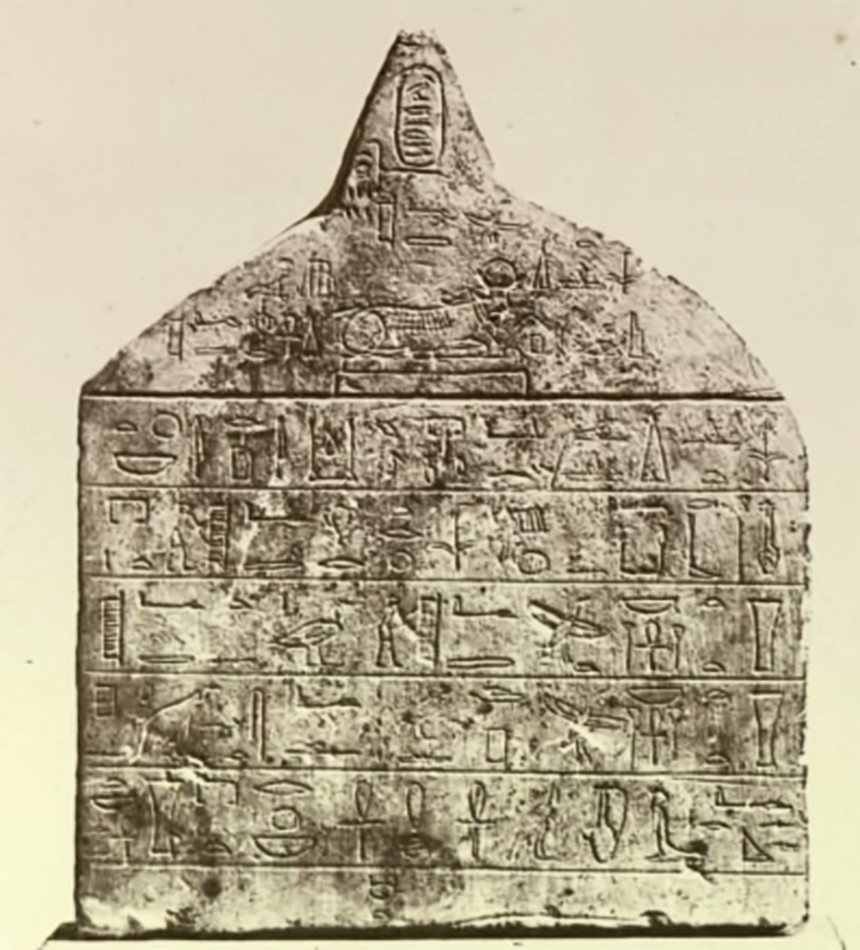
Bakenranef
Stele commemorating the death of an Apis bull in year 6 of Bakenranef, found in the Serapeum of Saqqara. Bakenranef's name is visible on the tip of the stele. Reign of Bakenranef, 24th dynasty, Third intermediate period.
Photo: Mariette (1857)
Text: Wikipedia
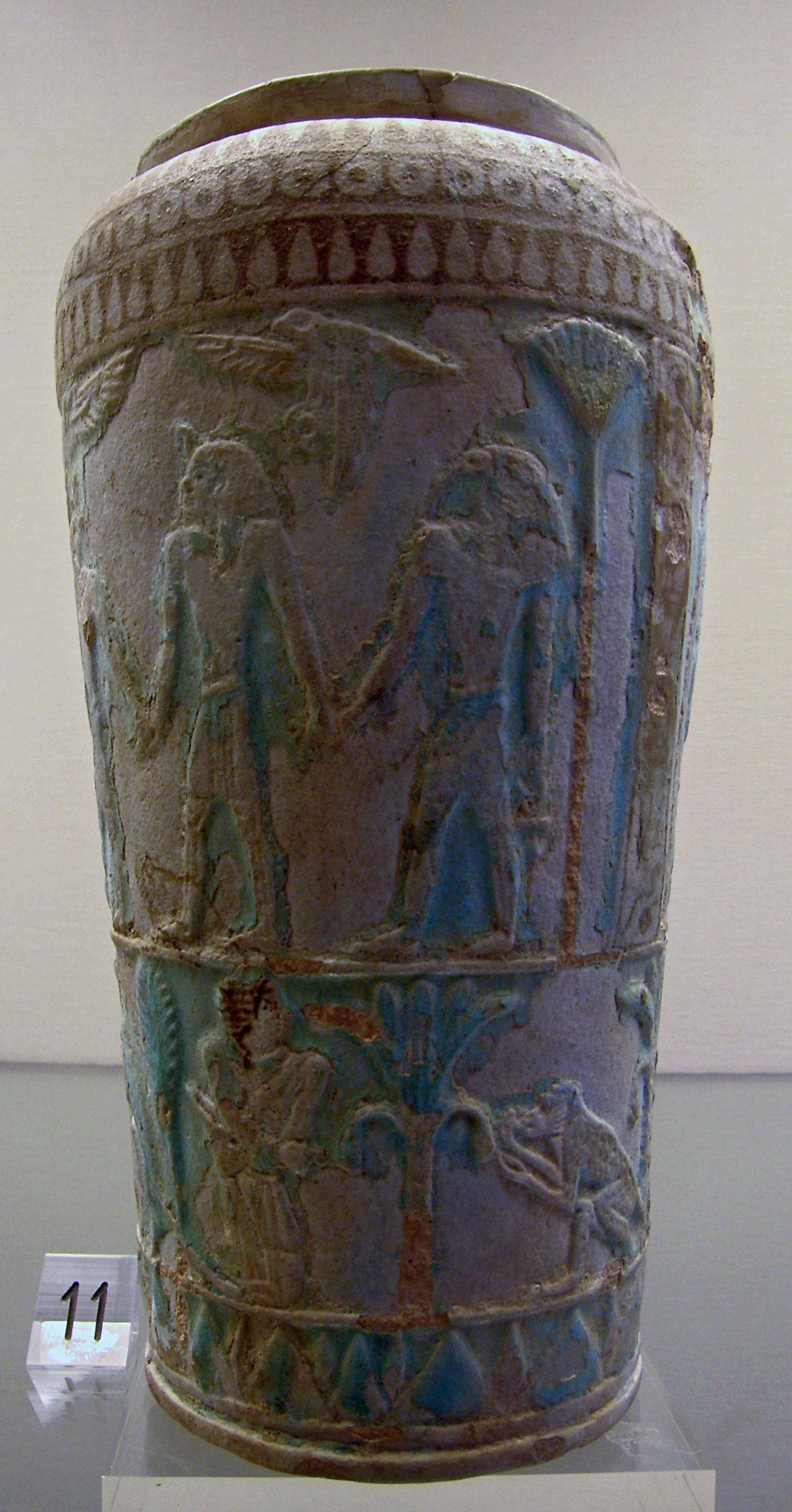
24th Dynasty: 732 BC - 720 BC
Bakenranef
This Bakenranef or Bocchoris vase is a ceramic container dating from Ancient Egypt. It was found in 1895 in a tomb at Tarquinia, and is now in the National Museum at Tarquinia (222 mm high; Museum inv. no. RC 2010). The vessel, often also labelled as situla and made of Egyptian faience, bears an inscription with the names of the 24th dynasty pharaoh Wahkare Bakenrenef (Greek: Bocchoris) who ruled about 720 BC to 715 BC. It shows the king between the Egyptian goddess Neith and the god Horus in the middle register, on one side and on the other between Horus and Thoth. In the lower register are shown Egyptian enemies between trees and monkeys. The vessel is an important evidence for long distance trade in the 9th and 8th century BC. It is furthermore of some importance for dating earlier phases of Etruscan culture in Italy. Because of the good preservation of the vessel, it has been argued that it came very shortly after it was made into the Etruscan tomb.
The place of production of the vase is under discussion. The object appears on the first view fully Egyptian. The hieroglyphs are readable. However, some researchers regard the vase as a product of a Phoenician workshop, since it is known that the Phoenicians often produced objects in Egyptian style. The Phoenician origin was suggested after the discovery of a similar – yet of a somewhat lower quality – vessel near Motya, Sicily. However, the finding at Tarquinia of two situliform vessels with the names of Psamtik I and Psamtik II respectively, again suggested a Lower Egyptian origin of the Bocchoris vase.
The vase was found in 1895 in a tomb chamber with a pitched roof and a bench. The tomb owner might be a woman judging from the objects found. Gold foil plaques might have adorned clothing. Many Egyptian beads were found. Two beads show the Egyptian god Bes, there were bronze and pottery vessels. Due to the Bocchoris vase being the best known object from the tomb, by eponimy the whole tomb is often called 'Bocchoris Tomb', despite not having any connection with the actual burial place of king Bocchoris, which is still unknown.
Photo: Udimu
Permission: Creative Commons Attribution-Share Alike 4.0 International license.
Text: Wikipedia
The 25th Dynasty / Nubian Dynasty / Kushite Empire: 746 BC - 656 BC
The Twenty-fifth Dynasty of Egypt (notated Dynasty XXV, alternatively 25th Dynasty or Dynasty 25), also known as the Nubian Dynasty or the Kushite Empire, was the last dynasty of the Third Intermediate Period of Ancient Egypt.
The 25th Dynasty was a line of rulers originating in the Nubian Kingdom of Kush - in present-day northern Sudan and southern Egypt - and most saw Napata as their spiritual homeland. They reigned in part or all of Ancient Egypt from 746 BC to 656 BC. The dynasty began with Kashta's invasion of Upper Egypt and culminated in several years of both successful and unsuccessful war with the Mesopotamian based Assyrian Empire.
The 25th Dynasty's reunification of Lower Egypt, Upper Egypt, and also Kush (Nubia) created the largest Egyptian empire since the New Kingdom. They assimilated into society by reaffirming Ancient Egyptian religious traditions, temples, and artistic forms, while introducing some unique aspects of Kushite culture. It was during the 25th dynasty that the Nile valley saw the first widespread construction of pyramids (many in modern Sudan) since the Middle Kingdom.
After the Assyrian kings Sargon II and Sennacherib defeated attempts by the Nubian kings to gain a foothold in the Near East, their successors Esarhaddon and Ashurbanipal invaded Egypt and defeated and drove out the Nubians. War with Assyria resulted in the end of Kushite power in Northern Egypt and the conquest of Egypt by Assyria.
They were succeeded by the Twenty-sixth dynasty of Egypt, initially a puppet dynasty installed by and vassals of the Assyrians, the last native dynasty to rule Egypt before the Persian conquest.
| 25th Dynasty / Nubian Dynasty / Kushite Empire | ||||||
|---|---|---|---|---|---|---|
| Name | Horus (Throne) Name |
Consort | Pyramid | Yrs | Dates | Comments |
| Alara | Queen Kasaqa (Kurru 23) |
Kurru 9? | 43 | 795 BC - 752 BC | Alara was a King of Kush, who is generally regarded as the founder of the Napatan royal dynasty by his 25th Dynasty Kushite successors and was the first recorded prince of Kush. He unified all of Upper Nubia from Meroë to the Third Cataract and is possibly attested at the Temple of Amun at Kawa. Alara also established Napata as the religious capital of Kush. Alara himself was not a 25th dynasty Kushite king since he never controlled any region of Egypt during his reign compared to his two immediate successors: Kashta and Piye respectively. |
|
| Kashta | Maatre | Queen Pebatjma (Kurru 7?) |
Kurru 8 | 13 | 765 BC - 752 BC | Kashta is thought to be a brother of his predecessor Alara. He ruled Nubia from Napata, below the fourth cataract near Karima in the northern part of Sudan, on a loop of the Nile. The important hill of Jebel Barkal is just outside Karima. |
| Piye | Menkheperre Usermaatre |
Queen Tabiry (Kurru 53) Queen Abar (Nuri 53?) Queen Khensa (Kurru 4) Queen Peksater (Kurru 54) |
Kurru 17 | 31 | 752 BC - 721 BC | Piye was founder of the Twenty-fifth Dynasty of Egypt, and ruled Egypt from the city of Napata. He was the son of Kashta and Pebatjma. As ruler of Nubia and Upper Egypt, Piye took advantage of the squabbling of Egypt's rulers by expanding Nubia's power beyond Thebes into Lower Egypt. |
| Shabaka | Neferkare | Queen Qalhata (Kurru 5) Queen Mesbat Queen Tabekenamun? |
Kurru 15 | 14 | 721 BC - 707 BC | Neferkare Shabaka, or Shabako was a pharaoh of the Twenty-fifth Dynasty of Egypt. Shabaka is thought to be the son of Kashta and Pebatjma, although a text from the time of Taharqa could be interpreted to mean that Shabaka was a brother of Taharqa and hence a son of Piye.
Shabaka's Queen Consort was Qalhata, who was, according to Assyrian records, a sister of Taharqa. Shabaka and Qalhata were the parents of King Tantamani. |
| Shebitku | Djedkare | Queen Arty (Kurru 6) |
Kurru 18 | 17 | 707 BC - 690 BC | Shebitku was a pharaoh of the Twenty-fifth Dynasty of Egypt. He was a son of Piye, the founder of this dynasty. Shebitku's queen was Arty, who was also a daughter of king Piye. |
| Taharqa | Khunefertumre | Queen Takahatenamun (Nuri 21?) Queen Atakhebasken (Nuri 36) Queen Naparaye (Kurru 3) Queen Tabekenamun? |
Nuri 1 | 26 | 690 BC - 664 BC | Taharqa was the son of Piye, the Nubian king of Napata who had first conquered Egypt. Taharqa was also the cousin and successor of Shebitku. The successful campaigns of Piye and Shabaka paved the way for a prosperous reign by Taharqa. Although Taharqa's reign was filled with conflict with the Assyrians, it was also a prosperous renaissance period in Egypt and Kush. The empire flourished under Taharqa, due in part to a particularly large Nile river flood, abundant crops, and the intellectual and material resources set free by an efficient central government. Taharqa's inscriptions indicate that he gave large amounts of gold to the temple of Amun at Kawa. The Nile valley empire was as large as it had been since the New Kingdom. Taharqa and the 25th dynasty revived Egyptian culture. Religion, arts, and architecture were restored to their glorious Old, Middle, and New Kingdom forms. During Taharqa's reign, the central features of Theban theology were merged with Egyptian Middle and New Kingdom imperial ideology. Under Taharqa, the cultural integration of Egypt and Kush reached such a point that it could not be reversed, even after the Assyrian conquest. |
| Tantamani | Bakare | Queen Piankharty Queen ...salka Queen Malaqaye? (Nuri 59) |
Kurru 16 | 26 | 664 BC - 656 BC | Tantamani was the son of King Shabaka and the nephew of his predecessor Taharqa. Once the Assyrians had appointed Necho I as king and left, Egypt was seen as vulnerable. Tantamani soon invaded Egypt in hopes of restoring his family to the throne. Tantamani marched down the Nile from Nubia and reoccupied all of Egypt including Memphis. Necho I, the Assyrians' representative, was killed in Tantamani's campaign. The Assyrians led by Ashurbanipal returned to Egypt in force and reconquered the land occupied by Tantamani, who fled to upper Egypt. The Assyrian reconquest effectively ended Nubian control over Egypt although Tantamani's authority was still recognised in Upper Egypt until his 8th Year in 656 BC when Psamtik I's navy peacefully took control of Thebes and effectively unified all of Egypt. These events marked the start of the Twenty-sixth Dynasty of Egypt. Tantamani died 653 BC. |
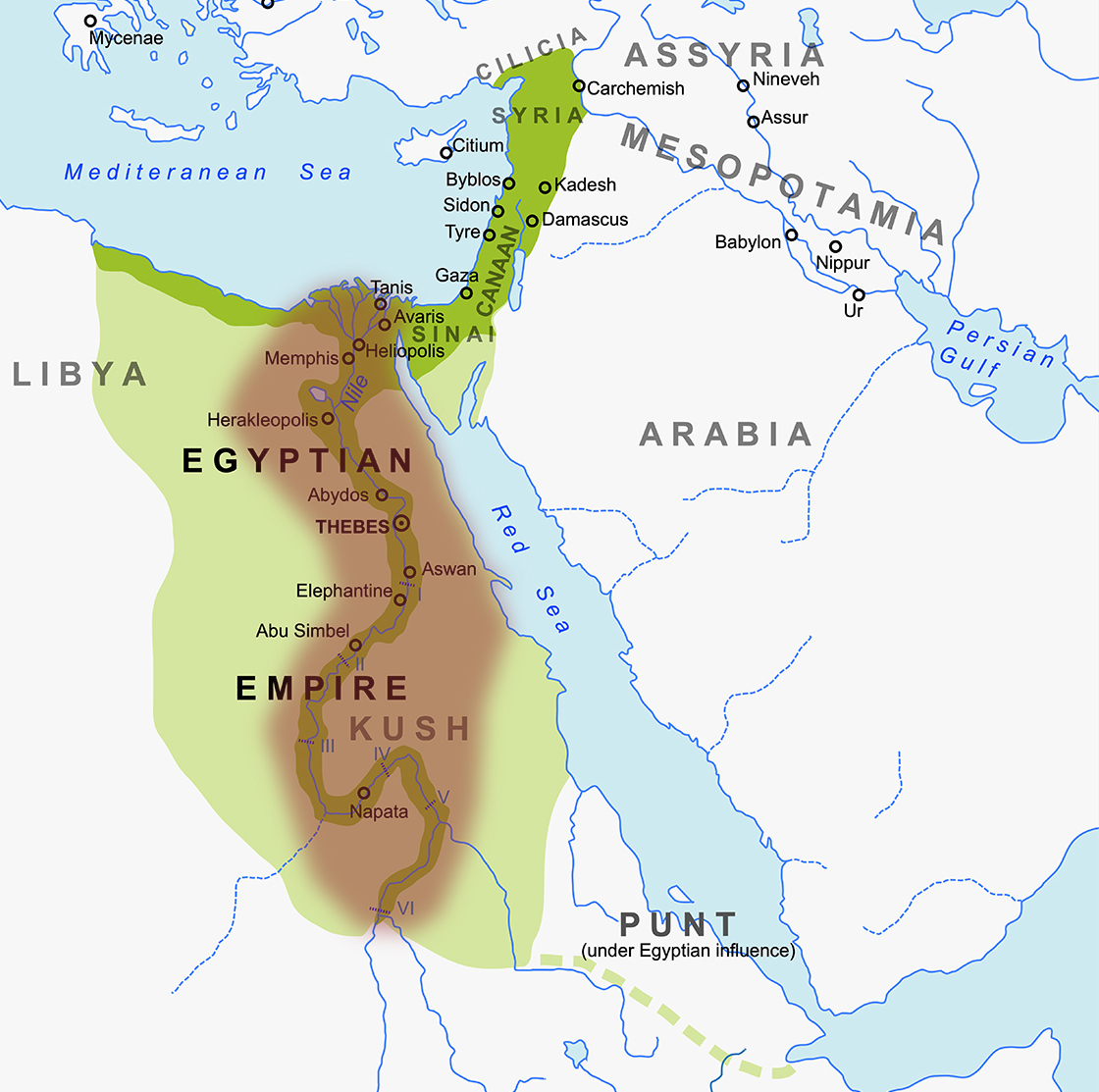
The Kushite empire of the 25th dynasty, circa 700 BC, shown in brown shading.
Base Map: The maximum extent of the New Kingdom during the Eighteenth, Nineteenth, and Twentieth dynasties of Egypt by Andrei Nacu and Jeff Dahl
Permission: Creative Commons Attribution-Share Alike 3.0 Unported license.
Kushite empire in brown after Lommes.
Permission: Creative Commons Attribution-Share Alike 4.0 International license.
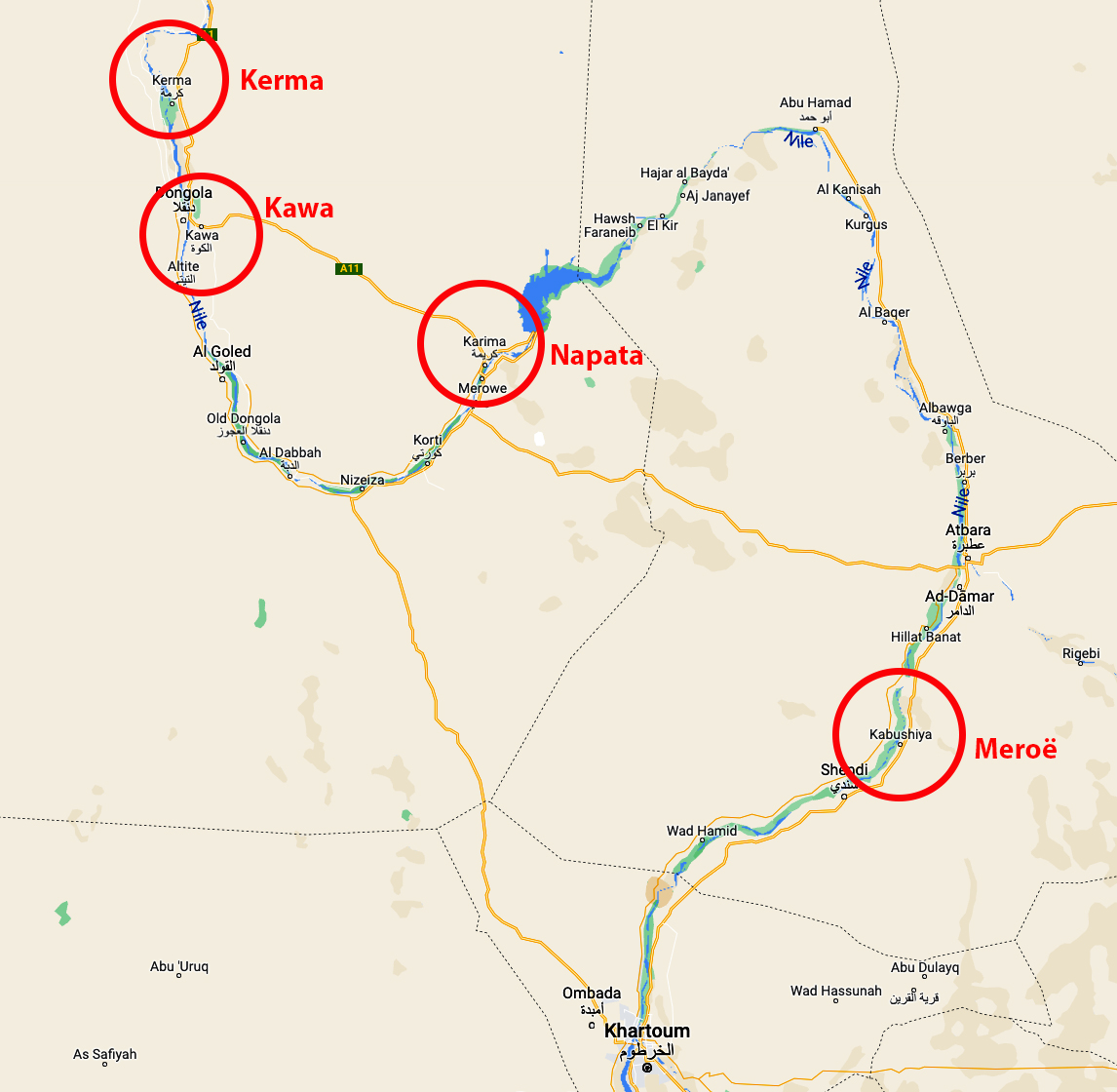
The relative positions of Napata and Meroë, the heartland of of the 25th Dynasty Kushite Empire. The important sites of Kerma and Kawa are also shown.
Napata
Napata was a city of ancient Kush at the fourth cataract of the Nile, dammed in modern times as in the image above, near the site of modern Karima, in Sudan. It was the southernmost permanent settlement in the New Kingdom of Egypt (16th–11th centuries BC) and home to Jebel Barkal, the main Kushite cult centre of Amun.
It was the sometime capital of the Twenty-fifth Dynasty of Egypt and, after its fall in 663 BC, of the Kingdom of Kush. In 593 BC, it was sacked by the Egyptians and the Kushite capital was relocated to Meroë. Even after this move, Napata continued to be the kingdom's primary religious centre. The city was sacked a second time by the Romans in 23 BC but was rebuilt and continued as an important centre of the Amun cult.
The terms 'Napata' or 'Napatan period' can also refer to the Kushite polity from its rise around 750 BC until 270 BC, when Napata finally lost its symbolic significance as the location of royal burials to Meroë. The subsequent period of Kushite history is called Meroitic down to the collapse of the kingdom.
Meroë
Meroë was an ancient city on the east bank of the Nile about 6 km north-east of the Kabushiya station near Shendi, Sudan, approximately 200 km north-east of Khartoum. This city was the capital of the Kingdom of Kush for several centuries from around 590 BC, until its collapse in the fourth century AD. The Kushitic Kingdom of Meroë gave its name to the 'Island of Meroë', which was the modern region of Butana, a region bounded by the Nile (from the Atbarah River to Khartoum), the Atbarah and the Blue Nile.
The Kingdom of Kush which housed the city of Meroë represents one of a series of early states located within the middle Nile. It was of the earliest and most impressive states found on the African continent (along with Ancient Egypt). The site of the city of Meroë is marked by more than two hundred pyramids in three groups, of which many are in ruins. They have the distinctive size and proportions of Nubian pyramids.
Kerma
Kerma was the capital city of the Kerma culture, which was in existence in present-day Sudan by 3 500 BC. Kerma is one of the largest archaeological sites in ancient Nubia. It has produced decades of extensive excavations and research, including thousands of graves and tombs and the residential quarters of the main city surrounding the Western/Lower Deffufa, a massive tomb structure close to the river. The Lower/Western Deffufa (a massive tomb structure) was found closer to the river. The cemetery of Upper/Eastern Deffufa is a few kilometres away from the river.
Kawa
Kawa is located between the Third and Fourth Cataracts of the Nile on the east bank of the river, across from Dongola. In ancient times it was the site of several temples to the Egyptian god Amun, built by the Egyptian rulers Amenhotep III and Tutankhamun, and by Taharqa and other Kushite kings.
Photo: Google Maps
Text: Wikipedia

25th Dynasty / Nubian Dynasty / Kushite Empire: 746 BC - 656 BC
Black Granite Statues
From left to right, statues of the 7th century BC kings Tantamani, Taharqa, Senkamanisken, Tantamani, Aspelta, Anlamani and Senkamanisken. Now in the Kerma Museum.
In 2003, a Swiss archaeological team working in northern Sudan uncovered one of the most remarkable Egyptological finds in recent years. At the site known as Kerma, near the third cataract of the Nile, archaeologist Charles Bonnet and his team discovered a ditch within a temple from the ancient city of Pnoubs, which contained seven monumental black granite statues.
The statues were found in a pit in Kerma, south of the Third Cataract of the Nile. The seven statues, which stood between 130 to 270 cm tall, were inscribed with the names of five of Nubia's kings: Taharqa, Tanoutamon, Senkamanisken, Anlamani, and Aspelta. Taharqa and Tanoutamon ruled Egypt as well as Nubia. Sometimes known as the 'Black Pharaohs', Nubian kings ruled Egypt from circa 746 BC - 660 BC
Photo: Matthias Gehricke
Permission: Creative Commons Attribution-Share Alike 4.0 International license
Source: Kerma Museum
Text: http://www.crystalinks.com/nubia.html, Wikipedia

25th Dynasty / Nubian Dynasty / Kushite Empire: 746 BC - 656 BC
Takhennu
Ta-khennu's Double Coffin and mummy
Luxor, 3rd Intermediate period, 750 - 650 BC.
On the lid of the inner coffin Ta-khennu's hair is dressed in the so-called Hathor-hairstyle which is rather unusual for this period. On the upper picture she is being introduced to Osiris, god of the Underworld, and Re, the sun god, at the weighing of the heart. This part of the coffin is mostly in very good condition.
Photo: Don Hitchcock 2014
Source: Original, Københavns (Copenhagen) Museum, National Museum of Denmark

25th Dynasty / Nubian Dynasty / Kushite Empire: 746 BC - 656 BC
Takhennu
The lid of the outer coffin (centre) is very damaged. On top of the mummy was placed a protective net of beads which today has almost disappeared. Only the scarab, scraps of some bead hieroglyphs, and the faint imprint of the network reveal that they once existed.
Photo: Don Hitchcock 2014
Source: Original, Københavns (Copenhagen) Museum, National Museum of Denmark
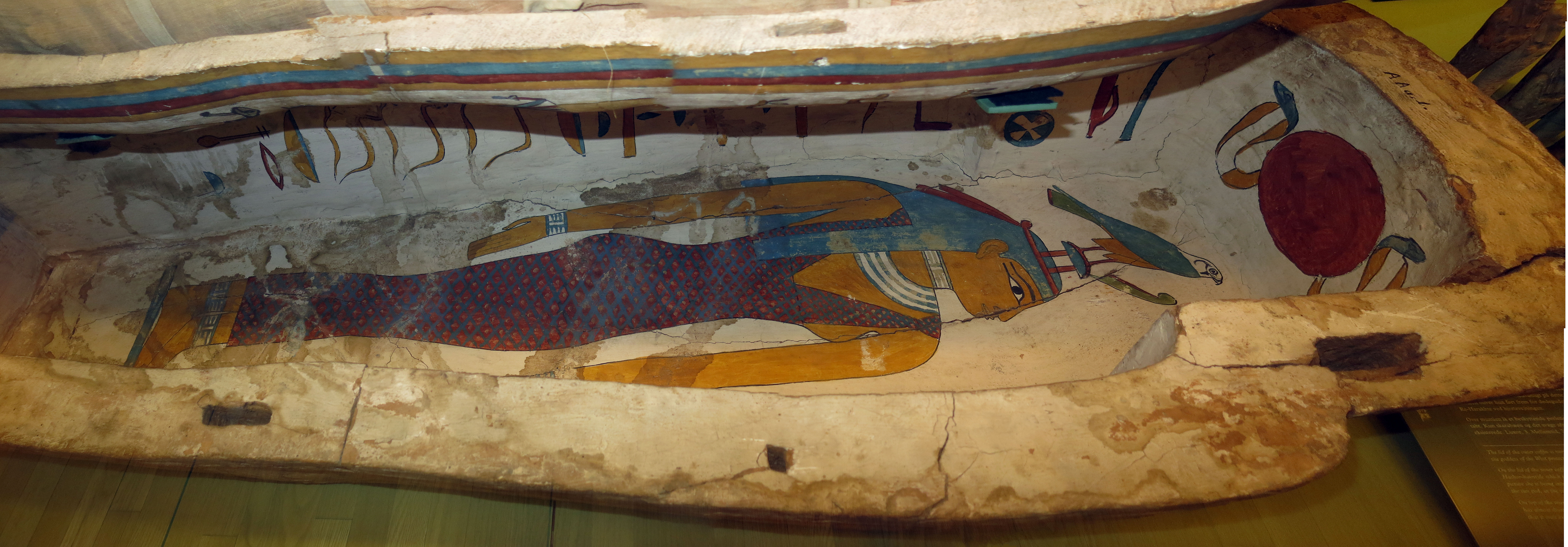
25th Dynasty / Nubian Dynasty / Kushite Empire: 746 BC - 656 BC
Takhennu
At the bottom of the outer coffin the goddess of the West protects the dead.
Photo: Don Hitchcock 2014
Source: Original, Københavns (Copenhagen) Museum, National Museum of Denmark
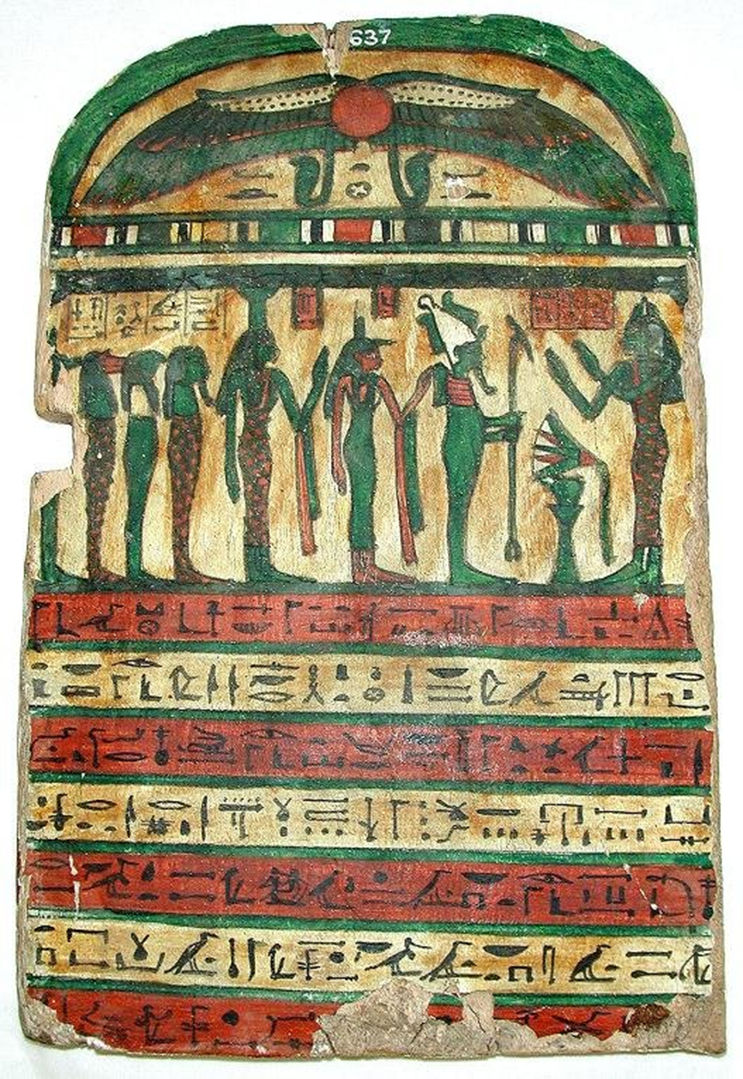
25th Dynasty / Nubian Dynasty / Kushite Empire: 746 BC - 656 BC
Takhennu
Stela of Takhennu, or Ta-khennu, Luxor, 3rd Intermediate period, 750 - 650 BC.
Material: Sycomore fig, Ficus sycomorus, wood.
There are three sections on this round-topped stela. A winged sun-disk with uraei, the figure of the sacred serpent, an emblem of sovereignty depicted on the headdress of ancient Egyptian rulers and deities, appears below a curved border at the top. In the middle there is a scene beneath a sky-sign decorated with stars. The deceased Takhennu stands on the right with her arms raised in adoration before an altar on which rests a water-pot cooled by a lotus-blossom.
Behind stand Osiris, Isis, Nephthys, and the four sons of Horus. Seven lines of text in the bottom section contain a prayer to Osiris, Geb, Atum, Ptah-Sokar, Anubis, and Osiris-Wennufer on behalf of Takhennu.
Photo: © Trustees of the British Museum, CC BY-NC-SA 4.0
Source and text: © http://www.britishmuseum.org/
25th Dynasty / Nubian Dynasty / Kushite Empire: 746 BC - 656 BC
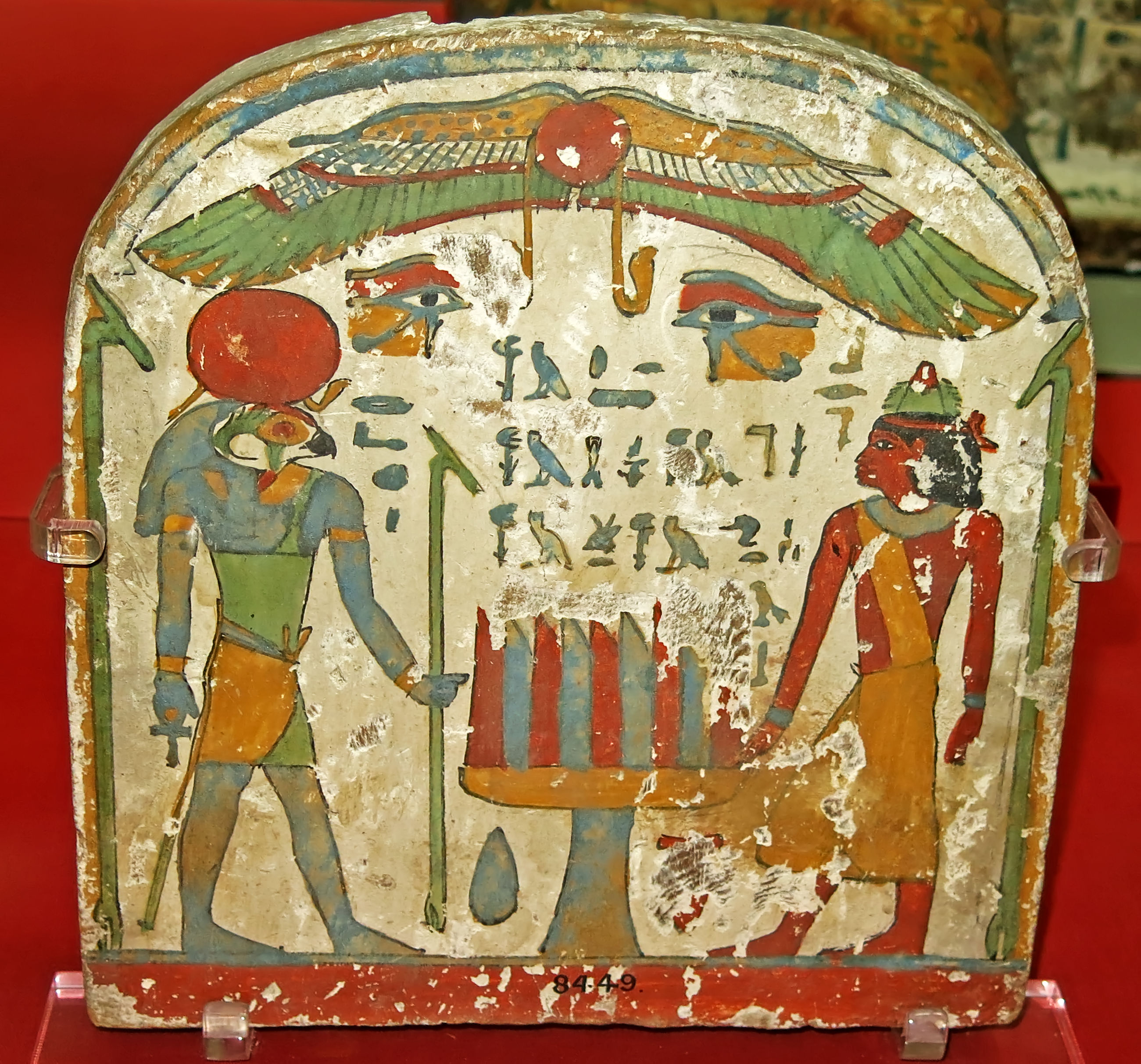
Horakhbit
Sycomore fig wood ( Ficus sycomorus ) stela of Horakhbit: this round-topped stela is bordered by a curved sky-sign at the top and a was-sceptre on each side. Below the sky is a winged sun-disk with uraei flanked by 'wedjat'-eyes. On the left stands Ra, while the deceased stands on the right. Between them is an altar with offerings above which are three lines of text, naming the offerings.
Circa 725 BC - 675 BC.
The stela has been gouged in many places and has flaked around the edges. The background of the stela is white. There is a slight yellow margin on three sides and large red border at the bottom with an upper blue edge. The sky-sign is blue and the sceptres are green. The disk is red with yellow uraei. The upper wings of the disk are yellow with blue dots and a blue upper edge; the middle are white with black lines, blue decoration, often faded to grey, and a red lower edge; the lower are green with feathers delineated in black, yellow at each end, and a red lower edge in the centre. The 'wedjat'-eyes are blue with a black pupil on white.
There is a red band between eye and eyebrow and a yellow band below and to one side of the eye. The god has a red disk with a yellow uraeus. His wig and body are blue. His face is white with a red eye on yellow, green cheek, red poll, and black beak. His collar and bangles are yellow; his upper garment green; his kilt yellow and green with a blue sash and yellow and green tail. His 'ankh'-sign is blue and his sceptre is green.
The deceased has a red body, blue collar and bangles, yellow garment, black wig and eye, red fillet, and red and green cone. The altar is blue with a yellow top and red and blue offerings. The loaf and vase beneath are blue and red respectively. The hieroglyphs are blue. Plaster still remains on the sides and back of the stela.
The stela is typical of the small wooden funerary stelae placed in Theban tombs of the period. The scene shows the dead man before the sun-god Ra-Horakhty.
Catalog: EA8449
Photo: Don Hitchcock 2015
Source: Original, British Museum
Text: Card with the display at the British Museum, http://www.britishmuseum.org/, © Trustees of the British Museum, CC BY-NC-SA 4.0
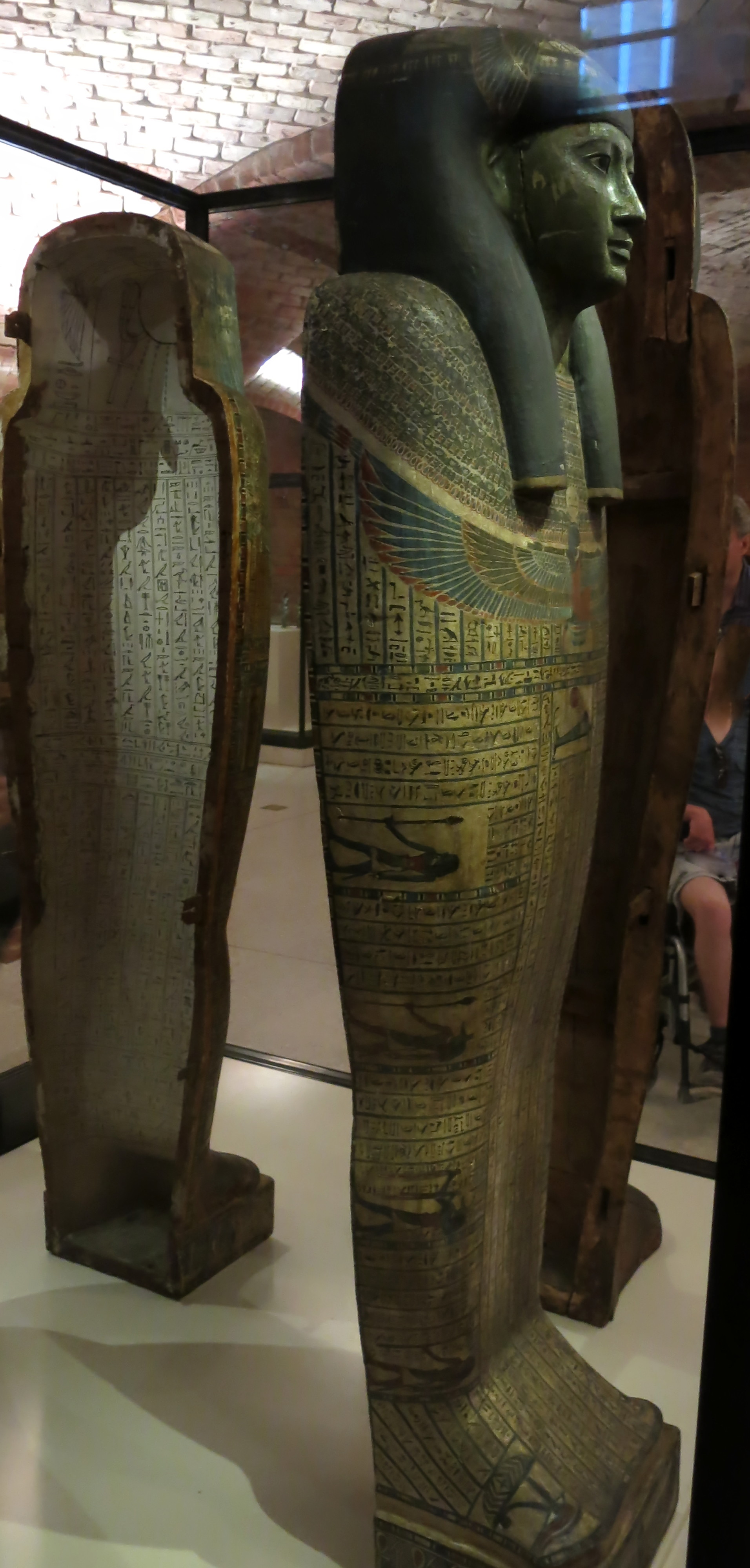
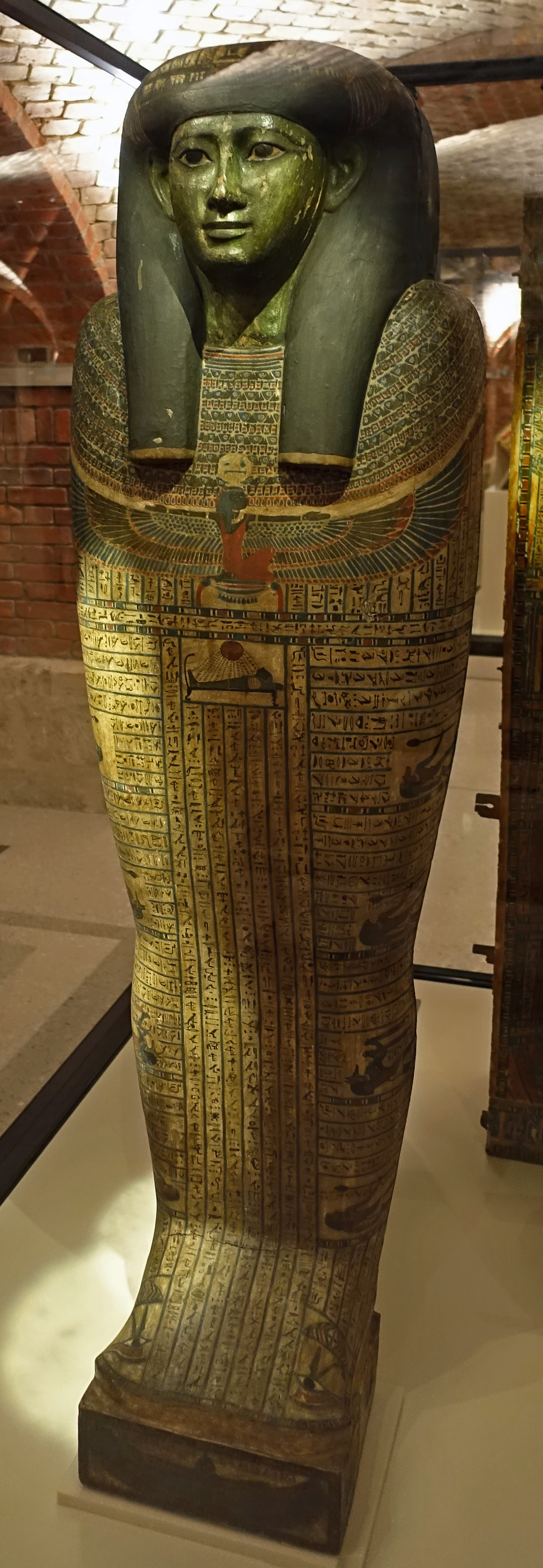
25th Dynasty / Nubian Dynasty / Kushite Empire: 746 BC - 656 BC
Tarekap
Circa 730 BC
Lid of the inner, anthropomorphic coffin of the lady Tare-kap.
Dimensions 1785 x 530 x 280 mm
In ancient Egypt it was customary, with few exceptions, to equip women for the hereafter somewhat less strictly than was the norm for men. This is clearly reflected in the coffin of Tarekap. Even though all the coffin components have been manufactured with high quality materials, the decoration is limited to a small number of images. Both the lid and the coffin case of the inner coffin were entirely covered with texts from the Book of the Dead. This is followed by detailed genealogical data with a list of dead relatives.
Since these wooden coffins are from the tomb of the Amun priest Paestenfi (ÄM 52/01), this membership of the deceased in the Theban upper class is not surprising. The coffin of Tarekap bears inscriptions giving her the title of 'the veiled', a reference to her status as a priest's wife. Together with the sign of Ankh, a symbol which stands for continuation of life in the hereafter, even the base of the coffin cover was decorated with hieroglyphic signs.
The iconographic equipment of the coffin lid was kept largely conventional. From the middle of the coffin cover are five paired depictions, which, apart from the four Horus sons, show two manifestations of the god Anubis, the divinities Geb and Nut, and two Udjat or Wedjat eyes - a division typical of this time. The representations of the winged goddesses Nut and Isis at the crest as well as in the foot of the coffin were common motifs.
In contrast to the rather inconspicuous representations and the black hieroglyphs on a white background, however, there are some colour accents, especially in the upper half of the mummy-shaped coffin. A fine accessory depicts the depiction of the dead in the chest area painted like a vignette. The body of Tarekap lies on a stretcher under a radiant sun as a sign of her further life in the beyond. In addition to the colourful flower collar, the sarcophagus, above all, the green painted face surrounded by a black wig gives a remarkable appearance - with regard to the god of the underworld Osiris a symbol of regeneration.
Catalog: Wood, primed in white, painted, Thebes ÄM 4/1
Photo: Don Hitchcock 2015, 2018
Source: Original, Staatliche Museen zu Berlin, Neues Museum, Germany
Text: © Card at the Staatliche Museen zu Berlin, Olivia Kühne in http://www.smb-digital.de/ (CC BY-NC-SA 3.0 DE)
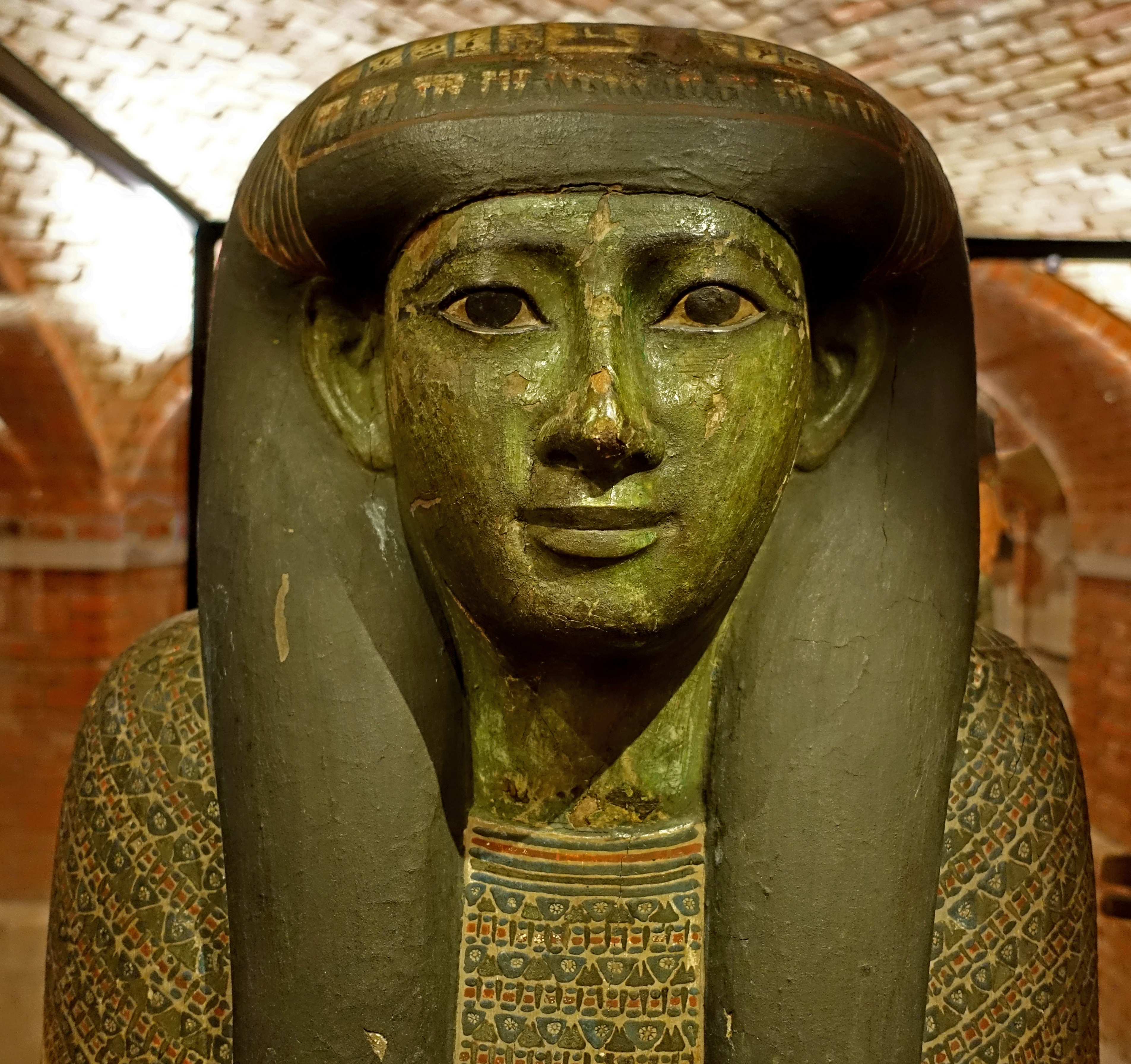
25th Dynasty / Nubian Dynasty / Kushite Empire: 746 BC - 656 BC
Tarekap
Circa 730 BC
Closeup of the head on the lid of the inner, anthropomorphic coffin of the lady Tare-kap.
Catalog: Wood, primed in white, painted, Thebes ÄM 4/1
Photo: Don Hitchcock 2018
Source: Original, Staatliche Museen zu Berlin, Neues Museum, Germany
Text: © Card at the Staatliche Museen zu Berlin

25th Dynasty / Nubian Dynasty / Kushite Empire: 746 BC - 656 BC
Tarekap
Circa 730 BC
Closeup of the central part of the anthropomorphic coffin of the lady Tare-kap, showing the goddess Nut spreading her wings protectively over the deceased.
Catalog: Wood, primed in white, painted, Thebes ÄM 4/1
Photo: Don Hitchcock 2018
Source: Original, Staatliche Museen zu Berlin, Neues Museum, Germany
Text: © Card at the Staatliche Museen zu Berlin
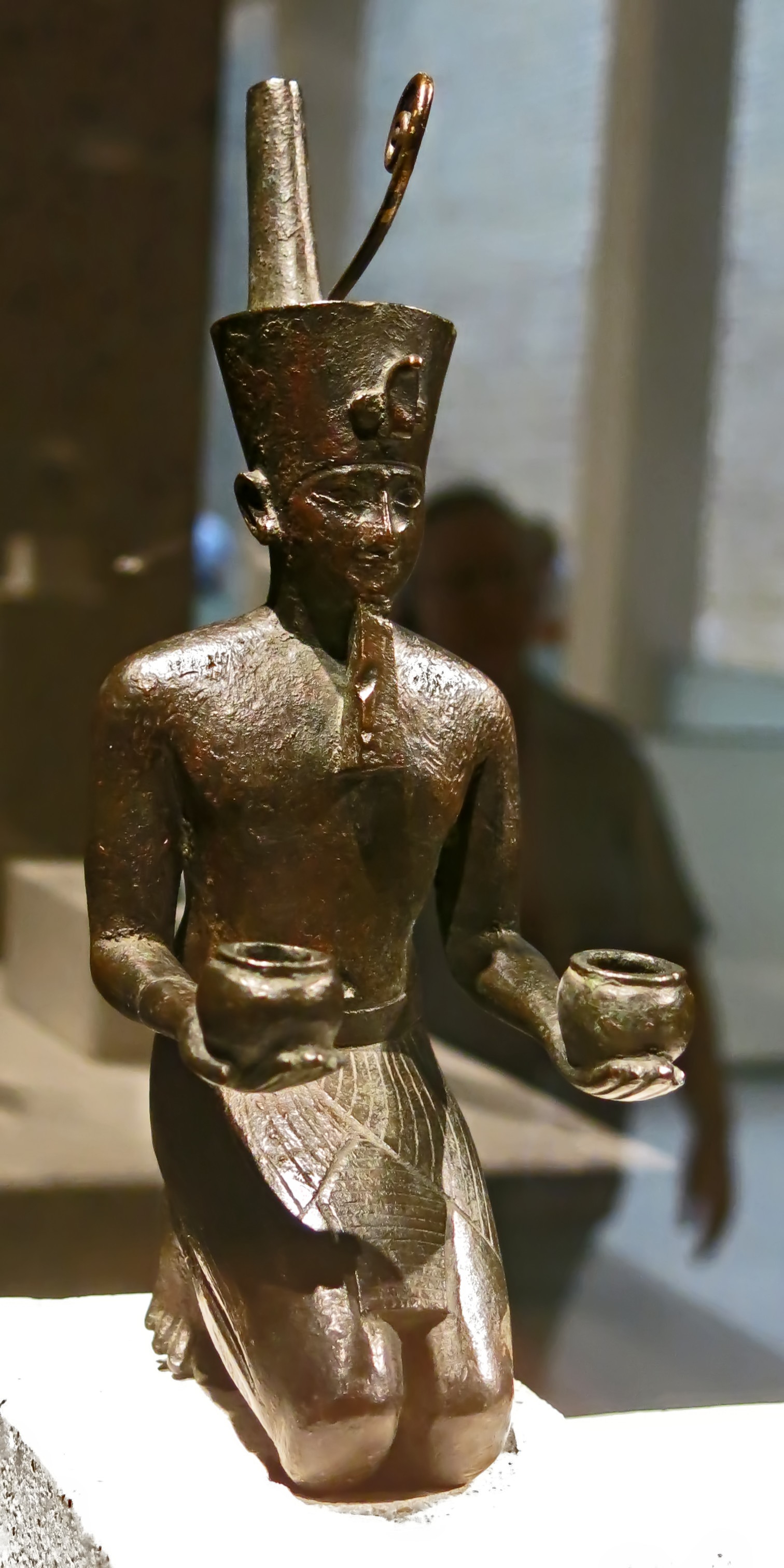
25th Dynasty / Nubian Dynasty / Kushite Empire: 746 BC - 656 BC
Kushite king
Statuette of a kneeling Kushite king with a sub-Egyptian crown, sacrificing wine in globular vessels.
225 x 70 x 90 mm.
The statuette depicts a kneeling king with a lower Egyptian crown, with the uraeus snake on his forehead. In addition, the figure depicted bears the king's beard and a three-piece, pleated robe, a short skirt called a Schendit. In the hands stretched out in front of the body he holds two nw-pots, named after the hieroglyph nw ( ) which depicts a spherical pot.
These statuettes usually belonged to an ensemble, in which the founder kneels before a deity and presents these sacrifices. The figures could be connected by a base. An indication that this object was part of a group is given by the two pins below the knees and toes, which would have served for anchoring to a pedestal. Such objects were presumably donated as gifts to temples.
Catalog: Bronze, ÄM 2504
Photo: Don Hitchcock 2015
Source: Original, Staatliche Museen zu Berlin, Neues Museum, Germany
Text: © Card at the Staatliche Museen zu Berlin, J. Jancziak and R. Pabst, http://www.smb-digital.de/, (CC BY-NC-SA 3.0 DE)
Additional graphic, the nw hieroglyph: Wikipedia

25th Dynasty / Nubian Dynasty / Kushite Empire: 746 BC - 656 BC
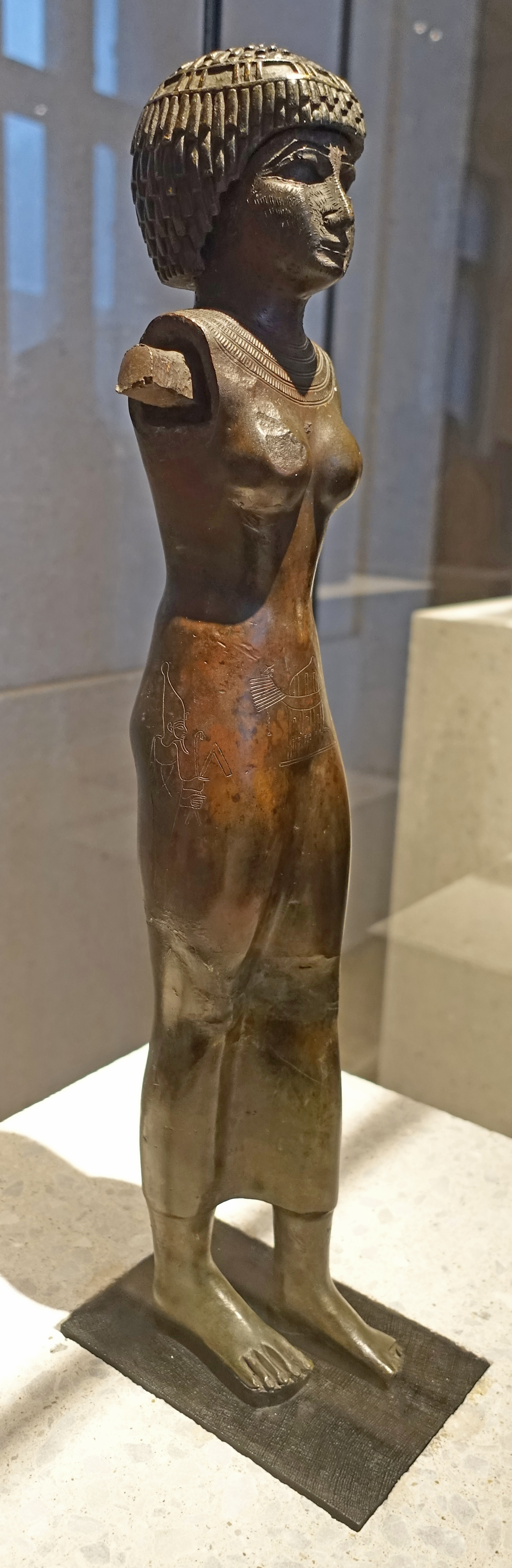
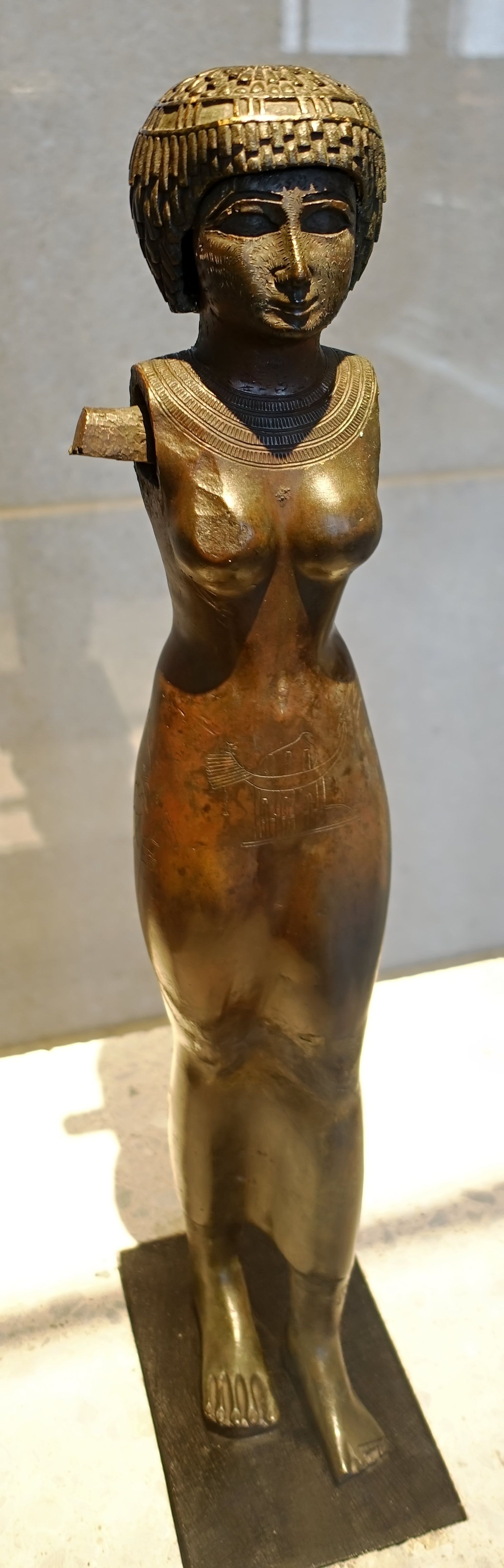
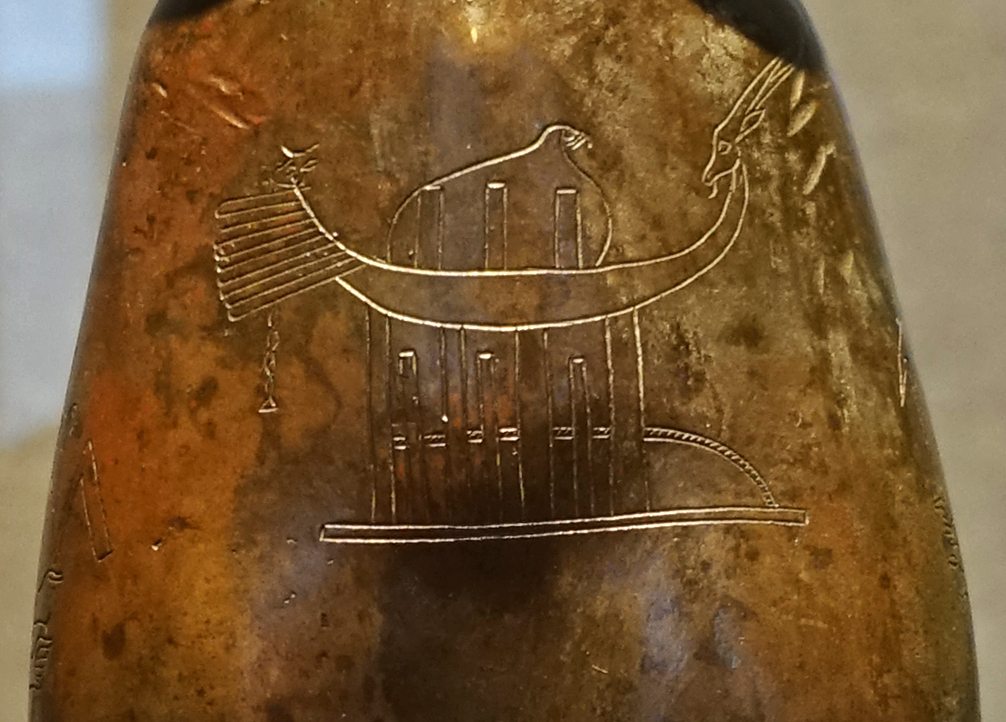
Female Priest
Standing figure of a female priest with (left) figural engravings on her dress.
Catalog: Bronze, ÄM 2309
Photo: Don Hitchcock 2018
Source: Original, Staatliche Museen zu Berlin, Neues Museum, Germany
Text: © Card at the Staatliche Museen zu Berlin, (CC BY-NC-SA 3.0 DE)
25th Dynasty / Nubian Dynasty / Kushite Empire: 746 BC - 656 BC
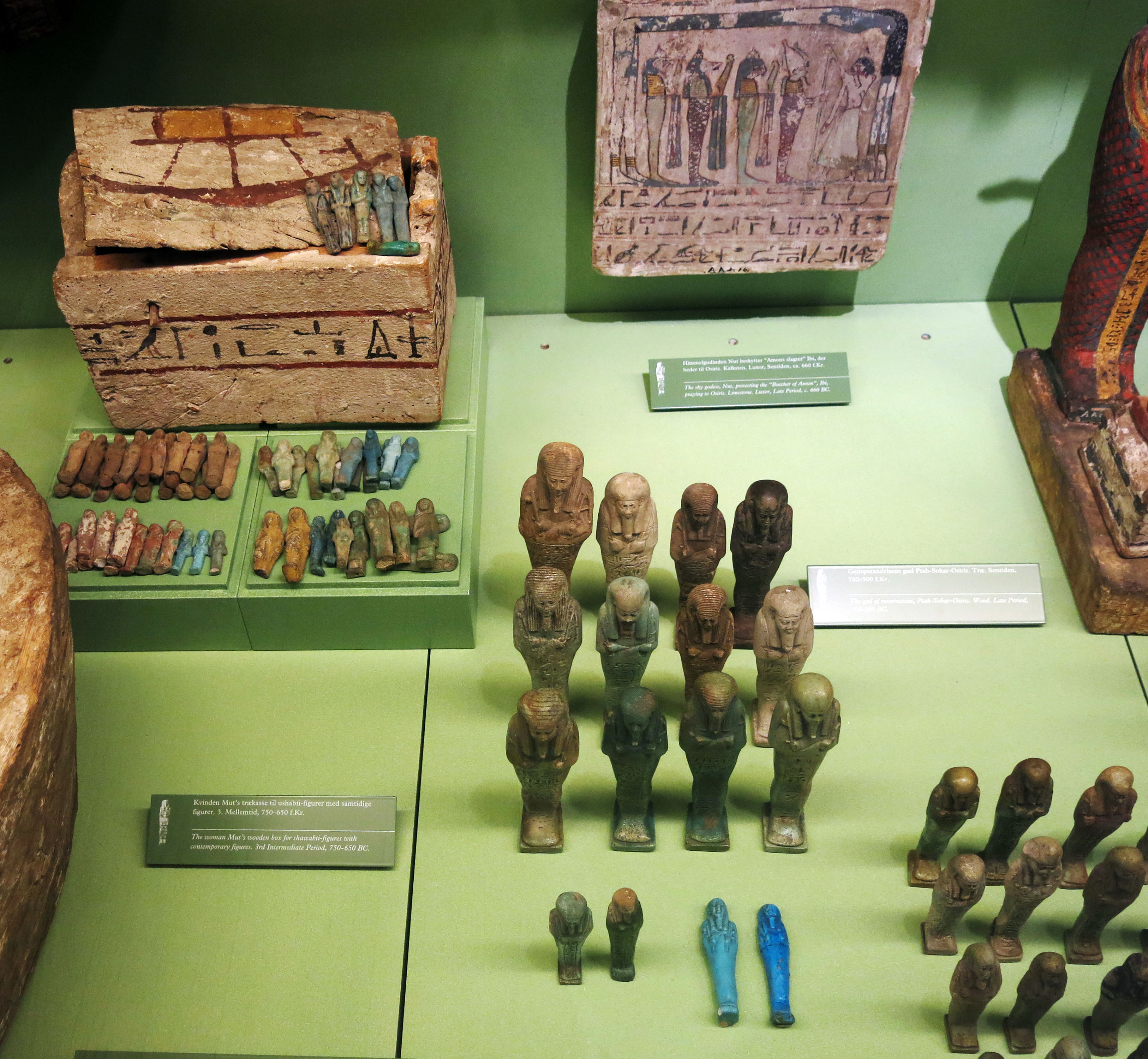
Mut
The woman Mut's wooden box for shawabti-figures with contemporary figures.
3rd Intermediate Period, 750-650 BC.
Photo: Don Hitchcock 2014
Source: Original, Københavns (Copenhagen) Museum, National Museum of Denmark
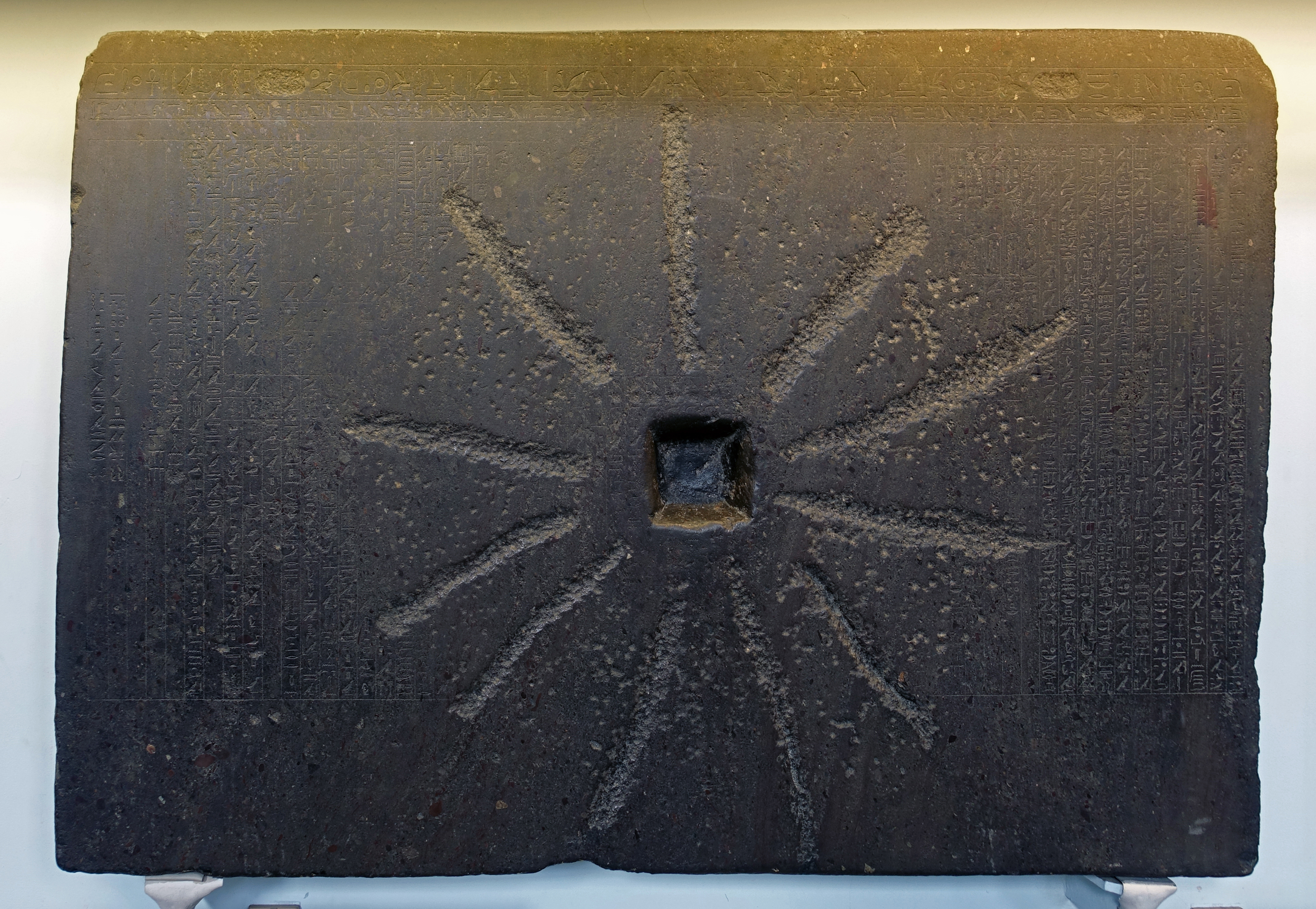
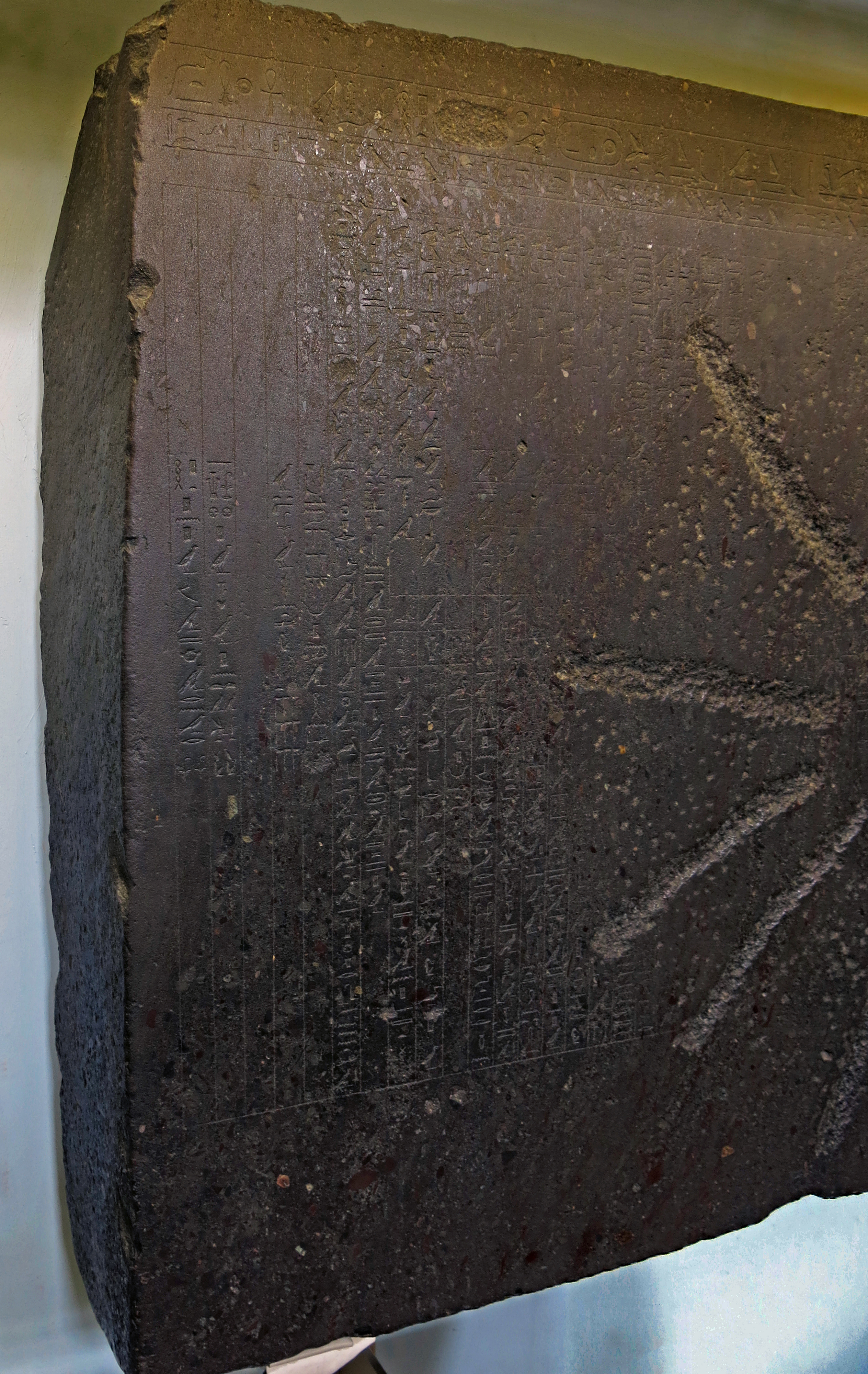
25th Dynasty / Nubian Dynasty / Kushite Empire: 746 BC - 656 BC
Shabaka / Shabaqo Stone
This slab, later reused as a millstone, tells of the world's creation by Ptah, chief god of Memphis. The text is archaic and a preface claims that Shabaqo, a Kushite king, had it copied from an ancient worm-eaten scroll in the temple of Ptah. Memphis features as Egypt's capital and Ptah as king.
Shabaka / Shabaqo took up residence in Memphis, like the Old Kingdom pharaohs. The Kushites justified their rule over Egypt by acting as guardians of its legacy and emulating its past achievements.
Reign of Shabaqo, (about 721 - 707 BC), circa 710 BC.
From Memphis, originally from the temple of Ptah.
Conglomerate stela, rectangular, subsequently re-used as a nether millstone: two horizontal registers of hieroglyphs record the names of Shabako and the 'perhaps ancient fiction' of his attempt to preserve an ancient text from further deterioration or destruction; below these are sixty vertical registers of hieroglyphs, some substantially damaged by the action of grinding flour, which record the 'Memphite Theology' or creation myth, a text perhaps originally composed during the New Kingdom, in which Ptah is responsible for the creation of all things by means of the spoken word.
Height 950 mm, width 1370 mm, depth 205 mm, weight 585 kg.
Catalog: Conglomerate, Memphis, EA498
Photo: Don Hitchcock 2018, 2015
Text: Card with the display at the British Museum, http://www.britishmuseum.org/, © Trustees of the British Museum, CC BY-NC-SA 4.0
Source: Original, British Museum
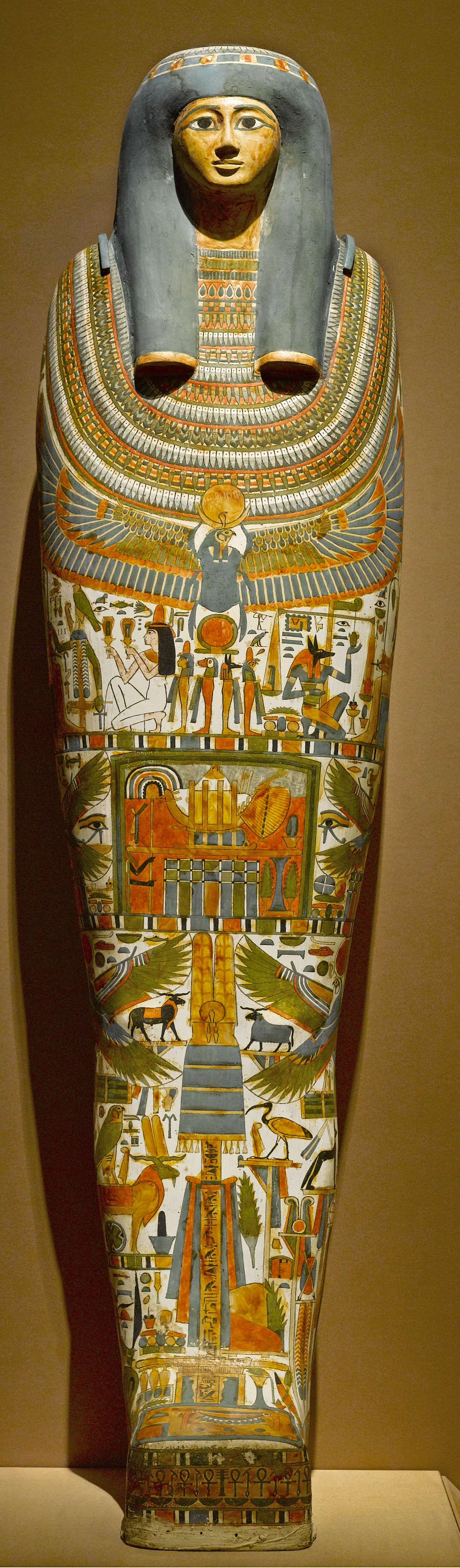
25th Dynasty / Nubian Dynasty / Kushite Empire: 746 BC - 656 BC
Gautseshenu
Cartonnage and Mummy of Gautseshenu.
Egypt, probably from Thebes / Luxor. Third Intermediate Period, Dynasties 25 to 26, circa 700–650 BC. Linen, paint, gesso, organic materials; 163 x 38 x 29 cm .
Brooklyn Museum, Charles Edwin Wilbour Fund, 34.1223
This cartonnage shows, on the right, Anubis, the jackal-headed god, weighing the heart of the deceased, an important test for entry to the afterlife. In the center are the Four Sons of Horus, who protected specific mummified organs of the body. On the left, the deceased kneels and plays musical instruments before the symbol of the god Osiris.
This mummy’s name, Gautseshenu, means 'bouquet of lotuses'. The Egyptian word seshen (lotus) is the origin of the name Susan. She was from a prominent family of Egyptian priests, and the brightly colored 'cartonnage' or coffin made of linen and resin, was discovered near the city of Luxor in southern Egypt. Her coffin has never been opened.
The young woman was at least 16 years old and stood about 4 feet 6 inches, 137 cm tall.
Photo: https://www.google.com/culturalinstitute/asset-viewer/inner-cartonnage-of-gautseshenu/xgEwVgBunKnzdw?exhibitId=dQKygktK6lIGLg
© Charles Edwin Wilbour Fund
Text: http://www.brooklynmuseum.org/exhibitions/mummy_chamber/gautseshenu.php and http://thegrio.com/2011/04/29/hospital-uses-cat-scan-to-look-inside-mummys-unopened-coffin/
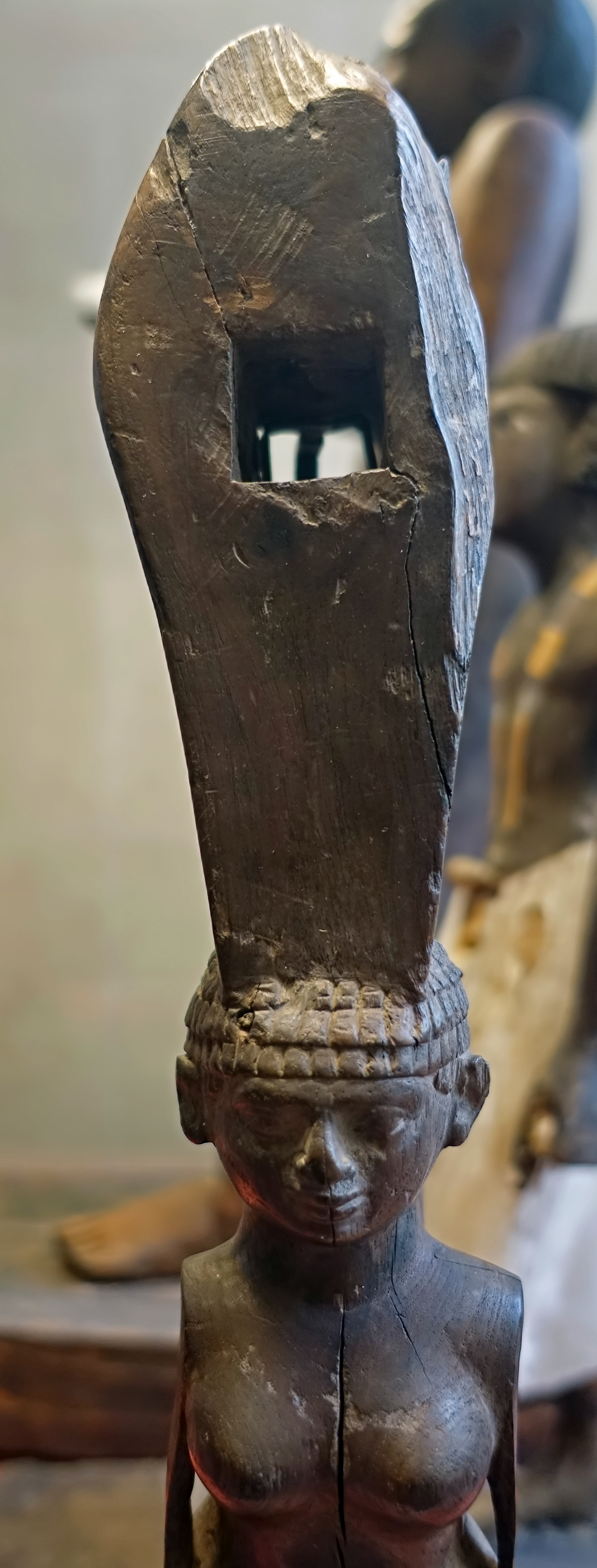
25th Dynasty / Nubian Dynasty / Kushite Empire: 746 BC - 656 BC
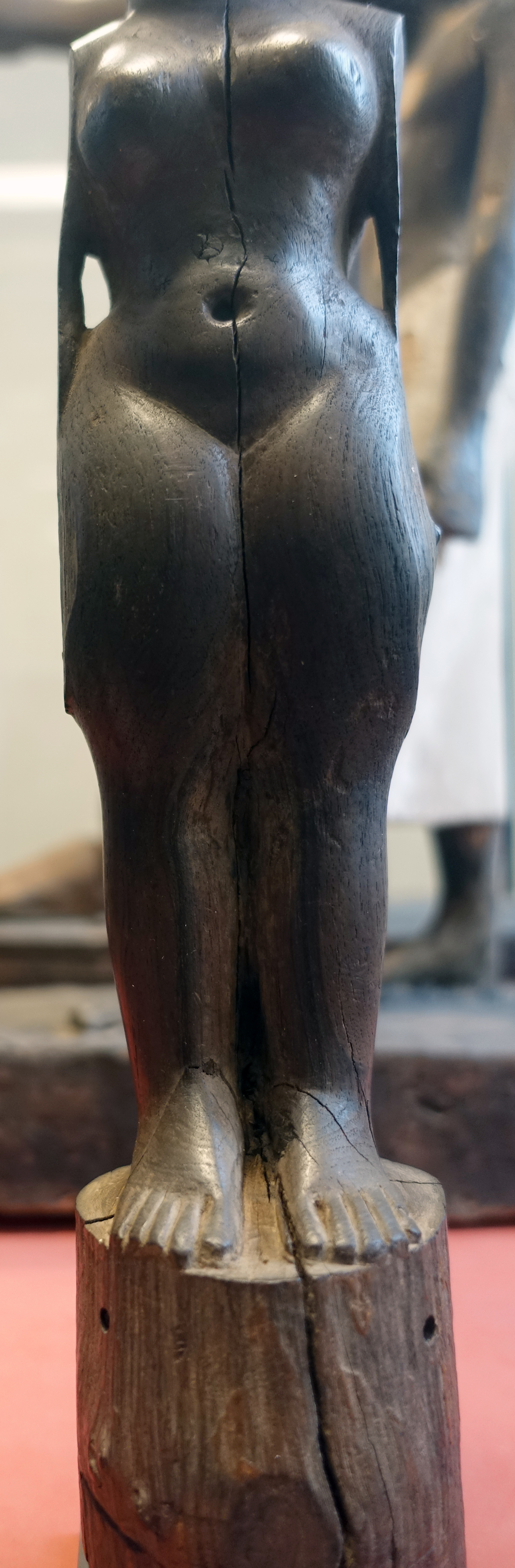
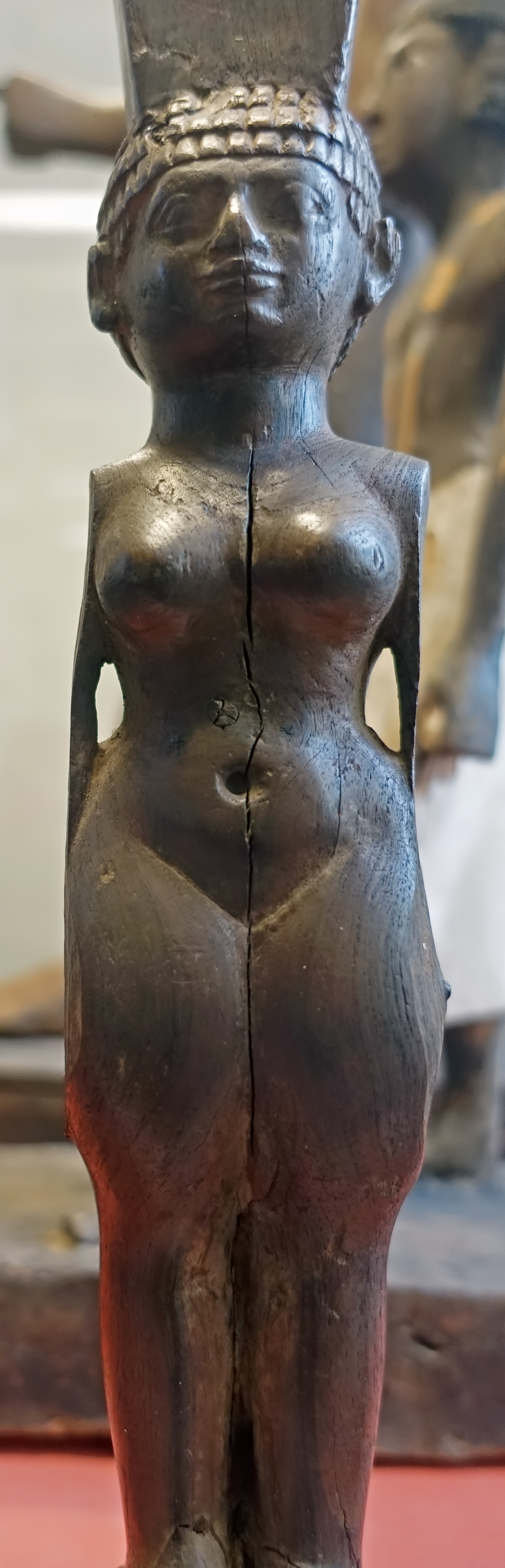
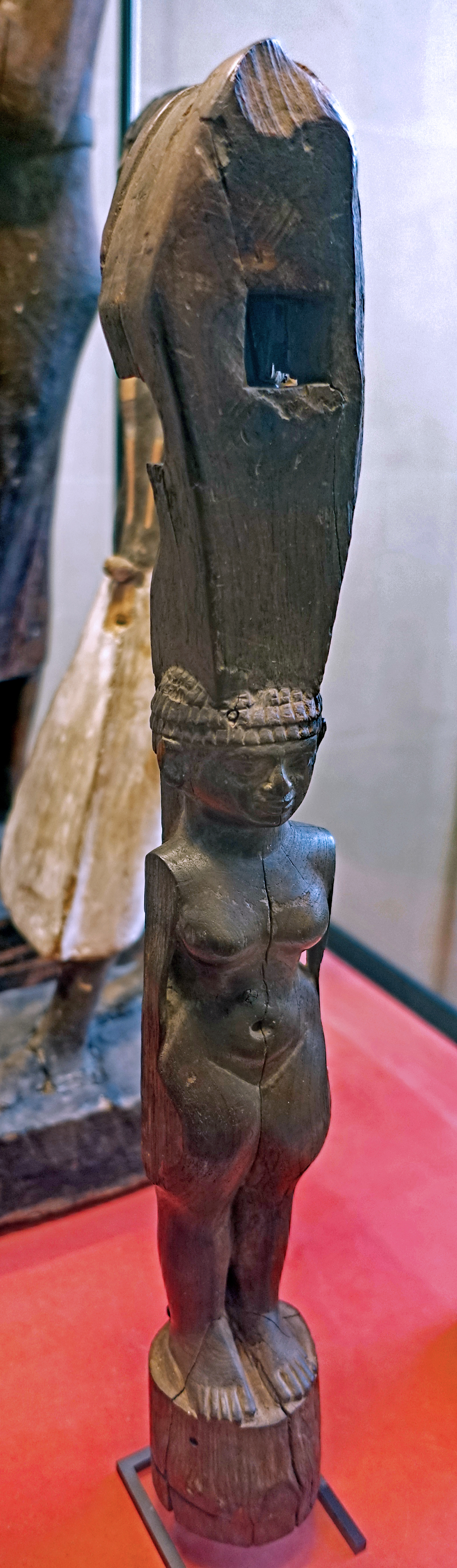
Ebony furniture leg
An ebony furniture leg in the shape of a naked woman.
( The word ebony itself comes from the Ancient Egyptian word hbny. The closest source would be western Africa, which demonstrates the extent of the ancient Egyptian trade routes. In addition, the physique of the model is quite unlike the normal shape used by the local artists for Egyptian women - Don )
The woman is standing, nude, with a short curly wig. The piece is pierced by a mortise.
Height 452 mm, width 70 mm, thickness 65 mm.
Catalog: Ebony, west Africa, Aile Sully, Room 334, Materials and Techniques, Vitrine 3, E 7652
Photo: Don Hitchcock 2018
Source and text: Original, Louvre Museum, Paris, France, https://collections.louvre.fr/
25th Dynasty / Nubian Dynasty / Kushite Empire: 746 BC - 656 BC
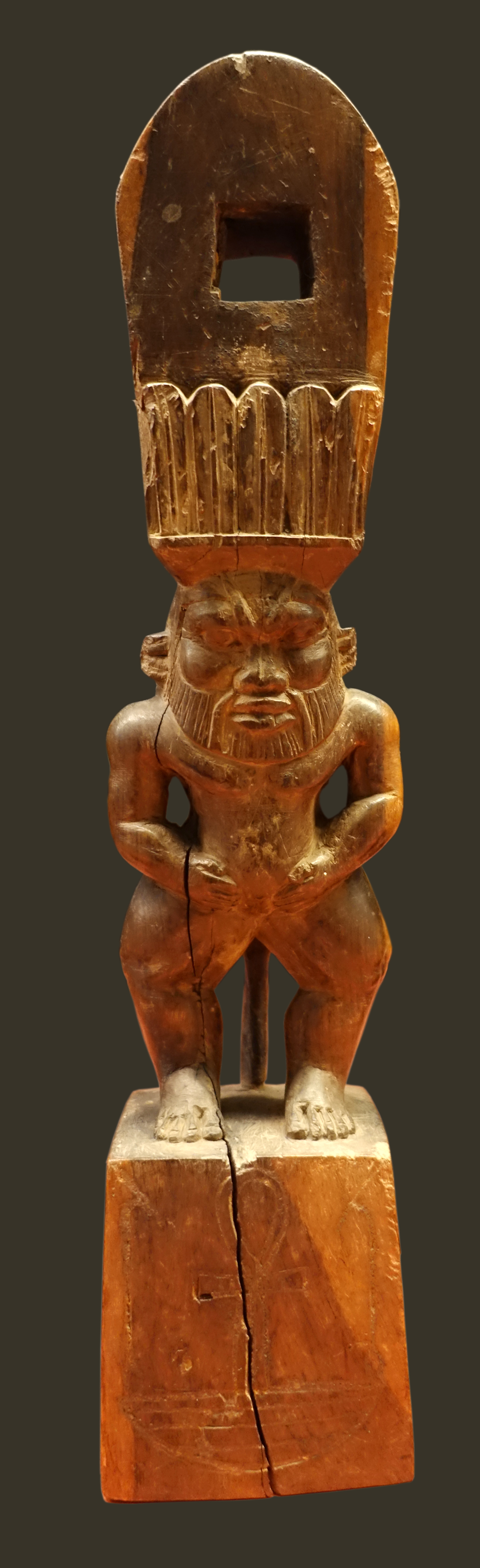
Ebony furniture leg
The leg features the god Bes, standing, naked, wearing a beard and the crown of Bes.
Height 375 mm, width 68 mm, thickness 47 mm.
Catalog: Wood, Dalbergia cf. melanoxylon, Pharaoh's ebony, African grenadilla, west Africa, E 10379, AF 537
Photo: Don Hitchcock 2018
Source and text: Original, Louvre Museum, Paris, France, https://collections.louvre.fr/
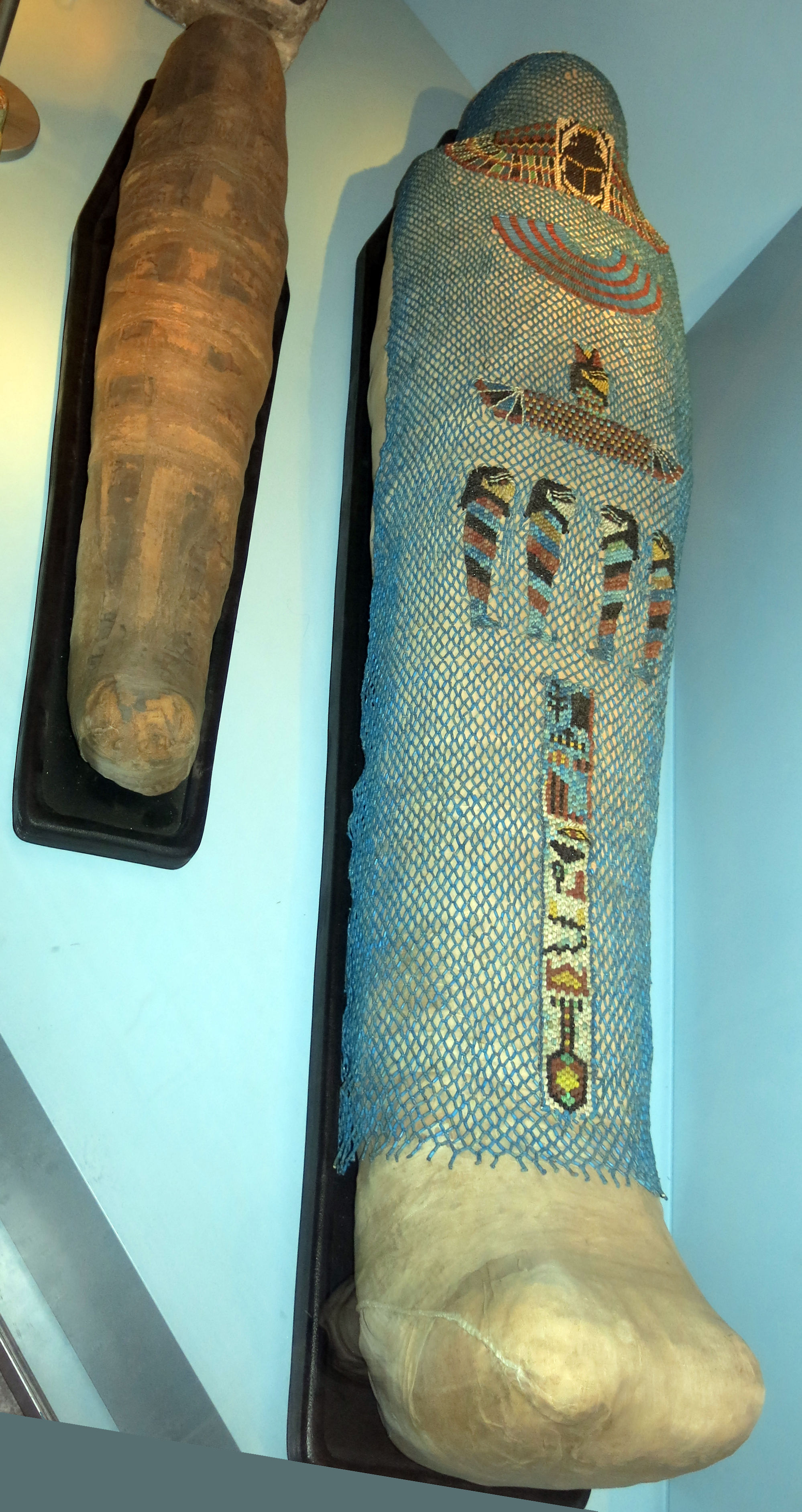
25th Dynasty / Nubian Dynasty / Kushite Empire: 746 BC - 656 BC
Keku
Mummy of Keku and shroud
The mummy is covered with a bead coverlet, presumably a symbol of heaven. The shroud that lies beside the mummy was manufactured in 2006 by the Te Papa museum in New Zealand, in deference to the human remains of Keku that were exhibited there. According to Maori beliefs, the shroud is a symbol and carrier of life, love, care and respect.
Note that no attempt has been made to create a face from the beads, as was the case with the bead coverlet of Peftjauneith. Keku's bead coverlet is much larger, covering most of the body, and near the head is the symbol of a scarab.
In ancient Egyptian religion, the sun god Ra is seen to roll across the sky each day, transforming bodies and souls. Beetles of the Scarabaeidae family (dung beetle) roll dung into a ball as food and as a brood chamber in which to lay eggs that are later transformed into larvae. For these reasons the scarab was seen as a symbol of this heavenly cycle and of the idea or rebirth or regeneration. The Egyptian god Khepri, Ra as the rising sun, was often depicted as a scarab beetle or as a scarab beetle-headed man. The ancient Egyptians believed that Khepri renewed the sun every day before rolling it above the horizon, then carried it through the other world after sunset, only to renew it, again, the next day.
Mummy, linen, faience; site Thebes / Luxor ca 700-650 BC.
shroud; Wellington, New Zealand 2006.
Photo: Don Hitchcock 2014
Source: Original, Rijksmuseum van Oudheden, National Museum of Antiquities, Leiden.
Additional text: Wikipedia
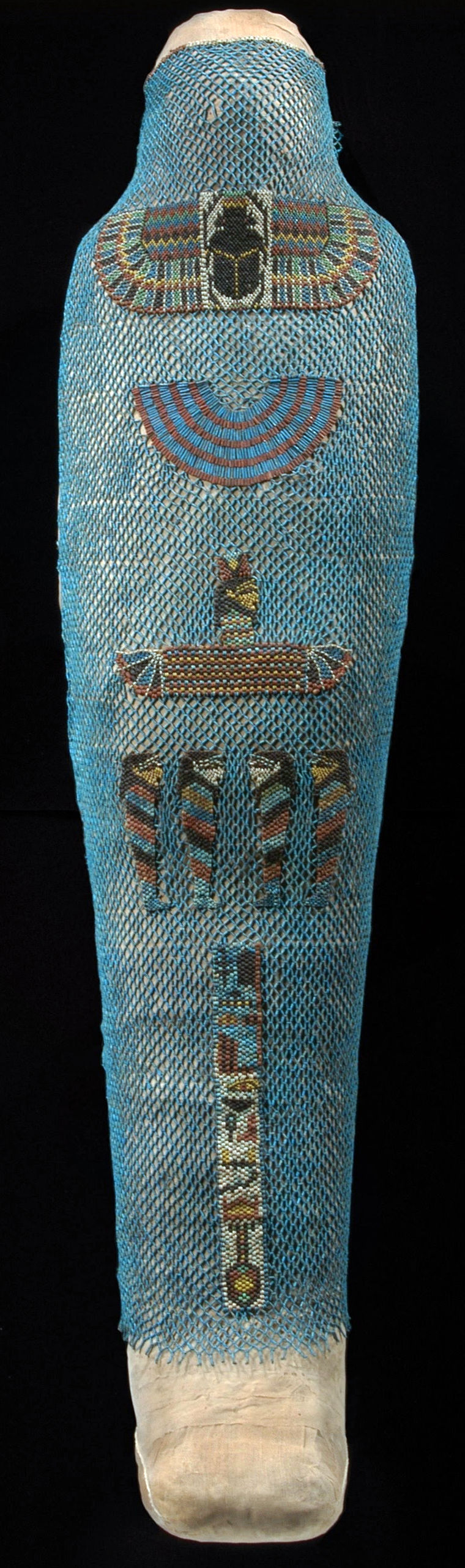
25th Dynasty / Nubian Dynasty / Kushite Empire: 746 BC - 656 BC
Mummy of Inamonnefnebu
(Note that two identifications have been given for this mummy. I would be glad if I could clear up the confusion. The dates are the same, the descriptions are the same for both Keku and Inamonnefnebu. Perhaps Keku is the person and Inamonnefnebu is the place where it was found? Keku or Kekoe is listed on the catalogue as Egypt Item number: AMM 1-d - Don )
Mummy of Inamonnefnebu 700 BC - 650 BC Length 155 cm.
The mummy has been wrapped in a shroud of a vaguely reddish colour. There is a wide gap along the centre of the back, through which one can see the regular transverse bandages of the layer underneath. The shroud is held in place by a number of straps of folded linen: around the head, hips, knees, and just above the ankles, with the diagonal bands of a stola over the torso. There are three windings of a broad bandage around the insteps, with one loop passing under the soles of the feet, likewise over the shroud.
On top of the shroud lies a bead net which is 151 cm long and 51.5 cm wide. It is mainly composed of blue faience cylinder beads (0.6. cm long), forming rhomboid cells, with blue twin rings on the crossings. The upper edge of the net has been reinforced with a triple border of ring beads, forming alternating strips of red, white, and blue. The lower edge has a fringe with tufts of two cylinders and a twin ring each.
The following elements of bead mosaic have been worked into the bead net: a winged scarab on the throat, a collar on the chest consisting of alternating ranges of blue and red cylinder beads, a winged goddess on the abdomen, four antithetic Sons of Horus on the thighs and a column of text on the lower legs. The hieroglyphs read: ‘An offering which the King gives to Osiris, Lord of Aby[dos], may he grant a good burial.’
Mummy from Inamonnefnebu
RMO AMM 1,195, also listed as Leiden 15, AMM 1
Mummy, linen, faience, Thebes / Luxor (Egypt), late 25th – early 26th dynasty, ca 700-650 BC.
Photo and text: © https://www.google.com/culturalinstitute/asset-viewer/mummy-of-inamonnefnebu/RQHBQRZcxv6nTw?hl=en-gb
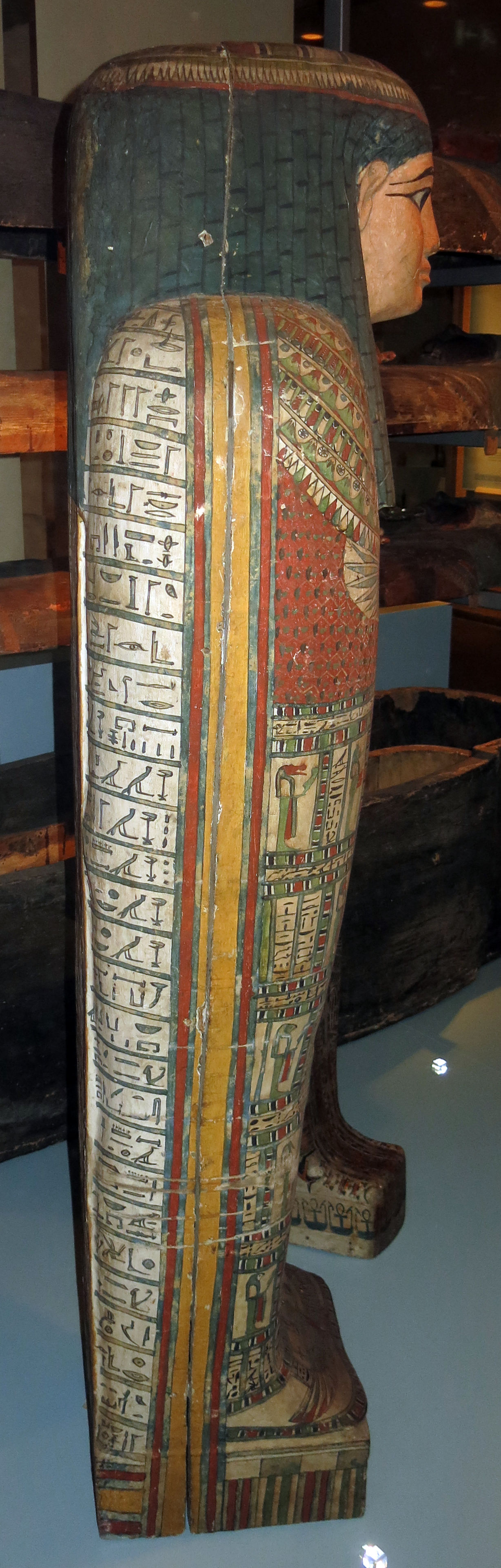
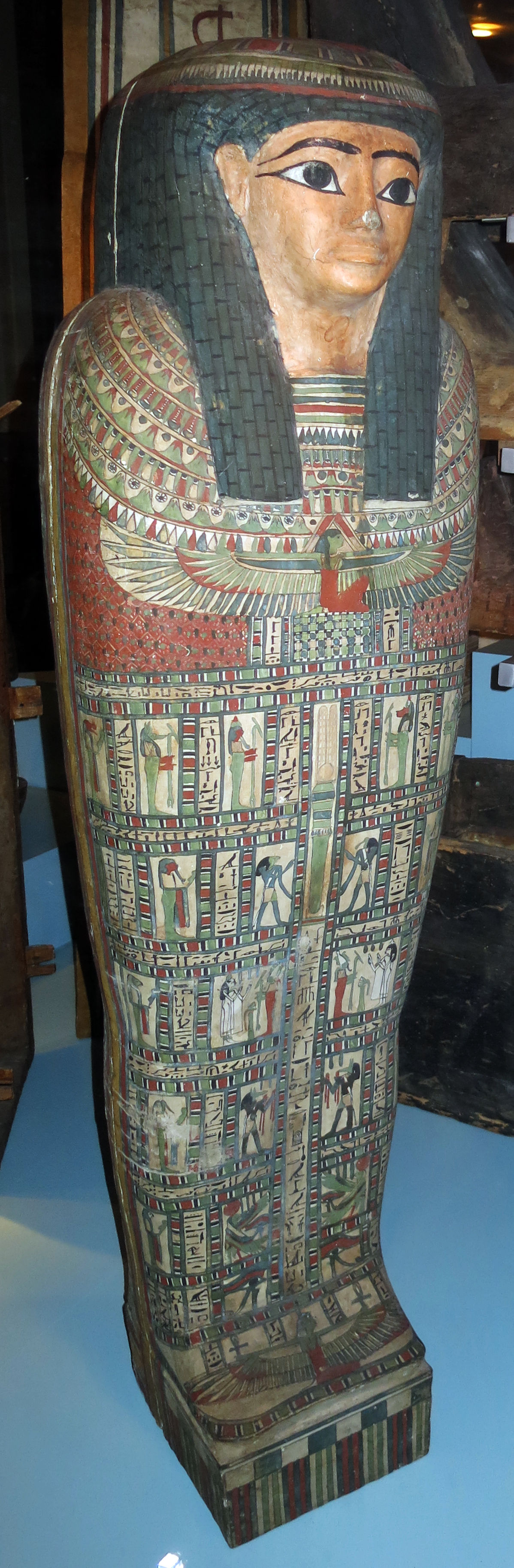
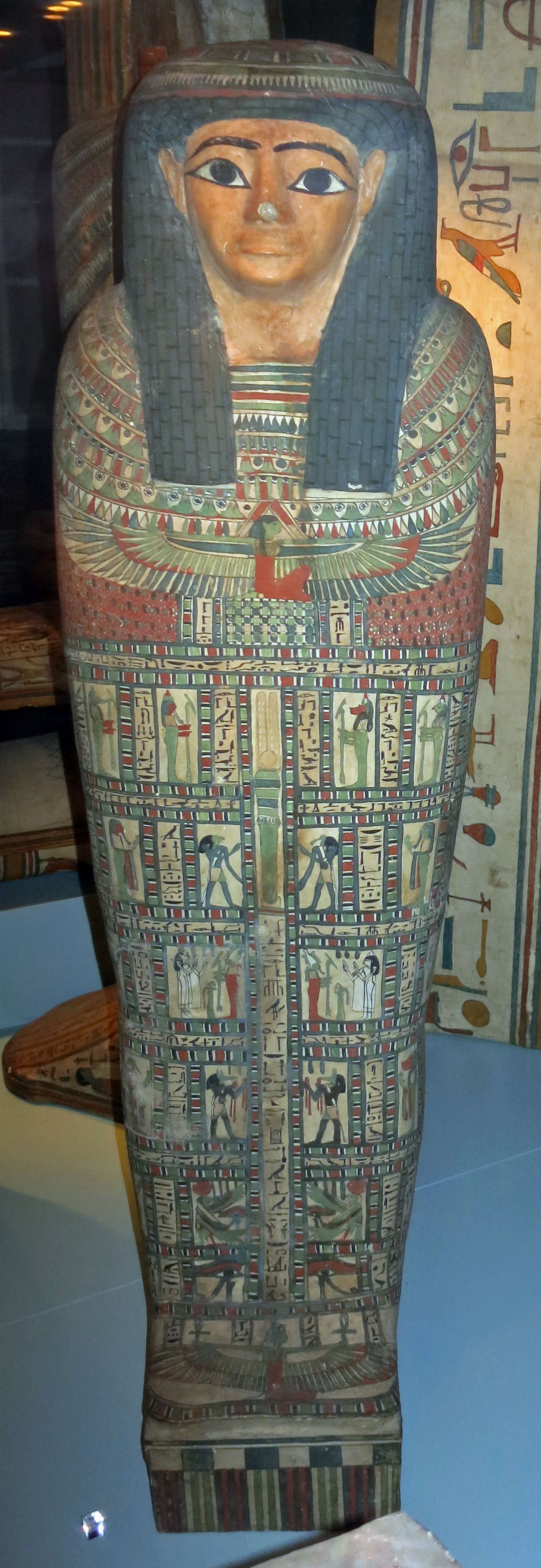
25th Dynasty / Nubian Dynasty / Kushite Empire: 746 BC - 656 BC
Keku
Coffin of Keku.
Dimensions 31 x 49 x 172 cm
Keku lived in Thebes (now Luxor) ca 700 BC, and was the wealthy daughter of Namenekhamun, chief butcher in the temple complex of the god Amun. She died in her early 20s - probably of disease.
Photo: Don Hitchcock 2014
Source: Original, Rijksmuseum van Oudheden, National Museum of Antiquities, Leiden.
Additional text: http://www.theage.com.au/news/Science/Keku-a-wonder-to-behold-after-2700-years/2005/06/14/1118645805303.html?oneclick=true

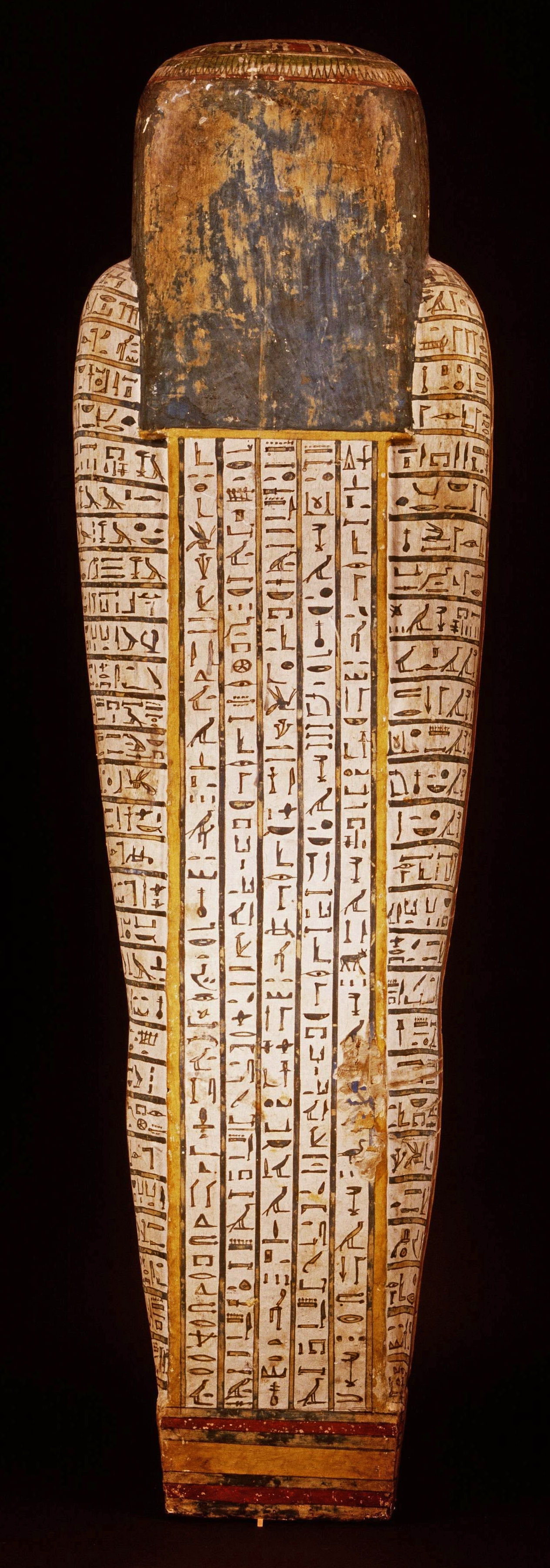

25th Dynasty / Nubian Dynasty / Kushite Empire: 746 BC - 656 BC
Keku
Coffin of Keku.
'Unfortunately, we do not know who excavated Keku and when, but it must have been a local agent in Upper-Egyptian Thebes / Luxor, working for one of the great diplomats-collectors around 1825 - perhaps the Italian, Piccinini, who appears to have worked for Giovanni d'Anastasi,' said Dr Maarten Raven, the curator of the museum's Egyptian department.
'Giovanni d'Anastasi, a merchant in Alexandria and consul-general for Sweden, sold his collection of almost 6000 Egyptian objects to the Leiden Museum in 1828. Keku was among these objects.'
Photo: http://www.rmo.nl/collectie/zoeken?object=AMM+4-c
Text: http://www.ancientegypt.com.au/ancient-egypt-articles/2005/6/20/revealing-ancient-secrets/
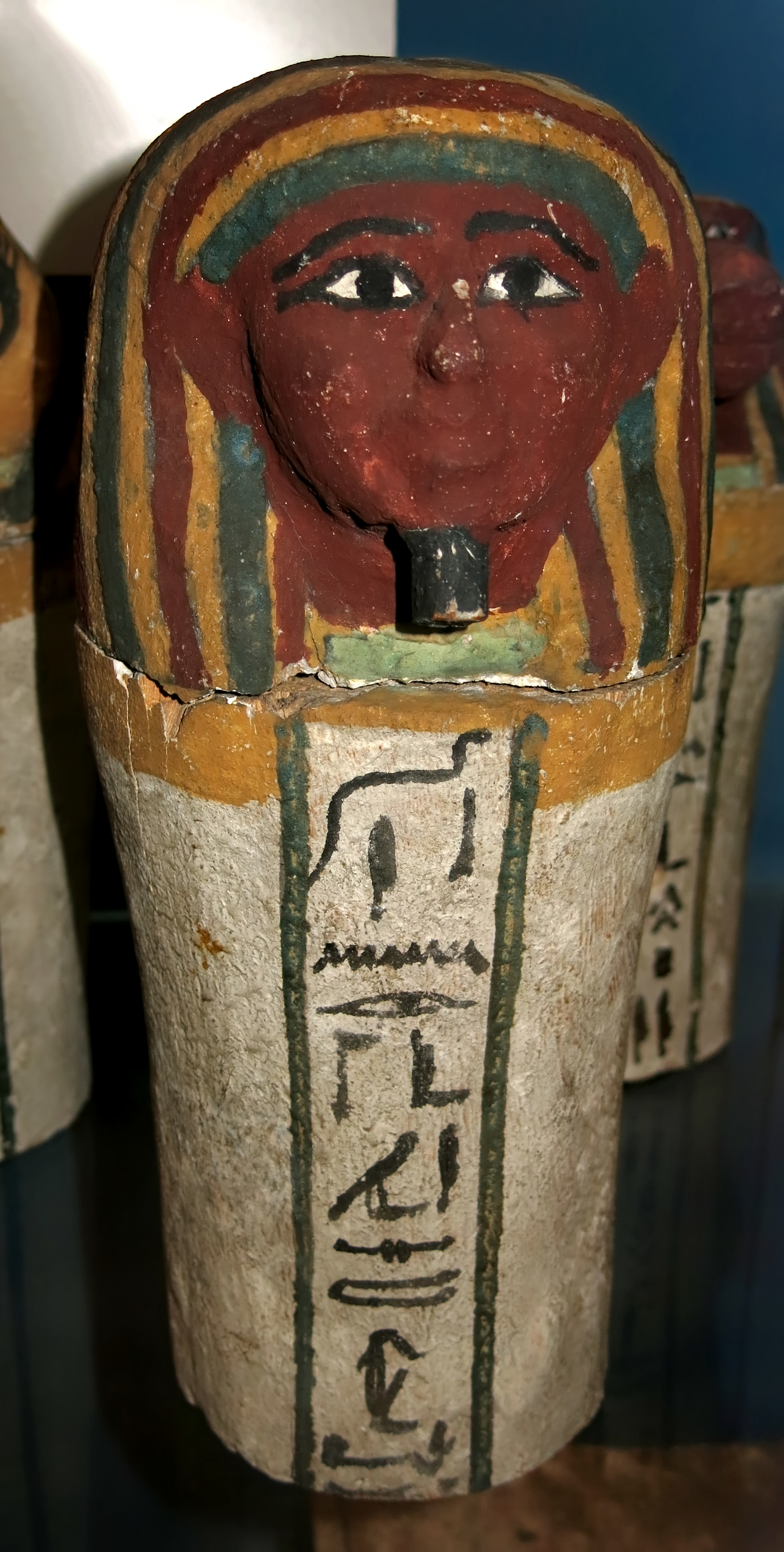

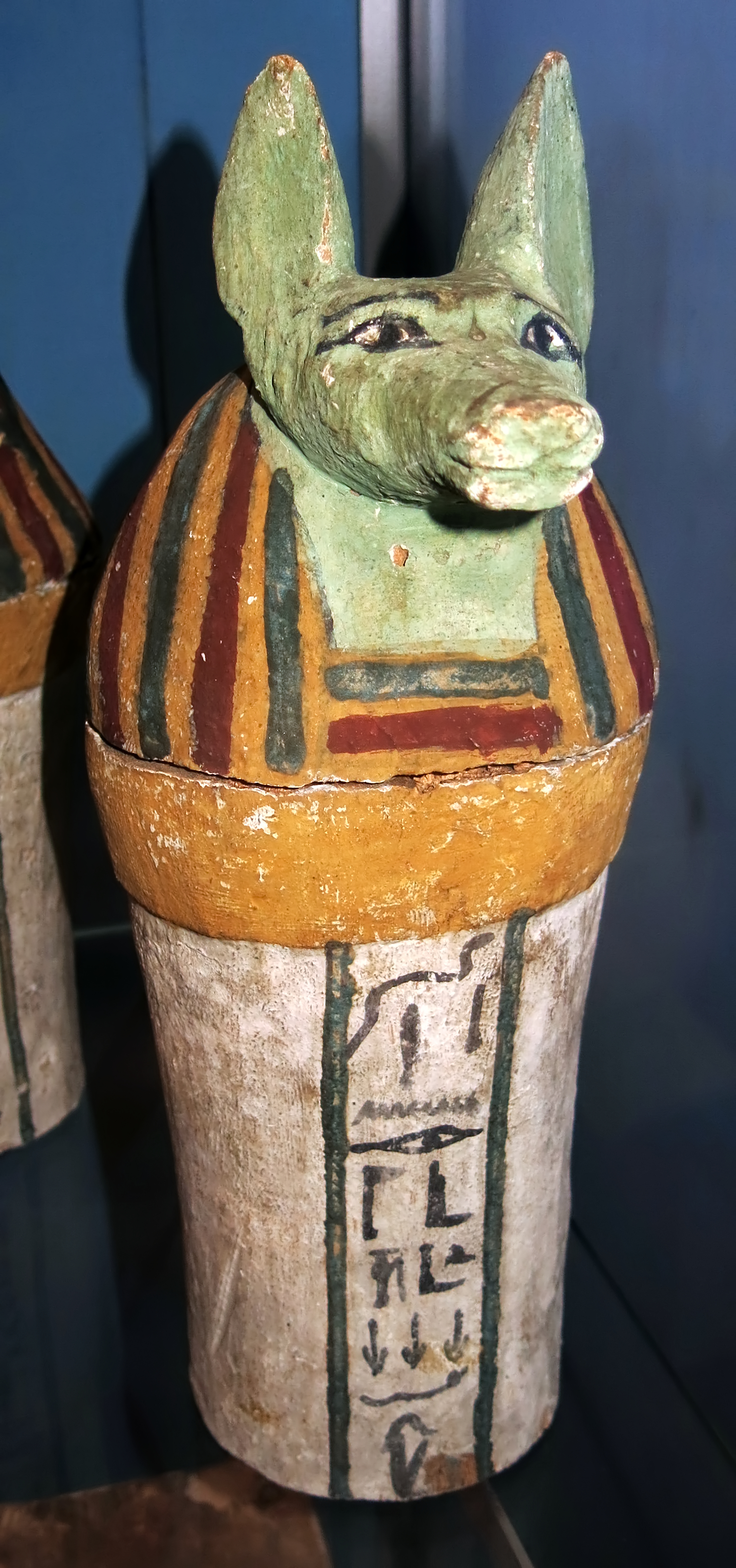
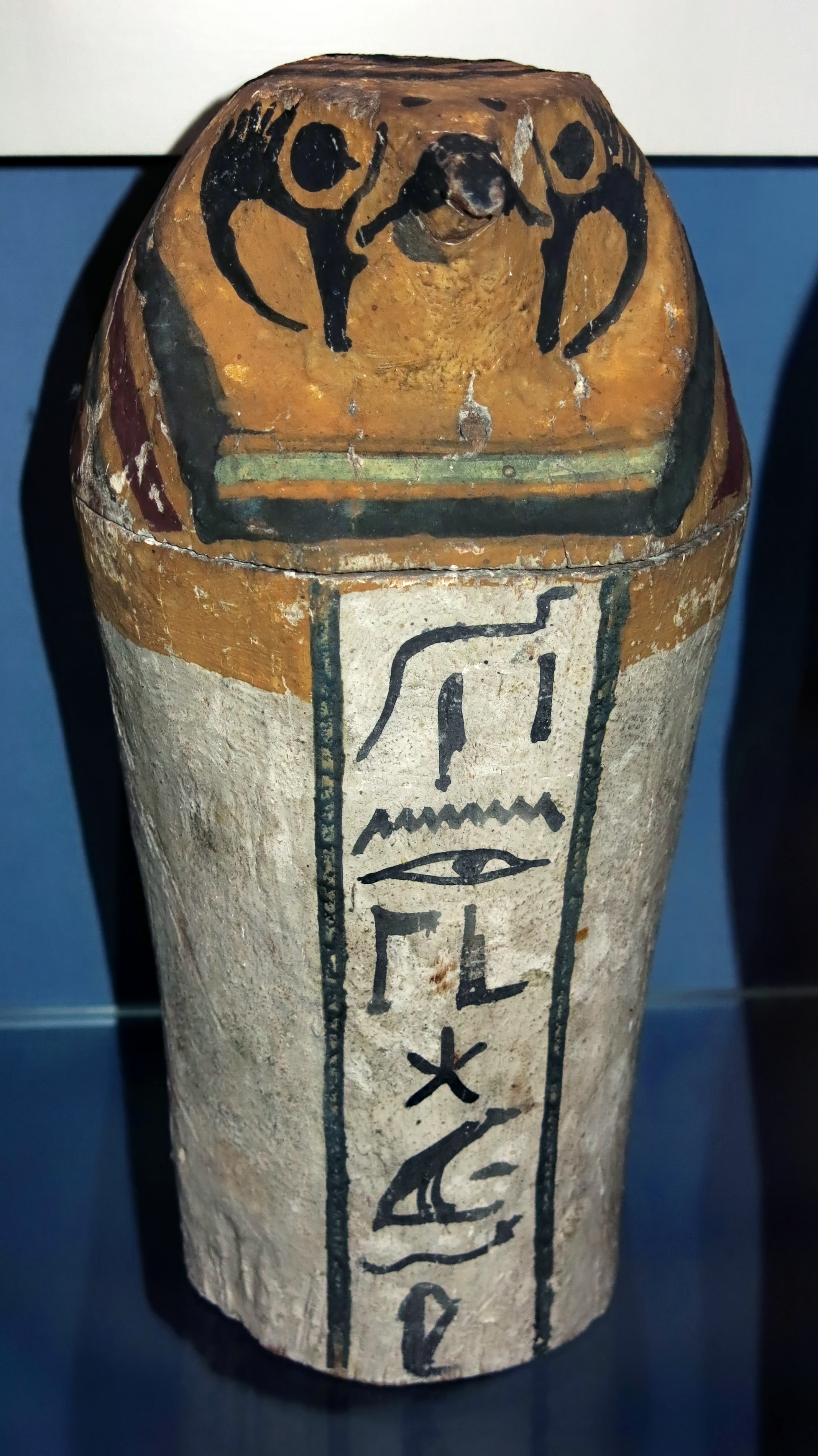
25th Dynasty / Nubian Dynasty / Kushite Empire: 746 BC - 656 BC
Wooden dummy Canopic Jars
Each of the jars contains a shallow cavity too small to accommodate a package of wrapped viscera. The inscriptions associate Duamatef and Qebhsennuef with a falcon and a jackal respectively.
Catalog: Painted wood, Provenance unknown, circa 700 BC, EA9562 - 9565
Photo: Don Hitchcock 2015
Source: Original, British Museum
Text: Card with the display at the British Museum, https://www.britishmuseum.org/, © Trustees of the British Museum, CC BY-NC-SA 4.0

25th Dynasty / Nubian Dynasty / Kushite Empire: 746 BC - 656 BC
Di-Mut-shep-n-ankh
The priestess Di-Mut-shep-n-ankh died at the age of 35. She was wrapped in 15 garments, which had been reused as mummy bandages.
The lower coffin appears to be made of wood, although the lid is of cartonnage, a technique similar to papier mache.
Ca 700 BC.
Photo: Don Hitchcock 2014
Source: Original, Københavns (Copenhagen) Museum, National Museum of Denmark
Additional text: http://picturemixture.wordpress.com/2009/08/26/di-mut-shep-n-ankh/

25th Dynasty / Nubian Dynasty / Kushite Empire: 746 BC - 656 BC
Di-Mut-shep-n-ankh
The cartonnage which forms the casket lid of the priestess Di-Mut-shep-n-ankh, also known as 'the leader of the chorus of Karnak'.
Sun gods wrap their wings around the woman.
Photo: Don Hitchcock 2014
Source: Original, Københavns (Copenhagen) Museum, National Museum of Denmark
Additional text: http://picturemixture.wordpress.com/2009/08/26/di-mut-shep-n-ankh/
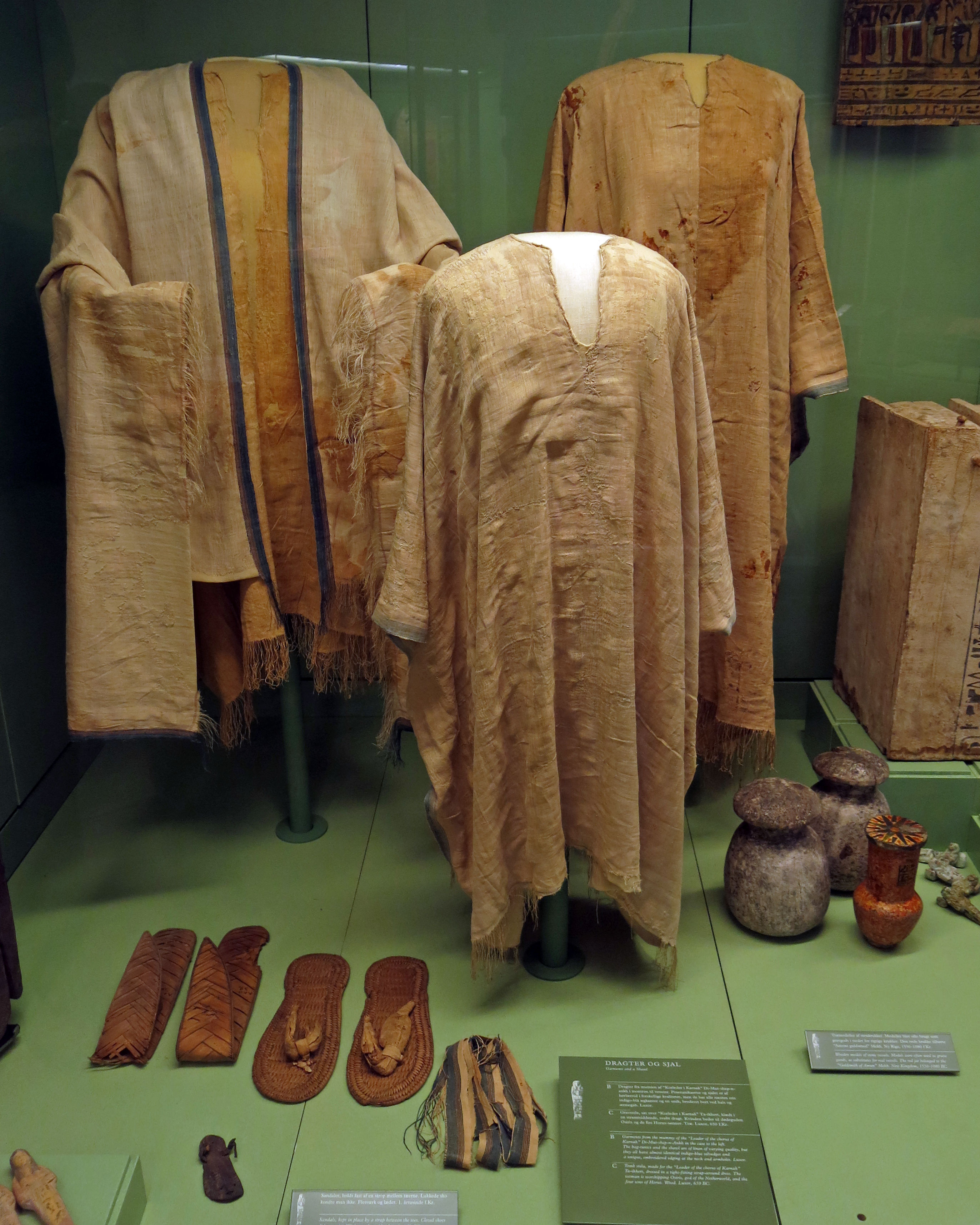
25th Dynasty / Nubian Dynasty / Kushite Empire: 746 BC - 656 BC
Di-Mut-shep-n-ankh
Garments from the mummy of the 'Leader of the chorus of Karnak', Di-Mut-shep-n-ankh. The tunics and the shawl are of varying quality, but they all have almost identical indigo-blue selvedges and a unique, embroidered edging at the neck and armholes.
Also in this image are examples of sandals, kept in place by a strap between the toes. Closed shoes did not exist. Wickerwork and leather, ca 1000 BC.
Photo: Don Hitchcock 2014
Source: Original, Københavns (Copenhagen) Museum, National Museum of Denmark
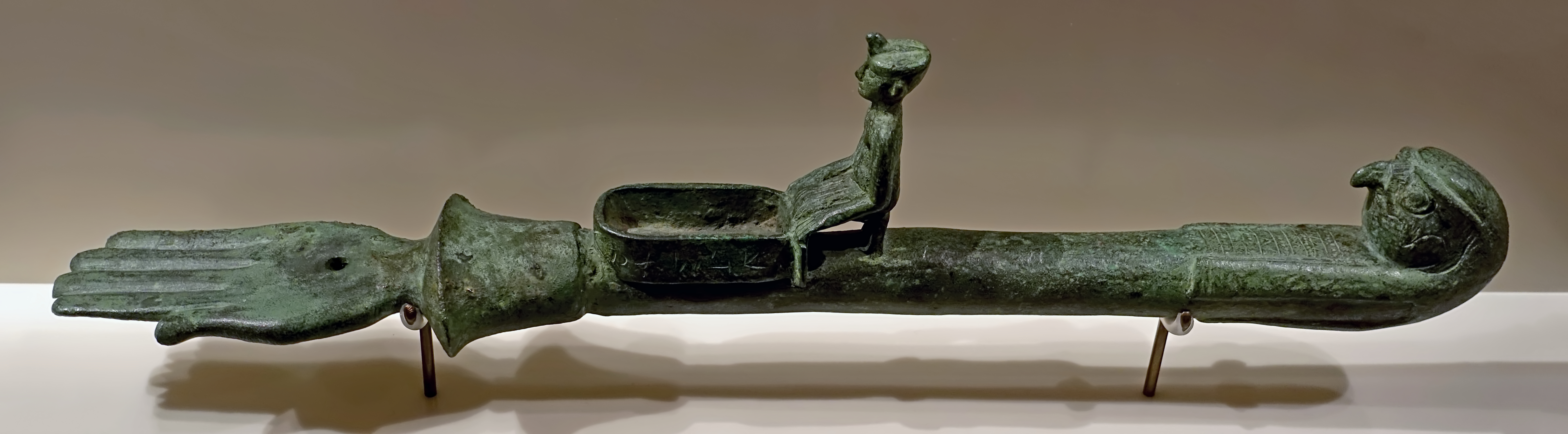
25th Dynasty / Nubian Dynasty / Kushite Empire: 746 BC - 656 BC
Incense Censer
This Censer was for burning incense grains in front of a divine shrine.
Circa 700 BC.
Catalog: Bronze, ÄM 10708
Photo: Don Hitchcock 2018
Source: Original, Staatliche Museen zu Berlin, Neues Museum, Germany
Text: © Card at the Staatliche Museen zu Berlin (CC BY-NC-SA 3.0 DE)
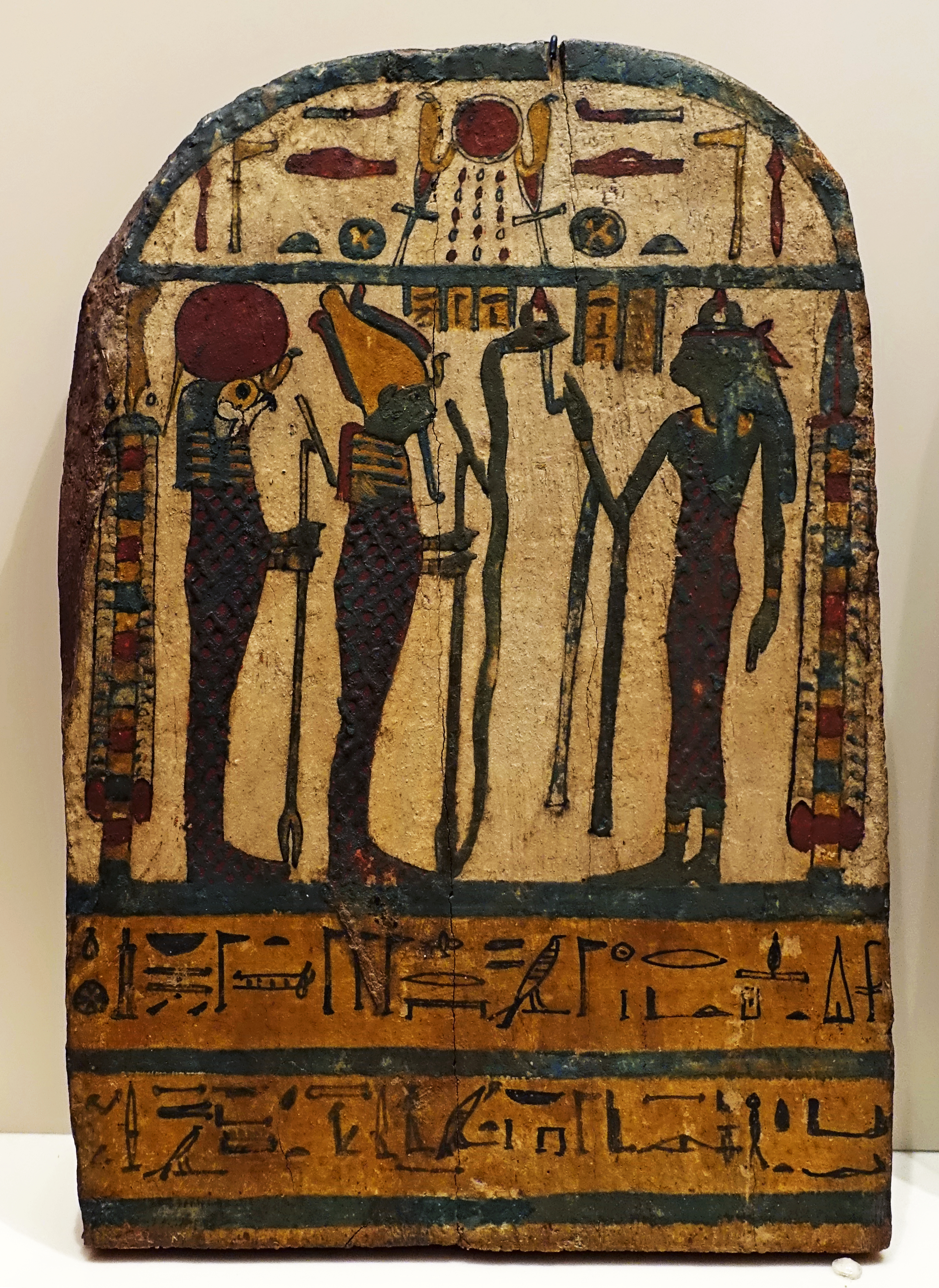
25th Dynasty / Nubian Dynasty / Kushite Empire: 746 BC - 656 BC
Mutinet
Stela of Mutinet, daughter of a gatekeeper.
Circa 700 BC.
Catalog: Wood, ÄM 784
Photo: Don Hitchcock 2018
Source: Original, Staatliche Museen zu Berlin, Neues Museum, Germany
Text: © Card at the Staatliche Museen zu Berlin (CC BY-NC-SA 3.0 DE)
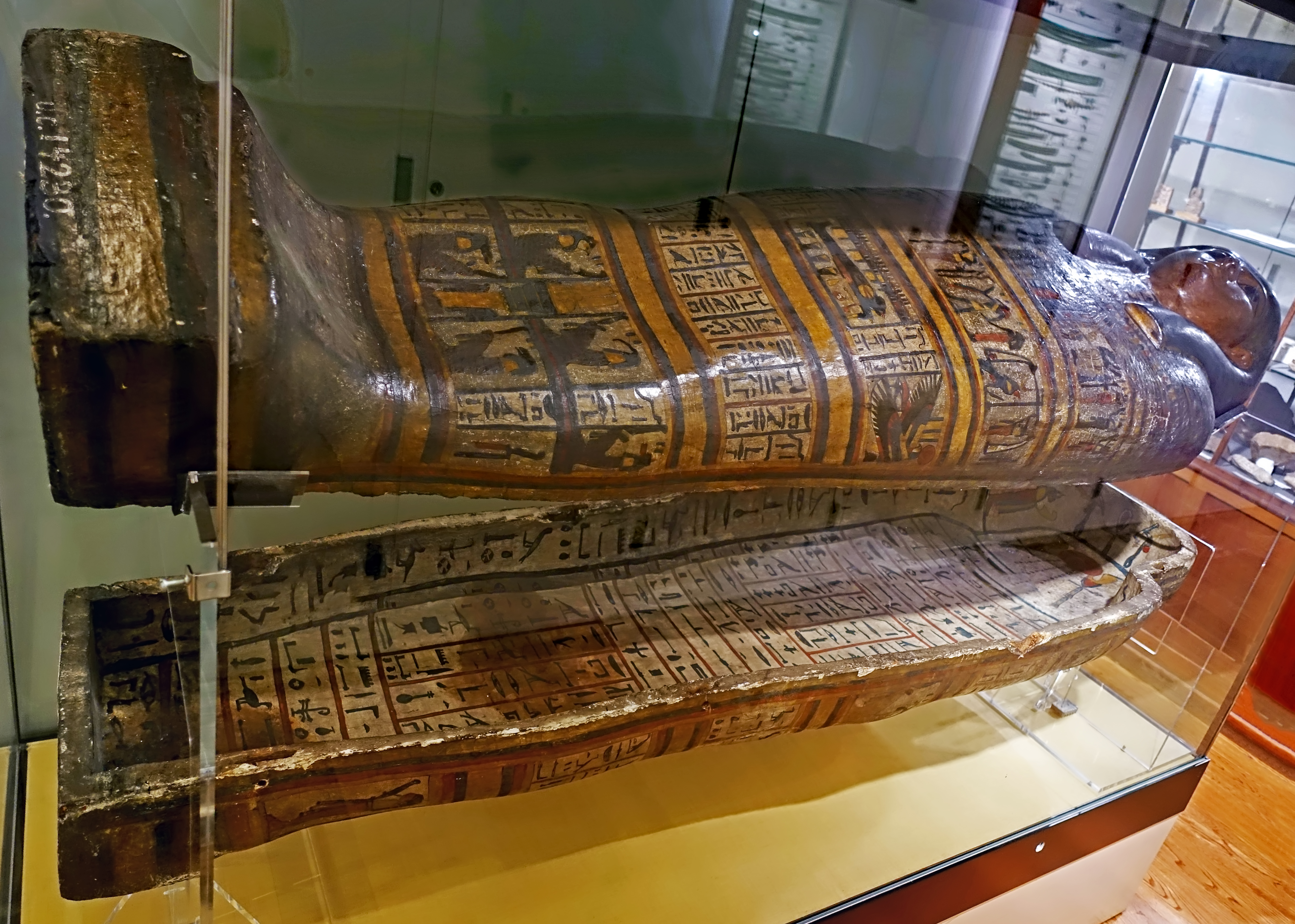
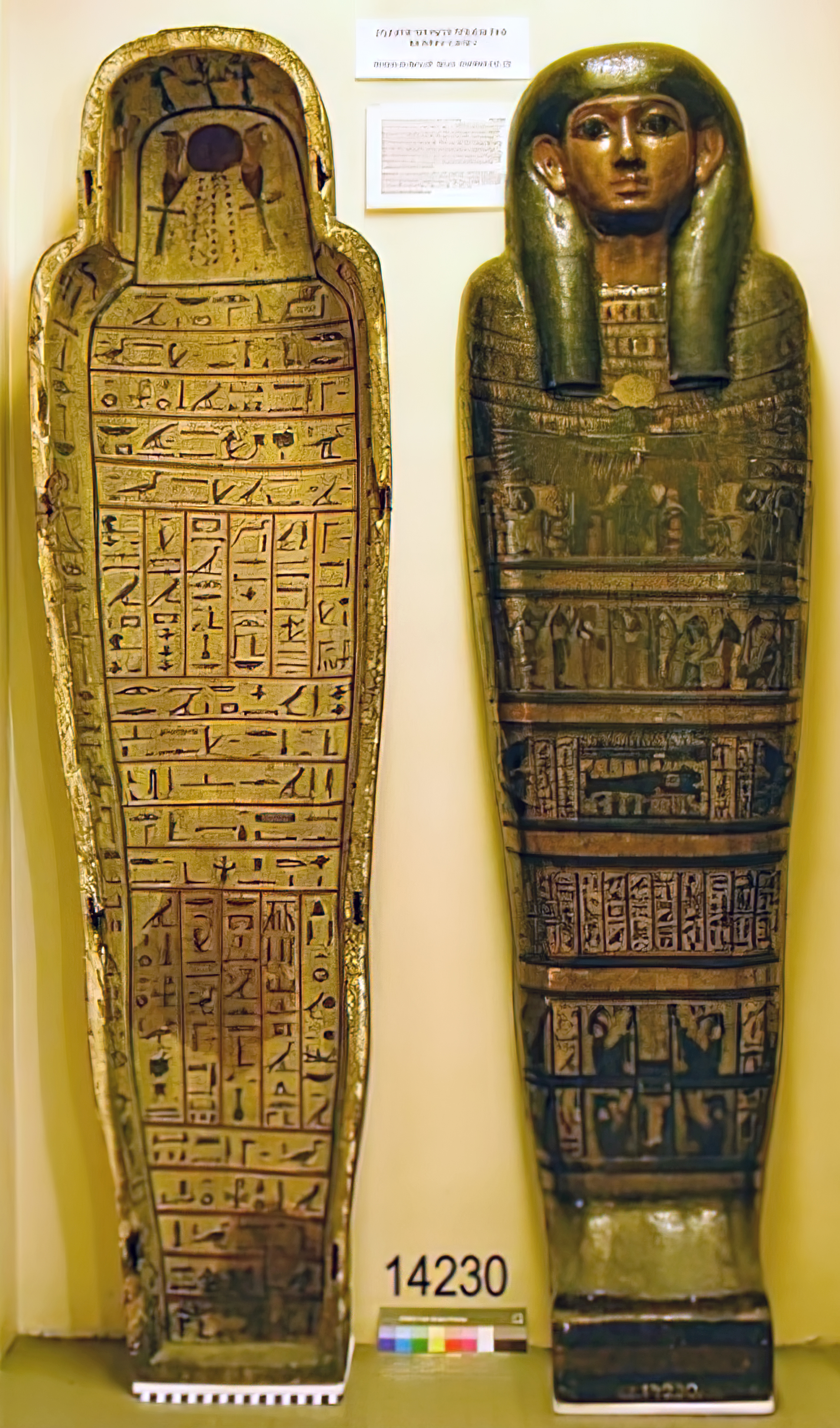
Photo (above): Don Hitchcock 2018
Photo (left): Petrie Museum, © 2015 UCL. CC BY-NC-SA license.
Source: Original, Petrie Museum, London, England
Text: Card / online catalogue, the Petrie Museum, © 2015 UCL. CC BY-NC-SA license

25th Dynasty / Nubian Dynasty / Kushite Empire: 746 BC - 656 BC
Nairytisitnefer
Coffin case of Nairytisitnefer
Circa 700 BC.
This coffin case contained the mummified body of a woman called Nairytisitnefer. She came from a rich priestly family at Thebes, and died about 700 BC. We know the names of her parents and grandfathers, and the fact that she was married, but nothing else.
Nairytisitnefer's fine-quality coffin, made of wood covered with linen and plaster is full of religious meaning. It is covered with images and prayers from the Book of the Dead intended to bring about her rebirth in a perfect form.
The Book of the Dead is a modern name for Ancient Egyptian manuscripts containing compositions drawn from about 175 individual 'chapters'. These were known to the Ancient Egyptians as 'chapters for coming forth by day'. They comprise a collection of hymns, spells, and instructions for securing eternal life.
Description of the front of the coffin lid
Line 1, under the collar
Nairytisitnefer worships Osiris and other gods represented as mummies.
Line 2
Nairytisitnefer, led by the god Thoth, is questioned by the gods to find out if she is worthy to proceed to the next world and become 'true of voice'.
Line 3
Nairytisitnefer's mummy lying on a funerary bed, captioned:
Words spoken. The deceased the married woman Nairytisitnefer, true of voice.
Line 4
Inscription in 13 columns giving Nairytisitnefer's ancestry:
words spoken by Nairytisitnefer, true of voice, daughter of Basa, prophet of Montju, Lord of Thebes, true of voice, her mother being the married woman, Taawy, true of voice, daughter of the beloved of the god, the hour-watcher in Karnak, Iuefenamun, true of voice, son of the similarly-titled Djedmontuiuefankh, true of voice, O Osiris, bull of the West, the Great God who is in...
Line 5
A group of gods seated on both sides of the symbol of the god Osiris, captioned:
Words spoken by Nairytisitnefer, daughter of Basa, the god's father, offerer in Thebes, true of voice.
Line 6
The god Anubis flanking five lines of damaged text beginning: Words spoken by the deceased [Nairytisitnefer].
Description of the interior of the coffin base:
Words spoken by Nairytisitnefer [her parentage is listed again, in the same form as on the lid]. The heart [or mind]of Nairytisitnefer is given to her in the house of minds, and her heart to her in the house of hearts. The mind of Nairytisitnefer belongs to her, and she is content with it. Nairytisitnefer [her parentage is listed again, in the same form as on the lid].
Length 755 mm.
Catalog: Wood, linen, plaster, From the Besenmut family burial(s) at Thebes, Catalog No. UC14230
Photo: Don Hitchcock 2018
Source: Original, Petrie Museum, London, England
Text: Card / online catalogue, the Petrie Museum, © 2015 UCL. CC BY-NC-SA license
25th - 26th Dynasty: 746 BC - 525 BC
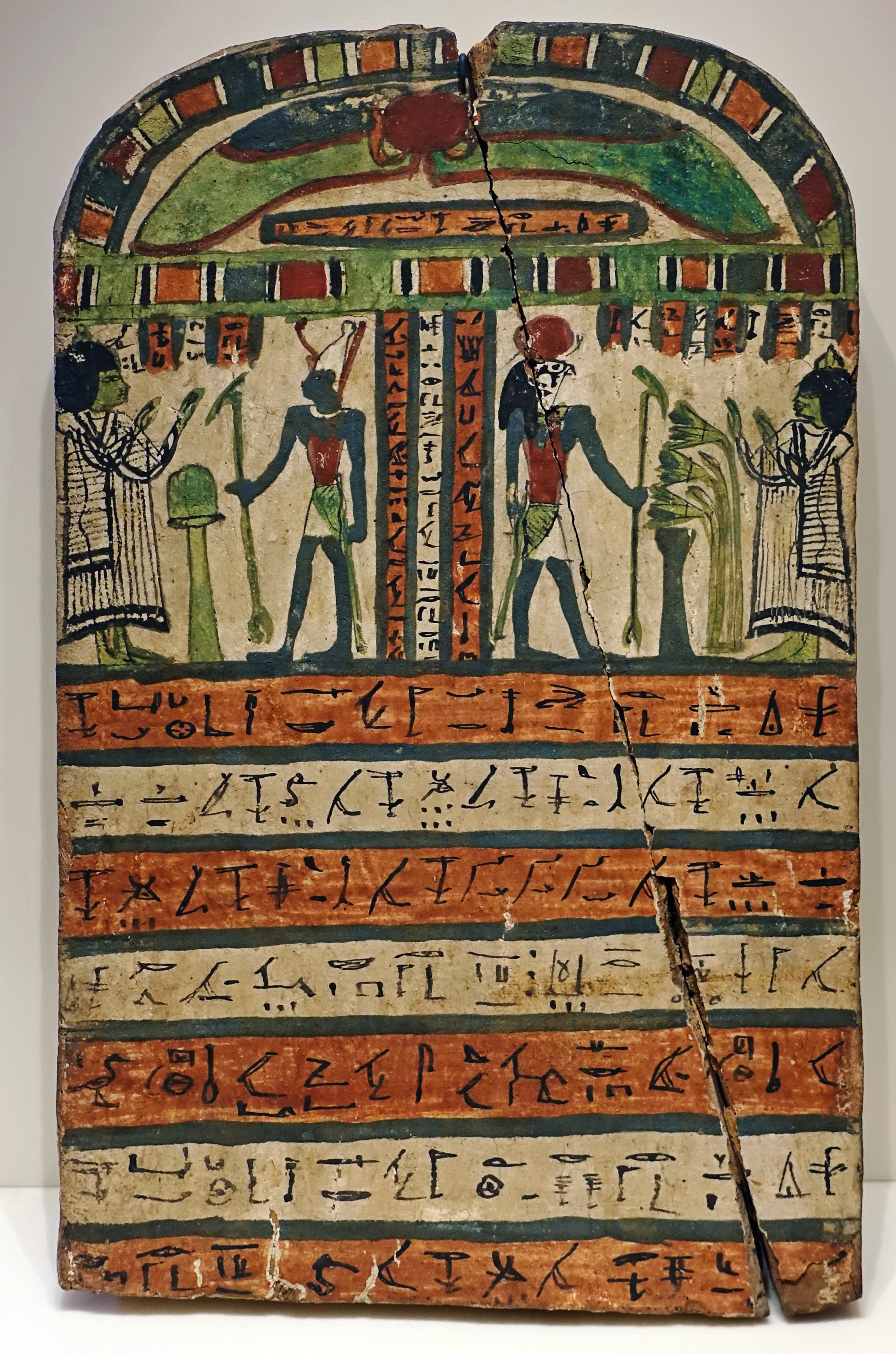
Takasu
Votive stela of Takasu for the gods Harmakhis and Atum.
Circa 650 BC.
Catalog: Wood, Thebes, ÄM 935
Photo: Don Hitchcock 2018
Source: Original, Staatliche Museen zu Berlin, Neues Museum, Germany
Text: © Card at the Staatliche Museen zu Berlin (CC BY-NC-SA 3.0 DE)
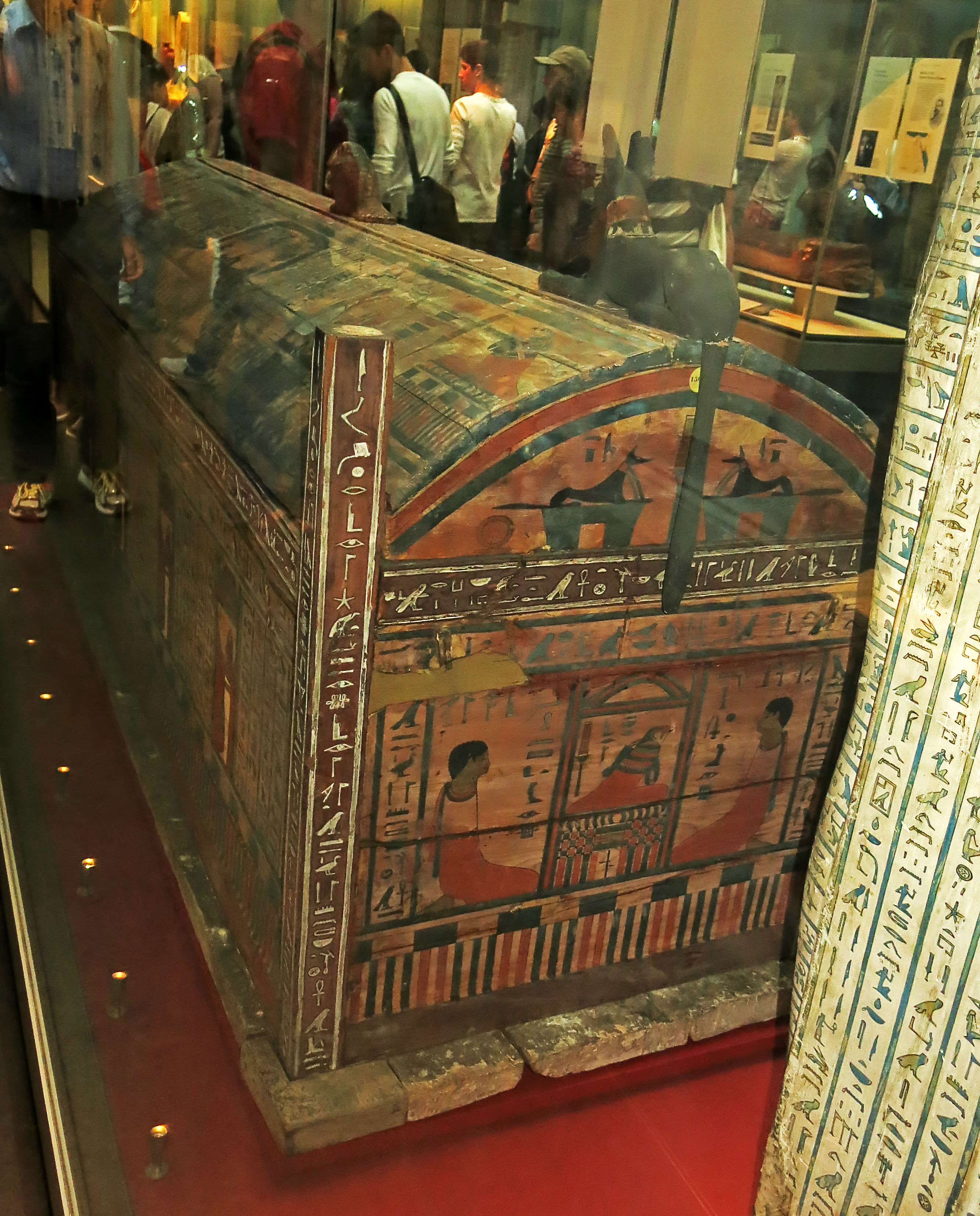
25th Dynasty / Nubian Dynasty / Kushite Empire: 746 BC - 656 BC
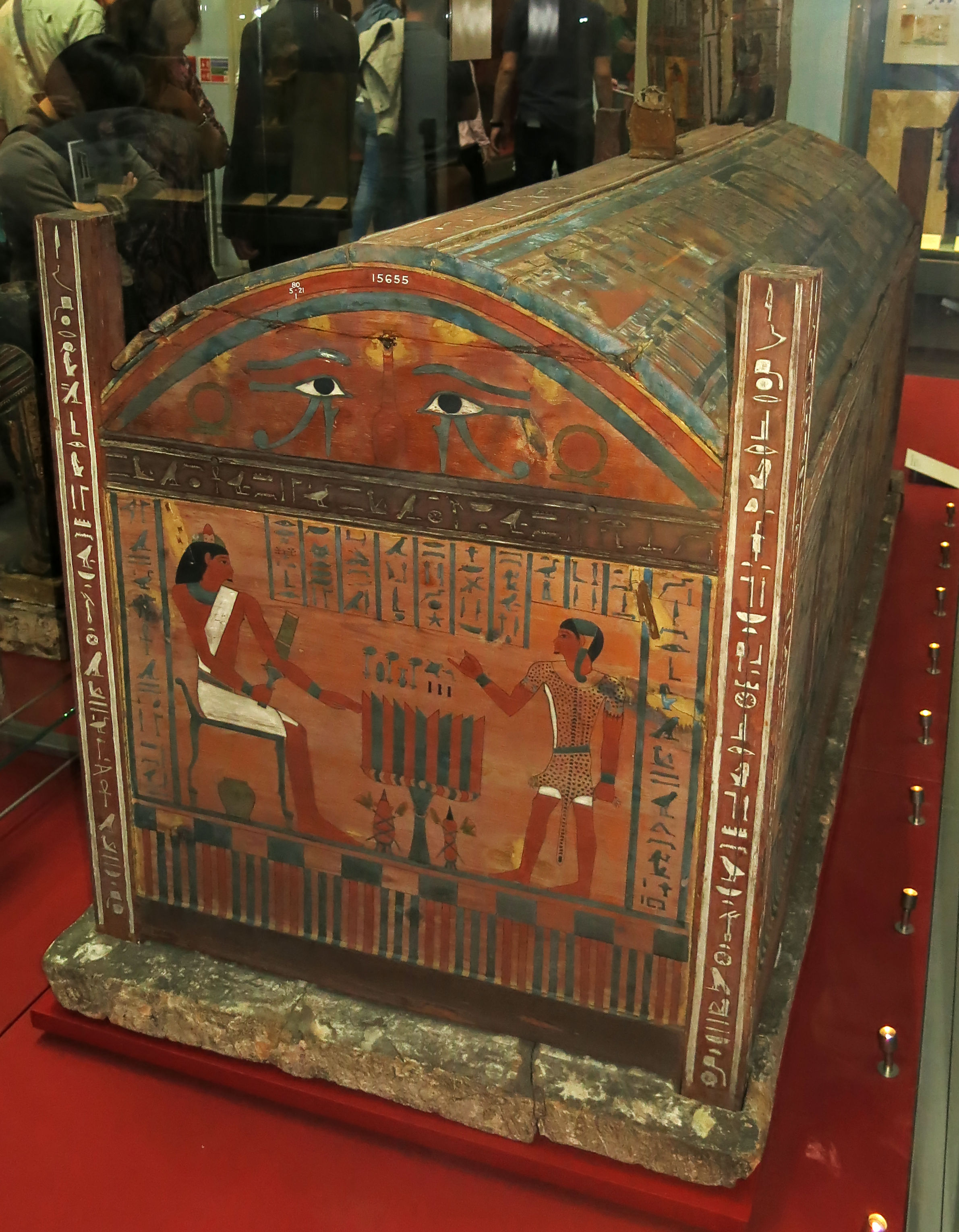
Prophet of Montu, Hor
Wooden outer coffin of the Prophet of Montu, Hor.
25th Dynasty, circa 700 BC - 680 BC from Thebes / Luxor.
Painted decoration and Hieroglyphic text, reinforced with metal clamps.
Length 2045 mm, width 762 mm, height 915 mm.
Catalog: EA15655
Photo: Don Hitchcock 2015
Source: Original, British Museum
Text: Card with the display at the British Museum, http://www.britishmuseum.org/, © Trustees of the British Museum, CC BY-NC-SA 4.0
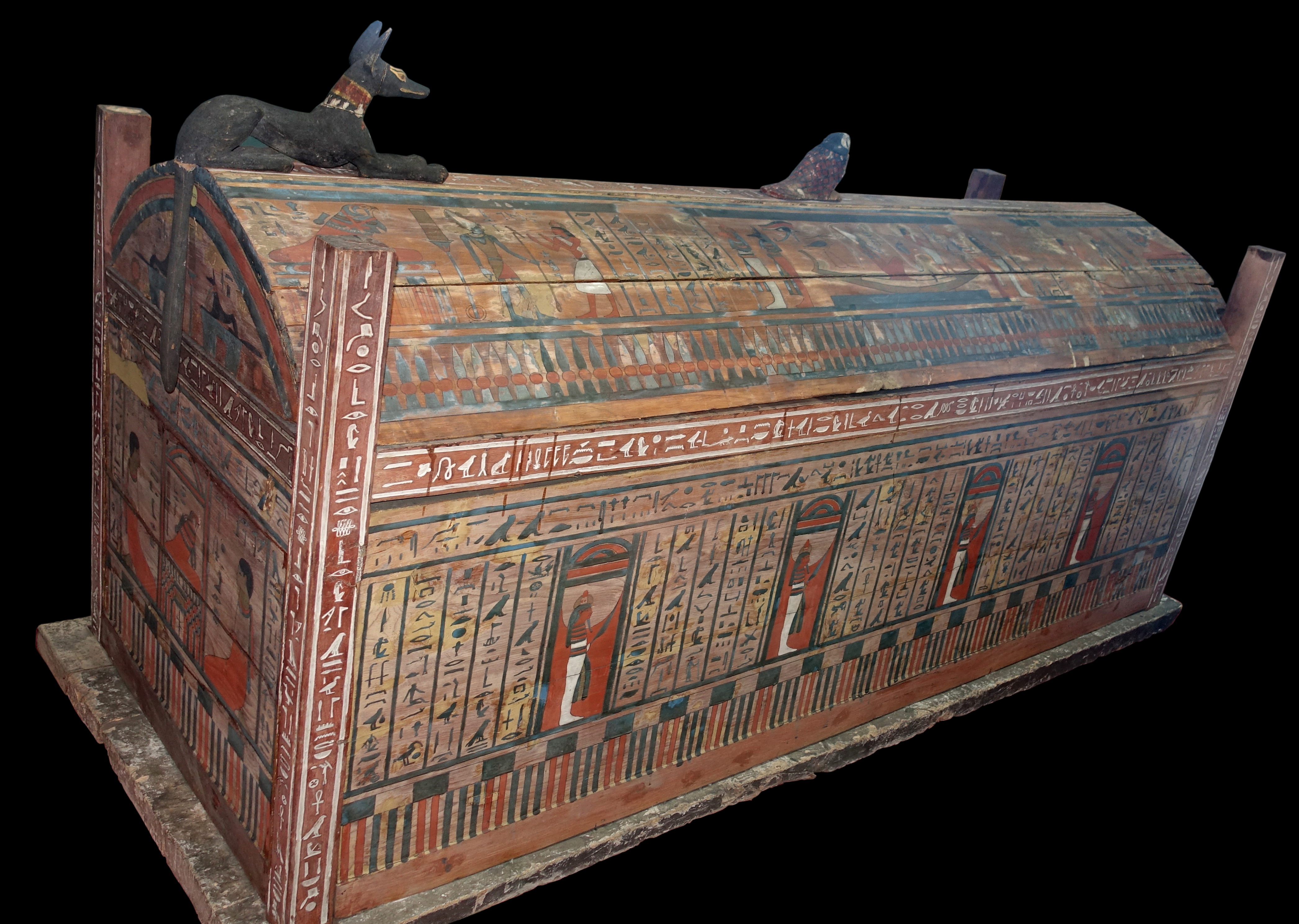
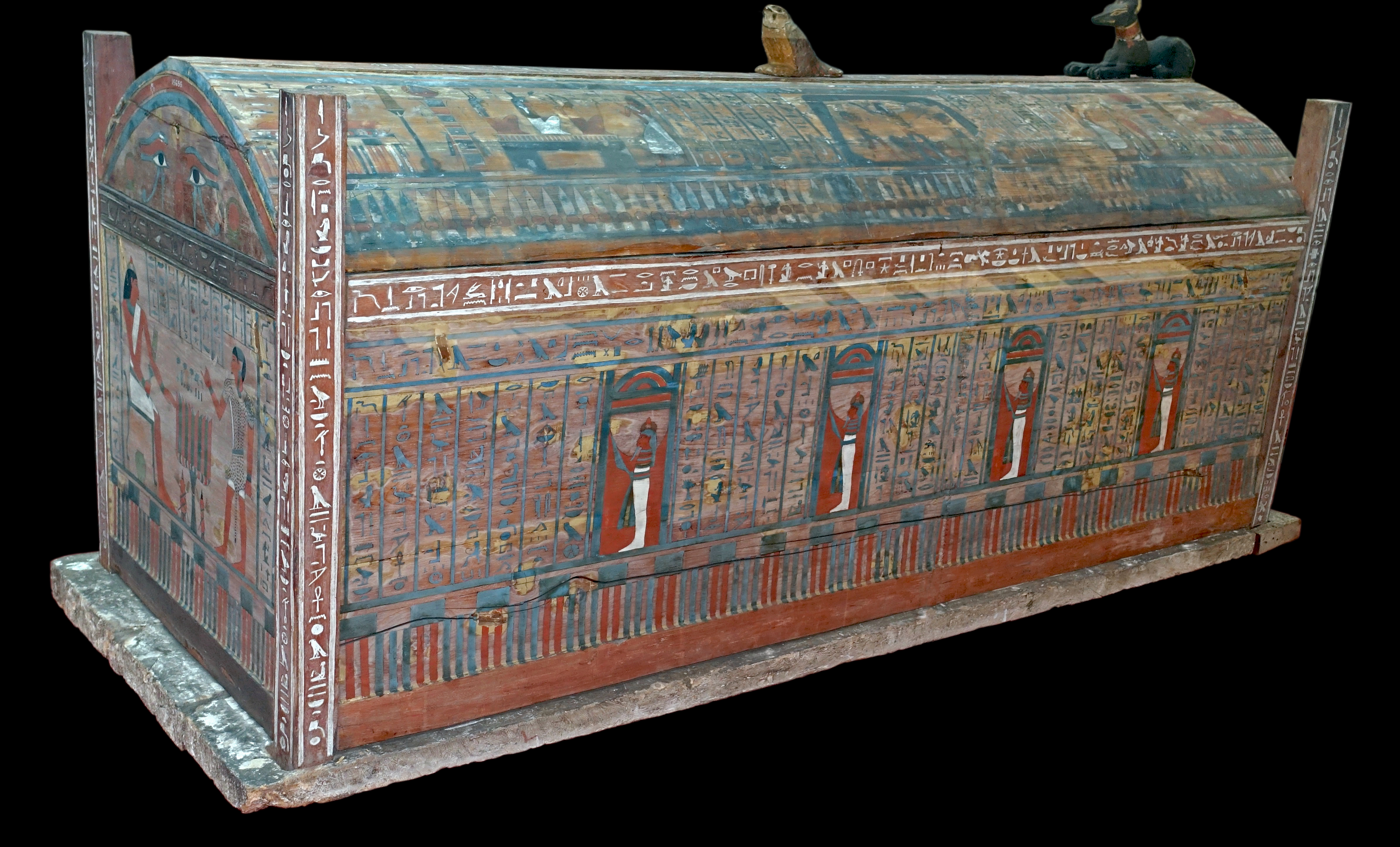
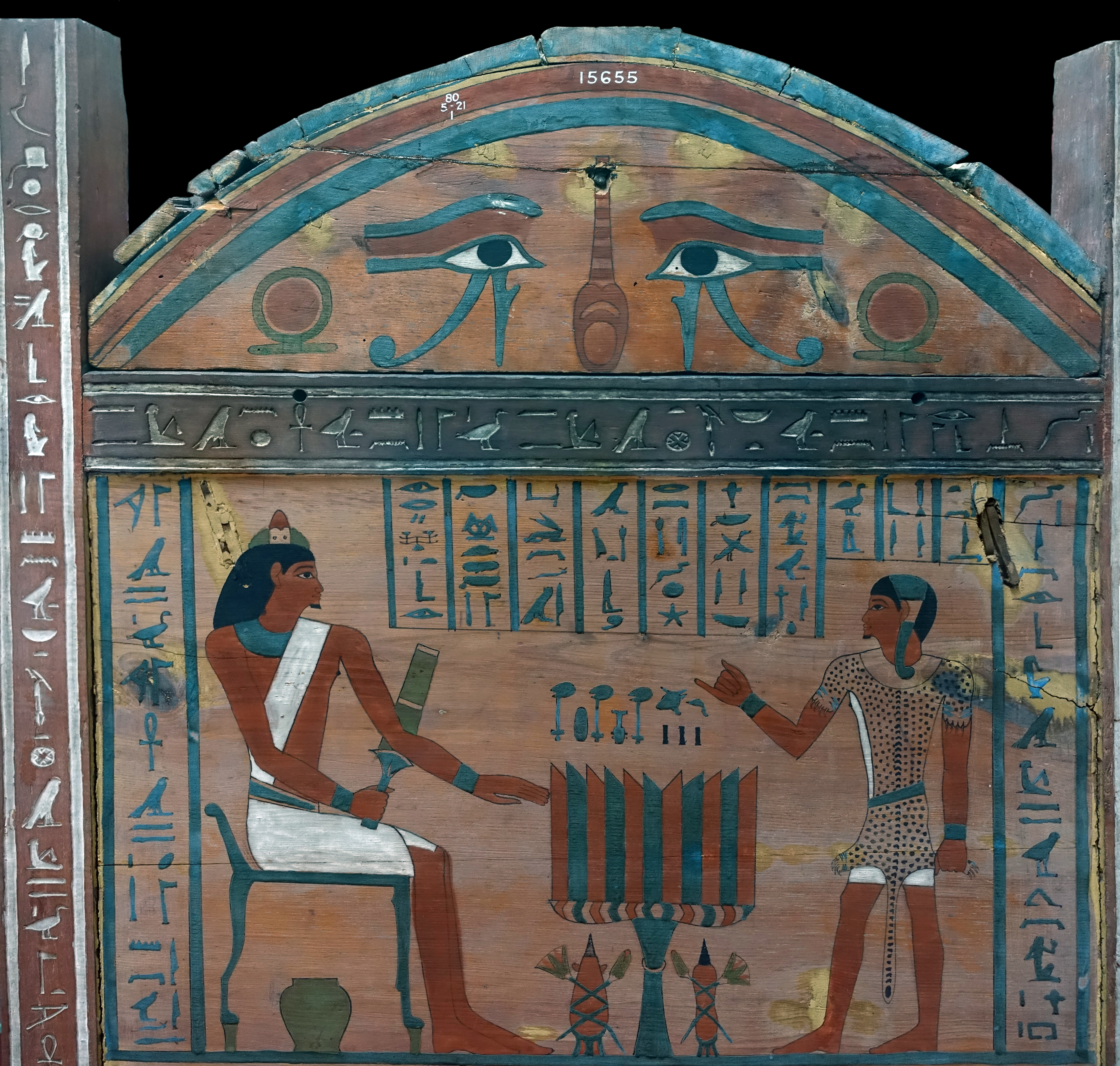
25th Dynasty / Nubian Dynasty / Kushite Empire: 746 BC - 656 BC
Prophet of Montu, Hor
Wooden outer coffin of the Prophet of Montu, Hor.
25th Dynasty, circa 700 BC - 680 BC from Thebes / Luxor.
Painted decoration and Hieroglyphic text, reinforced with metal clamps.
Length 2045 mm, width 762 mm, height 915 mm.
Catalog: EA15655
Photo: Don Hitchcock 2018
Source: Original, British Museum
Text: Card with the display at the British Museum, http://www.britishmuseum.org/, © Trustees of the British Museum, CC BY-NC-SA 4.0
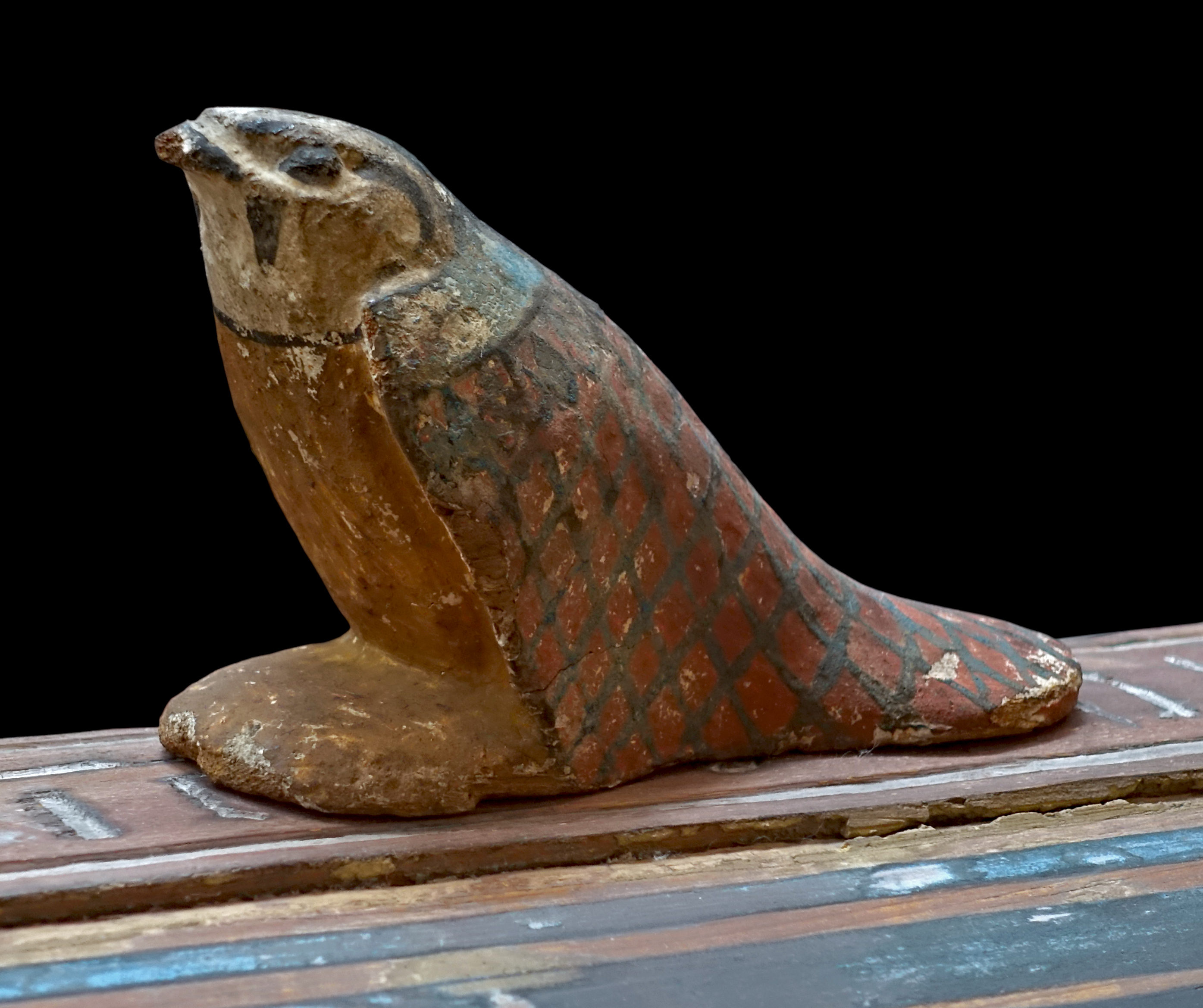
25th Dynasty / Nubian Dynasty / Kushite Empire: 746 BC - 656 BC
Prophet of Montu, Hor
Horus sculpture on the lid of the wooden outer coffin of the Prophet of Montu, Hor.
Horus was one of the most significant ancient Egyptian deities. He was most commonly depicted as a falcon, or a man with a falcon head. Horus served many functions, most notably being the god of the sky, war and hunting.
Catalog: EA15655
Photo: Don Hitchcock 2018
Source: Original, British Museum
Text: Card with the display at the British Museum, http://www.britishmuseum.org/, © Trustees of the British Museum, CC BY-NC-SA 4.0
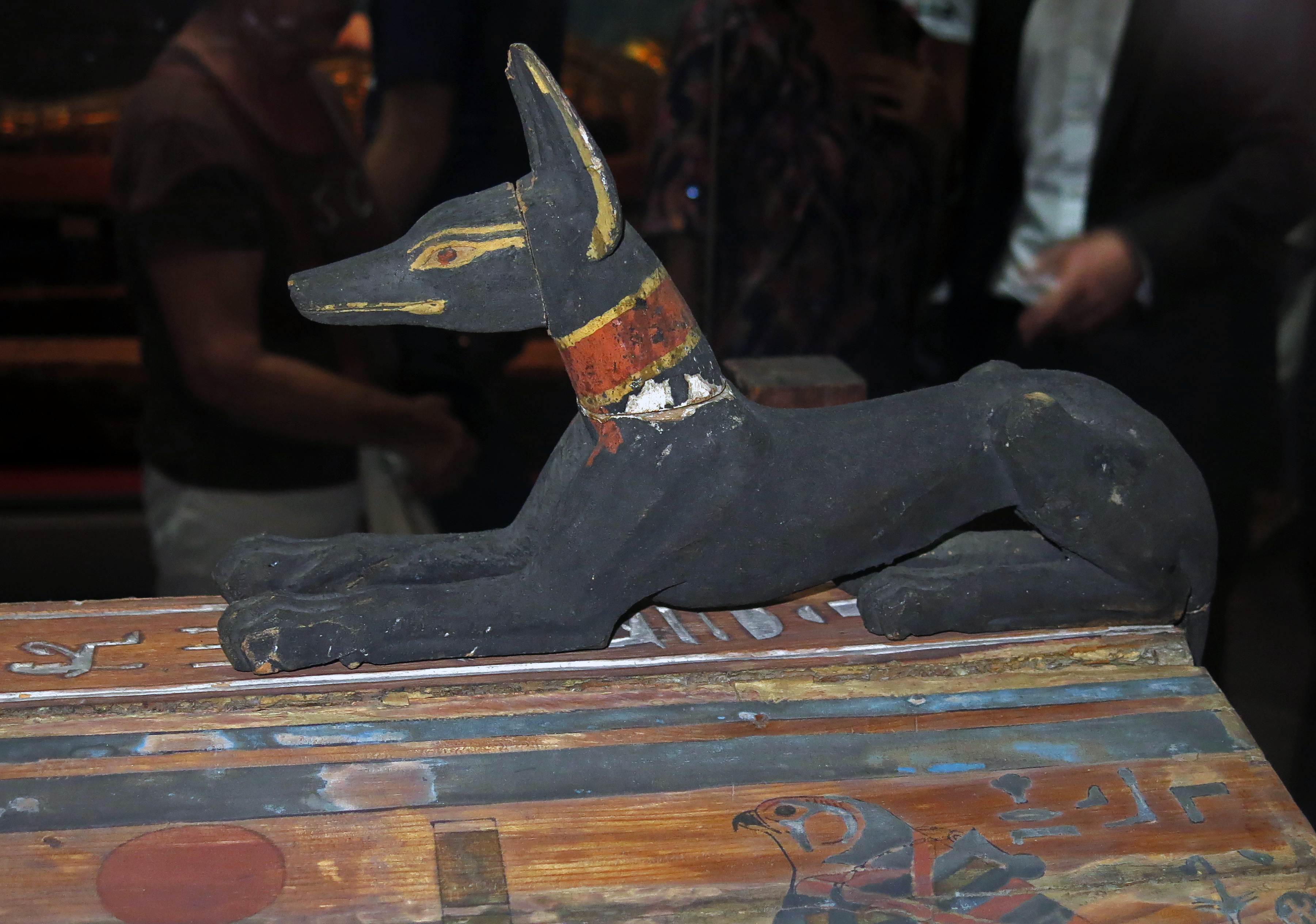
25th Dynasty / Nubian Dynasty / Kushite Empire: 746 BC - 656 BC
Prophet of Montu, Hor
Anubis sculpture on the lid of the wooden outer coffin of the Prophet of Montu, Hor.
Anubis is the Greek name of a god associated with mummification and the afterlife in ancient Egyptian religion, usually depicted as a canine or a man with a canine head. Like many ancient Egyptian deities, Anubis assumed different roles in various contexts. One of his prominent roles was as a god who ushered souls into the afterlife. He attended the weighing scale during the 'Weighing of the Heart,' in which it was determined whether a soul would be allowed to enter the realm of the dead. Anubis was depicted in black, a color that symbolized both rebirth and the discoloration of the corpse after embalming.
Catalog: EA15655
Photo: Don Hitchcock 2015
Source: Original, British Museum
Text: Wikipedia
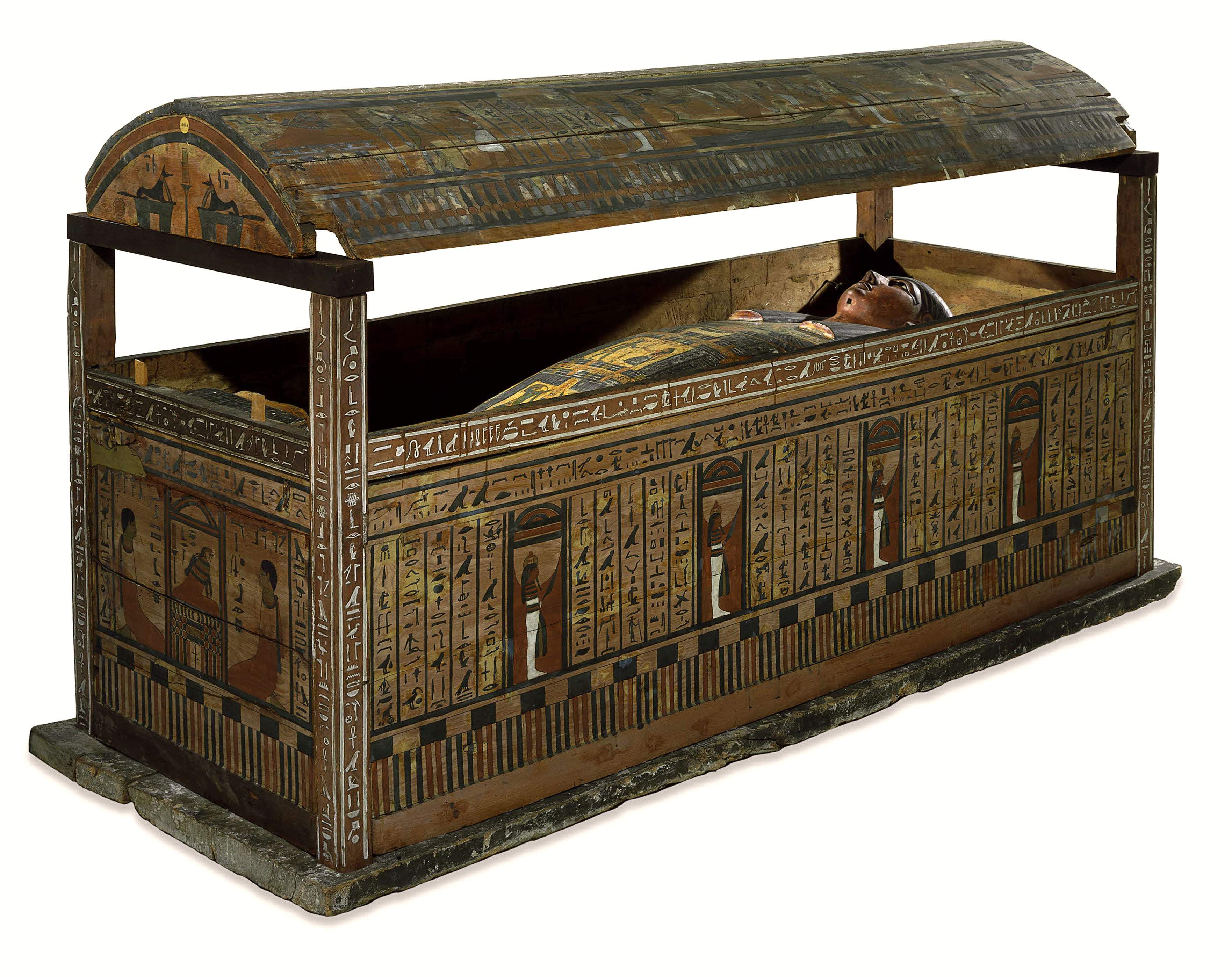
25th Dynasty / Nubian Dynasty / Kushite Empire: 746 BC - 656 BC
Prophet of Montu, Hor
Wooden outer coffin of the Prophet of Montu, Hor, with the lid lifted so that we can see the painted and shaped coffin inside.
Catalog: EA15655
Photo: © Trustees of the British Museum, CC BY-NC-SA 4.0
Source: Original, British Museum
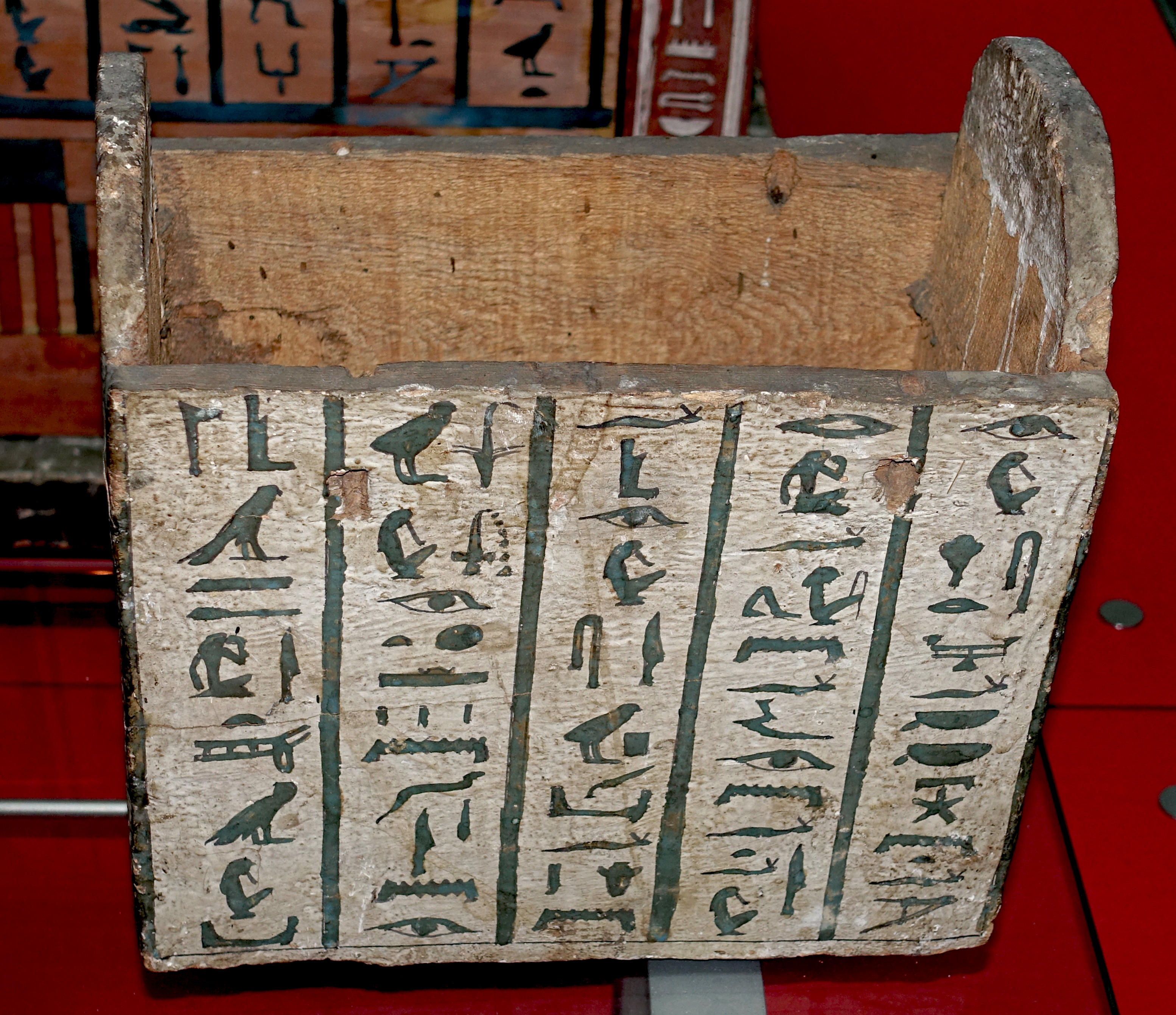
25th Dynasty / Nubian Dynasty / Kushite Empire: 746 BC - 656 BC
Prophet of Montu, Hor
Shabti-box for the Priest of Montu, Hor, Son of Ankhhor and Karoma, grandson of Iwf-aw, made of wood, covered with plaster, painted white and green-blue, rectangular in form, floorless, extended, curved top, shorter sides.
Shabtis or Ushabtis were funerary figurines used in Ancient Egypt. Shabtis were placed in tombs among the grave goods and were intended to act as servants or minions for the deceased, should he/she be called upon to do manual labor in the afterlife.
The figurines frequently carried a hoe on their shoulder and a basket on their backs, implying they were intended to farm for the deceased. They usually carried hieroglyphs, typically found on the legs. Called 'answerers', they carried inscriptions asserting their readiness to answer the gods' summons to work.
The practice of using ushabtis originated in the Old Kingdom (circa 2 600 BC - 2 100 BC) with the use of life-sized reserve heads made from limestone, which were buried with the mummy. Most ushabtis were of minor size, and many produced in multiples – they sometimes covered the floor around a sarcophagus. Exceptional ushabtis are of larger size, or produced as a one of-a-kind master work.
Produced in huge numbers, ushabtis, along with scarabs, are the most numerous of all ancient Egyptian antiquities to survive.
Catalog: EA8525
Photo: Don Hitchcock 2018
Text: http://www.britishmuseum.org/, © Trustees of the British Museum, CC BY-NC-SA 4.0
Additional text: Wikipedia
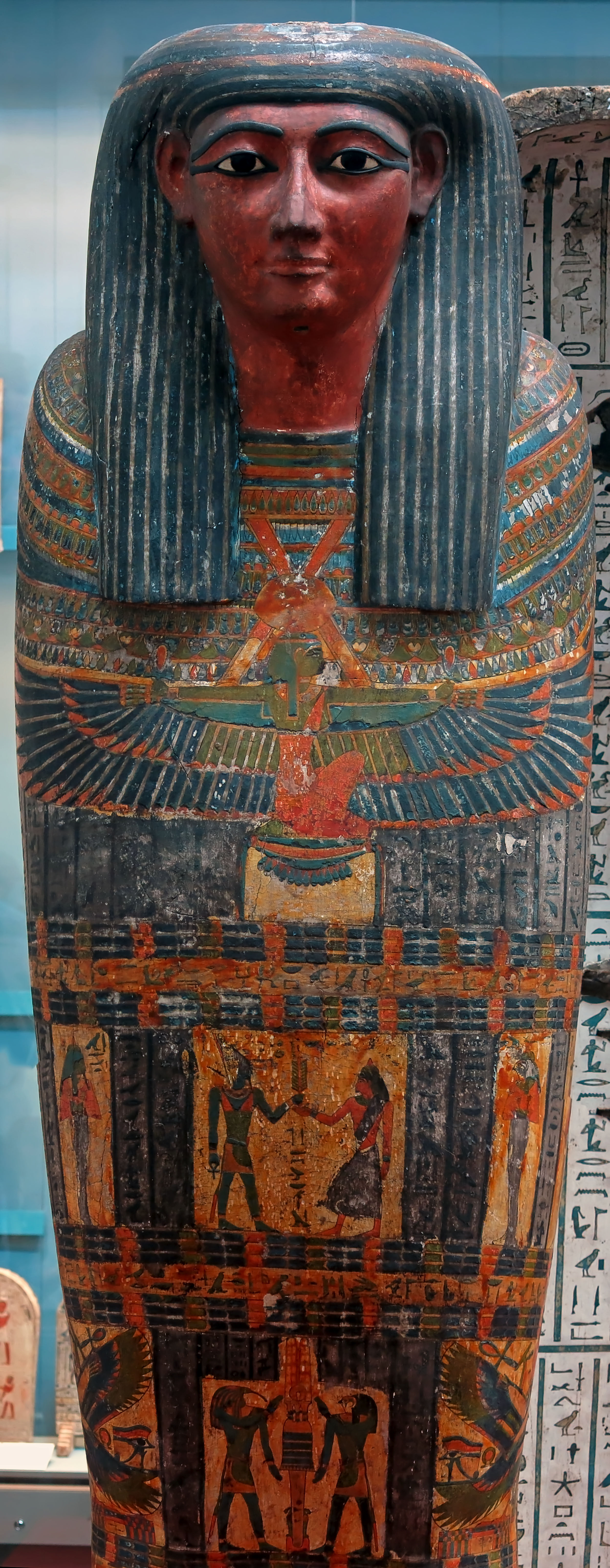
25th Dynasty / Nubian Dynasty / Kushite Empire: 746 BC - 656 BC
Prophet of Montu, Hor
This is the first coffin inside the outer coffin, shown above with the lid of the outer coffin raised.
Dimensions of the base: height 179 cm, width 47 cm, thickness 13 cm
Dimensions of the lid: height 178 cm, width 47 cm, thickness lid-face 24 cm, thickness lid-feet 26 cm.
Catalog: EA27735
Photo: Don Hitchcock 2015
Source: Original, British Museum
Text: http://www.britishmuseum.org/ © Trustees of the British Museum, CC BY-NC-SA 4.0
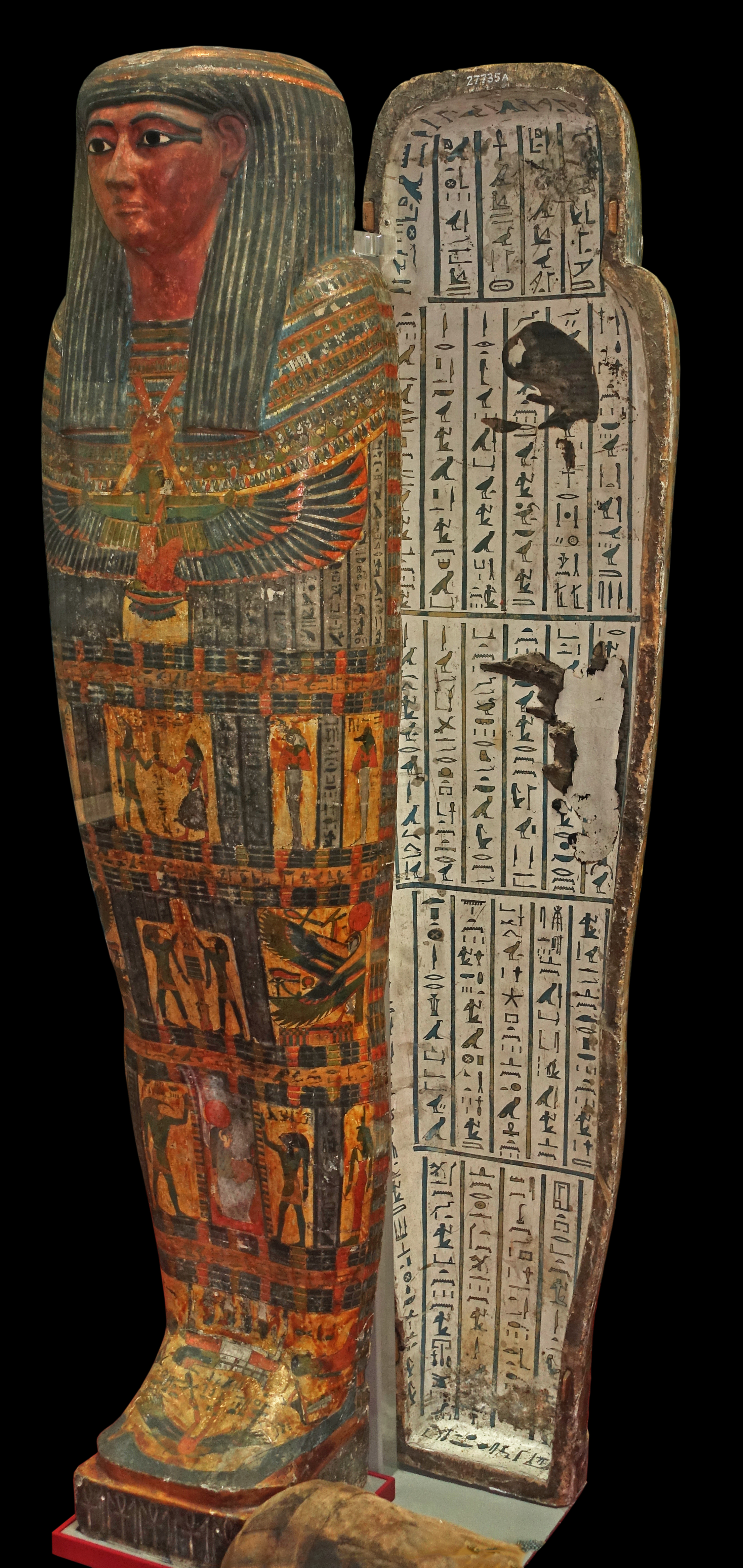
25th Dynasty / Nubian Dynasty / Kushite Empire: 746 BC - 656 BC
Prophet of Montu, Hor
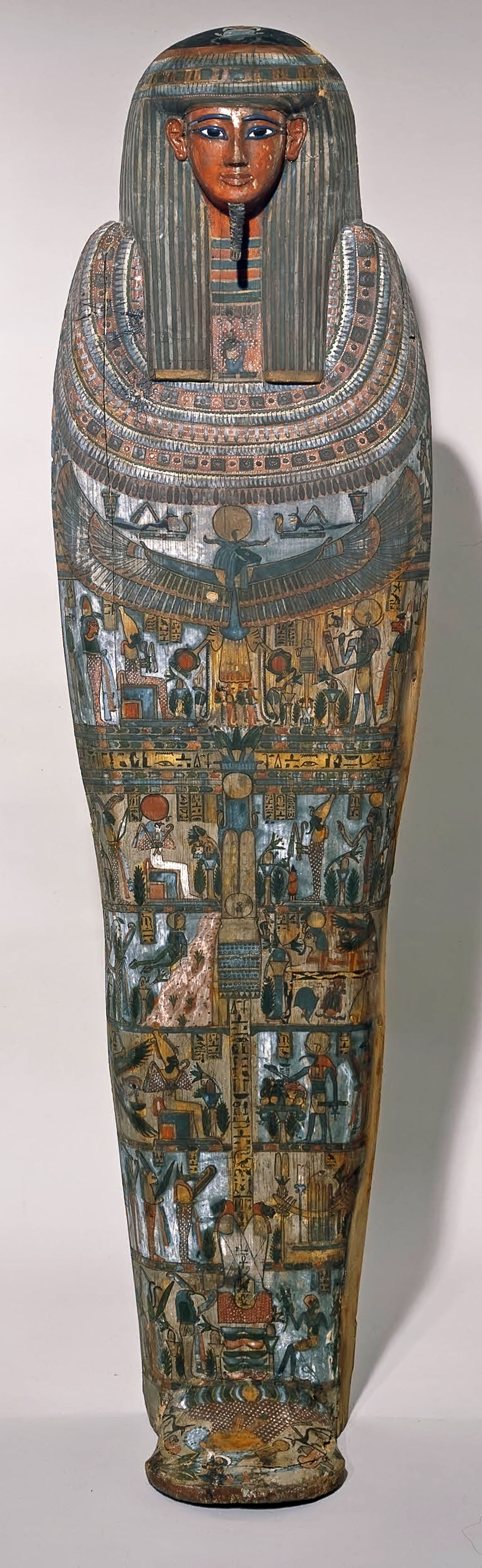
This is the complete lid and back of the coffin.
Circa 700 BC - 680 BC
Height: Base 179 cm, Lid 178 cm.
Thickness: Base 13 cm, Lid-face 24 cm, Lid-feet 26 cm.
Width: Base 47 cm, Lid 47 cm.
Hor, priest of Montu, belonged to a powerful Theban family, and his burial assemblage is typical of those prepared for people of high status during the Twenty-fifth Dynasty. Political decentralisation and economic stress had curtailed the construction of new tombs. Burials were deposited in older sepulchres or in temple precincts, and the dead were now provided with only those items considered most essential to ensuring new life - most importantly, a set of coffins richly decorated with religious texts and symbolic images.
The eternal universe in which Hor hoped to dwell was magically created for him by the shape and decoration of his coffins. Two, of a possible three, have survived: a rectangular outer case (registration no. 1880,0521.1) and an inner one of anthropoid form, this object.
Hor's outer coffin (registration no. 1880,0521.1) resembles a shrine for the physical body (statue) of a god. The use of this shape for a coffin alludes to the divine status which the occupant hoped to achieve after death. But the coffin is also a model of the universe, the vaulted lid representing the sky, across which the sun god travelled, and the base the earthly realm ruled over by Osiris. To emphasise this link, the lid is painted with scenes depicting the creation of the universe (the separation of the earth god Geb and the sky goddess Nut) and the daily cycle of the sun (Hor is shown piloting Atum, the evening sun, in a barque).
The coffin's long sides are arrayed with deities, intended to give eternal protection to the mummy. The spaces between them contain extracts from the Book of the Dead. At one end Hor is shown sitting before a table of offerings, a scene heavily influenced by Old and Middle Kingdom art.
This is the inner coffin, which has been skilfully carved to represent Hor as a divine being. His body is shrouded, leaving only his head exposed, and he stands on a plinth, his back supported by a pillar. The coffin's surfaces are covered with hieroglyphic texts and images, including spells from the Book of Dead to ensure food offerings for Hor's spirit and to assist him in passing through the ordeal of judgement.
Hor's burial place seems to have been discovered in the early 1820s, when his funerary objects were acquired by European collectors. The findspot was not recorded, but at around the same time funerary furniture belonging to several relatives of Hor also came to light, suggesting that a communal burial may have been discovered. This was perhaps located at or near Hatshepsut's temple at Deir el-Bahari, where other burials of the priests of Montu were found in the 1850s and 1860s.
The British Museum also has a shabti box of Hor (registration no. 1837,0413.70) and another box is in Aberdeen. No actual shabtis of his survive.
Catalog: Painted decoration and Hieroglyphic text on wood, inlaid glass(?) eyes, Thebes, EA27735
Photo: Don Hitchcock 2018
Text: http://www.britishmuseum.org/, © Trustees of the British Museum, CC BY-NC-SA 4.0
Source: Original, British Museum


25th Dynasty / Nubian Dynasty / Kushite Empire: 746 BC - 656 BC
Prophet of Montu, Hor
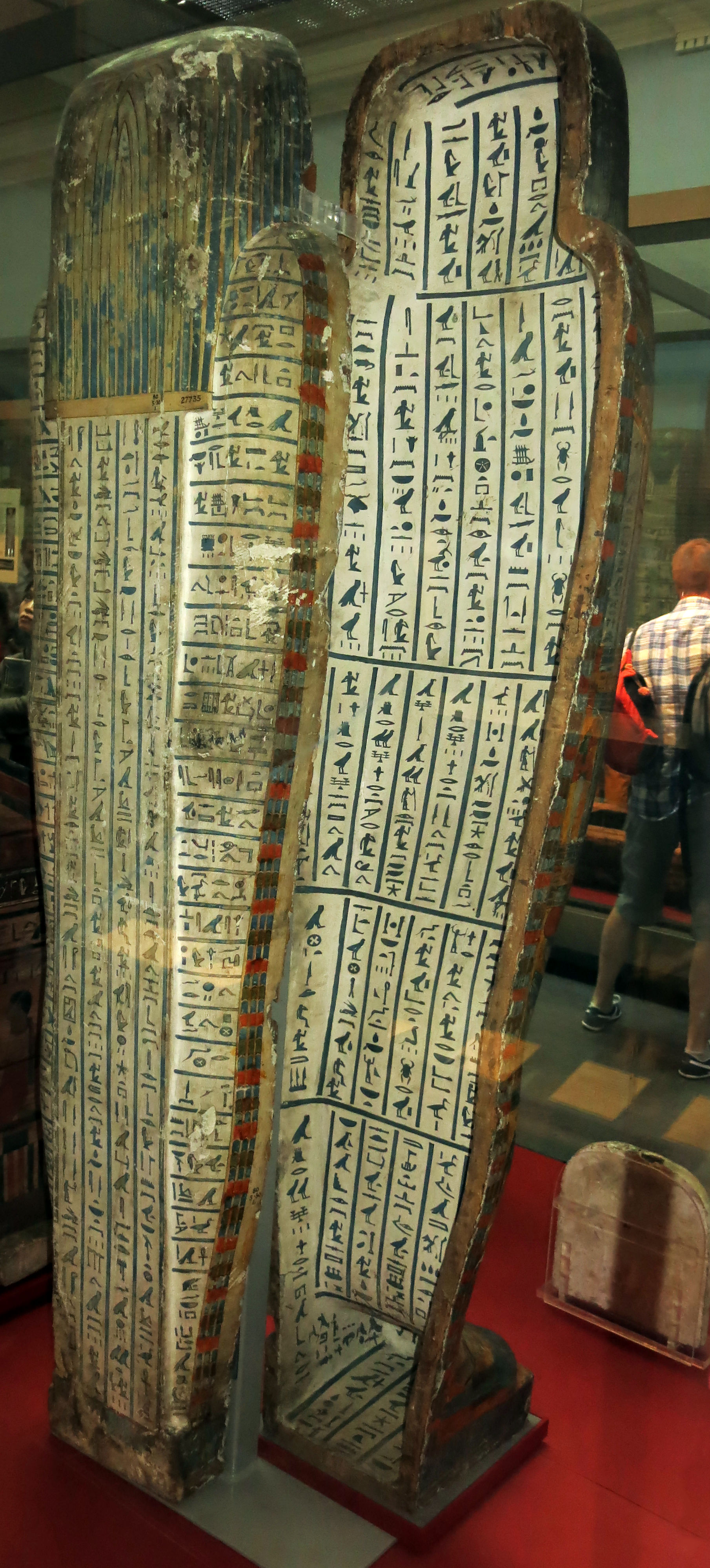
These photos show the coffin from the reverse side of the complete lid and back above.
( As always, click on the smaller images above to see the full size images. The full size lower image, for example, is more than 9 000 x 5 000 pixels - Don )
Catalog: EA27735
Photo: Don Hitchcock 2018
Source: Original, British Museum
Text: http://www.britishmuseum.org/ © Trustees of the British Museum, CC BY-NC-SA 4.0
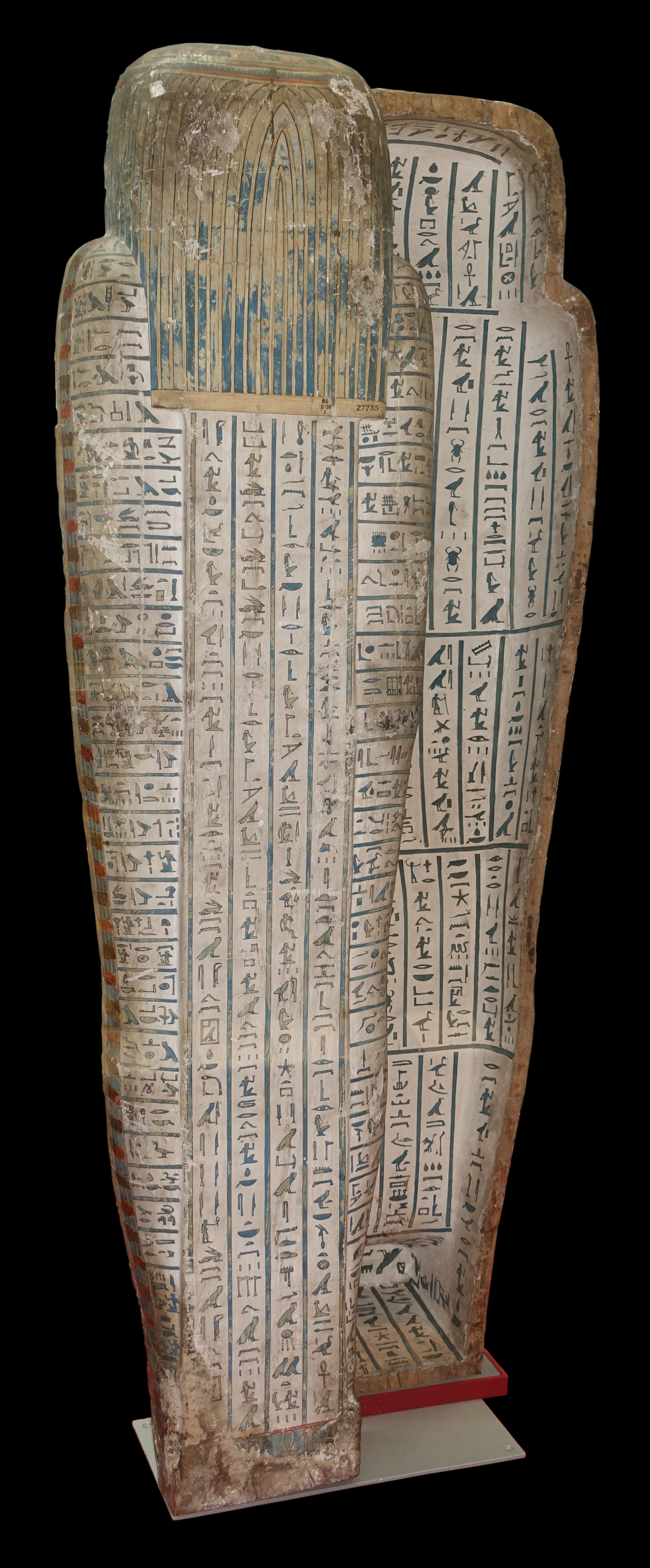
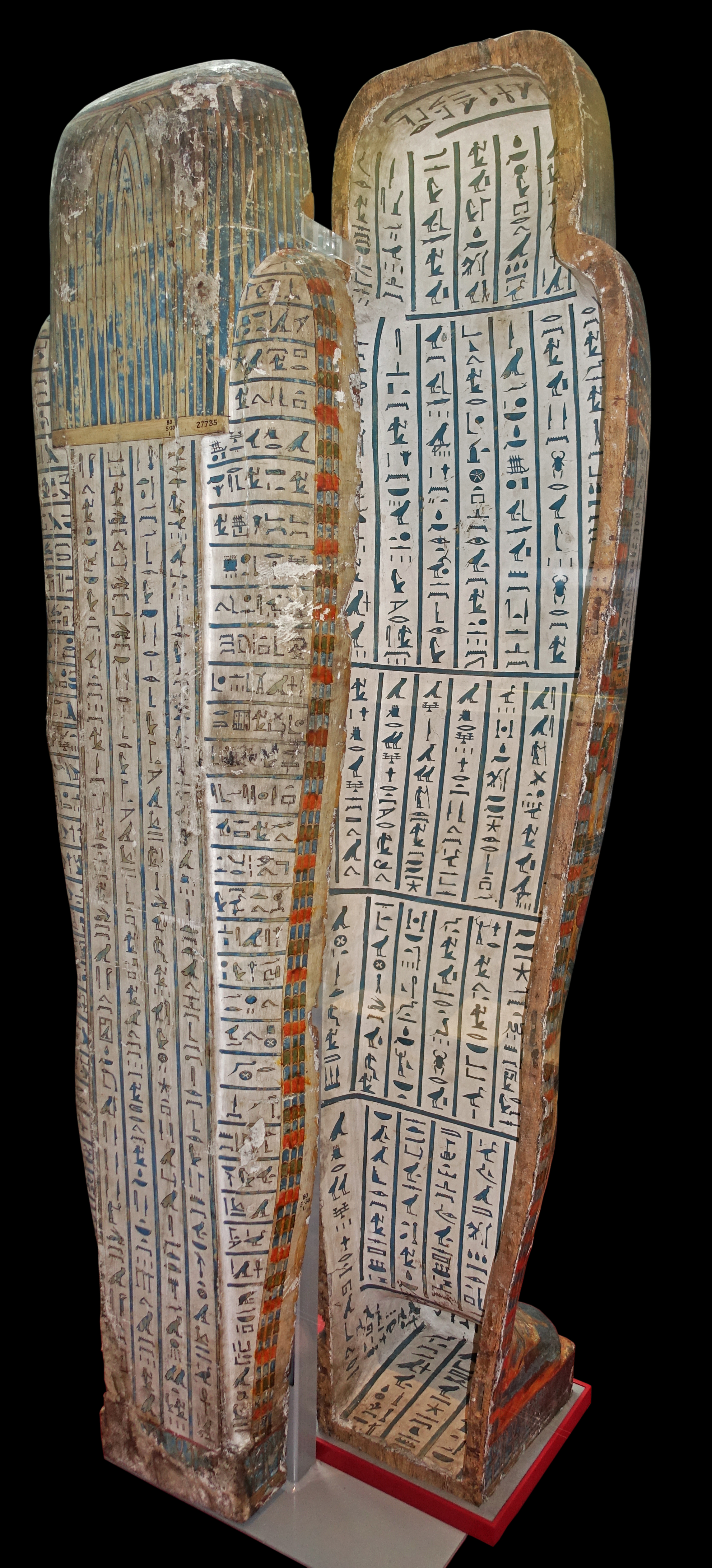
25th Dynasty / Nubian Dynasty / Kushite Empire: 746 BC - 656 BC
Prophet of Montu, Hor
These photos show the coffin from the reverse side of the complete lid and back above.
Catalog: EA27735
Photo: Don Hitchcock 2018
Source: Original, British Museum
Text: http://www.britishmuseum.org/ © Trustees of the British Museum, CC BY-NC-SA 4.0
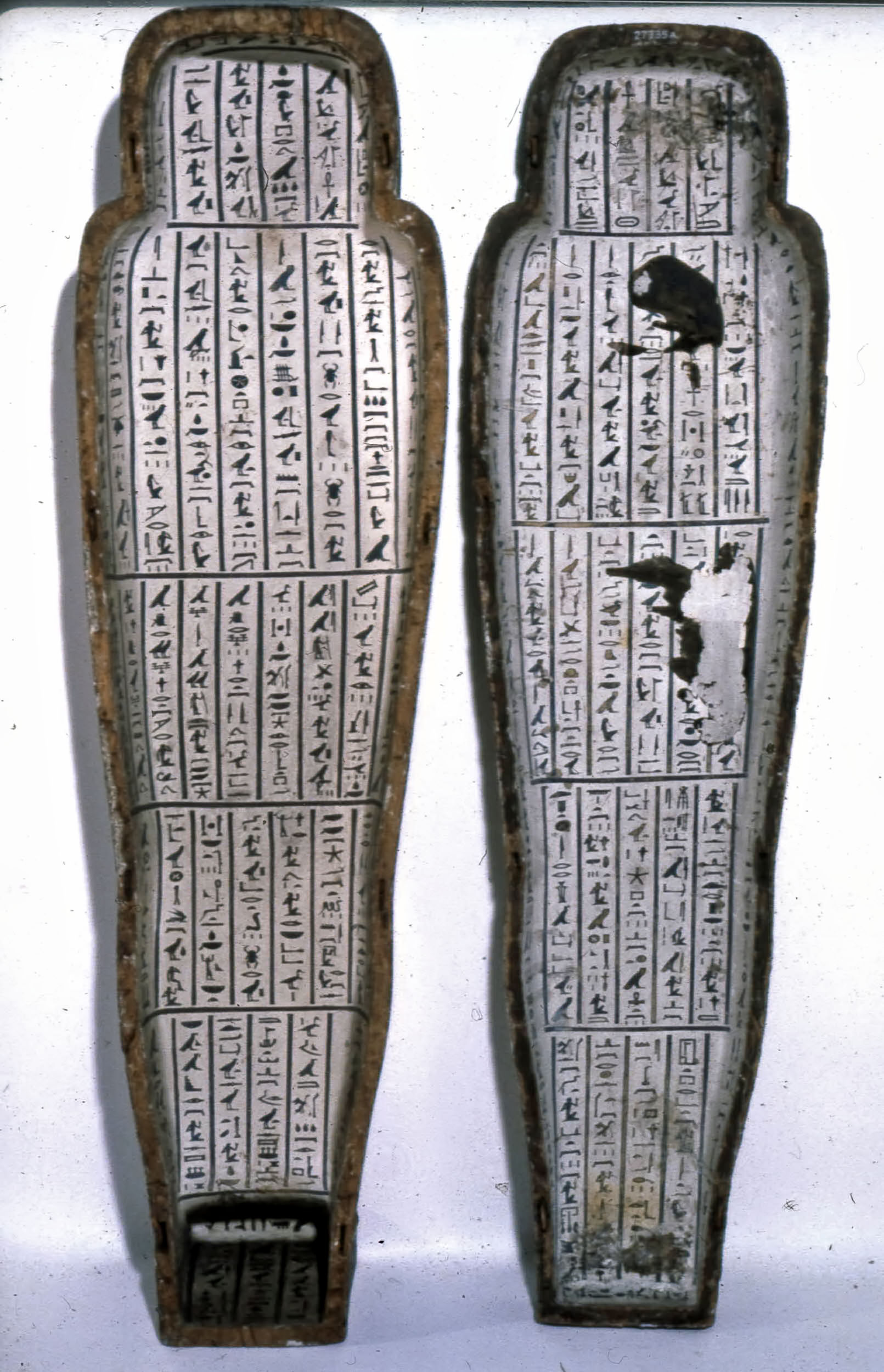
25th Dynasty / Nubian Dynasty / Kushite Empire: 746 BC - 656 BC
Prophet of Montu, Hor
Prophet of Montu, Hor, coffin, about 700 BC.
These photos show the black on white hieroglyphics used on the back of the lid and on the inside and outside of the base of the coffin above.
Catalog: EA27735
Photo (left): Don Hitchcock 2015
Photo (right): © Trustees of the British Museum, CC BY-NC-SA 4.0
Source: Original, British Museum
25th Dynasty / Nubian Dynasty / Kushite Empire: 746 BC - 656 BC
Prophet of Montu, Hor
Cartonnage mummy-case of Hor, the innermost coffin which holds the mummy.
The mummy is of a man of middle age. The mummy is wrapped in linen, and has a cartonnage mummy-case and painted wooden coffin. Both are inscribed with the name Hor.
Skull - Most of the upper teeth are missing and the incisors are very worn. Artificial eyes in the orbits; the right is displaced. The cervical spine appears intact.
Thorax and Abdomen - Filled with dense packing material. A scarab lies above the level of the upper lumbar vertebrae. The dorsal and lumbar inter-vertebral discs are partially opaque. No fractures or ribs or spinal column. Pelvis and hips normal. Circumcision has apparently been performed.
Arms - Extended. Hands with extended fingers in the pubic area. Legs - No fractures or dislocations. The knee cartilages are opaque. No lines of arrested growth.
A dense mummiform figure, just under 8 inches long, between the femoral shafts, is visible on the plate.
Catalog: EA6659
Photo: © Trustees of the British Museum, CC BY-NC-SA 4.0
Source: Original, British Museum
Text: http://www.britishmuseum.org/, © Trustees of the British Museum, CC BY-NC-SA 4.0
25th Dynasty / Nubian Dynasty / Kushite Empire: 746 BC - 656 BC
Prophet of Montu, Hor
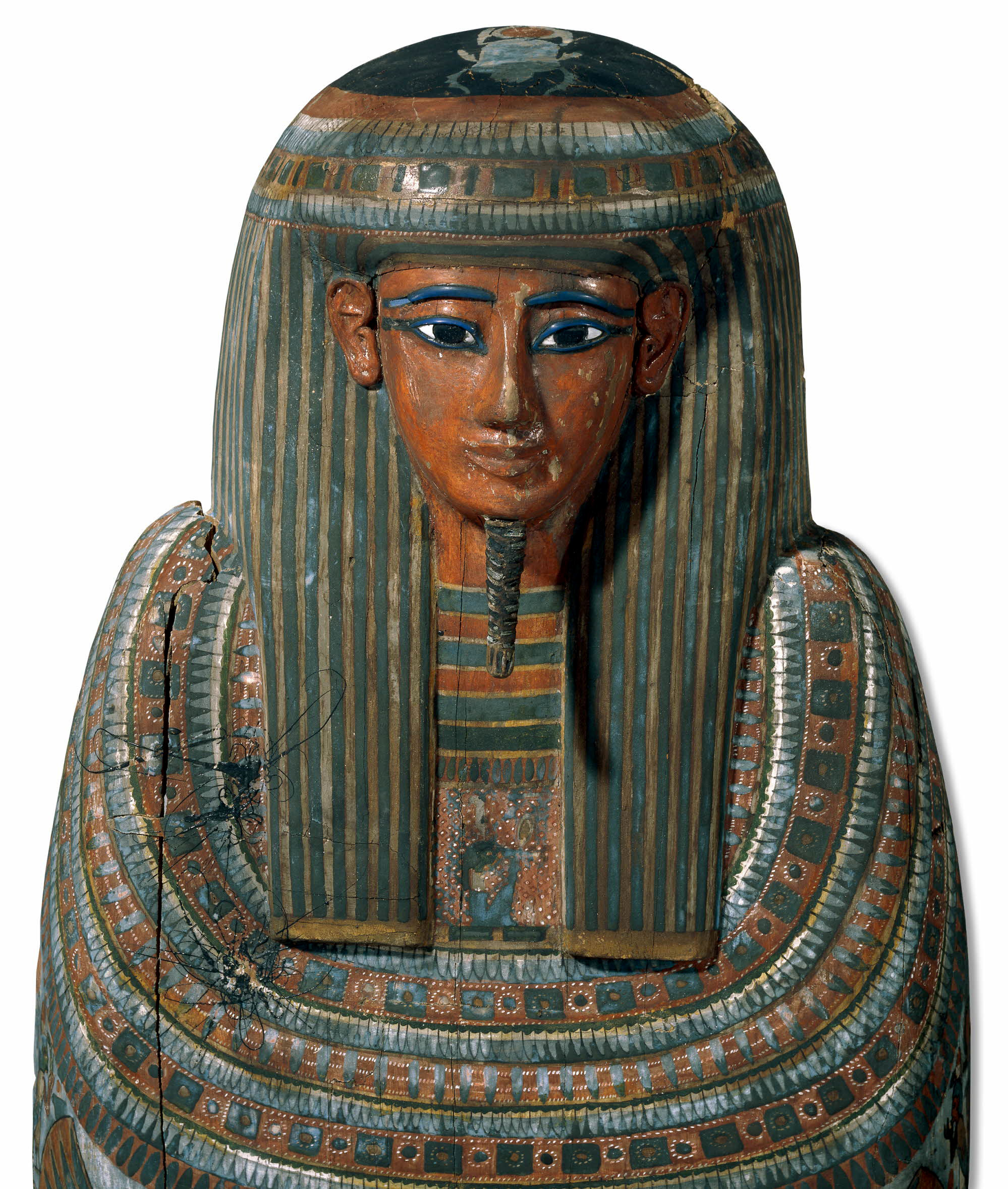
Close up of the Cartonnage mummy-case of Hor.
Catalog: EA6659
Photo: © Trustees of the British Museum, CC BY-NC-SA 4.0
Source: Original, British Museum
Text: http://www.britishmuseum.org/, © Trustees of the British Museum, CC BY-NC-SA 4.0

25th Dynasty / Nubian Dynasty / Kushite Empire: 746 BC - 656 BC
Prophet of Montu, Hor
Cartonnage mummy-case of Hor, as above, and the mummy within it. The Hor coffin and mummy probably dates to the Twenty-second Dynasty (about 945-715 BC). The coffin is inscribed with the name of Hor.
X-rays taken of Hor's body in the 1960s suggest that he was middle-aged, but no obvious fractures or medical conditions have so far been observed. The X-ray did reveal that he had been circumcised. As was common practice in mummification, artificial eyes were placed in the eye sockets, and the arms were extended with the hands placed in the pubic area.
Catalog: EA6659
Photo: Don Hitchcock 2015
Source: Original, British Museum
Text: http://culturalinstitute.britishmuseum.org/asset-viewer/mummy-and-coffin-of-hor/ygH0metou2bcKQ?hl=en © Trustees of the British Museum, CC BY-NC-SA 4.0
25th Dynasty / Nubian Dynasty / Kushite Empire: 746 BC - 656 BC
Prophet of Montu, Hor
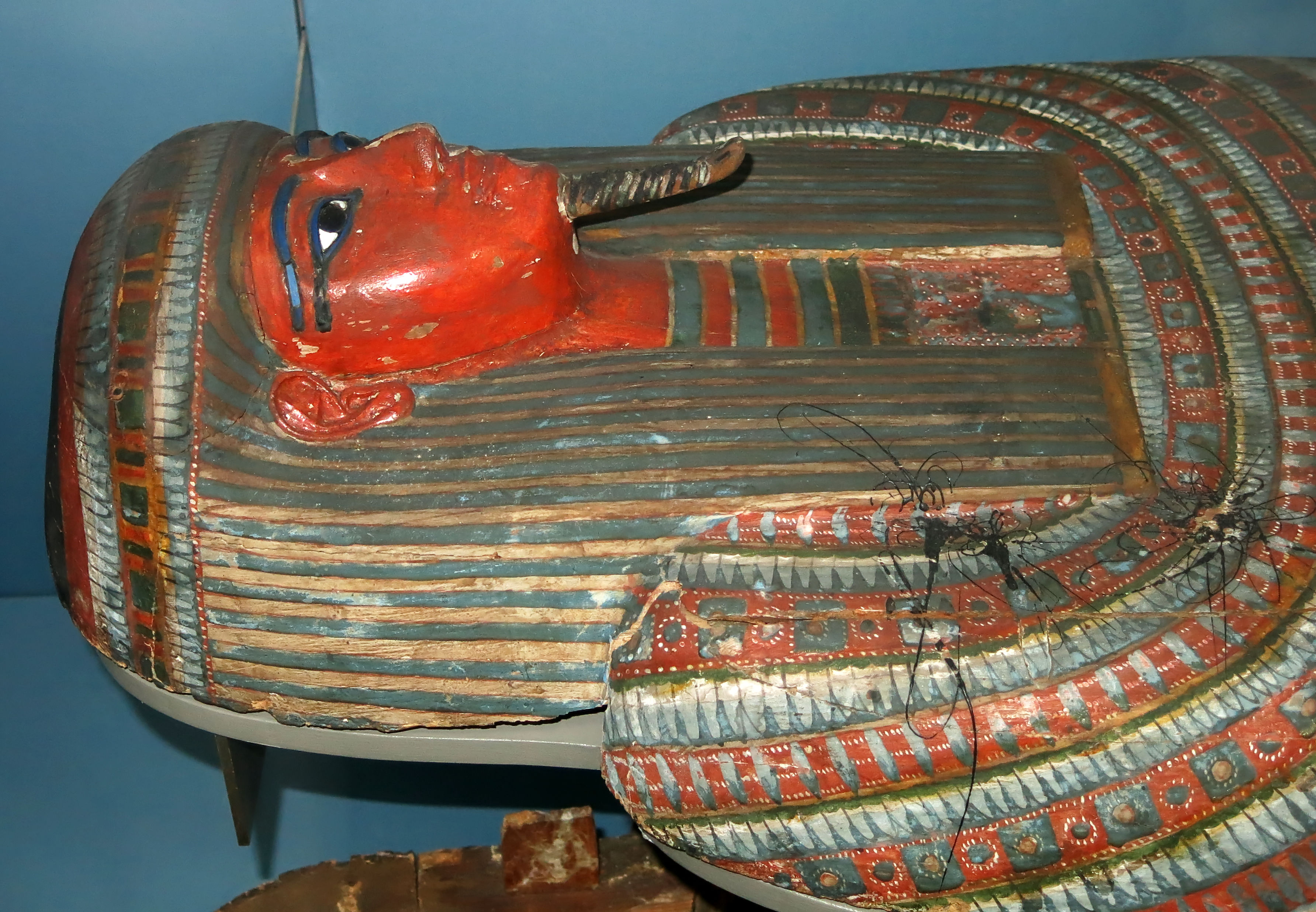
Close up of the head and shoulders of the Hor mummy-case.
After the X-ray, a small mummiform figurine was noticed among the bandages. It was removed in the 1960s, and examined in the Museum's research laboratory in the 1990s; the figure is made of clay with straw, and inside it is a very small cylindrical object, the identity of which remains mysterious.
Photo: Don Hitchcock 2015
Source: Original, British Museum
Text: http://culturalinstitute.britishmuseum.org/asset-viewer/mummy-and-coffin-of-hor/ygH0metou2bcKQ?hl=en © Trustees of the British Museum, CC BY-NC-SA 4.0

25th Dynasty / Nubian Dynasty / Kushite Empire: 746 BC - 656 BC
Prophet of Montu, Hor
Possible appearance of the tomb of Hor.
Reconstruction by C. Thorne.
Painting: © C. Thorne, © Trustees of the British Museum, CC BY-NC-SA 4.0
Rephotography: Don Hitchcock 2015
Source: Poster, British Museum
Text: Poster, British Museum, © Trustees of the British Museum, CC BY-NC-SA 4.0
25th Dynasty / Nubian Dynasty / Kushite Empire: 746 BC - 656 BC
Takhebkhenem
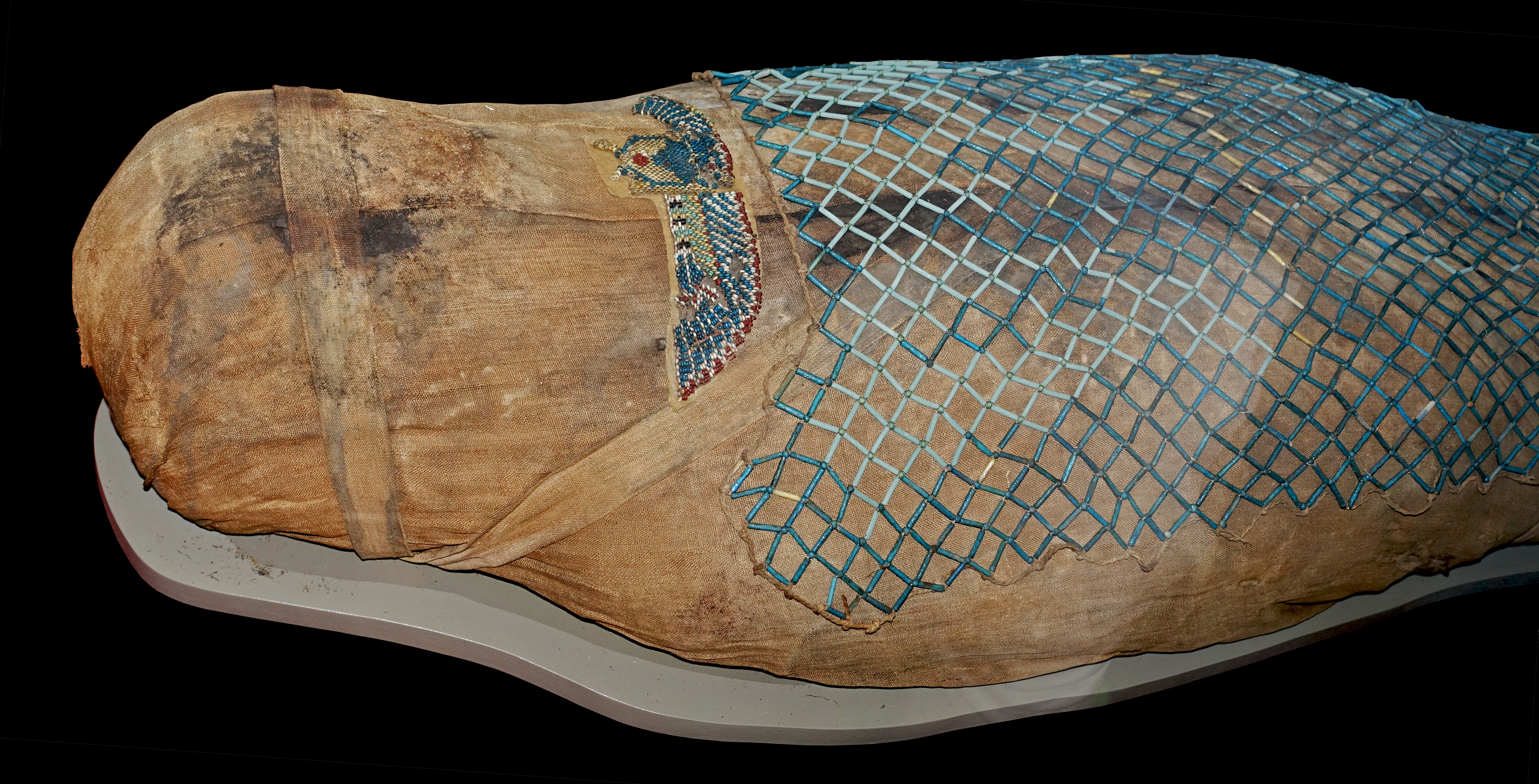
Mummy of Takhebkhenem, a door keeper's daughter.
25th Dynasty, about 700 - 680 BC, from Thebes / Luxor.
The mummy of this woman illustrates the method of wrapping employed in the 25th Dynasty. The outer shroud was originally dyed a salmon-pink colour. It is held in place by transverse bands and vertical strips (originally light brown and dark purple respectively). Over this is laid a network of tubular faience beads and a winged scarab beetle of mosaic beadwork.
CAT scans show that Takhebkhenem lies with her arms extended. The skeleton is in good condition, and all the teeth are present, but very little soft tissue remains on the bones. Large quantities of packing material, perhaps dried mud or earth, are visible inside the body cavity. Length: 154 cm.
Catalog: EA6692
Photo: Don Hitchcock 2018
Source: Original, British Museum
Text: Card with the display at the British Museum, © Trustees of the British Museum, CC BY-NC-SA 4.0
26th Dynasty: 664 BC - 525 BC
Takhebkhenem
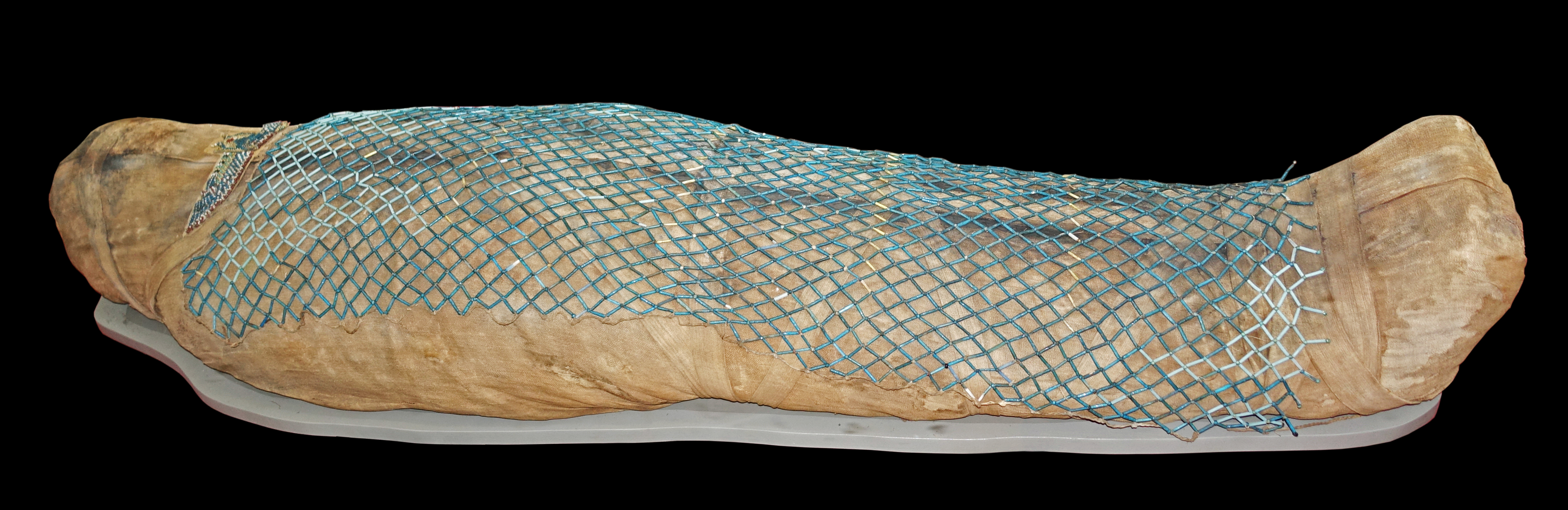
Mummy of the young adult woman Takhebkhenem, with linen wrappings covered by bead-net of blue glazed composition.
Description:
Skull - Mouth closed. All teeth present. Cervical spine intact. No fractures.
Thorax and Abdomen - Ribs, vertebral column, pelvis, and hips normal. No fractures or dislocations.
A large cylindrical mass of solidified resin, which appears to have been divided into four parts, occupies the right side of the body cavity, and a smaller, single, reniform mass is in the left side of the abdomen. The resin, which was fluid when introduced, formed four pools which afterwards solidified. The pelvis has been filled with a round mass of packing. Above the large pack is a ball of linen, and probably sawdust as often in mummies of this period.
Arms - Extended. Hands with extended fingers and their palmar surfaces on the anterior aspect of the thighs.
Legs - Bones and joints appear normal. There is a considerable quantity of linen packing between the thighs, possibly containing the viscera, as often in mummies of the Twenty-sixth Dynasty.
Height 258 mm (mummy)
Length 1410 mm (bead net, including string when laid flat), length 1570 mm (mummy), width 500 mm (bead net), depth 390 mm (mummy)
Culture/period: 26th Dynasty ( note the discrepancy in dates between the card at the museum and the online web resource. Other sources simply date it 'Late Period', which is in concord with the 26th Dynasty date estimate. I would be grateful if any reader could clear this up for me - Don )
Catalog: linen, human tissue, fibre, glazed beads, Thebes, EA6692
Photo: Don Hitchcock 2018
Source: Original, British Museum
Text: http://www.britishmuseum.org/, card at the display in the British Museum, © Trustees of the British Museum, CC BY-NC-SA 4.0
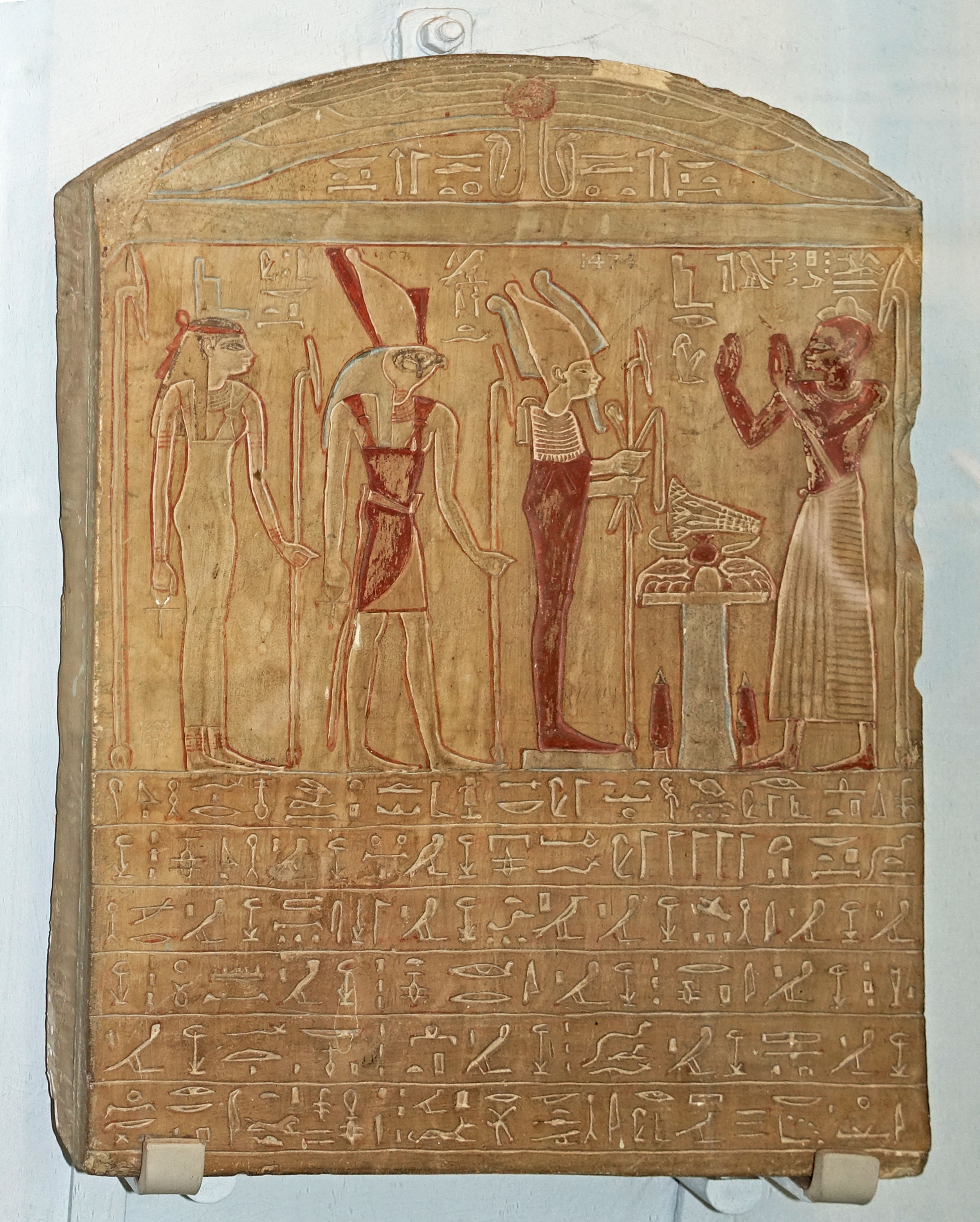
26th Dynasty: 664 BC - 525 BC
Stela of Pu-Inpu
Round-topped limestone stela of Pu-Inpu, Priest of Horus. At the top, winged solar disc with pendant uraei and hieroglyphs. The deceased is shown standing before an offering table and worshipping Osiris, Hornedjitef and Isis.
( Note that the identification as Hornedjitef appears to be a typo. The middle of the three looks like Horus. Horus was usually depicted as a falcon-headed man wearing the pschent, also known as a red and white crown, as a symbol of kingship over the entire kingdom of Egypt, as shown on the stela. Note also that Pu-Inpu was a Priest of Horus - Don )
There are six horizontal registers of hieroglyphs containing invocations requesting offerings for the Priests of Horus. Traces of polychrome colouring survive.
Production date circa 600 BC
Height 407 mm (max), width 280 mm (max)
Titles/epithets include : Priest of Horus
Named in inscription & portrayed: Puinpu
Named in inscription: Horus
Findspot: Abydos
Catalog: Limestone, polychrome painting, EA1474
Photo: Don Hitchcock 2018
Source: Original, British Museum
Text: http://www.britishmuseum.org/, card at the display in the British Museum, © Trustees of the British Museum, CC BY-NC-SA 4.0
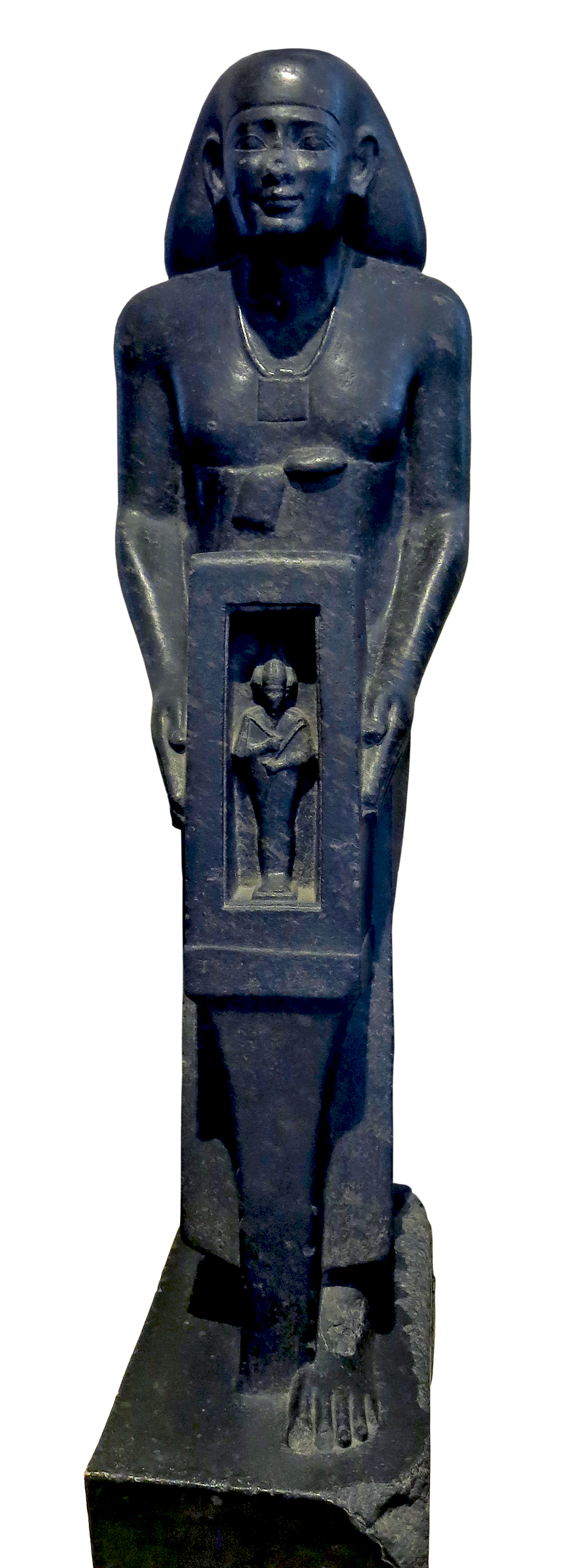
Peftchaouaneith
26th Dynasty: 664 BC - 525 BC
Naophorous statue, reign of Ahmose II, 570 BC - 526 BC
Peftchaouaneith is standing, left foot forward, wearing a high kilt, bag wig, pectoral, presenting a naos. Osiris is standing.
Names and titles: Peftchaouaneith, noble, prince, Sole Companion, overseer of the ceremonial palace, chief physician, director of the Double House of Silver, high steward, Great One of the Pavilion, father, overseer of estates, administrator of Dep, priest of Horus.
Height 1725 mm, Width 425 mm, depth 675 mm
Names and titles: Peftchaouaneith – Sebeksa – Nanesbastet – priest of Horus of Pe – prince – noble – chief physician – administrator of Dep – Sole Companion – Amasis – mother – father – Great Steward – Great One of the Pavilion – Director of the Double House of Silver – Controller of Estates – Controller of the Ceremonial Palace
Text: Appeal to the living – birth name – personal biography. His personal biography includes an account of construction work at Abydos.
Findspot: Abydos
Catalog: granodiorite, Sully, Salle 324 - Le temple, Hors vitrine, N94
Photo: Don Hitchcock 2015
Source and text: Original, Louvre Museum, Paris, France, https://collections.louvre.fr/
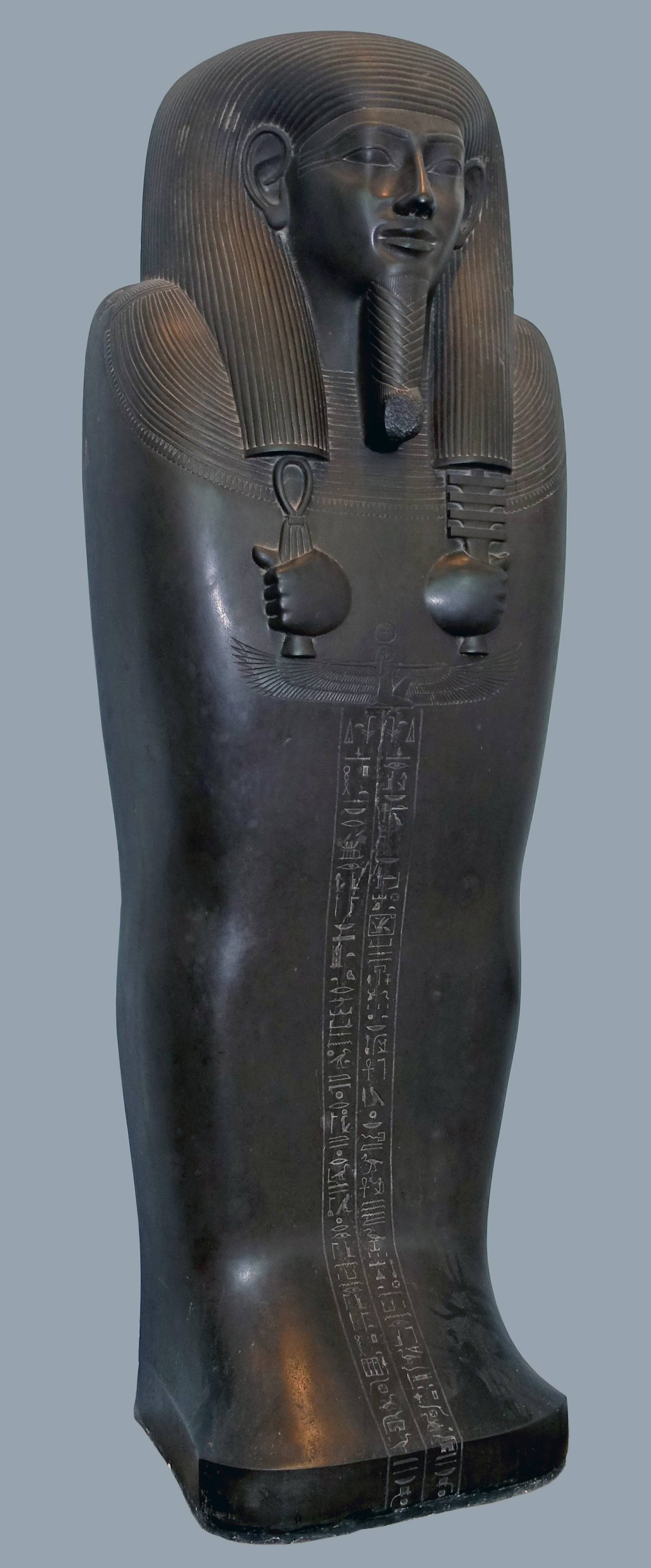
26th Dynasty: 664 BC - 525 BC
Sarcophagus of Sasobek
Black siltstone base and lid of the anthropoid sarcophagus of Sasobek, northern vizier of Egypt during the reign of Psamtek I. The lid is finely carved, showing the deceased wearing wig, beard and collar and with two vertical registers of hieroglyphic offering texts, surmounted by a figure of Nut.
Production date: circa 600 BC
Height 485 mm, length 2210 mm, width 820 mm
The heyday of the anthropoid stone sarcophagus was after 700 BC, in the Late Period. Sasobek's sarcophagus is one of the finest examples of its type to have survived. It is of a relatively unusual type - finely detailed false divine beards are uncommon on such sarcophagi. Many other examples of this period display rather exaggerated wide facial features, but Sasobek's face is naturalistic (although not a portrait) and serene.
The large ears may hint at some archaizing inspiration from monuments of the Middle Kingdom. The sarcophagus is in a superb state of preservation, having suffered damage only to the tip of the beard and the left side of the wig. Sasobek holds the djed pillar of Osiris in his right hand and the knot of Isis in his left. These amuletic symbols would grant him the stability and protection associated with the two deities. A broad collar runs across his shoulders, and below his hands is a kneeling winged figure of the goddess Nut, with her arms spread protectively across the body. Below the goddess are two columns of hieroglyphs, consisting of offering formulae, names, and titles.
The style of the sarcophagus suggests a date in the middle of the seventh century BC or a little later. Sasobek's principal title was that of vizier, and it seems most likely that he served in the reign of Psamtek I (664 BC - 610 BC). The provenance of this sarcophagus is less than certain. Thebes has been suggested as one possibility, although very few stone sarcophagi of this date have been unambiguously identified as coming from there, and this seems most unlikely.
Similar sarcophagi come from the Memphite necropolis, and Sais, the city from which Psamtek's family came, has also been suggested; one of Sasobek's titles associates him with Neith, the goddess of Sais, although this does not necessarily indicate a Saite provenance. Sasobek's son Horwedja is known from a statue in Baltimore (Walters Art Gallery 154); he bears titles associated with both the Memphite region and with Neith.
Catalog: Siltstone, EA17
Photo: Don Hitchcock 2018
Source: Original, British Museum
Text: http://www.britishmuseum.org/, card at the display in the British Museum, © Trustees of the British Museum, CC BY-NC-SA 4.0
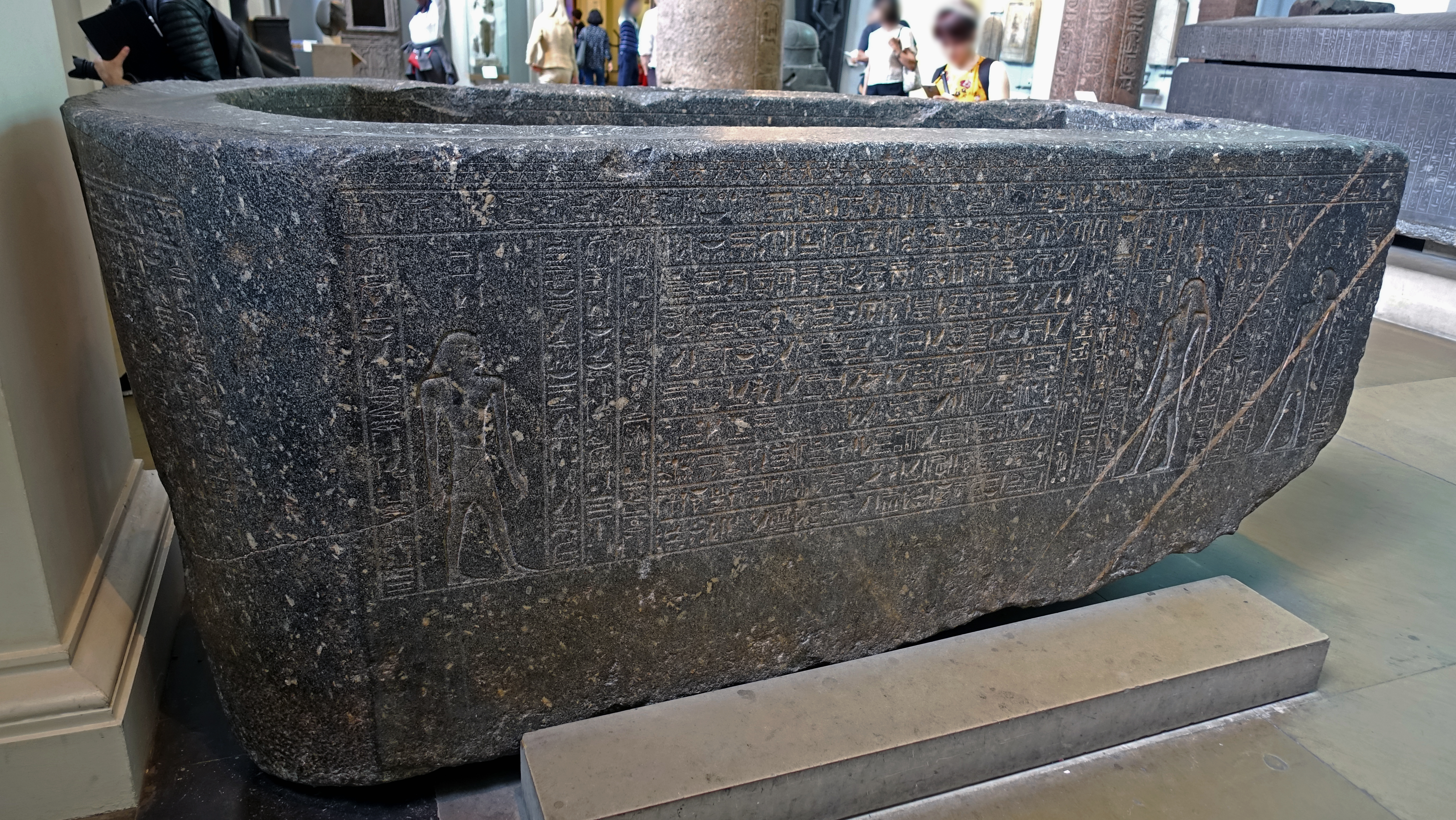
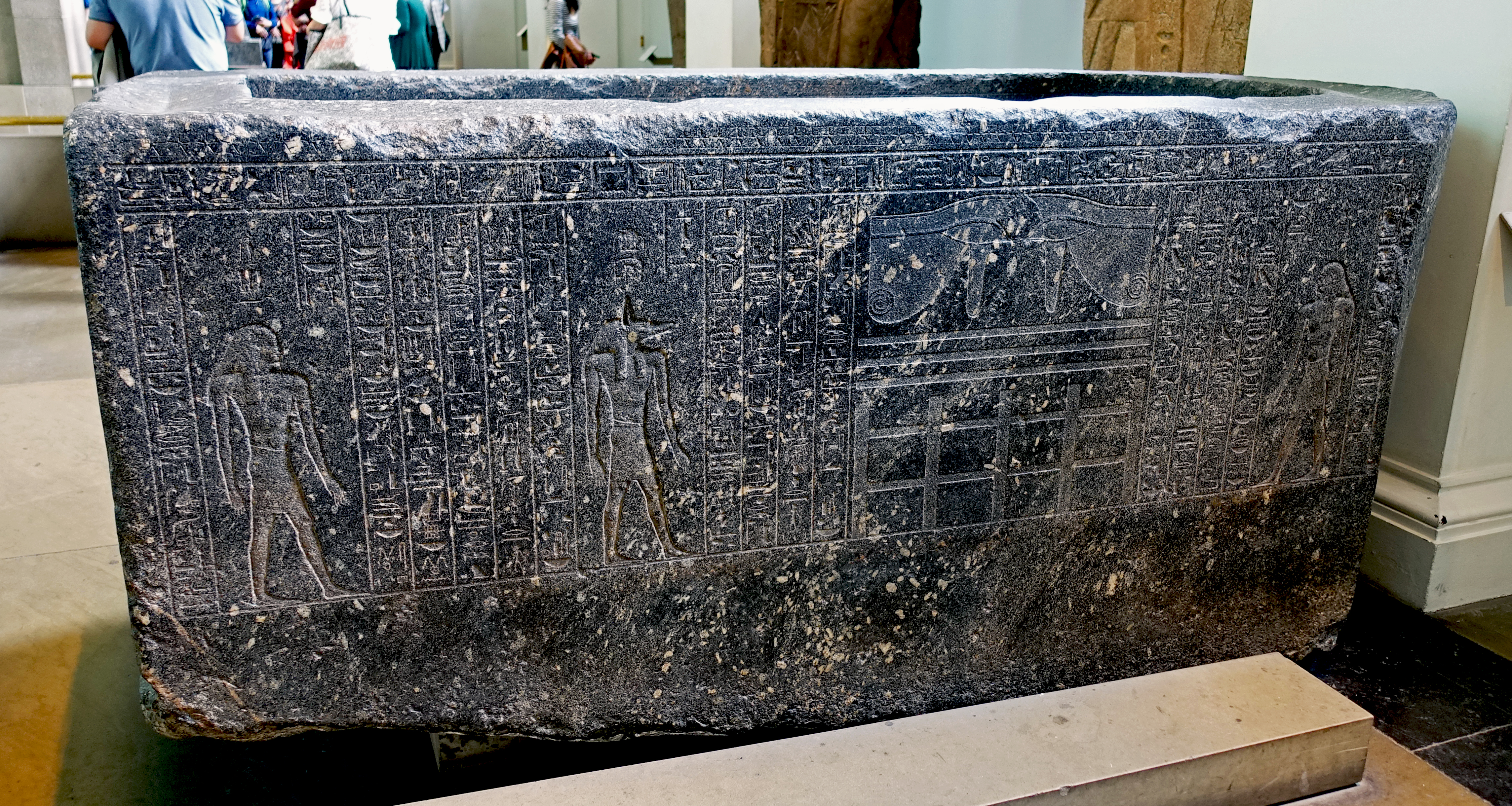
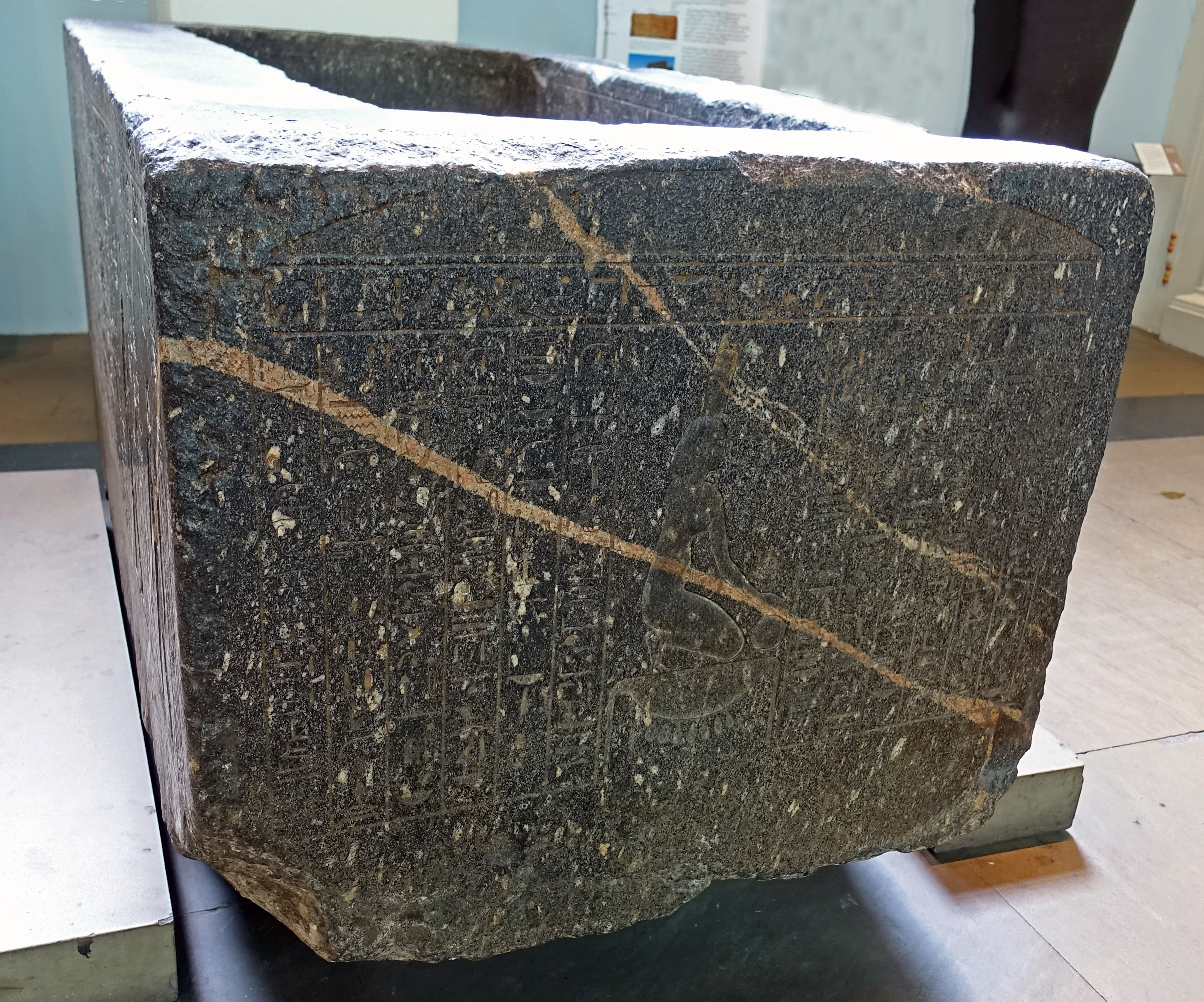
26th Dynasty: 664 BC - 525 BC
Sarcophagus of Hapmen
This is the Sarcophagus of Hapmen, an elite Egyptian official from the 26th Dynasty (circa 624 BC – 525 BC). Crafted from dark grey granite, it features intricately carved Book of the Dead spells and relief figures of deities.
The sarcophagus is elaborated with relief figures including Isis, Nephthys, Sons of Horus, Anubis (shown twice) and wedjat-eyes. The text gives the name and titles of the deceased and is derived from Chapter 72 of the Book of the Dead; interior - decorated with a relief comprising 21 funerary deities with a figure of Nut on the base. Hole drilled at one end.
The sarcophagus was the object of many myths, tales, and stories concerning its ‘magical powers’ after its rediscovery in the medieval period. In the 15th century Mamluk historian Ibn Iyas wrote that in the 900s, a mysterious basin made of 'dark stone and inscribed with the writing of birds' magically floated across the Nile, transporting people inside of it like a ferry. Italian nobleman Pietro della Valle visited the basin in 1615, recording that it was then situated in the ruins of a palace near Cairo’s Citadel. He wrote that local residents told him it was known as the Lovers’ Fountain, because one could drink from it to 'be relieved of the torments of love'. It was later used as a ritual bath, and a ‘plug-hole’ has been drilled for this purpose at one end. Another tale suggested that jinn (spirits) held markets by the basin during the Islamic holy month of Muharram, and if a passer-by purchased food from them, he would find his purchase transformed into gold.
Savants from Napoleon’s Expedition to Egypt recorded the sarcophagus in 1798 and collected it with the aim of taking it to France. After the French surrender in 1801, the sarcophagus was given to the British, and it arrived at the British Museum in 1802. The Cairo neighbourhood where the sarcophagus was located is still known as 'al-Houd al-Marsoud', Arabic for 'The Enchanted Basin'.
It has been suggested that the decoration is copied from the sarcophagus of Thutmose III in the Valley of the Kings.
Representations of: Isis, Nephthys, Anubis, Sons of Horus, Nut.
Production date: Circa 600 BC
Findspot: Cairo (city), Ibn Tulun Mosque (re-used at)
Height 1194 mm (max), length 2740 mm (max) width 1397 mm (max)
Catalog: Dark grey granite, EA23
Photo: Don Hitchcock 2018
Source: Original, British Museum
Text: http://www.britishmuseum.org/, card at the display in the British Museum, © Trustees of the British Museum, CC BY-NC-SA 4.0
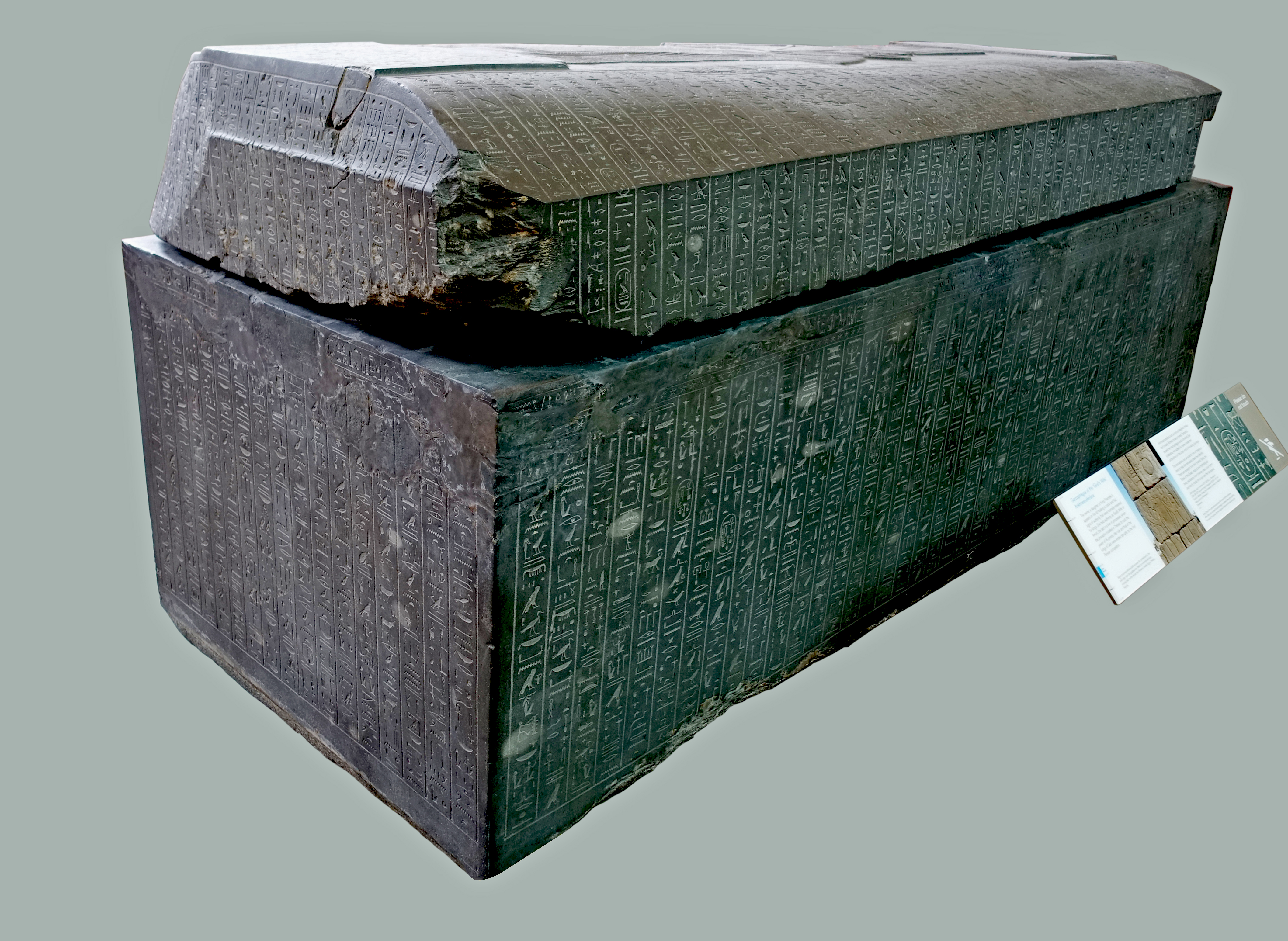
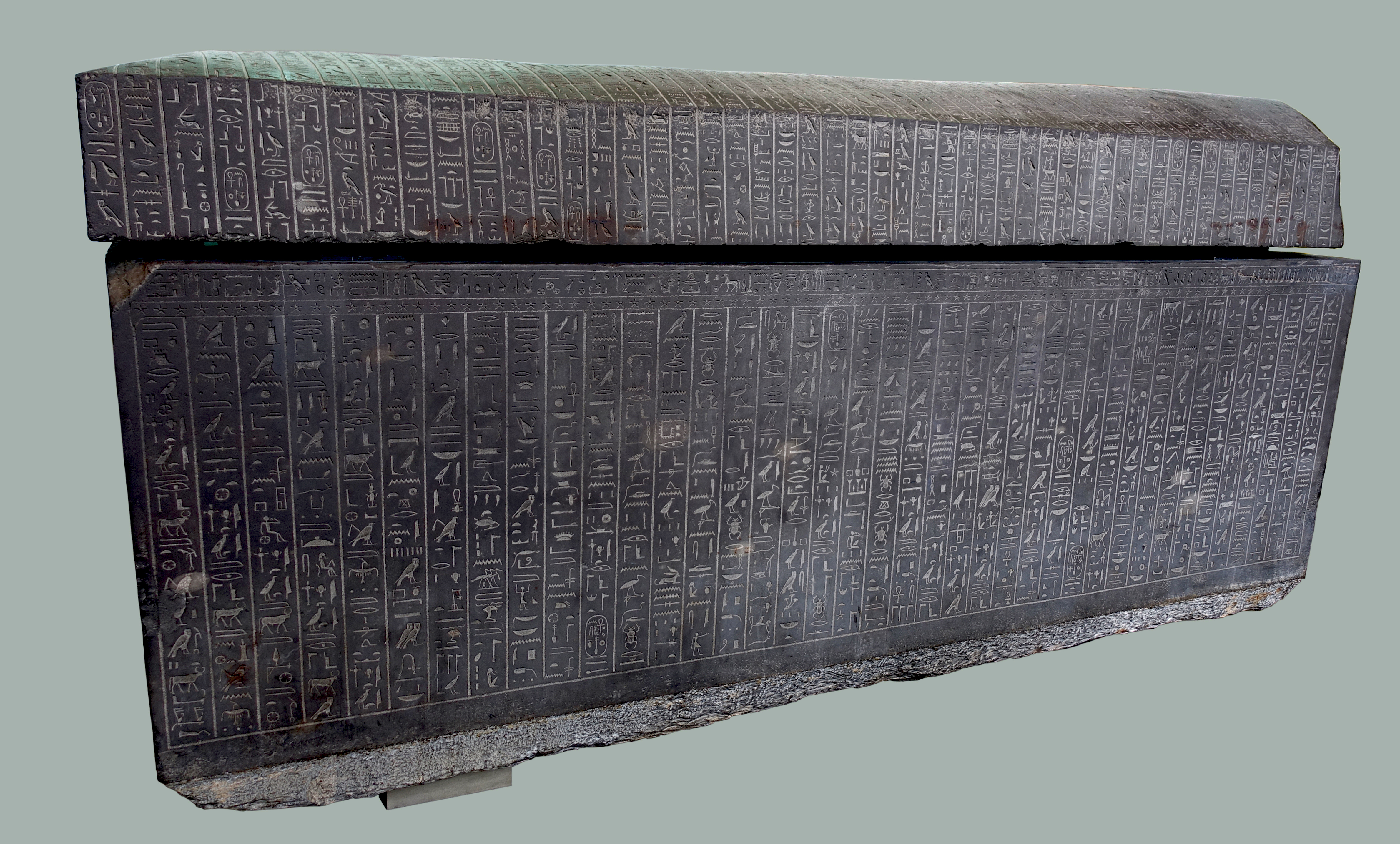
26th Dynasty: 664 BC - 525 BC
Lidded sarcophagus of Ankhnesneferibra
Ankhnesneferibra (or Ankhnesneferibre) was an ancient Egyptian princess and the last God's Wife of Amun during the 26th (Saite) Dynasty. Reigning from 595 to 525 BC, she commanded massive wealth and religious authority in Thebes, serving as the critical political anchor that united Upper Egypt with the northern pharaohs.
Black siltstone rectangular sarcophagus of Ankhnesneferibra, God's Adorer of Amun, daughter of Psamtek II. the exterior and interior are incised with vertical registers of hieroglyphs, containing prayers and invocations to the gods derived from a number of sources including the 'Pyramid Texts'.
The base of the interior is elaborated with a relief representation of Hathor, as goddess of the west. The sarcophagus was later usurped by a priest of Montu, Amenhotep-Pimontu, in the early Roman Period, who is responsible for the addition of the horizontal register of hieroglyphs around the rim and the usurpation of the cartouches.
The sarcophagus, hollowed from a single block of stone, has flat exterior surfaces of excellent smoothness, although the stone has not been highly polished. A band some 8 to 10 cm high along the base was left rough, possibly indicating the depth to which the coffin was set into the floor of the burial chamber in the original interment.
On the interior, the sides were cut so as to create a shaped receptacle for the burial, rounded at the head end and widest across the shoulders. Above this shaped area, the upper parts of the sides were cut back to a flat surface, forming a rectangular socket to accommodate the projecting part of the lid. All the upper edge of the foot end of the box has been broken, and some of the loose fragments have now been replaced in position.
Named in inscription: Ankhnesneferibra, Amun, Psamtek II (daughter of), Amenhoteppamontu
Representation of Hathor
Titles/epithets include: God's Adorer of Amun, Goddess of the West, Priest of Montu
Height 1120 mm (including lid), length 2590 mm (max), width: 1155 mm (max)
Production date circa 530 BC
Findspot: the Lidded sarcophagus of Ankhnesneferibra was originally placed in her tomb within the temple enclosure of Medinet Habu in Thebes (modern Luxor). However, its actual findspot was much further north in Deir el-Medina, in a pit (38 metres deep) where it was discovered in 1832 after being reused for a later burial.
Catalog: Siltstone, EA32
Photo: Don Hitchcock 2018
Source: Original, British Museum
Text: http://www.britishmuseum.org/, card at the display in the British Museum, © Trustees of the British Museum, CC BY-NC-SA 4.0
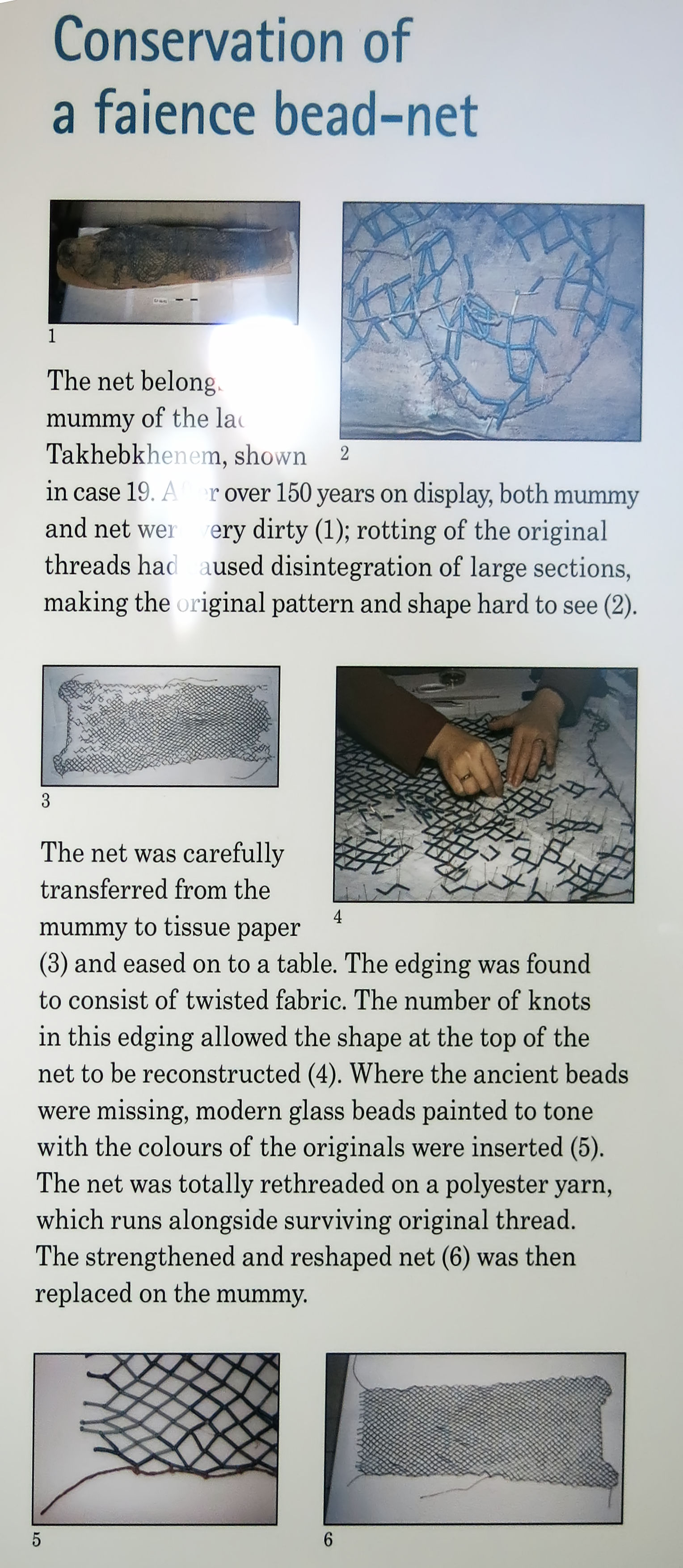
Poster showing the steps involved in the conservation of a faience bead-net. This is a highly skilled and time consuming task.
( I suspect that the dark blue beads in the images above are the original beads, while the pale blue ones are the modern painted glass beads. It is normal, and good practice, to make it obvious which part of an object on display is original, and which is a modern addition - Don )
Photo (rephotography): Don Hitchcock 2015
Source: Poster, British Museum, © Trustees of the British Museum, CC BY-NC-SA 4.0
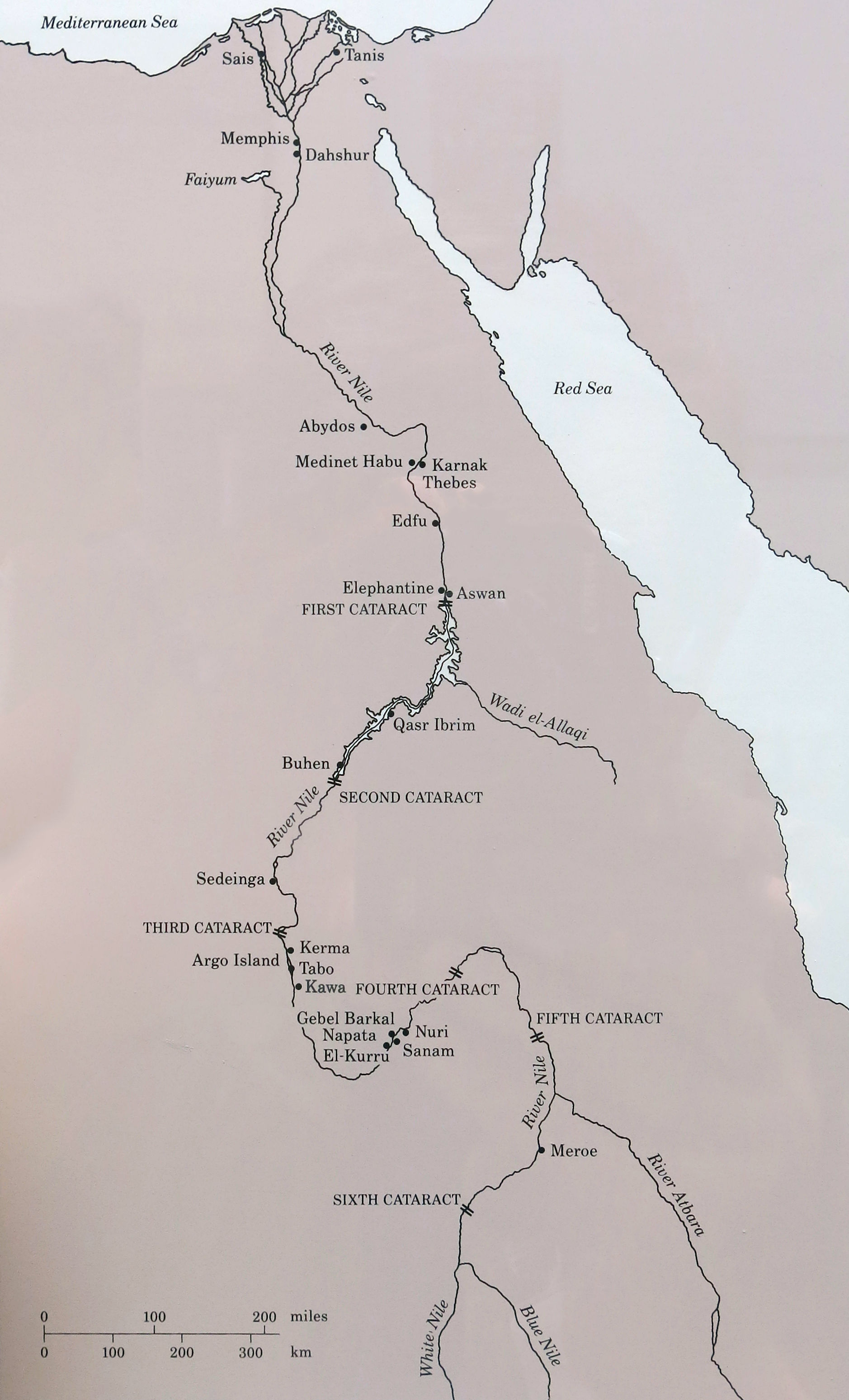
(left) Map of significant sites in Egypt and Nubia during the Napatan period, about 800 BC - 270 BC.
The Napatan Period
Three centuries after the New Kingdom pharaohs relinquished their Nubian territories, a powerful state rose to prominence in Upper Nubia. The important religious centre, Napata, gives its name to the period which includes a unique phase when Kushite kings also occupied the Egyptian throne.
The origins of the kingdom lie in the centuries following the withdrawal of the Egyptian imperial administration around 1070 BC. The rulers were of Kushite ancestry but had adopted many of the trappings of Egyptian culture, including pharaonic titles and regalia, and a devotion to the Egyptian deity, Amun.
From the reign of King Piye, about 747-716 BC, to the mid-7th century BC, five rulers of the Kushite line held sway over both Nubia and Egypt. Under their regime, Egypt enjoyed a cultural and political revival, participating more actively in foreign affairs and enjoying increased artistic productivity. Assyrian invasions eventually forced the Nubian kings out of Egypt, but their descendants continued to rule over a still powerful and independent kingdom in Nubia.
The Nubians
Nubia appears to have supported only a small population compared to that of Egypt. The ancient Nubians shared a broadly common ethnic background with the Egyptians, but their physical characteristics showed variations of skin colour, physiognomy and skeletal proportion. The distinctive features and the elaborate costume of the Nubians were carefully represented by Egyptian artists.
In Egyptian art Nubians can be easily recognised by their dark skin, feathers worn in the hair, large earrings and leopard - skin kilts. The languages spoken by the Egyptians and Nubians were different, Ancient Egyptian belonging to the Afro-Asiatic group and Nubian to the Nilo-Saharan family.
Photo: Poster, British Museum, © Trustees of the British Museum, CC BY-NC-SA 4.0
Rephotography: Don Hitchcock 2015
Text: Poster at the British Museum, © Trustees of the British Museum, CC BY-NC-SA 4.0

25th Dynasty / Nubian Dynasty / Kushite Empire: 746 BC - 656 BC
Harwa
Serpentine statue depicting the official, Harwa, presenting two female divine figures of Isis and Hathor.
25th Dynasty, circa 700 BC - 670 BC.
Harwa was Chief Steward of the 'God's Wife of Amun' at Thebes. He served under Amenirdis I, whose cartouche is inscribed between the two divine images, and under her successor, Shepenwepet II.
Statue itself: height 185 mm, width 130 mm, depth 170 mm
Fixed base: height 40 mm, width 160 mm, depth 195 mm.
Catalog: EA32555
Photo: Don Hitchcock 2015
Source: Original, British Museum
Text: Card with the display at the British Museum, http://www.britishmuseum.org/, © Trustees of the British Museum, CC BY-NC-SA 4.0
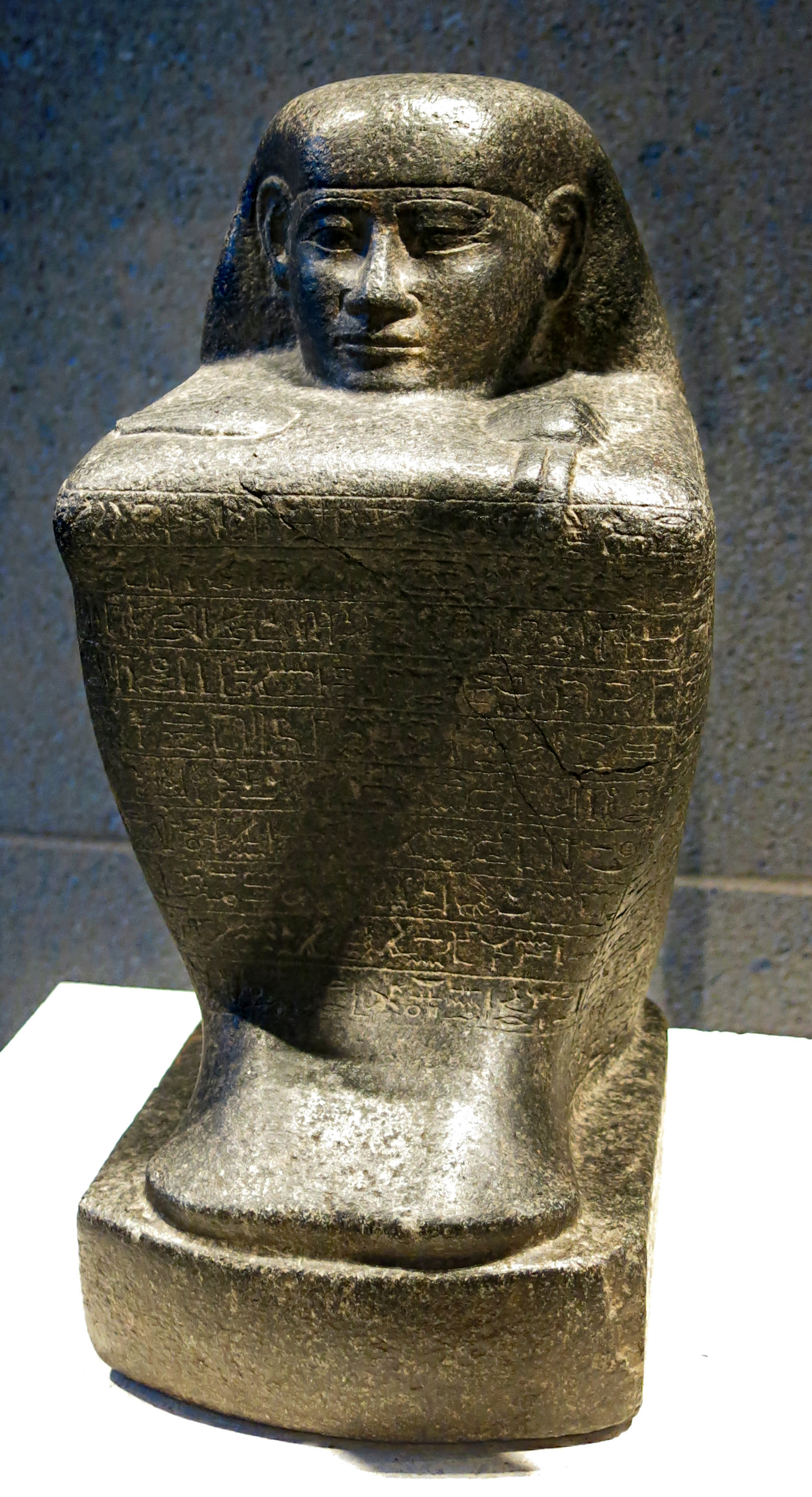
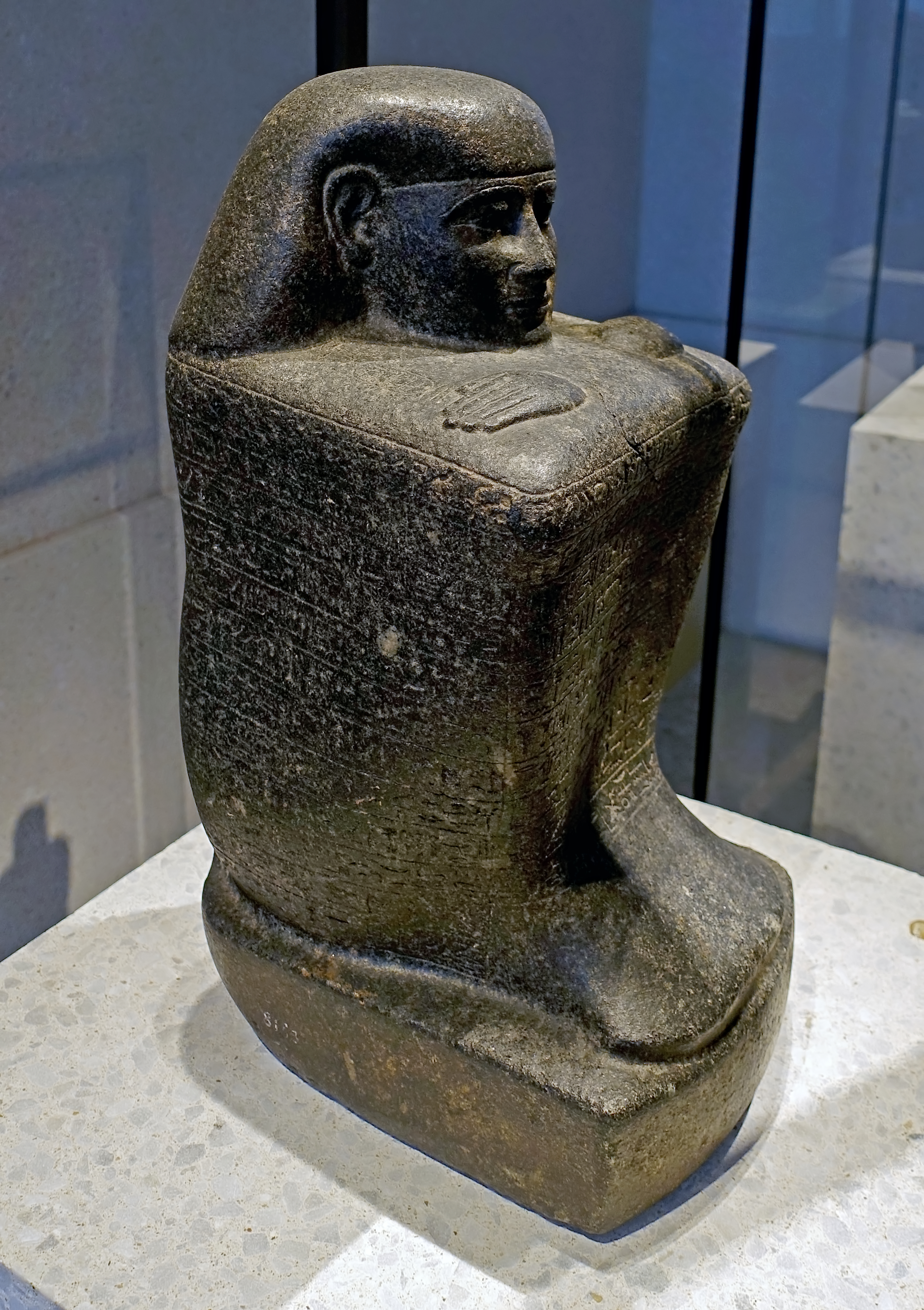
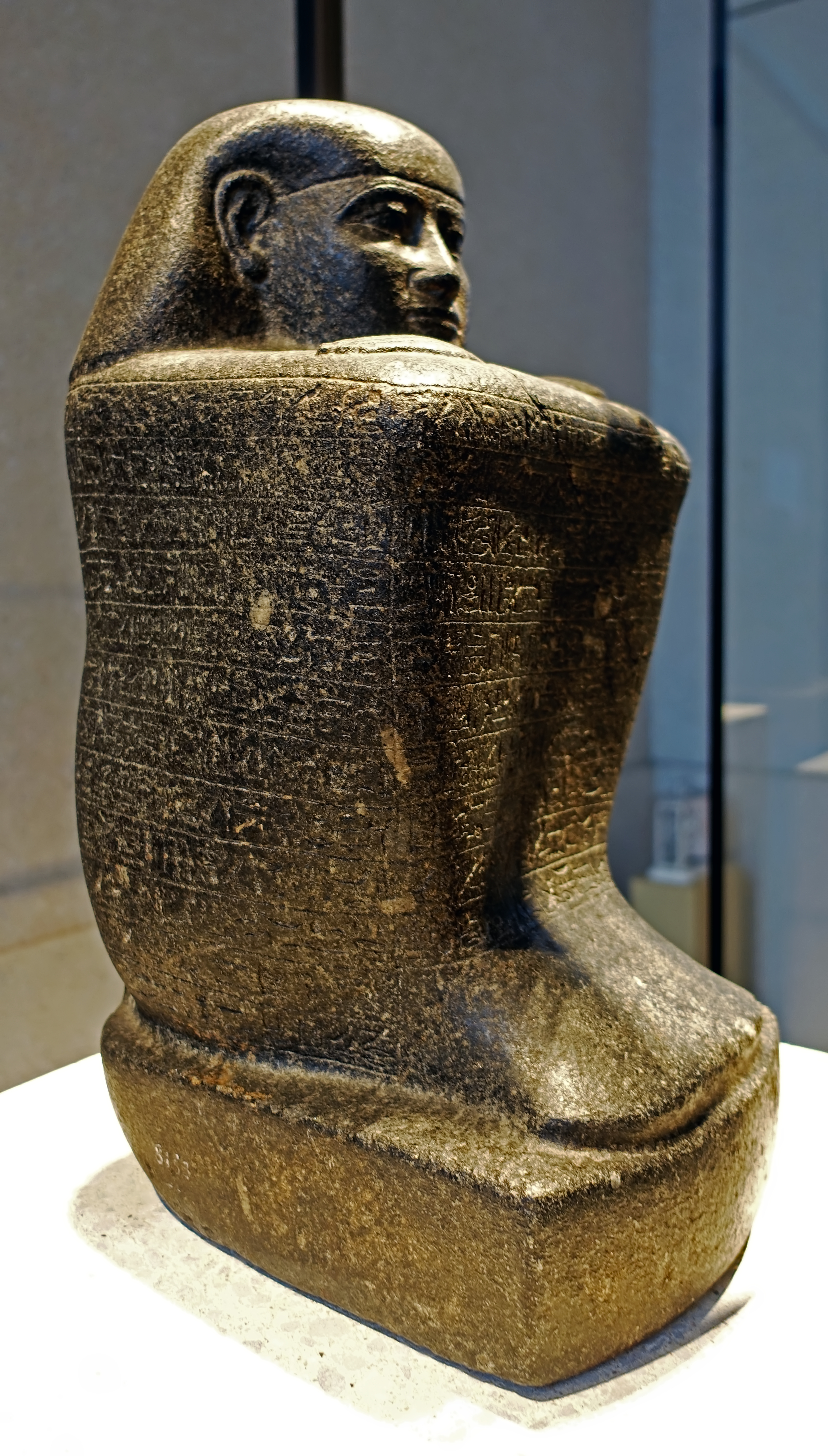
25th Dynasty / Nubian Dynasty / Kushite Empire: 746 BC - 656 BC
Harwa / Harua
( note that the dates for Harwa were problematical. In 2015 the museum card in the Staatliche Museen zu Berlin, Neues Museum, Germany, placed the sculpture in the 26th Dynasty, and gave it the date of circa 500 BC, i.e. in the 27th Dynasty; while the British Museum and Lichtheim (1980) gave the date as the 25th Dynasty, and unfortunately there was and is no mention of it in the Berlin online catalog. This has now been cleared up, and the Berlin Museum card now (in 2018) gives the date as circa 740 BC, and in the 25th Dynasty. This is a tribute to the professionalism and competence of the curators at the SMB, and I have noticed that I need to use the information on the 2018 cards rather than the 2015 ones - they are more accurate, and carry more useful information - Don )
A block statue of the chief steward Harua / Harwa, 487 mm high, circa 740 BC. It is one of eight known statues of Harwa, the High Steward of the ' Divine Consort of Amun ', Amenirdis, daughter of King Kashta. Under the Nubian kings of the 25th Dynasty the office of ' Divine Consort of Amun ' at Thebes became especially prominent. Exercised by a king's daughter, and transmitted to a female successor by adoption, the position of ' High Priestess of Amun ' ensured the king's control over the Theban region.
The chief official of the ' Divine Consort ' who bore the title ' High Steward ' was an important personality in the administration. The prominence achieved by the Divine Consorts and by their High Stewards was also a corollary of the declining significance of the office of High Priest, or ' First Prophet of Amun ' in the Nubian and Saite periods.
Catalog: Diorite, Western Thebes, Grave 37, ÄM 8163
Photo: Don Hitchcock 2015, 2018
Source: Original, Staatliche Museen zu Berlin, Neues Museum, Germany
Text: © Card at the Staatliche Museen zu Berlin (CC BY-NC-SA 3.0 DE)
Additional text: Lichtheim (1980)
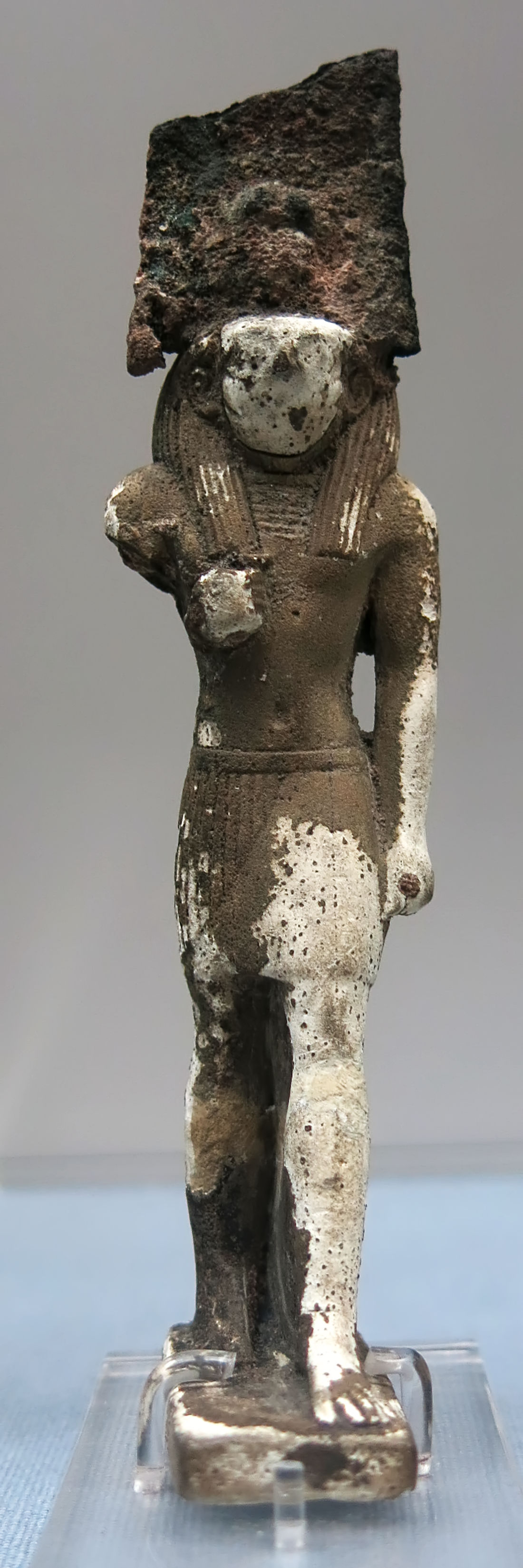
25th Dynasty / Nubian Dynasty / Kushite Empire: 746 BC - 656 BC
Montu-Re
Faience figure of the god Montu-Re / Montu-Ra inscribed with the name of Shabaqo / Shabako.
25th Dynasty, circa 716 BC - 702 BC.
The god's feathered headdress, now lost, was made of bronze.
Glazed composition (now discoloured) of the figure of Montu-Ra. Bronze plumes (incomplete) on head. Hieroglyphic text including cartouche of Shabako on back. Left arm lost.
Height 110 mm.
Catalog: EA11334
Photo: Don Hitchcock 2015
Source: Original, British Museum
Text: Card with the display at the British Museum, http://www.britishmuseum.org/, © Trustees of the British Museum, CC BY-NC-SA 4.0
Nubian Kings of EgyptText above: Poster at the British Museum, © Trustees of the British Museum, CC BY-NC-SA 4.0
Circa 716 BC - 664 BC
Taking advantage of instability and political disunity in Egypt, the Kushite King Piye launched an invasion about 728 BC. His successor, Shabaqo, achieved complete control about 716 BC, and he and his three successors, Shabitqo, Taharqo, and Tanutamani, were acknowledged as the legitimate sovereigns of Egypt, forming the 25th Dynasty.
The kings resided chiefly at Memphis, one of the principal cities of Egypt, and Kushite princesses were appointed to the religious office of 'God's Wife of Amun', a policy which gave the royal family firm control of Thebes.
The 25th Dynasty rulers brought Egypt much needed stability and increased political prestige. They fostered a revival of art, architecture and religious learning, drawing inspiration from the great eras of Egypt's past.
Taharqo was an active builder, constructing a number of temples in both Egypt and Nubia. Between 674 and 663 BC Assyrian invasions forced the Kushites to abandon Egypt. Taharqo was compelled to flee back to Nubia, where he died in 664 BC. An attempt by Tanutamani to retake Egypt was unsuccessful and he spent the rest of his reign in Nubia.
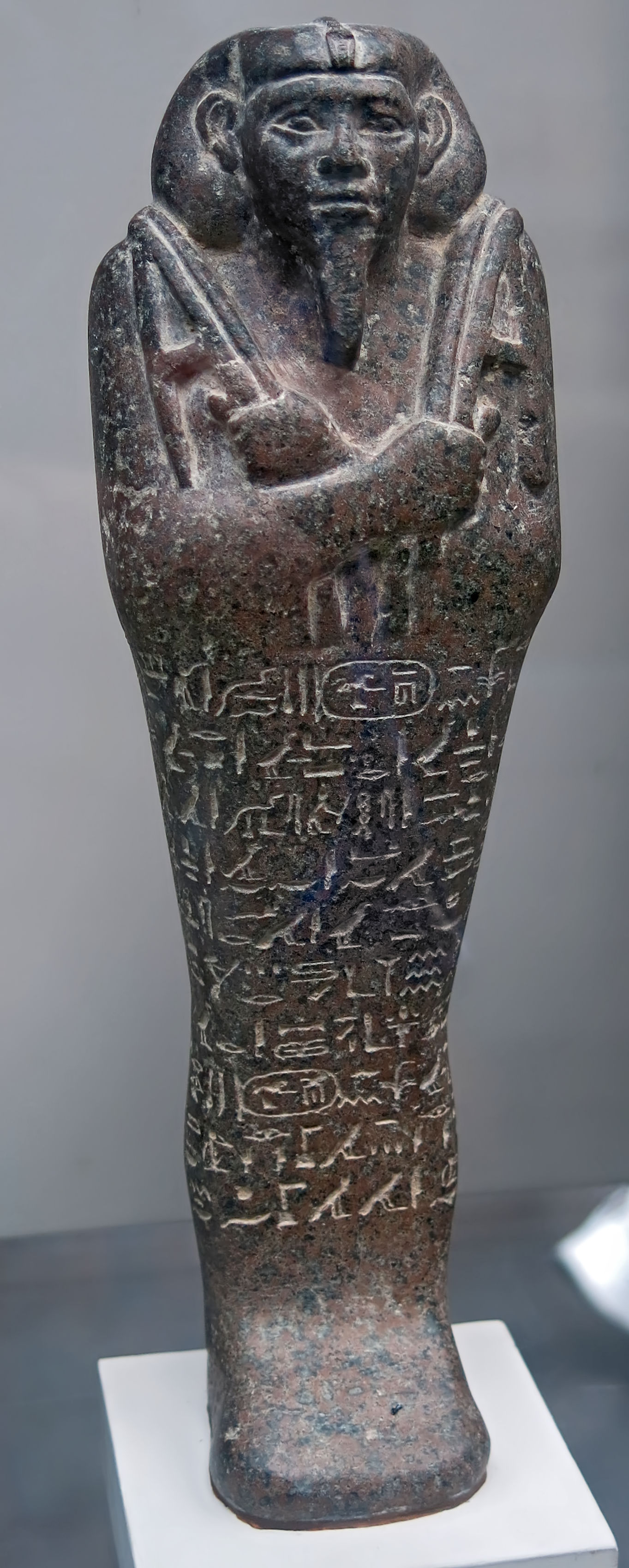
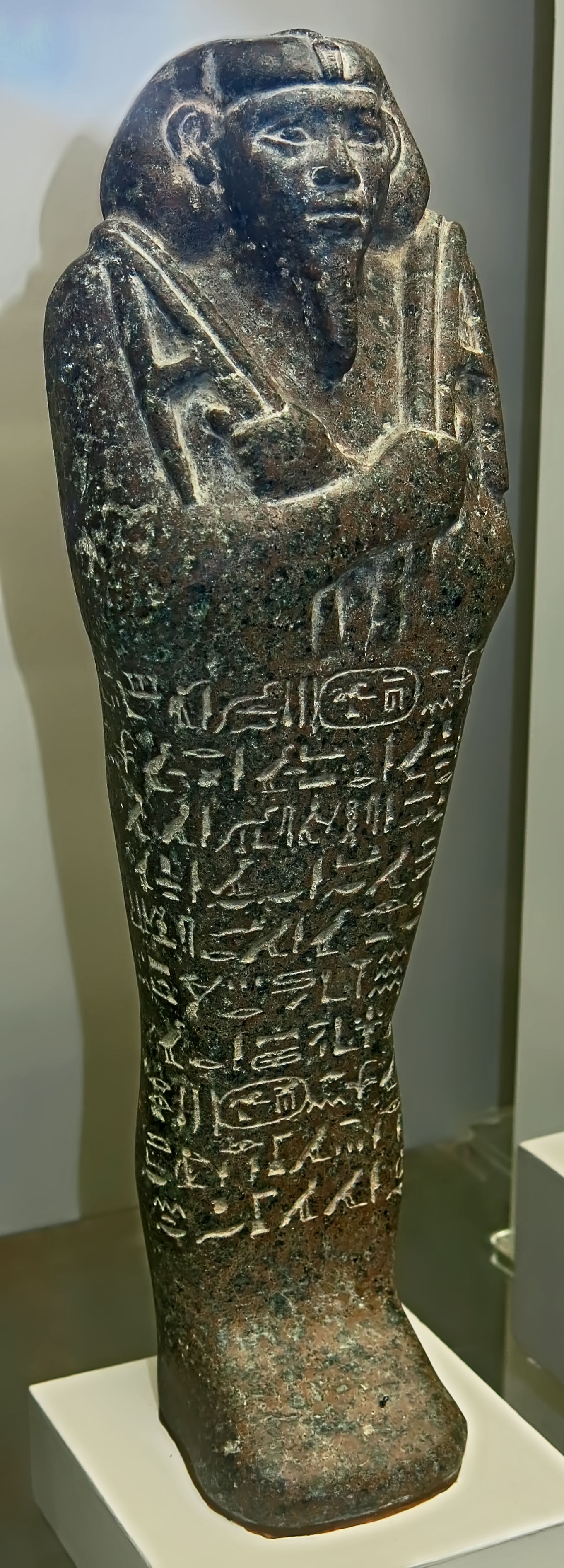
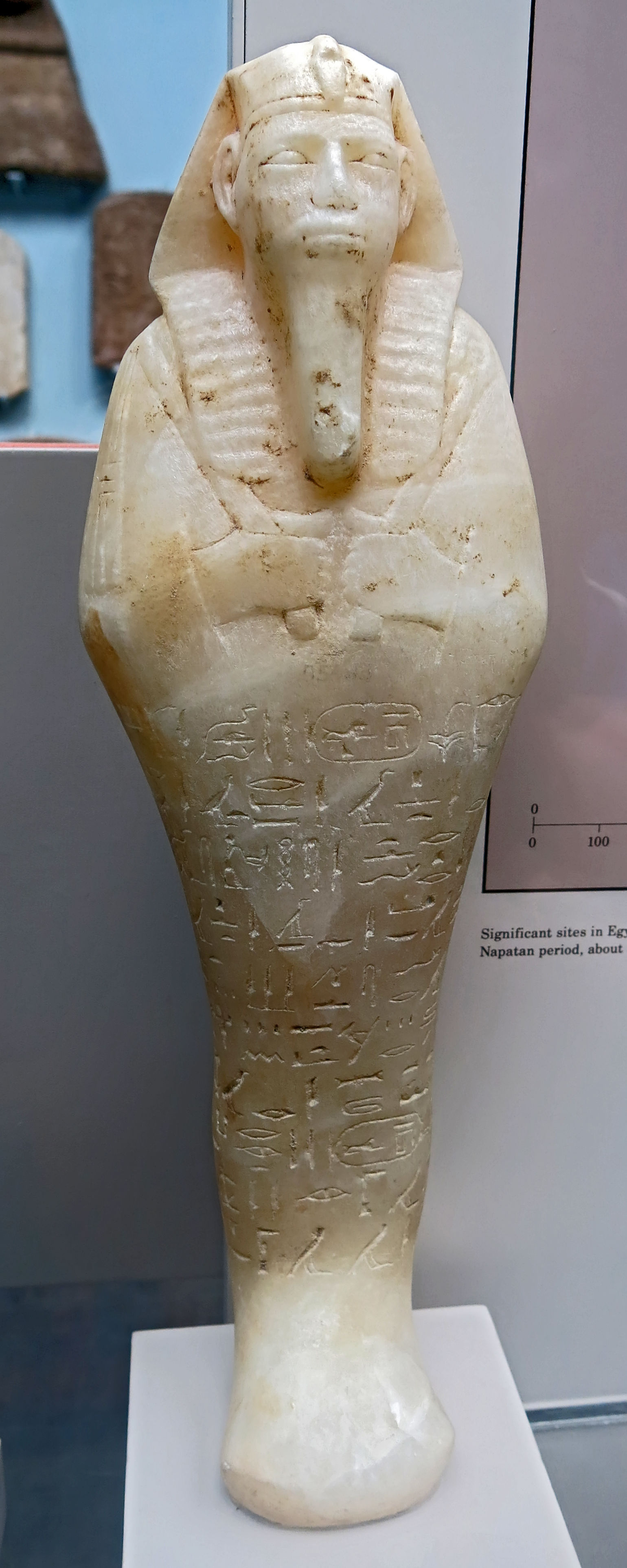
25th Dynasty / Nubian Dynasty / Kushite Empire: 746 BC - 656 BC
King Taharqo
(left, centre) Granite statue of King Taharqo, 25th Dynasty, circa 664 BC, height 260 mm.
(right) Calcite statue of King Taharqo, 25th Dynasty, circa 664 BC, height 324 mm.
From Nuri, pyramid Nu 1.
Catalog: EA55487, EA55482
Photo: Don Hitchcock 2015
Source: Original, British Museum
Text: Card with the display at the British Museum, http://www.britishmuseum.org/, © Trustees of the British Museum, CC BY-NC-SA 4.0
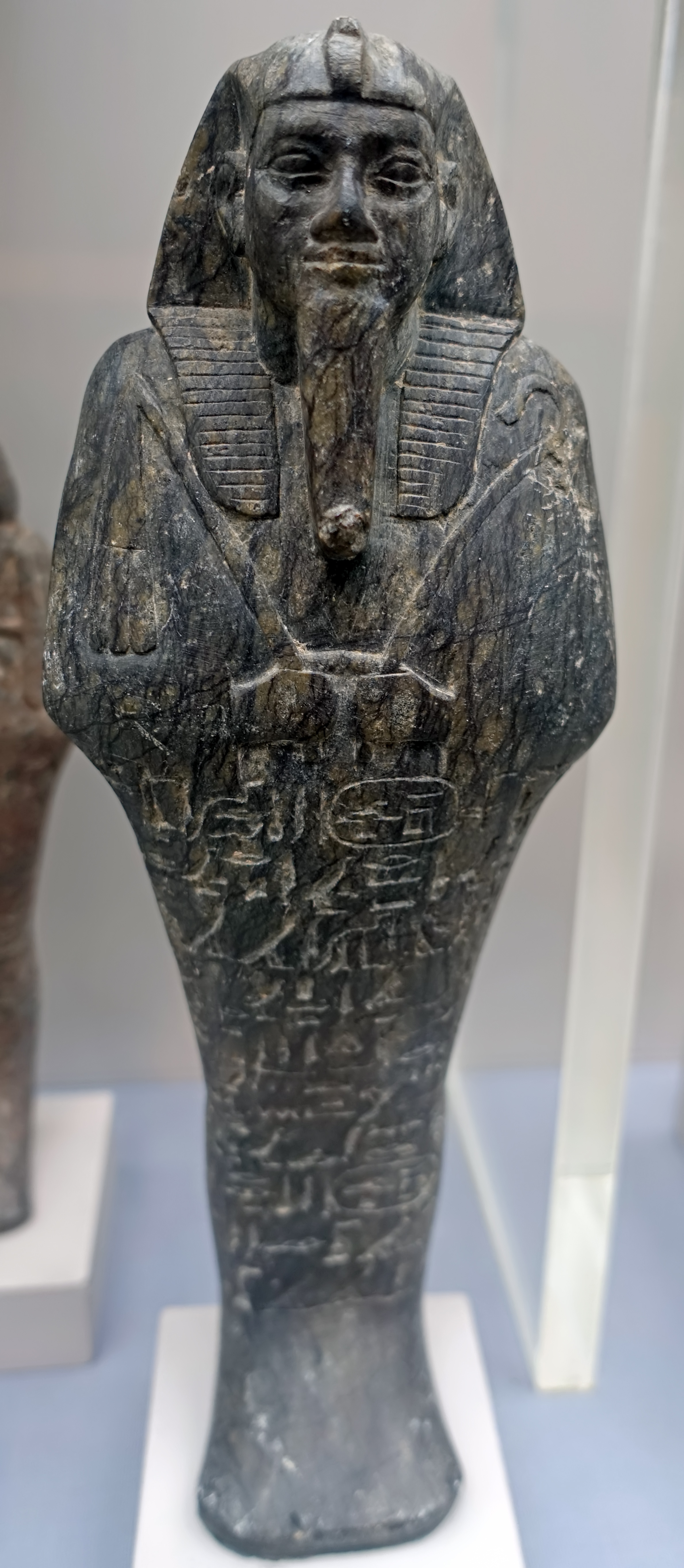
25th Dynasty / Nubian Dynasty / Kushite Empire: 746 BC - 656 BC
King Taharqo
Serpentine shabti of King Taharqo.
25th Dynasty, circa 664 BC.
Height 250 mm, width 93 mm, depth 58 mm.
Catalog: Serpentine, Nuri, EA55489
Photo: Don Hitchcock 2018
Source: Original, British Museum
Text: Card with the display at the British Museum, http://www.britishmuseum.org/, © Trustees of the British Museum, CC BY-NC-SA 4.0
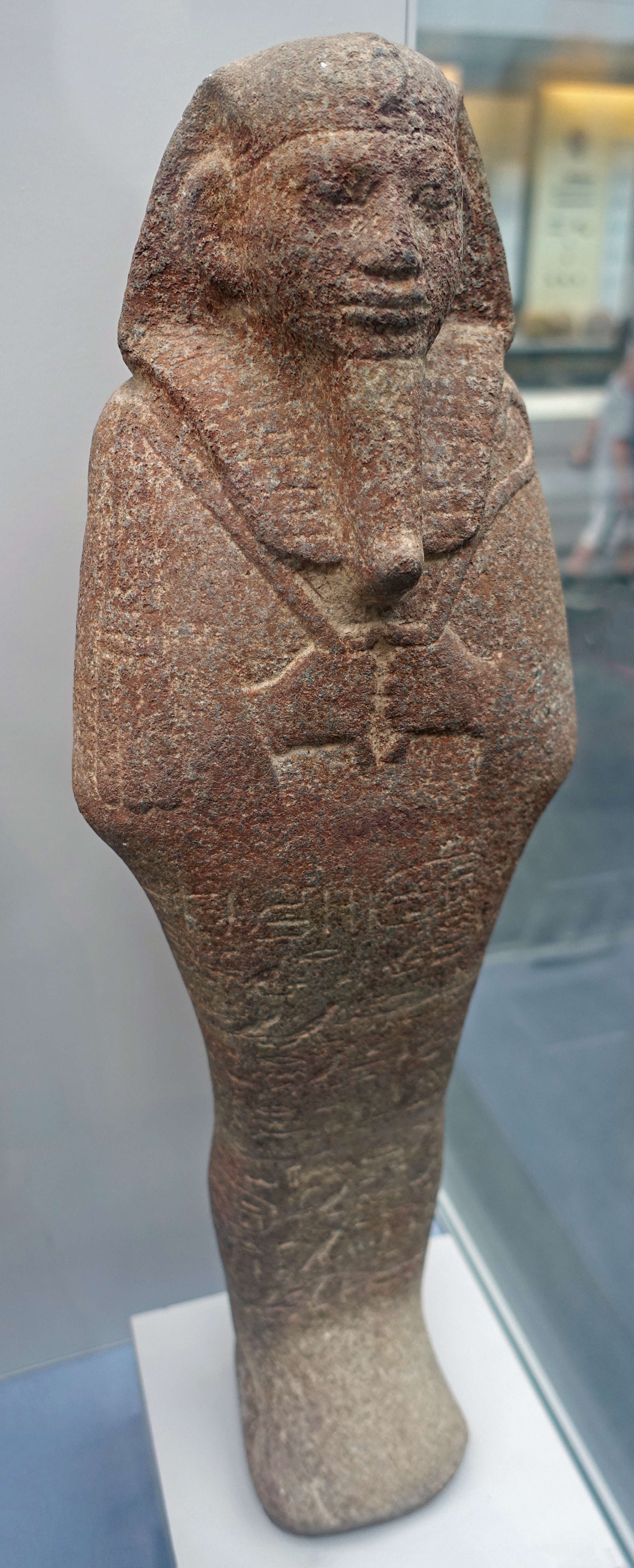
25th Dynasty / Nubian Dynasty / Kushite Empire: 746 BC - 656 BC
King Taharqa / Taharqo
Red quartzite shabti of Taharqo.
Circa 664 BC
Height 483 mm.
Catalog: Red quartzite, Nuri, EA55486
Photo: Don Hitchcock 2018
Source: Original, British Museum
Text: Card with the display at the British Museum, http://www.britishmuseum.org/, © Trustees of the British Museum, CC BY-NC-SA 4.0

25th Dynasty / Nubian Dynasty / Kushite Empire: 746 BC - 656 BC
King Taharqa / Taharqo
Granite shabti of Taharqo.
Circa 664 BC
Height 204 mm, width 75 mm, depth 54 mm.
Catalog: Granite, Nuri, EA55488
Photo: Don Hitchcock 2015
Source: Original, British Museum
Text: Card with the display at the British Museum, http://www.britishmuseum.org/, © Trustees of the British Museum, CC BY-NC-SA 4.0
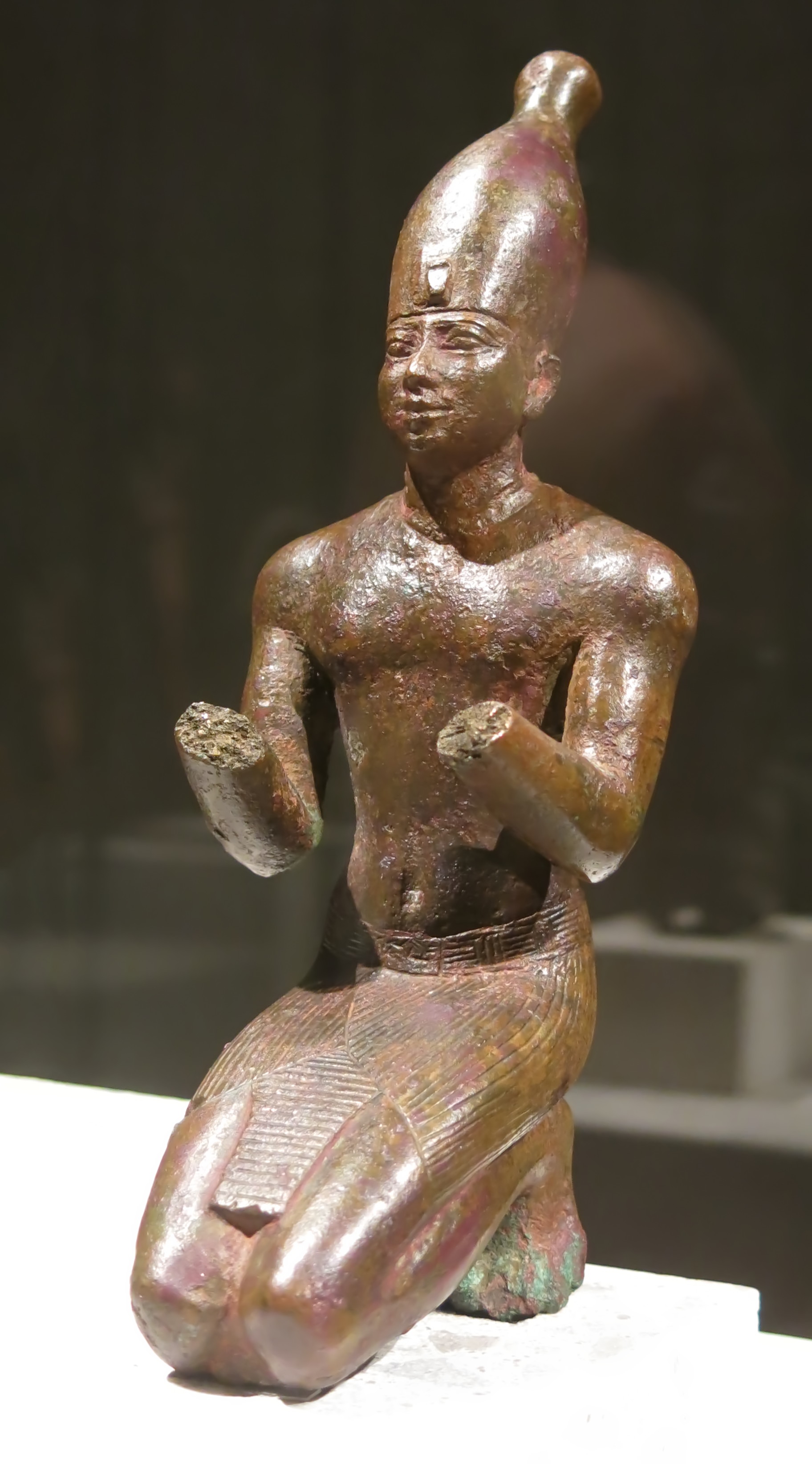
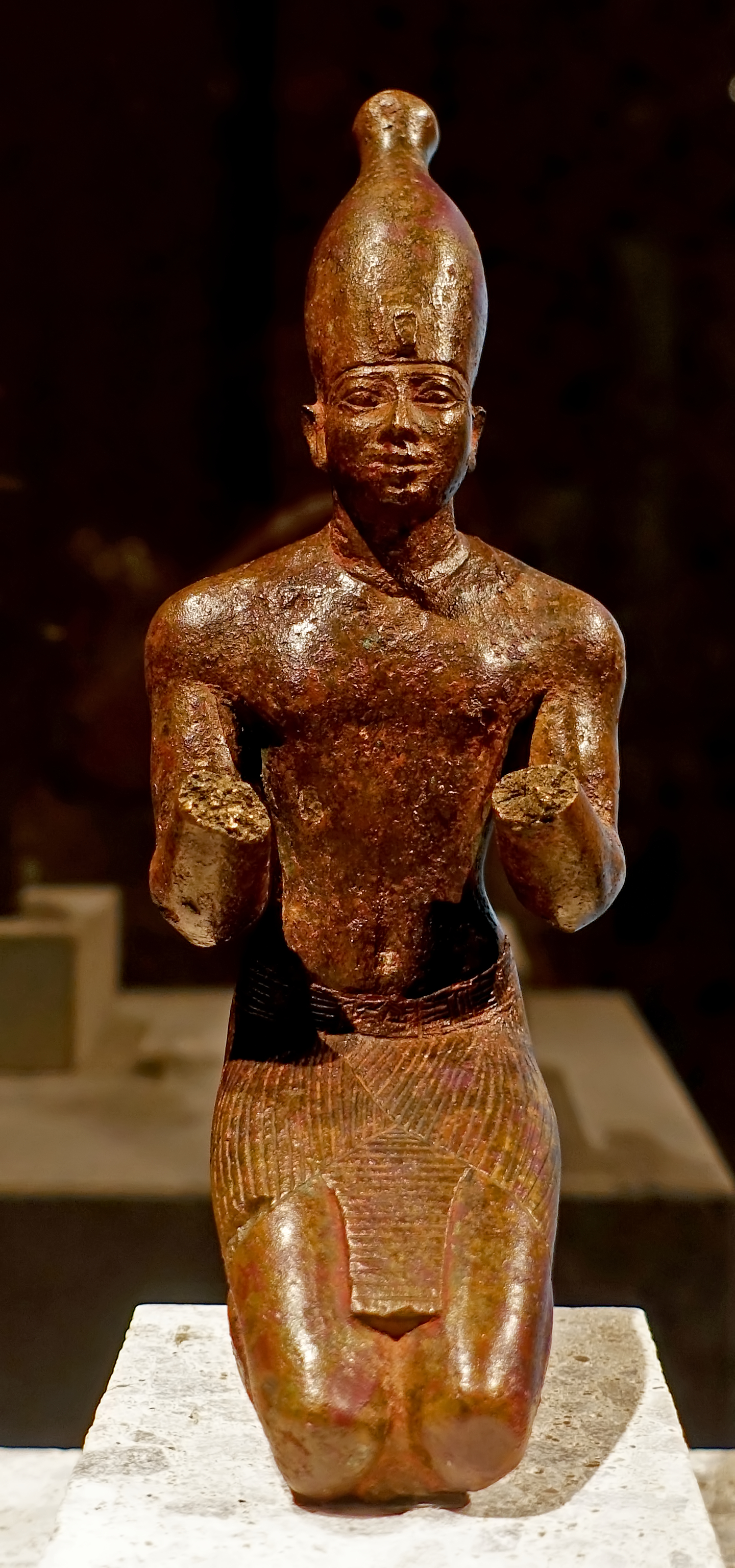
25th Dynasty / Nubian Dynasty / Kushite Empire: 746 BC - 656 BC
King Taharqa / Taharqo
Kneeling statue of Taharqa, a Kushite king, hands lost.
Taharqa was the son of Piye, the Nubian king of Napata who had first conquered Egypt. Taharqa was also the cousin and successor of Shebitku.[3] The successful campaigns of Piye and Shabaka paved the way for a prosperous reign by Taharqa.
Taharqa's reign can be dated from 690 BC to 664 BC, a little over 26 years. Evidence for the dates of his reign is derived from the Serapeum stela, catalog number 192. This stela records that an Apis bull born and installed (fourth month of Peret, day 9) in Year 26 of Taharqa died in Year 20 of Psammetichus I (4th month of Shomu, day 20), having lived 21 years.
He is wearing the Hedjet, the white crown of Upper (southern) Egypt.
Catalog: Bronze, ÄM 34397
Photo: Don Hitchcock 2015, 2018
Source: Original, Staatliche Museen zu Berlin, Neues Museum, Germany
Text: © Card at the Staatliche Museen zu Berlin, (CC BY-NC-SA 3.0 DE)
Additional text: Wikipedia

25th Dynasty / Nubian Dynasty / Kushite Empire: 746 BC - 656 BC
King Taharqo
Faience composite amulet inscribed with the names of Taharqo.
25th Dynasty, circa 690 BC - 664 BC.
Provenance unknown.
The amulet incorporates a was - sceptre within the outline of an ankh - sign.
Height 23 cm.
The inscription describes Taharqo as beloved of the god Amen-Re.
Catalog: EA49726
Photo: Don Hitchcock 2015
Source: Original, British Museum
Text: Card with the display at the British Museum, http://www.britishmuseum.org/, © Trustees of the British Museum, CC BY-NC-SA 4.0
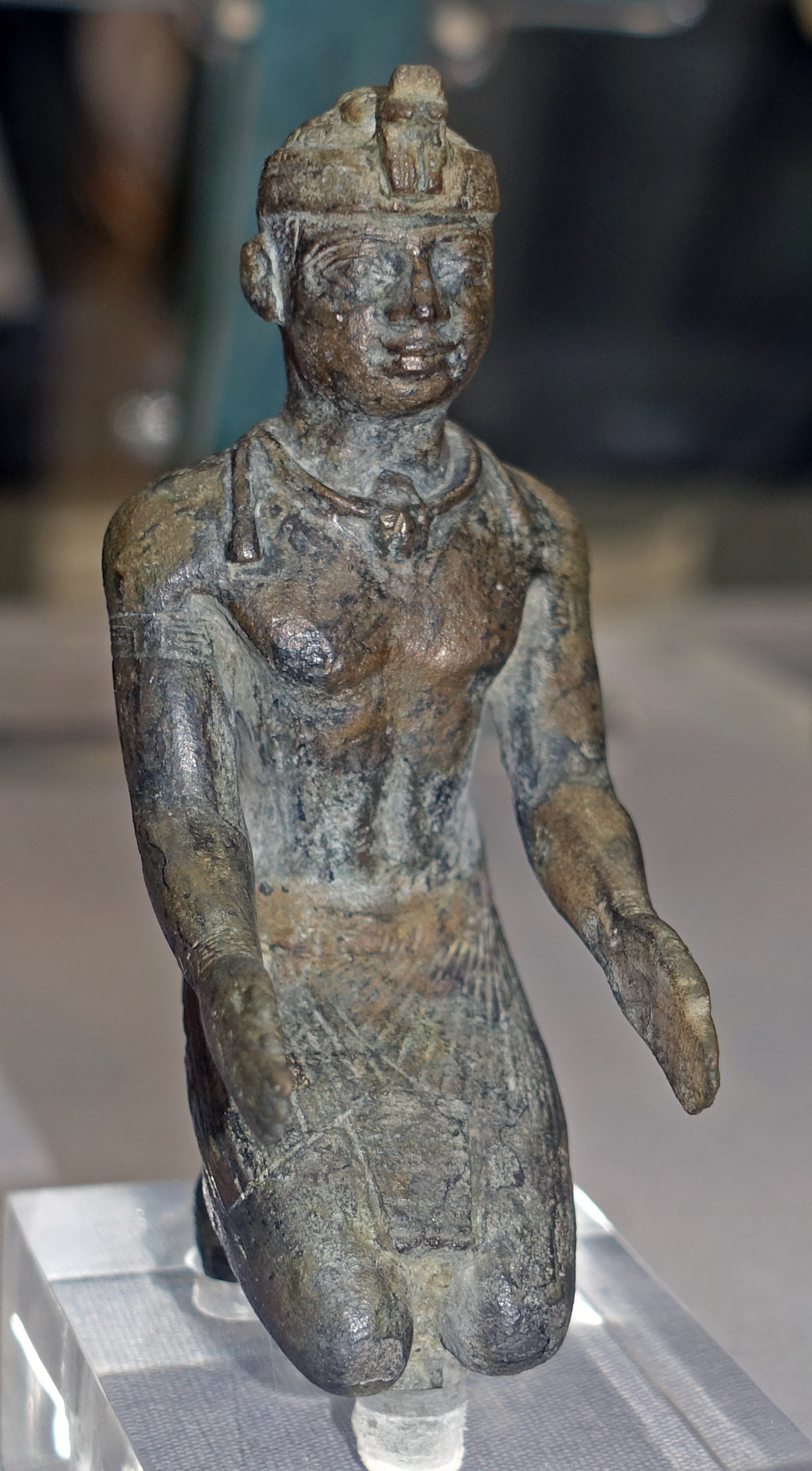
25th Dynasty / Nubian Dynasty / Kushite Empire: 746 BC - 656 BC
King Taharqo
Bronze statuette of a kneeling king.
25th Dynasty, about 690 BC - 664 BC From Kawa, Temple 'T'.
The king kneels to present an offering to a god. He wears the double uraeus, a cap-like headdress and necklace with rams' head pendants typical of depictions of Napatan kings. An incised inscription on the belt has been read as the name of Taharqo.
Height 112 mm.
Catalog: EA63595
Photo: Don Hitchcock 2018
Source: Original, British Museum
Text: Card with the display at the British Museum, http://www.britishmuseum.org/, © Trustees of the British Museum, CC BY-NC-SA 4.0
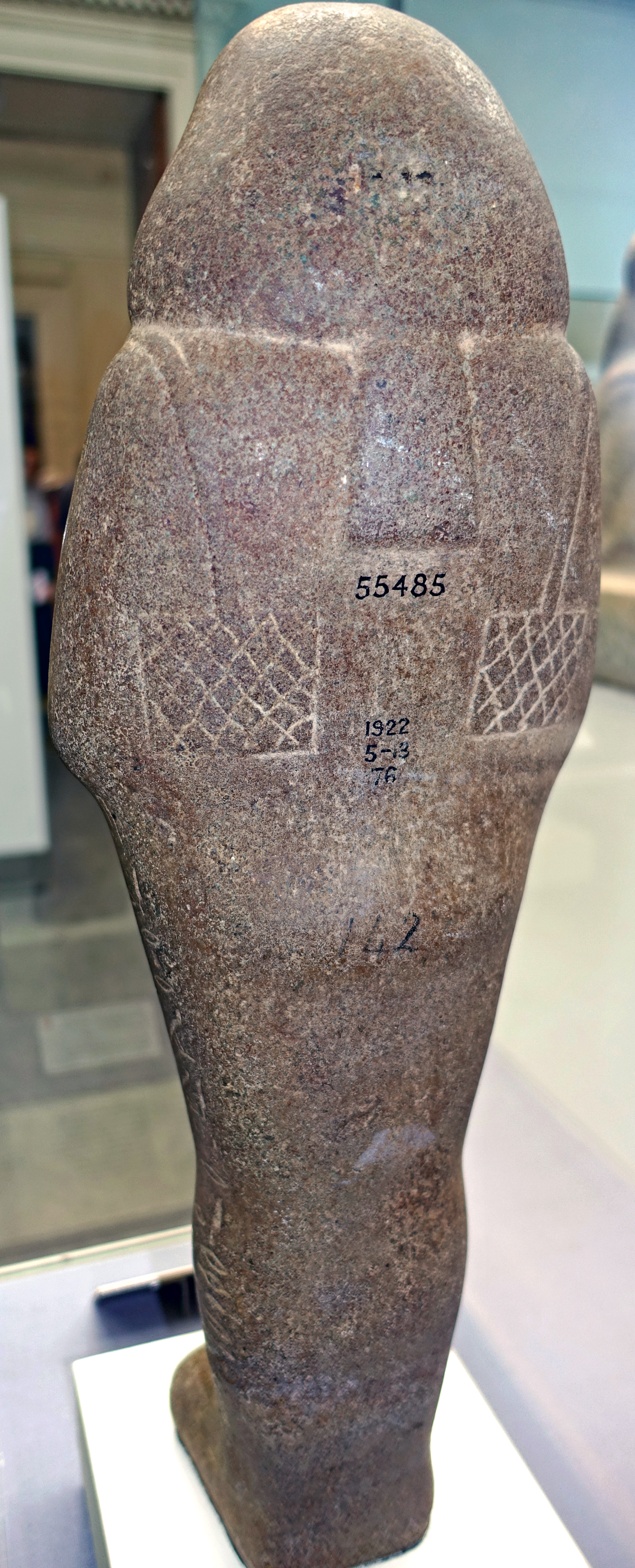
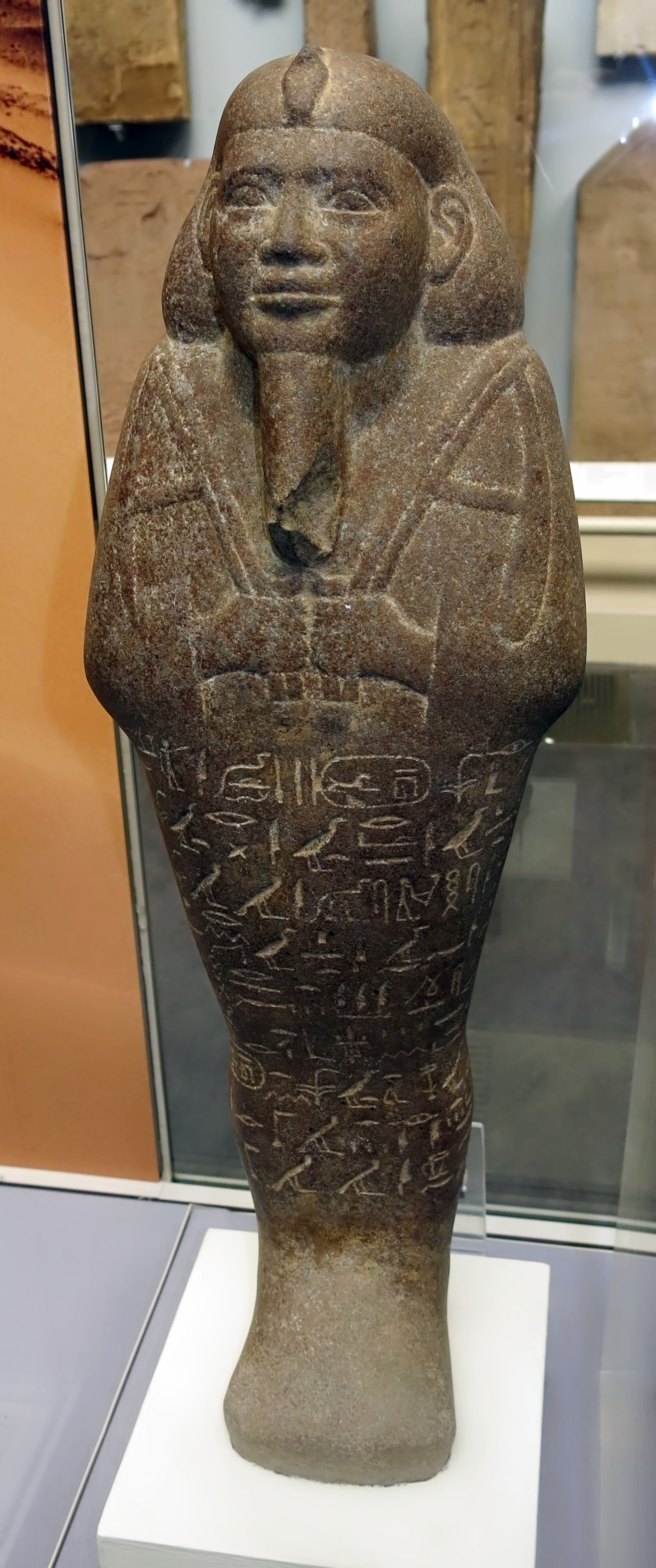
25th Dynasty / Nubian Dynasty / Kushite Empire: 746 BC - 656 BC
King Taharqo
Quartzite shabti of King Taharqo from Nuri, pyramid Nu 1, 25th Dynasty, circa 690 BC - 664 BC.
Culture/period Napatan / Kushite
Height 508 mm.
Catalog: EA55485
Photo: Don Hitchcock 2018, 2015
Source: Original, British Museum
Text: Card with the display at the British Museum, http://www.britishmuseum.org/, © Trustees of the British Museum, CC BY-NC-SA 4.0
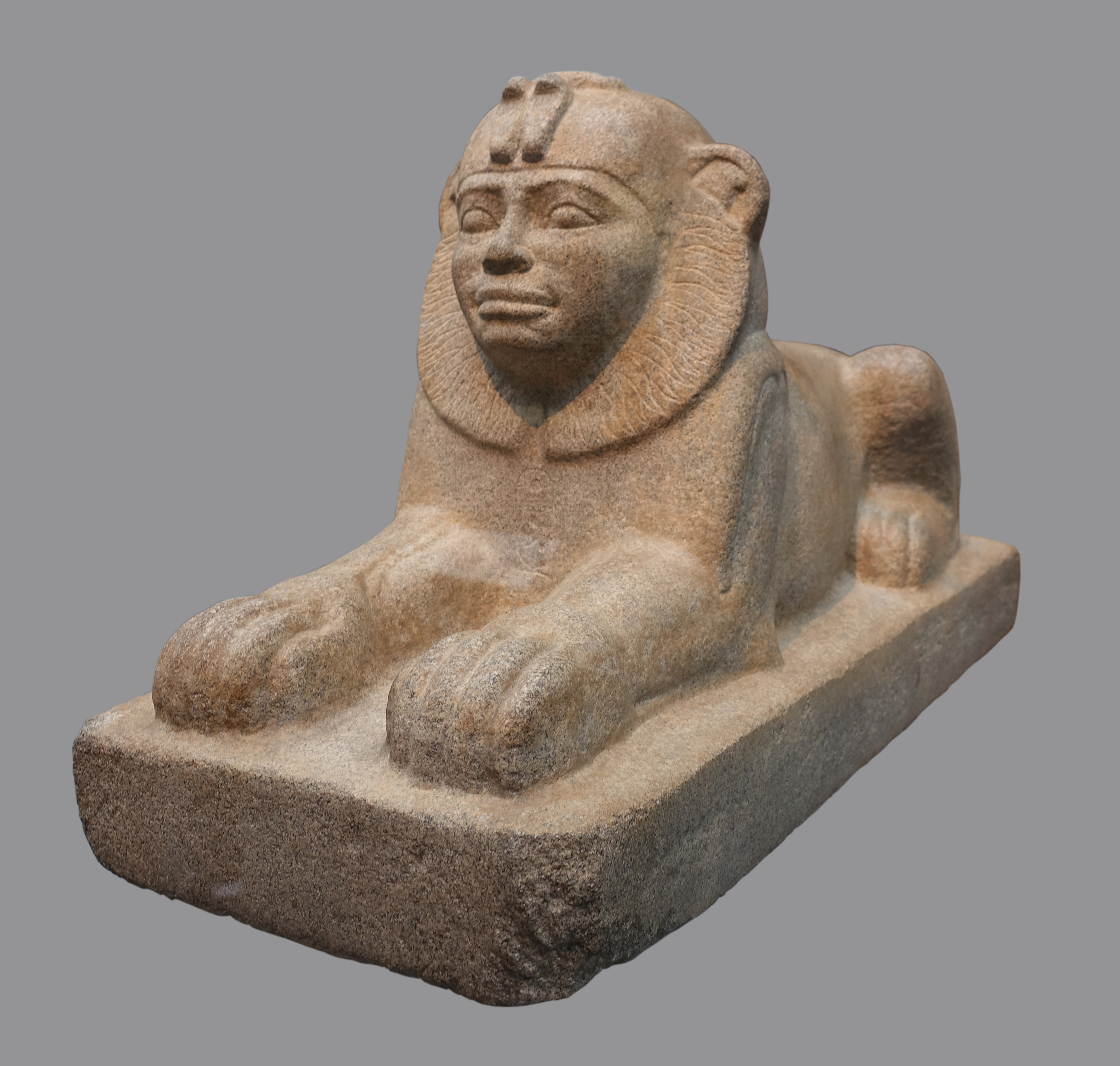
25th Dynasty / Nubian Dynasty / Kushite Empire: 746 BC - 656 BC
King Taharqo
From Kawa, Temple T, Kushite, Napatan, Circa 680 BC.
The framing of the face with a lion's mane is a feature borrowed from Egyptian royal sculpture of the Middle and New Kingdoms. The double uraeus, the cap-like headdress and the vigorous carving of the king's facial features are purely Nubian in inspiration.
Granite (probably granite gneiss) sphinx of Taharqo wearing skull-cap and double-uraeus; cartouche on breast.
Height 406 mm, length 730 mm.
Following the Egyptian withdrawal from Nubia at the end of the New Kingdom, a number of small political entities rapidly established themselves in the ensuing power vacuum. In the course of the three centuries after the Egyptians withdrew, these various small entities were gradually united into the second kingdom of Kush.
The second kingdom of Kush was very Egyptianised, acknowledging Amun as their principal deity, and using Egyptian modes of art and writing. In the eighth century BC they turned the tables on Egypt and acquired control of Upper Egypt, extending full control over the whole of the land at the beginning of the reign of Shabaka (circa 716 - 702 BC).
Kawa in Upper Nubia (Sudan), 100 km south of the third Nile Cataract, was the home of a local form of Amun, and was one of the sites at which the kings of the Kushite Twenty-fifth Dynasty constructed temples. One of their aims was apparently to ensure the prominence of this deity. This statue was found to the south of the central shrine of Temple T at Kawa, in a room at the western end of which was a raised dais, presumably for a throne, on which might have been placed a seated statue of Amun. No such statue survived, though this sphinx and parts of several others did.
Sphinxes represent the immense power of the Egyptian and Kushite king. While the body of this example is conventional, the head in particular looks back to the earlier sculptural forms of the Middle Kingdom, particularly noticeable in the careful depiction of the raised ruff of hair around the animal's neck, which resembles those of the well-known sphinxes of King Amenemhat III from Tanis (Cairo, CG 393, 394).
Compare also the now-modified mane of the sphinx of Amenemhat IV (registration no. 1928,0114.1). The features are characteristic of the Twenty-fifth Dynasty, and might be a stylised portrait of king Taharqa (690 - 664 BC), whose name is incised between the forepaws. The double uraeus cobra on the brow is characteristic of the royal insignia of the kings of Kush. Also highly distinctive of the art of this period are the pronounced furrows flanking the nose.
Kawa was originally founded in the New Kingdom, perhaps even by Akhenaten, which may explain the source of the word aten in its Egyptian name, Gematen; the earliest buildings yet discovered date from Tutankhamun's reign. The site rose to prominence during the Kushite period in the eighth century BC, and excavations have revealed the town and temples there. Temple T was constructed of sandstone blocks by Taharqa, starting in the sixth year of his reign; the building work took four years, and was undertaken by architects and builders brought all the way from Memphis in Egypt.
Catalog: EA1770
Photo: Don Hitchcock 2018
Text: Card with the display at the British Museum, http://www.britishmuseum.org/, © Trustees of the British Museum, CC BY-NC-SA 4.0
Source: Original, British Museum
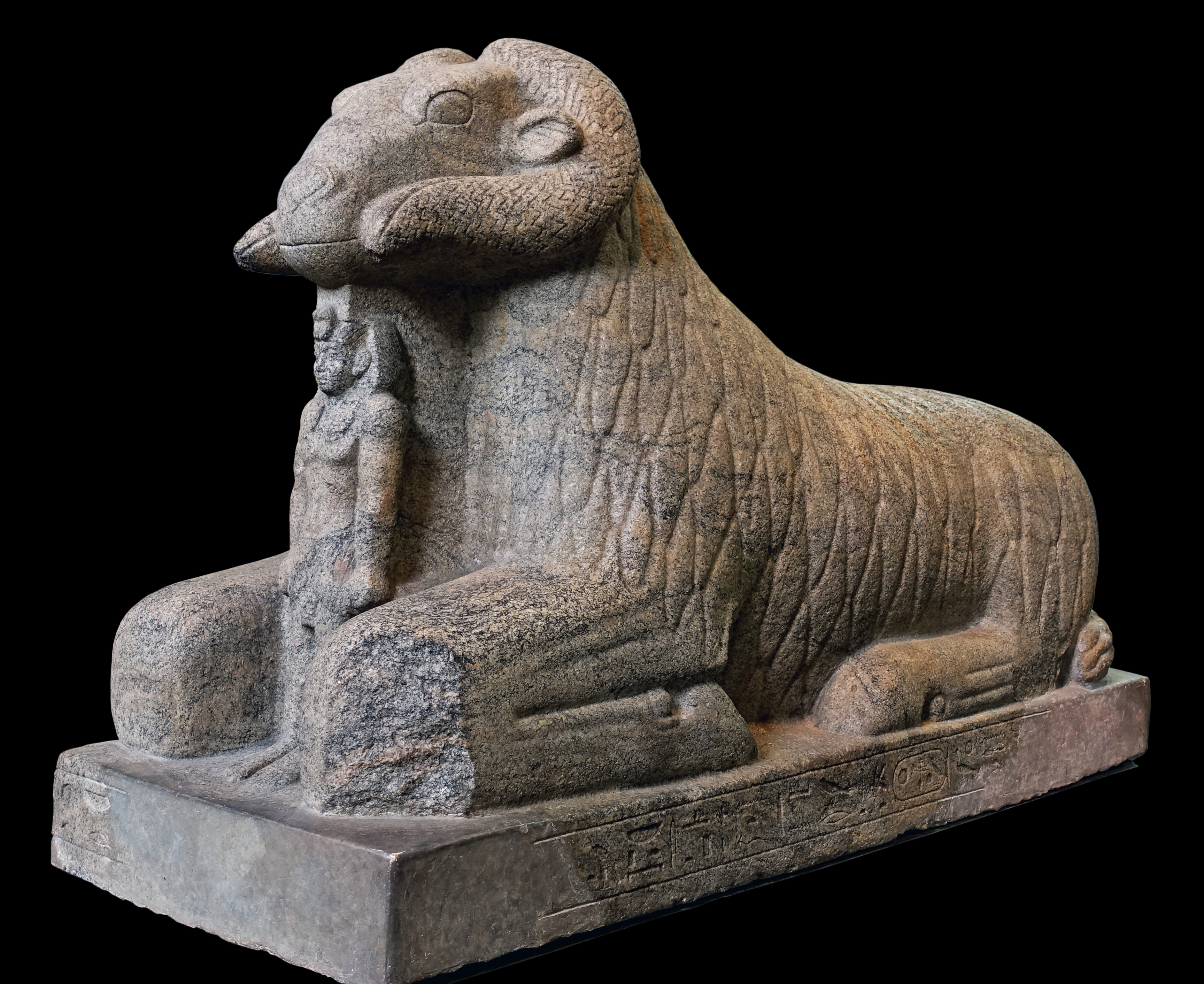
25th Dynasty / Nubian Dynasty / Kushite Empire: 746 BC - 656 BC
King Taharqo
Granitic gneiss sphinx of the ram of Amun protecting a standing figure of Taharqo between folded front legs. The rectangular base, which has been partially restored, is inscribed with a continuous horizontal register of hieroglyphs.
A hole in the top of the ram's head indicates where a gilded disk would originally have fitted. A hieroglyphic inscription runs round the sides of the plinth from front to back and proclaims Taharqa as the son of Amun and Mut, Lady of Heaven, 'who fully satisfies the heart of his father Amun'.
Production date 690 BC - 664 BC
The ram represents the creative and protective powers of the god Amun. By placing the king under the ram's chin, the sculpture visually reinforces divine shelter, cosmic authority, and the legitimacy of the Kushite rulers.
Height 106 cm (max), length 163 cm (base), width: 63 cm (base)
Named in inscription & portrayed: Amun, Taharqo
Findspot: Northern Nile, Northern Dongola Reach.Kawa, Temple T
Catalog: Granitic gneiss, EA1779
Photo: Don Hitchcock 2018
Text: Card with the display at the British Museum, http://www.britishmuseum.org/, © Trustees of the British Museum, CC BY-NC-SA 4.0
Additional text: Wikipedia
Source: Original, British Museum
This is the 18th Dynasty Block Statue of Senenmut, showcasing his shaved head and the detailed vertical hieroglyphic inscriptions on the back-pillar. It is currently housed at the Luxor Museum in Egypt
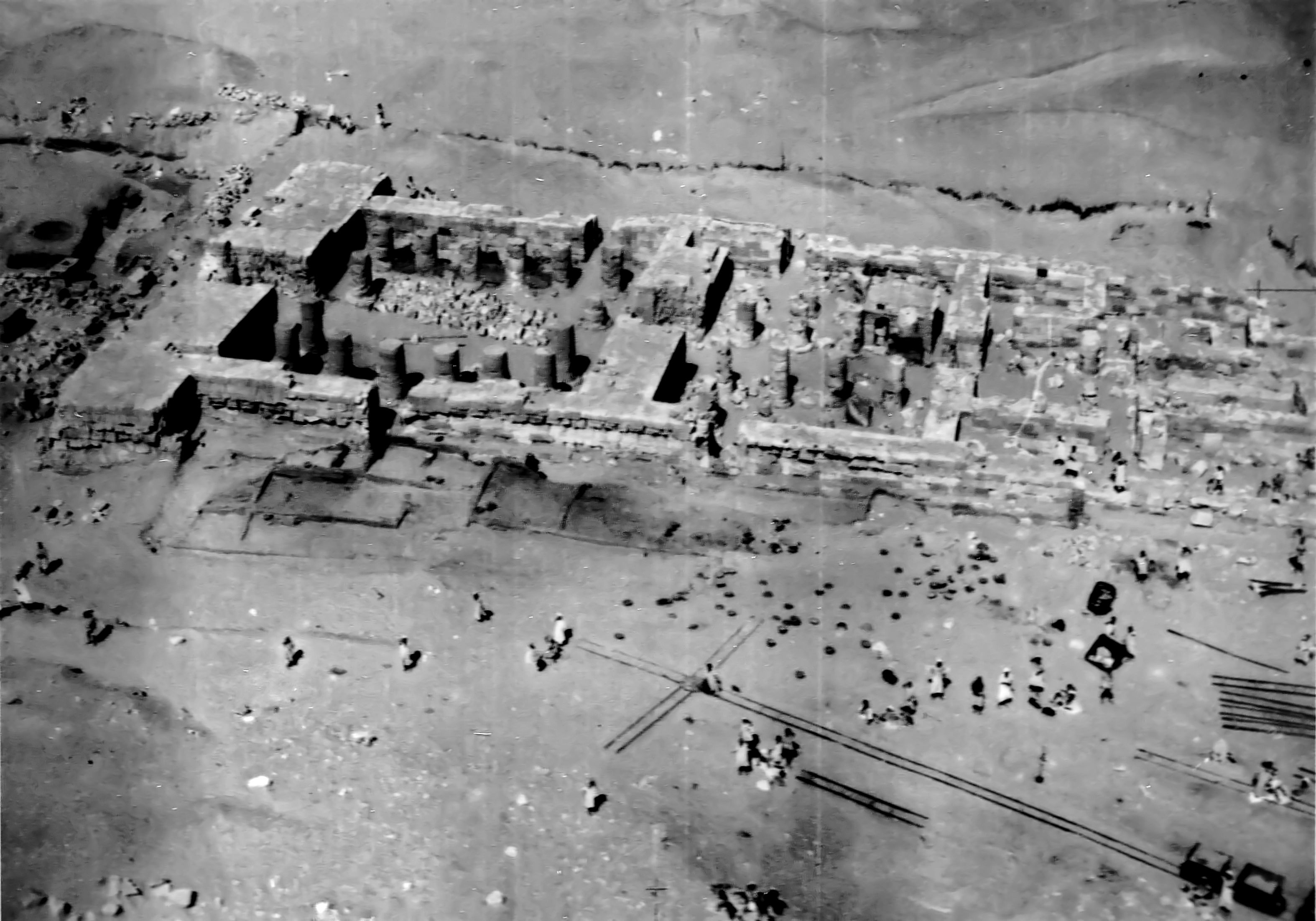
Aerial view taken by the Royal Air Force in the winter of 1935 - 1936 during the excavations of the Taharquo / Taharqo temple by the Oxford Excavation Committee.
Courtesy of the Institute of Archaeology UCL.
Photo: Institute of Archaeology UCL, poster at the British Museum
Rephotography: Don Hitchcock 2015
Text: Poster at the British Museum, © Trustees of the British Museum, CC BY-NC-SA 4.0
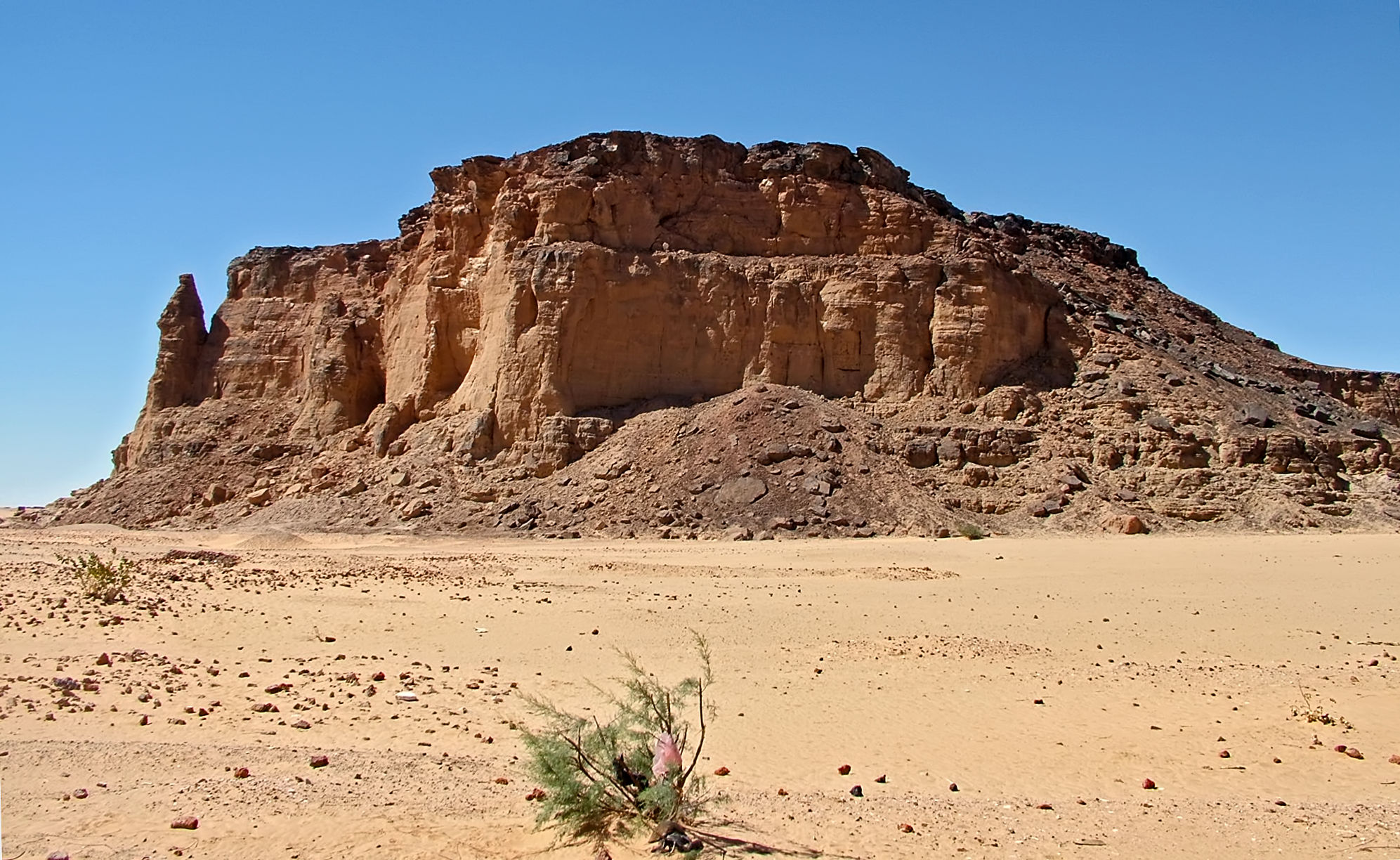
Gebel Barkal (or Jebel Barkal ) is a very small mountain located some 400 km north of Khartoum, in Karima town in Northern State in Sudan, on a large bend of the Nile River, in the region called Nubia. The mountain is 98 m tall, has a flat top, and apparently was used as a landmark by the traders in the important route between central Africa, Arabia, and Egypt, as the point where it was easier to cross the great river.
It was a religious centre and the seat of Amin. Beginning in the 26th Dynasty, Nubian rulers built many temples at the foot of its slopes.
Photo: LassiHU
Permission: GNU Free Documentation License
Text: Wikipedia
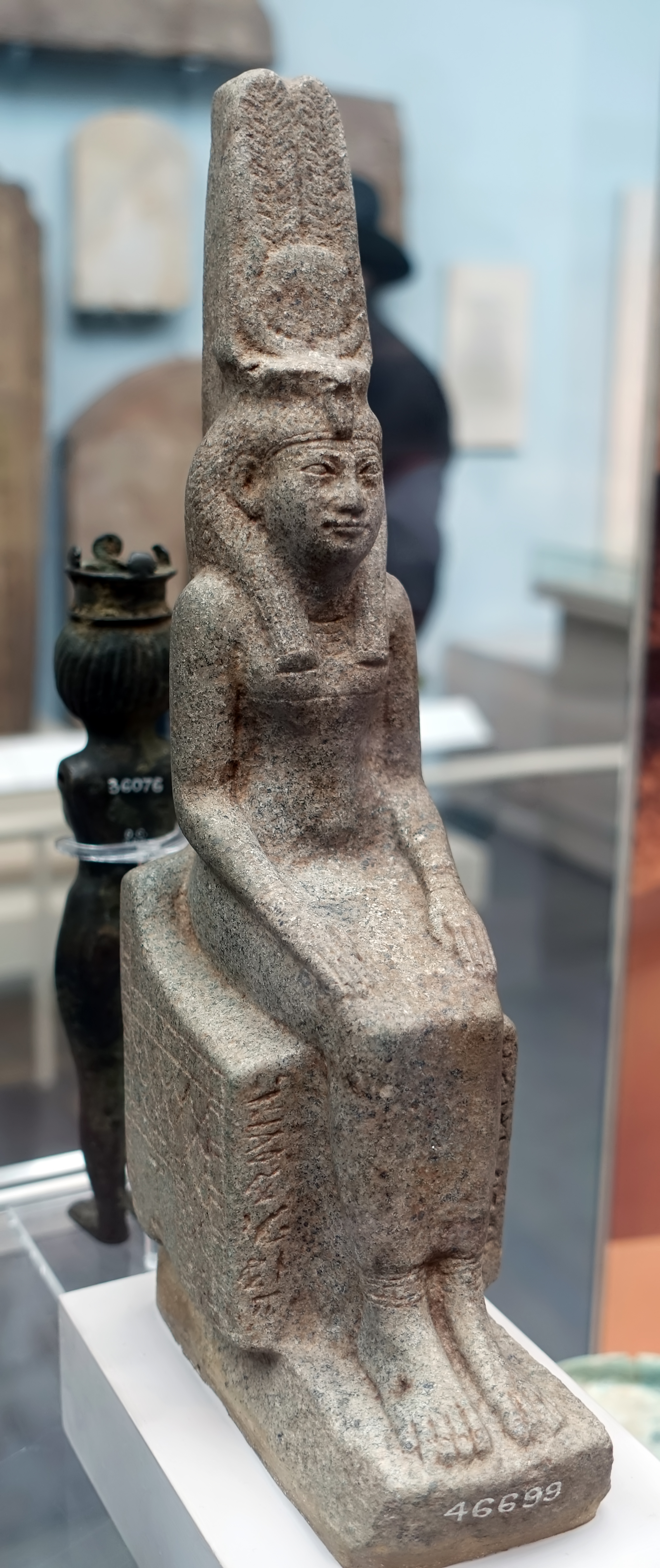
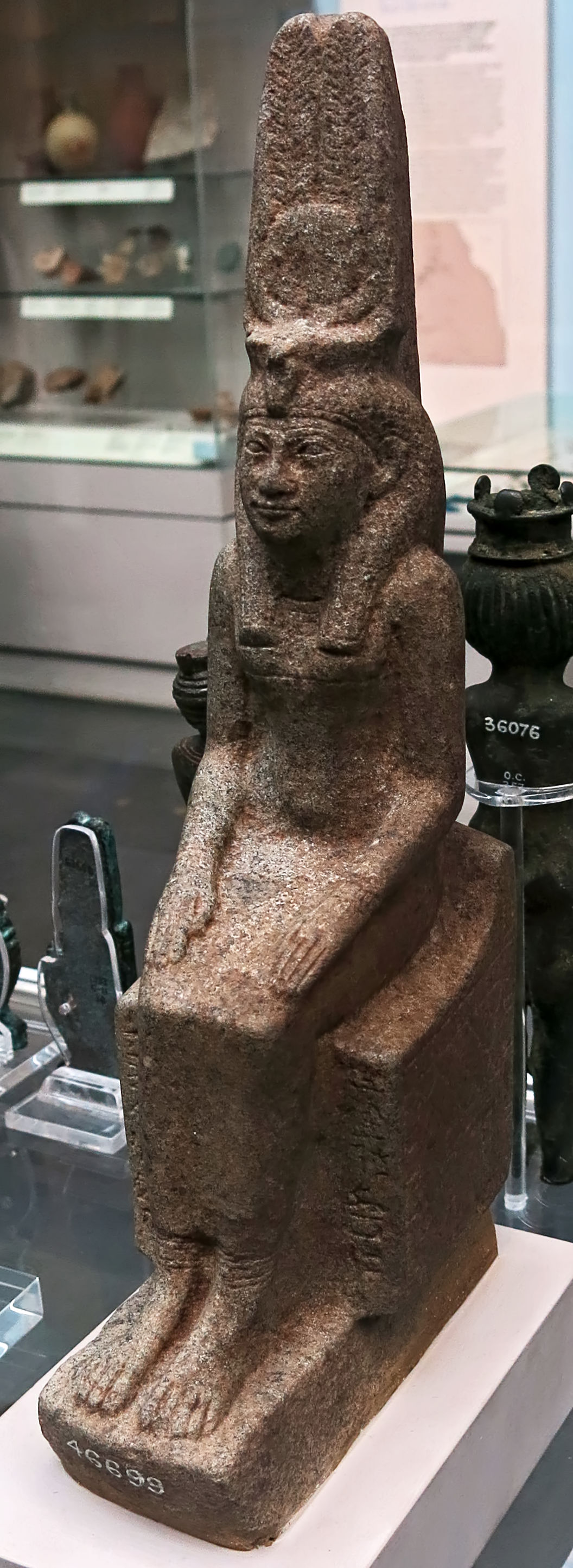
25th Dynasty / Nubian Dynasty / Kushite Empire: 746 BC - 656 BC
Amenirdis I
Granite statuette of Amenirdis I, 25th Dynasty.
From Kawa, Temple 'T', circa 700 BC - 656 BC
Amenirdis, daughter of King Kasha, was the first female member of the Nubian royal family to be appointed to the office of 'God's Wife of Amun' at Thebes. She was adopted by Shepenupet I as her heir and successor. She went on to rule as high priestess, and has been shown in several artefacts from the period.
Amenirdis was a Kushite princess, the daughter of Pharaoh Kashta and Queen Pebatjma. She is likely to have been the sister of pharaohs Shabaka and Piye. Kashta arranged to have Amenirdis I adopted by the Divine Adoratrice of Amun, Shepenupet I, at Thebes as her successor. This shows that Kashta already controlled Upper Egypt prior to the reign of Piye, his successor.
Amenirdis ruled as high priestess approximately between 714 BC and 700 BC, under the reigns of Shabaka and Shabataka, and she adopted Piye's daughter Shepenupet II as her successor. She also held the priestly titles of Divine Adoratrice of Amun and God's Hand. Upon her death, she was buried in a tomb in the grounds of Medinet Habu.
Shepenupet I was an ancient Egyptian high priestess during the reign of the 23rd Dynasty. She was the first 'hereditary' God's Wife or Divine Adoratrice of Amun to wield political power in ancient Thebes and its surrounding region.
Shepenupet I was the first to take on complete royal titulary with names in two cartouches, and although her successors followed her example, she remained the only one who also bore the royal titles 'Lord of the Two Lands' and 'Lord of Appearances', also, the only one whose throne name refers to Amun, not to his wife Mut.
Shepenupet I was the daughter of Osorkon III and Queen Karoadjet, and the (half- )sister of Takelot III and Rudamun. She was God's Wife during her father's whole reign.
When Kashta, a monarch of the 25th Dynasty, extended his influence to the Theban area, Shepenupet I was compelled to adopt Kashta's daughter Amenirdis I as her successor and name her as her chosen heir. Shepenupet and Amenirdis are depicted together in Wadi Gasus.
Height 277 mm, width 65 mm, length 110 mm
Catalog: EA46699
Photo: Don Hitchcock 2018, 2015
Source: Original, British Museum
Text: Card with the display at the British Museum, http://www.britishmuseum.org/, © Trustees of the British Museum, CC BY-NC-SA 4.0
Additional text: Wikipedia
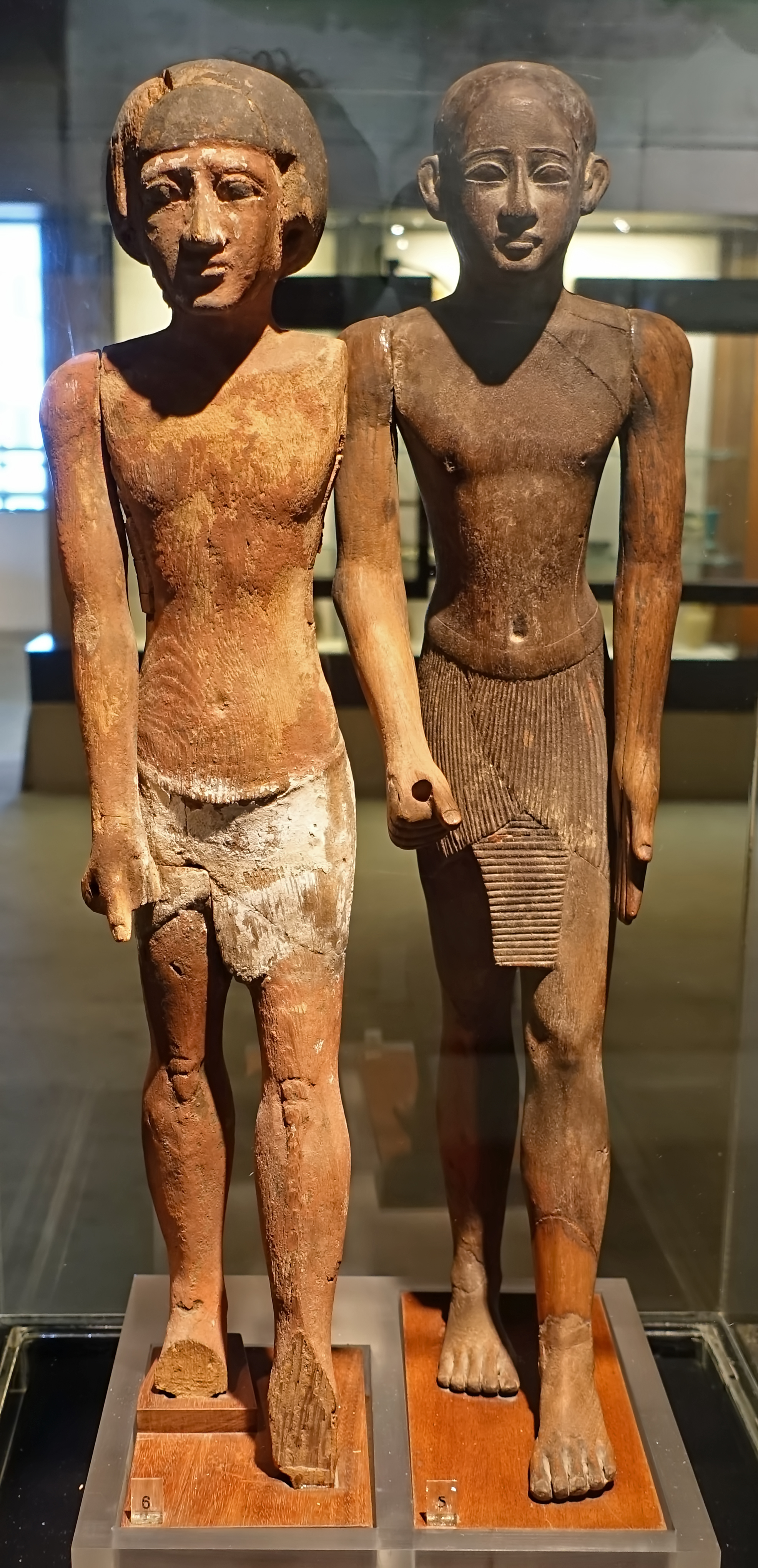
25th Dynasty / Nubian Dynasty / Kushite Empire: 746 BC - 656 BC (right)
Sixth Dynasty: 2 345 BC - 2 181 BC (left)
Statuettes of two men
(left) Circa 2190 BC
(right) Circa 700 BC
Wood was the most common material for funerary statuettes throughout Egyptian history. However, it was not worth less than stone, because good wood is rare in the Nile Valley and had to be imported at great expense.
Circa 1500 years after the carving of the statuette on the left, the one on the right was created, but with great similarity, perhaps as a result of archaism at that time. The face and the back are recent additions from old wood of the 4th century BC.
Catalog: Wood, unknown origin, (left) Inv. Nr. 1925.223 (right) Inv. Nr. 1925.236
Photo: Don Hitchcock 2018
Source and text: Original, Museum August Kestner, Hannover
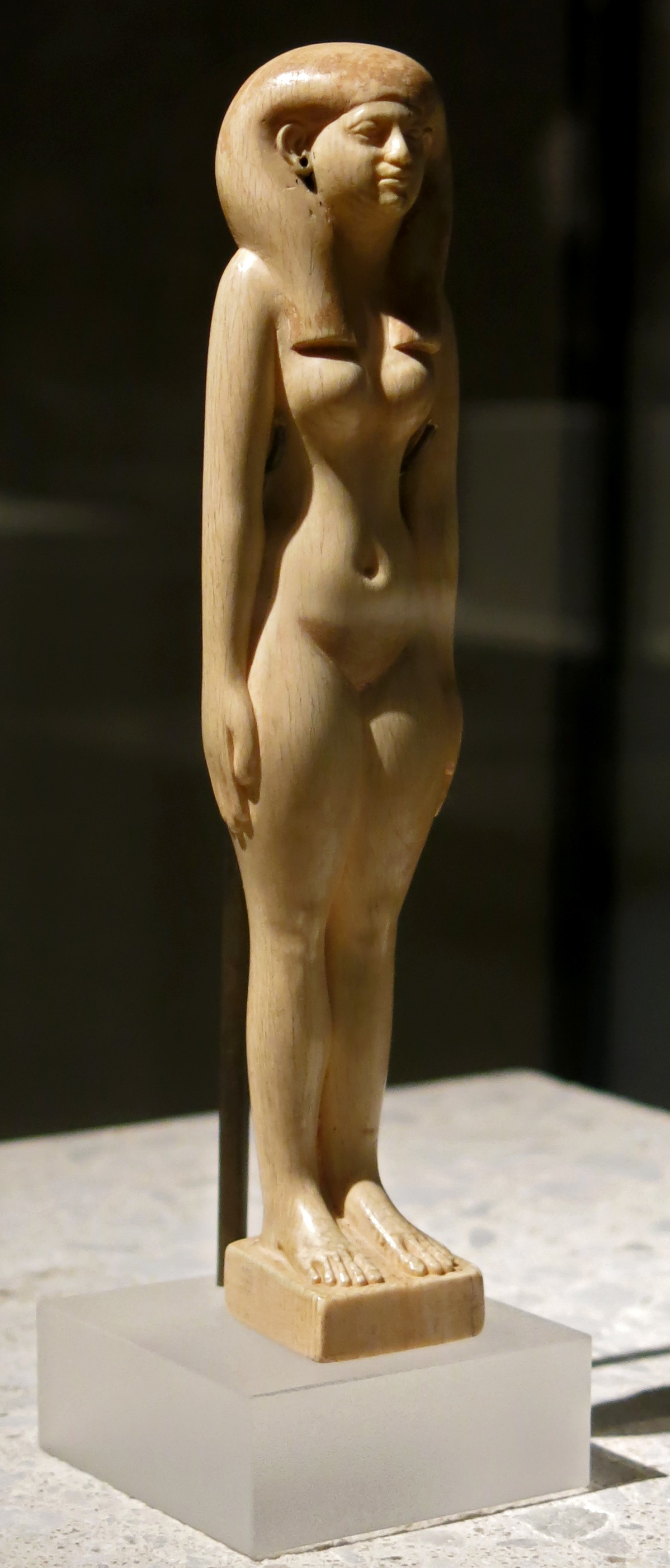

25th Dynasty / Nubian Dynasty / Kushite Empire: 746 BC - 656 BC
Tadja
Standing figure of Tadja, circa 700 BC.
Dimensions: 155 x 36 x 25 mm, weight 90.65 g
The figure, made of ivory, shows an unclothed woman standing with narrow, parallel legs on a small base. On her head she wears a beaded wig, whose strands end just above the breast. On the wig have been sculpted large ears with ear holes, which still carry silver remnants of earrings. The broad, round face, which passes into a short neck, contains finely detailed small eyes, with eyebrows. The nose is broad and flat, the lips large and full. The arms are attached to the sides of the body and the large hands lie on the round thighs.
She has hemispherical breasts and a high waist that transitions to wide hips. From the sternum to the large navel, the linea alba (a fibrous structure that runs down the midline of the abdomen) is hinted at. A large, painted triangle forms the pubic triangle. The knees are shown and there is a gap between the knees. The pillar-like calves pass into the feet with long toes, without noticeable definition at the ankle.
Above the round buttocks, small dimples are formed.
The figurine was found in the tomb of Tadja in the necropolis of Abusir el-Meleq.
The figure as well as the wooden statue ÄM 16999 belong to the grave of the Tadja from the necropolis of Abusir el-Meleq. Her grave goods are kept in the Egyptian Museum in Berlin under the inventory numbers ÄM 16956 to 17015.
Catalog: Elephant ivory, formerly painted, Abusir el-Meleq, ÄM 17000
Photo: Don Hitchcock 2015, 2018
Source: Original, Staatliche Museen zu Berlin, Neues Museum, Germany
Text: © Card at the Staatliche Museen zu Berlin, http://www.smb-digital.de/ , (CC BY-NC-SA 3.0 DE)
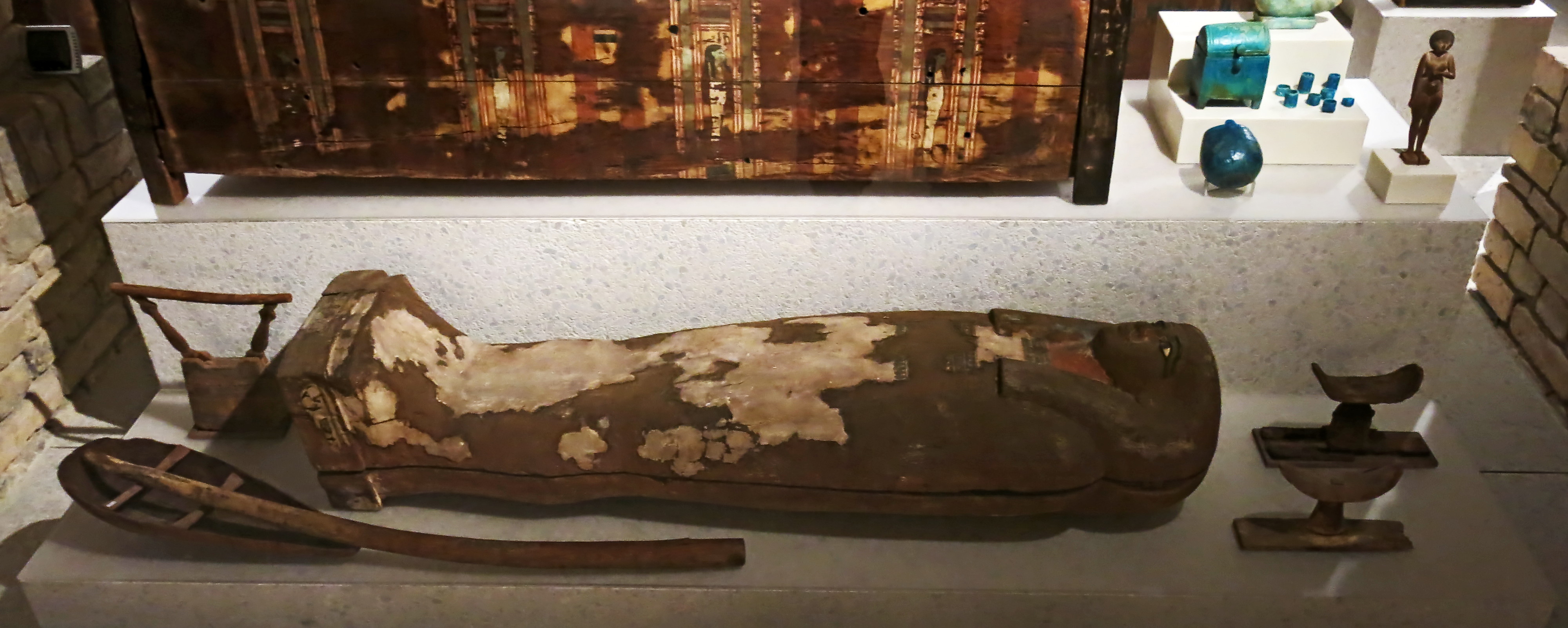
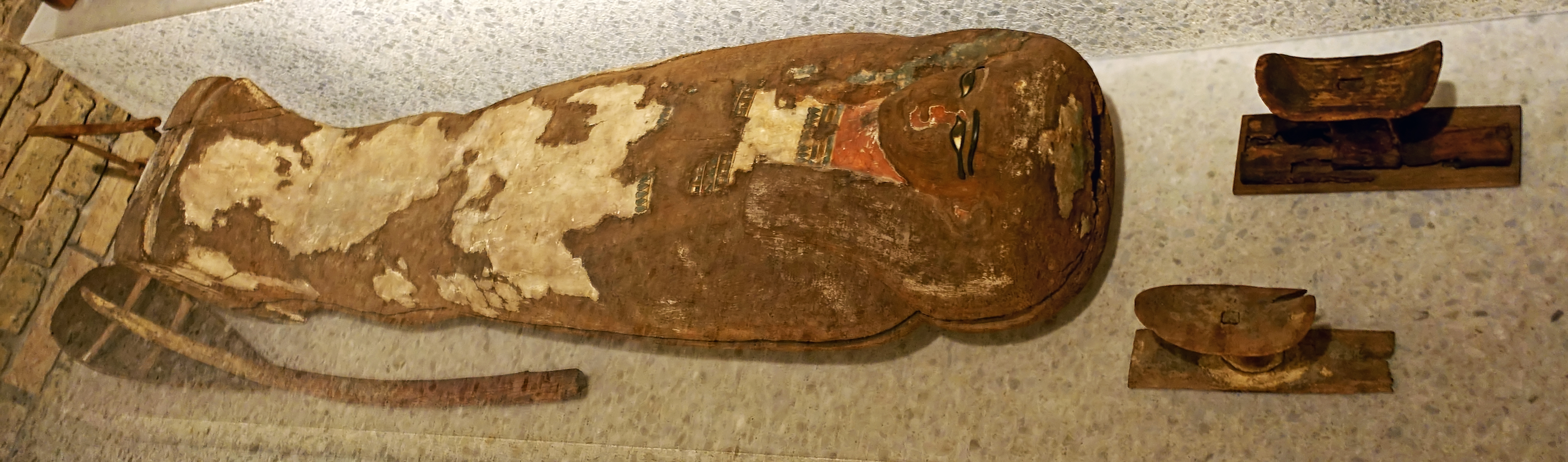
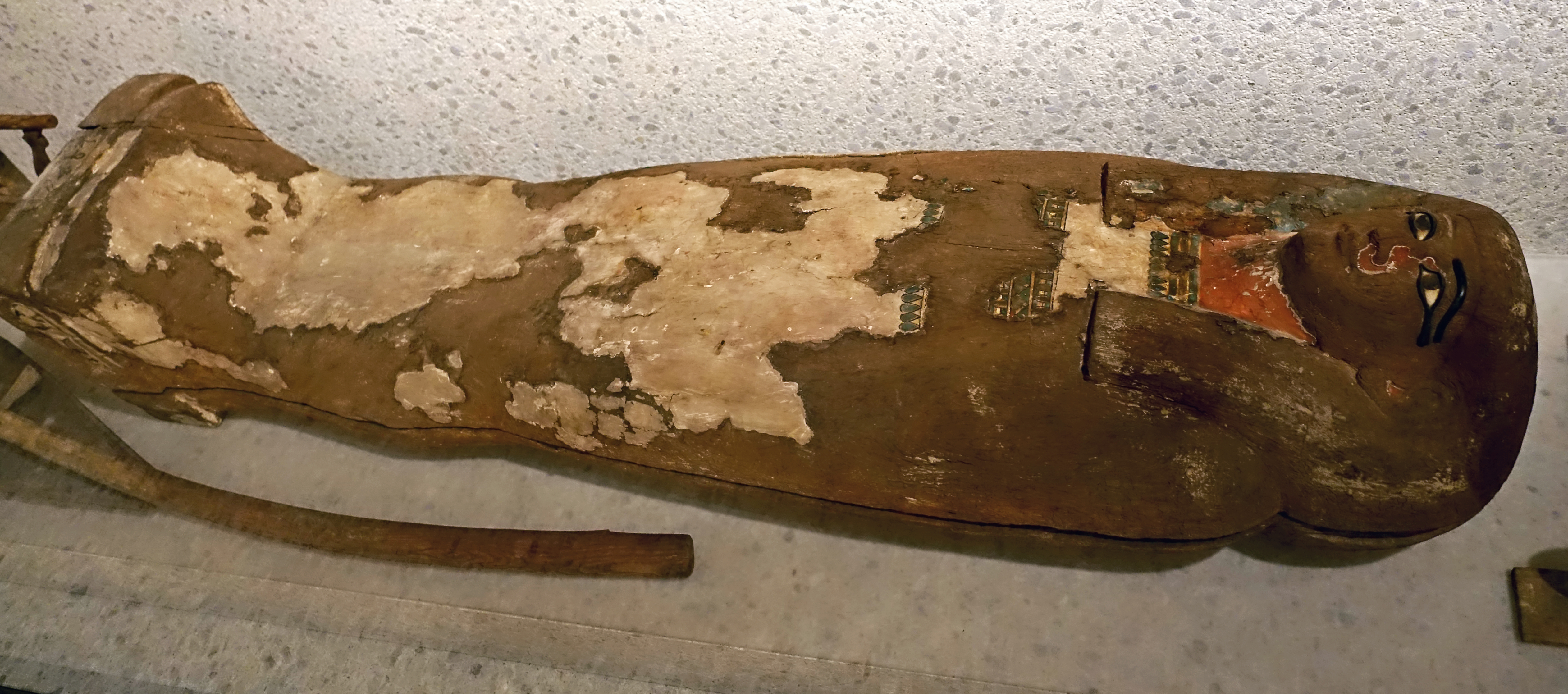
25th Dynasty / Nubian Dynasty / Kushite Empire: 746 BC - 656 BC
Tadja
Anthropoid inner coffin of the girl Tadja.
Circa 750 BC.
Catalog: Abusir el-Meleq, Tomb of Tadja, wood, ÄM 16998
Photo: Don Hitchcock 2015, 2018
Source: Original, Staatliche Museen zu Berlin, Neues Museum, Germany
Text: © Card at the Staatliche Museen zu Berlin, http://www.smb-digital.de/, (CC BY-NC-SA 3.0 DE)
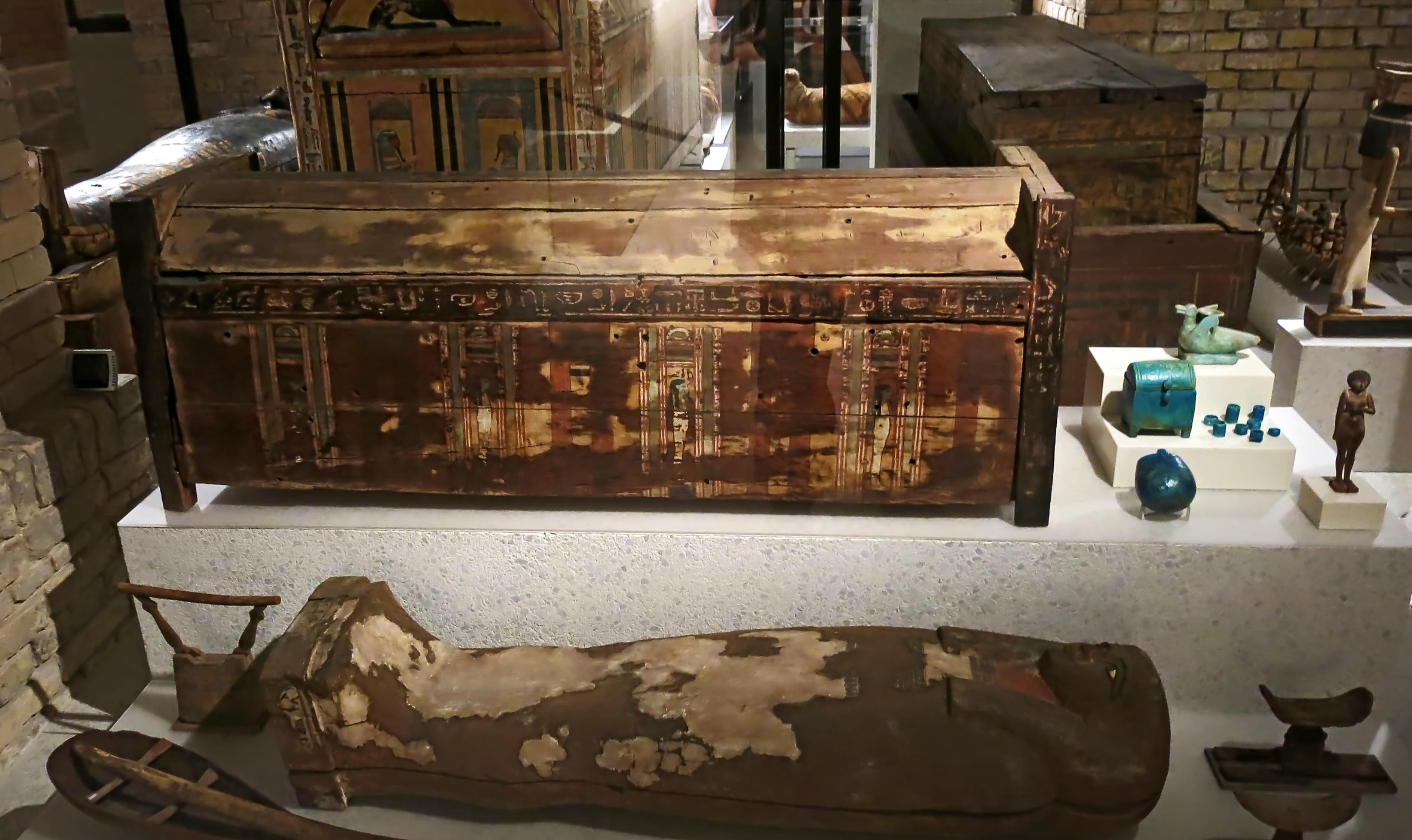
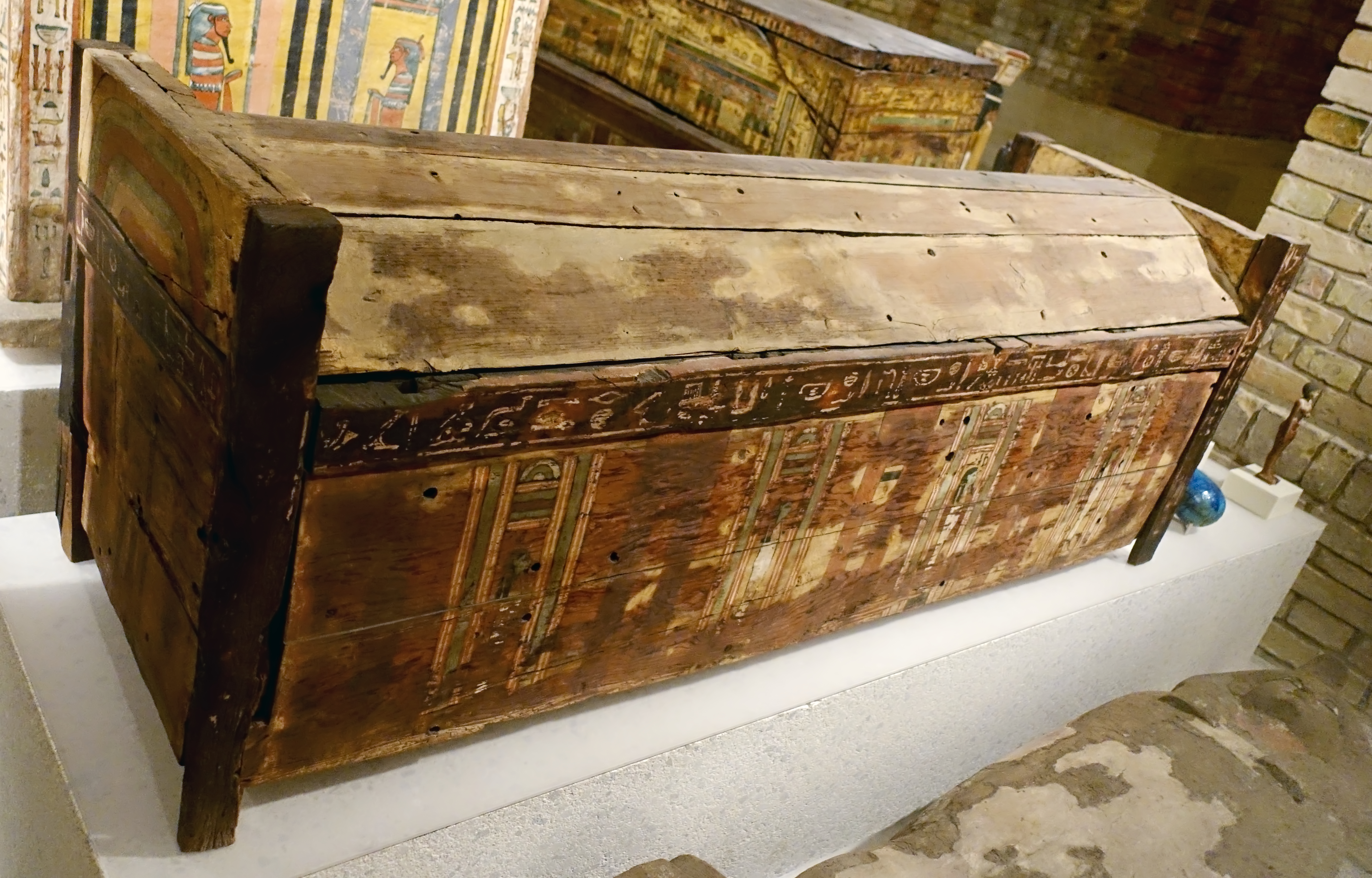
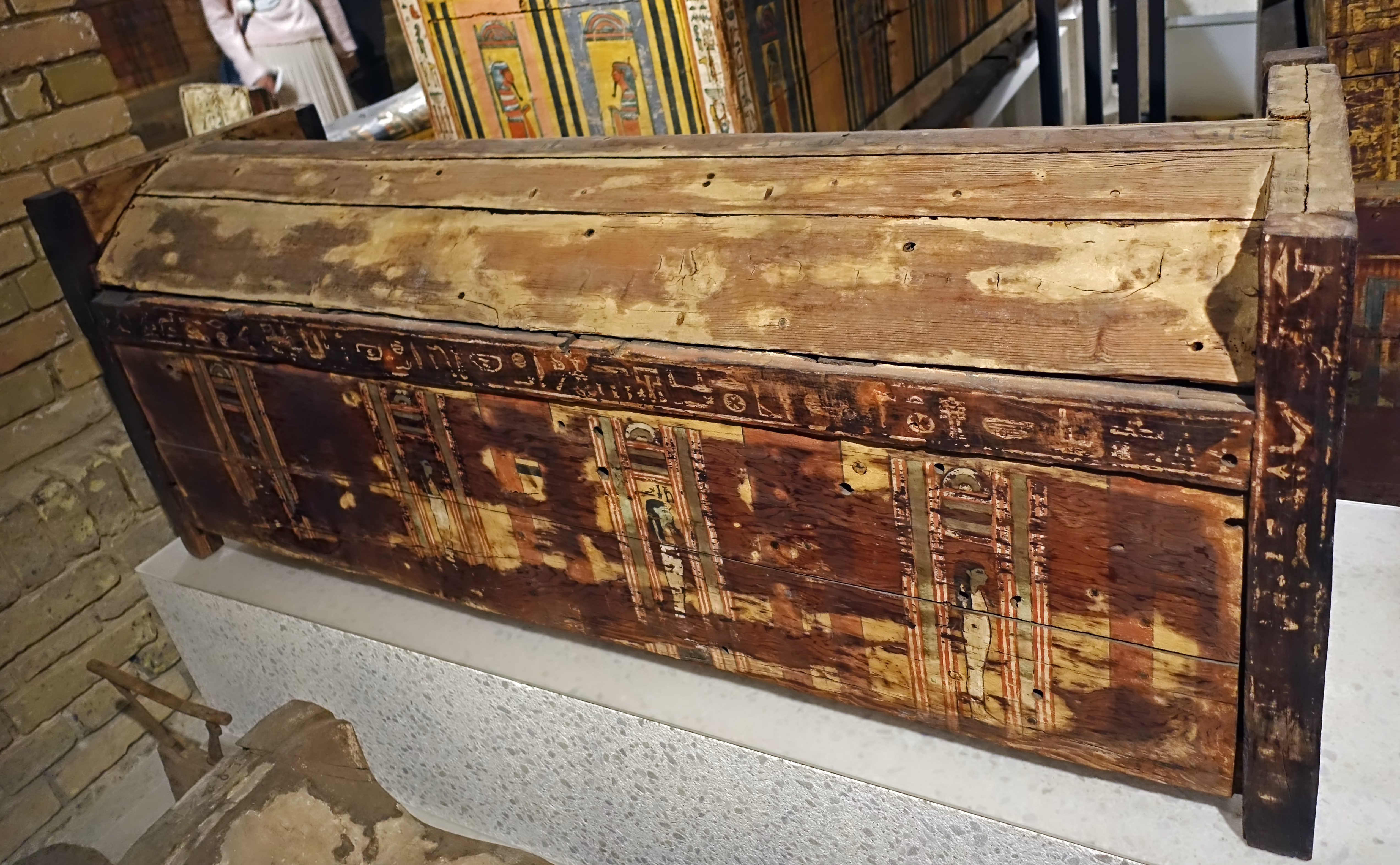
25th Dynasty / Nubian Dynasty / Kushite Empire: 746 BC - 656 BC
Tadja
Rectangular outer corner post coffin of the girl Tadja.
Circa 750 BC.
Catalog: Abusir el-Meleq, Tomb of Tadja, wood, ÄM 16997
Photo: Don Hitchcock 2015, 2018
Source: Original, Staatliche Museen zu Berlin, Neues Museum, Germany
Text: © Card at the Staatliche Museen zu Berlin, http://www.smb-digital.de/, (CC BY-NC-SA 3.0 DE)
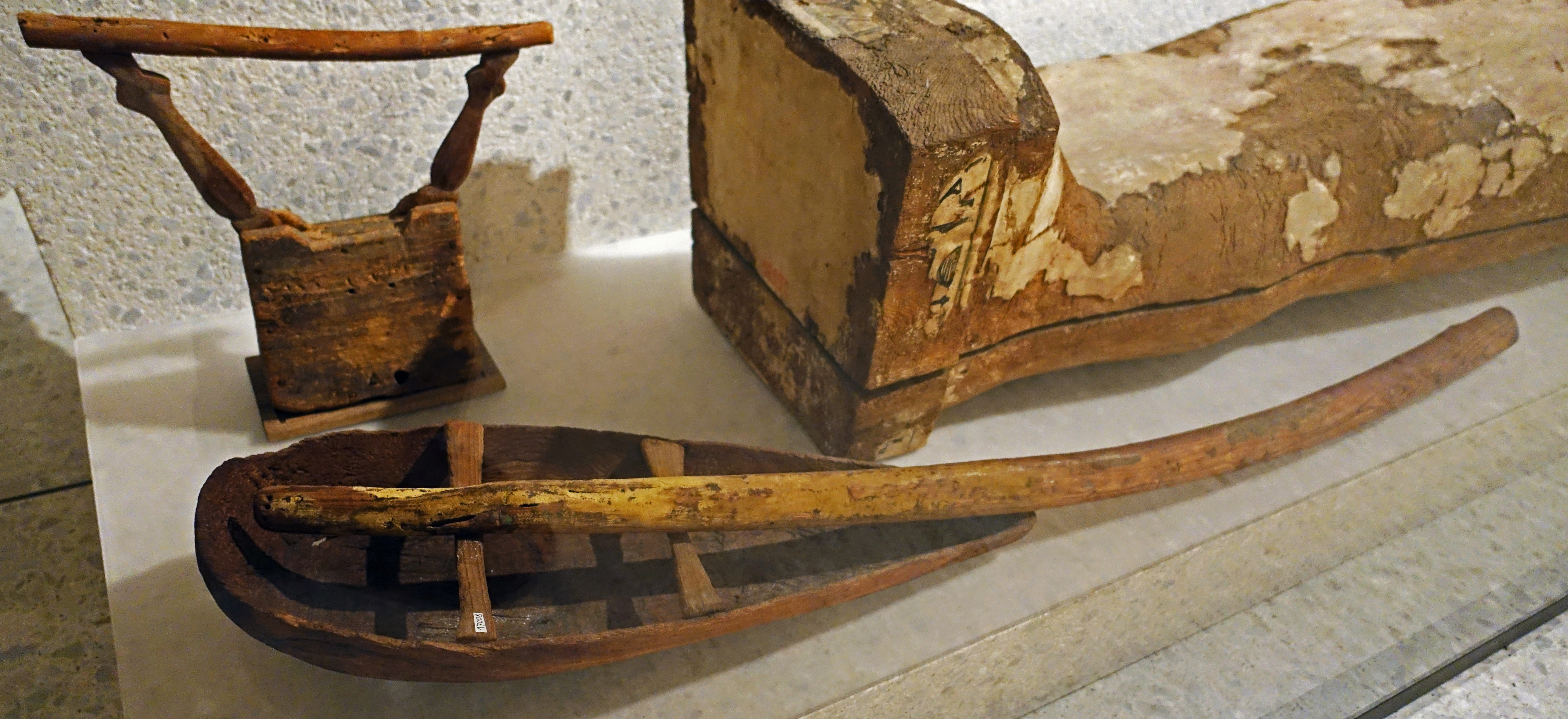
25th Dynasty / Nubian Dynasty / Kushite Empire: 746 BC - 656 BC
Tadja
Grave goods - musical instruments, a lyre and a lute, circa 750 BC.
( note that like many such grave goods, these were not functioning pieces, but representations only, much as the shabtis represented the servants who would magically come to life to look after the needs of the Pharaoh - Don )
Catalog: Abusir el-Meleq, Tomb of Tadja, wood, ÄM 17007/1, ÄM 17008
Photo: Don Hitchcock 2018
Source: Original, Staatliche Museen zu Berlin, Neues Museum, Germany
Text: © Card at the Staatliche Museen zu Berlin, http://www.smb-digital.de/, (CC BY-NC-SA 3.0 DE)

25th Dynasty / Nubian Dynasty / Kushite Empire: 746 BC - 656 BC
Tadja
Burial goods: Jewellery box with lid, various decorated rings of the girl Tadja, as well as vessels in the form of a basket and in the shape of a bird.
Circa 750 BC.
Catalog: Abusir el-Meleq, Tomb of Tadja, wood, ÄM 16994, ÄM 16956, ÄM 16959, ÄM 16961, ÄM 16964-7, ÄM 16970-1, ÄM 16995, ÄM 16996
Photo: Don Hitchcock 2018
Source: Original, Staatliche Museen zu Berlin, Neues Museum, Germany
Text: © Card at the Staatliche Museen zu Berlin, http://www.smb-digital.de/, (CC BY-NC-SA 3.0 DE)
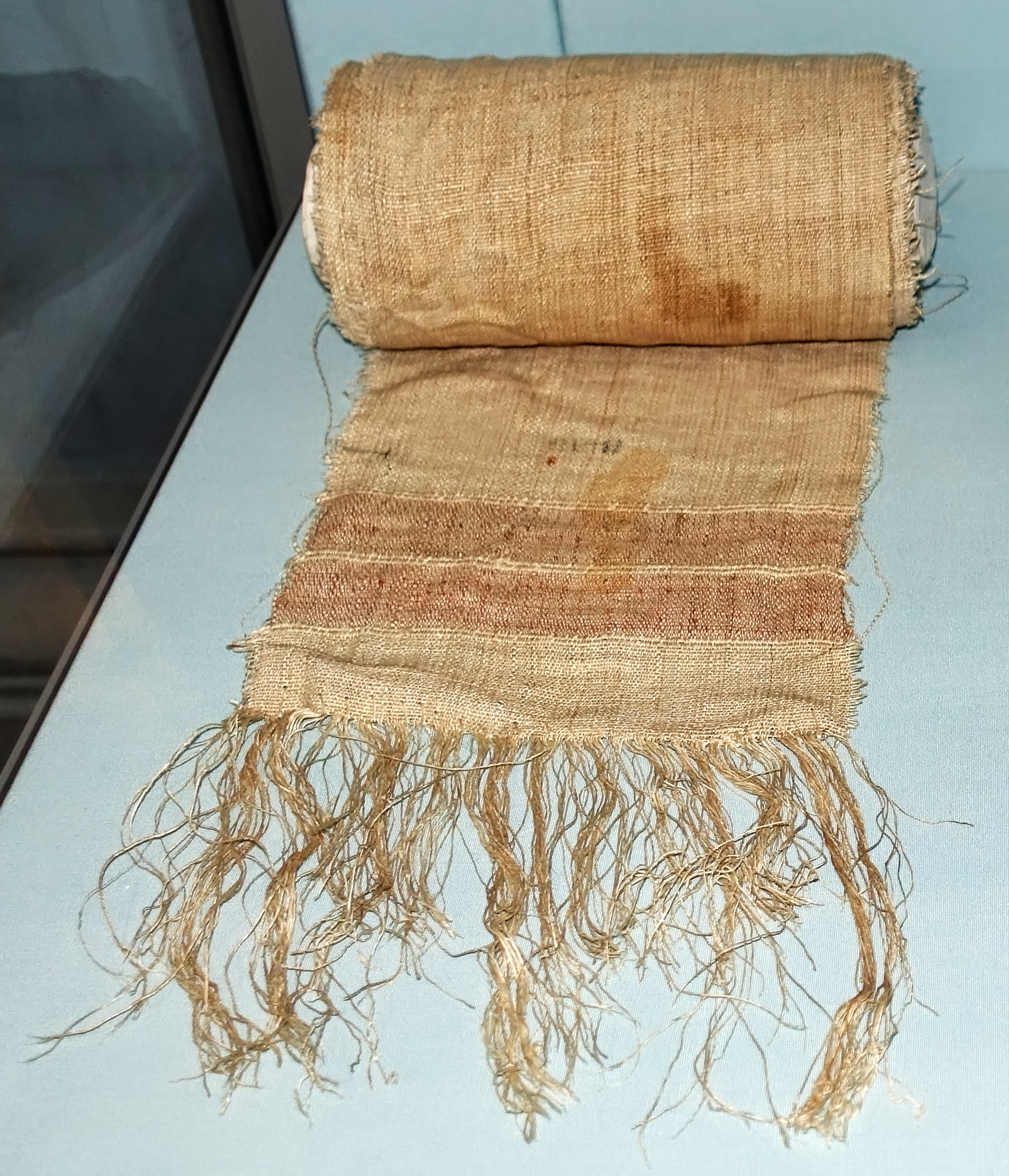
25th Dynasty / Nubian Dynasty / Kushite Empire: 746 BC - 656 BC
Funerary Cloth
Roll of linen from the mummy of Takush / Tai Kush.
This strip was taken from the mummy of a woman named Takush, which was unwrapped in 1843. The mummy and coffin are in the Maidstone Museum.
Textile fragment; long strip of linen cloth; medium-coarse quality. Undyed linen, cream to beige in places; threads naturally darker. Stained. Warp fringe (110 mm) at one end, loosely twisted into groups, the edge of the cloth being roughly oversewn to prevent unravelling; starting-border and three double self-bands alternating with two red bands at opposite end. The weave is plain [warp-faced simple tabby] and the threads are S-spun and S-spliced; the stitch gauge is warp c.28 ends per 10mm and weft 10 picks per 10mm. The sewing thread is S-spun and S-spliced; overcasting at the fringe. The weft in the bands makes it unclear as to whether it was dyed, pigmented or natural.
Dimensions: length 5260 mm, width 145 mm, fringe length 115 mm.
Catalog: Thebes, circa 680 BC, EA6518
Photo: Don Hitchcock 2018
Source: Original, British Museum
Text: Card with the display at the British Museum, https://www.britishmuseum.org/, © Trustees of the British Museum, CC BY-NC-SA 4.0
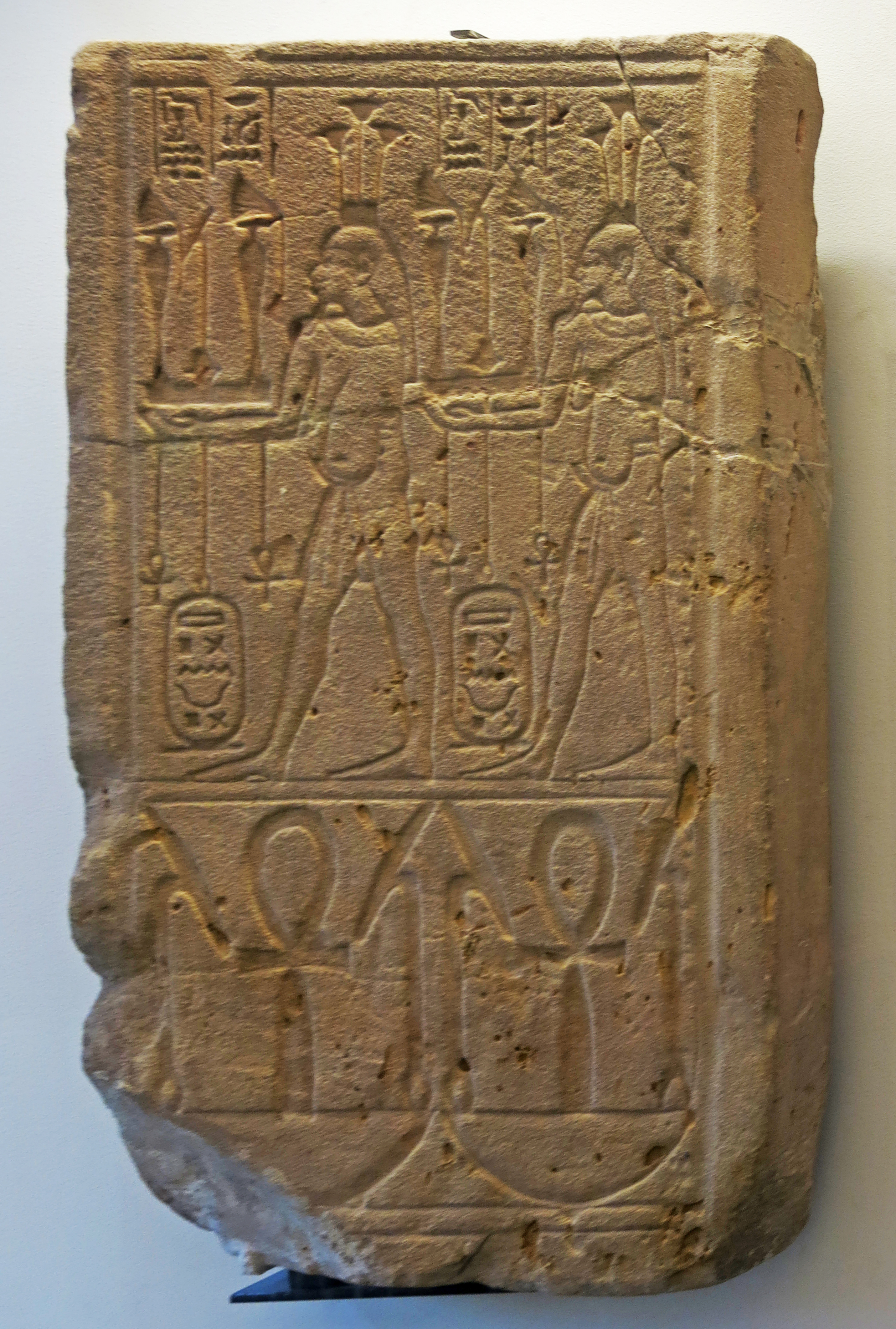
25th Dynasty / Nubian Dynasty / Kushite Empire: 746 BC - 656 BC
Spirits of the Nile flood
717 BC - 656 BC
Sandstone wall relief of the Spirits of prosperity (Hapi, the god of the flooding of the Nile, often depicted as two figures, and adorned with lotus or papyrus) bringing 'all good and pure things' on trays laden with libation vessels decorated with nenufar (white waterlily) flowers to the 'Divine Adorer of Amun, Shepenupet II'.
Hapi, the God of the flooding of the Nile, is typically depicted, as here, as an androgynous figure with a big belly and large drooping breasts, wearing a loincloth and ceremonial false beard.
Below, a frieze of signs: All life and power.
Height 870 mm, width 485 mm, thickness 90 mm.
Catalog: Sandstone, sunken relief, E 27208
Location: Room 336, Sully.
Photo: Don Hitchcock 2015, 2018
Source and text: Louvre Museum, Paris, France, https://collections.louvre.fr/en/ark:/53355/cl010014521
Additional text: Wikipedia
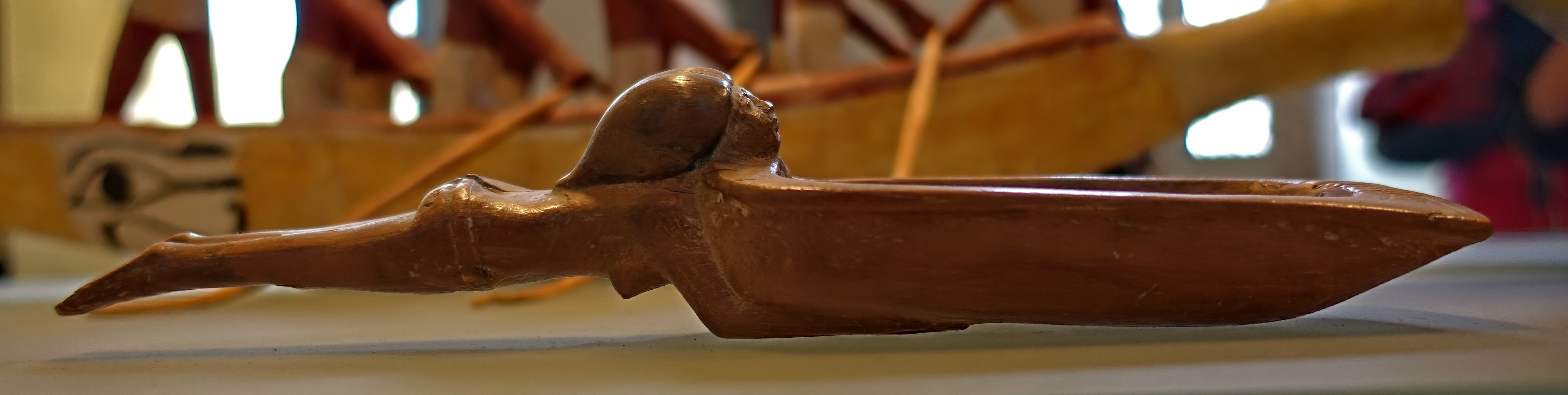

25th Dynasty / Nubian Dynasty / Kushite Empire: 746 BC - 656 BC
Spoon in the form of a swimmer
717 BC - 656 BC
Length 263 mm, width 62 mm.
Cosmetic spoon for rouge.
Catalog: Wood, unknown origin, N 1728
Photo: Don Hitchcock 2015, 2018
Source and text: Louvre Museum, Paris, France, https://collections.louvre.fr/en/ark:/53355/cl010014521

25th Dynasty / Nubian Dynasty / Kushite Empire: 746 BC - 656 BC
Shepenwepet II
Upper part of a serpentine shabti figure of the 'God's Wife of Amun', Shepenwepet II, wearing a diadem and holding a crook and flail.
Height 108 mm, width 63 mm, depth 47 mm.
Named in inscription: Shepenwepet II, Piankhy
Catalog: Medinet Habu (Thebes), EA65806
Photo: Don Hitchcock 2015
Source: Original, British Museum
Text: Card with the display at the British Museum, © Trustees of the British Museum, CC BY-NC-SA 4.0
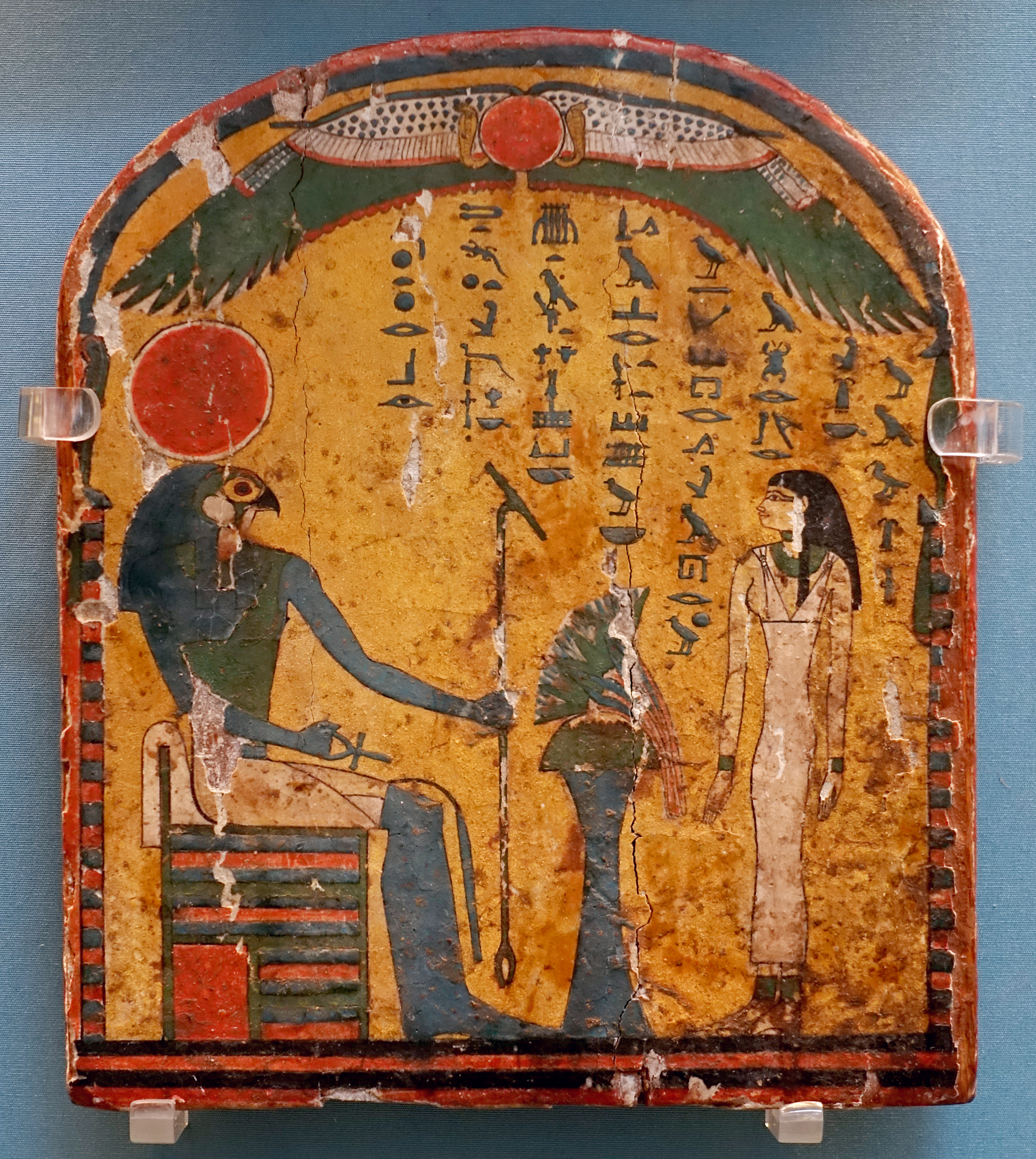
25th Dynasty / Nubian Dynasty / Kushite Empire: 746 BC - 656 BC
The lady Tj(en)tdiashakhet
Round-topped wooden stela: this painted round-topped stela has a scene on each side. On one side the god Ra-Horakhty is seated on the left behind an altar on which rest some lotus-flowers. The lady Tj(en)tdiashakhet stands on the right. Above are eight columns of text containing a prayer on behalf of the deceased and a winged sun-disk. The scene is bordered by a curved sky-sign at the top and the standards of the West and East on the left and right sides.
On the reverse the lady Tj(en)tdiashakhet is seated on the left. In front of her is an altar with offerings of bread, and on the right are a duck and three vases. Above are five lines of text consisting of a funerary invocation. The scene is bordered by a sky-sign at the top and the standards of the West and East on the left and right sides. The stela is well preserved apart from some cracks on the surface and loss of colour due to flaking in places. The background on both sides is bright yellow with a red border with two black lines on the bottom.
The sky-signs are blue, while the standards have red poles with blue bands, blue tops with green and red appendages, and green signs with blue details in the sign of the West. The sun-disk is red with yellow uraei. The upper wings are white with blue dots and a blue upper edge; the middle are white with black details; the lower are green with red edges apart from two patches of blue dots on white.
The disk of the god is red with a white border. His face is white, his beak black, his eye black on brown on yellow with green adjuncts, his wig and body are blue, his collar and upper garment green, and his kilt white. He carries a blue 'ankh' and a green 'was'-sceptre. The throne is composed of successive blue, red, blue, green bands, and a red lower-left corner all edged in green with white at the top. The altar is blue with a green top and red-stemmed blue lotuses with green leaves. The body of the lady on both sides is light yellow with black details. Her dress is white with black details, her wig is black, and her collar and bangles are green. The hieroglyphs on both sides are blue. On the reverse the lady sits on a black chair with green back covered in white and a green and red knob tied in white to the horizontal seat. It rests on a green pedestal. The altar is blue with red offerings. The vases are red with black tops and rest on blue stands with black tops. The entwining lotuses are indicated by black-edged stems with green and red buds. The duck has a white body with brown and black patches. The sides of the stela are painted red except for the bottom which is plastered in white.
Height 210 mm, width 176 mm, depth 16 mm, weight 455 gm.
Catalog: Painted wood, gesso, Thebes, EA65354
Photo: Don Hitchcock 2018
Source: Original, British Museum
Text: Card with the display at the British Museum, © Trustees of the British Museum, CC BY-NC-SA 4.0
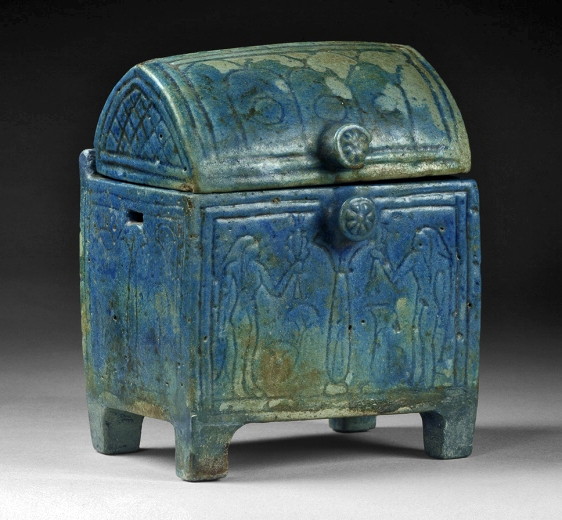
25th Dynasty / Nubian Dynasty / Kushite Empire: 746 BC - 656 BC
Tadja
Small blue faience box with lid from the tomb of Tadja, Tomb 5.
Dimensions: 134 x 107 x 92 mm.
From the rich grave inventory of Tadja from Abusir el-Meleq also comes this small jewellery box made of blue faience. It has a domed, removable lid and a rectangular box with four rectangular feet. The two parts are decorated with incised decorations and completely covered with a dark blue glaze. All image fields are framed by double lines. On the front of the box and the lid, each one decorated with a rosette knob is attached.
In the picture field on the front of the box, two females with Sistrums (frame rattles) flank a central, tapering papyrus column. Two papyrus plants are shown in front of the legs of the two sistrum players. Similarly, in the middle of the back of the box an upwardly tapering papyrus column, symmetrically mirrored to each side of a papyrus plant and a flying water bird are shown. The papyrus capital is consciously worked out semi-plastically and serves as a support surface for the hinge of the lid. Following the same decoration scheme, a papyrus column and flanking, stylised papyrus umbels adorn the two narrow sides of the box. Above the central papyrus column a transverse rectangular hole is inserted. Furthermore, the top of the lid is divided by the framing double lines into two rectangular image fields. Four stylised, upright standing papyrus umbels and three circles decorate the two display surfaces of the lid. The two gable-shaped fields on the narrow sides of the cover are decorated with cross-hatching.
The ornamentation of the jewellery box is striking, with the dominance of the motifs associated with the papyrus plant. The papyrus plant is at the same time the hieroglyph and symbol of 'green', 'thriving' and thus a salvific (salvation) sign. In addition to decorative purposes it could be attributed here an apotropaic (protection against evil) function. Furthermore, the papyrus is the coat of arms of Lower Egypt. The particular emphasis of the papyrus on the object may also be related to its origins in the Lower Egyptian town of Abusir el-Meleq.
Circa 750 BC.
Catalog: Abusir el-Meleq, Tomb of Tadja, Faience, ÄM 16994
Photo: Margarete Büsing, Staatliche Museen zu Berlin, Neues Museum, Germany, (CC BY-NC-SA 3.0 DE)
Source: Original, Staatliche Museen zu Berlin, Neues Museum, Germany
Text: © Card at the Staatliche Museen zu Berlin, http://www.smb-digital.de/, (CC BY-NC-SA 3.0 DE)
Additional text: I.Liao


25th Dynasty / Nubian Dynasty / Kushite Empire: 746 BC - 656 BC
Shepenupet II
Sphinx of Shepenupet II, god's wife of Amon, circa 660 BC.
Like their predecessors, the kings of the 25th Dynasty appointed princesses as wives of the god Amun. Shepenupet II, daughter of King Piye and sister of King Taharqo, achieved nearly regal status, as reflected in the Berlin sphinx. Her father’s name often accompanies her names and titles, which appear in various locations on the statue. She presents a vessel with a ram's head on the lid, an image of the god Amun.
Catalog: Granite, Karnak, 46 x 25 x 83 cm, 120 kg, ÄM 7972
Photo: Don Hitchcock 2018
Source: Original, Staatliche Museen zu Berlin, Neues Museum, Germany
Text: © Card at the Staatliche Museen zu Berlin, (CC BY-NC-SA 3.0 DE)
Additional text: https://artsandculture.google.com , Wikipedia
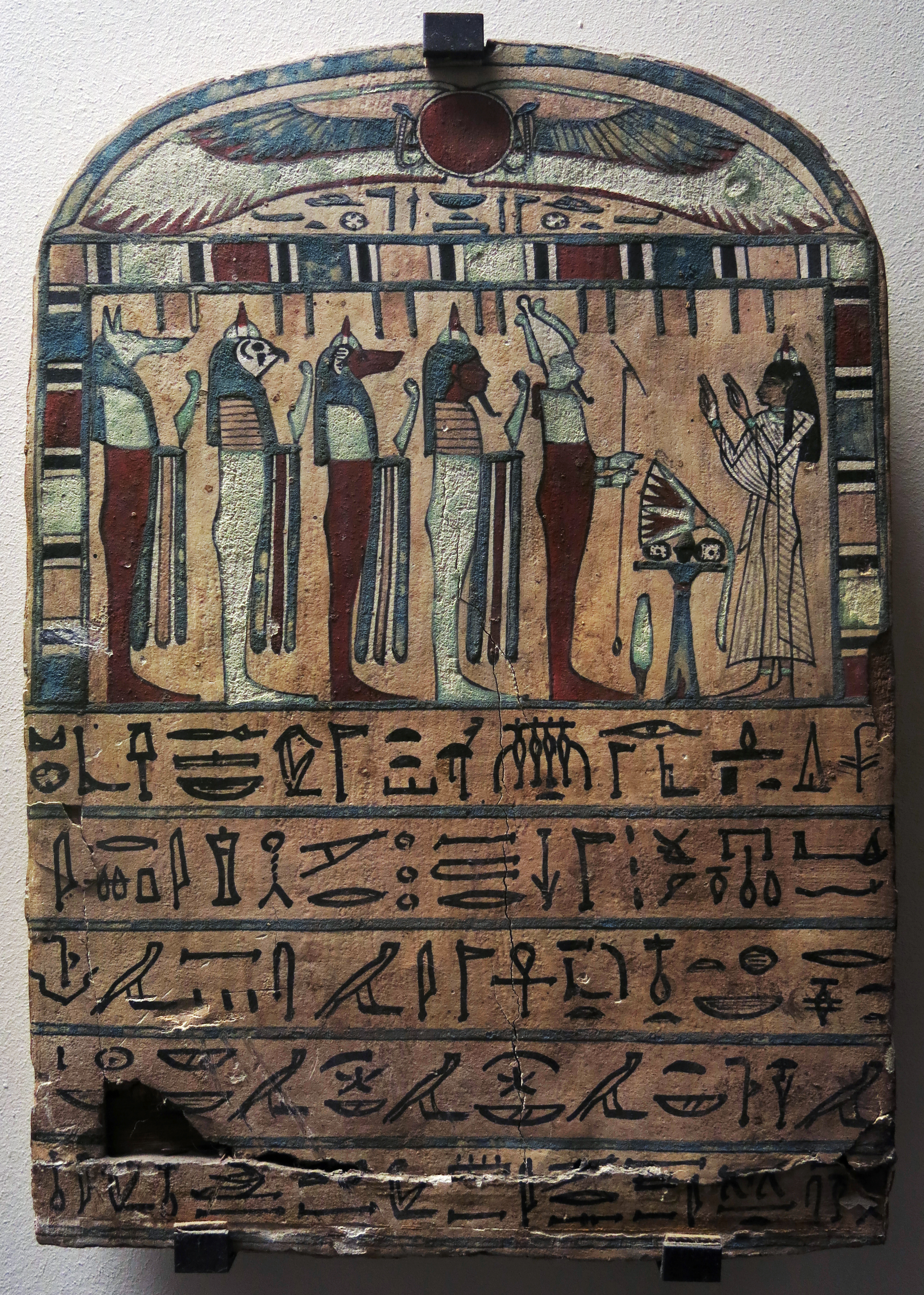
25th Dynasty / Nubian Dynasty / Kushite Empire: 746 BC - 656 BC
Meresimen
Arched stele showing an adoration scene, Meresimen standing with a pleated dress, wearing a perfume cone on her head, adoring. Osiris standing with the four sons of Horus, and an offering table. Above is a winged solar disc with a uraeus.
The piece is from the late 25th Dynasty. The text reads:
An offering which the king gives to Osiris, the ruler of the west, the great god, the lord of Abydos, that he may grant an offering of breads, beers, meats and fowls, incense and oil, wine and milk, and every good thing with which a god lives, at the new year, at the feast of the beginning of the year, at the feast of each month and at the feast of each fortnight, as well as at each feast of each day, for the singer of the residence of Amun, Meresimen, daughter of Unnefer.
Height 310 mm, width 220 mm, thickness 30 mm.
Catalog: Painted wood, N 4024, CC 166
Location: Aile Sully, Salle 323, Crypt of Osiris, Vitrine 11
Photo: Don Hitchcock 2015
Source and text: Original, Louvre Museum, https://collections.louvre.fr/

25th Dynasty / Nubian Dynasty / Kushite Empire: 746 BC - 656 BC
Irethoru
Irethoru was bailiff of the domain of Amen. His father's name is given as Naankh.
This is an adoration scene, with Irethoru standing, wearing a skirt and a perfume cone, standing, before Osiris and Isis, as well as the four sons of Horus.
In the arch above is an offering table, and a winged solar disc with uraeus.
Height 348 mm, width 271 mm, thickness 28 mm.
Catalog: Painted wood, N 3387, Salt no. 3841
Location: Aile Sully, Salle 323, Crypt of Osiris, Vitrine 11
Photo: Don Hitchcock 2015
Source and text: Original, Louvre Museum, https://collections.louvre.fr/
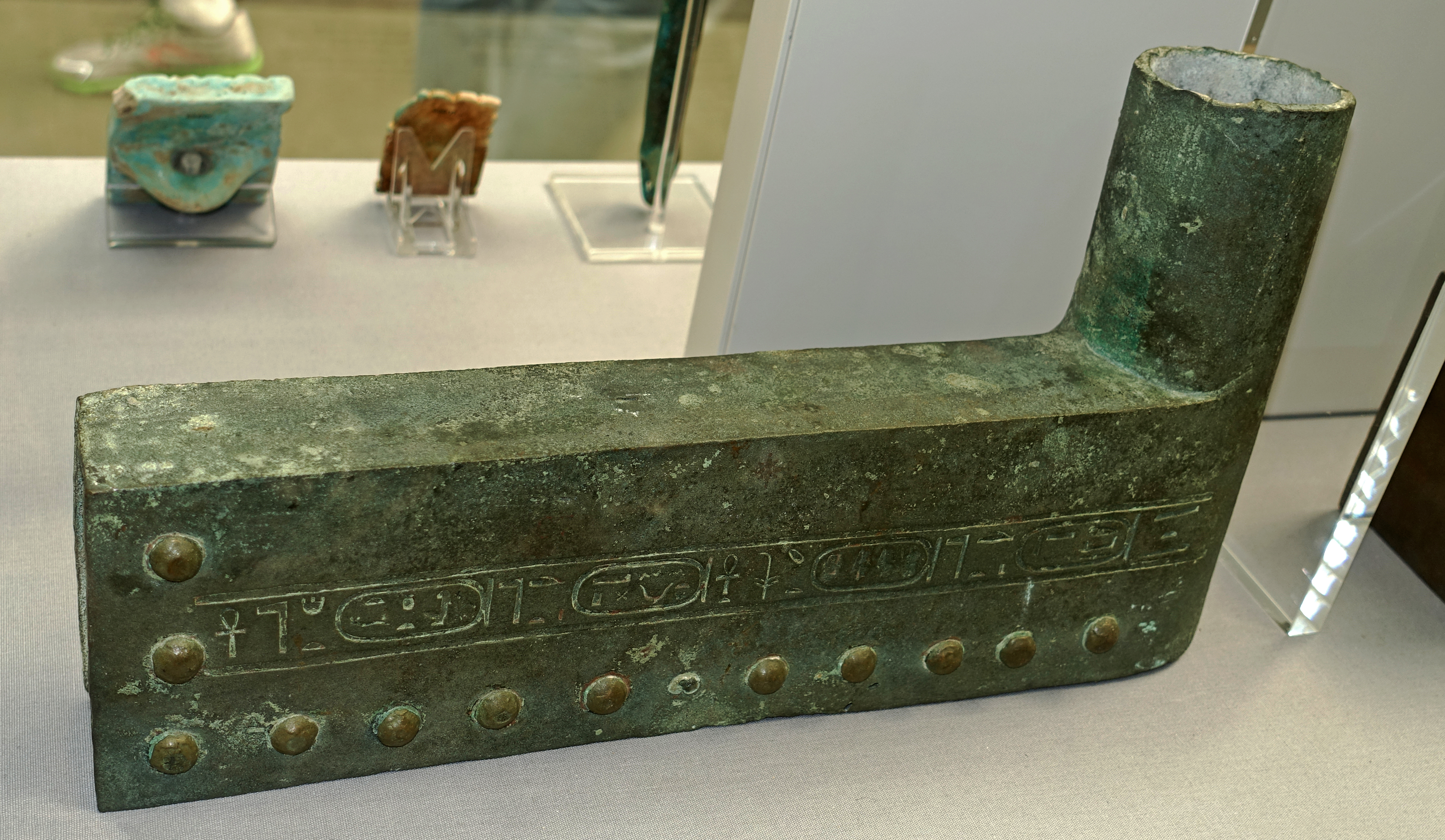 25th - 26th Dynasty: 746 BC - 525 BC
Door-hinge
Bronze door-hinge with the names of the 'God's Wives of Amun', Amenirdis I and Shepenwepet II.
25th or 26th Dynasty, circa 700 BC - 650 BC, provenance unknown.
Shepenwepet II, daughter of King Piye, was adopted by Amenirdis I as her successor.
Length 380 mm, height 204 mm.
Catalog: EA36301
Photo: Don Hitchcock 2018
Text: Card with the display at the British Museum, http://www.britishmuseum.org/, © Trustees of the British Museum, CC BY-NC-SA 4.0
Source: Original, British Museum
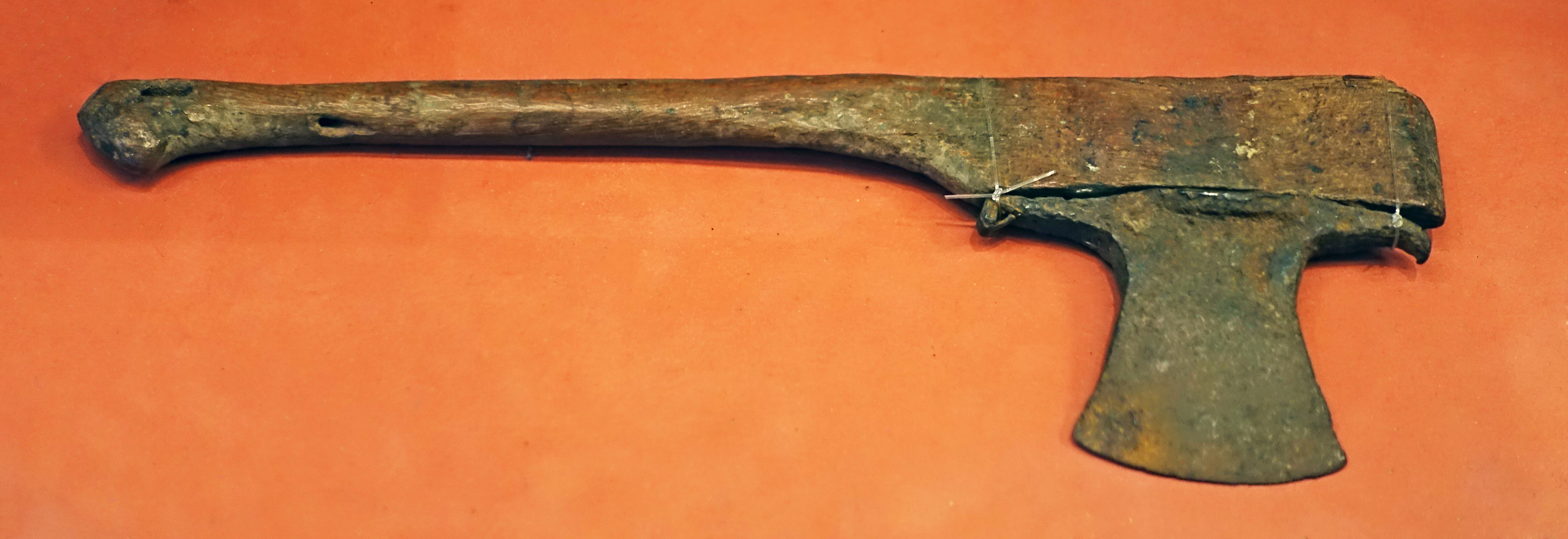
25th - 26th Dynasty: 746 BC - 525 BC
Axe
Scale model of an axe, with a wooden handle and an iron blade. Iron was commonly used in Egypt from 700 BC.
Photo: Don Hitchcock 2018
Source and text: Original, Card with the exhibit, Louvre Museum
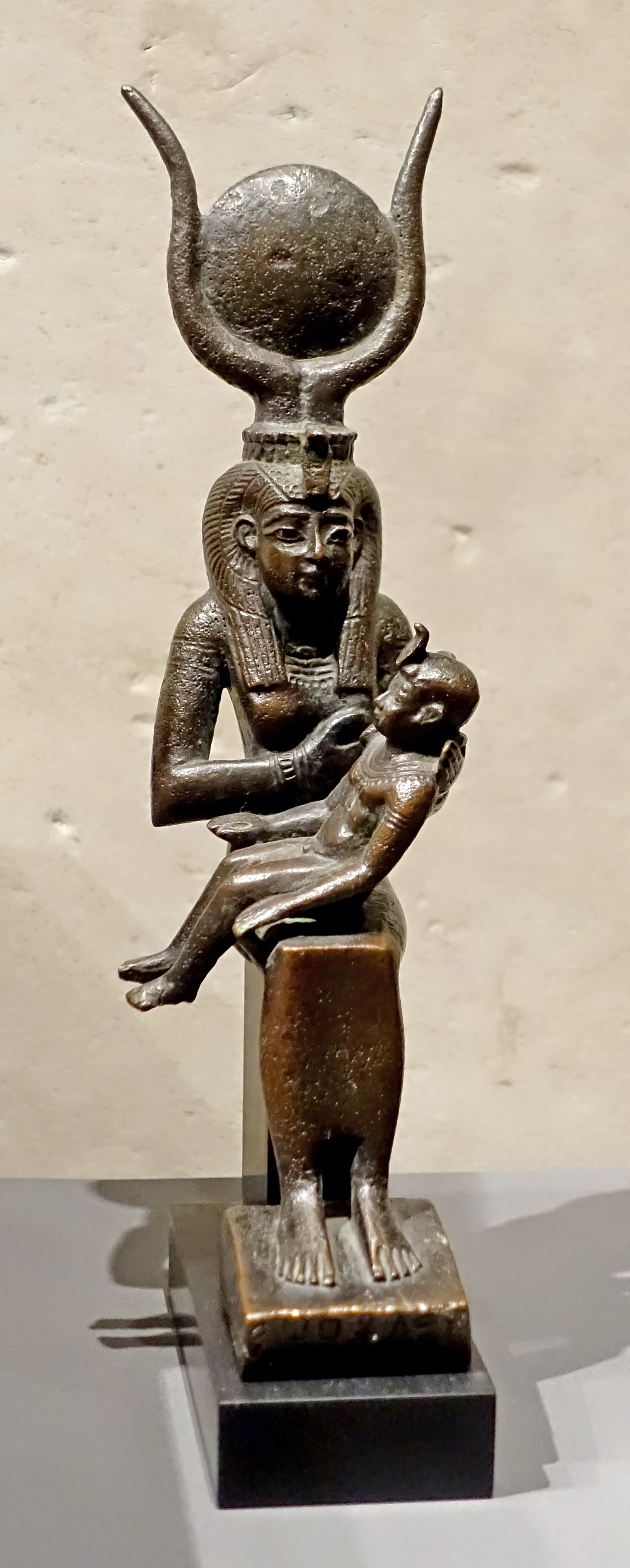
25th - 26th Dynasty: 746 BC - 525 BC
Isis
Seated Isis with the child Horus, in bronze.
Catalog: Bronze, 7th Century BC, ÄS 5309
Photo: Don Hitchcock 2018
Source: Original, Ägyptischen Museum München
Text: Museum card, © Ägyptischen Museum München
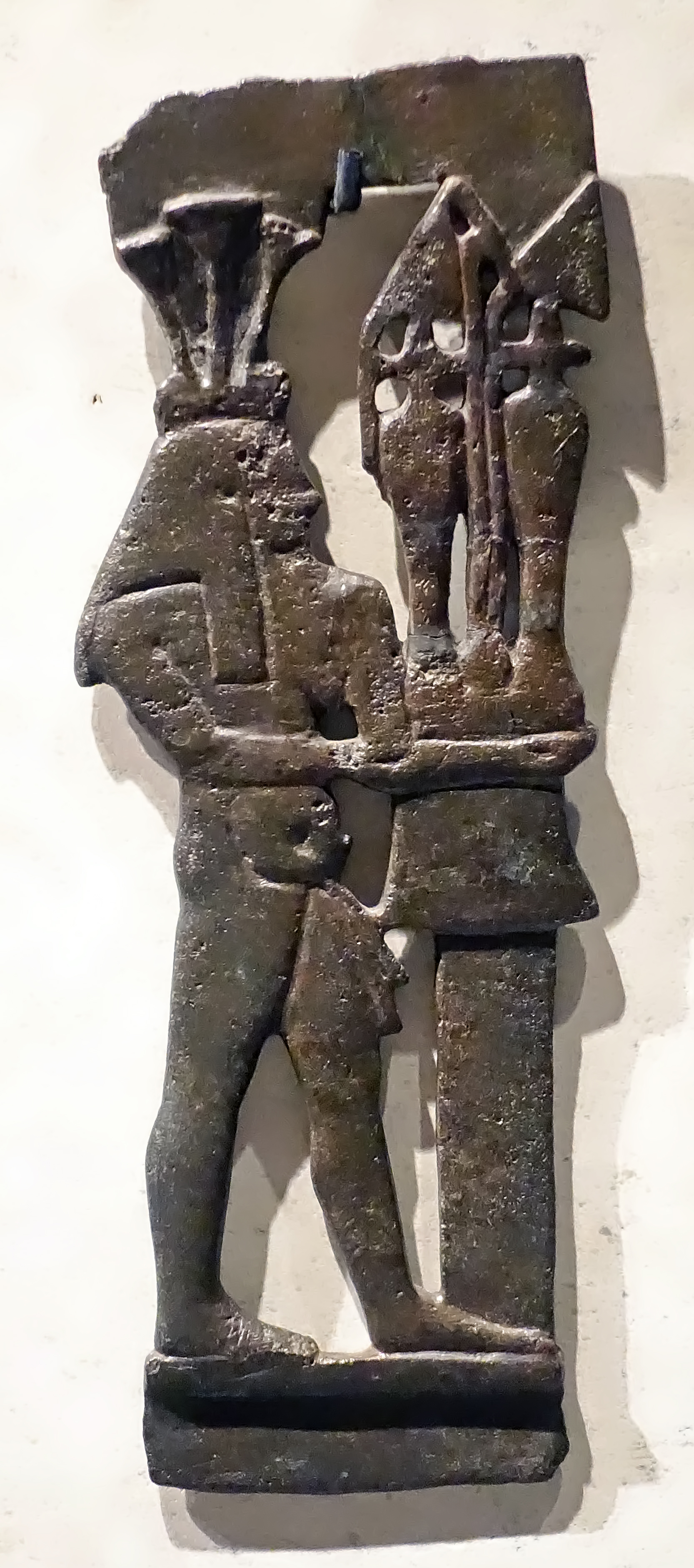
25th - 26th Dynasty: 746 BC - 525 BC
The Nile God, Hapi
Plaque in bronze of the Nile god Hapi with an offering platter.
The annual flooding of the Nile occasionally was said to be the Arrival of Hapi. Hapi was not regarded as the god of the Nile itself, but of the inundation event. This flooding provided fertile soil in an area that was otherwise desert, and Hapi thus symbolised fertility. He had large female breasts because he was said to bring a rich and nourishing harvest. Due to his fertile nature he was sometimes considered the 'father of the gods', and was considered to be a caring father who helped to maintain the balance of the cosmos, the world or universe regarded as an orderly, harmonious system. He was thought to live within a cavern at the supposed source of the Nile near Aswan.
The cult of Hapi was mainly located at the First Cataract named Elephantine. His priests were involved in rituals to ensure the steady levels of flow required from the annual flood. At Elephantine the official nilometer, a measuring device, was carefully monitored to predict the level of the flood, and his priests must have been intimately concerned with its monitoring.
Catalog: Bronze, 7th - 6th Century BC, ÄS 7237
Photo: Don Hitchcock 2018
Source: Original, Ägyptischen Museum München
Text: Museum card, © Ägyptischen Museum München
Additional text: Wikipedia
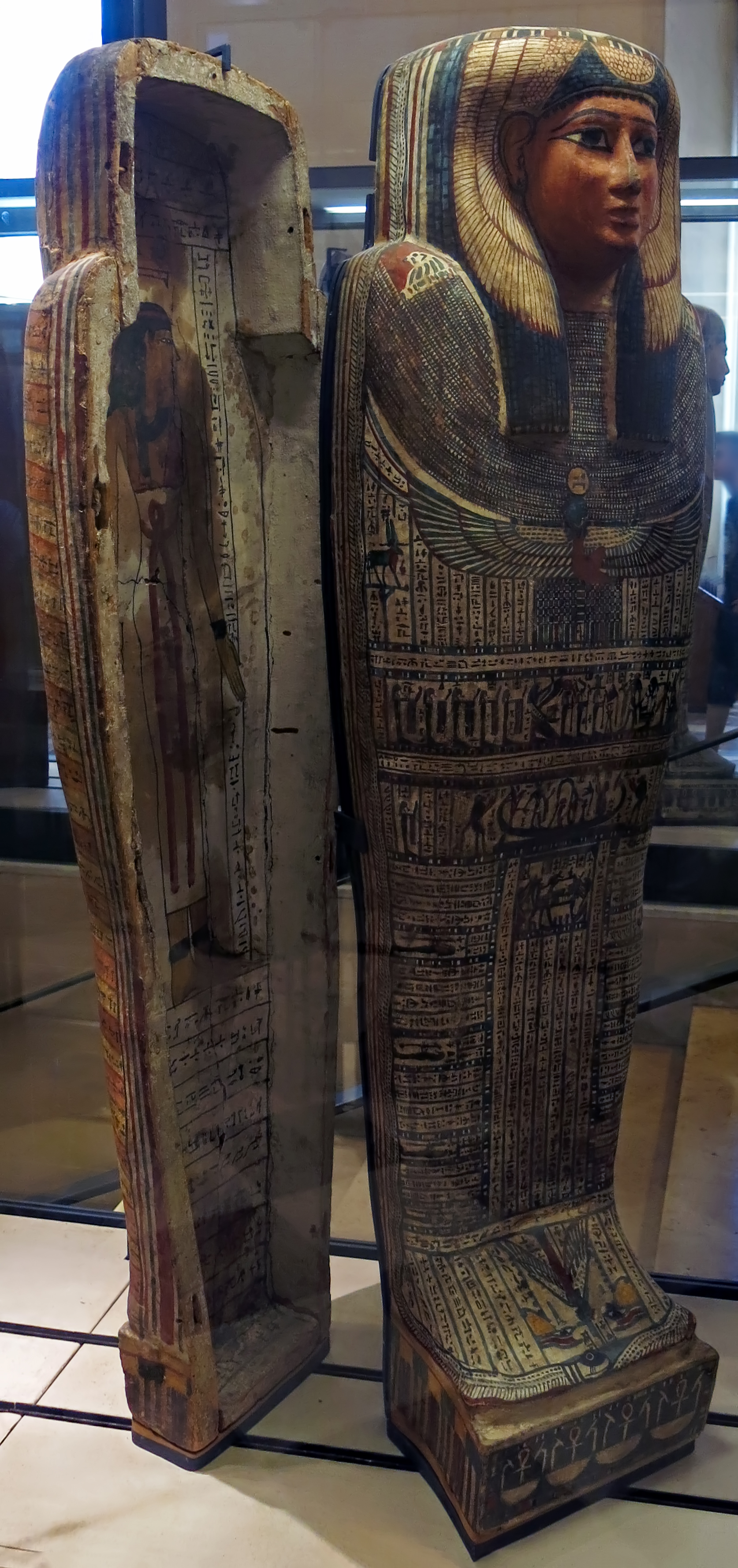
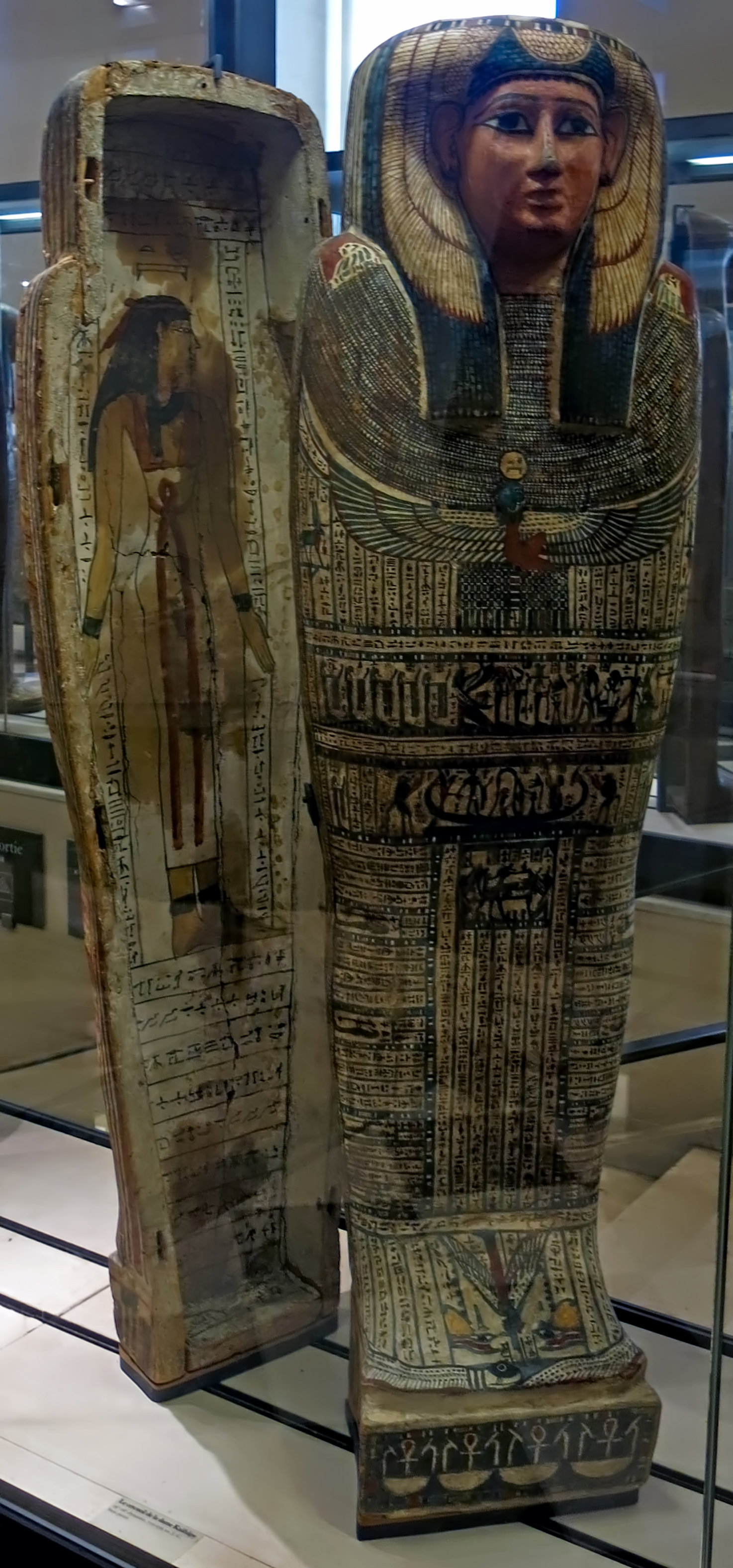
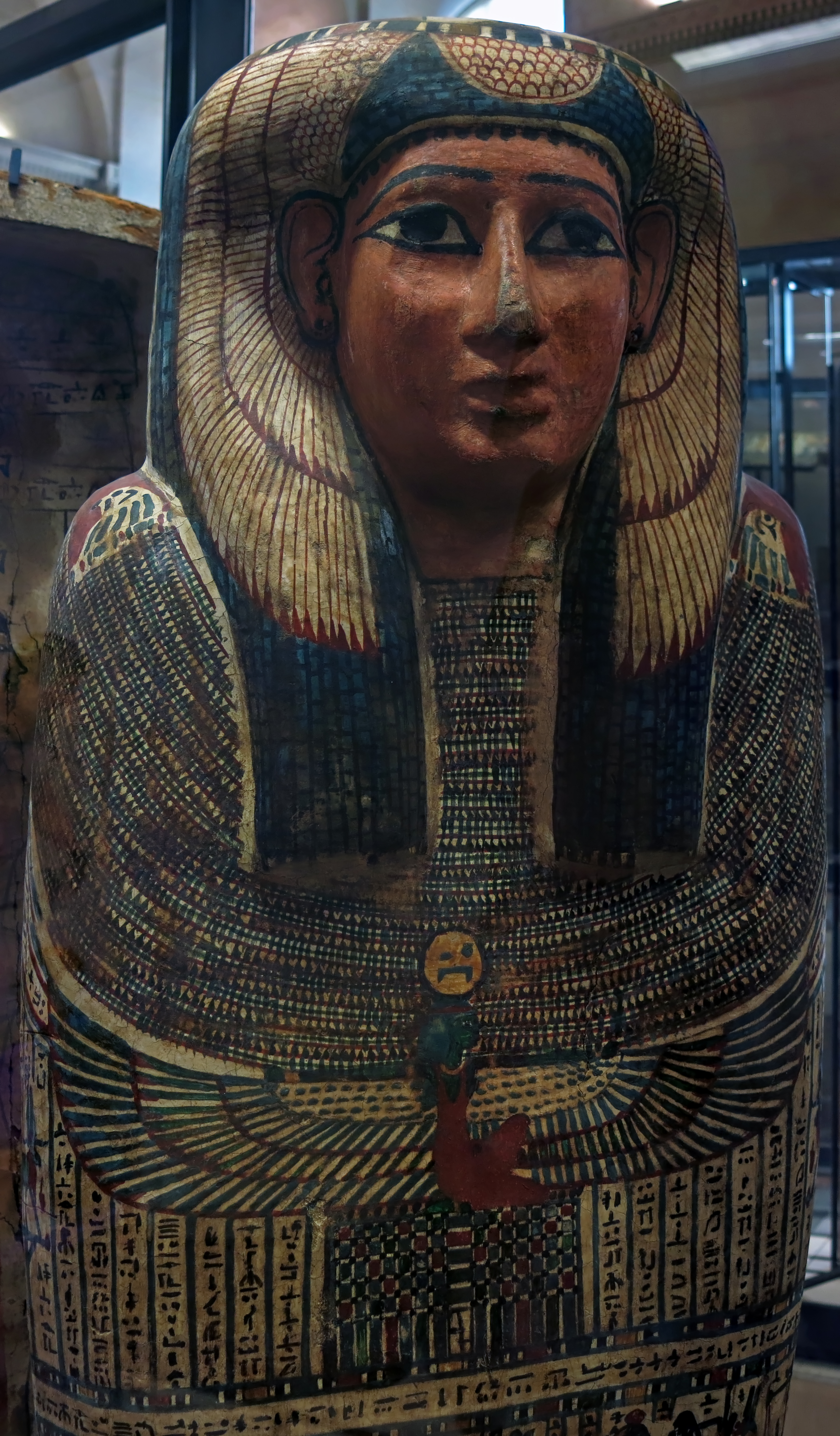
25th - 26th Dynasty: 746 BC - 525 BC
Kaahapy
Mummiform coffin of Kaahapy, Mistress of the house.
Description: shroud, hidden hands, tripartite wig, vulture's wings on wig, pierced ears, Usekh collar.
The goddess Nut is depicted on the chest, wings spread, kneeling, flanked by rams wearing the crown of Amun.
Height 1770 mm, width 520 mm.
Catalog: Painted wood, Salle 321, The sarcophagi, Vitrine 1, N 2566,
N 2625, Durand n°174 or 185
Photo: Don Hitchcock 2015
Source and text: Original, Louvre Museum, Paris, France, https://collections.louvre.fr/
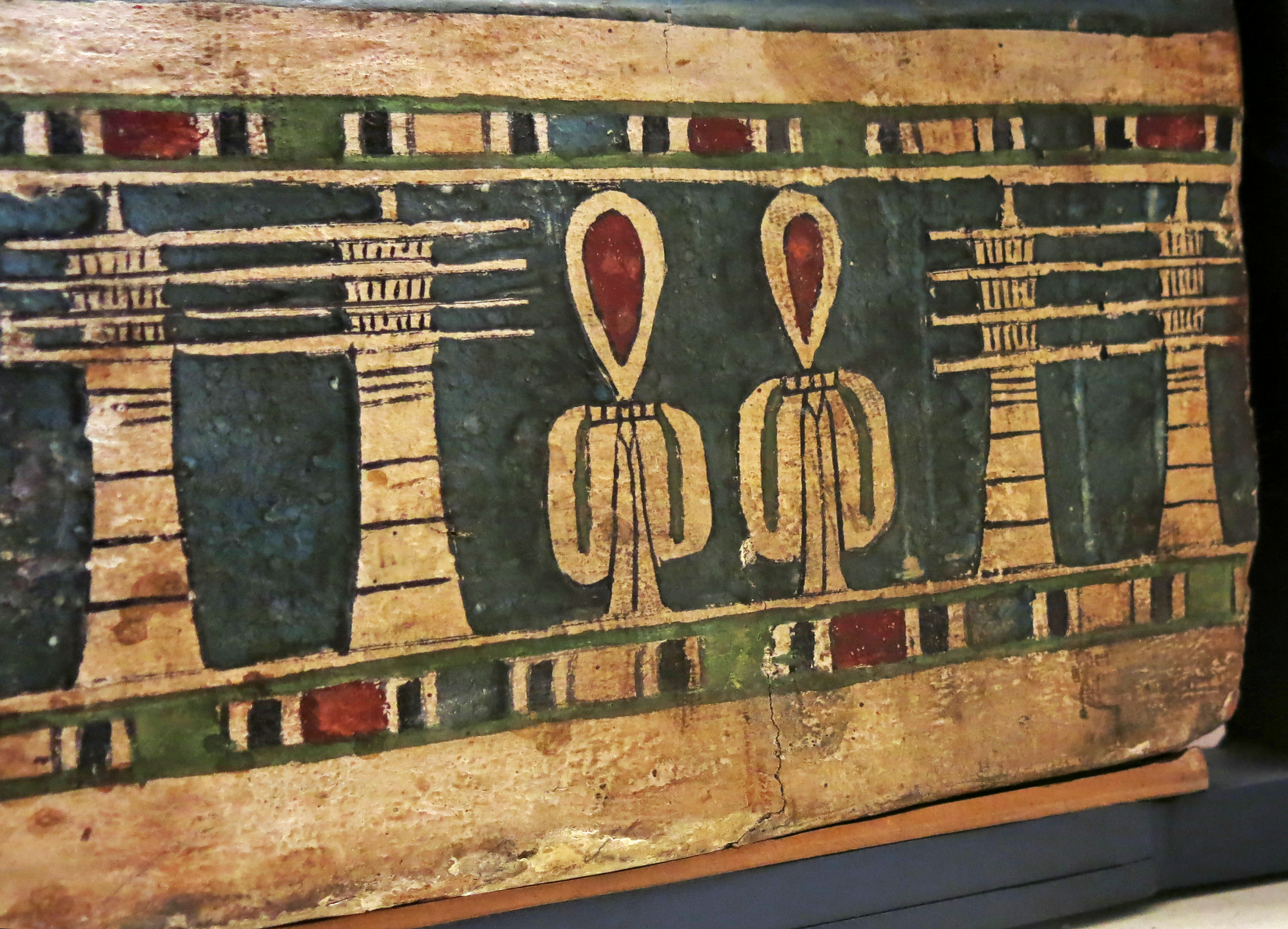
25th - 26th Dynasty: 746 BC - 525 BC
Kaahapy
Mummiform coffin of Kaahapy, Mistress of the house.
On the foot of this coffin are particularly good paintings of the Knot of Isis.
The Knot of Isis or Tyet is an ancient symbol that came to be connected with the goddess Isis.
In many respects the tyet resembles an ankh, except that its arms curve down. Its meaning is also reminiscent of the ankh, as it is often translated to mean 'welfare' or 'life'.
Tyet amulets came to be buried with the dead in the early New Kingdom of Egypt (circa 1 550 BC - 1 070 BC). The earliest examples date to the reign of Amenhotep III, and from then until the end of dynastic Egyptian history, few people were buried without one placed within the mummy wrappings, usually on the upper torso.
Here they are flanked by Djed pillars.
Catalog: Painted wood, Salle 321, The sarcophagi, Vitrine 1, N 2566,
N 2625, Durand n°174 or 185
Photo: Don Hitchcock 2015
Source and text: Original, Louvre Museum, Paris, France, https://collections.louvre.fr/
Additional text: Don Hitchcock and Wikipedia
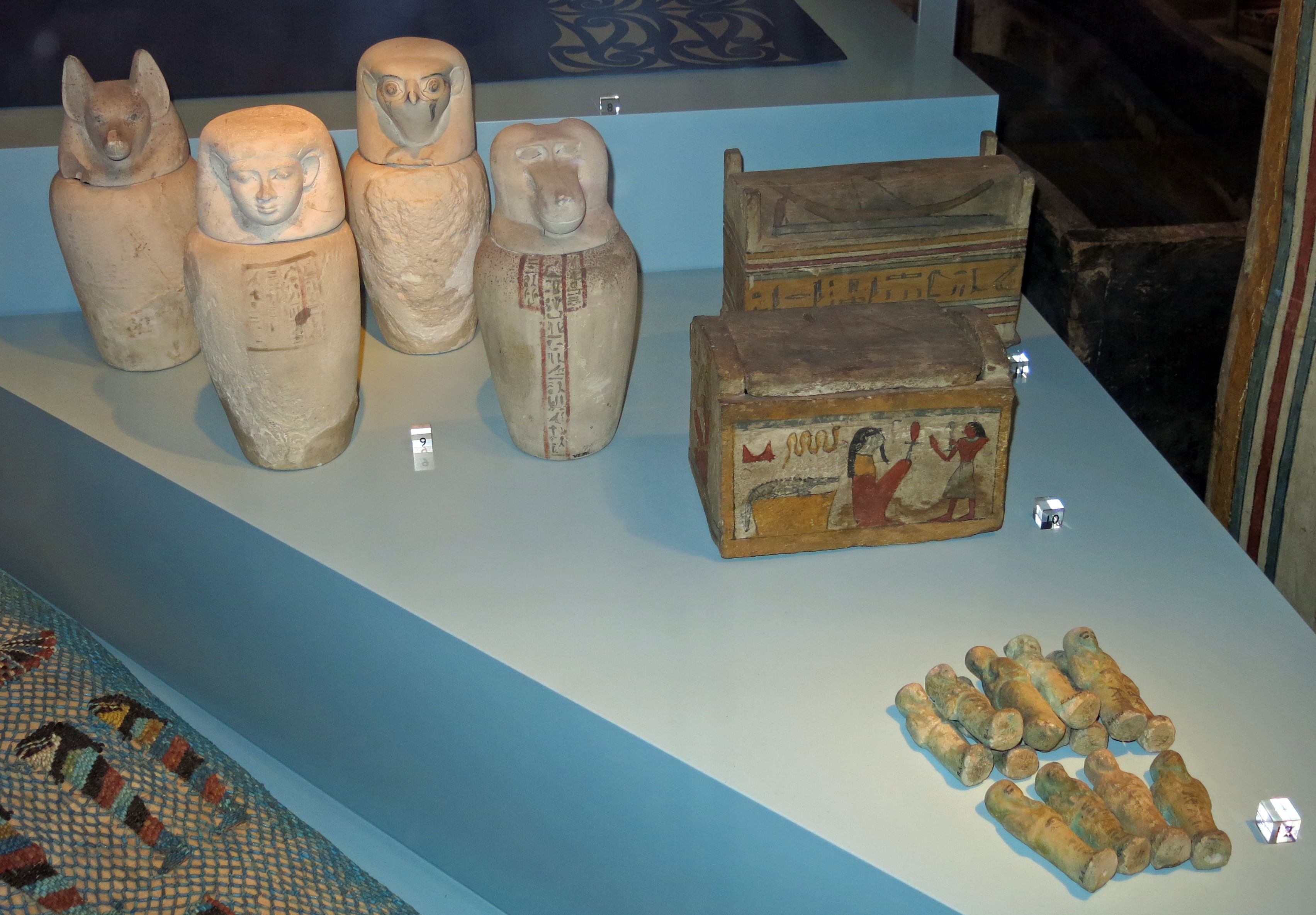
25th - 26th Dynasty: 746 BC - 525 BC
Funerary items
(9) Canopic jars of Horpenmenti - The Egyptian Renaissance brings the return of real hollowed Canopic jars (vases for intestines).
Limestone; Thebes / Luxor ca 750-650 BC, 25th - 26th dynasties
(10) Shabti box of Bakenrenef - The owner gives a shabti to a seated god. The lid shows a ship which carries the sun god through the sky and the underworld.
Bakenrenef or Bakenranef was an Egyptian Vizier of the North (Lower Egypt) during the reign of Psamtik I (664 BC – 610 BC) of the 26th Dynasty. Like Khaemwaset several centuries before, he bore the title of Iunmutef, 'Cleaner of the Great House'. His father was a mayor called Padineit, while his mother was a certain Tageb.
Wood; Thebes / Luxor ca 700-600 BC, 25th - 26th Dynasty
(11) Shabti box of Setywy - On the lid are again the ships which sail the sun god through the sky and the underworld.
The box is in the shape of a coffin with corner-posts, characteristic of the period.
Wood; Thebes / Luxor ca 700-600 BC, 25th - 26th Dynasty
(12) Shabtis of Pamel - Shabtis from this period are poorly finished mass production pieces. Often there were 400 per deceased: one for each day of the year plus supervisors for every ten workers.
Faience, Thebes / Luxor ca 900-700 BC. 22nd - 25th Dynasties.
Photo: Don Hitchcock 2014
Source and text: Original, Rijksmuseum van Oudheden, National Museum of Antiquities, Leiden.
Additional text: Wikipedia
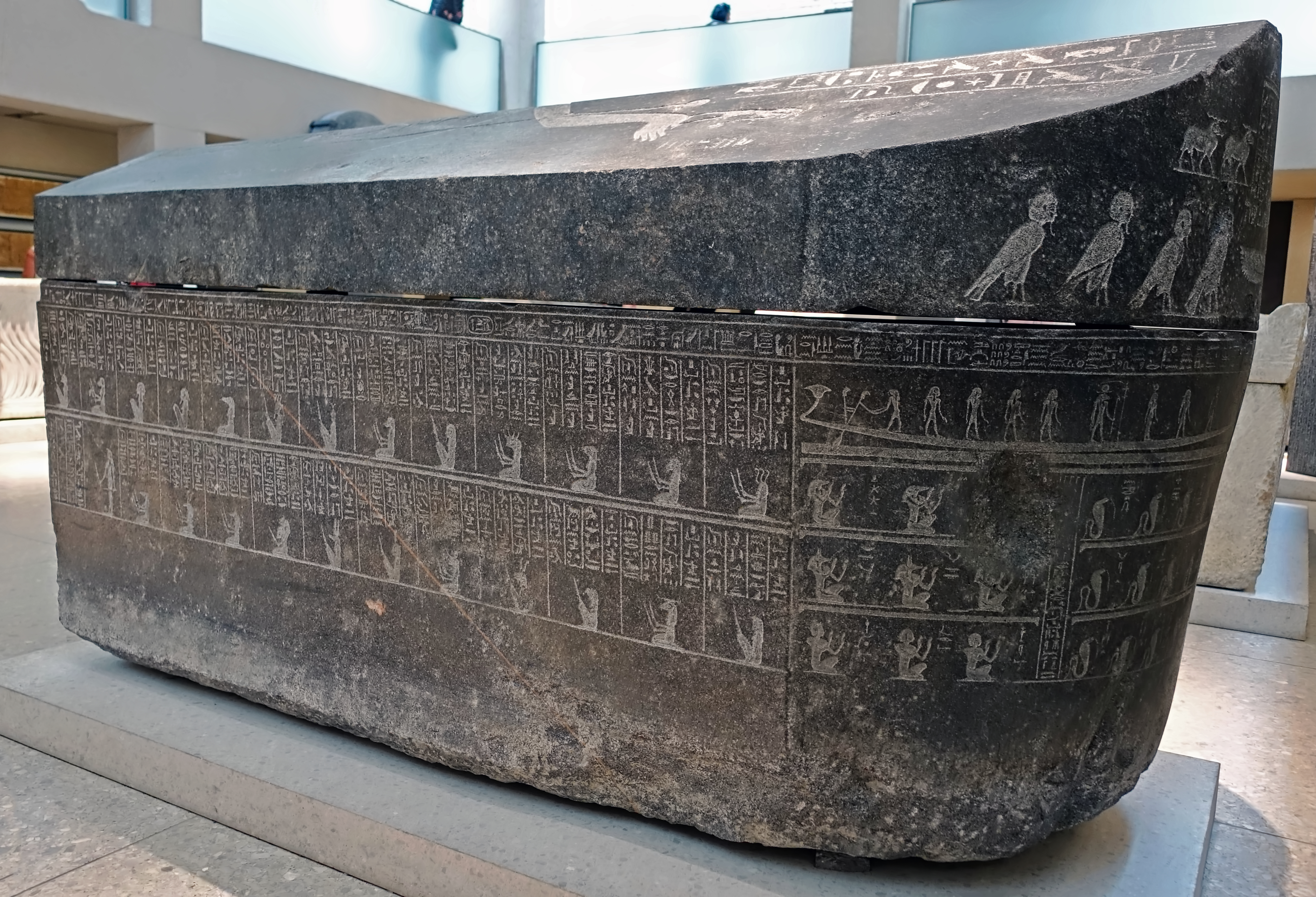
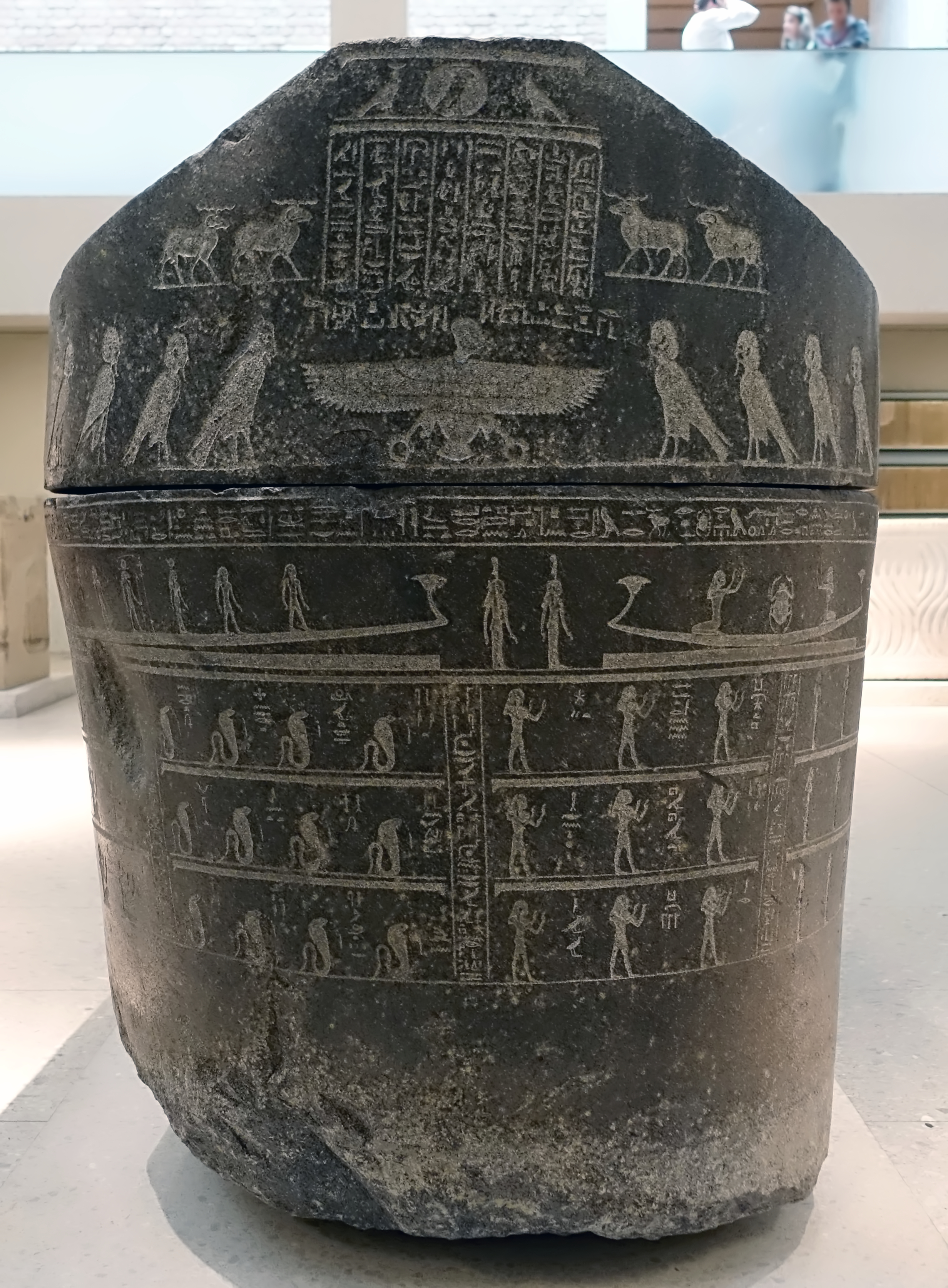
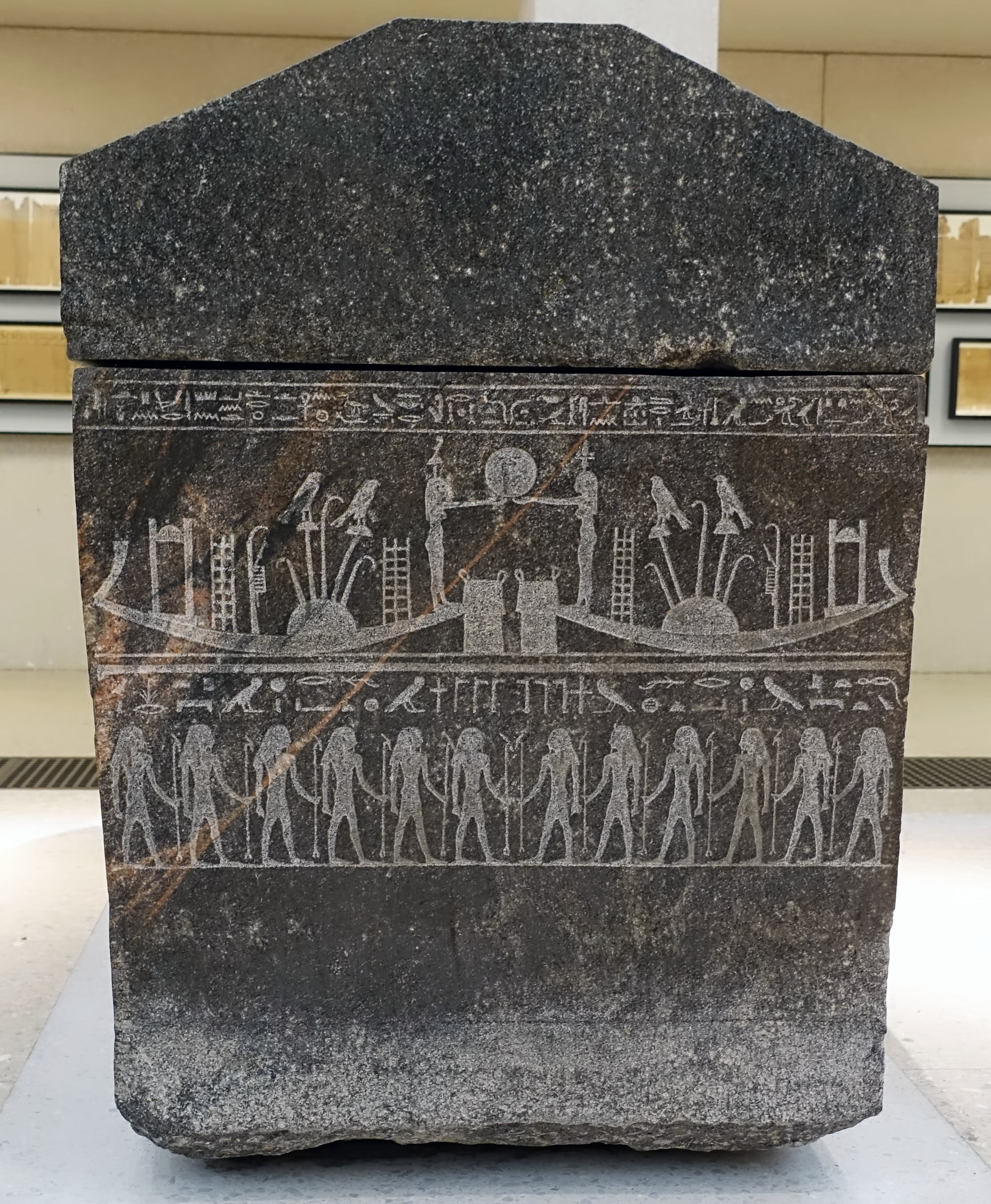

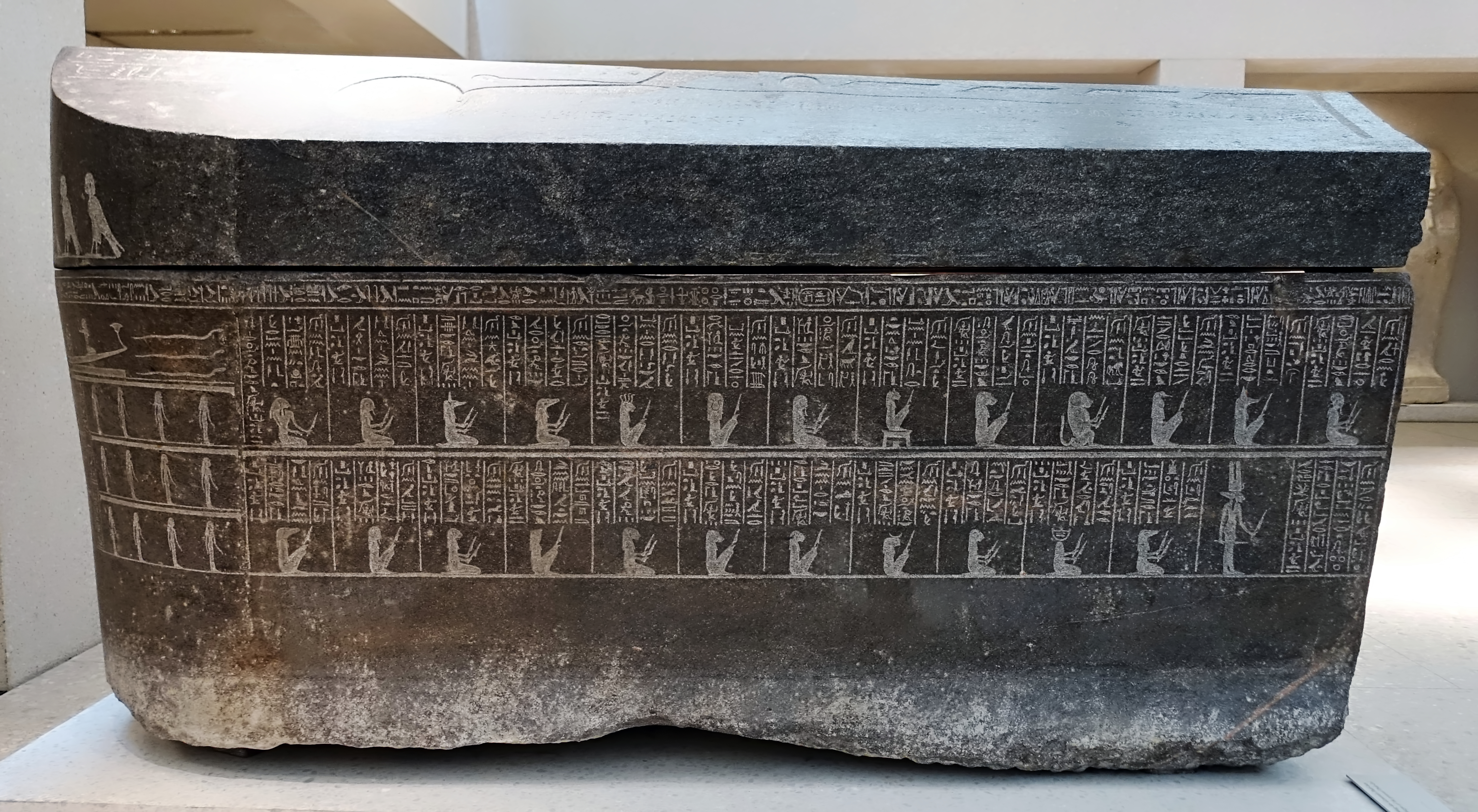
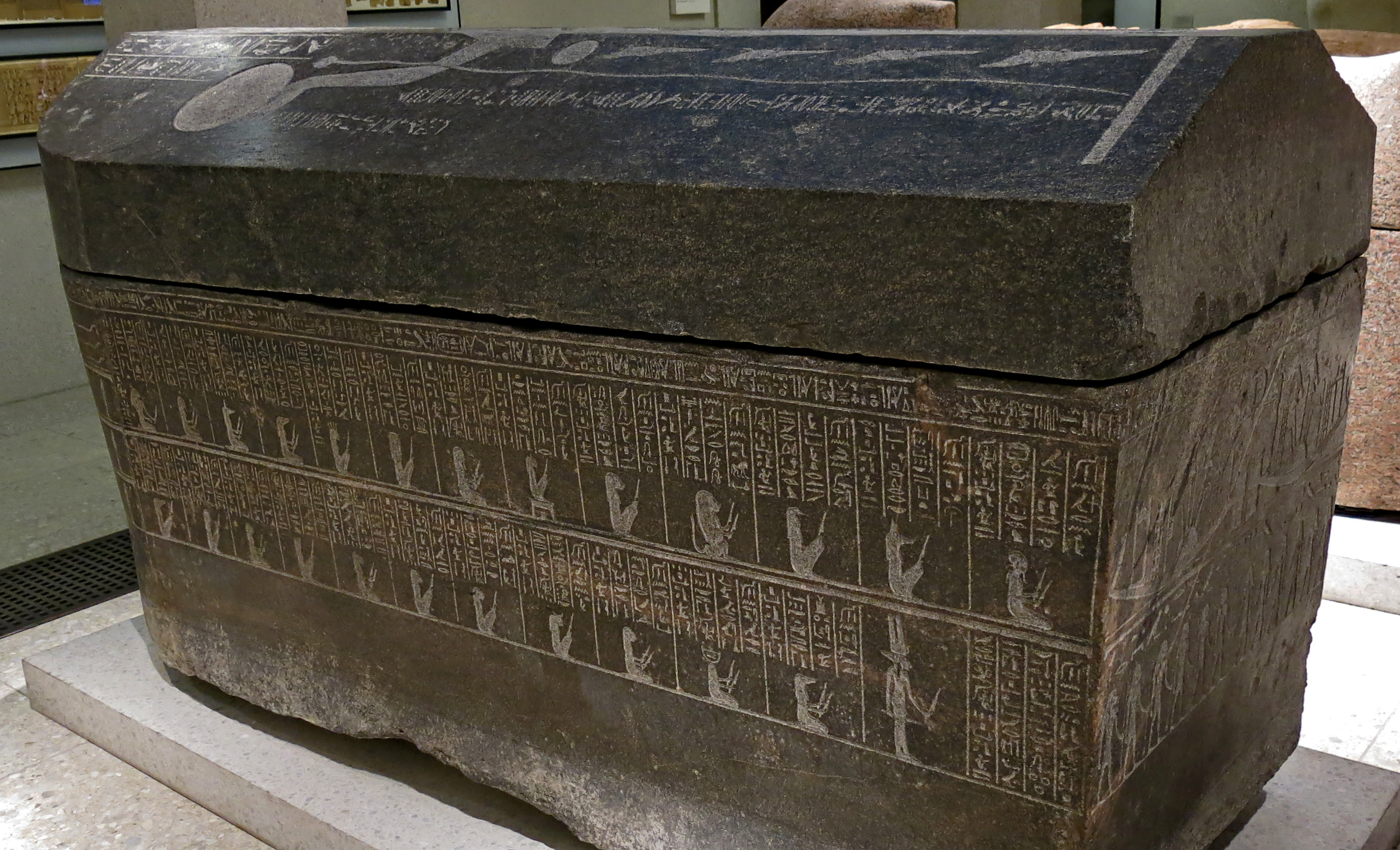
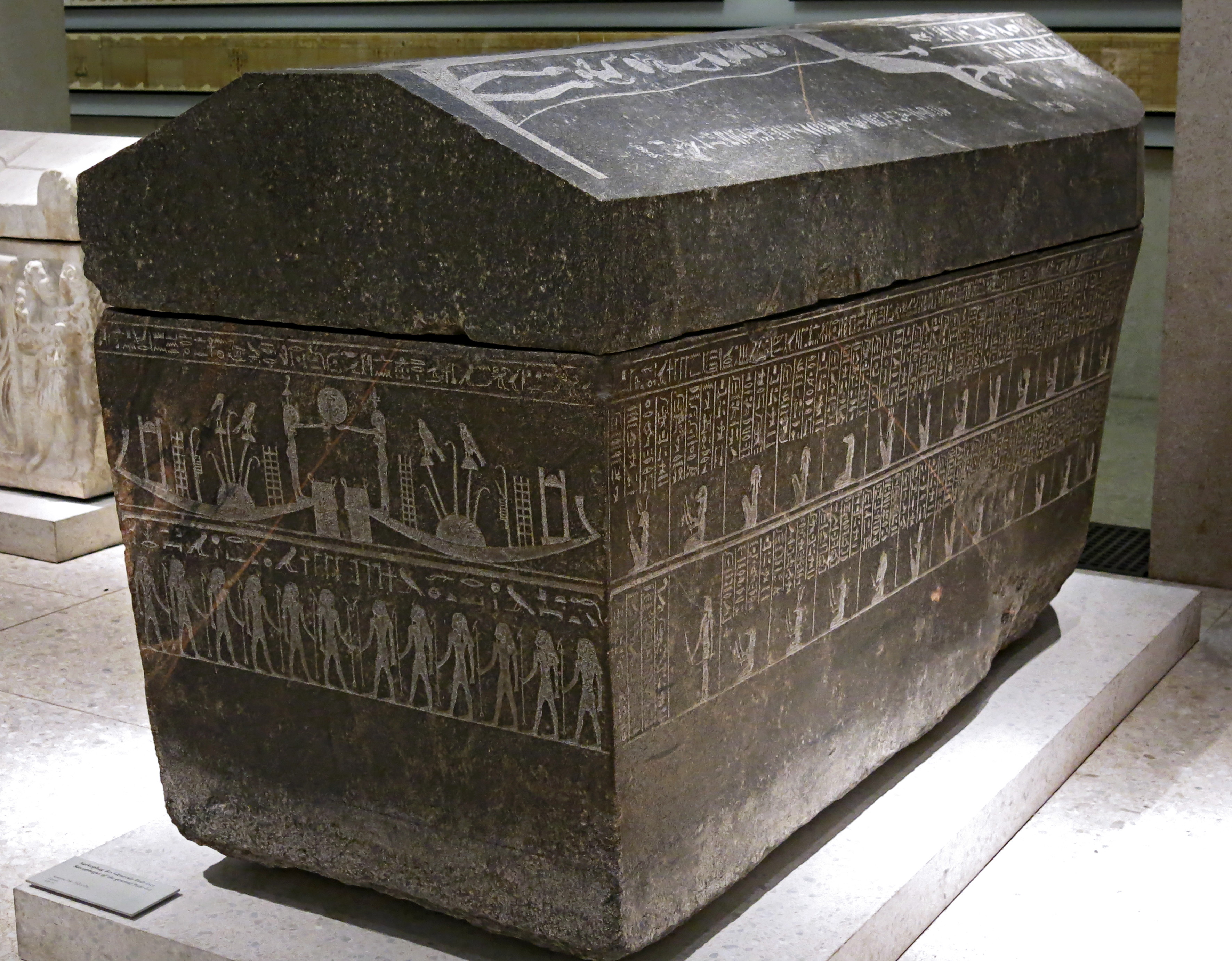
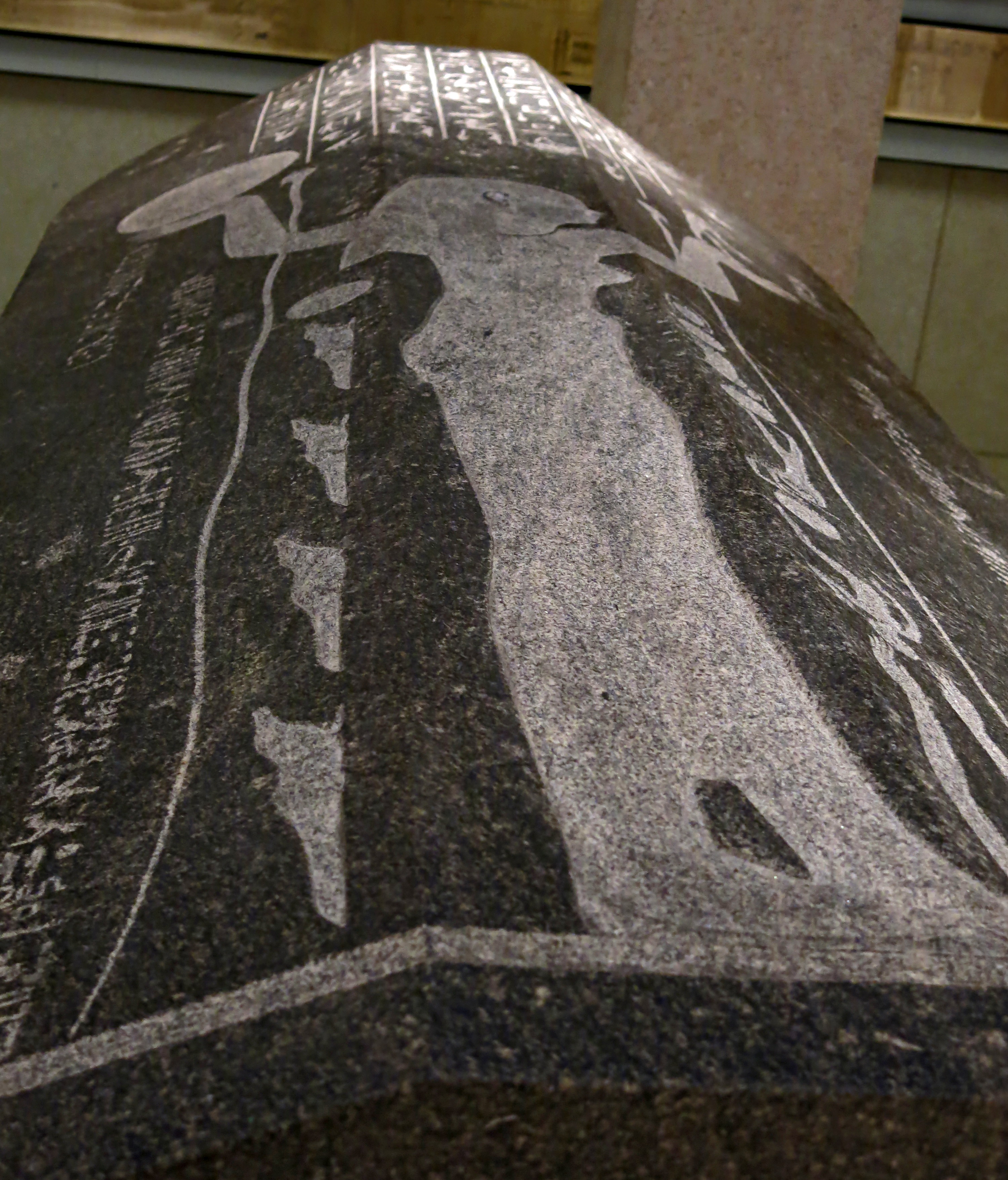
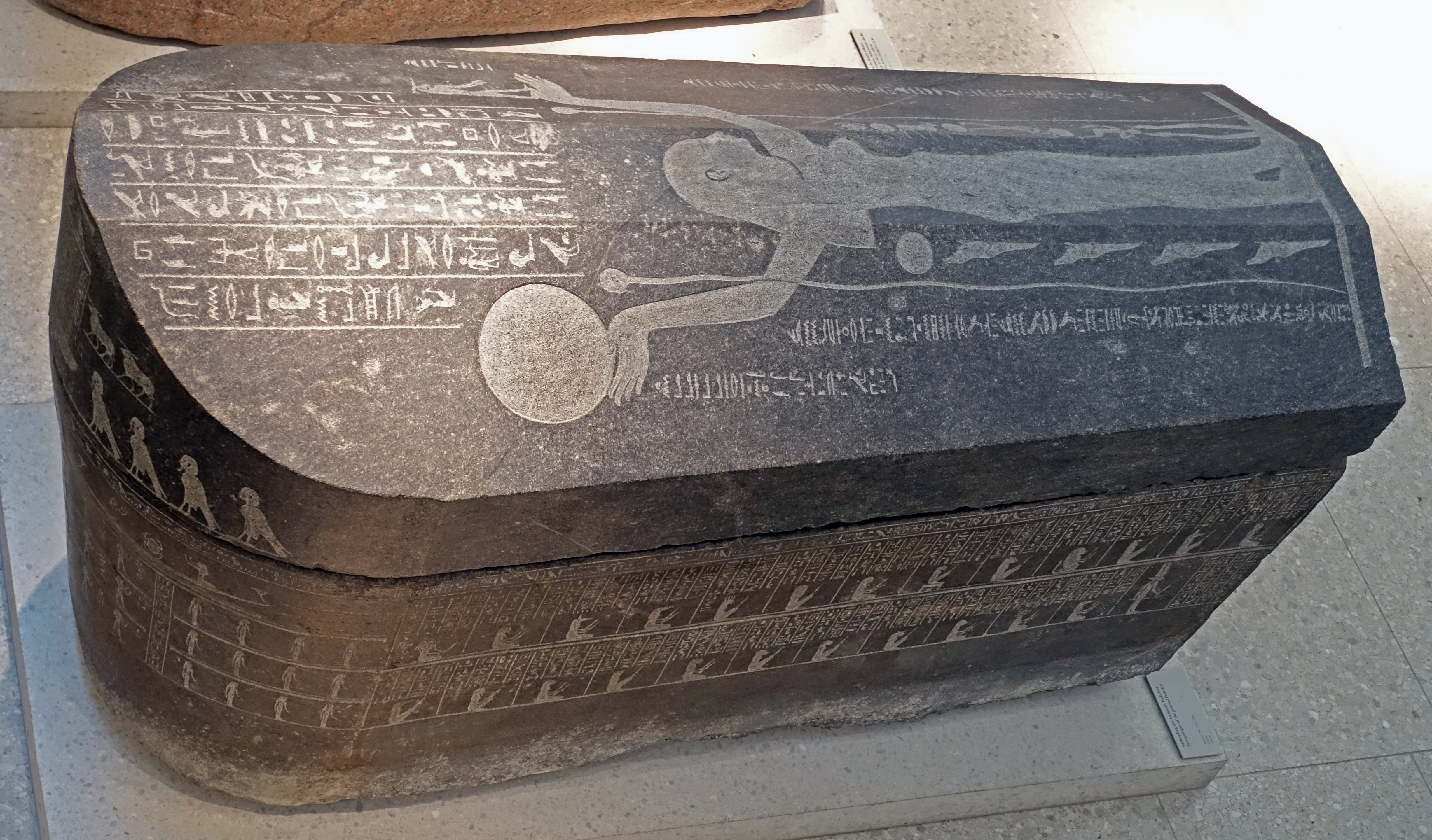
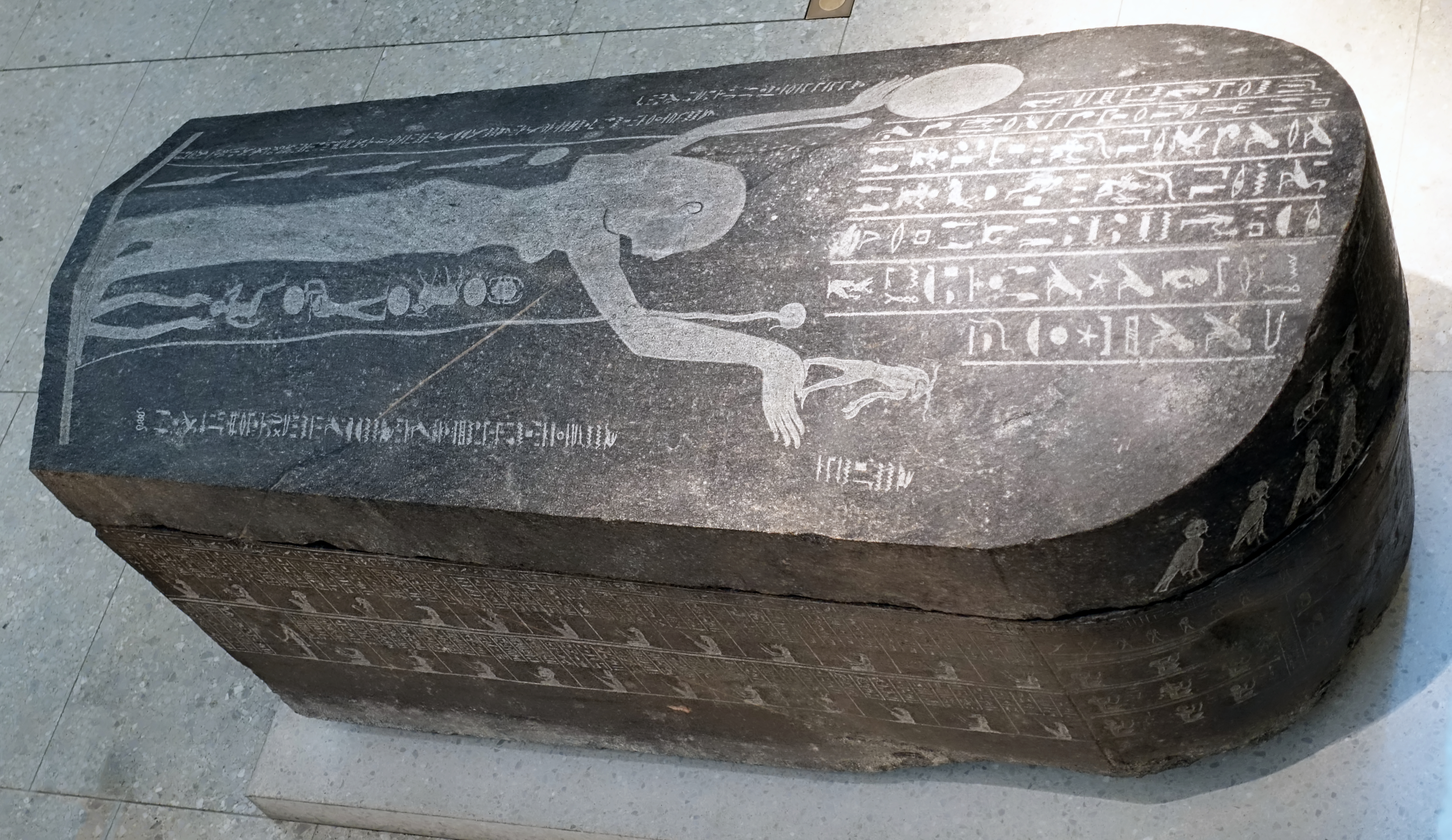
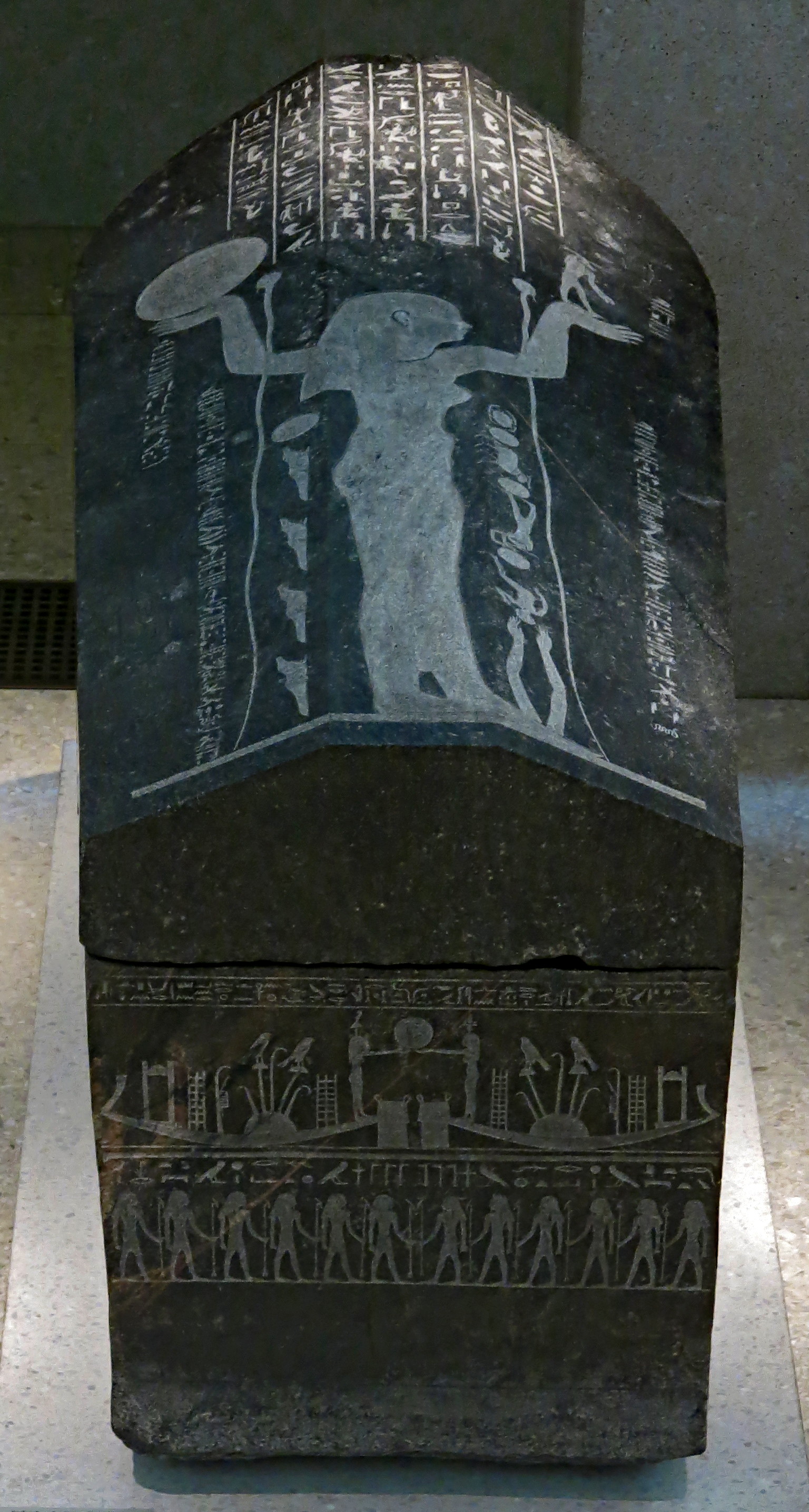
Sarcophagus of the General Pedi-Esi
25th - 26th Dynasty: 746 BC - 525 BC
Padiiset (the German spelling for General Pedi-Esi) is given the range of dates 728 BC - 700 BC by BarquinDev.
He is further described by this source as Prince of Athribis and Heliopolis, in the South of the Egyptian delta. Padiiset was the successor of Bakennefy II and the predecessor of Bakennefy III, who was his son.
Catalog: 746 - 332 BC, Granite, ÄM 29
Photo: Don Hitchcock 2015, 2018
Source: Original, Staatliche Museen zu Berlin, Neues Museum, Germany
Text: © Card at the Staatliche Museen zu Berlin, (CC BY-NC-SA 3.0 DE)
Additional text: https://thebiography.us/en/padiiset1
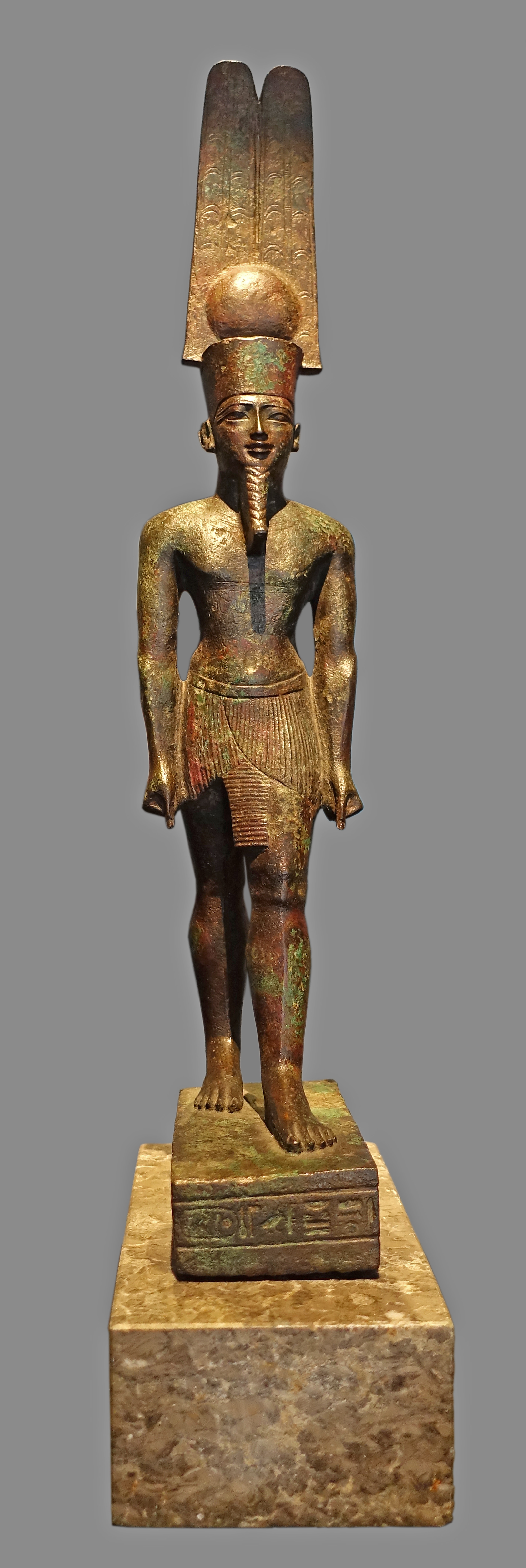
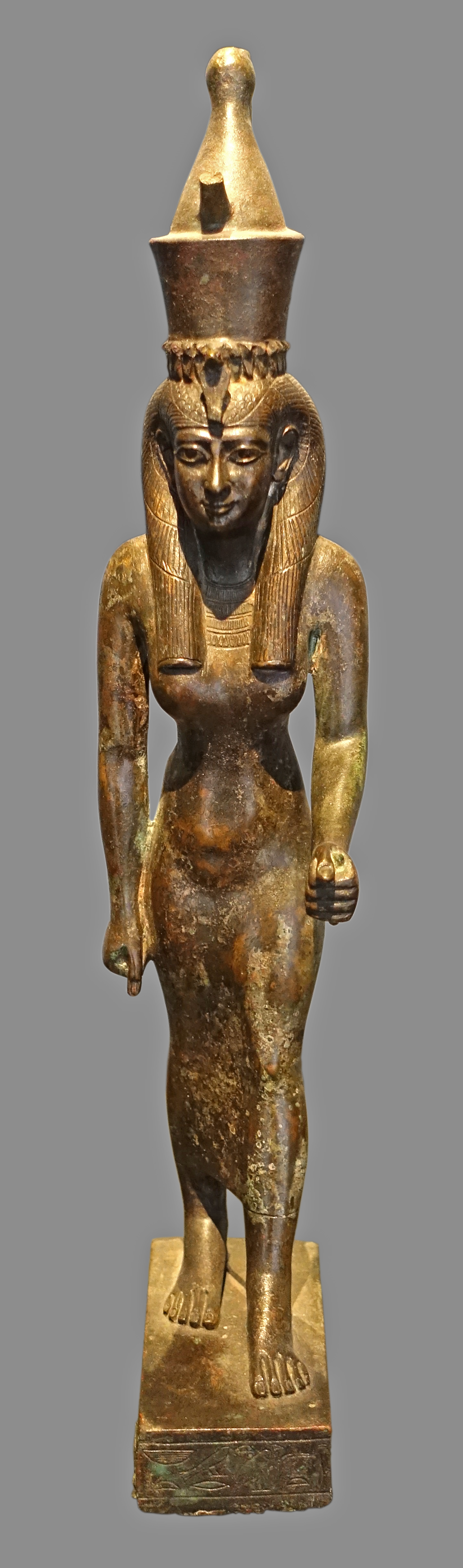
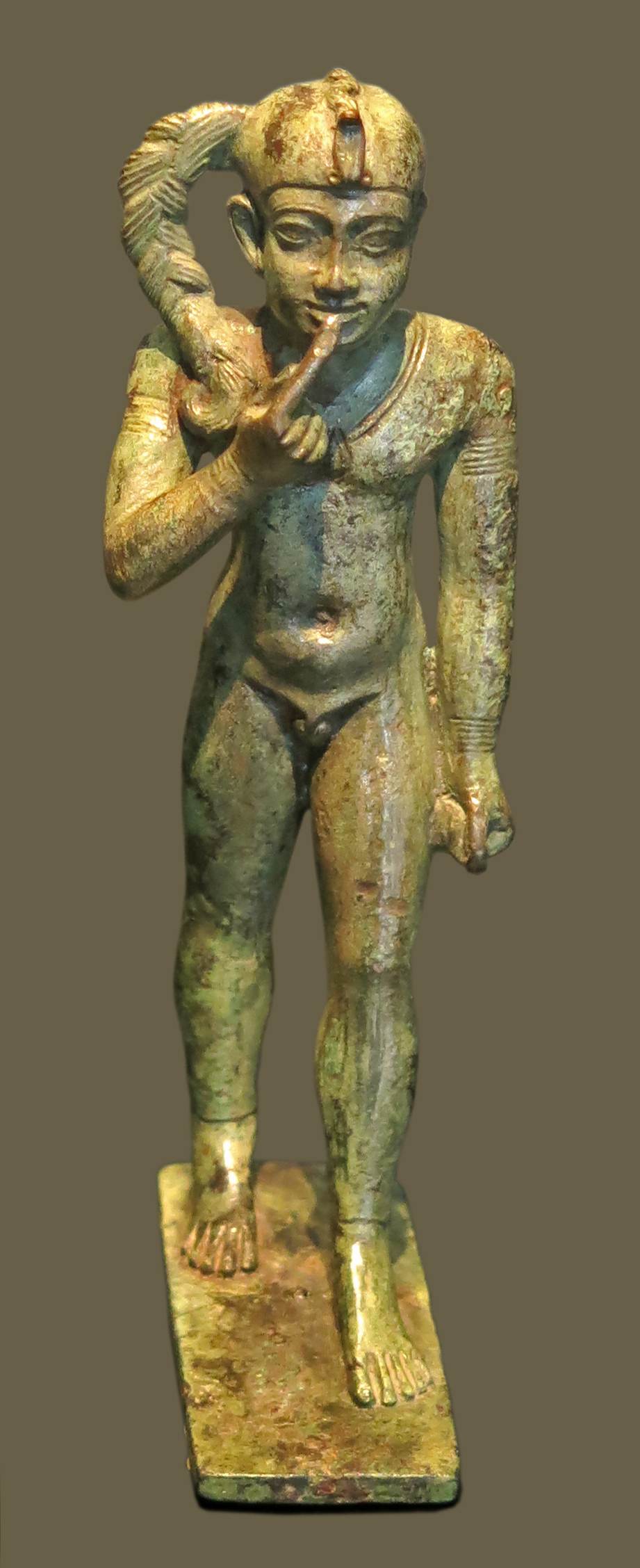
Divine Triad
25th - 26th Dynasty: 746 BC - 525 BC
Amun with a feathered crown, Mut, and Khonsu (as a child). Circa 700 BC - 600 BC.
Amun was the god of the sun and the air. He rose to prominence at Thebes during the New Kingdom, and he was worshipped across Egypt. He is usually depicted as a bearded man wearing a headdress with a double plume, or as a ram-headed man. He eventually merged with Ra, the ancient sun-god, to become Amun-Ra.
Mut was a mother goddess. Her name literally means mother in the ancient Egyptian language. Mut was sometimes said to have given birth to the world through parthenogenesis, but more often she was said to have a husband, the solar creator god Amun-Ra. Although Mut was believed by her followers to be the mother of everything in the world, she was particularly associated as the mother of the lunar child god Khonsu. At the Temple of Karnak in Egypt's capital city of Thebes, the family of Amun-Ra, Mut and Khonsu were worshipped together as the Theban Triad. In art, Mut was usually depicted (as in this case) as a woman wearing the double crown of the kings of Egypt, representing her power over the whole of the land.
Khonsu is the ancient Egyptian god of the Moon. His name means 'traveller', and this may relate to the perceived nightly travel of the Moon across the sky. Along with Thoth he marked the passage of time. Khonsu was instrumental in the creation of new life in all living creatures. At Thebes he formed part of a family triad, the 'Theban Triad', with Mut as his mother and Amun his father.
Catalog: Bronze, ÄS 6978, on loan, ÄS 5311
Photo: Don Hitchcock 2015
Source: Original, Ägyptischen Museum München
Text: Museum card, © Ägyptischen Museum München
Additional text adapted from egyptianmuseum.org, worldhistory.org, and Wikipedia


Neat Hieroglyphs
25th - 26th Dynasty: 746 BC - 525 BC
Fragment of an inscription engraved in neat and detailed hieroglyphs in the sunken relief method.
These very detailed hieroglyphs are typical of the 25th - 26th dynasties. Within the groups of signs (frames, quadrats), the reading is done, in this case, from right to left, and the sequence of frames is vertical (from top to bottom).
The hieroglyphs may be interpreted as:
You have come to the tomb of the woman of the house of Takhiouati.
Length 350 mm, width 285 mm, thickness 40 mm.
Catalog: limestone, AF 9459
Photo: Don Hitchcock 2015
Source and text: Original, Louvre Museum, https://collections.louvre.fr/
Drawing: After a poster, Louvre Museum
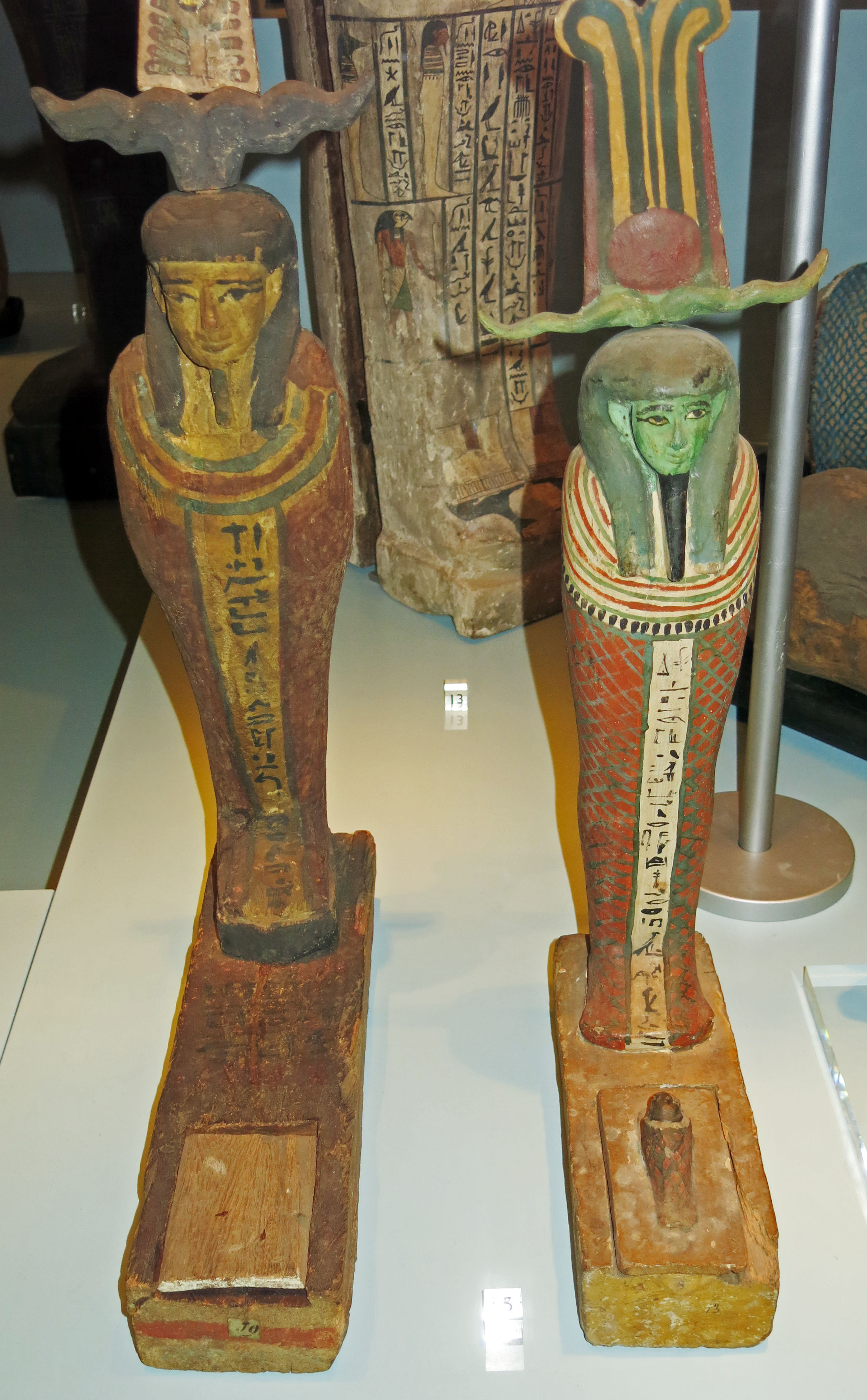
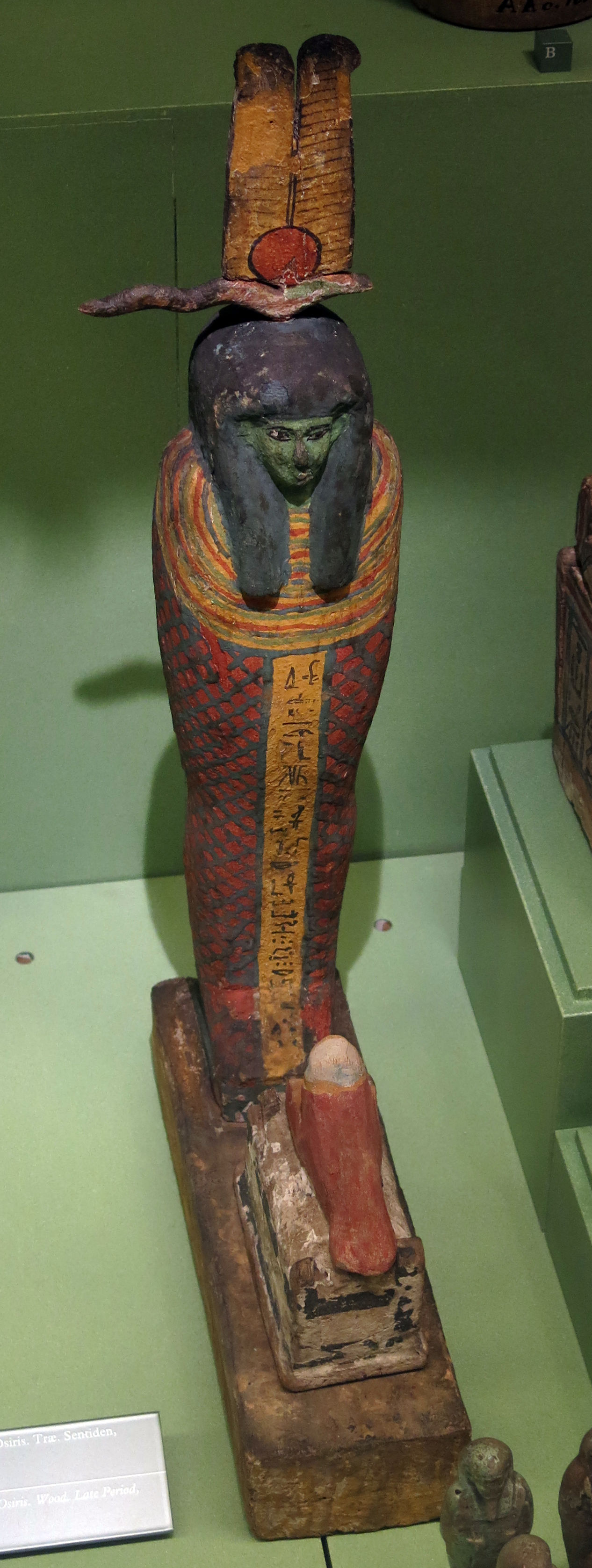

25th - 26th Dynasty: 746 BC - 525 BC
Ptah-Sokar-Osiris figures
Many of these figures contain a funerary papyrus, including a book of the dead. Others contain random old official documents, since few people could read, and the deception would never be uncovered. The papyrus documents were contained either within the statue itself, or in a lidded cavity in the box on which the statue often stood.
These figures, each with the feather crown of the god of resurrection Ptah-Sokar-Osiris, sometimes contain a 'corn mummy', symbol of new life. Egyptians wished to secure everlasting life by binding their fate to the sun, being reborn every morning, or to Osiris, dead and buried as a mummy, but resurrected to life in the Underworld.
(left) Wood, location Thebes / Luxor, ca 700-600 BC, 25th - 26th Dynasty.
(centre) Wood, Late Period, circa 700-500 BC.
(right) Wood, Late Period, circa 700-500 BC.
During annual rituals honouring Osiris, the ancient Egyptians fashioned small 'corn mummies' from a mixture of clay, sand, and grains of emmer wheat. These 'mummies' were wrapped in layers of bandages and placed in coffins decorated with images of the falcon god Sokar. The clay/seed mixture was watered before the funeral, so that the grains sprouted in the darkness of the tomb as a symbol of new life.
The Egyptians considered corn (emmer wheat) as being a living element of a natural cycle embodying the concept of resurrection and renewal. This concept was crucial to the worship of Osiris, who died and was resurrected as lord of the dead.
Photo: Don Hitchcock 2014
Source (left): Original, Rijksmuseum van Oudheden, National Museum of Antiquities, Leiden.
Source (centre and right): Original, Københavns (Copenhagen) Museum, National Museum of Denmark
Additional text: http://www.brooklynmuseum.org/opencollection/objects/154356/Corn_Mummy
Ptah-Sokar-Osiris was a funerary god, 'born' out of the association of three originally separate gods, all connected with rebirth. Ptah, the creator god of Memphis, and the funerary god Sokar of Saqqara (the necropolis of Memphis) were already linked in the Old Kingdom. A third god, Osiris, was later added because he also was a funerary god. This resulted in the god Ptah-Sokar-Osiris. In ancient Egypt three was the number of plurality; compare also the triads of deities, developing from the New Kingdom onwards. In many tombs of the Late Period statuettes of this god were found, showing the god in the shape of a mummy, with a human head or the head of a falcon, usually wearing a crown with ram's horns, standing on a base and sometimes with a small crouching falcon in front of him on the base, facing him.Text above: http://www.alexanderancientart.com/cat/e0737/e0737.html
In the statuette or in its base a funerary papyrus was sometimes hidden, often a copy of the Book of the Dead but also other texts, such as the Amduat or – surprisingly – discarded administrative documents; the latter were apparently sold to the owner as funerary manuscripts; since only a small percentage of the Egyptians could read, this deceit usually was not detected. It may seem strange that someone illiterate bought a funerary papyrus, but the texts on these were believed to be magically working anyway, just by being there.
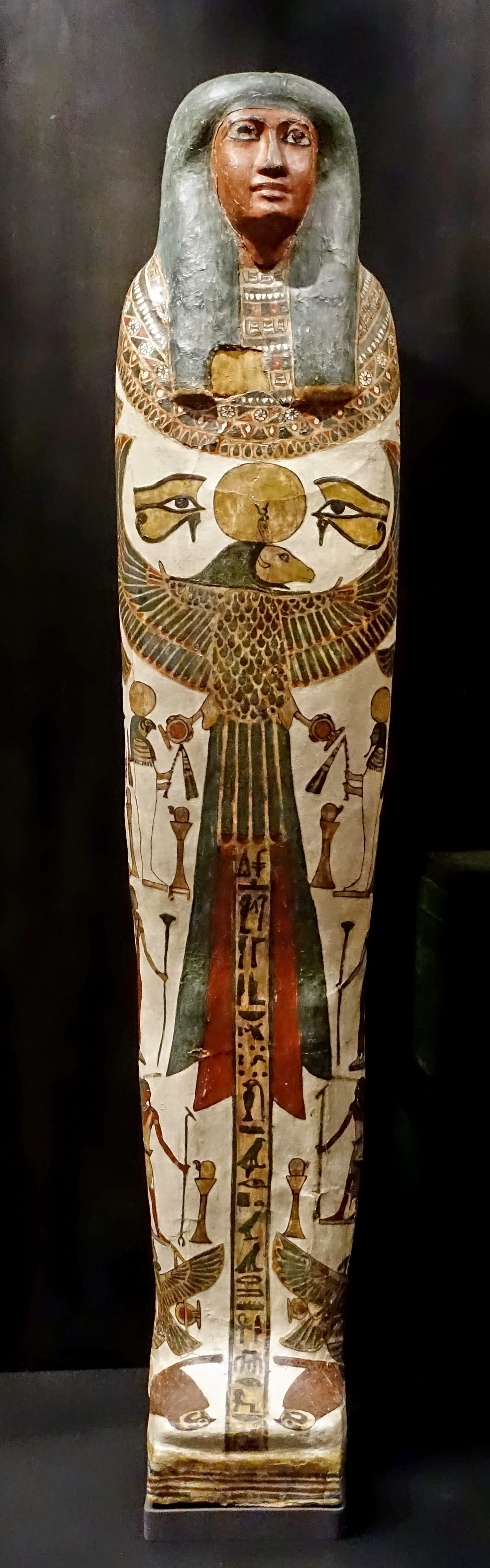
25th - 26th Dynasty: 746 BC - 525 BC
Well Painted Coffin
Coffin with images of various gods, Late Period, circa 7th - 6th century BC.
Catalog: Cartonnage ( no catalog number indicated - Don )
Photo: Don Hitchcock 2018
Source: Original, Ägyptischen Museum München
Text: Museum card, © Ägyptischen Museum München
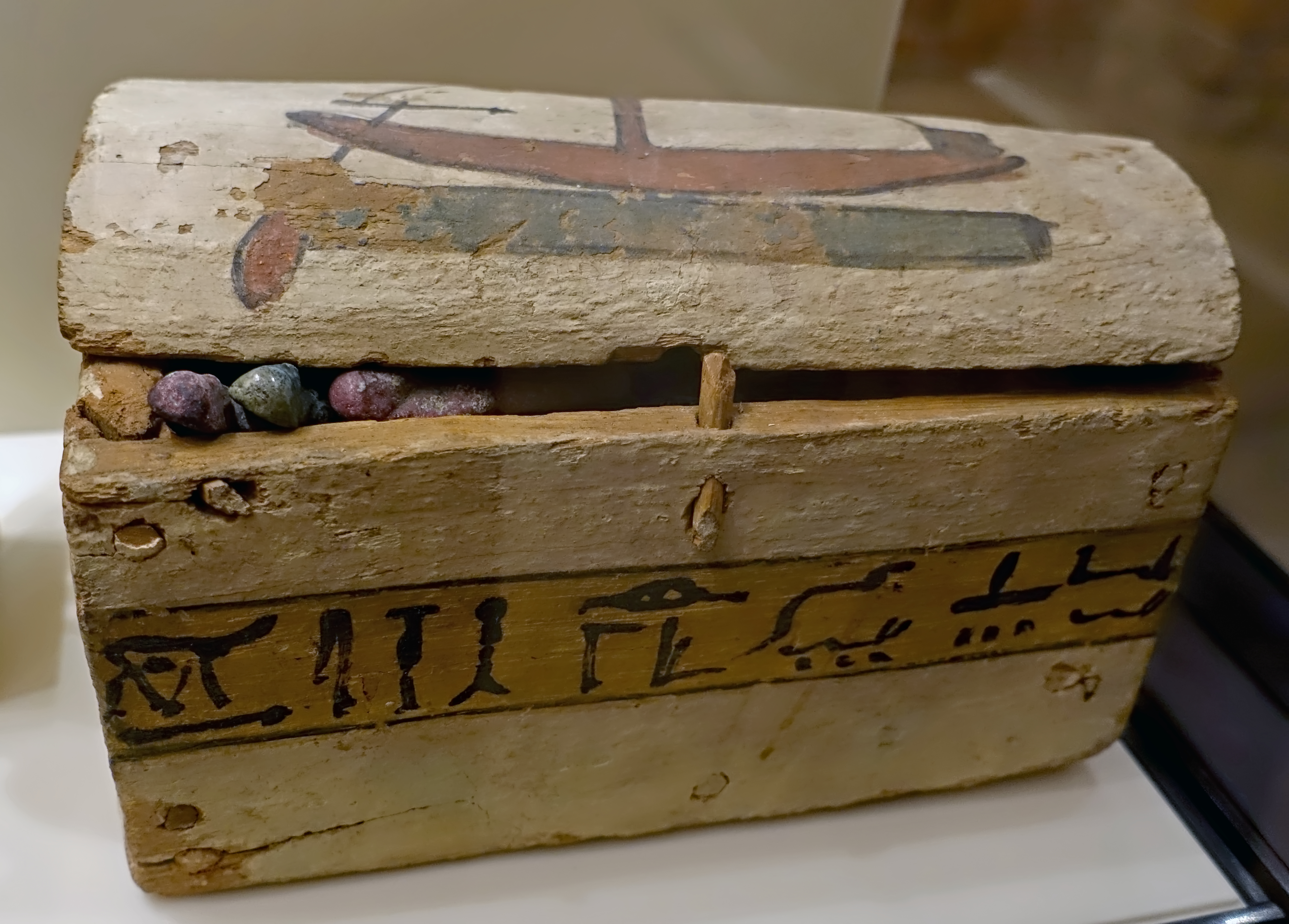
Late 25th - 26th Dynasty: 746 BC - 525 BC
Shabti Box with mass production shabtis
Catalog: Wood, faience, ÄM 734
Photo: Don Hitchcock 2018
Source: Original, Staatliche Museen zu Berlin, Neues Museum, Germany
Text: © Card at the Staatliche Museen zu Berlin, http://www.smb-digital.de/, (CC BY-NC-SA 3.0 DE)
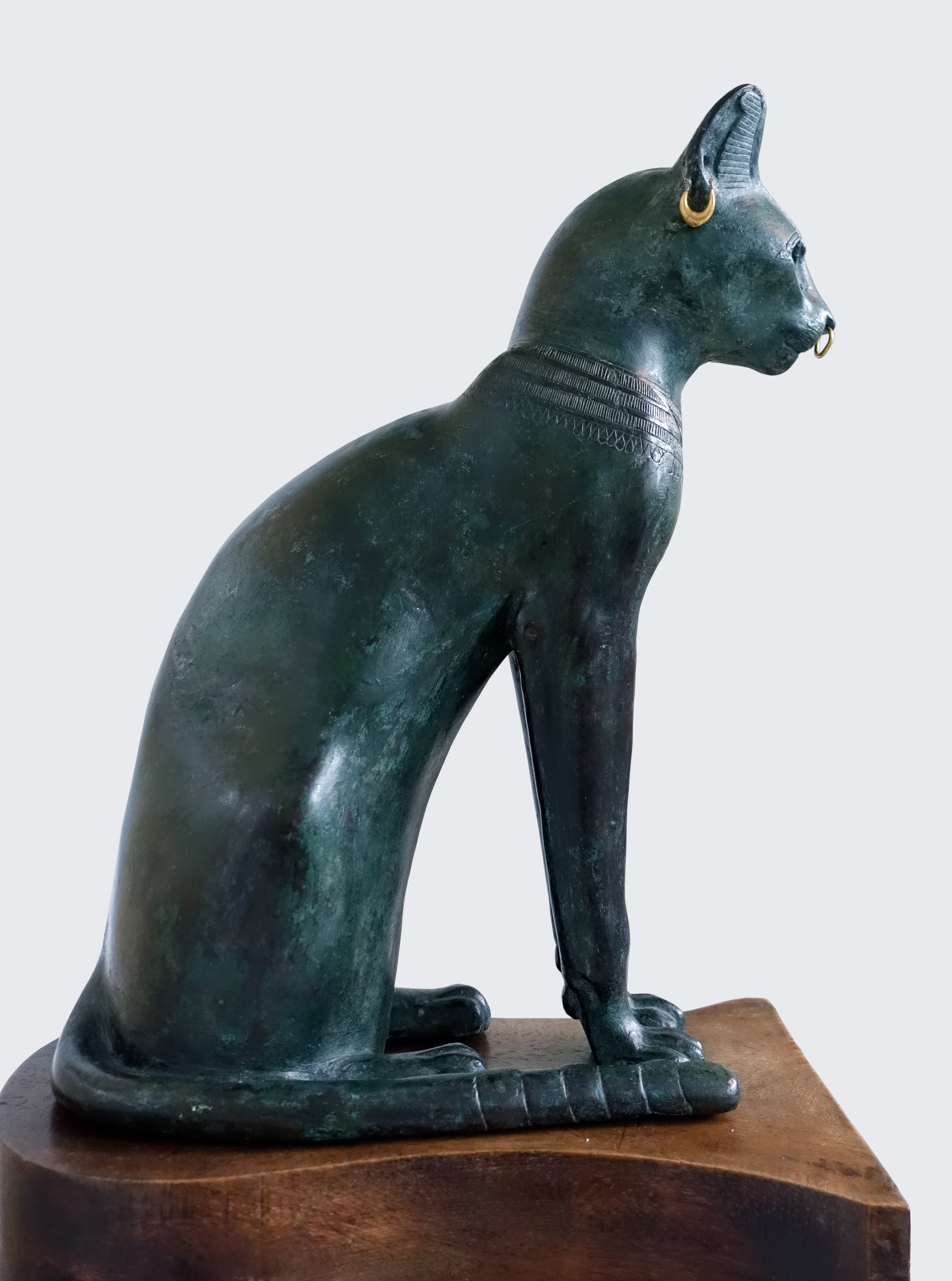
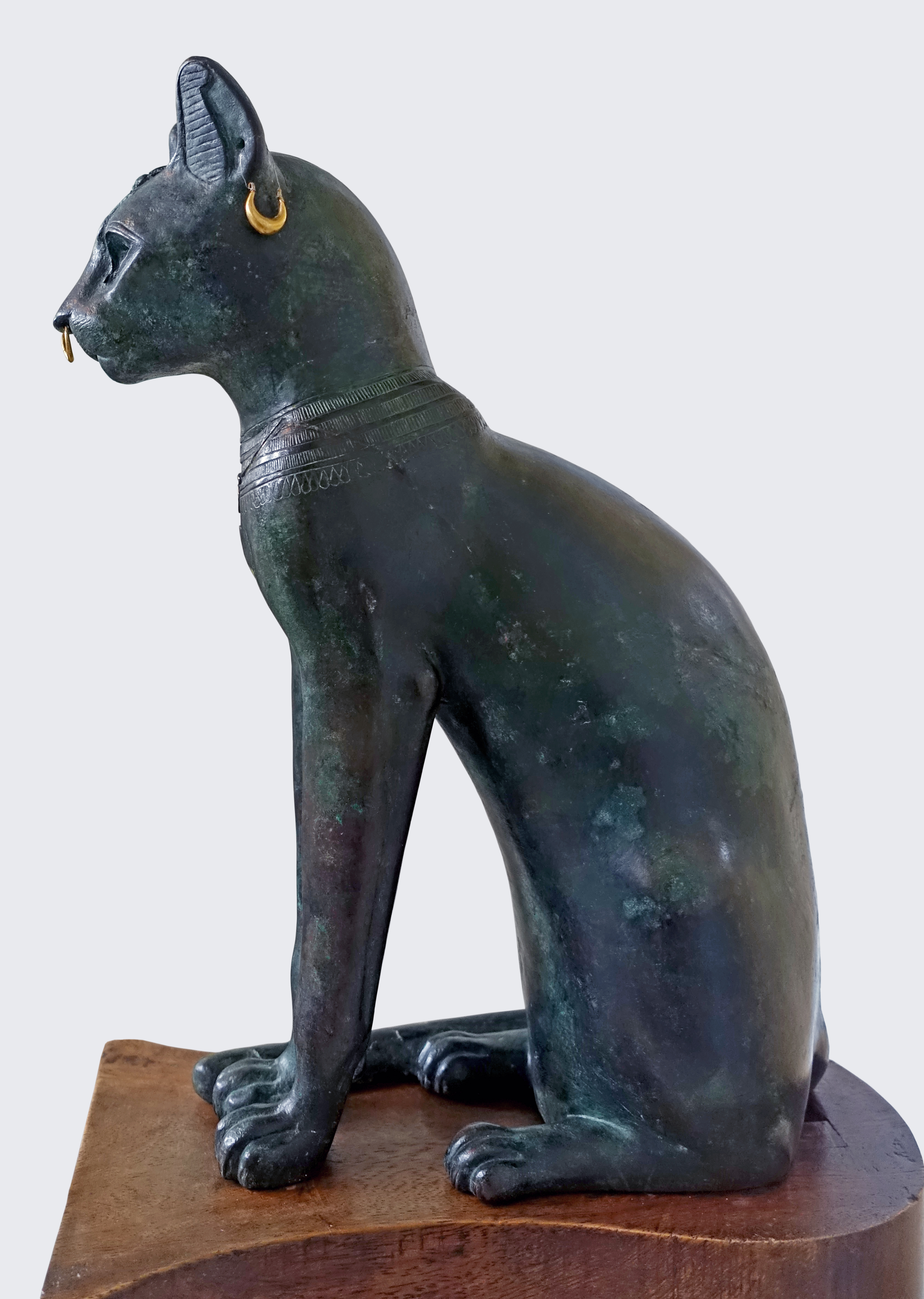
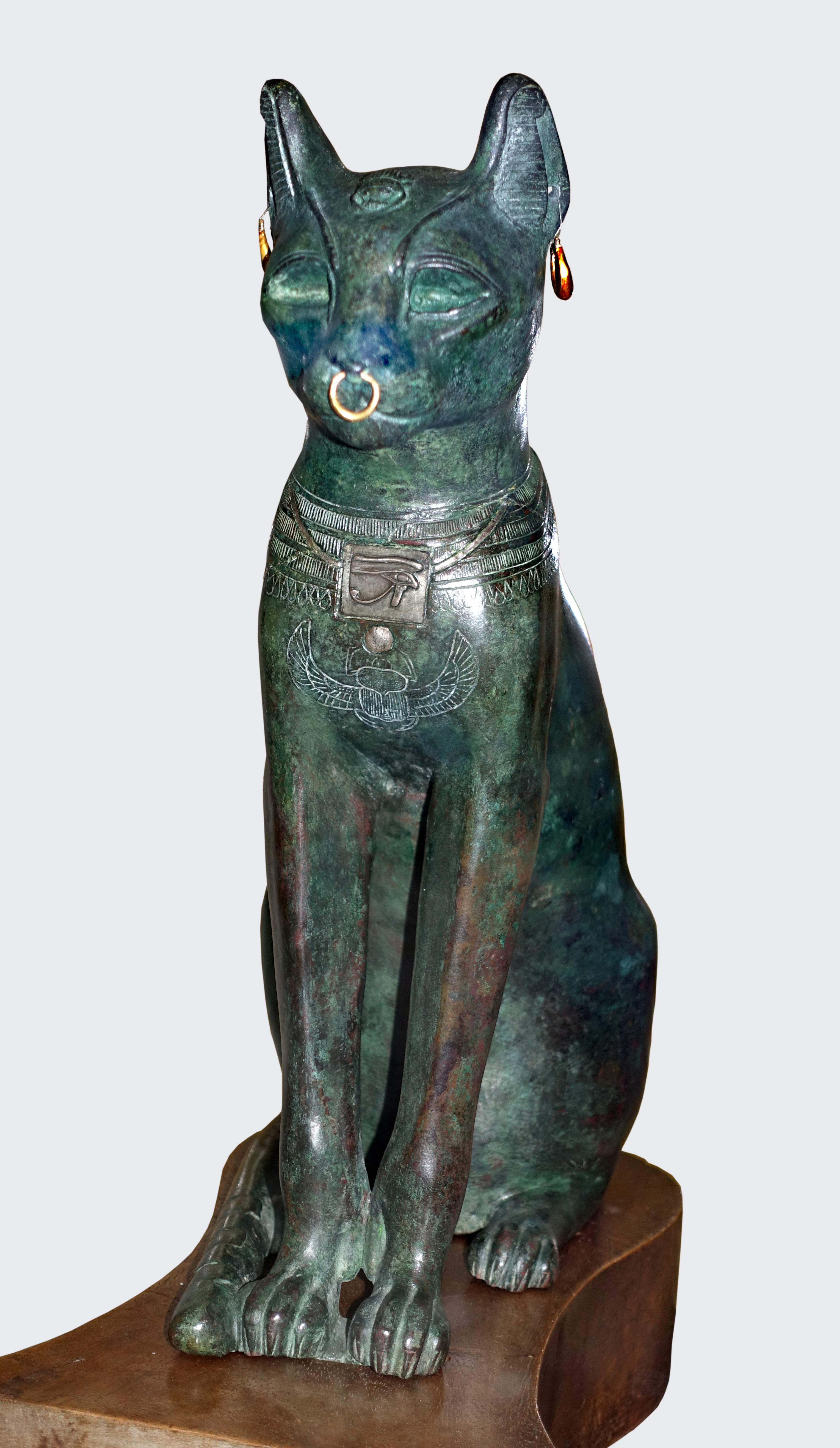
26th Dynasty, 664 - 525 BC
The Gayer-Anderson Cat
Bronze with silver plaque and gold jewellery.
Production date: Circa 600 BC
This regal and highly decorated bronze statue wears gold earrings and a gold nose ring. Her silver breastplate is decorated with the sacred eye of the god Horus, beneath which is an ornamental scarab and silvered disc.
Cat coffin, also known as the Gayer-Anderson Cat.
The hollow-cast copper alloy figure is in the form of a seated cat, its striated tail wrapped around its right side. The figure has a scarab in relief on the forehead and an incised collar around the neck with inlaid details, including a wedjat eye pectoral and a silver sun-disc held by an incised winged scarab on the chest.
The ears and nose are pierced and contain gold earrings and a nose-ring. The eyes are hollowed for inlays which are missing. Two tangs protrude from beneath the front paws and the tail, likely for insertion into a plinth. The figure probably originally contained the mummified remains of a cat and is now empty.
Height 42 cm (with base), 34 cm (without base, but not including tang)
Weight 10.8 kg (with base), 7.8 kg (without base)
Width 20 cm (with base), 14 cm (without base)
Depth 305 mm (with base), 230 mm (without base)
Donation: This iconic ancient Egyptian bronze statue of the cat goddess Bastet was jointly donated to the British Museum in 1939 by British Army officer and collector Major Robert Grenville Gayer-Anderson (often referred to as Gayer-Anderson Pasha) and Mary Stout Shaw.
Findspot: Saqqara (Memphis)
Catalog: Copper alloy, gold, silver, hollow-cast, inlaid, incised, EA64391
Photo: Don Hitchcock 2018
Text: Card with the display at the British Museum, http://www.britishmuseum.org/, © Trustees of the British Museum, CC BY-NC-SA 4.0
Source: Original, British Museum
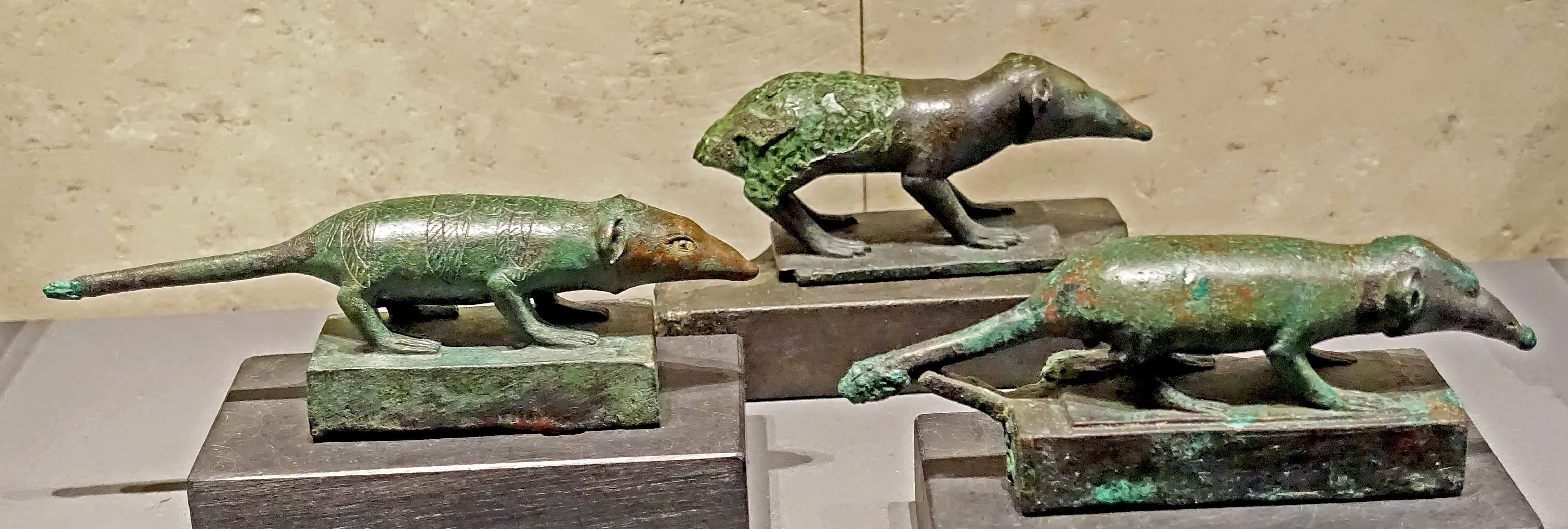
25th - 31st Dynasty: 746 BC - 332 BC
Three shrews
Three shrews, manifestations of a specific aspect of the sun god.
Late Period, circa 700 - 400 BC.
Catalog: Bronze, ÄS 7101, ÄS 7102, ÄS 7103
Photo: Don Hitchcock 2018
Source: Original, Ägyptischen Museum München
Text: Museum card, © Ägyptischen Museum München
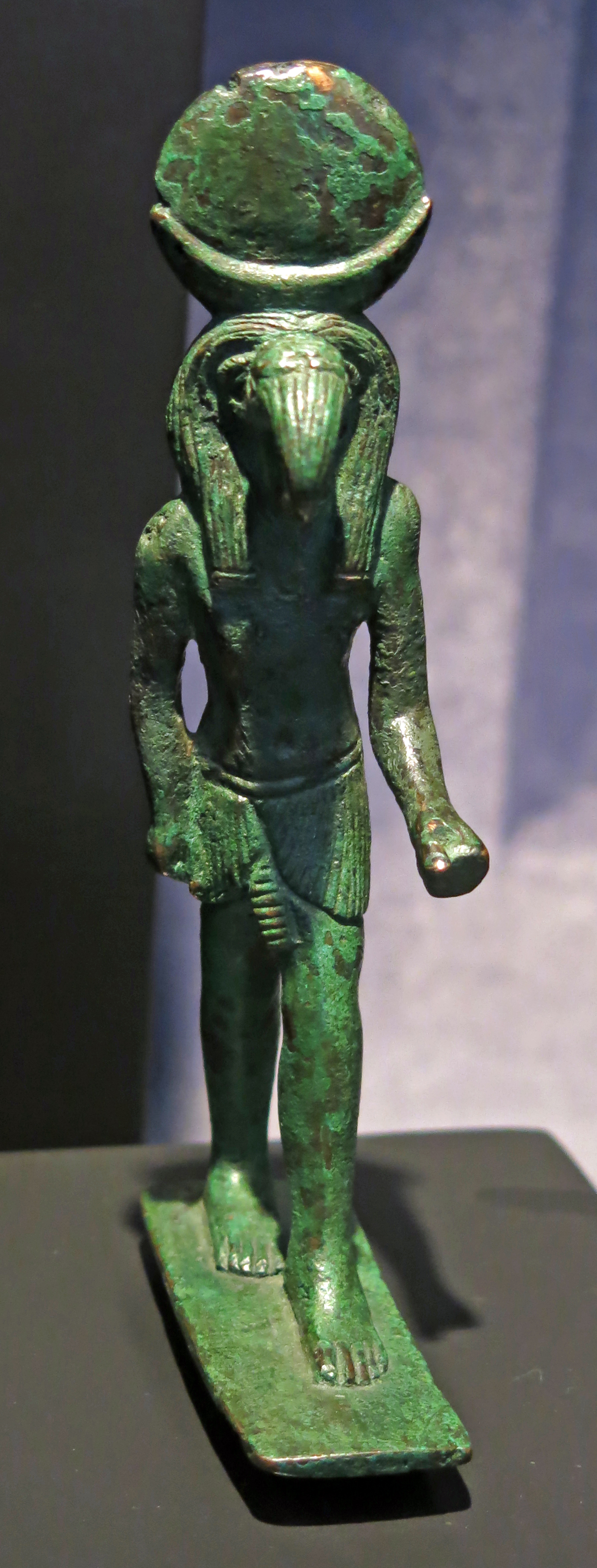
25th - 31st Dynasty: 746 BC - 332 BC
Thoth
The ibis-headed god wears the moon disc as an attribute. He is the god of knowledge and calculation, of the calendar and the scribe.
Late period, circa 700 BC - 400 BC.
Catalog: Bronze
Photo: Don Hitchcock 2015
Source and text: Badisches Landesmuseum Karlsruhe Germany

25th - 31st Dynasty: 746 BC - 332 BC
Otter
Circa 683 BC - 525 BC
During the Late Period and Ptolemaic times otters were represented in bronze statuettes such as this one, standing, forepaws raised, atop small bronze boxes. The pose of raised paws signifies the otter's adoration of the sun god when he rises in the morning. In myth otters were attached to the goddess of Lower Egypt, Wadjet, whose cult was centred in Buto, (which at the time was called Per-Wadjet) in the northern Delta.
Catalog: Bronze, Inv 77/27
Photo: Don Hitchcock 2015
Source and text: Badisches Landesmuseum Karlsruhe Germany
Additional text: www.metmuseum.org
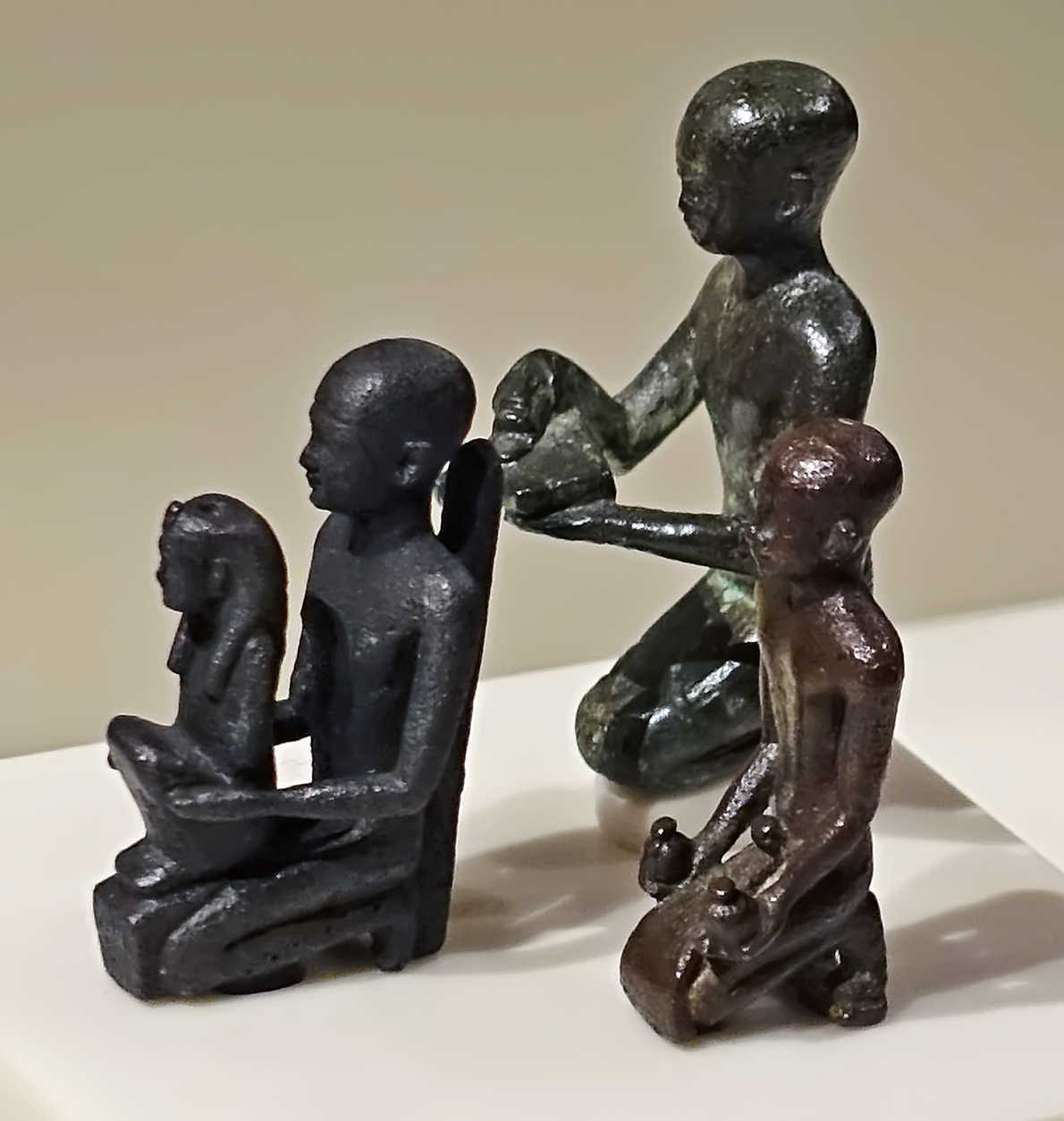
25th - 31st Dynasty: 746 BC - 332 BC
Offering Bearers
Three statuettes of offering bearers.
Catalog: 746 - 332 BC, bronze, ÄM 2508, ÄM 2574/2, ÄM 22590
Photo: Don Hitchcock 2018
Source: Original, Staatliche Museen zu Berlin, Neues Museum, Germany
Text: © Card at the Staatliche Museen zu Berlin, (CC BY-NC-SA 3.0 DE)
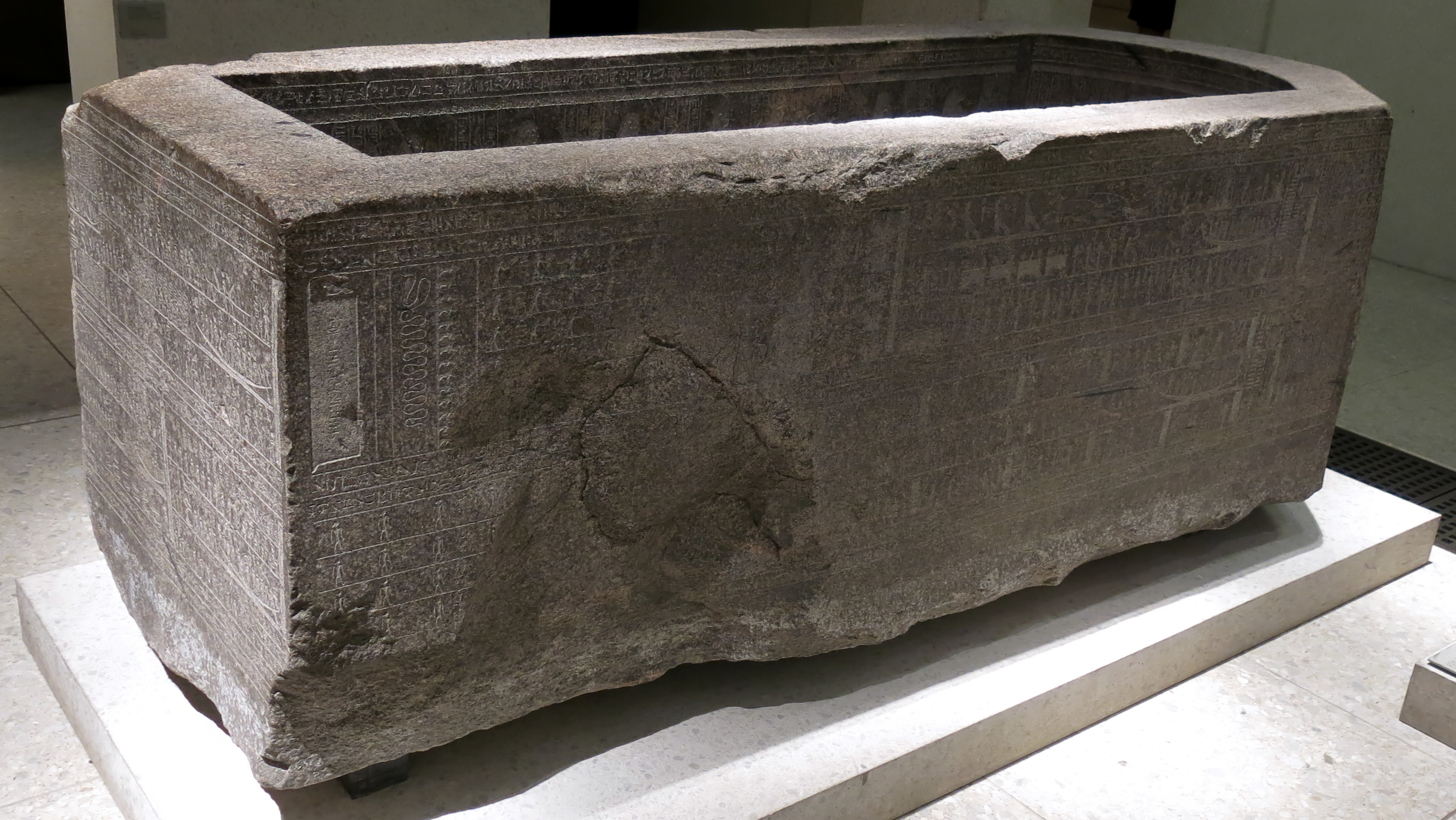
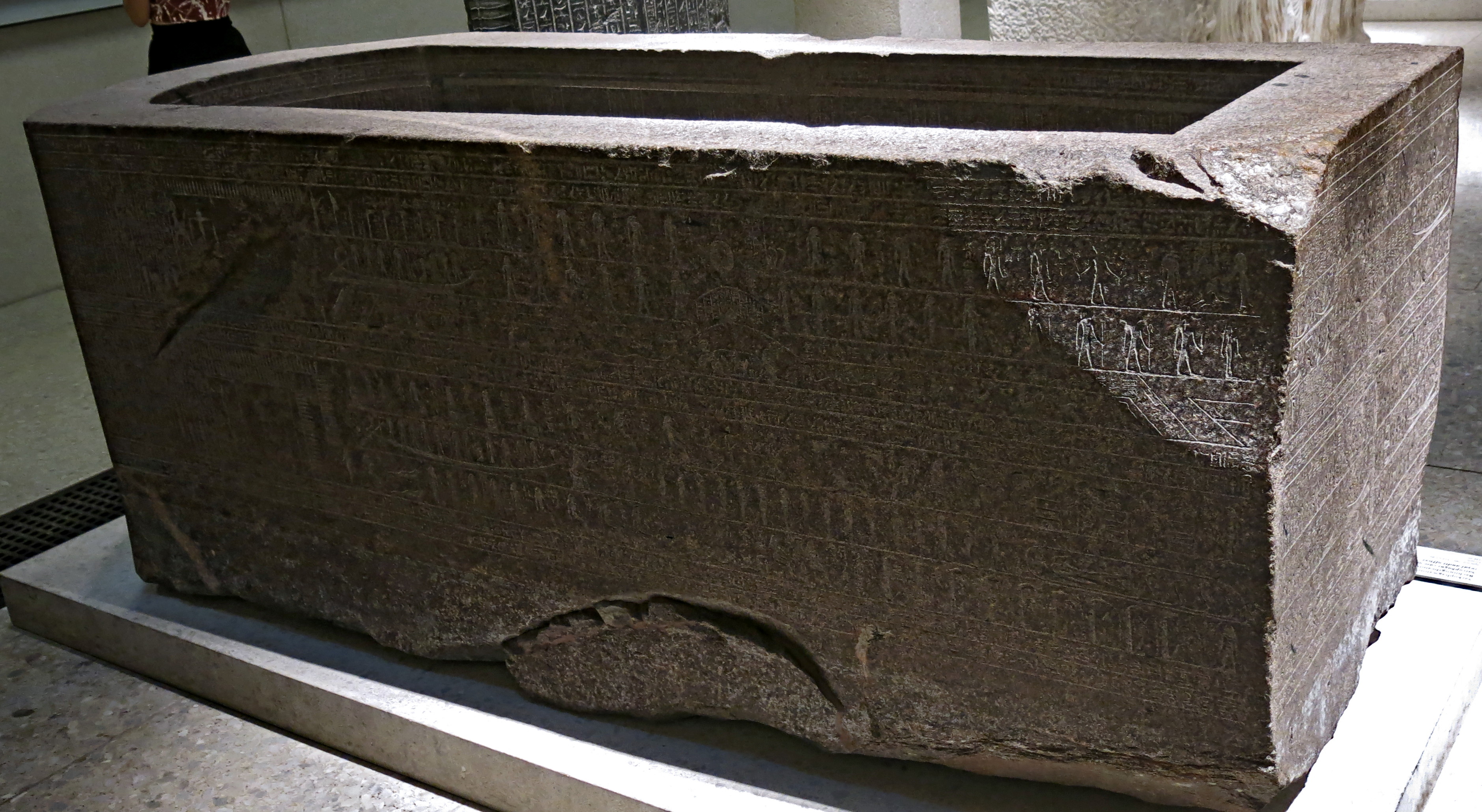
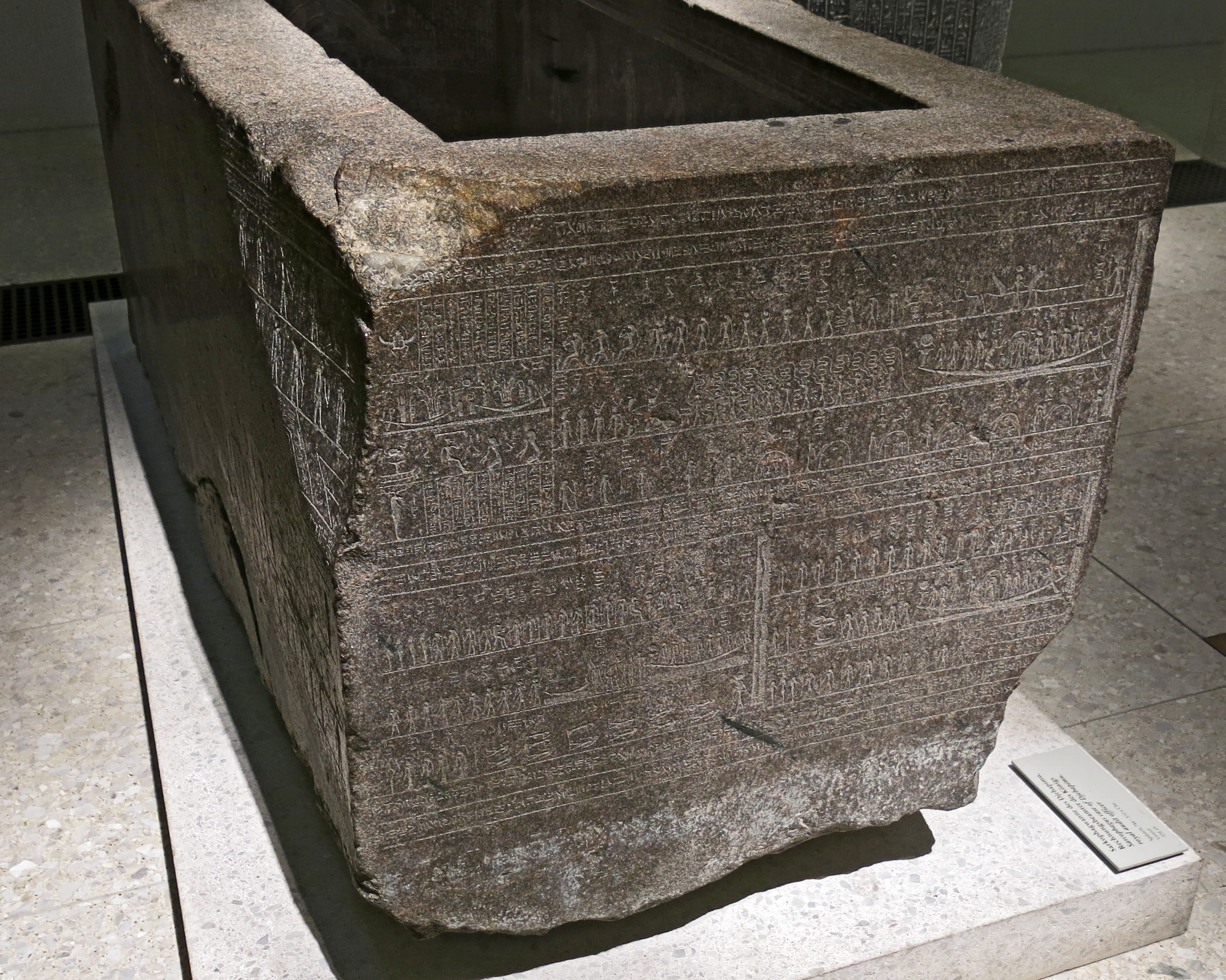
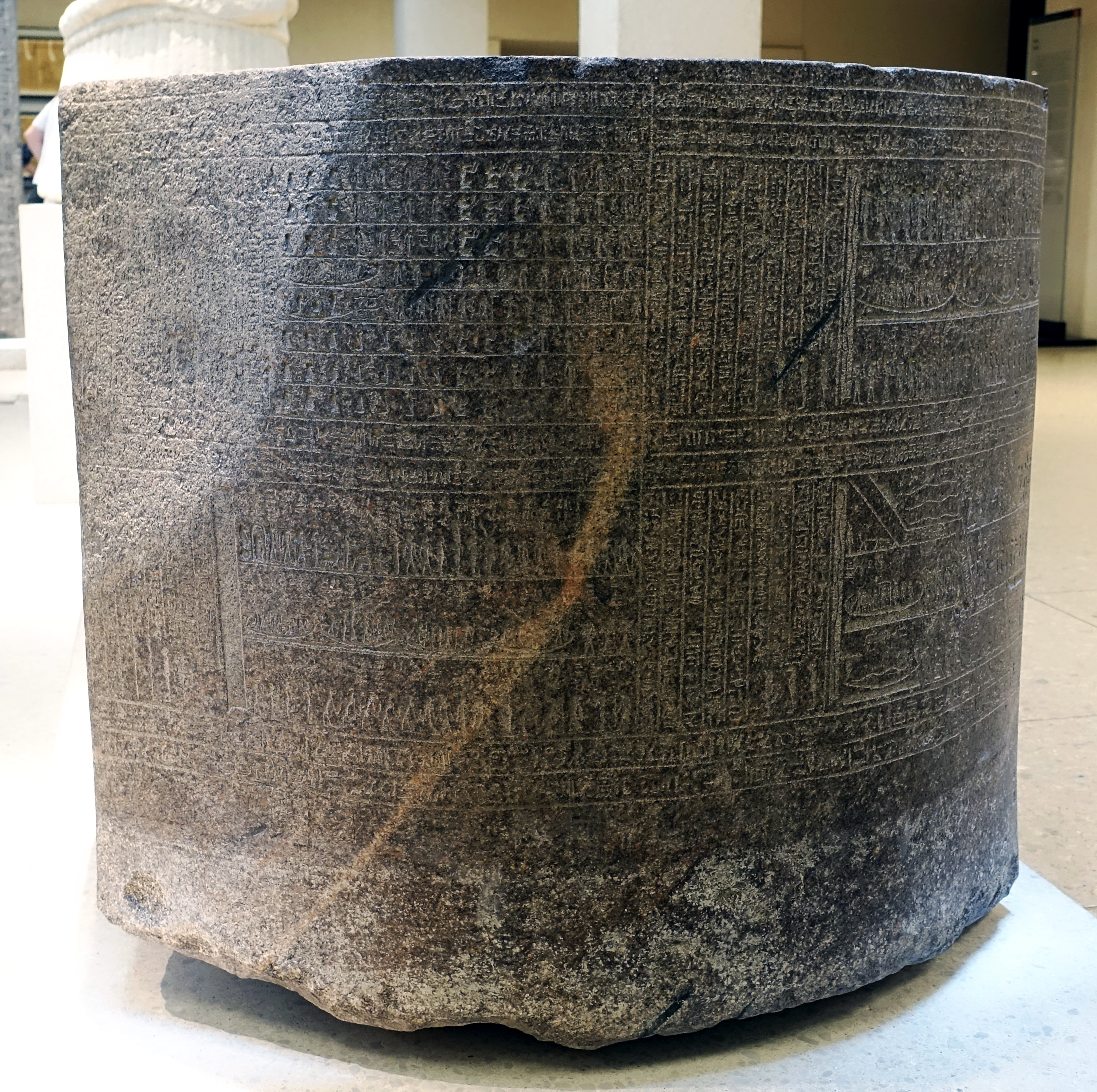
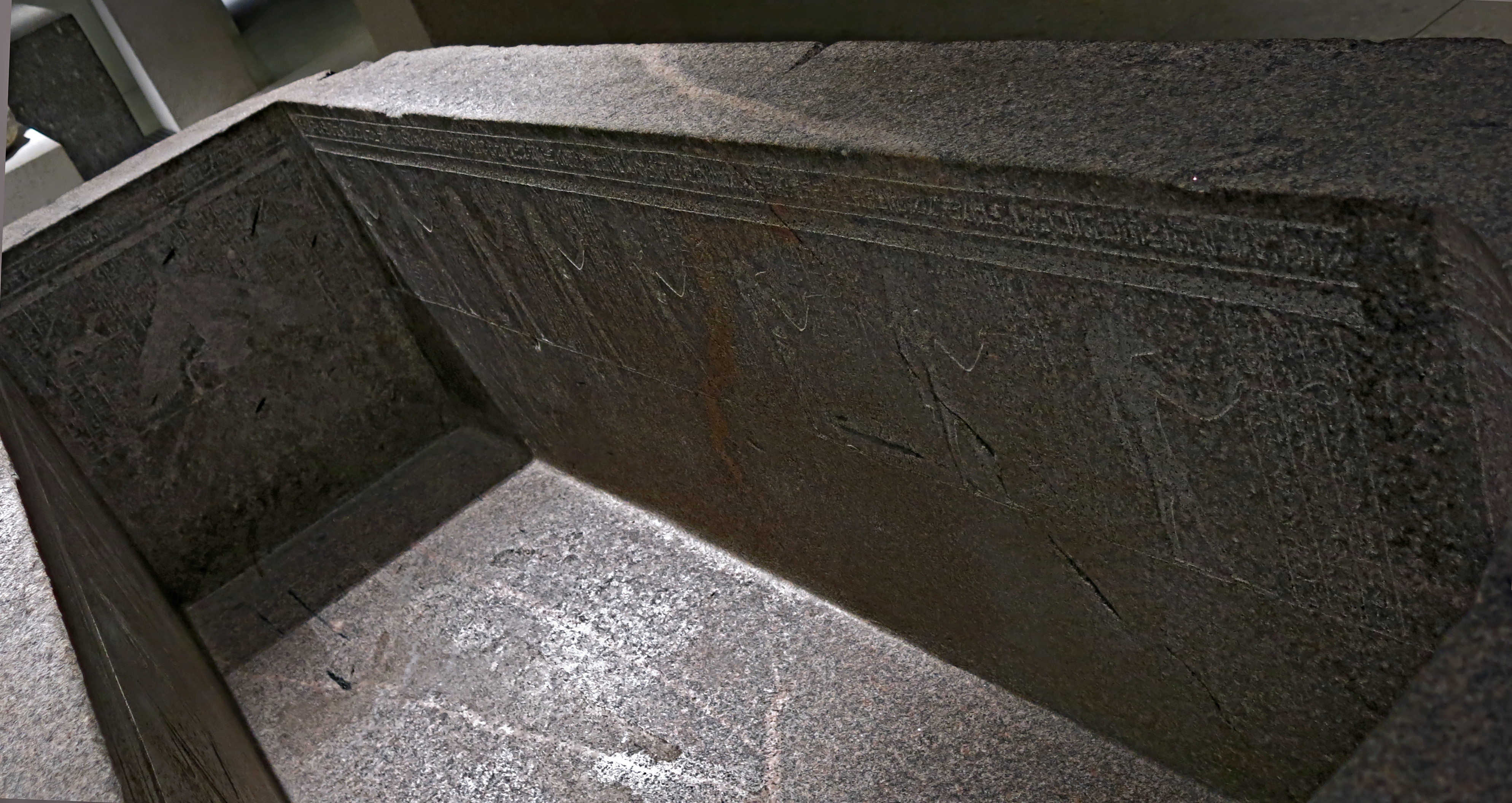

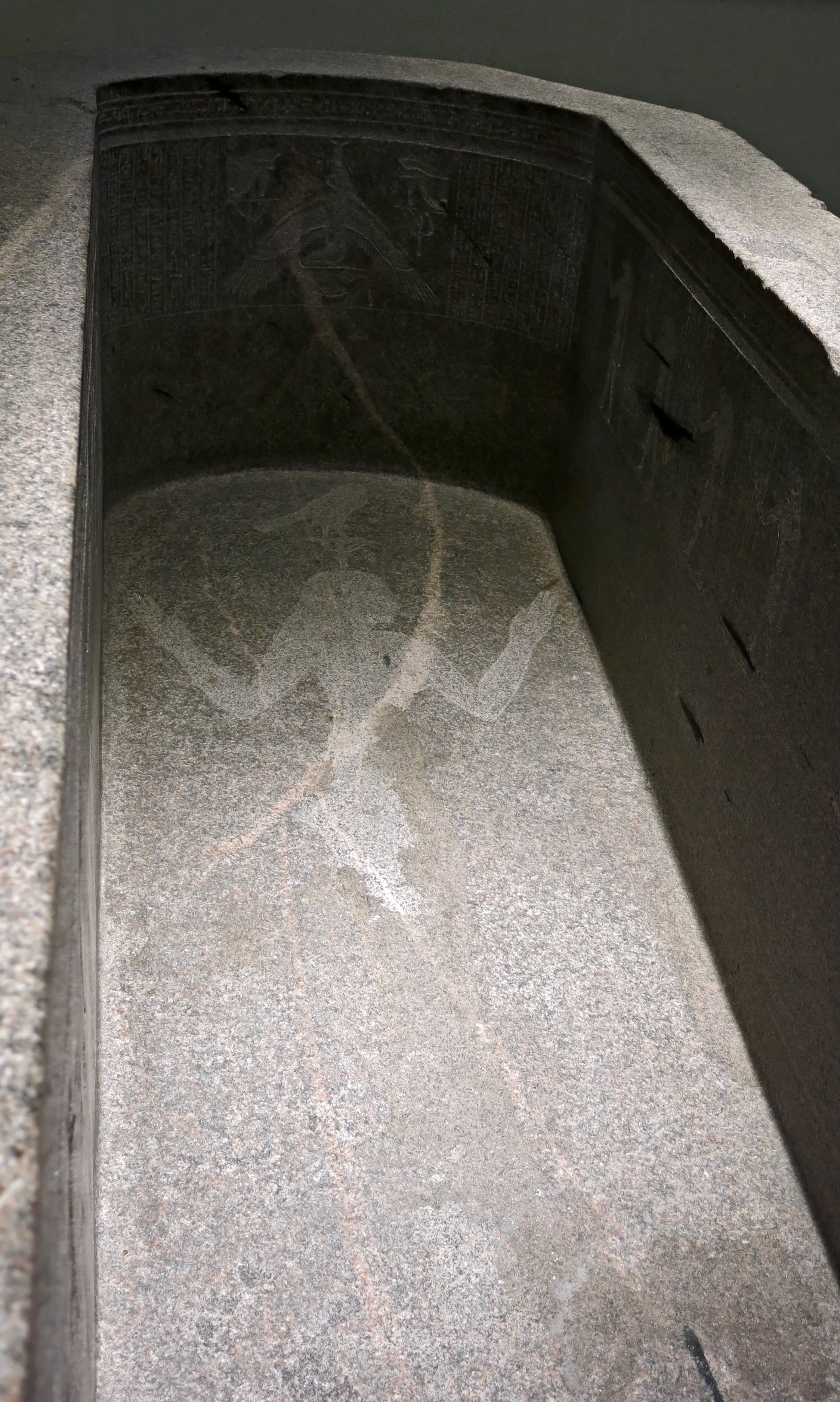
Sarcophagus of Djehapimu
25th - 31st Dynasty: 746 BC - 332 BC
Sarcophagus case of Djehapimu, Royal Audit Officer.
Catalog: Granite, ÄM 49
Photo: Don Hitchcock 2015, 2018
Source: Original, Staatliche Museen zu Berlin, Neues Museum, Germany
Text: © Card at the Staatliche Museen zu Berlin, (CC BY-NC-SA 3.0 DE)
Additional text: https://thebiography.us/en/padiiset1
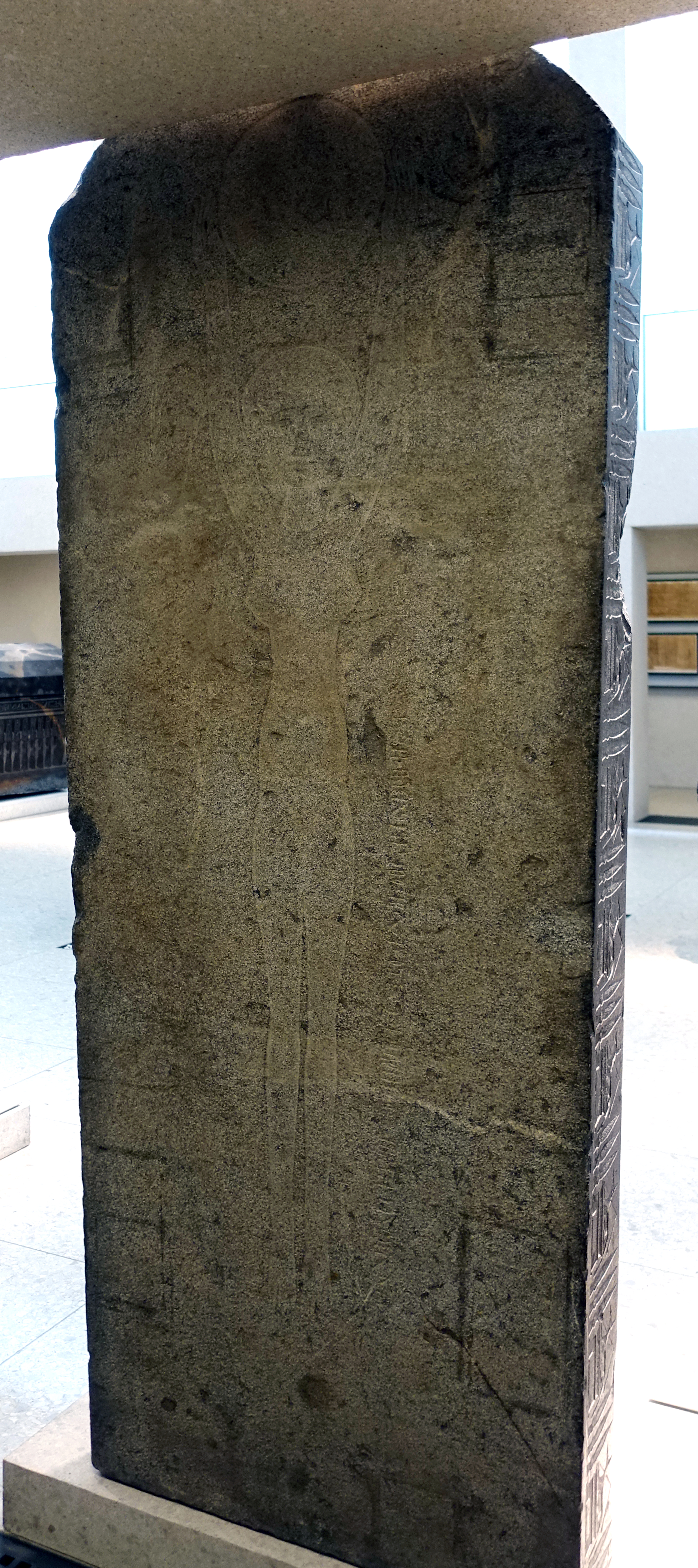

Sarcophagus lid of Djehapimu
25th - 31st Dynasty: 746 BC - 332 BC
Sarcophagus lid of Djehapimu, Royal Audit Officer.
Catalog: 746 - 332 BC, Granite, ÄM 49
Photo: Don Hitchcock 2018
Source: Original, Staatliche Museen zu Berlin, Neues Museum, Germany
Text: © Card at the Staatliche Museen zu Berlin, (CC BY-NC-SA 3.0 DE)
Additional text: https://thebiography.us/en/padiiset1
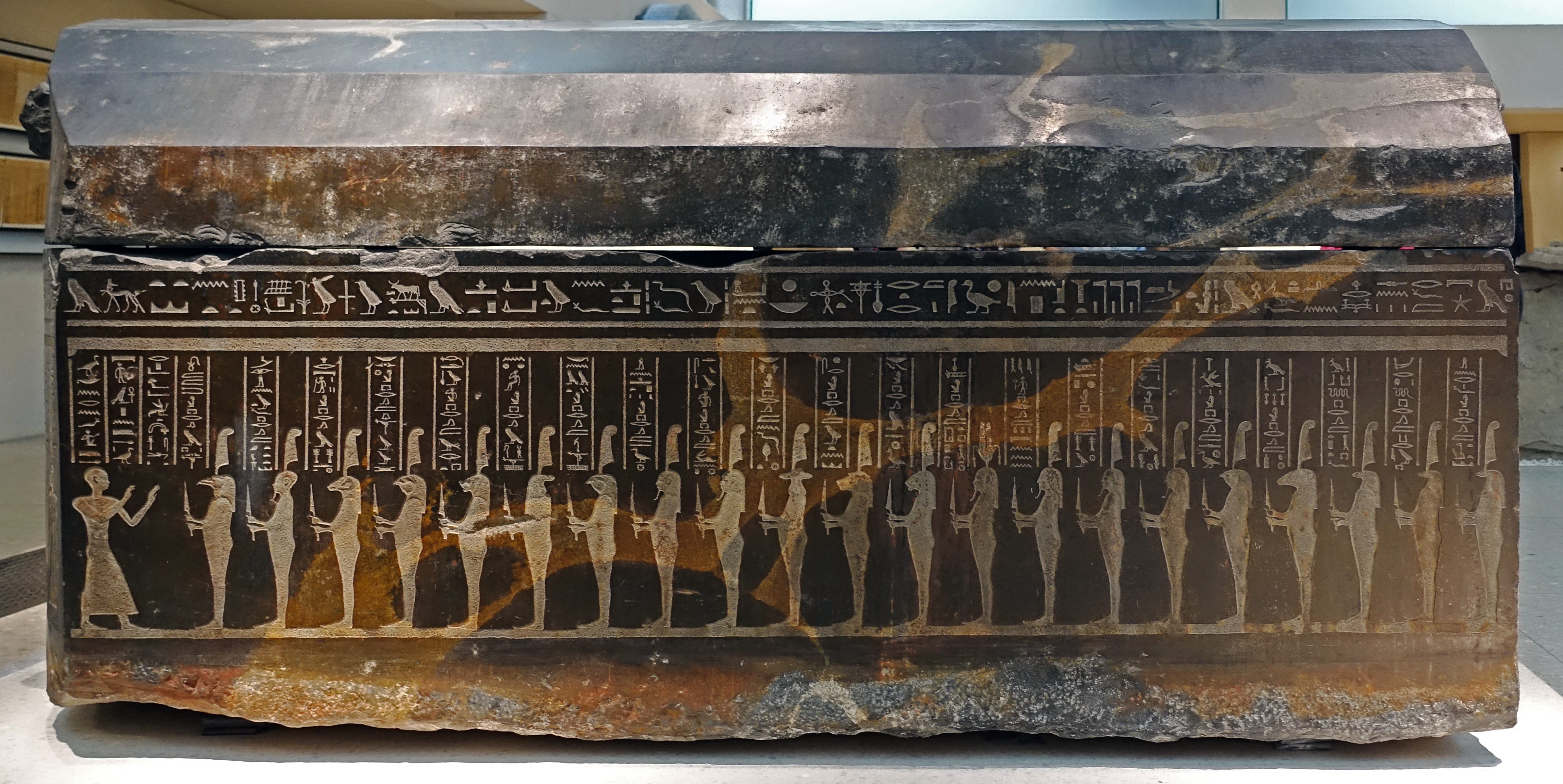
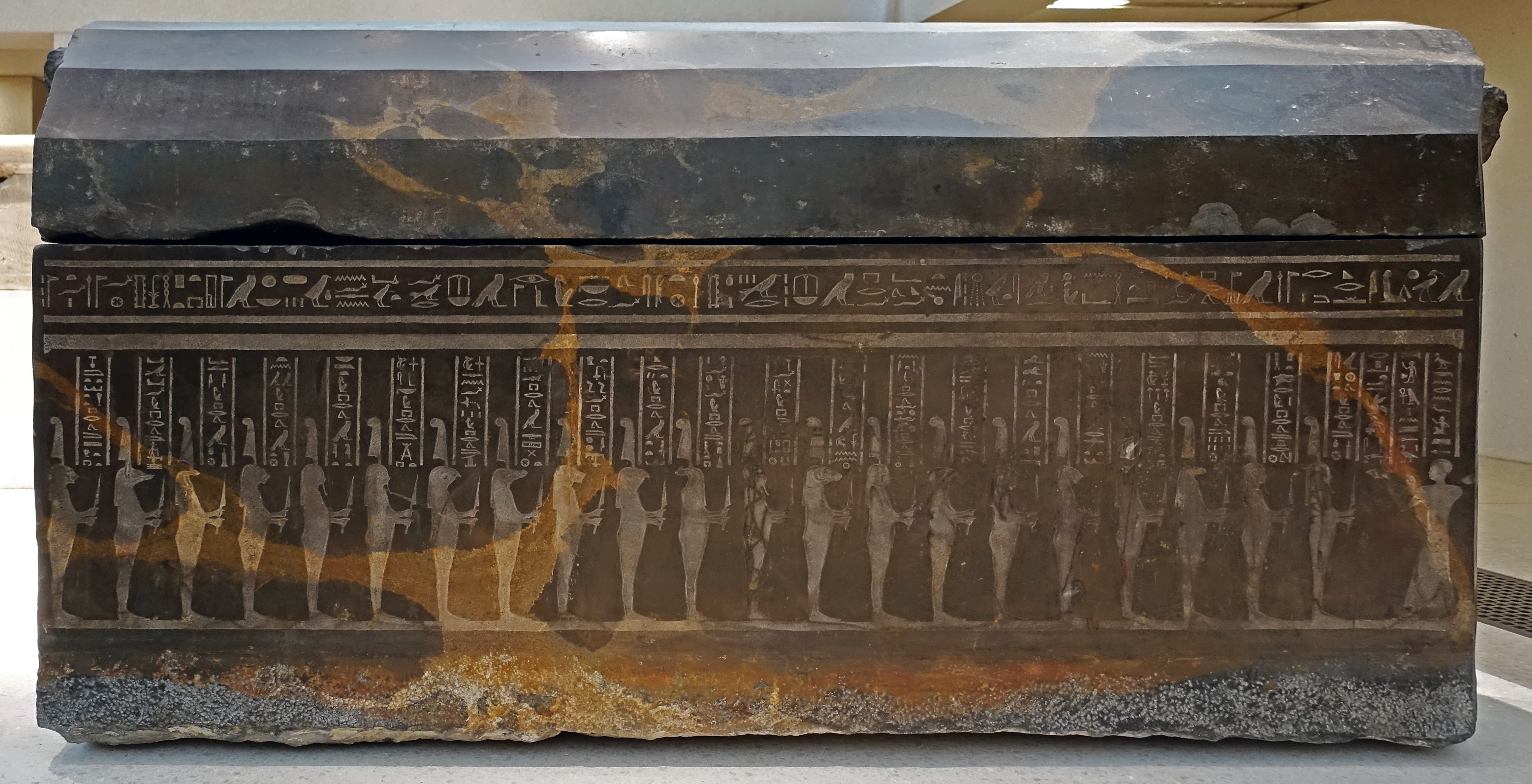
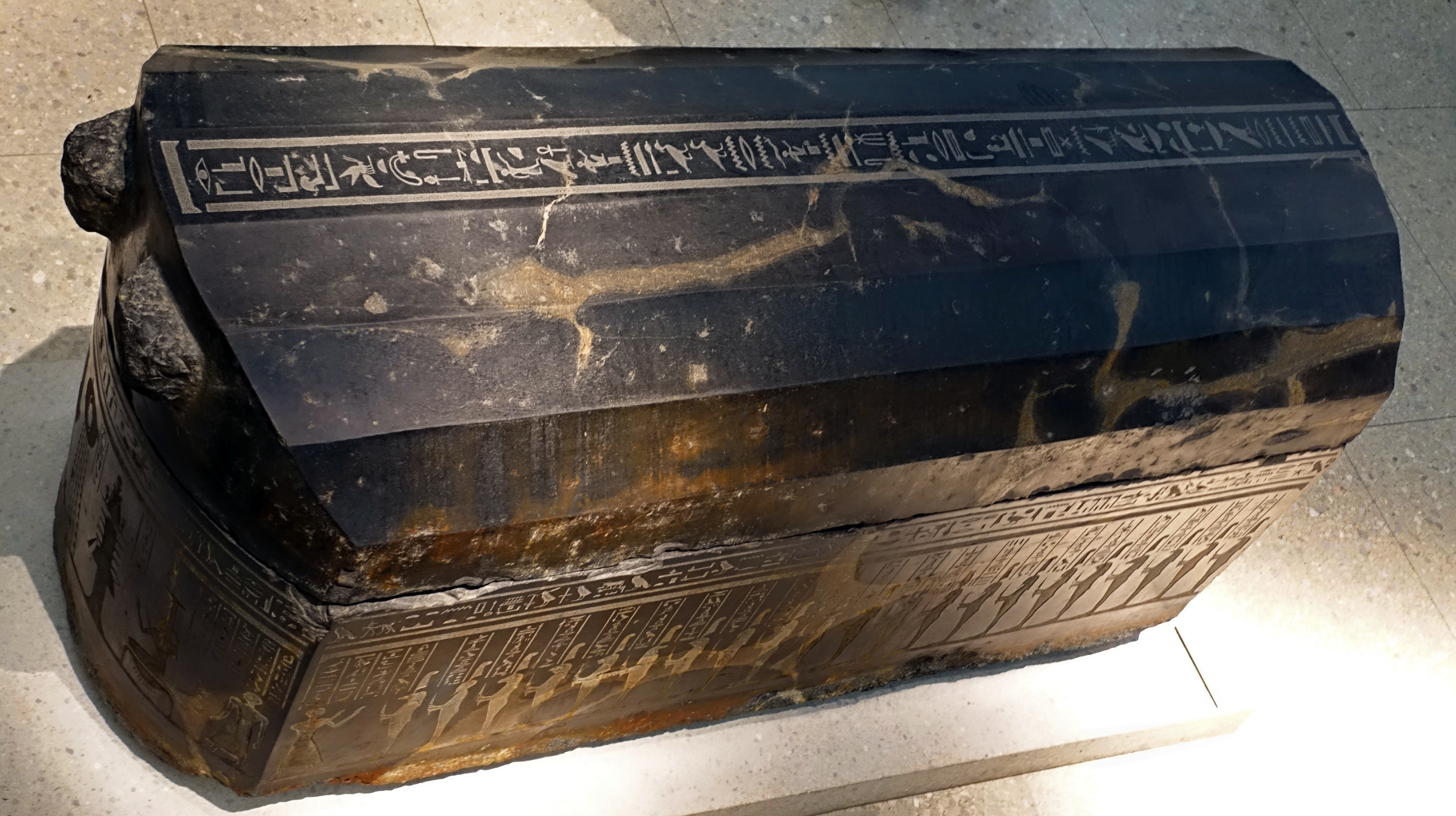
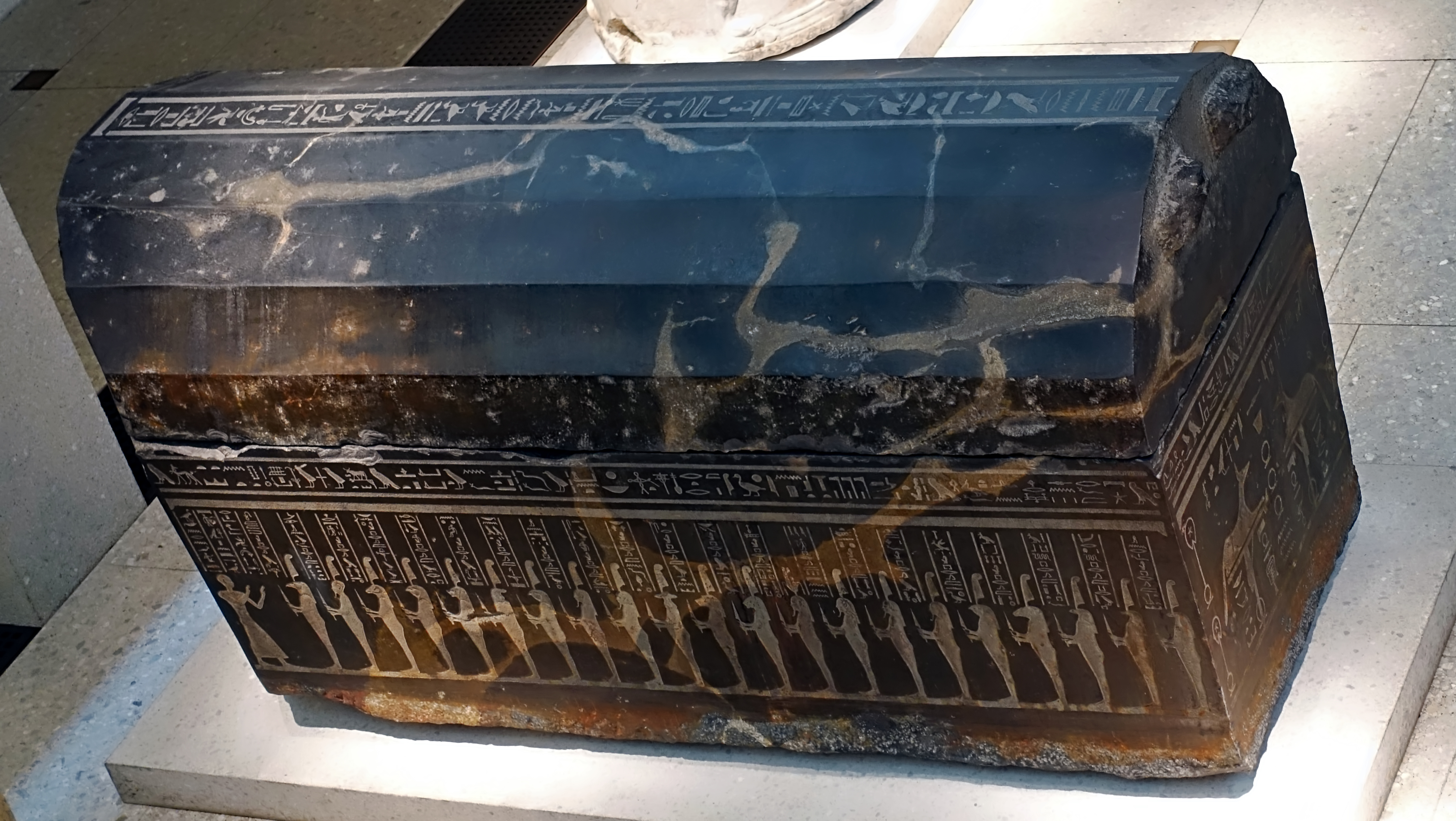
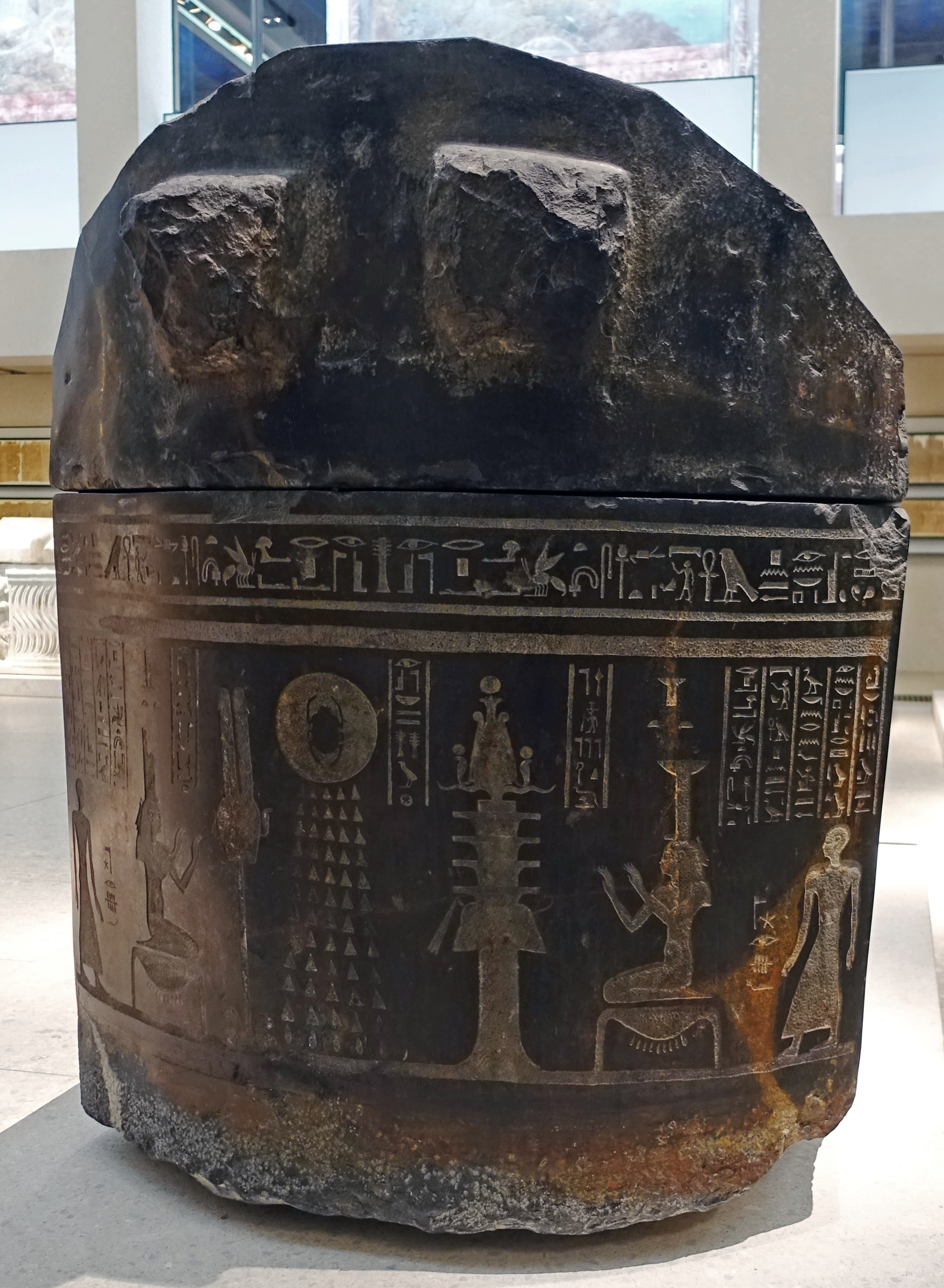
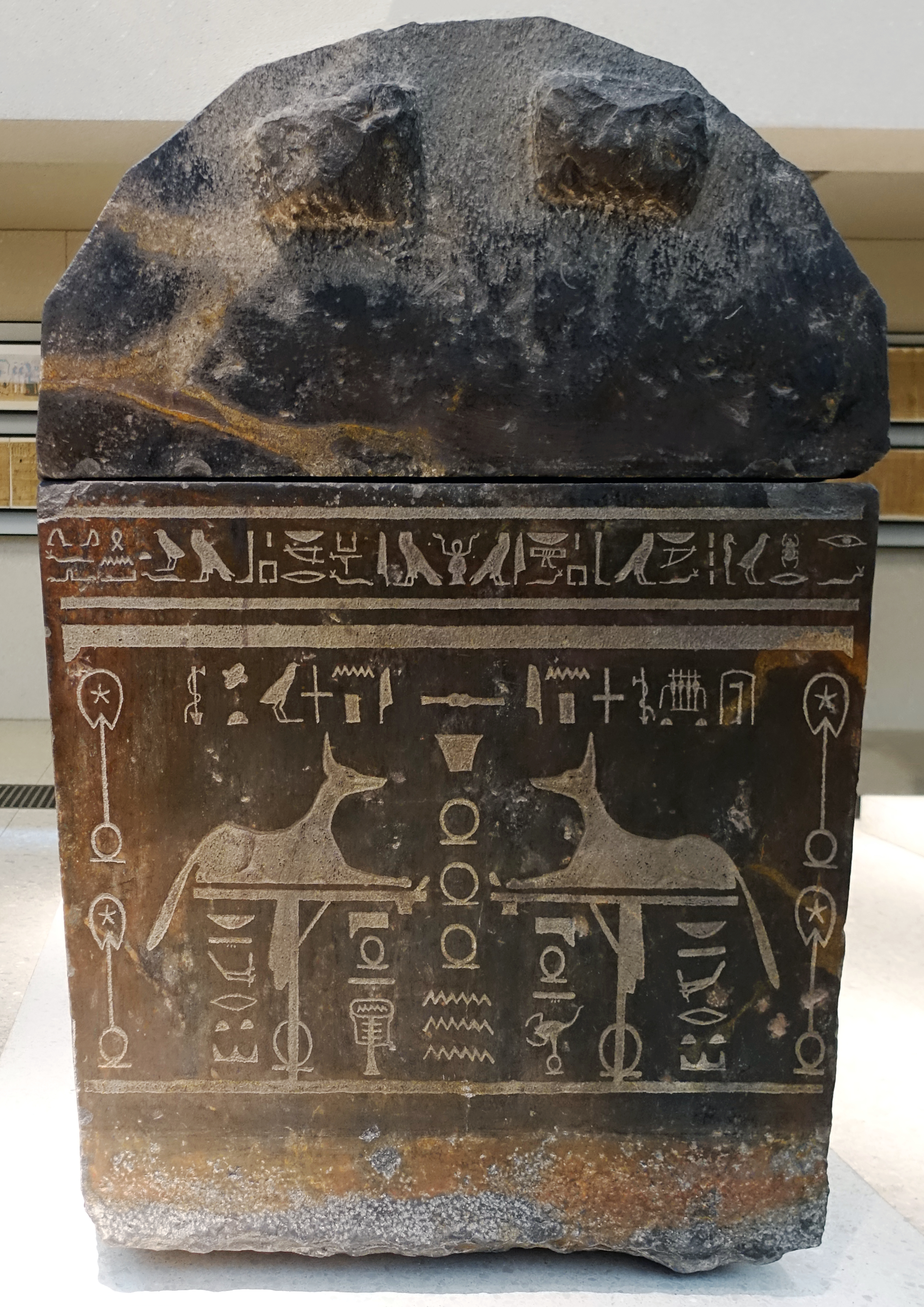
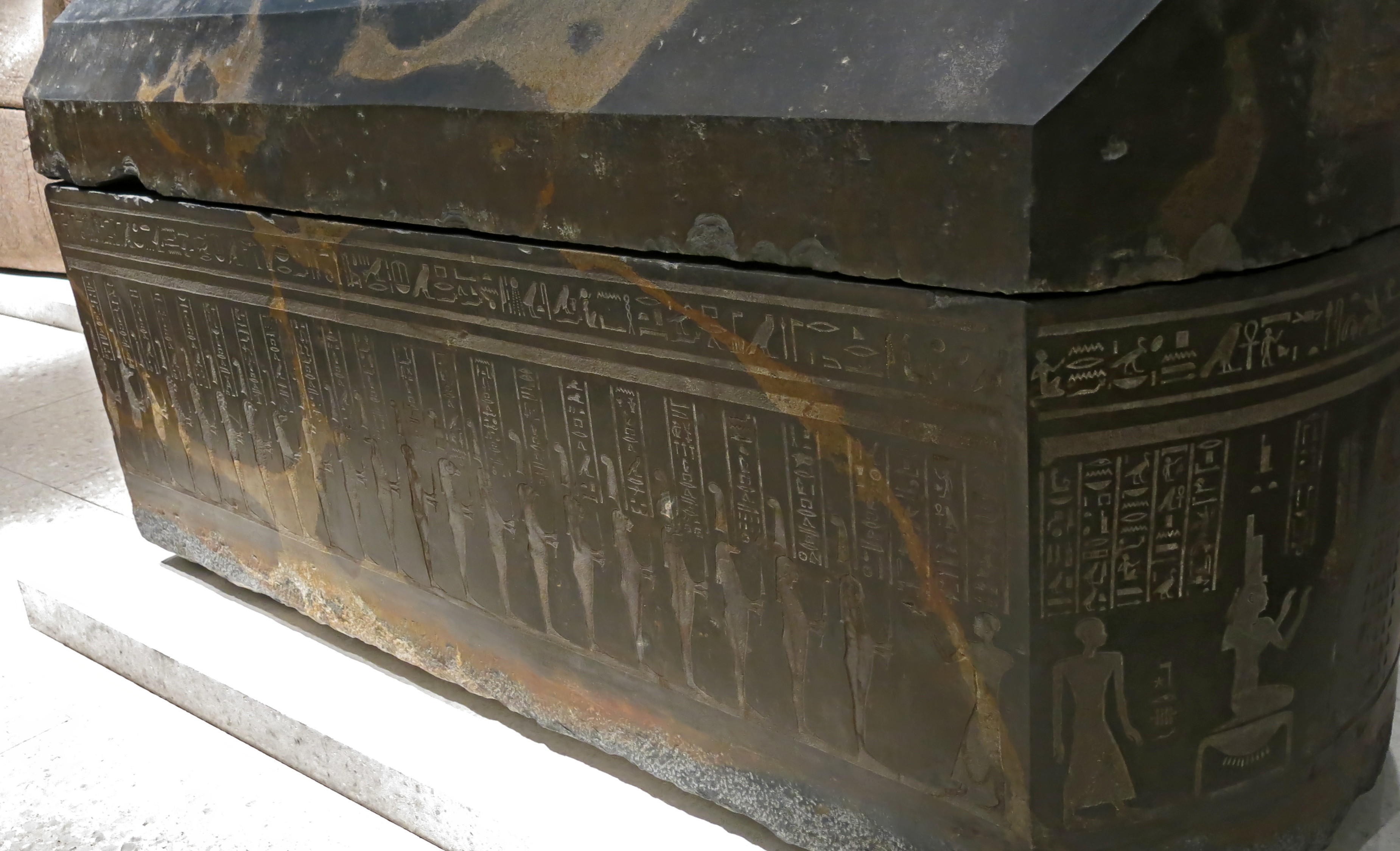
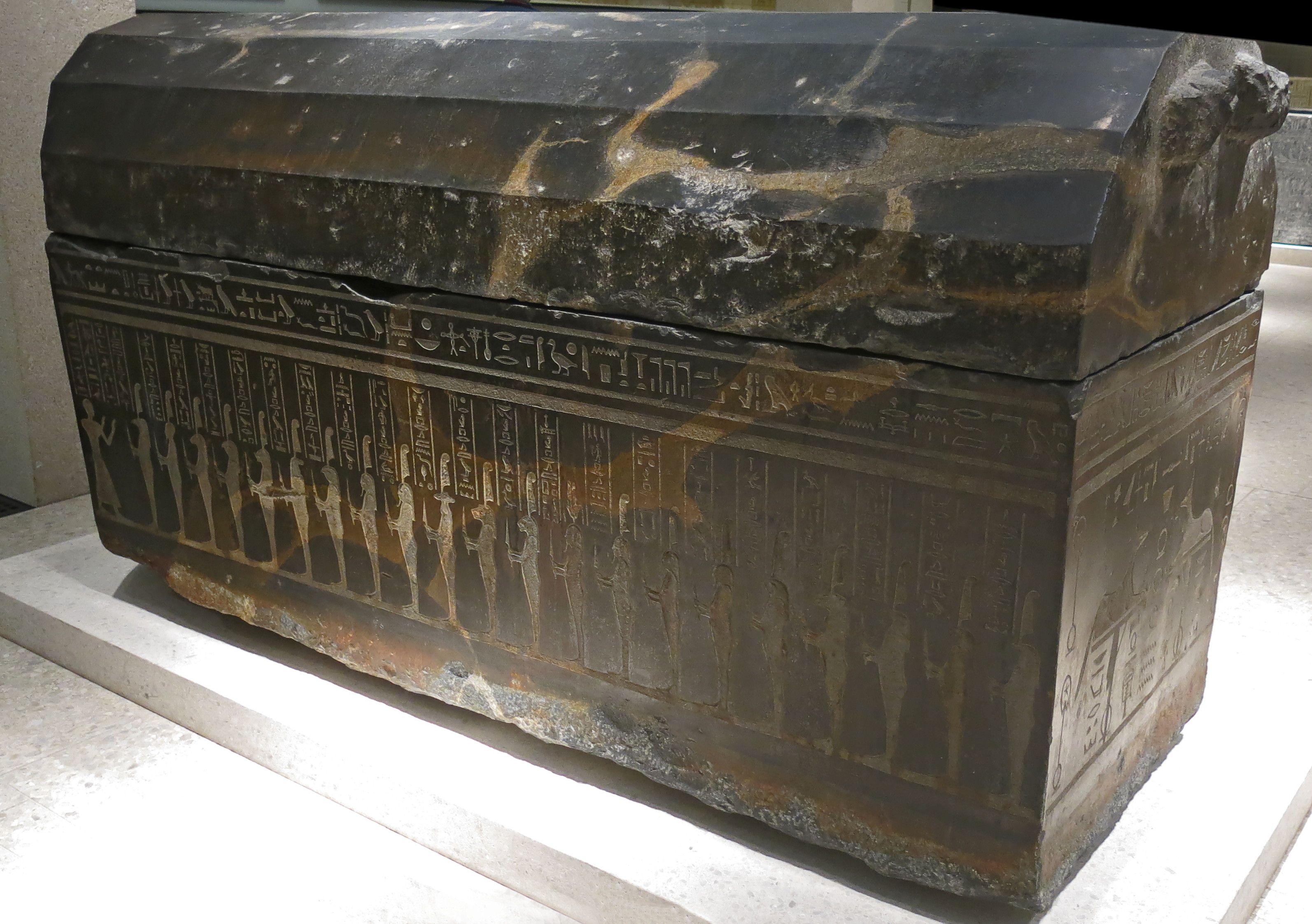
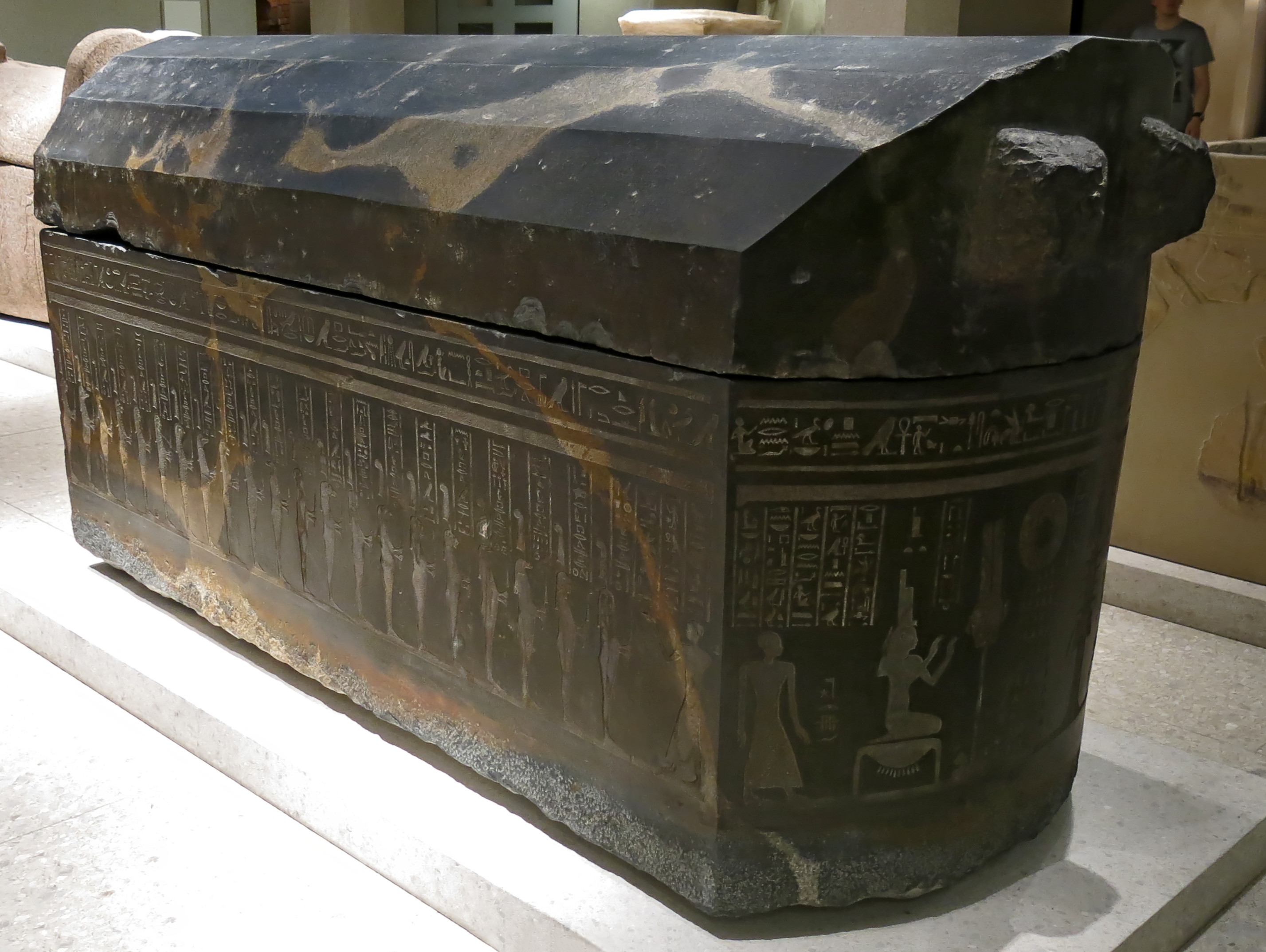
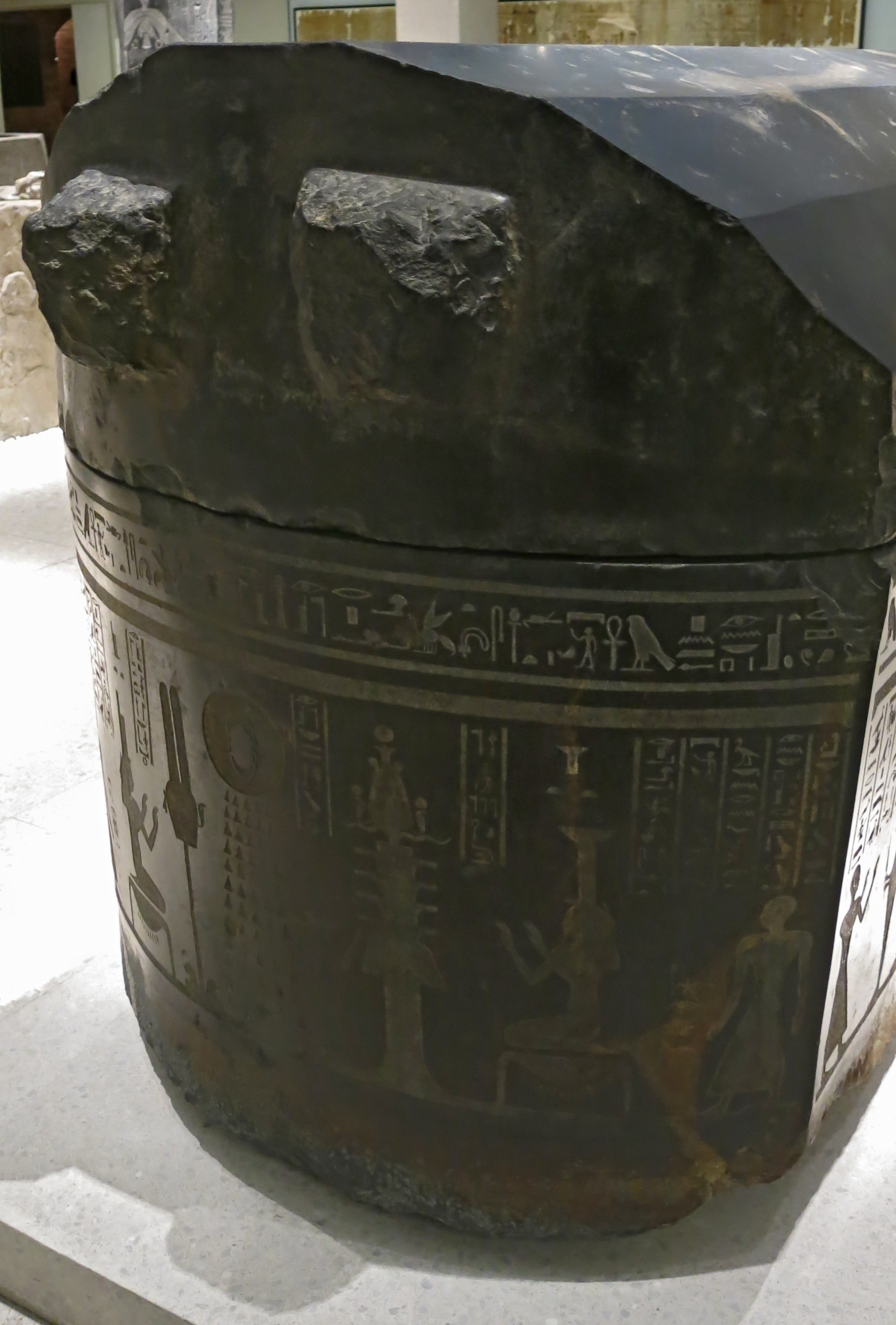
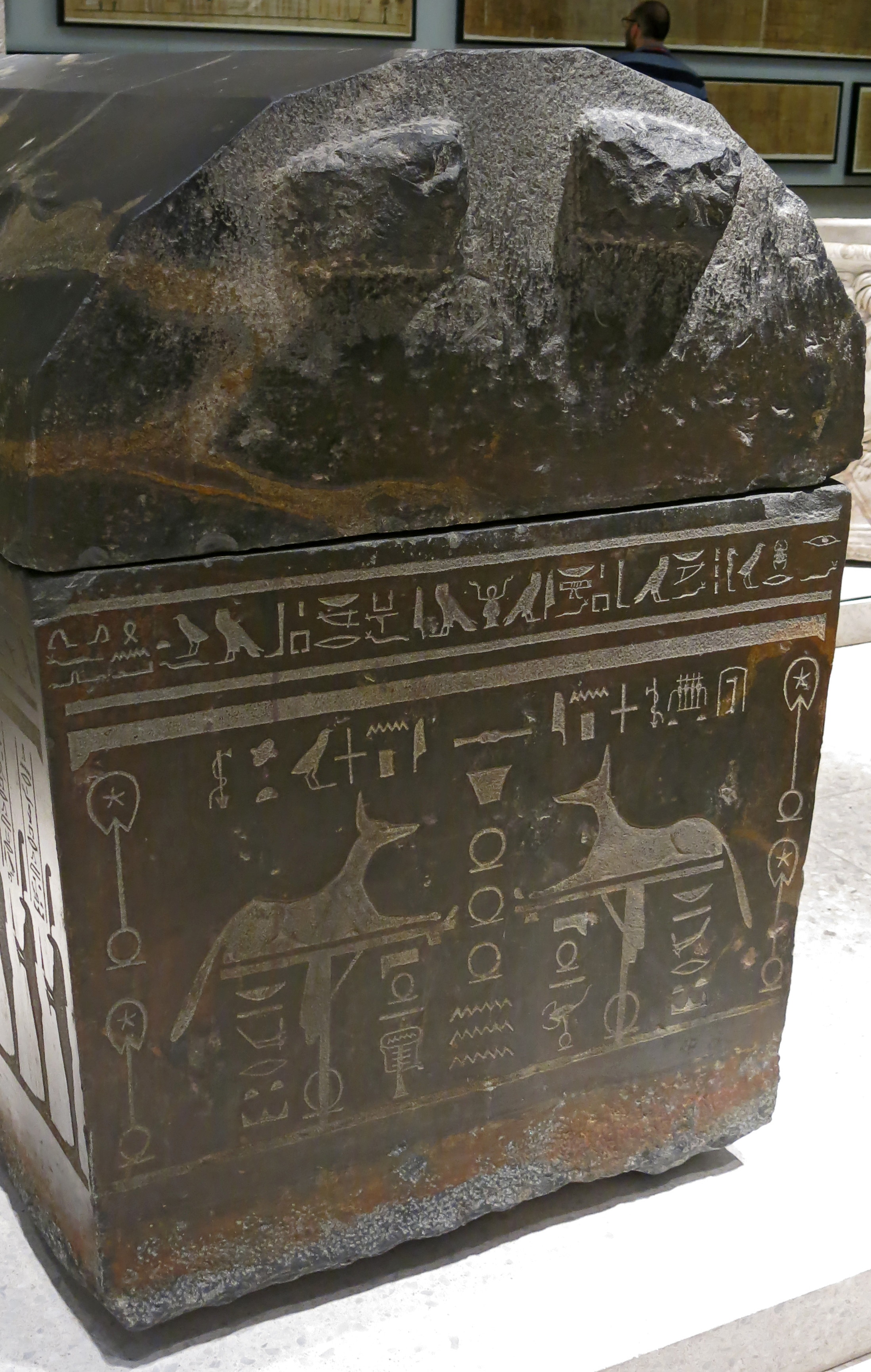
25th - 31st Dynasty: 746 BC - 332 BC
Treasurer Anch-Hor
Sarcophagus of the treasurer Anch-Hor with illustrations of daemons of the Netherworld.
Circa 746 BC - 332 BC
Dimensions: 1320 x 1100 x 2650 mm
The sarcophagus of the treasurer Anch-Hor impresses with its material, size and decoration. For its production, a hard rock, granodiorite, was used. The total weight of this coffin is more than five tons. Into the polished surface of the stone inscriptions and figurative representations were carved, which create a light-dark contrast because of their pecked interior surfaces.
On the long sides there are 42 divine beings with pointed knives in their hands. These are judges of the netherworld, who correspond to the vignettes on the death book papyri. The dead man stands together with the gods on the upper semicircular narrow side. On this side are the goddesses Isis and Nephthys, as well as symbolic representations of the god Osiris. In the centre there is a scarab in a sun-disc, from the sun-rays to the earth. All representations aim at a continuing life in the hereafter.
( Note that one end of the sarcophagus is rounded, the other is flat, and that large, roughly shaped protrusions have been left to help with raising and lowering of the lid - Don )
Catalog: Granodiorite, Memphis, ÄM 41
Photo: Don Hitchcock 2015, 2018
Source: Original, Staatliche Museen zu Berlin, Neues Museum, Germany
Text: © Card at the Staatliche Museen zu Berlin, J. Helmbold-Doyé at http://www.smb-digital.de/, (CC BY-NC-SA 3.0 DE)
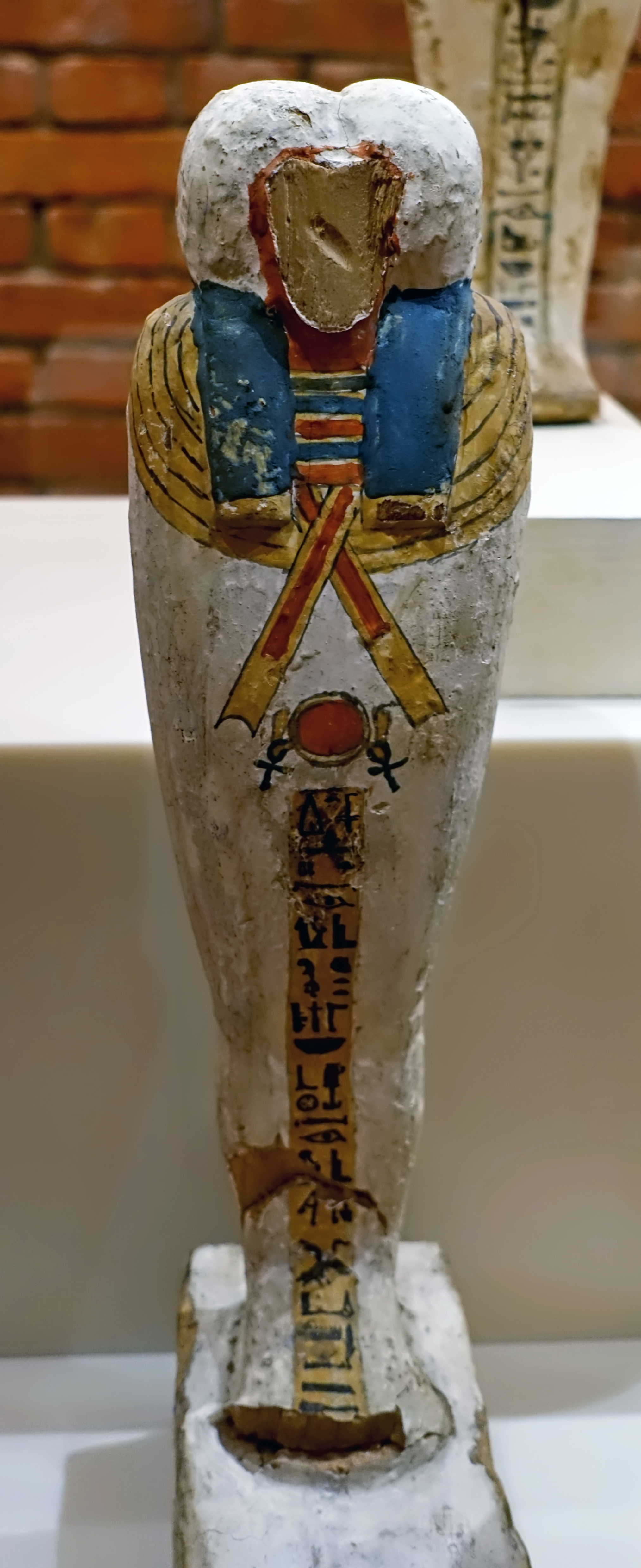
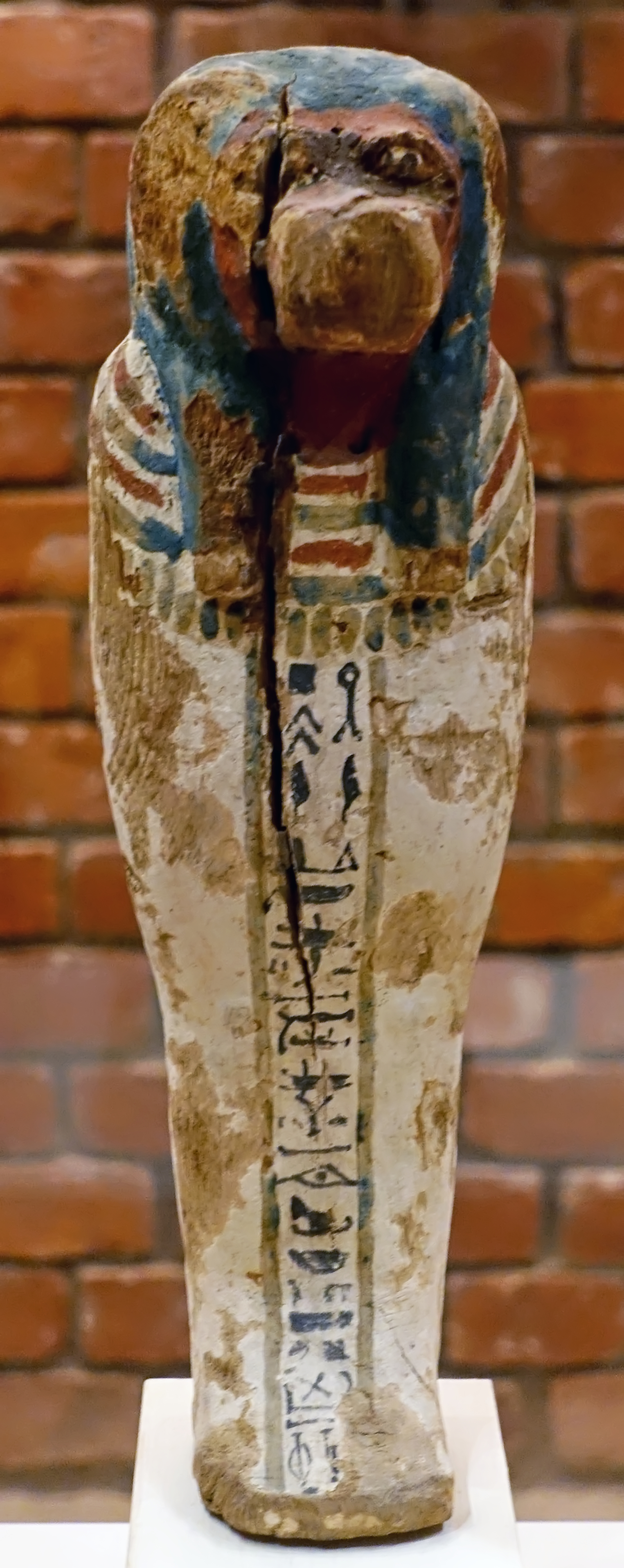
25th - 31st Dynasty: 746 BC - 332 BC
Protective Deity
Two figures of Horus' son Hapy (with head of baboon, a deity assigned to the lungs).
Circa 746 BC - 332 BC
Catalog: Wood, ÄM 10234, ÄM 10731
Photo: Don Hitchcock 2018
Source: Original, Staatliche Museen zu Berlin, Neues Museum, Germany
Text: © Card at the Staatliche Museen zu Berlin, (CC BY-NC-SA 3.0 DE)

25th - 31st Dynasty: 746 BC - 332 BC
Protective Deity
Son of Horus Duamutef (with jackal head, a deity assigned to the stomach).
Circa 746 BC - 332 BC
Catalog: Wood, ÄM 10719
Photo: Don Hitchcock 2018
Source: Original, Staatliche Museen zu Berlin, Neues Museum, Germany
Text: © Card at the Staatliche Museen zu Berlin, (CC BY-NC-SA 3.0 DE)

25th - 31st Dynasty: 746 BC - 332 BC
Protective Deity
Son of Horus Kebehsenuef (with falcon head, a deity assigned to the intestine).
Circa 746 BC - 332 BC
Catalog: Wood, ÄM 10235
Photo: Don Hitchcock 2018
Source: Original, Staatliche Museen zu Berlin, Neues Museum, Germany
Text: © Card at the Staatliche Museen zu Berlin, (CC BY-NC-SA 3.0 DE)

Winged Scarab
25th - 31st Dynasty: 746 BC - 332 BC
This amulet was attached to the mummy cover.
Catalog: 746 - 332 BC, Thebes, wood, gold, faience (?), ÄM 53/2
Photo: Don Hitchcock 2018
Source: Original, Staatliche Museen zu Berlin, Neues Museum, Germany
Text: © Card at the Staatliche Museen zu Berlin, (CC BY-NC-SA 3.0 DE)
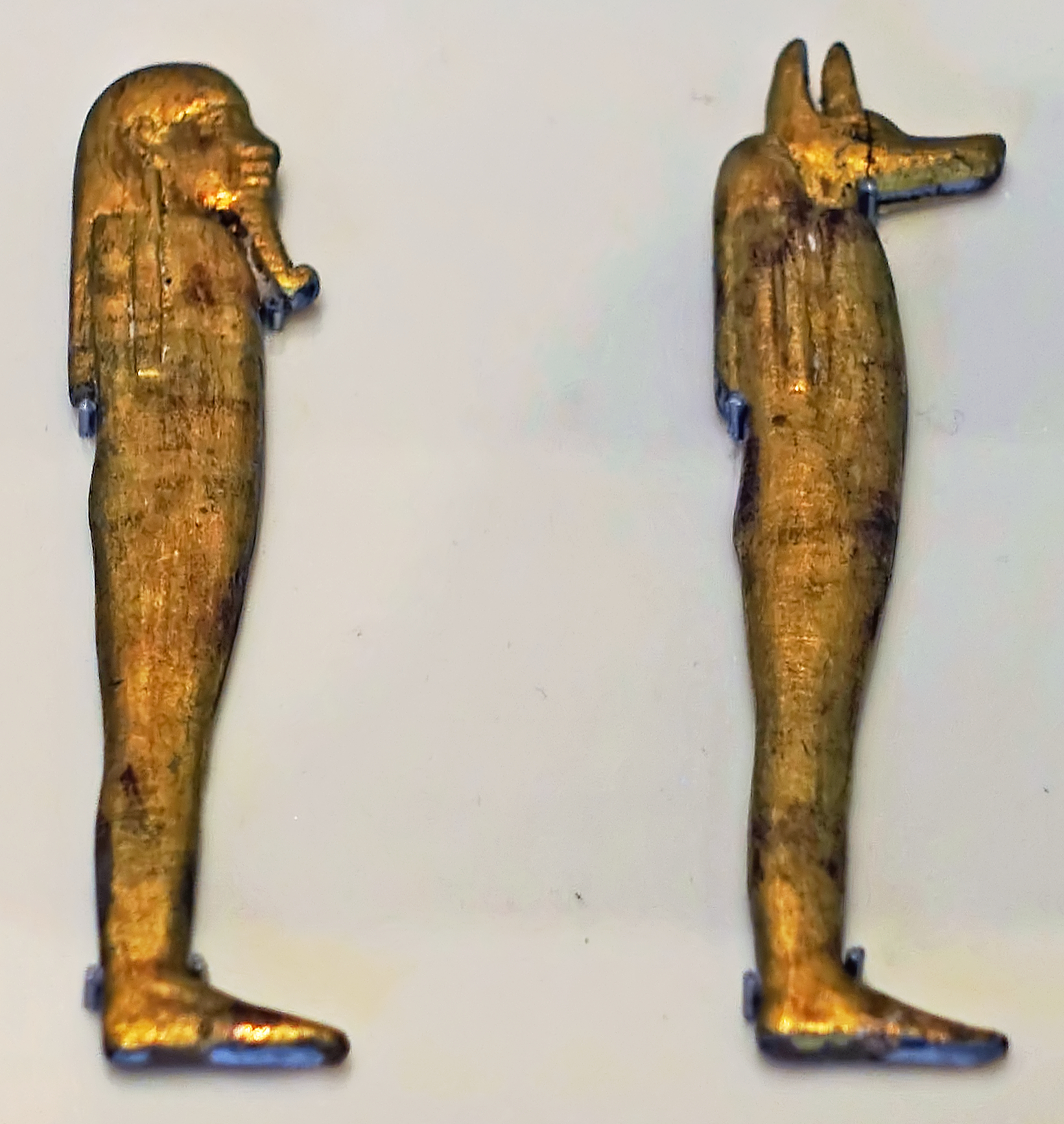
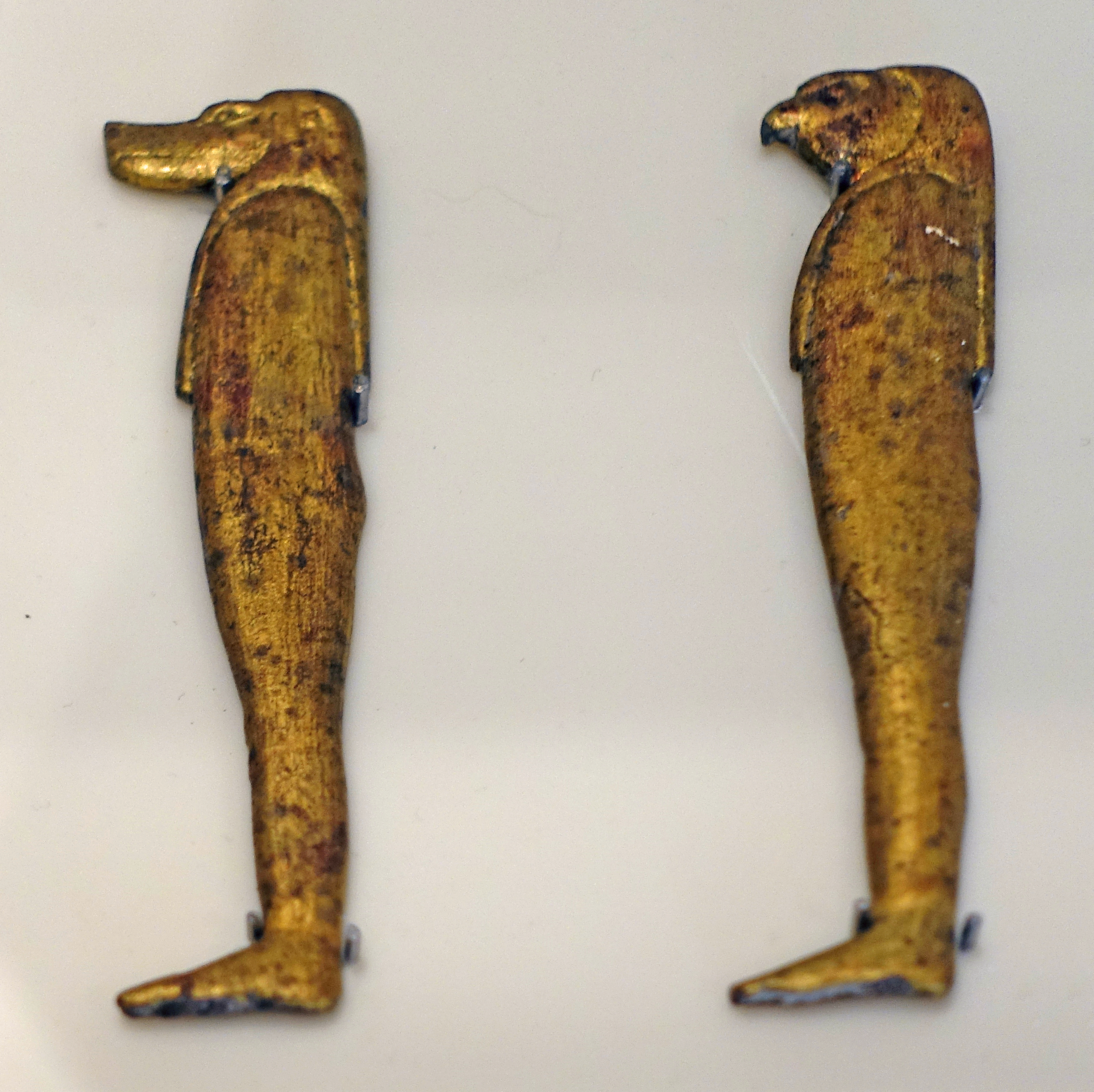
Amulets
25th - 31st Dynasty: 746 BC - 332 BC
Mummy amulets, originally attached to the mummy cover, in the shape of the four sons of Horus: Amset, Duamutef, Hapi and Khebehsenuef.
Catalog: 746 - 332 BC, Thebes, wood, gold, ÄM 53/3-6
Photo: Don Hitchcock 2018
Source: Original, Staatliche Museen zu Berlin, Neues Museum, Germany
Text: © Card at the Staatliche Museen zu Berlin, (CC BY-NC-SA 3.0 DE)
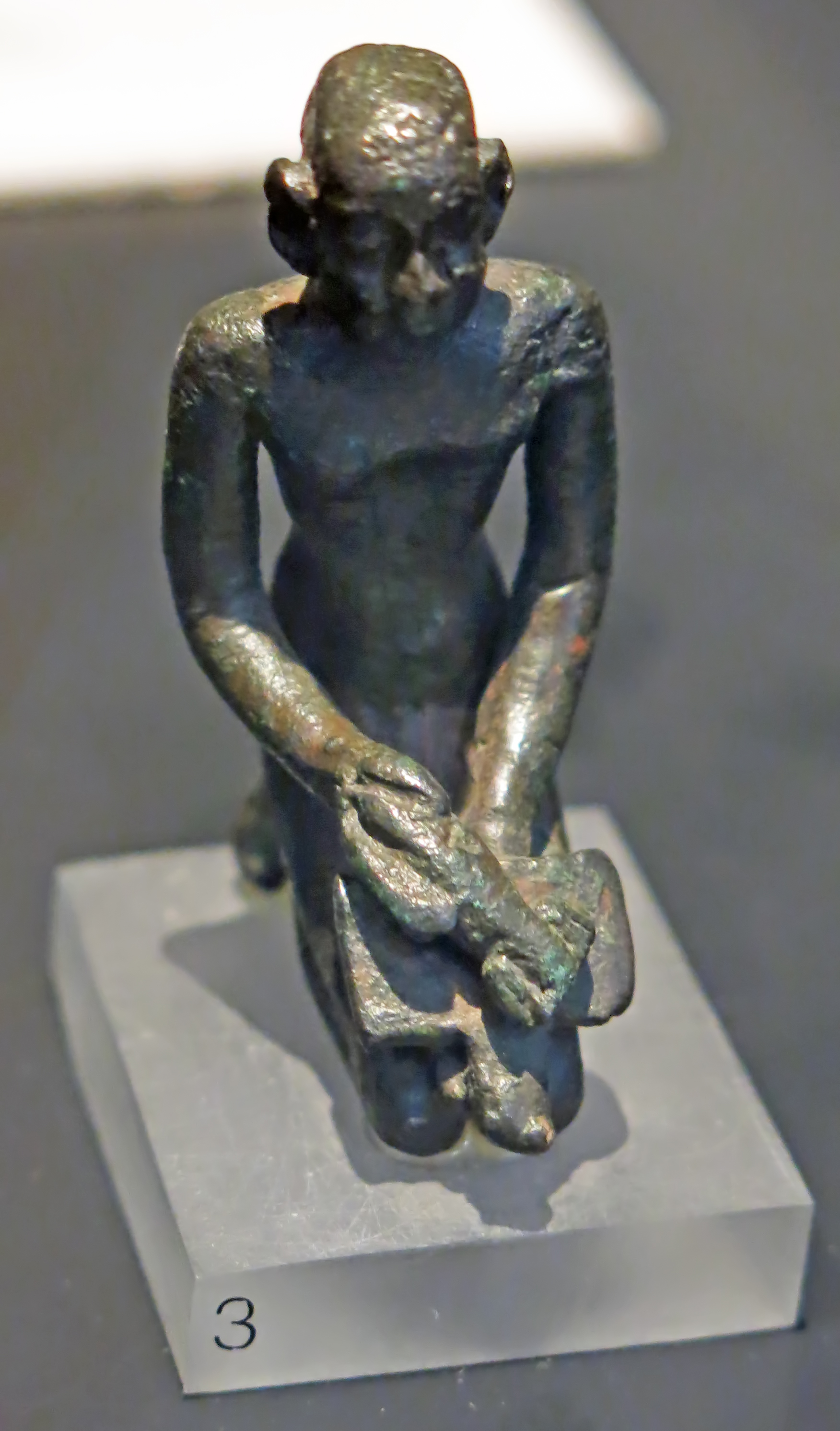
Kneeling man
25th - 31st Dynasty: 746 BC - 332 BC
With the vessel in his right hand, the man pours a potion over the sacrificial pans on his knees.
Circa 715 BC - 332 BC.
Catalog: Bronze, Inv H 1012
Photo: Don Hitchcock 2015
Source and text: Badisches Landesmuseum Karlsruhe Germany
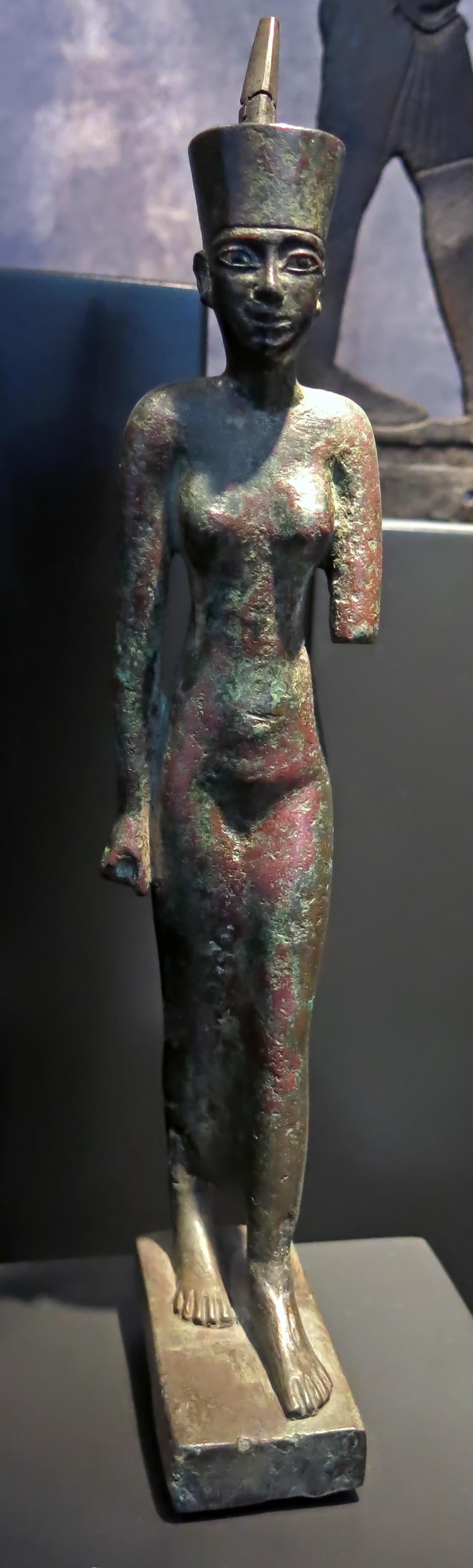
Neith
25th - 31st Dynasty: 746 BC - 332 BC
Neith, the patron goddess of the dead, has as attributes a bow and arrow on her head or, when she wears a crown, in her hand.
Late Period, 715 - 332 BC.
Catalog: Bronze, Inv. 65/82
Photo: Don Hitchcock 2015
Source and text: Badisches Landesmuseum Karlsruhe Germany
Nubia and the Kingdom of Kush
The 26th Dynasty: 664 BC - 525 BC
The Twenty-sixth Dynasty of Egypt was the last native dynasty to rule Egypt before the Persian conquest in 525 BC (although others followed). The dynasty's reign (664 BC – 525 BC) is also called the Saite Period after the city of Sais, where its pharaohs had their capital, and marks the beginning of the Late Period of ancient Egypt.
| 26th Dynasty | ||||||
|---|---|---|---|---|---|---|
| Name | Horus (Throne) Name | Consort | Burial | Years | Dates | Comments |
| Psamtik I | Wahibre | Mehytenweskhet | Sais | 54 | 664 BC - 610 BC | Manetho gives his reign as 54 years. Although a puppet ruler at first, by 655 BC he had gained full independence from the Assyrians. |
| Necho II | Wehemibre | Khedebneithirbinet I | 15 | 610 BC - 595 BC | Necho II was reported by the historian Herodotus to have sent an expedition which circumnavigated the continent of Africa (which he called Libya) in a clockwise direction with the help of Phoenician sailors. | |
| Psamtik II | Neferibre | Takhuit I | 6 | 595 BC - 589 BC | ||
| Apries | Haaibre | 19 | 589 BC - 570 BC | Manetho gives his reign as 19 years | ||
| Amasis II (Ahmose II) |
Khnemibre | Tentkheta Nakhtubasterau |
Sais | 44 | 570 BC - 526 BC | Herodotus claims that when Cambyses II invaded Egypt, realising he was not able to exact revenge for Amasis's previous misdeeds and trickery, he exhumed his body, desecrated it and burned what remained of the mummy. |
| Psamtik III | Ankhkaenre | 1 | 526 BC - 525 BC | |||
King Esarhaddon of Assyria conquered Egypt in 671 BC. In 664 BC his son King Ashurbanipal, the last important ruler of the Assyrians, installed Psamtik I as a vassal ruler of Egypt.
The Assyrian conquest of Egypt covered a relatively short period of the Neo-Assyrian Empire from 671 BC to 663 BCE. The conquest of Egypt not only placed a land of great cultural prestige under Assyrian rule but also brought the Neo-Assyrian Empire to its greatest extent.
By 656/655 BC, however, Psamtik I was able to declare outright independence from Assyria with impunity, though the new dynasty in Egypt wisely maintained friendly relations with Assyria.
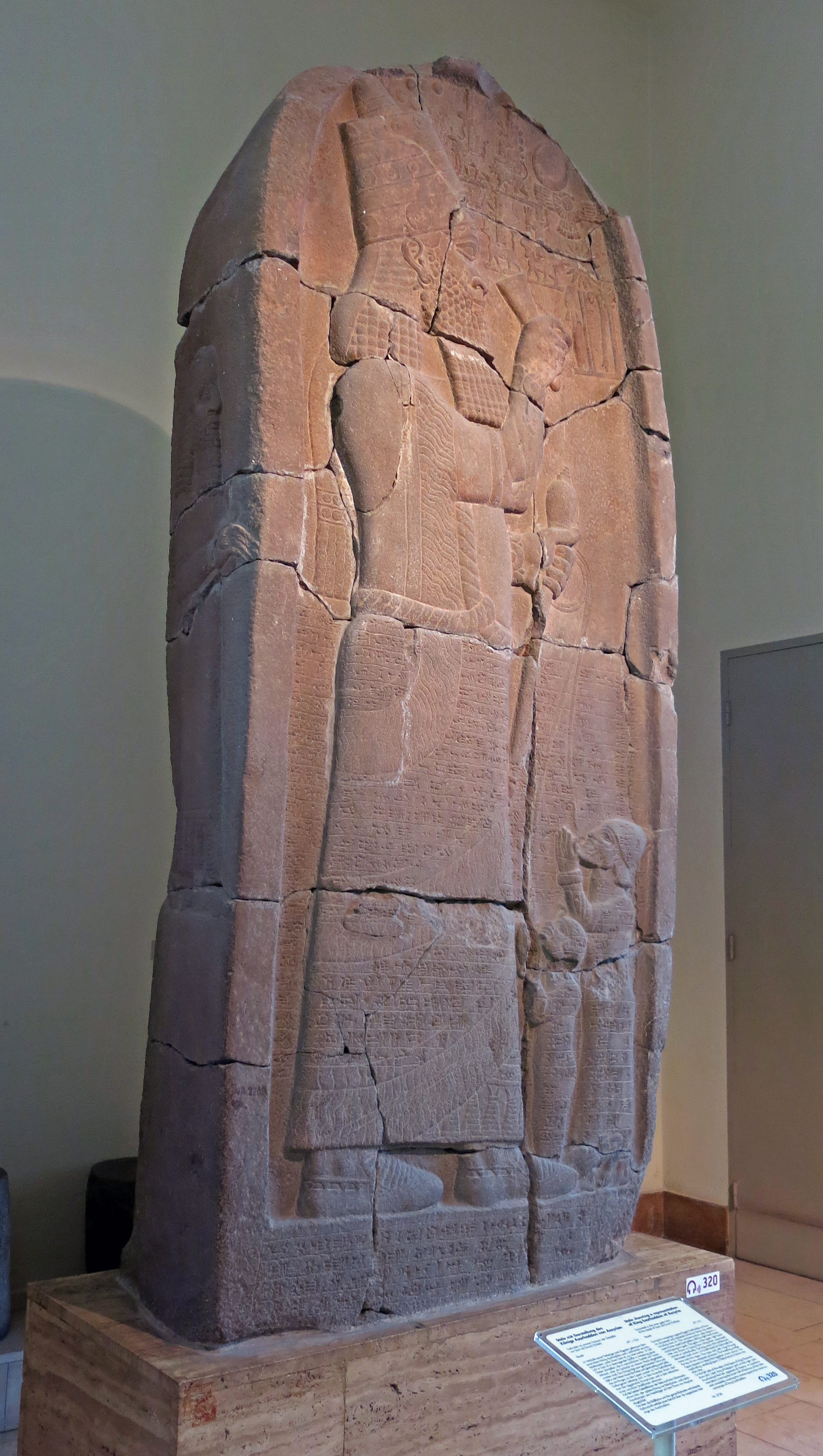
King Esarhaddon/Esarhaddon/Asarhaddon of Assyria
671 BC
Victory stele of King Asarhaddon of Assyria over Egypt showing a representation of King Esarhaddon of Assyria, excavated in the inner gate-room of the citadel of Sam`al/Zincirli (Turkey), (now Sendschirli).
During his campaigns against Egypt, Esarhaddon of Assyria conquered and subjected numerous Syrian city-states including Sam`al. The commemorative stele depicts a
super-human sized Esarhaddon with his right hand raised, worshipping his gods. The gods, in the upper right hand side, are shown in human form riding their associated
animal or symbolically. The king wears the beribboned, decorated royal crown. In his left hand he holds both the mace and two ropes.
The ropes end with rings through the lips of two prisoners. The kneeling smaller
figure appears to depict the Egyptian crown prince. The supplicating, standing figure, is likely that of a Syrian city-state ruller.
On the left side of the stele is the figure of king Shamash-shum-ukin, later king of Babylon, and on the right side, Assurbanipal, the heir apparent of Assyria. A cuneiform inscription covering the lower half of the front of the stele and completely covering the reverse reports the victorious campaigns of king Esarhaddon.
Inscription:
'Whoever removes this stela from its place, erases my written name, and writes his own name there, may his manhood feminize Ishtar, mistress of battle and combat, and make him sit down bound at the feet of his enemies."
This curse formula ends the inscription that covers the front and back of the stele. The monument was commissioned by the Assyrian king Asarhaddon, who guided the destiny of Assyria at the beginning of the 7th century BC. His foreign policy was marked by the conflict with Egypt for supremacy in Syria-Palestine. Only the 2nd campaign against Taharka in 671 BC brought the hoped-for decision in his favour.
This stele found in Sam'al, in southeastern Turkey, was to record this victory for posterity. After plundering the royal treasuries, Asarhaddon returned to Nineveh with most of his soldiers. While Taharka had managed to escape, his family and court were led into exile. It may be considered ironic that Asarhaddon did not survive a third campaign to the land along the Nile. In the long run this area could not be held anyway; already under Psammetich I / Psamtik I Upper Egypt regained its independence in 655 BC.
The front of the stele shows the ruler in monumental size with royal insignia and two conquered adversaries kneeling down before him. At head height are various deity symbols and cult images in a reduced scale. On the narrower sides, Asarhaddon's sons are depicted as a novelty: Assurbanipal, the last important ruler of the Assyrians, and Shamash-shum-ukin, who was to take the throne of Babylon.
The subjugated enemies, bound hand and foot, are held by a rope leading to a ring drawn through the lower lip. Judging by the costume, it could be the Egyptian crown prince and a rebellious Syrian city prince. Baal of Tyre or Abdi-milkutti of Sidon, who had fallen from grace and been beheaded a few years earlier, could also be considered.
The good state of preservation of the stele, which was worked from a very hard stone, is to be owed to a catastrophic fire, which destroyed the princely seat probably still in the 7th century BC completely. Sealed by falling mud-brick walls, the image and inscription survived until they were found in 1888 by the German excavators Robert Koldewey and Felix von Luschan. [Nadja Cholidis]
Height 322 cm, width 135 cm, thickness 62 cm, weight circa 8000 kg.
Catalog: Basalt, Pergamon Museum, Level 1, Museum of the Ancient Near East, Room 3, VA 02708
Photo: Don Hitchcock 2015
Source and text: Pergamon Museum, Berlin, recherche.smb.museum
Psamtik I was the first pharaoh of the Twenty-sixth Dynasty of Egypt, the Saite period, ruling from the city of Sais in the Nile delta between 664–610 BC. He was installed by Ashurbanipal of the Neo-Assyrian Empire, against the Kushite rulers of the Twenty-fifth Dynasty, but later gained more autonomy as the Assyrian Empire declined.
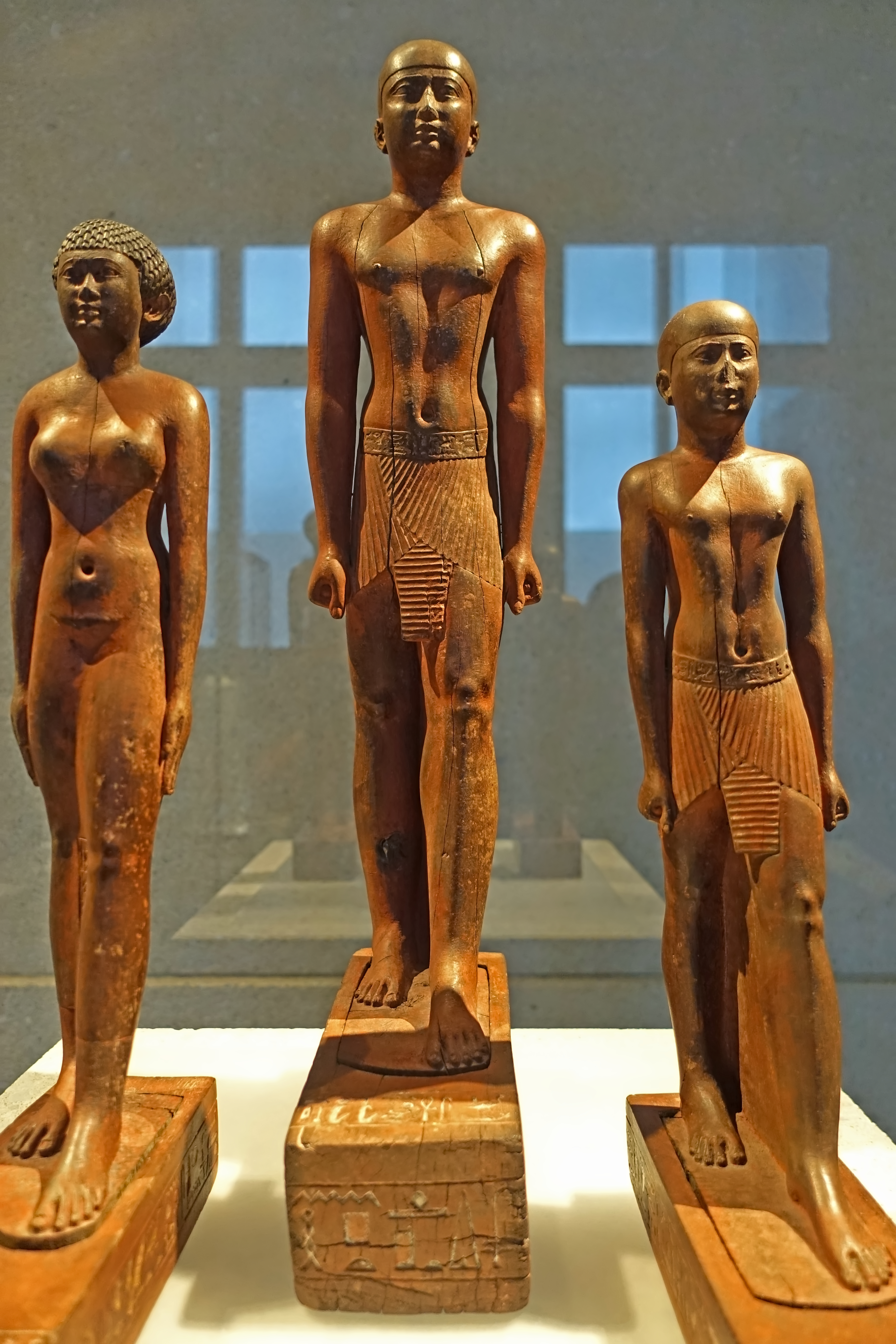
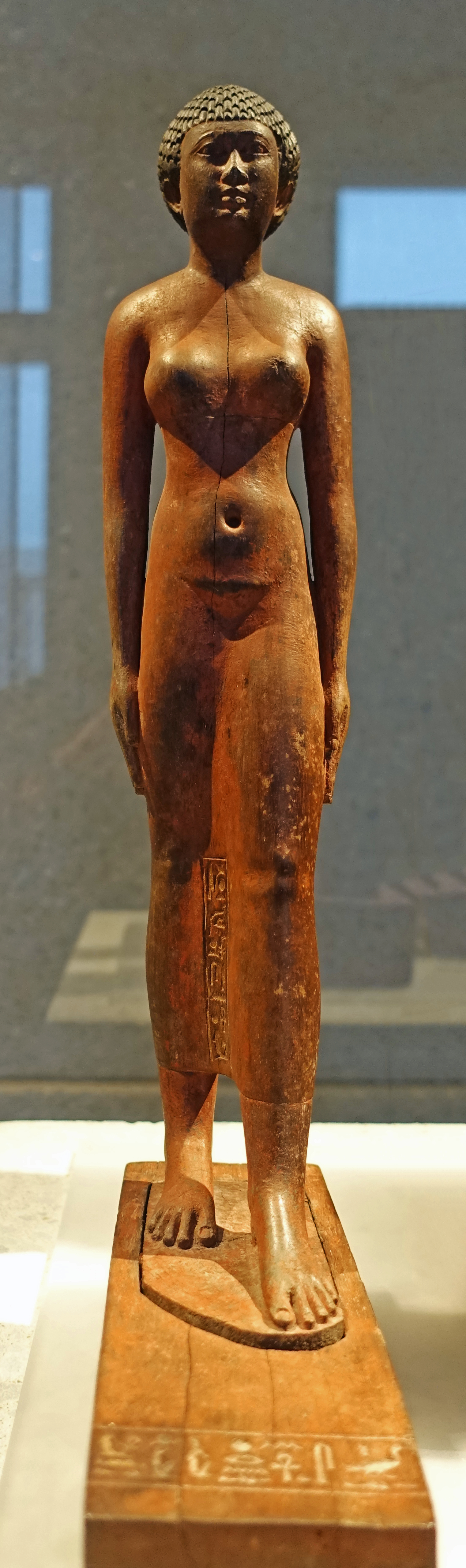
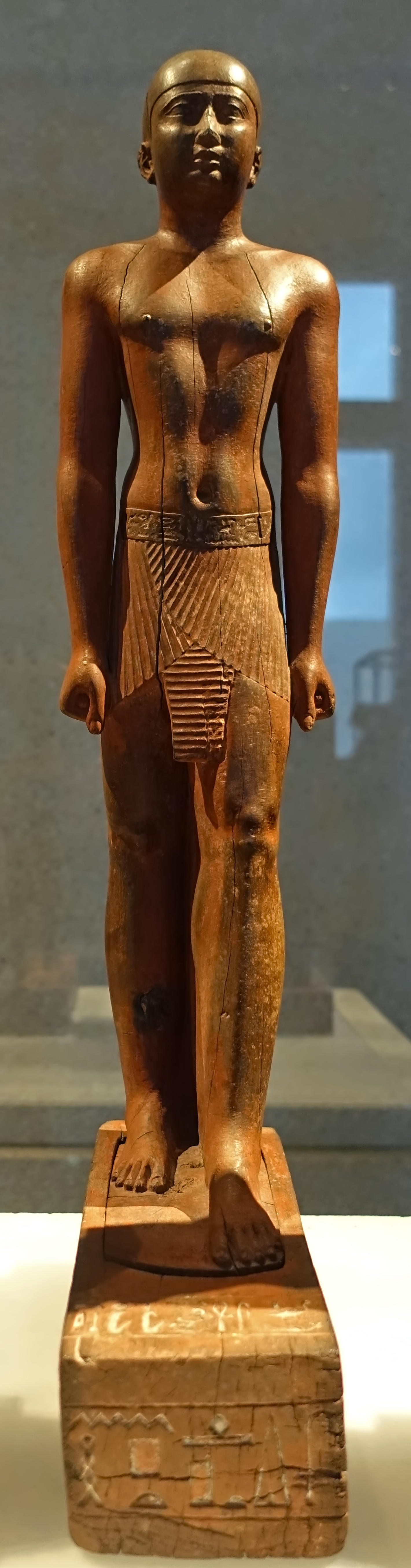
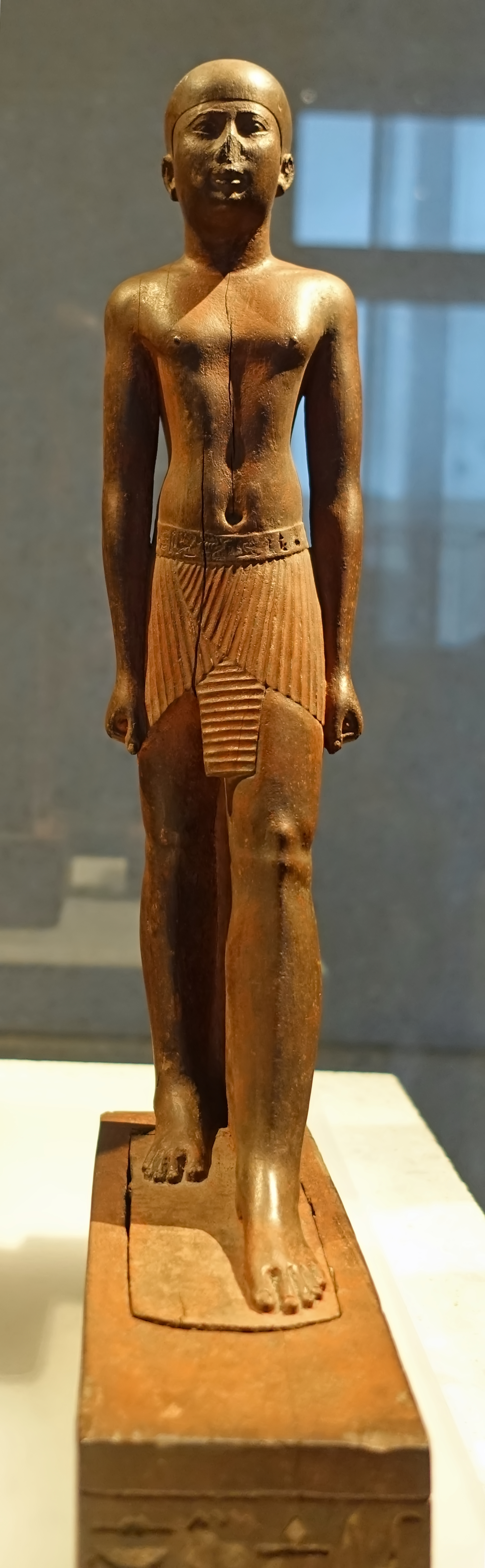
26th Dynasty: 664 BC - 525 BC
Psamtik I
Sculptural ensemble of Psamtik I, his wife Djed-Chonsu-iu-es-anch, and his son. Psamtik I (Psammetich) was the first ruler of the 26th Dynasty.
Necho I, the father of Psamtik by his queen Istemabet, died in 664 BC when the Kushite king Tantamani tried unsuccessfully to seize control of lower Egypt from the Assyrian Empire. After his father's death, Psamtik both united all of Egypt and freed it from Assyrian control within the first ten years of his reign.
Psamtik reunified Egypt in his ninth regnal year when he dispatched a powerful naval fleet in March 656 BC to Thebes and compelled the existing God's Wife of Amun at Thebes, Shepenupet II, to adopt his daughter Nitocris I as her heiress in the so-called Adoption Stela. Psamtik's victory destroyed the last vestiges of the Nubian Twenty-fifth Dynasty's control over Upper Egypt under Tantamani since Thebes now accepted his authority.
Nitocris would hold her office for 70 years from 656 BC until her death in 585 BC. Thereafter, Psamtik campaigned vigorously against those local princes who opposed his reunification of Egypt. One of his victories over certain Libyan marauders is mentioned in a Year 10 and Year 11 stela from the Dakhla Oasis.
Psamtik won Egypt's independence from the Assyrian Empire and restored Egypt's prosperity during his 54-year reign. The pharaoh proceeded to establish close relations with archaic Greece and also encouraged many Greek settlers to establish colonies in Egypt and serve in the Egyptian army. In particular, he settled some Greeks at Tahpanhes (Daphnae).
Catalog: Wood, ÄM 8812, ÄM 8813, ÄM 8814
Photo: Don Hitchcock 2018
Source: Original, Staatliche Museen zu Berlin, Neues Museum, Germany
Text: © Card at the Staatliche Museen zu Berlin
Additional text: Wikipedia
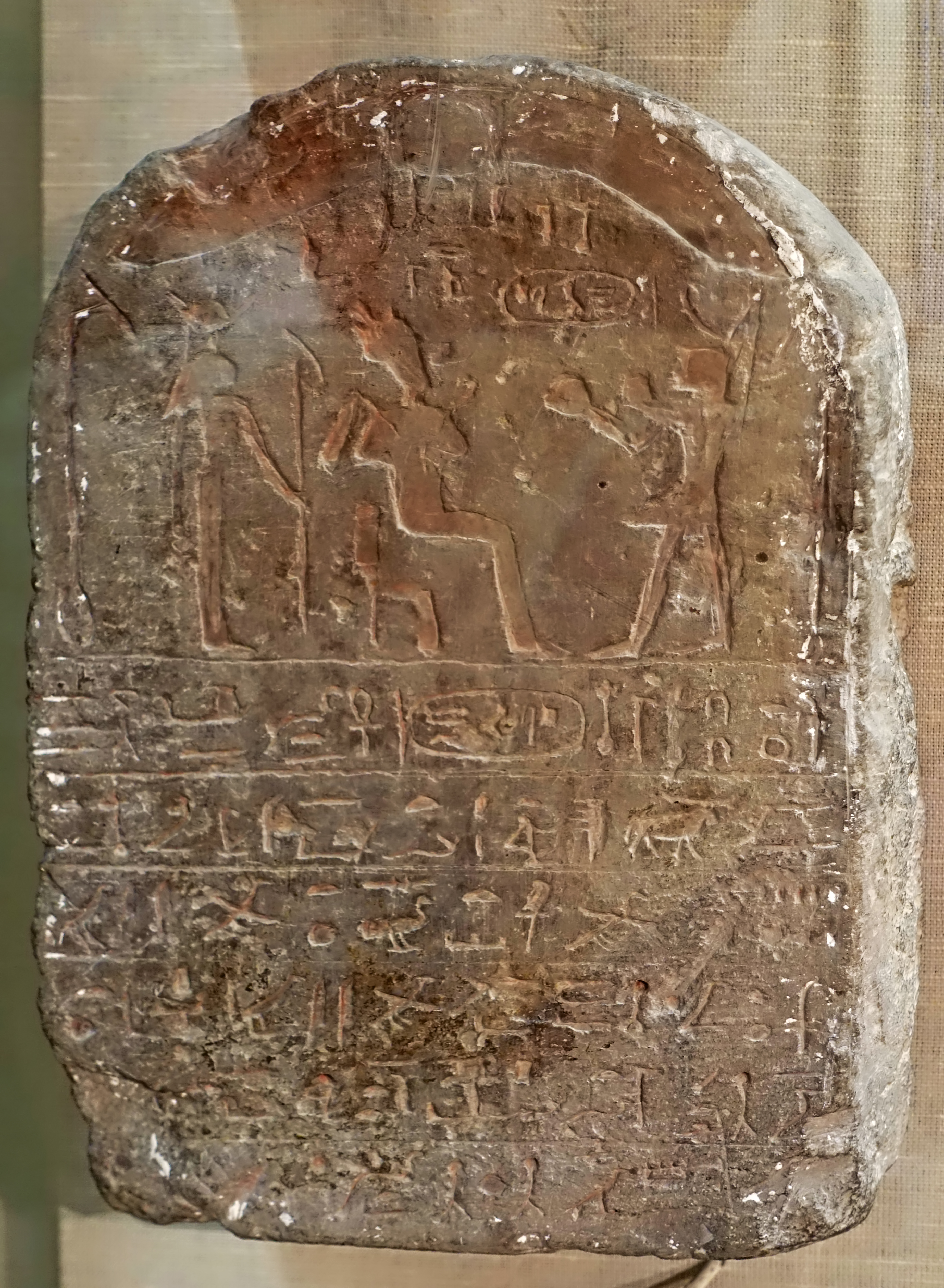
26th Dynasty: 664 BC - 525 BC
Psamtik I / Psammetich I
Psamtik I before Osiris and Isis, 664 BC - 610 BC
This stele belongs to the group of 'Land Donation Steles', which in the upper area shows the donor with the sacrifice and the deities to whom the sacrifice is made. These steles marked the boundaries of the arable land donated by a king for the benefit of a temple. The land thus belonged to the temple, which then leased the land to others, for a profit.
The structure of this scene is representative of this group: the sacrificing party is on the right, the receiving, divine party is shown on the left. The often poor state of preservation of the steles is attributed to the context in which they were erected, as they were probably buried in the ground.
Catalog: Limestone, from Sais (Delta), Inv. Nr. 1935.200.439
Photo: Don Hitchcock 2018
Source and text: Original, Museum August Kestner, Hannover
Additional text: Wikipedia
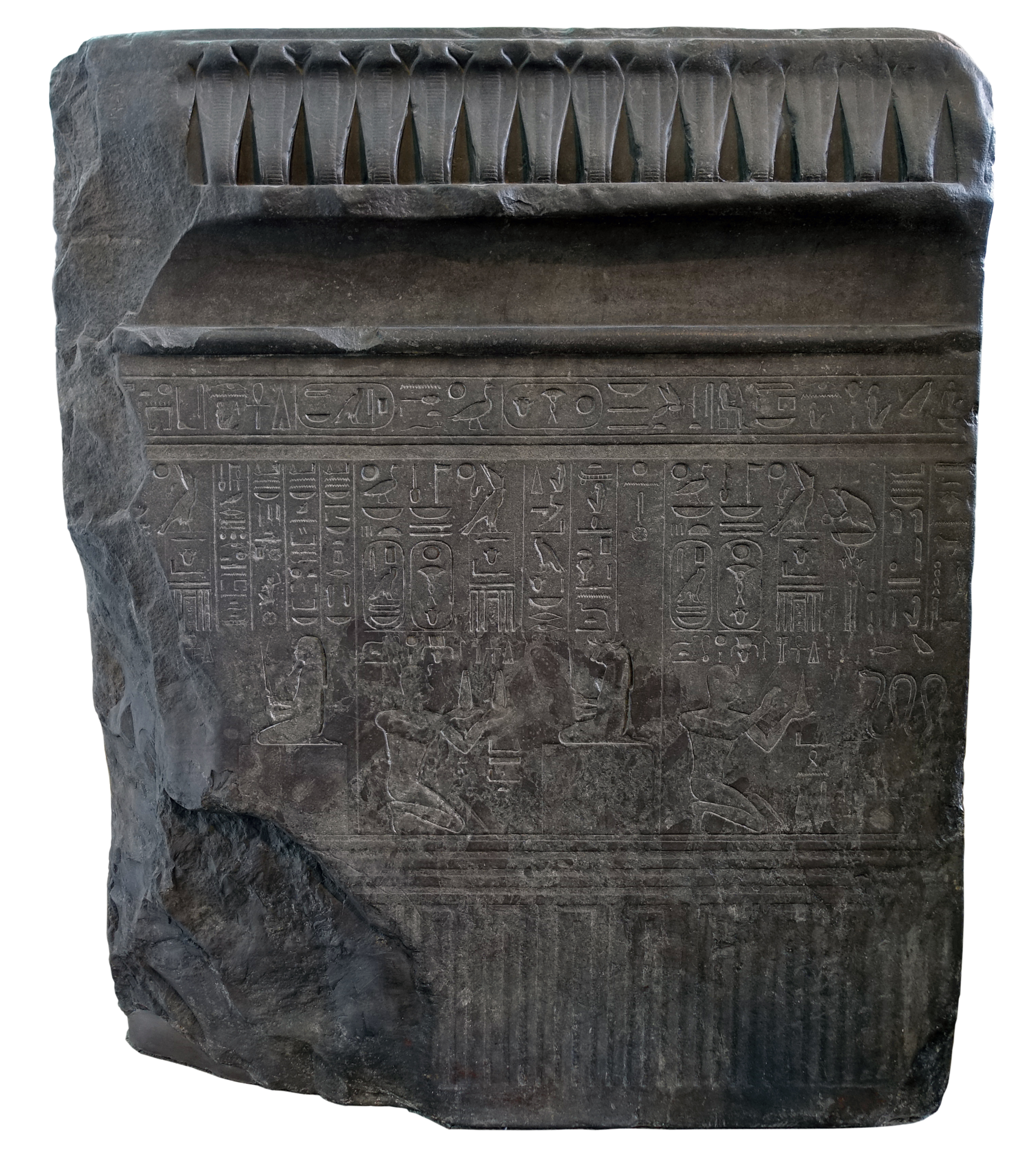
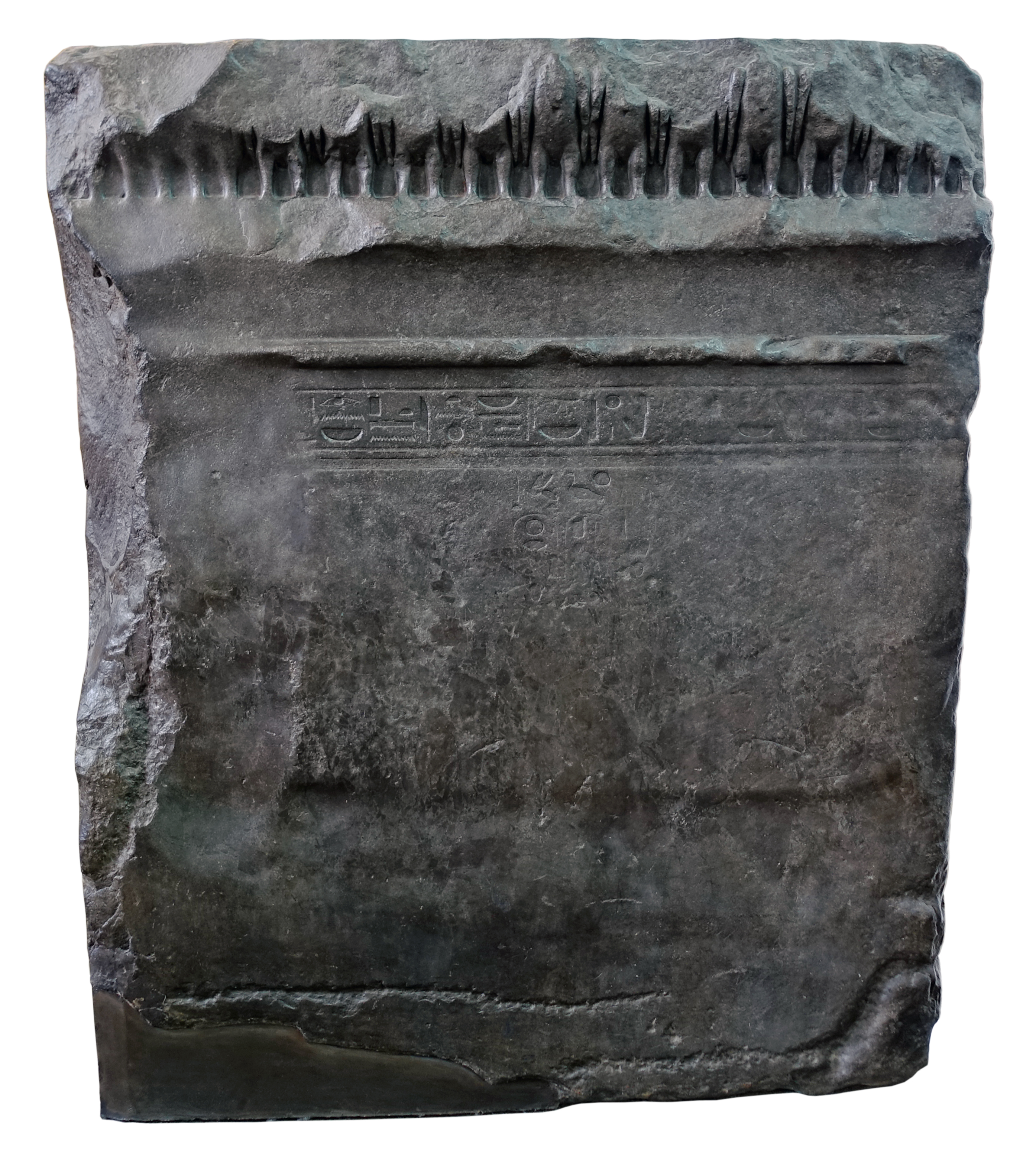
26th Dynasty: 664 BC - 525 BC
Psamtek I / Psamtik I / Psammetich I, 664 BC - 610 BC
Screen slab of the Egyptian king Psamtik I. The king kneels and makes offerings to fearsome looking deities, including a double headed bull god and a snake.
Psamtik I/Psamtek I, the founder of Egypt's 26th Dynasty, reigned from 664 BC to 610 BC. During his 54-year rule, he successfully reunified Egypt and initiated the 'Saite Renaissance', bringing a period of political stability and cultural revival.
The majority hold long knives, as they were meant to guard a sacred place behind the wall.
Most Egyptian depictions of people are highly idealised, but here the king's unflattering features suggest a rare attempt at pure portraiture.
The slab was part of a structure in the temple of Atum at Heliopolis.
The bottom design is a 'palace facade'. The frieze of cobras at the top represents Wadjyt, heraldic goddess of lower Egypt.
The reverse had a frieze of vultures: Nekhbet of Upper Egypt. That side also showed Psamtek offering, but there his figure, now effaced, was more prostrate.
Circa 664-610 BC.
Black basalt block; cornice of uraei; recessed Hieroglyphic text including the cartouches and Horus-name of Psamtek I and two sunk relief representations of the king kneeling and offering bread to deities; more text on the reverse.
Height 121 cm, thickness 25 cm, width 103 cm (max)
Findspot: The screen slab of Egyptian King Psamtik I was originally located at the Temple of Atum in Heliopolis (modern-day Cairo). However, the artifact was later relocated to Alexandria and eventually recovered from the United Kingdom before finding its permanent home in London.
Height 1210 mm, width 1030 mm, thickness 250 mm.
Catalog: Basalt, from Alexandria; originally from the temple of Atum at Heliopolis, Egypt. British Museum, London. EA20
Photo: Don Hitchcock 2018
Source: Original, British Museum
Text: Card with the display at the British Museum, © Trustees of the British Museum, CC BY-NC-SA 4.0
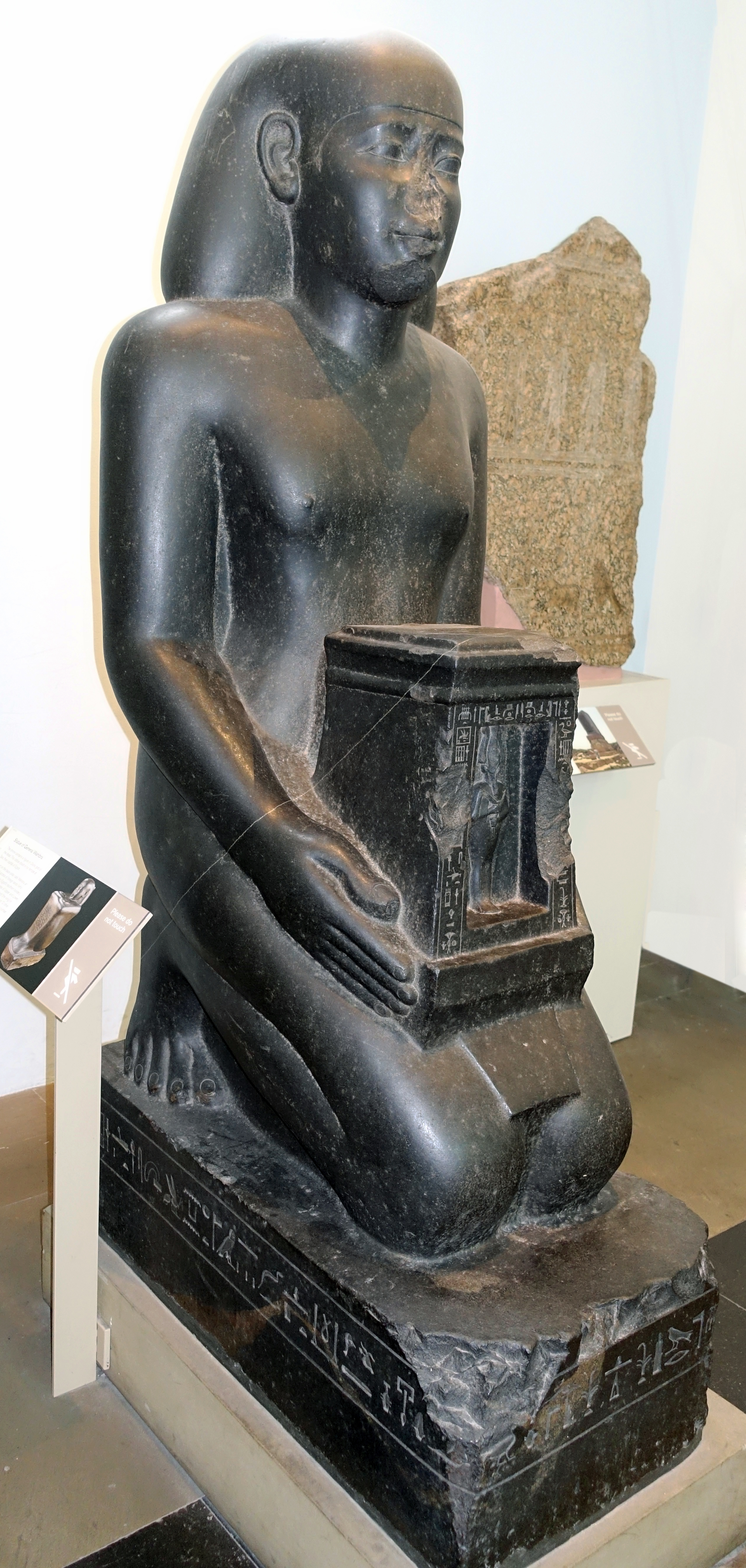
26th Dynasty, 664 BC - 525 BC
Reign of Amasis, 570 BC - 526 BC
Statue of General Wahibra.
The shrine contains a figure of Osiris, god of the dead. This statue stood in his temple at Sais, then capital of Egypt.
The text on the back-pillar calls Wahibra an 'overseer of access to foreign lands (who managed trade on Egypt's southern border), overseer of all the armies of Upper and Lower Egypt, chief warrior of his lord (the king) in every foreign land'.
He left at least 12 other statues at temples around Sais. Their number and size reflect his status and wealth.
Black basalt kneeling naophorous (shrine bearing( statue of Wahibra, larger than life-size, holding a small naos (shrine) containing a figure of Osiris, with hieroglyphic texts around the base and on the dorsal pillar, give Wahibra's titles, parents' names and ask for offerings to be given.
Production date circa 530 BC
Height 1803 mm (max)
This over-life-size statue of Wahibre shows him kneeling and presenting a small shrine containing a figure of Osiris. He wears a short shendyt kilt, in earlier times restricted to royalty. The front of the shrine, the base of the statue, and the back pillar are inscribed with hieroglyphs giving Wahibre's names and titles and the name of his father, Peftjaudineith.
The statue exhibits many of the characteristic features of Late Period art. Wahibre's face is rather bland and devoid of expression; he looks straight in front of him, without the slightly upturned gaze seen on some statues of the later Twenty-sixth Dynasty. The stone is highly polished but sparsely decorated, emphasising the hardness and magnificence of the stone.
Wahibre was a very important official in the Delta during the late Twenty-sixth or Saite Dynasty (so named since Sais - modern Sa el-Hagar - was its capital). One of his main titles was 'overseer of the door of the foreign lands', which presumably meant that he was responsible for the security of Egypt's borders; he was also a general, and other monuments assign him titles concerned with the southern borders of Egypt. It is presumed that his name reflects his birth in the reign of king Apries (589-570 BC), whose second cartouche name was Wahibre (he lived too late to have been named after Psamtek I, who was also called Wahibre).
His importance can be judged from the resources to which he must have had access to be able to set up a statue like this. In fact, this is but one of a series of statues known of him, which includes seven in the Egyptian Museum in Cairo. One of these names his mother as Tashebenneith.
The British Museum statue was probably set up in a temple, perhaps near a shrine of Osiris. It shows Wahibre demonstrating his piety by making a presentation to Osiris; he would thus expect to partake of the generosity and good fortune of the god, and to receive the offerings enumerated in the formulae on the base and the back pillar. Part of Wahibre's sarcophagus was found in the late nineteenth century in Kawadi, the area north-east of Sa el-Hagar. This might have been where his tomb was sited.
Judging from this statue's stated find spot, it had presumably been transported from its original location.
Named in inscription and portrayed: Wahibra
Representation of: Osiris
Findspot: Mariut, Lake, The Birch Slip records 'found near the lake mareotis at a distance of about 49 miles from Rosetta in A.D. 1785.
Catalog: Basalt, EA111
Photo: Don Hitchcock 2018
Source: Original, British Museum
Text: © Card with the display at the British Museum, http://www.britishmuseum.org/ , © Trustees of the British Museum, CC BY-NC-SA 4.0
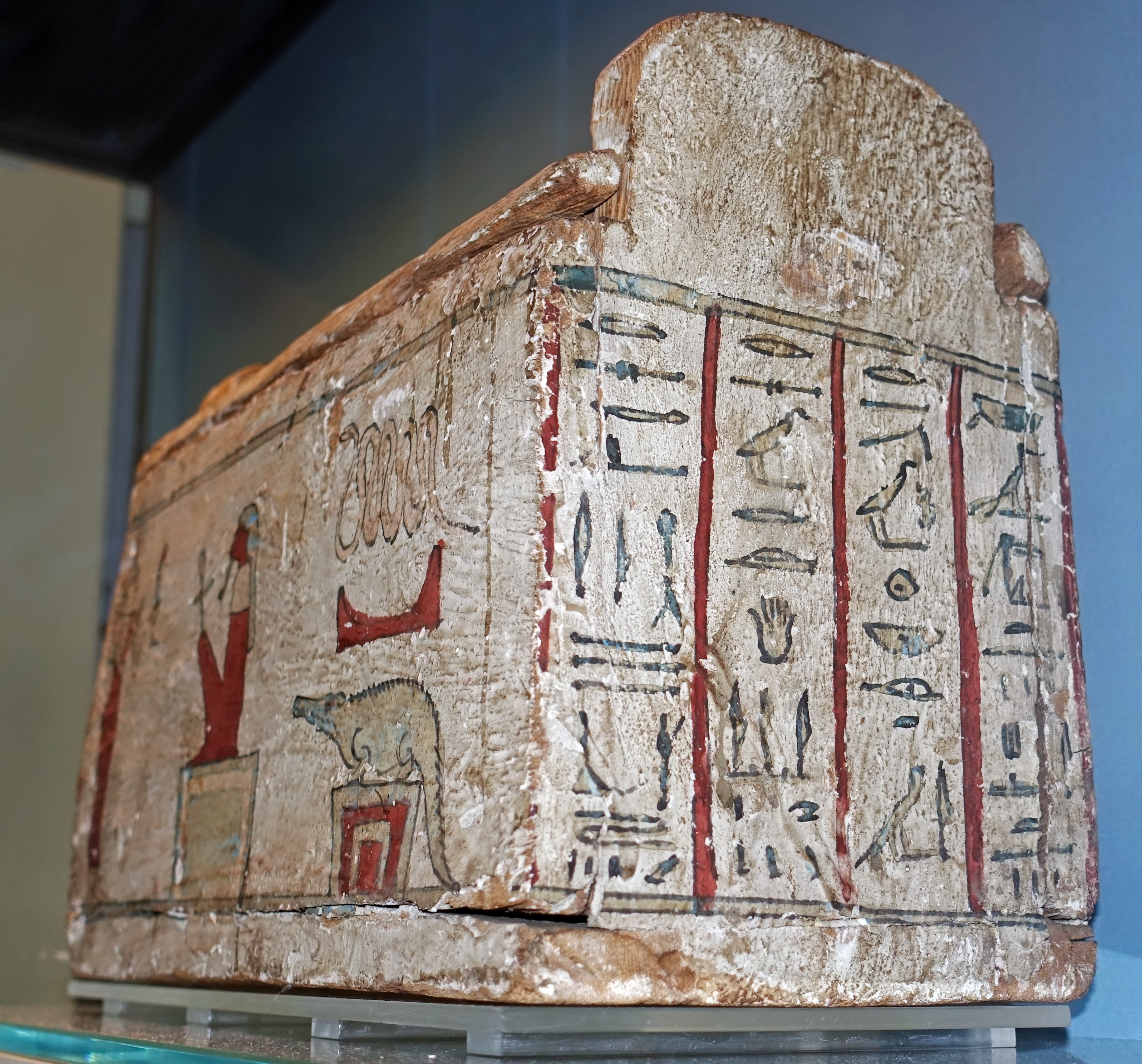
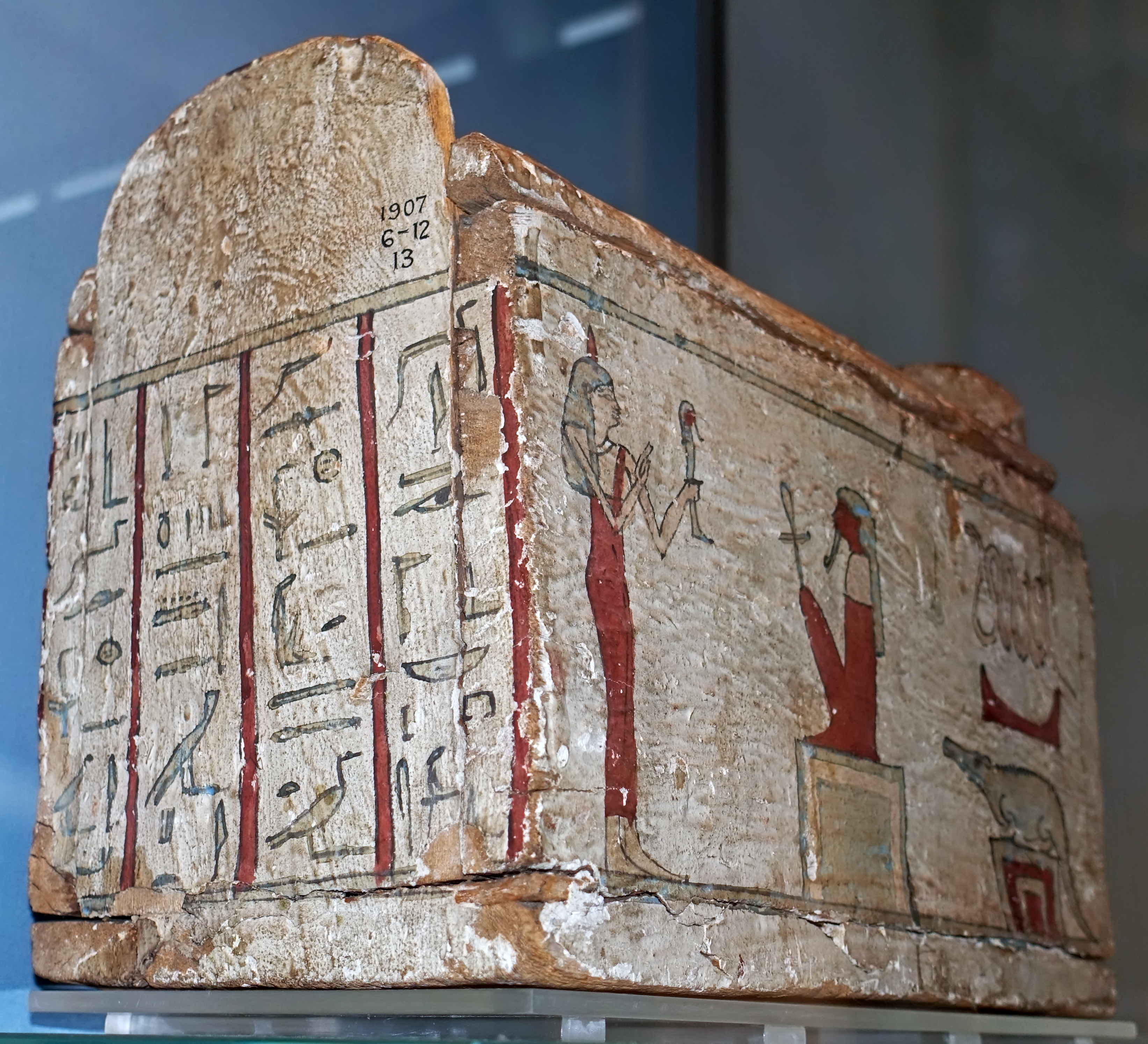
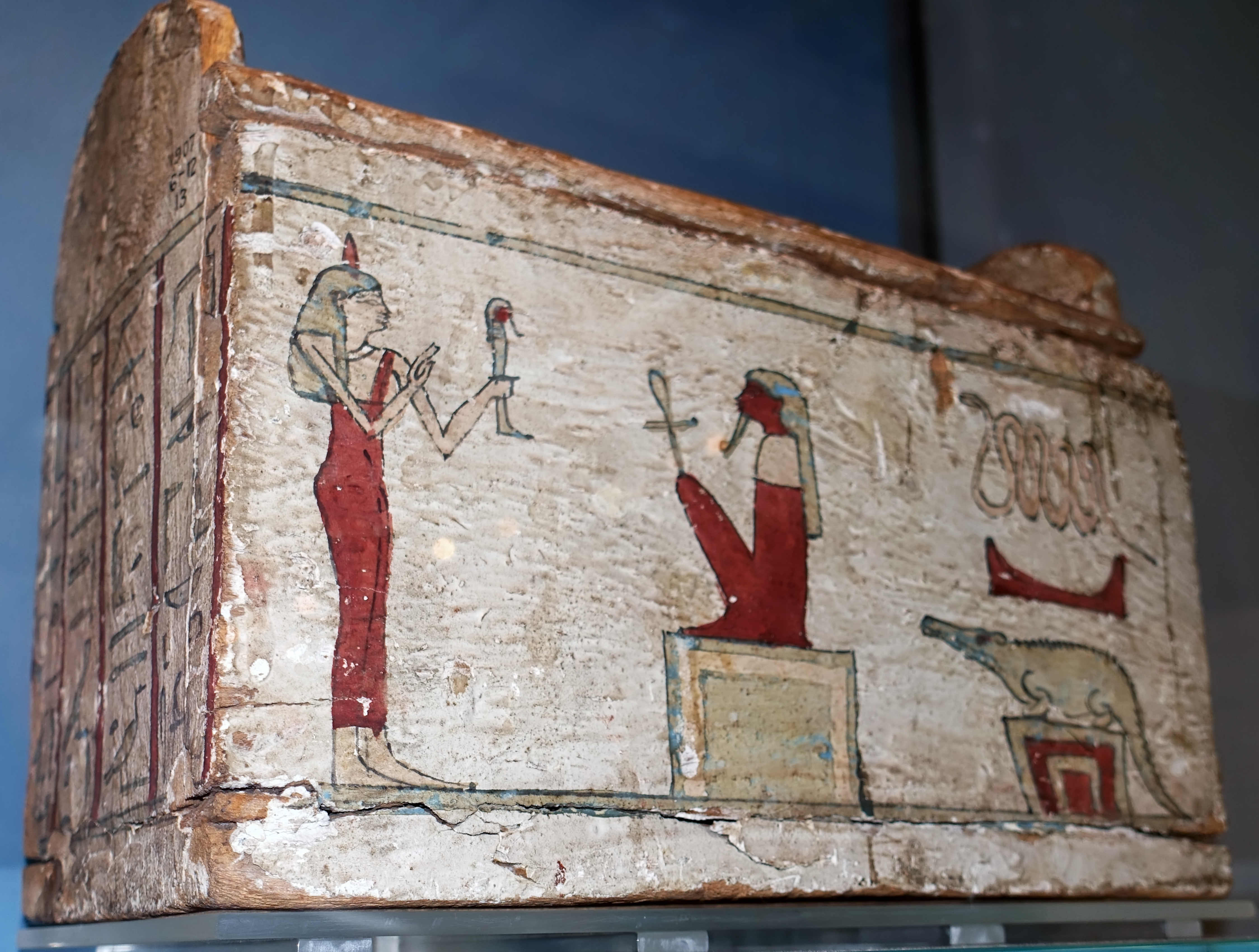
26th Dynasty: 664 BC - 525 BC
Neskhons
Shabti box of Neskhons, daughter of the fourth prophet of Amun Djedkhonsefankh.
Early 26th Dynasty, circa 650 BC.
The scene on the side, of uncertain significance, depicts the deceased presenting a shabti to a group of deities.
Catalog: Thebes, EA46714
Photo: Don Hitchcock 2018
Source: Original, British Museum
Text: Card with the display at the British Museum, © Trustees of the British Museum, CC BY-NC-SA 4.0
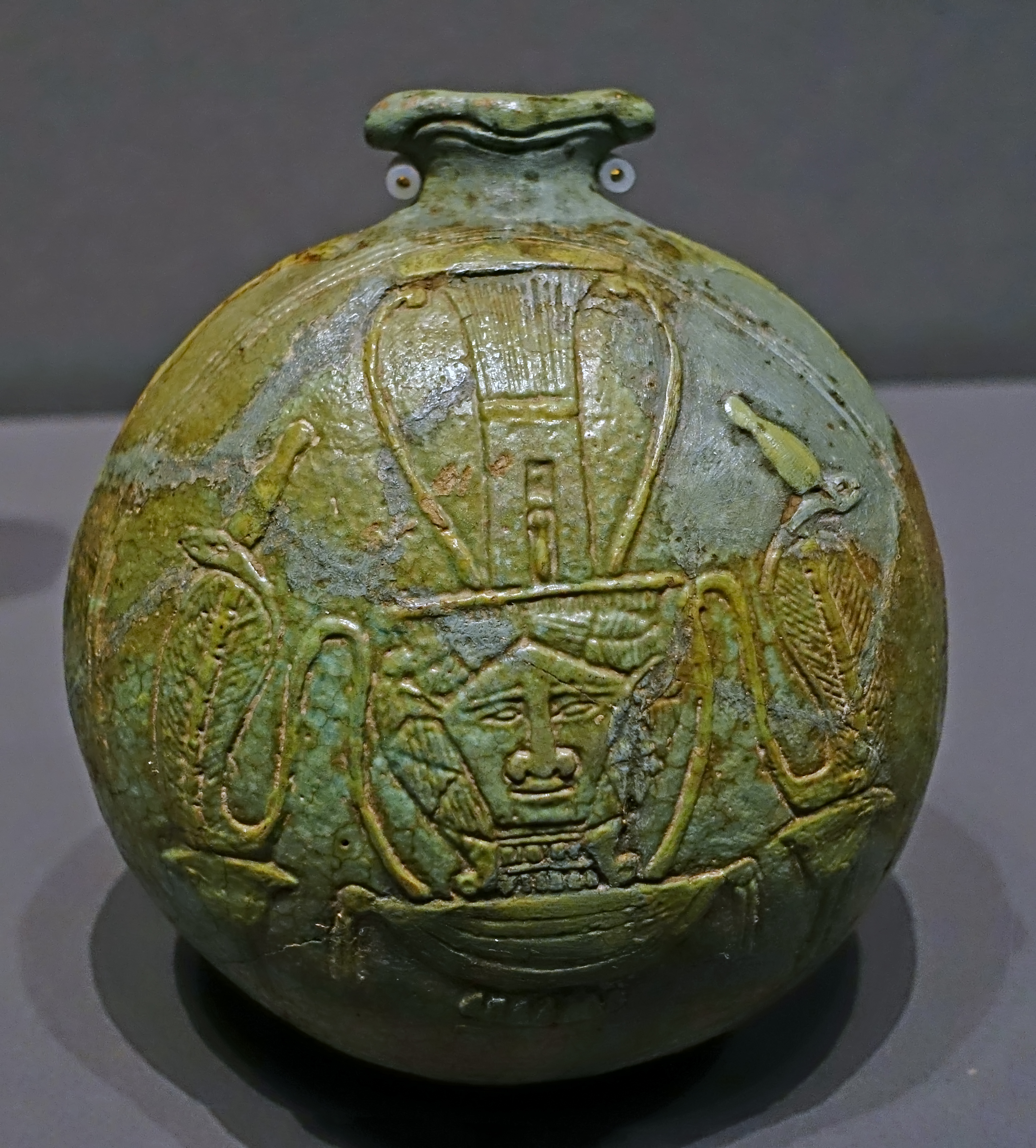
26th Dynasty: 664 BC - 525 BC
New Year's flask
New Year's flask with the image of a human-headed sistrum (symbol of the goddess Hathor), circa 650 BC - 550 BC
Hathor is flanked here by two rearing cobras, Uraei, from the Greek for 'on its tail'. They signify sovereignty, royalty, deity and divine authority.
Photo: Don Hitchcock 2018
Catalog: Faience, ÄS 382
Source: Original, Ägyptischen Museum München
Text: Museum card, © Ägyptischen Museum München
Additional text: Wikipedia
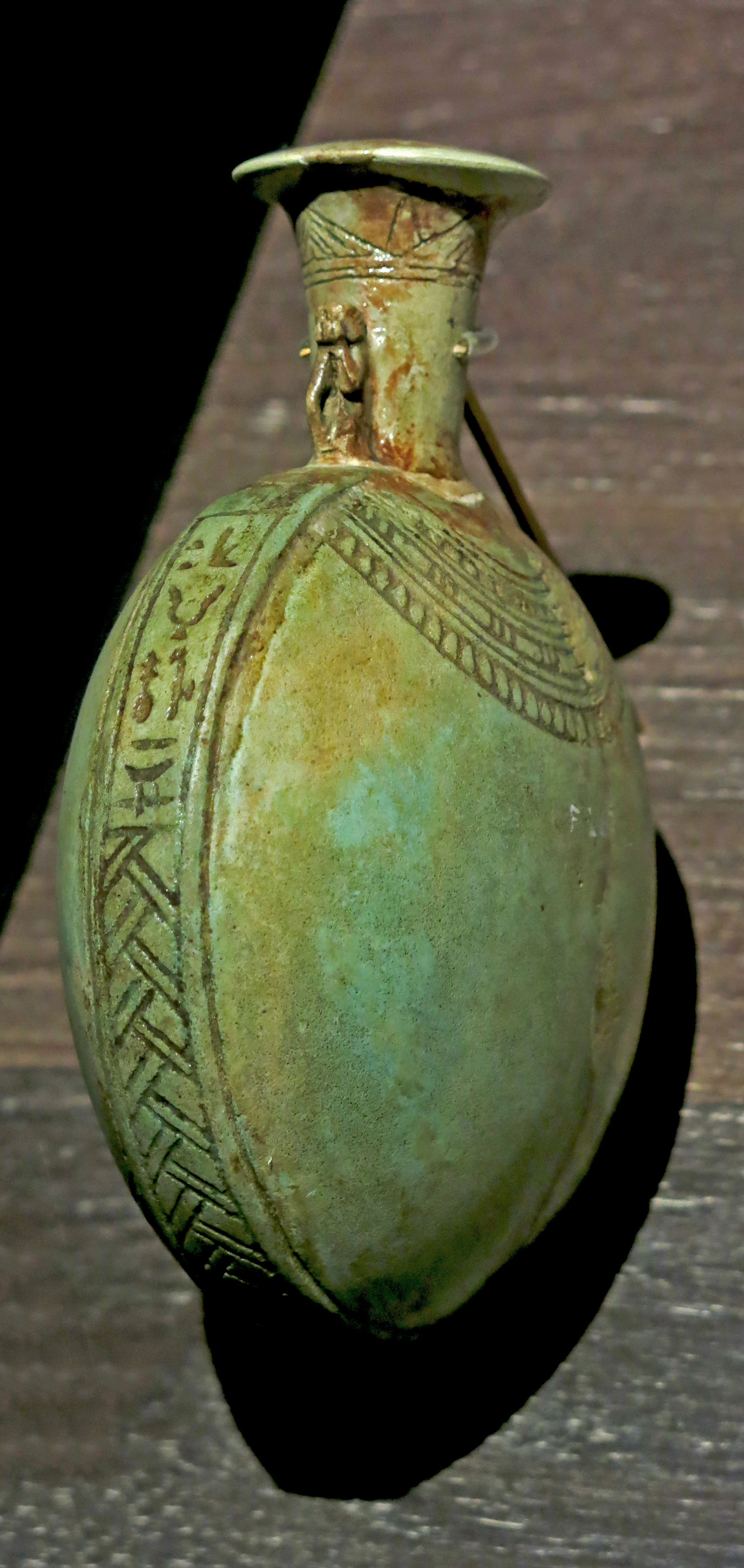
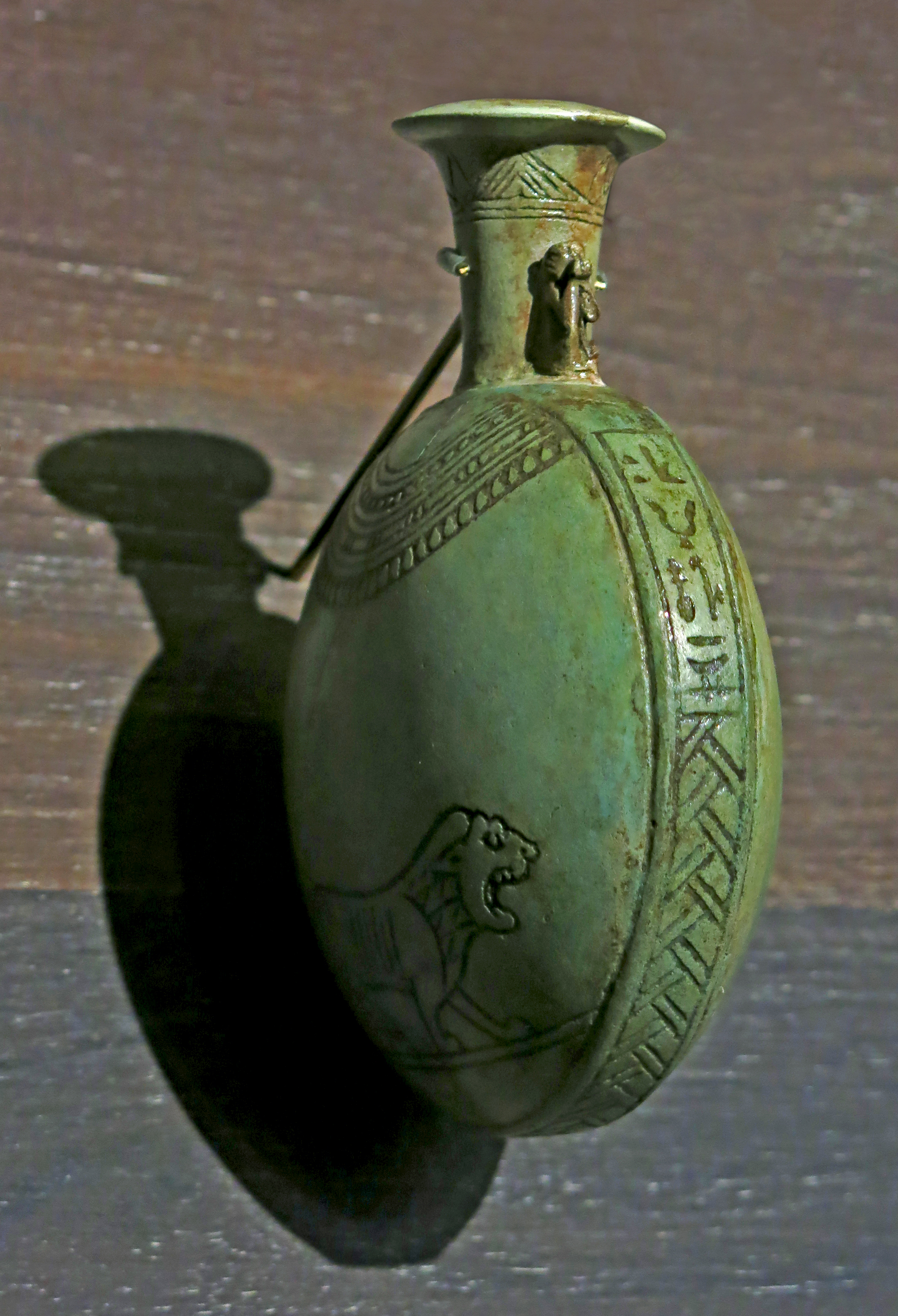
26th Dynasty: 664 BC - 525 BC
New Year's flask
New Year's flask inscribed with blessings, circa 7th - 4th century BC.
Photo: Don Hitchcock 2015
Catalog: Faience, ÄS 2922
Source: Original, Ägyptischen Museum München
Text: Museum card, © Ägyptischen Museum München

26th Dynasty: 664 BC - 525 BC
Bakenrenef
Fragment of an inscription from the tomb of the vizier Bakenrenef, circa 590 BC
( More fragments from the monumental rock-cut tomb of the vizier, Bakenrenef, who served under Psamtik I of the 26th Dynasty may be seen at www.metmuseum.org/art/collection/search/549495, where the date is given as 664 BC - 610 BC, i.e. the dates of the reign of the Pharaoh Psamtik I - Don )
Photo: Don Hitchcock 2015
Catalog: Limestone, Sakkara, ÄS 5896
Source: Original, Ägyptischen Museum München
Text: Museum card, © Ägyptischen Museum München
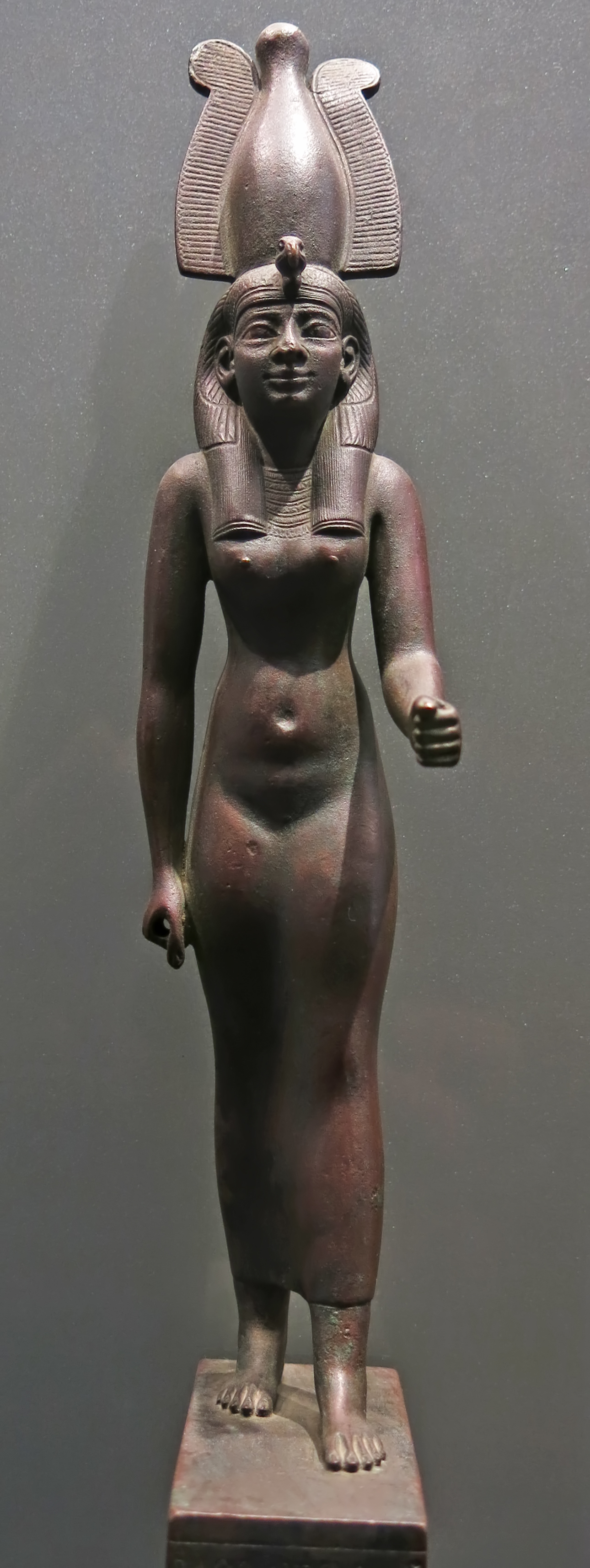 26th Dynasty: 664 BC - 525 BC
Nekhbet
Nekhbet is shown standing, wearing a robe, a tripartite wig, a vulture skin over her head, an Atef crown, (the crown of Osiris), and Usekh necklace.
Nekhbet was an early predynastic local goddess in Egyptian mythology, who was the patron of the city of Nekheb. Ultimately, she became the patron of Upper Egypt and one of the two patron deities for all of Ancient Egypt when it was unified.
Nekhbet was often depicted as a vulture.
Height 258 mm, width 46 mm, depth 75 mm.
Catalog: Bronze, gilded eyes, Memphis Serapeum, Memphis Necropolis, E 27210
Location: Aile Sully, Salle 336, Le Nil, Vitrine 7
Photo: Don Hitchcock 2015
Source and text: Original, Louvre Museum, https://collections.louvre.fr/
Additional text: Wikipedia
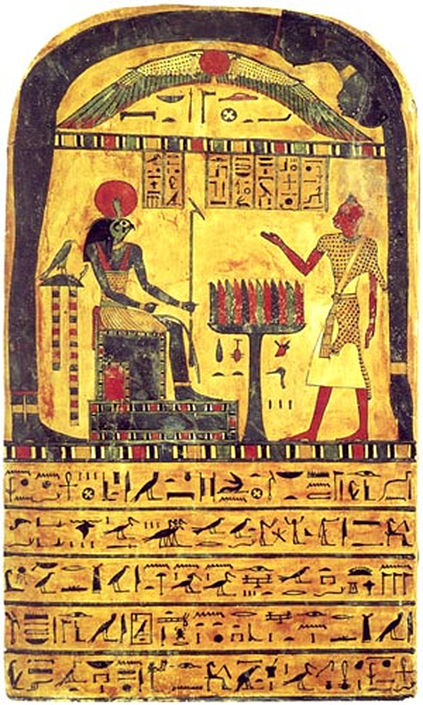
26th Dynasty: 664 BC - 525 BC
Ankh-af-na-khonsu
The Stele of Revealing. The funerary tablet of Ankh-af-na-khonsu, a 26th dynasty Theban priest.
Photo: Ashami
Text: Wikipedia
Permission: Public Domain
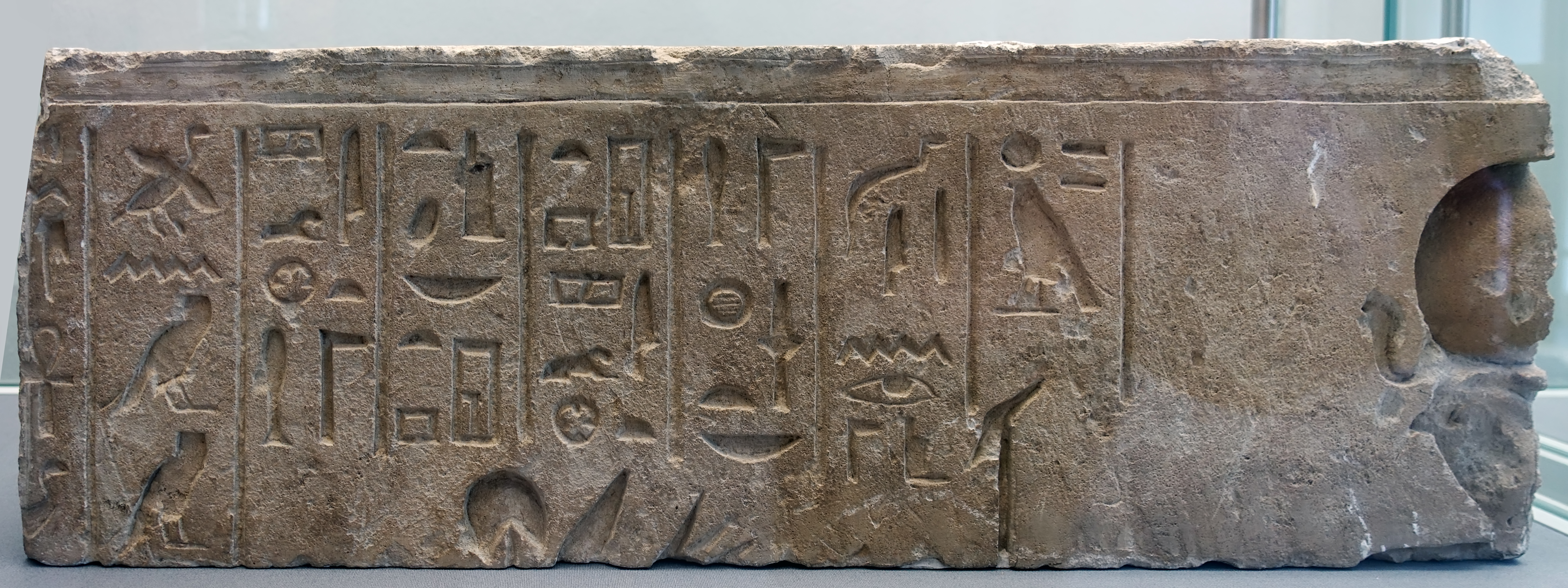
26th Dynasty: 664 BC - 525 BC
Priest Anchu
Block with the god Re-Harachte, circa 600 BC. On the right you can see Re-Harachte (Re, the Horus of the horizon) with a falcon's head crowned by a sun disk, representing the morning sun.
On the left - not preserved - once stood the priest Anchu, who worshipped him, whose inscription begins as follows: 'Words to be spoken by Osiris (i.e. the deceased), the priest of (goddess) Sachmet, the mistress of the temple of lscheru (= place name) and (priest of the goddess) lsis, the mistress of the temple of lscheru, Anchu'.
Catalog: Limestone
Photo: Don Hitchcock 2018
Source and text: Original, Museum August Kestner, Hannover

26th Dynasty: 664 BC - 525 BC
Priest Anchu
Block with the god Re-Harachte, circa 600 BC. The priest Anchu mentioned on the block above can be seen on this block with raised hands, i.e. in the gesture of a praying person. His long prayer to the god Atum (the evening sun) can be almost completely reconstructed.
Catalog: Limestone
Photo: Don Hitchcock 2018
Source and text: Original, Museum August Kestner, Hannover
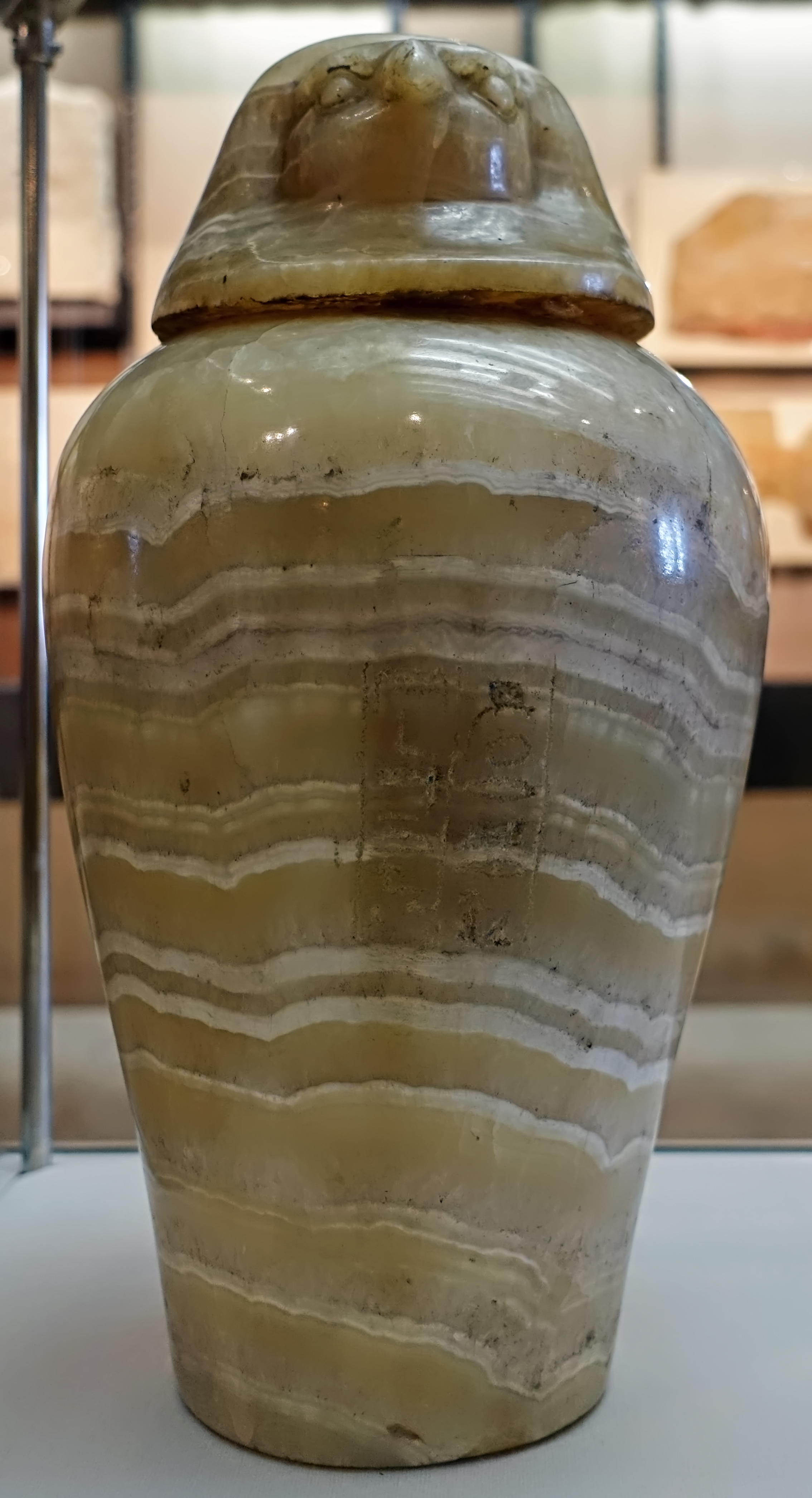
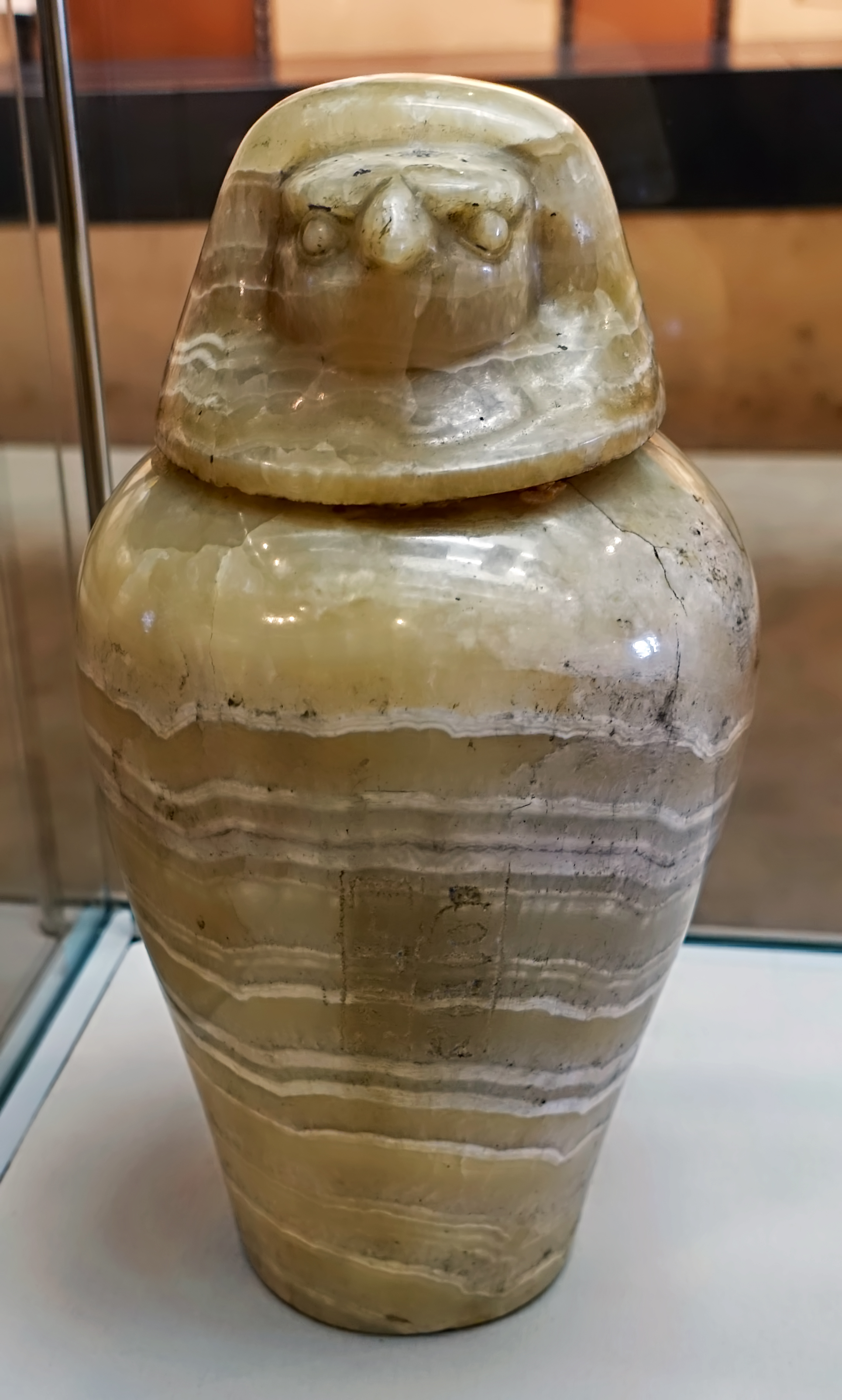
26th Dynasty: 664 BC - 525 BC
Canopic Jar
Circa 650 BC - 525 BC
Height 326 mm, diameter 174 mm.
The preservation of the physical body - necessary in the Egyptians' vision so that the Ba-soul could always reunite with it and regenerate in it - made the mummification of not only the body shell but also the organs and viscera indispensable. They were kept in four vessels under the protection of four gods and four goddesses. These gods, collectively known as the 'Children of Horus' and perhaps descended from deified princes and princesses of Horus (king), are called Amseti and Hapi (both names cannot be interpreted with certainty), Dua-mut-ef (He-who-prizes-his-mother) and Kebeh-senu-ef (He-who-satisfies-his-siblings). At first they were imagined in human form, but later three of them were also associated with animals: Baboon, falcon, jackal - although the attributions were not more precisely defined until the New Kingdom. The closures of the visceral vessels were also shaped like human and animal heads.
Since they thus partly resemble the cult image of Osiris of Canopus (vessel with a human face as lid), Egyptology of the early 19th century coined the term 'Canopic' or 'Canopic jars' for them, which, although completely misleading, is still in use today.
This alabaster jar contained embalmed organs under the protection of Kebeh-senu-ef, the hawk or falcon headed god who protected the intestines.
( On the right is a closeup of the hieroglyphs on the canopic jar. It seems to have been quite inexpertly done, in comparison to the beautifully turned and carved jar itself, as though the writing was added in a hurried fashion to a pre-existing jar, by a scribe with little knowledge of how to engrave stone.
I can make out what may be the following glyphs from Gardiner's list of Egyptian Hieroglyphs, Gardiner (1927)
D58, foot
K7, fish
H8, egg
D21, mouth
B1, seated woman
- Don )
Catalog: Alabaster, Inv. Nr. 1879
Photo: Don Hitchcock 2018
Source and text: Original, Museum August Kestner, Hannover
Gardiner's List: Gardiner (1927)
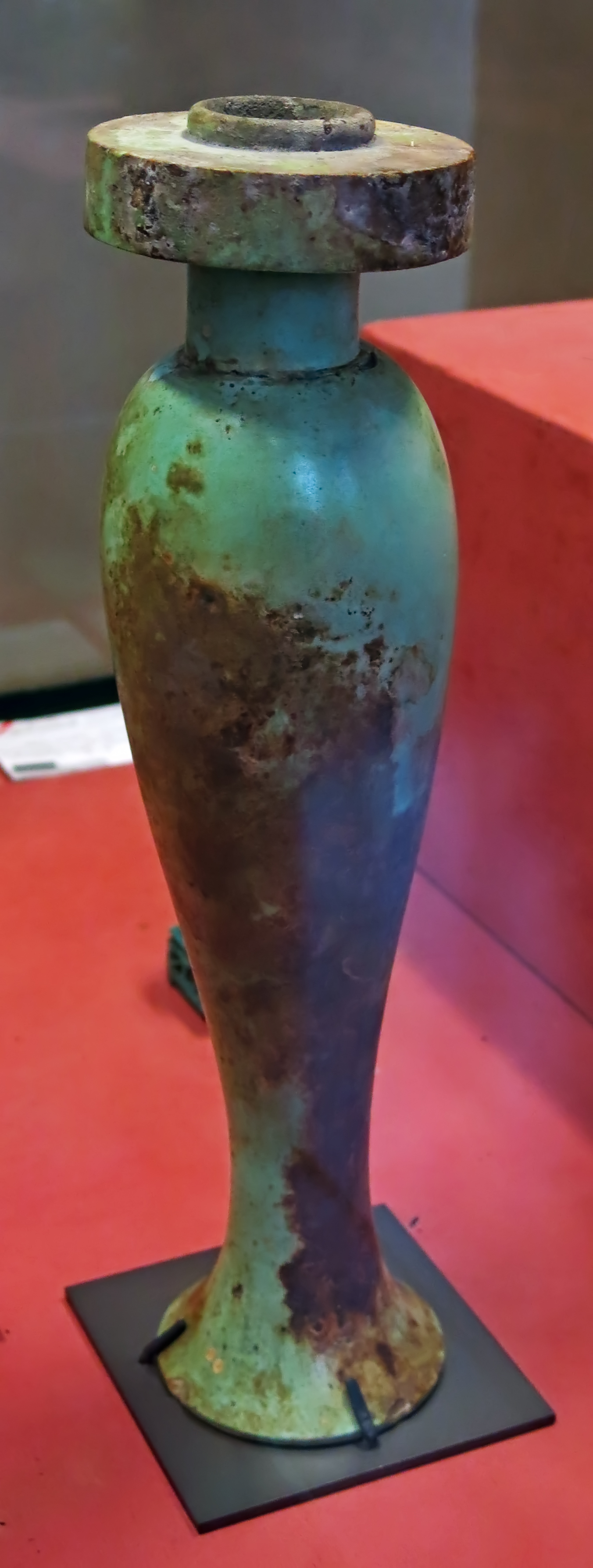
26th Dynasty: 664 BC - 525 BC
Offering vase
Special vessels such as this were used to hold ritually purified water. Called hes-vases (from the Egyptian word meaning 'favoured'), these containers were frequently left as tomb offerings so the deceased could drink the water and thus maintain a pure state throughout eternity.
Highly vitrified faience with traces of gilding on the lip. The brown discolouration is due to a fire. Circa 670 BC.
Height 310 mm.
Catalog: Faience, Aile Sully, Room 334, Materials and Techniques, Vitrine 6, N 976
Photo: Don Hitchcock 2015, 2018
Source and text: Original, Louvre Museum, Paris, France, https://collections.louvre.fr/
Additional text: brooklynmuseum.org
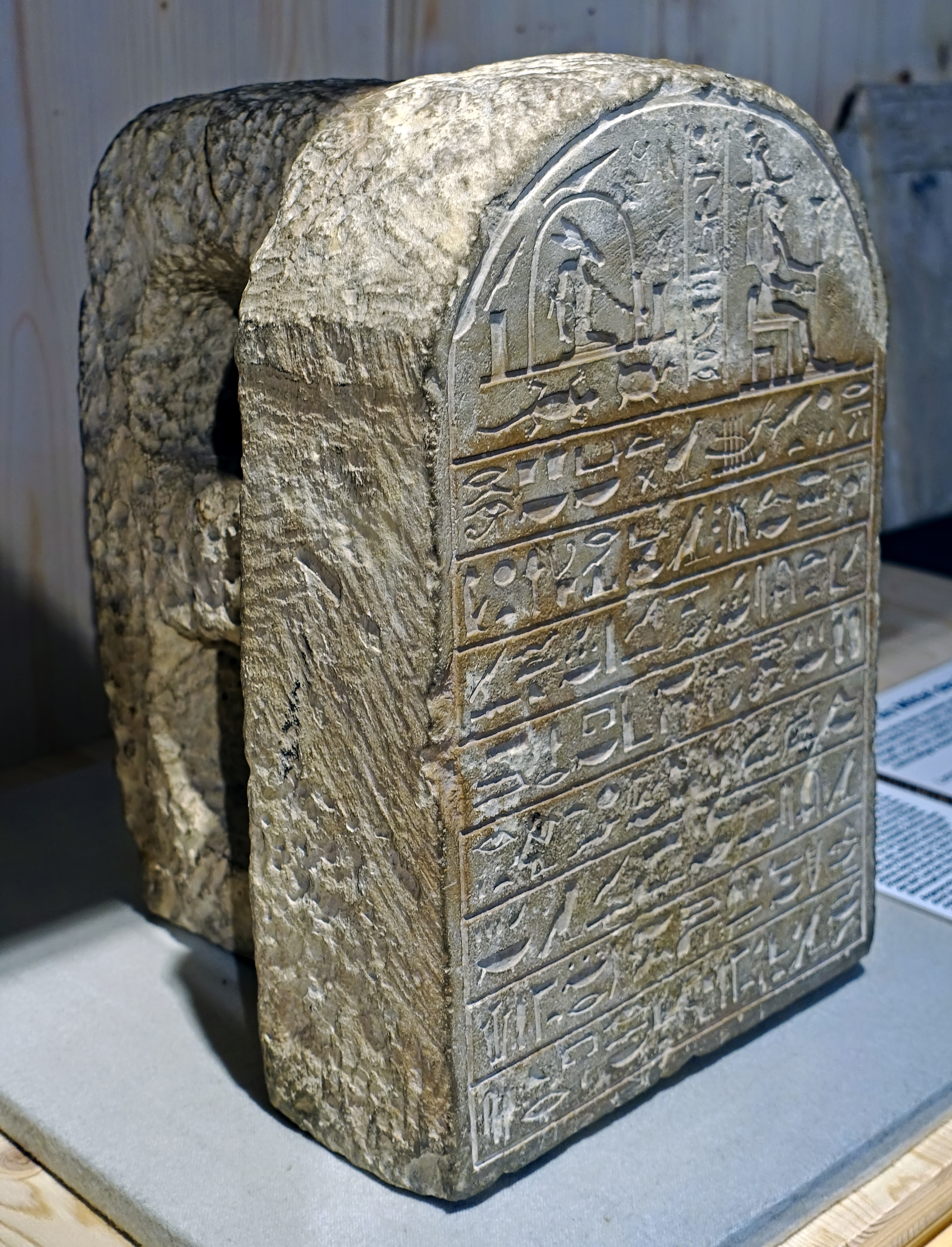
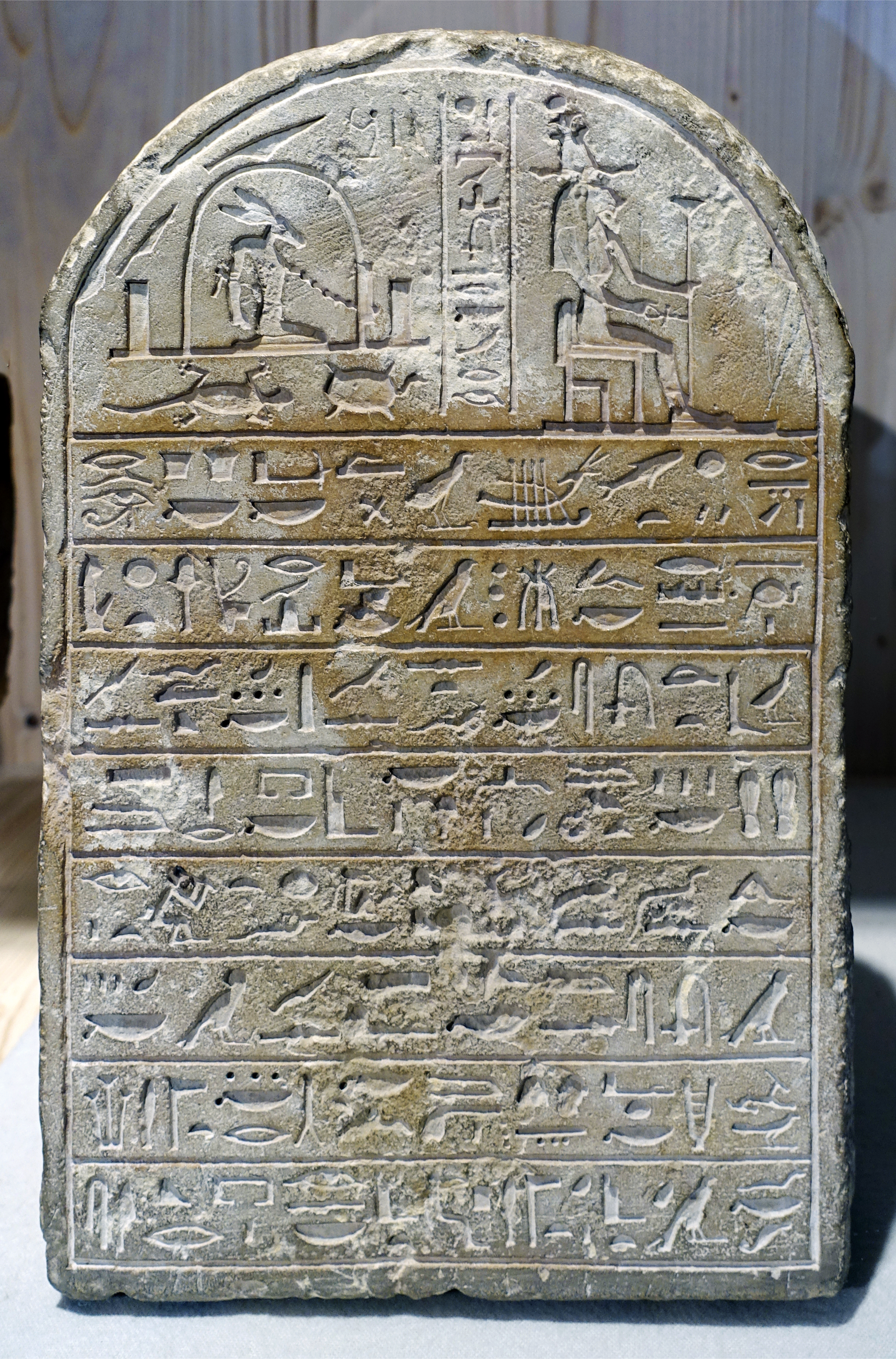
26th Dynasty: 664 BC - 525 BC
Hor-sa-lsis
Magic stele of the priest Hor-sa-lsis, circa 600 BC.
( This stela was once mounted in a stone wall, and the reinforcement of the back shown in the left hand image shows that it could not be removed without demolishing the wall - Don )
The goddess Sekhmet, enthroned on the right, guards the execution site shown behind her with the 'evil' god Seth (with donkey head) chained to it.
Sekhmet was a warrior goddess as well as goddess of healing. She is depicted as a lioness. She was seen as the protector of the pharaohs and led them in warfare. Upon death, Sekhmet continued to protect them, bearing them to the afterlife.
Translation of the eight-line inscription on the magic stele of the priest Hor-sa-Isis:
To the ground! To the ground! (you) Abomination of (the god) Sokar! You have hurled your saliva at the eye of Re, (therefore) you carry the (burden of) Horus children and enter the execution site of Sachmet.
She burns your limbs, she cuts off your fingers and separates your soles from Egypt, so that your son will not be in your place. But if you should ever come to the oasis of Bahariya, you will have to eat the enemy of the eye of Horus, so that his flame will burn in your body and his knife will cut in your flesh.
Your future life on earth will be bad, while your evil plans will not touch the priest Hor-sa-lsis (i.e. 'Horus, son of Isis'), son of the priest Pa-scheri-lsis (i.e. 'The child of Isis') and the housewife Qeris, (at all)!
The god Seth, who embodies evil and chaos, is addressed, but not mentioned by name for fear of making the naming effective by saying it, and is depicted in the semicircular picture field of the stele on the left chained to the place of execution of the goddess Sachmet and ready for destruction, in the company of his 'unholy' animals, the turtle and the lizard.
Seth is the enemy of his brother Osiris and his son Horus, the two 'good' rulers of the worlds beyond and in this world.
Language as a means of magic
The fact that language is still considered 'potent' today is made evident by its use and its (hoped for) impact in the case of curses as well as in the magical and shamanic practices still used by numerous peoples today. In the process, multiple enunciations are considered especially effective.
Intangible but spoken realities
For all ancient peoples, the spoken word had greater importance than is the case today. It was impossible to lie because something spoken, for the Egyptians for example, represented an absolute reality. If this does not manifest itself in the here and now, then it must be a reality in the parallel world of the hereafter.
One could thus create realities through speech alone, making the hereafter pleasant. Because people did not read silently to themselves until late antiquity, the written word was simultaneously a spoken word, and thus was likewise an absolute reality.
Catalog: Limestone, Egypt, probably from the oasis Bahariya (western desert).
Photo: Don Hitchcock 2018
Source and text: Original, Museum August Kestner, Hannover
Additional text: Wikipedia
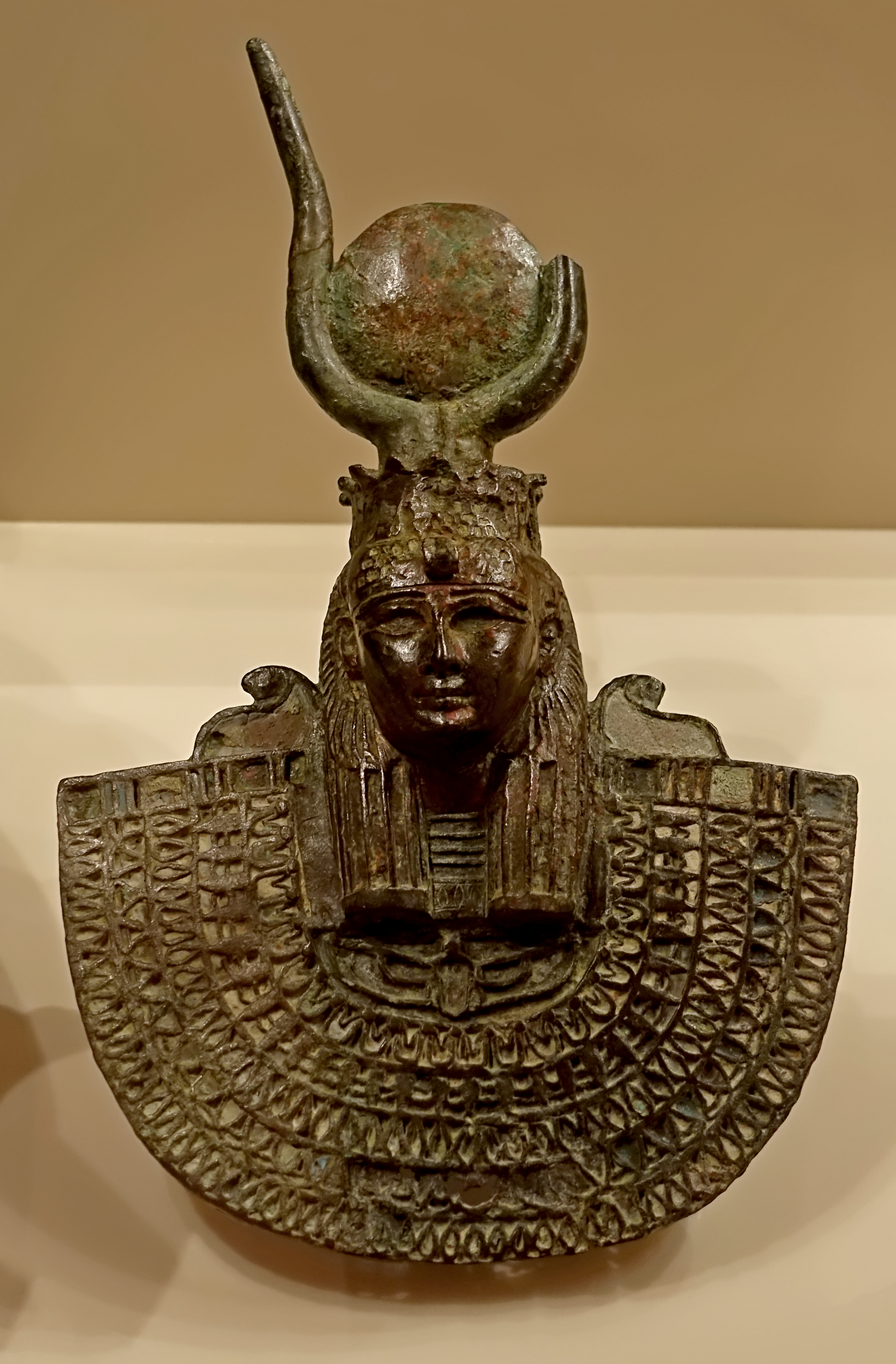
26th Dynasty: 664 BC - 525 BC
Aegis
Aegis of the head of Hathor, with the horns of a cow enclosing a sun disc.
Circa 550 BC.
( The word Aegis can mean, as in this case, the shield of a deity. Her headdress is composed of uraei, representations of a sacred serpent (the cobra) as an emblem of supreme power, worn on the headdresses of ancient Egyptian deities and sovereigns. - Don )
Dimensions: Height 305 mm. (?)
A particular form of cult object of Egypt is the Aegis, made up of a necklace and the counterweight of the menat, both fashioned in bronze. The necklace is topped by the head of the goddess Hathor shown with the horns of a cow. During processions in honour of the goddess this object as well as systrums (rhythm instruments) were usually carried by the priestesses.
Catalog: Bronze, ÄM 23706
Photo: Don Hitchcock 2018
Source: Original, Staatliche Museen zu Berlin, Neues Museum, Germany
Text: © Card at the Staatliche Museen zu Berlin, http://www.smb-digital.de/ (CC BY-NC-SA 3.0 DE)
Additional text: http://www.egyptian-museum-berlin.com/c34.php, google.com
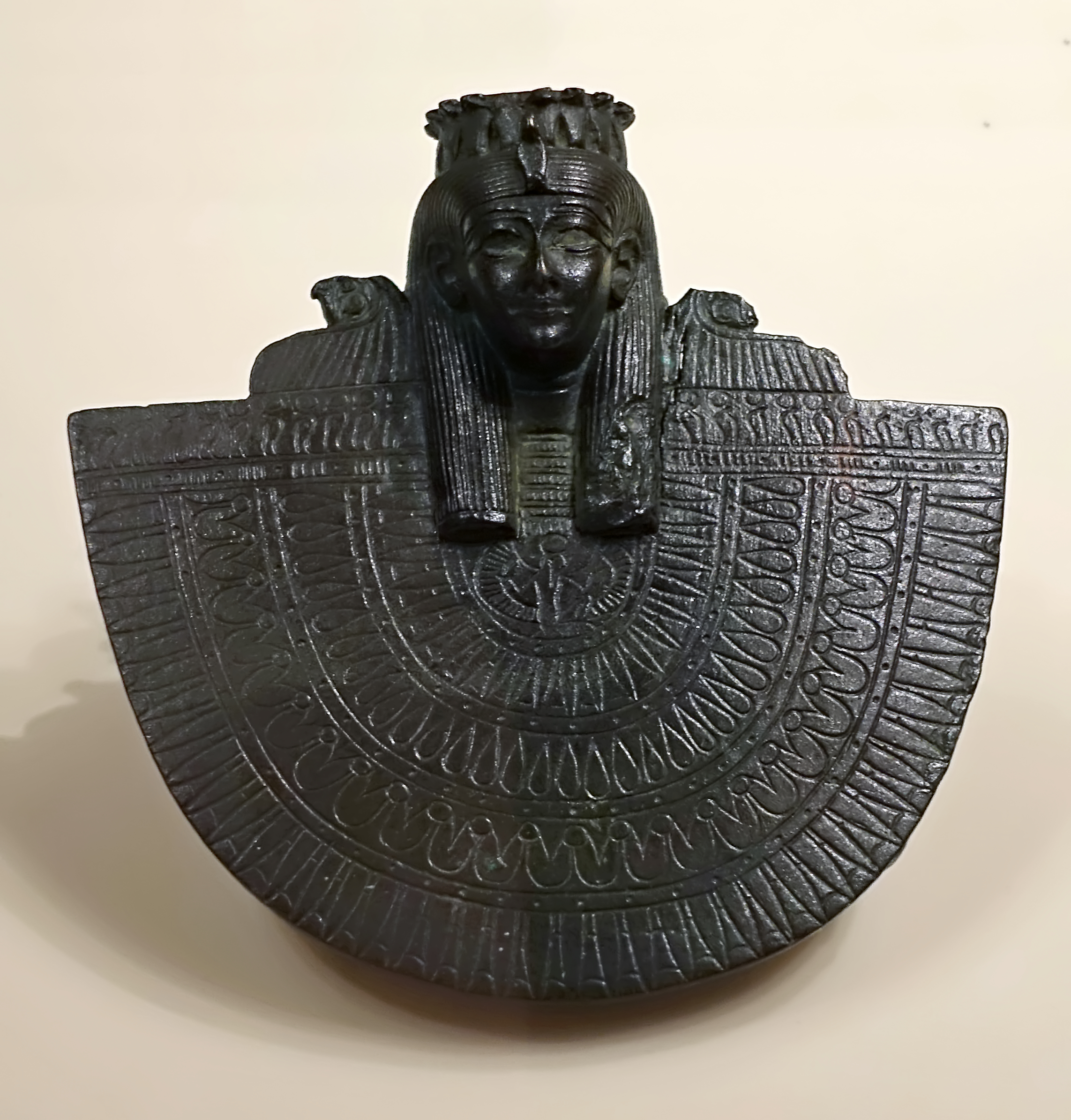
26th Dynasty: 664 BC - 525 BC
Aegis
Aegis of the head of Hathor, but lacking the horns of a cow enclosing a sun disc.
Circa 550 BC.
( This Aegis has lost the original horns and sun disc. Yet we can see the obvious representation of Hathor in miniature at the neck of the large head. It would appear that the semi-circular 'wings' of this piece and the one above are abstract renderings, indeed, of wings. - Don )
Hathor was a major goddess in ancient Egyptian religion who played a wide variety of roles. As a sky deity, she was the mother or consort of the sky god Horus and the sun god Ra, both of whom were connected with kingship, and thus she was the symbolic mother of their earthly representatives, the pharaohs.
( We can see two images of Horus depicted as a falcon on the shoulders of Hathor in this piece and the one above - Don )
She was one of several goddesses who acted as the Eye of Ra, Ra's feminine counterpart, and in this form she had a vengeful aspect that protected him from his enemies. Her beneficent side represented music, dance, joy, love, sexuality and maternal care, and she acted as the consort of several male deities and the mother of their sons. These two aspects of the goddess exemplified the Egyptian conception of femininity. Hathor crossed boundaries between worlds, helping deceased souls in the transition to the afterlife.
Catalog: Bronze, ÄM 2820
Photo: Don Hitchcock 2018
Source: Original, Staatliche Museen zu Berlin, Neues Museum, Germany
Text: © Card at the Staatliche Museen zu Berlin, http://www.smb-digital.de/ (CC BY-NC-SA 3.0 DE)
Additional text: Wikipedia
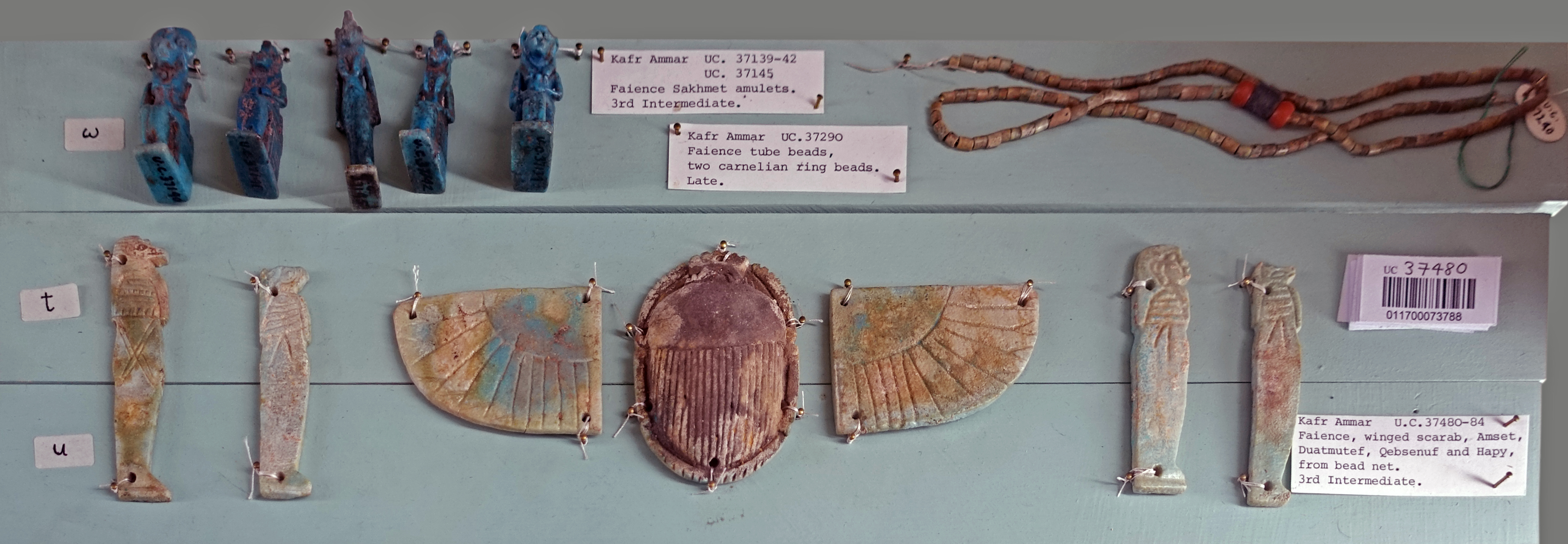
26th Dynasty: 664 BC - 525 BC
Group of Amulets
( The image above displays a series of amulets found at Ammur. Individual items are treated separately below - Don )
Photo: Don Hitchcock 2018
Source: Original, Petrie Museum, London, England
Text: Card / online catalogue, the Petrie Museum, © 2015 UCL. CC BY-NC-SA license.
26th Dynasty: 664 BC - 525 BC
Amulet
Faience amulet, blue glaze: seated female lion-headed deity on block throne. Left arm broken but wrist and hand crossed on breast holding lotus; right arm by side hand palm down on knee. Heavy wig with solar disk and uraeus, loop for suspension behind.
From Kafr Ammar, Grave 380.
Height 47 mm, width 10 mm, Accession Number LDUCE-UC37140
Photo (left): Petrie Museum, © 2015 UCL. CC BY-NC-SA license.
Text: Card / online catalogue, the Petrie Museum, © 2015 UCL. CC BY-NC-SA license.
26th Dynasty: 664 BC - 525 BC
Amulet
Faience amulet, blue glaze, of a seated female lion-headed deity on block throne, with incised marks. Both hands are crossed on the breast holding flails. the deity wears a heavy wig with a Uraeus and the amulet has a loop for suspension on the back.
From Kafr Ammar, Grave 380.
Height 39 mm, width 9 mm, Accession Number LDUCE-UC37141.
Photo (left): Petrie Museum, © 2015 UCL. CC BY-NC-SA license.
Text: Card / online catalogue, the Petrie Museum, © 2015 UCL. CC BY-NC-SA license.
26th Dynasty: 664 BC - 525 BC
Amulet
Faience amulet, blue glaze. Standing female lion-headed deity left foot forward, hands by side, wig and uraeus loop for suspension behind.
From Kafr Ammar, Grave 380, height 52 mm, width 8 mm, Accession Number LDUCE-UC37145.
Photo (left): Petrie Museum, © 2015 UCL. CC BY-NC-SA license.
Text: Card / online catalogue, the Petrie Museum, © 2015 UCL. CC BY-NC-SA license.
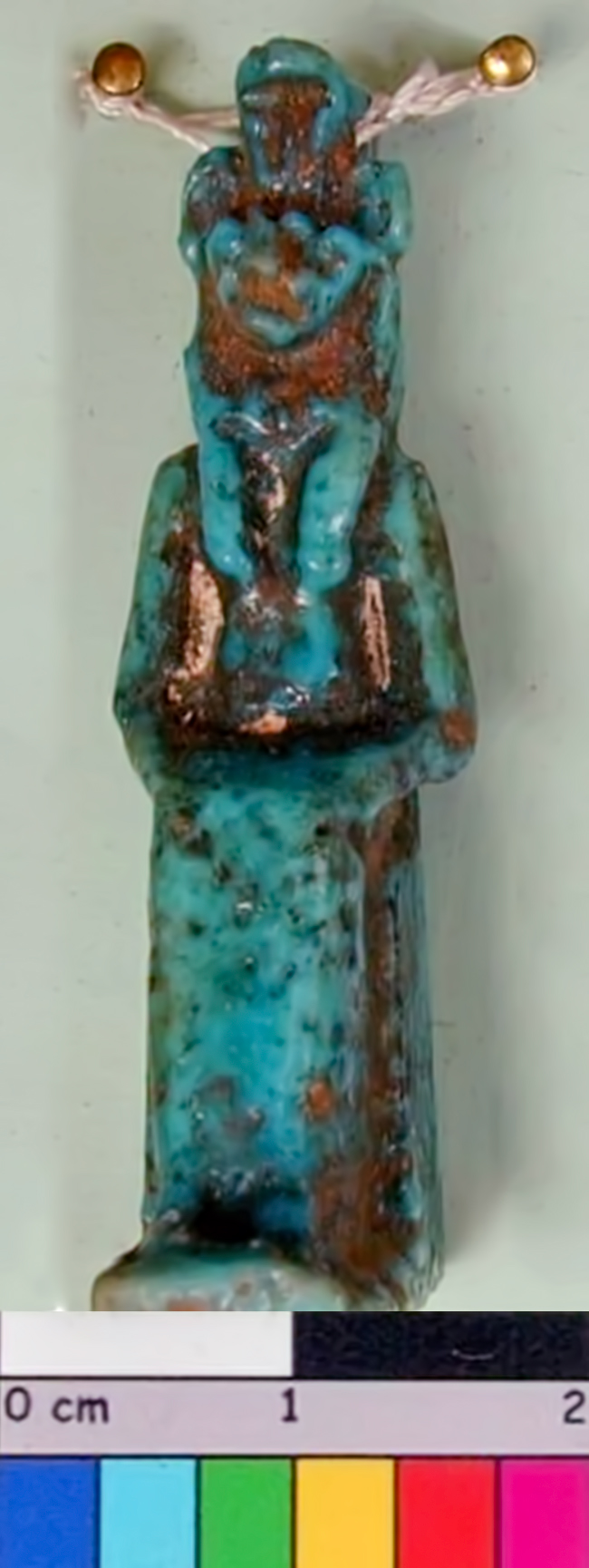
26th Dynasty: 664 BC - 525 BC
Amulet
Faience amulet, blue glaze: seated female lion-headed deity on block throne, with incised marks. Both hands palms down on knee. Heavy wig with a Uraeus and loop for suspension on the back.
From Kafr Ammar, Grave 380.
Height 40 mm, width 8 mm, Accession Number LDUCE-UC37142.
Photo (left): Petrie Museum, © 2015 UCL. CC BY-NC-SA license.
Text: Card / online catalogue, the Petrie Museum, © 2015 UCL. CC BY-NC-SA license.
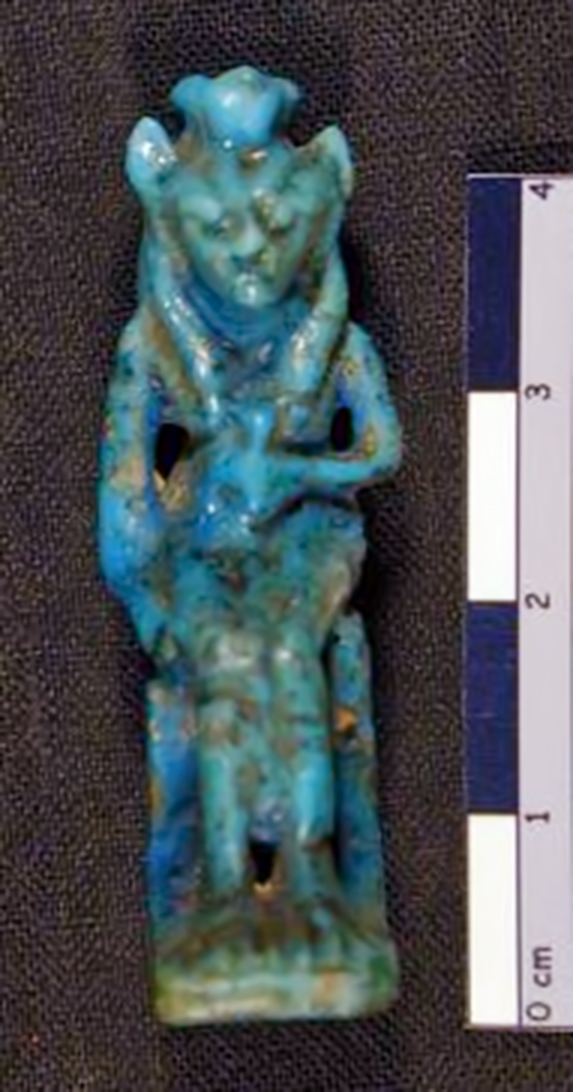
26th Dynasty: 664 BC - 332 BC
Amulet
Faience amulet, blue glaze: seated female lion-headed deity, left arm crossed on the breast holding a lotus flower, right arm by the side, bent to knee. Heavy wig with uraeus on head, and loop for suspension. Block throne.
From Kafr Ammar, Grave 380, height 41 mm, width 11 mm, Accession Number LDUCE-UC37139.
Photo (left): Petrie Museum, © 2015 UCL. CC BY-NC-SA license.
Text: Card / online catalogue, the Petrie Museum, © 2015 UCL. CC BY-NC-SA license.
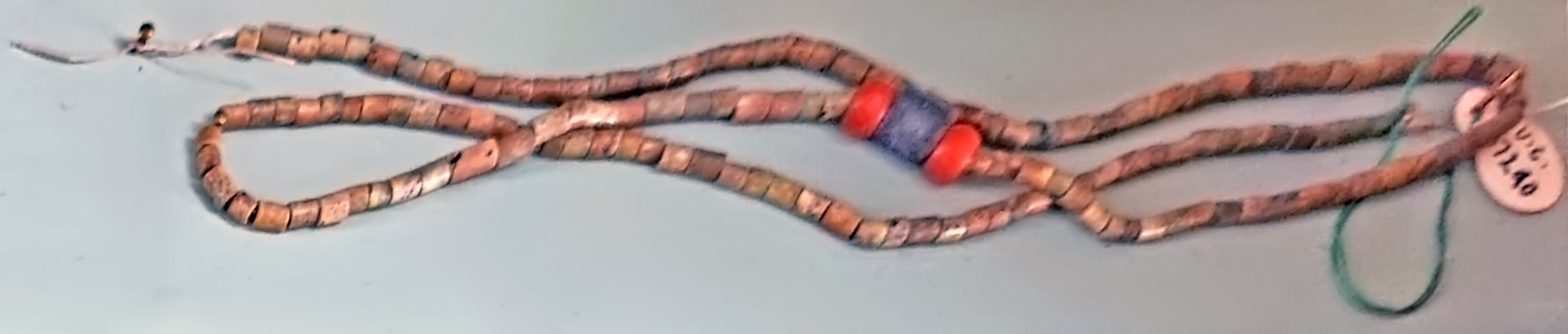
Late Period: 664 BC - 332 BC
Beads
Faience tube beads, decayed green glaze, with two large carnelian ring beads and one large decayed dark blue faience tube bead.
From Kafr Ammar.
Length 514 mm, diameter 3 mm, Accession Number LDUCE-UC37290.
Photo: Don Hitchcock 2018
Source: Original, Petrie Museum, London, England
Text: Card / online catalogue, the Petrie Museum, © 2015 UCL. CC BY-NC-SA license.
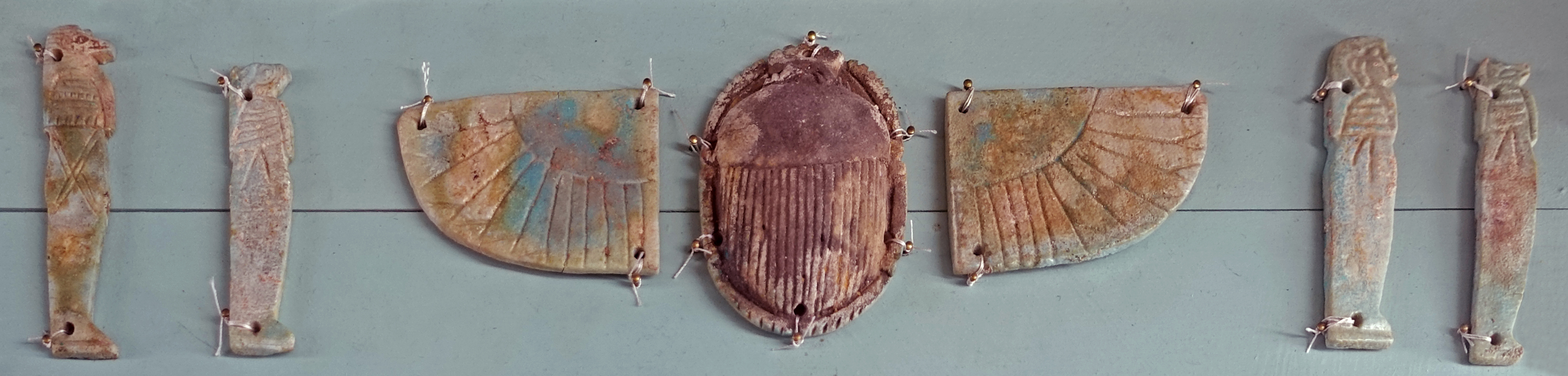
Third Intermediate Period: 1 077 BC - 656 BC
Bead Net Amulets
Centre: Large scarab, decayed faience turquoise glaze, pierced in six places for attachment to a bead net. The reverse is plain.
From Kafr Ammar.
Length 63 mm, width 45 mm, Accession Number LDUCE-UC37480A
Near left and right:
Decayed turquoise faience glazed wings of a scarab, pierced in three places for attachment to a bead net.
From Kafr Ammar.
Length 57 mm, width 57 mm, Accession Number LDUCE-UC37480B
Far left and right:
Decayed turquoise faience amulets, depicting Amset, Duatmutef, Qebsenuf and Hapy, from a bead net.
LDUCE-UC37481 to LDUCE-UC37484
From Kafr Ammar.
Photo: Don Hitchcock 2018
Source: Original, Petrie Museum, London, England
Text: Card / online catalogue, the Petrie Museum, © 2015 UCL. CC BY-NC-SA license.
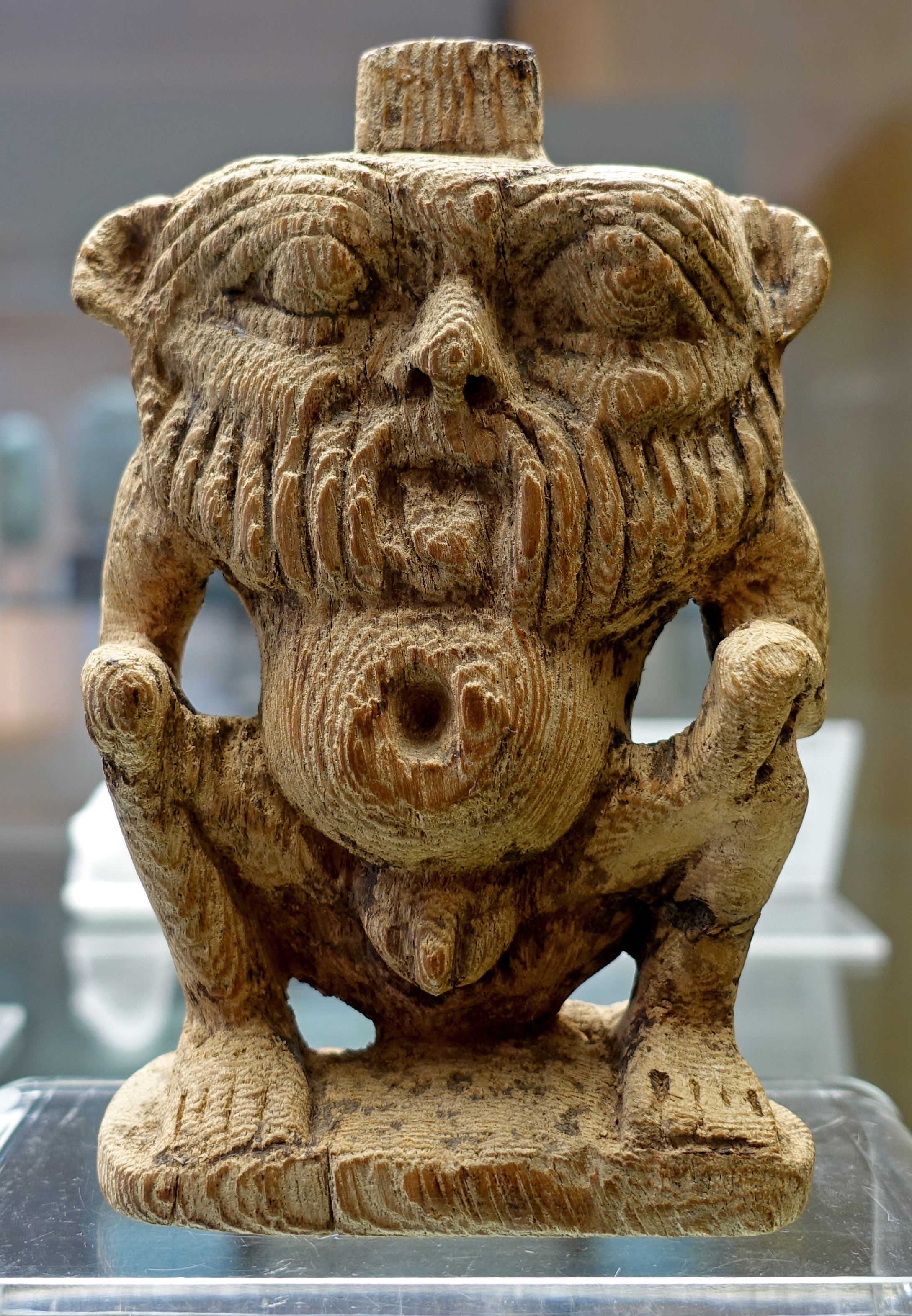
Third Intermediate Period to Roman Period: 800 BC - 200 AD
Bes
The House Demon Bes in Palm wood.
This statuette of the good-natured dwarf god Bes was probably part of a piece of furniture decoration because of the cone on his head. The fibrous palm wood of which this was made was otherwise rarely used for sculptural work.
Catalog: Inv. No. 2004.415
Photo: Don Hitchcock 2018
Source and text: Original, Museum August Kestner, Hannover
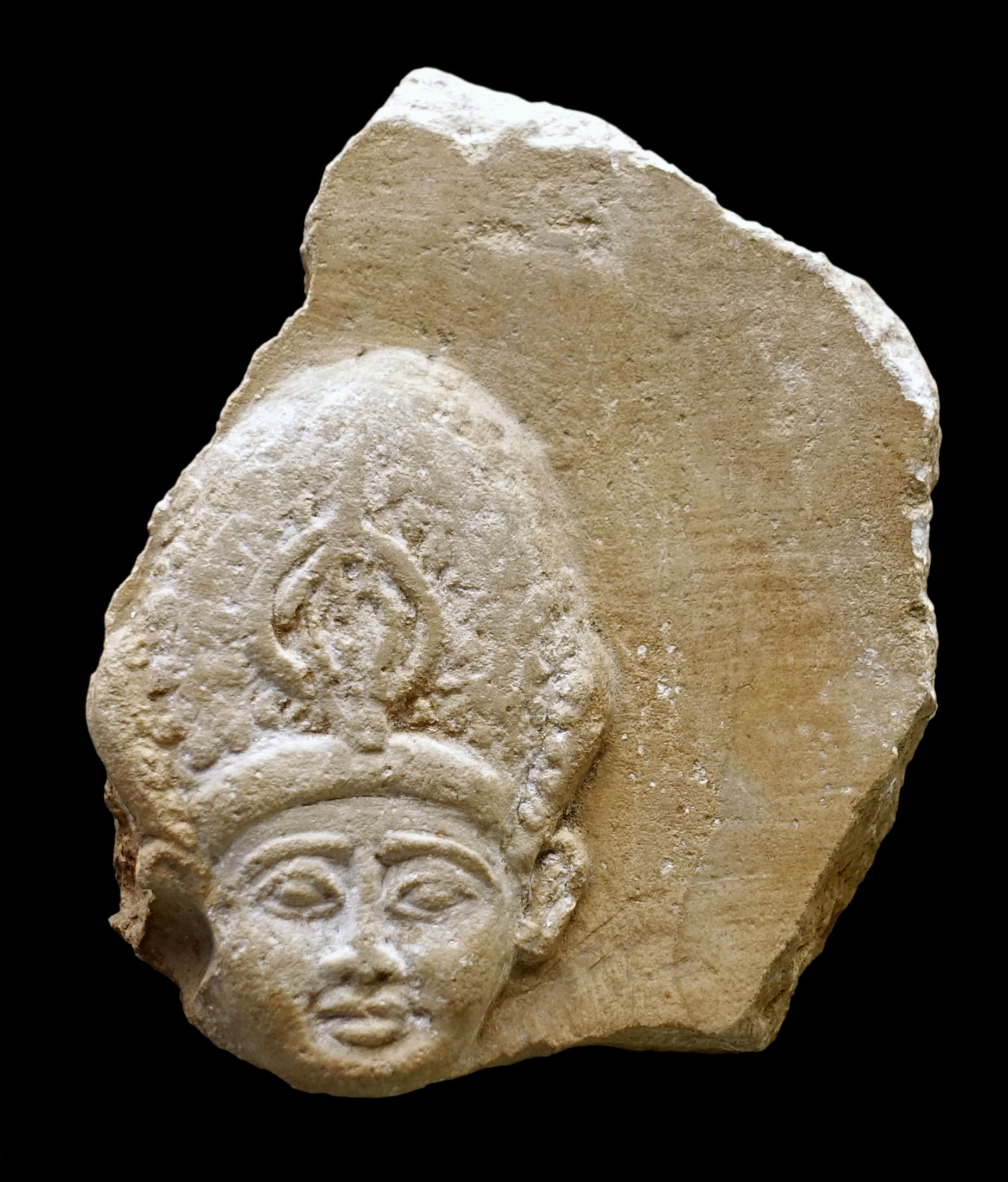
Late Period to Early Ptolemaic Period, 600 BC - 300 AD
King's Head
Sculptural study with a king's head, in limestone.
The Egyptians usually showed the human face in profile in flat depictions. Front view depictions of kings in particular are extremely rare. Here the pharaoh wears the so-called Blue Crown, a leather cap.
The khepresh (ḫprš) was an ancient Egyptian royal headdress. It is also known as the blue crown or war crown. New Kingdom pharaohs are often depicted wearing it in battle, but it was also frequently worn in ceremonies.
No original example of a khepresh has yet been found. Based on ancient artistic representations, some Egyptologists have speculated that the khepresh was made of leather or stiffened cloth[3] covered with a precise arrangement of hundreds of sequins, discs, bosses, or rings. Given that the deshret (red crown) and hedjet (white crown) were apparently woven of some sort of plant fibre, the circles or rings decorating ancient artistic representations of the khepresh may instead indicate the regular array of hexagonal holes in an open triaxial weave. As with many other royal crowns, a uraeus (cobra) was hooked to the front of the khepresh.
Catalog: Inv. No. 2006.45
Photo: Don Hitchcock 2018
Source and text: Original, Museum August Kestner, Hannover
Additional text: Wikipedia
Late Period: 664 BC - 332 BC
Beads
Faience tube beads, decayed green glaze, with two large carnelian ring beads and one large decayed dark blue faience tube bead.
From Kafr Ammar.
Length 514 mm, diameter 3 mm, Accession Number LDUCE-UC37290.
Photo: Don Hitchcock 2018
Source: Original, Petrie Museum, London, England
Text: Card / online catalogue, the Petrie Museum, © 2015 UCL. CC BY-NC-SA license.

26th Dynasty: 664 BC - 525 BC
Stele of Horus
Horus the Child, with shaved head, childhood wick, scarab, necklace. Head of Bes on the back, and a series of deities including Horus and Isis.
Height 190 mm, width 153 mm, thickness 126 mm.
Catalog: Limestone, high relief, formerly with inlaid eyes and eyebrows, E 16264
Location: Aile Sully, Salle 317, Gods and Magic, Vitrine 2
Photo: Don Hitchcock 2015
Source and text: Original, Louvre Museum, https://collections.louvre.fr/
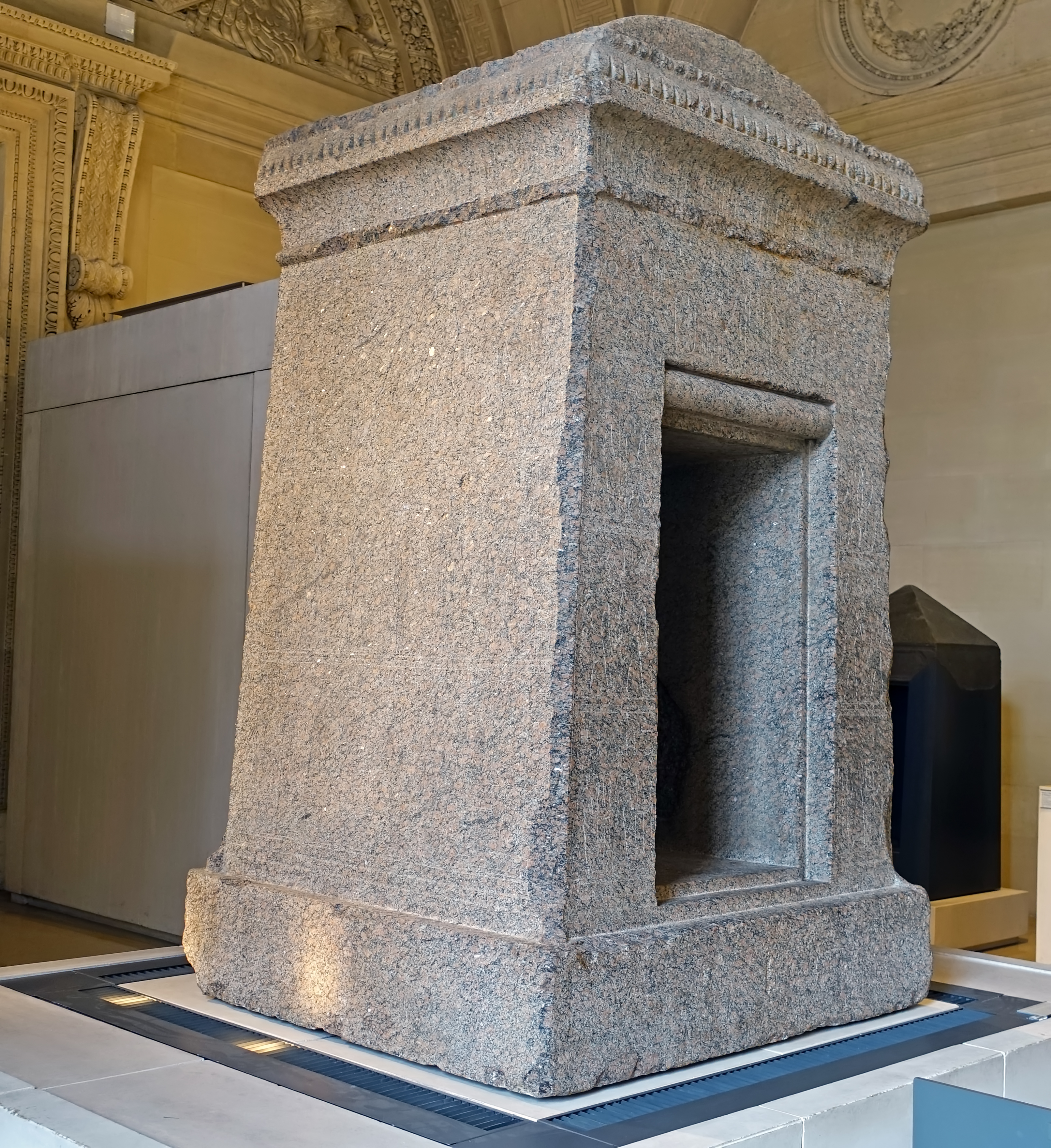
26th Dynasty: 664 BC - 525 BC
Naos / Shrine
The Naos which once housed a statue of Osiris. Reign of Ahmose II, 570 BC - 526 BC
Height 2550 mm, width 1610 mm, thickness 1500 mm, weight 8 000 kg.
Catalog: Pink granite, sunken bas-relief, found at sea off Alexandria, N 381, d 29, CC 20
Location: Aile Sully, Salle 324, Le Temple, not in a vitrine
Photo: Don Hitchcock 2018
Source and text: Original, Louvre Museum, https://collections.louvre.fr/
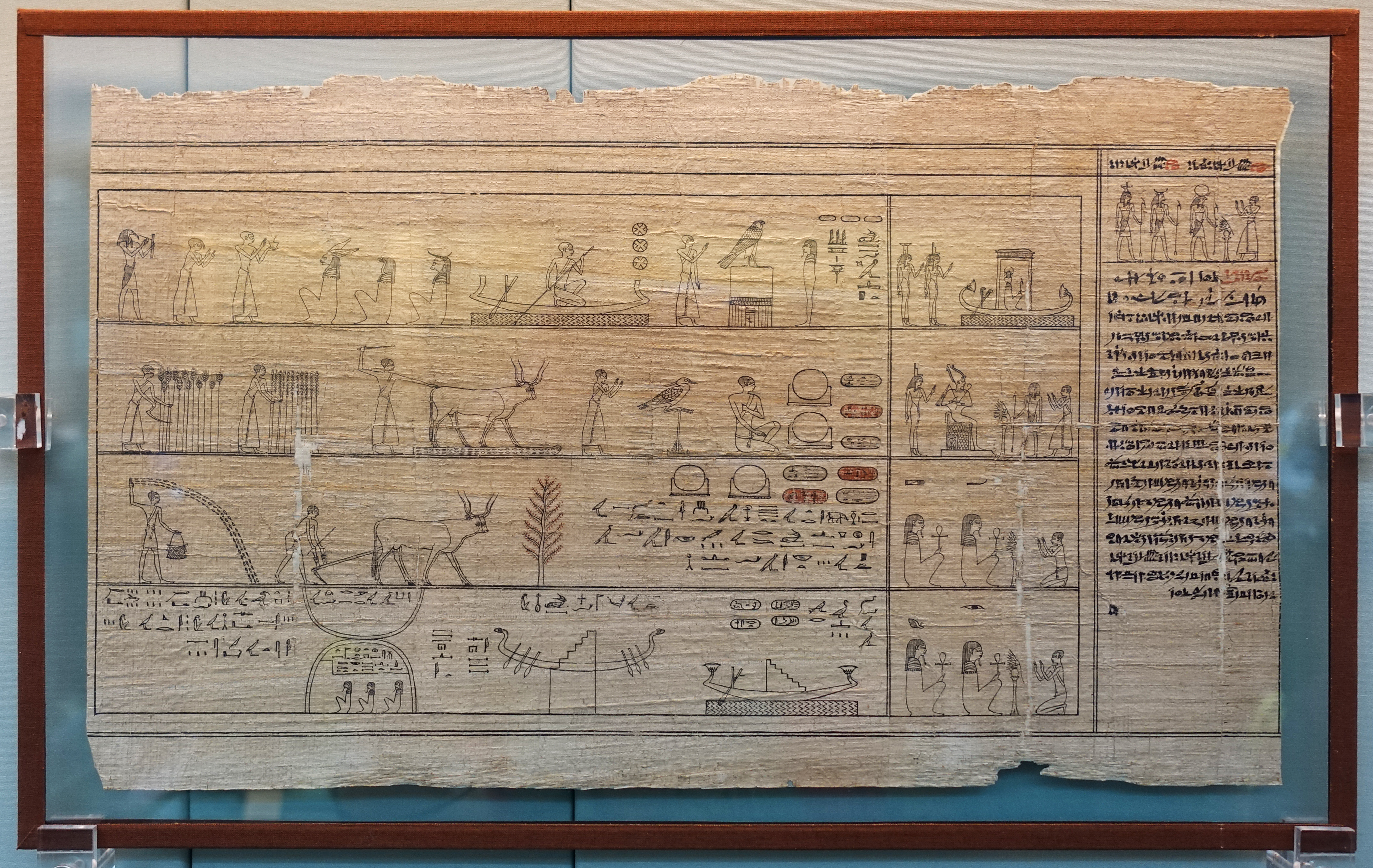
26th Dynasty: 664 BC - 525 BC
Book of the Dead of Ankhwahibra
Book of the Dead of Ankhwahibra; frame 15; black line vignettes containing Hieroglyphic text; Hieratic text to right.
Late 26th Dynasty, circa 550 BC - 525 BC
Length 51 cm (frame), 32 cm (frame)
Catalog: Papyrus, EA10558,15
Photo: Don Hitchcock 2018
Source: Original, British Museum
Text: Card with the display at the British Museum, https://www.britishmuseum.org/, © Trustees of the British Museum, CC BY-NC-SA 4.0

26th Dynasty: 664 BC - 525 BC
Stele of Horus
( This is the stuff of nightmares - Don )
Horus the Child, with shaved head, nude, childhood wick, with serpents, scorpions, lions and crocodiles, as well as the head of Bes, and a baboon.
A deity slaying pests.
Height 190 mm, width 55 mm, thickness 40 mm.
Catalog: Greywacke, engraving, high relief, E 930, N 4266?
Location: Aile Sully, Salle 317, Gods and Magic, Vitrine 2
Photo: Don Hitchcock 2015
Source and text: Original, Louvre Museum, https://collections.louvre.fr/
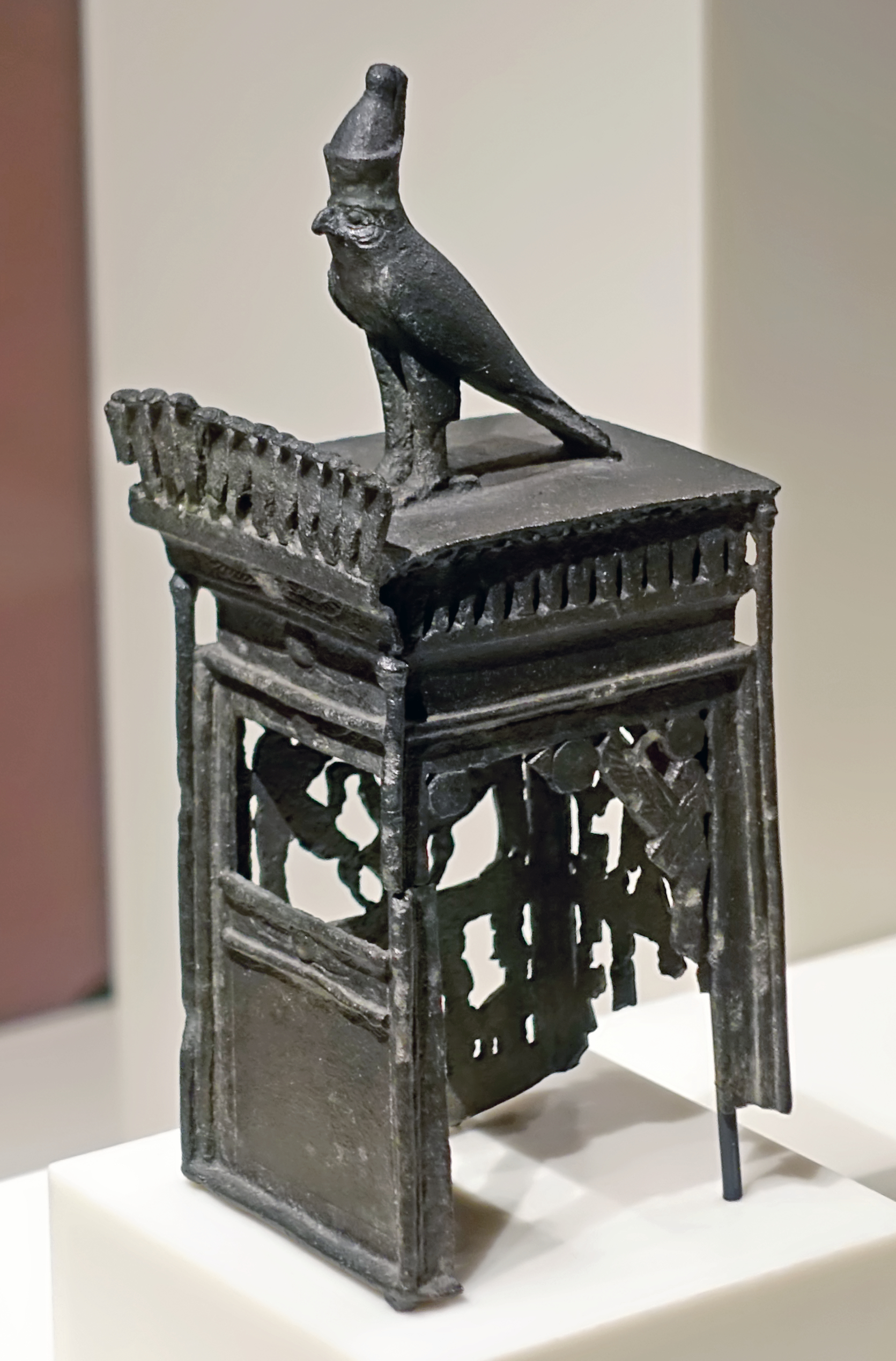
26th Dynasty: 664 BC - 525 BC
The god Horus
Model of a sacred shrine with a statuette of the god Horus as falcon.
Catalog: Bronze, ÄM 8674
Photo: Don Hitchcock 2018
Source: Original, Staatliche Museen zu Berlin, Neues Museum, Germany
Text: © Card at the Staatliche Museen zu Berlin, http://www.smb-digital.de/ (CC BY-NC-SA 3.0 DE)
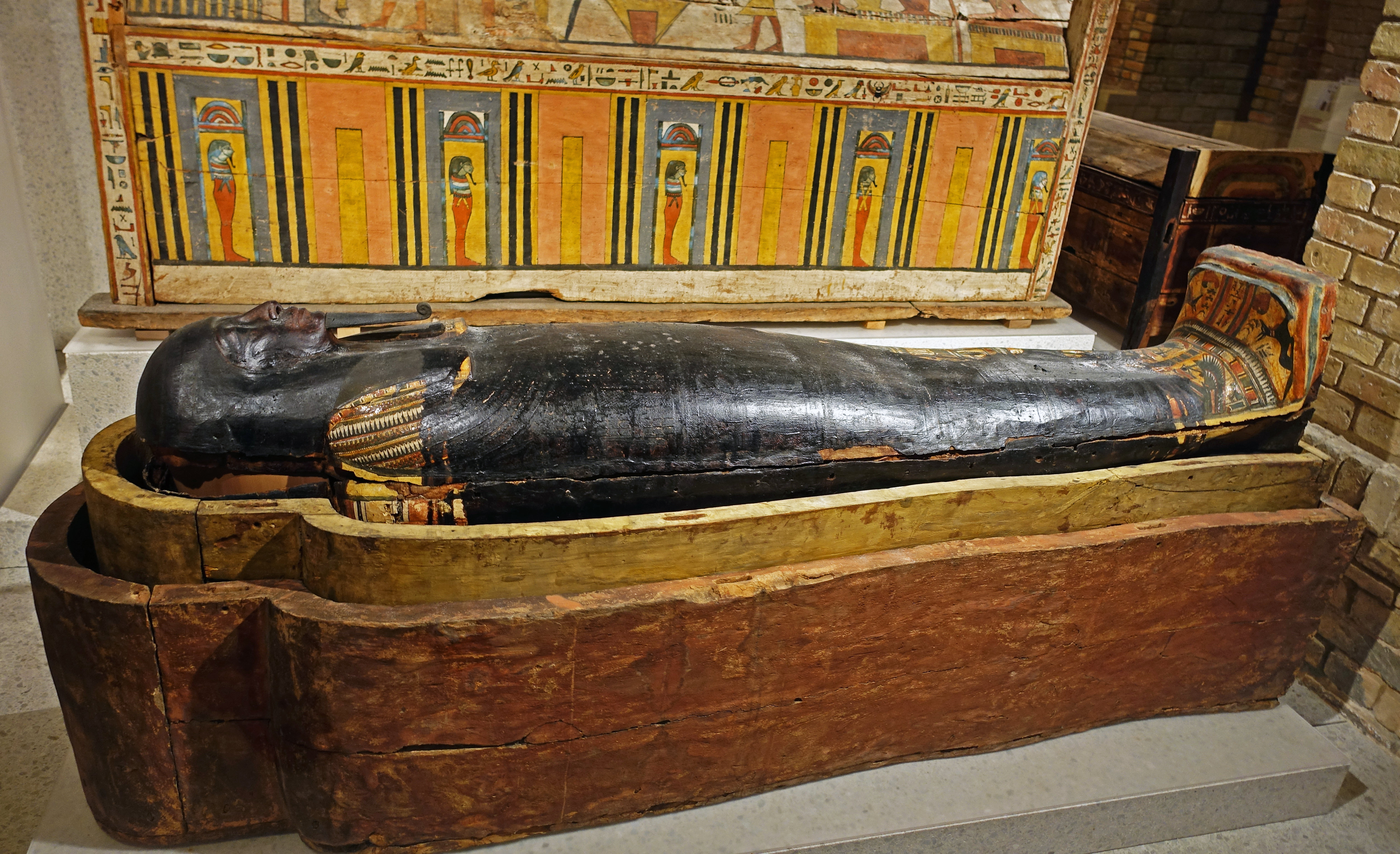
26th Dynasty: 664 BC - 525 BC
Kenhor, Priest of Min
Mummy cartonnage of Ken-Hor, coated with bitumen during the burial, circa 600 BC.
The innermost component of the coffin ensemble of Ken-Hor is the elaborately decorated mummy cover made of cardboard, in which the mummy was wrapped. A god beard is attached to the chin of the finely carved face. The eyes are well formed and painted.
In addition, a technical peculiarity of the cardboard can be observed: normally, the mummy-shaped cardboard over a form for cutting the mummy was cut on the back and closed again. For ÄM 8500, however, the cardboard packaging was cut through at the sides, similar to a separate lid. The lateral gap was covered after insertion of the mummy from the stucco layer applied as paint.
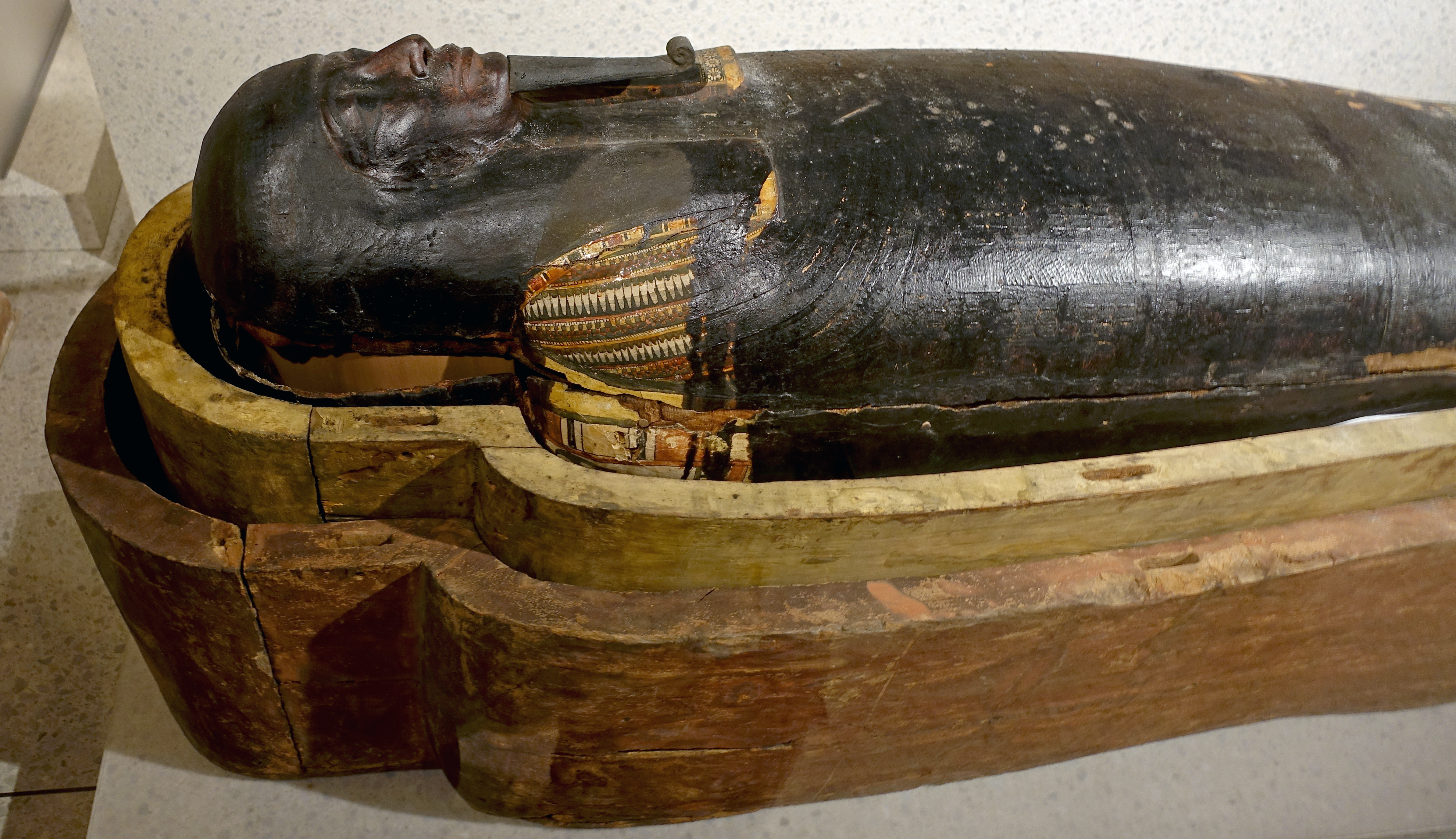
26th Dynasty: 664 BC - 525 BC
Kenhor, Priest of Min
Mummy cartonnage of Ken-Hor, coated with bitumen during the burial, circa 600 BC.
Already in historical time, possibly as part of the burial ceremony, the cardboard was covered while lying down with a now black discoloured substance. Therefore, most of the decorations are covered and can be seen only in slightly raised relief. However, with the use of grazing light shots you can capture parts of the decorations and, moreover, the theological illustrations of the cardboard packaging.
On the front side, below the collar, there are seven horizontal stripes of images ending in the foot area with depictions of the god Upuaut in the form of two prone jackals. In the strip above, a djed pillar is flanked by two udjat eyes and sun-crowned consecrations. In the three middle strips of the picture are the Book of the Dead Vignettes, in which the supply of the mummy by Anubis, the death court, and the demonstration of the deceased before Osiris after the passed death court are represented.
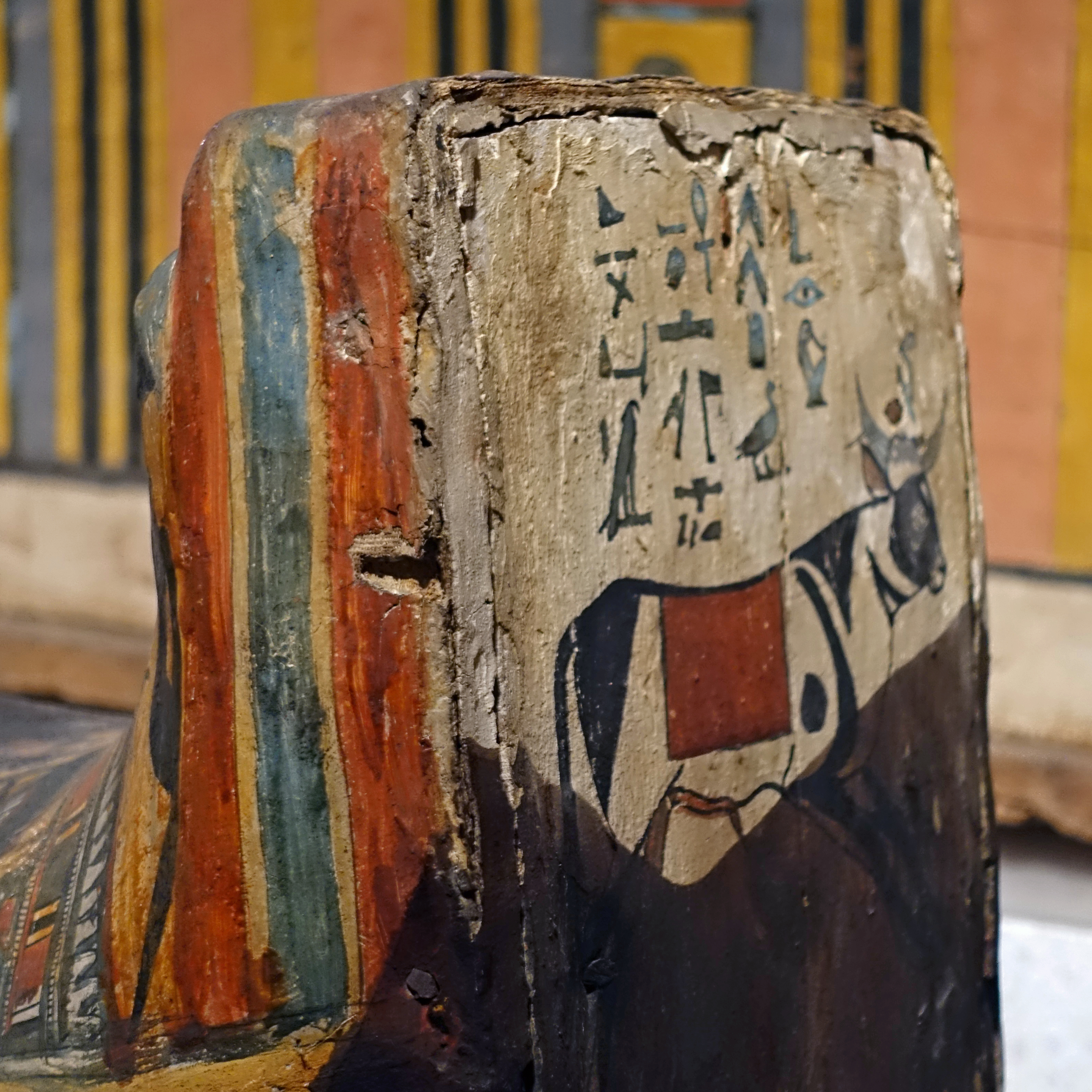
The other surfaces of the cardboard are also adorned with representations to support the deceased in its transformation into the otherworldly life.
Despite the black coating, the good quality of the painting of the mummy envelope of Ken-Hor is recognisable. These paintings include, for example, the representations of the animal-headed deities with knives from the Amduat (Book of the Underworld) on the back of the cardboard mummy cover, and the image of a running Apis bull as a protective symbol on the underside of the foot plate, as in the image at left.
Catalog: Achmim, Tomb of Kenhor, textile/cardboard, primed, painted, added bitumen, ÄM 8500/01
Photo: Don Hitchcock 2018
Source: Original, Staatliche Museen zu Berlin, Neues Museum, Germany
Text: © Card at the Staatliche Museen zu Berlin, http://www.smb-digital.de/ (CC BY-NC-SA 3.0 DE)
Additional text: I. Liao after: Brech, R., Late Egyptian coffins from Achmim.) A typological and chronological study, Gladbeck 2008, pp. 76ff, Germer, R. / Kischkewitz, H. / Lining, M., Berlin mummy stories multidisciplinary research project, Regensburg 2009, p. 127ff.
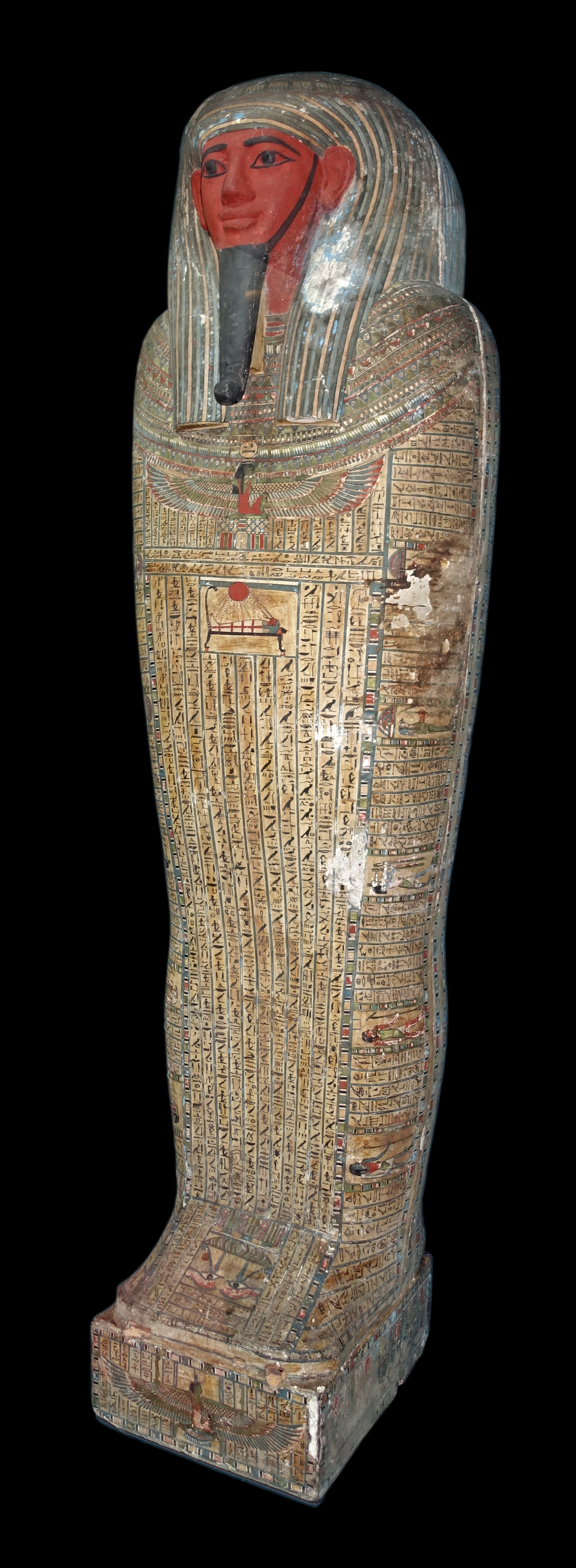
26th Dynasty: 664 BC - 525 BC
Besenmut
Painted wooden inner coffin of the Priest of Montu, Besenmut.
Circa 650 BC.
Base and lid of the anthropoid wooden coffin of Besenmut, Priest of Montu at Thebes, with polychrome painted face, wig and collar.
The rest of the exterior is covered with both vertical and horizontal registers of black painted hieroglyphs on a buff ground, in imitation of a papyrus text, giving Chapter CLIV of the Book of the Dead, the solitary vignette shows the mummy of the deceased on a bier receiving life and warmth from the rays of the solar disc.
Length 1900 mm, width 550 mm, depth 450 mm.
Catalog: Painted wood, Thebes, EA22940
Photo: Don Hitchcock 2018
Source: Original, British Museum
Text: Card with the display at the British Museum, https://www.britishmuseum.org/, © Trustees of the British Museum, CC BY-NC-SA 4.0
Dra' Abu el-Naga is one of the longest occupied necropolis of Ancient Egypt: it was used as a burial place almost continuously between the Middle Kingdom and the early Christian (Coptic) periods, i.e. a period of ca. 2500 years. During the Seventeenth Dynasty and early 18th dynasty, kings and their wives were interred here. The social spectrum of the private necropolis ranges from simple burials with few grave goods to the burials of higher-ranking individuals e.g. the High Priests of Amun of Karnak and other high officials.
In the early Middle Kingdom, at the end of the Second Intermediate Period and at the beginning of the New Kingdom Dra' Abu el-Naga was the site of the residence cemetery, as Thebes/Waset had at this time become the imperial capital and seat of government. Dra' Abu el-Naga's significance as a holy burial ground, which increased with the presence of the royal tomb complexes, resulted primarily from its position directly opposite the Temple of Karnak: The Temple of Karnak is known to have been the main cult centre of Amun from the Middle Kingdom and then became one of Ancient Egypt's most important temples during the New Kingdom.
The necropolis of Draʻ Abu el-Naga' is located on the West Bank of the Nile at Thebes, Egypt, just by the entrance of the dry bay that leads up to Deir el-Bahari and north of the necropolis of el-Assasif. The necropolis is located near the Valley of the Kings.
Text above: German Institute of Archeology or DAI, via Wikipedia.
During the Coptic eras, a monastery, Deir el-Bakhît, identified as the historical Theban Monastery of Saint Paulos, was built on the hilltop above the pharaonic cemetery.
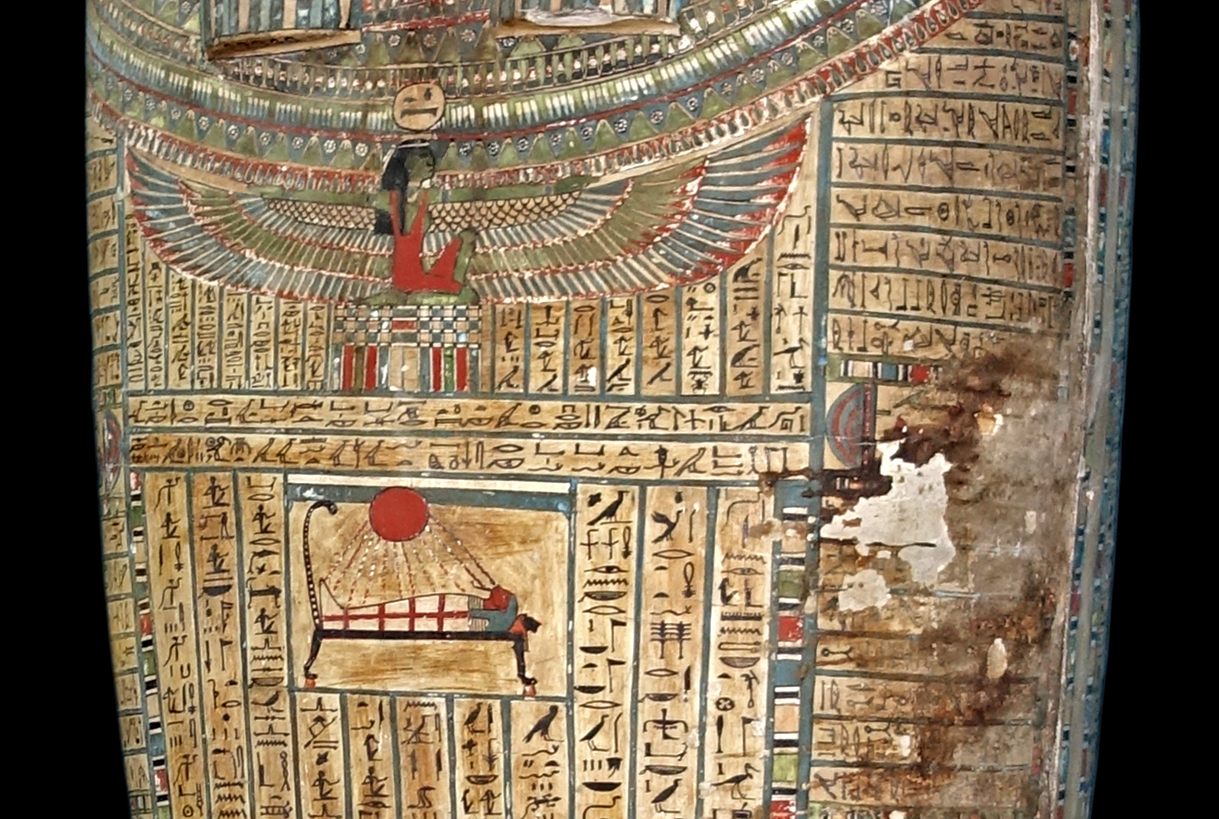
26th Dynasty: 664 BC - 525 BC
Besenmut
Painted wooden inner coffin of the Priest of Montu, Besenmut.
Beneath the winged figure of the goddess Nut on the breast is the vignette ( = image, = picture associated with) of chapter 154 of the Book of the Dead, the 'Spell for not letting the corpse perish'. See below for another version from a papyrus.
Catalog: Painted wood, Thebes, EA22940
Photo: Don Hitchcock 2018
Source: Original, British Museum
Text: Card with the display at the British Museum, https://www.britishmuseum.org/, © Trustees of the British Museum, CC BY-NC-SA 4.0
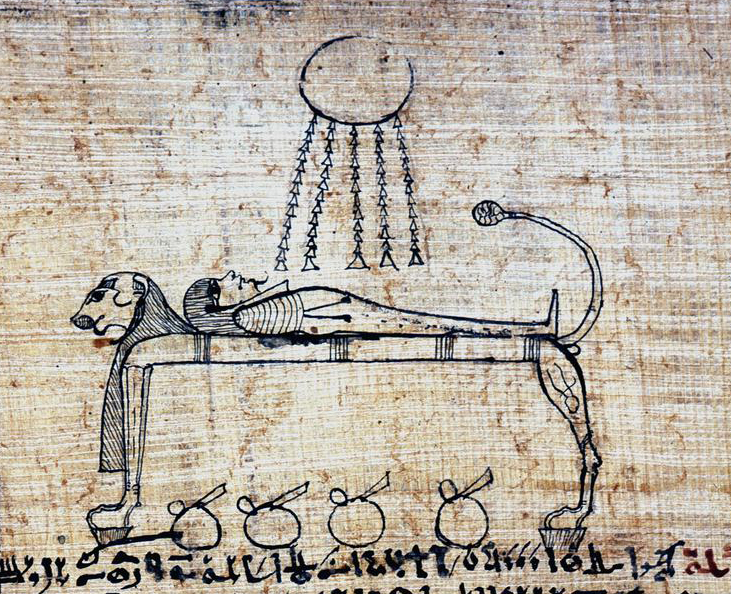
Ptolemaic (?) Period
Book of the dead
This section of the papyrus EA10098,11 shows the vignette (image) of the mummy being rejuvenated by the rays of the sun, in the spell for Chapter CLIV of the Book of the Dead.
Dimensions of the whole page: Length 712 mm (frame), width 357 mm (frame).
( Note the four canopic jars beneath the preparation table, which has been carved, as was traditional, in the likeness of a lion - Don )
Catalog: Papyrus, EA10098,11
Photo: © Trustees of the British Museum, CC BY-NC-SA 4.0
Source: Original, British Museum
Text: https://www.britishmuseum.org/, © Trustees of the British Museum, CC BY-NC-SA 4.0
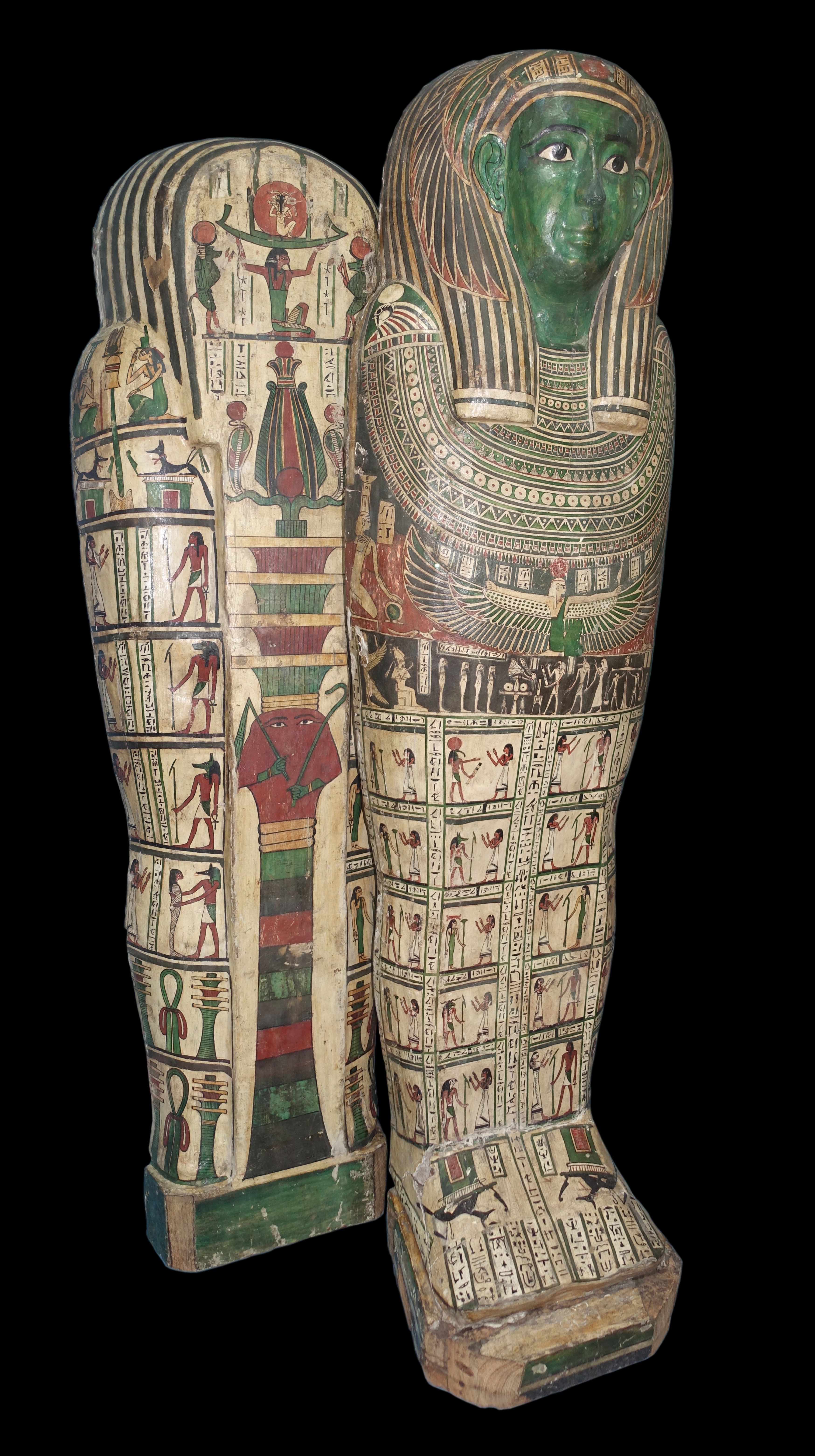
26th Dynasty: 664 BC - 525 BC
Itineb
Anthropoid coffin of sycomore fig wood, made for a man named Itineb. The exterior surfaces are covered with painted stucco. The face is painted green, and Itineb wears a striped wig, on top of which is a figure of the goddess Nut. She wears a solar disc on her head and holds an ankh sign in each hand. Her wings are extended down the sides of the coffin face, over the stripes of the wig. On the breast is a large collar with terminals in the shape of falcon heads.
Below the collar are (1) a central figure of the goddess Nut, kneeling, holding feathers and spreading her wings in protection over the coffin; at the extremities of the scene are kneeling figures of the goddesses Isis and Nephthys and two jackal figures; (2) painted on a black background, a scene showing the judgement of Itineb. At right, his heart is weighed in a balance, and to the left of this he is conducted by Thoth and Anubis towards Osiris, who sits enthroned; (3) a single line of hieroglyphic text extending to the toes divides the lower body field.
The inscription contains the hetep di nesu offering formula.
Hetep di nesu means ‘an offering which the king gives’. The king was called upon to give offerings on behalf of his people since only he could intercede on their behalf with the gods.
At each side are ten compartments, in each of which Itineb is depicted adoring a different deity. The associated texts explain that his various bodily members are identified with those of the deity depicted. On the foot of the coffin lid, in inverse orientation, are two images of Anubis as a jackal seated on a plinth, with texts above requesting offerings from the god.
The feet of the coffin are supported by a rectangular plinth, the corners of which have been cut away. The back of the coffin is carved in high relief to represent a dorsal column running from the base of the wig to the foot. On this column is painted a djed pillar wearing an atef crown and provided with human eyes and torso, the hands grasping crook and flail sceptres.
Above the djed is an image of a god raising the solar barque into the sky at dawn, worshipped by baboons. At each side of the dorsal column is a series of compartments containing figures of deities, some of them adored by Itineb. The interior of the coffin is undecorated; fragments of linen and blue faience beads adhere to the interior surface.
Measurements including the base: 220 mm, 1835 mm, 600 mm.
Catalog: Painted sycomore fig wood, plaster (?), linen (?), Saqqara (Memphis), EA6693
Photo: Don Hitchcock 2018
Source: Original, British Museum
Text: Card with the display at the British Museum, https://www.britishmuseum.org/, © Trustees of the British Museum, CC BY-NC-SA 4.0
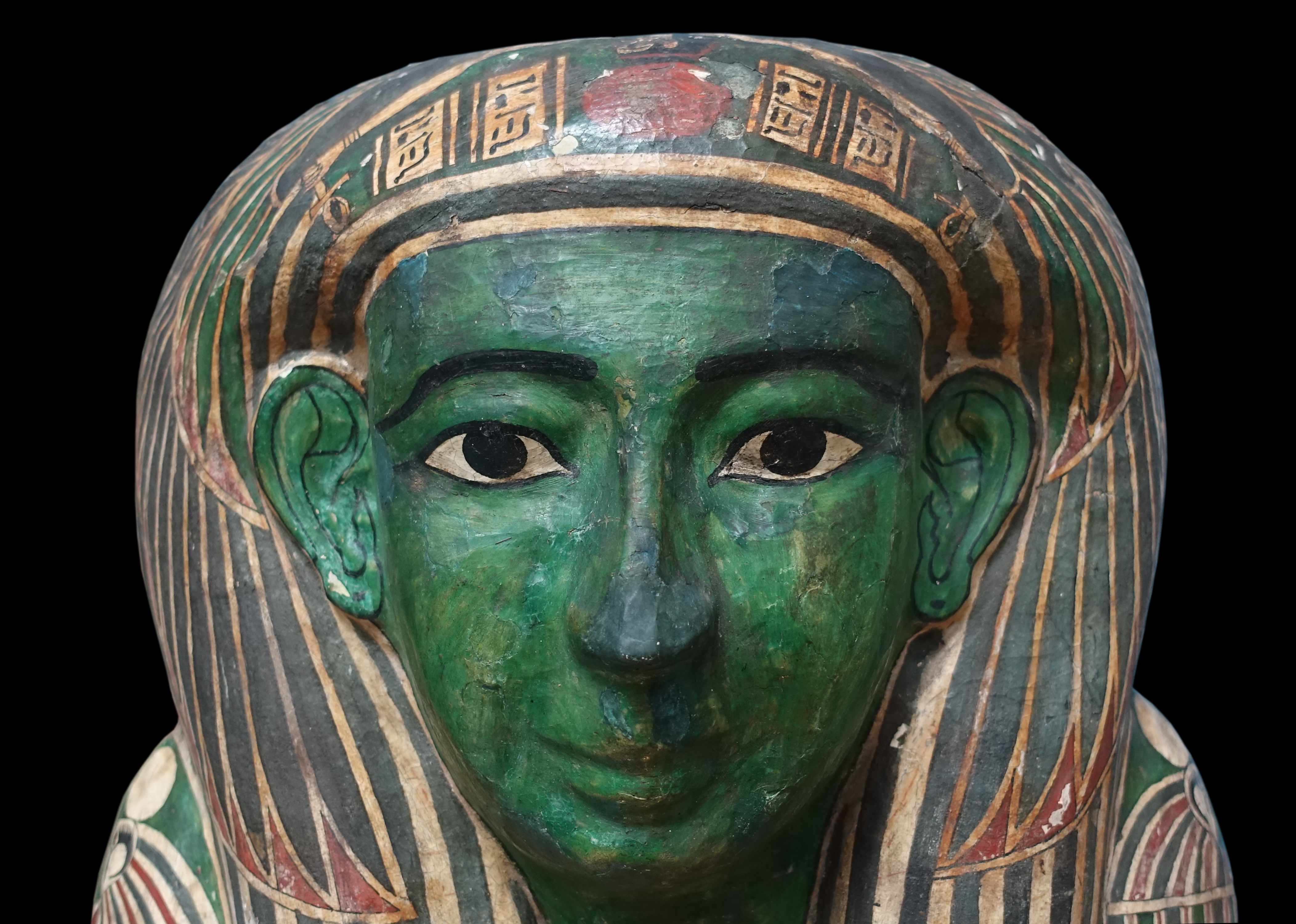
26th Dynasty: 664 BC - 525 BC
Itineb
Face of Iteneb.
Catalog: Painted sycomore fig wood, plaster (?), linen (?), Saqqara (Memphis), EA6693
Photo: Don Hitchcock 2018
Source: Original, British Museum
Text: Card with the display at the British Museum, https://www.britishmuseum.org/, © Trustees of the British Museum, CC BY-NC-SA 4.0
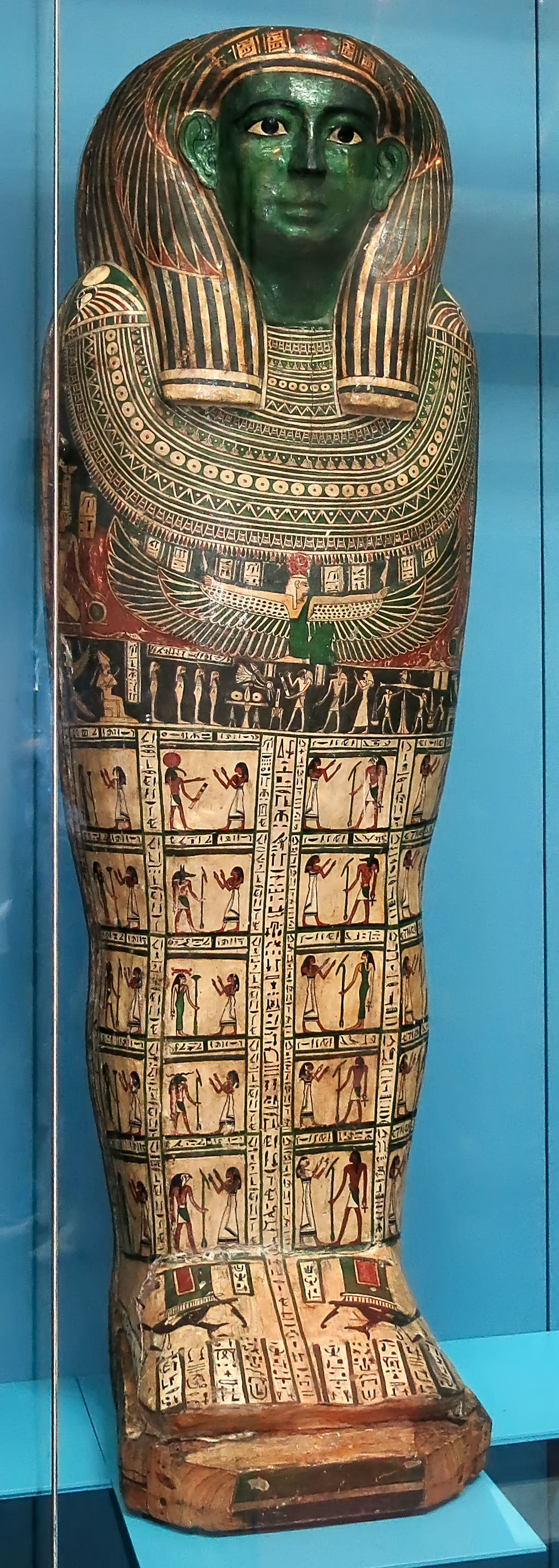
26th Dynasty: 664 BC - 525 BC
Itineb
Anthropoid coffin of sycomore fig wood, ( Ficus sycomorus )made for a man named Itineb.
The exterior surfaces are covered with painted stucco. The face is painted green, and Itineb wears a striped wig, on top of which is a figure of the goddess Nut. She wears a solar disc on her head and holds an ankh sign in each hand. Her wings are extended down the sides of the coffin face, over the stripes of the wig. On the breast is a large collar with terminals in the shape of falcon heads.
Below the collar are:
1. A central figure of the goddess Nut, kneeling, holding feathers and spreading her wings in protection over the coffin; at the extremities of the scene are kneeling figures of the goddesses Isis and Nephthys and two jackal figures.
2. Painted on a black background, a scene showing the judgement of Itineb. At right, his heart is weighed in a balance, and to the left of this he is conducted by Thoth and Anubis towards Osiris, who sits enthroned.
3. A single line of hieroglyphic text extending to the toes divides the lower body field. The inscription contains the 'hetep di nesu' offering formula. At each side are ten compartments, in each of which Itineb is depicted adoring a different deity. The associated texts explain that his various bodily members are identified with those of the deity depicted. On the foot of the coffin lid, in inverse orientation, are two images of Anubis as a jackal seated on a plinth, with texts above requesting offerings from the god. The feet of the coffin are supported by a rectangular plinth, the corners of which have been cut away.
Catalog: EA6693
Photo: Don Hitchcock 2015
Source: Original, British Museum
Text: http://www.britishmuseum.org/, © Trustees of the British Museum, CC BY-NC-SA 4.0
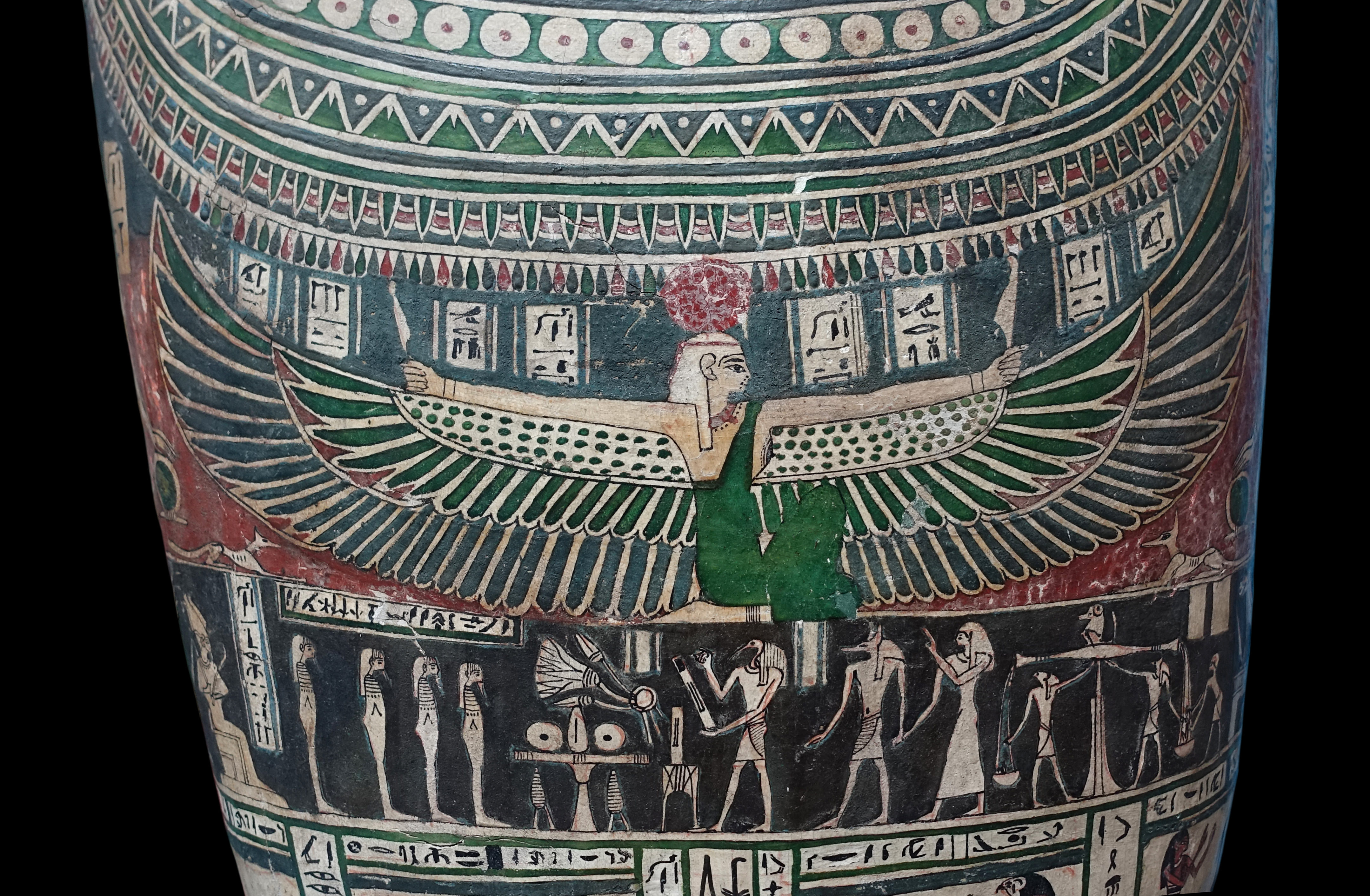
26th Dynasty: 664 BC - 525 BC
Itineb
Painted wooden coffin of Itineb, from Saqqara.
Here may be seen Nut spreading her wings over the coffin in protection.
Catalog: EA6693
Photo: Don Hitchcock 2018
Source: Original, British Museum
Text: http://www.britishmuseum.org/, card at the display in the British Museum, © Trustees of the British Museum, CC BY-NC-SA 4.0
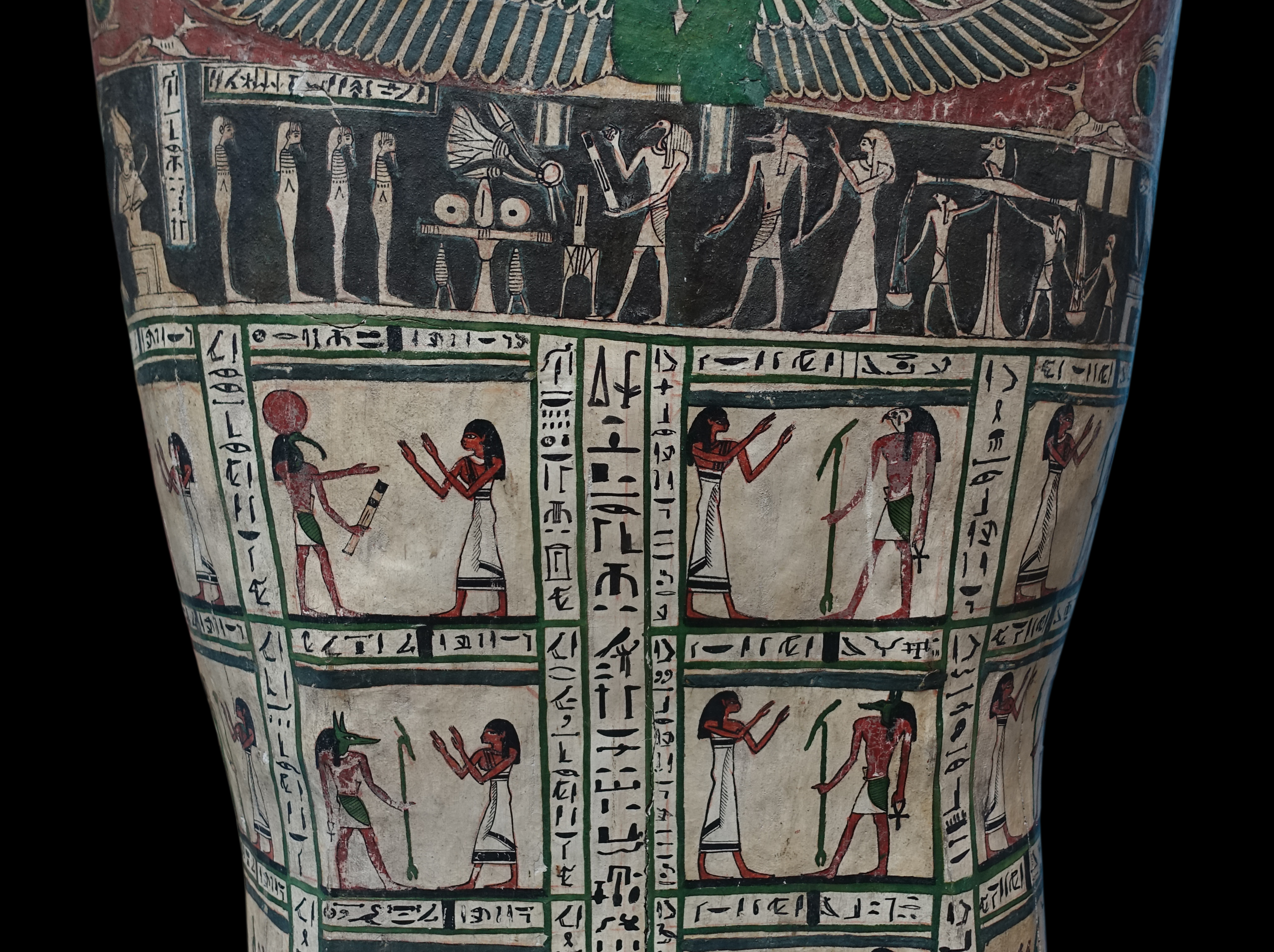
26th Dynasty: 664 BC - 525 BC
Itineb
Painted wooden coffin of Itineb, from Saqqara.
On the far left is Osiris, seated, then four standing figures possibly representing the four sons of Horus, then what may be an offering table.
In the centre is the ibis headed god Thoth, holding a writing palette and reed pen to record the deeds of the dead.
Then comes the dog headed anubis leading the adoring deceased. On the right are the scales of Anubis, with a baboon sitting on top of them, and with Anubis and his assistants weighing the heart of the deceased.
The four scenes visible below that include Thoth wearing a sun disk and carrying his writing palette and reed pens, with the deceased adoring him, then the deceased adoring the falcon headed god Thorus, who carries a was sceptre and an Ankh.
Below these are two paired images of the deceased adoring the dog headed god Anubis, carrying a was sceptre and Ankh.
Catalog: EA6693
Photo: Don Hitchcock 2018
Source: Original, British Museum
Text: http://www.britishmuseum.org/, card at the display in the British Museum, © Trustees of the British Museum, CC BY-NC-SA 4.0
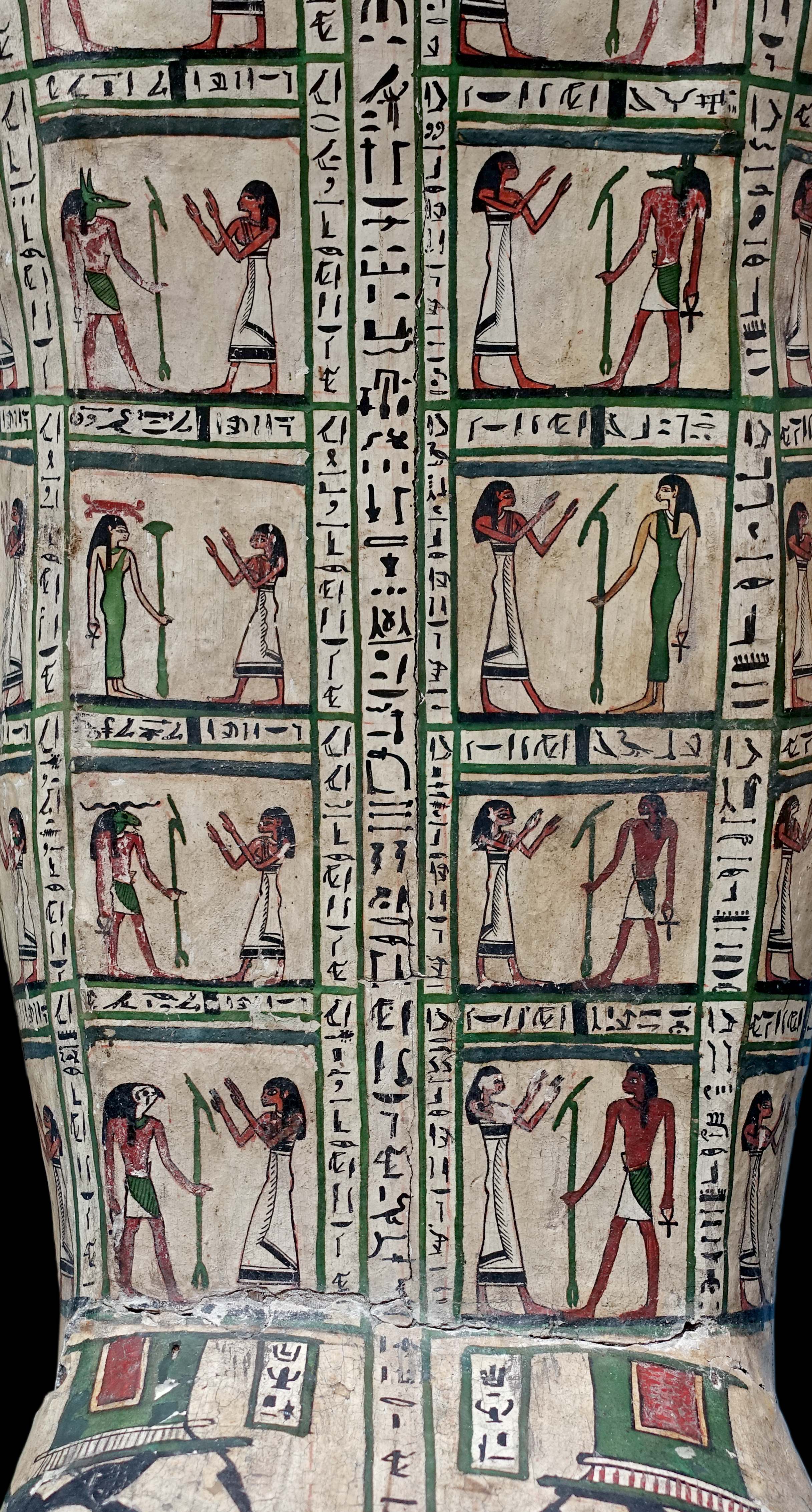
26th Dynasty: 664 BC - 525 BC
Itineb
Painted wooden coffin of Itineb, from Saqqara.
The lower part of the coffin has a number of images of the deceased adoring various deities.
Catalog: EA6693
Photo: Don Hitchcock 2018
Source: Original, British Museum
Text: www.britishmuseum.org/, card at the display in the British Museum, © Trustees of the British Museum, CC BY-NC-SA 4.0
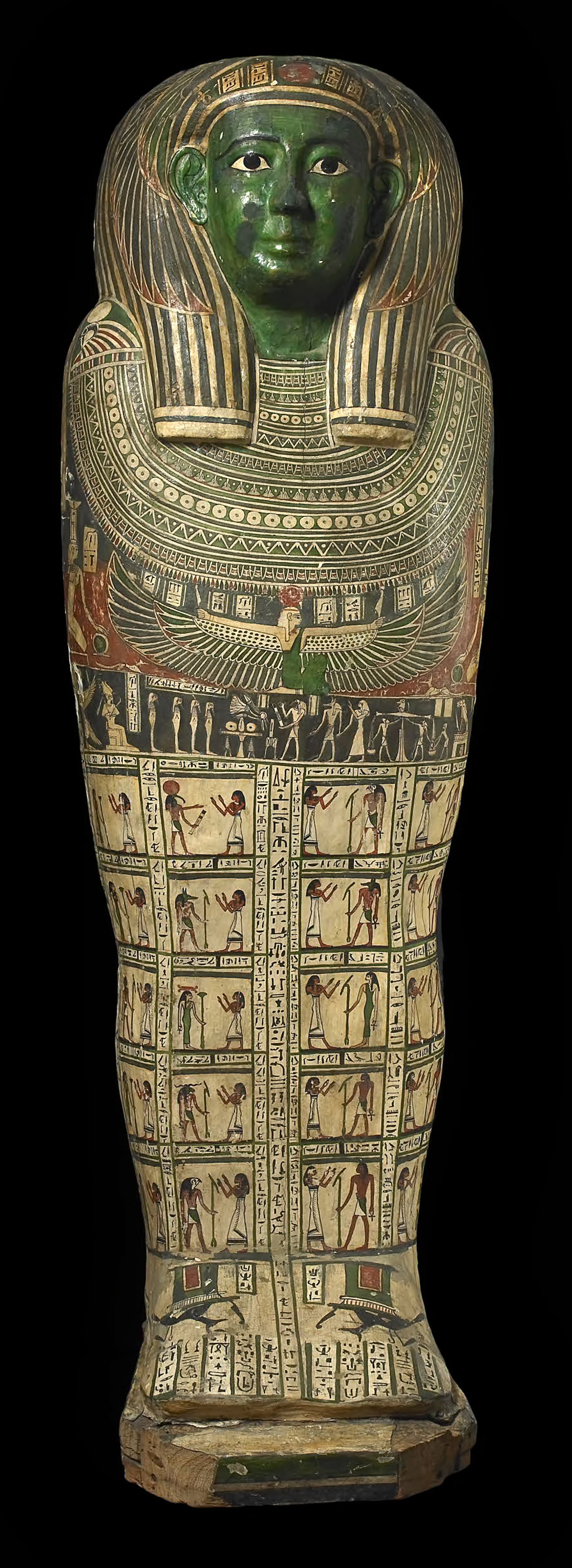
26th Dynasty: 664 BC - 525 BC
Itineb
Painted wooden coffin of Itineb, from Saqqara.
The green face associates the dead man with Osiris. Below the collar are painted the winged goddess Nut, a scene showing the judgement of the deceased before Osiris, and twenty small vignettes, in each of which Itineb adores a different deity. The back of the coffin shows the Djed pillar, symbol of Osiris, equipped with human eyes and torso and grasping the crook and flail sceptres. Above, the sun-disc in a barque is raised up at dawn and received by the arms of the sky-goddess.
The back of the coffin is carved in high relief to represent a dorsal column running from the base of the wig to the foot. On this column is painted a djed pillar wearing an atef crown and provided with human eyes and torso, the hands grasping crook and flail sceptres. Above the djed is an image of a god raising the solar barque into the sky at dawn, worshipped by baboons. At each side of the dorsal column is a series of compartments containing figures of deities, some of them adored by Itineb. The interior of the coffin is undecorated; fragments of linen and blue faience beads adhere to the interior surface.
( Note that many of the full length photographs of this coffin on the British Museum site appear to me to be foreshortened. I cannot account for this - Don )
Width 1835 mm, depth 600 mm, height 220 mm.
Catalog: EA6693
Photo: © Trustees of the British Museum, CC BY-NC-SA 4.0
Source: Original, British Museum
Text: http://www.britishmuseum.org/, card at the display in the British Museum, © Trustees of the British Museum, CC BY-NC-SA 4.0
God with four ram heads facing in four directions, probably Khnum 664–30 B.C. Late Period–Ptolemaic Period On view at The Met Fifth Avenue in Gallery 134 The god has four ram heads, each facing in a different direction. Above his heads he wears an atef crown. The figure probably represents the ram-headed god Khnum, who can be shown with four heads facing in different directions. Another ram god, Banebdjed, can also be shown with four ram heads, but then two face forward and two face back (see 26.7.894)
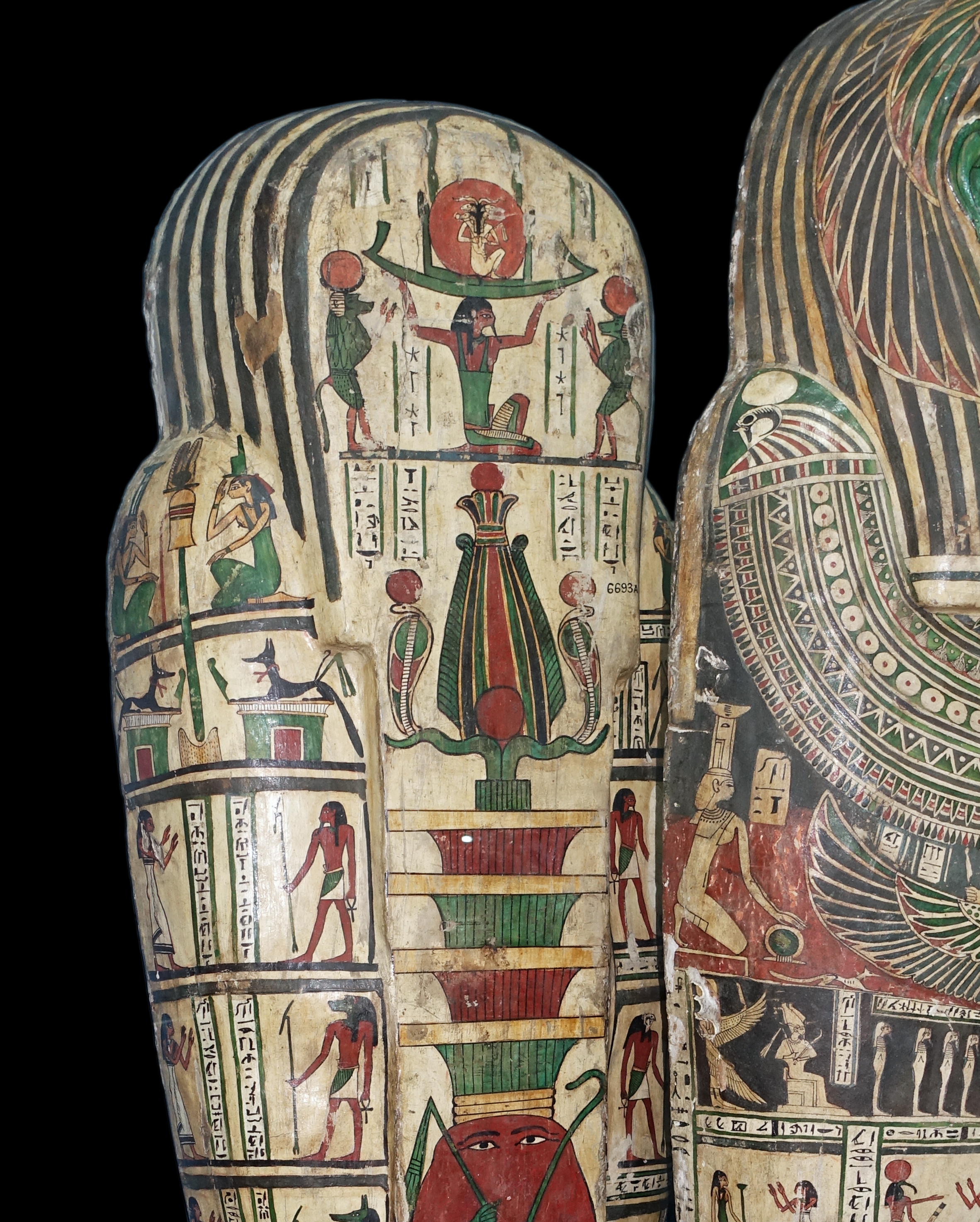
26th Dynasty: 664 BC - 525 BC
Itineb
Painted wooden coffin of Itineb, from Saqqara.
The back of this coffin was made in the curved anthropomorphic style, and is prolifically painted.
At the top of the back of the coffin is a solar barque, held aloft by a person with a beard similar to a pharaoh or god. In the solar barque, the red sun disk contains an image of a four headed ram god, probably Banebdjed, who was shown with four ram heads, two facing forward and two facing back, and here carries the flail and crook denoting authority and power.
Flanking the solar barque and adoring it are two baboons with solar disk headdresses. The reason that Egyptians considered baboons to be sacred is actually quite straightforward. When baboons wake in the morning, like many primates (humans included), they tend to stretch and produce vocalisations. To some, the pose baboons adopt while stretching – sometimes raising their front legs in the air – resembles worship. As they stretch more often at sunrise, this action together with their 'chattering' noises when moving from sleeping sites, was interpreted as singing and dancing to praise the Sun-god, Ra.
Below this image is a large Crown of Osiris, which includes a sun disk, two Uraei, and the ram horns of Ovis longipes palaeoagytiaca known from predynastic times. Khnum, an important god throughout Egypt, was depicted as this species, with its long wavy horns and heavy build.
To the left on this image, we can see Nephthys (left) and Isis (right) mourning before an Amun double plumed headdress.
Below this image are paired images of the canine form of Anubis wearing a red sash, carrying a crook and flail as symbols of power and authority, and each with an ostrich plume between their front paws. Each is resting on a shrine.
Below the shoulder of the coffin is an image of Nephthys with her distinctive crown, and touching a Shen Ring.
Below Nephthys is an image of Osiris seated on a throne, as well as an obscured standing figure with two wings outstretched towards Osiris.
Catalog: EA6693
Photo: Don Hitchcock 2018
Source: Original, British Museum
Text: http://www.britishmuseum.org/, card at the display in the British Museum, © Trustees of the British Museum, CC BY-NC-SA 4.0
Additional text: Suzanne Harvey - blogs.ucl.ac.uk/researchers-in-museums/2013/04/15/i-have-sung-and-praised-the-sun-disc-i-have-joined-the-baboons/
, and www.touregypt.net/featurestories/ram.htm
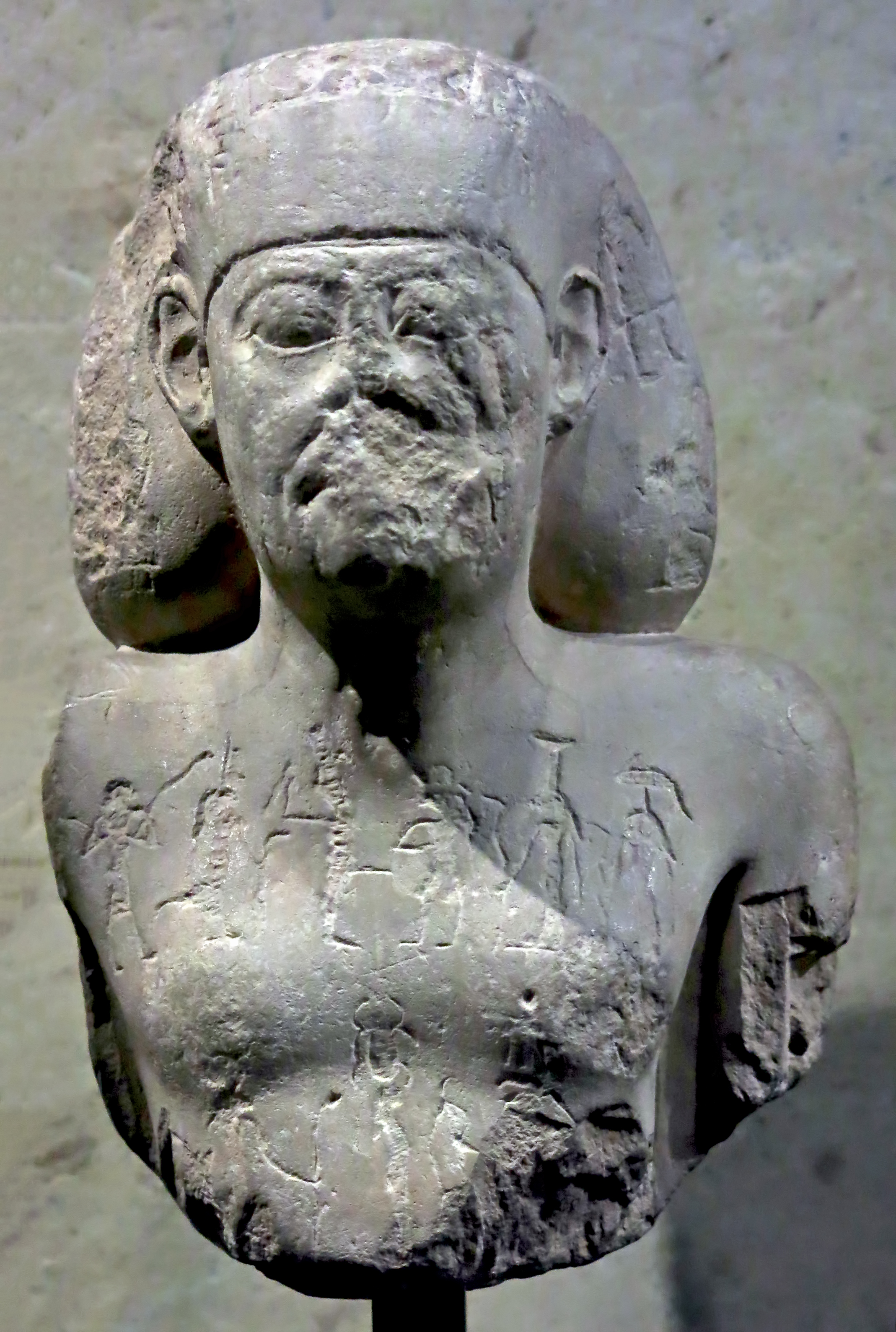
26th Dynasty: 664 BC - 525 BC
Demons
Three potbellied demons(protective figures for mother and child), 6th century BC.
Catalog: ceramic, ÄS 7231, ÄS 7232, ÄS 7233
Photo: Don Hitchcock 2015
Source: Original, Ägyptischen Museum München
Text: Museum card, © Ägyptischen Museum München
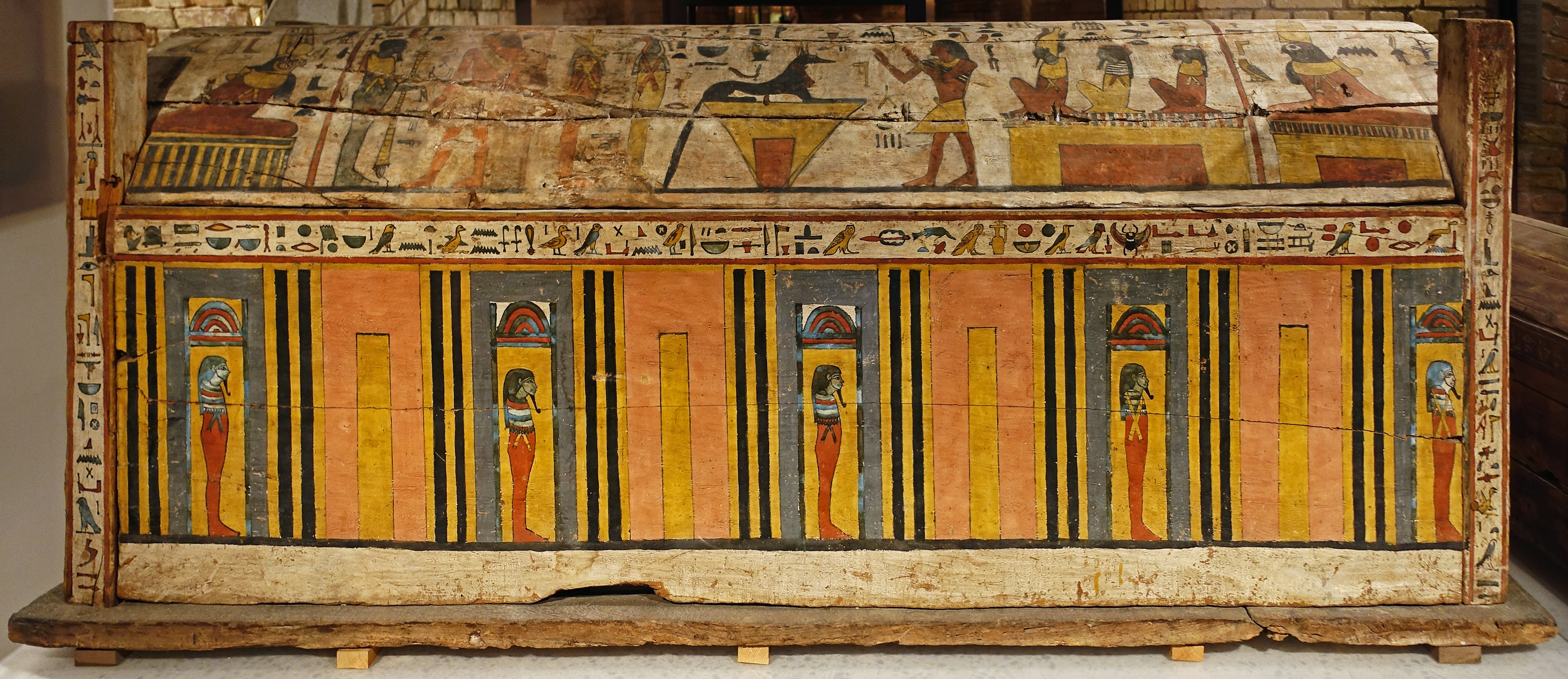
26th Dynasty: 664 BC - 525 BC
Kenhor, Priest of Min
Outer post box-shaped coffin of Ken-Hor.
Wood material); primed (white), painted
Dimensions: 850 x 770 x 2220 mm.
The coffin ensemble of the priest of Min, Ken-Hor, from Achmim, consists of the outer post coffin (ÄM 8497), two anthropomorphic coffins (ÄM 8498, ÄM 8499) and a mummy cover made of cardboard (ÄM 8500).
The outer post coffin of the Ken-Hor forms a chapel with corner posts and a domed lid. The shape of the coffin, which also ties in with the tomb chapel of Osiris, already provides the magical prerequisite for the protection and survival of the deceased. The inscriptions and representations of the coffin are also important elements for the otherworldly persistence of the deceased.
The decoration of the post coffin consists of two components. On the casket tray upright mummies are shown with gods beard in their shrines in front of illuminated grave entrances. The motif was taken from the third hour of the so-called Gates book. It is about the resurrection of the mummies by the light donation of the sun god when passing.
In addition, a vertical line of inscriptions with a prayer to Re-Harachte divides the domed lid into two oblong pictorial surfaces, into which the deceased enters, worshiping various deities. The hawks with sun disc and feather crown, which are usually put on the posts as wooden statuettes, are here painted on the four corners of the lid. The inscriptions describe the two hawks at the head area as the god Sopdu, and the other two at the foot as Horus. On the left of the inscription line, Ken-Hor is shown worshiping twice before Osiris. In the middle is Anubis in jackal shape on a shrine with the Abydos fetish as the centre, flanked on both sides by two Horus sons. To the right of the inscription ribbon, the sarong-owner in the middle prays to Anubis lying on a shrine, accompanied by three squatting gods on a shrine on the left side, as well as a hare-headed and a snake-headed god of the underworld on the right. On the right panel, the deceased is shown worshiping again before Ptah.
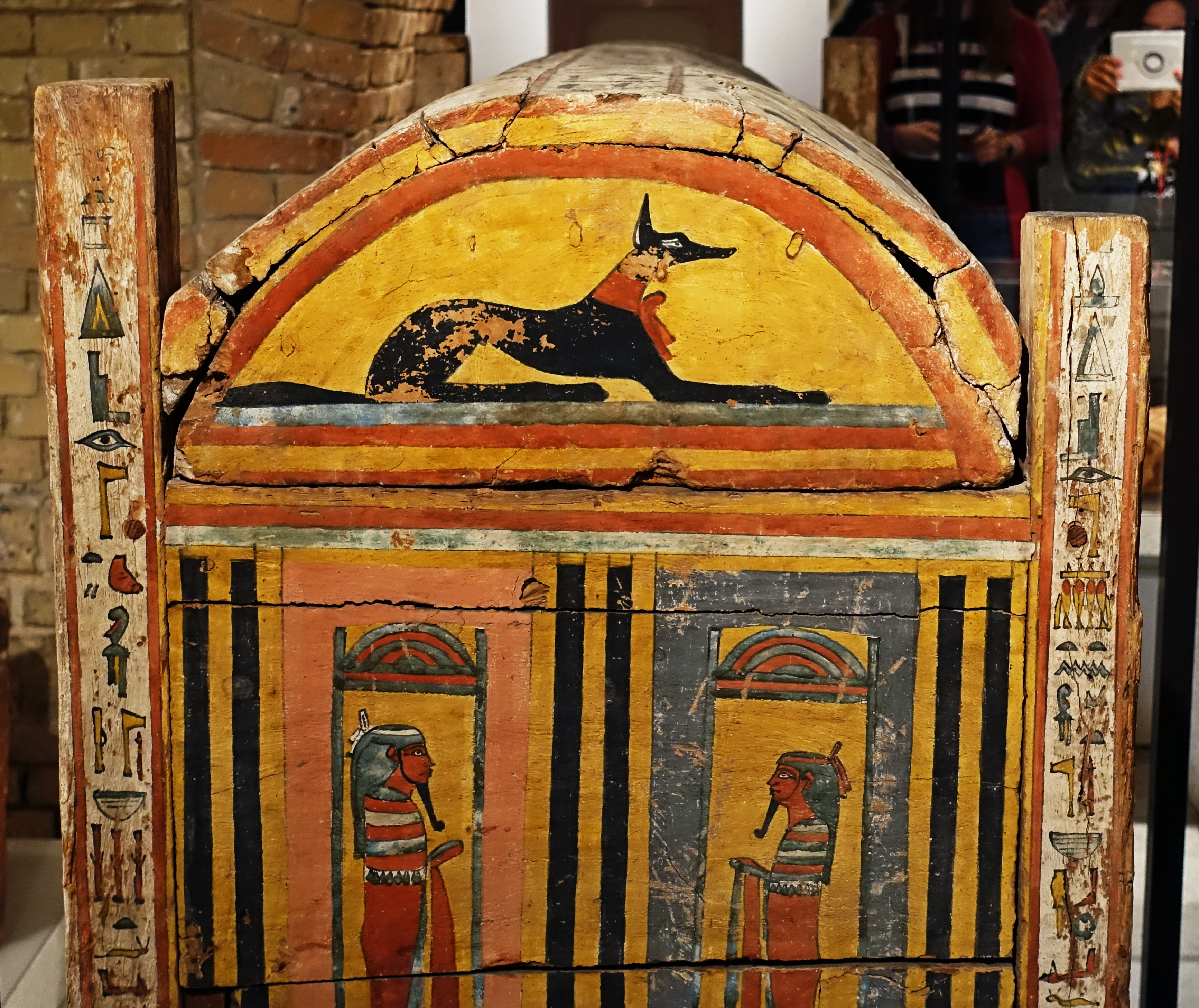
26th Dynasty: 664 BC - 525 BC
Kenhor, Priest of Min
In addition, a lying jackal on one and a pair of Ujat eyes on the other decorate the narrow sides of the coffin lid. However, it is extremely unusual that the udjat eyes, which are usually oriented in the head direction of the mummy placed in the coffin, are shown here on the foot area. Whether there has been a mistake here, still needs to be investigated.
Catalog: Achmim, Tomb of Kenhor, wood, white primed, painted, ÄM 8497
Photo: Don Hitchcock 2018
Source: Original, Staatliche Museen zu Berlin, Neues Museum, Germany
Text: © Card at the Staatliche Museen zu Berlin, http://www.smb-digital.de/ (CC BY-NC-SA 3.0 DE)
Additional text: I. Liao after: Brech, R., Late Egyptian coffins from Achmim.) A typological and chronological study, Gladbeck 2008, p. 73ff .; Germer, R. / Kischkewitz, H. / Lining, M., Berlin mummy stories multidisciplinary research project, Regensburg 2009, p. 126f.
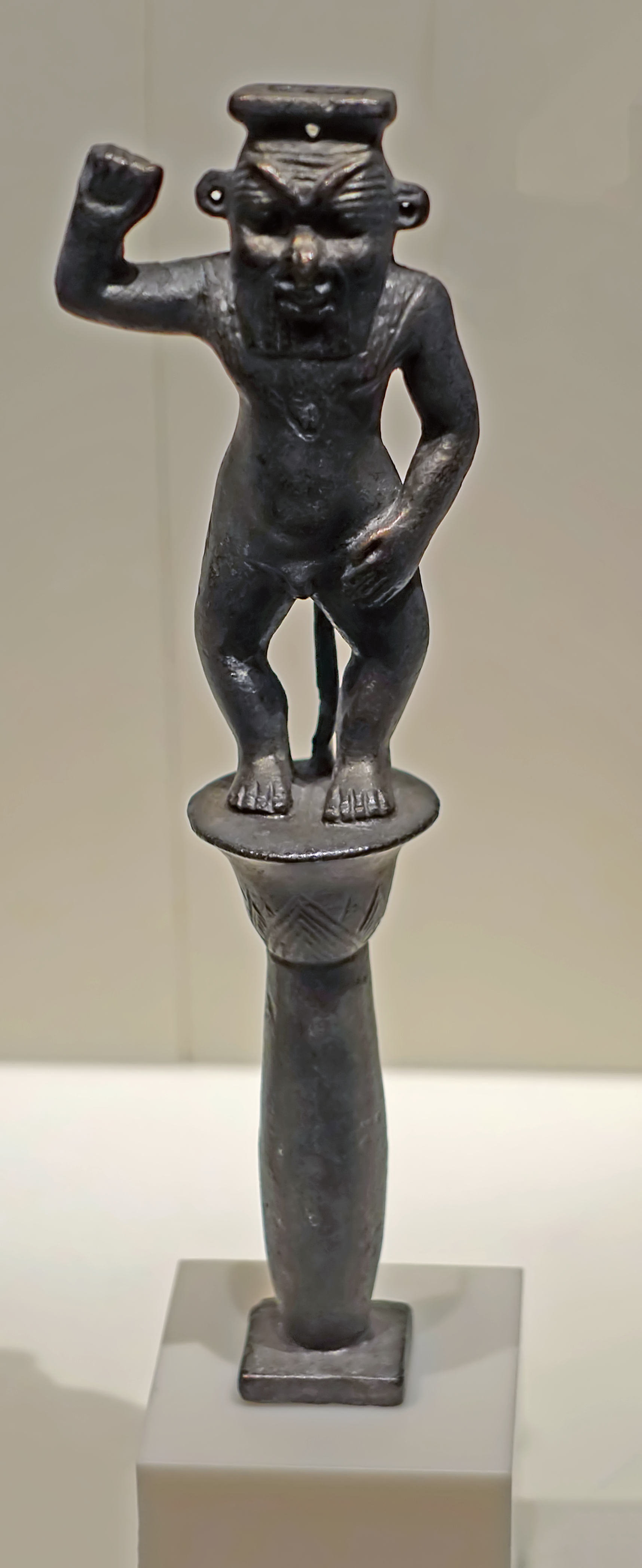
26th Dynasty: 664 BC - 525 BC
Bes
The god Bes on a lotus column.
Catalog: Bronze, ÄM 26019
Photo: Don Hitchcock 2018
Source: Original, Staatliche Museen zu Berlin, Neues Museum, Germany
Text: © Card at the Staatliche Museen zu Berlin, (CC BY-NC-SA 3.0 DE)
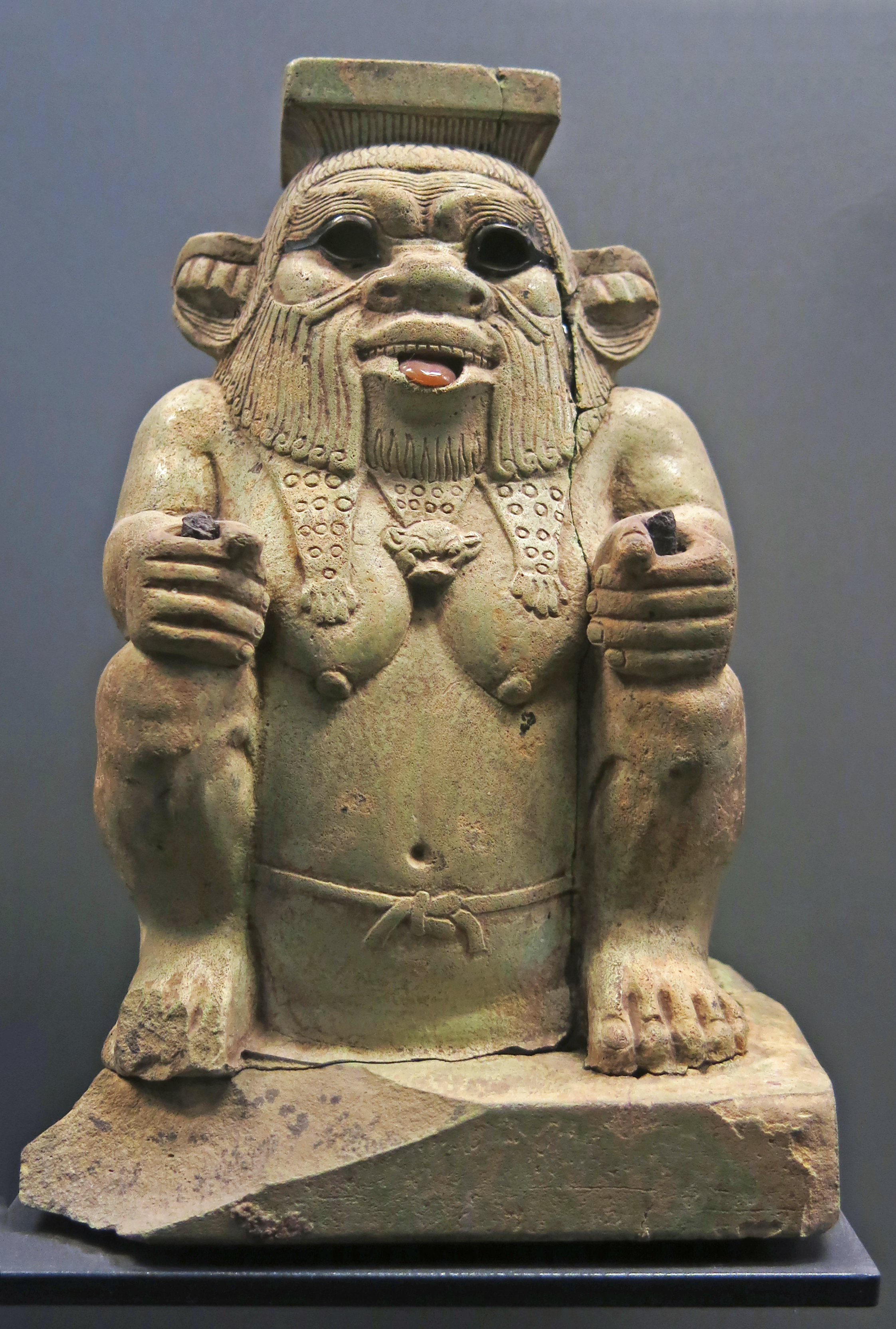
26th Dynasty: 664 BC - 525 BC
Bes
Bes is crouching, wearing a panther skin, beard, and with his tongue hanging out. His eyes and tongue are inlaid with carnelian.
Height 175 mm, width 115 mm.
Catalog: Siliceous earthenware, carnelian, E 10929
Location: Aile Sully, Salle 336, Le Nil, Vitrine 7
Photo: Don Hitchcock 2015
Source and text: Original, Louvre Museum, https://collections.louvre.fr/
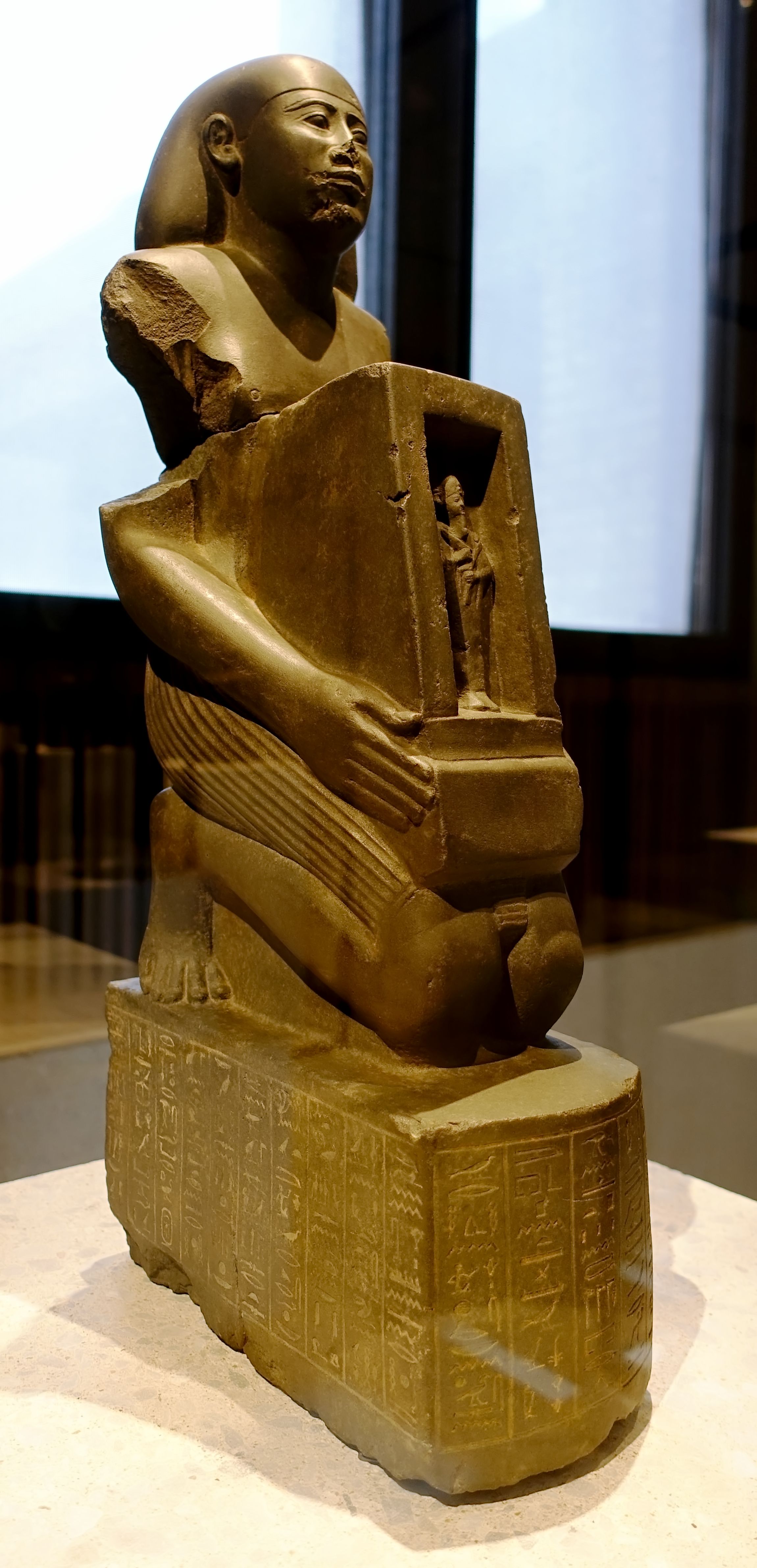
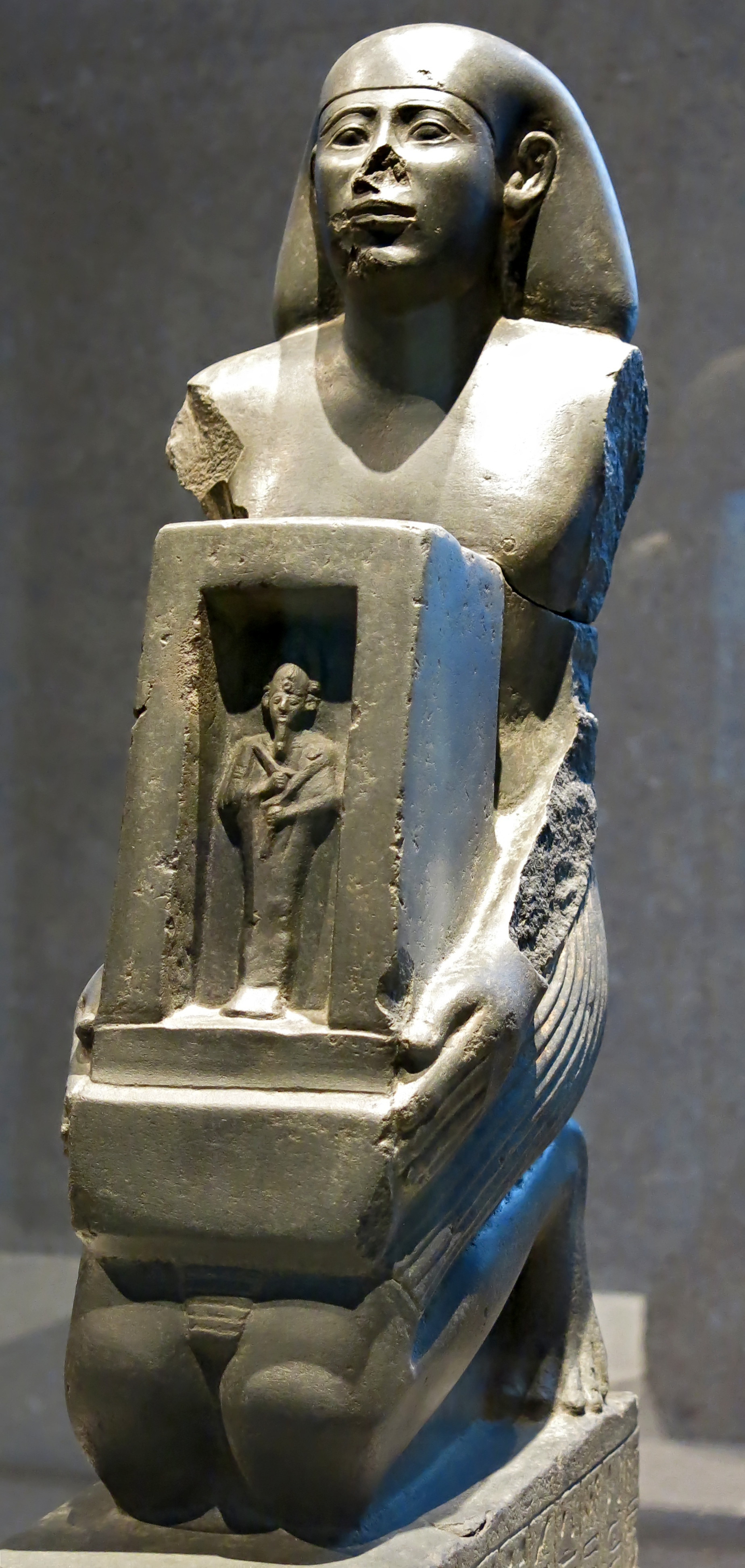
26th Dynasty: 664 BC - 525 BC
Nachthorheb / Nakhthorheb
Kneeling figure of Nachthorheb holding a shrine.
Circa 540 BC.
Dimensions: 560 x 135 x 255 mm.
The kneeling figure shows the customs officer Nachthorheb, holding a shrine with a figure of the god Osiris. The flat back of the wig bears two vertical lines of inscription, the first to the goddess Neith, and two titles of the figure, which are designated as military officers at the court.
Like most Egyptian high officials of the Pharaonic Period, Nakhthorheb held many civil and religious offices simultaneously. Monuments in his name are conserved in Rome, London, Cairo, and Copenhagen. His various duties are listed on the back pillar of this statue, interspersed with grandiose titles: ' His Excellency the Unique Friend, Director of the Palace, Secretary of the House-of-the-Morning, Director of the Castles, Chief Lector-Priest, Officer to the Crown, Director of every Divine Function, Head of Magi in the House-of-Life ' etc. He lived during the reign of Psammetichus II (595 - 589 BC) in the 26th Dynasty. Egypt was ruled by native kings in those days, after a series of political setbacks: domination by Sudanese and Nubian rulers (25th Dynasty) and a cruel invasion by the Assyrians (in 666 BC). The Egyptian elite was thus in search of its roots.
In the field of art, reference is often made to the grandeur and simplicity of the heroic period of the Old and Middle Kingdoms. This quest for simplicity went beyond ancient models, and the archaistic trend became a style of its own. The facial type with its slightly receding rounded chin and gentle, inexpressive smile corresponds to a model that first appeared during the 26th Dynasty and remained in use until the Roman conquest.
From the Middle Kingdom onward, the public areas of certain temples contained small private chapels; consequently, more and more personalities were granted the privilege of having a statue of themselves in temple courtyards. This royal favour enabled them to enjoy the protective proximity of their divine patron. They were even presented with the leftovers from the god's table, which was garnished every day by the priests. The inscription around the base of the statue of Nakhthorheb tells us that it was placed in the temple of the god Thoth, ' lord of Hermopolis and Dendera ' and the great patron of writing. Nakhthorheb was therefore entrusted to the god's protection in his lifetime, and then for eternity.
Catalog: Greywacke, ÄM 1048 and (base) VÄGM 1995/16
Photo: Don Hitchcock 2015, 2018
Source: Original, Staatliche Museen zu Berlin, Neues Museum, Germany
Text: © Card at the Staatliche Museen zu Berlin, http://www.smb-digital.de/ (CC BY-NC-SA 3.0 DE)
Additional text: http://www.louvre.fr/en/oeuvre-notices/statue-nakhthorheb-kneeling-prayer
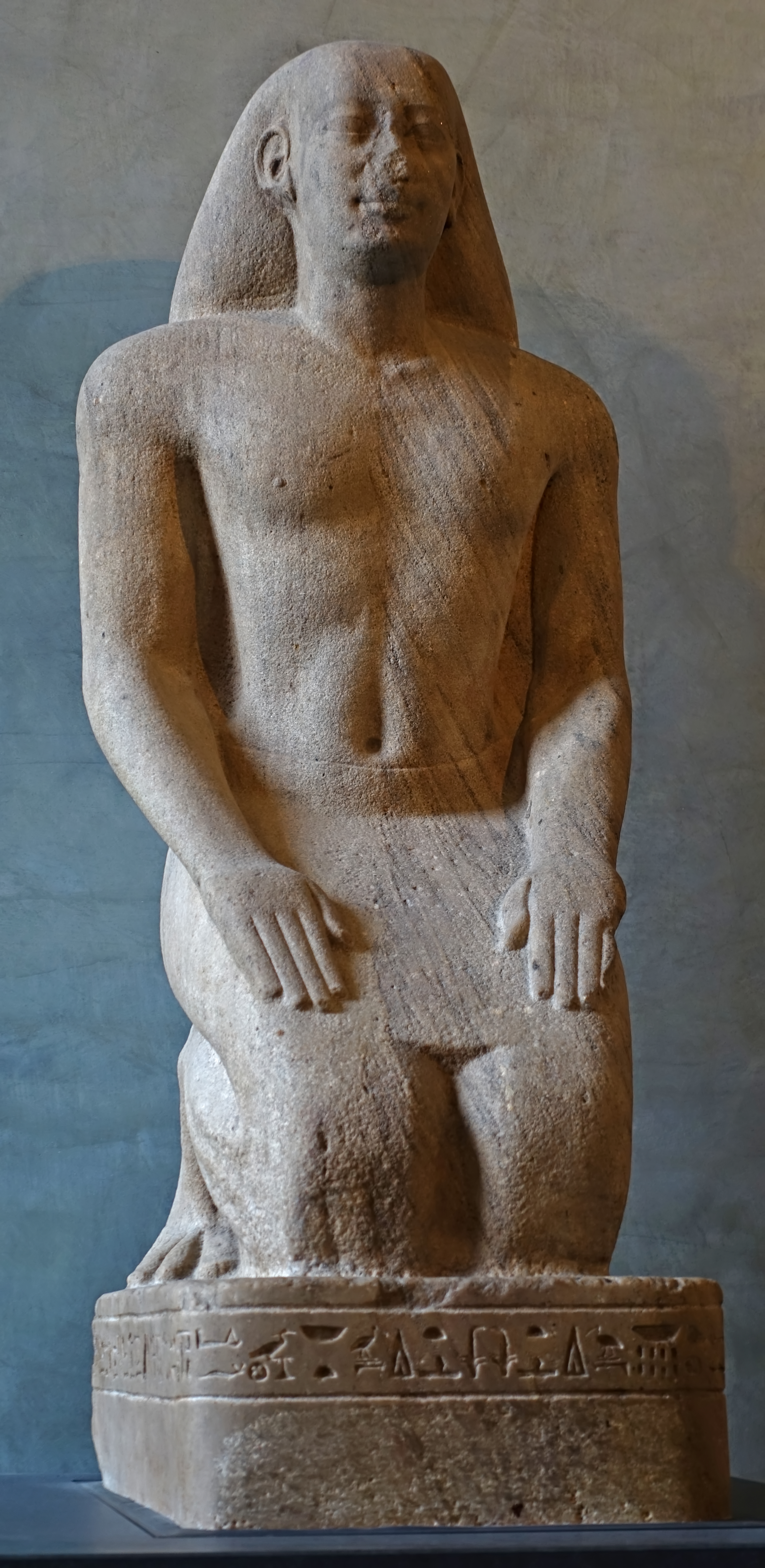
26th Dynasty: 664 BC - 525 BC
Nakhthorheb
Nakhthorheb in prayer.
Reign of Psamtik II (595 BC - 589 BC).
This is a statue of Nakhthorheb, an important dignitary from the Late Period in Egyptian art. He is represented kneeling, his hands flat on his thighs, in an attitude of reverence. The text inscribed on the statue is a prayer to Thoth, god of the cities of Hermopolis and Dendera.
Like most Egyptian high officials of the Pharaonic Period, Nakhthorheb held many civil and religious offices simultaneously. His various duties are listed on the back pillar of this statue, interspersed with grandiose titles. He lived during the reign of Psammetichus II / Psamtik II (595-589 BC) in the 26th Dynasty. Egypt was ruled by native kings in those days, after a series of political setbacks: domination by Sudanese and Nubian rulers (25th Dynasty) and a cruel invasion by the Assyrians (in 666 BC). The Egyptian élite was thus in search of its roots.
From the Middle Kingdom onward, the public areas of certain temples contained small private chapels; consequently, more and more personalities were granted the privilege of having a statue of themselves in temple courtyards. This royal favour enabled them to enjoy the protective proximity of their divine patron. They were even presented with the leftovers from the god's table, which was garnished every day by the priests. The inscription around the base of the statue of Nakhthorheb tells us that it was placed in the temple of the god Thoth, 'lord of Hermopolis and Dendera', and the great patron of writing. Nakhthorheb was therefore entrusted to the god's protection in his lifetime, then for eternity.
Height 1480 mm, width 465 mm, depth 700 mm.
Names and titles mentioned: Nakhthorheb (noble, prince, unique friend, controller of the palace, superior of the secrets of the house of the opening of the mouth, controller of the domains, reading priest and magician, attendant of the diadem, controller of all divine functions, companion of his Majesty, mouth of all Bouto, controller of the magicians in the house of life, etc.); Tasnakht (mother); Thoth
Catalog: Quartzite, Hermopolis Parva = Tell Baqliya, Lower Egypt - Eastern Delta, Temple of Bâh, according to the deity mentioned in the inscription, A 94
Photo: Don Hitchcock 2018
Source and text: Original, Musée du Louvre, https://collections.louvre.fr/en/ark:/53355/cl010009337
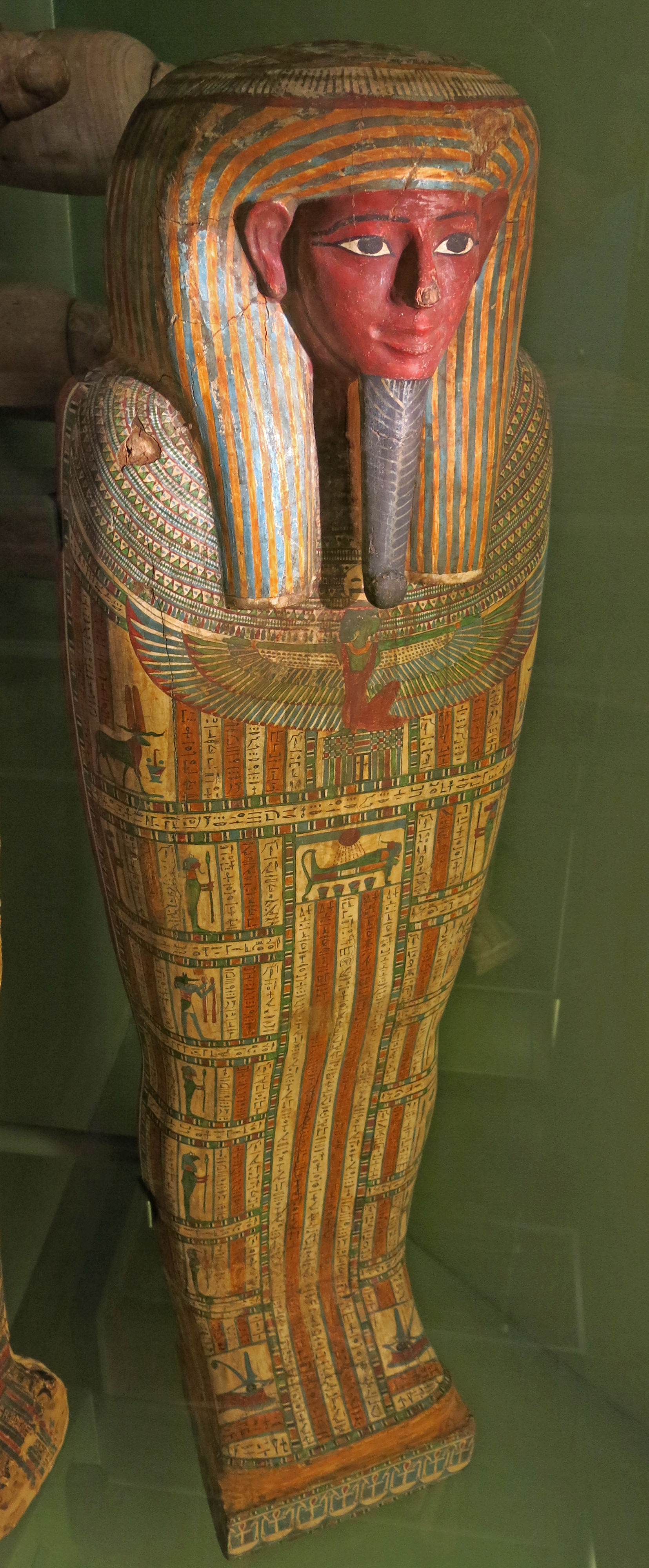
26th Dynasty: 664 BC - 525 BC
Ankh-af-na-khonsu
This wooden coffin belonged to the priest of Amun Ankh-f-n-Khonsu. Note that there were many individuals with this name.
650 BC.
Photo: Don Hitchcock 2014
Source: Original, Københavns (Copenhagen) Museum, National Museum of Denmark
Identification: http://picturemixture.wordpress.com/2009/08/26/di-mut-shep-n-ankh/
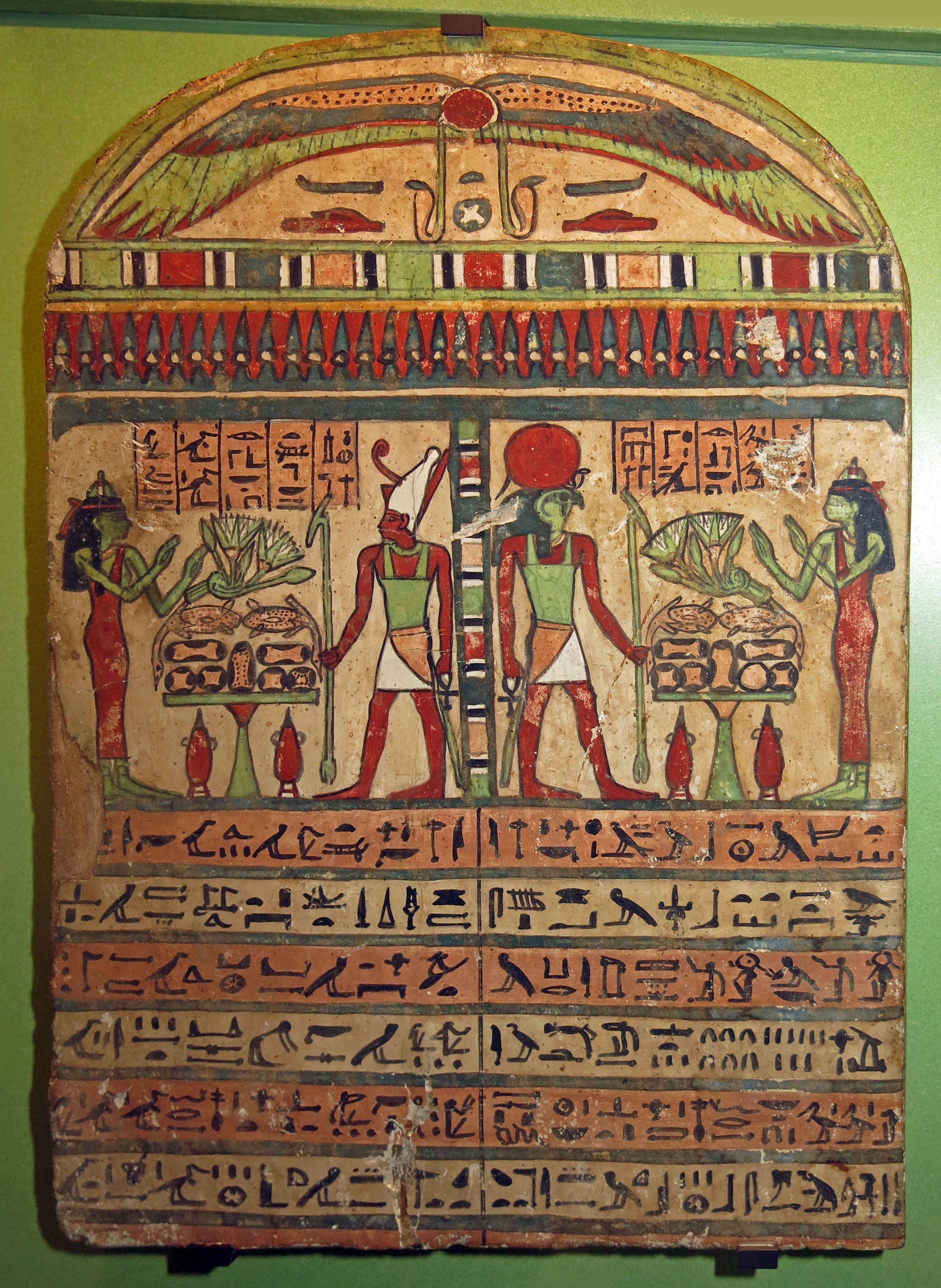
26th Dynasty: 664 BC - 525 BC
Baba
Baba, daughter of the priest of Amun Bes-n-Mut, praying to the sun gods Atum (left) and Re-Harakhte.
Funerary stela of wood. Luxor, late period, circa 650-640 BC.
Photo: Don Hitchcock 2014
Source: Original, Københavns (Copenhagen) Museum, National Museum of Denmark
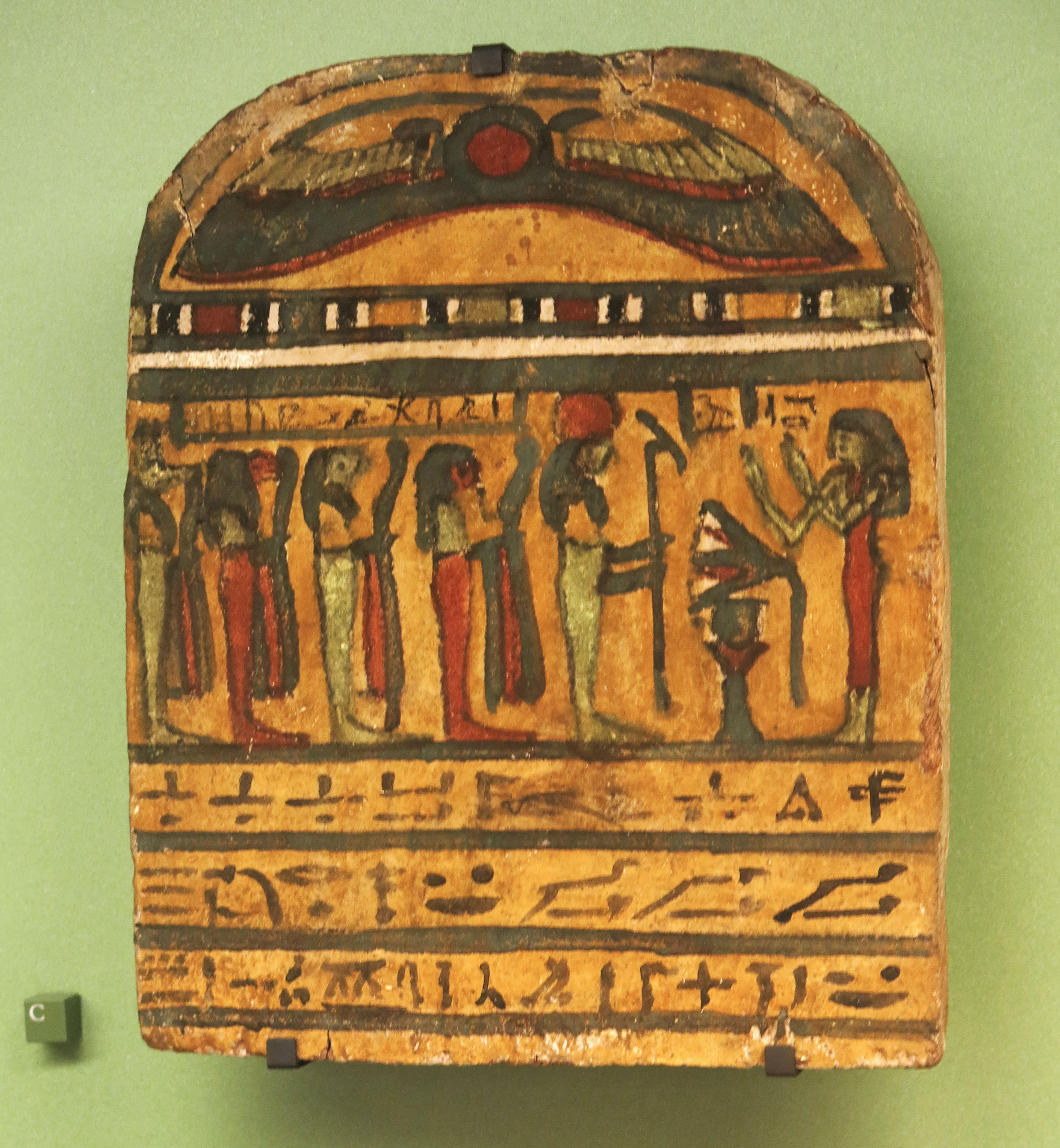
26th Dynasty: 664 BC - 525 BC
Ta-Ikhert
Tomb stela, made for the 'Leader of the chorus of Karnak', Ta-Ikhert, dressed in a tight fitting wrap around dress. The woman is worshipping Osiris, god of the Underworld, and the four sons of Horus.
Wood, Luxor, 650 BC.
Photo: Don Hitchcock 2014
Source: Original, Københavns (Copenhagen) Museum, National Museum of Denmark
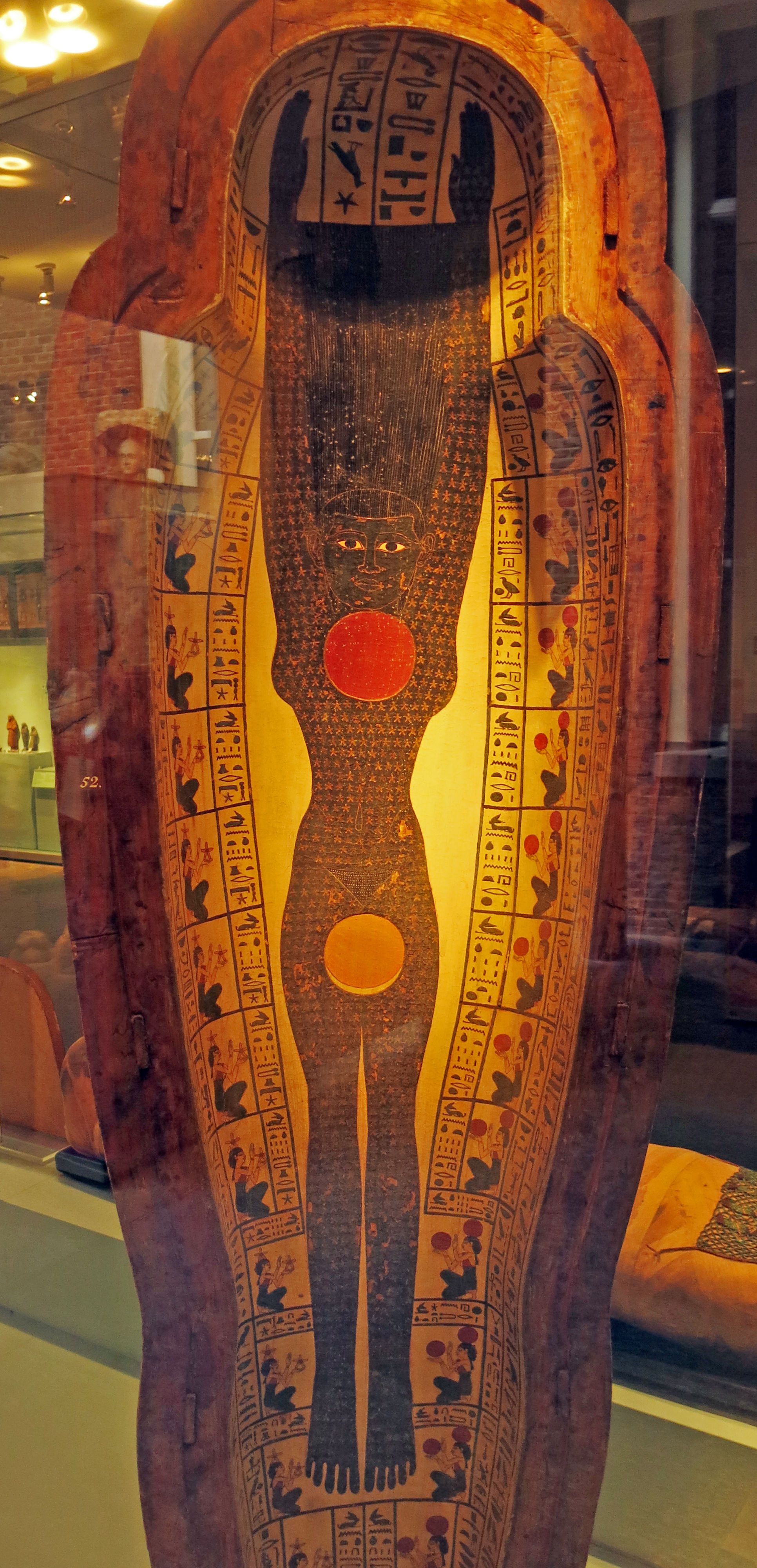

26th Dynasty: 664 BC - 525 BC
Peftjauneith
This is the inside of the Ancient Egyptian coffin for the mummy of Peftjauneith, 664 BC - 525 BC; the left image shows the sky goddess Nut, the sun, moon and stars and hours of day and night; the right shows the goddess of the West.
The mummy of Peftjauneith, inspector of temple estates in the Egyptian Nile delta, was found lying in this beautifully painted coffin. The decoration is an indication of his high function in society. The coffin is made of solid wood which must have cost a fortune in Egypt. Such beautiful timber had to be imported, for instance from the forests of the Lebanon. Moreover, the coffin is exquisitely painted in extraordinarily fine detail.
Photo: Don Hitchcock 2014
Source: Original, Rijksmuseum van Oudheden, National Museum of Antiquities, Leiden.
Text: http://www.rmo.nl/english/collection/highlights/egyptian-collection/coffin-mummy-peftjauneith

26th Dynasty: 664 BC - 525 BC
Peftjauneith
The inside of the lid features another picture of the celestial goddess Nut. Here she is represented as the nocturnal sky, black-skinned and strewn with stars. She gives birth to the moon crescent and is swallowing the round evening sun. She is flanked by the twelve hours of day and night. On the bottom of the coffin there is a picture of the goddess of the West, the quarter where the realm of the dead was thought to be.
Object: Mummy coffin
Dating from: c. 650 B.C.
Material: Wood
Size: 36 x 63 x 240 cm
Origin: Saqqara
Photo and text: http://www.rmo.nl/english/collection/highlights/egyptian-collection/coffin-mummy-peftjauneith


26th Dynasty: 664 BC - 525 BC
Peftjauneith
Mummy of Peftjauneith.
The area of the face and chest is covered by beadwork.
Location unknown, 664-525 BC, 26th Dynasty
Photo: Don Hitchcock 2014
Source: Original, Rijksmuseum van Oudheden, National Museum of Antiquities, Leiden.
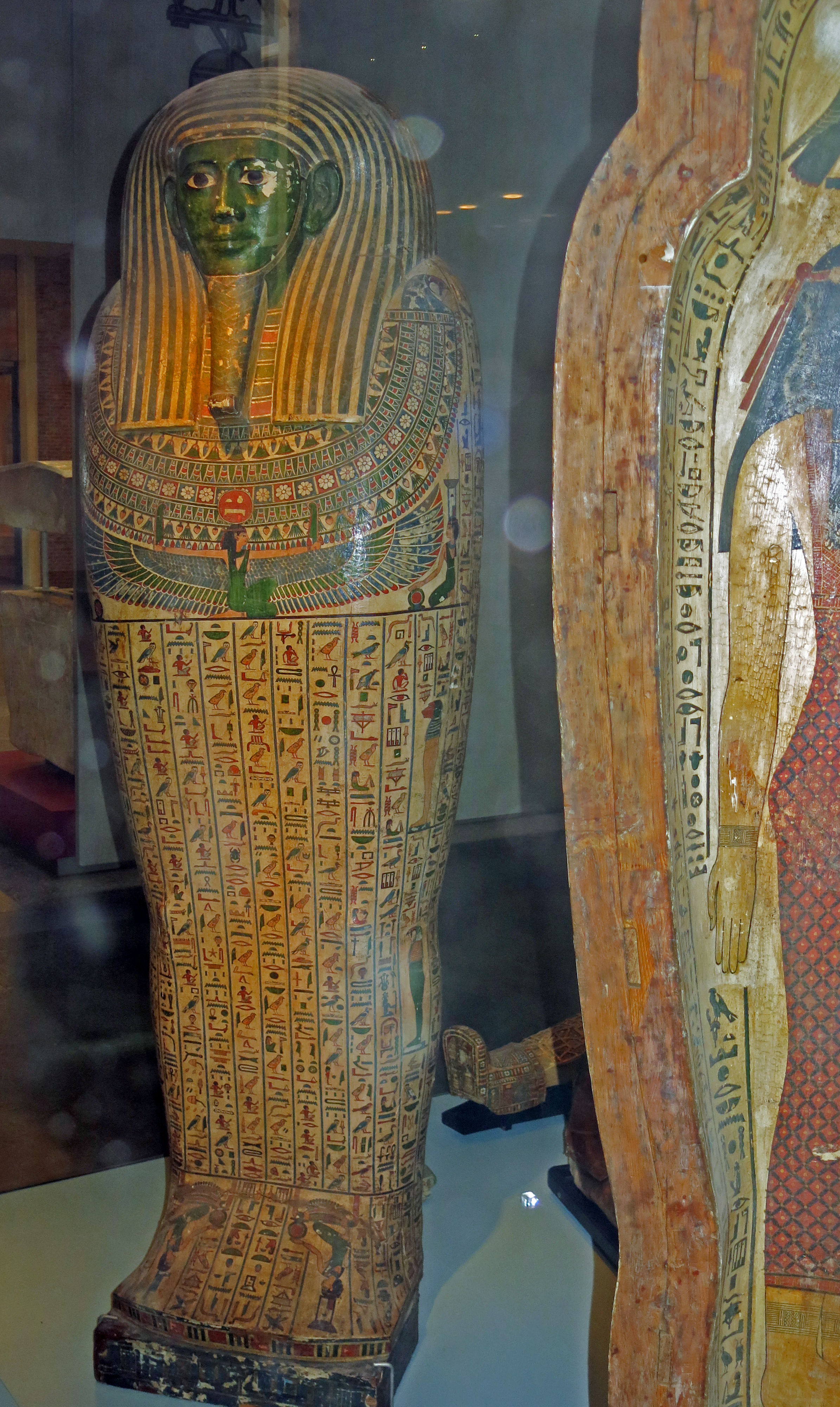
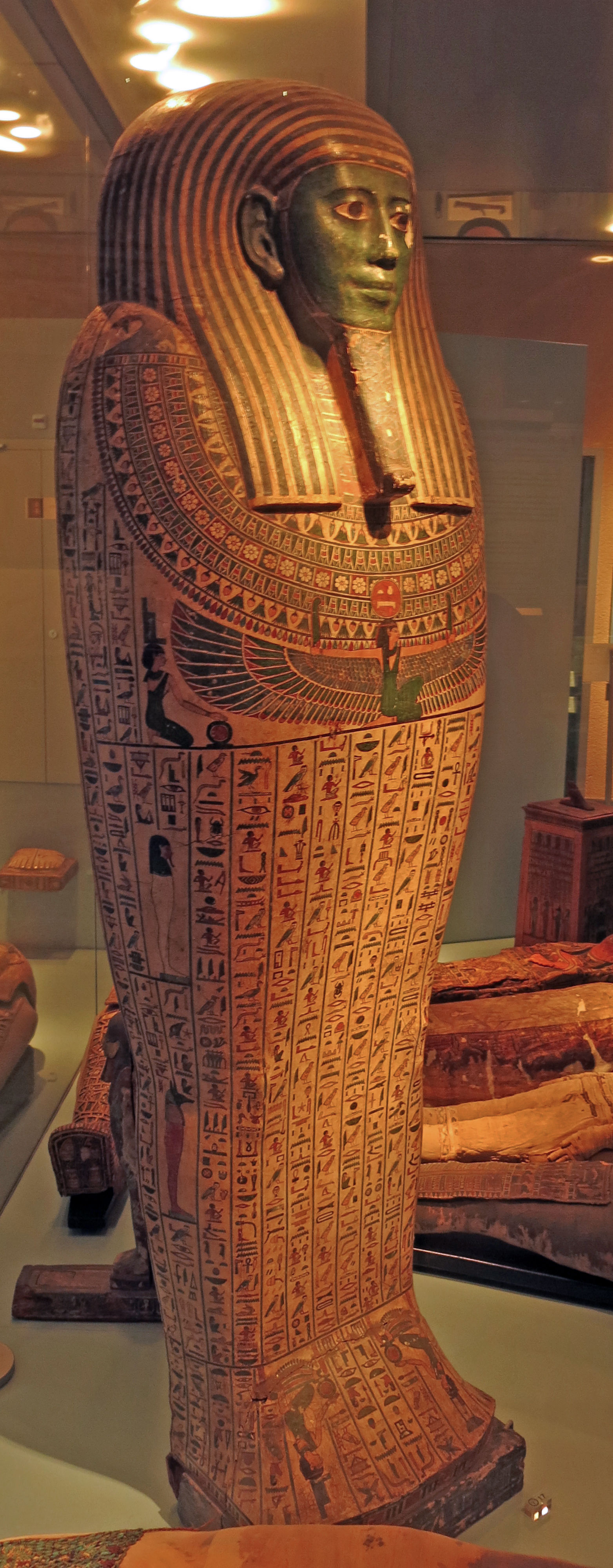
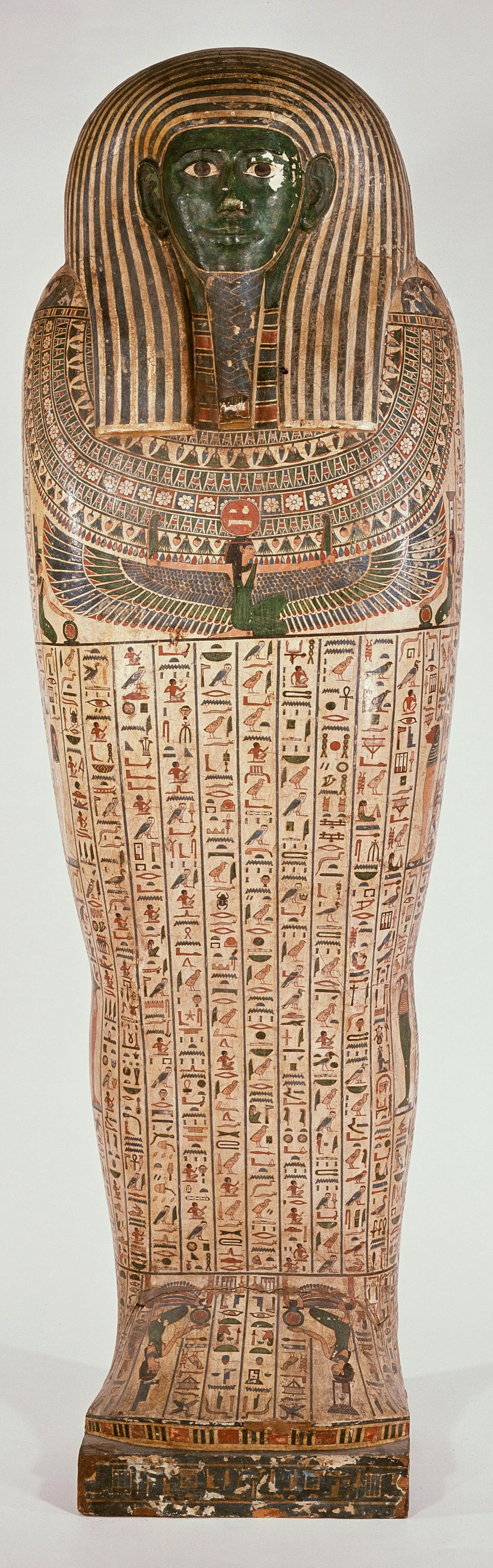
26th Dynasty: 664 BC - 525 BC
Peftjauneith
The outside of the coffin shows how Peftjauneith was depicted in the guise of the god Osiris himself. This is indicated by the striated divine wig, the divine beard, and the green face (in Egypt green was the colour of vegetation and new life).
A splendid collar lies on the chest, with underneath a depiction of the sky goddess, Nut, with her outspread wings. A spell from the Book of the Dead has been written on the abdomen. Each individual hieroglyph is a self-contained picture full of detail.
650 BC, 36 x 63 x 240 cm
Photo (left and centre): Don Hitchcock 2014
Source: Original, Rijksmuseum van Oudheden, National Museum of Antiquities, Leiden.
Photo (right): https://www.google.com/culturalinstitute/asset-viewer/mummy-coffin-of-peftjauneith/fgHXTUWHOSv4wg?projectId=art-project
Text: http://www.rmo.nl/english/collection/highlights/egyptian-collection/coffin-mummy-peftjauneith
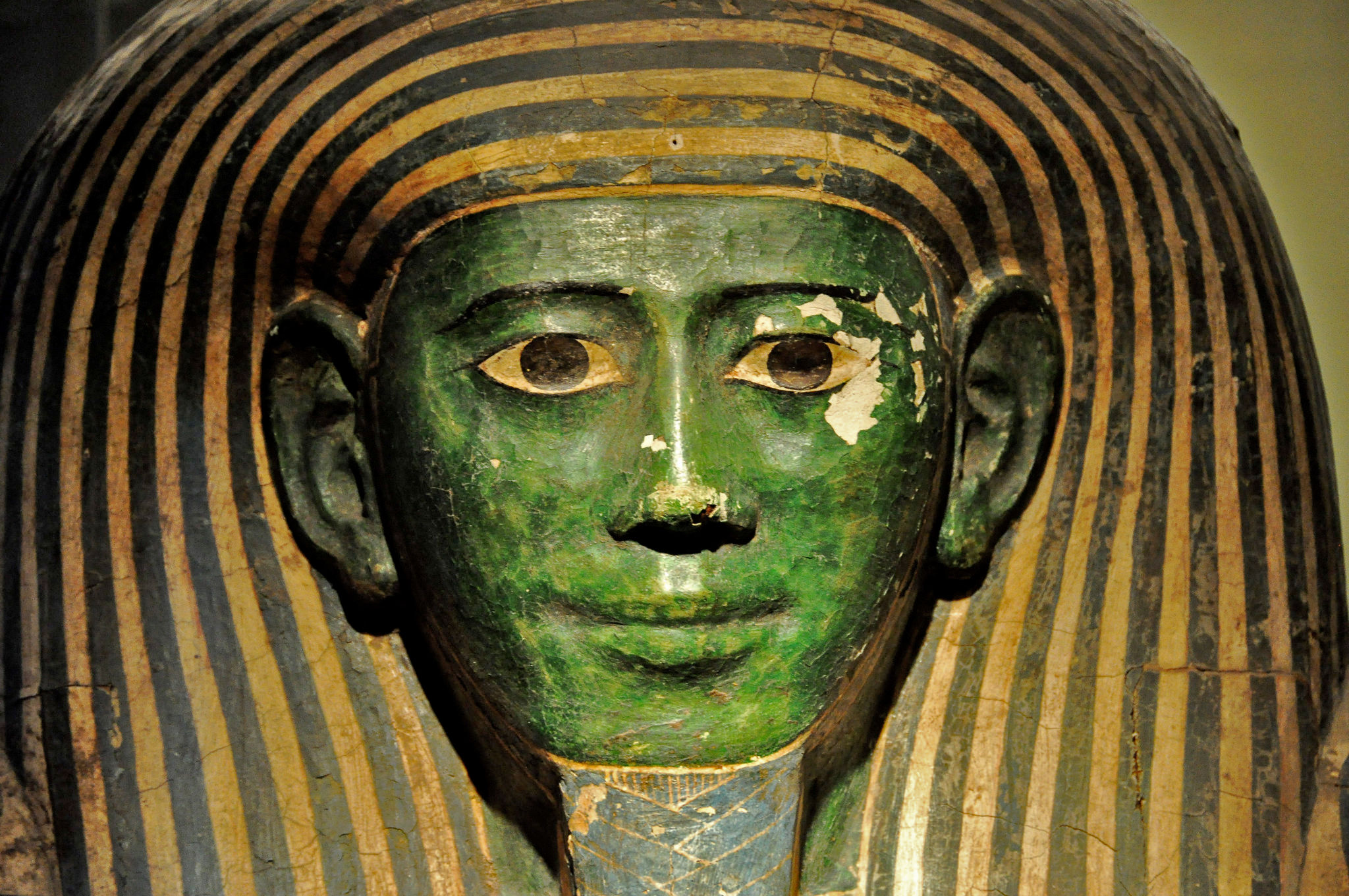
26th Dynasty: 664 BC - 525 BC
Peftjauneith
The face depicted on the coffin is full of character, and the photographer has done a wonderful job.
Photo: © Michiel 2005, http://www.ipernity.com/doc/288839/18779571
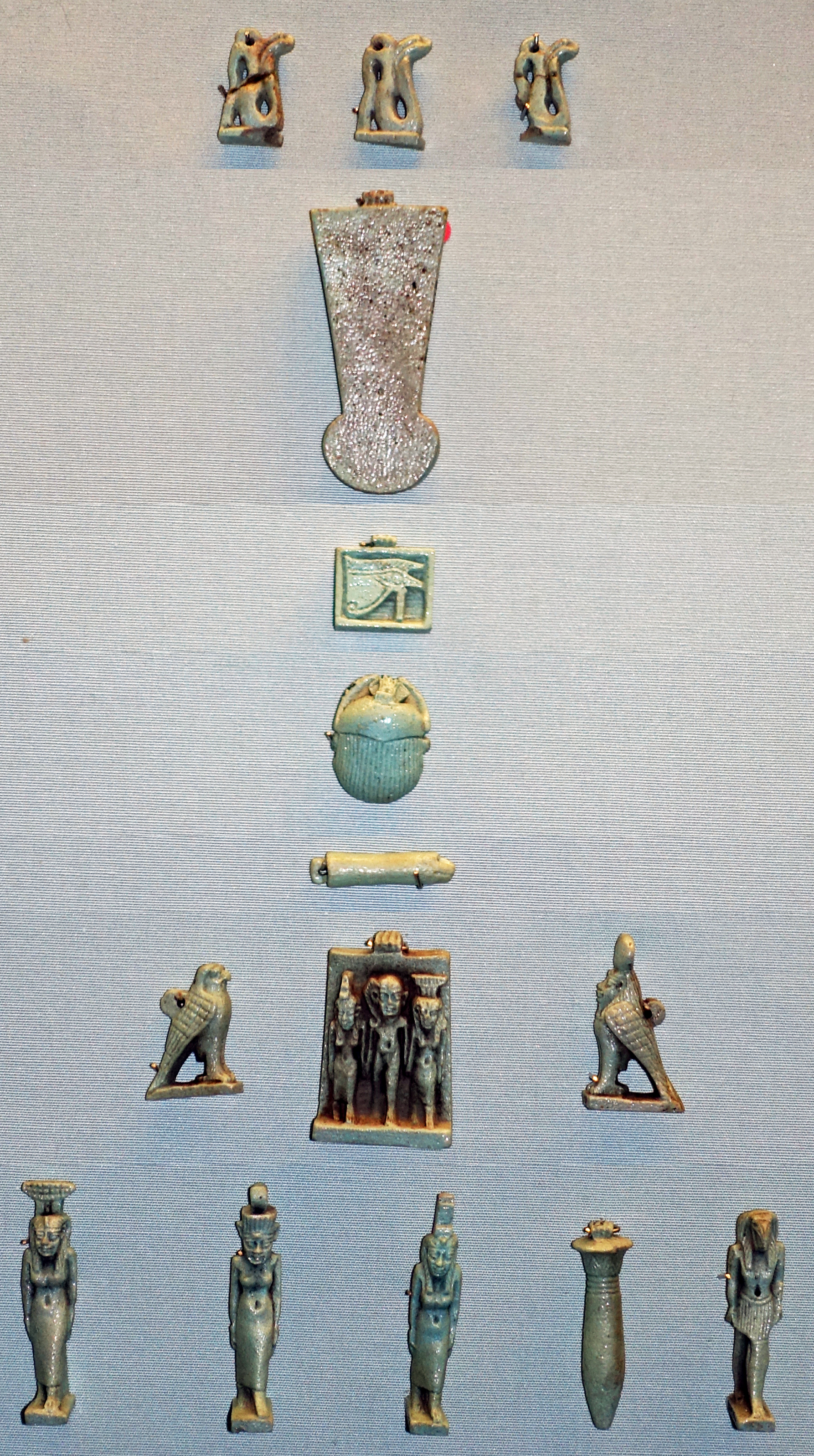
26th Dynasty: 664 BC - 525 BC
Set of amulets
From Nebesha, tomb 23, mummy D.
Nebesha contained four undisturbed mummies, each provided with a set of amulets. The arrangement of this set, as displayed, follows the original pattern of distribution:
Between the eyes: Uraeus serpents
At back of neck: counterpoise
At throat: Wedjat eye plaque
Below throat: scarab beetle, snake's head
Above heart: heart scarab (lost)
Across chest: falcon, triad, ba-bird
Lower chest: Nephthys, Neith, Isis, papyrus sceptre, Thoth
(the set of amulets are continued below)
Catalog: EA20577
Photo: Don Hitchcock 2018
Source: Original, British Museum
Text: www.britishmuseum.org/research/ and card at the Museum, © Trustees of the British Museum, CC BY-NC-SA 4.0
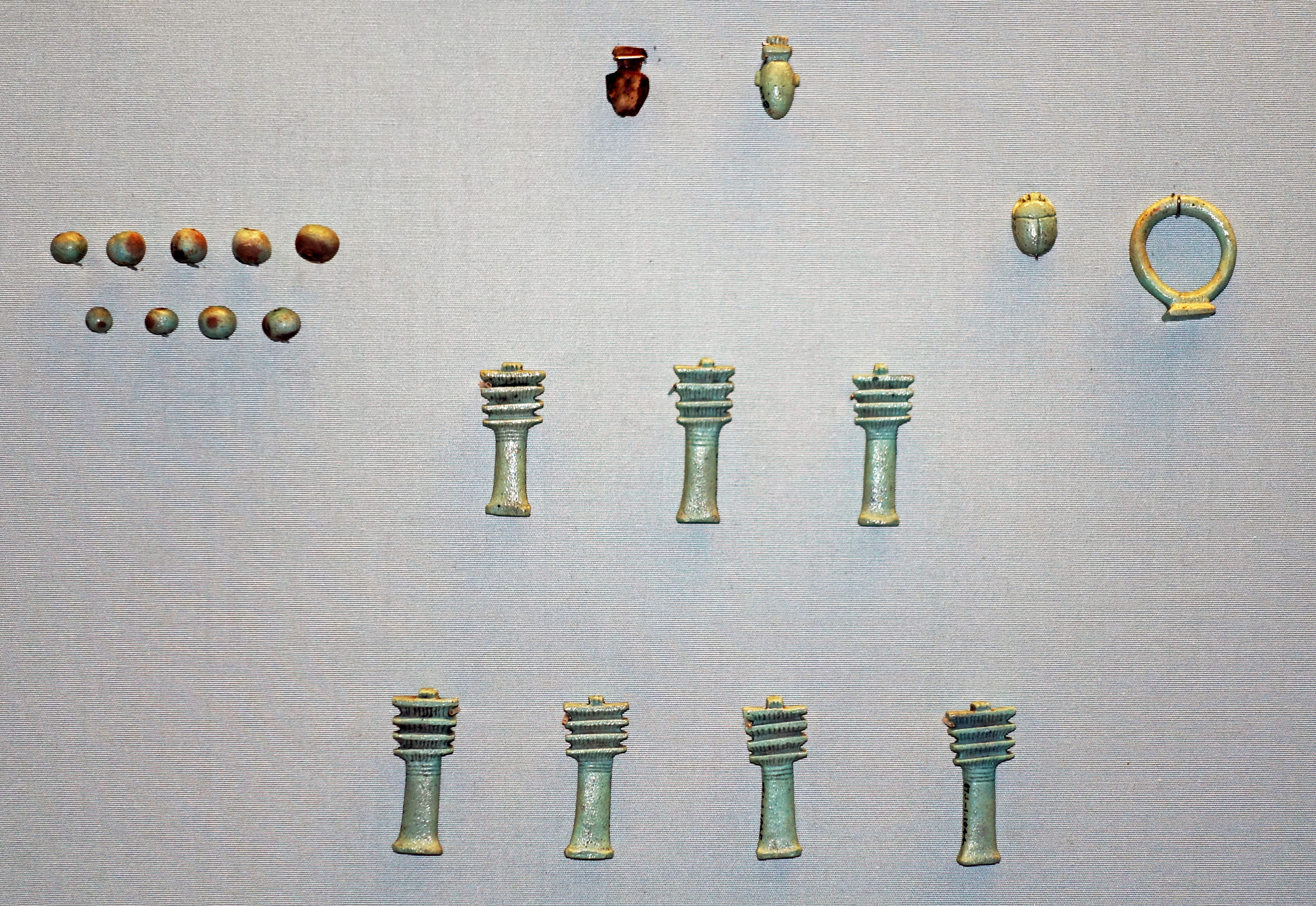
26th Dynasty: 664 BC - 525 BC
Set of amulets
From Nebesha, tomb 23, mummy D, continued from above.
Nebesha contained four undisturbed mummies, each provided with a set of amulets. The arrangement of this set, as displayed, follows the original pattern of distribution:
Base of chest: two hearts
Right wrist: nine beads
Left wrist: ring and scarab beetle
Stomach: three Djed pillars, four Djed pilars
Pelvic area: plumes, feathers, two fingers (all lost)
Catalog: EA20577
Photo: Don Hitchcock 2018
Source: Original, British Museum
Text: www.britishmuseum.org/research/ and card at the Museum, © Trustees of the British Museum, CC BY-NC-SA 4.0
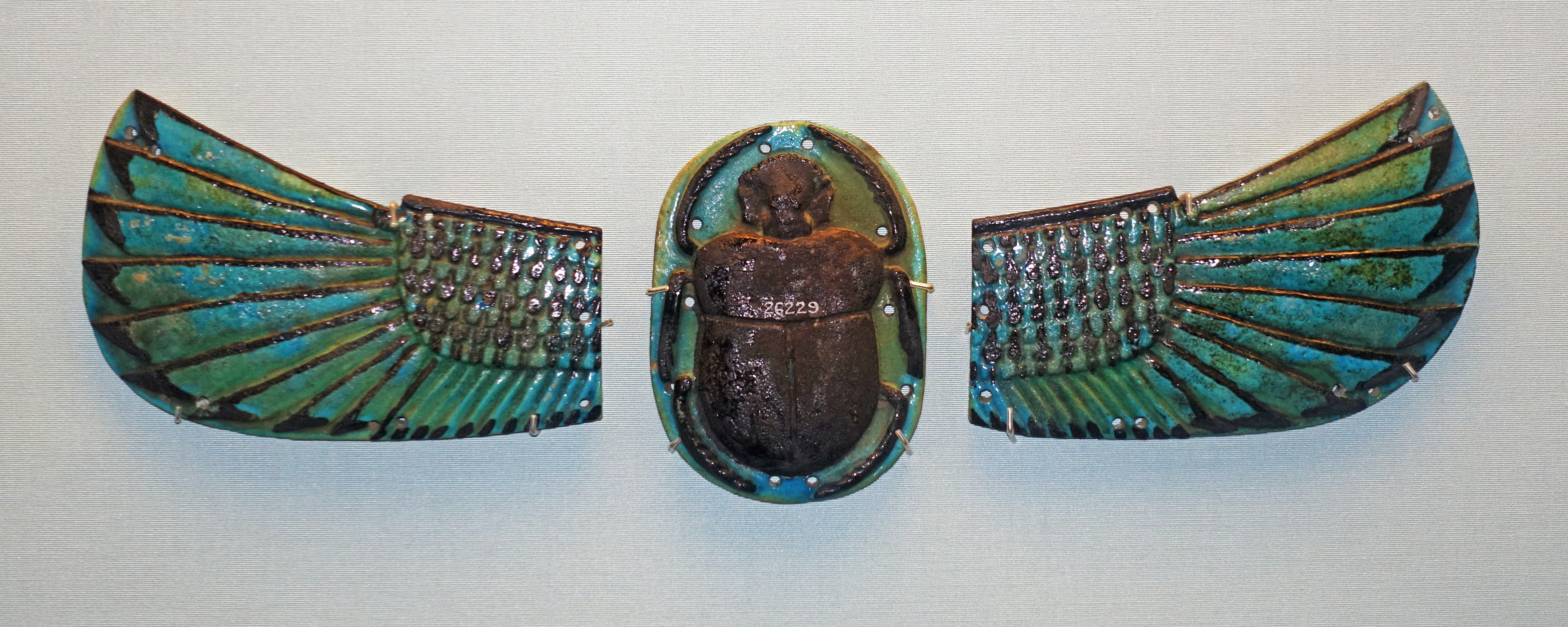
26th Dynasty: 664 BC - 525 BC
Scarab Amulet
Blue and black glazed composition mummy-scarab; two separate wings.
Length of each wing 114 mm, length of the scarab 82 mm.
This group of amulets, here and below, comprises a winged pectoral, a winged goddess, and figures of the four Sons of Horus. Attachment holes at the edges and on the backs of all three pieces suggest that they were intended to be sewn onto a bead net.
Catalog: EA26229
Photo: Don Hitchcock 2018
Source: Original, British Museum
Text: www.britishmuseum.org/research/ and card at the Museum, © Trustees of the British Museum, CC BY-NC-SA 4.0
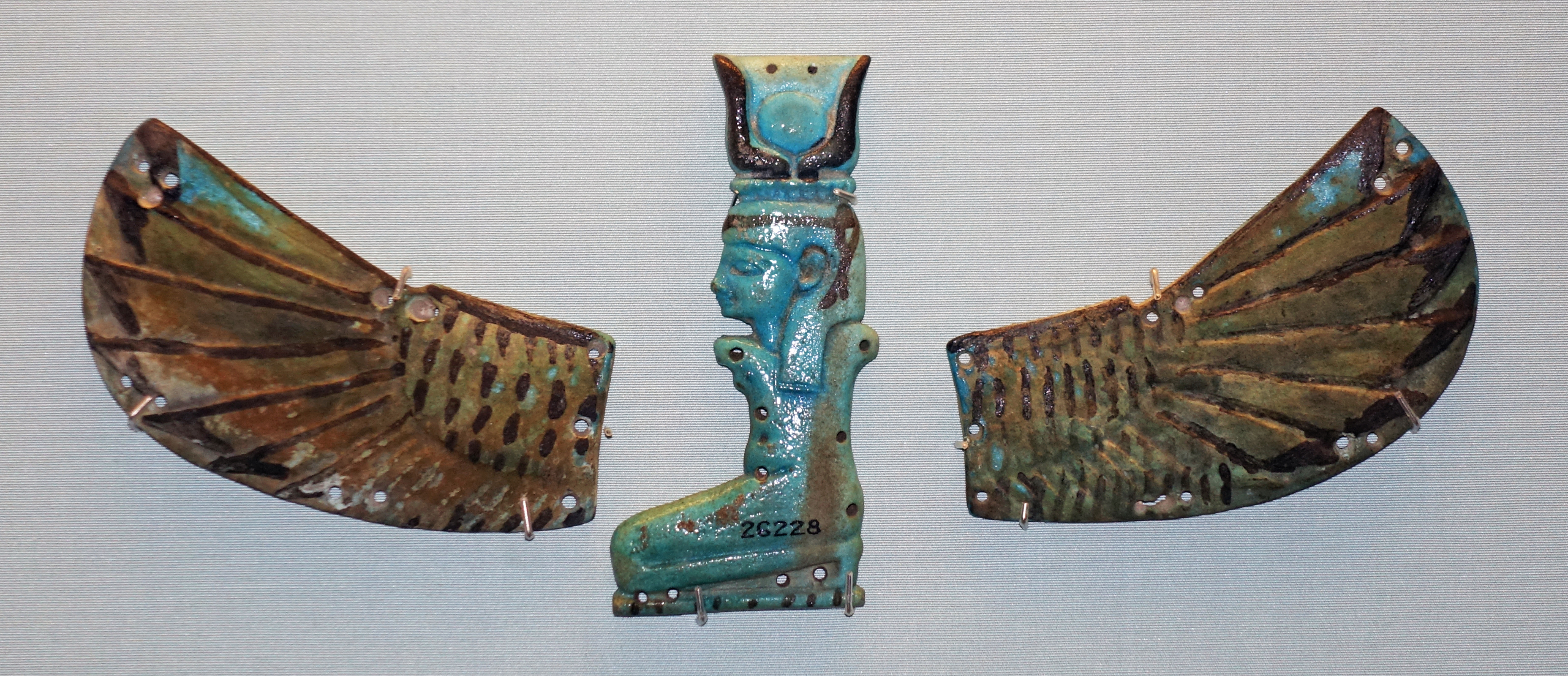
26th Dynasty: 664 BC - 525 BC
Faience amulet
Glazed composition amulet in the form of a kneeling goddess (probably Nut), with two separate wings.
Length of wings: 92 mm - 95 mm, length of figure 99 mm.
Catalog: EA26228
Photo: Don Hitchcock 2018
Source: Original, British Museum
Text: www.britishmuseum.org/research/ and card at the Museum, © Trustees of the British Museum, CC BY-NC-SA 4.0
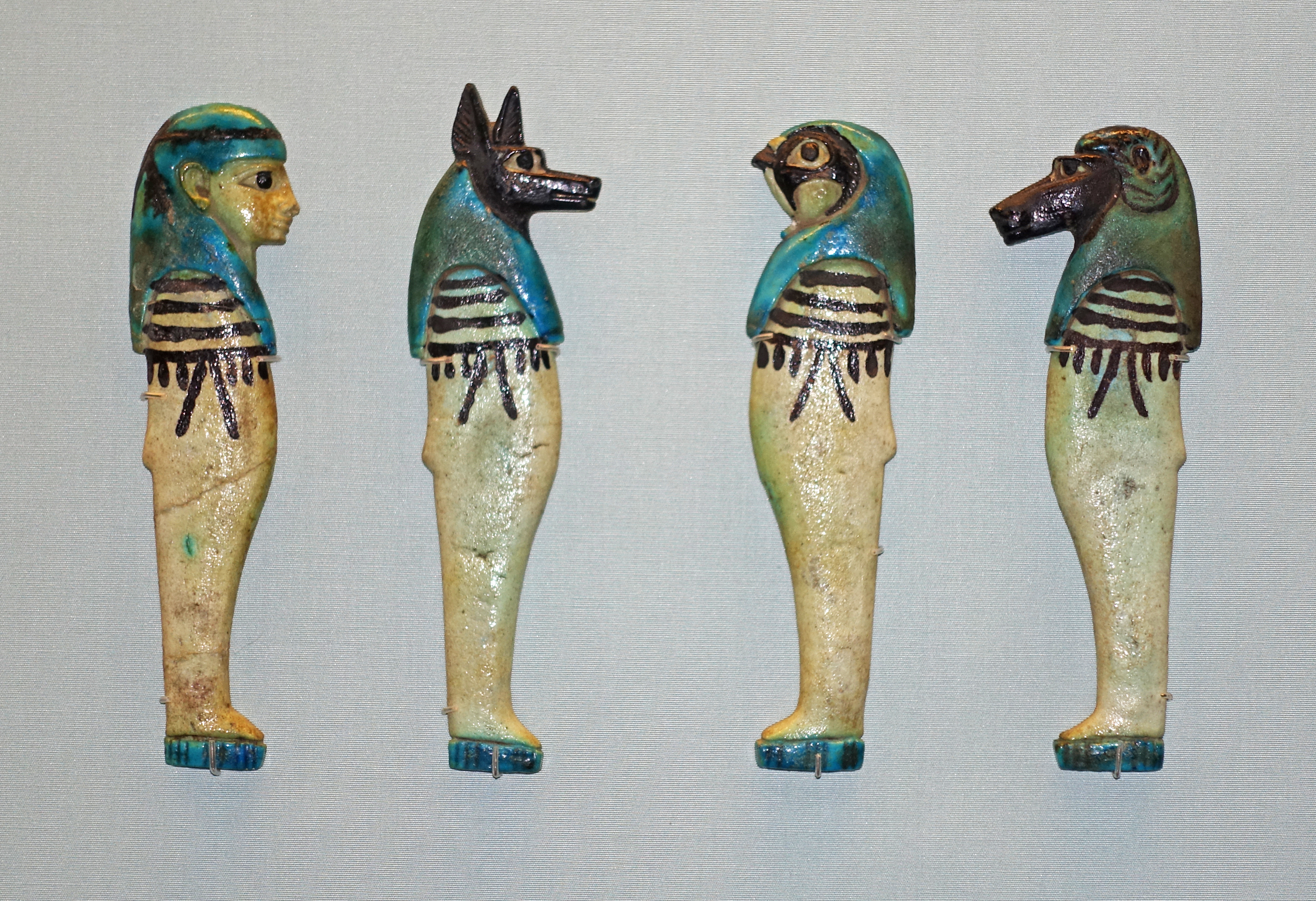
26th Dynasty: 664 BC - 525 BC
Sons of Horus
Glazed composition amulets of the Sons of Horus. A mould-made set of the Four Sons of Horus, with details of the tripartite wigs, broad collars, and plinths painted in blue and black. Three sets of threadholes — at head, mid-section, and feet — appear on the back of each amulet, allowing them to be invisibly sewn to the mummy bandages.
(left to right)
Height 144 mm (Imsety)
Height 146 mm (Duamutef)
Height 141 mm (Qebehsenuef)
Height 139 mm (Hapy)
Catalog: EA26230
Photo: Don Hitchcock 2018
Source: Original, British Museum
Text: www.britishmuseum.org/research/ and card at the Museum, © Trustees of the British Museum, CC BY-NC-SA 4.0
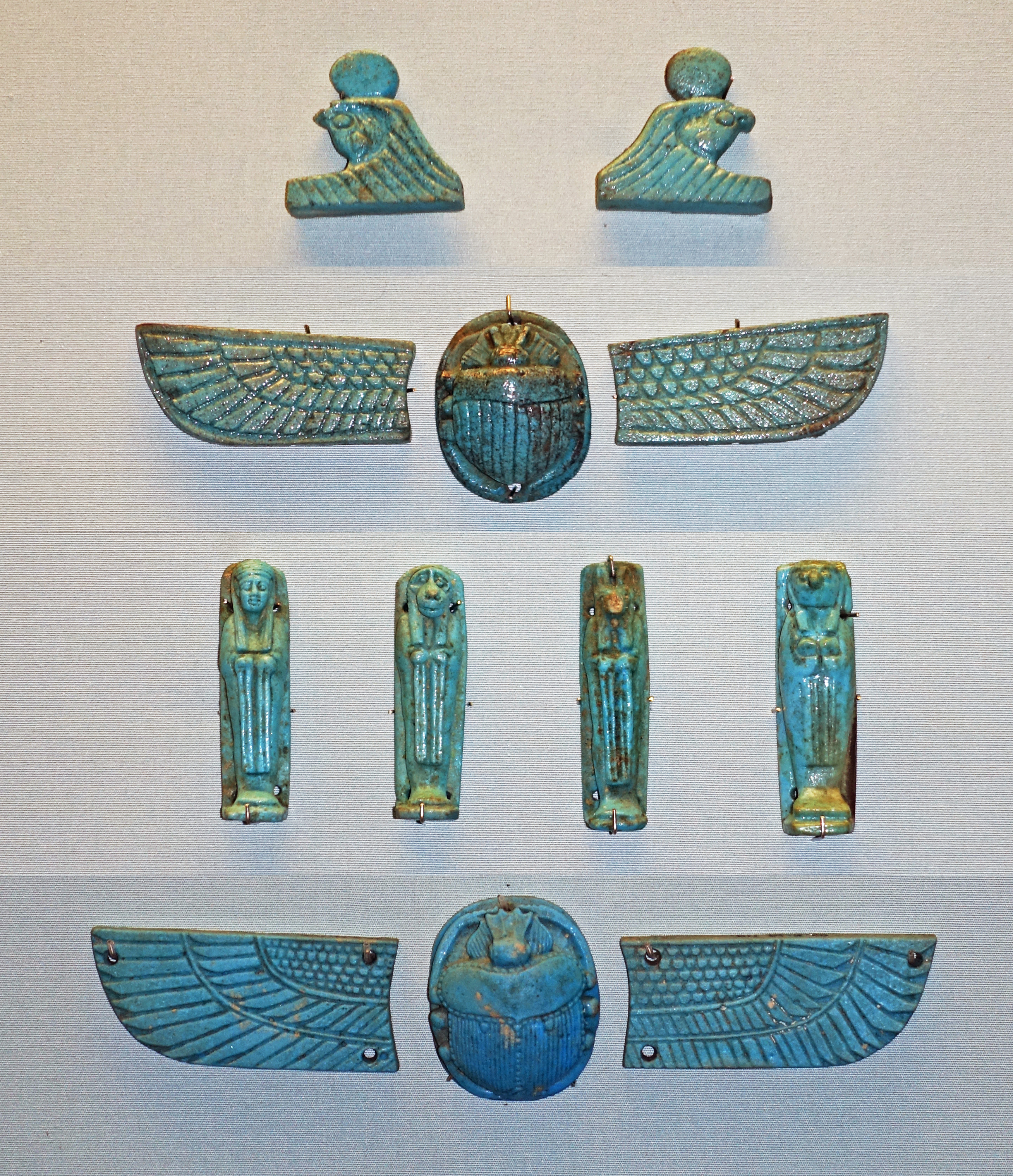
26th Dynasty: 664 BC - 525 BC
Faience Amulets
From the card at the side of the vitrine:
Set of faience amulets, probably from a bead net. The set consists of two falcon-head terminals from a collar, a winged pectoral scarab, and figures of the four sons of Horus.
From the online catalog: Sons of Horus: length 52 mm each.
( The BM online catalog lists EA26591 as being just the four sons of Horus. The museum card at the side of the vitrine lists the falcon-head terminals and the top (?) winged pectoral scarab, while the lower (?) winged scarab has not been mentioned, and apparently was added later to the exhibit. Alternately, it may be that the actual exhibit in the museum has been changed since my 2018 visit, with the removal of all but the four sons of Horus amulets, now reflected in the online catalog - Don )
Catalog: EA26591
Photo: Don Hitchcock 2018
Source: Original, British Museum
Text: www.britishmuseum.org/research/ and card at the Museum, © Trustees of the British Museum, CC BY-NC-SA 4.0
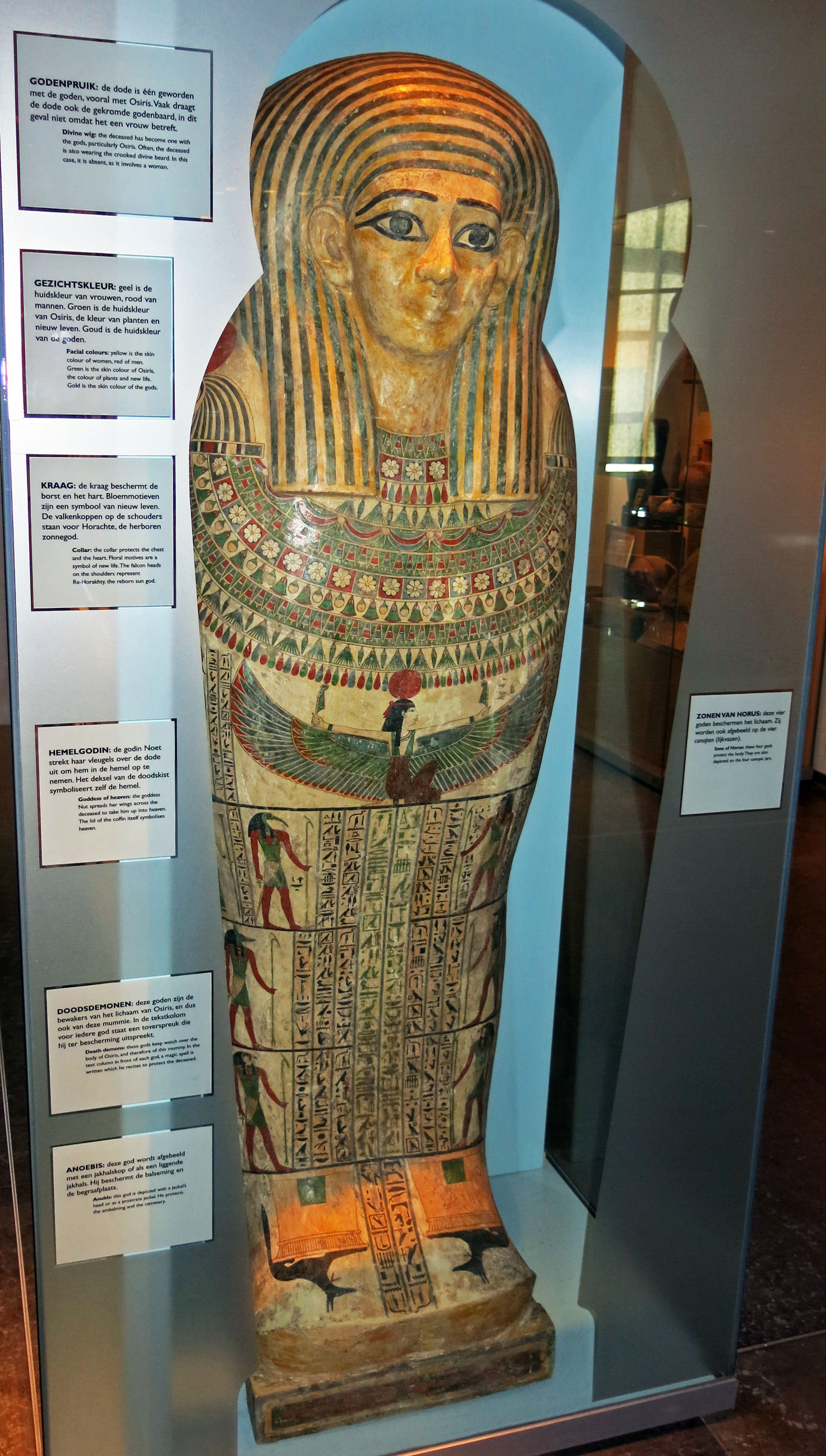

Circa 25th - 31st Dynasty: 746 BC - 335 BC
Haytemhat
Mummy coffin of Haytemhat.
27 x 58 x 186 cm
Photo (left): Don Hitchcock 2014
Source: Original, Rijksmuseum van Oudheden, National Museum of Antiquities, Leiden.
Photo (right): https://www.google.com/culturalinstitute/asset-viewer/mummy-coffin-of-haytemhat/nAEZIWwJ0HkEIA?projectId=art-project
Each part of the mummy coffin has a story to tell:
Divine wig:
The deceased has become one with the gods, particularly Osiris, and now wears the divine wig.
Often, the deceased is also wearing the crooked divine beard. In this case, it is absent, as it involves a woman.
Photo: Don Hitchcock 2014
Source: Original, Rijksmuseum van Oudheden, National Museum of Antiquities, Leiden.
Facial colours:
Yellow is the skin colour of women, red of men. Green is the skin colour of Osiris, the colour of plants and new life. Gold is the skin colour of the gods.
Photo: Don Hitchcock 2014
Source: Original, Rijksmuseum van Oudheden, National Museum of Antiquities, Leiden.

Collar:
The collar protects the chest and the heart. Floral motifs are a symbol of new life. The falcon heads on the shoulders represent Re-Horakhty, the reborn sun god.
Photo: Don Hitchcock 2014
Source: Original, Rijksmuseum van Oudheden, National Museum of Antiquities, Leiden.

Goddess of heaven:
The goddess Nut spreads her wings across the deceased to take them up to heaven.
The lid of the coffin itself symbolises heaven.
Photo: Don Hitchcock 2014
Source: Original, Rijksmuseum van Oudheden, National Museum of Antiquities, Leiden.
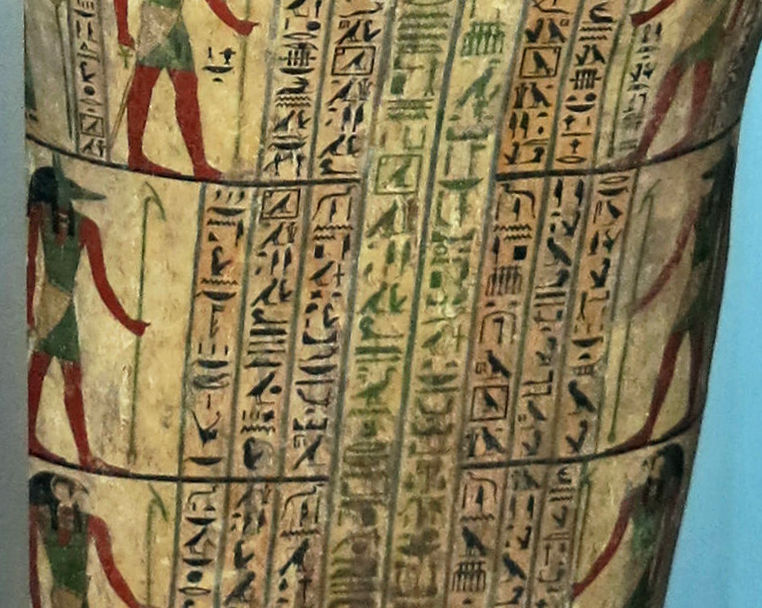
Death demons:
These gods keep watch over the body of Osiris, and therefore of this mummy.
In the text column in front of each god, a magic spell is written which he recites to protect the deceased.
Photo: Don Hitchcock 2014
Source: Original, Rijksmuseum van Oudheden, National Museum of Antiquities, Leiden.

Anubis:
This god is depicted with a jackal's head or as a prostrate jackal. He protects the embalming and the cemetery.
( This image is rotated 180° for ease of viewing, and in any case the hieroglyphs and the Anubis images become right way up in this orientation. It is from the foot of the mummy coffin, and the coffin would normally be on its back, and thus this set of images and hieroglyphs
on the foot would then be seen in the correct orientation - Don )
Photo: Don Hitchcock 2014
Source: Original, Rijksmuseum van Oudheden, National Museum of Antiquities, Leiden.
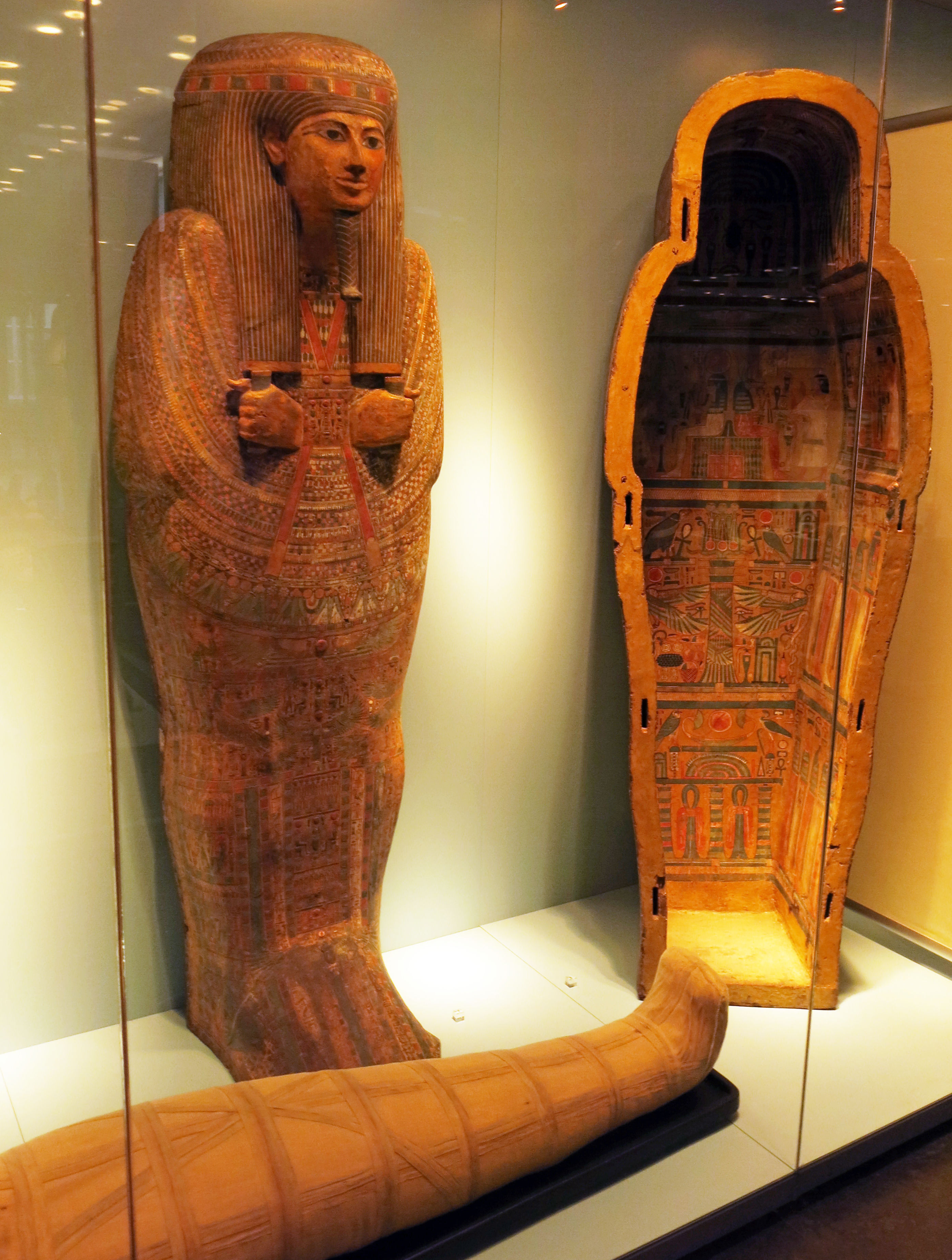
This burial casket shows a man with the divine wig, divine beard, and arms originally holding sceptres, obviously an important person.
Photo: Don Hitchcock 2014
Source: Original, Rijksmuseum van Oudheden, National Museum of Antiquities, Leiden.
It should be realised that these magnificent burial caskets, and the religion that was part and parcel of it, was something which applied only to the rich, to the elite, the ruling classes. The ordinary workers knew nothing of the religion, nor could they aspire to the excesses of the burial rituals and associated caskets and grave goods:
Excavating a shallow grave in sandy soil and getting a few rocks ready to cover the ground after the burial to protect the corpse from scavenging jackals was a matter of a few hours, performed close to the burial itself. Such tombs satisfied the needs of the vast majority of Egyptians throughout history.Text above from http://www.reshafim.org.il/ad/egypt/funerary_practices/burial.htm
Those who could afford it, may have preferred a more substantial tomb, built underground of mudbrick or even of stone. These were typically simple structures containing one or two small rooms, sometimes with a staircase for easy access. People aspiring to a genteel after-life-style beyond their means, bought at times themselves space in a neighbour's tomb:
List of valuables given to the owner of this tomb by Sebekhotep for burying his father in it: Small barley: 2 sacks; emmer: 3 sacks; tigernuts; 1 sack; setep-cloth: 50 square cubits; axe: 1; wab-garment: 1 (Things) which Wamet has given to his father which he will give to whomever he wants to: Small barley: 4 sacks; des-vessels: 2
But already in predynastic times such unimpressive graves did not satisfy the elite. The tomb itself became deeper, the superstructure more massive, culminating in the pyramids of the 4th dynasty. After the excesses of Khufu and his successors better judgment prevailed, and the tombs of subsequent kings and their families were more reasonably sized. Still, they required years of planning and execution at great expense.
After the Middle Kingdom the royals abandoned pyramids, opting instead for burials in graves cut into the living rock of the Upper Egyptian mountains. These tombs were at times similar to huge warrens with many passage ways and rooms, capable of accommodating large numbers of deceased family members. If the reason for hiding the burial places under mountains was to afford better protection from tomb robbers, then they were a sad disappointment: almost all the graves were broken into and robbed, sometimes only decades after they had been excavated.
Those who could afford it generally preferred to get their own tomb ready in time. The more substantial abodes of eternity could take years to build. The Old Kingdom companion of the house, the keeper of secrets, Mehi, wrote:
I made this tomb actually while I was alive and on my feet, as the favoured one of the king and beloved one of men; I paid the masons so that they were satisfied with it...
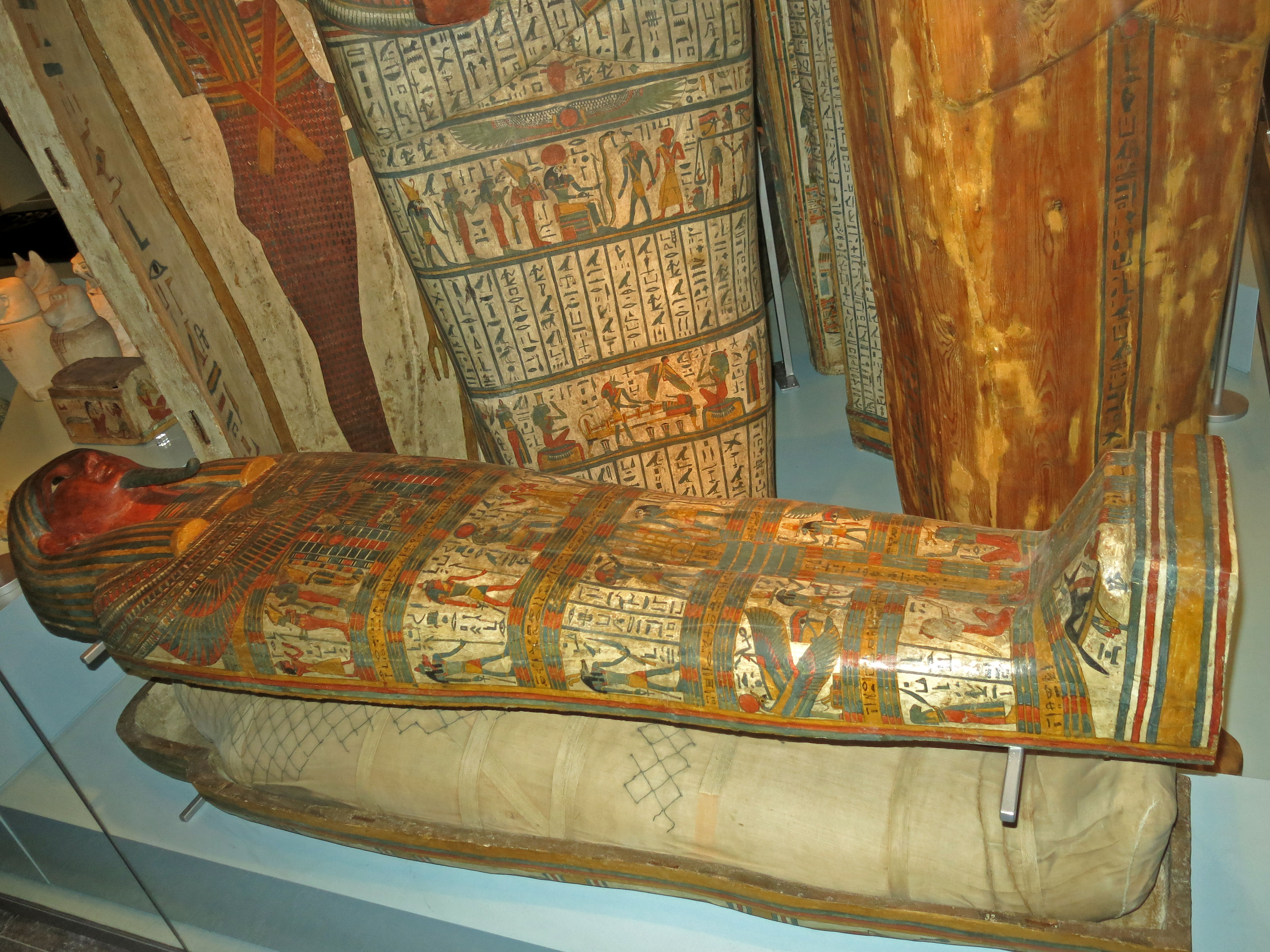
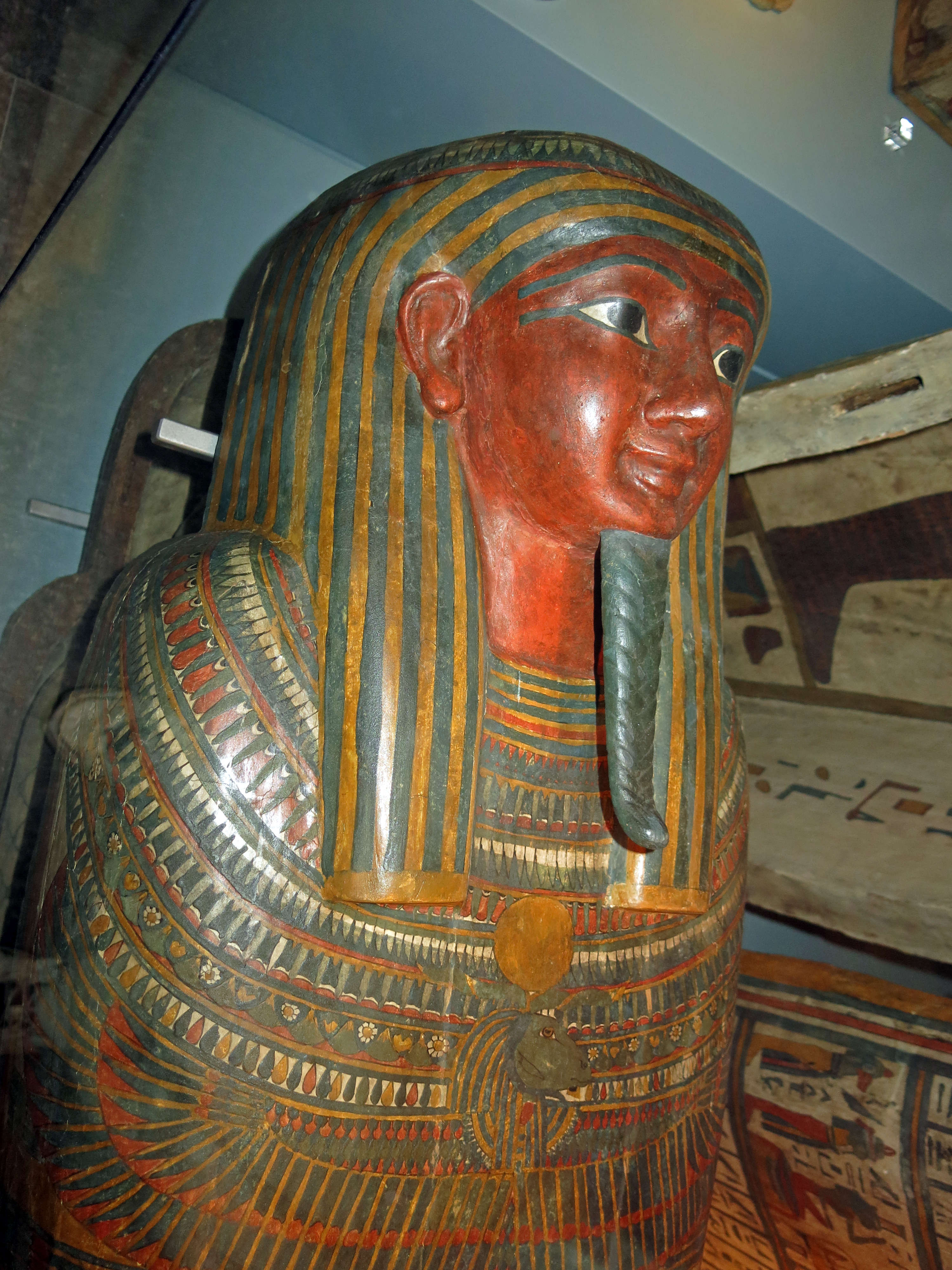
26th Dynasty: 664 BC - 525 BC
Petesis
Inner coffin and mummy of Petesis.
Petesis, son of Semtheus, circa 644 - 513 BC, was king of Athribis, near the apex of the Nile Delta.
Photo: Don Hitchcock 2014
Source: Original, Rijksmuseum van Oudheden, National Museum of Antiquities, Leiden.
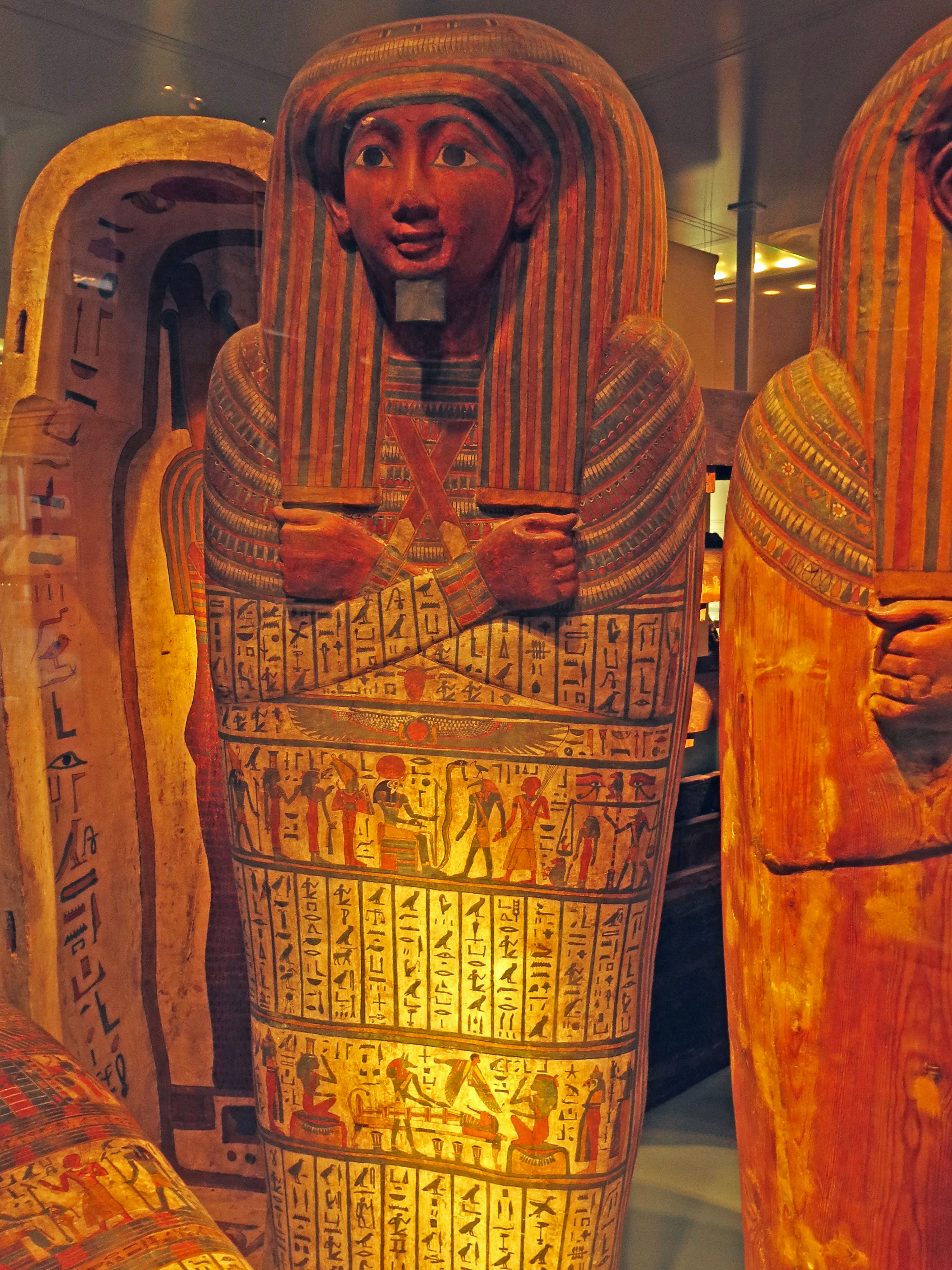

26th Dynasty: 664 BC - 525 BC
Petesis
Outer coffins of Petesis.
Photo: Don Hitchcock 2014
Source: Original, Rijksmuseum van Oudheden, National Museum of Antiquities, Leiden.
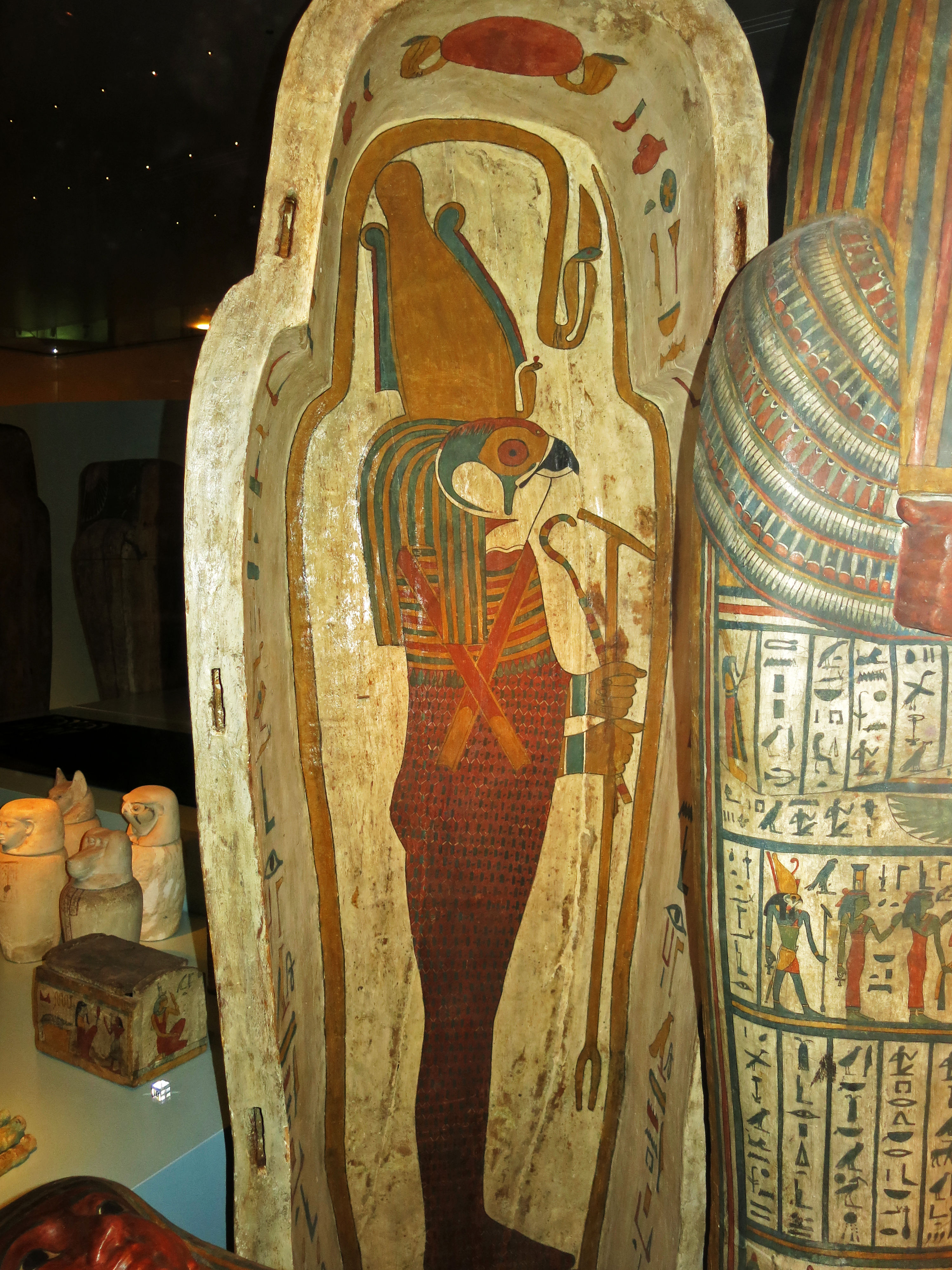
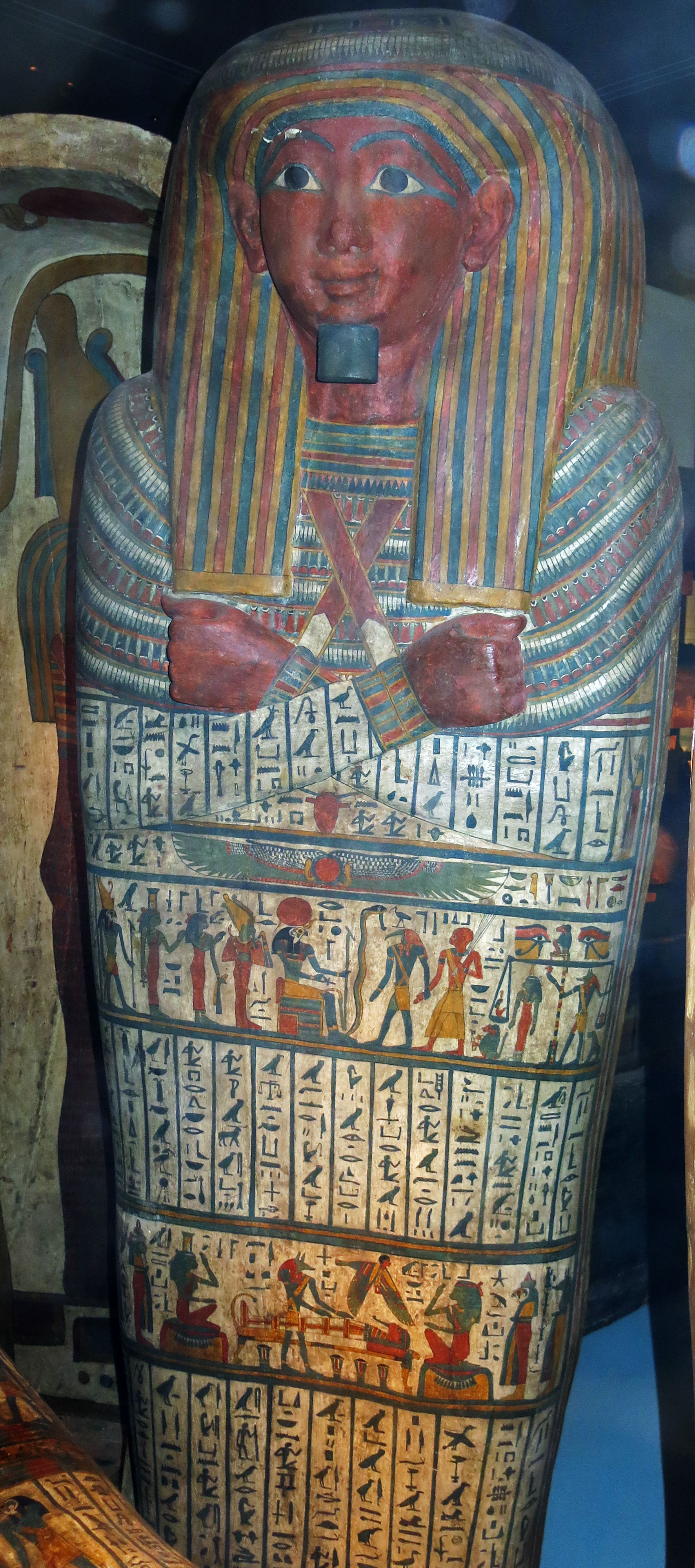
26th Dynasty: 664 BC - 525 BC
Petesis
Horus, the falcon headed god, appears painted on the inside of one of the coffins.
Horus is one of the oldest and most significant deities in ancient Egyptian religion, who was worshipped from at least the late Predynastic period through to Greco-Roman times.
He was usually depicted as a falcon-headed man wearing the pschent, the double crown, as a symbol of kingship over the entire kingdom of Egypt.
Photo: Don Hitchcock 2014
Source: Original, Rijksmuseum van Oudheden, National Museum of Antiquities, Leiden.
Additional text: Wikipedia
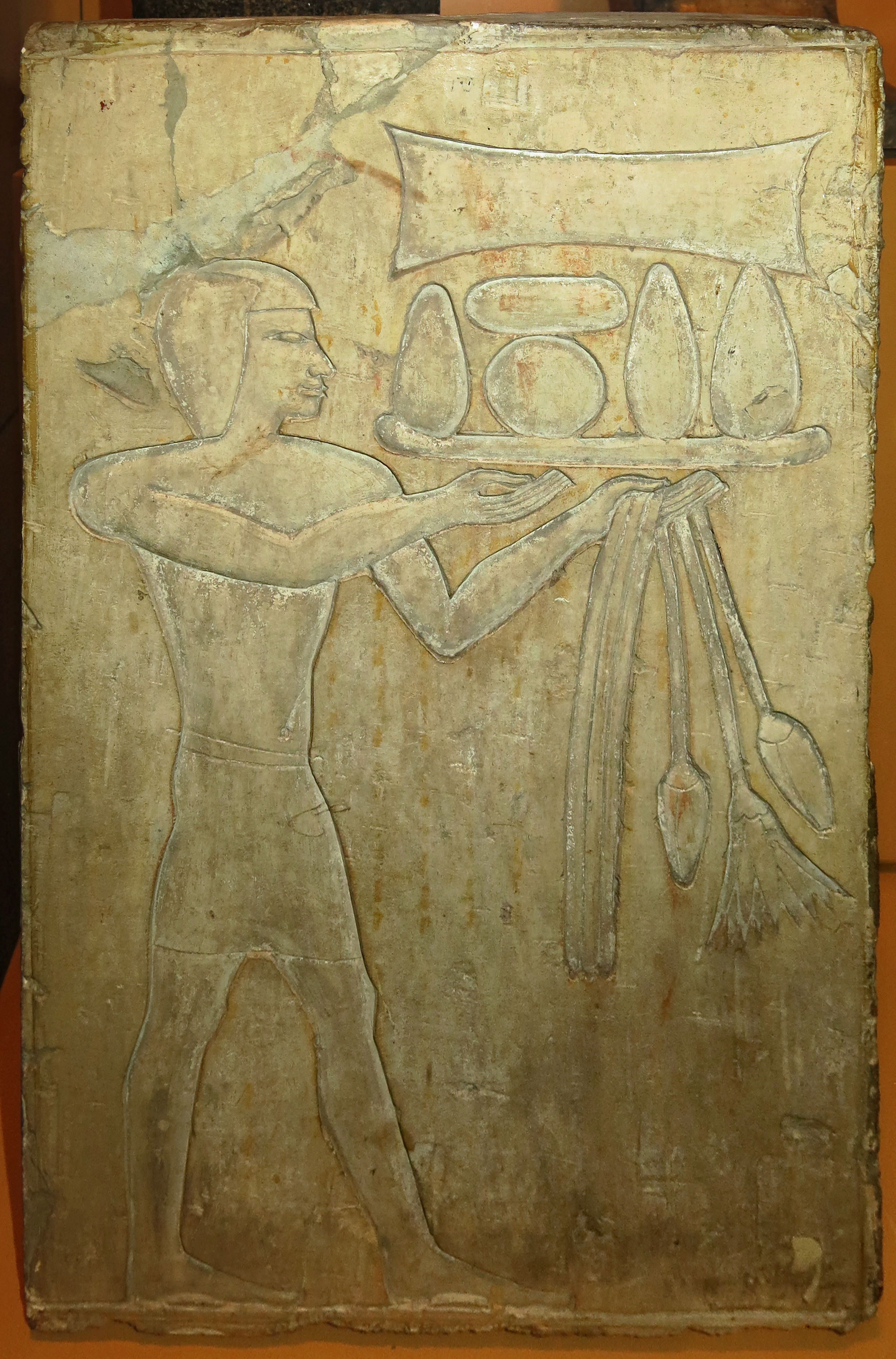
26th Dynasty: 664 BC - 525 BC
Tomb Relief
The figure is highly stylised and looks like a hieroglyph. The representation follows examples from the Old Kingdom, nearly 2000 years earlier. That makes this a fine example of the Egyptian Renaissance. Limestone, location unknown, ca 595-589 BC (26th Dynasty).
The 26th Dynasty was the last native dynasty to rule Egypt before the Persian conquest in 525 BC (although others followed). The dynasty's reign (664–525 BC) is also called the Saite Period after the city of Sais, where its pharaohs had their capital, and marks the beginning of the Late Period of ancient Egypt.
Photo: Don Hitchcock 2014
Source and text: Original, Rijksmuseum van Oudheden, National Museum of Antiquities, Leiden
Additional text: Wikipedia
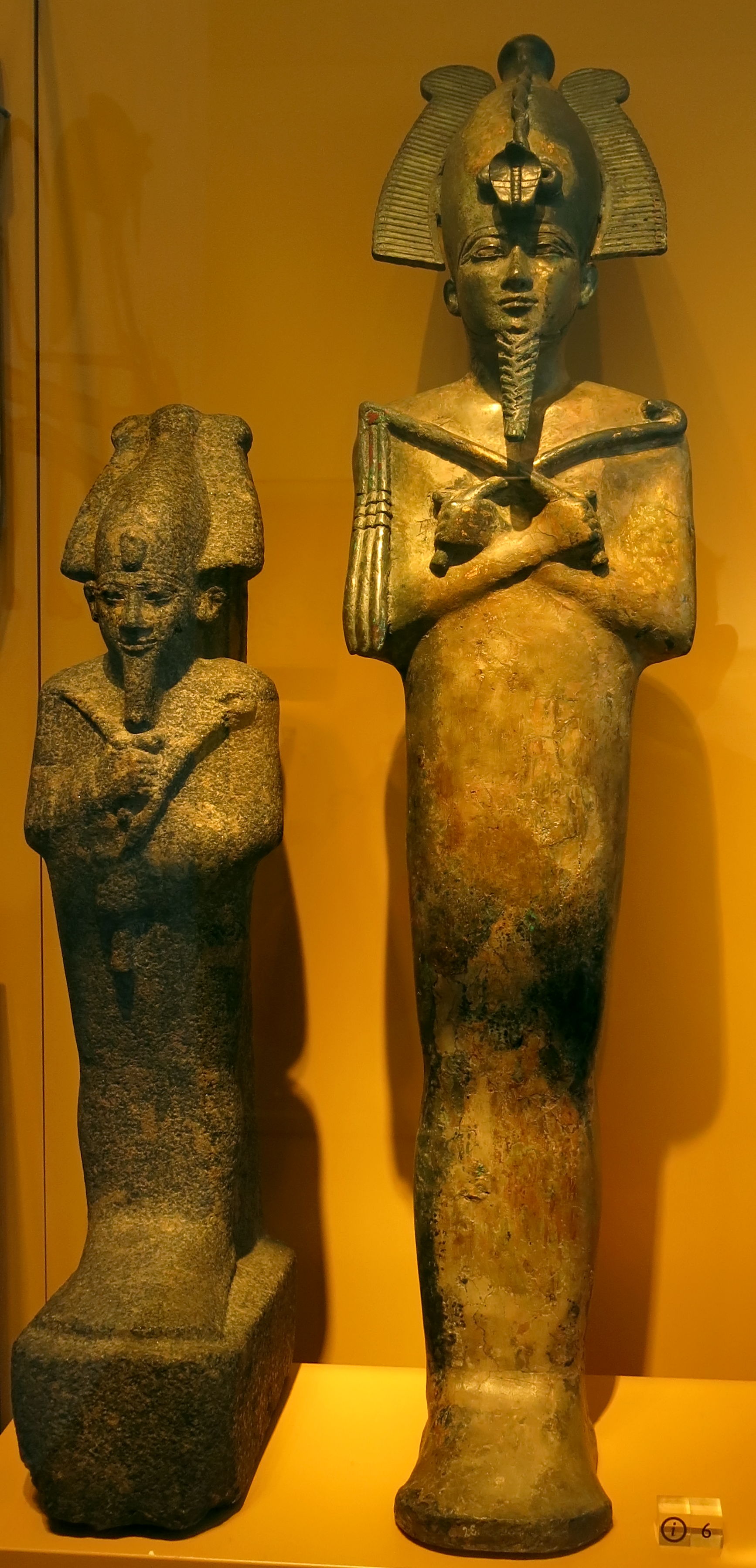
26th Dynasty: 664 BC - 525 BC
Temple statues of Osiris
The hollow cast statues are fully inlaid and covered with gold leaf.
Made of bronze, from the Thebes site, possibly Medinet Habu.
( Note that the statue on the left looks like it is made of stone rather than gold covered bronze - Don )
Photo: Don Hitchcock 2014
Source and text: Original, Rijksmuseum van Oudheden, National Museum of Antiquities, Leiden
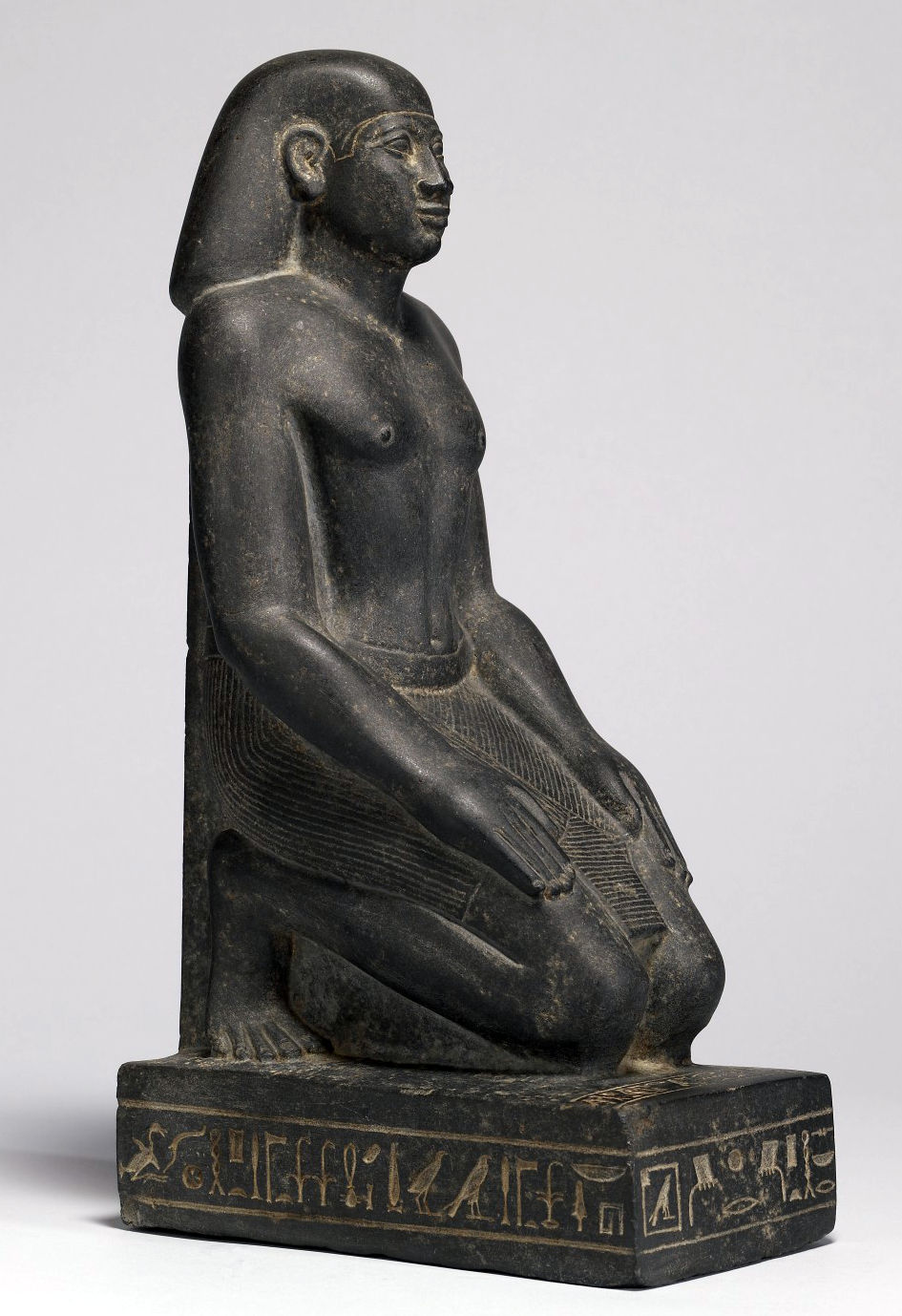
26th Dynasty: 664 BC - 525 BC
Hor-wedja
Hor-wedja was the son of Vizier Sasobek, the highest-ranking official during the reign of King Psammetichus I. Hor-wedja's son Meryptah commissioned this temple sculpture for him. Hor-wedja kneels, presenting only himself to his god. He abases himself in the deity's presence but keeps his head erect, expressing respect and confidence.
A hieroglyphic inscription gives the lineage and titles of Hor-wedja running in a horizontal band around the base, in a line across the top of the base and in a single vertical column on the back pillar. Hor-wedja kneels upon a rectangular base and his toes are splayed out in an unnatural way. He wears a belted shendyt kilt and a simple bag wig. The wide width of the wig is common for the Saite Period. The orientation of the wig onto the top of the back pillar is echoed in other sculptures from the 26th Dynasty through the reign of Apries.
As is characteristic for the period his image is quite idealised. The body appears strong but the definition of the musculature is subtle. A strong median line is visible. His hands are placed flat upon his thighs and appear unusually plump. His facial features are also typical for the Saite Period: long almond-shaped eyes with straight brows above, long smooth cheeks, a long straight nose and a softly smiling mouth. The statue is well preserved and the polish is only marred by a few minor nicks.
Circa 640 - 620 BC, made of graywacke, 375 x 113 x 198 mm.
Place of discovery: Memphis, Egypt (?)
(Translation):
His son, who makes his name live, the prophet-priest, the chief overseer of the estate, Mery-ptah;
An offering which he gives to Ptah-Sokar-Osiris, that he may give funerary offerings of bread, beer, oxen and fowl to the prophet-priest and leader of the houses, Hor-wedja;
The revered before Ptah-Sokar, the prophet-priest of Anubis of Ro-setaw, the leader of the houses (of Neith of Sais), the great one of the Two Lands, his beloved son, the priest of Neith...Hor-wedja. The revered before Hathor, the mistress of the Southern Sycamore, the prophet-priest, Hor-wedja, son of a man with the same titles, the prophet-priest of Ptah, the governor of the capital, the vizier, Sa-Sobek.
Photo and text: The Walters Art Museum, http://art.thewalters.org/detail/8349/kneeling-figure-of-hor-wedja/
Permission: Creative Commons Attribution-Share Alike 3.0 Unported License and the GNU Free Documentation License.
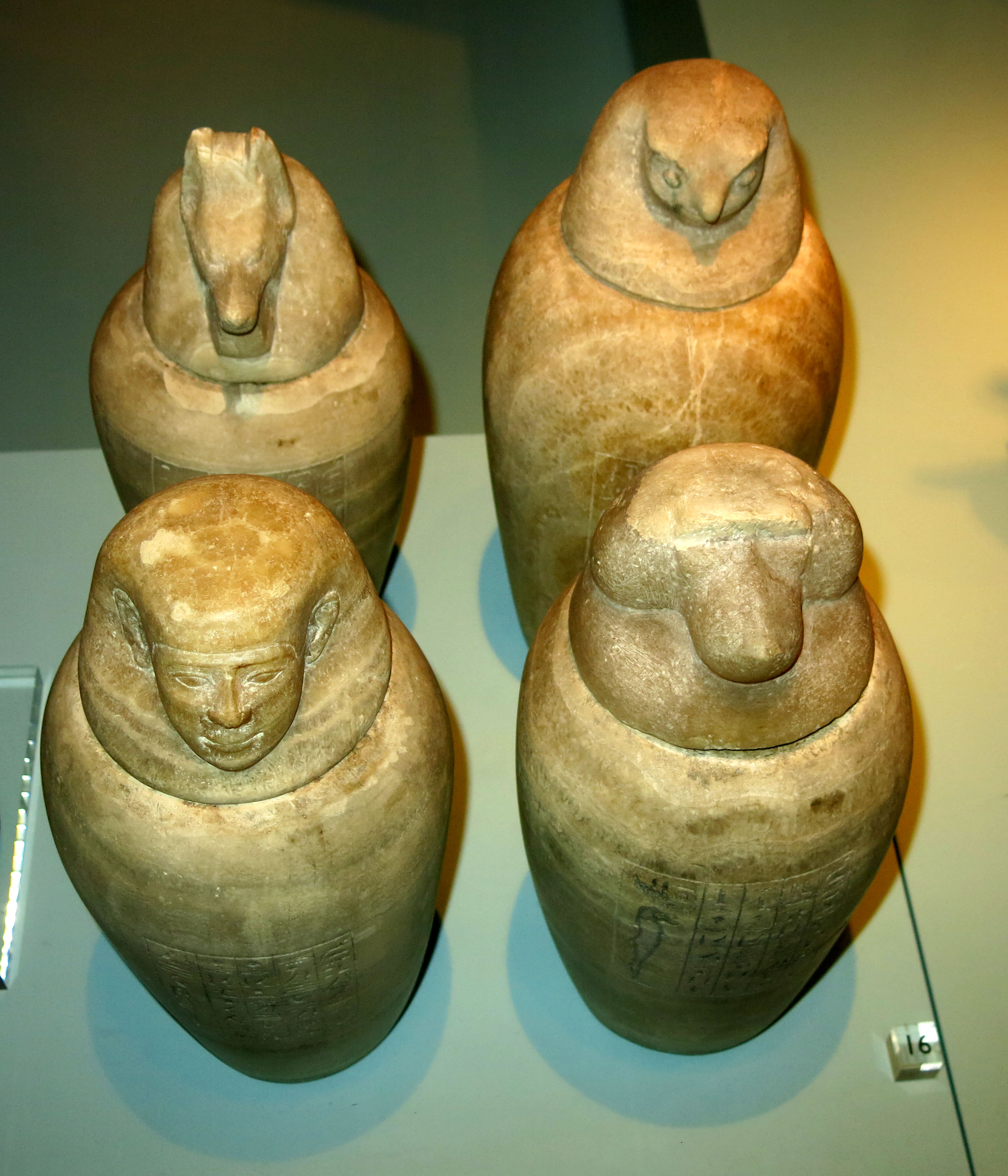
26th Dynasty: 664 BC - 525 BC
Hor-wedja
Canopic jars of Hor-wedja
Alabaster; site Memphis, Egypt (?); 664 - 525 BC, 26th Dynasty
Photo: Don Hitchcock 2014
Source: Original, Rijksmuseum van Oudheden, National Museum of Antiquities, Leiden.
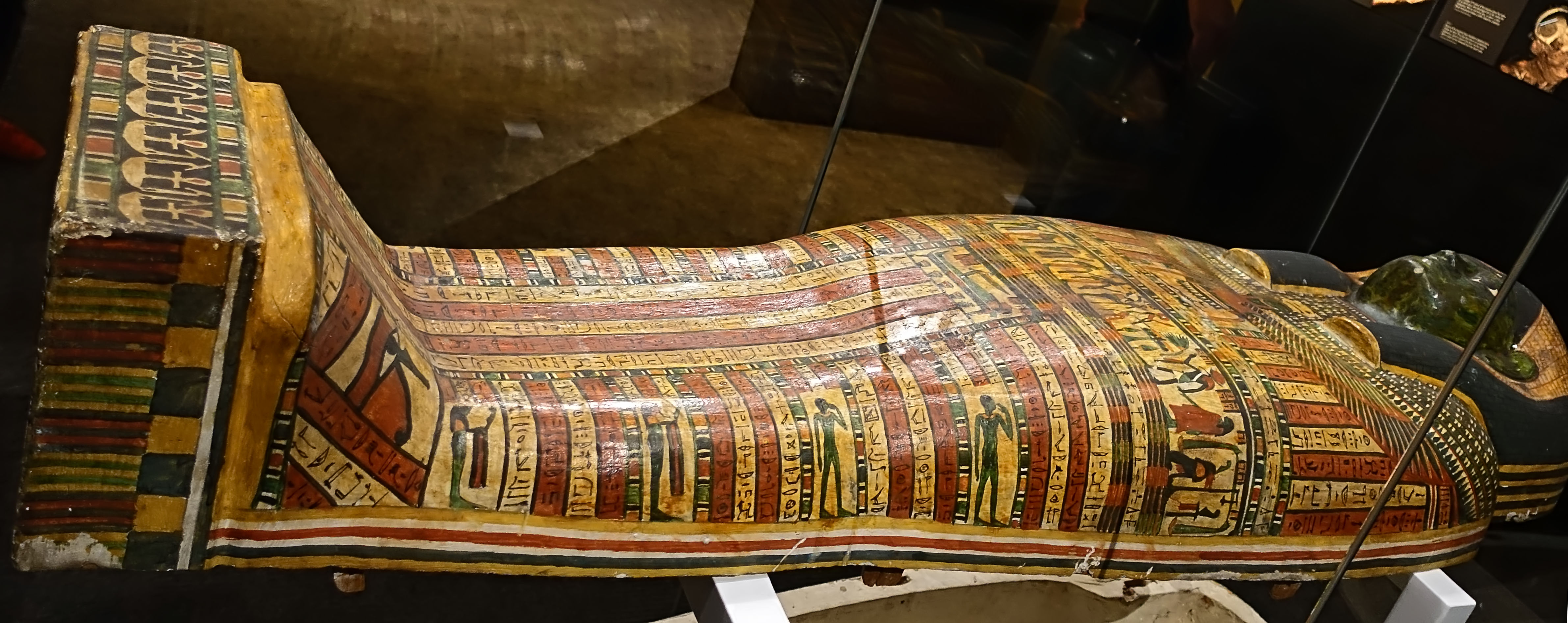
26th Dynasty: 664 BC - 525 BC
Seshepenmehyt
Base and lid of an anthropoid inner coffin of Seshepenmehyt, circa 600 BC. It is made of sycomore fig wood, ( Ficus sycomorus ) with elaborate polychrome painted decoration.
The coffin is a well-proportioned and fully three-dimensional image of a mummified entity standing upon a plinth and supported at the back by a pillar. The face is painted green.
Catalog: circa 600 BC, Thebes, EA22814
Photo: Don Hitchcock 2017
Text: Card, http://www.britishmuseum.org/, © Trustees of the British Museum, CC BY-NC-SA 4.0
Source: Exhibition by the British Museum at the National Museum of Australia, Canberra
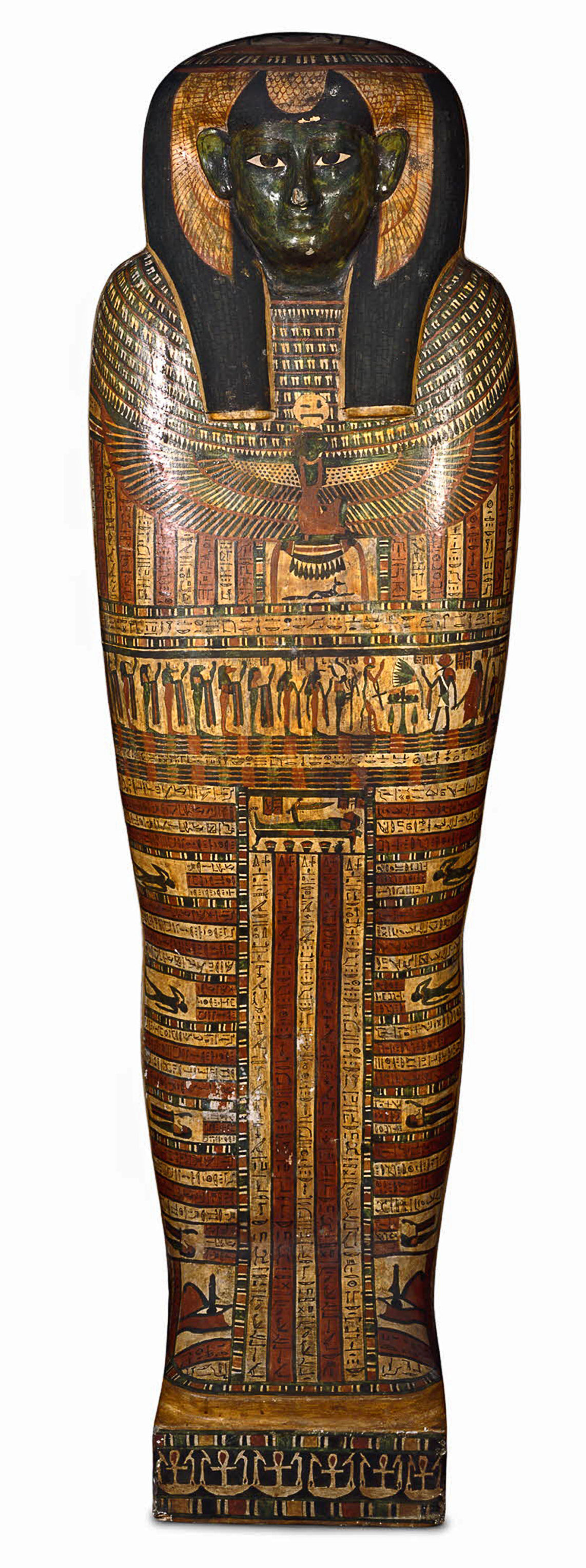
26th Dynasty: 664 BC - 525 BC
Seshepenmehyt
Below the collar Nut spreads her wings over Seshepenmehyt, and the scene of judgement and presentation to the gods is on the breast. In a small panel below, the Ba of the deceased is shown returning to the mummy, laid on its bier within the tomb, with canopic jars below. Otherwise the exterior of the coffin is dominated by blocks of inscriptions running vertically and laterally. These texts are written on backgrounds coloured alternately red and pale yellow.
Height: 300 mm, width 1770 mm, depth 550 mm (Dimensions of lid when horizontal)
Catalog: circa 600 BC, Thebes, EA22814
Photo: © Trustees of the British Museum, CC BY-NC-SA 4.0
Text: Card, http://www.britishmuseum.org/, © Trustees of the British Museum, CC BY-NC-SA 4.0
Source: Exhibition by the British Museum at the National Museum of Australia, Canberra
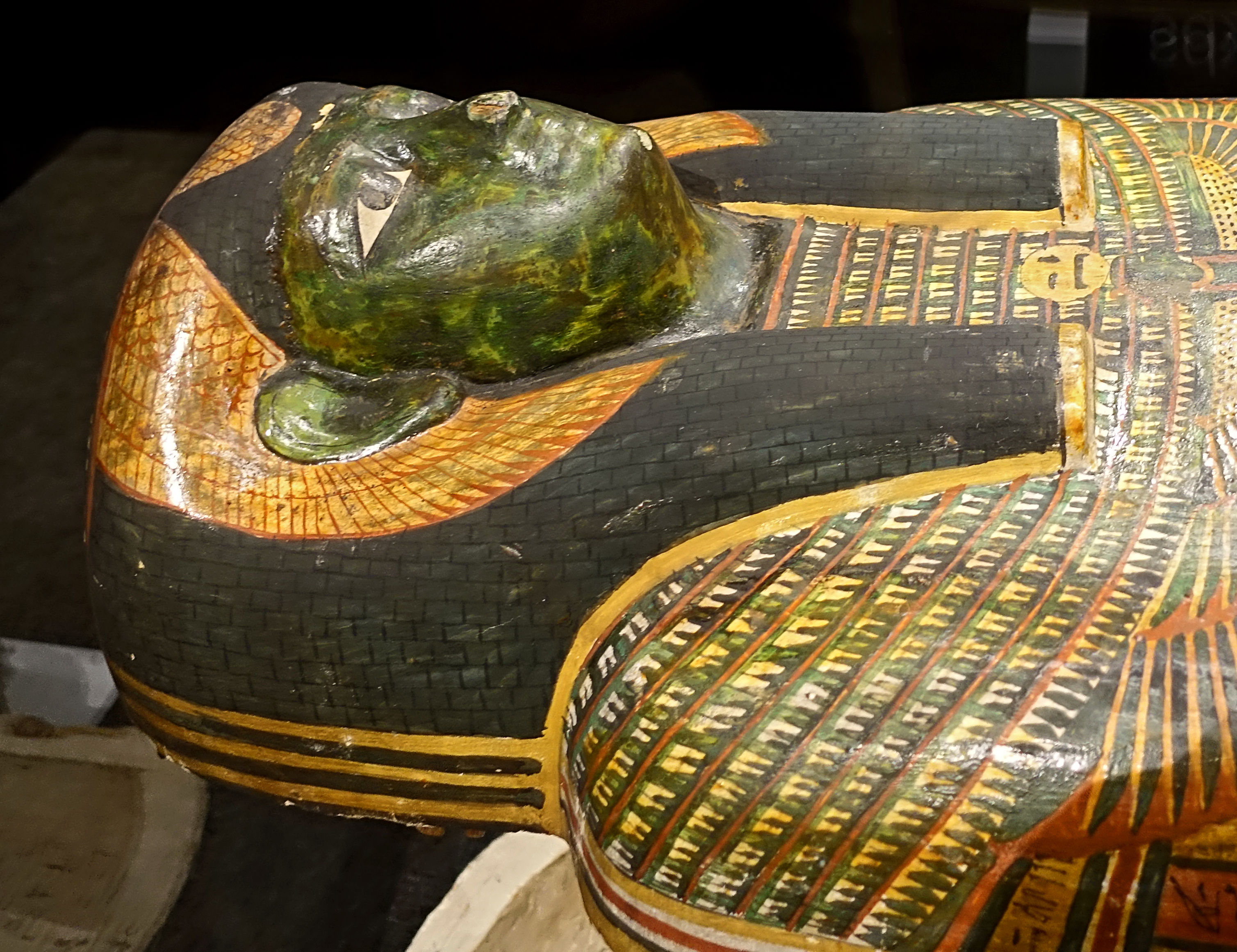
26th Dynasty: 664 BC - 525 BC
Seshepenmehyt
The inscriptions tell us little of Seshepenmehyt beyond the fact that she was 'lady of the house' and that she played the sistrum to accompany rituals in the temple of Amun-Ra at Thebes.
Catalog: circa 600 BC, Thebes, EA22814
Photo: Don Hitchcock 2017
Text: Card, http://www.britishmuseum.org/, © Trustees of the British Museum, CC BY-NC-SA 4.0
Source: Exhibition by the British Museum at the National Museum of Australia, Canberra

26th Dynasty: 664 BC - 525 BC
Seshepenmehyt
X-rays of the mummy show that beneath the wrappings is the body of an adult, who died between 25 and 40 years of age.
Catalog: circa 600 BC, Thebes, EA22814
Photo: © Trustees of the British Museum, CC BY-NC-SA 4.0
Text: Card, http://www.britishmuseum.org/, © Trustees of the British Museum, CC BY-NC-SA 4.0
Source: Exhibition by the British Museum at the National Museum of Australia, Canberra
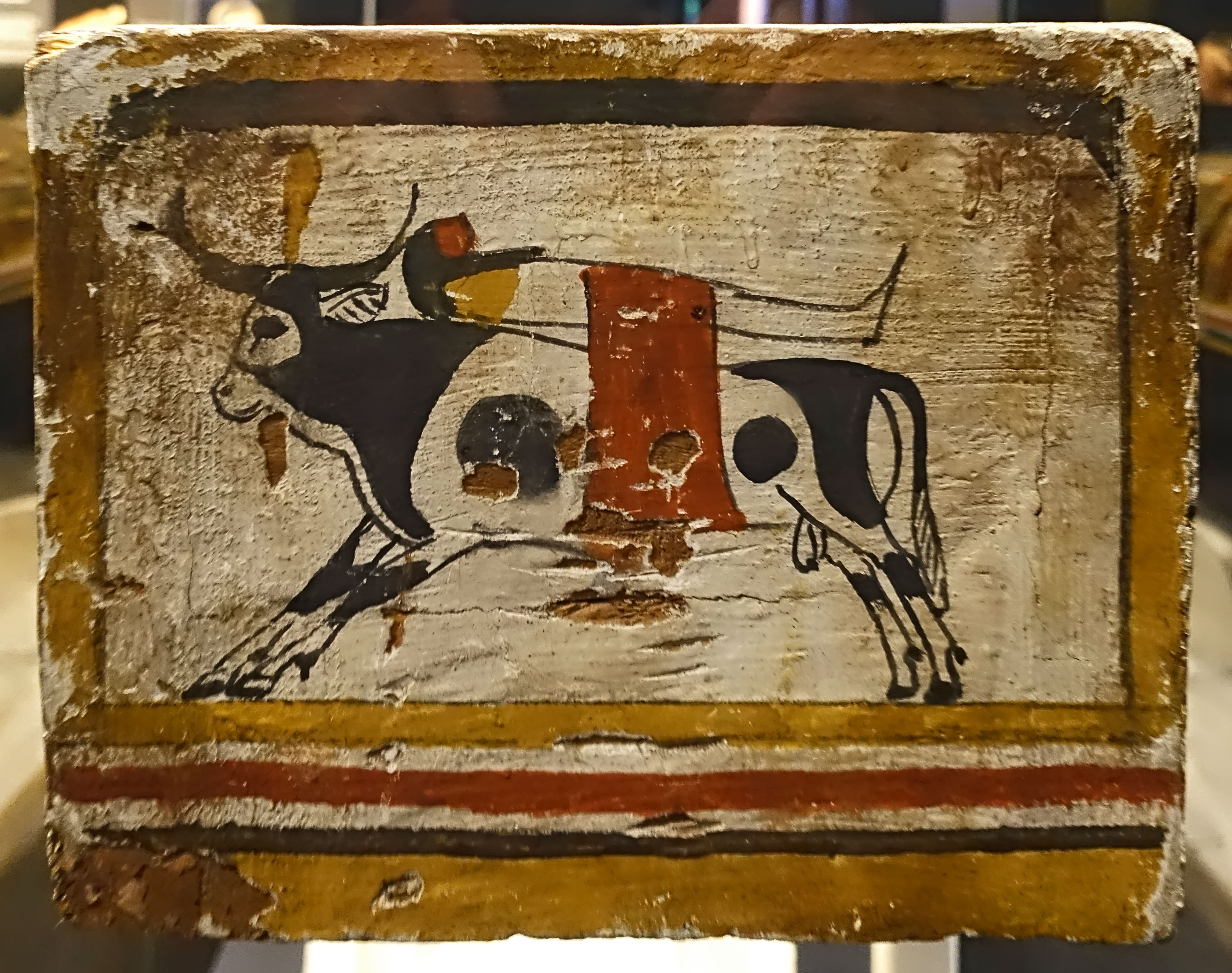
26th Dynasty: 664 BC - 525 BC
Seshepenmehyt
Base of the coffin.
Catalog: circa 600 BC, Thebes, EA22814
Photo: Don Hitchcock 2017
Text: Card, http://www.britishmuseum.org/, © Trustees of the British Museum, CC BY-NC-SA 4.0
Source: Exhibition by the British Museum at the National Museum of Australia, Canberra
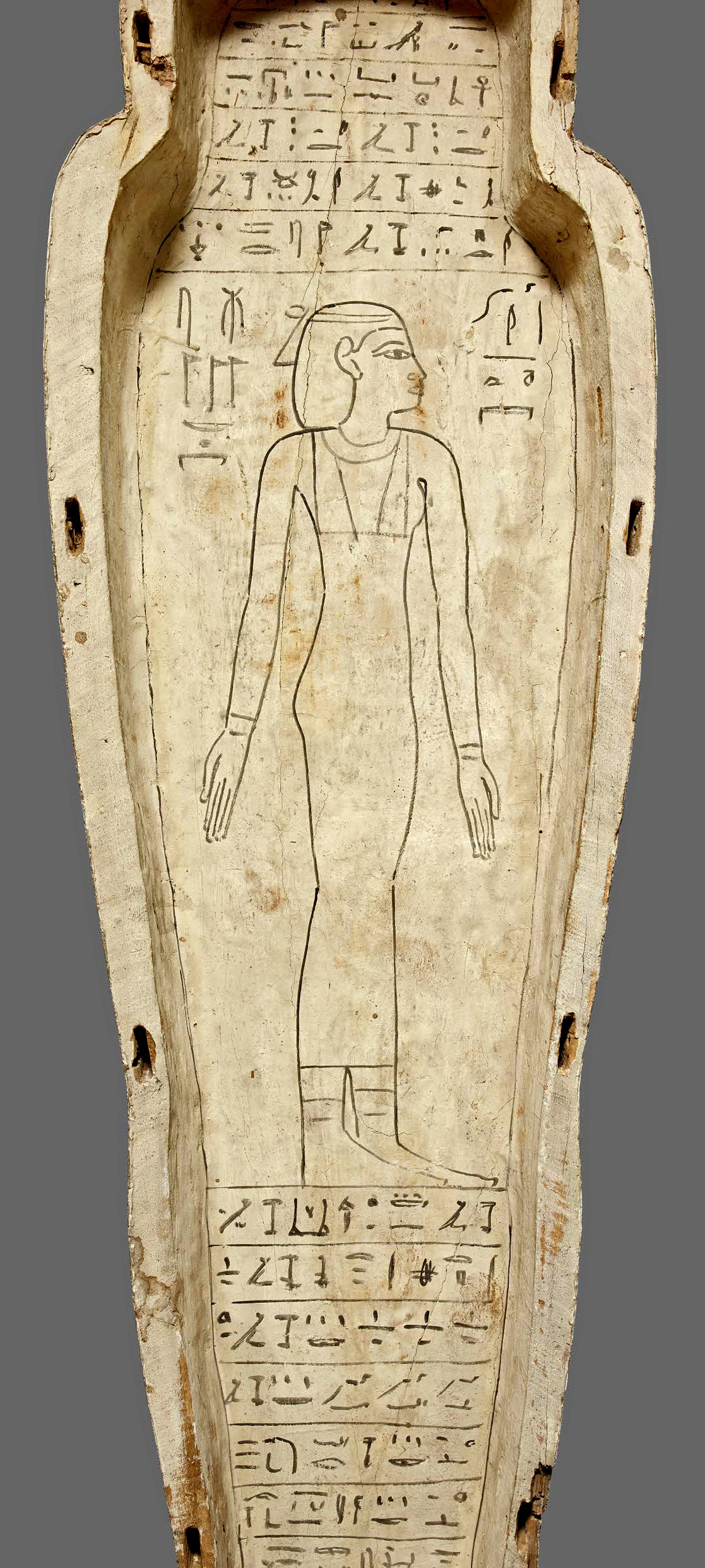

26th Dynasty: 664 BC - 525 BC
Seshepenmehyt
Inside of the coffin, top and bottom.
The insides of the inner coffin are also decorated, but in a simple style, with 'hotep-di-nesu' formula and figures of Nut drawn in black line on a white ground.
Catalog: circa 600 BC, Thebes, EA22814
Photo: © Trustees of the British Museum, CC BY-NC-SA 4.0
Text: Card, http://www.britishmuseum.org/, © Trustees of the British Museum, CC BY-NC-SA 4.0
Source: Exhibition by the British Museum at the National Museum of Australia, Canberra
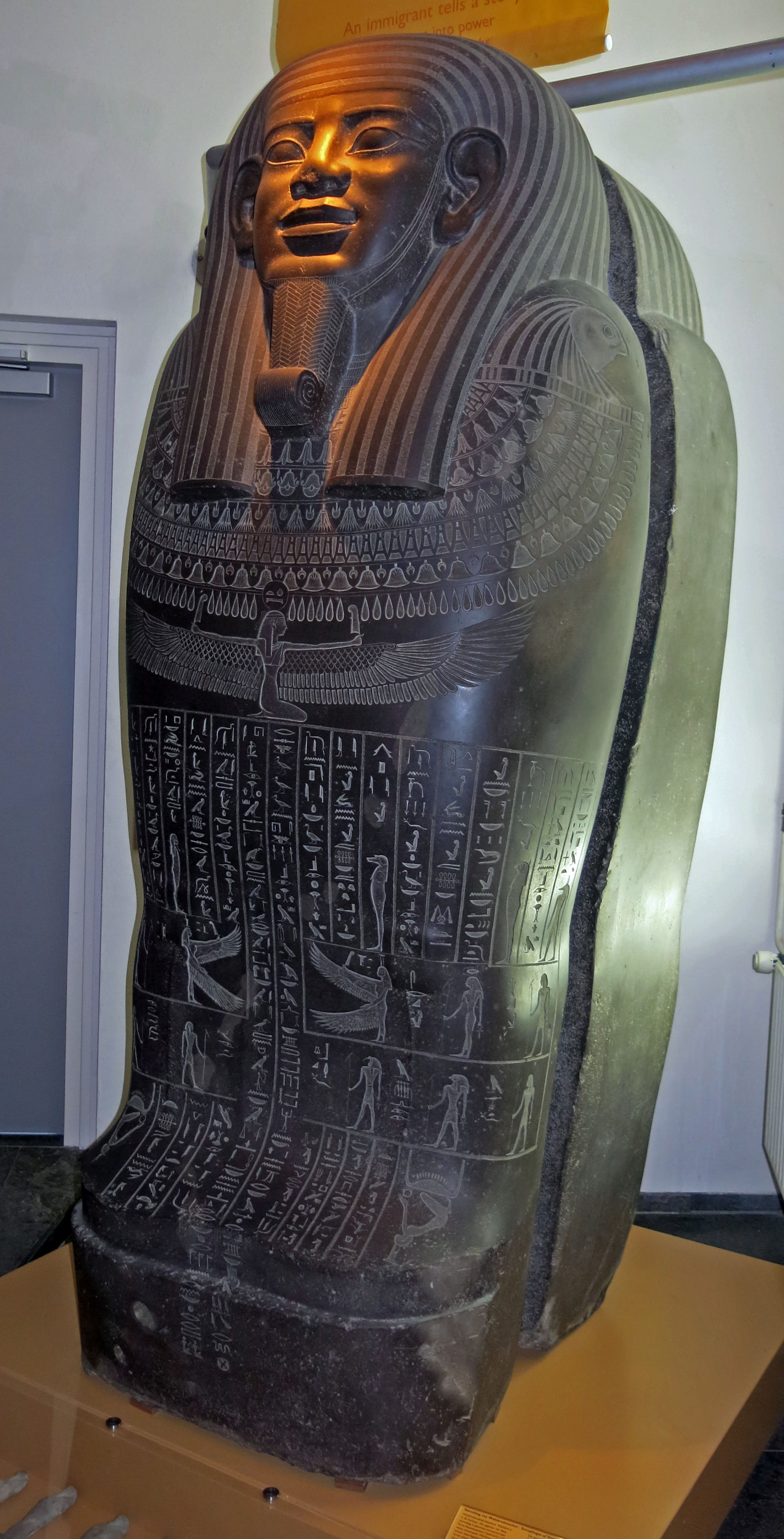
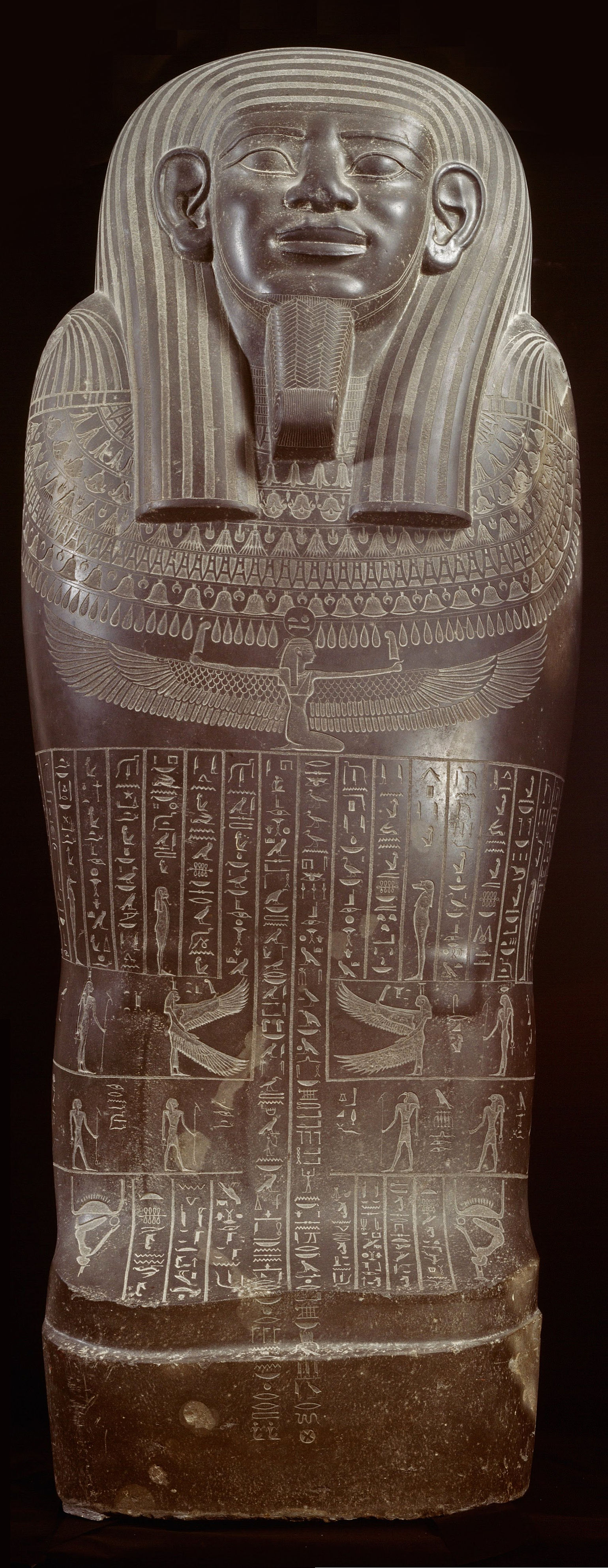
26th Dynasty: 664 BC - 525 BC
Wahibreemakhet
Sarcophagus of Wahibreemakhet.
600 - 525 BC, 105 x 94 x 230 cm.
The Twenty-sixth Dynasty of Egypt was the last native dynasty to rule Egypt before the Persian conquest in 525 BC (although others followed). The dynasty's reign (c. 685–525 BC) is also called the Saite Period after the city of Sais, where its pharaohs had their capital, and marks the beginning of the Late Period of ancient Egypt. In this period the great stone sarcophagi came back into use. This basalt sarcophagus belonged to Wahibreemakhet, a man of a Greek immigrant family.
The massive basalt sarcophagus of Wahibreemakhet is a typical expression of the Sais renaissance. Stone sarcophagi had become completely obsolete at the end of the New Kingdom; even the kings of the Third Intermediate Period made do usually with usurped specimens from previous periods. Among the Renaissance kings However, we find a renewed production of huge granite or basalt coffins. They are clearly inspired by examples from the New Kingdom, though the stocky shape with wide flat faces, surrounded by heavy wigs, are in fact quite ungainly. By contrast, very sophisticated decoration with an almost metallic perfection could be realised in this hard material.
Wahibreemakhet's parents were Arkskares and Sentiti which are recognised Greek names. This sarcophagus will therefore have belonged to the son of a Greek immigrant family. The 26th dynasty maintained close contact with a number of Greek cities. Many Greeks took mercenary service in the Egyptian army and hoped to become a merchant in the capital Memphis (where an entire Greek quarter arose) or in the special free port Naukratis in the Delta.
Yet Wahibreemakhet betrays nothing in this case of his Greek descent. The decoration is thoroughly Egyptian, with his beard and severe wig, the sky goddess Noetop on the chest, and Horuszonenen and other gods and demons below. The sarcophagus probably comes from Giza and Saqqara, where at this time of tens of metres of deep shaft graves were dug. The casket would have contained a wooden inner coffin, which contained the mummy, which at this time were often provided with rich jewels and amulets. Of these, however, in this case, nothing is left. We do not have the shabtis of Wahibreemakhet.
Photo (left): Don Hitchcock 2014
Source: Original, Rijksmuseum van Oudheden, National Museum of Antiquities, Leiden.
Photo (right): https://www.google.com/culturalinstitute/asset-viewer/sarcophagus-of-wahibreemakhet/6gF2eBYBDb2csg?hl=en
Text: http://www.rmo.nl/onderwijs/museumkennis/verhalen/sarcofaag-van-wahibre%C3%ABmachet

26th Dynasty: 664 BC - 525 BC
Shabti of Wah-ib-Rêe-em-akhet.
( note that there are many shabtis of Wahibreemakhet in museums around the world - Don )
The case of Wahibreemakhet, son of Alexikles and Zenodote, is the most prominent example for the high status that Greeks – as mercenaries or advisors – could attain in Egypt under the Saite pharaohs. His final resting place is identified in a tomb at Saqqara that was probably discovered by agents of Giovanni Anastasi in the 1820s and that contained not only Wahibreemakhet’s elaborate stone sarcophagus (now in Leiden), canopic jars (in Stockholm) and shabtis (in various collections), but also a set of limestone tomb reliefs recording spells from the Book of the Dead that are today in the collection of the British Museum and that were once erroneously attributed to ‘Campbell’s tomb’ at Giza. Wahibreemakhet’s rich burial, dating to the decades around 600 BC, and his ranking title 'Royal Sealer' illustrate both his social status and his assimilation to Egyptian culture.
Catalog: Faience, Saqqara ÄM 937
Photo: Don Hitchcock 2018
Source: Original, Staatliche Museen zu Berlin, Neues Museum, Germany
Text: © Card at the Staatliche Museen zu Berlin, http://www.smb-digital.de/, (CC BY-NC-SA 3.0 DE)
Additional text: https://www.brooklynmuseum.org/ , https://www.researchgate.net/publication/328786119_Wahibreemakhet_at_Saqqara
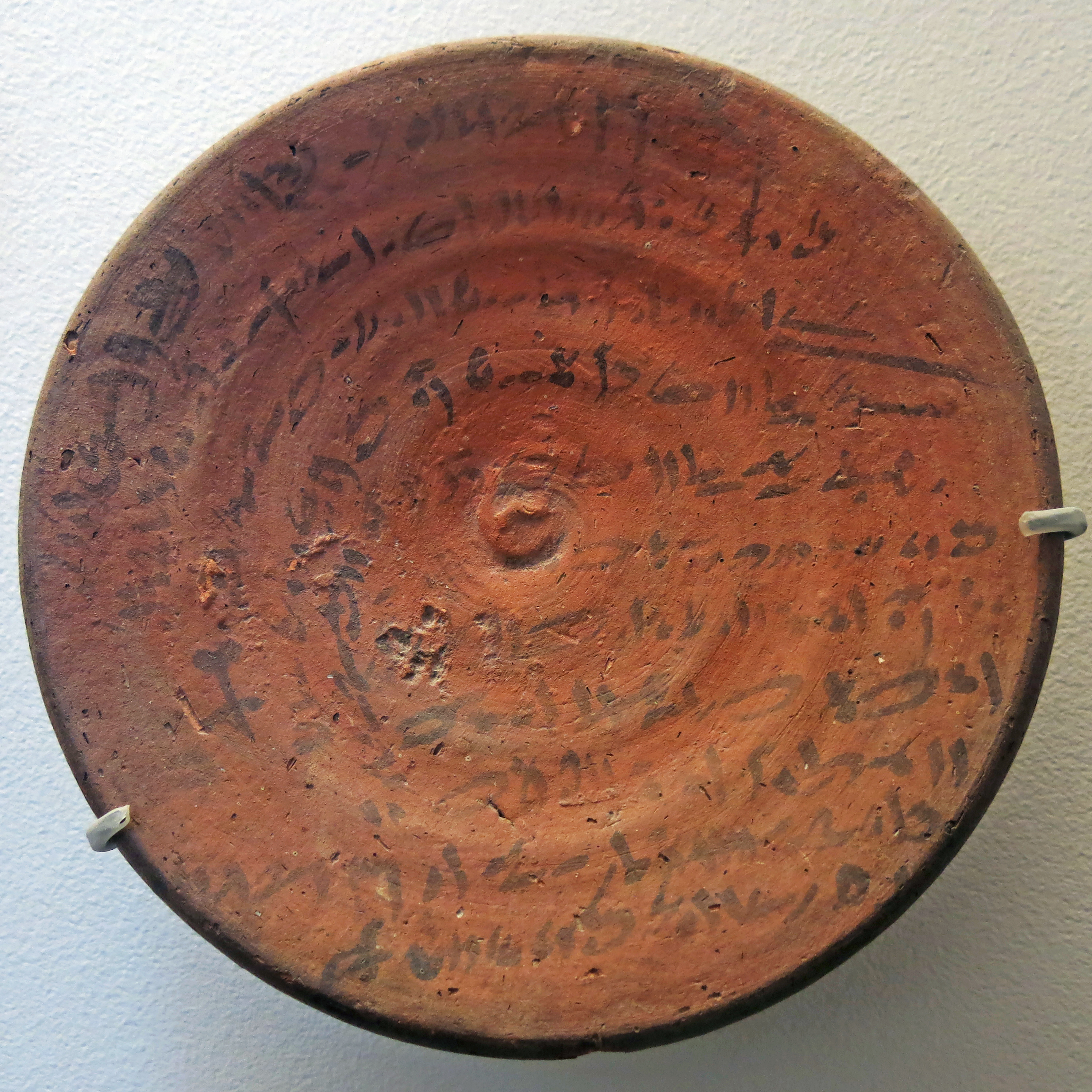
26th Dynasty: 664 BC - 525 BC
Slave contract
Personal commitment contract for a slave, 592 BC (year 4 of the reign of Psamtik II).
Terracotta bowl.
The demotic script reads:
I am satisfied with the money for which I become your servant. I am your servant... I will no longer be able to consider myself a private person independent of you, until I have repaid you for all the money, all the grain, all the other things in the world, with the children that will be born to me, with all that belongs to me and all that I will produce, with the clothes on my back...'
Translation after B. Menu.
Depth 25 mm, diameter 164 mm.
Catalog: Terracotta, slip, paint, red - black, Demotic script, N 706, LP 14, E 706 ERR
Location: Sully, Salle 335, Writing and the scribes, Vitrine 3.3
Photo: Don Hitchcock 2015
Source and text: Original, Louvre Museum, https://collections.louvre.fr/

26th Dynasty: 664 BC - 525 BC
Amasis II
Basalt sarcophagus of Amasis II (or Ahmose II), (reigned ca 570 BC - ca 526 BC), pharaoh of the twenty-sixth dynasty of Egypt.
Dimensions: 135 x 130 x 246 cm
Catalog: Basalt sarcophagus, AM 5-a.
Source: Original, Rijksmuseum van Oudheden, National Museum of Antiquities, Leiden.
Photo and text: http://www.rmo.nl/collectie/zoeken?object=AM+5-a
Additional text: Wikipedia
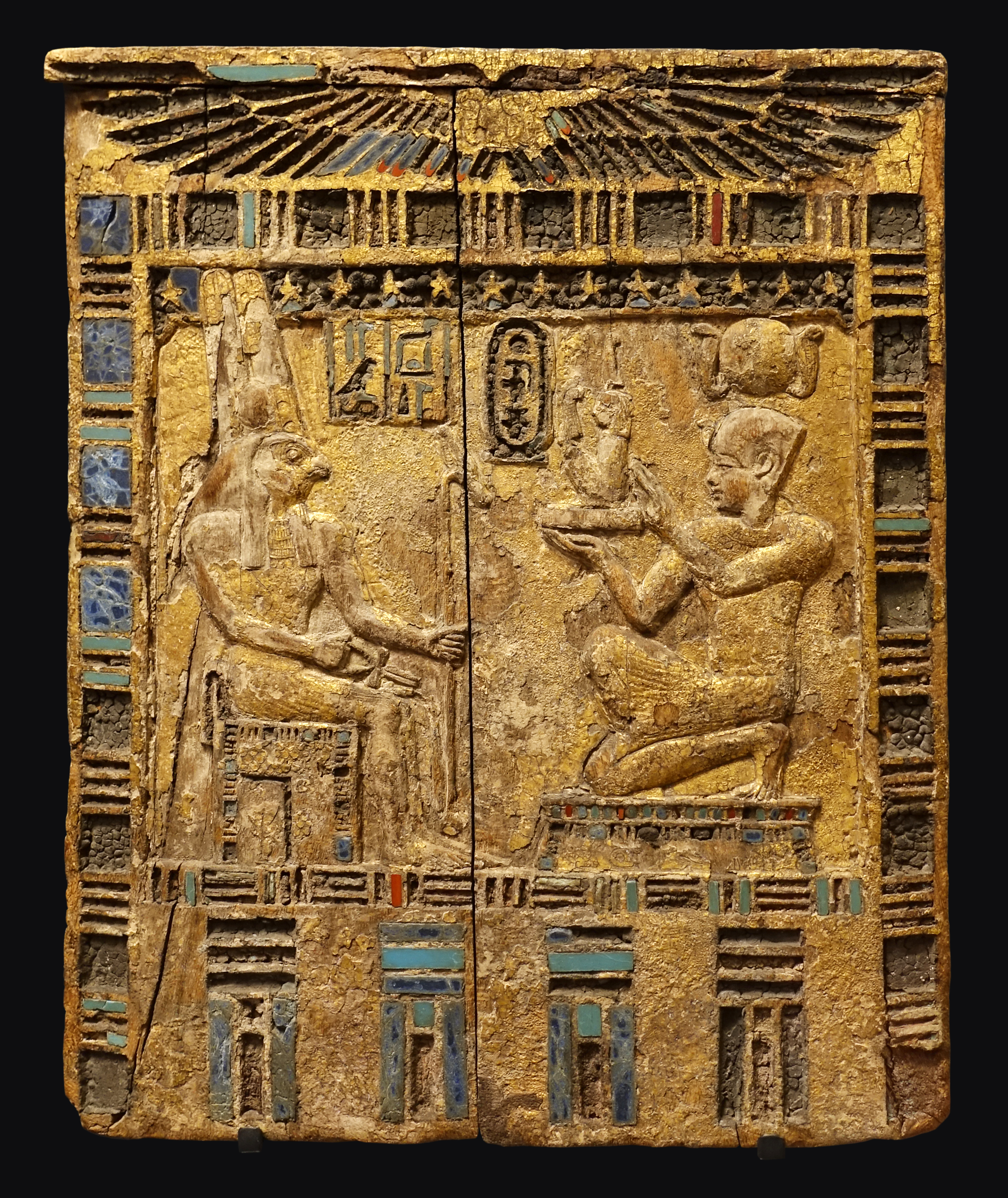
26th Dynasty: 664 BC - 525 BC
Amasis II / Ahmose II
Gilded and Inlaid Golden Naos or Shrine
Reign of Amasis II, 570 BC - 526 BC
Offering of Maat; king (kneeling, cornice base, loincloth, blue crown, offering, Ma'at; Sopdou (hawk-headed god, seated, double right feather)
At the top: winged solar disk with uraeus; starry sky sign
At the bottom: decoration on the facade of a palace (from text)
Height 315 mm, width 275 mm, thickness 45 mm.
Catalog: Sully wing, room 334, level 0, E 605; No. 504; Clot bey C 7 n°8
Photo: Don Hitchcock 2018
Source and text: Original, Louvre Museum, https://collections.louvre.fr/
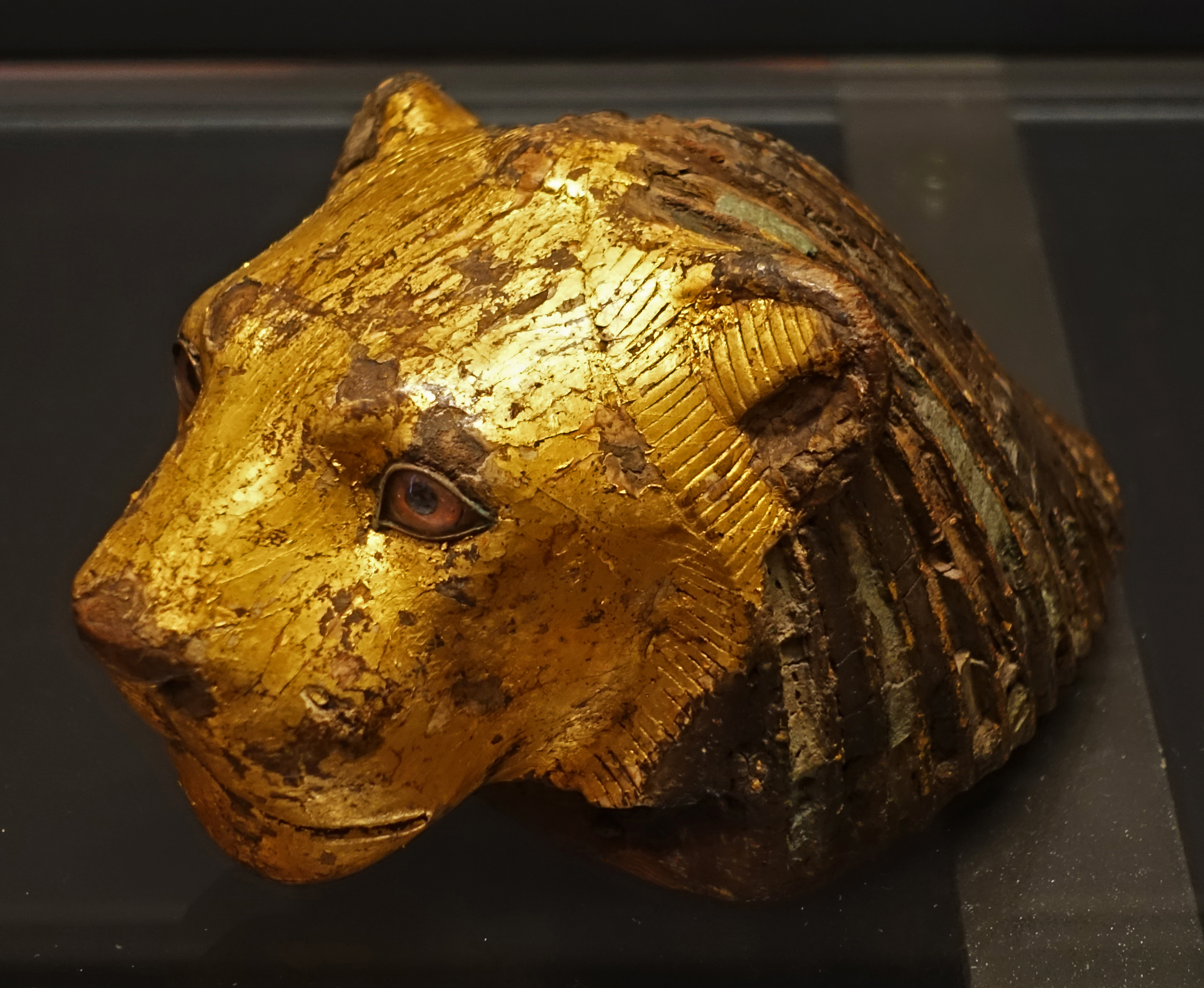
26th Dynasty: 664 BC - 525 BC
Lion Head, part of a piece of furniture
Circa 664 BC - 332 BC (Late Period)
Height 83 mm, length 165 mm, width 93 mm.
Catalog: Tamarisk wood, glass, gilding, inlaid, stuccoing, Sully wing, room 334, level 0, E 2558; No. 3800; Clot bey C 30 n°11
Photo: Don Hitchcock 2018
Source and text: Original, Louvre Museum, https://collections.louvre.fr/
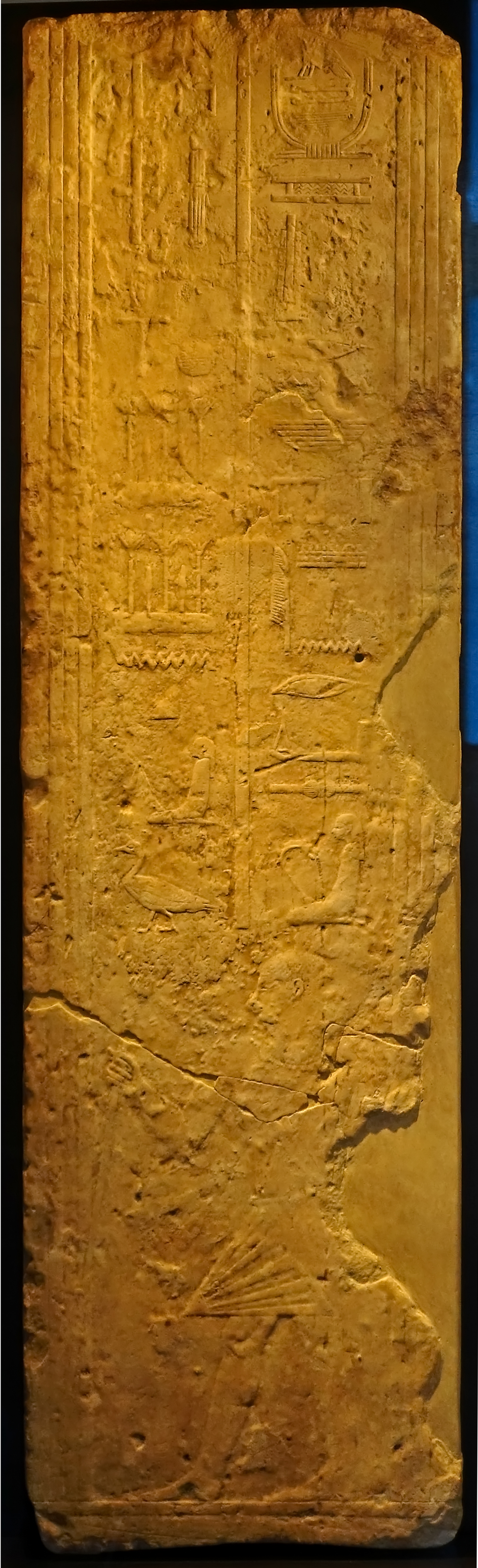
26th Dynasty: 664 BC - 525 BC
Door Frame
Door frame from the tomb of Sheshonq-ankh, circa 600 BC.
A re-creation of the Art of the Kushite Period
(25th dynasty, 746-655 BC)
Following the Third Intermediate Period,
which tied in stylistically to the late New
Kingdom and only brought forth idealised
images, Egyptian art received exciting new
impulses from the foreign rulers of the 25th
dynasty - the Kushites - originating in the
Kingdom of Napata, by the 4th cataract far
to the south. Inspired by African art, the new
human image is bolder in its proportions (as
in those of the slaughtering relief below) and
the faces are more differentiated, going so
far as to offer portraits of old age ( quartzite statue
head of Montemhat / Mentuemhat below).
At the same time, the artists consciously
delved into the past, modelling some of their
work on examples from earlier periods. This
relief (left), once the lower left part of a door
frame, illustrates this archaising style: at
first glance, the figure of the tomb owner
Sheshonq-ankh looks like a work of the Old
Kingdom. An attribution to the Late Period
results from an examination of the totality
of the work, including the text and general
proportions.
Photo: Don Hitchcock 2018
Catalog: Limestone, Gizeh, Gl. 95
Source: Original, Ägyptischen Museum München
Text: Poster and Museum card, © Ägyptischen Museum München

26th Dynasty: 664 BC - 525 BC
Montemhat
Torso of a standing-striding figure of the priest Montemhat wearing a panther skin, circa 650 BC.
( note the head of Hathor at the centre of the (original) piece - Don )
Catalog: Quartzite, Thebes, Gl. 127
Photo: Don Hitchcock 2018
Source: Original, Ägyptischen Museum München
Text: Museum card, © Ägyptischen Museum München
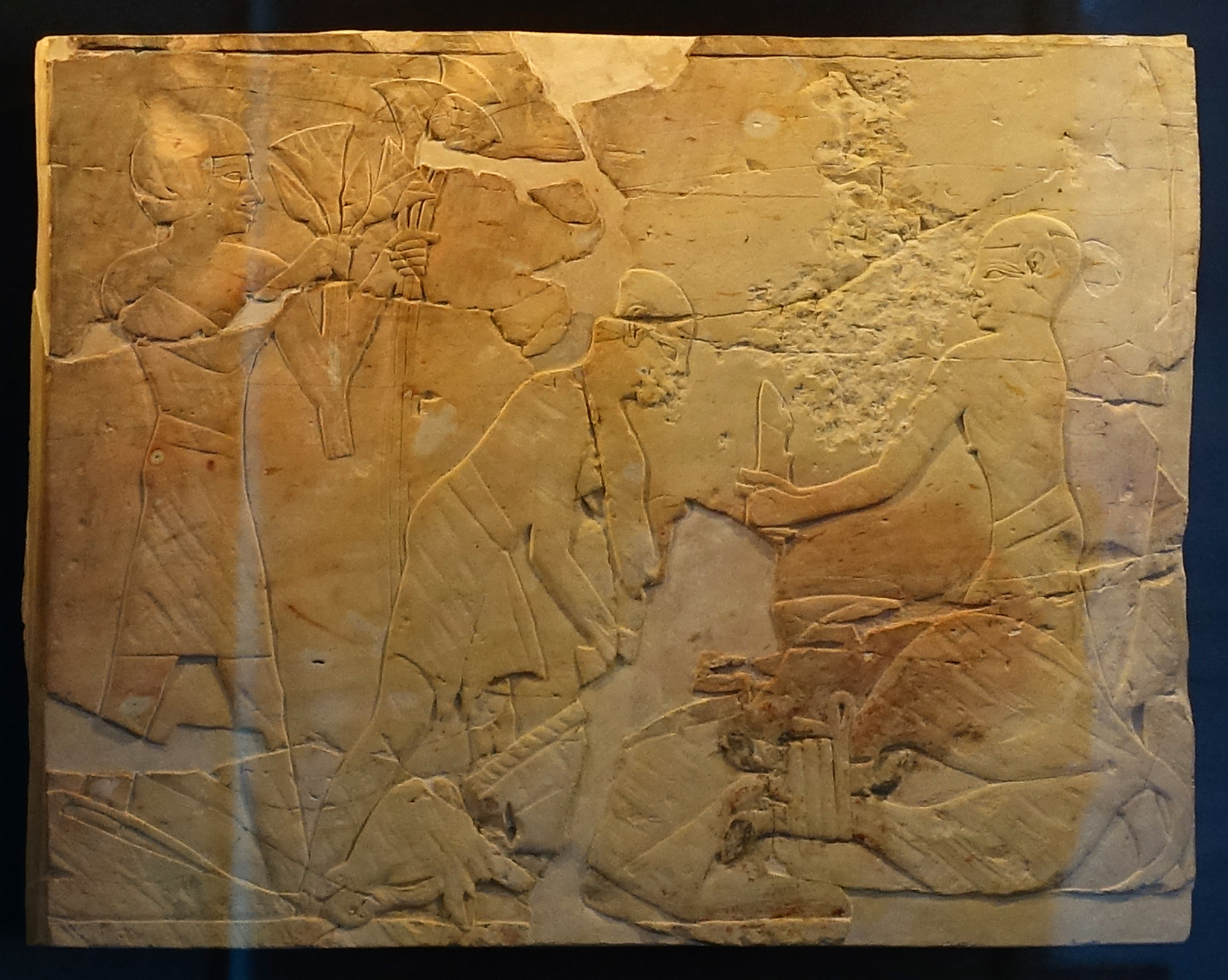
26th Dynasty: 664 BC - 525 BC
Tomb relief
Tomb relief with butchering scene, circa 600 BC.
Photo: Don Hitchcock 2018
Catalog: Limestone, Thebes Gl. 288
Source: Original, Ägyptischen Museum München
Text: Poster and Museum card, © Ägyptischen Museum München
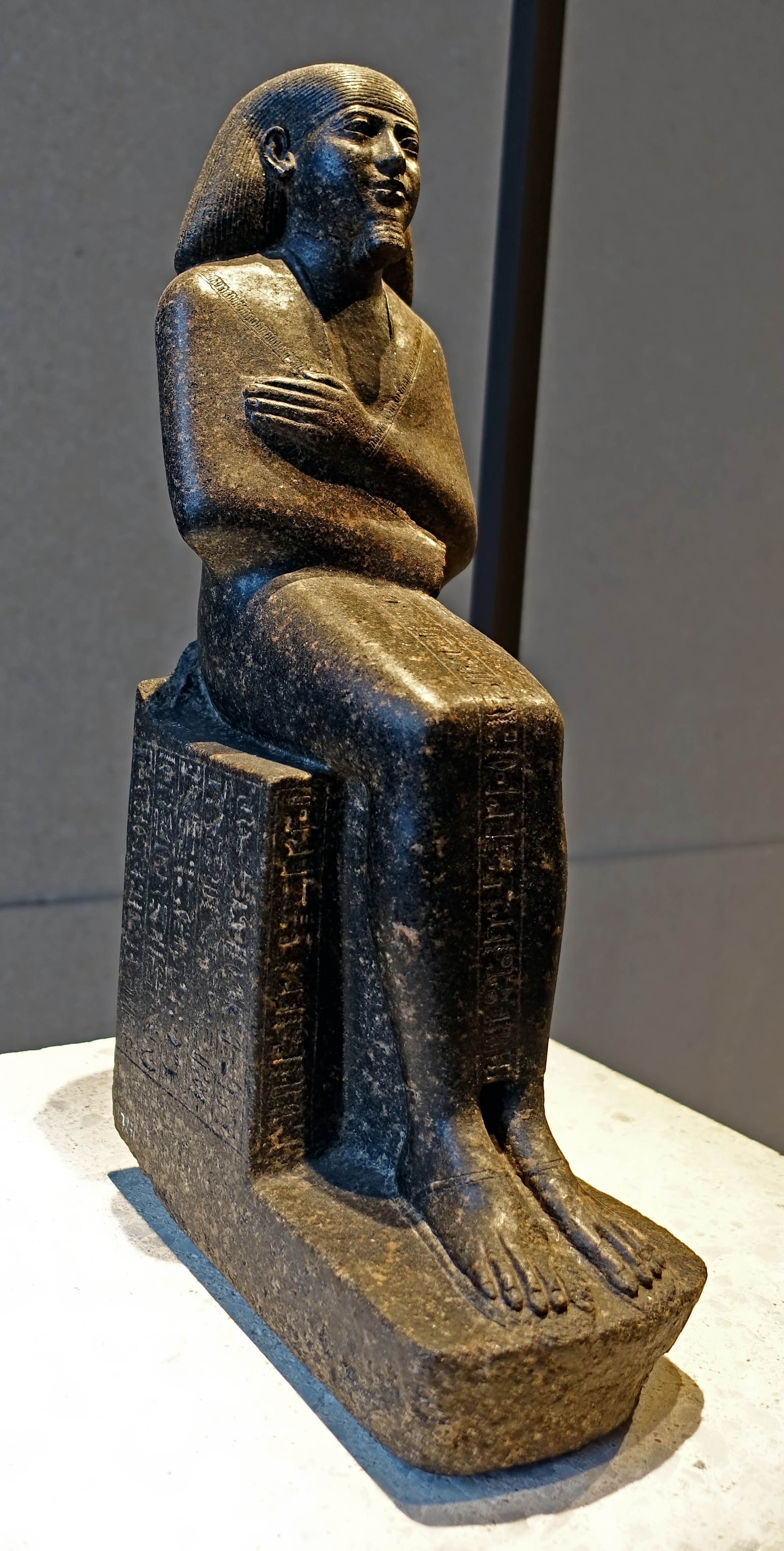
25th - 26th Dynasty: 746 BC - 525 BC
Montemhet / Montemhat / Mentuemhat
Seated figure of Montemhet, governor of the district of Thebes.
Fourth Prophet of Amun, circa 675 BC - 650 BC.
A finely worked statue of grey granite, 500 mm high. Montemhet is seated on a chair with arms folded, and enveloped in a long mantle. The face is youthful. The stone block representing the chair is inscribed on all four sides. In addition, a column of text runs down the centre of the mantle, and the back plinth is inscribed in two columns. The style of the statue is derived from Middle Kingdom prototypes.
The documentation for the high officials of Upper Egypt in the Post-Imperial epoch is relatively rich. They built sumptuous tombs on the west bank of Thebes and placed quantities of their statues in the temples. Many of these statues escaped destruction through the ironic fact that, contrary to the wishes of their owners, they were periodically removed from the temples and buried in the ground, to be dug up only at the beginning of the 20th Century. Thus we can build up dossiers and compile genealogies.
The inscriptions of Montemhet typify this situation. Coming from a family of Theban notables, Montemhet played a leading role during many troubled years. He was ' Count of Thebes ', and ' Governor of Upper Egypt ', as well as ' Fourth Prophet of Amun ' under the Nubian kings Taharqa and Tantamani, and he was still in office in the reign of Psamtik I, the founder of the Saite Dynasty. His career spans the half century from 700 BC to 650 BC. He witnessed the recurring Assyrian invasions, including the climactic capture of Thebes in 663 BC, an event that reverberated around the ancient world. After that, with King Tantamani having fled to Nubia and Psamtik I not yet in control of all of Egypt, the Thebaid was virtually autonomous under the governance of Montemhet and of his colleagues, the high stewards of the Divine Consort of Amun, the princess Shepenupet II. And when Psamtik I had attained full power he still retained the services of the aged Montemhet.
In the later periods of Egypt's history, the role of Divine Wife of Amun was held at Thebes by the king's daughter and was designed to prevent the emergence of a rival to the king. Montemhet (who was the Fourth Prophet in the Temple of Amun at Karnak), managed to gain considerable practical if not outright political power at Thebes, at the side of the Divine Wife Shepenopet II, who was King Piankhy's daughter and the successor of Amenardis I as the God's Wife.
Egypt was currently passing through troubled times and the Ethiopian rulers were in combat with the Assyrian forces in Egypt during the Twenty-fifth Dynasty. Montemhet was mentioned in the Rassam cylinder of Ashurbanipal as 'King of Thebes', but although he undoubtedly wielded considerable influence there, no evidence indicates that he attempted outright to seize royal power. He came from a distinguished family (his grandfather was Vizier), and he built extensively at Thebes. He was a dutiful subject: a scene in the Temple of Mut at Karnak shows him, with his father and son, following the figure of King Taharka as they worship the goddess Mut. Nevertheless in the accompanying inscription, he takes full credit for the programme of construction and repair of the divine buildings which customarily would have been ascribed to the king's own initiative.
Montemhet's tomb, one of the largest private tombs in the Theban Necropolis (no. 34), is located in front of Deir el Bahri and is currently under restoration.
Catalog: Granite, Karnak, ÄM 17271
Photo: Don Hitchcock 2018
Source: Original, Staatliche Museen zu Berlin, Neues Museum, Germany
Text: © Card at the Staatliche Museen zu Berlin, http://www.smb-digital.de/ (CC BY-NC-SA 3.0 DE)
Additional text: http://ancient_egypt.enacademic.com/799/Montemhet
Additional text: Lichtheim (1980)
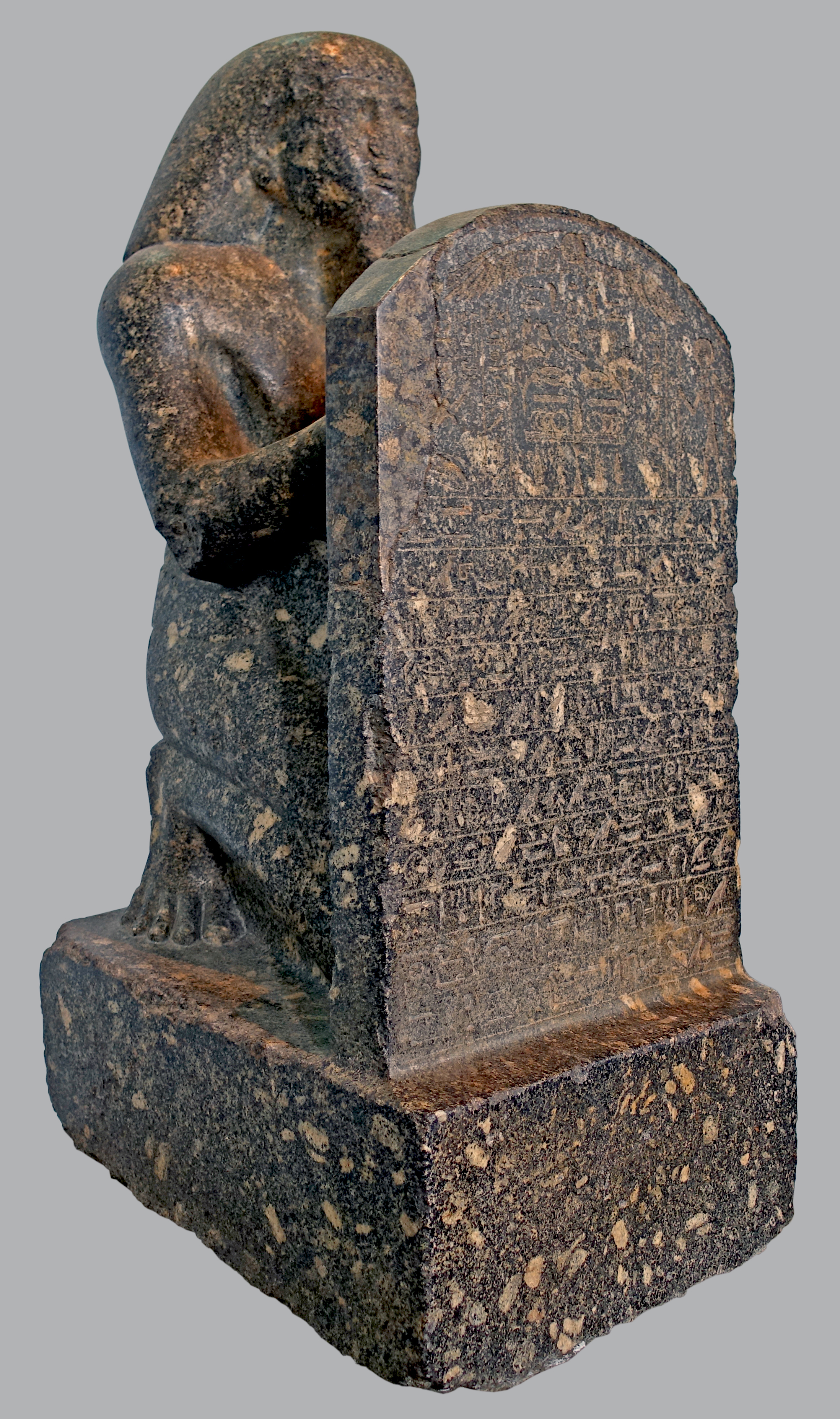
25th - 26th Dynasty: 746 BC - 525 BC
Statue of Governor Montemhet / Montemhat / Mentuemhat
Late 25th - early 26th Dynasty, circa 700 BC - 650 BC.
Statue of Governor Montuemhat
Montuemhat kneels behind a stela, raising his hands in worship. The damaged top left of the stela shows him likewise, adoring the sun-god Atum-Khepri. A hymn below describes Atum's sunset into the nerthworld. A matching statue, now in Cairo, bears a hymn to the sun at sunrise. Both must be from the governor's giant tomb.
Montuemhat ruled from Thebes over Upper Egypt, first as a vassal of the Kushite kings. He switched loyalty as Psamtek I of Sais phased out all foreign domination by Assyria and Kush.
From Western Thebes, Asasif, tomb of Montuemhat. Granodiorite, EA1643
Granodiorite kneeling stelophorous (stele-bearing) statue of Mentuemhat. The stela bears an offering scene above eleven rows of Hieroglyphic text as well as two columns of Hieroglyphic text on the back-pillar.
Height 76 cm, width 32 cm, depth 43 cm, weight 155 kg.
Named in inscription and portrayed: Mentuemhat
Catalog: Granodiorite, EA1643
Photo: Don Hitchcock 2018
Source: Original, British Museum
Text: Card at museum display © Trustees of the British Museum, CC BY-NC-SA 4.0
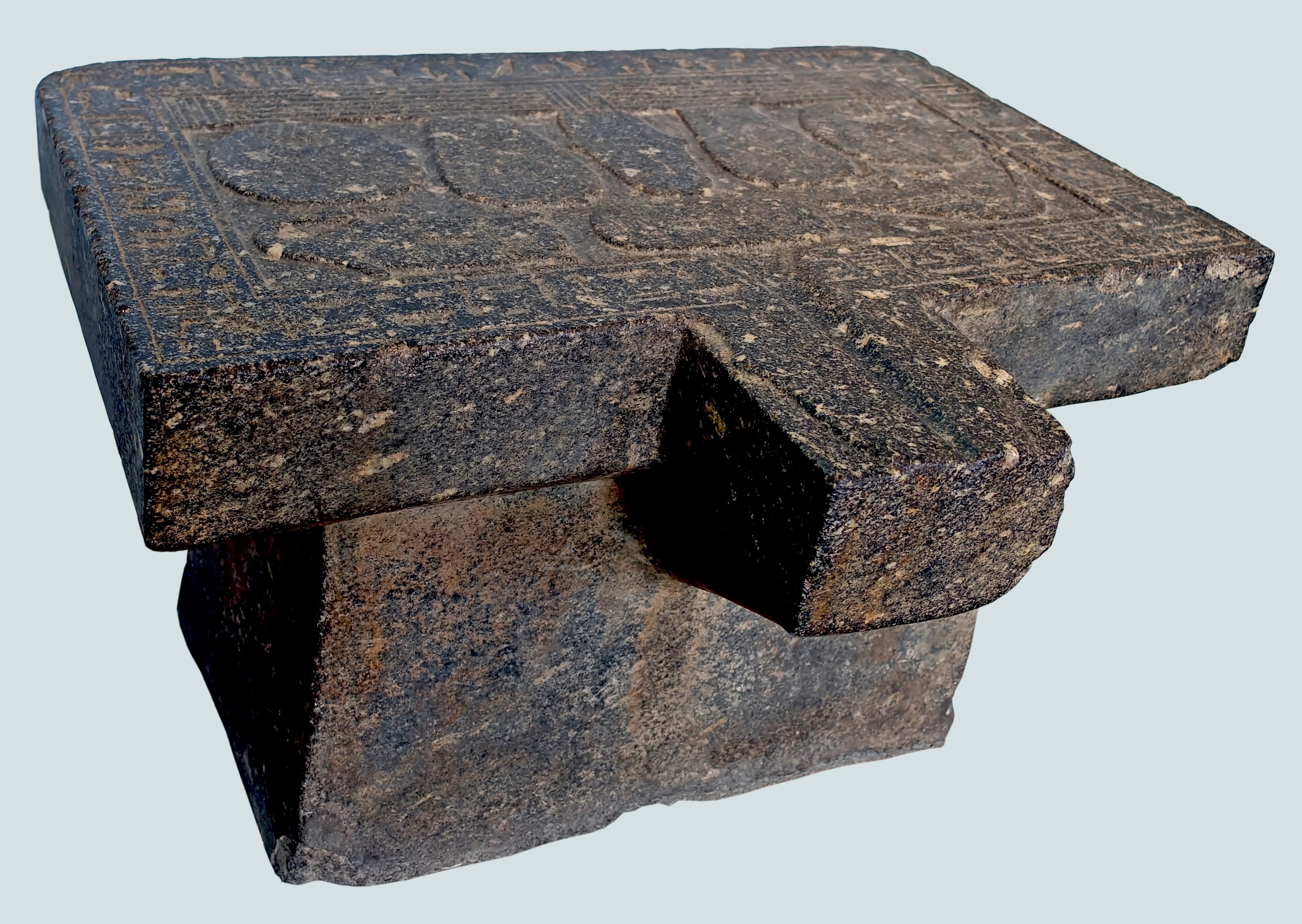
26th Dynasty: 664 BC - 525 BC
Offering Table of Nesptah
Early 26th Dynasty reign of Psamtek I, about 650 BC.
This offering table, from a temple or tomb, bears a depiction of a mat laid with food offerings: loaves of bread, water vessels, and fowl. Ritual libations were poured over the images to purify them for magical consumption by the owner's spirit. The water ran off via the spout.
The inscriptions identify the owner as Nesptah, son of the Governor Montuemhat. Nesptah inherited his father's worldly and priestly offices.
Height 51 cm, width 75 cm, depth 63 cm
Named in inscription: Nesptah, Mentuemhat (father)
Findspot: Thebes, probably from Asasif.
Catalog: Granodiorite EA1485
Photo: Don Hitchcock 2018
Source: Original, British Museum
Text: Card at museum display © Trustees of the British Museum, CC BY-NC-SA 4.0
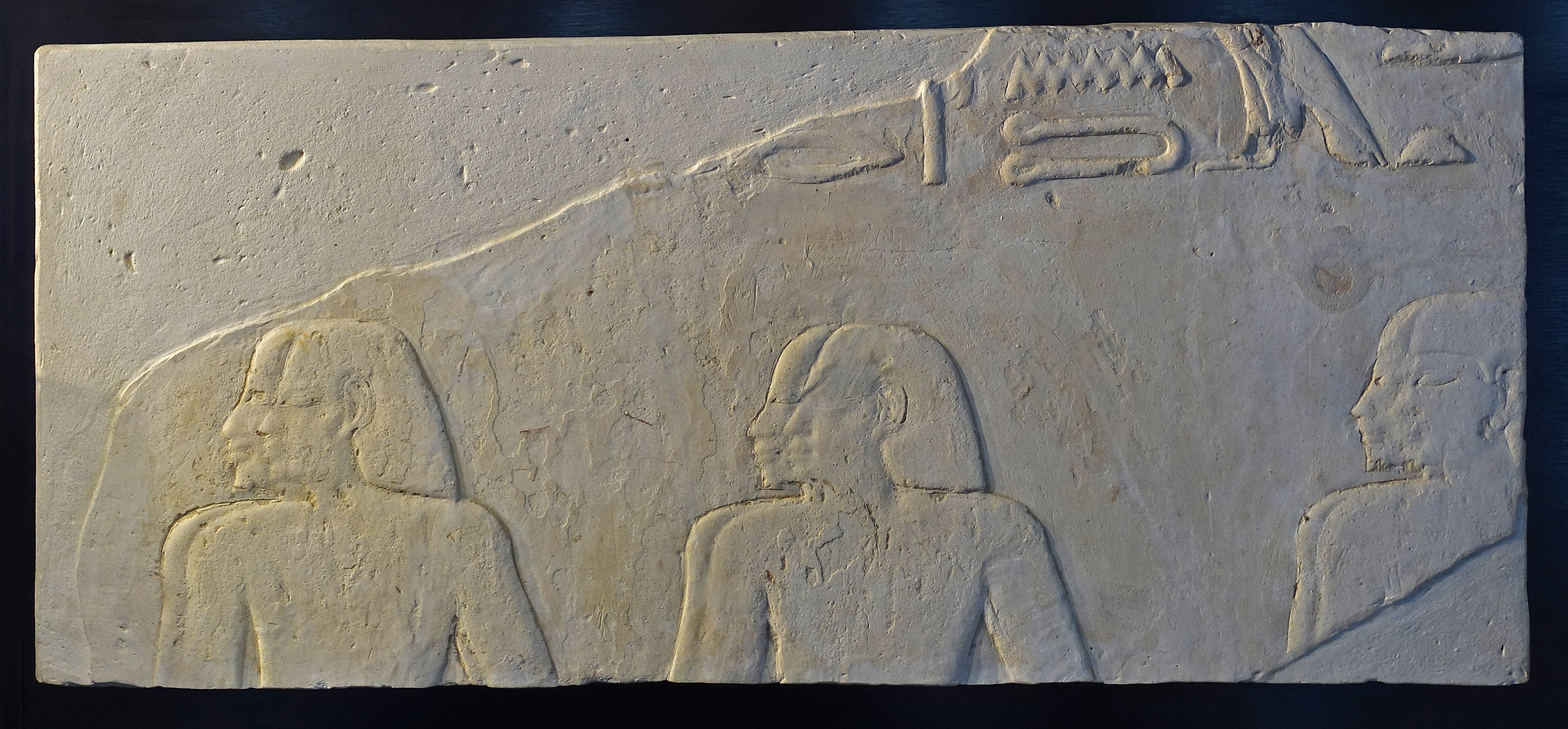

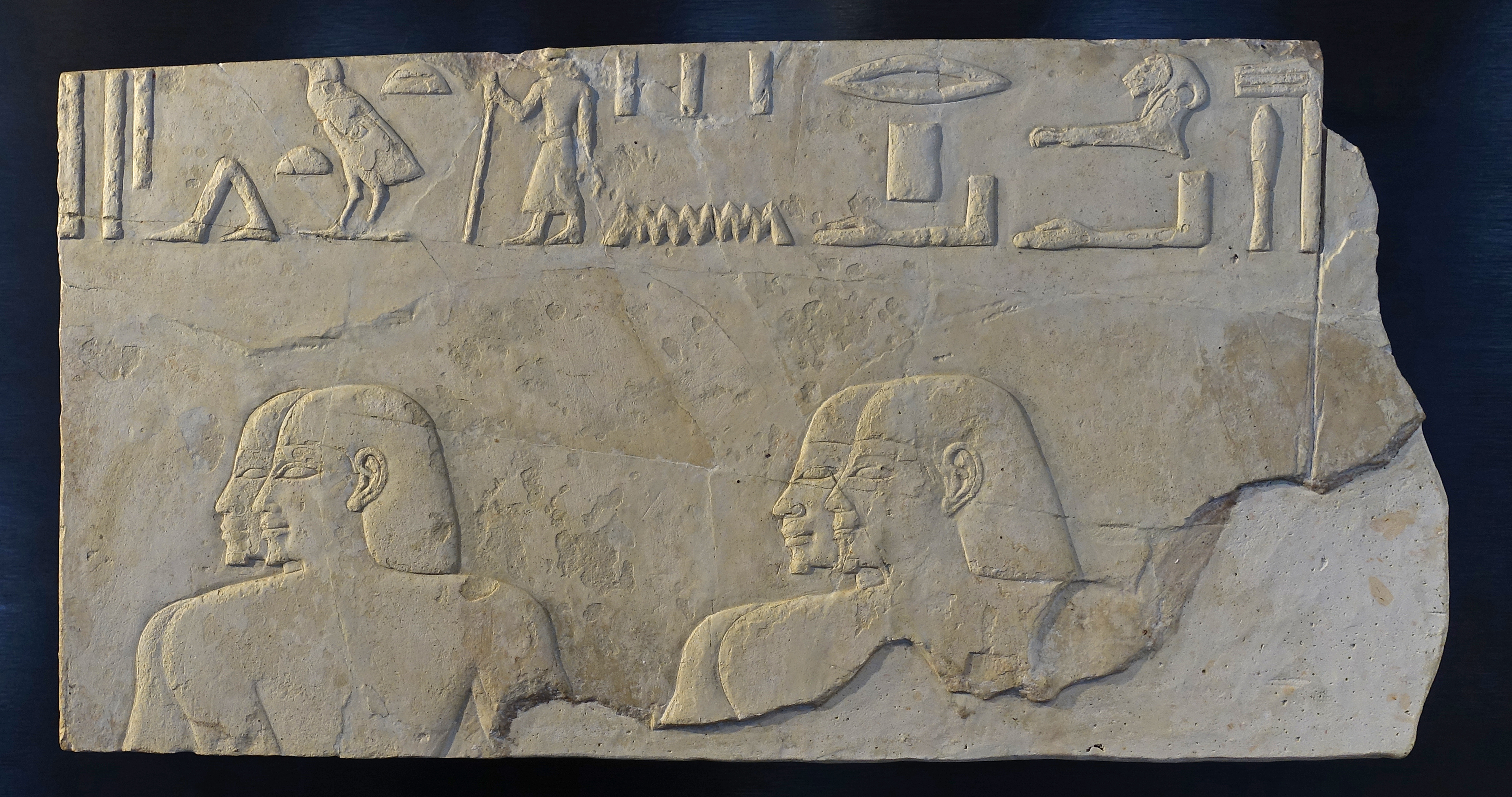

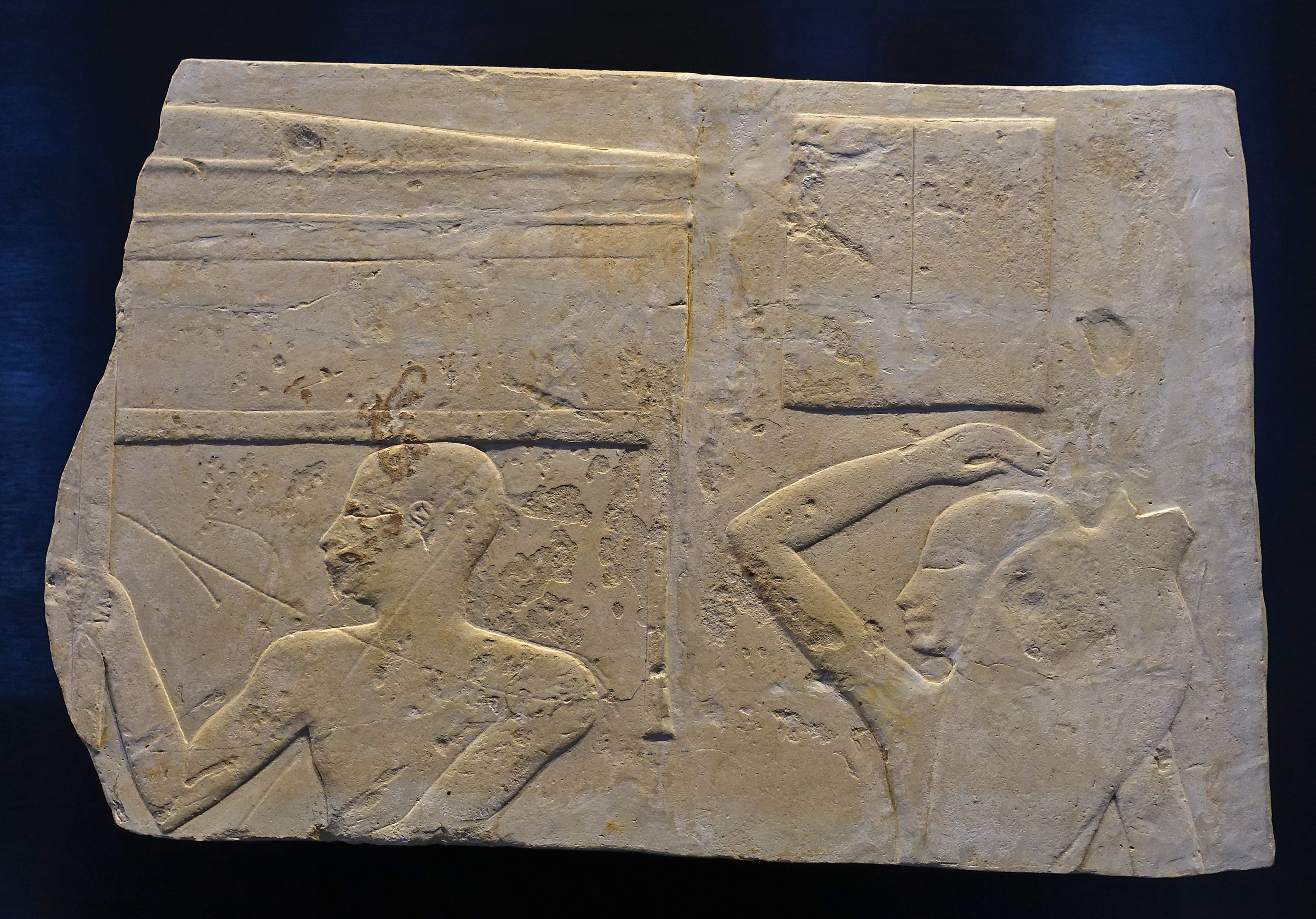
26th Dynasty: 664 BC - 525 BC
Montemhat / Mentuemhat
Reliefs from the tomb of Montemhat, (700 BC - 650 BC), circa 650 BC.
Mentuemhat or Montuemhat was a rich and powerful Theban official from ancient Egypt who lived during the Twenty-fifth Dynasty of Egypt and Twenty-sixth Dynasty of Egypt. He was the Fourth Priest of Amun in Thebes.
He is known from many statues and was buried in tomb TT34 of the Theban Necropolis.
Photo: Don Hitchcock 2018
Catalog: Limestone, Thebes West, Grab TT 34 | ÄS 5362 - 5366
Source: Original, Ägyptischen Museum München
Text: Museum card, © Ägyptischen Museum München
Additional text: Wikipedia
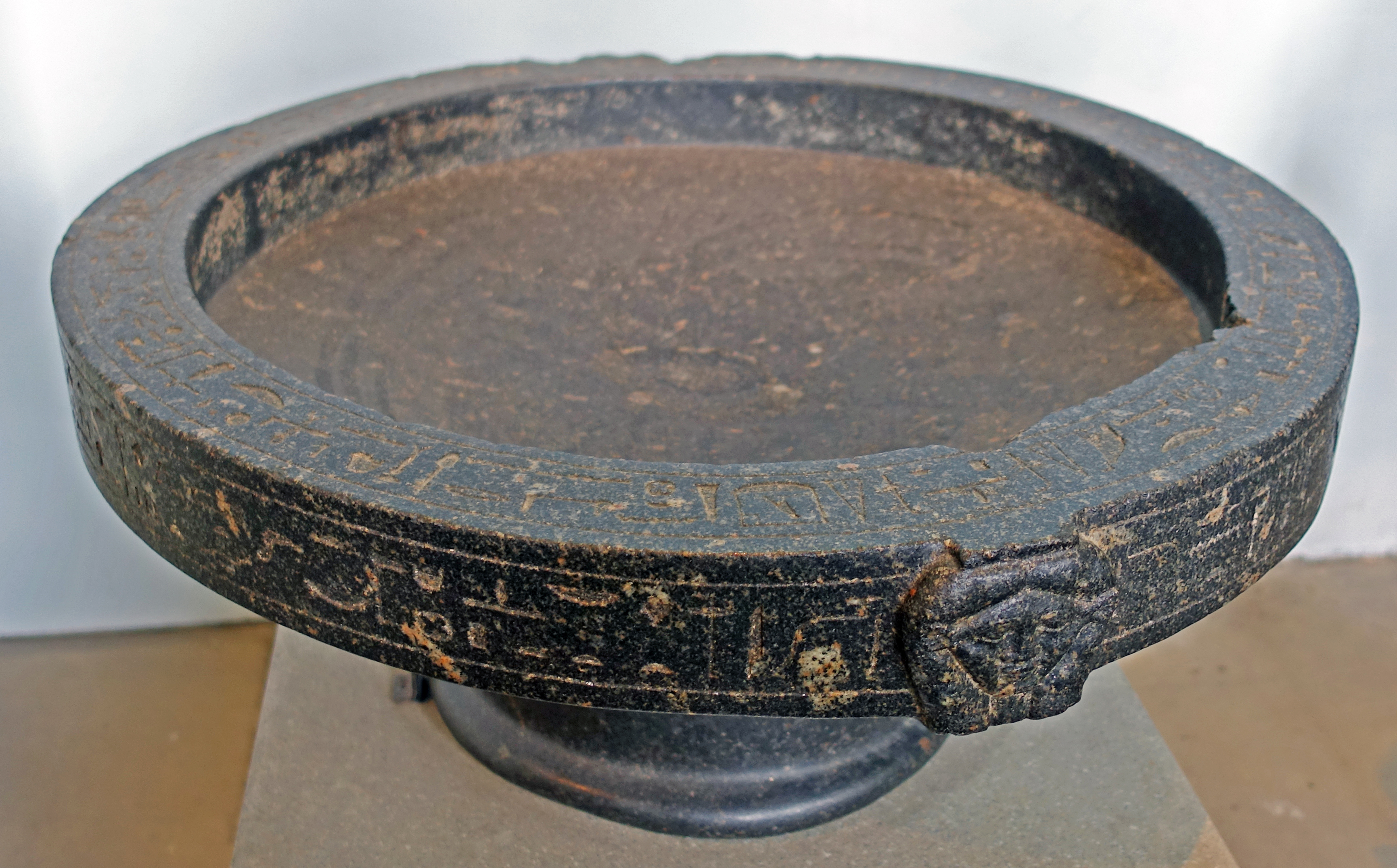
Libation bowl of Montuemhat
26th Dynasty: 664 BC - 525 BC, Reign of Montemhat / Mentuemhat, 700 BC - 650 BC)
Granodiorite libation-bowl of Mentuemhat. Hathor-head on the rim. Hieroglyphic text.
The governor of Upper Egypt dedicated this bowl to the goddesses Hathor and Mut, both named in the inscriptions. The front displays Hathor's face. The bowl was originally presented by a kneeling figure of Montuemhat, but only traces of his hands survive.
The bowl probably stood in the temple of Mut in South Karnak. Monteumhat left statues in that temple, as well as a chapel that features him and King Taharqo, his original Kushite overlord.
Early 26th Dynasty, reign of Psamtek I, about 650 BC.
Findspot: Thebes, probably South Karnak, temple of Mut.
Height 315 mm, width 680 mm, depth 710 mm
Named in inscription: Mentuemhat
Catalog: Granodiorite, EA1292
Photo: Don Hitchcock 2018
Source: Original, British Museum
Text: © Card with the display at the British Museum, http://www.britishmuseum.org/ , © Trustees of the British Museum, CC BY-NC-SA 4.0

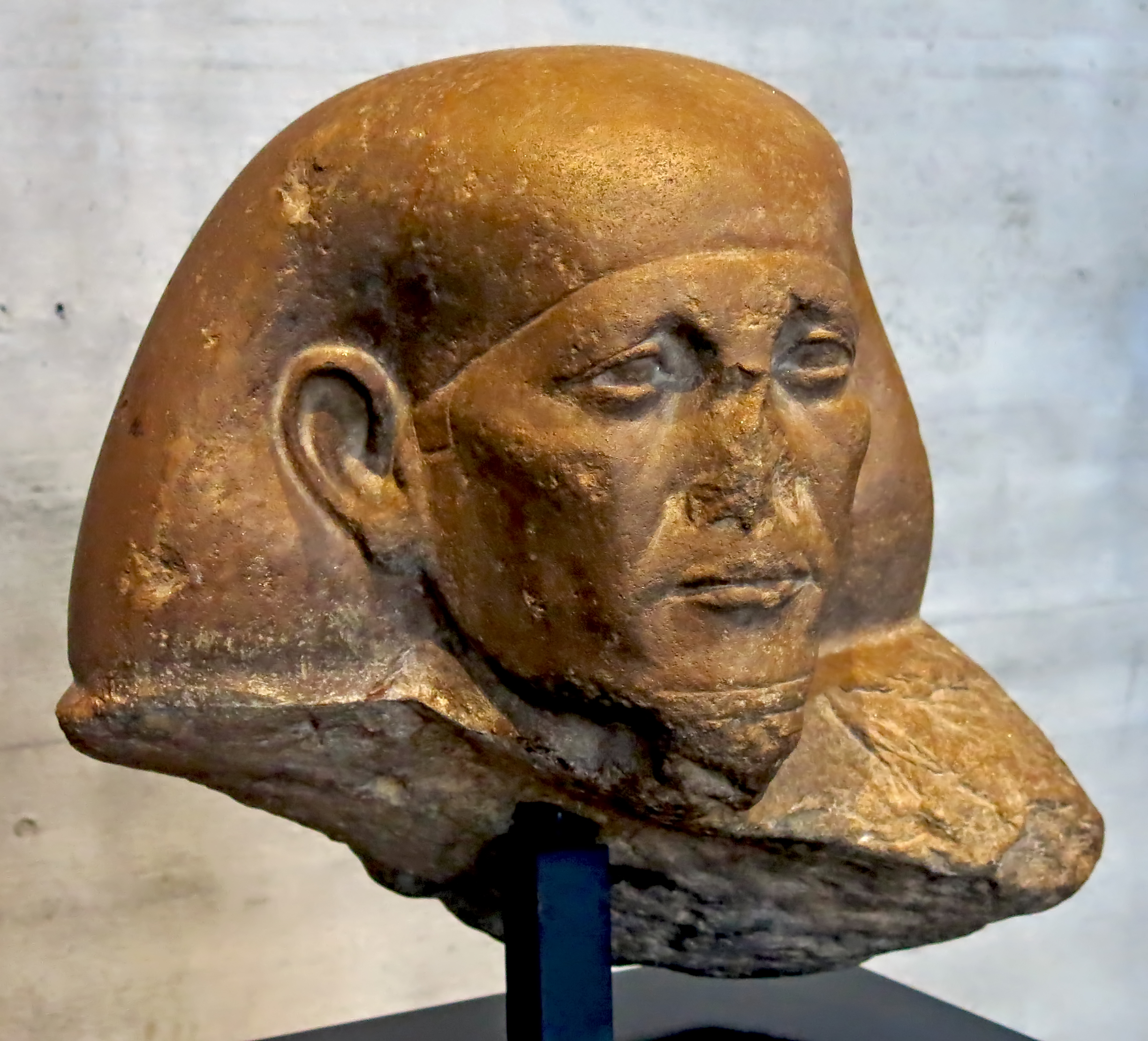
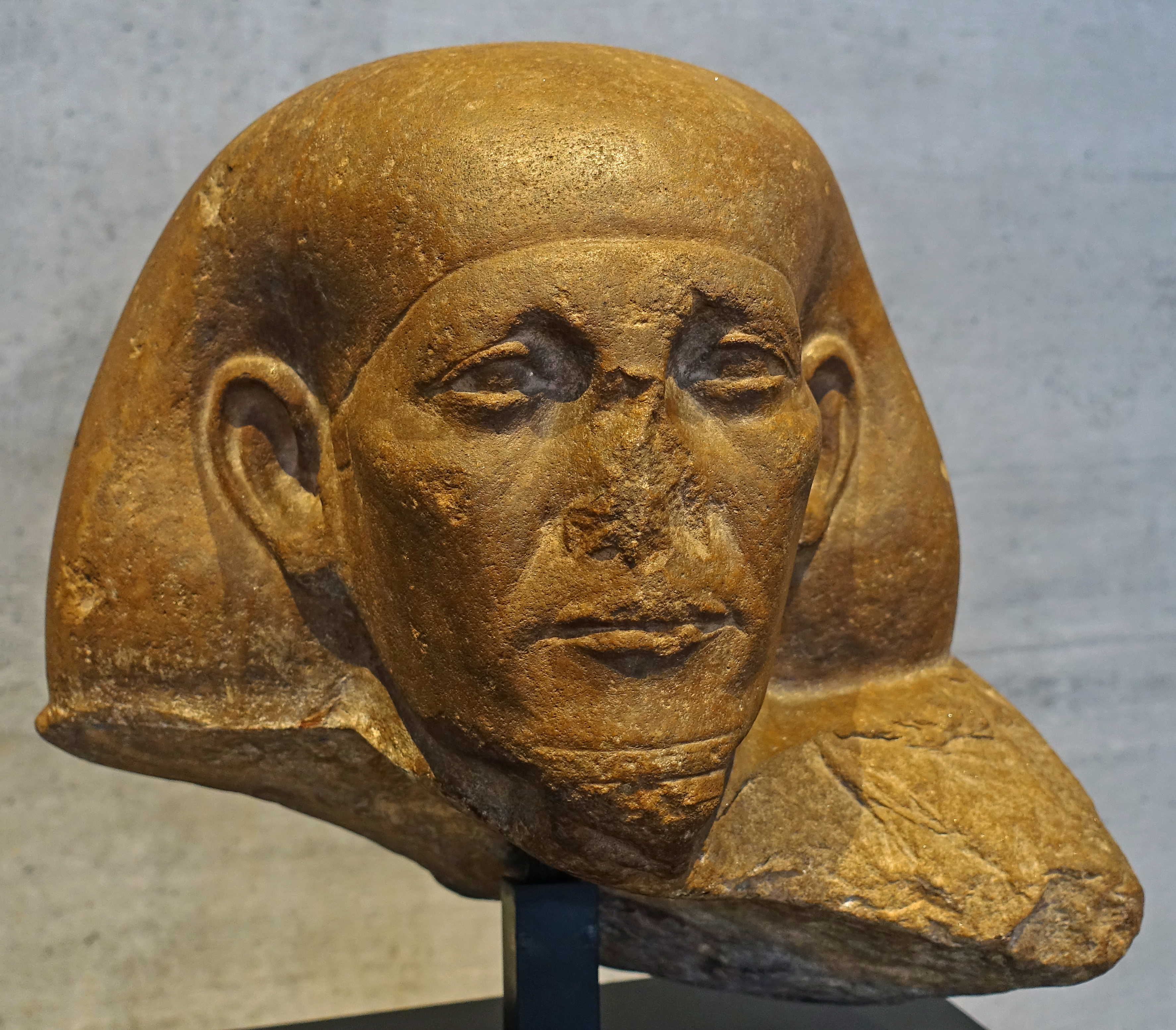
26th Dynasty: 664 BC - 525 BC
Montemhat / Mentuemhat
Head from a block statue of Montemhat, (700 BC - 650 BC), circa 650 BC.
circa 650 BC.
( This seems to be a very good portrait. Montemhat has that '1000 yard stare' of someone who has seen a lot of trouble in their lives - Don )
Photo: Don Hitchcock 2015, 2018
Catalog: Quartzite, ÄS 1622
Source: Original, Ägyptischen Museum München
Text: Museum card, © Ägyptischen Museum München
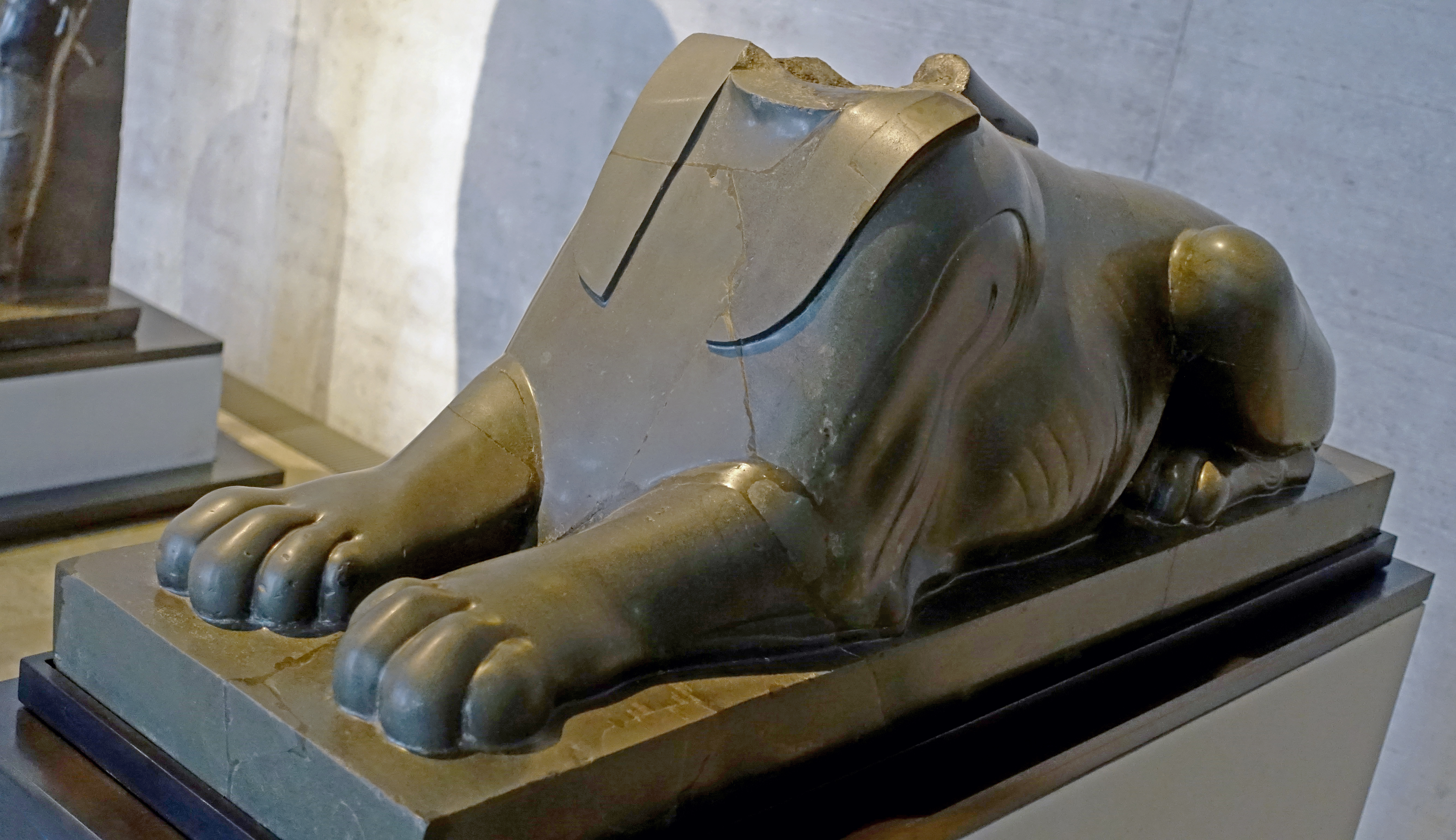
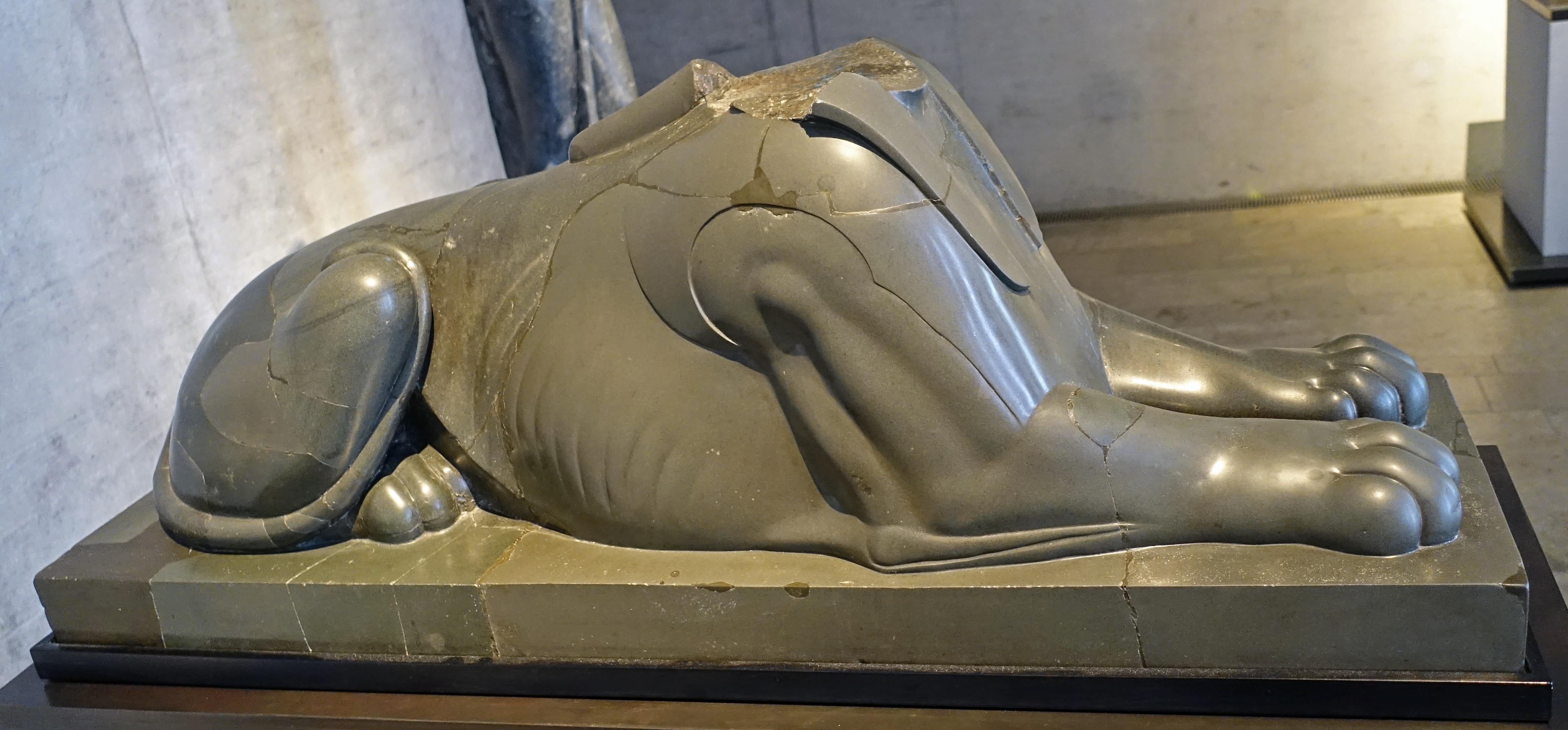
26th Dynasty: 664 BC - 525 BC
Sphinx
Sphinx figure from Hadrian's Villa outside Rome, one of a pair, see below.
( To my eyes, this is the more powerful and better sculpted of the two sphinxes, it is a shame that the head is missing - Don )
Hadrian's Villa, or Villa Adriana is a UNESCO World Heritage Site comprising the ruins and archaeological remains of a large villa complex built circa 120 AD by Roman Emperor Hadrian at Tivoli outside Rome. The site is owned by the Republic of Italy and has been managed since 2014 by the Polo Museale del Lazio.
Circa 600 BC.
Photo: Don Hitchcock 2018
Catalog: Amphibolite, Villa Adriana (Tivoli) GL.WAF 16
Source: Original, Ägyptischen Museum München
Text: Museum card, © Ägyptischen Museum München
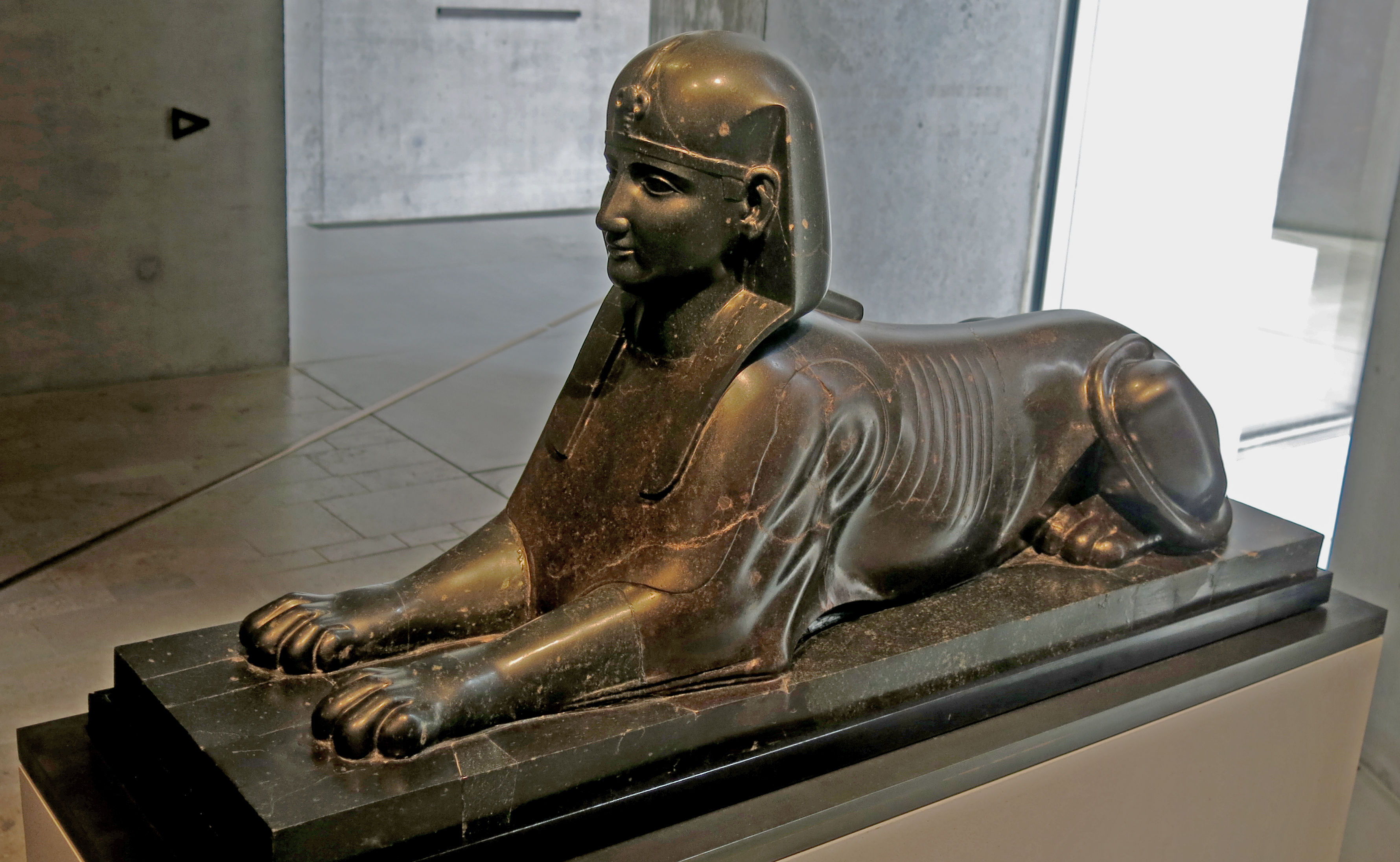
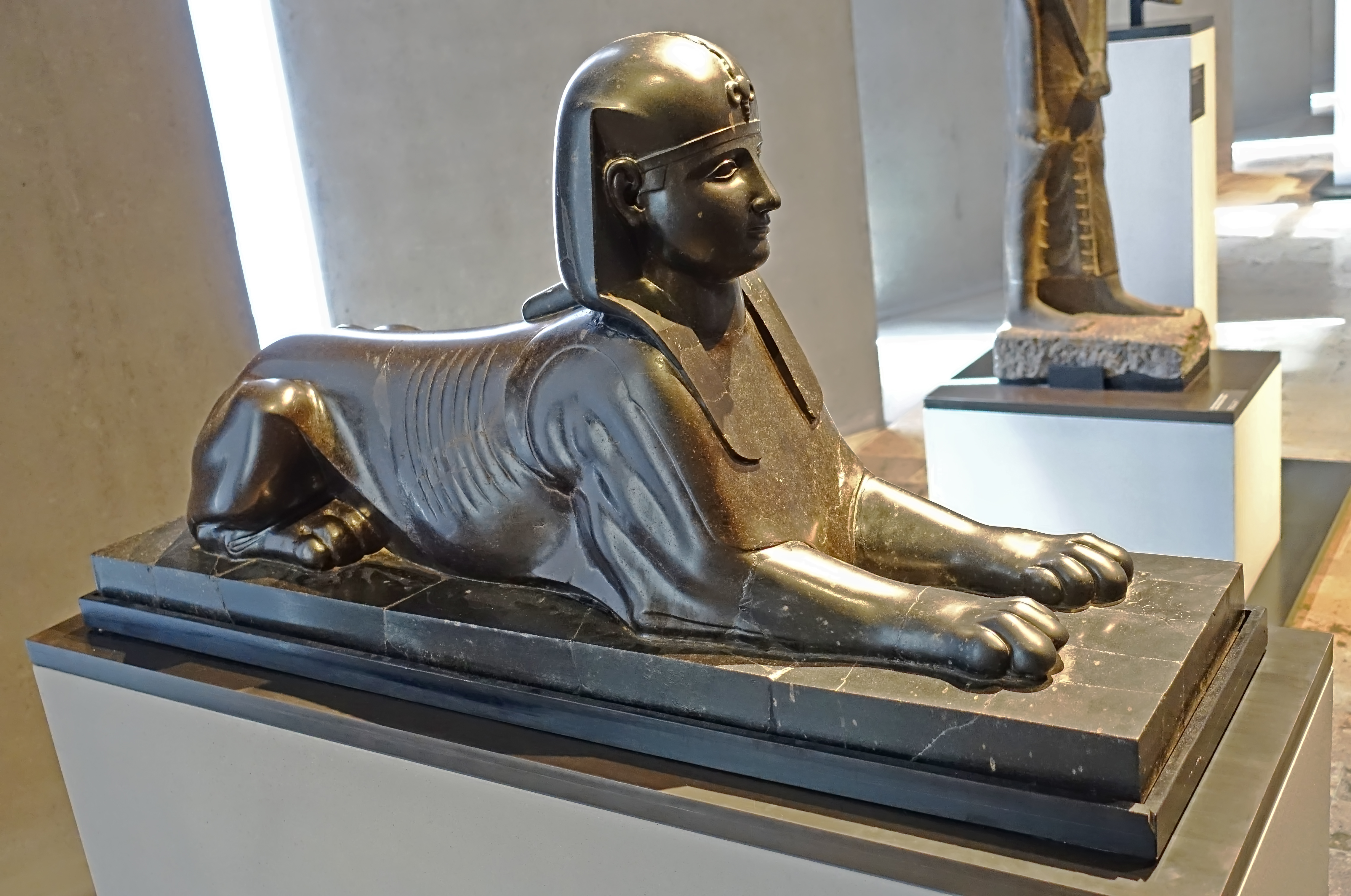
26th Dynasty: 664 BC - 525 BC
Sphinx
From the Villa Adriana, Rome. This is the second of a pair of sphinxes.
Circa 600 BC.
Photo: Don Hitchcock, 2015, 2018
Catalog: Amphibolite, Villa Adriana (Tivoli) GL.WAF 17
Source: Original, Ägyptischen Museum München
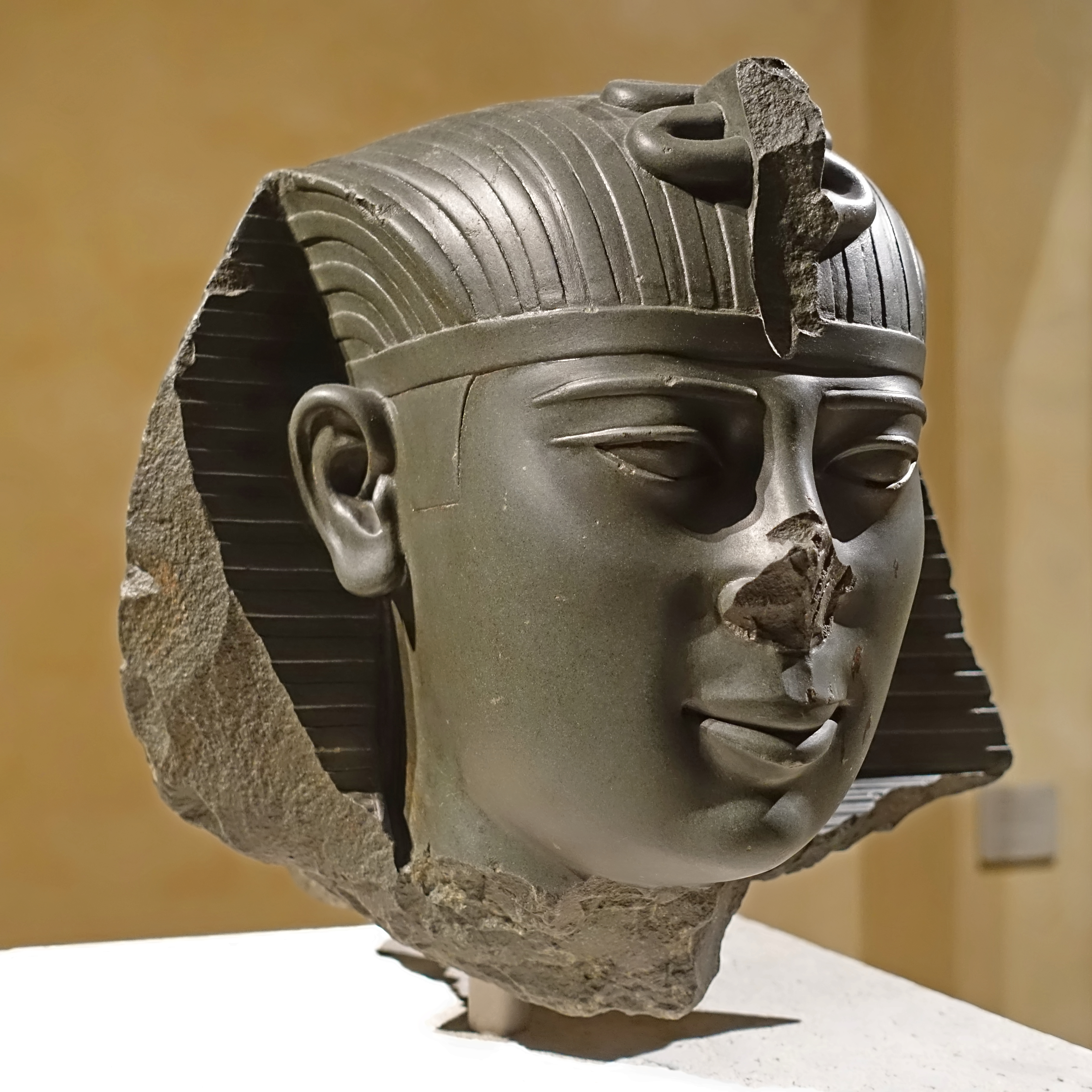

26th Dynasty: 664 BC - 525 BC.
Amasis II
Head of a statue of Pharoah Amasis II, also called Ahmose II, circa 550 BC
Amasis was originally an officer in the Egyptian army. His birthplace was Siuph at Saïs. He took part in a general campaign of Pharaoh Psamtik II in 592 BC in Nubia.
A revolt which broke out among native Egyptian soldiers gave him his opportunity to seize the throne. These troops, returning home from a disastrous military expedition to Cyrene in Libya, suspected that they had been betrayed in order that Apries, the reigning king, might rule more absolutely by means of his Greek mercenaries; many Egyptians fully sympathised with them. General Amasis, sent to meet them and quell the revolt, was proclaimed king by the rebels instead, and Apries, who then had to rely entirely on his mercenaries, was defeated. Amasis then married Chedebnitjerbone II, one of the daughters of his predecessor Apries, in order to legitimise his kingship.
Herodotus also describes how, just like his predecessor, Amasis relied on Greek mercenaries and councilmen. Although Amasis appears first as champion of the disparaged native, he had the good sense to cultivate the friendship of the Greek world, and brought Egypt into closer touch with it than ever before. Herodotus relates that under his prudent administration, Egypt reached a new level of wealth. Amasis adorned the temples of Lower (northern) Egypt especially with splendid monolithic shrines and other monuments.
It is said that it was during the reign of Ahmose II (Amasis) that Egypt attained its highest level of prosperity both in respect of what the river gave the land and in respect of what the land yielded to men and that the number of inhabited cities at that time reached in total 20 000.
His kingdom consisted probably of Egypt only, as far as the First Cataract, but to this he added Cyprus, and his influence was great in Cyrene, Libya. His final years were preoccupied by the threat of the impending Persian onslaught against Egypt. Amasis II died in 526 BC. He was buried at the royal necropolis of Sais, although his tomb has never been discovered.
Catalog: Sais, Greywacke, ÄM 11864
Photo: Don Hitchcock 2018
Source and text: Original, Staatliche Museen zu Berlin, Neues Museum, Germany
Additional text: Adapted from Wikipedia
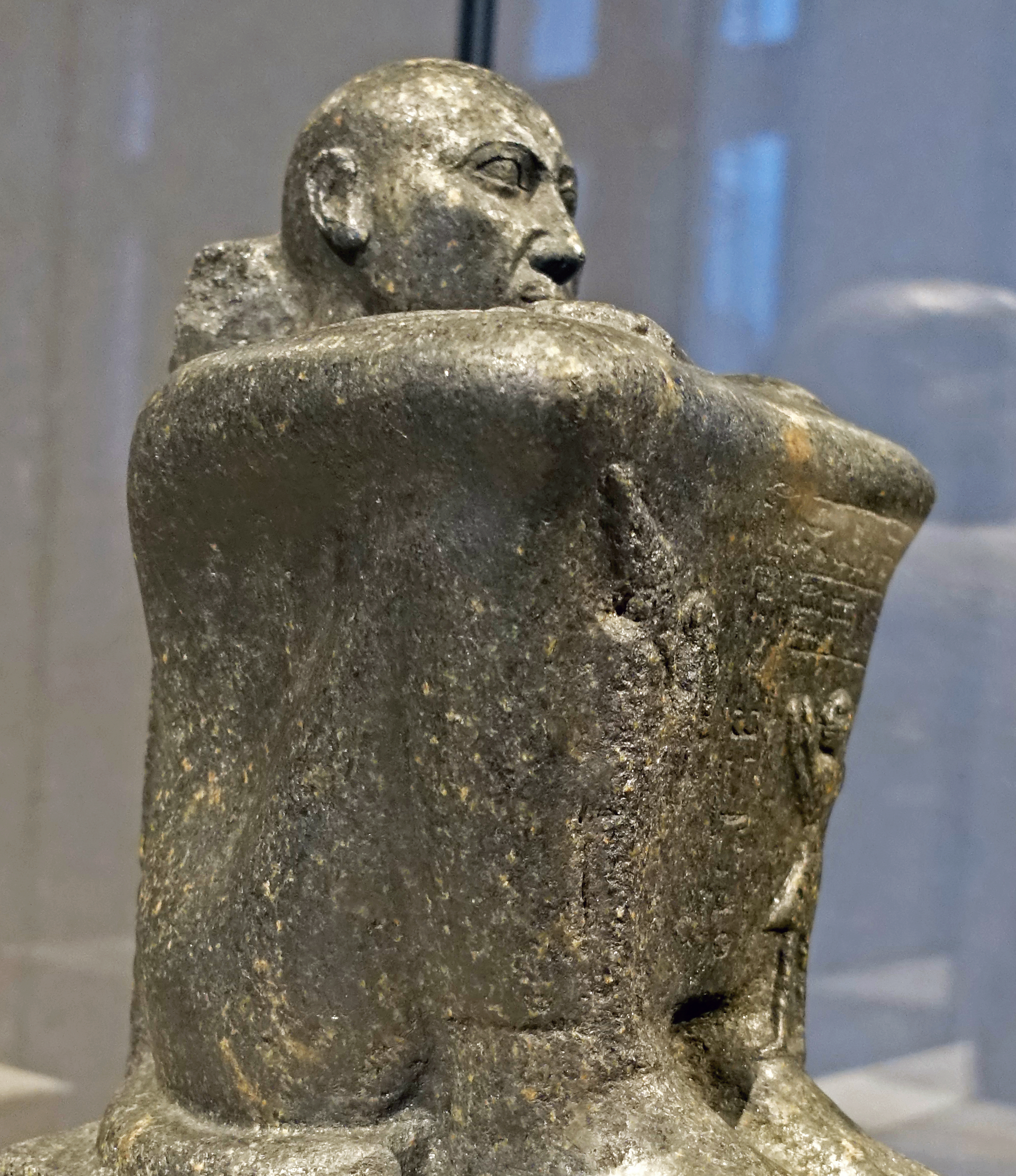
26th Dynasty: 664 BC - 525 BC.
Pedamenope
Block statue of the chief lector priest Pedamenope, circa 664 BC - 525 BC
Catalog:Thebes, Karnak, TT33, ÄM 23728
Photo: Don Hitchcock 2015
Source and text: Original, Staatliche Museen zu Berlin, Neues Museum, Germany
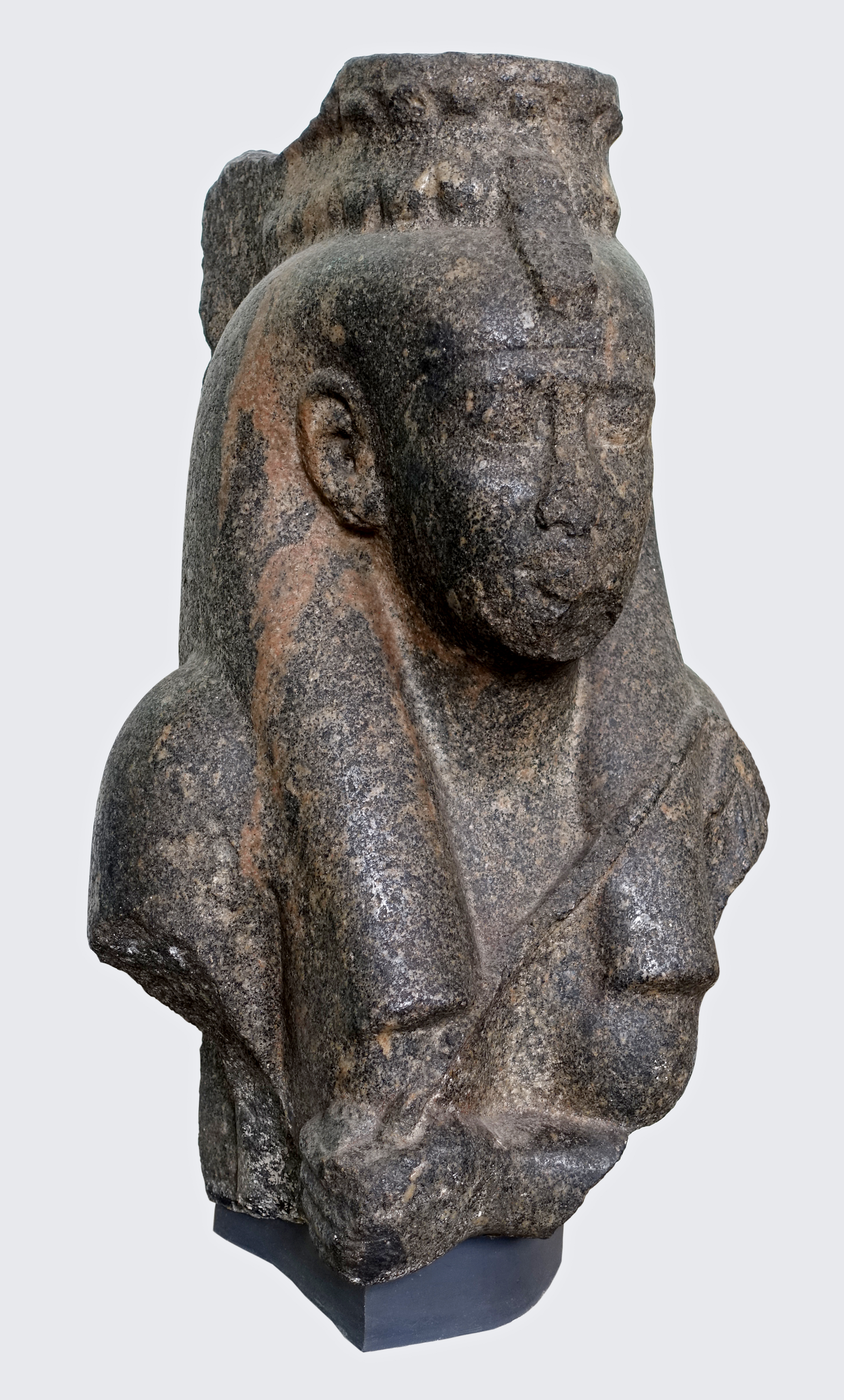
26th Dynasty: 664 BC - 525 BC.
Reign of Amasis (570 BC - 526 BC)
A Saite official
The bust belonged to a standing figure, erected in a temple. The owner lived when native kings from Sais, a town in the western Nile Delta, ruled over a united Egypt. He remains unidentifiec, because his name and titles would have been inscribed on the lower half. The facial features, benign if somewhat bland, represent the artistic ideal of the late 26th Dynasy. This template was endlessly repeated in sculpture of later centuries.
Findspot and provenance unknown.
Upper-section of black granite statue of a standing man, nose damaged, arms missing, unusual prominence is given to the Adam's apple.
Time of production circa 560 BC
Height 74 cm (max)
Catalog: Black granite, EA1647
Photo: Don Hitchcock 2018
Source: Original, British Museum
Text: Card at museum display © Trustees of the British Museum, CC BY-NC-SA 4.0
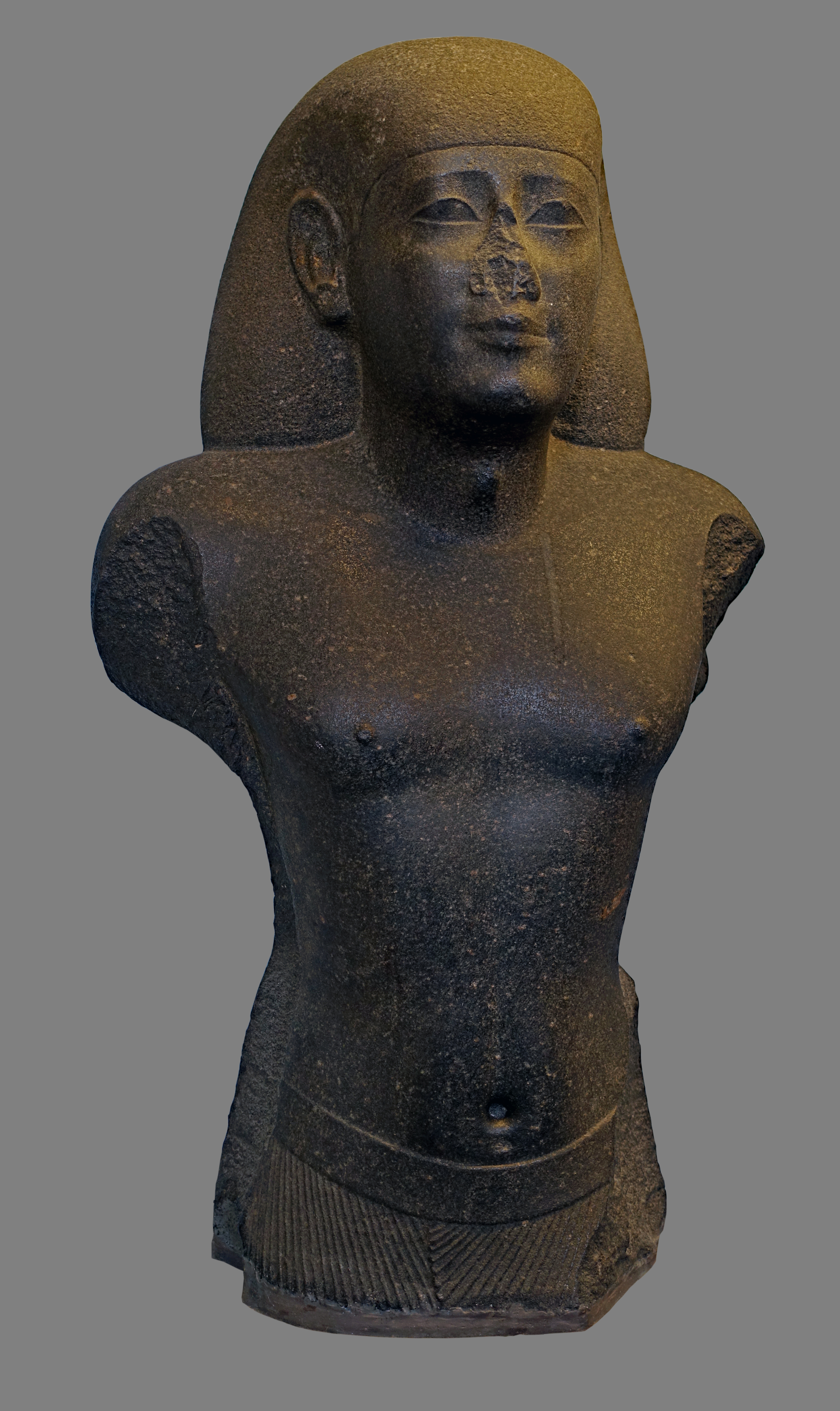
Reign of Pharaoh Amasis II/Ahmose II, 570 BC - 526 BC.
Saite Official
26th Dynasty: 664 BC - 525 BC.
Upper-section of a granodiorite statue of a standing man, nose damaged, arms missing, unusual prominence is given to the Adam's apple.
This bust or head fragment depicts an anonymous Saite official from the 26th Dynasty (570–526 BC), specifically during the reign of Pharaoh Amasis, the last great pharaoh of Egypt's Twenty-sixth (Saite) Dynasty.
Carved from granodiorite of unknown provenance, the sculpture reflects the idealised, serene facial features characteristic of the late Late Period. The benign, slightly softened facial features reflect the sculptural ideals of the late 26th Dynasty. Granodiorite is a hard, dense igneous rock that was highly prized by ancient Egyptian sculptors for its durability and smooth finish.
The official's name, titles, and lineage remain unidentified, as this identifying information was typically inscribed on the lower half (legs or base) of standing temple figures.
Production date circa 560 BC.
Height 74 cm (max).
Catalog: Granodiorite, EA1647
Photo: Don Hitchcock 2018
Source: Original, British Museum
Text: Card at museum display © Trustees of the British Museum, CC BY-NC-SA 4.0
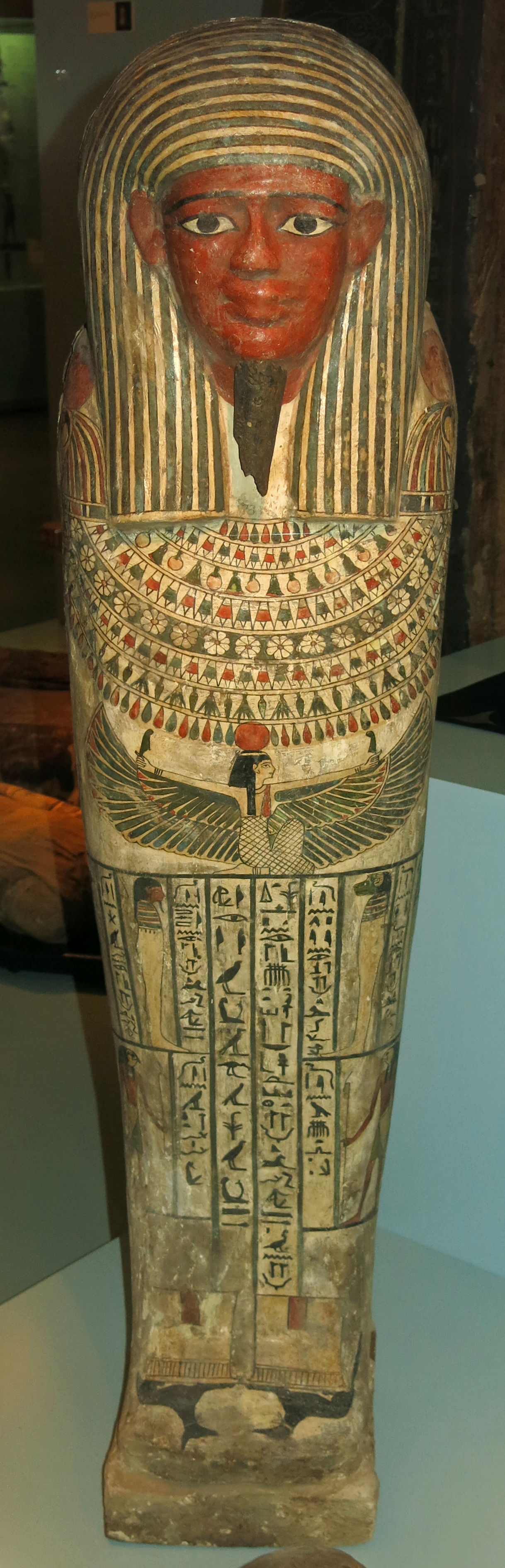
26th Dynasty: 664 BC - 525 BC
Keref
Coffin and mummy of Keref.
Keref was only 3 years old, yet he was given an expensive funeral.
Wood, location unknown; 525 BC
Photo: Don Hitchcock 2014
Source: Original, Rijksmuseum van Oudheden, National Museum of Antiquities, Leiden.
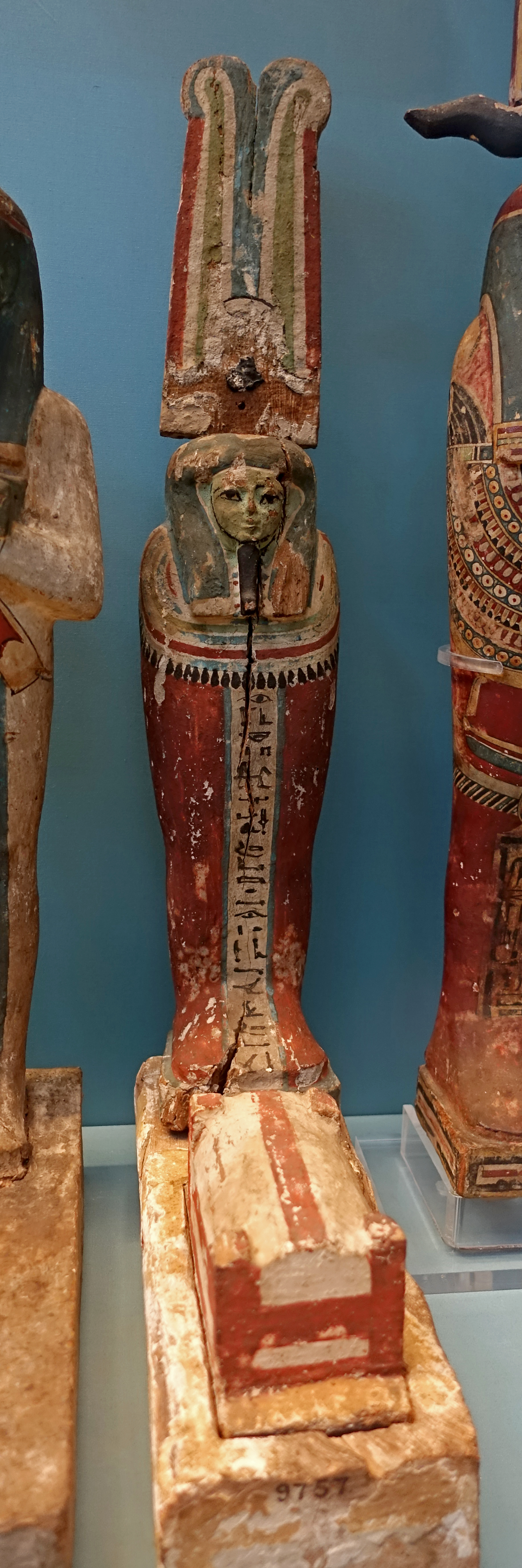
26th Dynasty: 664 BC - 525 BC
Ptah-Sokar-Osiris
Painted wooden figure of Ptah-Sokar-Osiris, painted black, white, red, blue and green; column of Hieroglyphic text front and back, inscribed for the lady Ahairtbinwer.
Height: 140 mm, 220 mm, 390 mm, length 327 mm, width 100 mm, 120 mm, 87 mm.
Catalog: Painted wood, EA9757
Photo: Don Hitchcock 2018
Source: Original, British Museum
Text: © Card with the display at the British Museum, http://www.britishmuseum.org/ , © Trustees of the British Museum, CC BY-NC-SA 4.0

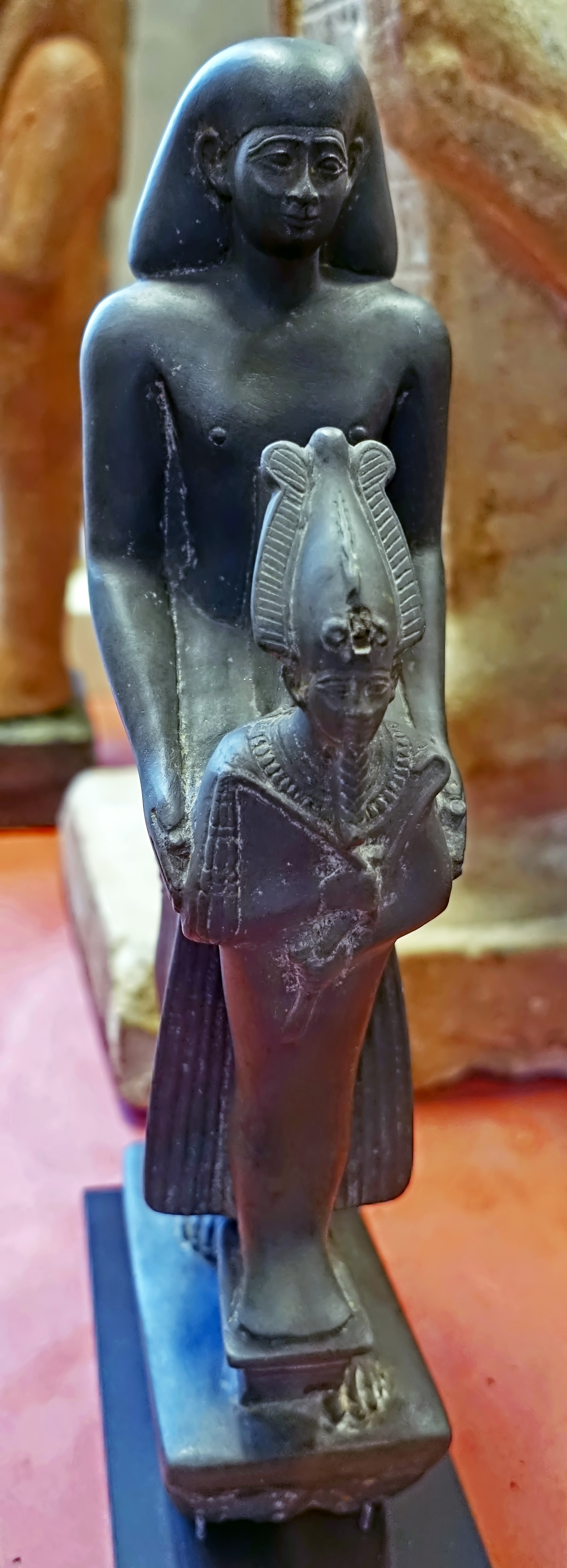
26th Dynasty: 664 BC - 525 BC
Osiris
Man presenting a statue of Osiris
'Theophore' statues such as this were ones where a god was depicted.
The standing man behind Osiris has a pleated skirt, and a 'pocket wig', one enclosed by cloth.
Often mistakenly called shale, this very fine-grained stone is greywacke, the 'Bekhen stone' of the Egyptians, which they extracted from the Wadi Hammamat, a desert valley between the Nile and the Red Sea.
Height 250 mm, width 53 mm, depth 86 mm.
Catalog: Greywacke, Aile Sully, Room 334, level 0, Vitrine 4, E 4299
Photo: Don Hitchcock 2015, 2018
Source and text: Original, Louvre Museum, Paris, France, https://collections.louvre.fr/
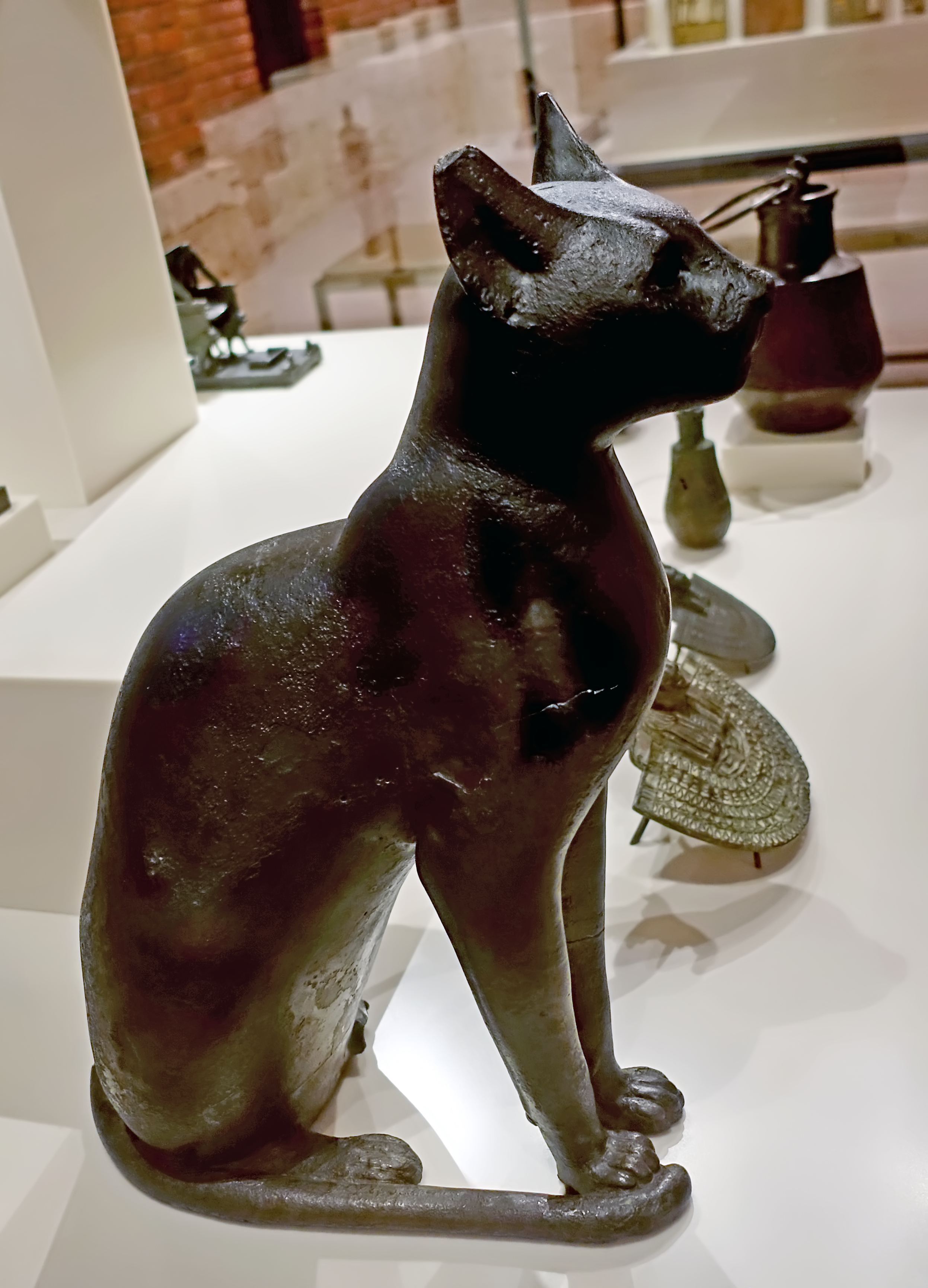
26th Dynasty: 664 BC - 525 BC
Cat
Bastet cat.
Circa 650 BC.
Bastet or Bast was a goddess of ancient Egyptian religion, worshiped as early as the Second Dynasty.
Bastet was worshiped in Bubastis in Lower Egypt, originally as a lioness goddess, a role shared by other deities such as Sekhmet. Eventually Bastet and Sekhmet were characterised as two aspects of the same goddess, with Sekhmet representing the powerful warrior and protector aspect and Bastet, who increasingly was depicted as a cat, representing a gentler aspect.
Catalog: Bronze, ÄM 2055
Photo: Don Hitchcock 2018
Source: Original, Staatliche Museen zu Berlin, Neues Museum, Germany
Text: © Card at the Staatliche Museen zu Berlin, (CC BY-NC-SA 3.0 DE)
Additional text: Wikipedia
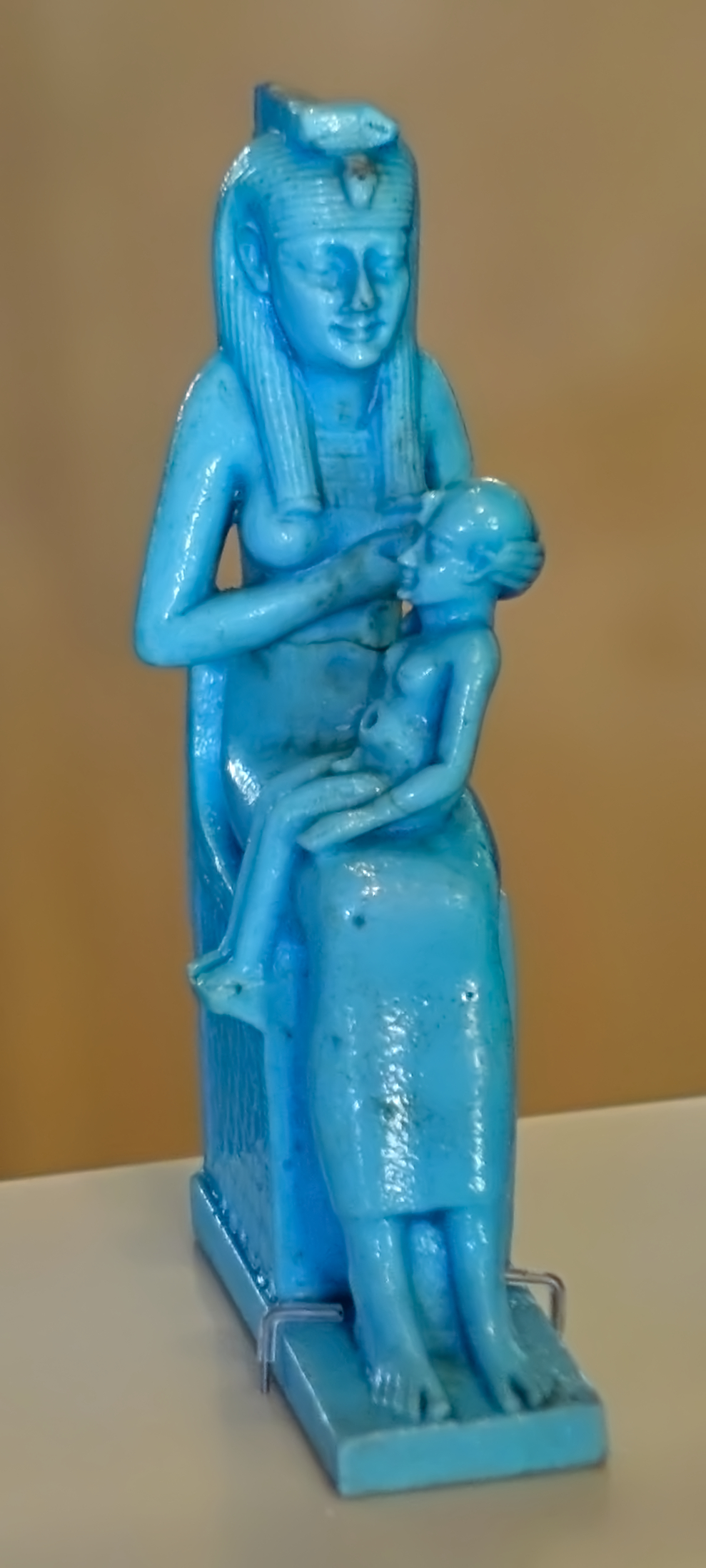
26th Dynasty: 664 BC - 525 BC
Isis
Statuette of the goddess Isis enthroned with the Horus boy (Isis lactans, the nursing Isis).
Dimensions: 97 x 32 x 61 mm
This is probably a protective amulet for the owner, and consists of a small figure of the goddess Isis, who is holding her son Horus' chest. With her left hand she supports the child's head, the right hand holds her breast.
The material is Egyptian faience, which has been in use since the end of the 4th millennium BC. It consists of fine quartz sand with a mostly green-blue glaze coating. Isis is originally the 'throne' according to the meaning of its name. However, she took on human form early on, sits on the throne herself as a young woman and usually wears her symbol as a crown on her head. In this statuette only the base of the crown was preserved.
Her role in the myth of life, death and resurrection of the god Osiris had made her the most popular and important goddess of the Egyptian pantheon. She was the loving wife and grieving widow of Osiris, who had once ruled Egypt as a legendary king and had been murdered out of envy by his brother Seth: Isis had wrapped the dismembered body in bandages, causing Osiris to rise again and henceforth in mummy-like shape prevailed in the realm of the dead.
Isis was also the divine mother of Horus, whom she hides in the marshes of the delta before the reenactments of Seth and secretly raises them so that he can later avenge his father and climb to the throne of Egypt. The argument about the legacy of Osiris, the rule over Egypt, between Seth and Horus before the judgment of the gods lasted eighty years. The magic of Isis finally helps Horus to victory.
The Egyptians worshiped Isis as the goddess of protection for every dead person, but above all as a great sorceress, whose magical invocations protected children from diseases and all kinds of evil. The narrative of Isis and Horus was one of the most popular topics from the late period. Both deities enjoyed great veneration throughout the Roman Empire until the 3rd century. Her image lived on in the Christian representation of the Virgin Mary with the boy Jesus. The last Temple of Isis on the island of Philae in southern Egypt, near the first cataract of the Nile, was only closed between 535 AD and 537 AD.
From: Müller, Ingeborg, in: Priese, K.-H. (Ed.), Egyptian Museum Berlin, Museum Island Berlin, Mainz 1991, p. 179 (cat. 107).
Catalog: Faience, light blue, Sheikh Abd el-Qurna,Thebes West, ÄM 4535
Photo: Don Hitchcock 2018
Source: Original, Staatliche Museen zu Berlin, Neues Museum, Germany
Text: © Card at the Staatliche Museen zu Berlin, http://www.smb-digital.de/eMuseumPlus?service=ExternalInterface&module=collection&objectId=606806&viewType=detailView, (CC BY-NC-SA 3.0 DE)

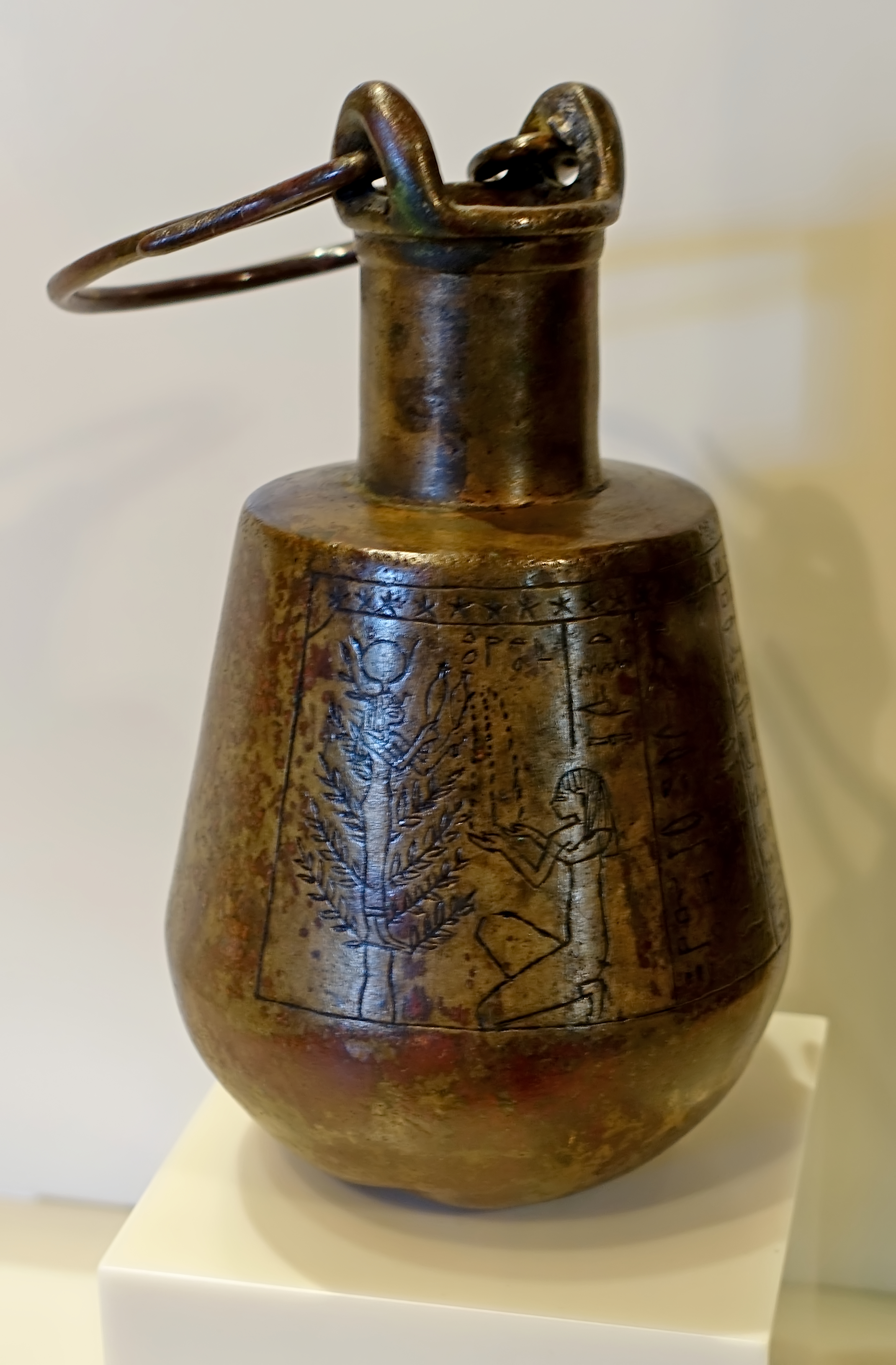
26th Dynasty: 664 BC - 525 BC
Situla
This is a small situla, or libation jar.
( It appears to depict Hathor, the Egyptian goddess of the sun, and a kneeling worshipper. Hathor helped deceased souls with their transition to the afterlife. - Don )
Circa 600 BC.
Catalog: Bronze, ÄM 4377
Photo: Don Hitchcock 2018
Source: Original, Staatliche Museen zu Berlin, Neues Museum, Germany
Text: © Card at the Staatliche Museen zu Berlin, (CC BY-NC-SA 3.0 DE)
Additional text: Wikipedia
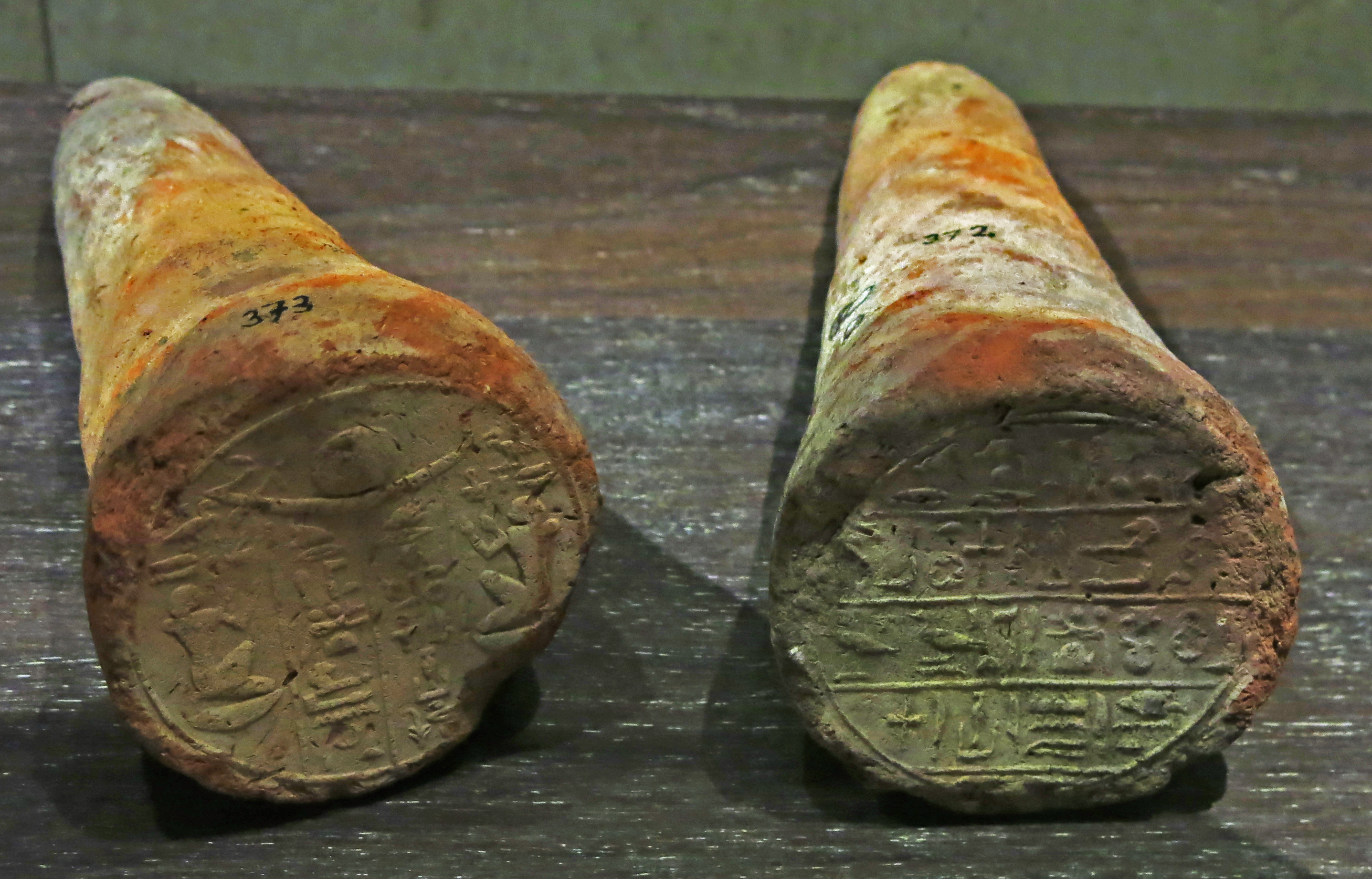
26th Dynasty: 664 BC - 525 BC
Mayor of Thebes
Two funerary cones of Basa, High Priest of Min of Coptos, and Mayor of Thebes.
Circa 600 BC.
Funerary cones were small cones made from clay that were used in ancient Egypt, almost exclusively in the Theban Necropolis.[1] The items were placed over the entrance of the chapel of a tomb. Early examples have been found from the Eleventh Dynasty. However, they are generally undecorated. During the New Kingdom, the cones were smaller in size and inscribed in hieroglyphs with the title and name of the tomb owner, often with a short prayer. The exact purpose of the cones is unknown.
Catalog: Ceramic, Thebes West, Grave 389, ÄS 372, ÄS 373
Photo: Don Hitchcock 2015
Source: Original, Ägyptischen Museum München
Text: Museum card, © Ägyptischen Museum München

26th Dynasty: 664 BC - 525 BC
Situla
Large situla of Tetamon, daughter of the priest Nachtefmut.
Circa 600 BC.
Catalog: Bronze, ÄM 4376
Photo: Don Hitchcock 2018
Source: Original, Staatliche Museen zu Berlin, Neues Museum, Germany
Text: © Card at the Staatliche Museen zu Berlin, (CC BY-NC-SA 3.0 DE)
Additional text: Wikipedia
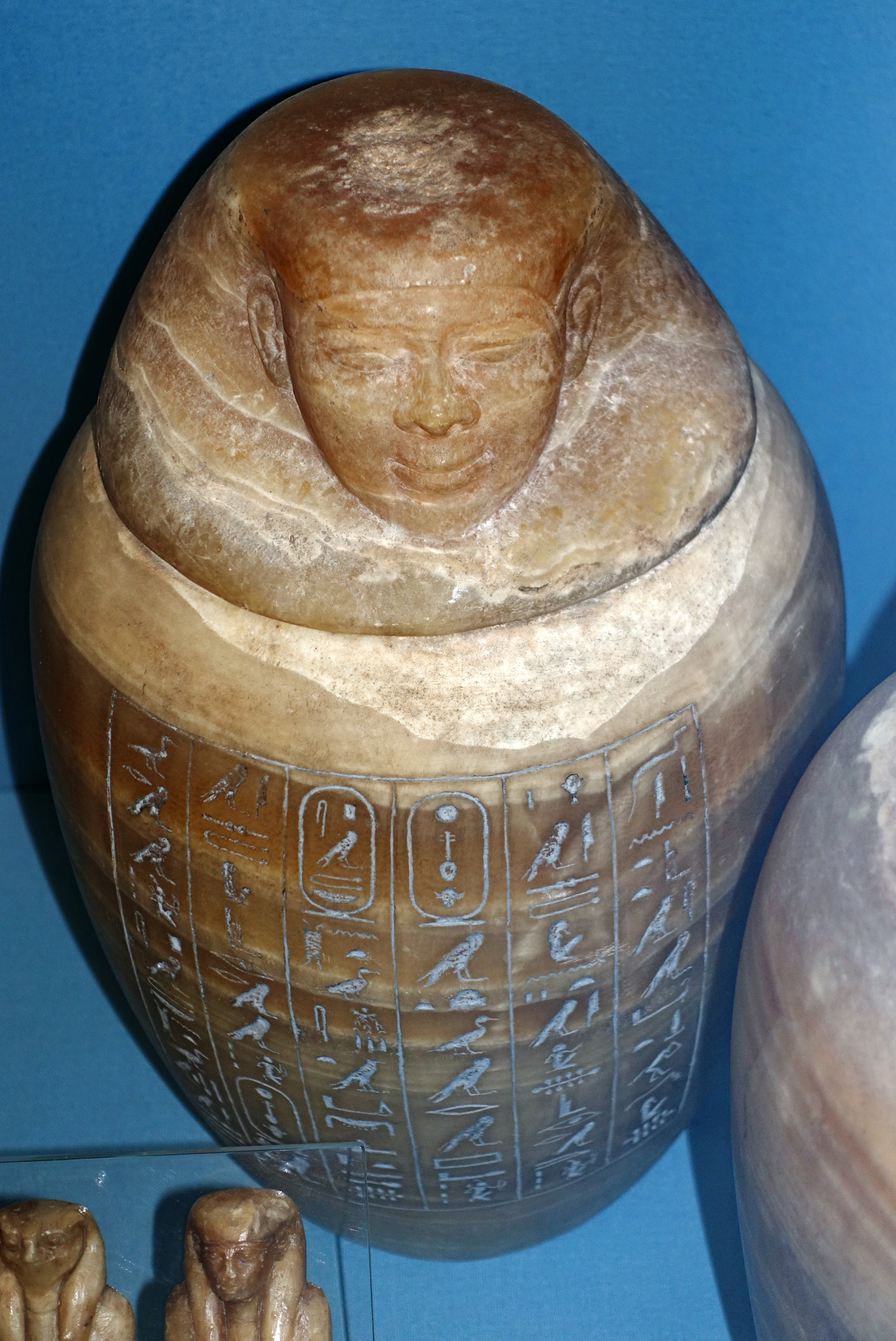


26th Dynasty: 664 BC - 525 BC
Commander Neferibre-emakhet
Four calcite Canopic Jars, circa 570 BC - 525 BC.
The owner was the son of another general named Psamtek-sa-Neit. The inscriptions promise the protection of the goddesses Isis, Nephthys, Neith and Selkis, and that of the four Sons of Horus.
EA36625 Imsety, Human form, diameter 210 mm, height 330 mm, six columns of incised Hieroglyphic text.
EA36626 Hapy, Baboon form, diameter 210 mm, height 340 mm, six columns of incised Hieroglyphic text.
EA36627 Duamutef, jackal form, diameter 215 mm, height 350 mm, six columns of incised Hieroglyphic text, lid chipped.
EA36628 Qebhsenuef, Hawk form, diameter 210 mm, height 345 mm, six columns of incised Hieroglyphic text.
Catalog: Calcite, Provenance unknown, EA36625-28
Photo: Don Hitchcock 2018
Source: Original, British Museum
Text: Card with the display at the British Museum, https://www.britishmuseum.org/, © Trustees of the British Museum, CC BY-NC-SA 4.0
Additional text: Wikipedia
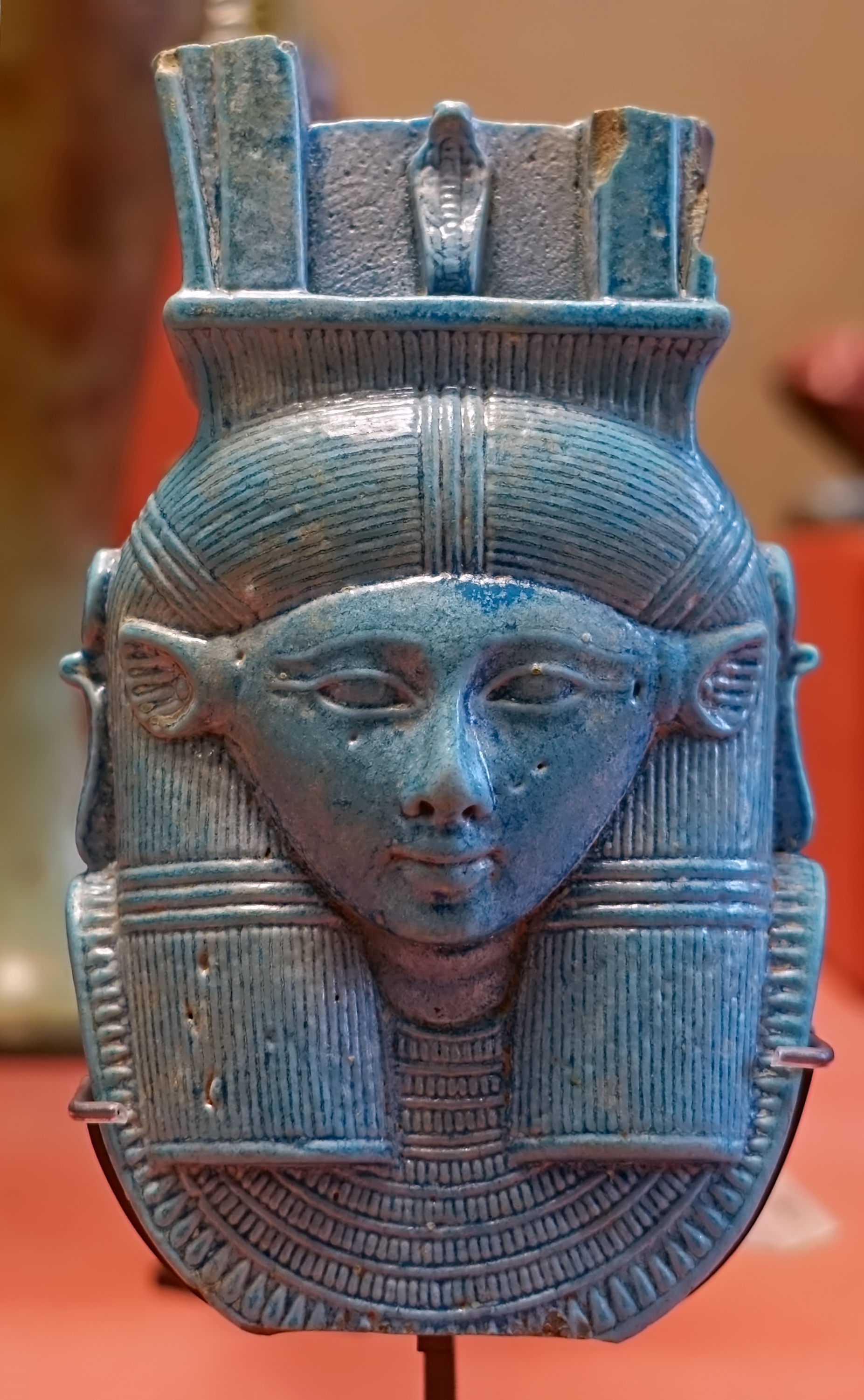

(left) 26th Dynasty: 664 BC - 525 BC
Naos Sistrum
Faience sistrum with a naos, a representation of a shrine or temple, mostly broken off in this example, as is the handle of the sistrum.
What is left features the head of Hathor, with a tripartite wig worn by goddesses and women of the elite, consisting of three divisions of the hair of the wig. Two were over the shoulders to be seen from the front, and the third over the back.
Also displayed is an uraeus, a symbol for the goddess Wadjet. She was one of the earliest Egyptian deities and was often depicted as a cobra.
This is a superb work, beautifully detailed with a masterly glaze, which is typical of this period.
Height 106 mm, width 64 mm, thickness 46 mm.
On the right is a very much smaller, ten cm long in total, less detailed faience 'model' sistrum displayed at the Museum August Kestner, Hannover, meant only as a grave good, from roughly the same period, but included here to show the shape of the original on the left. There would have originally been metal wires through holes in the sides of the sub-rectangular naos in order to give the sound of papyrus stalks in the wind when shaken. Sistrums intended for regular use were made wholly of metal, typically bronze.
Catalog: Aile Sully, Room 334 - Materials and Techniques, Vitrine 6, E 3668
Photo: Don Hitchcock 2018
Source and text: Original, Louvre Museum, Paris, France, https://collections.louvre.fr/
Additional text: Wikipedia
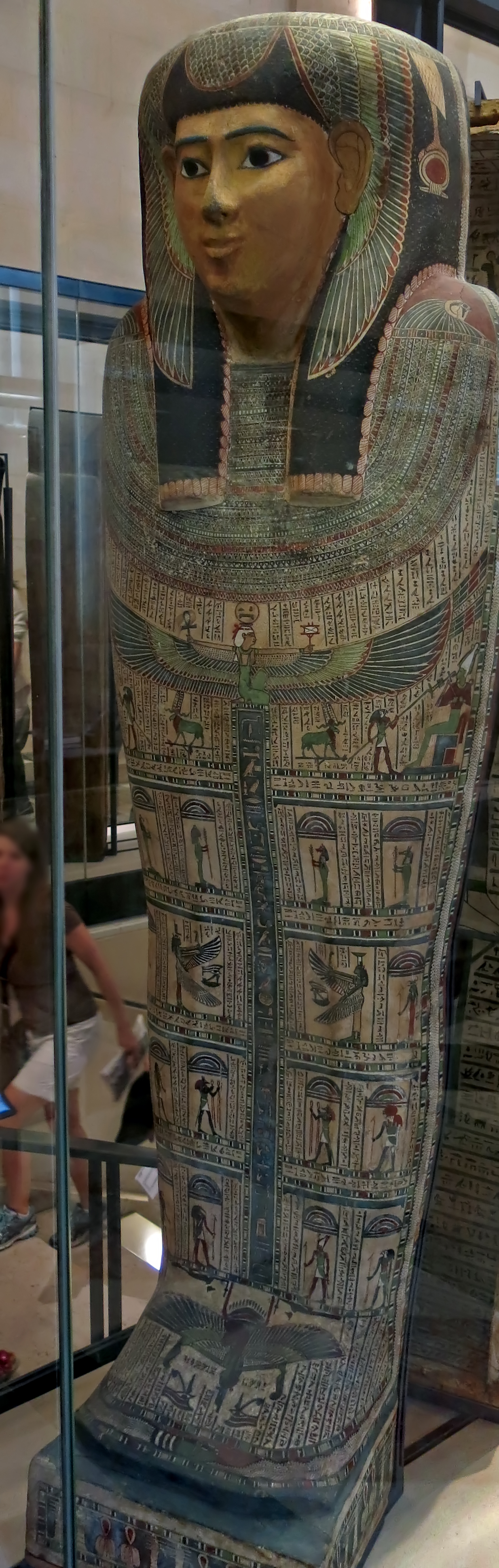
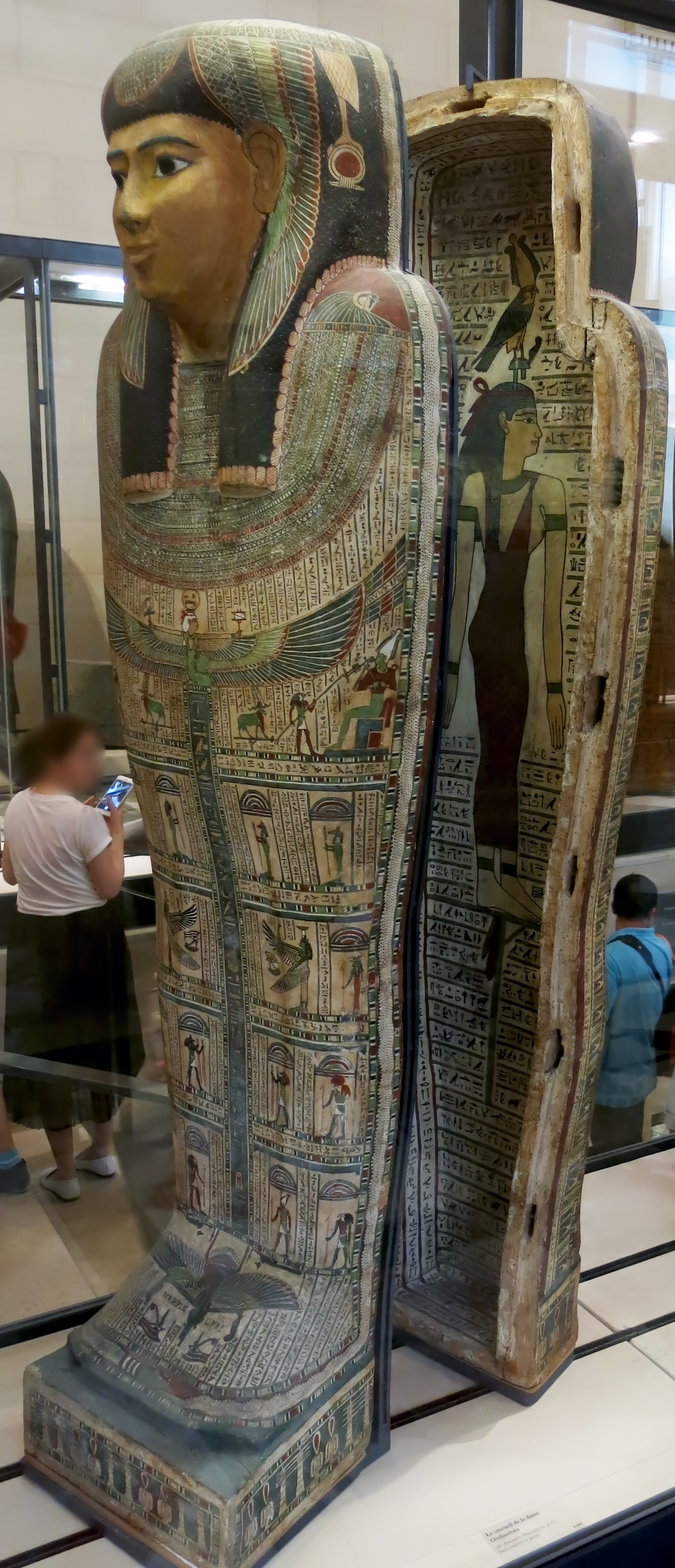
26th Dynasty: 664 BC - 525 BC
Oudjarenes
Wearing a shroud, hands are hidden, a tripartite wig, and Usekh collar, with a vulture spread over the wig, holding a Shen ring in its claw.
Below the collar, Nut, the winged goddess, is depicted kneeling with wings spread, holding an ankh in the right hand and the sign of the breath in the left.
Sign of Breath
Below Nut is an offering scene, with a symmetrical pair of falcon-headed gods presenting a was sceptre, on which is mounted a djed pillar and an ankh sign, to a seated Osiris. Also present are a pair of rams each wearing the crown of Amun.
On the next register are the four sons of Horus, each standing in a chapel.
On the register below that is a winged Isis on the left with her throne sign/headdress, the wings protecting a wedjat eye. On the right in a similar pose is a winged Nephthys, wearing her headdress.
Peeters Online Journals states that:
Oudjarenes was a woman who lived in Hut-sekhem. She was deified after her death, in the Ptolemaic period. She bore the title of 'God’s Wife of Neferhotep', whether during her lifetime or after her death, or, more plausibly, during both stages.Text above from https://poj.peeters-leuven.be/content.php?url=article&id=2003723
Inscriptions include Âaushérout (mother, mistress of the house), and Tchahorpakhepech (father).
Height 1890 mm, width 555 mm.
Catalog: Painted wood, Aile Sully, Room 321, the Sarcophagi, Vitrine 2, N 2626, Salt n°3007
Photo: Don Hitchcock 2015
Source and text: Original, Louvre Museum, Paris, France, https://collections.louvre.fr/
Breath Glyph: Budge (1920)
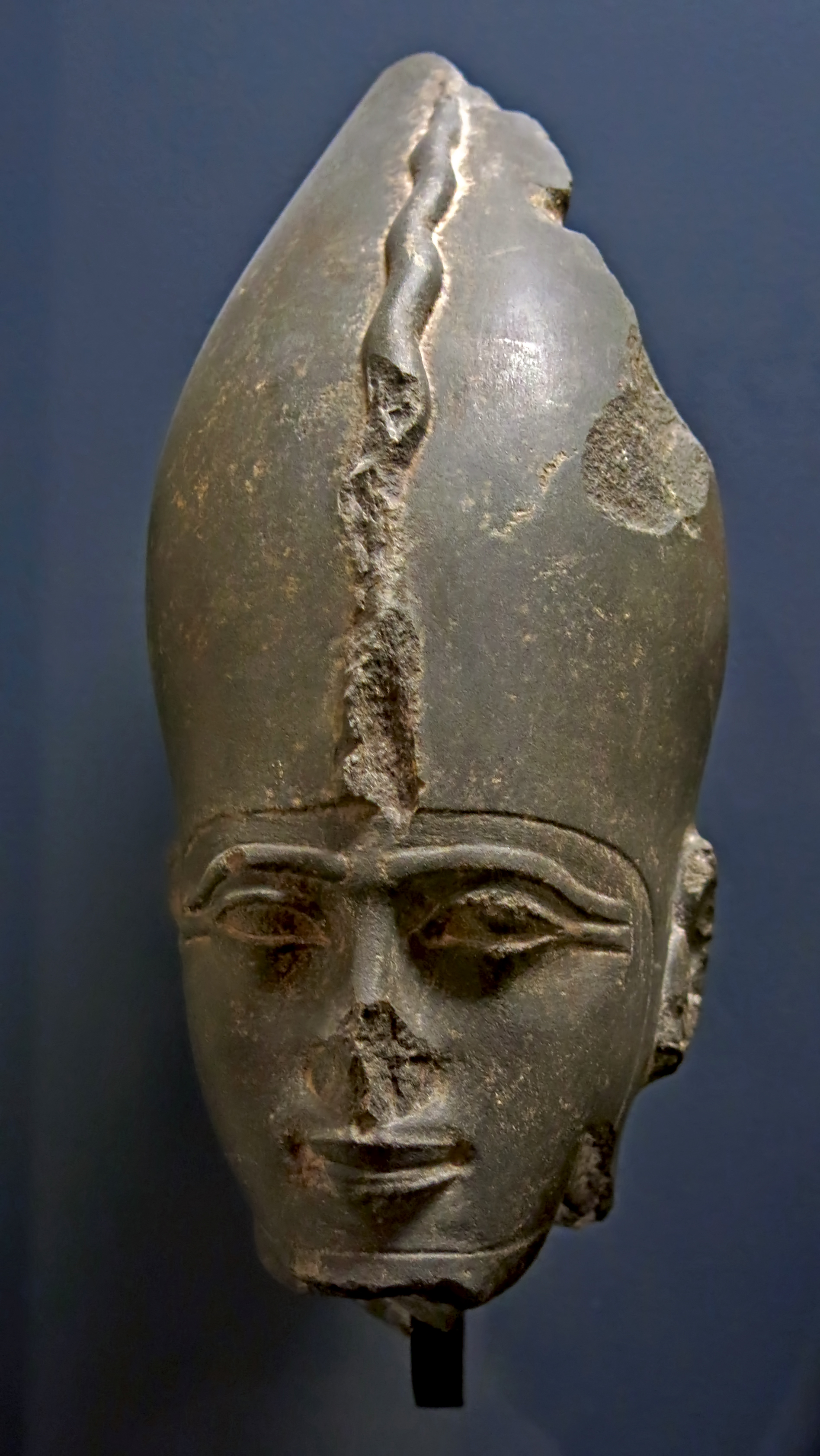
26th Dynasty: 664 BC - 525 BC
Psamtik III
Psamtik III, wearing the White Crown (Hedjet) of Osiris.
Psamtik III was the last Pharaoh of the Twenty-sixth Dynasty of Egypt from 526 BC to 525 BC. Most of what is known about his reign and life was documented by the Greek historian Herodotus in the 5th century BC. Herodotus states that Psamtik had ruled Egypt for only six months before he was confronted by a Persian invasion of his country led by King Cambyses II of Persia. Psamtik was subsequently defeated at the Battle of Pelusium, and fled to Memphis where he was captured. The deposed pharaoh was carried off to Susa in chains, and later committed suicide.
Height 275 mm.
Catalog: Greywacke, Aile Sully, Salle 323, Crypte d'Osiris, Vitrine 8, E 10706
Photo: Don Hitchcock 2015
Source and text: Original, Louvre Museum, Paris, France, https://collections.louvre.fr/
Additional text: Wikipedia
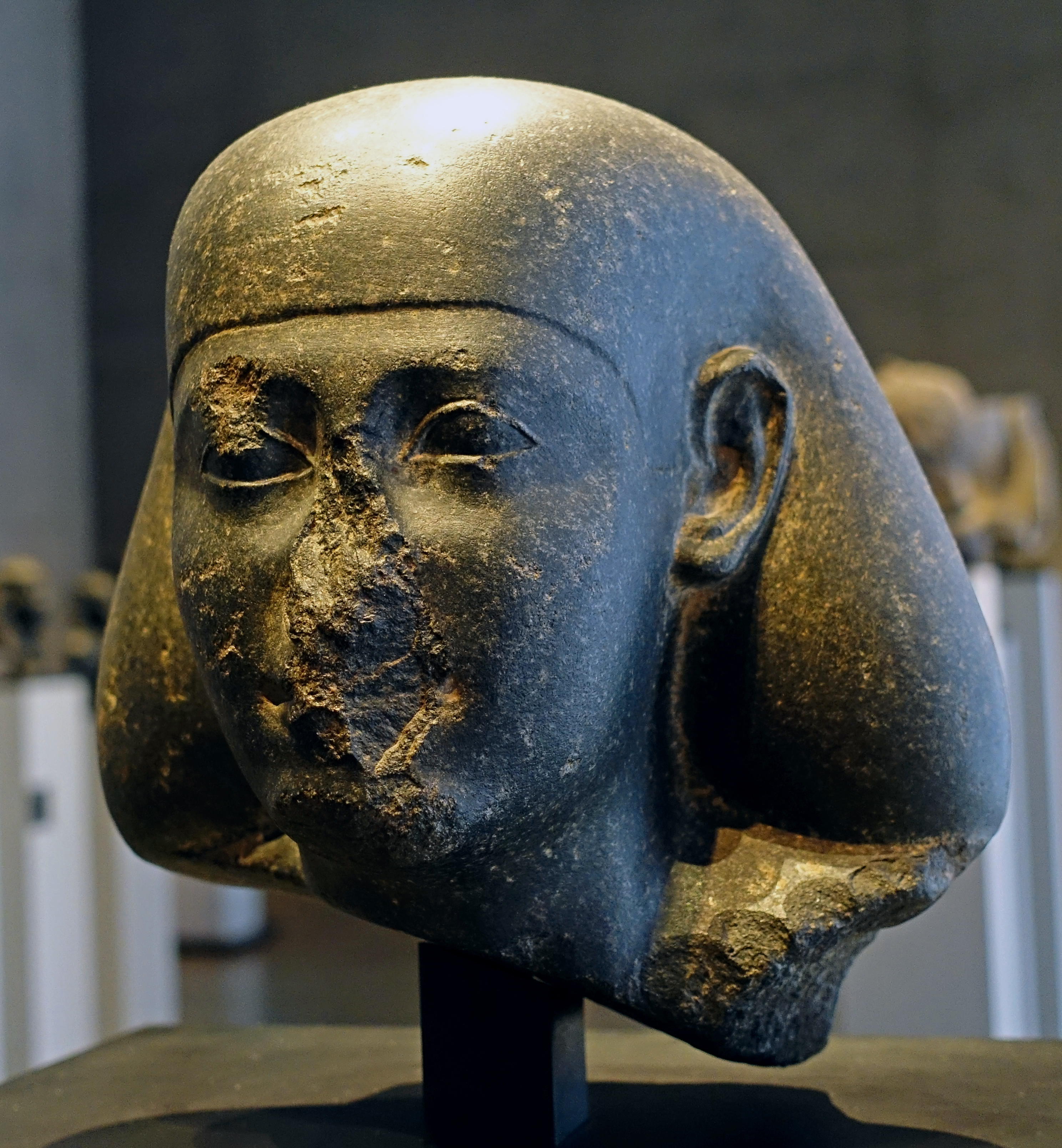
26th Dynasty: 664 BC - 525 BC
Head of a man
Head from the statue of a man, circa 600 BC
Catalog: Hardstone, ÄS 5558
Photo: Don Hitchcock 2018
Source: Original, Ägyptischen Museum München
Text: Museum card, © Ägyptischen Museum München
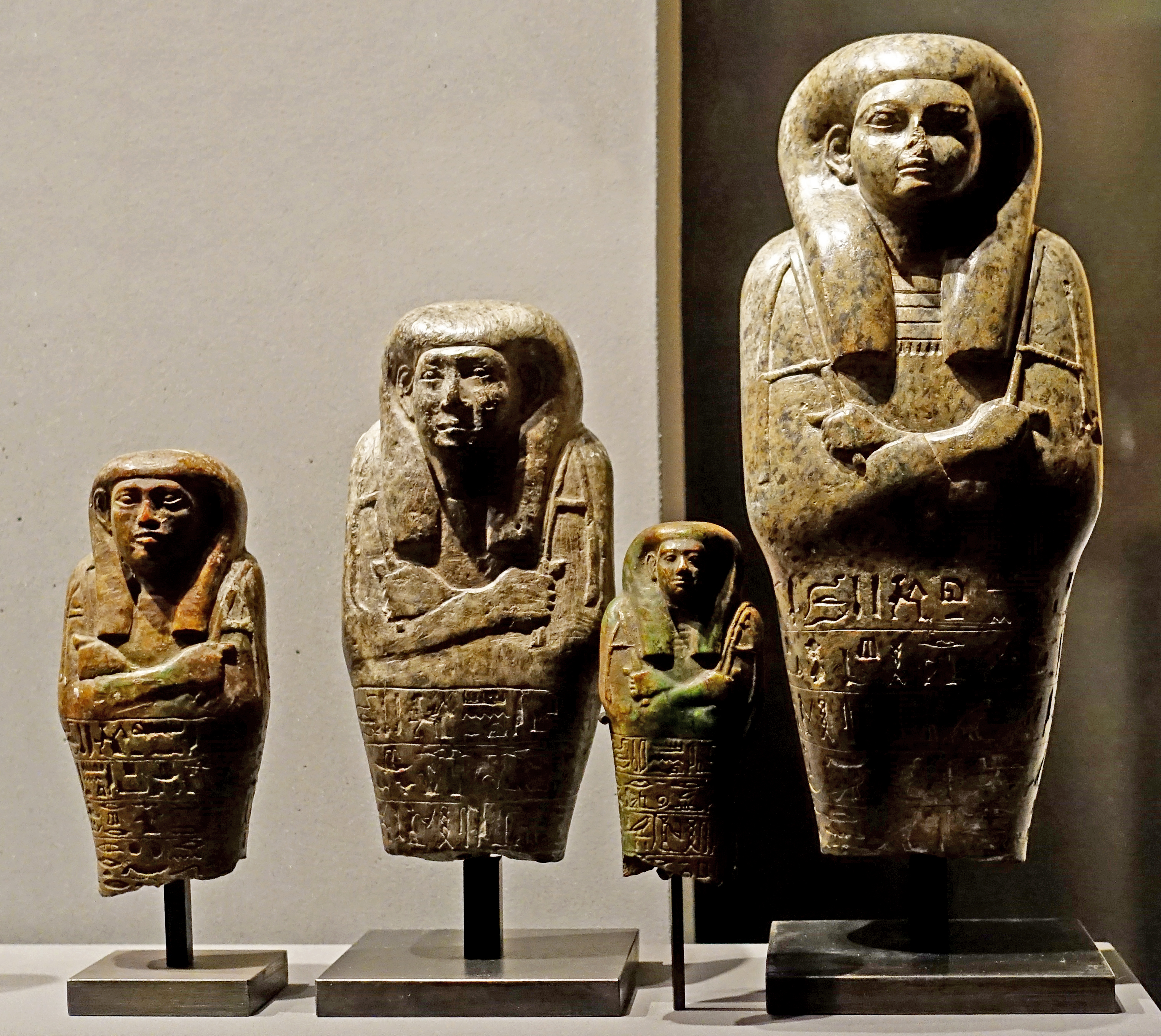
26th Dynasty: 664 BC - 525 BC
Petamenophis
Four ushebtis of the priest Petamenophis, circa 650 BC
Catalog: Serpentinite, West Thebes, Grave of Petamenophis, ÄS 269, ÄS 281, ÄS 389, ÄS 390
Photo: Don Hitchcock 2018
Source: Original, Ägyptischen Museum München
Text: Museum card, © Ägyptischen Museum München
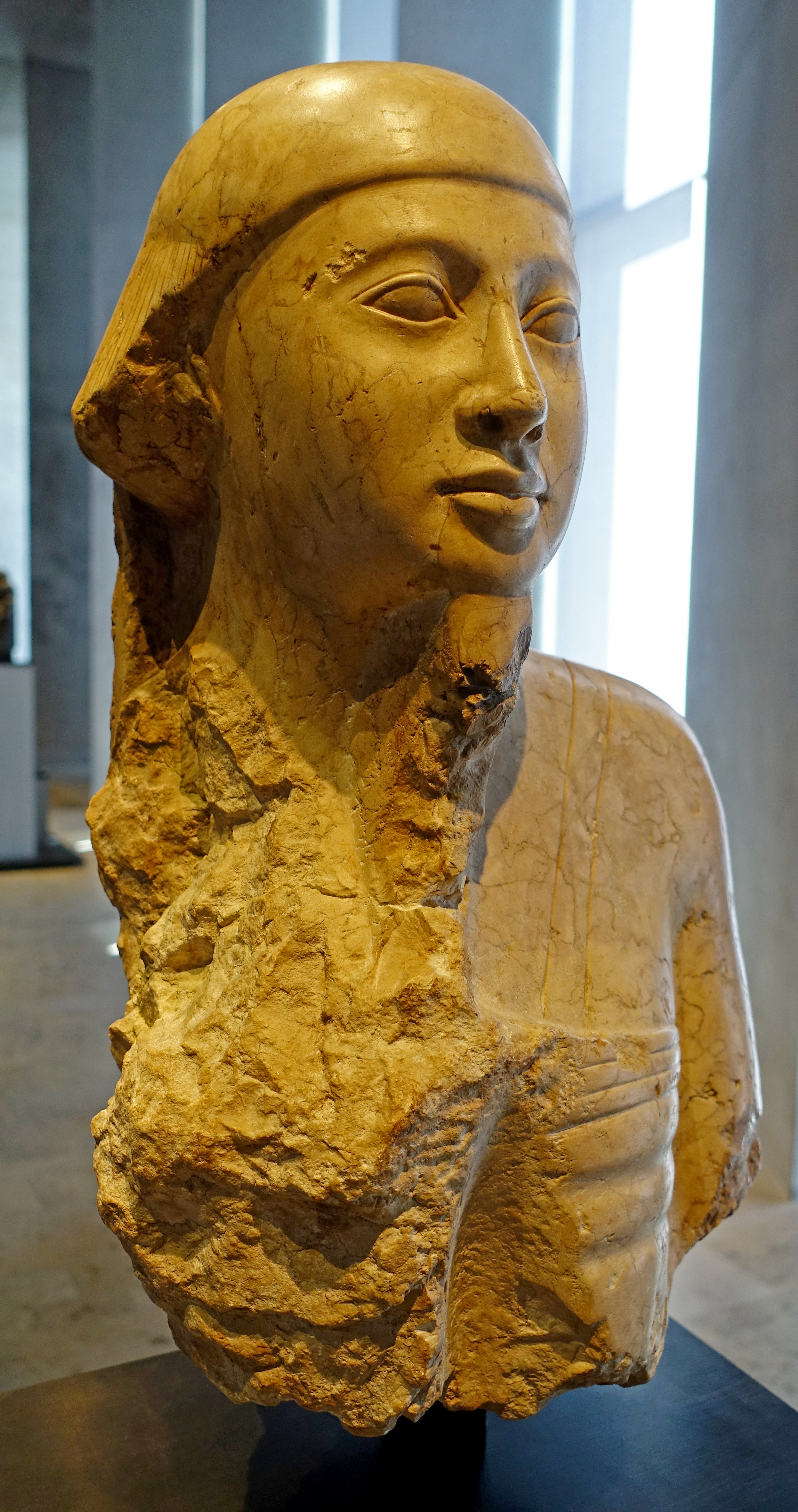
26th Dynasty: 664 BC - 525 BC
Priest
Upper half of a figure of a priest, circa 550 BC
Catalog: Limestone, Achmim, ÄS 4871
Photo: Don Hitchcock 2018
Source: Original, Ägyptischen Museum München
Text: Museum card, © Ägyptischen Museum München
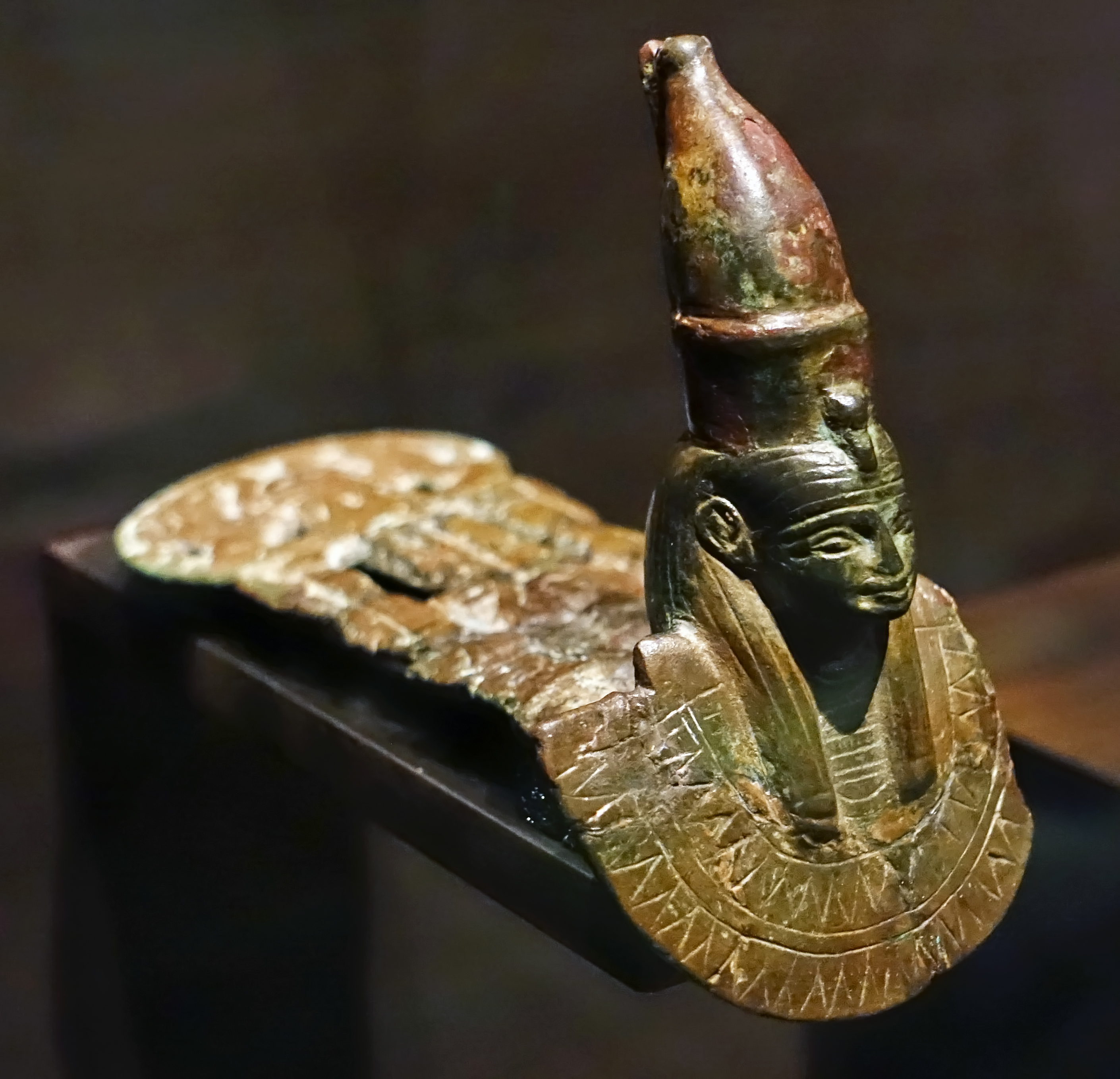
26th Dynasty: 664 BC - 525 BC
Menit
Menit with the head of Hathor, circa 600 BC.
Catalog: Bronze, ÄS 5848
Photo: Don Hitchcock 2018
Source: Original, Ägyptischen Museum München
Text: Museum card, © Ägyptischen Museum München
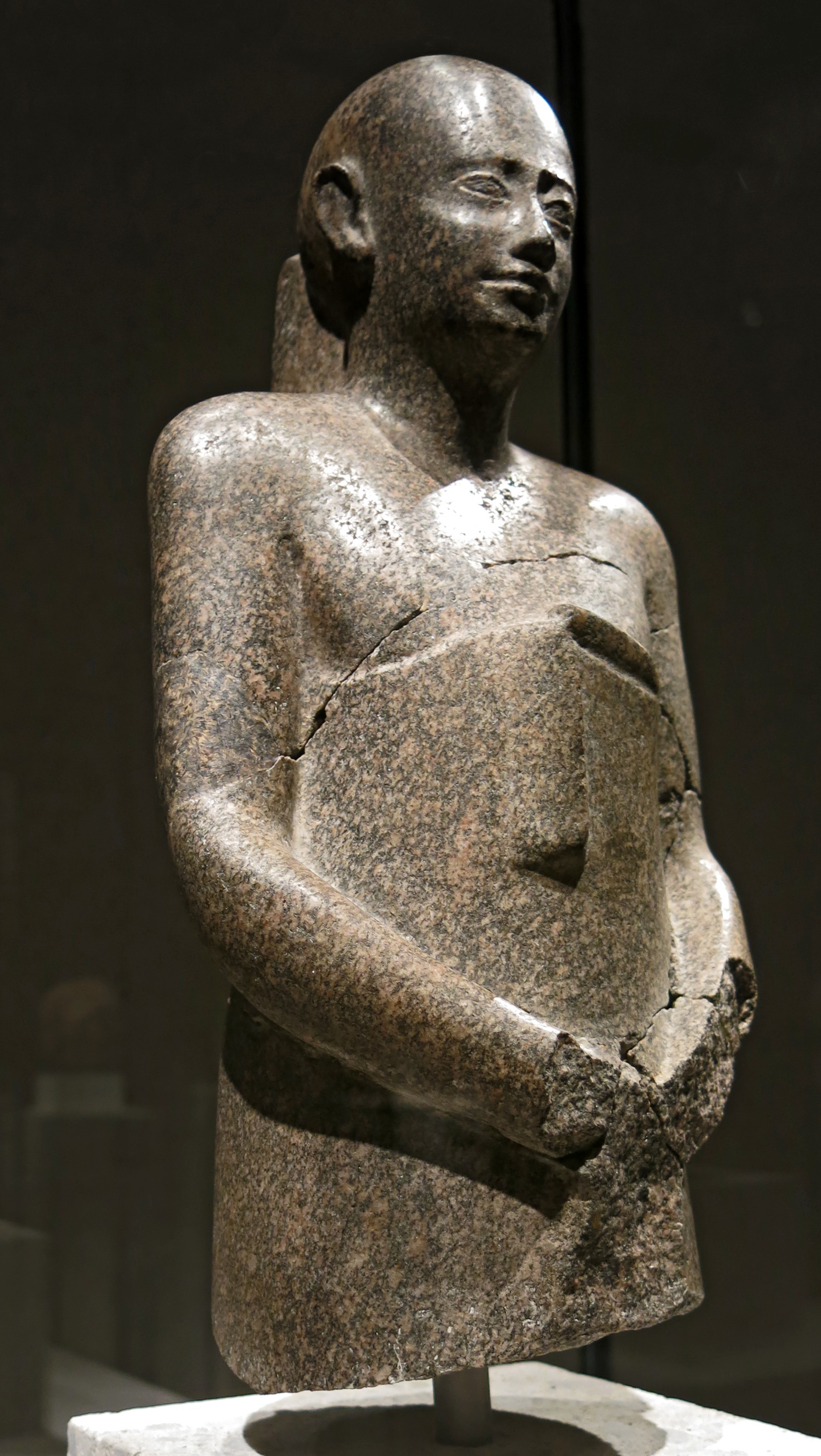
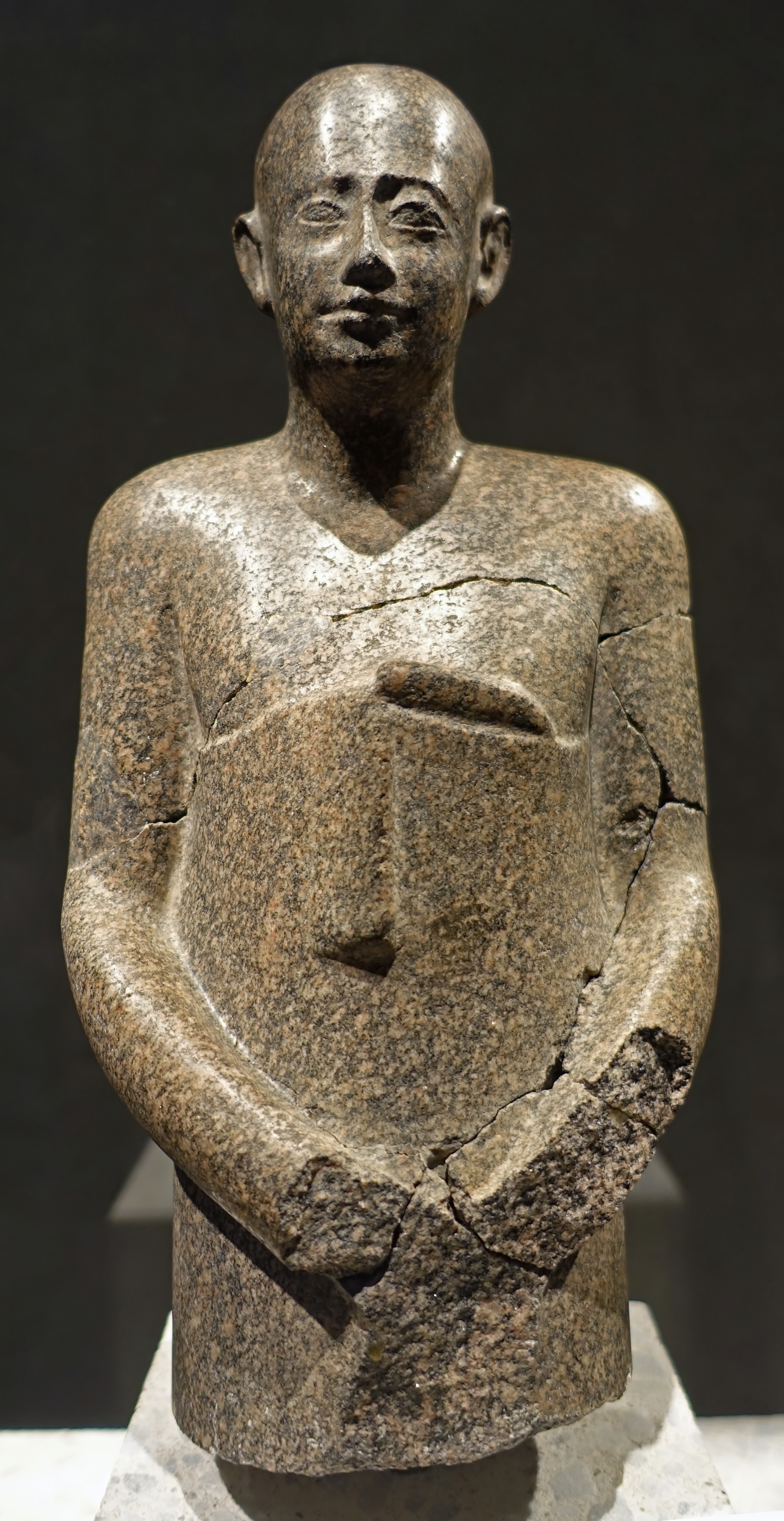
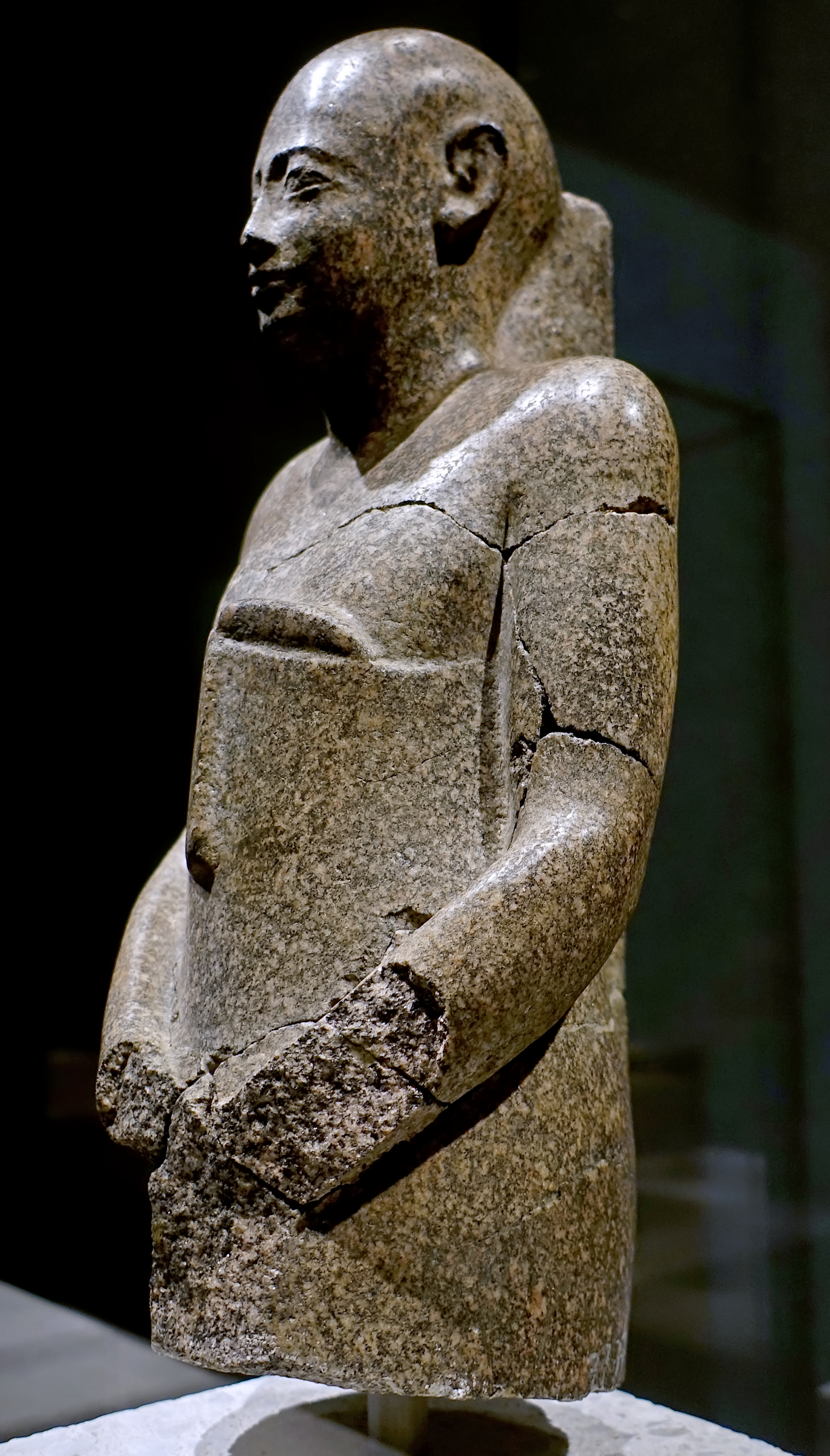
26th - 27th Dynasty: 664 BC - 404 BC
Hori
Upper part of a standing figure of the priest Hori, circa 525 - 450 BC.
Hori was the High Priest of Ptah at the very end of the reign of Ramesses II. Hori succeeded Neferronpet in office.
Hori was a son of prince Khaemwaset and hence a grandson of Ramesses II. Hori had an older brother named Ramesses who had served as Sem priest of Ptah. It was Hori however who would eventually follow in his father's footsteps and become high priest. Hori also had a sister named Isetnofret. It is possible that Isetnofret married her uncle Merenptah and served as his queen. If so, Hori would have been both a nephew and a brother-in-law to pharaoh Merenptah.
Hori is attested on:
• A pillar originally from his tomb in Saqqara. Hori uses the titles Noble, Chief in charge of Both Lands, Sem Priest and High Priest. He is explicitly said to be the son of Khaemwaset.
• A stela (BM 167) from the Scribe of the Royal Harem named Ptahemwia
Catalog: Granite, ÄM 7737
Photo: Don Hitchcock 2015, 2018
Source: Original, Staatliche Museen zu Berlin, Neues Museum, Germany
Text: © Card at the Staatliche Museen zu Berlin, (CC BY-NC-SA 3.0 DE)
Additional text: Wikipedia
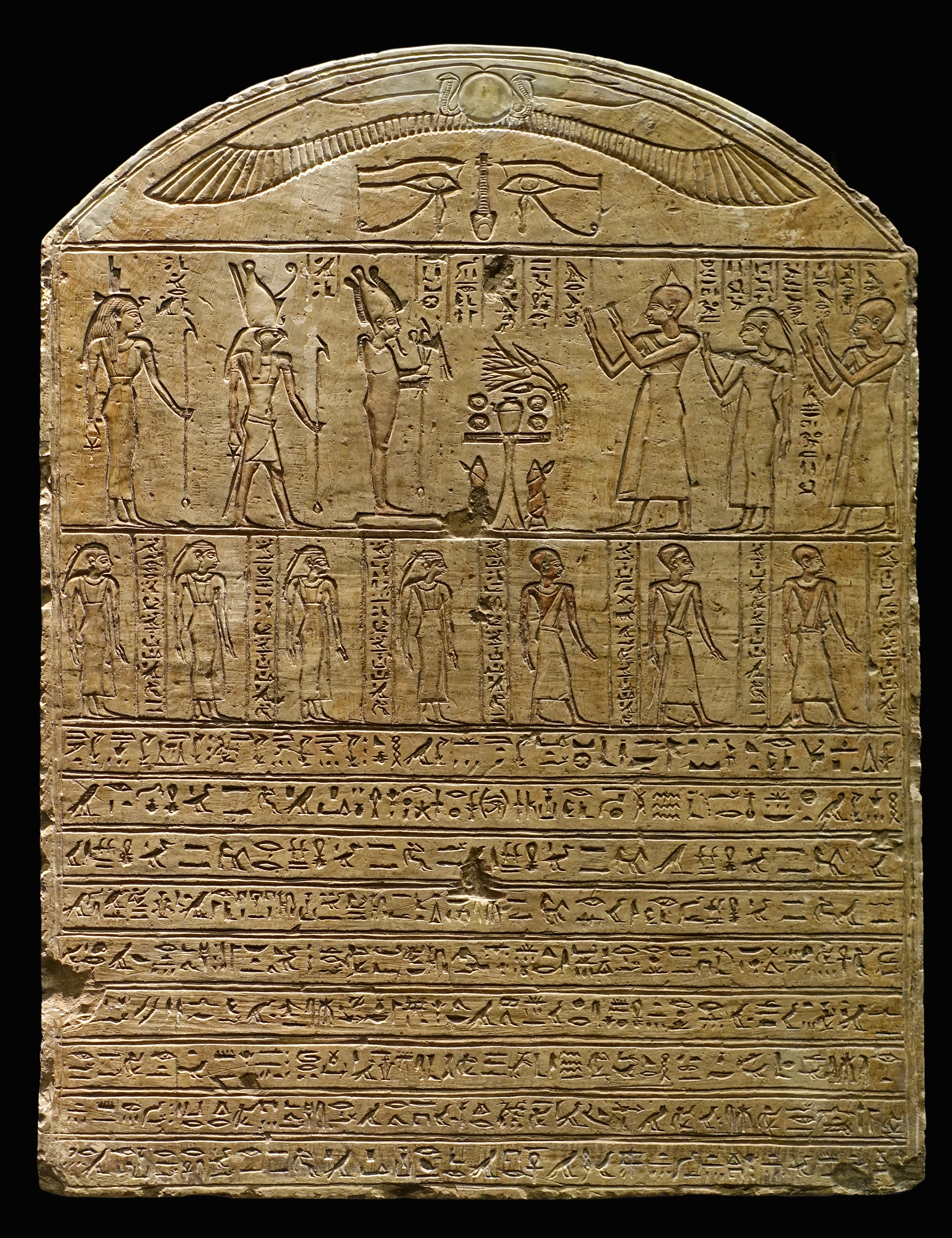
26th Dynasty: 664 BC - 525 BC
Padiherpachered
Stela of Padiherpachered, a priest of the Ka.
Circa 580 BC - 530 BC
Catalog: Limestone, Abydos, ÄS 49
Photo: Don Hitchcock 2018
Source: Original, Ägyptischen Museum München
Text: Museum card, © Ägyptischen Museum München

26th - 27th Dynasty: 664 BC - 404 BC
Bead nets
(left) Small bead net with pendant figures of the Sons of Horus.
Bead-net consisting of blue glazed composition short and standard cylinder beads strung in a diagonal pattern, one end elaborated with thirteen tassels, each comprising glazed composition beads and frayed fibre tassels, the other end has twelve similar tassels and four others, strung with beads and rudimentary funerary amulets, two of which are incomplete.
Late Period, after 664 BC.
Dimensions: length 694 mm (not including tassels), width 230 mm.
Catalog: Thebes, EA18247
(right) Collared bead net.
Bead-net of blue glazed composition beads.
Late Period, after 664 BC.
Dimensions: length 1395 mm, width 505 mm.
Catalog: Provenance unknown, EA29593
Photo: Don Hitchcock 2018
Source: Original, British Museum
Text: Card with the display at the British Museum, https://www.britishmuseum.org/, © Trustees of the British Museum, CC BY-NC-SA 4.0
Late Period, after 664 BC. Bronze reliquaries for mummified ichneumons and wooden reliquary for a mummified beetle. EA68292 67195. 26258. 67194. 36155

26th - 27th Dynasty: 664 BC - 404 BC
Ichneumon
Egyptian mongoose ( Herpestes ichneumon ).
Hollow-cast copper alloy ichneumon coffin; open at one end; surmounted by a solid-cast figure of an ichneumon.
Height 26 mm (coffin), height 16 mm (figure), length 143 mm (coffin), length 68 mm (figure), width 27 mm.
Catalog: Copper alloy, Saqqara (Memphis), EA68292
Photo: Don Hitchcock 2018
Source: Original, British Museum
Text: Card with the display at the British Museum, https://www.britishmuseum.org/, © Trustees of the British Museum, CC BY-NC-SA 4.0
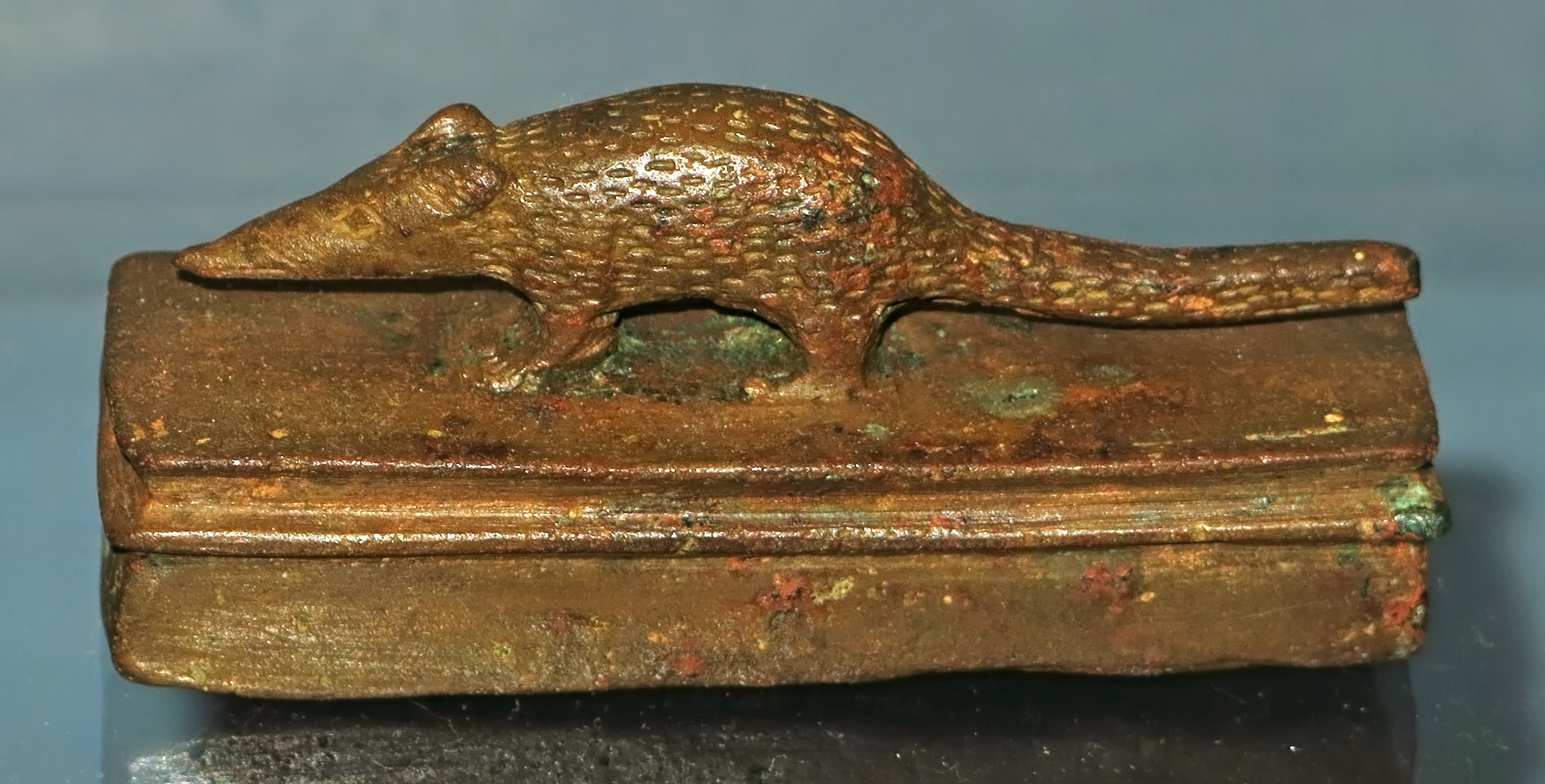
26th - 27th Dynasty: 664 BC - 404 BC
Ichneumon
Egyptian mongoose ( Herpestes ichneumon ).
Solid-cast copper alloy ichneumon (or shrewmouse, from the long snout) with incised fur-detail; naophorous ( carrying a naos, a shrine - Don ) pedestal with hieroglyphic and demotic inscription.
Height 35 mm (whole), length 81 mm (whole), length 76 mm (figure), width 25 mm (base).
Named in inscription: Ankhhap.
Catalog: Solid cast copper alloy, Saqqara (Memphis), EA67195
Photo: Don Hitchcock 2015
Source: Original, British Museum
Text: Card with the display at the British Museum, https://www.britishmuseum.org/, © Trustees of the British Museum, CC BY-NC-SA 4.0
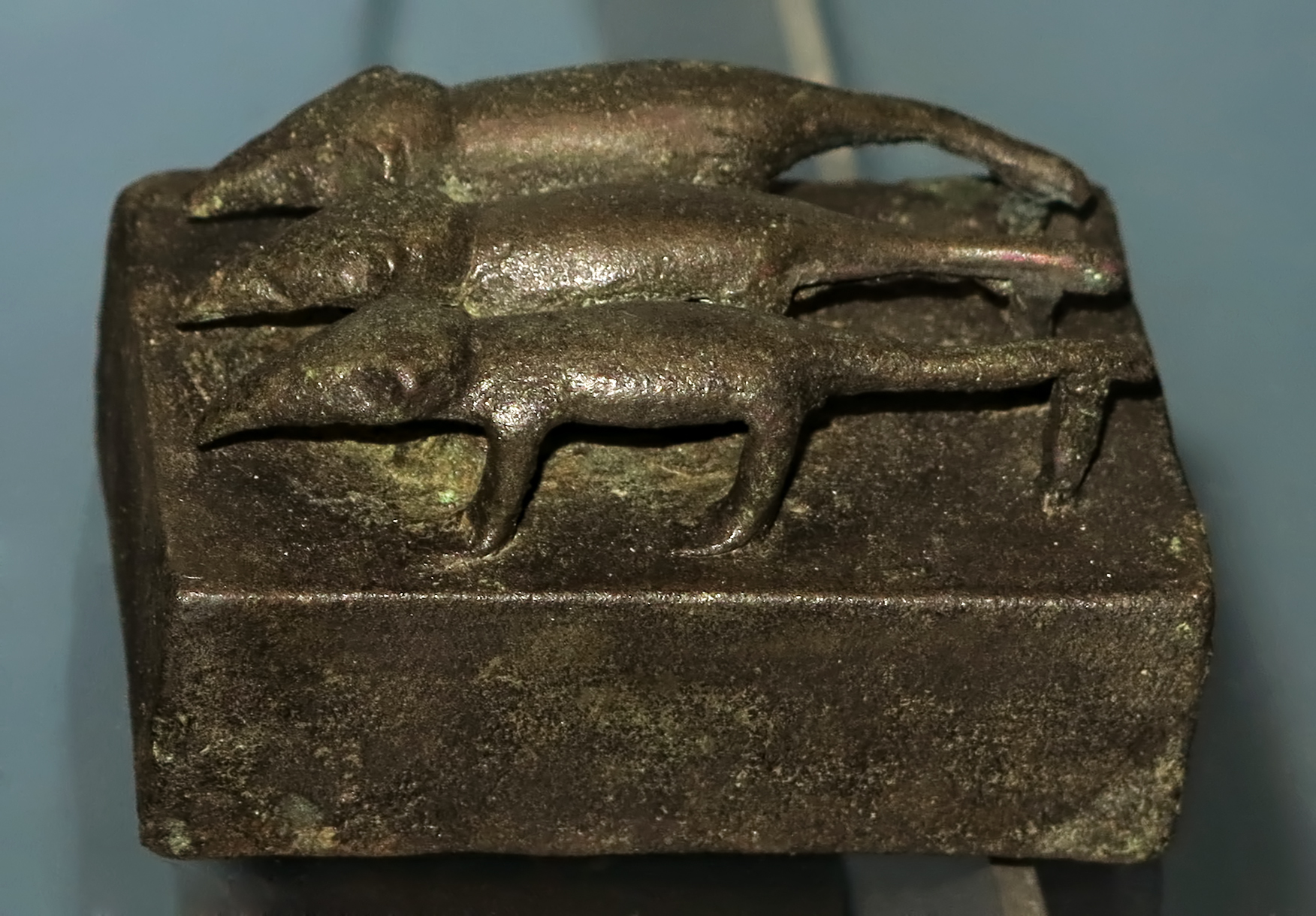
26th - 27th Dynasty: 664 BC - 404 BC
Shrew-mice
Bronze container for mummified shrew-mice; three figures of shrew-mice on top.
Length 67 mm.
The shrew mouse was an animal sacred to the solar deity Horus of Letopolis, capital of the second nome of Lower Egypt, but was honoured all over Egypt, particularly in the Delta. The mouse was considered to be the blind eye of Horus, which was miraculously healed, thereby symbolising resurrection and rebirth.
These types of shrew boxes were offered together with other statuettes and animal mummies in temples and catacombs, not just to Horus of Letopolis, but more broadly in contexts related to solar cult. More detailed examples have solar symbols inscribed on the back that testify to the regenerative power of the sun, similar to those found on Apis bulls.
Catalog: Bronze, EA26258
Photo: Don Hitchcock 2015
Source: Original, British Museum
Text: Card with the display at the British Museum, https://www.britishmuseum.org/, © Trustees of the British Museum, CC BY-NC-SA 4.0
Additional text: www.metmuseum.org/
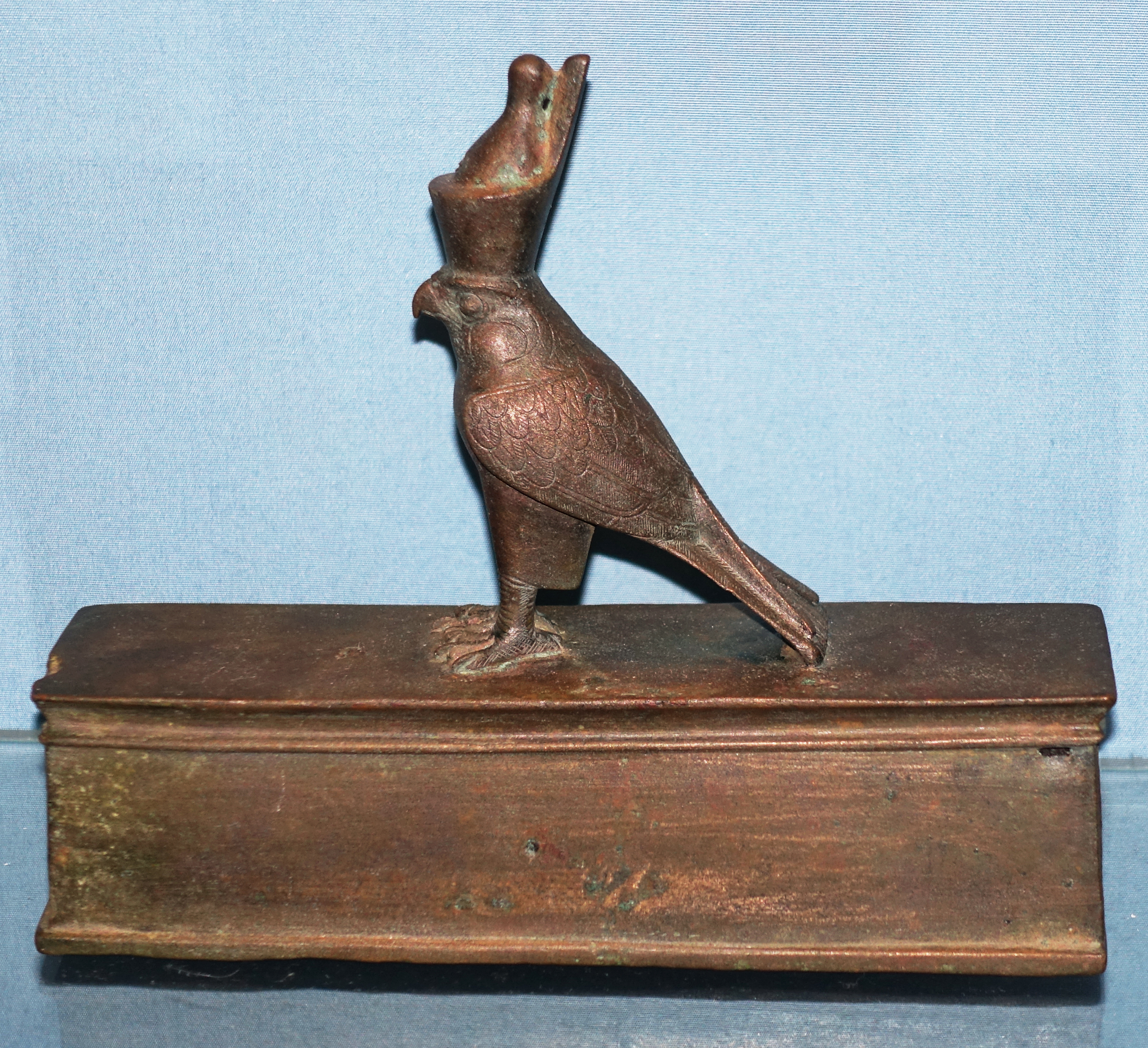
26th - 27th Dynasty: 664 BC - 404 BC
Falcon
Hollow-cast copper alloy naophorous coffin surmounted by a solid-cast figure of Haroeris or other deity depicted as a falcon wearing the double crown; incised plumage. The coffin contains a mummified falcon. ( naophorous -
carrying a naos, a shrine - Don )
Height 132 mm, length 174 mm, width 43 mm.
Catalog: Copper alloy, Saqqara, EA67196
Photo: Don Hitchcock 2018
Source: Original, British Museum
Text: Card with the display at the British Museum, https://www.britishmuseum.org/, © Trustees of the British Museum, CC BY-NC-SA 4.0
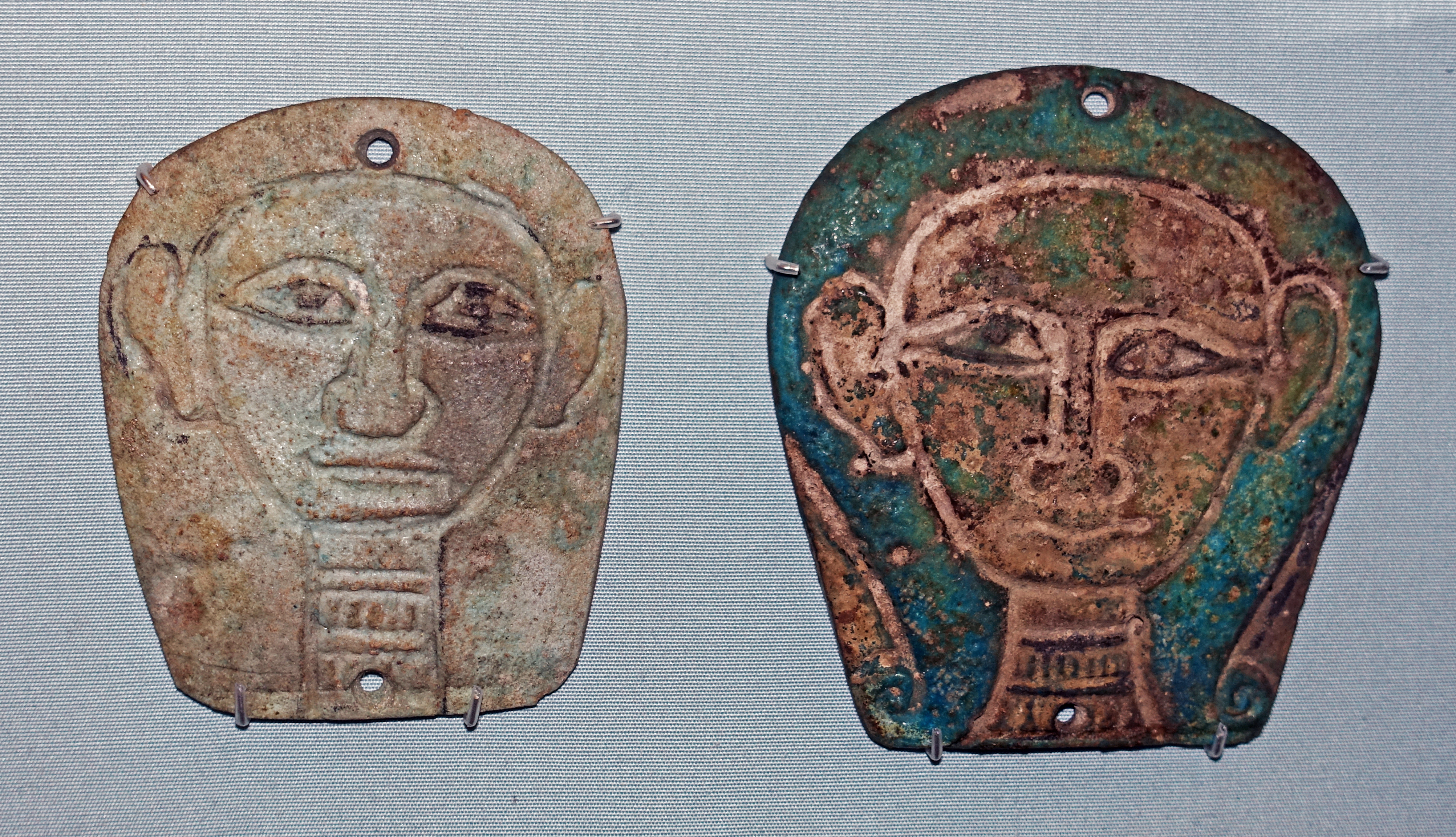
26th - 27th Dynasty: 664 BC - 404 BC
Goddess Nut
Faience faces of the goddess Nut from bead nets. Late Period, after 664 BC.
Bead nets also carried celestial symbolism. This was manifested in the blue colouring of the beads, and in the incorporation of a face of the sky-goddess Nut into some examples.
(left) EA1145, Height 80 mm, thickness 8 mm, width 74 mm. Green glazed composition fitting in the shape of the head of Nut. Incised details, pierced at each end for attachment.
(right) EA60905, Height 69 mm, thickness 5 mm, width 59 mm.
Green glazed composition fitting in the shape of the head of Nut; pierced at each end for attachment.
Catalog: Provenance unknown, EA1145, EA60905
Photo: Don Hitchcock 2018
Source: Original, British Museum
Text: Card with the display at the British Museum, https://www.britishmuseum.org/, © Trustees of the British Museum, CC BY-NC-SA 4.0
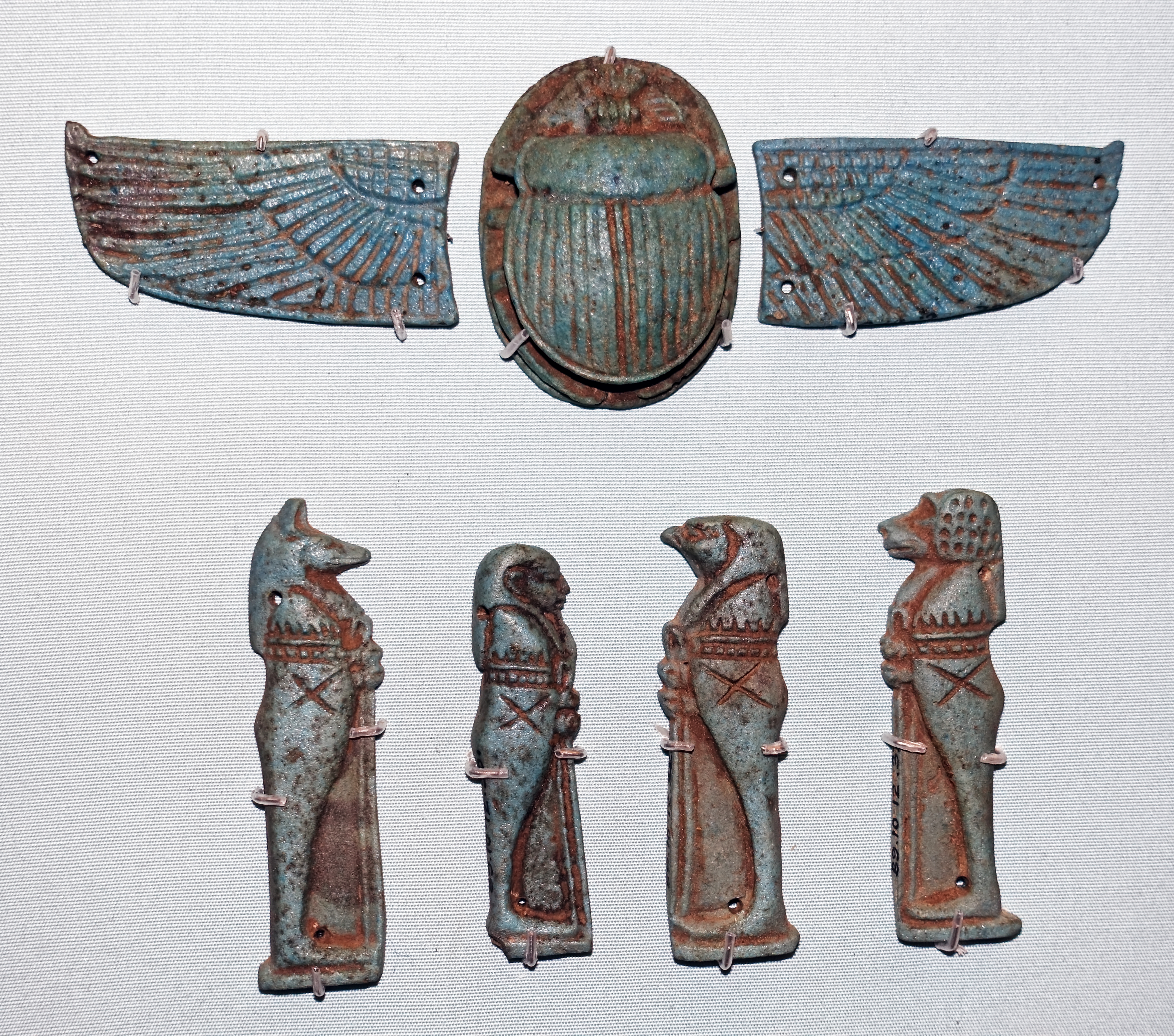
26th - 27th Dynasty: 664 BC - 404 BC
Amulets
Faience winged scarab, with the clypeus ( the broad plate at the front of an insect's head - Don ) marked, striated elytra and pierced in four places around the rim of the base; also two separate wings pierced in three places, and four Sons of Horus pierced at either end, all from a bead net.
Late Period, after 664 BC.
Catalog: Thebes, EA22805
Photo: Don Hitchcock 2018
Source: Original, British Museum
Text: Card with the display at the British Museum, https://www.britishmuseum.org/, © Trustees of the British Museum, CC BY-NC-SA 4.0
Additional text: Wikipedia
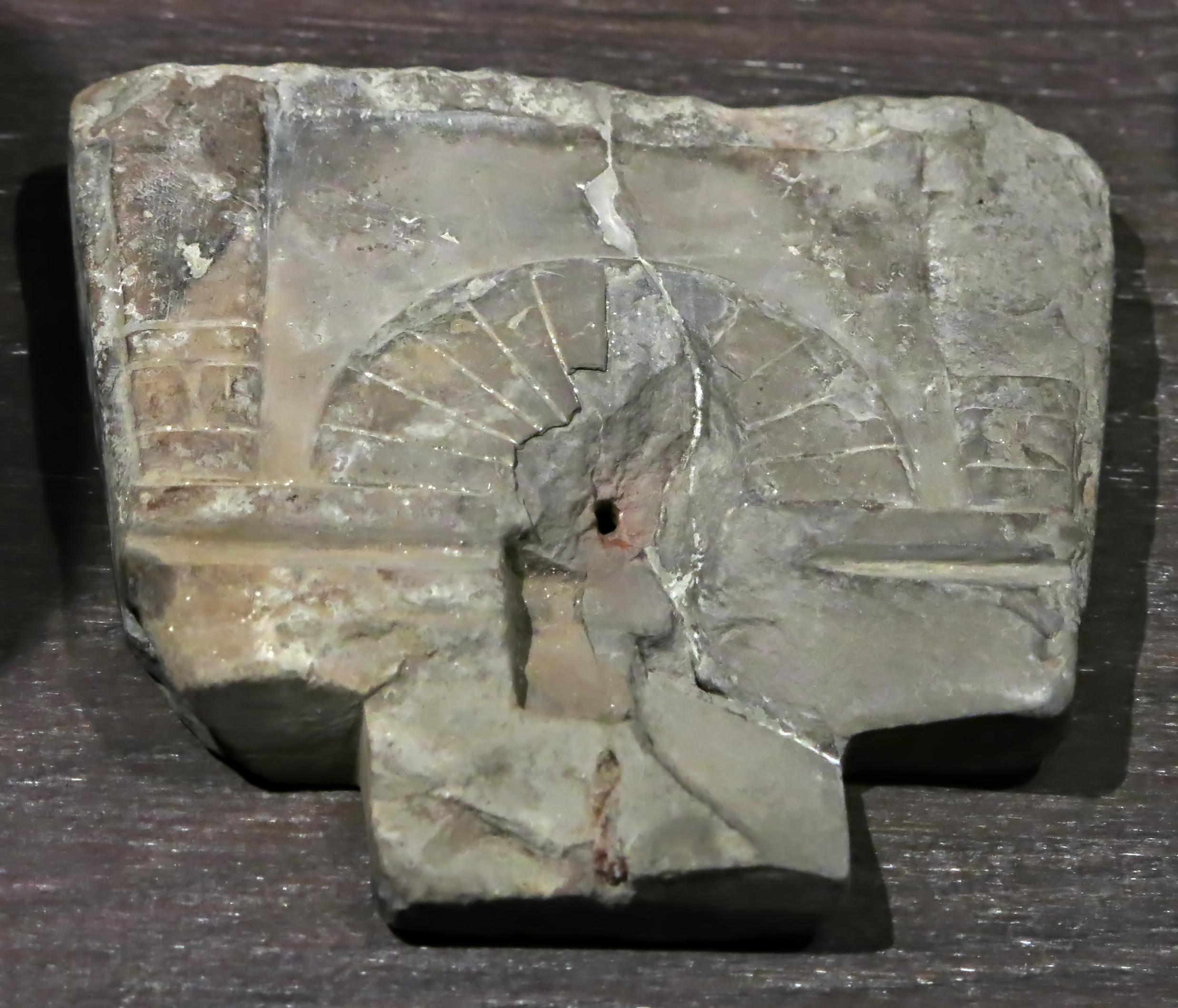
26th - 27th Dynasty: 664 BC - 404 BC
Sundial
Late Period, circa 6th - 5th century BC.
Catalog: Limestone (?), ÄS 5285
Photo: Don Hitchcock 2015
Source: Original, Ägyptischen Museum München
Text: Museum card, © Ägyptischen Museum München
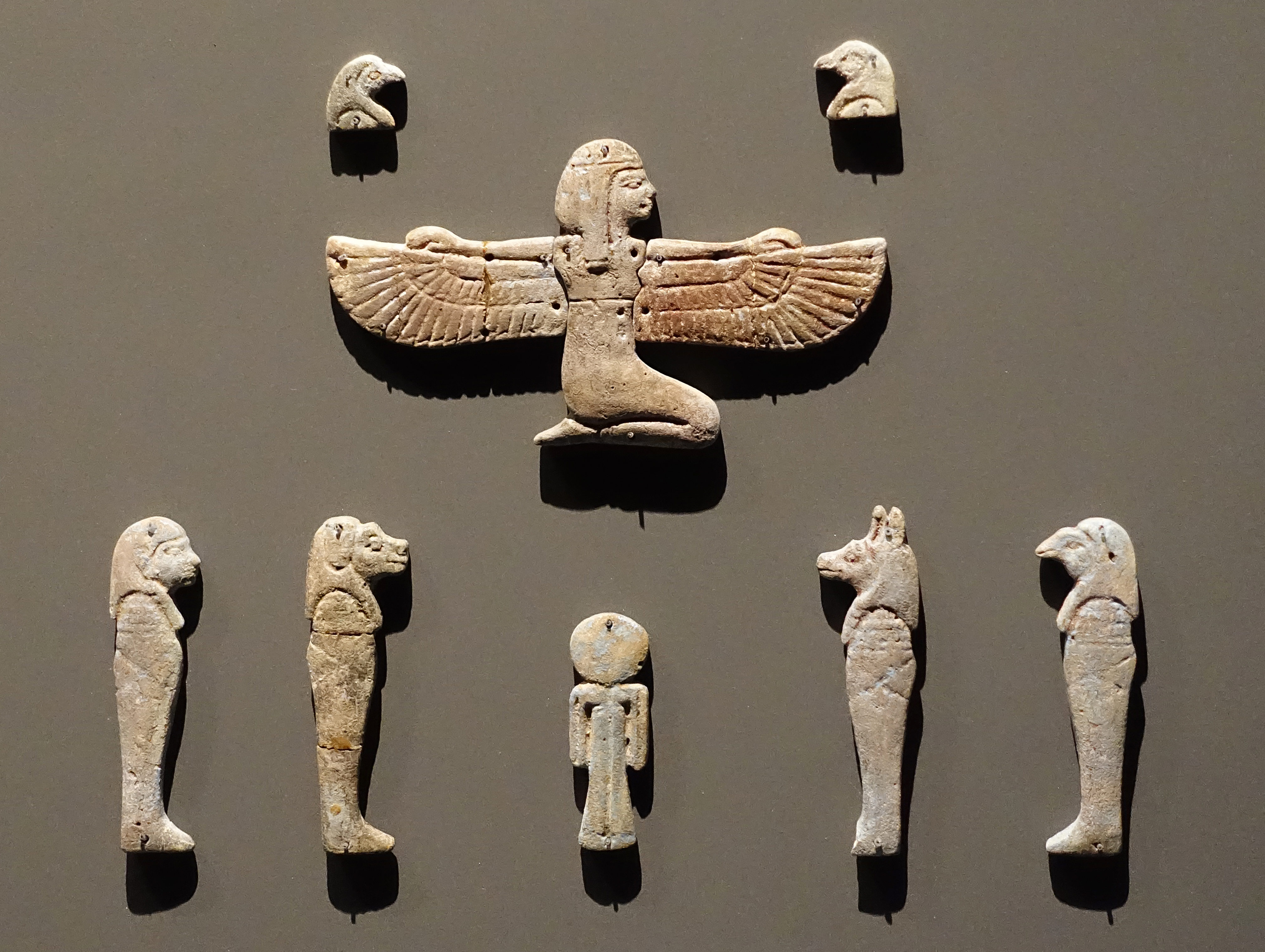
26th - 27th Dynasty: 664 BC - 404 BC
Amulets
Mummy Amulets, 6th - 5th century BC.
Mummy Facings / Amulets, consisting of two falcon heads, a winged goddess, four sons of Horus, and a 'Blood of Isis'.
( A 'Blood of Isis' is an amulet known also as the Tyet symbol, a looped shape similar to the Ankh, which came to be seen as Isis' emblem. Used as a funerary amulet, as here, it was said to confer her protection on the wearer - Don )
Catalog: Faience, ÄS 7151
Photo: Don Hitchcock 2018
Source: Original, Ägyptischen Museum München
Text: Museum card, © Ägyptischen Museum München
Additional text: Wikipedia
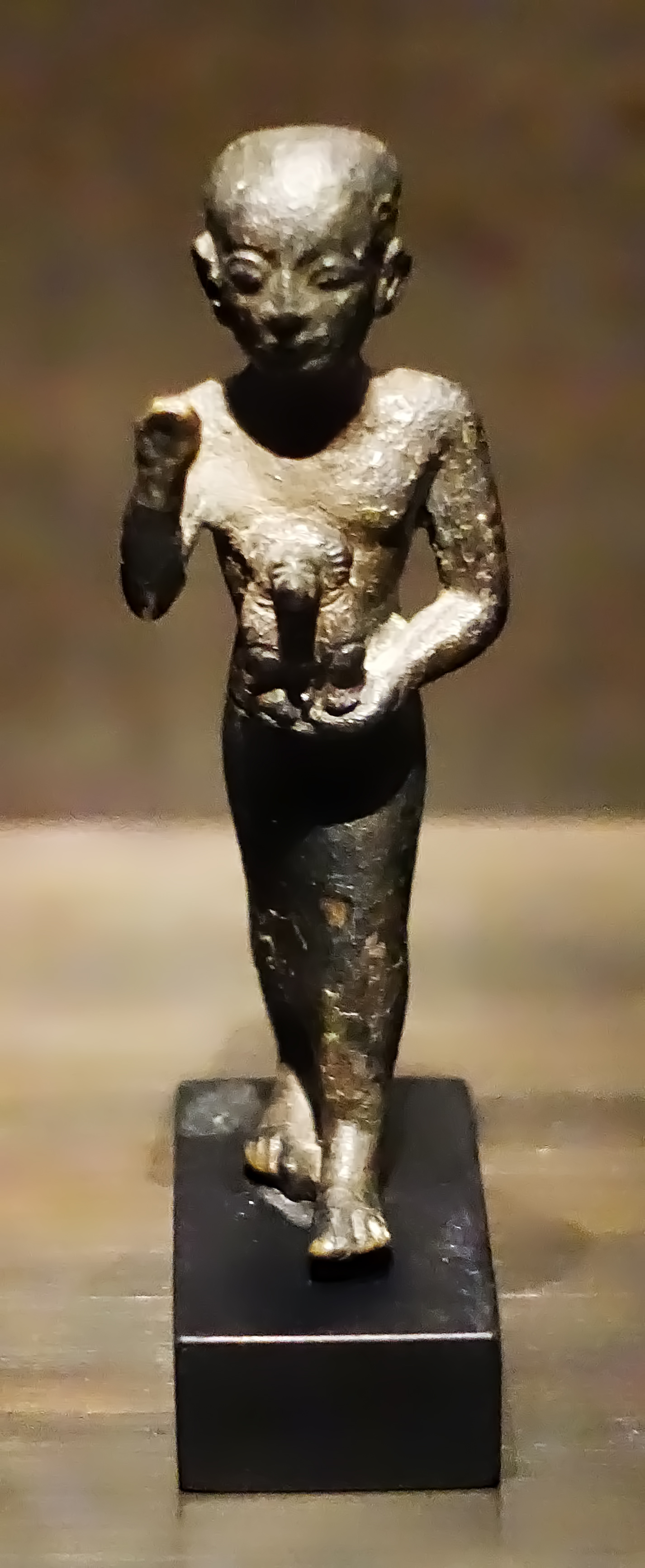


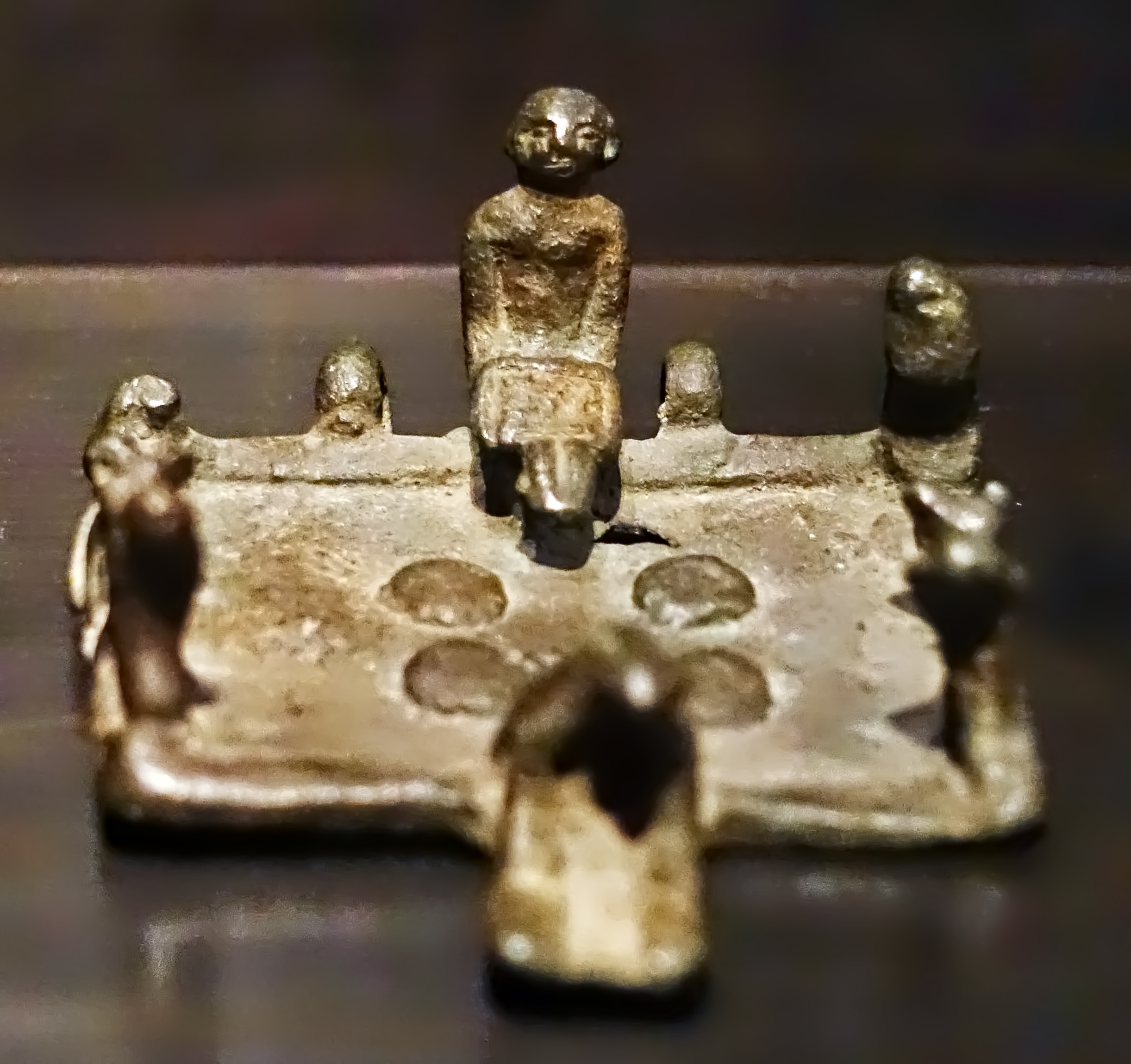
26th - 27th Dynasty: 664 BC - 404 BC
Offering
Offering bearers and offering tray with orans.
An orans is one who is praying or pleading.
Late Period, circa 6th - 5th century BC.
Catalog: Bronze, ÄS 168, ÄS 4837, ÄS 5590, ÄS 6285
Photo: Don Hitchcock 2018
Source: Original, Ägyptischen Museum München
Text: Museum card, © Ägyptischen Museum München
Additional text: Wikipedia
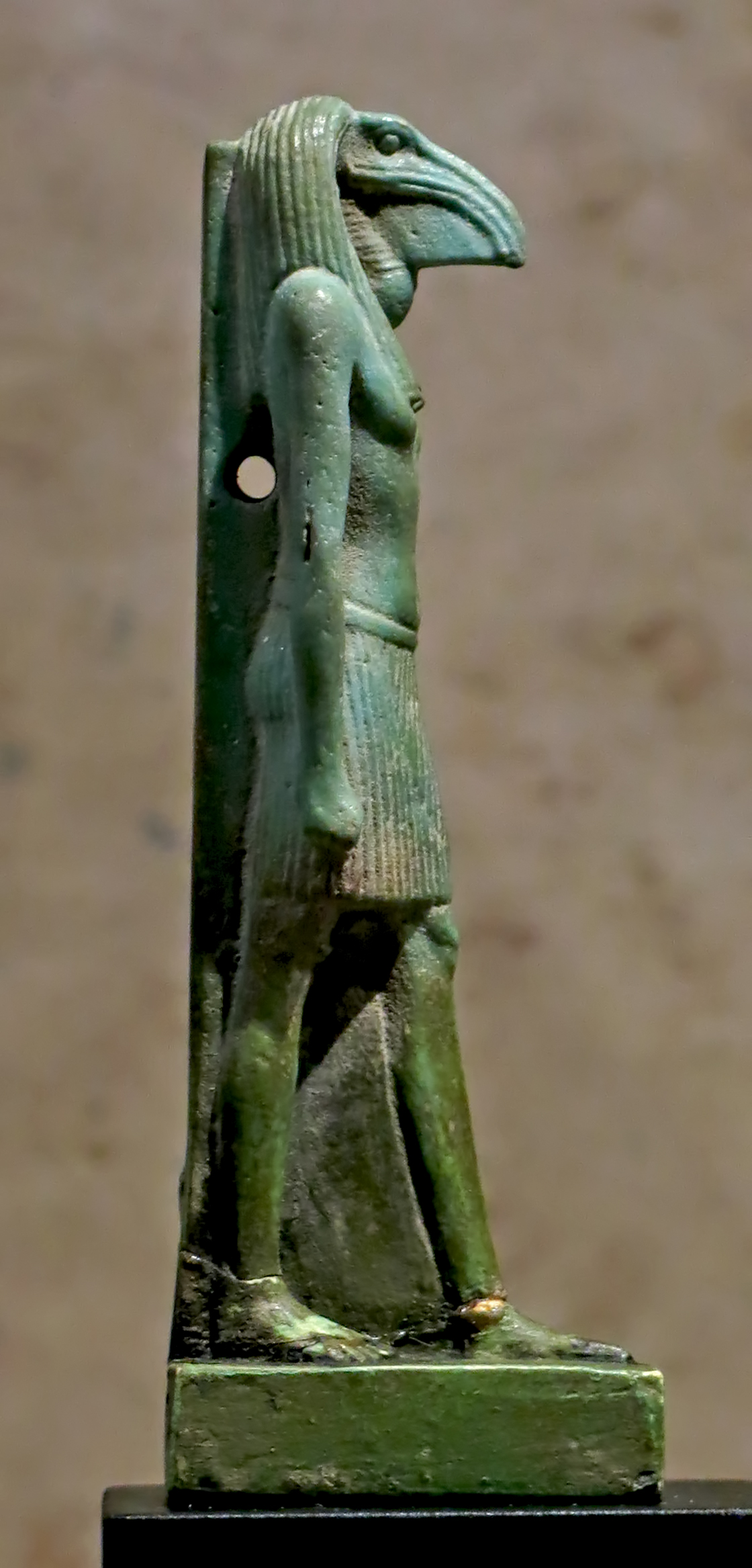
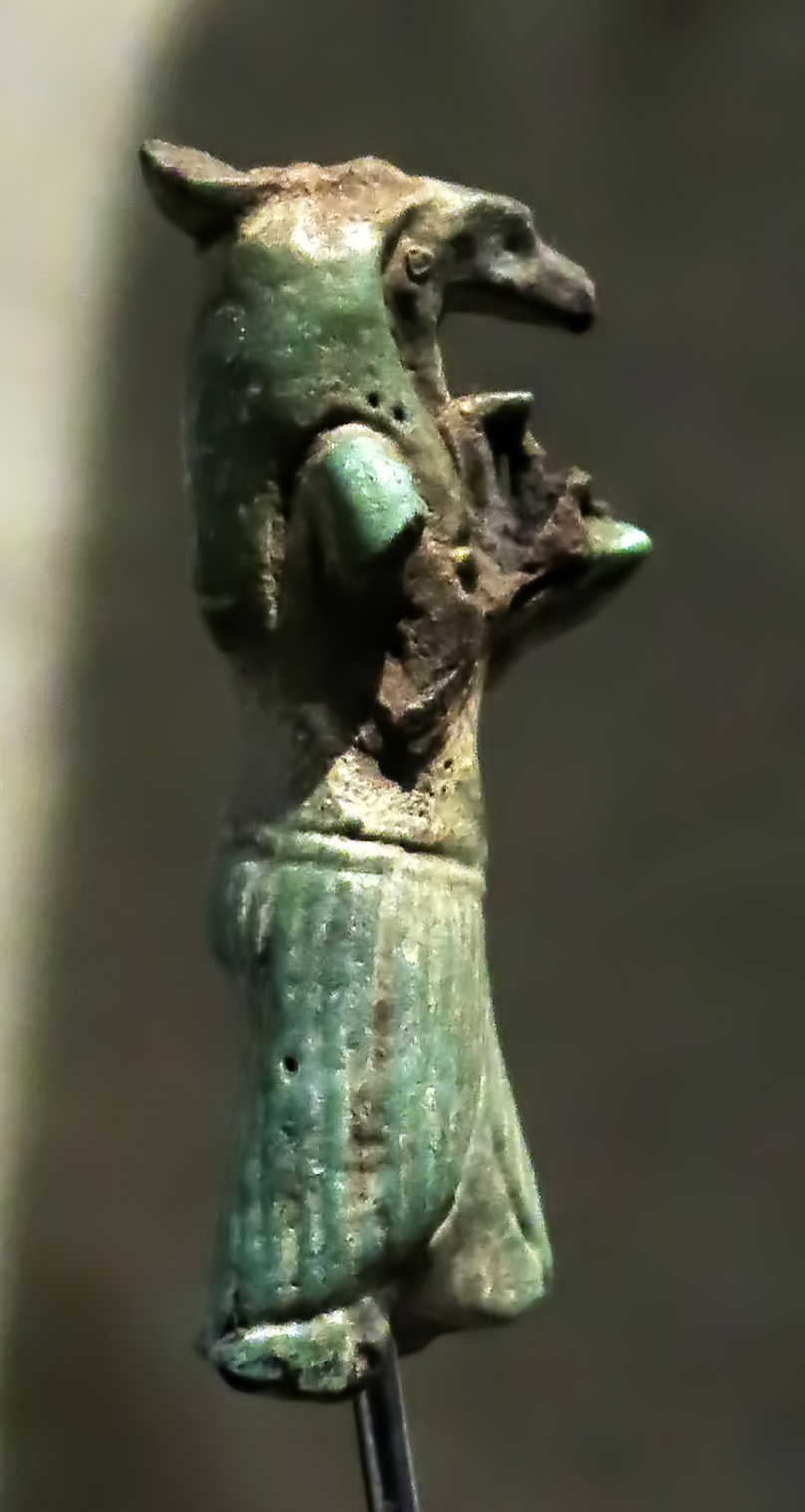
26th - 27th Dynasty: 664 BC - 404 BC
Thoth
Standing figures of the god of writing, Thoth.
Late Period, circa 6th - 5th century BC.
( Note the two different ways of treating the beak of the ibis-headed Thoth - on the left is the very common method, where a supporting panel is added beneath the beak to physically support it, and to avoid breakages, and on the right the artist has left the beak unsupported, with the common result of the shortening by breakage of the beak. This particular figure is further broken at the arms and below the knees - Don )
Catalog: Faience, Qantir (ÄS 5544b), ÄS 556, ÄS 5474, ÄS 5544b
( one of the figures was missing in the display, and there is no information concerning the catalog numbers of the remaining figures - Don )
Photo: Don Hitchcock 2015
Source: Original, Ägyptischen Museum München
Text: Museum card, © Ägyptischen Museum München
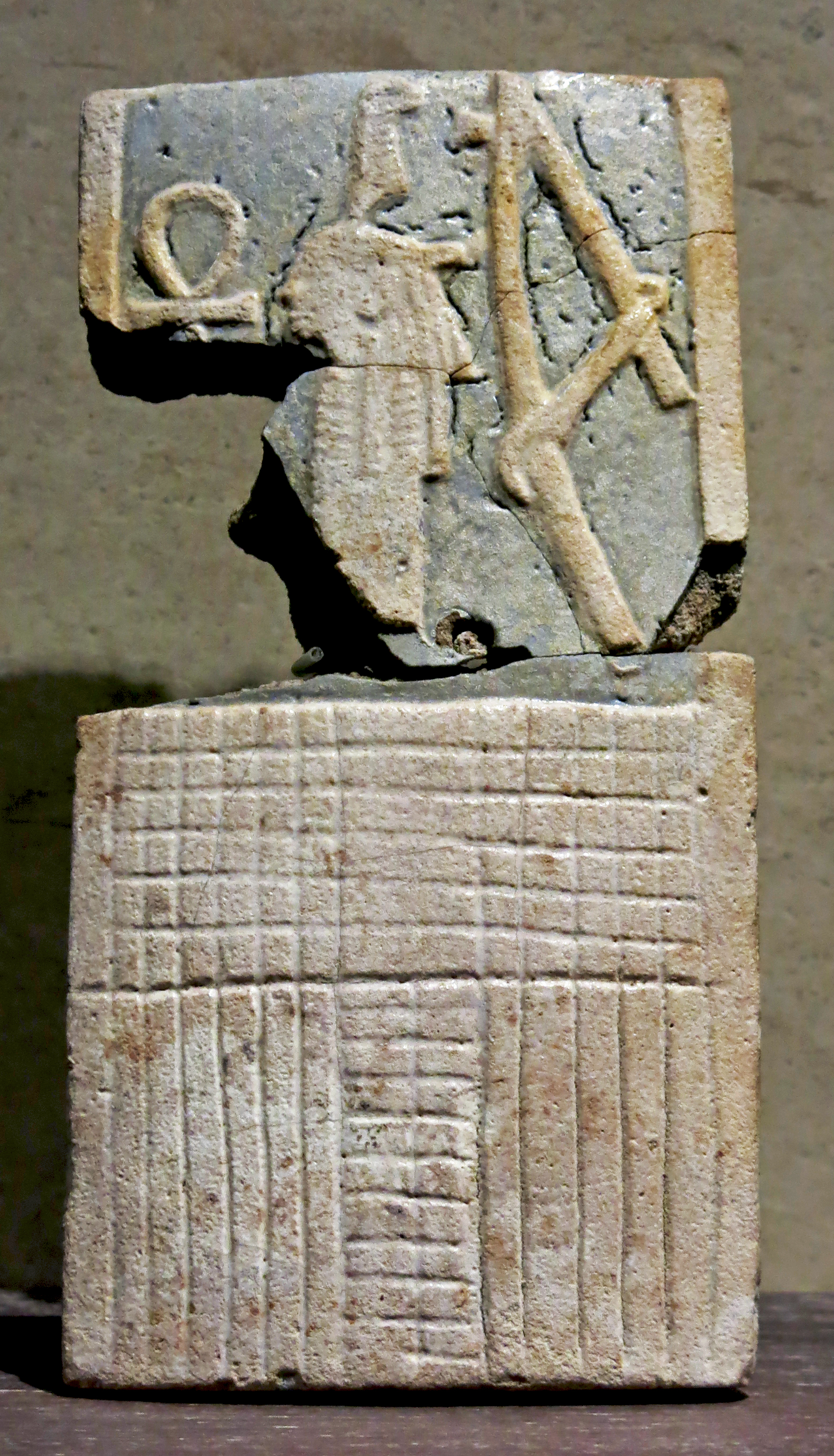
26th - 27th Dynasty: 664 BC - 404 BC
Amulet
Amulet in the form of a straight edge, a ruler.
Circa 6th - 5th century BC.
Catalog: ÄS 1797
Photo: Don Hitchcock 2015
Source: Original, Ägyptischen Museum München
Text: Museum card, © Ägyptischen Museum München
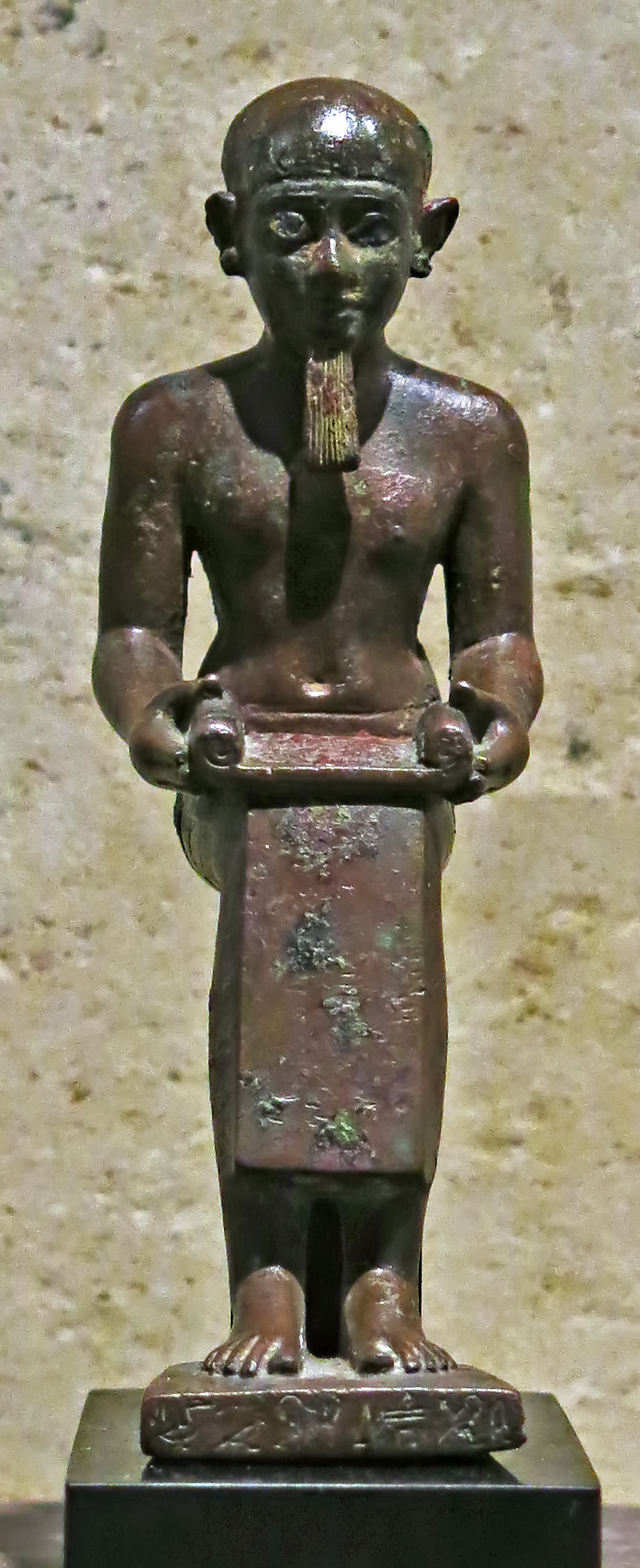
26th - 27th Dynasty: 664 BC - 404 BC
Imhotep
Seated figure of the deified Imhotep, patron god of scribes.
Circa 6th - 5th century BC.
Catalog: Bronze, tin, ÄS 5313
Photo: Don Hitchcock 2015
Source: Original, Ägyptischen Museum München
Text: Museum card, © Ägyptischen Museum München
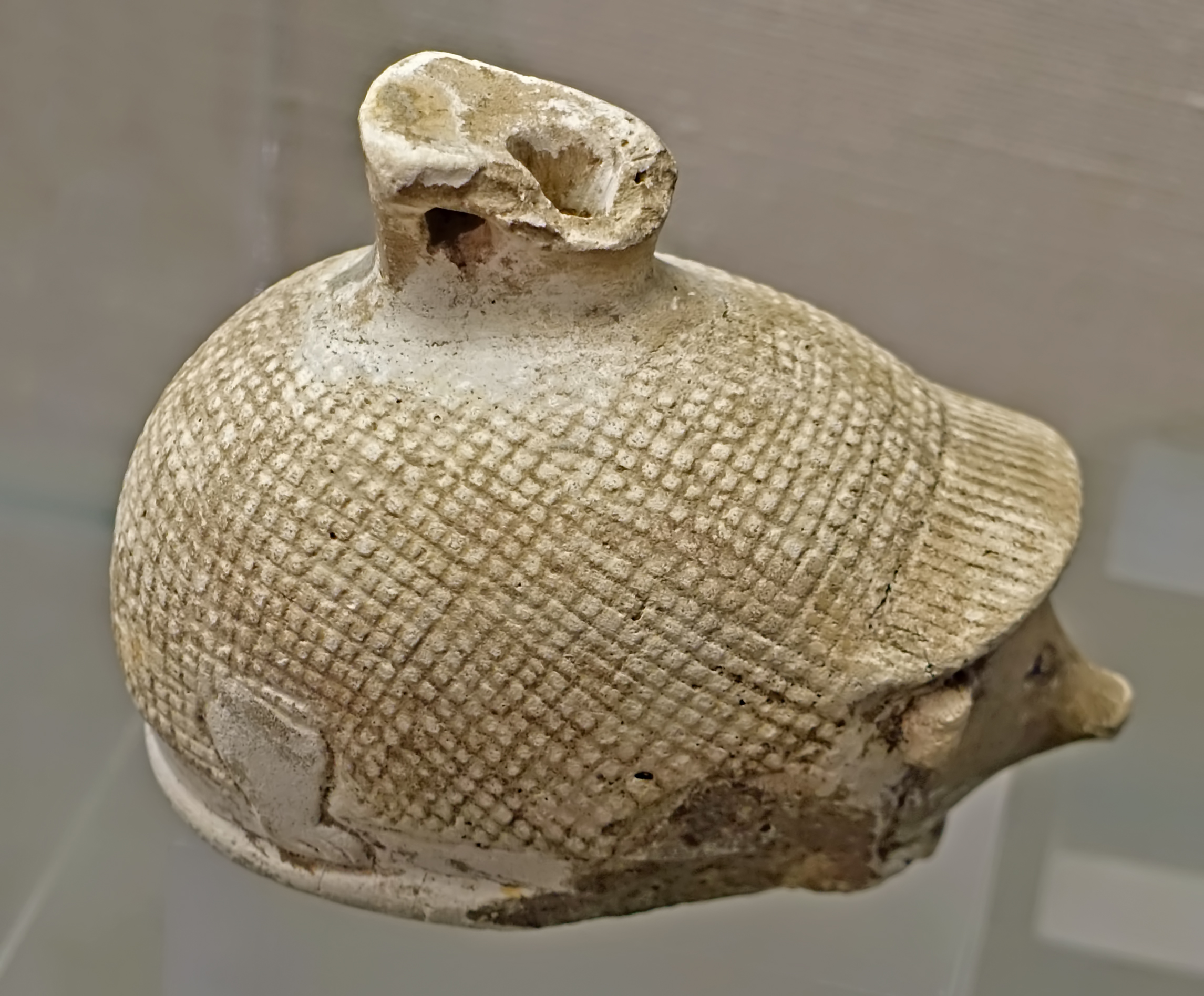
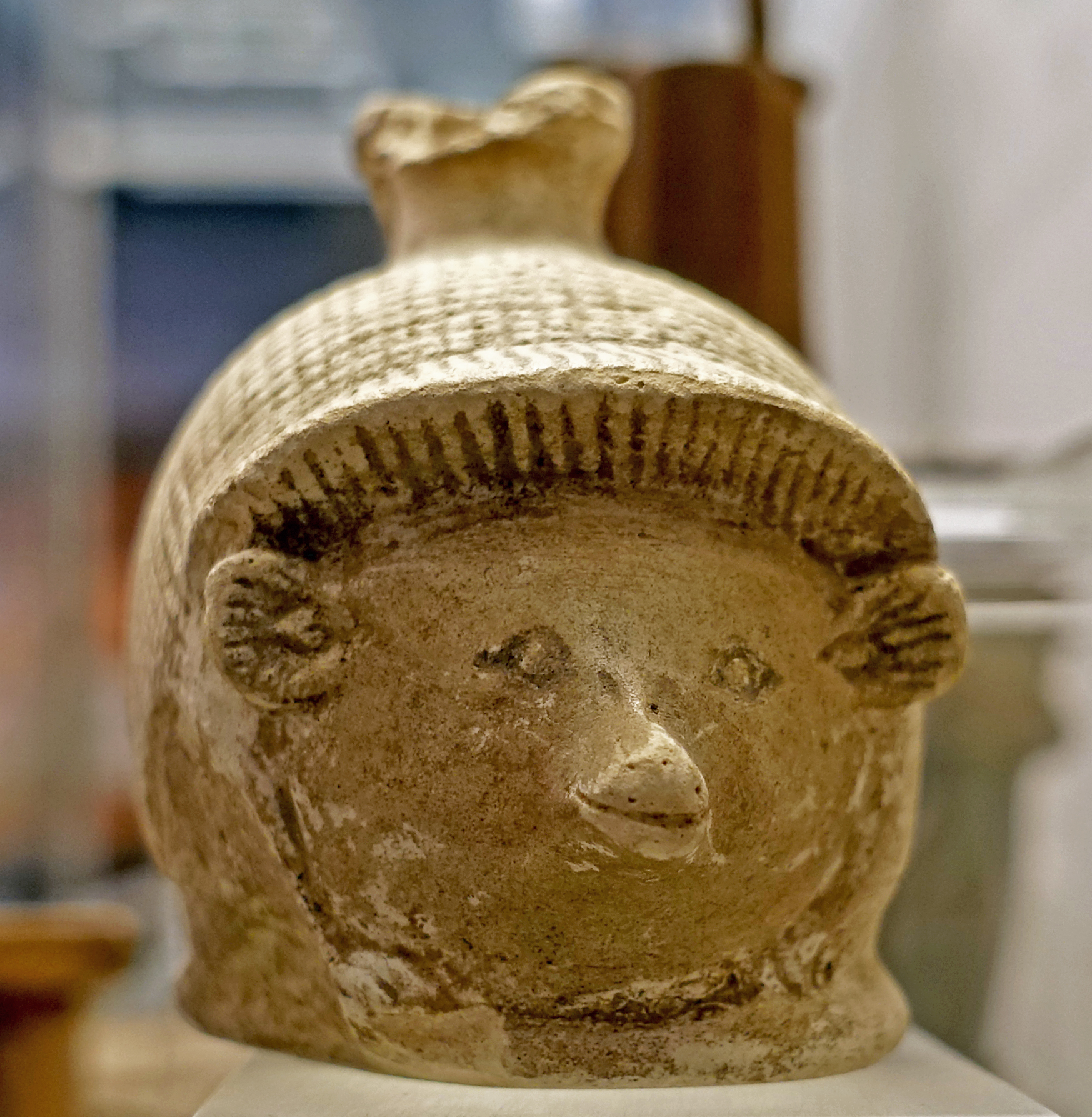
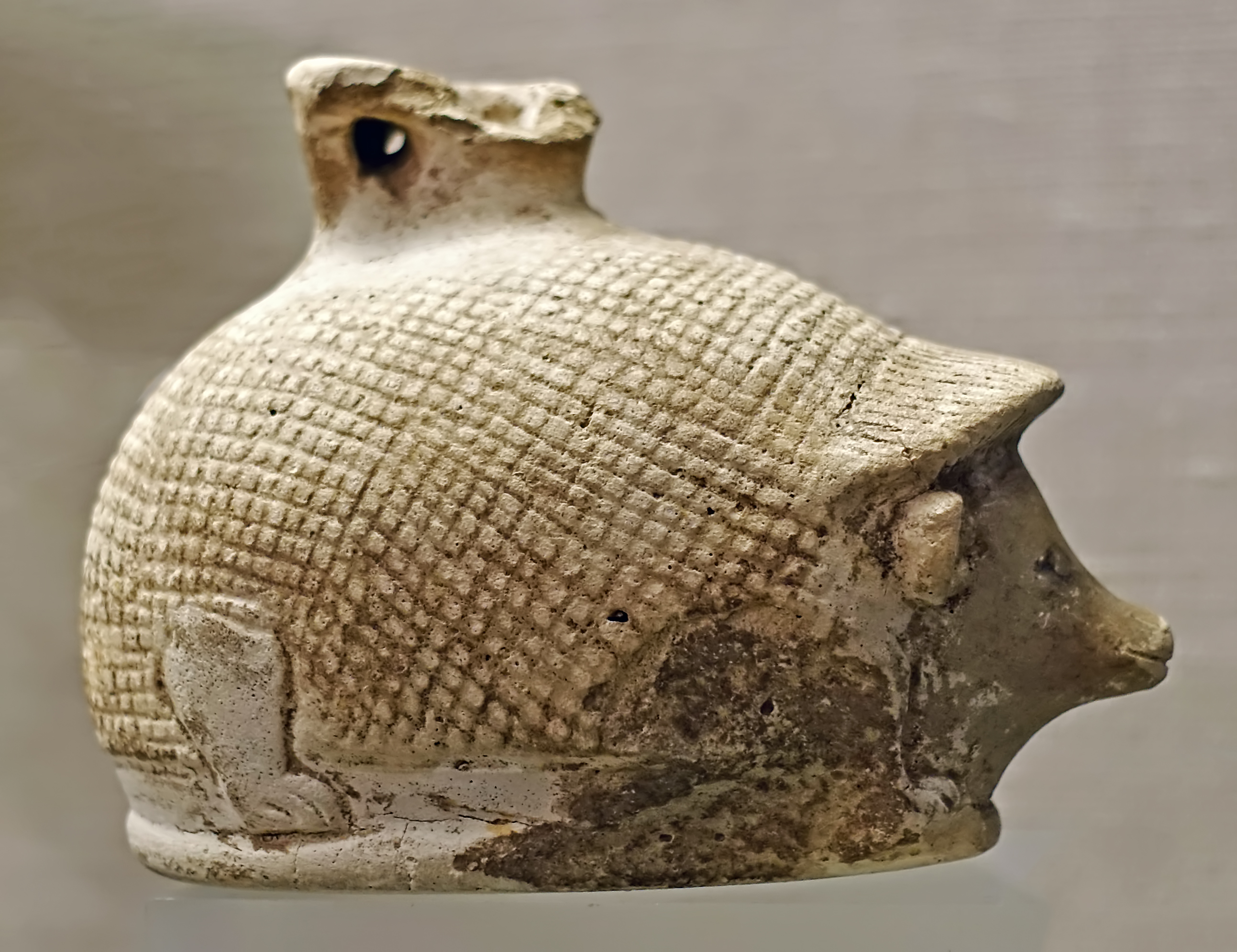
26th - 27th Dynasty: 664 BC - 404 BC
Arybaillos as a hedgehog
Late period, probably 7th/6th century BC.
The glaze of this Arybaillos, one of the largest examples of its category, has been almost completely rubbed off, and the expected human head is missing from the front rim of the spout.
The hedgehog-shaped Arybaillos may have been inspired by the Greeks, who founded a trading post in Naukratis in the Delta around the beginning of the 26th Dynasty.
Height 73 mm, length 96 mm.
Catalog: Terracotta, origin unknown, Inv. no. 1976.71
Photo: Don Hitchcock 2018
Source and text: Original, Museum August Kestner, Hannover
Additional text: Paper Catalogue, Museum August Kestner, Hannover
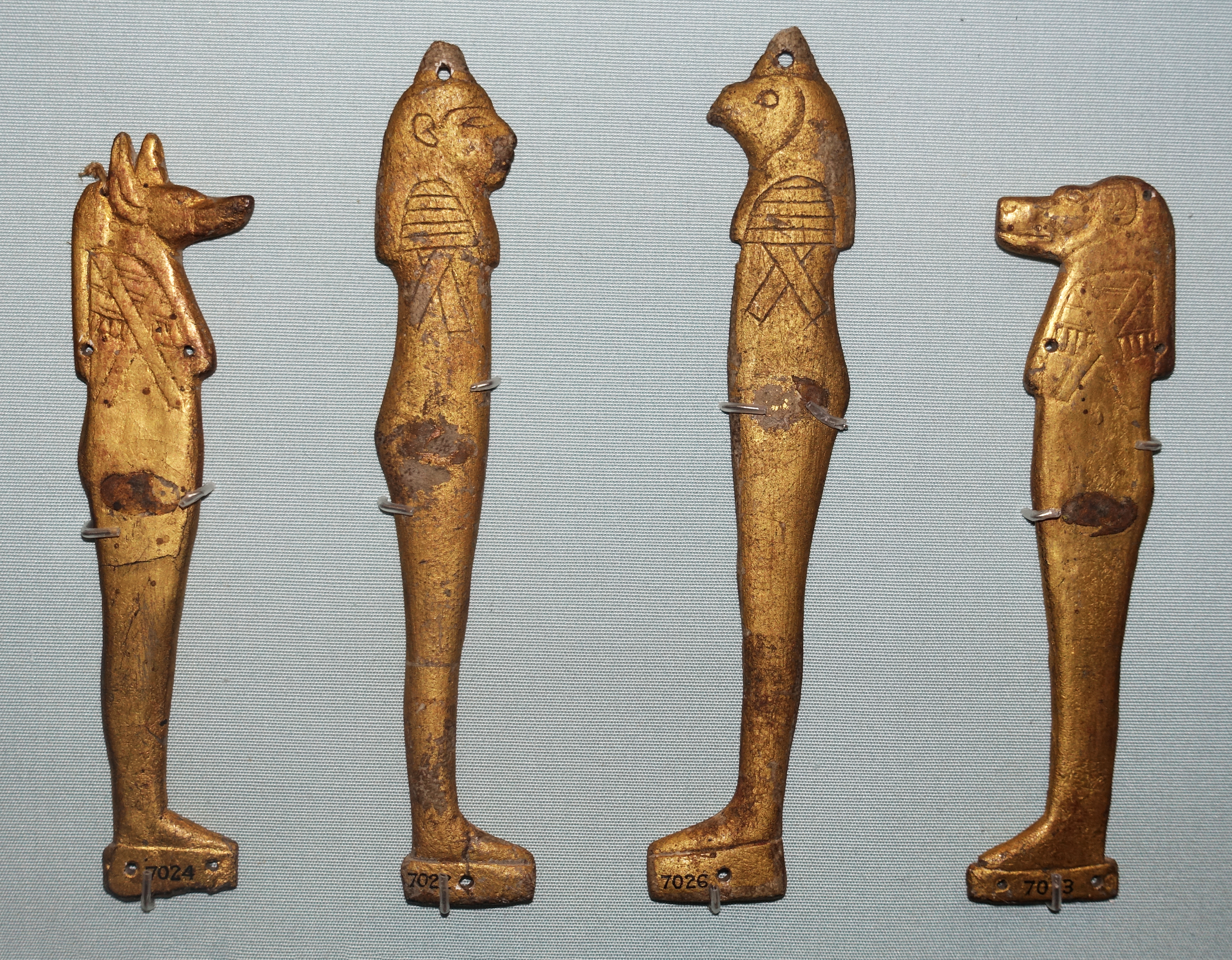
26th - 27th Dynasty: 664 BC - 404 BC
Amulets
Gilded wooden figures of Sons of Horus, probably from a bead net.
Late Period, after 664 BC.
Left to right:
EA7024: Gilded sycomore fig wood amulet with incised detail in the form of Duamutef; pierced in five places for attachment.
Dimensions: Length 106 mm, thickness 4 mm, width 26 mm.
EA7022: Gilded sycomore fig wood amulet with incised detail in the form of Imsety; pierced at either end for attachment.
Dimensions: Length: 118 mm, thickness 3 mm, width 20 mm.
EA7026: Gilded sycomore fig wood amulet with incised detail in the form of Qebhsenuef; pierced at either end for attachment.
Dimensions: Length 120 mm, thickness 5 mm, width 22 mm.
EA7023: Gilded sycomore fig wood amulet with incised detail in the form of Hapy; pierced in five places for attachment.
Dimensions: length 100 mm, thickness 2 mm, width 26 mm.
Catalog: Provenance unknown, EA7022, EA7023, EA7024, EA7026
Photo: Don Hitchcock 2018
Source: Original, British Museum
Text: Card with the display at the British Museum, https://www.britishmuseum.org/, © Trustees of the British Museum, CC BY-NC-SA 4.0
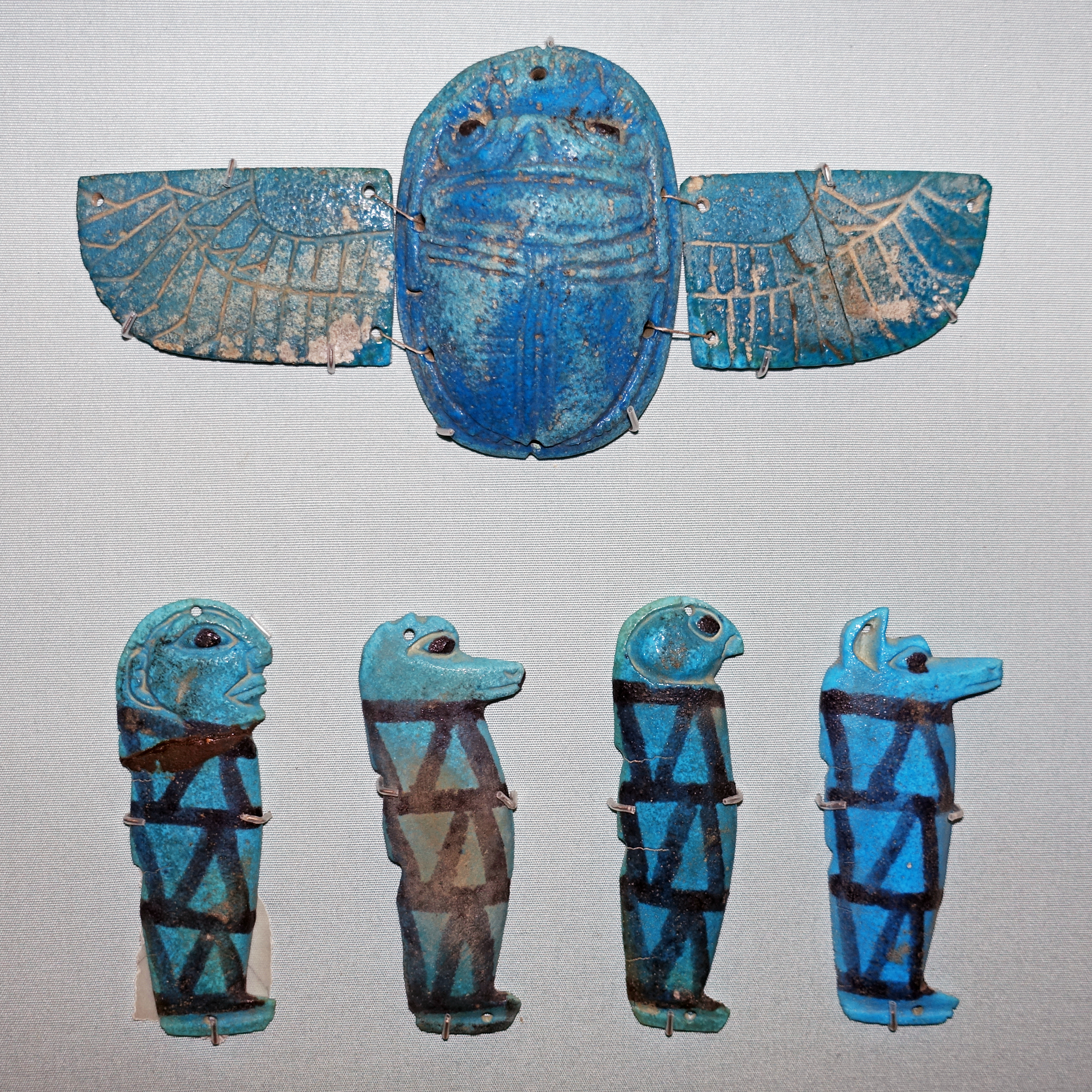
26th - 27th Dynasty: 664 BC - 404 BC
Amulets
Faience winged scarab and four Sons of Horus from a bead net.
Late Period, after 664 BC.
Blue glazed composition funerary-scarab with the clypeus marked, a double suture and pierced in six places around the edge; also two separate wings each pierced three times.
Four blue glazed composition amulets in the form of the Sons of Horus; each decorated with representations of bandaging and pierced at either end.
Dimensions:
Width: 24 - 35 mm (amulets)
Length: 80 - 83 mm (amulets)
Height: 22 mm (scarab)
Length: 57 mm (each wing)
Length: 73 mm (scarab)
Width: 52 mm (scarab)
Catalog: Provenance unknown, EA20856
Photo: Don Hitchcock 2018
Source: Original, British Museum
Text: Card with the display at the British Museum, https://www.britishmuseum.org/, © Trustees of the British Museum, CC BY-NC-SA 4.0
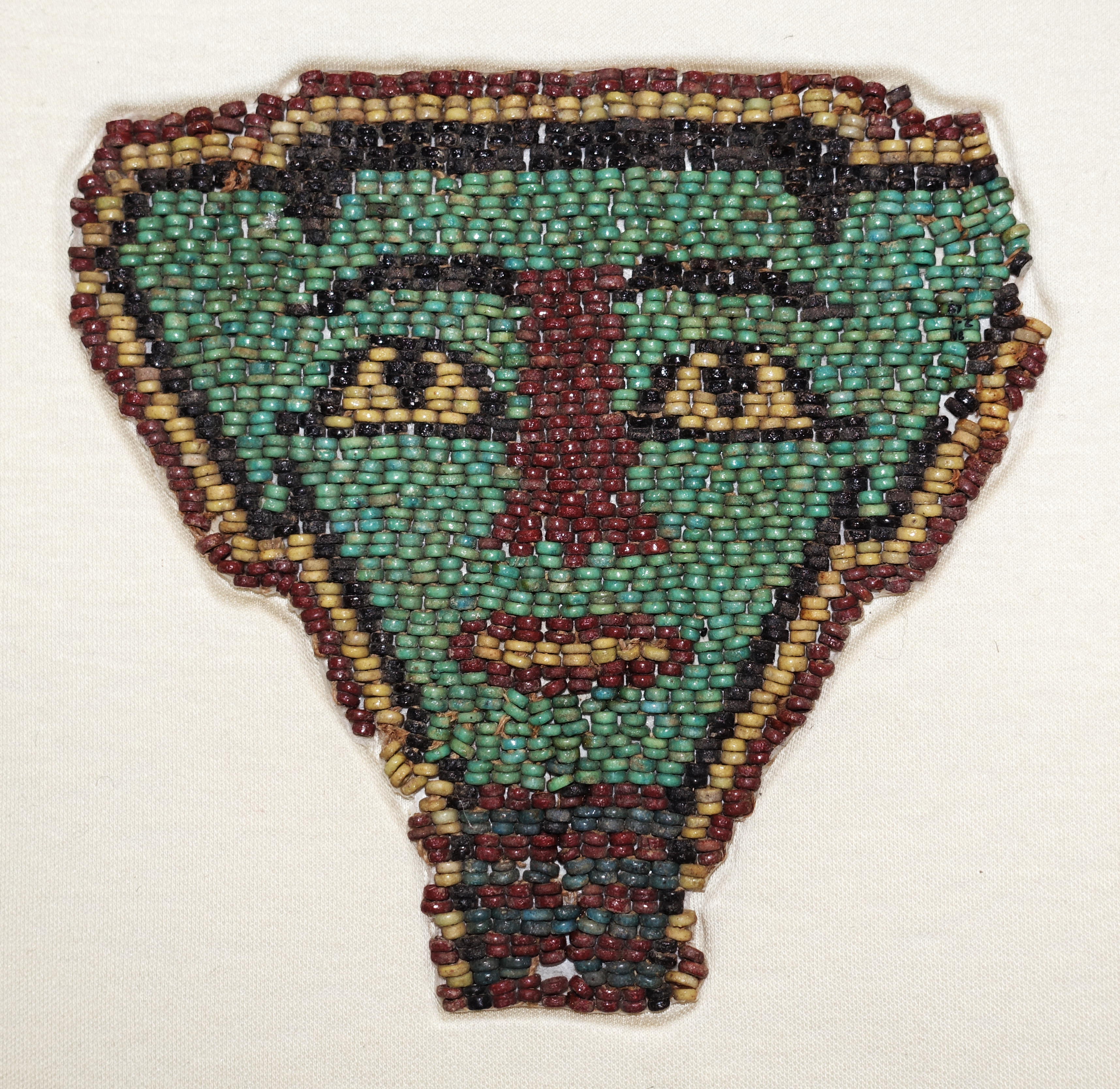
26th - 27th Dynasty: 664 BC - 404 BC
Hathor
Fragment from a bead-net comprising red, yellow, green and blue glazed composition short cylinder beads strung together to represent the face of Hathor.
Late Period, after 664 BC.
Dimensions:
Length: 128 mm.
Width: 132 mm.
Catalog: Akhmim, EA18167
Photo: Don Hitchcock 2018
Source: Original, British Museum
Text: Card with the display at the British Museum, https://www.britishmuseum.org/, © Trustees of the British Museum, CC BY-NC-SA 4.0

26th - 27th Dynasty: 664 BC - 404 BC
Hathor
Fragment from a bead-net, removed from a mummy, comprising red, yellow, green and blue glazed composition short cylinder beads strung together to represent the face of Hathor.
Late Period, after 664 BC.
Dimensions:
Length: 103 mm.
Width: 170 mm.
Condition: fair - incomplete, stuck onto a linen backing-cloth.
Catalog: Unknown provenance, EA14627
Photo: Don Hitchcock 2018
Source: Original, British Museum
Text: Card with the display at the British Museum, https://www.britishmuseum.org/, © Trustees of the British Museum, CC BY-NC-SA 4.0
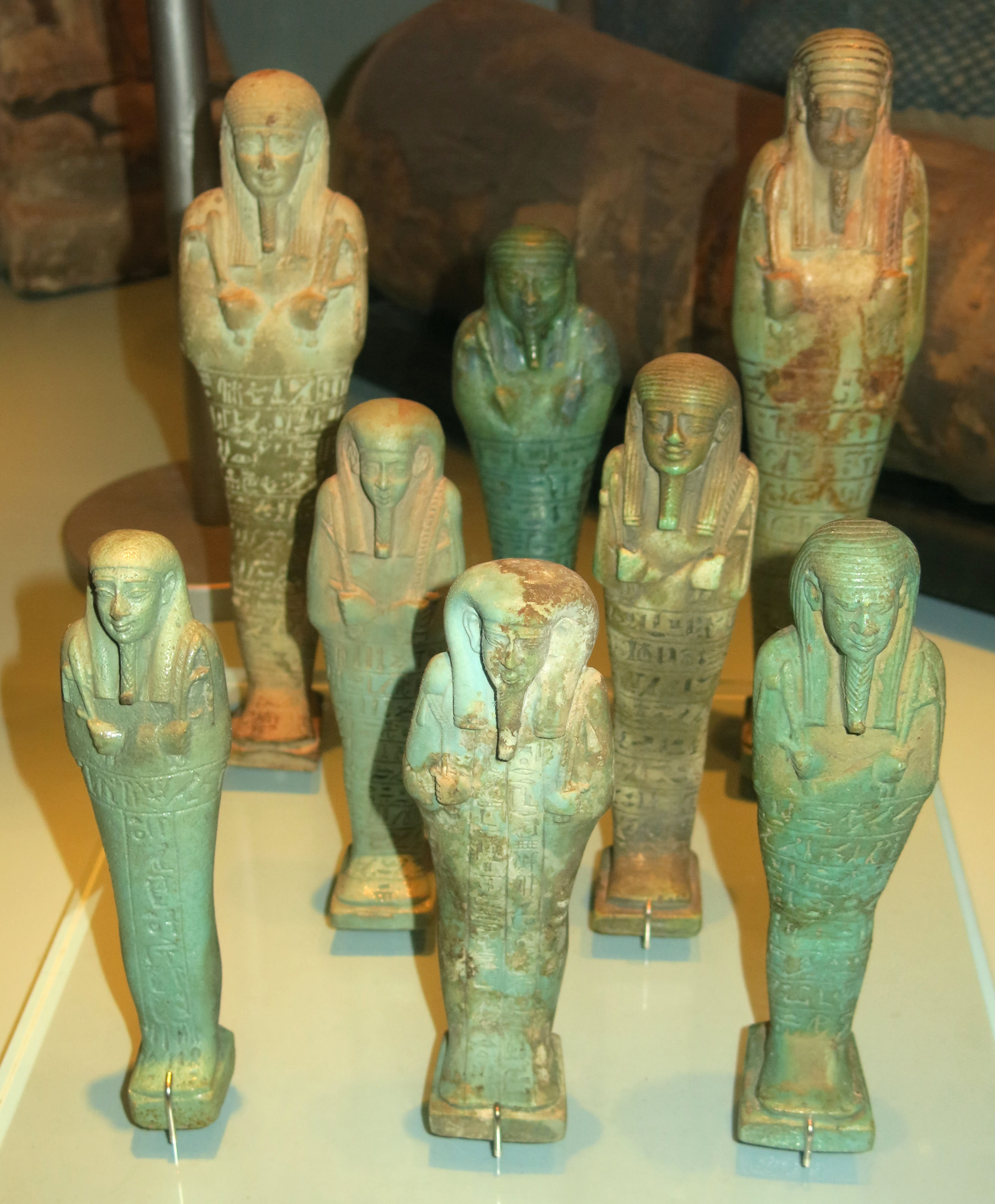
26th - 30th Dynasty: 664 BC - 343 BC
Shabtis
Ushabtis or Shabtis were placed in tombs among the grave goods and were intended to act as servants or minions for the deceased, should he/she be called upon to do manual labor in the afterlife. The figurines frequently carried a hoe on their shoulder and a basket on their backs, implying they were intended to farm for the deceased.
They were usually written on by the use of hieroglyphs typically found on the legs. Called 'answerers', they carried inscriptions asserting their readiness to answer the gods' summons to work. The practice of using shabtis originated in the Old Kingdom (ca. 2600 to 2100 BC) with the use of life-sized reserve heads made from limestone, which were buried with the mummy. Most ushabtis were of minor size, and many produced in multiples – they sometimes covered the floor around a sarcophagus. Exceptional shabtis are of larger size, or were produced as a one of-a-kind master work.
Shabti from this period have a back pillar and plinth underfoot.
Faience, site Mendes, Sakkara Haward, circa 600 - 350 BC, 26th - 30th dynasty.
Photo: Don Hitchcock 2014
Source: Original, Rijksmuseum van Oudheden, National Museum of Antiquities, Leiden.
Text: Wikipedia

26th - 31st Dynasty (Late Period): 664 BC - 332 BC
Canopic jars
The embalmed interior organs were placed in four jars, protected by four different gods, whose heads adorn their lids. The jars are often made of so-called 'Egyptian alabaster', i.e. calcite.
A - Jars belonging to the priest of Month Bes-n-Mut II, the uncle of Ankh-f-n-Khonsu VIII. Luxor, Late Period, ca 650 BC.
B - Jar brought to Denmark in 1737 by the envoy of Christian VI, naval lieutenant F.L. Norden (on the left) and in 1767 by lieutenant of the engineers Carsten Niebuhr, who was sent out to 'Arabia felix' by Frederik V. Late Period, 664 - 332 BC.
Photo: Don Hitchcock 2014
Source: Original, Københavns (Copenhagen) Museum, National Museum of Denmark
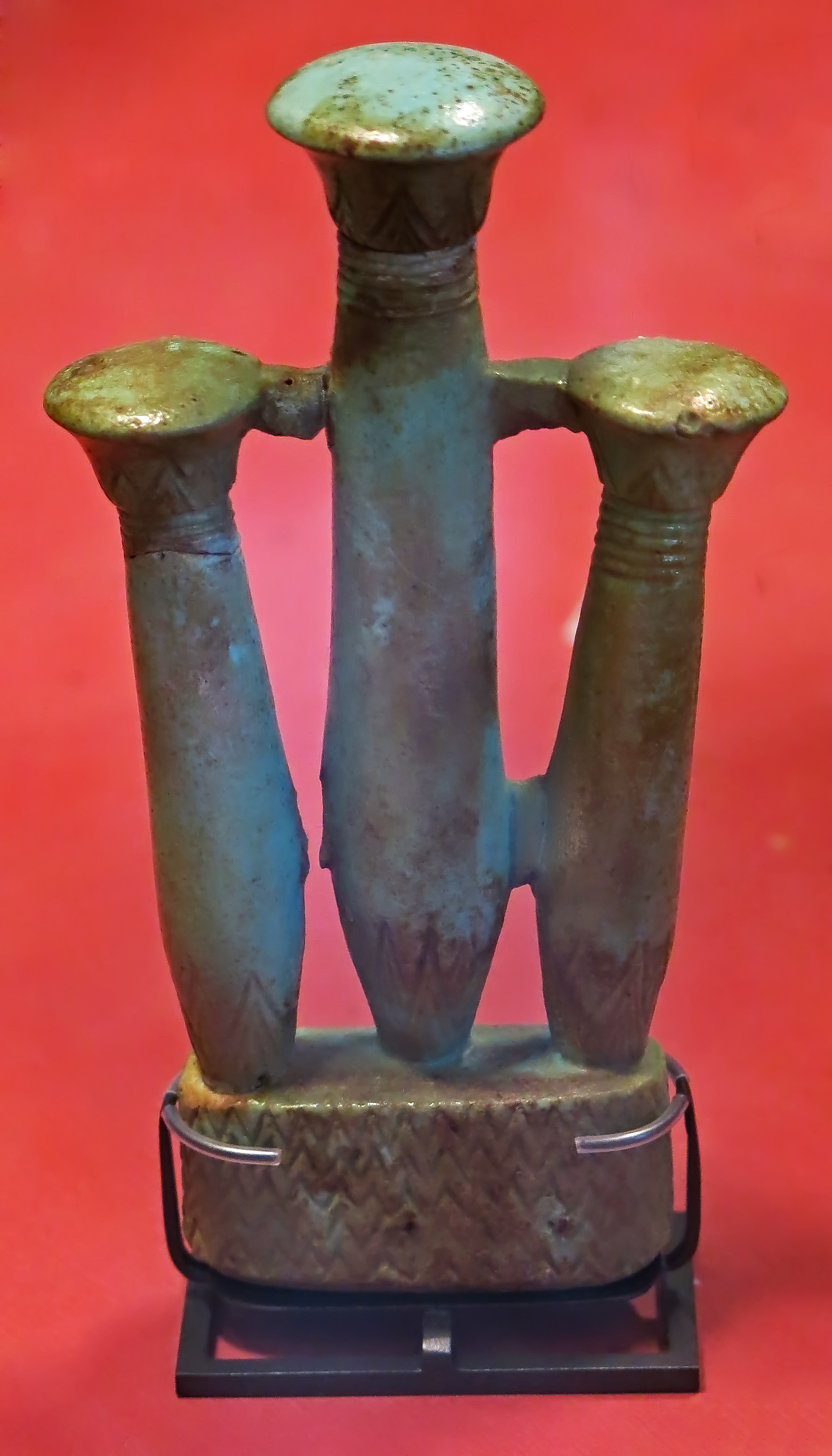
26th - 31st Dynasty (Late Period): 664 BC - 332 BC
Sign of the Delta
Amulet, three papyrus stems over the sign for water. This is the hieroglyph that designates the delta, or Lower Egypt.
Height 128 mm.
Catalog: Faience, Aile Sully, Room 334, Materials and Techniques, Vitrine 6, N 4613
Photo: Don Hitchcock 2015
Source and text: Original, Louvre Museum, Paris, France, https://collections.louvre.fr/
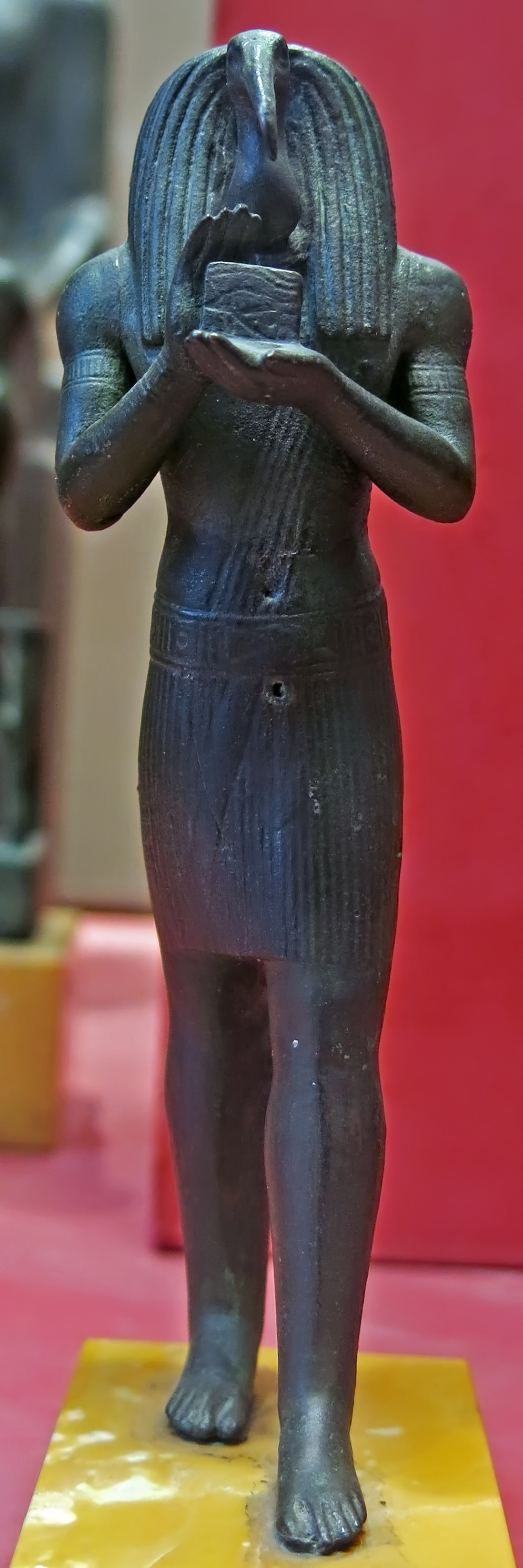
26th - 31st Dynasty (Late Period): 664 BC - 332 BC
Thot
Thot with ibis head and wearing a tripartite wig, brings the Udjat-eye cradled in his hands, sign of prosperity and abundance.
Late Period, 664 - 332 BC.
( note that the sculptor has made the lower legs of the god to be unnaturally thick, especially at the ankles - Don )
Height 145 mm.
Catalog: Copper alloy, Sully, Rez-de-chaussée, L'écriture et les scribes, Salle 335, Vitrine 5 : Les dieux qui patronnent l'écriture, E 3803
Photo: Don Hitchcock 2015
Source and text: Original, Louvre Museum, Paris, France
Additional text: http://cartelfr.louvre.fr/cartelfr/visite?srv=car_not_frame&idNotice=3390&langue=fr
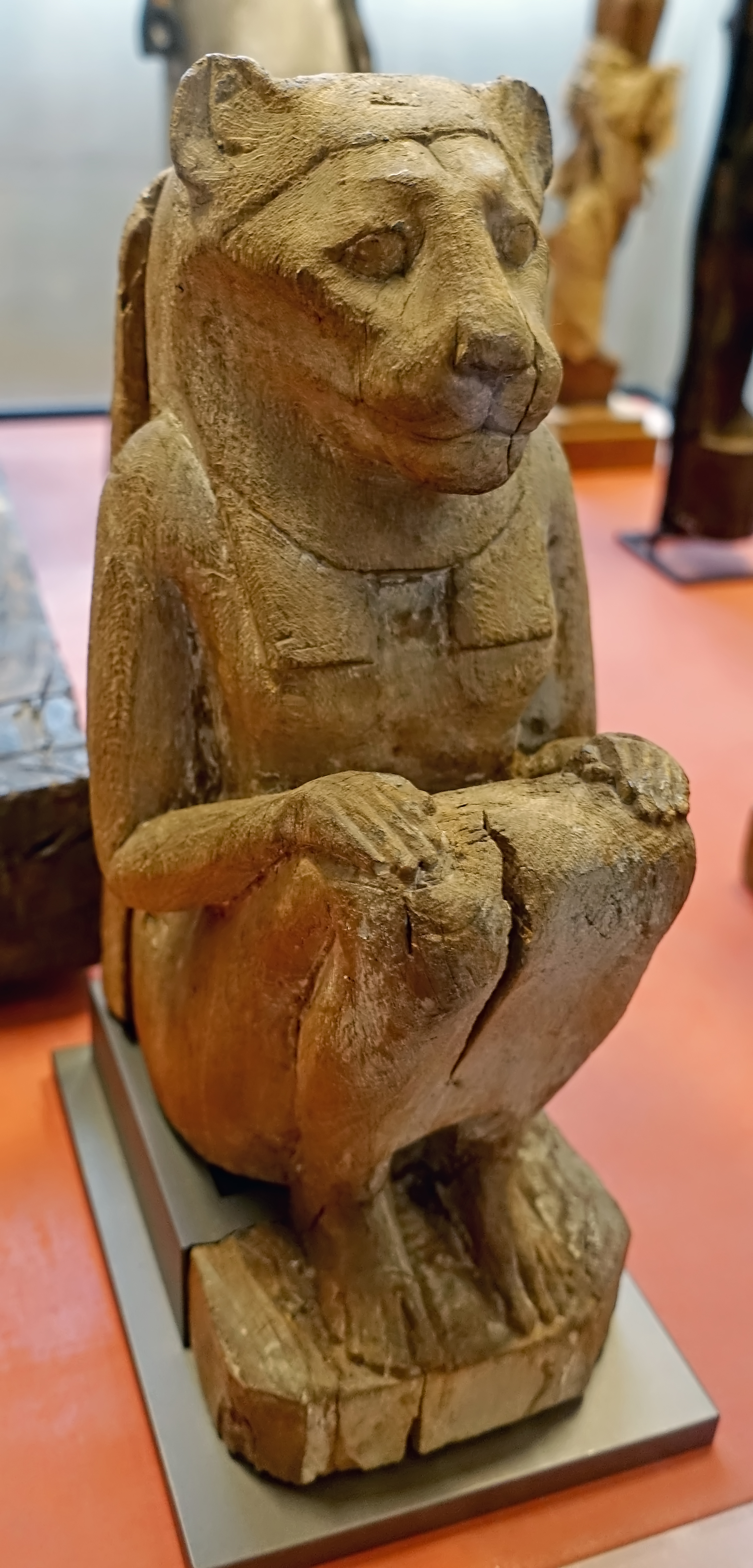
26th - 31st Dynasty (Late Period): 664 BC - 332 BC
Crouching Lioness
This statue of a squatting lioness-headed goddess may be an animal sarcophagus.
Height 268 mm, width 118 mm, depth 132 mm.
Catalog: Tamarisk wood, with Sycomore Fig, Ficus sycomorus wood for the backrest, Aile Sully, Room 334, Materials and Techniques, Vitrine 3, N 5209
Photo: Don Hitchcock 2018
Source and text: Original, Louvre Museum, Paris, France, https://collections.louvre.fr/
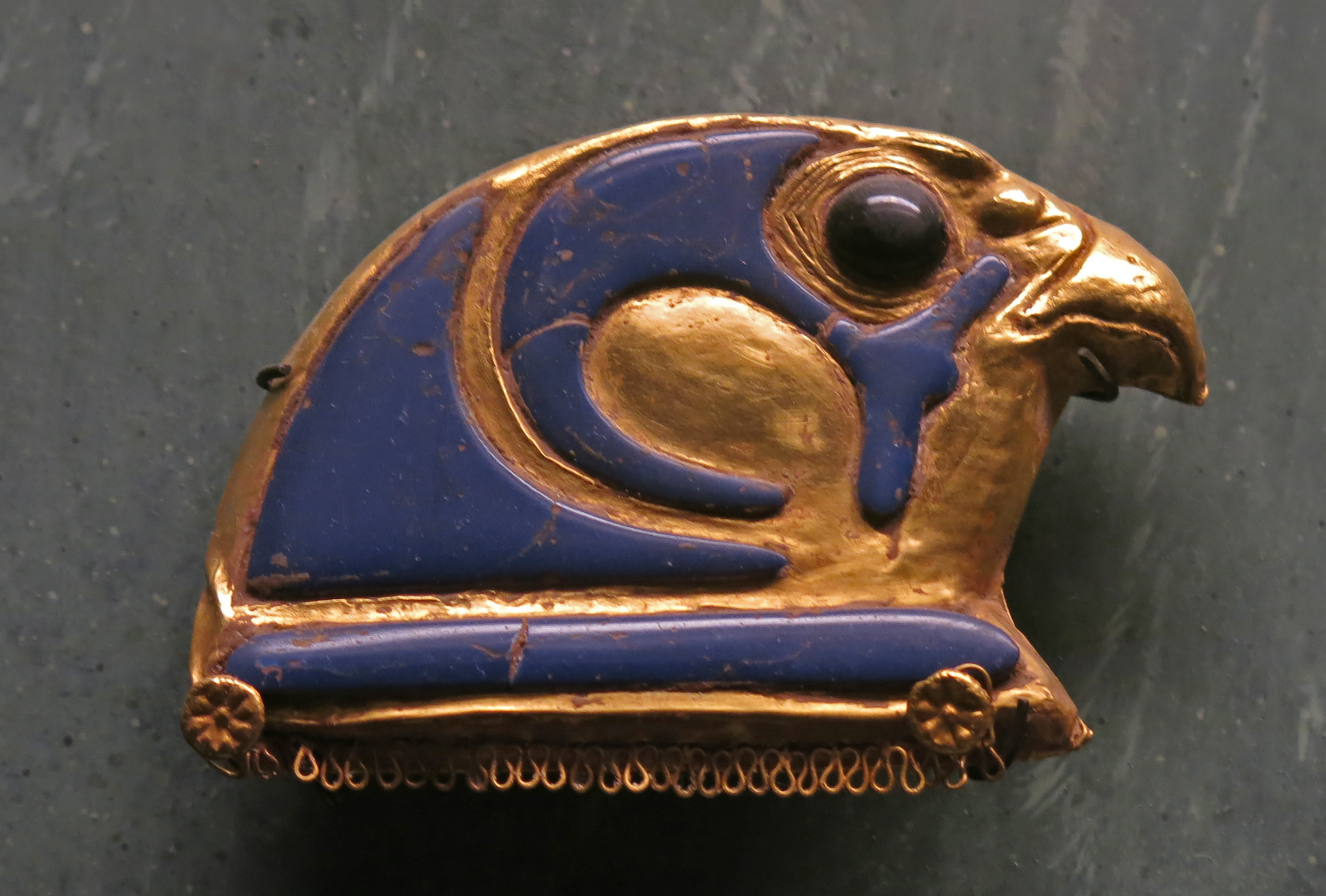
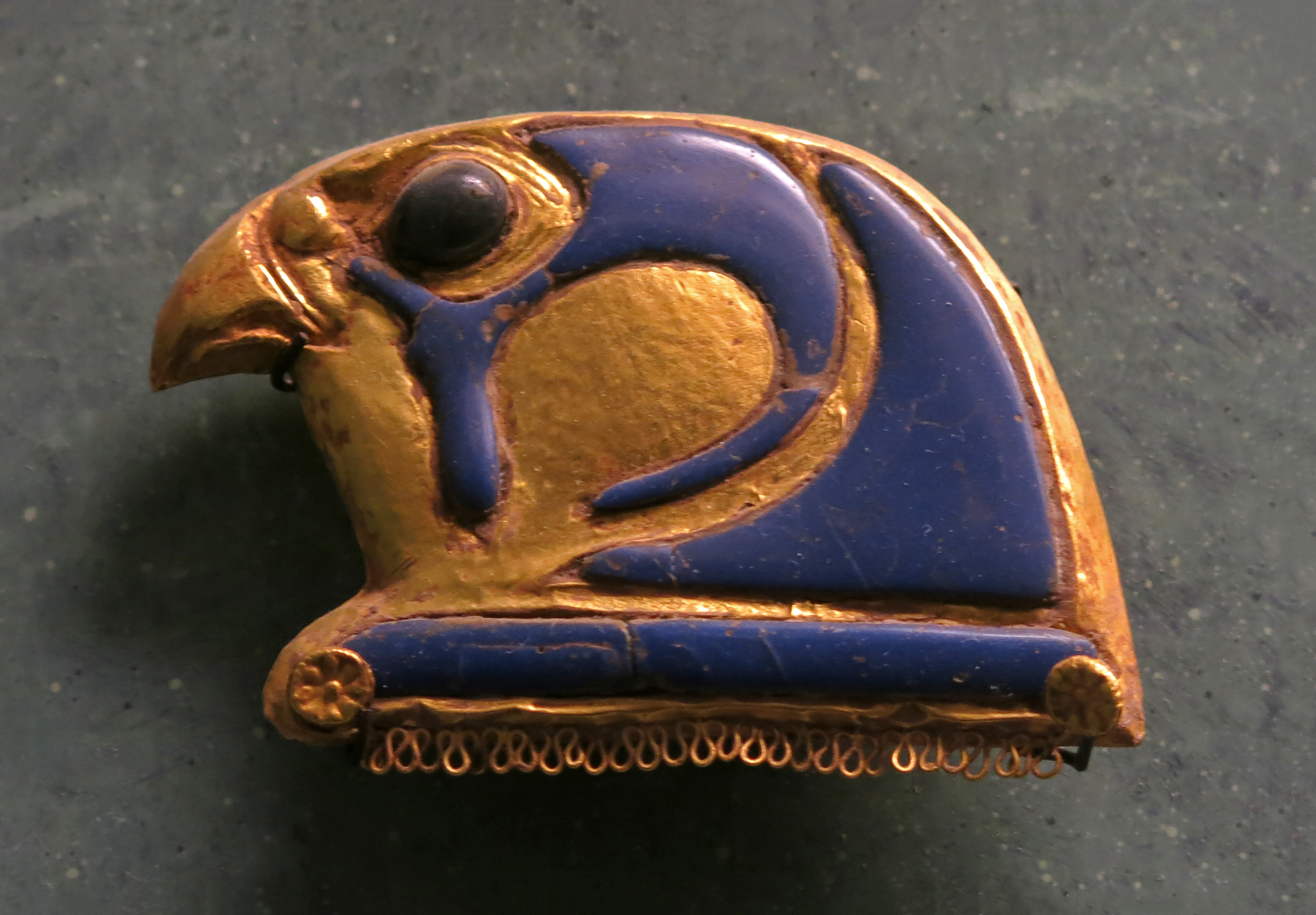
26th - 31st Dynasty (Late Period): 664 BC - 332 BC
Falcon heads
Pendants of necklaces.
Height 53 mm, width 74 mm, thickness 9.5 mm
Secondary material: gold, glass (blue, black)
Technique: gilding, inlay, plating, cut relief, half-round (smooth reverse)
Catalog: Gold and glass, Sully, Salle 330 - La parure, Vitrine 7, E 25380 A, E 25380 B
Photo: Don Hitchcock 2018
Source and text: Original, Louvre Museum, Paris, France, https://collections.louvre.fr/
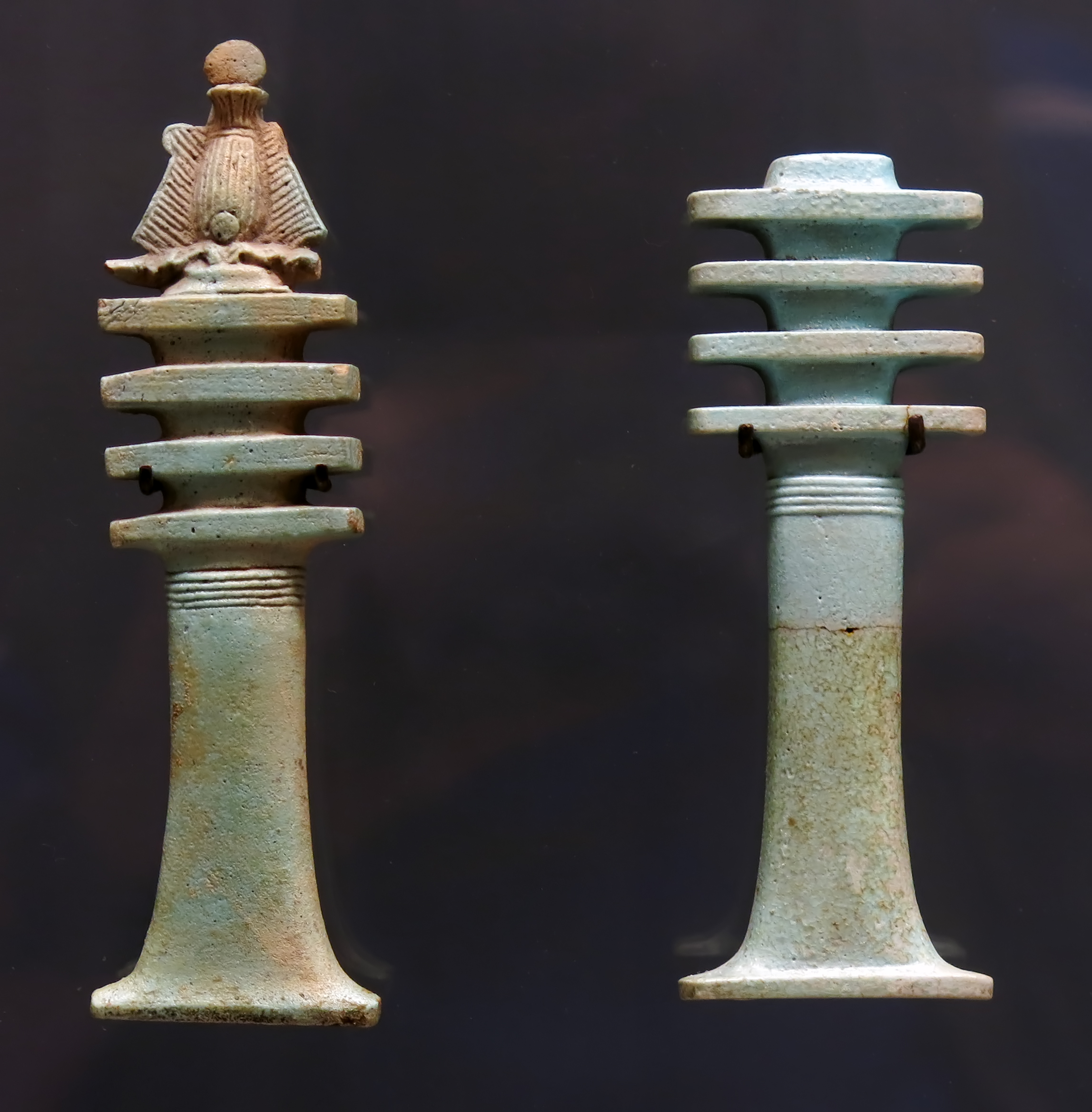
26th - 31st Dynasty (Late Period): 664 BC - 332 BC
Djed Pillars
(left):
Amulet in the form of a Djed pillar.
Blue-green in colour, with an Atef crown. The Atef is the specific feathered white crown of the ancient Egyptian deity Osiris. It combines the Hedjet, the white crown of Upper Egypt, with curly red ostrich feathers on each side of the crown for the Osiris cult. The feathers are identified as ostrich from their curl or curve at the upper ends, with a slight flare toward the base. They are the same feather as (singly) worn by Maat. They may be compared with the falcon tail feathers in two-feather crowns such as those of Amun, which are more narrow and straight without curve.
Height 133 mm, width 39 mm, thickness 13 mm.
Catalog: Faience, Room 323, Crypt of Osiris, Vitrine 5, N 4544, Salt n°1554
(right): Amulet in the form of a Djed pillar.
Light blue in colour.
Height 103 mm, width 42 mm, thickness 11 mm.
Catalog: Faience, Room 323, Crypt of Osiris, Vitrine 5, AF 2912
Photo: Don Hitchcock 2015
Source and text: Original, Louvre Museum, Paris, France, https://collections.louvre.fr/
Additional text: Wikipedia
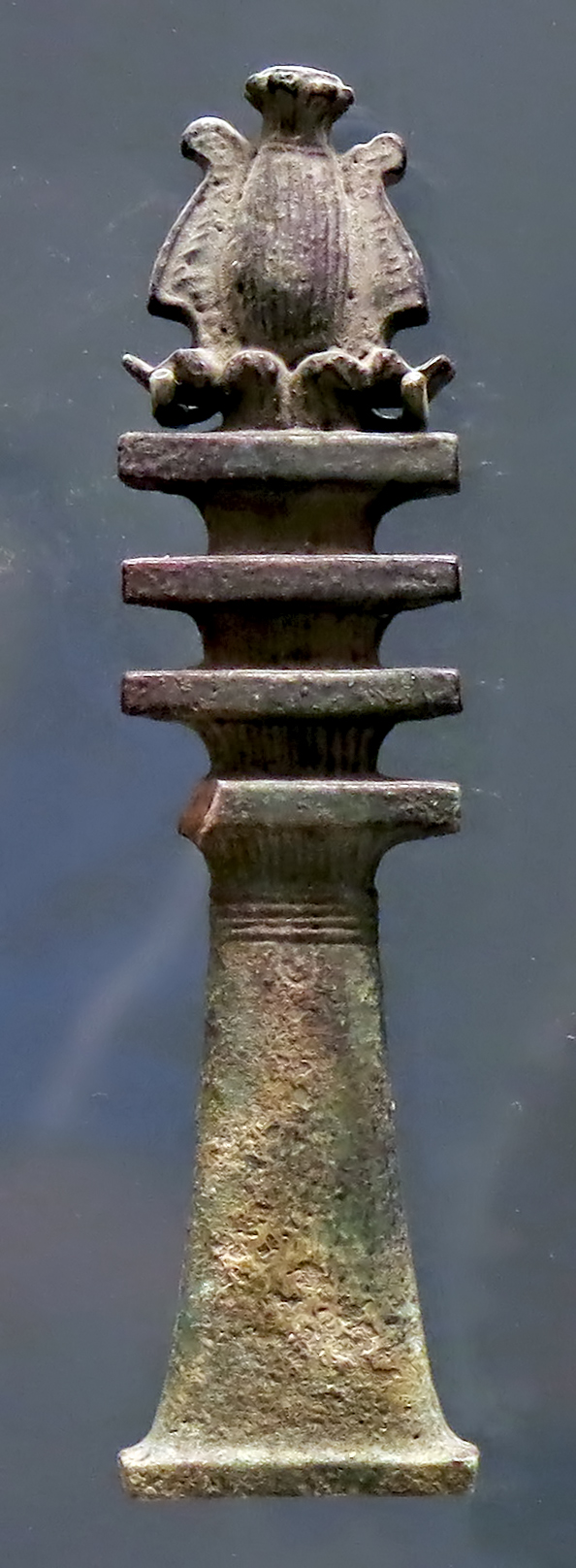
26th - 31st Dynasty (Late Period): 664 BC - 332 BC
Djed Pillar
Amulet in the form of a Djed pillar, unpierced, and with an Atef (Osiris) crown.
Height 115 mm, width 29 mm, thickness 12 mm.
Catalog: Faience, Room 323, Crypt of Osiris, Vitrine 5, AF 2917
Photo: Don Hitchcock 2015
Source and text: Original, Louvre Museum, Paris, France, https://collections.louvre.fr/

26th - 31st Dynasty (Late Period): 664 BC - 332 BC
Djed Pillar
Green amulet in the form of a Djed pillar, with arms, with an Atef (Osiris) crown, and a Was sceptre.
Height 101 mm.
Catalog: Faience, Room 323, Crypt of Osiris, Vitrine 5, AF 2919, Drovetti no. 32
Photo: Don Hitchcock 2015
Source and text: Original, Louvre Museum, Paris, France, https://collections.louvre.fr/
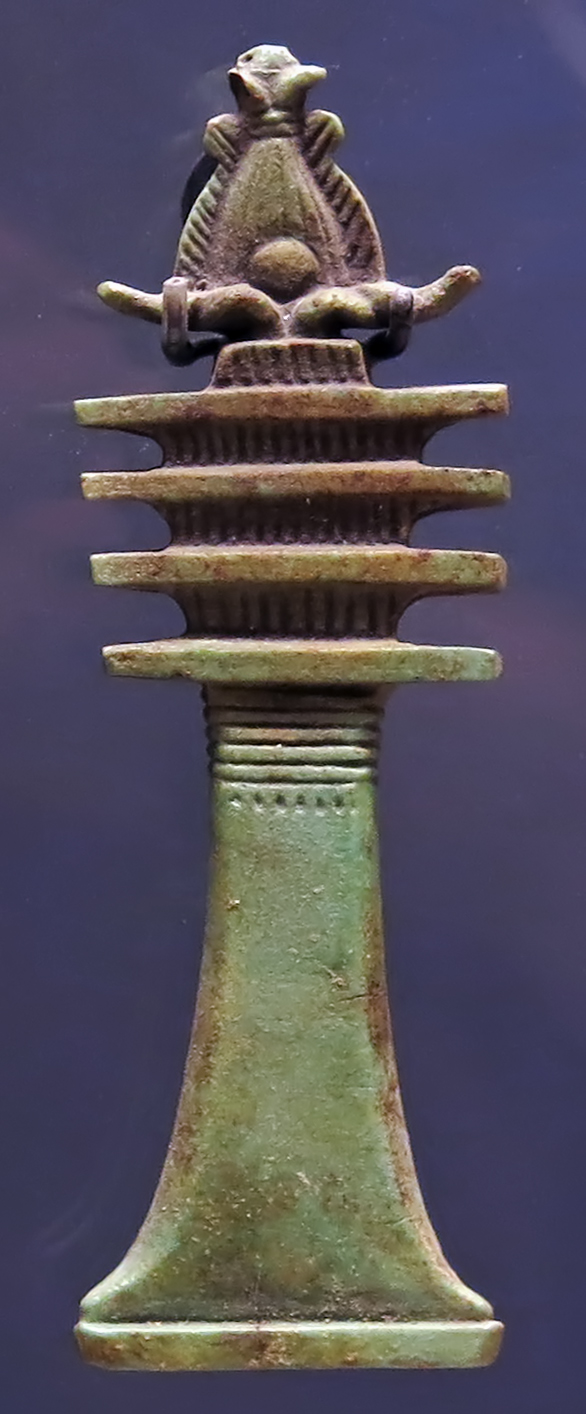
26th - 31st Dynasty (Late Period): 664 BC - 332 BC
Djed Pillar
Green amulet in the form of a Djed pillar, with an Atef (Osiris) crown.
Height 103 mm, width 34 mm, thickness 10 mm.
Catalog: Faience, Room 323, Crypt of Osiris, Vitrine 5, E 18271
Photo: Don Hitchcock 2015
Source and text: Original, Louvre Museum, Paris, France, https://collections.louvre.fr/
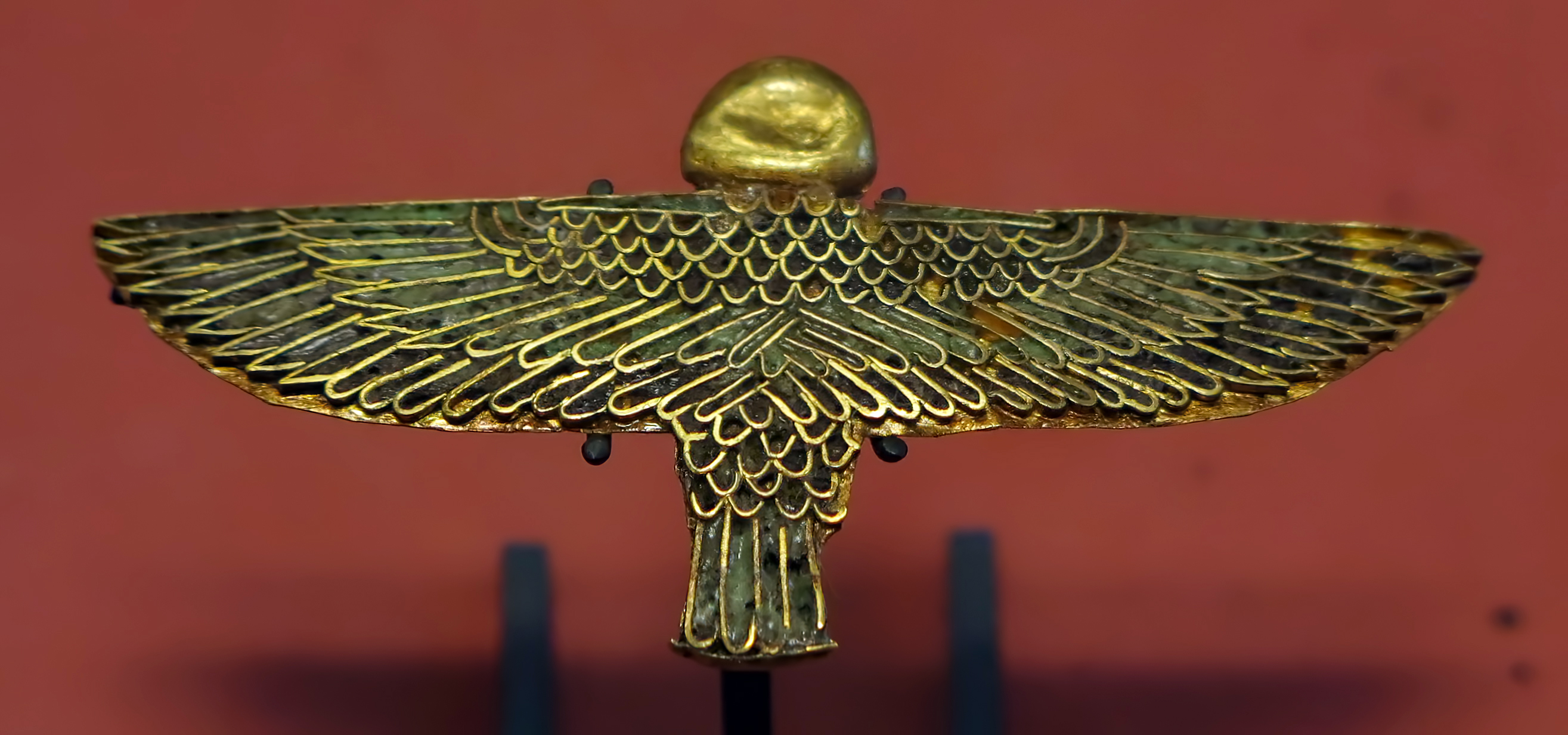
26th - 31st Dynasty (Late Period): 664 BC - 332 BC
Amulet
A pectoral / pendant in the form of a bird, with wings spread.
Length: 54 mm, width 26 mm.
Gold with glass inlay.
Technique : hollow, half round, cloisonné inlay, repoussage.
Catalog: Faience, Aile Sully, Room 334, Materials and Techniques, Vitrine 2, E 3149, AF 2227, Anastasi n°572
Photo: Don Hitchcock 2015
Source and text: Original, Louvre Museum, Paris, France, https://collections.louvre.fr/
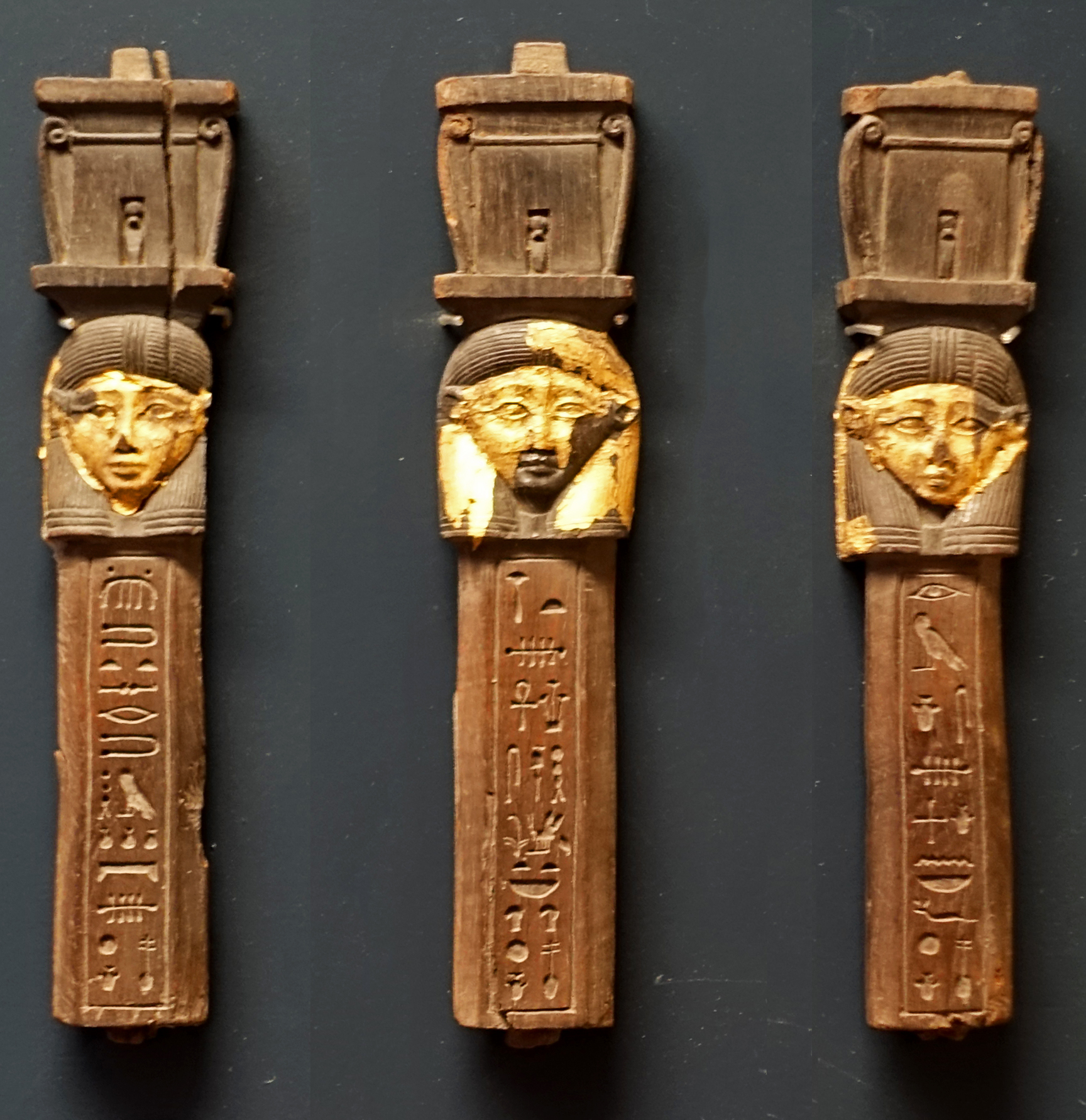
26th - 31st Dynasty (Late Period): 664 BC - 332 BC
Hathor emblem
Inscriptions: Wish for protection
Names and titles: Neferibre
Wood, with gilding (traces of gilding on the face and hair)
Height 110 mm (max), width 22 mm; Thickness: 0.8 cm
Findspot: Serapeum of Memphis (Saqqara, Memphite Necropolis, in the sand, during the excavation conducted northeast of the 'Petits Souterrains' [Small Underground Galleries] by Haggi Mohammed.
Catalog: Wood, Sully, Salle 334 - Matériaux et techniques, Vitrine 9, Main number N 4595, individual numbers IM 4969, IM 4970, IM 4971
Photo: Don Hitchcock 2018
Source and text: Original, Louvre Museum, Paris, France, https://collections.louvre.fr/
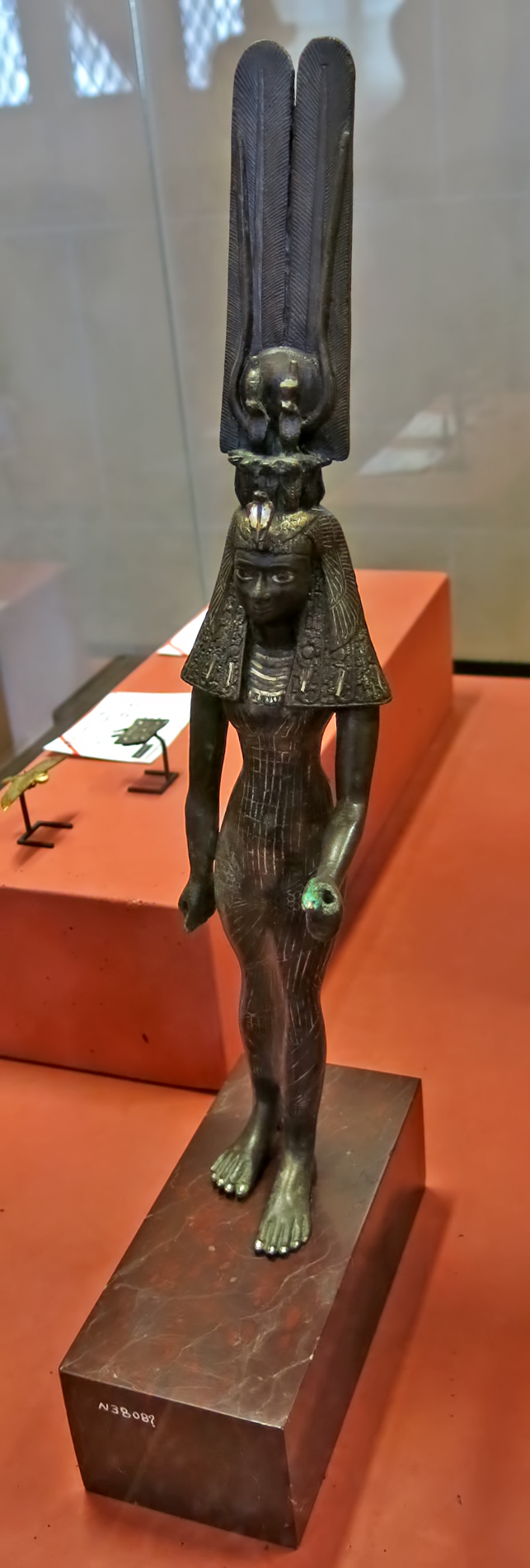
26th - 31st Dynasty (Late Period): 664 BC - 332 BC
Statue of a Goddess
Statue of Isis or Hathor, bronze inlaid with gold and silver.
The hairstyle and costume are not sufficient to identify the goddess with confidence.
The impressive vulture crown is surmounted by a pair of falcon plumes, and a double uraeus.
The Vulture crown was an ancient Egyptian crown worn by Great Royal Wives and female pharaohs. The crown depicted a vulture, with its two wings hanging down both sides of the head. It was a symbol of protection from the goddess Nekhbet.
She wears the Usekh, a type of broad collar or necklace, commonly shown worn by deities and the elite, and a feathered dress.
( the wig beneath the vulture crown is highly decorated - Don )
Height 360 mm.
Catalog: Bronze, silver, Aile Sully, Room 334, Materials and Techniques, Vitrine 2, N 3808, Salt no. 150
Photo: Don Hitchcock 2015
Source and text: Original, Louvre Museum, Paris, France, https://collections.louvre.fr/
Additional text: Wikipedia
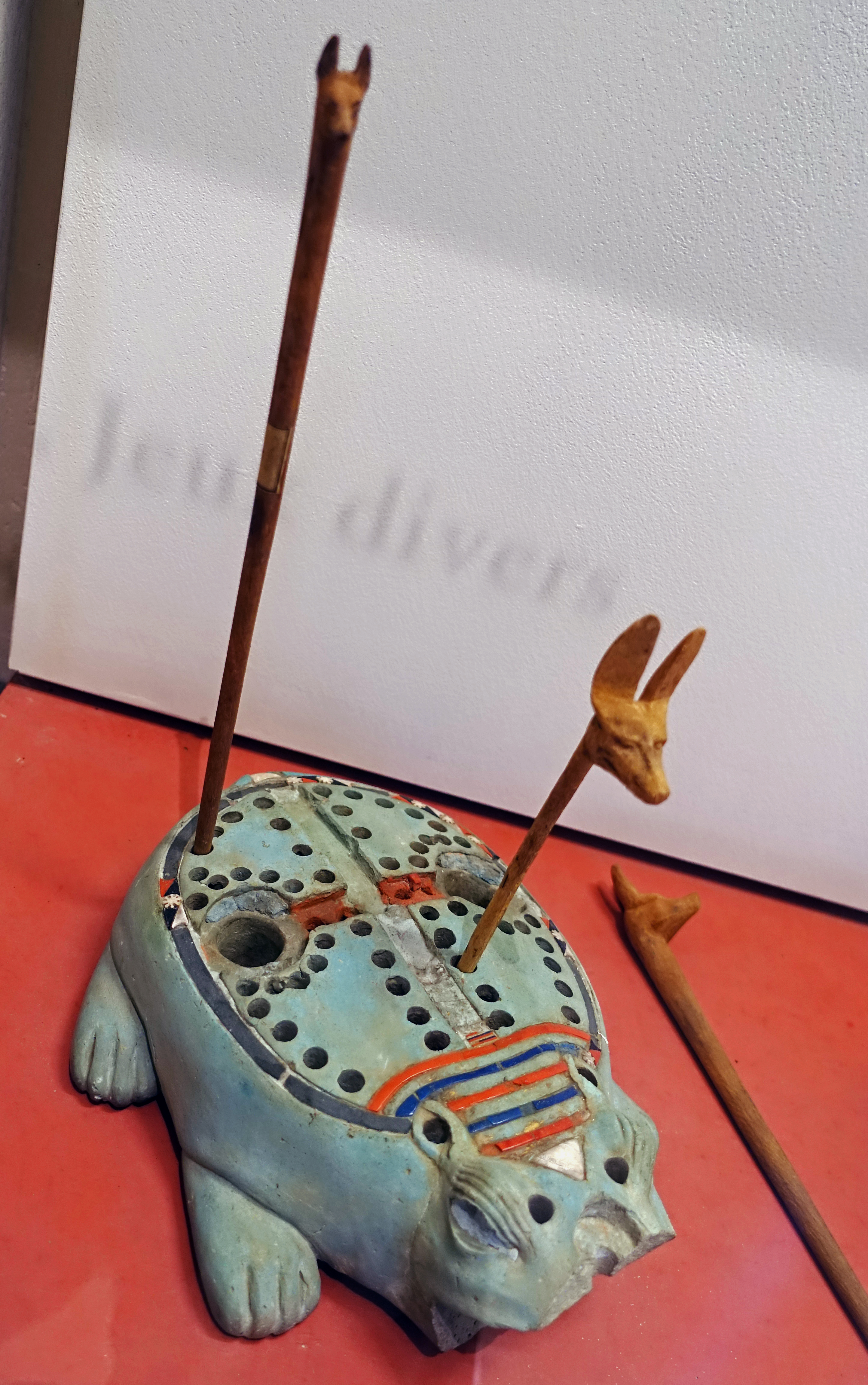
26th - 31st Dynasty (Late Period): 664 BC - 332 BC
Game Board in the shape of a hippopotamus
The game of 58 holes, commonly known as Hounds and Jackals or the Palm Tree Game, is an ancient race board game from the Middle Kingdom of Egypt (c. 2000 BC). Two players use 10 pegs (five with hound heads and five with jackal heads) to race along a track of 58 holes toward a final goal.
Three wooden pegs with jackal heads are shown here.
The most famous and complete set was found by Howard Carter in a Theban tomb and is housed in the Metropolitan Museum of Art.
Boards have been found in Egypt, Mesopotamia, the Levant, and as far as Azerbaijan, pointing to extensive ancient trade routes.
Modern reconstructions play it as similar to modern Chutes ( Snakes? - Don ) and Ladders. players use dice or casting sticks to move pegs from their starting positions along the outer tracks. Special Holes: Lines on the board connect certain holes to act as shortcuts (advancing forward) or penalties (sliding backward).
Decoration: Border of rosettes
Height 74 mm, length 215 mm, width 180 mm
Technique: inlay, perforation.
Colour: light blue-white-red-dark blue
Catalog: Siliceous faience, inlaid glass, wood, Sully, Room 329, N3043
Source and text: Original, Louvre Museum, Paris, France, https://collections.louvre.fr/
Additional text: Various sources, including the Met Museum
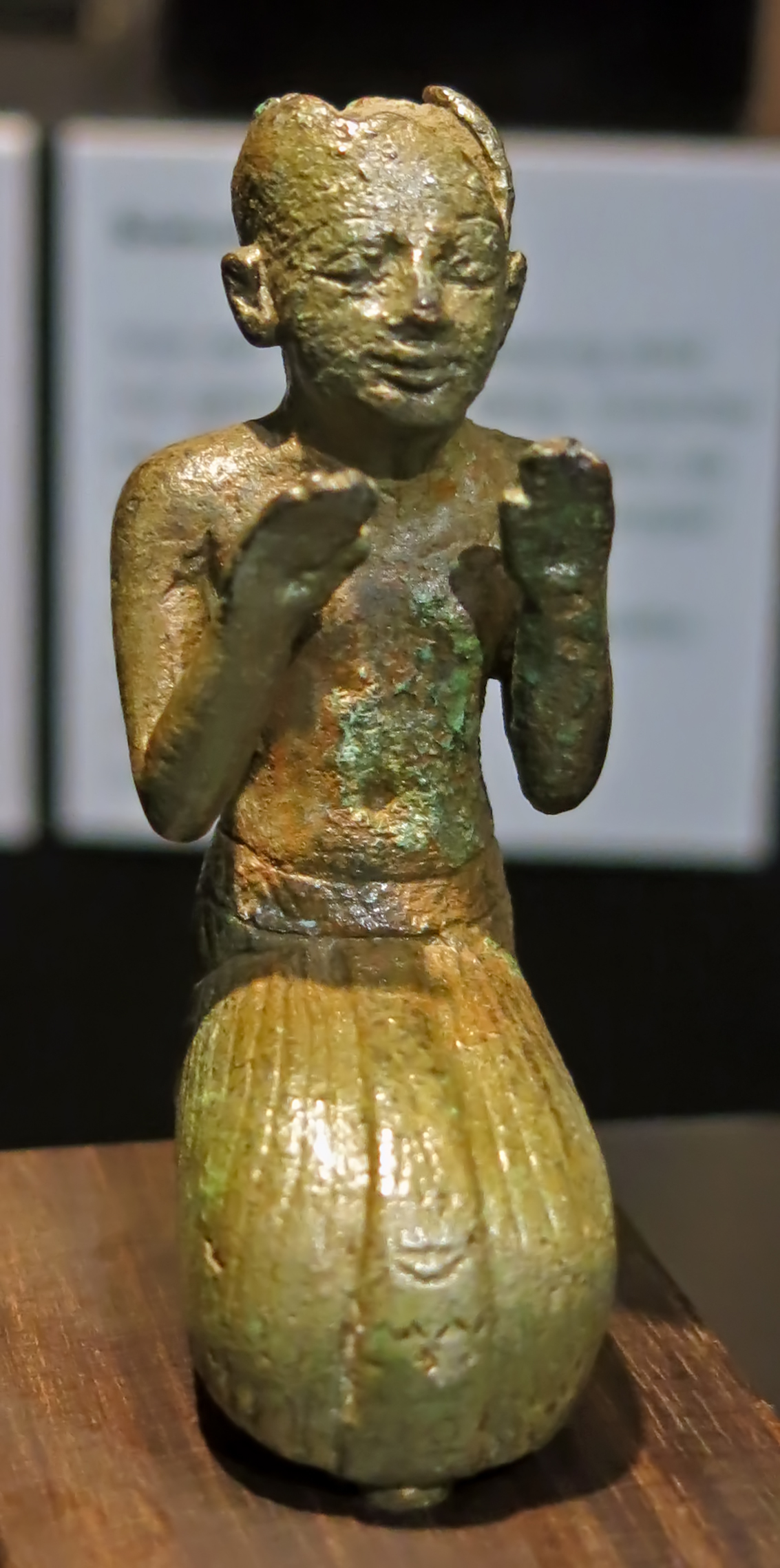
26th - 31st Dynasty (Late Period): 664 BC - 332 BC
Praying man
Praying man with an inscription on the apron with a prayer to Osiris.
Catalog: Bronze, Inv. H. 1024
Photo: Don Hitchcock 2015
Source and text: Original, Badisches Landesmuseum Karlsruhe Germany
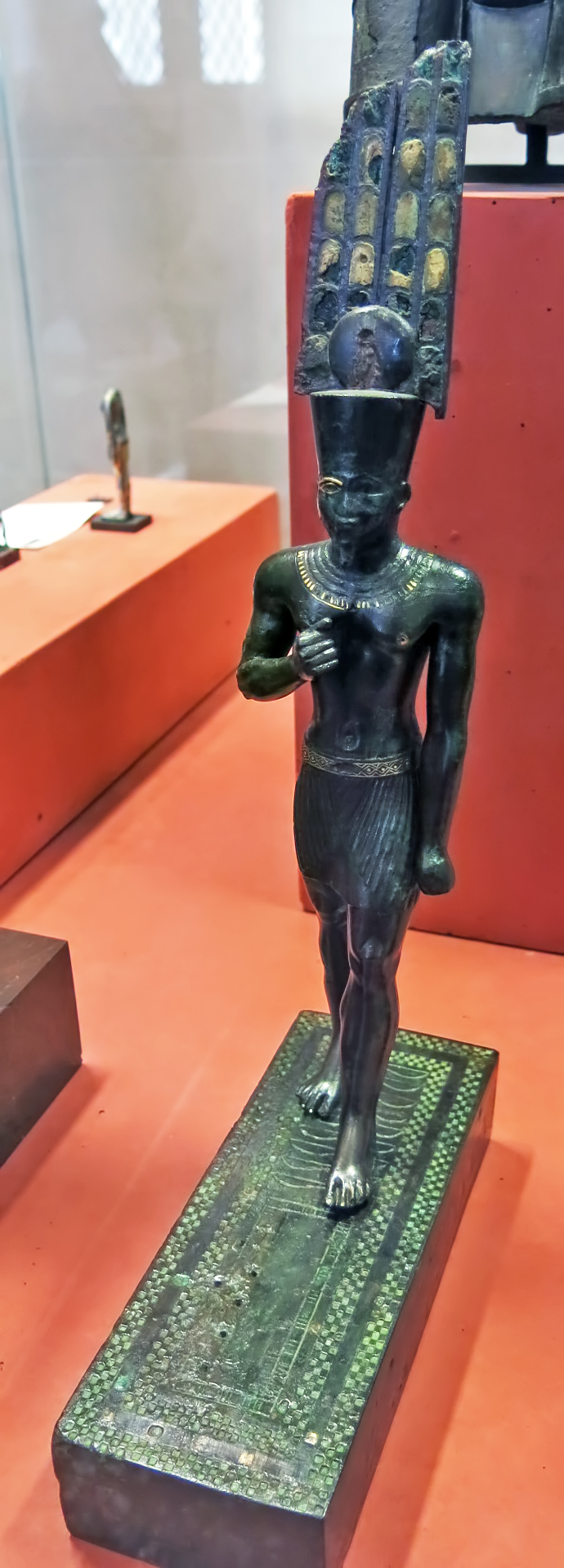
26th - 31st Dynasty (Late Period): 664 BC - 332 BC
Amun
Figurine of Amun.
( Amun is shown as a strong and well muscled warrior, with a kilt which is designed for easy movement on the battlefield if necessary.
See below for another better preserved version of the damaged double feather crown of this figurine - Don )
Height 260 mm. width 70 mm, depth 178 mm.
Catalog: Bronze, silver, gold, Aile Sully, Room 334, Materials and Techniques, Vitrine 2, N 3542, AF 1694, Salt no. 122
Photo: Don Hitchcock 2015
Source and text: Original, Louvre Museum, Paris, France, https://collections.louvre.fr/

26th - 31st Dynasty (Late Period): 664 BC - 332 BC
Censer
Wooden arm censer
In the middle of the arm was a cup, now disappeared, containing a reserve of incense grains, which were burnt in the cup at the end.
Falcon's head at one end of the censer, a bracelets on the arm, pierced in the centre.
This incense burner was an instrument of worship, a religious object.
Height 40 mm, length 367 mm, width 32 mm.
( Note that the date for this is very approximate, since no date was given on the museum card, nor in the catalog, but it is very similar to a dated censer on display at the Met Museum - Don )
Catalog: Wood, E 14687
Location: Aile Sully, Salle 322, La momie, Vitrine 1
Photo: Don Hitchcock 2015
Source and text: Original, Louvre Museum, https://collections.louvre.fr/

26th - 31st Dynasty (Late Period): 664 BC - 332 BC
Stele in front of a Naos, a shrine
A king stands, with wings and bird tail, Nemes headdress, atef crown, chendjit loincloth, skirt, knife, bow and arrows, flames on the skirt.
Naoi (shrines) are very unusual amongst architectural trial pieces. Models of architecture comprise usually parts of architectural elements, such as half of the façade of a temple, half of a gateway and above all capitals of columns including the common Hathor naos-sistrum capitals, though complete columns and even a pylon of a temple are also listed. Such models have been sometimes associated with religious functions, connected to foundation rituals for example.
N. Tomoun demonstrated that they were more intended to try out complicated combinations of different architectural details, an interpretation that works well at least in the case of composite capitals on the functions of these models. Such artefacts could also be an unusual type of false door stela. Many examples are known from Saqqara.
Catalog: Sandstone, salient bas-relief, E 21160
Location: Aile Sully, Salle 317, Gods and Magic, Vitrine 2
Photo: Don Hitchcock 2015
Source and text: Original, Louvre Museum, https://collections.louvre.fr/
Additional text: The British Museum, https://www.britishmuseum.org/collection/, © Trustees of the British Museum, CC BY-NC-SA 4.0

26th - 31st Dynasty (Late Period): 664 BC - 332 BC
Ptah-Patek
Ptah-Patek or just Patek, is one of many aspects of the god Ptah, minor god of Memphis as well as God of goldsmiths and artisans. Ptah-Patek is usually represented in the form of a deformed, naked green dwarf with a fat belly and a head that is out of proportion to his body. However, there are rare cases where he is adorned with a necklace and a crown on top of his cap.
Unlike Ptah, he is not provided with the Djed pillar, nor the was-sceptre, the ankh or the false beard, symbol of royalty. Their only similarity is that they both usually wear a cap on their heads. The Early Period was the period when his popularity was growing among the Egyptian people who, by associating it with god Bes as soon as the 22nd dynasty, exported it throughout the Eastern Mediterranean during the Hellenistic period.
Wearing a beetle on his head, and with two Horus figurines on his shoulders, Patek stands on the mouths of two crocodiles. He carries a knife in each hand. The goddess Isis wearing her distinctive headdress of a throne is on the right of the image, and the goddess Nephthys stands on the left, with her headdress symbol of a house, but missing the normal basket perched on top.
Height 85 mm, width 73 mm, thickness 313 mm.
Catalog: Faience, E 11202
Location: Aile Sully, Salle 317, Gods and Magic, Vitrine 2
Photo: Don Hitchcock 2015
Source and text: Original, Louvre Museum, https://collections.louvre.fr/
Additional text: https://www.lot-art.com/
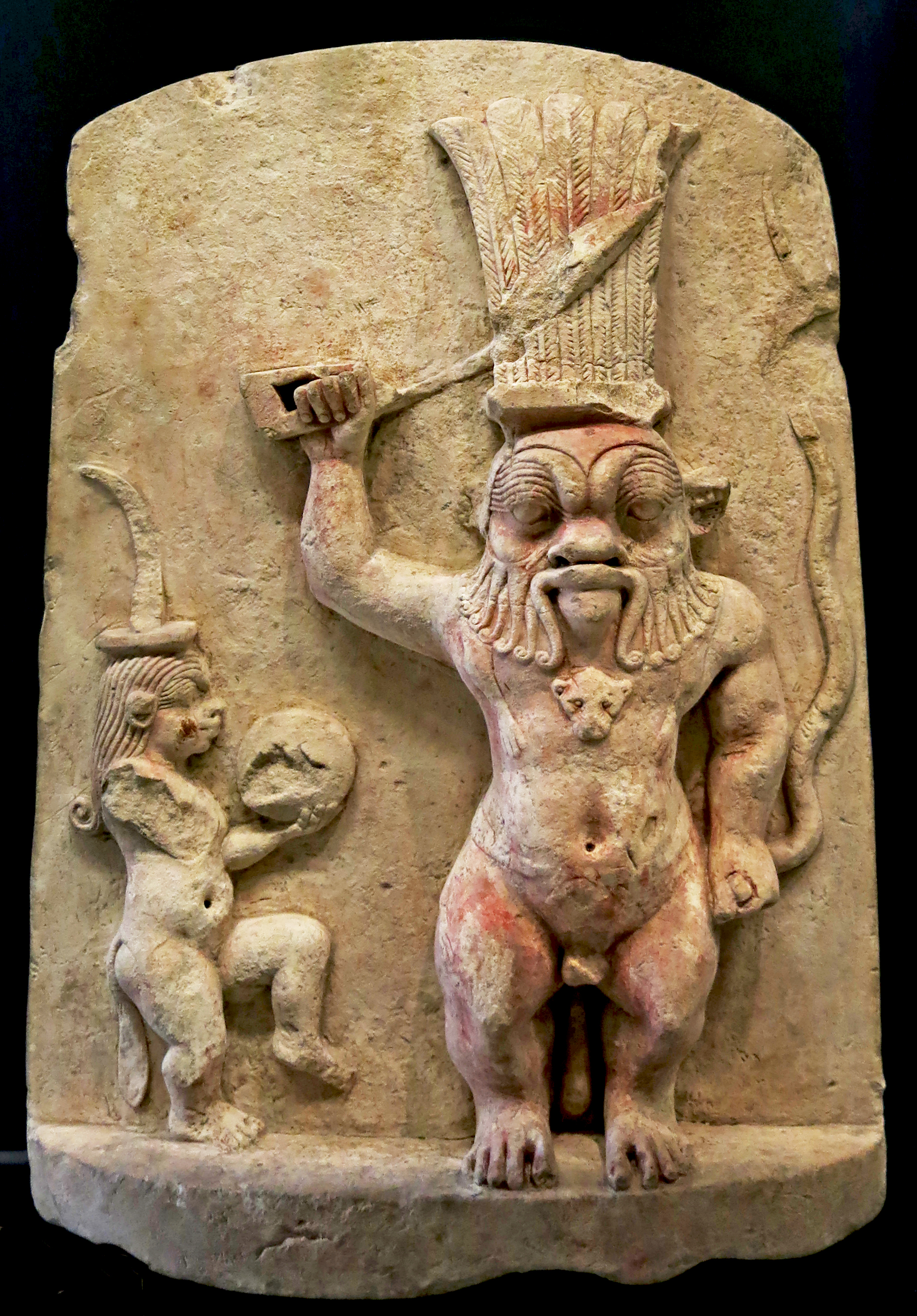
26th - 31st Dynasty (Late Period): 664 BC - 332 BC
Bes and Beset
Stele of a dancing scene, with Bes standing, half naked, wearing a panther skin, belt, the crown of Bes, holding a snake and a sword. Beset stands naked, wearing her distinctive crown, dancing, and playing the tambourine.
Bes, together with his feminine counterpart Beset, is an ancient Egyptian deity worshipped as a protector of households and, in particular, of mothers, children, and childbirth. Bes later came to be regarded as the defender of everything good and the enemy of all that is bad. Bes may have been a Middle Kingdom import from Nubia or Somalia, and his cult did not become widespread until the beginning of the New Kingdom.
Bes was a household protector, becoming responsible – throughout ancient Egyptian history – for such varied tasks as killing snakes, fighting off evil spirits, watching after children, and aiding women in labour by fighting off evil spirits, and thus present with Taweret at births.
Images of the deity, quite different from those of the other gods, were kept in homes. Normally Egyptian gods were shown in profile, but instead Bes appeared in full face portrait, with an erect penis, and sometimes in a soldier's tunic, so as to appear ready to launch an attack on any approaching evil.
He scared away demons from houses, so his statue was put up as a protector. Since he drove off evil, Bes also came to symbolise the good things in life – music, dance, and sexual pleasure. In the New Kingdom, tattoos of Bes could be found on the thighs of dancers, musicians and servant girls. Many instances of Bes masks and costumes from the New Kingdom and later have been uncovered. These show considerable wear, thought to be too great for occasional use at festivals, and are therefore thought to have been used by professional performers, or given out for rent.
Height 317 mm, width 225 mm, thickness 90 mm.
Catalog: Painted limestone, E 11138
Location: Aile Sully, Salle 317, Gods and Magic, Vitrine 2
Photo: Don Hitchcock 2015
Source and text: Original, Louvre Museum, https://collections.louvre.fr/
Additional text: Wikipedia
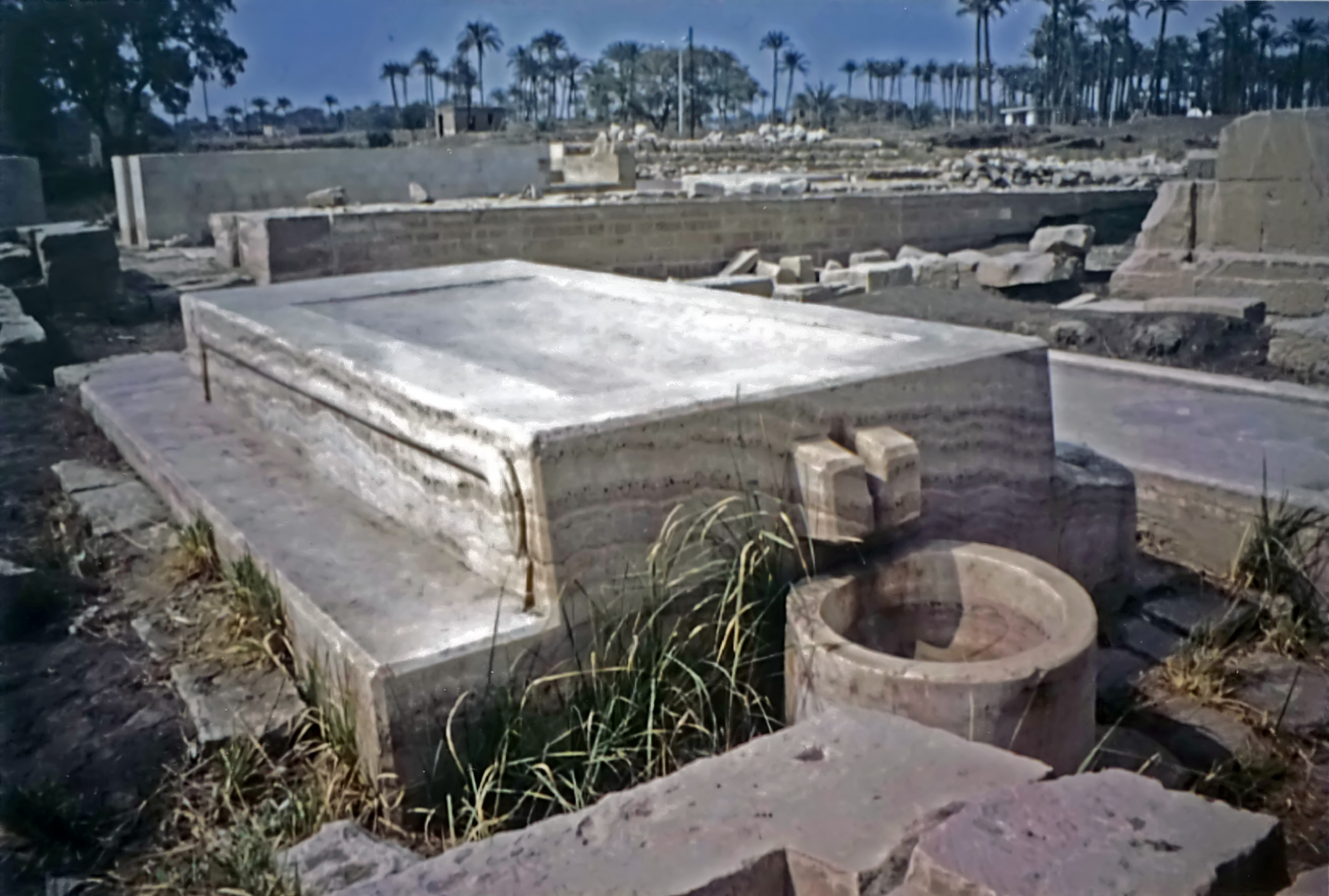
26th - 31st Dynasty (Late Period): 664 BC - 332 BC
Min-Amon, Amon-Min, Min
In Egyptian art, Min was depicted as an anthropomorphic male deity with a masculine body, covered in shrouds, wearing a crown with feathers, and often holding his penis erect in his left hand and a flail (referring to his authority, or rather that of the Pharaohs) in his upward facing right hand.
Amon-Min in this ithyphallic figurine is standing, with an erect phallus, wearing a shroud, a pectoral, the crown of Amun, plaited false beard, Usekh necklace, right arm raised holding a flail.
Height 210 mm.
Catalog: Bronze, AF 13808
Location: Aile Sully, Salle 336, Le Nil, Vitrine 7
Photo: Don Hitchcock 2015
Source and text: Original, Louvre Museum, https://collections.louvre.fr/
Additional text: Wikipedia
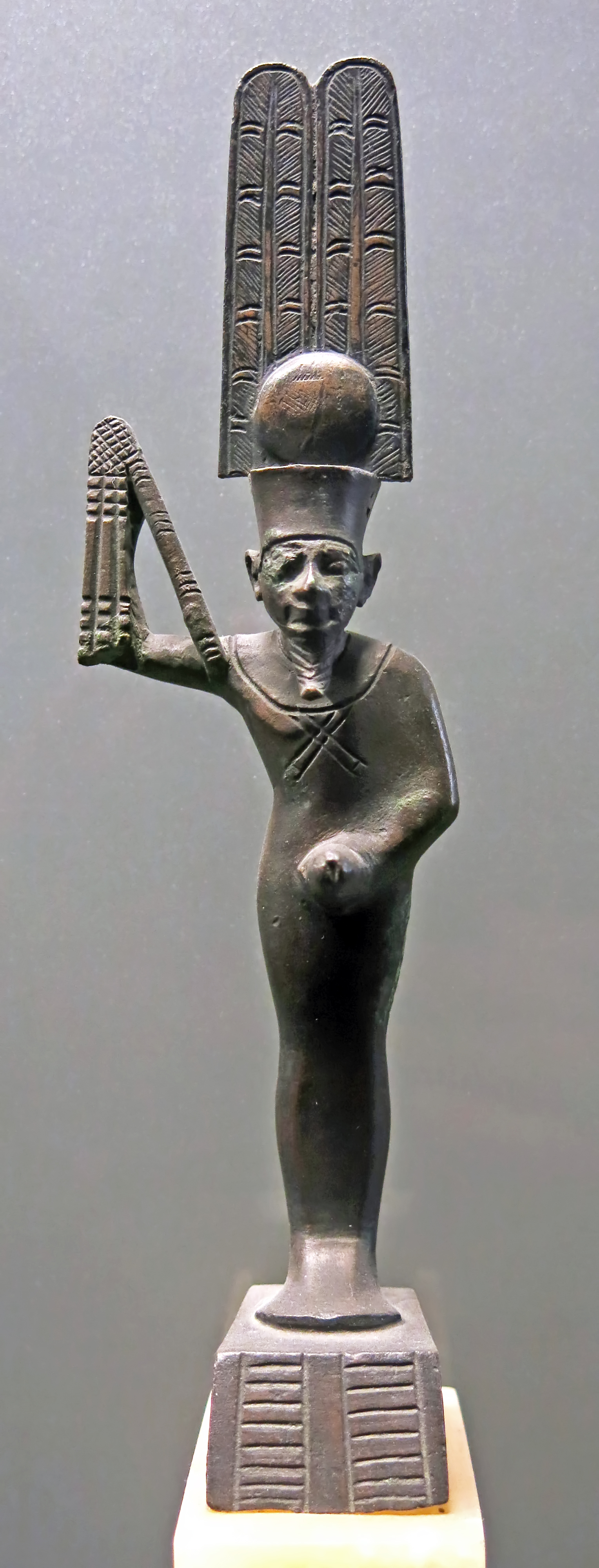
26th - 31st Dynasty (Late Period): 664 BC - 332 BC
Min, Ithyphallic figurine
Figure of Min holding phallus, wearing the crown of Amun, shroud, false beard plaited, pectoral, holding a flagellum.
Male deities as vehicles for fertility and potency rose to prevalence at the emergence of widespread agriculture. Male Egyptians would work in agriculture, making bountiful harvests a male-centered occasion. Thus, male gods of virility such as Osiris and Min were more developed during this time.
Fertility was not associated with solely women, but with men as well, even increasing the role of the male in childbirth. As a god of male sexual potency, he was honoured during the coronation rites of the New Kingdom, when the Pharaoh was expected to sow his seed—generally thought to have been plant seeds, although there have been controversial suggestions that the Pharaoh was expected to demonstrate that he could ejaculate—and thus ensure the annual flooding of the Nile. At the beginning of the harvest season, his image was taken out of the temple and brought to the fields in the festival of the departure of Min, the Min Festival, when they blessed the harvest, and played games naked in his honour, the most important of these being the climbing of a huge (tent) pole. This four day festival is evident from the great festivals list at the temple of Ramses III at Medinet Habu.
Height 183 mm.
Catalog: Bronze, E 4073
Location: Room 336, Le Nil, Vitrine 7
Photo: Don Hitchcock 2015
Source and text: Original, Louvre Museum, Paris, France, https://collections.louvre.fr/
Additional text: Wikipedia

26th - 31st Dynasty (Late Period): 664 BC - 332 BC
Anubis
Anubis, a dog-headed god, standing, wearing a chendjit loincloth, Usekh collar, left arm extended.
Anubis is the Greek name of the god of death, mummification, embalming, the afterlife, cemeteries, tombs, and the Underworld, in ancient Egyptian religion, usually depicted as a canine or a man with a canine head. Anubis is often referred to as having a 'jackal' head, but this 'jackal' is now more properly called a 'wolf'.
Like many ancient Egyptian deities, Anubis assumed different roles in various contexts. Depicted as a protector of graves as early as the First Dynasty, Anubis was also an embalmer. By the Middle Kingdom he was replaced by Osiris in his role as lord of the underworld. One of his prominent roles was as a god who ushered souls into the afterlife. He attended the weighing scale during the 'Weighing of the Heart', in which it was determined whether a soul would be allowed to enter the realm of the dead. Despite being one of the most ancient and one of the most frequently depicted and mentioned gods in the Egyptian pantheon, Anubis played almost no role in Egyptian myths.
Anubis was depicted in black, a colour that symbolised regeneration, life, the soil of the Nile River, and the discolouration of the corpse after embalming.
Height 167 mm.
Catalog: Bronze, E 4550
Location: Aile Sully, Salle 336, Le Nil, Vitrine 7
Photo: Don Hitchcock 2015
Source and text: Original, Louvre Museum, https://collections.louvre.fr/
Additional text: Wikipedia
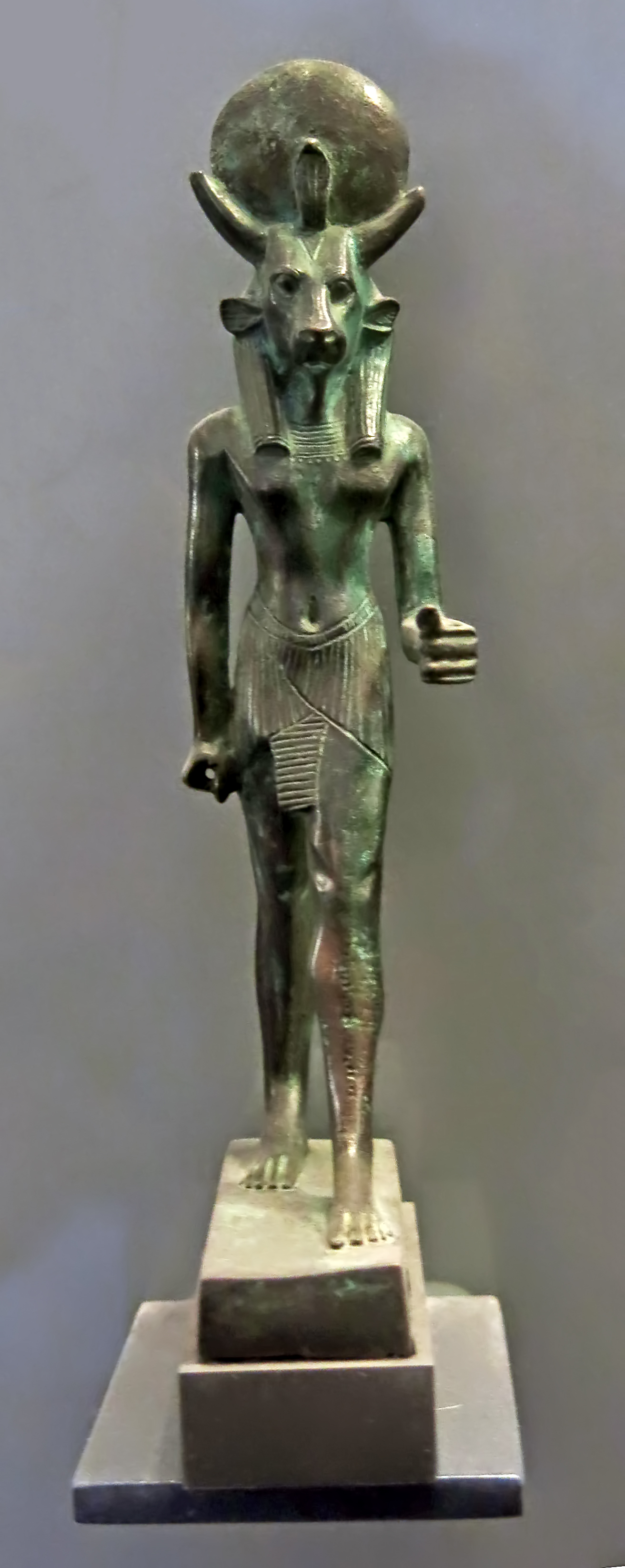
26th - 31st Dynasty (Late Period): 664 BC - 332 BC
Apis
Standing figure with a bull's head, wearing a Usekh necklace, tripartite wig, and a headdress of a solar disc and a uraeus.
Apis was a sacred bull worshiped in the Memphis region, identified as the son of Hathor, a primary deity in the pantheon of ancient Egypt. Initially, he was assigned a significant role in her worship, being sacrificed and reborn. Later, Apis also served as an intermediary between humans and other powerful deities, originally Ptah, later Osiris, then Atum.
Apis was the most popular of three great bull cults of ancient Egypt, the others being the cults of Mnevis and Buchis. All are related to the worship of Hathor or Bat, similar primary goddesses separated by region until unification that eventually merged as Hathor. The worship of Apis was continued by the Greeks and after them by the Romans, and lasted until almost 400 CE.
Height 168 mm, width 39 mm, depth 63 mm.
Catalog: Bronze, AF 12545
Location: Aile Sully, Salle 336, Le Nil, Vitrine 7
Photo: Don Hitchcock 2015
Source and text: Original, Louvre Museum, https://collections.louvre.fr/
Additional text: Wikipedia
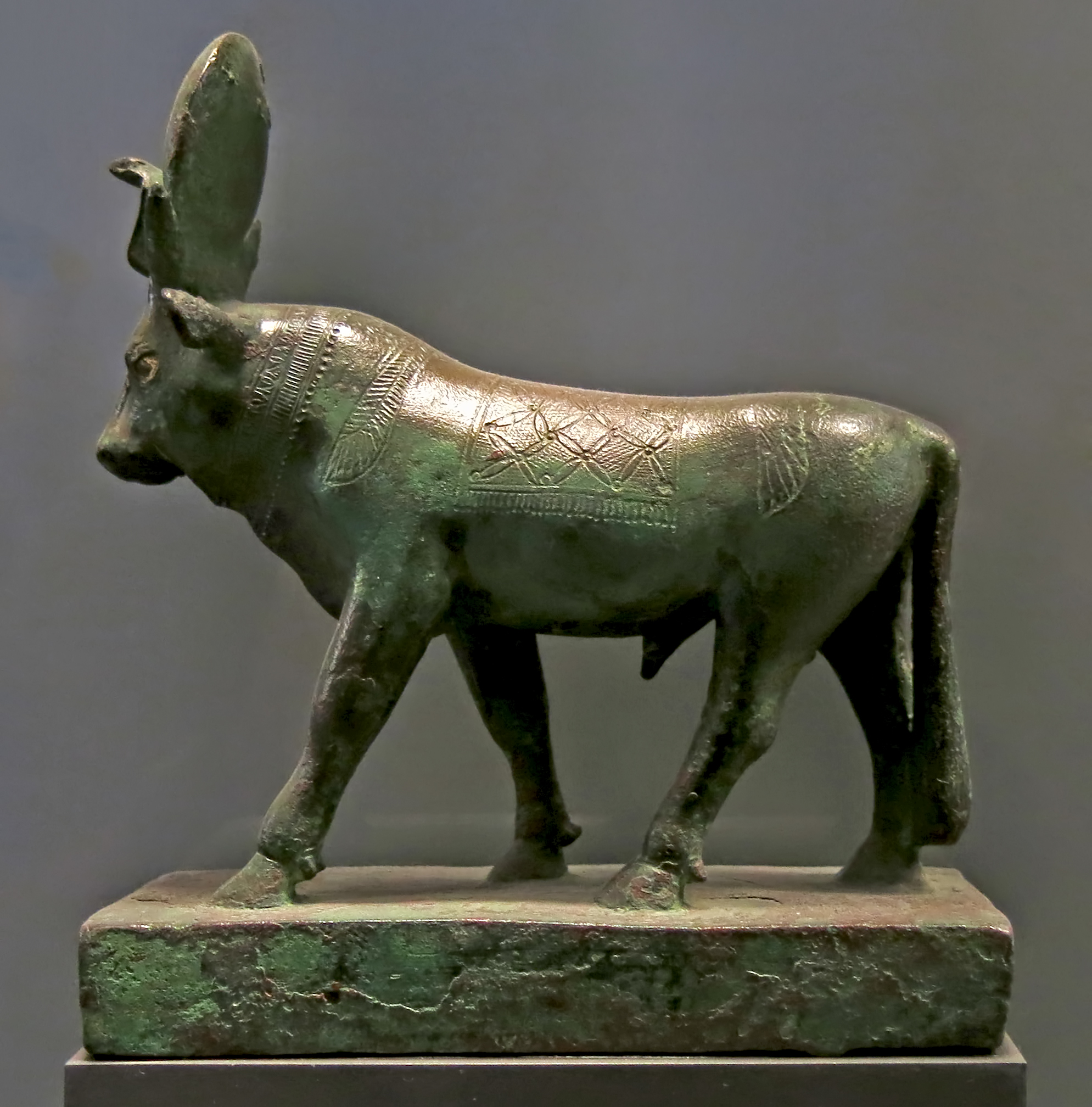
26th - 31st Dynasty (Late Period): 664 BC - 332 BC
Apis
Apis shown as a bull, standing, wearing a headdress of a solar disc and uraeus, a collar, and a silver triangle on the forehead.
Other decorations include a winged scarab, a vulture with wings outstretched.
Height 142 mm, depth 130 mm.
Catalog: Bronze, silver triangle, gold plated eyes, E 3654, AF 350
Location: Aile Sully, Salle 336, Le Nil, Vitrine 7
Photo: Don Hitchcock 2015
Source and text: Original, Louvre Museum, https://collections.louvre.fr/
Additional text: Wikipedia
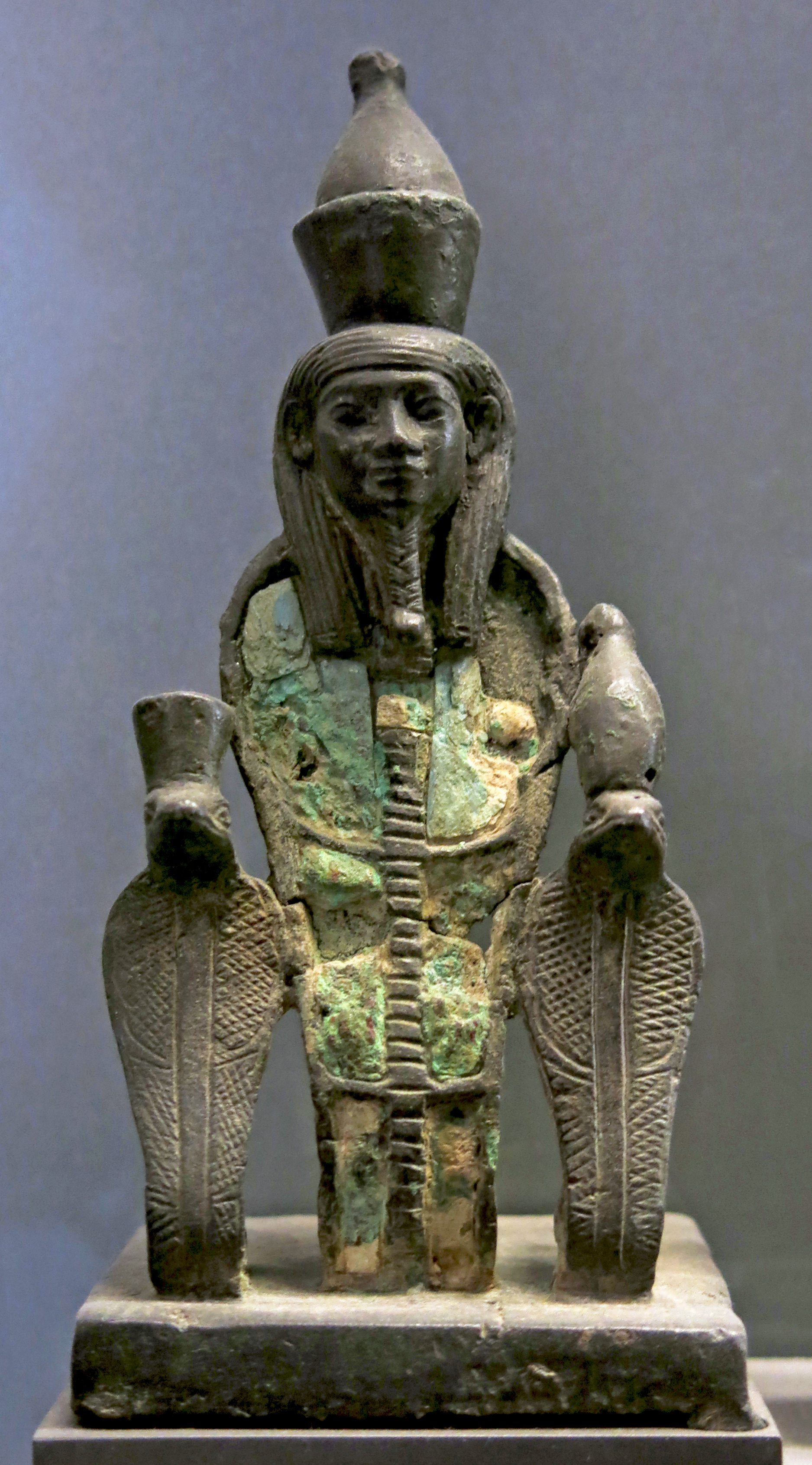
26th - 31st Dynasty (Late Period): 664 BC - 332 BC
Atum
Atum is shown here as a snake with a human head, a pschent crown, flanked by an erect snake with the white crown of Egypt, and an erect snake with the red crown of Egypt.
Atum was a self-created deity, the first being to emerge from the darkness and endless watery abyss that existed before creation. A product of the energy and matter contained in this chaos, he created his children - the first deities, out of loneliness. He produced from his own sneeze, or in some accounts, semen, Shu, the god of air, and Tefnut, the goddess of moisture. The brother and sister, curious about the primeval waters that surrounded them, went to explore the waters and disappeared into the darkness. Unable to bear his loss, Atum sent a fiery messenger, the Eye of Ra, to find his children. The tears of joy he shed upon their return were the first human beings.
Height 145 mm, width 65 mm, depth 63 mm.
Catalog: Bronze, remains of glass inlay on Atum's throat, E 27690
Location: Aile Sully, Salle 336, Le Nil, Vitrine 7
Photo: Don Hitchcock 2015
Source and text: Original, Louvre Museum, https://collections.louvre.fr/
Additional text: Wikipedia
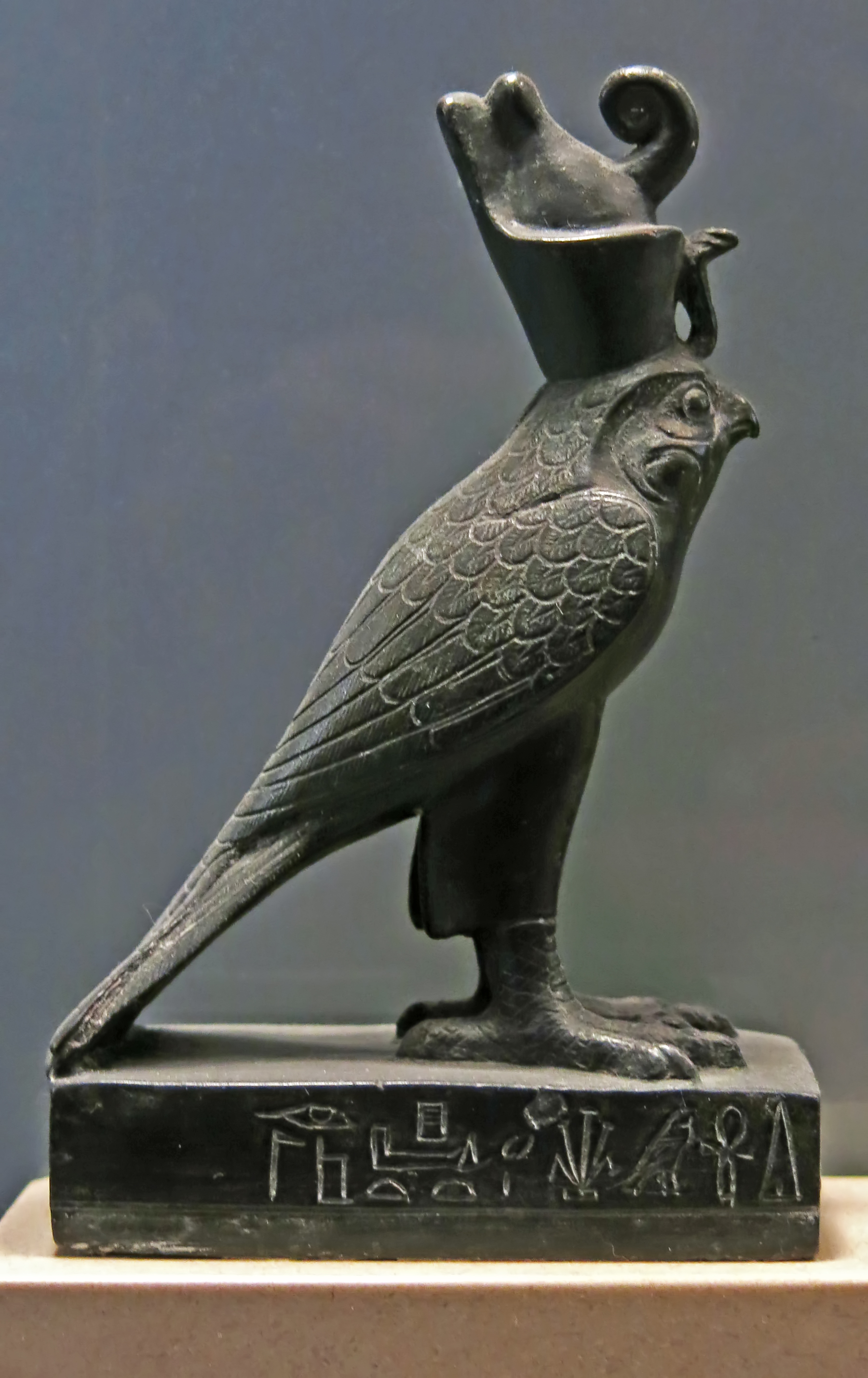
26th - 31st Dynasty (Late Period): 664 BC - 332 BC
Horus
Horus as a falcon, pschent crown, standing.
Horus is one of the most significant ancient Egyptian deities who served many functions, most notably god of kingship and the sky. He was worshipped from at least the late prehistoric Egypt until the Ptolemaic Kingdom and Roman Egypt. Different forms of Horus are recorded in history and these are treated as distinct gods by Egyptologists.
These various forms may possibly be different manifestations of the same multi-layered deity in which certain attributes or syncretic relationships are emphasised, not necessarily in opposition but complementary to one another, consistent with how the Ancient Egyptians viewed the multiple facets of reality. He was most often depicted as a falcon, most likely a lanner falcon or peregrine falcon, or as a man with a falcon head.
Height 113 mm, length 75 mm.
Catalog: Bronze, E 2453, N 4170 A
Location: Aile Sully, Salle 336, Le Nil, Vitrine 7
Photo: Don Hitchcock 2015
Source and text: Original, Louvre Museum, https://collections.louvre.fr/
Additional text: Wikipedia
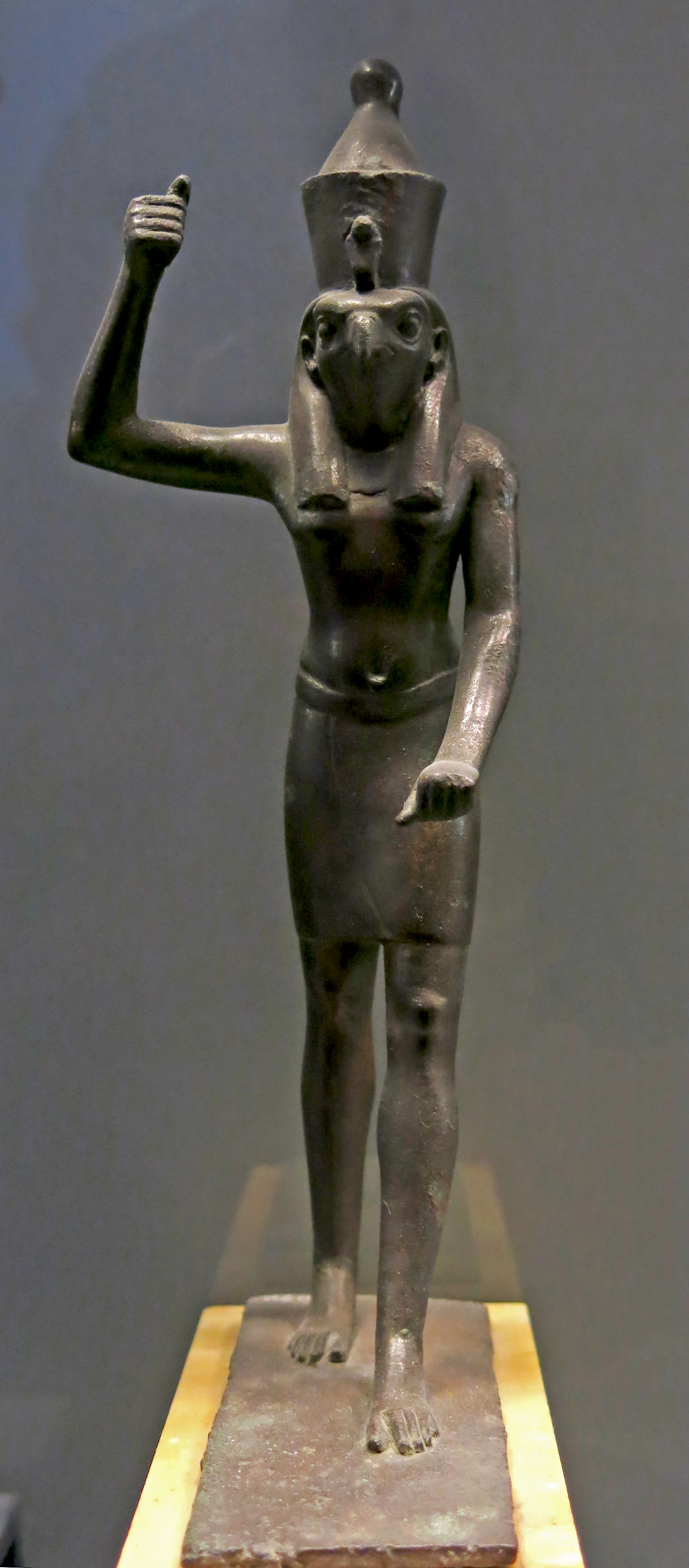
26th - 31st Dynasty (Late Period): 664 BC - 332 BC
Horus
Horus shown as a harpooner, a common representation.
Horus shown as a human body with hawk's head, standing, right arm raised, loincloth with rounded edge, pschent crown, originally holding a spear, right and left fists pierced.
Height 202 mm.
Catalog: Bronze, E 7978
Location: Aile Sully, Salle 336, Le Nil, Vitrine 7
Photo: Don Hitchcock 2015
Source and text: Original, Louvre Museum, https://collections.louvre.fr/
Additional text: Wikipedia
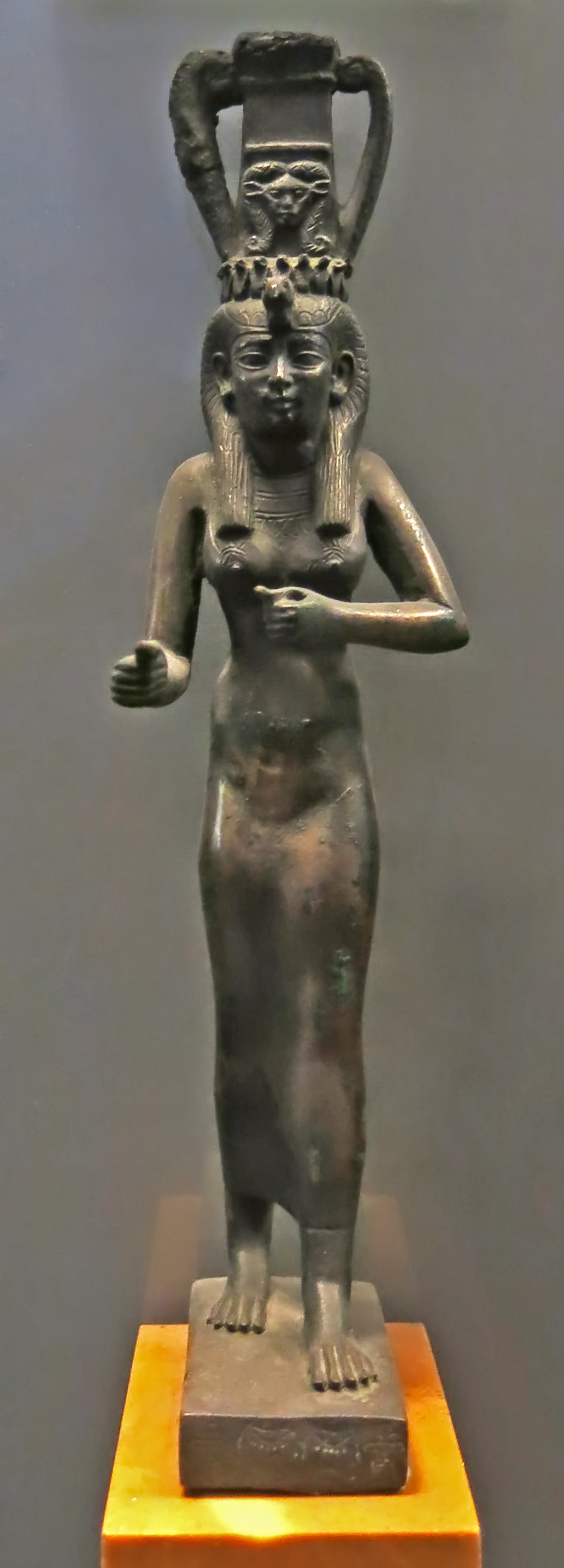
26th - 31st Dynasty (Late Period): 664 BC - 332 BC
Nebethesepet / Nebethetepet
Nebethetepet is shown standing, left arm bent over chest, right arm extended, wearing a robe, Usekh necklace, tripartite wig, vulture skin, and the crown of a sistrum signifying Nebethesepet.
Nebethetepet is shown standing in the long, form-fitting dress typical for many goddesses and wearing a sistrum shaped crown bearing an image of Hathor.
Nebethetepet was the female counterpart to Atum in the creation of the world. The sistrum, a musical instrument used in processions and rituals, alludes to her associations with the goddess Hathor, with whom the sistrum was closely related. Representations of Nebethetepet in copper alloy are rare as her cult was not widespread, although statuettes have been found at multiple sites including Sais, Memphis, and Saqqara.
Height 202 mm.
Catalog: Bronze, E 4417
Location: Aile Sully, Salle 336, Le Nil, Vitrine 7
Photo: Don Hitchcock 2015
Source and text: Original, Louvre Museum, https://collections.louvre.fr/
Additional text: Wikipedia, https://www.metmuseum.org/

26th - 31st Dynasty (Late Period): 664 BC - 332 BC
Bastet
The cat god Bastet, seated, Wedjat necklace, pierced ears, scarab engraved on head.
Bastet was originally a fierce lioness warrior goddess of the sun worshiped throughout most of ancient Egyptian history, but later she became the cat goddess that is familiar today. She then was depicted as the daughter of Ra and Isis, and the consort of Ptah, with whom she had a son Maahes.
As protector of Lower Egypt, she was seen as defender of the king, and consequently of the sun god, Ra. Along with other deities such as Hathor, Sekhmet, and Isis, Bastet was associated with the Eye of Ra. She has been depicted as fighting the evil snake named Apep, an enemy of Ra. Bastet was also a goddess of pregnancy and childbirth, possibly because of the fertility of the domestic cat.
Height 76 mm, depth 55 mm.
Catalog: Bronze, E 14282 Bis
Location: Aile Sully, Salle 336, Le Nil, Vitrine 7
Photo: Don Hitchcock 2015
Source and text: Original, Louvre Museum, https://collections.louvre.fr/
Additional text: Wikipedia

26th - 31st Dynasty (Late Period): 664 BC - 332 BC
Bes
Bes striking down vermin. Bes stands naked, with four arms, four wings and a bird's tail, as well as the heads of dog, ram, hawk, cat, lion.
He has an erect phallus, and is crushing a snake.
Height 111 mm.
Catalog: Bronze, Serapium of Memphis, Saqqara-North, Memphite Necropolis, N 5141
Location: Aile Sully, Salle 336, Le Nil, Vitrine 7
Photo: Don Hitchcock 2015
Source and text: Original, Louvre Museum, https://collections.louvre.fr/
Additional text: Wikipedia
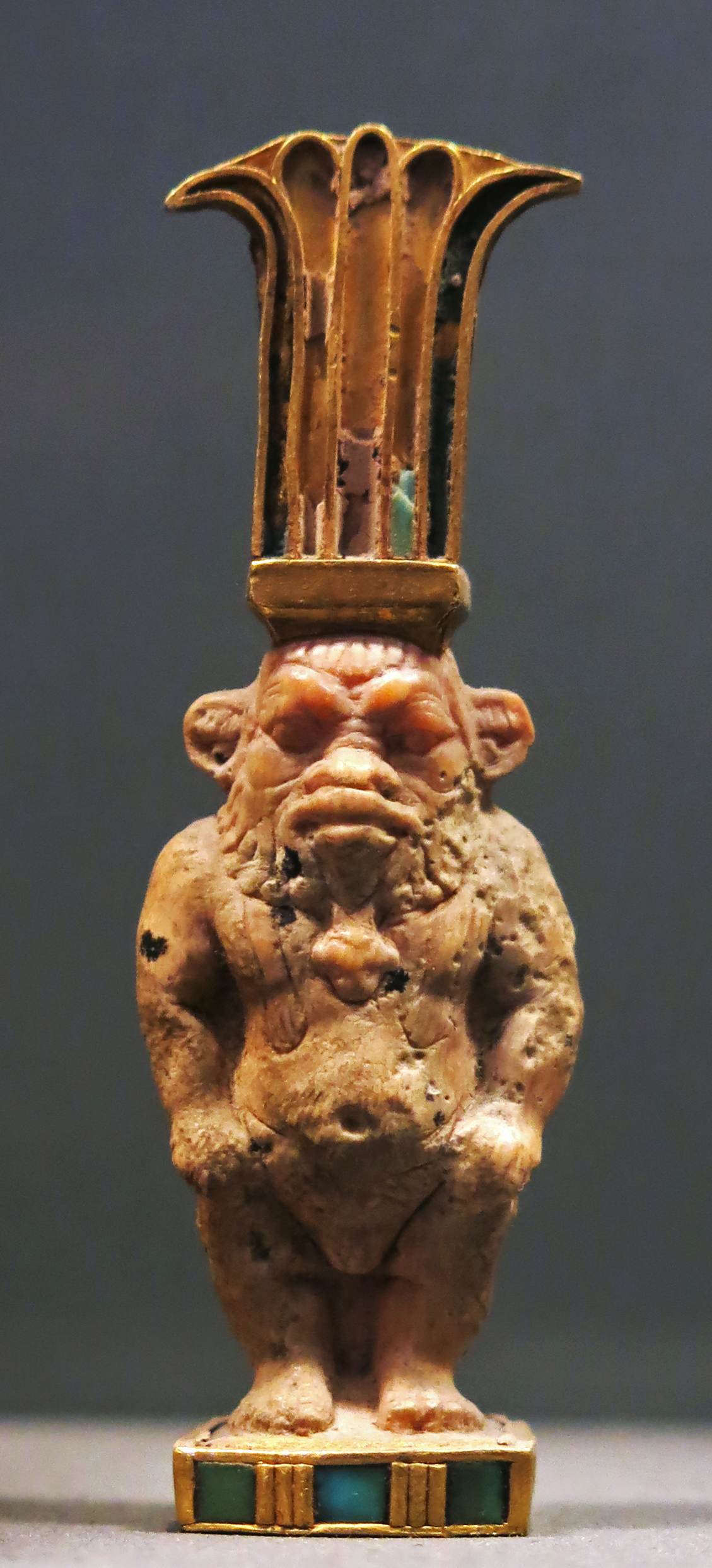
26th - 31st Dynasty (Late Period): 664 BC - 332 BC
Bes
Bes stands with his hands on his thighs, half naked, wearing an animal skin and the crown of Bes.
Height 55 mm, width 18 mm, depth 15 mm.
Catalog: Stone, gold, glass, cloisonné inlay, roundel, E 10685
Location: Aile Sully, Salle 336, Le Nil, Vitrine 7
Photo: Don Hitchcock 2015
Source and text: Original, Louvre Museum, https://collections.louvre.fr/
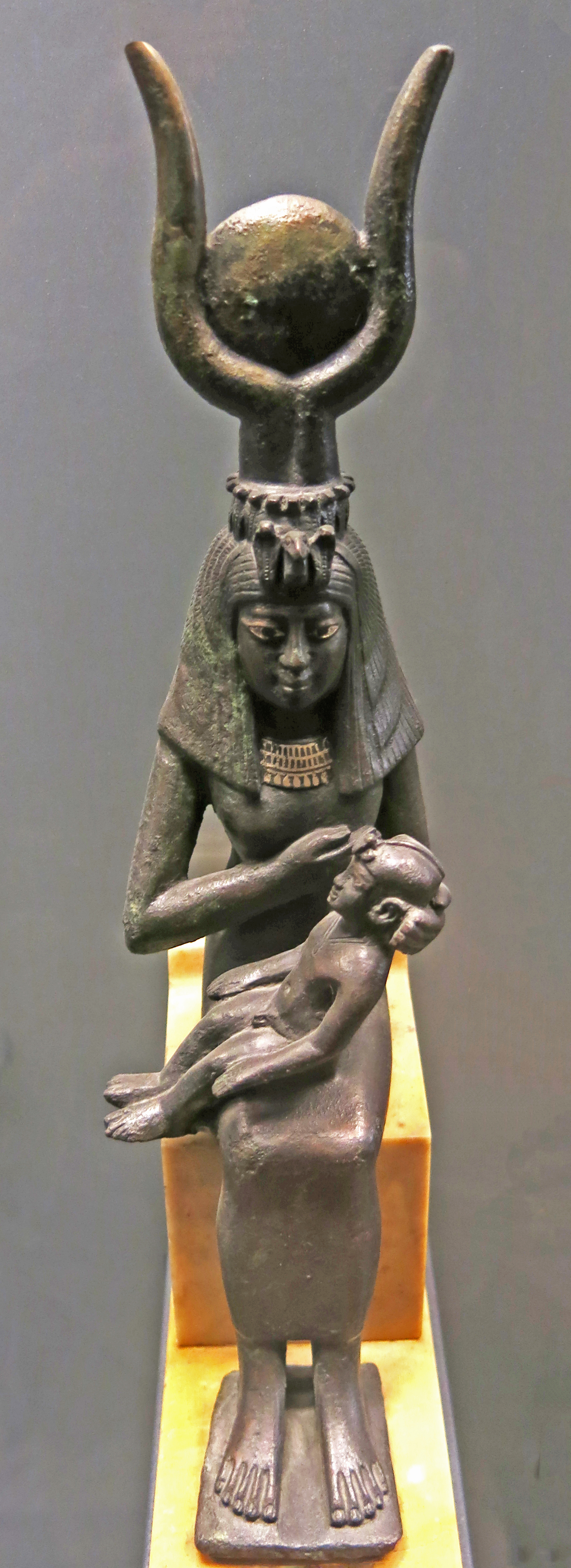
26th - 31st Dynasty (Late Period): 664 BC - 332 BC
Isis suckling her son Harpocrates / Horus.
Isis is seated, breast feeding Harpocretes, wearing a dress, wrap-around wig, vulture's skin, sun disc and horns as a headdress, Usekh necklace. Harpocretes is naked, seated on her lap, wearing a childhood wick and a uraeus.
Height 274 mm.
Catalog: Bronze, inlaid necklace, gold plated eye whites and Usekh necklace, E 3637
Location: Aile Sully, Salle 336, Le Nil, Vitrine 7
Photo: Don Hitchcock 2015
Source and text: Original, Louvre Museum, https://collections.louvre.fr/

26th - 31st Dynasty (Late Period): 664 BC - 332 BC
Isis suckling her son Horus
It is thanks to her magic that Isis saved her son Horus from the venomous beasts that populate the marshes where she had taken refuge, after the death of Osiris.
Height 188 mm, depth 112 mm.
Catalog: Feldspar, N 3997, Salt n° 3748
Location: Aile Sully, Salle 317, Gods and Magic, Vitrine 2
Photo: Don Hitchcock 2015
Source and text: Original, Louvre Museum, https://collections.louvre.fr/


26th - 31st Dynasty (Late Period): 664 BC - 332 BC
Winged Isis
The winged Isis is shown wearing the skin of a vulture, sun disc and horns, arms forward in an attitude of protection.
Height 165 mm.
Catalog: Bronze, E 3637
Location: Aile Sully, Salle 336, Le Nil, Vitrine 7
Photo (left): Don Hitchcock 2015
Photo (right): © Louvre Museum, https://collections.louvre.fr/ark:/53355/cl010010333
Source and text: Original, Louvre Museum, https://collections.louvre.fr/
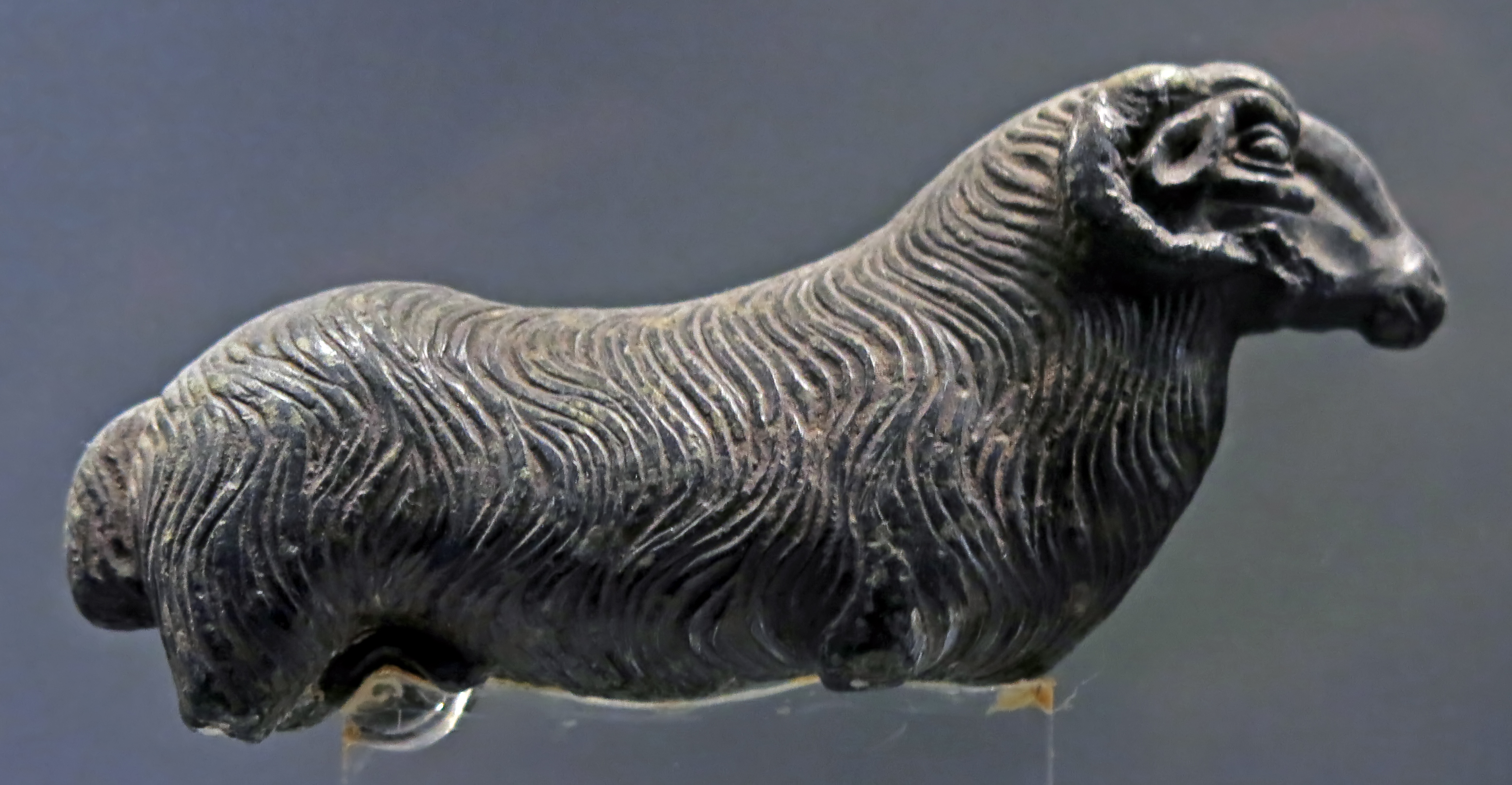
26th - 31st Dynasty (Late Period): 664 BC - 332 BC
Amulet of Khnum
Khnum, usually depicted as a ram or as a human with the head of a ram, was one of the earliest-known Egyptian deities, originally the god of the source of the Nile. Since the annual flooding of the Nile brought with it silt and clay, and its water brought life to its surroundings, he was thought to be the creator of the bodies of human children, which he made at a potter's wheel, from clay, and placed in their mothers' wombs. He was later described as having moulded the other deities, and he had the titles 'Divine Potter' and 'Lord of created things from himself'.
Height 46 mm, length 95 mm, thickness 25 mm.
Catalog: Serpentine, E 10579
Location: Aile Sully, Salle 336, Le Nil, Vitrine 7
Photo: Don Hitchcock 2015
Source and text: Original, Louvre Museum, https://collections.louvre.fr/
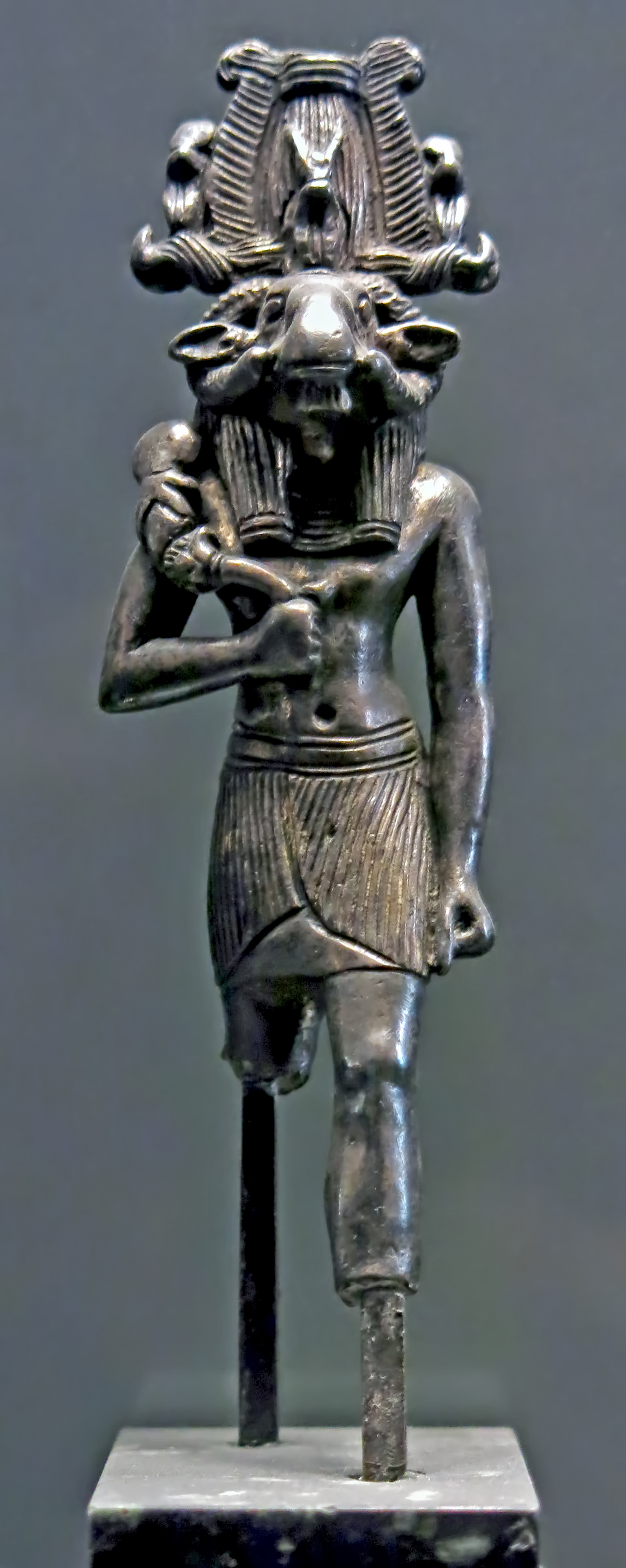
26th - 31st Dynasty (Late Period): 664 BC - 332 BC
Khnum
Figurine of Khnum, a ram-headed god, standing, wearing an atef crown, loincloth, and holding a weapon.
Height 98 mm, width 30 mm.
Catalog: Silver, Elephantine, Aswan, N 3577,CC 261, AF 2331
Location: Aile Sully, Salle 336, Le Nil, Vitrine 7
Photo: Don Hitchcock 2015
Source and text: Original, Louvre Museum, https://collections.louvre.fr/
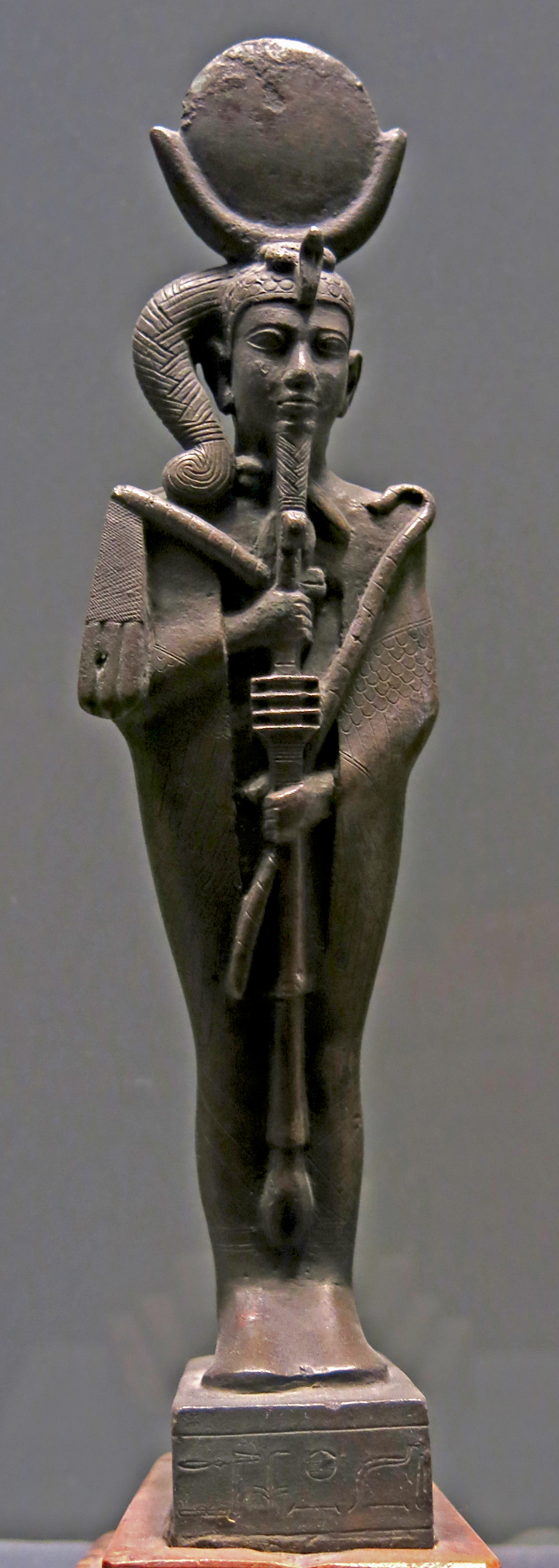
26th - 31st Dynasty (Late Period): 664 BC - 332 BC
Khonsu
Khonsu, the god of the Moon, is shown standing, wearing a shroud, a plaited false beard, the wick of childhood, with a lunar disc as his headdress. He holds a heka sceptre (crook), flagellum, was sceptre (stylised animal head), and a djed pillar.
The name of Khonsu, god of the Moon means 'traveller', and this may relate to the perceived nightly travel of the Moon across the sky. Along with Thoth he marked the passage of time. Khonsu was instrumental in the creation of new life in all living creatures.
Height 180 mm.
Catalog: Bronze, E 3720
Location: Aile Sully, Salle 336, Le Nil, Vitrine 7
Photo: Don Hitchcock 2015
Source and text: Original, Louvre Museum, https://collections.louvre.fr/
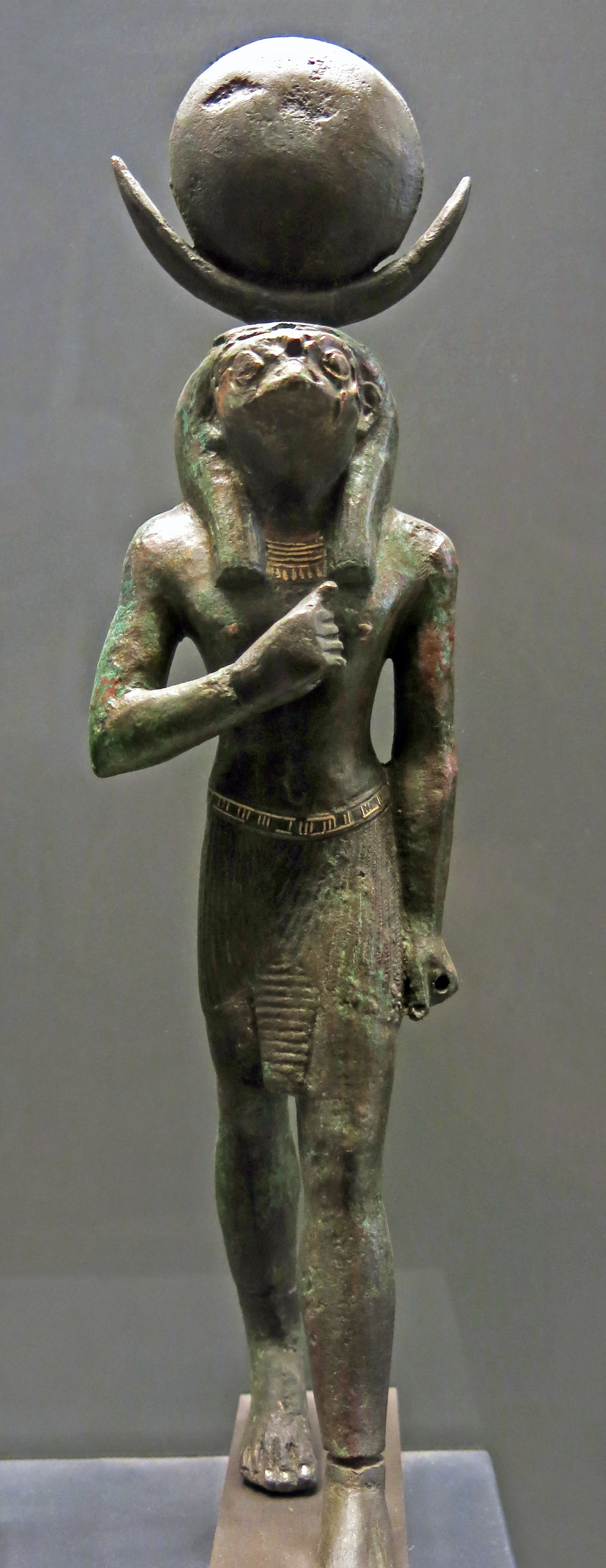
26th - 31st Dynasty (Late Period): 664 BC - 332 BC
Khonsu
Khonsu, the god of the Moon, is often shown with a hawk head, as part of his role as a sky god.
Here the standing figure wears a chendjit loincloth, Usekh necklace, and a lunar disc.
Height 280 mm.
Catalog: Bronze, inlaid gold, E 3720
Location: Aile Sully, Salle 336, Le Nil, Vitrine 7
Photo: Don Hitchcock 2015
Source and text: Original, Louvre Museum, https://collections.louvre.fr/

26th - 31st Dynasty (Late Period): 664 BC - 332 BC
Mut
Mut is shown standing, with her arms at her sides, wearing a dress, a tripartite wig, vulture skin, Pschent crown, Usekh necklace, and two bracelets.
Height 223 mm, width 40 mm, depth 30 mm.
Mut was a mother goddess worshipped in ancient Egypt. Her name literally means mother in the ancient Egyptian language. Mut had many different aspects and attributes that changed and evolved a lot over the thousands of years of ancient Egyptian culture.
Mut was considered a primal deity, associated with the primordial waters of Nu from which everything in the world was born. Mut was sometimes said to have given birth to the world through parthenogenesis, but more often she was said to have a husband, the solar creator god Amun-Ra.
Although Mut was believed by her followers to be the mother of everything in the world, she was particularly associated as the mother of the lunar child god Khonsu. At the Temple of Karnak in Egypt's capital city of Thebes, the family of Amun-Ra, Mut and Khonsu were worshipped together as the Theban Triad.
In art, Mut was usually depicted as a woman wearing the double crown of the kings of Egypt, representing her power over the whole of the land.
Catalog: Bronze, E 25952
Location: Aile Sully, Salle 336, Le Nil, Vitrine 7
Photo: Don Hitchcock 2015
Source and text: Original, Louvre Museum, https://collections.louvre.fr/
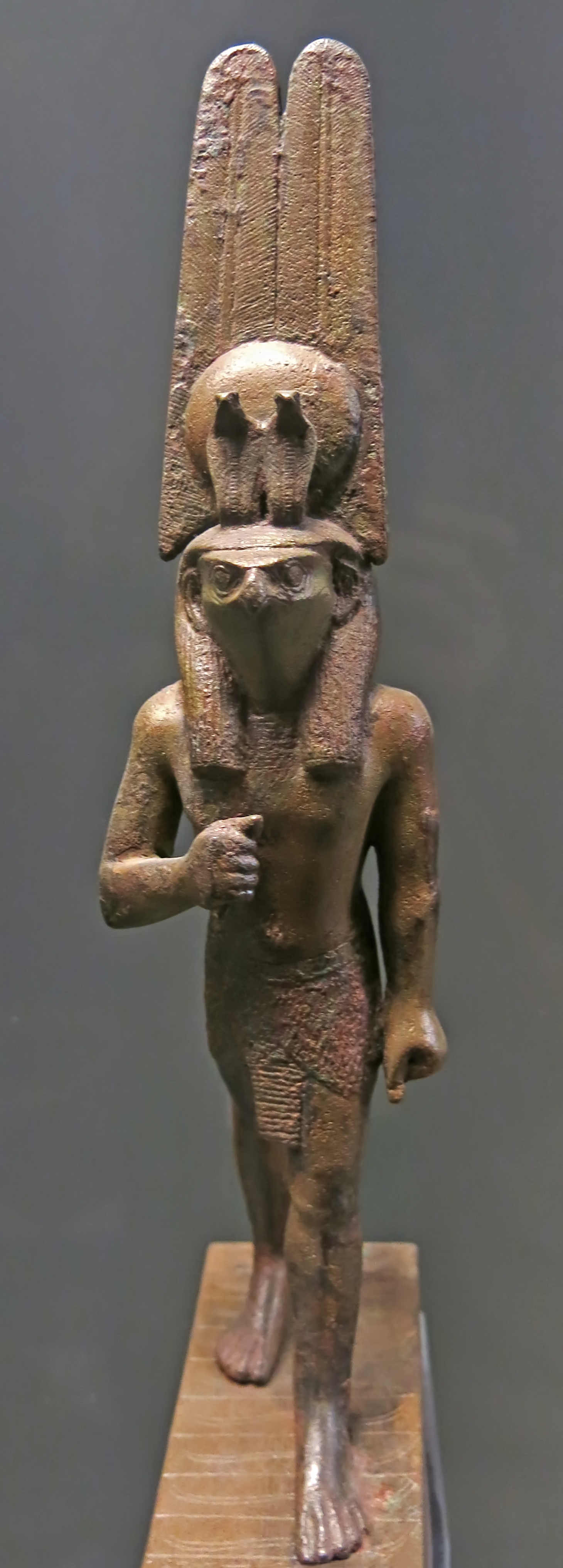
26th - 31st Dynasty (Late Period): 664 BC - 332 BC
Montu
Montu was a falcon-god of war in ancient Egyptian religion, an embodiment of the conquering vitality of the pharaoh. He was particularly worshipped in Upper Egypt and in the district of Thebes.
A very ancient god, Montu was originally a manifestation of the scorching effect of Ra, the sun – and as such often appeared under the epithet Montu-Ra. The destructiveness of this characteristic led to him gaining characteristics of a warrior, and eventually becoming a widely revered war-god.
The Egyptians thought that Montu would attack the enemies of Maat (that is, of the truth, of the cosmic order) while inspiring, at the same time, glorious warlike exploits. It is possible that Montu-Ra and Atum-Ra symbolized the two kingships, respectively, of Upper and Lower Egypt. When linked with Horus, Montu's epithet was "Horus of the Strong Arm".
Here Montu strides forward, wearing a chendjit loincloth, the crown of Montu, and the double uraeus.
Height 303 mm, width 50 mm, depth 116 mm.
Catalog: Bronze, AF 588
Location: Aile Sully, Salle 336, Le Nil, Vitrine 7
Photo: Don Hitchcock 2015
Source and text: Original, Louvre Museum, https://collections.louvre.fr/
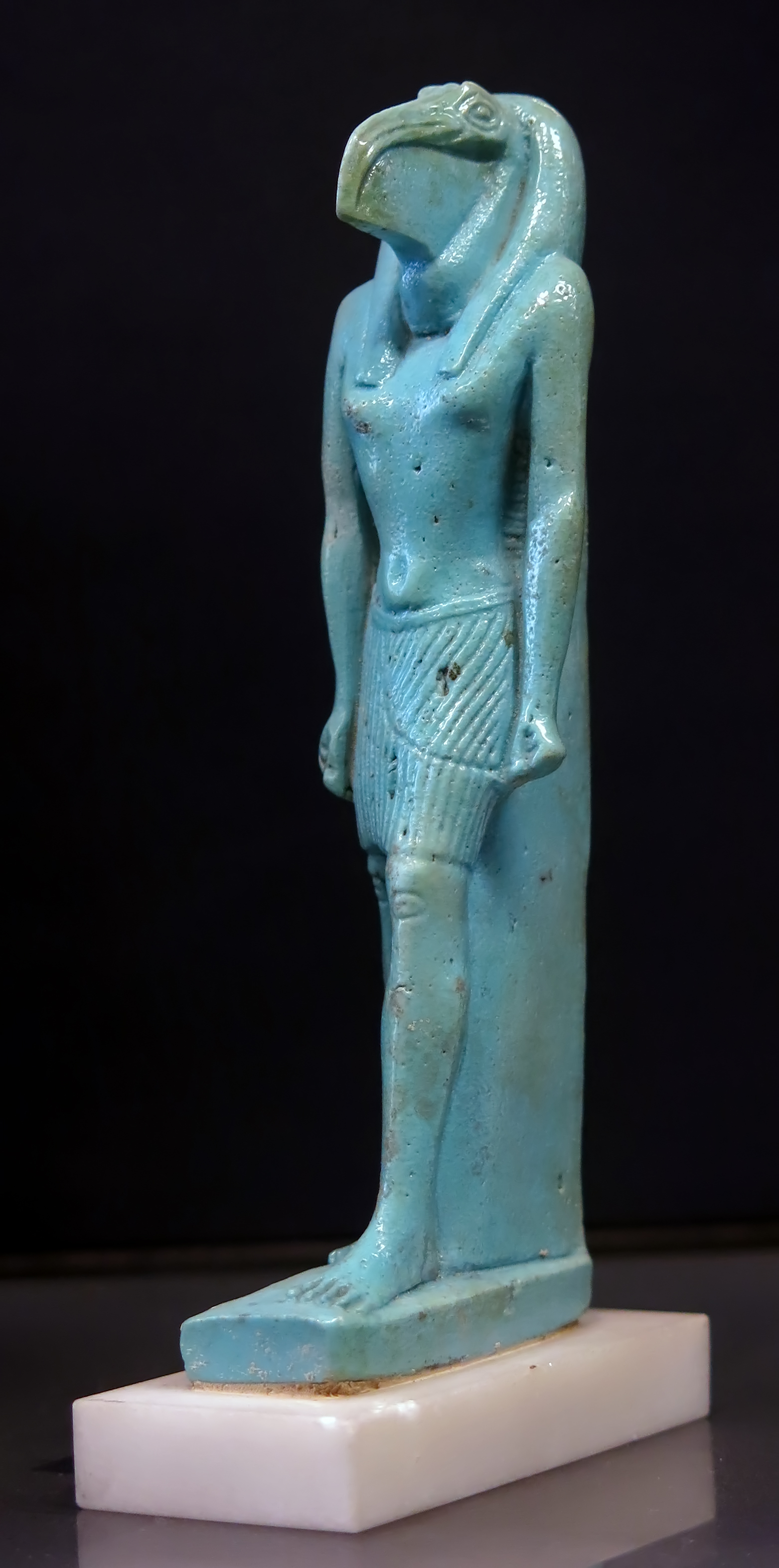
26th - 31st Dynasty (Late Period): 664 BC - 332 BC
Thoth
Figurine of Thoth, a god with the head of an ibis. He is shown standing, wearing a loincloth with rounded edge, and a Usekh collar. There is an undrilled dorsal pillar.
( Note that there is a wide bar beneath the beak, which both strengthens an otherwise fragile part of the sculpture, and also avoids too many returns in the mold. - Don )
Height 93 mm, width 29 mm, depth 37 mm.
Catalog: Faience, E 3490?, AF 2346
Location: Aile Sully, Salle 317, Gods and Magic, Vitrine 2
Photo: Don Hitchcock 2015
Source and text: Original, Louvre Museum, https://collections.louvre.fr/
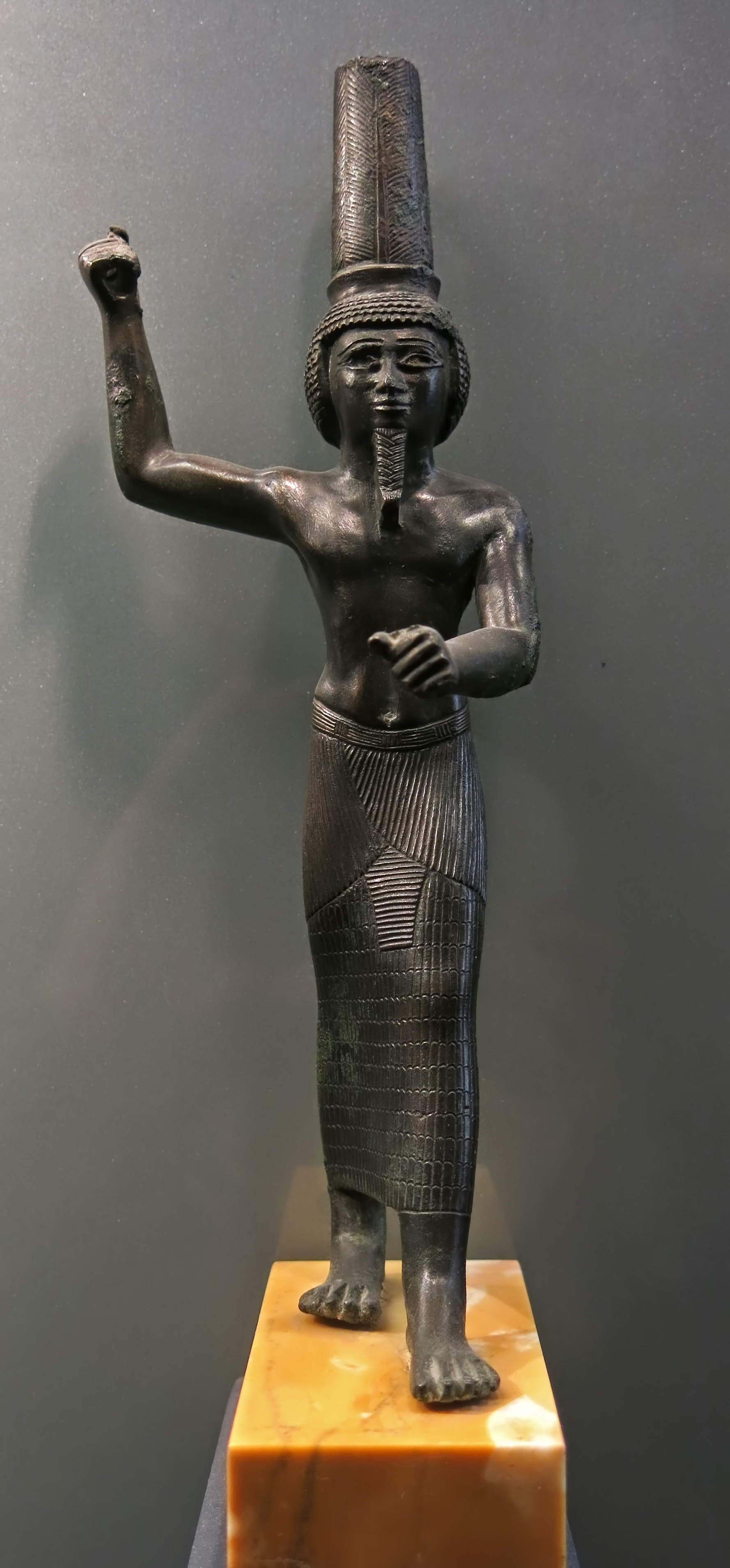
26th - 31st Dynasty (Late Period): 664 BC - 332 BC
Onuris
Figurine of Onuris standing, right arm raised, left arm extended holding a spear(?). Pleated skirt, chendjit loincloth, rolled up false beard, short curly wig, Onuris crown.
The god 'with the mighty arm' is recognisable by the four high feathers in his headdress. Wielding a spear, he is a manifestation of Shu, champion of Re slaughtering his enemies and exterminating the forces of evil.
His fighting spirit equals that of Montu, falcon god of war, and can even turn into a killing spree.
For this reason he has often been equated with Seth. His name, 'the one who brings back the distant', evokes another aspect borrowed from Shu.
His twin sister Tefnut had run away, so Shu went to look for her and convinced her to return to Egypt to her father Atum.
Height 215 mm.
Catalog: Bronze, N 3741
Location: Aile Sully, Salle 336, Le Nil, Vitrine 7
Photo: Don Hitchcock 2015
Source and text: Original, Louvre Museum, https://collections.louvre.fr/

26th - 31st Dynasty (Late Period): 664 BC - 332 BC
Neith
Neith is shown standing, wearing a dress and with the Deshret, the Red Crown of Lower Egypt, a uraeus, and Usekh necklace.
The necklace and the uraeus are inlaid with gold, and the eye white gold plated.
Height 230 mm.
Catalog: Bronze, gilded, N 3730
Location: Aile Sully, Salle 336, Le Nil, Vitrine 7
Photo: Don Hitchcock 2015
Source and text: Original, Louvre Museum, https://collections.louvre.fr/

26th - 31st Dynasty (Late Period): 664 BC - 332 BC
Osiris
Osiris seated, chendjit loincloth, plumed corselet, lunar disc, plaited false beard.
Oudjat eye engraved on the disc.
Height 190 mm.
Catalog: Bronze, formerly inlaid eyes, Memphis Serapeum, Memphis Necropolis, N 5109
Photo: Don Hitchcock 2015
Source and text: Original, Louvre Museum, https://collections.louvre.fr/
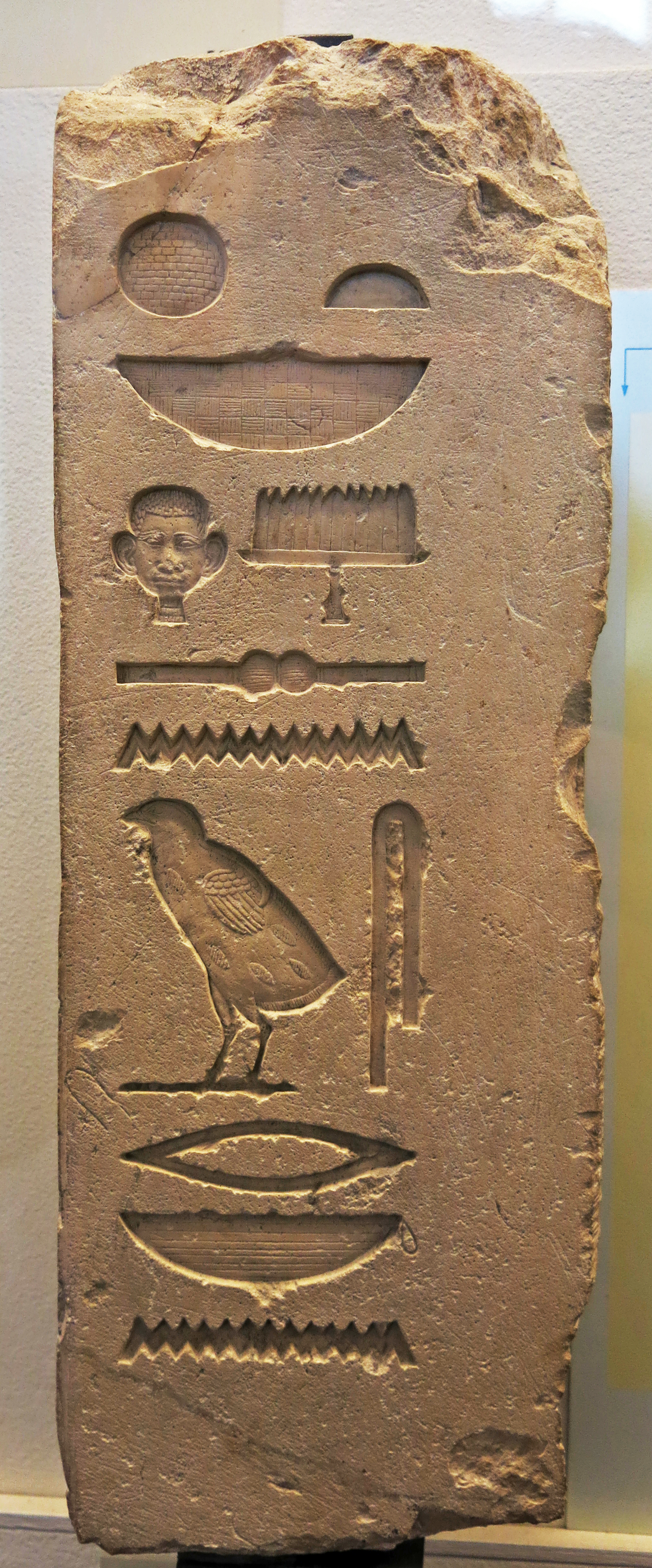
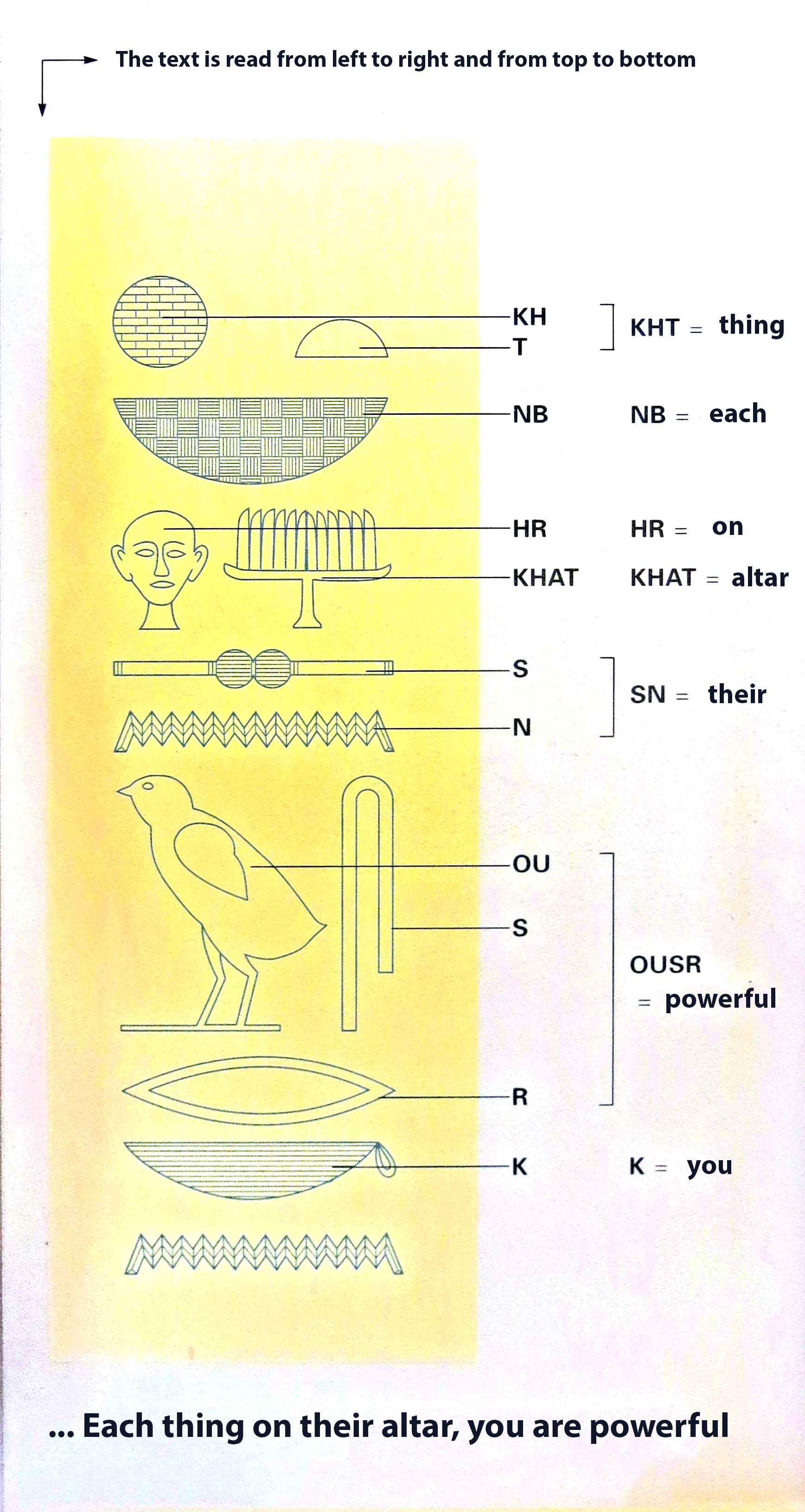
26th - 31st Dynasty (Late Period): 664 BC - 332 BC
Wall relief
Fragment of an elaborate Hieroglyphic column, probably the work of a late sculptor imitating the Old Kingdom style. They are arranged in a column; within each group or 'frame' or 'quadrat', they are read from left to right, and the groups are read from top to bottom.
The text reads:
Each thing on their altar, you are powerful
( It is unusual to see such care lavished on such large and sharp hieroglyphs - Don )
Height 345 mm. width 120 mm, thickness 70 mm.
Catalog: Limestone, sunken relief, E 11165
Photo: Don Hitchcock 2015
Source and text: Original, Louvre Museum, https://collections.louvre.fr/
Drawing: after a poster, Louvre Museum
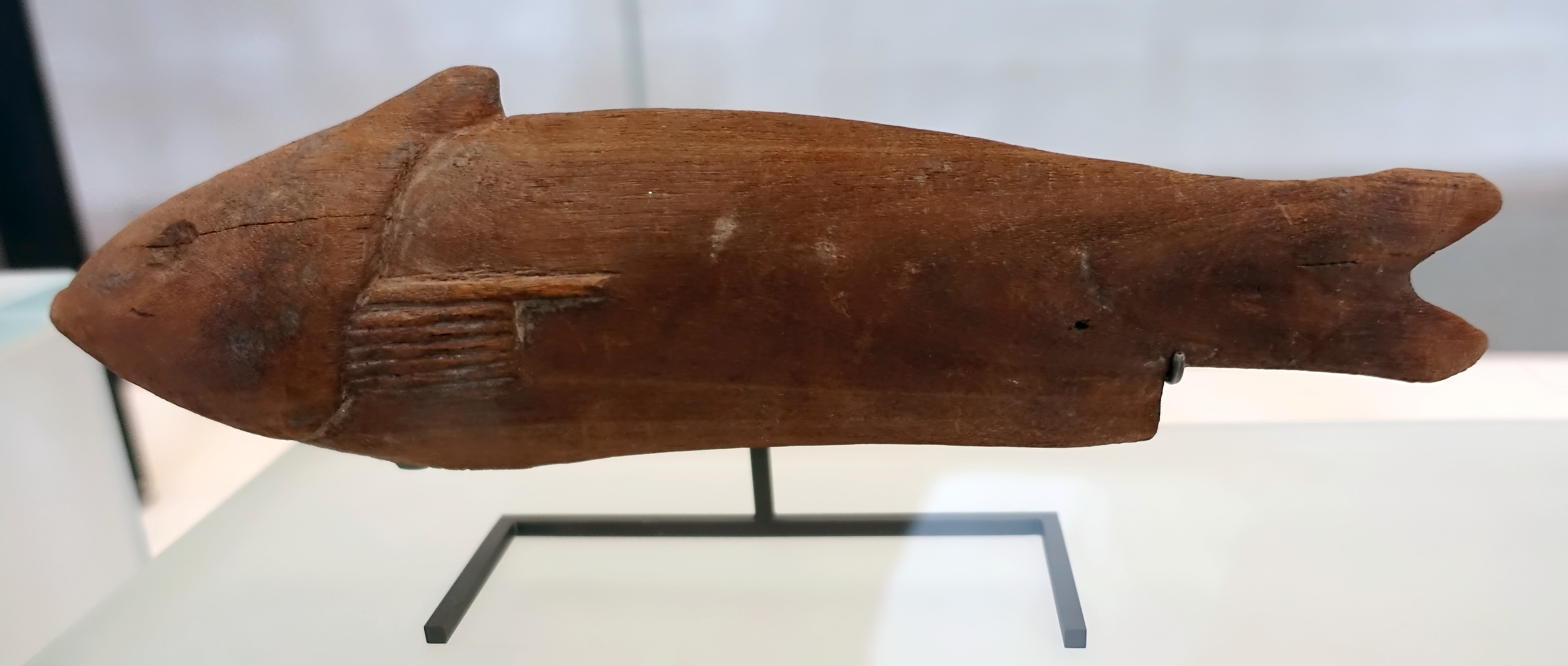
26th - 31st Dynasty (Late Period): 664 BC - 332 BC
Fish, Schilbe mystus
Wood, height 80 mm, length 260 mm.
The Schilbe mystus represents a fish goddess of the city of Mendes, Hatméhyt. It is the fish of the standard of the nome (administrative region) of Mendes.
Catalog: E 132
Photo: Don Hitchcock 2018
Source and text: Louvre Museum, Paris, France
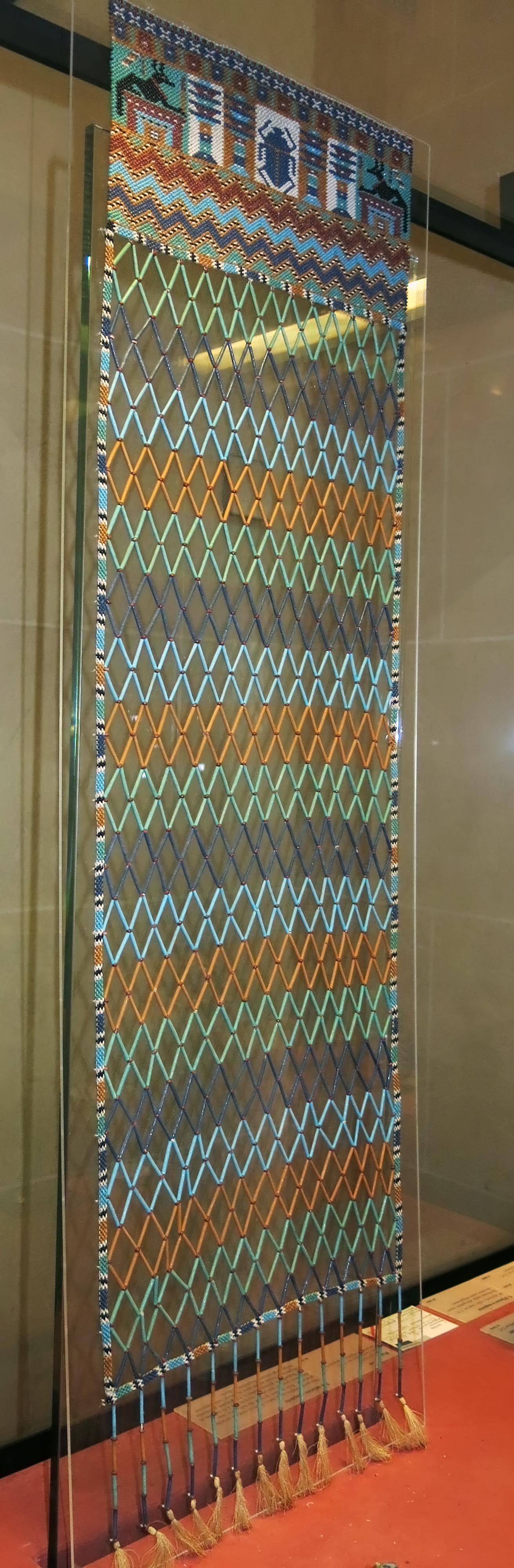
26th - 31st Dynasty (Late Period): 664 BC - 332 BC
Beaded net
Siliceous earthenware beads are used to adorn the living and the dead, mounted as necklaces or complex beads. This one has funerary motifs: A scarab, several djed pillars of the god Osiris, and depictions of the god Anubis.
The net using both tubular and round beads, was used to decorate a mummy.
Central to the fine beads at the head of the net is a Scarab, flanked by four Djed pillars, and two Anubis figures.
Below this 'heading' is a zig zag pattern, with the net below that mostly of tubular beads in a diamond shaped patternt.
Length 1050 mm, width 290 mm.
Colours range from white to yellow to light green to turquoise, to blue, red, and black.
Catalog: Room 334, Materials and Techniques, Aile Sully, Level 0, Vitrine 6, N 3078
Photo: Don Hitchcock 2018
Source and text: Louvre Museum, Paris, France
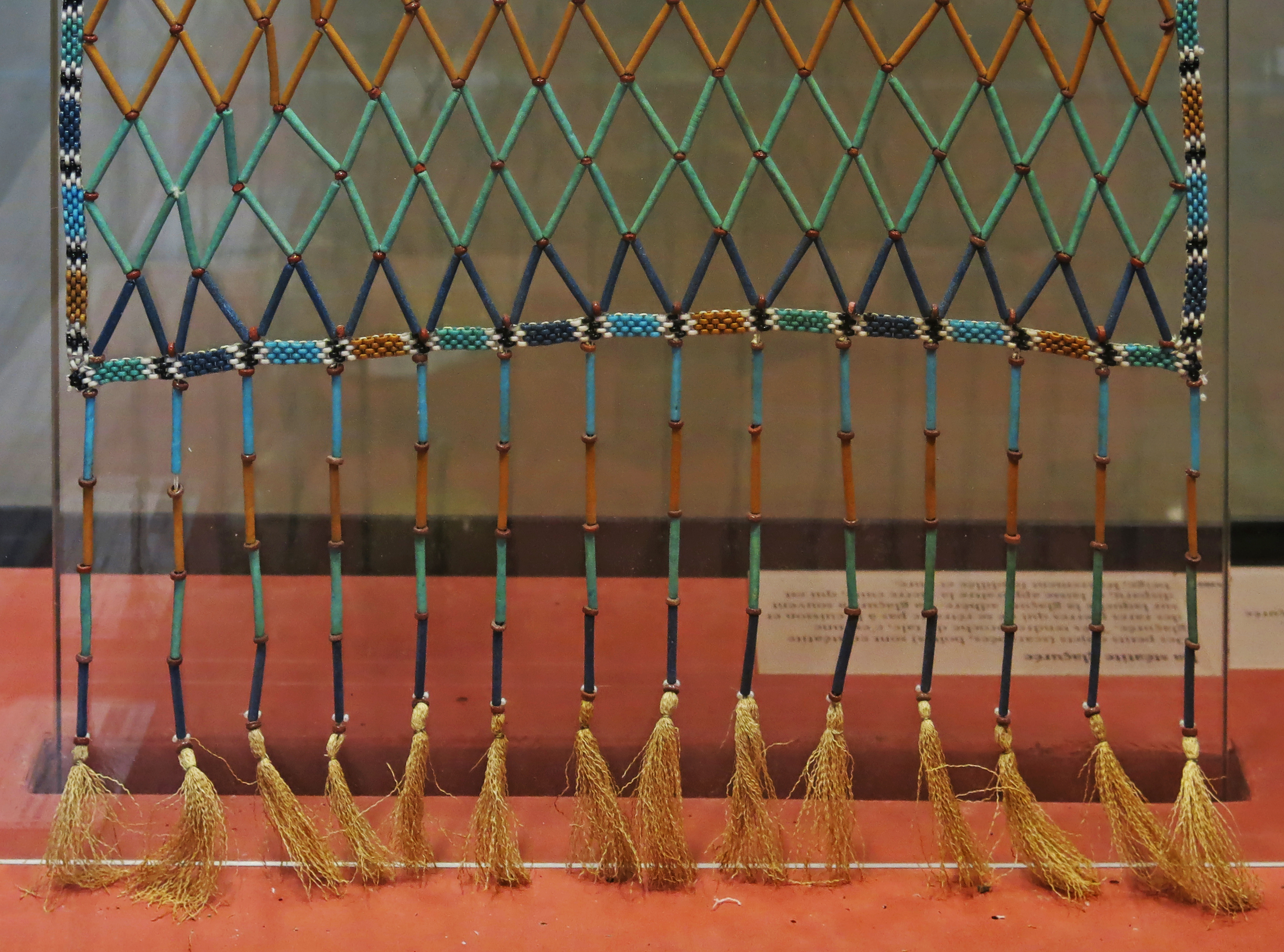
26th - 31st Dynasty (Late Period): 664 BC - 332 BC
Beaded net
The entire net has been beautifully designed and completed.
Catalog: Room 334, Materials and Techniques, Aile Sully, Level 0, Vitrine 6, N 3078
Photo: Don Hitchcock 2018
Source and text: Louvre Museum, Paris, France
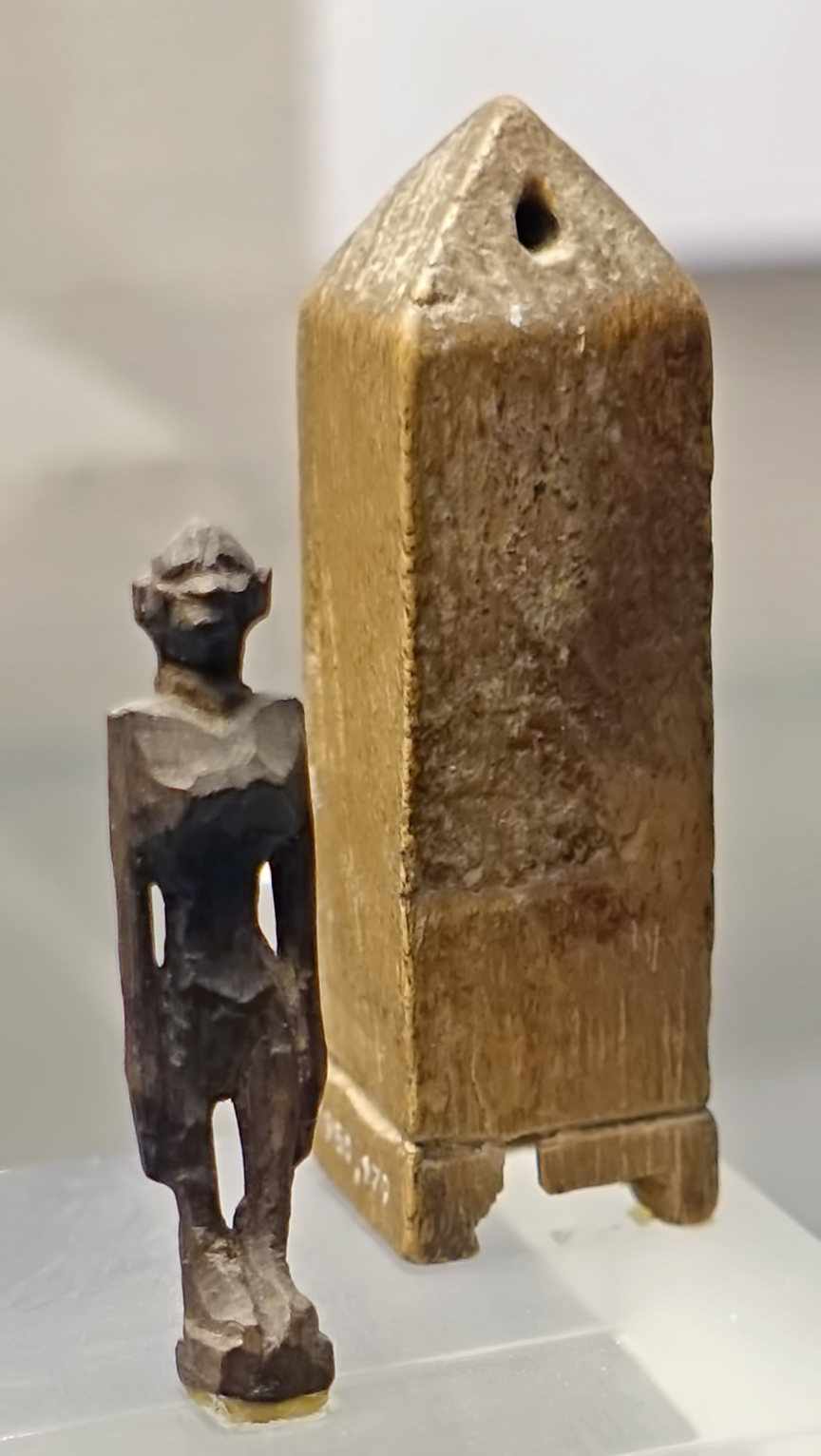
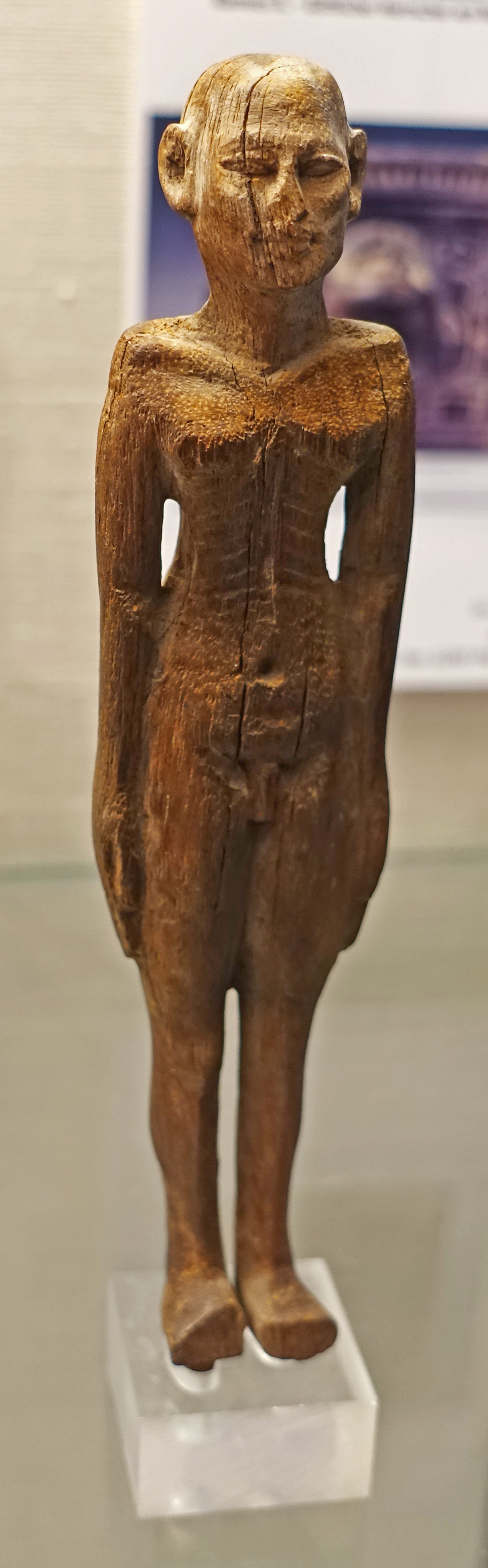
26th - 31st Dynasty (Late Period): 664 BC - 332 BC
(left) Model of an Obelisk Container and a Mummy
(right) Model of a Mummy
In the midst of objects such as jewellery, means of body care and images of friendly powers representing the joyful, worldly side of Egyptian life, these two objects look eerie and seemingly completely out of place. Nevertheless, the attribution can refer to a custom that is explicitly attested, albeit in a Greek source.
Herodotus, speaking of the Egyptians, notes: At the banquet of the rich, after the meal, a man carries around a wooden corpse in a coffin. It is perfectly formed and painted and is two cubits long. The bearer holds it up in front of each of the guests and says 'Look at him, then drink and be happy, when you are dead, you will look like him too. (Herodotus II, 78)
Although the dimensions of these objects are much smaller, both portraits can only be regarded as evidence of the 'memento mori' that struck the Greek observer as particularly typical of the Egyptians.
Dimensions: (left) Obelisk height 48 mm width 15 mm, thickness 15 mm, Mummy height 35 mm.
Dimensions: (right) Height 163 mm
Catalog: Wood, unknown provenance, (left) Inv. no. 1950.179, (right) Inv. no. 1955.153
Photo: Don Hitchcock 2018
Source and text: Original, Museum August Kestner, Hannover
Additional text: Paper Catalogue, Museum August Kestner, Hannover
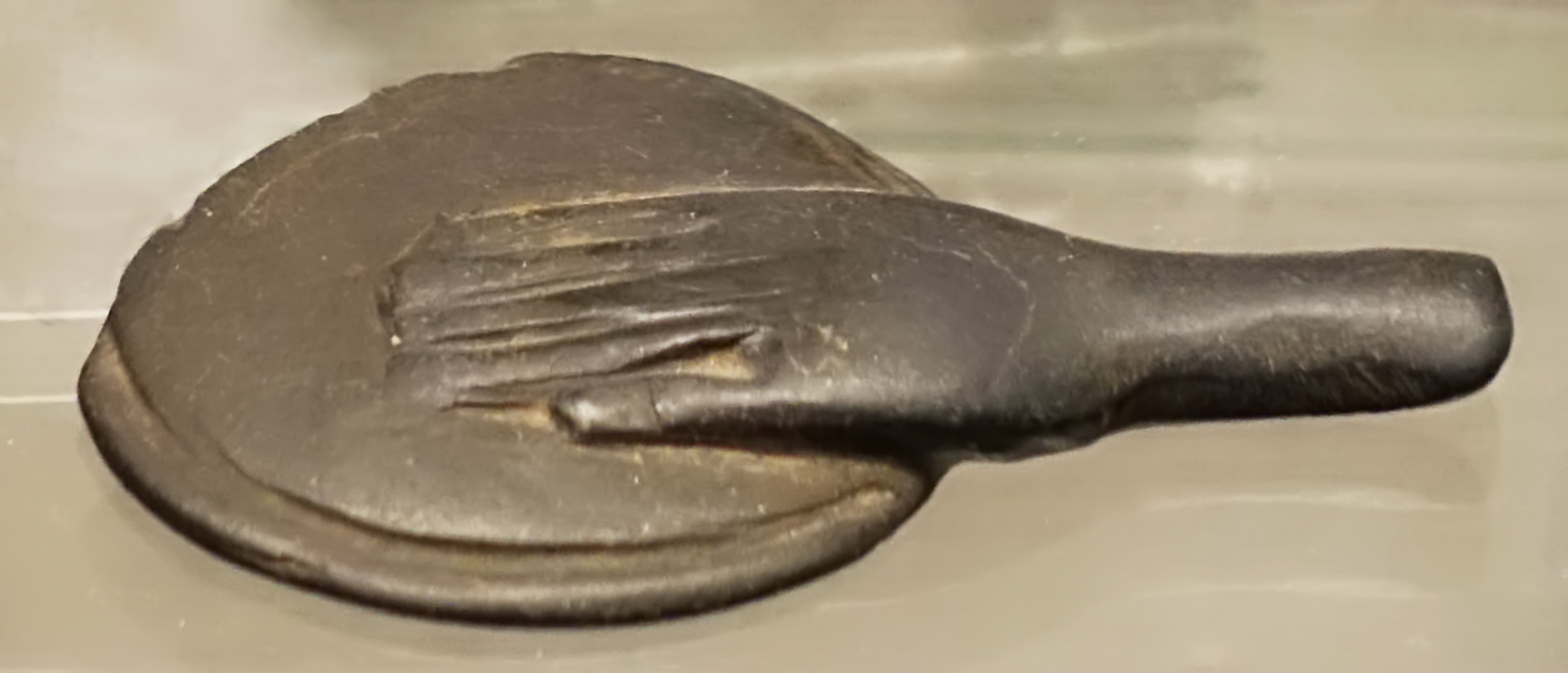
26th - 31st Dynasty (Late Period): 664 BC - 332 BC
Small spoon
Dimensions: length 63 mm, width 32 mm.
The hand-shaped grip holds a spoon in the shape of an oval (shell?). Whether the forearm was designed to be so short in the first place or was shortened in the course of a repair is unknown.
Catalog: Black stone, origin unknown, Inv. no. 1935.200.156
Photo: Don Hitchcock 2018
Source and text: Original, Museum August Kestner, Hannover
Additional text: Paper Catalogue, Museum August Kestner, Hannover

26th - 31st Dynasty (Late Period): 664 BC - 332 BC
Ladle
ladle with handle.
Dimensions: Height 60 mm, diameter of ladle 45 mm.
The ladle has the shape of a pilgrim's or New Year's bottle and is held by a girl with both arms above her still attached head ( however only one hand remains attached to the ladle - Don ).
New Year's Bottles, or New Year's flasks, are a type of lens shaped bottle found in Ancient Egypt. These bottles were filled with water from the Nile, or possibly with perfume or oil, and offered as celebratory gifts for the New Year.
Catalog: Limestone, origin unknown, Inv. no. 1951.4
Photo: Don Hitchcock 2018
Source and text: Original, Museum August Kestner, Hannover
Additional text: Paper Catalogue, Museum August Kestner, Hannover, Wikipedia
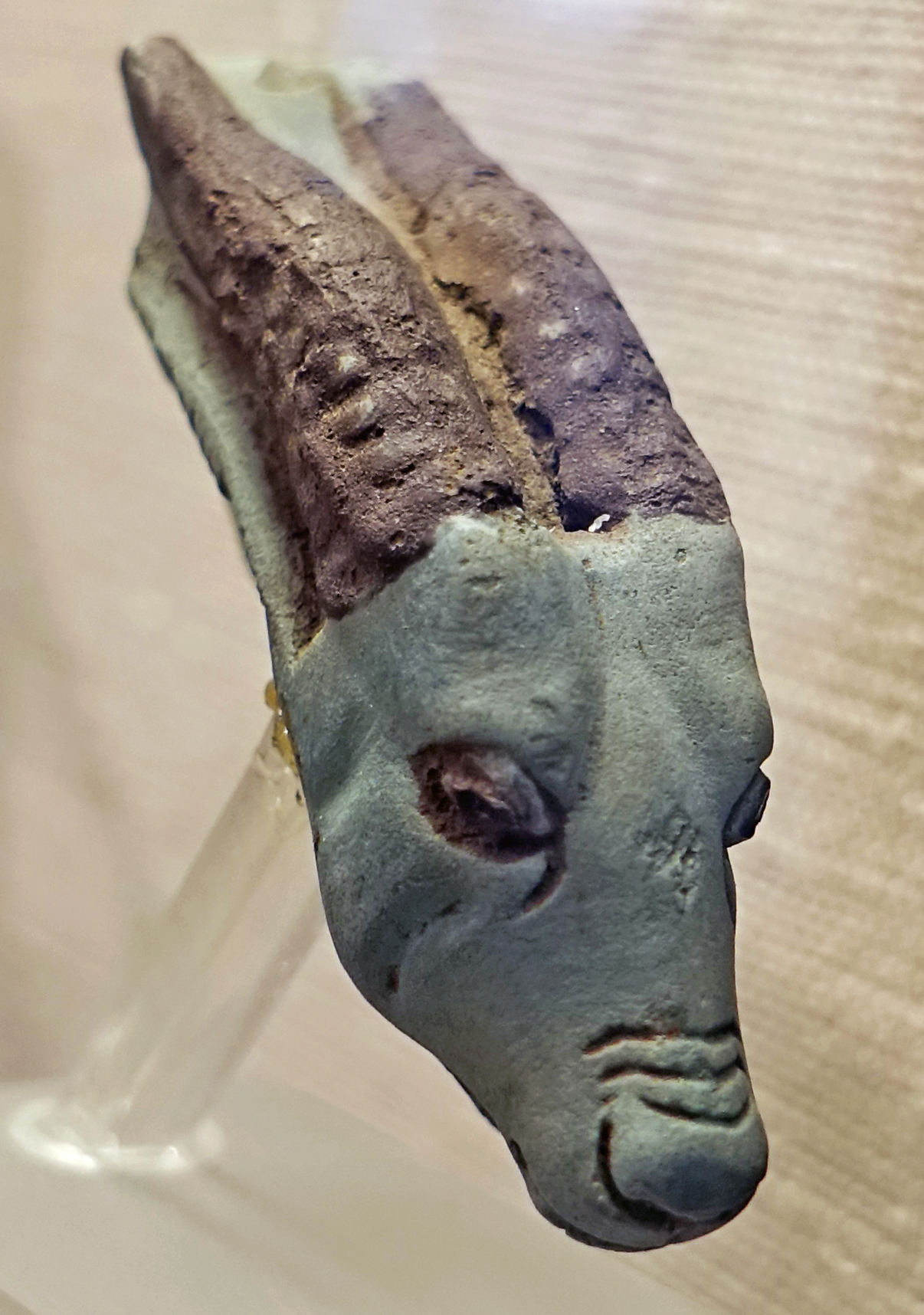
26th - 31st Dynasty (Late Period): 664 BC - 332 BC
Antelope
Head of an antelope.
Height 30 mm, length 65 mm.
Antelopes of various species already played an important role in Egypt in prehistoric times. For centuries, attempts were made to domesticate them, but this was abandoned in the Middle Kingdom. Their tasty meat was much sought after, and their horns could be made into weapons and implements.
Their value in the religious sphere is twofold.It was considered a sacred animal of the archer goddess Satet in the district of the 1st Nile cataract, and the 16th Upper Egyptian district had an antelope as an heraldic animal in its emblem. However, the negative assessment as an enemy of the gods is in the foreground, and this assessment even gave rise to an entire battle ritual that symbolised the destruction of opposing powers.
In view of this ambivalence, it is difficult to determine the purpose of this particularly beautifully crafted antelope's head. Since there was virtually no purpose-free handicraft in the sense of 'art for art's sake' in Egypt, it may be a broken piece from a sacrificial vessel.
Catalog: Faience, origin unknown, Inv. no. 1949.286
Photo: Don Hitchcock 2018
Source and text: Original, Museum August Kestner, Hannover
Additional text: Paper Catalogue, Museum August Kestner, Hannover, Wikipedia
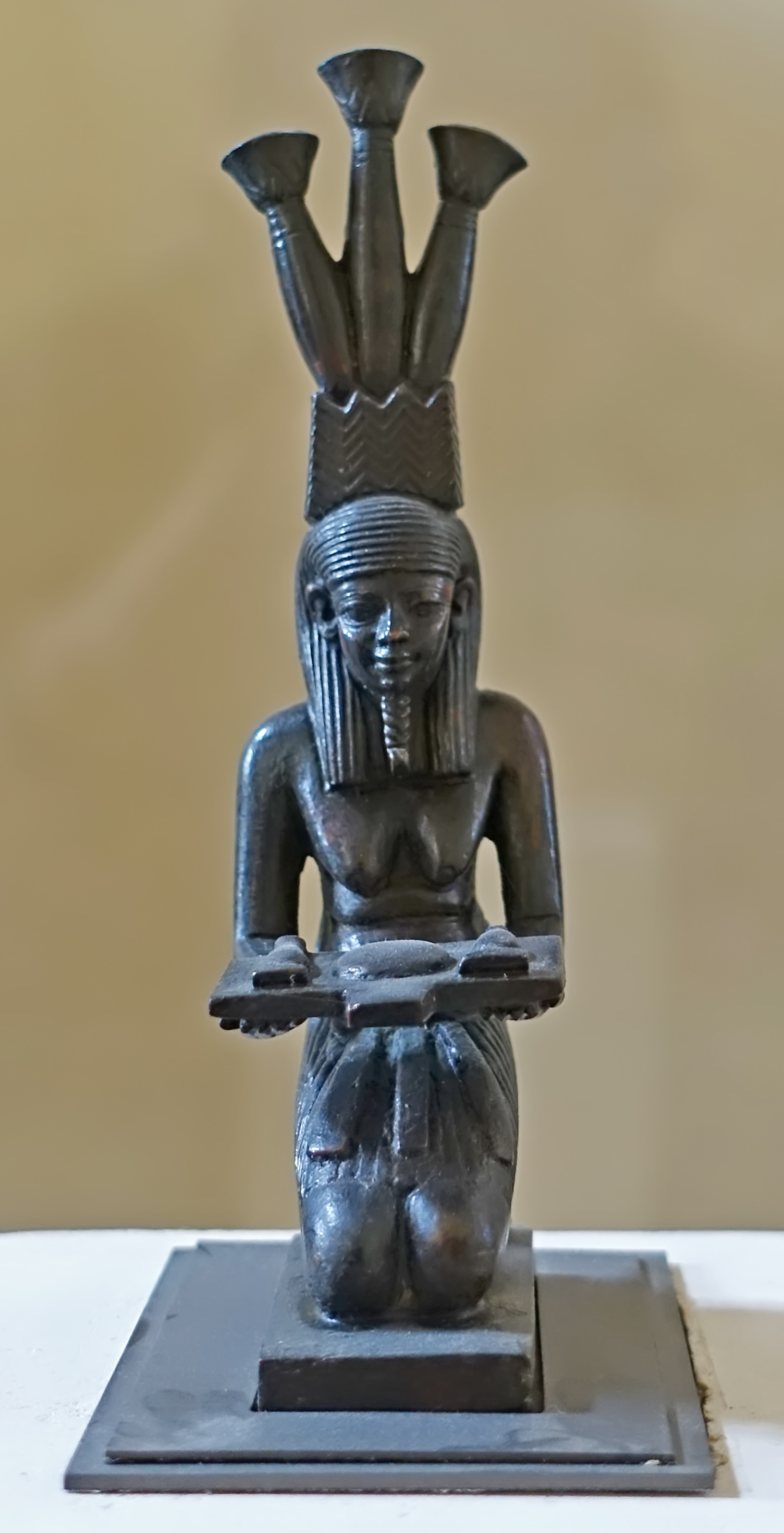
26th - 31st Dynasty (Late Period): 664 BC - 332 BC
The Lord of the Nile flood
The Lord of Prosperity brought by the flood, wearing a headdress with a bouquet of papyrus, holding out an offering table. Height 123 mm.
Hapi was the god of the annual flooding of the Nile. The flood deposited rich silt on the river's banks, allowing the Egyptians to grow crops. Hapi was greatly celebrated among the Egyptians. Some of the titles of Hapi were 'Lord of the Fish and Birds of the Marshes' and 'Lord of the River Bringing Vegetation'. Hapi is typically depicted as an androgynous figure with a big belly and large drooping breasts, wearing a loincloth and ceremonial false beard, and with an offering table.
Catalog: Copper alloy, Sully, salle 336, Niveau 0, Le Nil, Vitrine 4, E 4874
Photo: Don Hitchcock 2018
Source and text: Louvre Museum, Paris, France
Additional text: Wikipedia
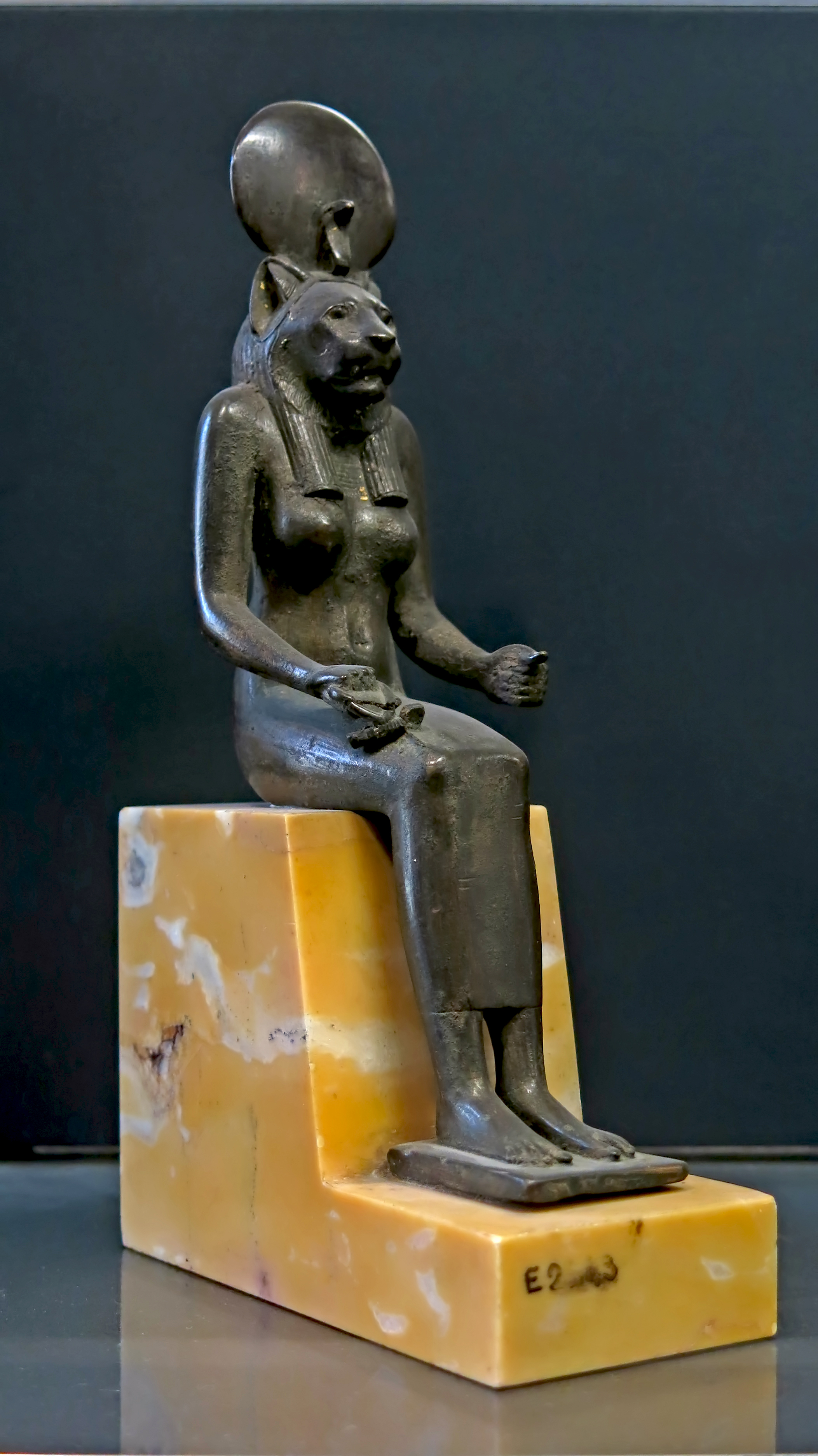
26th - 31st Dynasty (Late Period): 664 BC - 332 BC
Sekhmet
Figurine of Sekhmet, the lioness-headed goddess, seated, crowned by a sun disk, wearing a uraeus, and holding an ankh sign.
Height 17 cm.
Catalog: Bronze, traces of gilding, Sully, salle 317, Gods and Magic, Vitrine 2, E 2443, N 3830
Photo: Don Hitchcock 2018
Source and text: Original, Louvre Museum, https://collections.louvre.fr/

26th - 31st Dynasty (Late Period): 664 BC - 332 BC
Satis
Figurine of Satis, standing, wearing a robe, Usekh necklace, crown of Satis, scorpion, uraeus.
Height 141 mm, width 28 mm, depth 50 mm.
Inscriptions: Penimen (father?), Isis-Satis.
Catalog: Memphis Serapeum, Saqqara North, Memphite Necropolis, Bronze, Sully, salle 336, Le Nil, Vitrine 7, N 5031
Photo: Don Hitchcock 2015
Source and text: Original, Louvre Museum, https://collections.louvre.fr/
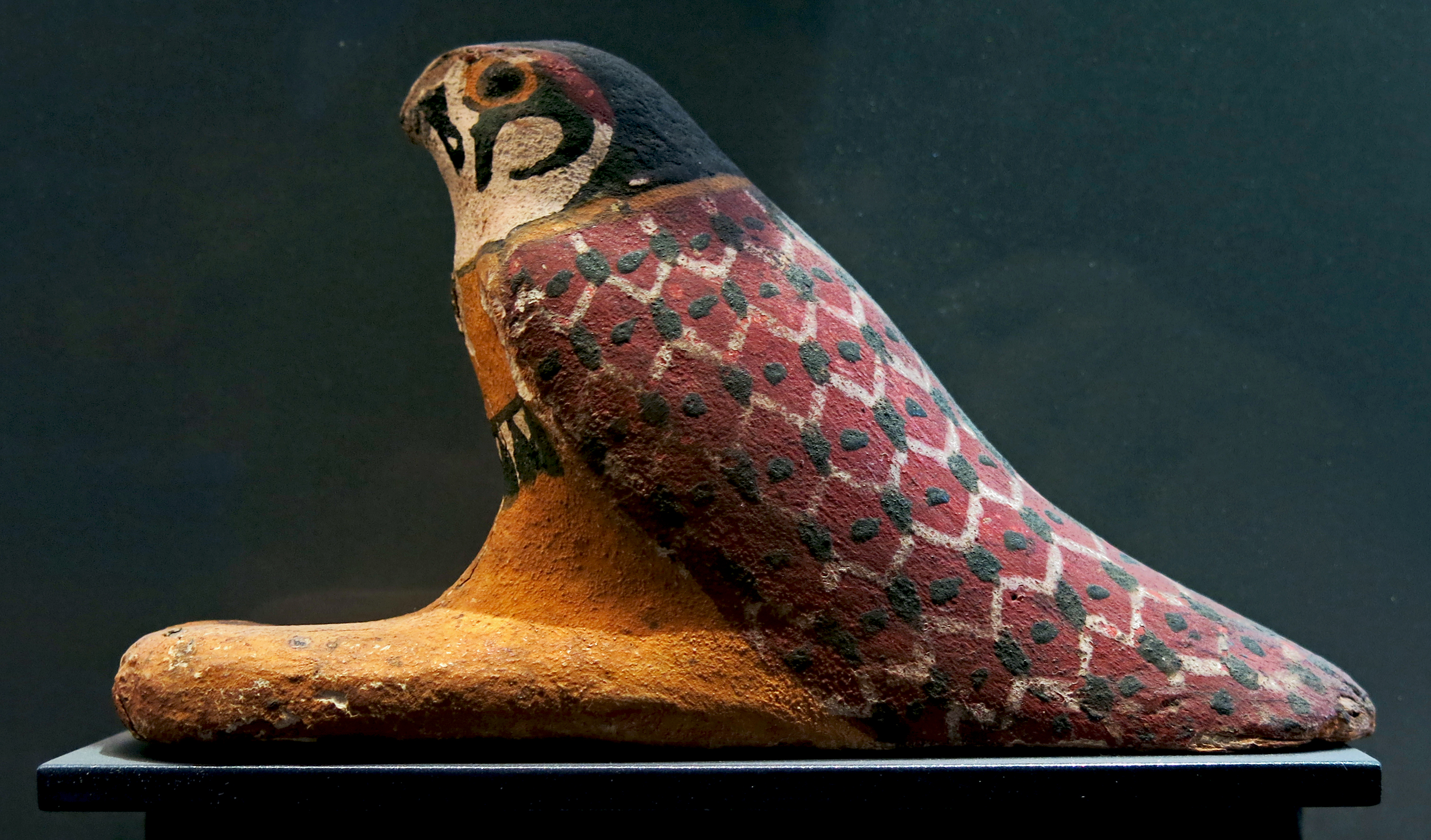
26th - 31st Dynasty (Late Period): 664 BC - 332 BC
Ptah-Sokar-Osiris
Akhem bird figurine, statue of Ptah-Sokar-Osiris.
Height 83 mm, length 147 mm.
Catalog: Wood, paint, stucco, Sully, salle 336, Le Nil, Vitrine 7, N 3941 B
Photo: Don Hitchcock 2015
Source and text: Original, Louvre Museum, https://collections.louvre.fr/

26th - 31st Dynasty (Late Period): 664 BC - 332 BC
Sebek
Figurine of Sebek, the crocodile-headed god, standing, left arm outstretched, wearing the pschent crown (double crown of upper and lower Egypt).
The dreaded water lord Sebek is represented as a crocodile or a crocodile-headed man. Diving into the deep waters, he knows the dangers and can overcome them with his natural aggressiveness.
He emerges to reach the shore just like the first sun. Sebek is therefore often equated with Re. He is also considered as the son of Neith, the goddess creator of the world. He was particularly revered in the Fayum where crocodiles were dedicated to him.
Height 298 mm, depth 180 mm.
Catalog: Bronze, silver plated toenails, Sully, salle 336, Le Nil, Vitrine 7, E 10782, AF 1683
Photo: Don Hitchcock 2015
Source and text: Original, Louvre Museum, https://collections.louvre.fr/
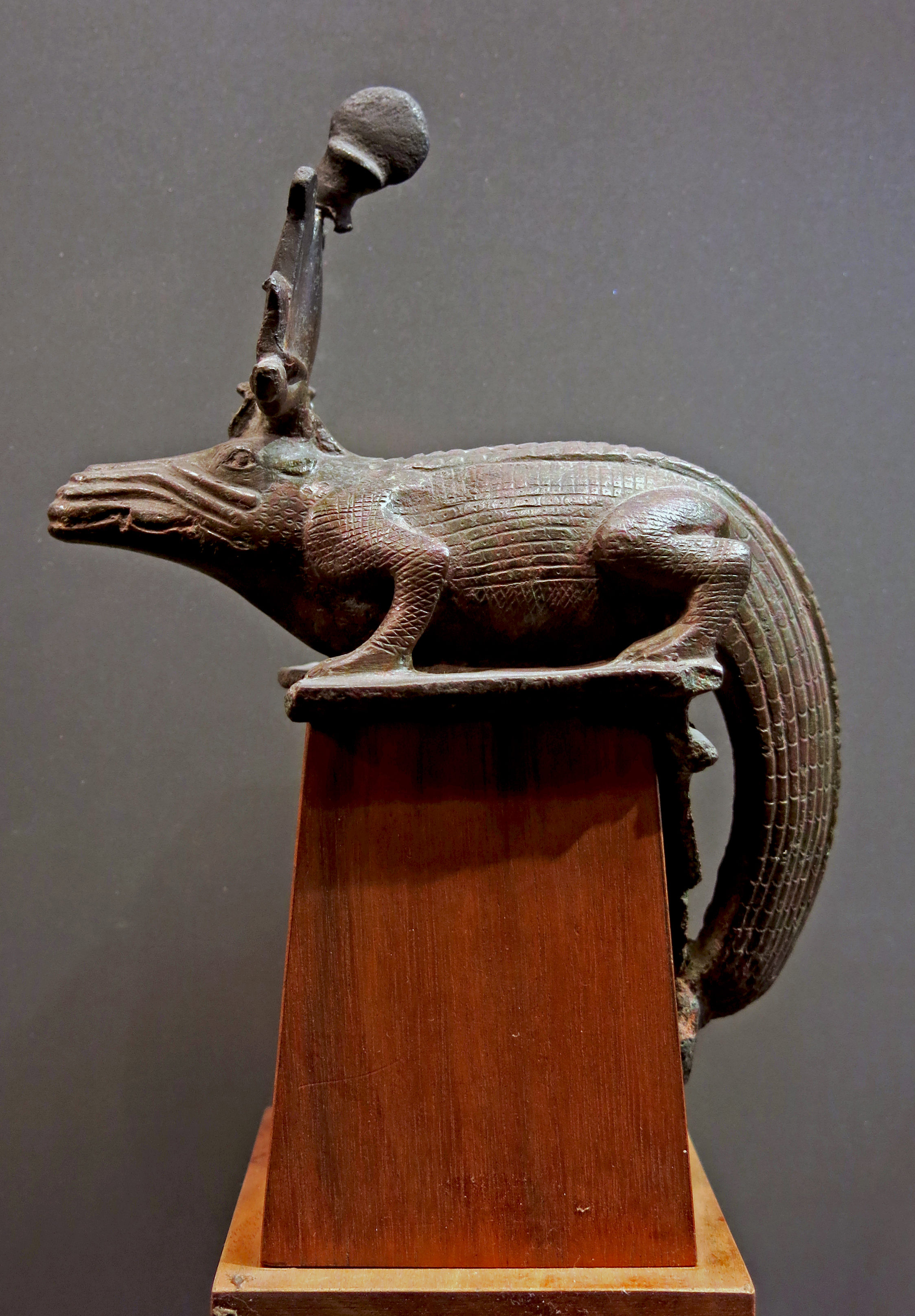
26th - 31st Dynasty (Late Period): 664 BC - 332 BC
Sebek
Sebek was an ancient Egyptian deity with a complex and fluid nature. He is associated with the Nile crocodile or the West African crocodile and is represented either in the form of a crocodile or as a human with a crocodile head. Sebek was also associated with pharaonic power, fertility, and military prowess, but served additionally as a protective deity with the ability to ward off evil influences, invoked especially for protection against the dangers presented by the Nile. goddess creator of the world. He was particularly revered in the Fayum where crocodiles were dedicated to him.
Height 160 mm, length 124 mm.
Catalog: Bronze, gold plating on the eyes, Sully, salle 336, Le Nil, Vitrine 7, E 10915
Photo: Don Hitchcock 2015
Source and text: Original, Louvre Museum, https://collections.louvre.fr/
Additional text: Wikipedia
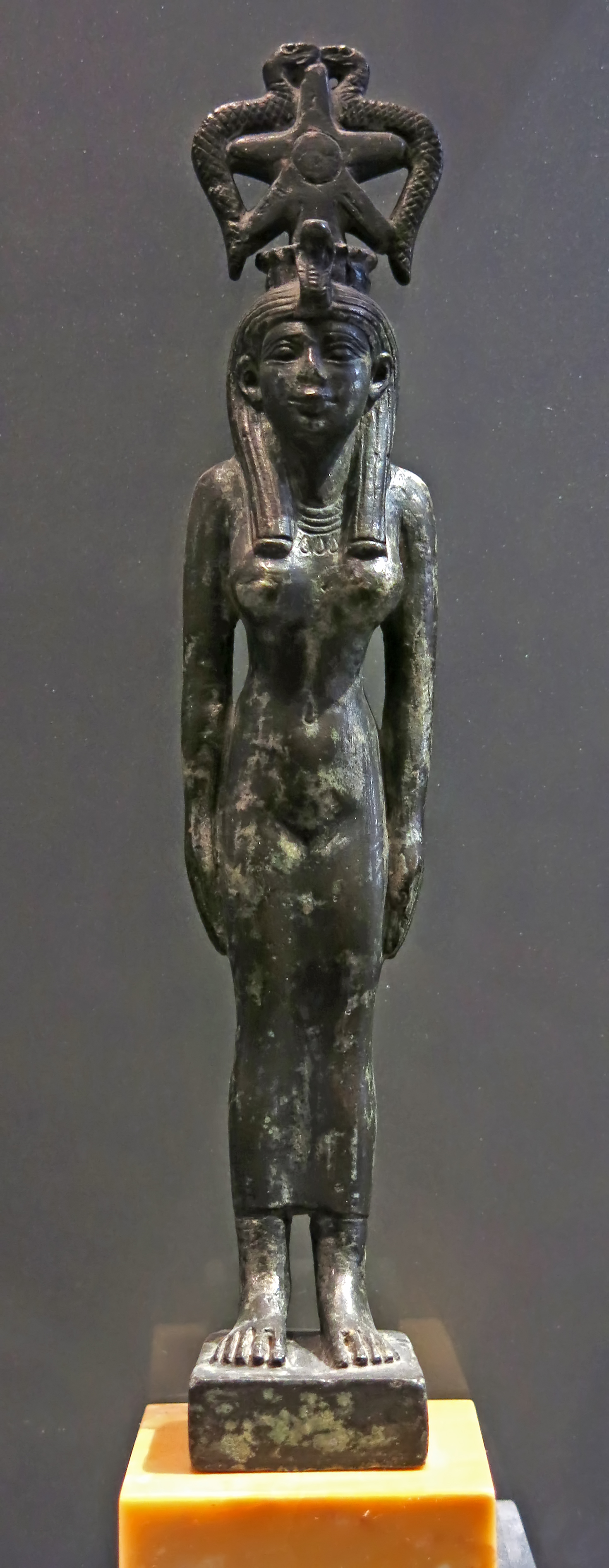
26th - 31st Dynasty (Late Period): 664 BC - 332 BC
Sechat
Sechat / Seshat, under various spellings, was the ancient Egyptian goddess of wisdom, knowledge, and writing. She was seen as a scribe and record keeper, and her name means she who is the scribe, and is credited with inventing writing. She also became identified as the goddess of accounting, architecture, astronomy, astrology, building, mathematics, and surveying.
In art, she was depicted as a woman with a seven-pointed emblem above her head. It is unclear what this emblem represents. This emblem is the origin of an alternate name for Seshat, Sefkhet-Abwy, which means 'seven -horned'
Mistress of the House of Books is another title for Seshat, being the deity whose priests oversaw the library in which scrolls of the most important knowledge were assembled and spells were preserved. One prince of the Fourth Dynasty, Wep-em-nefret, is noted as the Overseer of the Royal Scribes, Priest of Seshat on a slab stela. Heliopolis was the location of her principal sanctuary.
Here she is shown wearing a dress, arms at her sides, with the sign of Sechat on her head, as well as two snakes.
Height 158 mm.
Catalog: Bronze, Sully, salle 336, Le Nil, Vitrine 7, E 11564
Photo: Don Hitchcock 2015
Source and text: Original, Louvre Museum, https://collections.louvre.fr/
Additional text: Wikipedia
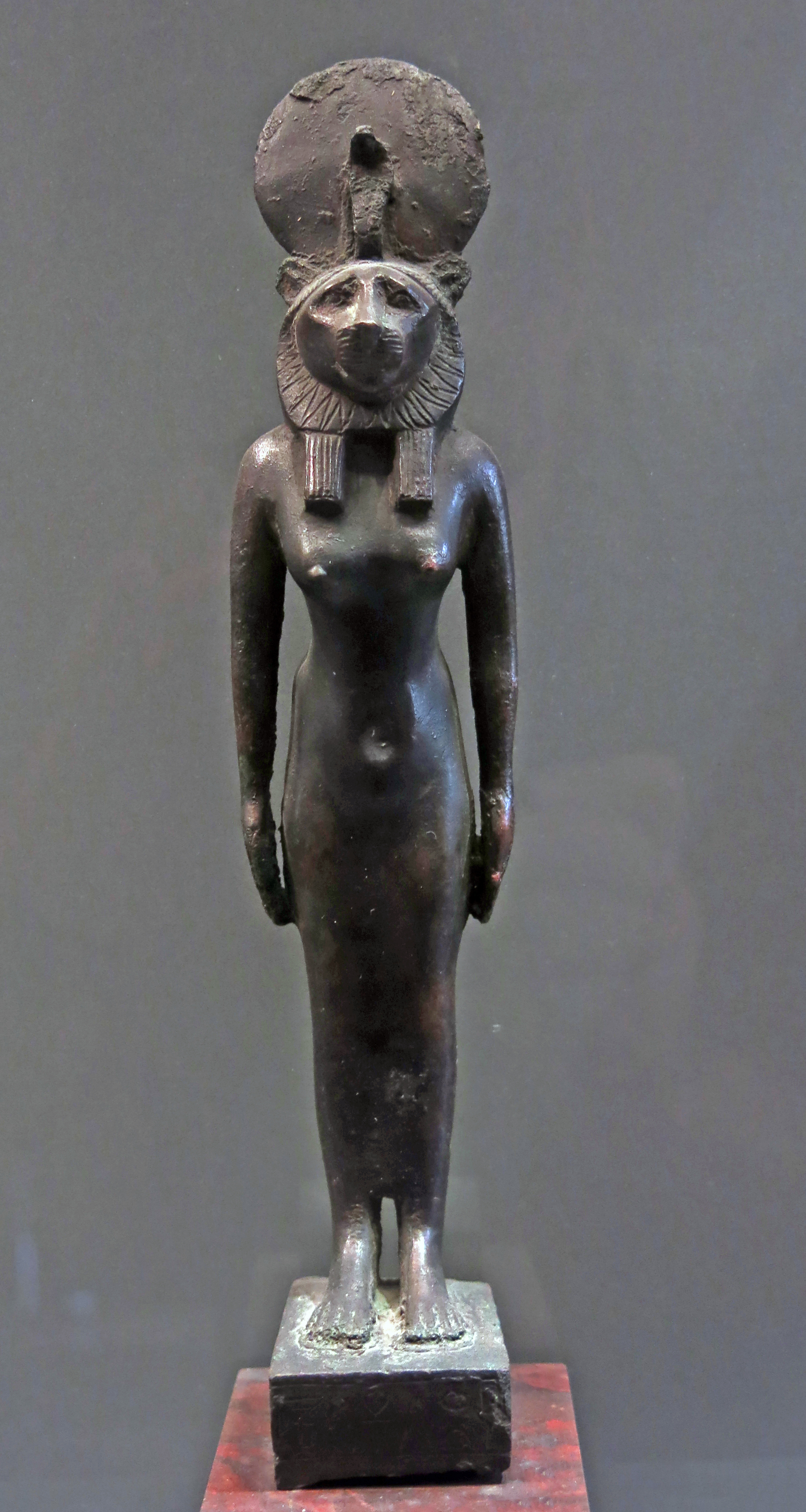
26th - 31st Dynasty (Late Period): 664 BC - 332 BC
Sekhmet
Goddess with lioness head, robe, standing, solar disk with uraeus.
Height 200 mm.
In Egyptian mythology, Sekhmet is a warrior goddess as well as goddess of healing. She is depicted as a lioness. She was seen as the protector of the pharaohs and led them in warfare. Upon death, Sekhmet continued to protect them, bearing them to the afterlife.
Sekhmet is a solar deity, sometimes called the daughter of Ra and often associated with the goddesses Hathor and Bastet. She bears the Uraeus, which associates her with Wadjet and royalty, and the solar disk.
Sekhmet was the daughter of the sun god, Ra, and was among the more important of the goddesses who acted as the vengeful manifestation of Ra's power, the Eye of Ra. Sekhmet was said to breathe fire, and the hot winds of the desert were likened to her breath. She was also believed to cause plagues, which were called her servants or messengers, although she was also called upon to ward off disease.
In a myth about the end of Ra's rule on the earth, Ra sends the goddess Hathor, in the form of Sekhmet, to destroy mortals who conspired against him. In the myth, Sekhmet's blood lust was not quenched at the end of battle that led to her destroying almost all of humanity. To stop her Ra poured out beer dyed with red ochre or hematite so that it resembled blood. Mistaking the beer for blood, she became so drunk that she gave up the slaughter and returned peacefully to Ra.
In other versions of this story, Sekhmet grew angered at the deception and left Egypt, diminishing the power of the sun. This threatened the power and security of the world - thus, she was persuaded by the god Toth to return and restore the sun to its full glory.
Sekhmet was considered the wife of the god Ptah and mother of his son Nefertum. She was also said to be the mother of a lion god, Maahes. She was also considered to be the sister of the cat goddess Bastet.
Catalog: Bronze, Sully, salle 336, Le Nil, Vitrine 7, E 14252
Photo: Don Hitchcock 2015
Source and text: Original, Louvre Museum, https://collections.louvre.fr/
Additional text: Wikipedia

26th - 31st Dynasty (Late Period): 664 BC - 332 BC
Taweret / Toueris
Taweret is the protective ancient Egyptian goddess of childbirth and fertility. The name 'Taweret' means 'she who is great', a common pacificatory address to dangerous deities. The deity is typically depicted as a bipedal female hippopotamus with feline attributes, pendulous female human breasts, the limbs and paws of a lion, and the back and tail of a Nile crocodile.
Height 115 mm.
Catalog: Wood, Sully, salle 336, Le Nil, Vitrine 7, AF 2956, N 3617
Photo: Don Hitchcock 2015
Source and text: Original, Louvre Museum, https://collections.louvre.fr/
Additional text: Wikipedia

26th - 31st Dynasty (Late Period): 664 BC - 332 BC
Drum
Diameter maximum 371 mm, minimum 260 mm, length: 390 mm.
Catalog: Willow, leather, Aile Sully, salle 329, Les loisirs, Vitrine 1, N 1442, Salt n° 605
Photo: Don Hitchcock 2015
Source and text: Original, Louvre Museum, Paris, France, https://collections.louvre.fr/

26th - 31st Dynasty (Late Period): 664 BC - 332 BC
Selket
Bronze figurine of a scorpion with a female head, arms, and horns.
Selket or Serket is the goddess of fertility, nature, animals, medicine, magic, and healing venomous stings and bites in Egyptian mythology. Serket was seen as one who could cure scorpion stings and the effects of other venoms such as snakebites.
Height 73 mm, length 102 mm.
Catalog: Bronze, N 5017
Photo: Don Hitchcock 2015
Source and text: Original, Louvre Museum, Paris, France, https://collections.louvre.fr/
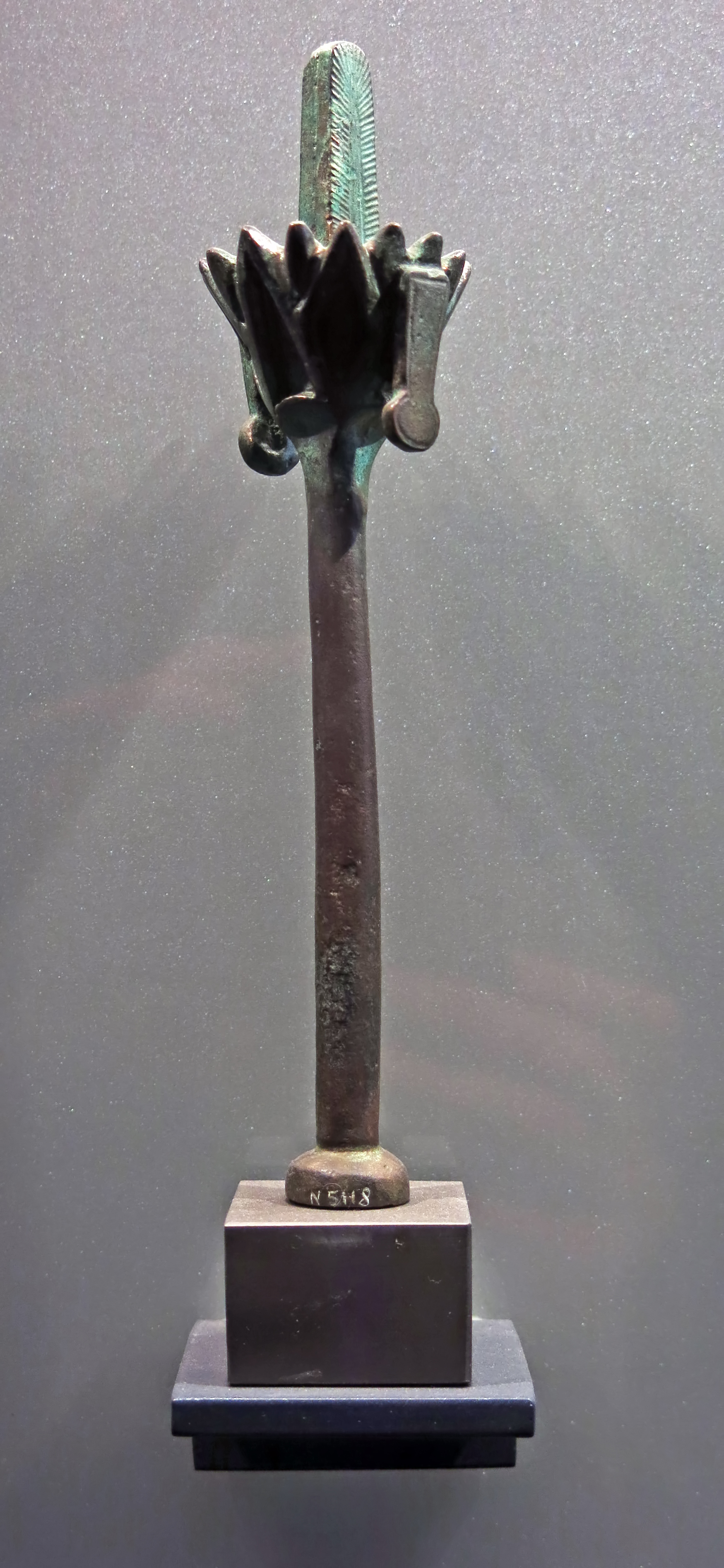
26th - 31st Dynasty (Late Period): 664 BC - 332 BC
Nefertem Emblem
Nefertem, 'beautiful one who closes' was, in Egyptian mythology, originally a lotus flower at the creation of the world, who had arisen from the primal waters. Nefertem represented both the first sunlight and the delightful smell of the Egyptian blue lotus flower, having arisen from the initial ocean within an Egyptian blue water-lily, Nymphaea caerulea.
This piece reduces the representation of Nefertem to the quintessentials, a lotus flower and feathers.
Height 150 mm.
Catalog: Bronze, N 5118
Location: Aile Sully, Salle 336, Le Nil, Vitrine 7
Photo: Don Hitchcock 2015
Source and text: Original, Louvre Museum, Paris, France, https://collections.louvre.fr/
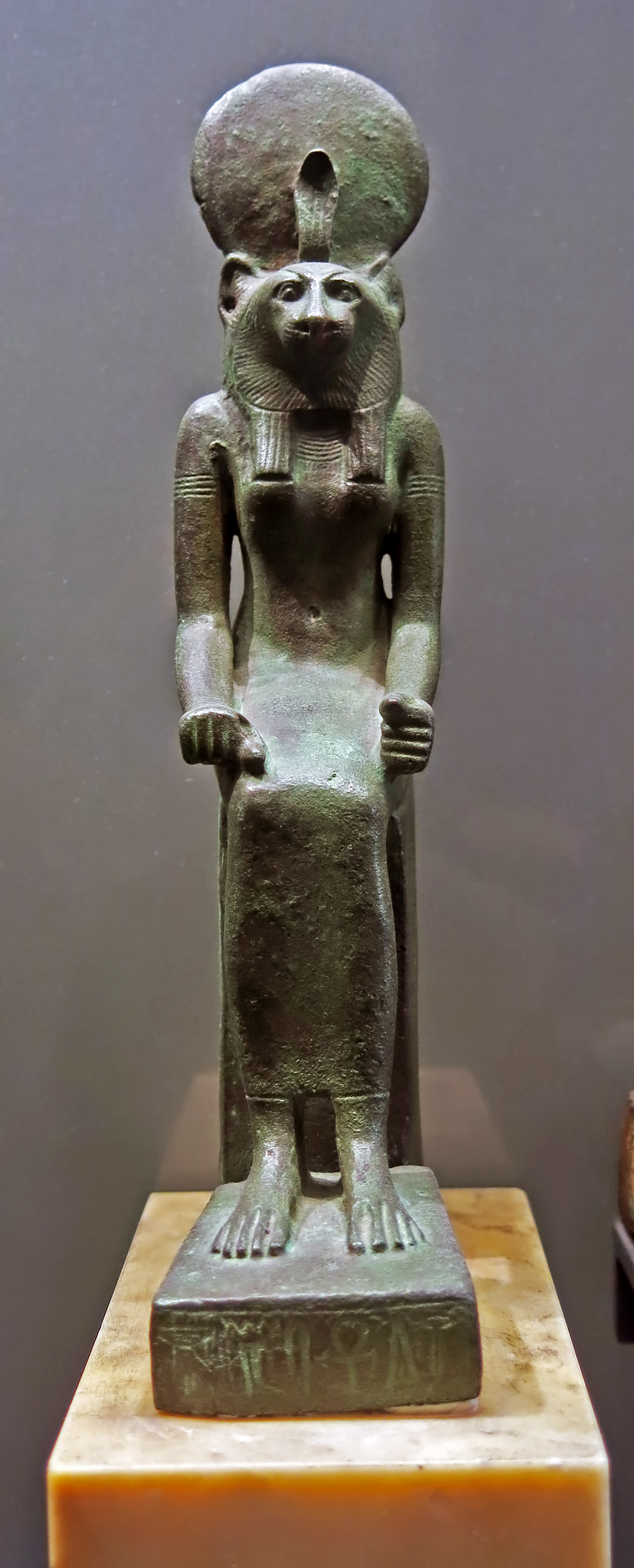
26th - 31st Dynasty (Late Period): 664 BC - 332 BC
Wadjet
Bronze statuette of a seated Wadjet / Ouadjet, with a solar disc and uraeus as headdress.
She wears arm bracelets, and a Usekh necklace. Wadjet is a goddess with a lion's head.
Wadjet was originally the ancient local goddess of the city of Dep. Wadjet was said to be the matron and protector of Lower Egypt, and upon unification with Upper Egypt, the joint protector and patron of all of Egypt. She was also the protector of kings and of women in childbirth. Wadjet was said to be the nurse of the infant god Horus. With the help of his mother Isis, they protected Horus from his treacherous uncle, Set, when they took refuge in the swamps of the Nile Delta.
Wadjet was closely associated in ancient Egyptian religion with the Eye of Ra, a powerful protective deity.
Wadjet was often depicted as a cobra. As patron and protector, later Wadjet often was shown coiled upon the head of Ra. In order to act as his protection, this image of her became the uraeus symbol used on the royal crowns as well.
As the patron goddess, she was associated with the land and depicted as a snake-headed woman or a snake—usually an Egyptian cobra, a venomous snake common to the region; sometimes she was depicted as a woman with two snake heads and, at other times, a snake with a woman's head. Her oracle was in the renowned temple in Per-Wadjet that was dedicated to her worship and gave the city its name. This oracle may have been the source for the oracular tradition that spread to Greece from Egypt.
Another early depiction of Wadjet is as a cobra entwined around a papyrus stem, beginning in the Predynastic era (prior to 3 100 BC) and it is thought to be the first image that shows a snake entwined around a staff symbol. This is a sacred image that appeared repeatedly in the later images and myths of cultures surrounding the Mediterranean Sea, called the caduceus, which may have had separate origins.
Height 180 mm.
Catalog: Bronze, Memphis Serapium, Memphite Necropolis, N 5139
Photo: Don Hitchcock 2015
Source and text: Original, Louvre Museum, Paris, France, https://collections.louvre.fr/
Additional text: Wikipedia
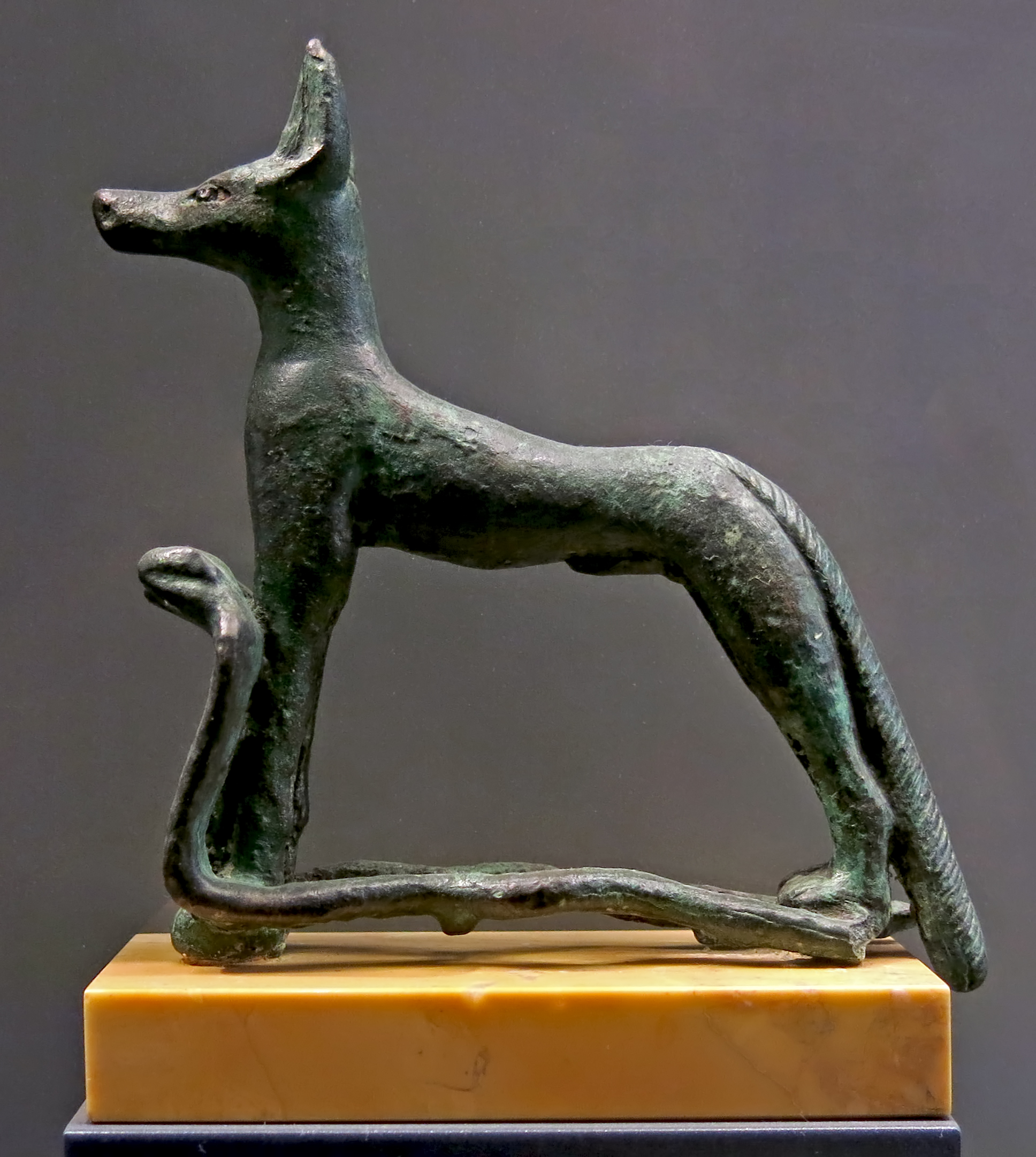
26th - 31st Dynasty (Late Period): 664 BC - 332 BC
Wepwawet
The figurine consists of a dog flanked by two Uraei.
In late Egyptian mythology, Wepwawet was originally a war deity, whose cult centre was Asyut in Upper Egypt (Lycopolis in the Greco-Roman period). His name means opener of the ways and he is often depicted as a wolf standing at the prow of a solar-boat. Some interpret that Wepwawet was seen as a scout, going out to clear routes for the army to proceed forward.
Wepwawet originally was seen as a wolf deity, thus the Greek name of Lycopolis, meaning city of wolves, and it is likely the case that Wepwawet was originally just a symbol of the pharaoh, seeking to associate with wolf-like attributes, that later became deified as a mascot to accompany the pharaoh. Likewise, Wepwawet was said to accompany the pharaoh on hunts, in which capacity he was titled (one with) sharp arrow more powerful than the gods alone.
In later Egyptian art, Wepwawet was depicted as a wolf or a jackal, or as a man with the head of a wolf or a jackal. Even when considered a jackal, Wepwawet usually was shown with grey, or white fur, reflecting his lupine origins. He was depicted dressed as a soldier, as well as carrying other military equipment - a mace and a bow.
Height 116 mm, length 114 mm.
Catalog: Bronze, Serapeum of Memphis, Memphite Necropolis, AF 287
Location: Aile Sully, Salle 336, Le Nil, Vitrine 7
Photo: Don Hitchcock 2015
Source and text: Original, Louvre Museum, Paris, France, https://collections.louvre.fr/
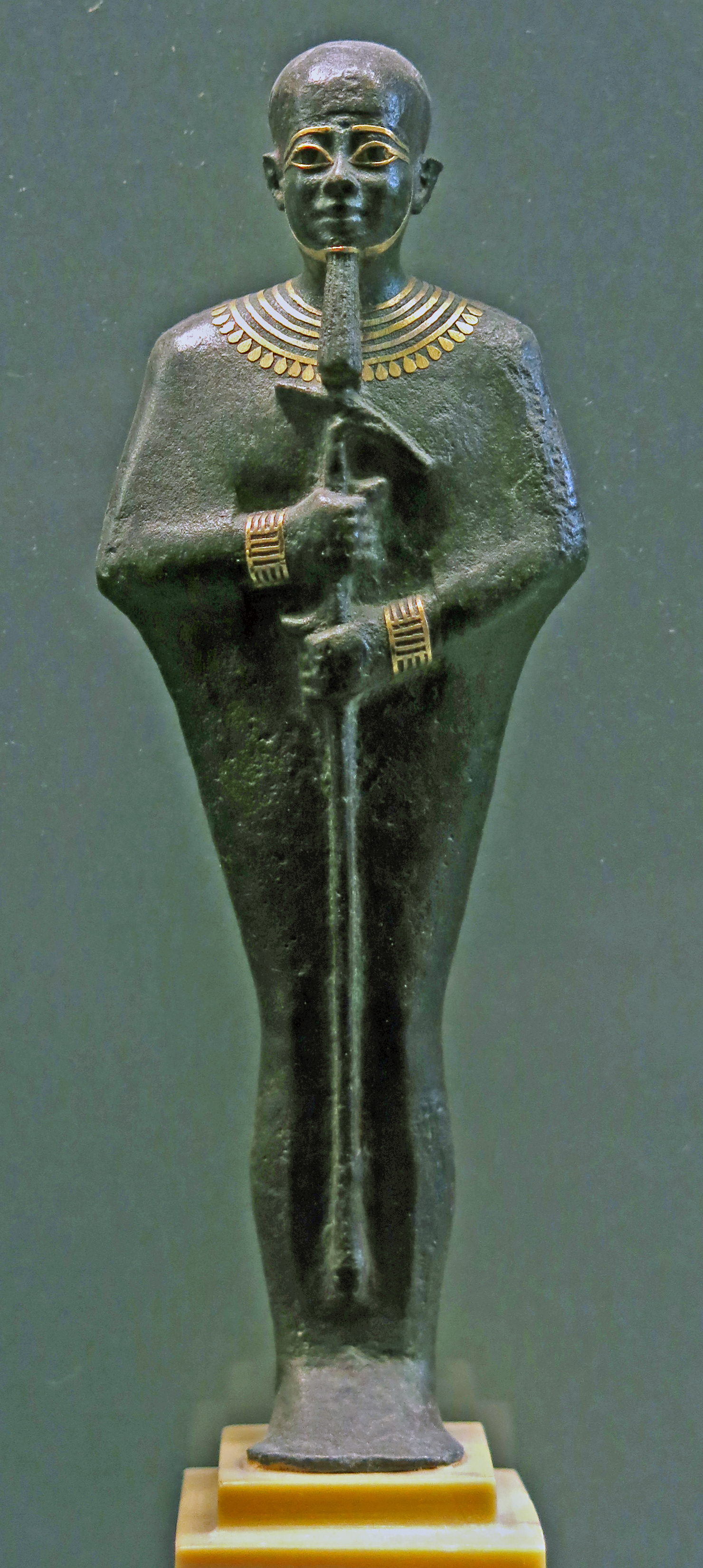
26th - 31st Dynasty (Late Period): 664 BC - 332 BC
Ptah
Ptah is an Egyptian creator god and patron of craftsmen and architects, who conceived the world and brought it into being through the creative power of speech. Like many deities of ancient Egypt he takes many forms. Sometimes represented as a dwarf, naked and deformed. Ptah is generally represented in the guise of a man with green skin, contained in a shroud sticking to the skin, wearing the divine beard, and holding a sceptre combining three powerful symbols of ancient Egyptian religion, the Was sceptre, the Ankh, and the Djed pillar.
Height 112 mm.
Catalog: Bronze, electrum, gold, Aile Sully, salle 336, Le Nil, Vitrine 7, E 3305
Photo: Don Hitchcock 2015
Source and text: Original, Louvre Museum, Paris, France, https://collections.louvre.fr/
Additional text: Wikipedia
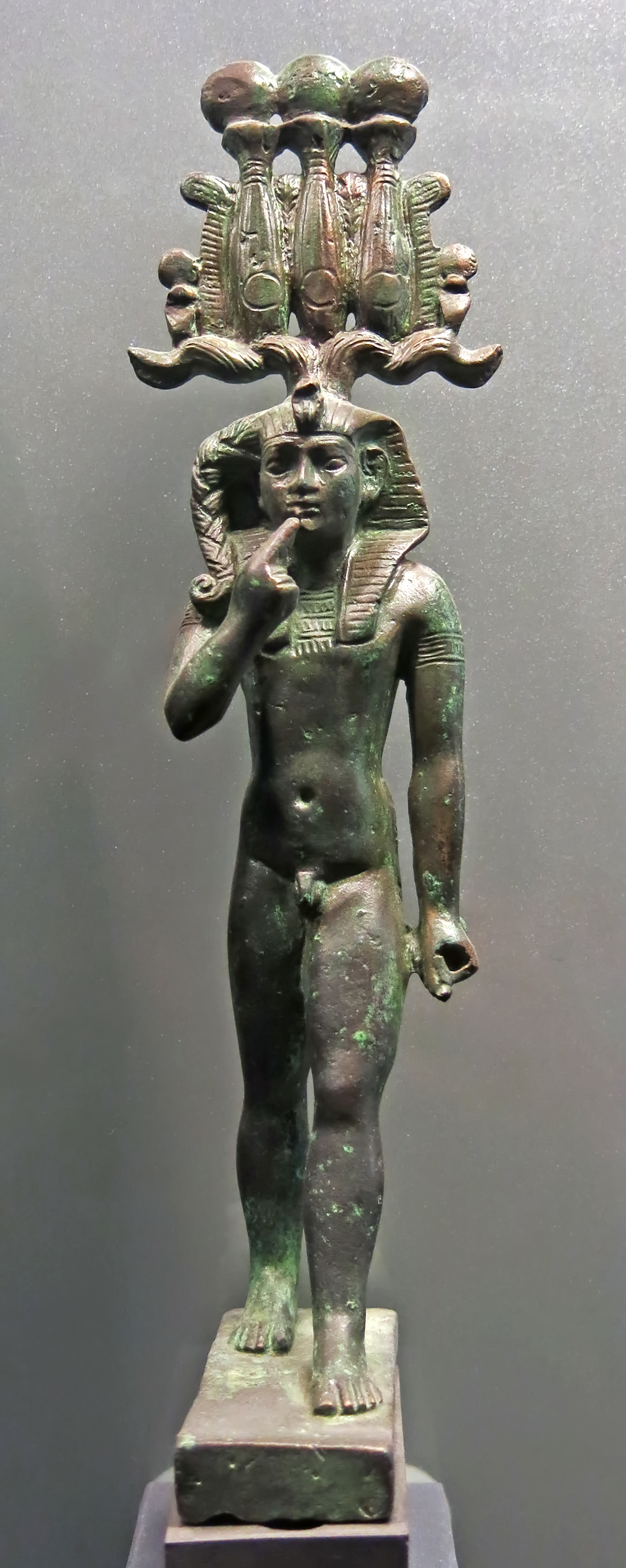
26th - 31st Dynasty (Late Period): 664 BC - 332 BC
Harpocrates
Harpocrates is a child god, shown here standing naked, finger to mouth, wearing a childhood wick, Hemhem crown (an ornate triple atef with corkscrew sheep horns and often two uraei), and an arm bracelet.
Height 195 mm.
Catalog: Bronze, Aile Sully, salle 336, Le Nil, Vitrine 7, E 3642
Photo: Don Hitchcock 2015
Source and text: Original, Louvre Museum, Paris, France, https://collections.louvre.fr/
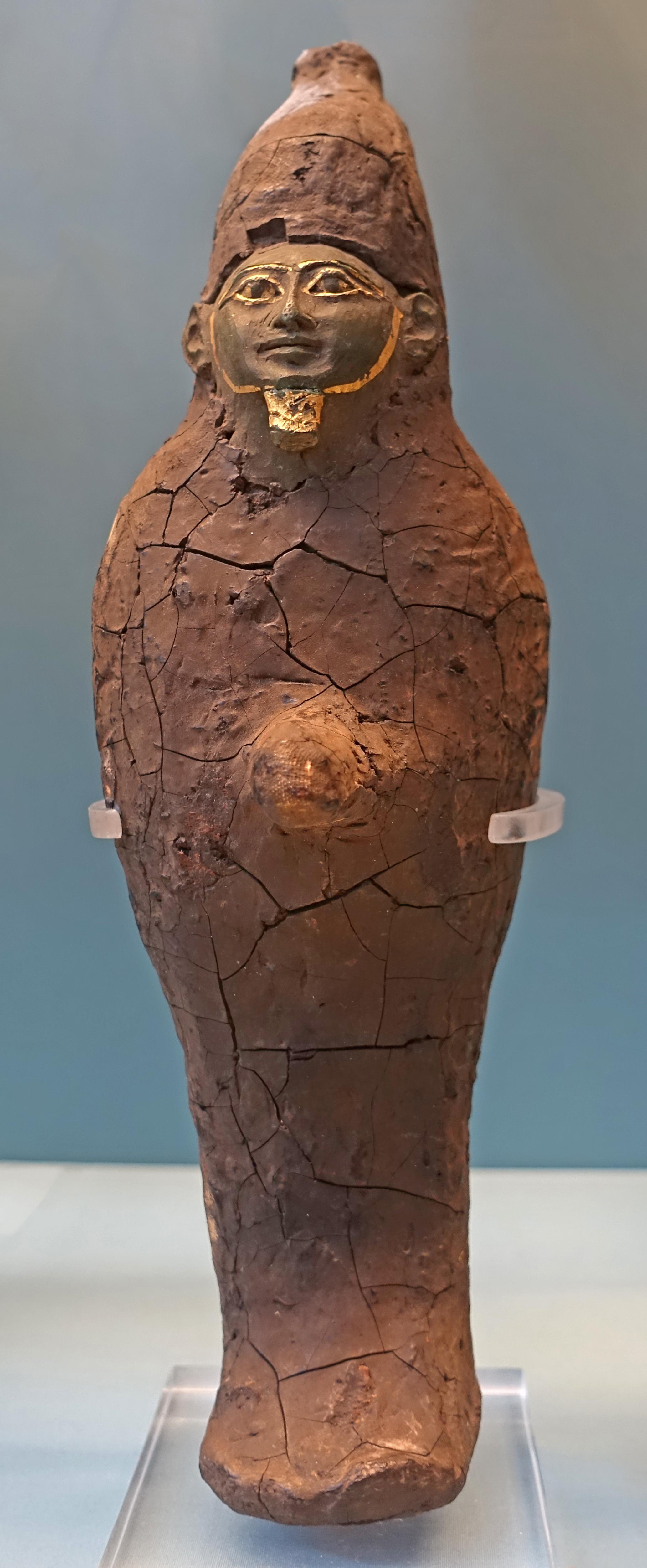
26th - 31st Dynasty (Late Period): 664 BC - 332 BC
Corn Mummy
Ithyphallic figure of Osiris composed of corn wrapped in resinous bandages with a gilded beeswax face. The face is of gilded green coloured beeswax.
( Ithyphallic is used, especially of a statue or other representation of a deity, for the state of having an erect penis - Don )
Height 320 mm, width 95 mm (maximum).
Catalog: linen, resin, gold, EA60745
Photo: Don Hitchcock 2018
Source: Original, British Museum
Text: © Card with the display at the British Museum, http://www.britishmuseum.org/ , © Trustees of the British Museum, CC BY-NC-SA 4.0
Additional text: Wikipedia
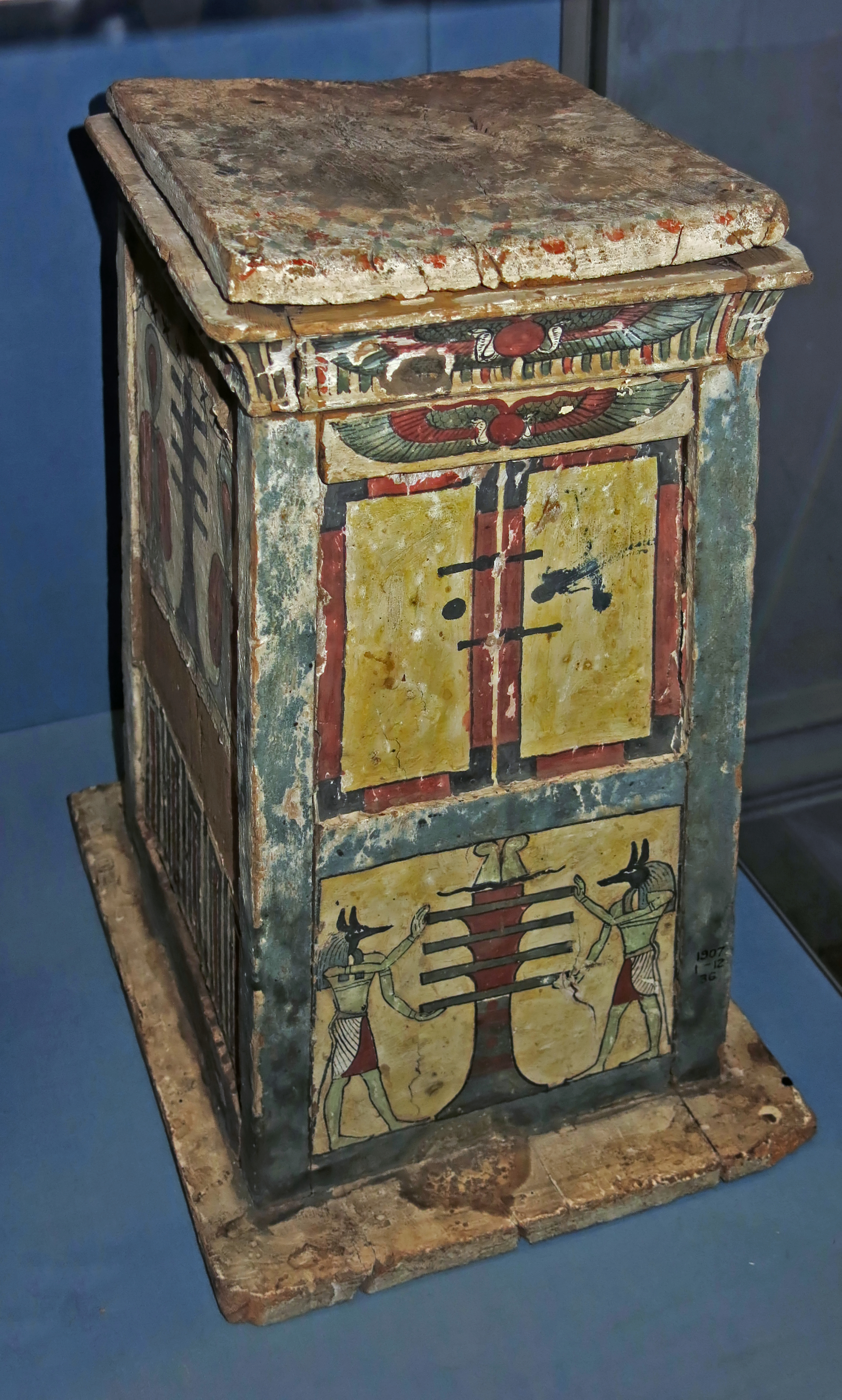
26th Dynasty - Macedonian Period: 664 BC - 305 BC
Canopic Chest
Painted wooden Canopic Chest
The chest is in the form of a shrine, with cornice and double doors. The decoration includes jackal-headed figures possibly representing Anubis, and alternating Djed and Tit signs. The catalog identifies it as a shabti box.
Height 423 mm, length 280 mm, width of base 290 mm, width of box 220 mm.
Circa 664 BC - 305 BC
Catalog: Decorated wooden shabti box, provenance unknown, EA43433
Photo: Don Hitchcock 2015
Source: Original, British Museum
Text: Card with the display at the British Museum, https://www.britishmuseum.org/, © Trustees of the British Museum, CC BY-NC-SA 4.0
26th Dynasty - Ptolemaic period: 664 BC - 30 BC
Double feather crown of Amun
( this image and text is included to provide context and more information about the double feather crown in the example above - Don )
This double feather crown belonged to a large Amun statuette, or to a child god who had close associations with Amun. The statue was probably made out of wood but would have incorporated copper alloy elements like this crown, a common technique for high prestige, large, and costly cult images.
Because this type of mixed media construction was commonly used, pieces such as these, even in their fragmented state, provide excellent clues about the appearance of large-scale temple statuary made from organic materials, much of which is now degraded and lost. The piece also displays the stunning craftsmanship and capabilities of Egyptian bronze workers with the multi-colored inlays and gilded sun disk.
Even though the inlays have deteriorated over time, the piece’s original combination of colours and materials would have been stunning and overall it shows the many ways in which artisans could play with copper alloy and other materials to make visually striking and dynamic pieces.
Cupreous metal, precious metal, vitreous inlay.
Height 103 mm, width 34 mm, thickness 4 mm.
Catalog: 17.192.48
Photo, source and text: https://www.metmuseum.org/art/collection/search/552047
Permission: Public Domain
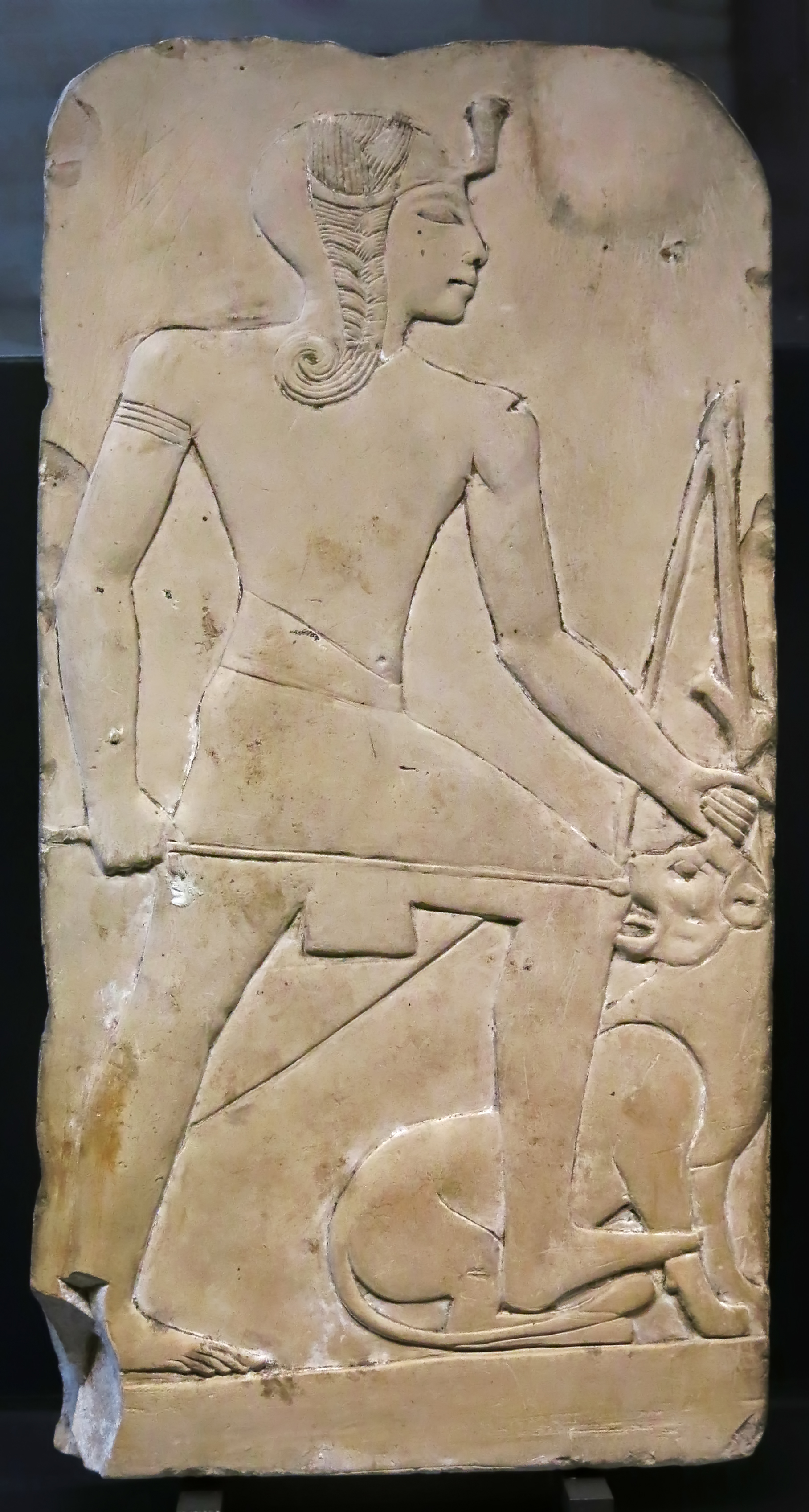
26th Dynasty - Ptolemaic period: 664 BC - 30 BC
The young god Ched 'the saviour'
Horus 'the saviour', in Egyptian 'Ched', takes the form of a young hunter prince. This type of stele prefigures the 'Horus on crocodiles' steles.
Possibly the stele shows Harpocretes, who was adopted by the Greeks from the Egyptian child god Horus. It depicts a child king, slaying pests, standing, wearing a loincloth and a childhood wick, with a uraeus, and holding a bow and arrow. A feline is at his feet.
Height 277 mm, width 143 mm, thickness 50 mm.
Catalog: Painted limestone, protruding bas-relief, N 524, Drovetti n° 314
Location: Aile Sully, Salle 317, Gods and Magic, Vitrine 2
Photo: Don Hitchcock 2015
Source and text: Original, Louvre Museum, https://collections.louvre.fr/
Additional text: Wikipedia
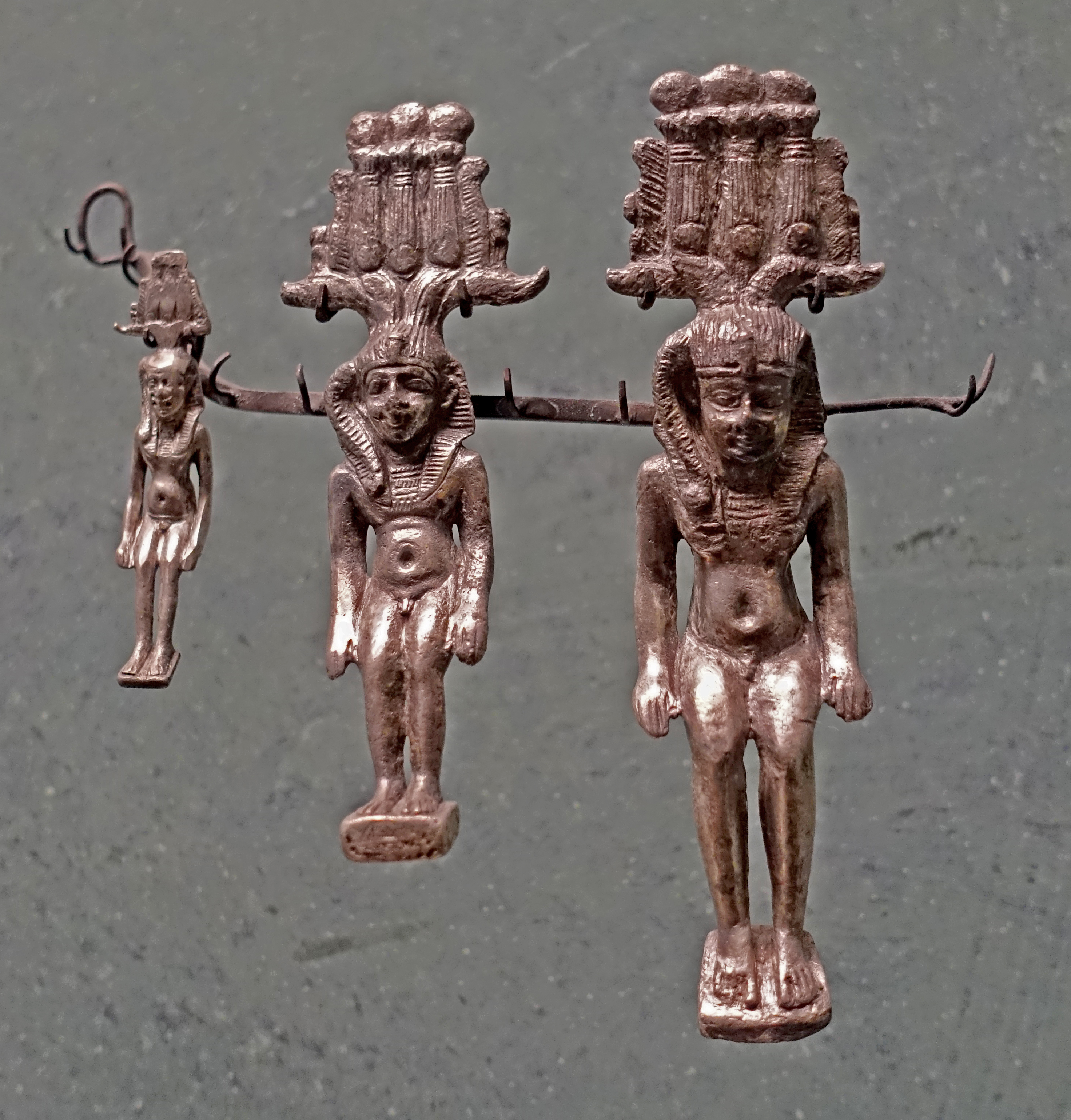
26th Dynasty - Ptolemaic period: 664 BC - 30 BC
Pendant Necklace
( Note that the image of this object in the Louvre collections, available at https://collections.louvre.fr/en/ark:/53355/cl010008254 , shows four sculptures of Harpocretes. The three sculptures on the right of the Louvre image are silver in colour, and correspond to the three sculptures above, photographed at the Louvre in 2018. The smaller sculpture on the left of the Louvre image is not shown in my image. Instead, the image above from 2018 (and also on my visit in 2015) has just the three sculptures shown above. In addition, the supporting structure holding the sculptures is different from the image above to the Louvre catalog image at the time of writing in July 2026. Note also that the sculptures above appear to be tarnished to a copper colour, which is normal in ancient Egyptian silver. Pure silver (Ag) is naturally very soft, so ancient metalworkers alloyed it with other metals, most commonly copper, Cu, to make it durable enough for jewellery and tools. Perhaps the piece has, since 2018, been cleaned and altered to some extent - Don )
Harpocrates in each of the sculptures is seated, nude, wears a nemes headdress, uraeus, lock of hair, and hemhem crown, which consisted of three atefs (which may be called a triple atef), two uraei, two ram's horns, and three to six solar disks.)
Height: a maximun of 115 mm (the pendants are of different sizes).
Catalog: Silver, Sully, Salle 330, E17235
Photo: Don Hitchcock 2018
Source and text: Original, Louvre Museum, Paris, France
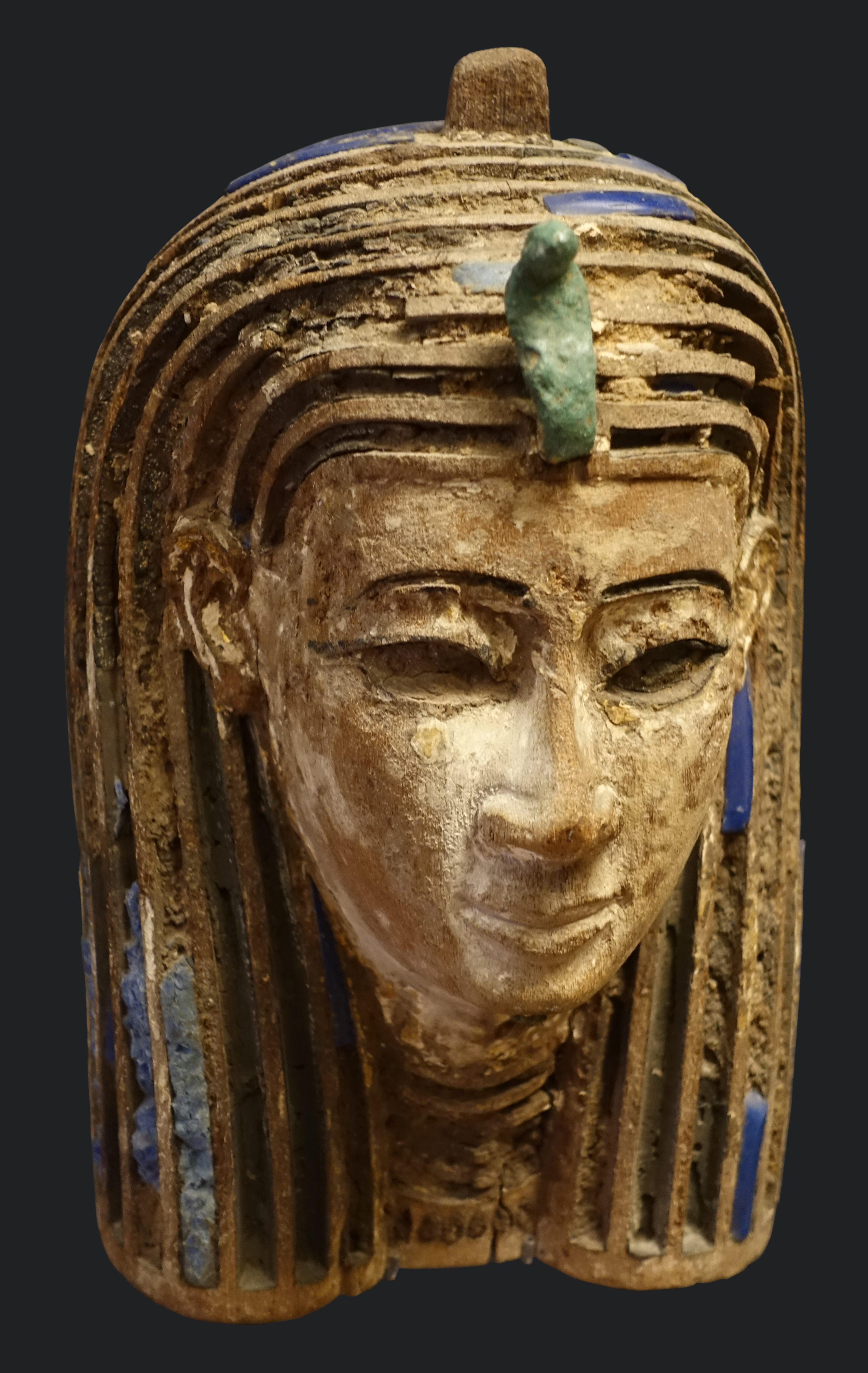
26th Dynasty - Ptolemaic period: 664 BC - 30 BC
Head encrusted in glass and bronze
This is an element of furniture, a head with a tripartite wig, and a uraeus.
Height 227 mm.
Catalog: Wood, bronze, glass, gilded, hair inlaid with blue glass, eyes and eyebrows originally inlaid, stuccoing, Sully wing, level 0, room 334, vitrine 9, E 2704, N 449
Photo: Don Hitchcock 2018
Source and text: Original, Louvre Museum, https://collections.louvre.fr/
The 27th Dynasty: The Persian Achaemenid Dynasty, 525 BC - 404 BC
The Twenty-seventh Dynasty of Egypt, also known as the First Egyptian Satrapy was effectively a province (satrapy) of the Achaemenid Persian Empire between 525 BC to 404 BC. It was founded by Cambyses II, the King of Persia, after his conquest of Egypt and subsequent crowning as Pharaoh of Egypt, and was disestablished upon the rebellion and crowning of Amyrtaeus as Pharaoh.
The last pharaoh of the 26th Dynasty, Psamtik III, was defeated by Cambyses II at the battle of Pelusium in the eastern Nile delta in May of 525 BC. Cambyses was crowned Pharaoh of Egypt in the summer of that year at the latest, beginning the first period of Persian rule over Egypt (known as the 27th Dynasty). Egypt was then joined with Cyprus and Phoenicia to form the sixth satrapy of the Achaemenid Empire, with Aryandes as the local satrap (provincial governor).
| 27th Dynasty | ||||||
|---|---|---|---|---|---|---|
| Name | Horus (Throne) Name | Years | Dates | Comments | ||
| Cambyses II | Mesutire | 3 | 525 BC - 522 BC | Defeated Psamtik III at the Battle of Pelusium in 525 BC. | ||
| Bardiya/Gaumata | 1 | 522 BC | Possible imposter. | |||
| Petubastis III | Seheruibre | 2 | 522/521 BC - 520 BC | Rebelled against the Achaemenid Pharaohs. | ||
| Darius I the Great | Stutre | 36 | 522 BC - 486 BC | |||
| Xerxes I the Great | 21 | 486 BC - 465 BC | ||||
| Psamtik IV | 21 | 480s BC | Proposed rebel against the Achaemenid Pharaohs. | |||
| Artabanus | 1 | 465 BC - 464 BC | Assassinated Xerxes I, later killed by Artaxerxes I. | |||
| Artaxerxes I | 41 | 465 BC - 424 BC | ||||
| Xerxes II | 1 | 425 BC - 424 BC | Claimant to throne. | |||
| Sogdianus | 1 | 424 BC - 423 BC | Claimant to throne. | |||
| Darius II | 19 | 423 BC - 404 BC | Last Pharaoh of the 27th Dynasty. | |||
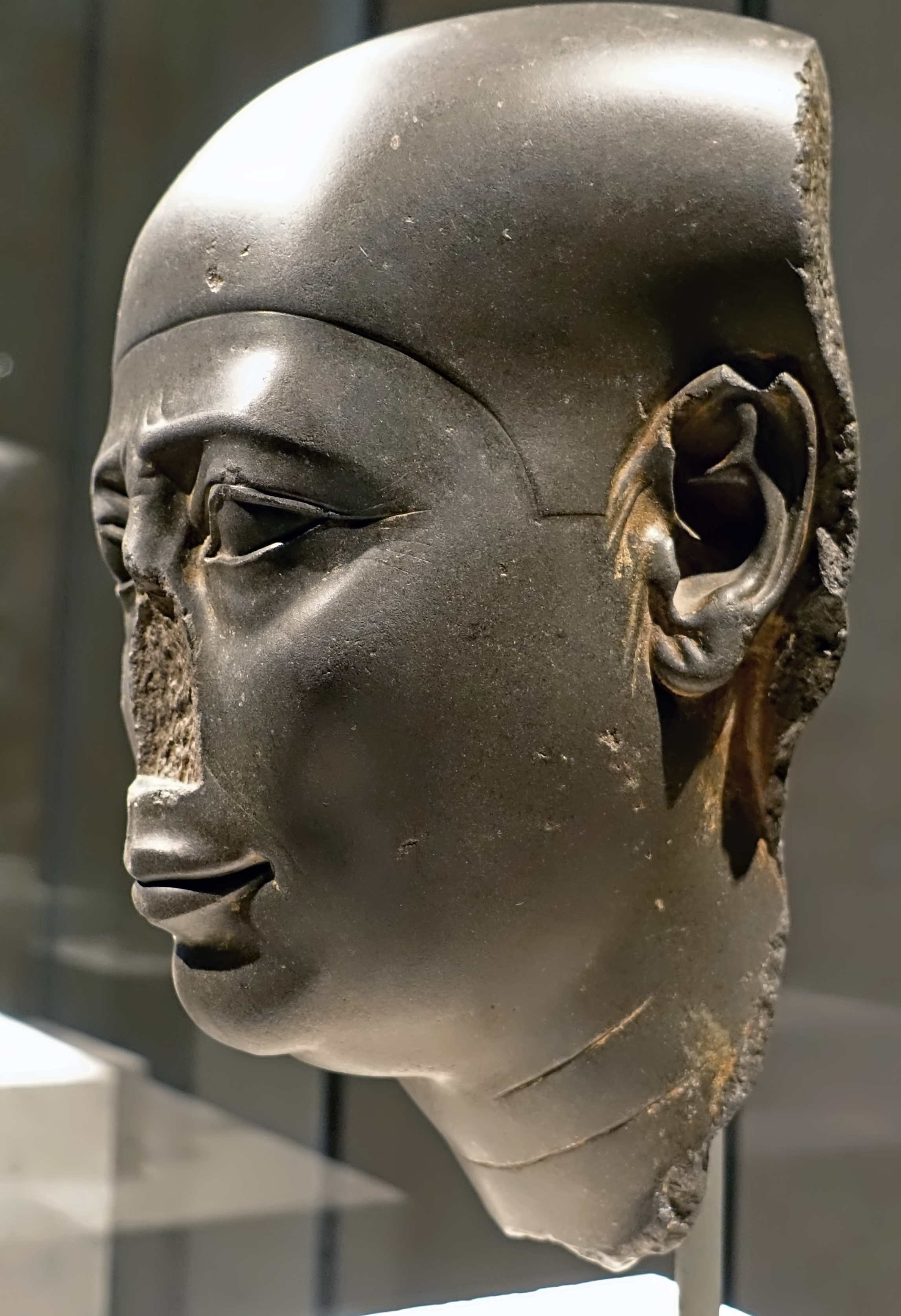

27th Dynasty: The Persian Achaemenid Dynasty, 525 BC - 404 BC
Head of a statue of an unknown man
Circa 500 BC.
Head, dark green hard stone.
Catalog: Greywacke, ÄM 31196
Photo: Don Hitchcock 2018
Source: Original, Staatliche Museen zu Berlin, Neues Museum, Germany
Text: © Card at the Staatliche Museen zu Berlin, (CC BY-NC-SA 3.0 DE)
Additional text: http://www.griffith.ox.ac.uk/gri/3berlin.pdf
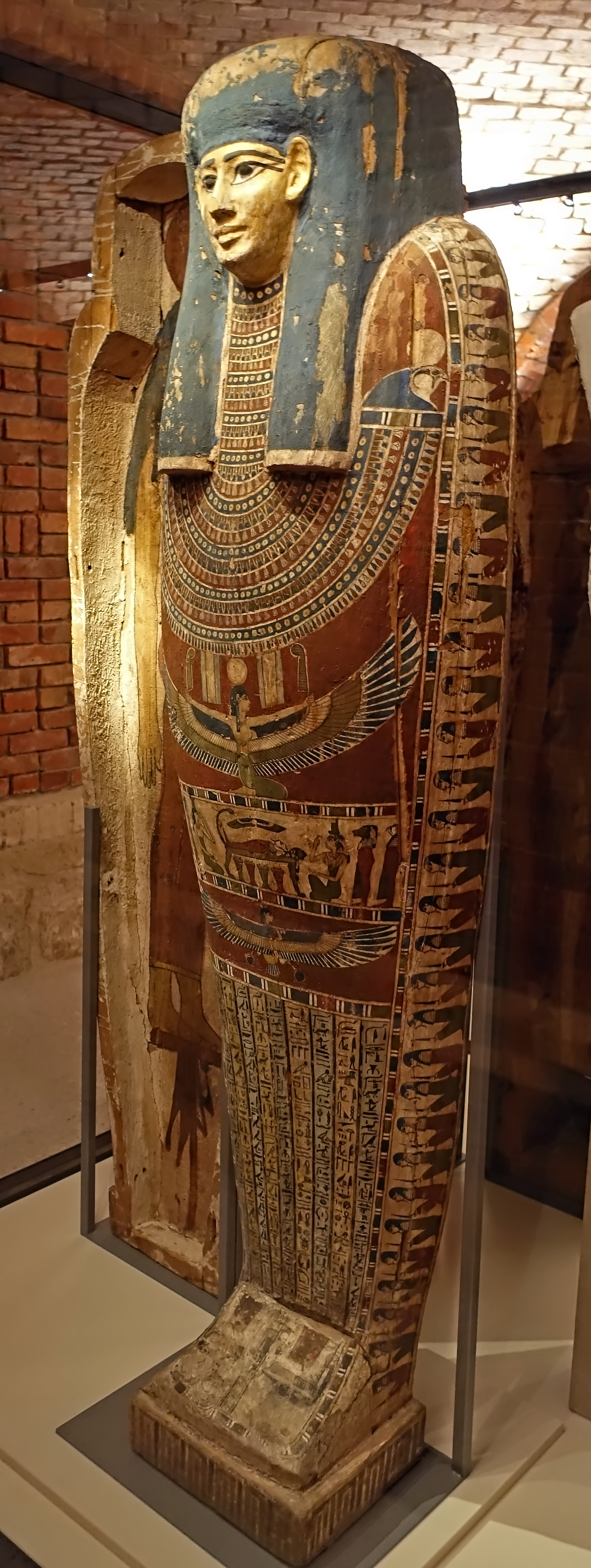
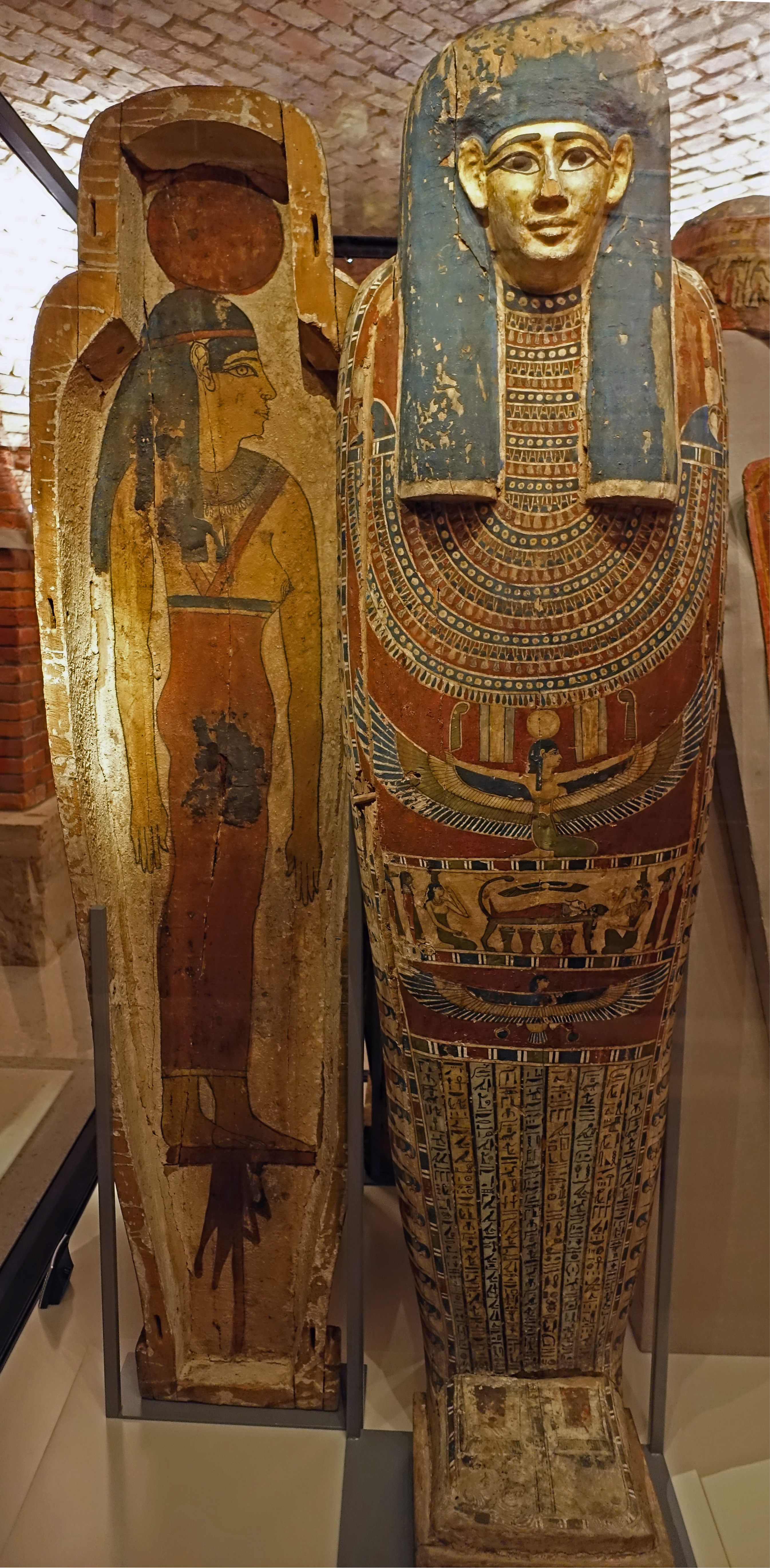
27th Dynasty: The Persian Achaemenid Dynasty, 525 BC - 404 BC
Nespamai
Inner, anthropomorphic coffin of Nespamai, priest in Achmim (lid), circa 500 BC
( note that http://www.smb-digital.de/ lists this as Ptolemaic. I have used the date given on the Museum card, and on a normally reliable site, http://www.touregypt.net/featurestories/akhmim.htm - Don )
Dimensions: 1840 x 470 x 395 mm
The lid of this double coffin of Nes-pa-maj has been patched together. The face of the owner has been idealised, and the neck collar is conventional for the time.
Case: The case of the inner coffin of Nespamai shows the goddess Nut.
Catalog: Provenance unknown, wood, stucco, primed and painted polychrome, (lid) ÄM 31213/1 (case) ÄM 31213/2
Photo: Don Hitchcock 2018
Source: Original, Staatliche Museen zu Berlin, Neues Museum, Germany
Text: © Card at the Staatliche Museen zu Berlin, http://www.smb-digital.de/ (CC BY-NC-SA 3.0 DE)
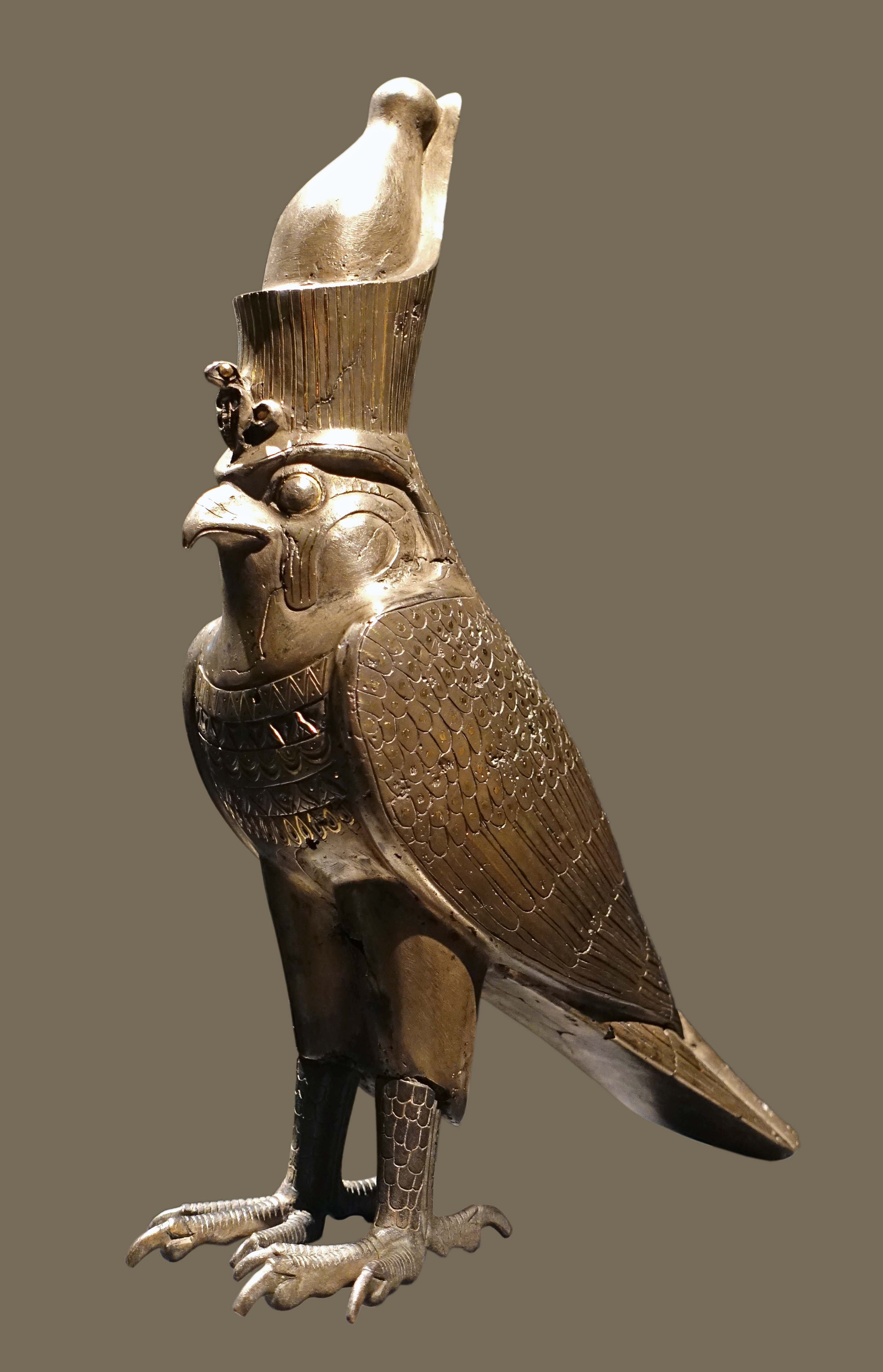
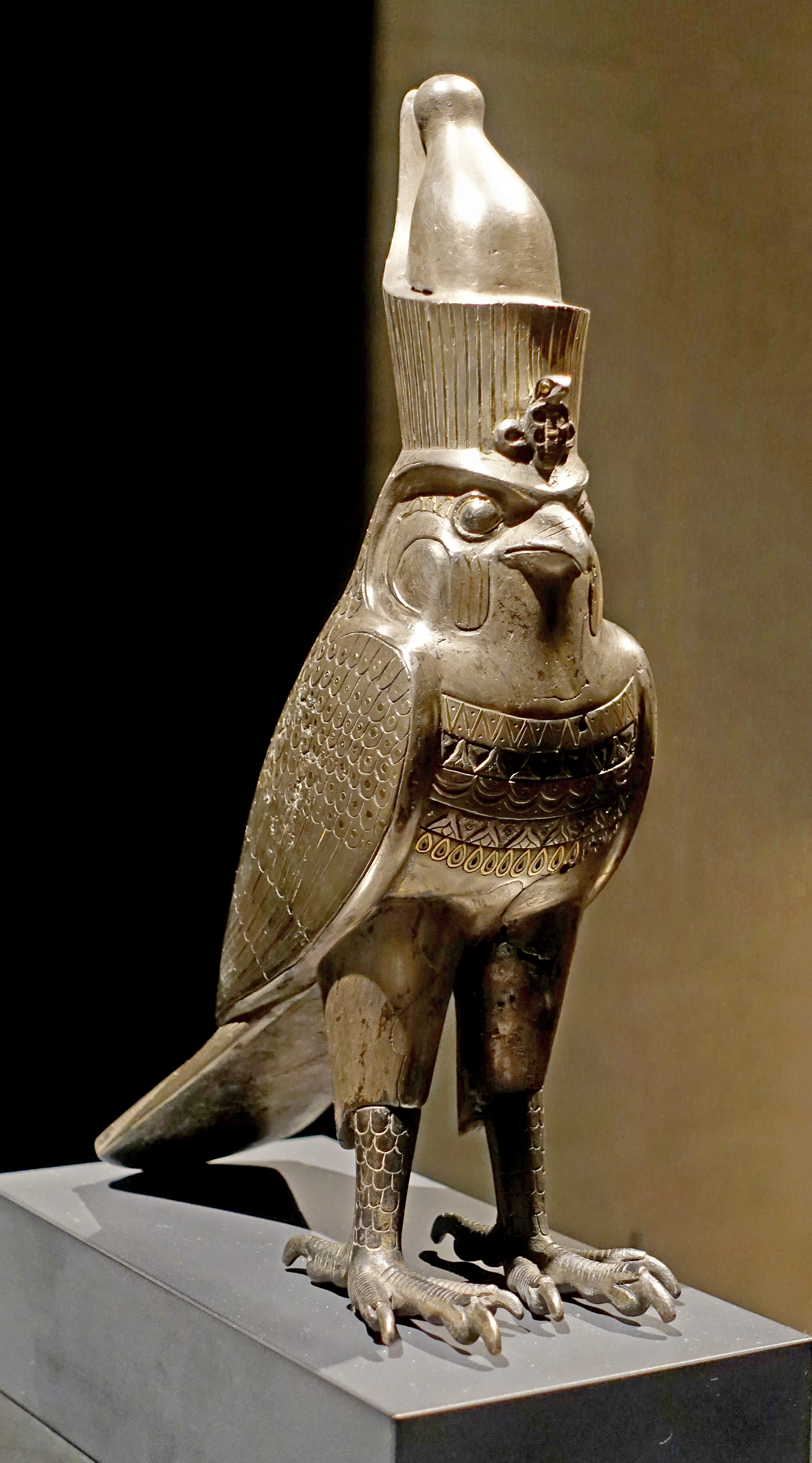
27th Dynasty: The Persian Achaemenid Dynasty, 525 BC - 404 BC
Horus
Cult image of the god Horus as a falcon wearing the double crown, circa 500 BC.
Catalog: Silver, electrum, on loan from the Bayrischen Landesbank
Photo: Don Hitchcock 2018
Source: Original, Ägyptischen Museum München
Text: Museum card, © Ägyptischen Museum München
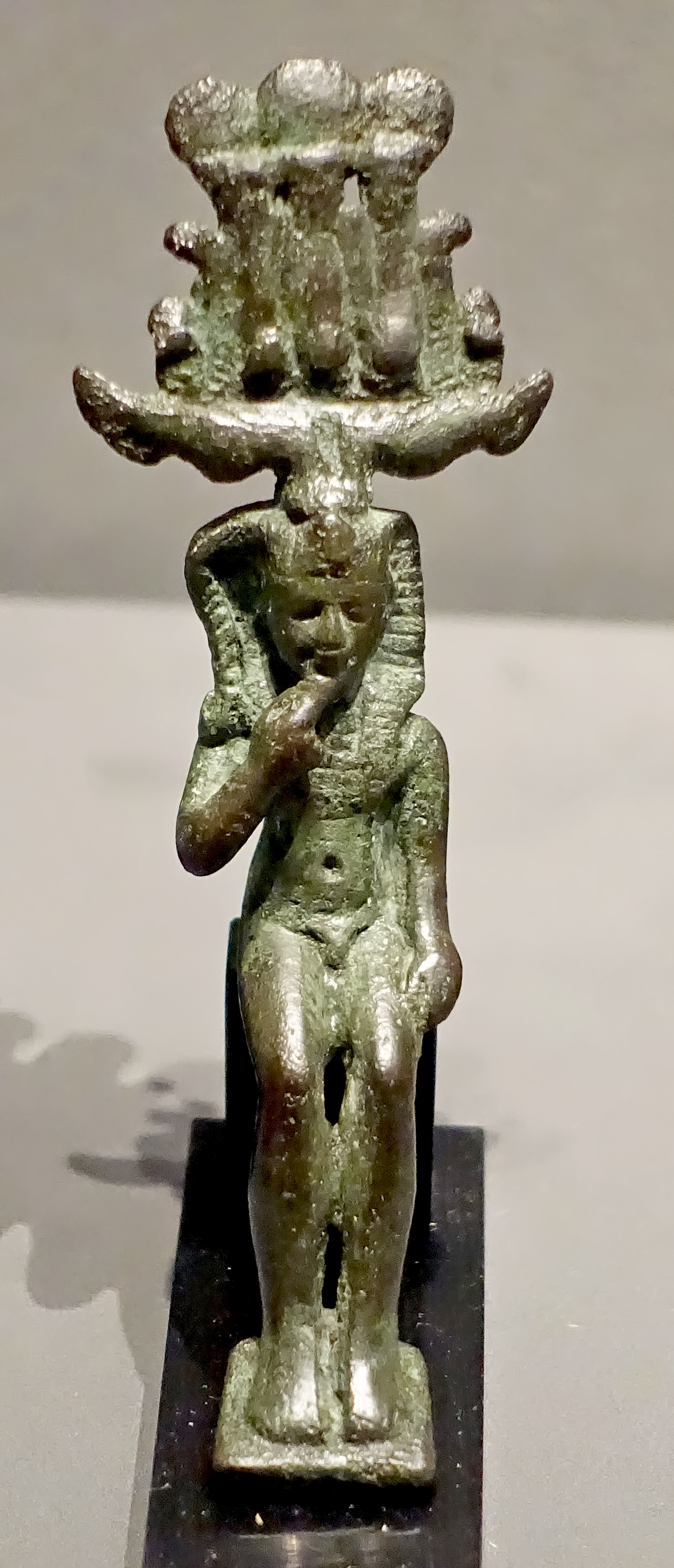
27th Dynasty: The Persian Achaemenid Dynasty, 525 BC - 404 BC
Harpokrates
Seated figure of Harpokrates (Horus the child), naked, and wearing the lock of youth.
Catalog: Bronze, ÄS 100
Photo: Don Hitchcock 2018
Source: Original, Ägyptischen Museum München
Text: Museum card, © Ägyptischen Museum München
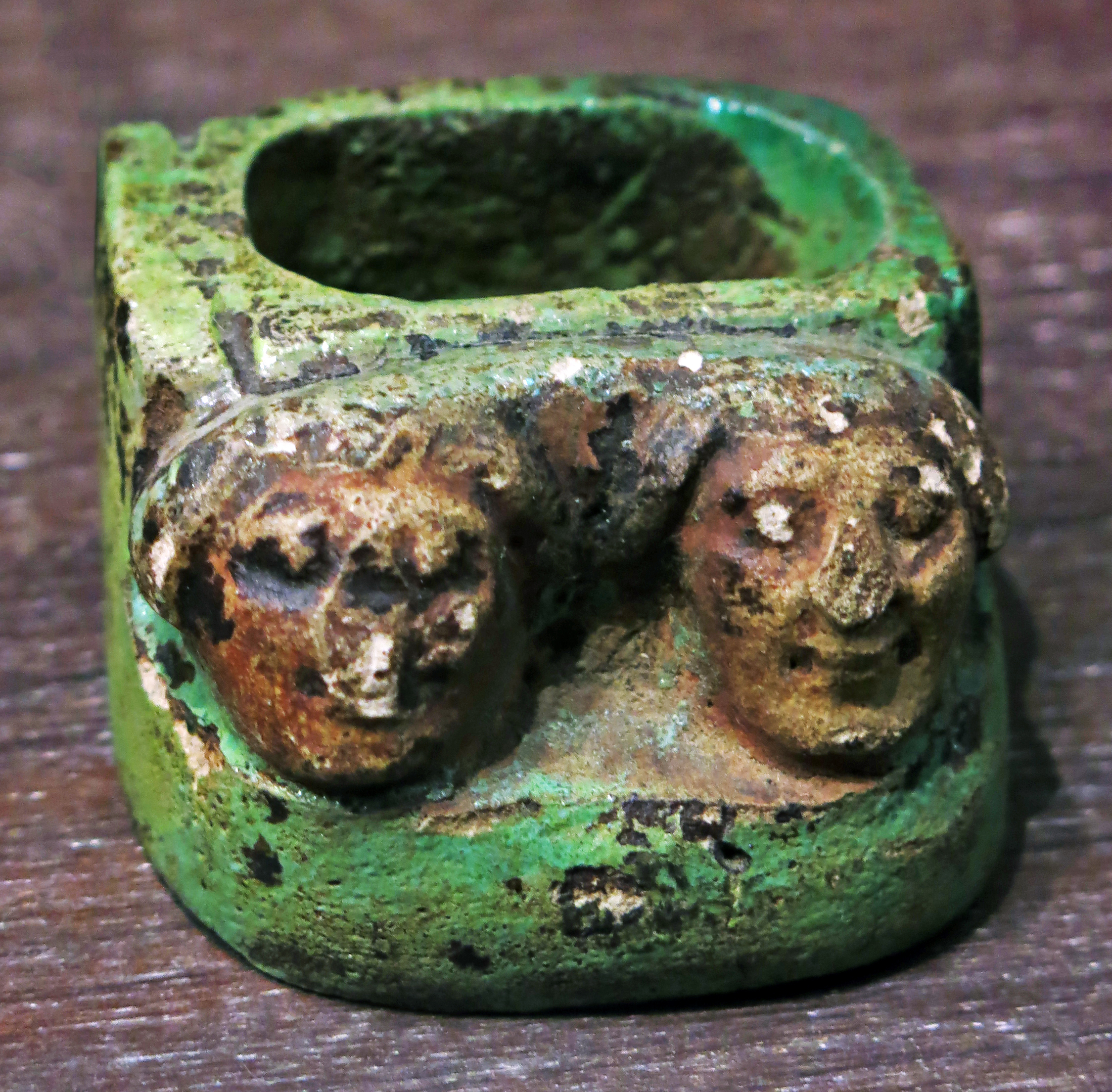
27th Dynasty: The Persian Achaemenid Dynasty, 525 BC - 404 BC
Ink Pot
Inkpot with the heads of foreigners, in painted acacia wood.
6th century BC.
Catalog: Acacia wood, ÄS 6987
Photo: Don Hitchcock 2015
Source: Original, Ägyptischen Museum München
Text: Museum card, © Ägyptischen Museum München

27th Dynasty: The Persian Achaemenid Dynasty, 525 BC - 404 BC
Hathor
Fragment of a capital with the head of the goddess Hathor.
6th century BC.
Catalog: Limestone, Gl. 289
Photo: Don Hitchcock 2018
Source: Original, Ägyptischen Museum München
Text: Museum card, © Ägyptischen Museum München
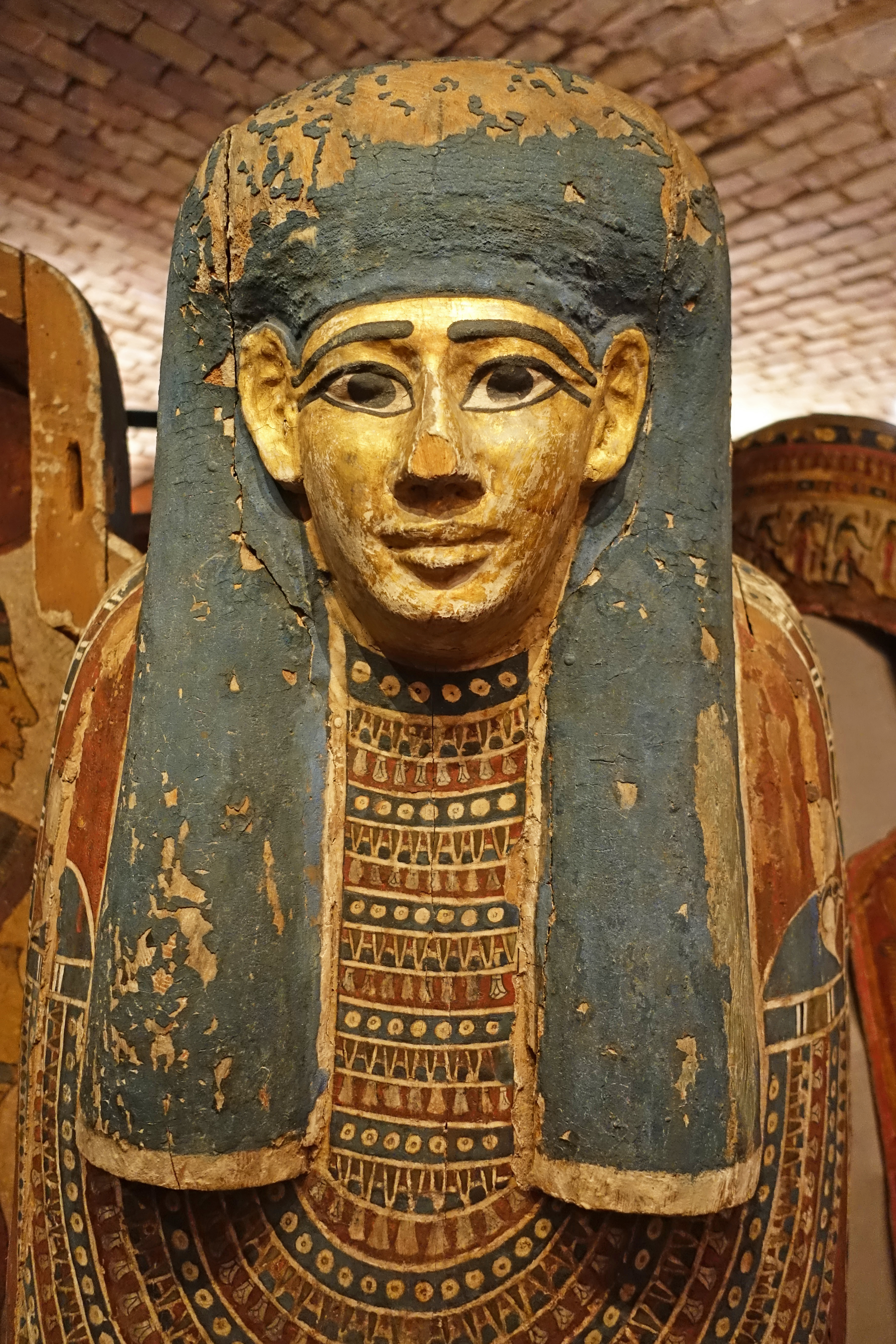
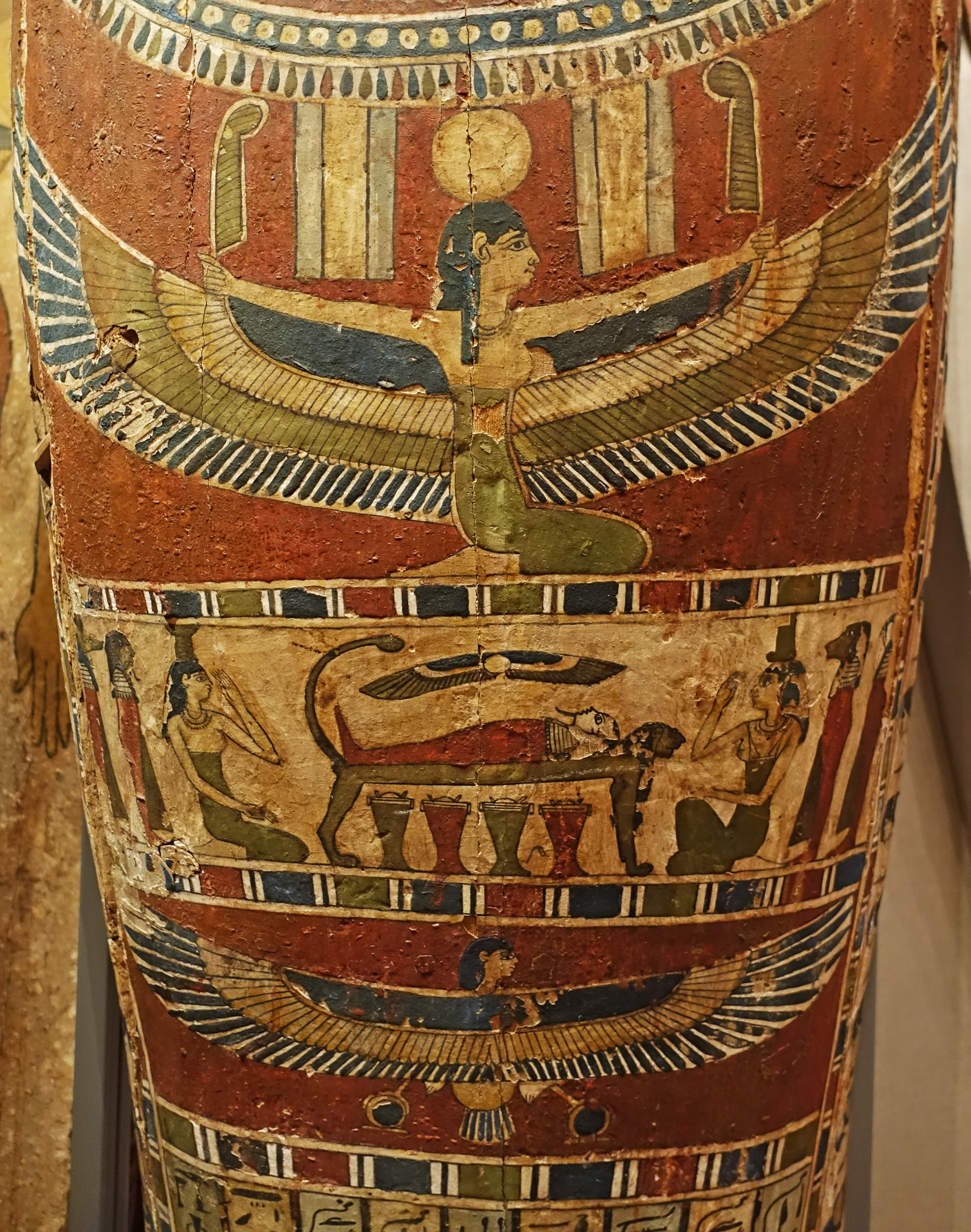
27th Dynasty: The Persian Achaemenid Dynasty, 525 BC - 404 BC
Nespamai
Inner, anthropomorphic coffin of Nespamai, priest in Achmim (lid), circa 500 BC
(left) Closeup of the face from the coffin lid
(right) Closeup of the central part of the lid, showing the goddess Nut spreading her wings in protection over the deceased.
Catalog: Provenance unknown, wood, stucco, primed and painted polychrome, ÄM 31213/1
Photo: Don Hitchcock 2018
Source: Original, Staatliche Museen zu Berlin, Neues Museum, Germany
Text: © Card at the Staatliche Museen zu Berlin, http://www.smb-digital.de/ (CC BY-NC-SA 3.0 DE)
27th Dynasty: The Persian Achaemenid Dynasty, 525 BC - 404 BC
Nespamai
The case of the inner coffin of Nespamai, priest in Achmim, showing the goddess Nut, circa 500 BC.
Catalog: Provenance unknown, wood, stucco, primed and painted polychrome, (case) ÄM 31213/2
Photo: Don Hitchcock 2018
Size: Stitched from two or more photos, 28 Megapixels
Source: Original, Staatliche Museen zu Berlin, Neues Museum, Germany
Text: © Card at the Staatliche Museen zu Berlin, http://www.smb-digital.de/ (CC BY-NC-SA 3.0 DE)
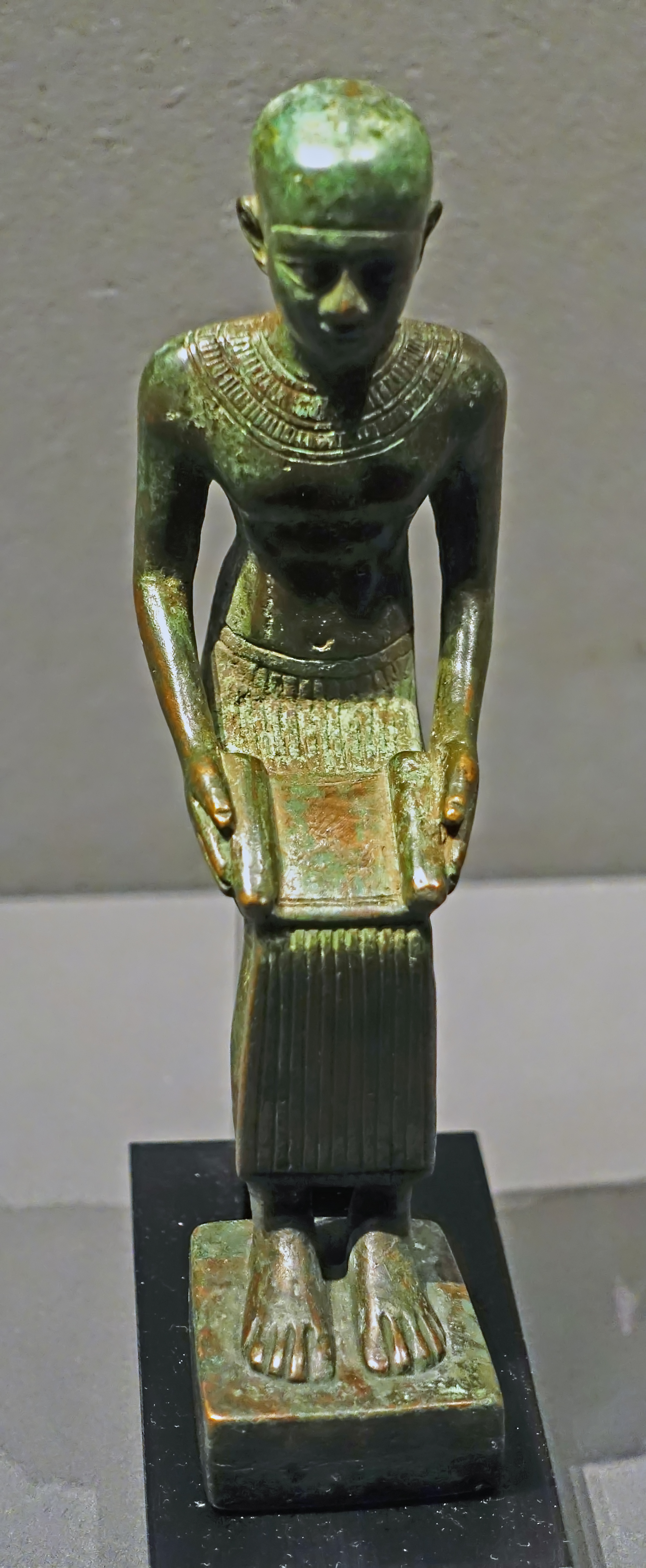
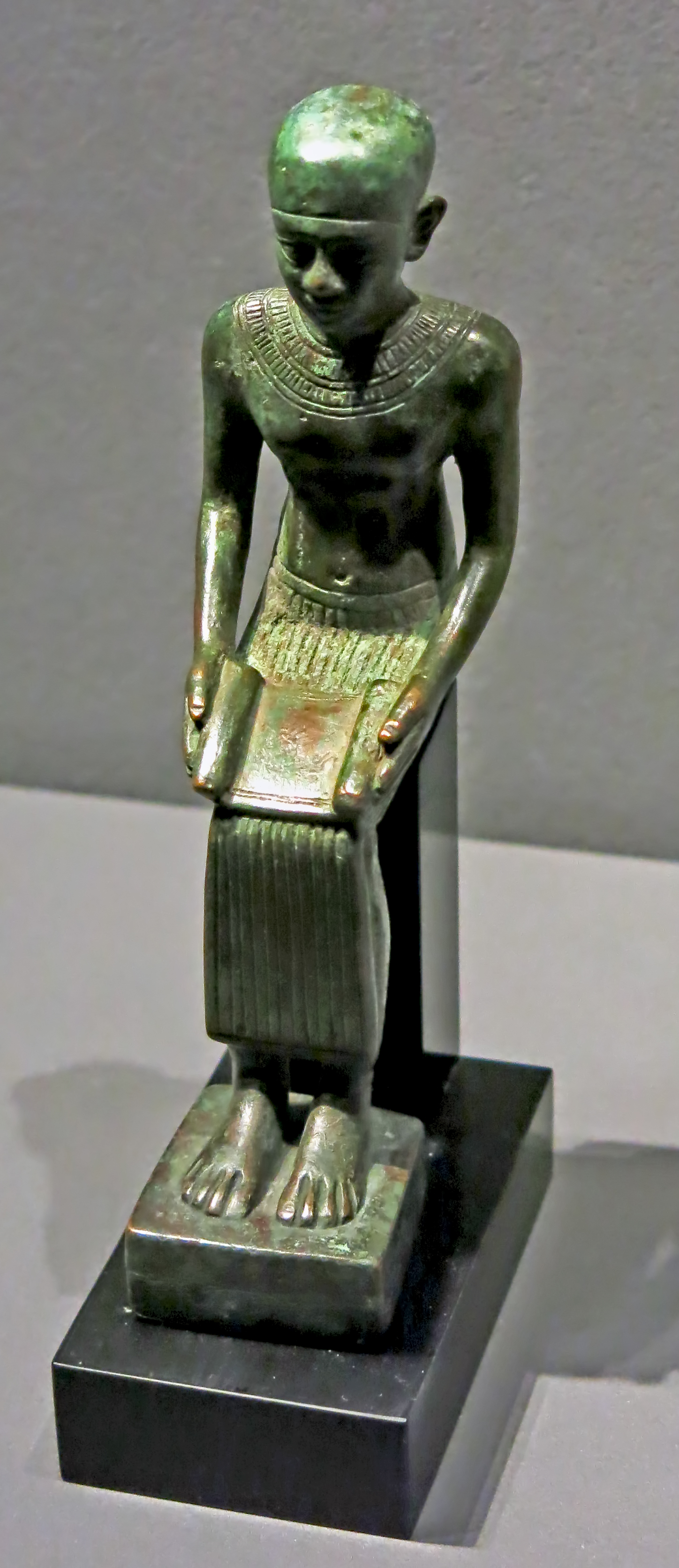
27th Dynasty: The Persian Achaemenid Dynasty, 525 BC - 404 BC
Imhotep
Imhotep with a shaved head, seated on a chair, wearing a skirt, an Usekh necklace, and holding a papyrus scroll.
Catalog: Bronze, 6th - 5th centuries BC, ÄS 5314
Photo: Don Hitchcock 2018, 2015
Source: Original, Ägyptischen Museum München
Text: Museum card, © Ägyptischen Museum München
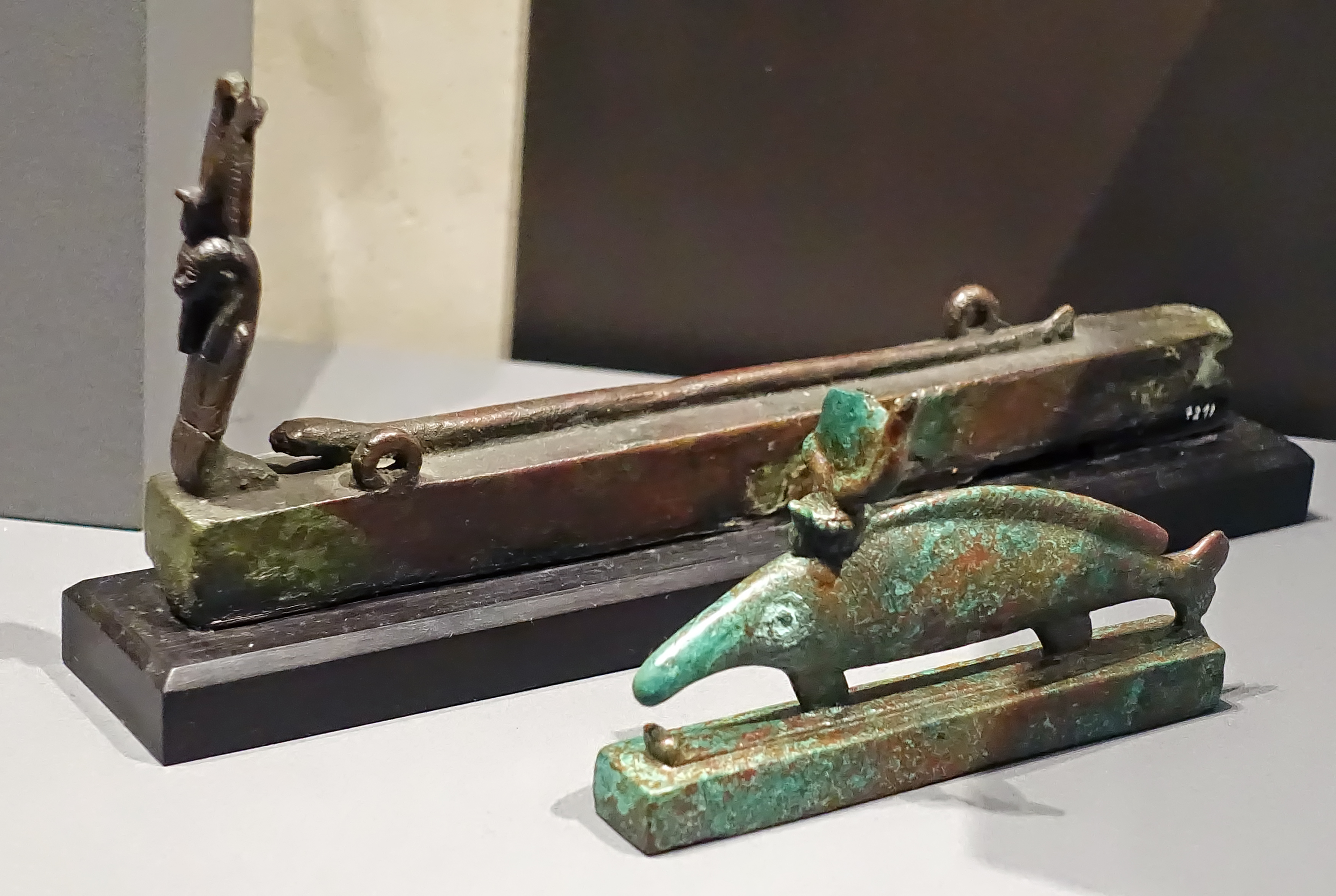
27th Dynasty: The Persian Achaemenid Dynasty, 525 BC - 404 BC
Atum
(left) The god Atum in the shape of a human-headed eel and wearing an Atef crown.
Catalog: Bronze, 6th - 4th centuries BC, ÄS 7219
Photo: Don Hitchcock 2018
Source: Original, Ägyptischen Museum München
Text: Museum card, © Ägyptischen Museum München
27th Dynasty: The Persian Achaemenid Dynasty, 525 BC - 404 BC
Oxyrhynchus Fish
(right) Oxyrhynchus Fish wearing a divine crown.
The Oxyrhynchus or 'sharp-nosed' Nile fish was one of three species of fish that according to Egyptian mythology devoured the phallus of Osiris after he was dismembered by Seth. The Oxyrhynchus fish was regarded as sacred and a town of the same name was established in the Faiyum.
Catalog: Bronze, 6th - 4th centuries BC, ÄS 7201
Photo: Don Hitchcock 2018
Source: Original, Ägyptischen Museum München
Text: Museum card, © Ägyptischen Museum München
Additional text: Wikipedia
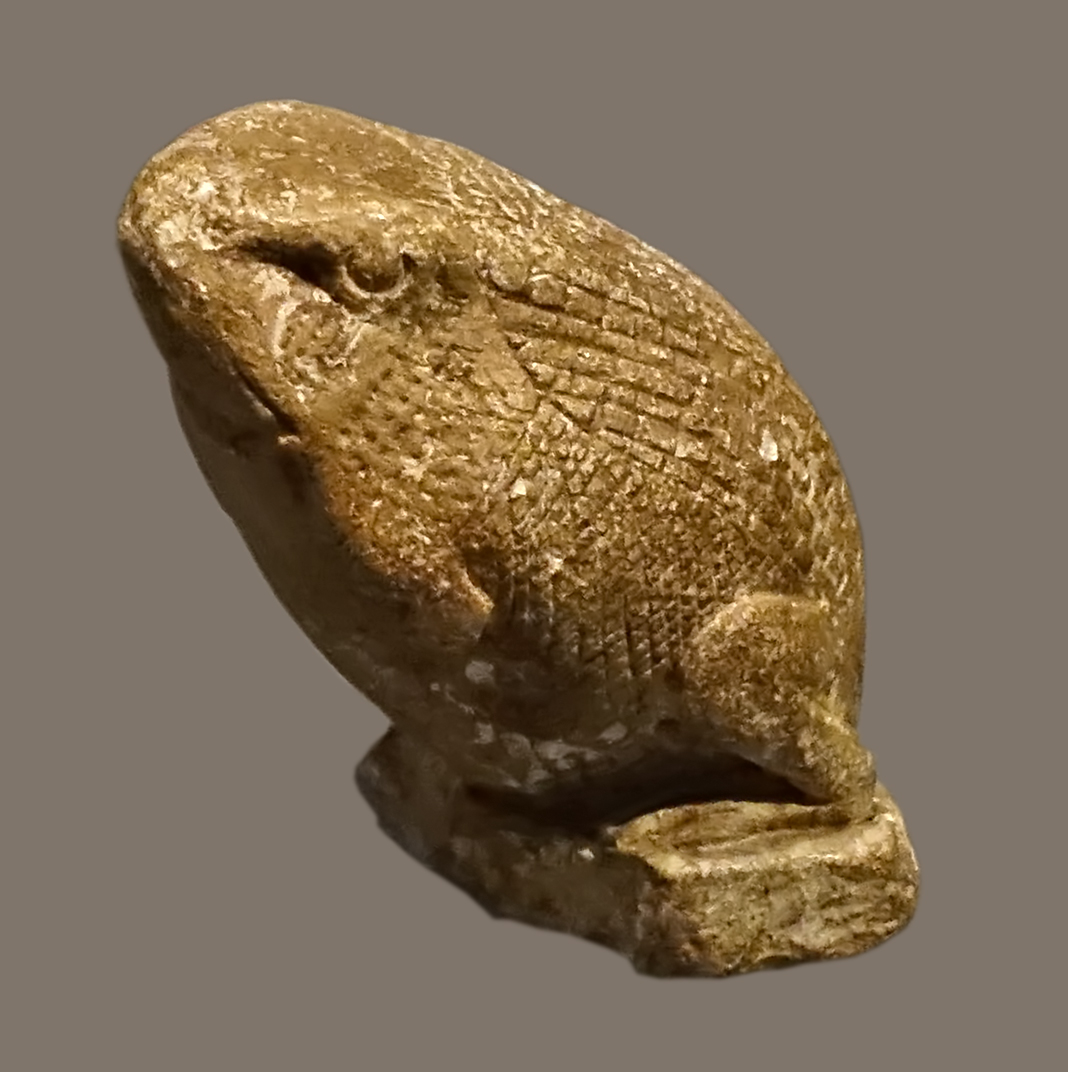
27th Dynasty: The Persian Achaemenid Dynasty, 525 BC - 404 BC
Frog
Figure of a frog, the symbol of regeneration.
Catalog: Limestone, 6th - 4th centuries BC, ÄS 1573
Photo: Don Hitchcock 2018
Source: Original, Ägyptischen Museum München
Text: Museum card, © Ägyptischen Museum München

27th Dynasty: The Persian Achaemenid Dynasty, 525 BC - 404 BC
Sun God
Statuette of the youthful sun god atop a lotus flower.
Catalog: Bronze, 6th - 4th centuries BC, ÄS 4848
Photo: Don Hitchcock 2018
Source: Original, Ägyptischen Museum München
Text: Museum card, © Ägyptischen Museum München

27th Dynasty: The Persian Achaemenid Dynasty, 525 BC - 404 BC
Neith
Standing figure of Neith suckling two crocodiles.
Neith was a great creator goddess, and was not linked with any partner except primarily her son Tutu. She was also closely associated with crocodiles: Sobek was considered her son and at Esna she had a second crocodile son Shemanefer. Small amulets like this one where she nurses two crocodiles may represent her as a creator goddess where the crocodiles represent the sun and the moon, or the animals may refer to her two crocodile sons Sobek and Shemanefer.
Catalog: Faience, 6th - 4th centuries BC, ÄS 2925
Photo: Don Hitchcock 2018
Source: Original, Ägyptischen Museum München
Text: Museum card, © Ägyptischen Museum München
Additional text: metmuseum.org
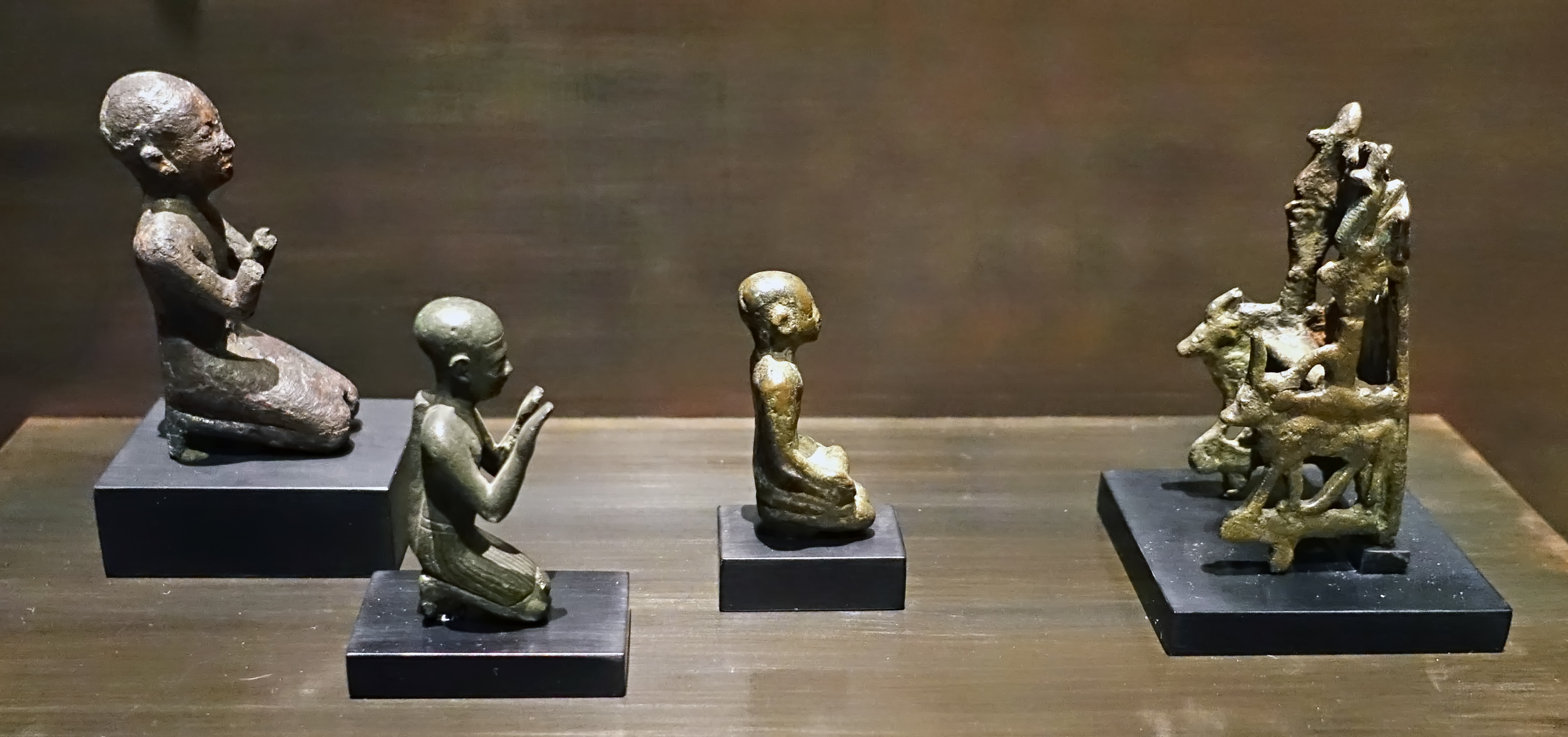
27th Dynasty: The Persian Achaemenid Dynasty, 525 BC - 404 BC
Praying Figures
Three figures praying before a divine throne.
Catalog: Bronze, 6th - 5th centuries BC, ÄS 1021, ÄS 6039, ÄS 7226, ÄS 608
Photo: Don Hitchcock 2018
Source: Original, Ägyptischen Museum München
Text: Museum card, © Ägyptischen Museum München
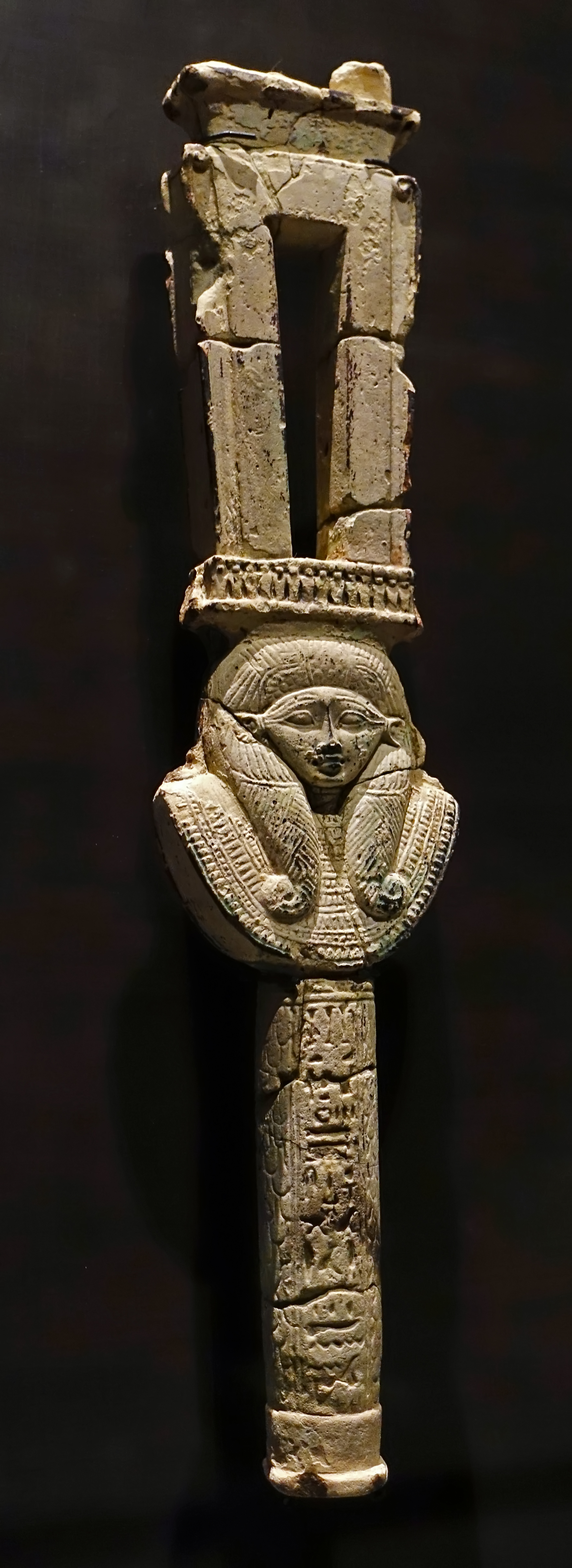
27th Dynasty: The Persian Achaemenid Dynasty, 525 BC - 404 BC
Sistrum
Naos or shrine sistrum.
Catalog: Faience, 6th - 5th centuries BC, ÄS 1689
Photo: Don Hitchcock 2018
Source: Original, Ägyptischen Museum München
Text: Museum card, © Ägyptischen Museum München
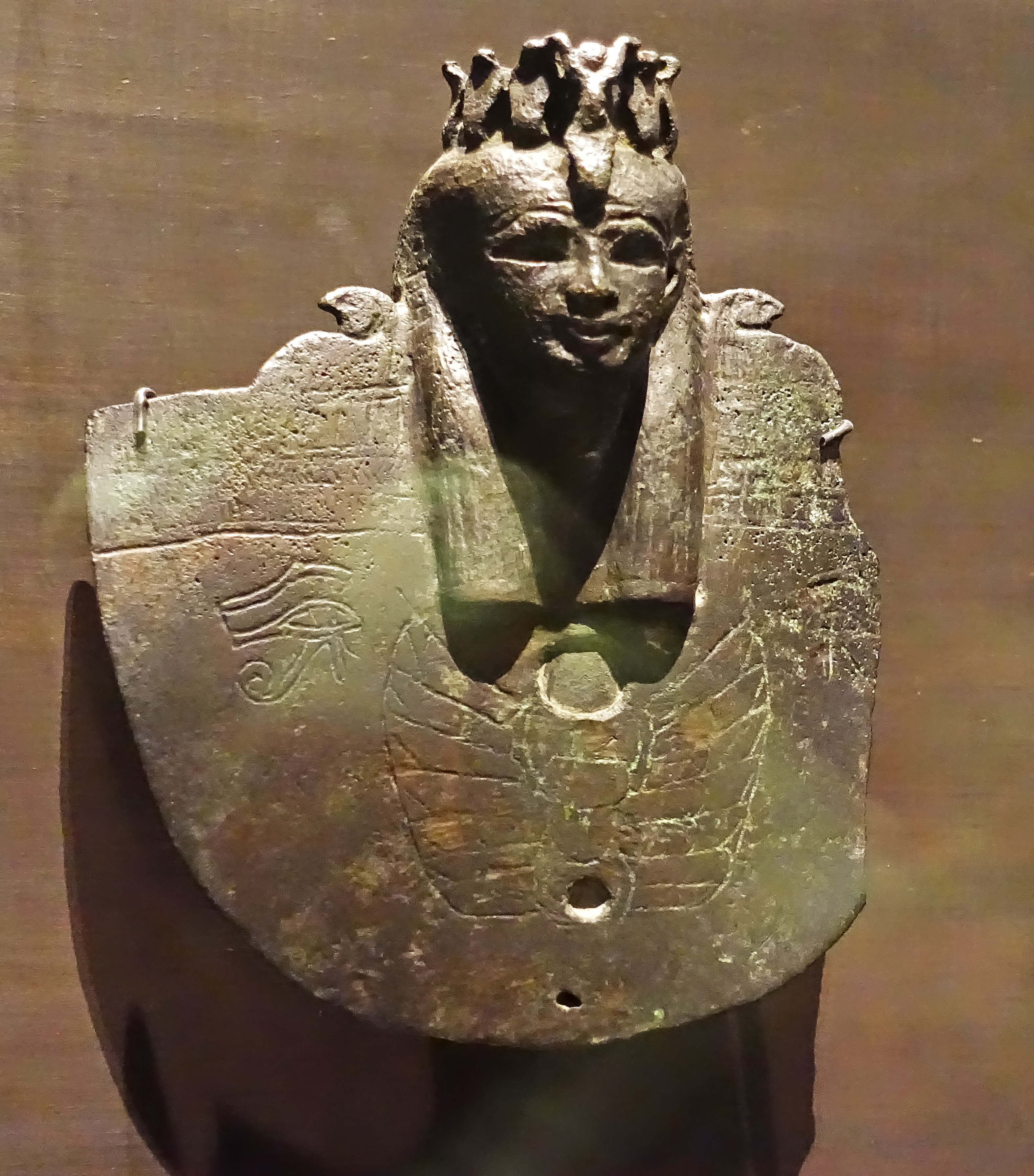
27th Dynasty: The Persian Achaemenid Dynasty, 525 BC - 404 BC
Aegis
Aegis with female head.
The aegis is an object that comprises the bust of a deity with a broad collar below it. Broad collars are generally accompanied by a menat, a counterpoise that hangs at the back of the neck, balancing the weight of the heavy, elaborate collar on the chest. Although this piece only shows the deity’s head and broad collar, it represents the aegis-menat combination, which was not only a personal adornment but also played an important role in cult. It was a protective symbol and was used in rituals and festivals; the head allowed the deity to inhabit the ritual instrument and thus take part in the ceremonies.
Catalog: Bronze, 6th century BC, ÄS 2031
Photo: Don Hitchcock 2018
Source: Original, Ägyptischen Museum München
Text: Museum card, © Ägyptischen Museum München
Additional text: www.metmuseum.org/art/collection/search/551775
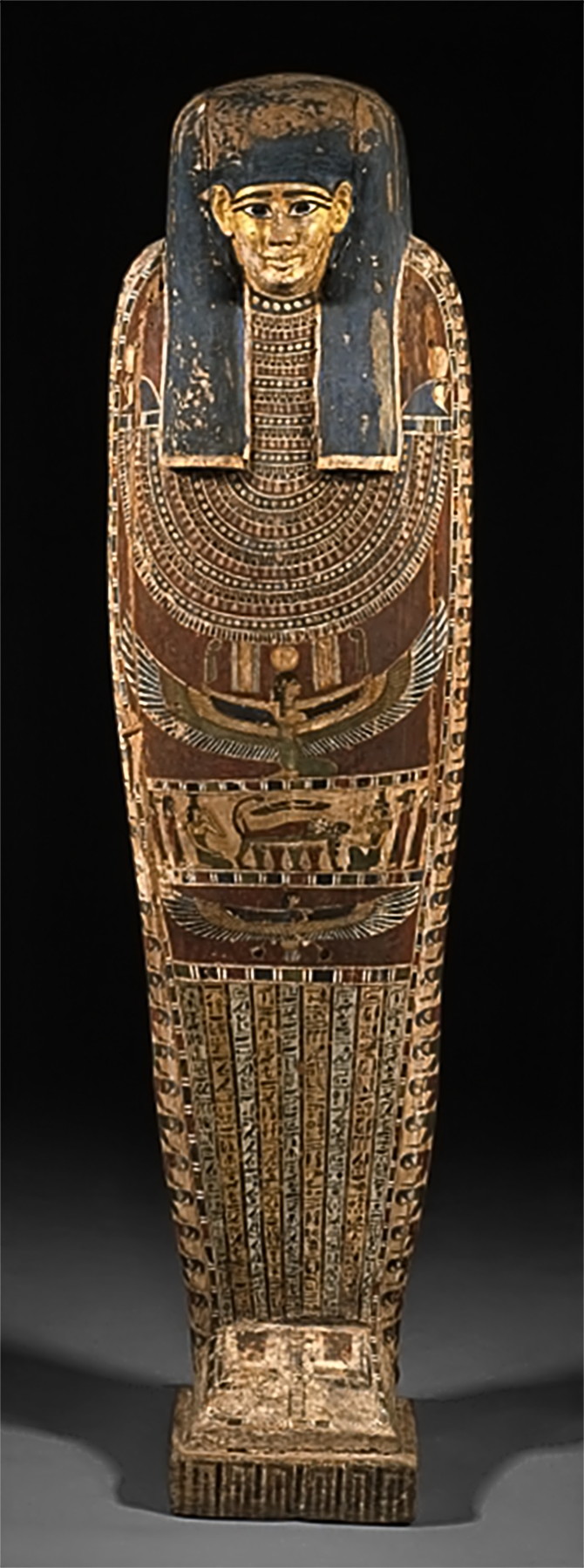
27th Dynasty: The Persian Achaemenid Dynasty, 525 BC - 404 BC
Nespamai
Circa 500 BC.
( note that http://www.smb-digital.de/ lists this as Ptolemaic. I have used the date given on the Museum card, and on a normally reliable site, http://www.touregypt.net/featurestories/akhmim.htm - Don )
Lid: The depictions of Osiris, resting on a lion-footed bed, mourned by Isis and Nephtys, who in turn are flanked by two so-called Horus children, as well as the winged Nechbet and the long ranks of knife wielding protection demons both on the large exterior and on the elegant inner coffin lid.
The remaining space is filled by religious texts recounting ancient tales.
Catalog: Provenance unknown, wood, primed and painted polychrome, (lid) ÄM 31213/1 (case) ÄM 31213/2
Photo: © Margarete Büsing, Ägyptisches Museum und Papyrussammlung der Staatlichen Museen zu Berlin - Preußischer Kulturbesitz (CC BY-NC-SA 3.0 DE)
Source: Original, Staatliche Museen zu Berlin, Neues Museum, Germany
Text: © Card at the Staatliche Museen zu Berlin, http://www.smb-digital.de/ (CC BY-NC-SA 3.0 DE)

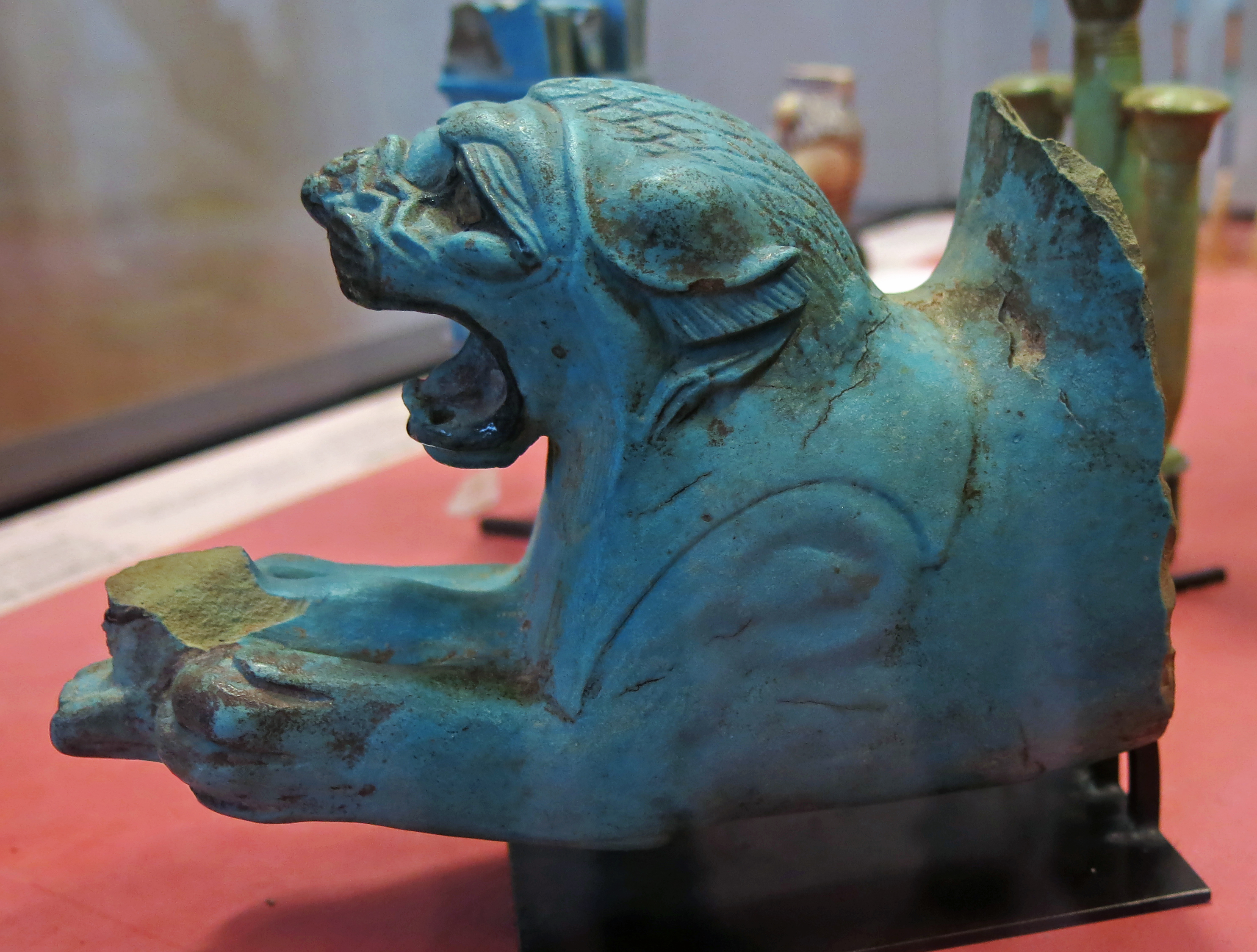
27th Dynasty - Macedonian 525 BC - 305 BC
Rhyton
Rhyton in the shape of a lion.
A rhyton is a vase with a large mouth at the top (here broken) and a small opening at the bottom, used as a drinking vessel. The style given to the lion belongs to the art of the Persian Achaemenid (First Persian Empire).
Many vessels considered rhytons featured a wide mouth at the top and a hole through a conical constriction at the bottom from which the fluid ran. The idea is that one scooped wine or water from a storage vessel or similar source, held it up, unstoppered the hole with one's thumb, and let the fluid run into the mouth (or onto the ground in libation) in the same way that wine is drunk from a wineskin today.
They are typically formed in the shape of an animal's head, and were produced over large areas of ancient Eurasia, especially from Persia to the Balkans. Many have an opening at the bottom through which the liquid fell; others did not, and were merely used as drinking cups, with the characteristic that they could not usually be set down on a surface without spilling their contents.
Height 105 mm, length 155 mm, width 7 mm.
Catalog: Siliceous earthenware, glass, gilding, Aile Sully, Room 334, Materials and Techniques, Vitrine 6, E 931, N 1000
Photo: Don Hitchcock 2015
Source and text: Original, Louvre Museum, Paris, France, https://collections.louvre.fr/
Additional text: Wikipedia
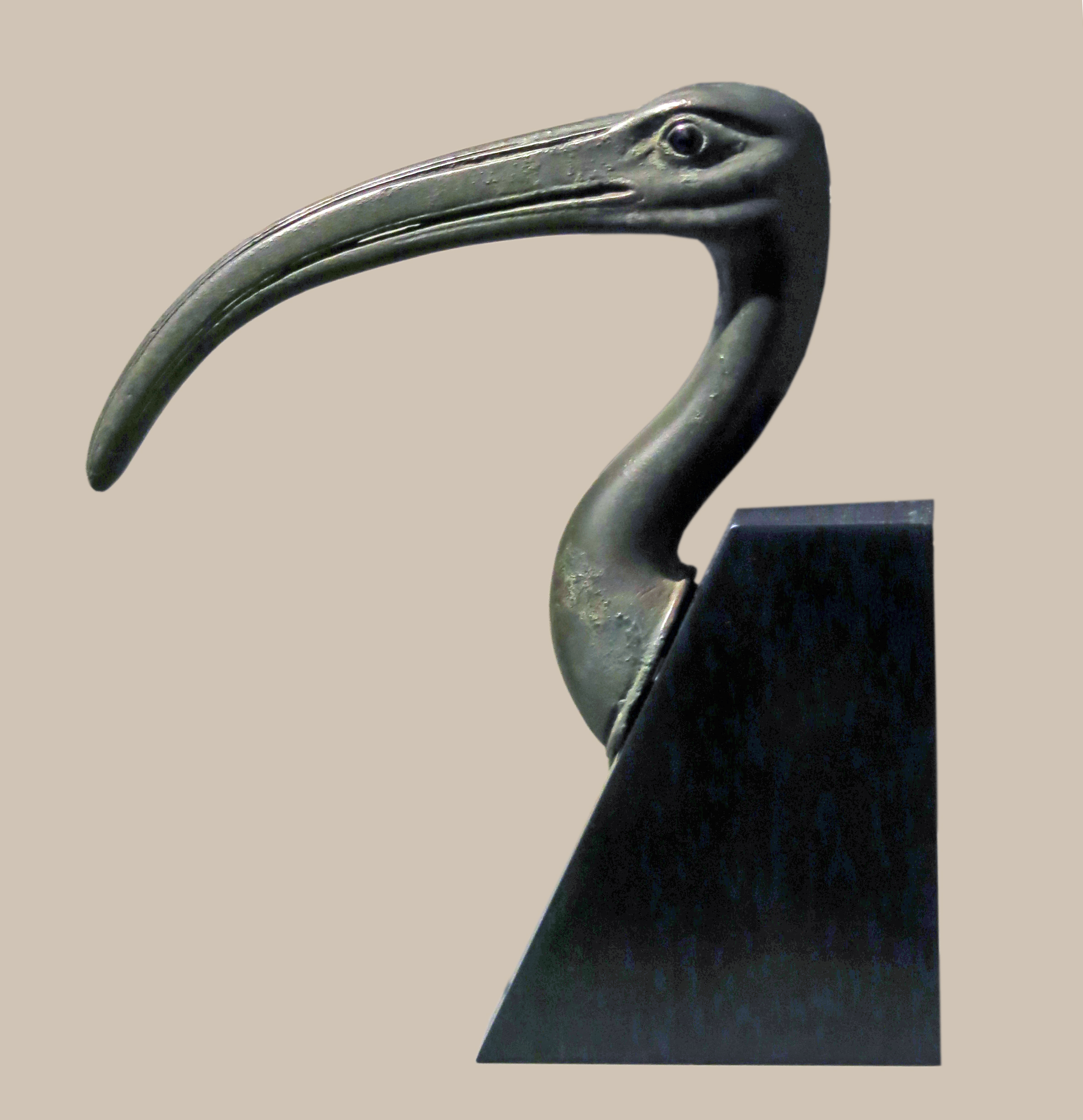
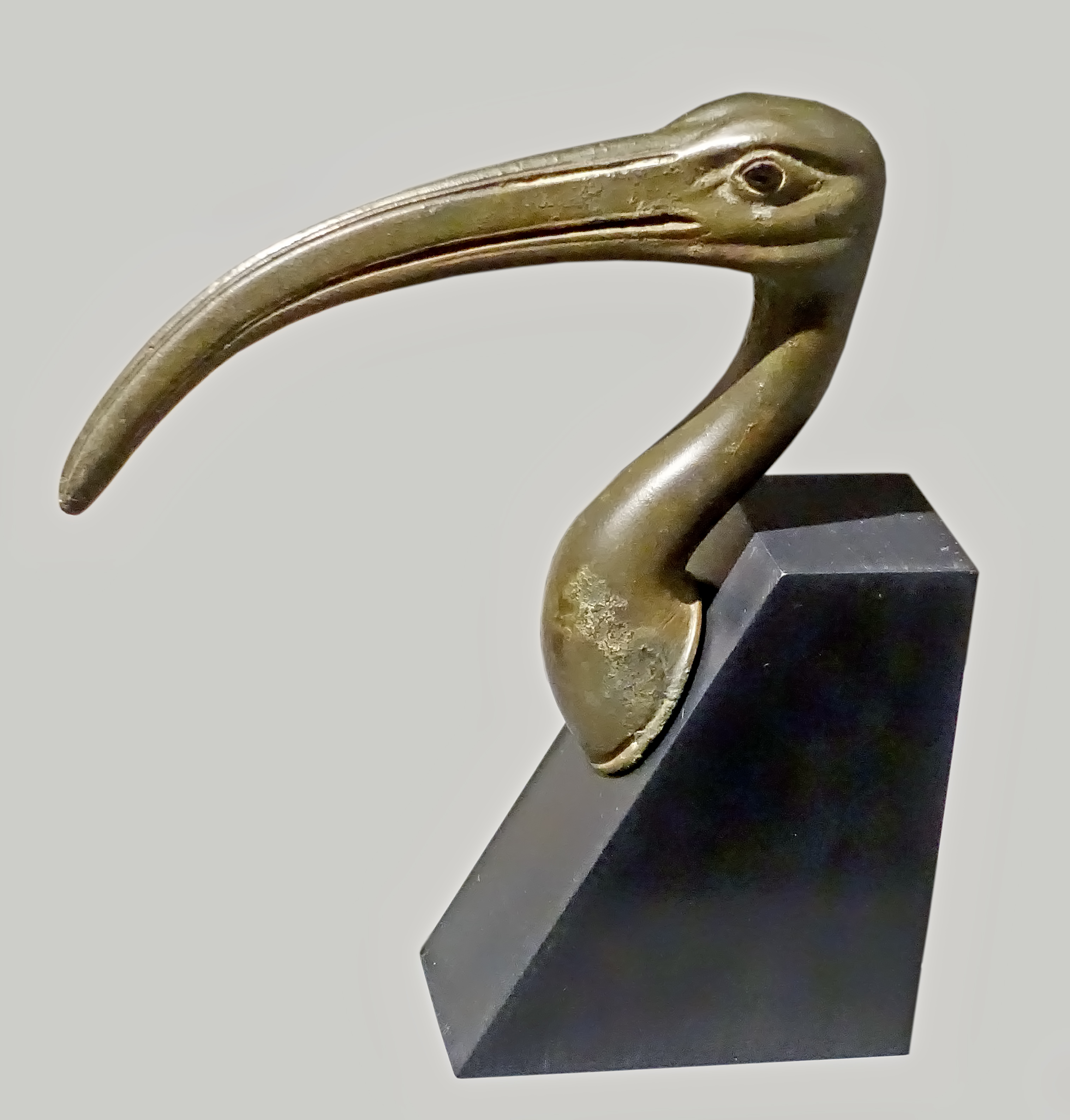
27th Dynasty - Macedonian 525 BC - 305 BC
Ibis
Head from the figure of an ibis, circa 6th - 4th century BC.
Catalog: Copper, obsidian, ÄS 5325
Photo: Don Hitchcock 2015, 2018
Source: Original, Ägyptischen Museum München
Text: Museum card, © Ägyptischen Museum München
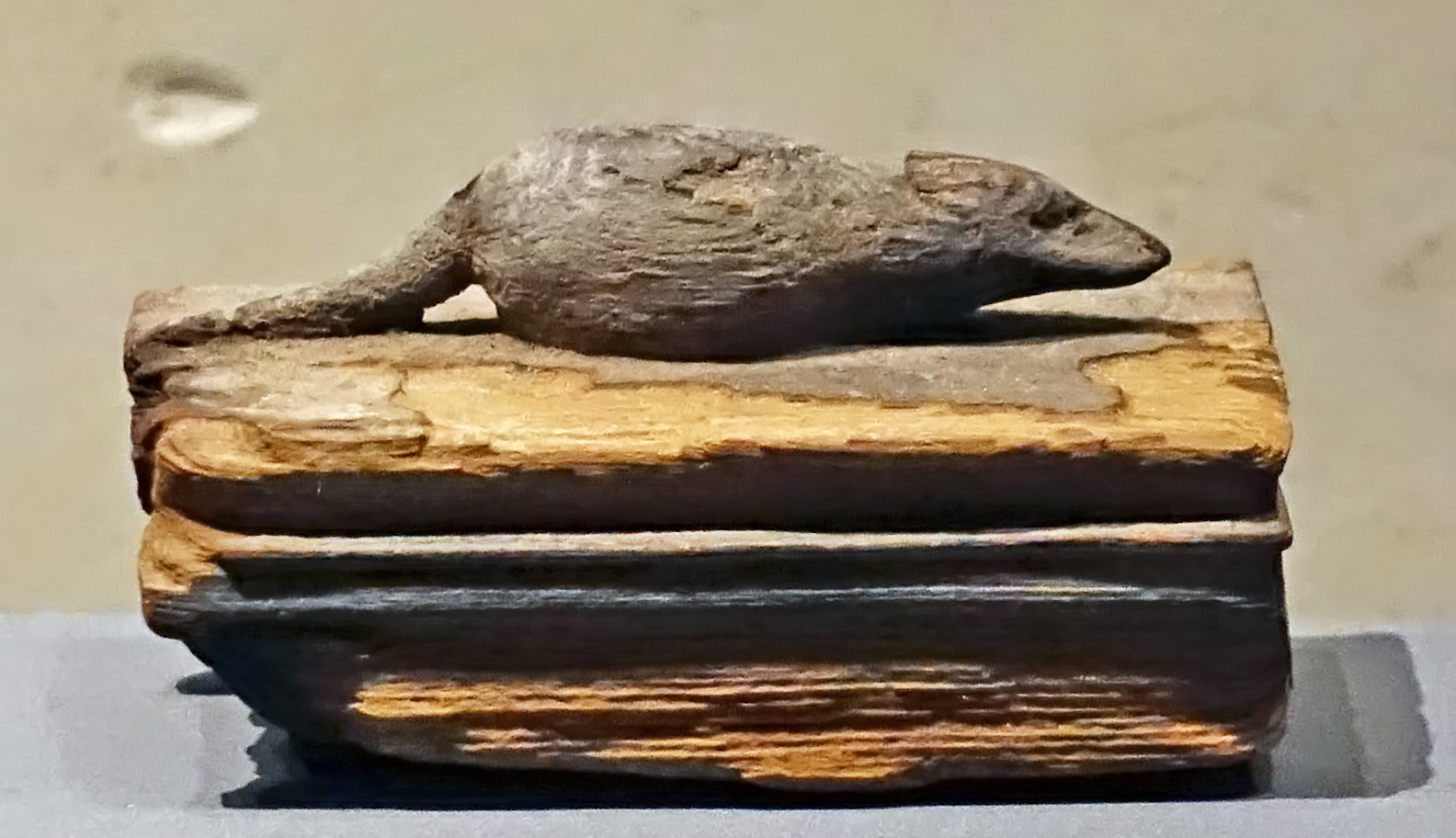
27th Dynasty - Macedonian 525 BC - 305 BC
Shrew
Shrew on a coffin.
Circa 6th - 4th century BC.
Catalog: Wood, Private loan
Photo: Don Hitchcock 2018
Source: Original, Ägyptischen Museum München
Text: Museum card, © Ägyptischen Museum München
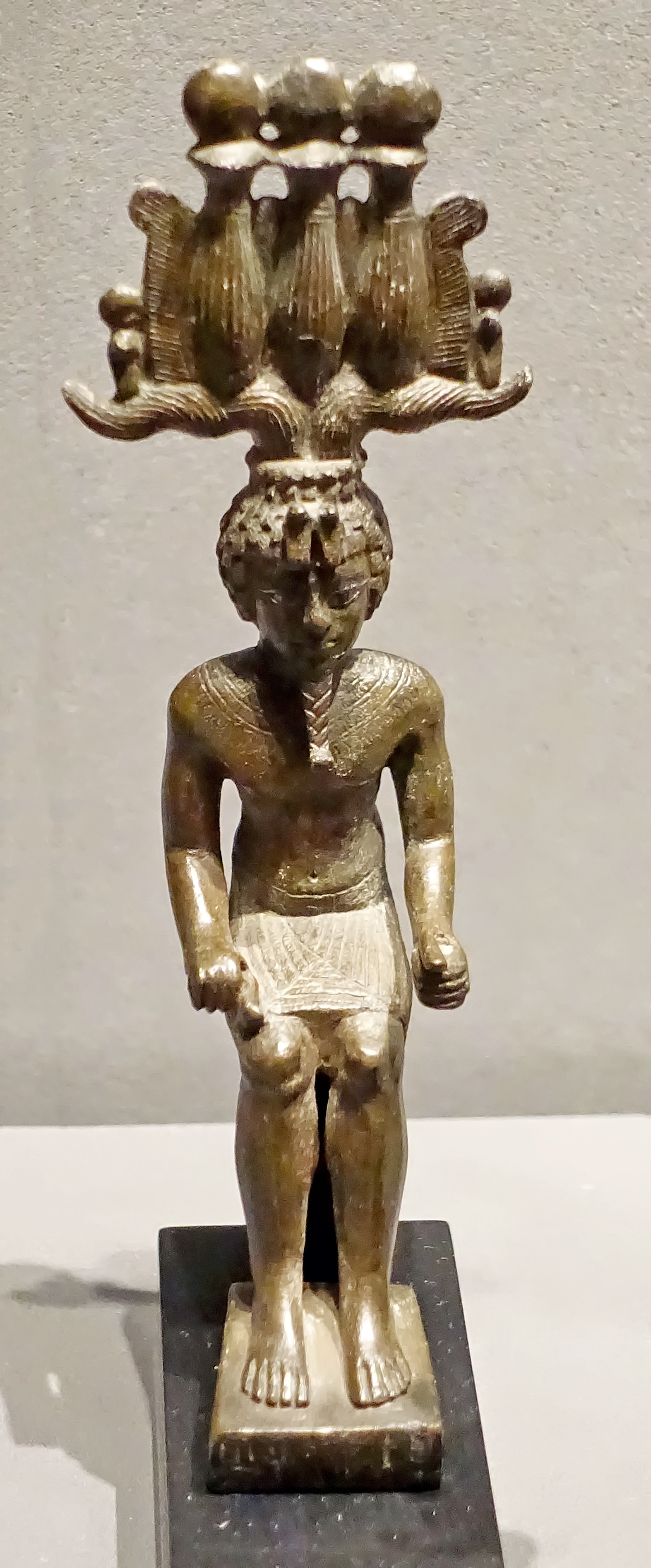
27th Dynasty - Macedonian 525 BC - 305 BC
Onuris
Seated figure of Onuris in human guise, wearing a triple Atef crown.
Onuris or Anhur was a god of war and hunting who was worshipped in the Egyptian area of Abydos, and particularly in Thinis. Myths told that he had brought his wife, Mehit, who was his female counterpart, from Nubia, and his name reflects this - it means (one who) leads back the distant one.
One of his titles was Slayer of Enemies. Due to his position as a war god, he was patron of the ancient Egyptian army, and the personification of royal warriors. Indeed, at festivals honouring him, mock battles were staged. During the Roman era the Emperor Tiberius was depicted on the walls of Egyptian temples wearing the distinctive four-plumed crown of Anhur.
The figure is partially decorated with niello, a black mixture, usually of sulphur, copper, silver, and lead, used as an inlay on engraved or etched metal, especially silver. It is added as a powder or paste, then fired until it melts or at least softens, and flows or is pushed into the engraved lines in the metal. It hardens and blackens when cool, and the niello on the flat surface is polished off to show the filled lines in black, contrasting with the polished metal (usually silver) around it.
Catalog: Bronze, Niello, Silver, ÄS 5315
Photo: Don Hitchcock 2018
Source: Original, Ägyptischen Museum München
Text: Museum card, © Ägyptischen Museum München
Additional text: Wikipedia

27th Dynasty - Macedonian 525 BC - 305 BC
Lion
Statuette of a lion.
Late period, 5th or 4th century BC.
Catalog: Egyptian faience, provenance unknown, Inv. Nr. 1973.10
Photo: Don Hitchcock 2018
Source and text: Original, Museum August Kestner, Hannover
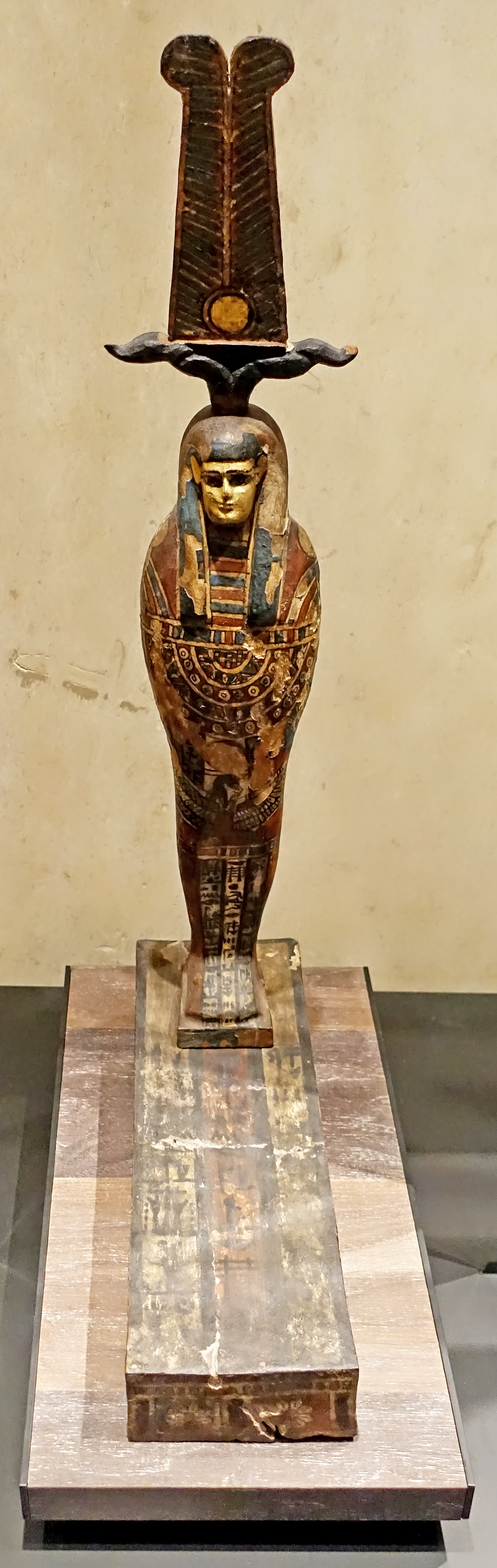
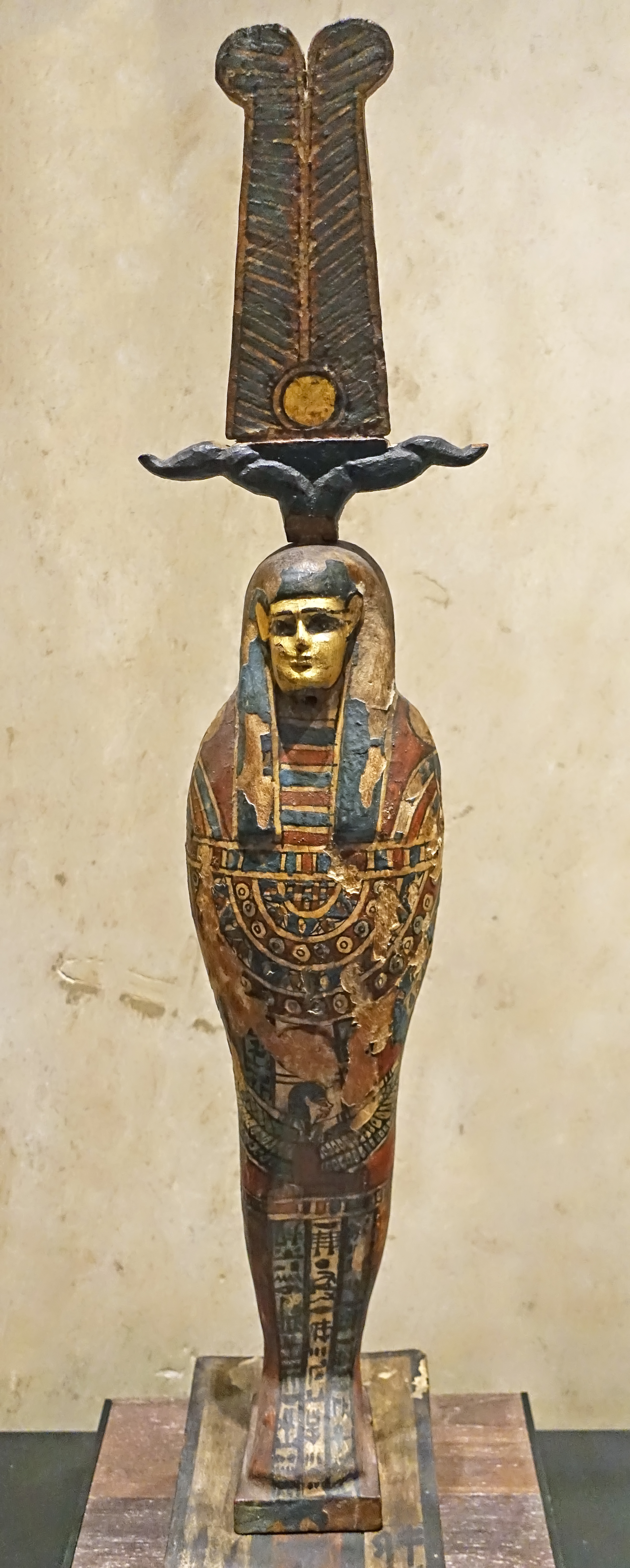
27th Dynasty - Macedonian 525 BC - 305 BC
Ptah-Sokar-Osiris
Ptah-Sokar-Osiris, protector of the deceased, with an offering formula.
Late Period, 5th - 4th Century BC.
Catalog: wood, ÄS 19
Photo: Don Hitchcock 2018
Source: Original, Ägyptischen Museum München
Text: Museum card, © Ägyptischen Museum München
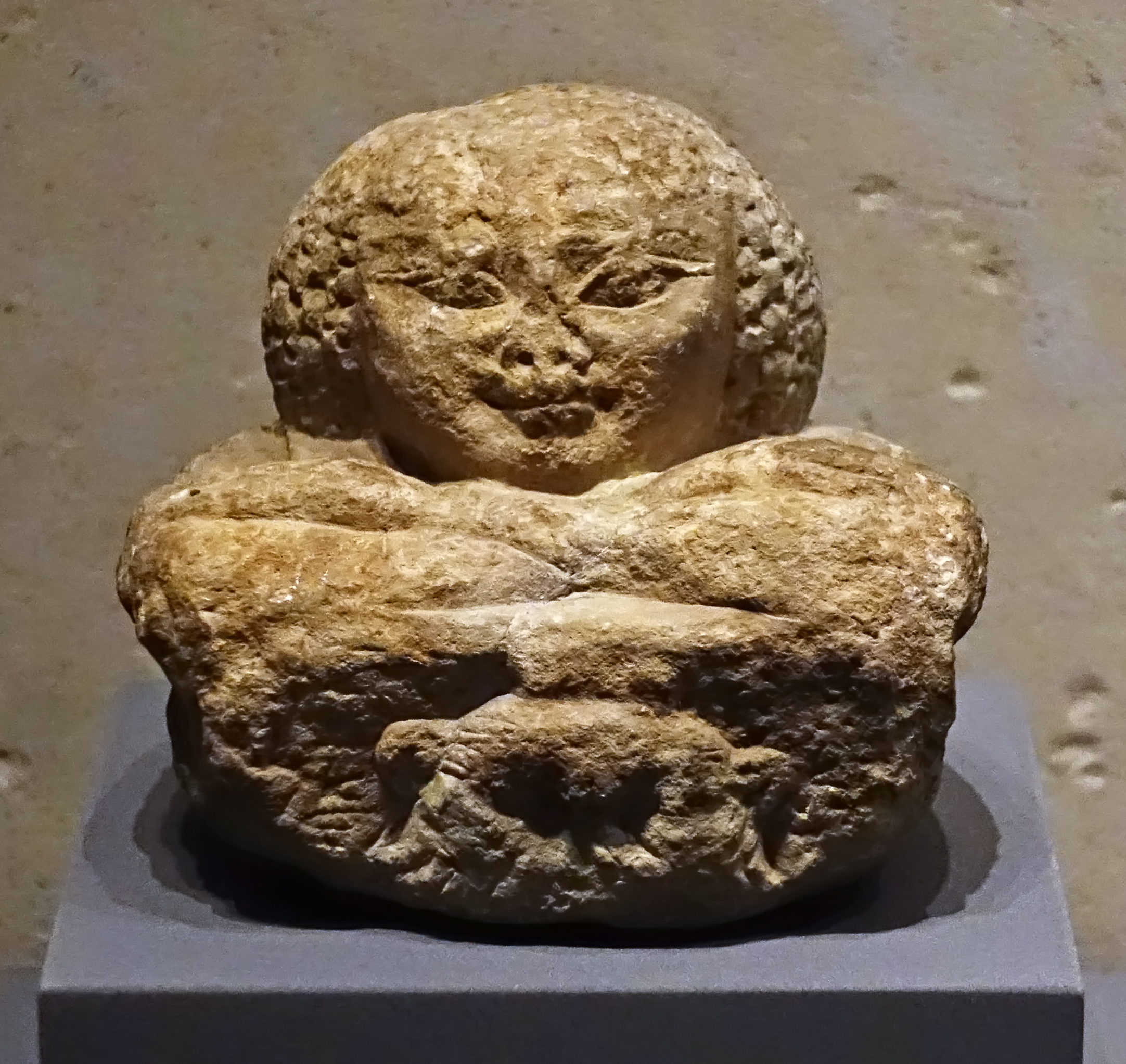
27th Dynasty - Macedonian 525 BC - 305 BC
Healer statue
Upper half of a healer statue bearing a magical text. Late period, 4th century BC.
Catalog: Limestone, ÄS 7262
Photo: Don Hitchcock 2018
Source: Original, Ägyptischen Museum München
Text: Museum card, © Ägyptischen Museum München
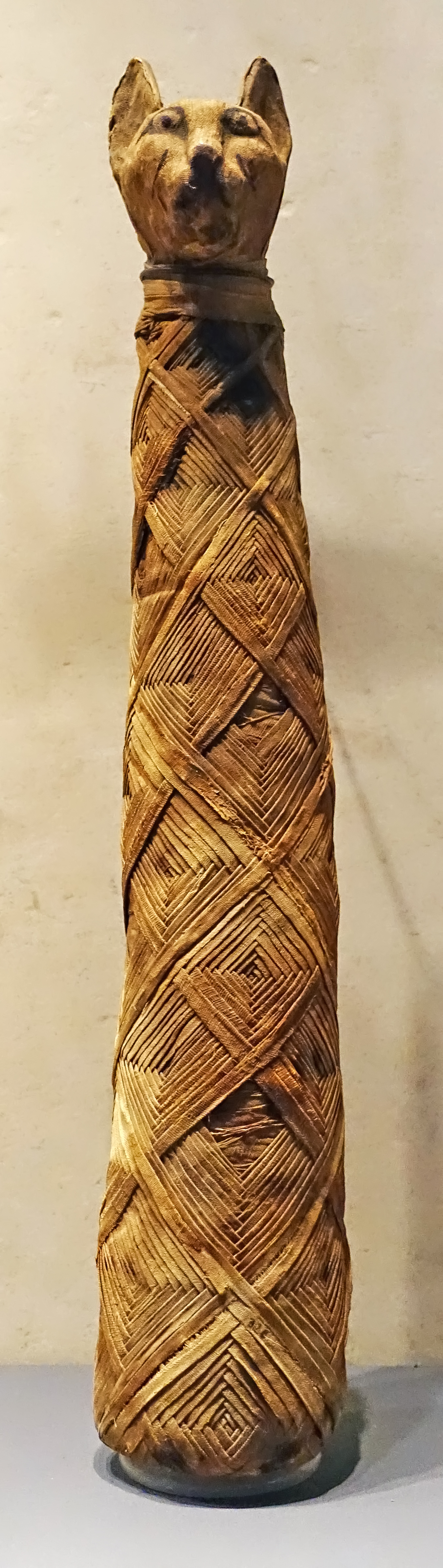
27th Dynasty - Macedonian 525 BC - 305 BC
Cat mummy
Cat mummy with painted face.
Catalog: Organic, linen, ÄS 321
Photo: Don Hitchcock 2018
Source: Original, Ägyptischen Museum München
Text: Museum card, © Ägyptischen Museum München
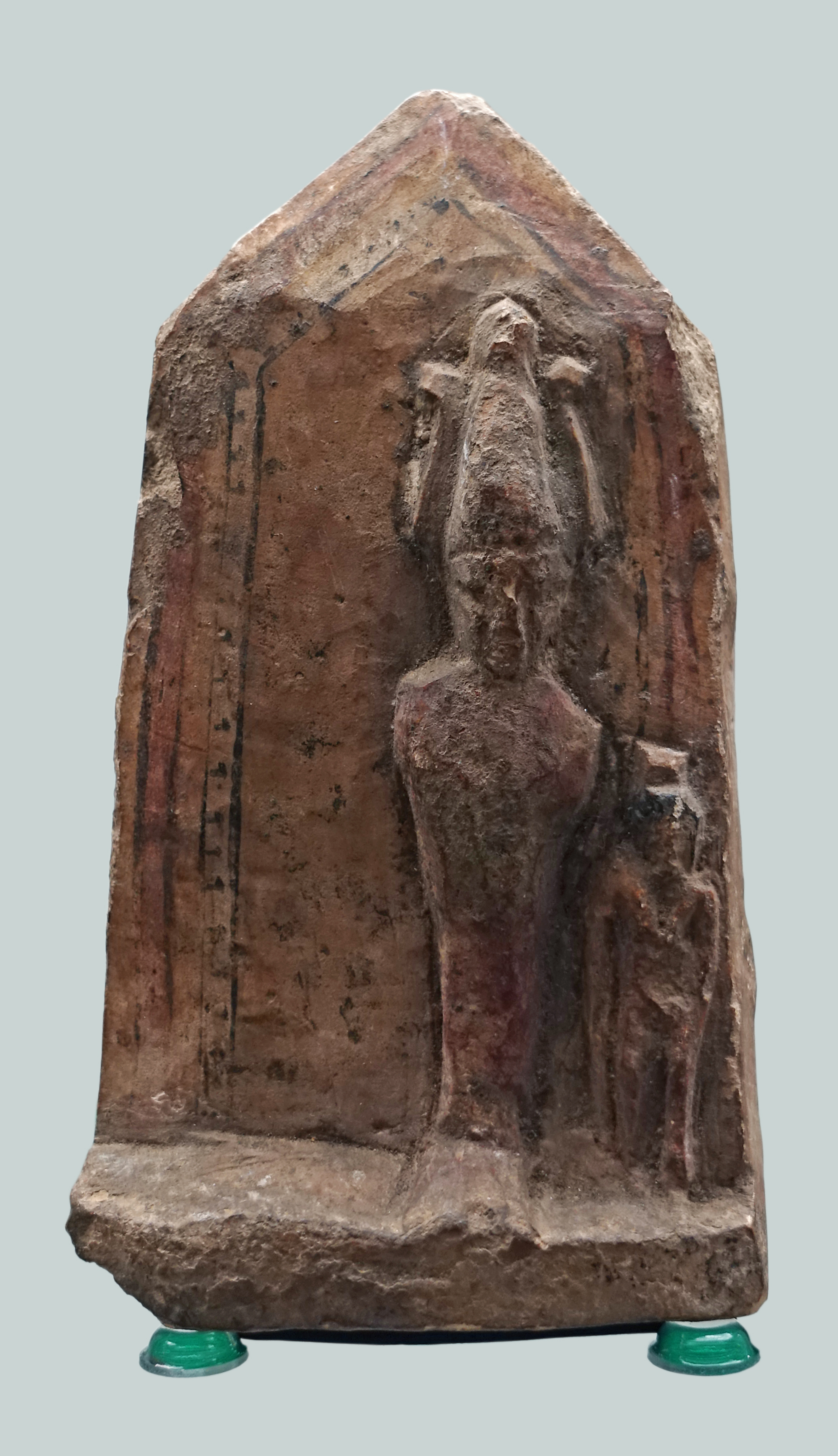
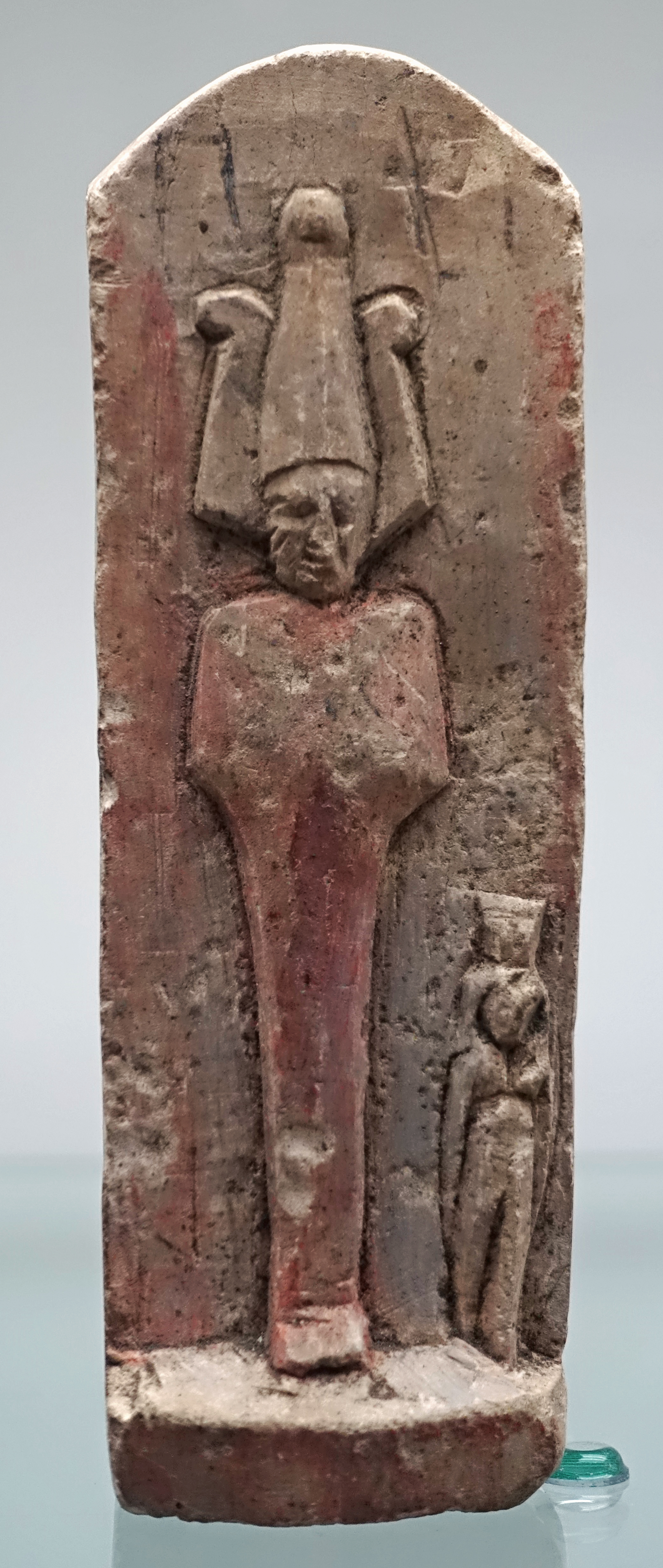
27th Dynasty - Ptolemaic 525 BC - 100 BC
Osiris and Isis
Egypt, Late Period to Ptolemaic Period, circa 500 BC - 200 BC.
The hollowed out backs of these painted limestone boxes were once filled with black Nile mud, symbolising the god Osiris and his return from the dead.
After Osiris is murdered by Set, goddesses find and restore Osiris's body with the help of other deities, including Thoth, a deity credited with great magical and healing powers, and Anubis, the god of embalming and funerary rites. Osiris becomes the first mummy, and the gods' efforts to restore his body are the mythological basis for Egyptian embalming practices, which sought to prevent and reverse the decay that follows death. This part of the story is often extended with episodes in which Set or his followers try to damage the corpse, and Isis and her allies must protect it. Once Osiris is made whole, Isis conceives his son and rightful heir, Horus.
Photo: Don Hitchcock 2018
Source and text: Original, Museum August Kestner, Hannover
Additional text: Wikipedia
The 28th Dynasty: 404 BC - 398 BC
The Twenty-eighth Dynasty of Egypt is usually classified as the third dynasty of the Ancient Egyptian Late Period. The 28th Dynasty lasted from 404 BC to 398 BC and it includes only one Pharaoh, Amyrtaeus (Amenirdis), also known as Psammetichus V.
| 28th Dynasty | ||||
|---|---|---|---|---|
| Name | Horus (Throne) Name | Years | Dates | Comments |
| Amyrtaeus (Amenirdis), also known as Psammetichus V |
6 | 404 BC - 398 BC | Amyrtaeus was probably the grandson of the Amyrtaeus of Sais, who is known to have carried on a rebellion in 465–463 BC with the Libyan chief, Inarus (himself a grandson of Psamtik III), against the satrap Achaemenes of Egypt. |
|
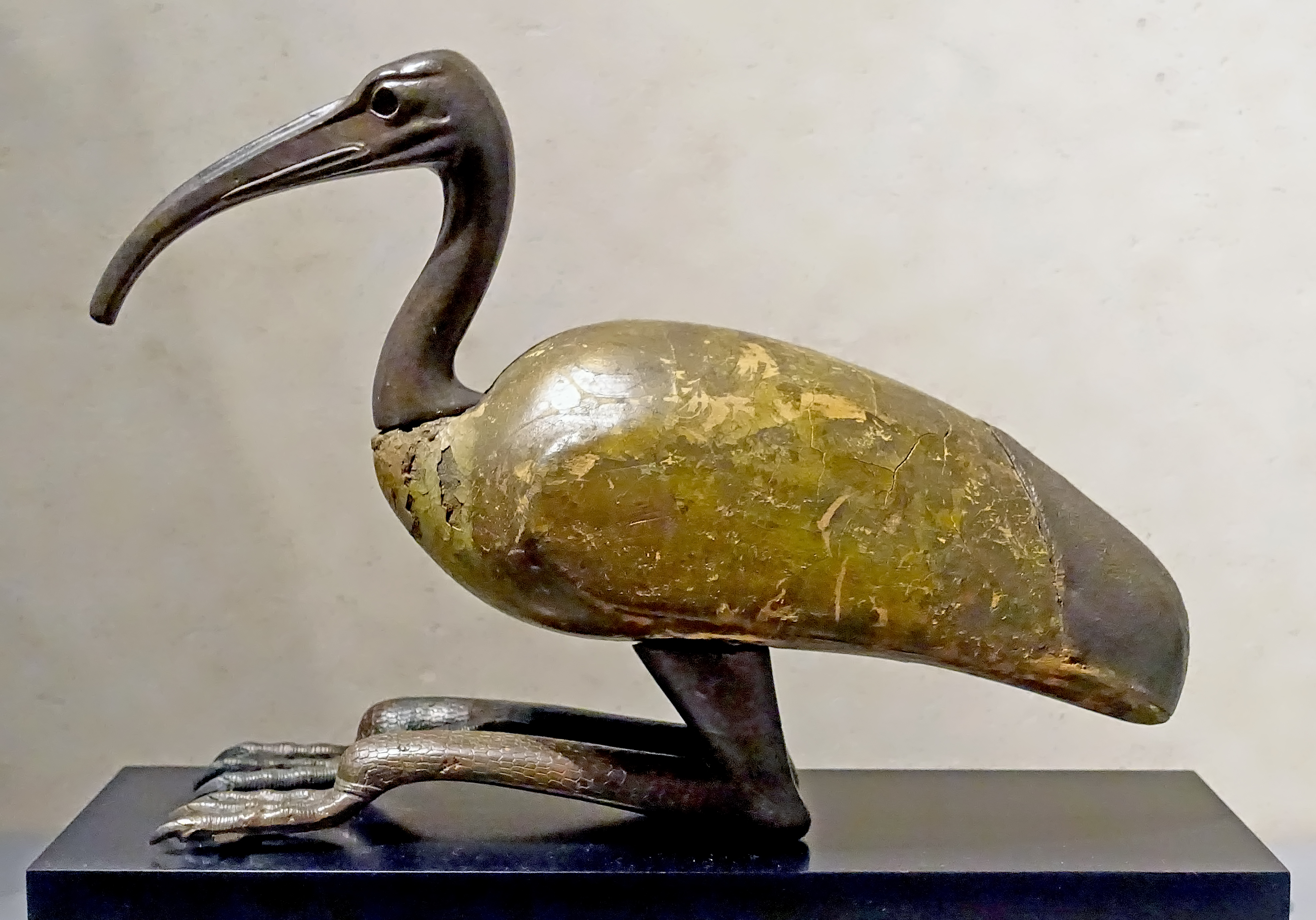
28th - 31st Dynasty: 404 BC - 332 BC
Ibis
Figure of a crouching ibis, a manifestation of Thoth, the god of scribes.
Catalog: Wood, bronze, ÄS 5347
Photo: Don Hitchcock 2018
Source: Original, Ägyptischen Museum München
Text: Museum card, © Ägyptischen Museum München
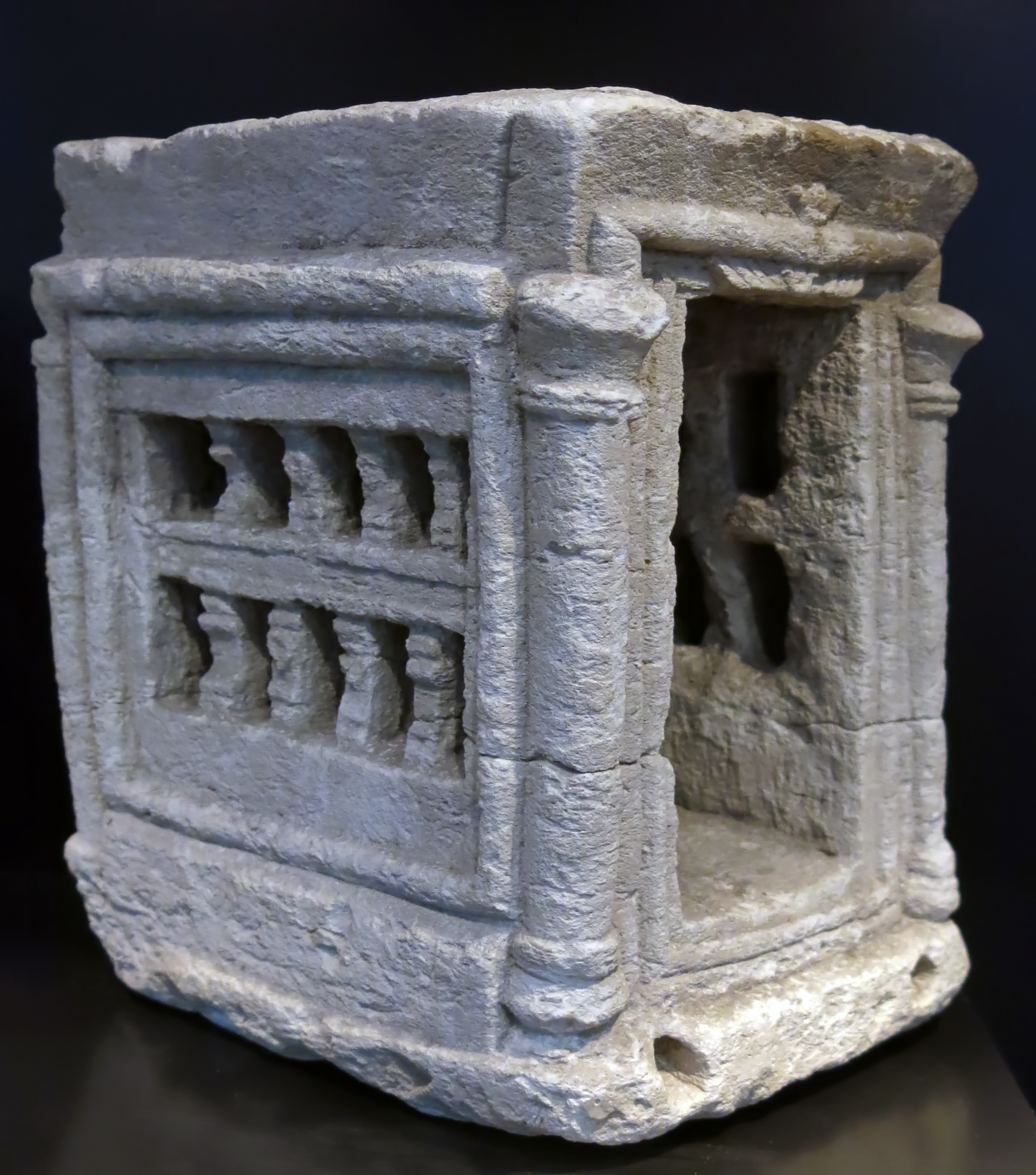
28th - Ptolemaic Dynasty: 404 BC - 30 BC
Model of a shrine
Model of a cult shrine. Such 'naiskoi' served as lamps in the house or grave. During processions, small god figures could be carried in them.
Circa 5th - 1st century BC.
Catalog: Limestone, Inv. H 1043
Photo: Don Hitchcock 2015
Source and text: Badisches Landesmuseum Karlsruhe Germany
The 29th Dynasty: 398 BC - 380 BC
The Twenty-ninth Dynasty of Egypt is usually classified as the fourth Dynasty of the Ancient Egyptian Late Period. It was founded after the overthrow of Amyrtaeus, the last Pharaoh of the 28th Dynasty, by Nefaarud I in 398 BC, and disestablished upon the overthrow of Nefaarud II in 380 BC.
| 29th Dynasty | ||||
|---|---|---|---|---|
| Name | Years | Dates | Comments | |
| Nefaarud I /Nepherites I |
5 | 398 BC - 393 BC | Defeated Amyrtaeus in open battle and had him executed. | |
| Psammuthes | 1 | 393 BC | Reigned for only a year. Overthrown by Hakor. | |
| Hakor (Achoris) | 13 | 393 BC - 380 BC | Overthrew his predecessor Psammuthes. Father of Nefaarud II. | |
| Nefaarud II | < 1 | 380 BC | Was deposed and probably killed by Nectanebo I after ruling for only 4 months. | |
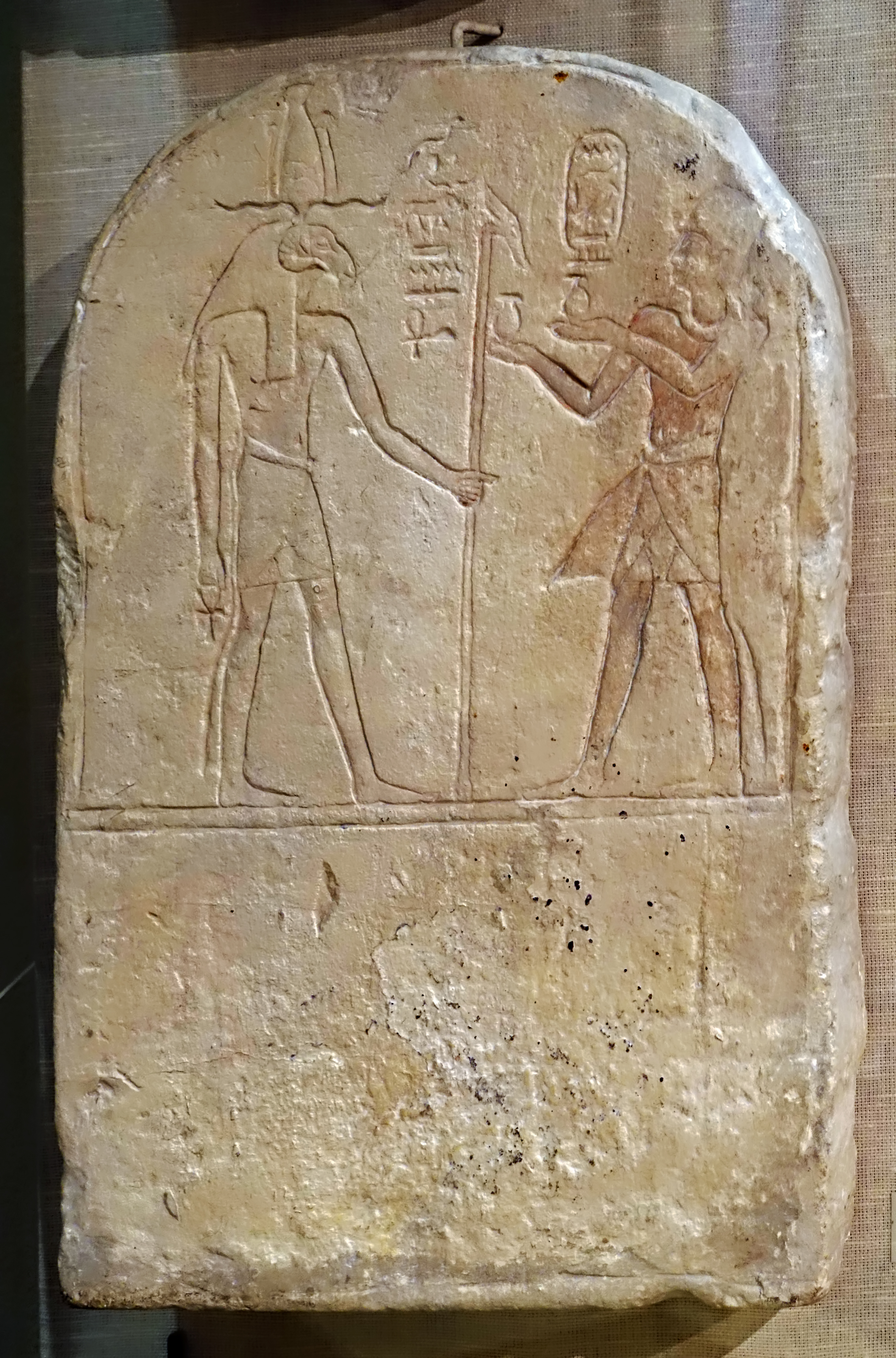
29th Dynasty: 398 BC - 380 BC
Pharaoh Nepherites I
Pharaoh Nepherites I before the ram god Khnum, 398 BC - 393 BC
It is believed that Nepherites was a general from the deltaic city of Mendes who, in the autumn of 399 BC, rose against pharaoh Amyrtaeus, defeated him in open battle, and then executed him at Memphis. Nepherites then crowned himself pharaoh at Memphis and possibly also at Sais, before shifting the capital from Sais to his hometown Mendes. The fact that Nepherites I chose the same Horus name of Psamtik I and the Golden Horus name of Amasis II – both relevant rulers of the earlier 26th Dynasty - is thought to demonstrate that he wanted to associate his rule with an earlier 'golden age' of Egyptian history.
Evidence of Nepherites' building work has been found in a number of locations across the country. In Lower Egypt, he is attested at Thmuis, Tell Roba, Buto (where a statue of him has been found), Memphis, Saqqara (where an Apis burial took place in his regnal year 2) and his capital and hometown Mendes. In Middle and Upper Egypt, he ordered a chapel at Akoris while at Akhmim, near Sohag, there is evidence of the worship of a statue of him which was placed inside a naos (shrine). He also added some buildings at Karnak such as a storeroom and a shrine meant to house a sacred bark. A basalt sphinx with his name is now located in the Louvre, but it was known to have been brought to Europe as early as the 16th century, having adorned a fountain at the Villa Borghese gardens, Rome.
In foreign affairs, he resumed the policy of Egyptian intervention in the Middle East. As reported by Diodorus Siculus, in 396 BC he supported the Spartan king Agesilaus in his war against the Persians; the Spartans had conquered Cyprus and Rhodes and were attempting to extend their influence further east. Nepherites supplied the Spartans with 500 000 measures of grain and material for 100 triremes. However, the cargo reached Rhodes just after the Persians managed to retake the island, so it was entirely seized by the philo-Persian admiral Conon of Athens.
Catalog: Limestone, Origin unknown, Inv. Nr. 1935.200.693
Photo: Don Hitchcock 2018
Source and text: Original, Museum August Kestner, Hannover
Additional text: Wikipedia
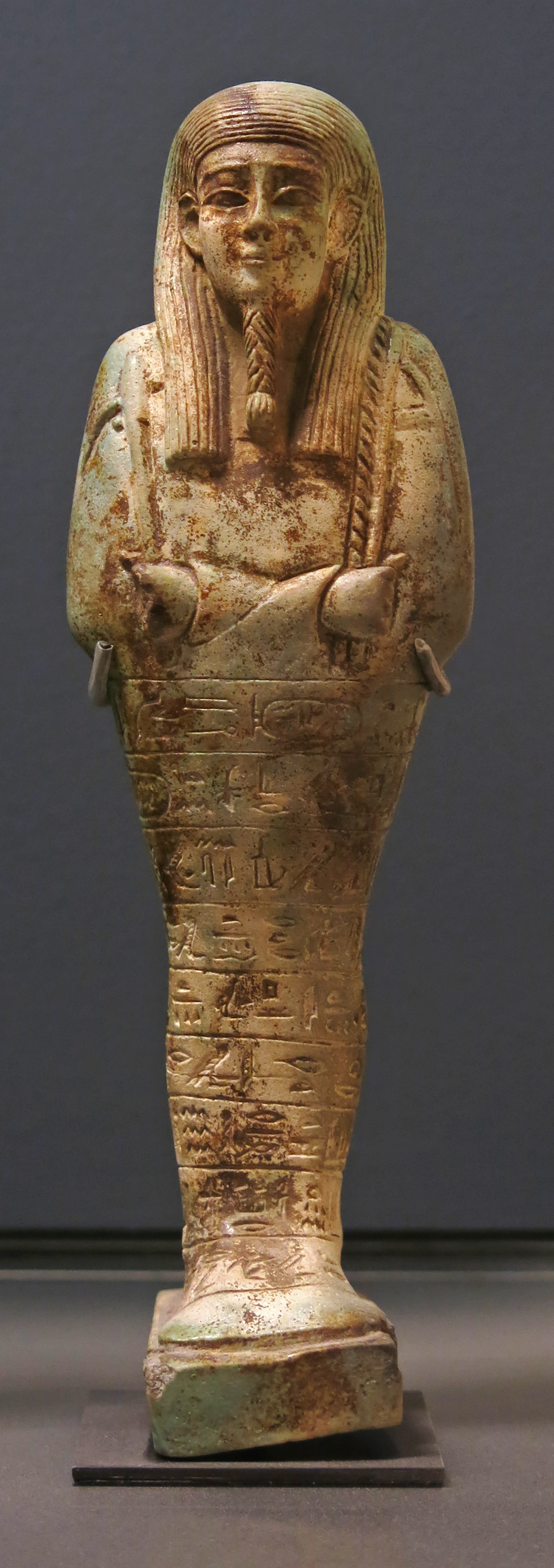
29th Dynasty: 398 BC - 380 BC
Mummiform funerary servant of Nepherites I (Nepherites I Baenre-Merinetjeru)
398 BC - 393 BC
Height 192 mm, width 59 mm, thickness 43 mm.
The funerary servant holds a basket, hoe, and bag, has crossed arms and a curled false beard, tripartite wig, and wears a shroud.
Catalog: Faience, light green in colour, Aile Sully, Salle 323, Crypte d'Osiris, Vitrine 3, E 5339
Photo: Don Hitchcock 2015
Source and text: Original, Louvre Museum, Paris, France, https://collections.louvre.fr/
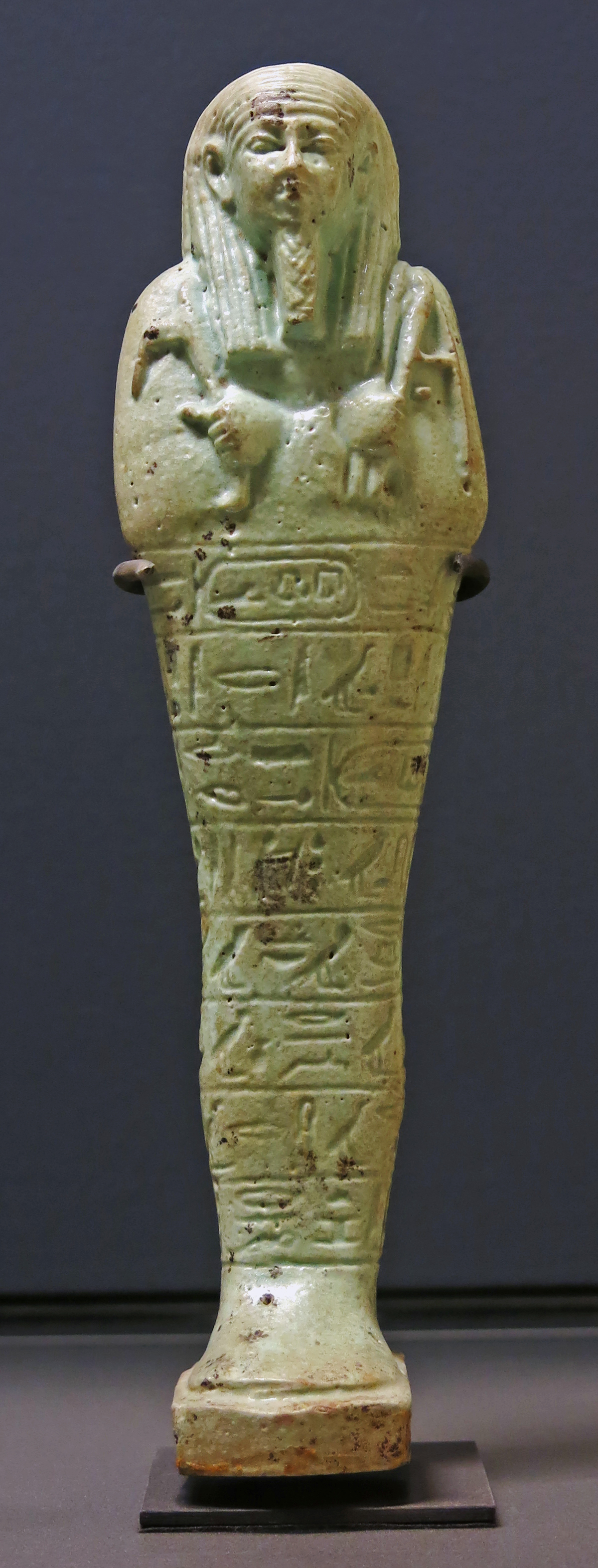
29th Dynasty: 398 BC - 380 BC
Mummiform funerary servant of Hakor
Hakor or Hagar, 393 BC - 380 BC, also known by the hellenized forms Achoris or Hakoris, was an ancient Egyptian pharaoh of the 29th Dynasty. His reign marks the apex of this feeble and short-lived dynasty, having ruled for 13 years – more than half of its entire duration.
Height 192 mm, width 51 mm, thickness 40 mm.
The funerary servant holds a basket, hoe, and bag, has crossed arms and a false beard, tripartite wig, and wears a shroud.
Catalog: Faience, light green in colour, Aile Sully, Salle 323, Crypte d'Osiris, Vitrine 3, E 17408
Photo: Don Hitchcock 2015
Source and text: Original, Louvre Museum, Paris, France, https://collections.louvre.fr/
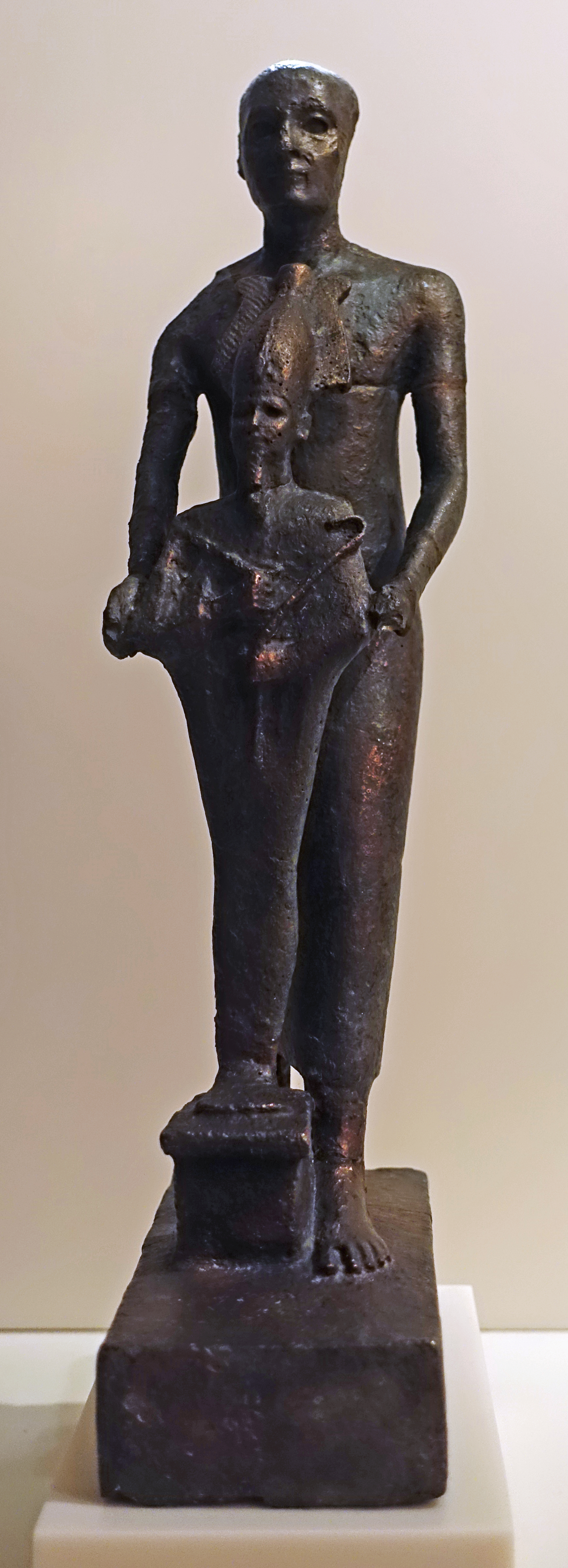
29th Dynasty: 398 BC - 380 BC
Priest
Priest holding a figure of the mummy-shaped god Osiris in front of him.
Dimensions: 275 x 75 x 135 mm.
This group of figures shows a large figure whose eyes are inlaid, assumed to be a priest because he is bald. He holds up a mummy-shaped figure of the god Osiris.
The inscription incised on the left edge of the base is not legible.
(Text by J. Helmbold-Doyé)
Catalog: Bronze, Tell el-Moqdam / Leontopolis, ÄM 9258
Source: Original, Staatliche Museen zu Berlin, Neues Museum, Germany
Text: © Card at the Staatliche Museen zu Berlin, http://www.smb-digital.de/, (CC BY-NC-SA 3.0 DE)
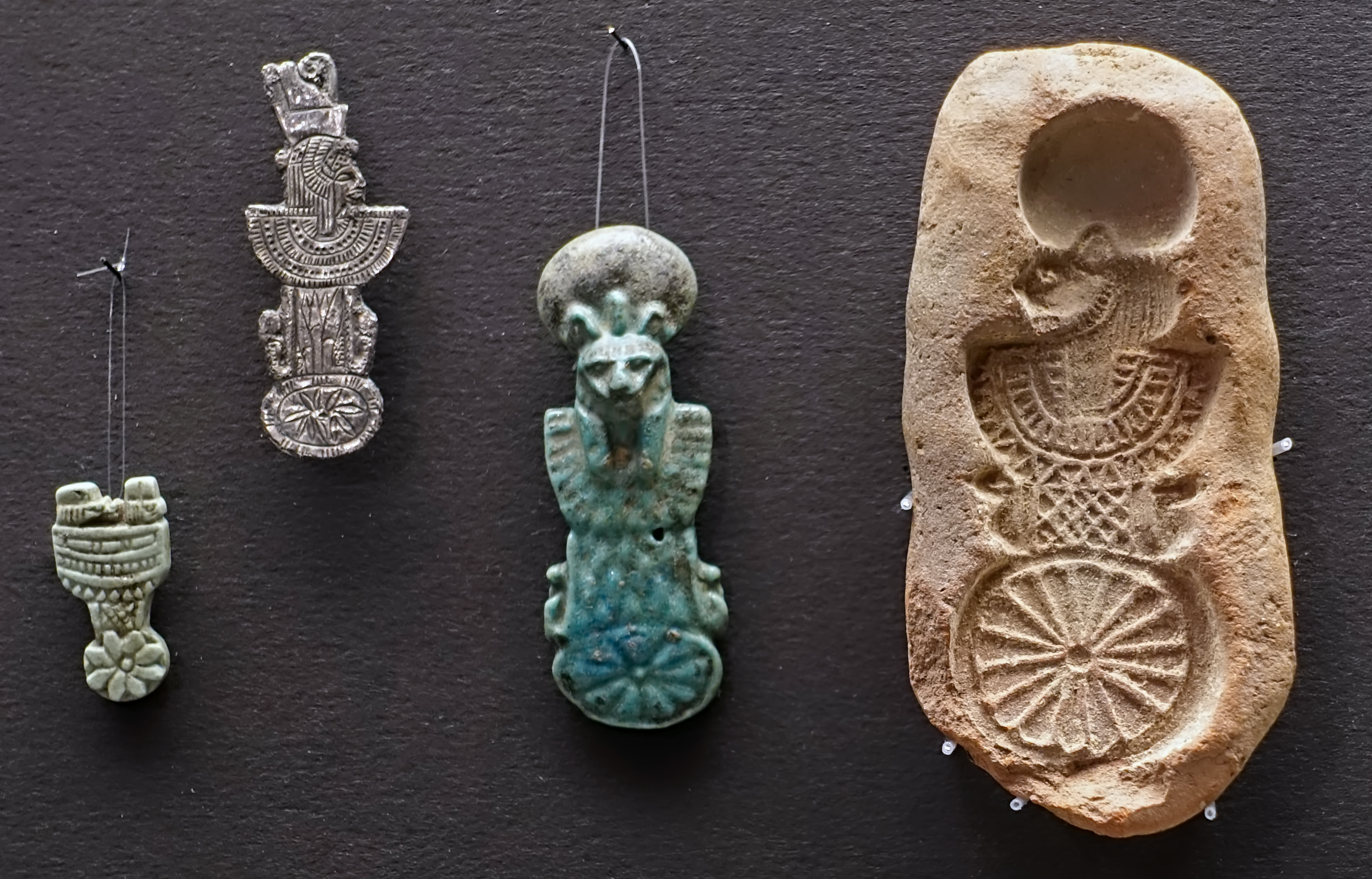
Menits
( Menits were counter balances hung on the wearer's back, to equalise the weight of a beaded necklace worn around the neck at the front. They were a symbol of divine protection - Don )
(left) Menit of Faience, probably from Lower Egypt.
Late period, perhaps 4th century BC.
Catalog: Inv. No. 2867
_______________
(left centre) Menit of silver, or electrum (a naturally occurring alloy of gold and silver), origin unknown.
Perhaps 3rd interim period, around 800 BC.
Height 41 mm, width 17 mm.
Given its very small dimensions and light weight, this example can only have been attached to a light, thin chain. The patron goddess is the wife of Amun, Mut von Asheru, with the double crown and the vulture hood in profile view and - according to the Egyptian canon - the large neck collar en face. Two urea hang down from it, flanking a lotus flower. The oval is designed as a rosette, the eyelet for hanging is soldered on the back of this piece.
Catalog: Inv. No. 1951.189
_______________
(right centre) Model of a faience 'menit', origin unknown from the New Kingdom, Late Period
Height 51 mm, width 18 mm.
The lion face may be identified as either Sekhmet or Bastet. Since there is no hanging device such as a hook or eyelet, the object has probably been used as an amulet since it is not practical for actual use as a menit. It may have served as part of grave goods.
Catalog: Inv. No. 2700
_______________
(right) This appears to be a mould for the casting of a menit using faience. It was undocumented at the museum and was not in the paper catalog provided at the museum. It has a lion face viewed from the side, and the piece has a sun headdress, a large neck collar, what may be urea on each side of the body, and a lotus flower at the base.
_______________
Photo: Don Hitchcock 2018
Source and text: Original, Museum August Kestner, Hannover
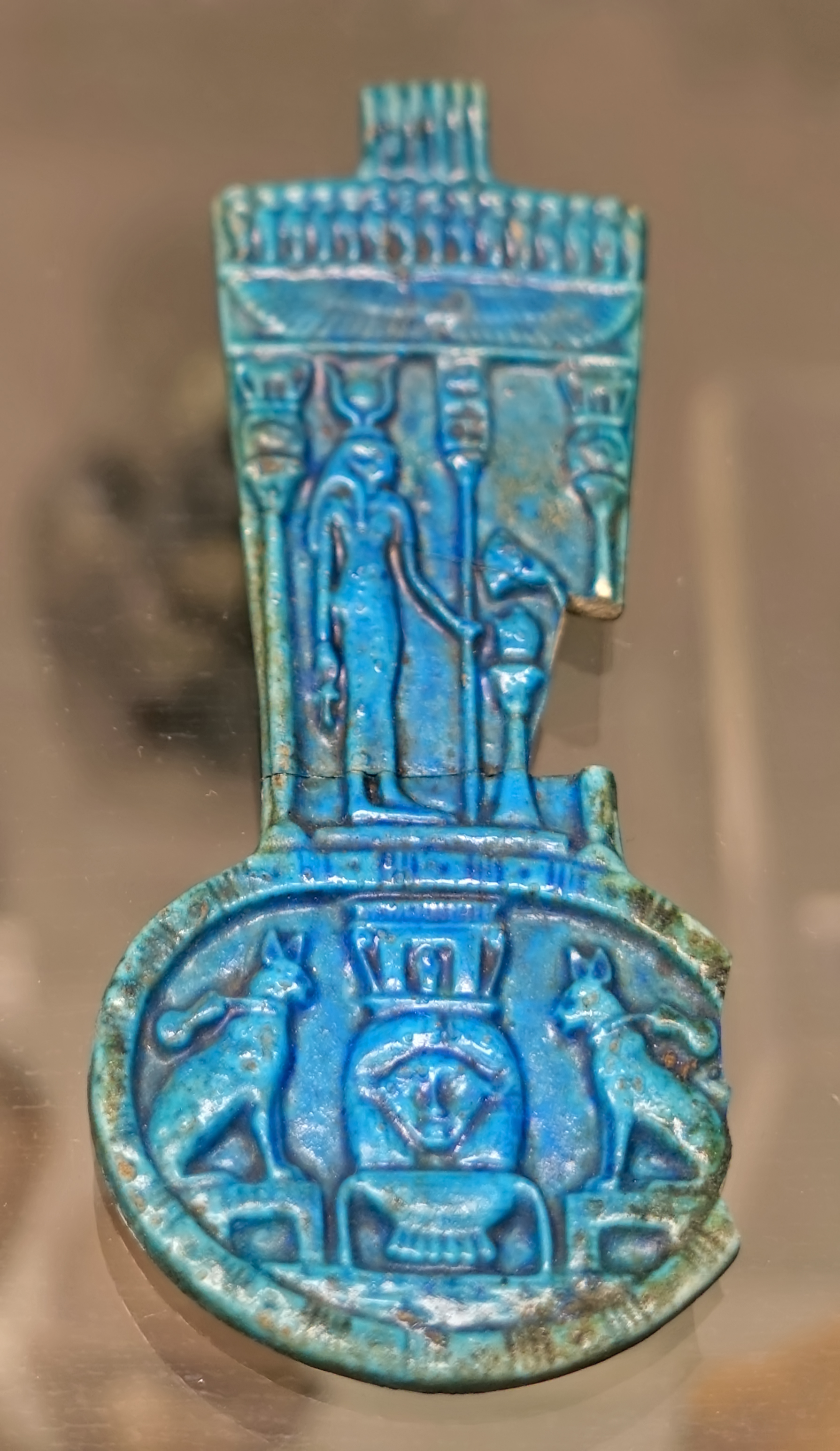
29th - 31st Dynasty: 398 BC - 332 BC
Menit
Faience, height 102 mm, width 50 mm.
Place of discovery unknown, probably Lower Egypt, Late period, perhaps 4th century BC.
The necklaces and collars of both men and women, usually composed of several rows of beads and therefore rather heavy, had a counterweight at the neck clasp, which was called a 'menit' in Egyptian (but is also documented as the name of the entire necklace) and was intended to keep the beads in a semicircular order or to prevent unsightly sagging downwards. The flat-oval lower part carries an attachment on which the loop for stringing is located and which can be designed in different ways.
In this example, it consists of a slightly conical rectangle. Both parts are decorated with flat plastic figures from the multifaceted theme of Hathor, the goddess of love.
The upper section imitates a shrine. The roof section is formed by the uraea frieze and the winged sun disk; the slender columns have composite capitals made of papyrus umbels and Hathor's head with a naos (religious shrine) on top.
The goddess in front of the sacrificial stand with water jug and lotus flower wears the cow's horns with sun disk on her head and holds the papyrus sceptre.
Above this her name is inscribed with the addition 'Mistress of Hepet', probably a place near Heliopolis, which may indicate the object's origin in Lower Egypt. The almost completely faded inscription on the reverse repeats this geographical addition and names a priest of unclear name as the owner of the menit.
In the oval the head of Hathor appears once again, on the sign for 'gold' and flanked by two cats, which in turn each carry a menit and at the same time underline Hathor's connection with the cat-headed goddess of protection and fertility, Bastet.
Catalog: Faience, place of discovery unknown, Inv. no. 2867
Photo: Don Hitchcock 2018
Source and text: Original, Museum August Kestner, Hannover
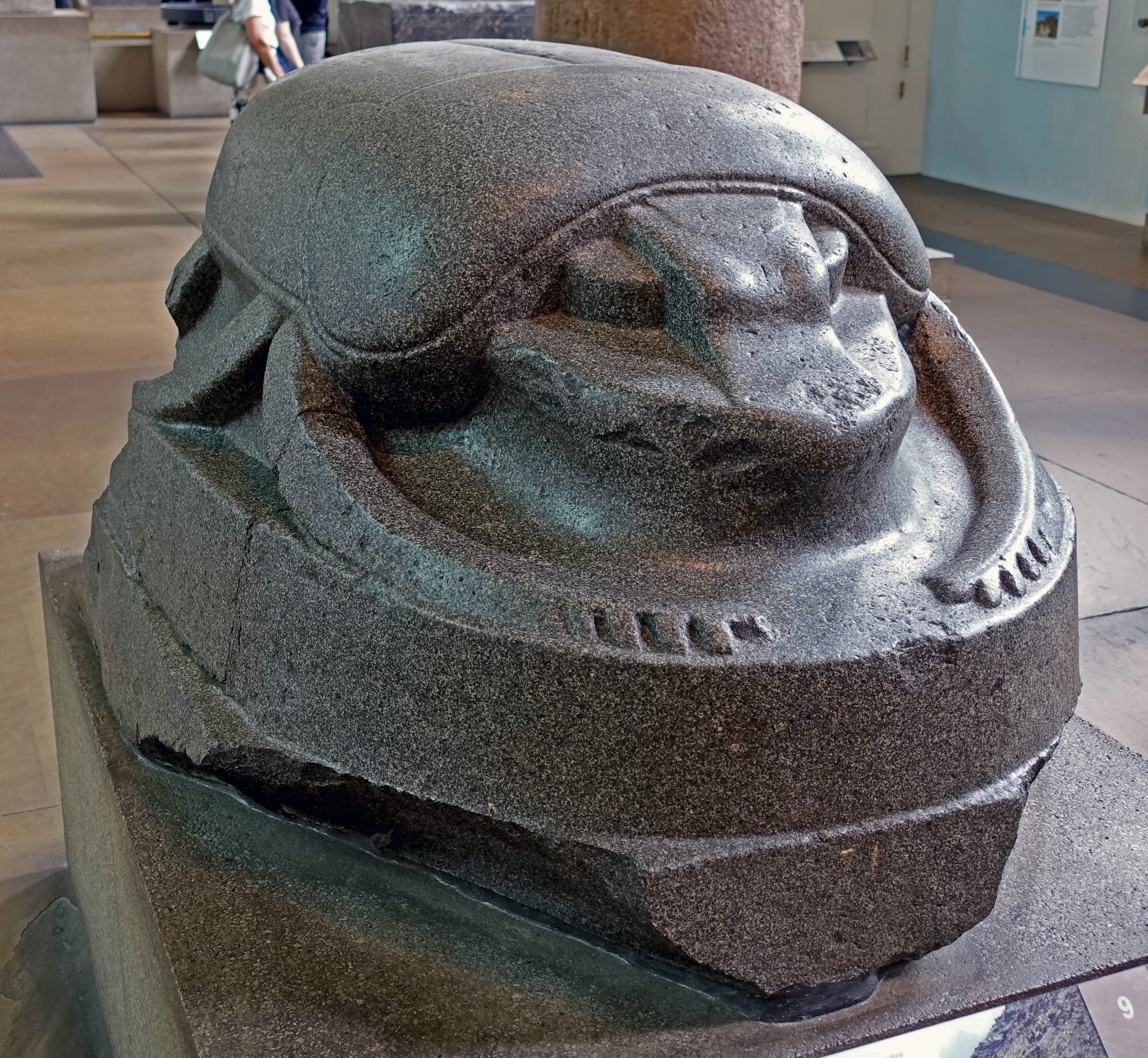
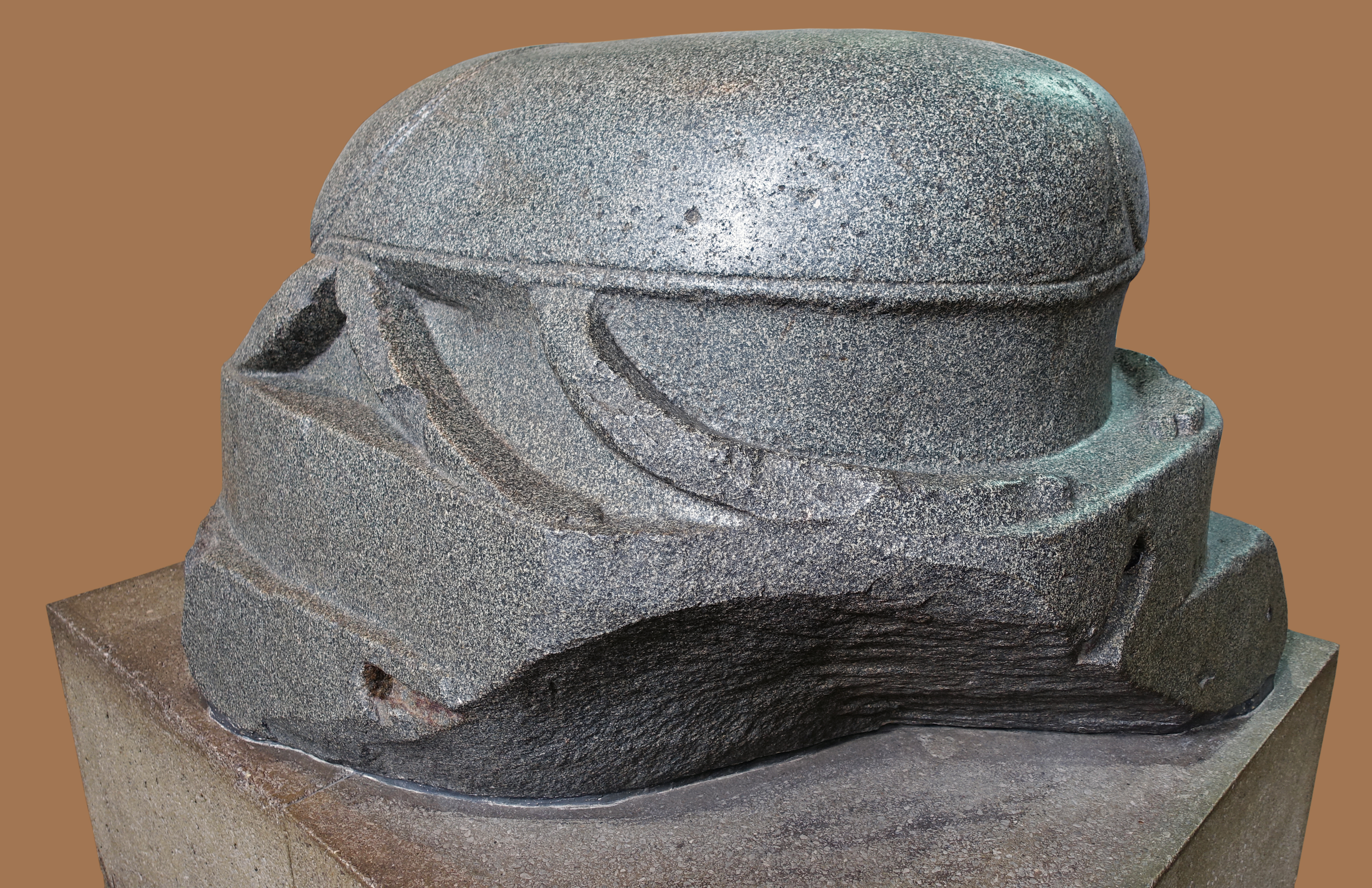
29th - 31st Dynasty: 398 BC - 332 BC
Monumental diorite scarab beetle, probably representing Khepri.
Production date circa 4th century BC.
Height 891 mm, length 1535 mm, width 117 cm, weight 2320.50 kg
Findspot: Istanbul (city)
Catalog: Diorite EA74
Photo: Don Hitchcock 2018
Source: Original, British Museum
Text: Card at museum display, http://www.britishmuseum.org/, © Trustees of the British Museum, CC BY-NC-SA 4.0
The 30th Dynasty: 380 BC - 343 BC
The Thirtieth Dynasty of Egypt is usually classified as the fifth Dynasty of the Ancient Egyptian Late Period. It was founded after the overthrow of Nefaarud II in 380 BC by Nectanebo I, and ended with the invasion of Egypt by the King of Persia, Artaxerxes III in 343 BC.
| 30th Dynasty | ||||
|---|---|---|---|---|
| Name | Horus (Throne) Name | Years | Dates | Comments |
| Nectanebo I | Kheperkare | 18 | 380 BC - 362 BC | Deposed and probably killed Nefaarud II, Father of Teos. |
| Teos / Djedhor | Irmaatenre | 2 | 362 BC - 360 BC | Co-regent with his father Nectanebo I from about 365 BC. Was overthrown by Nectanebo II. |
| Nectanebo II | Senedjemibra Setenpeninhur |
17 | 360 BC - 343 BC | Last native ruler of ancient Egypt. |
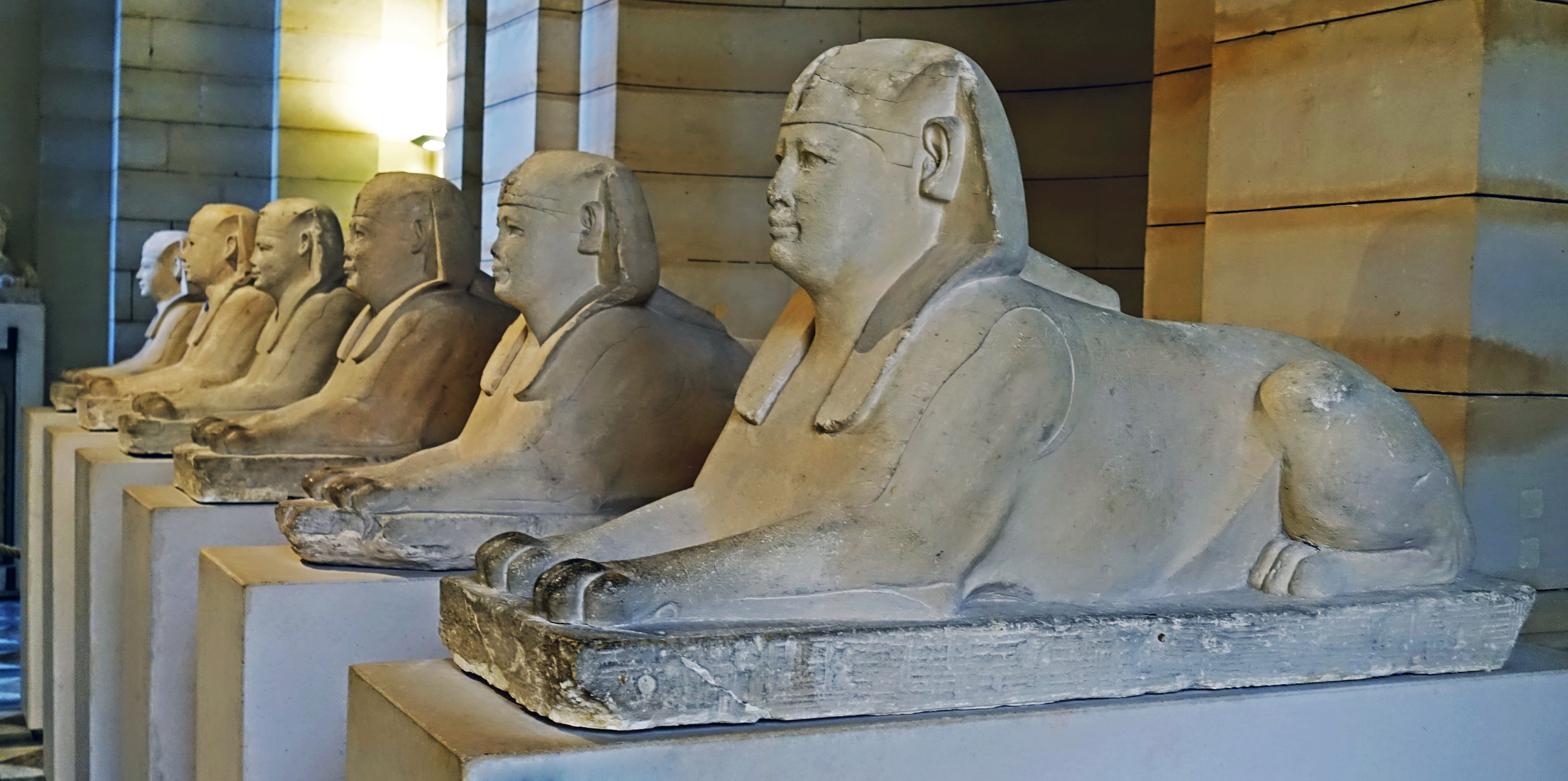
30th Dynasty: 380 BC - 343 BC
Nectanebo I
Reign: 380 BC - 362 BC
Six of the sphinxes that lined the path leading to the Serapeum of Saqqara, thought to be of Nectanebo I, who was the founder of the last native dynasty of Egypt, the 30th.
For the sphinx N391C: Height 665 mm, width 392 mm, length 1290 mm.
Findspot: The Avenue of Sphinxes, Serapeum of Memphis, Saqqara North, Saqqara
Catalog: Limestone, N391
Photo: Don Hitchcock 2018
Source and text: Original, Louvre Museum, Paris, France, https://collections.louvre.fr/
Additional text: Wikipedia
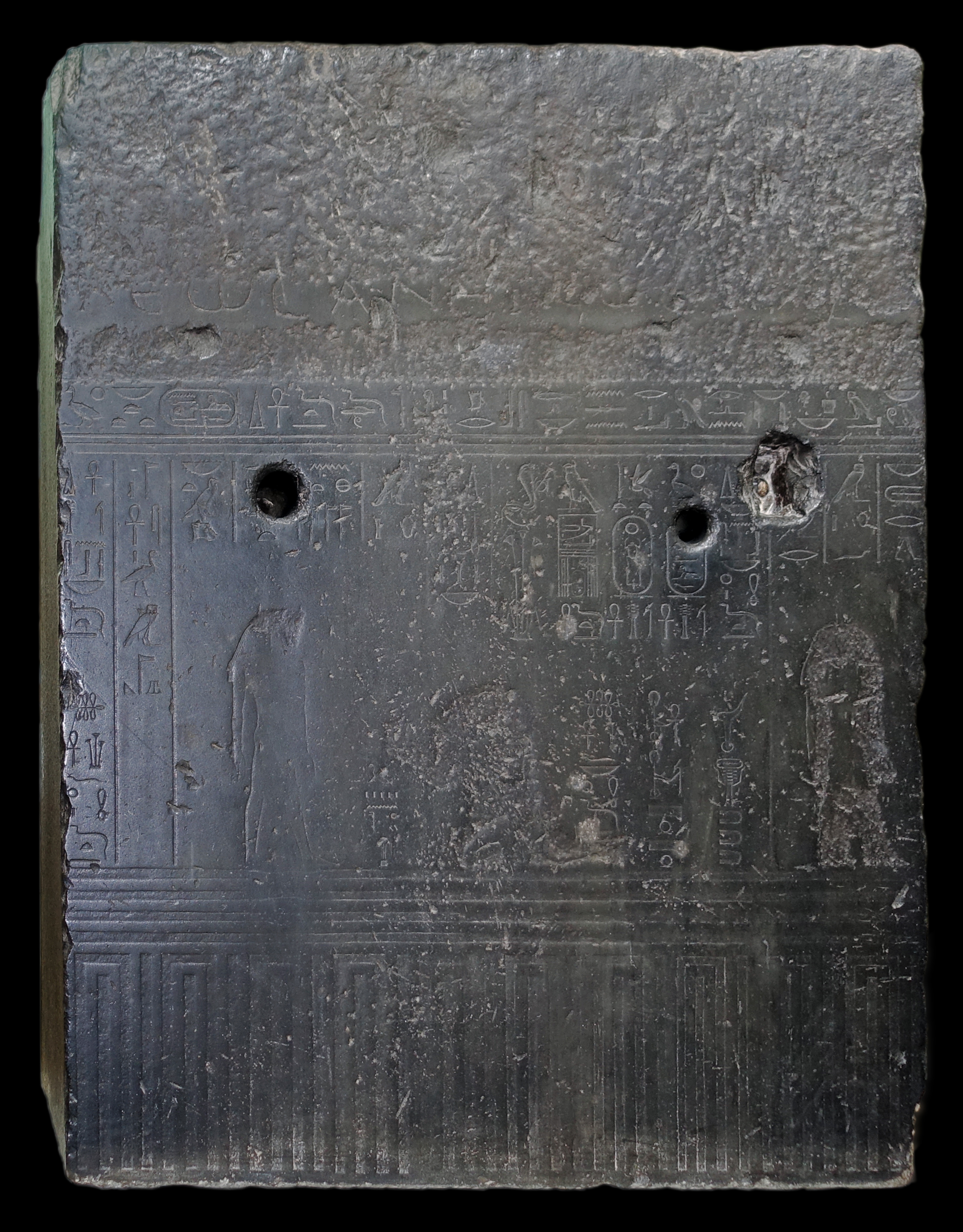

30th Dynasty: 380 BC - 343 BC
Nectanebo I
Reign: 380 BC - 362 BC
Produced circa 370 BC
Rectangular section of black siltstone architecture of Nectanebo I. Decorated on both sides in sunk relief with offering scenes above a niche patterned dado and crowned by a cavetto cornice. Atop the cornice, on the better preserved side of this slab, a row of falcons faced forward. Only the legs and feet have survived.
The corresponding decoration on the other side has been lost, but it probably consisted of a row of erect cobras. The more damaged side was decorated with an offering scene and part of another one. To the left, an animal headed god stands facing right. The king kneels before him in a semi prostrate position, with one leg extended back. At the right is another standing god from a second, similar scene. The inscriptions name the king as Nectanebo I.
The damage inflicted on this side is of several kinds and may have occurred several times during antiquity. The figures have been attacked with a chisel, though the inscriptions were left intact. The protruding parts of the cornice were cut back to make a flat surface, presumably an adaptation for reuse. The better-preserved side, also inscribed for Nectanebo I, has a single figure of the king kneeling to present a tall loaf of bread. This pose, like the semi-prostrate position, was traditional for kings making offerings. The pose has been designed to show only one leg and an inadequate number of toes.
The modeling of Nectanebo's body, with the breast, rib cage, and round abdomen as discrete units, follows the style of the late Twenty-sixth Dynasty. Characteristically Thirtieth Dynasty, however, is the representation of the hands with their long, waving fingers. The most noteworthy feature of this figure is its head - crowned only with a very unusual tight-fitting cap and a uraeus.
The face is striking, both beaky and jowly, with the eye set in a large, round socket. A small, rather delicate nostril and lips are shown, and there is the hint of a double chin. It is understandable that this face is usually considered to be a portrait likeness of Nectanebo, especially since the same features are depicted on the two other architectural slabs that bear his name and image. Two holes have been drilled in the slab.
Height 1226 mm, width 955 mm, depth 380 mm.
Curator's comments:
This architectural slab is one of five examples. Although all five slabs had been removed in antiquity from their original site, some of the inscriptions suggest that they were made for a structure in Heliopolis. Since the earlier and later examples are the same size and have identical architectural decoration, in addition to their very similar figural scenes, all were apparently part of the same structure. They are usually referred to as intercolumnar slabs - that is, low screen walls between huge columns at the entrances to late temples. But such a wall is typically a single piece of stone. On some of these slabs, scenes, such as that begun to the right on the damaged side of this slab, were carried over onto a second block. This fact lends support to the theory that they formed a long, low barrier at Heliopolis.
Catalog: Greywacke, El - Rashid, EA22
Photo: Don Hitchcock 2018
Source: Original, British Museum
Text: Card in museum, http://www.britishmuseum.org/ , © Trustees of the British Museum
The problem of the drilled holes
The problem of the drilled holes is that in both views of the slab above, the left hole is above the right. If we accept that the 'front' version is correct, then when we walk around the slab, the left hole from that perspective should be below the right.
This assumes that there are only two holes, drilled right through the slab horizontally.
One possibility is that one of the images has become reversed. If that were so, the text on the poster on the wall behind one of them should also be reversed. This is not the case.
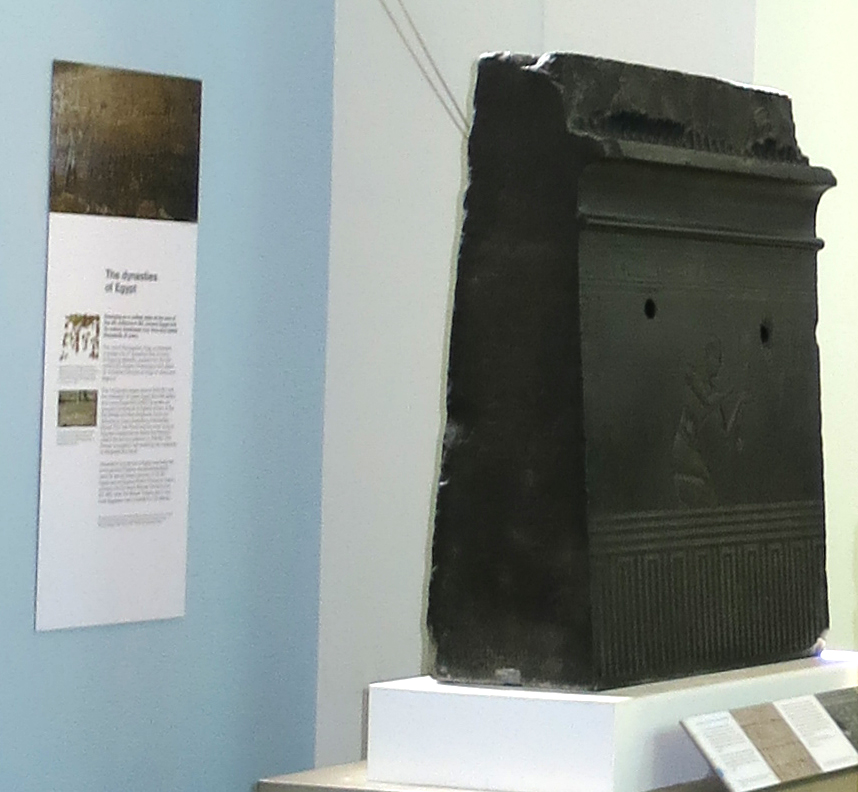
30th Dynasty: 380 BC - 343 BC
Nectanebo I
This distant image shows the 'front' of the piece above, and its general shape.
We can see that there is decipherable text on the wall, not mirrored.
And when we walk around the piece to the other side, the left hole becomes the right, and should be above the level of the other hole.
Catalog: Greywacke, El - Rashid, EA22
Photo: Don Hitchcock 2015
Source: Original, British Museum
Text: Don Hitchcock
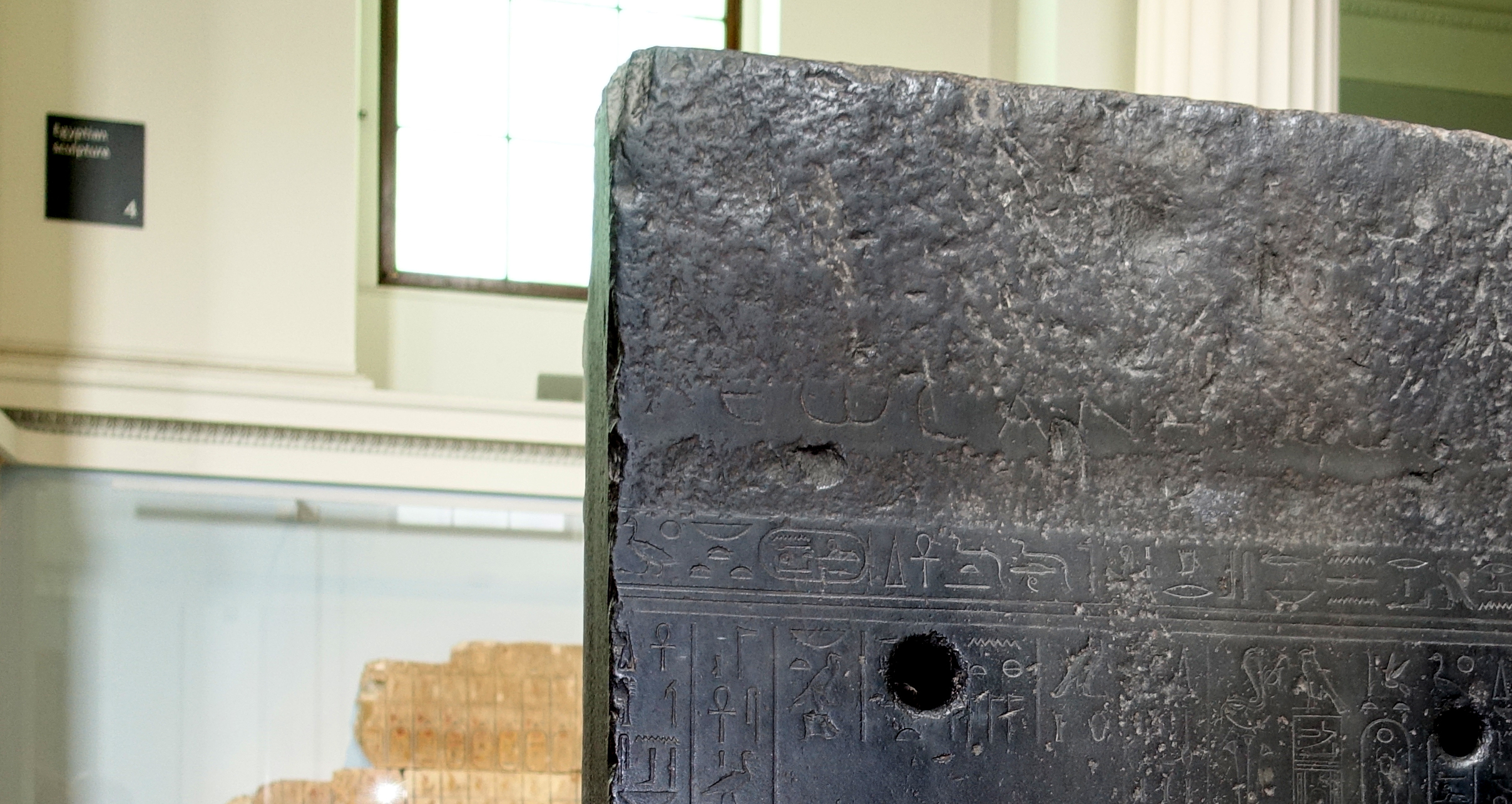
30th Dynasty: 380 BC - 343 BC
Nectanebo I
This distant image shows the 'back' of the piece above.
We can see that there is decipherable text on the wall, not mirrored, and there is a glimmer of light showing through the left hole, showing that the hole is drilled all the way through. Click on this thumbnail image to see the larger photo.
Catalog: Greywacke, El - Rashid, EA22
Photo: Don Hitchcock 2018
Source: Original, British Museum
Text: Don Hitchcock
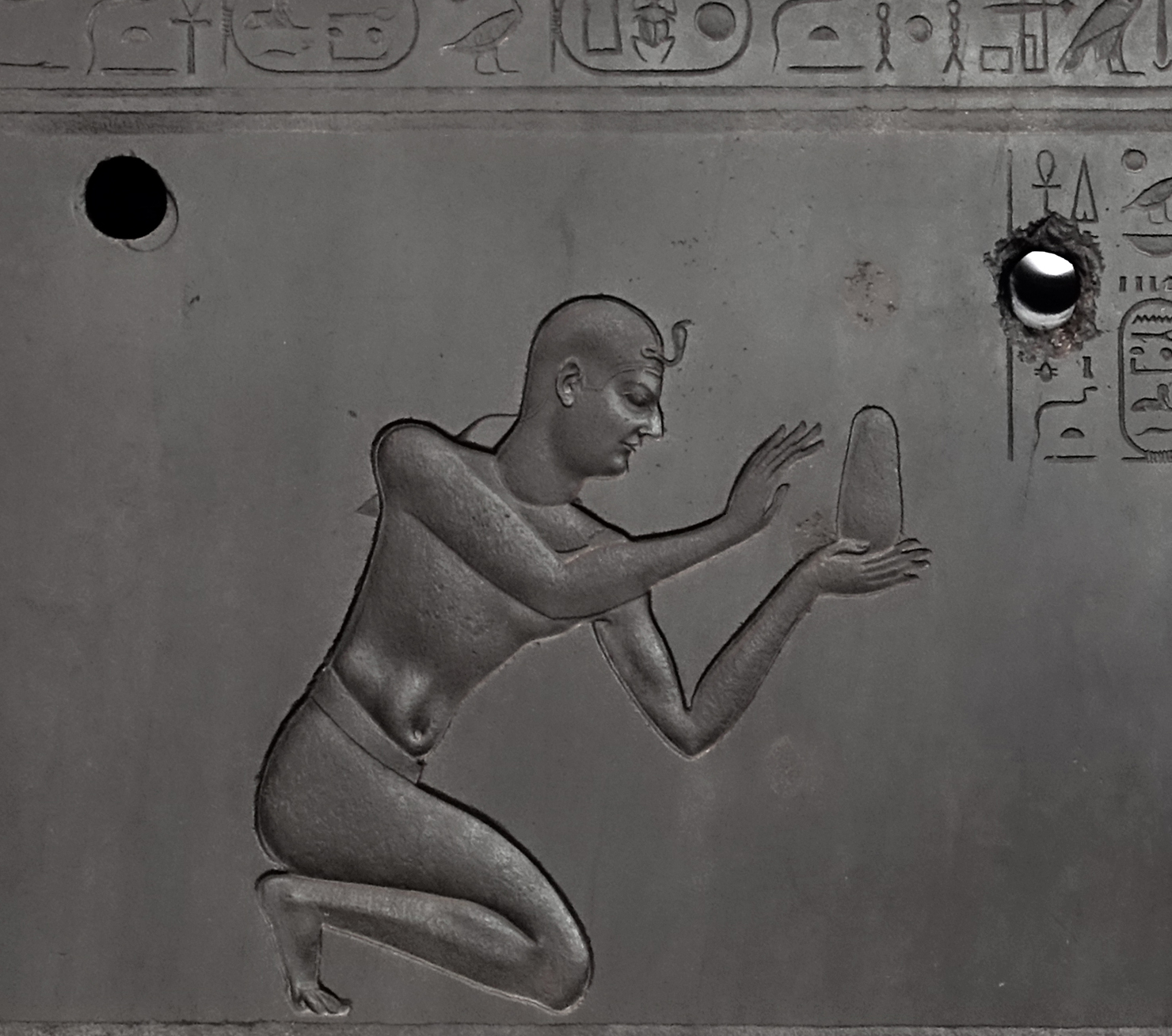
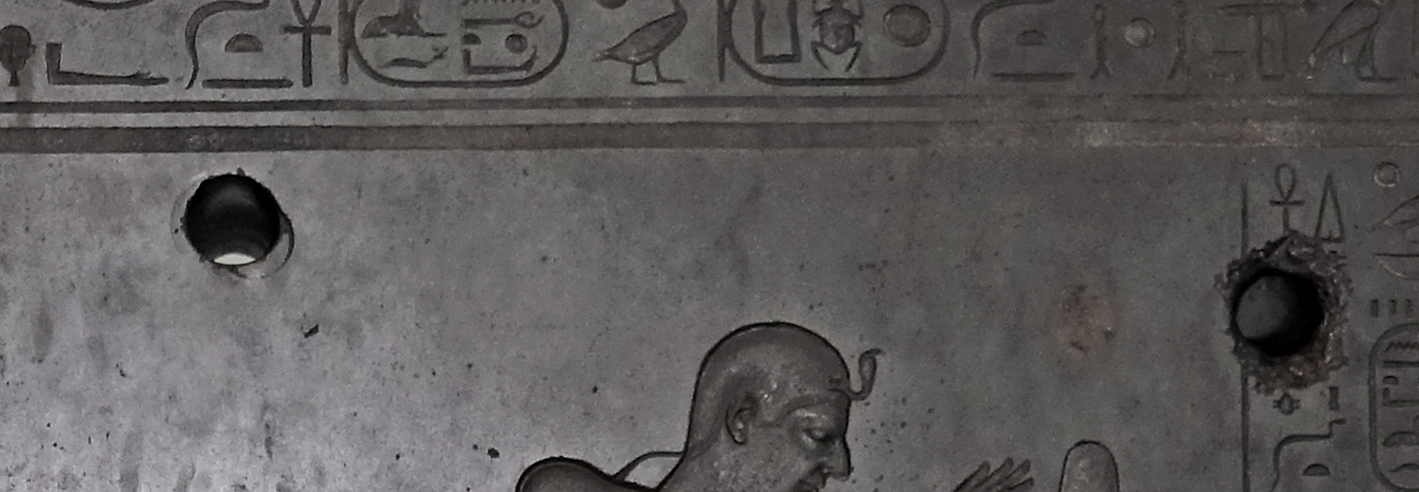
30th Dynasty: 380 BC - 343 BC
Nectanebo I
Here the right and left holes are apparently drilled all the way through the slab.
Catalog: Greywacke, El - Rashid, EA22
Photo: Don Hitchcock 2018
Source: Original, British Museum
Text: Don Hitchcock
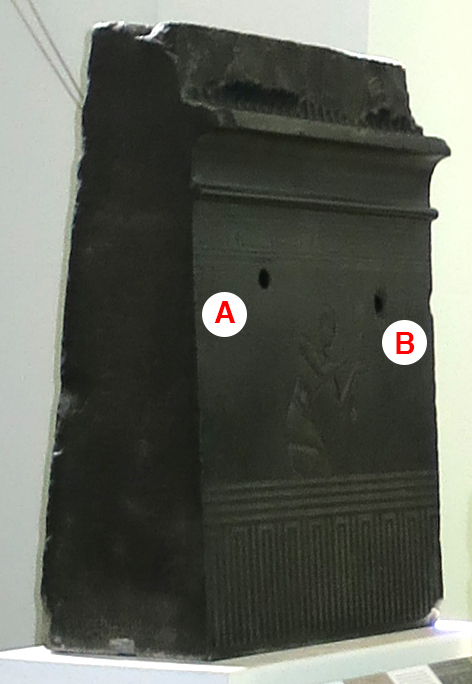
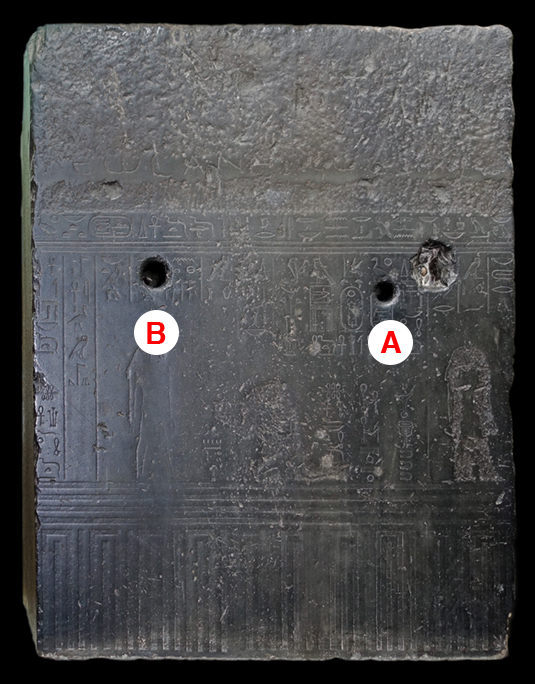
30th Dynasty: 380 BC - 343 BC
Nectanebo I
Here the holes are labelled.
And once again, when we start at the position of the left hand image here, and walk to the left around the piece to the other side, the left hole (A) in the first image becomes the right (A) in the second image, and should be above the level of the other hole.
The only conclusion I can come to is that the holes are drilled at an angle, with hole A of the front face drilled down at an angle, and hole B of the front face drilled up at an angle.
If any readers find themselves in the British Museum with nothing better to do with their time (see the location shot below) I would be glad of confirmation of this.
Or, I guess, there is a glitch in the matrix....
Catalog: Greywacke, El - Rashid, EA22
Photo: Don Hitchcock 2018
Source: Original, British Museum
Text: Don Hitchcock
This is the Nectanebo I slab in position in the Egyptian Sculpture Room 4, British Museum.
Photo: Google Street View

30th Dynasty: 380 BC - 343 BC
The Berlin green head.
230 x 140 x 200 mm.
The Berlin Green Head is an ancient Egyptian statue head made from green schist and housed in the Egyptian Museum of Berlin, not far from the Nefertiti Bust. It has been considered the work of a highly skilled (though unknown) ancient Egyptian sculptor, as well as one of the most famous and credited pieces of art from the Late and Ptolemaic periods of ancient Egypt.
The face of the statue is calm and emotionless and, unusually for contemporary works of art, also perfectly symmetric, and it is that of an intelligent-looking, middle-aged man with many well-rendered wrinkles and lines. The statue's shaved, oval-shaped skull is so realistic that it was once believed that the sculptor could not have made it without ancient Greek knowledge of anatomy, a claim subsequently disproved by the analysis of similar, earlier Egyptian artworks. On the back of the head, the top portion of a conventional back pillar is still visible.
The whole artefact is uninscribed, thus the owner's name and titles are unknown. For the same reason, the statue could only be dated on stylistic grounds. Once regarded as art of the Saite Period, it was later attributed to the Ptolemaic Period by Friedrich Wilhelm von Bissing. In 1960, Bernard von Bother further reduced the time range to between 100 and 50 BCE, arguing that the head reveals a maturity not compatible with the earlier Ptolemaic art, as well as a similarity with some upcoming Roman Republic-era Egyptian works. Its provenance is also unknown, as well as its trace before 1895, when it was acquired from the collections of prince Ibrahim Hilmy and Henry Wallis.
The Berlin Green Head has been compared to the similar, yet earlier, Boston Green Head, with the former one having lost part of the 'verism' (along with that, the asymmetry) which is more prominent in the latter one, yet without compromising the characterisation of the individual represented on it.
This head of a bald man is generally known as the 'green head' because of the colour of the stone. It is one of the masterpieces of the Berlin collection. On the face, the fine models are characterised by the sharp accents, which hardly show the material stone, but rather show a person marked by life - even if the older moves are more idealistic than realistic.
For example, the ridges on the nasal root and the crow's feet, which are indicated by three scribe lines on the sides of the eyes. Beneath the eyes are highly modelled tear ducts. Nasolabial folds protrude from the broad nose, which lead in an arc to the corners of the mouth. The rest of the chain, which appears like a smooth cord, can be seen on the left side of the neck. On the back there is a blunt, unmarked back pillar.
The dating of the head is controversially discussed and for the most part covers the 7th to the 1st century v. In this context it was often questioned to what extent the production of the head was influenced by Greek or Roman portraits. The head is doubtless in the Egyptian tradition and does not reflect the form of the western Mediterranean. Even if the pros and cons of the different points of view can not be explained at this point, a preference for the late Ptolemaic era is preferred.
What is decisive here is the fascinating effect of the head - the reproduction of the appearance as well as the personality of the man. Because the head is shown bald, it can be concluded that it is of a priest, for which group baldness (or a shaven head) was normal.
The head had already passed through several hands, before it was donated by James Simon in 1894 to the Berlin collection.
Catalog: Greywacke or green schist, ÄM 12500
Photo: Don Hitchcock 2015
Source: Original, Staatliche Museen zu Berlin, Neues Museum, Germany
Text: © Card at the Staatliche Museen zu Berlin, Jana Helmbold-Doyé on http://www.smb-digital.de/ (CC BY-NC-SA 3.0 DE)
Additional text: Wikipedia
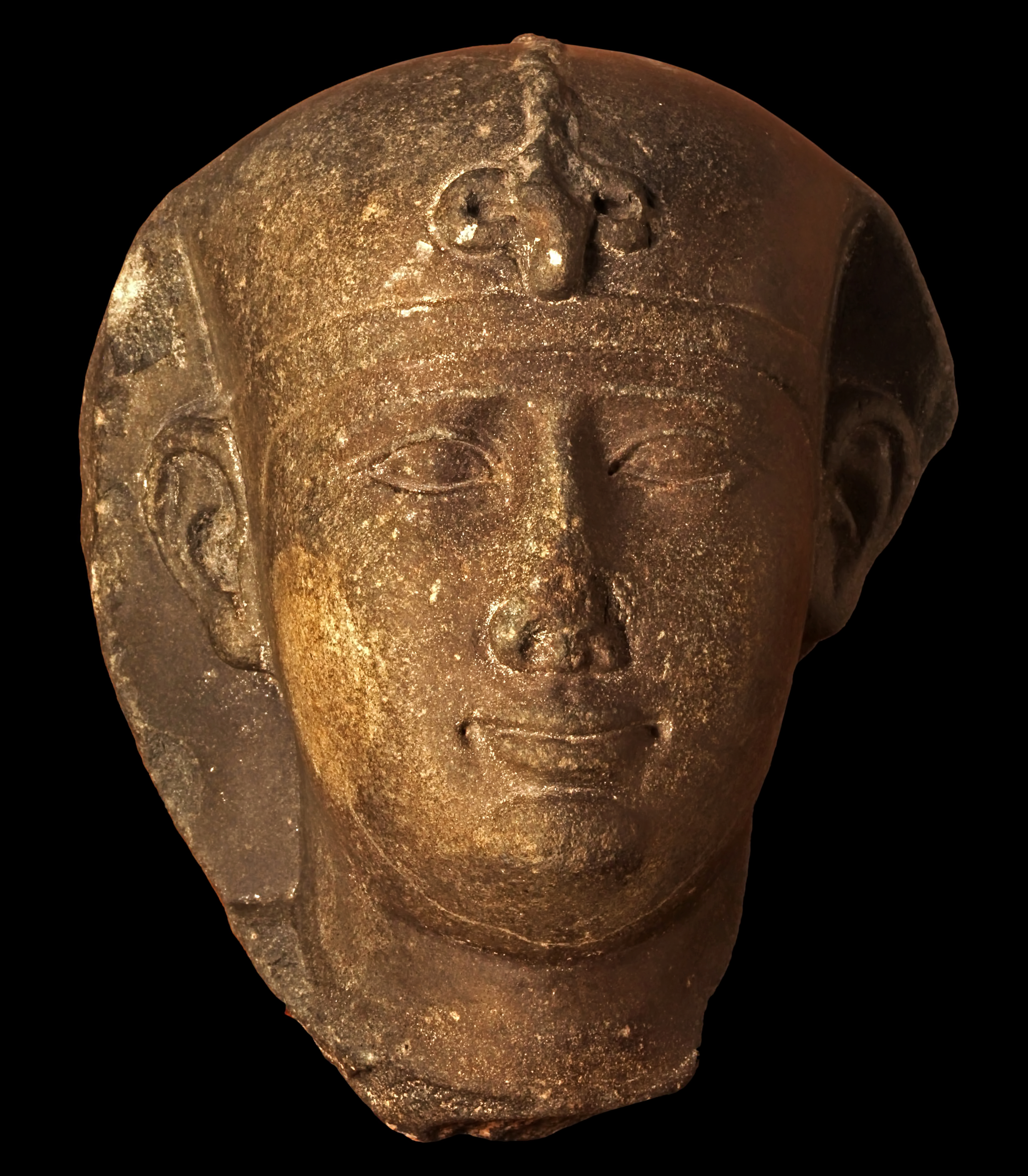
30th Dynasty: 380 BC - 343 BC
Head of Nectanebo II
380 BC - 332 BC.
Nectanebo II ruled during the period 360 BC - 342 BC. He was the third and last pharaoh of the Thirtieth Dynasty of Egypt as well as the last native ruler of ancient Egypt.
For several years, Nectanebo II was successful in keeping Egypt safe from the Achaemenid Empire. However, betrayed by his former servant, Mentor of Rhodes, Nectanebo II was ultimately defeated by the combined Persian and Greek forces in the Battle of Pelusium (343 BC). The Persians occupied Memphis and then seized the rest of Egypt, incorporating the country into the Achaemenid Empire under Artaxerxes III. Nectanebo fled south and preserved his power for some time. His subsequent fate is unknown.
Catalog: Greywacke, H 1701
Photo: Rama
Permission: Creative Commons Attribution-Share Alike 2.0 France license.
Source: Musée des beaux-arts de Lyon
Text: Wikipedia
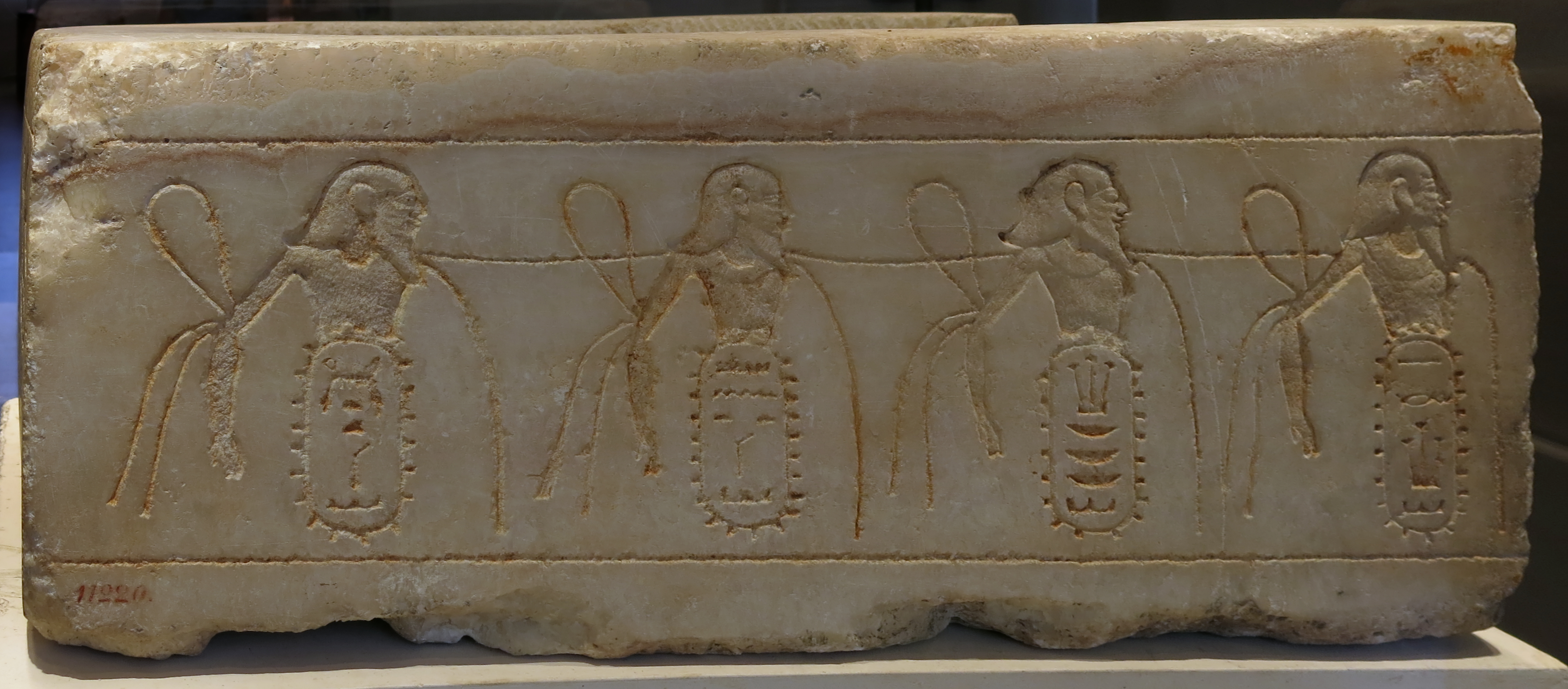
30th Dynasty: 380 BC - 343 BC
Base of a statue of Nectanebo II.
358 BC - 341 BC.
Height 26 cm, length 63 cm width 41 cm.
All are literally placed 'under the feet of the king'.
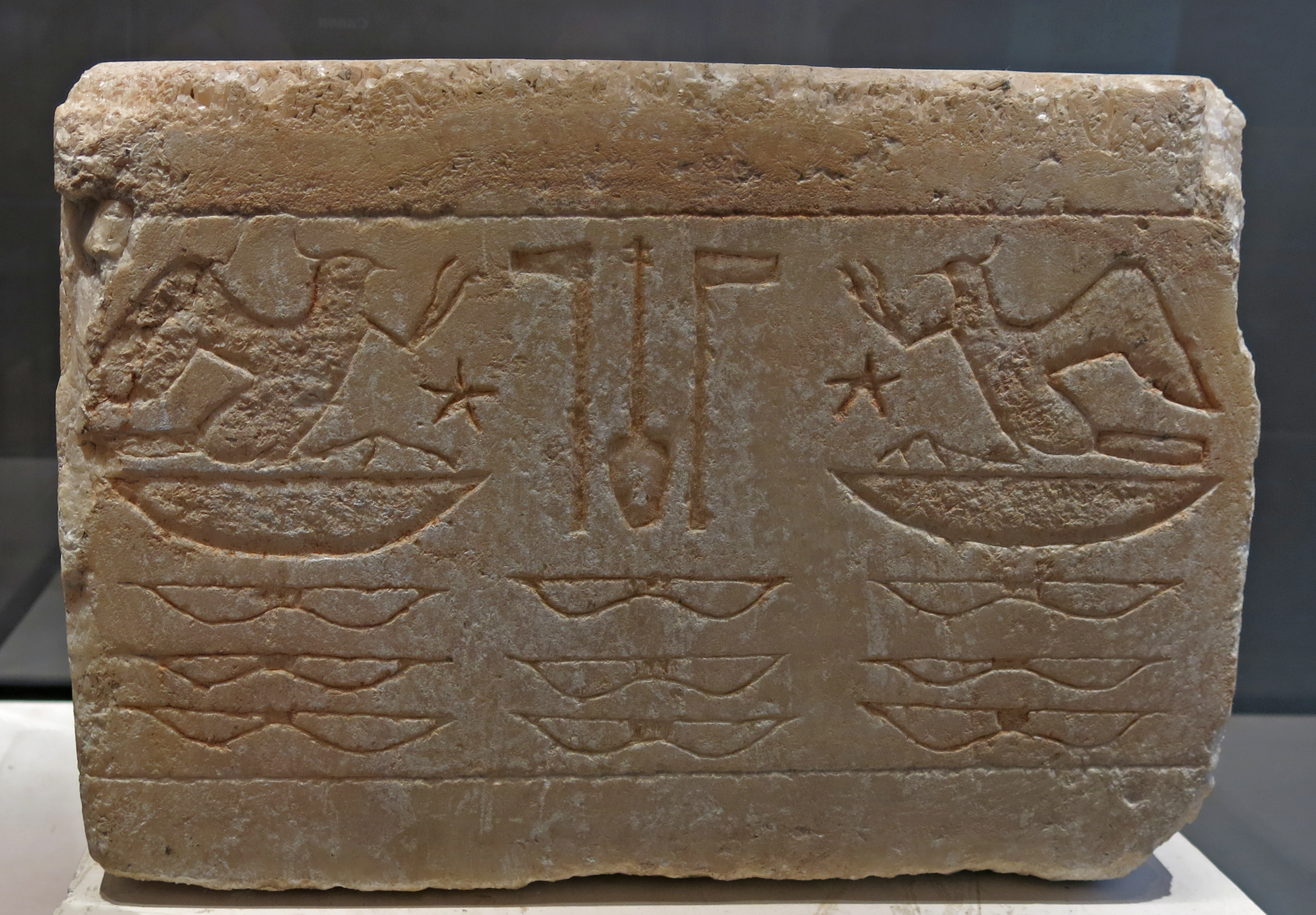
On the front of the base, which faced east, the birds (crested lapwings) represent the people of Egypt, and nine bows the traditional enemies of the country.
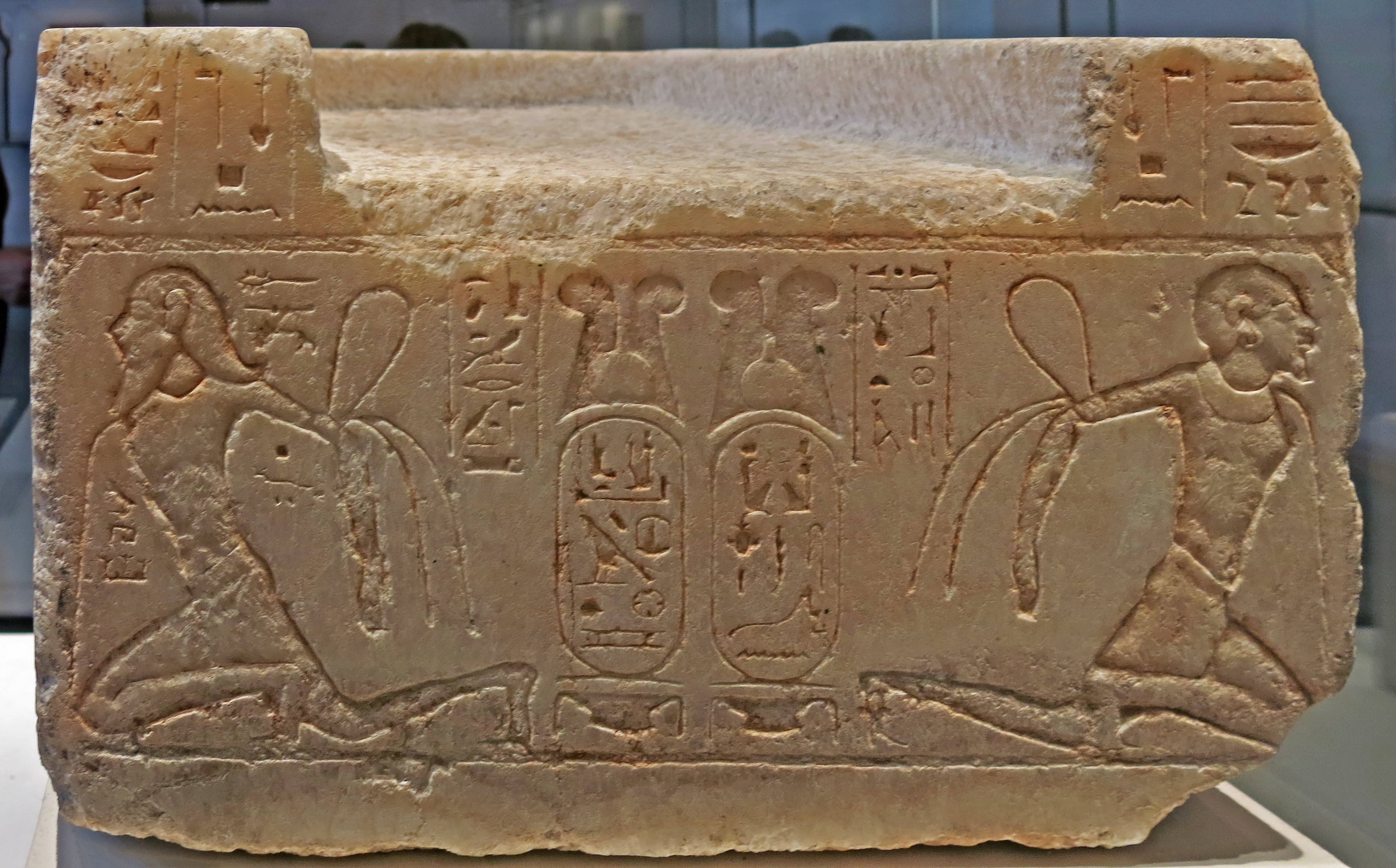
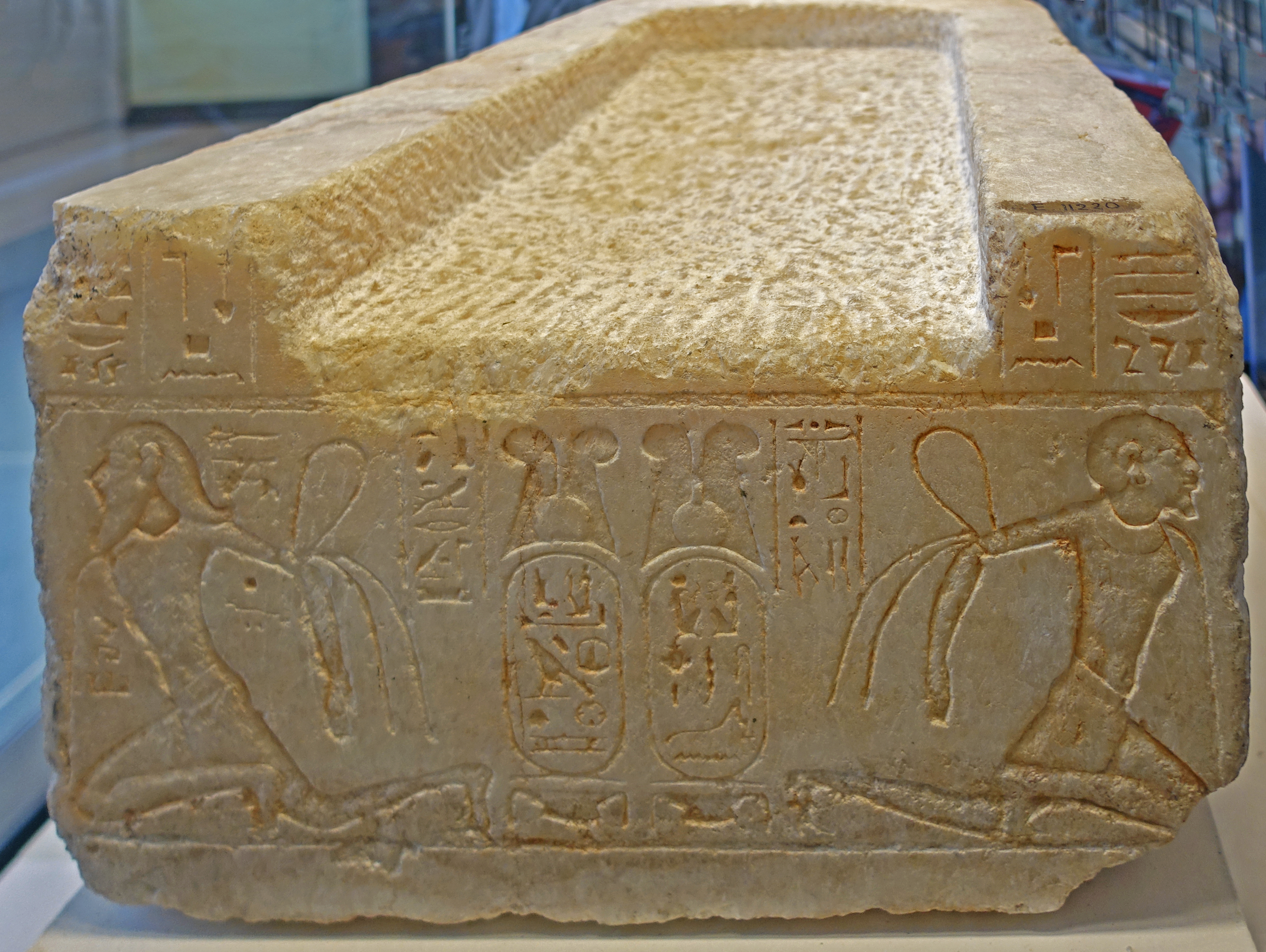
Back, facing west. Includes the cartouche of Nectanebo II.
We find the 'Nine Bows' referred to above here, surrounding the name of the King, in the form of tied up prisoners, peoples from the north to the left and peoples from the south to the right.
The north face. The four peoples of the north under the authority of the King, headed by Lower Egypt.
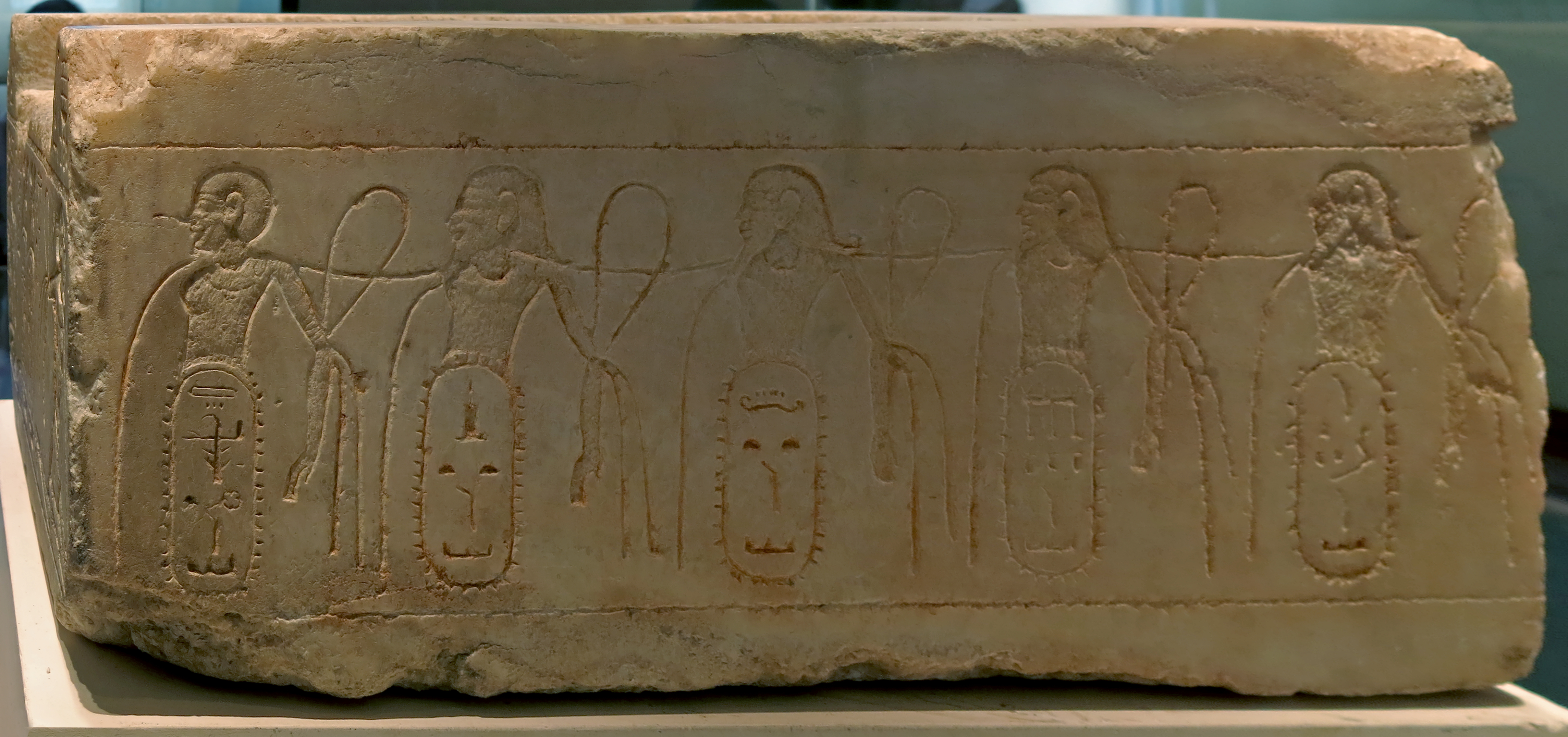
The south face. The five peoples of the south under the authority of the King, headed by Upper Egypt. This list of names, as well as the four names of the peoples of the north, was, at the time of Nectanebo II, long mythical and no longer corresponded to contemporary peoples.
Catalog: Alabaster, excavations at Coptos, E 11220
Photo: Don Hitchcock 2015, 2018
Source and text: Original, Louvre Museum, https://collections.louvre.fr/
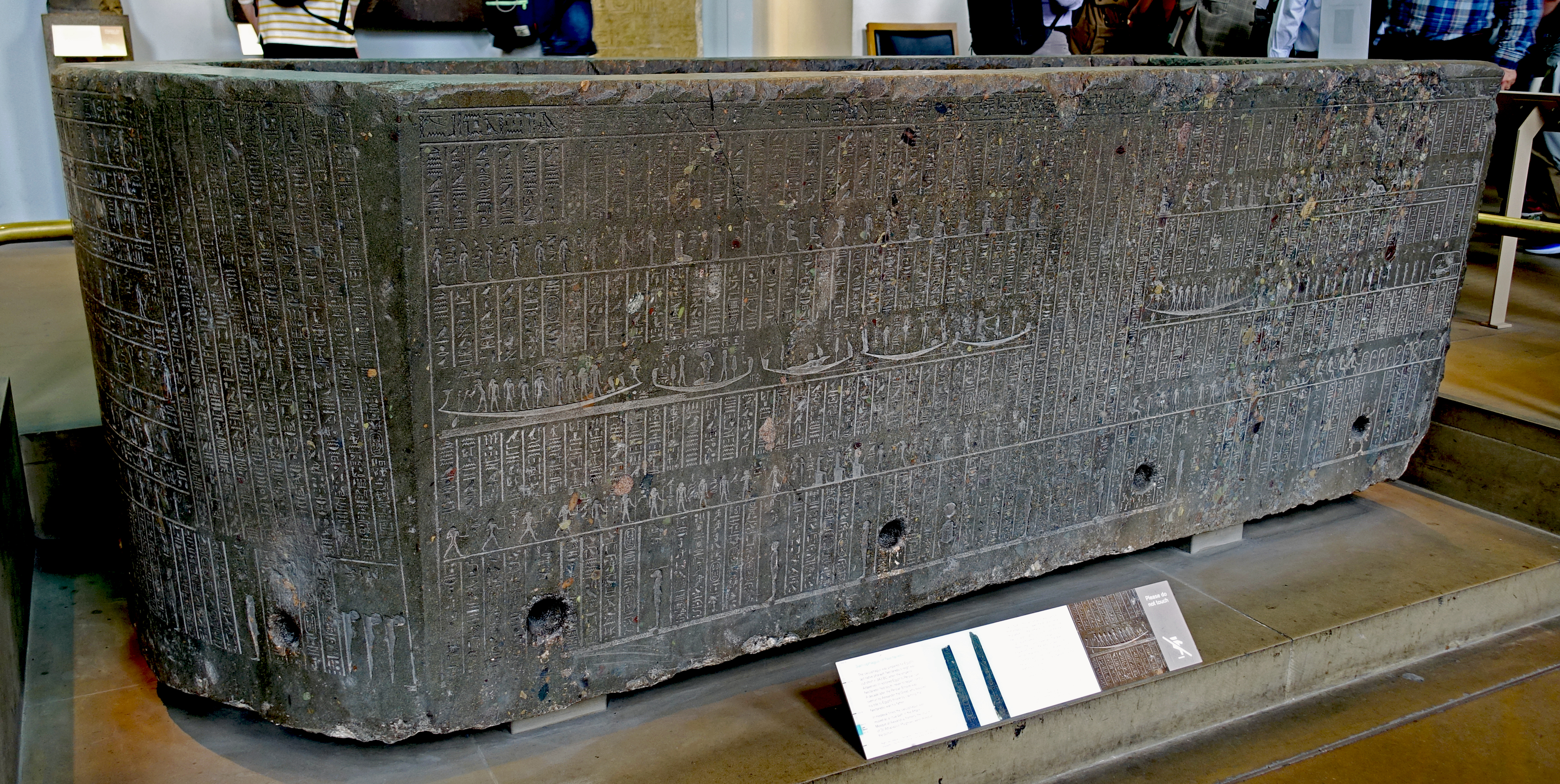
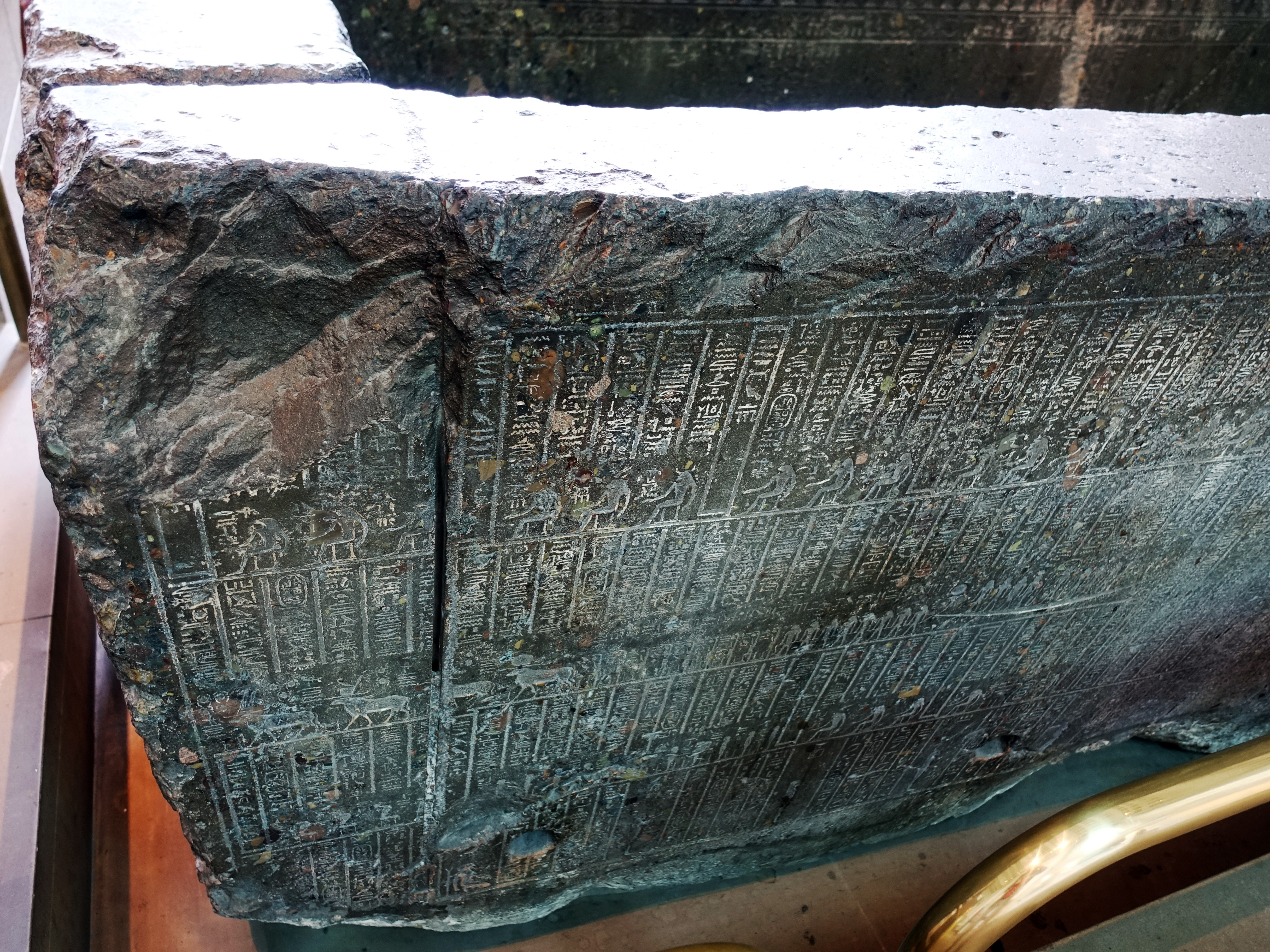
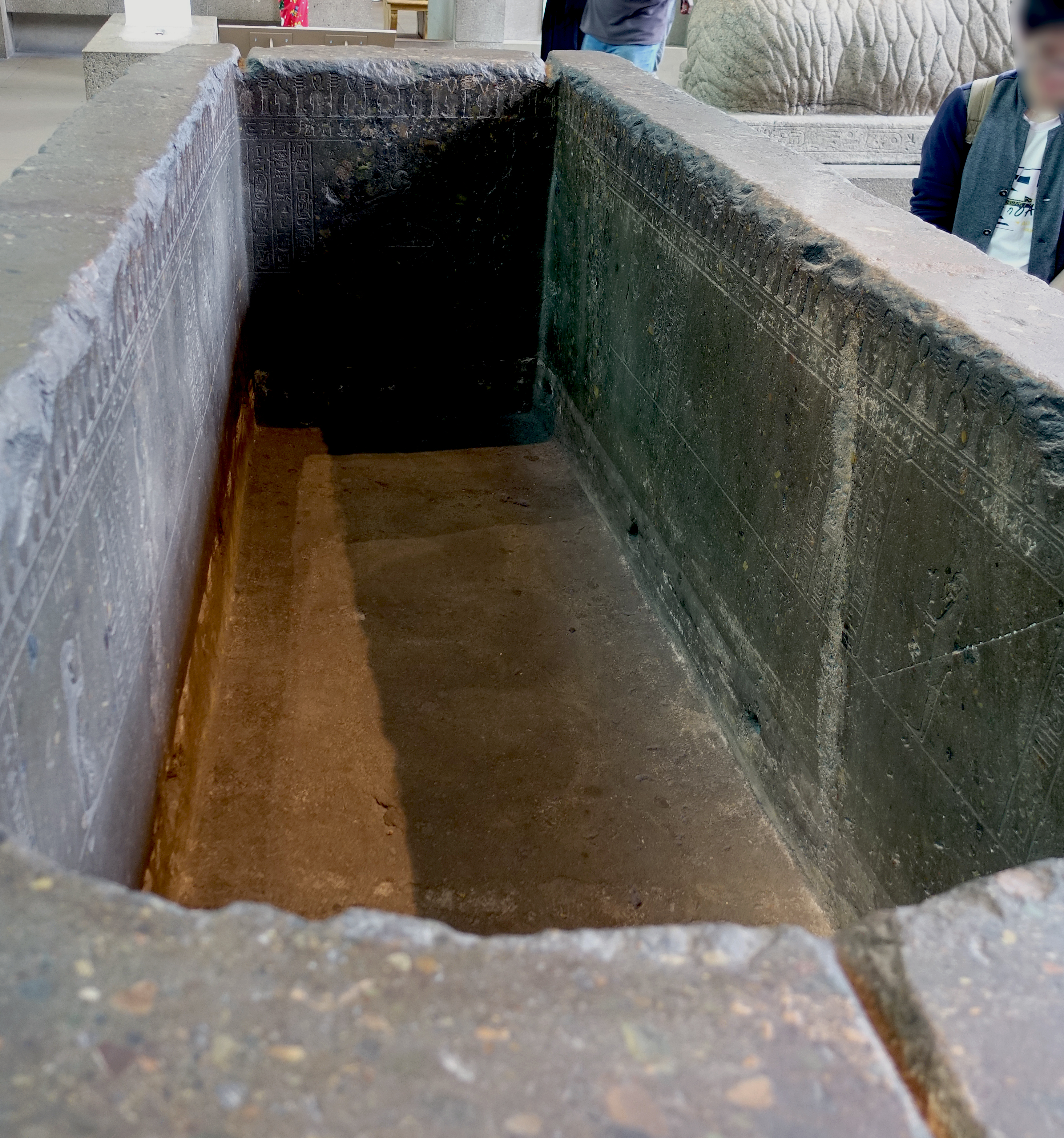
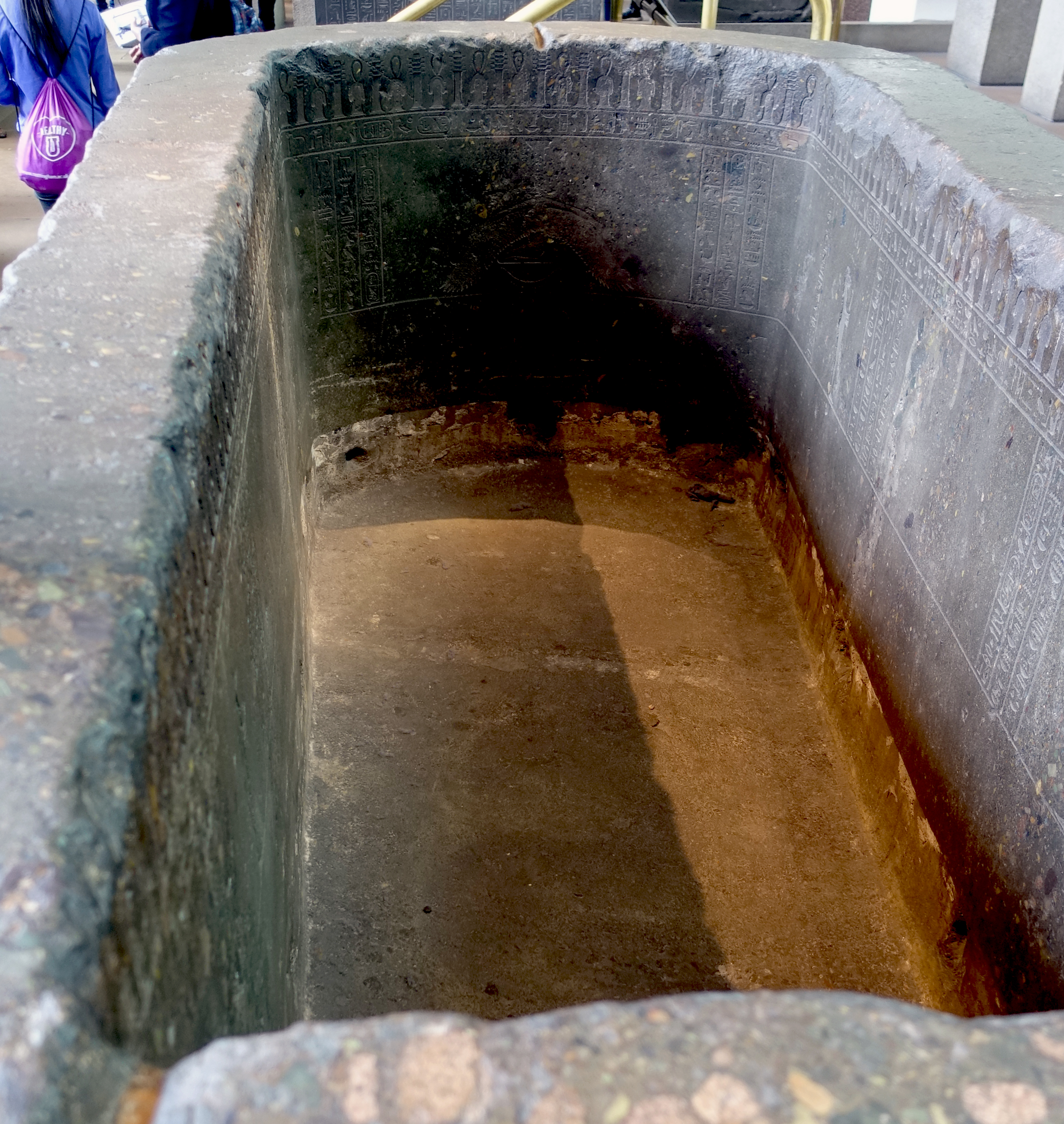
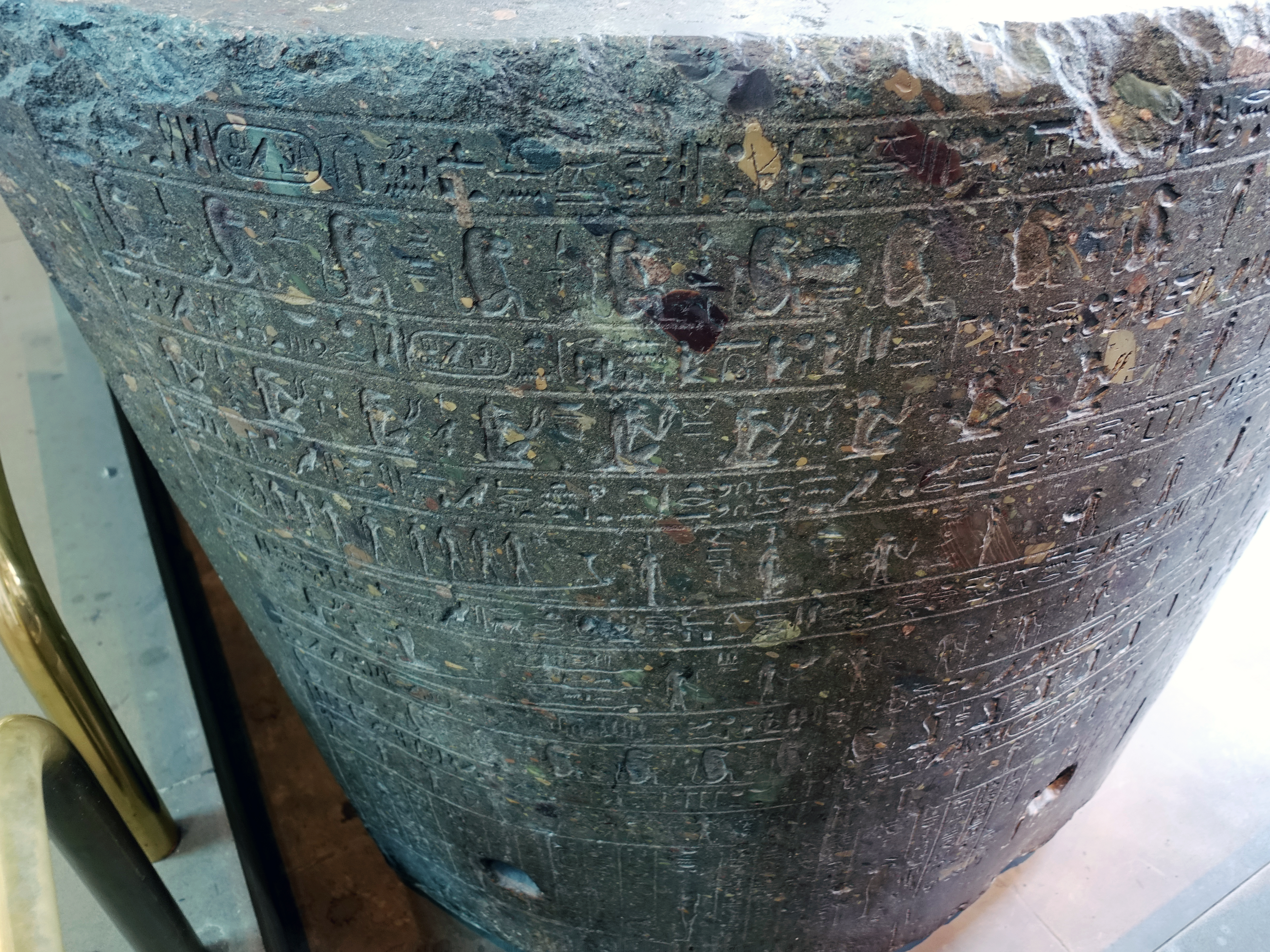
Sarcophagus of Nectanebo II
30th Dynasty: 380 BC - 343 BC
This sarcophagus was prepared for Egypt's last native pharoah. Nectanebo's reign was cut short in 343 BC, when the emperor Artaxerxes III restored Egypt to Persian rule.
Nectanebo fled south, never to regain control. A decade later, the Persian Empire was overrun by Alexander the Great, who boosted his title to Egypt's throne by claiming that Nectanebo was his father.
In medieval times, the sarcophagus was reused as a ritual bath in the Attarin Mosque at Alexandria, formerly the church of St Athanasius. Plugholes were drilled at the bottom.
The outside of the sarcophagus bears sections from a body of texts called the Amduat, literally 'that which is in the netherworld'. They describe the sun-god's nightly journey through the realm of Osiris, with twelve hours corresponding to different regions and challednges. The dead king would share in the deity's endless cycle of overnight regeneration. The inside bears figures of funerary gods, now eroded, including Anubis, the Sons of Horus, and Isis and Nephthys at the head and foot ends.
Conglomerate sarcophagus of Nectanebo II (Nakhthorheb), later re-used as a ritual bath in the Attarin Mosque at the location of the former Church of St Athanasius. There are twelve 'plug-holes' for this purpose which been drilled near the base. The interior is decorated with figures of funerary deities, but now effaced by water erosion, including the Sons of Horus and Anubis, with figures of Isis and Nephthys at the head and foot. The exterior has incised hieroglyphic texts derived from the 1st, 2nd, 3rd, 6th, 8th and 9th sections of the Amduat, elaborated with representations of Ra and Osiris and other attendant deities.
Production date circa 345 BC.
Findspot: Courtyard of the Attarin Mosque.
Height 1185 mm (max), length 3135 mm (max), width 162 centimetres (max)
Named in inscription: Nakhthorheb
Representations of: Sons of Horus, Anubis, Isis, Nephthys, Ra, Osiris
Catalog: Conglomerate, EA10
Photo: Don Hitchcock 2018
Source: Original, British Museum
Text: Card at the British Museum, http://www.britishmuseum.org/, © Trustees of the British Museum, CC BY-NC-SA 4.0
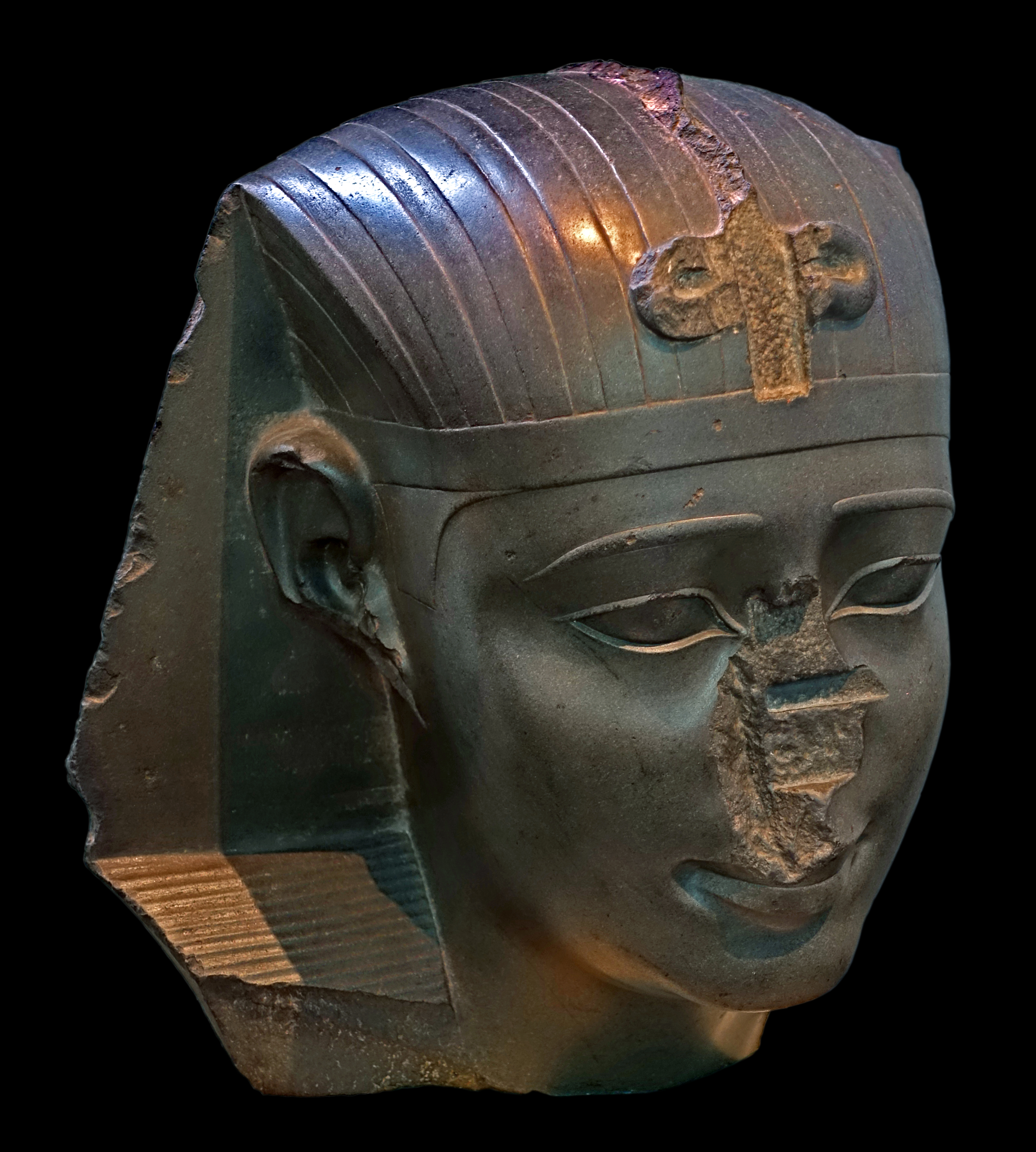
30th Dynasty: 380 BC - 343 BC
Head of King Nectanebo I or II
This was part of a statue placed in a temple. No inscription survives to identify the king, but
stylistic details point to Nectanebo I or II, the principal kings of Egypt's last native dynasty. The king's nose and the protective cobra on his forehead were destroyed to curse him.
Perhaps this vengeful act occurred when Egypt, after 60 years of independence, was reconquered by the Persians, whose rule is often referred to as the 31st Dynasty. A new nose and cobra were later fitted into prepared slots. This may have happened soon after Alexander the Great had conquered the Persian Empire, under the early Ptolemies. To bolster their title to Egypt's throne, they restored, renewed and imitated the monuments of their native predecessors.
Originally the wings of the headcloth displayed the usual horizontal pleats, but these were rubbed down, presumably when the statue was repaired. Many of the Ptolemies' own statues have stripeless headcloths.
Green siltstone head of a statue of a king. This royal head wears a 'nemes' (the iconic striped headcloth worn by pharaohs in ancient Egypt) with a uraeus, the hood of which was a separate piece, probably of gold or some other metal, which is now gone. Apart from the loss of its nose, which was further damaged by at least one attempt to repair it, the face is extremely well preserved. This face is mask-like. The king is probably Nectanebo I or Nectanebo II, possibly Ahmose II.
Height 39 cm (max), height 47 cm (with base), width 30 cm, depth 31 cm.
Findspot unknown.
Catalog: Green siltstone, EA97
Photo: Don Hitchcock 2018
Source: Original, British Museum
Text: Card at the British Museum, http://www.britishmuseum.org/, © Trustees of the British Museum, CC BY-NC-SA 4.0
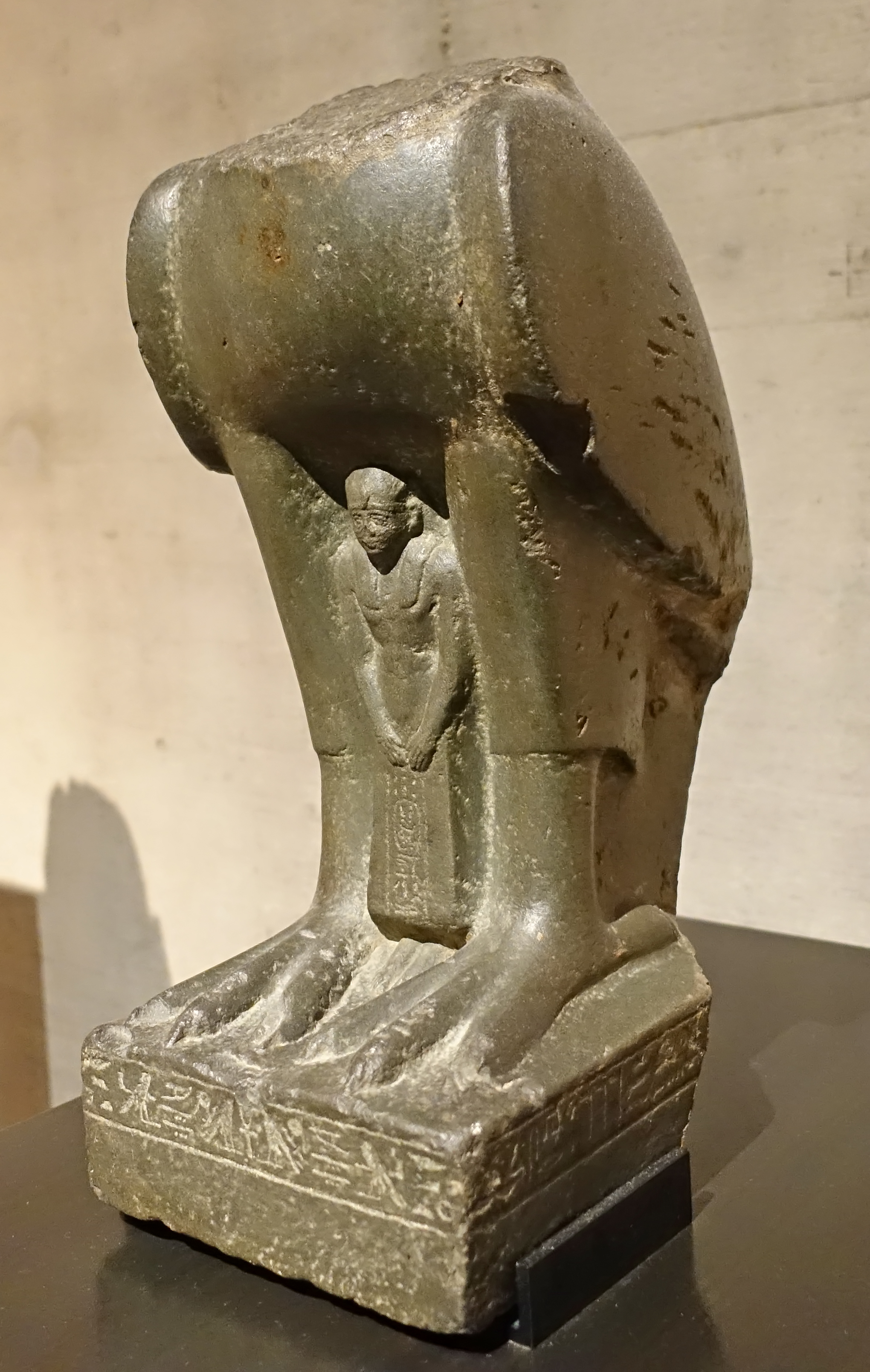
30th Dynasty: 380 BC - 343 BC
Nectanebo II.
Base of a statue of the god Horus as a falcon, protecting the praying figure of Nectanebo II.
Catalog: Greywacke, Memphis, circa 350 BC, ÄS 7152
Photo: Don Hitchcock 2018
Source: Original, Ägyptischen Museum München
Text: Museum card, © Ägyptischen Museum München
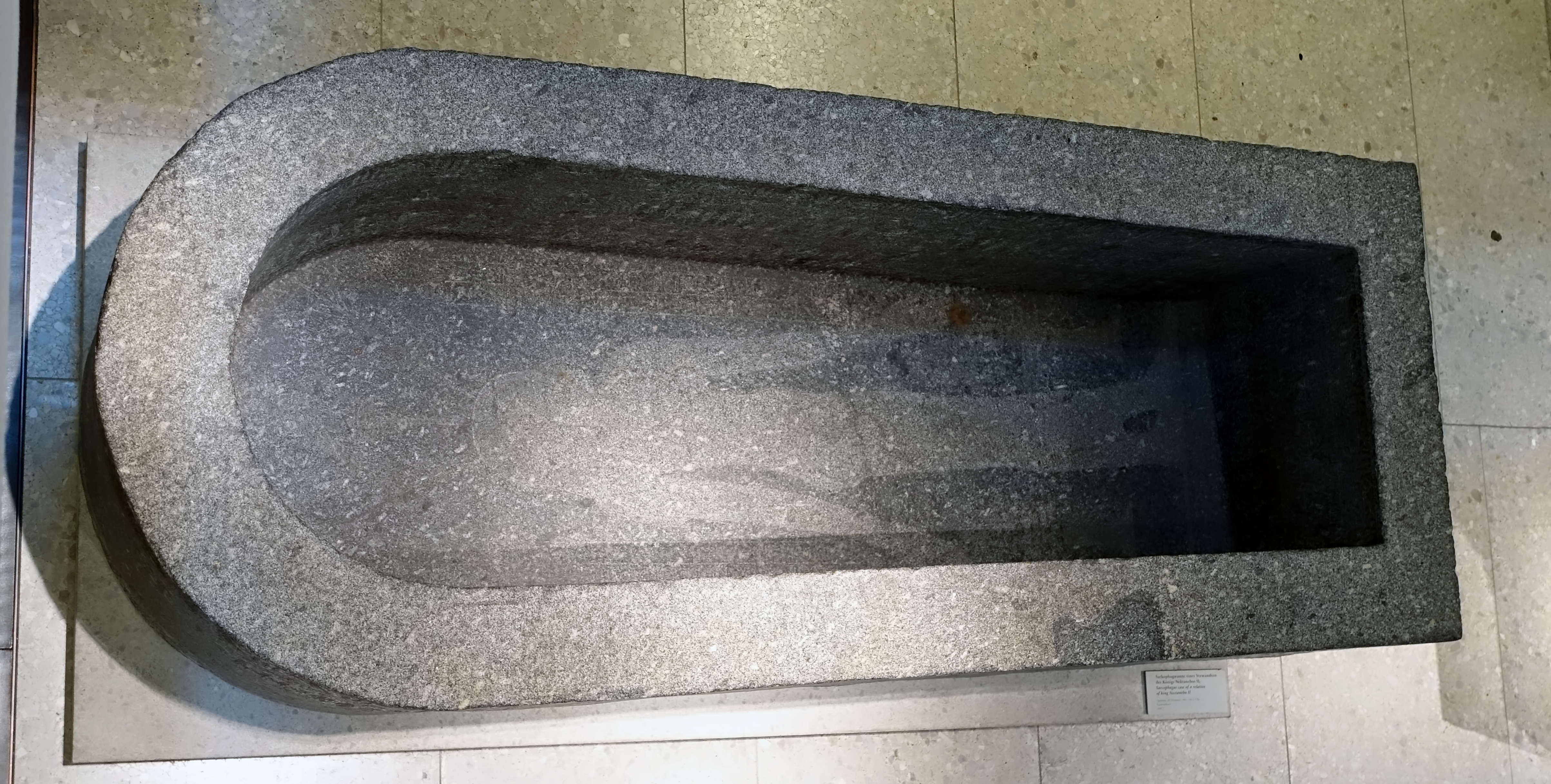
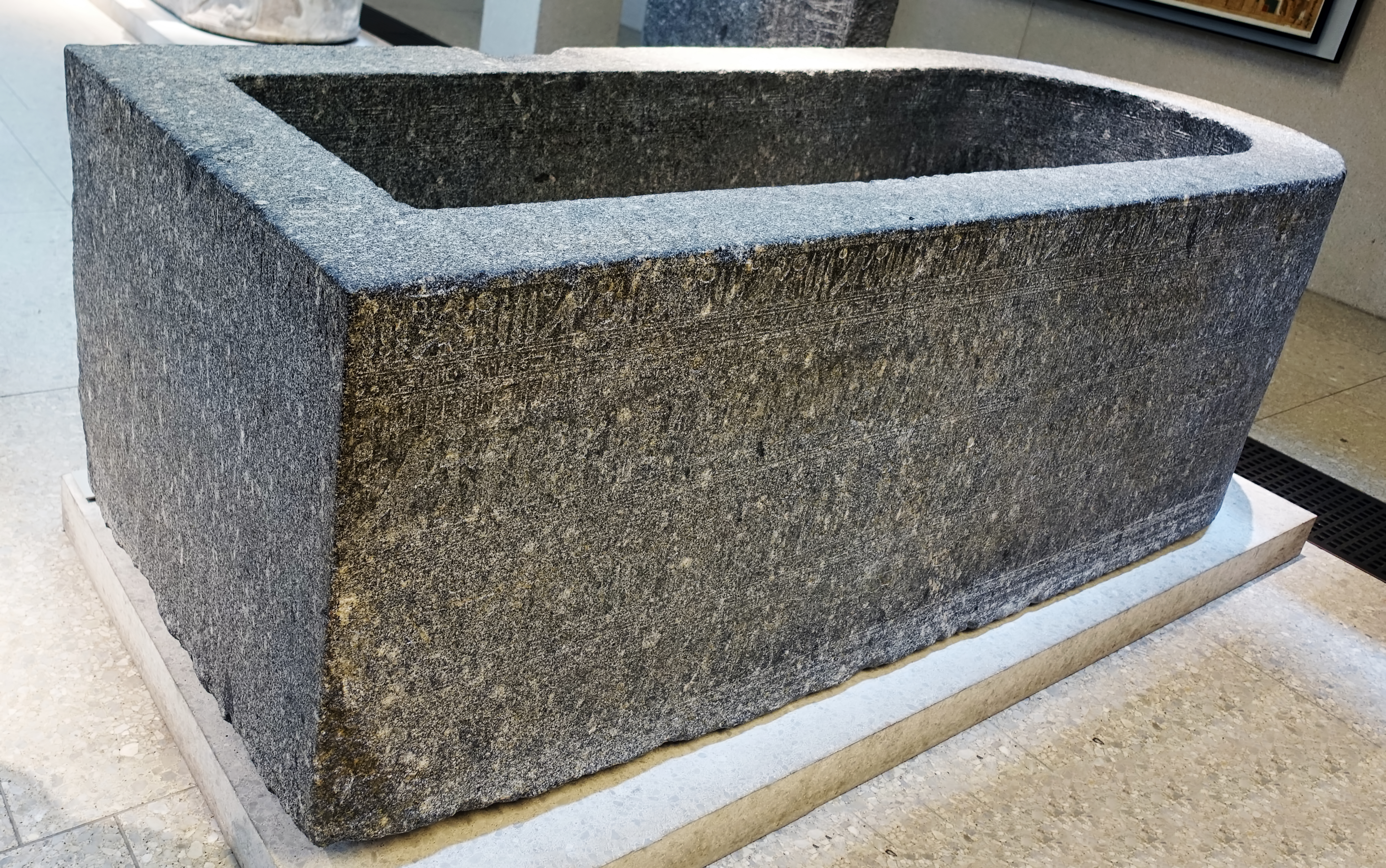
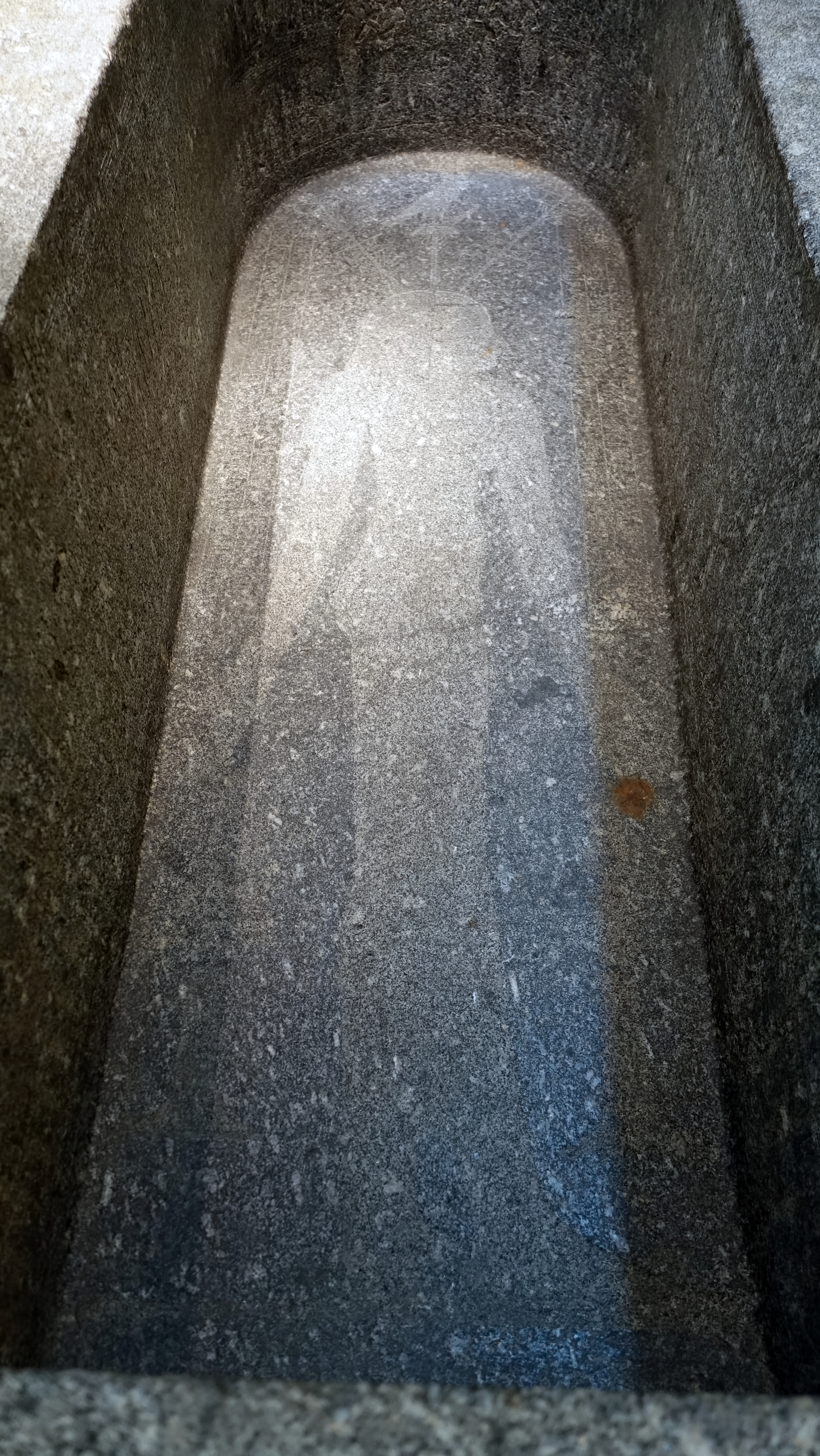
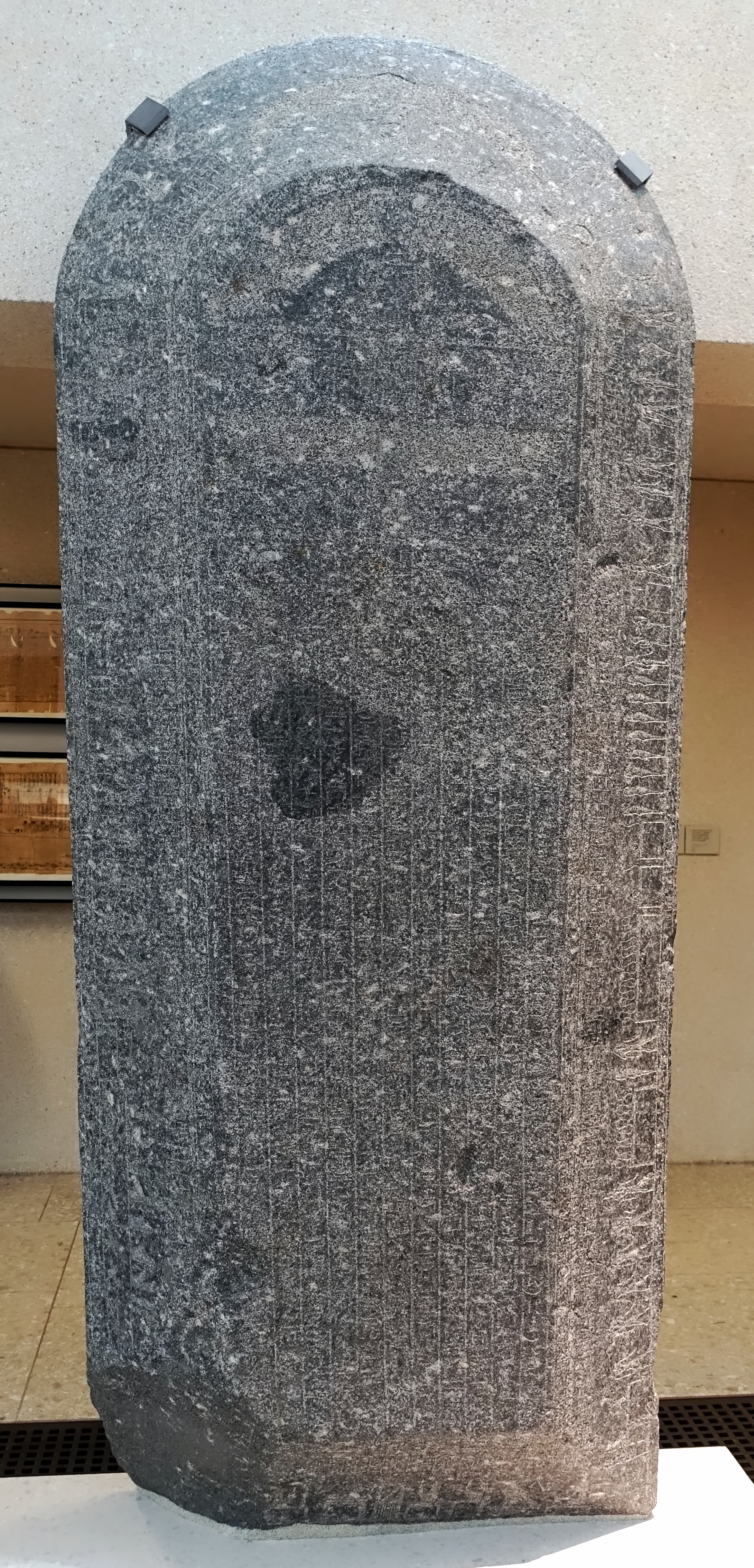
30th Dynasty: 380 BC - 343 BC
Sarcophagus case and lid of a relative of King Nectanebo II
360 BC - 342 BC
Catalog: Granodiorite, ÄM 7
Photo: Don Hitchcock 2018
Source: Original, Staatliche Museen zu Berlin, Neues Museum, Germany
Text: © Card at the Staatliche Museen zu Berlin, (CC BY-NC-SA 3.0 DE)
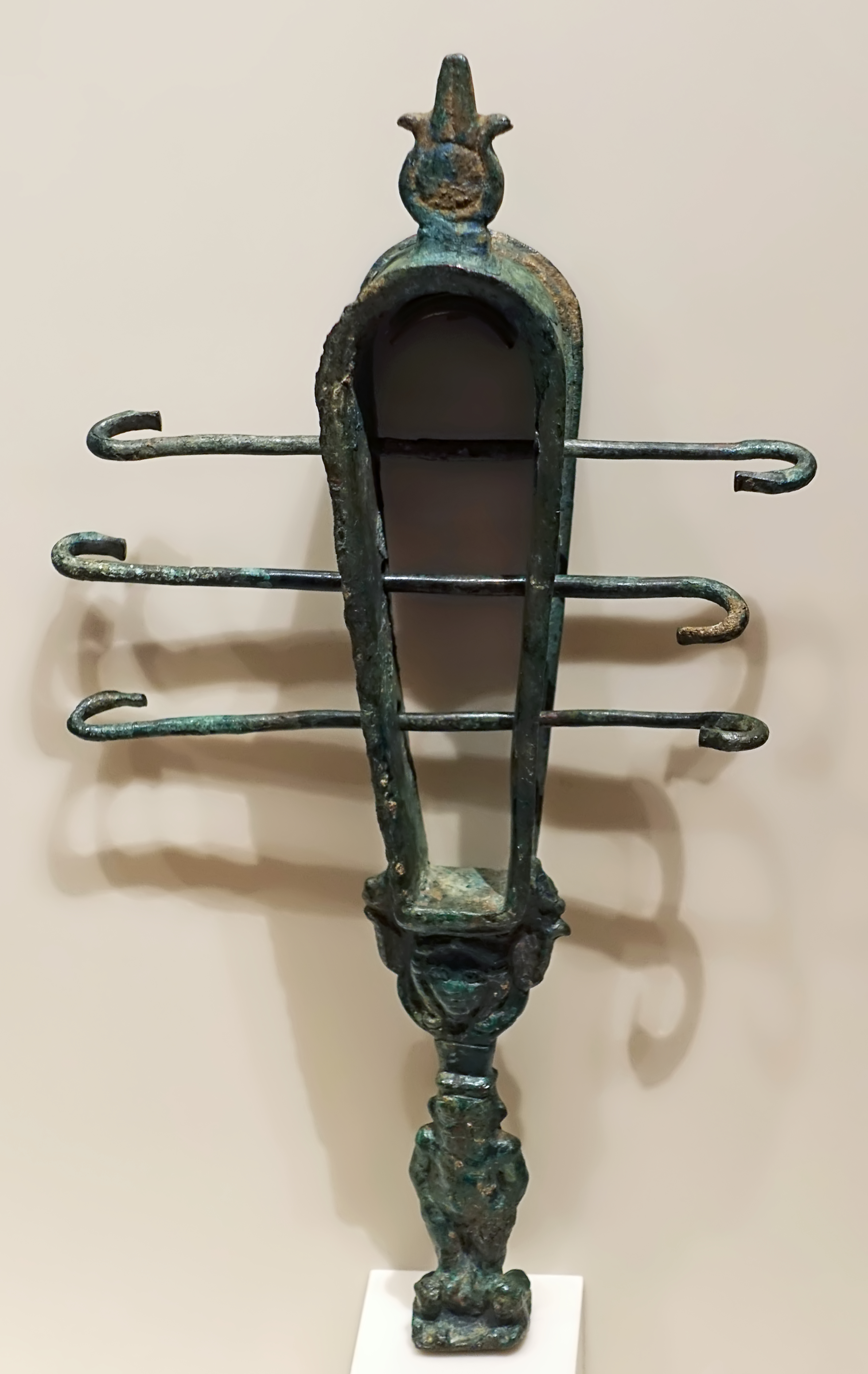
30th Dynasty: 380 BC - 343 BC
Sistrum
A rhythm instrument, called a sistrum, with the handle in the shape of the god Bes.
Circa 350 BC
Catalog: Bronze, ÄM 2767
Photo: Don Hitchcock 2018
Source: Original, Staatliche Museen zu Berlin, Neues Museum, Germany
Text: © Card at the Staatliche Museen zu Berlin, (CC BY-NC-SA 3.0 DE)
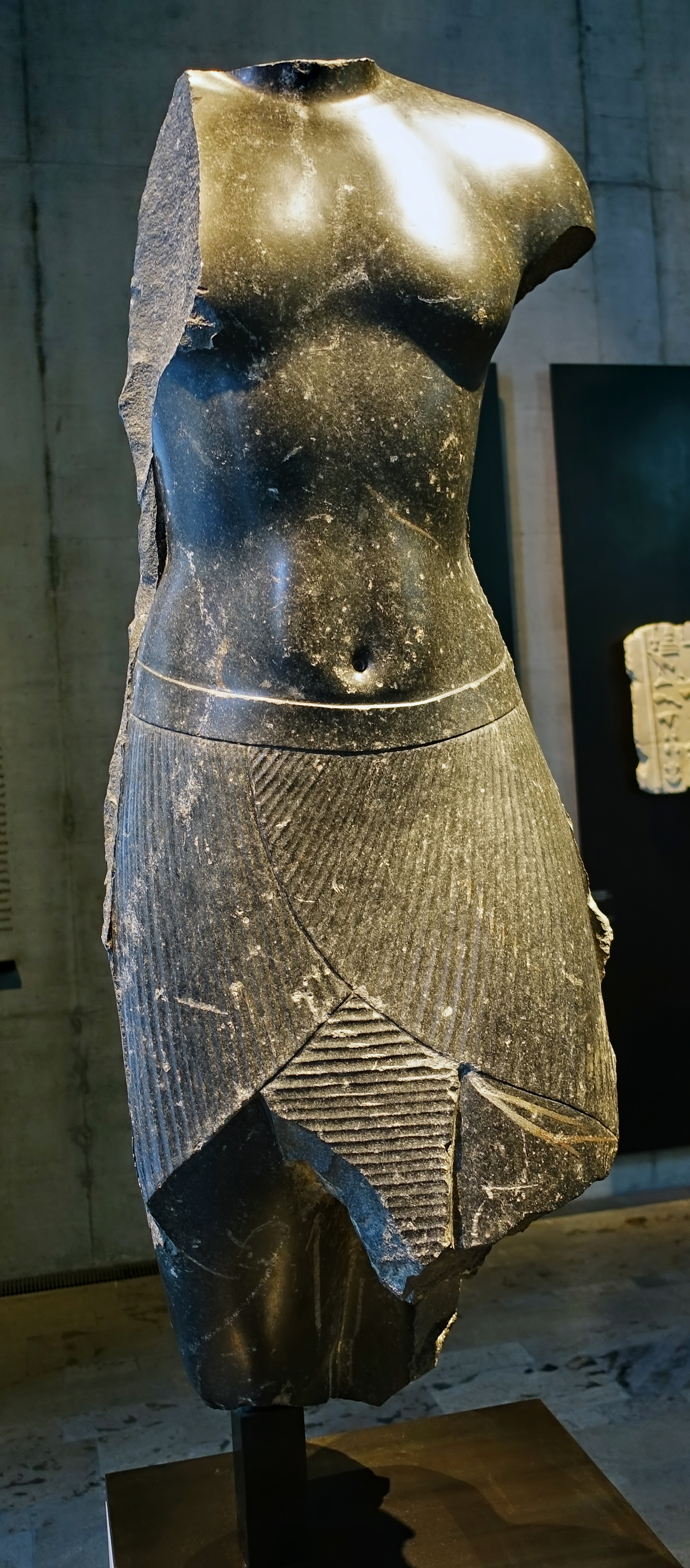
30th Dynasty: 380 BC - 343 BC
Torso
Torso from the standing-striding figure of a high official.
Circa 360 BC
Catalog: Greywacke, Tell Baklija, ÄS 7100
Photo: Don Hitchcock 2018
Source: Original, Ägyptischen Museum München
Text: Museum card, © Ägyptischen Museum München
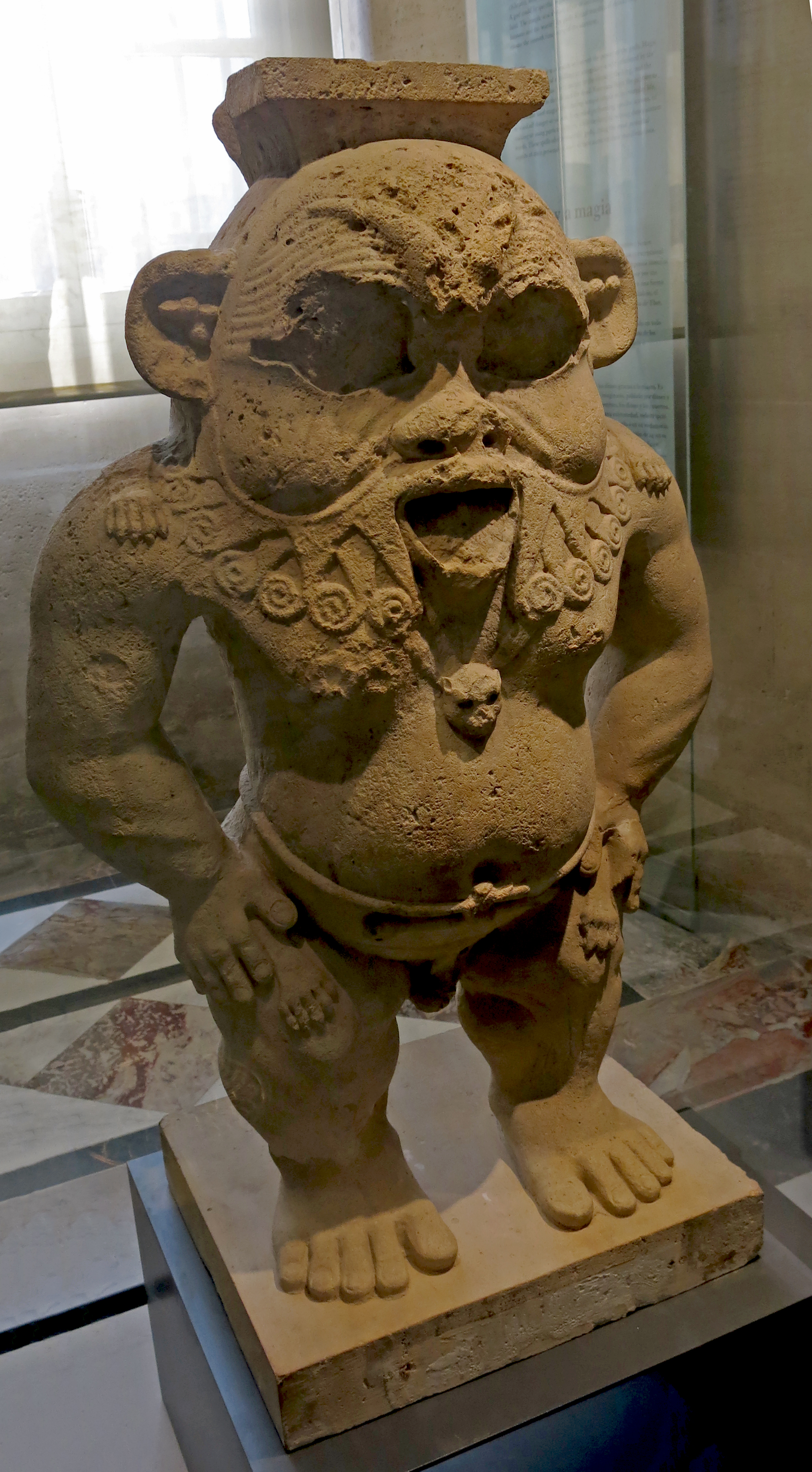
30th Dynasty: 380 BC - 343 BC
Bes
Bes was a widely worshipped deity in ancient Egypt and was believed to be the deity of music, merriment, and childbirth. As such, Bes was thought to be a protector of children, and depictions of him were frequently seen in the bedrooms of ancient Egyptian households.
Bes is standing, hands on thighs, wearing an animal skin, belt, snake, and beard. He is also wearing a modius, a flat topped cylindrical headdress or crown.
Catalog: Limestone, Temple of Nectanebo, Serapeum of Memphis, Saqqara, Aile Sully, Room 317, Gods and Magic, Vitrine 3, N 437, S 962
Photo: Don Hitchcock 2015
Source and text: Original, Louvre Museum, Paris, France, https://collections.louvre.fr/
Additional text: https://egyptianmuseum.org/, Wikipedia
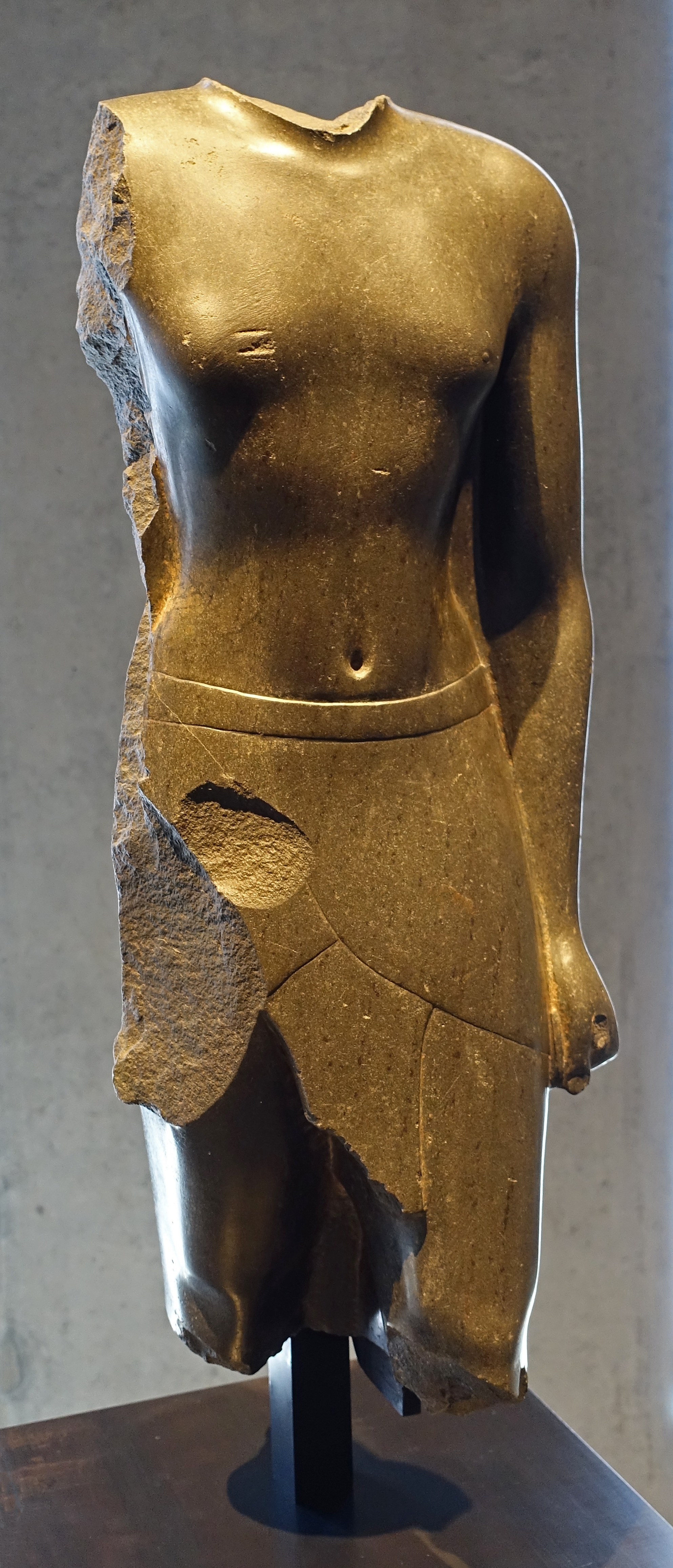
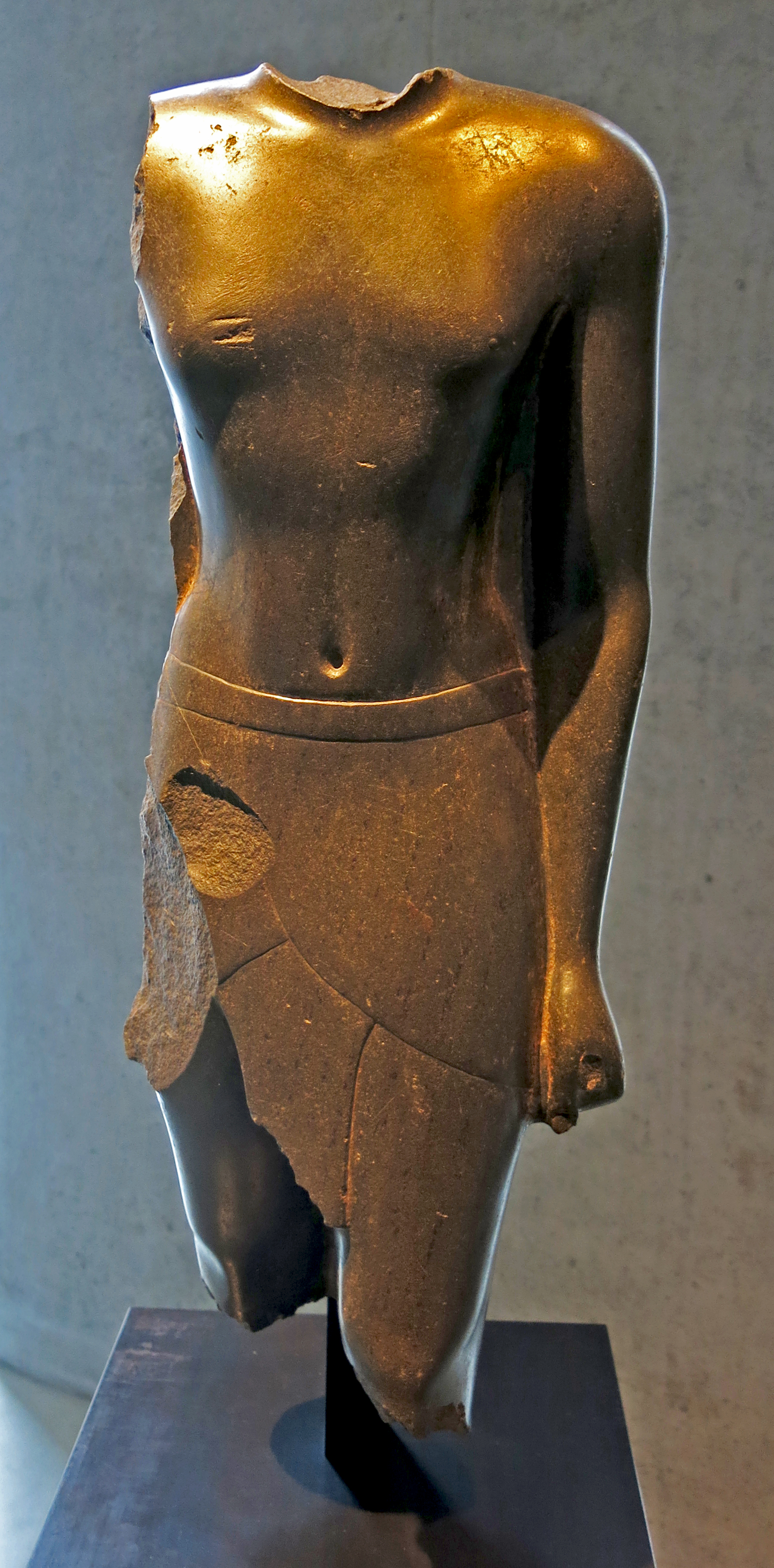
30th Dynasty: 380 BC - 343 BC
Hori
Torso from a standing-striding figure of Hori, High Priest in Athribis, circa 370 BC.
Catalog: Greywacke, Athribis, Gl.82
Photo: Don Hitchcock 2018, 2015
Source: Original, Ägyptischen Museum München
Text: Museum card, © Ägyptischen Museum München
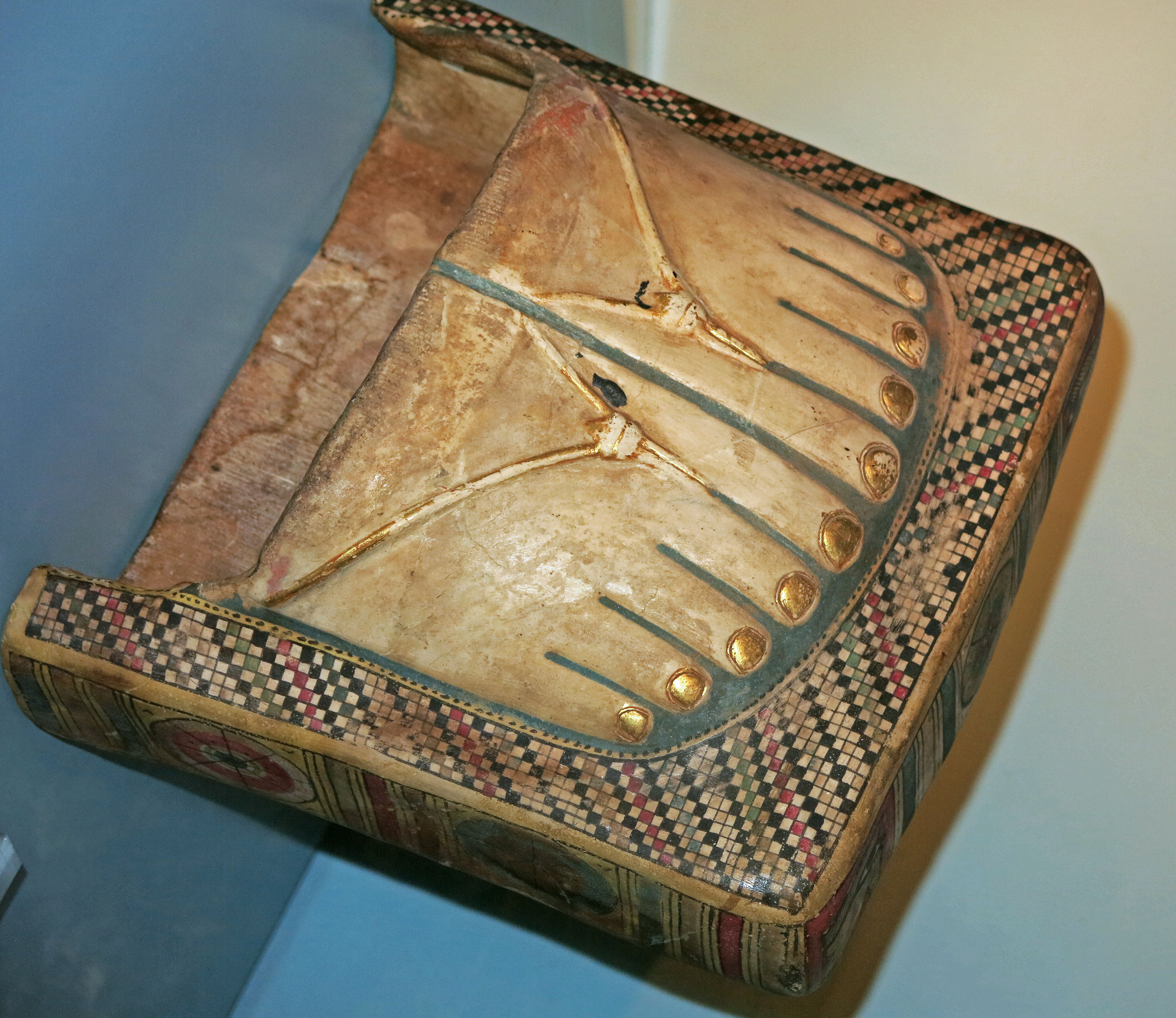
30th Dynasty: 380 BC - 343 BC
Foot Sleeve
This foot sleeve is remarkably richly decorated. On the bottom are images of conquered foreigners: an Asian and an African. Originating from a much earlier period in which that hostility was still productive, they have become symbols repelling evil here.
Around the plastically shaped feet with gilt nails we can see sandal straps. The feet are surrounded by a checkered pattern. The sides of the base sleeve are decorated with rosettes and the eye of Horus. The bottom also shows a pattern that had already been in use for thousands of years at this time. On the soles are the painted figures of two foreign prisoners. On the left is an Asian with light skin and long hair and a growth of beard. On the right is depicted a darker person, possibly an African. Both are traditional enemies of Egypt, and the images are placed in a denigrating position. Under the feet of the mummy they would be pushed down in the dust.
Figures of foreigners in Egypt more often adorn sandals, ottomans, chair legs or walking sticks. As destroyers of peace in Egypt, they were seen as enemies of the ruler and the people. This ancient enemy symbolism under the political relations of the Roman Imperial period, of course, was no longer meaningful. The decorations on the foot shell had become a symbol to safeguard against the evil forces that could threaten the survival of the dead person in the afterlife.
Photo: Don Hitchcock 2014
Source and text: Original, Rijksmuseum van Oudheden, National Museum of Antiquities, Leiden.

30th Dynasty: 380 BC - 343 BC
Nefertem
Amulet, with Nefertem standing, wearing a chendjit loincloth, and the crown of Nefertem. A bracket on the back.
Nefertem is usually depicted as a man wearing a water lily topped with high feathers or simply as a flower crowned with feathers.
He signifies the first manifestation of life that brings light to the world and fills it with its beneficial fragrance. It closes at night and fades in the morning accompanying the cycle of the sun to which it has been assimilated. He is the son of the main local god Ptah, and of Sekhmet.
Nefertem, 'beautiful one who closes' was, in Egyptian mythology, originally a lotus flower at the creation of the world, who had arisen from the primal waters. Nefertem represented both the first sunlight and the delightful smell of the Egyptian blue lotus flower, having arisen from the initial ocean within an Egyptian blue water-lily, Nymphaea caerulea.
Nefertem was eventually seen as the son of the creator god Ptah, and the goddesses Sekhmet and Bast were sometimes called his mother. In art, Nefertem is usually depicted as a beautiful young man having blue water-lily flowers around his head. As the son of Bastet, he also sometimes has the head of a lion or is a lion or cat reclining. The ancient Egyptians often carried small statuettes of him as good luck charms.
Height 103 mm.
Catalog: Faience, E 3502
Location: Aile Sully, Salle 336, Le Nil, Vitrine 7
Photo: Don Hitchcock 2015
Source and text: Original, Louvre Museum, https://collections.louvre.fr/
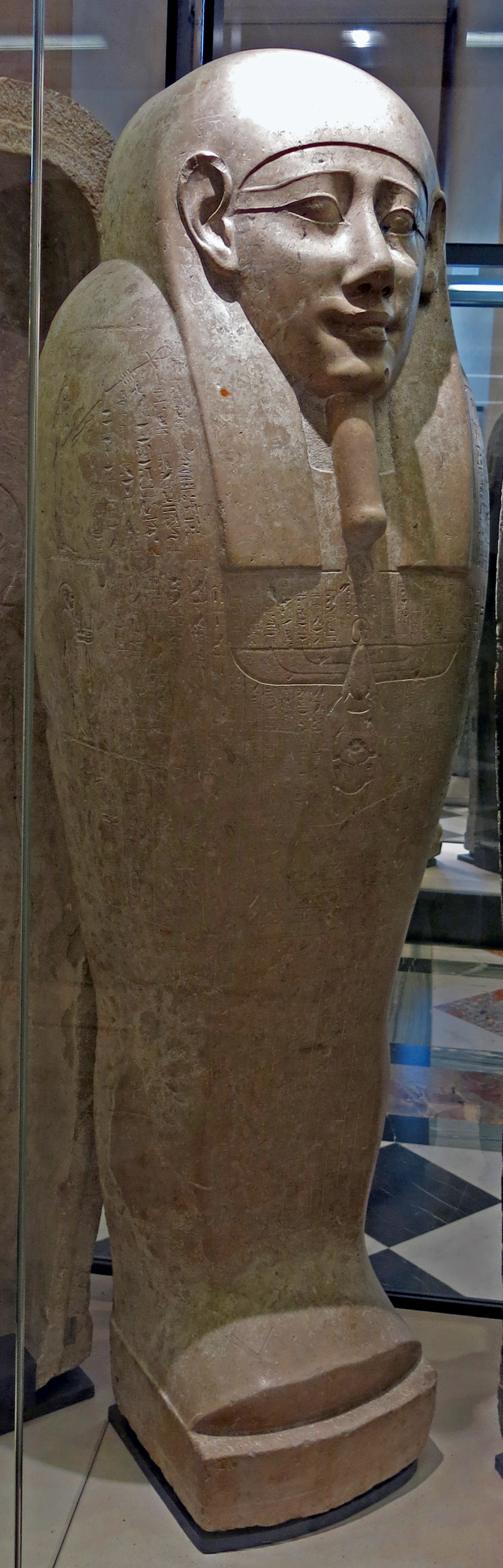
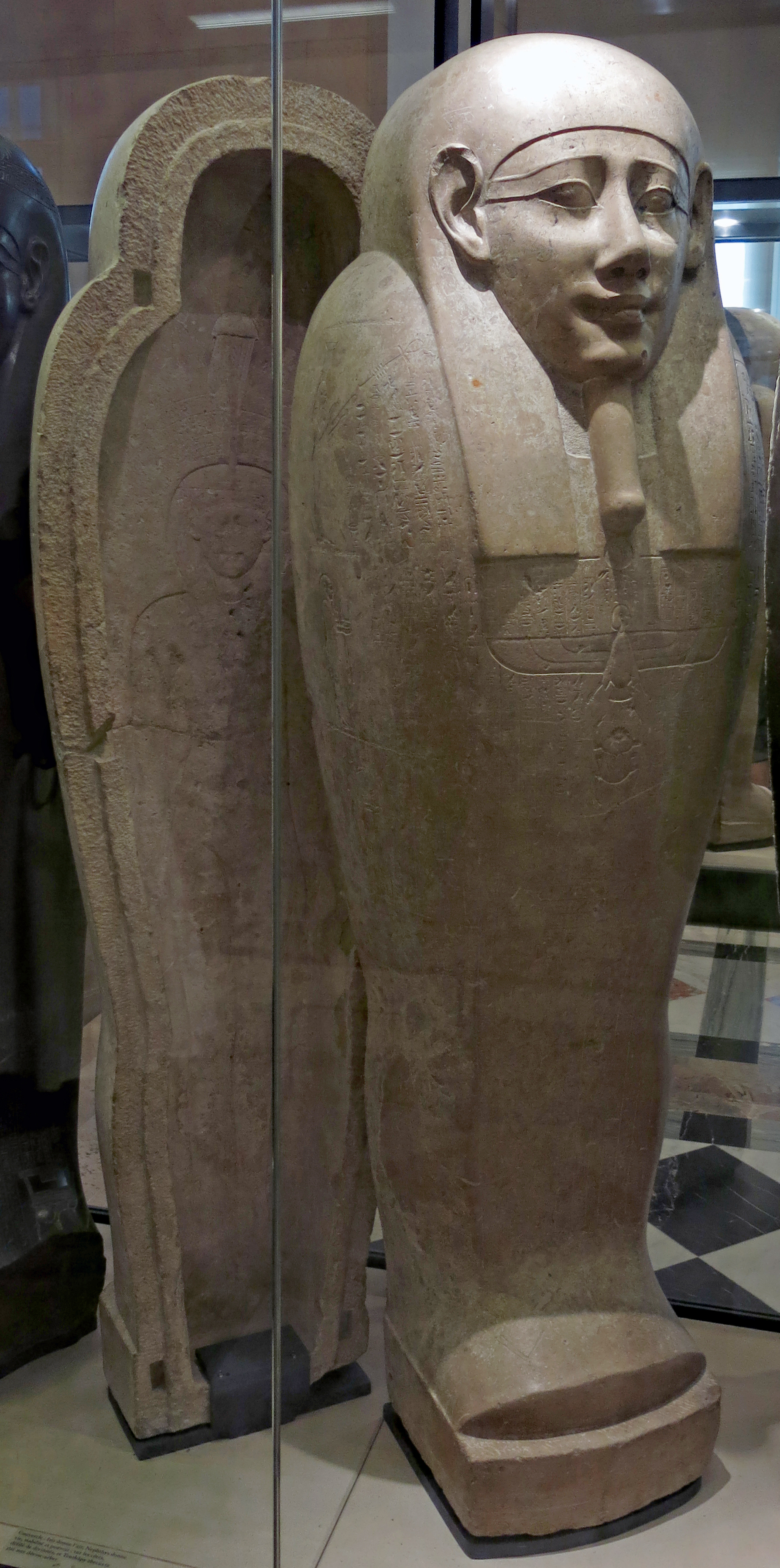
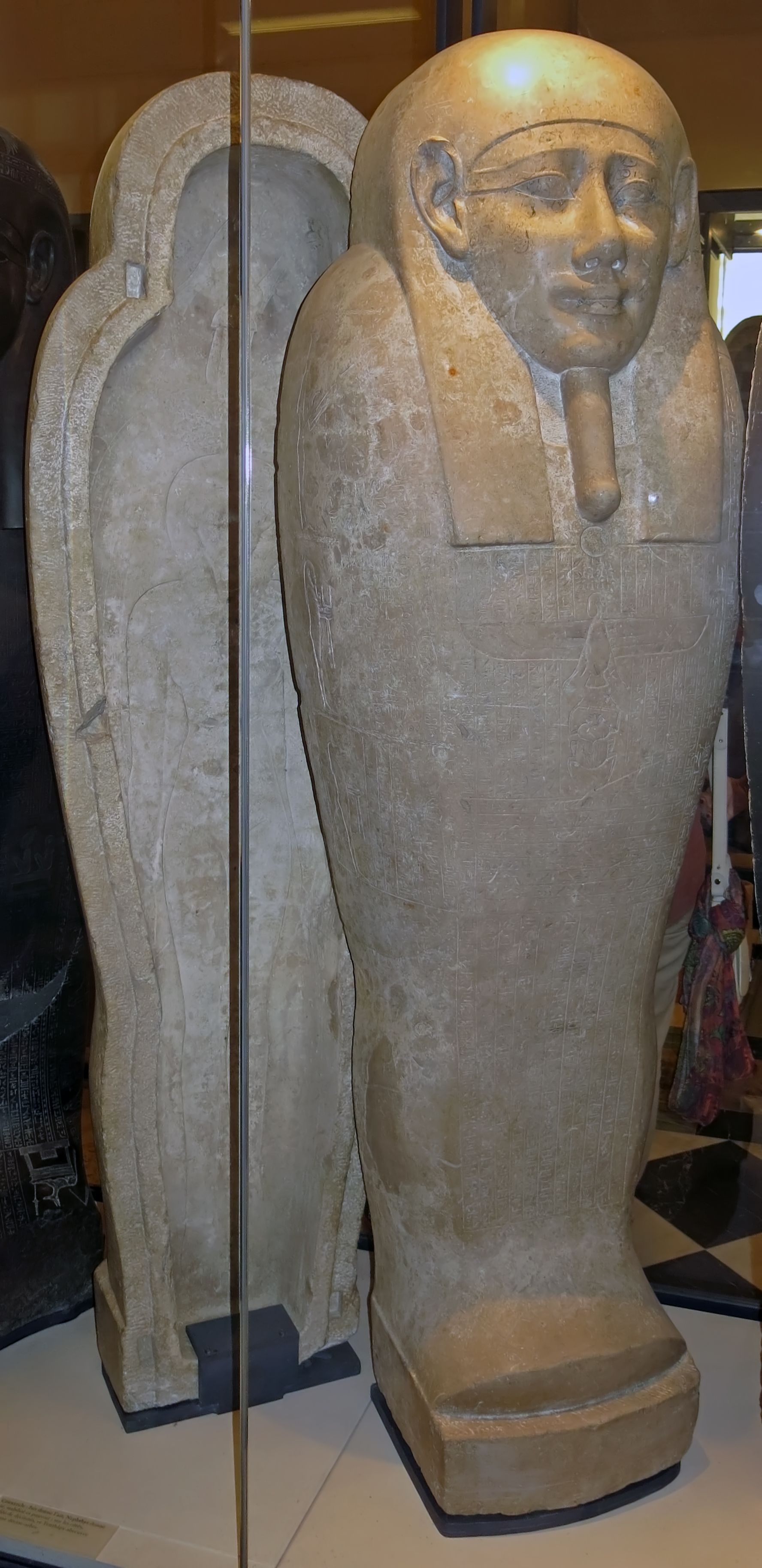
30th Dynasty - Ptolemaic : 380 BC - 30 BC
Iymhetep
The sarcophagus of Iymhetep.
Length 1840 mm, width 600 mm.
Inscribed with chapters from the Book of the Dead.
Other inscriptions: father of the god loved by the god, priest-sem, servant-hem of Ptah, servant of the god of Amun-Ra who presides over the temples; Isetouret (mother)
Cover: Isis gives air, Nephthys gives life, stability and power; on the sides, a parade of deities, and Tenthapy accepting a drink from a tree goddess.
Catalog: limestone, Salle 321, The sarcophagi, Vitrine 1, D 12, N 348, Drovetti n°277
Photo: Don Hitchcock 2015
Source and text: Original, Louvre Museum, Paris, France, https://collections.louvre.fr/
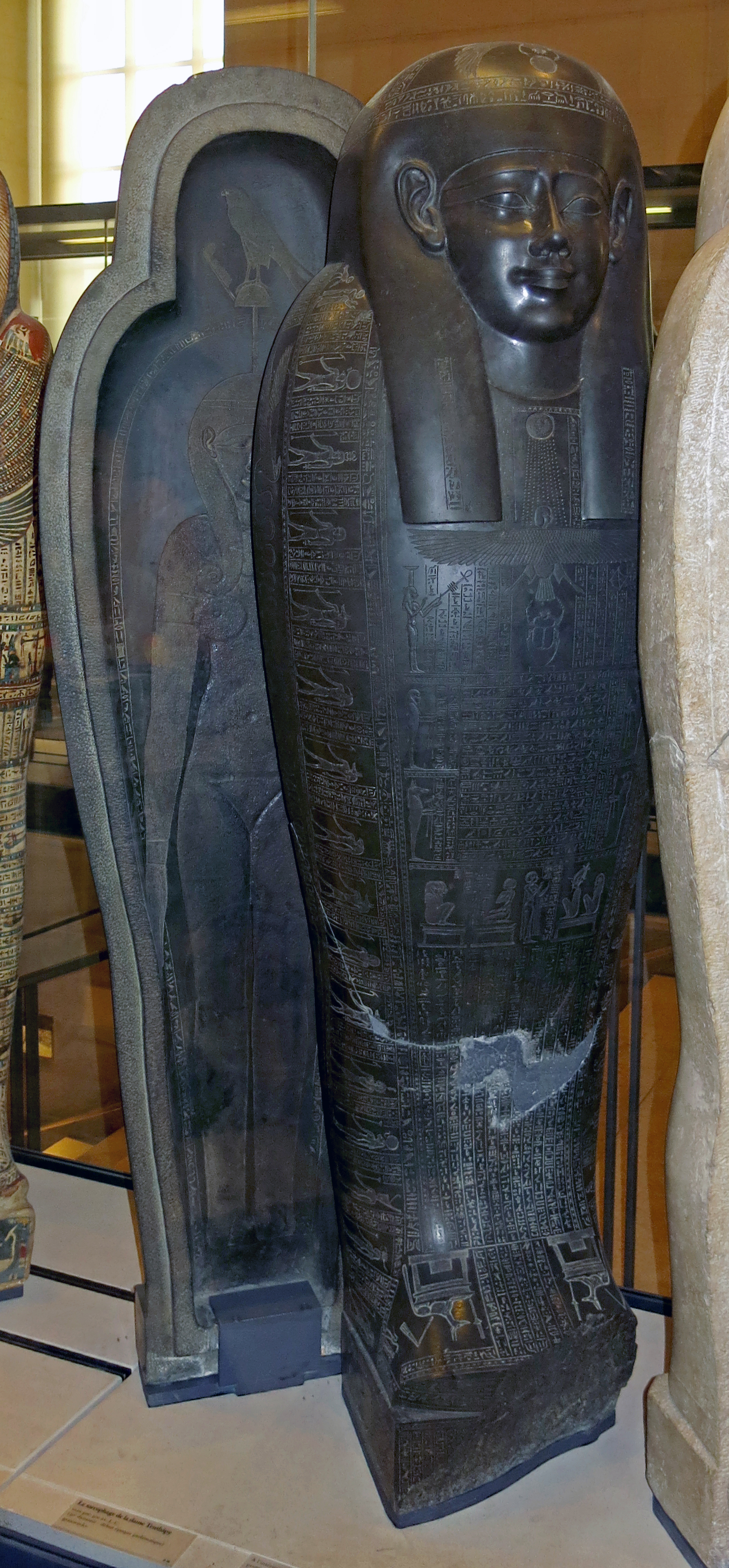
30th Dynasty - Ptolemaic : 380 BC - 30 BC
Tenthapy
The mummiform sarcophagus of the woman Tenthapy. She wears a shroud and a tripartite wig.
On the head is a winged scarab with a sun disk, starry sky sign, Hathor (shown as a cow, standing, with a sun disk, double ostrich feather, sistrum, collar counterweight, offering table.
On the chest is the starry sky sign, a radiant solar disc, and a ba-bird with wings spread.
On the belly is a scarab flanked by Isis (standing, sign of Isis, presenting, sign of the breath), Nephthys (standing, sign of Nephthys, presenting, was sceptre, a djed pillar, sign of an ankh.
( Nephthys is on the left, identified by the sign on her head. The was sceptre, djed pillar and ankh she is holding are in one straight line like a staff - Don )
On the sides below the panel carrying the scarab are the 4 sons of Horus (standing). ( Below them, and below a panel of hieroglyphics are ) a woman kneeling on a cornice pedestal, in front of three gods crouching on a cornice pedestal, ( in the centre ) a woman standing, adoring, ( and on the right ) a crouching Osiris and another crouching god ( behind him ).
On the left ( in a vertical register starting at the shoulder ) is a ba-bird, a woman standing, adoring, and then a series of standing deities including Atum ( shown here looking more like Ra, with a sun disk headdress, falcon head, and holding a was sceptre ) Osiris ( shown here with a scarab headdress ) Hapi, Anubis ( shown with the normal jackal/wolf head ). The others are listed in the catalog as Qebehsenuef, Horus, Thoth, the minor god Oupuaout, Heka ( God of Magic and Medicine ) Anubis, a hawk-headed god, Geb ( father of Osiris and Isis ), Nut, Isis, Nephthys, a protective winged snake, and a shen ring.
On the right (not visible in this image) the catalog lists a ba-bird, a woman standing, worshipping, a series of standing deities: the sun god Ra Horakhty, the scarab faced god Khepri, Amset/Imset, one of the four sons of Horus, Anubis, an ibis-headed god; Duamutef, Horus, Oupuaout, Anubis, Shu ( supporter of the sky ), Tefnut ( goddess of rain ), Neith ( goddess of war ) Selkis ( scorpion goddess of magic ) two gods, a protective winged snake, and a shen ring.
On the inside of the lid can be seen the naked goddess Imentet but wearing a Hathoric hairstyle, ( and the headdress of the Goddess Imentet, Goddess of the West, including a semicircle on a pole, an ostrich feather, and a falcon. )
Length 1780 mm, width 600 mm, depth 415 mm.
Catalog: Basalt / Greywacke, Salle 321, The sarcophagi, Vitrine 1, D 39, E 84, N 352
Photo: Don Hitchcock 2015
Source and text: Original, Louvre Museum, Paris, France, https://collections.louvre.fr/

30th Dynasty - Ptolemaic : 380 BC - 30 BC
Healer Statue
Healer statue decorated with divine figures and magical signs, 4th century BC.
These statues were of high status individuals, and they were covered with secret healing spells and images.
Liquids were poured over the statues, and the liquids were believed to absorb the healing properties of the statue, and were collected and used by Egyptians for healing from injury or sickness.
They were mostly used between the 26th Dynasty and the early Ptolemaic Period.
Catalog: Limestone, ÄS 2824
Photo: Don Hitchcock 2015
Source: Original, Ägyptischen Museum München
Text: Museum card, © Ägyptischen Museum München
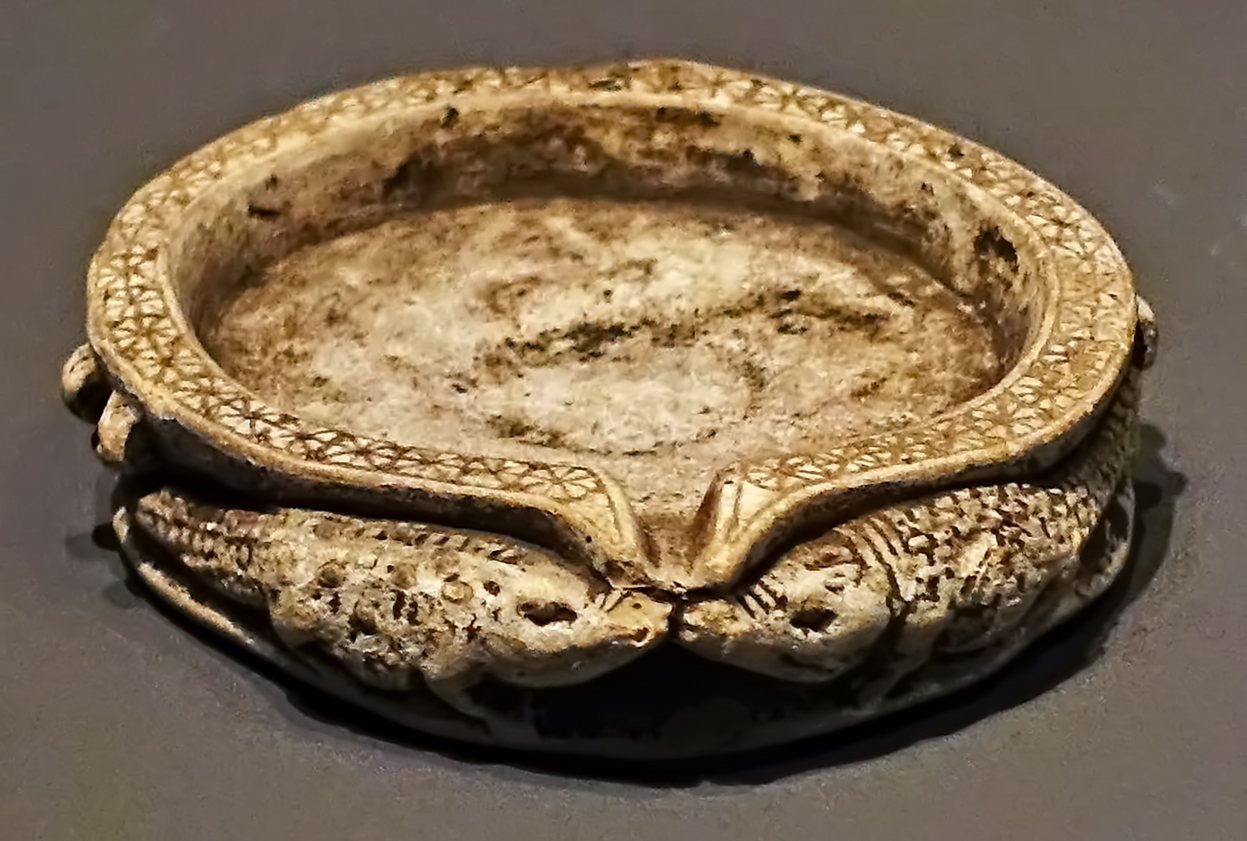
30th Dynasty - Ptolemaic : 380 BC - 30 BC
Dish for healing water
Dish for healing water, with a ring of four crocodiles around the edge, circa 4th - 2nd century BC.
Catalog: Faience, ÄS 2927
Photo: Don Hitchcock 2018
Source: Original, Ägyptischen Museum München
Text: Museum card, © Ägyptischen Museum München
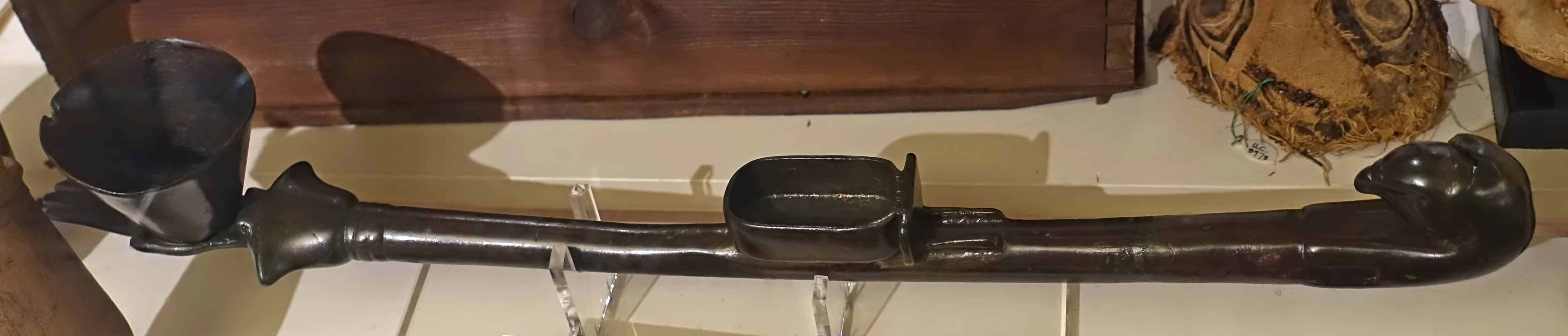
30th Dynasty - Ptolemaic : 380 BC - 30 BC
Bronze hand censer
The handle is falcon-headed and the terminal is in the form of a human hand, holding a basin-shaped pellet receptacle. The second pellet box is shaped in the form of a cartouche in the centre of the piece.
An arm-shaped censer like this one can be understood as a hieroglyphic representation of one of the most potent rituals, the rite of the presentation of the Eye of Horus. The incense bowl and the falcon terminal represent the Eye, while the arm is the hieroglyph for 'presenting' or 'giving'. The Eye of Horus was believed to possess the power to heal or protect whoever received it.
From Saqqara H5-2505 Hawk Gallery 16, Accession Number LDUCE-UC30663
Photo: Don Hitchcock 2018
Source: Original, Petrie Museum, London, England
Text: Card / online catalogue, the Petrie Museum, © 2015 UCL. CC BY-NC-SA license
Additional text: www.brooklynmuseum.org
The 31st Dynasty: 343 BC - 332 BC
The Thirty-first Dynasty of Egypt, also known as the Second Egyptian Satrapy, was effectively a short-lived province (satrapy) of the Achaemenid Persian Empire between 343 BC to 332 BC. It was founded by Artaxerxes III, the King of Persia, after his reconquest of Egypt and subsequent crowning as Pharaoh of Egypt, and was terminated upon the conquest of Egypt by Alexander the Great.
The period of the 31st Dynasty was the second occasion in which Persian pharaohs ruled Egypt, hence the term 'Second Egyptian Satrapy'. Before the 31st Dynasty was founded, Egypt had enjoyed a brief period of independence, during which three indigenous dynasties reigned (the 28th, 29th, and 30th dynasties). The period before this is referred to as the "First Egyptian Satrapy" or the 27th Dynasty.
| 31st Dynasty | ||||
|---|---|---|---|---|
| Name | Horus (Throne) Name | Years | Dates | Comments |
| Artaxerxes III | 5 | 343 BC - 338 BC | Placed Egypt under Persian rule for a second time. | |
| Artaxerxes IV | 2 | 338 BC - 336 BC | Only reigned in Lower (northern) Egypt. | |
| Khababash | Senen-setepu-ni-ptah | 3 | 338 BC - 335 BC | Led a revolt against Persian rule in Upper (southern) Egypt, declared himself Pharaoh. |
| Darius III | 3 | 338 BC - 335 BC | Upper Egypt returned to Persian control in 335 BC. | |
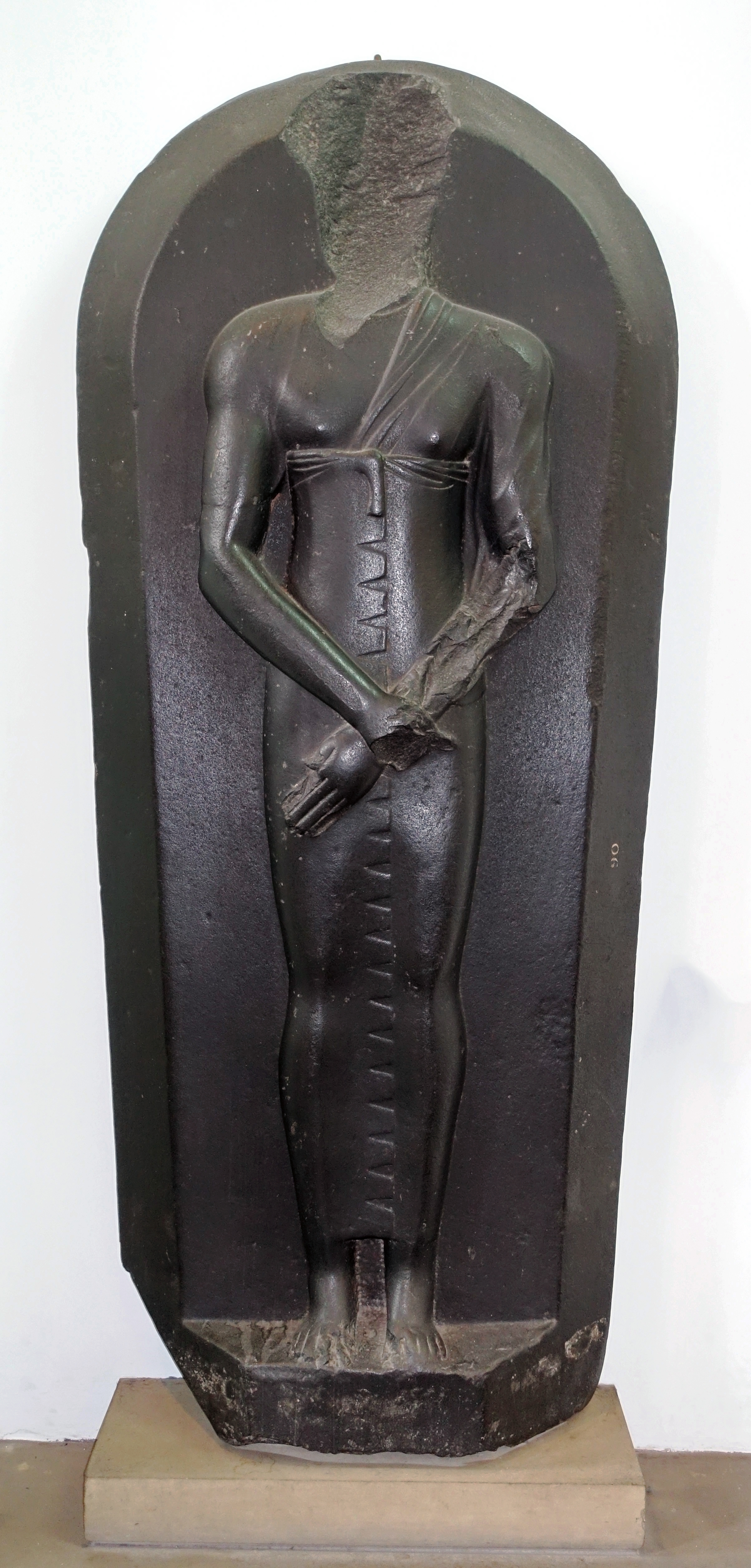
31st Dynasty (343 BC - 335 BC)
Sarcophagus lid
The male figure wears a fringed Persian garb with a scarf over one shoulder. The owner lived during the second Persian occupation, also known as the 31st Dynasty. He was either a Persian official, perhaps the governor (satrap) himself, or an Egyptian who adopted the Persian ways. The face was wilfully destroyed, perhaps as soon as Alexander the Great had ended the harsh and hated Persian domination.
This basalt (or microgranite) lid of a sarcophagus has rounded edges, and is carved in high relief with a rounded, trapezoidal lid.
The male figure in relief, the deceased wears a long Persian wrap-around garment with a fringe down the long edge and knotted at its top to a scarf, which passes over the left shoulder. The wrists are crossed over the lower stomach in the attitude of contemporary mummies. The face has been erased and one of the arms is damaged.
Height Circa 250 cm
Findspot: Unknown
Catalog: Granodiorite, EA90
Photo: Don Hitchcock 2018
Source: Original, British Museum
Text: Card at the British Museum, www.britishmuseum.org/, © Trustees of the British Museum, CC BY-NC-SA 4.0
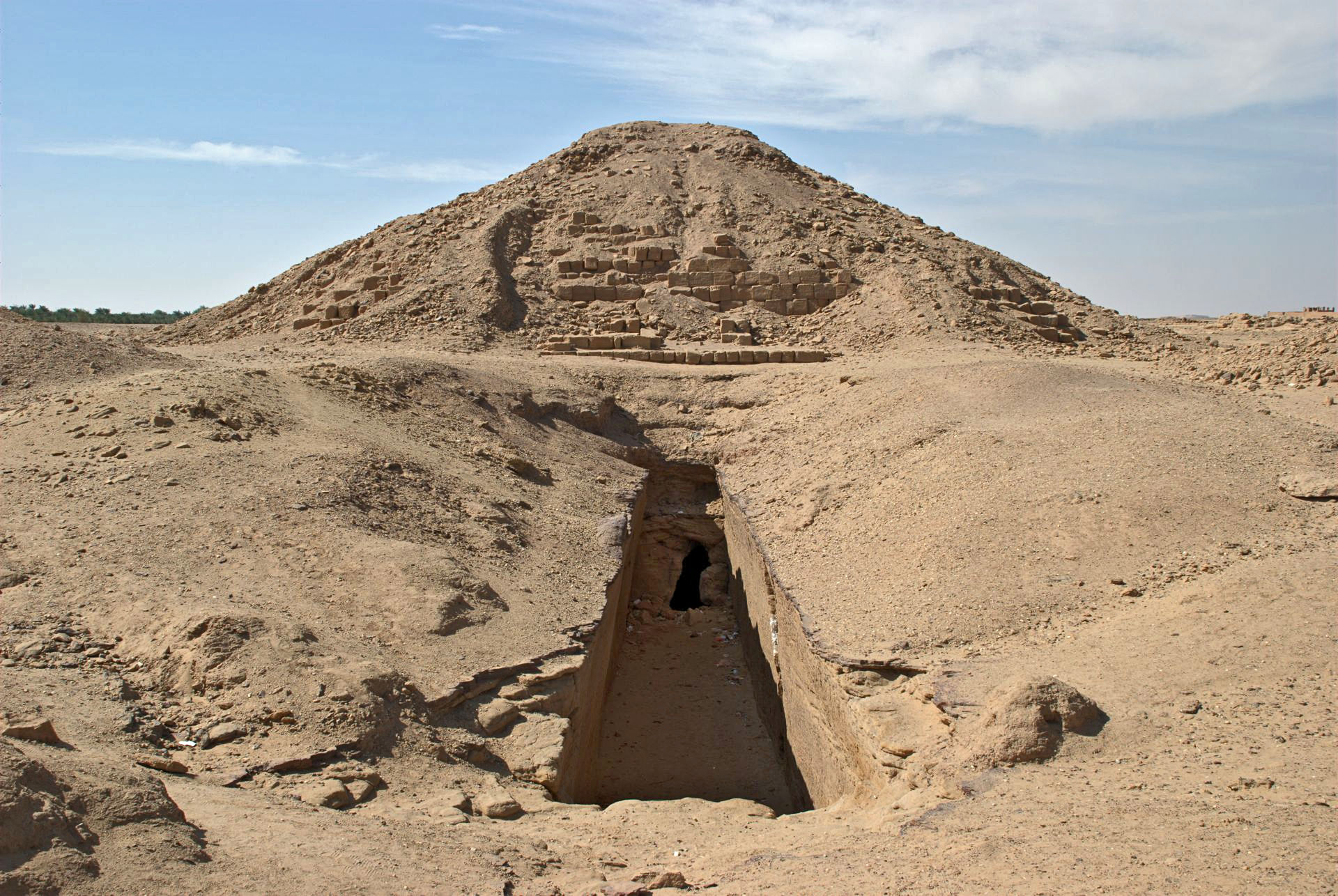
Pyramid K.1 of the 4th century BC at El-Kurru, south of Jebel Barkal, North Sudan.
Pyramids dating to the time of the Kingdom of Napata (circa 750 BC - 650 BC) and later.
K.1 - Unknown King. One of the largest pyramids. Located just south and adjacent to the pyramid of Piye (K.17) Dated to circa 362 BC - 342 BC (after Harsiotef, before Akhraten).
Photo: Bertramz
Permission: GNU Free Documentation License, Version 1.2 or any later version
Text: Wikipedia
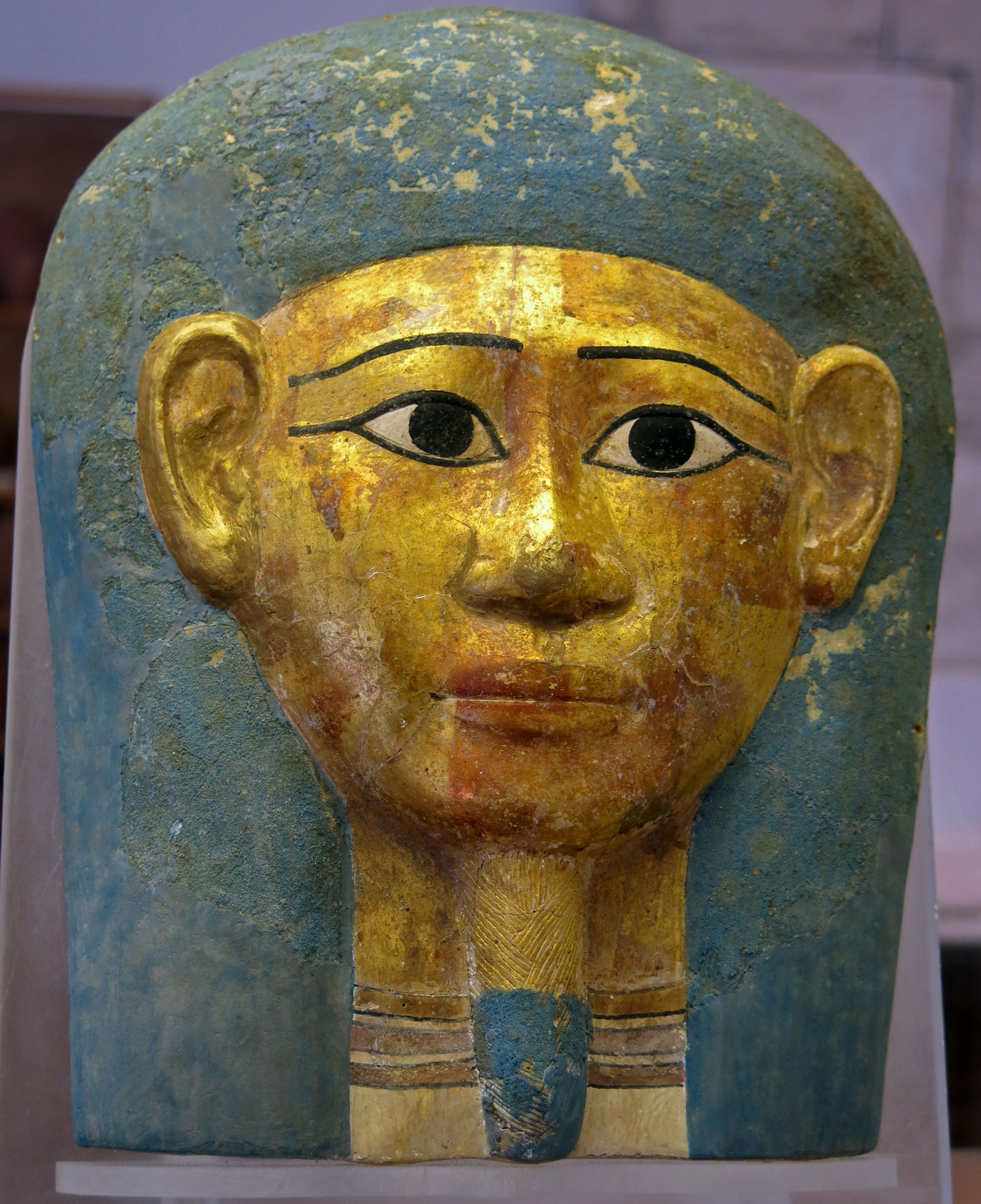
Late Period/Ptolemaic Era: 380 BC - 250 BC
Pen-ta-hut-hetep
Gold mask of the priest Pen-ta-hut-hetep.
Since the New Kingdom, the dead were equated with Osiris and should, like the god, reach a godly status in the realm of the dead. Thus, the mummy and the coffin are decorated so that the deceased appears as a forever-young god. Belonging to the typical burial objects are relatively small masks out of cartonnage, which lay around the head of the mummy. The gold plate on the face symbolizes the gold flesh of the gods and is thus everlasting.
Gold-plated cartonnage mask of Pen-ta-hut-hetep, who died at the age of 54 to 63 years.
Catalog: Tomb in Qubbet el-Hawa, QH 207, cult chamber, burial 12 (Pen-ta-hut-hetep), Inv. No BoS QH 207/119
Photo: Don Hitchcock 2014
Source: Original, Ägyptische Museum der Universität Bonn
Additional text: http://www.aegyptisches-museum.uni-bonn.de/Collection/highlights?set_language=en
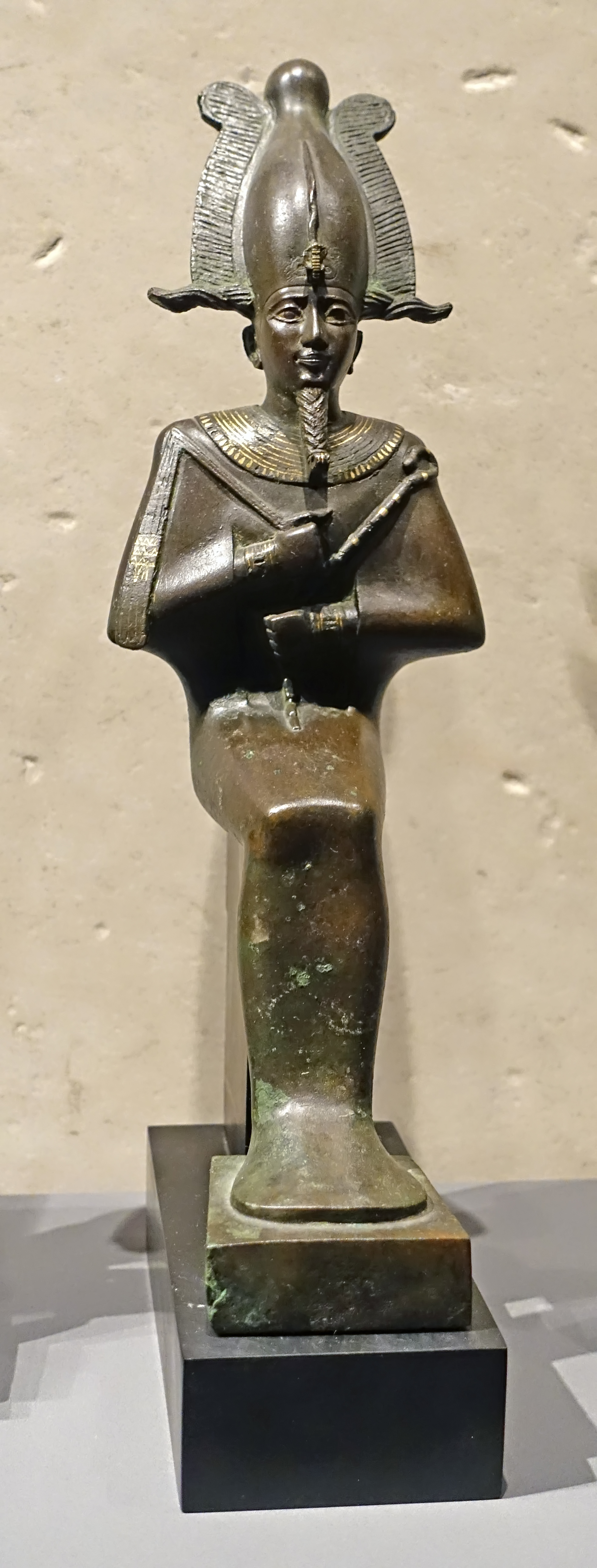
Late Period/Ptolemaic Era: 380 BC - 250 BC
Osiris
Osiris seated, in bronze, with what appears to be gold inlay on the Uraeus, his beard, the Usekh collar/necklace, the crook and flail, and the two bracelets.
Catalog: Bronze, Collection of the German bank HypoVereinsbank (HVB)
Photo: Don Hitchcock 2018
Source: Original, Ägyptischen Museum München
Text: Museum card, © Ägyptischen Museum München

Late Period/Ptolemaic Era: 380 BC - 250 BC
Coffin
Wooden coffin from the Late Period - Ptolemaic Period, 400 - 300 BC.
The colourfulness of the figural representations on the coffins of the third intermediate period disappears with the end of this epoch.
The proportions also change from narrow, slender forms to a broad-shouldered outline, the head without neck is partly tucked between the shoulders on the chest.
The massive proportions are reinforced by the use of the massive wooden beams of which the coffin is constructed.
Photo: Don Hitchcock 2018
Source: Original, Ägyptischen Museum München
Text: Museum card, © Ägyptischen Museum München
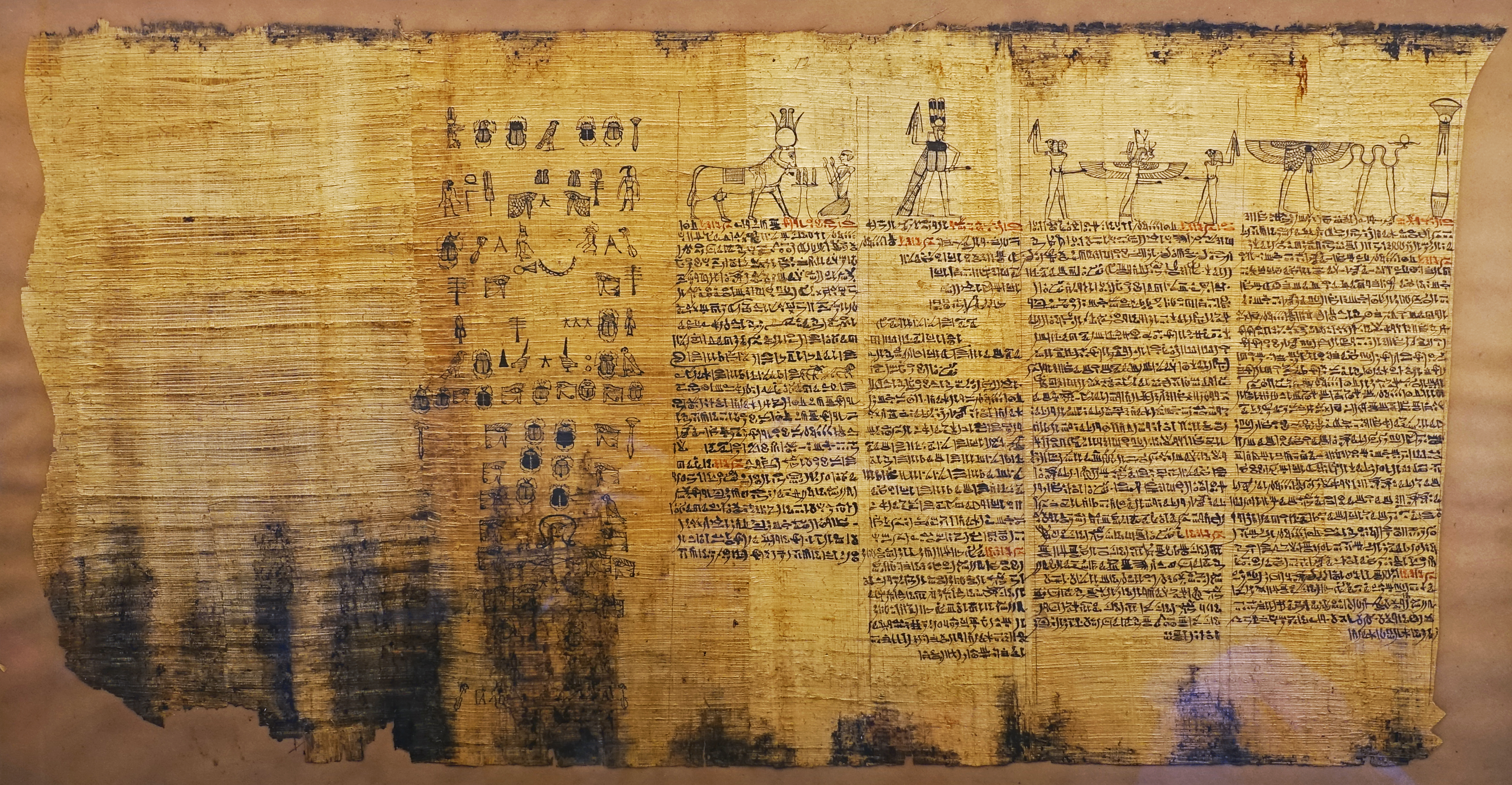
Late Period/Ptolemaic Era: 380 BC - 250 BC
Papyrus
Diagram showing prescribed distribution of amulets on a mummy, from a hieratic Book of the Dead papyrus.
This unusual document may have served as a master copy. The word Men ('so-and-so') is substituted for the name of the owner, and the diagram with which the roll ends
( towards the left of the papyrus - Don )
was evidently intended to be used as a guide in positioning amulets on a mummy.
Book of the Dead of Men..., sheet 12, black outline vignettes, Hieratic text in red and black.
Length: 660 mm (frame), width 355 mm (frame)
Catalog: EA10098,12
Photo: Don Hitchcock 2018
Source: Original, British Museum
Text: www.britishmuseum.org/research/ and card at the Museum, © Trustees of the British Museum, CC BY-NC-SA 4.0
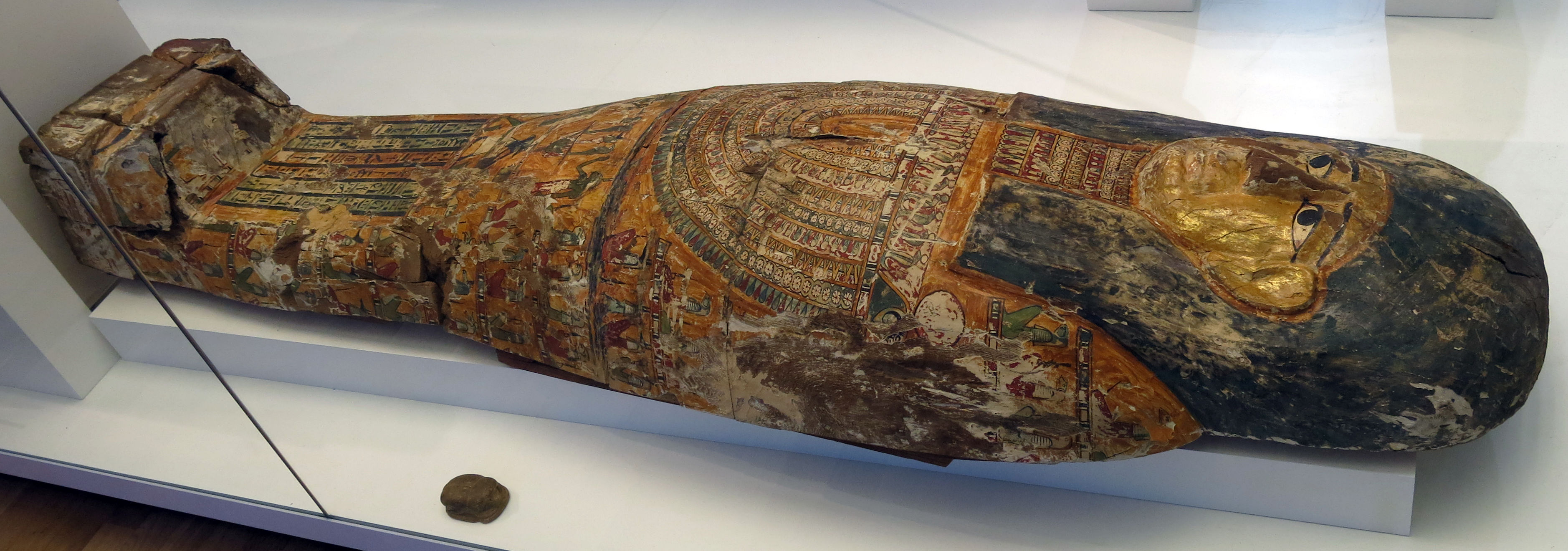
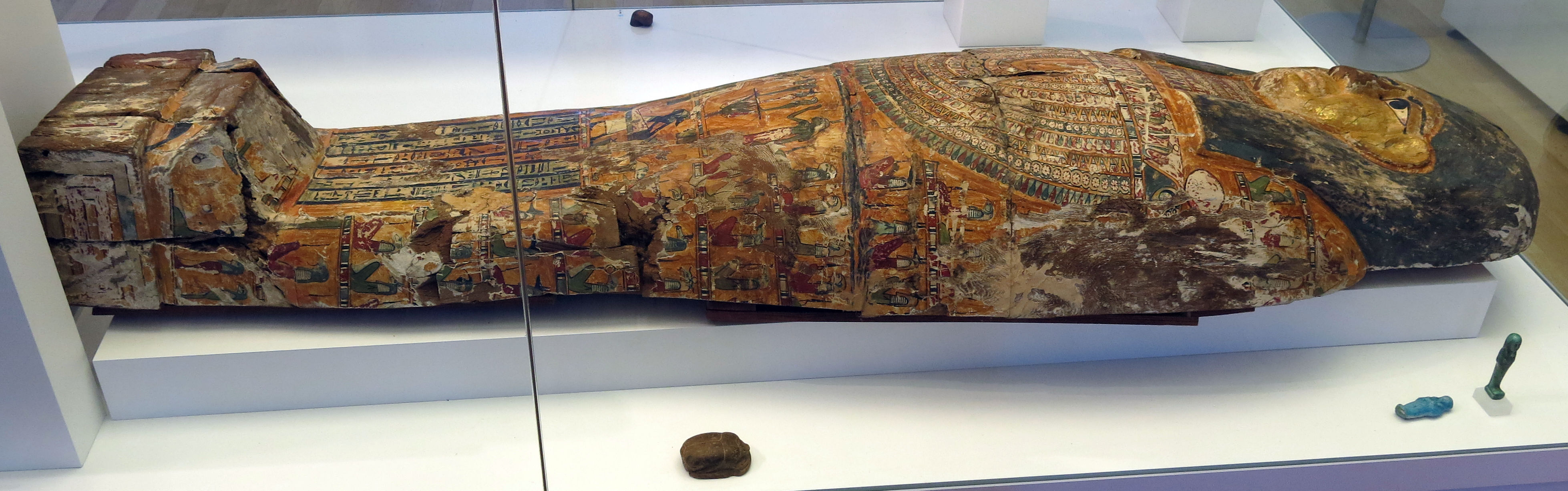
Late Period/Ptolemaic Era: 380 BC - 250 BC
Pen-ta-hut-hetep sarcophagus
Photo: Don Hitchcock 2014
Source: Original, Ägyptische Museum der Universität Bonn
Bonn excavations at Qubbet el-Hawa - Grave QH 207 - The Priest Pen-ta-hut-hetep
Golden in colour, the delicate features framed by a greenish-blue wig - the mummy mask of the Khnum-priest Pent-ta-hut-hetep reflects the afterlife after the Old Kingdom. The Egyptians wanted the person to be resurrected after death by the god Osiris, and therefore gave the deceased idealised images of masks to match this and other gods. Green and blue, colours of vegetation, as well as the emergence of new life, as well as the gold of the colour of divine flesh are typical aspects of such face masks. This mummy mask belonged to the Late Period, 664 BC - 525 BC, originating in the aboveground burial chamber of the tomb QH 207, which was originally created in the Old Kingdom, 2707 - 2202 BC.
Pent-ta-hut-hetep died at the age of between 54 and 63 years, and may be identified by his burial in a separated room, and by a high quality, interlocking nested coffin ensemble with special decorations as well as the size, quantity and craftsmanship of the grave goods as a man of high social status. In addition, there is a full list of his relatives and ancestors, so that the names of the parents of the deceased are known. It was very probably his brother who was buried in the casket right next to him.
Text: translated from the display at the Ägyptische Museum der Universität Bonn
Pent-ta-hut-hetep was a priest dedicated to the service of the god Khnum.
Khnum was one of the earliest Egyptian deities, a ram-headed god who was originally the god of the source of the Nile River. Since the annual flooding of the Nile brought with it silt and clay, and its water brought life to its surroundings, he was thought to be the creator of the bodies of human children, which he made at a potter's wheel, from clay, and placed in their mothers' wombs. He later was described as having moulded the other deities, and he had the titles Divine Potter and Lord of created things.
Photo: Jeff Dahl
Permission: GNU Free Documentation License, Version 1.2
Text: Wikipedia

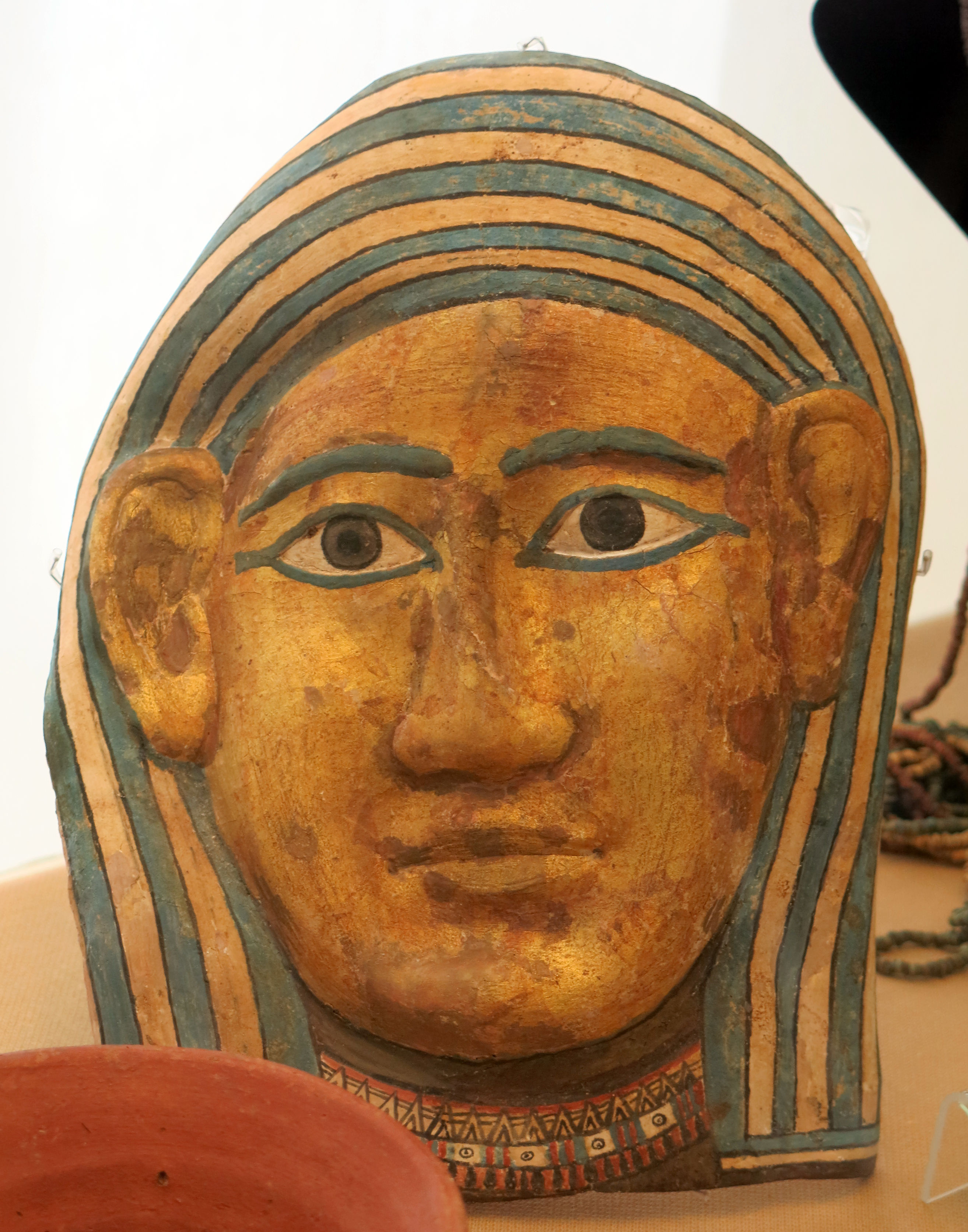
Late Period/Ptolemaic Era: 380 BC - 250 BC
Gold Masks from Qubbet el-Hawa
These were stand alone pieces placed near the sarcophagus of the deceased.
Photo: Don Hitchcock 2014
Source: Original, Ägyptische Museum der Universität Bonn
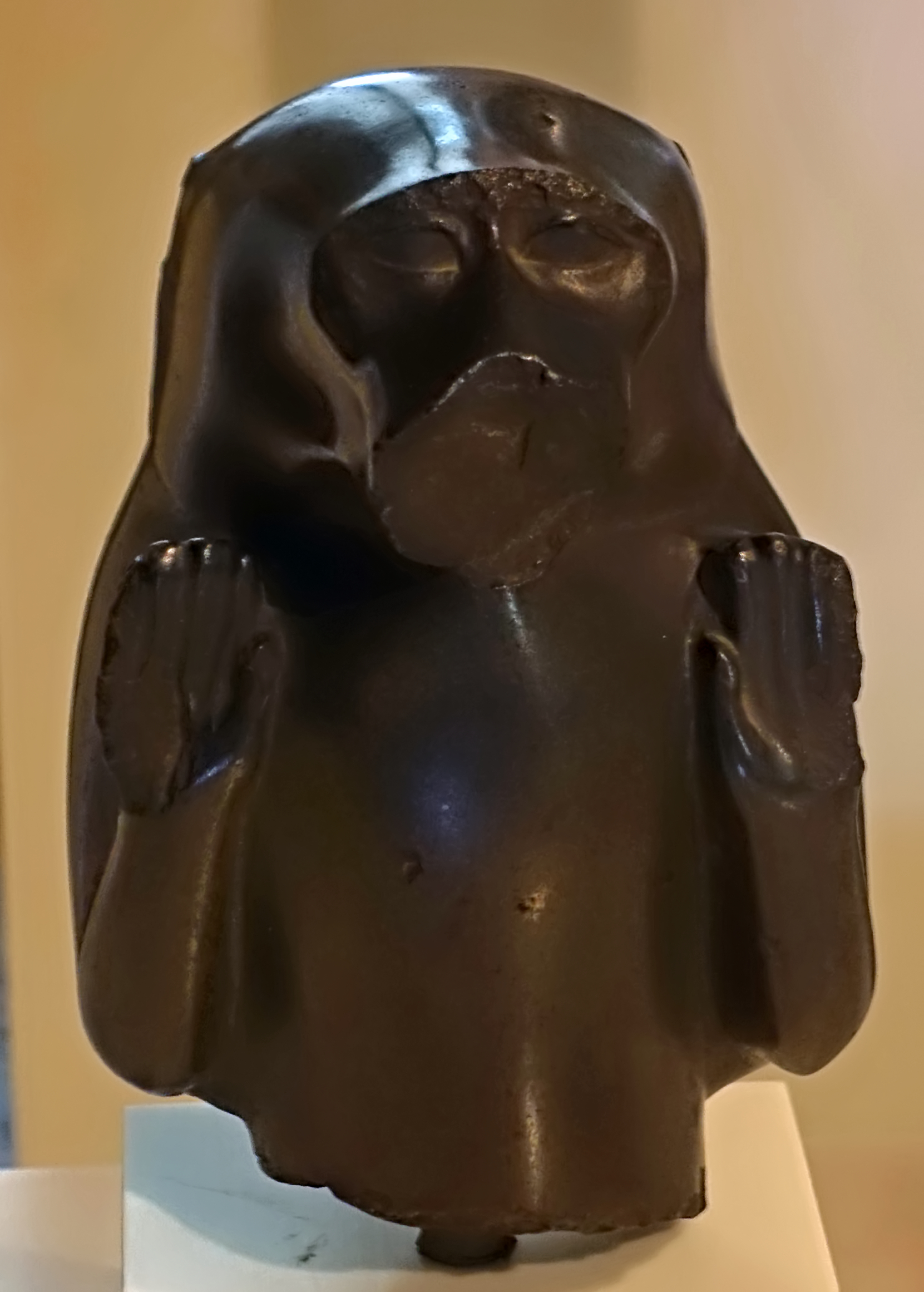
Late Period/Ptolemaic Era: 380 BC - 250 BC
Upper part of the figure of a praying ape
Circa 400 BC - 200 BC
Catalog: Basalt, ÄM 1051
Photo: Don Hitchcock 2018
Source: Original, Staatliche Museen zu Berlin, Neues Museum, Germany
Text: © Card at the Staatliche Museen zu Berlin
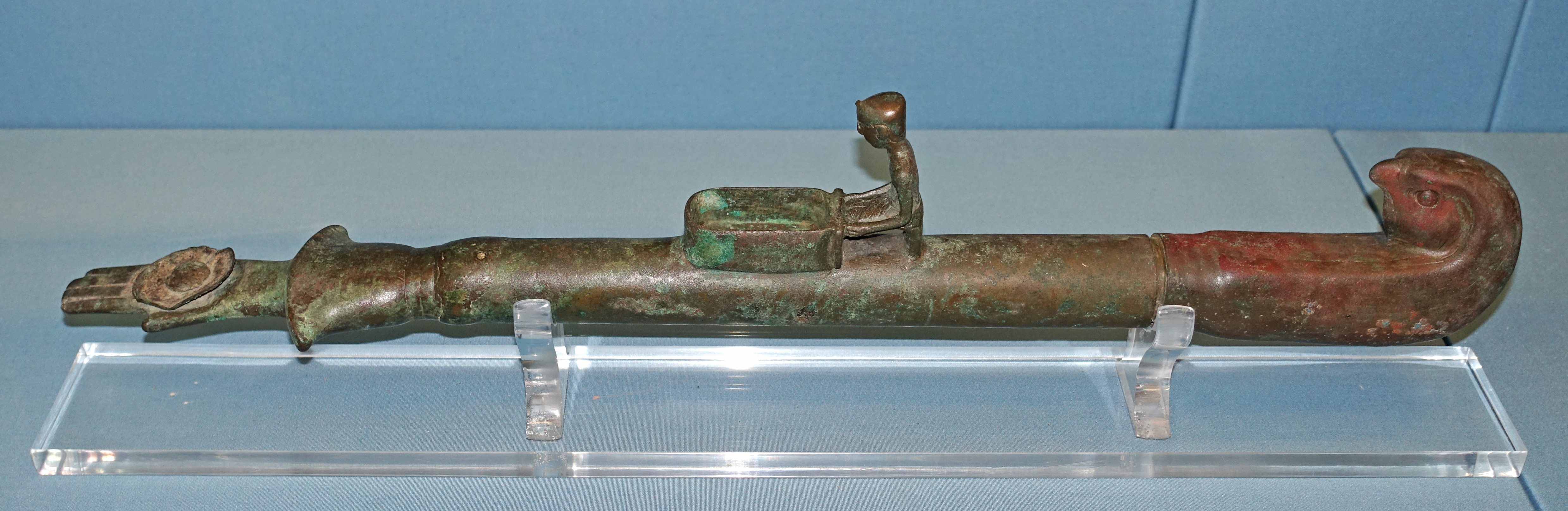
Late Period/Ptolemaic Era: 380 BC - 250 BC
Bronze Incense Burner
Circa 4th century BC - 2nd century BC
Bronze incense-burner; one terminal in the form of a papyrus-head issuing a hand holding a vessel (now missing); cartouche-shaped receptacle supported by the figure of a kneeling king halfway along the main shaft; separate bronze hawk-head terminal fits onto a wooden tang bound with papyrus.
Height 92 mm (maximum), length 504 mm (when complete), width 38 mm.
Catalog: Bronze, wood, papyrus, Saqqara, Memphis, EA67189
Photo: Don Hitchcock 2018
Source: Original, British Museum
Text: Card with the display at the British Museum, https://www.britishmuseum.org/, © Trustees of the British Museum, CC BY-NC-SA 4.0
Eroticism
Depictions of sexual relations between man and woman were absent from the official art of ancient Egypt. Symbolic, 'innocuous' images, such as the tomb owner hunting in the papyrus marshes with his family, were created as euphemisms. In the Late Period, however, under foreign influence, numerous small erotic groups and amulets were produced, illustrating various poses.
Music and eroticism went hand in hand - the harp and the lute were considered euphemisms for the sexual act. The single figures and groups played with iconographic details to suggest various gods, particularly Isis, Osiris and Harpokretes, establishing references to the myth of Osiris. They can be classified among the magical practices pertaining to the realm of fertility and the protection of the sexual union.
Text above: © Ägyptischen Museum München

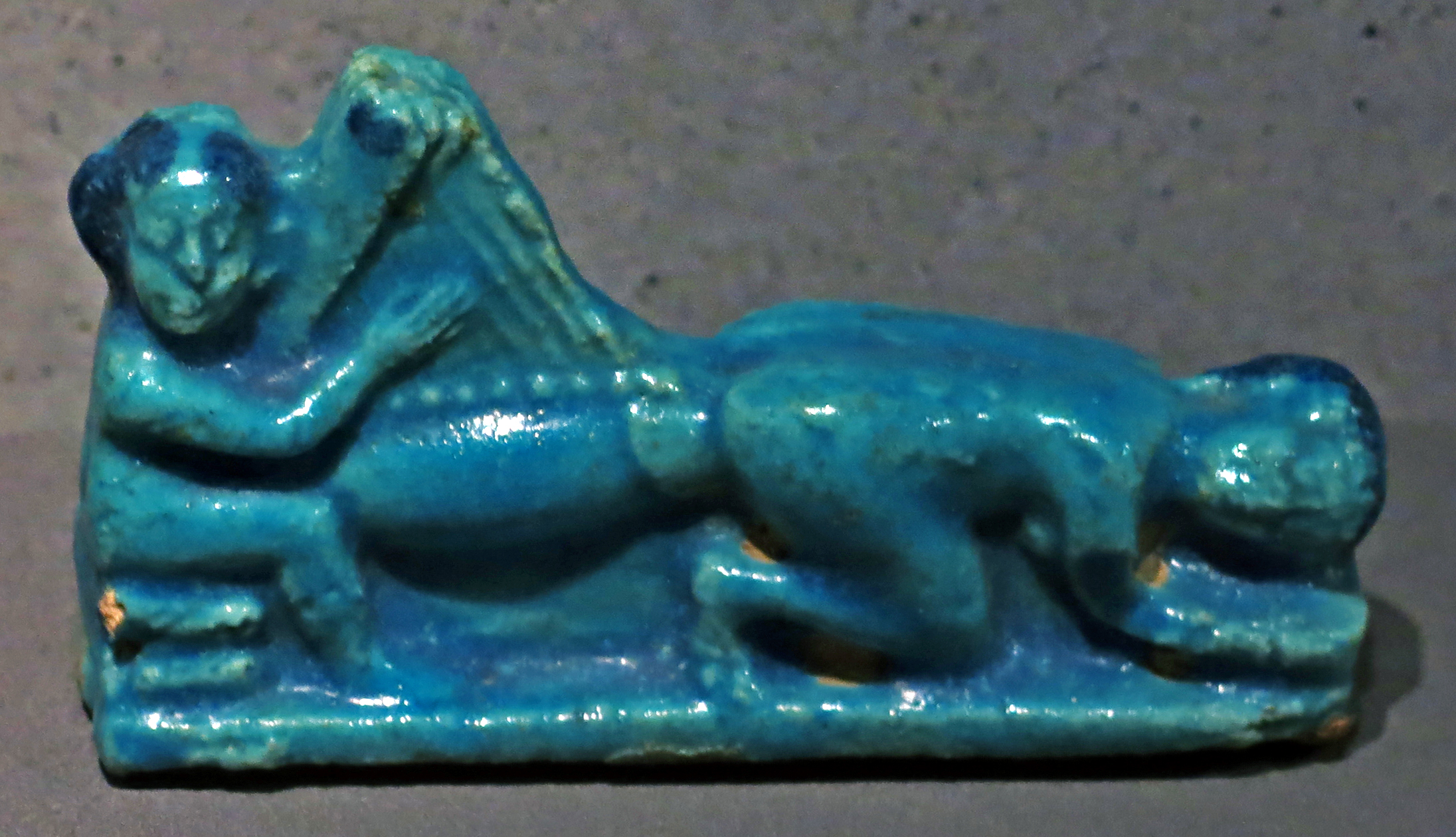
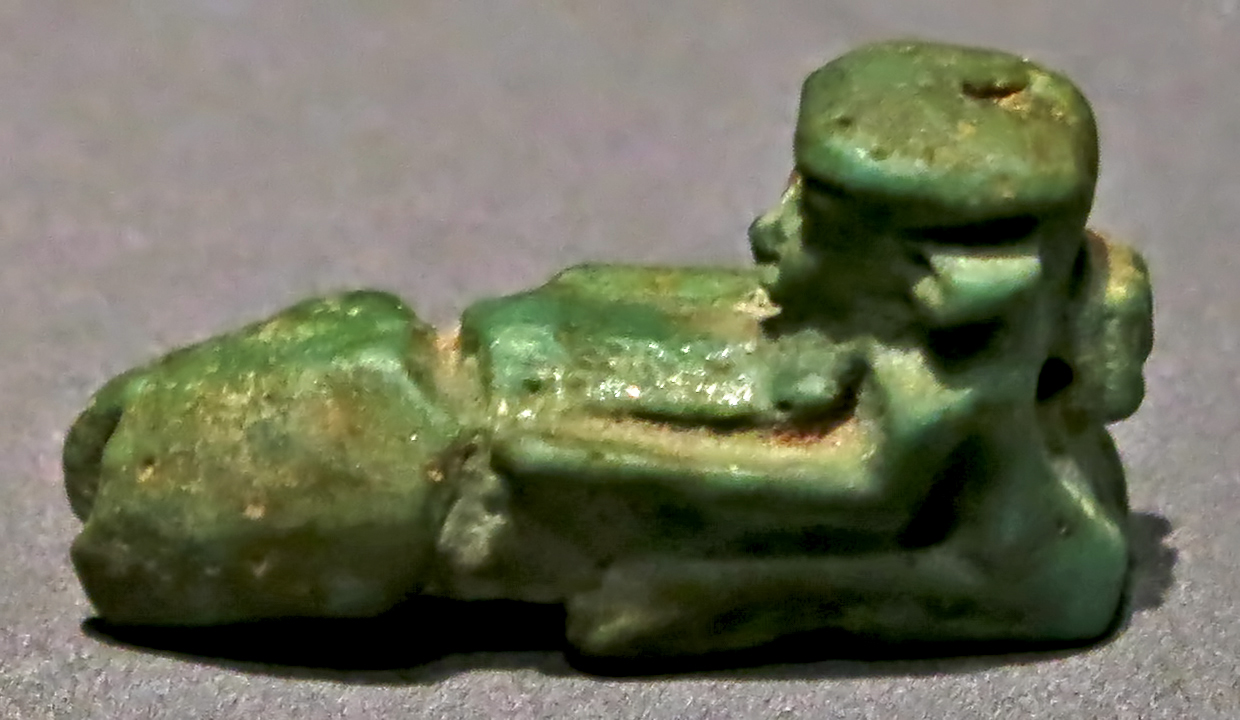
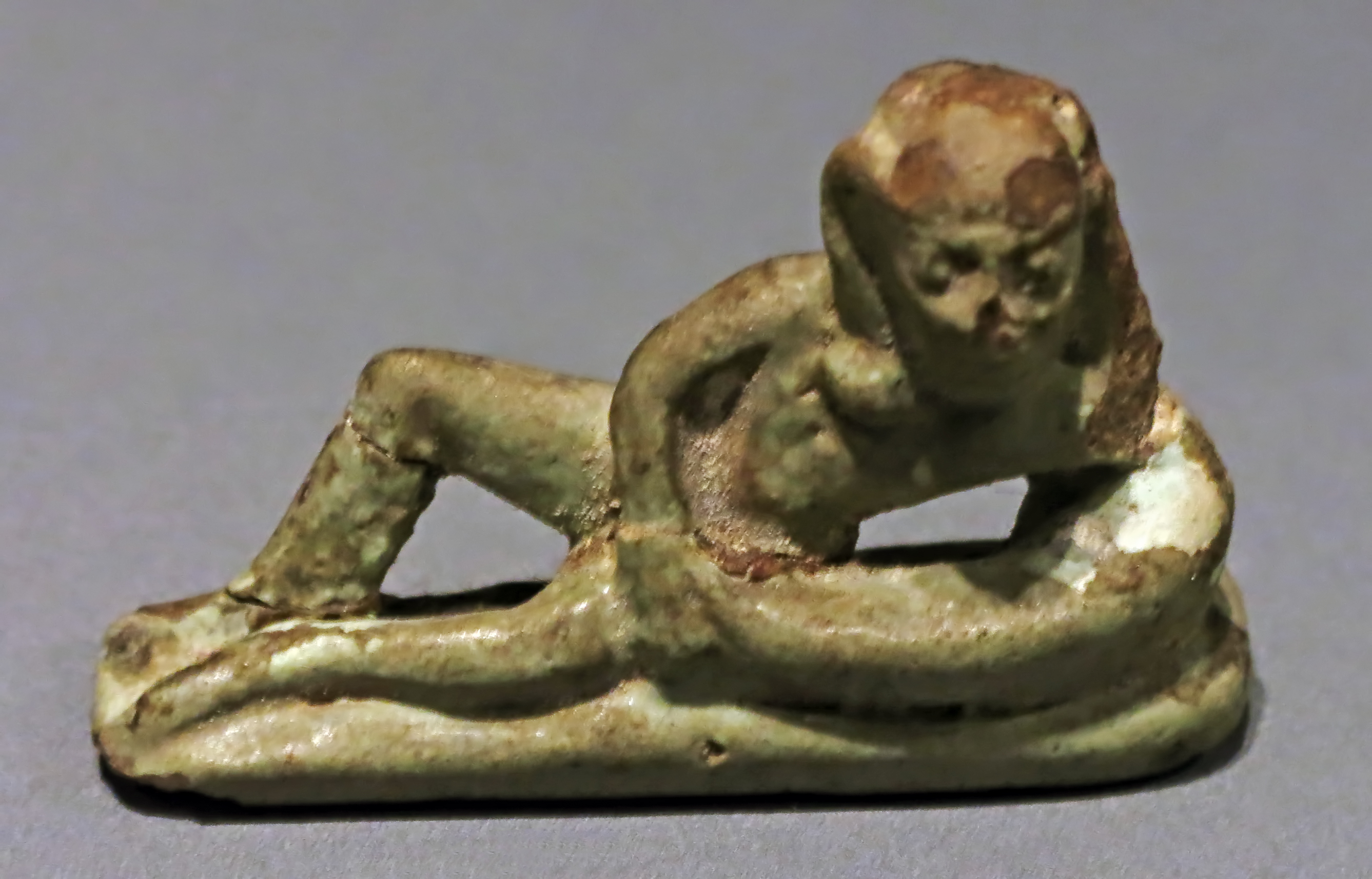
Late Period/Ptolemaic Era: 380 BC - 250 BC
Erotica
5th - 1st century BC.
Catalog: Faience, limestone, ÄS 1243, 6068, 6922, 6923, 7166, 7119, 7207, 7316.
Photo: Don Hitchcock 2015
Source: Original, Staatliche Museen zu Berlin, Neues Museum, Germany
Text: © Card at the Staatliche Museen zu Berlin
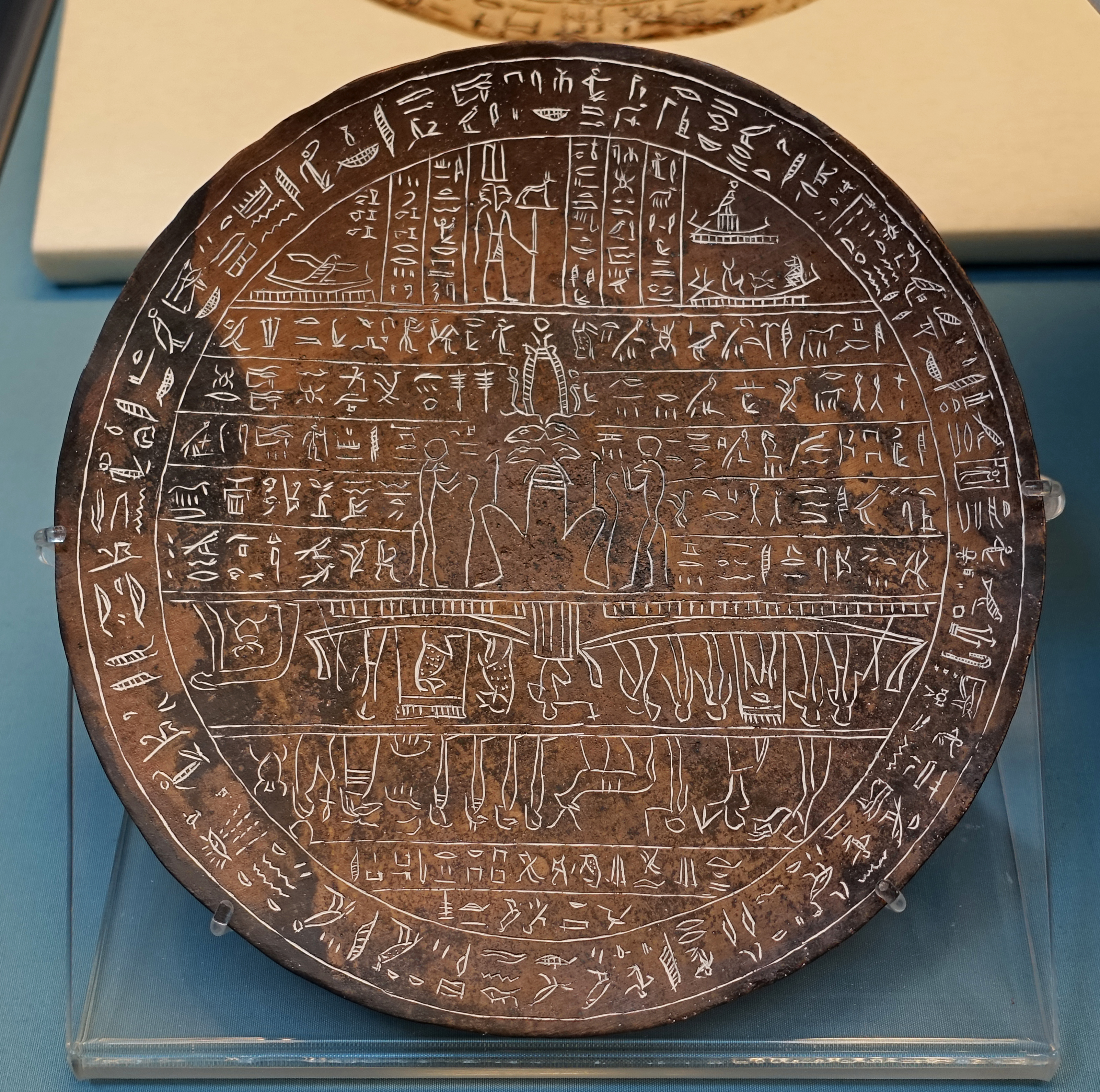
Late Period/Ptolemaic Era: 380 BC - 250 BC
Hypocephalus
Bronze hypocephalus: four-headed Ram of Mendes adored by baboons, and barques.
A hypocephalus is a small disk-shaped object generally made of stuccoed linen, but also of papyrus, bronze, gold, wood, or clay, which ancient Egyptians from the Late Period onwards placed under the heads of their dead. The circle was believed to magically protect the deceased and cause the head and body to be enveloped in light and warmth, making the deceased divine. It replaced the earlier cow-amulet.
( This hypocephalus was in a parlous state until it was superbly restored by the talented and professional Curator and Staff of the British Museum - Don )
Diameter: 200 mm.
Representation of: Banebdjedet, who was an ancient Egyptian ram god with a cult centre at Mendes. Khnum was the equivalent god in Upper Egypt.
Catalog: Abydos, Sohag Governorate, EA37330
Photo: Don Hitchcock 2018
Source: Original, British Museum
Text: Card with the display at the British Museum, www.britishmuseum.org, © Trustees of the British Museum, CC BY-NC-SA 4.0
Additional text: Wikipedia
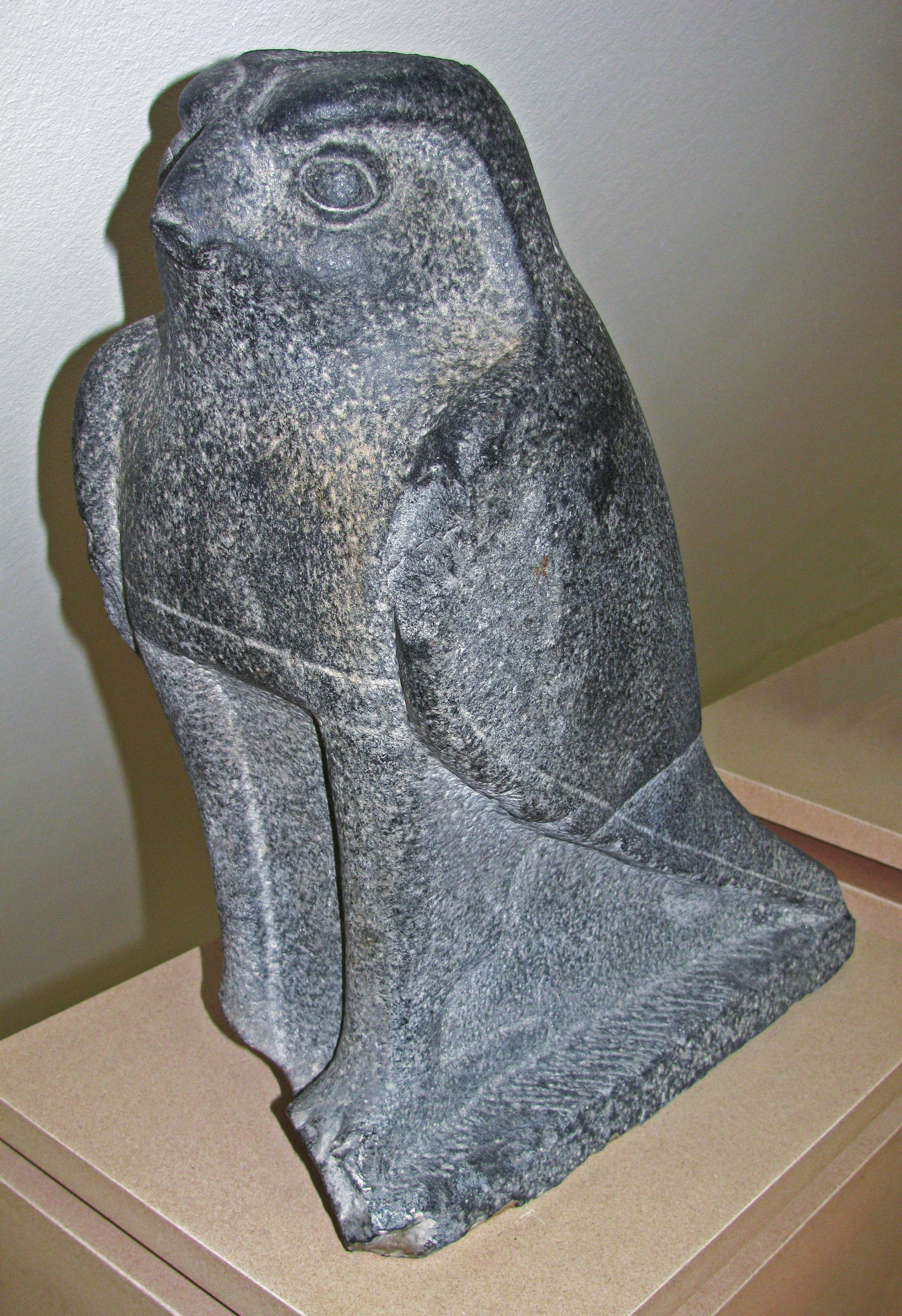
First Millenium BC: 1 000 BC - 1 BC
Horus falcon
The Horus falcon was a god of the sky and the sun, but also identical with the Egyptian king, and his protector.
Catalog: Basalt
Photo: Don Hitchcock 2014
Source and text: Original, Københavns (Copenhagen) Museum, National Museum of Denmark
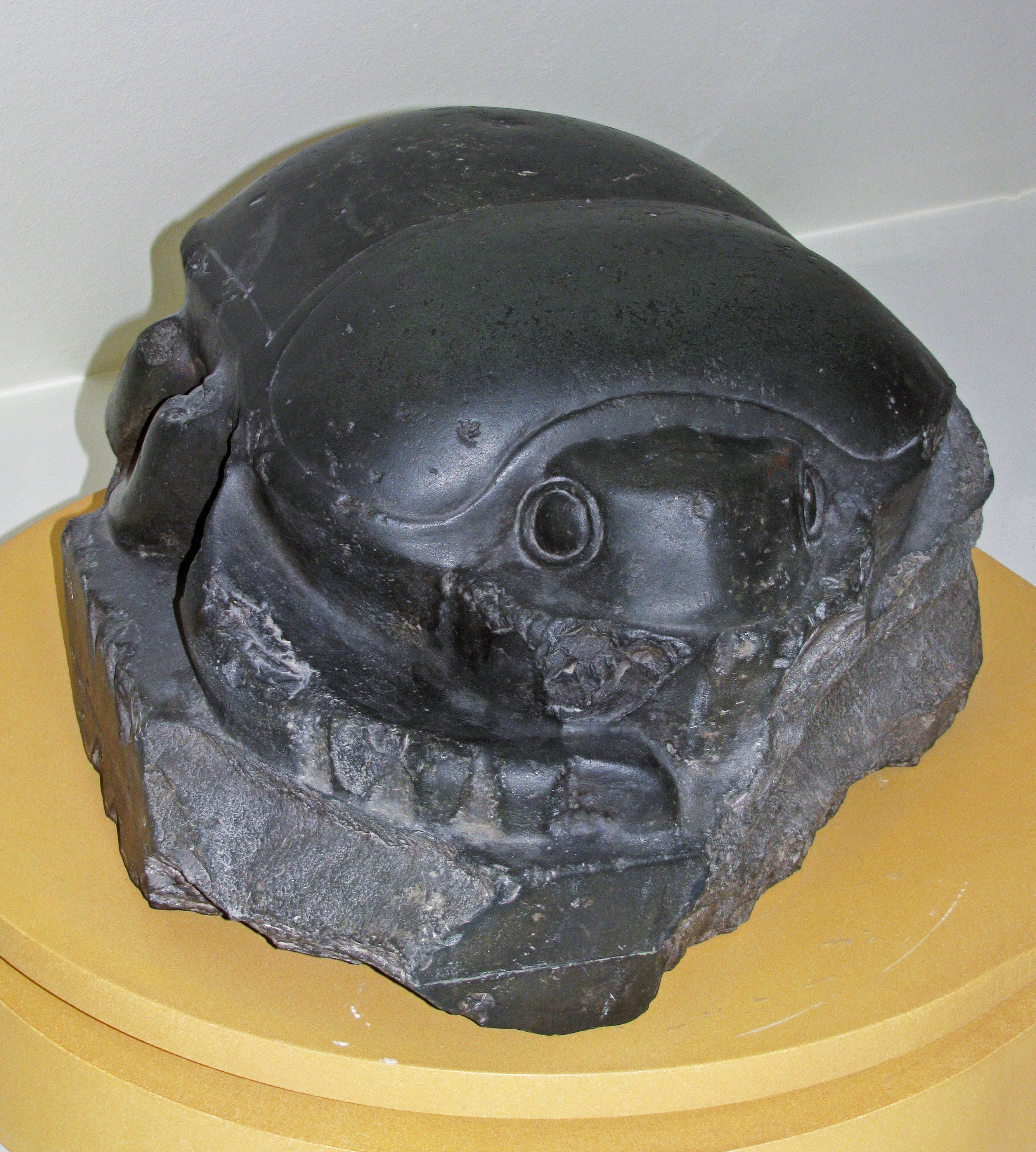
First Millenium BC: 1 000 BC - 1 BC
Scarab
The sacred dung beetle, symbol of the rising sun Khepri and of rebirth and resurrection.
Catalog: Basalt
Photo: Don Hitchcock 2014
Source and text: Original, Københavns (Copenhagen) Museum, National Museum of Denmark
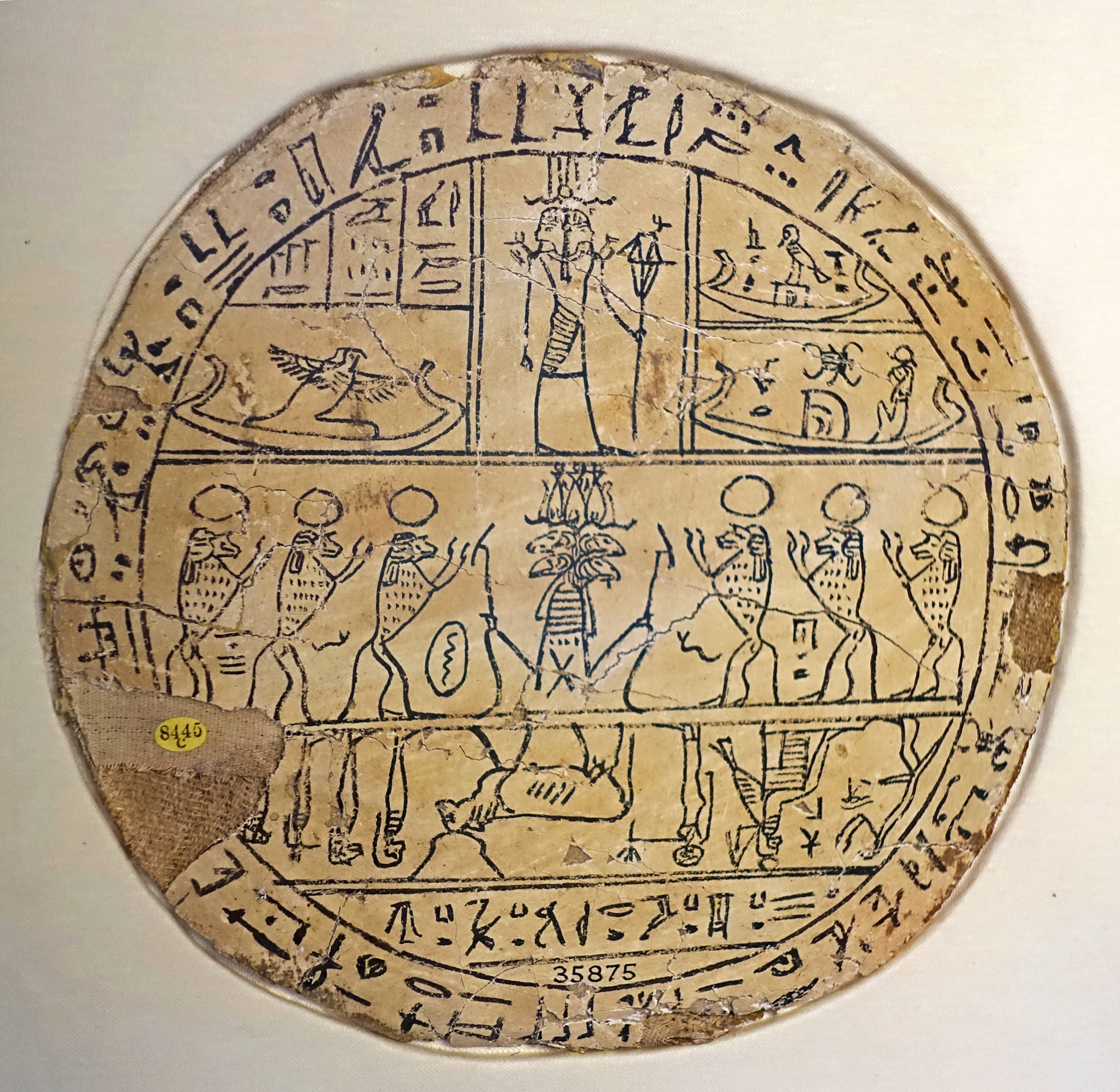
Late Period/Graeco-Roman Era: 380 BC - 395 AD
Hypocephalus
Stuccoed linen hypocephalus decorated with four painted registers of universal deities surrounded by a border of Hieroglyphs.
Diameter 212 mm.
Painted. 3 vertical registers, 1 circular register
Representation of: Sokar (?), Khnum, Hathor (?), Sons of Horus
Catalog: EA35875
Photo: Don Hitchcock 2018
Source: Original, British Museum
Text: Card with the display at the British Museum, www.britishmuseum.org, © Trustees of the British Museum, CC BY-NC-SA 4.0
References
- Budge E., 1920: Egyptian Hieroglyphic Dictionary, Vol. 1 (1920), London, John Murray, Albemarle St.
- Evans A., 2023: The lives of beetles, a natural history of Coleoptera, Princeton University Press, ISBN 978-0-691-23651-3
- Gardiner A., 1927: Egyptian Grammar: Being an Introduction to the Study of Hieroglyphs, 3rd Ed., pub. Griffith Institute, Oxford, 1957 (1st edition 1927), pp. 438–548 (pdf), http://web.ff.cuni.cz/ustavy/egyptologie/pdf/Gardiner_signlist.pdf
- Harer W., 1985: Pharmacological and Biological Properties of the Egyptian Lotus, Journal of the American Research Center in Egypt, Vol. 22 (1985), pp. 49-54 Published by: American Research Center in Egypt DOI: 10.2307/40000390
- Kákosy L., 1995: 'The Soter Tomb in Thebes', in S.P, Vleeming (ed.), Hundred-Gated Thebes: Acts of a Colloqium on Thebes and the Theban area in the Graeco-Roman Period, Leiden: Brill, 61- 67
- Lichtheim M., 1980: Ancient Egyptian Literature: The late period, University of California Press, 1980 - History - 248 pages
- Mariette A., 1857: Le Serapeum de Memphis,d, Publié sous les auspices de S.E.M. Achille Fould, Ministré d'État, Paris, Gide, Libraire-Editeur, 5 Rue Bonaparte
- Martin G., 1991: Hidden Tombs of Memphis, Thames and Hudson, London 1991
- Maspero G., 1903: History of Egypt, Chaldea, Syria, Babylonia, and Assyria, London : Grolier Society
- Pommerening, T., Marinova, E., Hendrickx, S., 2010: The Early Dynastic origin of the water-lily motif, Chronique d’Egypte, 85 (2010): 14-40
- Raven M., 1980: Papyrus-sheaths and Ptah-Sokar-Osiris Statues, RMO, 1980 - 296 pages
- Robins G., 2008: The Art of Ancient Egypt, Harvard University Press, 2008 - Art - 271 pages
- Rowe A., 1936: A catalogue of Egyptian scarabs, Chicago
- Schorsch D., 2007: Gifts for the Gods: Images from Egyptian Temples, Metropolitan Museum of Art (New York, N.Y.) Metropolitan Museum of Art, 2007 - Metal sculpture - 240 pages
- Strudwick N., 2006: Masterpieces of Ancient Egypt, University of Texas Press, 1 Nov. 2006 - Social Science - 352 pages
- Taylor J., 2010: Journey Through the Afterlife: Ancient Egyptian Book of the Dead, Harvard University Press, 2010 - History - 320 pages
Back to Don's Maps
Back to Archaeological Sites
 Back to Egypt Index Page