Back to Don's Maps
 Back to Archaeological Sites
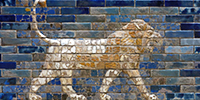 The Ishtar Gate at Babylon
 The Neo-Assyrian Empire
 Ancient Mesopotamia
Babylon
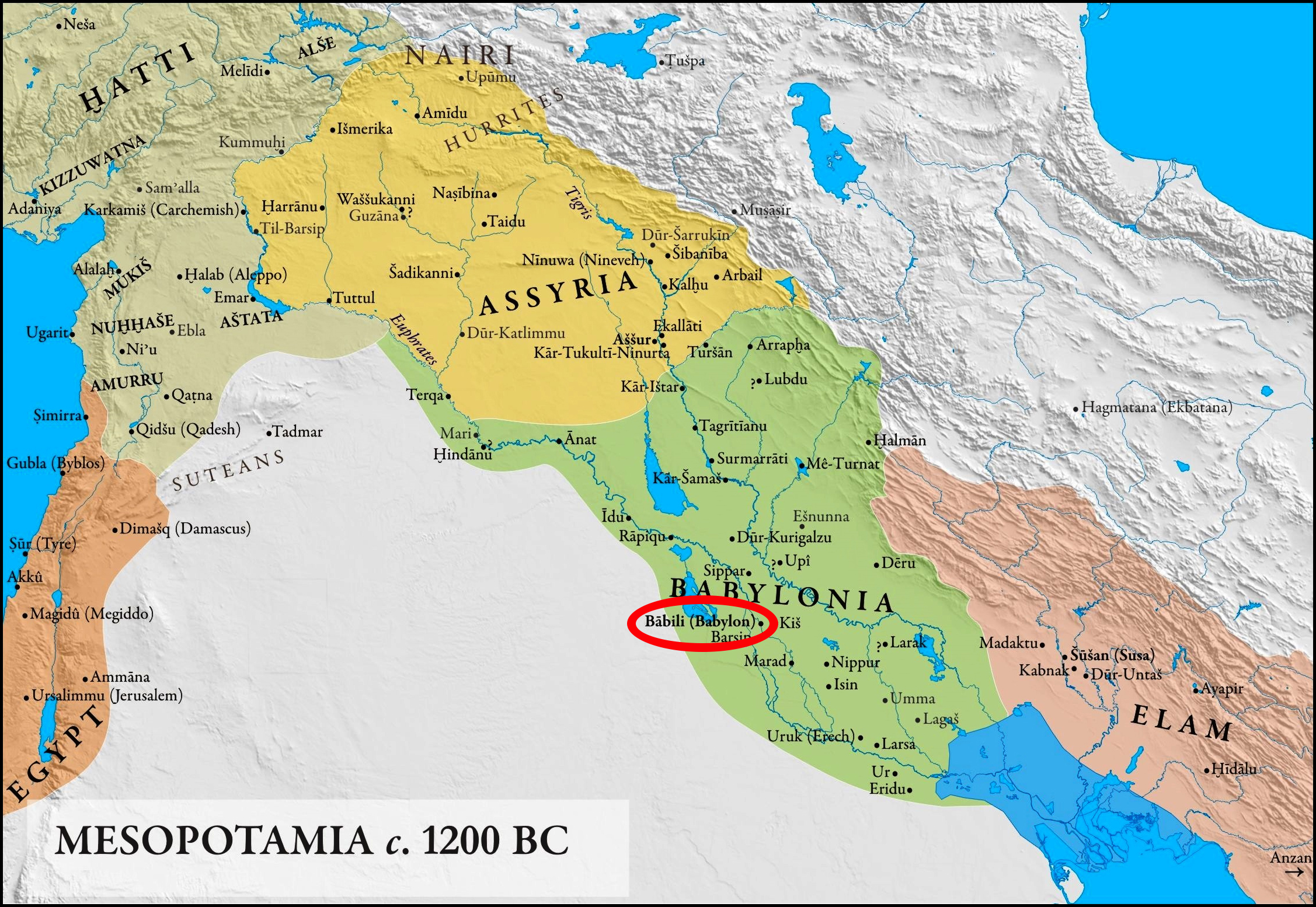
Map of Mesopotamia, circa 1 200 BC, with Babylon's position shown by a red ellipse.
This date of 1 200 BC corresponds to the start of the Late Bronze Age Collapse, when the Hittite Empire of Anatolia and the Levant (shown as Hatti on this map) collapsed, while states such as the Middle Assyrian Empire in Mesopotamia and the New Kingdom of Egypt survived but were weakened.
Note that the large area coloured in blue but with rivers and a coastline marked was under water in 1200 BC, part of the Persian Gulf at that time. Siltation from the Tigris/Euphrates created the modern coastline.
The Elamites (in modern-day Iran, approximately equivalent to the modern region of Khūzestān) were important neighbours to both Babylonia and Assyria in the Bronze Age.
Ancient Sumer, extant from 6 000 BC to 1 750 BC, lay between the Tigris and Euphrates Rivers, and stretched from Kish (Kiš) to Ur. Kiš was 25 km from the site of Babylon. Babylon was established as an independent city-state around 1 894 BC by the Amorite king Sumu-abum, though the site itself existed earlier as a minor port town since at least the late 3rd millennium BC during the Akkadian Empire.
Photo: FDRMRZUSA
Permission: Creative Commons Attribution-Share Alike 4.0 International license.
Proximate source: Wikimedia
Text: Don Hitchcock, Wikipedia, factsanddetails.com
Babylon was Located in southeastern/central-southern Mesopotamia (about 85 km south of modern Baghdad, Iraq) along the Euphrates River. It was the heart of the region known as Babylonia.
Babylon began as a minor port around 2 300 BC in Mesopotamia (present-day Iraq). Its name meant 'gateway of the gods'. It was a small trading town that grew into one of the largest and most powerful empires of the ancient world.
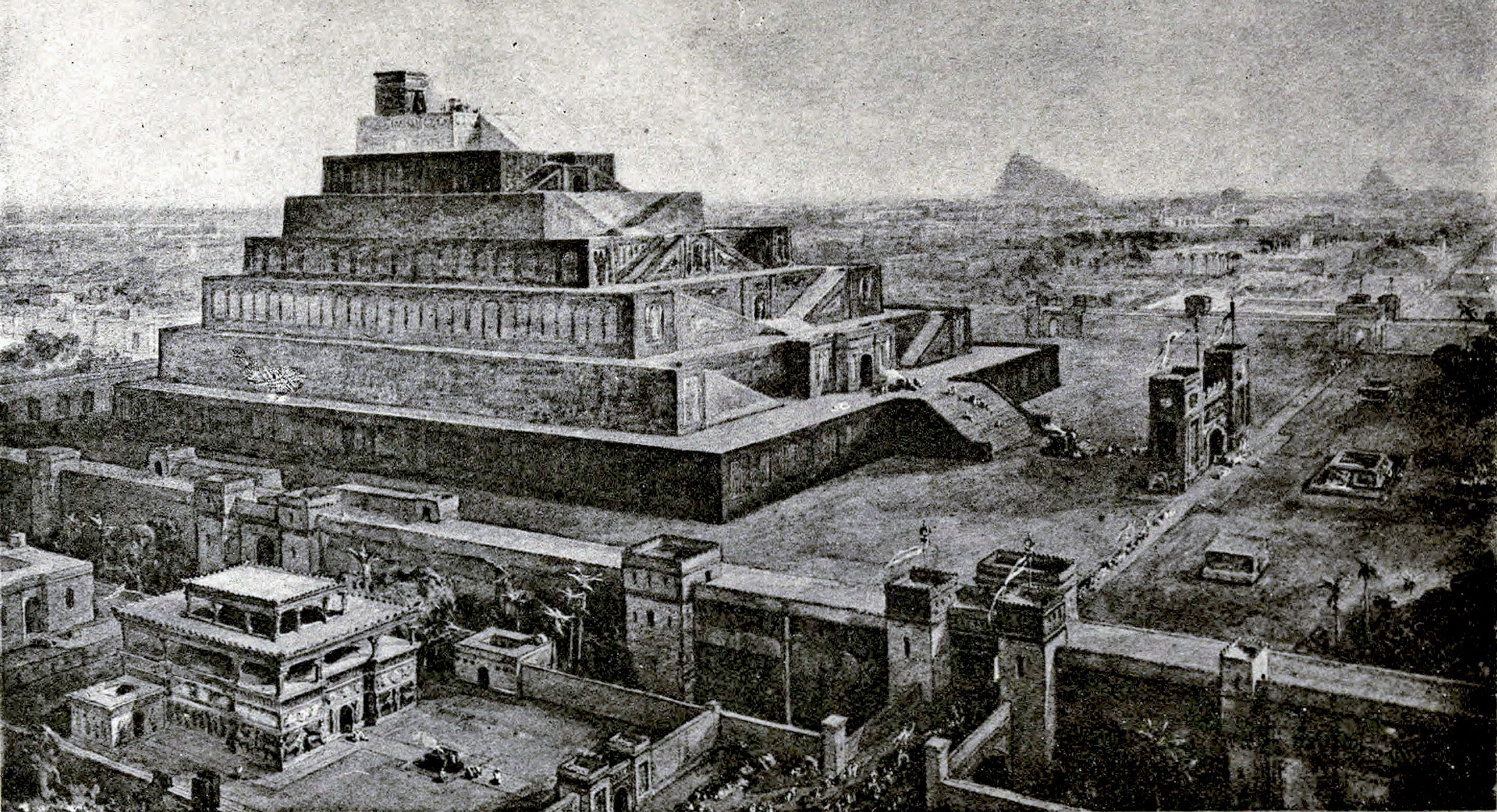
The Walls of Babylon and the Temple of Bel (or Babel), by 19th-century illustrator William Simpson – influenced by early archaeological investigations.
Photo: 1917 William Simpson (1823—1899)
Permission: Public Domain
Proximal source: Wikipedia
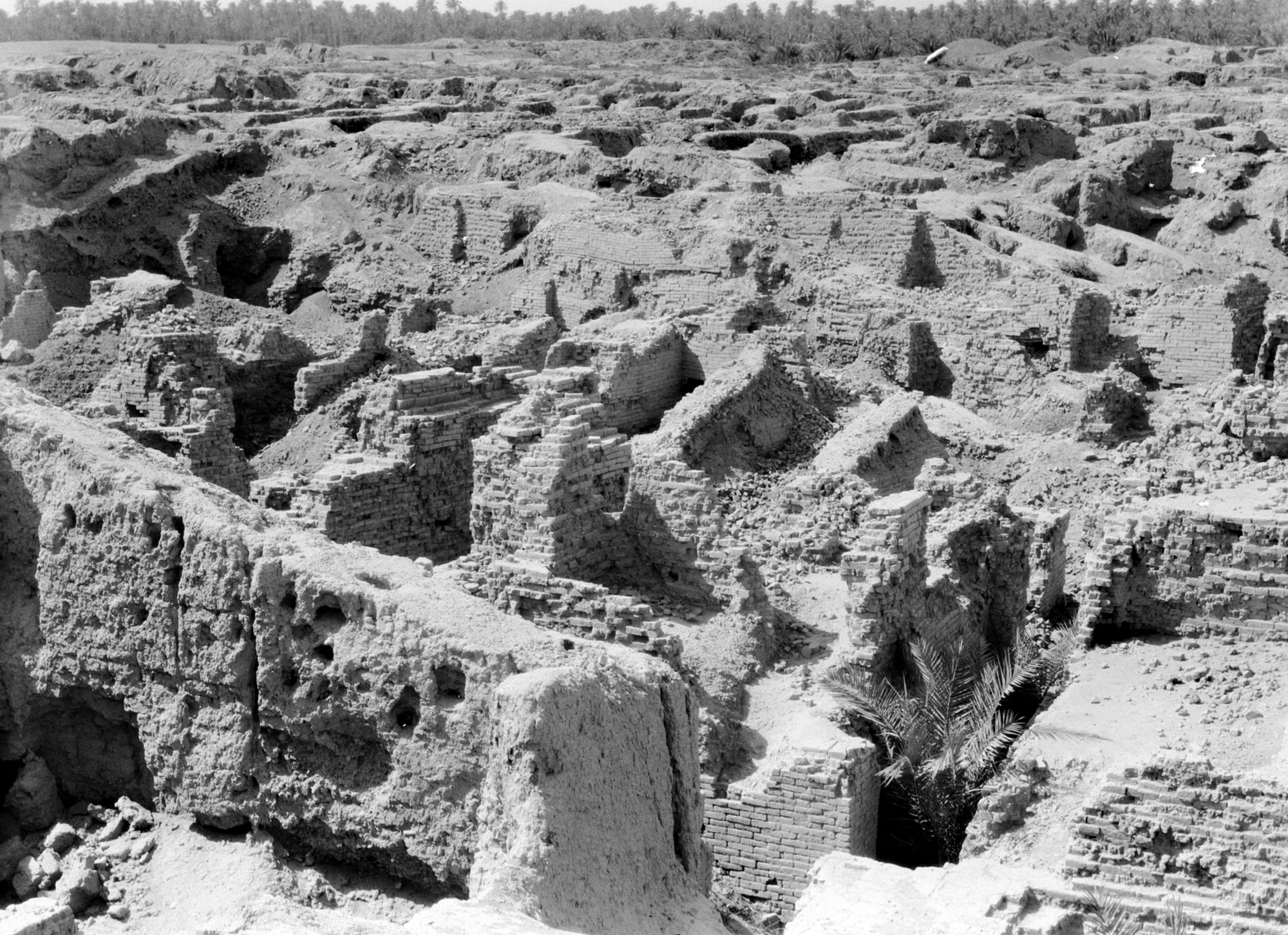
Babylon in 1932.
Photo: American Colony (Jerusalem). Photo Dept., photographer.
Permission: Public Domain
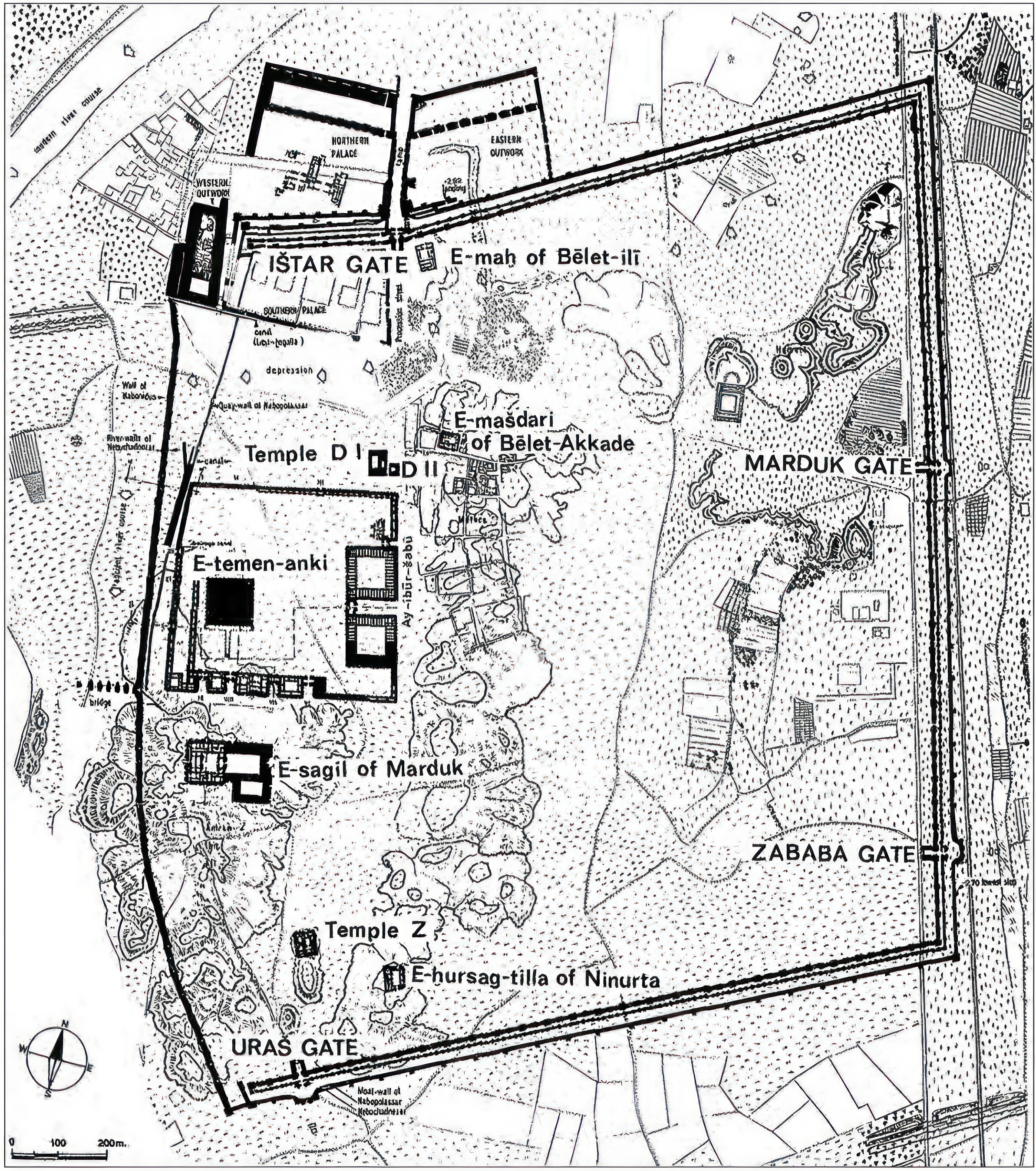
Babylon before the beginning of excavations in 1899.
Note that the Northern Palace is just outside the Ishtar Gate, while the Southern Palace is just inside the Ishtar Gate, as shown in the map above.
Photo: Wetzel (1930)
1930 Zur Topographie von Babylon nach der keilinschriftlichen Überlieferung. Pp. 84–109 in Die Stadtmauern von Babylon, by F. Wetzel. WVDOG 48. Leipzig: Hinrichs.
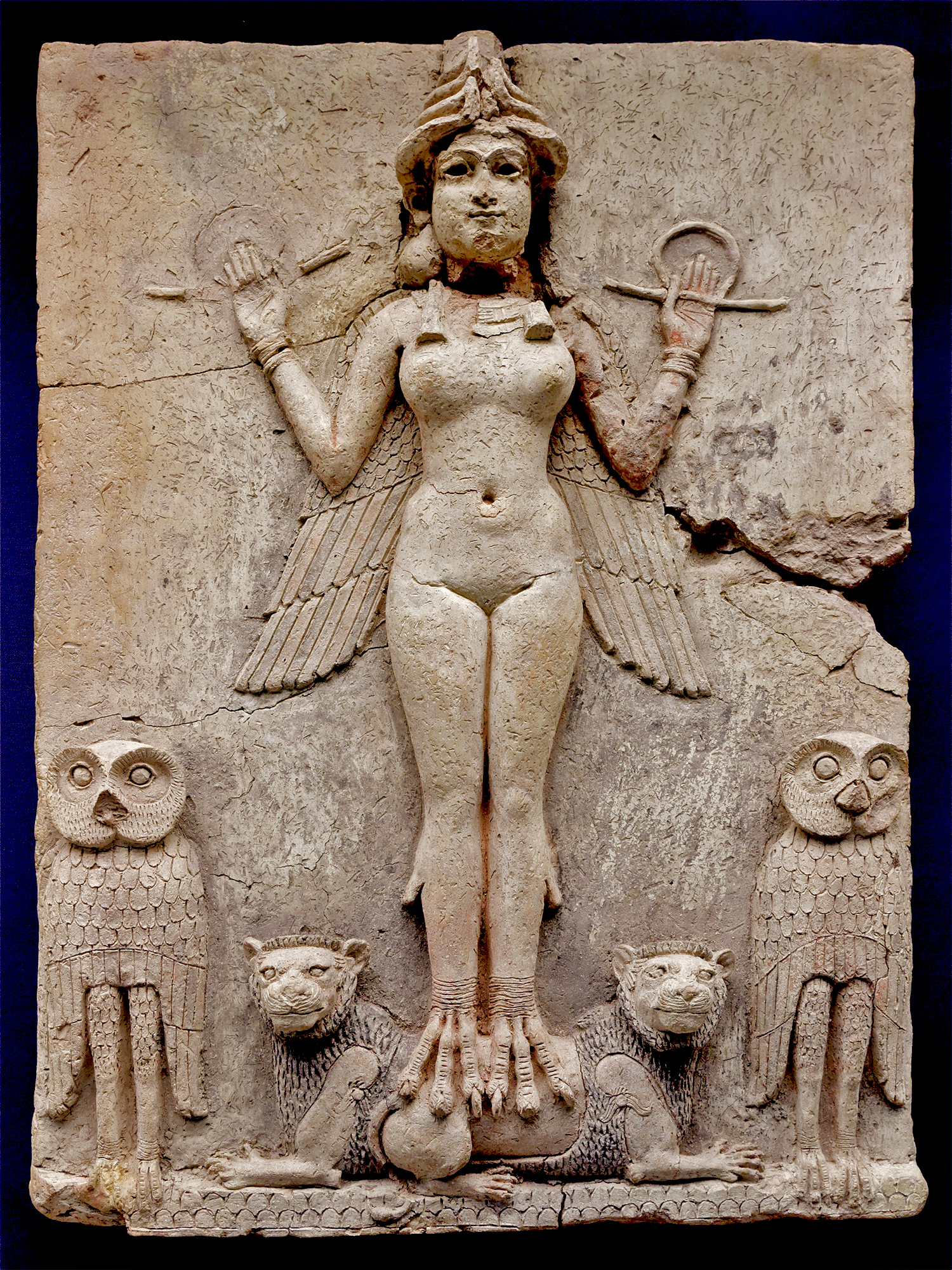
Burney Relief (Queen of the Night). Mesopotamian terracotta plaque depicting a winged, nude, goddess-like figure with bird's talons, flanked by owls, and perched upon two lions. Height: 49.5 cm.
Old Babylonian, 1 900 BC - 1 800 BC
Photo: Gennadii Saus i Segura, 2022
Permission: Creative Commons Attribution-Share Alike 4.0 International license
Source: British Museum
First Empire
King Hammurabi took the throne in 1 792 BC. He united nearby city-states and created the Code of Hammurabi, one of the oldest written law sets.
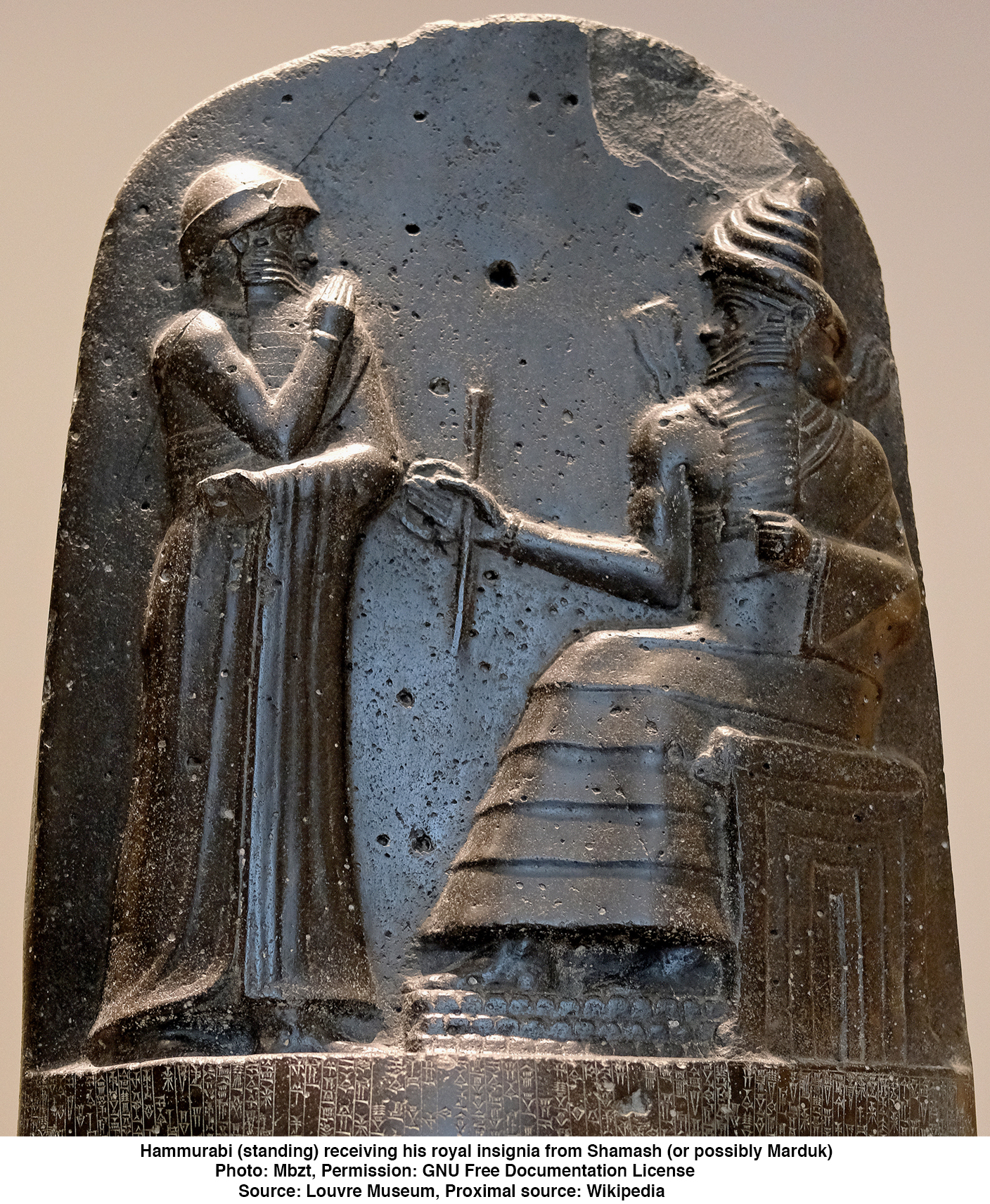
Hammurabi (standing) receiving his royal insignia from Shamash (or possibly Marduk)
Photo: Mbzt
Permission: GNU Free Documentation License
Source: Louvre Museum
Proximal source: Wikipedia
Decline
After Hammurabi died, his empire weakened and fell to outside groups like the Hittites and Kassites.
The Golden Age
Neo-Babylonian Empire: King Nebopolassar and his famous son, Nebuchadnezzar II, rebuilt Babylon into a massive, wealthy metropolis in the 6th century BCE.Wonders: The city featured giant double walls, the blue-tiled Ishtar Gate, and the legendary Hanging Gardens of Babylon.The Bible: Nebuchadnezzar II conquered Jerusalem and forced many Jewish people into exile, making Babylon a symbol of sin and tyranny in biblical texts. The tall ziggurat (temple tower) of Etemenanki likely inspired the story of the Tower of Babel.
Fall and Legacy
The Persian Conquest
The Neo-Babylonian Empire ended when Cyrus the Great and the Persian army captured Babylon without a fight in 539 BC. The Jews were set free from Babylon in 538 BC when the Persian king Cyrus the Great issued a decree allowing them to return to Jerusalem.
End of the City: Alexander the Great took the city in 331 BCE and died there, after which the city slowly emptied and fell into ruin. Today, the archaeological site is protected by UNESCO.
Text above: Various sources, including Wikipedia.
Nineveh, also known in early modern times as Kouyunjik, was an ancient Assyrian city of Upper Mesopotamia, located in the modern-day city of Mosul in northern Iraq. It is located on the eastern bank of the Tigris River and was the capital and largest city of the Neo-Assyrian Empire, as well as the largest city in the world for several decades. Today, it is a common name for the half of Mosul that lies on the eastern bank of the Tigris, and the country's Nineveh Governorate takes its name from it.
It was the largest city in the world for approximately fifty years until the year 612 BC when, after a bitter period of civil war in Assyria, it was sacked by a coalition of its former subject peoples including the Babylonians, Medes, Persians, Scythians and Cimmerians. The city was never again a political or administrative centre, but by Late Antiquity it was the seat of a Christian bishop. It declined relative to Mosul during the Middle Ages and was mostly abandoned by the 13th century AD.
Its ruins lie across the river from the historical city center of Mosul, in Iraq's Nineveh Governorate. The two main tells, or mound-ruins, within the walls are Tell Kuyunjiq and Tell Nabī Yūnus, site of a shrine to Jonah, the prophet who preached to Nineveh. Large amounts of Assyrian sculpture and other artefacts have been excavated there, and are now located in museums around the world.
Photo: Layard (1853) from a sketch by James Fergusson (1808–1886)
Proximal source: New York Public Library
Text: Wikipedia
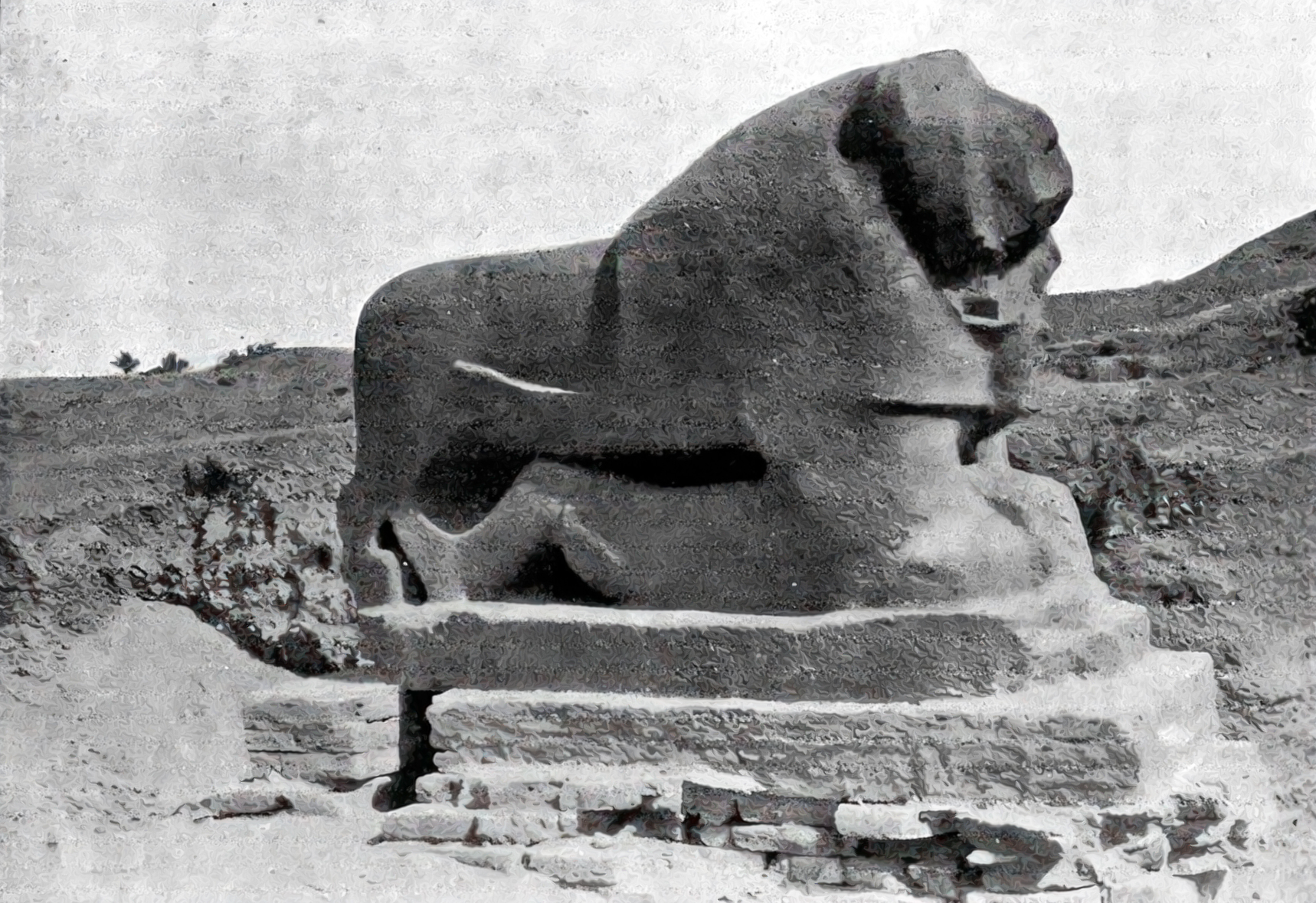
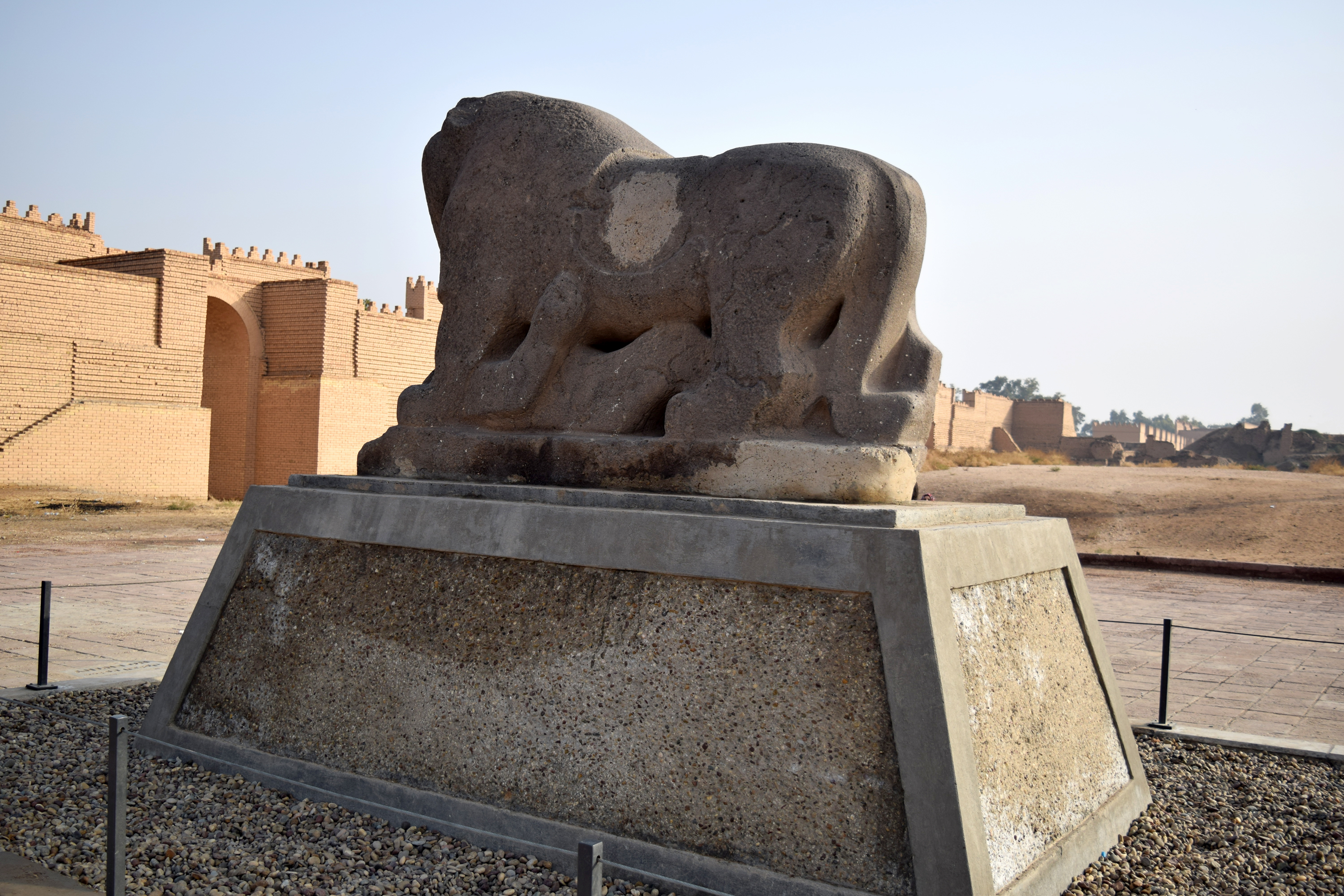
The Lion of Babylon
Fig. 101 (above) The basalt lion in the Principal Citadel.
Photo: (below) Hamody al-iraqi, 2016
The Lion of Babylon is a stone sculpture, over 2 600 years old, that was found in the ancient city of Babylon, Iraq. Its discovery was first documented in 1817 by Claudius Rich, although it may have been seen as early as 1790 by Joseph de Beauchamp.
The statue may have been commissioned by the Chaldean Babylonian king Nebuchadnezzar II, but most experts now believe it is of Hittite origin, made during a Hittite occupation of the city.
The statue is made out of black basalt, is two metres in length, and the platform upon which it stands is one metre high. The lion weighs around 7 000 kg. The statue's height is 1 metre.
It depicts a Mesopotamian lion above a supine human figure. The postures of the lion and human strongly suggest that they are having sexual intercourse.[6] This interpretation is supported by the back of the lion, which contains a carved depression where it is believed that a saddle was originally placed, on which a figure of Ishtar, the goddess of fertility, love, and war, may have sat or stood.
Modern history
The statue had been damaged over the years due to lack of protection, getting climbed on by tourists that left marks on the statue, or natural causes like erosion which archaeologists had already feared was going to happen without the right protection of the statue.
In 2013, the World Monuments Fund worked with the Iraq State Board of Antiquities to make improvements to the site. The Lion was cleaned and partially restored, the base of the statue was replaced, and a security barrier was added.
Symbolism
The Lion of Babylon is a historic theme in the region. The statue is considered among the most important symbols of Babylon in particular and Mesopotamian art in general.[12] The statue is considered a national symbol of Iraq, it has been used by several Iraqi institutions such as the Iraqi Football Association.
Photo: (top) Koldewey (1914)
Permission: Project Gutenberg License
Photo: (below) Hamody al-iraqi, 2016
Permission: Creative Commons Attribution-Share Alike 4.0 International license
Text: Wikipedia
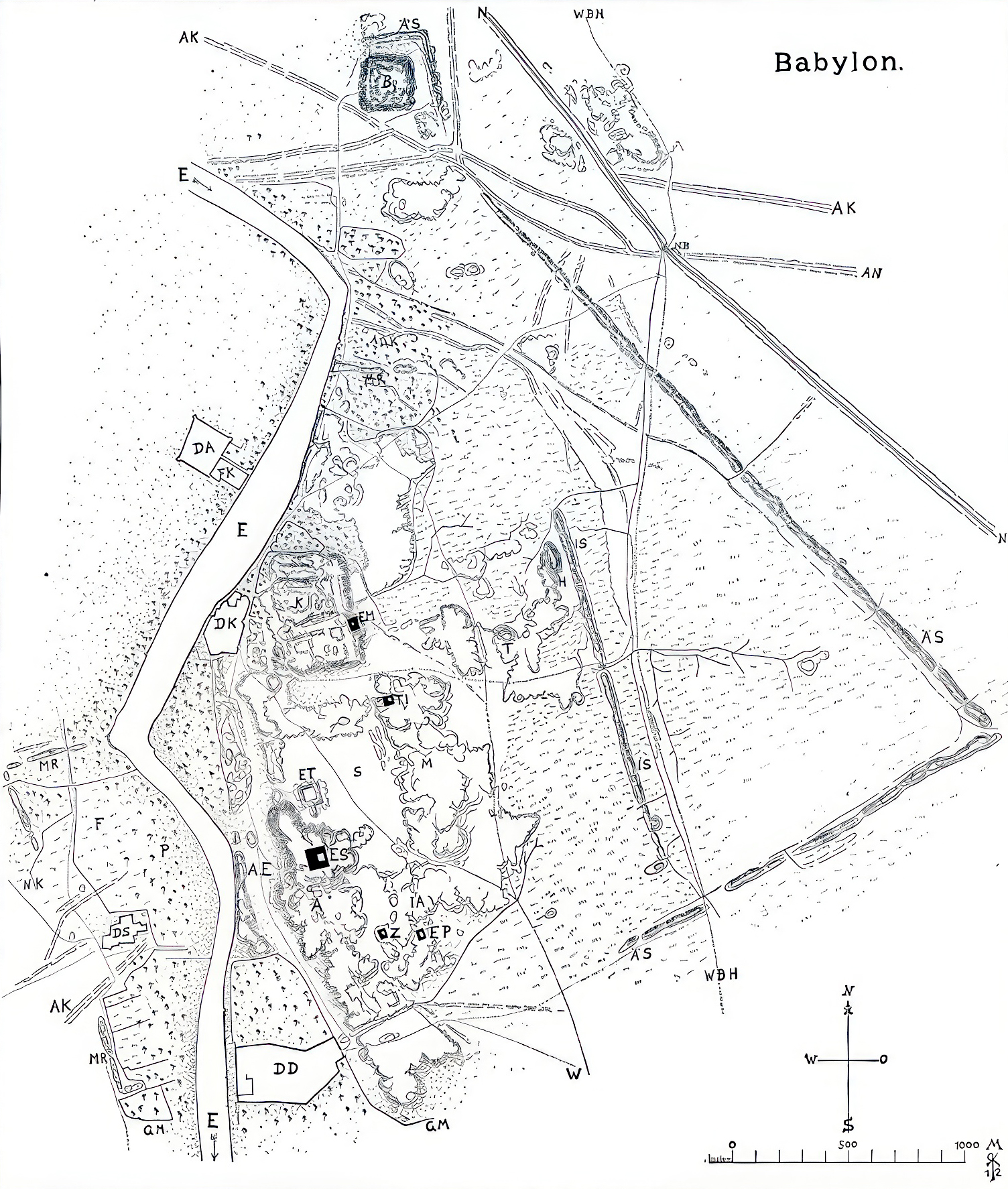
Fig. 1. Plan of the ruins of the city of Babylon
A The mound Amran
ADK Ancient ruined village of Kweiresh
AE Ancient Euphrates bed
AK Ancient ruined canal
AN Ancient Nil canal
AS Outer city wall
B The mound Babil
(The Babil mound is a prominent northern ruin at the ancient archaeological site of Babylon in Iraq, historically identified as the remains of King Nebuchadnezzar II's summer palace. Situated in the northern corner of Babylon’s outer rampart, roughly 85 kilometers (53 miles) south of Baghdad near the modern city of Hillah. Local tradition and archaeological excavation associate this high pile of unbaked brickwork (also historically called Mujellibe) with a grand royal palace complex rather than the central ziggurat (Etemenanki/Tower of Babel), which lies further south in the ruins)
DA The village of Ananeh
DD The village of Djumdjumma
DK The village of Kweiresh
DS The village of Sindjar
E Euphrates
EM E-Mach, the temple of Ninmach
EP E-Patutila, the temple of Ninib
ES E-Sagila, the temple of Marduk
ET E-Temenanki, the tower of Babylon/Babel
F Fields
FK Farm of Karabet
G Tomb of Amran Ibn Ali
GM Garden wall
H The mound Homera
IA Ishin aswad
IS Inner city wall
K The mound Kasr
M Merkes
MR Remains of walls
N The Nil canal
NB The Nil bridge
NK New canal
P Palms
S Sachn, a small plain, the precincts of the tower of Babylon, E-temen-an-ki
T The Greek theatre
TI Temple of Ishtar of Agade
W Road
WBH Road from Bagdad to Hilleh
Z Temple Z of some unknown divinity
Photo and text: Koldewey (1914)
Permission: Project Gutenberg License
'Beyt Nisan' (or Bīt Nisāni in Akkadian) translates to 'House of Nisan'. In ancient Babylon, this term directly refers to the Akitu House (Bīt Akīti), a specialised temple complex located outside the city walls where the famous Babylonian New Year festival was celebrated during the month of Nisan.
The name Nisan originated in Mesopotamia as the Akkadian word Nissāni (derived from the Sumerian nisag, meaning 'first fruits'). It marked the first month of spring and the beginning of the Babylonian calendar. During the first 12 days of Nisan, Babylonians held the Akitu festival to honour their chief god, Marduk. On the eighth day, the statue of Marduk was carried out of his primary city temple (the Esagila) along the Processional Way, through the Ishtar Gate, and transported via the Euphrates River to the Bīt Nisāni (House of Nisan / Akitu House). The 'House of Nisan' served as a symbolic residence for the gods outside the urban centre, representing a cosmic renewal, the rebirth of nature in spring, and the reconfirmation of the Babylonian king's divine right to rule.
Text above from various sources, including https://www.curtlandry.com/the-hebrew-month-of-nisan/ and Wikipedia
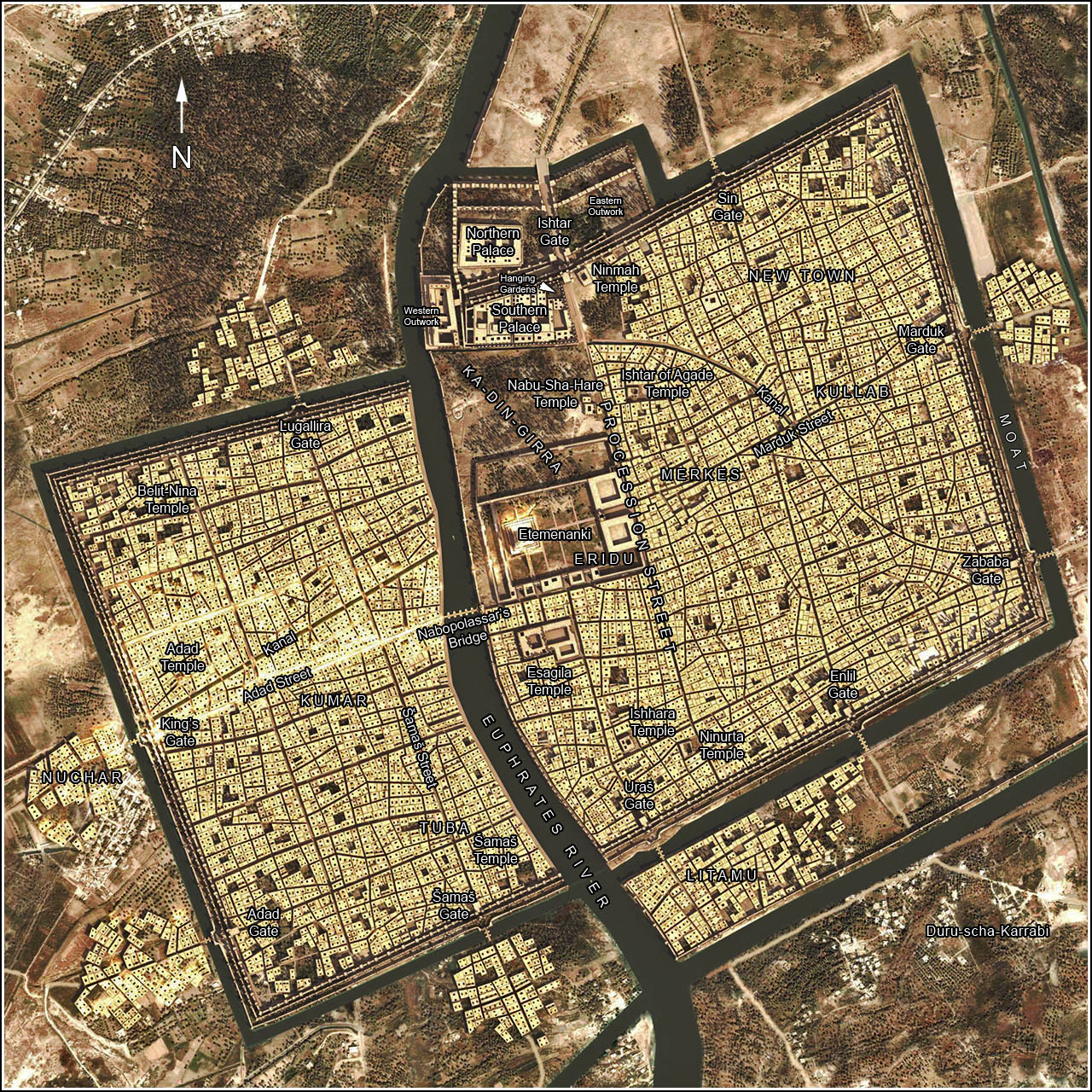
This is the best map of babylon I have found.
Note the following:
The Northern and Southern Palaces shown here are often called the Northern and Southern Fortresses.
Note also that the Hanging Gardens of Babylon are shown as being part of, or attached to, the Southern Palace.
Koldewey (1914) calls this area the Vaulted Building, and posits it as the original Hanging Gardens of Babylon. See below.
Photo and text: https://www.kadingirra.com/city_plan.html
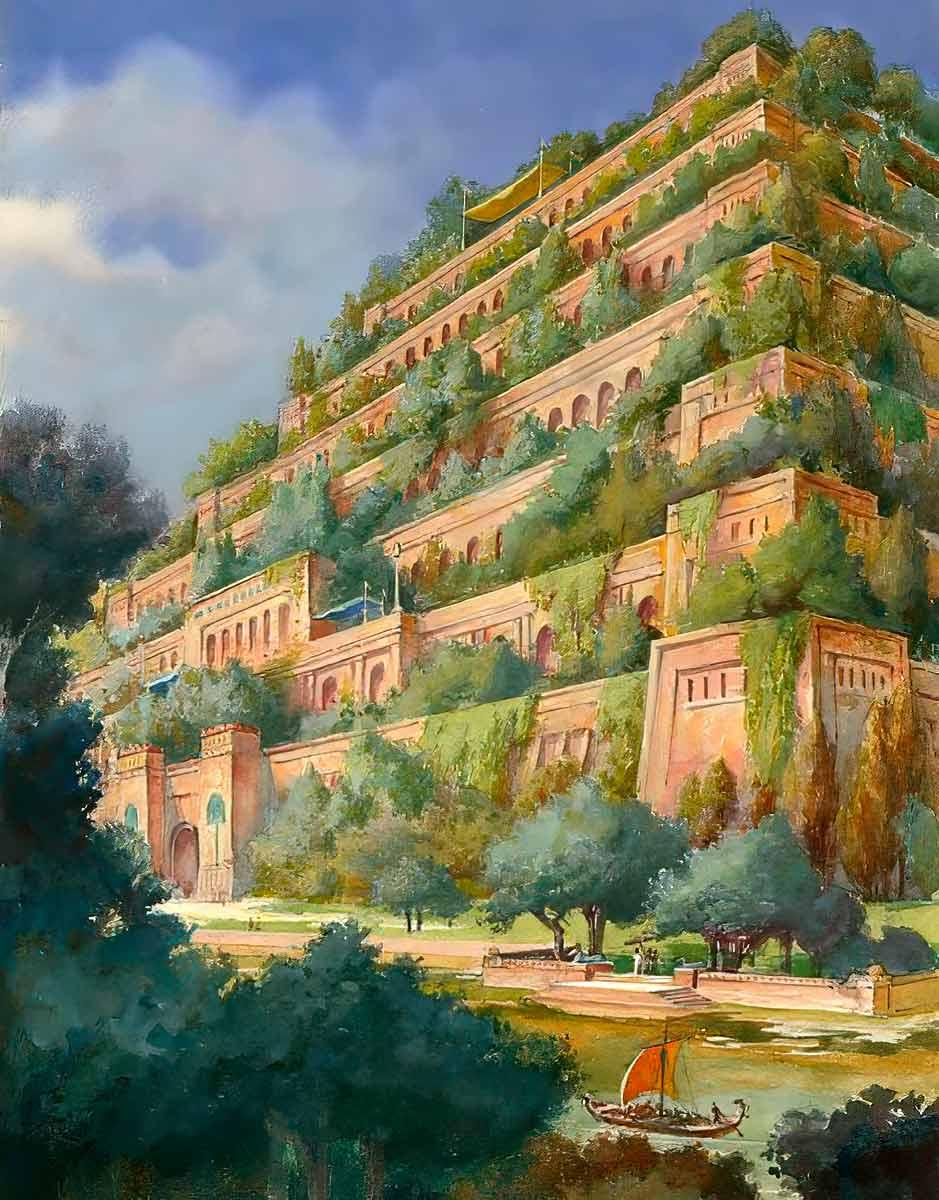
The Hanging Gardens of Babylon.
Painting: Felix Gardon, circa 1930s
Source: The Garden Trust
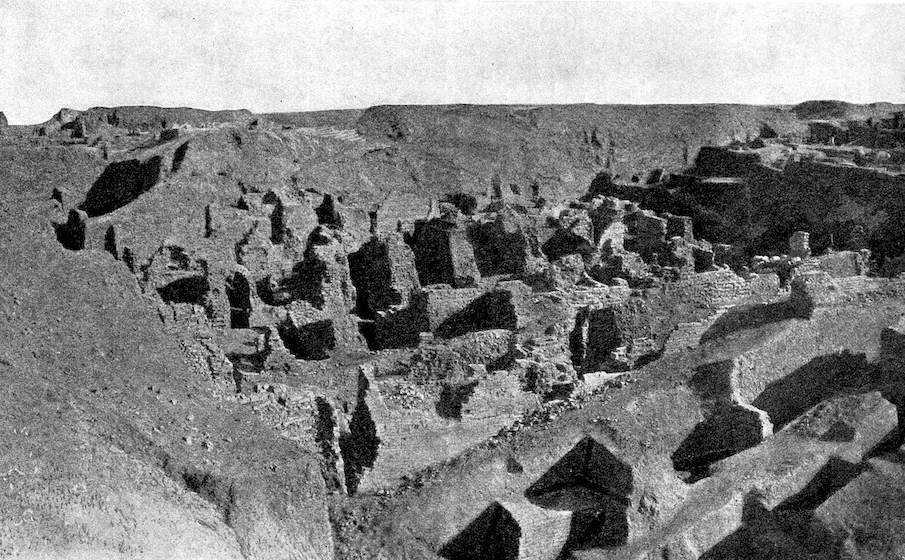
The Vaulted Building, possible site of the fabled Hanging Gardens.
From the north-east corner of the central court a wide passage leads to a building in the north-east corner of the Southern Citadel, which from every point of view occupies an exceptional place among the buildings of the Citadel and even of the whole city — one might almost say of the entire country.
Fourteen cells, similar in size and shape, balance each other on the two sides of a central passage, and are surrounded by a strong wall. Round this slightly irregular quadrangle runs a narrow corridor, of which the far side to the north and east is in large measure formed of the outer wall of the Citadel, while other ranges of similar cells abut on it to the west and south. In one of these western cells there is a well which differs from all other wells known either in Babylon or elsewhere in the ancient world. It has three shafts placed close to each other, a square one in the centre and oblong ones on each side, an arrangement for which I can see no other explanation than that a mechanical hydraulic machine stood here, which worked on the same principle as our chain pump, where buckets attached to a chain work on a wheel placed over the well. A whim works the wheel in endless rotation. This contrivance, which is used to-day in this neighbourhood, and is called a dolab (water bucket), would provide a continuous flow of water.
Photo and text: Koldewey (1914)
Permission: Project Gutenberg License
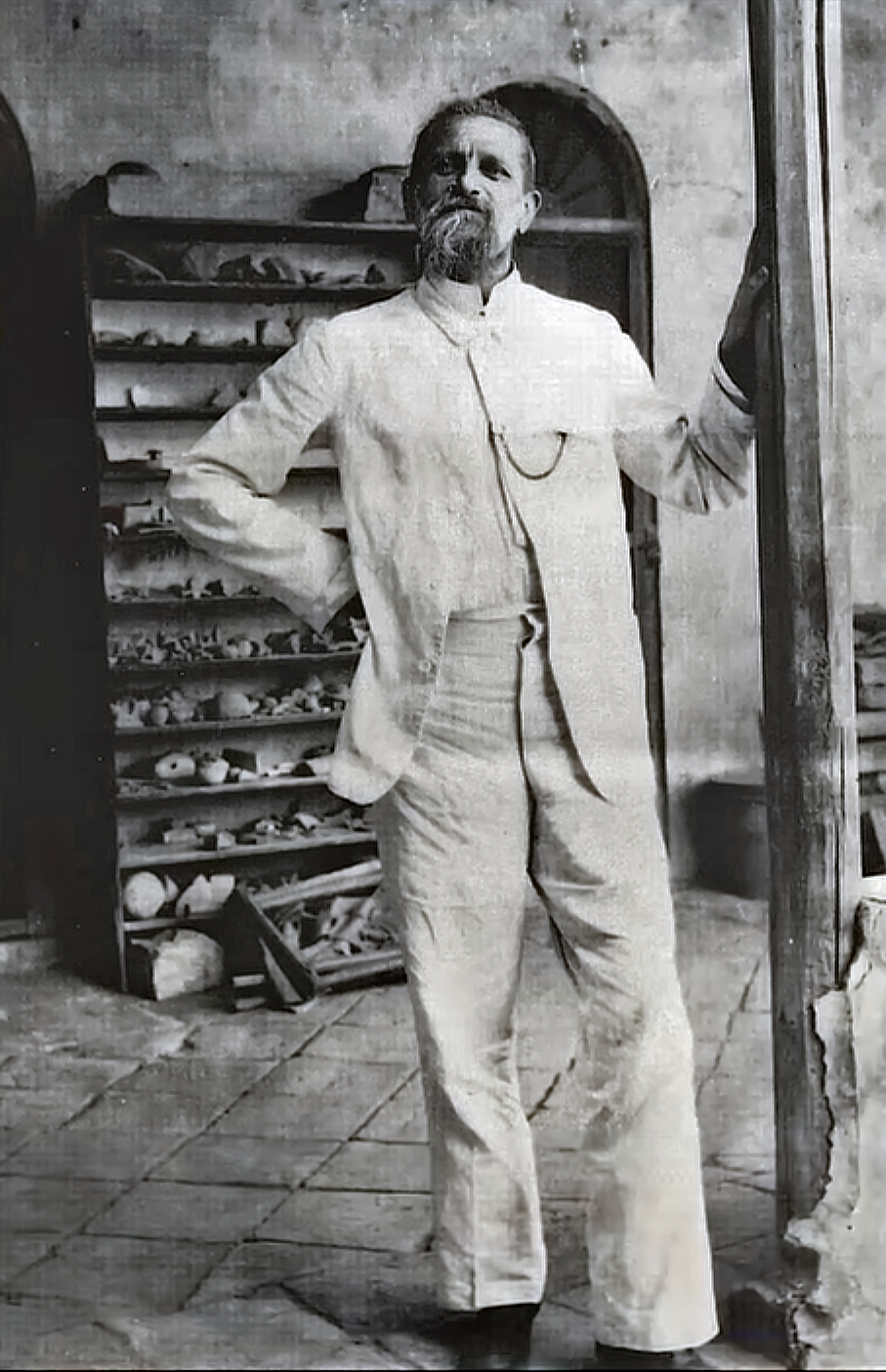
Koldewey directed the excavation of Babylon from 1899 through 1914, using comparatively modern archaeological techniques. The site had been identified a century earlier by Claudius James Rich.
More than 200 people worked on the site daily, year round, for fifteen years.
Photo: Unknown, proximal source https://www.youtube.com/watch?v=2dRH8Ju8upU&t=582s
Additional text: Wikipedia
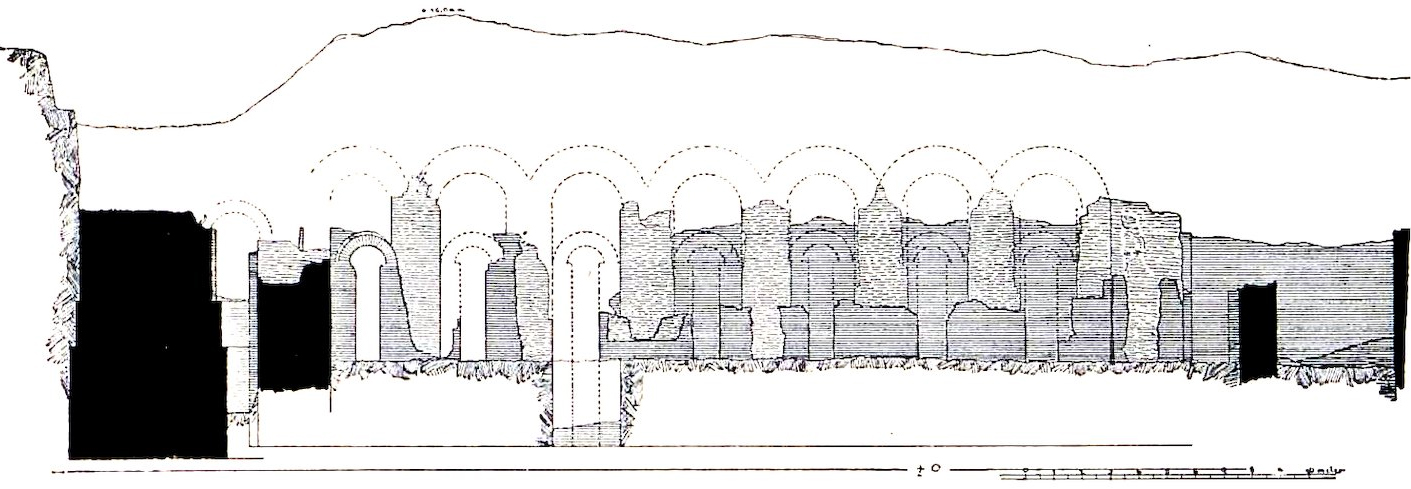
A section through the Vaulted Building.
We must here observe the difference that exists between arches, underground vaulting, and outstanding vaulting. The wall in which the arch is placed provides it with the necessary abutments; there are no difficulties to encounter in its construction, and we meet with it in the earliest times, at Nippur and Fara as early as the invention of writing. In Fara there is an underground canal which consists of actual arches placed close together; in Babylon and Assur there are underground vaults which certainly date back to the year 1 000 BC. Such vaultings are easily constructed, for the earth in which they are buried affords the necessary abutments.
But the case is very different when the vaulting has to be carried from one free standing wall to another. Then the building has to be so constructed that the thrust of the vaulting is counterbalanced by the walls themselves. This distinct advance appears to have been first attempted, or at any rate planned, in Mesopotamia by Nebuchadnezzar. Certainly, no house vaulting older than ours on the Southern Citadel has been found in Mesopotamia, roofing as it does a huge connected complex of chambers. The vaultings asserted by Place to be over the chambers at Khorsabad are, without exception, absolute inventions. Sargon was only acquainted with the arch in the wall, which, as we have already seen, is not a noteworthy achievement, and with the sloping courses employed in forming the arched roofing of a canal. Those Assyrian-Babylonian palaces were entirely roofed with wooden beams, like the cedars of Lebanon of our Southern Citadel. It is possible that the throne-room of the principal court was vaulted, but that is not certain. The vaulted building shows clear signs of tentative and inexperienced work in the arrangement of the vaulting. It consists merely of simple barrel-vaults, and there is, of course, no cross vaulting, cupola, or any arrangement of the kind. The thrust of the central chambers is on the north against the strong Citadel wall, and on the south against the outer row of chambers vaulted in the other direction as in the cross section above.
The ruin shown above lies completely below the level of the palace floor, and is the only crypt found in Babylon. It was approached from the upper passage by steps of crude brick faced with burnt brick that led into one that led into one of the southern chambers.
There are only two places where hewn stone occurs in any large quantity — in the Vaulted Building and on the north wall of the Kasr, the central palace mound or citadel of Babylon, and it is remarkable that in all the literature referring to Babylon, including the cuneiform inscriptions, stone is only mentioned as used in two places, in the north wall of the Kasr and in the hanging gardens.
Photo and text: Koldewey (1914)
Permission: Project Gutenberg License
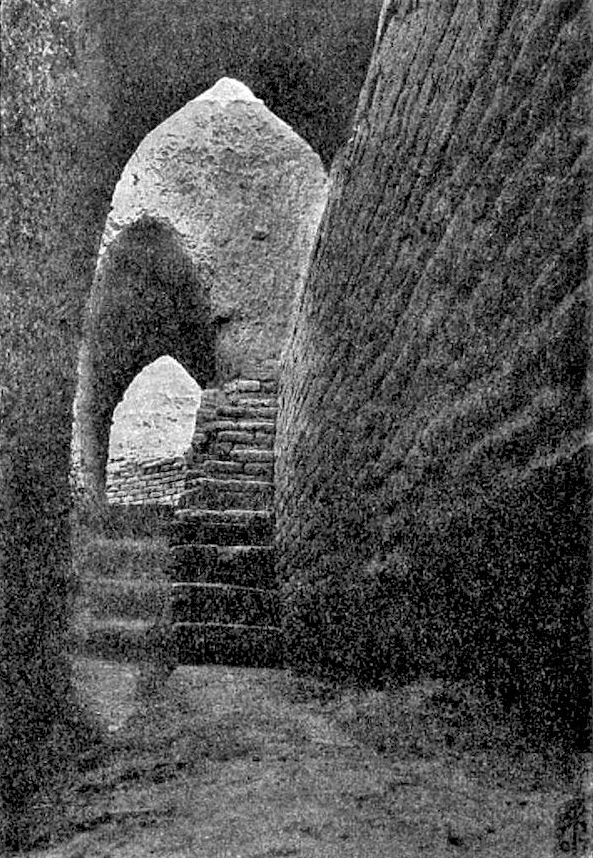
To the north of the Citadel there is a canal constructed, of which the vaulting still exists, as shown here. My opinion is that this canal conveyed to the east the water of the Euphrates, which was probably still called 'Arachtu' there, and that possibly it flowed round the Kasr in somewhat irregular fashion, even in the Neo-Babylonian period. This easterly body of water would then return to the Euphrates by means of the canal just described. At the south-west corner of the Kasr buildings, where they joined the wall of Nabonidus, the openings through which the water escaped are still preserved in this wall.
Photo and text: Koldewey (1914)
Permission: Project Gutenberg License
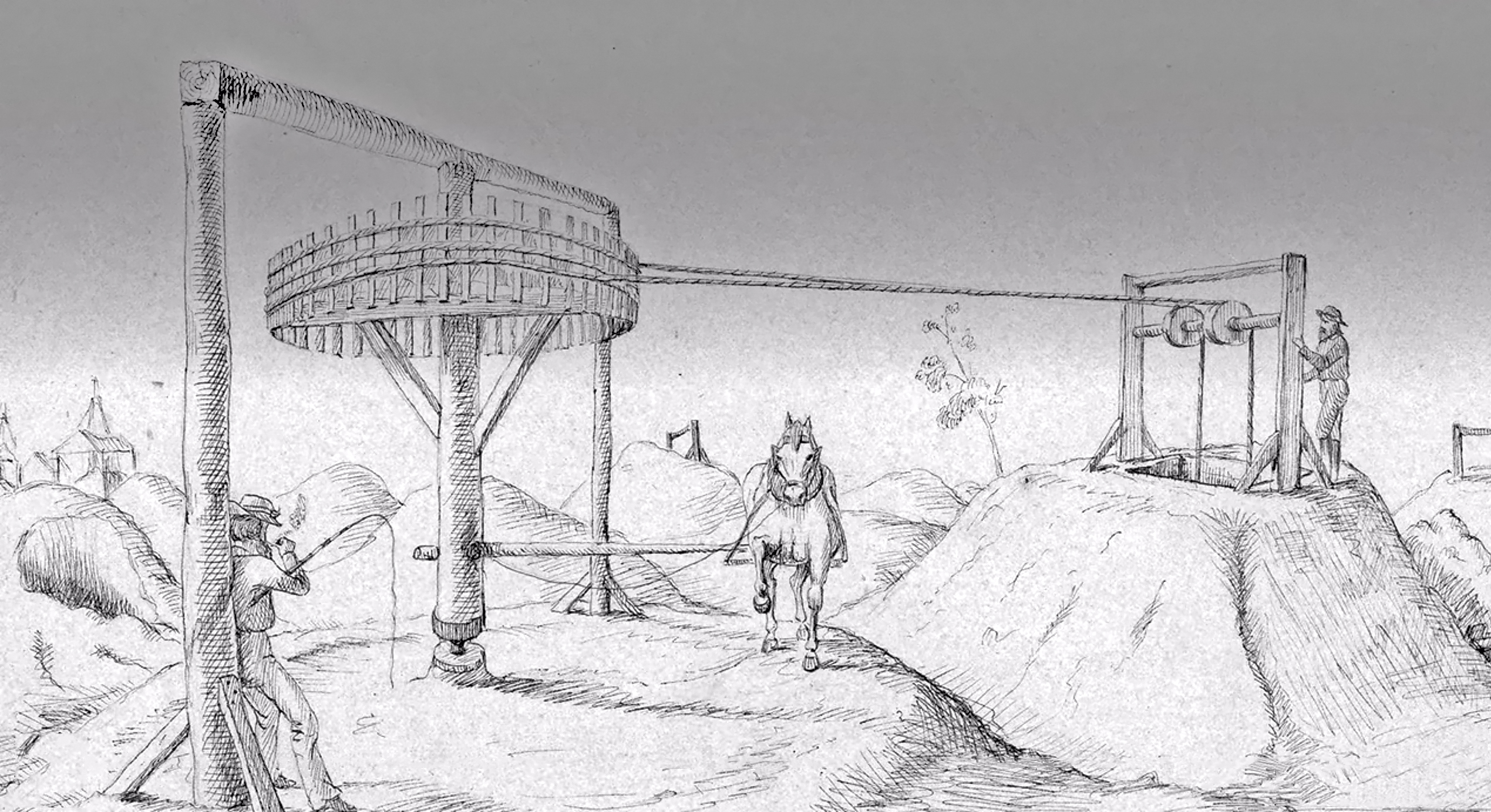
A whim, above, is a device similar to a windlass which may be used for hauling water to the surface from a well. It comprises a capstan or a wide drum with a vertical axle. A rope is wound around the drum, with both ends traversing several pulleys and hanging down the shaft. As the drum is turned around, one end of the rope is lowered, carrying an empty bucket, while the other one is raised, carrying a full bucket. The standard, simple horse (or ox in the case of Babylon) whim required the draft animal to stop, turn around, and walk the other way to reverse the winding drum.
Photo and text: Youtube video, Horse Powered Whims - Gold Mining Technologies, Gold Fields guide to Victorian Goldfields.
Much of the following information comes from an excellent youtube channel known as 'History with Cy', in this case the episode https://www.youtube.com/watch?v=2dRH8Ju8upU&t=582s
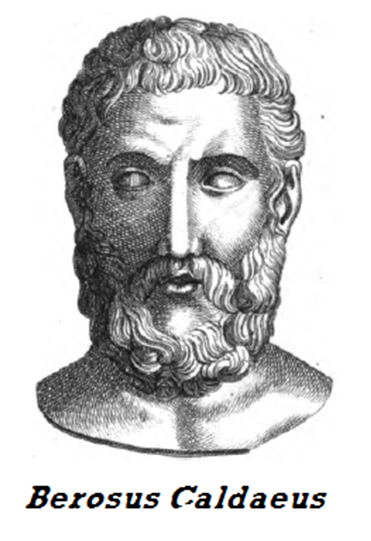
Berossus Caldeus
The writings of Berossus (a Babylonian priest writing around 280–290 BCE) provide the earliest known textual source attributing the Hanging Gardens of Babylon to King Nebuchadnezzar II.
Because his original three-book history, the Babyloniaca, did not survive intact, his descriptions reach us through later writers like the Roman-Jewish historian Flavius Josephus.
Key Details from Berossus' Accounts:
The Builder and Queen: Berossus wrote that King Nebuchadnezzar II built the grand structures to honour his wife, Amytis of Media. She grew up in Media (modern-day Iran/Azerbaijan) and felt homesick for her native land's green, mountainous landscapes.
He described the installation as a 'pensile paradise' or a collection of lofty stone terraces shaped and elevated to mimic natural hills and mountains. Pensile is defined as hanging, suspended from above, or overhanging.
Scholars note that the Akkadian language lacked a direct word for 'hanging'. The Greek word kremastos likely translated an original phrase meaning 'high as a mountain' used in native royal inscriptions.
Beyond pleasing a homesick queen, historians like those discussed in the Bryn Mawr Classical Review suggest Berossus used these descriptions as cultural diplomacy - bridging Babylonian heritage with Greek and Iranian audiences under his Hellenistic patron, Antiochus I.
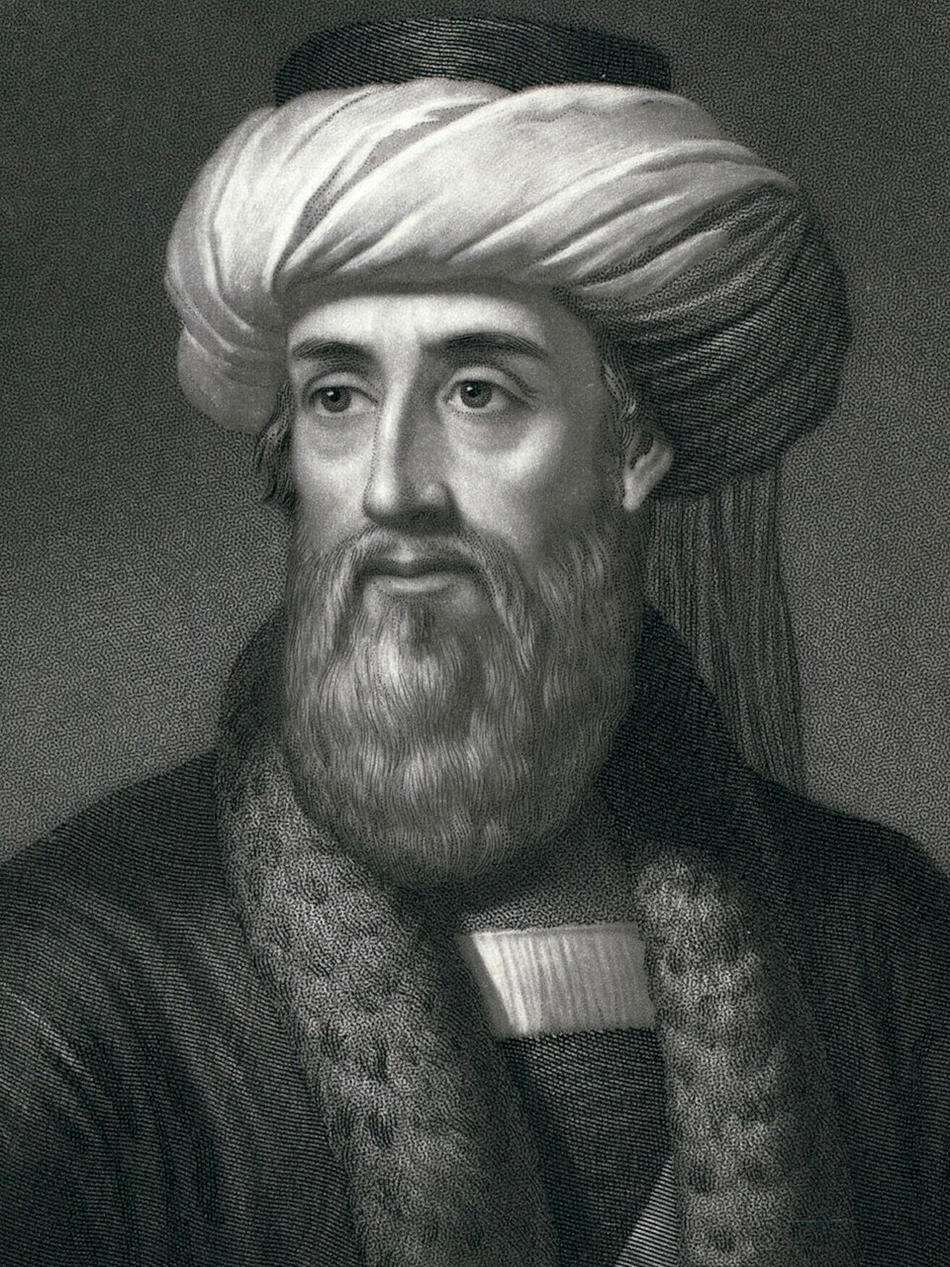
Flavius Josephus (born Yosef ben Mattityahu circa AD 36 – AD 100) was a Roman–Jewish historian and military leader.
He quotes Berossus Caldeus: At his palace Nebuchadnezzar II had knolls made of stone which he shaped like mountains and planted with all kinds of trees. Further more, he had a so-called pensile paradise.
It was planted because his wife, who came from Media, Iran, (region of northwestern Iran, best known for having been the political and cultural base of the Medes.) longed for such, which was the custom in her homeland.
(From Flavius Josephus, 'Jewish Antiquities', Book X.11)
Within this palace, he erected lofty stone terraces, in which he closely reproduced mountain scenery, completing the resemblance by planting them with all manner of trees and constructing the so-called Hanging Garden; because his wife having been brought up in Media, had a passion for mountain surroundings.
(From Flavius Josephus, 'Contra Apionem', Book I.19)
Photo: Engraving by John Sartain, 1880
Permission: Public Domain
Proximal source: Wikipedia
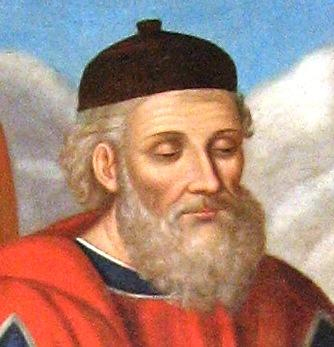
Diodorus Siculus or Diodorus of Sicily was an ancient Greek historian from Sicily. He is known for writing the monumental universal history Bibliotheca historica, in forty books, fifteen of which survive intact, between 60 and 30 BC.
He writes: There was also, beside the acropolis, the Hanging Garden, as it is called, which was built, not by Semiramis, but by a later Syrian king to please one of his concubines; for she, they say, being a Persian by race and longing for the meadows of her mountains, asked the king to imitate, through the artifice of a planted garden, the distinctive landscape of Persia.
The park extended four plethra on each side (that is, 400 Greek feet (podes).This translates to roughly 123 metres or 405 modern feet), and since the approach to the garden sloped like a hillside and the several parts of the structure rose from one another tier on tier, the appearance of the whole resembled that of a theatre.
When the ascending terraces had been built, there had been constructed beneath them galleries which carried the entire weight of the planted garden and rose little by little one above etc other along the approach; and the uppermost gallery, which was fifty cubits high (23 metres or 76 feet), bore the highest surface of the park, which was made level with the circuit wall of the battlements of the city. Furthermore, the walls, which had been constructed at great expense, were 22 feet (6.7 metres) thick, while the passageway between each two walls was ten feet (three metres) wide.
- Diodorus Siculus, Library of History, Book II.10
Photo: Diodorus Siculus as depicted in a 19th-century fresco
Permission: Public Domain
Proximal Source: Wikipedia
Note that all references to the hanging gardens come from Greek and Roman writers, there is nothing from Babylon itself.
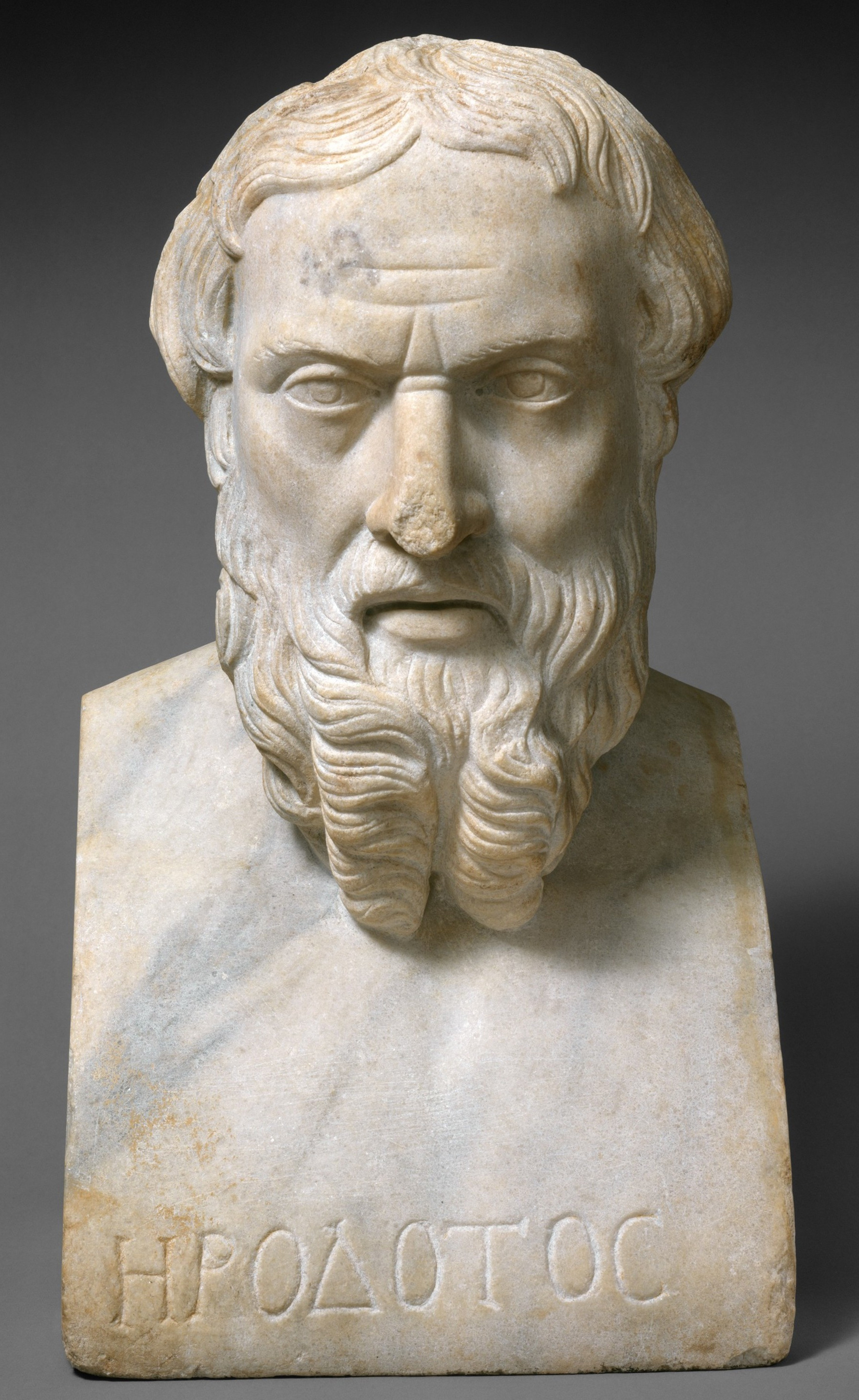
Marble bust of Herodotus.
Herodotus never mentions the Hanging Gardens of Babylon.
Herodotus, circa 484 BC – 425 BC, was a Greek historian and geographer from the Greek city of Halicarnassus. He wrote 'The Histories', a detailed account of the Greco-Persian Wars, among other subjects such as the rise of the Achaemenid dynasty of Cyrus. He has been described as 'The Father of History', a title conferred on him by the ancient Roman orator Cicero.
Date 2nd century AD
Medium marble, height 476 mm
Credit line: Gift of George F. Baker, 1891
Photo: Accession number 91.8, Metropolitan Museum of Art
Permission: Creative Commons CC0 1.0 Universal Public Domain Dedication
Proximal Source: Wikipedia
Several writers have suggested that the hanging gardens may have been in Nineveh, Assyria, far to the north of Babylon, perhaps built by King Ashurnasirpal II, Circa 865 BC - 860 BC. He did establish large gardens fed by water from canals.
King Sennacherib, who reigned from 704 BC to 681 BC over Mesopotamia, including Babylon, constructed the Palace of Sennacherib — proudly called the 'Palace Without a Rival' by the king himself - a massive royal residence built in the ancient city of Nineveh (modern-day northern Iraq). He moved the empire's capital to Nineveh and constructed the colossal 30-acre complex on the Kuyunjik mound. There he had a magnificent garden filled with many different kinds of plants, including rare and exotic trees and herbs, gathered from many places. To sustain these gardens, he instituted major waterworks, including damming the local river Khosr, a tributary of the Tigris River, and constructing aquaducts.
However, the ancient Assyrian capital of Nineveh was destroyed in August 612 BC by a coalition of Babylonians, Medes, and Scythians after a brutal three-month siege, so this palace and its gardens would have been long gone by the time Berosus wrote about it around three hundred years after its destruction.
When Robert Koldewey discovered the vaulted ruins in Babylon, his discovery was celebrated at the time as solving the mystery of the hanging gardens. Later, other scholars questioned this.
( To be perfectly frank, it appears to be the mission of some scholars to try to tear down the efforts and conclusions of other scholars - Don )
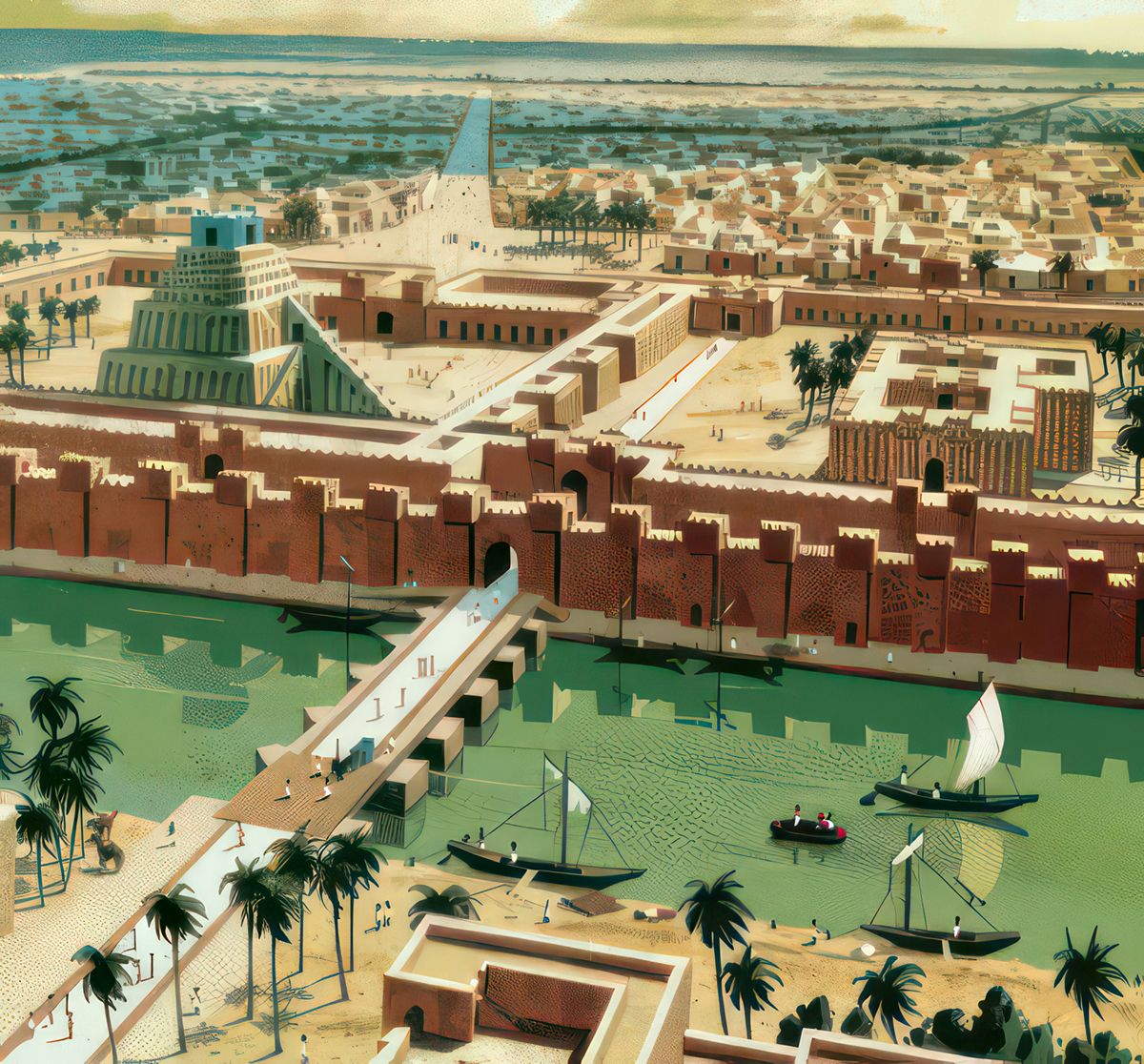
A representation of the 'Old City' of Babylon (view from the 'New city'). Note in the front level the formidable double wall protecting the Great Ziggurat and the Temple of Marduk.
Photo: Unknown. Ubiquitous on the internet with no attribution. Obviously from AI.
Text: https://periklisdeligiannis.wordpress.com
The reason Babylon existed at all
A sophisticated agricultural and irrigation system was the reason Babylon existed and thrived for many centuries.
Babylon's survival and wealth relied on a vast, engineered network of canals branching from the Euphrates River to control floods and irrigate crops.
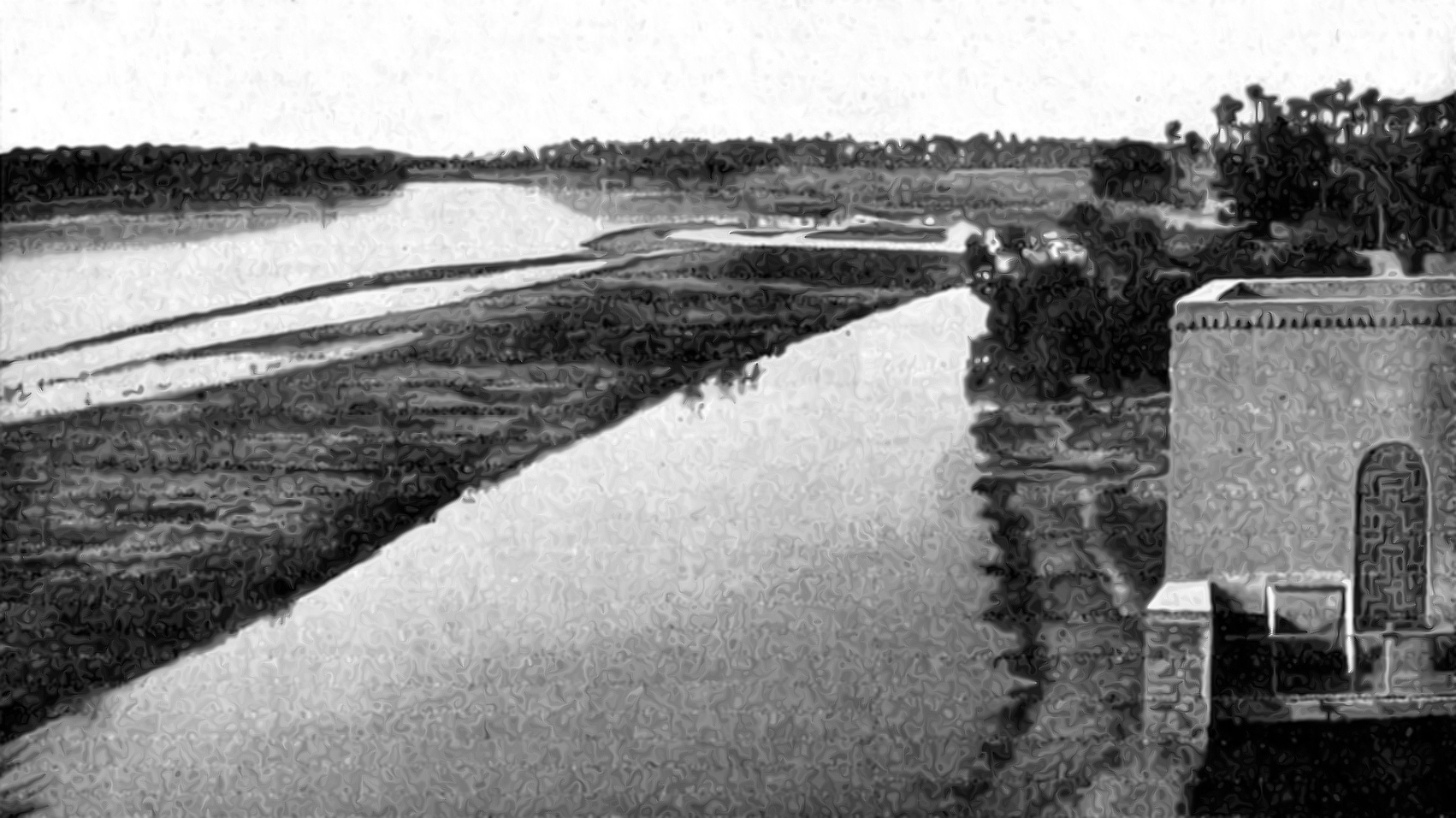
The Euphrates, seen looking north from the Expedition House in 1907.
Photo and text: Koldewey (1914)
Permission: Project Gutenberg License
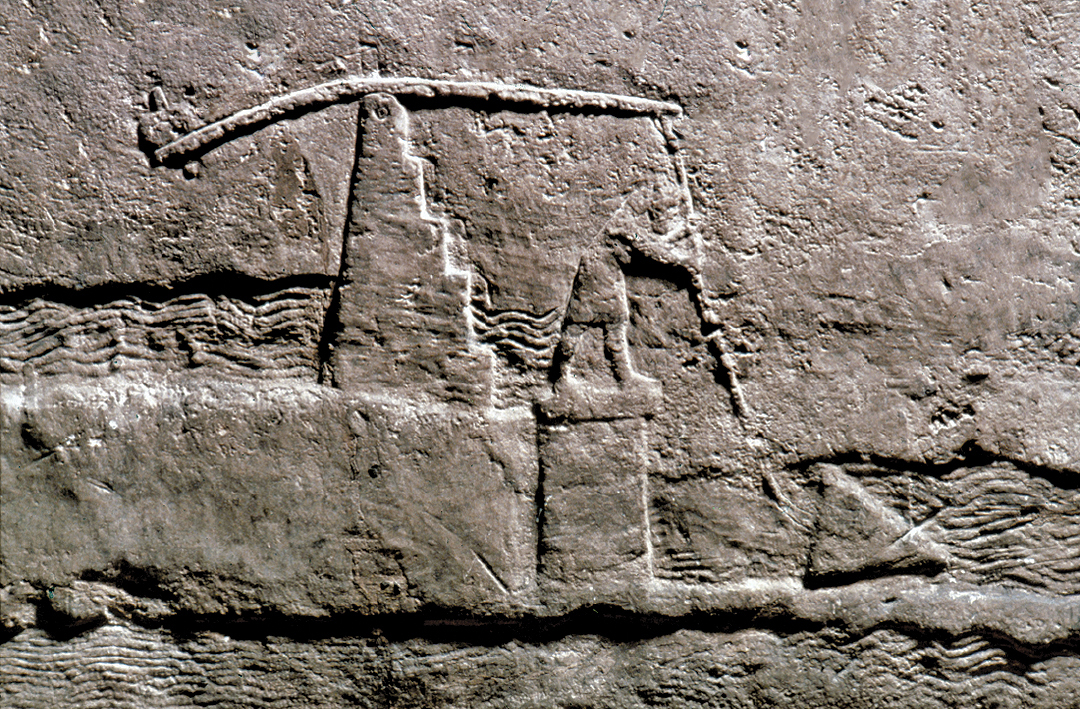
From circa 5 000 BC, irrigation was necessary for successful farming in southern Mesopotamia. By 1 000 BC, sophisticated feats of engineering allowed the Assyrians and Babylonians to redirect water through constructed aqueducts, like the one illustrated here on a relief at Nineveh from the palace of the Assyrian king Sennacherib.
The shaduf is a simple hand-operated lever tool invented around 2 000 BC – 3 000 BC that allowed ancient Mesopotamian farmers to lift water from rivers or canals into elevated irrigation channels.
The simple version shown here consists of a long wooden pole or beam that balances on a pivot. On one end is attached a clay vessel, skin, or basket tied with rope to the long end of the pole to scoop water. On the other side of the fulcrum or pivot the end of the pole has attached to it a heavy mass of stone, or dried mud made of clay and chopped straw to offset the weight of the filled bucket, requiring minimal physical exertion to raise the bucket. The worker then swung or tilted the balanced pole to empty the water into local agricultural basins and ditches.
The artist has shown three distinct bodies of water in canals. In Babylonian cylinder seals, relief carvings, and statues, water is rarely just a background element. It is most frequently depicted as parallel wavy lines streaming out of a jar or vase held by a deity.
In this case, the lowest water motif on the tile denotes the main canal. The next shows a smaller canal, at the same level as the main canal despite the perspective, but containing water diverted to it in order to conveniently both fill a bucket, then using the weighted pole to swing the filled bucket up and around to a subsidiary canal shown at the level of the base of the pole's support by a worker standing on what seems to be a small stone column, the top canal leading eventually to the fields to be irrigated.
The shaduf turned arid dry lands into fertile crop fields by enabling water lifting to heights of one to three metres.
This supported food production for early major cities like Uruk and Babylon. A single device could irrigate roughly 0.1 hectares of land within a 12-hour operational span, an area of 1000 square metres, or a plot of land perhaps 25 metres by 40 metres in size.
Photo and text: adapted from various sources, including https://nerd.wwnorton.com/ebooks/epub/worldscon3v1/EPUB/content/2.2-chapter02.xhtml
Construction of the canals
Surveying and Design
Daniel Mansfield, Senior lecturer, UNSW, provided an excellent review (parts of which are summarised below, as well as from other sources) of the development of the methods of trigonometry by Babylonians as a result of their need for the measurement of the area of fields and the demarcation of boundaries.
He has written a paper which may be seen at https://link.springer.com/article/10.1007/s10699-021-09806-0 , and a more accessible summary at:
https://theconversation.com/how-ancient-babylonian-land-surveyors-developed-a-unique-form-of-trigonometry-1-000-years-before-the-greeks-163428
Engineers used measuring rods and plumb lines to calculate precise land slopes and water grades.
The measuring rods, measuring ropes, and plumb lines were essential tools for architecture, urban planning, and land surveying.
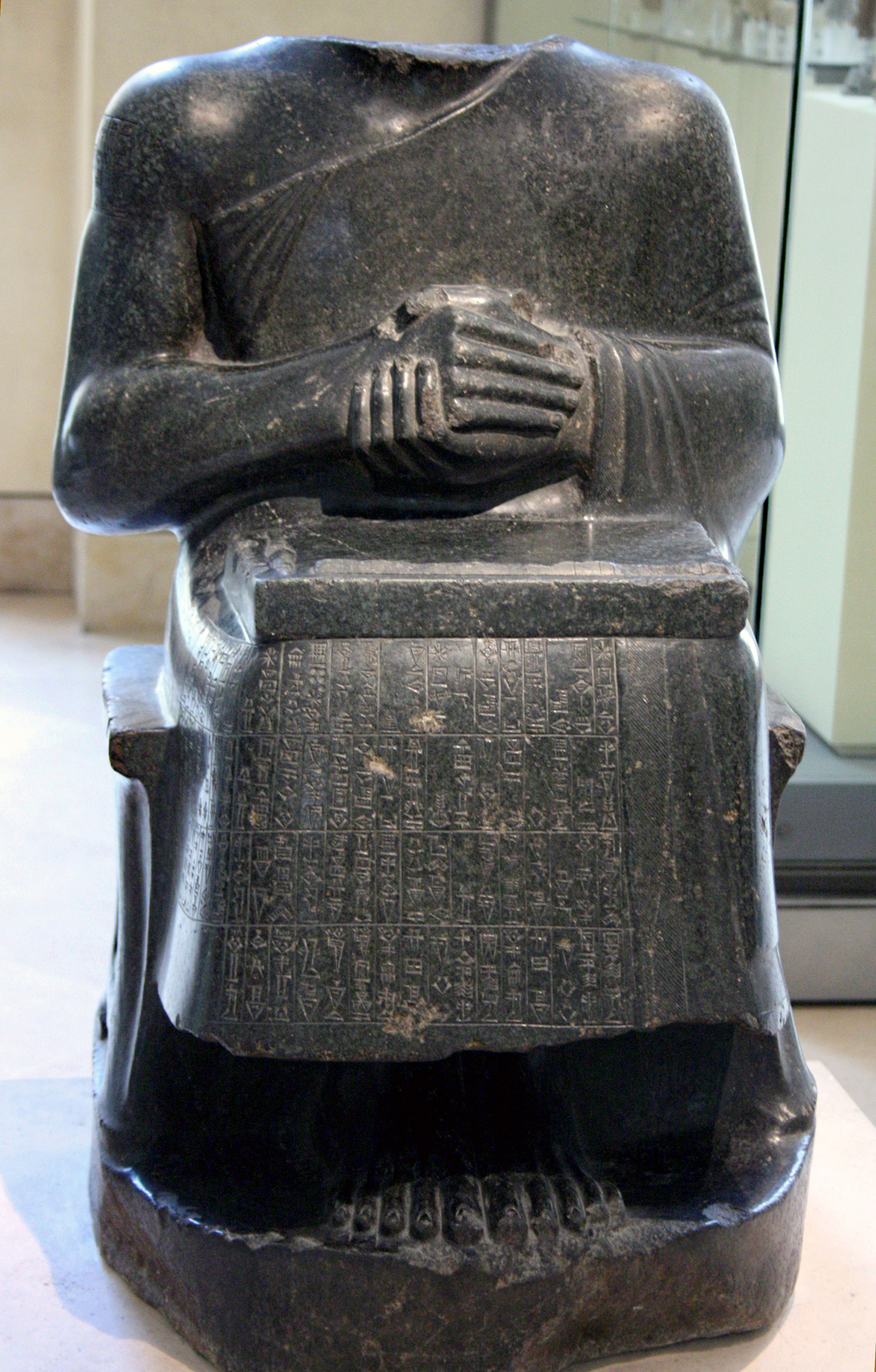
Gudea, Prince of Lagash. Diorite statue known as 'The Architect with the Rule', dedicated to the goddess Gatumdu, circa 2 120 BC (Neo-Sumerian period). Louvre Museum (Paris). Found in the ruins of Girsu at Tellō (Iraq).
The statue includes a cubit rod.
Girsu lies about 130 kilometres southeast of Babylon.
The statue earns its famous name because Gudea is depicted as a pious master builder. Balanced on his lap is a stone tablet displaying a meticulously engraved architectural ground plan of a temple. Next to the blueprint sits a stylus (for writing) and a graduated measuring ruler — making it one of the oldest archaeological depictions of architectural drafting tools in human history.
Photo: Michel wal, 2009
Permission: GNU Free Documentation License, Version 1.2 or any later version published by the Free Software Foundation; with no Invariant Sections, no Front-Cover Texts, and no Back-Cover Texts
Proximal source: Wikipedia
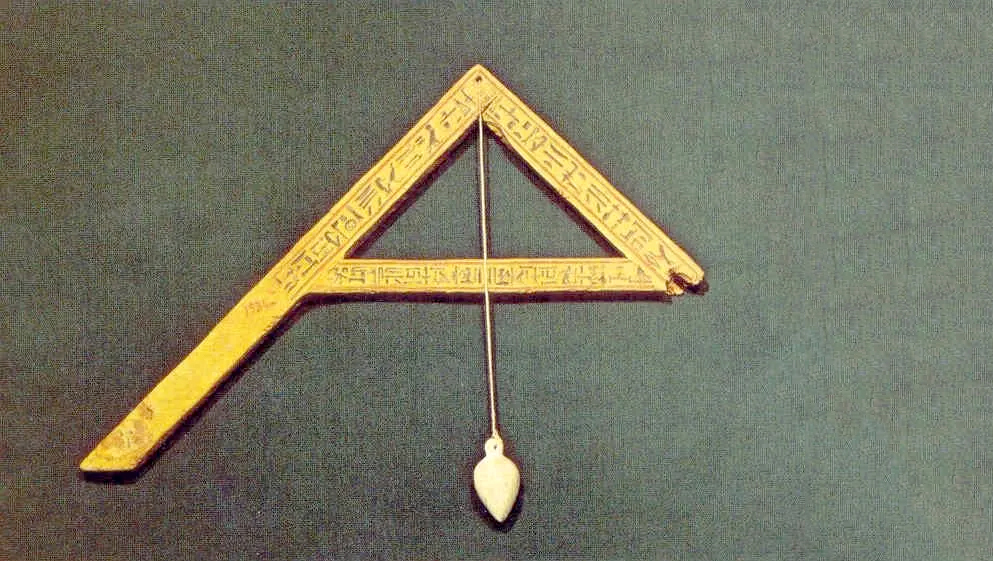
Plumb Level of Sennedjem
( Note that this image has been restored, the original image of the damaged plumb level may be seen by clicking on the image above - Don )
The Babylonian plumb line (often referred to interchangeably with the plumb bob or plummet) was a fundamental ancient engineering tool used to establish a true vertical line using gravity. While the invention of the tool is most widely credited to ancient Egypt around 4 000 years ago, it was heavily utilised throughout ancient Mesopotamia, including Babylon, to construct massive mud-brick structures, temples (ziggurats), and city walls.
This wooden plumb level from the Egyptian tomb of Sennedjem consists of two short pieces projecting at right angles from a longer slab. A limestone bob is strung from the top of the long slab and the upper short projecting wooden piece.
The string would touch the lower projecting piece when the long slab was held against a vertical surface. This tool bears the name of its owner, Sennedjem, who was a chief artisan during the reigns of Seti I and Ramesses II.
Photo and text: https://egypt-museum.com/plumb-level-of-sennedjem/
Source: New Kingdom, 19th Dynasty, ca. 1250 BC. From the tomb of Sennedjem (TT1), Deir el-Medina, West Thebes. Now in the Egyptian Museum, Cairo. JE 27260
The ancient Babylonians valued land, much as we do today. Early on, large swathes of agricultural land were owned by institutions such as temples or palaces.
Professional surveyors would measure these fields to estimate the size of the harvest. But they did not establish field boundaries. It seems those powerful institutions did not need a surveyor, or anyone else, to tell them what they owned.
The nature of land ownership changed during the Old Babylonian period, between 1 900 BC and 1 600 BC. Rather than large institutional fields, smaller fields could now be owned by regular people.
This change had an impact on the way land was measured. Unlike institutions, private landowners needed surveyors to establish boundaries and resolve disputes.
Babylonian surveyors relied on the unit rod and measuring rope (often referred to as tape and rod in ancient texts). Length measurements: Standard units included the cubit (about 50 cm or 20 fingers) and the rod (equal to 12 cubits, or about 6 metres).
Land division: Surveyors used these physical rods and ropes to lay out fields into rectangles, right-angled triangles, and right trapezoids for property rights and taxation.
Excavation: Labourers dug wide trenches using bronze tools and removed wet clay in baskets. Mathematical cuneiform texts guided workers on required dimensions and labor estimates.
Waterproofing: Crews lined canal beds and banks with fired bricks sealed with natural bitumen mortar to prevent leakage.
Flow Control: Builders installed wooden sluice gates and intake regulators to manage water volume from the river.
Maintenance - Dredging and Clearing:
Workers cleared plant reeds and continuously dredged accumulated silt to keep water flowing freely. Bank Repair: Laborers reinforced levees and banks with packed earth and stone revetments to prevent seasonal flood breaches. Legal Enforcement: Kings like Hammurabi enforced strict maintenance rules through the Code of Hammurabi, holding local governors and contractors legally responsible for neglected or failing waterways.
Specialised canal inspectors and temple officials supervised daily operations, water distribution, and repair schedules.
Babylonian canals powered Mesopotamian agriculture by turning an arid desert into a hyper-productive breadbasket. The region received very little rainfall, and the Euphrates River flooded unpredictably and violently in the spring—long before the autumn harvest.
The canal network solved this crisis by acting as a massive hydraulic management system.
Canals diverted excess water from spring floods into artificial basins and reservoirs, saving it for the dry summer months. Controlled Irrigation: Sluice gates and regulators allowed farmers to release water into their fields precisely when crops needed it, rather than relying on natural flooding.
As river water slowed down inside the canals, it deposited nutrient-rich silt onto the fields, acting as a natural fertiliser that renewed the soil year after year.
Canals pushed the boundaries of farming miles away from the main riverbanks, drastically increasing the total acreage of plantable land.
The 'Seeder Plow' Efficiency: The reliable water supply allowed for the widespread use of the ox-drawn seeder plow, which dropped seeds into furrows at the exact depth required for irrigated soil.
Stable water levels supported massive date palm orchards, onions, garlic, lentils, and vast fields of barley—the primary grain used for food, trade, and beer.
Canals functioned as the primary transport network. Large barges moved massive bulk harvests directly from rural fields to urban granaries and temple storehouses quickly and cheaply.
The canal-fed irrigation of southern Mesopotamia generated some of the highest agricultural returns in the ancient world, transforming Babylonia into a hyper-productive powerhouse.
The Babylonians categorised their agricultural output into distinct types of crops:
Cereals (The Staple Diet): Barley was the undisputed king of Mesopotamian crops. It was favoured over wheat and emmer because it is highly salt-tolerant and adapted to the arid climate. Wheat and emmer were grown in much smaller quantities, reserved primarily for luxury foods and high-end beers.
The Date Palm (The Tree of Life): Date orchards thrived along the banks of the canals. They tolerated the high salinity of irrigated soil and provided dried fruit packed with concentrated calories for worker rations.
Vegetables and Legumes: Shaded beneath the tall canopy of date palm orchards, farmers grew chickpeas, lentils, peas, onions, garlic, and leeks. [1, 2] Oil and Industrial Crops: Sesame was widely cultivated as the primary source of vegetable cooking oil. Flax was grown to produce linseed oil and linen fibers for clothing. [
Revolutionary Crop Yields: With the help of intensive canal irrigation and the ox-drawn seeder plow, southern Mesopotamia achieved staggering yields that rivalled, and sometimes exceeded, pre-industrial European farming.
Ancient texts detail how teams of workers used oxen and precise tools to maximise these agricultural cycles.
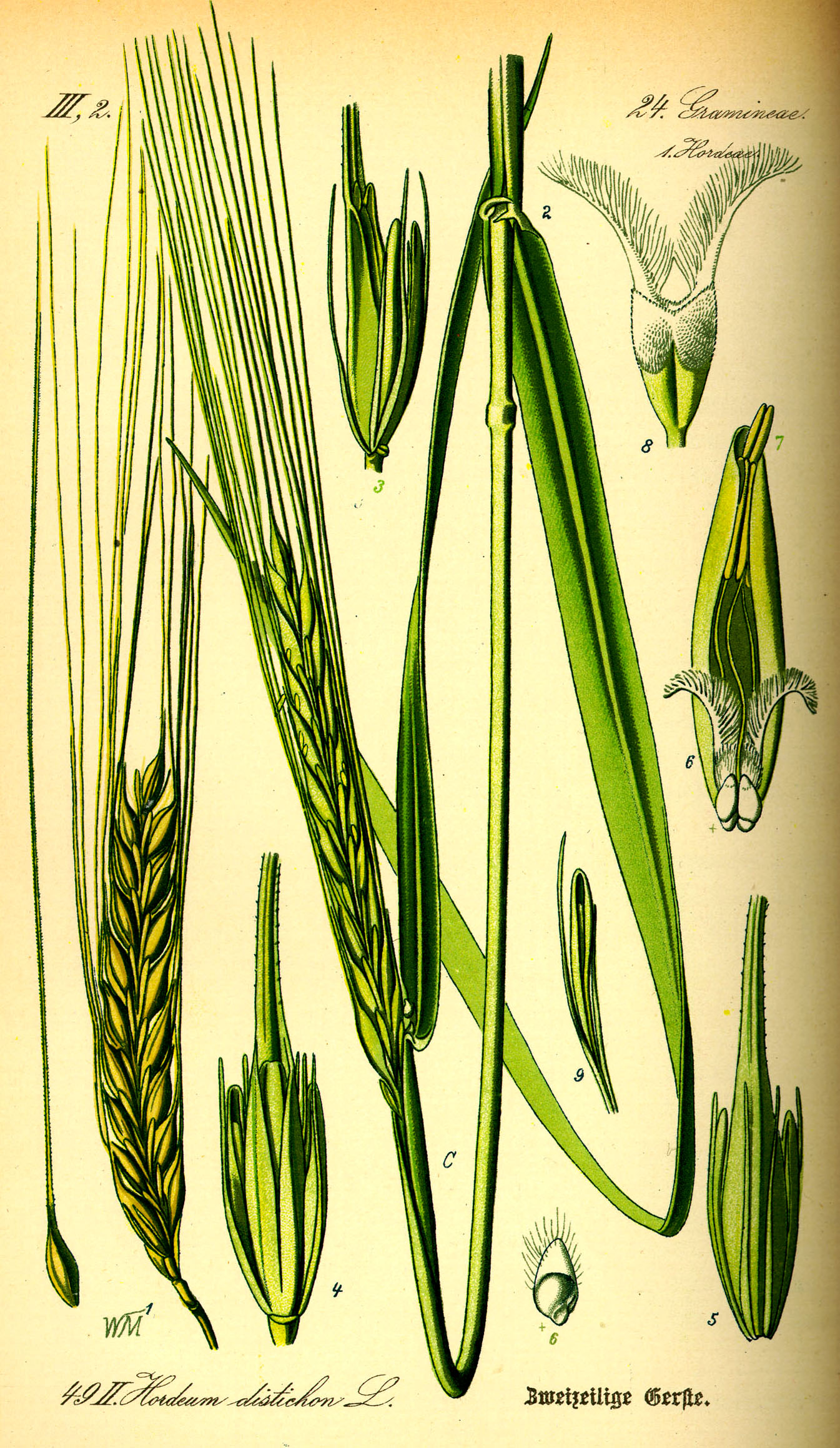
Common Barley, Hordeum distichon.
Hordeum distichon., the common barley or two-rowed barley, is a cultigen of barley, family Poaceae. It is native to Mesopotamia, and is widely grown throughout temperate regions of the world.
Barley, a member of the grass family, is a major cereal grain grown in temperate climates globally. It was one of the first cultivated grains, particularly in Eurasia as early as 10 000 years ago.
Photo: Prof. Dr. Otto Wilhelm Thomé Flora von Deutschland, Österreich und der Schweiz 1885, Gera, Germany
Permission: This work has been released into the public domain
Proximal source: www.biolib.de
Text: Wikipedia
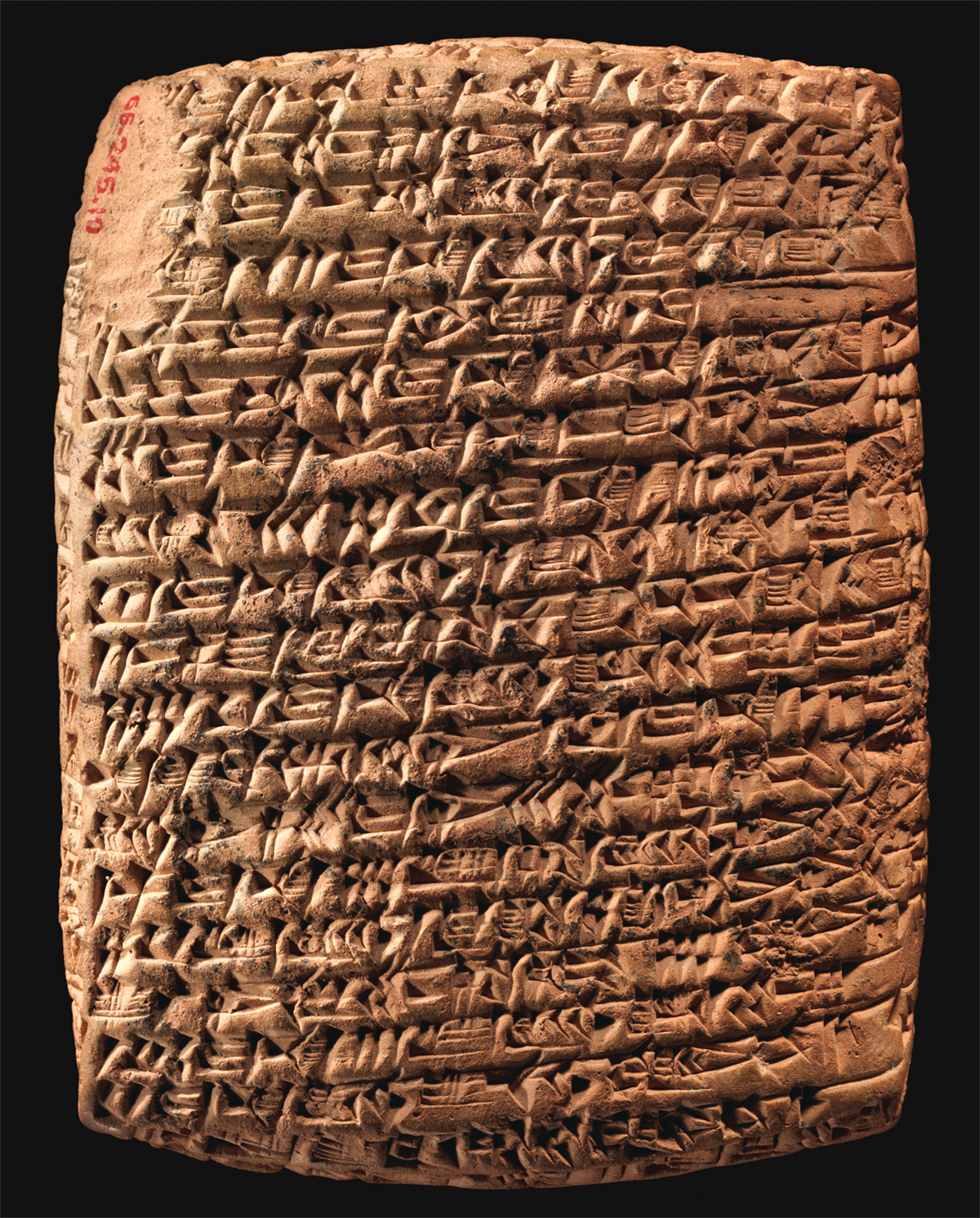
Cuneiform tablet: caravan account
Cuneiform is the earliest known logo-syllabic writing system in human history, characterised by its distinct wedge-shaped impressions made in soft clay. The word comes from the Latin cuneus, meaning 'wedge'. Scribes pressed a triangular reed stylus into wet clay tablets to form wedge shapes and lines.Evolution: It began around 3 200 BC in Sumer as simple pictographs used for accounting and trade records. It evolved into hundreds of abstract signs representing entire words or phonetic syllables.
This tablet is of a type used by the Assyrian merchants to track the income and expenses generated by caravan shipments. The cuneiform text, read from left to right, records not only the amount of silver invested in tin and textiles, but also the less commonly traded precious stone lapis lazuli, which was sourced from Afghanistan. In addition to investments in trade items, these shipments required various expenditures like clothing and wages for guides, as well as donkeys and their equipment and fodder. Donkeys became important trade items themselves and were often sold upon the caravan’s arrival in Anatolia after the arduous 6-8 week journey from Ashur. The tablet also records other fees, payments, and purchases, before calculating the total money owed to the prominent merchant Imdi-ilum who was active in the caravan trade between 1 888 BC and 1 876 BC
Photo and text: Met Museum
Permission: This work has been released into the public domain
Additional text: Wikipedia
The 24:1 Productivity Ratio
Cuneiform tax records ( See the image above for an illustration of cuneiform writing - Don ) from southern Mesopotamia show an average return ratio of 24:1 — meaning for every single basket of barley seed planted, farmers harvested 24 baskets. Under optimal conditions in the most fertile districts, historical accounts suggest yields could peak even higher.
During peak periods, barley production averaged roughly 1 100 litres per hectare.
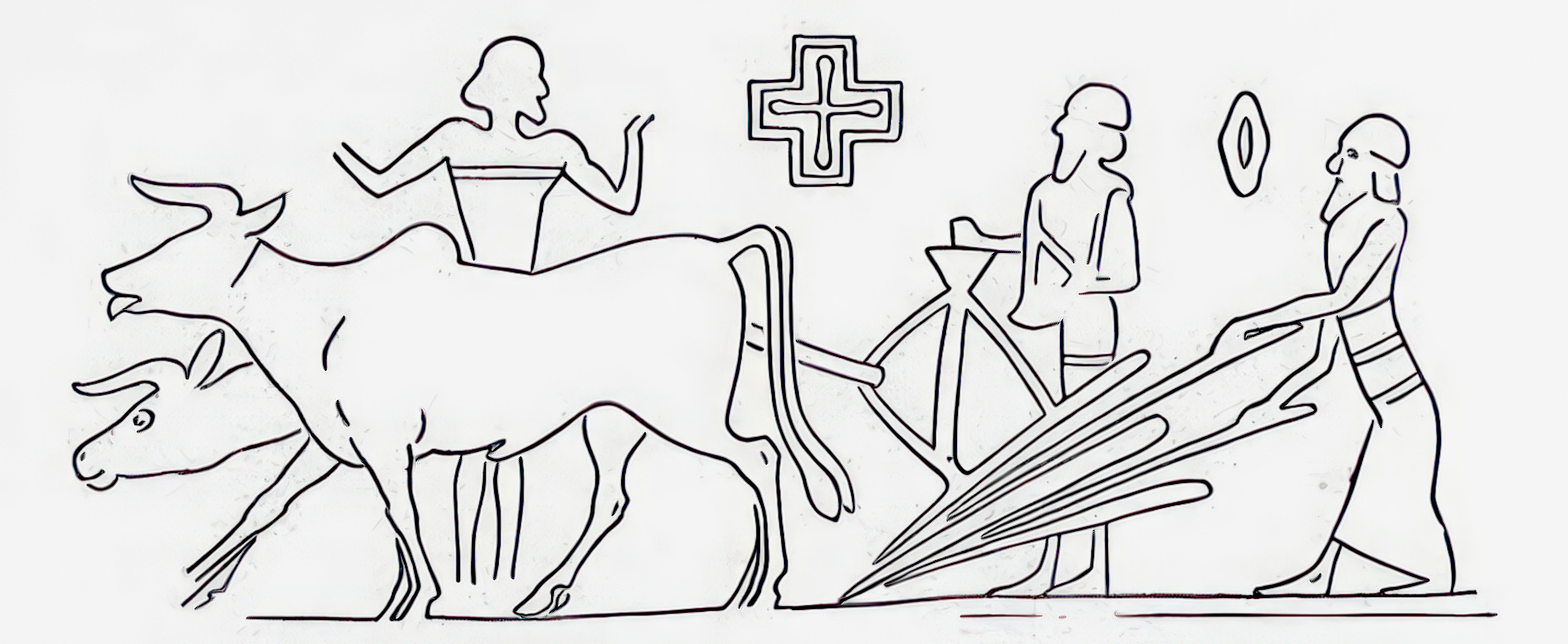
Sowing was done with a plow, driven by oxen, and fitted with a funnel to drop the seed into the furrows. The scene is clearly represented in an oft-reproduced cylinder seal of the University Museum, shown above. The seed was covered by a second plowing across the furrows or by working with a tilted share.
After the barley had begun to sprout, the fields were irrigated at least three or four times. The fields needed constant care: weeding the troublesome thorny plants, keeping away the herds of gazelles, 'chasing the nomadic shepherds with a club' etc.
The Babylonian seeder plow dropped seeds into deep, protected furrows rather than scattering them blindly. This innovation reduced the necessary seeding rate to just 42 to 60 litres per hectare, leaving more grain available for consumption, trade, and brewing.
This monumental agricultural surplus meant that a fraction of the population could feed the entire region. This surplus directly funded the construction of Babylon’s massive walls, temples, and palaces.
The plow gang consists of three men, as above. The one depicted larger in size than the others is doubtless the chief. He appears to be driving the animals, as is indicated by his raised arm, perhaps holding a whip. Another, having a bag over his shoulder, is in the act of feeding the tube or grain drill, through which the seed was dropped into the furrow made by the plow, which is being guided by the third man. The animals drawing the plow, known as alpu, 'ox', in the inscription, are in use in Babylonia at the present time. It is the Zebu or humped bull (bos indicus).
The individual for whom the seal was cut regarded himself as a devotee of Nin-Sar, the god of vegetation, as the first line of the inscription shows (Arad-NIN-SAR). Unfortunately the name of the owner in the second line is so imperfectly preserved that it cannot be read.
Photo and text: https://www.penn.museum/sites/expedition/sumerian-harvest-time/ and https://www.penn.museum/sites/journal/13/
Soil salinity was the single greatest ecological threat to Babylonian civilisation. Because Mesopotamia was incredibly hot and arid, irrigation water evaporated rapidly. This process left behind trace minerals that accumulated over time, while a rising, salty groundwater table poisoned plant roots from below.
To combat this 'white death', Babylonian farmers and engineers developed several surprisingly sophisticated countermeasures:
1. Alternate-Year Fallowing:
The primary defence against salinity was the fallow system. Farmers left half of their agricultural land unplanted every other year. [1, 2, 3] The Mechanism: During the fallow year, deep-rooted wild weeds and camel thorn grew over the uncultivated fields. These hardy plants drank the deep groundwater, lowering the water table.
Lowering the water table stopped capillary action from drawing toxic subterranean salts up into the topsoil where crops grew.
Leaching and Controlled Flooding:
Before planting a field, farmers used their canals to deliberately flood the dry land with a precise volume of freshwater. This technique, known as leaching, dissolved the encrusted surface crusts of salt and washed them down into the subsoil or out through primitive drainage ditches.
The Babylonian Desalination Cycle
Instead of using modern chemical treatments or mechanical pumps, the Babylonians used natural hydrology and plant biology to lower the water table and flush salt away from the surface.
A typical cycle across their long, narrow fields functioned through specific stages:
Season 1: Cultivation -> Heavy irrigation triggers salt buildup at the surface.
Season 2: Deep Fallow -> Camelthorn/weeds grow unwatered, lowering the water table.
Season 3: Flushing -> Floodwaters leach remaining salts down below the root zone.
Season 4: Crop Shift -> Salt-tolerant Barley is planted instead of salt-sensitive wheat.
The Weed-Driven Deep Fallow (Biological Drainage)
Fields were strictly mandated to lie completely fallow every second year. During this unwatered period, deep-rooted, wild desert plants—most notably camelthorn (lhagi maurorom) — were allowed to overrun the fields. These wild weeds tapped into the high, salty water table, drawing the moisture up and lowering the water levels significantly. By lowering the water table, they prevented capillary action from pulling more deep-soil salts up to the surface.
As the wild weeds dried up and the summer heat intensified, the topsoil dried out completely. This disrupted the continuous water columns in the soil, preventing further salt accumulation at the surface.
Seasonal Leaching (Flushing):
Before the next planting cycle, farmers would deliberately unleash controlled, heavy doses of river water across the dry fields. Because the water table had been successfully lowered by the weeds, this fresh water could easily percolate straight down through the soil. As it drained downward, it dissolved the accumulated surface salts and washed them deep into the subsoil, well below the root zone of future crops.
Rotational Planting of Salt-Tolerant Crops:
Even with flushing, some salt remained. The Babylonians adapted by shifting their main crop rotations away from salt-sensitive emmer wheat to highly salt-tolerant barley. Cuneiform tablets like the Sumerian Farmer’s Almanac explicitly laid out these crop shifts. They also interplanted date palms (which thrive in saline soils) and legumes (which replenished nitrogen stripped during the fallow cycles).
Text above: Various sources.
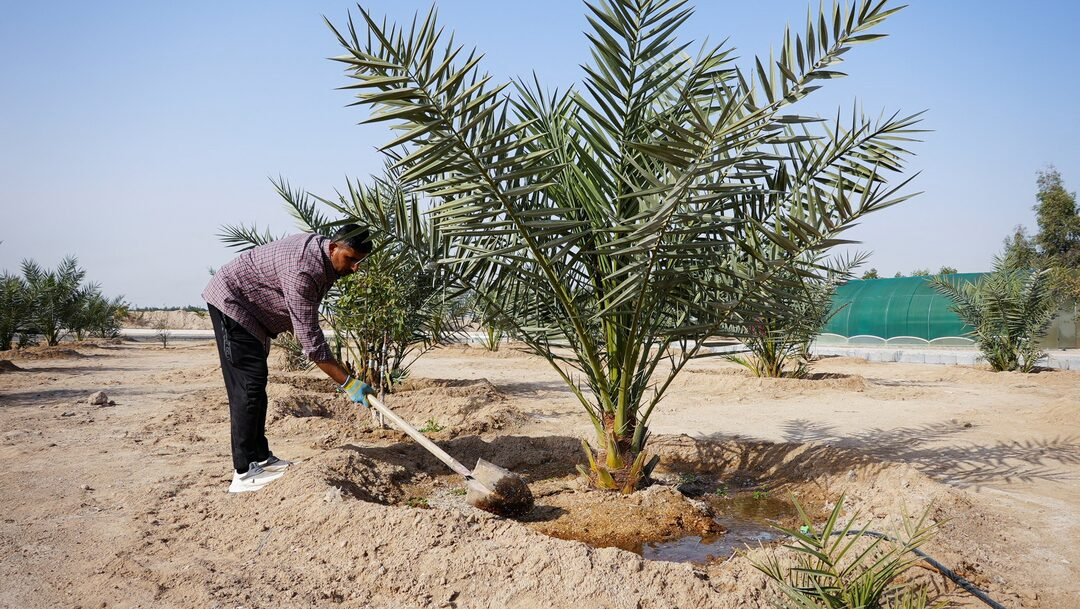
Babylonians used specific crops to naturally rehabilitate degraded, salty soils. They heavily planted date palms, which possess an incredibly high salt tolerance. The shade from the palm canopies also reduced surface evaporation, slowing down the rate of new salt accumulation in the soil underneath.
Date palms are still being planted today in Iraq as illustrated here to reduce soil salinity.
Photo: Mohammed Atti and Imad Creidi
Shifting to Salt-Tolerant Barley:
When a field's salinity grew too severe to support delicate emmer wheat, Babylonian farmers systematically switched the entire field to barley. Barley can thrive in soils that would wither other grains. This tactical shift, well-documented in cuneiform tablets, allowed Babylonian cities to maintain high food yields even as their fields slowly degraded.
Despite these brilliant strategies, salinity was a battle the ancient Mesopotamians could never entirely win. Over centuries, the relentless accumulation of salt gradually lowered the fertility of the southern plains, eventually forcing the centers of political power to shift further north.
Text above: Various sources
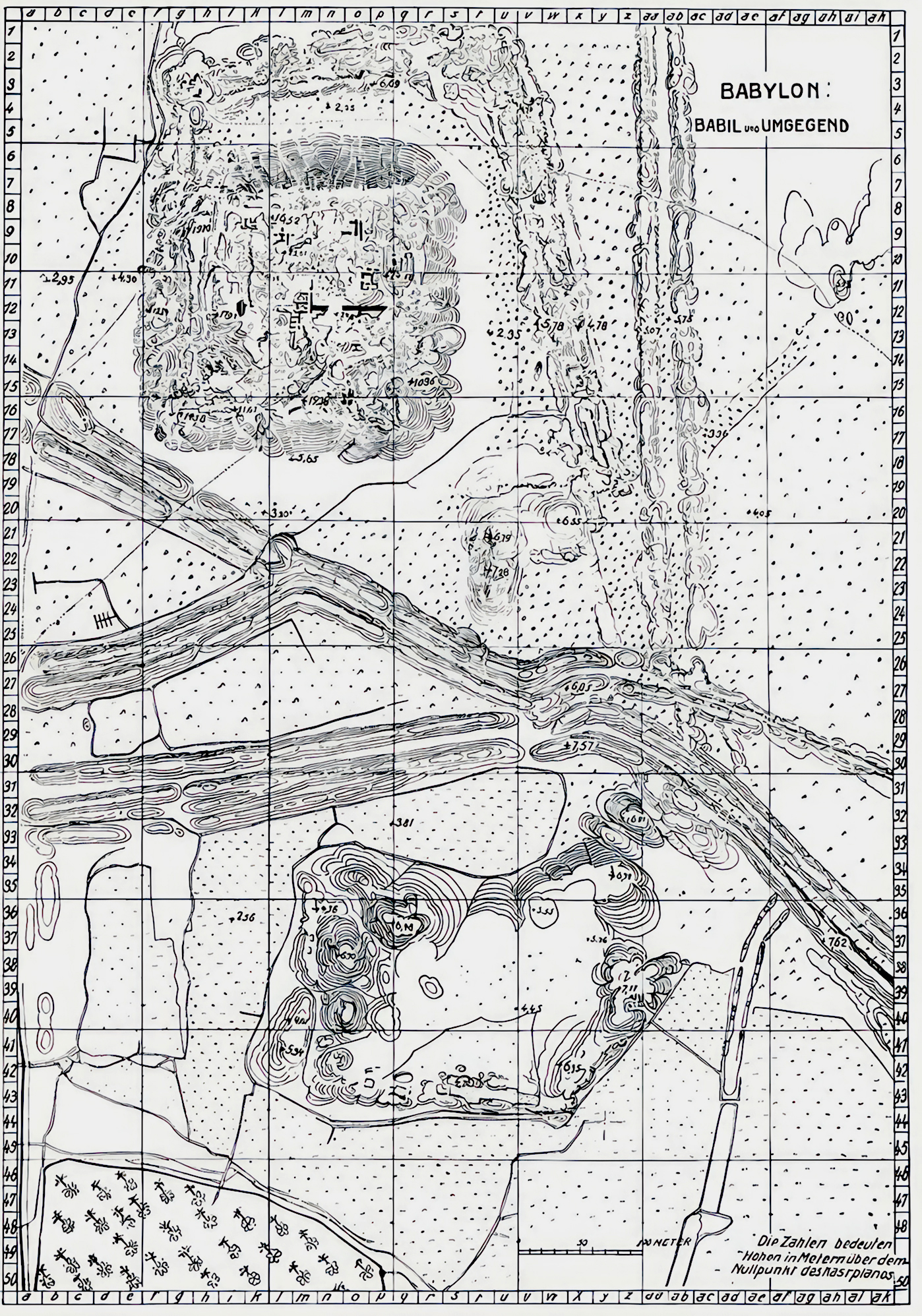
Babil and the surrounding area.
( The red outline shows the position of the mound of Babil itself, the ruins of King Nebuchadnezzar II's summer palace.
Click on the image to see the full size image without the red outline - Don )
The numbers represent heights in metres above the zero point of the plan.
Photo and text: Koldewey (1914)
Permission: Project Gutenberg License
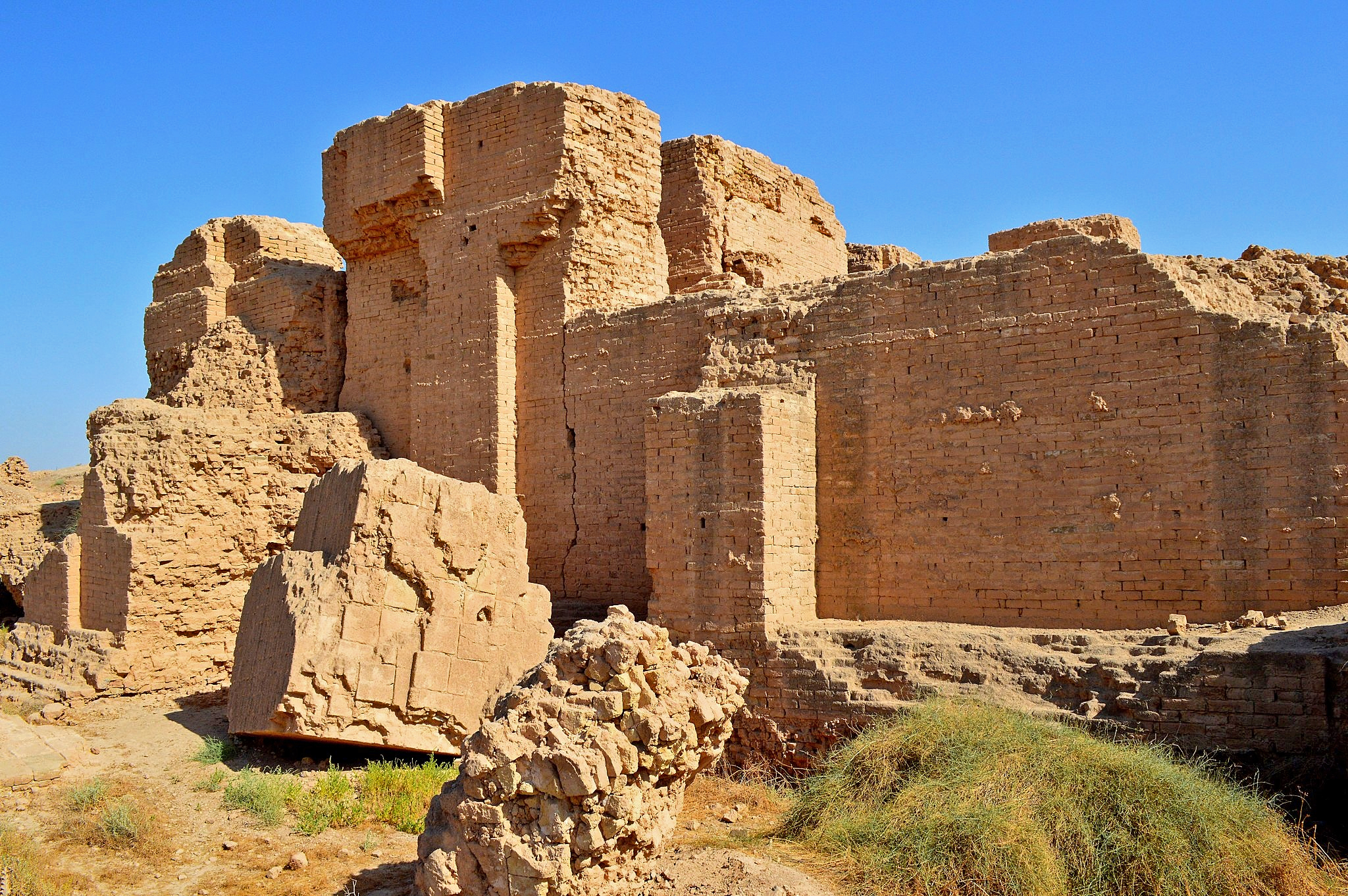
Ruins of the North Palace of the Neo-Babylonian king Nebuchadnezzar II at the ancient city of Babylon, Iraq, mound Babil. 6th century BC.
Photo and text: Osama Shukir Muhammed Amin FRCP(Glasg) 2012
Permission: Creative Commons Attribution-Share Alike 4.0 International licence.
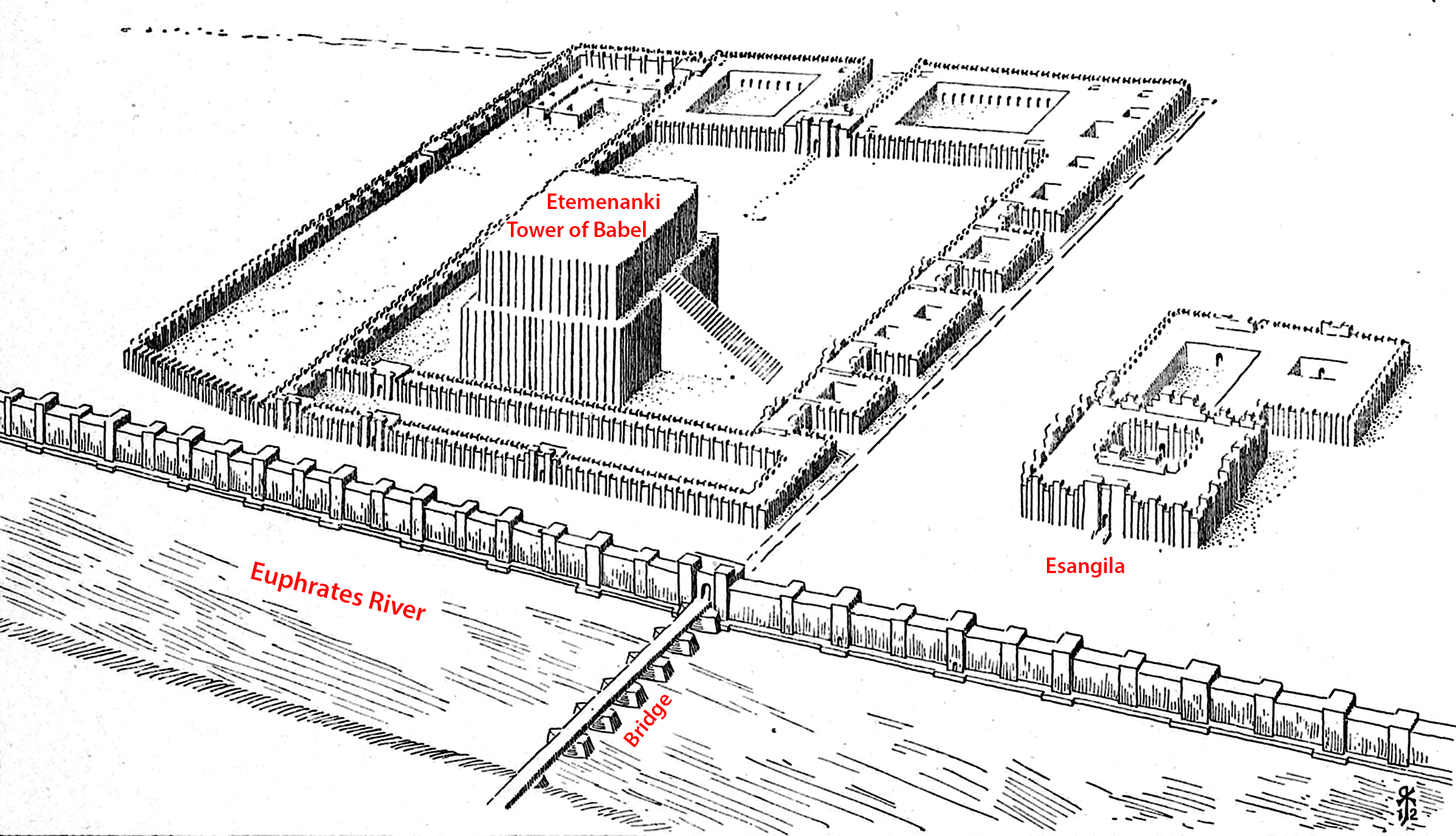
Esagila (house of the main elevation), the ground level Marduk temple, is shown here to the right of the street from the bridge over the Euphrates.
Etemenanki (E-temen-an-ki) (House of the Foundation of Heaven and Earth), the circa 92 metres high stepped tower.
The small high temple on the tower is said to have housed a bed and table for Marduk. The model of the tower follows the reconstruction proposal by W. Andrae / G. Martiny
State at the beginning of the 6th century BC
Photo and text: Koldewey (1914)
Additional text: Wikipedia
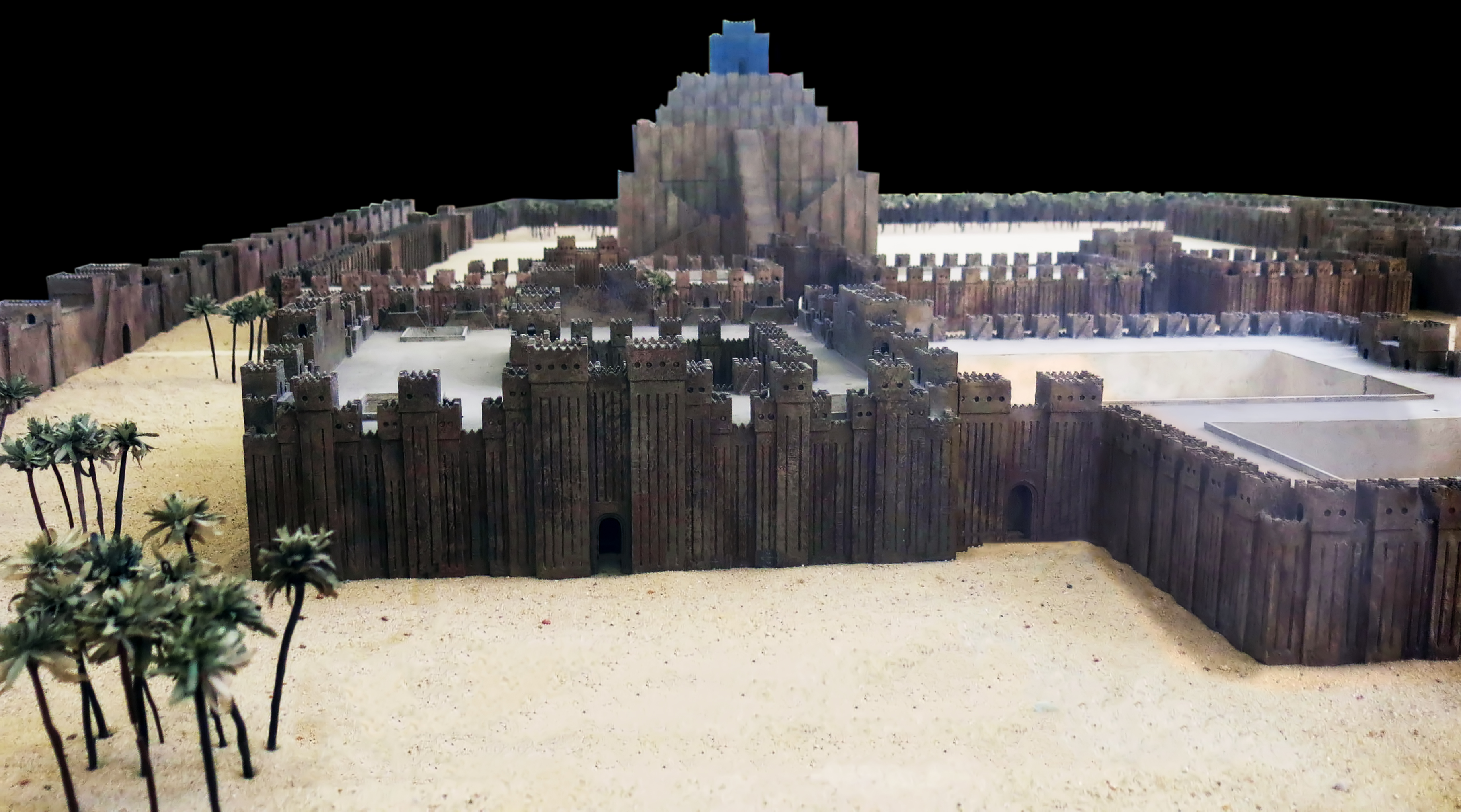
This view of the model of Babylon shows the interior of the peribolos, defined as a court enclosed by a wall, especially one surrounding a sacred area such as a temple, shrine, or altar.
The Esagila, a 'ground level' temple dedicated to Marduk, the protector god of Babylon, is in the foreground, with the Etemenanki, the Tower of Babel, in the background.
Etemenanki was a ziggurat dedicated to Marduk. It is now in ruins, and is located about 90 kilometres south of Baghdad, Iraq.
Photo: Don Hitchcock 2015
Source: Pergamon Museum, Berlin, recherche.smb.museum
Additional text: Wikipedia
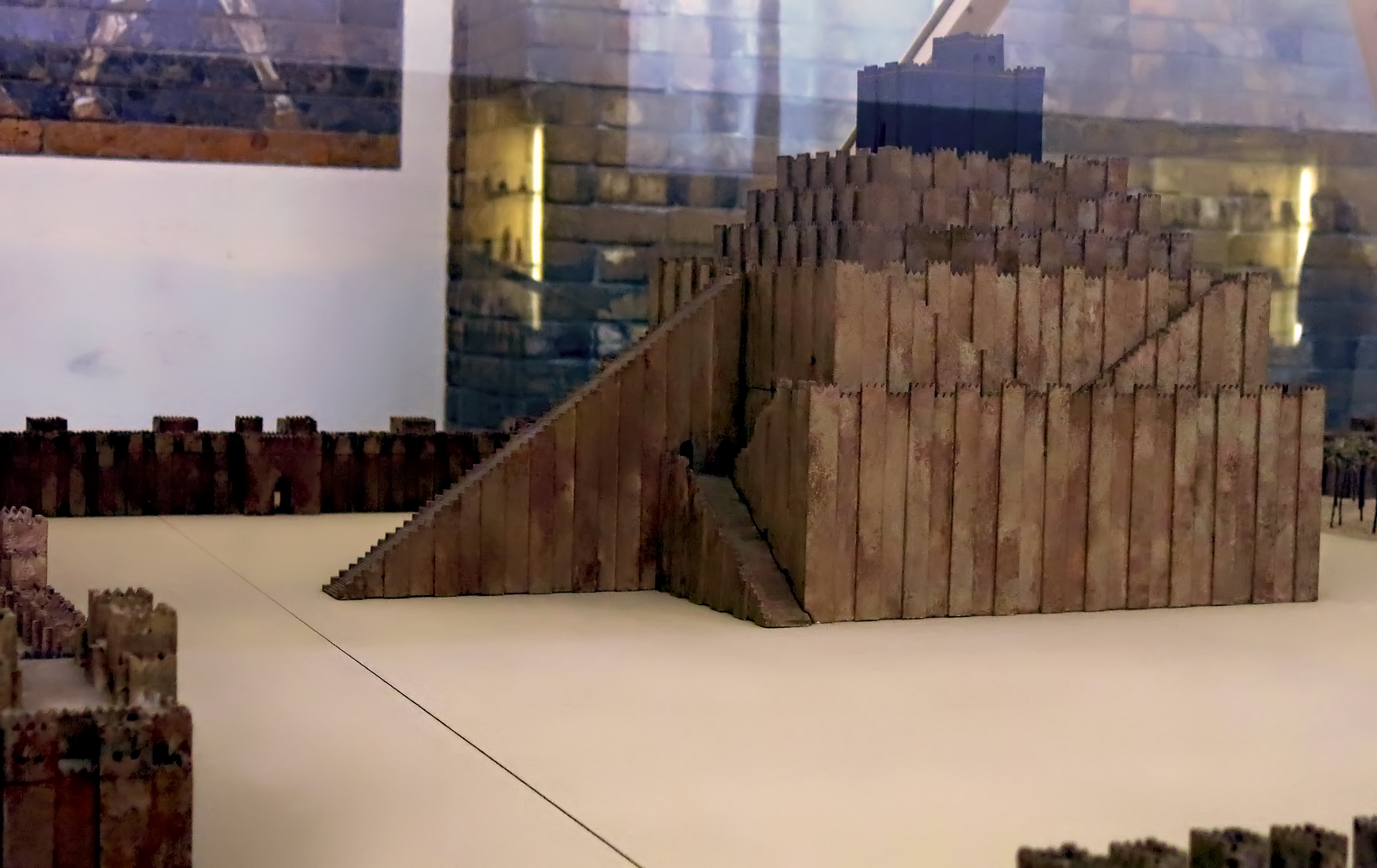
Model of Etemenanki, the Marduk temple in Babylon, also known as the Tower of Babel.
Babylon was destroyed in 689 BC by Sennacherib, who claims to have destroyed the Etemenanki. It took 88 years to restore the city. Work was started by the Assyrian king Esarhaddon, and continued under Nabopolassar, followed by his son Nebuchadnezzar II who rebuilt the ziggurat.
The city's central feature was the temple of Marduk (Esagila), with which this Etemenanki ziggurat was associated.
Photo: Don Hitchcock 2015
Source: Pergamon Museum, Berlin, recherche.smb.museum
Text: Wikipedia
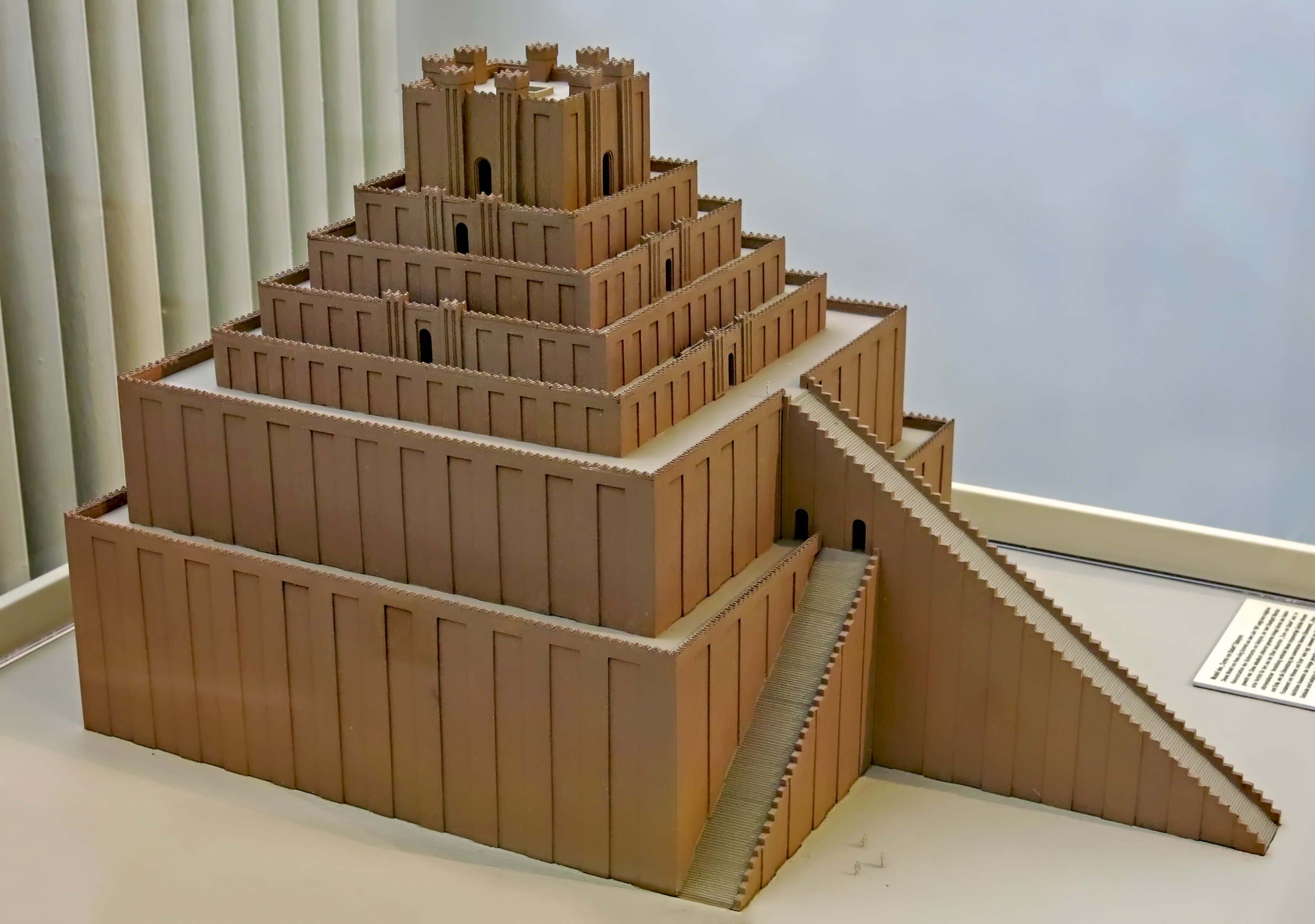
Another, more detailed version of Etemenanki.
The stepped tower of Babylon was dedicated to the city god Marduk. The model was made by Hans-Jörg Schmid in 1991. This building, in Akkadian called zikkurrat, might be the historical background for the biblical story of the 'Tower of Babel'.
In ancient Near Eastern thought, this stair-like structure connected heaven and earth, as the translation of the Sumerian name Etemenanki, 'House, foundation of heaven and earth' suggests.
To what extent the model represents the correct appearance of the building is debatable, as only the foundations of this building are preserved.
Catalog: VAG 01284
Photo: Don Hitchcock 2015
Artist: Hans-Jörg Schmid, 1991.
Source and text: Pergamon Museum, Berlin, recherche.smb.museum
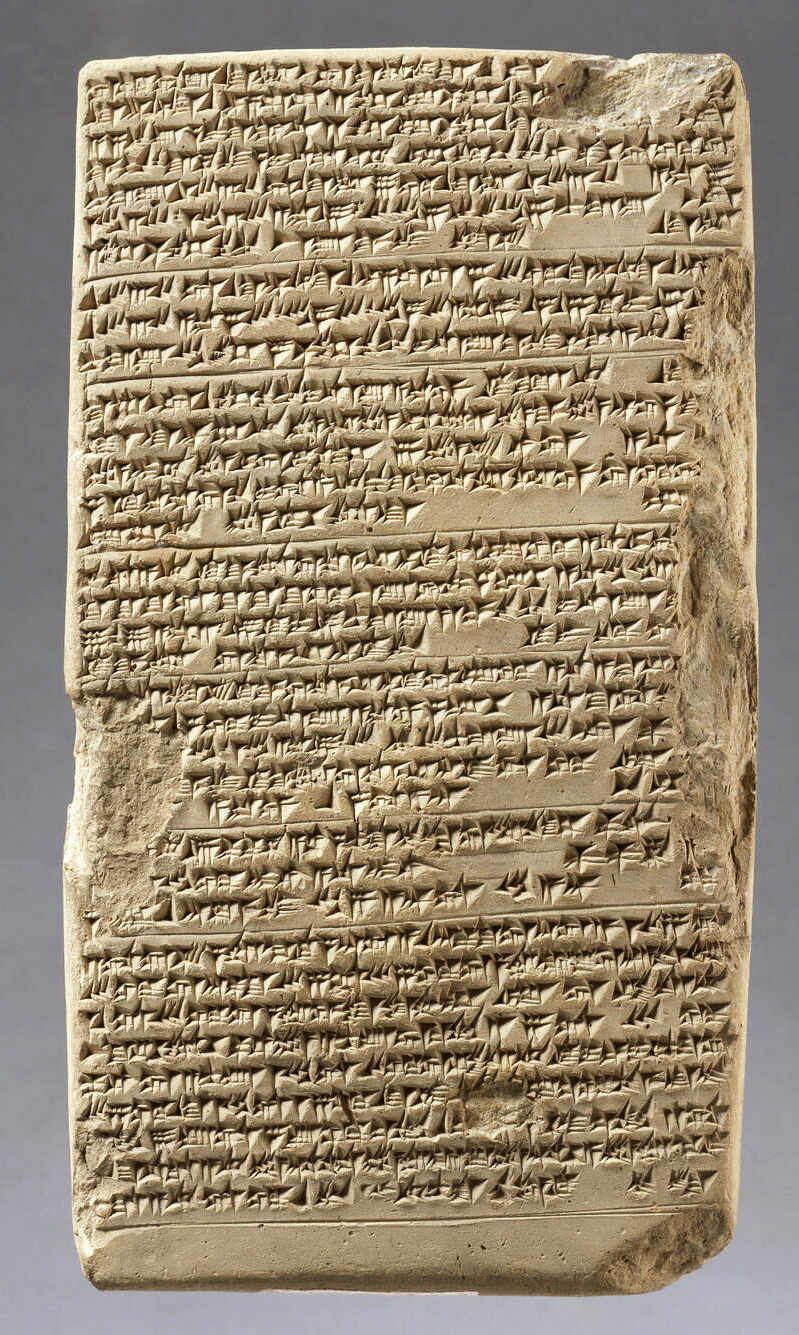
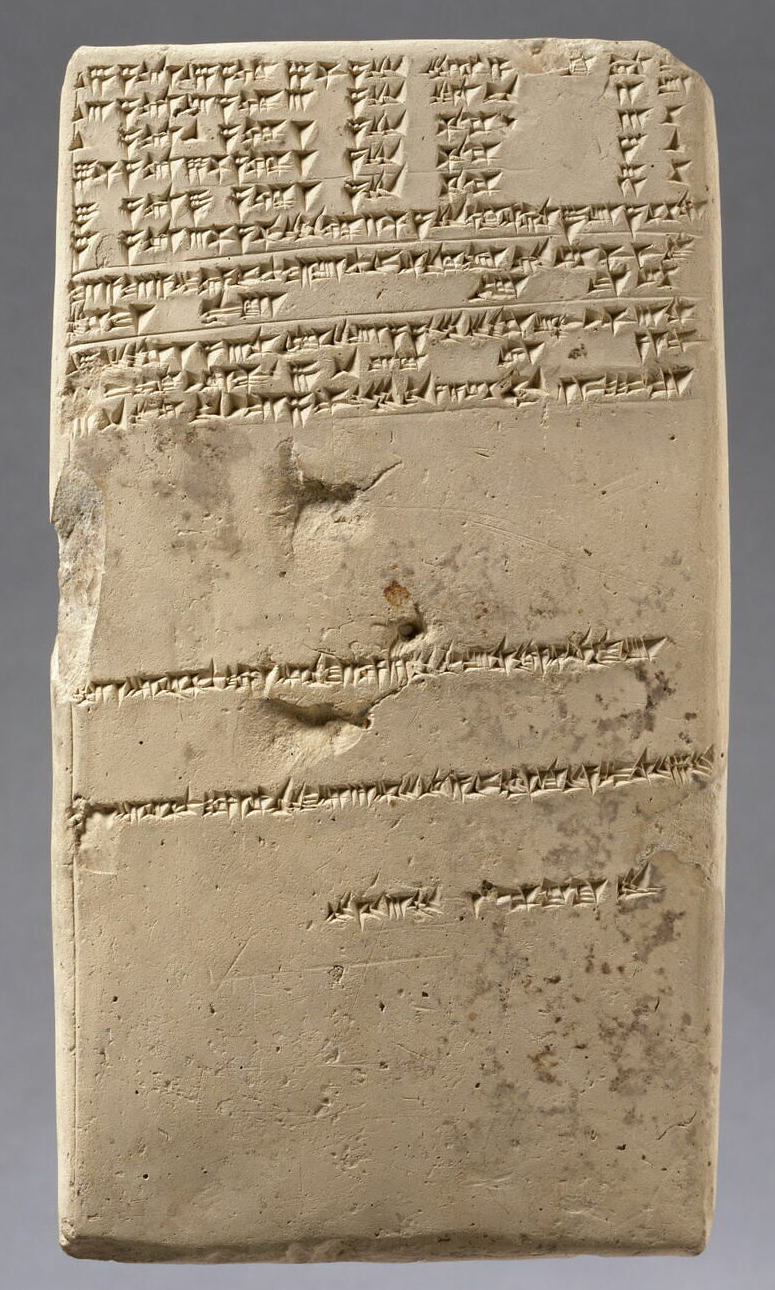
The 'Esagila' tablet
( This gives the height of Etemenanki as 91 metres, now believed to be no more than 66 metres, see below - Don )
Copy of a neo-Babylonian document written in Uruk from an original by Borsippa, Tablet of Esagila.
Inscription: Measurements of the Esagil and the Etemenanki.
Height 181 mm, width 100 mm, thickness 24 mm.
Date of the original tablet: Neo-Babylonian (Borsippa) (604 BC - 539 BC)
Date of creation / manufacture of this copy: Seleucid: Seleucos I (around 229 BC; year 83 of the Seleucids) (305 BC - 281 BC)
Provenance: Uruk archives of Eanna
Text above: © Louvre Museum, Paris, France, https://collections.louvre.fr/
Photo: © Raphaël Chipault, Louvre Museum, Paris, France, https://collections.louvre.fr/
Source: Original, Louvre Museum, Paris, France, https://collections.louvre.fr/

Modern scholars dispute the claim by the ancient Babylonian source (the 'Esagila' tablet) that the Etemenanki was 91 metres tall. 'The modern interpretation of the text of the Esagila tablet raises a serious technical problem: the excessive height of the first two terraces of the ziggurat and the total height of the building defy the laws of statics and compressive strength of a material such as raw earth brick.
Even allowing variation in the design of a six-level terraced structure, at that height, the compression stress on the structure would be somewhere around two to three times as much as comparable structures of the same time period. Fenollós J. et al. (2005) propose that, assuming the structure did indeed use a six-level terrace design as depicted in the Tower of Babel stele, the ziggurat was probably closer to 54 metres tall.
The temple at the top contributed another 12 metres in height, for a total height of 66 metres.
Photo: Don Hitchcock 2015
Artist: Hans-Jörg Schmid, 1991.
Text: Wikipedia
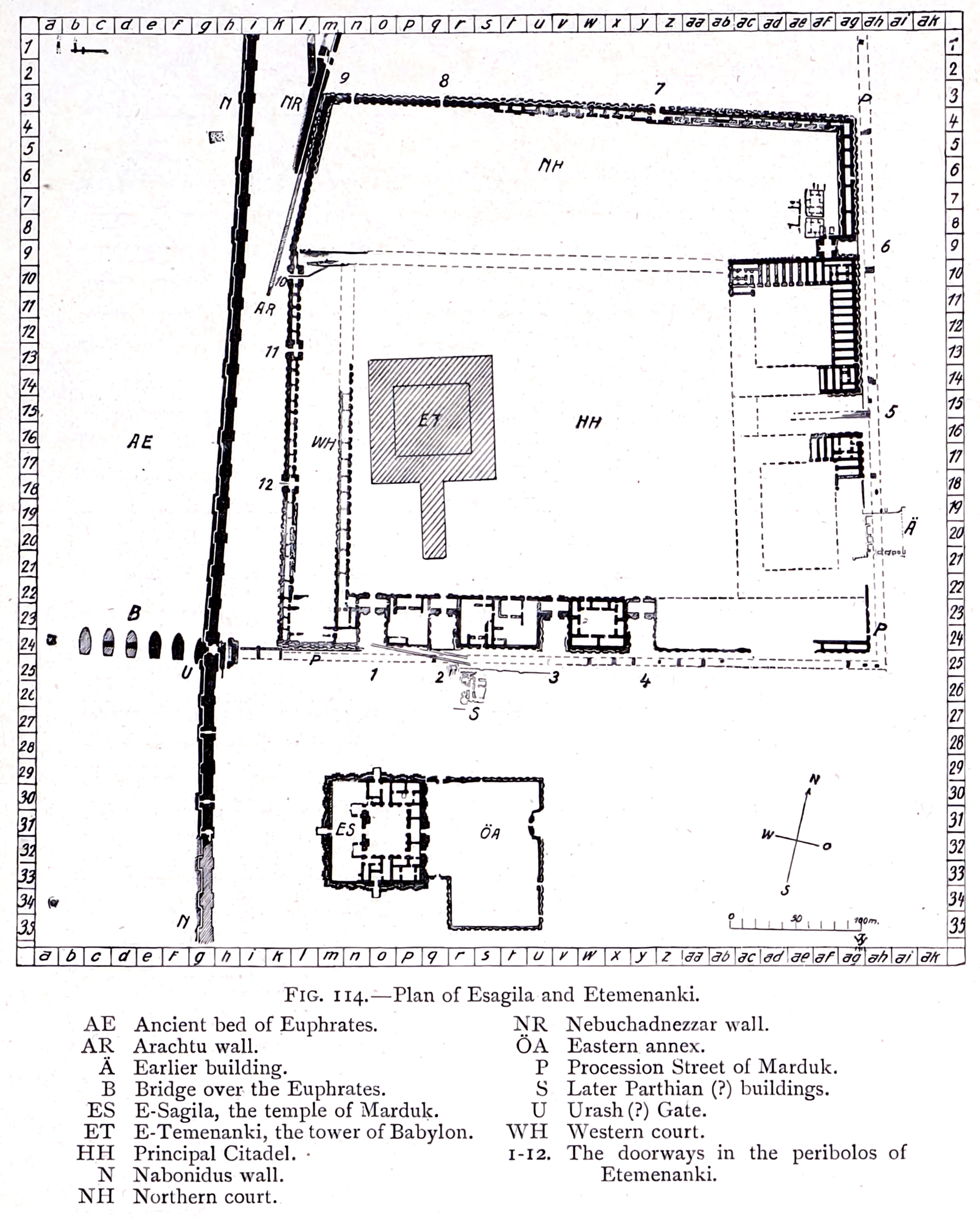
Plan of Esagila and Etemenanki.
Photo and text: Koldewey (1914)
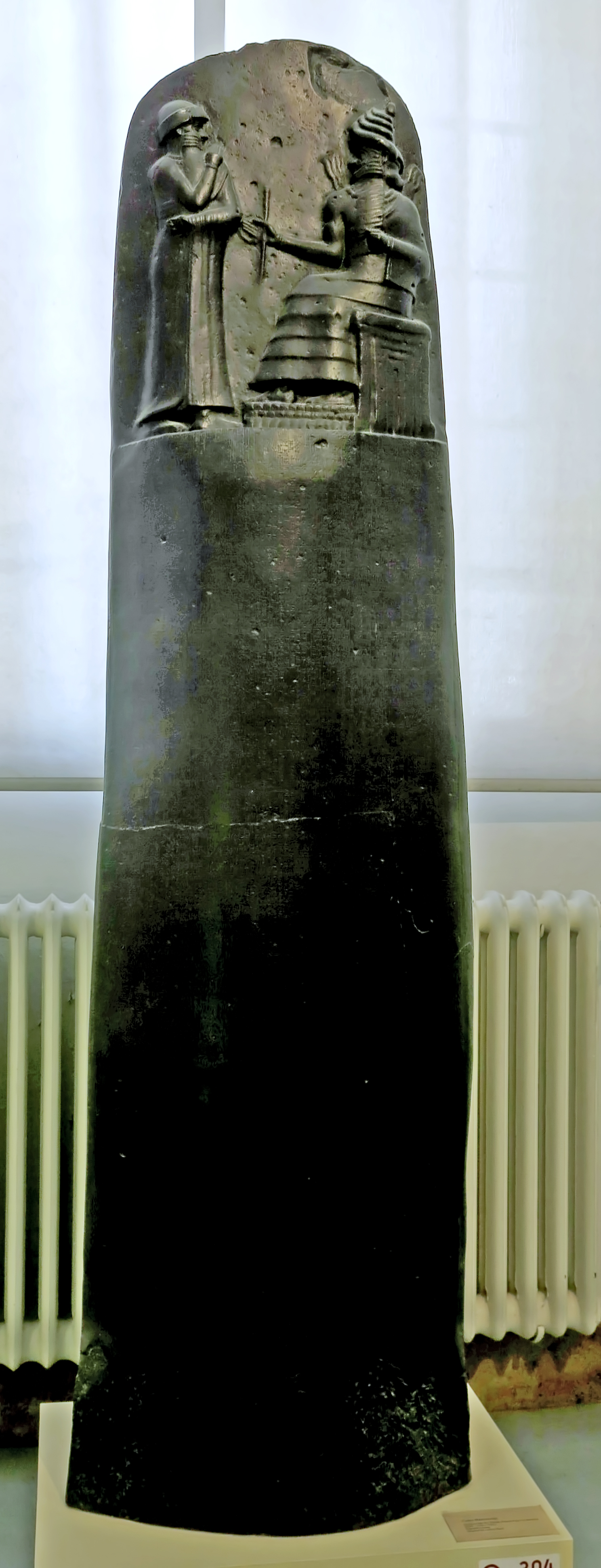
Codex Hammurabi
Stele of the Law of King Hammurabi of Babylon, 1 792 BC - 1 750 BC.
The code of Hammurabi is a Babylonian legal text composed circa 1 75 5– 1 750 BC. It is the longest, best-organised, and best-preserved legal text from the ancient Near East. It is written in the Old Babylonian dialect of Akkadian, purportedly by Hammurabi, sixth king of the First Dynasty of Babylon. The primary copy of the text is inscribed on a basalt or diorite stele 225 cm tall. The stele was discovered in 1901, at the site of Susa in present-day Iran, where it had been taken as plunder six hundred years after its creation. The text itself was copied and studied by Mesopotamian scribes for over a millennium. The stele now resides in the Louvre Museum.
The top of the stele features an image in relief of Hammurabi with Shamash, the Babylonian sun god and god of justice. Below the relief are about 4,130 lines of cuneiform text: one fifth contains a prologue and epilogue in poetic style, while the remaining four fifths contain what are generally called the laws. In the prologue, Hammurabi claims to have been granted his rule by the gods "to prevent the strong from oppressing the weak". The laws are casuistic, expressed as 'if ... then' conditional sentences. Their scope is broad, including, for example, criminal law, family law, property law, and commercial law.
Modern scholars responded to the Code with admiration, at its perceived fairness and respect for the rule of law, and at the complexity of Old Babylonian society. There was also much discussion of its influence on the Mosaic Law. Scholars quickly identified lex talionis, the "eye for an eye" principle, as underlying the two collections. Debate among Assyriologists has since centred around several aspects of the Code: its purpose, its underlying principles, its language, and its relation to earlier and later law collections.
Despite the uncertainty surrounding these issues, Hammurabi is regarded outside Assyriology as an important figure in the history of law, and the document as a true legal code. The U.S. Capitol has a relief portrait of Hammurabi alongside those of other lawgivers, and there are replicas of the stele in numerous institutions, including the headquarters of the United Nations in New York City and the Pergamon Museum in Berlin.
Photo: Don Hitchcock 2015
Source and text: Facsimile, Pergamon Museum, Berlin, recherche.smb.museum
Additional text: Wikipedia
Original is in the Louvre Museum, Paris
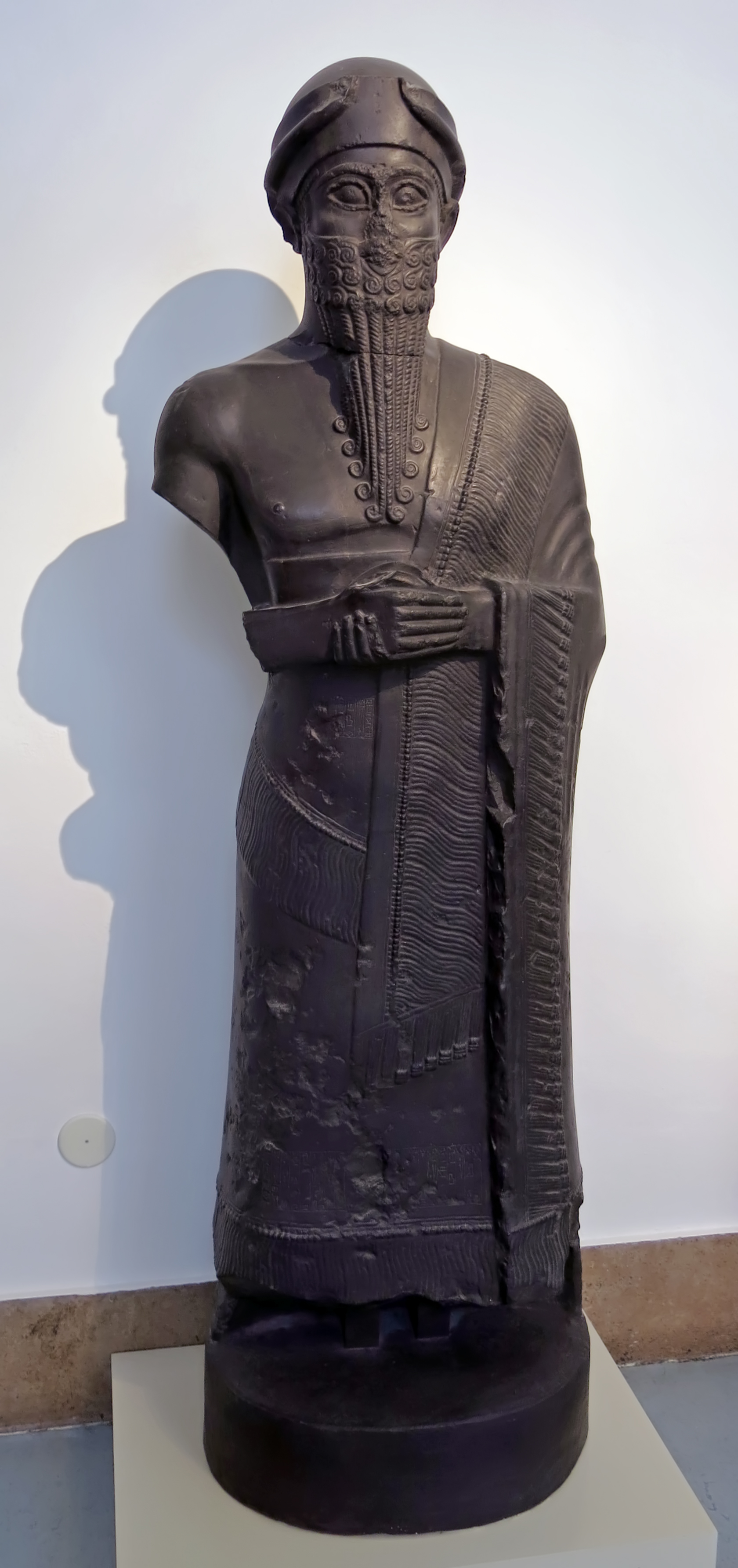
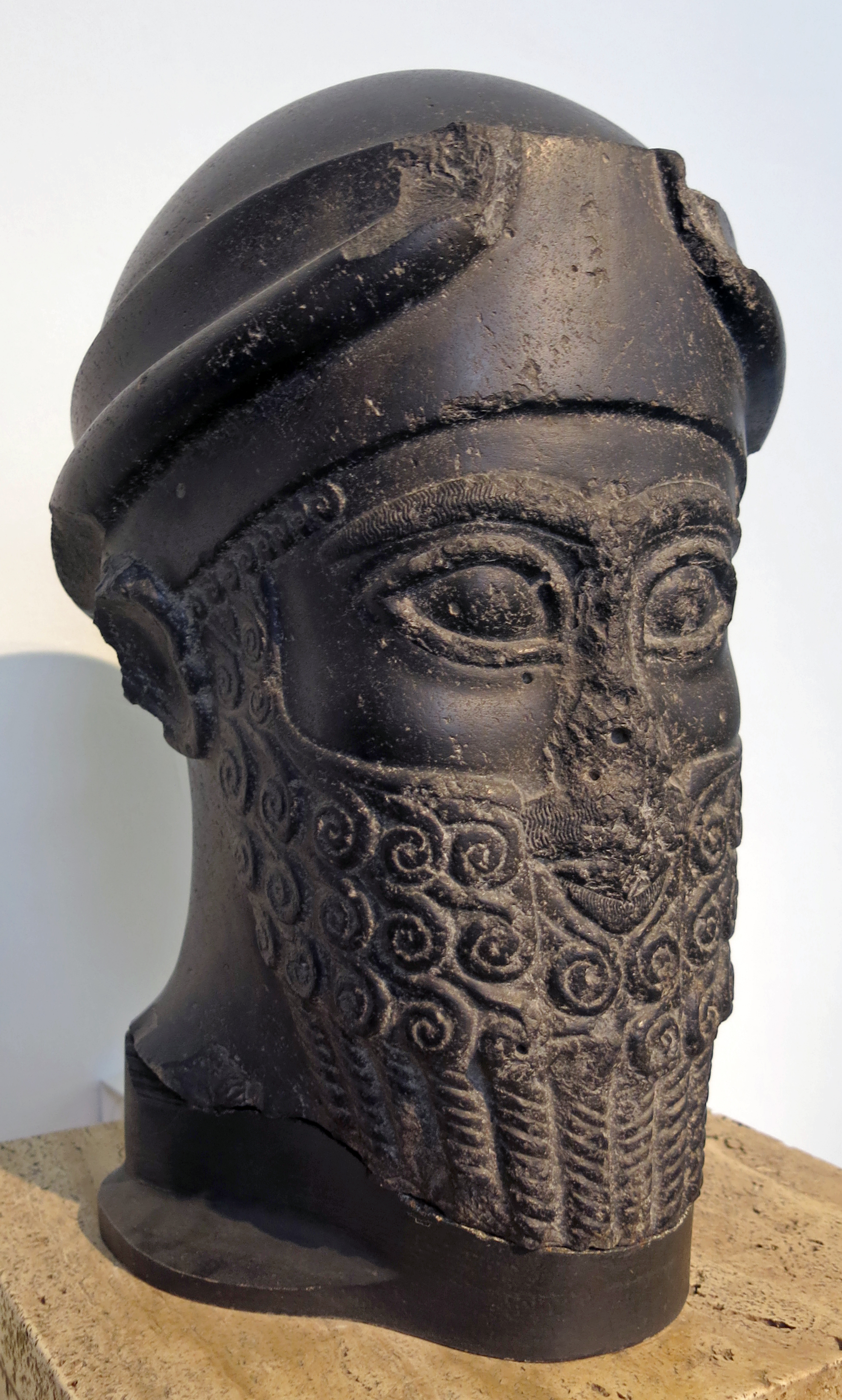
Votive statue dedicated by Prince Puzur-Eshtar / Puzur-Ishtar of Mari, taken as booty to Babylon.
Left: complete reassembled replica.
Right: original of the head.
Circa 1 950 BC.
This replica consists of casts of the diorite head (in Berlin) and of the body and base (Archaeological Museum, Istanbul).
Complete height 193 cm
This over-lifesized statue is one of the few large sculptures preserved from the ancient Near East. The head was broken from the body in an act of vandalism in antiquity.
Though separated, both pieces fortuitously survived so that the statue is nearly complete. The head was acquired by purchase for the collection before 1899 while the body came to light during excavations at Babylon and eventually reached Istanbul. Thanks to an exchange of casts, both museums can exhibit the complete sculpture.
According to the inscriptions below the right hand and above the hem of the garment, the sculpture was made as a votive gift. The name Puzur-Eshtar, Prince of Mari, is mentioned twice, but since the figure's headgear is the horned cap of a deity, the statue
cannot depict the mortal prince. The clasped hands of the figure and the text make it certain that the statue once belonged to the inventory of a temple, but where the temple stood is not known, despite the mention of Mari in the title of the prince. Like many
other monuments, the statue will have been looted from its original site and carried off as booty to Babylon in antiquity.
Photo: Don Hitchcock 2015
Source and text: Pergamon Museum, Berlin, recherche.smb.museum

Clay cylinder building deed with an inscription mentioning King Warad-Sin of Larsa. Isin-Larsa period, 1834 BC - 1823 BC, from Babylon.
At this time, from 2000 BC to 1800 BC, southern Mesopotamia was dominated by the cities of Isin and Larsa.
Photo: Don Hitchcock 2015
Source and text: Pergamon Museum, Berlin, recherche.smb.museum

Incised drawing of a lion attacking a wild boar.
Babylon, Kassite period.
2nd half of 2nd millennium BC
Photo: Don Hitchcock 2015
Source and text: Pergamon Museum, Berlin, recherche.smb.museum
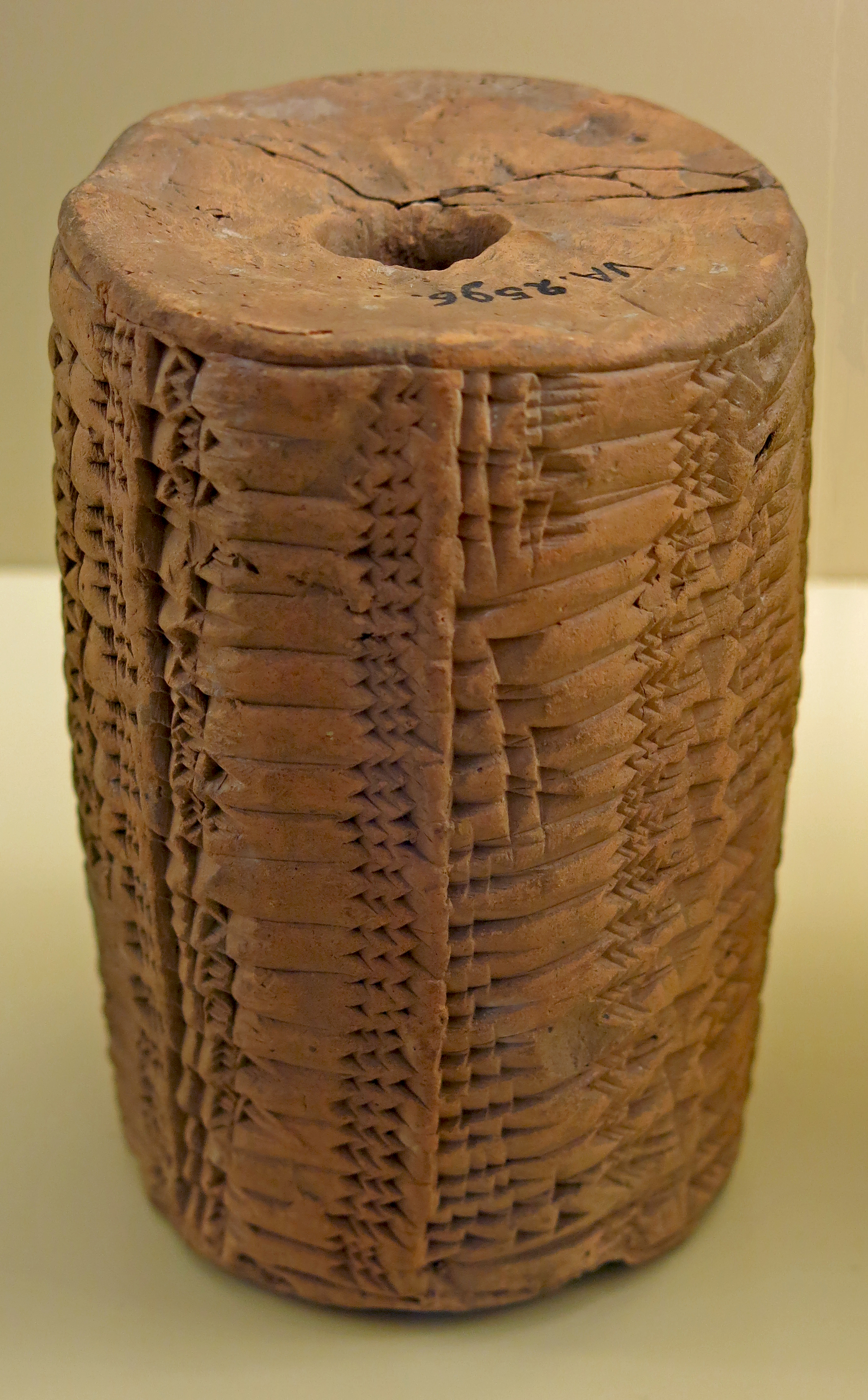
Old Babylonian baked clay cylinder.
The Akkadian cuneiform inscription mentions a capacity table. 18th-16th century BC.
Photo: Don Hitchcock 2015
Source: Pergamon Museum, Berlin, http://www.smb-digital.de/
Text: Wikipedia
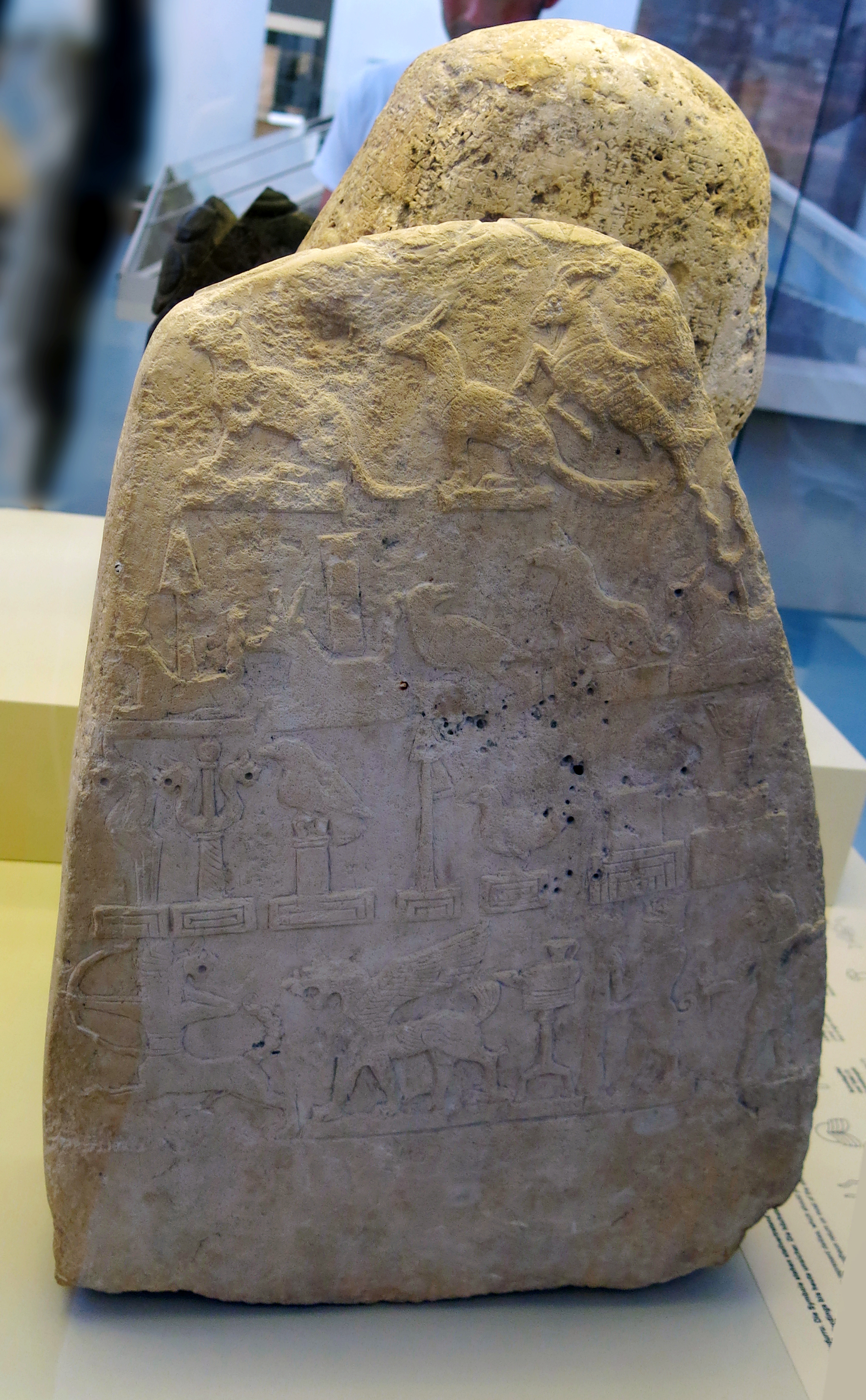
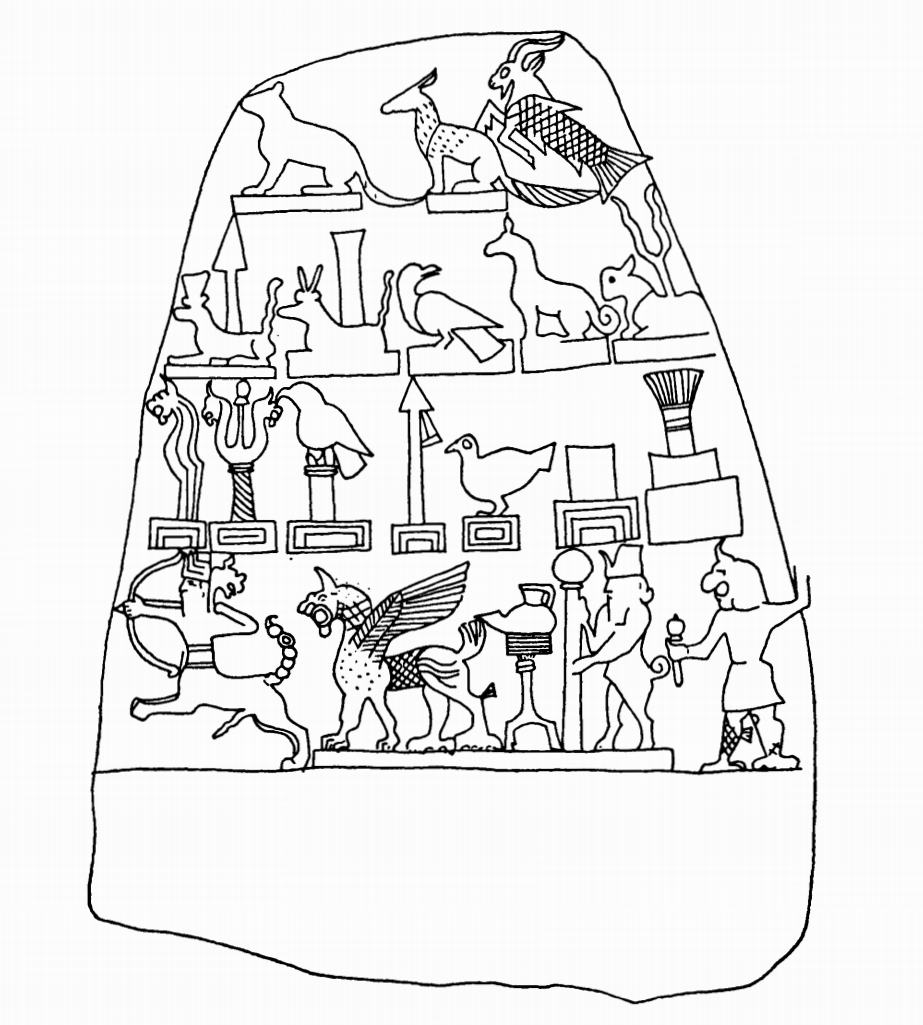
Stele, or kudurru, protecting a royal land grant, from Babylon.
Found in a stela workshop, the deity symbols are partly unfinished, and there is no inscription.
Middle 12th century BC.
The kudurru is from Babylon, Merkes 26 g 2, + 3.00 m. In a room where there is also 'a quantity of
of semi-precious stone pieces and shells together with finished beads of the same
material ..... The room was apparently the workshop of a stone cutter'.
Yellowish grey limestone. Height 50cm, breadth 20-36 cm, thickness 9 cm.
Plate-shaped stone without inscription. Relief images on the upper rim and in four registers on one broadside.
On the upper rim are astral images.
In the uppermost register are a big cat and a jackal(?), both squatting on low smooth pedestals, and a goatfish.
In the second register is a serpent-dragon with spade, a second with stylus, a bird with head turned back, a dog and a calf with a bundle of lightning, all on low, smooth pedestals.
In the third register are a lion staff, a double lion's club, a bird on pole, a triangular standard with pennant, a bird, a smooth rectangle, all standing on small decorated plinths, and a recumbent rectangle with a 'bundle' on a smooth pedestal.
In the lowest register a bow-shooting centaur, a standing lion dragon, a stand with a lamp, a bull-man with a standard, and
a lion-man. Some of the symbols have remained unfinished. There is no inscription.
Photo (left): Don Hitchcock 2015
Photo (right): Seidl (1989)
Source and text: Pergamon Museum, Berlin, recherche.smb.museum
Additional text: Seidl (1989)
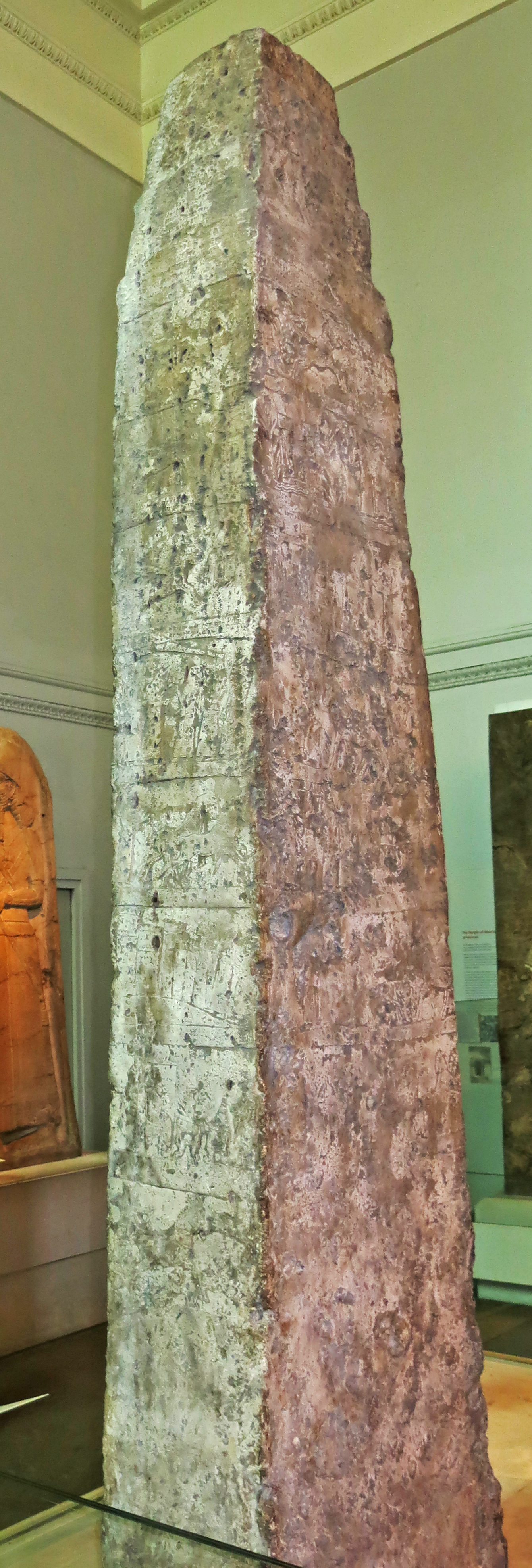


Reign of King Ashurnasirpal I, 1049 BC - 1031 BC.
The White Obelisk
Assyrian, probably about 1 050 BC. From Nineveh, between Sennacherib's Palace and the Ishtar Temple.
This limestone stela was excavated in 1853. The incomplete inscription names Ashurnasirpal, probably Ashurnasirpal I (1 049 BC - 1 031 BC). He is shown in his chariot, fighting (at the top) and hunting (bottom), and taking part in ritual scenes. The middle scenes show booty and tribute being brought, but their order is uncertain. This is an early example of Assyrian narrative relief that developed into the palace reliefs of later reigns.
Rectangular limestone obelisk, slightly tapering, with a stepped apex. Decorated with eight registers carved in low relief, representing scenes of warfare, hunts, processions of tributaries and ceremonial occasions associated with an Assyrian king best identified as Ashurnasirpal I.
There is a cuneiform inscription on two sides (A and D); ancient saw marks near the base, and the condition of the stone implies that the lowermost 35 cm was formerly inserted into a socket. The surfaces are now considerably weathered and damaged.
Findspot: Kouyunjik
Height 2850 mm, width 705 mm, depth 425 mm.
This gives a tentative translation by Sollberger, followed by Reade (1975) with restored passages within square brackets.
Inscription translation from Akkadian: Side A ll. 1-4: [In the first year of my reign, when] I sat in glory [on the throne], I moved my chariotry and numerous troops. I conquered inaccessible forts all round. I received contributions in horses from the land of Gilzanu; ..., I es[tablished] as regular dues. ll. 4-6: [Because] they did not (continue to) s[en]d the horses hither, I be[came angry and] marched against the city of Harira (and) the city of Halhalaush, (cities) of [cri]minal [lo]rds.
ll. 7-8: These (!) I conquered in the eponymy of Ashurnasirpal: I took out their goods, their captives, their possessions, their herds, (and) carried them to Ashur, my city; ll. 9-11: their great ... city, together with its population, I presented to Ashur, my god, my master Side D ll. 12-18: [...] of [...] I reached. The lords [...] whom [I had pursued] into the land of Shupria, trusted [great]ly in [their] massed troops and [...] ... [...] ... [...] they occupied. ll. 18-23: At the command of Ashur, [the Great Mountain,] the great lord, my master, I moved the chariotry [(and) ...] of my army: I conquered the city. [The enemy] abandoned the city, [...] the horses, oxen, [...] ...; he made (his) chariotry take up positions. ll. 23-25: [I reacted] fiercely: I raised a torch, crossed [quickly] on foot into the Kashiari range (and) marched against those cities. ll. 26-29: [...]
During the night I invested their cities [and ...] by sunrise I fought against numerous chariots and troops (and) made them suffer heavy losses. ll. 30-33: I conquered the city of Amlattu, the city of Shaburam, the city of Ruzidak, the city of Bugu, the city of Ustu, rebel cities of the land of Dannuna, set them on fire, (took out) their captives, their possessions, their riches ...
SIDE A (caption) ll. 1-2: The 'Bit-nathi' of the city of Nineveh: I performed the wine (libation) and sacrifice of the temple of the august goddess.
It was discovered at Kuyunjik by Rassam in July 1853 'about two hundred feet to the northeast of Sennacherib's palace' at a depth of some fifteen feet below the surface of the mound; it was found lying on its side and the findspot corresponds to an open area between the outer court of Sennacherib's palace at Nineveh and the Ishtar temple. This findspot is recorded on W. Boutcher's plan reproduced by Rassam in the 'Transactions of the Society of Biblical Archaeology' VIII (1882), opp. p.37 with contemporary drawings by C. Hodder as Or.Dr.VI,xl (general view), xli (faces C-D), xlii (faces A-B). It was shipped from Basra to Bombay on the Acbar in March 1854 and from Bombay to London on the Merchantman, arriving London February 1855.
Catalog: Limestone, Kouyunjik, 118807
Photo: Don Hitchcock 2015
Text: Card with the display at the British Museum, www.britishmuseum.org/, © Trustees of the British Museum, CC BY-NC-SA 4.0
( As with all my images, click on the smaller image on the page to see the full size photo - Don )
Middle Babylonian Kudurru, Reign of Nebuchadnezzar I
Reign of Nebuchadnezzar I, 1 121 BC - 1 100 BC
Predecessor Ninurta-nādin-šumi
Successor Enlil-nādin-apli
House 2nd Dynasty of Isin
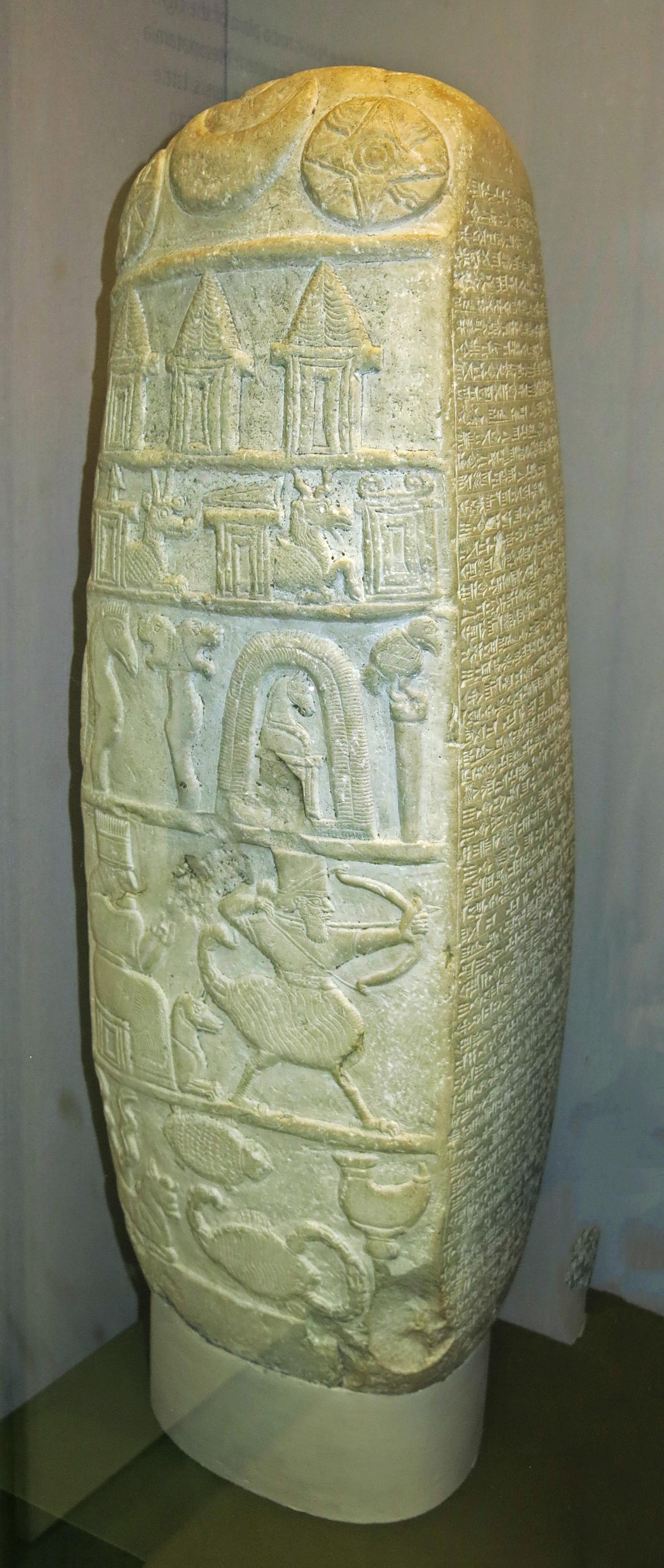
Limestone stela in the form of a boundary-stone: consisting of a block of calcareous limestone, shaped and prepared on four sides to take sculptures and inscriptions. It is now mounted on a stone plinth.
Carved in high relief, height 640 mm, length 210 mm, width 180 mm.
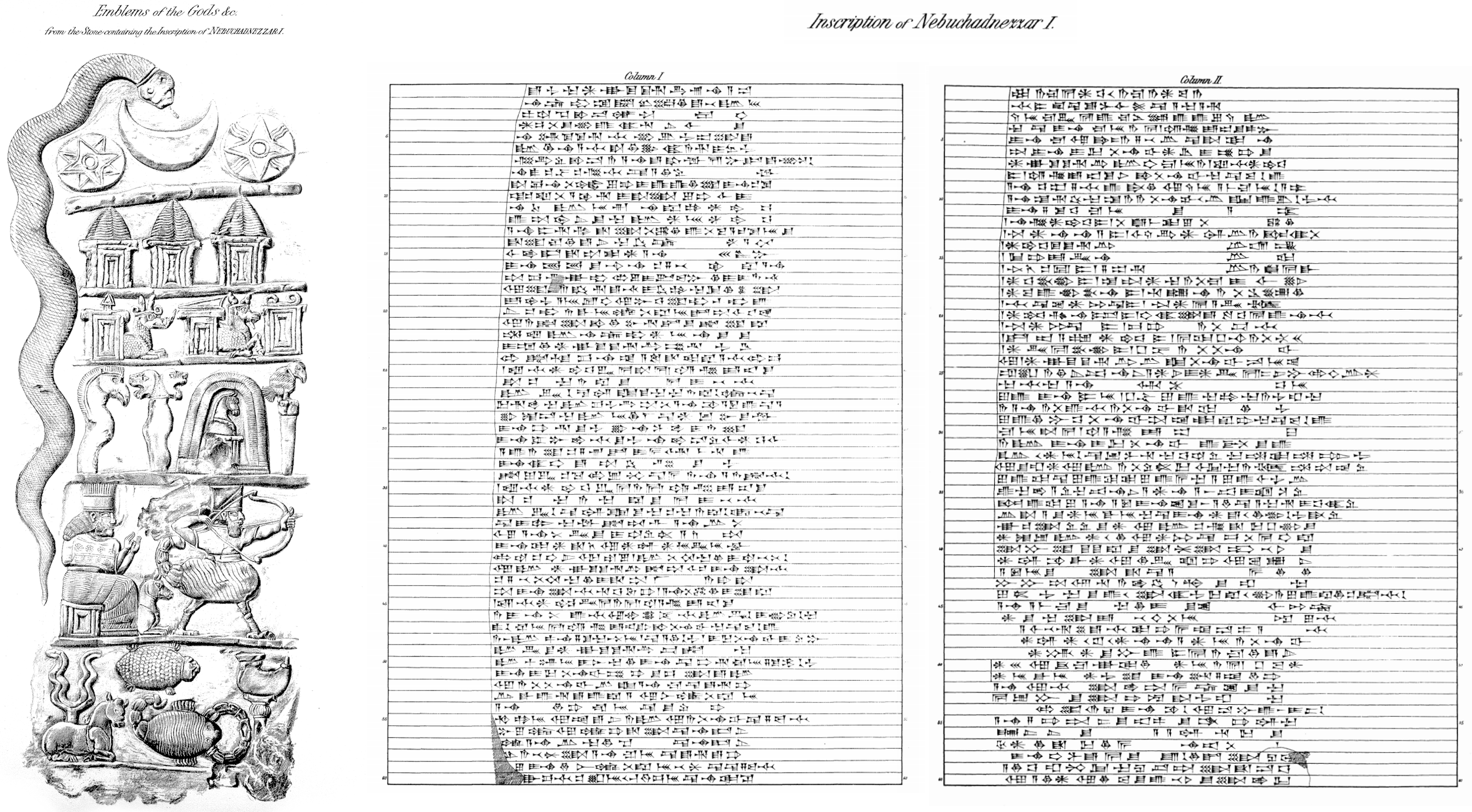
Face A has been sculptured in comparatively high relief with symbols, arranged in six registers:
First register: (1) Eight-pointed star ; (2) Crescent; (3) Solar disc.
Second register : (4) Horned headdress upon a shrine; (5) A second horned headdress upon a shrine; (6) A third horned headdress upon a shrine.
Third register : (7) Spear-head upon a shrine, beside which appears the fore-part of a horned dragon ; (8) Wedge upon a shrine, beside which appears the fore-part of a horned dragon, or composite monster ; (9) Yoke reversed, upon a shrine.
Fourth register: (10) Eagle-headed mace, or standard; (11) Twin-lion-headed mace, or standard ; (12) Horse's head, with neck and shoulders, upon a shrine, standing within a double arch upon a raised base, possibly intended to represent a shrine; (13) Bird on perch.
Fifth register: (14) The goddess Gula seated upon a shrine, with a dog lying beside her ; (15) Scorpion-man, wearing a cylindrical headdress, and shooting with a bow. The Scorpion-man has the head, arms and torso of a man, and below his girdle he has the body and tail of a scorpion, and the legs and claws of a bird.
Sixth register: (16) Lightning-fork, supported by a bull, couchant; (17) Turtle: (18) Scorpion; (19) Lamp on pedestal; and (20) Serpent, extending from the centre of the stone at the top, down the left-hand side of the first five registers.
Faces B and C each bear a single column of inscription, the lines running the full width of the stone. The top of the stone and Face D have been left blank, except for the serpent, which has been carved to the left of the emblems on Face A. Inscribed with a Charter from the reign of Nebuchadnezzar I.
Inscription note: The text of the Charter falls naturally into the following five sections:
I. Col. I, ll. 1-43 : Historical introduction, setting forth the services rendered by Ritti-Marduk to Nebuchadnezzar during a campaign in Elam, undertaken "to avenge Akkad" (l. 13), that is to say, in retaliation for Elamite raids in Northern Babylonia. The campaign was conducted from the frontier city of Der, and, being carried out in the summer, the Babylonian army suffered considerably from the heat and from lack of water (ll. 14-21). Ritti-Marduk, the Captain of the chariots, did considerable service to the king, both by encouraging the troops on the march (ll. 22-27) and by leading the attack against the Elamite Confederation during the battle which was subsequently fought on the banks of the Eulaeus (ll. 28-43).
II. Col. I, ll. 44-51 : Record of the granting of the Charter by Nebuchadnezzar to Ritti-Marduk, in reward for his services, freeing the towns or villages of Bit-Karziabku, of which he was the head-man, from the jurisdiction of the neighbouring city of Namar.
III. Col. I,l. 51-Col. II, l. 10 : Recital of the terms of the Charter, (i) Conferring on the towns freedom from all taxation, dues, or confiscations on the part of the king's officers or the officials of Namar (ll. 51-60); (ii) Securing the freedom of the towns from the corvee for public works (Col. II, ll. 1-2); (iii) Freeing the inhabitants from liability to arrest by imperial soldiers stationed in the towns or villages (Col. II, ll. 3-5) ; and (iv) Preventing the billeting of such soldiers on the towns by providing for their maintenance by Namar (Col. II, ll. 9-10).
IV. Col. II, ll. 11-25: Enumeration of the names and titles of thirteen high officials, who were present at the granting of the Charter (ll. 11-24), and the name of the engraver of the record (l. 25).
V. Col. II, ll. 26-60 : Imprecations intended to prevent any violation of the Charter, or any injury to the record.
Inscription translation Column 1:
(1) When Nebuchadnezzar, the exalted and noble prince, (2) the offspring of Babylon, the ruler of kings, (3) the valiant patesi, the governor of Eridu, (4) the Sun of his land, who makes his people to prosper, (5) who protects boundary-stones, who holds fast the boundaries, (6) the king of justice, who pronounces a righteous judgment, (7) the strong hero, whose might is devoted to waging war, (8) who bears a terrible bow, who fears not the battle, (9) who overthrew the mighty Lullubi with the sword, (10) the conqueror of the Amorites, the despoiler of the Kassites, (11) the appointer of kings, the prince beloved of Marduk, (12) - when the king of the gods, Marduk, sent him forth, (13) he raised his weapons to avenge Akkad. (14) From Der, the city of Anu, (15) he marched for thirty double hours. (16) In the month of Tammuz he undertook the campaign. (17) . . . . . the axe burned like fire, (18) and the . . . . . of the roads scorched like flame. (19) There was no water in the wells (?), and the drinking supply was cut off. (20) The splendour of the great horses failed, (21) and the legs of the strong man turned aside. (22) The noble king advances, the gods supporting him. (23) Nebuchadnezzar marches on, he has no rival, (24) he fears not the difficult country, he urges on (?) the yoked horses. (25) Ritti-Marduk, the head of the House of Bit-Karziabku, (26) the captain of his chariots, whose place was at the right hand (27) of the king, his lord, did not . . . . . him, and drove on his chariot. (28) The mighty king hastened, and he came to the bank of the Eulaeus. (29) The kings took their stand round about, and offered battle. (30) In their midst fire was kindled, (31) by their dust was the face of the sun darkened ; (32) the hurricane sweeps along, the storm rages. (33) In the storm of their battle (34) the warrior in the chariot perceives not - the companion at his side. (35) Ritti-Marduk, the head of the House of Bit-Karziabku, (36) the captain of his chariots, whose place was at the right hand (37) of the king, his lord, did not . . . . . him, and drove on his chariot. (38) He feared not the battle, he went down against the enemy, (39) and among the enemies of his lord he valiantly forced a way in.. (40) By the command of Ishtar and Adad, the gods who are arbiters of battle, (41) he turned evil against the king of Elam, and destruction overtook him. (42) And King Nebuchadnezzar triumphed, (43) he captured the land of Elam, he plundered its possessions. (44) When he had returned to Akkad in triumph and with joy of heart, (45) Ritti-Marduk, the head of the House of Bit-Karziabku, (46) whom the king, his lord, had beheld among the enemies and warriors, (47) concerning the towns of Bit-Karziabku, in the district of Namar, all that there are, (48) which under a former king had been freed, but through enemies had, contrary to their laws, come under the jurisdiction of Namar, (49) informed the king his lord, Nebuchadnezzar, (50) and the king enquired of the judges, and (to) the towns, as in days of old, (he gave) their freedom (51) from the whole jurisdiction of Namar, (decreeing) that officers of the king, (52) and the governor of Namar, and the commandant are not to enter a town; (53) that the master of the horse is not to bring stallions or mares (54) into the towns; (55) that revenue in cattle or sheep is not to be taken for the king or for the governor of Namar; (56) that a . . . . . or a homer of cypress is not to be rendered; (57) that a homer is not to be given to the tax-gatherer ; (58) that the master of the riding horses is not to enter the towns, (59) nor to take therefrom mares as riding horses; (60) that the fences (?) of the plantations and the date-palm groves no man is to cut down;
Inscription translation Column 2:
(1) that they shall not fortify Bit-Shamash nor Shanbasha, (2) nor build a bridge, nor bank up a road ; (3) that soldiers of Nippur or Babylon, or such soldiers of the king (4) as are quartered in the towns of Bit-Karziabku, (5) are not to cause the arrest of any man, whether in town or country ;— (6) from all jurisdiction of Namar whatsoever (7) Nebuchadnezzar, the king of hosts, freed the towns of Ritti-Marduk, (8) the son of Karziabku, in the district of Namar, all that there are, (9) for ever, and the soldiers quartered in those towns (10) he appointed for special maintenance by the governor of Namar and the commandant. (11) At (the declaration of) the freedom of those towns there are present (12) Nazi-Marduk, the son of Shaddakme, the priest of Akkad, (13) Arad-Nana, theson of Mudammik-Adad, the administrator of the land, (14) Marduk-kudurri-usur, the minister of Bel, (15) Tubia-enna, the officer, (16) Mukkut-issakh, the son of Sapri, the official of the Palace Gate, (17) Shamash-nadin-shumi, the son of Atta-iluma, the governor of Ishin, (18) Bau-shum-iddina, the son of Khunna, the governor of Babylon, (19) Uballitsu-Gula, the son of Arad-Ea, the provincial governor, (20) Marduk-mukin-apli, the son of Tabu-mile, the keeper of the treasure-house, (21) Arad-Gula, the son of Kalbi, the governor of Ushti, (22) Tab-ashab-Marduk, the son of Esagil-zeru, the governor of Khalman, (23) Enlil-nadin-shumi, the son of Khabban, the governor of Namar, (24) and Nabu-kudurri-usur, the commandant of Namar. (25) The scribe, who has written this memorial-stone, is Enlil-tabni-bullit, the seer. (26) Whenever in after time (27) one of the sons of Khabban, or any other man, (28) who may be appointed as governor of Namar, (29) or as prefect of Namar, be he small or great, whoever he may be, (30) with regard to the cities of Bit-Karziabku, (31) which the king has freed from the jurisdiction of Namar, (32) shall not fear the king or his gods, and shall again place them under (its) jurisdiction, (33) or shall obliterate the name of a god or of the king, which is inscribed (hereon), and shall write another (in the place thereof), (34) or shall employ a fool, or a deaf man, or a blind man, or a knave, (35) and shall smash this memorial with a stone, (36) or burn it in the fire, or put it in the river, or hide it in a field where it cannot be seen, (37) may all the great gods, whose names are mentioned in heaven and earth, (38) curse that man in wrath! May god and king look upon him in anger! (39) May Ninib, the king of heaven and earth, and Gula, the bride of Esharra, (40) destroy his boundary-stone and obliterate his seed! (41) May Adad, the ruler of heaven and earth, the lord of springs and rain, (42) fill his canals with mud! (43) May he set. hunger and want upon him, (44) and may oppression, ruin, and adversity be bound day and night at his side! (45) May ruin fasten its grip upon the inhabitants of his city! (46) May Shumalia, the lady of the bright mountains, (47) who dwells upon the summits, who treads beside the springs, (48) Adad, Nergal and Nana, the gods of Namar, (49) Siru, the bright god, the son of the temple of Der, (50) Sin and the Lady of Akkad, the gods of Bit-Khabban, (51) may these great gods in the anger of their hearts (52) contrive evil against him! (53) May another possess the house which he has built! (54) With a dagger in his neck, and a poniard in his eye, (55) may he cast himself upon his face before his captor, (56) and may he spurn his pleading, (57) and swiftly cut off his life! (58) Through the downfall of his house may his hands enter the mire! (59) As long as he lives may he drag sorrow along with him, (60) and, as long as heaven and earth remain may his seed perish!
Curator's comments:
Though the stele is inscribed with a charter of privileges, the form of the stone and the presence of symbols justify its classification among the kudurru-texts.
The kudurru of Gula-eresh 1907,1014.1 (BM 102485), if classified among the dated kudurrus, would be placed between the charter of Nebuchadezzar I and the kudurrus of Marduk-nadin-akhe's time, since it may be assigned to about the period of Enlil-nadin-aplu.
Subjects:
planet/constellation, sun/moon, headgear/hairstyle, shrine, arms/armour, dragon, mythical figure/creature, flag/pennant(?), dog, bird, deity, storm, reptile, arachnid, lamp/candle, serpent, horse/ass
Named in inscription:
Nebuchadnezzar I, Ninib, named & portrayed: Gula, Adad, Shumalia, Nergal, Siru, Sin, Marduk, An, Ishtar
Places named in inscription: Babylon, Elam, Eridu, Tell Aqar (historic), River Ulai, Nippur
Findspot: Abu Habba (Sippar)
Catalog: Limestone, ME 90858
Photo: Don Hitchcock 2015
Source: Original, British Museum
Text: © Card with the display at the British Museum, www.britishmuseum.org, © Trustees of the British Museum, CC BY-NC-SA 4.0.
Additional text: Wikipedia
Drawn image and inscription: Theophilus Goldridge Pinches M.R.A.S., 1905
Permission: Public Domain
Proximal source: Wikipedia
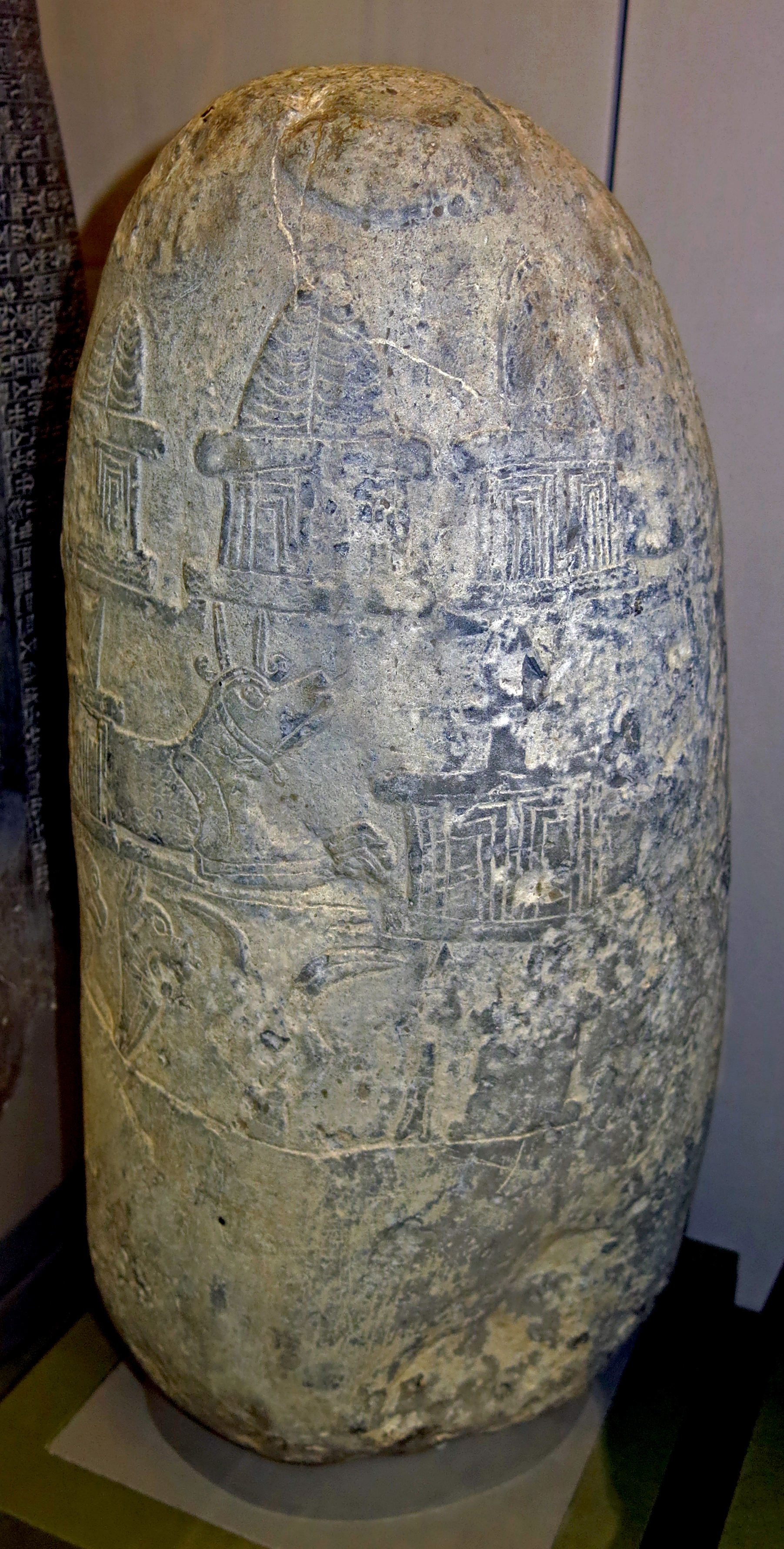
Babylonian Kudurru, 1 100 BC - 1 000 BC
The inscription on this conical limestone kudurru has been laboriously erased, an indication that the precautionary writing of curses on such stones was not without reason. There are divine emblems on one face, with 14 emblems and 3 discs in the field of the upper register and a serpent on the left side of the register and along the top.
Height 406 mm, length 203 mm, width 197 mm.
Findspot: Sawosat
Catalog: Limestone, ME 108835
Photo: Don Hitchcock 2015
Source: Original, British Museum
Text: © Card with the display at the British Museum, © Trustees of the British Museum, CC BY-NC-SA 4.0.
Stele, or kudurru, protecting a royal land grant, from Babylon.
Found in a stela workshop, the deity symbols are partly unfinished, and there is no inscription.
Middle 12th century BC.
The kudurru is from Babylon, Merkes 26 g 2, + 3.00 m. In a room where there is also 'a quantity of
of semi-precious stone pieces and shells together with finished beads of the same
material ..... The room was apparently the workshop of a stone cutter'.
Yellowish grey limestone. Height 50cm, breadth 20-36 cm, thickness 9 cm.
Plate-shaped stone without inscription. Relief images on the upper rim and in four registers on one broadside.
On the upper rim are astral images.
In the uppermost register are a big cat and a jackal(?), both squatting on low smooth pedestals, and a goatfish.
In the second register is a serpent-dragon with spade, a second with stylus, a bird with head turned back, a dog and a calf with a bundle of lightning, all on low, smooth pedestals.
In the third register are a lion staff, a double lion's club, a bird on pole, a triangular standard with pennant, a bird, a smooth rectangle, all standing on small decorated plinths, and a recumbent rectangle with a 'bundle' on a smooth pedestal.
In the lowest register a bow-shooting centaur, a standing lion dragon, a stand with a lamp, a bull-man with a standard, and
a lion-man. Some of the symbols have remained unfinished. There is no inscription.
Photo (left): Don Hitchcock 2015
Photo (right): Seidl (1989)
Source and text: Pergamon Museum, Berlin, recherche.smb.museum
Additional text: Seidl (1989)
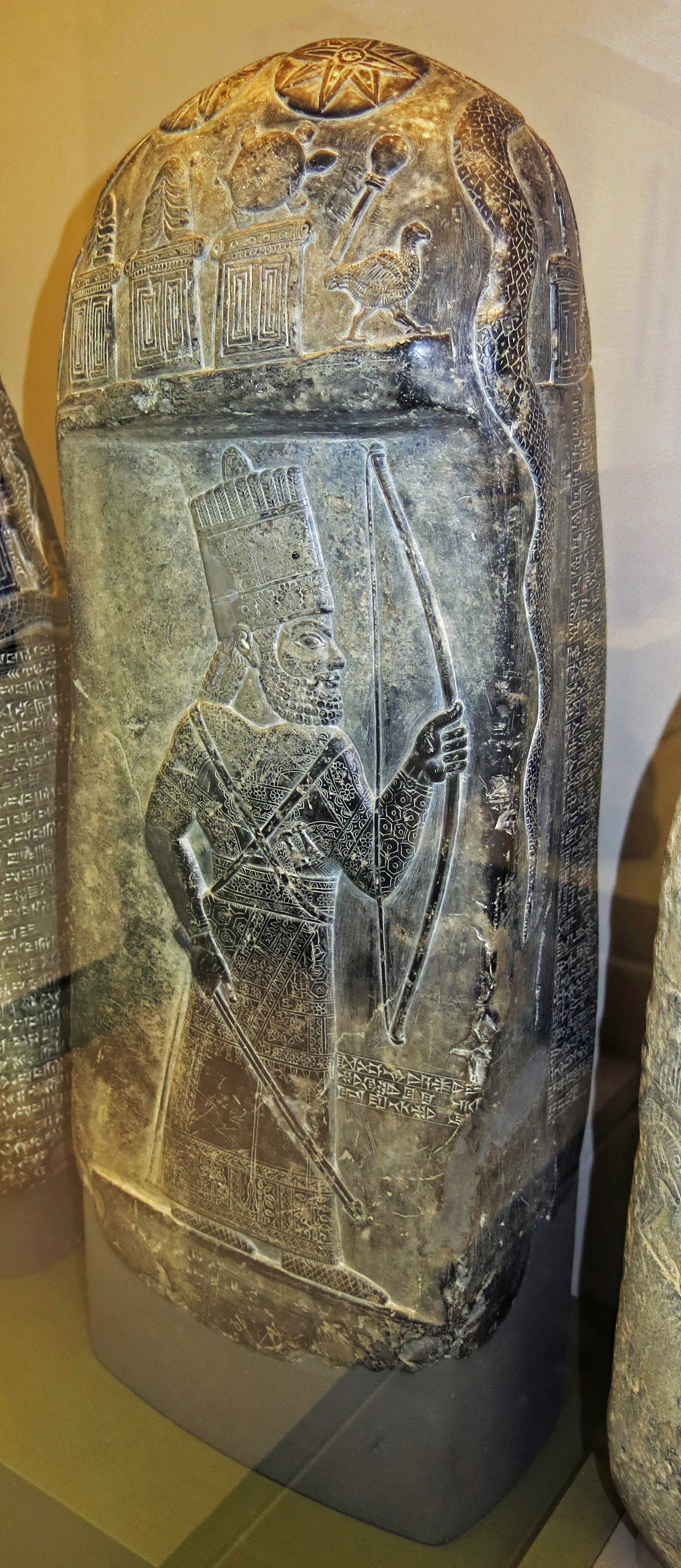
Babylonian Kudurru, 1 100 BC - 1 000 BC
Limestone kudurru from the reign of Marduk-nadin-ahhe: the boundary stone consists of a block of black limestone, which has been shaped and rubbed down to take sculptures and inscriptions.
The rounded top of the stone is sculptured on all four sides and on the top with emblems:
Diameter 133 mm - 152 mm, width 222 mm - 248 mm, height 654 mm.
Face A: (1) Lunar disc, (2) Solar disc, (3) Eight-pointed star, (4) Horned headdress upon shrine, (5) Horned headdress upon shrine, (6) Turtle upon shrine, (7) Battle-mace, and (8) Walking bird.
Face B: (9) Spear-head upon shrine, beside which appears a horned dragon, and (10) Twin-lion-headed mace.
Face C: (11) Wedge upon shrine, beside which appears a horned dragon, (12) Scorpion, and (13) Yoke reversed.
Face D: (14) Sitting dog, (15) Lamp, (16) Arrow, (17) Bird on perch, and (18) Lightning-fork.
Top of stone and Face B: (19) Serpent. Below the symbols on Face A is the figure of a Babylonian king wearing an elaborately embroidered robe and carrying a bow and two arrows. The greater part of Face A, with the exception of 127 mm at the top has been rubbed down so that it affords a flat surface for the royal figure.
Faces B, C, and D are rounded at the corners, and the two columns of inscription are engraved around these three sides, Col. I occupying parts of Faces B and C, and Col. II parts of Faces C and D. In consequence of the curved surface of the stone the end of each column of text is nearly at right angles to the beginning.
The text contains a deed recording the purchase of five 'gur' of corn-land by Marduk-nasir, the king's officer, from Amel-Enlil, the son of Khanbi. The land is described as situated on the Bad-dar Canal in Bit-Khanbi, and the name of the surveyor is stated. The purchase-price consisted of a chariot, saddles, two asses, an ox, grain, oil, and certain garments, the items being separately valued and making a total of seven hundred and sixteen shekels of silver.
Inscription translation for the lower part of Face A to right of royal figure:
(1) The name of this memorial-stone is (2) 'The Establisher of the Boundary (3) for ever.'
Inscription translation for column one:
(1) Five 'gur' of corn-land, a gan, measured by the great cubit, being reckoned at thirty 'ka' of seed, (2) on the bank of the Bad-dar Canal, in Bit-Khanbi, (3) the upper length to the north, adjoining Bit-Khanbi; (4) the lower length to the south, (5) adjoining Bit-Imbiati; (6) the upper width to the west, (7) adjoining Bit-Khanbi; (8) the lower width to the east, (9) adjoining the bank of the Bad-dar Canal, (10) which from the hand of Amel-Enlil, (11) the son of Khanbi, Marduk-nasir, the king's officer, (12) has received by purchase. (13) Shapiku, the son of Itti-Marduk-balatu, (14) the son of Arad-Ea, was the surveyor of the land. (15) One chariot with its furnishings (?), valued at one hundred (shekels of) silver, (16) six horse-saddles (?), valued at three hundred (shekels of) silver, (17) one western ass, valued at thirty (shekels of) silver, (18) two saddles (?) for the western ass, valued at fifty (shekels of) silver (19) one ass . . . . . , valued at fifteen (shekels of) silver, (20) one ox . . . . . , valued at thirty (shekels of) silver, (21) thirty-four 'gur' and eighty 'ka' of corn, measured by the twelve-'ka' measure, valued at one hundred and thirty-seven (shekels of) silver (22) one hundred and sixty 'ka' of oil, measured by the four-'ka' measure, valued at sixteen (shekels of) silver, (23) two upper garments . . . . . , valued at twelve (shekels of) silver, (24) nine mantles, valued at eighteen (shekels of) silver, one under-garment (?) valued at one (shekel of) silver, (25) one . . . . . -garment, valued at one (shekel of) silver, (26) one . . . . . -garment, valued at six (shekels of) silver, (27) in all seven hundred and sixteen (shekels of) silver, (28) which Amel-Enlil, the son of Khanbi, (29) from the hand of Marduk-nasir, the king's officer, (30) has received as the price of the five 'gur' of corn-land. (31) Whensoever in later days an agent, (32) or a governor, or a prefect, or a superintendent, (33) or an inspector, or any official whatsoever, who shall rise up and (34) be set over Bit-Khanbi, (35) shall direct his mind to take away these lands, (36) or shall lay claim to them, or cause a claim to be made, (37) or shall take them away or cause them to be taken away...
Inscription translation for column two:
(1) ...or shall side with evil (2) and shall return those lands to their province, (3) or shall present them to a god, or to the king, or to the representative of the king, (4) or to the representative of the governor, or to the representative of his council, (5) or to any other man, (6) or shall cause curtailment or diminution, (7) or shall say, "The lands were not the gift of the king," (8) or because of the curse shall cause another to take them, (9) or shall send a fool, or a man who is deaf, or one who is feeble-minded, or a vagabond, or one who is without intelligence, (10) and he shall cause him to remove this memorial-stone, or shall cast it into a river, (11) or put it in a well, or destroy it with a stone, or burn it in the fire, (12) or hide it in the earth, or hide it in a place where it cannot be seen, (13) upon that man may Anu, Enlil, Ea, and Nin-makh, (14) the great gods, look with anger, (15) and may they curse him with an evil curse that cannot be loosened! (16) May Sin, the light of the bright heavens, with leprosy that never departs (17) clothe his whole body, so that he may not be clean till the day of his death, (18) but must lie down like a wild ass at the outer wall of his city! (19) May Shamash, the judge of heaven and earth, smite his countenance, (20) so that his bright day may turn to darkness for him ! (21) May Ishtar, the lady, the princess among the gods, send a curse (?) upon him, (22) and in misery (?), her message of anger, (23) may he multiply his words day and night, (24) and like a dog may he pass the night in the open place of his city! (25) May Marduk, the king of heaven and earth, with dropsy, the bond of which (26) cannot be loosened, fill his body! (27) May Ninib, the lord of the boundary and the boundary-stone, tear out his boundary-stone, (28) tread down his boundary, and change his holding! (29) May Gula, the mighty physician, the great lady, (30) put a grievous sickness in his body, (31) so that he may pass light and dark blood like water! (32) May Adad, the ruler of heaven and earth, overwhelm his fields, (33) so that there may spring up abundantly weeds in place of green herbs and thorns in place of grain! (34) May Nabu, the exalted minister, appoint him days of scarcity and drought (35) as his destiny! (36) May all the great gods, whose names are mentioned on this memorial-stone, (37) drive him into evil and unhappiness! (38) His name, his seed, his offspring, (and) his posterity (39) may they destroy in the mouth of widespread peoples! (40) The name of this memorial-stone is "The Establisher of the Boundary for ever."
Curator's comments:
This records the purchase of land by a royal officer, Marduk-nasir; the value is given in silver but the land was paid for in the form of a chariot, clothes, animals and food; there are curses on anyone who attempts to invalidate the sale or damage the stone; the stone is named 'the establisher of the boundary forever' (carved just to the right of the figure of the King). No date is mentioned, but there is not lacking evidence of the period to which the monument should be assigned.
Koldewey has pointed out the close resemblance of the royal figure on this stone to that on the boundary-stone discovered by him at the end of 1900 in Tell ʿAmran ibn-ʿAli at Babylon. The headdress and garments of each figure are practically identical, not only in form but in minute details of decoration, the treatment of the hair is the same, and the style and workmanship are very similar. There is little doubt that the figures represent the same king, in whose reign the two deeds were drawn up. Moreover, in the fragment of text preserved on the stone from Tell ʿAmran, there occurs the name of [Tab-asha]b-Marduk, the son of Ina-Esagila-zeru, who was a high official in the reigns of Nebuchadnezzar I and Marduk-nadin-akhe. Hincke would provisionally identify both figures with Nebuchadnezzar I, but it should be noted that on the Warwick kudurru, which in shape resembles 1863,0826.1 (BM 90841), Marduk-nadin-akhe is represented by a similar figure "holding a bow in the left hand and two arrows in the right". The traditional identification with Marduk-nadin-akhe is therefore to be preferred.
Subjects:
sun/moon, moon, planet/constellation, headgear/hairstyle, shrine, reptile, arms/armour, bird, dragon, arachnid, dog, lamp/candle, storm, serpent, king/queen, cattle
Associated names:
Marduk-nadin-ahhe, Marduk-nasir (Purchaser of land), An, Enlil, Ea, Ishtar, Sin, Shamash, Marduk, Ninib, Gula, Nabu
Findspot: Babylon
Catalog: Black limestone, ME 90841
Photo: Don Hitchcock 2015
Source: Original, British Museum
Text: © Card with the display at the British Museum, © Trustees of the British Museum, CC BY-NC-SA 4.0.
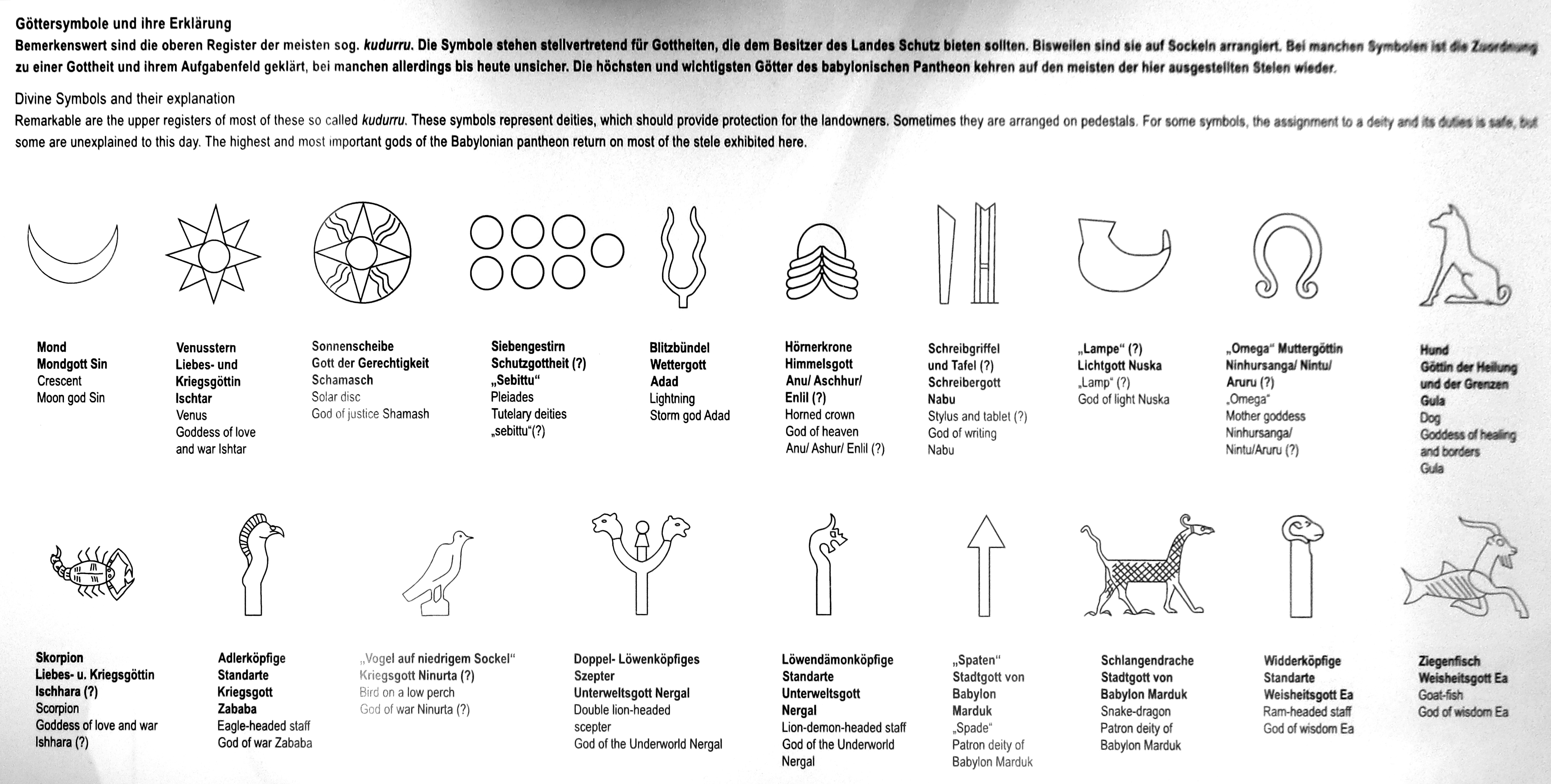
Divine symbols and their explanation.
The upper registers of these Kudurru, a type of stone document used as a boundary stone and as a record of land grants to vassals by the Kassites in ancient Babylonia between the 16th and 12th centuries BC, are remarkable.
The symbols on them represent deities, which were believed to protect the landowners.
Photo: Don Hitchcock 2015
Source and text: Pergamon Museum, Berlin, recherche.smb.museum
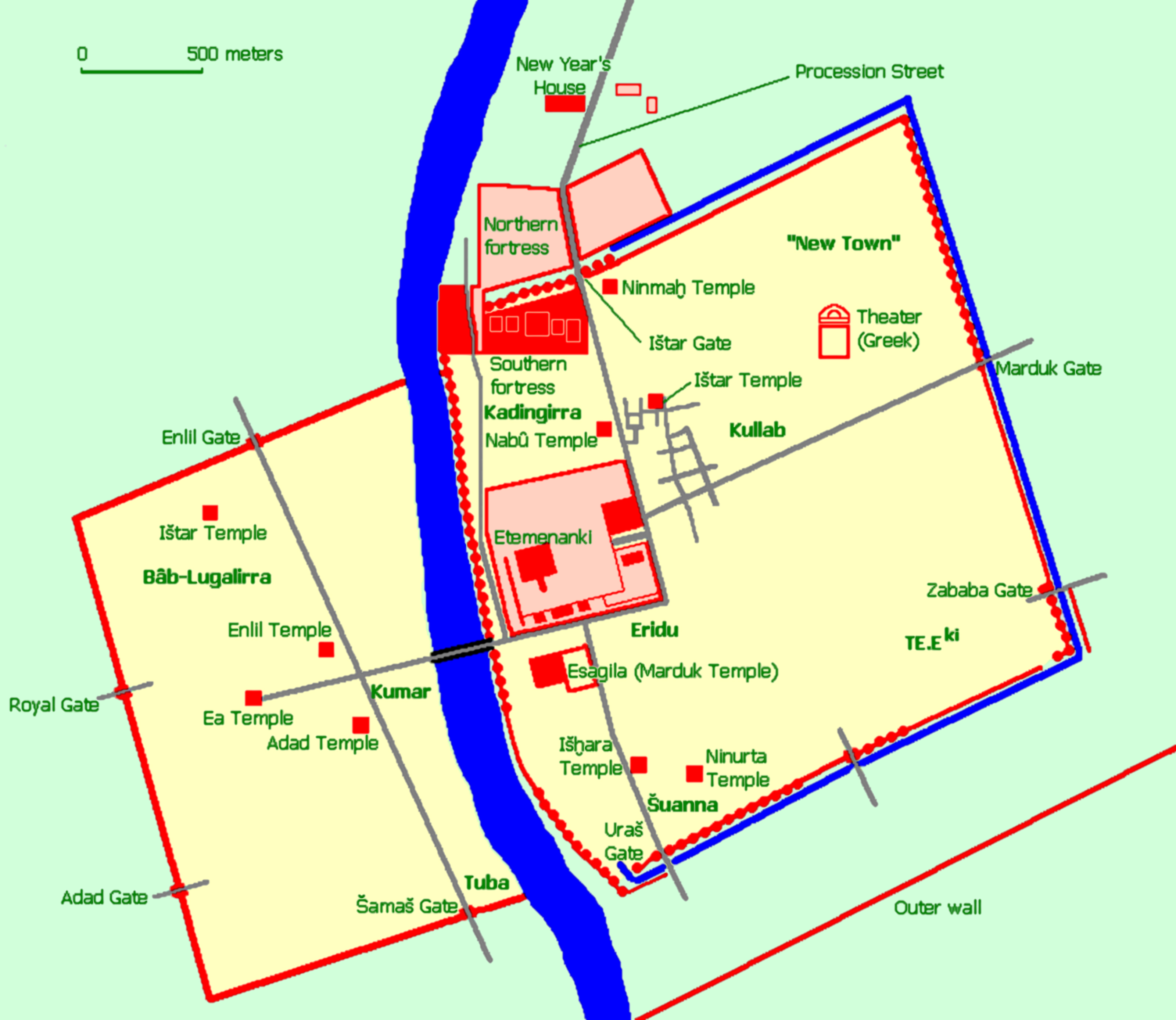
Map of Babylon
Photo: Jona Lendering
Permission: CC0 1.0 Universal
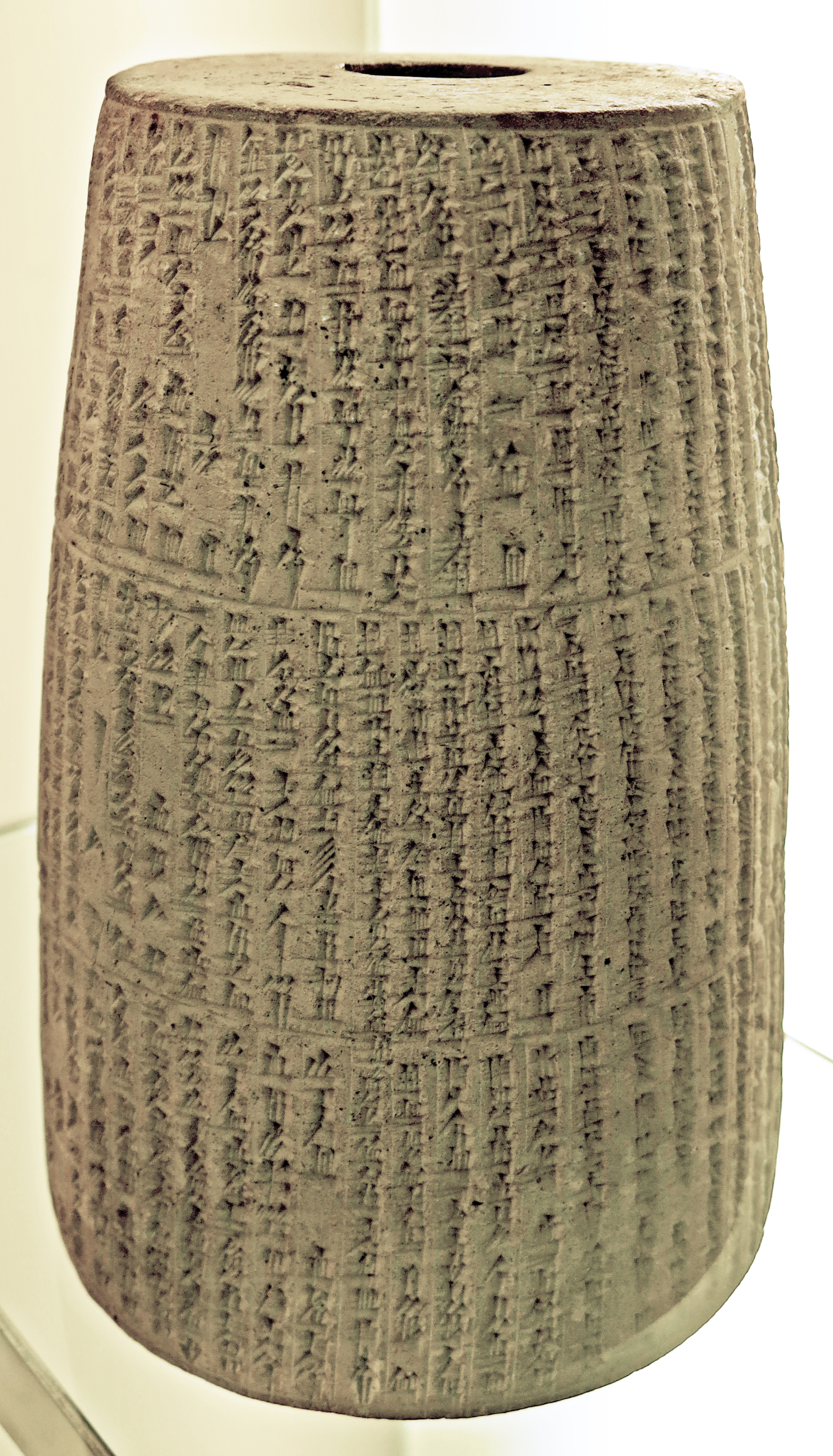
Nebuchadnezzar II's building deed for the renovation of the temple of the city god of Marad in the form of a truncated cone, ca 620 BC.
Since ancient times, the laying of the foundation stone has been part of the construction of a building. Today it usually takes the form of a ceremonial act in which capsules containing evidence of the present are laid in the foundation.
The laying of foundations can be traced back to ancient Egypt, the classical Mediterranean world and the ancient Orient, as well as to the Old Testament tradition. However, they were religiously based and much more elaborate than today. In Mesopotamia, this tradition began in the middle of the 3rd millennium BC and continued well into the 1st millennium BC.
The construction as well as the frequent renovation, repair or extension of palaces, temples, city walls and gates, which in Mesopotamia were always built of mud bricks that were not very durable, were among the most important tasks. The ruler was not only the builder, but also the one who ceremonially laid the first brick.
According to the myth of the creation of the world, the gods themselves built their residences and instructed the king in dreams to build. Once the site had been determined, it was a matter of carefully purifying it ritualistically. The blood of animals, honey, milk, wine, beer and oil had to be brought into the foundation trenches as offerings. In addition, cult personnel such as exorcists, lament singers, musicians and soothsayers had to be called in.
In contrast, nothing has come down to us about master builders and architects. If a renovation was to be carried out or if the ground plan was to be changed or the building moved, the approval of the gods had to be obtained. Above all, however, the inscriptions inserted into the building by predecessors had to be recovered, read and acted upon according to the instructions contained therein.
Photo: Don Hitchcock 2015
Source: Pergamon Museum, Berlin, recherche.smb.museum
The hollow truncated cone presented here, made as a body on the potter's wheel, is an outstanding example of such a foundation inscription. It was donated to the collection of the Museum of the Ancient Near East in 1890; its exact origin is therefore not certain.
But the inscription itself provides information about the place where it was found. According to the inscription, the object comes from the ancient city of Marad, a place about 70 km southeast of Babylon that can be traced back to the 3rd millennium BC. The existence of Marad has so far only been shown by such inscriptions. Here was the sanctuary of Lugal - Marada, the city god, who appears in cuneiform texts as a sword god and in his essence as a warlike underworld god. The text is written in cuneiform, that since the 2nd half of the 4th millennium BC.
In this case, it is a literary work in Akkadian, the oldest verifiable north-eastern Semitic language, whose two main dialects were Babylonian and Assyrian. The writing technique is the same as on thousands of clay tablets: the characters composed of individual wedge elements were written in the moist clay with a reed pen.
The text is divided into three columns of 45 to 50 lines each and shows the calligraphic effort to adapt the different character density of the lines to the given column width. The cone was then fired.
According to the inscription, the builder was Nebuchadnezzar II (605 BC - 562 BC), King of Babylon, who had the dilapidated sanctuary of Lugal-Marada in Marad renovated, about which he reports in this document:
At that time for Lugal-Marada, my lord, his temple in the midst of Marad - his founding document, which no one had seen since far away, I searched in its foundation and looked at it.
Over the foundation deed of Naram-Sîn, the king, my ancestor, I founded his foundation [anew.] A deed of my name I made and placed in it.
According to this, the temple had existed since the 23rd century BC, When the ancient kingdom of Akkadian was ruled by King Naram-Sîn (2272-2219 B.C.). Nebuchadnezzar II took the renewal of the building as an opportunity to now, in turn, place a foundation charter in the foundation. Apart from the quoted passage, the inscription is essentially identical to other comparable charters of the king. It is a literary building report which, after the introduction and titulature of Nebuchadnezzar, mentions his vocation as preserver of the cities and renewer of the temples and reports on his work on the buildings of Babylon and Borsippa.
The end of the inscription again follows literary patterns through the use of blessings and curses: 'O Lugal - Marada, Lord of all, you hero, look kindly on the work of my hands [...] Smash the adversaries, break their weapons, destroy the entire land of the enemies, overwhelm them insects! [...] Before Marduk, king of heaven and earth, make my deeds welcome, speak in my favour!'
Text: all of the text above referring to the building deed is by Prof. Dr. Joachim Marzahn, head curator at the Museum of the Ancient Near East.
Source: https://www.museumsportal-berlin.de/pl/magazin/blickfange/ein-grundstein-aus-der-zeit-nebukadnezars/
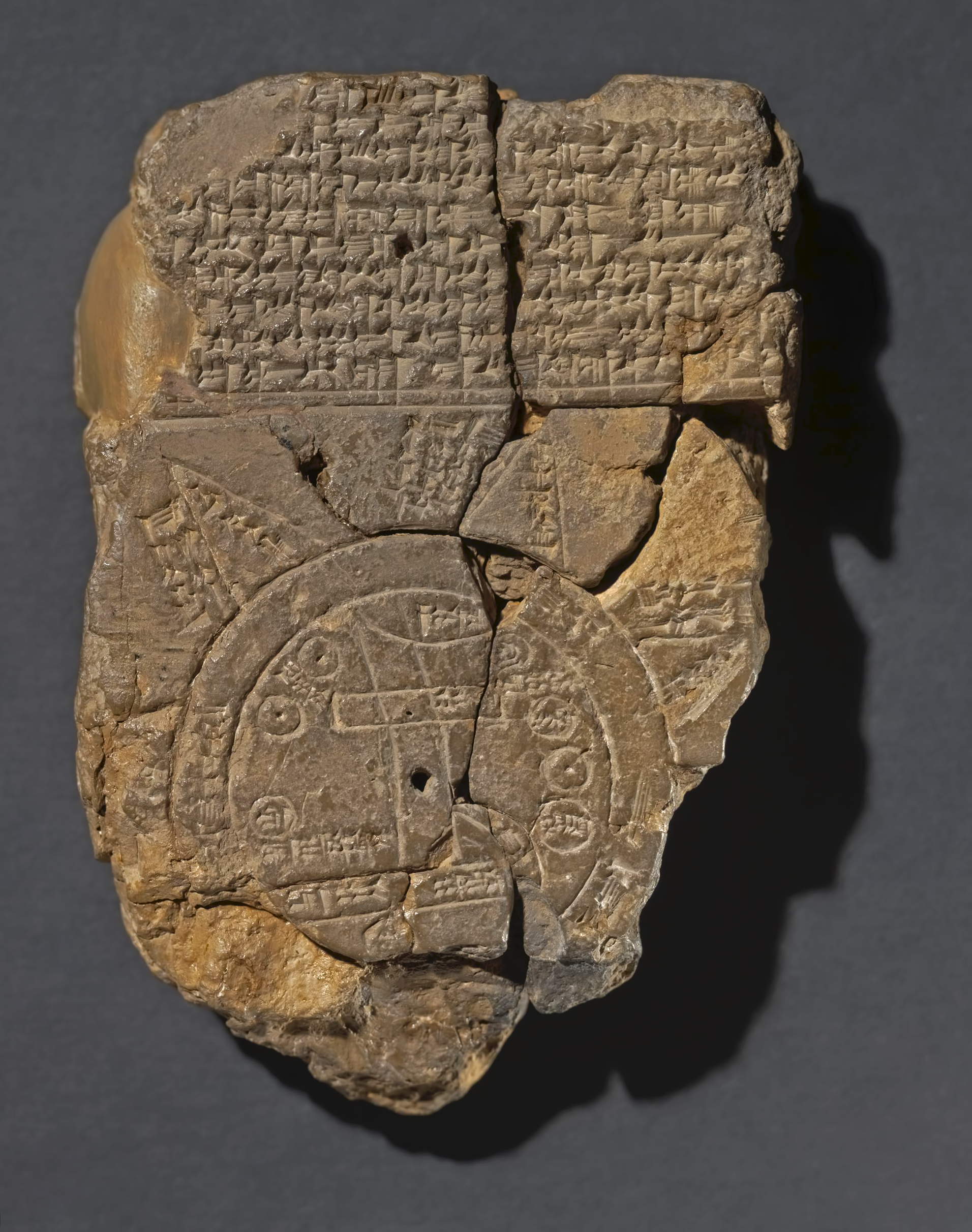
Map of the World
Circa 600 BC - 500 BC.
This clay tablet represents a map of the world. It shows the world as a disc, surrounded by a ring of water called the 'Bitter River'. 'Babylon' is marked as a rectangle at the right end of the Euphrates although the city actually occupied both banks of the river during most of its history. The river Euphrates flows south to a horizontal band, of which the right end is marked 'marsh' and the left end is marked 'outflow', thus the marshes at the head of the Gulf and either the Shatt al-Arab or where the river meets the cosmic 'Bitter River'.
To the right of the 'marsh' is a double curving line with a broken and unintelligible inscription. Small circles are used to indicate cities or districts, and two of which are identified as 'Assyria' and 'Der'. Three other geographical areas are marked, namely Bit-Yakin, the territory of an Aramaean tribal group around the southern Euphrates, is placed above its 'outflow'. Habban, the homeland of a Kassite tribal group around Kermanshah in western Iran, is placed quite wrongly to the west of Babylon. Urartu, an independent kingdom around the modern borders of Iran, Turkey and Russia, is placed relatively correctly to the north of Assyria.
Beyond the circular 'Bitter River' are placed the eight outlying regions (nagu). These are each marked, na-gu-u, and beside each is written the note '6 (or 7) beru (twelve or forteen hours in between' The beru is a Babylonian unit of time and linear measurement.
Danna (Sumerian) or Beru (Akkadian) is a word denoting a unit of time consisting of two hours. There were twelve Danna or Beru in a day. Danna were first used around 2 400 BC.
In addition, beside the north-eastern 'region' is written 'Where Shamash is not seen'. This reflects the fact that the sun rises in the east, crosses the heavens, sets in the west, and then returns to the east (as the Babylonians thought) through the underworld or the underworld waters, never passing through the northern (or southern) regions of the world or underworld.
On the reverse of this tablet these eight 'regions' are described in eight broken and largely unintelligible paragraphs, each beginning 'To the first (second, etc) region to which you go (the distance is) seven beru'. This, like the notes on the map, seems to indicate the distance between the different 'regions' around the edge of the world. It is not clear why the map twice gives the distance as six beru while the text, so far as preserved, consistently gives seven beru.
A final paragraph summarises, 'In all eight 'regions' of the four shores (kibrati) of the ea[rth ...], their interior no-one knows'. The 'four shores' (corresponding to the four quarters of the compass) is a regular Mesopotamian expression for the entire inhabited world.
The word nagu, which in historical and geographical texts simply means 'region', seems to have a special cosmic or mythological significance on this tablet and in the Flood story of the Epic of Gilgamesh (Tablet 11). There, as the flood waters subsided, Ut-Napishtim, the Babylonian Noah, 'looked about for the shores (kibrati), the boundaries of the sea. In each of twelve (directions) there emerged a nagu'. This and the triangular shape of the nagu on the map lead to the idea that the nagu may have been imagined as mountains.
The text at the beginning of the obverse of the tablet appears to be a description of the inhabitants, divine, human, animal or monstrous, of the areas beyond the earth, whether the eight 'regions' or the 'Bitter River' or maybe the underworld or underworld waters. Two or three lines may be missing at the beginning.
'... ruined cities ...
... whom Marduk watches ...
... the ruined gods who ... in the midst of the sea
... serpent, great dragon, between Anzu, scorpion-man
... mountain-goat, gazelle, zebu, leopard, bison
... lion, wolf, stag and hyaena
... the animal which Marduk created upon the rolling sea
... Ut-Napishtim, Sargon and Nur-Dagan king of
... their interior no-one knows'.
In the Epic of Gilgamesh (Tablet 10) the hero Gilgamesh goes to visit Ut-Napishtim in a land beyond the sea and beyond the Waters of Death. This suggests that the whole of this text is concerned with the inhabitants of the outer regions. The clause at the end of the text, 'their interior no-one knows' also ends the descriptions of the 'regions' on the reverse of the tablet.
Sargon, king of Akkad (ca 2 334 - 2 279 BC), established a short-lived empire spreading far to the north and west of the normal limits of Babylonia and became the subject of several legendary tales. One of these concerns a campaign against Nur-Dagan, king of Purush-handa (a city in central Turkey). As heroes of legend these two may well have been imagined as inhabiting a 'region' with Ut-Napishtim.
The 'ruined' gods are gods whose statues have become dilapidated and are in need of repair. The gods themselves were thought to have gone down to the underworld (via the Waters of Death), and the broken clause, 'who ... in the midst of the sea', probably refers to this underworld abode. The reference to 'ruined cities' may be to the gods of these cities.
In the Epic of Creation the serpent, great dragon, scorpion-man and bison are among the monsters created by Tiamat ('Sea') to do battle with the god Marduk. Anzu, the lion-headed bird, is the opponent of the god Ninurta in another Babylonian epic, and in other contexts is listed with Tiamat's monsters. All of these monsters may have been imagined as inhabiting the underworld or underworld waters.
The Babylonian author Berossus also recounts a story of strange monsters, some half-human, being created in the primeval waters before the creation of the world and being ruled over by Tiamat. The zebu or humped bull (apsasu) is referred to in Sumerian texts of about 2 000 BC. Later the name seems to be applied to a mythical monster, perhaps a sphinx. The remaining animals in the list would have been known to the Babylonians in the 1st millennium BC but would probably have been regarded as wild, strange or exotic. So they would have been suitable inhabitants of the outer 'regions'. The sea-animal created by Marduk is perhaps a whale.
The hole at the centre of the tablet is a so-called 'firing hole', deliberately made by the scribe. Similar holes appear in the middle of the text above the map and at two points on the reverse. The function of the so-called ‘firing hole' is unclear. Generally, it is considered that a ‘firing hole' had nothing to do with the baking of a tablet. However, ‘firing holes' certainly helped a tablet to dry out faster and more evenly.
Excavated by Hormuzd Rassam at Abu Habba, Sippar.
Height 122 mm, width 82 mm.
Inscription language: Akkadian, written in cuneiform.
A note at the end of the tablet states that it was copied from an earlier document but the inclusion of Assyria, Bit-Yakin, Habban and Urartu indicates that it was composed no earlier than the 9th century BC, circa 900 - 800 BC
Catalog: Clay tablet, 92687
Photo and text: www.britishmuseum.org, © Trustees of the British Museum, CC BY-NC-SA 4.0
Additional text: cdli.mpiwg-berlin.mpg.de/articles/cdln/2016-1
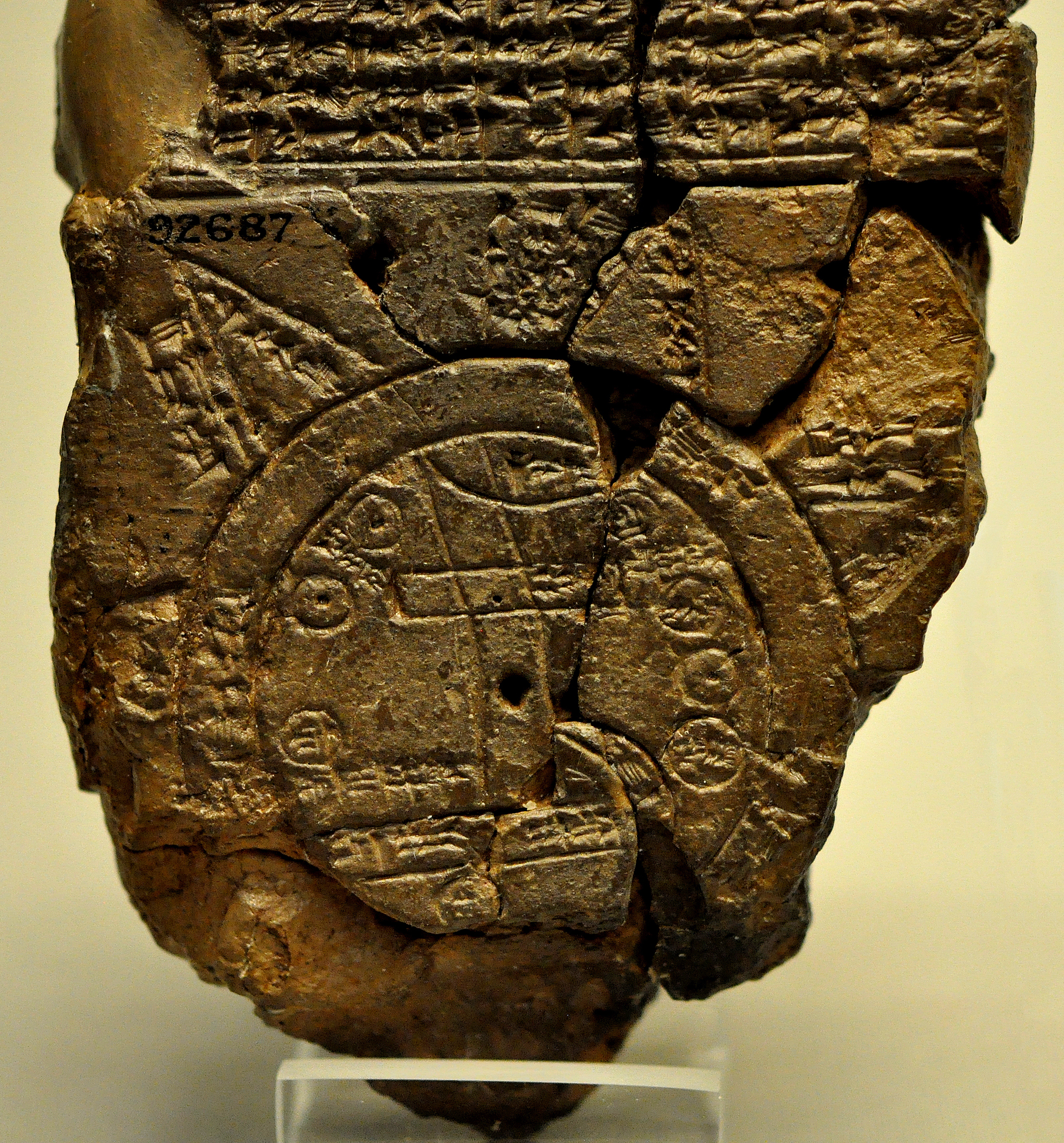
A close-up view of the Babylonian map of the World. This partially broken clay tablet contains both cuneiform inscriptions and a unique map of the Mesopotamian world. Probably from Sippar, Mesopotamia, Iraq.
700 BC - 500 BC.
Photo: Osama Shukir Muhammed Amin FRCP(Glasg) 2014
Source: The British Museum
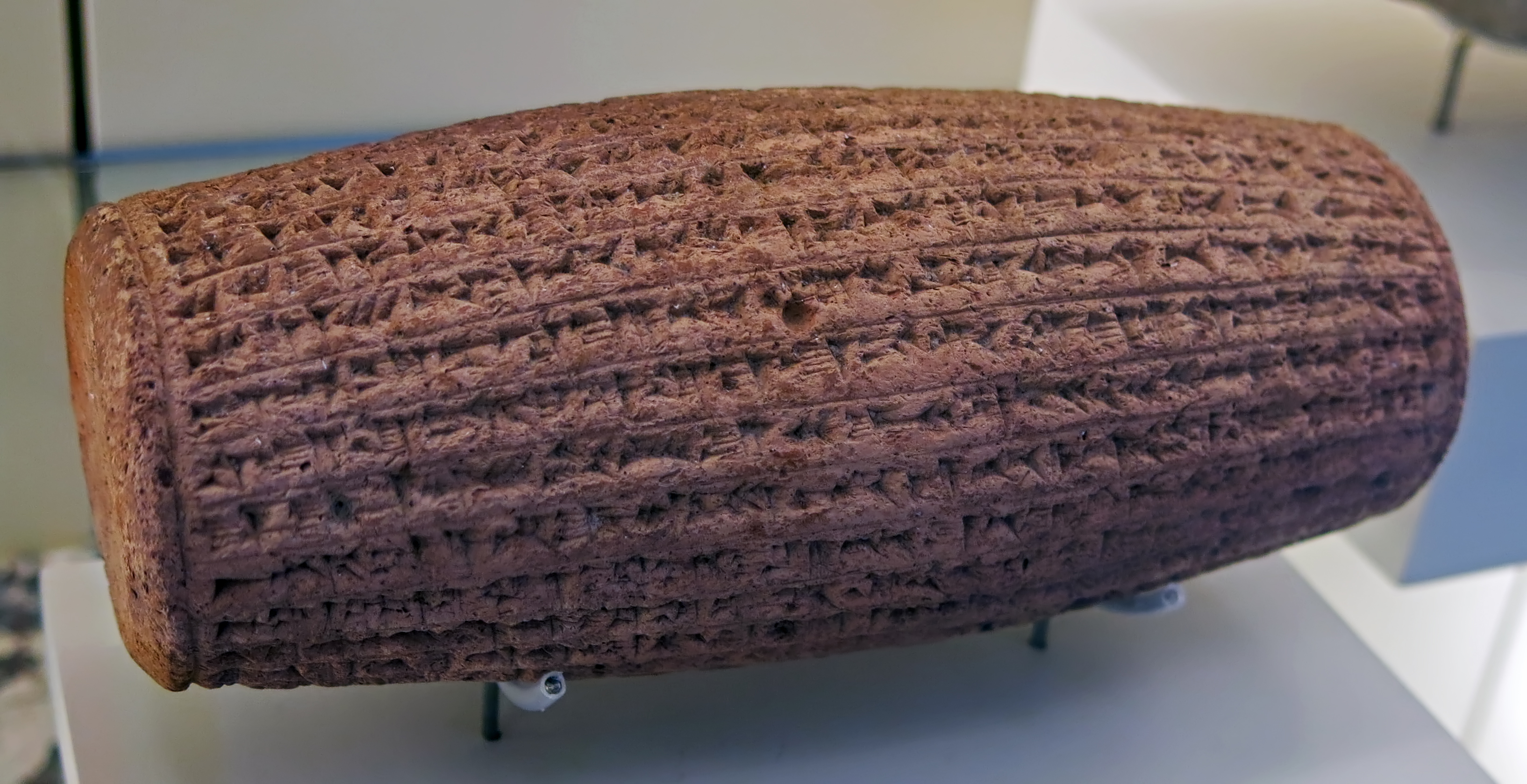
Clay cylinder building deed.
The Akkadian cuneiform text mentions the name of the last great Assyrian king Assurbanipal, 668 - 626 BC, whose elder brother Shamash-shum-ukin became king of Babylon, and also mentions one of the double walls of Babylon, Nemet-Enlil, which had a total length of eight kilometres, and was further protected by a fifty metre wide moat, connected at both ends to the Euphrates.
Photo: Don Hitchcock 2015
Source and text: Pergamon Museum, Berlin, recherche.smb.museum
Additional text: Wikipedia
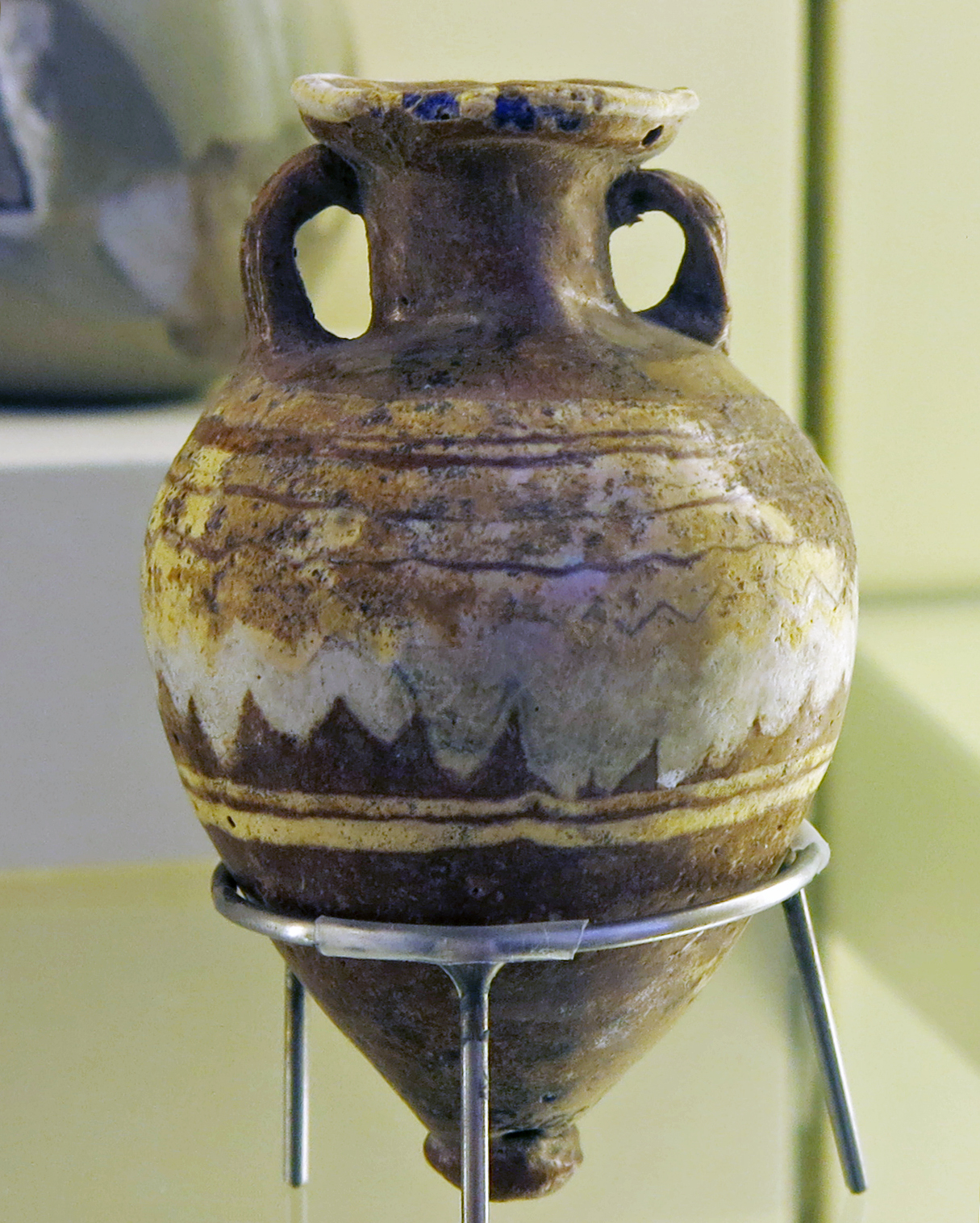
Small amphora for cosmetics or fragrance oil.
6th - 5th century BC.
Height 69 mm, diameter 44 mm, diameter opening and edge 25 mm, diameter opening 9 mm.
Catalog: Glass, Babylon, VA Bab 03073
Photo: Don Hitchcock 2015
Source and text: Pergamon Museum, Berlin, http://www.smb-digital.de/
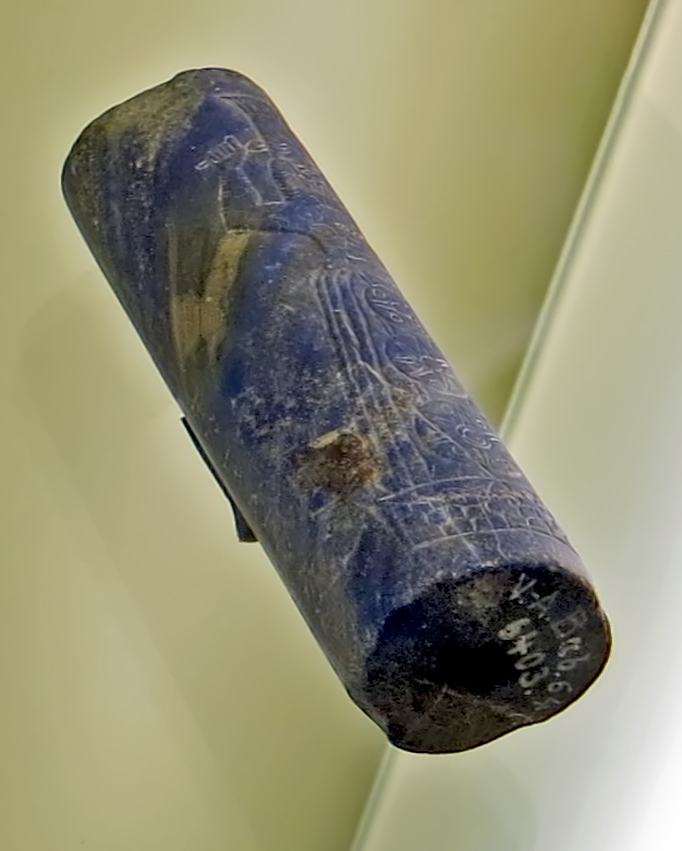
God Seal
Engraved cylinder seal.
Dated to Esarhaddon (680 BC – 669 BC)
Height 125 mm, diameter 32 mm, weight 300 gm.
Catalog: Lapis Lazuli, VA Bab 00647
Photo: Don Hitchcock 2015
Source and text: Pergamon Museum, Berlin, recherche.smb.museum
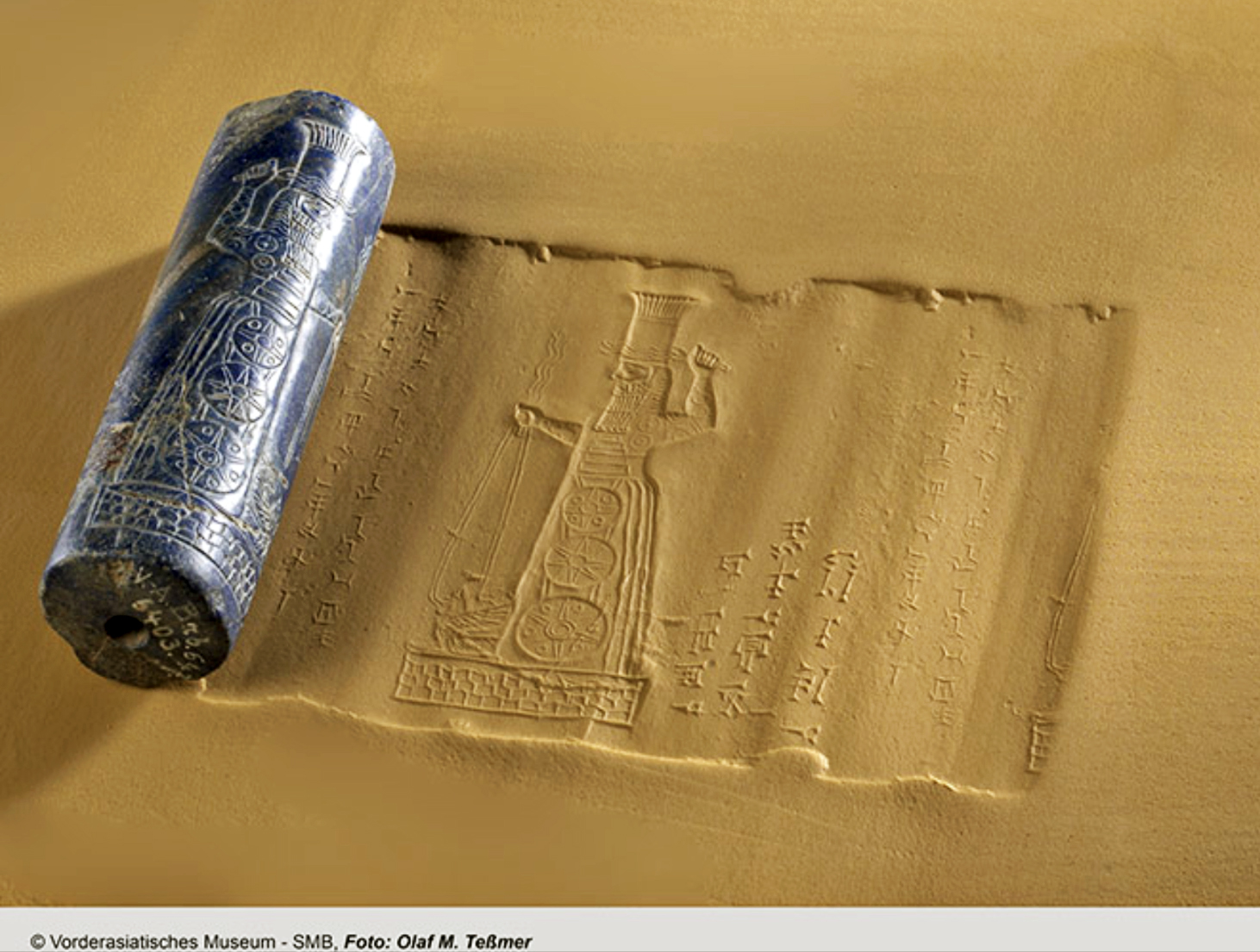
God Seal
Engraved cylinder seal.
Dated to Esarhaddon (680 BC – 669 BC)
This massive lapis lazuli cylinder was found together with beads, scarabs and precious ornaments mixed up with raw material, carefully hidden by the last owner, probably a Parthian manufacturer of beads, beneath the floor of his house.
The storm god Adad, standing on a stylized pedestal, is shown with bolts of lightning in his hands, a lion-dragon on a leash lying at his feet. His garment is decorated with the image of a ziggurat and three star-discs one below the other, which are depicting gold or silver pendants.
The initial Neo-Babylonian inscription, 'Seal of the god Adad', was supplemented at first by the addition 'Property of the god Marduk … of Esangila'.
The second Assyrian dedication 'To the god Marduk, great lord, his lord, Esarhaddon, king of the universe, king of Assyria, has given [the seal] for his life' suggests that the seal was at one point misappropriated from the treasury of Esangila and that it was Esarhaddon (680-669 B.C.) who reversed the sacrilege.
The technique - positive carved inscriptions, raised relief - substantiates that the cylinder was never used for sealing, although very few impressions of god's seals are known. [Nadja Cholidis]
Height 125 mm, diameter 32 mm, weight 300 gm.
Catalog: Lapis Lazuli, VA Bab 00647
Photo credit: Staatliche Museen zu Berlin, Vorderasiatisches Museum / Olaf M. Teßmer CC BY-NC-SA 4.0
Source and text: Pergamon Museum, Berlin, recherche.smb.museum
The dates presented here are drawn from multiple sources, many of which differ significantly between two or more otherwise apparently reliable sources, or contradict one another (or are even self contradictory!). I have attempted to bring some order to this confusion, but in certain cases establishing reliable dates is simply not possible. Many or perhaps most of the dates given in the table below are at best very approximate. Treat the dates with great caution. Caveat emptor. • a caste of priests.
| Babylonian Chronology | Dynasty I (Amorite, 1894–1595 BC): Founded by Sumu-abum, famous for Hammurabi. Dynasty II (First Sealand, c. 1725–1475 BC. Based in the southern marshlands.) Dynasty III (Kassite, c. 1595–1155 BC): Longest-ruling dynasty, establishing lasting Babylonian culture. Dynasty IV (Second Isin, 1153–1022 BC): Native Babylonian rulers after the Kassite fall. Dynasty V (Second Sealand, 1021–1001 BC): Short-lived dynasty. Dynasty VI (Bazi, 1000–981 BC): Named after a town on the Tigris. Dynasty VII (Elamite, 980–975 BC): A brief period of foreign rule. Dynasty VIII (E, 974–732 BC): A period of instability, sometimes called "Intermediate Period". Dynasty IX (Assyrian, 732–626 BC): Ruled directly by the Neo-Assyrian Empire. Dynasty X (Chaldean/Neo-Babylonian, 626–539 BC): Founded by Nabopolassar, including Nebuchadnezzar II. Naming Conventions Geographic/Ethnic Origin: Dynasties were often identified by the regional background of their leaders, such as the Kassites or Chaldeans. City of Origin: Some, like the Second Dynasty of Isin, were named after the city from which the kings originated. King Lists: Modern scholars and ancient scribes used sequential numbers (I-X) to organize the dynasties. Reign Identification: Within these periods, years were not numbered consecutively but were named after major events during a king's reign.
|
||
|---|---|---|---|
| Sumu-abum | 1894 BC - 1881 BC | The Old Babylonian Dynasty (circa 1894 BC – 1595 BC) marked the rise of Babylon from a small city-state to a dominant Mesopotamian power. The founder of the dynasty was Sumu-abum who established Babylon as an independent city-state after the decline of the Ur III Empire. He consolidated control over nearby cities and laid the political foundation for Babylon’s future expansion. He did not yet control a vast empire, but he began the Amorite dynasty that would eventually dominate southern Mesopotamia. | |
| Sumu-la-El | 1880 BC - 1845 BC | Sumu-la-El was an early consolidator who strengthened Babylon’s defences with city walls. He expanded territory by conquering nearby rival cities and improved irrigation systems and temple construction. Under his rule, Babylon became a more significant regional power. | |
| Sabium | 1844 BC - 1831 BC | Sabium continued territorial expansion. He reinforced political control over surrounding cities and maintained stability during a competitive period among Mesopotamian city-states. | |
| Apil-Sin | 1830 BC - 1813 BC | Apil-Sin strengthened city fortifications. and engaged in regional conflicts, particularly with neighbouring city-states such as Isin and Larsa, and helped prepare the kingdom for later expansion. | |
| Sin-Muballit | 1812 BC - 1793 BC | Sin-Muballit expanded Babylon’s territory further and launched campaigns against rival cities including Larsa. His reign set the stage for Babylon’s greatest expansion. He abdicated in favour of his son, Hammurabi (possibly due to illness). | |
| Hammurabi | 1792 BC - 1750 BC | Hammurabi was the most famous ruler of the dynasty. He conquered major Mesopotamian cities including Larsa, Eshnunna, Mari, and eventually Assyria. He united much of Mesopotamia under Babylonian rule. He issued the Code of Hammurabi, one of the earliest and most complete written legal codes up till that point. He promoted large scale irrigation projects and temple construction. Under Hammurabi, Babylon became the dominant political and cultural centre of Mesopotamia. | |
| Samsu-iluna | 1749 BC - 1712 BC | Samsu-iluna faced widespread revolts after Hammurabi’s death. He struggled to maintain control over southern Mesopotamia and lost significant territories, weakening Babylon’s dominance. His reign marked the beginning of the empire’s gradual decline. | |
| Abi-Eshuh | 1711 BC - 1684 BC | Abi-Eshuh attempted to suppress rebellions and recover lost territories. and built defensive works and attempted to control the Tigris River to undermine enemies but he had limited success restoring Babylon to its former strength. He was defeated by Damqi-ilishu of the Babylonian Dynasty II, the Sealanders, from the marshes south of Babylon. | |
| Ammi-Ditana | 1683 BC - 1647 BC | Ammi-Ditana presided over a period of relative stability, and focused on religious dedications and temple restorations, as well as promoting economic and administrative continuity. | |
| Ammi-Saduqa | 1646 BC - 1626 BC | Ammi-Saduqa issued decrees aimed at economic justice and debt relief, and continued religious and administrative traditions. But he was best known for the 'Venus Tablets', which were astronomical observations of Venus. The Venus Tablet of Ammisaduqa (part of the Enuma Anu Enlil series) is a crucial 17th-century BC Babylonian cuneiform text recording 21 years of observations of Venus's rising and setting (heliacal risings/settings). It is one of the oldest known astronomical texts, used to date Mesopotamian chronology. It records the first and last visibility of Venus, defining its synodic period. The synodic period of Venus is the time it takes for Venus to return to the same position relative to the Sun as seen from Earth. It is approximately 584 days (or roughly 1.6 years). This cycle, known as the Venusian synodic cycle, includes periods as both a morning and evening star and is characterised by a 5:8 ratio with the Earth's orbit, completing a full cycle of positions every 8 years. Besides tracking Venus, the tablet also contains omens linking celestial movements to floods, food availability, and war outcomes. These tablets demonstrate that Babylonian astronomers accurately tracked planetary motion, with some researchers suggesting they even recorded the atmospheric effects of the Thera (Santorini) volcanic eruption. The tablets were found in the library of Nineveh (Kouyunjik) and are now housed in the British Museum and the Iraqi Museum. | |
| Samsu-Ditana | 1625 BC - 1595 BC | Samsu-Ditana was the last ruler of the dynasty. He reigned during a period of significant weakness. Babylon was sacked around 1595 BC by the Hittite king Mursili I. The fall of Babylon ended the Old Babylonian Dynasty. After this event, the Kassites eventually rose to power in Babylon. | |
| First Sealand Dynasty, circa 1732–1475 BC. Based in the southern marshlands. The dynasty, which had broken free of the Old Babylonian Empire, was named for the province in the far south of Mesopotamia, a swampy region bereft of large settlements which gradually expanded southwards with the silting up of the mouths of the Tigris and Euphrates rivers (the region known as mat Kaldi 'Chaldaea' in the Iron Age). Sealand pottery has been found at Girsu, Uruk, and Lagash but in no site north of that. 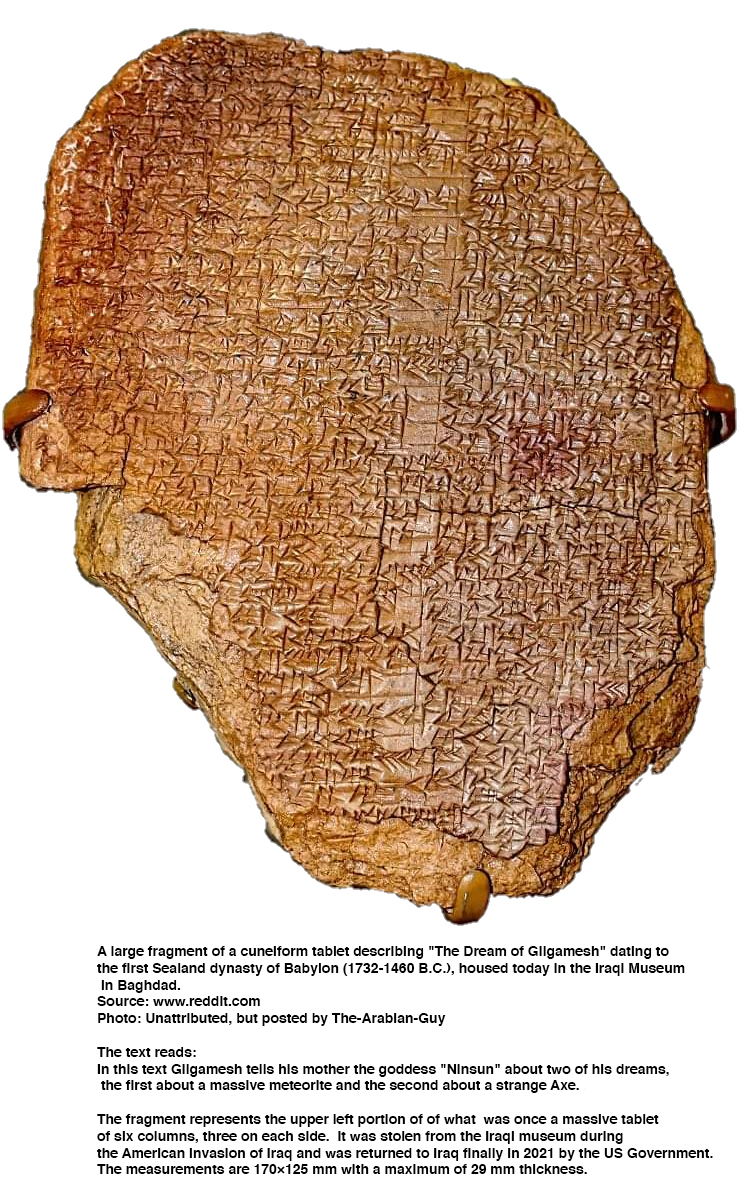
|
|||
| Ilum-ma-ili | 1732 BC - 1725 BC | Ilum-ma-ili was born in the Sealand region of southern Mesopotamia, and he founded the First Sealand dynasty after rebelling against the Amorite rulers of Babylon in 1732 BC. Ilum-ma-ili battled the Amorite kings Samsu-iluna and Abi-Eshuh, he conquered Nippur and used the terrain to counter Abi-Eshuh's efforts to dam the Tigris and flush Ilum-ma-ili and his Sealanders out of their homeland. He died in 1725 BC and was succeeded by his son Itti-ili-nibi. | |
| Itti-ili-nibi | circa 1700 BC | Itti-ili-nibi was a king of the First Sealand Dynasty in the region south of Babylon. He is considered the second ruler of this dynasty, succeeding the founder, Ilum-ma-ili. The Sealand Dynasty was characterised by its efforts to maintain independence in southern Mesopotamia against the Amorite rulers of Babylon (such as Abi-Eshuh). He ruled during a period of instability following the decline of the First Babylonian Dynasty (Amorite dynasty). He was succeeded by Damqi-ilishu. He was a contemporary of King Bel-bani of Assyria and Pharaoh Merdjefare in Egypt. | |
| Damqi-ilishu | circa 1677 BC | Damqi-ilishu or Damqi-ilishu II likely ruled for 26 years, during a period when the Sealand Dynasty overlapped with the First Dynasty of Babylon. The Sealand Dynasty was a contemporaneous, independent dynasty, not a successor to the Old Babylonian (Amorite) Dynasty in the city of Babylon itself. He is noted for defeating Abi-Eshuh, a successor to Samsu-iluna of the First Dynasty of Babylon, in an attempt to control the region.
It is important not to confuse him with the 15th and final king of the Kingdom of Isin, named Damiq-ilishu, who died around 1792 BC |
|
| Iškibal | circa 1650 BC | There are no known monumental inscriptions or detailed royal narratives about his reign. Like other Sealand kings, he probably ruled from a marshland capital (possibly Dur-Enlil or another southern city), nanaged trade routes linking Mesopotamia with the Persian Gulf and maintained regional autonomy during a politically unstable period. Iškibal is typically credited with a reign of approximately 15 years. He was succeeded by his brother Shushi. | |
| Shushi | 1625 BC - 1602 BC | Shushi was the fifth king of the Sealand dynasty. He is known only from later king lists. According to these lists, he reigned for 24 years. The name Shushi is problematic but is possibly Akkadian. According to the Babylonian King List, Šušši was the brother of Iškibal. Šušši is recorded as reigning for 24 years. | |
| Gulkishar | 1602 BC - 1563 BC | Gulkishar was the sixth king from the First Sealand dynasty. He reigned over a part of Lower Mesopotamia around 1595 BCE, contemporarily with the end of the reign of Samsu-Ditana, the final ruler from the First Dynasty of Babylon. The full territorial extent of his kingdom remains uncertain, though it is assumed that it encompassed the shore of the Persian Gulf, the lower Tigris and Euphrates, as well as part of central Babylonia. It remains a subject of debate among researchers whether he ever controlled Babylon itself. In contrast with many other members of his dynasty, who are only known from king lists, he continued to be referenced in various genres of texts up to the first millennium BCE. The best-known example is an epic portraying his conflict with Samsu-Ditana, in which he is aided by the goddess Ishtar. It can be established that he must have already been in power circa 1595 BC. According to the Babylonian King List A his reign lasted 55 years. However, it is possible that this source slightly exaggerates the lengths of reigns of the individual kings of the Sealand. It has been suggested that its compilers rounded them up to numbers ending in 0 or 5 when no detailed records were available to them, though this remains speculative. Gulkishar has been characterised by Assyriologists as an ambitious ruler. During his reign the Sealand state consolidated power across Mesopotamia in the aftermath of the sack of Babylon by Mursili I and his Hittite forces. The full extent of the kingdom of Sealand remains uncertain, though it can be assumed that it encompassed the lower Tigris and Euphrates, and that it reached up to the shore of the Persian Gulf in the south[e] and possibly up to central Babylonia in the north. It is uncertain if Nippur was a part of it, despite the importance of deities associated with it in the official pantheon. | |
| Peshgaldaramesh | 1599 BC - 1549 BC | Peshgaldaramesh reigned for approximately 50 years. He was the son of Gulkishar, who was a significant ruler of the First Sealand Dynasty, having reigned for 55 years. Peshgaldaramesh is one of the better-attested kings in the later part of this dynasty, which, despite the lack of extensive, detailed records, is documented in the King List. He was followed by his son, Ayadaragalama, who reigned from 1548 BC to 1520 BC. | |
| Ayadaragalama | 1548 BC - 1520 BC | Ayadaragalama is recorded as one of the better-documented rulers of this dynasty through cuneiform texts. This places him in the Middle Bronze Age period of Mesopotamian history. In ancient Mesopotamia, years were often named after major events; around fourteen such year names are associated with his reign, with mentions of religious acts and conflicts. Some year-names mention repelling enemies and building defensive works, likely against Kassite and Elamite groups. Texts note offerings and rituals to gods like Enlil and Ea. Texts and Archives: Many of the surviving texts with his name come from cuneiform archives (e.g., the Schøyen Collection). Scholars have examined a hymn attributed to Ayadaragalama, which praises the gods of Nippur and provides cultural and religious context for his reign. He was known for expanding his control into central Babylonia. | |
| Akurduana | 1519 BC - 1493 BC | Akurduana (c. 1519–1493 BC). Akurduana ruled the region south of Babylon during a period of overlap with the Old Babylonian and Kassite periods. Known from the Synchronistic Kinglist, he was a contemporary of Assyrian King Puzur-Ashur III and Egyptian Pharaoh Thutmose I. He ruled for approximately 26 years as part of the Sealand Dynasty. His reign occurred after the fall of the First Babylonian Dynasty to the Hittites, during a time when the Sealand kings held power in southern Mesopotamia. | |
| Melamkurkurra | 1492 BC - 1485 BC | Melamkurkurra reigned for approximately 7 years, he succeeded Akurduana and was followed by Ea-gamil, who may have been his son. His reign occurred during a period of complex, shifting power dynamics in the region. Key Details About Melamkurkurra: Timeline: c. 1492–1485 BC or 1491–1484 BC. He ruled the southern region of Mesopotamia (the 'Sealand') rather than Babylon itself, while the region experienced turmoil and the end of the Amorite dynasty. Succession: Succeeded by Ea-gamil, hia son, the final king of the dynasty | |
| Ea-gamil | 1484 BC - 1475 BC | Ea-gamil, the last king of the dynasty and was the son of Melamkurkurra. He ruled briefly before fleeing to Elam following an invasion by the Kassite king Ulam-Buriash, brother of the Babylonian king Kashtiliash III. Ulam-Buriash conquered the Sealand which ended the dynasty and allowed the Kassites to take control of the region. Rather than facing defeat, Ea-gamil fled to Elam. He had a distinctly Sumerian name. | |
Note that there are significant gaps in the kings list, and there is significant doubt about the dates given for all members of this dynasty. 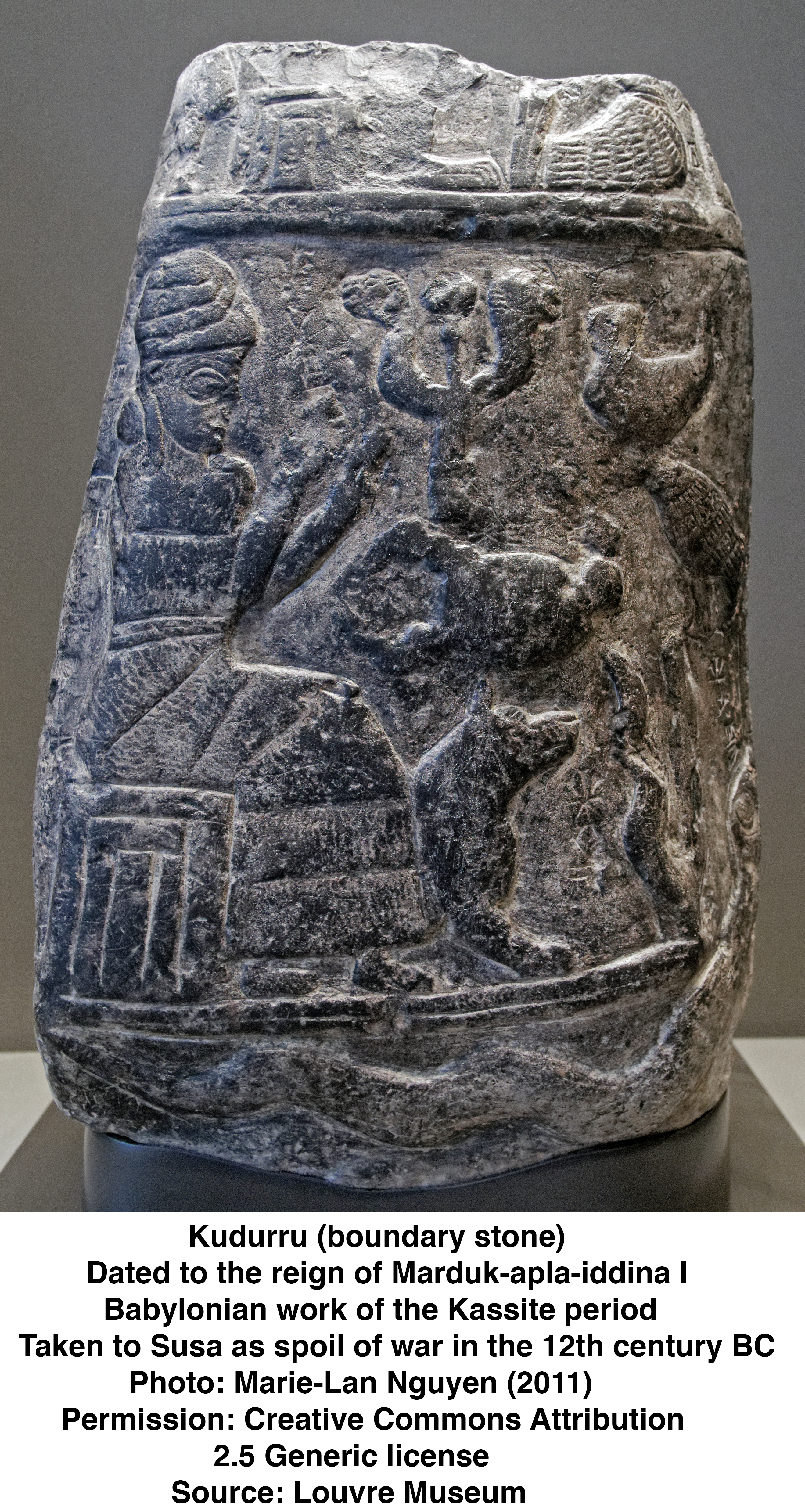
|
|||
| Gandash | 1595 BC - 1594? BC | The Kassite Dynasty ruled Babylon for over 500 years, with 36 kings traditionally listed. They brought long-term stability and adopted Babylonian culture, while early kings like Gandash and Agum II established their rule, and later kings like Kurigalzu I/II and Burnaburiash II engaged in international diplomacy. Gandash (circa 16th century BC) is traditionally considered the founder of Kassite rule in Babylon. He may not have ruled all of Babylonia, but he established the Kassite political presence. Little direct evidence survives. | |
| Agum II | 1594 BC - 1573 BC | Agum II is identified as one of the early kings of the Kassite Dynasty, which took control of Babylon after it was sacked by the Hittite king Mursilis I in 1595 BC (middle chronology). According to tradition (specifically the 'Agum-kakrime Inscription'), he is noted for recovering the statue of the god Marduk that had been stolen by the Hittites, suggesting a reign roughly 24 years after the statue was originally taken. He is considered the king who firmly established the Kassite Dynasty in Babylon. | |
| Burnaburiash I | 1570 BC - 1550 BC | Burnaburiash I strengthened Kassite control over Babylonia following the dynasty’s rise after the fall of the Old Babylonian Empire. He helped stabilise political authority during the early Kassite period. He secured the Kassite royal line and passed the throne to his successor, likely his son Kashtiliash III (according to king lists, though early Kassite succession is somewhat uncertain). He continued traditional Babylonian religious practices and supported major temples, especially in Babylon, reinforcing legitimacy by honouring Babylonian deities. | |
| Kashtiliash III | 1550 BC - 1530 BC | Kashtiliash III is generally placed immediately after Burnaburiash I in the early Kassite dynasty (mid-16th century BCE, though the exact dates are uncertain). As with much of early Kassite history, the sequence comes from later king lists and is not perfectly secure, but Kashtiliash III is the standard successor in modern reconstructions. | |
| Ulamburiash | 1530 BC - 1500 BC | Ulamburiash was a Kassite king who expanded Kassite control, particularly into the Sealand region of southern Mesopotamia. He is considered one of the early rulers who helped consolidate Kassite authority over Babylonia. | |
| Agum III | 1465 BC - 1436 BC | Agum III, son of Kaštiliyåš, appears to have been one of the successors to Burna-Buriyåš I, because he is mentioned in the Chronicle of Early Kings after Ulam-Buriyåš, who was a son of Burnaburiash I. Although this source does not give him a royal title, it is inconsistent in this regard and does say he called up his own army, ummānšu idkēma. Little is known about the king, with the only Babylonian reference to him from an expedition he led against 'the Sealand', a region synonymous with Sumer, ca. 1465 BC, which is described in the Chronicle of Early Kings. His invasion followed that of his uncle, Ulam-Buriyåš, described in the preceding lines of the chronicle, who had previously made himself 'master of the land', i.e. Sealand. Whether the campaign was against a competing Kassite kingdom, a restive province or a resurgent Sealand dynasty is not disclosed. He reputedly conquered the city of Dur-Enlil which is otherwise unknown and destroyed its temple of Egalgašešna, leaving him in control of all of southern Mesopotamia. | |
| Kadashman-Sah | 1435 BC - 1415 BC | King of Babylon from 1435 to 1415 BC, succeeding Agum III and preceding Karaindash. | |
| Karaindash | 1415 BC - 1400 BC | Karaindash built temples in Uruk, established diplomatic relations with Egypt, and promoted architectural development. | |
| Kadashman-Harbe I | 1400 BC - 1387 BC | Kadashman-Harbe I was a King of Babylon during the Kassite dynasty who reigned in the early 14th century BC, specifically cited as ruling from roughly 1400 to 1387 BC. He was the son of Karaindash, campaigned against the Suteans, and is recognised as a contemporary of the Elamite king Tepti Ahar. He was the 16th King of the Kassite (3rd) Dynasty of Babylon. He campaigned against the Suteans near the Euphrates. Contemporary Rulers were Tepti Ahar of Elam and Amenhotep II of Egypt. | |
| Kurigalzu I | 1386 BC - 1375 BC | Kurigalzu I founded a new capital city, Dur-Kurigalzu (near modern Baghdad). He constructed monumental temples and a large ziggurat. He strengthened royal authority. | |
| Kadashman-Enlil I | 1374 BC - 1360 BC | Kadashman-Enlil I is known to have been a contemporary of Amenhotep III of Egypt, with whom he corresponded (Amarna letters). This places him securely to the first half of the 14th century BC by most standard chronologies. Kadashman-Enlil I was one of the most prominent Kassite kings of Babylon during the Late Bronze Age international era. His reign fell during a time when Babylonia was part of a network of powerful states that included Egypt, Mitanni, the Hittites, and Assyria. | |
| Burnaburiash II | 1359 BC - 1333 BC | Burnaburiash II engaged in extensive diplomatic correspondence with Egypt (recorded in the Amarna Letters). He maintained international relations with major powers including Egypt, Mitanni, and the Hittites and oversaw a period of prosperity and trade. | |
| Kurigalzu II | 1332 BC - 1308 BC | Kurigalzu II made war with Assyria. He maintained Kassite authority in Babylonia despite growing Assyrian power. | |
| Nazi-Maruttaš | 1307 BC - 1282 BC | Nazi-Maruttaš was the 23rd king of the dynasty, succeeding his father, Kurigalzu II. He ruled during the Middle Babylonian period and is known for his role as a 'King of the World'. His reign is associated with the Nazimaruttaš kudurru stone, a boundary stone now in the Louvre Museum. He appears in literary texts that were copied well after his reign, indicating a significant historical footprint compared to other Kassite rulers. | |
| Kadašman-Turgu | 1281 BC - 1264 BC | Kadašman-Turgu was the 24th king of the Kassite Dynasty or 3rd dynasty of Babylon. He succeeded his father, Nazi-Maruttaš, continuing the tradition of proclaiming himself 'king of the world' and went on to reign for eighteen years. He was a contemporary of the Hittite king Ḫattušili III, with whom he concluded a formal treaty of friendship and mutual assistance, and also Ramesses II with whom he consequently severed diplomatic relations. Kadašman-Turgu reigned during momentous times, but seems to have played only a peripheral role. Ḫattušili III, in a letter to his son and successor Kadašman-Enlil II, said of him, 'they used to call [your father] a king who prepares for war but then stays at home'. His personal seal included suckling animals in two registers, allegorically symbolising his care for his subjects. The continued employment of the extinct Sumerian language in royal votive inscriptions was in decline and the Babylonian calendar was under revision with the introduction of the Akkadian term: Šanat rēš šarrūti, 'accession year'. Early in his reign, he brokered a treaty with the Assyrian king Adad-Nīrāri. Kadašman-Turgu’s father, Nazi-Maruttaš had been engaged in a protracted war with both Adad-Nīrāri and his father Arik-den-ili which had reached its dénouement in a battle at Kār-Ištar of Ugarsallu. This settlement perhaps explains why there were no reports of any conflict between the Babylonians and Assyrians during this time. It also freed the Assyrians to turn their attention to conquering their westerly neighbour and former overlord the Mitanni. | |
| Kadashman-Enlil II | 1263 BC - 1255 BC | Kadashman-Enlil II succeeded his brother, Kadashman-Turgu, and was followed by Kudur-Enlil. He is known for corresponding with the Hittite king Hattusili III and taking a hardline stance against them while managing relations with Assyria. | |
| Kudur-Enlil | 1254 BC - 1246 BC | Kudur-Enlil was the 26th king of the 3rd or Kassite dynasty of Babylon. He reigned into his ninth year, as attested in contemporary economic tablets. He was possibly the first Kassite king to have a wholly Babylonian name. Nippur experienced explosive growth under Kudur-Enlil and his successor, with the city expanding almost to its Ur III extent. Kudur-Enlil extensively refurbished the Enlil Temple in Nippur. The later period of construction is witnessed by his stamped brick inscriptions which describe him as a benefactor of the temple. A brick of Kudur-Enlil bearing a twelve-line Sumerian inscription which was found inside the temple states that he built the supporting wall with bitumen and baked bricks. | |
| Shagarakti-Shuriash | 1245 BC - 1233 BC | Shagarakti-Shuriash was the twenty seventh king of the Third or Kassite dynasty of Babylon. The earliest extant economic text is dated to the 5th day of Nisan in his accession year, corresponding to his predecessor’s year 9, suggesting the succession occurred very early in the year as this month was the first in the Babylonian calendar.[1] He ruled for thirteen years and was succeeded by his son, Kaštiliašu IV. | |
| Adad-shuma-iddina | 1222 BC - 1217 BC | Adad-shuma-iddina reigned briefly before Adad-shuma-usur took the throne, marking a period of instability following Assyrian interference in Babylonia, specifically by Tukulti-Ninurta I. | |
| Adad-shuma-usur | 1216 BC - 1187 BC | Adad-shuma-usur restored Babylonian independence after Assyrian control and reasserted Kassite authority. He is known for diplomatic letters criticising Assyrian rule. | |
| Meli-Šipak II | 1186 BC - 1172 BC | Meli-Šipak II, was the 33rd king of the Kassite or 3rd Dynasty of Babylon and ruled for 15 years. His reign marks the critical synchronisation point in the chronology of the Ancient Near East. He is recorded as the son of Adad-šuma-uṣur, his predecessor, on a kudurru (boundary stone). Elsewhere he seemed reluctant to name himself in his royal inscriptions, despite Adad-shuma-usur’s apparent renown as restorer of Kassite independence, which has been the subject of much speculation amongst historians. He was the last king to bear a wholly Kassite name. Meli means servant or slave, Šipak was a moon god, but Šiḫu was possibly one of the Kassite names for Marduk. Meli-Shipak's rule is understood to have been peaceful. Not so for the edges of his kingdom, where the catastrophic collapse at the end of the Bronze Age was starting to dramatically unfold with many of the cities of the Levant experiencing destruction. | |
| Marduk-apla-iddina I | 1171 BC - 1159 BC | Marduk-apla-iddina I was likely the son of Meli-Šipak II. He is described as the 'servant' of Meli-Šipak II on a kudurru, a boundary stone recording a land grant, and is believed to be his son. He claimed, like his father, descent from Kurigalzu and evidently kept court in Dūr-Kurigalzu itself because tablets found in the burnt ruins of the Tell-el-Abyad quarter which marked the later Elamite destruction of the city, are dated in the first two years of his reign. These include lists of garments received or distributed for the New Year, or akitu, festival and indicate a normal economic relationship with Babylonia's western and eastern neighbours, the Subarians and Elamites respectively, whose singers apparently entertained the royal household. Documents surviving from his reign include mention of his repair of the E-zida temple at Borsippa, where he credited the god Enlil with raising him to kingship despite recording this in an inscription wholly dedicated to Marduk. There is evidence of thriving commerce in woolen garments with Assyrian traders, and numerous royal land grants in northern and especially northeastern Babylonia. | |
| Zababa-shuma-iddin | 1158 BC | Zababa-šuma-iddina was the 35th and next to last king of the Kassite dynasty, who reigned for just one year, circa 1158 BC. He was without apparent ties to the royal family and there is uncertainty concerning the circumstances of his coming to power. His short unhappy reign was subjected to invasions on two different fronts. One of these was where Assyrian forces under the leadership of Aššur-dan I annexed the region lying between the Lower Zab and the Adhaim, or Al Uzaym River, seizing control of Zaban, Irriya and Urgarsallu, and carrying off much plunder. | |
| Enlil-nadin-ahi | 1158 BC - 1155 BC | Enlil-nadin-ahi followed Zababa-shuma-iddin as the king of Babylon, serving as the final ruler of the Kassite dynasty. Zababa-shuma-iddin was defeated and his reign ended by Elamite invaders, after which Enlil-nadin-ahi briefly took the throne. Both kings ruled during the collapse of the Kassite dynasty, which was ultimately conquered by the Elamites under Shutruk-Nahhunte. Enlil-nadin-ahi was defeated and taken to Susa by the Elamites. | |
The Second Dynasty of Isin (c. 1153–1022 BC) is identical to the Fourth Dynasty of Babylon. This dynasty was established by Marduk-kabit-ahheshu after defeating the Elamites, bringing native Akkadian-speaking rule back to Babylon. While the kings originated from or were associated with the city of Isin, they ruled from Babylon, which is why it is listed as the Fourth Dynasty in the Babylonian King List. 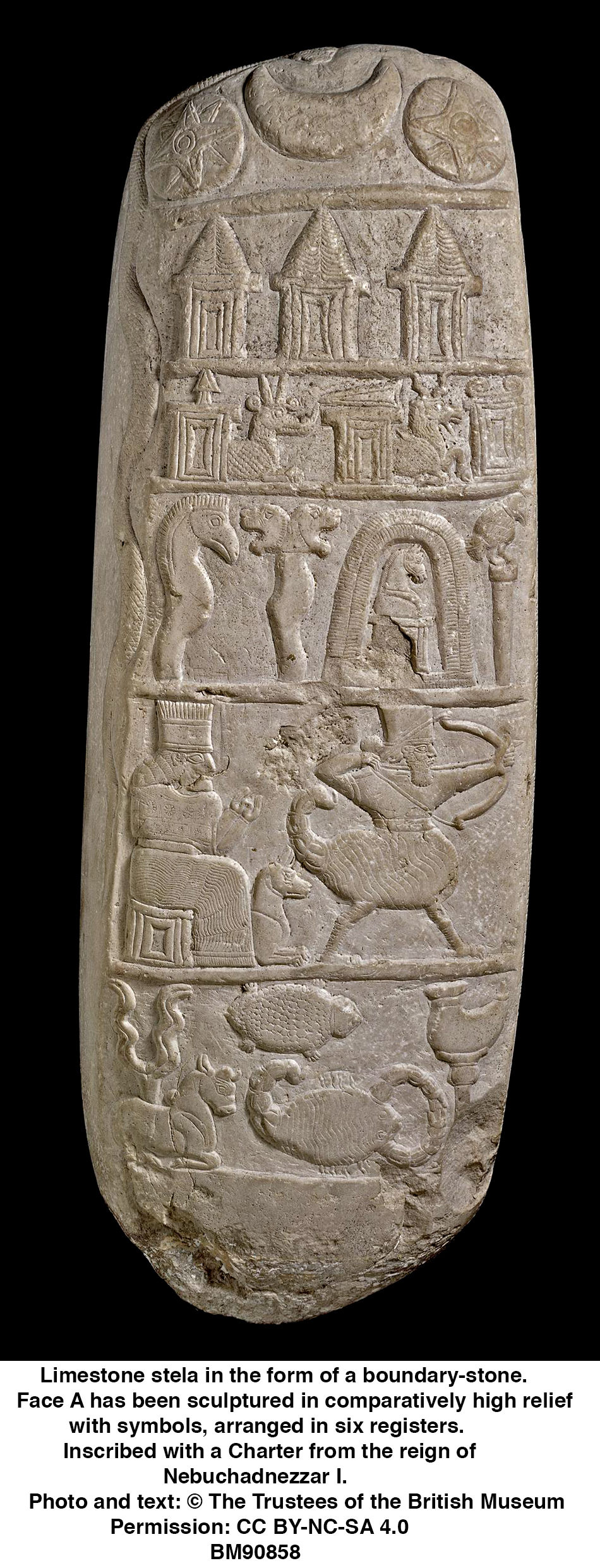
|
|||
| Marduk-kabit-ahheshu | 1153 BC - 1136 BC | Marduk-kabit-ahheshu was the founder of the 2nd Dynasty of Isin, which was to rule Babylon until around 1022 BC. He followed Enlil-nadin-ahi as king of Babylon, marking the transition from the end of the Kassite dynasty (circa 1155 BC) to the start of the Second Dynasty of Isin. Marduk-kabit-aḫḫēšu apparently acceded to the throne in the aftermath of the Elamite overthrow of the Kassite Dynasty. His name and length of reign are most clearly ascertained from the Babylonian King List which gives 18 years for his rule. The dynasty marks the ascendance of the cult of Marduk, since 6 of the 11 kings of the dynasty were to include his name as a theophoric element, and he was to become entrenched as the supreme deity of the pantheon. He was succeeded by his son, Itti-Marduk-balāṭu. | |
| Itti-Marduk-balāṭu | 1135 BC - 1128 BC | Itti-Marduk-balāṭu was the second king of the 2nd Dynasty of Isin that ruled over Babylon, and he was the son of its founder, Marduk-kabit-aḫḫēšu. He is thought to be the first of the dynasty actually to rule from the city of Babylon. He was followed by his son Marduk-nadin-ahhe. Like his father before him, he made incursions into Assyria. The Elamites, under their king Shilhak-Inshushinak, the brother of Kutir-Nahhunte, raided repeatedly into Mesopotamia up to the Tigris and as far north as Nuzi around this period. It is believed that he was one of the richest citizens and kings of Babylon, with estimated income of 10 babylonian shekels/month, which would be circa 14 400€/month today, considering prices of silver, used in currency and median inflation rate. | |
| Ninurta-nādin-šumi | 1127 BC - 1122 BC | Ninurta-nādin-šumi was the 3rd king of the 2nd dynasty of Isin and 4th dynasty of Babylon. He reigned for seven years, contemporaneously with Aššur-reš-iši, circa 1133 BC to 1115 BC, the Assyrian king with whom he clashed. He may be the author of a rather condescending letter to Aššur-reš-iši, preserved in two pieces, in which he chastises the Assyrian king for failing to keep an appointment in the border town of Zaqqa, 'If only you had waited one day for me in the city of Zaqqa!' He was primarily remembered in antiquity as the father of his successor, the celebrated king Nebuchadnezzar I. His descendants continued to reign through three more generations until the seventh king of the dynasty, Marduk-šāpik-zēri. | |
| Nebuchadnezzar I | 1121 BC - 1104 BC |
Nebuchadnezzar I was the most prominent monarch of the Fourth Dynasty of Babylon (Second Dynasty of Isin). He was a warrior-king renowned for defeating the Elamites, recovering the stolen idol of the god Marduk, and defending Babylon from Assyrian advances. He ruled for approximately 22 years, stabilising Babylon after the collapse of the Kassite dynasty. His greatest achievement was a campaign against Elam, which was, at the time, occupying part of Babylonia. He recovered the statue of Marduk, the patron deity of Babylon, which had been taken by the Elamites, and returned it to the city, boosting his legitimacy. He successfully fought against Assyrian incursions into his territory.
Note: Nebuchadnezzar I is distinct from the later, more famous Nebuchadnezzar II (605 BC – 562 BC) of the Neo-Babylonian Empire who appears in the Bible. |
|
| Enlil-nādin-apli | 1103 BC - 1095 BC | Enlil-nādin-apli, was the 5th king of the 2nd dynasty of Isin, and the 4th dynasty of Babylon. He was the son and successor of Nebuchadnezzar I and was toppled by a revolt led by his uncle, Marduk-nādin-aḫḫē. He was followed by his brother, Marduk-nādin-aḫḫē, and later his nephew, Marduk-šāpik-zēri. These rulers dealt with continued conflicts with Assyria. | |
| Marduk-nadin-ahhe | 1095 BC - 1078 BC | Marduk-nadin-ahhe reigned as a monarch of Babylon following the era of Elamite disruption. He was the sixth king of the Second Dynasty of Isin. He is best known for his restoration of the Eganunmaḫ in Ur and the famines and droughts that accompanied his reign. His relationship with his Assyrian counterpart, Tukultī-apil-Ešarra, was antagonistic and he launched a raid early in his reign into Assyria, capturing the cultic idols of Adad and Šala from Ekallāte, a town only around thirty miles from Assur. | |
| Marduk-shapik-zeri | 1077 BC - 1065 BC |
Marduk-shapik-zeri ruled after the Aramaean crises that heavily impacted the previous king, Marduk-nadin-ahhe. He was the 7th king of the 2nd dynasty of Isin. He succeeded Marduk-nadin-aḫḫē, who may possibly have been his father or brother, during a time when the Arameans, driven by famine, were engaged in attacking the Assyrians under Tukultī-apil-Ešarra during his latter years.
(The Aramean crises refer primarily to a series of geopolitical upheavals between 1200 and 700 BCE, during which Aramean tribes migrated, established independent city-states in the Levant, and fought for dominance against the Neo-Assyrian Empire. These crises included the initial collapse of Late Bronze Age powers, the rise of Aramean states, and their eventual conquest and deportation by Assyria.) |
|
| Adad-apla-iddina | 1064 BC - 1043 BC | Adad-apla-iddina was the 8th king of the 2nd Dynasty of Isin. He was a contemporary of the Assyrian King Ashur-bel-kala who raided Babylonia early in his reign. His reign was apparently also marked by an invasion of Arameans led by a usurper. Following the death of Marduk-shapik-zeri, the Assyrian king Ashur-bel-kala intervened, deposing a potential intermediate ruler Kadašman-Buriaš, and installing Adad-apla-iddina on the throne as his vassal. | |
| Marduk-aḫḫe-eriba | 1042 BC | The brief reign of Marduk-aḫḫe-eriba and the devastating Aramean and Sutean invasions represent a critical tipping point for the Second Dynasty of Isin. Marduk-aḫḫe-eriba was the 9th king of the Second Dynasty of Isin and is identified as a younger son of Adad-apla-iddina. He ruled for just six months. He may have come to power only because his older brothers predeceased him. Historical evidence suggests he remained a vassal of the Assyrian Empire under king Ashur-bel-kala. His reign was defined by catastrophic incursions by West Semitic nomadic tribes. The Arameans and Suteans sacked the land of the Sumerians and the Akkadians, specifically targeting religious centres like Nippur and Sippar. These invaders are recorded as having leveled all the temples and carried off the property of the god Enlil. The Epic of Erra was later composed to explain these disasters. It attributes the chaos to the god Marduk temporarily leaving his seat in Babylon, allowing the plague-god Erra to wreak havoc. Because the Babylonian kings were too weak to stem these migrations, the Arameans permanently occupied large portions of eastern and central Babylonia, while the Suteans settled in the western deserts. | |
| Marduk-zer-X | 1041 BC - 1030 BC | Marduk-zer-X was the 10th and penultimate king of the 2nd Dynasty of Isin. He was succeeded by Nabû-šuma-libūr, whose relationship to him is uncertain. | |
| Nabû-šumu-libūr | 1029 BC - 1022 BC | Nabû-šumu-libūr was the 11th and last king of the 2nd Dynasty of Isin. He ruled during a period of instability due to incursions of Aramean nomadic tribesmen in Northwest Babylonia. | |
The Second Dynasty of Sealand (or Dynasty V) followed the Second Dynasty of Isin (Dynasty IV) in Babylonia during a period of instability that followed the reign of kings like Nebuchadnezzar. The Second Dynasty of the Sealand, circa 1025 BC – 1004 BC, also known as the Fifth Dynasty of Babylon, was a short-lived, 3-king dynasty in southern Mesopotamia during a chaotic 'Dark Age'. 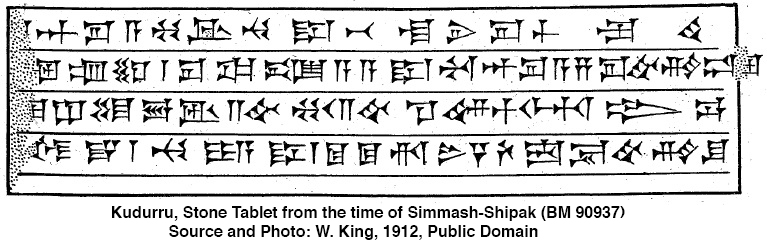
|
|||
| Simbar-Shipak | 1021 BC - 1004 BC | Simbar-Shipak, (also known as Simbar-Shiḫu) was a Babylonian king who founded the 2nd Dynasty of the Sealand, Babylon’s 5th Dynasty. He conducted a program of restoration of a number of temples that had been destroyed earlier by the marauding Arameans and the Sutû. Simbar-Šiḫu BM 90937, held in the British Museum, is a Babylonian boundary stone (kudurru) from the reign of King Simbar-Shihu (also known as Simmash-Shipak), who reigned approximately 1025–1008 BC Simbar-Šipak lived during turbulent times, where crop failures and almost constant conflicts with semi-nomadic migrants caused the Babylonian government of the preceding 2nd Dynasty of Isin to fall. As a soldier from the southern region of Mesopotamia, he emerged to stabilise the situation. He reigned for 18 years according to the King List A, 17 years according to the Dynastic Chronicle which names him Simbar-Šiḫu, 'knight of the Sealand', son of Eriba-Sin, an individual otherwise unknown, and soldier of the dynasty of Damiq-ilišu/ The dynasty ruled during a period of significant disruption, where Aramaean and Sutian tribes were migrating into Babylonia from the west and looting religious sites. The dynasty consisted of three kings, including founder Simbar-Shipak (c. 1020–1003 BCE) and a short-lived usurper named Zeri, who reigned for only three months. It was the first of four dynasties (including Bazi and Elamite) that controlled Babylon after the Second Dynasty of Isin. Founded by Simbar-Shipak, a Kassite leader, this dynasty emerged amid Aramean and Sutian invasions to defend holy sites, but quickly collapsed due to instability, replaced by a second Kassite Dynasty (Dynasty VI) The dynasty was replaced by a second Kassite Dynasty (Dynasty VI) around 1003 BC. | |
| Ea-mukin-zēri | 1004 BC | Ea-mukin-zēri succeeded Simbar-Shipak as king of Babylon. He was likely the assassin who ended Simbar-Shipak's reign and took the throne, initiating a brief period of instability. Ea-mukin-zēri, son of Hašmar was the second king of the second Sealand or 5th Dynasty of Babylon, but only for 3 months, according to the Dynastic Chronicle, 5 months according to the Kinglist A. The Dynastic Chronicle notes that 'he was buried in the swamp of Bit-Hašmar' presumably an ancestral homeland and possibly Darband-i-Ḫān, where the Diyala breaks through the Bazian range, at the northeast boundary of Namri according to Levine or southern Babylonia according to Brinkman The practice of interring Mesopotamian kings in wetlands, 'close to the abode of Enki' was a common practice at the time. After Ea-mukin-zēri's short reign of a few months, Kashu-nadin-ahhe took the throne. | |
| Kashu-nadin-ahhe | 1003 BC - 1001 BC | Kashu-nadin-ahhe was the third and final king of the second Sealand Dynasty of Babylon. His brief three-year reign was marked by distressed times. There was a famine so severe that it caused the suspension of the regular food and drink offerings at the Ebabbar, or white house, temple of Šamaš in Sippar. Although the Dynastic Chronicle records he was interred in a palace, its name is not preserved. | |
The Bazi or Bῑt-Bazi dynasty (c. 1004–985 BC) was a short-lived ruling house in Babylon, following the Second Dynasty of Sealand during the early 1st millennium BC, comprised of three kings: Eulmash-shakin-shumi, Ninurta-kudurri-usur I, and Shirikti-Shuqamuna. It represents a period of political instability and decline following the Second Dynasty of Isin, characterised by Kassite-related names and brief, unremarkable reigns. The period was defined by the breakdown of central authority, increased invasions by nomadic groups like the Aramaeans, and a general decline in the power of the Babylonian state. 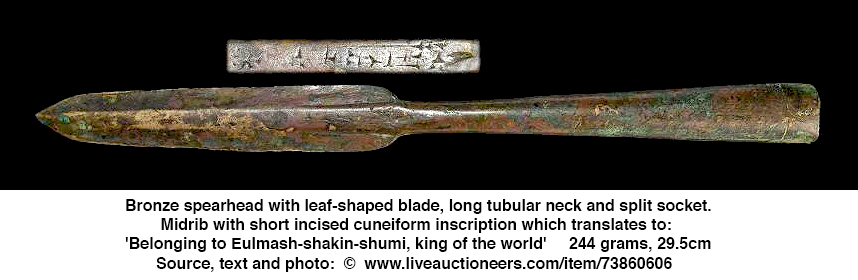
|
|||
| Eulmash-shakin-shumi | 1004 BC - 985 BC | Eulmash-shakin-shumi was the founder of the 6th Dynasty of Babylon, known as the Bῑt-Bazi Dynasty, after the Kassite tribal group from which its leaders were drawn. A small settlement near the Tigris in the 23rd century had been adopted by a minor Kassite clan by the 14th century, the name being co-opted as the ancestor figure for the tribe. In the midst of the turmoil inflicted by the Aramean migrations and the famines that drove them, Eulmaš-šākin-šumi seems to have seized the throne and possibly moved his capital to Kar-Marduk, a hitherto unknown location presumed to be less vulnerable to invasions of semi-nomads than Babylon. The Sun God Tablet of Nabu-apla-iddina relates that Ekur-šum-ušabši, the priest and seer appointed during the time of Simbar-šipak, complained that due to the “stress and famine under Kaššu-nādin-aḫi,” an intermediate monarch, "the temple offerings of Šamaš (had) ceased," prompting Eulmaš-šākin-šumi to divert flour and sesame wine from that allocated to the god Bel and a garden in the new city district of Babylon for ongoing provisions. The Dynastic Chronicle reports that 'he was buried in the palace of Kar-Marduk'. | |
| Ninurta-kudurri-usur I | 983 BC - 981 BC | Ninurta-kudurrῑ-uṣur I was the second king of the Bῑt-Bazi or 6th Dynasty of Babylon and he reigned for three years, according to the King List A. This was during an era of economic and political retrenchment. The Bīt-Abi-Rattaš kudurru from the reign of Nabû-mukin-apli, circa 974 BC – 939 BC, begins with a recollection of an earlier legal document from Kār-Marduk, which may have been his capital, dated to his second year. It concerns a manslaughter settlement, where one Arad-Sibitti has killed the female slave of Buruša the bow-maker, ironically with an arrow. The king pronounced judgement and commanded Arad-Sibitta to give the plaintiff seven slaves in compensation and this was witnessed by seven high-ranking witnesses, of whom three were of Kassite origin and one, Ammenna, the officer, a Hurrian. He may be represented by the eleventh king in the Prophecy A whose rule likewise endures for three years. This describes the apocalyptic events of the king’s reign with cities being destroyed, rebellion, hostility against Akkad, disconnection from the rites at the Ekur and Nippur, and fragmentary but ominous events involving the Amurru and weapons. He was succeeded by his brother Širikti-Šuqamuna. | |
| Shirikti-Shuqamuna | 981 BC | Shirikti-Shuqamuna succeeded his fellow 'son of Bazi' Ninurta-kudurrῑ-uṣur I, as 3rd king of the Bῑt-Bazi or 6th Dynasty of Babylon and exercised the kingship for just 3 months, an insufficient time to merit an official regnal year. He was the last monarch of the Bīt-Bazi dynasty, which had reigned for 20 years 3 months according to the King List A, and a contemporary of the Assyrian king Aššur-rabi II, 1012 BC – 971 BC. He was named for the Kassite god of war and of the chase, Šuqamuna, one of the two (with Šumalia) associated with the investiture of kings. The Dynastic Chronicle records that he was interred in a palace. | |
Elamite, 980–975 BC: A brief period of foreign rule. The Seventh Dynasty of Babylon, also known as the Elamite Dynasty, was a short-lived ruling line in the early 10th century BC (circa 980 BC). It consisted of a single ruler, Mār-bīti-apla-uṣur, who was of Elamite origin. 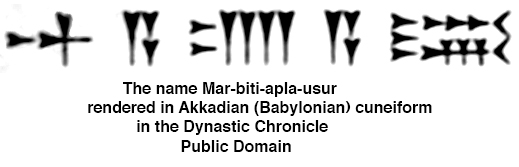
|
|||
| Mar-biti-apla-usur | 980 BC - 975 BC | The circumstances surrounding the fall of the previous Bazi dynasty and the ascendancy of Mar-biti-apla-usur are unknown. His name was wholly Akkadian and he was described as a remote descendant of Elam. There are no known rulers of Elam bearing Akkadian titles, but his reign coincides with a blank period in Elamite political history. He was a contemporary of Assyrian king Aššur-reš-iši II. His rule endured for six years and he was buried in the palace of Sargon suggesting an interment suitable for a rightful king. | |
The Eighth Dynasty of Babylon, 974 BC – 732 BC, often referred to in historical context as the Dynasty of E, was a period of relative instability and obscurity in the 8th century BC, following the Dynasty of Bazi and preceding the Ninth Dynasty (or Assyrian domination). It was characterised by weak native rule and the continued infiltration of Aramean and Chaldean tribes. 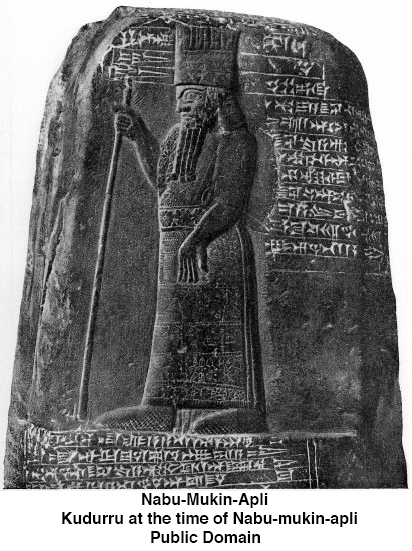
|
|||
| Nabu-Mukin-Apli | 974 BC - 939 BC | Nabu-Mukin-Apli founded Babylon’s 8th dynasty, the so-called Dynasty of E, and ruled for thirty-six years. The chronology of the Eighth Dynasty is fragmented, as primary sources like King List A are incomplete for this period. This era represents a low point in Babylonian history when the city was frequently under foreign influence or threat, particularly from Assyria and new West Semitic settlers. It serves as a transitionary period between the earlier, chaotic Kassite-influenced eras and the later, more powerful Neo-Babylonian Empire. The Synchronistic Kinglist records Nabu-Mukin-Apli as a contemporary of the Assyrian king Tiglath-Pileser II. His reign was plagued by Aramean invasions, resulting in Babylon being cut off from its agricultural hinterland for several years and consequently being unable to celebrate the new year festival. His reign falls in the midst of the Babylonian dark age and consequently his ancient sources are meagre. He is mentioned in the The Akitu festival, or New Year’s festival of Marduk and Nabû, was interrupted several times, indeed for a stretch of nine straight years, because the 'Aramaeans were belligerent'. While records are incomplete, Nabû-mukin-apli (ruled 36 years) is the best-documented king, known for stabilising the realm despite these threats. His younger son, Rīmūt-ilī, acted as šatam ekurrāti, overseer of the temples. He was succeeded by his other sons, firstly Ninurta-kudurri-uṣur II, for 8 months, and then Mar-biti-aḫḫe-idinna for an as yet undetermined period. | |
| Ninurta-kudurri-usur II | 939 BC | Ninurta-kudurrῑ-uṣur II, was the second king of the Dynasty of E, a sequence of mixed dynasties, of Babylon; he reigned for 8 months 12 days, according to the King List A. No contemporary documents survive for his reign or that of his successor, his younger brother, Mār-bῑti-aḫḫē-idinna. The Religious Chronicle may have been written during his reign, as it ends with events relating to the reign of his father although the only copy that we have is written in the Neo-Babylonian script and is consequently late. His reign was possibly too insignificant to warrant mention in the Eclectic Chronicle. | |
| Mar-biti-ahhe-iddina | 939 BC - 920 BC | Mar-biti-ahhe-iddina, the third of the sons of Nabu-mukin-apli, is known only from king lists, a brief mention in a chronicle and as a witness on a kudurru from his father. He took the throne after the death of his elder brother Ninurta-kudurri-utsur II, is almost completely unknown. He was first recorded as a witness to a property title in a kudurru inscription along with the signatures of his brothers Ninurta-kudurri-utsur II and Rimut-ili, a temple administrator, in the 25th year of the reign of his father Nabu-mukin-apli, more than ten years before his accession to the throne. The Synchronic History records him, like his father and elder brother, as contemporaries of the Assyrian king Tiglath-pileser II , which is consistent with the modern chronology of the time. However, we have no idea of the length and extent of his reign, and we do not know whether his successors to the throne were related to him. The reign of Mar-biti-ahhe-iddina may have ended considerably earlier than 920 BC, but it must be taken into account that the next king, Shamash-mudammik, somewhere around 905 BC, waged war with the Assyrian king Adad-nirari II, who came to the throne around 912 BC, and that no intermediate ruler is known between Mar-biti-ahhe-iddina and Shamash-mudammik. | |
| Shamash-mudammiq | 914 BC - 901 BC | Shamash-mudammiq succeeded Mar-biti-ahhe-iddina as the King of Babylon around 914 BC or by some accounts shortly after 920 BC. He ruled during a period of conflict with the Assyrian Empire. He was the 4th king of Babylon in a sequence designated as the Dynasty of E and ruled during the latter part of the 10th century BC. He was contemporary with the Assyrian king Adad-Nārāri II with whom he sparred. Of unknown ancestry, the duration of his reign is equally uncertain. That he followed Mār-bῑti-áḫḫē-idinna is indicated by the sequence on the Assyrian Synchronistic King List, but Assyrian contact was scanty and this may merely record those rulers who had interacted, omitting those who did not. His rule marks the resumption of contacts characterised as 'battles, alliances, shifting of borders, and (later) diplomatic marriages that seem to have bound the two countries together. He was defeated by the Assyrian king Adad-nirari II around 901 BC, which is the main fixed chronological reference for his reign. | |
| Nabu-shuma-ukin I | 900 BC - 887 BC | Nabû-šuma-ukin I, was the 5th king listed in the sequence of the so-called dynasty of E, possibly a mixed series of dynasties, that ruled over Babylon during the early Iron Age. His rule marks a temporary resurgence in the fortunes of Babylonia, which was to last on through his son and successor, Nabû-apla-iddina’s reign and the two kings who followed in this four-generation dynasty. The circumstances of his ascendancy and his relationship with his predecessor are not known. The beginning of his reign was marked by war with Assyria when Adad-Nārāri II swept down on his second campaign and supposedly defeated him according to the Assyrian version, apparently sacking several cities and hauling their 'vast booty' back home. The outcome may not have been quite so one-sided as described as the Assyro-Babylonian border was pushed back north to the basin of the Lesser Zab. His relations for the remainder of Adad-Nārāri’s time and with the next Assyrian monarch, Tukulti-Ninurta II, in contrast were good, and he made an entente cordiale and exchanged daughters in marriage with one of them, the Synchronistic Chronicle being too fragmentary here to be sure which one, auguring in an extended period of peaceful relations. | |
| Nabu-apla-iddina | 886 BC - 853 BC | Nabu-apla-iddina was the sixth king of the Dynasty E of Babylon and he reigned for at least thirty-two years. During much of Nabû-apla-iddina's reign Babylon faced a significant rival in Assyria under the rule of Ashurnasirpal II. Nabû-apla-iddina was able to avoid both outright war and significant loss of territory. There was some low level conflict, including a case where he sent a party of troops led by his brother to aid rebels in Suhu. Later in his reign Nabu-apla-iddina agreed to a treaty with Ashurnasirpal II’s successor Shalmaneser III. Internally Nabu-apla-iddina worked on the reconstruction of temples and something of a literary revival took place during his reign with many older works being recopied. The 9th century BC was marked by a recovery of sorts after the terrible instability of the preceding hundred and fifty years when Aramaean tribes had wantonly raided into Mesopotamia. He was the second of four successive generations of a single family to rule. His father, Nabû-šuma-ukin I, had preceded him and he was to be succeeded by his son, Marduk-zakir-šumi I. The Synchronistic Kinglist gives his Assyrian contemporary as Aššur-nāṣir-apli II although his reign extended on into that of Šulmānu-ašarēdu III. He provided troops to the state of Suḫu in the middle Euphrates valley as part of its 878 BC revolt against Aššur-nāṣir-apli II. Kudurru, the governor of the fortress of Suru had defiantly refused to pay the Assyrians tribute, provoking their wrath. Nabû-apla-iddina's own brother Zabdanu and the diviner Bel-apli-iddina led the army of 3000 and following their defeat were taken prisoner. Although Aššur-nāṣir-apli claimed to have conquered the border fortresses Hirimmu and Harutu in his own inscriptions, this may be a restatement of his father, Tukulti-Ninurta II’s campaigns. His reign marks the last time a governor of Isin was to appear as a prominent official in a legal document, and the roles of Kassites were to be central to the monarchy, occupying high positions at court. The province of Chaldea in southern Babylonia was first mentioned and the šakin temi begins to serve as regional governor. There was a shift in fashion, where, for example, the feathered crown is replaced by a peaked dome as a headdress of the king. His inscriptions adorn perhaps five kudurrus, a possession inscription of his eldest son, and he is referenced in three Assyrian kinglists and two chronicles. Towards the end of his reign he concluded a treaty with Šulmānu-ašarēdu III which was to prove instrumental in stabilising his successor Marduk-zakir-šumi I’s rule, following the revolt of his brother, Marduk-bēl-ušati. His reign is mentioned in a later copy of an offering list of aromatics used in the cult of Marduk in the Esagila at Babylon, and in a contemporary temple ordinance tablet distributing meats in the Eanna temple in Uruk. There is some evidence for a literary revival, with fresh editions of the Utukkū Lemnūtu series and the Sakikkū texts prepared, and for the sharing of a scribe between the Babylonian and Assyrian courts. Kabti-ilani-Marduk’s work, the Epic of the plague god Erra, is sometimes dated to his reign and is certainly of this period. | |
| Marduk-zakir-shumi I | 853 BC - 819 BC | Marduk-zakir-shumi I was a contemporary of the Assyrian kings, Salmānu-ašarēdu III (commonly known as Shalmaneser III) (859–824 BC) and Šamši-Adad V (824–811 BC) with whom he was allied. There are few contemporary inscriptions bearing witness to his reign. During his campaign, Salmānu-ašarēdu captured the city of Baqani, extracting tribute from Adini of Bit-Dakkuri, also from Mušallim-Marduk of the Amukani and the leader of the Yakin tribes, the earliest attestation of these Chaldean groups, and made a pilgrimage to Babylon where he recounted 'I ascended to Esagila, the palace of the gods, the abode of the king of all'. He practiced his religious devotions at other cultic shrines as his Black Obelisk recalls 'I went to the great urban centres. I made sacrifices in Babylon, Borsippa and Kutha'. A relief from the front of his throne base depicts him gripping Marduk-zâkir-šumi’s hand in a public display of Assyro-Babylonian friendship. The kings are flanked by beardless youths identified as the crown princes and presumed to be Šamši-Adad V and Marduk-balāssu-iqbi, who would eventually come to conflict. | |
| Marduk-balassu-iqbi I | 818 BC - 813 BC | Marduk-balassu-iqbi I was the 8th king of the Dynasty of E of Babylon. He was the successor of his father, Marduk-zākir-šumi I, and was the 4th and final generation of Nabû-šuma-ukin I's family to reign. He was contemporary with his father's former ally, Šamši-Adad V of Assyria, who may have been his brother-in-law, who was possibly married to his (Marduk's) sister Šammu-ramat, the legendary Semiramis, and who was to become his nemesis. He was recorded as a witness on a kudurru dated to his father's 2nd year, 25 years before he ascended the throne, suggesting he was fairly elderly when he assumed power. He seems to have made his capital at Gannanāti, a town on the Diyāla River. He engaged in construction activity in Seleucia, and exerted control over territory encompassing both Dēr and Nippur. His officials, like him, seem to have received their positions through inheritance, such as Enlil-apla-uṣur, the šandabakku or governor of Nippur, and the sons of Tuballiṭ-Ešdar, the sukkallus (court personnel) and šākin ṭēmi (a regional governor), suggesting weak central authority and some local autonomy in the provinces. | |
| Baba-aha-iddina | 812 BC | Baba-aha-iddina was the successor to Marduk-balassu-iqbi, the king of Babylon. Following the defeat and capture of Marduk-balassu-iqbi by the Assyrian king Shamshi-Adad V in 813 BCE, Baba-aha-iddina took the throne for a brief period before he was also captured during subsequent Assyrian campaigns. He was captured in 813 BCE by Shamshi-Adad V of Assyria. Šamši-Adad V encircled the city and he himself took it. He took Bāba-aḫa-iddina with his wealth and palace treasures to Assyria. He went up to Cutha, Babylon and Borsippa an) performed the sacred services. He went down to Chaldea. In Chaldea he received the tribute of its kings. His officers collected gifts from Karduniaš. Together they established a permanent boundary line. Šamši-Adad made no attempt to annex Babylonia which remained independent, though kingless for a period, but returned to Assyria where he spent his last year. | |
| 'Ninurta-apla-X' | Before 790 BC | Baba-aha-iddina was succeeded by a period of chaos, often termed an interregnum or represented by, in this case, the placeholder 'Ninurta-apla-X'. Placeholders are used by scholars, and have been for thousands of years. For example, ancient Egyptian scribes used specific placeholder names, 'Hudjefa' or 'Sedjes', which literally mean 'erased' or 'missing', to designate older pharaohs in king lists whose names had been lost. During the interregnum there was no king for several years. The only records of events during this period come from the chronicles of the Assyrian eponym dating system. The successor to 'Ninurta-apla-X' (whoever that might have been, and whatever his actual name might have been) was the similarly obscure king, Marduk-bēl-zēri. 'Ninurta-apla-X' is a placeholder used by Assyriologists to represent an incomplete ancient Mesopotamian royal or official name, typically from the Neo-Assyrian period. It indicates a name beginning with the god Ninurta (the deity of agriculture, war, and hunting) followed by 'apla' (son) and an unknown or missing final element, designated as 'X'. We still use placeholders now for things which we do not know the proper names for, like geographical/site names - many cultures are named after the modern village, mountain, or site where their remains were first excavated. Examples include Göbekli Tepe (Turkey) or Hopewell (Ohio), which refer to archaeological sites rather than the original name of the people. Also, cultures are often identified by their artefacts, such as the Bell Beaker Culture or Linear Pottery Culture. | |
| Marduk-bel-zeri | 790 BC - 780 BC | Marduk-bel-zeri was one of the kings of Babylon during the turmoil following the Assyrian invasions of Šamši-Adad V. He is identified on a Synchronistic King List fragment as Marduk-[bēl]-x, which gives his place in the sequence and reigned around the beginning of the 8th century BC. He was a rather obscure monarch and the penultimate predecessor of Erība-Marduk who was to restore order after years of chaos. He is known from a single economic text from the southern city of Udāni dated to his accession year. This city was a satellite cultic center to Uruk, of uncertain location but possibly near Marad, later to be known as Udannu. He is tentatively restored to the Dynastic Chronicle where he is described as a soldier but his circumstances are otherwise unknown. His successor was Marduk-apla-uṣur. | |
| Marduk-apla-usur | 780 BC - 769 BC | Marduk-apla-usur was an 8th century BC Chaldean tribal leader who ruled as King of Babylon after the reign of Marduk-bēl-zēri. He is known only from three inscriptions and ruled during a period of chaos. He should not be confused with the Marduk-apla-uṣur who ruled Suḫi on the middle Euphrates and paid tribute to Salmānu-ašarēdu III a generation or so earlier. His Assyrian contemporaries were probably Salmānu-ašarēdu IV (783 - 773 BC) and/or Ashur-dan III (773 - 755 BC) and the latter is known to have campaigned in northern Babylonia on three occasions: 771 BC (against Gannanāti), 770 BC (against Marad) and 767 BC (against Gannanāti again). Into the vacuum created by the devastation, the southern Chaldeans were able to rise to power and he seems to have been the first member of the tribal group to have made pretensions to the Babylonian throne. His place in the sequence of kings is known from a Synchronistic King List fragment. His length of reign and dynastic affiliation are unknown, as he was recorded as belonging to a separate affiliation from his predecessor and successor, but the Dynastic Chronicle records that 'the dynasty of Chaldea was terminated. Its kingship was transferred to the Sealand' and, as his successor was Erība-Marduk, the archetypal ancestor figure of the later Chaldean monarchs, it is surmised his origins were with a different Chaldean group than that of Erība-Marduk's Bīt-Yakin tribe. He is mentioned in a fragmentary Neo-Babylonian narrative text from Uruk ('The Crimes and Sacrileges of Nabu-šuma-iškun') which provides no further enlightenment about his time apart from a passing observation that 'forced labor and corvée (unpaid labour owed by a vassal to his feudal lord) were imposed'. His successor was Erība-Marduk. | |
| Erība-Marduk | 769 BC - 761 BC | Erība-Marduk was the king of Babylon, very speculatively during circa 769 BC – 761 BC. He was one of three Chaldaean tribal leaders to occupy the Babylonian throne during the course of the 8th century and would be looked back on as the ancestor figure during future reigns of members of this group. A member of the Bīt-Yakin tribe, who was later to be given the title 're-establisher of the foundations of the land', was credited with restoring stability to the country after years of turmoil. He participated in the Akītu, or new year festival, first in the beginning of the second year of his reign, as his rule extended into northern Babylonia and he suppressed the incursions of nomads around Babylon and Borsippa, restoring fields and orchards to their former owners. An inscription of Esarhaddon of Assyria (681 BC – 669 BC), relates how part of the temple of Ištar in the Eanna at Uruk, the shrine of the goddess Nanaya originally built by Nazi-Maruttaš in the 13th century, had been restored by Erība-Marduk. Not all restorations, however, were to the liking of his successors. According to the Harran stele of Nabonidus (555 BC –539 BC), his reign witnessed a sacrilegious reform of the cult of Ištar (bēltu ša Uruk, 'lady of Uruk'), when the people of Uruk replaced her statue with an unsuitable one, unyoking its team of lions and removing its shrine. This may have been part of a program of suppressing the licentious cults of the goddesses in southern Babylonia. His successor was Nabû-šuma-iškun | |
| Nabu-shuma-ishkun | 761 BC - 748 BC | Nabu-shuma-ishkun was king of Babylon, speculatively circa 761 – 748 BC , and ruled during a time of great civil unrest. He came from the Bīt-Dakkūri tribe, a Chaldean group apparently unrelated to that of his immediate predecessor, Erība-Marduk. An inscription of the governor of Borsippa, Nabû-šuma-imbi highlights his weakness and the autonomy of his regional officials. A barrel cylinder records the struggle over the control of their fields in the face of the incursions of marauders from Babylon and Dilbat, as well as Chaldeans and Arameans. At night, the city streets and its temple area were transformed into a battleground. During the fifth and sixth years of the king, the strife was so great that the cultic idol of Nabû was prevented from participating in the Akītu, or new year festival in Babylon. The coincidental recording of years five and six of a no longer legible ruler in the Chronicle of the Market Prices has led this reference to be assigned to him. In the king’s eighth year, Nabû-šuma-imbi was able to install a certain Nabû-mutakkil as a temple official[i 1] and repair the Ezida temple of Nabû storehouses. He is the main subject of a chronicle,[i 7] "The Crimes and Sacrileges of Nabu-šuma-iškun", uncovered in Uruk in a Seleucid era dwelling belonging to the exorcist Anu-ikṣur on the Parthian mound southeast of the Eanna complex, whose underlying theme is his violation of all moral and legal principles and consequentially – and his ignominious demise. His crimes included 'burning alive sixteen Cutheans at Zababa's gate in the heart of Babylon' and 'he committed insult and unspeakable slander' of a certain Iltagal-il of the town Dur-ša-Karbi, and 'a leek, a thing forbidden in the Ezida, he brought to the temple of Nabû and gave to eat to the one 'entering the temple'(i.e. the priest)' apparently an unforgivable act. Unfortunately the Chronicle was damaged in antiquity so how he met his comeuppance is not preserved. The length of his reign is uncertain, as it is not preserved in chronicle or king list references, but his reign is known to have ended in 748 BC as the chronology is fixed from the reign of Nabû-Nasir onward, and there is a legal text recording the sale of a plot of land, and a grain receipt dated to his tenth year, and two economic texts to his thirteenth year. His successor was Nabû-Nasir. | |
| Nabonassar | 747 BC - 734 BC | Nabonassar deposed a foreign Chaldean usurper named Nabu-shuma-ishkun, bringing native rule back to Babylon after twenty-three years of Chaldean rule. His reign saw the beginning of a new era characterised by the systematic maintenance of chronologically precise historical records. Both the Babylonian Chronicle and the Ptolemaic Canon begin with his accession to the throne. He was contemporary with the Assyrian kings Aššur-nirarī V (755 BC – 745 BC) and Tiglath-Pileser III (745 BC – 727 BC), under the latter of whom he became a vassal, and the Elamite kings Humban-Tahrah I (reigned until 743 BC) and Humban-Nikaš I (742 BC – 717 BC). Nothing is known of his provenance or origin, although it appears he was a native Mesopotamian. His three predecessors were from the migrant Chaldean tribes settled in the far south east of Babylonia since the 9th century BC. The Dynastic Chronicle may have been composed during his reign as it records the succession of kings from the antediluvian era down to his immediate predecessor, Nabû-šuma-iškun. It records that the 'dynasty of Chaldea was terminated' (with Nabû-šuma-iškun) and 'its kingship was transferred', but the remainder is lost. He may also have commissioned a vituperative chronicle which vilifies his predecessor for his sacrilegious actions and the Chronicle of the Market Prices which mentions the volatile costs of various commodities in reigns up until that of his predecessor. His name appears in the Eclectic Chronicle but the context has not been preserved. His reign marks the reform of the Babylonian calendar, introducing regular calculated intercalary months, the eighteen-year cycle texts (the 223-month Saros Cycle, named for Edmund Halley’s misreading of a passage in Pliny) and perhaps even the zodiac. Berossus of Kos reported, in an account preserved by Syncellus, that it was from the reign of Nabû-nāṣir onward that the movements and duration of the stars were recorded. He noted in his work Babyloniaca that: 'He gathered the records of his predecessors and destroyed them, thus ensuring that the history of the Chaldean kings began with him.' According to Claudius Ptolemy in his work Almagest, this gave rise to an era beginning at noon on 26 February 747 BC, when the Anno Nabonassari began, but prior to the Hellenistic period there is no trace of this era. The Babylonian Chronicle, covering the years 747 BC to 668 BC, the best preserved exemplar of this genre, was possibly collated from Babylonian astronomical diaries, although the earliest exemplar of these dates to 652 BC. The lists of celestial phenomena started with the lunar eclipse of 747 BC – 746 BC (6 February 747 BC), a spectacular conjunction of the moon and the planets which may have inspired the commencement of recording of accurate astronomical observations. The country regained from Nabû-šuma-iškun was one riven by internal divisions and conflicts with the immigrant tribes of Arameans and Chaldeans, where the central authority was greatly diminished. In Nabû-nāṣir's third year, the Assyrian general Tukultī-apil-Ešarra, better known under the Hebraic rendition 'Tiglath-Pileser III', came to power in the Neo-Assyrian Empire, overthrowing the existing regime, and in the first of two campaigns to secure his southern and eastern frontiers invaded Babylonia. During the first of these (745 BC) he sacked Rabbilu and Hamranu, abducted the gods of Šapazza, subjugated the numerous Aramean and Chaldean tribes, and destroyed the capital of the Chaldean tribe the Bit-Shilani, Sarrabanu, impaling its leader, Nabû-ušabši. His forces skirted the metropolitan areas of Dur-Kurigalzu and Sippar and may have reached as far as the region of Nippur. Whether or not he actually solicited military aid from the Assyrians, Nabû-nāṣir seems to have been the main beneficiary of these actions as his regime was stabilised and he was subsequently able to put down a revolt in Borsippa. His hold over Uruk remained tenuous, as two local dignitaries complained of the neglect of the Akītu temple in their inscription[i 7] commemorating their own restorations, usurping monarchic privilege. Twenty-three tablets survive dealing with agricultural production, animal husbandry, weaving and sales from his first to his fourteenth year and these seem to represent a recovery in economic activity. A letter archive excavated in 1973 in Nippur contains the correspondence between Kudurru the šandabakku, or governor, of Nippur and an individual of this name who is greeted as 'brother', which may be him. He is recorded as having succumbed to illness and died in his palace during the fourteenth year of his reign. He was succeeded by his son, Nabû-nādin-zēri, the only known hereditary succession in Babylonia in a period from 810 BC to the rise of the Neo-Babylonian Empire in 626 BC. His successor was Nabû-nādin-zēri. | |
| Nabu-nadin-zeri | 733 BC - 732 BC | Nabu-nadin-zeri's accession followed shortly after the first incursions of the newly emboldened Neo-Assyrian state. He was one of the kings who were contemporary with Tukultī-apil-Ešarra III, the Assyrian king who would later (729 BC) go on to conquer Babylon. In the second year of his reign, he was toppled and killed in an insurrection led by a provincial official named Nabû-šuma-ukīn, who in turn was to retain the throne for little more than one month. There are no known texts from his reign. The overthrow of his dynasty and its replacement by a usurper may have provided Tukultī-apil-Ešarra with the excuse to invade. His successor was Nabû-šuma-ukīn II. | |
| Nabu-suma-ukin II | 732 BC | Nabu-suma-ukin II is only known from the Kinglist A, was a usurper and briefly king of Babylon for one month and two days during 732 BC before he was swept aside by his successor, Nabû-mukin-zēri. His reign was so fleeting he was omitted from the Ptolemaic Canon. His Assyrian contemporary was Tukultī-apil-Ešarra III who was too distracted campaigning in Syria to react to political events. He came to power as a disaffected former provincial governor leading a rebellion against Nabû-nādin-zēri, the son and successor of Nabû-Nasir. He was deposed and replaced by the Chaldean chief, Nabû-mukin-zēri, of the Bīt-Amukani tribe. | |
/ Dynasty IX (Assyrian) The Ninth Dynasty of Babylon, or Dynasty IX (Assyrian) refers to a specific period in the Babylonian King List rather than a dynasty based in the Assyrian heartland itself. This period, which spanned roughly from 732 BC to 626 BC, represents the time when Babylon was under direct Assyrian control, domination, or vassalage during the Neo-Assyrian Empire. The first king was Nabu-mukin-zeri. 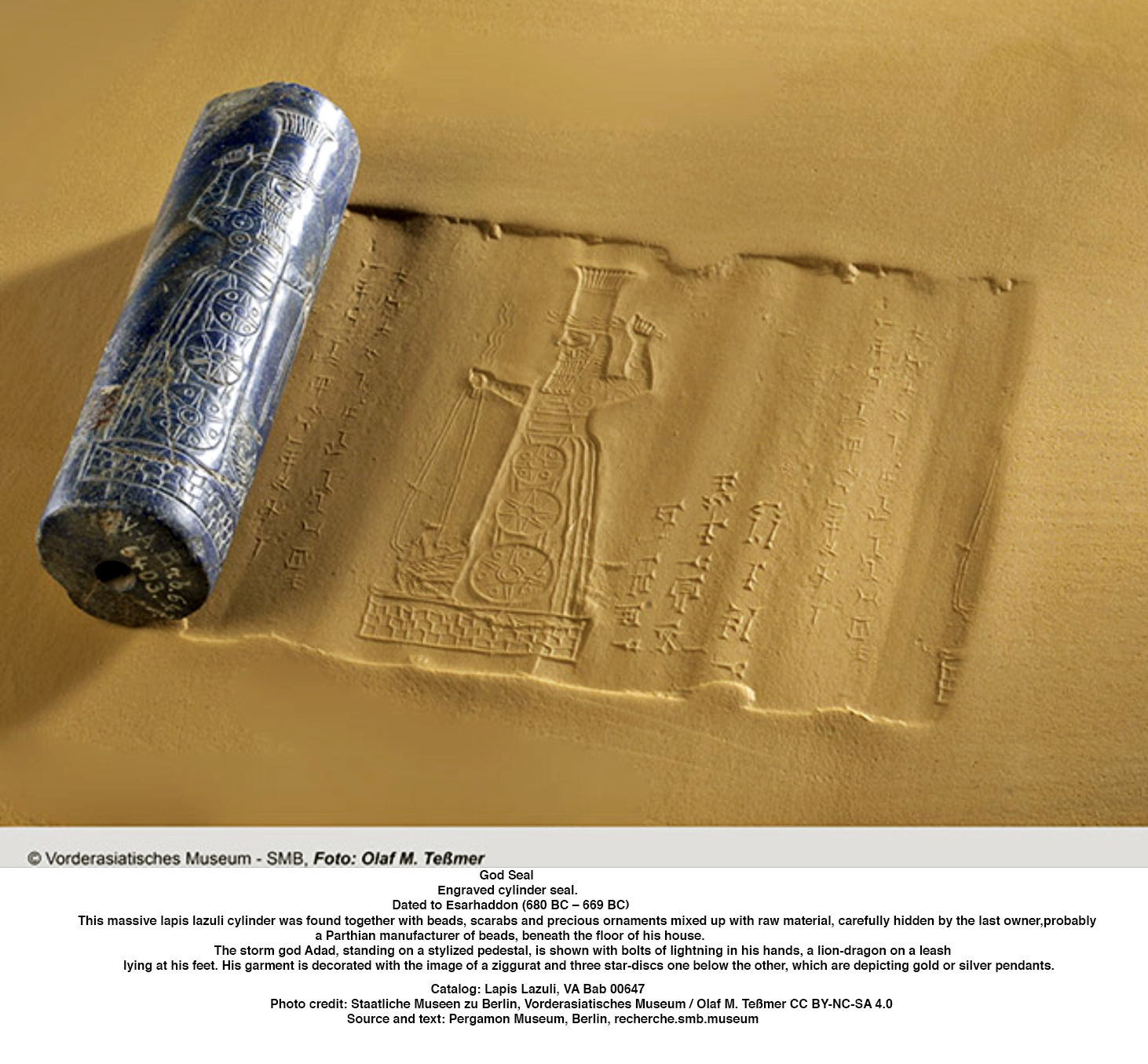
|
|||
| Nabu-mukin-zeri | 732 BC - 729 BC | Nabû-mukin-zēri was king of Babylon 732–729 BC. His reign was brought to its eventual end by the capture of the stronghold of Šapia by the forces of the Assyrian king Tukultī-apil-Ešarra III (Tiglath-Pileser III) (745–727 BC). The chief of the Chaldean Amukanu tribe in southern Babylonia, he took advantage of the instability which attended the revolt against Nabû-nādin-zēri and deposed its leader, Nabû-šuma-ukîn II. The fortuitous discovery in 1952 of a cache of diplomatic correspondence in the chancery offices of the Northwest Palace in a room designated as ZT 4 at Kalhu, modern Nimrud, by archaeologists led by Max Mallowan, has shed much light on events of the Mukin-zēri rebellion. Of the more than three hundred tablets uncovered, a group of more than twenty letters and fragments concerned the events in Babylonia which led to Assyrian intervention and subsequent annexation of the region around 730 BC. They paint a picture of Babylonia riven by splits and rivalries among the various Aramaic, Babylonian and Chaldean factions. Soon after the Amukanite removed his predecessor from the throne and seized it for himself, Tukultī-apil-Ešarra directed his efforts to the removal of the usurper using all available means at his disposal. A letter describes the outcome of a mission to Babylon to win over the support of the city's elders. The Assyrian delegation of two officers, Šamaš-bunaya and Nabû-namir, was forced to conduct its diplomacy outside the gates of the city, in full view of Nabû-mukin-zēri's representative, Asinu. 'Why do you act in a hostile manner towards us for their sake? They belong among the Chaldeans! It is the Assyrian king who can show favours towards Babylon, maintaining your civic privileges!' Tukultī-apil-Ešarra's invasion of 731 BC caused Nabû-mukin-zēri to flee Babylon for Šapia, his stronghold in the south, where he remained holed up while the Assyrian forces devastated its surroundings and felled its date palms. The Chronicle on the Reigns from Nabû-Nasir to Šamaš-šuma-ukin describes the final outcome: 'In the third year, the Assyrian king having come down to Akkad, he ravaged Bīt-Amukanu and captured Nabû-mukin-zeri. He subsequently ascended the throne in Babylon himself. | |
| Tiglath-Pileser III | 729 BC - 727 BC | Tiglath-Pileser III, the King of Assyria, succeeded Nabu-mukin-zeri as King of Babylon in 729 BC. After conquering Babylon and defeating Nabu-mukin-zeri, who was a Chaldean warlord, Tiglath-Pileser III assumed direct control, uniting the thrones of Assyria and Babylon until his death in 727 BC. Tiglath-Pileser III was one of the most prominent and historically significant Assyrian rulers. He ended a period of Assyrian stagnation, introduced numerous political and military reforms, and doubled the lands under Assyrian control. Because of the massive expansion and centralisation of Assyrian territory and the establishment of a standing army, some researchers consider Tiglath-Pileser's reign to mark the actual transition of Assyria into an empire. The reforms and methods of control introduced under Tiglath-Pileser laid the groundwork for policies enacted not only by later Assyrian kings but also by later empires for millennia after his death. After Tiglath-Pileser III's short reign, he was succeeded by his son, Shalmaneser V. | |
| Shalmaneser V | 727 BC - 722 BC | Shalmaneser V's brief reign is poorly known from contemporary sources, he remains known for the conquest of Samaria and the fall of the Kingdom of Israel, though the conclusion of that campaign is sometimes attributed to his successor, Sargon II, instead. Shalmaneser V is known to have campaigned extensively in the lands west of the Assyrian heartland, warring not only against the Israelites, but also against the Phoenician city-states and against kingdoms in Anatolia. Though he successfully annexed some lands to the Assyrian Empire, his campaigns resulted in long and drawn-out sieges lasting several years, some being unresolved at the end of his reign. The circumstances of his deposition and death are not clear, though they were likely violent, and it is unlikely that Sargon II was his legitimate heir. It is possible that Sargon II was entirely unrelated, which would make Shalmaneser V the final king of the Adaside dynasty, which had ruled Assyria for almost a thousand years. Shalmaneser V was deposed in 722 BC and replaced as king by Sargon II. The exact circumstances surrounding the struggle for the throne are not clear, but were likely violent. An awkward succession is clearly indicated by the fact that out of all of Sargon's numerous preserved inscriptions, only a single one mentions Shalmaneser V's fate in any detail, recording him as a godless tyrant who robbed Assur, Assyria's ceremonial centre, of its traditional rights and privileges. | |
| Sargon II | 722 BC - 705 BC | Sargon II is generally believed to have become king after overthrowing Shalmaneser V (r. 727–722), probably his brother. He is typically considered the founder of the Sargonid dynasty. Modelling his reign on the legends of the ancient rulers Sargon of Akkad, from whom Sargon II likely took his regnal name, and Gilgamesh, Sargon aspired to conquer the known world, initiate a golden age and a new world order, and be remembered and revered by future generations. Over the course of his seventeen-year reign, Sargon substantially expanded Assyrian territory and enacted important political and military reforms. An accomplished warrior-king and military strategist, Sargon personally led his troops into battle. By the end of his reign, all of his major enemies and rivals had been either defeated or pacified. Among Sargon's greatest accomplishments were the stabilisation of Assyrian control over the Levant, the weakening of the northern kingdom of Urartu, and the reconquest of Babylonia. From 717 BC to 707 BC, Sargon constructed a new Assyrian capital named after himself, Dur-Sharrukin ('Fort Sargon'), which he made his official residence in 706 BC. Sargon considered himself divinely mandated to maintain justice. Like other Assyrian kings, Sargon at times enacted brutal punishments against his enemies, but there are no known cases of atrocities against civilians from his reign. He worked to assimilate and integrate conquered foreign peoples into the empire and to extend to them the same rights and obligations as native Assyrians. He forgave defeated enemies on several occasions and maintained good relations with foreign kings and with the ruling classes of the lands he conquered. Sargon also increased the influence and status of both women and scribes at the royal court. Sargon embarked on his final campaign, against Tabal in Anatolia, in 705. He was killed in battle, and the Assyrian army was unable to retrieve his body, preventing a traditional burial. According to ancient Mesopotamian religion, he was cursed to remain a restless ghost for eternity. Sargon's fate was a major psychological blow for the Assyrians and damaged his legacy. Sargon's son Sennacherib was deeply disturbed by his father's death and believed that he must have committed some grave sin. As a result, Sennacherib distanced himself from Sargon. Sargon was barely mentioned in later ancient literature and nearly completely forgotten until the ruins of Dur-Sharrukin were discovered in the 19th century. He was not fully accepted in Assyriology as a real king until the 1860s. Due to his conquests and reforms, Sargon is today considered one of the most important Assyrian kings. | |
| Sennacherib | 705 BC - 681 BC | Following Sargon II's death in battle in 705 BC, Sennacherib assumed the throne, moved the capital to Nineveh, and reigned during a period of significant expansion and military campaigns, including campaigns against Judah. Immediately upon taking power, he abandoned his father's capital city, Dur-Sharrukin, and moved the royal residence to Nineveh, separating himself from his father's legacy. The second king of the Sargonid dynasty, Sennacherib is one of the most famous Assyrian kings for the role he plays in the Hebrew Bible, which describes his campaign in the Levant. Other events of his reign include his destruction of the city of Babylon in 689 BC and his renovation and expansion of the last great Assyrian capital, Nineveh. After the Babylonians and Elamites captured and executed Sennacherib's eldest son Aššur-nādin-šumi, whom Sennacherib had proclaimed as his new vassal king in Babylon, Sennacherib campaigned in both regions, subduing Elam. Because Babylon, well within his own territory, had been the target of most of his military campaigns and had caused the death of his son, he destroyed the city in 689 BC. Sennacherib transferred the capital of Assyria to Nineveh, where he had spent most of his time as crown prince. To transform Nineveh into a capital worthy of his empire, he launched one of the most ambitious building projects in ancient history. He expanded the size of the city and constructed great city walls, numerous temples and a royal garden. His most famous work in the city is the Southwest Palace, which Sennacherib named his 'Palace without Rival'. In 681 BC, Arda-Mulissu and his brother Nabu-shar-usur murdered Sennacherib, hoping to seize power for themselves. Babylonia and the Levant welcomed his death as divine punishment, while the Assyrian heartland probably reacted with resentment and horror. Arda-Mulissu's coronation was postponed, and Esarhaddon raised an army and seized Nineveh, installing himself as king as intended by Sennacherib. | |
| Esarhaddon | 680 BC - 669 BC | Esarhaddon was the third king of the Sargonid dynasty, and is most famous for his conquest of Egypt in 671 BC, which made his empire the largest the world had ever seen, and for his reconstruction of Babylon, which had been destroyed by his father. Esarhaddon's rise to the throne was difficult, he first had to defeat his brothers in a six-week-long civil war. His brothers' attempted coup had been unexpected and troublesome for Esarhaddon, and he would be plagued by paranoia and mistrust for his officials, governors and male family members until the end of his reign. As a result of this paranoia, most of the palaces used by Esarhaddon were high-security fortifications located outside of the major population centers of the cities. Also perhaps resulting from his mistrust for his male relatives, Esarhaddon's female relatives, such as his mother Naqiʾa and his daughter Šērūʾa-ēṭirat, were allowed to wield considerably more influence and political power during his reign than women had been allowed in any previous period of Assyrian history, with the possible exception of Sammuramat in the 9th century BC. Despite a relatively short and difficult reign, and being plagued by paranoia, depression and constant illness, Esarhaddon remains recognised as one of the greatest and most successful Assyrian kings. He quickly defeated his brothers in 681, completed ambitious and large-scale building projects in both Assyria and Babylonia, successfully campaigned in Media, Persia, Elam, the Arabian Peninsula, Anatolia, the Caucasus, and the Levant, defeated the Kushite Empire and conquered Egypt and Libya, enforced a vassal treaty upon the Medes and Persians and ensured a peaceful transition of power to his two sons and heirs Ashurbanipal as ruler of the empire and Šamaš-šuma-ukin as king of Babylonia after his death. | |
| Ashurbanipal | 668 BC - 631 BC | Ashurbanipal succeeded his father Esarhaddon as the king of the Neo-Assyrian Empire, reigning from 668 BC to roughly 631 BC. To avoid succession disputes, Esarhaddon appointed Ashurbanipal as king of Assyria, while his brother, Shamash-shum-ukin, was appointed king of Babylon. Ashurbanipal is generally remembered as the last great king of Assyria. He inherited the throne as his father Esarhaddon‘s favored heir. His 38-year reign was among the longest of any Assyrian king. Though sometimes regarded as the apogee of ancient Assyria, his reign also marked the last time Assyrian armies waged war throughout the ancient Near East and the beginning of the end of Assyrian dominion over the region. Ashurbanipal is chiefly remembered today for his cultural efforts. A patron of artwork and literature, Ashurbanipal was deeply interested in the ancient literary culture of Mesopotamia. Over the course of his long reign, Ashurbanipal utilised the massive resources at his disposal to construct the Library of Ashurbanipal, a collection of texts and documents of various different genres. Perhaps comprising over 100 000 texts at its height, the Library of Ashurbanipal was not surpassed until the construction of the Library of Alexandria, several centuries later. The more than 30 000 cuneiform texts that have survived from the library are a highly important source on ancient Mesopotamian language, religion, literature and science. Artwork produced under Ashurbanipal was innovative in style and motifs and is regarded to possess an 'epic quality' otherwise absent from much of the art produced under previous kings. Ashurbanipal is recognised as one of the most brutal Assyrian kings. He was one of the few rulers to boast of his gory massacres of rebellious civilians. His extensive destruction of Elam has been described as a genocide. The Assyrians won many battles under Ashurbanipal, campaigning further from the Assyrian heartland than ever before, but several of his campaigns achieved little strategic advantage. Ashurbanipal failed to maintain control of Egypt, and his wars in Arabia cost time and resources without establishing longterm Assyrian control. His extensive sack of Babylon after defeating Shamash-shum-ukin weakened the resources of the empire and fanned anti-Assyrian sentiment in southern Mesopotamia, perhaps contributing to the rise of the Neo-Babylonian Empire five years after Ashurbanipal's death. Whether Ashurbanipal's policies led to the fall of the Assyrian Empire only two decades after his death is disputed in modern Assyriology. | |
| Ashur-etil-ilani | 631 BC - 627 BC | Under Ashur-etil-ilani's rule, the empire quickly began to decline, with Ashur-etil-ilani's reign marking the start of a period of instability leading to the collapse of the empire. Aššur-etil-ilāni is an obscure figure with a brief reign from which few inscriptions survive. Because of this lack of sources, very little concrete information about the king and his reign can be deduced. It is possible that Aššur-etil-ilāni was a weak ruler as there are no records of the king ever undertaking a military campaign or going on a hunt, activities previous Assyrian kings would famously do very often; this, in turn, may have helped to entice some of Assyria's vassals, such as the Kingdom of Judah, to break free from Assyrian control and begin to act independently. Aššur-etil-ilāni was succeeded by his brother Sîn-šar-iškun under uncertain, though not necessarily violent, circumstances. The spread of inscriptions by Aššur-etil-ilāni in Babylonia suggest that he exercised the same amount of control in the southern provinces as his father Ashurbanipal had, having a vassal king (Kandalanu) but exercising actual political and military power there himself. His inscriptions are known from all the major cities, including Babylon, Dilbat, Sippar and Nippur. Too few inscriptions of Aššur-etil-ilāni survive to make any certain assumptions about his character. Excavations of his palace at Kalhu, one of the more important cities in the empire and a former capital, may indicate that he was less boastful than his father as it had no reliefs or statues similar to those that his predecessors had used to illustrate their strength and success. The lack of such depictions may partly be because there are no records of Aššur-etil-ilāni ever conducting a military campaign or going on a hunt. His Kalhu palace was quite small with unusually small rooms by Assyrian royal standards. It is possible that some of Assyria's vassals used the reign of what they perceived to be a weak ruler to break free of Assyrian control and even attack Assyrian outposts. | |
| Sinsharishkun | 627 BC - 612 BC | Sinsharishkun was the penultimate king of the Neo-Assyrian Empire. Succeeding his brother in uncertain, possibly violent circumstances, Sîn-šar-iškun was immediately faced by the revolt of one of his brother's chief generals, Sîn-šumu-līšir, who attempted to usurp the throne for himself and briefly took over much of Babylonia. Sîn-šumu-līšir was defeated relatively quickly. The Neo-Babylonian Empire, and the Median ruler Cyaxares, technically still a vassal of Assyria, then invaded the Assyrian heartland. In 614 BCE, the Medes captured and sacked Assur, the ceremonial and religious heart of the Assyrian Empire while much of the Assyrian army was occupied fighting the Babylonians, and in 612 BCE their combined armies attacked, brutally sacked, and razed Nineveh, the Assyrian capital. Sîn-šar-iškun's fate is unknown, but it is assumed that he died in the defence of his capital. He was succeeded as king only by Aššur-uballiṭ II, possibly his son, who fought his way out of Nineveh and rallied what remained of the Assyrian army at the city of Harran Despite the catastrophic fall of Assyria during his time as king, there is nothing to suggest that Sîn-šar-iškun was any less competent than his successful warrior-king predecessors who had dominated Western Asia for centuries. He employed the same tactics as his predecessors and appears to have utilised his forces rationally and strategically, fighting entirely in line with traditional Assyrian warfare. What doomed the Assyrian Empire might instead have been a combination of the weakening of Assyrian military power caused by internal revolts, the lack of an effective defensive plan for the Assyrian heartland, which had not been successfully invaded in over eight hundred years, over expansion of the Assyrian empire leading its military to be spread too thinly, combined with having to face multiple enemies in large numbers which aimed to outright destroy Assyria rather than simply conquer it. His successor was Aššur-uballiṭ II. | |
| Ashur-uballit II | 612 BC - 609 BC | Assur-uballit II was the final ruler of Assyria, ruling from his predecessor Sîn-šar-iškun's death at the Fall of Nineveh in 612 BC to his own defeat at Harran in 609 BC and failure to retake the city in 608 BC. He was possibly the son of Sîn-šar-iškun and likely the same person as a crown prince mentioned in inscriptions at the Assyrian capital of Nineveh in 626 and 623 BC. Over the course of Sîn-šar-iškun's reign, the Neo-Assyrian Empire had been irreversibly weakened by war between rival claimants to the throne. A revolt in 626–620 BC in Babylonia had seen the loss of the empire's southern provinces which would go on to form the Neo-Babylonian Empire, war against its king Nabopolassar and the Medes and attacks on its northern territories by Scythians proved disastrous for Assyria, leading to sacks and destructions of the important cities of Assur, Kalhu, Arbela, Arrapha and Nineveh between 614 BC and 612 BC. After the loss of these cities and the death of Sîn-šar-iškun, Aššur-uballiṭ II rallied what remained of the Assyrian army at Harran where, bolstered by an alliance with Egypt (former vassals of Assyria), he ruled for three years, and may have continued to fight on after the loss of all Assyrian cities. His identification as 'king of Assyria' comes from Babylonian sources. Contemporary Assyrian inscriptions suggest that the Assyrians saw Aššur-uballiṭ as their legitimate ruler, but continued to refer to him as 'crown prince' seeing as he could not undergo the traditional Assyrian coronation ceremony at Assur and thus had not formally been bestowed with the kingship by the Assyrian chief deity, Ashur. His rule at Harran came to an end when the city was seized by Medo-Babylonian forces in 610 BC. Aššur-uballiṭ's attempt at retaking it in 609 BC was repulsed whereafter he is no longer mentioned in contemporary chronicles, signalling the end of the ancient Assyrian monarchy. | |
/ Chaldean dynasty The Neo-Babylonian Empire, led by Nabopolassar and later Nebuchadnezzar II, lasting from 626 BC to 539 BC, overlapping to some extent the Ninth Dynasty of Babylon, Dynasty IX of the Neo-Assyrian empire, became the dominant power in the region, effectively acting as the successor to Assyrian authority. 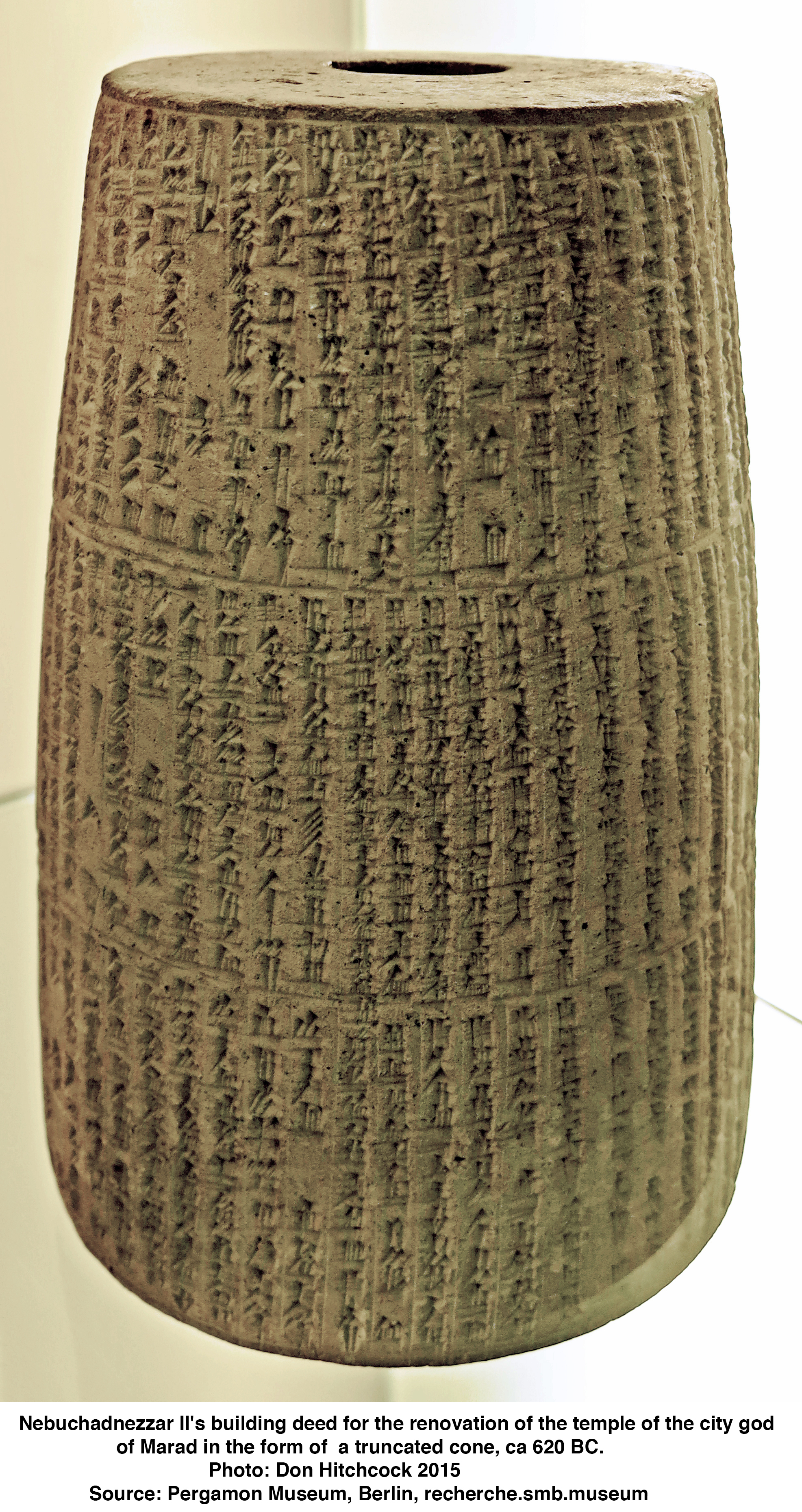
|
|||
| Nabopolassar | 626 BC - 605 BC | Nabopolassar was the founder and first king of the Neo-Babylonian Empire, and ruled from his coronation as king of Babylon in 626 BC to his death in 605 BC. Though initially only aimed at restoring and securing the independence of Babylonia, Nabopolassar's uprising against the Neo-Assyrian Empire, which had ruled Babylonia for more than a century, eventually led to the complete destruction of the Assyrian Empire and the rise of the Neo-Babylonian Empire in its place. Of unclear, possibly Chaldean origin and potentially connected to a powerful political family in the southern city of Uruk, Nabopolassar revolted against the Neo-Assyrian king Sinsharishkun at an opportune moment when Babylonia was already plagued by political instability. Though the advantage shifted back and forth dramatically several times, Nabopolassar managed to decisively push the Assyrians out of Babylonia after nearly ten years of fighting. Subsequent campaigns were intended to hinder the possibility of an Assyrian campaign directed at Babylonia through securing the border, but the intervention of the eastern Median Empire under Cyaxares in Nabopolassar's favor shifted the goals and the possibilities of the war. In 614 BC, the Medes brutally sacked the city of Assur, the religious and ceremonial heart of Assyria, and in 612 BC the Medes and Babylonians assaulted Nineveh, Assyria's capital. As with Assur before it, Nineveh was brutally sacked, with its inhabitants, including children, slaughtered en masse and the entire city being burned to the ground. Sinsharishkun probably died in its defense. Other Assyrian cities, such as Nimrud, were also assaulted and sacked much in the same way. The brutality of the Medes, including their habit of sacking even the religious temples, was so excessive that it shocked the Babylonians; contemporary Babylonian chronicles, otherwise hostile to the Assyrians, lament the sackings with sorrow and remorse. Nabopolassar's own attitude towards Assyria is unclear; in some inscriptions he is careful to ascribe his victory and its aftermath to divine intervention to rid himself of the blame, while in others he openly boasts of the destruction. The Neo-Babylonian Empire's claim to succeed the Neo-Assyrian Empire was immediately challenged by Egypt under Pharaoh Necho II, who fought for several years to restore the Assyrians, whom he was allied to, until he was defeated at the Battle of Carchemish in 605 BC. Upon his death that same year, Nabopolassar was succeeded by his son Nebuchadnezzar II. As the founder of the Neo-Babylonian Empire, Nabopolassar was long remembered by the Babylonians after his death, even beyond the fall of his empire less than a century later. In the Hellenistic period, several centuries later, Nabopolassar's legend was still remembered, with Babylonian authors casting him as a champion ordered by Marduk, Babylon's chief deity, to avenge their homeland, and as a symbol against the domination of foreign empires over Babylon. | |
| Nebuchadnezzar II | 605 BC - 562 BC | Nebuchadnezzar II was the second king of the Neo-Babylonian Empire, ruling from the death of his father Nabopolassar in 605 BC to his own death in 562 BC. Often titled Nebuchadnezzar the Great, he is regarded as the empire's greatest king, famous for his military campaigns in the Levant and their role in Jewish history, and for his construction projects in his capital of Babylon. Ruling for 43 years, Nebuchadnezzar was the longest-reigning king in the history of the Babylonian dynasty. By the time of his death, he was among the most powerful rulers in the world. Possibly named after his grandfather of the same name or after Nebuchadnezzar I, one of Babylon's greatest warrior-kings, Nebuchadnezzar II had already secured renown for himself during his father's reign, leading armies in the Medo-Babylonian conquest of the Assyrian Empire. At the Battle of Carchemish in 605 BC, Nebuchadnezzar inflicted a crushing defeat on an Egyptian army led by Pharaoh Necho II and ensured that the Neo-Babylonian Empire would succeed the Neo-Assyrian Empire as the dominant power in the ancient Near East. Shortly after this victory, Nabopolassar died and Nebuchadnezzar became king. Despite his successful military career during his father's reign, Nebuchadnezzar's early reign saw few achievements and witnessed a disastrous failed invasion of Egypt. This performance led some of Babylon's vassals to doubt Babylon's power and was the cause of brewing rebellion across his empire. After first putting down some insurrections in the east, Nebuchadnezzar turned his attention to the Levant and engaged in a string of campaigns against his rebellious vassal states. In 587 BC Nebuchadnezzar besieged Jerusalem and destroyed it and the Kingdom of Judah, deporting much of its population in what became known as the Babylonian captivity. This episode earned Nebuchadnezzar a position of notoriety in Jewish history. Through this conquest, the subsequent capture of the Phoenician city of Tyre, and other campaigns in the Levant, Nebuchadnezzar restored the Neo-Babylonian Empire's fortunes in the ancient Near East. Beyond his military campaigns, Nebuchadnezzar is remembered as a great builder who erected many of Babylon's religious buildings, including the Esagila and Etemenanki, embellished its palaces and beautified its ceremonial centre through renovations to the city's processional street and the Ishtar Gate. As most of Nebuchadnezzar's inscriptions deal with his building projects rather than military accomplishments, he was for a time seen by historians mostly as a builder rather than a warrior. | |
| Amel-Marduk | 562 BC - 560 BC | Amel-Marduk was the third emperor of the Neo-Babylonian Empire, ruling from 562 BC until his overthrow and murder in 560 BC. On account of the small number of surviving cuneiform sources, little is known of Amel-Marduk's reign and his actions as king. Amel-Marduk, originally named Nabu-shum-ukin, was not Nebuchadnezzar's eldest son nor the oldest living son at his appointment as crown prince and heir. It is not clear why Amel-Marduk was appointed by his father as successor, mainly since there appear to have been altercations between the two, possibly involving an attempt by Amel-Marduk to take the throne while his father was still alive. After the conspiracy, Amel-Marduk was imprisoned, possibly together with Jeconiah, the captured king of Judah. Nabu-shum-ukin changed his name to Amel-Marduk upon his release, possibly in reverence for the god Marduk. Amel-Marduk is remembered mainly for releasing Jeconiah after 37 years of imprisonment. Amēl-Marduk is also known to have conducted some building work in Babylon, and possibly elsewhere, though the extent of his projects is unclear. The Babylonians appear to have resented his rule, as Babylonian sources after his reign describe him as incompetent. In 560 BCE, he was overthrown and murdered by his brother-in-law Neriglissar, who thereafter ruled as king. | |
| Neriglissar | 560 BC - 556 BC | Neriglissar was the fourth king of the Neo-Babylonian Empire, ruling from his usurpation of the throne in 560 BC to his death in 556 BC. Though unrelated to previous Babylonian kings, possibly being of Aramean ancestry, Neriglissar was a prominent official and general in the reign of Nebuchadnezzar II (r. 605–562 BC) and became even more influential through marrying one of Nebuchadnezzar's daughters, possibly Kashshaya. Nebuchadnezzar was initially succeeded by his son, Amel-Marduk, but Amel-Marduk's reign only lasted for two years before Neriglissar usurped the Babylonian throne and put him to death. Through his marriage to Nebuchadnezzar's daughter, possibly significantly older than any of the old king's sons, Neriglissar might have represented a less legitimate but more wealthy and well-established faction of the royal family, even if he himself was not part of this family. The most well documented event of Neriglissar's reign is his successful 557 BC – 556 BC campaign in Anatolia against Appuwashu, king of a small kingdom in Cilicia. Neriglissar successfully captured Appuwashu's capital, Ura, as well as another city, Kirshu, before conducting an amphibious attack against a nearby island and then laying waste to mountain passes on the western border to Lydia. Shortly after returning home to Babylonia victorious, Neriglissar died in April 556 BC. He was succeeded as king by his son, Labashi-Marduk, whose reign would only last for two or three months before being deposed and killed in favour of Nabonidus. | |
| Labashi-Marduk | 556 BC | Labashi-Marduk was the fifth and penultimate king of the Neo-Babylonian Empire, ruling in 556 BC. He was the son and successor of Neriglissar. Though classical authors such as Berossus wrote that Labashi-Marduk was just a child when he became king, Babylonian documents indicate that he had been in charge of his own affairs before his rise to the throne, suggesting he was an adult, though possibly still relatively young. Labashi-Marduk's reign was very short, lasting only one to three months, with the last evidence of Neriglissar's life dating in April 556 BC and documents dated to Labashi-Marduk's successor, Nabonidus, appearing in May that same year and becoming widespread in Babylonia by the end of June. Nabonidus's son Belshazzar led a coup against the king, deposing and killing Labashi-Marduk and proclaiming Nabonidus as king. The reason for Labashi-Marduk's deposition is unknown, Berossus simply describes the justification as Labashi-Marduk having indulged in 'evil ways'. One possible explanation is that whereas Neriglissar derived his claim to the throne from having married a daughter of Nebuchadnezzar II, a previous king, Labashi-Marduk may have been wholly unconnected to the Babylonian ruling dynasty, as a result of being the son of another wife. | |
| Nabonidus | 556 BC - 539 BC | Nabonidus was the last king of the Neo-Babylonian Empire, ruling from 556 BC to the fall of Babylon to the Achaemenian Empire under Cyrus the Great in 539 BC. Nabonidus was the last native ruler of ancient Mesopotamia, the end of his reign marking the end of thousands of years of Sumero-Akkadian states, kingdoms and empires. He was also the last independent king of Babylon. Regarded as one of the most vibrant and individualistic rulers of his time, Nabonidus is characterised by some scholars as an unorthodox religious reformer and as the first archaeologist. The origins of Nabonidus, his connection to previous royalty, and subsequently what claim he had to the throne remain unclear, given that Nabonidus made no genealogical claims of kinship to previous kings. This suggests that he was neither related nor connected to the Chaldean dynasty of Babylonian rulers. However, he is known to have had a prominent career of some kind before he became king. It is possible that he was connected to the Chaldean kings via marriage, possibly having married a daughter of Nebuchadnezzar II (r. 605–562 BC). Nabonidus's mother, Adad-guppi, was of Assyrian ancestry. His father, Nabu-balatsu-iqbi, of whom little is known, may also have been either Assyrian or Babylonian. Some historians have speculated that either Adad-guppi or Nabu-balatsu-iqbi were members of the Sargonid dynasty, rulers of the Neo-Assyrian Empire until its fall in 609 BC. Nabonidus was, to his own apparent surprise, proclaimed king after the deposition and murder of Labashi-Marduk (reigned 556 BC) in a plot likely led by Nabonidus's son Belshazzar. Throughout his reign, inscriptions and later sources suggest that Nabonidus worked to increase the status of the moon god Sîn and decrease the status of Babylon's traditional national deity Marduk. Nabonidus was in self-imposed exile in Tayma, Arabia from 552 BC to 542 BC. The reason for this is unknown, though it might have been due to disagreements with the Babylonian clergy and oligarchy. Belshazzar acted as regent in Babylonia during this period, while Nabonidus continued to be recognised as the king. When Nabonidus returned to Babylonia in 543/542 BC, he escalated his religious efforts and rebuilt the Eḫulḫul, the temple dedicated to Sîn in the major northern city of Harran. Nabonidus's reign came to an abrupt end with the quick victory over his empire by Cyrus the Great in 539 BC. After the decisive battle of Opis, the Persians entered Babylon without a fight. Several sources state that Nabonidus was captured but spared, and possibly allowed leave to the region of Carmania. He may have been alive in exile as late as the reign of Darius the Great (reigned 522 BC – 486 BC). | |
The Achaemenid Persian Empire (559 BC to 330 BC) conquered Babylon in 539 BC. Led by Cyrus the Great, the Achaemenids ended the Chaldean dynasty and took control of Mesopotamia, marking the end of Babylon as an independent power and its integration into the Persian Empire. 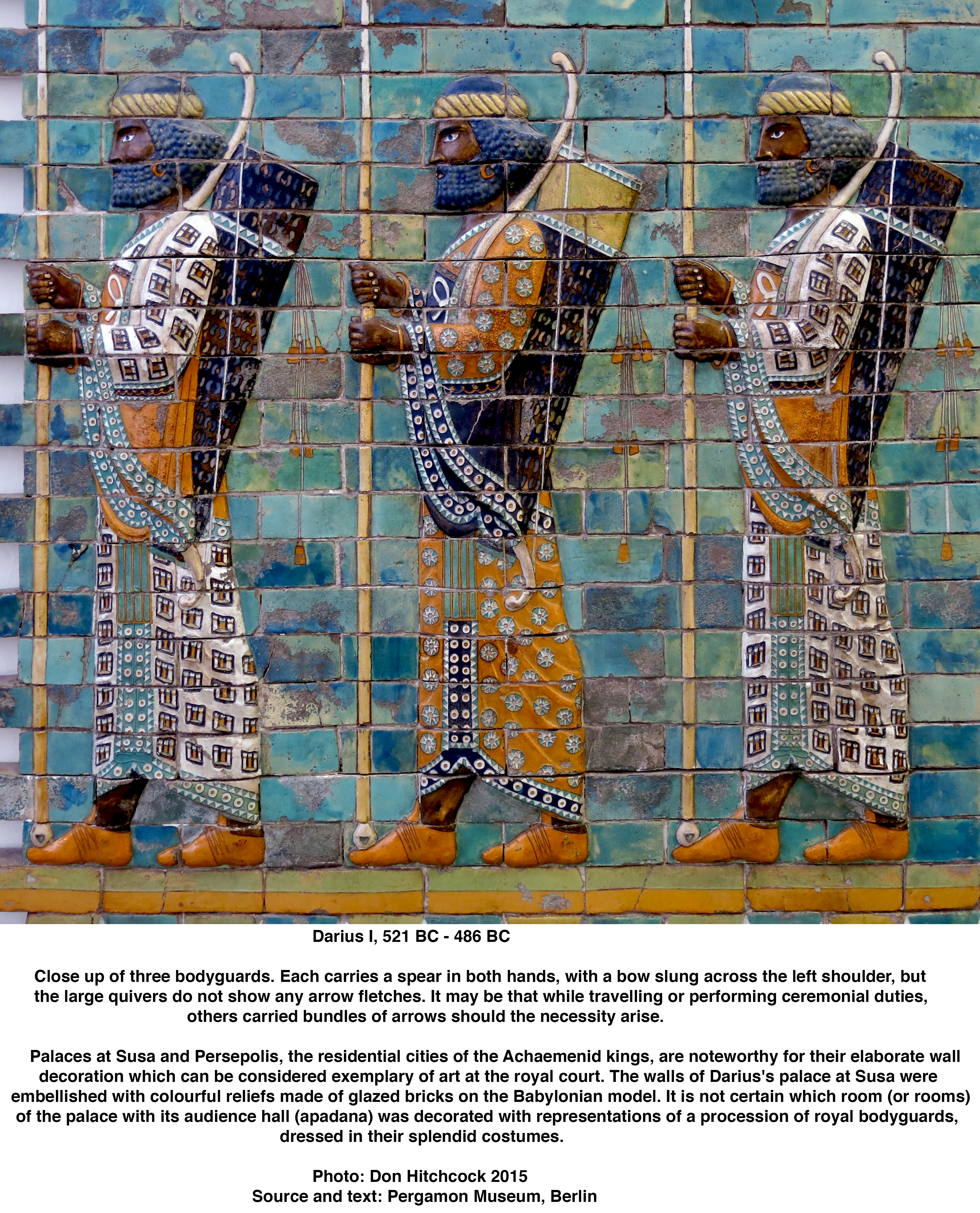
|
|||
| Cyrus the Great | 559 BC - 530 BC | Cyrus the Great is recognised as the founder of the Achaemenid Empire. Born in Persis, he brought the Achaemenid dynasty to power by defeating the Median Empire and embracing all of the previous civilised states of the ancient Near East, expanding vastly across most of West Asia and much of Central Asia to create what would soon become the largest empire in history at the time. The Achaemenid Empire's greatest territorial extent was achieved under Darius the Great, whose rule stretched from Southeast Europe and Northeast Africa in the west to the Indus Valley in the east. The beginnings of the Achaemenid Empire were, however, originally created by nomadic Persians. The Persians were Iranian people who arrived in what is today Iran circa 1000 BC and settled a region including north-western Iran, the Zagros Mountains and Persis, alongside the native Elamites. The Persians were originally nomadic pastoralists in the western Iranian Plateau. The Achaemenid Empire may not have been the first Iranian empire, as the Medes, another group of Iranian people, possibly established a short-lived empire when they played a major role in overthrowing the Assyrians. The Achaemenids were initially rulers of the Elamite city of Anshan, which is considered to be the origin of one of the world's oldest known civilisations. It was occupied continuously from before 4000 BC to 1000 BC and was politically tied to the Elamites at Susa, as well as the Mesopotamians. Cyrus the Great was from Anshan. He was born around 590–580 BC. After absorbing the Median Empire, Cyrus conquered Lydia and eventually the Neo-Babylonian Empire, granting him control of Anatolia and the Fertile Crescent, respectively. He also led a major expedition into Central Asia, where his army 'brought into subjection every nation without exception' before he allegedly died in battle with the Massagetae, a nomadic Eastern Iranian people, along the Syr Darya in December 530 BC. However, according to Xenophon of Athens, Cyrus did not die fighting and had instead returned to the capital city of Pasargadae. Regardless of the date of his death, he was succeeded by his son Cambyses II, whose campaigns led to the conquests of Egypt, Nubia, and Cyrenaica during his short reign. To the Greeks, he was known as Cyrus the Elder and was particularly renowned among contemporary scholars because of his habitual policy of tolerance for peoples' customs and religions in the lands that he conquered. Similarly, he is exalted in Judaism for his role in freeing the Jewish people from the Babylonian captivity by issuing the Edict of Restoration following the Persian conquest of Babylon. This event is described in the Hebrew Bible as the return to Zion, whereby displaced Jews were repatriated to what had been the Kingdom of Judah, thus enabling the resurgence of Jewish sovereignty in the Land of Israel. Cyrus also facilitated Jewish aspirations for a new Temple in Jerusalem in the Achaemenid Empire's Province of Judah, where the original Solomon's Temple had once stood before being destroyed during the Babylonian siege of Jerusalem. His efforts resulted in the completion of the Second Temple, which marked the beginning of the Second Temple period and Second Temple Judaism. According to the Book of Isaiah, he was anointed by Yahweh and explicitly designated 'messiah' for this task. Cyrus is the only non-Jewish figure to be revered in this capacity. In addition to his influence on traditions in both the East and the West, Cyrus is recognised for his achievements in politics and military strategy. He was influential in developing the system of a central administration at his capital city to govern the Achaemenid Empire's satraps, who worked for the profit of both rulers and subjects. Satraps in this case were provincial governors in the ancient Median and Achaemenid (Persian) Empires, acting as viceroys with significant autonomy to manage taxation, internal security, and military levies within their assigned territories (satrapies). Appointed by the king, they were usually Persian nobility who maintained order and collected taxes for the empire. His realm's prestige in the ancient world would gradually reach as far west as Athens, where upper-class Greeks adopted aspects of the culture of the ruling Persian class as their own. Likewise, Cyrus's reign played a crucial role in defining the history of Iran for well over a millennium, as future Persian empires often viewed the Achaemenid era with deference and as the ideal example to emulate. His dynasty was also instrumental in allowing Zoroastrianism to develop and spread as far east as China. To this end, he remains a cult figure in modern Iran, with his Pasargadae tomb serving as a spot of reverence for millions of the country's citizens. His successor was his eldest son, Cambyses II. | |
| Cambyses II | 530 BC - 522 BC | Cambyses II was the second King of Kings of the Achaemenid Empire.. He was the eldest son of and successor to Cyrus the Great. His relatively brief reign was marked by his conquests in North Africa, notably Egypt, which he took by defeating pharaoh Psamtik III (reigned 526 BC – 525 BC) at the Battle of Pelusium in 525 BC. After his victory in Egypt, he expanded the empire's holdings in Africa by taking Cyrenaica, the coastal region of eastern Libya. In the spring of 522 BC, Cambyses had to leave Egypt hastily to put down a revolt in Persia. En route to Syria (Eber-Nari), Cambyses somehow received a thigh wound; it soon became gangreneous. Cambyses died three weeks later in Agbatana, likely the modern city of Hama. He died childless, and was thus succeeded by his younger brother Bardiya. Bardiya ruled for a short time, and was then overthrown by Darius the Great (r. 522–486 BC), who went on to increase the power of the Achaemenids further. Before his accession, Cambyses was governor of northern Babylonia under his father Cyrus from April to December 538 BC. He held positions in Babylon and Sippar. In 530 BC, his father made him co-ruler. Cyrus then set off on an expedition against the Massagetae of Central Asia, where he met his end. Cambyses thus became the sole ruler of the vast Achaemenid Empire. According to chroniclers, he faced no opposition. | |
| Bardiya | 522 BC - 522 BC | Bardiya or Smerdis was a son of Cyrus the Great and the younger brother of Cambyses II, both Persian kings. There are sharply divided views on his life. Bardiya either ruled the Achaemenid Empire for a few months in 522 BCE, or was impersonated by a magus called Gaumata until he was toppled by Darius the Great. Bardiya was the younger son of Cyrus the Great and a full or half-brother of Cambyses II. According to Ctesias, on his deathbed Cyrus appointed Bardiya as satrap (governor) of some of the far-eastern provinces. According to Darius the Great, Cambyses II, after becoming king of Persia but before setting out for Egypt, killed Bardiya and kept this secret. However, according to Herodotus (who gives two detailed stories), Bardiya went to Egypt with Cambyses and was there for some time but later Cambyses sent him back to Susa out of envy, because 'Bardiya alone could draw the bow brought from the Ethiopian king'. Herodotus then states that 'Cambyses had a dream in which he saw his brother sitting on the royal throne. As a result of this dream Cambyses sent his trusted counsellor Prexaspes from Egypt to Susa with the order to kill Smerdis (Bardiya)'. Bardiya's death was not known to the people, and so in the spring of 522 BC, a usurper pretended to be him and proclaimed himself king on a mountain near the Persian town of Paishiyauvada. Darius claimed that the real name of the usurper was Gaumata, a Magian priest from Media; this name has been preserved by Justin but given to his brother (called Patizeithes by Herodotus), who is said to have been the real promoter of the intrigue. According to Herodotus, the name of the Magian usurper was Oropastes. The despotic rule of Cambyses, coupled with his long absence in Egypt, contributed to the fact that 'the whole people, Persians, Medes and all the other nations' acknowledged the usurper, especially as he granted a tax relief for three years. Cambyses began to march against him, but died in the spring of 522 BC. Before his death he confessed to the murder of his brother, and publicly explained the whole fraud, but this was not generally believed. Nobody had the courage to oppose the new king, who ruled for seven months over the whole empire. The new king transferred the seat of government to Media. A number of Persian nobles discovered that their new ruler was an impostor, and a group of seven nobles formed a plot to kill him. In September 522 BC they surprised him at a castle in Nisa (on the Nisaean plain) and stabbed him to death. One of the seven, Darius, was proclaimed as ruler shortly after. | |
| Darius the Great | 521 BC - 486 BC | Darius I, commonly known as Darius the Great, was the third King of Kings of the Achaemenid Empire, reigning from 522 BC until his death in 486 BC. He ruled the empire at its territorial peak, when it included much of West Asia, parts of the Balkans (Thrace–Macedonia and Paeonia) and the Caucasus, most of the Black Sea's coastal regions, Central Asia, the Indus Valley in the far east, and portions of North Africa and Northeast Africa including Egypt (Mudrâya), eastern Libya, and coastal Sudan. Darius ascended the throne after overthrowing the Achaemenid monarch Bardiya (or Smerdis), who he claimed was in fact an imposter named Gaumata. The new king met with rebellions throughout the empire but quelled each of them; a major event of Darius's career described in Greek historiography was his punitive expedition against Athens and Eretria for their participation in the Ionian Revolt. Darius organised the empire by dividing it into administrative provinces, each governed by a satrap. He organised Achaemenid coinage as a new uniform monetary system, and he made Aramaic a co-official language of the empire alongside Old Persian. He also put the empire in better standing by improving roads and introducing standard weights and measures. Through these changes, the Achaemenid Empire became centralised and unified. Darius undertook other construction projects throughout his realm, primarily focusing on Susa, Pasargadae, Persepolis, Babylon, and Egypt. He had an inscription carved upon a cliff face of Mount Behistun to record his conquests, which would later become important evidence of the Old Persian language. He was succeeded by his son, Xerxes I in 486 BC. | |
| Xerxes I | 486 BC - 465 BC | Xerxes I reigned as the fourth King of Kings of the Achaemenid Empire, reigning from 486 BC until his assassination in 465 BC. He was the son of Darius the Great and Atossa, a daughter of Cyrus the Great. In Western history, Xerxes is best known for his invasion of Greece in 480 BC, which ended in Persian defeat. Xerxes was made successor by Darius over his elder brother Artobarzan and inherited a large, multi-ethnic empire upon his father's death. He consolidated power by crushing revolts in Egypt and Babylon, and renewed his father's campaign to subjugate Greece and punish Athens and its allies for their interference in the Ionian Revolt. In 480 BC, Xerxes led a large army and crossed the Hellespont into Europe. He achieved victories at Thermopylae and Artemisium before capturing and razing Athens. His forces gained control of mainland Greece north of the Isthmus of Corinth until their defeat at the Battle of Salamis. Fearing that the Greeks might trap him in Europe, Xerxes retreated with the greater part of his army back to Asia, leaving behind Mardonius to continue his campaign. Mardonius was defeated at Plataea the following year, ending the Persian invasion. After returning to Persia, Xerxes dedicated himself to large construction projects, many of which had been left unfinished by his father. He oversaw the completion of the Gate of All Nations, the Apadana and the Tachara at Persepolis, and continued the construction of the Palace of Darius at Susa. He also maintained the Royal Road built by his father. In 465 BC, Xerxes and his heir Darius were assassinated by Artabanus, the commander of the royal bodyguard. He was succeeded by his third son, who took the throne as Artaxerxes I. | |
| Artaxerxes I | 465 BC - 424 BC | Artaxerxes I was the fifth King of Kings of the Achaemenid Empire. He was the third son of Xerxes I. In Greek sources he is also surnamed 'Long-handed' allegedly because his right hand was longer than his left. Josephus and several ancient traditions identify him as King Ahasuerus, from the Book of Esther. Artaxerxes was probably born in the reign of his grandfather Darius I, to the emperor's son and heir, Xerxes I. In 465 BC, Xerxes I was murdered by Hazarapat Artabanus, the commander of the royal bodyguard and the most powerful official in the Persian court, with the help of a eunuch, Aspamitres. Greek historians give contradicting accounts of these events. Artaxerxes had to face a revolt in Egypt in 460 BC – 454 BC led by Inaros II, who was the son of a Libyan prince named Psamtik, presumably descended from the Twenty-sixth Dynasty of Egypt. In 460 BC, Inaros II revolted against the Persians with the help of his Athenian allies, and defeated the Persian army commanded by the satrap Achaemenes. The Persians retreated to Memphis, and the Athenians were finally defeated in 454 BC, by the Persian army led by Megabyzus, after a two-year siege. Inaros was captured and carried away to Susa. After the Achaemenid Empire had been defeated at the Battle of the Eurymedon in 469 BC, military action between Greece and Persia was at a standstill. When Artaxerxes I took power, he introduced a new Persian strategy of weakening the Athenians by funding their enemies in Greece. This indirectly caused the Athenians to move the treasury of the Delian League from the island of Delos to the Athenian acropolis. This funding practice inevitably prompted renewed fighting in 450 BC, where the Greeks attacked at the Battle of Cyprus. After Cimon's failure to attain much in this expedition, hostilities ceased. Later sources argue that the purported Peace of Callias was agreed among Athens, Argos and Persia in 449 BC. However, the existence of a formal treaty between the Greek States and Persia is disputed. The rebuilding of the Jewish community in Jerusalem had begun under Cyrus the Great, who had permitted Jews held captive in Babylon to return to Jerusalem and rebuild Solomon's Temple. Consequently, a number of Jews returned to Jerusalem in 538 BC, and the foundation of this 'Second Temple' was laid in 536 BC, in the second year of their return. After a period of strife, the temple was finally completed in the sixth year of Darius, 516 BC. In Artaxerxes' twentieth year, Nehemiah, the king's cup-bearer, apparently was also a friend of the king, as in that year Artaxerxes inquired after Nehemiah's sadness. Nehemiah related to him the plight of the Jewish people and that the city of Jerusalem was undefended. The king sent Nehemiah to Jerusalem with letters of safe passage to the governors in Trans-Euphrates, and to Asaph, keeper of the royal forests, to make beams for the citadel by the Temple and to rebuild the city walls. Artaxerxes I was immediately succeeded by his only legitimate son, Xerxes II, in 424 BC. Xerxes II reigned for only 45 days before being assassinated by his half-brother, Sogdianus, who then seized the throne. Sogdianus reigned for six months and fifteen days before being overthrown and killed by another half-brother, Darius II, who secured the throne. | |
| Darius II | 424 BC - 404 BC | Following the death of Artaxerxes I, in 424 BC there was a struggle for power between his sons. The victor, Ochus, adopted the name Darius (Greek sources often call him Darius Nothos, 'Bastard'), in reference to his unattested lineage. His reign was marked by a series of revolts by various satraps and involvement in the Greek Peloponnesian War. It seems that Darius II was quite dependent on his wife Parysatis. In excerpts from Ctesias, some harem intrigues are recorded, in which he played a disreputable part. After Darius took power, he arranged diplomatic marriages between his own family and that of Hydarnes in Armenia. As long as the power of Athens remained intact Darius did not meddle in Greek affairs. In 424 BC, Darius and the Athenian emissary Epilycus confirmed the peace between Persia and Athens, either through a new agreement or a renewal of the Peace of Callias. When in 413 BC, Athens supported the rebel Amorges in Caria, Darius II would not have responded had not the Athenian power been broken in the same year at Syracuse. As a result of that event, Darius II gave orders to his satraps in Asia Minor, Tissaphernes and Pharnabazus, to send in the overdue tribute of the Greek towns and to begin a war with Athens. To support the war with Athens, the Persian satraps entered into an alliance with Sparta. In 408 BC he sent his son Cyrus to Asia Minor, to carry on the war with greater energy. Darius is said to have received the visit of Greek athlete and Olympic champion Polydamas of Skotoussa, who made a demonstration of his strength by killing three Immortals (the name given by the Greek historian Herodotus to a 10 000 strong unit of elite heavy infantry in the Achaemenid army) in front of the Persian ruler. A sculpture representing the scene is visible in the Museum of the History of the Olympic Games of antiquity. Darius II was followed as Persian king by his son, Artaxerxes II. | |
| Artaxerxes II | 404 BC - 359 BC | Soon after his accession, Artaxerxes II faced opposition from his younger brother Cyrus the Younger, who assembled an army composed of troops from his Lydian and Ionian satrapies as well as Greek mercenaries in his bid for the throne. The forces of the brothers clashed at Cunaxa in 401 BC, which resulted in the defeat and death of Cyrus. Following this, Artaxerxes II had to contend with several other revolts; a revolt by Evagoras I in Cyprus between 391–380 BC, by the Phoenicians in 380 BC, and most importantly, the revolts by the western satraps (known as the Great Satraps' Revolt) in the 360s and 350s BC, led by distinguished figures such as Datames, Ariobarzanes, and Autophradates. Artaxerxes became involved in a war with Persia's erstwhile allies, the Spartans, during the Corinthian War (395–387 BC). The Spartans under their king Agesilaus II had started by invading Asia Minor in 396–395 BC. To redirect the Spartans' attention to Greek affairs, Artaxerxes subsidised their enemies through his envoy Timocrates of Rhodes. In particular, the Athenians, Thebans, and Corinthians received massive subsidies. Tens of thousands of darics (a high-purity gold coin, weighing approximately 8.4 grams) were used to bribe these Greek states to start a war against Sparta. According to Plutarch, the Spartan king Agesilaus II said, upon leaving Asia Minor, 'I have been driven out by ten thousand Persian archers' alluding to the archer depicted on Persian coins. The Achaemenids, allied with Athens, managed to utterly destroy the Spartan fleet at the Battle of Cnidus (394 BC). After that, the Achaemenid satrap of Hellespontine Phrygia, Pharnabazus II, together with former Athenian admiral Conon, raided the coasts of Peloponnesia, putting increased pressure on the Spartans. The King's Peace, promulgated by Artaxerxes II in 387 BC, put an end to the Corinthian War under the guarantee of the Achaemenid Empire. In 386 BC, Artaxerxes II betrayed his allies and came to an arrangement with Sparta, and in the Treaty of Antalcidas, he forced his erstwhile allies to come to terms. This treaty restored control of the Greek cities of Ionia and Aeolis on the Anatolian coast to the Persians, while giving Sparta dominance on the Greek mainland. In 385 BC, Artaxerxes campaigned against the Cadusians. The rulers of the Parthian Empire notably considered Artaxerxes II their progenitor. Greek authors gave Artaxerxes II the epithet 'Mnemon', meaning having a good memory. Artaxerxes II was succeeded by his son, Artaxerxes III, who reigned from 358 to 338 BC. | |
| Artaxerxes III | 358 BC - 338 BC | Artaxerxes III was the son and successor of Artaxerxes II. Before ascending the throne Artaxerxes was a satrap and commander of his father's army. Artaxerxes came to power after one of his brothers was executed, another committed suicide, the last murdered and his father, Artaxerxes II died. Soon after becoming king, Artaxerxes murdered all of the royal family to secure his place as king. He started two major campaigns against Egypt. The first campaign failed, and was followed up by rebellions throughout the western part of his empire. During the second invasion, Artaxerxes finally defeated Nectanebo II, the Pharaoh of Egypt, bringing the country back into the Persian fold after six decades. In Artaxerxes's later years, Philip II of Macedon's power was increasing in Greece, where he tried to convince the Greeks to revolt against the Achaemenid Empire. His activities were opposed by Artaxerxes, and with his support, the city of Perinthus resisted a Macedonian siege. There is evidence for a renewed building policy at Persepolis in his later life, where Artaxerxes erected a new palace and built his own tomb, and began long-term projects such as the Unfinished Gate. His assassination and the instability which followed put an end to any hopes of a Persian revival and the empire would soon after fall to the invading armies of Alexander the Great. | |
| Artaxerxes IV | 338 BC - 336 BC | Artaxerxes IV (originally called Arses) ascended the throne after his father, Artaxerxes III, was poisoned by the eunuch Bagoas. The latter put Artaxerxes IV on the throne with the expectation of being able to control him. With the weakening of the Achaemenid Empire from the assassination of Artaxerxes III and the succession of Artaxerxes IV , the Greek league sent troops into Asia in 336 BC. Artaxerxes IV , in an attempt to free himself from Bagoas' influences, tried to have the eunuch poisoned; but this attempt did not succeed. Instead he succumbed to poison himself at the orders of Bagoas. Bagoas put Artaxerxes IV's cousin Darius III on the throne after him. Around the same period, most of the Greek city-states had joined the Greek league under the leadership of the Macedonian king Philip II, who took advantage of the events in Persia by demanding compensation from the country for helping the town of Perinthus during the reign of Artaxerxes III. Artaxerxes IV declined, and as a result, a Greek expedition was started with Philip II as general, who sent 10 000 Macedonian soldiers into Asia in 336 BC. Macedonian propaganda, made in order to legitimise the conquests of Alexander the Great a few years later, accused Darius III of playing a key role in the murder of Artaxerxes IV, who was portrayed as the last king of the Achaemenid royal house. He was succeeded by Darius III. | |
| Darius III | 336 BC - 330 BC | Darius III was the thirteenth and last Achaemenid King of Kings of Persia. Contrary to his predecessor Artaxerxes IV (Arses), Darius was a distant member of the Achaemenid dynasty. During his early career, he was reportedly an obscure figure among his peers and first rose to prominence during the Cadusian expedition of Artaxerxes III in the 350s BC. As a reward for his bravery, he was given the Satrapy of Armenia. Around 340 BC, he was placed in charge of the royal 'postal service', a high-ranking position. In 336 BC Philip II of Macedon was authorised by the League of Corinth as its Hegemon to initiate a sacred war of vengeance against the Persians for desecrating and burning the Athenian temples during the Second Persian War, over a century before. He sent an advance force into Asia Minor under the command of his generals Parmenion and Attalus to liberate the Greeks living under Persian control. After they took the Greek cities of Asia from Troy to the Maiandros river, Philip was assassinated and his campaign was suspended while his heir consolidated his control of Macedonia and the rest of Greece. In 334 BC, Alexander the Great began his invasion of the Persian Empire and subsequently defeated the Persians in several battles before looting and destroying their capital, Persepolis, by fire in 330 BC. With the Persian Empire now effectively under Alexander's control, Alexander then decided to pursue Darius. Before Alexander reached him, however, Darius was killed by his relative Bessus, who was also the satrap of Bactria. | |
Adapted from the Met Museum, Department of Ancient Near Eastern Art, © 2000–2020 The Metropolitan Museum of Art, as well as Wikipedia, Grokipedia, historica.fandom.com and various other sources
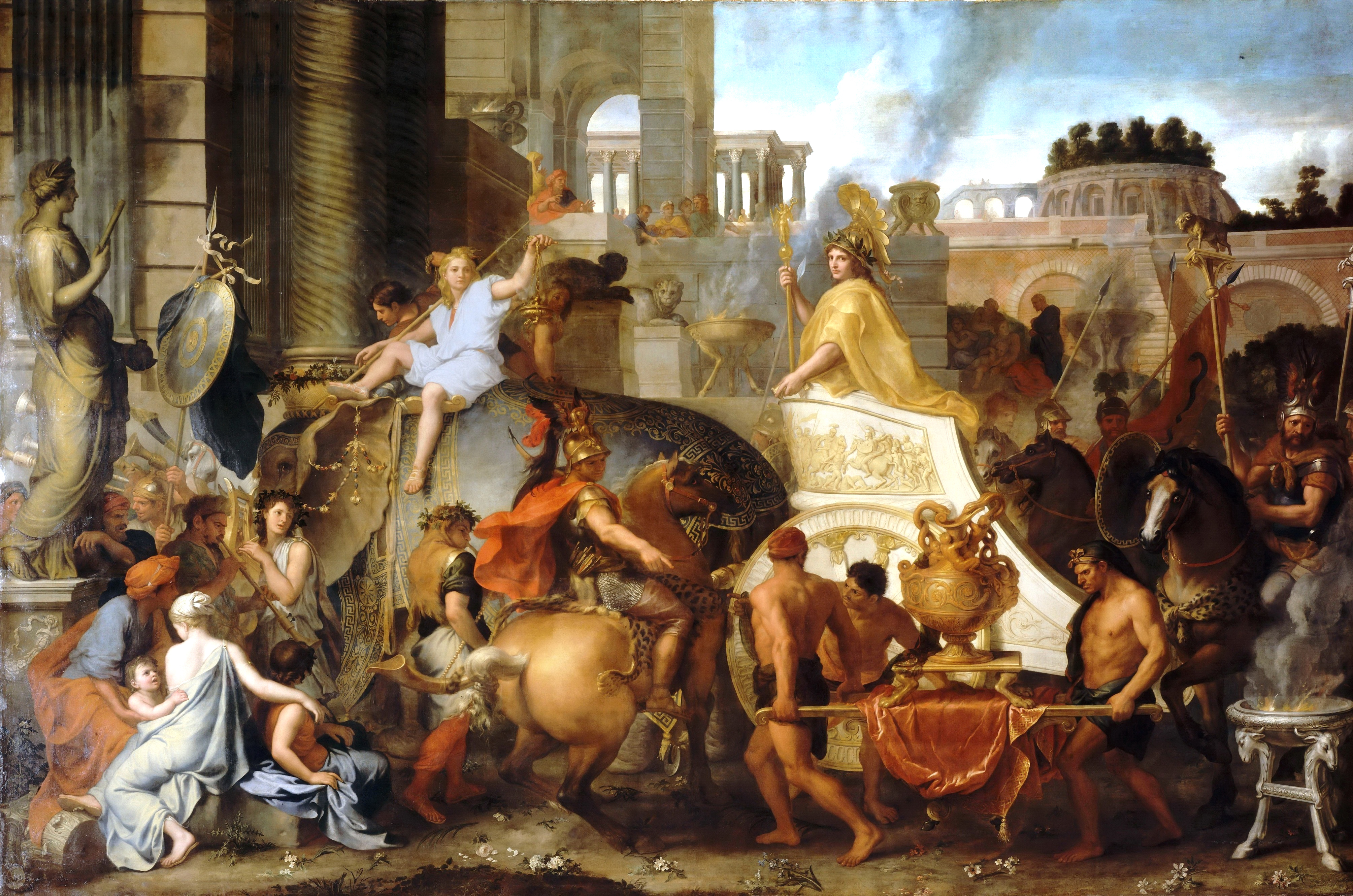
Entry of Alexander into Babylon, or The Triumph of Alexander
Date of painting 1 665 AD
Medium: oil on canvas
Height 450 cm, width 707 cm
Catalog: Department of Paintings of the Louvre, Salle 914, INV2898, MR1919
Permission: Public Domain
Source and text: Original, Louvre Museum, https://collections.louvre.fr/
References
- Diamond J. , 2005: Guns, Germs and Steel, Norton & Company, New York, London, revised HB edition from the original of 1997.
- Fenollós J. et al., 2005: Etemenanki: nuova ipotesi di ricostruzione dello ziggurat di Nabucodonosor II nella cittá di Babilonia, (PDF). ISIMU: Revista sobre Oriente Próximo y Egipto en la antigüedad: 201–216.
-
Groman-Yaroslavski I. et al., 2016: Composite Sickles and Cereal Harvesting Methods at 23,000-Years-Old Ohalo II, Israel, PLOS ONE, November 23, 2016, doi.org/10.1371/journal.pone.0167151
- Hall H., 1930: A Season's Work at Ur, Al-'Ubaid, Abu Shahrain-Eridu-and Elsewhere Being an Unofficial Account of the British Museum Archaeological Mission to Babylonia, 1919, ISBN 9781138817838
- King L., 1919: A History of Babylon, from the Foundation of the Monarchy to the Persian Conquest, History of Babylonia vol. 2
- Koldewey R., 1914: The excavations at Babylon, Publisher London: Macmillan and Co.
- Layard A., 1849: Nineveh and its Remains, Volume I, Publisher London: John Murray
- Layard A., 1853: Discoveries in the ruins of Nineveh and Babylon : with travels in Armenia, Kurdistan and the desert : being the result of a second expedition, Publisher New York : G. P. Putnam and Co.
- Seidl U., 1989: Die babylonischen Kudurru-Reliefs: Symbole mesopotamischer Gottheiten, Zurich Open Repository and Archive, University of Zurich Main Library
- van Ess M., Fassbinder J., 2019: Uruk-Warka, Archaeological Research 2016 – 2018, Preliminary Report, Sumer, Vol. LXV 2019
- Vucetich, J., Peterson R., 2012: The population biology of Isle Royale wolves and moose: an overview., isleroyalewolf.org/data/data/home.html
- Varoujan D. et al., 2020: Sea Level Changes in the Mesopotamian Plain and Limits of the Arabian Gulf: A Critical ReviewJournal of Earth Sciences and Geotechnical Engineering, Vol.10, No.4, 2020, 87-110ISSN: 1792-9040 (print version), 1792-9660 (online)Scientific Press International Limited
- Wetzel, F., 1930: Zur Topographie von Babylon nach der keilinschriftlichen Überlieferun, Pp. 84–109 in Die Stadtmauern von Babylon, WVDOG 48. Leipzig: Hinrichs.
- Woolley C., 1934: Ur Excavations Volume II, The Royal Cemetery, British Museum and University of Pennsylvania
Woolley (1934)
Back to Don's Maps
Back to Archaeological Sites