Back to Don's Maps
 Back to Archaeological Sites
Göbekli Tepe
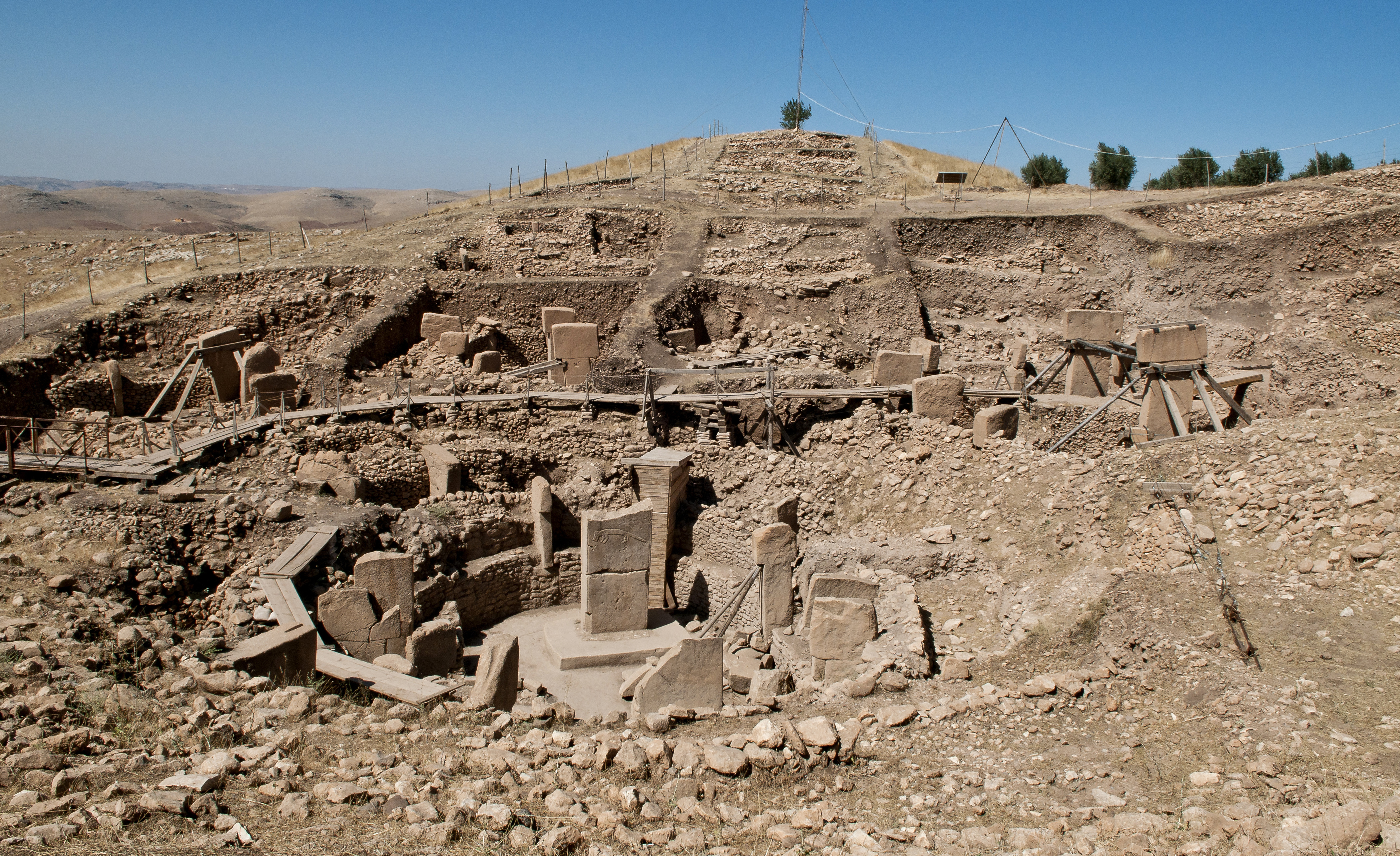
Date: 6 September 2011
Photo: Teomancimit
Permission: Creative Commons Attribution-Share Alike 3.0 Unported licence.

Halet Çambel, co-discoverer (together with Peter Benedict) of Gӧbekli Tepe was born in Berlin in 1916. Her mother was Remziye Hanım, the daughter of ambassador İbrahim Hakkı Paşa, and her father was Hasan Cemil Bey, who was an attache in Berlin at the time of their daughter's birth. The Çambel family returned to Turkey in 1924, after living in Switzerland and Austria following the First World War. Having graduated from Arnavutköy American College for Girls in İstanbul in 1935, Halet started her archaeology education at Sorbonne University in Paris with a scholarship she received from the French Government. In 1938, Çambel began her doctoral studies at the Sorbonne. She participated in the large regional prehistoric surveys in which Göbekli Tepe was first noted in 1963. However its monumental significance was not understood until its rediscovery in 1994. Halet Çambel was also an Olympic fencer and led major excavation and heritage work in Turkey.
Peter Benedict was affiliated with the University of Chicago anthropology department as a doctoral student. He conducted ethnographic work in Turkey alongside researchers like Michael Meeker and June Starr.
Photo: archivecenter.bogazici.edu, Bogazici Archive and Documentation Centre
Text: Adapted from arsivmerkezi.bogazici.edu.tr/en/collections/halet-cambel.php and various other sources including Wikipedia.
The site was initially noted during a joint survey in 1963 by the University of Chicago and Istanbul University. Anthropologists Peter Benedict and Halet Çambel recorded the presence of flint tools and limestone slabs but misidentified the mound as a medieval cemetery and largely dismissed its importance.
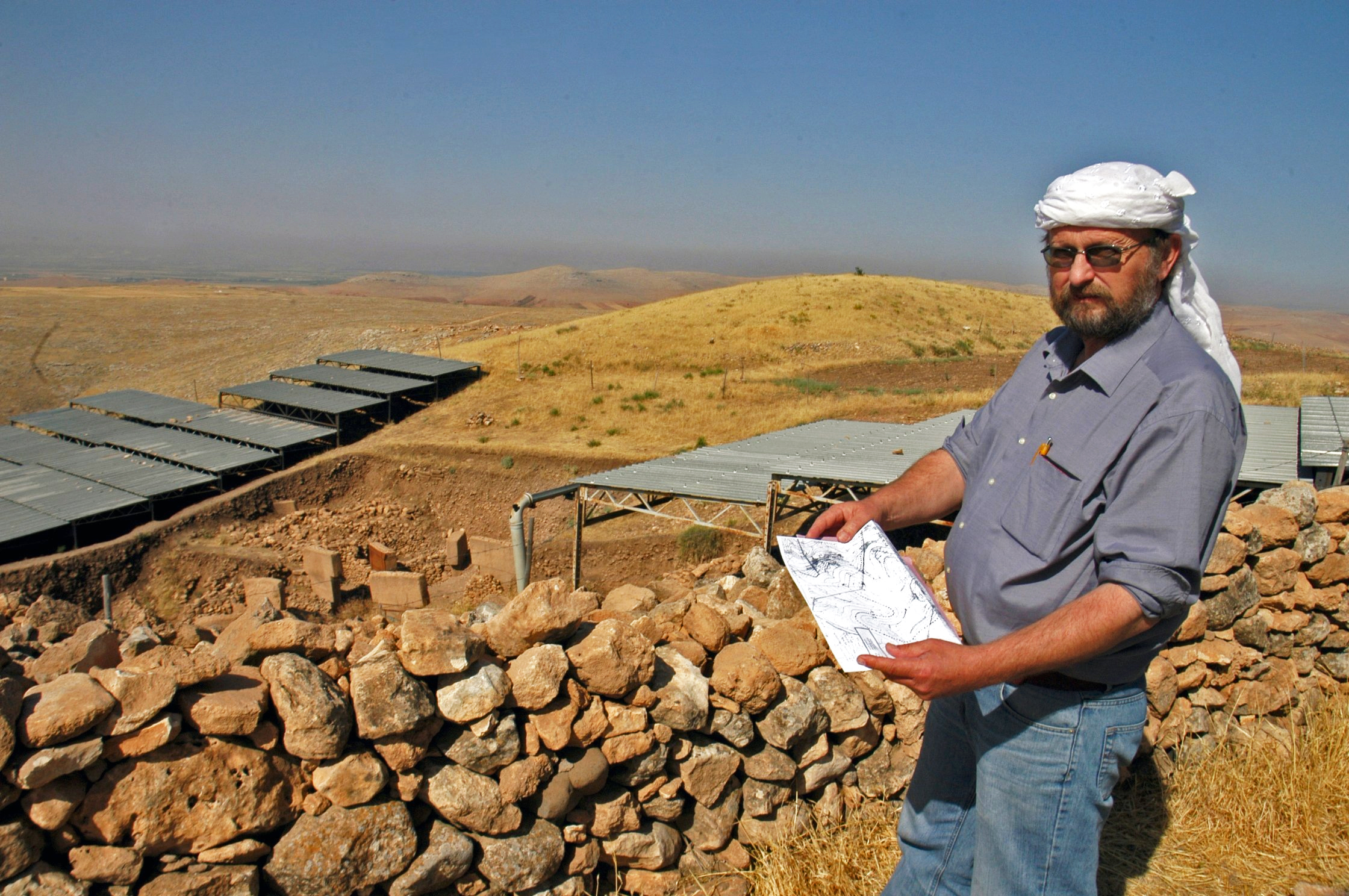
In 1994, German archaeologist Klaus Schmidt recognised the site's true prehistoric significance while conducting his own survey of the region. He identified the surface stone fragments as Neolithic T-shaped pillars similar to those he had seen at Nevalı Çori.
Official excavations began in 1995 under Schmidt's direction in collaboration with the Şanlıurfa Museum and the German Archaeological Institute (DAI).
Following Schmidt's death in 2014, the project continued under the leadership of Lee Clare and eventually Turkish prehistorian Necmi Karul.
Text above: Various sources
Photo: AA Photo
Reference: Schmidt (2000)
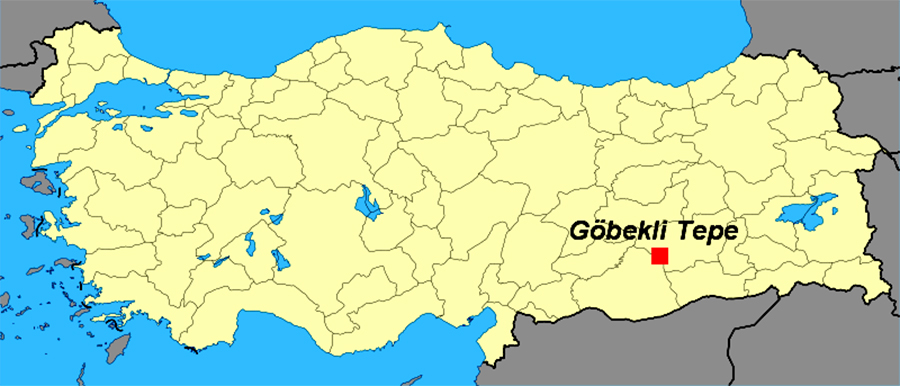
Location of Gӧbekli Tepe
Photo: Bjoertvedt
Permission: GFDL
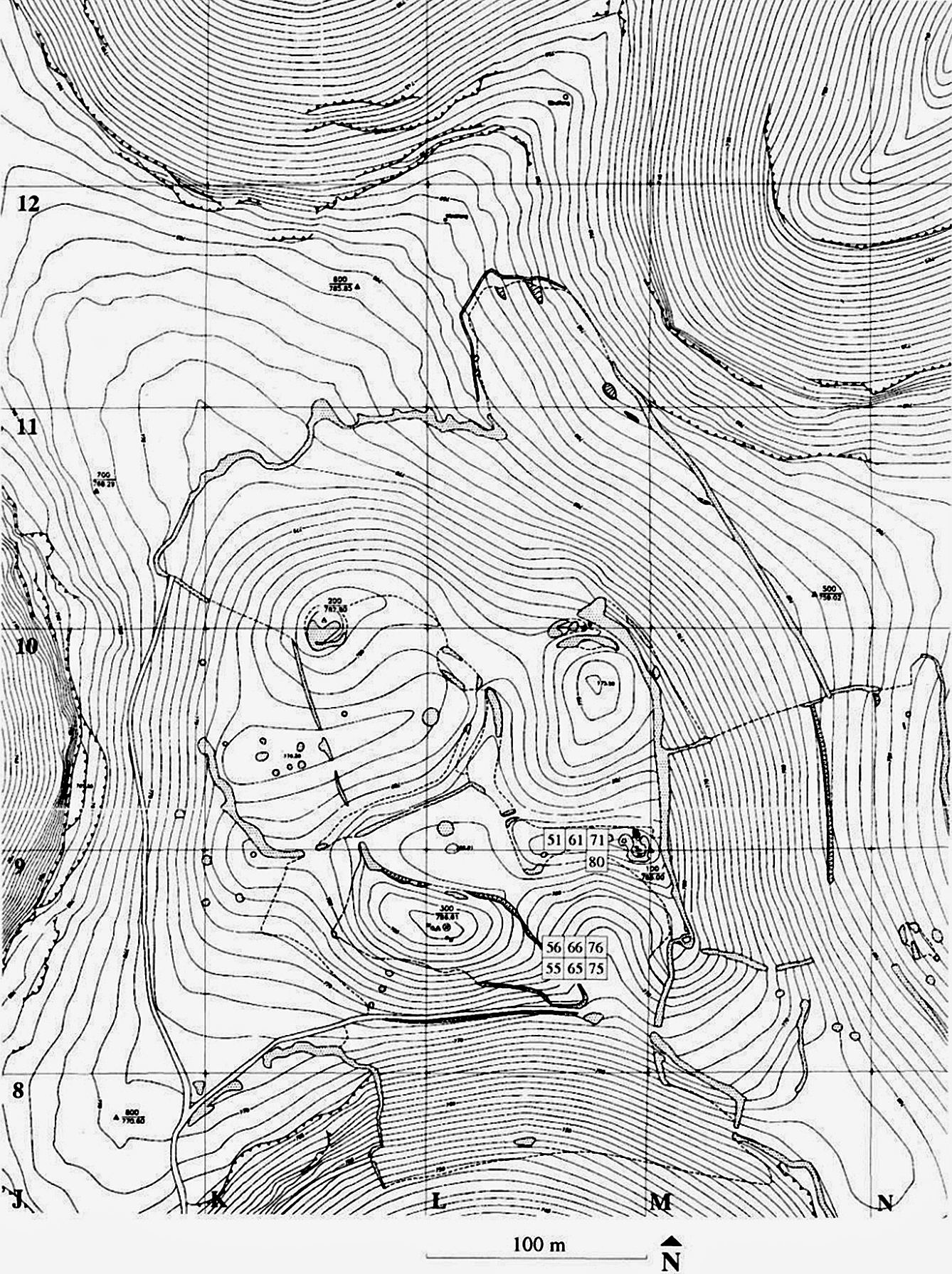
Göbekli Tepe, the excavated areas, circa 1999.
Photo: Schmidt (2000)
Göbekli Tepe was built by hunter-gatherers from the Pre-Pottery Neolithic period (around 9600-8200 BC), a significant discovery showing that these early people did not just settle agricultural communities, but were capable of complex monumental architecture for social and ritual purposes.
Archaeological evidence suggests nomadic groups gathered to construct the large, T-shaped pillars and enclosures using stone tools, challenging the idea that complex societies only arose after farming.
The fact that there is evidence like wild animal bones, showing none of the signatures of domesticated aniimals, and the lack of domesticated plants confirms they lived off the land and did not have any of the characteristics of people who had adopted agriculture.
To build Göbekli Tepe required cooperation, planning, and a social structure beyond simple family units, indicating sophisticated social organisation according to the UNESCO World Heritage Centre and the Smithsonian Magazine.
The builders came from the surrounding region of Upper Mesopotamia, carving the massive pillars from the local limestone. The structures were probably used for communal gatherings, rituals, and possibly funerary rites, with carvings depicting wild animals reflecting their beliefs, according to Britannica and Quora users.
In essence, these prehistoric people demonstrated advanced technical skills and complex spiritual lives long before the dawn of agriculture, challenging conventional narratives about the origins of civilization, according to the BBC.
Text above: Various sources.
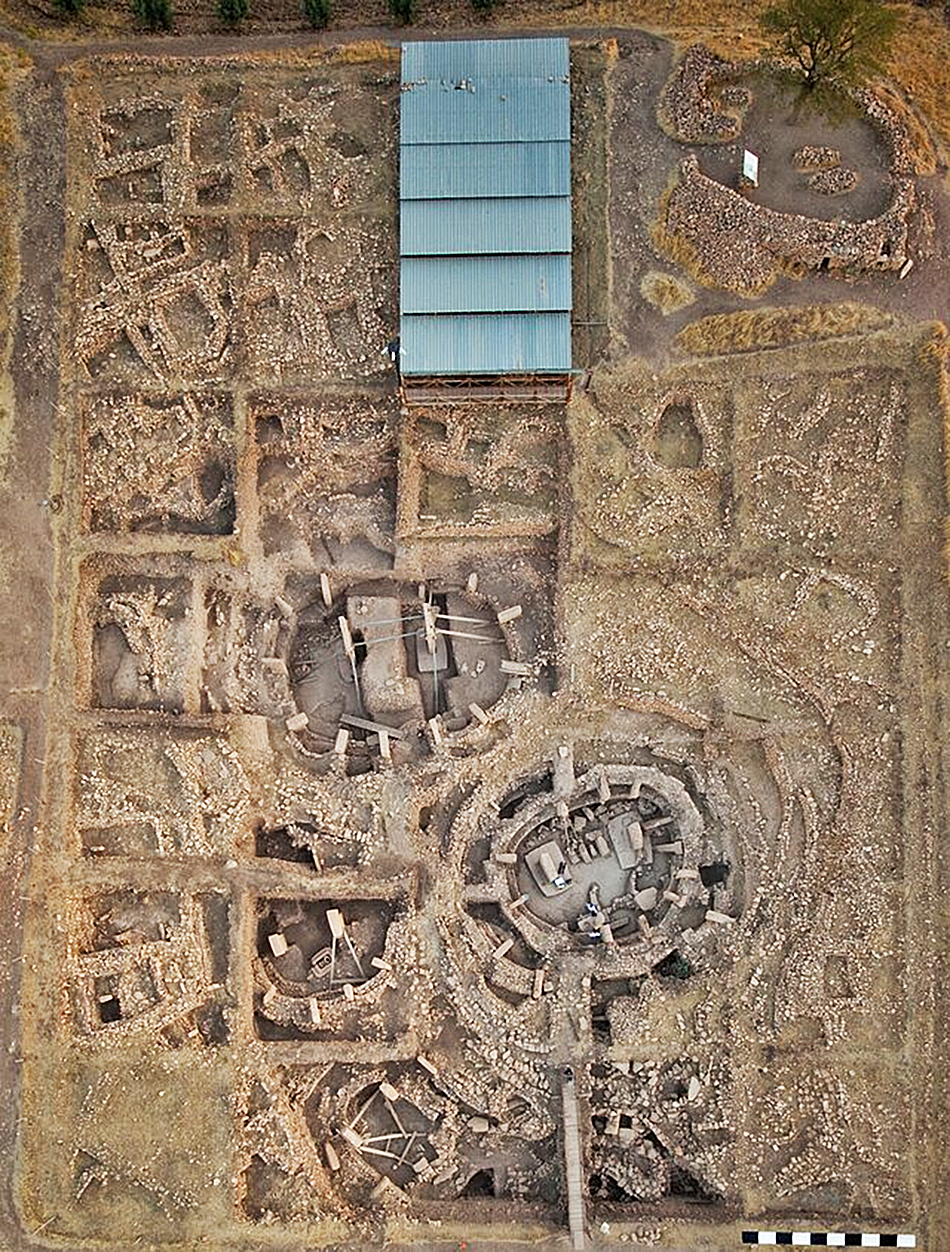
The archaeological site of Göbekli Tepe Main excavation area with four monumental circular buildings and adjacent rectangular buildings (German Archaeological Institute, photo E. Kücük).
Photo: German Archaeological Institute, © E. Kücük
Source: Korol (2024)
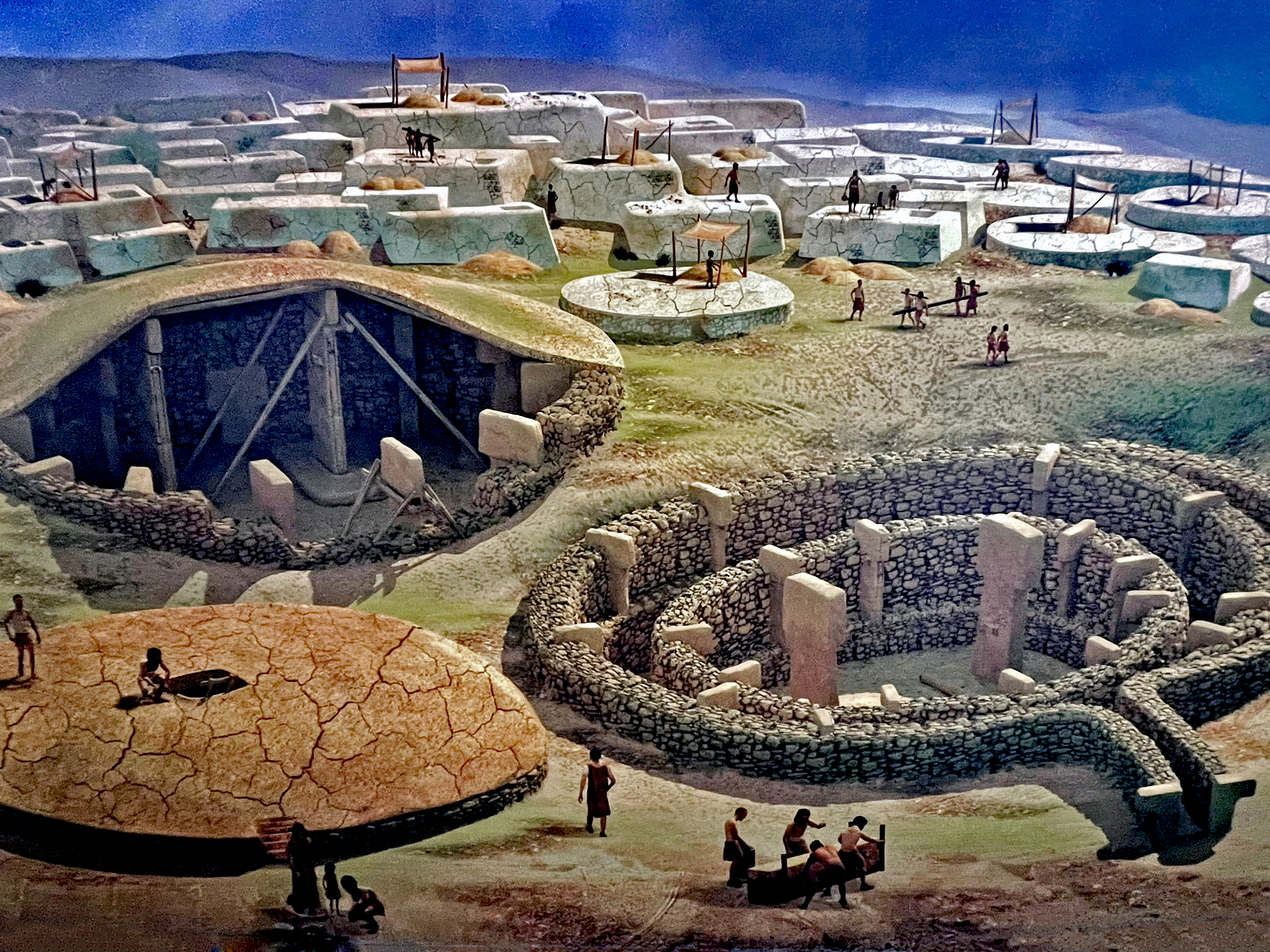
Attempt to visualise the construction of Göbekli Tepe, a reconstruction by Turkish museum specialists
based on the works of recent years.
Source: Korol (2024)
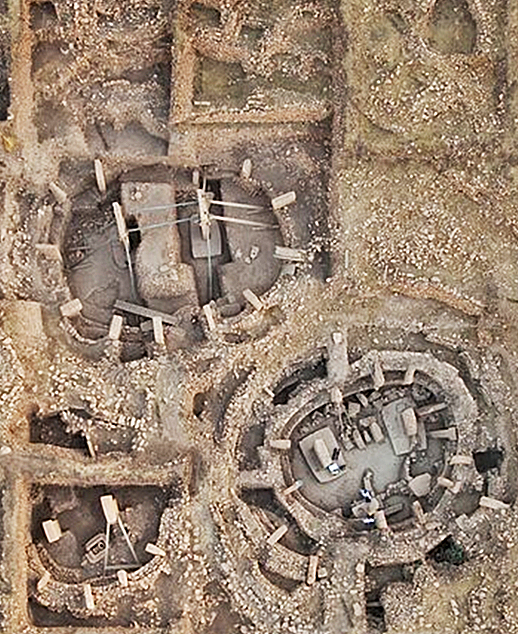
The artist's impression above appears to show this part of the Göbekli Tepe site.
Photo: German Archaeological Institute, © E. Kücük
Source: Korol (2024)
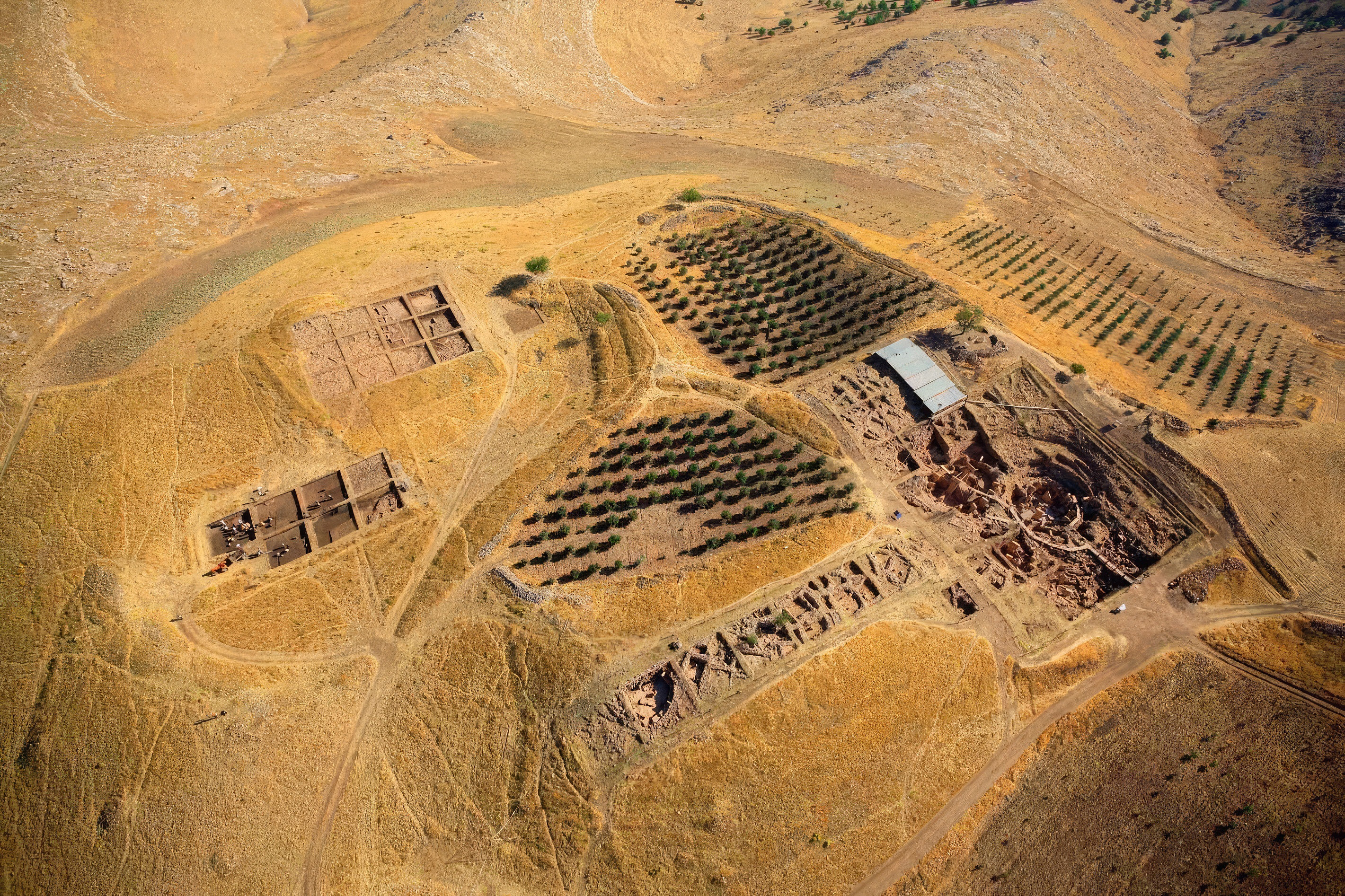
Aerial view of Göbekli Tepe in 2013
Photo: © DAI, Göbekli Tepe Project
Source: https://whc.unesco.org/en/list/1572/
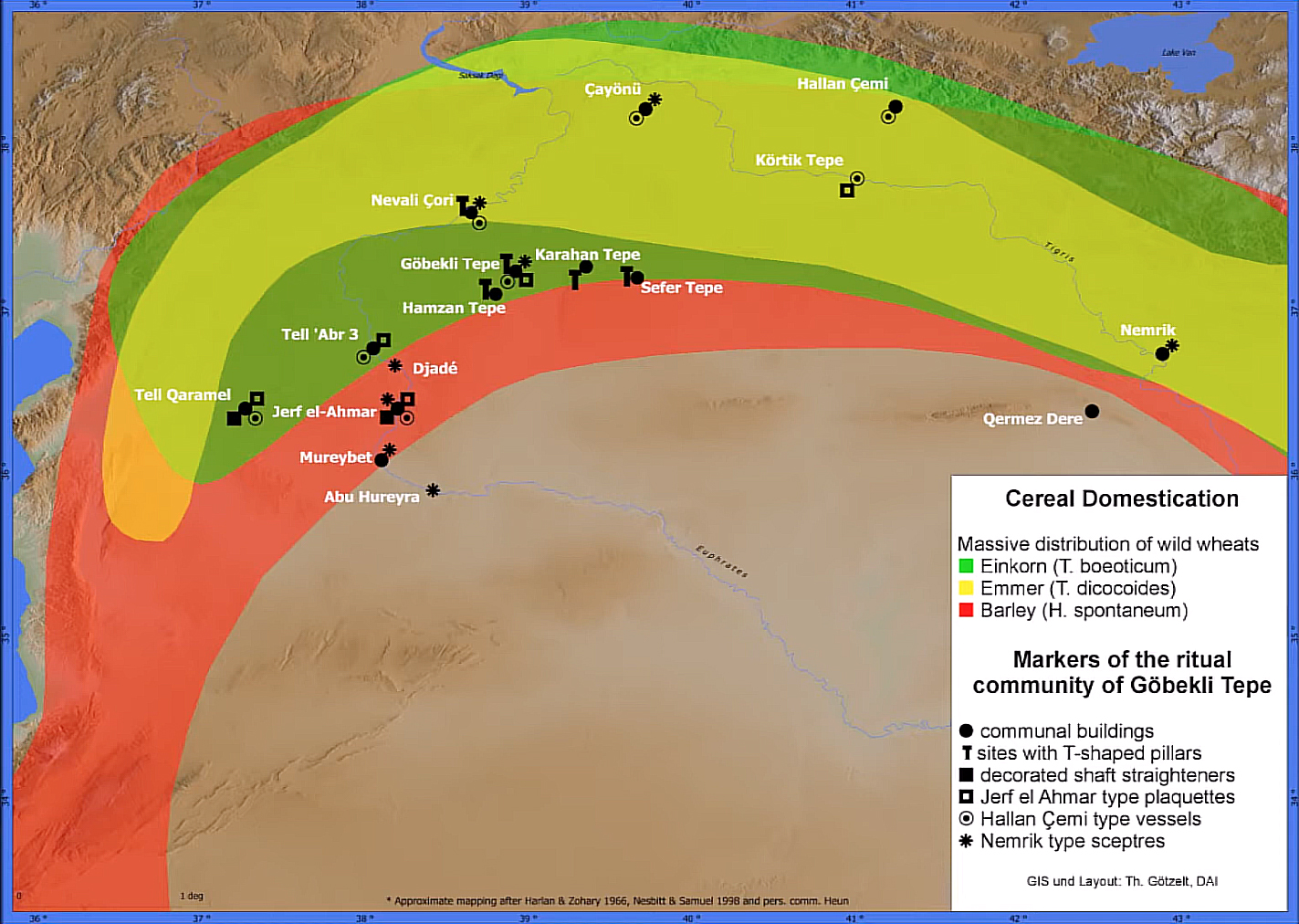
Cereal 'Domestication' (Distribution of wild wheats) and Markers of the ritual community of Göbekli Tepe.
Photo: © GIS and Layout: Th. Götzelt, DAI
Source: Archaeonomy, https://www.youtube.com/watch?v=nAeTGTgLg8g
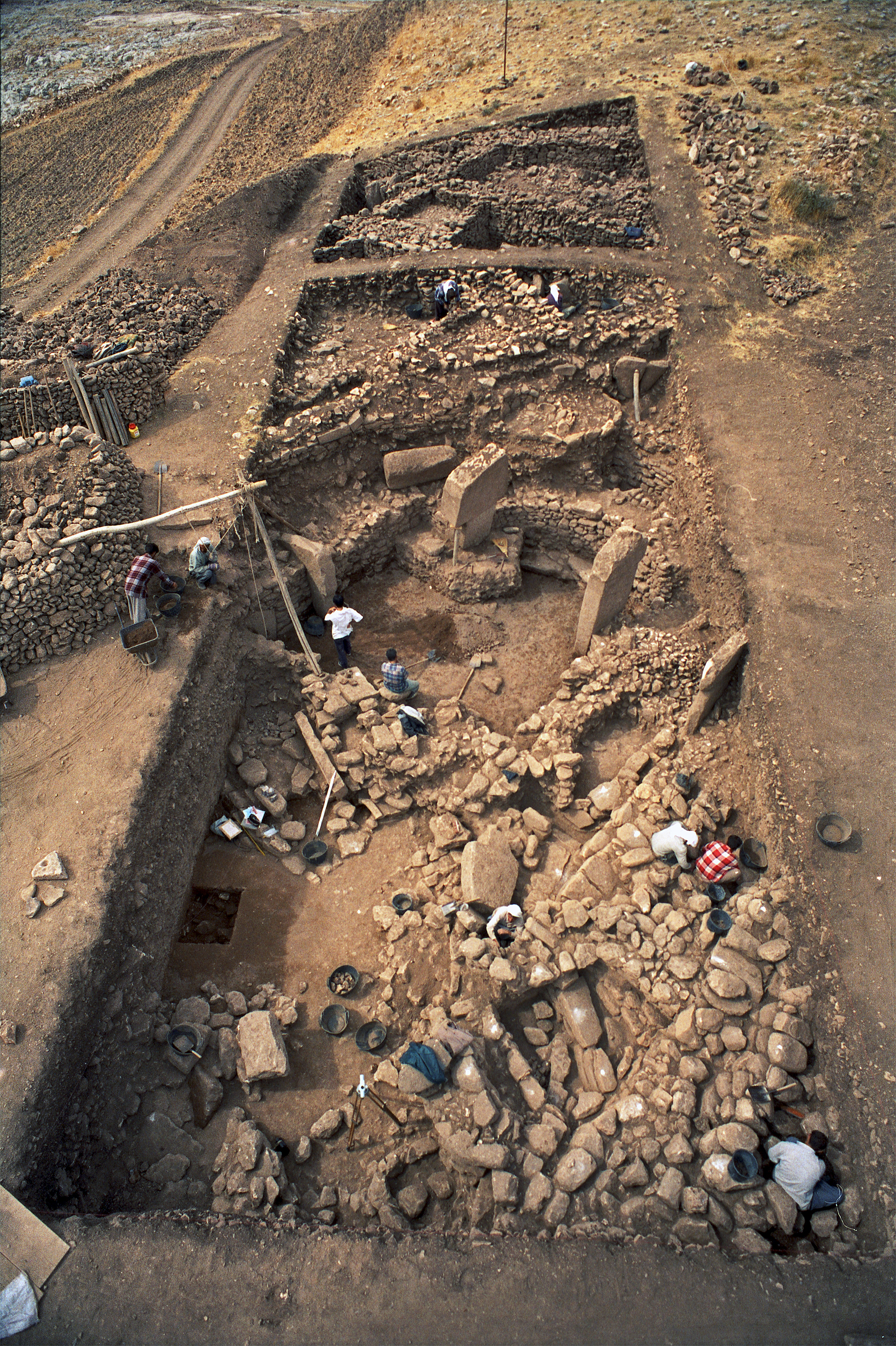
Enclosure A in 1997 (Photo: M. Morsch, copyright DAI).
The ground plan of Enclosure A appears more rectangular than round. First radiocarbon data suggest that it may be a little younger than other Enclosures, C and D, and maybe the rectangular shape already could indicate the transition to the later, rectangular, Layer II building type. The existence of different outer walls may as well hint at a longer building history and possible alteration over toime. However, Enclosure A is still not entirely excavated, so any description must remain preliminary as of yet
Photo: © M. Morsch, copyright DAI
Source and text: Tepe Telegrams, www.dainst.blog/the-tepe-telegrams/2017/01/05/enclosure-a-a-short-overview/
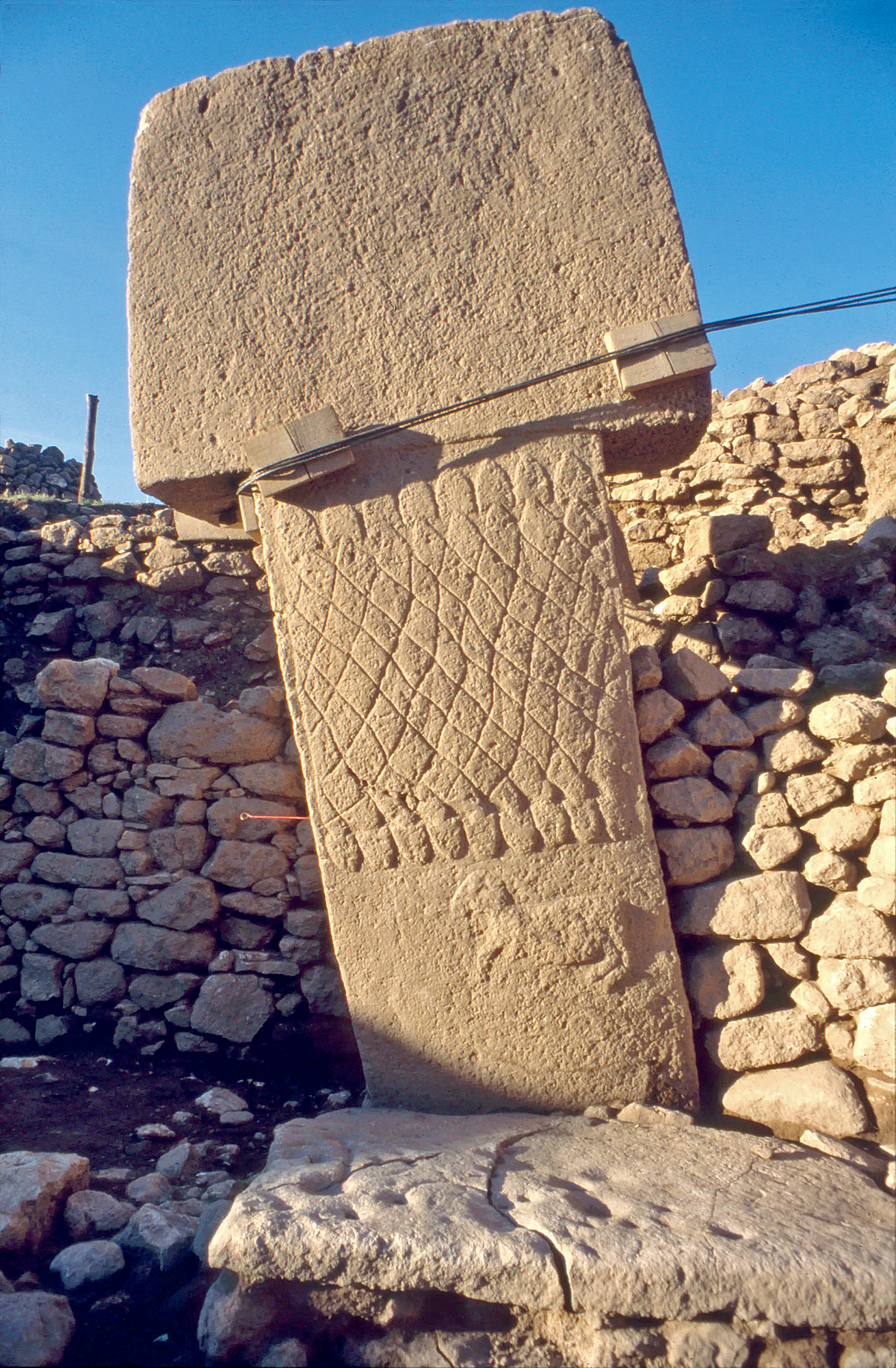
Pillar 1 in Enclosure A shows a net-like pattern formed of snakes and a ram.
Photo: C. Gerber © DAI
Proximal Source and text: https://tepetelegrams.wordpress.com/2016/10/06/current-state-of-research-at-gobekli-tepe-interviewed-by-arkeofili-com/
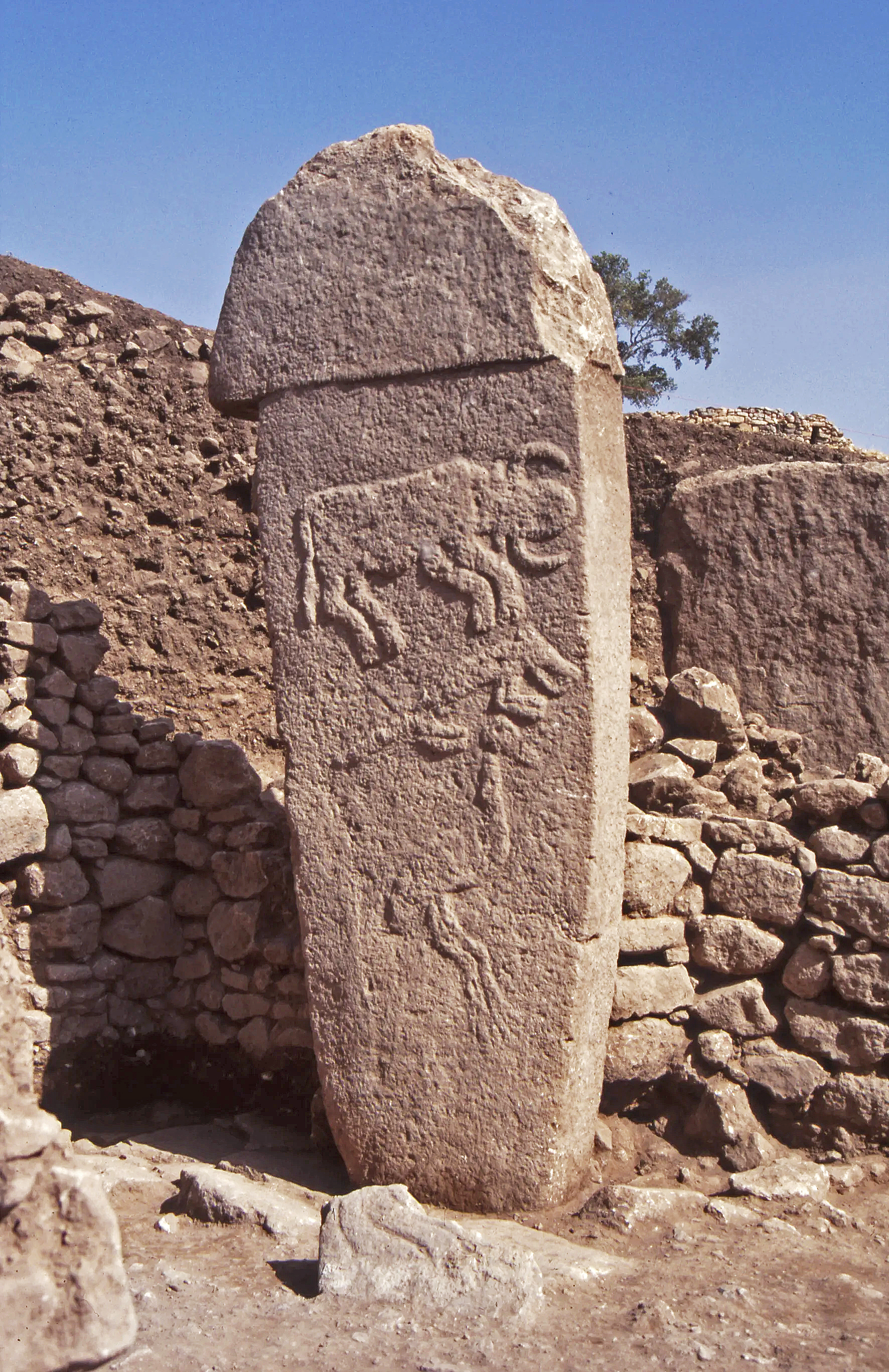
Pillar 2, Enclosure A, Göbekli Tepe. Showing reliefs of aurochs, fox, and crane.
The crane has an extraordinary, un-bird like leg anatomy.
This unique, stylised carving likely represents a ritual, possibly an animal masquerade or 'crane dance' that blended human and animal, or perhaps represented a mythological being.
During the first field season at Göbekli Tepe in 1995 one of the landowners had started to clear his field in the southeastern depression of stones that hindered ploughing. He dug out the heads of two large T-shaped pillars and had already started to smash one pillar with a sledgehammer. Fortunately he could be persuaded to stop, and in the 1996 work started in this area. What came to light here was the first of the monumental buildings of Göbekli Tepe’s older layer (Layer III), later called Enclosure A.
Photo: O. Dietrich © DAI
Proximal Source and text: https://tepetelegrams.wordpress.com/2016/10/06/current-state-of-research-at-gobekli-tepe-interviewed-by-arkeofili-com/
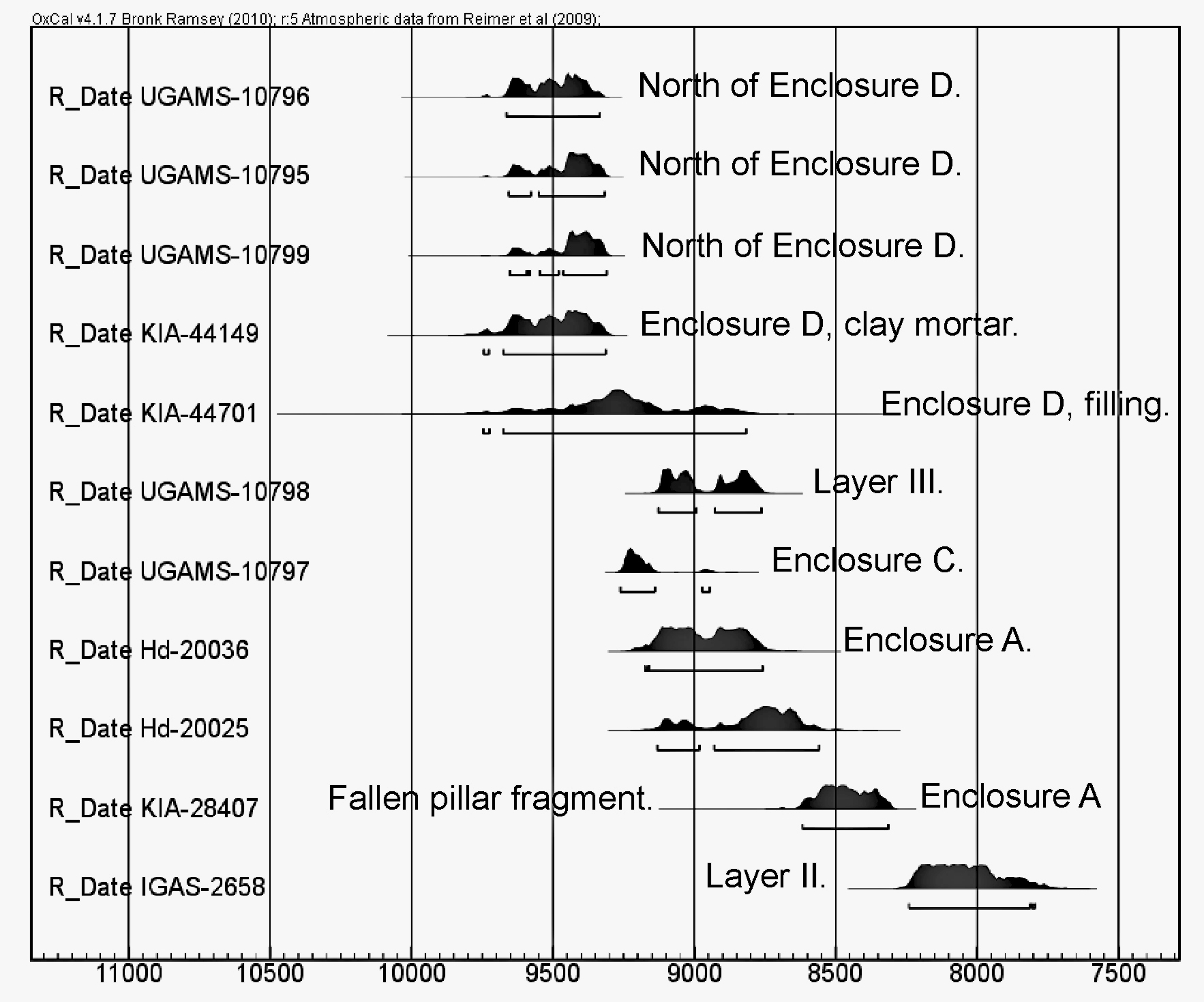
The period Göbekli Tepe was built in is addressed as the Pre-Pottery Neolithic (PPN) after one of its main cultural traits, the absence of pottery vessels (there are clay figurines later in the PPN, however). The general chronological division for the Early Neolithic was developed in the Southern Levant, by Kathleen Kenyon on the basis of the stratigraphy of Jericho.
She observed a fundamental distinction in the ground plans of buildings – round constructions in the earlier PPN A, rectangular buildings in the later PPN B. She further based her subdivision on differences in the material culture. These differences are most obvious in a certain find category: projectile points. Very detailed categorization schemes have been elaborated meanwhile, based on material from sites throughout the Near East. They serve as 'guiding fossils' for dating (yes, early archaeologists borrowed this term from geology).
At Göbekli Tepe, we can differentiate two layers which are completely different in the type of architecture appearing in them. Layer III, the lower and thus older layer, has the famous circular enclosures with the T-shaped pillars. Layer II is characterised by smaller buildings with rectangular groundplans. They sometimes also have pillars that are much smaller than the older ones however.
Photo: OxCal v4.1.7 Bronk Ramsey (2010): r:5 Atmospheric data from Reime et al. (2009)
Proximal Source and text: https://tepetelegrams.wordpress.com/2016/06/22/how-old-ist-it-dating-gobekli-tepe/
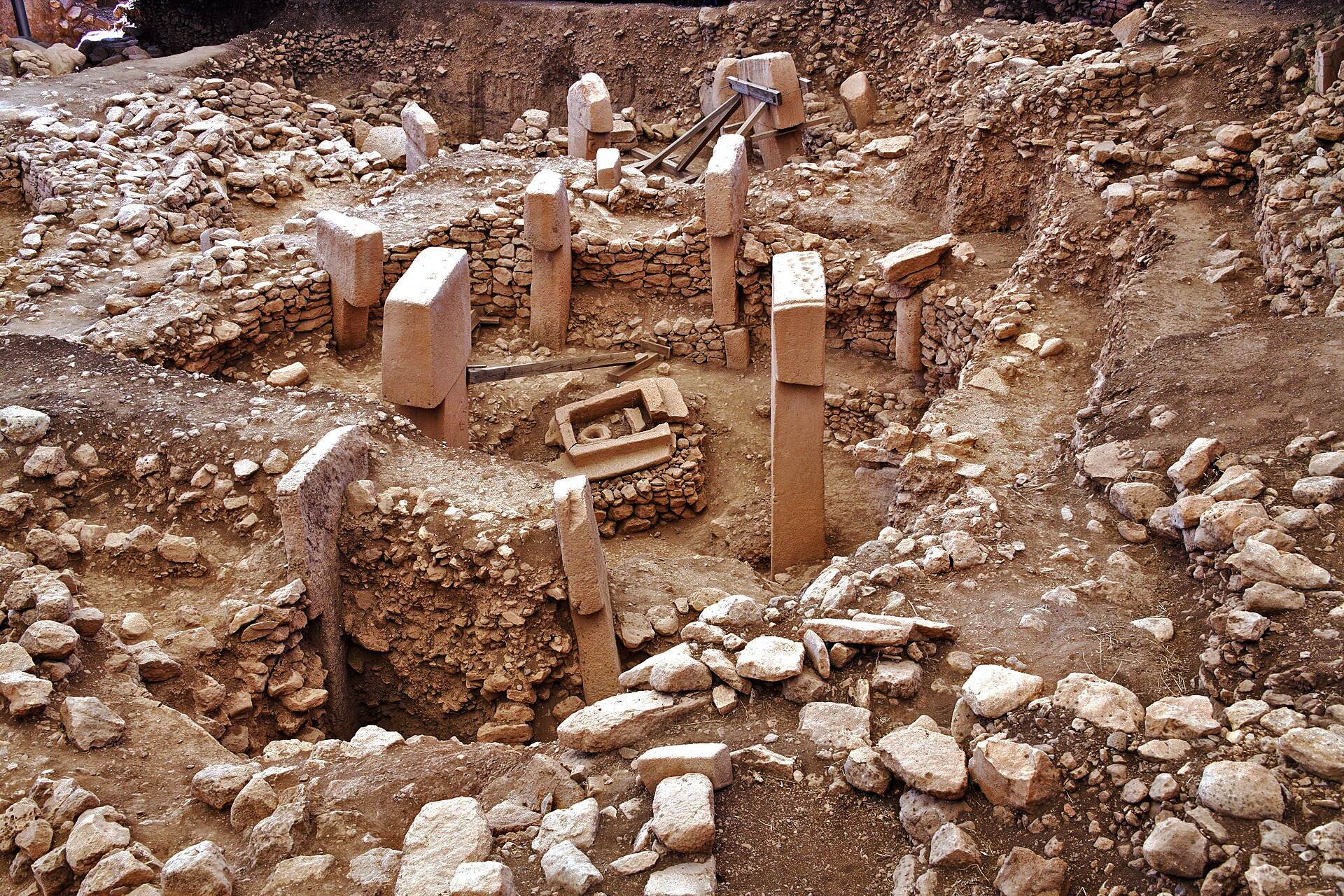
Enclosure B is located in the Southeast Hollow (Main Excavation Area) of Göbekli Tepe.
It has a round ground plan and measures roughly 10 metres in diameter. A total of seven T-shaped limestone pillars have so far been discovered set into its circular wall. The two central T-pillars brings the total number of monoliths in this building to nine. However, as the building is not yet excavated in its entirety, further pillars may still be found.
The floor of the enclosure was excavated over several square metres in the area between the two central pillars. The floor is made of a lime mortar terrazzo floor. The inner-facing broad sides of the two central pillars carry depictions of life-size foxes in low relief.
The ground plan of this enclosure is round, with an internal diameter of nearly 10 metres. Two central pillars and a total of eight pillars in the surrounding ring wall have been discovered so far. Most of these pillars are undecorated and none of them, as far as their front (i.e. 'belly') sides are visible, are adorned with the raised lateral parallel bands thought to depict a stola-like garment.
It dates from the 10th-9th milleniun BC
Text: Wikipedia
Additional text: www.dainst.blog/the-tepe-telegrams/2017/02/03/enclosure-b-a-short-overview/
Photo: © Dosseman
Photo date: 22 September 2019, 10:50:30
Permission: Creative Commons Attribution-Share Alike 4.0 International license.
Proximal source: Wikipedia
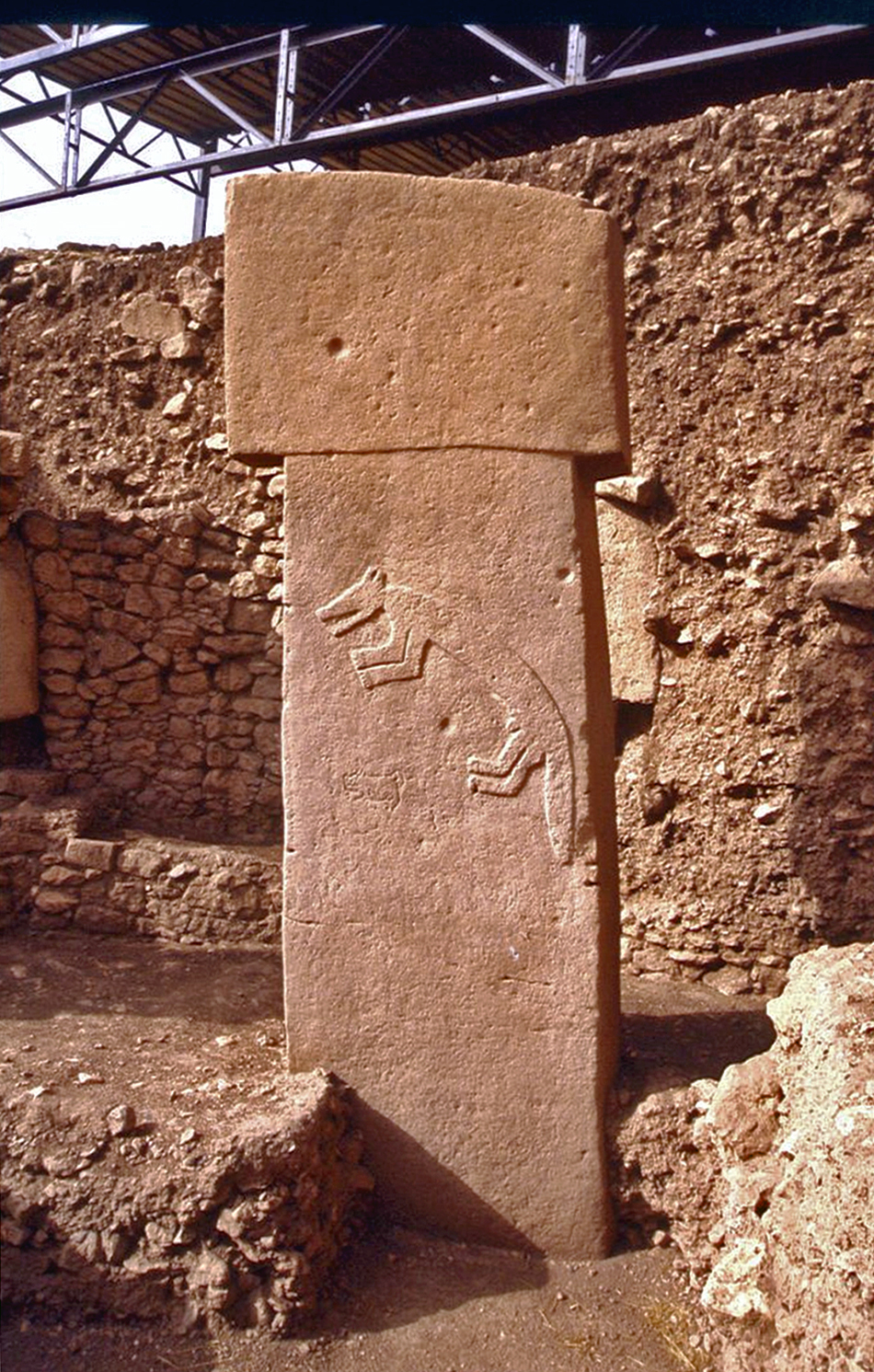
Pillar 10, Enclosure B.
Pillar 10 is one of the two central T-shaped pillars in Enclosure B at the Pre-Pottery Neolithic site of Göbekli Tepe, dating to roughly 9600–8200 BCE. It features a prominent, raised relief carving of a fox, measuring roughly 3 meters in height. The pillar stands on a terrazzo floor alongside Pillar 9, which also features a fox carving, marking them as central figures in this ~10-meter diameter, round, ritual building.
Along with Pillar 9, Pillar 10 is central to the enclosure, which is defined by its roughly round shape, and 8 surrounding pillars.
The fox is the dominant motif for the central pillars in this specific enclosure. A limestone 'porthole stone' was discovered near the center of Enclosure B.
The enclosure was investigated in a deep sounding in 2011, which also revealed exterior walls and another porthole stone with fox imagery to the north.
Photo: M. Morsch, © DAI)
Source and text: www.dainst.blog/the-tepe-telegrams/2017/02/03/enclosure-b-a-short-overview/
Additional text: Various sources
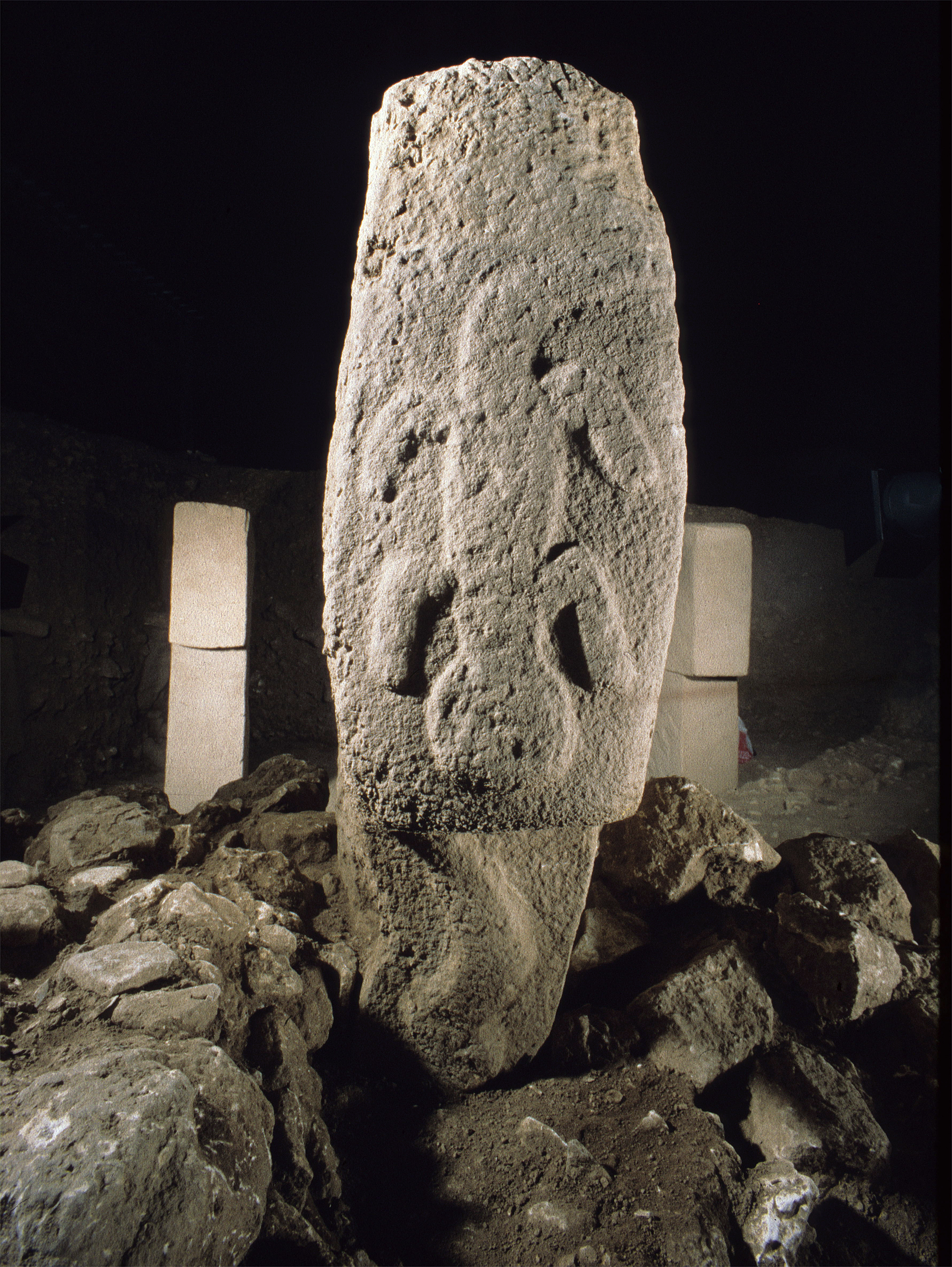
Pillar 6, Enclosure B.
Pillar 6 in the southern part of Enclosure B shows the relief of a quadruped animal from above on the small side of the pillar’s head. It resembles a reptile, but there are also similar PPN depictions which may depict leopards.
On the pillar-shaft a snake is depicted crawling down. It is worth noting that all reliefs are found on the back side of the pillar, i.e. not facing towards the central pillars, a clear indication that Pillar 6 likely represents a case of secondary use.
Photo: I. Wagner © DAI
Source and text: www.dainst.blog/the-tepe-telegrams/2017/02/03/enclosure-b-a-short-overview/
Additional text:
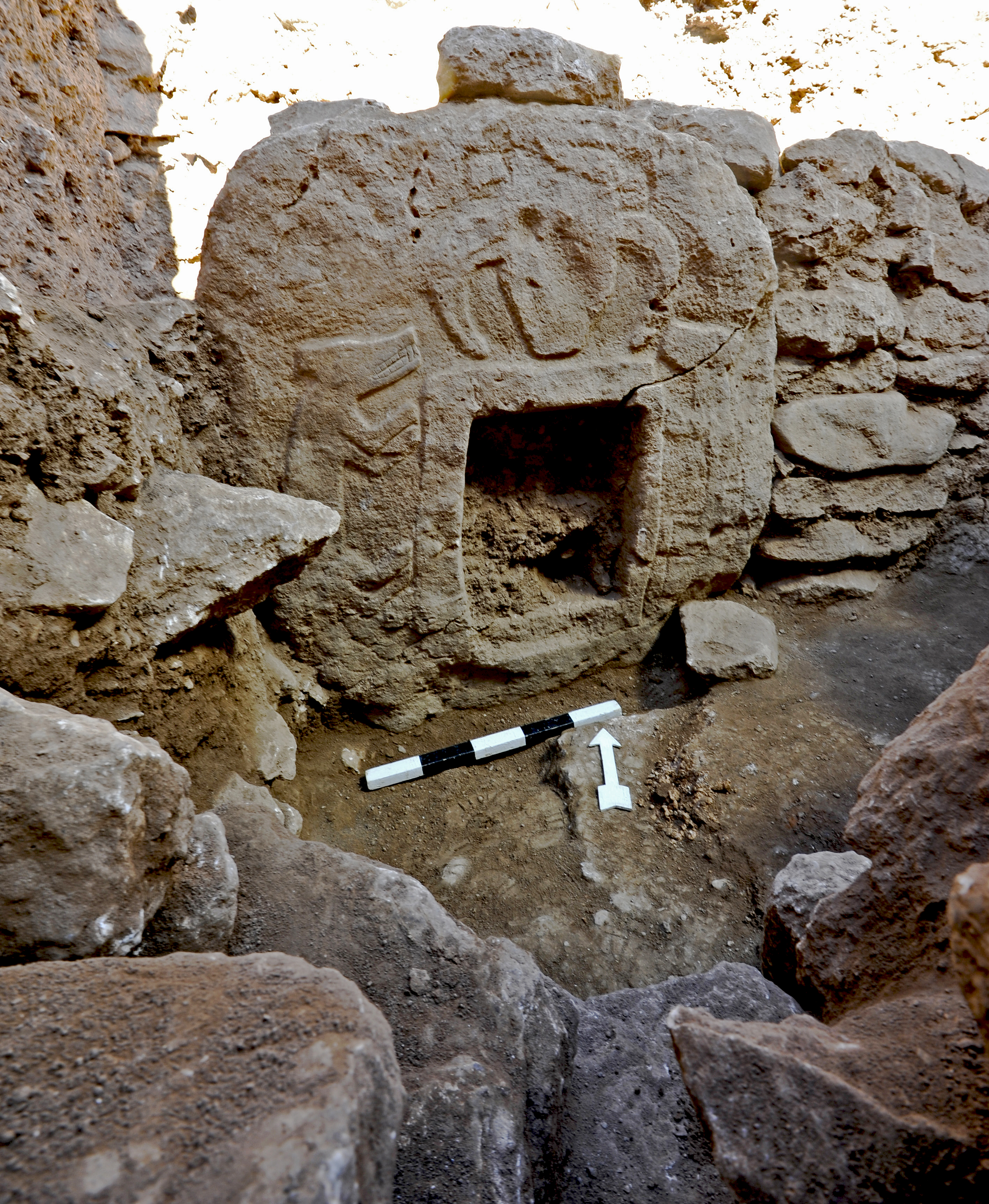
Stone portal, found in situ in a wall in a deep sounding to the north of Enclosure B
The stone was found during a deep sounding excavation to the north of Enclosure B, a project initiated to install protective shelter struts. The stone features a subrectangular central hole flanked by two foxes depicted opposite to each other in a jumping or 'guarding' posture. A bucranium (bull's skull) relief is positioned directly above the opening.
It was found embedded within a wall on the bedrock, situated just outside the known boundaries of Enclosure B. While several 'porthole stones' have been found at Göbekli Tepe, including a monumental 3x3m example in the northwestern hilltop, this was the first to be found in its original architectural context.
Archaeologists debate whether it served as a symbolic entrance to a building or a 'guarded' niche within a room. Its discovery also revealed previously unknown walls and pillars belonging to the older Layer III phase of the site.
Photo: N. Becker © DAI
Source and text: www.dainst.blog/the-tepe-telegrams/2017/02/03/enclosure-b-a-short-overview/
Additional text: Various sources
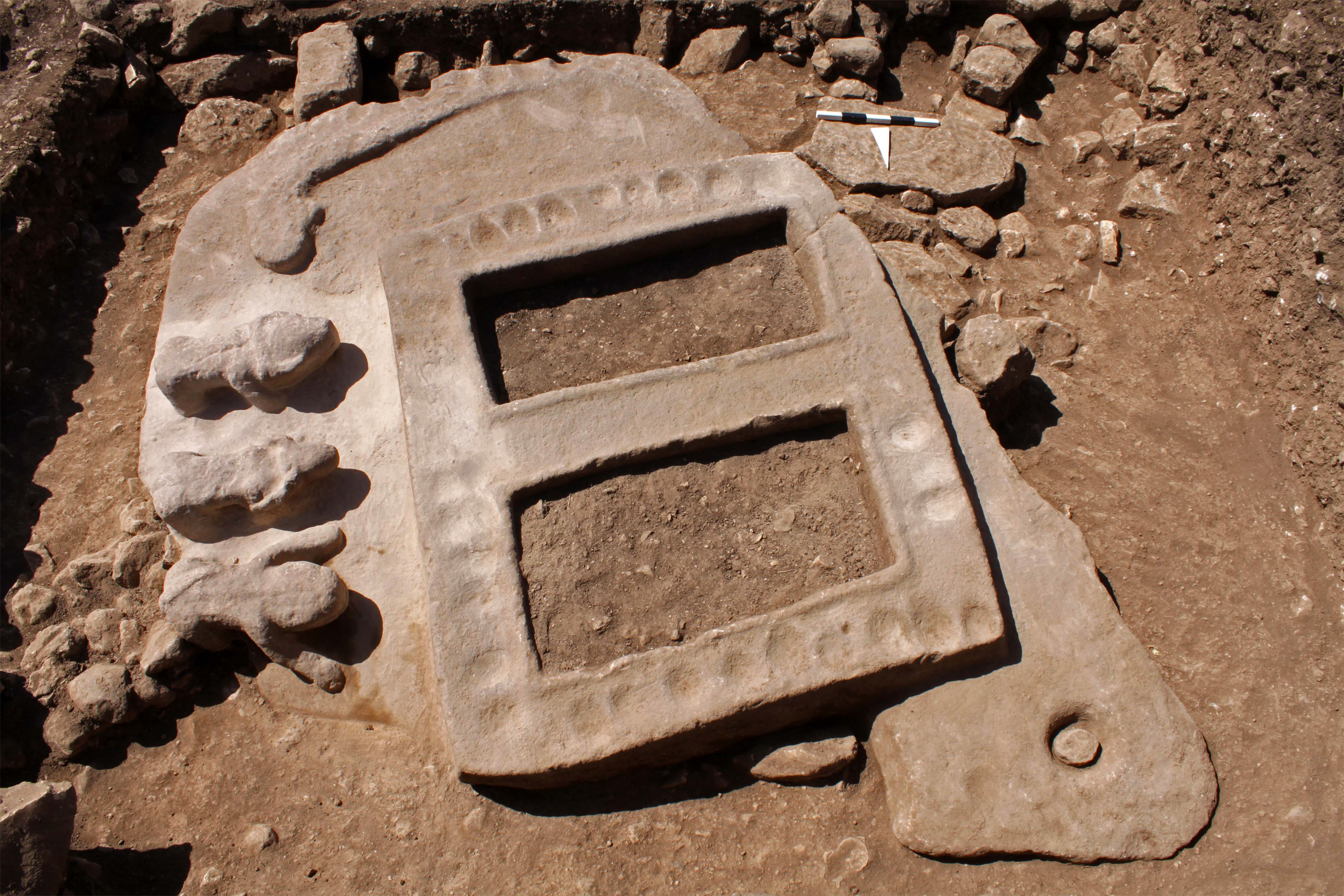
A monumental porthole stone from the northwestern hilltop areas.
A very important find in the northwestern hilltop was made. What seemed in the moment of discovery to be a larger worked stone, a common thing at Göbekli Tepe, turned out after several days of detailed excavation to be a monumental porthole stone. Several such stones with a central opening are known from the site, and they could have played a role as entrances to the enclosures or other buildings. One of them lies approximately in the centre of Enclosure B and gives some reason to think about an entrance through a possible roof for that building.
However, this new porthole stone from the northwestern areas was completely different, not only in regard to its enormous measurements of circa 3 metres x 3 metres. First, unlike all examples found before, it has two openings. Second, it is richly decorated with three circa 50 cm long sculptures of quadrupeds (a bull, a ram and a wildcat) and a 150 cm long snake in high relief, as well as a row of cupholes. Unfortunately, the stone was not in situ, that is, not in its original context. But the decorations clearly show that it must have been part of an important building whose entrance had to be guarded accordingly.
Photo: © O. Dietrich
Source and text: www.dainst.blog/the-tepe-telegrams/2017/03/20/
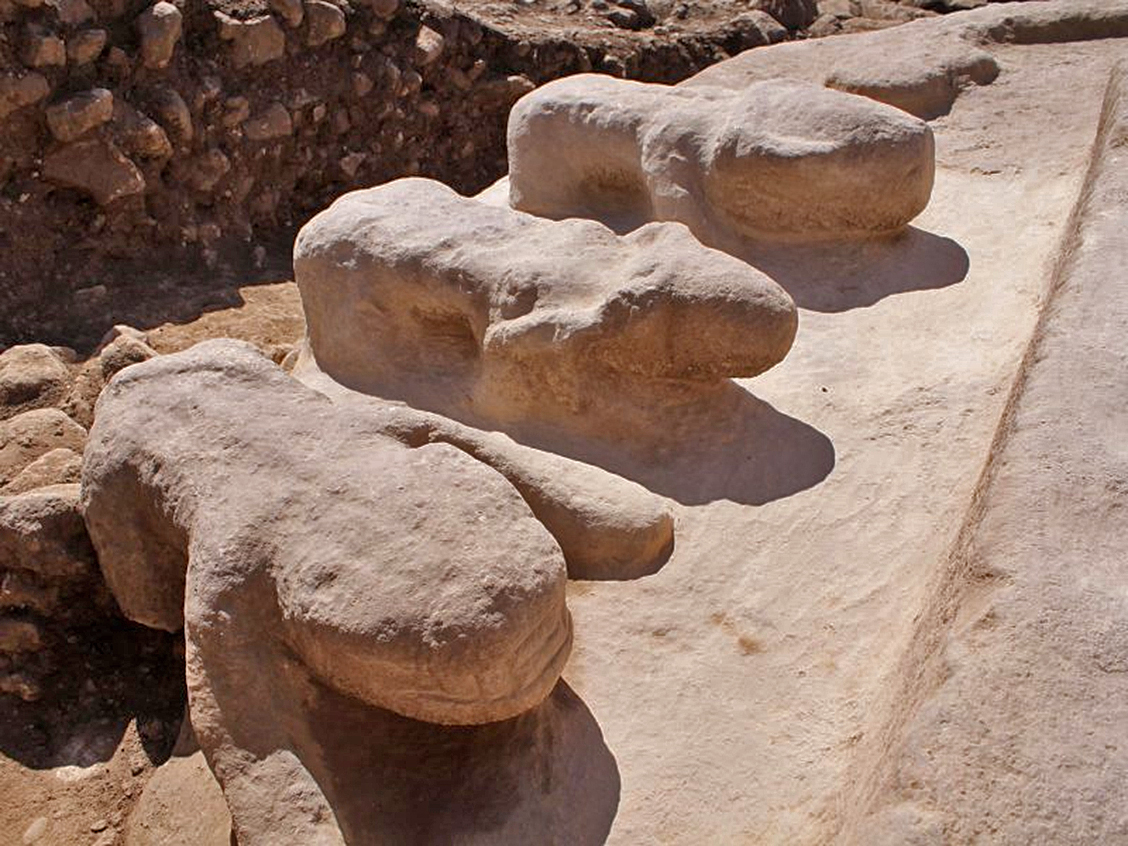
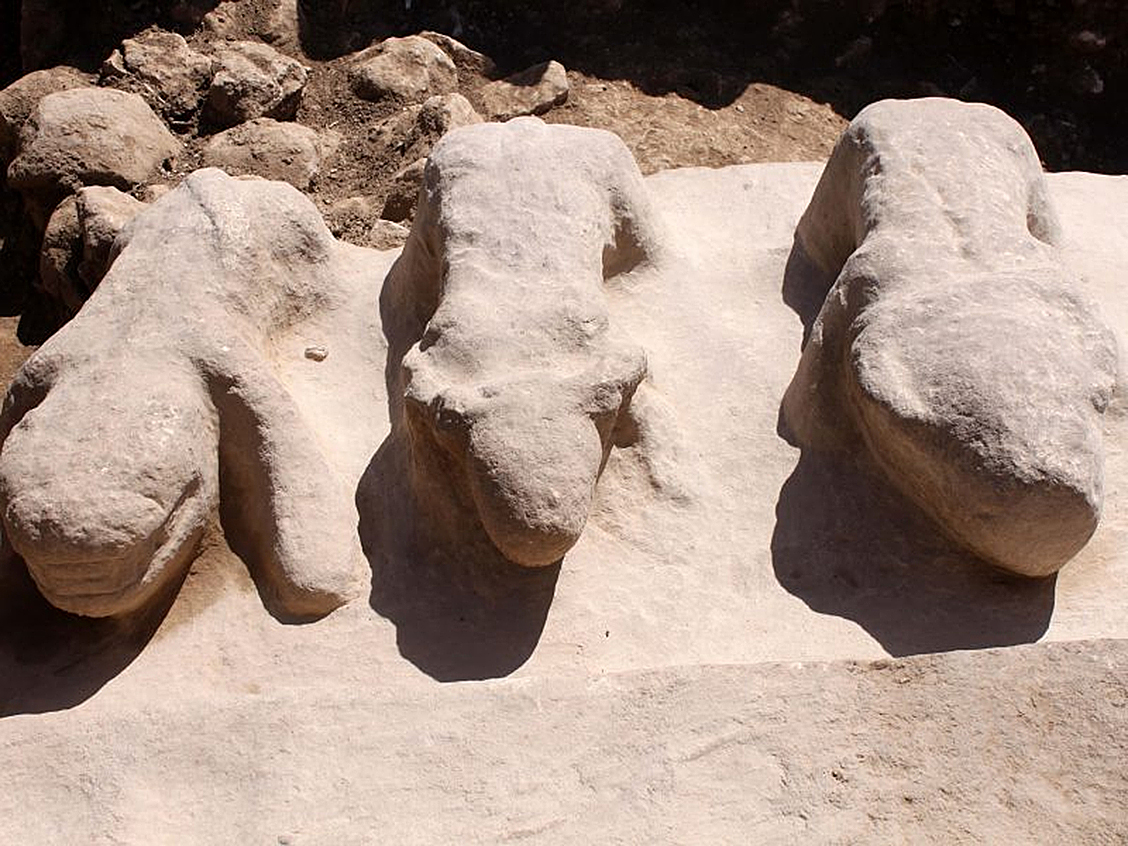
Closeups of the sculptures on the monumental porthole stone.
Photo: © O. Dietrich
Source and text: www.dainst.blog/the-tepe-telegrams/2017/03/20/
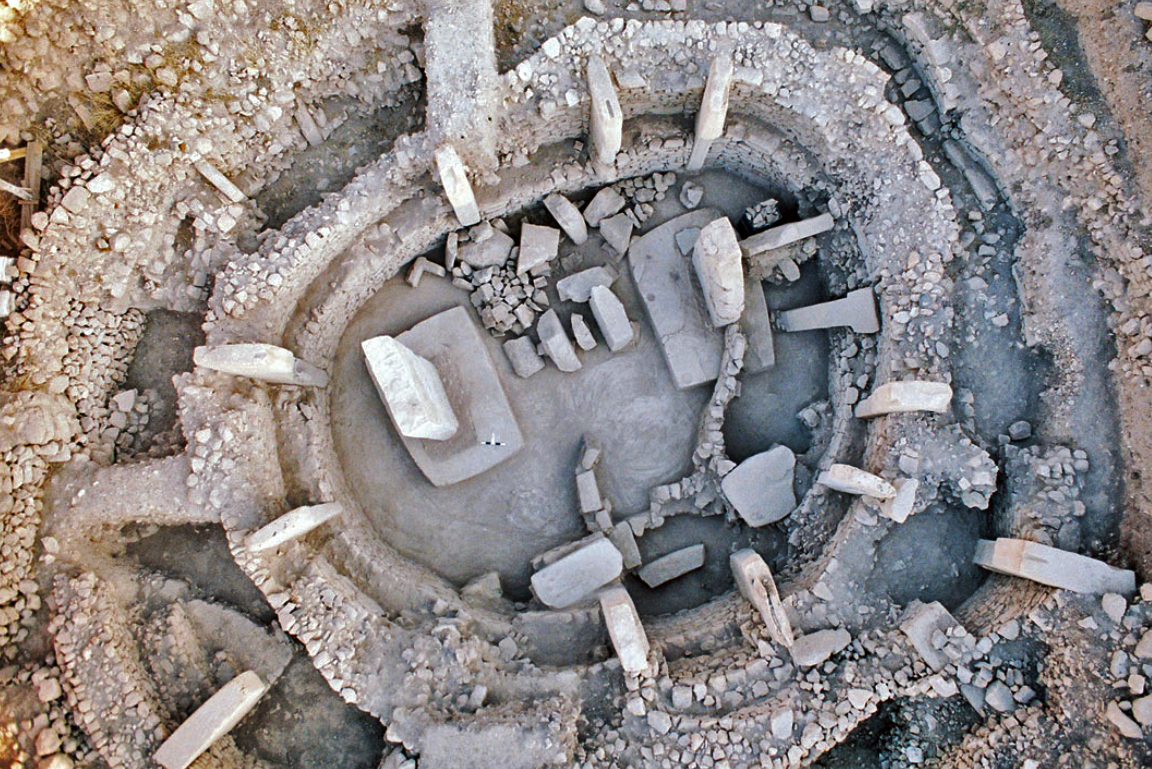
Enclosure C seen from above.
Depictions and sculptures of boars predominate the imagery of Enclosure C. Pillar 12 for example has a depiction of a boar with pronounced canine teeth. Next to this a sculpture of a boar was found, obviously deposited there during refilling.
Another deposition of a boar sculpture, this time together with stone plates, was found next to one of Enclosure C's central pillars. The list continues with many further examples, as most boar sculptures discovered at Göbekli Tepe are from Enclosure C.
The richness of both boar depictions and sculptures hints at a special concern of the builders of that stone circle with wild boar. As other enclosures also feature a dominant animal species, there is the possibility that we are dealing with emblematic or totemic animals here. But not all of the depictions are just 'emblematic' in character. It seems that some, or all, also tell a story.
Photo: K. Schmidt, © DAI
Source and text: Dietrich et al. (2012)
Additional text: www.dainst.blog/the-tepe-telegrams/2016/07/15/boars-in-gobekli-tepes-enclosure-c-just-a-story-of-hunters-and-prey/
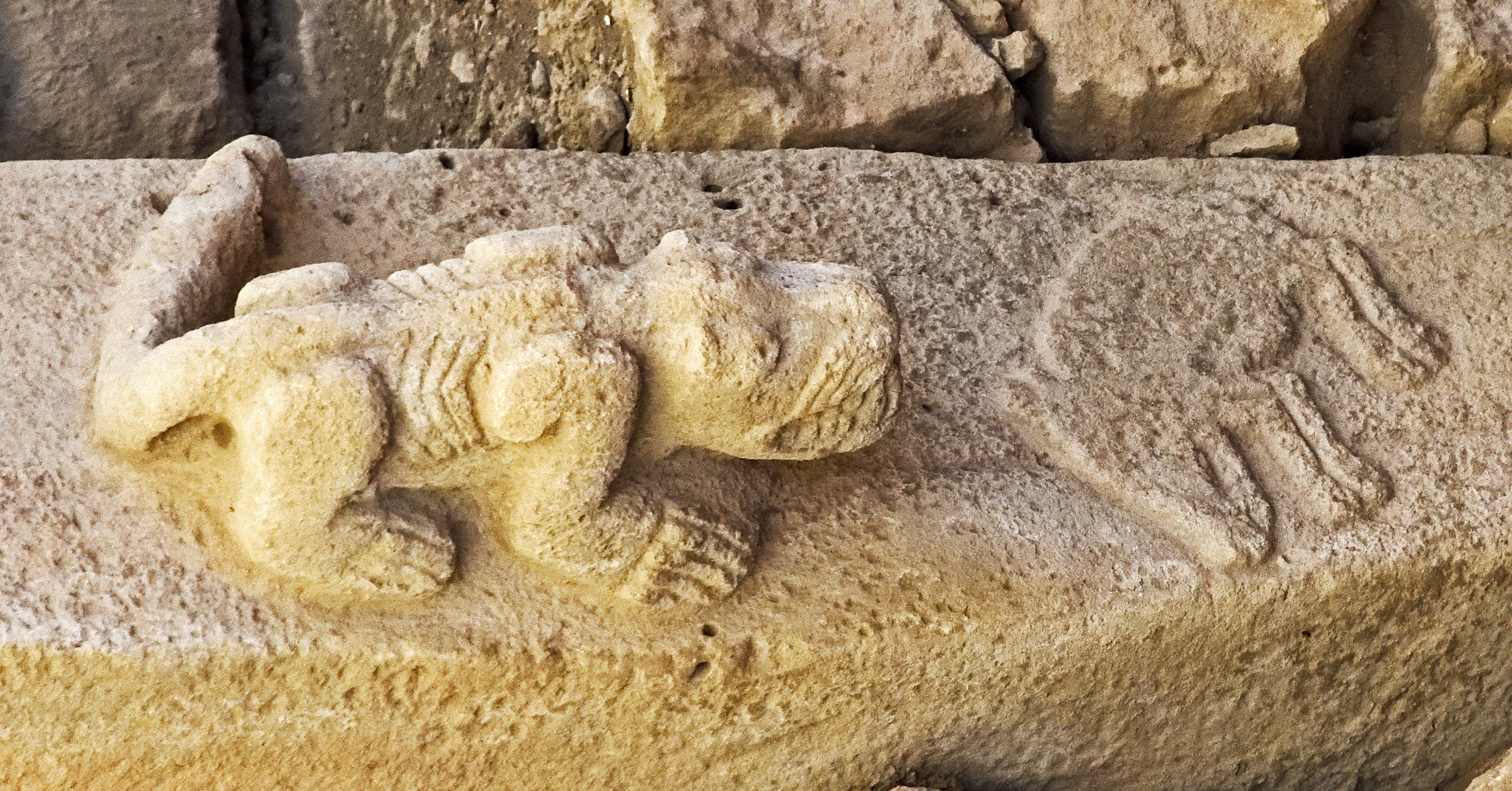
Enclosure C: Animal hunting scene. Gobekli Tepe.
This shows a sculpture or relief of a lion or panther in a crouching position on Pillar 27, Enclosure C. Near it is a wild boar shown in bas relief. It may be that the predator is attacking the boar.
Photo: © Dosseman
Source and text: Wikipedia
Permission: Creative Commons Attribution-Share Alike 4.0 International licence.
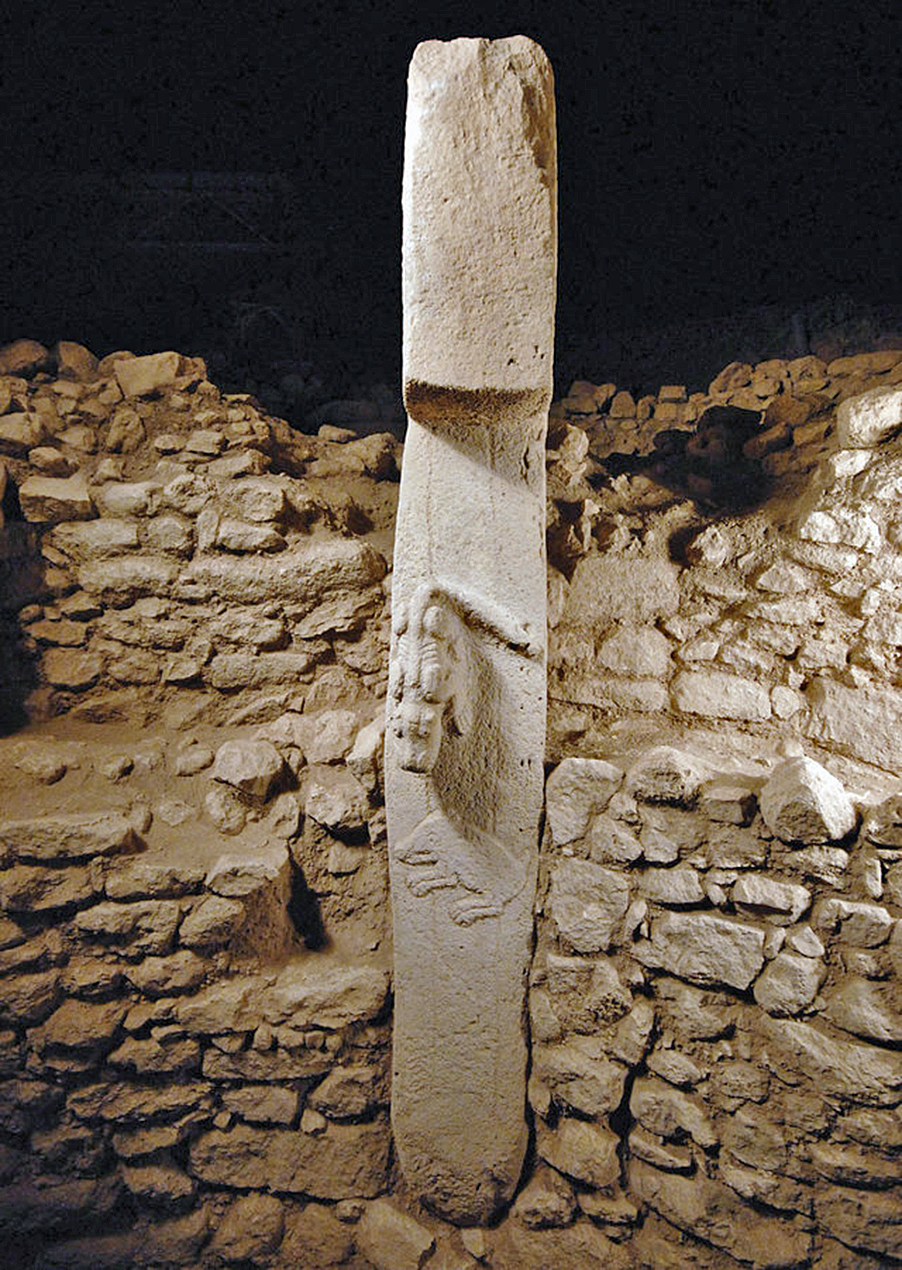
Enclosure C: Animal hunting scene. Gobekli Tepe.
Photo: D. Johannes, © DAI
Source and text: Dietrich et al. (2012)
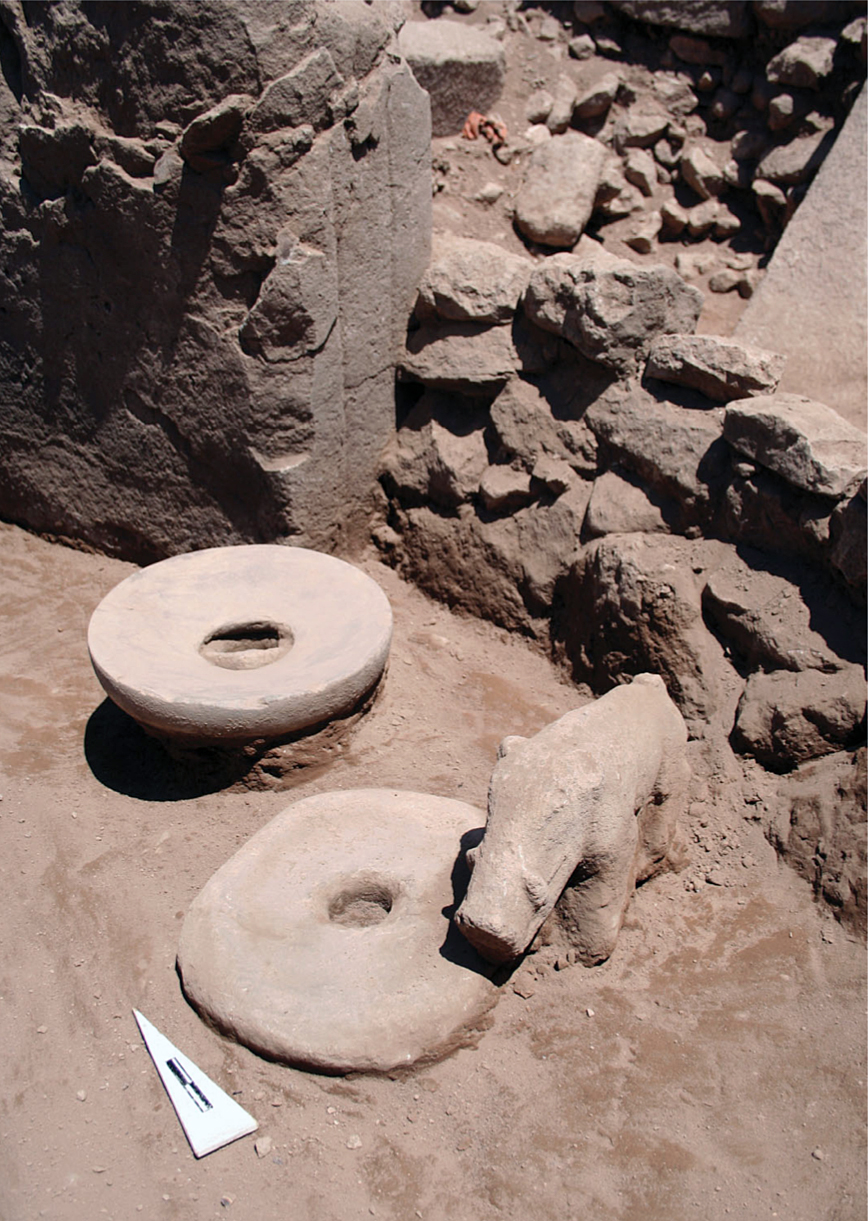
Enclosure C: Sculpture of a boar and stone plates discovered near one of the central pillars of Enclosure C.
Photo: K. Schmidt, © DAI
Source and text: Dietrich et al. (2012)
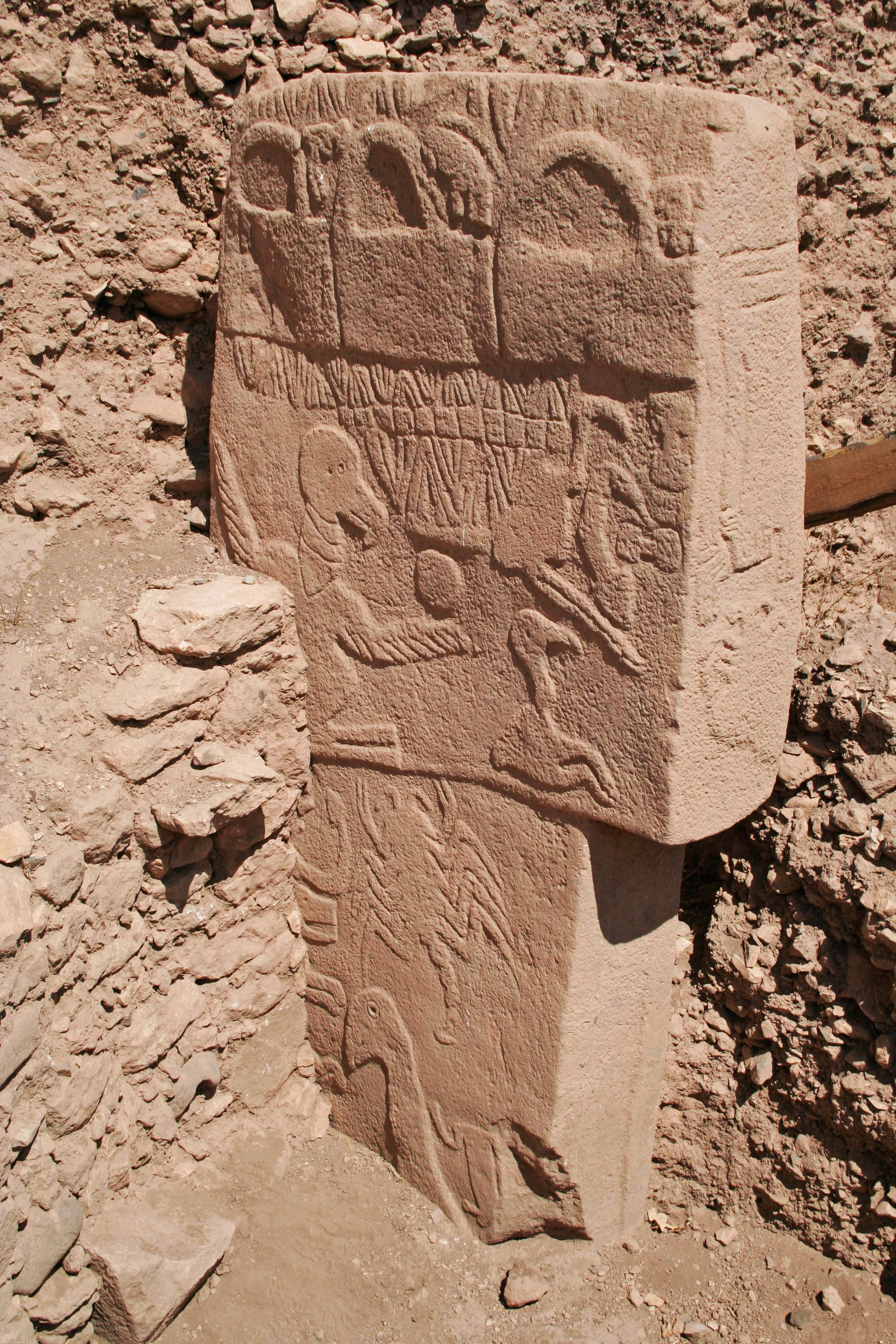
Pillar 43, Enclosure D, often called the 'Vulture Stone' at Göbekli Tepe (circa 9500 BC), is a T-shaped limestone pillar featuring a rich, complex relief carving of a vulture, a scorpion, cranes (or similar long-necked birds), and other animals.
This object, like others, likely represents mythological, cosmological, or seasonal themes — such as an autumn scene or, controversially, an ancient sky map representing constellations like Scorpius.
Some images on Göbekli Tepe’s pillars indicate a narrative meaning. One striking example for this is Pillar 43 in Enclosure D. The whole western broad side of this pillar is covered by a variety of motifs. Dominant is a big vulture. It lifts its left wing, while the right wing points to the front. It is possible that this gesture aims at the sphere or disc that can be seen above the tip of the right wing. But to the right of the vulture another bird, maybe an ibis or a young vulture is shown. If we take this image as a depiction of a young bird, then the stretched-out wing of the vulture could be a gesture of protection, and the sphere could be the egg the young bird hatched from. Another possibility would be a depiction of the sun or the moon. However, the scenery could also mean something completely different, as we will see below.
To the right above this scene, a snake, two H-shaped symbols and wild fowl are depicted. On the pillar’s shaft, a huge scorpion as well as the head and neck of another bird are dominating the scene. While some more reliefs to the left of the scorpion and the bird are hidden by the perimeter wall, to the right of the bird’s neck an especially interesting motif is depicted. Due to damage to the pillar it is not preserved completely, but the representation of a headless human with an erect penis is quite clearly recognizable. The depiction seems to relate to aspects of Early Neolithic death cult known from several sites and offers another interpretation for the spherical object aboive the vultures wing: it could be the depiction of the person’s head. But even without giving too much weight to this aspect of the pillar’s reliefs, it is clear that the intention behind the imagery goes well beyond depicting nature.
On the uppermost part of Pillar 43, a row of three rectangular objects with cupola-like ‘arches’ on their tops can be seen. Every one of these objects is accompanied by an animal added on the ’arch’. The meaning of these images is hard to guess, but they might represent the enclosures during their time of use, seen from the side. The rectangular part would represent the perimeter walls, while the cupolas may indicate roofs. As usually depictions of one animal species seem to dominate in every enclosure, it is an intriguing thought that buildings of different groups are depicted here with the emblematic animals of these groups added for recognition. Following this line of argument, one would also have to assume that the enclosures were depicted here rather schematic in an almost technical sectional view – what would be highly unusual compared to the other naturalistic representations from Göbekli Tepe. A final decision on the meaning of these images is not possible at the moment.
Photo: O. Dietrich © DAI
Text: https://tepetelegrams.wordpress.com/2016/10/14/of-animals-and-a-headless-man-gobekli-tepe-pillar-43/ and various other sources
Proximal Source: https://tepetelegrams.wordpress.com/2016/10/06/current-state-of-research-at-gobekli-tepe-interviewed-by-arkeofili-com/
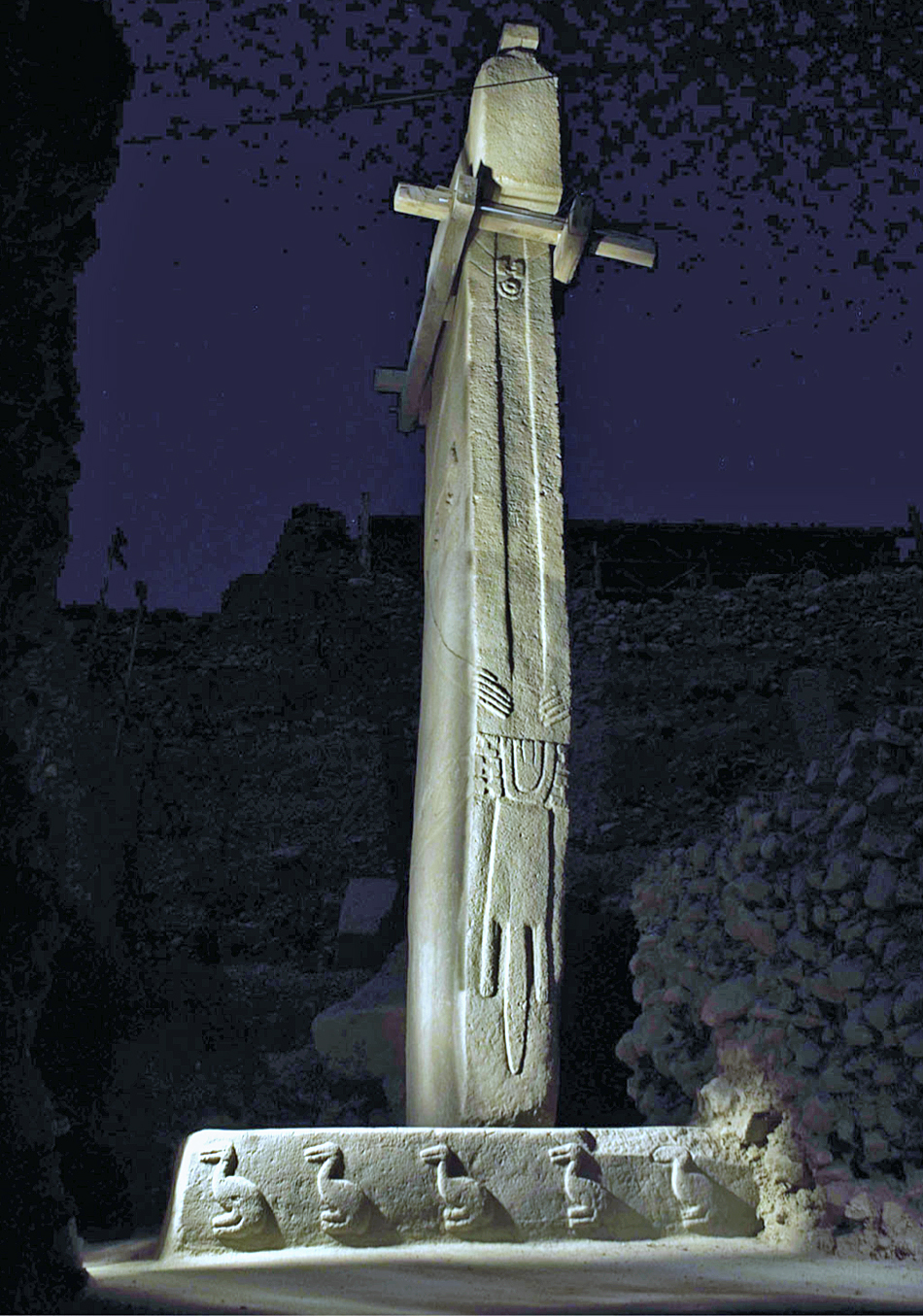
The second central pillar of Enclosure D shows elements of clothing as well. Its socket is decorated with a row of ducks in high relief.
Photo: N. Becker © DAI
Source and text: Dietrich et al. (2012)
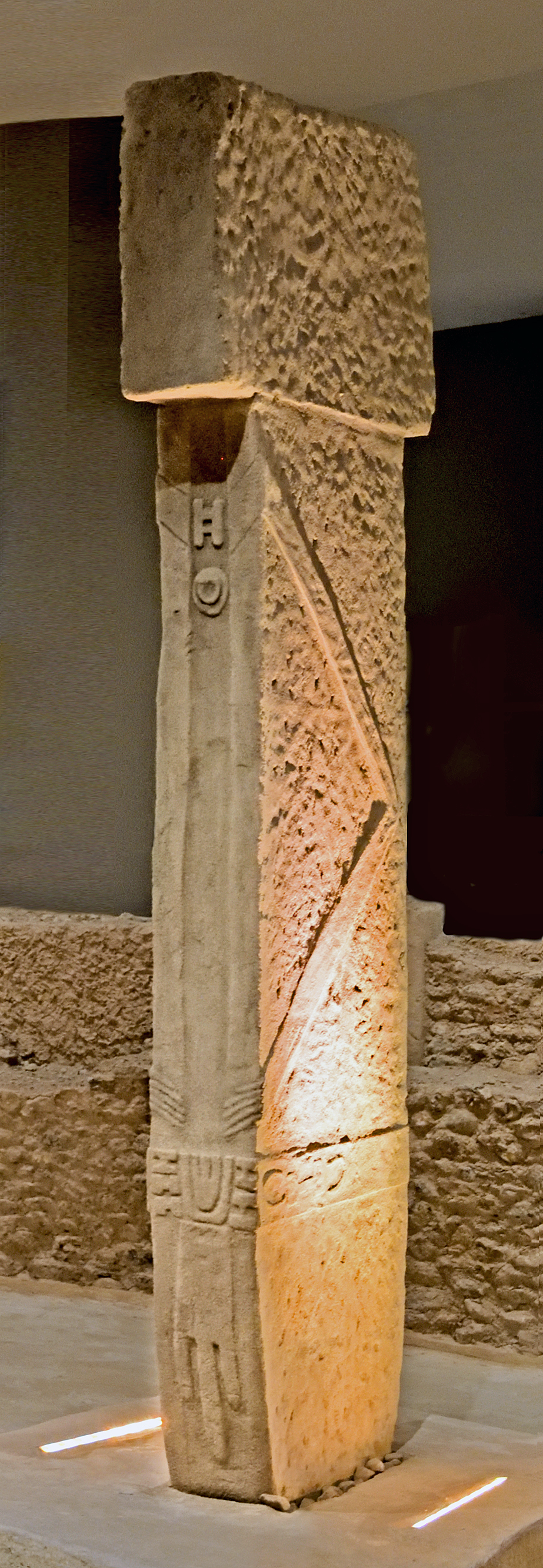
The second central pillar of Enclosure D, shown here without the socket and row of ducks.
This is a facsimile at Şanlıurfa Museum, 21.8 km from Göbekli Tepe.
Photo: © Dosseman
Permission: Creative Commons Attribution-Share Alike 4.0 International licence.
Proximal source and text: Wikipedia
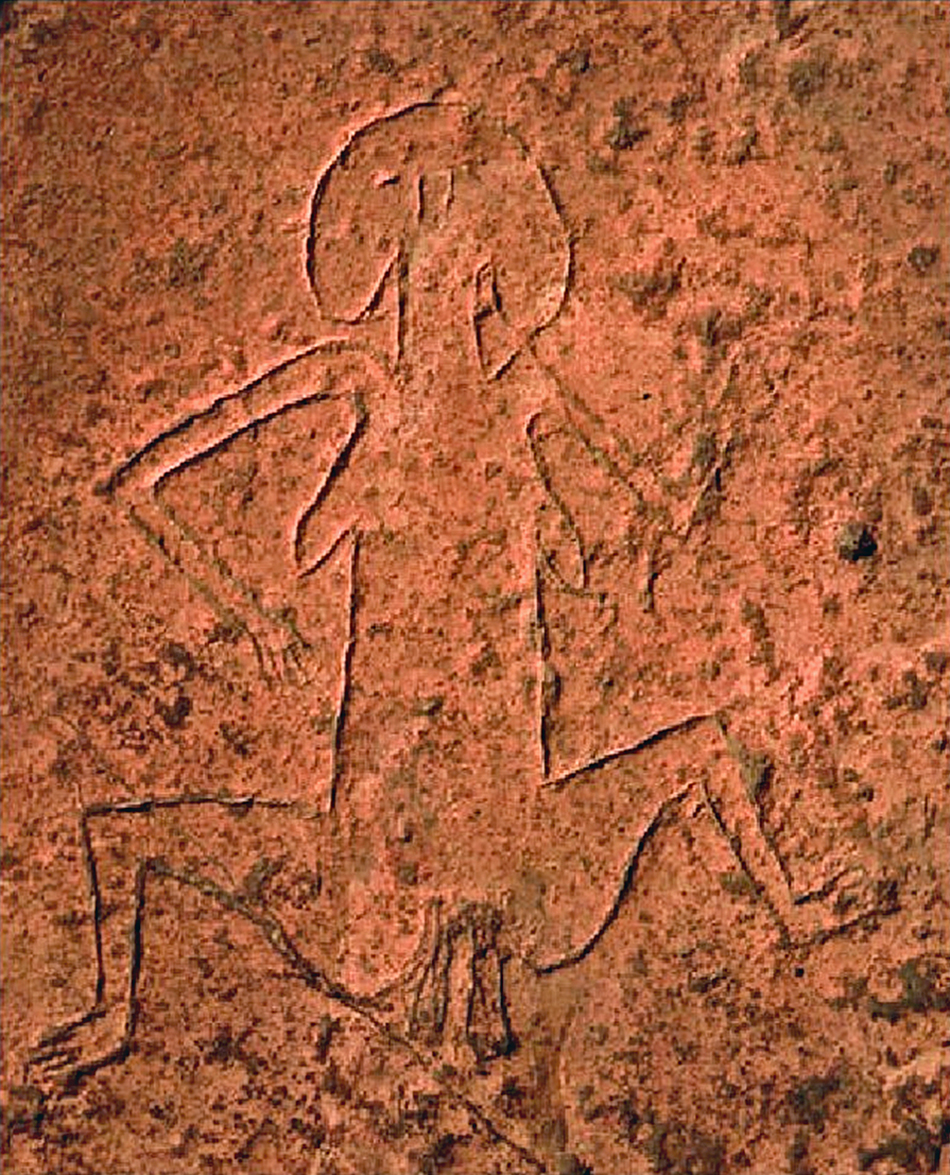
Göbekli Tepe, engraving of a female human from layer II.
At Göbekli Tepe, we can differentiate two layers which are completely different in the type of architecture appearing in them. Layer III, the lower and thus older layer, has the famous circular enclosures with the T-shaped pillars. Layer II is characterised by smaller buildings with rectangular ground plans. They sometimes also have pillars that are much smaller than the older ones however.
The enclosures of Layer III were treated in a special way at the end of their use lives. They were cleaned, part of their fittings dismantled, and refilled. During the refilling, objects that obviously had a great importance to PPN people were deposited in the filling. However it seems that refilling was a relatively fast process. There are no intermediate sterile layers brought in by water or wind.
Although the observed archaeological stratigraphy is confirmed by the relative sequence of the data, absolute ages are clearly too young, with Layer III being pushed into the 9th millennium. Layer II produced ages from the 8th or even 7th millennia cal BC. Therefore, the data fail to provide absolute chronological points of reference for architecture and strata. At most they serve as a latest possible date for the backfilling of the enclosures (Layer III) and the abandonment of the site (Layer II).
Photo: Dieter Johannes, © DAI
Permission: CC BY-SA 4.0
Source and text: Schmidt (2010)>
Additional text: www.dainst.blog/the-tepe-telegrams/2016/06/22/how-old-ist-it-dating-gobekli-tepe/
References
- Dietrich O., Heun M., Notroff J., Schmidt K., Zarnkow M., 2012: The role of cult and feasting in the emergence of Neolithic communities. New evidence from Göbekli Tepe, south-eastern Turkey, Antiquity 86, (2012, pp. 674–695
- Korol D., 2024: "The First Temple in the World", Status Legitimacy Problems: Göbekli Tepe in Scientific Discussions of the Last Two Decades, NaUKMA Research Papers History and Theory of Culture 7 (2024), DOI: 10.18523/2617-8907.2024.7.118-129
- Schmidt K., 2000: Göbekli Tepe, Southeastern Turkey. A Preliminary Report on the 1995-1999 Excavations, Paléorient, Année 2000 26-1 pp. 45-54
- Schmidt K., 2010: Göbekli Tepe – the Stone Age Sanctuaries. New results of ongoing excavations with a special focus on sculptures and high reliefs, Documenta Praehistorica 37, pp 239-256, DOI: 10.4312/dp.37.21 License: CC BY-SA 4.0
Back to Don's Maps
Back to Archaeological Sites