Back to Don's Maps
Egyptian methods of drilling, cutting, carving, and polishing granite
I was led to the information below by a video from the Abyss Archive, https://www.youtube.com/watch?v=IYVtg4U9Ci4. I have since confirmed the information from various sources.
I am delighted to have found the answer to something which has bothered me since ever I first started recording Egyptian sculpture. At that time there was no sensible method recorded of how the sculptures were made. I first started wondering about the methods when I found very old, pre-dynastic round pots of Andesite (which has a mohs scale hardness of 6-7, the same hardness and difficulty level for grinding and polishing as granite) which had patently been ground into shape somehow. At the time the few early examples were supposed by some, without evidence, to be imported from some other unnamed culture. (Aliens are always lurking somewhere in discussions of the engineering ability of ancient Egyptians....)
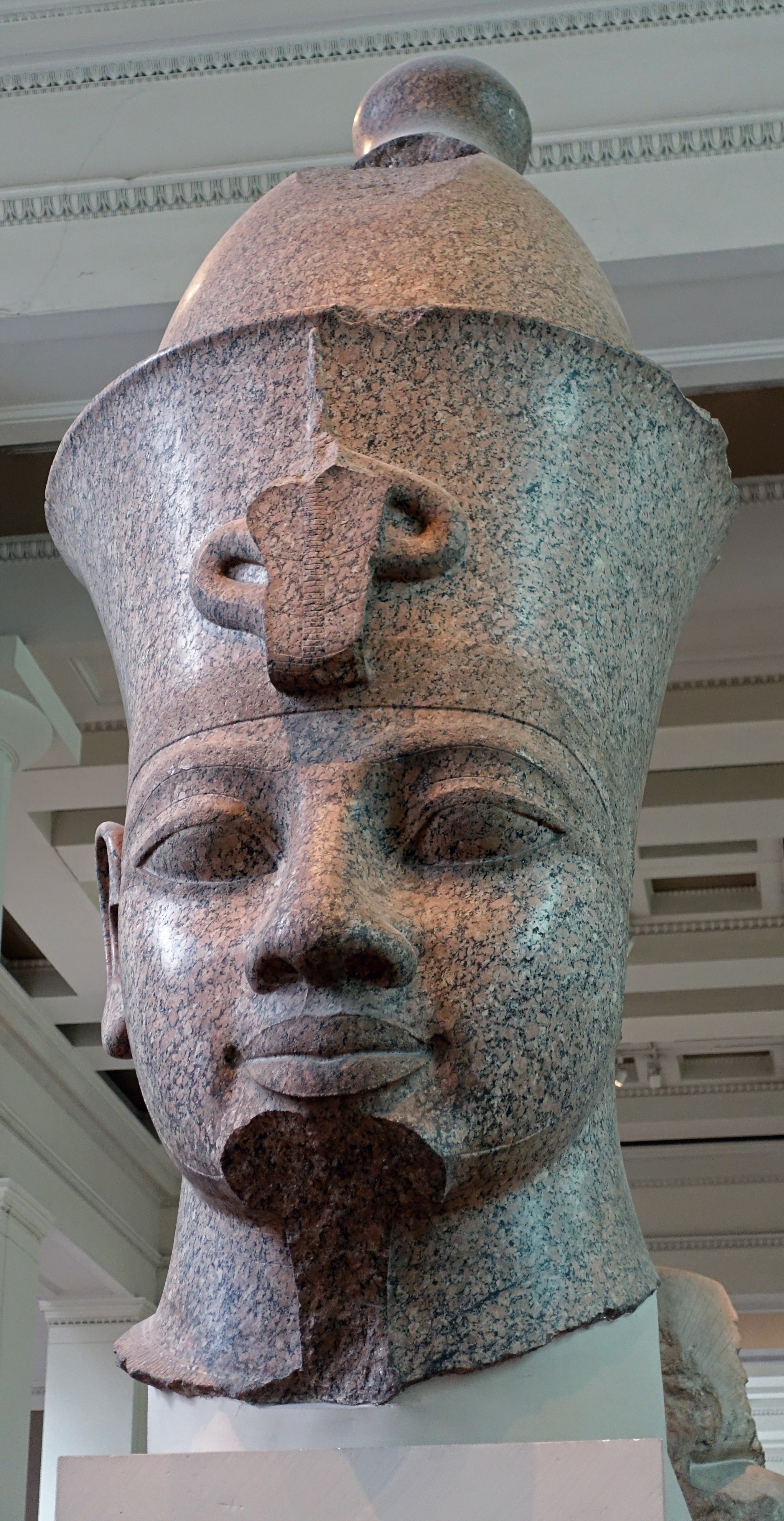
Eighteenth Dynasty: 1 550 BC - 1 292 BC
King Amenhotep III
Head from a monumental red granite statue of Amenhotep III, circa 1 370 BC.
This superb sculpture demonstrates that the Egyptians by this time in the 18th Dynasty, 1 550 BC - 1 292 BC, had complete control of cutting, shaping, and polishing granite.
Height: 2900 mm, weight 3 600 kilograms.
Catalog: Red granite, Luxor Governorate, Karnak (Thebes): Temple of Khonspakhered, EA15
Photo: Don Hitchcock 2018
Source: Original, British Museum
Text: Card with the display at the British Museum, © Trustees of the British Museum, CC BY-NC-SA 4.0, www.britishmuseum.org/
Ancient Egyptians used corundum, often in the form of emery (a rock rich in corundum) as a high-hardness abrasive to work granite by grinding rather than cutting. Because corundum (hardness 9 on the Mohs scale) is significantly harder than the quartz (hardness 7) and feldspar (hardness 6) in granite, it allowed them to effectively cut, drill, and polish the hard stone.
Egyptians utilised hollow copper or bronze tubes as drills, rotated back and forth using a bow drill. The corundum/emery powder was mixed with water to create a slurry that was fed into the hole. As the copper tube rotated, the corundum particles embedded themselves in the soft metal, acting as cutting teeth that ground away the granite, leaving behind fine concentric striations.
Cutting/Sawing:
For sawing large granite blocks, Egyptians used copper saws (likely toothless blades) in combination with a wet abrasive slurry of emery or corundum. The saw was operated back and forth, rubbing the abrasive against the stone to cut through it slowly.
Studies have demonstrated that copper tubes combined with emery/corundum can cut through granite, whereas quartz sand alone is inefficient.
Archaeological Remains:
Analysis of drilling residue found at ancient sites has identified particles of corundum.
The tell-tale concentric lines observed on ancient granite cores and in holes (such as at the Giza Plateau) indicate the use of a hard, cutting abrasive paste applied during a rotational process.
Polishing:
Final polishing was achieved by using abrasive slurries, starting with coarser emery and moving to finer grits. These powders were applied to the granite surface using rubbing stones (like quartzite or dolerite) or leather or cloth primed with extremely fine powdered abrasive, perhaps wrapped around a wooden block or a stone, creating a high-gloss finish.
Tin oxide, SnO2 , cassiterite, is presently used for this task to get a mirror finish on granite, and was available to ancient Egyptians through the mining of cassiterite (tin stone, tin oxide) in the Eastern Desert, with sources in the Abu Dabbab rare-metal granite massif and surrounding areas. This tin oxide was primarily and importantly used as a precursor of metallic tin for the making of bronze.
Cassiterite, the primary tin ore, is most commonly black, brownish-black, or brown due to iron impurities.
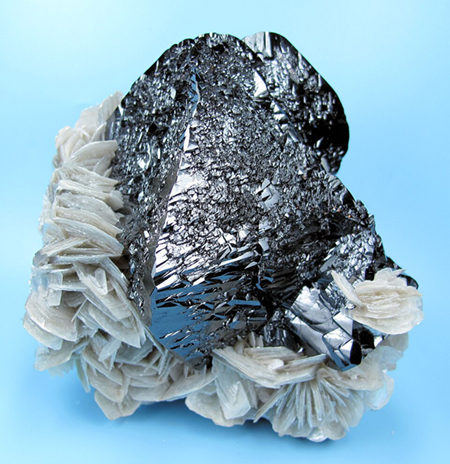
Black cassiterite, with encrusting white muscovite, from Xuebaoding, Huya, Pingwu, Mianyang, Sichuan, China.
100 mm x 95 mm, 1128 gm.
Photo and text: CarlesMillan
Permission: Creative Commons Attribution-Share Alike 3.0 Unported licence.
Creating bronze:
To create bronze, the tin oxide had to be first reduced to metallic tin for the best results. The concentrated cassiterite was mixed with charcoal (which acts as a reducing agent to remove the oxygen) in a small clay-lined pit, hearth, or crucible.
Temperature:
Because tin has a very low melting point, 232°C, it can be reduced at relatively low temperatures using a wood fire, though hotter, more efficient furnaces were often used.
Modern granite polishing with tin oxide:
Modern polishing of granite involves using tin oxide, SnO2 , in the form of an ultra-fine abrasive powder to achieve a high-gloss, mirror-like finish on countertops and floors. It works best by creating a paste with water, buffing it into granite using felt pads and low-speed, high-pressure tools, removing minor scratches and restoring lustre.
Felt pads or hard polishing cloths are preferred because they generate controlled friction and heat, which helps develop the reflective finish.
Text above: Various sources, including www.penn.museum
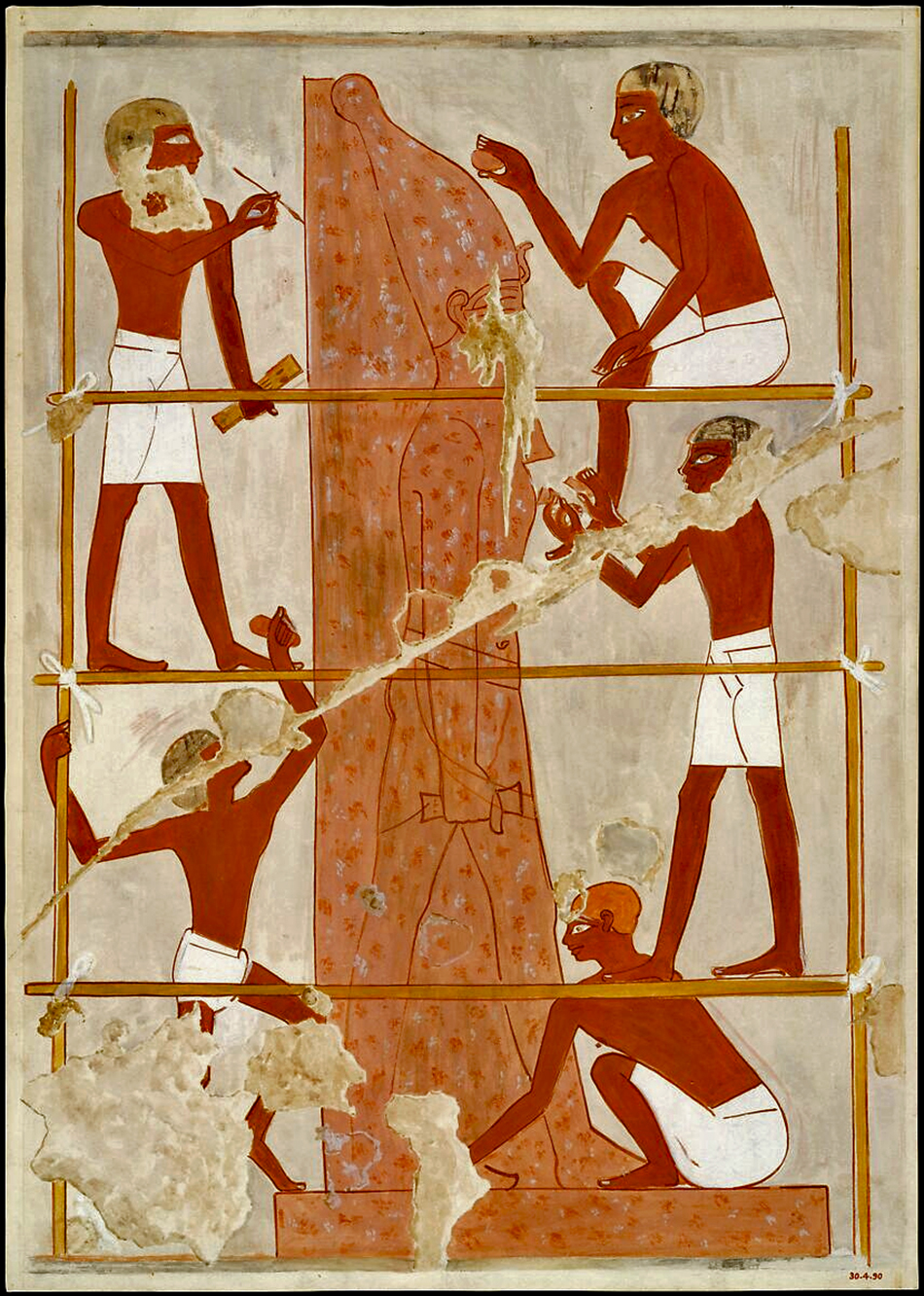
Sculptors at Work, Tomb of Rekhmire
Painted by Nina de Garis Davies (1881 - 1965)
18th Dynasty, Circa 1 479 – 1 425 BC
Reign of Thutmose III – early Amenhotep II.
Original from Egypt, Upper Egypt, Thebes, Sheikh Abd el-Qurna, Tomb of Rekhmire (TT 100)
Artisans are shown using hammers and flint or metal chisels to shape colossal statues, often working on wooden scaffolding to reach higher sections.
One worker appears to be writing or painting something on the back of the statue, perhaps to provide guidance to the later workers who would carve the images or hieroglyphics on the often flat back (as in this instance) of the statue.
Medium: Tempera on Paper
Dimensions: facsimile: h. 54 cm (21 1/4 in); w. 38.5 cm (15 3/16 in), scale 1:1, framed: h. 57.2 cm (22 1/2 in); w. 41.3 cm (16 1/4 in)
Credit Line: Rogers Fund, 1930
Object Number: 30.4.90
Curatorial Department: Egyptian Art
Photo and text: Metropolitan Museum
Permission: Public Domain
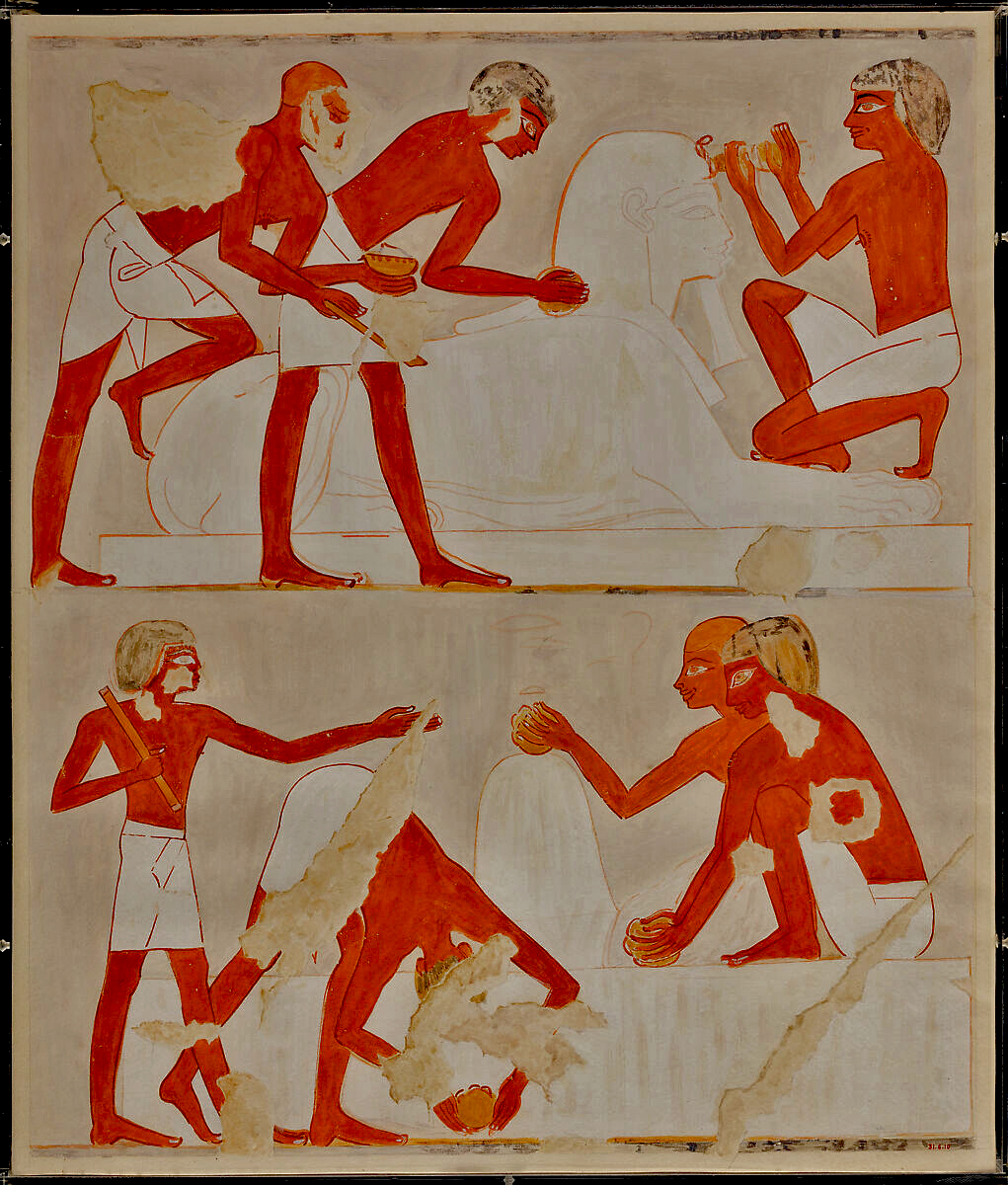
Sculptors at Work, Tomb of Rekhmire
Painted by Nina de Garis Davies (1881 - 1965)
18th Dynasty, Circa 1 479 – 1 425 BC
Reign of Thutmose III – early Amenhotep II.
Original from Egypt, Upper Egypt, Thebes, Sheikh Abd el-Qurna, Tomb of Rekhmire (TT 100)
The painting illustrates the intense activity of an ancient Egyptian workshop. It shows sculptors working on colossal statues. Artisans are using tools like mallets and chisels to carve large-scale stone figures.
The mural was intended to document the vast production overseen by Rekhmire for the Temple of Amun. It emphasises the bureaucratic role of the Vizier in managing the state’s economy and artistic output.
Medium: Tempera on Paper
Dimensions: facsimile: h. 53.5 cm (21 1/16 in); w. 45 cm (17 11/16 in), scale 1:1, framed: h. 56.8 cm (22 3/8 in); w. 48.6 cm (19 1/8 in)
Credit Line: Rogers Fund, 1931
Object Number: 31.6.10
Curatorial Department: Egyptian Art
Photo and text: Metropolitan Museum
Permission: Public Domain
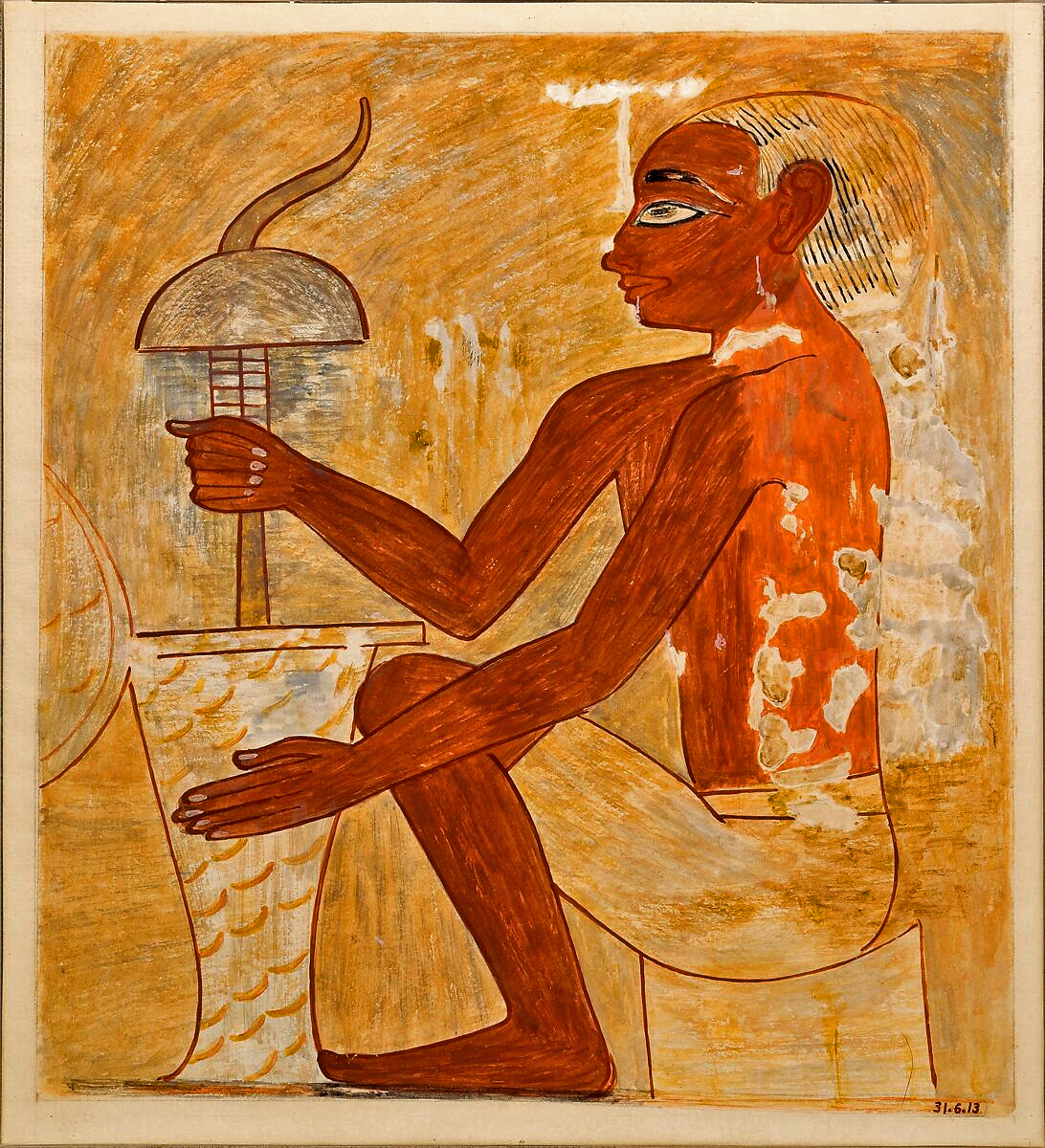
Drilling a Stone Vase, Tomb of Rekhmire
Painted by Nina de Garis Davies (1881 - 1965)
18th Dynasty, Circa 1 479 – 1 425 BC
Reign of Thutmose III – early Amenhotep II.
Original from Egypt, Upper Egypt, Thebes, Sheikh Abd el-Qurna, Tomb of Rekhmire (TT 100)
At the top of the drill is a curved handle to rotate the drill. This is attached to an inverted bowl shape, probably a solid stone or metal hemisphere to provide weight for the drill, and there appears to be a hollow tubed 'handle' below the bowl around the rod or spindle to allow the artisan to guide the rod which was connected to the grinding stones below, inside the vase.
The artisan may be using his hand to add dry abrasive powder such as ground emery stone to the vase to facilitate the grinding process. Emery powder was mixed to a slurry with water to cut through the stone. The proportions of powder to water were carefully adjusted. There would probably have been two heavy stones attached to the bottom of the spindle to aid the grinding process.
Medium: Tempera on Paper
Dimensions: facsimile: h. 26.5 cm (10 7/16 in); w. 23.5 cm (9 1/4 in), scale 1:1, framed: h. 29.2 cm (11 1/2 in); w. 26.7 cm (10 1/2 in)
Credit Line: Rogers Fund, 1931
Object Number: 31.6.13
Curatorial Department: Egyptian Art
Photo and text: Metropolitan Museum
Permission: Public Domain
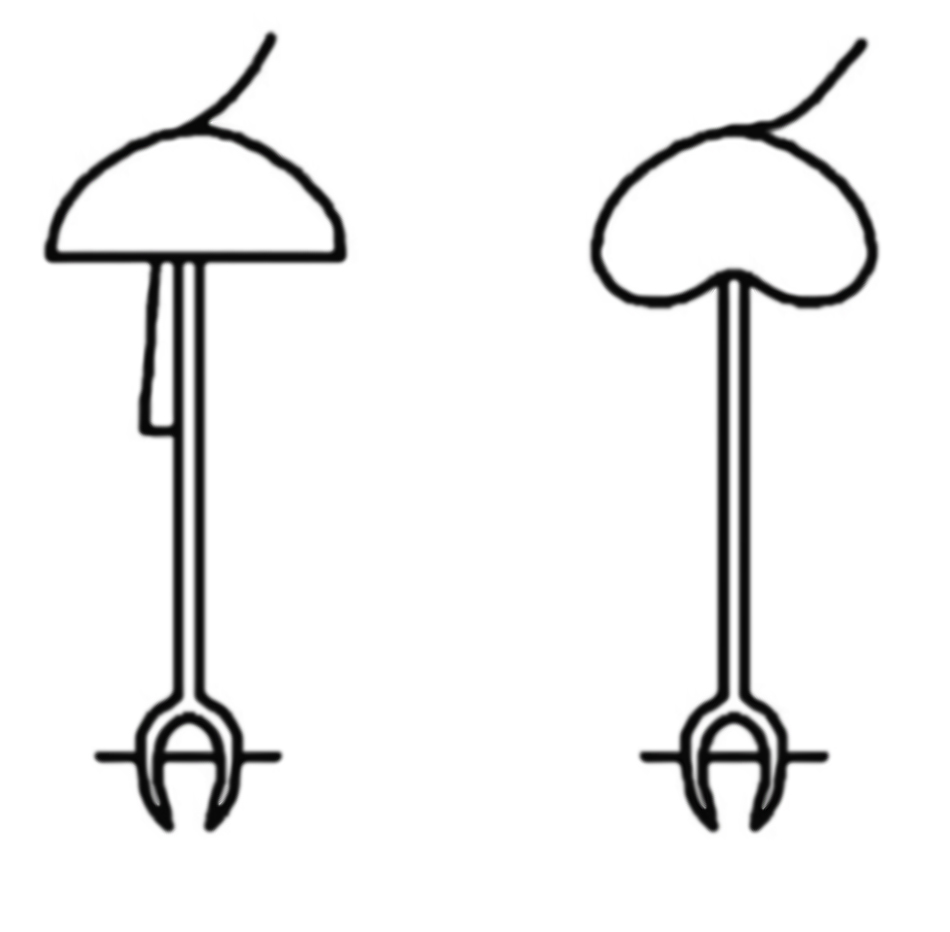
Hieroglyphs derived from the crank drill or borer, Gardiner's (1957) signs U24 and U25.
Photo and text: Ilan (2016)
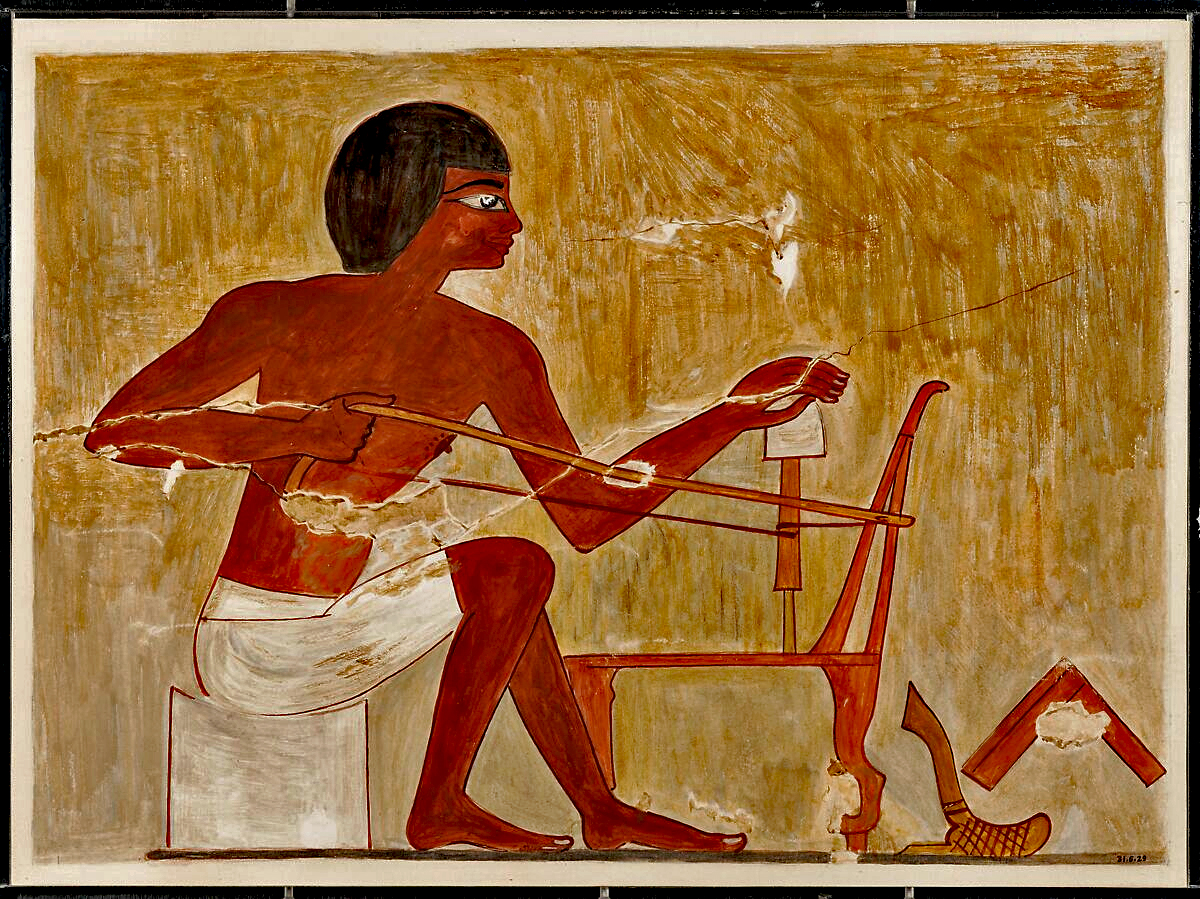
Carpenter Making a Chair, Tomb of Rekhmire
Painted by Nina de Garis Davies (1881 - 1965)
18th Dynasty, Circa 1 479 – 1 425 BC
Reign of Thutmose III – early Amenhotep II.
Original from Egypt, Upper Egypt, Thebes, Sheikh Abd el-Qurna, Tomb of Rekhmire (TT 100)
This facsimile painting copies a wall painting in the tomb of Rekhmire (TT 100) in western Thebes. The detail depicts a carpenter drilling holes in the frame of a low chair with feline legs. The carpenter uses a bow-drill and his adze and level ( actually a try square, used for marking, measuring, and checking 90° angles on materials, see below for an image of an original ancient Egyptian level - Don ) lie on the ground behind the chair. The facsimile was painted at the tomb in 1929 by Nina de Garis Davies, a member of the Graphic Section of the Museum's Egyptian Expedition.
The carpenter is holding a cup shaped object, possibly ceramic, on top of a wooden rod fitted with what is probably a bronze drill bit, possibly a toothed cylinder.
While early bronze existed around 3 000 BC – 2 300 BC, it was not in common use until the Middle Kingdom (circa 2 025 BC – 1 700 BC) and the New Kingdom (c. 1 550 BC – 1 069 BC), when it replaced copper for tools and weapons.
Medium: Tempera on Paper
Dimensions: facsimile: h. 30 cm (11 13/16 in); w. 41 cm (16 1/8 in); scale 1:1; framed: h. 33 cm (13 in); w. 44.5 cm (17 1/2 in)
Credit Line: Rogers Fund, 1931
Object Number: 31.6.29
Curatorial Department: Egyptian Art
Photo and text: Metropolitan Museum
Permission: Public Domain
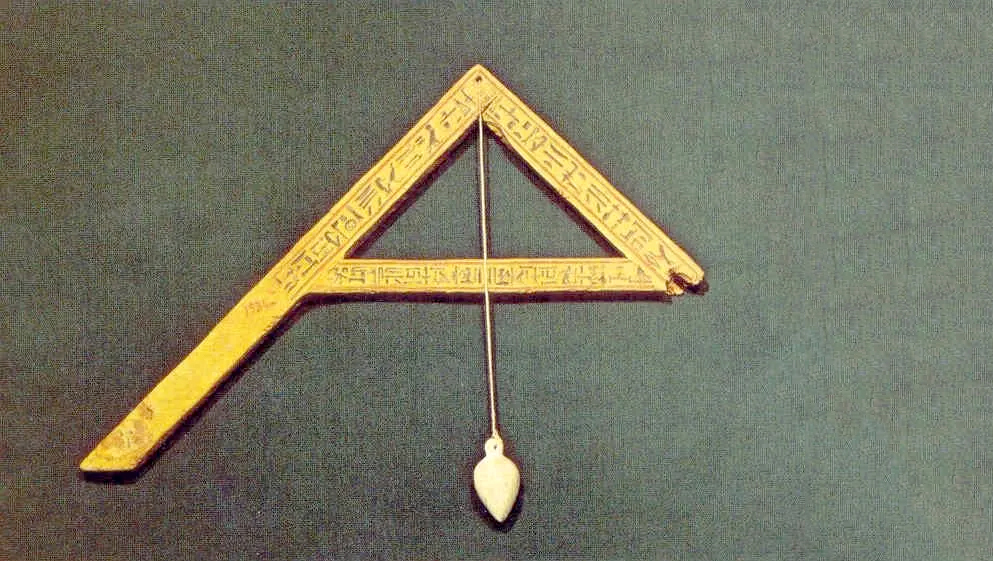
Plumb Level of Sennedjem
( Note that this image has been restored, the original image of the damaged plumb level may be seen by clicking on the image above - Don )
This wooden plumb level from the tomb of Sennedjem consists of two short pieces projecting at right angles from a longer slab. A limestone bob is strung from the top of the long slab and the upper short projecting wooden piece.
The string would touch the lower projecting piece when the long slab was held against a vertical surface. This tool bears the name of its owner, Sennedjem, who was a chief artisan during the reigns of Seti I and Ramesses II.
A plumb bob, or plummet, is a weight, usually with a pointed tip on the bottom, suspended from a string and used as a vertical reference line, or plumb-line. It is essentially the vertical equivalent of a “water level”.
The instrument has been used since at least the time of ancient Egypt to ensure that constructions are 'plumb', or vertical. It is also used in surveying, to establish the nadir with respect to gravity of a point in space.
Photo and text: https://egypt-museum.com/plumb-level-of-sennedjem/
Source: New Kingdom, 19th Dynasty, ca. 1250 BC. From the tomb of Sennedjem (TT1), Deir el-Medina, West Thebes. Now in the Egyptian Museum, Cairo. JE 27260
The first clue to the methods the Egyptians used - Petrie's Core #7
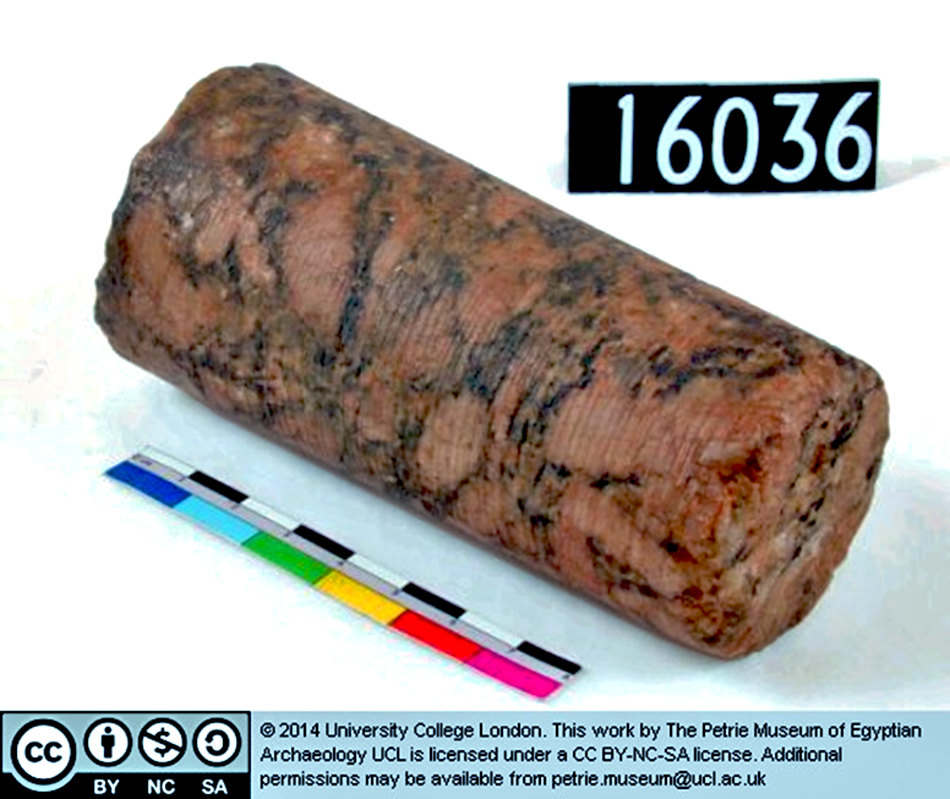
Petrie's Core #7
Petrie's Core #7 (catalog number UC 16036) is an ancient Egyptian drill core made of pink granite, discovered by archaeologist William Flinders Petrie near the Great Pyramid of Giza in 1881. It is renowned in archaeology for demonstrating an extraordinary level of precision, featuring a continuous, deeply cut spiral groove that has prompted intense debate regarding the technologies used by the 4th Dynasty Egyptians (circa 2613 BC – 2494 BC).
Granite is difficult to work with without advanced tools. The core features a continuous spiral groove, indicating a 'feed rate' of 0.100 inches (2.54 mm) per revolution. The spiral is remarkably regular, which some engineers and researchers argued implied the use of a single-point cutting tool (perhaps jewel-tipped) rather than simple abrasive grinding.
The artefact is housed in the Petrie Museum of Egyptian Archaeology in London.
Recent analyses suggest that it was produced using copper tubular drills and abrasive sand. Studies have shown that the spiral pattern can be achieved through manual labor using a tubular drill with abrasive grit, where the groove is formed as the tool is rotated.
Recent studies have suggested that the grooves, while precise, are not a perfect, uniform spiral but rather variable markings that align with the natural, irregular mineral composition of the granite.
Petrie's Core #7 remains a testament to the high level of technical skill possessed by ancient Egyptian artisans.
Photo: Petrie Museum of Egyptian Archaeology UCL
Permission: CC BY-NC-SA licence
Proximate source: www.quantumgaze.com/ancient-technology/lost-ancient-technology-ancient-egypt-brien-foerster/
Text: Various sources, including www.penn.museum
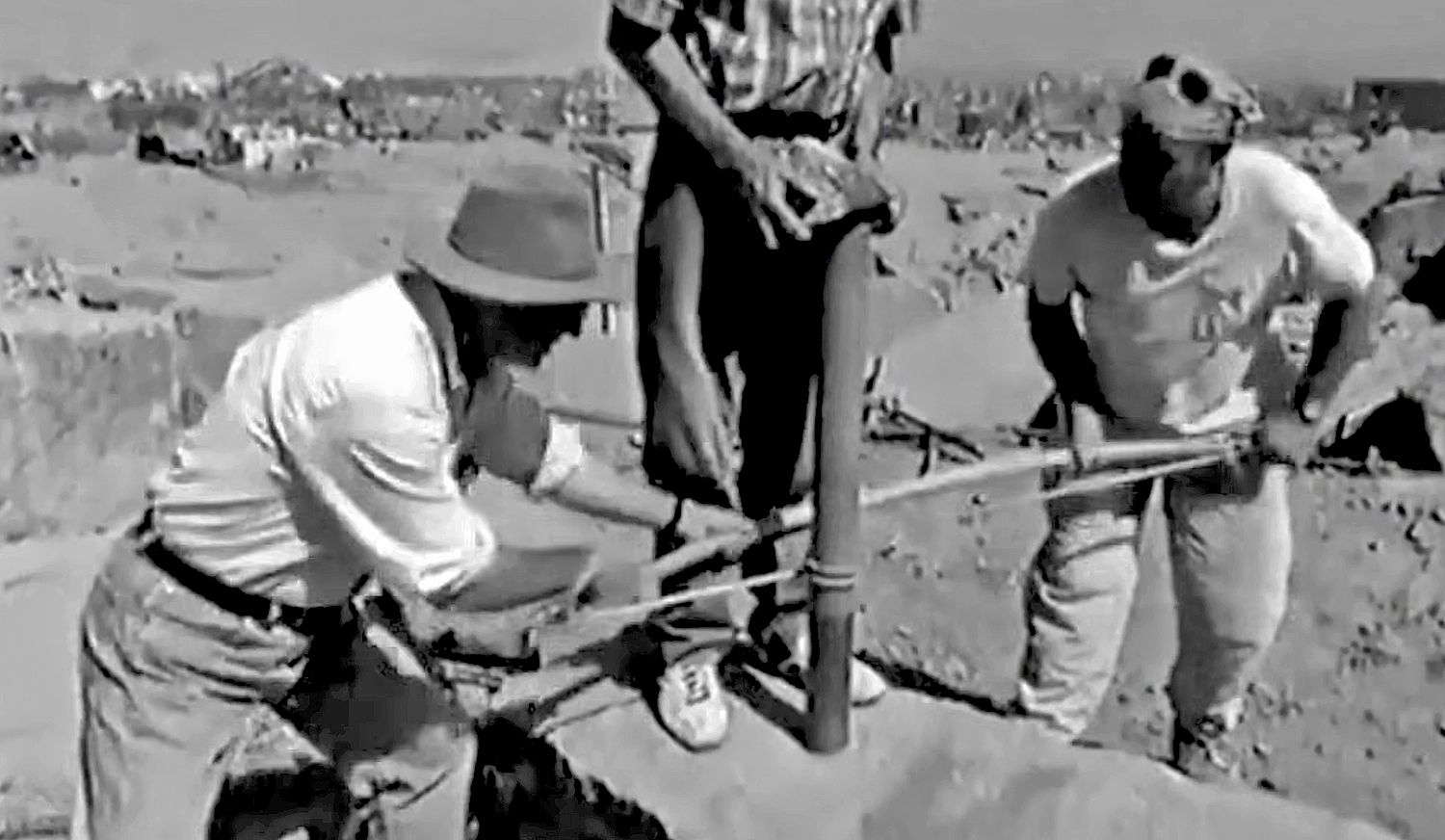
(top photo) This is a demonstration of how a copper tube and emery slurry can be used to drill a circular hole in granite using a bow saw.
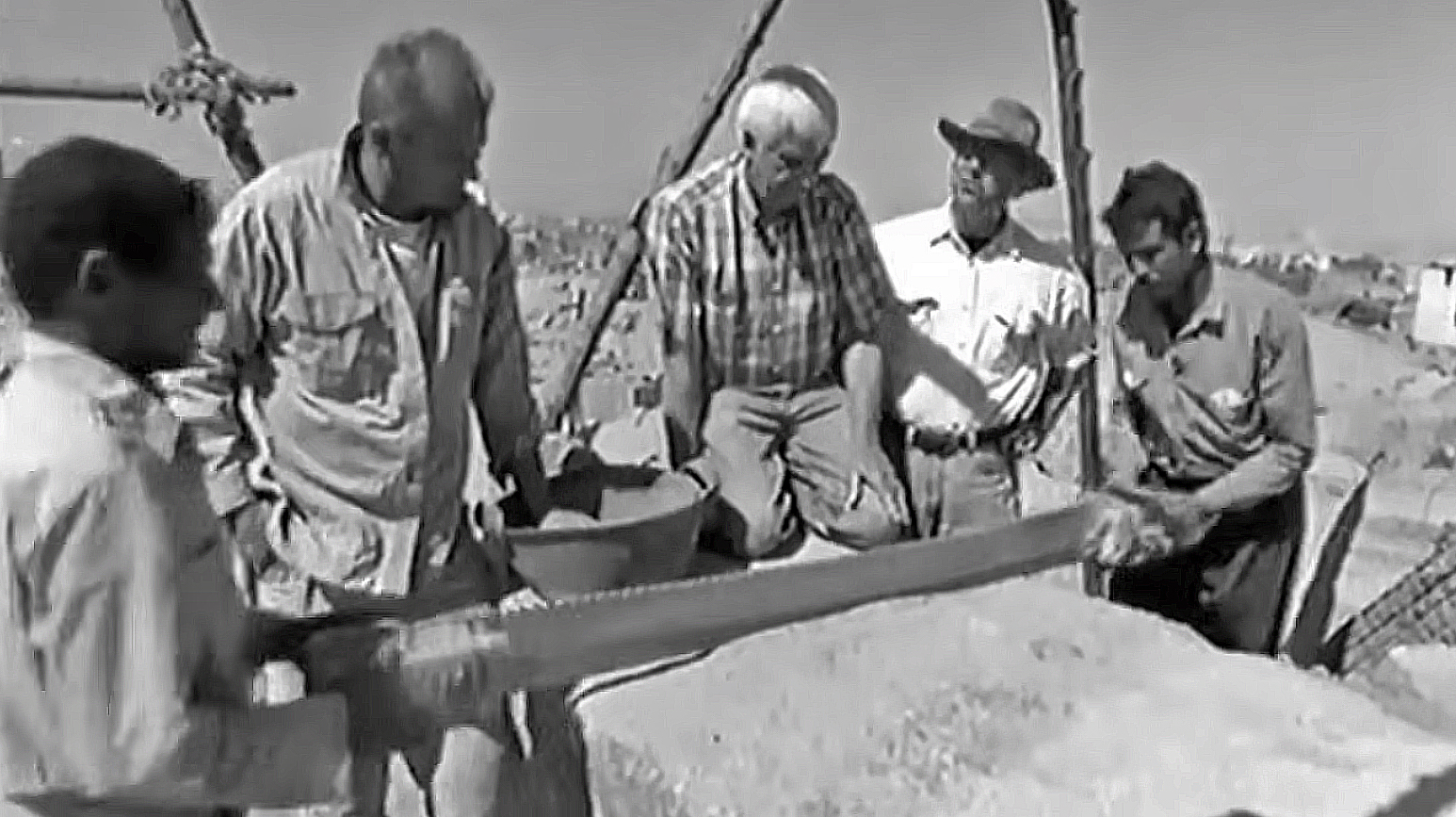
(lower photo) And from the same video, this demonstrates how a toothless two-man crosscut saw of copper may be used with emery slurry to cut through granite.
Photos:
Ancient Egyptian Granite Cutting Mystery Finally Solved - With Proof
Source: www.youtube.com/watch?v=TQNFWJpvr0I&t=290s
From the 'First Humans' channel, www.youtube.com/@FirstHumans
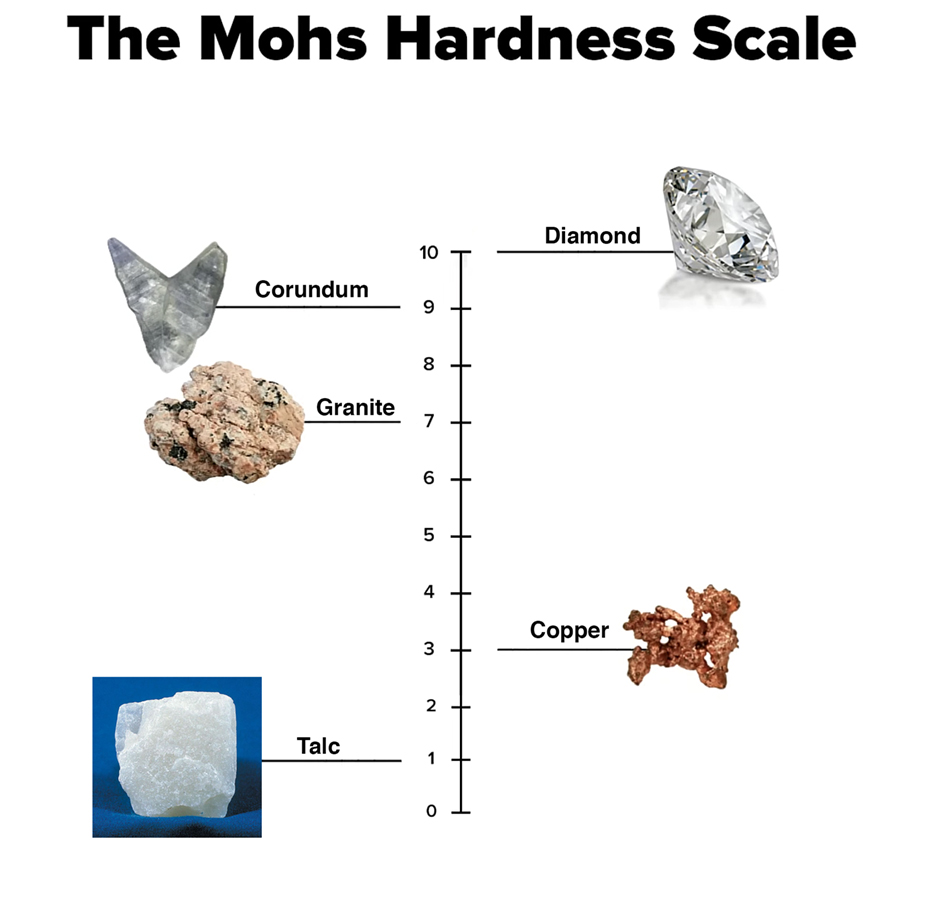
Mohs hardness scale as it applies to this topic.
Photo: www.youtube.com/watch?v=TQNFWJpvr0I&t=290s
From the 'First Humans' channel, www.youtube.com/@FirstHumans
The talc image is in the public domain, via Wikimedia Commons
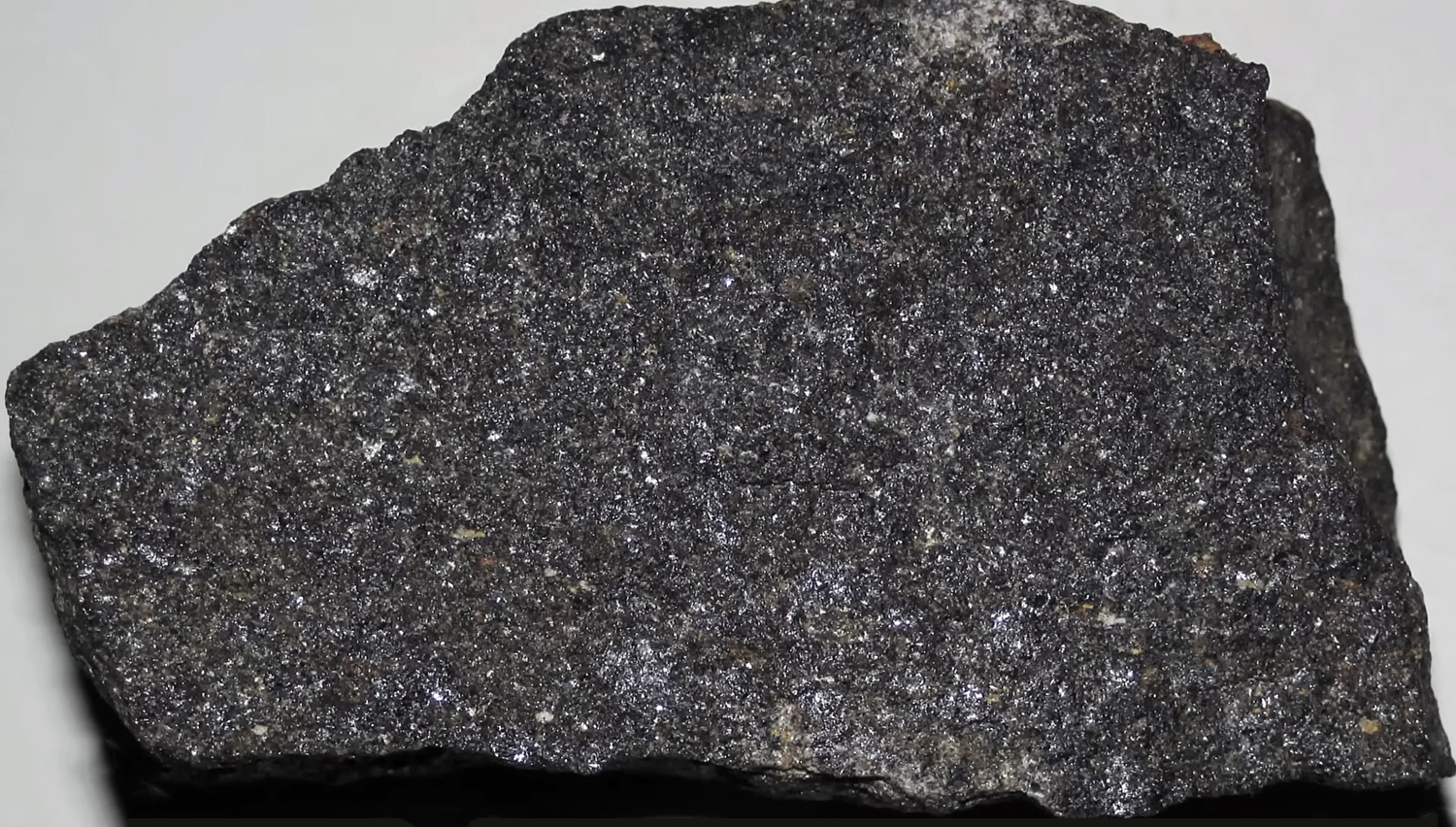
Emery is a dense, very hard rock, consisting of magnetite and corundum. Magnetite, Fe3O4 has a hardness of 6, a little harder than that of a steel knife blade, but less than quartz, which has a hardness of 7. Corundum has a hardness of 9 on the Mohs scale, making it an extremely hard, durable mineral second only to diamond, which is 10. However diamond is many times harder than Emery despite the apparent small difference on Mohs Scale. The actual difference is greater than that between talc (1) and corundum (9).
Photo: From the 'First Humans' channel, www.youtube.com/@FirstHumans
Text: Various sources, including Wikipedia
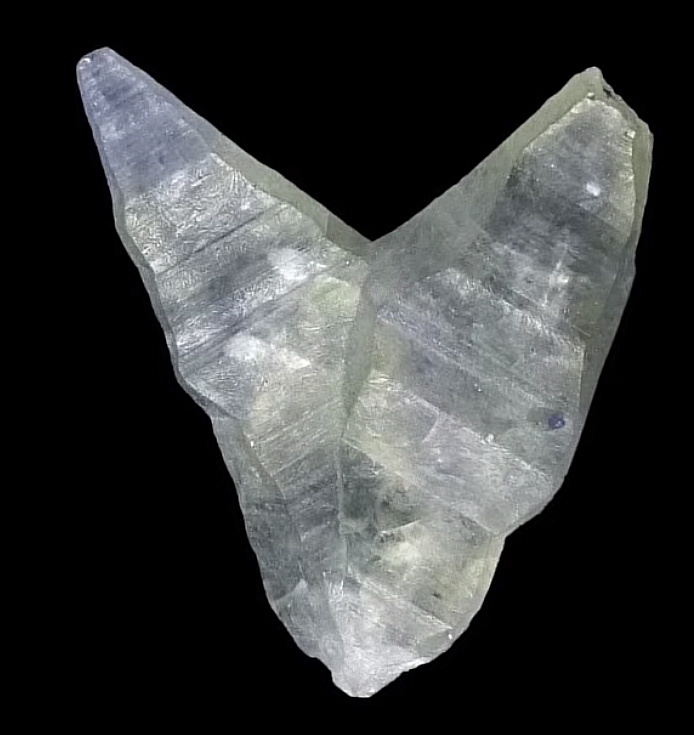
Corundum is a crystalline form of aluminium oxide, Al2O3, typically containing traces of iron, titanium, vanadium, and chromium. It is a rock-forming mineral. It is a naturally transparent material, as shown at left, but can have different colours depending on the presence of transition metal impurities in its crystalline structure. Corundum has two primary gem varieties, ruby and sapphire. Rubies are red due to the presence of chromium, and sapphires exhibit a range of colours depending on what transition metal is present. Corundum can be transparent, which if in crystalline form is a variety of sapphire used as a gemstone. Blue sapphires get their colour from trace amounts of titanium and iron.
Corundum is used primarily as an industrial abrasive. It is extremely hard and often applied to cloth or paper for sanding and polishing metal, and grinding materials. Natural emery is now sourced predominantly from Turkey and Greece.
Photo: https://www.youtube.com/watch?v=TQNFWJpvr0I&t=290s
From the 'First Humans' channel, www.youtube.com/@FirstHumans
Text: Various sources, including Wikipedia
Methods of Using Corundum Abrasives
Abrasive Slurries (Wet Grinding)
: The most common method involved making a thick, paste-like slurry by mixing crushed corundum (often found in emery) with water, which was then placed between the granite surface and a rubbing tool.
Polishing and Smoothing:
To achieve a polished, mirror-like finish on statues, craftsmen used hand-held rubbing stones — like quartzite — to grind down the granite, consistently applying finer and finer grades of corundum and/or quartz sand paste.
Tubular Drilling and Sawing:
For cutting and drilling, Egyptians used hollow copper tubes or saw blades, which did not cut the stone directly but acted as a guide to drive the corundum abrasive against the granite, effectively grinding it down, as evidenced by spiral tool marks in granite cores.
Key Details of the Process:
Hardness Advantage: Corundum (hardness 9 on the Mohs scale) and emery (a mix containing corundum) are significantly harder than the primary components of granite (quartz 7, feldspar 6), allowing them to efficiently grind the granite. Application at Amarna: Evidence from the Great Aten Temple at Amarna confirmed the use of corundum-rich abrasive in bronze tubular drills.
It is Labor Intensive:
The process was not fast, requiring immense 'elbow grease' and, for large projects, years of work, often conducted in phases from rough shaping with dolerite hammer-balls to final polishing.
This technique allowed artisans to create intricate details on statues, such as those found on the monumental red granite statue of Amenhotep III, circa 1 370 BC, shown at the top of this page, or the precise, smooth interior of granite sarcophagi.
Text above: Various sources, including www.penn.museum
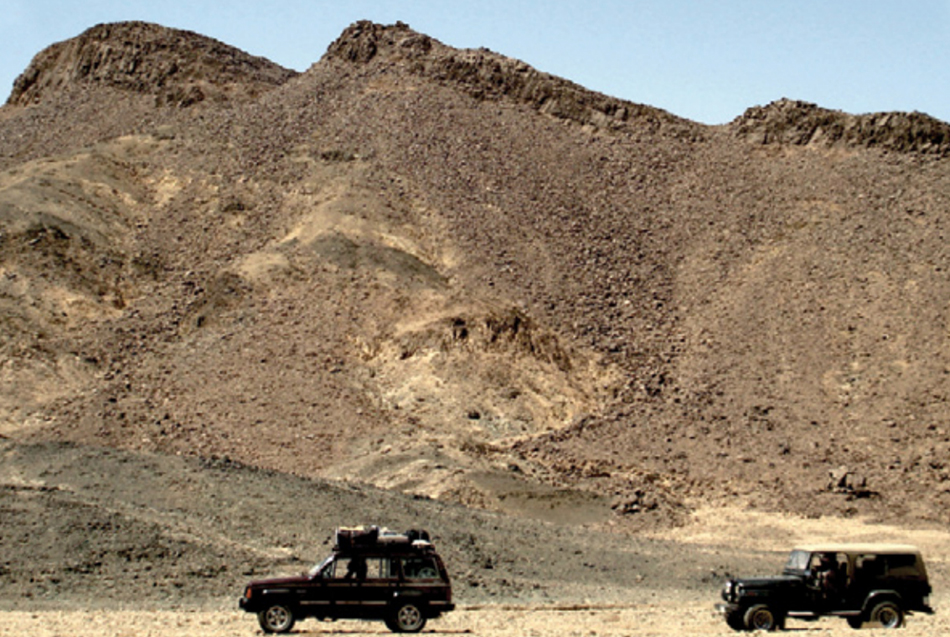
Above: Part of the the Migif-Hafafit gneissic complex.
Photo: Makroum (2017)
Natural corundum is primarily found in Egypt within the Migif-Hafafit gneissic complex located in the South Eastern Desert. It is specifically found as industrial to semi-gem corundum within corundum-bearing pegmatite veins and lenses that cut across older Precambrian rocks.
Key Locations in the Eastern Desert:
Studies have identified eight specific localities within the Migif-Hafafit area, south of Marsa Alam and near Wadi El Gemal, where these deposits occur:
Wadi El Qarn
Um Karba
Um Maiat
Abu Merikhat
Um Nimr
North El Hima
South El Hima
Um Shegera
Reference: Ahmed & Gharib (2018)
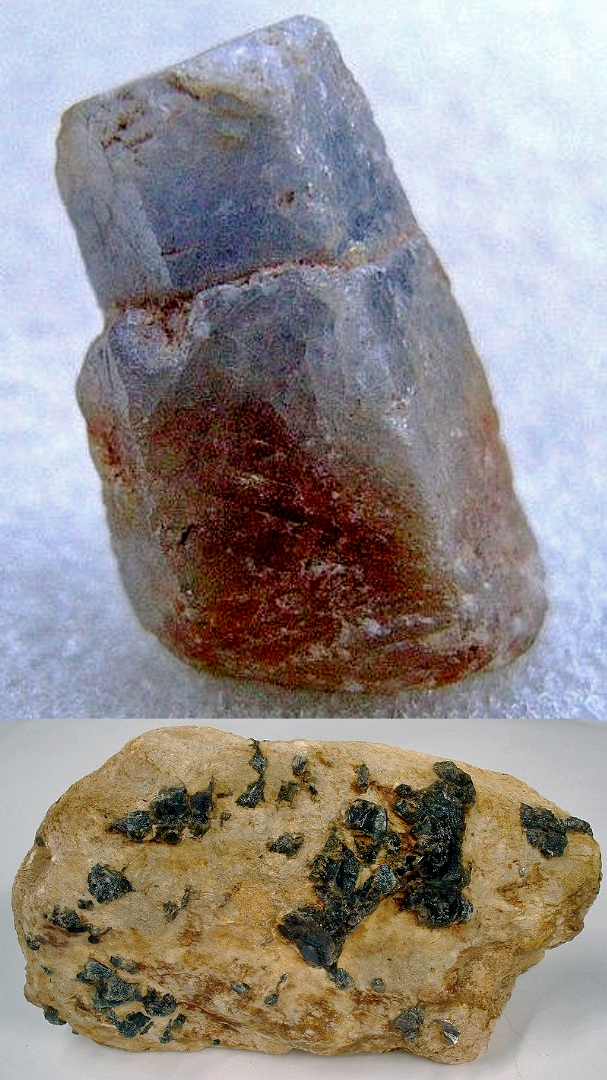
Corundum may be a rock-forming mineral of pegmatite.
Photo: דקי
Permission:Creative Commons Attribution-Share Alike 3.0 Unported license.
Proximate source: Wikimedia
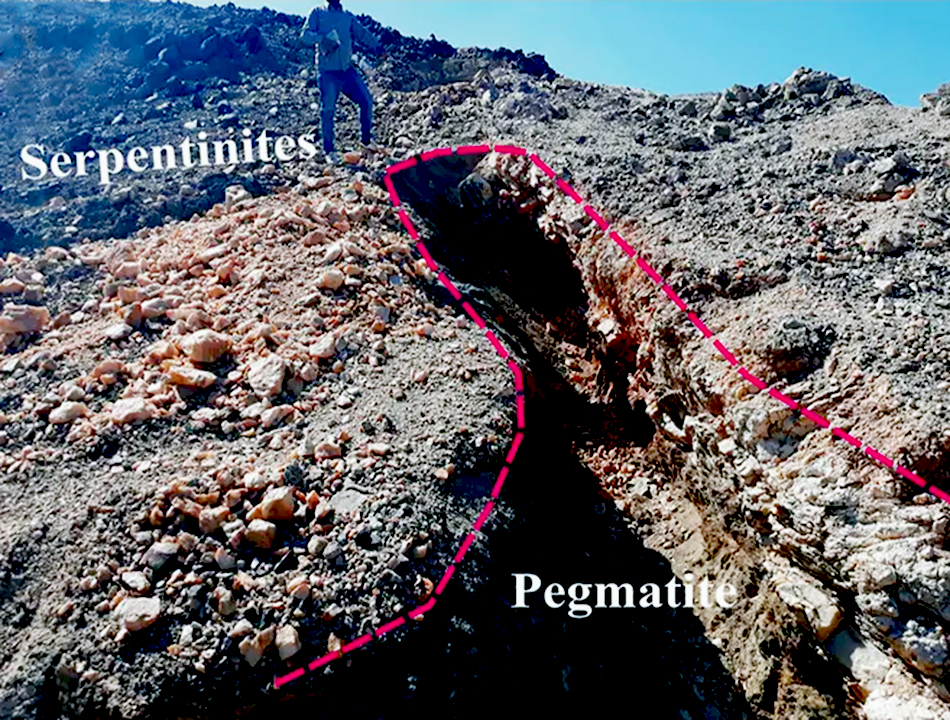
The corundum is found in pegmatite veins that intrude into silica-deficient serpentinites.
The corundum in this area occurs as dark to pale grey, greenish, or black elongated, hexagonal prismatic crystals.
These deposits are commonly associated with vermiculite, tourmaline, margarite, and hercynite.
The corundum in the Hafafit area has been identified as a source of abrasive material (emery) used by the ancient Egyptians, with historical mining activities found in the area.
Text: Ahmed & Gharib (2018)
Photo: Khaleal et al. (2022)
References
- Ahmed, A., Gharib M., 2018: Formation of corundum and associated mineral zones in the hybrid ultramafic-pegmatite association of the Neoproterozoic Hafafit core complex, South-Eastern Desert, Egypt sciencedirect.com
- Ilan D., 2016: The ground stone components of drills in the Ancient Near East: Sockets, flywheels, cobble weights, and drill bitsJournal of Lithic Studies vol. 3, nr. 3, p. xx-xx doi:10.2218/jls.v3i3.1642
- Khaleal, F. et al., 2022: Exploration and Petrogenesis of Corundum-Bearing Pegmatites: A Case Study in Migif - Hafafit Area, Egypt Front. Earth Sci. 30 March 2022
- Makroum, F., 2017: Structural interpretation of the Wadi Hafafit culmination: A Pan-African gneissic dome in the central Eastern Desert, Egypt Geological Society of America