Back to Don's Maps
Истории от Дмитрия Никоноровича
Описание жизни в Воронежской области недалеко от районного центра Кантемировка Воронежской области предоставленное Владимиром Городнянским и полученные им от своего отца.
Stories from Dmitry Nikonorovich
Stories of life in the Voronezh area, in the part called Kantemorovka, from Vladimir Gorodnjanski's father
Конец войны
Шла весна 1945 го года. В начале апреля прошел слух о том, что уже составлены списки для отправления нас на фронт, что уже все распределены по вагонам, в которых нас туда повезут; но время шло, мы продолжали занятия и ни о каком отправлении на фронт ничего не было слышно.
Вскоре все заметили, что занятия почти прекратились. Лишь изредка нас гоняли по строевой подготовке. Ослабли требования к дисциплине, не все делалось по распорядку дня, мы много времени шатались без дела. Можно было без разрешения отлучиться из расположения роты, уйти в лес, побродить среди деревьев, вот- вот готовых покрыться листвой.
Но, самое главное: отменили третью норму питания и ввели девятую. Пошла совсем другая жизнь: ребята стали поправляться, повеселели и все чаще слышны стали разговоры про девочек.
Об отправке на фронт ничего не говорили. Говорили, что Сталин, якобы, дал приказ нас, 1927 год рождения, туда не отправлять, чтобы сохранить для службы после окончания войны, когда старшие возраста уйдут по домам.
К концу апреля установилась хорошая, солнечная погода, лес готов был покрыться листвой, земля просохла, и поляны в лесу уже покрылись зеленой травкой. В эти дни, в свободное от занятий время, я частенько один уходил в лес, подальше от расположения роты, бродил, любуясь оживающей природой, отдыхая душой от невзгод перенесенной зимы. Там же в лесу, пристроившись где-нибудь под кустом, писал письма домой. Все ждали конца войны. В Германии шли еще ожесточенные бои за Берлин там еще гибли тысячи наших солдат, но эта участь нас, молодых, считай, миновала. 9-го мая над расположением полка появился самолет и стал кружиться в небе, разбрасывая листовки, которые оповещали нас об окончании Великой Отечественной и второй мировой войны. Радость была неимоверная. Было общее построение, поздравления Служба с этих пор стала полегче; вся страна, армия, как будто сбросили с себя неимоверное напряжение, в котором находились 4 долгих года. Все эти годы воля, энергия были направлены на одну цель: защита Родины, победа над врагом. Нас больше не гоняли, как прежде, командиры стали не так требовательны, занятия проводились кое-как. Экзаменов никаких не было. Много времени проводили в лесу, уже одевшемуся в прекрасный зеленый наряд.
Всем взводом с утра уходили подальше в лес, располагались на поляне, и командир взвода читал нам теорию артиллерийского дела. Отдохнувшие , возвращались в расположение к обеду. После обеда в основном были предоставлены сами себе. В то время у меня пропала шинель: исчезла куда-то из землянки прямо с вешалки. То ли из другой роты кто проник в землянку и утащил ее, то ли из своих кто снес на барахоловку.
Как бы там ни было, но я остался без шинели. Для меня это была беда, и я сильно переживал, не зная, что делать. Я знал, что командир взвода не поверит в то, что ее могли украсть: он будет думать, что я ее потерял, или продал. Но докладывать все равно надо было, и я доложил. Разгневался взводный не на шутку, винил в пропаже меня. - Где хочешь, доставай шинель! Чтобы через четыре дня шинель была. Иди! – кричал он. - Слушаюсь – Отвечаю я, и ухожу.
Но что делать? Где найти шинель? Не знаю. Поделился своей бедой с товарищем. Товарищ мой оказался довольно находчивым и смелым; всю инициативу по добыче шинели он взял на себя. Я делал то, что он говорил. Действовали мы по его плану, который он наметил. Мне было не по себе от этого плана, но делать нечего – шинель надо было добывать.
Отпросились мы у командира взвода отлучиться на целый день. Он нас отпустил. После завтрака мы ушли в лес, побродили там, полежали под кустами, дождались того времени, когда в лесу стали появляться группы из других подразделений для проведения занятий. На эти занятия солдаты брали с собой шинели, скатанные в скатки. Найдя укромное место среди кустов на какой-нибудь небольшой полянке, располагались на траве, полулежа на скатках, и слушали командира взвода, который проводил занятия. Мы стали кружить по лесу, то и дело натыкаясь на группы занимающихся. Нам надо было утащить скатку. Но подходящего момента никак не появлялось: от места занятий никто не отходил. Когда мы уже приуныли, вдруг наткнулись на группу, расположившуюся метрах в пятнадцати от железнодорожного полотна среди кустов. Мы залегли в кустах почти рядом с ними и стали наблюдать, ждать подходящего момента. Издалека послышался звук приближающегося железнодорожного состава. Он все ближе и ближе; уже слышно пыхтенье паровоза и перестук вагонных колес на стыках рельс. Вся группа поднимается и спешит к полотну, оставляя на месте скатанные шинели. Все внимание солдат приковано к проходящему составу, который везет военную технику и солдат на восток на войну с Японией. Лучшего момента для нас и не придумаешь. Мой друг вылез из кустов, подцепил скатку, отполз назад, и тогда мы вскочили на ноги и рванули, что было духу, убегая подальше от того места. Ах, как мы бежали! Как мы ломились через кусты, прыгали через канавы, избегая на пути встречи с кем бы то ни было. В тот же день я доложил командиру взвода, что шинель найдена. О том, где я ее нашел, он спрашивать не стал. После этого я смотрел на своего товарища уже другими глазами: теперь я знал, что он может украсть что угодно. Появилась мысль: а не он ли украл тогда те злополучные лепешки, из-за которых мы всю ночь простояли в строю. Но как бы там ни было, он меня выручил, и я ему был благодарен за это.
The end of the war
It was spring 1945. In early April, a rumour spread that lists had already been compiled for sending us to the front, that everyone had already been assigned to the train cars in which we would be taken there; but time passed, we continued our classes and nothing was heard about sending us to the front.
Soon everyone noticed that classes had almost ceased. Only occasionally were we driven to drill. The requirements for discipline were relaxed, not everything was done according to the daily routine, we spent a lot of time hanging around doing nothing. It was possible to leave the company location without permission, go into the forest, wander among the trees, which were about to become covered in leaves. But, most importantly: they cancelled the third food ration and introduced the ninth. A completely different life began: the guys began to get better, they became more cheerful and more and more often we heard talk about girls.
Nothing was said about sending them to the front. They said that Stalin had allegedly given the order not to send us, born in 1927, there, in order to preserve us for service after the end of the war, when the older age groups would go home.
By the end of April, the weather was fine and sunny, the forest was ready to be covered with leaves, the earth had dried out, and the clearings in the forest were already covered with green grass. On those days, in my free time from classes, I often went into the forest alone, away from the company's location, wandered, admiring the reviving nature, resting my soul from the hardships of the winter we had endured. There in the forest, having settled down somewhere under a bush, I wrote letters home.
Everyone was waiting for the end of the war. In Germany, fierce battles were still going on for Berlin, thousands of our soldiers were still dying there, but this fate, for us young people, was considered to have passed. On May 9, an airplane appeared over the regiment and began circling in the sky, dropping leaflets that informed us of the end of the Great Patriotic War and the Second World War. The joy was incredible. There was a general formation, congratulations.
From that time on, service became easier; the whole country, the army, seemed to have thrown off the incredible tension in which they had been for 4 long years. All these years, the will, the energy were directed toward one goal: the defense of the Motherland, the victory over the enemy. We were no longer driven as before, the commanders were not so demanding, the classes were conducted somehow. There were no exams. We spent a lot of time in the forest, already dressed in a beautiful green outfit.
In the morning, the whole platoon would go further into the forest, settle down in a clearing, and the platoon commander would read us the theory of artillery. Having rested, we would return to the location for lunch. After lunch, we were mostly left to our own devices. At that time, my overcoat went missing: it had disappeared somewhere from the dugout, right from the hanger. Either someone from another company had broken into the dugout and stolen it, or one of our own had taken it to the junkyard. Whatever the case, I was left without my overcoat. It was a disaster for me, and I was very worried, not knowing what to do. I knew that the platoon commander would not believe that it could have been stolen: he would think that I had lost it or sold it. But I still had to report it, and I did. The platoon commander was seriously angry, blaming me for the loss.
- Wherever you want, get the overcoat! I want the overcoat in four days. Go! - he shouted.
- Yes, I answer, and leave.
But what to do? Where to find an overcoat? I don’t know. I shared my trouble with a comrade. My comrade turned out to be quite resourceful and brave; he took all the initiative in getting an overcoat upon himself. I did what he said. We acted according to his plan, which he outlined. I felt uneasy about this plan, but there was nothing to be done – an overcoat had to be obtained.
We asked the platoon commander for permission to leave for the whole day. He let us go.
After breakfast, we went into the forest, wandered around there, lay under the bushes, waited for the time when groups from other units began to appear in the forest to conduct training. For these training sessions, the soldiers took their overcoats with them, rolled up into rolls. Having found a secluded place among the bushes in some small clearing, they settled down on the grass, half-lying on the rolls, and listened to the platoon commander, who was conducting the training. We started circling around the forest, bumping into groups of people studying. We needed to steal the roll. But the right moment never appeared: no one left the place of study. When we were already despondent, we suddenly came across a group located about fifteen meters from the railroad tracks among the bushes. We lay down in the bushes almost next to them and began to watch, waiting for the right moment.
From afar we heard the sound of an approaching train. It was getting closer and closer; we could already hear the puffing of a locomotive and the clatter of wagon wheels on the joints of the rails. The whole group got up and hurried to the track, leaving their rolled-up coats in place. All the soldiers' attention was riveted to the passing train, which was carrying military equipment and soldiers to the east to fight Japan. You couldn't think of a better moment for us. My friend crawled out of the bushes, grabbed the roll, crawled back, and then we jumped to our feet and ran as fast as we could, running away from that place. Oh, how we ran! How we broke through the bushes, jumped over the ditches, avoiding meeting anyone along the way. That same day, I reported to the platoon commander that the overcoat had been found. He didn’t ask where I had found it. After that, I looked at my comrade with different eyes: now I knew that he could steal anything. A thought came to mind: maybe he had stolen those ill-fated flatbreads, because of which we had stood in formation all night. But be that as it may, he had helped me out, and I was grateful to him for that.
Поход на Саратов
Служба шла вяло, занятиями нас не обременяли, кормили хорошо. Иногда проводили смотры всего полка на полковом плацу. Дядю Федю я больше не видел.
Занимаясь в лесу, недалеко от железнодорожного полотна, прервав занятия, наблюдали за воинскими эшелонами, часто проходившими на восток. Заслушав шум приближающегося состава, подходили ближе к полотну и с интересом смотрели на то, что везли на платформах. Везли на восток танки, орудия, «катюши», машины и много разного военного имущества. Удивлялись тому, как много техники перебрасывается на восток. Шла подготовка к войне с Японией.
Там еще шла война между Америкой и Японией. Нам надо было помогать Америке, как и договаривались. Поговаривали, что могут направить туда и нас.
В начале сентября наше правительство объявило Японии войну. Страна снова находилась в состоянии войны. Но это была уже не та война, что только закончилась: шла она где-то далеко, далеко, и не такими силами и напряжением, как с Германией. Продолжалась она совсем не долго и закончилась, когда нами была разгромлена Квантунская армия и сброшены бомбы на Японские города Хиросима и Нагасаки. В эти самые дни, когда шла война, в нашем полку началась какая-то суета, подготовка к чему-то: сдали винтовки, проверяли у солдат обувь, портянки. Старшины рот сдавали имущество
И вот, вскоре, неожиданно подняли полк по тревоге задолго до подъема; приказали скатать скатки, надеть вещмешки, построили, объяснили, что предстоит дальний, длительный переход. Полк, рота за ротой, батальон за батальоном, двинулись из расположения полка по какой-то дороге в восточном направлении. Туда же двинулся и соседний полк. Шли целый день, кормились из полевых кухонь. На следующий день вышли из лесов. Впереди открылись взору степи, знакомые мне с самого детства. Прямая дорога уходила далеко за горизонт; по дороге, на сколько хватало глаз, виднелись движущиеся колоны солдат. Останавливаясь на кроткие привалы и на прием пищи возле походных кухонь, шли уже несколько дней, не зная конца пути.
Шли и по ночам, приходилось идти и под дождем. Усталость брала свое. Когда уже, казалось, нет больше сил шагать, вдруг раздавалась команда: «Привал!». На землю падали, как подкошенные там, где застала команда, и многие тут же засыпали. В ночное время приходилось видеть, как спят на ходу солдаты. Заснувший на ходу, терял направление движения, отделялся от колоны и шел в сторону, в степь. Шел, пока не его не разбудят.
Шел десятый день нашего похода, мы прошли уже более четырехсот километров и уже втянулись в ходьбу. Объявили, что остался один переход. Около какой-то небольшой речки сделали привал на целый день. Отдыхали, стирали портянки, отсыпались, кормились из полевой кухни. И вот последний переход. Отдохнувшим, легко шагалось. При подходе к расположению полка, куда мы пришли, роты подтянулись, выровнялись. В головы батальонов поставили гармонистов. Под музыку маршей мы втягивались на плац строевым шагом, подтянутые, как будто и не прошагавшие 450 км. Встречавшее нас командование и солдаты удивлялись тому, что мы, сколько прошагавшие, такие бодрые. Мы прошли из под Тамбова под Саратов. Нашим новым местом службы стал 60-й запасной стрелковый полк.
March on Saratov
The service was sluggish, we were not burdened with classes, and were well fed. Sometimes they would review the entire regiment on the regimental parade ground. I never saw Uncle Fedya again.
While studying in the forest, not far from the railway track, we would interrupt our classes and watch the military trains that often passed to the east. Hearing the noise of an approaching train, we would come closer to the track and watch with interest what was being carried on the platforms. They were transporting tanks, guns, Katyushas, vehicles, and a lot of different military equipment to the east. We were surprised at how much equipment was being transferred to the east. Preparations were underway for war with Japan.
There was still a war going on between America and Japan. We had to help America, as had been agreed. There was talk that they might send us there too.
In early September, our government declared war on Japan. The country was at war again. But this was no longer the war that had just ended: it was going on somewhere far, far away, and not with the same forces and tension as with Germany. It did not last long at all and ended when we routed the Kwantung Army and dropped bombs on the Japanese cities of Hiroshima and Nagasaki.
In those very days, when the war was going on, some kind of fuss began in our regiment, preparations for something: they handed in their rifles, checked the soldiers' shoes and foot wraps. The company sergeants handed over their belongings And so, soon, unexpectedly, the regiment was raised on alert long before reveille; they ordered us to roll up our foot wraps, put on our kit bags, lined us up, and explained that a long, long march lay ahead. The regiment, company after company, battalion after battalion, moved from the regiment's location along some road in an easterly direction. The neighboring regiment moved there too. They walked the whole day, eating from field kitchens. The next day we left the forests. Ahead of us opened up the steppes, familiar to me since childhood. The straight road went far beyond the horizon; along the road, as far as the eye could see, moving columns of soldiers were visible. Stopping for short rests and meals near field kitchens, we had been walking for several days, not knowing the end of the road. We walked at night, and had to walk in the rain. Fatigue took its toll. When it seemed that there was no more strength to walk, the command was suddenly heard: "Halt!" They fell to the ground, as if mown down, where the command found them, and many fell asleep right there. At night, I had to see soldiers sleeping on the move. One who fell asleep on the move lost the direction of movement, separated from the column and walked to the side, into the steppe. He walked until he was woken up.
It was the tenth day of our march, we had already covered more than four hundred kilometers and had already gotten into walking. They announced that there was one march left. We made a halt for the whole day near a small river. We rested, washed our foot wraps, slept, and ate from the field kitchen. And here was the last march. Rested, it was easy to walk. As we approached the regiment's location, where we had arrived, the companies pulled themselves together and lined up. Accordion players were put at the head of the battalions. To the music of marches, we pulled ourselves onto the parade ground in a marching step, pulled together, as if we had not walked 450 km. The command and soldiers who met us were surprised that we, having walked so much, were so cheerful. We marched from Tambov to Saratov. Our new place of service was the 60th Reserve Rifle Regiment.
Путь на запад
Прослужить в этом полку пришлось не долго. Здесь не было занятий по строевой и боевой подготовке, целыми днями солдаты были предоставлены самим себе, бродили по окрестным полям, лазили по оврагам, каких было много, как и у нас в Воронежской области. Здесь не было лесов, была степь да холмы, как и у нас дома. Земля только не черная, больше песчаная. Иногда нас водили на колхозные поля убирать морковку. Там она хорошо произрастала. Посевы ее были обширны. Так много моркови я нигде не видел. Иван Твердохлебов опять куда-то в хозвзвод пристроился, и больше я его не встречал.
В Ноябре месяце того же, 1945-го года, на станции Татищево, что под Саратовом, мы погрузились в эшелон, состоявший из товарных вагонов, так называемых «теплушек». Нас было много, эшелон составился очень длинный.
И снова, как год назад в Кантемировке, мы сидели в закрытых вагонах и гадали о том, куда двинется эшелон. Двинулись на запад, но куда – мы не знали.
Сами мы были уже не те салаги-призывники:мы на год повзрослели, за этот год узнали, что такое фунт лиха, мы стали настоящими солдатами. Среди нас было немало тех, кто воевал на фронте, участвовал в боях. Они то и задавали ту особую атмосферу вольницы: перед сержантами не тянулись, плохо их слушались, пререкались. На остановках выходили из вагонов, несмотря на запрет, бродили по вокзалам, бегали на привокзальные базары, где многие брали у торговок еду, фрукты, не заплатив за это деньги. Получались скандалы, местная милиция ничего не могла поделать: солдаты ее не признавали, издевались над милиционерами. На одной из станций одного из них разоружили: отобрали у него пистолет. Инцидент был серьезный, начальник эшелона вынужден был построиться всех у своих вагонов. Разоруженный милиционер вместе с нашим начальством ходил вдоль строя, всматриваясь в лица солдат, пытаясь узнать нападавшего. Но узнать его так и не удалось.
Власти были вынуждены оповещать начальство железнодорожных станций, находившихся на нашем пути, о приближении «бандитского» поезда. Поэтому, по прибытии нас туда, там уже не было базаров: их заранее разгоняла милиция. Мы ехали долго. Подолгу стояли на станциях, на запасных путях. Проехали всю европейскую часть Российской Федерации, Проехали Белоруссию, но все еще не знали, куда нас везут. И только когда эшелон пошел по Литве, миновали Каунас и стали приближаться к западным границам СССР, догадались,что нас везут в Германию, в Восточную Пруссию.
The Road to the West
I didn't have to serve in this regiment for long. There were no drill or combat training classes, the soldiers were left to their own devices all day long, wandering around the surrounding fields, climbing through ravines, of which there were many, just like in our Voronezh region. There were no forests here, just steppe and hills, just like at home. The soil was not black, but more sandy. Sometimes we were taken to the collective farm fields to harvest carrots. They grew well there. The crops were vast. I have never seen so many carrots anywhere. Ivan Tverdokhlebov again found a job in a supply platoon somewhere, and I never met him again.
In November of the same year, 1945, at the Tatishchevo station near Saratov, we boarded a train consisting of freight cars, the so-called "teplushkas". There were many of us, the train was very long.
And again, like a year ago in Kantemirovka, we sat in closed carriages and wondered where the train would go. We moved west, but where - we did not know.
We ourselves were no longer the same greenhorns-conscripts: we had matured by a year, during this year we learned what a pound of sorrow was, we became real soldiers. Among us there were many who had fought at the front, participated in battles. They were the ones who set that special atmosphere of freedom: they did not bend to the sergeants, did not obey them well, argued. At stops, despite the ban, they got out of the carriages, wandered around the stations, ran to the station bazaars, where many took food and fruit from the vendors without paying for it.
Scandals arose, the local police could do nothing: the soldiers did not recognize them, mocked the policemen. At one of the stations, one of them was disarmed: his pistol was taken away. The incident was serious, the commander of the train was forced to line everyone up at their cars. The disarmed policeman, together with our superiors, walked along the line, peering into the soldiers' faces, trying to recognize the attacker. But they were unable to recognize him.
The authorities were forced to notify the command of the railway stations along our route about the approach of the "bandit" train. Therefore, when we arrived there, there were no longer any markets: they were dispersed in advance by the police. We traveled for a long time. We stood for a long time at the stations, on the sidings. We drove through the entire European part of the Russian Federation, drove through Belarus, but still did not know where we were being taken. And only when the train went through Lithuania, passed Kaunas and began to approach the western borders of the USSR, did we guess that we were being taken to Germany, to East Prussia.
Восточная Пруссия
Ночью, когда все уже спали, поезд остановился на какой-то станции. Рано утром, когда еще не рассвело, и первые проснувшиеся стали выходить из вагонов по нужде, прямо перед нашим вагоном на газоне увидели мертвого солдата, нам незнакомого. Он лежал на спине, раскинув руки; череп и лицо его были разрублены, видно, сильным ударом топора. Убит он был ночью, когда мы все спали.
Место, где остановился ночью наш поезд, было уже в Германии. Это был немецкий город Инстенбург. Хотя война кончилась еще в мае, здесь еще убивали наших солдат. Враг был рядом. Так встретила нас Германия, чужая, враждебная нам страна, с которой мы воевали долгих четыре года. Думал ли я тогда, в 1942-ом году, когда немецкие солдаты, такие бодрые, веселые, победителями ворвались в наше село и стали хозяйничать, думал ли я тогда,что, как солдат Красной Армии, как победитель, буду шагать по их дорогам , по их полям.
Очень разбирало любопытство: хотелось увидеть эту Германию, но была лишь возможность окинуть взглядом близлежащие дома, немного побродить по вокзалу, набитым множеством людей – это были люди, возвращавшиеся в Россию из немецкой неволи, куда были угнаны немцами на принудительные работы.
Одного лишь беглого взгляда на город было достаточно для того, чтобы увидеть его непохожесть на наши российские города. Крыши из красной черепицы, куда ни глянь. Итак, мы, молодые советские солдаты, прибыли в Германию, чтобы заменить своих старших солдат, уходивших, после Победы, домой.
Здесь, в Инстенбурге, наш эшелон начали расформировывать. Часть солдат оставили в городе, с остальными эшелон ушел дальше, до следующей станции. Оттуда мы, разными колонами, двинулись пешком в разных направлениях, В нашей колоне насчитывалось около ста человек. Шли в темноте, накрапывал дождь, шинели отсырели, и от них шел пар. Начало светать, дождь прекратился, рассеялись облака, взошло солнце и осветило местность, по которой мы шли. Все с интересом смотрели по сторонам, разглядывая немецкие пейзажи. Местность была ровная, без холмов, по сторонам простирались неубранные, не вспаханные поля. Вдали, изредка, открывались взору какие-то постройки, крытые красной черепицей. Изредка встречались перелески. Показались впереди идущие нам навстречу многочисленные колоны, вернее толпы, женщин, молодых девчат и парней – это добирались домой, в Россию, бывшие в рабстве у немцев, люди.
К вечеру вошли в како-то лес, вернее не лес, а парк. Уж очень чисто там было для леса: никаких лишних зарослей, завалов, сухих деревьев – ничего этого не было: все было ухожено, расчищено. Среди деревьев расположены какие-то постройки. В окружении одноэтажных домиков высился обширный, двух этажный дом с какими-то башенками, пристройками. Своей архитектурой он был похож на маленький средневековый замок. Немного в стороне располагалась конюшня, каких до этого я нигде не видел. Как выяснилось позже, это было имение одного богатого бюргера, который бежал на запад при приближении Красной Армии. Разбитые пианино, валявшиеся во дворе, разбитые дорогие кресла, шкафы и прочая домашняя утварь говорили о том, что жили здесь не бедные люди. Комнаты, оклеенные красивейшими, дорогими обоями, потолки с лепными узорами, изразцовые печи, красоты изумительной. Но кругом разгром, развал. В этом имении нас и расквартировали. Навели порядок в жилых помещениях, убрали территорию, в конюшне появились лошади, предназначенные для артиллерийских упряжек. Наша служба продолжилась снова в артиллерии на конной тяге.
* * *
East Prussia
At night, when everyone was already asleep, the train stopped at some station. Early in the morning, when it was still dark and the first people to wake up began to get out of the cars to relieve themselves, right in front of our car on the lawn we saw a dead soldier, unknown to us. He was lying on his back, his arms spread out; his skull and face were cut, apparently by a strong blow of an axe. He was killed at night, when we were all asleep.
The place where our train stopped at night was already in Germany. It was the German city of Instenburg. Although the war had ended in May, our soldiers were still being killed here. The enemy was close by. This is how Germany met us, a foreign, hostile country with which we had fought for four long years. Did I think then, in 1942, when the German soldiers, so cheerful and happy, burst into our village as victors and began to rule, did I think then that, as a soldier of the Red Army, as a winner, I would walk along their roads, across their fields.
I was very curious: I wanted to see this Germany, but I only had the opportunity to glance at the nearby houses, wander around the train station a little, filled with many people - these were people returning to Russia from German captivity, where they had been driven by the Germans for forced labor.
Just one quick glance at the city was enough to see how different it was from our Russian cities. Red tiled roofs, wherever you looked. So, we, young Soviet soldiers, arrived in Germany to replace our older soldiers, who were leaving for home after the Victory. Here, in Instenburg, our train began to disband. Some of the soldiers were left in the city, with the rest the train went further, to the next station. From there we, in different columns, moved on foot in different directions. There were about a hundred people in our column. We walked in the dark, it was drizzling, our coats were damp and steaming. It began to get light, the rain stopped, the clouds dispersed, the sun rose and illuminated the area we were walking through. Everyone looked around with interest, examining the German landscapes. The area was flat, without hills, unharvested, unplowed fields stretched out on both sides. In the distance, occasionally, some buildings, roofed with red tiles, were visible. Occasionally there were copses. We saw numerous columns, or rather crowds, of women, young girls and boys walking towards us - these were people who had been slaves to the Germans, making their way home to Russia. Towards evening we entered some kind of forest, or rather not a forest, but a park. It was very clean there for a forest: no unnecessary thickets, rubble, dry trees - none of that: everything was well-groomed, cleared. Some buildings were located among the trees. Surrounded by one-story houses, there was a spacious, two-story house with some turrets and outbuildings. Its architecture resembled a small medieval castle. A little to the side there was a stable, the likes of which I had never seen anywhere before. As it turned out later, this was the estate of a rich burgher who fled to the west as the Red Army approached. Broken pianos lying in the yard, broken expensive chairs, wardrobes and other household items indicated that not poor people lived here. Rooms covered with the most beautiful, expensive wallpaper, ceilings with stucco patterns, tiled stoves, amazing beauty. But all around there was chaos, disorganization. We were quartered in this estate.
They put the living quarters in order, cleaned up the territory, horses intended for artillery teams appeared in the stable. Our service continued again in the artillery on horse traction.
* * *
И снова судьба определила меня в учебный батальон, который был сформирован для подготовки командиров орудий. Как-то , уже зимой, нас, семеро солдат во главе с сержантом, откомандировали для подготовки места расположения будущего учебного батальона. Отправились в путь на санях розвальнях, бог знает, откуда там взявшихся, и запряженных одной резвой лошадкой. Получили сухой паек на несколько дней, одну винтовку с патронами на всех, сели в сани, и лошадка рысью побежала по зимней дороге, которая все глубже уходила в довольно большой, девственный лес. За целый день в пути не встретилось ни одного населенного пункта. Зато лес становился все гуще, все темнее. Громадные ели подступали к самой дороге.
День уже близился к концу, когда вдруг перед нами открылась живописная картина: среди леса, на большой поляне, по ее краям, образуя круг, стояли с десяток аккуратнейших, красивых одноэтажных домиков, похожих на коттеджи. В лесу тишина, вокруг ни одной живой души, ровным покрывалом на всем лежит толстым слоем, никем нетронутый чистый, белый снег. Никаких следов на снегу, ни одной протоптанной дорожки нигде не видно. Красота сказочная.
Здесь, в глухом лесу, подальше от посторонних глаз, у немцев была школа подготовки шпионов разведчиков. Теперь нам предстояло здесь учиться на командиров орудий. Мне, между прочим, уже второй раз.
Обошли и осмотрели все дома. Если снаружи их вид был изумительным, то внутри царил хаос, разгром: разбитые двери, окна, поломанные стулья, кровати, горы мусора. Привезшие нас двое солдат, уехали обратно, в расположение; мы, семеро, остались одни. Надвигалась ночь, надо было подумать о ночлеге. В одном из домов, на втором этаже облюбовали комнату, приспособили печку, вроде буржуйки, растопили, поели, попили чаю. Подперли двери изнутри, распределили очередность дежурства и уснули крепким сном, кроме дневального, который поддерживал огонь в печке и охранял сон спящих солдат. Когда ночь перевалила на другую половину, меня разбудили на дежурство. Я сел около печки, смотрел на огонь и изредка подкладывал дрова. Тишину темной комнаты нарушало потрескивание дров да похрапывание спящих. Немного было не по себе. Воображение рисовало обстановку, в которой мы находились: глухой лес, ночь, на многие километры ни души и , может быть, в этом лесу немецкие партизаны, следившие за нами. И вдруг я услышал приглушенные голоса внизу, на первом этаже. К нам на второй этаж вела деревянная лестница, и я явно услышал, что по ней к нам кто-то осторожно поднимается.
Я схватил винтовку и, не поднимая шума, растолкал ребят. Все замерли, прислушиваясь. Слышно было, как какие-то люди подошли к нашей двери и прислушиваются. Потом по-русски голос: «Да здесь они! Стучи!» Раздался стук в дверь. « Кто там? - спрашиваем. «Свои» - ответили нам, и мы узнали знакомый голос.
Оказалось, что следом за нами приехала еще одна группа. Остаток ночи коротали вместе. Было уже веселее. Днем работали: наводили порядок в домах, расчищали дорожки от снега. Скоро эта тишина огласится командами сержантов, строевыми песнями, без которых строй не проходил и ста метров, как требовал командир учебного батальона. Командира-самодура, как оказалось впоследствии. Здесь предстояло прожить еще одну зиму после призыва, потруднее той, которую прожили в учебном полку под Тамбовом, несмотря на то, что жить предстояло не в душных землянках, а в шикарных коттеджах.
* * *
And again fate assigned me to a training battalion, which was formed to prepare gun commanders. Once, already in winter, seven of us soldiers, led by a sergeant, were sent to prepare the location of the future training battalion.
We set off on a sled, God knows where it came from, and harnessed to one frisky horse. We received dry rations for several days, one rifle with cartridges for everyone, got into the sled, and the horse trotted along the winter road, which went deeper and deeper into a fairly large, virgin forest. For the whole day on the road we did not come across a single populated area. But the forest became denser and darker. Enormous fir trees approached the road itself. The day was drawing to a close when suddenly a picturesque scene opened up before us: in the middle of the forest, in a large clearing, around its edges, forming a circle, stood about ten neat, beautiful one-story houses, similar to cottages. The forest was silent, there was not a single living soul around, a thick layer of untouched, clean, white snow lay on everything like an even blanket. Not a single footprint in the snow, not a single trodden path was visible anywhere. Fabulous beauty.
Here, in the dense forest, far from prying eyes, the Germans had a school for training spies and intelligence officers. Now we were to study here to become gun commanders. By the way, this was my second time.
We went around and examined all the houses. If their appearance from the outside was amazing, then chaos and devastation reigned inside: broken doors, windows, broken chairs, beds, mountains of garbage. The two soldiers who brought us drove back to the location; the seven of us were left alone. Night was approaching, we had to think about where to spend the night. In one of the houses, on the second floor, we found a room, adapted a stove, like a potbelly stove, lit it, ate, drank tea. We propped the doors from the inside, assigned shifts and fell into a deep sleep, except for the orderly who kept the fire going in the stove and guarded the sleep of the sleeping soldiers. When the night had passed the other half, I was awakened for duty. I sat down by the stove, looked at the fire and occasionally added wood. The silence of the dark room was broken by the crackling of the wood and the snoring of the sleeping people. I felt a little uneasy. My imagination painted the situation in which we found ourselves: a dense forest, night, not a soul for many kilometers and, perhaps, German partisans in this forest, watching us. And suddenly I heard muffled voices downstairs, on the first floor. A wooden staircase led to the second floor, and I clearly heard someone carefully climbing up it.
I grabbed the rifle and, without making any noise, pushed the guys aside. Everyone froze, listening. You could hear some people approaching our door and listening. Then a voice in Russian: "Yes, they are here! Knock!" There was a knock on the door. "Who is there?" we asked. "Ours," they answered, and we recognized the familiar voice.
It turned out that another group had arrived after us. We whiled away the rest of the night together. It was already more fun. During the day we worked: tidied up the houses, cleared the paths of snow. Soon this silence would be filled with commands from sergeants, marching songs, without which the formation did not go even a hundred meters, as the commander of the training battalion demanded. A tyrant commander, as it turned out later. Here they had to live another winter after the call-up, more difficult than the one they lived in the training regiment near Tambov, despite the fact that they had to live not in stuffy dugouts, but in luxurious cottages.
* * *
Прошло немного времени, и началась служба, насыщенная занятиями и работами; работали по наведению порядка в домах по обустройству быта. Наше учебное подразделение насчитывало сто человек, Были доставлены и расположены в полутора километрах от нас в оборудованном артиллерийском парке пять 76-ти миллиметровых противотанковых пушек на конной тяге. Лошадей поместили в небольшой конюшне там же. Туда приходилось ходить в караул.
Командиром нашего батальона был назначен майор, не помню фамилию. Пришлось запомнить другое: он оказался служакой, какие редко встречаются. При наведении порядка и дисциплины он доходил до самодурства, и за короткое время сумел сделать из нас запуганных роботов, терпящих и сносивших прямые издевательства.
Перво-наперво, стал мучить нас холодом. В домах, где раньше размещались немецкие курсанты, были комнаты на 4 человека; в каждой комнате была кафельная печка, топившаяся дровами, коих в округе было навалом. Наш самодур приказал убрать печи, сломать стенки, разделяющие комнаты и превратил дома в общие казармы, заставленные рядами солдатских коек. Стояла зима с довольно крепкими морозами, а нам приходилось спать под одним тоненьким байковым одеялом в неотапливаемой казарме, дрожа от холода. Не выдерживая холода, стали накрываться шинелями поверх одеяла. Но нагрянувший в казарму после отбоя командир батальона, ругаясь и понося нас по всякому, посбрасывал со всех шинели, строго запретив ими накрываться.
После этого некоторые смельчаки стали устраиваться по двое на одной кровати. Запретили и это. Утром после подъема, намерзшиеся за ночь, выбегали на улицу, на физзарядку в нательных рубахах. После зарядки, строем бежали к ручью, протекавшему в полукилометре от казарм. На замерзшем ручье разбивали лед и умывались ледяной водой без мыла. После умывания, уже в гимнастерках, строем, с песнями, шли в столовую на завтрак.
Кормили даже хуже, чем в Учебном полку под Тамбовом. К весне многие начали пухнуть от голода. Почему-то всем очень хотелось соли. В столовой на ломтик хлеба насыпали толстый слой соли и с хрустом на зубах съедали. Говорили, что при голоде организм требует соли. Когда весной зазеленела трава, стали посылать солдат на поиски крапивы для борща.
Помню, как мы с товарищем в поисках крапивы, набрели на небольшой заброшенный хутор и в одном доме, в закроме, обнаружили зерно ржи. О! это было спасение от голода. О том, что мы нашли рожь, распространяться не стали. Отныне в свободное время мы добирались до того хутора, набивали там карманы зерном, разжигали небольшой костер в лесу и на листе железа поджаривали и ели рожь. Очень трудная была зима, много лишений пришлось перенести. Роптать же, никто не смел. За малейшее пререкание с сержантами сажали на гауптвахту, которая располагалась в неотапливаемом бетонном подвале под одним из домов.
И в то же время над расположением постоянно звенела строевая песня. Строй без песни не ходил. Построивши роту для перехода, куда бы то ни было, старшина командовал: «С места с песней шагом марш!» Если с первого шага песня не запевалась, старшина командовал: «Рота! Стой! На лево! Ложись! По пластунски вперед, марш!» И мы ползли по пластунски по глубокому снегу. Тем, кто высоко поднимал голову над снегом, старшина ходил и силой вдавливал в снег голову или задницу, грозя наказанием.
Потом опять построение и опять команда: «С места с песней шагом марш!» Если опять с первого шага не запели, все повторялось сначала. Однажды наш взвод возвращался с занятий из леса. Шли молча. Вдруг командир взвода приказал: «Городнянский, запевай!» Я опешил, я никогда не запевал, не умел этого, не мог. Молчу , не запеваю. Командир взвода уже громче, требовательней: «Городнянский, запевай!»
- Я не умею петь,- отвечаю.
- Запевай!- требует он.
- Не буду,- осмелился сказать я .
- Я прикажу тебе в колодец прыгнуть и ты прыгнешь, - со злостью кричит он.
- В колодец прыгну, а петь не буду, - ответил я.
Командир взвода замолчал, и до самого расположения шли молча, без песни. Это был уже бунт. Я ждал наказания, но его, почему-то, не последовало.
Где-то в конце мая занятия прекратились, и нас, почему-то, возвратили в ту часть, откуда мы были направлены на учебу. Вскоре я в составе команды из 15-ти человек был направлен к новому месту службы – в Кенигсберг.
A little time passed, and the service began, full of classes and work; we worked on restoring order in houses and arranging everyday life. Our training unit numbered one hundred people. Five 76-millimeter horse-drawn anti-tank guns were delivered and located one and a half kilometers from us in an equipped artillery park. The horses were placed in a small stable there. We had to go there on guard duty. A major was appointed commander of our battalion, I don’t remember his last name. I had to remember something else: he turned out to be a servant, the likes of which are rare. When restoring order and discipline, he reached the point of tyranny, and in a short time managed to turn us into frightened robots, enduring and putting up with direct bullying.
First of all, he began to torment us with cold. In the houses where the German cadets had previously been housed, there were rooms for 4 people; Each room had a tiled stove, heated by firewood, of which there was plenty in the area. Our tyrant ordered the stoves to be removed, the walls dividing the rooms to be torn down, and the houses turned into common barracks filled with rows of soldiers' beds. It was winter with fairly severe frosts, and we had to sleep under one thin flannel blanket in an unheated barracks, shivering from the cold. Unable to bear the cold, we began to cover ourselves with greatcoats over the blankets. But the battalion commander, who burst into the barracks after lights out, swearing and cursing at us in every way, threw off everyone's greatcoats, strictly forbidding us to cover ourselves with them. After this, some brave souls began to arrange themselves in pairs on one bed. This was also forbidden. In the morning after getting up, frozen during the night, we ran out into the street to do physical exercise in our undershirts. After the exercises, we ran in formation to the stream that flowed half a kilometer from the barracks. We broke the ice on the frozen stream and washed ourselves with ice-cold water without soap. After washing, already in our tunics, we marched in formation, singing, to the canteen for breakfast.
The food was even worse than in the Training Regiment near Tambov. By spring, many began to swell from hunger. For some reason, everyone really wanted salt. In the canteen, they poured a thick layer of salt on a slice of bread and ate it with a crunch in the teeth. They said that when hungry, the body requires salt. When the grass turned green in the spring, they began sending soldiers to look for nettles for borscht.
I remember how my comrade and I, while looking for nettles, came across a small abandoned farm and in one house, in a bin, we found a grain of rye. Oh! it was salvation from hunger. They did not spread the word that we had found rye. From now on, in our free time, we would go to that farmstead, fill our pockets with grain, make a small fire in the forest and roast and eat the rye on a sheet of iron. It was a very difficult winter, we had to endure many hardships. No one dared to grumble. For the slightest argument with the sergeants, we were sent to the guardhouse, which was located in an unheated concrete basement under one of the houses. And at the same time, a marching song constantly rang out over the area. The formation did not move without a song. Having lined up the company for the march, no matter where it was, the sergeant major would command: “From the place with a song, march!” If the song did not start from the first step, the sergeant major would command: “Company! Halt! To the left! Lie down! On your bellies forward, march!” And we would crawl on our bellies through the deep snow. Those who raised their heads high above the snow, the sergeant major walked and forcibly pressed their heads or butts into the snow, threatening punishment.
Then again formation and again the command: "From place with a song, march!" If again they did not sing from the first step, everything was repeated from the beginning.
Once our platoon was returning from training in the forest. They walked in silence. Suddenly the platoon commander ordered: "Gorodnyansky, start singing!" I was taken aback, I never started singing, I did not know how to do it, I could not. I was silent, I did not start singing. The platoon commander was already louder, more demanding: "Gorodnyansky, start singing!"
- I do not know how to sing, - I answer.
- Start singing! - he demands.
- I will not, - I dared to say.
- I will order you to jump into the well and you will jump, - he shouts angrily. - I'll jump into a well, but I won't sing, - I answered. The platoon commander fell silent, and we walked all the way to the location in silence, without a song. This was already a mutiny. I expected punishment, but for some reason it didn't follow.
Somewhere around the end of May, classes stopped, and for some reason we were returned to the unit from which we were sent for training. Soon I was sent to a new duty station as part of a team of 15 people - to Königsberg.
Кенигсберг
Мы ехали в кузове грузовика по хорошо асфальтированному шоссе, обсаженному с обеих сторон большими деревьями, проезжали небольшие города с очень аккуратными домами и, вымощенными брусчаткой, улицами. Мы, русские солдаты, ехали по покоренной нами земле, глазели по сторонам, с интересом рассматривая все, что попадалось на глаза. Мы ехали по Пруссии – цитадели германского милитаризма.
Далеко впереди замаячили контуры большого города. Это был Кенигсберг – столица Восточной Пруссии. Город был основательно разрушен: ни одного уцелевшего здания, множество искареженных снарядами памятников разным полководцам, разрушенные мосты. Воочию видно, как основательно поработала наша артиллерия и самолеты. Но, в то же время, здесь полегли сотни тысяч наших солдат.
Наш грузовик проехал через весь город и привез нас в расположение воинской части на окраине города. Это был 159-й танковый полк. Здесь отныне должна проходить моя дальнейшая служба. Полк был расквартирован на месте бывшего расположения немецкого танкового полка. Казармы, ангары для танков, столовая, штабные дома – все добротное, построенное еще до войны.
Казарма, где мы поселились, - это длинное, трехэтажное здание с тремя подъездами. Внутри длинные коридоры, справа и слева комнаты для личного состава. При распределении меня зачислили в роту управления при штабе полка.
Служба пошла не трудная, все было по-новому. Во время войны полк воевал в Германии. Поразило множество старшин, сержантов и рядовых, носивших боевые награды. С конца войны прошел всего лишь год, и дух фронтовых взаимоотношений еще присутствовал. После службы в учебных подразделениях непривычно было наблюдать вольные отношения между старшими и младшими.
В выходные дни можно было побродить по дачному поселку, что был рядом с нашим полком. Там еще жили цивильные немцы, переживавшие в то время необычный для них голод. Их дети приходили к нашей столовой и копались в баках с кухонными отбросами, а дети наших офицеров с криками «Ура!» гнали их камнями и палками с территории полка. Некоторые солдаты, прихватив с собой хлеба, шли в поселок, где за пол-буханки хлеба можно было найти партнершу, чтобы разрядиться. Голод заставлял немок продаваться за кусок хлеба.
Поселок был застроен домами, утопающими в садах, где зрело много разных фруктов, ягод. Большинство домов пустовало, там был разгром и запустение. Несмотря на это, можно было представить, как великолепно все здесь выглядело до войны. Офицеры полка подбирали себе пустые дома, чтобы жить там со своими семьями. В таких домах солдаты убирали хлам, мусор делали ремонт, но придать домам прежний вид не могли, не умели.
Königsberg
We were riding in the back of a truck along a well-paved highway, lined on both sides with large trees, passing small towns with very neat houses and cobblestone streets. We, Russian soldiers, were riding through the land we had conquered, looking around, examining with interest everything that caught our eye. We were riding through Prussia, the citadel of German militarism.
Far ahead, the outlines of a large city loomed. It was Königsberg, the capital of East Prussia. The city was thoroughly destroyed: not a single surviving building, many monuments to various commanders mangled by shells, destroyed bridges. You could see with your own eyes how thoroughly our artillery and planes had worked. But, at the same time, hundreds of thousands of our soldiers had perished here. Our truck drove through the entire city and brought us to the location of a military unit on the outskirts of the city. This was the 159th Tank Regiment. From now on, my further service was to take place here. The regiment was quartered on the site of the former location of a German tank regiment. Barracks, hangars for tanks, a canteen, headquarters houses - everything was solid, built before the war.
The barracks where we settled was a long, three-story building with three entrances. Inside there were long corridors, with rooms for personnel on the right and left. When I was assigned, I was enrolled in the command company at the regiment headquarters.
The service was not difficult, everything was new. During the war, the regiment fought in Germany. I was amazed by the many senior officers, sergeants and privates who wore military awards. Only a year had passed since the end of the war, and the spirit of front-line relationships was still present. After serving in training units, it was unusual to observe free relations between seniors and juniors. On weekends, you could wander around the summer cottage village that was next to our regiment. Civilized Germans still lived there, experiencing an unusual famine for them at that time. Their children came to our canteen and dug through the bins with kitchen waste, and the children of our officers, shouting "Hurray!" drove them away from the regiment with stones and sticks. Some soldiers, taking bread with them, went to the village, where for half a loaf of bread you could find a partner to unwind. Hunger forced German women to sell themselves for a piece of bread.
The village was built up with houses buried in gardens where many different fruits and berries ripened. Most of the houses were empty, there was devastation and desolation. Despite this, one could imagine how magnificent everything looked here before the war. The officers of the regiment picked out empty houses for themselves to live there with their families. In such houses, the soldiers removed the junk, made repairs to the garbage, but they could not, they did not know how, return the houses to their former appearance.
Летние лагеря
В начале лета 1946-го года наш полк в составе дивизии выехал в летние лагеря. Расположились в лесу, жить стали в палатках, началась боевая учеба. В соседней дивизии через письма из дома обнаружился земляк Алексей Ермоленко, с которым мы учились в школе. В свободное время, по выходным, стали иногда встречаться. Делились новостями, полученными из дома.
Иногда полк поднимался по тревоге и уходил на учения. Довелось много километров проехать по немецкой земле на танках в качестве десантника. Гусеницами танков портили асфальт на шоссейных дорогах, мяли поля, пугали немецких жителей по деревням. Хоть и не война была, но страх в их глазах при нашем появлении пришлось видеть. Боялись они нас, очень боялись. Видать еще фронтовики вселили в них страх, когда проходили здесь с боями.
Как-то под вечер мы всем отделением возвращались из леса, где копали землянку для штаба, готовясь к учениям. По дороге догнали старого немца, бредущего тоже из леса с корзиной грибов. Знаками, жестами вступили с ним в общение, интересуясь грибами и т. д. Старик, по всему было видно, нас не боялся и объяснялся не очень дружелюбно.
- Русс найн культура,- сказал он по- немецки. Но мы его поняли, он сказал о безкультурьи русских. - Как так? Почему? – удивились мы.
-Драйсик, т.е. тридцать, руссиш зольдатен, айн, т. е. одна, дойтче фрау фик, фик,- сказал он, отплевываясь. Короче говоря, мы поняли, якобы, во время войны одну немецкую женщину насиловали по тридцать русских солдат. Мы стали доказывать, что в России немецкие солдаты тоже насиловали.
-Найн, найн, нет, нет, - твердил он, не веря этому. Мы ускорили шаг и оставили старика позади. Однажды на учениях произошел забавный случай. Дивизия, в которой служил мой земляк Алексей, по плану учений была нашим противником: они были «синие», а мы «зеленые». Нас, группу из шести человек во главе с лейтенантом, послали в разведку, чтобы разведать расположение противника. Мы вышли в ночь. Шли уже долго, устали.
- Отдохнем, - тихо говорит лейтенант, и мы ложимся в густой, высокой траве. Все закуривают, прикрываясь с головой плащ-палатками. Я не курю. Ложусь на спину и смотрю в ночное небо на бесчисленные звезды на млечный путь, переметнувшийся через все небо. Тишина до звона в ушах. Лишь крик перепела доносится откуда-то издалека. Вспомнилась ушедшая в прошлое картина из далекого детства, когда отец впервые взял меня с собой в ночь на ловлю перепелов. До того была похожа ночь на ту, что запомнилась мне тогда на всю жизнь: та же тишина ночная, то же небо, те же звезды и млечный путь, те же крики перепелов. Все это возбуждало желание хоть один раз побывать дома. Незадолго до начала учений мы встретились с Алексеем, читали письма из дома, делились воспоминаниями, и теперь все это усиливало это желание.
Тихая команда «Пошли» вернула меня к действительности. Вот уже два часа молча и, как можно бесшумно ступая, обходя воронки и путаясь в густой траве, мы идем за лейтенантом. Через некоторое время вышли к шоссе, залегли в кювете и стали наблюдать за его лентой, освещаемой луной. Быстро и без шума перебежали шоссе и снова залегли, вслушиваясь в тишину. И вдруг услышали храп спящего человека где-то поблизости. Лейтенант посылает меня разведать в чем дело. Ползу на храп и вскоре вижу: в кювете, привалившись к откосу, держа в руках автоматы и зажав их между колен, спят двое солдат. Один из них похрапывает. Ползу назад и докладываю лейтенанту. «Будем брать», говорит он. Нас трое на одного. Приготовились навалиться, закрыть рот, скрутить и обезоружить. Вдруг тот, что храпел, приподнял голову. Понял, видимо, в чем дело и хотел вскочить на ноги, но не успел: на него навалились трое. Короткий, отрывистый вскрик «А..а..а»! и только бесшумная возня. Вяжем, берем на руки «языков» и бежим через дорогу. Потом ставим их на ноги и с хорошим настроением ведем к себе в расположение.
Самым забавным оказалось то, что один из языков оказался моим земляком, Алексеем. То- то было хохоту.
* * *
Summer camps
In early summer 1946, our regiment, as part of a division, went to summer camps. We settled in the forest, began to live in tents, and began combat training. In a neighboring division, through letters from home, we found a fellow countryman, Alexei Ermoolenko, with whom we went to school. In our free time, on weekends, we began to meet sometimes. We shared news received from home.
Sometimes the regiment was raised on alarm and left for training. I had to travel many kilometers on German soil in tanks as a paratrooper. The tracks of the tanks damaged the asphalt on the highways, crushed the fields, and frightened the German residents in the villages. Although it was not a war, I had to see the fear in their eyes when we appeared. They were afraid of us, very afraid. Apparently, the front-line soldiers instilled fear in them when they passed through here with battles. One evening, our entire squad was returning from the forest, where we were digging a dugout for the headquarters, preparing for exercises. On the way, we caught up with an old German, also wandering from the forest with a basket of mushrooms. We entered into communication with him using signs and gestures, asking about the mushrooms, etc. The old man, by all appearances, was not afraid of us and did not explain himself in a very friendly manner.
- Russ nein kul'tura, - he said in German. But we understood him, he was talking about the lack of culture of the Russians.
- How so? Why? - we were surprised.
- Dreisik, i.e. thirty, russisch soldaten, ein, i.e. one, deutsche Frau fic, fic, - he said, spitting.
In short, we understood that during the war, one German woman was allegedly raped by thirty Russian soldiers. We began to prove that in Russia, German soldiers also raped.
- Nein, nein, no, no, - he repeated, not believing it. We quickened our pace and left the old man behind.
Once, during the exercises, a funny incident happened. The division in which my fellow countryman Alexei served was our enemy according to the exercise plan: they were "blue", and we were "green". We, a group of six people led by a lieutenant, were sent on reconnaissance to scout out the enemy's location. We went out into the night. We had been walking for a long time, we were tired.
- Let's rest, - the lieutenant says quietly, and we lie down in the thick, tall grass. Everyone lights a cigarette, covering their heads with raincoats. I don't smoke. I lie on my back and look at the night sky at the countless stars at the Milky Way, thrown across the entire sky. The silence is so loud that my ears are ringing. Only the cry of a quail comes from somewhere far away. I remembered a distant picture from my childhood, when my father took me with him one night to catch quails for the first time. The night was so similar to the one I remembered for the rest of my life: the same silence of the night, the same sky, the same stars and the Milky Way, the same cries of quails. All this aroused the desire to visit home at least once. Shortly before the start of the exercises, we met with Alexey, read letters from home, shared memories, and now all this strengthened this desire.
The quiet command "Let's go" brought me back to reality. For two hours now, silently and as noiselessly as possible, stepping around craters and getting tangled in thick grass, we have been following the lieutenant. After a while, we came to the highway, lay down in a ditch and began to watch its ribbon, illuminated by the moon. Quickly and noiselessly, we ran across the highway and lay down again, listening to the silence. And suddenly we heard the snore of a sleeping man somewhere nearby. The lieutenant sends me to find out what is going on. I crawl towards the snoring and soon I see: in a ditch, leaning against the slope, holding machine guns in their hands and squeezing them between their knees, two soldiers are sleeping. One of them is snoring. I crawl back and report to the lieutenant. "We will take", he says. There are three of us against one. We are ready to pounce, close the mouth, twist and disarm. Suddenly the one who was snoring raised his head. He apparently understood what was going on and wanted to jump to his feet, but did not have time: three fell on him. A short, abrupt cry "A..a..a"! and only a silent scuffle. We tie up, pick up the "tongues" in our arms and run across the road. Then we put them on their feet and in a good mood lead them to our location.
The funniest thing was that one of the tongues turned out to be my fellow countryman, Alexey. That was some laugh.
* * *
В конце лета переехали на зимние квартиры. Этим летом умер на всесоюзный «староста» Михаил Иванович Калинин. В его честь Восточную Пруссию переименовали в Калининградскую область и всех немцев оттуда выселили, а область начали заселять россиянами. На зимних квартирах служба та же, что и в лагерях: строевые занятия, наряды, несение караульной службы по охране разных объектов. Как-то раз я был назначен в караул на охрану складов с артиллерийским снарядами и прочими боезапасами. Под эти склады были приспособлены подземелья фортов, опоясывающих Кенигсберг по окружности. Эти знаменитые форты были построены немцами еще до первой мировой войны и считались неприступными для врага. Их казематы, туннели, ходы сообщений были сооружены глубоко под землей. Необычайной толщины бетонные стены и потолки. По площади каждый форт занимал несколько гектаров, и все они были соединены между собой подземными ходами. Окружены форты были широкими и глубокими рвами, заполненными водой. Через ров перед входом в форт перекинут мостик. Сам вход закрывался неимоверно массивными железными воротами. Мой пост находился как раз напротив входа в форт по наружной стороне рва. От караульного помещения полтора километра.
В назначенный час, когда уже стемнело, разводящий повел смену менять часовых, в том числе и меня. Я принял пост, разводящий и сменившиеся часовые ушли, оставив меня одного. Ночь еще по летнему теплая, тишина кругом, в небе поднимается луна, серебря воду во рву. Пост очень ответственный, на километры ни души, жутковато.
Прохаживаюсь вдоль рва, прислушиваюсь ко всему, всматриваюсь в кусты. От ходьбы устал, захотелось присесть, немного отдохнуть. Присел под откосом, облокотившись на землю одной рукой, а другой, удерживая винтовку. Воображение стало рисовать картины, минувших здесь многих лет. Представилось, как здесь когда- то на моем месте стоял немецкий часовой. Почувствовал, что веки у меня слипаются, клонит в сон, но не было сил подняться и пройтись. Как ни боролся со сном, он меня все-таки одолел. Очнулся, когда почувствовал, как кто-то тянет у меня из рук винтовку. С ужасом вскакиваю на ноги и вижу перед собой знакомое лицо офицера, поверяющего караулы. Отругавши меня, он сказал: «Я вас снимаю с поста»,- и ушел. А вскоре пришли и сменили меня с поста досрочно и больше на пост не ставили. Я переживал, ждал наказания, но оно, к моему удивлению, так и не последовало. Все равно совесть еще долго мучила, было стыдно.
At the end of the summer we moved to winter quarters. That summer the all-Union "elder" Mikhail Ivanovich Kalinin died. In his honor, East Prussia was renamed the Kaliningrad Region and all the Germans were evicted from there, and the region began to be populated with Russians. In winter quarters, the service is the same as in the camps: drill exercises, outfits, guard duty to protect various objects. Once I was assigned to guard duty to protect warehouses with artillery shells and other ammunition. The dungeons of the forts surrounding Königsberg were adapted for these warehouses. These famous forts were built by the Germans before the First World War and were considered impregnable to the enemy. Their casemates, tunnels, and communication passages were built deep underground. The concrete walls and ceilings were of extraordinary thickness. Each fort occupied several hectares in area, and they were all connected by underground passages. The forts were surrounded by wide and deep moats filled with water. A bridge was thrown across the moat in front of the entrance to the fort. The entrance itself was closed by incredibly massive iron gates. My post was located just opposite the entrance to the fort on the outside of the moat. It was one and a half kilometers from the guardhouse.
At the appointed hour, when it was already dark, the guard leader led the shift to change the sentries, including me. I took over the post, the guard leader and the relieved sentries left, leaving me alone. The night was still warm as in summer, silence all around, the moon was rising in the sky, silvering the water in the moat. The post was very important, not a soul for kilometers, eerie.
I walked along the moat, listening to everything, peering into the bushes. I was tired from walking, I wanted to sit down, rest a little. I sat down under the slope, leaning my elbows on the ground with one hand and holding the rifle with the other. My imagination began to paint pictures of many years that had passed here. I imagined how a German sentry had once stood here in my place. I felt my eyelids sticking together, I was getting sleepy, but I didn’t have the strength to get up and walk around. No matter how hard I fought sleep, it overcame me. I came to when I felt someone pulling the rifle out of my hands. I jumped to my feet in horror and saw the familiar face of the officer inspecting the guards in front of me. Having scolded me, he said: “I am removing you from your post,” and left. And soon they came and relieved me from my post early and did not put me back on post. I was worried, waiting for punishment, but to my surprise, it never came. All the same, my conscience tormented me for a long time, I was ashamed.
Mine Sweeping - Extended Service

Minesweeper 'Stepan Gryadyushko'
Photo: Dmitry Nikonorovich, via Vladimir Gorodniansky

Group of sailors, Dmitry Nikonorovich at front left
Photo: Dmitry Nikonorovich, via Vladimir Gorodniansky

Group of cadets, Dmitry Nikonorovich in centre row, far left
Photo: Dmitry Nikonorovich, via Vladimir Gorodniansky

Dmitry Nikonorovich on board, in uniform
Photo: Dmitry Nikonorovich, via Vladimir Gorodniansky
The sixth year of my military service had begun. Men born in 1928-29 had already served in the navy, but no one knew anything about demobilisation for servicemen of my age. More and more people were wondering: when? I had become so accustomed to the service over the years that I could not even imagine how I would live in civilian life; somewhere in the subconscious there was an alarm about that.
The service didn't bother me. In terms of service, I was not in bad standing with the command, but in terms of career, that is, promotion, there was no need to worry. In conscript service you did not achieve higher ranks than first class sergeant and squad commander, but I already had that. Chief sergeant major and midshipman were assigned only to long-term conscripts.
This autumn, our ship commander, Captain 3rd Rank Koloskov, died. He was a good commander and it was especially easy to serve under him. He often set me up as an example to others in his career. Once, at one of the meetings, he said memorable words about me: 'Gorodnyansky is the most modest man of all the brave, and the bravest of all the modest.'
Suddenly, unexpectedly, he fell ill, went to the hospital and soon died there. He was not yet old; he had a young wife and a 12-year-old son. There was a magnificent funeral. From Mine Harbour, through the entire city, the coffin was carried in their arms; a large procession of sailors was walking, stopping the street traffic; all the way the orchestra played funeral marches. I carried a wreath in front of the coffin. He was buried at the Alexander Nevsky Cemetery in Tallinn. Another, ordinary person was appointed commander. His personality was not bright, and therefore, probably, not memorable.
With the onset of new navigation in the spring of 1951, we began to engage in combat trawling of non-contact electromagnetic mines. By that time, anchor contact mines in the Baltic had been mostly cleared out and destroyed, but bottom electromagnetic mines still remained and posed a danger to shipping. The ships of our division had excellent electromagnetic trawls, and we began mine sweeping. The trawling area was the Gulf of Riga. Before going out to trawling, the ships underwent demagnetisation, that is, the destruction of the ship’s magnetic field. During a long winter stay in one place, the ship was magnetised from the magnetic field of the globe and itself became a magnet with its own magnetic field, from which electromagnetic mines could explode.
Freed from its magnetic field, the minesweeper, when trawling, drags far astern a strong magnetic field formed around thick bare copper electrodes kept near the surface by floats. The ship's generator supplied the electrodes with a powerful pulsating current, forming a strong magnetic field around them, detonating the mines lying at the bottom.
At dawn, the ships weighed anchor, set trawls and plowed the sea until darkness. And so all summer. For each mine blown up, the crew was paid money in addition to what they were paid for trawling in general. Officers and long-term conscripts received a substantial salary increase. It was a good incentive to work more hours. Subsequently, at the end of the trawling, some of its participants were awarded orders and medals; I received the Order of the Red Star.
Meanwhile, they started talking specifically about demobilising us, the sailors and foremen born in 1927, from the navy.
It was planned to carry it out in two stages: the first stage left in early summer, the second in the fall. I got into the second one. It would seem that I should be happy that such a long, difficult military service was finally over, but, oddly enough, this did not make me happy. I was increasingly overwhelmed by thoughts about where I would live and what I would do. Moreover, having been on vacation a year ago, I saw terrible poverty, overcrowding, and lack of rights for ordinary people, especially in the countryside. This couldn’t help but touch me, it made me worry: was it really possible, I thought, to go and twist the ox's tail again? ( i.e. return to civilian life - possibly derived from part of 'The First Step' by Leo Tolstoy )
After the first line went home, with which my fellow countryman Ivan Shelyakin also left, the question began to torment me even more: 'What should I do?' With the departure of many experienced specialists, the fleet was literally drained of blood. Intensified agitation began for them to remain for long-term service. Everywhere one could only hear: 'Long-term conscripts are the golden foundation of our fleet.' And I made up my mind: I wrote a report with a request to enrol me in long-term service for a period of 5 years. The request was granted, and a new stage in my life began. This happened in the fall of 1951.
I was transferred to the minesweeper 'Stepan Gryadyushko', where the position of commander of a group of miners became vacant, and was appointed to this position with a promotion in rank. A lot then changed for me in the service and in life. The service added more responsibility: from now on, all the equipment and weapons of Combat Unit 3 - trawls, bomb releasers, bomb throwers, explosive equipment, premises, etc. - all became my responsibility. Everything must be in good working order and ready for combat use at any time. It was necessary to maintain discipline among subordinates at the proper level, to be responsible for everyone. The salary of long-term conscripts was slightly less than that of an officer, but it was enough to start a family. This, however, was still a long way off.
I began to live not in the common sailor's quarters, but in a cabin for long-term conscripts. There were four of us there: Volodya Tkachenko, the foreman of the gunners' group, Viktor Zhukov, the ship's senior boatswain and Chuvash Averky Abramov, commander of the radiometricians. We ate there too, the meals being delivered by a messenger.
From now on, I had the right to leave the ship not only on the days of dismissal of personnel, but at any time, free from duty and watches, to remain on shore until the morning and return only to raise the flag. On shore it was permitted to dress in civilian clothing, which was strictly prohibited for conscripts. In general, everything was the same as for officers.
Immediately after enrolment, a vacation of 45 days was due. I packed my suitcase, received the money and left for Leningrad. There, Ivan Shelyakin, who was demobilised in the spring, worked at one of the factories. I decided to visit him on the way home to Kommunar. It was interesting to know and see how he settled into civilian life. Sister Lucy was no longer in Leningrad - she married a demobilised sailor and went with him to the Kostroma region.
I checked my suitcase into the storage room at the Moskovsky station and went to Ivan. He lived in a factory dormitory, very unequipped, as it seemed to me. In the room where he lived there were several poorly made beds. On some of the beds there were dressed men lying around, apparently not sober. In the middle of the room there was an uncovered table with a dirty top. Ivan took out a jar of some kind of jam from his nightstand and poured cold boiled water from the kettle into a cup, then spread the jam on bread and ate it with water.
Ivan lived poorly, very poorly. He was still an apprentice, his salary was small and, therefore, he was poor. I suggested we go somewhere with good food and drinks, but he was going to work on the night shift.
So we parted. This meeting left me with a bad impression; I did not envy Ivan, and I was once again convinced that I had made the right decision by staying for an extra-urgent appointment. Having said goodbye to Ivan, I went to the Moskovsky station, where my train to Moscow left in the evening. There was still a lot of time left before the train left, and I decided to go to the hairdresser. I thought about Valya and how interesting it would be to meet her.
And miracles happen! In this city with millions of people, I came face to face with her. I noticed her first. What caught my eye was that she was pregnant, literally pregnant. She was led by the arm by a young man, slightly taller than me, with blond hair. They were walking towards me. Passing by, I paused and said: 'Hello, Valya'! She quickly glanced in my direction, recognised me and, as if taken aback, stopped. Blushing and almost stuttering with excitement, she said: 'Hello!' Having recovered a little from such an unexpected meeting and from excitement, she hastened to introduce her companion: 'This is my husband,' she said. We had a short conversation: what and how, and that is how we parted. Since then I have known nothing about her life or fate.
Afterwards I knew a lot of women, I parted with them easily, quickly forgetting them, but for some reason, Valya often came to mind. Years passed, everything seemed to be forgotten, but no, no, and I remembered her, so young, cheerful, loving, charming - and the thought arose: perhaps I was mistaken when I broke off relations with her?
Only a year had passed since the previous vacation, so this visit home was perceived as something already ordinary. Now I had to go on vacation every year for five years. My father approved my decision to stay for long-term service.
This vacation at my father’s house was different from the previous ones: I had money, I could help my parents a little, but I still had some left over for my own needs. I found friends with whom I sometimes drank and I got a girlfriend.
The vacation passed, I returned to the ship, and my new service began, which differed in many ways from the previous one: I had to be responsible not only for myself, but also for the people, for the material, the military equipment of the entire Combat Unit. At the same time, unusual freedom appeared in my personal life. The rigid framework in which I had previously been confined around the clock, when my every step, every action was under surveillance from bed to wake-up, immediately changed.
From now on, no one stood over me and controlled my every step. It was now possible to go ashore in civilian clothes and appear on the ship only in the morning for the raising of the flag. If, while on military service, I rarely drank alcohol, now every time I went ashore, as a rule, I was celebrated with a drink. My cabin mates, Tkachenko and Zhukov, were decent drinkers, and in their company I had to drink a glass. We were all unmarried, we went ashore together and played tricks, of course, together.
During the entire period of service, from the beginning of my long-term service until my marriage, almost nothing good remained in my memory. Booze, women who, as it turned out, were easily available - that’s what filled the time on the shore. There were even fights. Some unpleasant actions of that time, even now, after more than a dozen years, evoke a feeling of shame and remorse when remembered.
Just as those calves or foals, shut up in a barn all winter, with the onset of spring, released from there, feeling spaciousness and freedom, begin to frantically rush around the yard, jumping, so we, having served 7 years of military service, not knowing any freedom, suddenly having felt it, we began to play tricks, like those calves and foals.
Actually, I was not very inclined to this, but, as they say, a Jew hanged himself for the company. Volodya Tkachenko especially stood out from this company. He often got quite drunk, and when drunk, he performed, as they say.
It happened that, returning from shore drunk, he began to pour out his anger on the assistant commander of the ship, Senior Lieutenant Wulf, who lived next to our cabin. The cabins were separated from each other by just a thin bulkhead and, of course, he heard everything that was happening in our cabin. Volodka shouted: 'You should die, you shaggy Jew!' – and hit the bulkhead with his boot. With difficulty, having calmed him down, we laid him on the locker; he fell asleep and slept until the morning still dressed.
It seemed that Volodka would not be happy after this, but Wulf acted as if nothing had happened. Wulf was a Jew, and at that time Jews were persecuted on a state scale: they were removed from leadership positions, they were not accepted to study at higher educational institutions, etc. All this, probably, forced him to remain silent. But in the end, it was removed. On instructions from above, a party meeting was convened with a far-fetched agenda: 'Personal business of the communist Wulf.' At this meeting, all his mistakes and mistakes in his service were recalled and he was expelled from the party. After this, an order was immediately received for his dismissal from the fleet. He had to leave the ship immediately.
I remember that day we went to sea; the commander was already on the bridge, and they should have already removed the ladder, given up the mooring lines and departed, but they were waiting for something. And so, fastening his overcoat as he walked, with a suitcase in his hands, Senior Lieutenant Wulf hurried towards the stern along the deck, almost running. He walked down the ladder to the shore, put his suitcase on the ground and began to look at the ship. The command immediately followed from the bridge: “Remove the ladder, loose the mooring lines!” and the ship slowly began to move away from the wall. And until we left the gates of Mine Harbor, Wulf kept looking at the ship leaving for the sea, on which he honestly served for many years, but by someone’s evil will he was expelled from the fleet simply because he was a Jew.
Well, what can I say? Throughout their thousand-year history, Jews have been subjected many times to persecution
After being awarded the rank of chief petty officer, it was necessary to change my uniform. I received material for sewing a tunic, jacket, overcoat, trousers, etc. The uniform, except for the shoulder straps, became similar to that of an officer. I began to eat with the officers in the officers' wardroom at a common table with them. The ship's commander's table stood separately. All furniture was screwed to the deck. All officers were invited to the set table as messengers; Everyone sat down in their places, but did not start eating. They were waiting for the ship's commander. When he appeared, everyone stood up and began to eat after his invitation: 'Please eat.'
Cleanliness, leather sofas, white tablecloths, napkins, dishes, like in a restaurant, a messenger - all this was unusual at first. Sometimes I thought: would I have known everything if I had settled somewhere in the village? I had a very good idea of what I would have to see and do there.
Ivan Shelyakin, having been pushed around in Leningrad after demobilisation, returned to Rudayevka completely. On one of our vacation visits, we met there. I saw that his life was not going well there. Having served 7 years in military service, unaccustomed to village life, he could not find himself there. He was in poverty. I was once again convinced that my decision to stay for an extended period was correct.
1952.
Wintering in Mine Harbor.
Exit to the sea after the opening of navigation following winter. We visited Riga, Venstpils, Libau, and sometimes went out trawling, practiced laying anchored mines, artillery firing and other exercises.
Back in the spring, I met a girl, Valya, Estonian by nationality, but born and lived in the Leningrad region, at a dance at a firemen's club. Having met, I took her home. At the dance I was in civilian clothes, and when I came to her a couple of days later in a naval uniform, she was extremely surprised and said: 'But I swore that I would never be friends with sailors!' But, apparently, the impressions from our first meeting were such that she forgot about the oath and soon became very attached to me.
Valya lived on Africa Street - there is such a street in Tallinn - near the Komsomol stadium that was then under construction. A small street lined with old, small wooden houses. It was almost on the outskirts of the city, although not far from the centre. The city of Tallinn was small. She lived in one of these houses with stove heating, no sewage system, and a cold toilet in the yard. She worked as a technologist at a dairy plant.
Besides other memories of that time, one adventure remains in my memory: a fight with soldiers. That day Valya and I were in the city. Having returned from the city, we entered the courtyard and saw two soldiers heading towards us from the restroom. They were noticeably drunk, and began to behave indecently towards us. And when one of them unceremoniously took Valya by the shoulder, an incredible, hitherto unfamiliar anger suddenly flared up in me. I don't remember what happened next.
I came to my senses already in the house. From outside they were banging on the door and demanding to open it. We didn’t want to open it, but in the end I took a log near the stove and, hiding it behind my back, said to Valya: 'Open it!' Those two soldiers appeared on the threshold. Oh my God! What did they look like! How 'decorated' their faces were!
- Why did you beat us? - they ask.
'I haven’t hit you yet,' I shout, 'Go away!' Otherwise I’ll start hitting now! – and swung the log. They quickly disappeared.
So what was it? Why don't I remember beating them? This was probably the deranged state that one sometimes hears about. Valya then said: 'Well, you decorated them just like Easter eggs.' Neither before nor after has anything like this ever happened to me.
In the summer I went on vacation, and after returning our meetings continued and lasted for another year. It’s likely that everything would have ended with our marriage, but one day I asked her: 'Aren’t you afraid that you’ll get pregnant? We're not married.' She replied: 'The doctors told me that I would never have children.' We continued to meet, but I no longer thought about marriage.
3 часть
После предыдущего отпуска прошел только год, поэтому этот приезд дома был воспринят как что-то уже обычное. Теперь мне предстояло бывать в отпусках каждый год в течении пяти лет. Мое решение остаться на сверхсрочную службу отец одобрил.
Этот отпуск в доме отца проходил по- другому, чем предыдущие: я был при деньгах, мог помочь как то родителям, но и на свои нужды еще оставалось. Нашлись друзья, с которыми иногда бражничал, обзавелся подружкой.
Прошел отпуск, я вернулся на корабль, и началась моя новая служба, во многом отличавшаяся от прежней: надо было отвечать не только за себя, но и за людей, за материальную часть, боевую технику всей Боевой Части. Вместе с тем появилась непривычная свобода в личной жизни; сразу расширились жесткие рамки, в которые я был заключен прежде круглые сутки, когда каждый мой шаг, каждое действие было под наблюдением от отбоя до подъема. Отныне надо мной никто не стоял и не контролировал мой каждый шаг. На берег теперь можно было отлучаться в гражданской одежде и являться на корабль только утром к подъему флага. Если , находясь на срочной службе, я редко употреблял спиртное, то теперь каждый сход на берег, как правило, отмечался выпивкой. Мои товарищи по каюте, Ткаченко и Жуков были приличными выпивохами, и в компании с ними приходилось и мне прикладываться к рюмке. Все мы были неженаты, на берег ходили вместе и куролесили, конечно, вместе.
За весь период службы, начиная с начала сверхсрочной и до женитьбы, ничего хорошего в моей памяти не осталось почти. Пьянки, женщины, которые, как оказалось, были легко доступны – вот что заполняло времяпровождения на берегу. Случались даже драки. Некоторые нелицеприятные поступки того времени даже сейчас, по прошествии не одного десятка лет, вызывают при воспоминании чувство стыда и раскаяния.
Как те телята или жеребята, застоявшиеся за всю зиму в хлеву, с наступлением весны, выпущенные оттуда, почувствовав простор и свободу, начинают неистово носиться по двору, подпрыгивая, так и мы, прослужив по 7 лет срочной службы, не зная никакой свободы, вдруг почувствовав ее, начинали куролесить, как те телята и жеребята.
Собственно я не очень был расположен к этому, но, как говорят, за компанию и жид удавился. Из этой компании особенно выделялся Володя Ткаченко. Частенько изрядно напивался, а напившись, выступал, как говорят. Бывало, вернувшись с берега пьяным, начинал изливать злость на помощника командира корабля старшего лейтенанта Вульф, который жил рядом с нашей каютой. Каюты разделялись между собой всего лишь тонкой переборкой и, конечно же, он слышал все, что происходит в нашей каюте. Володька орал: «Чтоб ты сдох, жид пархатый»! – и бил в переборку сапогом. С трудом, утихомирив, мы укладывали его на рундук; он засыпал и спал до утра одетым. Казалось, не сдобровать Володьке после этого, но Вульф вел себя так, как будто ничего не было. Вульф был еврей, а на евреев было тогда гонение в государственном масштабе: снимали с руководящих должностей, не принимали на учебу в высшие учебные заведения и т. д. Все это, наверное, и заставляло его молчать. Но, в конце концов, его все же убрали. По указанию свыше собрали партийное собрание с надуманной повесткой дня: «Персональное дело коммуниста Вульф». На этом собрании припомнили все его промахи, ошибки по службе и исключили из партии. После этого немедленно поступил приказ о его увольнении из флота. ОН тут же должен был покинуть корабль.
Помню, в тот день мы уходили в море; командир был уже на мостике, и уже должны были убрать трап, отдать швартовы и отходить, но чего-то ждали. И вот, на ходу застегивая шинель, с чемоданом в руках по палубе, чуть ли не бегом, спешил в сторону кормы старший лейтенант Вульф. Сошел по трапу на берег, поставил на землю чемодан и стал смотреть на корабль. Тут же последовала с мостика команда: «Убрать трап, отдать швартовы»! и корабль медленно стал отходить от стенки. И пока мы не вышли за ворота Минной Гавани, Вульф все смотрел на уходящий в море корабль, на котором он честно прослужил много лет, но по чьей то злой воле был изгнан из флота лишь только за то, что был евреем.
Ну что тут можно сказать? За всю свою тысячелетнюю историю евреи подвергались много раз и не таким гонениям.
После присвоения звания главного старшины надо было поменять форму одежды. Получил материал на пошивку кителя, тужурки,шинели, брюк и т.д. Форма одежды, кроме погон, стала похожа на офицерскую. Кушать стал вместе с офицерами в офицерской кают-компании за общим столом с ними. Столик командира корабля стоял отдельно. Вся мебель привинчена к палубе. К накрытому столу все офицеры приглашались вестовым; усаживались на свои места, но кушать не начинали. Ждали командира корабля. При его появлении все вставали и начинали кушать после его приглашения: «Прошу кушать».
Чистота, кожаные диваны, белые скатерти, салфетки, посуда, как в ресторане, вестовой – все это было непривычно сначала. Иногда думалось: узнал бы я все, это если бы обосновался где-нибудь в деревне? Что там пришлось бы увидеть, и чем заниматься, я очень хорошо представлял.
Иван Шелякин, помыкавшись в Ленинграде после демобилизации, вернулся в Рудаевку на совсем. В один из приездов в отпуск, мы сним там встретились. Я увидел, что жизнь у него там не ладится. Прослуживший 7 лет на военной службе, отвыкший от деревенской жизни, он не мог там найти себя. Бедствовал. Я еще раз убедился в том, что мое решение остаться на сверхсрочную было правильным.
Part 4
1952-й год. Зимовка в Минной Гавани. Выходы в море после открытия навигации. Побывали в Риге , Венстпилсе, Либаве,, иногда выходили на траление, отрабатывали постановку якорных мин, артиллерийские стрельбы и прочие учения. Еще весной познакомился на танцах в клубе пожарников с девушкой Валей, эстонкой по национальности, но родившейся и жившей в Ленинградской области. Познакомившись, проводил ее домой. На танцах я был в гражданской одежде, а когда пришел к ней через пару дней в морской форме, то она была чрезвычайно удивлена и сказала: «Да я же клялась, что никогда не буду дружить с моряками»! Но, видимо, впечатления от первой нашей встречи оказались такими, что она забыла про клятву и очень скоро сильно ко мне привязалась.
Жила Валя на улице Африка – есть такая улица в Таллинне – возле строящегося тогда стадиона имени «Комсомола». Маленькая улочка, застроенная старыми, небольшими деревянными домами. Это была почти окраина города, хотя и недалеко от центра. Так невелик был город Таллинн. В одном из таких домов с печным отоплением, без канализации, с холодной уборной во дворе и жила она. Работала технологом на молочном комбинате.
Кроме прочих воспоминаний о том времени, осталось в памяти одно приключение: драка с солдатами. В тот день мы были с Валей в городе. Вернувшись из города, вошли во двор и увидели двух солдат, направлявшихся к нам от уборной. Были они заметно пьяны, и стали непристойно вести себя по отношению к нам. И когда один из них бесцеремонно взял Валю за плечо, во мне вдруг вспыхнула неимоверная, незнакомая доселе злость. Что дальше было – не помню.
Пришел в себя уже в доме. Снаружи в дверь колотили и требовали открыть. Открывать мы не хотели, но, в конце концов, я взял возле печки полено и, спрятав его за спиной, сказал Вале: »Открывай»! На пороге появились те два солдата. О, боже мой! На кого они были похожи! Как разукрашены были их морды!
- Ты за что нас бил? – спрашивают.
- Я вас еще не бил, - кричу, - Уходите! А то сейчас бить начну! – и замахнулся поленом. Они быстро смылись.
Так что же это было? Почему я не помню, как их бил? Наверное, это и было то невменяемое состояние, о котором иногда приходится слышать. Валя потом сказала: «Ну ты их прямо как пасхальные яички разукрасил». Ни до этого, ни после этого со мной подобного никогда не случалось.
Летом я съездил в отпуск, а после возращения наши встречи продолжались и длились еще год. Вероятно, что все кончилось бы нашей женитьбой , но как-то я ее спросил: «Ты не боишься, что забеременеешь? Мы ведь не женаты». Она ответила: «Мне врачи сказали, что детей у меня никогда не будет». Мы еще продолжали встречаться, но о
Немного о снах
Сон какой-то странный мне приснился. Вроде на большом открытом пространстве стоит круглая, диаметром около 10 метров, вышка, уходящая ввысь на большую необозримую высоту, куда-то под облака. В этой вышке много этажей, какой-то подъемник, устройство для подъема наверх и спуска вниз людей. Мне предстоит подняться на нем, воде бы как для каких-то испытаний. Я залезаю в кабину, мне страшно, я переживаю. Кабина с невероятной скоростью поднимается вверх; мне жутко даже представить на какой высоте я нахожусь, сердце сжимается от страха. Но, в конце-концов, опускаюсь вниз, выхожу из башни и просыпаюсь. Чувствую облегчение оттого, что это был лишь сон.Потом, вспоминая этот сон, думаю: откуда он взялся такой сон? Откуда вообще появляются разные, невероятные фантазии во сне? Иногда приснится такое, что только диву даешься. А ведь не на пустом месте, наверное, возникают во сне разные видения; видимо, в реально жизни что-то было подобное, забылось потом, но где-то в уголках памяти отложилось, чтобы возникнуть когда-нибудь во сне, похожее на что-то подобное, случавшееся наяву и давно забытое. И вспомнился мне один эпизод из детской еще поры. В нескольких километрах от нашего села в открытой обширной степи, на самом возвышенном ее месте стояла тригонометрическая вышка, для нужд геодезии поставленная. Выйдя за село и вглядевшись вдаль, ее можно было увидеть. Из-за расстояния она казалась совсем небольшой; нам, ребятишкам она казалась чем-то загадочным, необыкновенным. Любопытство тянуло туда, хотелось вблизи увидеть загадочную вышку. Но мы были еще малы, чтобы отправиться в далекий для нас путь. Но когда доросли до 10-11 лет мы, все-таки, до нее добрались. Однажды, сговорившись, мы, ватагой из 5-ти пацанов, двинулись в путь к той загадочной вышке. Помнится, что была летняя, солнечная погода, наш путь лежал через посевы еще невысокой ржи, пшеницы, овса.
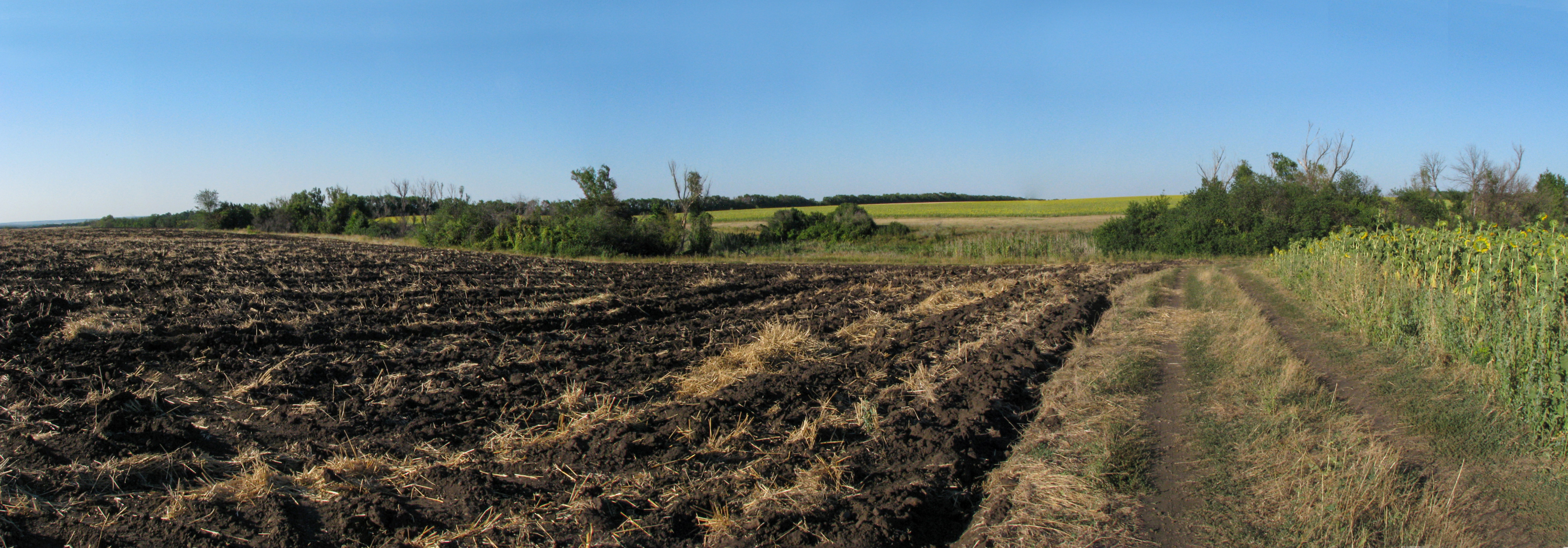
Photo: Vladimir Gorodniansky
Через пару километров мы вышли на огромное вспаханное поле. Идти было не очень легко, наши босые ноги утопали в мягкой пахоте, иногда на пути попадались куски битого кирпича, непонятно откуда там взявшиеся. Вдали на пашне заметили большую птицу, вышагивающую на длинных ногах. «Я знаю, это дрофа» – сказал Мишка Сулимин. Я впервые видел эту редкую птицу, обитающую в наших степях. Было интересно.
Прошли вспаханное поле, шли по целине, заросшей разными степными травами. Вышка все приближалась, увеличиваясь в размерах и все яснее проявляя свои очертания. И вот мы возле вышки. Стоим, пораскрывав рты и запрокинув головы, разглядываем ее вершину, которая, казалось, плыла в сторону, когда в небе над ней проплывало облако и останавливалась, когда оно уходило дальше. Мы были поражены высотой башни, она была высотой не более 5-6-ти этажного дома, но нам, деревенским пацанам, никогда не видевшим ничего выше наших низеньких хат под соломенными крышами, это сооружение казалось чем-то необыкновенным, фантастическим.
Это сооружение было похоже на буровую вышку, какими мы их видим на картинках, но собрана она не из металлических балок, а из бревен. По углам квадрата на земле, со сторонами метров по 10, кажется, были вкопаны в землю четыре толстых бревна торчком с небольшим наклоном каждого к центру квадрата, Верхние концы бревен соединялись перекладинами с помощью скоб и гвоздей, а на них настилалась площадка из досок. В ней оставлялось отверстие для пролезания при подъемах и спусках. Эта площадка была уже меньше чем площадь на земле у основания. На этой площадке крепились по углам четыре бревна уже потоньше и покороче тех, что поднимались от земли; на них также сооружалась площадка. И так до самого верха. Самая верхняя площадка была совсем уже маленькая, стороны ее квадрата были всего по два метра, кажется. Ограждена она была деревянными перилами. Высотой эта вышка была в пять или шесть этажей, а с этажа на этаж вели хорошо закрепленные деревянные лесенки.
Мы ходили вокруг вышки, пораскрывав рты и заглядывая вверх, но влезать на нее смелости не хватало, хотя и подмывало любопытство. В конце-концов все осторожно забрались на первый этаж. Но на второй этаж поднялись только мы с Шуркой Жуковым, повертелись там немного и осторожно полезли дальше. С высоты 3-го этажа горизонты расширились, видно далеко, все интересно, хотя и жутко с непривычки. До самой верхней площадки совсем уже недалеко, но .страх удерживает. И все же желание взобраться наверх перебарывает страх, и я начинаю карабкаться дальше, за мной полез и Шурка. И вот последняя площадка. Я пролезаю через лаз, становлюсь во весь рост, держась за перила. За мной поднимается и Шурка. Площадка маленькая, вдвоем на ней мы еле помещаемся, вниз смотреть страшно.
Там на земле наши друзья что-то кричат, машут руками, с высоты они кажутся очень маленькими. Шурка бросает вниз свой картуз и кричит: «Лови...и!». Над нами только небо, а кругом, куда ни повернись, до самого горизонта необозримые степные дали. Вдали еле виднеются маленькие, как игрушечные, крайние хаты нашего села; справа, недалеко от вышки, виднеется дорога; по дороге едет подвода, запряженная лошадьми. Это дорога из Титаревки на Кантемировку. Все так интересно, дух захватывает, но надо спускаться вниз. Это тоже не безопасно. Крепко цепляемся за перекладины, чтобы не сорваться. А вот и земля под ногами, все страхи, переживания позади, все закончилось благополучно, и мы довольные, гордые своим подвигом, возбужденные, отправляемся в обратный путь. Домой вернулись только под вечер.
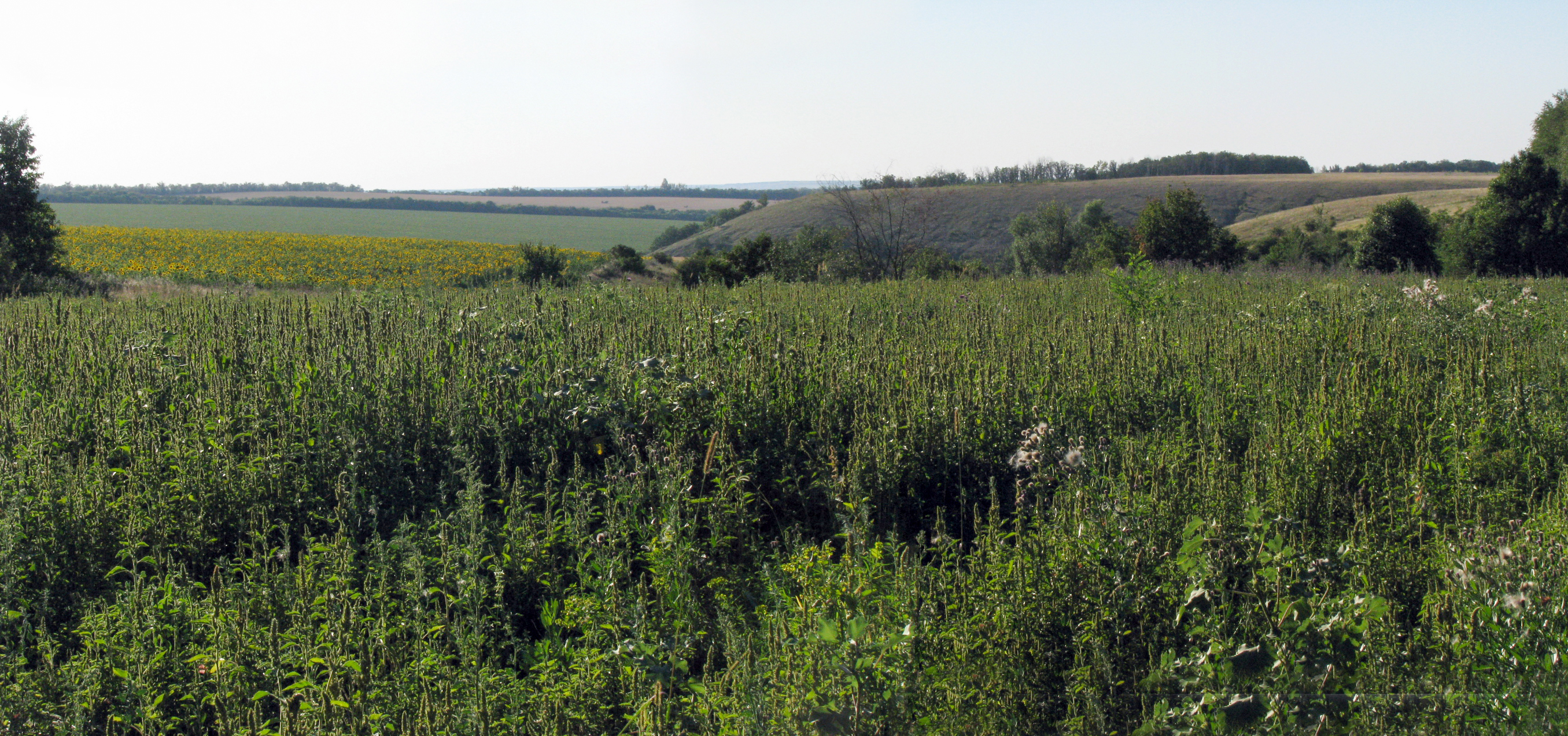
Photo: Vladimir Gorodniansky
Тот поход, конечно, запомнился надолго. Той вышки вскоре не стало, зачем ее убрали – не знаю, но к началу войны в 1941-м году ее уже не было. Постепенно все забылось, но где-то в уголках памяти все пережитое, конечно, отложилось. И тот сон с высокой вышкой, который приснился мне, можно сказать, в конце жизни, был, видимо, навеян сигналами из тех уголков памяти, что отложились еще в детстве.
* * *
Когда я был уже в подростковом возрасте, мне вспомнились обломки кирпичей, тех, что мы видели на вспаханном поле, когда ходили к вышке. Меня заинтересовало, откуда они там взялись в открытой степи, вдали от всякого жилья, и я обратился к отцу с вопросом об этих кирпичах. Отец поведал мне такую историю. Давно, еще до первой мировой войны 1914-18 годов на том месте, где мы видели обломки кирпичей, проживала колония немцев, взявших в аренду у царского правительства России землю. Обустроившись, они стали выращивать на наших знаменитых черноземах пшеницу, рожь, ячмень, овес и прочие сельскохозяйственные культуры. Хорошие урожаи получали по сравнению с местными крестьянами-хохлами. Добротно обустроившись, безбедно жили, рассказывал отец, даже нанимали работников из нашего села. Какое-то время и отец работал у них , будучи еще молодым парнем. Перво-наперво, наладили изготовление кирпича и черепицы, благо сырья (глина, песок) для их изготовления в нашей местности было достаточно. Дома они построили себе кирпичные, по типу тех, какие строились у них в Германии, и, конечно, сильно отличавшихся от хат местных жителей, построенных из плохого дерева, самана, соломы и глины. Не могли, а может быть, не хотели наши хохлы делать так , как делали немцы. Менталитет, как говорят сейчас, был совсем другой.
Когда же грянула первая мировая война и Россия стала воевать с Германией, то колонисты оказались в сложном положении; началось гонение на живших в России немцев. Колонистов изгнали, имущество их разграбили наши селяне, дома разрушили. С тех пор прошло много лет, и к тому времени, когда ходили мы к тригонометрической вышке, на том месте уже было голое поле без каких- либо признаков былого, хорошего человеческого жилья. Из земли только кое-где выпахивались на поверхность куски кирпича, и мало кто, кроме стариков, знал их происхождение. Если бы мне отец не поведал той истории, то и я бы не узнал. Но вот узнал, записал все на бумаге и теперь, может быть, узнают о той истории и другие люди, которые будут жить после меня.
A bit about dreams
I had a strange dream. It seemed to me that in a large open space there was a round tower with a diameter of about 10 metres, a tower that went up to a great boundless height, somewhere under the clouds. There were many floors in this tower, as well as some kind of elevator, a device for lifting people up and down. I had to climb it, as if for some kind of test. I was worried and scared. The cabin rose at an incredible speed. I was terrified of even imagining how high I was, my heart was contracting with fear. But, in the end, I went down again, got out of the tower and woke up. I felt relieved that it was just a dream.
Then, remembering this dream, I think 'where did it come from?'. Where do these different, incredible fantasies come from in a dream? Sometimes you dream of something that just makes you wonder where the dream came from. But the different visions in a dream do not arise from nothing. Apparently, in real life, something like this was forgotten, but somewhere in the corners of memory it was stored, in order to appear again in a dream, similar to something which had happened in reality and now was long forgotten. Then I remembered an episode from my childhood. A few kilometres from our village, in a vast open steppe, on its highest elevation, there was a trigonometric tower, set up to facilitate land surveying. It could be seen by going outside the village and peering into the distance. Because it was far away, it seemed quite small; it seemed to us children to be something mysterious and unusual. Curiosity pulled us there, I wanted to see the mysterious tower close up. But we were still too small to go on such a journey so far away. But when we reached the age of 10 or 11, we were ready.
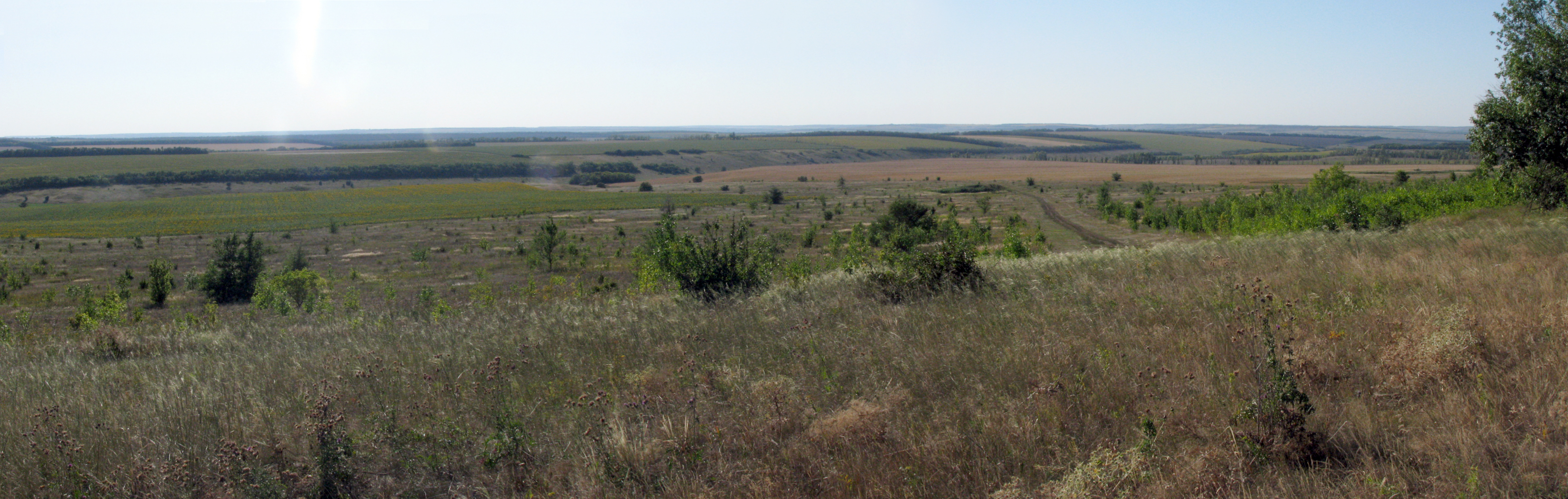
Photo: Vladimir Gorodniansky
Then, having conspired together on the adventure, we, a gang of 5 boys, set off on the road to that mysterious tower. I remember that it was summer, sunny weather, our path lay through the crops of rye, wheat, and oats which were still not grown much. After a couple of kilometres we went through a huge plowed field. It was not very easy to cross it, and our bare feet were buried in soft plowed dirt, and sometimes we came across pieces of broken brick, it was not clear where they came from. In the distance, on the plowed land, a large bird was seen pacing on long legs. 'I know this bird - it is called a bustard' said Mishka Sulimin. It was the first time I had seen this rare bird which lives in our steppes. It was very interesting.
We continued across the plowed field, then crossed onto unplowed earth, overgrown with various steppe grasses. The tower was getting closer, increasing in size and showing its shape more clearly. And then we were suddenly near the tower. We stood, opening our mouths and throwing our heads back, looking at its top, which seemed to float to the side when a cloud was floating in the sky above it and stopped when it went further. We were struck by the height of the tower, it was at a height of no more than a 5 or 6 story building, but to we village boys, who had never seen anything higher than our low huts under thatched roofs, this building seemed something unusual, fantastic.
This structure was like a drilling rig, as we see them in the pictures, but it was not assembled from metal beams, but from logs. At the corners of the square on the ground, with sides of about 10 metres, four thick logs were stuck in the ground with each post slightly tilted towards the centre of the square. The upper ends of the logs were connected with crossbars using crossbars and nails, and a platform of planks was laid on them. A hole had been left for climbing up and down. This platform was already smaller than the area on the ground at the base. On this deck, four logs were fastened in the corners, already thinner and shorter than those that rose from the ground; they also built a platform. And so on to the very top. The topmost platform was quite small, only two metres on a side, it seemed. It was fenced with a wooden railing. This tower was five or six floors high, and well-fixed wooden ladders led from floor to floor.
We walked around the tower, opening our mouths and looking up, but we did not have the courage to climb it yet, although curiosity was consuming us. In the end, everyone cautiously climbed to the first floor. But only Shurka Zhukov and I climbed to the second floor, walked around there a bit, and cautiously climbed on. From the height of the 3rd floor, the horizons had expanded, we could see far away, everything was interesting, albeit terribly unfamiliar. We were now very close to the top platform, but still we were afraid. Nevertheless, the desire to climb up overcame my fear, and I begin to climb further, and Shurka climbed after me.
Then here is the last platform. I crawled through the hole, and stood up, holding tightly to the railing. Shurka climbed after me. The platform was small, together we barely fit on it, and it was scary to look down. There below us our friends shouted something and waved their hands, from our height they seemed very small. Shurka shouted 'Catch ... here!' and threw his cap over the edge. Above us there was only the sky, and around, no matter where we turned, the vast steppes continued to the horizon. In the distance, we could barely see the small, toy-like huts on the edge of our village; to the right, near the tower, you could see the road; a horse drawn cart moved along it. This was the road from Titarevka to Kantemirovka, a part of Ukraine at that time. Everything was so interesting, and it was breathtaking, but we had to go down. This was not safe either. We clung tightly to the steps of each ladder so as not to fall. And then we felt the ground under our feet, all the fears were left behind, everything ended happily, and we were satisfied, proud of our feat, excited, and set off on the return trip. By the time we got home it was evening.
That adventure, of course, was remembered for a long time. That tower soon disappeared, why it was removed I don’t know, but by the beginning of the war in 1941 it was already gone. Gradually, everything was forgotten, but somewhere in the corners of our memory everything experienced, of course, was remembered. And that dream with a high tower, which I had a dream at the end of my life, was, apparently, inspired by signals from those corners of the memory that were created in childhood.
* * *
When I was in my teens, I remembered the fragments of bricks, those that we saw on the plowed field when we went to the tower. I was interested in where they came from in the open steppe, away from any dwelling, and I turned to my father with a question about these bricks. My father told me this story. For a long time, even before the First World War of 1914 -18, a colony of Germans lived in the place where we saw the wreckage of bricks, renting land from the tsarist government of Russia.
Having settled down, they began to grow wheat, rye, barley, oats and other crops on our famous chernozem soils. Good yields were obtained in comparison with the local Khokhlama peasants.
For some time my father worked for them as a young boy. First of all, they set up the production of bricks and tiles, and there was plenty of raw material in the form of clay and sand for their production in our area. They built their own brick houses, similar to those they had built in Germany, and, of course, very different from the huts of the locals, built from poor wood, mud, straw and clay. We couldn't, or maybe didn't, want our khokhlas (Ukrainian peasants) to do as the Germans did. The mentality, as they say now, was quite different.
When the First World War was coming and Russia started to fight with Germany, the colonists found themselves in a difficult situation; persecution of Germans living in Russia began. The colonists were expelled, their property was looted by our villagers, their houses were destroyed. Many years have passed since then, and by the time we went to the trigonometric tower, there was already a bare field in that place without any signs of former, good quality human housing. Only pieces of bricks were plowed out of the ground in a few places, and few people knew their origins except for the old people. If my father hadn't told me that story, I wouldn't have known it either. But I did, I wrote it all down on paper and now maybe other people who will live after me will find out about that story too.
Дедовщина
Я говорю о явлении, бытующем в недрах Вооруженных Сил России. Не знаю, есть ли оно в армиях других стран, а вот, что она есть в армии Российской, часто приходится слышать из новостей, передаваемых по телевизионным каналам из России, слушать, смотреть, возмущаться и задумываться о том, откуда она взялась эта пакостная, бесчеловечная, омерзительная штука – «дедовщина».При нынешнем, таком коротком сроке службы, всего 1,5 года, появляются старослужащие, так называемые деды по отношению к новобранцам и начинающие издеваться над ними, терроризировать, избивать, доводя порою их до самоубийства. В свое время я прослужил в армии и во флоте 12 лет. Был призван в конце Великой Отечественной Войны, служил 7 лет срочной и 5 лет сверхсрочной, и за эти годы никогда не слышал о какой то там дедовщине. Не было ее. Не было в то время у прослуживших уже не один год такого нечеловеческого отношения ко вновь прибывшим на службу молодым ребятам. Часто задаюсь вопросом: почему тогда было не так, как сейчас? И, кажется, нахожу ответ.
Все дело в том, по-моему, что в те времена служба в армии считалась делом чести, и в армию не брали всяких отщепенцев, преступников, имевших судимость и отсидевших срок в тюрьме. Сейчас служат и такие. Вот они то и заносят в армию дух тюремного поведения, где попадающие туда с воли подвергаются прохождению курса унижений, оскорблений, избиений и безусловному подчинению пахану, авторитету.
Я стал замечать это в последний год моей службы, когда во флот на корабли, где я служил, стали направлять парней, не призванных в положенное для них время из-за того, что они отбывали тогда срок в тюрьме за совершенные преступления.
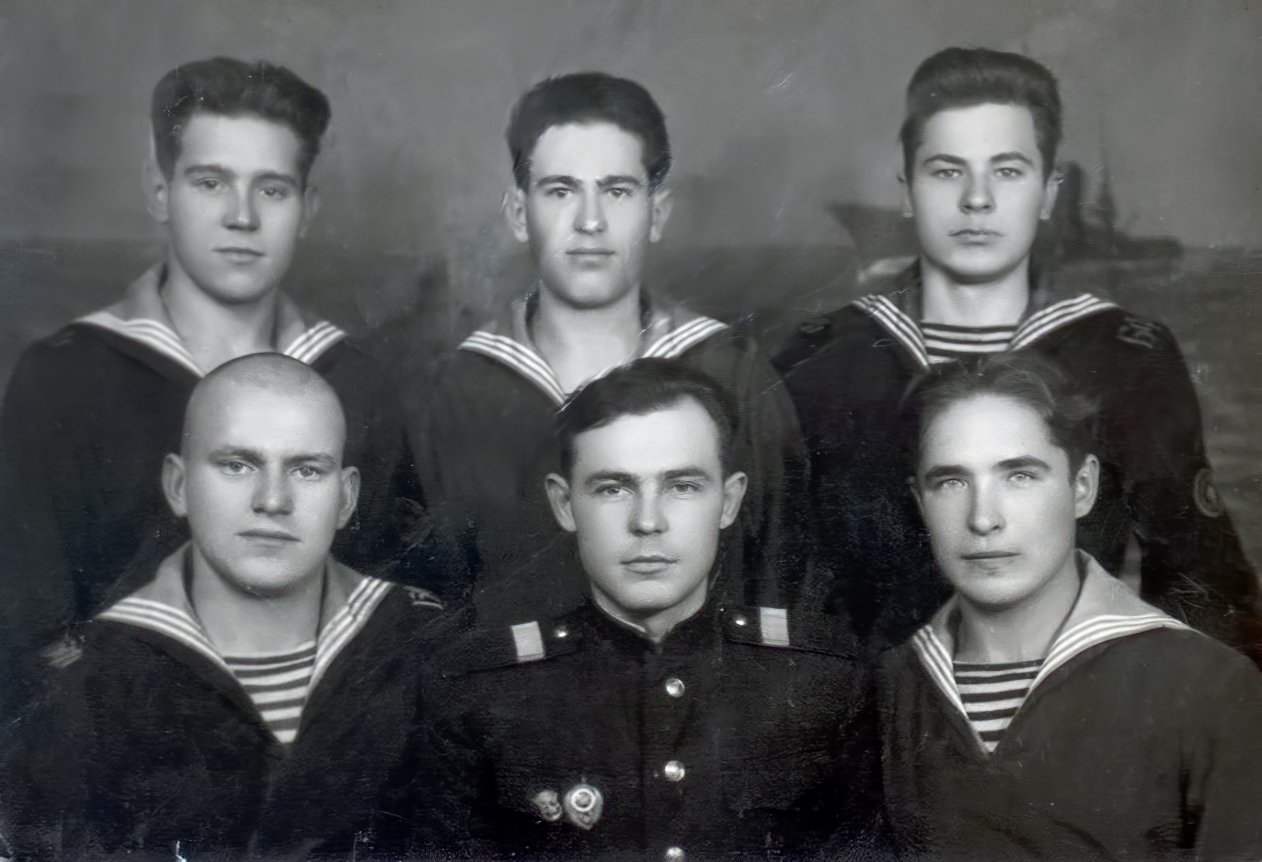
Dmitry Nikonorovich, front row, centre.
Photo: Dmitry Nikonorovich, via Vladimir Gorodniansky
Помню, к нам на корабль прибыли 10 человек таких матросов. Они отличались от наших ребят и внешним видом и поведением. Но, главное, отношением к службе и взаимоотношениями между собой. Резко бросалось в глаза их нежелание служить, пренебрежение к любой работе, употребление тюремного жаргона. Командирам прибавилось забот с ними. Был среди них один здоровый, наглый тип, по фамилии Сидоров. В размеренную налаженную корабельную жизнь он вносил много нехорошего. Старшине приходилось прилагать много усилий, чтобы заставить его выполнить приказание. Особенно не хотел выполнять любую работу.
Был среди них один матрос, слабый по виду и тихий какой-то. Деревенский видно был. Но как издевался над ним этот наглый Сидоров! Совсем затравил бедного парня, никакого житья не давал ему, иногда избивал, когда не было рядом начальства, принуждал его прислуживать. Жаловаться же начальству тот боялся.
Наши матросы, особенно старослужащие, воспитанные на традициях морского братства, не привыкшие к тому, как вели себя бывшие зеки, держались по отношению к ним отчужденно, но все-таки мирно, слава богу. Зэки же, чувствуя их силу и братство, в конфликт с ними не вступали.
Однажды в воскресенье, когда мы стояли в Таллинне, в Минной гавани, я был дежурным по кораблю. В дежурную рубку заглянул старший матрос Яковенко и обратился ко мне: «Товарищ мичман, там у нас в кубрике Сидоров бузит». Я спустился в кубрик и там увидел, как в углу между койками Сидоров насел на Пряхина, душит его, изрыгая матерные угрозы: «Ах ты падло, гнида трухлявая–рычит он–Я тебя научу старших слушаться, я тебе кишки сейчас вымотаю гад. Ты уже три дня лишних на свете живешь!»
«Сидоров, прекрати хулиганить! – как можно жестче требую я. Он поднял на меня глаза и, с искаженной от злобы мордой, прорычал: «Ухо…ди, начальник!» Сильно пахнуло перегаром.
Я вышел из кубрика, позвал четверых крепких ребят и приказал им утихомирить буяна. В случае неподчинения – связать. После короткой возни Сидорова связали крепким линьком по рукам и ногам, затащили в душевую, уложили на холодную, выложенную кафелем, палубу и всего облили холодной водой. Дверь в душевую закрыли на замок, ключ я взял с собой.
Сидоров орал, матерился. «Развяжите меня, суки поганые!» – кричал он. Но я решил проучить его и душевую не открывал. Через некоторое время он продрог, мокрый набухший линек больно врезался ему в тело, и он начал кричать уже по другому: «Да развяжите же меня, мне больно, я больше не буду!» Я все не велел развязывать, но когда его товарищи стали просить и пообещали не дать ему больше буянить, разрешил развязать и отпустить его, предварительно взяв с него обещание вести себя нормально.
– Еще будешь? – спросил я его.
– Да не буду больше, развяжите скорее, очень больно. Честное слово, товарищ мичман, не буду. – Уже совсем другим голосом и тоном пообещал он.
Месяца через два присланных к нам на обучение отпустили по домам, служба на корабле пошла поспокойнее.
Сейчас я думаю, что все то, что происходило во время их пребывания на корабле, было зародышем того явления, которое сейчас называют дедовщиной. Все больше убеждаюсь в том, что ее появление в армии связано с тем, что на службу стали призываться и отсидевшие срок в тюрьме, и что от них пошла эта самая зараза.
И еще сильнее убеждаюсь, вспомнив один эпизод, связанный с человеком – уголовником, усвоившим тюремную мораль, основанную на праве сильного.
Проживая как-то летом в Богучаре, я приболел и попал на несколько дней в больницу. Меня поместили в палату, где лежали шесть человек больных. Я хорошо запомнил двоих: молодого мужчину и паренька-подростка. Паренек иногда мог подниматься с постели, мужчина не поднимался. Мне бросилось в глаза то, как мужчина помыкал этим пареньком, грубо заставляя его буквально прислуживать ему. Паренек, видно был не особенно бойким и безропотно подчинялся всевозможным прихотям мужика.
На третий день моего пребывания в больнице, в палату зашли два милиционера, сели на стульях у койки мужчины и начали что-то у него выпытывать. Оказывается, этот мужчина после отбывания срока в тюрьме был выслан из какого-то города в соседнее с Богучаром село за пьянство и тунеядство. Там он учинил драку, и в драке был ранен ножом. В больнице находился на излечении.
Наблюдая происходящее в палате, я все больше понимал, откуда появилась дедовщина в нашей доблестной армии.
Hazing
Hazing is a phenomenon occurring in the the Armed Forces of Russia. I don’t know if it is in the armies of other countries, but it is often mentioned in the news on TV channels from Russia, causing resentment, and wonder about about where this dirty, inhuman, disgusting thing came from, called hazing.At the present, during a short time in the armed services for compulsory military training, only 18 months, the old servicemen, the so-called grandfathers, are in charge of the recruits and begin to mock, terrorise, and beat them, sometimes leading the new recruits to suicide. At one time, I served in the army and navy for 12 years. I was called up towards the end of the Great Patriotic War, served 7 years as an emergency serviceman, and 5 years as a re-enlisted serviceman, and during those years I never heard of any hazing. It did not exist. At that time, the people who had served more than one year did not have such an inhuman attitude towards the newly arrived young men. I often asked myself: why was it not so now? And, it seems, I have found the answer.
The thing is, in my opinion, that in those days service in the army was considered a matter of honour, and they did not take into the army any renegades, anyone who had a criminal record and had served a prison sentence. Now these people must serve. So they bring the spirit of prison behaviour into the army, where those who are newly arrived are subjected to a course of humiliation, insults, beatings and unconditional submission to authority.
I began to notice this in the last year of my service, when the fleet administration for the ships in which I served began to enlist older men with criminal records, who had not been called up earlier at the appropriate age because they were serving time in prison for the crimes they had committed.
Dmitry Nikonorovich, front row, centre.
Photo: Dmitry Nikonorovich, via Vladimir Gorodniansky
I remember ten such sailors arrived on our ship. They differed from us in their appearance and behaviour. But, most importantly, they differed in the attitude to the service and their relationships among themselves. Their unwillingness to serve, disregard for any work, and the use of prison jargon were sharply striking. The commanders became increasingly worried about them. Amongst them was one heavy, arrogant type, by the name of Sidorov. In the measured well-adjusted ship life, he contributed a lot of bad things. The mate had to make a lot of effort to get him to execute his orders. Especially he did not want to do any work.
There was one sailor among them, weak in appearance and kind of quiet. It was obvious he was from a village. But how this arrogant Sidorov mocked him! He completely harassed the poor man. Sidorov did not give him any private life, he sometimes beat him when there were no superior officers around, and forced him to wait on him. The sailor was afraid to complain to the authorities.
Our sailors, especially the old servicemen, educated in the traditions of the fraternity of the sea, who were not accustomed to how the former convicts behaved, were alienated towards them, but still behaved peacefully, thank God. The cons, feeling their strength and brotherhood, did not come into conflict with them.
Once on Sunday, when we were staying in Tallinn, in Mine harbour (Miinisadam), I was on duty on the ship. The senior sailor Yakovenko looked into the on-duty cabin and addressed me: "Comrade midshipman, Sidorov is kicking someone in the cockpit." I went down to the cockpit and there I saw in a corner between the beds Sidorov sitting on Pryakhin, strangling him, spewing out obscene threats: “Oh, you dirtbag, louse - he growled - I will teach you how to obey, I will spill your guts out now. You have been living high for three days! ”
'Sidorov, stop bullying!' - I demanded as harshly as possible. He raised his eyes to me and, with a face distorted by anger, growled: 'go… away, chief!' His breath smelled strongly of booze.
I went out of the cockpit, called four strong guys and ordered them to calm down the miscreant. In case of insubordination - to tie him up. After a short struggle, Sidorov was tied up with a strong rope on his hands and feet, dragged into the shower room, laid on the cold tiled floor, and had cold water poured on him. The door to the shower was locked, and I took the key with me.
Sidorov screamed and swore. 'Untie me, you nasty bitches!' He shouted. But I decided to teach him a lesson and did not open the shower. After a while, he became cold, the wet, swollen line bit into his body painfully, and he began to shout differently: 'Please, untie me, it hurts me, I will not do it again!' I did not order him untied, but when his comrades began to speak for him, and promised not to allow him to fight anymore, allowed them to untie and release him, after he had promised to behave normally.
'Will you?' I asked him.
'I will not do it any more, untie me, it is very painful. Honestly, comrade midshipman, I will not.' In a completely different tone of voice, he promised.
Two months later they were sent home for training, life on the ship became quieter.
Now I think that everything that happened during their stay on the ship was the germ of what is now called hazing. More and more I am convinced that its appearance in the armed forces is connected with the fact that those who served time in prison were called to the service, and that this infection came from them.
And I am even more convinced, remembering that one episode with a man - a criminal - who had learned prison morality, based on the law of the strong.
Living in the summer in Boguchar, I got sick and ended up in a hospital for several days. I was placed in a ward where six sick people were lying. I remember two well: a young man and a teenage boy. The boy could sometimes get out of bed, the man did not get up. I was struck by how the man ordered this boy around, roughly forcing him to literally serve him. The boy, apparently was not particularly brisk and meekly obeyed all sorts whims of man.
On the third day of my stay in the hospital, two policemen came into the ward, sat on the chairs at the bedside of the man and began to elicit something from him. It turns out that this man, after serving time in prison, was expelled from some city to a village next to Boguchar for drunkenness and thieving. There he caused a fight, and in the fight he was wounded with a knife. He was being treated in the hospital.
Observing what happened in the hospital ward, I increasingly understood where hazing came from in our valiant armed service.
Грабители
Бог дал мне дожить до очень почтенного возраста. В таком возрасте ничего уже хорошего, значительного не совершишь. Повспоминать, разве только что, о прошедшей жизни можно. Вот и сижу, вспоминаю о прошлом. Удивительное дело: что было вчера, позавчера – не всегда помнится, а вот что было в детстве, в юности - всплывает в памяти до таких подробностей, как будто это было вчера.
Как раз и вспомнился мне, кстати, один случай из моей далекой юности.
Шел 1944 год. Шла война. Нас освободила от немецкой оккупации наша Красная Армия. Бои шли где-то на западе. Мы, шестнадцатилетние подростки, трудились в колхозе. Я, Сашка Жуков и Витька Круглов вместе с другими колхозниками занимались обмолотом выращенной пшеницы. Ее снопы были уже свезены и уложены в большие скирды в разных местах обширных колхозных полей.
В тот день мы работали в трех километрах от нашего села. Молотилка была установлена у скирды и, приводимая в движение трактором через ременную передачу, жестоко громыхая и поднимая густые облака пыли, молотила с раннего утра до позднего вечера.
Сашка и Витька, только что окончившие курсы трактористов при МТС, обслуживали трактор, а я возился с обмолоченным зерном. В обеденный перерыв они заинтриговали меня своим задуманным мероприятием, пока мне не понятным. Подробнее ввести меня в курс дела пообещали позднее.
По договоренности с ними, я должен был часа за полтора до окончания работы под каким-нибудь предлогом отпроситься с работы домой, потом, по окончании работы, всем троим встретиться и действовать дальше по задуманному ими плану.
Ухватившись руками за правый бок, я подошел к бригадиру, пожилому, уже не призывного возраста, мужчине и, изображая на лице мучения от боли, обратился к нему: «У меня в боку сильно заболело, я не могу работать.
Отпустите меня домой».
Бригадир встревожился, сочувственно посмотрел на меня и спросил:
- Сам домой дойдешь?
- Дойду как-нибудь, - стараясь перекричать грохот молотилки, сказал я.

Кукуруза, Corn
Бригадир меня отпустил, и я ушел. До села идти 3 км. В одном месте справа от дороги росла высокая, в человеческий рост, густо посаженная, кукуруза. Я вошел в эту кукурузу, отошел метров на двадцать от дороги, сел на землю и стал ждать ребят.
Photo: Don Hitchcock 2018
Было начало сентября, стояли теплые, погожие, безветренные дни; после грохота молотилки тишина стояла до звона в ушах. Земля была теплая, сухая. Я прилег на землю и, чуть было не уснул.
Но вот вдали послышались голоса, и вскоре мимо меня в село прошли женщины, закончившие работу; они громко судачили между собой. Прождав еще с полчаса, я услышал со стороны дороги условный свист; это свистели Сашка с Витькой. Я вышел из кукурузы, подошел к ним, и тут они раскрыли свой план: «Грабить пойдем» - сказал, как будто шутя, Сашка, не вызвав у меня восторга этой шуткой. Но, оказалось, что все так и было: они звали меня добыть меда на хуторе Калиновка, километрах в 1,5 от места, где мы находились. Не по желанию, скорее из солидарности, я согласился идти с ними на неясное и, похоже, опасное мероприятие. Пошлым летом Сашка работал помощником пчеловода на колхозной пасеке, там освоил азы работы с пчелами, и вот захотелось ему использовать приобретенный опыт на воровском деле. Сговорившись с Витькой, они решили пригласить и меня на этот ночной подвиг. Ну, а я что ж: за компанию, говорят, и жид удавился. Так вот и я – согласился.
Пошли по на правлению к хутору прямо по полям: местами по стерне, местами по пахоте. Солнце скрылось за горизонтом, начало смеркаться, но стемнеть по- настоящему не давала взошедшая полная, яркая луна. Она как то необычно ярко освещала своим светом поля в тот теплый, безветренный вечер. Мы шли по полю. Ровное, степное пространство вдруг сразу обрывалось, начинался крутой спуск в низину, в так называемое урочище. На спуске рос густой кустарник и отдельные низкорослые деревца. Внизу, под горой, протекал небольшой ручей, Сразу за ручьем, вдоль его берега располагались огороды жителей хутора, а за огородами, вытянувшись в одну улицу, стояли хаты. Их было не больше двадцати. Освещаемые яркой луной, они белели своими побеленными стенами. С высоты горы их хорошо было видно, но любоваться тем красивым видом нам не очень хотелось: мы озабочены были другими мыслями.
Мы начали спускаться вниз по склону, продираясь сквозь кусты. Собаки, видимо, почуяли нас, и во многих дворах поднялся лай. Пришлось присесть на землю в кустах, не решаясь идти дальше. Так прошло более получаса, собаки утихли, и только слышно было, как в дальнем конце улицы бренчала балалайка и кто-то негромко пел частушки. Потом и это все стихло; видимо, все разошлись по домам спать.
Мы продолжали сидеть и ждать, пока не утихнет все основательно. Ждать долго не хотелось, поднялись и потихоньку, осторожно продолжили спускаться вниз. Перешли ручей, и вышли на огород. Ни одна собака, почему то больше не лаяла: было тихо.
Сашка знал, что летом в огородах у здешних жителей стояли ульи, но сейчас, пройдя несколько огородов, мы ни одного улья не увидели. Оказывается, все ульи уже убрали на зиму в укрытия. Так что мы только облизались. Что делать, надо ни с чем уходить домой. Но не такой был Сашка, чтобы домой возвращаться без добычи: он предложил залезть в чей-нибудь погреб и поискать там сливочного масла. Инициатива и организация того воровского дела вся исходила от Сашки.
Выбрали двор без собаки, осмотрелись. Во дворе стоял большой стог сена, рядом с домом сарай, за углом дома погреб с выходом наверх. Дверь выхода подперта чурбаком. Входную дверь в доме мы заперли снаружи, как запирают хозяева, уходя из дома, но только вместо замка вставили палку. Из дома теперь выйти никто не мог, разве только вылезть через окно.
Сашка спустился в погреб, Витька стал наверху у входа, а я отошел метров на 15 в огород. Сашка что-то долго не вылезает из погреба. Тихо кругом, собаки не лают, от луны светло как днем. Мне становится не по себе: кажется, что нас вот-вот увидят и начнется на нас облава. А что будет дальше – не хотелось даже и думать. Страшнее всего для меня был только позор.
Наконец из погреба появляется Сашка, руки у него по локоть в сметане. Говорит, что в погребе темно, ничего не видно, и он наощуп лазил руками в горшки и кувшины, но масла не нашел. Решили взять кувшины со сметаной. Три раза спускался Сашка в погреб, вынося оттуда каждый раз по два кувшина со сметаной. С шестью кувшинами – у каждого по два – прошли через огород к ручью, поднялись на гору, с высоты посмотрели на хутор, где ни в одном окошке уже не светился огонь, не лаяли собаки: было тихо, жители, видимо, улеглись спать – мы были в безопасности.
Но что делать со сметаной? Не домой же ее нести. И мы, уже изрядно проголодавшиеся, сметану поели, сколько могли, остальную же вылили на землю, а кувшины взяли с собой. Хоть какая-то была добыча. До своего села дошли быстро, благо было не далеко. При входе в свое село разделились по одному. Чтобы попасть домой, я пошел не по улице – не хотелось попадаться кому-либо на глаза, а прошел к дому через свой сад и огород.
Кухонное окно светилось: в окне светилась лампа. Я осторожно, стараясь не шуметь, вошел в сени и прислушался. Через дверь услышал как отец взволнованным голосом кому-то, что-то рассказывает. Я догадался, что речь идет обо мне. Когда отец умолк, я понял, что из дома будут выходить и, чтобы никому не попадаться на глаза быстро поднялся по лесенке, стоявшей в сенях, на чердак и притаился там в темноте. Из комнаты в темные сени вышли знакомые, как я узнал по голосам, ребята. Оказалось, они заходили к нам, чтобы позвать меня на вечеринку. Проводив ребят, отец вернулся в дом, а я, немного выждав, слез с чердака и тоже вошел в комнату.
Увидев меня, отец очень обрадовался и спросил:
– Где ты был? Что случилось?
Мне пришлось врать, чтобы как то выкрутиться. «У меня на работе сильно заболело в боку. Я отпросился с работы. По дороге домой так разболелось, что я не мог идти дальше. Я сошел с дороги и вошел в кукурузу, прилег на землю. Боль постепенно утихала и я уснул. Сколько спал – не знаю. Проснулся – ночь, луна. И вот пришел.
Отец рассказал, что когда я не пришел вечером с работы, он забеспокоился и пошёл в колхозную контору, где в это время всегда были председатель и бригадиры. Там мой бригадир сказал, что я на работе заболел, и он отпустил меня домой.
Тогда отец всерьез забеспокоился, пришел домой, взял вилы на всякий случай и пошел искать меня в ночную степь. Шел полевой дорогой, время от времени громко звал меня, но я, естественно, ничего не мог слышать. Я в это время в соседнем хуторе грабил чужие погреба.
Как бы там ни было, но все для меня обошлось благополучно. Только вот бабушка целую неделю не могла успокоиться. Ей не давали покоя два кувшина, неизвестно откуда появившиеся в ее домашнем хозяйстве. Она сокрушалась, гадала, приставала ко всем членам семьи с расспросами про них. Никто ничего вразумительного сказать ей не мог, и она уже начала поговаривать о какой-то сверхъестественной силе, принесшей ей кувшины. Догадывался ли отец о чем-нибудь - не знаю. Мог, наверное, но за всю свою жизнь ни разу не спрашивал о тех злополучных кувшинах. Не рассказал о них и я, хотя уже будучи взрослым, приезжая к нему в гости, за выпивкой иногда хотелось рассказать. Но так и не рассказал, не решился. А тот грех так и остался на мне, и при воспоминании о нем появляются, все – таки, угрызения совести. Хотя я и не верующий, но иногда мысленно прошу не то бога, не то другую какую-то силу, простить меня за содеянное по молодости и по глупости.
Thieves
God has given me the gift of a very ripe old age. At this age, nothing significant can be accomplished. It is only possible, perhaps, to reminisce about a past life. Here I sit, think of the past. An amazing thing about old age is that what happened yesterday, the day before yesterday - I don’t always remember, but what happened in childhood, in my youth, comes to mind in great detail as if it were only yesterday
I just remembered, by the way, one story from my distant youth.
It was 1944. There was a war. We were liberated from the German occupation by our Red Army. The fighting went on, somewhere in the west. We, sixteen-year-olds, worked on the collective farm. I, Sashka Zhukov and Vitka Kruglov, together with other collective farmers, threshed the harvested wheat. The sheaves had already been brought in and laid in large stacks in different places of the vast collective-farm fields.
That day we worked three kilometres from our village. The threshing machine was installed in a shed and, driven by a tractor through a belt drive, rumbled thunderously, and raised thick clouds of dust. We worked at threshing from the early morning until late evening.
Sasha and Vitka, who had just completed the course for tractor drivers at the MTS, worked the tractor, and I was busy with the threshed grain. At lunchtime, they intrigued me with what they proposed to do, which I finally understood in general terms. They promised to give me the full details later.
By agreement with them, I had to wait until an hour and a half before we were supposed to finish work, and under some pretext take time off from work to go home, then, after work, all three of us should meet and act further according to their plan.
Grabbing hold of my right side, I went up to the brigadier, an elderly man no longer of military age, and, pretending to be in pain, asked him: 'Let me go home'.
The brigadier was alarmed, looked at me sympathetically and asked:
'Can you get home by yourself?'
'I'll make it somehow' I said, trying to shout over the roar of the thresher.
The brigadier let me go and I left. It was 3 km to the village. In one place, to the right of the road, tall, densely planted corn grew. I entered this corn, walked about twenty metres from the road, sat on the ground, and waited for the others.
It was the beginning of September, we were having warm, pleasant, calm days; after the racket of the thresher, the silence allowed me to hear ringing in my ears. The ground was warm and dry. I lay down on the ground and almost fell asleep.
But soon I heard voices in the distance, and the women who had finished their work passed by me towards the village; they loudly gossiped among themselves. After waiting for half an hour, I heard a low whistle from the side of the road; it was Sasha with Vitka. I came out of the corn, approached them, and then they revealed their plan. 'Let's go stealing' they said, as if joking, and I said 'Sasha, do not make silly jokes'. But it turned out that this was the case: they wanted us to get honey from Kalinovka farm, 1.5 kilometres away from where we were. Not really wishing to, rather out of friendship, I agreed to go with them on a vague and seemingly dangerous undertaking.
Last summer, Sasha worked as a beekeeper's assistant at a collective farm apiary, where he mastered the basics of working with bees, and now he wanted to use the experience gained for this thievery. Having agreed on the project with Vitka, the two of them decided to invite me on this night-time exploit. Well, I went along with them, and they say that Judas the Jew hanged himself. So I agreed.
We went in the direction of the farm directly through the fields: sometimes there was stubble, sometimes ploughed ground. The sun disappeared over the horizon, it was beginning to get dark, but soon a full, bright moon rose. The fields were unusually brightly illuminated with the moon's light on that warm, windless evening. We walked across the field. The flat steppe suddenly ceased, and a steep descent to the lowland, to the so-called tract, began. On the slope of the descent, thick brush and some stunted trees grew. Below, under the mountain, a small stream flowed.
Below the descent flowed a small stream. Immediately behind the stream, the gardens of the inhabitants of the farm were located along its bank, and behind the gardens, stretched out along a single dirt road, there were no more than twenty huts. Illuminated by the bright moon, they stood out with their whitewashed walls. From the height of the steppe above the descent, they were clearly visible, but we didn't stop to admire that beautiful view: we were preoccupied with other thoughts.
We started down the slope, crashing through the bushes. The dogs sensed us, and in many yards stood barking.We had to sit down on the ground in the bushes, not daring to go any further. More than half an hour went by, the sound of the dogs died down, and all we could hear was the sound of a balalaika and someone singing softly. Then this sound too died away, and everyone went to bed.
We continued to sit and wait until it all sound subsided. Finally we did not want to wait any longer, and got up, and slowly, carefully continued to go down the slope. We crossed the stream, and went into the garden. For some reason no dog barked anymore: all was quiet.
Sasha knew that in summer there were hives in the gardens of the local inhabitants, but now, after going through several gardens, we had not seen a single beehive. It turned out that all the hives had been removed to shelter from the coming winter. So we were just licked. What could we do, we had to go home with nothing it seemed. But Sasha was not the type of person to return home without loot: he suggested getting into someone's cellar and looking for butter there. The initiative and organisation of the thieves' affairs was all from Sasha.
We chose a yard without a dog, and looked around. In the courtyard there was a large haystack, next to the house a barn, and around the corner of the house there was a cellar with access through the top. The other door was propped closed by block of wood. We locked the front door of the house from the outside, in the same way as the owners locked up, leaving the house, but instead of a lock, they inserted a stick. Nobody could get out of the house now, unless he came out through the window.
Sasha went down into the cellar, Vitka was upstairs at the entrance, and I moved 15 metres into the garden. Sasha was a long time coming out of the cellar. It was quiet all around, the dogs did not bark, and the moon was as bright as day. I felt uneasy. It seemed that we were about to be seen, and we would be chased. What would happen after that I did not want to think. The worst thing for me would be the shame.
Finally, Sasha appeared out of the cellar, his arms covered to the elbow in sour cream. He said that it was pitch dark in the cellar, nothing was visible, and he put his hands into many pots and jugs, but he did not find any butter. We decided to take the jugs with sour cream. Three times Sasha went down to the cellar, taking out two jugs of sour cream each time. With six jugs, two each, we passed through the garden to the stream, climbed the slope again, and looked from the top at the farm where no light came from any window, the dogs did not bark: it was quiet, the inhabitants were apparently all in bed asleep - we were safe.
But what to do with sour cream? We could not carry it home. And we, already fairly hungry, ate as much sour cream as we could, poured the rest on the ground, and took the jugs with us. At least we had something for our efforts. We reached our village quickly, it was not far away. At the entrance to the village we divided one by one. To get home, I didn’t go down the street - I didn’t want to be seen by anyone, so I walked to my house through gardens and an orchard.
The kitchen window was bright: a lamp was shining in the window. I cautiously entered the hall, trying not to make any noise, and listened. Through the door, I heard my father talking to someone in an agitated voice. I guessed that it was about me. When my father fell silent, I realised that they would leave the house and, and so that no one would see me, I quickly climbed the ladder, which stood in the hallway, into the attic and hid there in the dark. Friends came out of the room into the dark hall, men, as I realised from the voices. It turned out they came to our home to invite me to a party. After leaving the visitors, my father returned to the house, and I, after waiting a little, got down from the attic and entered the room.
On seeing me, my father was very happy and asked:
'Where have you been? What happened?'
I had to lie to get out of that. 'I became very ill at work, with pain in my side. I asked for leave from work. On the way home I was in so much pain, that I could not go any further. I left the road and went into the corn, and lay down on the ground. The pain gradually subsided and I fell asleep. How long I slept I do not know. I woke up to the light of the moon. And here I am.'
My father told me that when I did not came home from work in the evening, he was worried and went to the collective farm office, where at that time there were always the chairman and supervisors. There my foreman had said I was sick on the job, and he let me go home.
Then the father became seriously worried, he came home, took a pitchfork, just in case, and went to look for me in the night on the steppe. He followed the dirt road, sometimes loudly calling for me, but I certainly could not hear. I was at this time in the neighbouring hamlet robbing a cellar.
Despite everything, it turned out well for me. However the whole week my grandmother could not calm down. She was haunted by the two pitchers, which came from nowhere and had appeared in her household. She lamented, wondering, and pestered all the family members with questions about it. Nobody said anything intelligible, so she could not understand it, and began to talk about some kind of supernatural force, which brought the jugs to the house.
I did not know if my father had guessed anything. He could, probably, but in his entire life he never asked about those unfortunate jugs. I did not tell about them either, although already being an adult, when I came to visit him, I sometimes wanted to tell him everything. But I never told, I did not dare. And that sin remained on me, and when I remember it, nevertheless, remorse emerges. Although I am not a believer, I sometimes mentally ask not God, but some other kind of power, to forgive me for my deed because of my youth and stupidity.
Аня
Я познакомился с ней на танцах в сельском клубе, куда пришел, находясь в гостях у отца во время краткосрочного отпуска летом 1950 года. Я приехал на несколько дней к отцу в деревню из Эстонии, где проходил службу в Военно-Морском Флоте. В эту деревню отец переехал на жительство в то время, когда я был уже на службе, поэтому я там никого не знал, и знакомых у меня там не было.Прослышав о том, что в клубе намечаются танцы, я решил туда сходить. Погладил свои морские брюки-клеш, надраил «корочки», так называли на флоте парадные хромовые ботинки, и вечером отправился в клуб. Там только что закончился показ кинофильма. Зрители расходились по домам, но молодежь оставалась на танцы. Скамейки с середины зала убрали и расставили у стен. На середине зала образовалась площадка для танцев.
Я вошел в зал, когда все это уже было сделано, а парни и девушки стояли у стен в ожидании начала танцев. Меня здесь никто не знал, моряков здесь, вдали от моря, видели не часто и потому на меня сразу же все обратили внимание. Я в своей морской форме резко выделялся среди всех, и мне как-то от этого было не по себе. Но вот заиграл баян и первые пары пошли танцевать. Приглашать кого-нибудь на танец я пока не решался; присматривался к публике, наблюдал за танцующими. Парней было мало и, поэтому, многие девушки танцевали друг с другом.
В перерывах между танцами девушки отдельно от парней теснились у стенки. Среди них мне бросилась в глаза одна очень симпатичная, стройная, невысокого роста девушка с тяжелой русой косой. Это была настоящая деревенская красавица. Она привлекала мое внимание, я часто смотрел в ее сторону и каждый раз видел, что она тоже наблюдает за мной: наши взгляды часто встречались; и когда заиграли вальс, я пригласил ее на танец.
Мы кружились по залу, танец хорошо получался. Я стал приглашать ее и на следующие танцы. Во время одного из танцев я, сразу обращаясь к ней запросто на ты, спросил: - Ну а как же звать тебя красавица?
- Аня. А вас как зовут? – сразу же спросила она. Я сказал, как меня зовут, и добавил:
- Ну, вот и познакомились. А где же твой кавалер? Такая дивчина не может быть без кавалера.
- Его послали сегодня куда-то в рейс. Он шофер, где-то задержался.
- А где ты живешь? – спрашиваю.
- Я в другом поселке живу, в Калиновке. Это 2 километра отсюда.
- А кто же тебя проводит домой? Одной ведь страшно ночью в поле.
- А я смелая, я ничего не боюсь, - с веселым задором ответила она. А ко мне в голову влезла мысль – проводить ее домой. И когда мы танцевали последний танец, я предложил: - Аня, ну так давай я провожу тебя.
Она ответила не сразу, но, немного подумав, согласилась. На улицу я вышел первым, стал ждать ее. Она вышла вместе с девчатами и стала в сторонке. Я подошел к ней и сказал: «Ну, веди, я ведь дороги не знаю». Мы пошли рядом по темной улице, потом я взял ее под руку; Нас обгоняли какие-то люди: это были, наверное, спешившие домой после танцев. Нас они, конечно, видели. Мы повернули с улицы, и по какому-то проулку, мимо огородов, спустились вниз, где была криница. Потом по тропинке, ведущей в гору, через не густые кустарники, вышли на открытое, ровное место. Впереди была степь. Мы пошли по полевой дороге. Ночь была тихая, теплая, но безлунная; на небе светились мириады ярких звезд, и четко выделялся млечный путь.
Я положил руку на ее плечо и ближе прижал к себе. Она не противилась. Мы медленно шли, разговаривая. Она все расспрашивала о море, и с интересом слушала, что я ей рассказывал. Собираясь на танцы, я и подумать не мог, что окажусь вот в такой ситуации. Где-то в подсознании меня что-то тревожило. Очень необычно все выходило: и ее быстрое согласие на провожание, и ее, якобы существующий, кавалер – все это было неясно и не давало четко осознать, что же происходит и что будет дальше. Ну, что ж, теперь, думаю, будь, что будет.
Мы шли по дороге к ее поселку, большое, необозримое подсолнуховое поле темнело справа; высокие, с человеческий рост подсолнухи росли у самой дороги. Слева простиралось уже убранное хлебное поле. Далеко впереди замаячили огоньки в домах Аниного поселка. Мы прошли примерно половина пути.
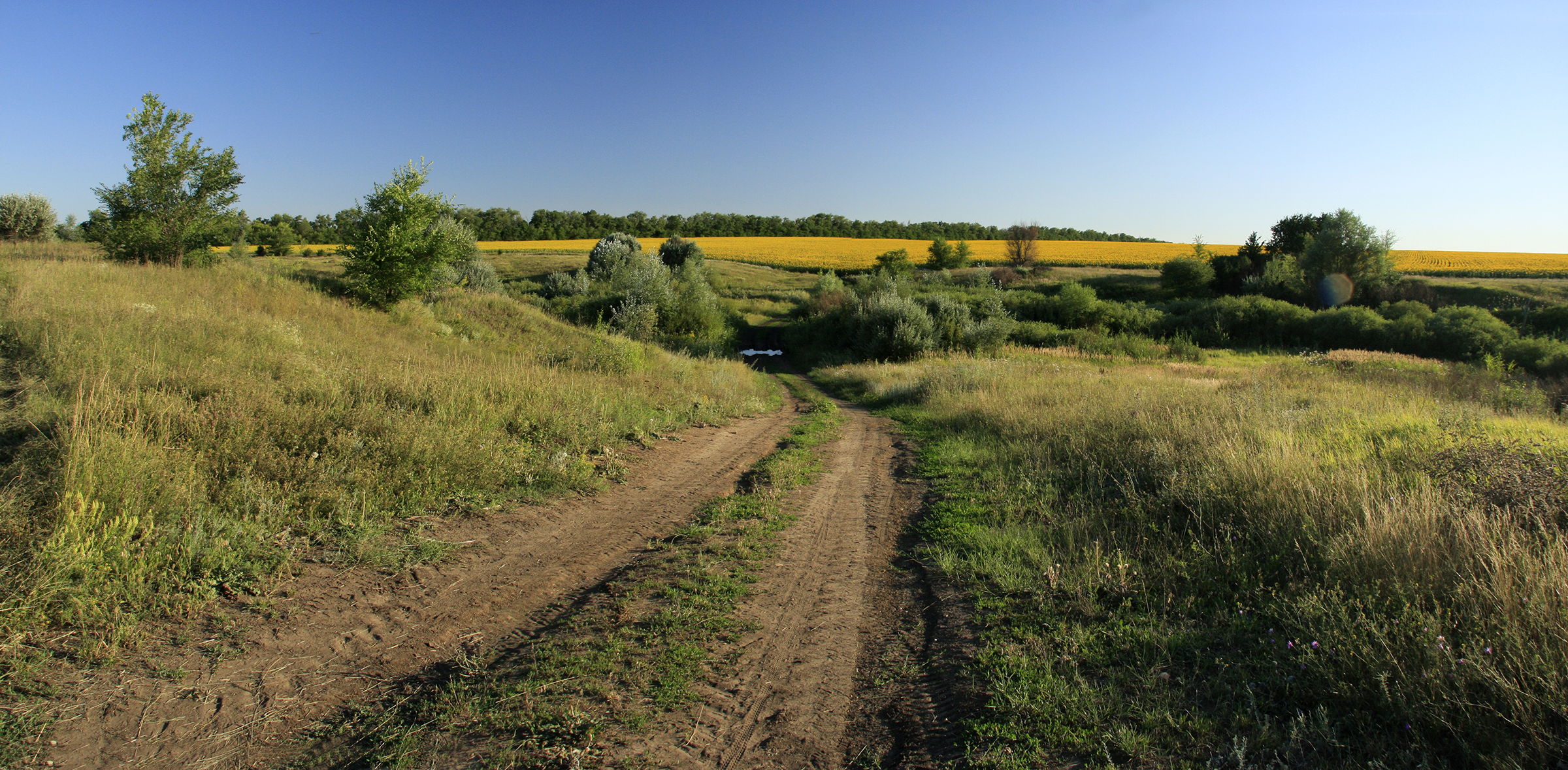
Sunflowers, подсолнухи.
Photo: Vladimir Gorodnjanski

Sunflowers, подсолнухи.
Photo: Don Hitchcock 2014
И вдруг далеко, далеко позади нас, еле слышный из-за дальности расстояния, протяжный зов: «Аня…я…я»! Мы остановились, прислушиваясь. Через минуту, но уже ближе, тот же зов. Ну вот, думаю: предстоит встреча с ее кавалером, и чем она кончится – неизвестно.
Аня же быстро хватает меня за рукав и тянет в подсолнухи. Отошли от дороги метров двадцать, и присели на травку. - Это Андрей, явно обеспокоенным голосом, почти шепотом сказала Аня
Видимо, вернувшись из рейса, он поспешил в клуб, но Аню там уже не застал; еще не ушедшие оттуда домой ребята, конечно же, сказали ему, что она ушла с моряком, и он поспешил ее догонять. Вот он уже возле нас проходит и громко зовет: «Аня…я…я»!
И так звал ее, идя до самого поселка. Видимо, обнаружив, что ее нет дома, повернул назад. Шел и все также звал Аню. Потом зов все удалялся и, наконец, смолк совсем. А мы с Аней так и остались в подсолнухах, и были там пока и небо на востоке не начало бледнеть, и петухи в поселке не заголосили. Я проводил ее до поселка, поцеловал на прощанье и ушел.
Через два дня я уехал. С Аней не виделся, как у нее все обошлось – так и не знаю. О ее жизни, судьбе тоже ничего не знаю. Но та звездная, летняя ночь, подсолнухи, жаркие поцелуи так и остались в памяти на всю мою долгую жизнь. Через многие годы, на закате жизни, иногда возникает в памяти и как будто слышится тот протяжный, призывный зов:
Аня…я…я...я !
Anya
I met her at a dance at a rural club, when I came home to visit my father during a short summer vacation in 1950. I served in the Navy, and had a short furlough, so I came for a few days to see my father in a village in Estonia, where he had gone to live after I had joined the Navy, so I did not know anyone, and I had no friends there.Having heard that dances were organised by the club, I decided to go to one when I heard that it was planned. I ironed my bell-bottomed trousers, completely cleaned and polished my "korochki" boots, called in the Navy Ceremonial 'chrome' boots, and in the evening went to the club. They had just finished showing a movie. Most of the audience went home, but the young people remained for the dance. Benches from the middle of the hall were removed and were placed around the walls. The middle of the room was cleared to form a dance floor.
I entered the hall, when all this has been done, and the boys and girls were standing against the walls waiting to start dancing. I was in Naval uniform, and no one had seen many sailors here, since it was some distance from the sea, and I got a lot of attention because of the novelty of my uniform. I stood out amongst the rest of the people there, and felt a little strange about it.
But then the accordion began to play and the first couples started dancing. I did not dare to invite someone to dance. Instead, I observed the rest of the people, and watched the dancing. There were few young men, and many of the girls danced with each other.
In between the dances, girls and boys separated, and stood against the wall. Among the girls, I was struck by one very pretty, slim, not very tall girl with tightly braided blonde hair. She was a rustic beauty, and attracted my attention, I often looked at her, and every time I did I saw that she, too, was watching me, and our eyes often met. When a waltz struck up, I asked her to dance.
We circled the room, she was a good dancer. I invited her to dance for the next set, and the next, and during one of the dances, without ceremony, talking easily with her, I asked:
'What is your name, my beauty?'
'Anya' she replied. 'And yours?'
As soon as she asked, I told her my name, and added:
'Well, we've introduced ourselves. Where's your boyfriend?' This girl was too beautiful not to have a man friend.
'He was sent today on a long journey. He is a driver, and will be back late'.
'And where do you live?' I asked.
'I live in another village near Kalinovka. It is two kilometres away.'
'And who will take you back home?' It was a long way to walk back in the darkness beside the fields.
'I am brave, I am not afraid of anything!' she replied with cheerful enthusiasm.
And into my mind came the idea - take her home! When we danced the last dance, I suggested:
'Anya, let me see you home.'
She did not answer immediately, but after some thought, agreed.
I went out on the street first, and waited for her. She came out with a group of girls and started walking beside the road. I approached her and said: 'Well, lead on, I do not know the way.'
We walked side by side down a dark street, then I took her by the hand; we overtook some people who were probably also going home after the dance. They saw us, of course. We turned off the main street, and went down a side street, past gardens, downhill, past a well. Then the path led up the mountain, through thick bushes, and came out onto an open, flat area. Ahead was the steppe. We went on, on a road beside fields. The night was calm and warm, but there was no moon; the sky glowed with a myriad of bright stars, and the Milky Way stood out clearly.
I put my hand on her shoulder and held her close. She did not resist. We walked along slowly, talking. She asked me about the sea, and listened with great interest to what I told her.
When I first decided to go to the dance, I could not imagine finding myself here in this situation. Somewhere in my subconscious I was worried about it.
It was very unusual the way it all came out, and I quickly decided to try to replace her boyfriend if I could. The situation was, however, not clear, and I could not quite work out what was happening, and what might happen next. Well, I thought, we will see what happens.
We walked down the road towards her village, with a vast sunflower field darkening the view to the right. The plants were tall as me, with sunflowers growing over the road. To the left stretched an already harvested grain field. Far ahead loomed the lights in the houses of Anya's village. We had walked about half way to her home.

Sunflowers
Photo: Vladimir Gorodnjanski

Sunflowers
Photo: Don Hitchcock 2008
Suddenly far, far behind us, barely audible due to the distance, we heard a long drawn out cry: 'Anya ...!' We stopped and listened. A minute later, but closer, we heard the same call. Well, I thought, we will meet her boyfriend, but how it will end is unknown.
Anya quickly grabbed my arm and pulled me into the sunflowers. We went off the road about twenty metres, and sat down in the field. Almost in a whisper Anya said 'It's Andrew', in an obviously worried voice.
Apparently, after returning from his trip, her boyfriend had hurried to the club, but Anya was no longer there; and young men who had not yet gone home told him, of course, that she had gone home with a sailor, and he hurried to catch up with her. Already he was near, and he passed us, loudly calling 'Anya ...!'
So he called out to her, going towards the village. Apparently, finding that she was not yet home, he turned back.
He came past again, calling for her. The calls faded, and finally stopped altogether. And I remained with Anya in the sunflowers, until the light started to come in the east, the roosters in the village crowed, and I accompanied her to her home. We kissed goodbye, and I left.
Two days later I went back to my ship. I had not seen Anya in that time, and I did not know what had transpired. About her life, her fate, I learned nothing. But the starry, summer night, the sunflowers, the hot kisses and the rest, has remained in my memory for all my long life. Years later, in the twilight of life, sometimes the memory recurs, as if I heard a prolonged, plaintive cry:
'Anya...a...a...a ! '
Крушение
1943-й год. Война. Первое лето после освобождения нас от немецкой оккупации. На зеленой лужайке позади колхозной конюшни, прямо на траве, отец по указанию председателя колхоза освежевывает только что зарезанную им овцу.Я, пятнадцатилетний подросток, сижу рядом на корточках и наблюдаю за работой отца. Вокруг нас топчется приехавший из районного центра работник НКВД и тоже наблюдает. На нем военная фуражка, темно-синяя гимнастерка, брюки-галифе и хромовые сапоги. На ремне в кобуре болтается пистолет. Он приехал, чтобы взять в колхозе для какого-то там районного начальства свежую баранину.

NKVD badge
Source: http://et.wikipedia.org/wiki/NSV_Liidu_Siseasjade_Rahvakomissariaat
Видно, что он торопится и, поэтому, торопит отца. Отец до оккупации учительствовал в нашем селе, чисто крестьянскими работами занимался мало, в разделке овец, конечно, опыта не имел. Он теряется , движения не уверенны, руки заметно дрожат, а энкэвэдэшник торопит.
–Ну что ты копаешься? Быстрее давай, – грубо, да еще с матерными словами, каких я никогда в жизни не слыхал от отца, покрикивал он. Отец еще больше теряется, мне становится его жалко, я никогда не видел его таким униженным.
Почему он так робел перед этим грубым и наглым представителем власти – я этого не знал. В то время ему было 48 лет, кажется. В армию не призывался из-за инвалидности, на фронте не был, не воевал. Может быть, из-за этого чувствовал свою никчемность для страны, и это его мучило. Не знаю. Всю мою жизнь до этого отец был для меня символом мужества, справедливости, добропорядочности, всеми на селе уважаемым человеком. И вот на глазах все это рушится, происходит крушение моего представления об отце. Мне жалко отца, я чувствую, что это несправедливо, что все это не так, и что все это исходит от человека в форме НКВД. Мне становится страшно.
The Humiliation
The year was 1943, during the war, the first year after our release from German occupation. On the green lawn behind the collective farm stables, on the orders of the farm chairman, my father skinned a freshly killed sheep.
I was a teenager, fifteen, sitting on my heels beside him, watching the work of my father. Around us paced an employee of the NKVD, from the district's centre, also watching. He had on a military cap, a dark blue tunic, breeches and calf boots. On his belt in a holster hung a gun. He had come to the farm to get some fresh mutton for the district authorities.
It was evident that he was in a hurry, and urged my father to go faster. My father, before the occupation, was a teacher in our village, and who of purely peasant work knew little. He was not fast, and not sure of what he was doing, his hands were visibly shaking, and the NKVD man kept hurrying him to finish.
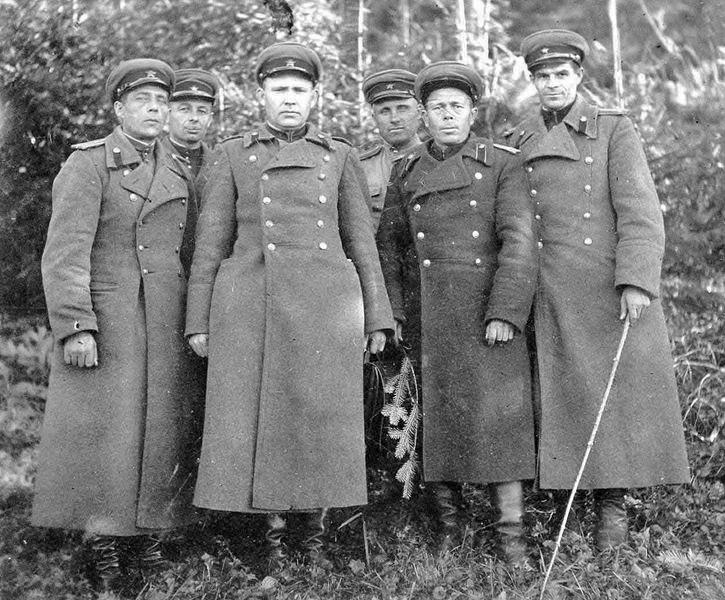
NKVD Officers
Source: http://www.schuster.ru/eng/rsfsr-sssr-1918-45-gg/uniforma/shinel-komnachsostava-nkvd--obr-1937-g/
'Well what are you doing? Faster, come on!' he shouted to him roughly, with abusive words which I had never heard spoken to my father. My father became even more clumsy, I felt sorry for him, I had never seen him so humiliated.
Why was he so submissive in front of this rude and arrogant authority figure I do not know. At the time he was 48 years old, I think. He had not been called up to the army because of a disability, and had not fought at the front. Perhaps because of this, he felt useless to the country, and it tormented him. I do not know. All my life my father was to me a symbol of courage, fairness, integrity, and was respected by all the village. All at once this image of him was crumbling, this view of my father. I felt sorry for my father, and I felt it was unfair for him to be treated so, and especially coming from a person in the uniform of the NKVD. I was scared.
Dmitry Gorodnyanskiy 2015
Бабушка
Это самый родной и близкий человек, с кем я рядом, в тесном общении, в ее заботах обо мне, прожил детство, отрочество и большую часть юности, это моя бабушка, моя бабуся, мать моего отца.В наших краях дети своих бабушек называют бабусями, а не бабушками. Это пришло с Украины. Хотя Воронежская область не Украина, но в целом ряде ее районов, граничащих с Украиной, в селах жители общаются между собой на украинском языке, несмотря на то, что там на протяжении, может быть, сотен лет нет ни украинских школ, ни украинских газет, ни радио и телевидения на украинском языке. Все это только на русском.
Говорят, что в давние времена, еще при царе Алексее Михайловиче, на этих землях разрешено было поселиться переселенцам с Украины, спасавшимся от поляков. Так и существуют там два языка: русский государственный и украинский – язык домашнего обихода, как говорится.
'Babushka', by Irina Gaiduk
Source: http://russiapedia.rt.com/of-russian-origin/babushka/
Русские дети, обращаясь к своей бабушке, говорят бабушка; на Украине дети говорят – бабуся. Бабуся – это и есть бабушка, и если ребенок даже сердится на бабушку, то обращаясь к ней, он говорит – бабуся. Так вот: была у меня бабуся. Самый близкий, родной человек; вместо матери она стала для меня после того, как умерла мать. Также и для моих сестер – девятилетней Люси и двухлетней Лены. Прочно и надолго вошла она в мою память, и только с любовью я ее вспоминаю. С малых лет запомнились ее добрые, ласковые руки, когда, бывало, жалея меня, гладила по голове и вытирала слезы, когда уже в недобрые годы иногда искала у меня в голове насекомых. Бывало, присядет на стуле, позовет меня: «Иди ко мне, Митя». Я подхожу, приседаю возле нее, она пригибает мою голову к себе на колени и начинает своими пальцами перебирать мои волосы, нащупывая насекомых. Это длится долго, мне приятно прикосновение ее рук, и я задремываю. Помнятся ее вкусные пирожки и вареники, готовить которые она была великая мастерица.
Перед глазами у меня невысокого роста, в меру сухощавая, с остатками на лице былой привлекательности, подвижная, в старенькой кофточке с широкими рукавами, в длинной широкой юбке и с подвязанным спереди на поясе большим карманом. Звали ее Марией. От зари и до зари на ногах в труде и заботах; незавидная доля в жизни ей досталась. Дедушку, ее мужа, не знаю: родился я, когда на свете его уже не было. Кроме моего отца был у нее еще один сын – Антон, моложе отца, а также дочь Харитина. Очень смутно их помню; когда я чуть подрос, их в Крамаревке уже не было: уехали насовсем в разные края. Всех она растила будучи вдовой.
Ее хата и огород располагались на той же улице, что и школа, прямо напротив через дорогу. Мы же (отец, мать и дети) жили в служебной квартире при школе, зимой бабушка жила с нами, а на лето перебиралась в свою хату, занималась там огородом. На пришкольном участке был сарай, в котором содержались корова, поросенок и куры. Все это хозяйство лежало на бабушке, а когда я подрос, то и на мне. Так что работы хватало.
А когда умерла мать, на плечи бабушке еще легла и забота о нас, троих детях. Когда же отец снова женился, и появились на свет одна за другой две девочки, то нас стало пятеро. Самая младшая появилась на свет родившейся преждевременно из-за несчастного случая с матерью, стоившего ей жизни. Как бабушка выходила маленькую крошку, никогда не знавшую материнской груди, безо всякой медицинской помощи, когда как раз грянула война, и более-менее сносная жизнь осталась только в воспоминаниях. Какая же она была стойкая, наша бабушка, какой подвиг она совершила. И никогда не стонала, не чертыхалась, не сетовала на свою горькую долю. В пору к лику святых ее причислить.
Я, правда, со временем подрос и стал помогать бабушке и в огороде, и в уходе за коровой и поросенком; добывал ежедневно топливо для приготовления пищи и отопления дома. Из-за отсутствия лесов в наших краях не было дров; в топку шла и солома, и кизяк, и мелкий хворост, и бурьян. Все это мне надо было добывать ежедневно. А война все продолжалась. Подошло время идти на войну и мне, семнадцатилетнему. Бабушка хлопотала, собирая меня в дорогу на призывной пункт. Перед моим уходом из дома она всю ночь не спала, готовила сумку с едой. Провожая меня, она только одна и плакала. Последний раз я обнял ее, поцеловал и ушел. Больше я с ней виделся. Но я помню и никогда не забуду тебя, моя труженица, моя добрая, милая бабуся. Я последний человек на этом свете, который помнит тебя, мои две сестры, которые еще живы, тебя не помнят, потому что были совсем еще маленькими при твоей жизни.
Спасибо тебе за твою любовь и заботу обо мне, за добрую память, что ты оставила о себе и стала самым светлым пятнышком, светящимся из той далекой, смутной дали. Тебя давно нет, но для меня ты жива и будешь жить, пока я жив. Когда же я умру, умрет и моя память, а вместе с ней умрешь и ты. Мы вместе уйдем в небытие.
Ноябрь 2010 год.
Grandmother
Of all the relatives and friends of people with whom I am close, the closest and greatest in affection to me, in her close communion and her care for me, through my childhood, adolescence, and most of my youth, is my babushka, my grandmother, my father's mother.In our area the children called their grandmothers babusja, not babushka. This word comes from Ukraine. Although the Voronezh region is not part of Ukraine, in a number of its districts which border Ukraine, in the villages the people communicate with each other in the Ukrainian language, despite the fact that there have been, for perhaps hundreds of years no Ukrainian schools, nor Ukrainian newspapers nor radio or television programs in the Ukrainian language. All of these media are only in Russian.
It is said that in ancient times, under Tsar Alexei Mikhailovich, these lands were opened up to settle immigrants from Ukraine, fleeing from the Poles. And there exist two languages: Russian is the state language, and Ukrainian is the common language of the home.

'Babushka'
1900-1949 unknown painter, oil on cardboard, signed И.Д.
Source: http://www.ebay.com/itm/Russian-Ukrainian-Soviet-Oil-Painting-Portrait-grandmother-realism-babushka-/261425890644
Russian children, referring to their grandmother, say babushka.
Ukrainian children say babusja. Even if they are angry at her, they still turn to her and say the affectionate term babusja.
She was the closest, dearest person to me; she became a mother to me after my mother died. Also for my sisters - Lucy, nine, and Lena two years. Regularly and forever she comes into my memory, and I just love to remember her and the things she did. From an early age I remember her kind, tender hands when she used to comfort me, patting me on the head and wiping away my tears during hard times, sometimes looking at my head for lice. Sometimes, she would sit down on a chair, and call me: 'Come to me, Mitya.' I came to her, crouched beside her, she put my head on her lap and combed her fingers through my hair, feeling for insects. It lasted a long time, I was pleased with the touch her hand, and I dozed off. I remember her delicious pies and dumplings, she was a master of cooking.
I remember her as being short, fairly lean, with the remnants of a former beauty, moving around in an old blouse with wide sleeves, a long wide skirt with a large pocket below the belt at her waist. Her name was Mary. From dawn to dusk she was on her feet with work and care; it was an unenviable share of life that she got. Grandfather, her husband, I did not know. He was gone when I was born. As well as my father she had another son, Anton, younger than my father, and a daughter Haritana. Vaguely I remember them, by the time I was grown they had gone from Kramarevkea, and were living in a different region. She, a widow herself, raised us all. Her hut and garden were located on the same street as the school, directly across the road. We (father, mother and children) lived in a serviced apartment at the school, in winter grandmother lived with us, and during the summer moved to her hut, and worked there in her garden. In the school grounds was a barn, which contained a cow, a pig and some chickens. All this was looked after by grandmother, until I grew up, when it became my job. So there was enough work to do around the place.
And when my mother died, the burden of care was laid on the shoulders of my grandmother, the day to day care of us, three children. When my father remarried, two girls were born one after the other, making five of us in all. The youngest was born prematurely, because of an accident to her mother, which cost her her life. Grandmother nursed the little crumb that had never known its mother's breast, without any medical care. Then the war broke out, and the more or less tolerable life we led remained only in our memories. She never faltered, our grandmother, she worked hard and loved us as always. She never complained, never swore, and did not rail against her bitter lot. She was a saint.
It is true that as I grew up I took over some of grandmother's chores, and helped in the garden, and in the care of a cow and a pig; I scavenged the area around our house daily for the fuel for cooking and heating our home. Due to the lack of forests in our area we did not have firewood; the fuel was straw, and dung, and small twigs and weeds. I had to bring these home on a daily basis.
And the war continued. It came time for me to go to war, since I was seventeen. Grandmother was busy getting me ready for the road and taking me to the recruiting station. Before I left she had not slept all night while preparing a large bag of food for me. When she saw me, she was the only one crying. For the last time I hugged her, kissed her, and left. I saw her no more. But I remember you and will never forget you, my hard worker, my good, dear granny. I am the last person on this earth who remembers you, since my two sisters who are still alive do not remember you since they were still too young to remember you while you were alive.
Thank you for your love and concern for me, for the good memories you left about yourself, you became the most bright memory of that time, glowing from that distant time. You did not live for a long time, but to me you are alive, and you will live as long as I do. When I die, my memories will die, and with those gone, you will die too. We leave together into oblivion.
November 2010.
Грачи
В конце марта я увидел расхаживающих по газону перед нашим домом двух настоящих, больших черных грачей. Я остановился и долго любовался ими. Как давно я их не видел! Они напомнили мне детство.Долго живя в Эстонии, да к тому же в большом городе, я практически их здесь никогда не видел. Здесь даже за плугом, по свежей борозде, когда пашут поле, ходят, собирая червей, не грачи, а чайки.
И как же много их было там у нас в Воронежских краях, где я жил до семнадцати лет. Их прилет из теплых краев весной воспринимался как большое событие, как праздник, как переход в природе от зимы к лету. Черные, большие птицы ходили по освободившемуся от снега выгону, сидели на деревьях, летали стаями, играя и готовясь к гнездованию и выводу птенцов. С наступлением настоящего тепла, с появлением обильного корма в виде червячков, гусениц, разных насекомых и жучков, они улетали к местам гнездований в рощи, леса, где самки садились на яйца.

In The Rooks Have Returned (1871) by Alexei Savrasov, the arrival of the rooks is an early portent of the coming spring.
Artist: Alexei Savrasov (1830–1897)
Date: 1871
Permission: Public Domain, via Wikipedia
Километрах в шести от села, на площади примерно в семь- восемь гектаров произрастала дубовая роща. Там, в этой роще, ежегодно гнездилась большая колония грачей на время высиживания и вскармливания потомства. Помню один поход туда нас десяти-двенадцати летних пацанов. В одно из воскресений, летом, мы, ватага из восьми мальчишек, сговорившись, отправились в неблизкий для нас, босоногих, поход в ту рощу.
Поднявшись в гору по улице Коростивке, мы вышли на открытый простор. Далеко впереди, еле различимая, виднелась роща, куда мы направлялись. Нам предстояло пройти до нее без дороги по балкам, буеракам, перебираясь через овраги и бурьяны.
И вот мы входим в лес. О! Боже мой! Такого я никогда не слышал и не видел. Тысячи грачей, заметив нас, входивших в лес, подняли такой оглушительный, тревожный крик, что мы невольно остановились, и долго стояли на одном месте, не решаясь идти дальше и всматриваясь в глубину леса. Буквально на каждом дереве виднелись по пять-шесть гнезд. И так по всей роще. А грачей…. видимо, не видимо, и своим криком они буквально оглушали нас.
Почему они так тревожно кричали, мы поняли, когда полезли на деревья смотреть гнезда, надеясь набрать яиц; но их там уже не было. Во всех гнездах сидели еще не оперившиеся птенцы, а грачи буквально набрасывались на нас, разбойников, пытаясь защитить своих детей.
Но как же возвращаться домой без добычи? Мы были неразумными, безжалостными пацанами, нас никто не научил любить и беречь природу, но что-то было в нас от добытчиков, от охотников, что и заставило по варварски разорять гнезда, не внимая жалобному, отчаянному крику грачей.
Мы повыбрасывали из гнезд по несколько штук птенцов. Падая на землю с большой высоты, они погибали. Подобрав мертвых, мы двинулись в обратный путь; у каждого было не менее пяти - шести мертвых птенцов. Грачи никак не могли успокоиться. Удаляясь от леса мы еще долго слышали их крики.
На обратном пути, где-то на полдороги от дома, мы сделали привал возле каких-то чахлых кустарников рядом с неглубоким оврагом. У Мишки Сулимина были спички, взятые из дома; решили разжечь костер. Насобирали в кустарнике сухих веток, прошлогодней сухой травы, и на дне оврага запылал костер. Нами овладело какое-то буйное веселье: мы шумели, галдели, боролись друг с другом, а потом начали поджаривать на огне свою добычу. Вкус того мяса в памяти у меня не остался; без соли оно, конечно, не понравилось.
Домой я вернулся уже к концу дня; дома уже начали беспокоиться из-за моего долгого отсутствия, но все обошлось без осложнений. Птенцов дорогой я выбросил, опасаясь взбучки за разорение гнезд.
В конце лета, ближе к осени, каждый день в небе грачи устраивали грандиозные представления - это старые грачи обучали молодых, народившихся этим летом, летать, готовя их к дальним перелетам в теплые страны.
В небе откуда-то появлялась огромная стая грачей, как темное облако закрывавшая чуть ли не пол - неба. Как много их было! Никуда не улетая, стая начинала свои игры. Как будто по чьей-то команде это облако то расширялось, то сужалось, то, как огромное колесо, начинало крутить карусель. Я всегда подолгу любовался этим грандиозным зрелищем.
Как давно это было! Мне сейчас 81 год, но все вспомнилось, когда я увидел на газоне двух грачей.
Милые, хорошие, полезные птицы! Увидев вас здесь, вдали от родины, я словно снова побывал в детстве. Спасибо вам. И простите меня за то, что я когда-то разорял ваши гнезда, неразумный.
Rooks
At the end of March I saw two big black rooks walking around on the lawn in front of our house. I stopped what I was doing, and admired them for a long time. And for a long time I did not see them, as my eyes misted over and I relived parts of my childhood.I have lived in Estonia for a long time, in a big city, so I very rarely see them. Here, even when a tractor is used to plough a field, the birds which walk behind, collecting worms, are not rooks but gulls.
And how many of them there were in the Voronezh region where I lived until the age of seventeen! Their arrival in warm spring weather was seen as a big event, like a holiday, as a transition in nature from winter to summer. The big, black birds seemed to release the snow from the pasture, sitting in the trees, flying in flocks, playing and preparing for nesting and hatching. With the onset of the heat, and with the advent of abundant food in the form of worms, caterpillars, beetles and other insects, they selected a nesting place in the woods, where the female sat on the eggs.

A Rook in Dartmoor, Devon, England. It is walking in a field where sheep are kept.
Photo: Brian Snelson from Hockley, Essex, England
Permission: Creative Commons Attribution 2.0 Generic license.
About six kilometres from the village, in an area of approximately seven or eight hectares, an oak grove grew. There, in the grove, every year a large colony of rooks nested during the time of incubation of the eggs and the feeding of their offspring. I remember one trip when we were ten or twelve, and one Sunday, in summer, our group of eight boys agreed to go on a barefoot hike in the woods.
Walking up the hill along Korostivke Street, we came to an open space. Far ahead, barely discernible, we could see the grove where we were going. We had to go up the trackless hill, crossing gullies, and passing through tall weed growth.
And then we entered the forest. Oh my God! I encountered something I had never heard or seen before. Thousands of rooks, seeing us go into the woods, raised such a deafening cry of alarm that we actually stopped and stood for a long time in one place, not daring to move on, and peering into the depths of the forest. In every tree we could see five or six nests, and it was the same throughout the grove. We had not noticed the rooks until that point, and their noise literally stunned us.
We realised the reason for their anxious commotion, when we climbed the trees to check the nests, hoping for eggs, and found none there. In the nests were their young, not yet fledged, and the rooks pounced on us. They saw us as robbers, and tried to protect their children.
But how could we go home without a catch? We were foolish, ruthless boys, no one taught us to love and protect nature, and there was something in us like hunter gatherers, and that led us to mercilessly destroying many nests, not listening to the mournful, desperate cries of the rooks.
We threw out the nestlings from the nests, and destroyed the nests. Falling to the ground from such a great height, they perished. We picked up the dead birds, and started home. Each boy carried not less than five or six nestlings. The rooks did not calm down in any way. After leaving the wood we heard their calls for a long time.
On the way back, about halfway home, we made a halt near some stunted bushes next to a shallow ravine. Mishka Sulimina had matches; we decided to make a fire. We collected dry twigs, dry grass from last year's growth, and at the bottom of the ravine we got a fire going. We had some riotous fun: we made a noise, chattered, fought with each other, and then began to roast on the fire our prey. The taste of that meat has not remained in my memory. Without salt, it could not have been palatable.
I returned home at the end of the day; my family had already started to worry about my long absence, but there were no complications. I threw my remaining chicks down beside the road, fearing reprimand for the destruction of the nests.
At the end of summer, close to autumn, every day the rooks flew about, as the old rooks trained the young, born this summer, to fly, preparing them for the long flights to distant warmer lands.
In the sky there was a huge flock of rooks, like a dark cloud which covered almost half of the sky. How many of them were! They did not fly away, they continued with their games. As though on command, the cloud extended, narrowed, now it was like a huge wheel, twisting like a roundabout. I always admired this wonderful spectacle.
How long has it been! I am now 81 years old, but I still remembered that time when I saw the two rooks on the lawn.
Lovely, good, useful birds! Having seen you here, far from my native land, it is as if I have again visited my childhood. Thank you. Also forgive me for once stupidly ruining your nests and killing your chicks.
сумку
В другой раз встреча с немцами была пострашнее. По селу прошли слухи о том, что в окрестностях Рудаевки нашли убитого немца. За несколько дней до этого отец принес откуда-то немецкую сумку, похожую на противогазную, но побольше размерами. В сумке была опасная бритва с принадлежностями к ней, темно-синий комбинезон большого размера и новенький совсем, отличный солдатский ремень из толстой кожи и с пряжкой, на которой был изображен орел и вытеснены слова «С нами бог». Отец сказал, что сумку эту нашел где-то за лесом, и велел мне запрятать ее куда-нибудь подальше. Я, не вдаваясь в расспросы, забросил ее на чердак со всем содержимым.
German WWII gas mask cape bag.
Photo: http://www.hikishop.com/ww2-german-gas-mask-cape-pouch-bag-reproduction-tan-p-320.html
А через день, наверное, к нам прибегает Витька Котляров и, сильно волнуясь, говорит мне: «Каратели приехали! Ходят по дворам, что-то ищут. Сейчас они у деда Амоса». А это всего через два двора от нас. Я вышел во двор и увидел, что у деда Амоса во дворе немецкие солдаты что-то ищут, а один из них толкнул деда и ударил его пинком в зад.
«Сумка… На чердаке сумка!» - молнией пронеслось в мозгу. Ноги стали ватными, растерялся. Сказал отцу, который в это время был в комнате. Он побледнел и быстро сказал: «Лестницу из сеней скорее вынеси и забрось в бурьян за хатой. Незаметно только». А сам из комнаты так и не вышел. Я схватил лестницу, унес за хату и бросил в бурьян. На чердак теперь не по чем залезть, но остановит ли это фрицев - туда ведь и без лестницы залезть - пара пустяков. И вот каратели заходят во двор, в дом. Полетела на пол с кровати постель, все выброшено из шкафчиков, из столов, посветили фонариком в печку, потыкали каким-то прутом зерно в закроме, в чулане. Осмотрели сарай.
Подозрительного ничего не нашли и по одному выходят во двор. Последний остановился в сенях и смотрит, задрав голову, вверх, туда, где чердак. Ну, вот и все, думаю. Найдет там сумку - расстреляют всех нас прямо во дворе. Но солдат, покрутив головой, медленно вышел во двор. Видимо не захотел лезть на чердак, боясь испачкаться мелом, которым были побелены стены в сенях.
Кто-то из нас родился в рубашке. Мы долго потом приходили в себя, а сумку с комбинезоном отец куда-то выбросил, оставив себе бритву, а мне ремень Не однажды мне приходила в голову мысль о том, что, не связана ли та сумка с убийством немца, но расспрашивать об это отца не решался, и, зная отца, как неспособного поднять руку на подобного себе, всегда отгонял от себя мысль об участии отца в истории с немцем.
The bag
On another occasion, a confrontation with the Germans was terrible. In the village there had been rumours that somewhere near Rudaevka a German soldier had been found dead. A few days before, my father had brought home from somewhere a German bag, similar in shape to that used for their gas masks, but bigger in size.

The bag had shaving accessories and dark blue overalls of a large size in it, and a brand new quite different soldier's belt of thick leather with a buckle. The buckle showed an eagle, and the words 'Gott mit uns' or 'God is with us'.
Father said that this bag was found somewhere beyond the forest, and told me to hide it somewhere far away. I did not question him, I threw it into the attic with all of its contents.
Photo: StromBer
Permission: Public Domain
A day later, Vic Kotliarov from next door came running to us in great agitation, and told me: 'The avengers have come! Going from house to house, looking for something. Now they have my grandfather Amos!'
At the time there were just the two of us in our house. I looked outside and saw that grandfather Amos was in his courtyard and that the German soldiers were looking for something. One of them shoved Vic's grandfather and kicked him.
'..... Bag! In the attic, bag!' - lightning flashed in my brain. My legs turned to jelly, I was confused. I repeated this to my father, who came into the room. He turned pale and said quickly 'Put the ladder to the attic in the weeds behind the house, but hide it well so that no one can see it. It must be invisible.'
I turned, grabbed the attic ladder, took it outside the hut and threw it into the weeds behind the hut.
It was not now possible to climb up to the attic, but the lack of a ladder would be a trifle to Fritz if once he decided to investigate.
The soldiers came into the yard, and into the house. They threw all the bedclothes from the bed, emptied all the cupboards, tipped over the tables. One of them shone his flashlight into the oven, poked a rod into the grain bins in the closet, and inspected the barn.
They found nothing suspicious, and one by one were going into the yard outside. The last stopped in the hall, and looked up at the entrance to the attic.
Well, that's the end of it, I thought. They will find the bag there and shoot us all in the yard. But the soldier, shaking his head slowly, continued outside into the yard. He probably did not want to climb up into the attic, and was afraid to get dirty chalk on him from the whitewashed wall in the hallway.
Some of us were born under a lucky star. My father came to himself after he was certain they were gone, and got rid of the bag with the overalls somewhere far away. He kept for himself the razor, and a razor strop.
Later I thought that the bag might be related to the murder of the German, but I did not dare to ask my father about this, knowing his inability to raise his hand to another, and I banished the thought of his participation in the murder of the German soldier.
Восточная Пруссия
Ночью, когда все уже спали, поезд остановился на какой-то станции. Рано утром, когда еще не рассвело, и первые проснувшиеся стали выходить из вагонов по нужде, прямо перед нашим вагоном на газоне увидели мертвого солдата, нам незнакомого. Он лежал на спине, раскинув руки; череп и лицо его были разрублены, видно, сильным ударом топора. Убит он был ночью, когда мы все спали.
v Место, где остановился ночью наш поезд, было уже в Германии. Это был немецкий город Инстенбург. Хотя война кончилась еще в мае, здесь еще убивали наших солдат. Враг был рядом. Так встретила нас Германия, чужая, враждебная нам страна, с которой мы воевали долгих четыре года. Думал ли я тогда, в 1942-ом году, когда немецкие солдаты, такие бодрые, веселые, победителями ворвались в наше село и стали хозяйничать, думал ли я тогда, что, как солдат Красной Армии, как победитель, буду шагать по их дорогам , по их полям?
Очень разбирало любопытство: хотелось увидеть эту Германию, но была лишь возможность окинуть взглядом близлежащие дома, немного побродить по вокзалу, набитым множеством людей – это были люди, возвращавшиеся в Россию из немецкой неволи, куда были угнаны немцами на принудительные работы.
Одного лишь беглого взгляда на город было достаточно для того, чтобы увидеть его непохожесть на наши российские города. Крыши из красной черепицы, куда ни глянь. Итак, мы, молодые советские солдаты, прибыли в Германию, чтобы заменить своих старших солдат, уходивших после Победы домой.
Здесь, в Инстенбурге, наш эшелон начали расформировывать. Часть солдат оставили в городе, с остальными эшелон ушел дальше, до следующей станции. Оттуда мы, разными колонами, двинулись пешком в разных направлениях, В нашей колоне насчитывалось около ста человек.
Шли в темноте, накрапывал дождь, шинели отсырели, и от них шел пар. Начало светать, дождь прекратился, рассеялись облака, взошло солнце и осветило местность, по которой мы шли. Все с интересом смотрели по сторонам, разглядывая немецкие пейзажи. Местность была ровная, без холмов, по сторонам простирались неубранные, не вспаханные поля. Вдали, изредка, открывались взору какие-то постройки, крытые красной черепицей. Изредка встречались перелески. Показались впереди идущие нам навстречу многочисленные колоны, вернее толпы, женщин, молодых девчат и парней – это добирались домой, в Россию, бывшие в рабстве у немцев, люди.
К вечеру вошли в какой-то лес, вернее не лес, а парк. Уж очень чисто там было для леса: никаких лишних зарослей, завалов, сухих деревьев – ничего этого не было: все было ухожено, расчищено. Среди деревьев расположены какие-то постройки. В окружении одноэтажных домиков высился обширный, двух этажный дом с какими-то башенками, пристройками. Своей архитектурой он был похож на маленький средневековый замок. Немного в стороне располагалась конюшня, каких до этого я нигде не видел. Как выяснилось позже, это было имение одного богатого бюргера, который бежал на запад при приближении Красной Армии. Разбитые пианино, валявшиеся во дворе, разбитые дорогие кресла, шкафы и прочая домашняя утварь говорили о том, что жили здесь не бедные люди. Комнаты, оклеенные красивейшими, дорогими обоями, потолки с лепными узорами, изразцовые печи, красоты изумительной. Но кругом разгром, развал. В этом имении нас и расквартировали.
Навели порядок в жилых помещениях, убрали территорию, в конюшне появились лошади, предназначенные для артиллерийских упряжек. Наша служба продолжилась снова в артиллерии на конной тяге.
И снова судьба определила меня в учебный батальон, который был сформирован для подготовки командиров орудий. Как-то, уже зимой, нас, семеро солдат во главе с сержантом, откомандировали для подготовки места расположения будущего учебного батальона.
Отправились в путь на санях розвальнях, бог знает, откуда там взявшихся, и запряженных одной резвой лошадкой. Получили сухой паек на несколько дней, одну винтовку с патронами на всех, сели в сани, и лошадка рысью побежала по зимней дороге, которая все глубже уходила в довольно большой, девственный лес. За целый день в пути не встретилось ни одного населенного пункта. Зато лес становился все гуще, все темнее. Громадные ели подступали к самой дороге.
День уже близился к концу, когда вдруг перед нами открылась живописная картина: среди леса, на большой поляне, по ее краям, образуя круг, стояли с десяток аккуратнейших, красивых одноэтажных домиков, похожих на коттеджи. В лесу тишина, вокруг ни одной живой души, ровным покрывалом на всем лежит толстым слоем, никем нетронутый чистый, белый снег. Никаких следов на снегу, ни одной протоптанной дорожки нигде не видно. Красота сказочная.
Здесь, в глухом лесу, подальше от посторонних глаз, у немцев была школа подготовки шпионов разведчиков. Теперь нам предстояло здесь учиться на командиров орудий. Мне, между прочим, уже второй раз.
Обошли и осмотрели все дома. Если снаружи их вид был изумительным, то внутри царил хаос, разгром: разбитые двери, окна, поломанные стулья , кровати, горы мусора. Привезшие нас двое солдат, уехали обратно, в расположение; мы, семеро, остались одни. Надвигалась ночь, надо было подумать о ночлеге. В одном из домов, на втором этаже облюбовали комнату, приспособили печку, вроде буржуйки, растопили, поели, попили чаю. Подперли двери изнутри, распределили очередность дежурства и уснули крепким сном, кроме дневального, который поддерживал огонь в печке и охранял сон спящих солдат. Когда ночь перевалила на другую половину, меня разбудили на дежурство. Я сел около печки, смотрел на огонь и изредка подкладывал дрова. Тишину темной комнаты нарушало потрескивание дров да похрапывание спящих. Немного было не по себе. Воображение рисовало обстановку, в которой мы находились: глухой лес, ночь, на многие километры ни души и , может быть, в этом лесу немецкие партизаны, следившие за нами. И вдруг я услышал приглушенные голоса внизу, на первом этаже. К нам на второй этаж вела деревянная лестница, и я явно услышал, что по ней к нам кто-то осторожно поднимается.
Я схватил винтовку и, не поднимая шума, растолкал ребят. Все замерли, прислушиваясь. Слышно было, как какие-то люди подошли к нашей двери и прислушиваются. Потом по-русски голос: «Да здесь они! Стучи!» Раздался стук в дверь. « Кто там? - спрашиваем. «Свои» - ответили нам, и мы узнали знакомый голос.
Оказалось, что следом за нами приехала еще одна группа. Остаток ночи коротали вместе. Было уже веселее. Днем работали: наводили порядок в домах, расчищали дорожки от снега. Скоро эта тишина огласится командами сержантов, строевыми песнями, без которых строй не проходил и ста метров, как требовал командир учебного батальона. Командира-самодура, как оказалось впоследствии.
Здесь предстояло прожить еще одну зиму после призыва, потруднее той, которую прожили в учебном полку под Тамбовом, несмотря на то, что жить предстояло не в душных землянках, а в шикарных коттеджах.
Прошло немного времени, и началась служба, насыщенная занятиями и работами; работали по наведению порядка в домах по обустройству быта. Наше учебное подразделение насчитывало сто человек, Были доставлены и расположены в полутора километрах от нас в оборудованном артиллерийском парке пять 76-ти миллиметровых противотанковых пушек на конной тяге. Лошадей поместили в небольшой конюшне там же. Туда приходилось ходить в караул.
Командиром нашего батальона был назначен майор, не помню фамилию. Пришлось запомнить другое: он оказался служакой, какие редко встречаются. При наведении порядка и дисциплины он доходил до самодурства, и за короткое время сумел сделать из нас запуганных роботов, терпящих и сносивших прямые издевательства.
Перво-наперво, стал мучить нас холодом. В домах, где раньше размещались немецкие курсанты, были комнаты на 4 человека; в каждой комнате была кафельная печка, топившаяся дровами, коих в округе было навалом. Наш самодур приказал убрать печи, сломать стенки, разделяющие комнаты и превратил дома в общие казармы, заставленные рядами солдатских коек. Стояла зима с довольно крепкими морозами, а нам приходилось спать под одним тоненьким байковым одеялом в неотапливаемой казарме, дрожа от холода. Не выдерживая холода, стали накрываться шинелями поверх одеяла. Но нагрянувший в казарму после отбоя командир батальона, ругаясь и понося нас по всякому, посбрасывал со всех шинели, строго запретив ими накрываться.
После этого некоторые смельчаки стали устраиваться по двое на одной кровати. Запретили и это. Утром после подъема, намерзшиеся за ночь, выбегали на улицу, на физзарядку в нательных рубахах. После зарядки, строем бежали к ручью, протекавшему в полукилометре от казарм. На замерзшем ручье разбивали лед и умывались ледяной водой без мыла. После умывания, уже в гимнастерках, строем, с песнями, шли в столовую на завтрак.
Кормили даже хуже, чем в Учебном полку под Тамбовом. К весне многие начали пухнуть от голода. Почему-то всем очень хотелось соли. В столовой на ломтик хлеба насыпали толстый слой соли и с хрустом на зубах съедали. Говорили, что при голоде организм требует соли. Когда весной зазеленела трава, стали посылать солдат на поиски крапивы для борща.
Помню, как мы с товарищем в поисках крапивы, набрели на небольшой заброшенный хутор и в одном доме, в закроме, обнаружили зерно ржи. О! это было спасение от голода. О том, что мы нашли рожь, распространяться не стали. Отныне в свободное время мы добирались до того хутора, набивали там карманы зерном, разжигали небольшой костер в лесу и на листе железа поджаривали и ели рожь. Очень трудная была зима, много лишений пришлось перенести. Роптать же, никто не смел. За малейшее пререкание с сержантами сажали на гауптвахту, которая располагалась в неотапливаемом бетонном подвале под одним из домов.

Rye Grains
Photo: http://www.adailyapple.com/food/Grains/Rye
И в то же время над расположением постоянно звенела строевая песня. Строй без песни не ходил. Построивши роту для перехода, куда бы то ни было, старшина командовал: «С места с песней шагом марш!» Если с первого шага песня не запевалась, старшина командовал: «Рота! Стой! На лево! Ложись! По пластунски вперед, марш!» И мы ползли по пластунски по глубокому снегу. Тем, кто высоко поднимал голову над снегом, старшина ходил и силой вдавливал в снег голову или задницу, грозя наказанием.
Потом опять построение и опять команда: «С места с песней шагом марш!» Если опять с первого шага не запели, все повторялось сначала.
Однажды наш взвод возвращался с занятий из леса. Шли молча. Вдруг командир взвода приказал: «Городнянский, запевай!» Я опешил, я никогда не запевал, не умел этого, не мог. Молчу , не запеваю. Командир взвода уже громче, требовательней: «Городнянский, запевай!»
- Я не умею петь,- отвечаю.
- Запевай!- требует он.
- Не буду,- осмелился сказать я.
- Я прикажу тебе в колодец прыгнуть, и ты прыгнешь, - со злостью кричит он.
- В колодец прыгну, а петь не буду, - ответил я.
Командир взвода замолчал, и до самого расположения шли молча, без песни. Это был уже бунт. Я ждал наказания, но его, почему-то, не последовало.
Где-то в конце мая занятия прекратились, и нас, почему-то, возвратили в ту часть, откуда мы были направлены на учебу. Вскоре я в составе команды из 15-ти человек был направлен к новому месту службы – в Кенигсберг.
East Prussia
At night, when everyone was asleep, the train stopped at a station. Early in the morning, when it became light, the first man up got out of the carriage to relieve himself. Right in front of our carriage on the grass was a dead soldier, whom we did not recognise. He lay on his back, arms stretched out, his skull and face were split open from the strong blow of an axe. He had been killed during the night while we were all asleep.The place where the train had stopped during the night was in Germany. It was the German city of Insterburg. Although the war had ended in May, soldiers were still being killed. The enemy was near. So we found in Germany an alien, hostile country with which we had fought for four long years. I thought back then at the start, in 1942, when German soldiers, were cheerful, happy, conquerers who broke into our village and began to rule the roost, I thought at the time that someday, as a soldier of the Red Army, as the conquerer in my turn, I would walk on their roads, and in their fields.
It really was curious. I wanted to see Germany, but there was only the opportunity to take a look at the nearby houses, to take a little walk around the station, full of a lot of people - they were the people who were going back to Russia from captivity in Germany, who had been captured by the Germans to use as forced labor.
Merely a cursory view of the city was enough to see that Insterburg was quite different to our Russian cities. There were roofs of red tiles, everywhere you looked. So, we, the young Soviet soldiers, arrived in Germany to replace the older soldiers who went home after the victory.
Here in Insterburg, the train load of soldiers began to disperse. Some soldiers stayed in the city, while the rest of the men on the train moved on to the next station. From there we were marched off in different directions according to our orders. In our group there were about a hundred men.
We walked in the dark, in drizzling rain. Our coats became damp, and then they steamed with our exertions. At first light, the rain stopped, the clouds dispersed, the sun rose and illuminated the terrain on which we walked. Everyone looked around with interest at the German landscape. The terrain was flat, with no hills, and on either side stretched untouched, unploughed fields. In the distance we sometimes saw buildings covered with red tiles. Occasionally there were woods. Numerous columns appeared before us going towards the railway station, and as they passed we saw crowds of women, young girls and boys, going home to Russia after being slaves to the German people.
In the evening we entered a forest, or rather not a forest, more like a park. It was too clean there to be called a forest: there were no weeds, debris, or dead trees anywhere. It was well maintained and cleared.
Among the trees were some buildings. In an environment of single-storey houses rose a huge, two-storey house with turrets and outbuildings. Its architecture was like a small medieval castle. Located a little away distant were stables, which until then I had never seen before. As we found out later, it was the manor of a wealthy burgher, who had fled to the West at the approach of the Red Army.
Lying in the yard was a broken piano, broken expensive armchairs, cabinets and other household items which spoke eloquently of the fact that those who had lived here were not poor.
The walls of the rooms had been covered with the most beautiful, expensive wall-paper, the ceilings had moulded patterns, there were tiled heating stoves, the beauty was amazing. But around us was defeat and disorder. In this manor we were billeted.
Having put things in order in the premises, and having cleaned the area, we found sleds in the horse stables apparently intended for artillery. Our journey continued with horse-drawn artillery.
Once again, fate had put me in a training battalion which was formed to prepare men to be the gun commanders. One day, in the winter, we seven soldiers, led by a sergeant, were put to work to prepare the site of the future location of a training battalion.
We left on one of the horse drawn sleds, God knows where it came from originally, and pulled by one frisky horse. We were given dry rations for several days, one rifle with bullets, and we got into the sleigh. The horse trotted on a winter road that went deeper and deeper into a large, virgin forest. For a whole day on the road we did not come across one settlement. The forest grew thicker and darker, enormous fir-trees grew close by the road.
The day was coming to an end, when suddenly in front of us there was a tableau: in the woods, on a large glade, at its edges, forming a circle, stood a dozen neat, beautiful one-story house-like cottages.
In the silence of the woods, not a single soul, a thick coverlet of snow on everything, untouched pure, white snow. There were no traces on the snow, no trodden paths anywhere in sight. It was fabulous beauty.
Here, deep in the woods, away from prying eyes, the Germans had had a school for spies and scouts. Now we were here to learn to be gun commanders. I, by the way, for the second time.
We went around and visited all the houses. Although the outside view was amazing, it was a mess inside, the chaos of defeat: broken doors, windows, broken chairs beds, mountains of dust. The two soldiers who had brought us here left to go back, as arranged. We seven were left alone. Night was approaching, and it was necessary to think about how to spend the night. In one of the houses, on the second floor we chose a room with a stove, got it going, thawed out, ate, and had a drink of tea. We barred the door from the inside, organised watch duty, and fell sound asleep. At the second half of the night I was awoken for duty. I sat by the stove, looking at the fire and occasionally adding firewood. The silence was broken only by the crackling fire and the snoring of the men. I felt slightly uncomfortable. Imagination painted the situation in which we found ourselves: in a deep forest, night, and for miles around not a soul could be in the forest except for German partisans who might follow us. Suddenly I heard muffled voices downstairs on the first floor. There was a wooden staircase leading to our room on the second floor, and I clearly heard someone cautiously ascending the stairs.
I grabbed my rifle and, discreetly, nudged the sleepers awake. Everyone froze, listening. We could hear people approaching our door, and stopping. Then in Russian a voice: "Yes, here they are!" There was a knock at the door. "Who is there?" we asked. "Friends!" they said, and we recognised a familiar voice.
It turned out that behind us had come another group. We whiled away the rest of the night together. We were already more cheerful. We worked during the day to clean up the house, and clear the snow from the paths. Soon the calm was broken by the commands of sergeants, the songs of the front without which any operation does not move a hundred metres, as required by our training battalion commander. A petty tyrant commander, as it turned out.
Here we had to survive another winter, more difficult in some ways than when we had lived in a training regiment near Tambov, although it was not necessary to live in stuffy dugouts, but in smart cottages.
Some time passed, and our service began, with difficult classes and work, work to restore order in the maintenance of the houses and to improve our living conditions. Our training unit totalled a hundred people, and five 76-millimetre horse-drawn anti-tank guns had been delivered and were located about a mile away in an artillery park. Horses were placed in a small stable in the same area. We had to take guard duty.
Our battalion commander was a Major, I do not remember his name. I had to remember something else: he was campaigner, an old hand, which was rare. In the process of bringing order and discipline he was a tyrant, and in a short time managed to make us intimidated robots suffering under his taunts and bullying.
First of all, he began to torment us with cold. In the houses where previously were housed the German cadets there were rooms with 4 people each, each room had a tile stove, burning wood, of which the district had plenty available. Our petty tyrant ordered the removal of the stove, the breaking down of the walls separating the rooms, and turned the house into a general barracks crammed with rows of soldiers' beds. It was winter with a pretty hard frost, and we had to sleep under one thin flannelette blanket in unheated barracks, shivering from a cold. Not being able to bear the cold, we began to cover the blankets with overcoats. But the commander appeared suddenly in the barracks after lights out, swearing and berating us, and forbad us to use the overcoats to cover the beds.
After this, some brave souls decided to sleep two to a bed. This was forbidden also. In the morning after getting up, frozen during the night, we had to ran out into the road, and do physical exercises in our underwear. After gymnastics, we had to run to a stream half a kilometre from the barracks. We broke the ice of the frozen stream and washed ourselves with ice-cold water without soap. After washing, already in soldiers' tunics, each group, with songs, went to the dining room for breakfast.
The food was even worse than in the training regiment near Tambov. By spring, many of our bellies had begun to swell from hunger. For some reason, we all craved salt. In the dining room we piled a thick layer of salt on a slice of bread, and crunched into it with our teeth to eat it. It was said that when hungry the body demands salt. When spring began to turn the grass green, soldiers were sent to search for nettles for borscht.

Nettles
Photo: Uwe H. Friese, Bremerhaven 2003
Permission: GNU Free Documentation License, Version 1.2
I remember how my friend and I went to try to find nettles, and came upon a small abandoned farm, and in the same house, in the bins, found grains of rye. Oh! It was rescue from starvation. The fact that we had found some rye we did not broadcast to anyone else. From now on in our spare time we went to that farm, where with pockets stuffed with grain, we started a small fire in the woods and on a sheet of iron roasted and ate the rye. Was a very hard winter, we had to endure many hardships. No one dared to complain. For a minor altercation with sergeants, soldiers were placed in the guardhouse, which was located in an unheated concrete basement under one of the houses.
At the same time, during marching practice we constantly sang. Without a song, the unit went nowhere. On the commencement of any journey, wherever it might be, the sergeant in command ordered "By the right, quick march, with a song!" If there was not a song on the first step of the march, the sergeant major ordered :Company! Halt! On the left! Lie down! Forward, on your bellies, march!" We crept along on our bellies through the deep snow. Those who raised their head above the snow had the sergeant major press their head or their bum into the snow, and were threatened with further punishment.
Once again we were put back into formation and again the command rang out: "By the right, with a song, forward march!" If again there was not a song on our lips from the first step, the whole procedure was repeated.
One day our platoon was returning from training in the forest. They walked in silence. Suddenly, a platoon commander ordered: "Gorodnyansky, Sing!" I was stunned. I never sang, I did not know how, I could not. I was silent, and did not begin to sing. The platoon commander, louder, demanded: "Gorodnyansky, Sing!"
- I can not sing, - I answered.
- Sing - he demands.
- I will not - I dared to say.
- If I command you to jump into a well, you will jump! - he shouted in a rage.
- I will jump into a well, but I will not sing - I answered.
The platoon leader became silent, and we walked silently to the unit without a song. It was already a revolt. I was waiting for punishment, but for some reason nothing happened.
Sometime in late May the session in the forest ended and we, for some reason, were sent to a new place for training. Soon I was part of a team of 15 people directed to a new place of service - Königsberg.
Продолжение службы в Армии
Но, несмотря на всякие лишения: голодание, замерзание и так далее, мы жили, существовали. Дни стояли морозные, снега много навалило. Обмундирование у нас не зимнее - шинели, бывшие в употреблении, уже просвечивались на свет, кальсоны и нательные рубахи летние, но целыми днями приходилось быть на улице, не морозе. Строевые занятия, обучение рукопашному бою, занятия с пушкой – все на морозе, в снегу. Ползать по-пластунски, таскать пушку с позиции на позицию – все по глубоким сугробам. Команды: «Танки справа!», «Танки слева!» следовали одна за другой. Теоретические занятия по артиллерийским наукам проходили в землянке, в тепле. На занятиях в лесу во время перерывов иногда удавалось погреться у костра, который жгли военнопленные, работавшие в лесу по заготовке дров; их лагерь находился где-то поблизости. Иногда оттуда была слышна труба, игравшая «Отбой», «Подъем!»
Как разительно отличались эти пленные от нас: это были здоровые, упитанные мужики, в отличие от нас, исхудавших от плохой кормежки, молодых еще, совсем еще сопляков, советских солдат. По международной конвенции, говорят, их не имели права плохо кормить. Так ли это было, но по ним было видно, что они питаются не по нашей третьей норме. Сегодня, когда я пишу о том времени, исполнилось 58 лет со дня начала Великой Отечественной Войны Советского Союза. По российскому телевидению много говорят об этой войне. Мое внимание вдруг привлек особое внимание разговор о Тамбовских лагерях 1944-45 годов.
Оказывается, это брали интервью у бывших пленных, ветеранов Тамбовских лагерей. Меня это, естественно, очень заинтересовало, я все бросил и стал слушать. Интервью давал пожилой француз, воевавший на стороне немцев против Советского союза и оказавшийся в плену у русских. Вместе с другими пленными он находился в Тамбовских лагерях для военнопленных. Показывали макет барака, в каких они жили, рассказывали о том, как они заготавливали лес и так далее. Господи! Как меня это взволновало! Ведь их лагерь и наши землянки были рядом в этих Тамбовских лесах.
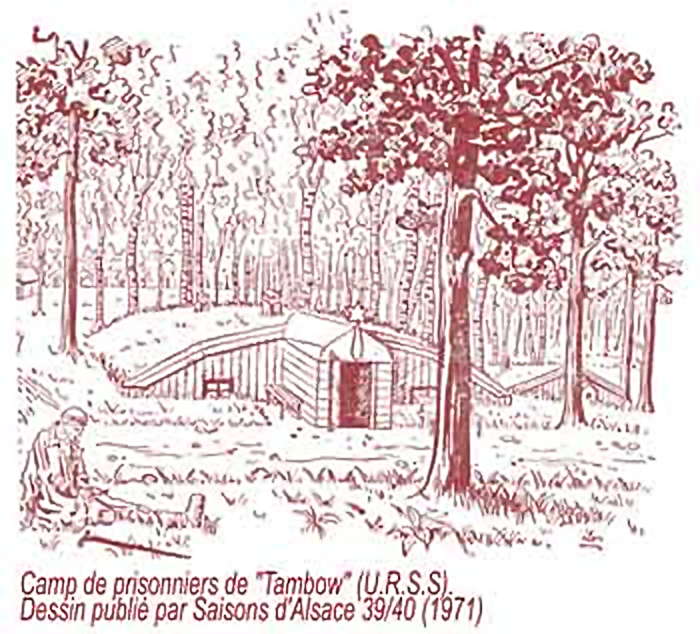
Tambov prisoner camp.
Photo: http://severr.livejournal.com/232749.html
Больше всего меня поразило то, как они жаловались на те, якобы, невыносимые, тяжелые условия, в которых они находились. Я хорошо помню те минуты, когда наш сержант, объявив перерыв, разрешал нам погреться у костра, который они жгли все время. Хорошо помню и их, здоровых мужиков, совсем не похожих на нас, замученных мальчишек. Интересно, помнит ли кто-либо из них нас, советских солдат, гревшихся вместе с ними у костра? Знали ли они, как нас кормили, как муштровали? А тот макет барака был дворец по сравнению с нашими землянками.
Обидно, но интервью, конечно, у меня никто не возьмет, и никто не будет знать как оно было. Дисциплину командиры наши поддерживали жесткую. Чтобы не отправили их на фронт, они из кожи лезли, выслуживаясь перед вышестоящим начальством; гоняли нас с подъема до отбоя, требуя беспрекословного подчинения. Но как бы там ни было, службой особенно я не тяготился: переносить лишения мне было не привыкать. Дома, до армии, тоже приходилось переносить тяготы жизни: и холод, и голод и, главное, тяжелый труд в колхозе. Семья большая, с малых лет без матери. Пожалеть некому. Совсем по-другому было у Ивана Твердохлебова: будучи у матери один, он не испытал того, что испытал я. Мать у него была баба бойкая, разбитная: все добудет, все достанет. Иван всегда был одет на много лучше всех нас, его сверстников. По внешнему виду он не похож был на семнадцатилетнего парня: толстомордый, откормленный, с уже жесткой щетиной на лице, он больше походил на молодого мужика. Ростом был как я, но толще, тяжелее и покрепче. Дружил с ребятами постарше, кавалерил вместе с ними, и нас, его сверстников глядел свысока.
А вот на службе этот мужик скис, не выдерживая ее тягот. Каким-то образом определился в хозяйственный взвод на подсобном участке; там ему дали лошадь, сани, там он что-то возил, кормил свиней. В расположении части появлялся очень редко, был таким же мордастым, как и дома. Вообщем, устроился. Митьку Котлярова мы больше не видели: попал он куда-то в другую часть, адресов друг друга мы не знали, связи между нами не было никакой года полтора. Свои адреса мы узнали через переписку из дома. Я получил от него письмо из Кронштадта, где он служил тогда в Военно-Морском Флоте на тральщике. Я ему, конечно, завидовал.
Continuation of service in the Army
But, despite all sorts of deprivation, starvation, freezing, and so on, we lived there. The weather was freezing, a lot of snow. We did not have winter uniforms. Our coats were already worn through, we had only light underclothes and a singlet worn under the shirt in summer, but we had to be outside all day in the cold.Drill, unarmed combat training, gun training - all in the cold in the snow. We had to crawl on our bellies, pull a field gun from one position to another - all in deep snowdrifts. Commands: "Tanks on the right!", "Tanks on the left!" followed one after the other.
Theoretical classes of artillery sciences were in the dugout, where it was warm. In the classroom in the forest during breaks we sometimes managed to get warm by the fire, which the prisoners who worked in the woods for firewood had lit, and their camp was somewhere nearby. Sometimes we heard the trumpet playing "Taps," "Get up!"
How strikingly different from us, were the prisoners: they were healthy, well-fed men, unlike us, the Soviet soldiers, emaciated from poor feeding, still young, still wet behind the ears. By international convention, saying they were not allowed to be fed poorly. So it was, but it was evident that they were not fed according to our third rate provisions.
Today, when I write about that time, it marks 58 years since the beginning of the Great Patriotic War of the Soviet Union. On Russian television there is a lot of talk about the war, and my attention was suddenly attracted to a talk about the Tambov camps during 1944-45.
As it turned out, they were interviewing former POWs, veterans from the Tambov camps. I was naturally very interested in this, I dropped everything and began to listen. They gave an interview with an elderly Frenchman who fought on the German side against the Soviet Union who became a prisoner of the Russians. Together with other prisoners, he was in the Tambov prison camp.
They showed the layout of the barracks in which they lived, talked about how they harvested timber and so on. Lord! How this excited me, because their camp and our dugouts were near Tambov in these forests!
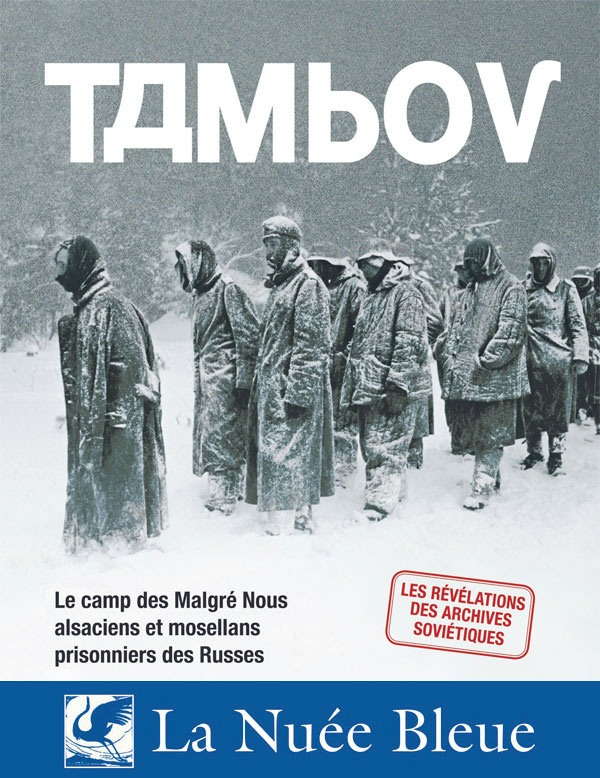
Tambov prisoner camp.
Photo: http://fotki.yandex.ru/users/ellaxxi/view/344165/?page=0
What struck me most is how they complained about the allegedly intolerable and difficult conditions in which they are located. I remember those moments when our sergeant, announcing a break, allowed us to bask in the fire, they were kept burning all the time. And I well remember those prisoners, healthy men, not like us, tortured boys.
I wonder if any of those captives remembered us, the Soviet soldiers warming ourselves with them around the campfire? Were they, as we were, drilled as well as fed? And the layout of their barracks was a palace compared to our dugout.
It's a shame, but the interview continued, of course, I had no will to set them right, and no one will know how it was. Our commanders maintained strict discipline. In order not to be sent to the front, they jumped out of their skin in order to gain favour with their superiors, and drove us hard from getting up to lights out, demanding unquestioning obedience.
But be that as it may, I was not bored while in army service. I was no stranger to deprivation. At home, before joining the army, I had had to endure the hardships of life, the cold, the hunger, and, most importantly, hard work on the farm. Our family was large, and from an early age we were without a mother. No one got any pity. It was quite different for Ivan Tverdokhlebova: having a mother, he had not experienced what I experienced.
His mother had been a brisk woman, sprightly, able to find everything necessary for her children. Ivan was always dressed a lot better than the rest of us, his contemporaries. In appearance he looked like a seventeen-year old boy: jowly, fat, already with stiff bristles on his face, he looked more like a young man. His height was like mine, but he was thicker, heavier and stronger. He was friends with the guys a little older, in the cavalry, and he and his friends looked down on us.
But in service this man turned sour, unable to bear his burdens. Somehow, the platoon put him into the economic section, where he was given a horse and sleigh, which he drove, and fed pigs. As a result of this arrangement, we saw each other rarely, but he was as fat as he had been at home. Somehow it was arranged.
Mitka Kotlyarova, we saw no more: he went away to another section, we did not know each other's address, and there was no communication between us for a year and a half. We eventually learned his address through letters from home. I received a letter from him from Kronstadt, where he served time in the Navy on a minesweeper. I envied him, of course.
Продовольственная армия
Кормить нас стали по, так называемой, «третьей норме», самой худшей из всех существующих тогда в армии норм питания. Жидкий суп с мерзлой картошкой без мяса , маленькая порция черного хлеба, немножко каши без масла в обед, в ужин и того хуже. У некоторых еще не до конца были съедены запасы еды из дома, которые хранились у них под подушками в головах. Доедали они их тайком от посторонних голодных глаз; укрывшись с головой одеялом после отбоя, тихо жевали, чтобы не возбуждать зависть у других, Бдительно следили, чтобы никто не утащил бы чего-нибудь. Но все равно такое случалось; возникали скандалы, доходившие чуть - ли не до драки. Прошло еще немного времени, продукты кончились у всех, и голодать стали все. Чувство голода преследовало постоянно; после столовой оно не утихало, молодой организм требовал пищи. Среди нас только и были разговоры о еде: вспоминали и рассказывали о разных домашних кушаньях. О девчонках и не вспоминали.
Compulsory military education strengthens our defense!
Photo: http://www.allworldwars.com/Russian%20WWII%20Propaganda%20Posters.html
У каждого была вожделенная мечта попасть в наряд на кухню, куда регулярно посылали на сутки по несколько человек от роты, и наесться там досыта хоть один раз. Как правило, там объедались и на несколько дней попадали в лазарет. Был и я там в наряде. Самое трудное было – это чистить котел после раздачи каши. Каша в котле пригорала и после раздачи на стенках котла оставалась корка, которую надо было соскрести. Забираешься полностью в огромный котел, еще не остывший полностью, и начинаешь соскребать пригоревшую корку, обливаясь потом. Счищенные корки черной пригоревшей каши забирал повар, но можно было ее поесть и украсть для друзей, которые в это позднее вечернее время дежурили под окнами столовой ,ожидая, когда им выбросят в форточку несколько ошметков пригоревшей каши.
На привокзальной площади станции Рада – она была в километре от нашего расположения – был небольшой базар, где местные женщины продавали всякую скудную домашнюю снедь. Продавали там и лепешки, бог знает из чего испеченные. Те, кому из дома могли прислать деньги, ходили туда тайком от начальства и покупали эти лепешки. Съедали их, конечно, тоже тайком. Купил как – то лепешки и Иван Сидоренко, парень из Чехуровки нашего Писаревского района. Все лепешки не съел, две оставил в кармане шинели, а шинель повесил на вешалку. Лепешки эти кто-то заприметил, украл и съел, наверное. Не обнаружив лепешек, Иван пожаловался старшине роты, и тот решил выявить вора во что бы то ни стало и строго наказать, чтобы другим не повадно было воровать.
На вечерней поверке, после переклички, команды «Отбой!» не последовало. Вместо нее последовала другая, очень категоричная: « Приказываю выйти из строя тому, кто взял лепешки из кармана шинели курсанта Сидоренко! » Гробовая тишина, никто из строя не вышел. Минут пять старшина подождал и снова повторил команду, добавив: «Будете стоять всю ночь, пока не узнаю, кто взял лепешки». Шло время, никто не признавался, и старшина строй не распускал. Время от времени он уходил к себе каптерку, а мы оставались стоять в строю. Уйти из строя никто даже не помышлял: это было бы равносильно бунту. Пока не было старшины, в строю слышались недовольные матерные возгласы в адрес укравшего лепешки. Появлялся старшина. - Что за шум? Смирно! Вольно! Нет желающих признаться? - Таких не было, и он опять уходил в каптерку.
Все устали стоять, хотелось спать, и непонятно было, чем все это кончится. Так продолжалось всю ночь. Минут за 15 до подъема старшина скомандовал: «Отбой!» Улеглись, не успели уснуть, как на линейке перед землянками горнист заиграл «Зорю», дневальный прокричал: «Подъем!», и дальше все пошло по распорядку дня. Не поспав ночь, нужно было крутиться до следующего отбоя. Из-за этих проклятых лепешек, на которые никто даже и не посмотрел, будучи сытым, приходилось терпеть эти лишения и унижения. Ходили разговоры о том, что на фронте хорошо кормят, и многие из нас, устав от мук постоянного голода, очень хотели, чтобы их быстрее отправили на фронт, даже зная о том, что там живут постоянно на грани между жизнью и смертью.
Army Food
We had to eat food categorised as 'third rate', the worst of all existing types then in army supplies. Thin soup was made with frozen potatoes, without meat, and with that we got a small portion of black bread, a little porridge without butter for lunch and dinner - or worse. Some had not yet fully eaten the food reserves they had brought from home, and kept them under their pillows at their head. They finished them off privately, keeping their secret from outsiders' hungry eyes, having covered their head with a blanket after lights out, quietly munching so as not to arouse jealousy from others, keeping an eye out so that no one stole anything. But still this happened, there were arguments that almost reached fighting. In a short time, everyone ran out of food, and all were hungry. The feeling of hunger constantly pursued us, and even after eating, it did not subside, the young organism demanded food. Among us we talked only about food: we remembered and talked about various household foods. We did not think about or remember girls.
Паек ЧФ СССР
An IRP-P Russian Navy combat ration, with main courses, meat spreads, crackers and drinks.
Photo: Russianname
Permission: GNU Free Documentation License, Version 1.2
Everyone cherished the dream of going to detail in the kitchen, where regularly several people from the company were sent daily, and there ate their fill at least once. As a rule, there stuffed themselves and got a few days in hospital. I was also there. The hardest part was to clean the pot after the distribution of cereals. Porridge in the pot burnt after the distribution remained on the walls of the boiler as a crust, which had to be scraped off. We took it away completely in a huge pot, not yet fully cooled down, and you started to scrape the burnt crust, dripping with sweat. The cleaned off crust of black burnt porridge was taken away by the cook, but you could steal the crust, and friends, who at that time were on duty in the late evening under the windows of the dining room, waited for them to be thrown out the window, waiting for a few scraps of burnt porridge.
On the station station square - it was a kilometre away from our location - there was a small market, where local women sold homemade, poor food. They sold flat cakes or tortillas there and God knows what they were made from. Those who could get money from home went there secretly and bought these cakes. And ate them, of course, also secretly. I and Ivan Sidorenko, a guy from our Chehurovki Pisarevsky area, both bought the bread. We did not eat all the cakes and two were left in a greatcoat pocket, and the greatcoat hung on a hanger. The flat bread was spotted by somebody who stole and and ate it. Unable to find the flat bread, Ivan complained to the top sergeant, and he decided to to reveal the thief, to be severely punished, so that others were not tempted to steal.
At evening roll call, after roll call, the command "Dismiss!" was not called out. Instead roll call was followed by another command: 'I command anyone who took the flat bread out of cadet Sidorenko's pocket to step forward!' Deathly silence, no one stepped forward. The sergeant waited five minutes and then repeated the command, adding: 'You will stay up all night, until I know who took the flat bread!'
As time passed, no one admitted the theft, and the sergeant did not dismiss the ranked soldiers. From time to time he went to his supply room, and we were standing in line. No one even dreamed of breaking ranks and leaving: it would be tantamount to revolt. While there was no sergeant, in the ranks could be heard shouting of abuse at the person who stole the bread. The sergeant reappeared. - What's the noise? Attention! At Ease! No one wishes to confess? - No one stepped forward, and he again went into the supply room.
Everybody was tired of standing and wanted to sleep, and it was not clear how this would end. This went on all night. 15 minutes before the morning wake up call, the sergeant gave the order: "End Roll Call!" We did not have time to sleep, as the bugler in front of the dugouts played "Zorya" and the orderly shouted: "Get up!" And then everything went on with the normal daily routine. We had not slept during the night, and we had to rotate to the next duty. Because of these damn stolen flat cakes, which nobody had even seen, being eaten, they had to endure hardship and humiliation. There was talk that at the front the troops were well fed, and many of us were tired of the constant hunger pangs, we wanted to be sent to the front quickly, even knowing that there we would be living permanently on the brink between life and death.
После смерти мамы
Со смертью матери наша жизнь пошла по-другому. Все заботы о нас, детях, легли на плечи бабушки. Добрая, заботливая, трудолюбивая, но совсем неграмотная, она не могла, конечно же, воспитывать и учить нас так, как это делала мать. При жизни матери мы жили в хорошем достатке. Зарплаты отца и матери хватало, видимо на то, чтобы мы жили безбедно. Сельских учителей хорошо обеспечивали продуктами питания даже в голодные годы, снабжали топливом.По внешнему виду, по одежде мы отличались от постоянно бедствующих, голодающих, ничего не получающих за свой труд, колхозников. Нас, детей, мать одевала в покупные, фабричного изготовления одежды в отличие от наших деревенских сверстников, которые бегали в сшитых дома простой иголкой, вручную, рубашках и штанах из грубого домотканого полотна. Мой друг Шурка устроил дома у себя однажды протест против такой одежды: плакал, кричал: «Хочу такие трусики, как у Митьки, с настоящими бретельками!» И никак не хотел одевать свои грубые, полотняные штаны.
Теперь мы постепенно становились похожими на всех и года через два ничем уже не отличались от других. Первое после смерти лето я провел в Богучаре у тети Лизы, маминой сестры. Богучар - это бывший до революции уездный центр, расположенный на берегу тихой речки Богучарки в семи километрах от Дона. В шестидесяти километрах восточнее Кантемировки, вдали от железной дороги, он и сейчас тихий провинциальный городишко - районный центр самого южного района Воронежской области.
Тетя Лиза работала в то время на Богучарской метеостанции, а дядя Федя, ее муж, был начальником почты. Их дети, мои двоюродные брат и сестра, были старше меня: Володя на четыре, а Зоя на два года. Не помню, откуда мы отправились в Богучар, но только помню, как в пути застал нас дождь. Мы ехали в темноте ночью на подводе, запряженной парой лошадей. Тетя Лиза накрыла меня каким-то брезентом, и капли дождя громко стучали по нему. Было сыро и холодно. Под шум дождя и чавканье под лошадиными копытами земли, размокшей от дождя, я уснул. Проснулся, когда тетя Лиза переносила меня спящего на руках в какой-то дом, где в огромной комнате на столе тускло горела керосиновая лампа.
The road to Boguchar, Дорога к Богучар
Photo:Vgor, via Panoramio
Возница перетащил в дом кожаные мешки с почтой, которую он вез в Богучар, и сложил в темном, неосвещенном углу комнаты. На этих мешках мы улеглись спать. С рассветом тронулись дальше и вскоре были в Богучаре. О! Каким большим городом показался мне тогда Богучар! Огромный собор на площади, четырехэтажное здание педучилища, пожарная каланча: все это было ново, интересно. Володя повсюду таскал меня с собой. Каждый день бывали на речке, но купаться я боялся, потому что не умел плавать. Мне негде было научиться: не было в Крамаревке речки. Богучарка казалась мне великой, таинственной рекой, а когда с ватагой мальчишек мы добрались аж до Дона, то, увидев его, я был ошеломлен. Помню мы долго пробирались через заросли кустов и высокой травы, как вдруг они кончились и прямо перед нами открылся Дон - величавая, широкая река.
Мальчишки с криками «Ура!!!» побежали к воде, на ходу сбрасывая с себя рубашки и штанишки, а я встал на месте как вкопанный и не мог идти дальше. Я никогда раньше не видел так много воды, мной овладел какой-то смутный страх перед этой стихией - я боялся подходить к воде. На поход к Дону ушел почти весь день. Такая длительная самовольная отлучка из дома для Володи не прошла безнаказанной. По дороге домой мы попали под ливень с грозой и ураганом и поэтому в дом явились мокрыми с головы до ног. Володя был поставлен в угол, а Зоя со злорадством, так чтобы не видели родители, показывала ему язык. Этого Володя долго вытерпеть не мог и, когда она, в очередной раз, пробегая мимо показала ему язык, он сильно её ущипнул. Раздался вопль, всех перепугавший, а Володя был вытащен из угла и подвергнут порке ремнем.
Вообще он был хулиганистый парень. Уже перед самой войной, когда он кончал десятилетку, его судили за хулиганство и на один год посадили в тюрьму. В войну он был командиром танка. В конце 1942 года участвовал в освобождении своих родных мест от немцев, заезжал на своем танке домой. Это была его последняя встреча с родными: с войны он не вернулся.
After the death of my mother
With the death of my mother in 1935 when I was seven years old, our life changed course. The care of all of us children lay on the shoulders of our grandmother. She was kind, caring, hardworking, but quite illiterate. She could not, of course, educate and teach us the way that our mother did. When our mother was alive, we lived in plenty. The salaries of my father and mother were now gone, as well as the fact that we could live comfortably. Rural teachers were well provided with food, even in lean years, and fuel was supplied.In appearance, the clothes we wore always differed from the children of the farmers, who were poverty-stricken, starving, and received almost nothing for their labour. We wore store bought, factory made clothes, in contrast to our rural counterparts, who wore clothes which were stitched with a simple needle, stitched at home by hand, shirts and trousers of coarse homespun cloth. My friend Shura at home once voiced a protest against his garment: crying, screaming, "I want trousers like Mitya, with those straps!" And he did not want to wear his coarse linen trousers.
Now we gradually became similar to all the others, and in two years did not differ at all in dress from the others. The first summer after the death of my mother I was in Boguchar, at Aunt Lisa's, mother's sister. Boguchar is a former county town before the Revolution, situated on the banks of a quiet river. Boguchar is seven kilometres from the Don. Sixty kilometres to the east of Kantemirovka, away from the railway, it is still a quiet provincial town - a district centre of the southern district of the Voronezh region.
Liza worked at that time at Boguchar weather station, and Uncle Fedya, her husband, was the chief officer at the weather station. Their children, my cousins, were older than me: Volodya four years older, and Zoe two years older.
I do not remember how we came to go to Boguchar, but I do remember the road we travelled, and the rain. We were traveling in the dark night on a cart drawn by two horses. Liza covered me with a tarp and rain beat loudly on it. It was damp and cold. With the sound of rain and the rhythm of horses' hooves on earth sodden with rain, I fell asleep. When I awoke, Liza bore me asleep in her arms into a house where a large room on the table was dimly lit by a kerosene lamp.
The coachman dragged into the house some leather bags with mail, which he was carrying into Boguchar, and stacked them in a dark, unlit corner of the room. On these bags we went to sleep. At dawn, we moved on and were soon in Boguchar. Oh! How big the city of Boguchar seemed to me then! The huge cathedral in the square, the four-story building of the teachers' school, the fire-tower: it was new, interesting.
Volodya dragged me along everywhere . Every day I visited the river, but I was afraid to swim, because I did not know how to swim. I had no place to learn: we had only the tiny Kramarevke river. The Bogucharka River seemed to me a great, mysterious river, but when, with a gang of boys, we got right up to the Don, then saw it, I was stunned. I remember we went a long way through the bushes and tall grass, when they thinned and disappeared in front of us and there opened the Don - a majestic, wide river.
The river Bogucharka, part of my childhood, with a child of the present day doing what I loved to do.
Photo: Vladimir Gorodnjanski, 2007
The boys, shouting "Hurrah!" ran to the water, dropping their shirts and pants as they ran, but I stood as if rooted to the spot and could not go any further. I had never seen so much water, I had possession of some vague fear of this element - I was afraid to approach the water.
The trip to the Don went on almost all day. Such a prolonged absence without leave from home for Volodya did not pass unpunished. On the way home we got drenched in a downpour with thunder and lightning, and so came back to the house wet from head to foot. Volodya was placed in a corner, and Zoe gloatingly, told him that he should have told their parents, and poked out her tongue. Volodya endured this for a long time but eventually could stand it no more, and when she once again ran past sticking out her tongue, he pinched her hard. There was a scream, everyone was scared, and Volodya was pulled out of the corner and subjected to a whipping with a belt.
Actually, he was boisterous guy, a hooligan, even already before the war. When he finished ten years of service, he was tried for disorderly conduct and given a year in prison. During the war he was a tank commander. In late 1942, he participated in the liberation of the homeland from the Germans, and at one time called in at his home driving his tank! This was his last meeting with his family, he never returned from the war.
От автора
Эти воспоминания о небольшом сравнительно отрезке времени - конец войны 1944-го года и осень 1956 г. Это не военные мемуары большого военачальника, описывающего планирование и проведение боевых операций, использующего для этого дневниковые записи и архивные документы.Это воспоминания простого солдата и моряка о своей службе. У меня нет дневниковых записей того времени, я не копался в архивах, не встречался с бывшими сослуживцами. Это только то, что сохранила память. Здесь мало упоминается фамилий моих командиров и товарищей по службе, потому что они забылись по прошествии более чем полувека.
Воспоминания не претендуют на какое-то общественное, идеологическое, военное и прочие значения. Но у меня есть внуки, бог даст, будут и правнуки. Быть может, когда- либо, они возьмут в руки эти воспоминания и прочитают про юность и молодость своего деда, прадеда, про его службу в Красной Армии и Военно-Морском Флоте СССР.
На что и надеюсь.
В Тамбовские леса
Хмурым осенним днем ноября месяца 1944 года на станции Кантемировка, что на юге Воронежской области, 17-ти летние юноши, призывавшиеся в Красную Армию, заполнили пространство вдоль железнодорожного состава в ожидании погрузки в товарные вагоны, так называемые «теплушки». Печальный вид имело это воинство. Обносившиеся основательно за время войны, к тому же оставившие одежду получше дома, и, поэтому, одетые в немыслимое рванье, с сидорами за плечами, эти мальчики-юноши были скорее похожи на нищих. Это был последний военный призыв. Эта серая масса шевелилась, двигалась, гомонила. Над толпой поднимались дымки от самокруток из крепкого домашнего «самосада». Это дымили еще не научившиеся по настоящему курить будущие солдаты.Издалека послышалась команда: «Станов..и..и..сь»! тут же подхваченная другими командирами: «В две щеренги становись!» Толпа задвигалась, забегали призывники, стараясь стать в строй рядом со своими односельчанами, чтобы попасть служить в одну часть со своими. Мы стали в строй рядом с Иваном, а Митька, находившийся где-то в отдалении, оказался в строю где-то в другом месте, и, поэтому, попал в другой вагон, а впоследствии и совсем в другую часть.
Из нашей Крамаревки призывались трое: я, Иван и Митька Котляров. Двери в вагонах закрылись, и открывать их без разрешения запретили. Началось томительное ожидание отправления состава в путь; гадали - в какую сторону он двинется.
Но вот дернулись вагоны, лязгнули буфера, и поезд медленно двинулся на север, в сторону Москвы. Паровоз набирал скорость, все чаще постукивали на стыках рельс вагонные колеса; хотелось выглянуть из вагона и посмотреть последний раз на оставляемые родные места ,но окон в вагоне не было, и не было возможности увидеть убегающие назад холмы, поля, дороги, перелески.
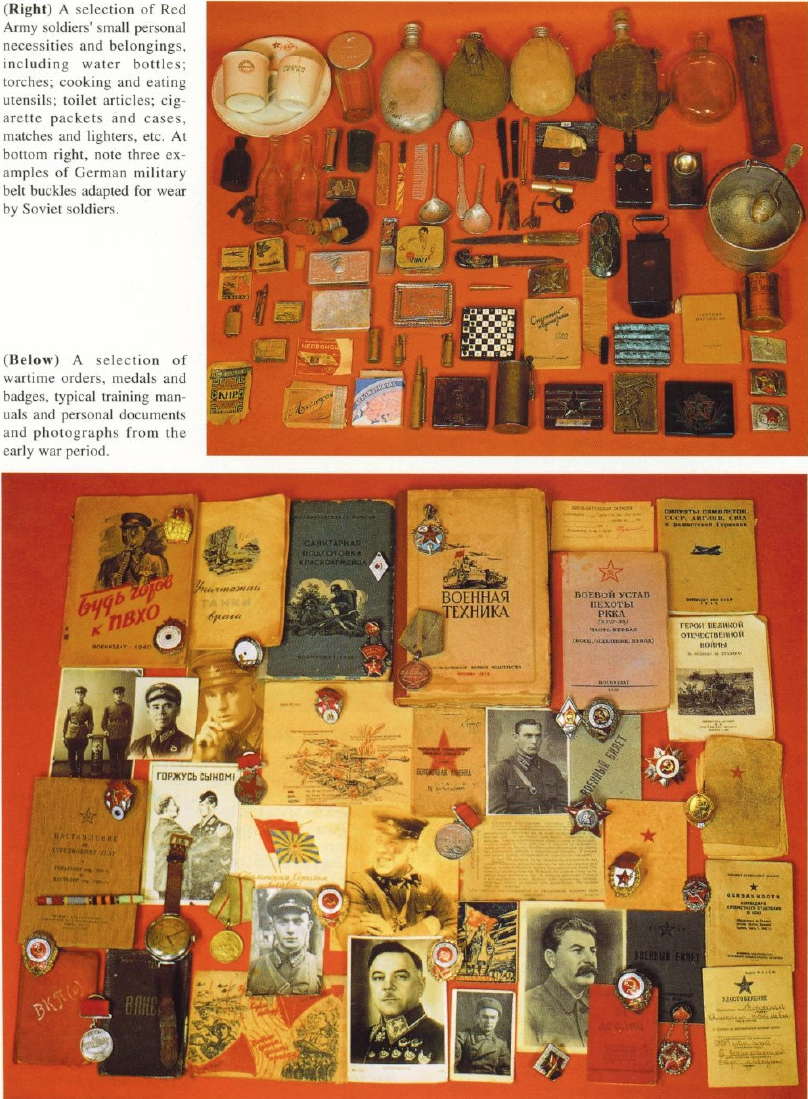
(top) Personal items of Red Army soldiers, including water bottles, torches, cooking and eating utensils, toilet articles, cigarette packets and cases, matches and lighters.
(bottom) A selection of wartime orders, medals and badges, typical training manuals and personal documents and photographs from the early war period.
Photo: http://www.scribd.com/doc/65345790/Red-Army-Uniforms-of-WWII
Потихоньку начали устраивать свой быт. Те, кто попроворнее и понахальнее заняли места на нарах, назначенный дневальный разжег огонь в буржуйке. Стали развязывать «сидоры», основательно набитые едой, достаточной не на одну неделю вместо предписанных трех дней. Уставших на переходе от Талов до Кантемировки ребят, потянуло в сон. Кто на нарах, кто на полу, подложив под голову «сидор», уснули молодым, крепким сном. А поезд мчал их неведомо куда. О том, куда он их мчит, знал лишь начальник эшелона.
Ребята спали… Что снилось им под перестук вагонных колес? А может быть, им ничего и не снилось? Быть может отсыпались они за целых три года войны, когда с ее началом и до этого времени они от зари и до зари, ежедневно без выходных, работали в колхозах на тяжелых крестьянских работах, вместо ушедших на фронт мужиков. Они пока отдыхали, отсыпались. Но впереди их ждала не менее трудная, тяжелая военная служба, война, фронт.
На следующий день, утром, когда эшелон остановился на какой-то станции, поступила команда получить сухой паек. Это означало, что мы отныне солдаты и кормить нас будут независимо от того, есть ли что у нас в «сидорах». Принесли тот первый армейский харч, которым мне довелось питаться целых двенадцать лет. Принесли хлеб, масло, сахар, тушенку, разделили поровну на всех. Вместе с тем, что было взято из дома - это было уже много. Мы были сыты и, не зная, что так всегда не будет, утратили чувство бережливости, перестали ценить самое насущное: хлеб. Хлебом стали бросаться друг в друга из одного конца вагона в другой.
А эшелон наш мчался уже в ночи, паровоз давал временами протяжные гудки, монотонно стучали колеса на стыках, мы были очень, ну очень молоды, отдохнувшие, здоровые и, несмотря ни на что, жизнерадостные. На остановках отодвигались двери вагона, снаружи заходили в вагон какие-то командиры, проверяли порядок, делали наставления, уходили, двери закрывались и мы ехали дальше. Часто эшелон останавливался и долго простаивал, но наружу нас не выпускали, и мало кто из посторонних знал, что везут в этих товарных вагонах.
Не помню, сколько времени мы ехали, но вот на одной из остановок раскрылась дверь и послышалась команда: «Выходи строиться!» Было утро. Изо всех вагонов посыпались, как горох из кружки, пацаны - новоиспеченные воины, по внешнему виду еще далеко не похожие на них.
Команда «Становись!» выстроила нас перед вагонами. Какой - то небольшой железнодорожный вокзал был перед нами; ни вправо, ни влево, ни сзади его не виделось каких - либо заметных построек. За вокзалом темнел непривычный глазу лес из хвойных деревьев, которые не растут в наших краях. Это были Тамбовские леса.
Извиваясь змеей по извилистой дороге, колонна наша потянулась в лес. Шли недолго. Среди леса, куда мы пришли, ровными рядами располагалось множество больших землянок. Невысокими длинными холмиками возвышались над землей их крыши, покрытые дерном. В стороне от них виднелось кирпичное здание с пристройкой, возле которой высилась высокая круглая кирпичная труба. Это была баня.
Началась стрижка наголо, мытье в бане почти холодной водой, одевание в военную форму. Переодетые в военную форму, остриженные, все казались похожими друг на друга, и мы с трудом узнавали даже своих товарищей. Нашу гражданскую одежду куда - то убрали, но сидора с продуктами, которые мы еще не успели съесть, оставили при нас. Распределили нас по ротам, взводам, отделениям, познакомили с командирами и поселили в землянках. Эти землянки представляли из себя траншеи метра 2 глубиной, метров 8 шириной и длиной метров 30. Эти траншеи были накрыты двухскатной крышей из бревен, которые в свою очередь прикрывались соломой и земляным дерном.
Linden tree in Tambov Forest.
Photo: http://www.tstu.ru/win/tambov/les/gribi.htm
В одном конце землянки за перегородкой с дверью располагалась каптерка старшины роты, с другого конца по ступенькам вверх был выход на улицу, с левой стороны от входа, во всю длину землянки, тянулись двухэтажные нары, а с правой - вешалки для шинелей и пирамиды для винтовок.
Справа и слева от нашей землянки тянулись землянки других рот. Отныне начиналась моя нелегкая солдатская служба. Она началась в 4- том учебном стрелковом полку. Наша рота была артиллерийская. Из нас предстояло за короткое время подготовить командиров противотанковых орудий, и после окончания учебы отправить на фронт. Служба началась.
From the author
These memoirs are about a rather small interval of time - the end of the war in the year of 1944 to the autumn of 1956. They are not military memoirs of a big military leader describing planning and carrying out of fighting operations, using for this purpose diary records and archival documents.These are memoirs of a simple soldier and seaman in service. I do not have diary records from that time, I have not dug in the archives, I did not meet former colleagues. Here I have detailed only what remains in my memory. There is little mention here of the names of my commanders and comrades in the service, because they have been forgotten after the lapse of more than half a century.
These memoirs do not pretend to be some sort of commentary on social, ideological, military, and other values. But I have my grandchildren, and, God willing, there will be great-grandchildren. Perhaps they will take in their hands these memories and read about the youth of their father, grandfather, or great-grandfather, and about his service in the Red Army and Navy of the USSR.
I hope that this will come to pass.
In Tambov Forest
On a gloomy autumn day of November, 1944 at station Kantemirovka, in the south of the Voronezh area, 17 years old young men drafted into the Red Army, filled the area in front of the train, in expectation of being loaded into freight cars, so-called 'wagons'. This army had a sad look about it. Thoroughly shabbily dressed during the war, they had, moreover, left their better clothes at home. Therefore, dressed in unthinkable rags, with a knapsack on their shoulders, these boys or young men looked more like beggars.It was the last military draft. The grey mass swirled about and talked. Hanging over the crowd was smoke from hand made 'home grown tobacco' cigarettes. These future soldiers smoked, though they had not yet learnt to smoke properly.
From afar the command was heard: 'Squad….fall in!', immediately picked up by other officers: "Get in two lines!" The crowd began to move, the recruits hurried, trying to fall into line alongside his fellow villagers to get to serve in the same unit. I got next to Ivan but Mitya, who was somewhere further away, turned out to be sent to serve somewhere else, and, therefore, got into another car, and later served out the war in a completely different area.
From Kramerevka three were drafted: me, Ivan, and Mitya Kotljarov.
The doors on the boxcars were closed, and it was prohibited to open them without permission. Then began an agonising suspense, waiting for departure. We wondered in which direction the train would move. Then the waggons jerked, buffers clanged, and the train slowly moved northward, towards Moscow. The steam locomotive sped up, the tapping of the wheels on the joints in the rails increased in tempo, and we would have liked to look out for the last time at familiar places, but there were no windows in the wagon, and there was no possibility of catching sight of the familiar fields, roads and woods as they disappeared.
We slowly began to organise our life within the walls of our prison. Those who were quicker or more impudent seized places on the plank beds, and the man responsible got the fire going in the potbelly stove. We began to untie our knapsacks, filled with enough food for a week, not the designated three days. Those who became tired went to sleep. Some were in a bunk, some were on the floor, they tucked their knapsack under their head and fell into a deep, youthful sleep.
And the train rushed them God knows where. Their destination was known only to their superior officers. The boys were sleeping….. What did they dream of while the wheels clattered? Or maybe they did not even dream? Maybe they slept to catch up on three long years of war, from its beginning until that time, they had worked on collective farms in heavy labour, instead of the men who went to the front. They rested now, and slept. But what waited in front of them was a labour no less difficult than their farm labour - difficult military service, the war front awaited.
The next morning when the train stopped at a station, the young men received rations from their commanders. This meant that we soldiers were now to be fed whether or not there was anything in our knapsacks. That was my first taste of army grub, which I had to eat for twelve years. They brought bread, butter, sugar, canned meat, and divided it equally amongst us all. However, what we had brought from home was now too much. We were full, and not realising that it would not always be so, ceased to appreciate the most vital food, bread. We were soon throwing bread at each other from one end of the car to the other.
Our train rushed on through the night, the engine gave a long drawn out whistle at times, always there was the monotonous clattering of wheels on the rails, but we were young, healthy, rested, full, and in spite of everything, cheerful. At the stops the doors of the wagon were opened, officers came to check that we were behaving ourselves and following instructions. The doors were closed and we moved off. Often the train would stop for some time, but they did not let us out, very few people outside must have realised what was inside the boxcars, and eventually the train moved on.
I don't remember how long we travelled, but at one of the stops the command was heard 'Get out!'. It was morning. Out of the coaches like peas spilled from a cup, came the boys - newly made soldiers, although their appearance showed that they were far from being seasoned soldiers.
At the command 'Fall in!' we lined up in front of the cars. A small railway station was in front of us, and neither to the right nor the left, nor behind it, could we see any appreciable structures. Behind the station was a forest of dark conifers which did not grow in our area. It was Tambov forest.
Wriggling like a snake on the winding road, our convoy entered the woods. We did not march for long. Into the woods we went, where there were plenty of large dugouts. Their long low mounds rose above the land, their roofs covered with turf. Away from them there was a brick building with an annex, near which towered a high round brick chimney. It was a bath.
They cut our hair, then we washed in the bath of almost cold water, and dressed in military uniforms. After we were all changed, it seemed that we were all similar to each other, and we could hardly even recognise our friends. Our civilian clothes were taken away, as well as our knapsacks with the food we had not eaten. We were divided into companies, platoons and divisions, and were introduced to our commanders and sent to the dugouts. The trenches were two metres deep, eight metres wide and 30 metres long. The trenches were covered with a gable roof of logs, which in turn were covered with straw, dirt and turf.
Mushroom in Tambov Forest.
Photo: http://www.tstu.ru/win/tambov/les/gribi.htm
These trenches were covered with a gable roof of logs, which in turn were covered with straw and dirt turf. At one end of the dugout behind a partition with a door was the store-room, on the other end were steps up and out to the road. On the left side of the doorway, all the length of the dugout, were two-storeyed plank beds, and on the right were hangers for overcoats and pyramids for rifles. To the right and to the left of our dugout were dugouts of another squadron.
Henceforth began my hard soldier's service. It started in the 4th academic Infantry Regiment. Our squadron was artillery. From our ranks it was necessary to prepare commanders of anti-tank guns, and after graduation to be sent to front. Army service had begun.
The Drake
We went in a minibus to the wedding of my niece of Lena in the next district.In the bus there were twenty of us. I and my wife Masha had arrived from Estonia at the invitation of my sister to participate in the wedding celebrations.
It was summer. The road ran through the open steppe among extensive fields planted with wheat, sunflowers and corn. I continuously looked out of the window of the bus, recognising things familiar to me from my childhood and adolescence. Four kilometres away from the road among the hills lay my native village once stood. I was born and lived there before being drafted into the army during World War II. I was only 17 years old.
For thirty years I had not been to these places, and already my village had disappeared, I was told, and not a trace remained. It disappeared after the war, in peacetime, but in my memory it has remained, although much is forgotten from the life of that time when I lived there.
Looking out of the bus window, I saw in one place two hundred metres from the road a strange, green oasis among the already faded steppe grasses, yellowed by the summer heat . A small area stood out among them of green, tall, dense vegetation. Something stirred in my memory, and suddenly as a flash of lightning I was thrown into the past.
I remembered! I knew it! That was it, Garbachev liman! The liman, which in childhood and adolescence so occupied me and my peers held me and attracted me. In those days, the road along which we were travelling had not existed. Now, seeing and remembering it, I wanted to jump out of the bus and run to it to see if everything was the same as it had been. The bus moved on, but the memories gushed over me, and I gave myself up to them, to the memories of the place.
Photo: bucefal, http://www.panoramio.com/group/11152/
Our side in the south of the Voronezh region, where we lived, was not actually steppe, but the forest was no longer continuous. You can travel on the steppes where it is flat for twenty kilometres. By the side of the road to the right and left you will see lowlands, islands in the forest, and you will see a village in the hills to the side, but ahead, as far as the eye can see, steppe and more steppe. And then suddenly the plain comes to an end, and a gentle descent down the hill begins, the road goes between hills on the slopes of which stand the huts of a village . You will pass the village, you will go uphill, and there again the steppe runs to the horizon before you.
Our village stood among such hills. There was neither a small river, nor lakes nearby anywhere. Water was only in wells from springs coming from underground at the foot of hills.
We rural boys, frequently left the boundaries of the village and went far into the steppe, getting to this or that forest, there climbing trees, ruining numerous nests of rooks and magpies.
At one point, about four kilometres from the village in the open steppe, not ploughed for some reason, there were three limans as we called them. It was some kind of mysterious, unexplained phenomenon in the open flat steppe. Located in a straight line, at a distance of about two hundred metres from each other, it is not known how these three limans were formed, similar in size and depth of the depression, but obviously not of man-made origin.
They were round as saucers, each with a diameter of 100 m and a depth of no more than 3 metres. In the winter they were completely filled up by snow, and in the spring the snow melted, the hollows then filled by water and in the steppe there were three lovely lakes. In the summer they became overgrown and, surprisingly, each one had its own type of vegetation. The first, which we called 'Garbachev's liman', was overgrown by bullrushes. This tall plant is higher than a human. The thickness of a finger at the root of the stem, without leaves or shoots, the inside spongy, after spring it rose from the water and quickly grew thick, covering the entire lake from shore to shore, like waves, swaying in the wind.
The bullrush, Okuga, interfered with the evaporation of water in the summer from heat and so it stayed there for a long time. The average liman was entirely overgrown by water lilies, their leaves covered the entire surface of the water, not leaving one metre of open water. On these leaves, lapwings nest directly, laying eggs. The liman was chest deep. Stripped naked, we took with us peaked caps and, pushing aside the water lily leaves, wandered around the lake, collecting lapwing eggs.
Lapwings at this time circled above us and cried piteously. Till now it is remembered this pitiful cry, as if human crying: 'Whose … we, you, whose … we'. But we were hard hearted and continued this evil act.
In the third liman water for some reason did not stay, it quickly dried up and grew with low, tough grass. There was nothing for us to do there.
Most of all we were drawn to the Garbachev liman, it pulled us to it because of the water, there it was possible to bathe.To do this, we had a special place there: straight from the shore toward the middle of the liman, we uprooted the bullrushes, clearing a path four metres wide and twenty metres long. The result was a channel just over head height for some distance from the shore.
Oh, it was a great thing for us! It was the only place for us, where we swam, splashed, and dived. I learned to swim there.
Sometimes boys from the other village, Titarevka, came to the liman. But we did not see them very often. We usually came at different times. Once, we all came at the same time, and the meeting ended with a fight.
We were already getting ready to go home when they suddenly appeared. They arrived in a hostile and aggressive mood. Amongst us, we thought that the problem was their leader, a courageous, strong, and desperate boy. Because he was with them, they were also courageous. There were eight of them, and eight of us. They told us to go home, we did not go. One of them, probably their leader, seized one of us and they tumbled to the ground fighting. I was stupid, and decided to grapple with him. I was not courageous or desperate, but at home I could beat all the boys of my age, even some older than me. When I rushed at him, someone hit me with a stick on my back, and they went for the others. Our group trembled, turned tail and ran. I ran right behind. The Titarevka boys ran after us, shouting.
I was ashamed, and suddenly I remembered, as I had once a long time ago been taught by a friend of mine, Shurka, who beat her older sister. He and I had elder sisters with whom sometimes the conflicts became physical fights. Shurka told me that when he was in danger of losing a fight, he grabbed a kitchen knife, and with a hysterical voice shouted 'I will kill you!' His sister was frightened and stopped, and ran away. 'You should do that too' he told me. I don't think I had ever done that, but now I thought of it.
I stopped, got a penknife from my pocket, and shouted 'Stop, you bastards! I will kill you!' Those chasing after us were taken aback and stopped, seeing a lunatic in front of them. Almost every boy had a penknife, but no one ever threatened another with a knife. Our group stopped and rushed back to me. The Titarevka boys trembled and ran, and we pursued them for a long time. Then, I do not remember how, we became reconciled, and sometimes swam together, and I even struggled with their leader. Once he beat me, once I beat him.
As a child, I remember, I wanted to shoot something. Slingshots, bows, a toy pistol, even a gun - all these were made by boys and used in practice. The most difficult skill was making an arquebus. This consisted of a metal tube, a wooden handle, sulfur from matches - this was all that was necessary to make such a gun. The shot went straight, as from a pistol. One of us, I do not remember who, made a самопал, or samopal, which is also similar to a gun. It was more than fifty centimetres long, the metal tube had a bolt at one end, a slot for propylene for ignition, secured to a wooden stock, and thus a small gun had been made.
The whole group of us went to the Liman, which had not yet been covered after spring by grass, to shoot ducks. We poured a lot of match heads into the barrel, some lead shot, and all was tightly packed with a wad. On the water, near the shore, there were ducks swimming. The owner of the gun took aim, and my neighbour Leshka stood behind him and saw where he was aiming. 'More to the right, more to the left! At the drake, at the drake!' he shouted. A shot rang out, but the shot went not in the direction of the drake, but to the rear, to Leshka. The bolt hammered into the end of the pipe shot out, and struck Leshka in the right cheek. Leshak fell to the ground, covered in blood.
All of us were very frightened, but somehow dragged him home, where he was sent to Pisarevka, the regional hospital. There the wound was sewn up, and although it healed, there was a scar, and afterwards Leshka got the name of 'Drake'.
The nickname stayed with him, I remember. I remembered all that after seeing the Liman of my childhood from the window of a bus.
Селезень
Мы ехали в небольшом микроавтобусе на свадьбу моей племянницы Лены в соседний район.В автобусе нас было человек двадцать. Я и моя жена Маша приехали из Эстонии по приглашению сестры Вали, чтобы поучаствовать в свадебных торжествах.
Было лето. Дорога пролегала в открытой степи среди обширных полей, засеянных хлебами, подсолнухом и кукурузой. Я неотрывно смотрел в окно автобуса, узнавая знакомые мне с детства и юности места. Километра четыре в стороне от дороги среди холмов лежало когда-то мое родное село. Я там родился и жил до призыва в армию во время Великой Отечественной Войны. Мне было тогда 17 лет.
Лет 30 я не бывал в этих местах, уже и деревни моей нет на свете, исчезла, говорят, и следа не осталось. Исчезла уже после войны, в мирное время, но в памяти моей она осталась, хотя многое забыто из жизни того времени, когда она существовала, и я там жил.
Глядя в окно автобуса, я увидел в одном месте метрах двухстах от дороги какой-то необычный, зеленый как бы оазис, среди уже пожухлых и пожелтевших от летнего зноя степных трав. Небольшой участок резко выделялся среди них какой-то зеленой, высокой, густой растительностью. Что-то шевельнулось в моей памяти, и вдруг как вспышкой молнии она бросила меня в далекое прошлое. Я вспомнил! Я узнал! Это был он, Гарбачев лиман! Лиман, который в детстве и в подростковом уже возрасте моем и моих сверстников так занимал, волновал и притягивал к себе. В те времена со стороны дороги, по которой мы ехали, видеть лиман мне ни разу не приходилось. Сейчас, увидев и вспомнив его, мне хотелось выпрыгнуть из автобуса и побежать к нему, посмотреть, все ли там так, как когда- то было. Но автобус шел дальше, а на меня нахлынули воспоминания, и я предавался им всю дорогу, аж до самого места.
Сторона наша на юге Воронежской области, где мы жили, не совсем степная, но и лесов сплошных уже нет. Можно ехать по ровной степи километров двадцать. В стороне от дороги то справа, то слева увидишь в низинах, в балках островки леса, деревеньку среди холмов увидишь в стороне, а впереди, насколько хватает глаз, степь да степь. А там вдруг равнина кончилась и начинается пологий спуск под гору, дорога идет между холмов, на склонах которых стоят избы деревни. Проедешь деревню, поднимешься в гору, а там опять перед тобою ровная степь до самого горизонта.
Наша деревня стояла среди таких холмов. Ни речки, ни озера поблизости нигде не было. Вода только в колодцах да из родников, бивших из-под земли у подножия холмов.
Мы, деревенские пацаны, часто покидали пределы села и уходили далеко в степь, добирались до того, или иного леса, лазили там по деревьям, разоряя многочисленные гнезда грачей, сорок, копчиков. В одном месте, километрах в четырех от села в открытой степи, на непаханом почему-то пространстве, лежали три лимана, как мы их называли. Это было какое-то загадочное, необъяснимое явление на лоне ровной степи. Расположенные на одной прямой линии, на расстоянии примерно двухсот метров друг от друга, на поверхности земли, неизвестно когда образовались три одинаковых по размерам и по глубине впадины, явно не рукотворного происхождения. Были они круглые как блюдца, диаметром 100м каждое и глубиной не более 3-х метров. Зимой они полностью заметались снегом, весной снег таял, впадины заполнялись водой и в степи появлялись три симпатичных озера. Летом они зарастали и, что удивительно, каждое своей растительностью. Первое, которое мы называли «Гарбачев лиман», зарастало окугой. Это высокое, выше человеческого роста, растение. Толщиной с палец у корня стебель без листьев и отростков, внутри губчатый, после весны поднимался из воды и быстро густо рос, покрывая все озеро от берега до берега, волнами колыхаясь под ветром.
Окуга препятствовала испарению воды летом от зноя и, поэтому, она держалась там долго. Средний лиман сплошь зарастал кувшинками, их листья покрывали всю водную поверхность, не оставляя ни одного метра открытой воды. На этих листьях чибисы прямо без гнезда откладывали яйца. Глубина там была нам по грудь. Раздевшись догола, мы брали с собой фуражки и, раздвигая листья кувшинок, бродили по озеру, собирая яйца чибисов.
Чибисы в это время кружились над нами и жалобно кричали. До сих пор помнится это жалостливое, словно человеческий плач: «Чьи…ви, чьи…ви». Но мы были жестоки и продолжали свое злое действо.
В третьем лимане вода почему-то не держалась, он быстро высыхал и зарастал какой-то невысокой, жесткой травой. Нам там делать было нечего.
Больше всего нас привлекал Гарбачев лиман, он тянул нас к себе тем, что там была вода, там можно было купаться. Для этого мы устроили там специальное место: прямо от берега по направлению к середине лимана, вырвав с корнем окугу, проделали в ее зарослях просеку метра четыре шириной и метров двадцать длиной. Получился как бы канал глубиной чуть выше головы поодаль от берега.
О, это было великое дело для нас! Это было единственным местом для нас, где мы купались, бултыхались, ныряли, там научился я плавать.
К лиману иногда приходили пацаны из другого села - Титаревки, но встречались с ними мы не часто: приходили обычно в разное время; а однажды, все-таки встретились, и встреча кончилась дракой.
Мы уже собирались уходить домой, как вдруг появились они. Повели себя как-то враждебно, агрессивно. Промеж нас ходили разговоры о том, что, якобы, у них есть вожак, смелый, сильный и отчаянный пацан. Он был, видимо, с ними, и потому они были смелыми. Их было, как и нас, человек восемь. Они стали прогонять нас домой, мы не уходили. Один из них, видимо это и был ихний вожак, схватил одного нашего пацана и повалил на землю. Меня охватило зло, и я решил схватиться с ним. Я не был смелым и отчаянным, но я побарывал дома всех своих сверстников, а то и ребят постарше. Только я ринулся к нему, как кто-то больно ударил меня палкой по спине и начал набрасываться на других. Ребята наши дрогнули и бросились наутек. Следом побежал и я. Титаревские по пятам, с криками, гнались за нами.
Обидно мне стало, и вдруг как-то само собой вспомнилось, как когда-то давно учил меня мой дружок Шурка побеждать свою старшую сестру. У меня и у него были старшие сестры, с которыми иногда возникали конфликты, доходившие порой до потасовок. Шурка говорил мне, что когда ему приходится туго и он не побеждает, то он хватает кухонный нож и нарошно, истерическим голосом кричит: «Зарежу!!!» Сестра пугается и убегает. «Ты тоже так делай»,- учил он меня. Не помню, чтобы я когда-нибудь так делал, но теперь об этом вспомнил.
Остановился, достал из кармана перочинный ножик и истошным голосом громко заорал: «Стойте, гады! Зарежу!!!» Гнавшиеся за нами опешили и остановились, видя перед собой какого-то сумасшедшего. Перочинные ножики были почти у каждого мальчишки, но чтобы грозить зарезать кого-либо, такого не было. Наши ребята остановились и устремились ко мне. Титаревские дрогнули и побежали, а мы еще долго гнались за ними. Потом, не помню как, помирились и иногда купались вместе, а я даже боролся с ихним вожаком. То он меня побеждал, то я его.
В детстве, помню, стрелять хотелось из чего-либо. Рогатка, лук, пугач, самопал - все это мастерилось пацанами самостоятельно и применялось на деле. Верх мастерства - это изготовление самопала. Металлическая трубка, деревянная ручка, сера со спичек - все это нужно было для изготовления самопала, выстрел получался настоящий, как из пистолета. Один из нас, не помню кто, изготовил самопал, похожий на ружье: в длинную, больше полуметра длинной, металлическую трубку забил с одного конца болт, пропилил прорезь для поджигания, закрепил на деревянном ложе, и получилось небольшое ружье.
Большой компанией отправились на лиманы, еще не успевшие зарасти после весны травой, стрелять уток. В ружье было насыпано много серы со спичечных головок, дроби, и все туго забито пыжом. На воде, недалеко от берега, плавали утки. Хозяин ружья стал целиться, а мой сосед Лешка встал позади него и смотрел, куда тот целится. «Правее, левее! В селезня, в селезня!»: командовал он. Прогремел выстрел, но ружье выстрелило не в направлении селезня, а в обратную сторону, в Лешку. Забитый в ствол болт выбило, и он пробил Лешке правую щеку. Лешка упал на землю, заливаясь кровью.
Photo: http://photo.kylekeeton.com/2008/07/just-russian-duck.html
Мы все были сильно напуганы, кое-как дотащили его домой, откуда он был отправлен в Писаревку, в районную больницу. Там рану зашили, все зажило, но остался шрам, а к Лешке приклеилось прозвище «Селезень».
Так и жил он с этим прозвищем, сколько я помню. Вот что мне вспомнилось после того, как я увидел из окна автобуса лиман моего детства.
Quail Hunting
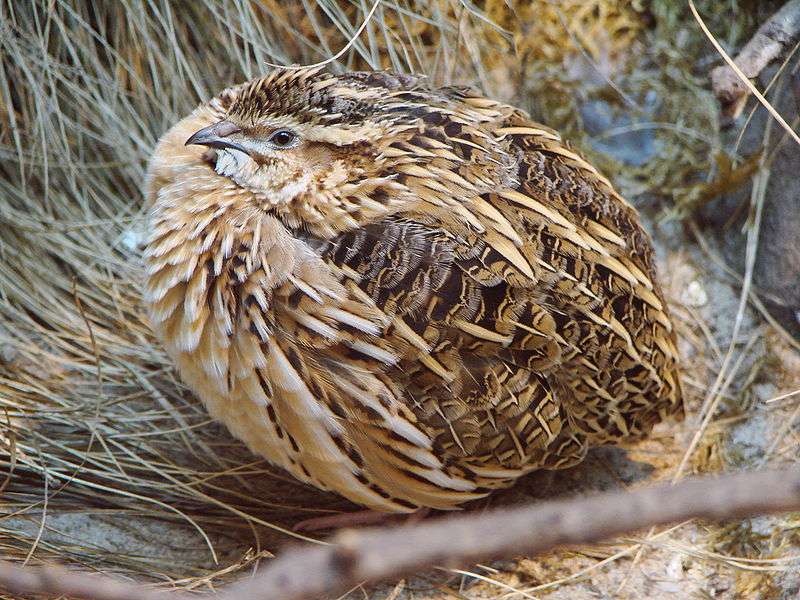
Male Quail.
Photo: Guérin Nicolas, Creative Commons Attribution-Share Alike 3.0
My father liked to hunt quails. Towards evening, when the sun was already close to the horizon, he took his hunting gear and went out onto the steppe to stay all night, coming home at daybreak with the quails he had caught.
Once, I remember, he took me with him. Along the small road of Souslik we climbed the mountain, went down again, climbed another hill, and then entered the open steppe.
The sun had already disappeared below the horizon, and the soft summer twilight began. The wind stopped, and by the time it got dark we came to a wheat field which had not yet begun to ear yet. The wheat was above my knees, and it was difficult to walk - I quickly tired. My father put me on his shoulders and we went on. We soon stopped, sat down on the ground and began to prepare the equipment for catching quails.
The summer night was silent. Above the horizon the big round moon was out, and shone a pale light all around.
My father pulled a net out woven from black thread between two arches of long wooden rods, raised it vertically above the ground and strengthened it so that it remained upright. We lay down near it in the wheat. Then my father got out his "Bayka" - a decoy which would call up a male quail. The catching began, with my father making a sound like "Pid-podom, pid-podom" on the Bayka, and somewhere far away in the night I could hear the sound, hardly audible because of the distance, the response of a male:
- H-a-a-vav, h-a-a-vav
My father once again called on his decoy, the male responded from a closer distance. In the night he flew from place to place, gradually coming nearer to the sound of the female decoy. Soon he was calling from close by, and my father again made the decoy sound, we could hear the noise of wings, there was a jerk in the net, and my father quickly brought it down to earth.
We had it! The quail, confused in the net, fought with its wings to free itself, but it could not get out. We disentangled it, and put it in a bag. Gradually we filled the bag.
Suddenly something huge hit the net, and brought it to the ground. I was frightened, and nearly began to cry. It was an eagle owl, a night robber, chasing a quail, had itself been caught in the net. My father released this large eyed raptor and set it free.
The catching of quails continued, and already I would like to have slept, my eyelids stuck together, and not able to struggle with tiredness, I fell asleep. I woke up only when my father carried me into the village, and it was already light.
Some live quails my father put into cages from the bag, and they delighted Lucy and Lena. My grandmother prepared a roast dinner of quails.
How tasty it was! If there is a better tasting meat than quail, I have yet to savour it.
All my life I have dreamt that sometime I must hunt quails again, but it was never possible, but whenever I heard the melancholy call of a quail I listened to it like bewitching music whenever I heard it from across the fields.
Written By Dmitriy Gorodnyanskiy
Перепелиная охота
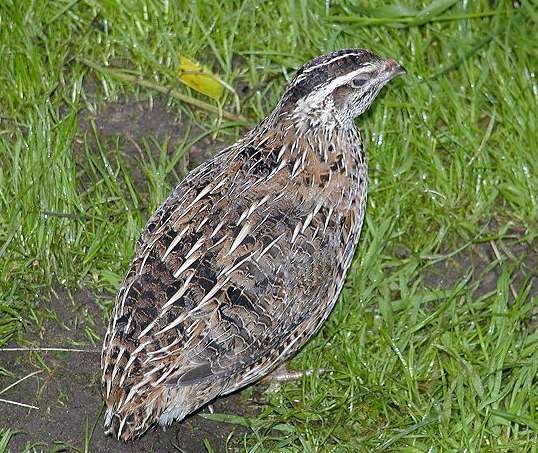
Female Quail
Photo: Wikimedia commons, GNU Free Documentation License, Version 1.2
Отец любил охотиться на перепелов. Под вечер, когда солнце уже клонилось к горизонту, он брал охотничьи снасти и уходил в степь на всю ночь, возвращаясь домой под утро с пойманными перепелами.
Однажды, помню, он взял с собой и меня. По Суслиной улочке мы поднялись на гору, спустились вниз, опять поднялись на холм и вышли в открытую степь.
Солнце уже скрылось за горизонтом, наступили мягкие летние сумерки. Шли еще долго и, когда уже стемнело, вышли на пшеничное поле, еще не колосившееся. Пшеница была мне выше колен, было трудно идти - я быстро устал. Отец посадил меня к себе на плечи и мы пошли дальше. Вскоре остановились, сели на землю и стали готовить снасть для ловли перепелов.
Тихая, летняя ночь уже наступила. Из-за горизонта вылезла большая круглая луна, осветив все вокруг бледным, призрачным светом.
Сплетенную из черных ниток сетку отец натянул между двух больших дуг, сделанных из длинных деревянных прутьев, поднял эту сетку вертикально над землей и укрепил, чтобы она не падала, а сами мы прилегли в пшенице, рядом с сеткой. Потом отец достал «байку» - манок, которым подзывают перепела-самца. Ловля начинается. «Пид-подом, пид-подом», - начинает играть на байке отец, и где-то далеко в ночи, еле слышно из-за расстояния, отзывается самец:
- Х-а-а-вав, х-а-а-вав».
Отец еще раз зовет и самец отзывается уже ближе. Ночью он перелетает с места на место, постепенно приближаясь на крик самки - днем бежит по земле. И вот он уже совсем близко отозвался. Еще раз поманил отец, слышен шум крыльев, удар в сетку и отец валит ее на землю.
Есть! Перепел, запутавшись в сетке, бьется крылами, но самому ему уже не вырваться. Мы его выпутываем и кладем в сумку. Сумка наполняется постепенно. Но вдруг что-то огромное ударяется в нашу сетку и валит ее на землю. Я испугался и чуть не заплакал. Оказывается, филин - этот ночной разбойник - гоняясь за добычей, сам попался в сетку. Отец освободил это глазастое страшилище и опустил на волю.
Ловля продолжается, но мне уже хочется спать, у меня слипаются веки и, не в силах бороться со сном, я засыпаю. Просыпаюсь только при входе в село на руках у отца. Уже рассвело.
Дома несколько живых перепелов отец выпускает из сумки и они летают по комнате, приводя в восторг Люсю и Лену. К обеду бабушка приготавливает жаркое из перепелов. До чего вкусно! Вкуснее перепелиного мяса не ел, не знаю.
Всю жизнь мечтал, чтобы самому когда-нибудь поохотиться на перепелов, да так и не удалось, и осталась только тоска по перепелиному крику и слушаю я его как чарующую музыку, когда приезжаю в родные края.
Pronja Kramarev
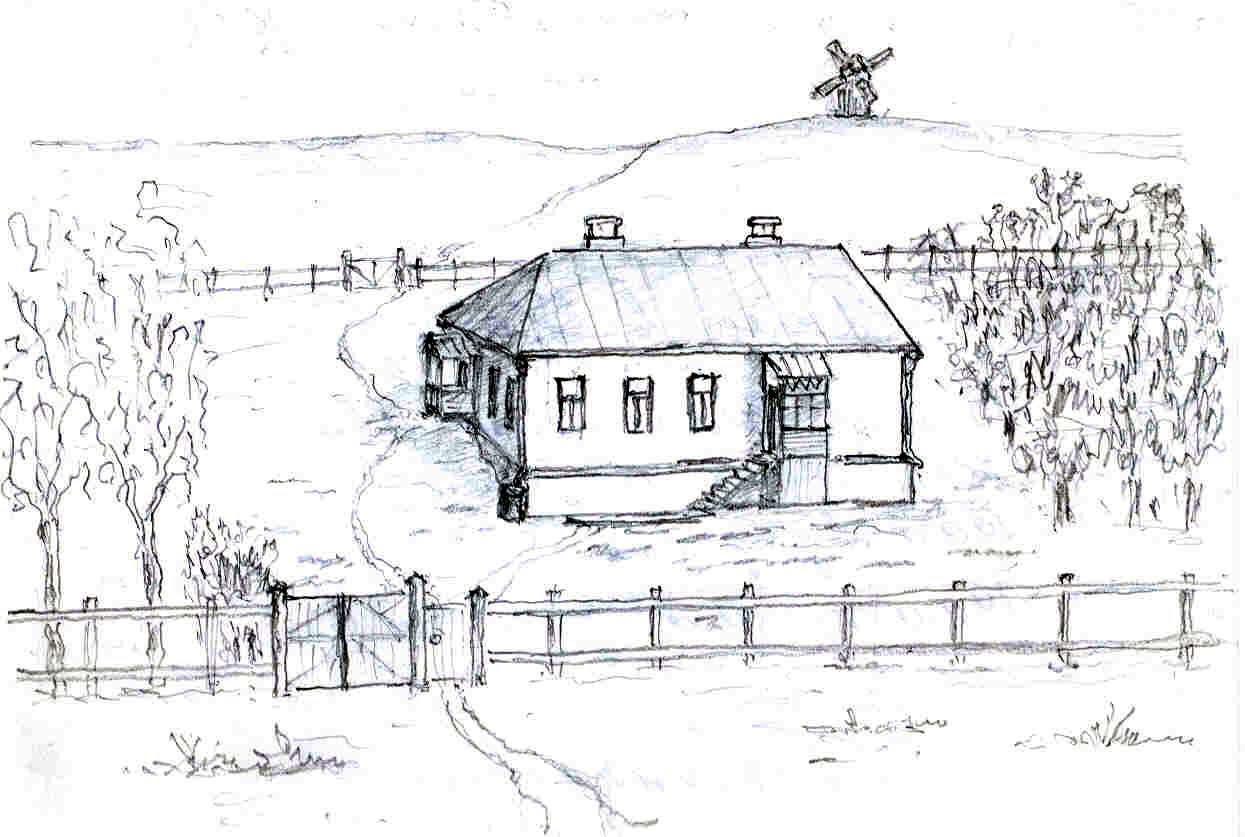
Дом в Крамаревке. В нем была наша квартира, там была
начальная школа; там я родился, учился в школе, там прошло
моё детство.
Our house in Kramarevka. It housed the local elementary school, as well as our apartment. I was born there, went to school there, and there I passed my childhood.
"Yesterday I set you to read at home and to remember a little story from the Reading Book. Pronja, read us this story" said the teacher.
Pronja slowly rises, bends his head down, hides his eyes from the teacher and from the class, and is silent. The teacher waits. One minute passes, and another, but Pronja remains silent.
"Well, Pronja? Will you read?" the teacher asks. The only answer is silence, and giggling from the back of the room. Pronja stands, shifting from one foot to the other, bends his head low, and remains silent.
It is visible that he is worried, as though it is a shame to him, but it is not certain whether he is unable or unwilling to read. He should be in fifth class, but he is still in third. Somehow with great effort he finished four classes of our primary Kramarevka rural school. He did not continue further with his studies, though in my opinion, he was not too stupid to do so.
I began my further study in an unfinished high school, in Rudaevka, the next village. I did not see Pronja anymore. He lived on the edge of the village, and when the war began he worked in another collective farm brigade. I know only, that in 1943 he was called up for the army, and went to war. Next year I was called up for military service. I served in the army for a long time, and did not return to Kramarevka, I took up residence in Estonia.
In ten years I did not visit Kramarevka, my relatives no longer lived there, and the village has since disappeared, it no longer exists. Peasants left to live in the surrounding villages. Many moved to Rudaevka where once it was necessary to me to go to school. But in Estonia I received a letter from sister Valja. She invited me to come to the wedding of her daughter Lena. Valja lived near Rudaevka where the wedding was to be held. The groom was from Rudaevka.
I and Masha, my wife, went to visit Valja, and then to Rudaevka. There lived the parents of the groom, who gave us a small room. In expectation of the celebrations, I walked to the village. A lot had changed over these long years. There was no familiar face, the school where I had studied had disappeared, leaving not a brick standing. In its place was vacant ground. Even trees had grown on the spot.
On a table in our room a pile of newspapers was laid. One of them was a regional newspaper called 'Rural Now'. I became interested and began to look through the newspaper. In one article my attention was caught by a big laudatory piece about a certain inhabitant of Rudaevka village, a tractor operator Kramareve Prokofii Ivanoviche.
In the article it said that Prokafij Ivanovich was looked on with pride not only by the local villages, but over the whole area: he was a fair worker, he exceeded all the performance standards, and was an example for all in life, and was a veteran of the Great Patriotic War. Many positive examples from his life and work were listed.
A thought flashed through my head, whether this was the same Pronja with whom I sat in class and who could not learn to read. But now the wedding celebrations had begun, and this thought left me.
A notable wedding had been prepared. There were more than a hundred people gathered for the celebration. In a court yard a huge awning had been erected, and under it were placed tables, benches, and chairs. Despite the heat of summer, under the awning it was cool. The light rain did not matter.
Everyone sat down in their places, congratulations to the young couple began, shouts of 'Kiss!' were heard, customary during a wedding feast, after which the bride and groom kiss. The accordion player played cheerful dance tunes. In the middle there was a man no longer young, but still obviously a strong man. His trousers were tucked into shining boots, and he wore a jacket with a military decoration from the Patriotic War.
Under the influence of the fervent music of the accordion he broke into a dance. It was obvious that he was a highly skilled dancer. All the wedding guests looked on with interest, and encouraged him to continue, with shouts of admiration. It seemed as though it was not an old man, but a young one who danced.
I asked a local man sitting next to me 'Who is dancing?'
It is our celebrity! It is Prokofij Ivanovich - he answered. And is he a local? - I ask.
'Yes, a local, but earlier he lived in Kramarevka'. All became clear. Before my eyes danced the dashing figure of Pronja Kramarev.
Пронька Крамарев
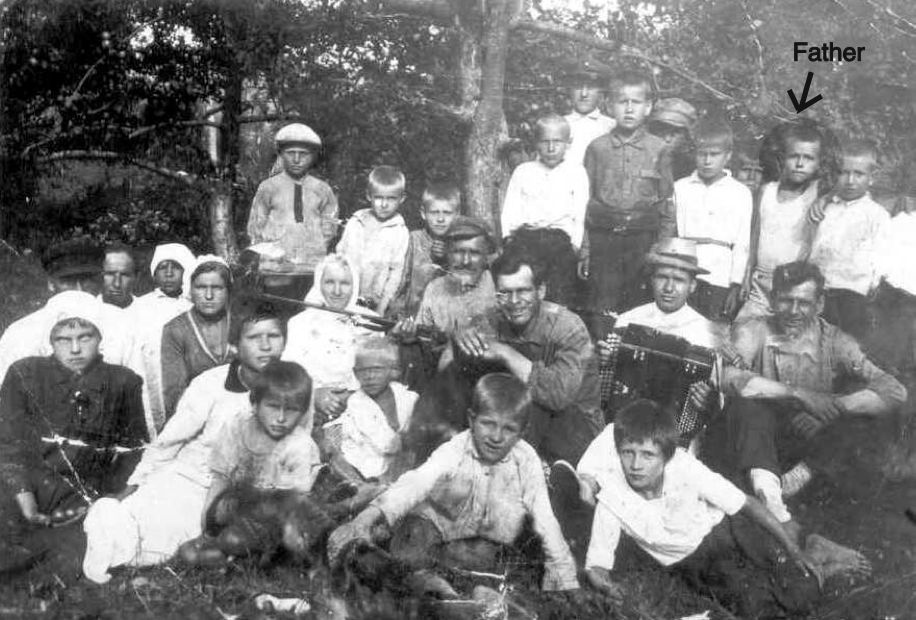
Photo taken in 1936, showing Dmitry Nikonorovich second from the right in the back row
Photo: Vladimir Gorodnjanski
-Вчера я задавал вам прочитать дома и запомнить маленький рассказ из Книги для Чтения. Проня, прочитай нам этот рассказ, - говорит учитель.
-Проня, не спеша, поднимается, низко наклоняет голову, прячет глаза от учителя и от класса, и молчит. Учитель ждет. Проходит минута, другая, но Проня молчит.
- Ну что, Проня? Будешь читать? - спрашивает учитель. В ответ молчание, да хихиканье на задних партах. Проня стоит, переминаясь с ноги на ногу, низко наклонив голову, и молчит. Видно как он переживает, как ему стыдно, но читать то ли не умеет, то ли не хочет. Ему бы в 5-ом классе надо быть, а он все еще в 3-ем. Кое-как с великим трудом он закончил четыре класса нашей начальной Крамаревской сельской школы. Дальше он не учился. Хотя, по-моему, не так уж и глуп был.
Я стал учиться дальше в другой, уже Неполной Средней Школе, в Рудаевке - соседнем селе. С Пронькой как- то я больше не сталкивался: жил он на другом краю села, работал с началом войны в другой колхозной бригаде. Знаю только, что в 1943-ем году был призван в армию, воевал. В следующем году был призван в армию и я. Долго служил, в Крамаревку больше не вернулся, обосновался на постоянное жительство в Эстонии.
Прошел не один десяток лет. В Крамаревку я не наведывался, из родственников там давно уже никого не было, да и само село исчезло, ушло в небытие. Сельчане разъехались жить в соседние села. Многие переехали в Рудаевку, где когда-то пришлось мне учиться в школе. Но вот однажды я получил письмо от сестры Вали. Она приглашала приехать на свадьбу ее дочери Лены. Жила же Валя недалеко от Рудаевки, где и предстояло играть свадьбу. Жених был Рудаевский.
Мы с Машей, моей супругой, собрались, и вскоре были у Вали, а потом и в Рудаевке. Там остановились у родителей жениха, где нам отвели небольшую комнатку. В ожидании торжеств, я прогулялся по селу. О, как много всего изменилось за эти долгие годы. Ни одного знакомого лица; той школы, где я учился, нет и в помине: на ее месте пустырь. Даже деревья выросли другие.
На столе в нашей комнате лежала стопка газет. Это, оказалось, была районная газета «Сельская Новь». Я заинтересовался и стал просматривать газеты. В одном из номеров мое внимание привлекла большая хвалебная статья о некоем жителе села Рудаевки, трактористе Крамареве Прокофии Ивановиче.
В статье говорилось, что Прокофий Иванович гордость не только села, но и всего района: он честный труженик, перевыполняет нормы выработки, пример для всех в быту, он ветеран Великой Отечественной Войны. Приводилось еще много положительных примеров из его жизни и работы.
У меня мелькнула мысль: а не тот ли это Проня, с кем когда то я сидел в одном классе, и который никак не мог научиться читать. Но тут начались свадебные торжества, и эта мысль куда-то улетела.
Свадьбу подготовили знатную. Собралось более ста человек. Во дворе натянули огромный тент, под ним расставили столы, скамейки, стулья. Несмотря на летнюю жару, под тентом было прохладно. Дождь также был не страшен.
Все сели по местам, начались поздравления молодых, крики «Горько!», Свадьба набирала обороты. В какой-то момент баянист заиграл веселую плясовую. На середину вышел мужчина уже в годах, но видать еще крепкий. Брюки заправлены в начищенные до блеска сапоги, пиджак с орденом "Отечественная Война" расстегнут. Под задорную музыку баяна он пустился в пляс. Видно было, что это умелый, опытный танцор. Вся свадьба с интересом смотрела и подбадривала его, а он выбивал такую дробь, выкидывал такие коленца, что залюбуешься. Казалось, пляшет не пожилой мужчина, а молодой парень.
Я спросил у сидевшего рядом местного мужчину: «Кто это пляшет?»
-О, Это наша знаменитость! Это Прокофий Иванович - ответил он.
- А он здешний? - спрашиваю.
- Да, здешний, но раньше жил в Крамаревке. Все стало ясно. На моих глазах так лихо отплясывал тот самый Пронька Крамарев.
После войны под Кенигсбергом
Конец лета 1946 года. Восточная Пруссия. Я служил в танковом полку в пригороде Кенигсберга, тогда еще не переименованного в город Калининград.
Наш полк располагался на месте бывшего немецкого тоже танкового полка. Мы жили в бывших, хорошо обустроенных немецких казармах. Рядом с расположением полка был дачный поселок, в котором жили еще не переселившиеся в Германскую Демократическую Республику немцы.
В выходные дни, в свободное от занятий время, мы могли свободно побродить по поселку, полюбоваться домами, садами, огородами. Да, ими можно было именно любоваться. Дома – красивые коттеджи, аккуратно и добротно построенные. Ухоженные сады и огороды, правда, на необитаемых участках уже заросшие бурьяном.
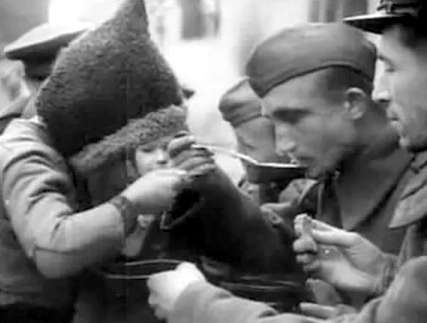
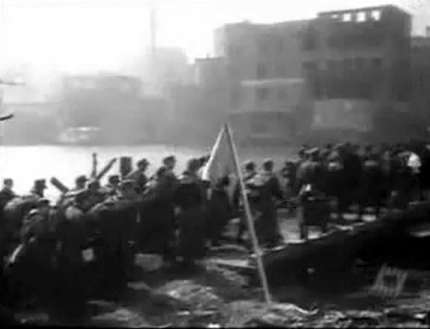
Königsberg 1945
Photos: From the film "Assault of East Prussia"
Оставшиеся немцы жили бедно. Германия после поражения бедствовала. Жители нашего соседнего поселка также переживали трудное время, голодали. Их дети приходили к нашей полковой столовой и копались в баках с кухонными отбросами. Улицы поселка были безлюдны: люди предпочитали больше сидеть по домам.
В одно из воскресений я ушел из расположения и бродил по поселку. Обратил внимание на то, что поселок пуст: нигде не видно ни одного человека. Не спеша проходя по улице вглубь поселка, я услышал издалека доносившиеся взрывы хохота многих людей, приглушенные расстоянием. Меня это заинтересовало, и я пошел туда, откуда слышался хохот. Он становился все слышнее.
Повернув за угол дома и выйдя на другую улицу, я увидел необычную картину: на сравнительно небольшой площадке между домами шло какое-то представление. На сооруженном из досок помосте прохаживался, что-то говоря и жестикулируя руками, прилично одетый человек, по всей видимости, эстрадный артист. Перед помостом располагалась публика, (человек 100), похоже, местная из близлежащих домов. Сидели они на стульях и скамейках, принесенных из дома.
Я, конечно, не понимал, что говорит человек, но был поражен тем, как реагирует публика. Один за другим сотрясали воздух взрывы хохота. Люди покатывались от смеха. Я такого дружного, заразительного хохота вместе стольких людей никогда, ни до этого, ни после, не слышал.
Под влиянием увиденного и услышанного я возвращался в часть и думал: что можно такое рассказывать, чтобы люди так смеялись? И еще занимала мысль о том, что, оказывается, жизнь в поселке не так уж мертва. После разгрома, когда вся страна их лежала еще в руинах, когда всего год прошел, как закончилась война и голод царствовал в стране, люди жили не предаваясь унынию, смеялись, несмотря на то, что рядом, на их земле находилась чужая армия. Похоже, поражение в войне их не тяготило, они радовались тому, что нет войны и нет смертей.
After the war in Königsberg
At the end of summer of 1946 I served in a tank regiment in Königsberg, East Prussia, not yet renamed the city of Kaliningrad.Our regiment bunked down in the same building as did a former German tank regiment. We lived in the well equipped German barracks. Nearby another part of the regiment was settled in the country, in which the Germans who had not yet moved to the German Democratic Republic lived.
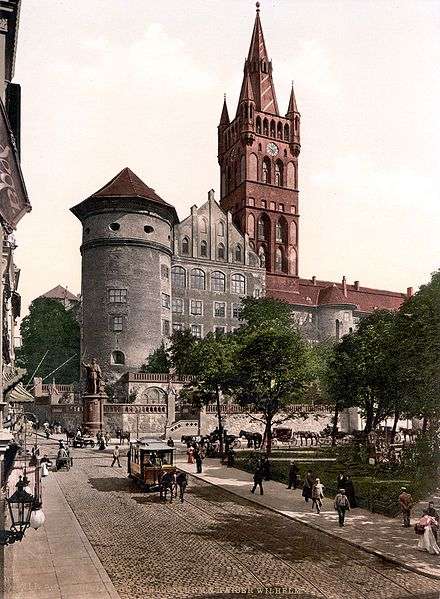
Königsberg Castle tower and Emperor William's Monument, Königsberg, Kaliningrad, Russia
Photo: Photochrom print (color photo lithograph), between 1890 and 1905, public domain
Source: Reproduction number: LC-DIG-ppmsca-00735 from Library of Congress, Prints and Photographs Division, Photochrom Prints Collection
In my days off, during free time, we could wander freely through the settlement, admiring the houses, flower gardens, and kitchen gardens. Yes, they could be admired. The Houses - beautiful cottages, well and soundly constructed. Amongst the well-groomed gardens and kitchen gardens, on uninhabited sites, already tall weeds had invaded.
The remaining Germans lived poorly. Germany after defeat lived in misery. Inhabitants of the neighbouring town also experienced a hard time, and some were starving. Their children came to our regimental dining room and looked through the tubs of kitchen waste. The streets of the town were deserted. people preferred to stay at home.
One Sunday I left the barracks and wandered through the town. I noticed that the settlement was empty, there was no one anywhere. Slowly passing along the street, deep into the town, I heard from a distance muffled explosions of a laughter of many people. It interested me, and I went towards the sound of laughter. It became clearer.
After turning the corner of a house and coming out onto another street, I saw an unusual picture. On a rather small platform between the houses on a stage strolled, sometimes speaking and gesticulating with his hands, a well dressed person, most likely an actor. Before the stage about a hundred people from nearby houses were arranged, sitting on chairs and benches brought from the homes.
Certainly I did not understand what the man was saying, but I was astounded with the way the audience reacted. Explosions of laughter shook the air, people rocked with laughter. I had never heard such harmonious, contagious laughter from so many people all at once, neither before nor after.
After seeing and hearing this, I stepped back a bit and thought: "How is it possible that people laugh so much? Yet I was interested in the idea that it appeared that life in the occupied town was not dead after all. After a time when all the country around was laid in ruins, and a year had passed in which war and famine had reigned throughout the country, people not bowed down with despondency laughed, although their land had been occupied by an enemy army. Also, defeat in war did not weigh on them, they were pleased that there was no war and no death.
Восточная Пруссия
Ночью, когда все уже спали, поезд остановился на какой-то станции. Рано утром, когда еще не рассвело, и первые проснувшиеся стали выходить из вагонов по нужде, прямо перед нашим вагоном на газоне увидели мертвого солдата, нам незнакомого. Он лежал на спине, раскинув руки; череп и лицо его были разрублены, видно, сильным ударом топора. Убит он был ночью, когда мы все спали.
Место, где остановился ночью наш поезд, было уже в Германии. Это был немецкий город Инстенбург. Хотя война кончилась еще в мае, здесь еще убивали наших солдат. Враг был рядом. Так встретила нас Германия, чужая, враждебная нам страна, с которой мы воевали долгих четыре года. Думал ли я тогда, в 1942-ом году, когда немецкие солдаты, такие бодрые, веселые, победителями ворвались в наше село и стали хозяйничать, думал ли я тогда,что, как солдат Красной Армии, как победитель, буду шагать по их дорогам , по их полям.
Очень разбирало любопытство: хотелось увидеть эту Германию, но была лишь возможность окинуть взглядом близлежащие дома, немного побродить по вокзалу, набитым множеством людей - это были люди, возвращавшиеся в Россию из немецкой неволи, куда были угнаны немцами на принудительные работы.
Одного лишь беглого взгляда на город было достаточно для того, чтобы увидеть его непохожесть на наши российские города. Крыши из красной черепицы, куда ни глянь. Итак, мы, молодые советские солдаты, прибыли в Германию, чтобы заменить своих старших солдат, уходивших, после Победы, домой.
Здесь, в Инстенбурге, наш эшелон начали расформировывать. Часть солдат оставили в городе, с остальными эшелон ушел дальше, до следующей станции. Оттуда мы, разными колоннами, двинулись пешком в разных направлениях, В нашей колонне насчитывалось около ста человек.
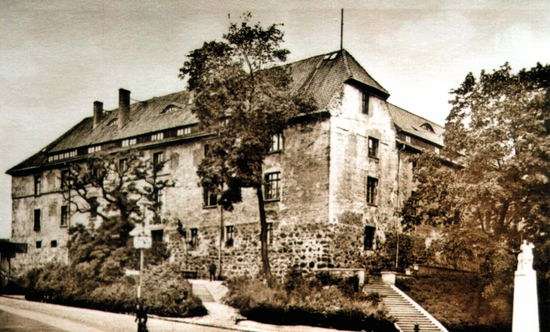
«Замок Инстербург»
В черте города расположены два замка тевтонского периода, что делает Черняховск уникальным городом Российской Федерации.
«Замок Инстербург» – памятник федерального значения. Основан в 1336 году по приказу великого магистра Тевтонского ордена Дитриха фон Альтенбургского. Построенная крепость сначала была деревянным сооружением и только в 1380 году она стала каменной. Она служила форпостом ордена для борьбы с Литвой. Пережила несколько пожаров, но как феникс возрождалась из пепла и становилась более мощной. Восточный форпост неоднократно посещался знатными гостями (можно упомянуть графа Дерби – будущего короля Англии Генриха IV (1390), шведскую королеву Марию-Элеонору – принцессу Бранденбургскую, вдову шведского короля Густава Адольфа (1643), польского короля Чарторыжского (1704) и т.д.). После секуляризации ордена замок был превращен в резиденцию Главного Управления округа Инстербург. До конца Второй Мировой войны в цитадели замка располагался музей краеведения Инстербургского Общества древностей.
Photo and text: http://www.chernyahovsk.su/index.php?subcat=149
Шли в темноте, накрапывал дождь, шинели отсырели, и от них шел пар. Начало светать, дождь прекратился, рассеялись облака, взошло солнце и осветило местность, по которой мы шли. Все с интересом смотрели по сторонам, разглядывая немецкие пейзажи. Местность была ровная, без холмов, по сторонам простирались неубранные, не вспаханные поля. Вдали, изредка, открывались взору какие-то постройки, крытые красной черепицей. Изредка встречались перелески. Показались впереди идущие нам навстречу многочисленные колоны, вернее толпы, женщин, молодых девчат и парней - это добирались домой, в Россию, бывшие в рабстве у немцев, люди.
К вечеру вошли в какой-то лес, вернее не лес, а парк. Уж очень чисто там было для леса: никаких лишних зарослей, завалов, сухих деревьев - ничего этого не было: все было ухожено, расчищено. Среди деревьев расположены какие-то постройки. В окружении одноэтажных домиков высился обширный, двух этажный дом с какими-то башенками, пристройками. Своей архитектурой он был похож на маленький средневековый замок. Немного в стороне располагалась конюшня, каких до этого я нигде не видел. Как выяснилось позже, это было имение одного богатого бюргера, который бежал на запад при приближении Красной Армии. Разбитые пианино, валявшиеся во дворе, разбитые дорогие кресла, шкафы и прочая домашняя утварь говорили о том, что жили здесь не бедные люди. Комнаты, оклеенные красивейшими, дорогими обоями, потолки с лепными узорами, изразцовые печи, красоты изумительной. Но кругом разгром, развал. В этом имении нас и расквартировали.
Навели порядок в жилых помещениях, убрали территорию, в конюшне появились лошади, предназначенные для артиллерийских упряжек. Наша служба продолжилась снова в артиллерии на конной тяге.
East Prussia
At night when everyone was asleep, the train stopped at an anonymous station. We slumbered on. Early in the morning, before dawn, the first soldiers woke and began to leave the carriage to relieve themselves. Directly in front of our car on a lawn was a dead soldier, unfamiliar to us. He lay on his back, his hands stretched out. The skull and the face were split open, obviously by an axe. He had been killed at night while all of us slept.
The place where we stopped during the night was the German city of Insterburg. Though war was terminated in May, here our soldiers were still being killed. The enemy was near. Thus we had arrived in Germany, the country we had fought for four long years. I did not think, in 1942, when German soldiers, such vigorous, cheerful, victors, rushed into our village and began to take over, that, I as a soldier of the Red Army, would walk on their roads and on their fields as the victor.
My curiosity was mixed: it would be good to see this Germany, but there was only an opportunity to look at nearby houses, to wander about a little on the station, the platform filled by people who were going back to Russia from German bondage after having been kidnapped by the Germans to do forced hard labour.
Only one fleeting glance at the city was enough to see its dissimilarity on our Russian cities. Red tiled roofs wherever you looked. So, we, young Soviet soldiers, arrived in Germany to replace the senior soldiers leaving, after the Victory, going home.
Here, in Insterburg, our echelon started to disband. Part of the soldiers were left in city, with the others sent to the following station. Therefore we, in different columns, moved on foot in different directions. In our column there were a about a hundred men.
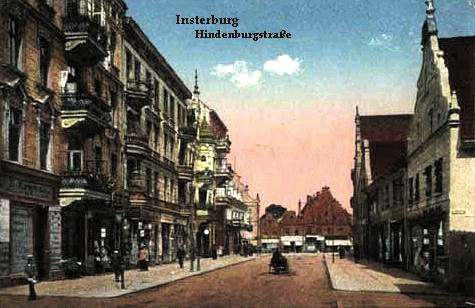
Insterburg, about 1890 from a postcard sent in 1899.
Insterburg is now Chernyakhovsk, Черняхо́вск. As part of the northern part of East Prussia, Insterburg was transferred from Germany to the Soviet Union after the war as previously agreed between the victorious powers at the Potsdam Conference. The German population was either evacuated or expelled and replaced with Russians. In 1946 Insterburg was renamed Chernyakhovsk in honor of the Soviet World War II General of the army Ivan Chernyakhovsky, who was killed in the Battle of Königsberg.
Photo: Wikimedia Commons, public domain.
Text: Wikipedia
At evening we came to a wood, more like a park than anything else. It was very clean for a wood. There were no superfluous thickets of saplings, nothing to block passage through the wood, no dead trees. Everything was well-groomed, neat and tidy.
Amongst the trees were located constructions. Amongst mostly one storied small houses there was a two floored house with turrets and other vertical structures. The architecture was similar to a small medieval building. A little house to the side was such a stable as I had never seen before. As we found out later, it was the manor of a rich burgher who had fled at the approach of the Red Army.
The broken pianos lying around in the court yard, the broken expensive armchairs, beautiful cabinets and other domestic utensils told us that no poor people had lived here. The walls of the rooms had been papered with the most beautiful, expensive wall paper, ceilings with carved patterns, tiled furnaces, amazing beauty. But all around was chaos and disorder. In this manor we were billeted.
Having put things in order in the premises, and cleaned the area around the house, we put the horses intended for the artillery teams into the stable. Our army once more used horses as draft animals for artillery.
Chickens
Photo: http://www.fi.muni.cz/~qdvorak1/HTML/worksheet9.htm
In June - July the days are usually hot and stuffy, the sun scorches mercilessly and it is possible to hide from the heat only in the house in the afternoon, outside is too hot. On the contrary, in the evening the house is close, but it is much better in the street.
After sunset the heat lessens, the air freshens, and one begins to breathe easily. It is silent there is not even any wind - even on an aspen that grows behind a shed, the leaves do not tremble. From the closeness of the house there is rescue only in the street. On nights such as this which are silent and warm, the whole family sleeps outside under the stars.
Photo taken in 1936, showing Dmitry Nikonorovich second from the right in the back row
Photo: Vladimir Gorodnjanski
On the ground, near a wall of the house, on part of a garden, my father spread fresh hay for a bed. The hay was covered with bedsheets, blankets, pillows, everything, and all except for grandmother who slept in the house, were put to bed in the open air.
Near to our sleeping area outside pink bushes blossomed, exhaling a wonderful smell, and from the fresh hay came the fragrant smell of grasses. Even now I cannot encounter this smell indifferently.
Once, I woke up before everyone else. The sun had not yet risen above the cherry trees, and all around was still shadowed with the end of the night. All still slept. Nearby our bed on a court yard went, clucking, a broody hen with small, still fluffy chickens.
I got out of bed and caught a chicken, and, having caught it, took it into my head to baptise him in water that was in a barrel under a drainpipe. I do not know, how long a time I bathed him, but when he, having suffered much with the water, was already half-dead, I threw him away and caught another, and this one too was "baptised". Thus some chickens were ruined. The brood hen was disturbed, and began to make loud clucking noises, and from this noise my mother woke up. Having seen what I have done, she sighed and firmly flogged me.
Therefore those fertile summer nights in the open air, an adventure with chickens and, certainly, my mother are remembered fondly by me.
Цыплята
Дом в Крамаревке. В нем была наша квартира, там была
начальная школа; там я родился, учился в школе, там прошло
моё детство.
Our house in Kramarevka. It housed the local elementary school, as well as our apartment. I was born there, went to school there, and there I passed
my childhood.
В июне-июле стоят обычно жаркие, душные дни, солнце палит нещадно и от жары днем можно спрятаться только в доме. Вечером - наоборот: в доме духота, а на улице благодать. После захода солнца жара спадает, воздух свежеет, дышать становится легко. Тихо, ветра нет: даже на осине, что растет за сараем, листья не трепещутся. От духоты в доме спасение только на улице. Ночи в эту пору тихие, теплые, и мы всей семьей ночью спим на улице под открытым небом.
На земле, у стены дома, со стороны сада, отец расстилал свежее сено для постели. Сено накрывали простынями, одеялами, клали подушки, и все, кроме бабушки, которая спала в доме, укладывались спать под открытым небом.
Рядом с нашим ложем цвели розовые кусты, источал запах любисток, от свежего сена исходил душистый запах трав. Этот запах я и до сих пор не могу переносить равнодушно.
Однажды я проснулся раньше всех. Солнце еще не поднялось выше вишневых деревьев, от всех предметов тянулись длинные тени. Все еще спали. Неподалеку от нашей постели по двору ходила, квохча, наседка с маленькими, еще пушистыми цыплятами.
Я вылез из постели и принялся ловить цыпленка, а, поймав, мне вздумалось выкупать его в воде, что была в баке под водосточной трубой. Не знаю, как долго я его купал, но когда он, нахлебавшись воды, был уже полуживой, я его бросил и поймал другого, и тоже «выкупал». Таким образом загубил несколько цыплят. Наседка растревожилась, начала громко квохтать, и от этого шума проснулась мать. Увидев, что я натворил, она ахнула и крепенько меня отлупила.
Потому и запомнились мне те благодатные летние ночи под открытым небом, случай с цыплятами и, конечно, сама мама.
Photo: Vladimir Gorodnjanski
The Books

It gets dark early in the winter. The pupils had dispersed to their homes from school after lessons, and the school watchman, a hard of hearing, reticent old man with a big beard, had kept a solid-fuel stove alight during the day for warmth for the children in the classrooms of the school building which we lived in.
He now sat in the darkness before the stove, waiting while the last embers burnt before closing the damper in the chimney.
We children listened as always to his songs, which he crooned to himself under his breath, sitting before the stove lost in reflection looking at the embers, stirring the coal slowly with a poker.
We stole from the kitchen, and silently made our way through a dark classroom into the vestibule where the old man sat, and hid ourselves to listen to his songs.
Having finished the work, he closed the damper, and we escaped back to our living quarters.
It was already late, but mother was still not home. She had left in the early morning for a Department of National Education meeting.
Father sat at a table and wrote by the light of a kerosene lamp, and Lucy and I played. Little Lena and Grandmother were already asleep.
But suddenly in the hall there was the jingle of keys and turning of locks, a snatch of conversation, and into the room came mother and the driver who had taken her to the meeting and had now brought her home. Mother was wrapped up in a shawl, and the driver had his big moustaches and eyebrows covered in hoarfrost, with big mittens tucked into his belt.
He and mother had in their hands a big parcel of books, which mother had brought back for the school library. The driver left, father helped mother to take off her coat and mittens, and Lucy and I started to untie the books.
And there on the floor sat, smelling of frost and book ink, a big heap of newcomers to the house - children's books!
Oh my God! What pleasure! Lucy and I snatched up the books and looked, and looked, and looked. We were both able to read by that time.
How many interesting pictures! How many wonderful new stories and fairy tales we had to read through!
We were ready to sit with the books until morning, but it was already late, and we were put to bed. I fell asleep in anticipation of the pleasures to come the next day in reading the books.
Photo: www.rusbook.net
Книжки

Зимой темнеет рано. Уже разошлись из школы ученики после уроков и школьный сторож, глуховатый, неразговорчивый дед с большой бородой, протопил печку в прихожей между классами и теперь сидит в темноте перед печкой, дожидаясь, пока прогорят последние головешки, чтобы закрыть трубу. Уже мы, дети, послушали его песни, которые он обычно мурлычет себе под нос, сидя перед печкой в отблесках последних огоньков, помешивая кочережкой уголья. Для этого мы из кухни тихо пробирались через темный класс в прихожую, где сидел дед и, затаившись, слушали его песни.
Протопив печку, он закрывал трубу, а мы убегали к себе в комнату.
Уже поздно, но мамы все еще нет дома. Она утром рано уехала в район, в отдел народного образования по делам школы.
Отец сидит за столом и пишет при свете керосиновой лампы, а мы с Люсей во что-то играем. Маленькая Лена и бабушка уже спят.
Но вот в сенях слышно звяканье щеколды, какие-то разговоры и в комнату входят мама и возница, который возил ее в район. Мама закутана в шаль, у возницы усы и брови в инее, за поясом большие рукавицы. У него и у мамы в руках большие связки книг, - это мама привезла их для школьной библиотеки. Возница уходит, отец помогает маме раздеться, а мы с Люсей пытаемся развязать книги.
И вот на полу высится большая куча новеньких, пахнущих морозом и типографской краской, в основном детских книжек.
О, господи! Какая радость! Мы с Люсей набрасываемся на эти книжки и смотрим, смотрим, смотрим. Сколько интересных картинок! Сколько новых рассказов и сказок предстоит прочитать. Мы до утра готовы сидеть с этими книжками, но уже поздно - нас укладывают спать. Я засыпаю в предвкушении удовольствия назавтра заняться книжками. Читать я в то время уже умел.
фотография: www.rusbook.net
The Beggar Woman
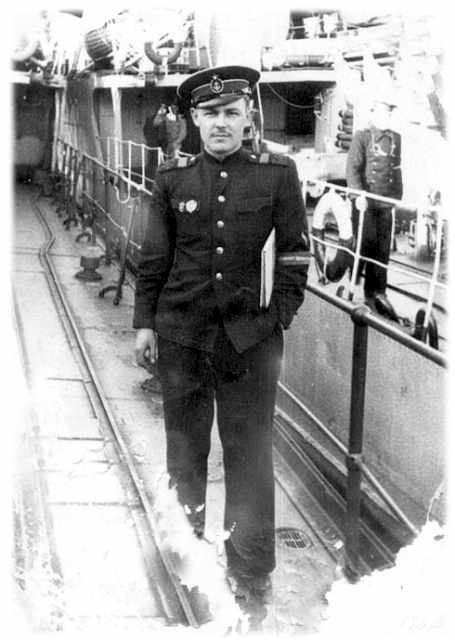
There once was a beggar woman, Побирушка or Pobirushka as we called her. She seemed to me to be about forty years old. She lived in a развалюшке (dilapidated house) with peeling walls, a leaking straw roof and windows stopped up with cloths instead of glass.
We called her Mavra. She was, as they say, not herself. She was strange.
In the kitchen garden she had a hill of ashes which she cleaned out from her stove and poured out always on the one place. At certain times she ascended this little hill and began a speech which sometimes continued for an hour. Once, being in Rudajevka at aunt Olja's home, I heard her performance.
She gave her speeches usually towards evening. In the pre-evening silence on all the village, in the most distant nook, her speech was heard. She shouted loudly, abused, cursed the collective-farm and regional heads, and the Soviet authority. The authorities did not touch her. There she was regarded as strange, they had got used to her performances and did not pay them any attention.
She did not work at all - she fed herself by asking for alms, going to neighboring villages in turn.
That ill-starred day she passed by our village. We boys used to play games on the road near the school. In the deserted street the Mavra woman appeared in the distance. Carrying a stick with which she beat off the rural dogs, and dressed as usual in rags, she silently came near us.
We, for some reason, whenever we caught sight of the old woman Mavra, always started to tease her. We went behind her a little and shouted:
- Mavra! Baba Mavra!
And the baba woman Mavra raised a stick to us and roughly swore. We ran away laughing, and then again started to tease her.
So it was at this time, and I do not know why, I took it in my head to take from the ground a pebble and to fling it at the woman. Although I was only small, the force has sufficient, that the pebble not only reached the woman Mavra but got her in the head. She howled with pain, and I, having got a fright, escaped home.
At home I hid under the bed and waited with horror, until the end of this should come.
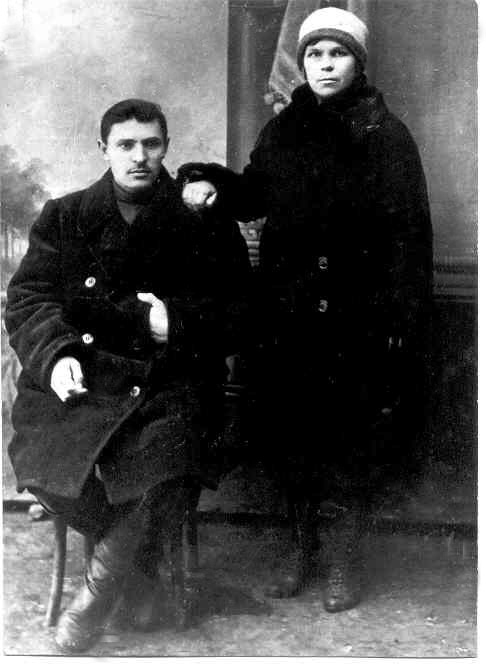
My parents: Gorodnyanskiy Nikanor Afanas'evich 1896-1956
Gorodnyanskaya Xenia Potapovna 1891 - 1935
Picture from the nineteen thirties.
Мои родители: Городнянский Никанор Афанасьевич
1896-1956гг
Городнянская Ксения Потаповна 1891- 1935гг
Снимок тридцатых годов 20-ого столетия.
The woman Mavra went from us to the village square to complain about me. She knew my mother. When in our village my mother always talked to her, and, when they met, they often talked a long time. Mother looked on her favourably and always presented her with generous alms.
From my refuge under the bed to me something was audible as in a loud voice the woman Mavra spoke to my mother, and my mother only sighed and repeated: "Yes, then what! Yes, then what!"
This did not foretell anything good to me, for her voice was loud and angry, : "Mitja! Come here immediately!" I did not respond, hoping that she would not find me. But mother rather quickly found me, as she knew where I usually hide from the doctor when he comes to school to inject the children.
She pulled me out like a kitten from under the bed, and in a court yard, with the woman Mavra, gave to me a terrible, well - remembered punishment. She found a thin stick, pulled down my pants and hit me, hurting my bottom very much.
I shouted loudly from the pain, but mother, probably had decided to dissuade me from bad acts once and for all. She was very much afraid that I would become a hooligan. After a time I began to understand it, and the bad feeling towards my mother for that beating has passed.
But at that time ..., after the beating, humiliated and crushed morally and physically, being filled with tears, I went to a garden behind the school where in a corner, the fence had thickets of high, huge and dense burdocks. On all fours I climbed in the area, and lay on the ground face down and, still sobbing, have given in to the feeling of the insult. I wanted to appear dead - not for ever, certainly. I was hoping, that mother would shout above my corpse, tearing her hair and appealing to the sky: "My God! Why did I beat him? Forgive me, My God! Forgive!"
The dream crept on me imperceptibly - I fell asleep. A rustle woke me. It was a hen, cackling, making her way past me in the thickets of burdocks. Near me she sat on the ground and became silent. I crept up to her, drove her from the place and saw that where she sat, in a small hollow in the ground, there were fifteen eggs. I collected them all in the hem of my shirt and brought them home. Mother was washing the floor of the room. Not approaching too close to her, I showed her the find.
- Bring them here, - my mother said, being surprised.
- And you will not beat me? - I asked plaintively.
- Not at present, no.
The eggs were addled, rotten and unusable, and my mother ordered me to throw them somewhere far away. But it is not possible to throw such things out simply!
I took the eggs to my friend Fed'ka, living near me in the neighbourhood. Having shared them between ourselves, we left the rural street, and went onto the main road, and started to compete who could throw an egg the farthest.
Just then, along the street came in our direction, Fed'ka's older brother, with a friend. Not approaching us very close, they stopped, and Fed'ka's older brother said "Well, who can throw closest to us?"
I wanted very much to throw so far, and threw an egg with all my strength. The egg not only reached him, it broke on his chest, covering his white shirt, his neck and chin.
"Oh, you skunk!" cried Fed'ka's older brother; and rushed at me.
For the second time that day I was very frightened, and rushed again to escape. First to a court yard, then through a kitchen garden, climbed over a fence, and then gave him the slip in another garden.
That day, so full of events, I remember still.
The Rubber Ball

During that time long ago none of the children in the village had a rubber ball. Rubber balls are now common, but it was then for us something special, unobtainable. They only appeared when I was older.
Instead, we made balls of cloth. We rolled up scraps, wound and fastened them with string and played. The ball did not jump up, nor did it bounce from a wall, but we played and dreamed to have a true rubber, inflated ball.
I remember one day we children were all at home, in the room. Suddenly, my mother was at the door. She was hiding something from us behind her back and, smiling, asked:
- Guess what I have brought you?
We could not guess, and silently we looked at her. Then she lifted a dark blue, true rubber ball above her head and threw it forcefully to the floor. The ball jumped up to the ceiling, bounced across the room and, at last, rolled under a bed.
We stood stunned for some seconds, and then with shouts of delight we climbed under the bed, got the ball from under it, and thought the presence of the ball was an unprecedented miracle, and there were no children on earth happier than we.
And my mother coming to the door, and throwing the ball, will remain in my memory for ever.
Photo: www.arcadeshop.com/parts.htm
The Plane
The Polikarpov I-5, first built in 1930, the main equipment of Soviet fighter units until 1936.
Photo source: http://avia.russian.ee/air/russia/pol_i-5.php
Being small, I raved about planes. If I saw only a picture, I dreamed about them at night.
In dreams I often flew, without a plane or wings. In my dreams, I even climbed up trees or our house, and jumped, waving my hands, and flew. Sometimes I climbed so high, the details on the ground were hardly visible.
Up to the age of six, probably, I never saw a plane. However once in winter, I remember, a blizzard raged outside the windows. My father came home, if I remember correctly, from Rudaevka. He came into the house covered in snow, shook it off, and said:
"What weather! There is a whiteout. But behind the village of Wovchivka, not far away, a plane has landed in a field. The pilot has lost his way, and could not safely fly any further until he regained his bearings. "
I reacted as though I was burnt. I ran around the room, not knowing what to do. I seized a coat to run out of the house, but my parents stopped me, and I had to promise not to go out until the storm had passed.
But the storm showed no sign of easing. I watched out of a window, and with melancholy looked at the raging white haze, and nearly cried from disappointment, that it still continued.
The blizzard stopped that night while I slept soundly. When I woke up, I looked out the window, and immediately got ready to run to the field to look at the plane, but my father told me that the plane had already taken off.
Then I began to cry.
Some of the boys I knew lived at Wovchivka, and saw that plane. Ah, how I envied them!
Later I remember my mother leading me by the hand amongst a crowd of people somewhere. Probably it was in Boguchar at a market where we sometimes went when on a visit to my Aunt Lize. I was being dragged along unwillingly by my mother, when people started looking up into the sky and shouting something. Suddenly I heard from above an increasing, unclear rumble.
I lifted up my head and there it was, high in the clear sky, I saw something floating, like a plane. And suddenly I realised, that is what it was! My mother pulled at me, but I escaped from her grasp, and began to jump up and down, throwing a hand to the sky and shouting all the time like a madman:
"A plane! A plane!"
My mother said "be quiet, you, be silent! It is bad to shout like that!".
And passers-by looked not at the plane but at me, and smiled uncomprehending smiles. They truly did not understand the wonder of the plane flying.
Самолет

The Polikarpov I-5, first built in 1930, the main equipment of Soviet fighter units until 1936.
Photo source: http://avia.russian.ee/air/russia/pol_i-5.php
Будучи маленьким, я бредил самолетами. Виденные только на картинке, они мне снились часто по ночам. Во сне я сам, без самолета и крыльев, часто летал. Взобравшись на дерево или дом, я прыгал оттуда и, замахав руками, летел по воздуху. Иногда забирался так высоко, что землю внизу было еле видно.
Лет до шести, наверное, самолета я ни разу не видел. Однажды зимой, помню, несколько дней бесновалась за окном вьюга. Отец пришел домой, по-моему, из Рудаевки. Вошел в дом весь облепленный снегом и, отряхиваясь, промолвил:
- Ну и погодка. Белого света не видно. Там за селом, около Вовчивки, самолет сел на поле; летчик заблудился и дальше лететь не мог.
Меня словно обожгло; я забегал по комнате, не зная, что делать. Схватился за пальто, чтобы бежать в поле, но меня остановили, пообещав пойти туда, как только утихнет буря.
Буря все не утихала, я подходил к окну, с тоской смотрел на беснующуюся белую мглу и чуть не плакал от досады, что она не проходит.
Вьюга утихла ночью, когда я крепко спал. Проснувшись, я глянул в окно и, первым делом, засобирался бежать в поле смотреть самолет, но отец сказал, что самолет уже улетел. И тогда я заплакал.
Некоторые мальчишки, жившие на Вовчивке, видели тот самолет. Ах, как я им завидовал!
И вот однажды, помню, мать ведет меня за руку среди толпы людей по какой-то площади. Видимо, это было в Богучаре на базаре, куда мы, должно быть, в гости к тете Лизе приезжали. Я нехотя тащусь за матерью, перед глазами мельтешат о чем-то гомонящие люди. Вдруг я улавливаю идущий откуда-то сверху, все нарастающий непонятный гул. Поднял кверху голову и там высоко в чистом небе увидел что-то плывущее, похожее на самолет. И тут до меня дошло, что это же он и есть. Мать тянула меня, но я вырвался из ее руки, запрыгал на месте и, показывая в небо рукой, как сумасшедший начал орать на всю площадь:
- Самолет! Самолет!
- Тише, ты, тише! Нехорошо так кричать, - говорила мне мать, а прохожие смотрели не на самолет, а на меня и улыбались какими-то непонятными улыбками. Неужели они не понимали, что это же летит настоящий самолет?
1942
In the summer of 1942 on the collective farm fields, an infrequent good crop of wheat ripened. We prepared for harvesting, but it was going to be difficult. Few men remained on the farms, and every grain must be harvested without them.In an unexpected way, everything changed in a moment. The Germans started a big summer advance, hoping finally to defeat the Soviet Union.
Having broken through the front in the area of Kharkov and not meeting resistance, the Germans began moving east, deep into our country. The retreat of our armies turned to flight. It was impossible to hold in check the well equipped German military machine, and being afraid of becoming encircled, our army ran for safety.
On the highway, from Kantemirovka near Boguchar to the Don, our receding armies came in a never-ending stream. We watched from a hill, near a collective farm garden, this stream of machines and vehicles.
All day long above this stream floated German dive bombers.
They flew high as though on a peaceful mission, then turned their noses towards the ground, and with a howl the first came down with a deadly purpose, behind it a second, and a third.
All along the road fountains of dirt rose from the exploding bombs. It was hurtful to see this, understanding that in those columns of dust our soldiers were perishing.
It was annoying also that we made no response to these attacks. German pilots were unpunished in their terrible work, and our planes were nowhere to be seen.
Only once, in one of those sad days, we saw a German plane forced down behind a hillock, near a garden called "Kukuruznik" or "corner". The German pilot appeared and was captured. The Russian pilot who forced him down decided to land, for once having beaten a German.
Not switching off the engine, the pilot got out of the plane, looked around and saw us, and called to us "Which way is Kantemirovka?"
We showed him, and he climbed into the cabin, having asked us to turn the plane's tail around so that the plane faced in the direction we had indicated for Kantemirovka.
The plane ran along the ground, bouncing on the hummocks, and flew into the air, not climbing much, and veered away from the direction of Kantemirovka, and on the other side of a gorge landed near a corn field. We saw the pilot jump out of the plane and disappear into the corn, chased by a German plane. We did not see any more planes.
Fleeing the bombardment, single machines with Red Army men, vehicles, small groups of soldiers, even single men, left the stream of armies moving along the highway, turned off onto country roads, and independently hurried to the east, to the Don. In villages they stopped only to drink water.
We had no time to think about evacuation, as events proceeded so rapidly. The chairman of a collective farm disappeared from the village, the office ceased to exist, all collective farm facilities were thrown into chaos.
Cows, horses, pigs, sheep were without supervision and wandered at liberty in the fields, frequently being brought down by wolves. A collective farm apiary remained, but was not taken care of or harvested.
About then the Germans appeared. On that day, since the morning, cannon fire was heard from different directions, machine guns rumbled. The inhabitants stayed off the streets, hidden in houses, in cellars, waiting for something terrible to happen. Only we, the boys, did not want to be hidden, we wanted to see everything with our own eyes.
I came running to Mitka Kotljarov. In her courtyard other boys had already gathered. Mitka's house stood at the edge of the village near some barns. Behind the barns the fields immediately began. From this field, on a horse without saddle or stirrups, a horseman came galloping down the rural street.
It was a Red Army soldier without weapon or equipment. Lashing the horse with a belt from his uniform, from time to time looking back, he galloped the length of the street through the whole village and disappeared behind the hill.
As soon as the horseman disappeared, from behind the barns a group of Red Army soldiers in uniform came running, about fifteen men. Out of breath, wet from sweat and burnt by the sun, with rifles but without any other equipment, absolutely exhausted, they dropped to the ground in the shadow of the first house on the opposite side of the street. One of them, loudly swearing obscenities, said "Enough, we will go no further. We will not fight any more, come what may!"
They had not had time to recover when from behind the barns an unfamiliar machine burst out with a great clanking noise, a vehicle with tracks instead of back wheels. In the body of the machine enemy soldiers in helmets sat, with a machine gun on a rotating support with a gunner seated at the weapon.
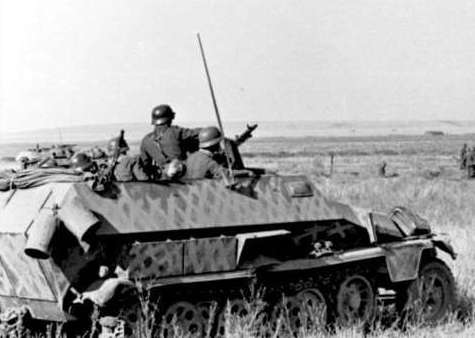
A German Half Track on the Russian steppes in August 1942.
Photo: Wikimedia Commons, Creative Commons Attribution-Share Alike 3.0 Germany
Behind the barns, on the road to Taly, there was now visible an escorted column of captured Red Army men. The soldiers from the group captured in the street joined that column also, and at that moment became prisoners of war. At this moment also, we became inhabitants of a temporarily occupied area of the Soviet Union.
For many years after, whenever filling in questionnaires at the entry to the Komsomol, for work, or for study, in the column for the question "have you lived in occupied territory?" we answered yes, and then the agency of state security asked whether you had cooperated with the Germans, and only after a careful check of the truth of your claim could the application be processed.
Stenka, the older sister of Mitka, who had been an adult for a long time, but was a перестарок, an old maid, a tractor driver and collective farm activist surprised and exasperated us all. Before the Germans had searched our soldiers she already had presented them with food. She left the courtyard, approached the commander and, having bowed, presented him with a loaf of bread and a big bowl full of eggs.
All my life I recall this act with disgust for her. Under the eyes of the unfortunate soldiers, for god knows how long they had not eaten or drunk, to so servilely bring comfort to the enemy - a more vile act it would be hard to imagine.
1942 год
В то лето на полях колхоза зрел богатый урожай, какой не часто бывает в наших краях. Готовились к уборке. Она предстояла быть трудной: мужчин осталось мало - все до зернышка предстояло убрать без них.
И вдруг неожиданно, все вмиг изменилось. Немцы начали свое большое летнее (1942 года) наступление, надеясь в это лето окончательно свалить Советский Союз. Прорвав фронт где-то в районе Харькова и не встречая сопротивления, они начали стремительное продвижение на восток, вглубь нашей страны. Отступление наших войск превратилось в бегство. Не в силах сдерживать натиск хорошо оснащенной военной армады, боясь попасть в окружение, они бежали в прямом смысле слова.
По большаку, ведущему из Кантемировки в Богучар, к Дону потянулись нескончаемым потоком наши отступающие войска. С холма, что возле колхозного сада, виден этот поток: можно различить машины, повозки. С утра до вечера над этим потоком волнами проплывают немецкие пикирующие бомбардировщики. Летят высокой, как будто мирно, но вот, наклонив нос под углом к земле, с воем пошел вниз на цель первый, за ним второй, третий… Вдоль дороги поднимаются фонтаны от разрывов бомб. Больно было видеть это сознавая, что в тех разрывах гибнут наши солдаты. Досадно было от того, что так спокойно, безнаказанно выполняли немецкие летчики свою страшную работу. Наших самолетов нигде не было видно. Только один раз, в один из тех печальных дней, вынырнув из-за пригорка, возле сада приземлился наш «кукурузник». За ним, оказывается, охотился немецкий летчик. Наш летчик, спасаясь, решил приземлиться, на время оторвавшись от немца. Не выключая двигателя, летчик вылез из самолета, огляделся вокруг и, увидев нас, знаками позвал к себе.
- В какой стороне Кантемировка? - спросил он.
Мы ему показали, и он залез в кабину, попросив развернуть самолет за хвост в указанном нами направлении. Самолет пробежал немного по земле, подпрыгивая на кочках, взлетел и, не набирая высоты, полетел в сторону Кантемировки, но на другой стороне балки, через которую перелетел, снова приземлился возле кукурузного поля. Мы видели, как летчик выскочил из самолета и бегом скрылся в кукурузе, спасаясь от снова появившегося немецкого самолета. Других наших самолетов мы тогда не видели.
Не выдержав бомбежки, отдельные машины с красноармейцами, повозки, небольшой группы бойцов, а то и одиночки, отрывались от основного потока войск, двигавшегося по большаку, сворачивали на проселочные дороги и самостоятельно спешили на восток, к Дону. В селах останавливались лишь напиться воды. Об эвакуации в этот раз и подумать не успели - так стремительно развивались события. Председатель колхоза куда-то исчез из села, контора перестала существовать, все колхозное хозяйство было брошено на произвол судьбы Коровы, лошади, свиньи, овцы остались без присмотра и бродили по полям, часто становясь добычей волков. Осталась без присмотра и колхозная пасека.
Вот-вот должны были появиться немцы. В тот день с утра были слышны откуда-то издалека орудийные выстрелы, глухо тарахтели пулеметы. Жители на улицах не показывались, прятались в домах, в погребах, ждали чего-то страшного. Только мы, пацаны, не хотели прятаться, хотели все видеть своими глазами. Я прибежал к Митьке Котлярову. Во дворе у него уже толкались без дела другие пацаны. Митькин дом стоял на самом краю села у амбаров. За амбарами сразу начиналось поле. С этого поля, из-за амбаров, верхом на лошади без седла и стремян, вылетел галопом на деревенскую улицу всадник. Это был красноармеец без оружия и всякого снаряжения. Стегая лошадь ремнем от гимнастерки, временами оглядываясь назад, он проскакал по улице через все село и скрылся за горой.
Не успел скрыться всадник, как из-за амбаров появилась бегущая группа красноармейцев из пятнадцати человек. Запыхавшиеся, в мокрых от пота и выгоревших на солнце гимнастерках, с винтовками и без всякого снаряжения, видимо до предела уставшие, они попадали на землю в тени у первого же дома на противоположной стороне улицы. Один из них, громко выругавшись матом, сказал: «Все, дальше не пойдем - сил больше нет. Будь что будет!»
Не успели они отдышаться, как из-за амбаров выскочила, лязгая гусеницами, какая-то незнакомая машина с гусеницами вместо задних колес. В кузове сидели чужие солдаты в касках, к вращающемуся на подставке пулемету приник пулеметчик.
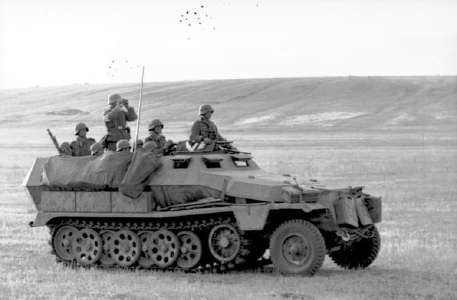
German troops observing the field in a SdKfz. 251 halftrack vehicle, southern Russia, Aug 1942
Photographer: Geller
Source: German Federal Archive
Identification Code: Bild 101I-217-0493-31
Photo: Licensing: According to the German Federal Archive (Bundesarchiv), as of 21 Jul 2010
Машина было рванулась вдоль улицы, но вдруг резко затормозив возле красноармейцев, остановилась. Пулемет мгновенно вывернулся в их сторону, и из кабины выскочил немец - видимо командир. Что-то выкрикнув по-немецки, подошел к красноармейцам, и те один за другим стали подниматься с земли, поднимая вверх руки.
За амбарами, по дороге в сторону Талов, уже шла под конвоем колонна только что, видимо, пленных красноармейцев. В ту колонну влились и наши, и стали с этого момента военнопленными. А мы с этого момента стали жителями временно оккупированных районов Советского Союза.
На протяжении многих лет потом, заполняя анкеты при поступлении в комсомол, партию, на работу, на учебу, в графе анкеты на вопрос «Жил ли на оккупированной территории?» отвечал - «жил», а органы госбезопасности наводили справки - не сотрудничал ли ты с немцами, и только после тщательной проверки вопрос о приеме или поступлении мог решиться положительно.
Стенька - старшая сестра Митьки, давно уже взрослая, но незамужняя девица-перестарок, трактористка и колхозная активистка всех нас удивила и возмутила. Не успели немцы еще и обыскать наших солдат, как она им уже преподнесла «хлеб-соль». Она вышла из своего двора, неся в одной руке буханку хлеба, а в другой большую миску полную яиц, подошла к командиру и, поклонившись, все это подала ему.
Всю жизнь с гадким чувством вспоминаю ее за это. На глазах у своих несчастных солдат, бог знает сколько времени не евших и не пивших, так подобострастно подносить угощение врагу этих солдат - подлее поступка не придумаешь.
December 1942
For the first time, a big military unit arrived in our village for rest and recreation. It consisted of parts of the 8th Italian army, which was defending the right bank of the Don River, forty kilometres from us.
Having coerced two or three families to live in one house, the forcibly vacated houses were occupied by the command and staff. They settled down in the village, together with a German Commandant's office which maintained order. Ordinary soldiers were lodged in hastily converted stables and cow sheds. Collective farm cattle were almost non-existent by that time.
We were not expelled from our house, but an officer lodged in our only living room, and all eight people in our family were forced to live in the kitchen. But the officer probably did not like our neighbourhood, and soon moved somewhere else, and no one else came to replace him.
Italians were remembered as cheerful, sociable people, who were all the time whistling and singing songs. The song of ours called "Katyusha" they liked especially, and we often heard them singing it.
Listen to the song Katyusha
From: http://www.barynya.com/mp3/index.stm
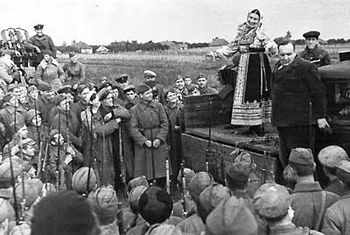
From Wikipedia:
Photo: Lidiya Ruslanova performing the song for Soviet soldiers during WWII.
Katyusha (Катюша) is a Russian Soviet wartime song about a girl longing for her beloved, who is away on military service. The music was composed in 1938 by Matvei Blanter and the lyrics were written by Mikhail Isakovsky. It was first performed by the celebrated folk singer, Lidiya Ruslanova. Some critics believe that Katyusha was not a Blanter composition, pointing out that a similar tune was used by Igor Stravinsky in his opera Mavra (1922) which he later adapted to Chanson Russe (1937).
Katyusha is a tender diminutive from the female name Ekaterina (Catherine). In Russian, many names have diminutives (besides nicknames). For example, the diminutive for Natalia is Natasha, and the tender diminutive for Natasha is Natashenka. In the case of Ekaterina (Catherine), Katya is the nickname and Katyusha, a tender diminutive.
The Russian song also gave name to the BM-8, BM-13, and BM-31 "Katyusha" rocket launchers that were built and fielded by the Red Army in World War II.
Soldiers did not steal in the open during the day, since they were afraid of the German Commandant, but at night sheep and pigs vanished from farms. They were not scared of the local inhabitants, since there were no reprisals.
Our neighbour Aunt Polka dug a potato from her kitchen garden, and an Italian soldier went straight from the stable where he was quartered to Aunt Polka's kitchen garden. He stopped near her, and not having asked permission, put the potato into his pocket. Aunt Polka seized a bunch of potato leaves and began beating the soldier about the head with it. She shouted loudly "Ah damn you! I will give you potatoes! I will tell the Commandant!
The soldier protected his head with his hands, and when Aunt Polka stopped hitting him, he cried, imitating her: "Commmandant, Commandant!" and put his finger to his temple and twisted it, implying that she was crazy. However he took the potato from his pocket and threw it on the ground, and left. It was too dangerous to act like this with Germans, however. Often Italians could be seen at the river, catching frogs which they ate, causing us to feel revulsion towards them. We would never have done such a thing.
In the village a curfew was in effect, and with the approach of twilight it was forbidden to appear on the street, under threat of being shot by the patrols.
With the approach of the cold weather, the Italians became pitiful to look at. They were dressed in light clothes which were not suitable for the frosty weather. From being cheerful and gallant, they turned into pitiable, dirty, pathetic creatures.
Often during patrol duty on the street, two patrol soldiers came into the house late at night to get warm, and stayed in the warmth for hours, obviously breaking service regulations and risking being punished. Having got warm, they started talking to us, and tried to teach us Italian. One of them from Milan patted me on the shoulder and reapeated "Carosh, Carosh" or "Good, Good" and also invited me after the war to visit him in Milan. He showed us photos of relatives, and repeated :"Hitler kaput!" (finished), "Stalin kaput!" "Mussolini kaput!". They had not been home in five years, and we were surprised and unable to understand how it was possible not to be given home leave in five years.
On one evening, having come to the house to get warm, our friends tried for a long time to explain something to us.
"Bang, bang!" they said, miming shooting a rifle, and having clapped a hand to their chest, pointed in the direction of the front. Eventually we guessed that they would soon leave for an advance.
That evening they were gloomy and were more often silent. They were not looking forward to going to the front in order to kill others.
The following day all the military was active. Soldiers began to move around, there were many commands issued, and the grumble of cars was heard. After noon, after jumping into vehicles, part of the group left for the front. Itn the village the only ones left was a group of eight, living in the house belonging to Aleha Suslin.
During these months we heard no news about the course of the war. We did not know what Moscow, Stalin, or the government were doing, and neither did the rest of the country. But despite that, there was no one who had any doubt that victory would be ours, that the Soviets would prevail. And when we saw with what despondency the Italians left for the front, it became clear that they also felt that their prospects were not brilliant. There was hope for a fast resolution to the conflict.
Once towards evening, passing on skis past the kitchen garden of Aleha's house, I saw the commander of the Italians, who lived in the house, run into the house. A command and shouts from inside were heard, and the soldiers putting on their clothes ran out into the court yard. They were close to panic, it seemed. They quickly harnessed a horse, and jumping into the moving sledge, galloped off along the street towards Kantemirovka.
By the time it was dark, we heard somewhere far away, near the Don River, stutters of a machine gun. It became clear: The guns were ours.
Декабрь 1942
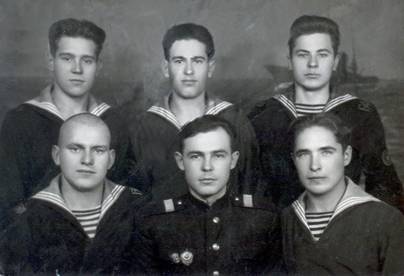
Впервые за все время оккупации в селе расположилась большая воинская часть, прибывшая на отдых с передовых позиций. Это были части 8-й итальянской армии, которая держала оборону на правом берегу Дона, в сорока километрах от нас.
Согнав в один дом по две-три семьи, освободившиеся дома заняло командование и штабы. Расположилась в селе и немецкая комендатура, которая следила за порядком. Рядовые солдаты поселились в наспех переоборудованных конюшнях и коровниках. Колхозного скота к тому времени почти не осталось.
Нас из дома не выгнали, но в единственной нашей жилой комнате поселился какой-то чин, а мы все восемь человек вынуждены были жить на кухне. Но чину, видимо, не понравилось наше соседство, и он вскоре куда-то переселился, а к нам больше никого не вселяли.
Итальянцы запомнились как веселые, общительные люди, все время насвистывающие или напевающие какие-нибудь мелодии. Часто слышалась мелодия нашей «Катюши», которая им нравилась.
Солдаты в открытую не мародерничали, опасаясь немецкого коменданта, но по ночам у жителей пропадали то овцы, то поросята. У жителей перед ними страха не было, так как не было репрессий.
Наша соседка тетка Полька как-то копала у себя в огороде картошку, а один итальянский солдат шел к себе на конюшню прямиком через огород, мимо тетки Польки. Остановившись возле нее и не спросив разрешения, стал накладывать себе в карманы картошку. Тетка Полька схватила пук картофельной ботвы и начала изо всей силы стегать ею солдата по голове. При этом громко кричала: «Ах ты, проклятый! Я тоби дам картоху! Заявлю комэнданту!»
Солдат закрывал голову руками, а когда тетка перестала стегать, тоже закричал, передразнивая ее:
- Командатэ, командатэ! - и покрутил возле виска пальцем. Выбросил из карманов картошку и ушел. С немцами же так поступать было опасно.
Часто итальянцев можно было видеть у ручья, ловивших лягушек, которых они ели, вызывая этим у нас к ним брезгливое чувство.
В селе был установлен комендантский час, и с наступлением сумерек на улице появляться было запрещено под угрозой быть застреленными патрулями.
С наступлением холодов на итальянцев стало жалко смотреть; одетые в легкое, не предусмотренное для наших морозов обмундирование, они из веселых и бравых солдат превратились в жалких, грязных замухрышек.
Часто во время патрулирования на нашей улице, в поздние часы к нам в дом заходили погреться два патрульных солдата и просиживали в тепле часами, явно нарушая устав и рискуя быть наказанными. Отогревшись, начинали болтать что-то по своему, пытались учить нас итальянскому языку. Один из них, житель Милана, похлопывая меня по плечу, приговаривал: «Карош, карош», - и приглашал после войны в Милан. Показывали фотографии родственников и все повторяли: «Гитлер капут! Сталин капут! Муссолини капут!» Уже по пять лет они не были дома, и мы удивлялись - как это можно так долго не быть дома.
В один из вечеров, зайдя к нам погреться, наши знакомые долго пытались нам что-то объяснить.
- Пук, пук! - изображали стрельбу из винтовки, и, похлопав себя по груди, показывали руками в направлении фронта. В конце концов, мы догадались, что они скоро уходят на передовую.
В тот вечер они были мрачные и больше молчали. Знать не хотелось им идти туда, где убивают.
Через день вся воинская часть пришла в движение: засуетились солдаты, слышались какие-то команды, заурчали моторы машин. А после полудня, погрузившись в машины, часть ушла на передовую. В селе осталась команда всего из восьми человек, живших в доме Алехи Суслина.
Все эти месяцы мы ничего не знали о ходе войны: не знали как Москва, как Сталин, правительство, и вообще - как вся страна. Но, несмотря на это, не было ни у кого, почему-то, сомнения в том, что победа будет за нами, что советская власть выстоит. А когда увидели с каким унынием уходят на фронт итальянцы, стало понятным, что дела у них с войной не блестящи. Появилась надежда на скорое освобождение.
Однажды под вечер, проходя огородами на лыжах мимо дома Алехи, я увидел, как командир итальянцев, живших в доме, бежит бегом вниз по холму со стороны Рудаевки. Я остановился, заинтересовавшись. Старший вбежал в дом - оттуда послышалась какая-то команда, крики, и солдаты, на ходу одеваясь, стали выскакивать во двор. Было похоже на панику. Быстро запрягли лошадь и, на ходу вскакивая в сани, галопом помчались по улице в сторону Кантемировки.
А когда уже стемнело, то где-то далеко, со стороны Дона, послышались пулеметные очереди. Стало ясно: идут наши.
Trophies Dec 1942
(Dmitry Nikonorovich is 15 years old in this story. The village Kramarevka was near to Rudaevka. Kramarevka has disappeared, although Rudaevka still exists.)
It was a week after the Italians had retreated, and through the village had passed many soldiers going to the west. From the north, near Tali (Taly, Талы), the sound of the artillery cannonade continued unceasing. It was said that nothing of Tali remained, that all the houses had been destroyed.
As soon as the cannonade ceased, I, with Shurka, decided to go to Tali to find out what had happened, and to get if possible any "trophy" old clothes. It would be very desirable also to learn about the fate of our relatives.
Early in the morning before sunrise, not having taken with us even a piece of bread, we set out. There was a strong frost - the snow under our feet squealed a little, from behind the horizon the huge cold and red sun rose as we walked, hardly appearing through a frosty haze.
I was dressed in an old coat of my father's, which reached to my ankles. I belted it with an ill-starred soldier's German belt with an eagle on a metal plate and an inscription "God with us" in German.
Urged on by the frost, we quickly walked eight kilometres on a road heavily rolled by military machines, and from a hillock was visible the village of Tali, which stretched for kilometres along the small river Bogucharka. Steadfastly we peered into village, trying to see the destroyed and burnt houses, but they, strangely enough, stood untouched.
Ahead on the road at an entry to the village loomed the figure of a soldier with a rifle behind his back, in valenoks (warm felt boots) and a cap with lowered earflaps. Shifting from one foot to the other, he beat his hands on his sides, trying to warm himself. We understood that it was some guard post, and that we were not to pass the guard.
The sentry, for certain, had noticed us for a long time on the white deserted road and waited until we approached.
Involuntarily slowing down our steps, we came nearer to the soldier.
- Stop! - that stopped us! - where do you go? - he asked.
- To visit relatives, - we submissively answer.
- Here it is impossible, it is forbidden.
 German belt buckle of the period, with the legend "Gott mit uns"
Photo: http://www.neaca.com/images/WWII_Nazi_Army_Belt_Buckle_1942_1_.JPG
We stood silently and were ready to turn back. But the sentry approached me and roughly removed the belt from me. He rolled it up and put it in his pocket. Whether he liked my belt, whether he removed it from me as from an arrested person - I do not know.
- Come with me! - he ordered us, and we went under his escort to the centre of Tali.
Crossing the bridge over the small river, I remembered a long time ago going over this bridge with my mother, going on a visit to Aunt Liza who lived at that time in the centre of the village. On the bridge at that time repair work was being done, and some old boards had been removed. Far, far below through gaps in the boards I could see the river below. Both the height, and the water passing beneath frightened me greatly. I stopped, and did not wish to cross the bridge. Mother had to carry me across.
That was a long time ago, and not in my mother's arms this time I strode across the bridge, under the escort of a soldier of the Soviet Red Army.
Having crossed the bridge, we entered the centre of the village. Here there was movement: the military moved quickly through the streets, but no local residents could be seen. There were none in the court yards, and the wooden shutters over the windows were closed in many houses. Civilians were escorted wherever they went by the military. It was a horrible sight, there was a sensation that we had all been taken captive by an enemy force.
This was the time right after the liberation from German occupation, and special departments tried feverishly to discover and catch those who had cooperated with the Germans.
In an area near one of the houses stood a column of people, perhaps fifty men. Near them a military escort with a machine gun stood guard. Our escort brought us to the column, talked with the guard, and then left us there, presumably back to his post. Our new guard ordered us to the tail of the column, where we stood for a long time. Listening carefully to the talk of those around us, we understood that they were policemen, and heads of the villages in the area.
We were in good company! What will happen to us? But to ask, to be indignant, to protest - we were rural boys, so we did not think to do that. We silently obeyed destiny and with apprehension waited for what was to come.
The cold began to penetrate our bones. First we shivered, then our teeth chattered. But at last an important military official arrived, and we were taken to a big one storeyed house, where we were ordered to sit on a bench in a small room and told to wait. When the guards left, a door into another room was left open. Through this door we could see two tiered plank beds, and we could see many men lying on them who were dressed differently to us - probably arrested people.
From time to time the armed Red Army man came into the house and called out loudly "Petrov! Sidorenko! Come quickly! Go!" These Petrovs, Ivanovs, Sidorenkovs left for somewhere, frightened to death from the expressions on their faces.
The time wore on towards evening, and nobody was interested in us. We dreamt of being in a warm log hut, but instead we sat and picked our noses, and our stomachs already rumbled with hunger.
Suddenly from a corridor a loud voice which forced us to shudder called out:
Hey boys! Come here!
We were called into another room, where an officer sat at a table.
- Sit down, - he said, pointing to chairs. We sat down.
Your surname? How old are you? Where are you from? Why did you come here? - The officer began to ask questions. Having received our answers, he thought for a while, not knowing, probably, what to do with us. He then took a piece of paper and began to write something. Presenting us with the piece of paper, he told us in a strict manner:
Here is a note. Show it if you are detained further. But go straight home, do not look left or right! Well, quickly! - and almost unnoticeably smiled, and a huge weight was lifted from our shoulders.
Almost running, we rushed home. We passed through the village, no one stopped us, and the soldier at the entry to the village had disappeared. The sun went below the horizon, the frost grew worse, and it got dark quickly. We longed to be home, where our loved ones were already very worried for our safety. But trophies were carried by Shurka: on the return journey he had picked up on a road behind a village, dropped god knows by whom, a most beautiful, very large piece of cloth in a coloured pattern. We also managed to get a cold slice of bread and gnawed at it as we walked home.
Трофеи
Декабрь 1942
(Село Крамаревка находилось рядом с Рудаевкой. Сейчас села Крамаревка нет, есть только Рудаевка.)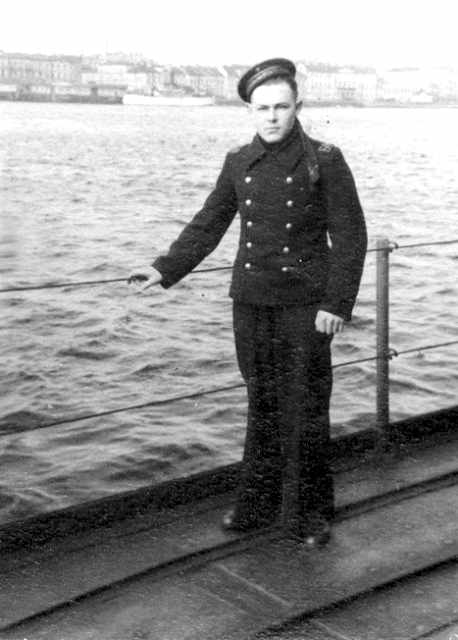 Уже прошла неделя, как удрали итальянцы, через село прошло много войск на запад, а севернее, в стороне Талов, все еще не смолкала артиллерийская канонада. Ходили слухи, что от Талов ничего не осталось, что все дома разрушены.
Как только смолкла канонада, мы с Шуркой решили сходить в Талы, чтобы все разузнать и раздобыть, если удастся, какого-нибудь трофейного барахла. Очень хотелось узнать о судьбе родственников.
Рано утром, еще до восхода солнца, не взяв с собой даже куска хлеба, мы двинулись в путь. Был крепкий мороз - снег под ногами аж повизгивал, из-за горизонта поднималось огромное холодное и красное солнце, еле просвечивая сквозь морозную мглу.
Одет я был в старое отцовское холодное пальто, достававшее мне до щиколоток. Подпоясан тем злополучным солдатским немецким ремнем с орлом на бляхе и надписью «С нами бог» по-немецки.
Подгоняемые морозом, мы быстро прошагали восемь километров по плотно укатанной военными машинами дороге, и вот с пригорка видны Талы, протянувшиеся на километры вдоль речки Богучарки. Пристально вглядываемся в село, стараясь увидеть разрушенные и сожженные дома, но они, как ни странно, стояли целыми.
Впереди на дороге у входа в село маячила фигура солдата с винтовкой за спиной, в валенках и в шапке с опущенными ушами. Переминаясь с ноги на ногу, он бил руками по своим бокам, стараясь согреться. Мы поняли, что это какой-то пост, и что мимо него никак не пройти. Часовой, наверняка, нас давно заметил на белой пустынной дороге и ждал, когда мы к нему подойдем.
Невольно замедляя шаги, мы приближались к солдату.
- Стой! - остановил он нас. - Куда идете? - спрашивает.
- Проведать родственников, - смиренно отвечаем мы.
- Сюда нельзя, запрещено.
Мы молча стоим и готовы уже повернуть назад. Но часовой подходит ко мне и бесцеремонно снимает с меня ремень. Скатал и положил себе в карман. То ли понравился ему мой ремень, то ли снял он его с меня как с арестованного - не знаю.
- Давай, вперед! - приказал он нам, и мы пошли под его конвоем в сторону центра Талов.
Проходя мост через речку, вспомнилось, как когда-то давно мы с матерью переходили этот мост, направляясь в гости к тете Лизе, жившей тогда в центре Талов. На мосту велись как раз в это время ремонтные работы - местами были сняты старые доски, и далеко, далеко внизу сквозь щели виднелась речная вода. И высота, и вода далеко внизу меня сильно пугали; я упирался и не хотел идти на мост. Матери пришлось взять меня на руки.
То было давно, и не на маминых руках теперь я шествую по этому мосту, а под конвоем солдата своей родной Красной Армии.
Перейдя мост, мы вошли в центр. Здесь ощущалось какое-то движение: сновали по площади военные. Местных жителей нигде не было видно, во дворах пусто, ставни во многих домах закрыты. По улицам и по площади иногда проводили под конвоем каких-то гражданских людей. От всего этого становилось жутковато, было ощущение того, как будто нас взяли в плен и привели в расположение вражеского стана.
То было время, когда сразу после освобождения Особые отделы лихорадочно выискивали и вылавливали тех, кто сотрудничал с немцами.
На площади возле одного из домов колонной стояли человек пятьдесят мужчин - возле них топтался конвойный с автоматом. Наш конвойный подвел нас к нему и, что-то переговорив, ушел, видимо, на свой пост, а новый наш страж приказал нам стать в хвост колонны, где пришлось простоять довольно долго. Вслушавшись в разговоры арестованных, мы поняли, что это были полицейские, и старосты из сел района.
Ничего себе компания! Куда мы попали? Но чтобы просить, возмущаться, протестовать - мы, деревенские пацаны, даже и не думали. Мы молча покорились судьбе и с тревогой ждали, что будет дальше.
От холода начинала пробирать дрожь и мелко постукивать зубы. Но вот, наконец, пришел какой-то военный - колонну увели, а нас забрал с собой. Привел в довольно большой одноэтажный дом, усадил на скамейке в маленькой комнатушке и приказал ждать. Уходя, дверь в комнате оставил открытой. Через эту дверь нам было видно в большой комнате напротив много двухъярусных нар и лежащих на них мужчин, по-разному одетых - видимо арестованных.
Время от времени в дом заходил вооруженный красноармеец и громко выкрикивал: «Петров! Сидоренко! Собирайся быстро! Пошли!» - и уводил куда-то этих Петровых, Ивановых, Сидоренковых, перепуганных насмерть, судя по выражению их лиц.
Время клонилось к вечеру, а нами никто не интересовался. В теплой избе после холода начало клонить в сон, и мы, сидя, клевали носами, а в желудках уже урчало от голода.
Вдруг в коридоре раздался громкий голос, заставивший нас вздрогнуть:
- Эй, пацаны! Давай сюда!
Нас позвали в другую комнату, где за столом сидел военный.
- Садитесь, - сказал он, показывая на стулья. Мы сели.
- Фамилия? Сколько лет? Откуда? Зачем пришли? - стал задавать военный вопросы. Получив на все ответы, он задумался, видимо, не зная, что же с нами делать дальше. Потом взял лист бумаги и стал что-то писать. Подавая нам бумагу, строго сказал: «Вот вам записка. Покажете, если вас задержат. И дуйте домой прямиком, никуда не заглядывайте! Ну, быстро! - и чуть заметно улыбнулся, а у нас сразу свалилась с души тяжесть.
Чуть ли не бегом рванулись мы домой. Прошли через все село, никто нас не остановил и даже солдата на входе в село уже не было.
Солнце садилось за горизонт, мороз крепчал, быстро стемнело. Изголодавшиеся, замерзшие поздно вернулись домой, где из-за нас уже сильно волновались.
С трофеями Шурке повезло: на обратном пути он подобрал на дороге за селом оброненную бог знает кем красивейшую, вышитую цветным узором большую скатерть. А еще мы подобрали на дороге промерзший кусочек хлеба и грызли его в пути.
Photo: Vladimir Gorodnjanski
Сенька Дроботов
Photo: Wikipedia
Почему-то он вспомнился мне по прошествии более чем шестидесяти лет. Что-то показывали по телевизору, что-то говорили о тех далеких временах. Все это напомнило мне мое далекое детство, бедное отрочество и юность, вспомнился он – Сенька Дроботов – мой хороший, верный друг, которого я тогда обрел. К сожалению, на короткое время.
Он появился в нашем селе за два года до начала Великой Отечественной Войны. Был он из беспризорников, года на полтора старше меня. Мне же было тогда 12 лет.
Государство, как мне помнится, заботясь о беспризорниках, отдавало их на воспитание в бездетные семьи
Жила в нашем селе бездетная, уже не молодая женщина тетка Полька, как мы ее звали. Ее небольшая хатка стояла почти на краю села, в конце огорода росли яблони и вишни.
Жила тихо, смирно, ни с кем не скандаля, ничем не выделяясь среди жителей села. Работала в колхозе.
Откуда-то, не знаю из каких мест, привезли и отдали ей на воспитание Сеньку Дроботова, тринадцатилетнего пацана-беспризорника. Она стала как бы его матерью и отвечала за его жизнь и благополучие. Он же должен был ее слушаться во всем и почитать как мать.
Он стал посещать нашу школу, и я запомнил день, когда он первый раз пришел на занятия. На большой перемене к нему стал приставать и задираться Витька Климчук, здоровый парень-переросток. Все кончилось тем, что Витька с подбитым глазом и окровавленным носом, не дождавшись конца занятий, ушел домой.
О! Это была интересная сцена. Таких драк между нашими пацанами еще никто из нас, деревенских, не видел; уж очень быстро и умело расправился Сенька с Витькой. Видно жизнь научила его постоять за себя.
Но тетке Польке пришлось из-за этого иметь неприятную беседу с директором школы. На самом же деле Сенька оказался добрым, отзывчивым парнем, вступать с ним в конфликты смельчаков больше не находилось. Мы же с ним подружились; нас почему-то тянуло друг к другу.
Я часто стал бывать у него дома. Целыми днями, летом, когда Тетка Полька была на работе, мы с ним во дворе, или в доме, чем-нибудь занимались. Сенька был смышленым, сообразительным парнем. У тетки Польки в сарае обнаружился кое-какой слесарный инструмент: напильники, плоскогубцы, молотки, зубило и пр. Не знаю, где он научился, но работал ими здорово. Он научил меня делать складные перочинные ножички, большие, так называемые, цыганские иголки и прочие нехитрые поделки. Все-то он умел. Таких людей в народе называют умельцами. После, когда уже шла война, мы с ним освоили шитье тапочек, что особенно было кстати: купить то их было негде, да и незачто.
Первое время, когда он появился у Тетки Польки, их взаимоотношения были как бы никакими, то есть ни хорошими, ни плохими. Со стороны тетки Польки не замечалось по отношении к нему каких-либо строгих требований, понуканий, окриков. Не заметно было также близких, теплых отношений, какие бывают между матерью и родным сыном. Сенька жил как бы сам по себе. По своей натуре добрый, не злой, он никогда не грубил тетке, помогал ей по хозяйству: таскал воду, рубил дрова.
Постепенно их отношения становились теплее, начиналось сближение. В кругу других женщин тетка Полька уже начинала хвалить Сеньку. « Какой он хороший помощник, какой он смышленый, добрый, сообразительный», - говорила она женщинам.
Среди сверстников Сенька был бесспорным авторитетом. Его уважали, слушались; во всех играх, забавах, при стычках с пацанами из другой деревни он был всегда вожаком, командиром.
Время шло. В 1941-ом году грянула война с Германией. К началу войны Сеньке было уже 15 лет. Для нас, пацанов, началась настоящая трудовая жизнь – работа в колхозе. Летом 1942 года немцы дошли аж до нас, фронт отодвинулся дальше на восток, и мы оказались на оккупированной территории.
В памяти о том времени не возникают какие-либо ужасы, бедствия, о которых приходилось слышать. Нас все это миновало, нам просто повезло, не затронуло то, что происходило в других местах.
Колхозы немцами не были ликвидированы, но нас, подростков работать в них не очень принуждали, и, поэтому, много времени мы были предоставлены самим себе. В лесах, на полях после прохождения фронта осталось много брошенного того, что стреляло, взрывалось, убивало. А как нам, пацанам все это было интересно! Так хотелось пострелять, поразряжать, пощупать. И в то же время как это было опасно для жизни! Много погибло детей и подростков, много осталось калек и инвалидов после прохождения фронта.
Ребят нашего села эта беда как-то обошла стороной: никого не убило, не покалечило. Не потому, что мы не копались в этом барахле, не разряжали, не стреляли, не взрывали. Занимались этим много. Но у нас был Сенька Дроботов, видно бог ему дал интуицию, способность чувствовать опасность для жизни во всех этих забавах, он учил нас, предостерегал от опасного шага.
Время шло, мы подрастали, подошло время влюбляться. Сенька из подростка превращался в видного парня. Чуть выше среднего роста, со спортивного вида фигурой, с волнистым русым чубом он стал предметом воздыхания деревенских девчат.
По вечерам на деревенской улице, несмотря на то, что шла война и мы были в оккупации, собиралась на вечеринки молодежь. Там играла гармошка, пели песни.
Сенька и ребята его возраста стали посещать эти вечеринки. Там, на этих вечеринках, и встретил он свою любовь. Ею стала Маруся Пивнева, красавица, певунья, хохотунья. Многие парни сохли по ней, но она всем предпочла Сеньку Дроботова. Вскоре все увидели, как они влюбились друг в друга. На вечеринках были все время рядом, и покидали ее вместе, раньше всех.
Между тем прошло лето, пришла осень, а в декабре наша Красная Армия освободила нас от немцев. Фронт с тяжелыми боями стал продвигаться дальше на запад. Ребят 1925 – 1924 г.г. рождения призвали в армию сразу же, как только прогнали немцев. Сеньку тоже призвали.
Провожали призывников почти всем селом. Плакала тетка Полька, рыдала Маруся, истово, не стесняясь никого, целовала Сеньку, долго не отпускала от себя, словно не хотела его никому отдавать.
Фронт отошел от нас не очень далеко, там шли тяжелые, кровопролитные бои. Наших ребят, можно сказать не обученных бросили в это пекло, и они почти все там погибли. Получила похоронку и тетка Полька. Сообщали, что Дроботов Семен Павлович погиб смертью храбрых в боях с немецко-фашистскими захватчиками.
А у Маруси к весне уже стала заметна беременность. В начале лета она родила мальчика, назвала его Семеном, Сенькой.
Мы, молодые ребята, кому осенью предстояло идти на войну, и молодые девчата также собирались вечерами на деревенской улице, пели, плясали, играли, расходясь по домам только под утро.
Однажды мы собрались на вечеринку на площадке напротив дома, где жила Маруся с матерью. Пели, играли. Из дома вышла Маруся и стала немножко в сторонке от нас, наблюдая наши игры. Видно вспоминала, как совсем недавно бывала на таких же вечеринках вместе с Сенькой.
Вдруг стал накрапывать дождь. Расходиться не хотелось. И тут Маруся пригласила нас всех к себе в дом, чтобы укрыться от дождя. Мы, без шума, стараясь не разбудить ребенка, разместились в большой комнате.Но все равно из соседней комнаты послышался вдруг громкий, требовательный плач. Мы все притихли, слушая его.
Это подавал голос маленький Сенька Дроботов.
Senka Drobotov
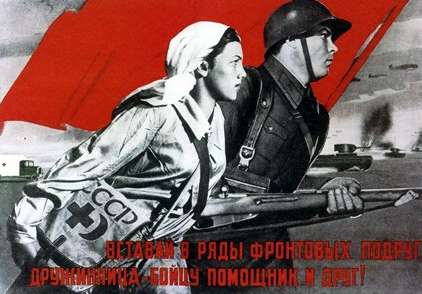
Photo: Wikipedia
For some unknown reason I remembered something after more than sixty years. Something on the tv spoke to me about those times long gone. It reminded me about my childhood, my poverty in adolescence and as a youth. I was reminded of Senka Drobotov, who I had as a good, true friend for such an unfortunately short time.
He appeared in our village two years before the beginning of World War II. He came from a shelter for homeless children. The state at that time gave such children to childless familes for education and a loving home life. He was a year and a half older than me, and I was at that time twelve years old.
There lived in our village a childless woman, old Aunt Polka as we called her. Her small hut stood almost on the edge of the village, and apple trees and cherries grew at the end of her kitchen garden.
She lived silently, without disturbing the peace, not arguing with anyone, and without acquaintances in the village. She worked on the collective farm.
Where he came from I do not know, but Senka Drobotov, thirteen years old, was given to her to raise. She became his mother, and was responsible for his life and well being. He was told he should obey her in all matters, and to esteem her as his mother.
He began to come to our school, and I remember the day when he first came to class. During lunch time he began to pick a fight with Vit'ka Klimchuk, a healthy but fat, large boy. It ended when Vit'ka got a black eye and a bloody nose, and he went home early.
Oh, it was an interesting time. Such fights between us boys living in the country, we rarely saw. Senka very quickly and skilfully finished Vit'ka off. It was obvious that whatever life he had led to that point, he had certainly learned to stand up for himself.
But Old Aunt Polka had to have an unpleasant conversation with the principal because of the fight. In fact Senka appeared to us to be a kind, sympathetic boy, and he did not have any more fights with any of us. We made friends with him. For some reason, he and I gravitated to each other and became good friends.
I began to spend some time at his place. During the whole day, in the summer when Aunt Polka was at work, we played together in the back yard, or in the house, or were engaged in something. Senka was a clever, sharp boy. Some metalwork tools were found in Aunt Polka's shed - files, flat-nose pliers, hammers, a chisel and so forth. I do not know where he learned their use, but he was a good worker with these tools. He taught me to make a folding penknife, large needles and other simple hand made articles. He was able to do anything. Some called him a skilled craftsman. Later when the war came, we mastered sewing slippers, but that was essential, there was no where to buy them otherwise, and in any case no money for the purpose.
When he first appeared at Aunt Polka's house, their mutual relations were neutral, that is neither good nor bad. We did not notice her making any strict requirements of him, nor did she shout at him. We also did not notice any close, warm emotions between them, such as would occur between a mother and her natural son. Senka lived as though inside himself. As for his nature, he was not malicious, he was never rude to Aunt Polka, and helped her with chores such as carrying water and cutting fire wood.
Gradually their attitudes to each other became warmer, and a rapprochement developed. In the company of other women, Polka began to praise Senka. "What a wonderful helper he is, how clever, kind, and acute" she said to other women.
Among his contemporaries, Senka was the indisputable authority. He was respected and obeyed at all times. In games and in skirmishes with the boys from the other villages he was always the leader, the commander.
Time passed. In 1941 war with Germany burst upon us. At the beginning of the war Senke was 15 years old. For us boys, the labour of life in the collective farm began. In the summer of 1942 the German front passed our territory, and we turned out to be in occupied territory.
In my memories of that time there are no horrors, we heard of no disasters. It passed us all by, we were simply lucky, and we heard no mention of what had occurred in other places.
The collective farms had not been liquidated by the Germans, but to us teenagers we were not so much forced to work in them, and therefore we had a lot of time to ourselves. In the woods, in the fields after the passage of the front there remained a lot of reminders of the horrors of war, the explosions and the deaths. And to us boys, that was interesting! We wanted to do some shooting ourselves, to feel these emotions. Even so, it was dangerous. We lost many children and teenagers, and many cripples and invalids were left behind after the passage of the front.
Even so, the children of our particular village were bypassed by these problems. No one was killed, no one was crippled. Not because we did not search through the rubbish, did not shoot guns, or did not blow things up. But we had Senka Drobotov, it was obvious God had given him intuition, the ability to recognise danger to life in all our dangerous entertainments, and he taught us, and warned us away from dangerous pursuits.
Time passed, we grew up, and the time approached for all of us to fall in love. Senka changed from just a teenager to a very visible and desirable presence. He was hardly above average height, but with a strong physique, and wavy fair hair, he became the focus of attention of many of the girls in our rural community.
In the evenings in the streets in the country, in spite of the fact that there was a war on, and we were occupied, the youth of the area gathered for parties. We played the accordion, and sang songs.
Senka and his contemporaries began to visit these parties. Here, he fell in love. She was Maria Pivneva, a beauty, a singer, a happy girl. Many young men chased her, but she preferred above all Senka Drobotov. Soon everyone could see that they had fallen in love with each other. At parties they were always beside each other, and left together before everyone else.
Meanwhile summer passed, autumn came, and in December our Red Army had delivered us from the Germans. The heavy fighting of the front moved further to the west. Children born from 1924 to 1925 were called up for military service, and Senka was also called up.
Almost the whole village saw off the recruits when they left the village to join the army. Aunt Polka cried, Maria cried, and in front of everyone kissed Senka, and held him for a long time, not wishing to allow him to leave.
The front was not so far from us, and there were heavy, bloody fights. Our untrained children were thrown into hell, and almost all of them were lost. Aunt Polka received information that Drobotov Simeon Pavlovich had died bravely in fighting the fascist aggressors.
By spring, Maria's pregnancy was already obvious. At the beginning of summer she gave birth to a boy, whom she named Simeon, or Senka.
We young children would ourselves go to war in the autumn, and with the young girls of the village we again gathered in the village street, to sing, to dance, to play, and to go home only at daybreak.
Once we gathered for a party at a place opposite the house where Maria and her mother were. We sang and played. Maria left the house, and stood a little apart from us, looking at our games. She obviously remembered, how so recently she was at the same sort of parties with her Senka.
Suddenly a trickle from the skies became heavy rain. Maria invited us all to her house to shelter from the rain. We entered silently, trying not to wake her child, and went into the main room. But soon from the next room came a loud crying. All of us became silent, listening to the crying child.
Thus little Senka Drobotov made his presence felt.
Тетя Оля
Photo: http://static.flickr.com/53/136596810_335b79218b_o.jpg
В Рудаевке, на тихой улочке в маленькой хатке жила наша тетя Оля, мамина младшая сестра с двумя дочерьми - Диной и Кларой - моими двоюродными сестрами.
Летом, обычно по воскресеньям, в хорошую солнечную погоду мать одевала нас по праздничному и вела в гости к тете Оле.
Летом во дворе, под огромной яблоней у самого порога, всегда стоял у них стол. С нашим приходом стол накрывали скатертью, ставили самовар и начиналось чаепитие. Приходили еще две-три тетиных Олиных коллег-учительниц - за столом становилось шумно и весело.
Мы, дети, напившись чаю, уходили играть в сад, а во дворе продолжалось чаепитие, сопровождавшееся шумной беседой. Слышался время от времени голос матери и громкий на всю улицу, взрывной, заразительный хохот тети Оли. Я после в жизни не встречал такой хохотушки, как она. Помню ее всегда веселой, неунывающей, несмотря на трудную судьбу. Ее мужа, дядю Федю, которого я не помню, репрессировали и загнали в Сибирь, когда Дина и Клара были еще малютками. Оттуда он больше не вернулся - тетя Оля одна в те трудные времена вырастила двух девочек и дала им образование.
Aunt Olja
In Rudaevka, on a quiet side street in a small hut lived our aunt Olja, my mother's younger sister with her two daughters - Dyne and Clara, my cousins.In summer, on Sundays in good weather, we were usually dressed in our best clothes by our mother, and went to visit Aunt Olja.
In summer there was always a table under a huge apple tree near the doorway at Aunt Olja's. Upon our arrival a cloth was spread, a samovar was placed there, and we began to drink tea. Two or three of Aunt Olja's teacher colleagues also usually came, and in a short time the table became noisy and cheerful.
We children, having drunk our tea, left to play in the garden, and in the court yard the tea drinking proceeded, accompanied by noisy conversation. The voice of our mother could be heard, and also the loud, explosive, infectious laughter of Aunt Olja was heard from time to time. Never after have I heard such laughter. I remember her always cheerful, despite her difficult life.
Her husband, Uncle Fedja who I do not remember, was subject to repression, and was sent to Siberia when Dyne and Clara were still babies. He never returned from Siberia, and Aunt Olja during those hard times brought up and educated the two girls.
Ботинки
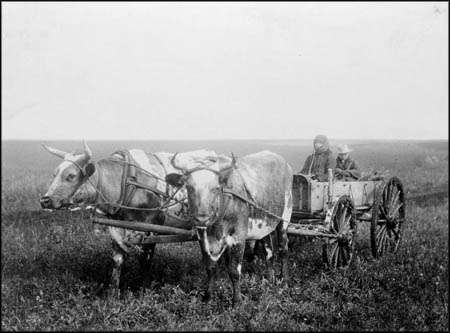
Photo: http://www.canadiana.org/citm/_images/common/c007815.jpg
Намолоченное зерно нужно было как можно быстрее сдать государству, вывезти в Кантемировку на заготовительный пункт. Для вывоза зерна организовали обоз из десяти, кажется, подвод. Возчиками и одновременно грузчиками, назначили пацанов. Попал в обоз и я. Были среди нас две, или три девчонки.
Зерно возили на волах. Грузили подводы на току и, растянувшись цепочкой по Титаревскому шляху, двигались в путь на Кантемировку. Путь не близкий: двадцать километров. Тихо бредут волы в степи по шляху, поскрипывают колеса, мерно колыхается тяжело нагруженный воз. Хорошо ехать и отдыхать в дороге, растянувшись на зерне и глядя в небо, следить за парящим в высоте коршуном, высматривающим добычу на земле.
Кантемировка, расположенная в долине, открывалась взору вся вдруг с вершины горы. Пугал опасный, крутой спуск - приходилось заклинивать одно колесо у подводы для торможения.
Приемный пункт заготзерна работал круглые сутки. Разгрузившись, трогались в обратный путь. Вернувшись в Крамаревку и не заходя даже домой, сразу грузились новым зерном, меняли волов и, получив в колхозной кладовой печеного хлеба и подсолнечного масла, снова трогались в путь на Кантемировку.
Часто в пути нас заставала ночь. Однажды я ехал в обозе последним. Груженые, мы выехали из Крамаревки уже после захода солнца. На степь опускалась тихая теплая летняя ночь, загорались в небе яркие звезды и все четче обозначался в небе млечный путь. Луна еще не всходила. Медленно брели волы, покачивалась подвода, слышались с передних подвод, время от времени, крики возчиков:
- Эгей! Пошел, пошел!
- Что спишь, зараза!?
- Цоб, цобэ!
В надвинувшейся темноте уже почти не видно едущую впереди подводу. Под мерное покачивание и скрип колес потянуло в сон, но я изо всех сил старался не уснуть. Тяжелели веки, глаза закрывались сами собой, и я на какое-то короткое время забывался чутким сном. Волы как будто чувствовали, что хозяин уснул, и замедляли шаг, отставая от обоза. Очнувшись, я еле слышал уже голоса возчиков и скрип колес далеко ушедшего вперед обоза.
- Гей, гей! Пошел, пошел! - гнал я почти бегом своих волов, догоняя обоз. В какой-то момент сон свалил меня окончательно. Завалившись на зерно, я крепко, по-настоящему, уснул. Не знаю, сколько я спал, но вдруг, проснувшись, почувствовал, что что-то не так. Волы мирно пасутся; взошедшая луна поднялась уже довольно высоко, освещая степь своим призрачным светом. Дороги нигде не видно.
Я понял, что волы, учуяв свободу, пока я спал, походя, щипая траву, ушли в степь. Где я? В какой стороне дорога? Не знаю. Прислушался - кругом тишина. Лишь одни сверчки сверчат в этой тишине. И тут я испугался: мной овладел страх. В то время ходили слухи о том, что какие-то люди по ночам нападают на отставшие в степи подводы с зерном и грабят их.
Сижу на возу и не знаю в какую сторону ехать. Вдруг далеко в стороне послышались еле различимые голоса людей и скрип колес. Я быстро погнал в ту сторону своих волов и вскоре пристроился в хвост к какому-то обозу, оказавшегося обозом из соседнего села Титаревки.
К заготпункту я приехал, когда уже совсем рассвело. Мои друзья уже разгрузились, но без меня не решались ехать домой. Увидев меня, обрадовались, а когда я рассказал про свою историю, долго смеялись, подшучивая надо мной.
Без перерыва, без отдыха, без нормального сна, лишь урывками в дороге погружаясь в чуткий, тревожный сон, постоянно подгоняемые председателем и бригадиром, мы уже довольно много дней возили зерно. Хотелось уже хорошенько выспаться дома в нормальных условиях.
Как-то раз, возвращаясь порожняком из Кантемировки и не доехав километра три до дома, мы повернули к кринице, что была в полукилометре от дороги, чтобы напоить там волов. Солнце уже зашло, на землю опускались мягкие летние сумерки. Напоив волов, мы уже хотели трогаться дальше, как кто-то из нас предложил остаться тут до утра. Все согласились, уговорившись молчать об этом дома, чтобы не получить нагоняй, а за задержку сослаться на поломку чьей-то подводы.
Распрягли волов и пустили их пастись. Ребята насобирали сучьев в посадке и разожгли костер, а девчонки сварили в ведре кулеш из имевшегося у нас пшена.
Стоял теплый вечер с летними, доносившимся с полей запахами трав, был вкусный кулеш у костра, и мы были свободны. Долго еще слышался в ночи в нашем таборе громкий смех, девчоночий визг, пока все не угомонились и не уснули на подводах крепким сном.
Проснулись, когда солнце уже поднялось, высушило росу на траве и начало припекать. Волов нигде поблизости не увидели и поиски их ничего не дали. Прелесть вчерашнего вечера как ветром сдуло, но делать нечего, и мы втроем - Мишка, Васька и я - взяв с собой батоги, побрели в село за другими волами, предчувствуя бурю при встрече с председателем и гадая, чем все для нас закончится.
Никто бы не узнал о нашей ночевке у криницы, если бы не волы, отпущенные нами пастись, не пришли под утро на колхозный двор, где их и увидели. Поднялся переполох. Чуть позднее подошли и мы. Боже мой, что было! Председатель орал на нас, грозился всякими карами, а мы виновато опустив головы, молча слушали его ругань. Потом отлучили из стада своих отдохнувших волов и погнали к кринице, где нас с беспокойством ждали остальные.
В этот день председатель не смог доложить в район о количестве сданного хлеба за сутки: сдача была сорвана. Из района последовал грозный окрик, а нас еще больше стали подгонять. Но как бы там ни было - и мы, и волы немножко отдохнули.
После того лета с волами я больше за всю свою жизнь дела не имел, но добрая память о них осталась на всю жизнь. Сотни лет, верно служивший крестьянину, вол был вытеснен из сельского быта машинами всего через несколько лет после описываемых мною событий. Люди моего поколения - последние свидетели его использования в крестьянском труде. Только что нарождавшийся теленок мужского пола кастрировался, вырастал и становился основной тягловой силой в наших краях. Крупный (намного крупнее коровы), с большими рогами, покорный, медлительный, почти никогда не бегающий бегом, он обладал большой силой и выносливостью.
Целыми днями под палящим солнцем, запряженный в нехитрую упряжь - ярмо, он мог возить тяжело груженые возы, арбы с сеном или снопами, таскать плуг, вспахивать поле.
Выпряженных вечером волов, пастух гнал в ночь на пастбище, где они паслись и отдыхали. Рано утром все стадо лежало на выгоне за амбарами, пережевывая жвачку. Отсюда их брали и запрягали в ярмо на целый день.
Как ни спешили с вывозкой зерна, но уже стало ясно, что колхозу своими силами с этим скоро не управиться и тогда на помощь откуда-то прислали военную машину с шофером-солдатом, невысокого роста русоволосым парнем лет двадцати двух, звавшимся Николаем.
Меня и Ивана Твердохлебова, как ребят покрепче, прикрепили к этой машине грузчиками, и наступили для нас с ним трудные дни, наполненные тяжелой, изнурительной работой, а время работы на волах осталось в памяти, как приятное воспоминание. Нагрузить и разгрузить подводу зерном раз в десять легче, чем грузовую машину. На волах полдня едешь до Кантемировки, да полдня обратно - успеешь отдохнуть. Десять же потов сойдет, пока вдвоем нагрузишь машину, а она за двадцать минут проскочит путь от Крамаревки до Кантемировки и, не успев отдохнуть, начинаешь разгрузку.
Если бы за ту работу, что я выполнял в колхозе, мне платили сполна, как положено, то я, наверное, один бы мог прокормить нашу большую семью, но мы работали ничего не получая, и если и старались больше заработать трудодней, то не потому, что на них надеялись получить побольше, а потому, чтобы не числиться симулянтом, уклоняющимся от спасения родины.
Работали отец, Люся, я, но жили бедно: не во что было одеться, обуться. С наступлением осени по утрам уже было прохладно, а я был бос, мерзли ноги, но благо, засунув их поглубже в зерно, можно было спасаться от холода.
- Ты почему босиком до сих пор ходишь? - спросил меня однажды Николай, наш шофер, и я ответил: - Не во что обуваться.
И тогда, когда мы ночью грузились на току, Николай высыпал в машину тайком от весовщика пару ящиков зерна, минуя весы, а в Кантемировке на рассвете заехал в один из дворов на дальней улице и, рискуя попасть под трибунал, продал это лишнее зерно хозяевам.
После разгрузки заехали на базар, и Николай за вырученные деньги купил у одного мужика пару солдатских ботинок.
- На, носи! - сказал он, отдавая их мне. А мне и радостно было оттого, что я теперь обут и что не страшна теперь мне зима, но и не ловко оттого, что ничем не могу его отблагодарить.
The Boots
Photo: http://www.canadiana.org/citm/_images/common/c007815.jpg
It was compulsory to hand over the grain that had been threshed as soon as possible to the state, and to take it out to Kantemirivka, which was the staging point for grain.
Transport for the grain was organized to be done by ten young people,
The ten people who were to both load and transport the grain consisted mostly of boys, as well as two or three girls.
The grain was hauled by oxen. We loaded the carts on the floor of the barn, and having got into a line on the Titarevka Road, we set out for Kantemirivka. It was not close, at least twenty kilometres away. Silently the oxen marched across the plain, wheels squeaking from the swaying, heavily loaded cart. It was good to have a rest on the way, stretched out on the grain and looking up at the sky, watching a kite soaring above, looking for prey on the ground.
Kantemirivka, located in a valley, suddenly became visible from the top of the mountain pass. It was a frightening, dangerous, steep descent, and it was necessary sometimes to jam one wheel to brake the cart.
The place where grain was to be offloaded worked all day and night. Having unloaded, we got moving immediately on the road back. Having returned to Kramarevka, not even having gone to our homes, we were immediately loaded with more grain, changed oxen, and having received from a collective farm pantry some baked bread and sunflower oil, we got under way again back to Kantemirivka.
Often on these trips, night found us. Once I was last in a string of carts. After being loaded, we left Kramarevka just after sunset. The steppe fell silent, it was a warm summer night, bright stars began to light the heavens, and the whole Milky Way was sharply defined in the clear night sky. The moon was not up yet, the oxen walked slowly along, the cart rocked, and the shouts of the bullock drivers were heard from time to time:
- Ehe! go!, go!
- What, you sleep, you plague!?
- Cob, Cobe!
Already in the swiftly gathering darkness it was not possible to see the cart ahead. With the regular rocking and creak of wheels it was like a dream, and I tried hard not to fall asleep. My eyes grew heavy, my eyes closed by themselves, and for a short time I was immersed in a dream. The oxen sensed that the driver was asleep, and slowed their steps, lagging behind the other carts. Regaining my wits, I could hardly hear the voices of moving carts and the creak of wheels far in the distance ahead.
- Hey! Hey!! Go, Go!
- I almost made the oxen run, trying to catch up with the other carts.
Even so, I still found it very hard to stay awake. Having eaten well, I really did fall asleep this time. I do not know how long I slept, but suddenly I woke up, feeling that something was not right. The bullocks were grazing peacefully, and the rising moon was now high enough that it covered the steppe in a shining light. There were no roads visible anywhere.
I realised that the bullocks, sensing freedom while I slept, had gone off the road, cropping grass, and were now in the middle of the trackless steppe. Where was I? On what side of the road? I did not know.
I listened hard, but only crickets chirred in the silence. Now I was frightened. Fear took possession of me, since I had heard that people at night attack any carts which lagged behind on the steppe, and plundered them.
I sat on the cart and did not know which direction to go. Suddenly from one side I heard distinctly the voices of people and the creak of wheels. I quickly drove the oxen towards the disappearing tail end of the line of the other carts, and soon enough came to the next village, Titarevka.
I arrived at the storage depot when it was dawn. Friends had already unloaded, but without me they did not dare to go home. They were delighted to see me, and when I told them my story, they laughed for a long time, making fun of me.
Without rest or interruption, without proper sleep, only sometimes in fits and starts on the road but even then immersed in bad dreams, we were constantly hurried by the director and the foreman, and for many days we did this work of carrying grain. All we wanted to do was to go home, to sleep in our own beds.
Once, coming back empty from Kantemirovka and not having gone three kilometres from the village, we turned off to a well, that was five hundred metres from the road, to give the oxen a drink. The sun was already down, and the soft summer twilight fell on the earth. Having given the bullocks water, we were getting ready to get under way when someone suggested waiting there till morning. We all agreed readily, and decided to say nothing about it when we got home to avoid a scolding, but decided to make an excuse of a breakage to one of the carts.
The bullocks were unharnessed and let go to graze. The boys gathered branches and got a fire going, the girls cooked kulesh in a bucket from some millet that we had.
It was a warm summer evening, with tall grass around, tasty kasha at a fire, and we were free. For a long time loud laughter was still heard in our camp, as well as girlish squeals until we all quietened down and fell sound asleep on the carts.
We woke up with the sun already up, the dew had dried from the grass, and it had become hot. The oxen were nowhere to be seen, and although we searched, we could not find them. The charm of the previous evening had blown away like the wind, but there was nothing to be seen, and the three of us, Michael, Vasyok and I, having taken our whips, plodded on looking for the wandering bullocks, having a presentiment of a storm when we had to meet the chairman of the collective, and wondering where we would end up.
In fact, no one would have found out about our spending the night at the well if the oxen, after being let off to graze, did not come at daybreak to a collective farm court yard where they were seen. The alarm was raised. A short time later we also arrived.
My God, what a to-do! The chairman shouted at us, threatened us with punishments, and we guilty ones listened silently with lowered heads to his abuse. Then we separated our oxen from the collective's herd, and drove them to the well where the others were anxiously waiting for us.
The chairman could not send a report that day for the tally of the quantity of grain handed over, since the chain of delivery had been broken. From the village a terrible noise followed us. But anyway, we and the oxen had had a little bit of a rest, at least.
The remembrance of that summer with the oxen has stayed with me as a pleasant memory all my life. For hundreds of years oxen have served the peasant, but have now been superseded in rural life by machines a few years after the events described above. The people of my generation were the last ones to witness their use in rural life. Immediately after being born a male calf was castrated, grew up, and became a basic draft animal in our region. They were much larger than cows, with big horns, obedient, sluggish, almost never running, they were strong and enduring.
For whole days under the scorching sun, harnessed in a simple yoke, it could haul heavily loaded carts, bullock drays with hay or sheaves of wheat, or drag a plough to dig up a field ready for crops.
Unharnessed in the evening, the oxen were driven by the cowherd to a night pasture where they grazed and rested. Early in the morning the whole herd of oxen were back behind the barns, chewing their cud. From there they were taken and harnessed in a yoke for the rest of the day.
It had become clear that the collective farm would soon not, by its own efforts, be able to cope with the effort needed to transport the grain in time. A military truck was sent to us with a soldier-driver, who was small in height and blond haired, about twenty two years of age, called Nikolay.
As young men, I and Ivan Tverdohlebov were fairly strong, and were attached to this machine as loaders, and we spent many difficult days with Nikolay, filled with heavy, wearisome work, and the time spent with the bullock teams remained only as pleasant memories. To load and unload a cart is ten times easier than a truck. Using oxen, at midday you go up to Kantamirovka, and by midday the next day you are back, leaving time for recuperation. Using a truck, you load it, spend twenty minutes getting to Kantamirovka, then you have to start unloading, without time for a rest.
If I had carried out that sort of work on the collective farm, and was paid accordingly, I could have supported a large family. But with this work, we toiled for almost nothing, and if we tried to earn more, we would be deviating from the Communist ethos of our native land.
My father, Lucy and I worked hard, but lived poorly. There were no new clothes to put on, and no shoes. With the approaching autumn, the mornings were already cool, but I was barefooted, my feet were freezing, and it was a blessing to thrust them deep into the grain to warm them there.
"Why do you go barefoot?" our driver, Nikolay, asked me once, and I answered that I had no shoes to put on.
Once when we were loading at night, Nikolay poured out of the hopper secretly from the man on the scales two barrels of grain. After leaving the scales, in Kantamirovka at dawn we came into a courtyard in a distant street where he sold this grain on the black market, risking being caught by the tribunal.
After unloading the remaining grain at the depot, Nikolay used the money to buy from a muzhik a pair of soldier's boots.
"Take them!" he told me, handing them to me. To me it was wonderful, because now I had shoes to put on,and winter was not so terrible for me, but I was also uncomfortable, because I had nothing to give him in return.
Смерти в глаза
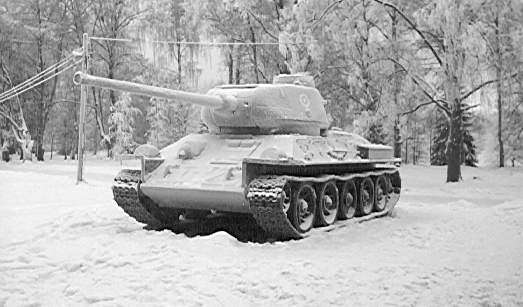
Photo: http://www.saunalahti.fi/~ejuhola/7.62/t34-85a.jpg
Еще с вечера где-то со стороны Дона были слышны далекие пулеметные очереди и уханье орудийных выстрелов, уже удрал в большой панике из нашего села небольшой гарнизон итальянских солдат, находившийся у нас во все время немецкой оккупации, а сегодня утром… о! о! какая перемена во всем!
Наша Красная Армия двинулась на запад, прорвав фронт и преследуя отступающие части 8-й Итальянской армии, стоявшей полгода на позициях по правому берегу Дона в шестидесяти километрах к востоку от нас.
Рано утром мимо села, на полном ходу, с десантниками на броне, поднимая гусеницами снежный вихрь, промчались в сторону железнодорожной станции Кантемировка наши танки Т-34. Потом через село потянулись войска: проходили пехотные части, кавалерийские эскадроны, шли машины с прицепленными артиллерийскими орудиями, походные кухни, повозки. Люди, машины, пушки, лошади — все двигалось на запад, не останавливаясь в селе.
Жители стояли на улице у дворов, радостно приветствовали своих освободителей. Небывалое возбуждение охватило нас, пацанов. Мы мотались как оглашенные по селу, бегали друг к другу, делясь свалившимися на нас впечатлениями. Да и как было не возбуждаться, не восхищаться, не радоваться и не гордиться всем тем, что проходило, проезжало, пробегало перед нами. Всего полгода прошло, как мы видели отступающих, вернее убегающих наших солдат от страшного, грозного врага, боясь попасть в окружение, в плен. Ни самолетов наших, ни танков не видно было нигде, одни солдаты с обреченным видом, в мокрых от пота гимнастерках, не все даже с винтовками, спешили на восток, к Дону. В небе одни лишь немецкие самолеты, охотившиеся чуть ли не за каждым нашим солдатом. Унылое, гнетущее настроение владело нами, мирными жителями. «Что будет? Что будет?» было у всех на уме.
Сколько вражеских солдат, танков, артиллерии, машин прошло вслед за нашими отступающими войсками. Все это казалось неодолимым, непобедимым. А где же все это теперь? В обратную сторону ничего не прошло, ничего мы не видели. Уничтожили все-таки наши воины эту грозную силу. Так как же было не гордиться, не восхищаться, нам, пацанам, всем этим.
Через полгода совсем другая армия была перед нами. Какие могучие танки — эти Т- 34, какая артиллерия, а, главное, какие веселые, бравые, тепло и добротно одетые, наши солдаты, все с автоматами вместо винтовок.
Вместе с другими ребятами я оказался на общем колхозном дворе, где возле конюшни расположились, гомонили и чем-то , видно было, озабочены человек 15 солдат и с ними офицер - командир. Все они суетились вокруг большой грузовой машины и прицепленным к ней артиллерийским орудием. Слышались распоряжения и команды офицера. Видимо что-то случилось то ли с машиной, то ли с орудием, и командир торопил всех, чтобы быстрее устранить неполадки двинуться догонять своих.
Мы подошли поближе и стали с интересом наблюдать за их действиями. Я особенно заинтересовался командиром. Статный, в белом новом полушубке, подпоясанным широким ремнем с пистолетом на боку, с портупеями через плечи, в красивой зимней шапке со звездой, он четко отдавал команды, распоряжения. Живой, энергичный, всем своим видом, своими действиями, он производил на меня неизгладимое, положительное впечатление. Казалось, что только таким должен быть командир Красной Армии, что только такому командиру и можно с удовольствием, беспрекословно подчиняться и идти за ним в бой.
Мы кучкой стояли поблизости и с интересом наблюдали необычную для нас, будоражащую мальчишеское воображение картину. Вдруг командир повернулся в нашу сторону, быстро осмотрев нас, громко сказал, указывая на меня рукой:
— Слушай, парень! Иди сюда!
Я сразу не понял, что он зовет меня, и стоял, не двигаясь с места.
— Да, да! Ты иди сюда, — уже требовательней позвал он. Я быстро подбежал к нему. — Слушай, — говорит он — вот записка, отнеси ее быстро в Рудаевку.
И объяснил где и кому ее передать. Я схватил записку и уже был готов бежать в Рудаевку, которая была в трех километрах от нас, но вдруг вспомнил, что в конюшне стоят лошади и, что можно поехать верхом. Я забежал в конюшню, снял с крючка уздечку, набросил ее на первую попавшуюся под руку лошадь, вывел ее из конюшни, сел верхом и направился по дороге в сторону Рудаевки. Понукал лошадь на галоп, хотелось побыстрее выполнить очень важное, как мне казалось, задание командира, но лошадь оказалась старой, ленивой клячей и никак не хотела быстро бежать.
Передо мной впереди простилалась белая, пустынная, зимняя степь. Но вот вдалеке на моей дороге показалось что-то темное, движущееся мне навстречу, похожее на танк. Вскоре я мог различить и определить, что это был действительно танк Т-34, идущий на небольшой скорости. Мне подумалось, что это танк, отставший от колонны, прошедшей утром мимо села, и теперь ее догонявший. Вот он все ближе и ближе. Я остановил лошадь на обочине дороги и стал ждать пока он проедет.
В это время в небе, в стороне от нас появился, откуда-то взявшийся, не высоко летящий, самолет. Я увидел, что это немецкий истребитель-бомбардировщик Фоке-Вульф; мы, пацаны, знали почти все типы немецких военных самолетов, научились распознавать их даже по гулу мотора. Самолет начал маневрировать и взял курс на приближавшийся ко мне танк, и когда танк был уже рядом со мной, сорвался на него в пике.
В голове у меня лихорадочно пронеслась мысль о том, что сейчас рядом со мной рванет бомба и мне конец; я успел увидеть в сумраке кабины белеющее лицо пилота — это летела на меня моя смерть, стало страшно. Подчиняясь, видимо, инстинкту самосохранения, мгновенно спрыгнул с лошади, упал и буквально вжался в землю, ожидая взрыва бомбы. Танк остановился рядом со мной, взрыва не было, но по броне громко простучали пули, видимо, крупнокалиберного пулемета, а самолет, взревев мотором, вышел из пике, набрал высоту и улетел. Стало тихо, только двигатель танка негромко работал на холостом ходу.
Я поднялся с земли, огляделся. Моя перепуганная лошадь умчалась домой и была уже далеко, самолета нигде не видно. Открылась крышка люка на башне танка, и оттуда вылез по пояс танкист в шлеме на голове.
— Ну что, парень? Живой?— улыбаясь, спросил он. — Живой,— отвечаю.
— — Ну, будь здоров, — сказал танкист и исчез в башне, закрывая за собой люк.
— Танк двинулся дальше, а я остался один среди поля. Немного оправившись от нервного потрясения, все еще не веря в то, что жив, я пошел дальше, на Рудаевку, выполнять задание так понравившегося мне командира. Там у сельсовета, где я должен был передать записку, уже никого не было. Делать нечего — я побрел домой. На общем дворе возле конюшни тоже уже никого не было: видимо, устранив неисправности, они двинулись догонять своих.
Так и не довелось мне выполнить очень важное, как мне казалось, задание командира Красной Армии, но довелось посмотреть смерти в глаза и запомнить тот случай на всю жизнь.
Looking Death in the Eye
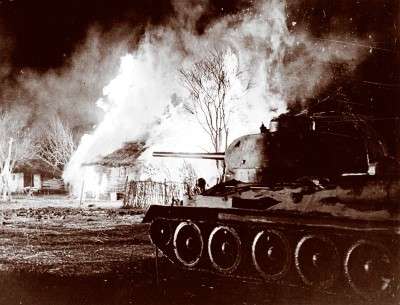
Photo: http://people.howstuffworks.com/allies-bomb-northern-nazi-germany.htm
Ever since nightfall, somewhere from the banks of the Don bursts of machine gun fire and the rumble of cannon were audible. The small garrison of Italian soldiers had been firing at us during the whole of the German occupation, but by this morning the fear and panic was gone from our village. It was a huge change for everyone.
The shock troops, the front line of our Red Army had moved on to the west, having broken through the enemy front, and were pursuing fleeing parts of the Italian Eighth Army, which had been stationed for six months on the right (west) bank of the Don, sixty kilometres to the east of us.
Early in the morning flowing past the villages, were Soviet commandoes in armoured vehicles, like caterpillars in a blizzard, flowing past the Kantemirovka railway station in Red Army T-34 tanks. Then troops passed through the village - infantry squadrons, cavalry squadrons, carts with heavy artillery, mobile kitchens, vehicles. People, machines, guns, horses - all moved on to the west, not stopping in the village.
The residents stood in the street as in a court yard, joyfully welcoming the liberators. An unknown joy captured us boys. We ran around the village, ran to each other, sharing the things we had seen. It had been a difficult six months, when we could hardly be pleased, not even be proud of what had passed before our eyes, as we had seen our soldiers retreating (more accurately escaping!) from the frightful, terrible enemy, afraid of being captured. Our planes and tanks were not visible anywhere. Our soldiers seemed doomed, some not even with rifles as they hastened to the east, in shirts wet with sweat, to the Don. In the sky it seemed that there was one German plane for every one of our soldiers. We were engulfed in a sad, oppressive mood, and all we could think was "What will become of us? What is going to happen?"
How many enemy soldiers, tanks, artillery and vehicles had passed by us in pursuit of our retreating armies? They had seemed invincible, unconquerable. Yet now, where were they? They had not passed by us, we had seen nothing of the retreating armies, yet our soldiers had destroyed the whole of this terrible force. We boys were proud of the result.
Within six months the other army had fallen before us. What mighty tanks, those T-34, what artillery, and the main thing, what cheerful, gallant, warmly and smartly dressed soldiers, all with automatics instead of ordinary rifles.
Together with the other children we arrived at the main collective farm court yard near a stable where we heard shouting and saw a big lorry and the artillery piece attached to it, while around it swarmed fifteen soldiers and with them their commanding officer. We heard the orders the officer made in order to fix something which was wrong with the machine, and the officer was in a hurry to catch up with the rest of his squadron.
We stood closer and began to observe their work with interest. I was especially interested in the officer in charge. He was a commanding figure, in a new white short fur coat, cinched with a wide leather belt with a pistol on one side, with sword belts across his shoulders, in a beautiful winter cap with a star. He gave commands precisely, and was alive, vigorous, and he made upon me an indelible, positive impression. It seemed that a commander of the Red Army should always be like this, such that it was impossible not to follow his orders with pleasure, implicitly to submit and to fight following him.
Our small group stood nearby and with great interest observed these unusual happenings, a picture which excited our boyish imaginations. Suddenly the officer turned to our group, and having quickly examined us, loudly called to me to give a hand:
"Listen, you boy! Come here!"
At first I did not understand, then he called me again, not moving from his place:
"Yes, yes, You! Come here!" he shouted again, enunciating his words carefully. I ran to him quickly.
"Listen!" he said, "Here is a note, carry it quickly to Rudaevka."
He also explained who to give it to. I seized the note, and was already starting to run to Rudaevka which was about three kilometres from us, but then suddenly remembered that in a nearby building there were horses stabled, and that instead of running, I could ride bare back on one of them.
I ran to the stable, removed a bridle from a hook, threw it over the first horse to hand, brought it out of the stable, jumped astride it, and rode down the road to Rudaevka. I urged the horse to a gallop, it would be important to execute quickly the very important task I had been given, the task of a commander, but the horse turned out to be an old, lazy cow who did not want to gallop.
Before me stretched a white, deserted, winter landscape. But in the distance on the steppe on the road I saw something dark, moving towards me, similar to a tank. Soon I could distinguish that it really was a T-34 tank, travelling slowly. I thought that perhaps it was a tank which had lagged behind the column, left behind in the morning at the previous village, and now it was catching up. It came closer and closer. I stopped the horse on the side of the road and began to wait until it should pass.
Suddenly in the sky, far away from us appeared a low flying plane. I saw that it was a German fighter bomber, a Folke-Woulff. We boys knew almost all types of German military planes, and had learned to distinguish them even by the sound of their engines. The plane started to manoeuvre and headed for the tank which was coming nearer to me, and when the tank was beside me, the plane lined up for the kill.
Into my head rushed the idea that a bomb from the plane would explode near or on the tank, and that would be the end of me. I had time to see the growing white figure of the pilot in the darkness of the cockpit, and the thought of my imminent death filled me with fear. It was terrible. In a sudden instinct of self-preservation, I instantly jumped off the horse, falling from it, and I literally pressed myself into the ground, expecting the explosion of a bomb at any second.
The tank had stopped beside me, and there was no explosion, but loud noises of bullets from a heavy calibre machine gun hitting the tank. The pilot gunned the motor, gained height and was gone. It became silent except for the quietly idling motor of the tank.
I rose from the ground, and looked around. My frightened horse had dashed away home, and was already far away. The plane was not visible anywhere. The cover of the hatch on the tower opened, and out came the helmeted head of the tank driver.
"Well, boy, are you alive?" he smilingly asked.
"Alive." I replied.
"Well, good health to you" the tankman said, and disappeared into the tower of the tank, closing the hatch behind him.
The tank moved on, and I remained the only one in the field. It was a little like recovering from a nervous shock, still not trusting that I was still alive. I walked on, to Rudaevka, to carry out the task the commander I liked so much had given to me to do.
There at the village where I was to transfer the note, there was nobody. There was nothing I could do, so I plodded home.
At the main court yard near the stable the soldiers had already gone. Probably, having fixed the problems, they had moved on to catch up to their regiment.
And thus it was not possible for me to execute what seemed to me to be a very important task given to me by an officer of the Red Army, but it had been possible to look death in the eye and to remember the experience for the rest of my life.
The Draft
It was 1944. Already we had been at war for almost three years, with no end in sight: we were at war within our own territory. The Germans resisted fiercely, and there was heavy fighting at the front, which was moving slowly westward to the borders of the USSR.Many women had received death certificates for their husbands and sons, and some people returned from war as cripples. Father Shurki Zhukova returned without a leg. In a long cavalry overcoat, on two crutches, he daily skipped along the street in the direction of the collective farm office.
By the time spring came, newly qualified tractor operators returned. I was assigned to work as a plough operator in the tractor group, with Shurka (he was the tractor driver, and I was the operator of the plough). We began to work on one tractor to plough a field, at last having been liberated from this heavy work using the oxen and cows with which we had done the field work before.
The aged HTZ needed a lot of effort to operate: it took at least an hour to get it started. First we burned rags moistened in kerosene to warm up the motor. Because of the soot and the black oil we looked like chimney sweeps. There was no soap, and there was nothing to clean our clothes.
It was difficult being on night shift without a light. Because of the blackout, we worked in darkness, not being allowed to switch on the headlights.
Sometimes, having left Shurka at the end of the field to take a nap, I drove the tractor alone. The darkness was impenetrable, it was pitch black - nothing was visible. You could hold the tractor in the furrow only intuitively, if the wheel of the tractor leaves the furrow when the steering wheel is turned, it twitches sharply. Under the influence of the monotonous rumble of the motor, you drive in a dream, almost asleep, and the morning is still so far away. It was tempting to stop the motor, and sleep the night away in the tall weeds, but the field had to be ploughed.
But anyway - youth prevailed. We were buoyed up by the company, we were young men and women. Having completed my work late one day, I washed quickly, and left the village to go to a party.
On a hill near a windmill in the evenings the youth of the village gathered, the accordion and a balalaika played, we sang chastooshkas including obscene songs, and sang in chorus Russian and Ukrainian songs, danced "barinja" (lady) and a hopak. We left only at daybreak.
In the afternoon after work sleep beckoned, and I swore that I would not go anywhere in the evening, that I would lie down to sleep, but the first sounds of the accordion on the hill near the mill banished weariness and dreams, and there was nothing that could keep me sitting at home. And tomorrow, the whole thing would be repeated.
I didn't dare approach Nadja Sulimana, for me she seemed totally inaccessible. Out of all the rural schoolchildren, she was the one who was able to continue studying to tenth grade and to finish it. Living at Pisarevka with her family, she studied at a unique school. It was the only ten-grades school in the area. Being at home on vacation, she, I remember, retold in the evenings to a circle of young people the contents of literary works which she had studied at school, and we, having stopped our games and our singing, became silent, listening to her. I very much envied her: I too very much would have liked to study, but there was no such opportunity. Instead of study I had been occupied with oxen, ploughs, harrows and the pitchfork.
That year my father was frequently sick; every day, having come home from work, he lay down in bed on his stomach and for hours loudly groaned from a pain in the stomach. By nature not happy person, and also tormented by illness, he could not provide security for our family. Especially, with regard to clothes, money was necessary. Poverty, patched and overpatched trousers caused a feeling of inferiority which saddened me in that fine time of youth. I could not be a beau in such trousers.
At the height of summer, all the recruits gathered at the recruitment office. After the course, a young soldier left home, and, while continuing to work, day by day, waited for conscription into the army.
In October I, Ivan Tverdohlebov and Mitka Kotljarov received our summons - we were called up for military service. I was at that time not quite seventeen years old, but the war demanded new victims, the Father Land could not wait for when we should be the normal nineteen-year age for call up before the war.
In the evening we three, and some other guys gathered at Mitka's place, and sat silently at a table on which his sisters put bottles of water, simulating vodka. In all the village there was no moon-shine to be found. We went home, and in the morning we silently left for Rudaevka. There were none of those noisy parties that are arranged now, in peace time for the men leaving for two years in army, the farewells lasting for many days with feasts and much drinking.
In Rudaevka we combined with the local recruits and, having been supplied with knapsacks, we went on foot to Talis. Since it was a cloudy, slushy morning, the weather did not promote a good mood, and we went up to Tali silently, everyone, thinking about themselves. I looked at the fields, looked back to where Kramarevka had disappeared, thought of my small sisters, my old grandmother and my sick father, mentally once again said goodbye to them, and a bitter lump was involuntarily driven to my throat, and my eyes dimmed with tears. Farewell native fields, farewell Kramarevka, farewell everything. Whether I would ever return here again I did not know.
Recruits from the whole area gathered in Tali near a military registration and enlistment office, and there was a lot of seeing off. Noise, din, excitation of crowd grasped us also - the mood was changed, and already we almost did not think of the houses we had left.
I saw many send-offs to the war in the army, and you can see these send-offs in films now, but recollecting our entry into the war, in essence still children, I reflect and am surprised that women did not wail. For war I saw many send-off in army, and now in many films frequently show, how then saw off on war, but recollecting saw off of us, in essence still children, I reflect and am surprised to that women did not wail how they wailed before, seeing off in army of the relatives that was not felt in an atmosphere of seeing-off hopelessness, and was more solemnity as though saw off us on service in a peace time. I remember, how one woman, outvoicing noise of crowd, a fervent voice shouted to someone at parting: « Sasa! Serve well, below the major do not come back! »
As though war did not rattle in the West and not perished on that war of thousand people and as though we not there left . May be have sobred out for war all tears, and may be approach of the Victory was felt, and mothers did not trust, that their children should go under bullets and to perish. All trusted, probably, that war will end without our participation in it.
But we then did not want it. Each of us secretly , on boyish, was pleased to that goes on war that is necessary to do some fighting. Were proud of it and tried to seem is more adult.
But as though we tried to be adults, boyishness and climbed from us. On all 25 kilometres way up to a Kantemirovka, gone on foot, we behaved as children. It was authorized to us to go it is free, without formation, and we in a way chased one after another, struggled, competed, who will run on a railway rail, not coming off with it further.
Only one episode in a way has set us thinking for a while on where we go and that waits for us ahead. To us has met on road of soldiers, the man of years of forty, thin and pale, appreciablly tired. He went on foot from station, coming back with front, home in the Pisarevka after wound.
New English an overcoat has been dressed on on one left hand and it is clasped at a neck on one hook. The right hand in the plaster, tied up to a neck a green kerchief, looked out from under an overcoat. Having overtaken with us, he has stopped, and we cheerful, excited, have surrounded with his dense ring. I remember, how he was excited, when has learned, that we are directed in army.
- Yes where you such very young? - is surprised he has exclaimed.
Then spoke, that war should end soon, but that Fritzs persistently resist, that there are heavy fights and more many people perish still. We have become silent, but not for long. The soldier behind hillock as we already were former, frivolous boys has not had time to disappear.
At station of us the echelon made of commodity cars expected. We have loaded into it together with recruits of Kantemirovka area . Buffers have clanked, the train was slowly touched forward, taking away us in unknown. The new strip in my life began.
Призыв в Армию
Наступил 1944 год. Уже почти три года идет война, а ей не видно конца: воюют еще на нашей территории. Немцы ожесточенно сопротивляются, фронт медленно, с тяжелыми боями продвигается на запад к границам СССР.Многие женщины получили похоронки на мужей, сыновей некоторые вернулись с войны калеками. Вернулся без ноги отец Шурки Жукова. В длинной кавалерийской шинели, на двух костылях, он ежедневно скакал по улице в направлении колхозной конторы.
К весне вернулись новоиспеченные трактористы. Меня назначили работать прицепщиком в тракторный отряд, и мы с Шуркой (он тракторист, а я прицепщик) стали работать на одном тракторе: пахать поле, высвободив от этой тяжелой работы и волов, и коров, на которых мы пахали до этого.
Старенький ХТЗ доставлял уйму хлопот: не меньше часу уходило на то, чтобы его завести. Жгли тряпки, смоченные в керосине, разогревая мотор. От копоти, мазута, масла были похожи на трубочистов. Не было мыла - нечем было стирать одежду.
Трудно было в ночную смену без света. В целях светомаскировки работали в темноте, не зажигая фар.
Иногда, оставив Шурку одного в конце поля вздремнуть, я уезжал в загон один. Тьма непроглядная, хоть глаз выколи - ничего не видно. Трактор держишь в борозде лишь чутьем, по вращению руля: он резко дергается, если колесо трактора выйдет из борозды. Под монотонный гул мотора неудержимо клонит в сон, а до утра еще так далеко. Заглушить бы мотор, да завалиться спать в бурьяне, но что будет, если мало вспашешь.
Но как бы там ни было - молодость брала свое. Тянуло в компанию, где молодежь, где девчата. Отработав день допоздна, быстро умывшись, уходили в деревню на вечеринку.
На холме возле ветряной мельницы по вечерам собиралась молодежь, играла гармошка, балалайка, пели частушки, в том числе и похабные, пели хором русские и украинские песни, плясали барыню и гопака. Расходились только под утро.
Днем на работе ужасно хотелось спать, и я клялся, что вечером никуда не пойду - сразу лягу спать, но первые же звуки гармошки на горе возле мельницы прогоняли усталость и сон, и не было сил усидеть дома. А на завтра все повторялось снова.
К Наде Сулиминой я все так же не смел подходить: для меня она теперь казалась вовсе недосягаемой. Из всех наших деревенских школьников она одна смогла продолжить учебу в десятилетке и закончить ее. Живя в Писаревке у родственников, она училась там в единственной на весь район школе-десятилетке. Бывая дома на каникулах она, помню, пересказывала по вечерам в кругу молодежи содержание литературных произведений, которые они проходили в школе, а мы, прекратив игры и песни, притихшие, слушали ее рассказ. Я ей очень завидовал: мне тоже очень хотелось учиться, но только не было такой возможности. Вместо учебы я был занят волами, плугами, боронами, вилами.
В тот год отец особенно часто болел; каждый день, придя с работы, ложился на кровать вниз животом и часами громко стонал от боли в животе. По природе своей не очень-то разбитной человек, к тому же еще и терзаемый болезнью, он не мог обеспечить более-менее благополучное положение семьи. Особенно, что касалось одежды, чтобы приобрести которую в те времена нужны были особые способности и средства. Бедность, латаные и перелатанные штаны вызывали какое-то чувство неполноценности, которое омрачало жизнь в ту прекрасную пору юности. Кавалерить в таких штанах я просто стеснялся.
В разгар лета всех призывников собрали на сборы в военкомате. Пройдя курс молодого бойца, разъехались по домам и, продолжая трудиться, со дня на день ждали призыва в армию.
В октябре месяце я, Иван Твердохлебов и Митька Котляров получили повестки - мы призывались в армию. Мне не было в ту пору полных семнадцати лет, но война требовала новых жертв, Родина не могла ждать, когда мы дорастем до нормального девятнадцатилетнего возраста, с какого призывали до войны.
Вечером мы трое, да еще некоторые ребята собрались у Митьки, тихо посидели за столом, на который его сестры поставили несколько бутылок с водой, имитируя водку. Во всем селе не нашлось бутылки самогона. Разошлись по домам, а на утро также тихо ушли на Рудаевку. Не было тех шумных проводов, какие устраивают сейчас, в мирное время парням, уходящим на два года в армию, проводов с многодневными пиршествами и обильными возлияниями.
В Рудаевке соединились с тамошними призывниками и, побросав на подводу свои котомки, двинулись пешком на Талы. С утра был пасмурный, слякотный день, погода не способствовала хорошему настроению, и мы до Талов шли молча, каждый, думая о своем. Я смотрел на поля, оглядывался назад, где скрылась Крамаревка, думал о маленьких сестрах, старой бабушке и больном отце, мысленно еще раз прощался с ними, и горький комок невольно подкатывался к горлу, глаза застилало слезами. Прощайте все, прощайте родные поля, прощай Крамаревка. Вернусь ли сюда когда-нибудь - не знаю.
В Талах возле военкомата собрались призывники со всего района, было много провожающих. Шум, гам, возбуждение толпы захватило и нас - настроение переменилось, и мы уже почти не думали об оставленных домах.
За войну я видел много проводов в армию, да и теперь во многих фильмах часто показывают, как тогда провожали на войну, но вспоминая проводы нас, в сущности еще детей, я задумываюсь и удивляюсь тому, что не голосили женщины так, как они голосили до этого, провожая в армию своих близких, что не чувствовалось в атмосфере проводов обреченности, а было больше торжественности, как будто провожали нас на службу в мирное время. Помню, как одна женщина, перекрикивая шум толпы, задорным голосом кричала кому-то на прощанье: «Саша! Служи хорошо, ниже майора не возвращайся!»
Как будто и не гремела еще на западе война и не гибли на той войне тысячи людей, и как будто мы не туда уходили. Может выплакали за войну все слезы, а может чувствовалось приближение Победы, и не верили матери, что их детям придется идти под пули и погибать. Все верили, наверное, что война закончится без нашего участия в ней.
Но сами мы этого тогда не хотели. Каждый из нас в тайне, по мальчишески, радовался тому, что идет на войну, что придется повоевать. Гордились этим и старались казаться повзрослее.
Но как бы мы ни старались быть взрослыми, мальчишество так и лезло из нас. На всем 25-ти километровом пути до Кантемировки, пройденные пешком, мы вели себя как дети. Нам было разрешено идти вольно, без строя, и мы в пути гонялись друг за другом, боролись, соревновались, кто дальше пробежит по железнодорожному рельсу, не соскакивая с него.
Только один эпизод в пути заставил нас задуматься на время о том, куда мы идем, и что нас ждет впереди. Нам повстречался на дороге солдат, мужчина лет сорока, худой и бледный, заметно уставший. Он шел пешком со станции, возвращаясь с фронта, домой в Писаревку после ранения.
Новая английская шинель была у него надета на одну левую руку и застегнута у шеи на один крючок. Правая рука в гипсе, подвязанная к шее зеленой косынкой, выглядывала из-под шинели. Поравнявшись с нами, он остановился, и мы веселые, возбужденные, окружили его плотным кольцом. Помню, как он взволновался, когда узнал, что мы направляемся в армию.
- Да куда же вас таких молоденьких? - удивленно воскликнул он.
Потом говорил, что война должна скоро закончиться, но что фрицы упорно сопротивляются, что идут тяжелые бои и гибнет еще много людей. Мы притихли, но ненадолго. Не успел солдат скрыться за пригорком, как мы уже были прежними, несерьезными пацанами.
На станции нас ожидал эшелон, составленный из товарных вагонов. В него мы погрузились вместе с призывниками Кантемировского района. Лязгнули буфера, поезд медленно тронулся вперед, увозя нас в неизвестное. Начиналась новая полоса в моей жизни.
Поэмы
Посылаю стихотворение моего отца.
I send a poem by my father.
Photo: http://www.trekearth.com/gallery/Asia/Russia/photo236177.htm
Россия, прости меня милая.
За что я не знаю и сам.
Неужто тебе изменил я,
Неужто врагом тебе стал?
Russia, forgive me my darling.
For what I do not know also.
Really have I betrayed you,
Really have I become your enemy?
-----------------------------------------------
Пойми меня родина малая,
Пойми и, прошу я, прости
За то, что родные могилы
Дождаться меня не могли.
Understand me small native land,
Understand and, I ask, forgive
For that native tomb
Could not wait for me.
-----------------------------------------------
Ах, если б вы знали, что где бы я ни был,
В какой бы ни жил стороне,
И зов ваш, и образы милые
Носил я с собою везде.
Ah, if you would know, that where I was,
In what place did not live,
Both your call, and images of darlings
I carried with myself everywhere.
-----------------------------------------------
Простите, родные могилы,
За все, что плохое во мне,
За то, что я рядом не лягу,
А лягу в чужой стороне.
Forgive, native tombs,
For everything, that is bad in me,
For that I beside you shall not lay down,
And I shall lay down in a strange country.
1993 г.