Back to Don's Maps
 Mousterian (Neanderthal) Sites
 Back to the review of hominins
La Quina - a Neanderthal site with thick asymmetric tools
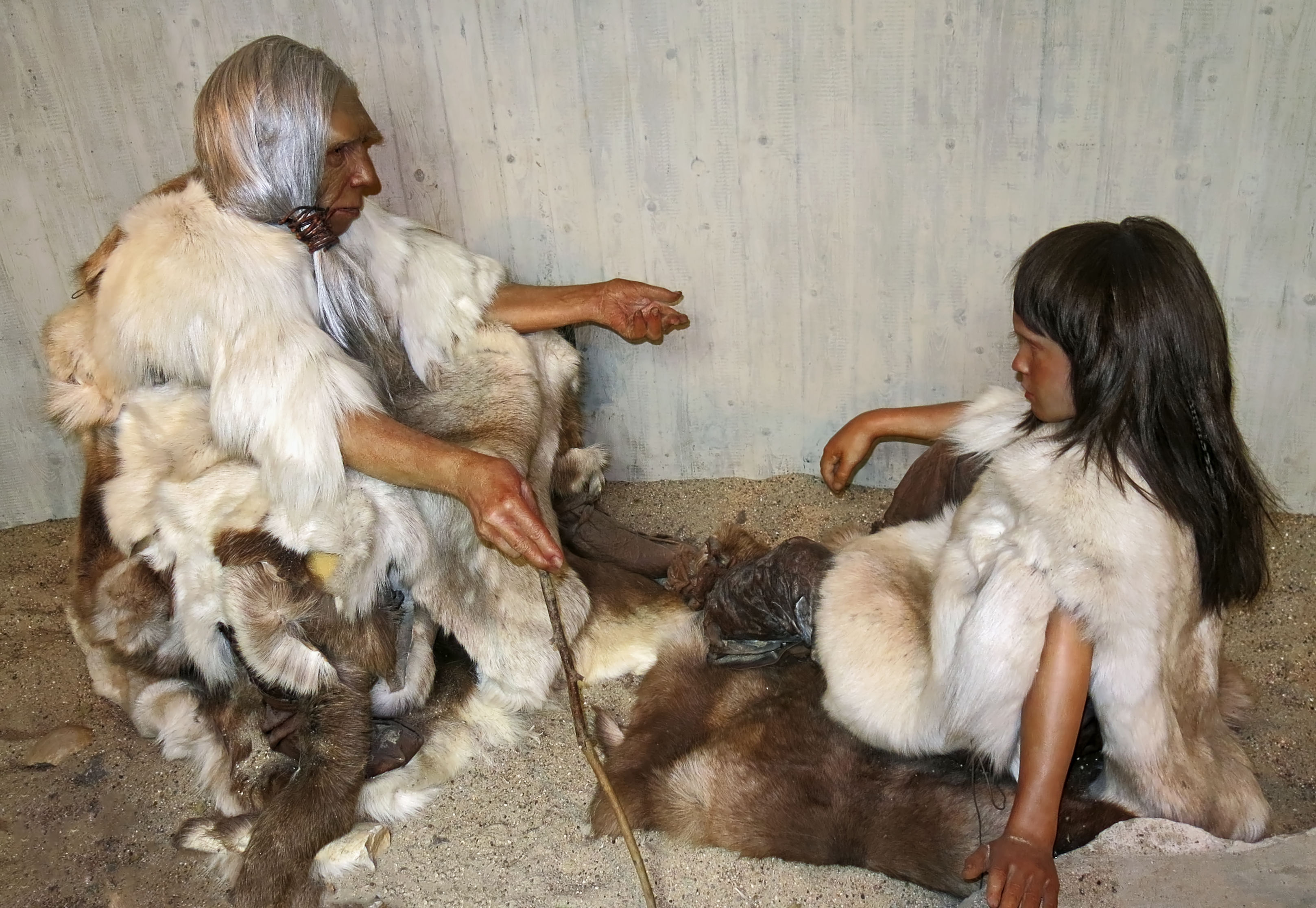
Woman and child from La Quina
Photo: Don Hitchcock 2015
Artist: Élisabeth Daynès, Paris
Source: Neanderthal Museum, Mettmann
La Quina is a Neanderthal site located in the Charente region of south-western France. The artisans of the La Quina Mousterian industry type (thick asymmetric tools transformed many times) had a particular way of life. They were hunters specialising in the hunt for reindeer or bison, and they moved following the herds. Their prey was generally transported, either all or in part, back to their base camps, caves or shelters. The primary site (or Station Amont) originally consisted of an accumulation of deposits of more than seven metres deep which extended for approximately 100 metres at the base of a limestone cliff. The area around La Quina is characterised by limestone cliffs cut by the Voultron River which still flows through the area today, as well as shallow rockshelters resulting from differential weathering of the limestone.
La Quina is located in the Charente region of south-western France, approximately 5 km from the village of Villebois-Lavalette. The site itself has been known for more than a century and was first excavated systematically between 1905 and 1935 by the French archaeologist Dr. Henri-Martin. Subsequently, Germaine Henri-Martin continued excavation from 1953 until the late 1960s. After her death in 1975, the site became the property of the Musée des Antiquités Nationales.
The area around La Quina is characterised by limestone cliffs cut by the Voultron River which still flows through the area today and shallow rockshelters resulting from differential weathering of the limestone. The primary site (or Station Amont) originally consisted of an accumulation of deposits of more than seven metres deep which extended for approximately 100 metres at the base of a limestone cliff.
In addition, other sediments some 200 metres to the southwest comprise the Station Aval. The Station Aval contained a sequence of Mousterian, Chatelperronian, and Aurignacian levels. The more extensive section of the Station Amont, the focus of recent excavations, displays a deep stratified sequence of Mousterian layers which have yielded large numbers of faunal remains as well as abundant stone tools and the fragmentary remains of over 25 hominids. Those specimens that are taxonomically identifiable have been attributed to Homo sapiens neanderthalensis.
Text above adapted from Hardy (2004)
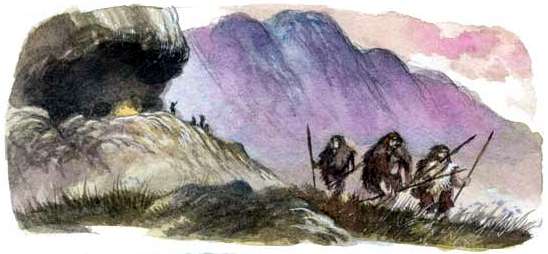
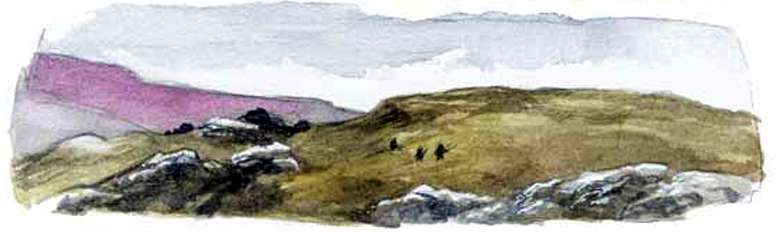
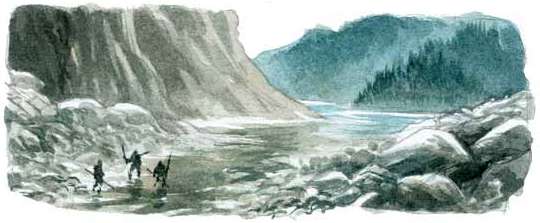
The artisans of the Quina Mousterian industry type (thick asymmetric tools transformed many times) had a particular way of life: they were hunters specializing in the hunt for Reindeer or Bison, and they moved following the herds.
Their prey was generally transported, either all or in part, back to their base camps, caves or shelters.
Text: Translated and adapted from the display at le Musée National de Préhistoire, Les Eyzies
Photo: http://roudier-neandertal.blogspot.com/
Artist:© Emmanuel Roudier, 2008
Superb watercolours were done for this exhibition by the French artist, Emmanuel Roudier.
Blog: http://roudier-neandertal.blogspot.com/ Contact: emmanuelroudier@gmail.com
La Quina aval
The remains of ungulates come from the work of Soulier (2013)
| Fauna of La Quina aval | ||
|---|---|---|
| Fauna | Number of Identified Specimens | Minimum Number of Individuals |
| Horse | 107 | 3 |
| Aurochs and Bison | 27 | 2 |
| Reindeer | 2987 | 22 |
| Deer | 2 | 1 |
| Wolf | 11 | 1 |
| Polecat | 1 | 1 |
| Fox | 84 | 2 |
| Hare | 11 | 1 |
| Snowy Owl | 3 | 1 |
| Unidentified mesofauna | 5 | |
| Ungulates 1/2 | 4 | |
| Ungulates 2 | 502 | |
| Ungulates 3/4 | 66 | |
| Ungulates 5 | 4 | |
| Undetermined | 1634 | |
| Total | 5495 | |
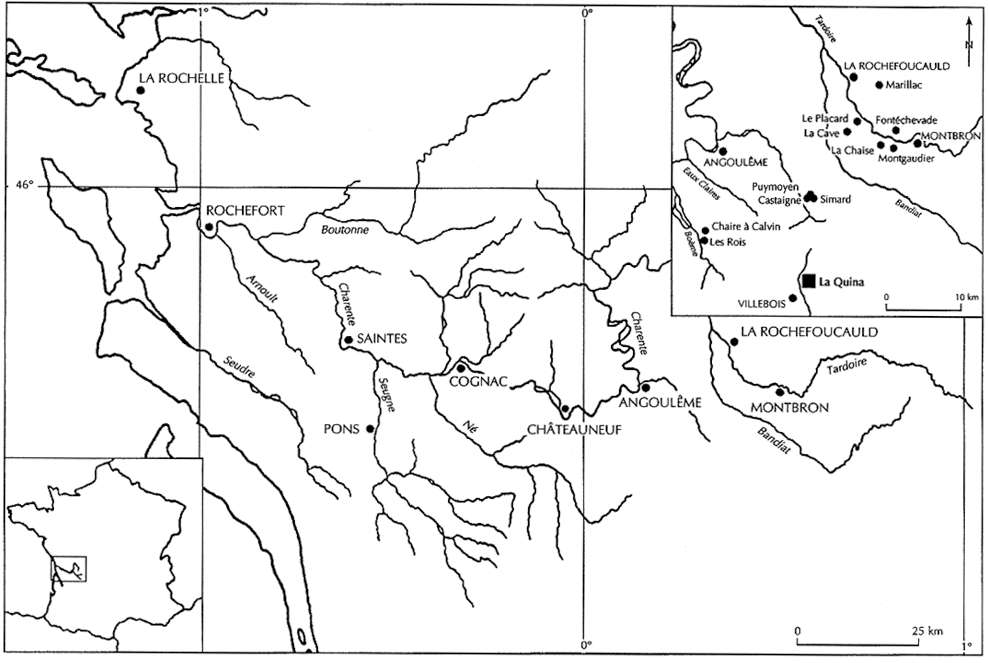
Map of the region
Photo: Debénath A. et al (1998)

Gustave Chauvet during his 1897 excavations at La Quina.
Photo and text: Jelinek (2013)
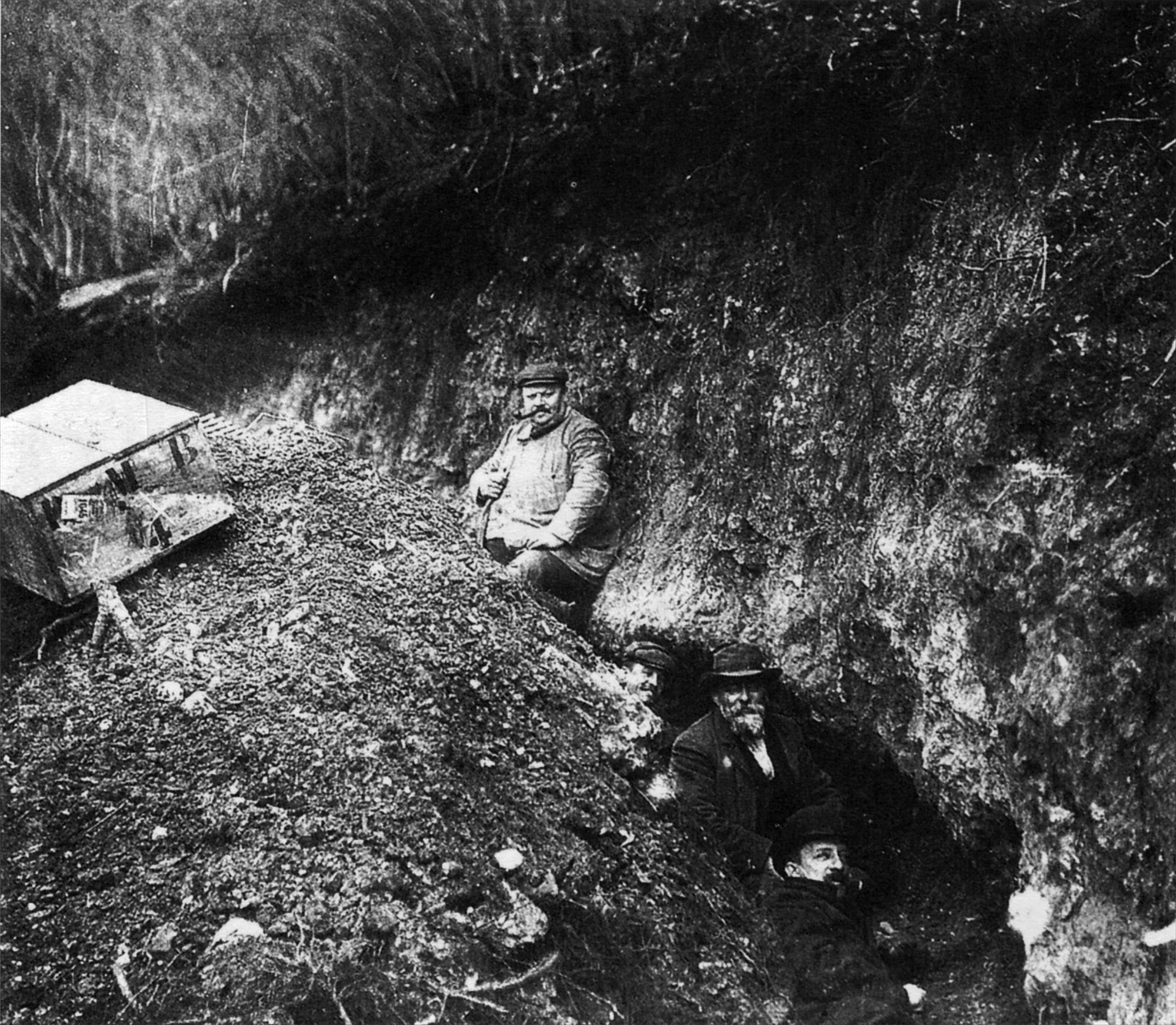
Dr Henri-Martin's excavations at the station amont.
Photo by Dr Henri-Martin, of M. Bertranet, in 1906, on the left, with excavators undercutting the sterile deposits.
Photo and text: Jelinek (2013)
Original source: from Breton family photos, archives of the Musée d'Angoulême
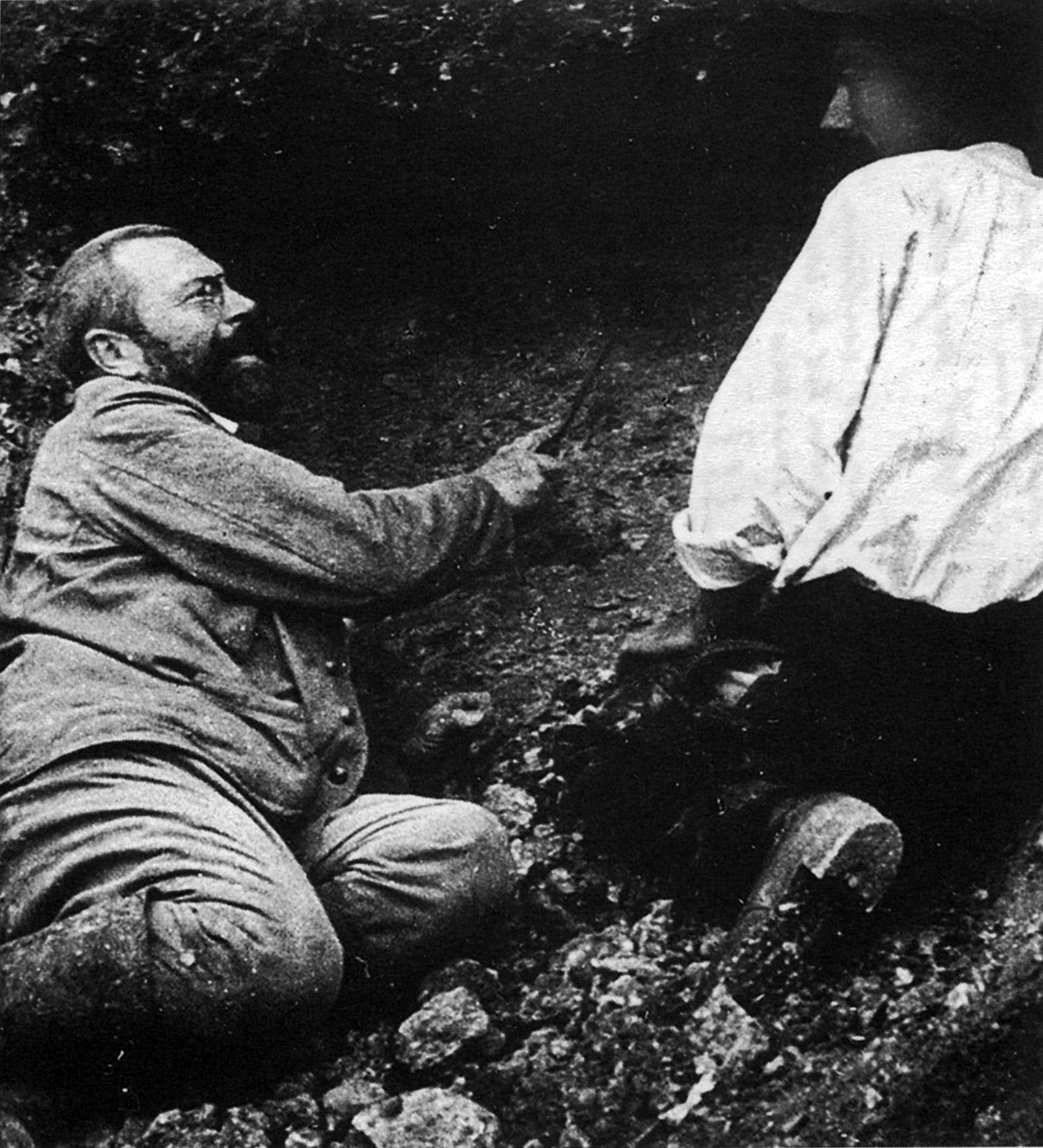
Dr Henri-Martin's excavations at the station amont.
Dr Henri-Martin, in 1912, on the left, using a crochet, or hook, a common tool in archaeology at that time.
Photo and text: Jelinek (2013)
Original source: from Breton family photos, archives of the Musée d'Angoulême
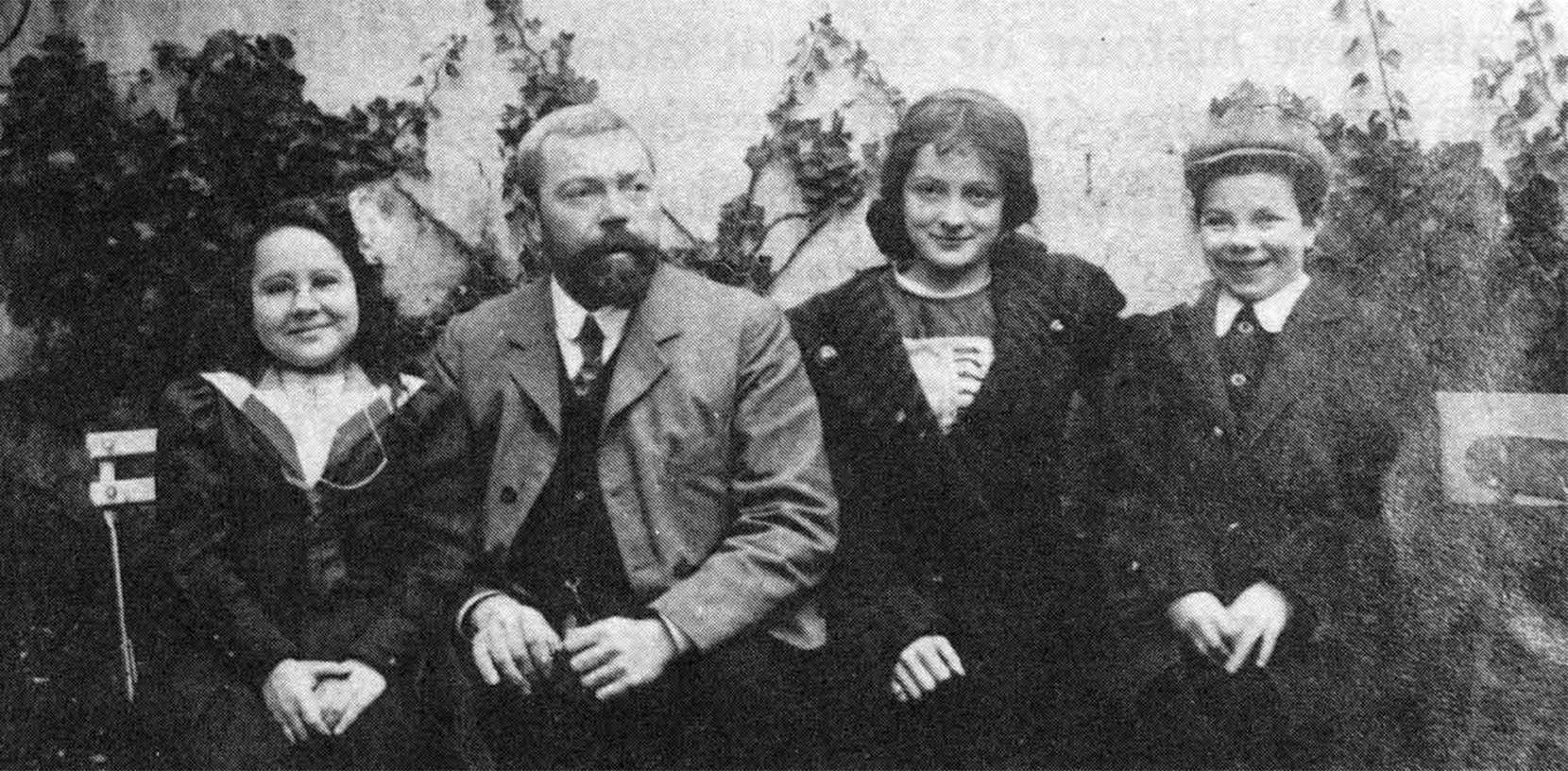
Dr Léon Henri-Martin and children.
Photo: Heinrich Wendel (© The Wendel Collection, Neanderthal Museum)
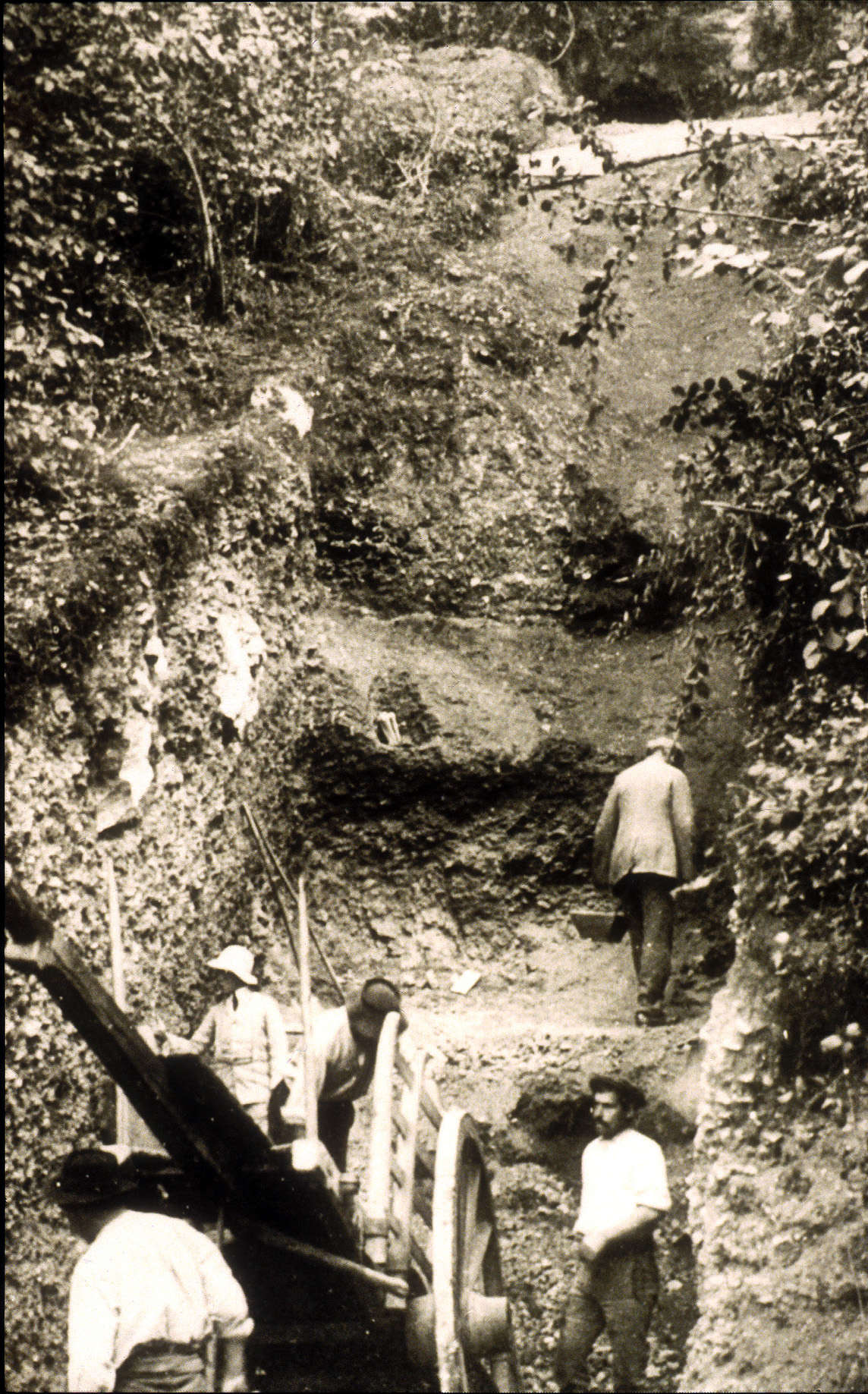
Excavations at La Quina by Dr Henri-Martin.
Photo: Heinrich Wendel (© The Wendel Collection, Neanderthal Museum)
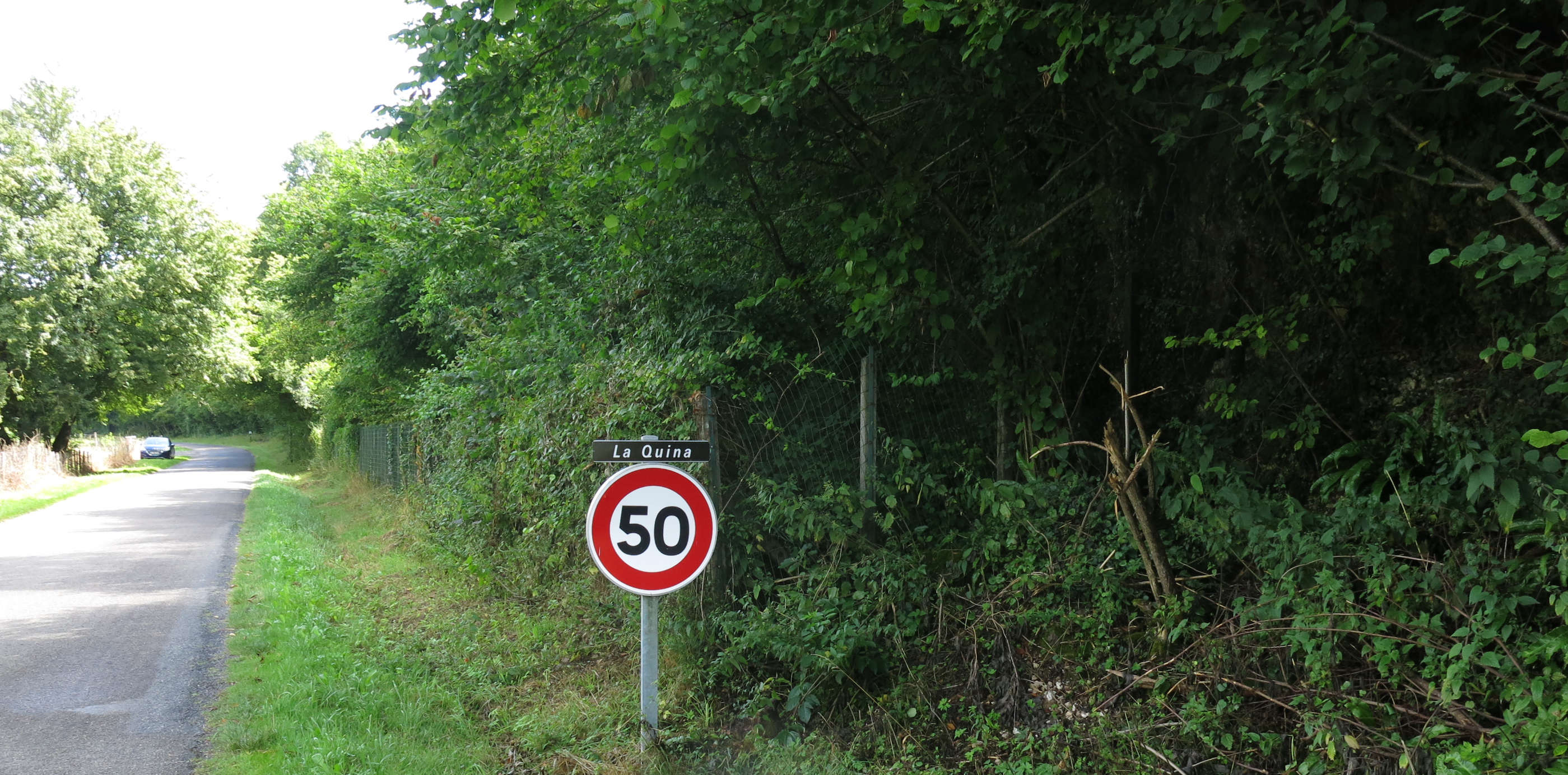
The paleolithic sites of La Quina, Gardes-le-Pontaroux, Charente, France. The two sites are on the right side of the Pontaroux-Blanzaguet road, hidden by vegetation underneath the overgrown limestone cliff.
There is a wire fence around the former digs, but no warning signs against unauthorised digging, or any other marker, which is unusual for important French archaeological digs.
Photo: Don Hitchcock 2014
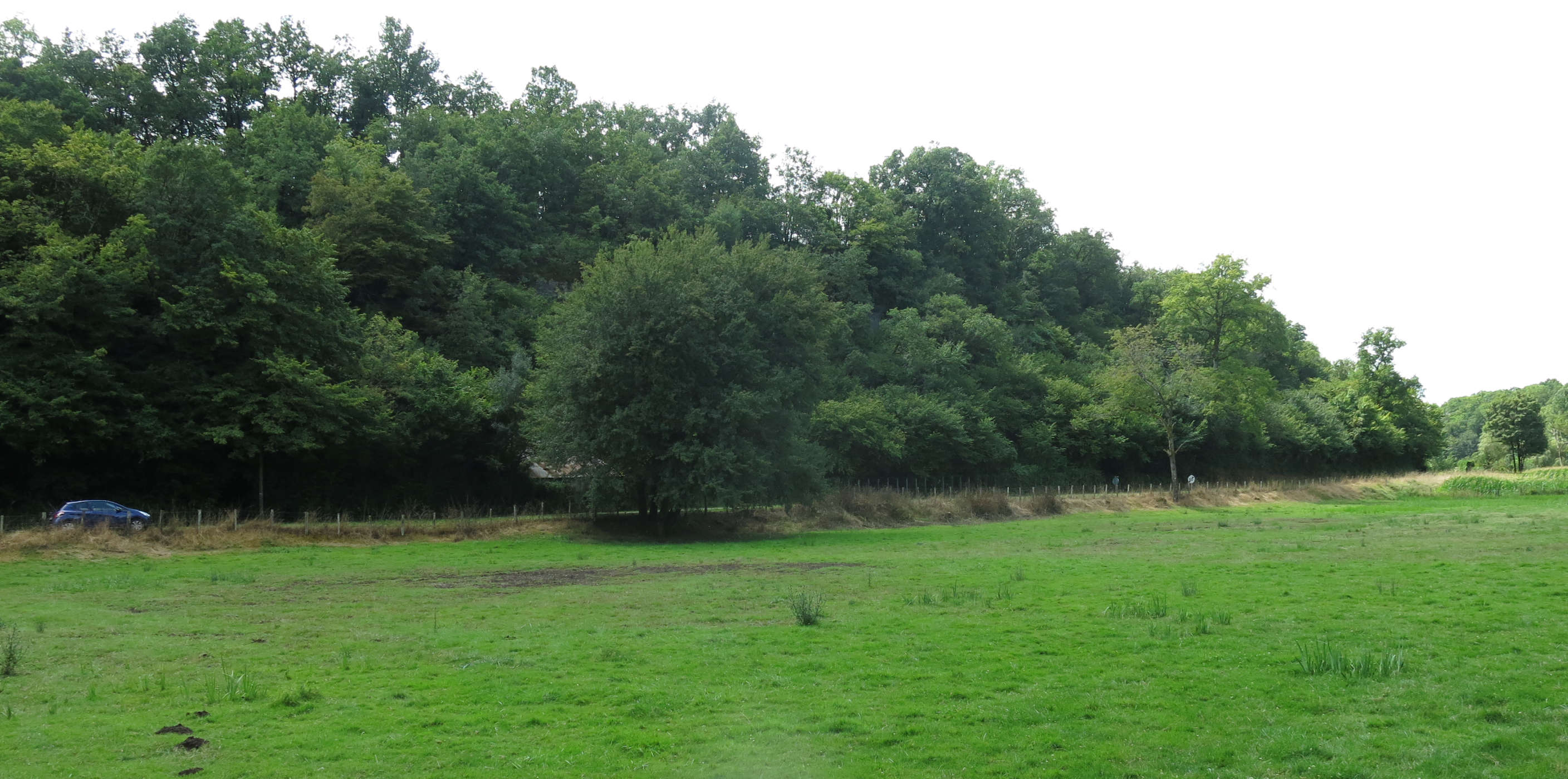
A distant shot of the La Quina archaeological area, which is to the right of the car in this view.
The roofed area visible through the tree forms the northern edge of the site, which faces west across the present day grazed pasture.
Photo: Don Hitchcock 2014

1907 picture of La Quina.
It should be noted that there is far more vegetation on the La Quina slope now than a hundred years or more ago.
Photo: L. Henri-Martin
Source: Archives, © Musée d'Archéologie nationale, Saint-Germain-en-Laye
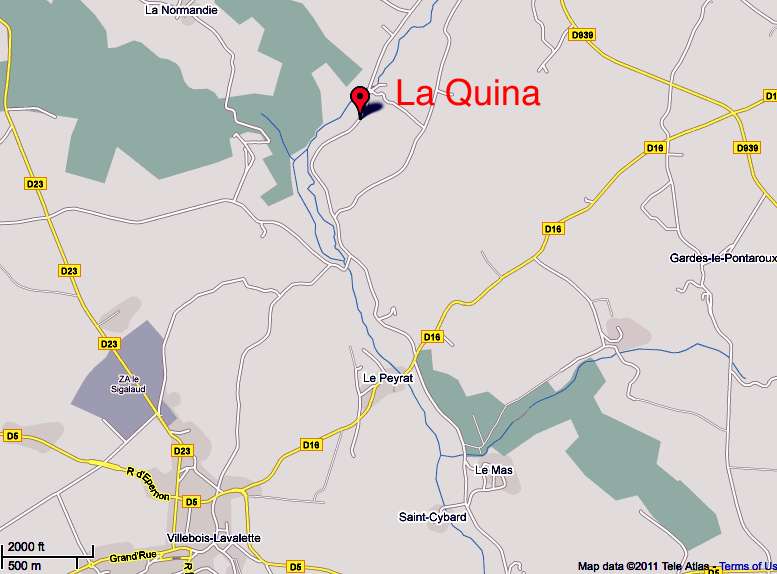
Location map for La Quina, about 2 km north of Villebois-Lavalette. Print this out and take it with you if you are going to the site, it is invaluable.
Photo: Google Maps
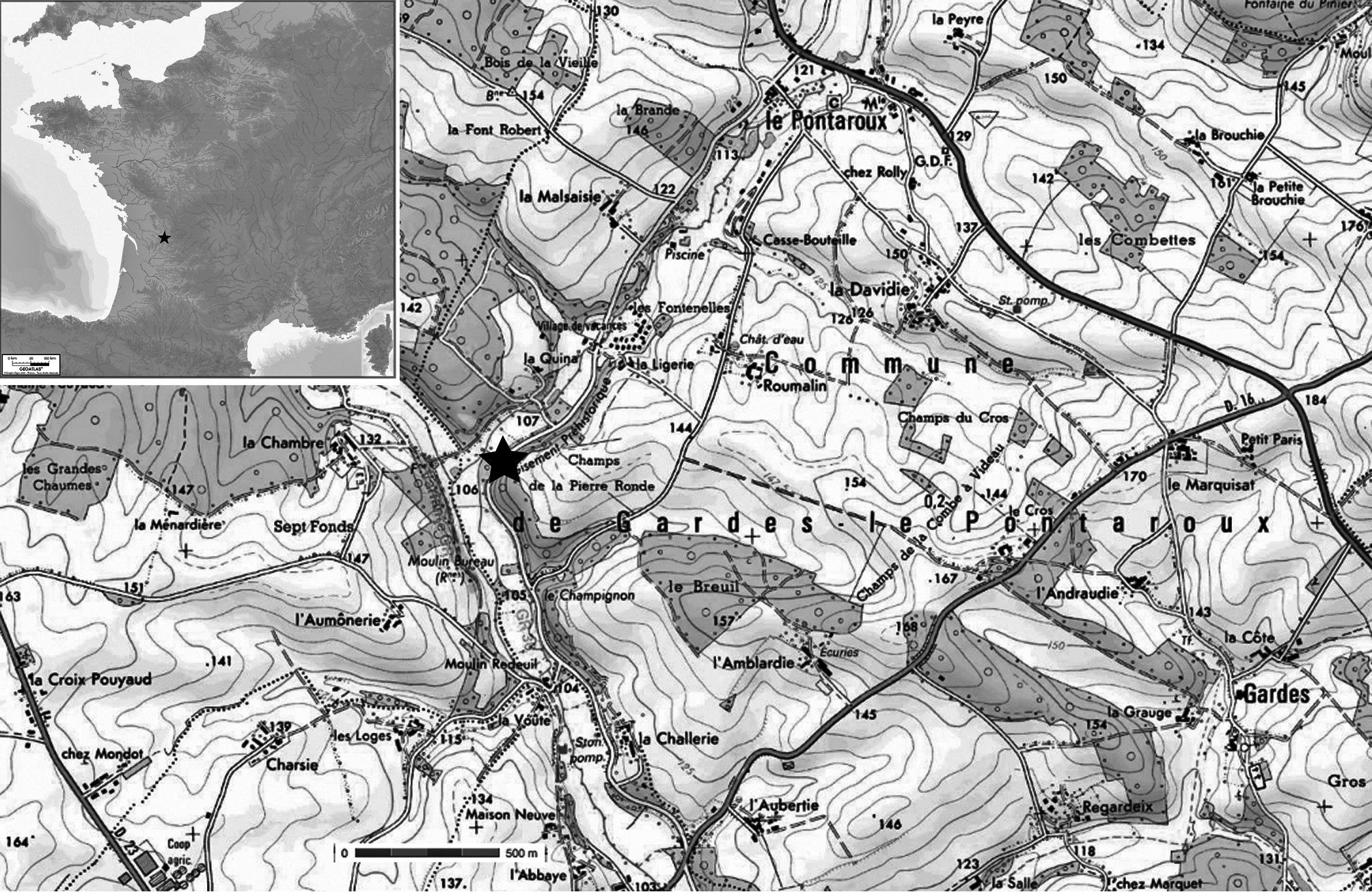
A more detailed location map with contour lines for La Quina, about 2 km north of Villebois-Lavalette.
Photo: Mallye et al. (2013)
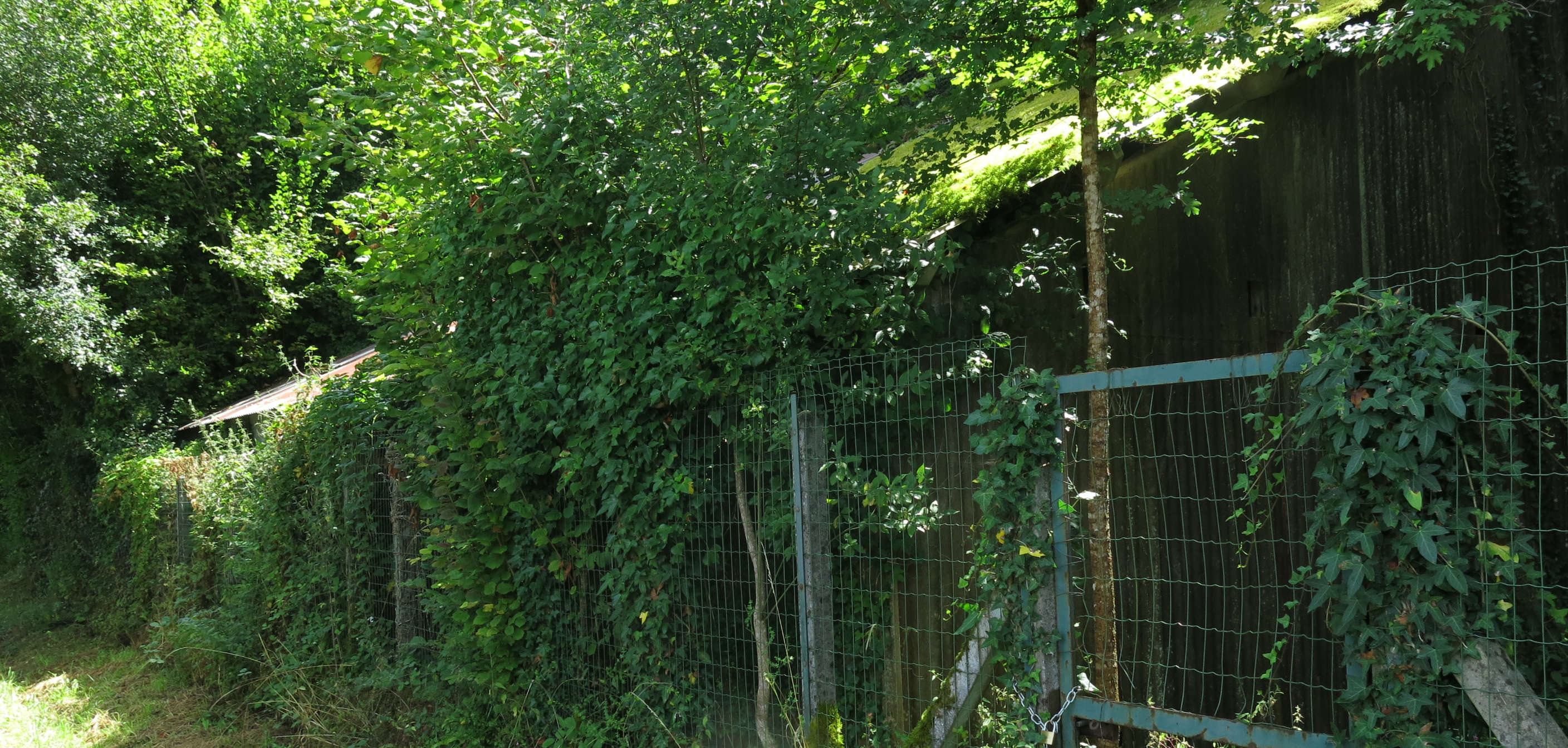
There is an old shelter over the digs at one point, walled on the southern side, no doubt originally used when the excavations were active. It now serves as protection for an undug 'witness' section of the site.
Photo: Don Hitchcock 2014
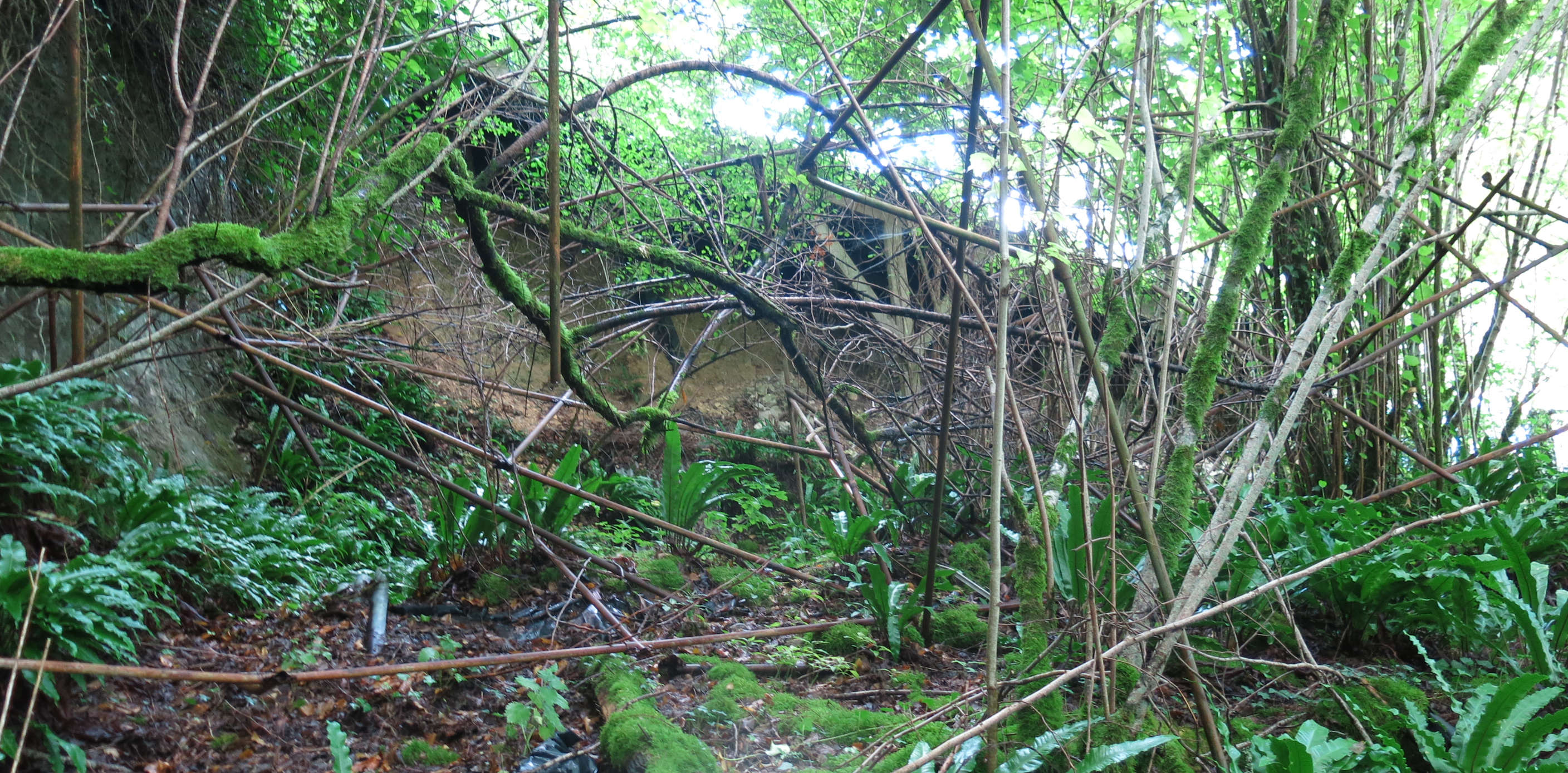
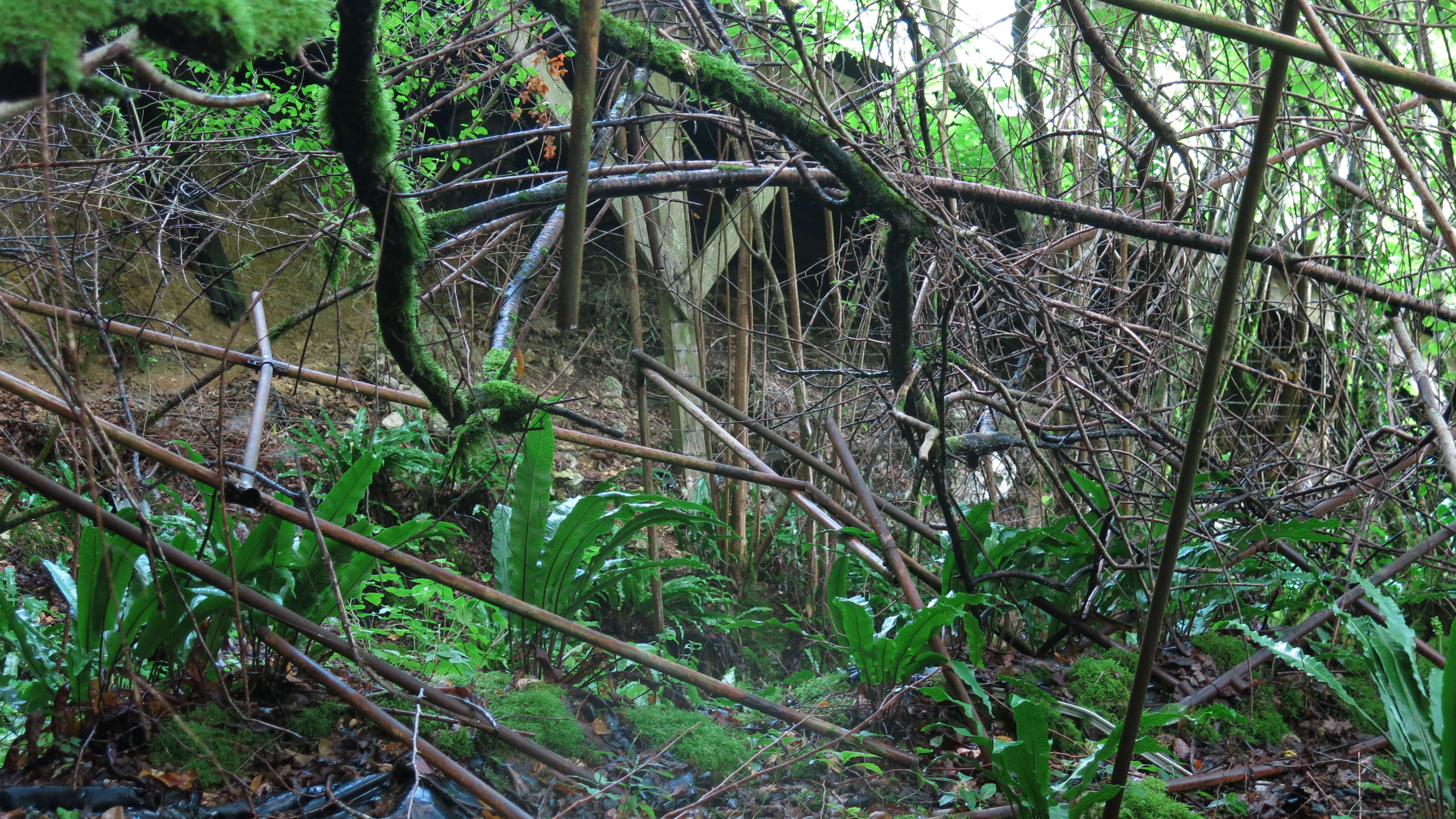
The northern side of the roofed area is not walled, though the roof has been well supported.
Photo: Don Hitchcock 2014
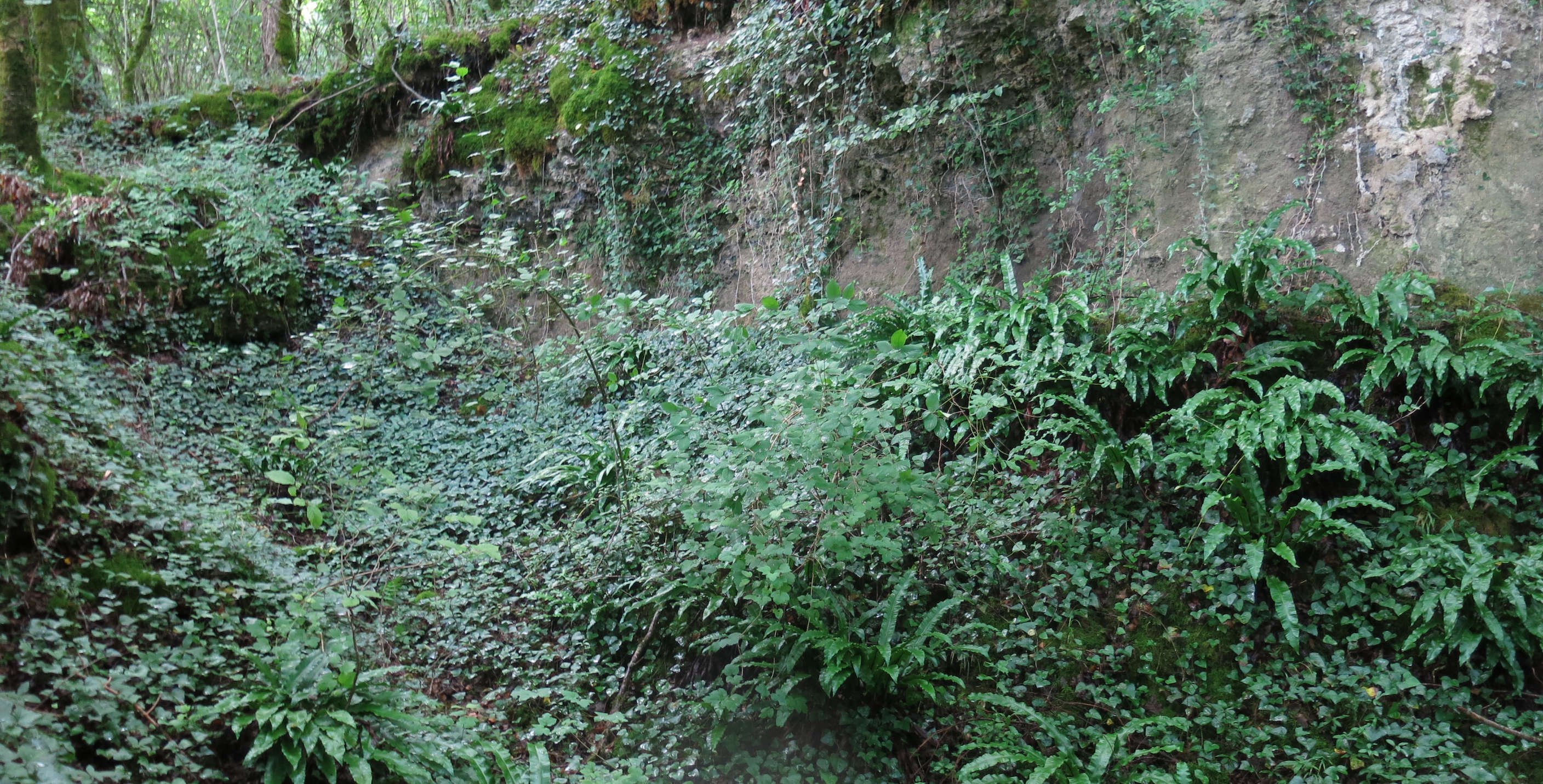
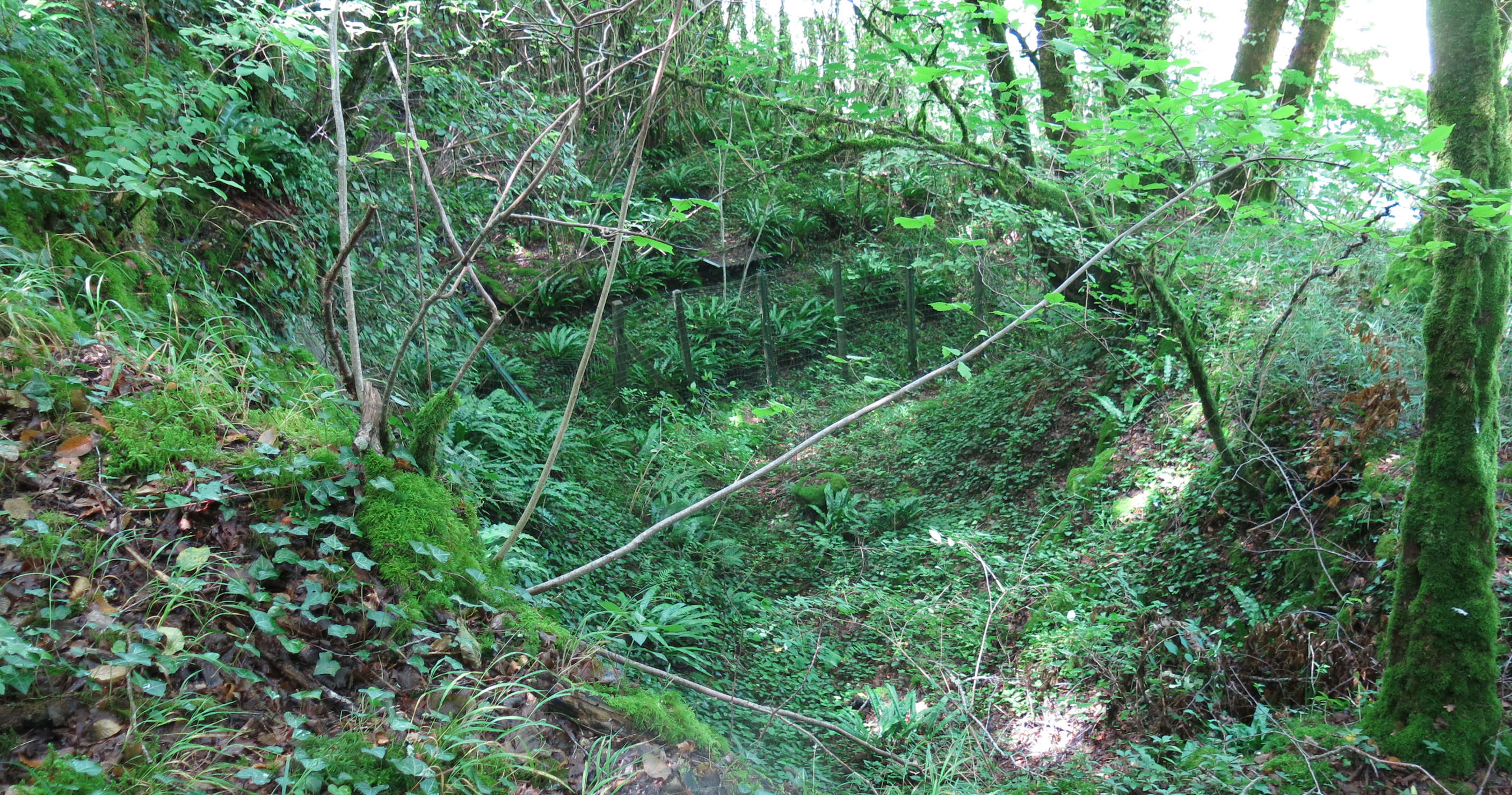
On the northern side of the enclosed area is this former dig, which gives access to the cliff above.
Photo: Don Hitchcock 2014

On a shelf in the cliff are these small caves, presumably already investigated by researchers.
Photo: Don Hitchcock 2014
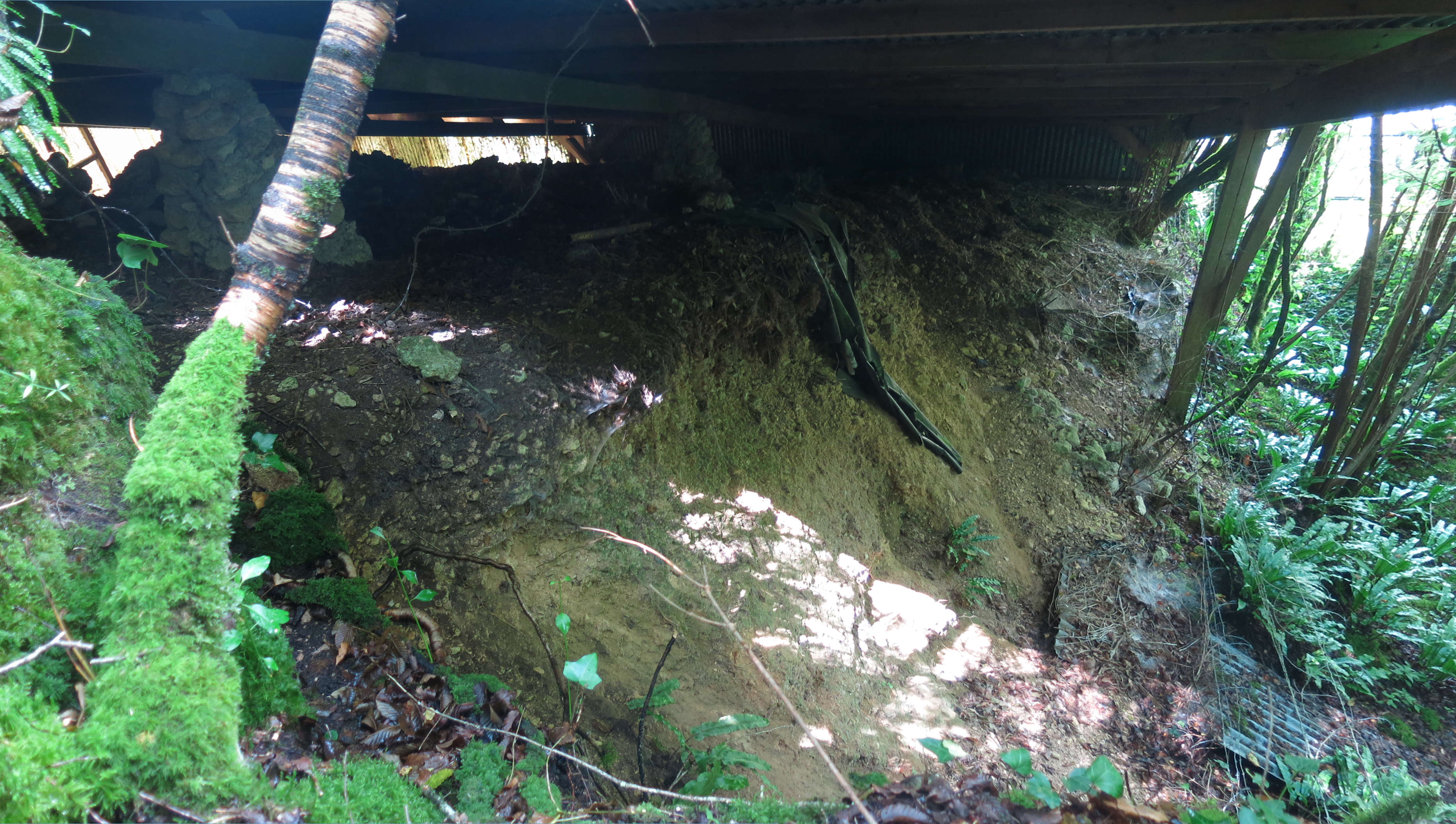
From the shelf in the cliff above the fenced area it is possible to zoom in on this 'witness' section of the dig, which I was very pleased to see has been left for future excavations.
Rescue digs are another matter, as when a site is about to be inundated by waters of a newly built dam, but in too many cases sites have been excavated completely for no good reason.
Photo: Don Hitchcock 2014
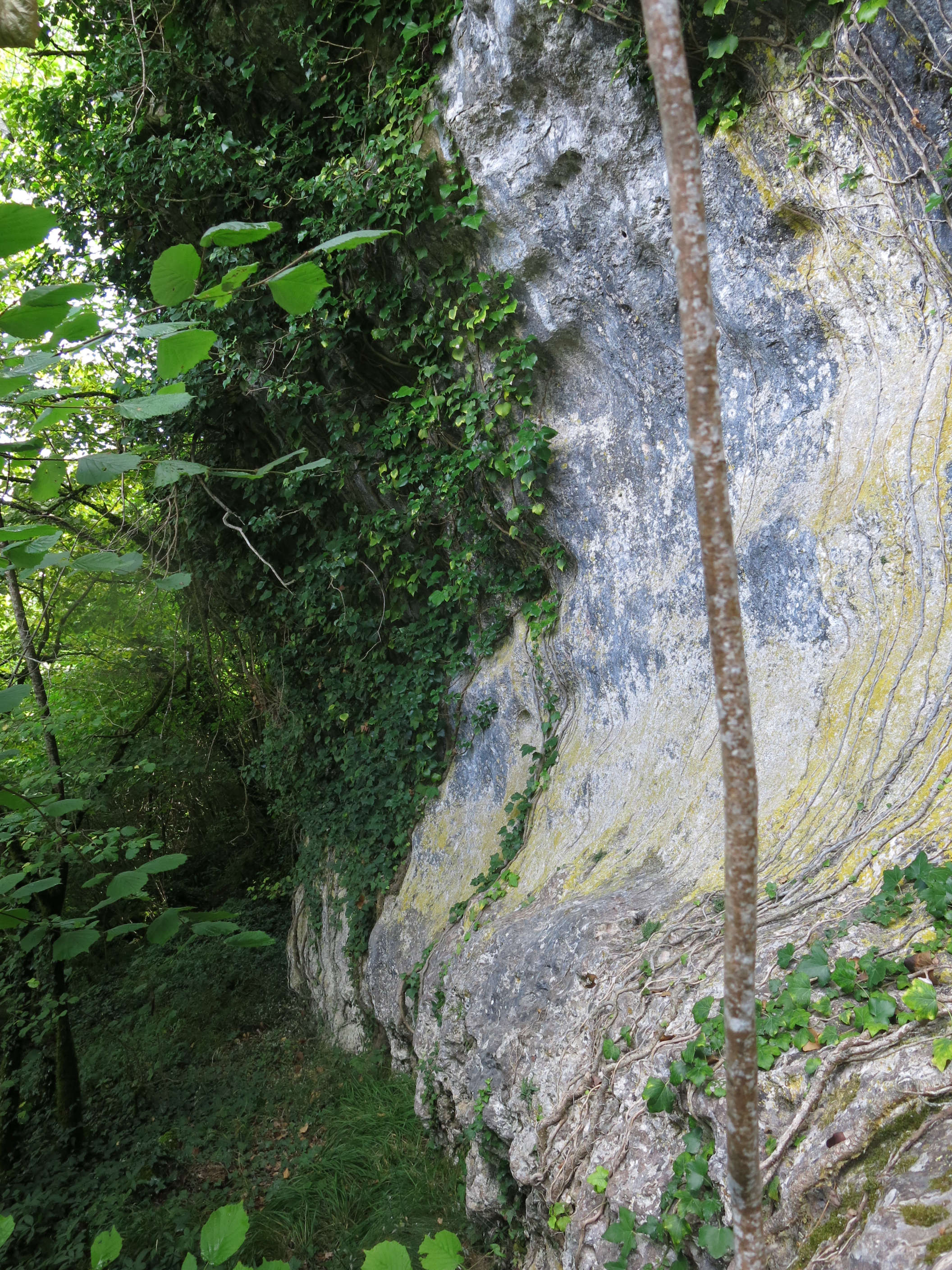
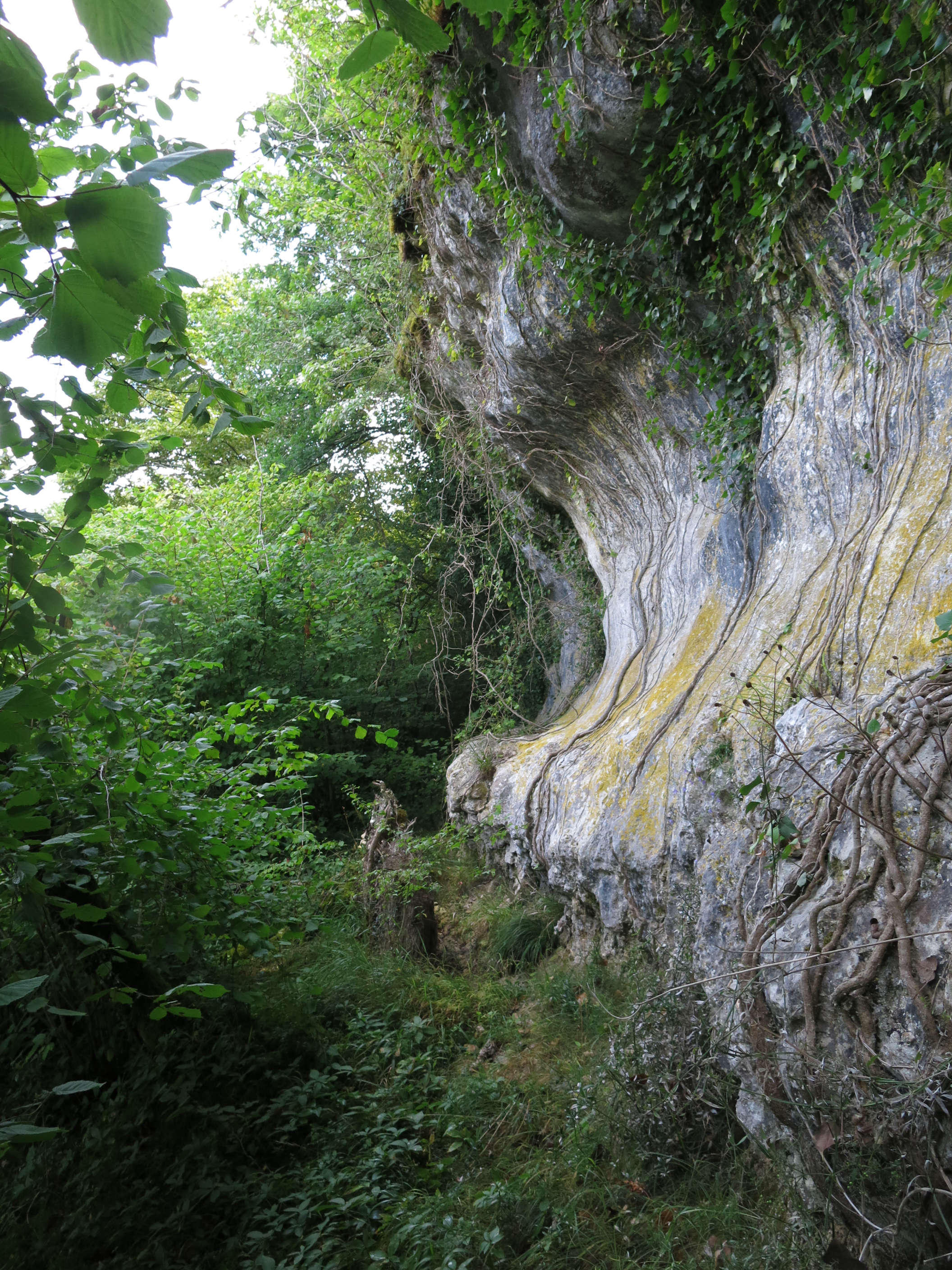
The cliff continues above the narrow shelf.
Photo: Don Hitchcock 2014
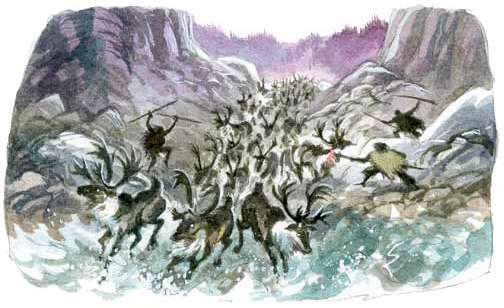
The craftsmen of the Mousterian Quina type industry (asymmetrical thick flakes formed into tools that have been transformed many times) had a particular way of life: hunters specialised in hunting reindeer and bison, and they moved following the herds.
Les artisans de l'industrie moustérienne de type Quina (éclats épais asymétriques portant des outils transformés de nombreuses fois) ont un mode de vie particulier: chasseurs spécialisés dans la traque du Renne ou du Bison, ils se déplacent en suivant les troupeaux.
Text: Display at Musée National de Préhistoire, Les Eyzies
Photo: http://roudier-neandertal.blogspot.com/
Artist:© Emmanuel Roudier, 2008
Superb watercolours were done for this exhibition by the French artist, Emmanuel Roudier.
Blog: http://roudier-neandertal.blogspot.com/ Contact: emmanuelroudier@gmail.com
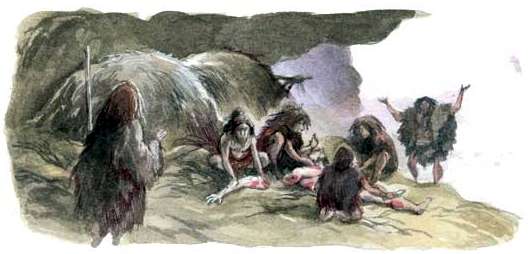
Prey is usually reported for all or part of the known base camps, caves or shelters. They do not seem to bury their dead, but practice complex funeral ceremonies on them (defleshing the bones).
Les proies sont généralement rapportées, pour tout ou parties, aux camps de base, grottes ou abris. Ils ne semblent pas enterrer leurs morts, mais pratiquent sur eux des gestes funéraires complexes (décharnement des corps).
Text: Display at Musée National de Préhistoire, Les Eyzies
Photo: http://roudier-neandertal.blogspot.com/
Artist:© Emmanuel Roudier, 2008
Superb watercolours were done for this exhibition by the French artist, Emmanuel Roudier.
Blog: http://roudier-neandertal.blogspot.com/ Contact: emmanuelroudier@gmail.com
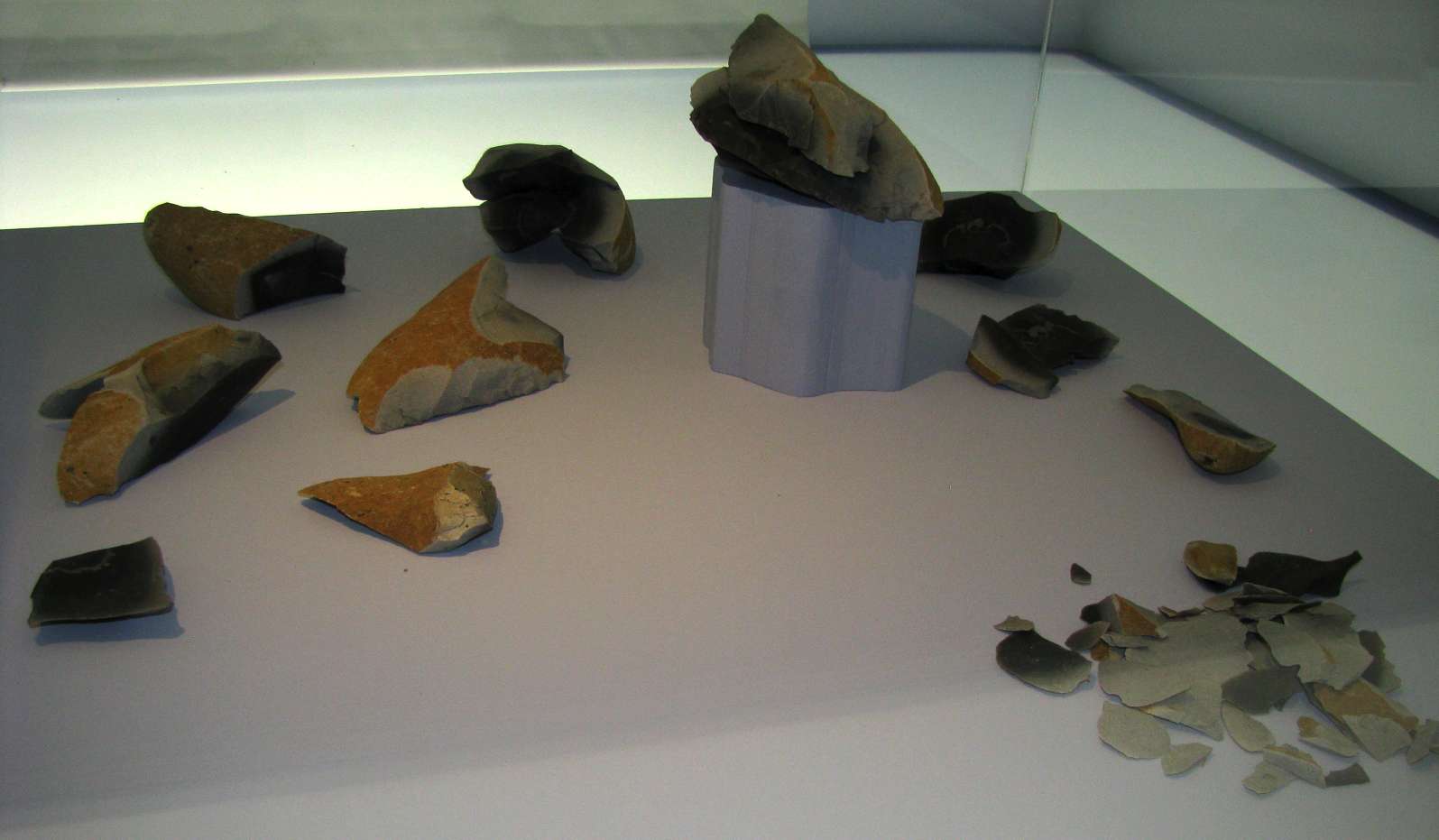
Experimental flint knapping using the La Quina method. This method allows the production of thick flakes with an asymmetrical cross section.
Text: Display at le Musée National de Préhistoire, Les Eyzies
Photo: Don Hitchcock 2008
Source: Display at le Musée National de Préhistoire, Les Eyzies
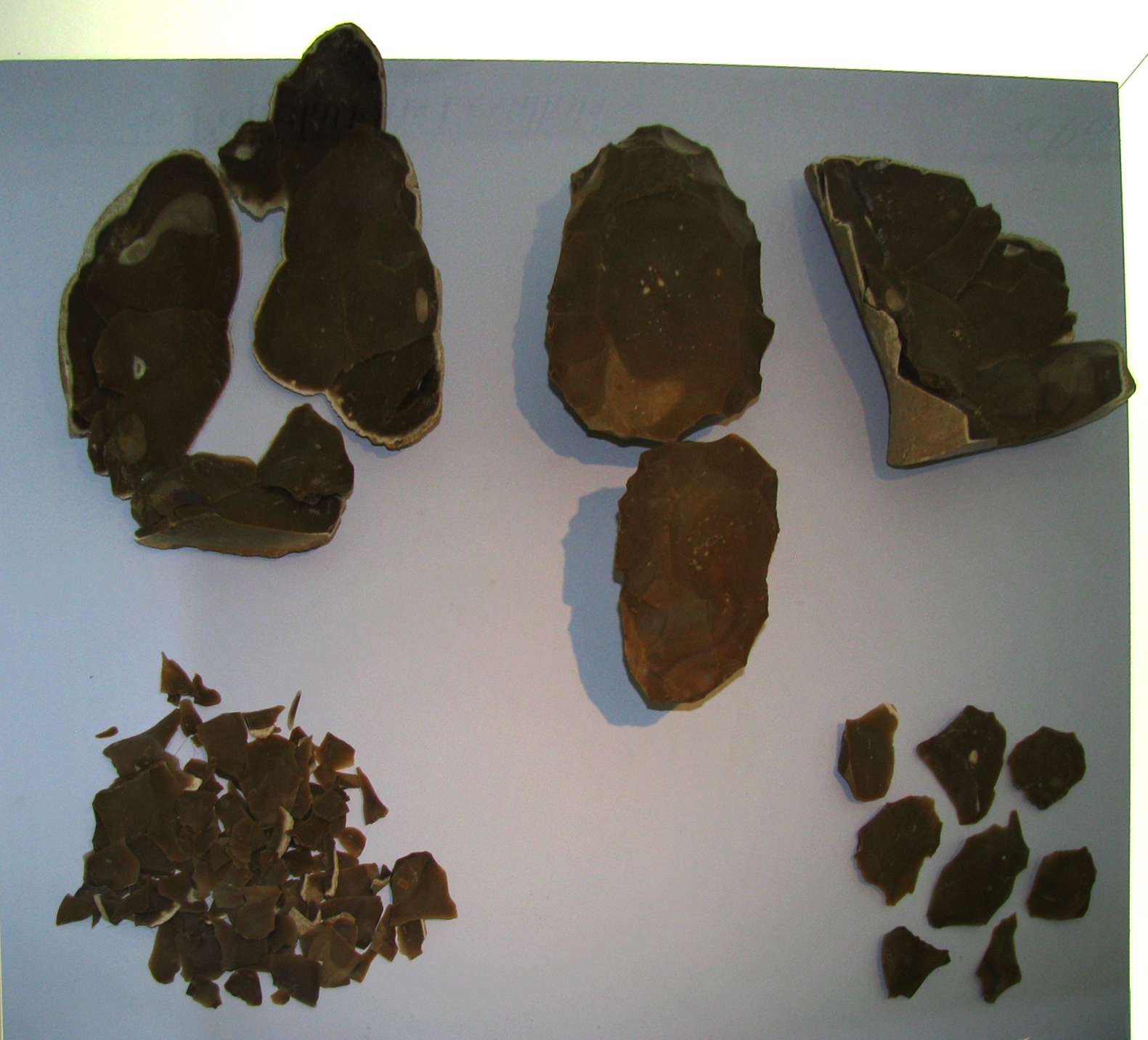
For comparison, experimental flint knapping using the Levallois method.
Photo: Don Hitchcock 2008
Source: Display at le Musée National de Préhistoire, Les Eyzies

Racloir, side scraper, in flint.
Circa 60 000 BP - 40 000 BP
Photo: Don Hitchcock 2018
Collections du Musée national de Préhistoire, Les Eyzies-de-Tayac
Source and text: Musée de l'Homme, Paris
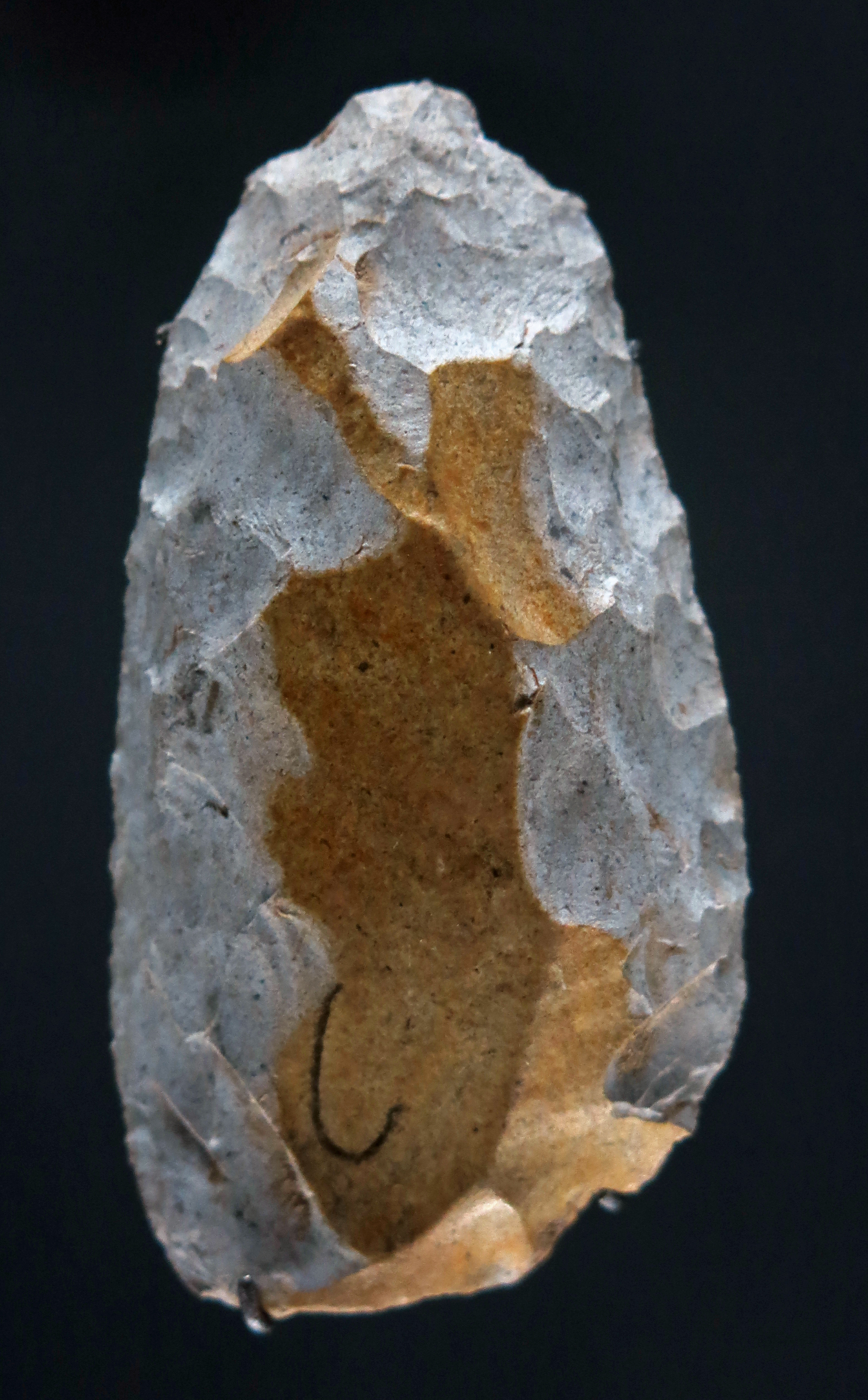
Racloir, side scraper, La Quina.
Photo and text: Don Hitchcock 2015
Source: Original, Muséum de Toulouse
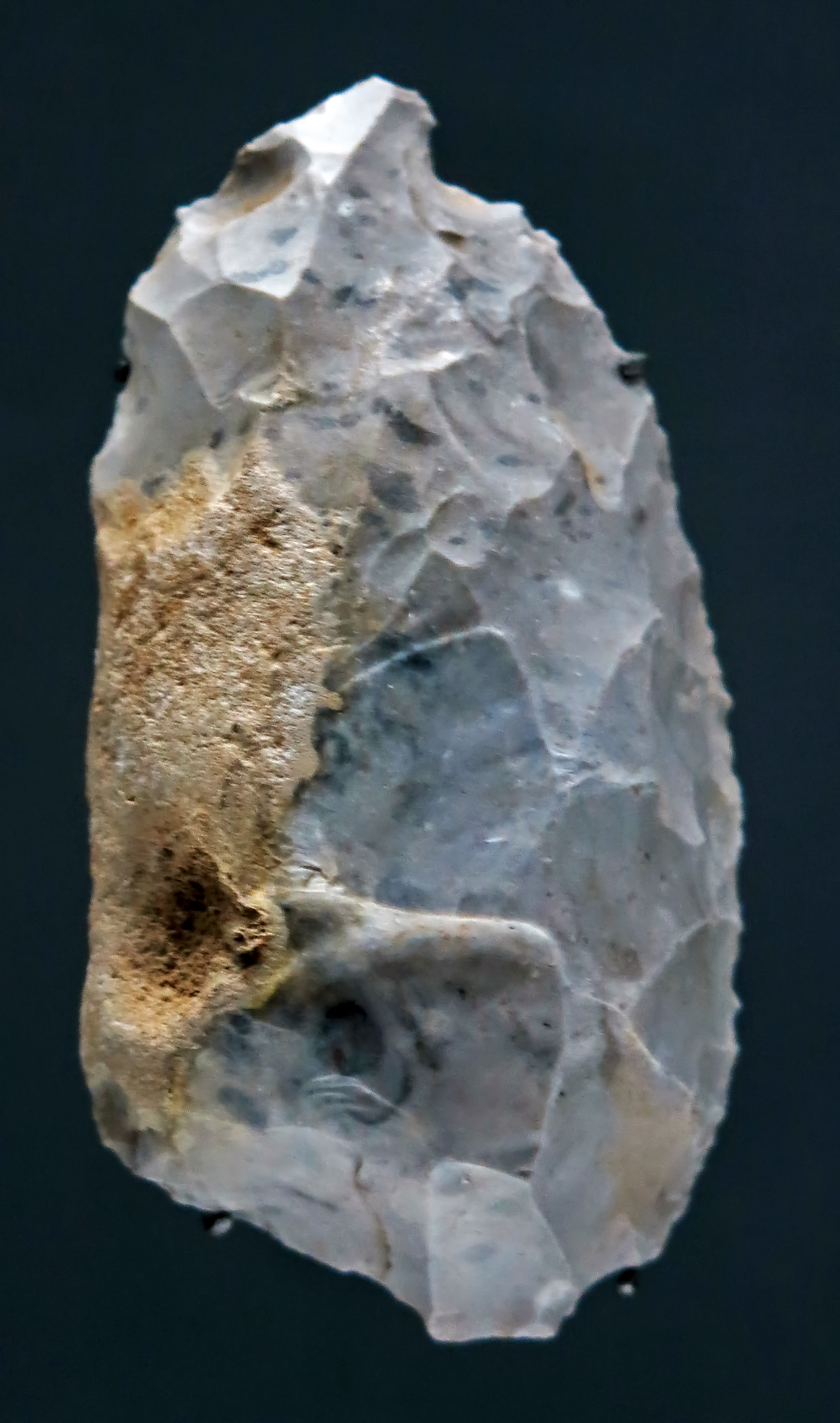
Racloir, side scraper, La Quina.
( Note that as in the case of many tools from La Quina, the tool is somewhat asymmetric. The La Quina knappers appeared to care little for symmetry, so long as the tool worked, though they could do beautiful work when necessary, as in the case of stones pecked perfectly spherical, presumably for bolas.
In this case, the artisan has left two projections at either end of the scraper, providing small width convex scrapers for fine work, as well as associated concave sections - Don )
Photo and text: Don Hitchcock 2015
Source: Original, Muséum de Toulouse
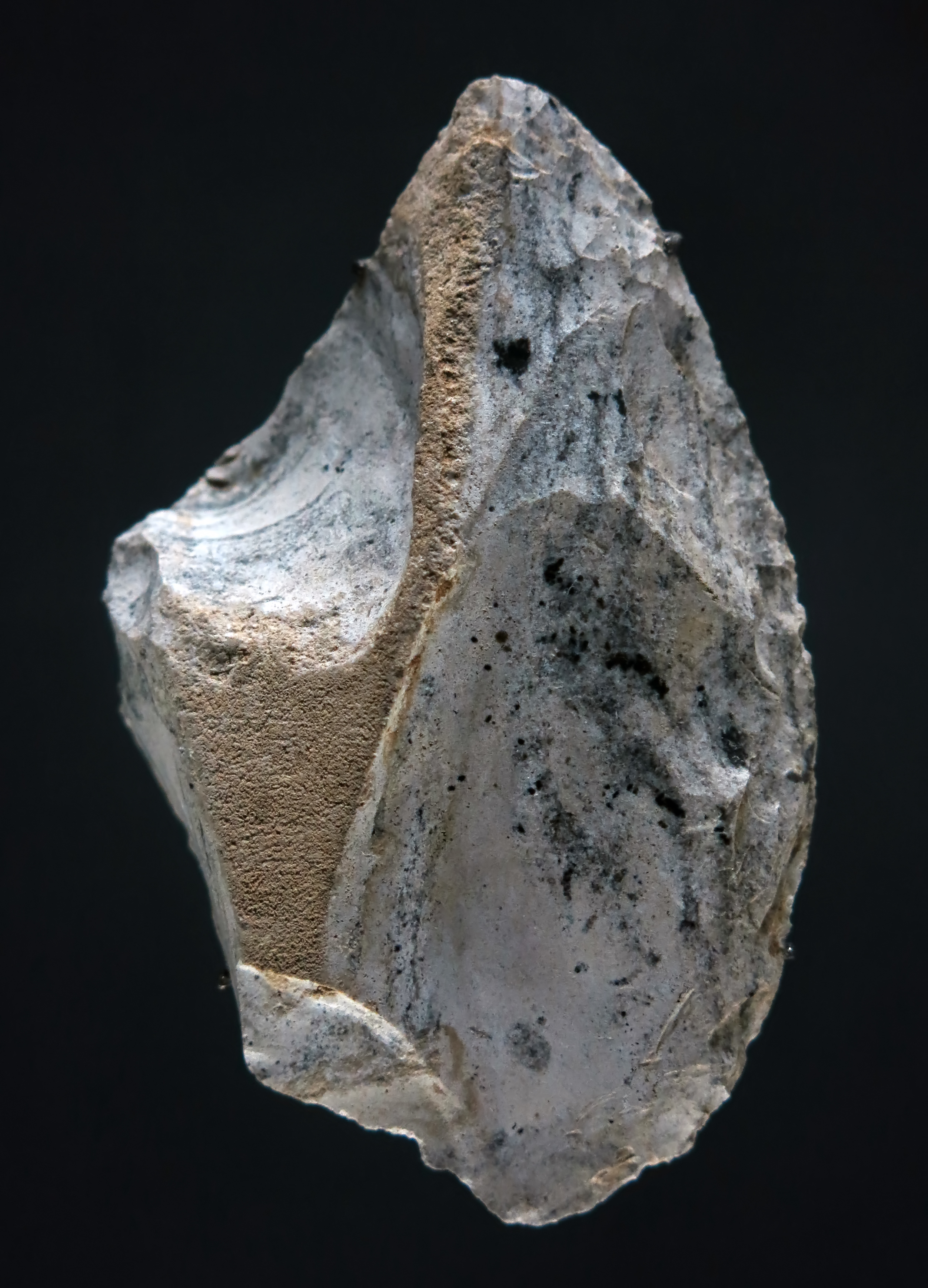
Racloir, side scraper, La Quina.
Many Neanderthal tools, as here, show deep and smooth indentations, expertly made, to create a good grip on the hand held tool.
Photo and text: Don Hitchcock 2015
Source: Original, Muséum de Toulouse
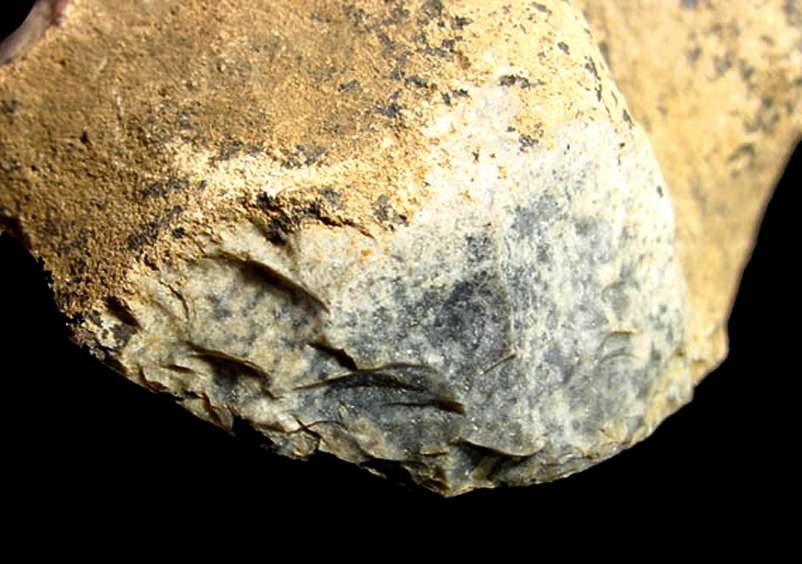
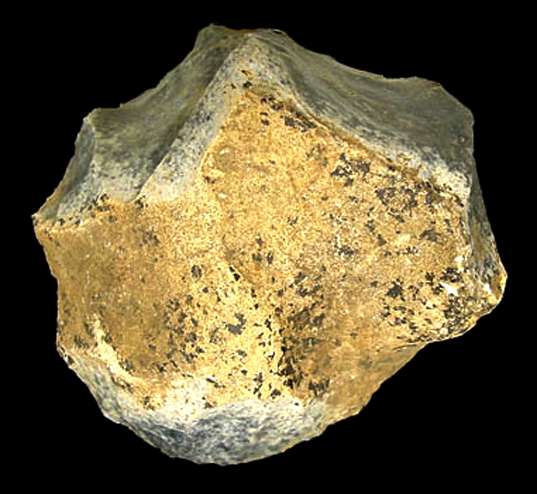
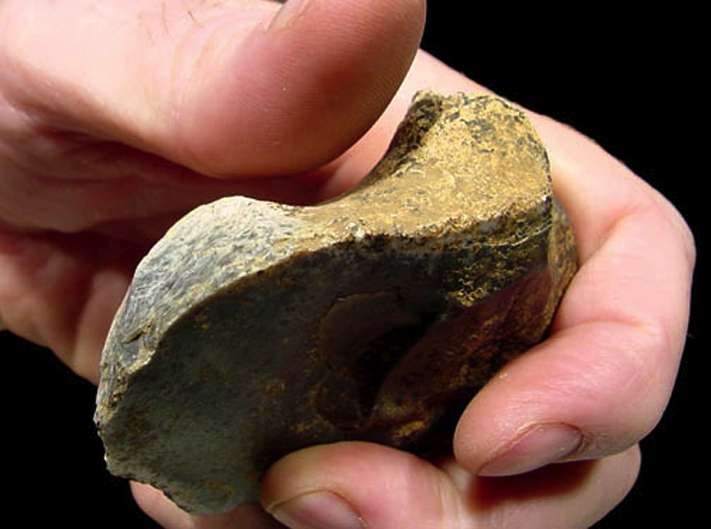
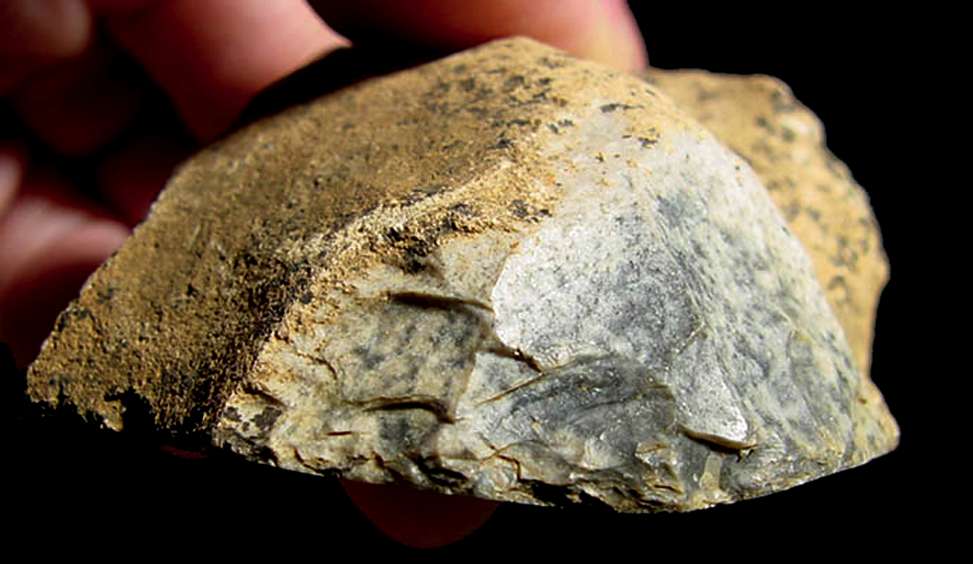
This tool was sold on the open market, and was described thus:
This stone tool was fashioned by Neanderthals over 40 000 years ago out of flint and discovered in the world famous region of Dordogne, France, considered to be the 'Capital of Prehistory'. The site this specimen was excavated from is now closed and protected by the government. This rare artifact was legally collected with the landowner's permission decades ago before the area was sealed.
This specimen is classified as a convex scraper utilising Quina retouching. It displays a used and resharpened cutting edge and was made on a very large and thick flint flake. Superb workmanship, patina and retouching. Cutting end shows some of the finest craftsmanship of this flaking method! Ingenious design where the Neanderthal maker incorporated a natural depression in the flint nodule to be used as a thumb grip (see above photo). Such forethought and three-dimensional conception is proof of the very high level of intelligence in the Neanderthal people. Lightly encrusted with the original occupation layer deposits. Large area of the original cortex present. This rare Neanderthal tool was collected in a rock shelter from a subterranean level that was once a Neanderthal occupation layer. Famous site find! No restoration, no repair and no modern damage.
The Quina type Mousterian Tradition is unique and originally known from the la Quina type-site at Charente, France. La Quina is particularly important because of the Neanderthal skeletal remains found in association with rich cultural and faunal materials it contains. The site has undergone extensive excavation and the large faunal assemblage should permit reconstruction of Mousterian hunting techniques and demonstrate how these changed and developed over time. The flaking technique known as la Quina retouch was first found at this important site and is characterized by a stepped, scalar retouch on the edges of scrapers.
Photo and text adapted from: http://www.paleodirect.com/m147.htm
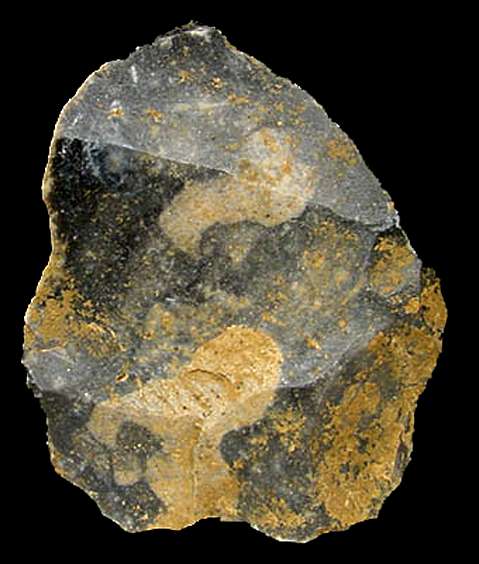
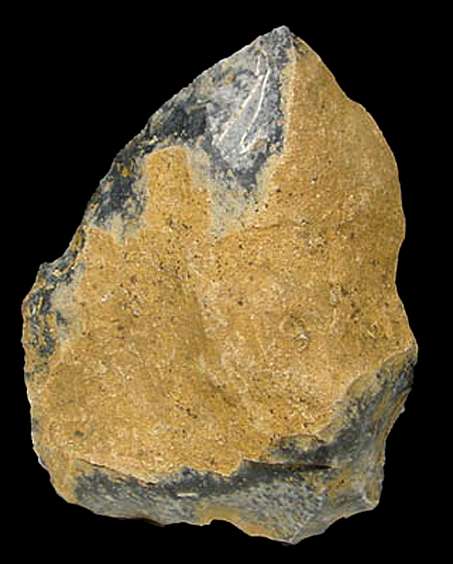
This tool was sold on the open market, and was described thus:
This stone tool was fashioned by Neanderthals over 40 000 years ago out of flint and discovered in the world famous region of Dordogne, France, considered to be the "Capital of Prehistory". The site this specimen was excavated from is now closed and protected by the government. This rare artifact was legally collected with the landowner's permission decades ago before the area was sealed. Dordogne is one of the world's most famous Neanderthal regions and the fact that this archeological site is off-limits to any collecting, makes this wonderful stone tool artifact exceedingly rare and desirable.
This specimen is classified as a side scraper utilising La Quina retouching. It is huge at three inches (75 mm) in length compared to most specimens found at the site averaging well under this. It displays a used and resharpened cutting edge and was made on a very large flint flake. Lightly encrusted with the original occupation layer deposits. Large area of the original cortex present. This rare Neanderthal tool was collected in a rock shelter from a subterranean level that was once a Neanderthal occupation layer.
Photo and text adapted from: http://www.paleodirect.com/m124.htm
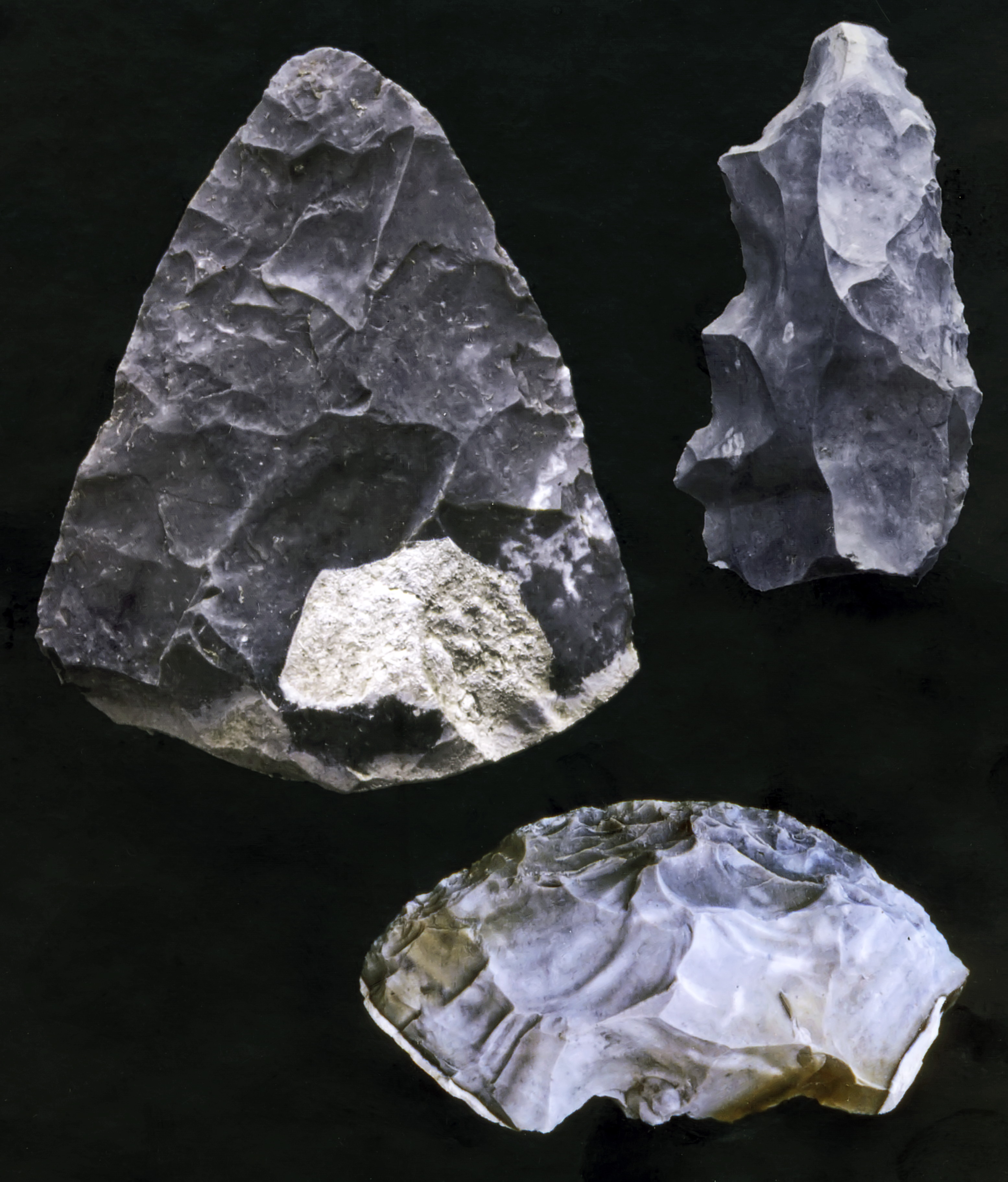
La Quina tool. This is much more symmetrical (in one plane at least) than most.
Photo: Jelinek (2013)
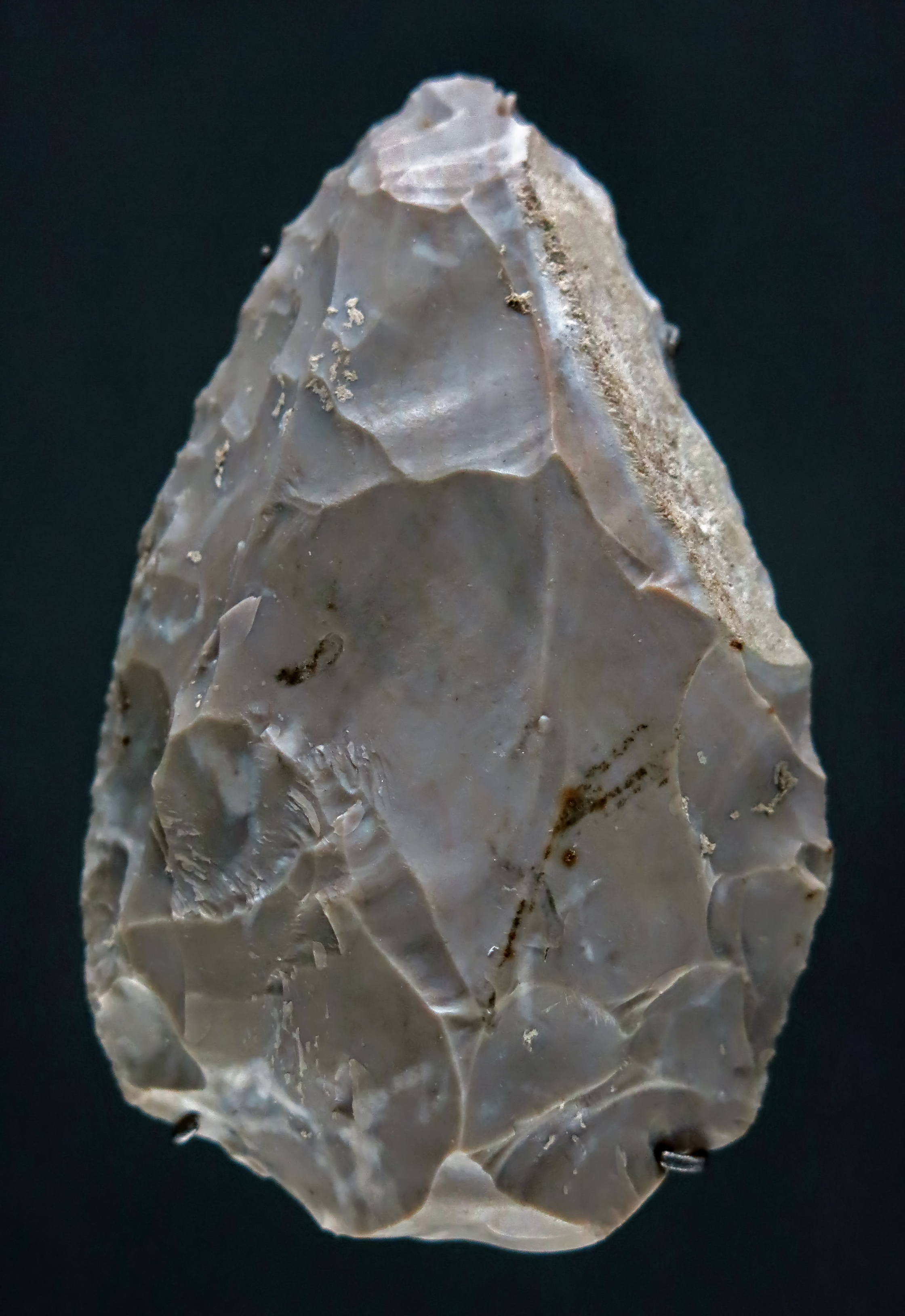
Racloir, La Quina.
Photo: Don Hitchcock 2015
Collection: É. Lartet
Source and text: Original, Muséum de Toulouse

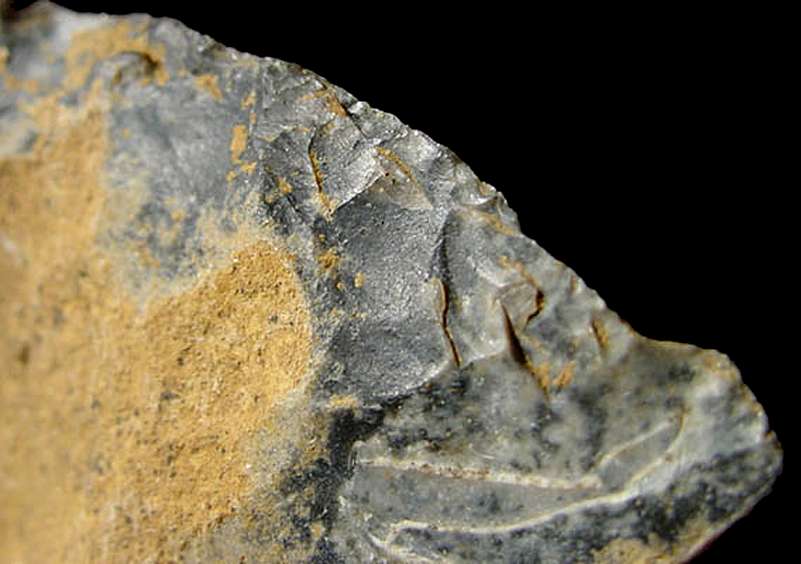
The La Quina type Mousterian Tradition is unique and originally known from the La Quina type-site at Charente, France. La Quina is particularly important because of the Neanderthal skeletal remains found in association with the rich cultural and faunal materials it contains. The site has undergone extensive excavation and the large faunal assemblage should permit reconstruction of Mousterian hunting techniques and demonstrate how these changed and developed over time. The flaking technique known as the La Quina retouch was first found at this important site and is characterised by a stepped, scalar retouch on the edges of scrapers.
The Mousterian tool tradition gets its name from artifacts discovered at a rock shelter named Le Moustier located in southwestern France, in the Vezere Valley.
Photo and text adapted from: http://www.paleodirect.com/m124.htm

Imprints of a sharp object and abrasions on a bone, possibly from being used as a thimble to push a needle and thread through holes in hides. Other explanations are possible - it could have been used as a hammer bone on a retoucher for example, or simply to knock off flakes from a small tool. It may be significant that the marks are at each end of the piece, which would support the latter possibility.
Middle Paleolithic (Quina Mousterian) (300 000 to 30 000 BP).
Locality : La Quina, Gardes-le-Pontaroux, Charente, France
Former collection of Léon Henri-Martin (1864 - 1936)
Different views of the same specimen - Muséum of Toulouse MHNT.PRE.2006.0.35
Size : 113 x 48 x 12 mm, mass 69.6g
Date: 15 January 2011
Photo: Didier Descouens
Source: I, the copyright holder of this work, hereby publish it under the following license: This file is licensed under the Creative Commons Attribution-Share Alike 3.0 Unported license.
From: Wikimedia Commons
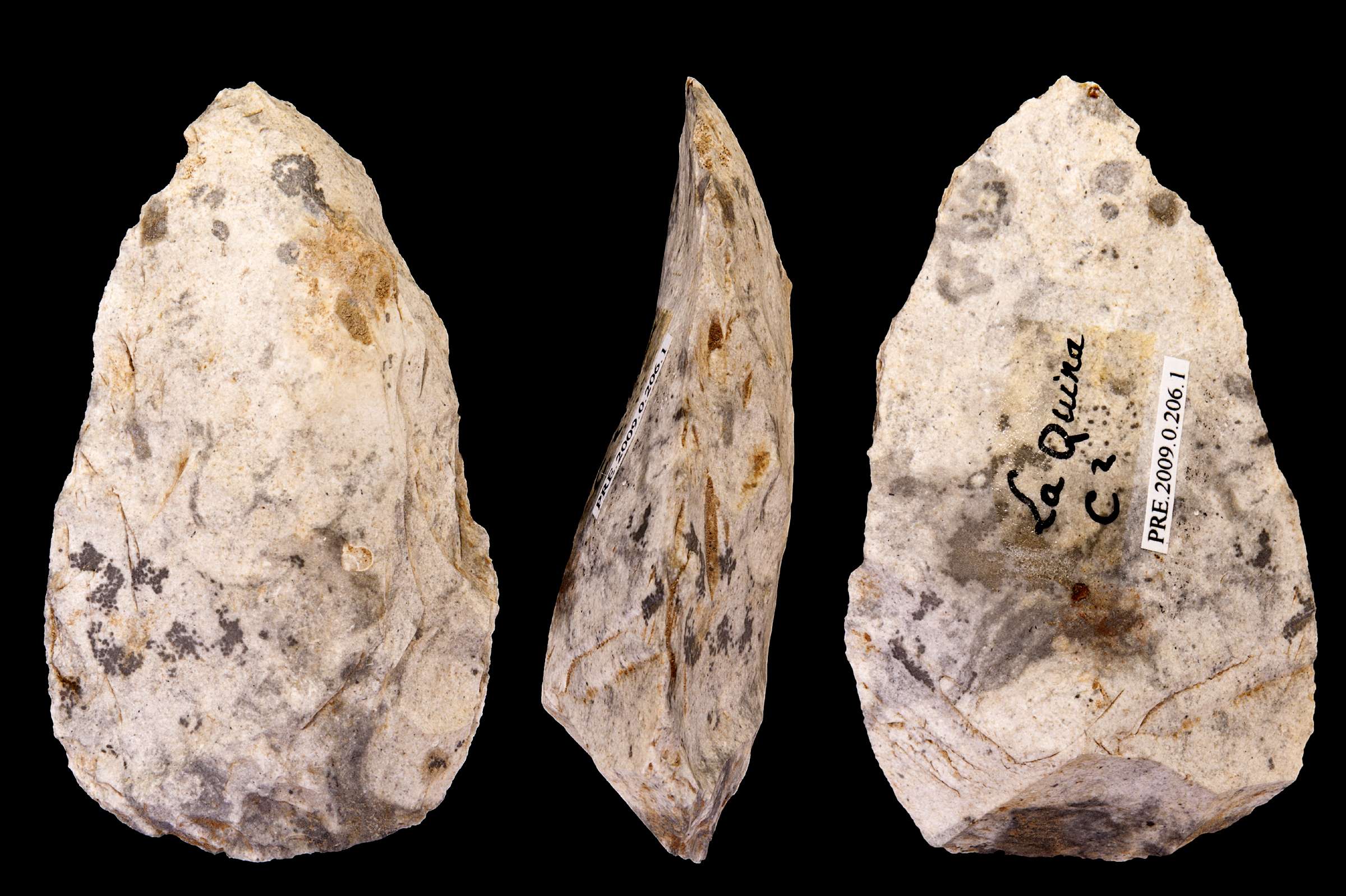
Racloir, flint. Different views of the same specimen.
Middle Paleolithic (Quina Mousterian) (300 000 to 30 000 BP).
Locality : La Quina, Gardes-le-Pontaroux, Charente, France
Different views of the same specimen - Muséum of Toulouse MHNT.PRE.2009.0.206.1
Dimensions
69 × 42 × 20 mm - 48.3 g
Date: 13 November 2010
Photo: Didier Descouens
Source: I, the copyright holder of this work, hereby publish it under the following license: This file is licensed under the Creative Commons Attribution-Share Alike 3.0 Unported license.
From: Wikimedia Commons
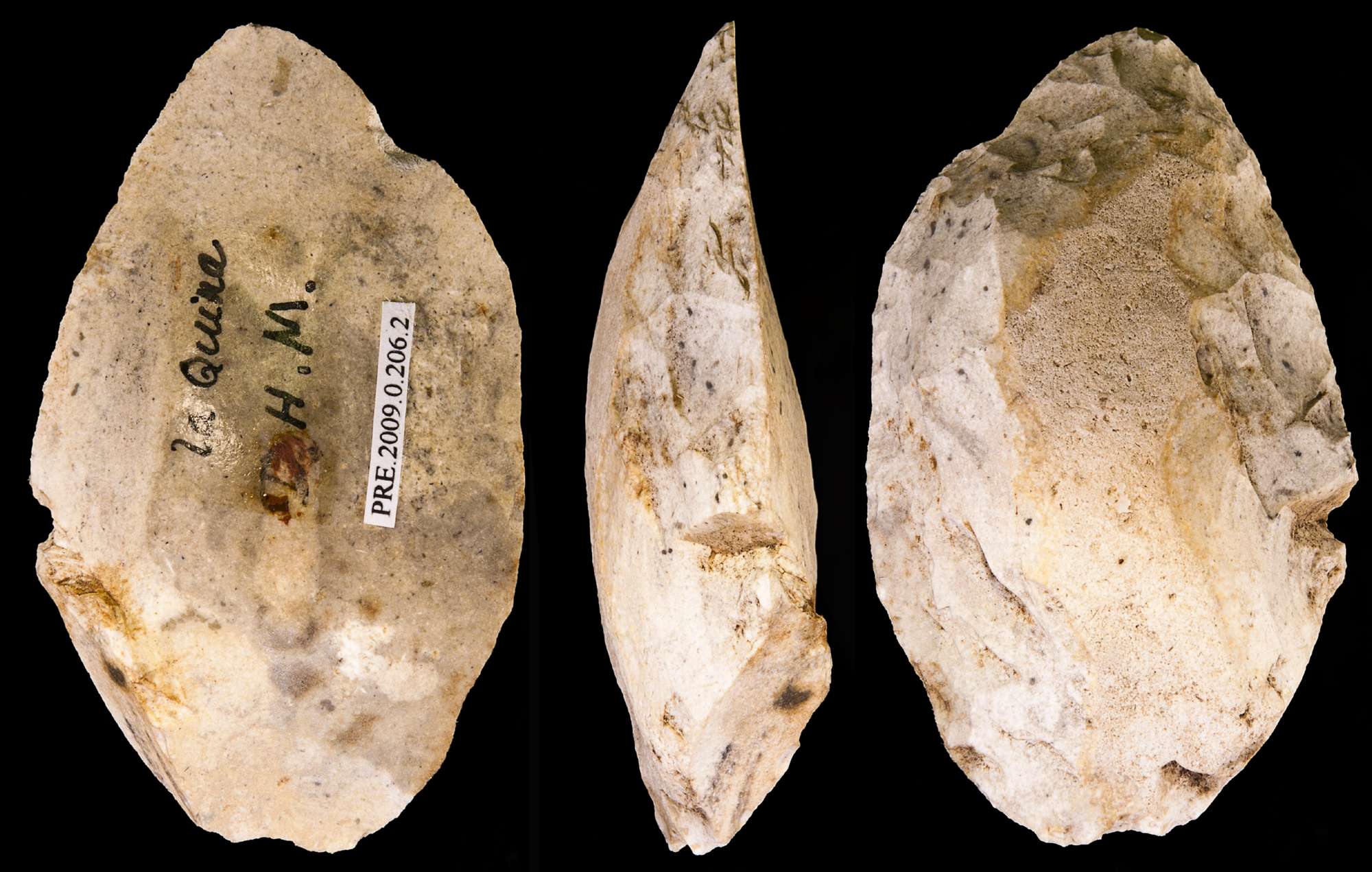
Racloir - Different views of the same specimen.
Date: between - 300 000 and 30 000 BP (Middle Palaeolithic - Mousterian)
Medium: flint
Dimensions: 64 × 38 × 17 mm (2.5 × 1.5 × 0.7 in) - 36.2 g
Current location: Muséum de Toulouse
Accession number: MHNT.PRE.2009.0.206.2
Object history: Findspot: La Quina, Gardes-le-Pontaroux, Charente, France
Photo: Didier Descouens, 2010-12-28
Permission: I, the copyright holder of this work, hereby publish it under the following license: Creative Commons Attribution-Share Alike 3.0 Unported license.
From: Wikimedia Commons
La Quina and unsophisticated bone tools
The site of La Quina at Gardes-le-Pontaroux, in Charente, a place of many human remains including a female Neanderthal skeleton, but no trace of burial has been revealed during excavations. This Middle Palaeolithic site gave its name to the Mousterian cultural group of La Quina. It is characterised by numerous thick scrapers, with steep retouch and often a staircase form. Study of wear patterns shows that these versatile tools were used in butchering game. The abundance of faunal remains indicates a site for killing and butchering.
Incisions on the bones are man-made, and although they appear in the Middle Paleolithic they are still very rare. These are the first two photos below.
Bones used for refining flint flakes are called retouchers. The contact between flint and bone produces shocks which are shown as transverse marks.
Text above: Display at Musée d'archéologie nationale, Saint-Germain-en-Laye
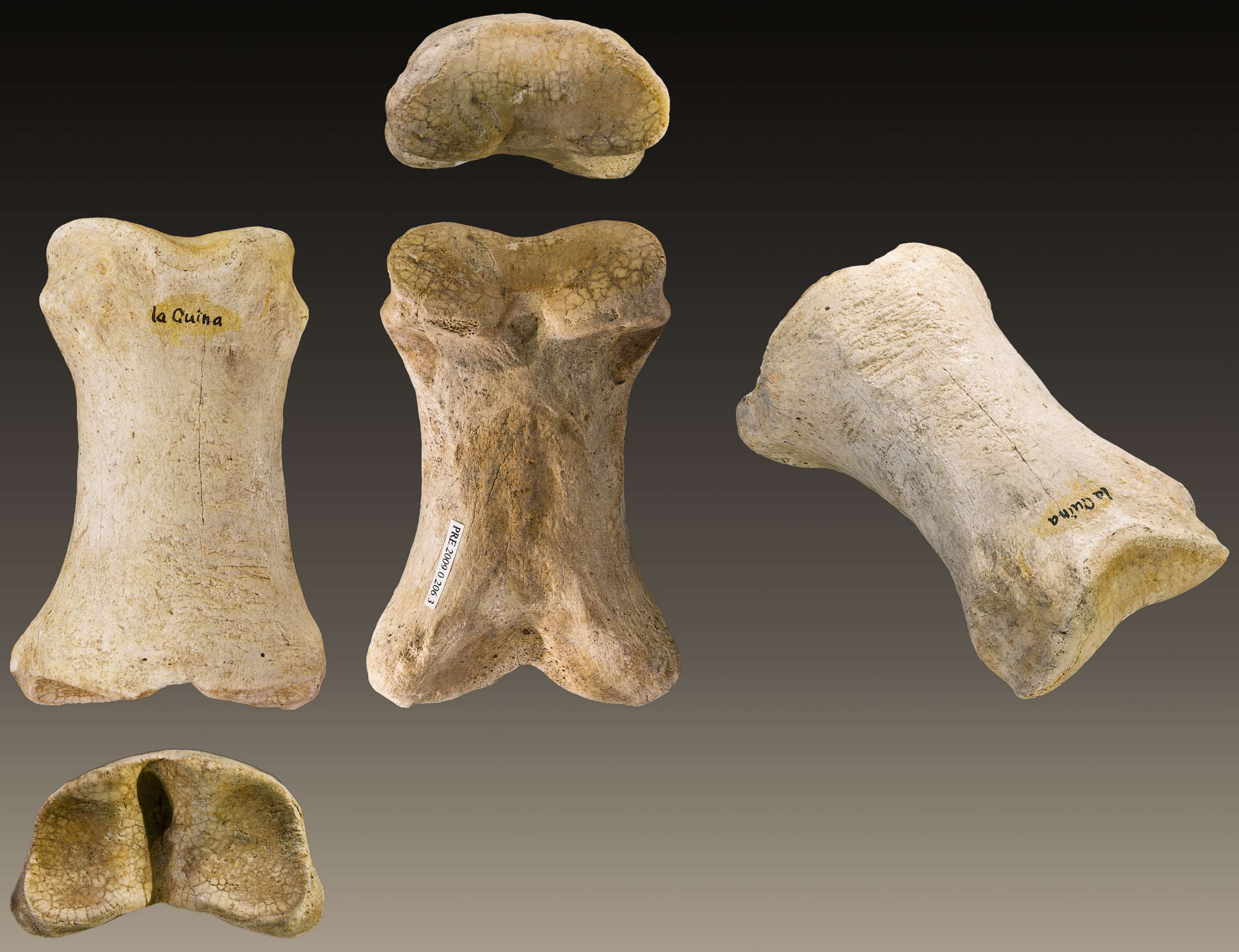
Imprints of a sharp object and abrasions on a bone, possibly from being used as a thimble to push a needle and thread through holes in hides. Other explanations are possible - it could have been used as a hammer bone on a retoucher for example, or simply to knock off flakes from a small tool.
Middle Paleolithic (Quina Mousterian) (300 000 to 30 000 BP).
Locality : La Quina, Gardes-le-Pontaroux, Charente, France
Different views of the same specimen - Muséum of Toulouse MHNT.PRE.2009.0.206.3
Dimensions: 89 x 58 x 38 mm.
Former collection of Léon Henri-Martin (1864 - 1936).
Photo: Didier Descouens
Permission: Creative Commons Attribution-Share Alike 3.0 Unported license.
From: Wikimedia Commons
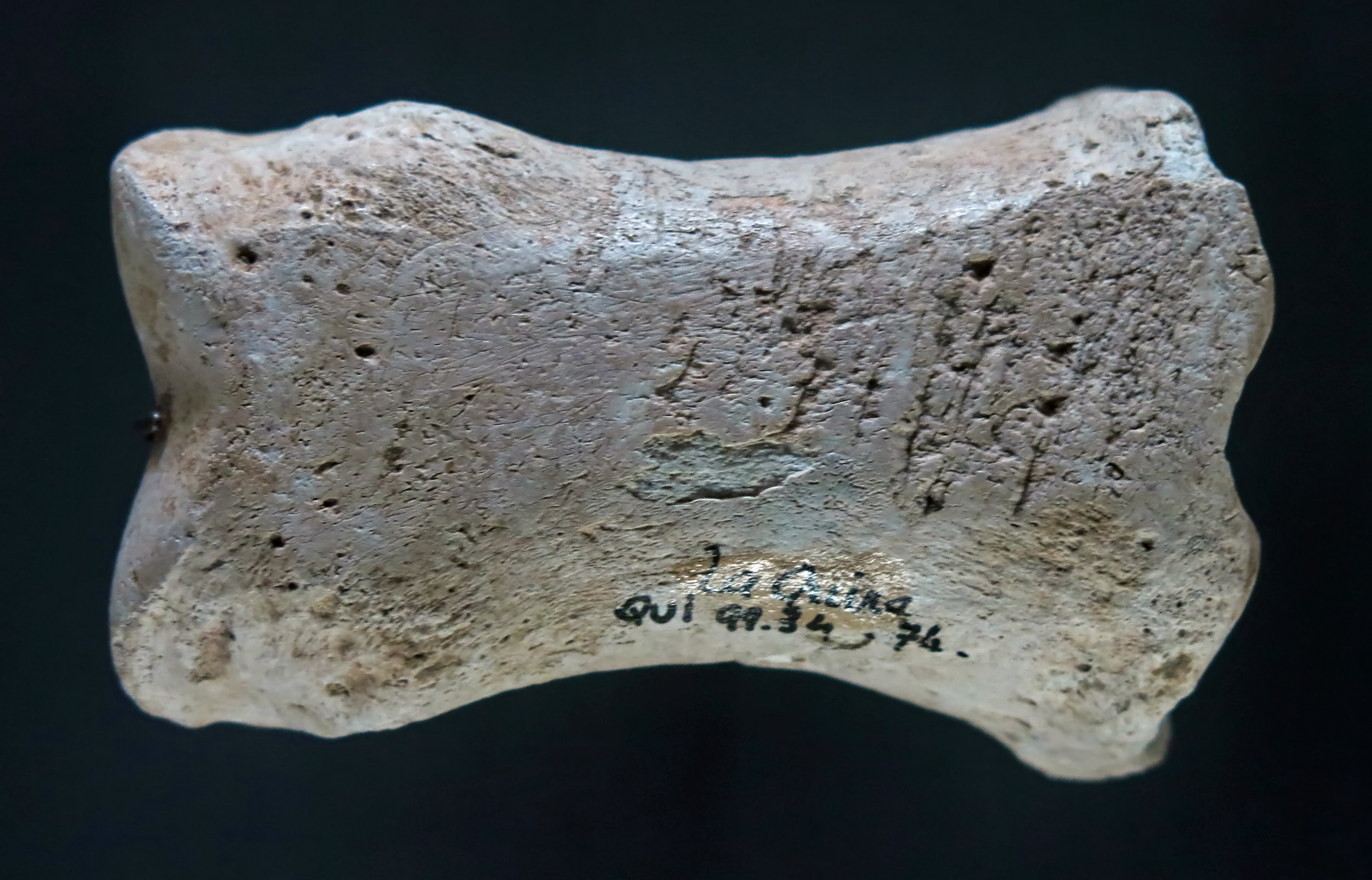
Impressions of a sharp object on a Bone
( Probably used as a retoucher, the marks being from knapping flakes from a core. At first glance it appears not to be very much marked for such a tool, but it appears to have been ground back to a flat surface by rubbing on a piece of sandstone, in order to give a good working surface again after much use - Don )
Photo: Don Hitchcock 2015
Collection: Léon Henri-Martin
Source and text: Original, Muséum de Toulouse
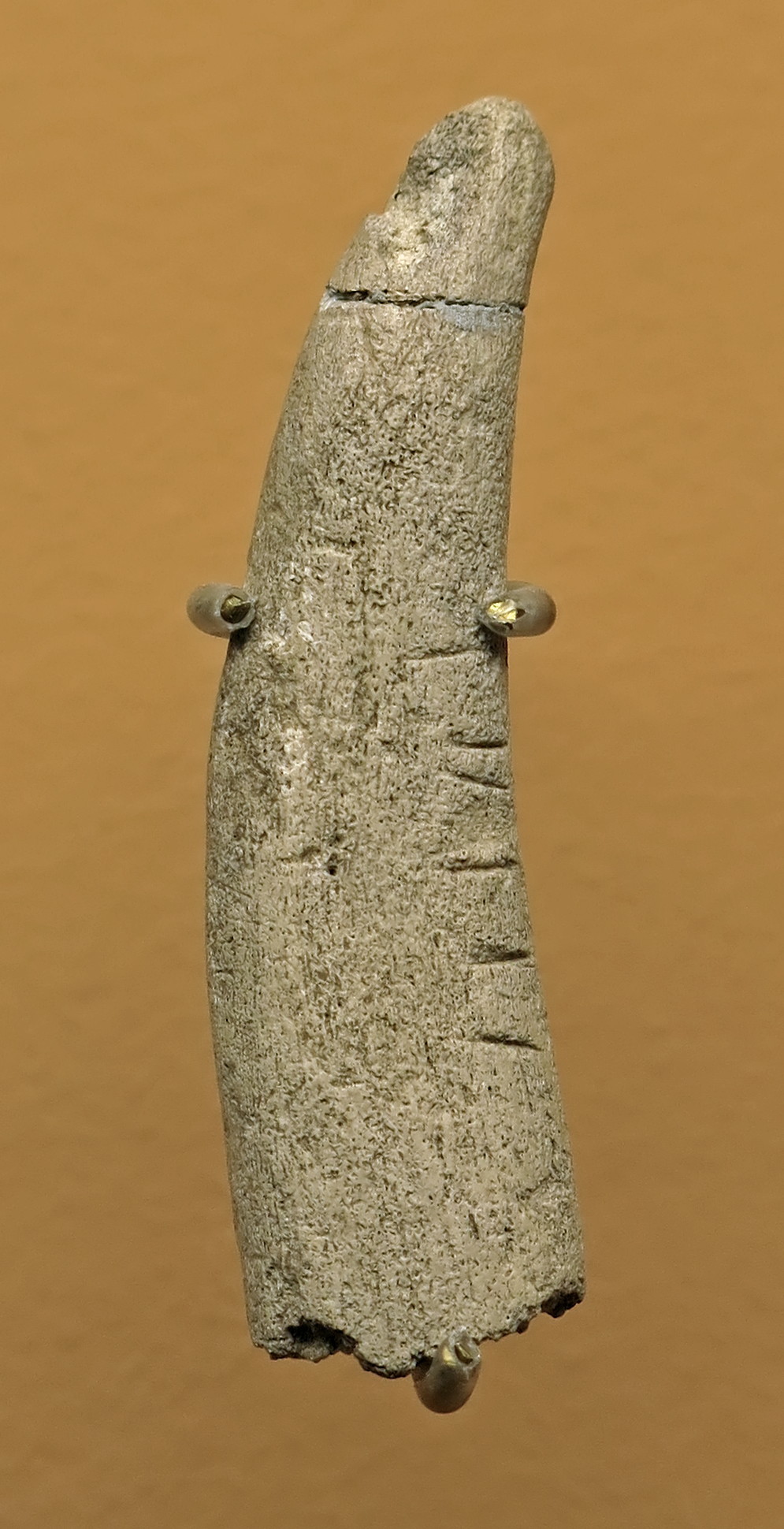
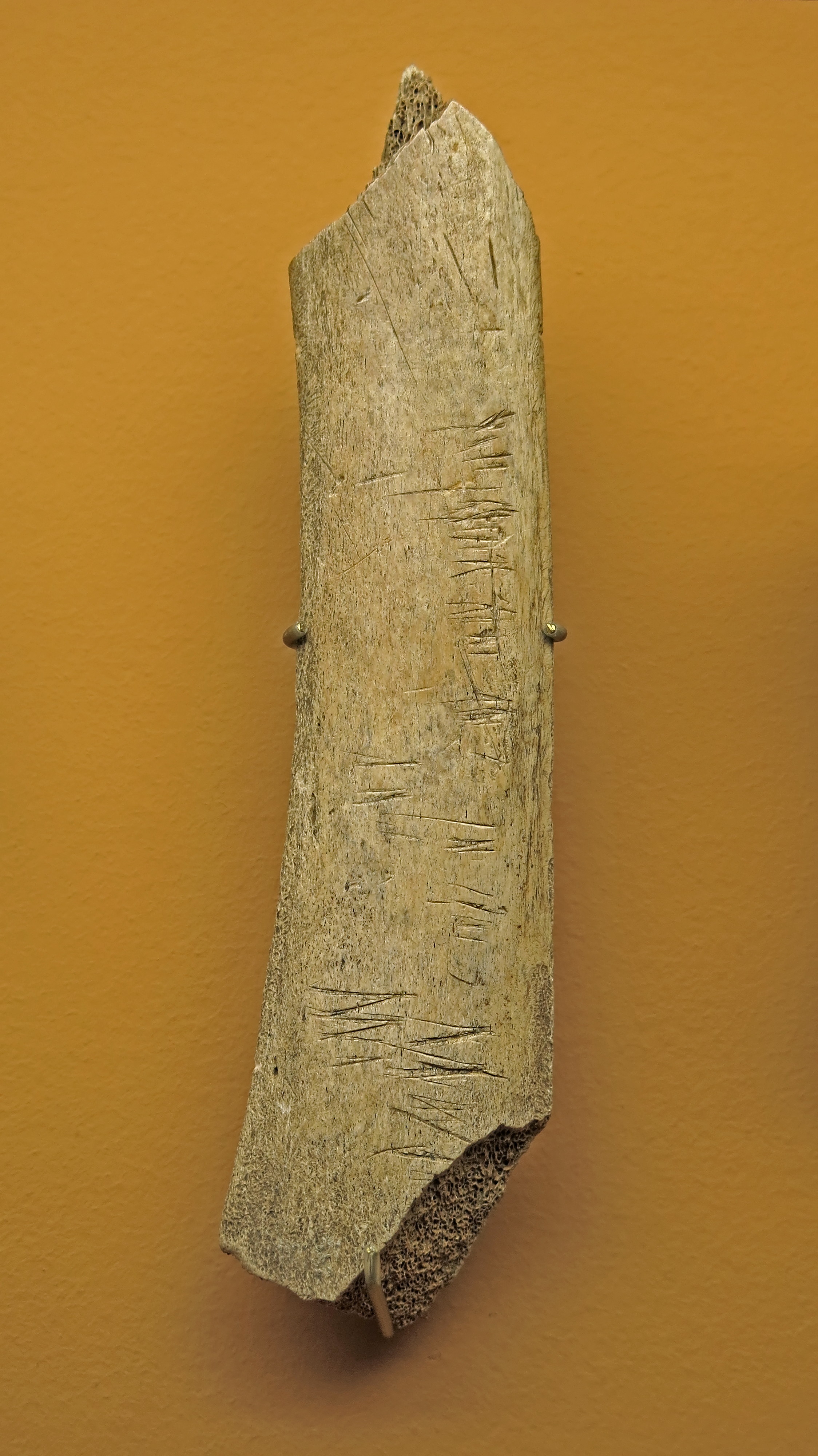
(left) This bone, made from a reindeer horn bud, has man made incisions, and what appears to be a groove or rainurage cut in the top to allow it to be held by a tight cord. It may have been a neck ornament.
(right) Fragment of a rib with a series of man-made cuts in it. Some on the lower end make a partial zig zag pattern, but it is difficult to be sure if the pattern is intentional.
Photo: Don Hitchcock 2015
Source: Original, display, Musée d'Archeologie Nationale et Domaine, St-Germain-en-Laye
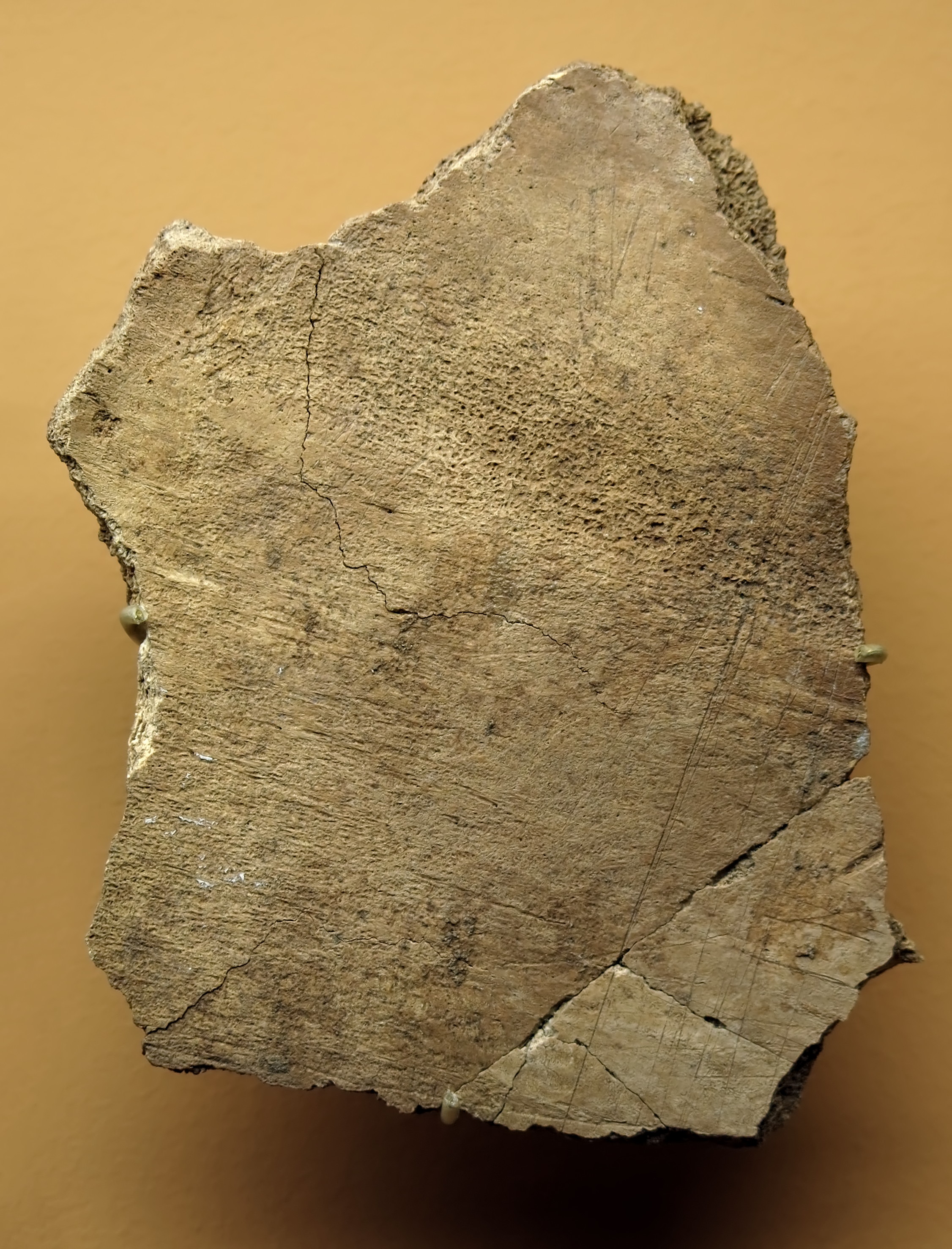
(left) Fragment of the shoulder blade of a large bovid, possibly a bison, with traces of butchery. Original.
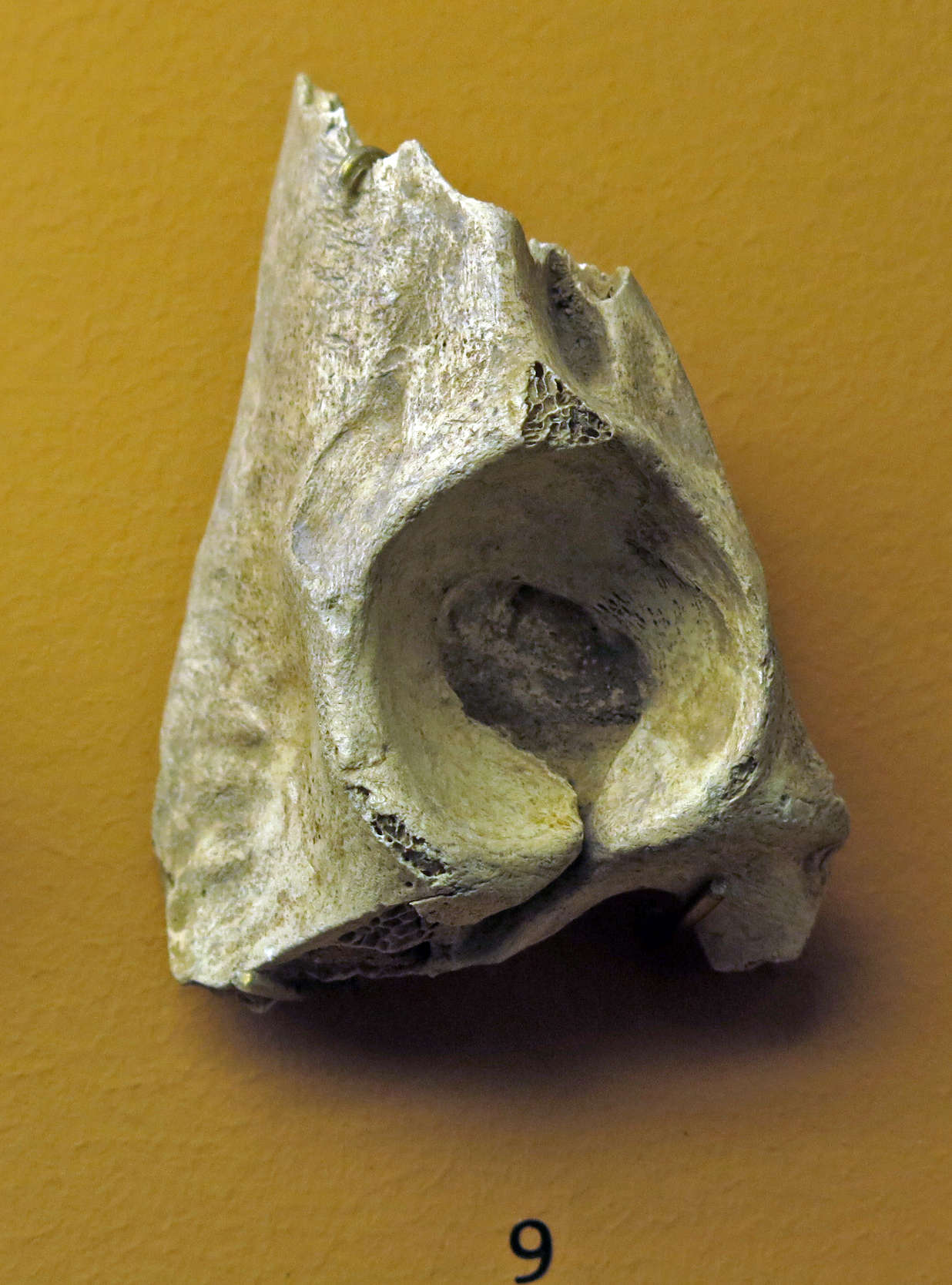
(right) Retoucher made from the os coxae or hip bone of a reindeer.
Photo: Don Hitchcock 2014
Source: Original, display, Musée d'Archeologie Nationale et Domaine, St-Germain-en-Laye
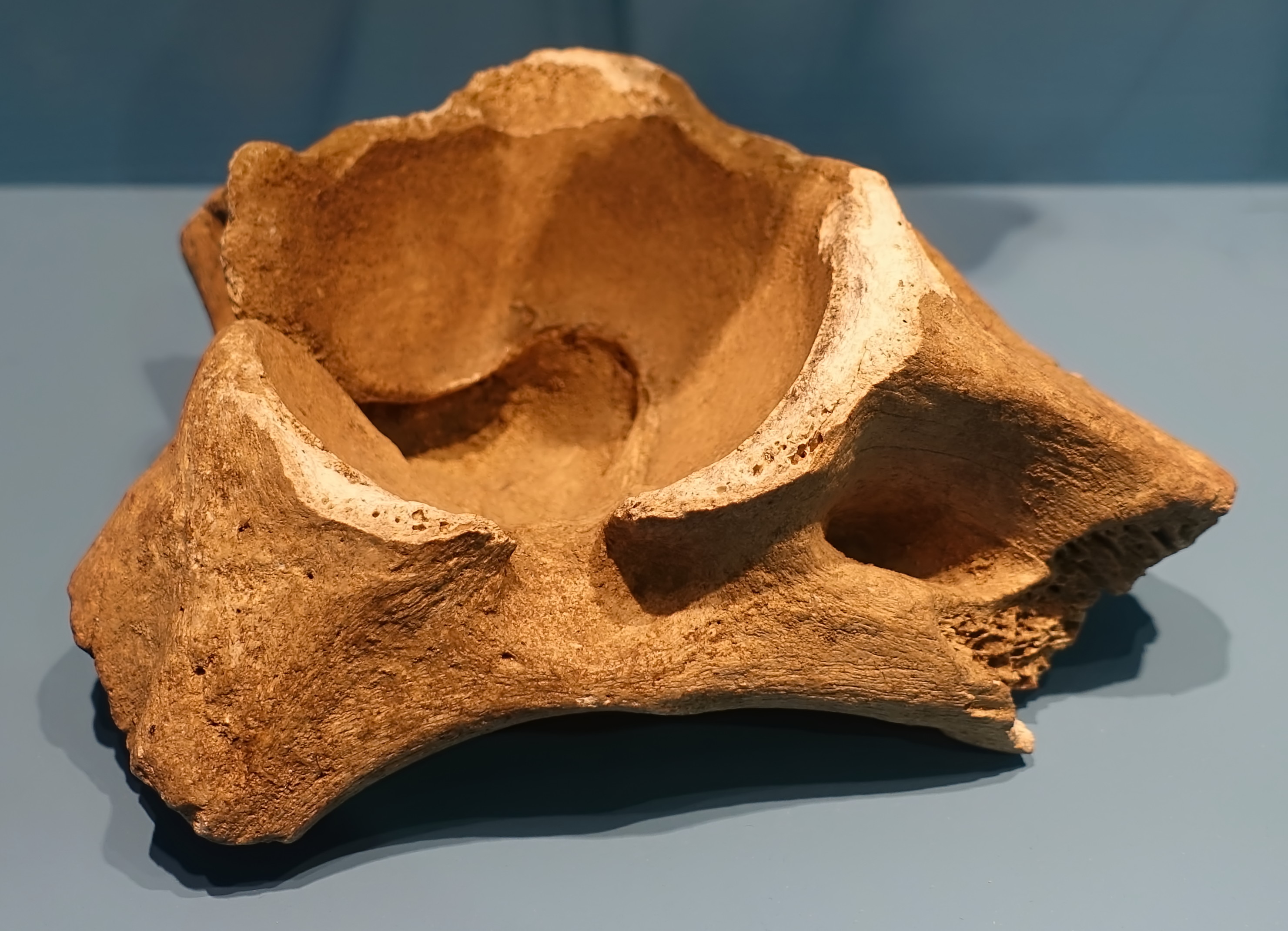
Pot for pigments.
Coxal (pelvic) bone of bison, Mousterian.
Photo: Don Hitchcock 2018
Collections de l'Institut de paléontologie humaine
Source and text: original, Musée de l'Homme, Paris
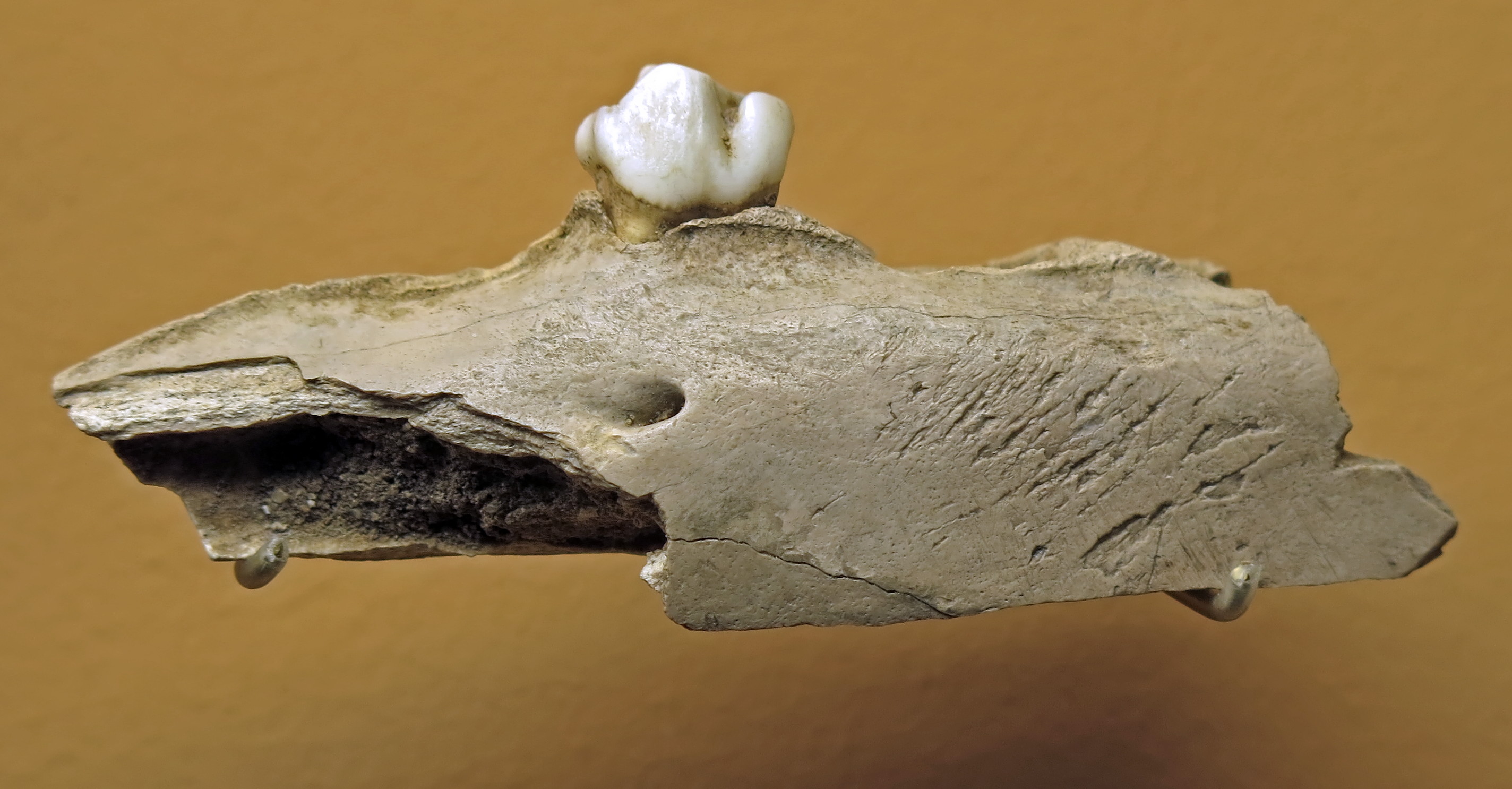
Retoucher made from the lower mandible of a reindeer.
Photo: Don Hitchcock 2015
Source: Original, display, Musée d'Archeologie Nationale et Domaine, St-Germain-en-Laye
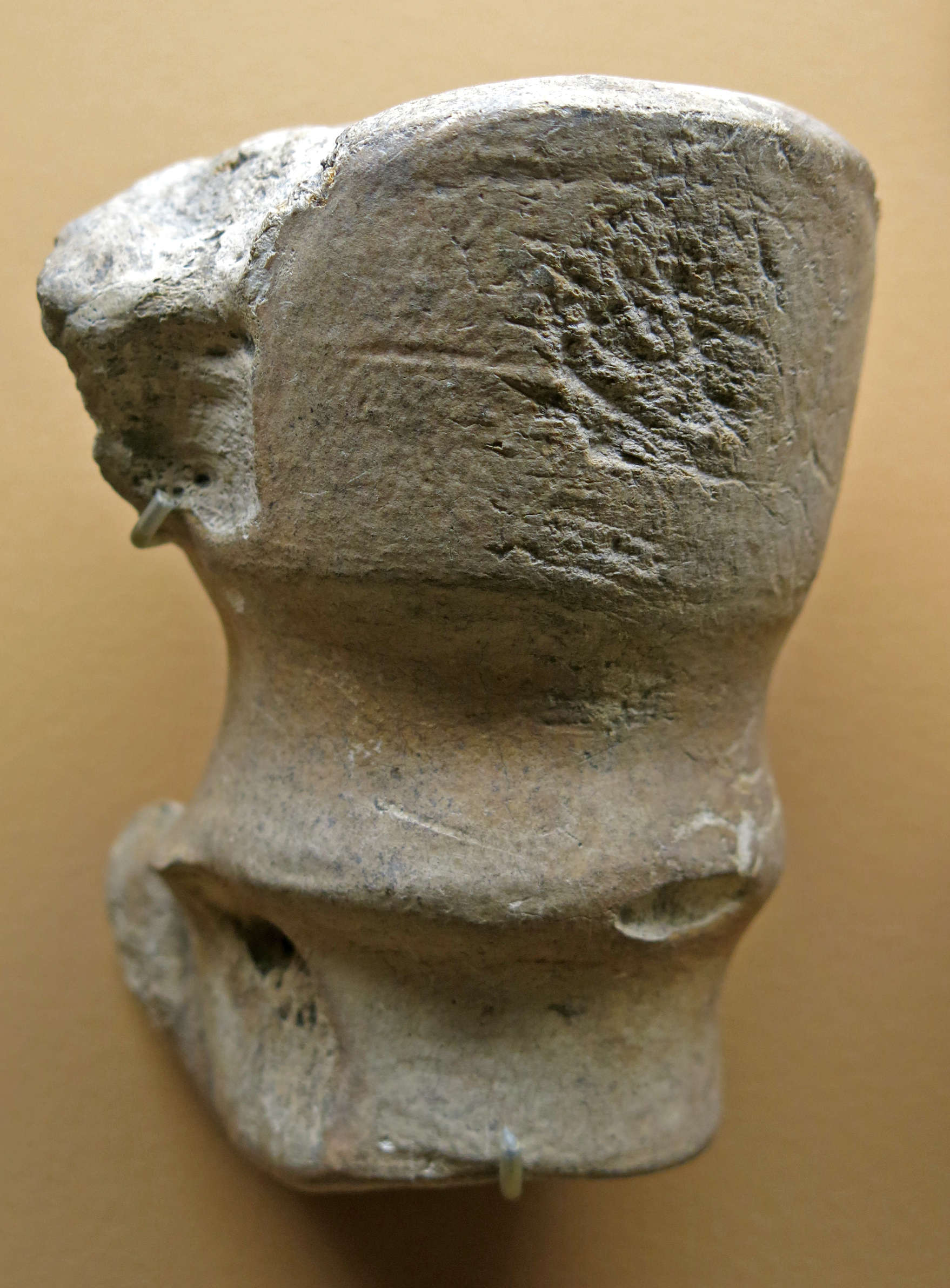
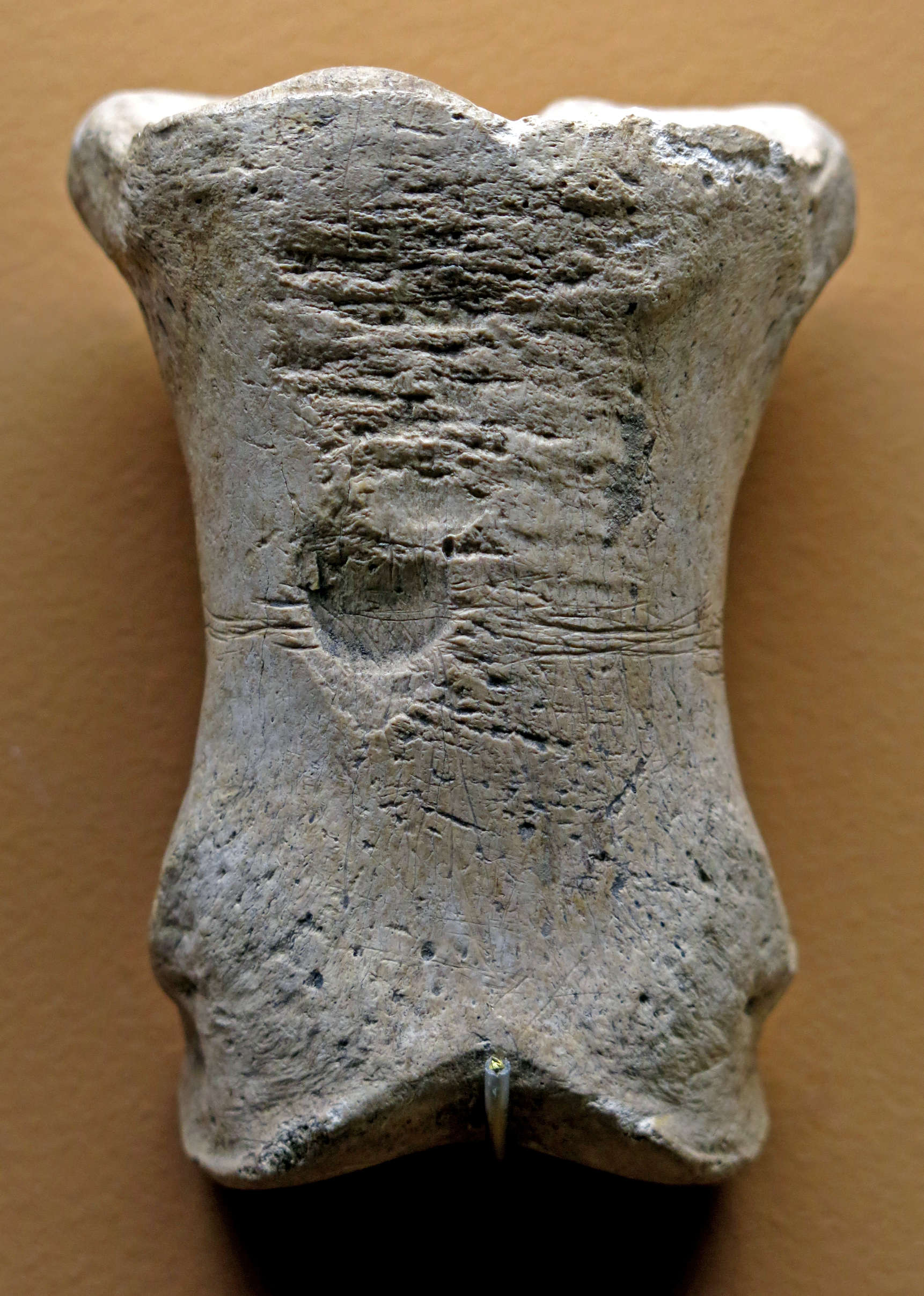
(left) Retoucher on the distal end of the humerus bone of a bovid, altered by fracturing. Original.
(right) Retoucher using the first phalange bone of a horse. .
Photo: Don Hitchcock 2014
Source: Original, display, Musée d'Archeologie Nationale et Domaine, St-Germain-en-Laye
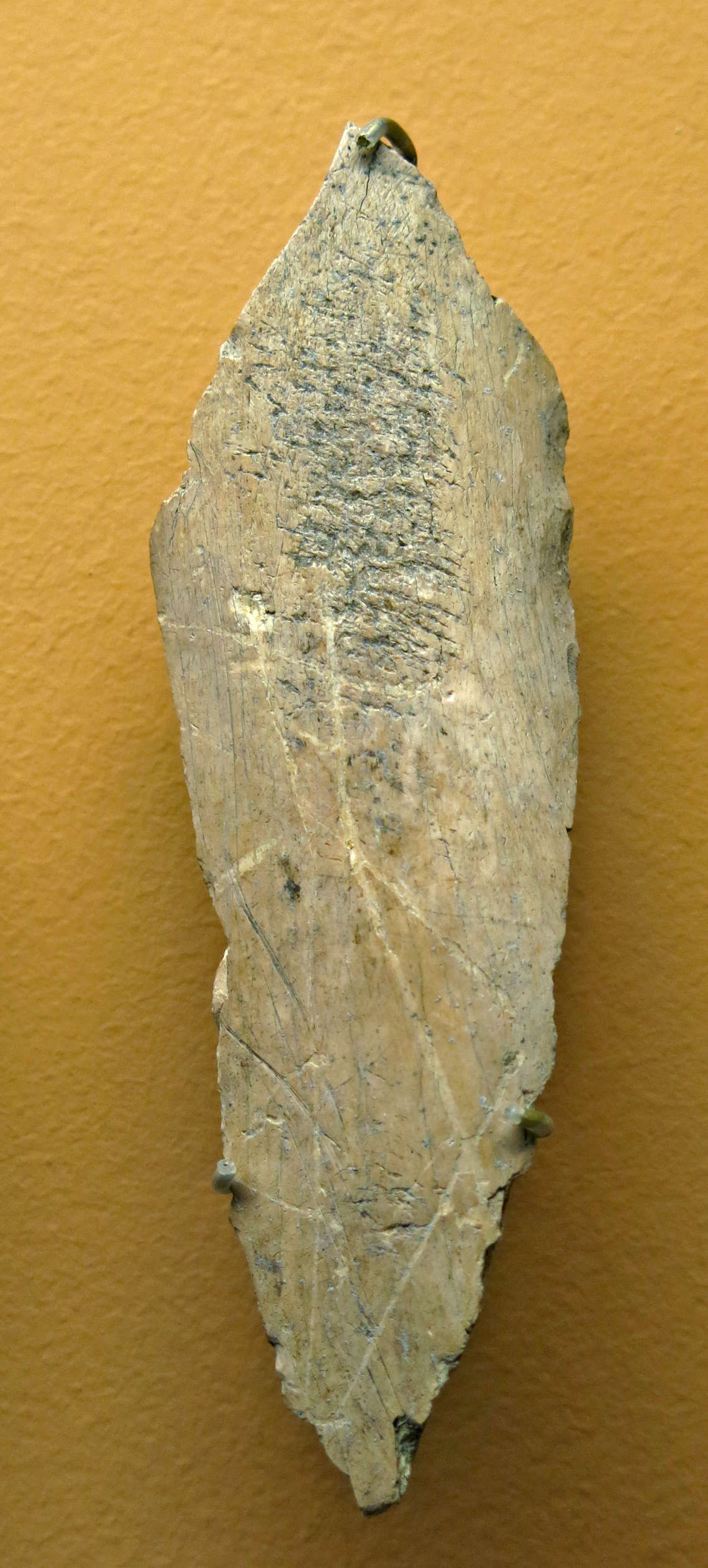
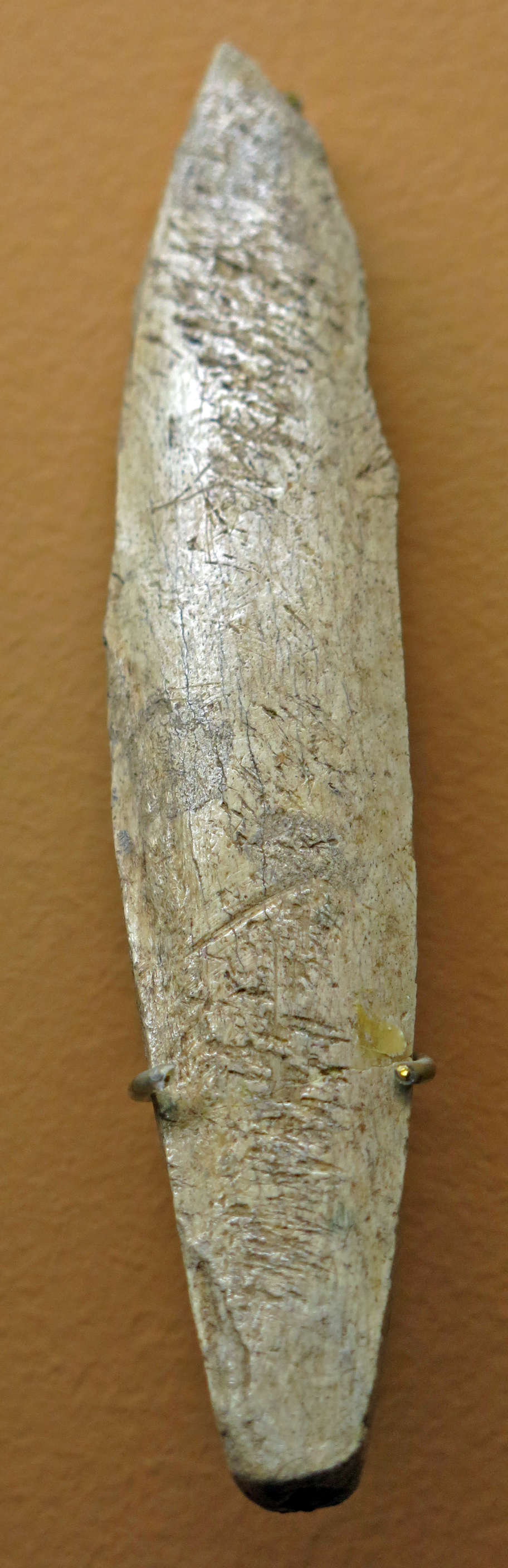
(left) Retoucher on a bone fragment.
(right) Retoucher on a bone fragment.
Photo: Don Hitchcock 2014
Source: Original, display, Musée d'Archeologie Nationale et Domaine, St-Germain-en-Laye
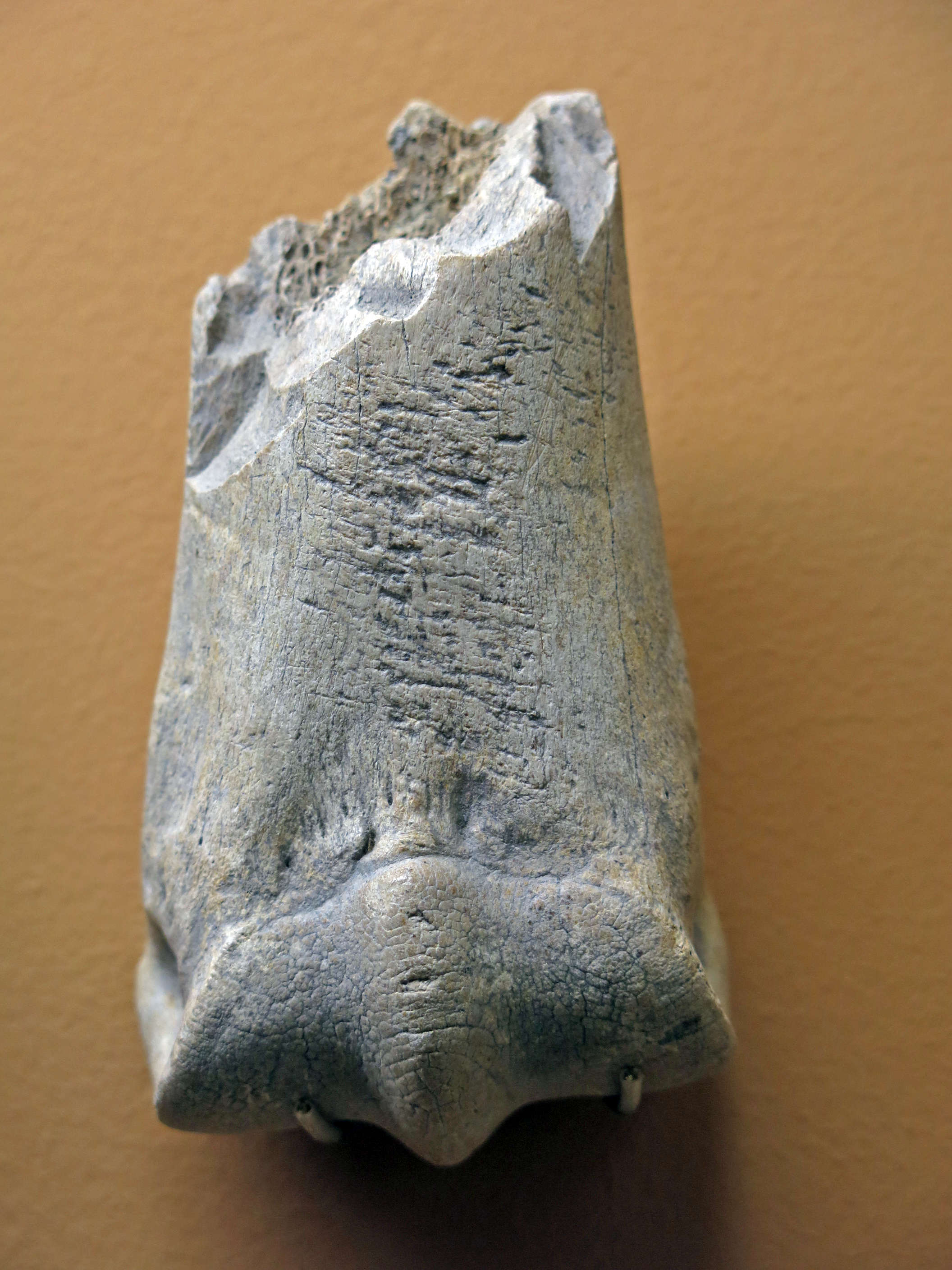
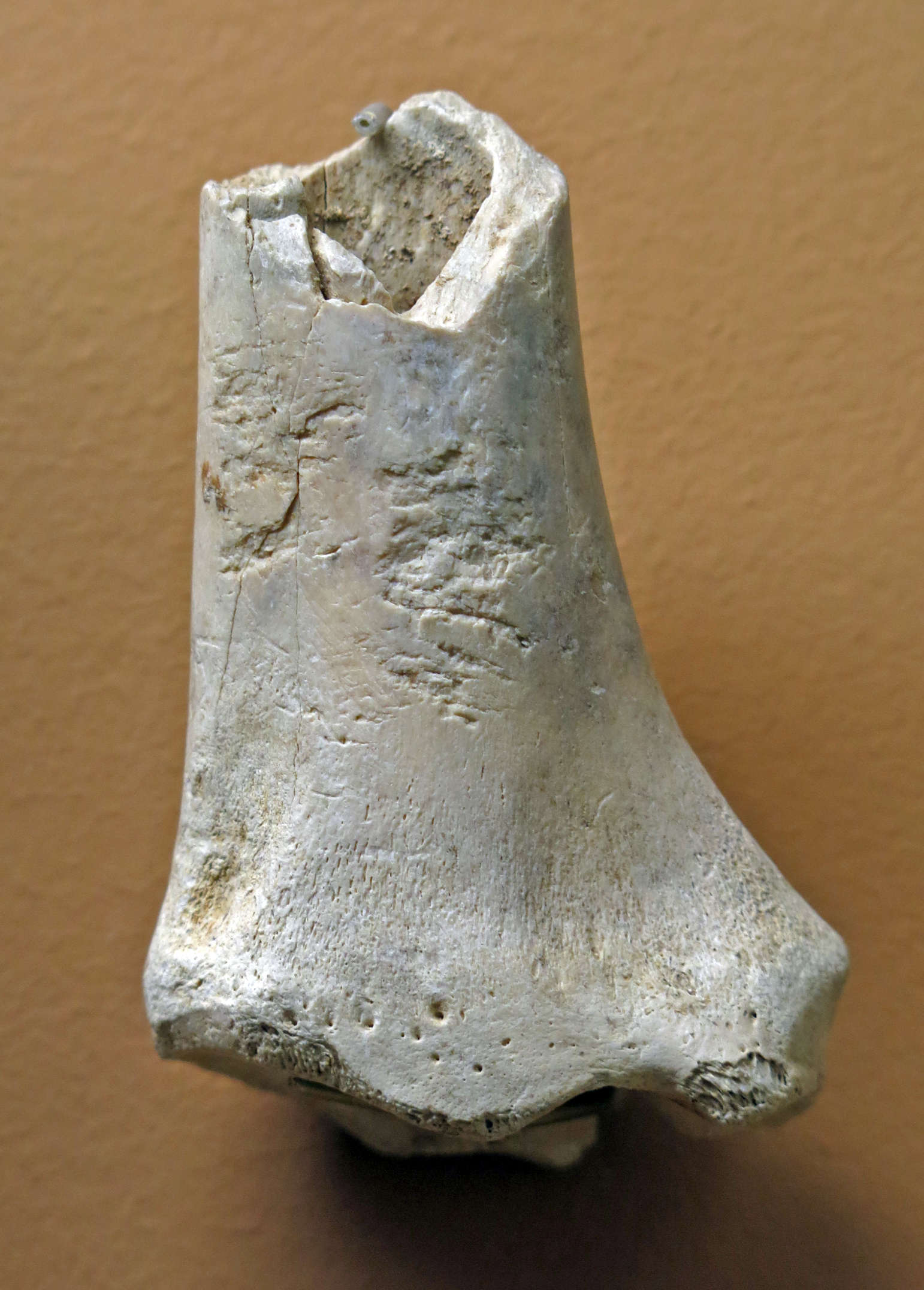
(left) Retoucher on a fragment of a horse metatarsal altered by fracturing.
(right) Retoucher on the proximal extremity of the radius of a reindeer.
(I would expect that both these pieces would have been longer when in use, with the rest of the missing bone acting as a handle. After breaking, the retoucher was thrown away - Don )
Photo: Don Hitchcock 2014
Source: Original, display, Musée d'Archeologie Nationale et Domaine, St-Germain-en-Laye
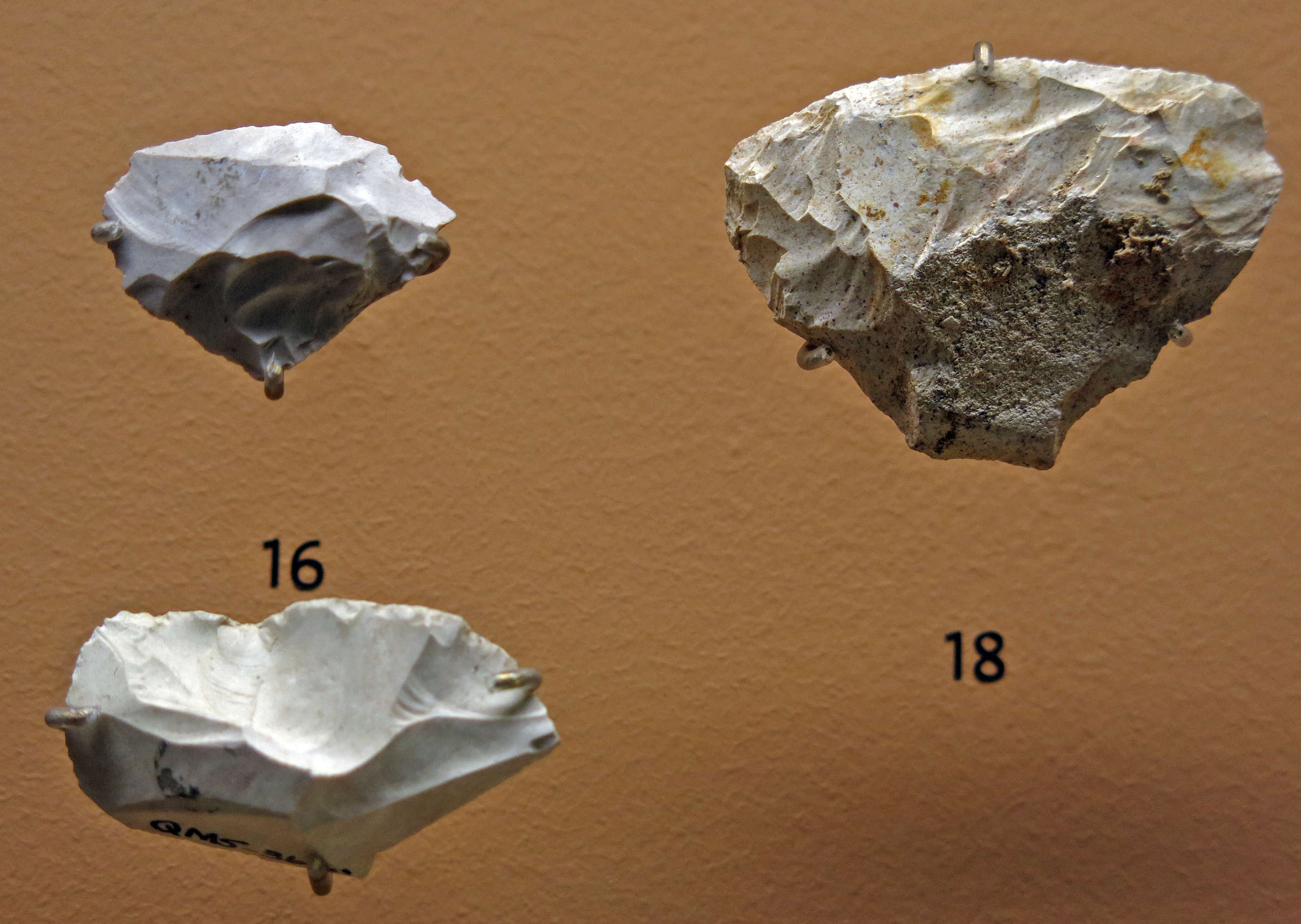
Flakes reworked into racloirs, scrapers, in the La Quina style.
Photo: Don Hitchcock 2014
Source: Original, display, Musée d'Archeologie Nationale et Domaine, St-Germain-en-Laye
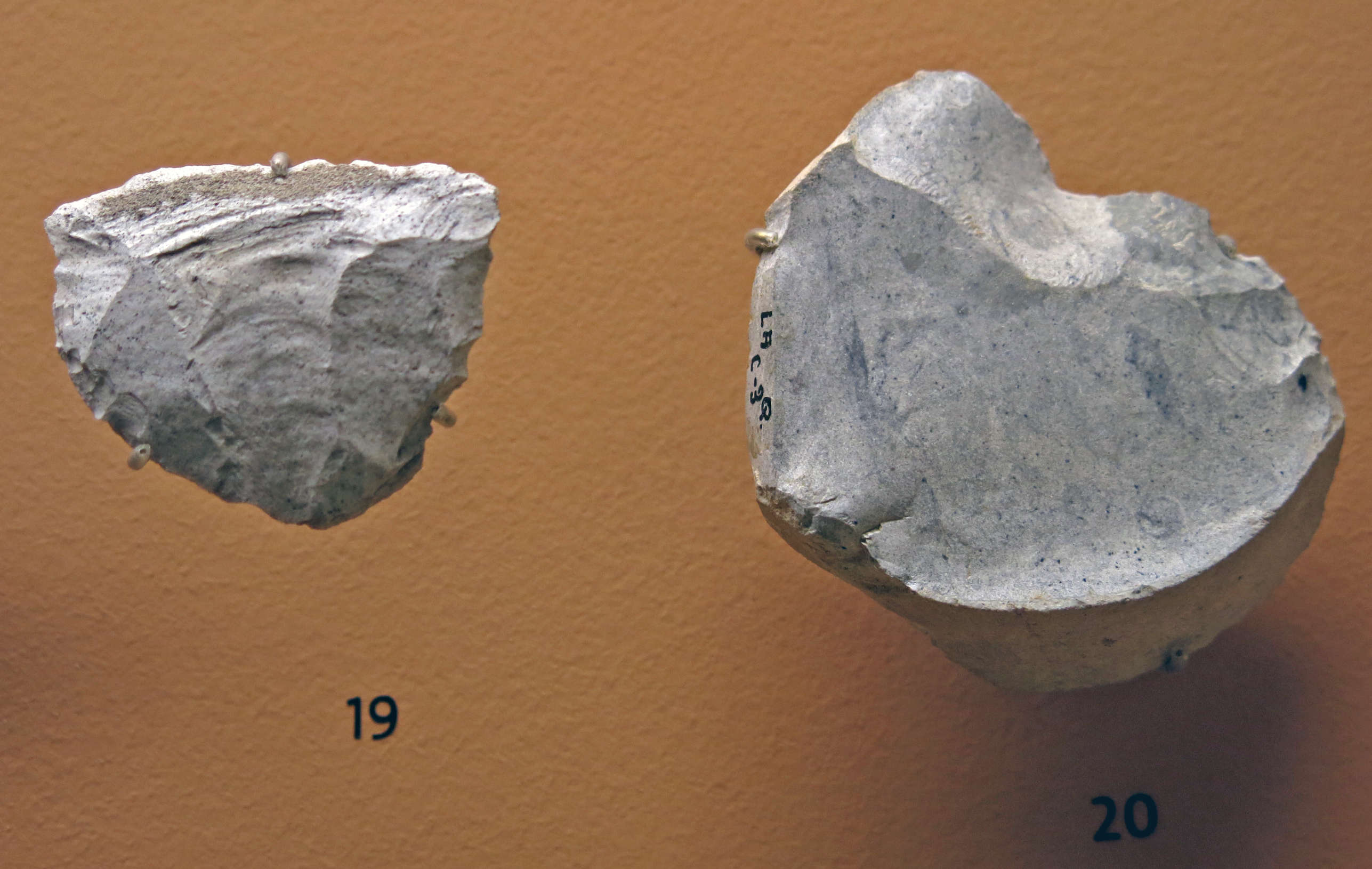
(left) Flake reworked into a racloir.
(right) Racloir of the La Quina type, with a Clactonian notch. Clactonian notches are large notches obtained from a single stroke of the hammer, sometimes corrected by small secondary alterations, which may also be due to use.
Photo: Don Hitchcock 2014
Source: Original, display, Musée d'Archeologie Nationale et Domaine, St-Germain-en-Laye
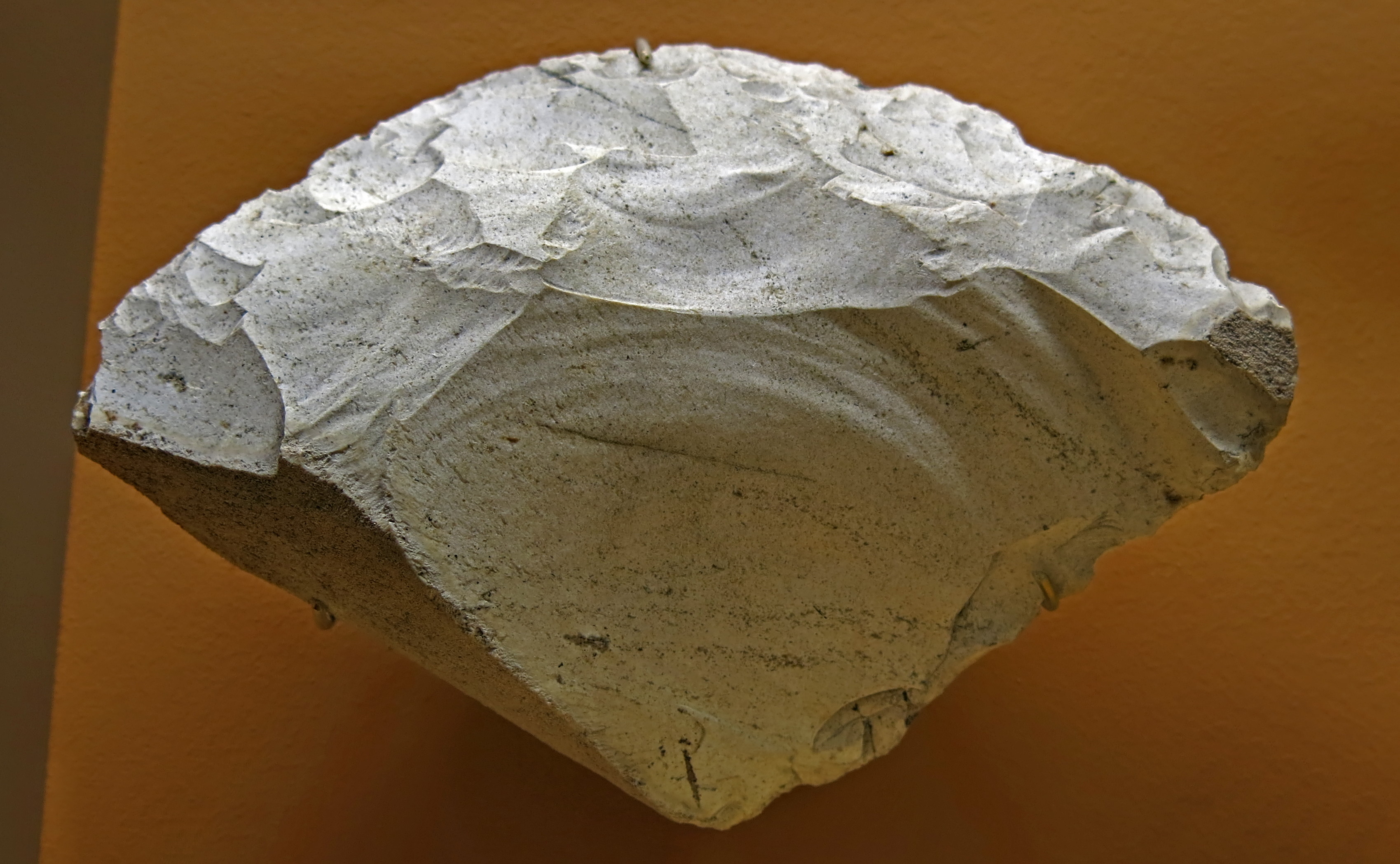
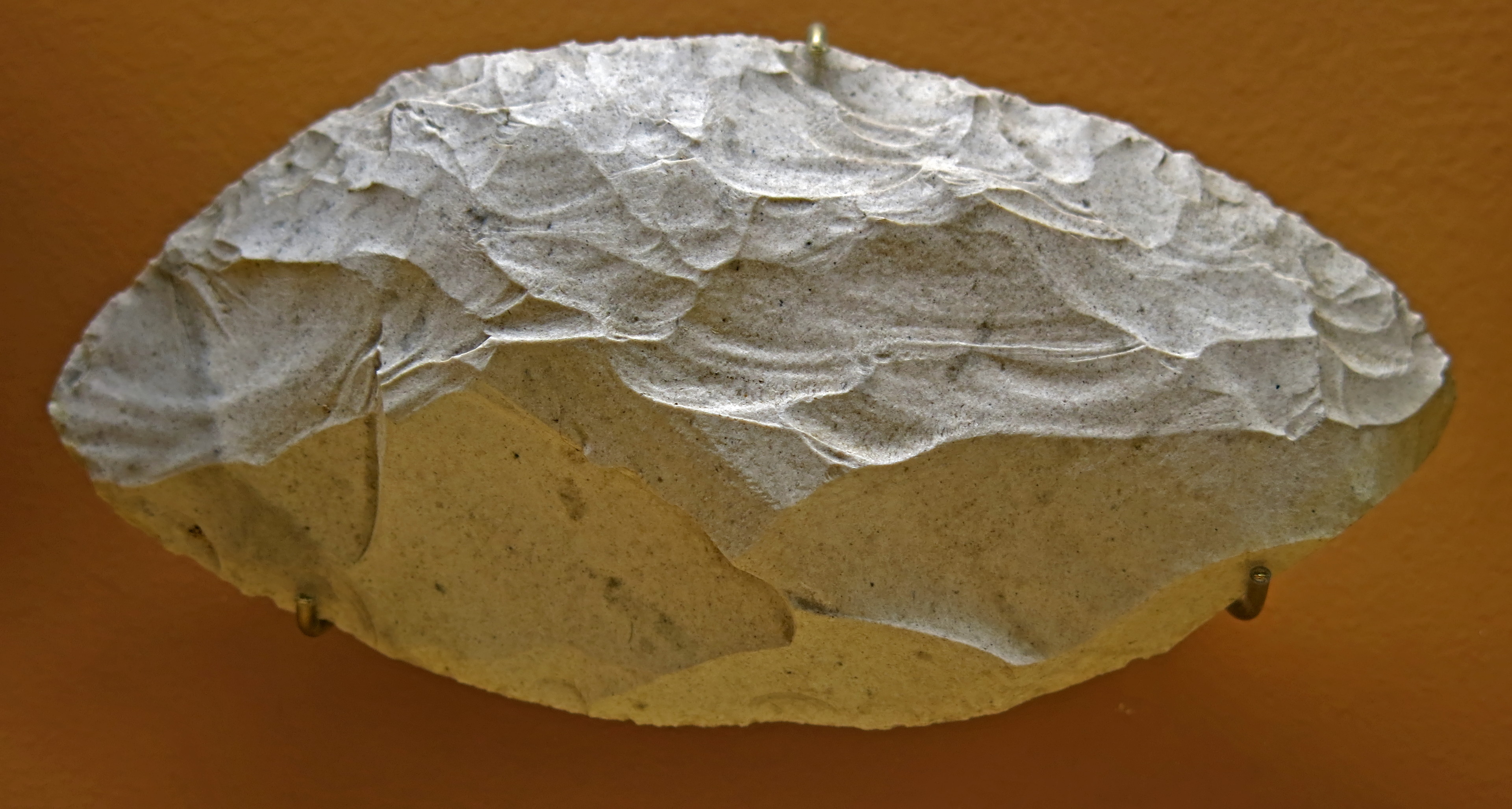
Racloirs from La Quina.
Photo: Don Hitchcock 2015
Source: Original, display, Musée d'Archeologie Nationale et Domaine, St-Germain-en-Laye

(left) Nucleus of the Lavallois type. Original.
(right) Percuteur or hammer stone. Original.
Photo: Don Hitchcock 2014
Source: Display, Musée d'Archeologie Nationale et Domaine, St-Germain-en-Laye
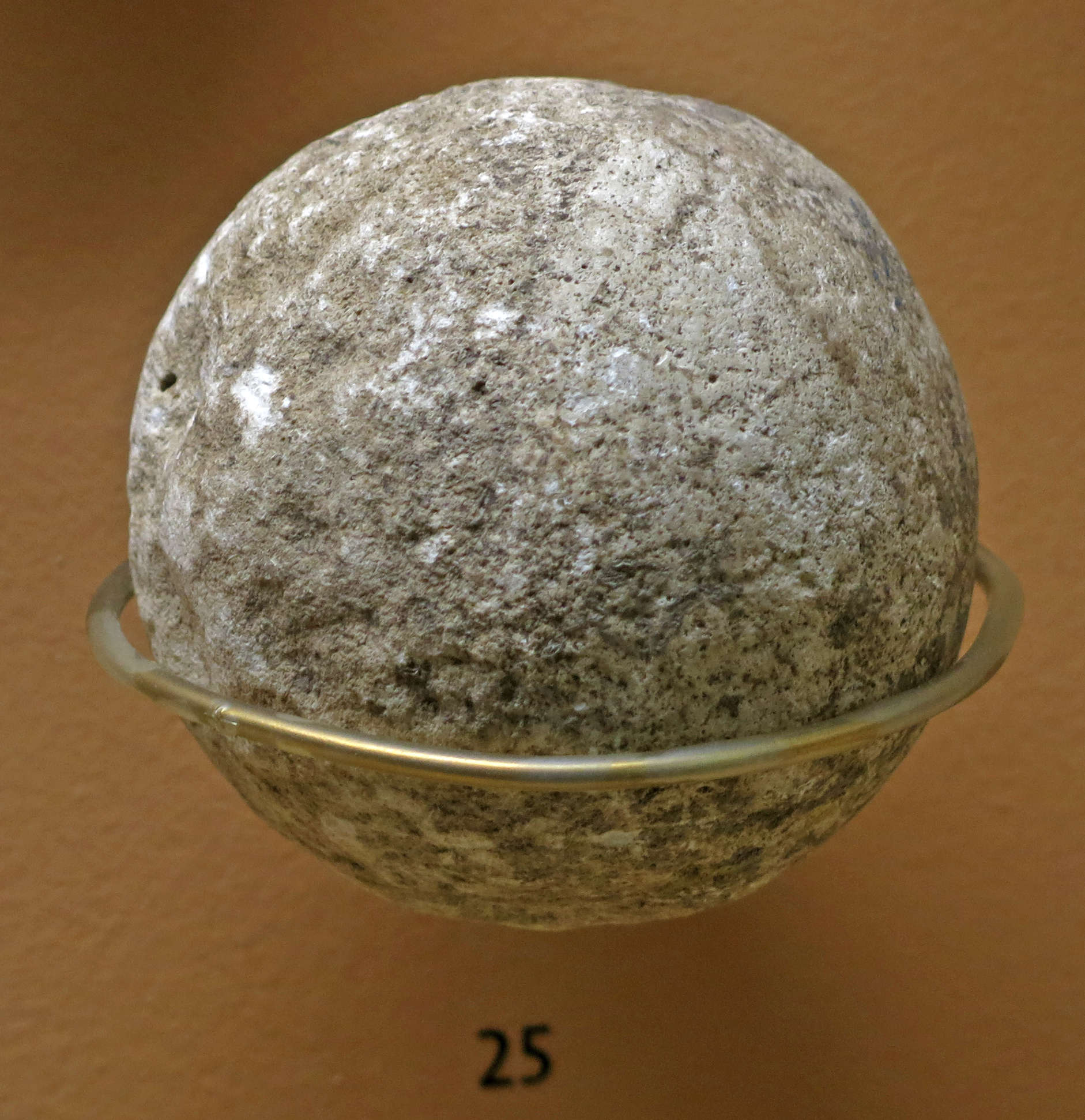
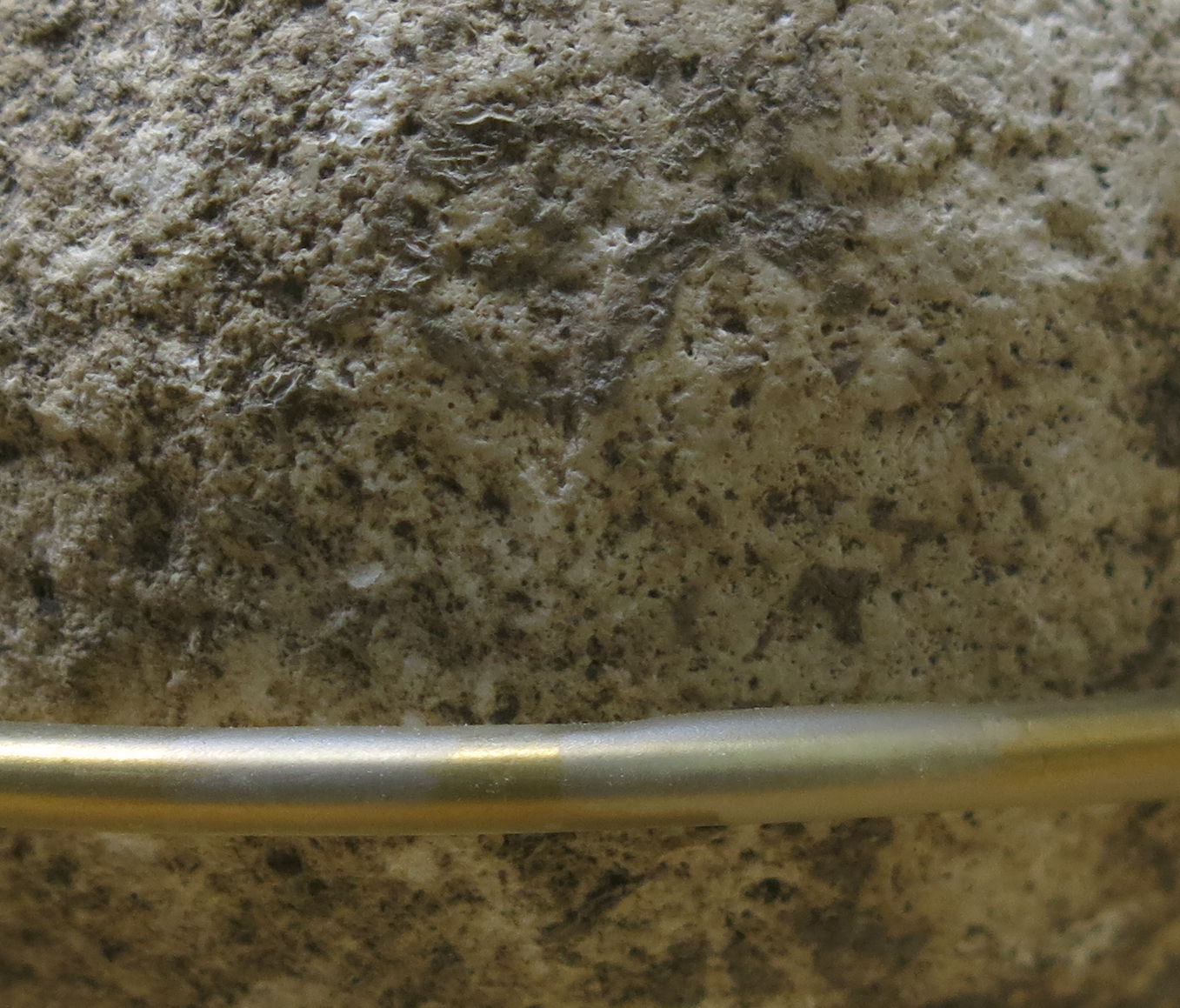
'Bola'. Original.
This piece shows that the La Quina knappers had excellent skills, despite the thick and asymmetric tools they usually turned out. This would have taken a lot of effort and skill to peck into such a close approximation to a sphere.
The original report of its discovery stated that it was of limestone.
Some have suggested that it was used as a weight in a bola, a hunting tool which uses three or more weights tied together by cord or thongs, and thrown so as to entangle the legs of hunted animals and bring them down.
However there is no conclusive evidence for the use of bolas in Europe. This artefact is an enigma.
Photo: Don Hitchcock 2014
Source: Display, Musée d'Archeologie Nationale et Domaine, St-Germain-en-Laye
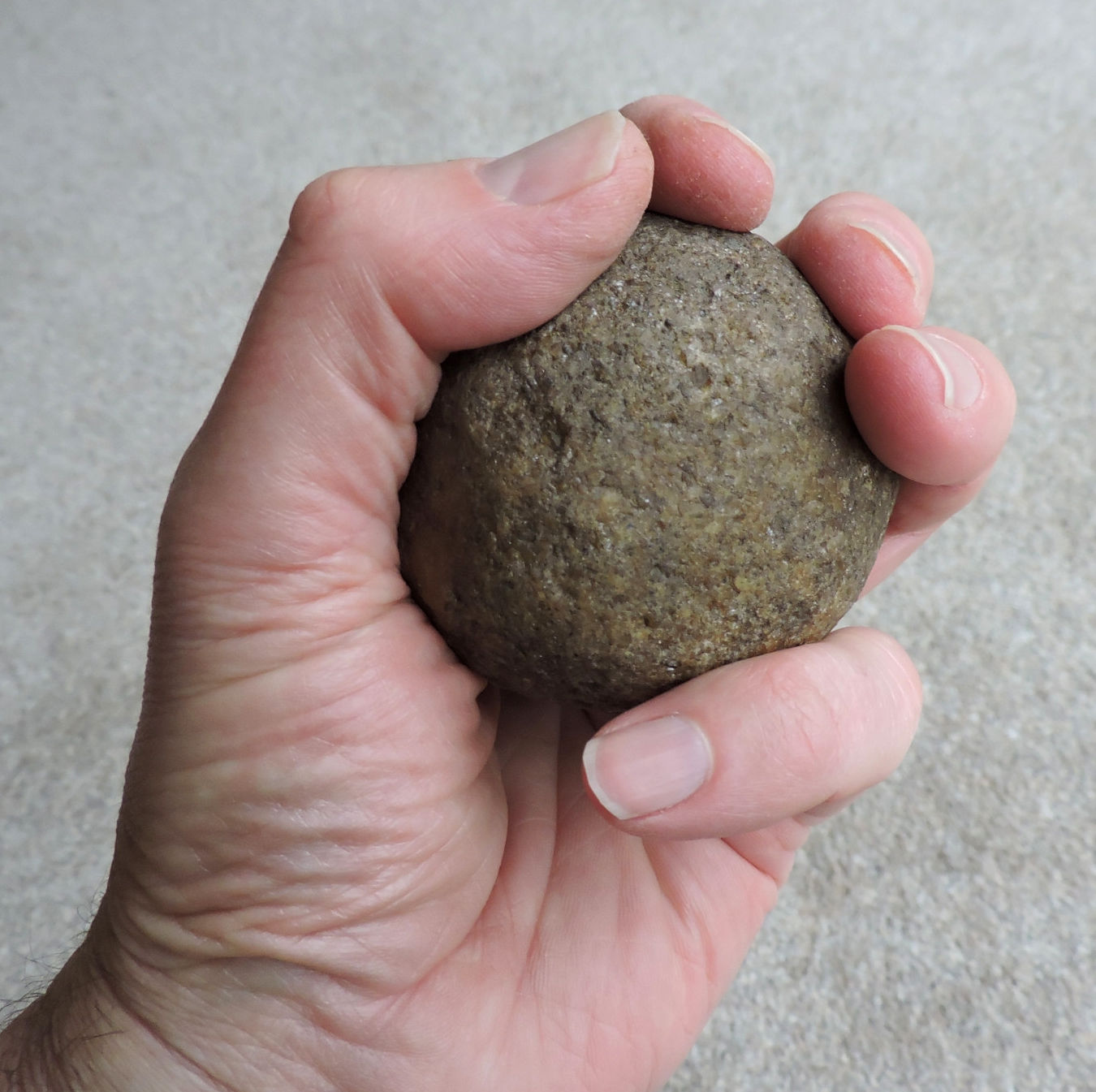
One of 55 round stone artefacts analysed to determine their use as throwing weapons for hunting and defense.
The La Quina 'bola' above may have been used for this purpose, rather than as part of a bola.
A team of psychologists, kinesiologists and archaeologists at Indiana University and elsewhere are throwing new light on a longstanding archaeological mystery: the purpose of a large number of spherical stone artefacts found at a major archaeological site in South Africa.
IU Bloomington professor Geoffrey Bingham and colleagues in the United Kingdom and United States contend that the stones - previously thought by some to be used as tools - served instead as weapons for defense and hunting.
The research, which combines knowledge about how modern humans perceive an object's 'throwing affordance' with mathematical analysis and evaluation of these stones as projectiles for throwing, appears in the journal Scientific Reports.
'Our study suggests that the throwing of stones played a key role in the evolution of hunting,' said Bingham, a professor in the IU Bloomington College of Arts and Sciences' Department of Psychological and Brain Sciences and an author on the study. 'We don't think that throwing is the sole, or even primary, function of these spheroids, but these results show that this function is an option that warrants reconsidering as a potential use for this long-lived, multipurpose tool.'
The use of these stones, which date from between 1.8 million and 70 000 years ago, has puzzled archaeologists since they were unearthed at the Cave of Hearths in South Africa's Makapan Valley nearly 30 years ago.
The team's conclusions are based upon a theoretical framework and computational tools developed in the Perception/Action Lab at IU, directed by Bingham, who investigates human coordinated action and perceptual capabilities. This includes judging an object's throwing affordance, which is the selection of the best object in terms of size, weight and shape for throwing at maximum distance, speed and damage.
Using these methods, the researchers used computational models to analyse 55 ball-shaped stone objects from the South African site, finding that 81 percent of the stones were the optimal size, weight and shape for hitting such a target at a 25 metre distance. The stones are about the size of tennis balls but much heavier.
The team also simulated the projectile motions the spheroids would undergo if thrown by an expert, as well as estimated the probability of these projectiles causing damage to a medium-sized prey such as an impala.
Research on biomechanics and perception, particularly vision, shows that the human shoulder joint and perceptual abilities are uniquely specialised for throwing objects aimed at a particular target at a distance of 20 to 30 metres, Bingham said. The stones, which predate thrown spears, likely served as projectile weapons for hunting and defence since they were found to perform best as hunting weapons when thrown overhand, he added.
'Humans are the only animals - the only primates even - with that talent," Bingham said. 'We can throw something to hit something else - like a quarterback throwing to the running back all the way down the field. That's how in large measure we survived the ice ages. The available food was largely on hoof, or it was 'mega-fauna,' such as a mammoth. You don’t want to get close to them.'
Previous research by archaeologists suggested that spherical stones were used as percussive tools for shaping or grinding other materials. Most of the objects analysed in this study had weights that produce optimal levels of damage from throwing, however, rather than simply being as heavy as possible.
'Imagine a human, searching for an object to throw so as to cause the most damage possible to potential prey or a competitor,' Wilson said. 'This is a perceptual task: the person needs to perceive throwing - relevant properties of objects and be able to discriminate between objects that vary in those properties.'
Bingham, along with former students and other colleagues, have been studying the mechanics and evolutionary role of throwing - a complex human action - for several decades at IU. Over time, they developed both theories on this capability, as well as virtual simulations to measure the mechanics of the task.
'The ability to throw great distances was not a small thing,' Bingham said. 'It was how we got lunch.'
Photo Credit: Judy Maguire
Source and text: https://www.sciencedaily.com/releases/2016/08/160819084826.htm

Biface hand axe from La Quina.
Photo: Don Hitchcock 2014
Source: Display, Musée d'Archeologie Nationale et Domaine, St-Germain-en-Laye

Blattspitzen from La Quina found in 1923.
Although most of the La Quina toolkit was thick and asymmetric, this example of a Blattspitzen or leaf point shows good knapping ability.
Photo: Martin (1931)
Permission: Public domain - this image is in the public domain because its copyright has expired.
Astragale humain du Moustérien moyen de La Quina. Ses affinités
Human anklebone from the middle Mousterian at La Quina.
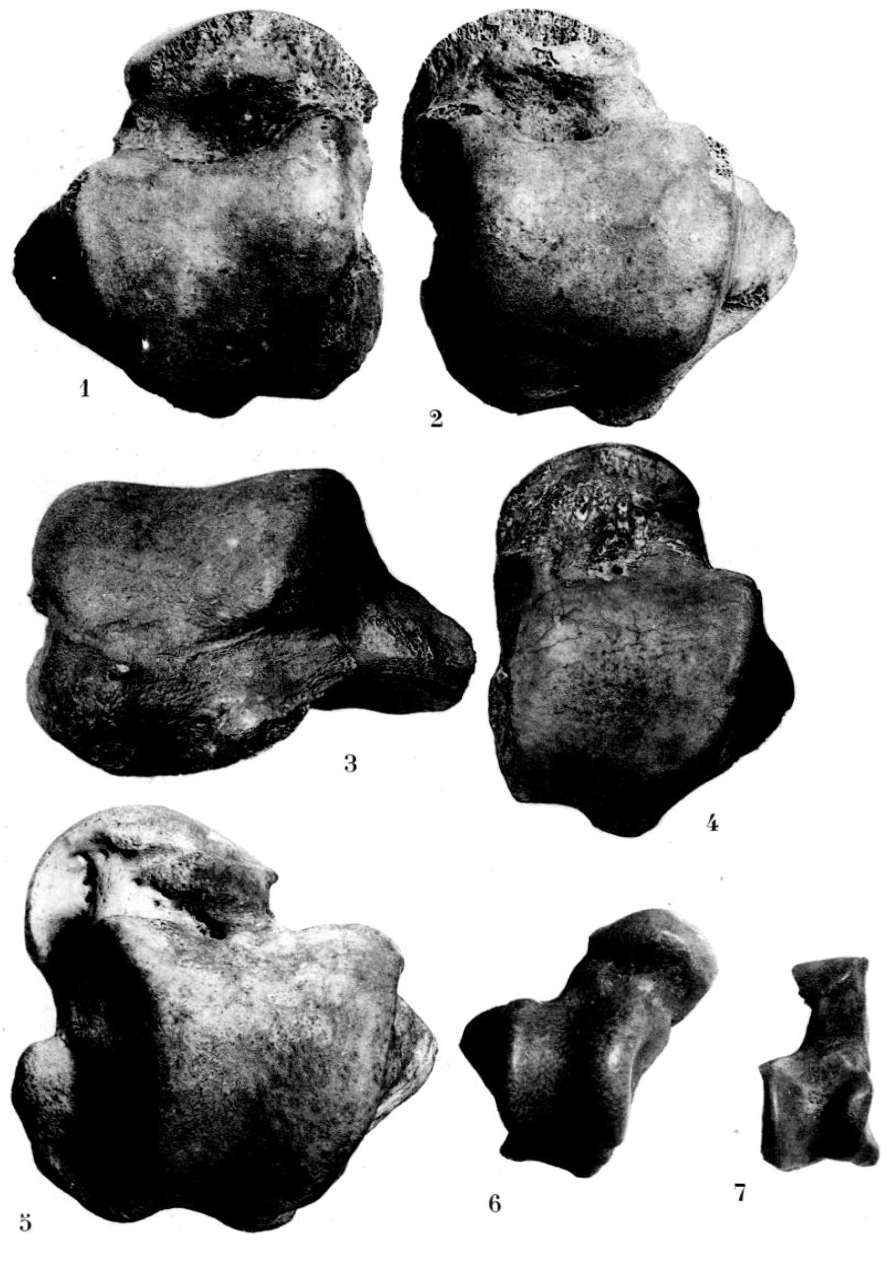
Fig 1 - left anklebone, La Quina man. View of the upper side.
Fig 2 - right anklebone, La Quina man. View of the upper side.
Fig 3 - right anklebone, La Quina man, same as Fig 2, view of the rear. The lateral expansion is seen in profile.
Fig 4 - right anklebone, modern female human.
Fig 5 - right anklebone, gorilla.
Fig 6 - left anklebone, Lemur.
Fig 7 - left anklebone, hare.
Photo and text: translated and adapted from Martin (1910)
The site of la Quina has not yet provided any whole human skeleton, despite my extended research, but in a part of the gisement, which bears the symbol c3 (not part of the paper. However it is almost certainly layer three in the diagram below
'Site of La Quina after excavations' from Munro (1912) which is noted as being drawn after Dr. Henri-Martin - Don), I have found in a layer corresponding to the middle Mousterian, two human astragals (anklebones). As I already announced at the Congress of the AFAS in 1908, these two pieces were lying a few centimetres from each other, and are of the same proportions - they appear to belong to two feet of the same person.
These two bones, perfectly in place, just behind the former leading edge of the slope, represent the only remains of a skeleton, which was probably destroyed in 1881, when the Pontaroux to Villebois - Lavalette road was made. Despite active monitoring by collectors who came to pick up artefacts at that time from under the pickaxes of the workers, abundant flint and bone, as I could prove, were rejected and unrecognised. It has probably suffered the fate of most human Mousterian skeletons.
However we shall examine these two anklebones, because these remnants must not be lost, especially since this bone has a very great importance in human ontogeny.
The precise position, i.e. the orientation of the first anklebone, could not be recognised, as this bone fell into my hands, as though hit by a hockey stick, from the middle of a mound of sandy clay separated from the archaeological layer. However the scrutiny of this layer allowed me a moment later to find the second bone.
This was the left, it lay almost flat,
the head directed to the right. No other part of the foot accompanied
these two bones, so we can surmise that there was once a disjunction of the skeleton, common elsewhere, which prevented me from finding the other parts of the foot.
These two bones have all the signs of a fossilized substance, they are devoid of gelatin.
Text above: translated and adapted from Martin (1910)
The Skeleton of La Quina
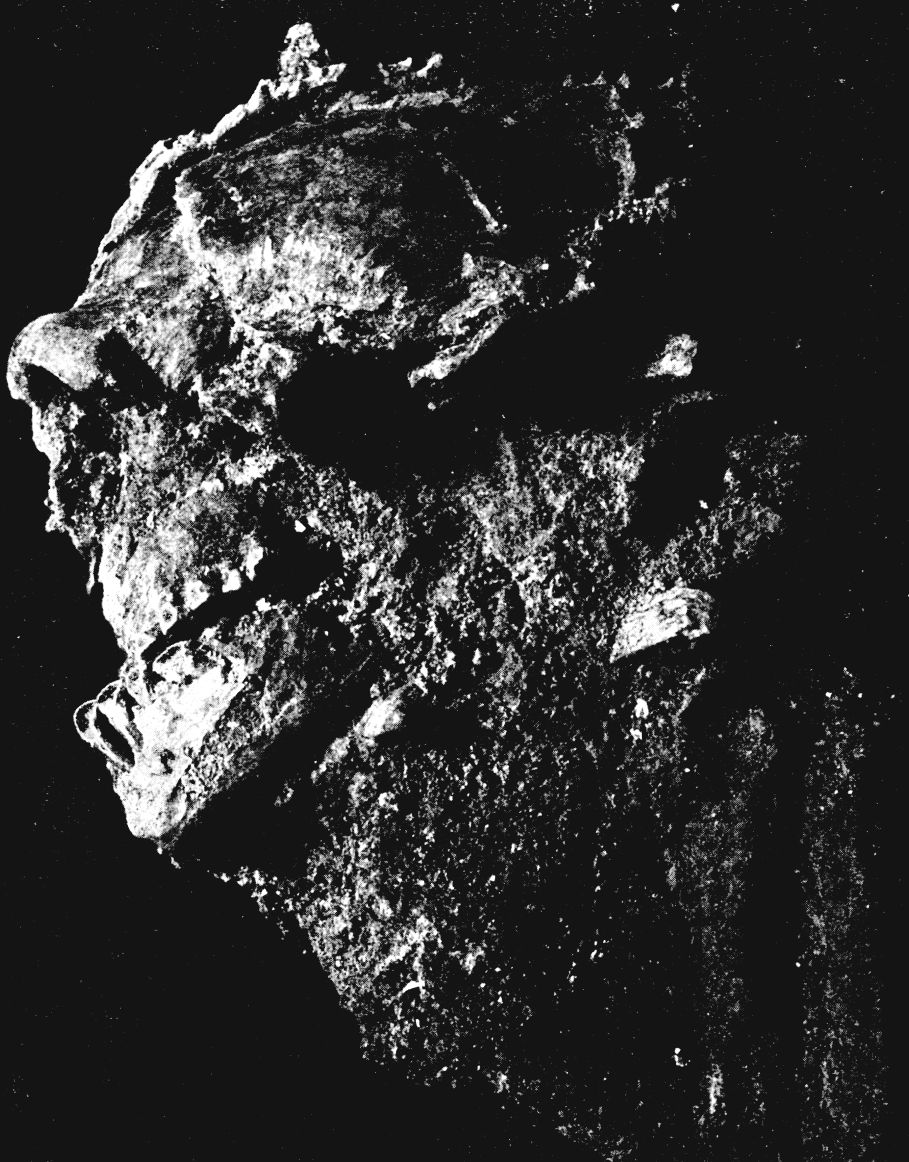
Profile of the skeleton of La Quina.
On the 16th October 1911, Dr Henri-Martin sent a note to the Academic des Sciences in Paris announcing the discovery
of a human skeleton of the Neanderthal type, on the 18th September last, in the station of La Quina (Charente).
The skeleton lay in a horizontal position, in an ancient muddy deposit of the river Voultron, forming part of the lower Mousterian debris, and at a distance of 4.50 metres from the base of the present cliff. The stratum in which the skeleton was embedded consisted of sandy clay, underlying a mass of fallen rocks from the cliff which in Mousterian times projected over the bank of the river.
The skeleton was buried in its muddy bed to a depth of 80 cm, but it was not surrounded by a grave, nor was there any appearance of its having been intentionally inhumed. On the contrary, the situation and circumstances indicated that the body had either fallen from the cliff, or was carried by the current of the stream into the place where it was found, and so became permanently entombed in the sedimentary debris of the river.
Text: Munro (1912)
Photo: Martin (1911)
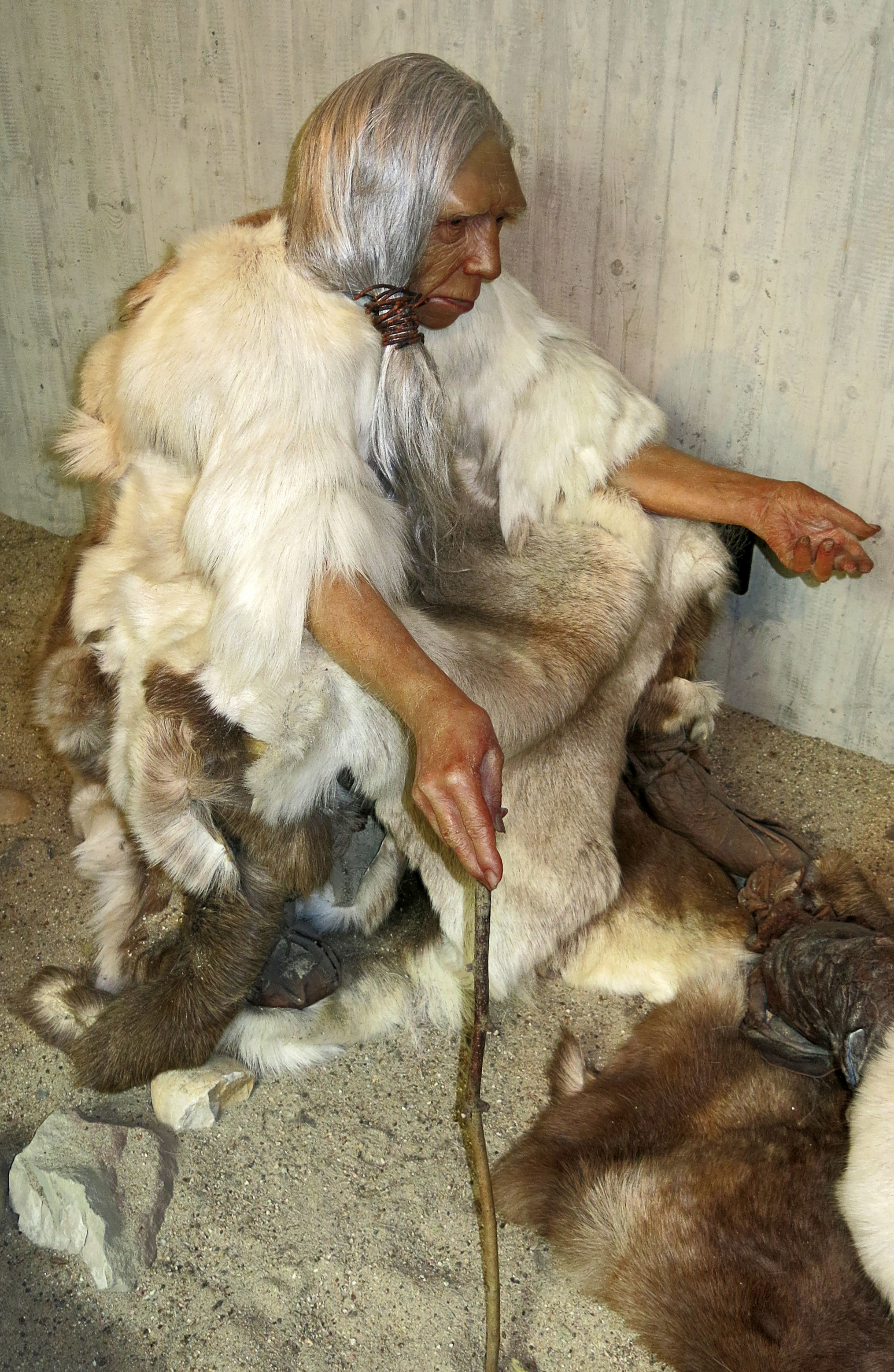
Woman from La Quina
This is a reconstruction from the skeleton of the adult woman found at La Quina, as shown above.
Photo: Don Hitchcock 2015
Artist: Élisabeth Daynès, Paris
Source: Neanderthal Museum, Mettmann, near Düsseldorf, accessible by a regular train service.
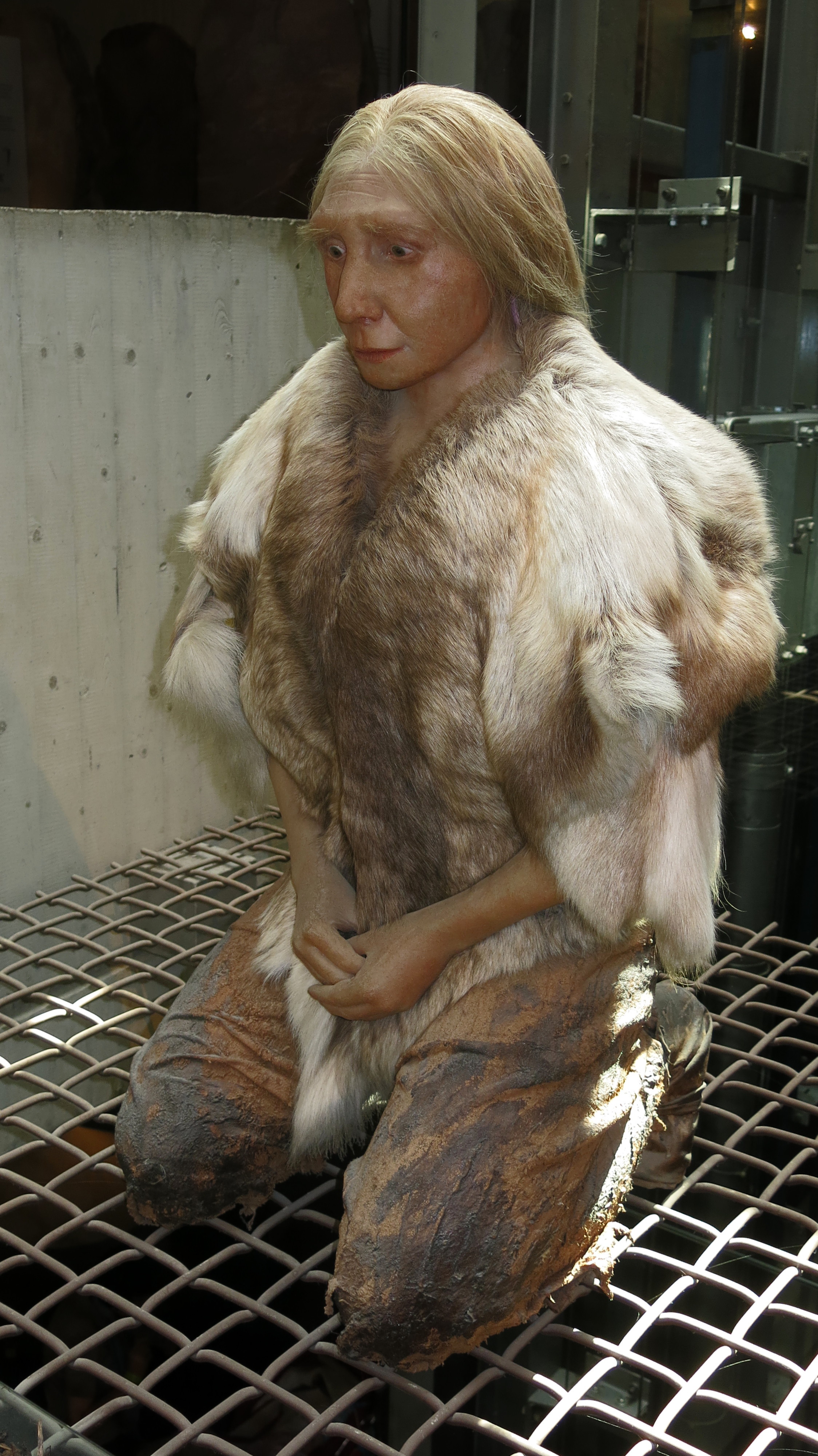

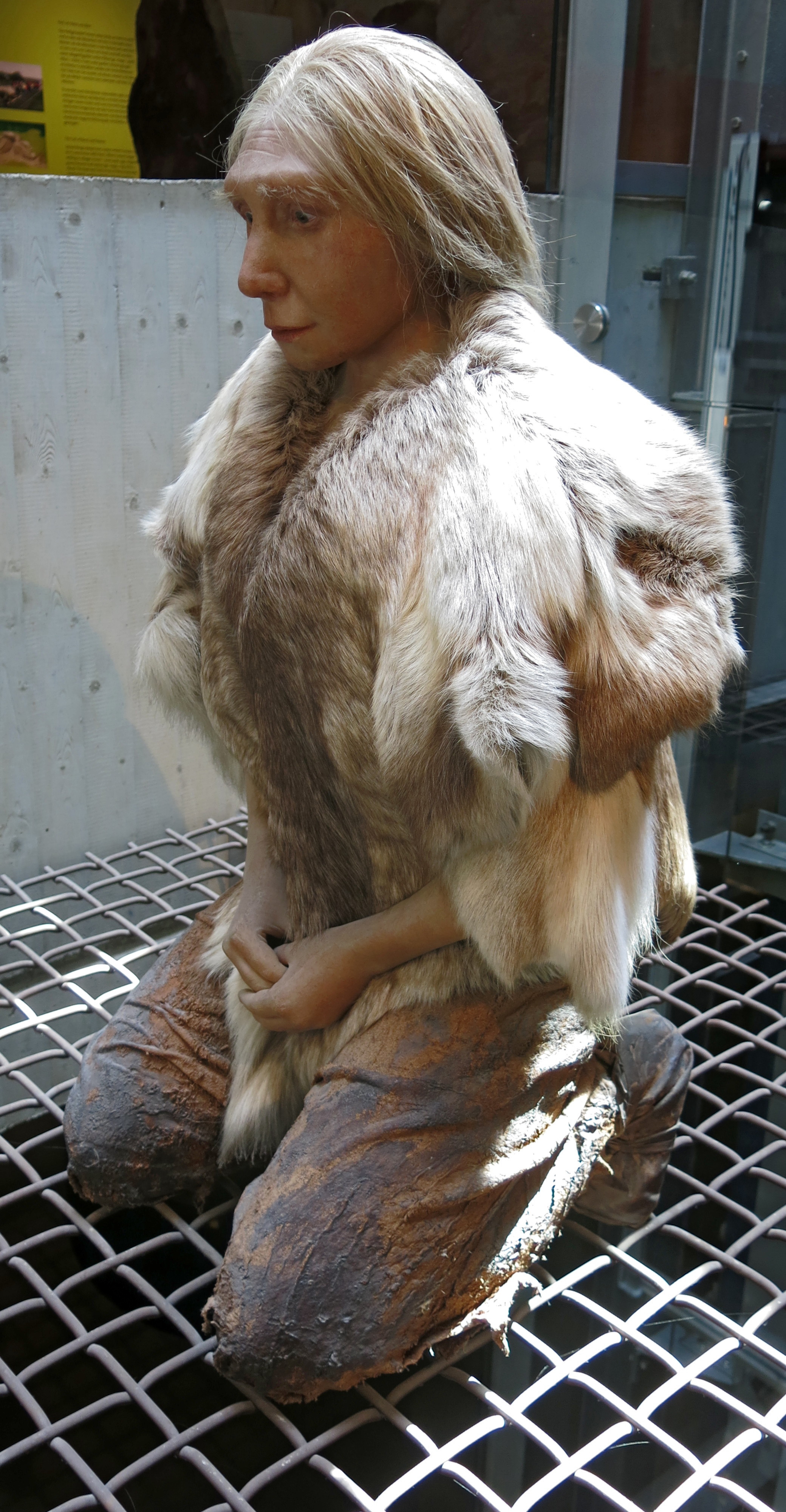
Woman from La Quina
This appears to be another reconstruction from the skeleton of the adult woman found at La Quina.
Photo: Don Hitchcock 2015
Artist: Élisabeth Daynès, Paris
Source: Neanderthal Museum, Mettmann, near Düsseldorf, accessible by a regular train service.
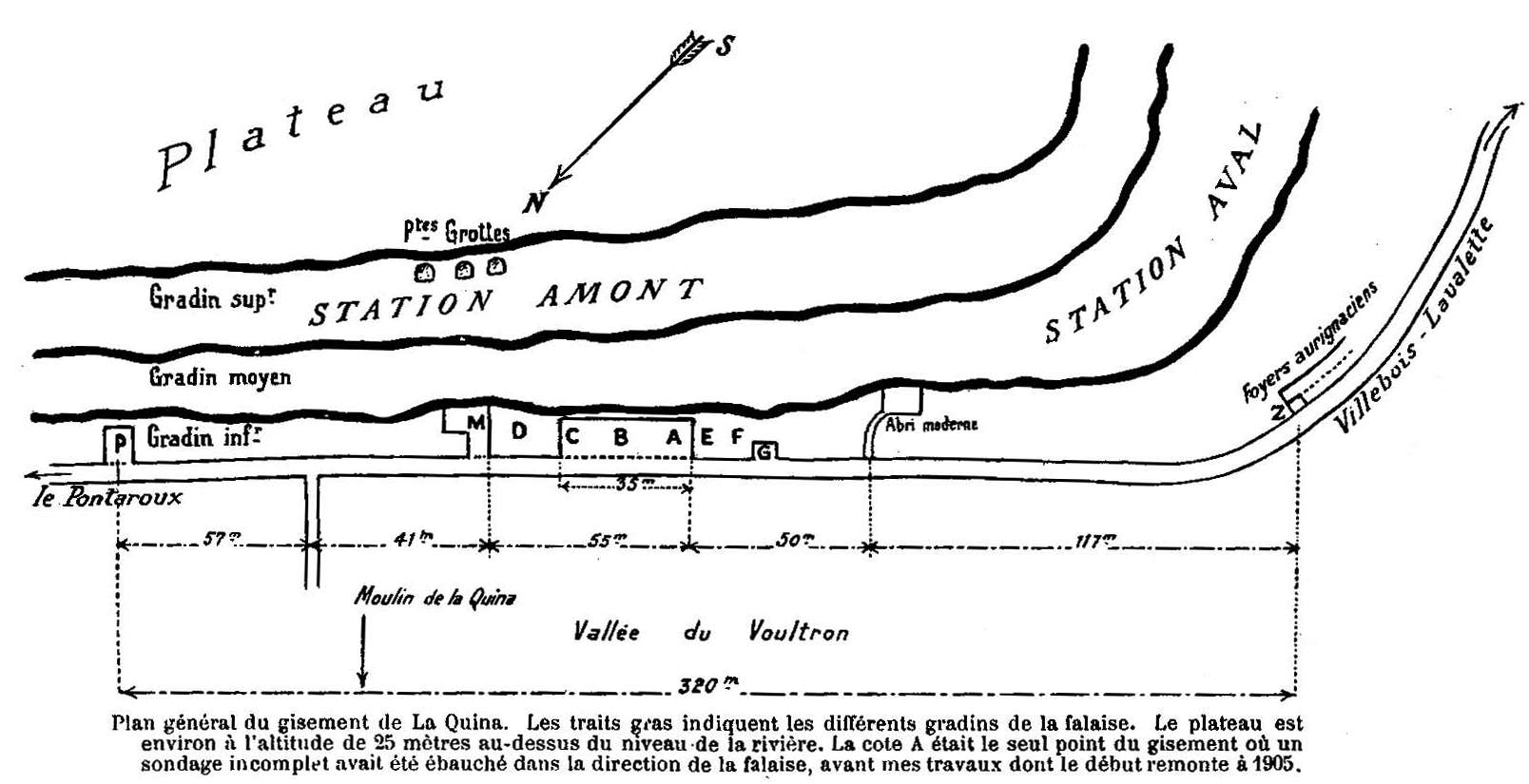
Map showing the parts of the site excavated.
At La Quina, Dr Henri-Martin conducted excavations in wide trenches perpendicular to the front of the cliff : trenches A to M for the Station Amont and X-Y-Z for the Station Aval.
Photo: Henri-Martin (1965)
Text: adapted from Heinrich Wendel (© The Wendel Collection, Neanderthal Museum)
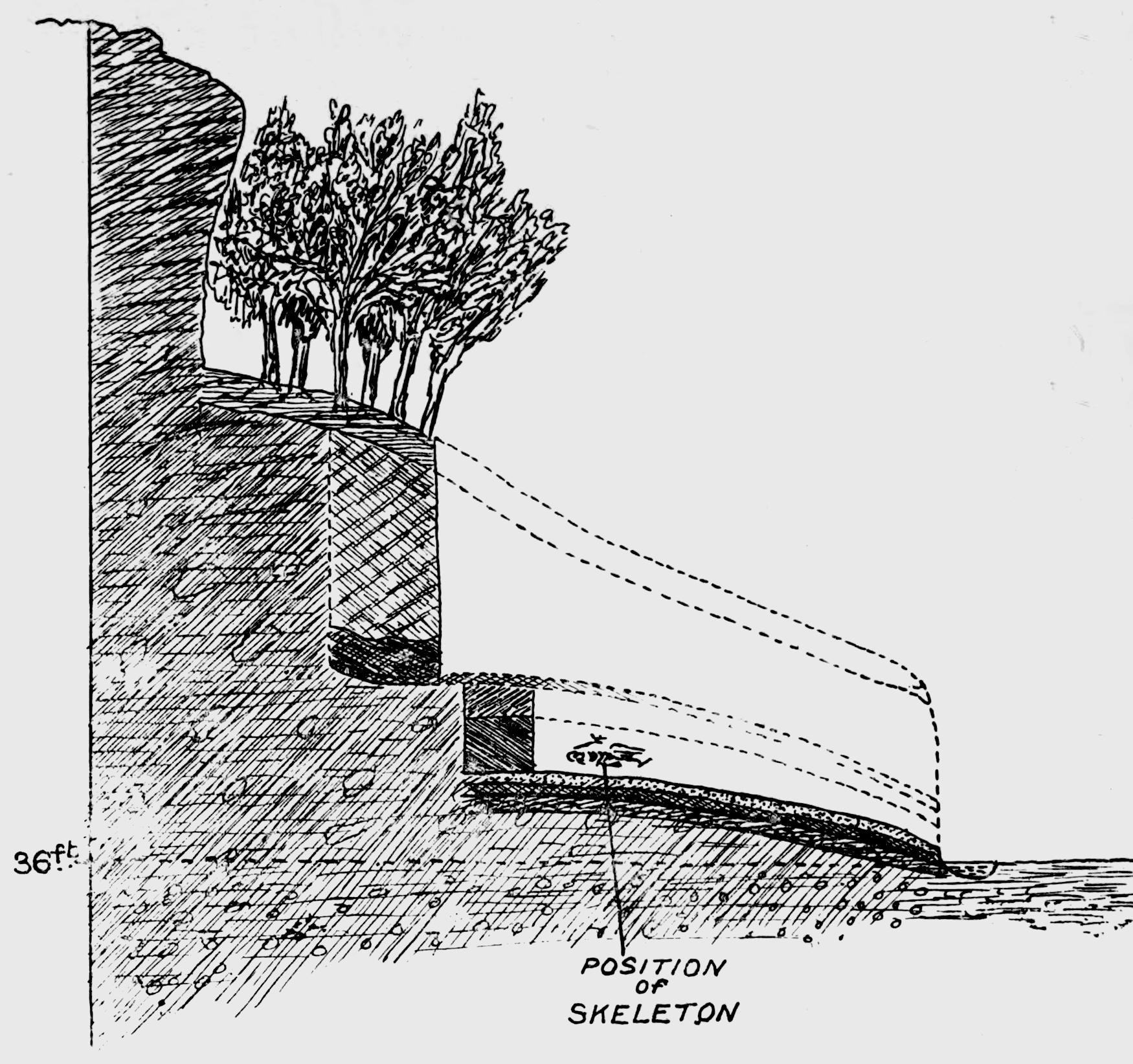
Section of the strata at La Quina, the strata removed during excavations being represented by stippled lines. (After Dr Henri-Martin.)
Photo: Keith (1915)
Proximal source: archive.org
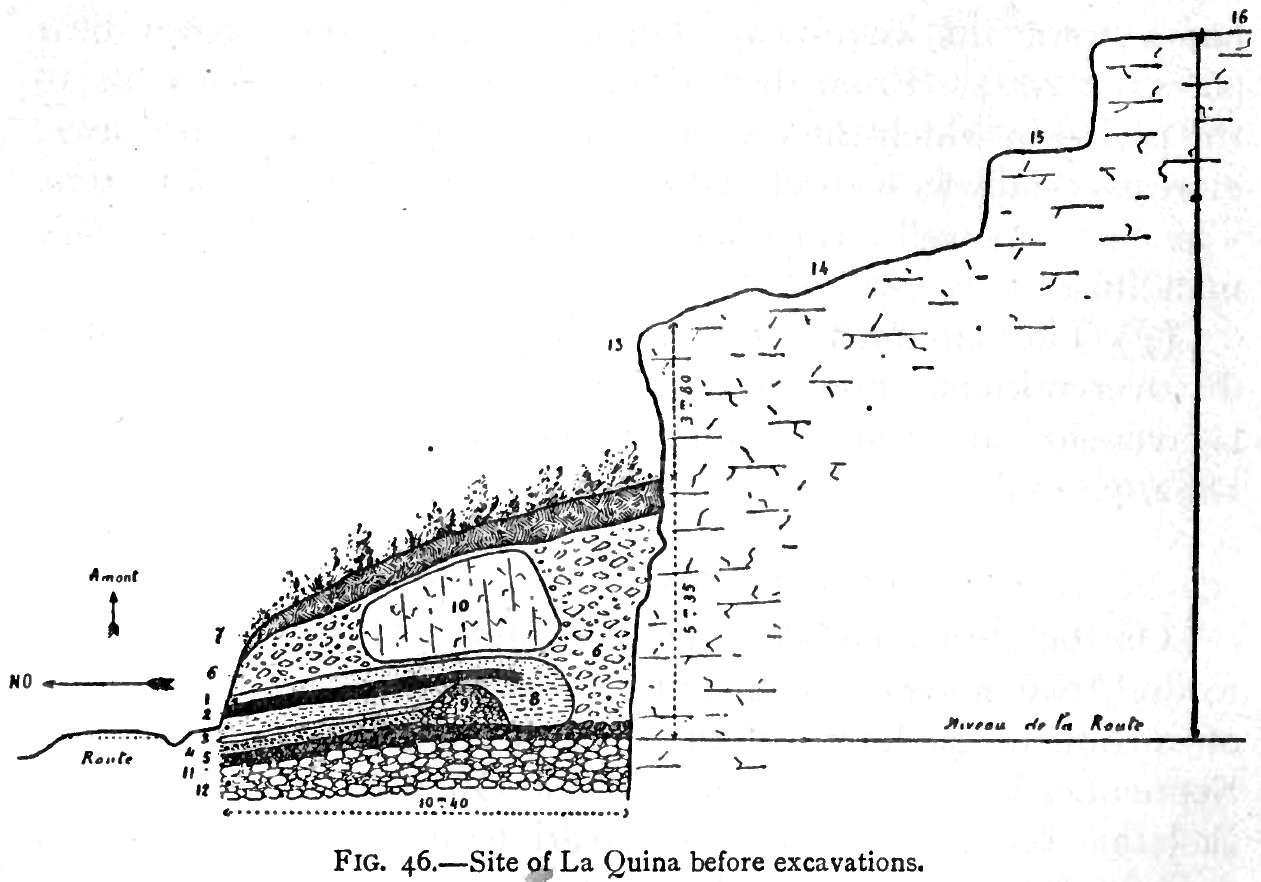
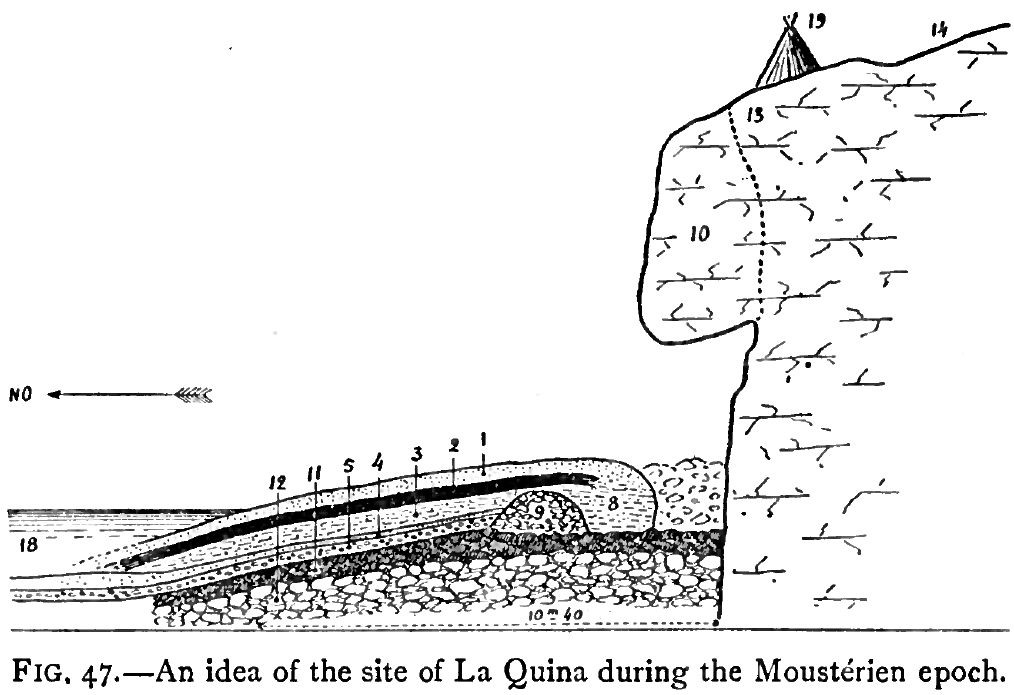
Site of La Quina before excavations and during the time of occupation.
Photo: Munro (1912)
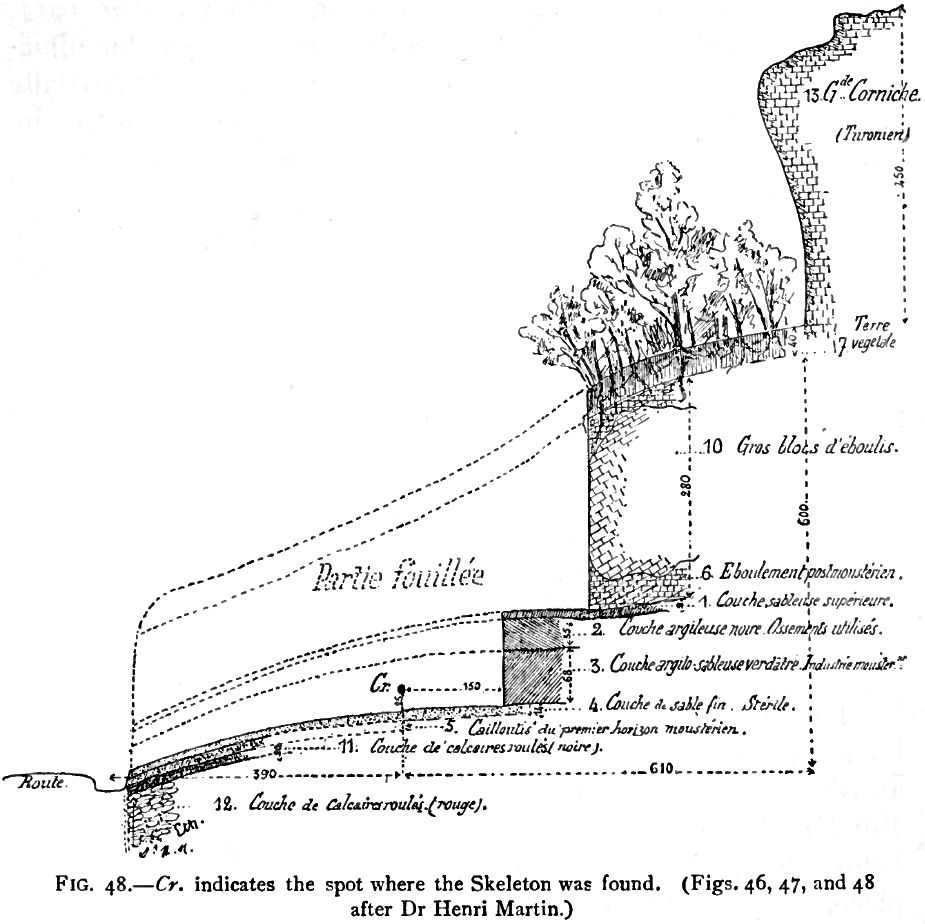
Site of La Quina after excavations.
1. Couche sableuse supérieur.
2. Couche argileuse noire. Ossements utilisés.
3. Couche argilo-sableuse verdâtre Industrie moustier.
4. Couche de sable fin. Stérile.
5. Cailloutis du premier horizon moustérien.
7. Terre vegetate.
10. Gros blocs d'éboulis.
11. Couche de calcaires roulés (noire).
12. Couche de calcaires roulés (rouge).
13. Grande corniche (Turonient).
Photo: Munro (1912)
1. Top sand layer.
2. Black clay layer. Bone tools.
3. Greenish sandy clay layer. Mousterian industry .
4. Layer of fine sand. Sterile.
5. Gravel of the first Mousterian horizon.
7. Treed surface.
10. Large blocks of scree.
11. Layer of rounded limestone (black).
12. Layer of rounded limestone (red).
13. High cliff (of the Turonian age, Upper Cretaceous, 94 to 89 million years ago).
Cr. indicates the spot where the skeleton was found.
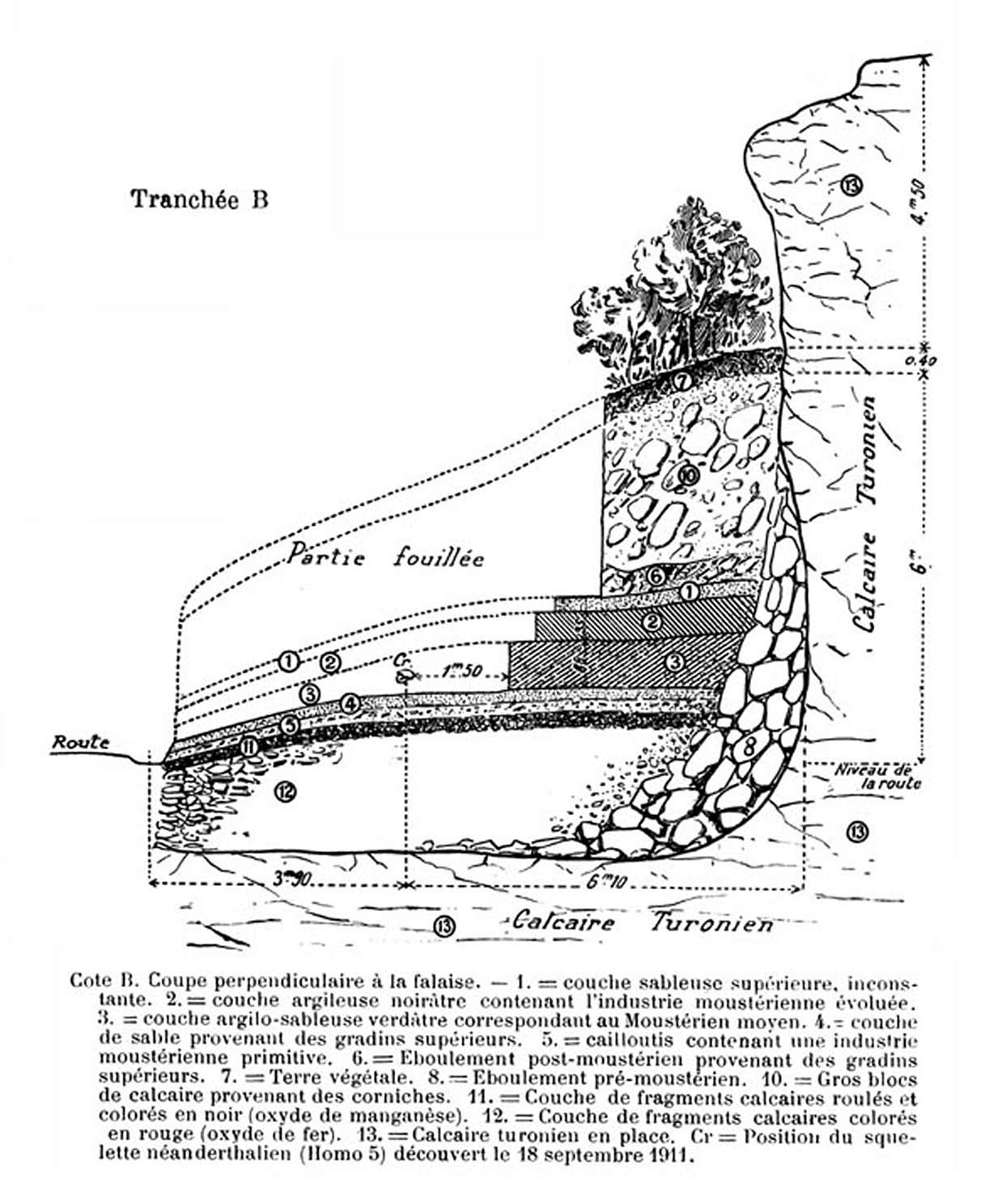
Site of La Quina - more detailed coupe diagram.
Dr Henri-Martin’s Stratigraphy of trench B:
1 : inconstant top sandy layer
2 : dark clayey bed with 'evolved' Mousterian
3 : greenish clayey-sandy layer; 'middle Mousterian'
4 : sandy layer coming from the upper terraces
5 : layer of limestone fragments with 'primitive' mousterian industry
6 : Pre-Mousterian scree from the upper levels of the cliff.
7 : humic soil
8 : Pre-Mousterian scree
10 : large blocks of limestone fallen from the cliff
11 : limestone fragments coloured by manganese dioxide and iron oxide
12 : layer of limestone fragments coloured red by iron oxide
13 : Turonian (late Cretaceous) limestone bedrock
Cr. : Position of the skeleton, La Quina 5
Photo: Henri-Martin (1923)
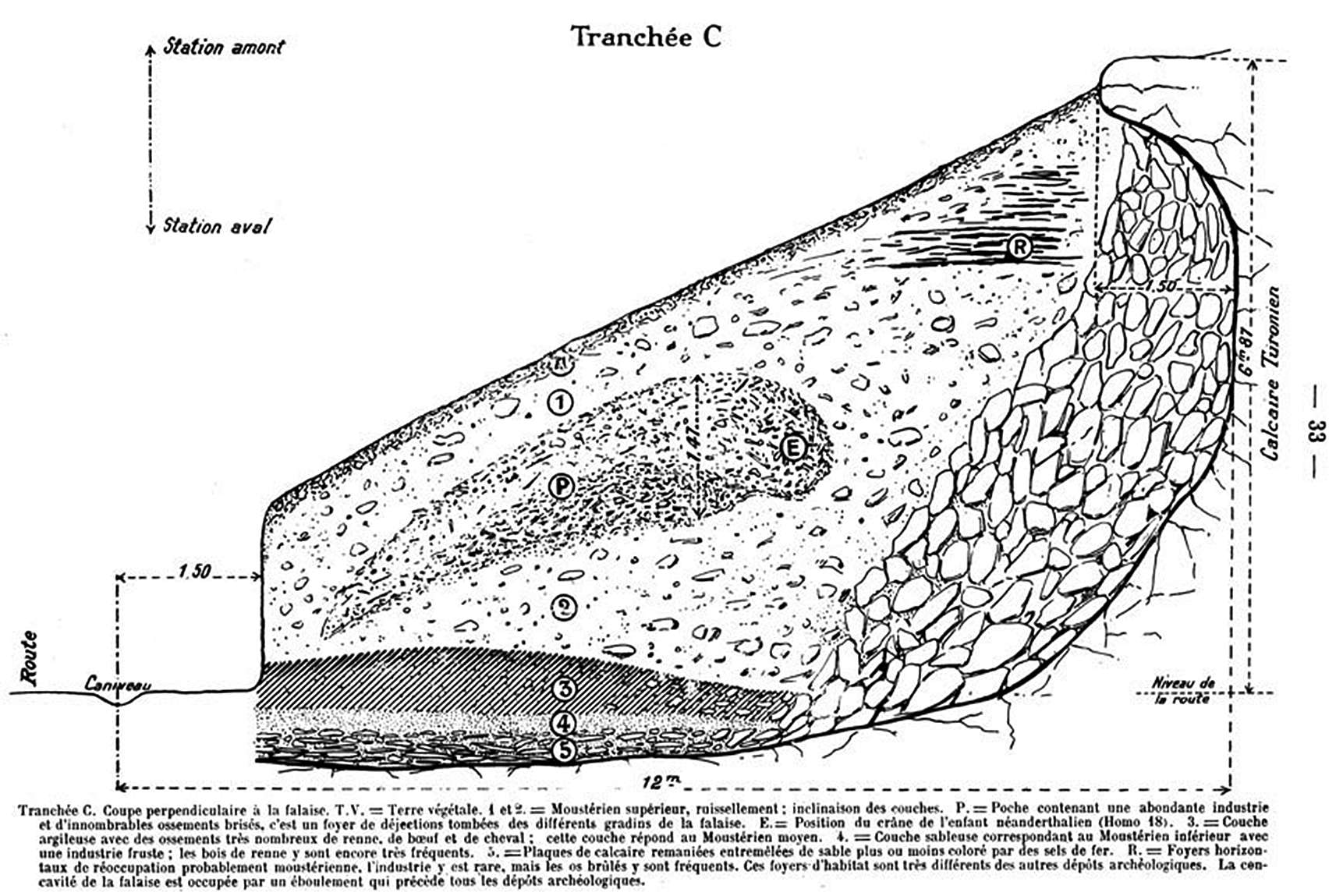
Dr Henri-Martin’s Stratigraphy of trench C, cut perpendicular to the cliff:
T.V. (terre végétale): humic soil
R = horizontal hearths from a probably Mousterian reoccupation, lithic industry is rare, but burnt bones are common. These hearths are very different from other archaeological deposits.
1 and 2: upper Mousterian, cut by runoff, the beds are sloped.
P: Pocket containing an abundant lithic industry and countless broken bones. There is a hearth made of stones fallen from different layers of the cliff.
E: Position of the skull of the Neanderthal child (Homo 18).
3: Clay layer with very many bones of reindeer, aurochs and horse. This layer corresponds to the middle Mousterian.
4: Sandy layer corresponding to the lower Mousterian with an unsophisticated industry. Reindeer antlers are still very common.
5: Slabs of reworked limestone interspersed with sand more or less colored by iron compounds.
The concavity of the cliff is occupied by a landslide that precedes all archaeological deposits.
Photo and text: Henri-Martin (1923)
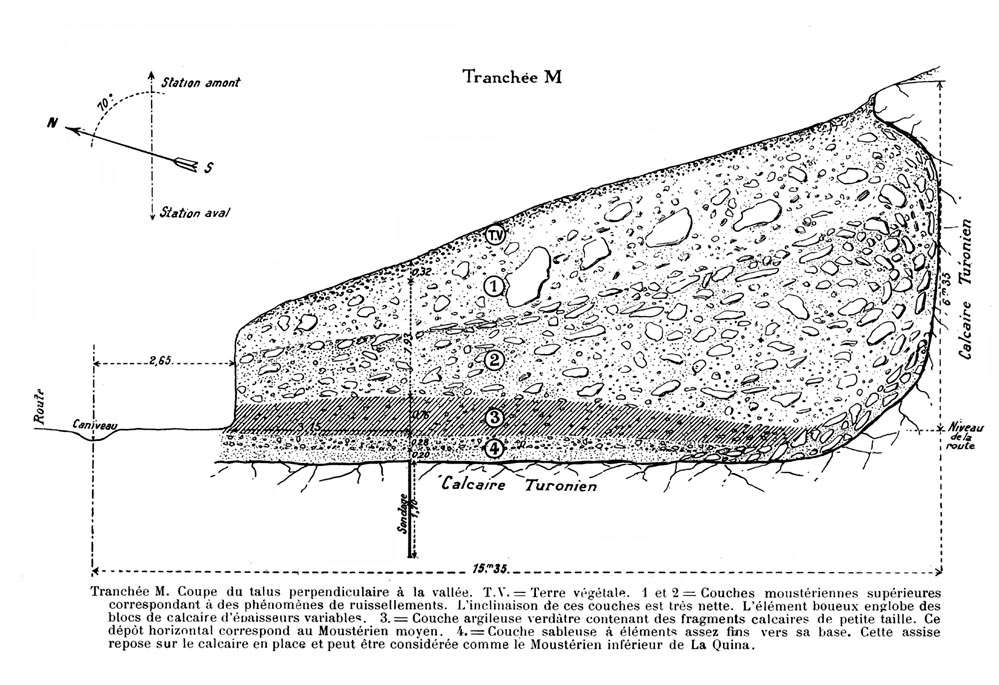
Dr Henri-Martin’s Stratigraphy of trench M, cut perpendicular to the valley:
T.V. ( terre végétale): humic soil
1 and 2: Upper Mousterian layers cut by runoff. There is marked inclination of these layers. The deposit includes clayey limestone blocks of varying thicknesses.
3: Greenish clay layer containing small limestone fragments. This horizontal deposit corresponds to the middle Mousterian.
4: Sandy layer, quite fine at the base. this layer rests on the limestone bedrock and can be considered as the lower Mousterian of La Quina.
Photo and text: Henri-Martin (1923)
Some flint scrapers and pointers, a round ball of limestone, and a few bones of ruminants and of the horse, showing rude workmanship, were also found in the same stratum ; but there were none of the finer worked objects characteristic of the upper Mousterien.
These different layers being in their original position, without having suffered any subsequent disturbance, it is possible to assign the skeleton to the base of the middle Quaternary period. In consequence of having been subjected to a long process of maceration, the cranial bones became more or less displaced along the lines of their sutures, but Dr Henri-Martin thinks the skull can be easily reconstructed.
So far as can be judged at present, it shows the anthropoid characters of the Neanderthal race in a higher degree than the other skulls of the Quaternary period. The superciliary ridge on the left is extremely thick and overhanging, a feature which is exaggerated by the lowness of the forehead behind it. The teeth are exceptionally large, especially the canines, as compared with those of modern races.
Little more can be said of this, the latest addition to the Neanderthal- Spy race of Europe, until the skeleton is completely disinterred from its matrix and carefully examined.
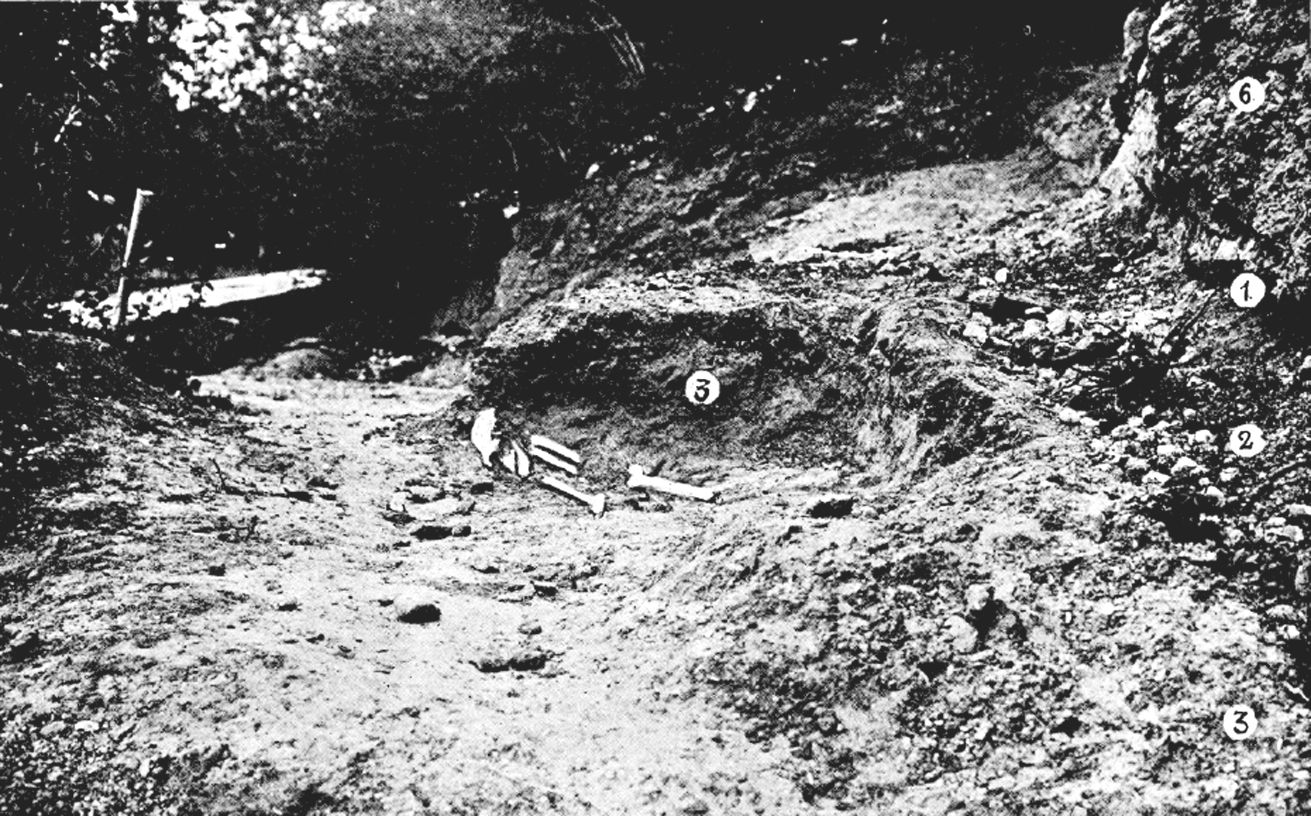
Photograph I
The gisement or archeological dig of La Quina. State of the excavations 18th October, 1911, after removal of the block containing the human skeleton in layer 3. The human bones have been drawn in later by M. Ed. Hue on the photograph and show the exact location of the pieces collected.
1 and 2 - Advanced Mousterian archaeological layers.
3 - Sandy clay containing a more simple, primitive Mousterian, without, however, being at the very base of the sediments, because two lower levels, very poor and thin, are below this level.
Photo: Martin (1911)
Text: translated and adapted from Martin (1911) by Don Hitchcock
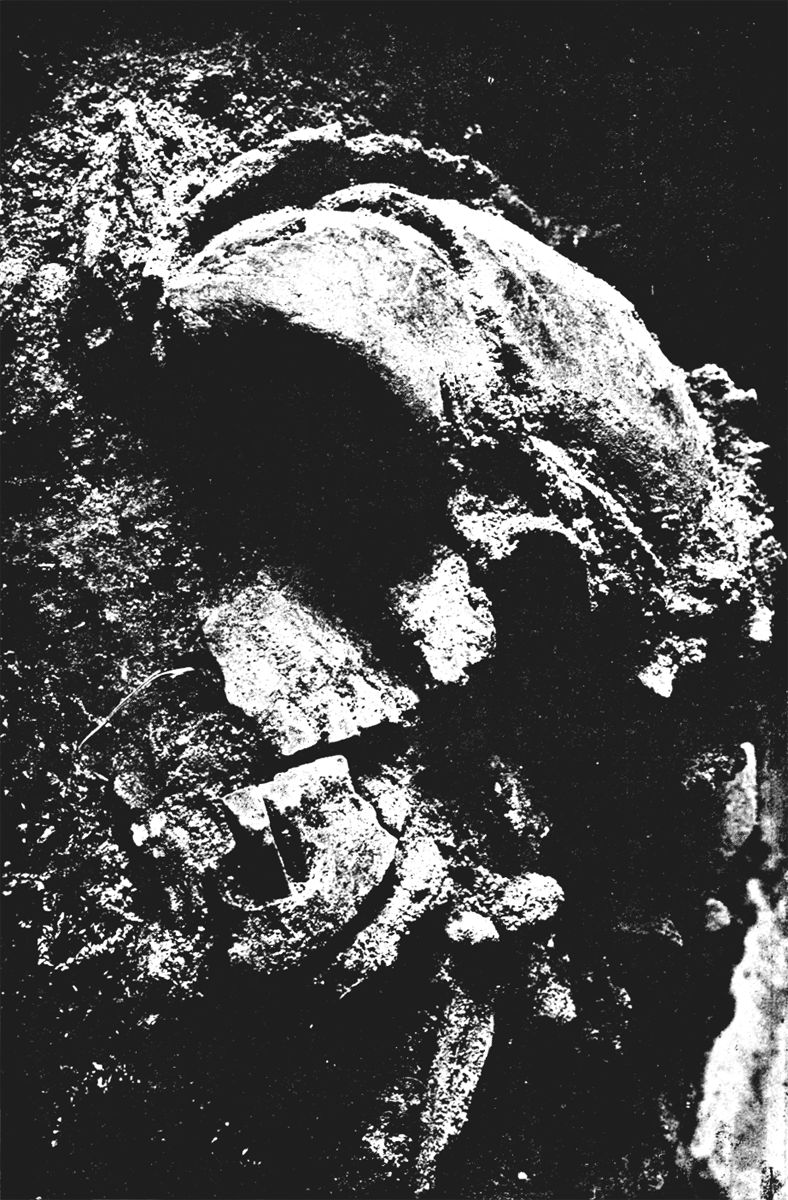
Photograph II and Photograph III
Photograph II - Front view of the skull. The photograph was taken during one of the first phases of disengagement from the matrix, in the Peyrat laboratory. The skull is resting on the right side and is still has some of the sand-clay matrix attached. Three teeth found with the skull at the time of the discovery are not yet replaced.
Photograph III - Side view of the skull. Photograph taken at the end of the first release from the matrix, before complete restoration.
The separation of the bones of the skull shows the good condition of the sutures. The frontal is nested in the parietal. The left eyebrow is visible and prominent, the upper maxilla is depressed, and so is the temporal. The occipital bone is straightened. Below and to the right is the left humerus and probably the scapula. The distance that separates the chin from the top of the eyebrow is 146mm.
Photo: Martin (1911)
Text: translated and adapted from Martin (1911) by Don Hitchcock
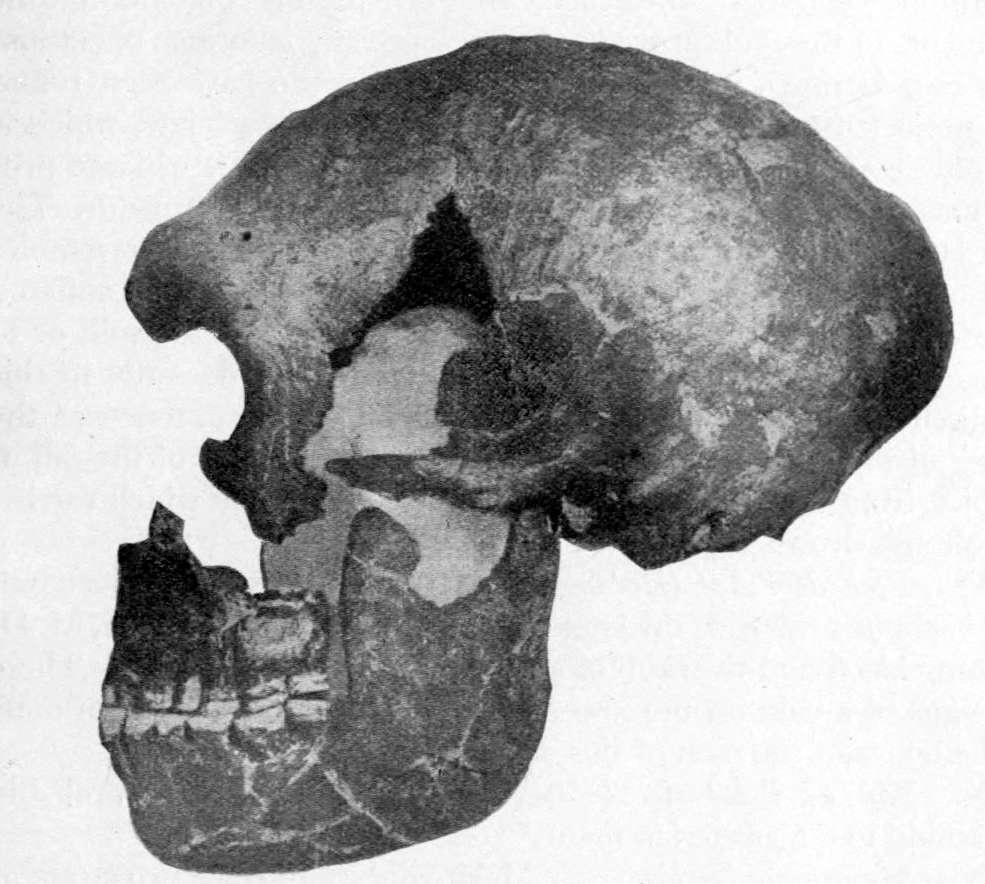
The skull from La Quina, after reconstruction.
Photo: Macalister (1921) (Public Domain)
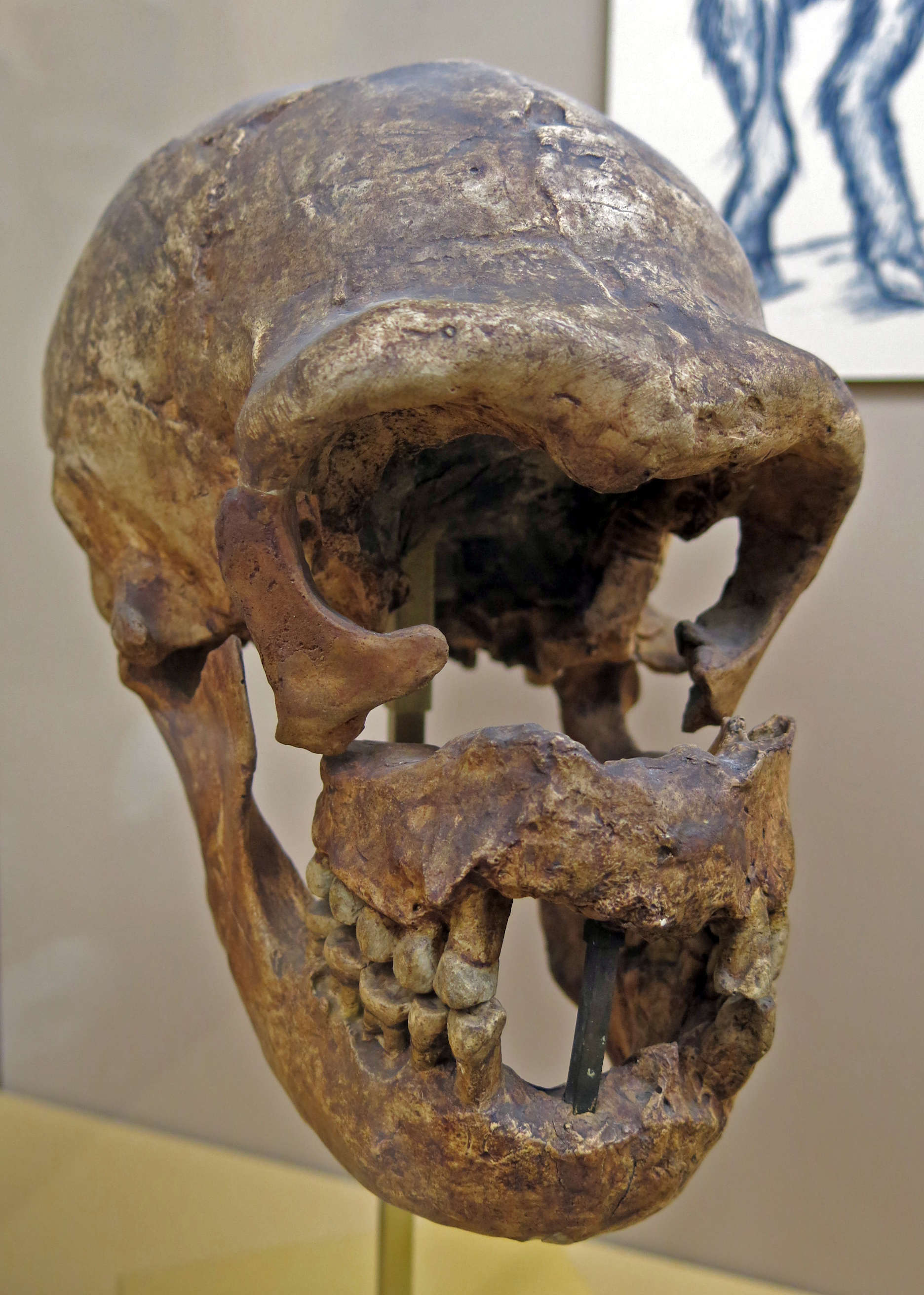
Facsimile of the skull of the La Quina woman.
Photo: Don Hitchcock 2014
Source: Display, Musée d'Archeologie Nationale et Domaine, St-Germain-en-Laye
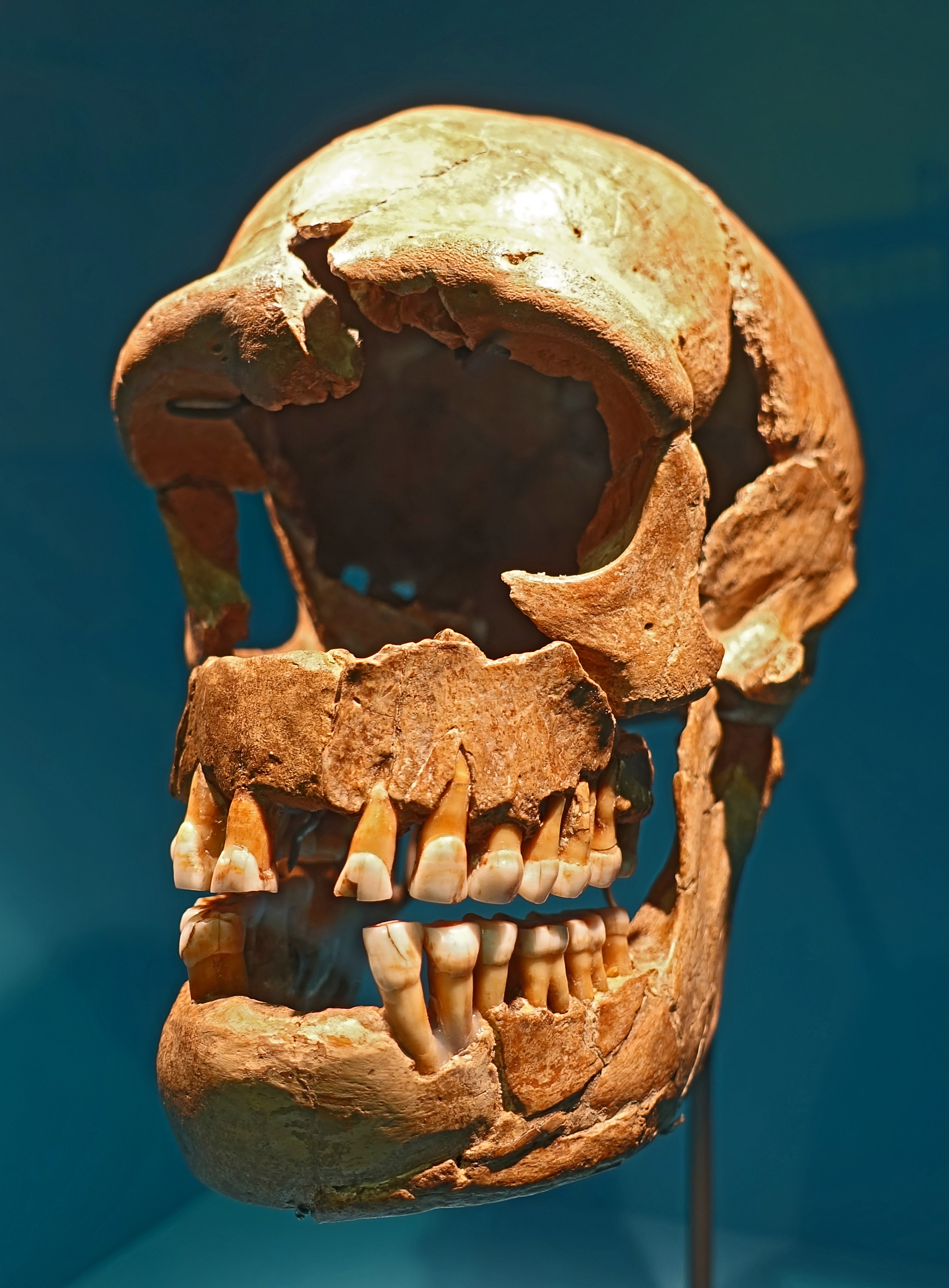

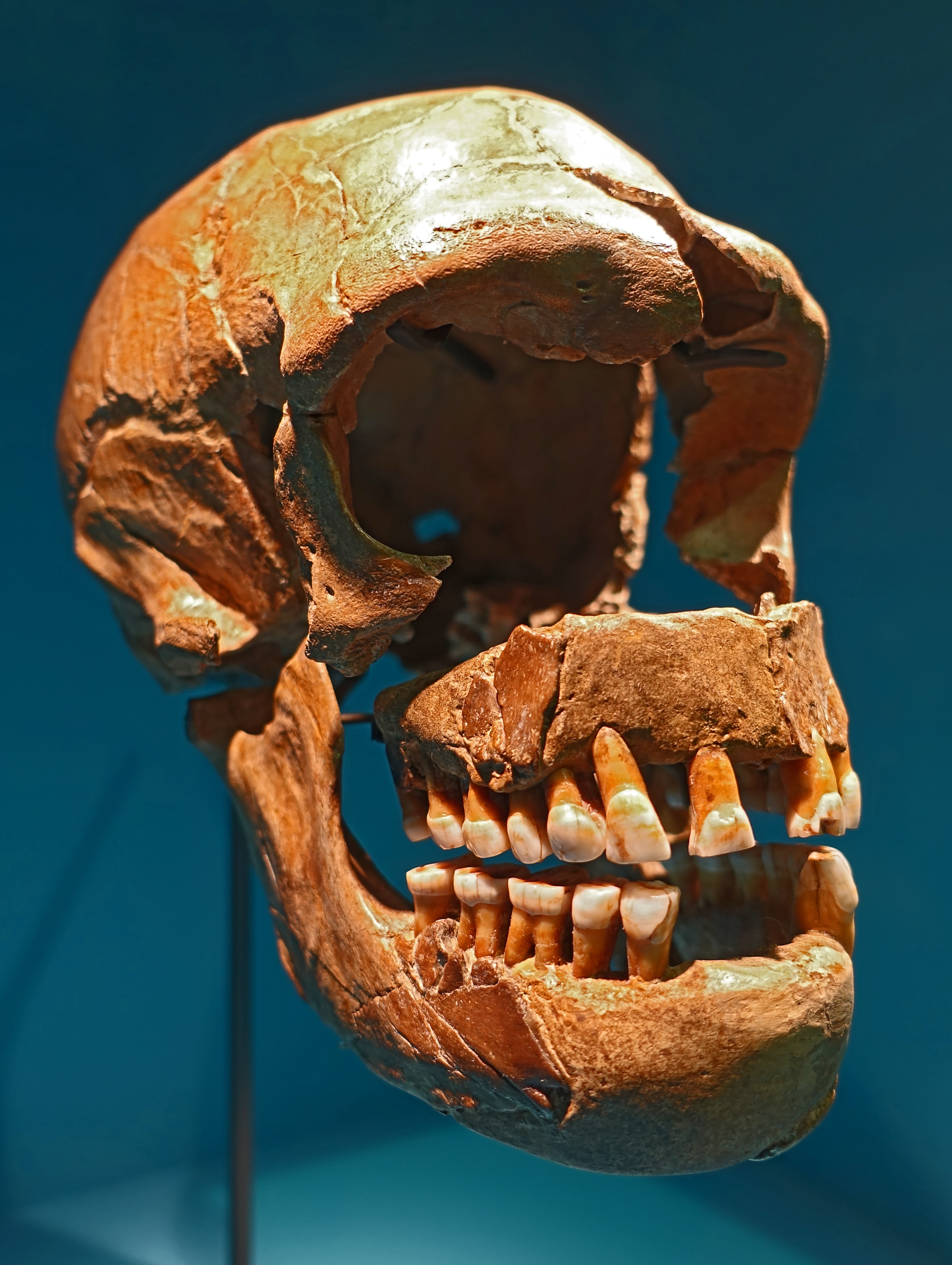
Cranium, upper and lower jaw (maxilla and mandible) of the La Quina woman known as H5.
Original, circa 71 000 BP.
Photo: Don Hitchcock 2018
Collections du Musée national de Préhistoire, Les Eyzies-de-Tayac
Source and text: Musée de l'Homme, Paris
Dr Henri-Martin described the skeleton and its position in the La Quina station, together with the ingenious method by which he transported a solid mass measuring 43 x 25 x 23 inches, containing the human bones, into his laboratory, at a meeting of the Societé Préhistorique Française, on 26th October 1911.
This communication was accompanied by photographic illustrations, one of which, showing the skull while only partially cleared of the surrounding earth, I am enabled, with the author's kind permission, to print as Plate XIV.
The station of La Quina is well known to anthropologists, having been described by its discoverer, M. Chauvet, as early as 1896 (Bull. Soc. Arch, de la Charente), and by others since.
But Dr Henri-Martin's labours in the excavation of La Quina, even before the present very important discovery, had the foremost place, as shown by his valuable work, Evolution du Mousterien dans la Station de la Quina, published in 1907.
Previous to this, Dr Henri-Martin discovered that certain large bones, found in the Mousterien deposits of La Quina, had been utilised as implements (Soc. Prdhist. Francaise, 1906, pp. 155, 189).
In the following year he published sections of the station showing the true stratigraphical position of its successive archaeological strata. A careful study of these sections will give more precise information as to the position of the skeleton than any amount of writing. I therefore reproduce them here with a few explanatory annotations.
The following two sets of information demonstrate how far we have come in just ten years with regard to gaining information from specimens. The first is a CT scan of a half mandible, the second uses only what can be seen from the outside of apparently the same object.
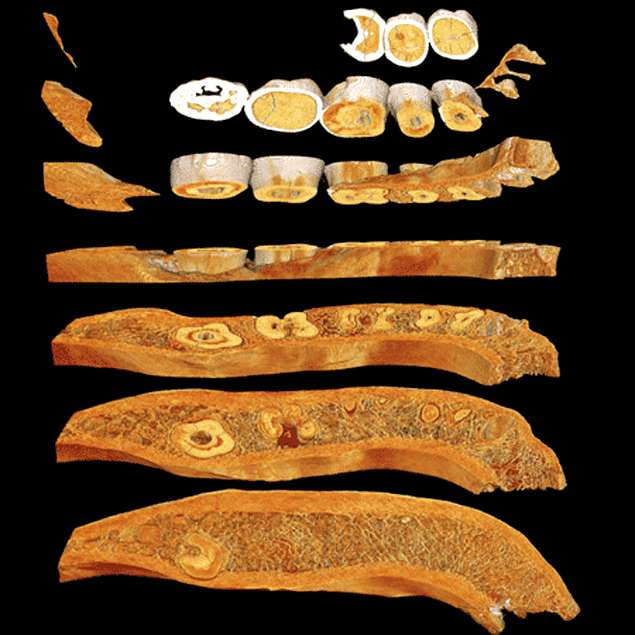
Micro-CT-based series of virtual axial sections of a 50 000 - 40 000 year old adult Neanderthal hemimandible from the Mousterian levels of the La Quina rock shelter, Charente, France. The thick cortical bone and complex distribution of alveolar trabeculae are revealed, by Luca Bondioli, Roberto Macchiarelli, and Arnaud Mazurier.
Photo: Cover of Nature, November 2007 Volume 203 No 9
Text below: Trinkaus et al. (1998)
In the evidence provided by the discoveries at Le Moustier, La Ferrassie, and La Chapelle-aux-Saints, one is forced to the conclusion that the Dordogne, during the Mousterian period, had as its sole inhabitants men of the Neanderthal type; in the succeeding period - the Aurignacian - men of the modern type took their place. At least, men of the modern type have never been found in a stratum of Mousterian age in this region; only remains of Neanderthal men have been so found. Such an inference has the further support of discoveries made by Dr Henri-Martin in the Department of Charente, adjoining of the Dordogne on the north-west.
For fifteen years, from 1905 onwards, Dr Henri-Martin explored a deposit of Mousterian age, situated at the foot of an old rock shelter at La Quina and buried under the debris which had fallen from the cliff. Along the valley and near the cliff flows a small stream - the Voultron - on its way to join the Dronne, another of the northern tributaries of the Dordogne. The deposits at La Quina showed three strata, belonging to different phases of the Mousterian period. Dr Henri-Martin found not only the typical implements of the middle and later stages of the period, with remains of the reindeer, the horse, and primitive ox (Bos primigenius), but also rude implements worked in bone.
In 1910, he found a human astragalus or anklebone which was recognised by its peculiar form to be that of a man of the Neanderthal type - so distinctive is the structure of this race. In September 1911, two years after the famous discoveries in the region of the Dordogne, Dr Henri-Martin found in the lowest part of the deeper of the two Mousterian strata, a human skeleton, again of the Neanderthal type. The bones were embedded in a greenish sandy clay, a silt deposited in the bed of the Voultron when that stream flowed nearer to the foot of the rock shelter than it does now. The discoverer formed the opinion that the body had fallen into the stream and had thus become naturally entombed. When we remember the instances already cited, where men of both the Mousterian and Aurignacian periods have buried their dead near or under the sites of habitation, we are inclined to regard La Quina as a similar case - one of burial.
Altogether parts of about twenty individuals were found. The skull of a child aged eight years shows distinctive features; the supra-orbital ridges are already in the process of development, and the eye sockets are remarkably large.
The skeleton found at La Quina is probably that of a woman - the first of her race to be discovered in France. Neanderthal women have also been found elsewhere - in Croatia. Probably, too, the Gibraltar skull is that of a woman. We are familiar with the sexual differences which distinguish the average modern man from the average woman. Our knowledge is founded on the study of hundreds of individuals. When a totally new form of mankind is discovered, we cannot foretell the manner or the degree of sexual differentiation. Hence the uncertainty as regards the sex of the individual represented by the La Quina skeleton. The skull is long, 203 mm; rather narrow in comparison with the length, 138 mm, giving a head index of 68. (138/203*100 = 68% - Don) The eyebrow ridges are as greatly and prominently developed as in male skulls, and such is not the case in skulls of modern women.
The jaws of the La Quina woman are strong and the teeth big. The bones of the vault of the skull are about 5 mm in thickness, whereas in the skulls of Neanderthal men in particular and Palaeolithic men in general, the vault has a thickness of 8 or 10 mm. The brain capacity of the skull is estimated by Professor Anthony at 1350 cc, about the same as for modern women, but 250 cc less than the capacity of the La Chapelle man's skull. The stature is calculated to have been 150 cm.

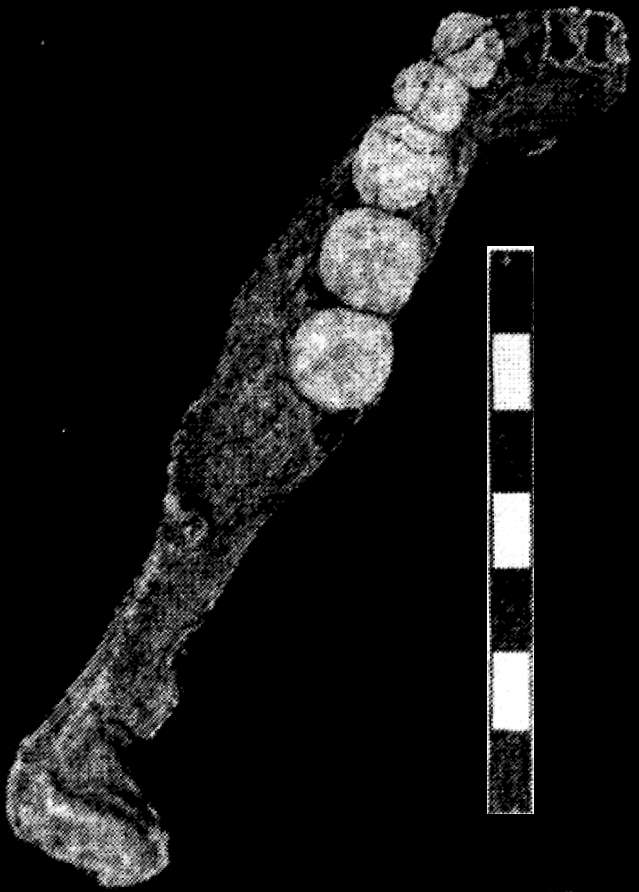

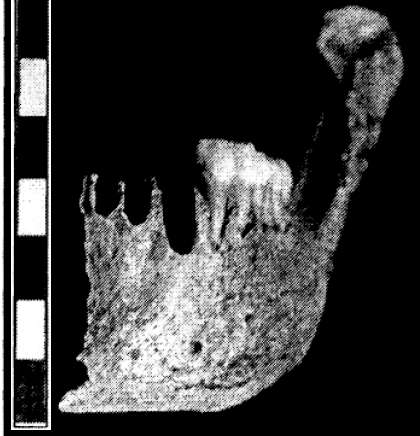
La Quina 9 mandible.
Views of the La Quina left hemimandible. The medial, lateral and anterior views are taken parallel or perpendicular to the mid-sagittal plane defined by the preserved symphysis. The superior view is parallel to the occlusal plane of the postcanine teeth. Scales in centimetres.
Photo and text: Trinkaus et al. (1998)
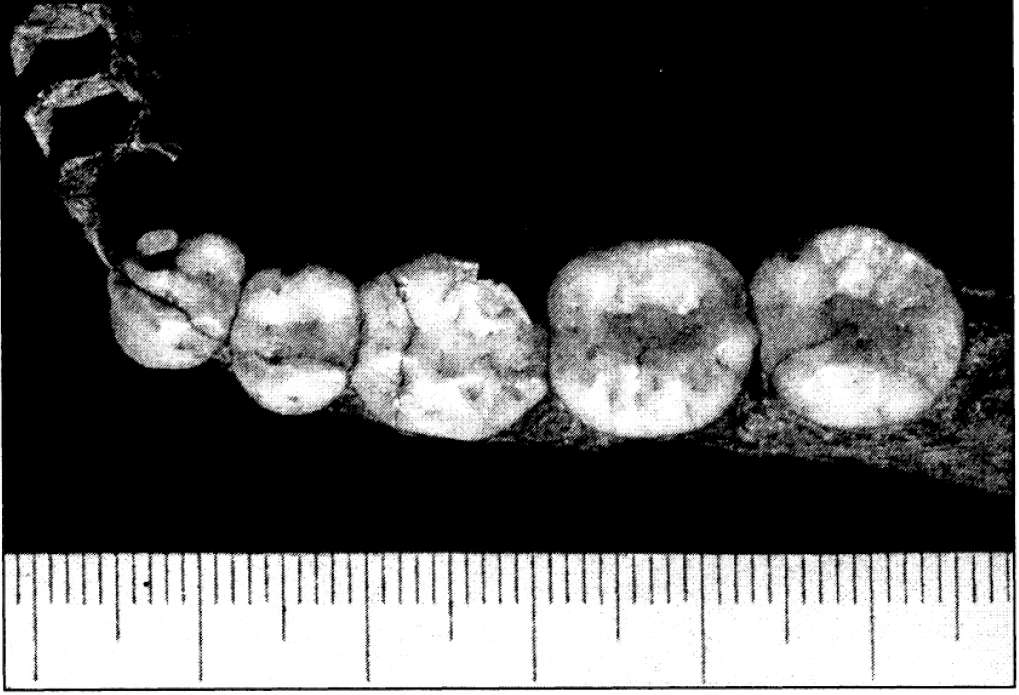
La Quina 9 dentition.
Occlusal view of the La Quina 9 left postcanine dentition.
Photo and text: Trinkaus et al. (1998)
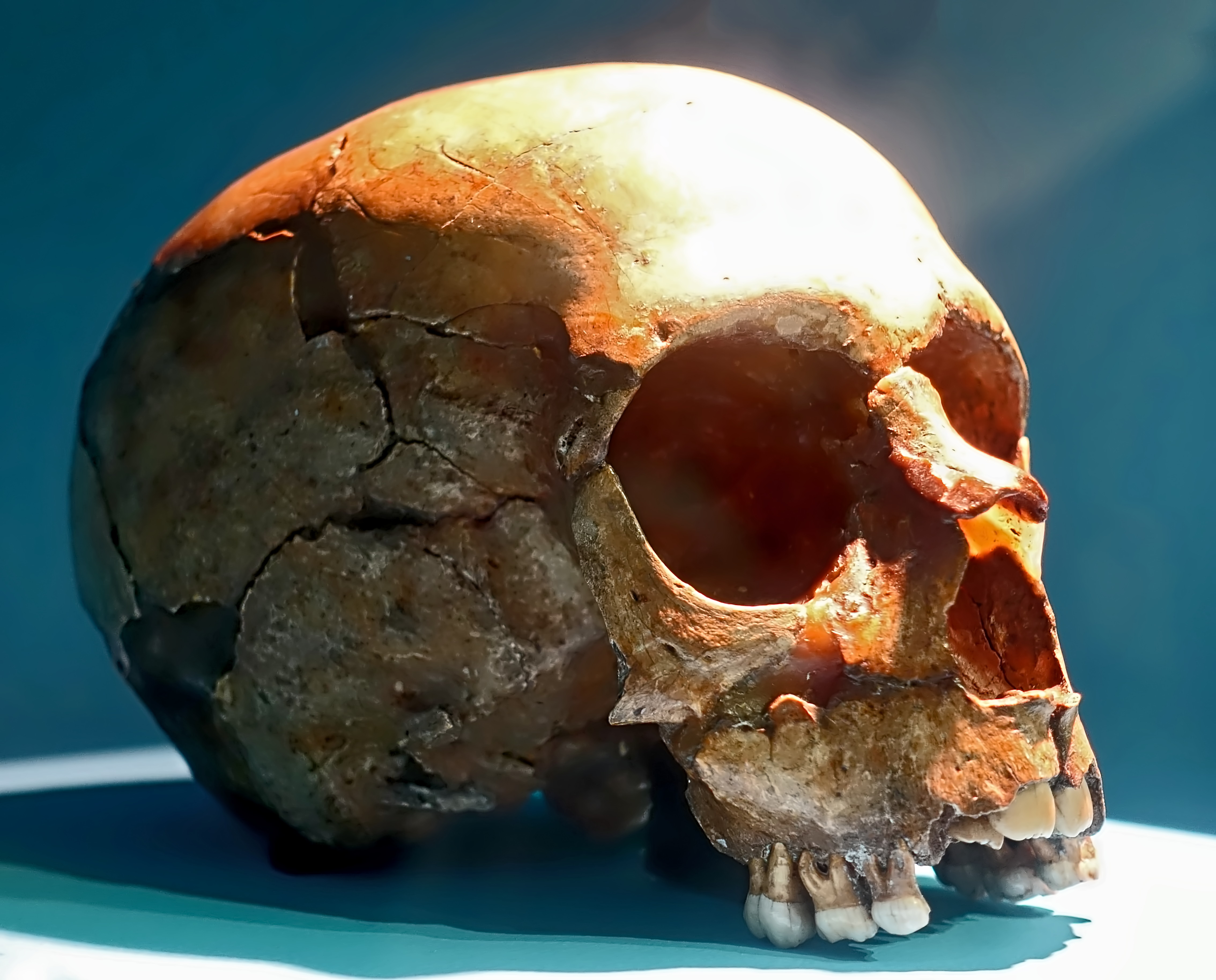
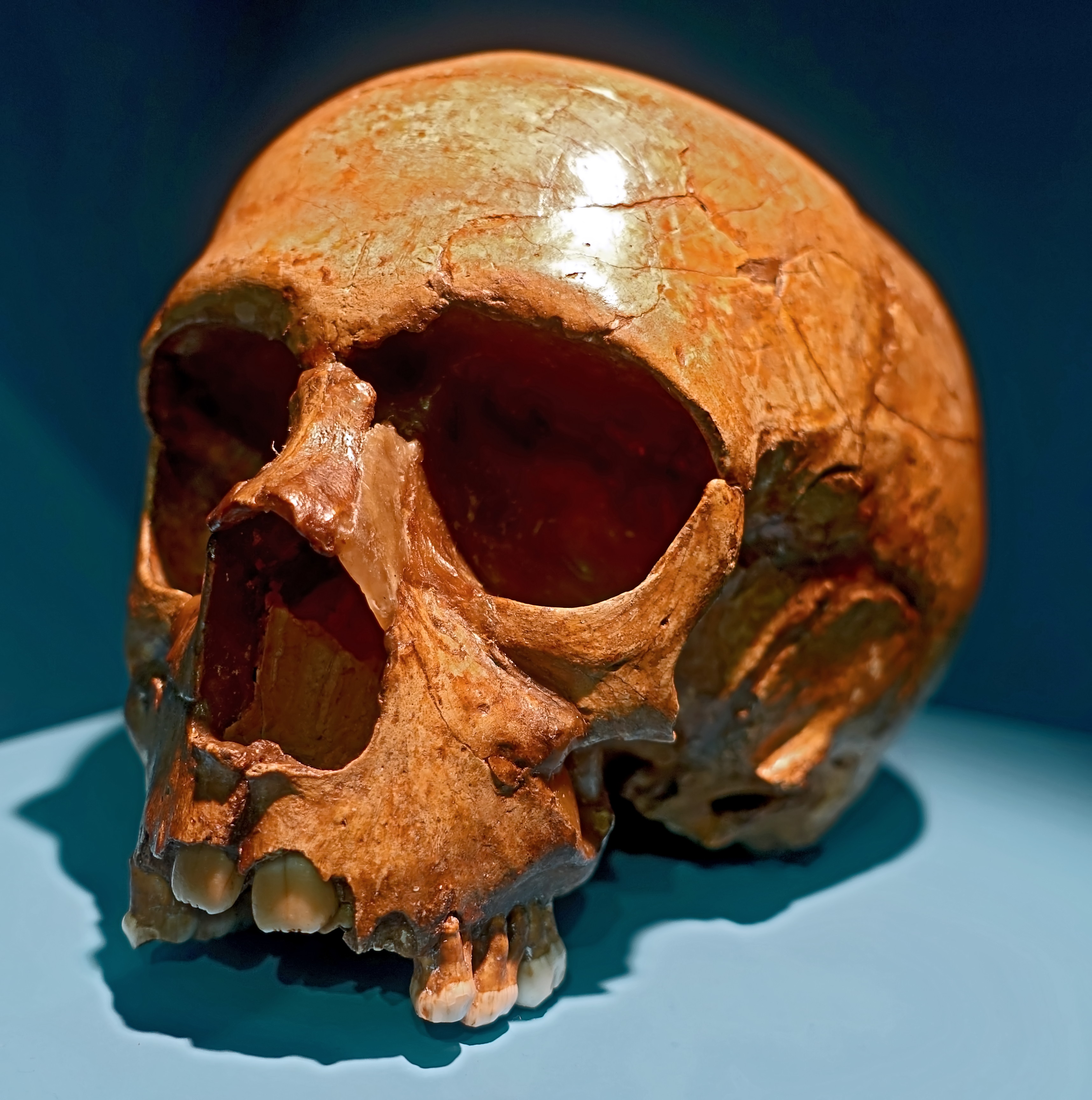
Skull of the child from La Quina, H18, about 7-8 years old.
Original, Middle Palaeolithic
Discovered in 1915 by Henri-Martin, ca 65 000 BP.
Photo: Don Hitchcock 2018
Collections du Musée d'Archéologie nationale - Domaine national de Saint-Germain-en-Laye
Source and text: Musée de l'Homme, Paris
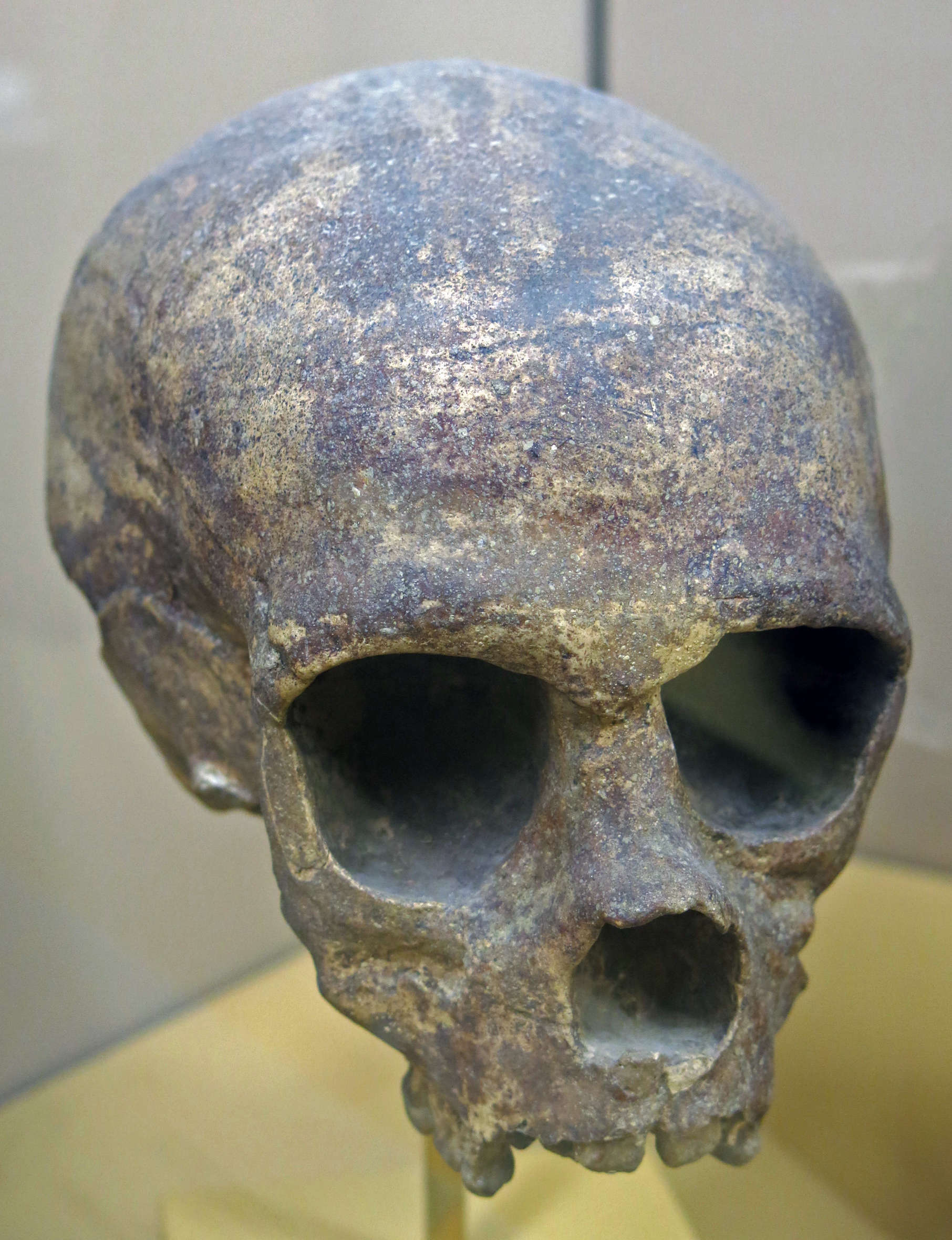
Facsimile of the skull of the La Quina child, aged about 8 years old.
Photo: Don Hitchcock 2014
Source: Display, Musée d'Archeologie Nationale et Domaine, St-Germain-en-Laye
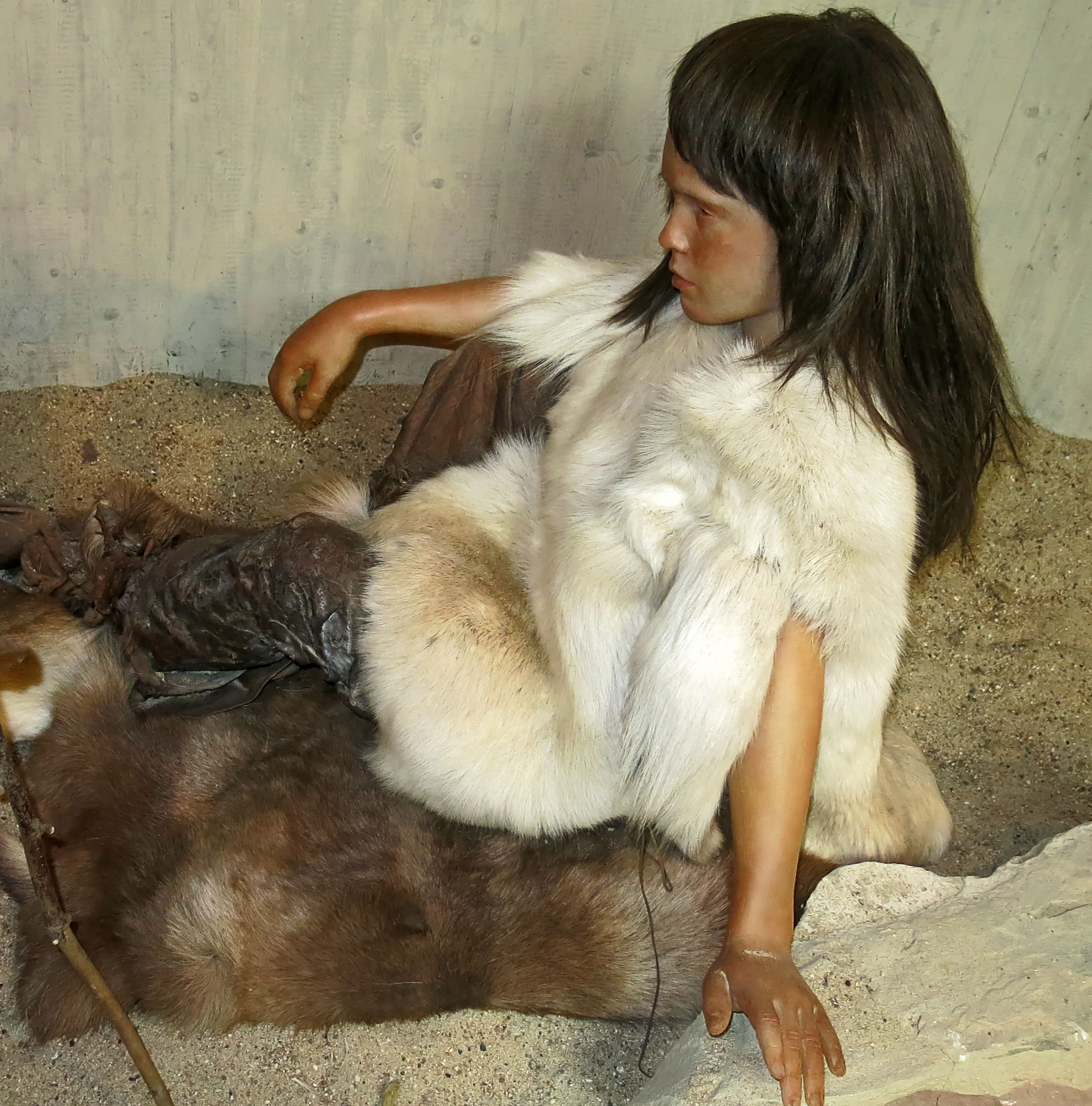
Child from La Quina
This is a reconstruction from the skull of the child found at La Quina, as shown above.
Photo: Don Hitchcock 2015
Artist: Élisabeth Daynès, Paris
Source: Neanderthal Museum, Mettmann, near Düsseldorf, accessible by a regular train service.
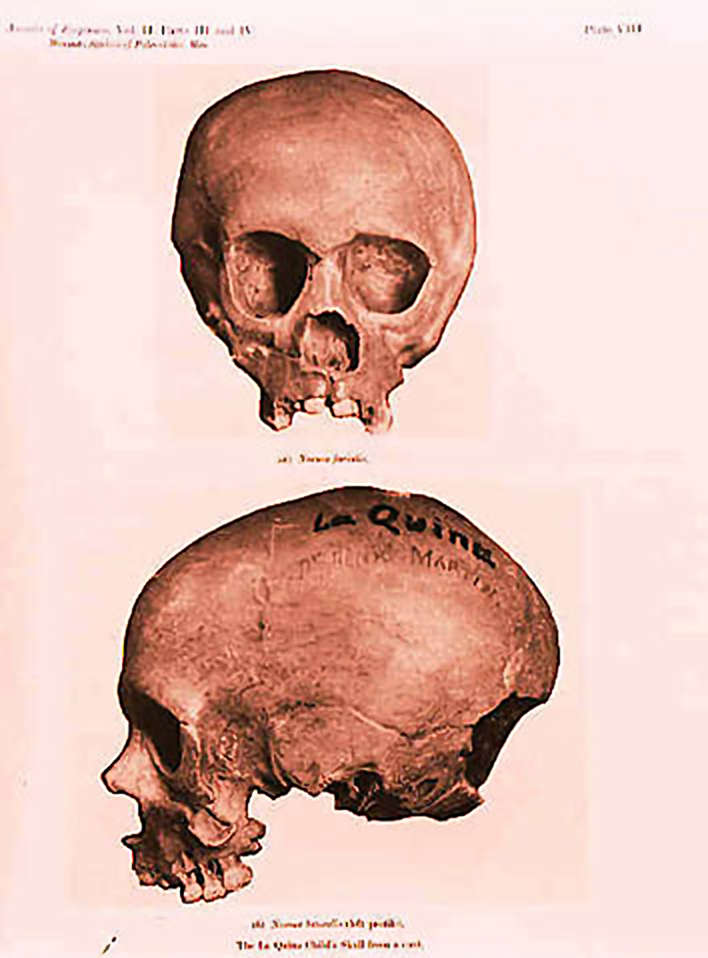
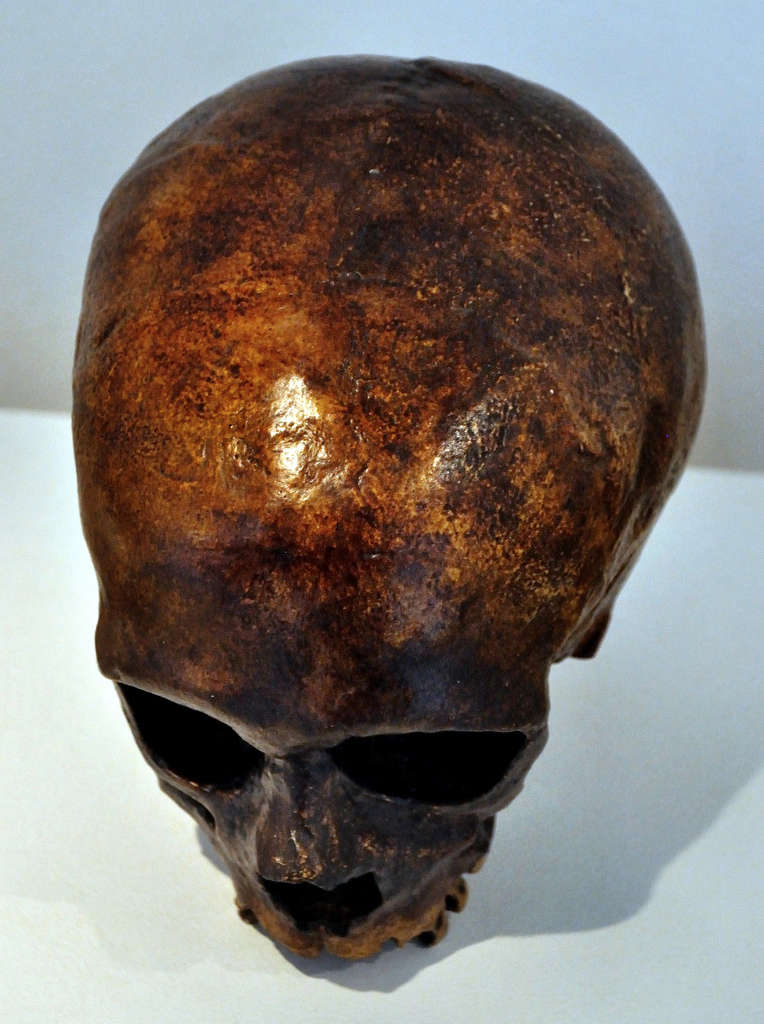
The La Quina child skull.
(left) glass slide of the original.
(right) facsimile, Brno Anthropos Museum
Photo: (left) http://www.albertaonrecord.ca/is-edm-767;rad
Photo: (right) © Thomas T., http://www.flickr.com/photos/theadventurouseye/5602617612/
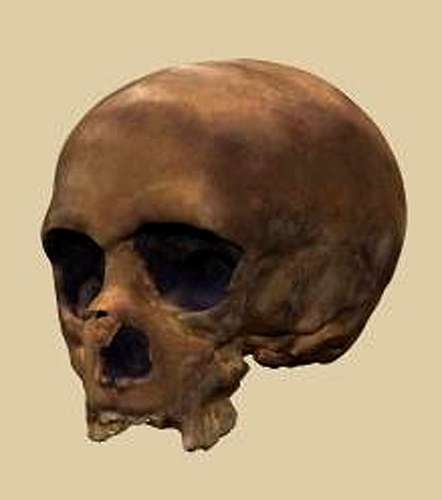
Image of La Quina 18, 3D scan, 3/4 view
Discovered by:
Henri-Martin in 1915
Age:
About 65 000 years old
Species: Homo neanderthalensis
This skull comes from a child, about 7-8 years old.
Photo: http://humanorigins.si.edu/evidence/human-fossils/fossils/la-quina-18
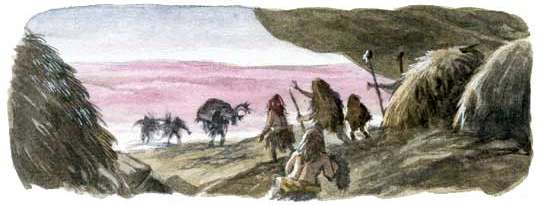
They do not seem to have buried their dead, but practised complex funeral ceremonies involving removal of the meat from the bones of the bodies.
Text: Translated and adapted from the display at le Musée National de Préhistoire, Les Eyzies
Photo: http://roudier-neandertal.blogspot.com/
Artist:© Emmanuel Roudier, 2008
Superb watercolours were done for this exhibition by the French artist, Emmanuel Roudier.
Blog: http://roudier-neandertal.blogspot.com/ Contact: emmanuelroudier@gmail.com
In a preliminary synthesis of excavations at La Quina from 1985 through 1994, Debénath A. et al (1998) observe that the report aimed to establish a detailed stratigraphy of the sediments, to understand the mechanisms and circumstances of their deposition, to define the chronology of the formations in terms of absolute dates, and to determine the palaeoenvironments in which people lived at La Quina, and to develop a detailed understanding of the material culture and human activities at the site.
The lithic industries were all Mousterian: Denticulate Mousterian and Mousterian of Acheulian tradition in the upper levels, and Quina Mousterian in the lower intermediate levels.
In terms of palaeontology, there is a certain monotony in the species present: bovines (Bos and Bison), horse and reindeer. Only their relative frequencies vary significantly in different levels of the profile. These species indicate an open environment. The reindeer are represented by distal limb bones indicating marrow extraction, and the horses, which are represented in the upper levels primarily by fragments of skull and pelvis.
In terms of human palaeontology, a fragment of a child's frontal bone, and a portion of an adult calotte (top of the skull - Don) in the lower beds (Quina Mousterian) as well as several teeth.
Text above adapted from: Debénath A. et al (1998)
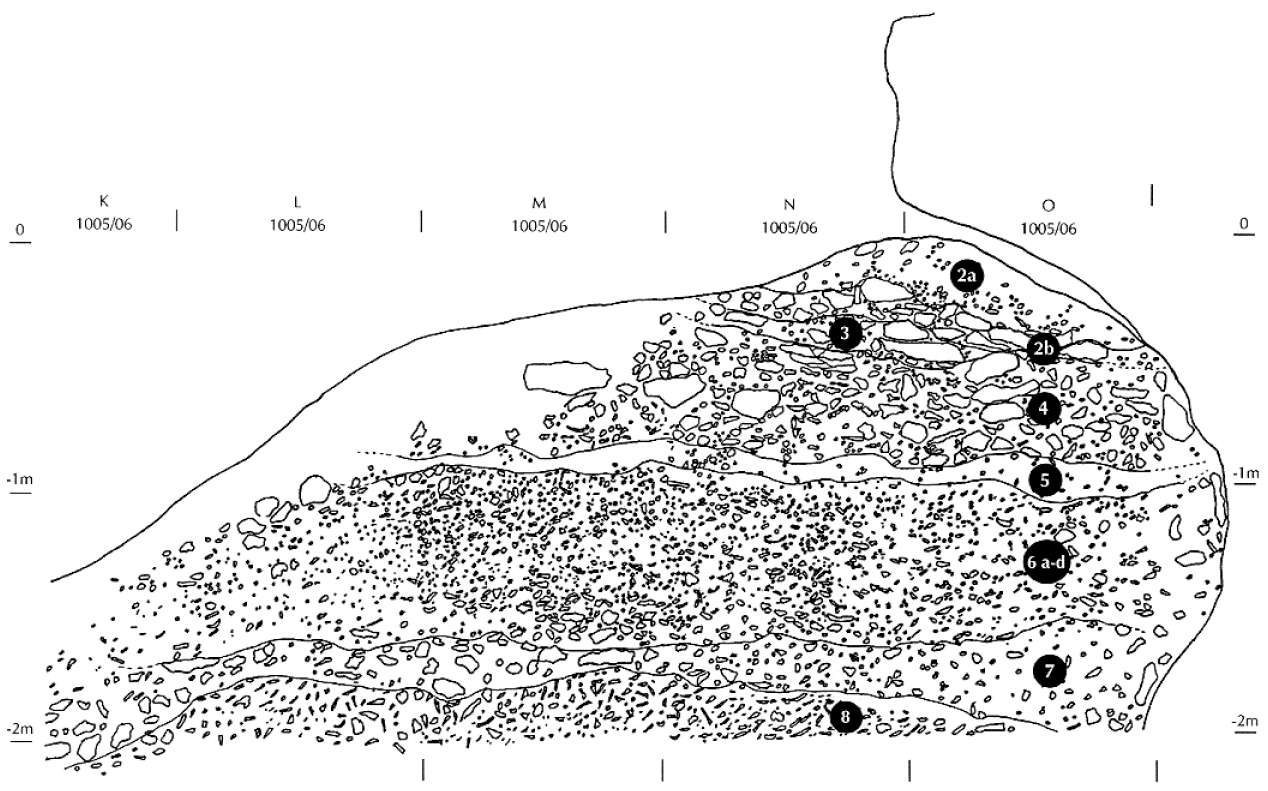

(Gauche) Stratigraphie de la coupe nord, (droit) Stratigraphie de la coupe sud
(Left) Stratigraphy of the north cut, (right) Stratigraphy of the south cut.
Photo: Debénath A. et al (1998)
The sequence at the primary site, Station Amont is divided into upper and lower deposits.Text above adapted from Hardy (2004)
(Note that the terms upper and lower deposits used by Hardy (2004) are the same as the terms la coupe nord and la coupe sud of Debénath A. et al (1998) - Don).
The upper levels, numbered 1-8, lie in front of and fill a small rockshelter near the top of the lowest cliff scarp and are layered horizontally. The faunal remains are densely packed and often highly comminuted.
(Comminuted means reduced to small pieces or particles by pounding or abrading - Don).
Lithics in the upper deposits consist mainly of débitage with formal tools including primarily denticulates and notches and other tool classes poorly represented. Beds 1-8 are separated from the lower sediments (Beds FQ) by a layer of sterile colluvium 1.5-2 m thick. The lithic industries of the lower deposits are typologically classified as Quina Motisterian. Levels L and M from this sequence were included in this analysis.
Thermoluminescence dating of heated flint indicates that levels 6a-8 accumulated during oxygen isotope stage (OIS) 3 between approximately 40-48 thousand years ago (kya). The fauna includes horse (Equus caballus), bison (Bison sp.) and reindeer (Rangifer tarandus) throughout the sequence with reindeer dominant in levels 7 and 8. The fauna suggests a climate of cold to moderate open steppe. The dominance of reindeer in Levels 7 and 8 suggests a cold period of OIS 3. Palynology shows low levels of arboreal pollen (5-10 per cent) throughout, although they are lowest in levels 7 and 8.
The lower deposits (beds F-Q) are probably later than OLS 5 and belong in early OIS 4, between approximately 57-71 kya, based on the presence of reindeer remains. The predominance of horse, bison, and reindeer throughout the sequence suggests conditions considerably colder than present.
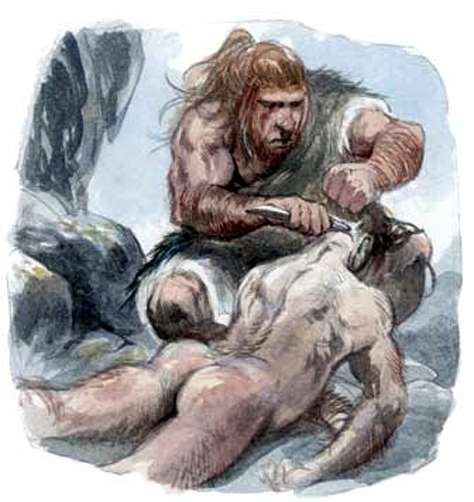
Dans plusieurs gisements (Pradelles/Marillac, Combe-Grenal ), des os humains éparpillés présentent des traces de découpe. Ces marques impliquent une intervention directe sur les cadavres, immédiatement après la mort ou un peu plus tard.
Ces gestes peuvent correspondre, soit à du cannibalisme, soit à des rite funéraires complexes impliquant le démembrement total ou partiel des cadavres.
Text: Display at le Musée National de Préhistoire, Les Eyzies
Photo: http://roudier-neandertal.blogspot.com/
Artist:© Emmanuel Roudier, 2008
Superb watercolours were done for this exhibition by the French artist, Emmanuel Roudier.
Blog: http://roudier-neandertal.blogspot.com/ Contact: emmanuelroudier@gmail.com
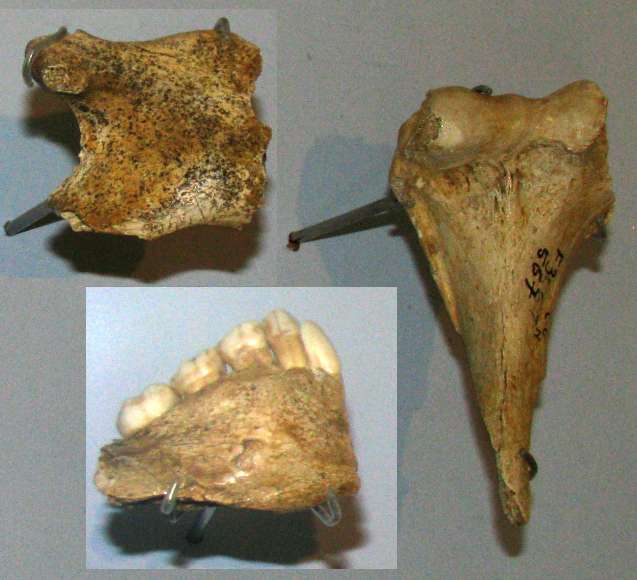
Restes humains présentant des traces de découpe, Combe-Grenal, fouille F. Bordes
Human remains showing signs of cutting, Combe-Grenal, excavation F. Bordes
(The distinguished archaeologist James R. Sackett has written an interesting short Biography of François Bordes which may be of interest to readers - Don )
Text: adapted and translated from the display at Musée National de Préhistoire, Les Eyzies
Photo: Don Hitchcock 2008
Source: Originals, display at Musée National de Préhistoire, Les Eyzies
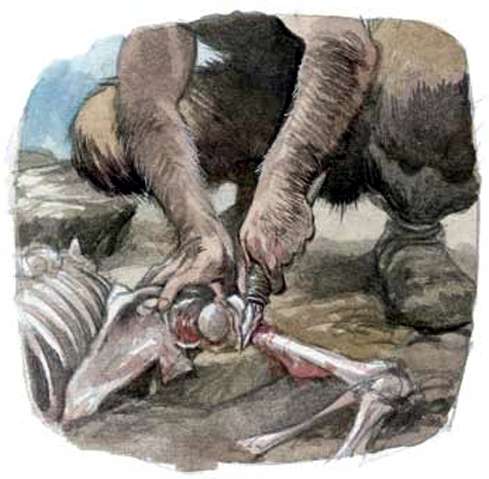
In several archaeological sites (Pradelles / Marillac, Combe-Grenal ), scattered human bones show signs of cutting. These marks imply a direct intervention on the corpses immediately after death or a little later.
These gestures may correspond either to cannibalism or to a complex funeral ritual involving the total or partial dismemberment of the corpses.
Text: Translated and adapted from the display at the Musée National de Préhistoire, Les Eyzies
Photo: http://roudier-neandertal.blogspot.com/
Artist:© Emmanuel Roudier, 2008
Superb watercolours were done for this exhibition by the French artist, Emmanuel Roudier.
Blog: http://roudier-neandertal.blogspot.com/ Contact: emmanuelroudier@gmail.com
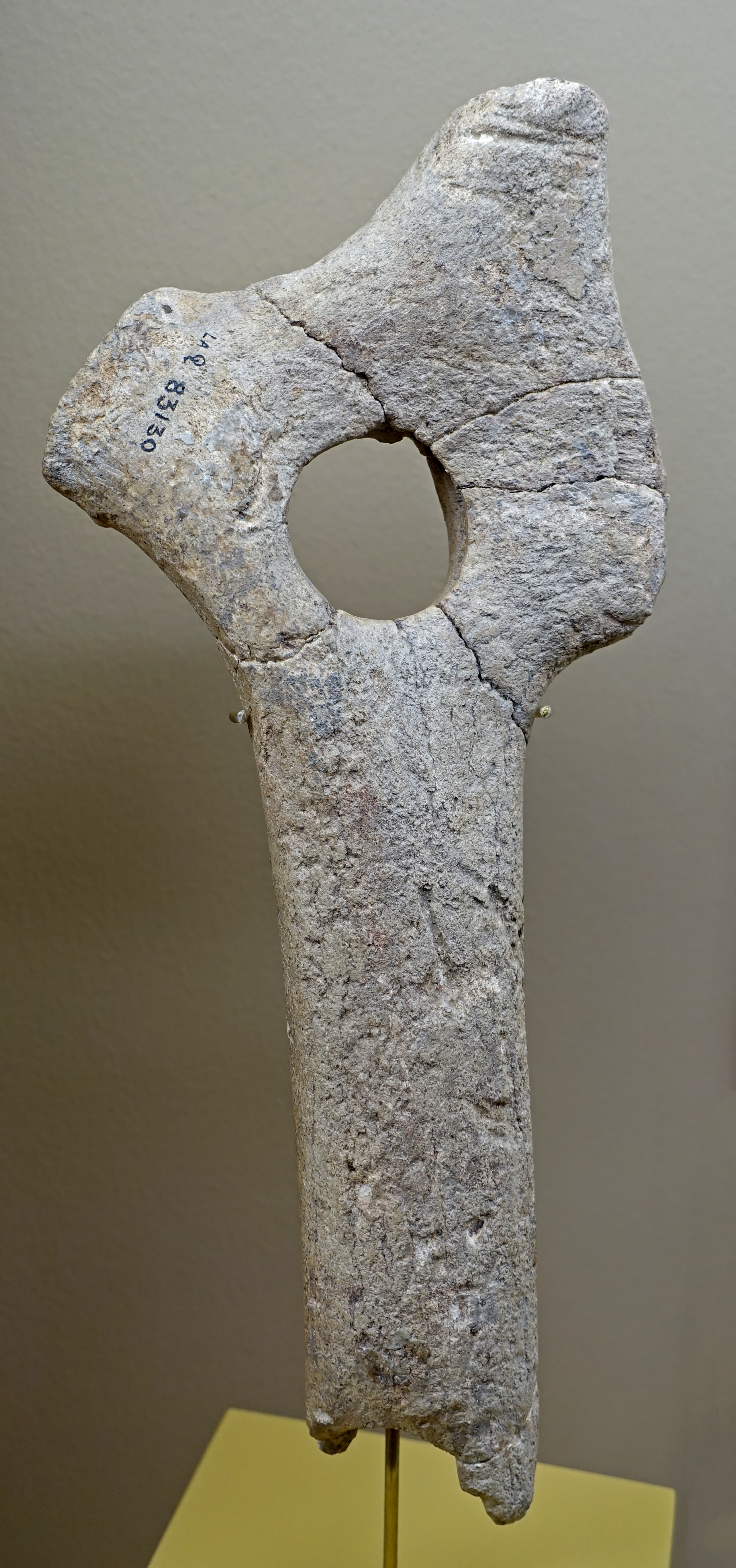
Bâton percé.
Because La Quina is such an important Neandertal site, it is easy to forget that there are some early Upper Palaeolithic layers as well, as is demonstrated by this large bâton percé made of reindeer antler. They are usually thought to have made their appearance in the Aurignacian, and this example is from that period.
Dimensions: height 292 mm, width 129 mm, thickness 35 mm.
Photo: Don Hitchcock 2018
Provenance: La Quina
Catalog: MAN83130
Additional text: https://www.photo.rmn.fr/
Source: Original, Musée d'Archeologie Nationale et Domaine, St-Germain-en-Laye
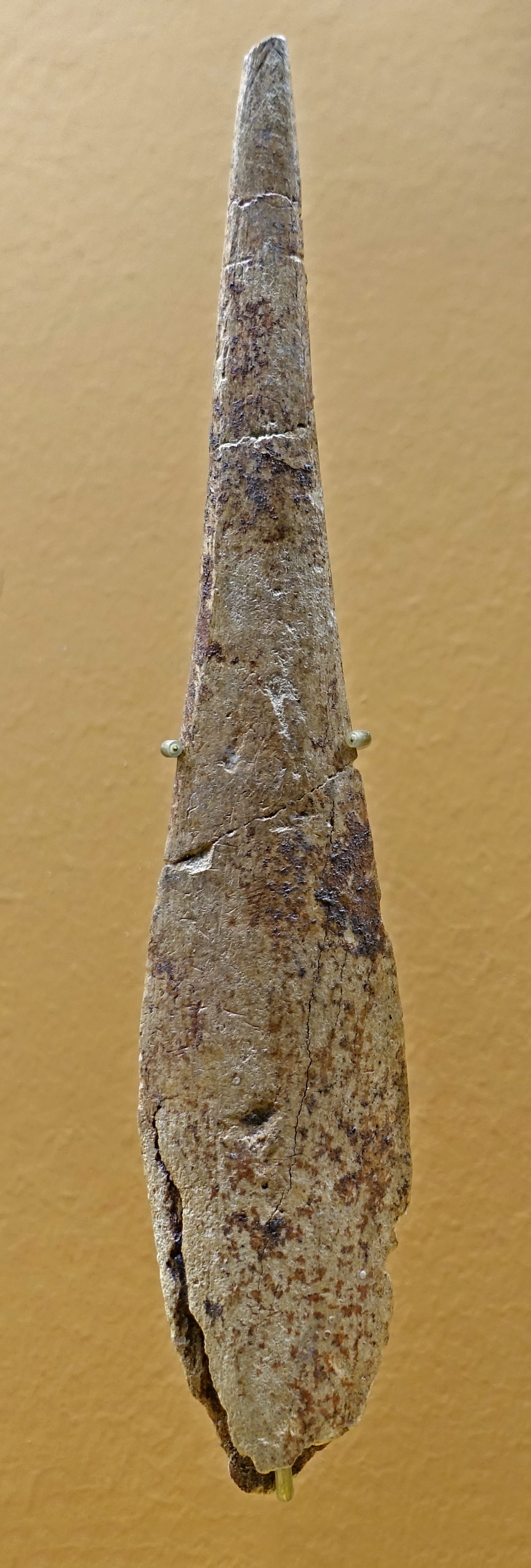
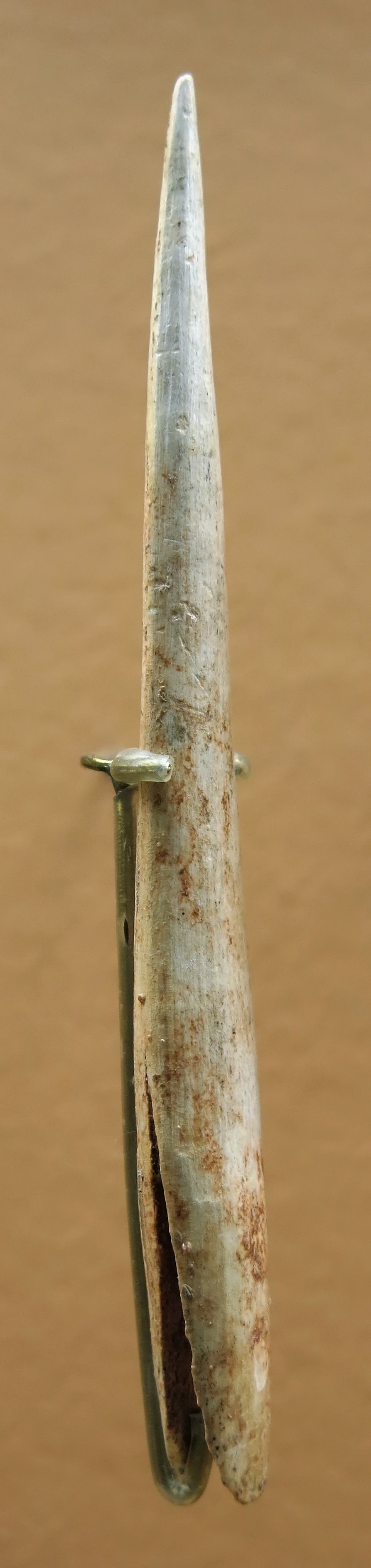
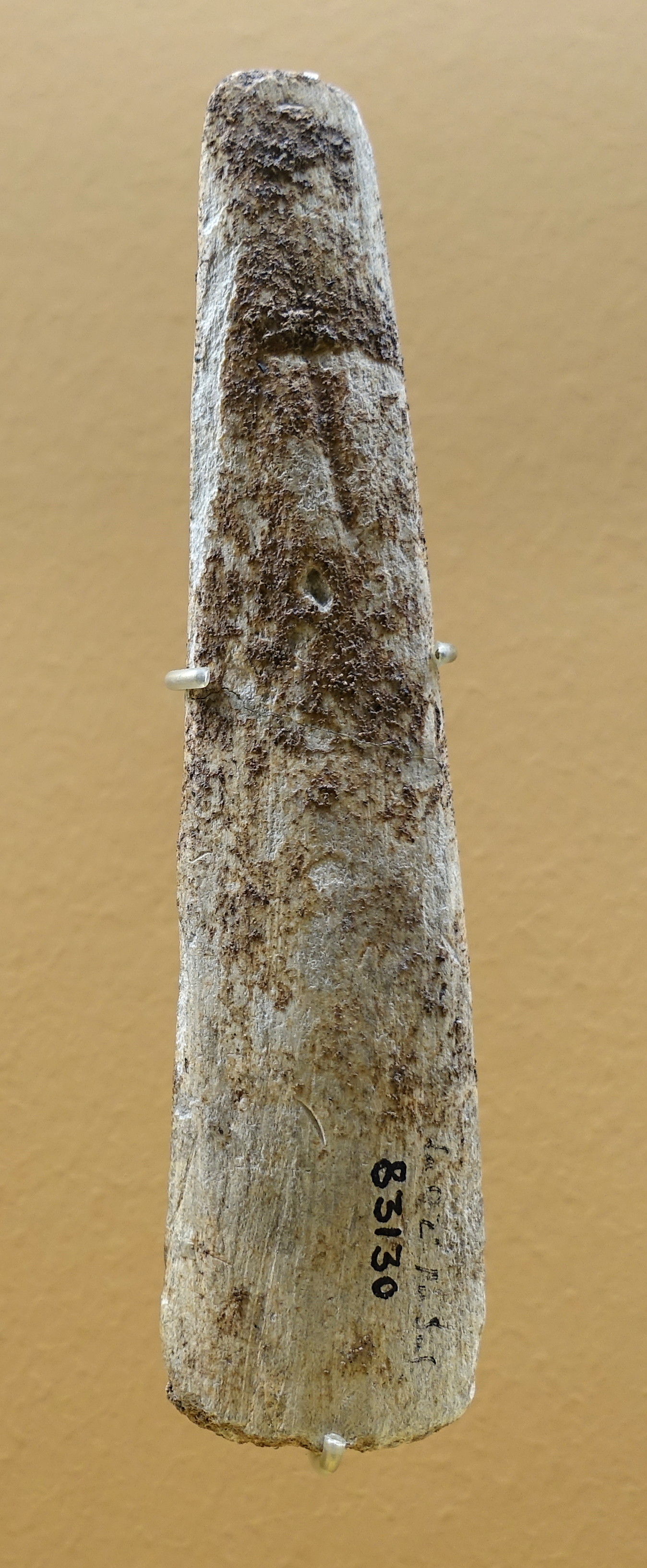
(left): Aurignacian spear point with a split base in reindeer antler from la Quina.
Dimensions: length 164 mm, width 31 mm, thickness 9 mm.
Catalog: MAN83130d
(centre): Aurignacian spear point with a split base in reindeer antler from la Quina.
Dimensions: length 105 mm, width 12 mm, thickness 8 mm.
Catalog: MAN83130d
(right): Upper Palaeolithic rhomboid spear point in reindeer antler from la Quina.
Dimensions: length 134 mm, width 32 mm, thickness 8 mm.
( note that some wedges used for splitting bone and antler look very much like this artefact - Don )
Catalog: MAN83130
Photo: Don Hitchcock 2018
Source: Original, Musée d'Archeologie Nationale et Domaine, St-Germain-en-Laye
Text: https://www.photo.rmn.fr
References
- Debénath A. et Jelinek A. et al., 1998: Nouvelles Fouilles à La Quina (Charente) Gallia Préhistoire, 40, 1998, p. 29-74
- Hardy B., 2004: Neanderthal behaviour and stone tool function at the Middle Palaeolithic site of La Quina, France Antiquity Sep 2004, Vol. 78 Issue 301, p. 547, 19p
- Henri-Martin, L., 1910: Astragale humain du Moustérien moyen de La Quina. Ses affinités, Bulletin de la Société préhistorique française, 1910, tome 7, N. 7. pp. 391-397.
- Henri-Martin, L., 1911: Présentation d'un Crâne humain trouvé avec le Squelette à la base du Moustérien de La Quina (Charente), Bull. de la Société préhistorique française, Année 1911, Volume 8, Numéro 10 p. 615 - 626.
- Henri-Martin, L., 1923: Recherches sur l'évolution du Moustérien dans le gisement de la Quina (Charente) - t. 4 : l'enfant fossile de La Quina, Angoulême, Mémoires de la Société Archéologique et Historique de la Charente, 14, 158 p.
- Henri-Martin, L., 1931: Recherches sur l'évolution du Moutérien dans le gisement de la Quina (Charente). Tome 2: Industrie lithique. Mémoires de la Société Archéologique et Historique de la Charente, tome 14. Angoulème.
- Henri-Martin, G. , 1965: La Quina Bulletin de l'Association française pour l'étude du quaternaire, Année 1965 Volume 2 Numéro 2-3-4 pp. 198-204
- Jelinek, A., 2013: Neandertal Lithic Industries at La Quina, University of Arizona Press, April 18, 2013
- Keith, A., 1915: The Antiquity of Man London 1915; 2nd edition in two volumes, 1925
- Macalister, R., 1921: A text-book of European archaeology Cambridge, Univ. Press
- Mallye, A., Soulier M., Laroulandie V., 2013: Grands carnivores et mésofaune de l’Aurignacien ancien à La Quina aval (Charente, France) (fouilles V. Dujardin), Paléo, [En ligne], 24 | 2013, mis en ligne le 17 avril 2014, consulté le 24 juin 2016. URL : http:// paleo.revues.org/2657
- Munro R., 1912: Paleolithic Man and Terramara Settlements in Europe, Edinburgh: Oliver & Boyd. 1912 (out of copyright)
- Soulier M., 2013: Entre alimentaire et technique : exploitation animale aux débuts du Paléolithique supérieur. Stratégies de subsistance et chaînes opératoires de traitement du gibier à Isturitz, La Quina aval, Roc-de-Combe et Les Abeilles. Thèse de doctorat, Université Toulouse 2, - Le Mirail, 754 p.
- Trinkaus, E. et al., 1998: Bull. et Mém. de la Société d'Anthropologie de Paris, La Quina 9 and Neandertal mandibular variability, n.s., t10, 1998, 3-4, p293-324.
Back to Don's Maps
 Back to Archaeological Sites