Gargas - The Cave Art of the Grotte de Gargas

The view from the entrance to the Grotte de Gargas. This is the sort of prospect the initial visitors to the cave would have had when looking out over the valley - though the vegetation would have been different. During colder times it would have been more steppe like, with few if any trees except perhaps along the streams. The animals drawn and painted in the cave indicate that there must have been, at least close by, herbaceous steppe country for the horse and the bison, and deciduous forest for the cervidae such as the deer. Mammoth and reindeer indicate that there was tundra within their migratory range, if not in this area. This aspect would have provided a wonderful vantage point for observing game.
Photo: Don Hitchcock 2008
"The cave art of Grotte de Gargas constitutes one of the most moving revelations today of the life and thoughts of our prehistoric ancestors. It is made up of two very important elements - painted hands, many mutilated, as well as important animal engravings and paintings." - adapted from Barrière (undated)
Twenty five thousand or more years ago, someone for the first time entered the cave of Gargas, a small self-contained cavern close to the 700 metre elevation near the present day village of Aventignan in the French Pyrenees. Within 50 metres of the entrance, the cave became fairly dark, and at 100 metres, making a turn to the left, completely so. Our visitor lighted her way with oil or fat burning in a stone lamp. Fortunately the cave was smooth and dry, though from time to time animals had inhabited it. The sharp-clawed cave bear had even scratched on its walls. Although our visitor may have known other caves in the region, we do not know what purposes animated her first visit to Gargas. But one of her actions - and, of course, one of her purposes - was to draw, or more precisely, to make marks.
Oozing from hidden fissures, water carrying fine silts of calcium carbonate had deposited panels of moist clay on many surfaces of the cave. With her fingers together, our visitor gouged straight and curving traces, or with one finger traced somewhat more complicated zigzags and swirls. We cannot say exactly how long this activity was kept up - perhaps for generations.
Finally someone traced a simple line in the minimal form of a bison's forequarters - its horns, head, and muzzle. Later the whole outline was drawn, including details of eyes, fetlocks, and hooves, incised with a sharp stone on the harder surfaces of the cave walls. Horses, reindeer, various species of antelope and other animals were depicted with increasing differentiation, detail, and modulation, and in individually recognisable styles. At least for this people, in this part of the world, about 20 000 BC, image making had been born.
Text above adapted from: Davis and Quinn (1996)
A further note is necessary. I have made extensive use for this page of the photographs and drawings and text in a very impressive and important work,
Barrière, C. , 1976: L’art pariétal de la Grotte de Gargas / Palaeolithic Art in the Grotte de Gargas avec la collaboration de Ali Sahly et des élèves de l’Institut d’art préhistorique de Toulouse. Translated into English by W.A. Drapkin. Bilingual edition. Toulouse: Mémoires de l’Institut d’Art Préhistorique No. 3, and Oxford: British Archaeological Reports, Supplementary Series 14 (2 volumes), Institute of Prehistoric Art of Touluse.
since it is by far the most useful resource for the art of Gargas. The volumes are a wonderful resource, and deserve a very much wider audience. Any researcher wishing to understand the Grotte de Gargas and its art should read this text thoroughly from cover to cover.
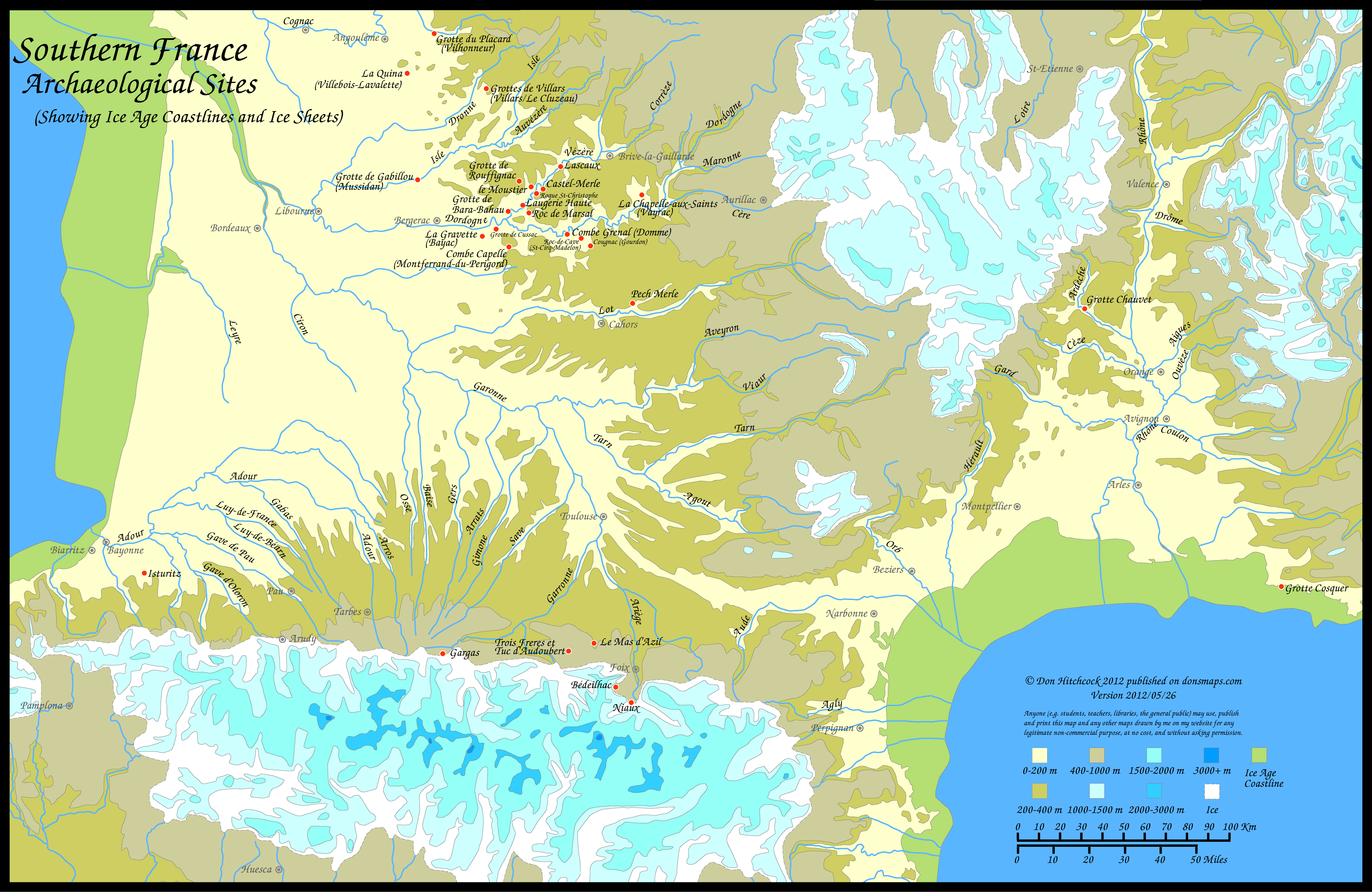
Note - Use this pdf file if you wish to print this map on a single sheet of paper.
Photo: Don Hitchcock version 2012/05/26
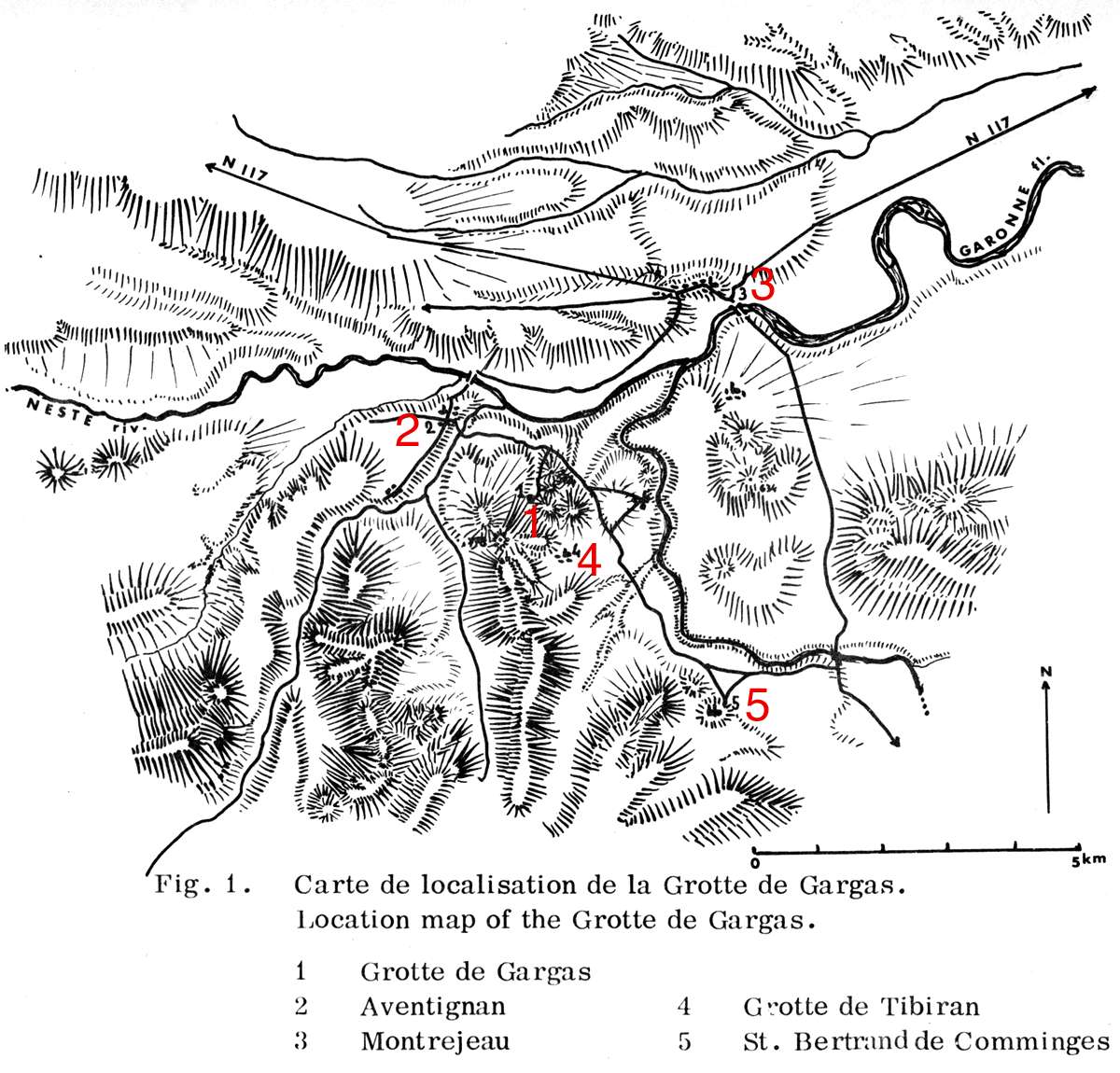
Map of the region surrounding Grotte de Gargas. I have added the red numbers to make the features easier to find.
Photo: Barrière (1976 i)
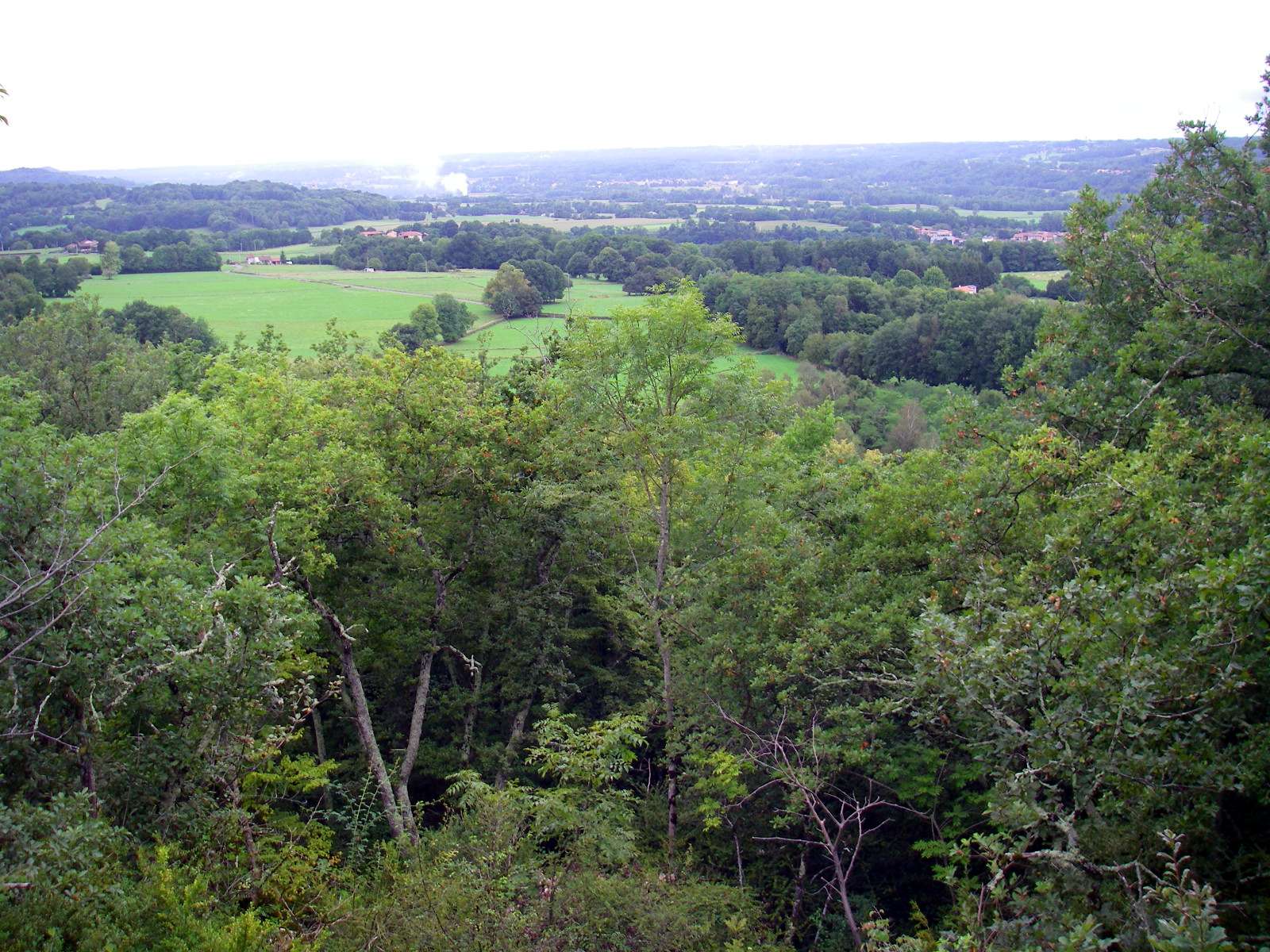
View from the entrance to the Grotte de Gargas.
Photo: Don Hitchcock 2008
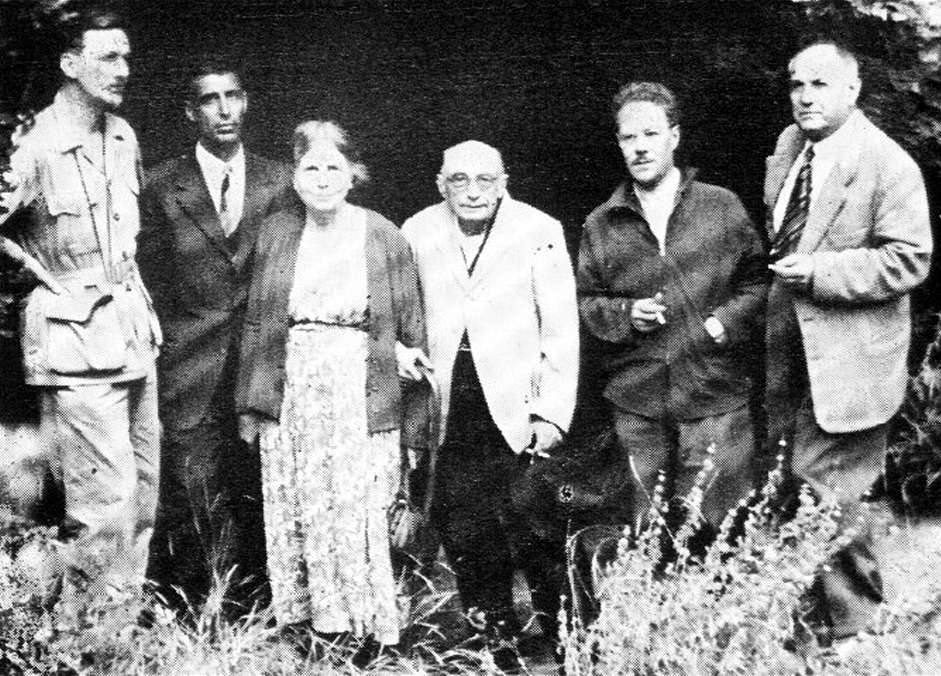
Dr Clark, Dr Sahly, Miss Boyl, Abbé Breuil, Romain Robert and F. Denjean at the entrance to the Grotte de la Vache (11th August 1958). Livre Préhistoire Ariégeoise 1985.
(I have included this photo since it is the only one I have been able to find of Dr Sahly, who did a lot of research at the Grotte de Gargas - Don)
Photo and text translated from: http://www2.ac-toulouse.fr/eco-primaire-pradelet-tarascon/spip.php?article558
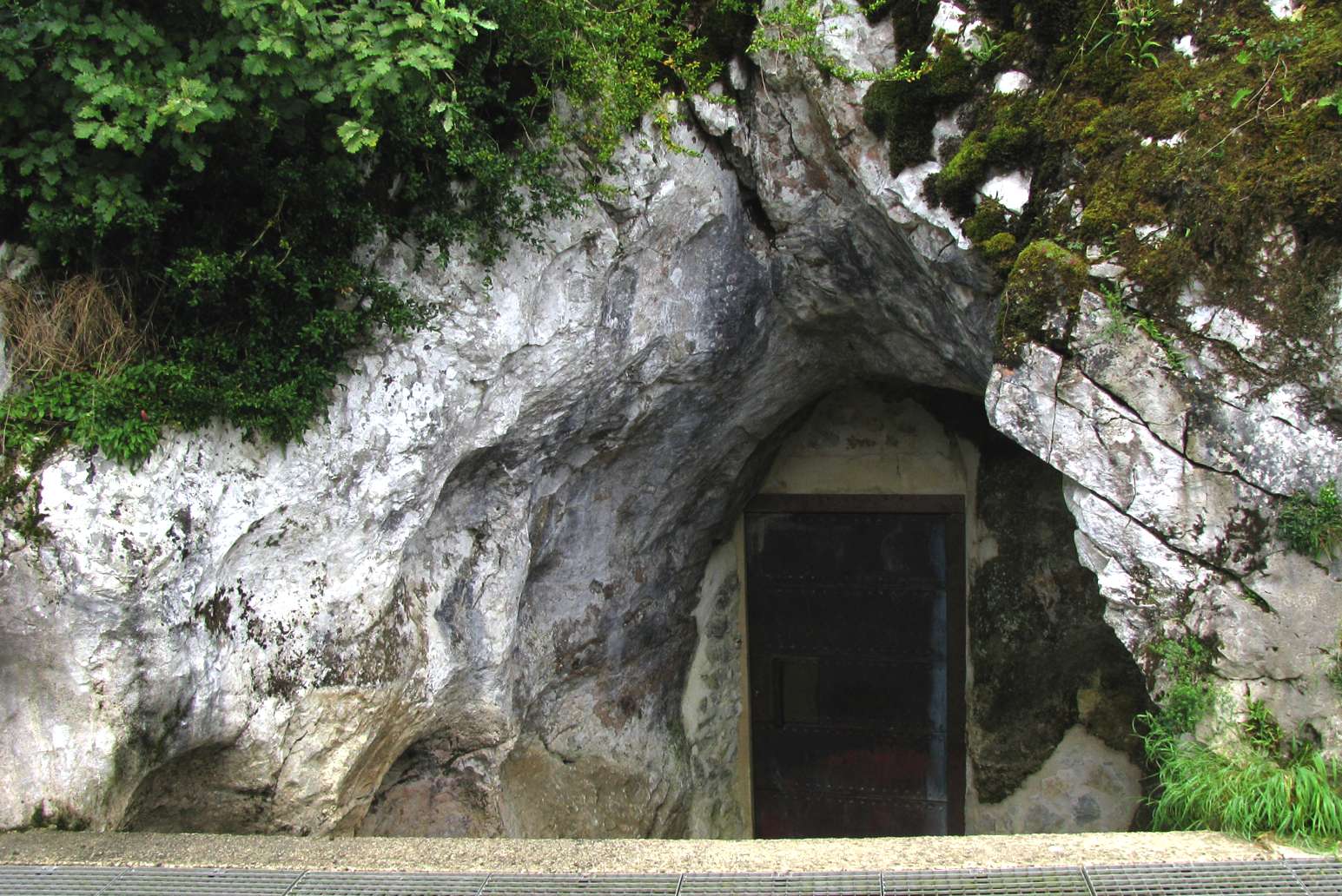

Entrance to the Grotte de Gargas.
Photo: Don Hitchcock 2008
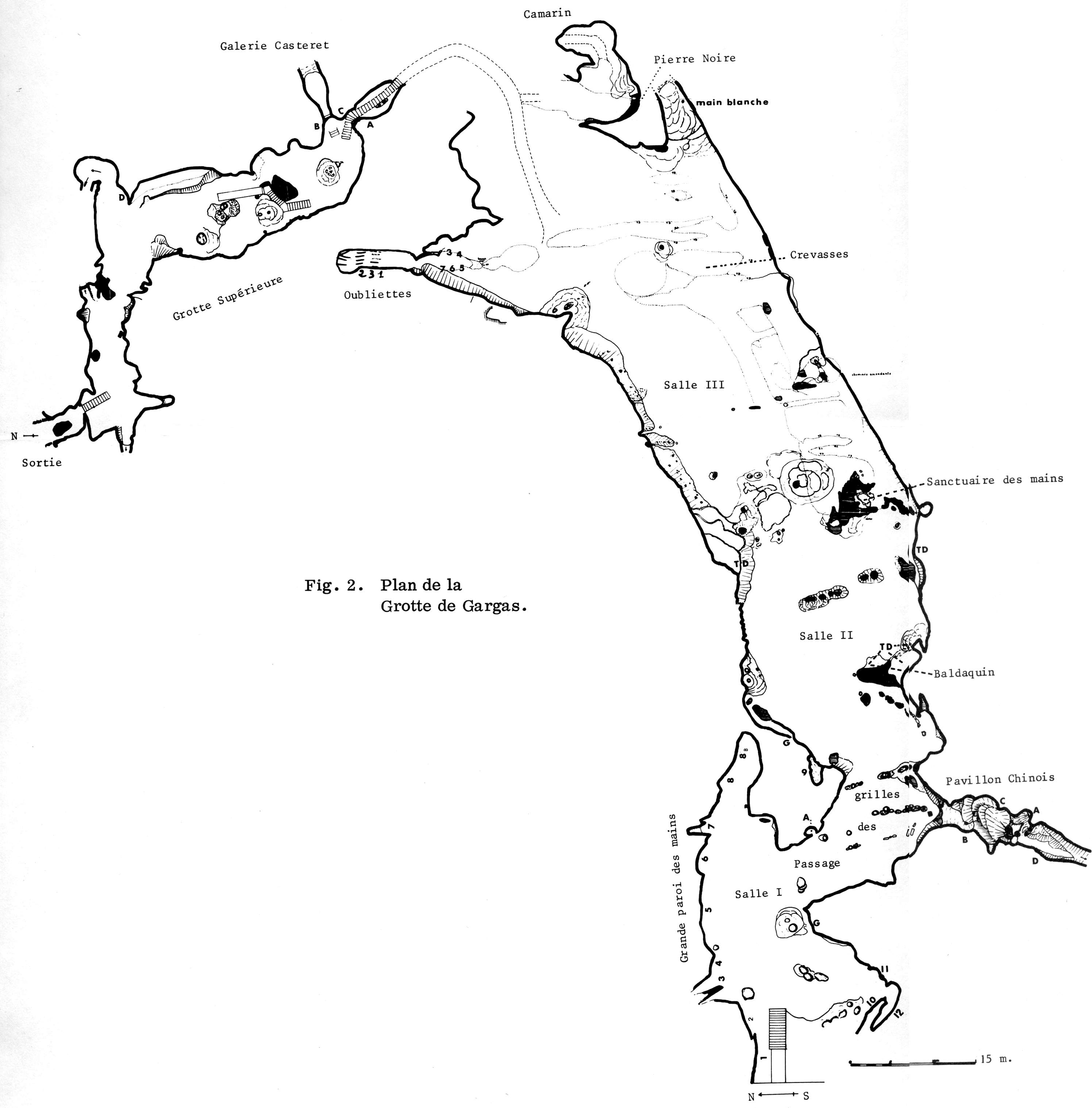
Plan of the Grotte de Gargas.
Photo: Barrière (1976 i)
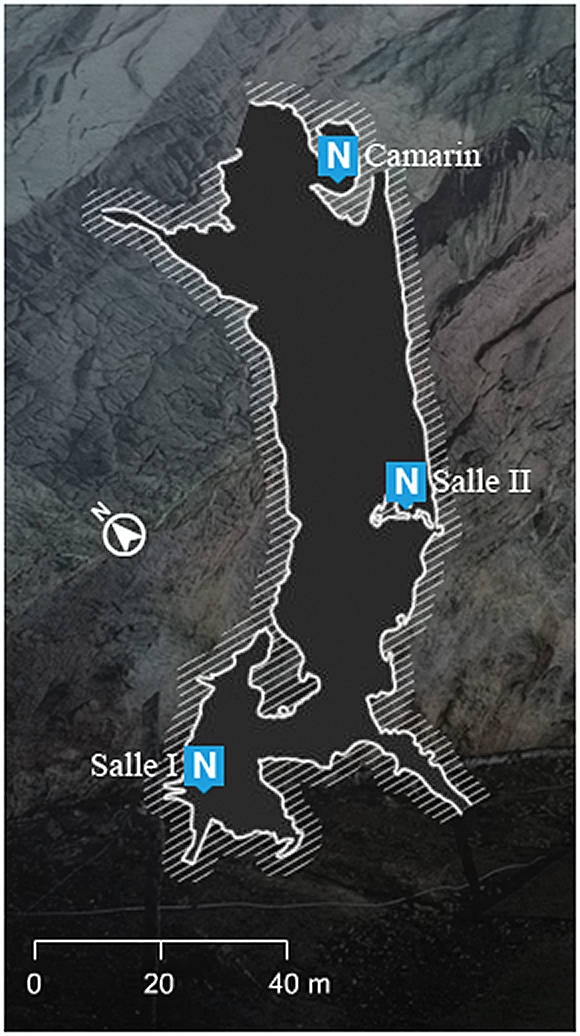
A very much simplified plan of Gargas cave.
Photo: Heinrich Wendel (© The Wendel Collection, Neanderthal Museum)
Salle I
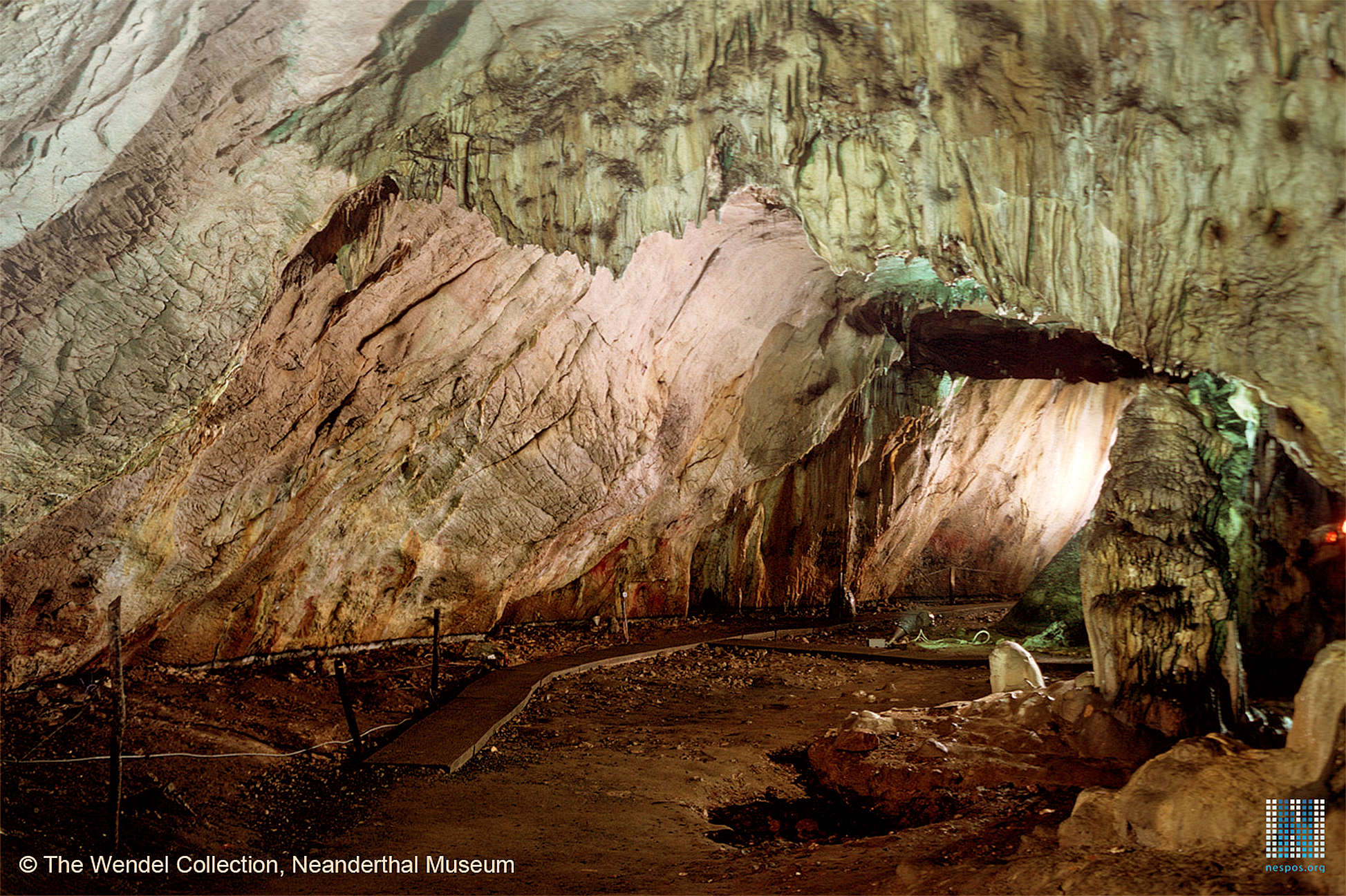

Grotte de Gargas Salle I
The cave has been set up with some additions for tourism. Apart from the steel entry door, sadly not in place from the time of its discovery, the cave has some walkways and lighting.
Photo: Heinrich Wendel (© The Wendel Collection, Neanderthal Museum)
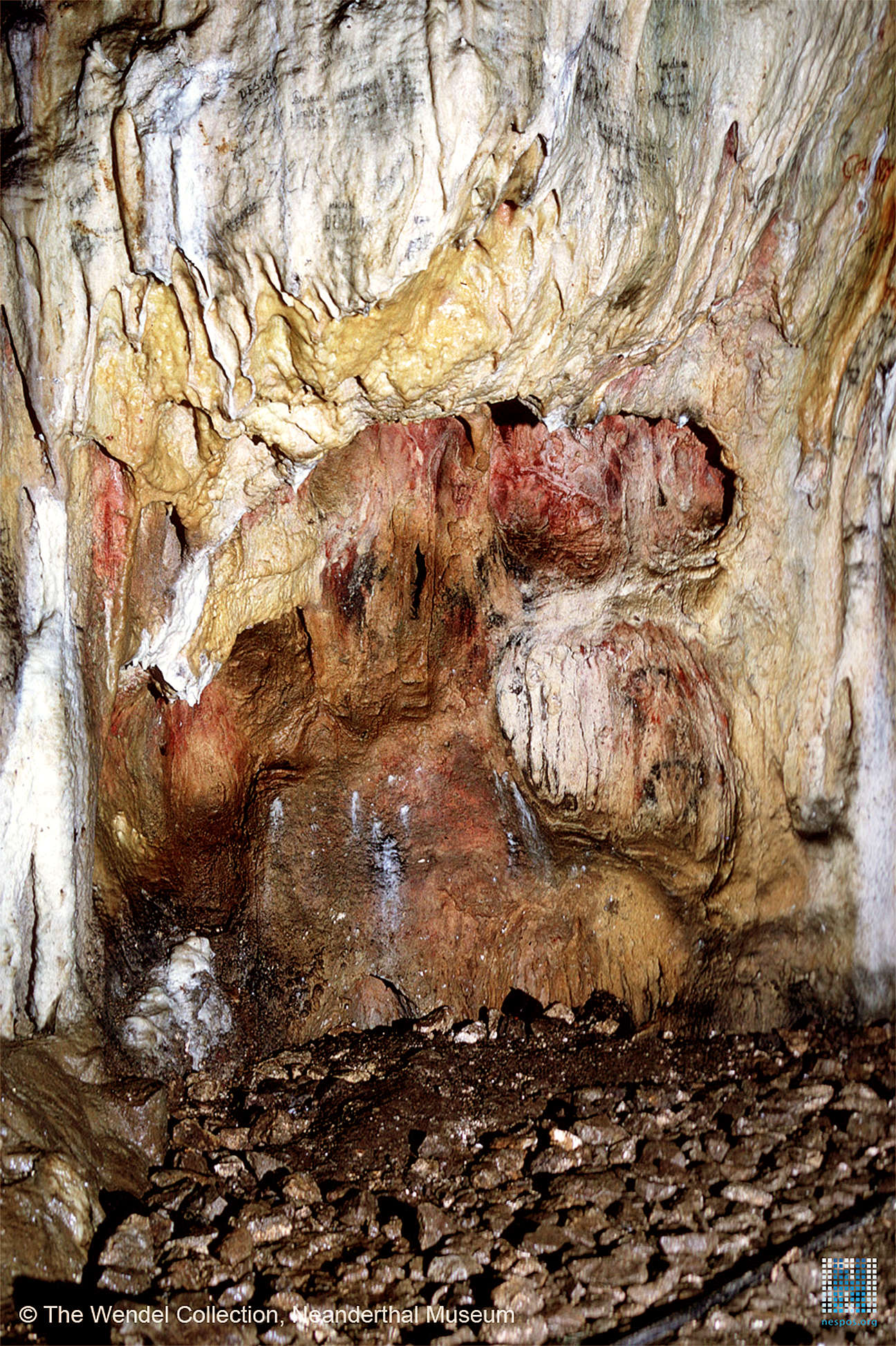
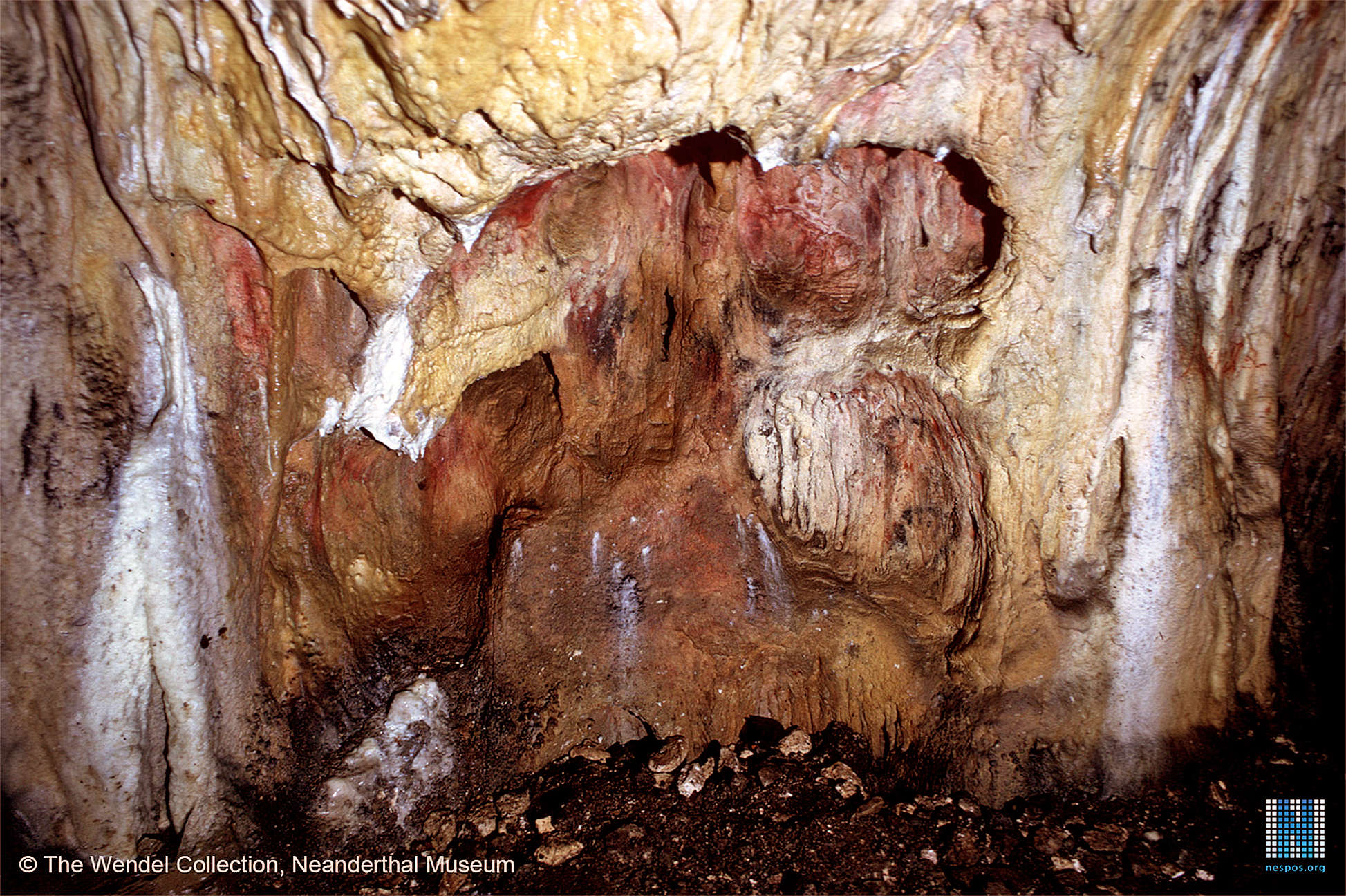
Grotte de Gargas Salle I
This section has some negative stencils of handprints using red and black pigments, illustrating the lack of some fingers on the hands.
Photo: Heinrich Wendel (© The Wendel Collection, Neanderthal Museum)
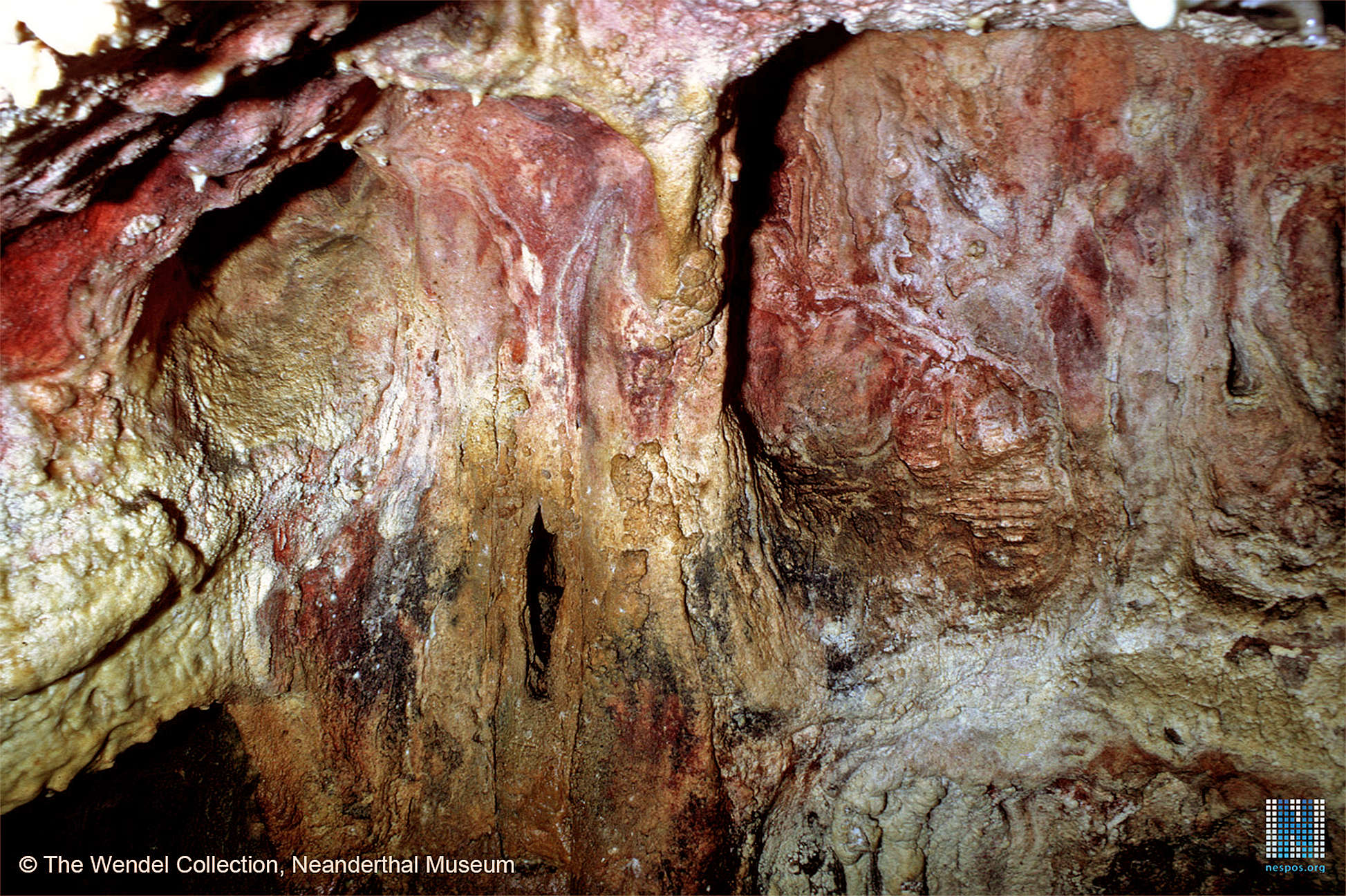

Grotte de Gargas Salle I
Different viewpoints are necessary to see all the images on this section of the wall.
The rightmost hand stencil in red is somewhat obscured by a fold of rock in the right photograph, but may be seen clearly in the one on the left, in the centre right of the image just to the right of the the black shadow.
In addition, the fingers of the leftmost hand stencil, the outside digits of which are somewhat visually separated from the middle three, may be seen on the left hand photograph in the upper centre of the image, at the lower margin of the upper red marking on the yellowish 'pillar'.
The central third hand stencil is visible in the right hand photograph, as a smudged outline in dark red ochre, on the right side of the central 'pillar' just above the yellowish concretions there.
Photo: Heinrich Wendel (© The Wendel Collection, Neanderthal Museum)
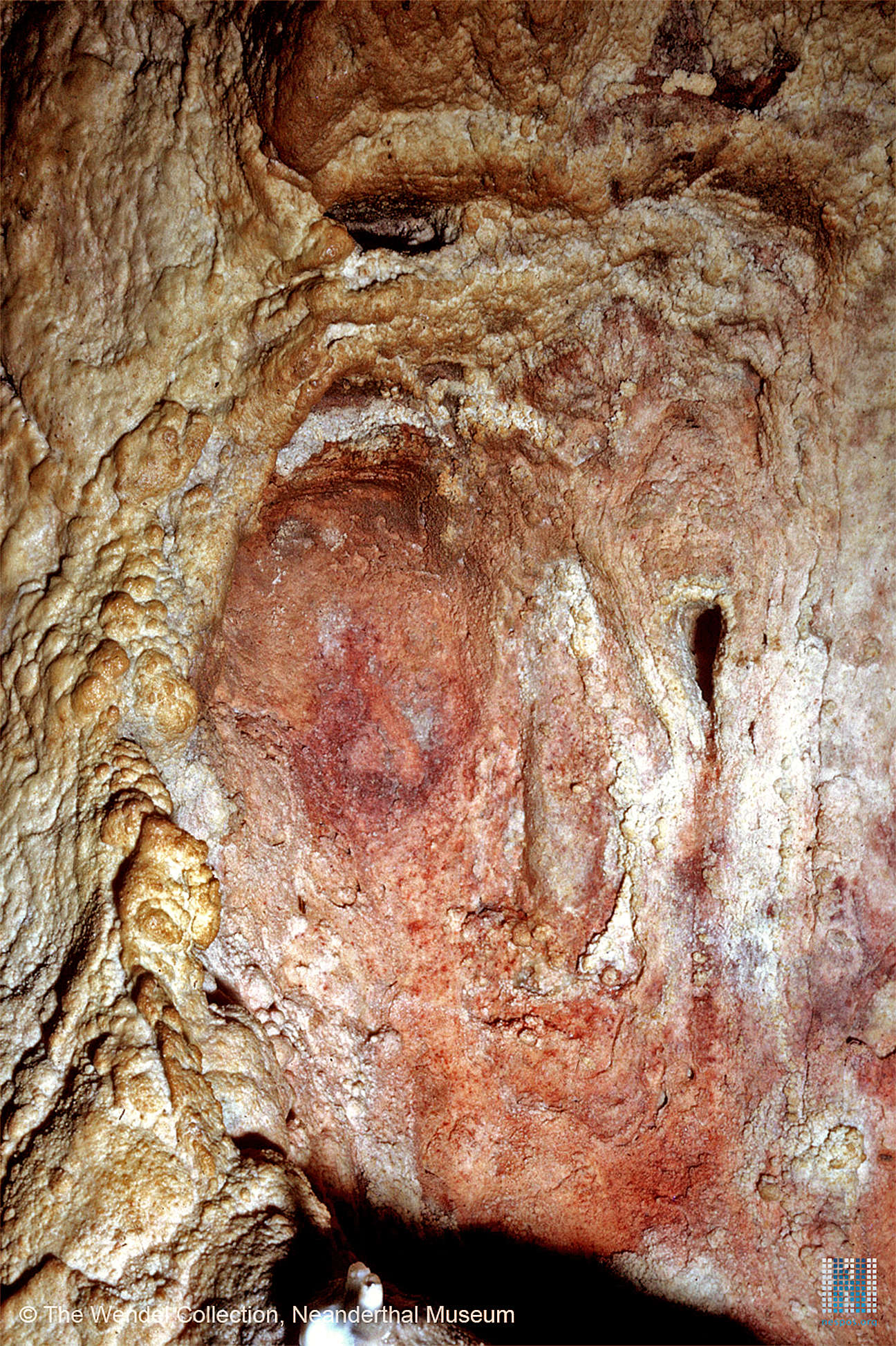
Grotte de Gargas Salle I
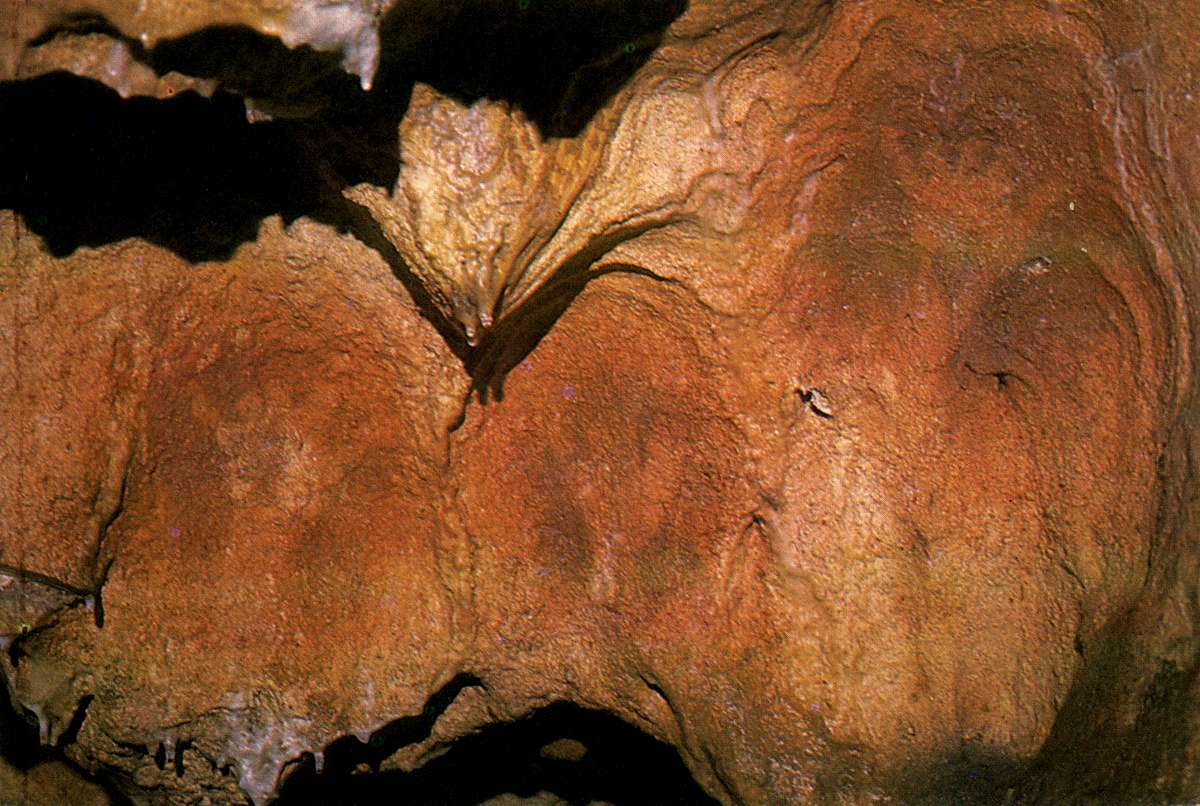
I am not able to discern anything besides the dark red coloration of ochre, with a lighter patch in the middle of it, in the niche on the wall in this photograph.
Photo: Heinrich Wendel (© The Wendel Collection, Neanderthal Museum)
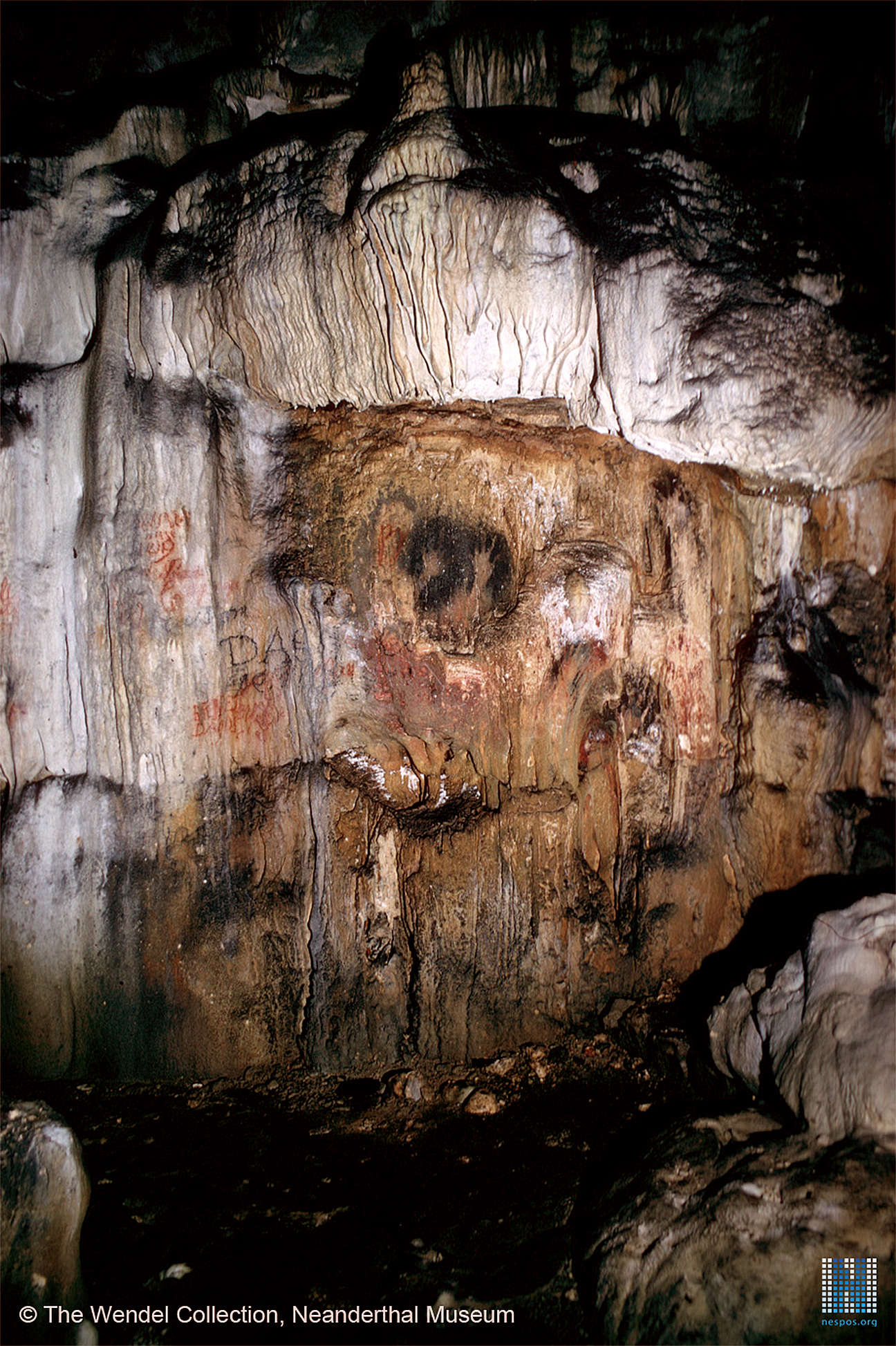
Grotte de Gargas Salle I
Negative hand stencils in black pigment.
Photo: Heinrich Wendel (© The Wendel Collection, Neanderthal Museum)
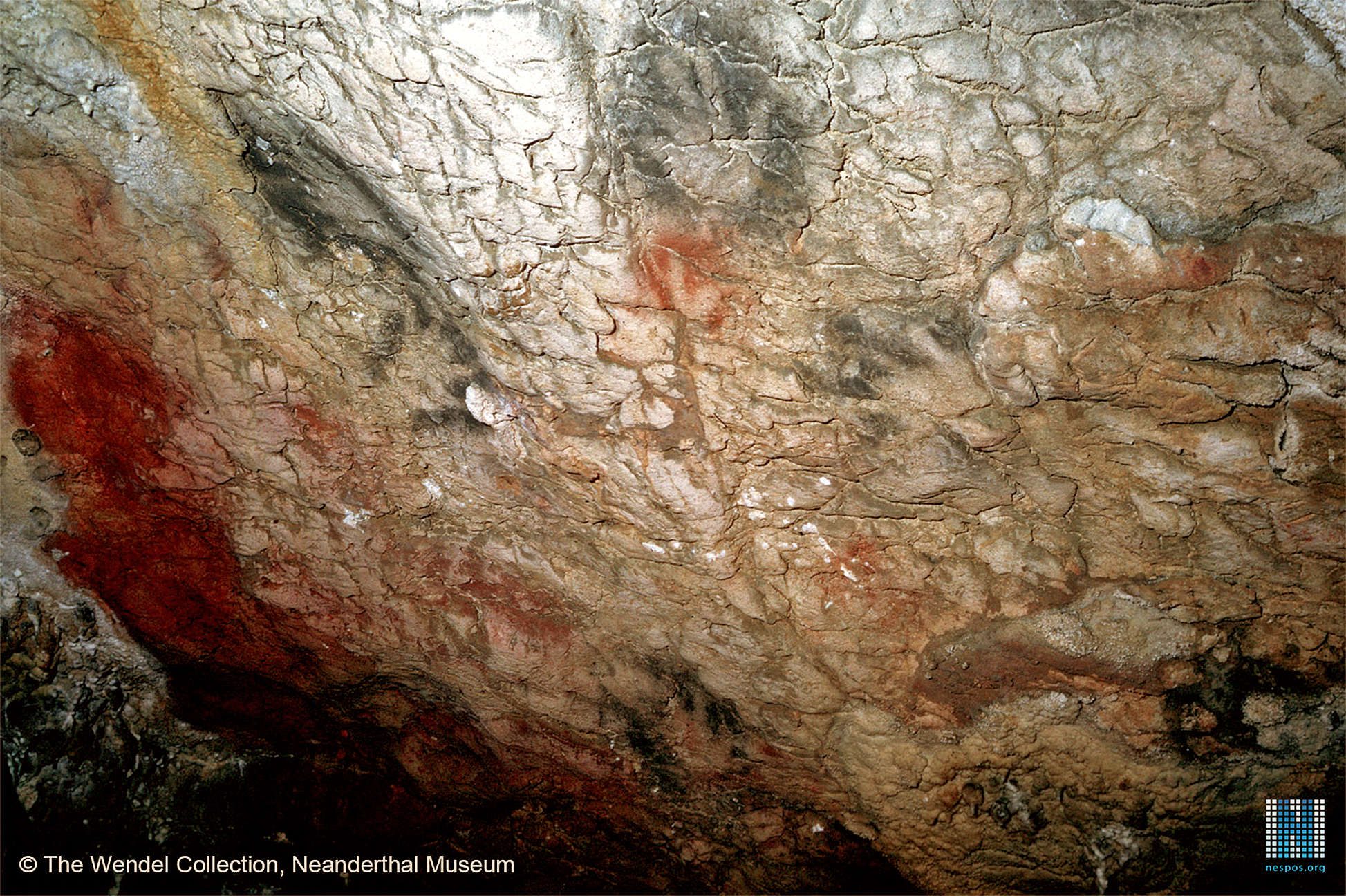
Grotte de Gargas Salle I
Both black and red outlined hands can be seen in this view of a sloping wall.
I can count five, possibly six, black stencils, and at least one partial stencil in red.
Photo: Heinrich Wendel (© The Wendel Collection, Neanderthal Museum)
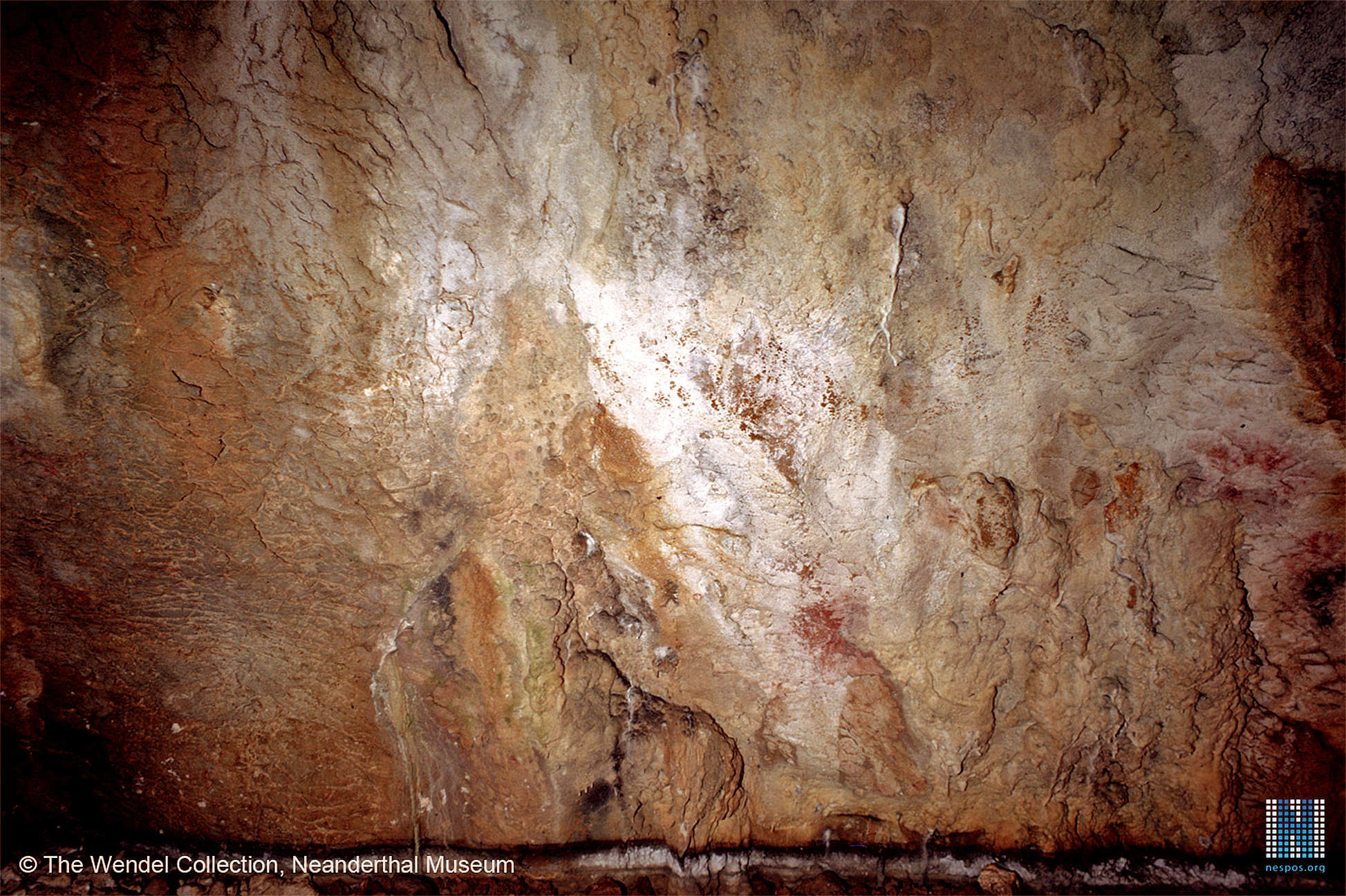
Grotte de Gargas Salle I
There is one black hand stencil on the left of this image, with another, unclear, possibly two stencils superimposed, in red on the far right.
Photo: Heinrich Wendel (© The Wendel Collection, Neanderthal Museum)
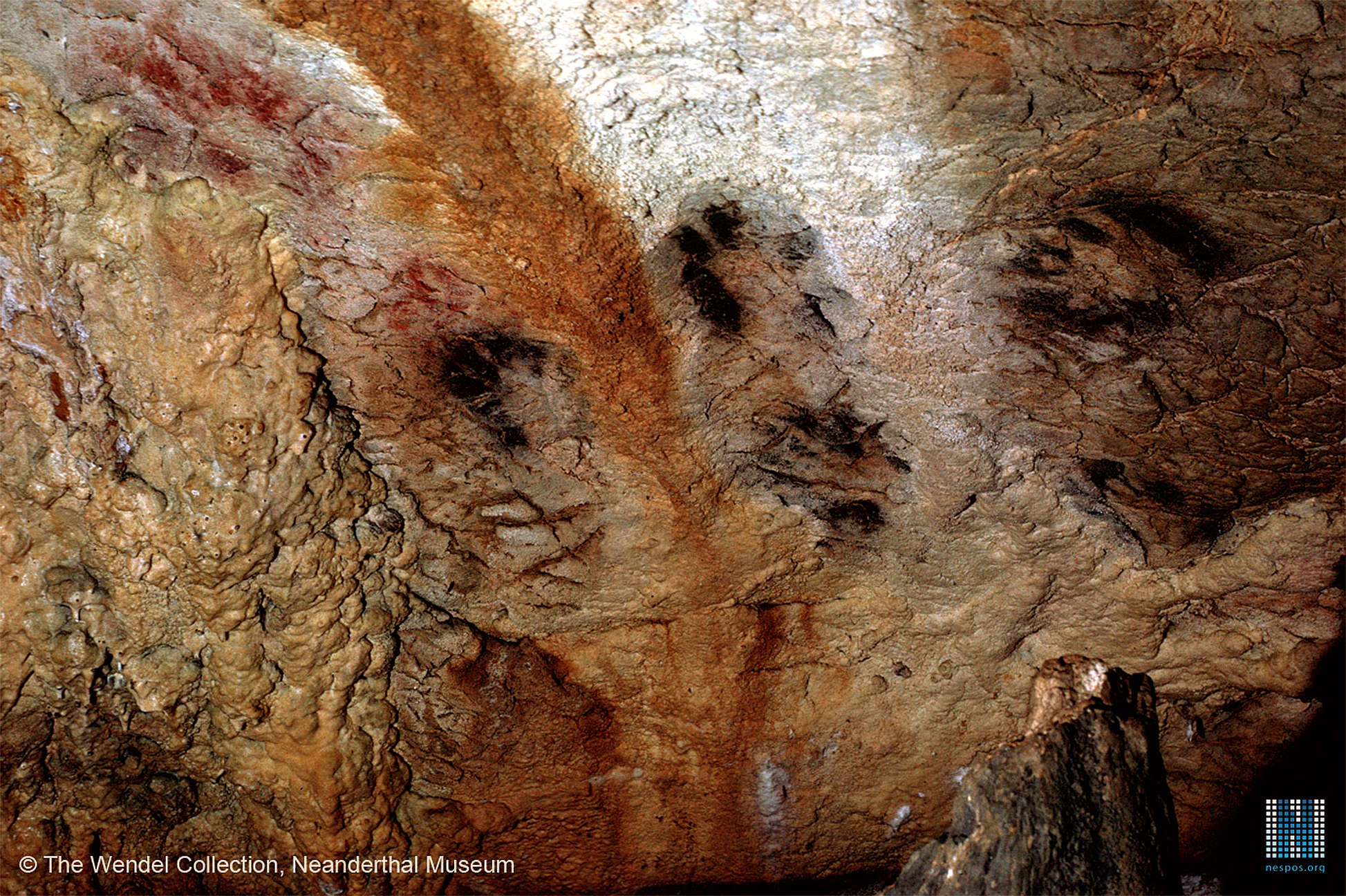
Grotte de Gargas Salle I
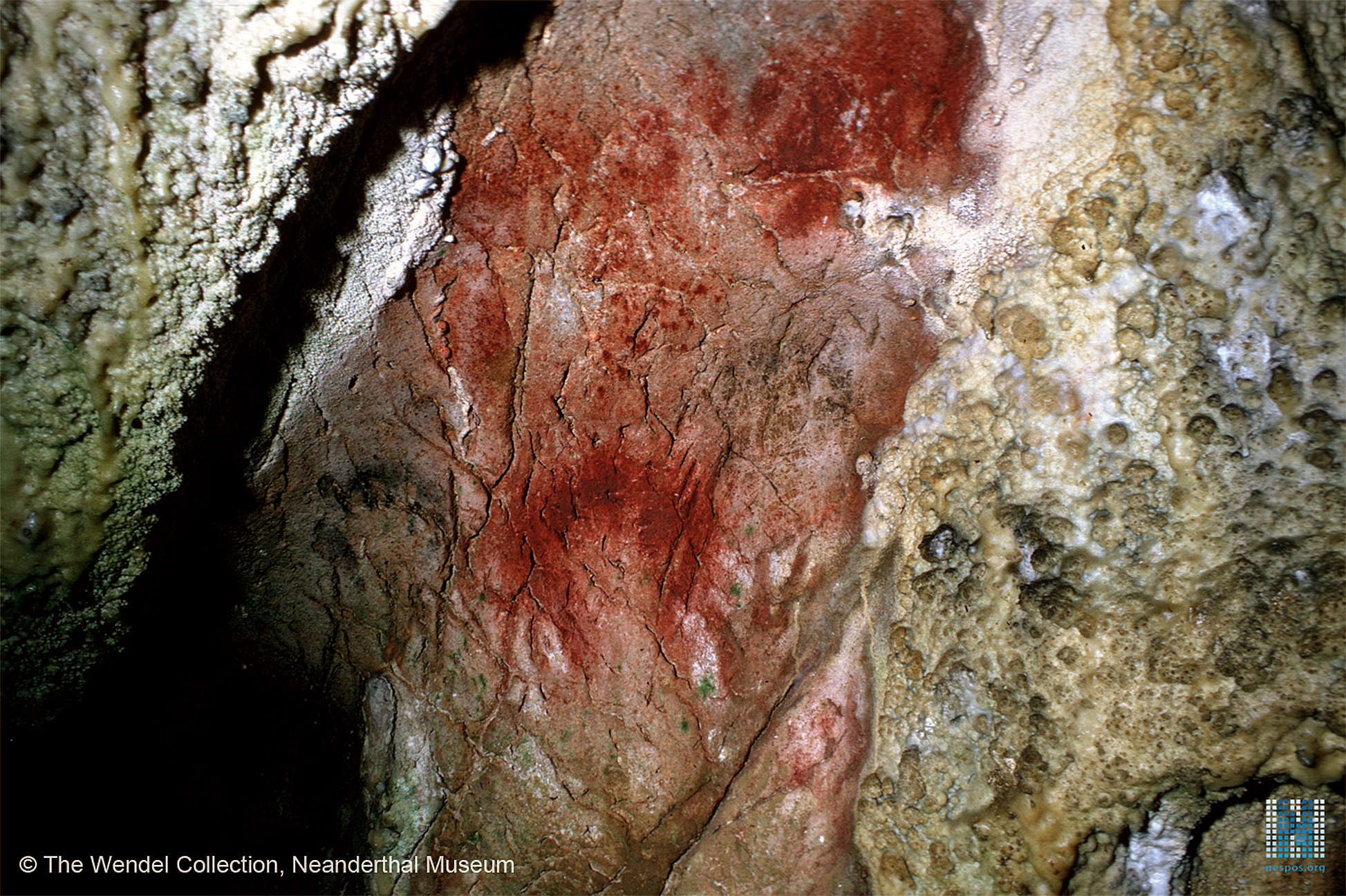
There are several stencils in both black and red in this image, apparently on the ceiling rather than on a wall.
Photo: Heinrich Wendel (© The Wendel Collection, Neanderthal Museum)

Grotte de Gargas Salle I
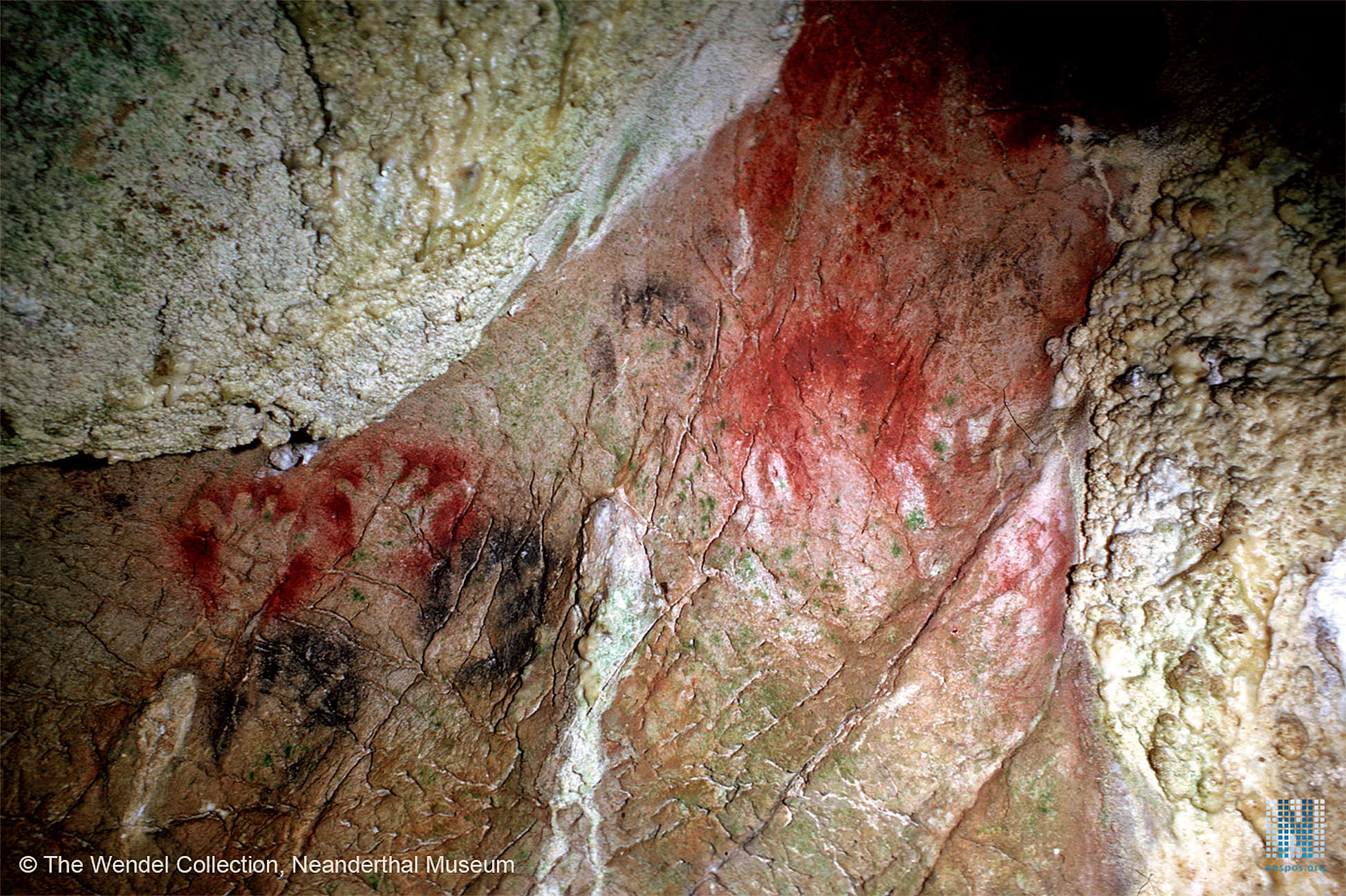
Several hand stencils in both red and black, with a close up photograph on the right.
There are several red dots on the wall as well as some large areas of red pigment without obvious form.
Note the two 'positive' prints on the lower centre of the right photo, created when the artist used white ochre sprayed or painted over the hand while resting on a dark background.
Photo: Heinrich Wendel (© The Wendel Collection, Neanderthal Museum)
Grotte de Gargas Salle I
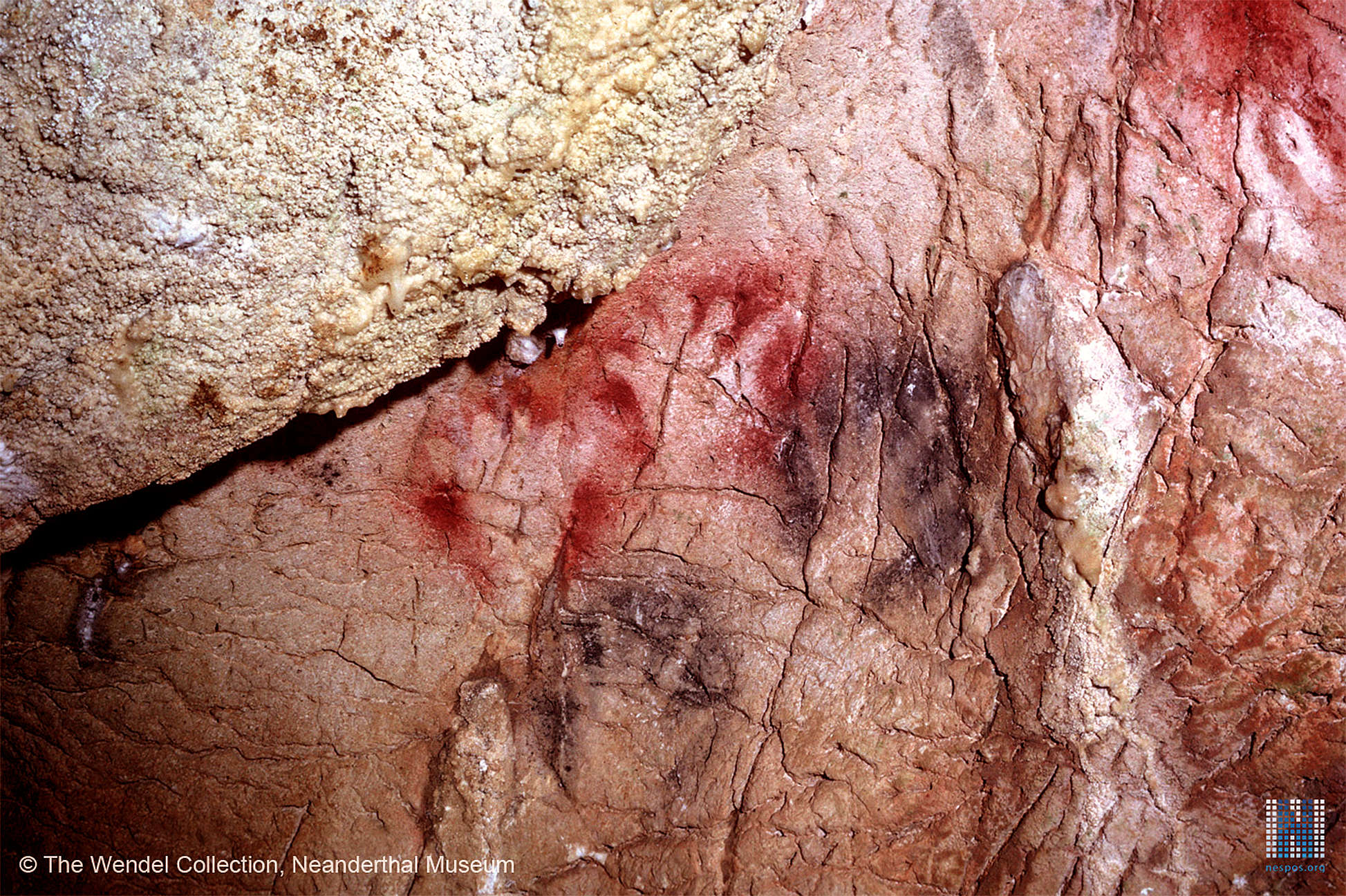
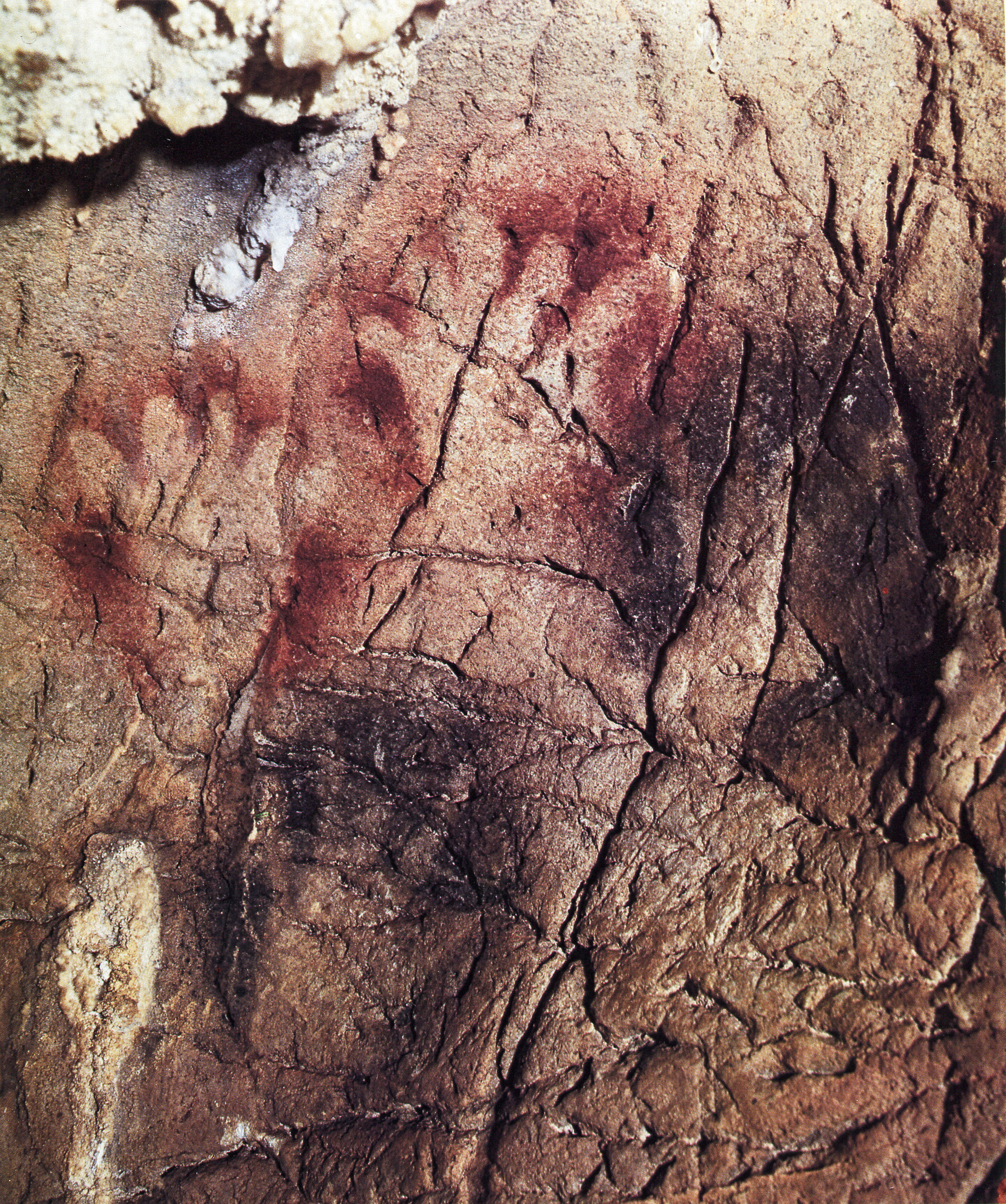
Close ups of the lower part of the photo above on the left.
At least one of the hands in black appears to be whole, but the two prominent stencils in red show mutilated hands.
Photo: Heinrich Wendel (© The Wendel Collection, Neanderthal Museum)
Grotte de Gargas Salle I
Photo: N. Aujoulat, CNP.
Source: Leroi-Gourhan (1984)

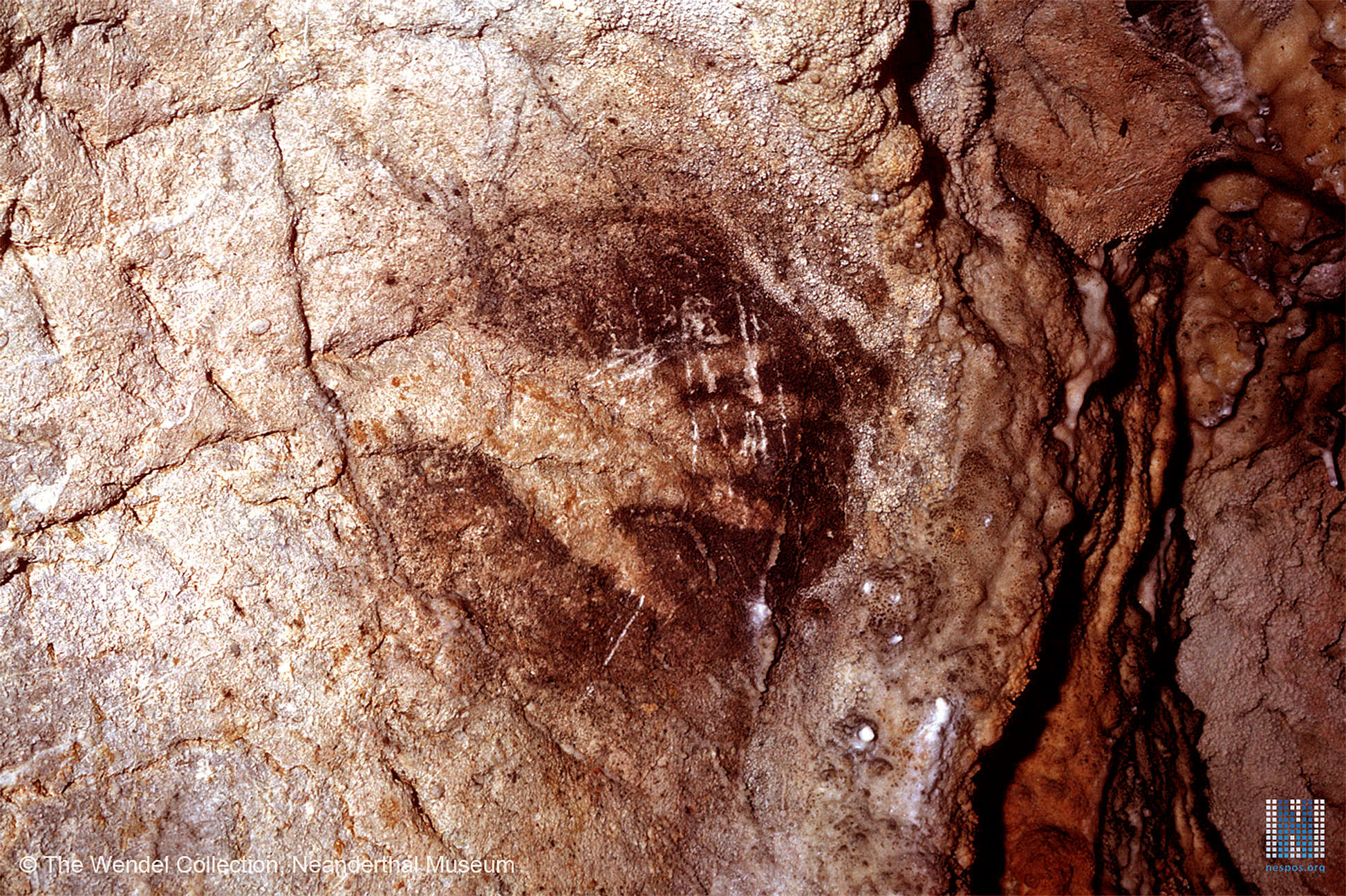
Grotte de Gargas Salle I
The left index finger of the lower hand is mutilated, and the middle finger of the upper hand is also mutilated, as shown in the closeup in the right hand photograph.
Photo: Heinrich Wendel (© The Wendel Collection, Neanderthal Museum)
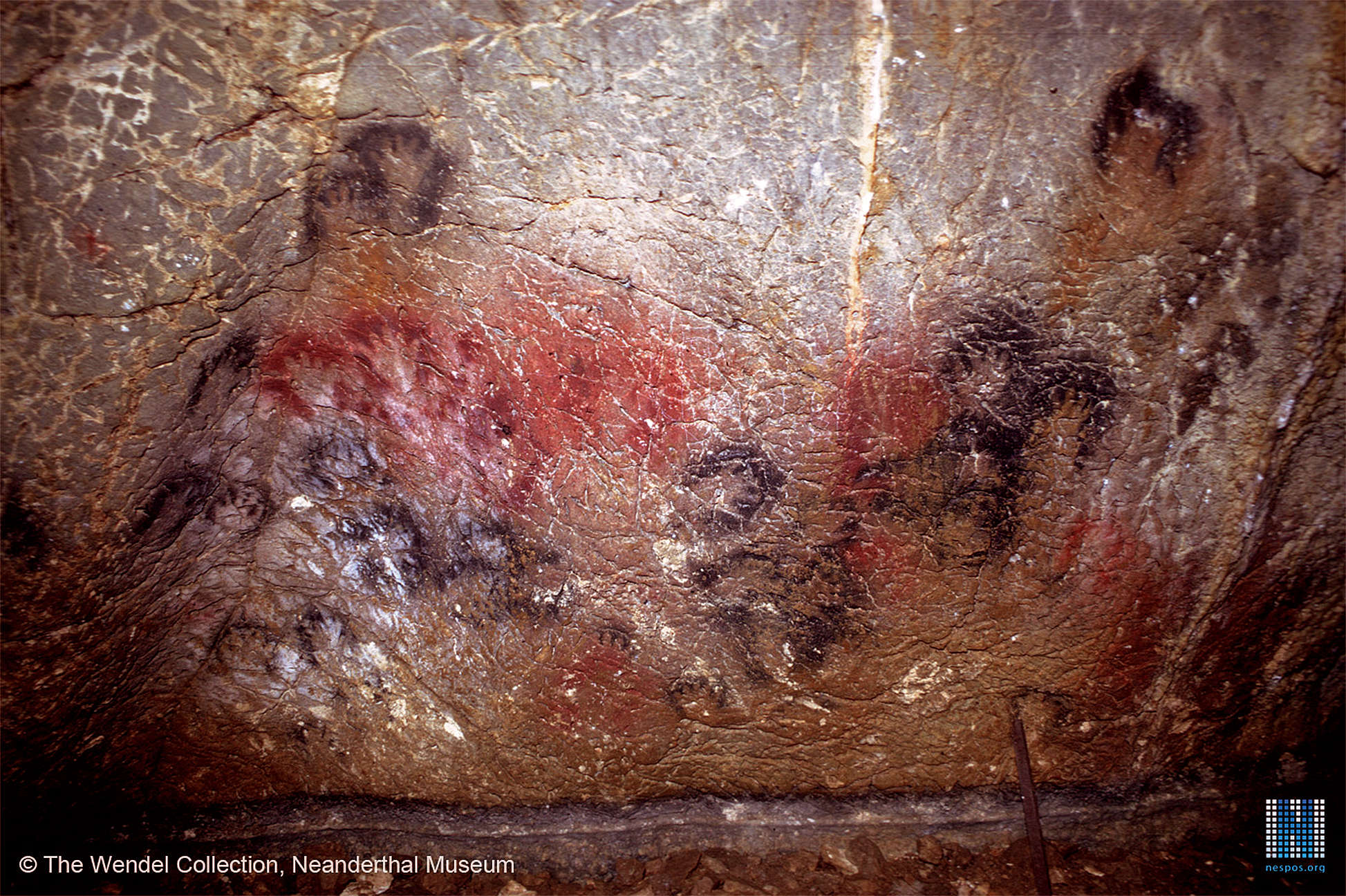
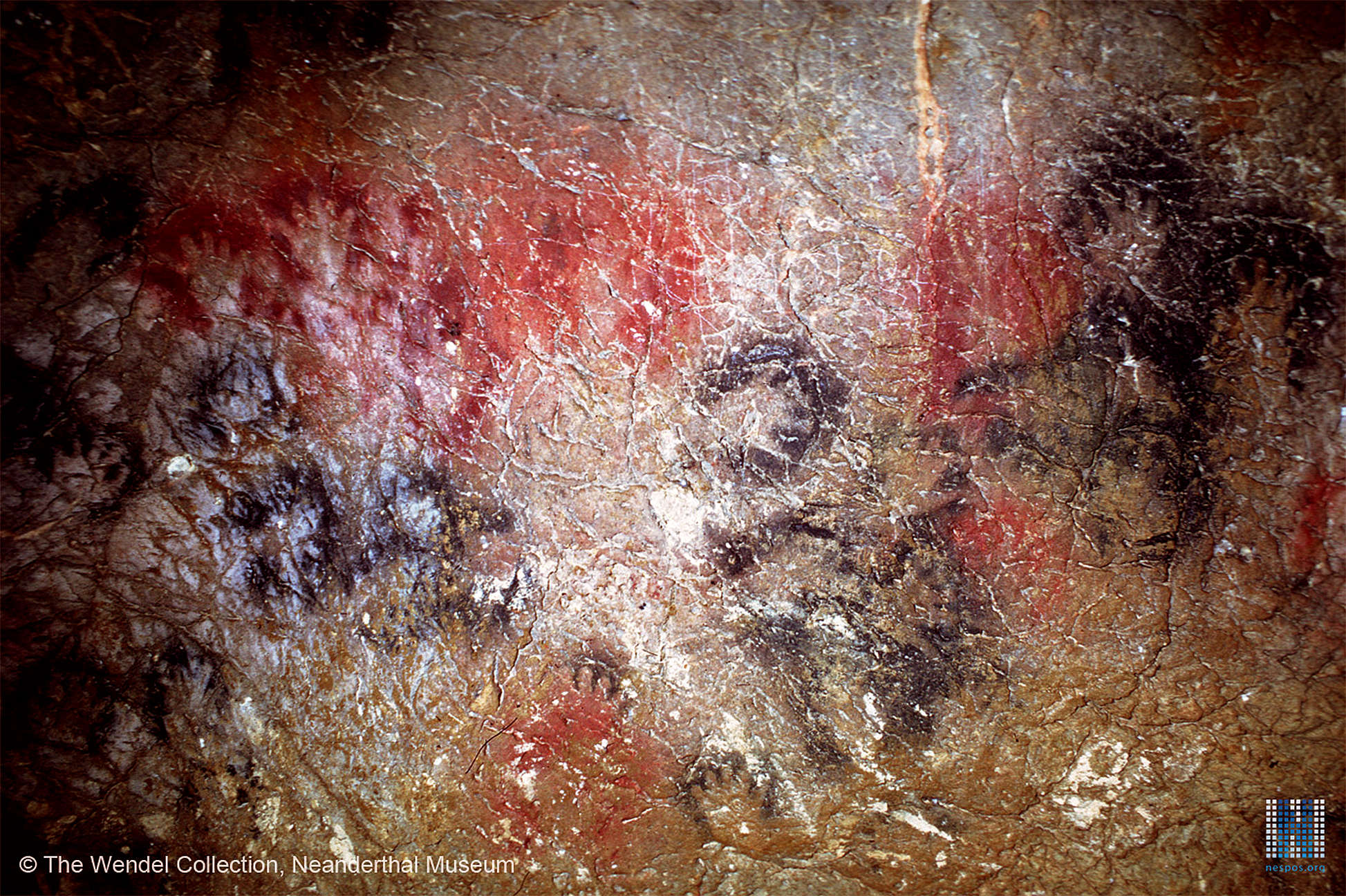
Grotte de Gargas Salle I
Multiple hand stencils in black, dark red, and a lighter red colour. Closeup on the right.
Photo: Heinrich Wendel (© The Wendel Collection, Neanderthal Museum)

Grotte de Gargas Salle I
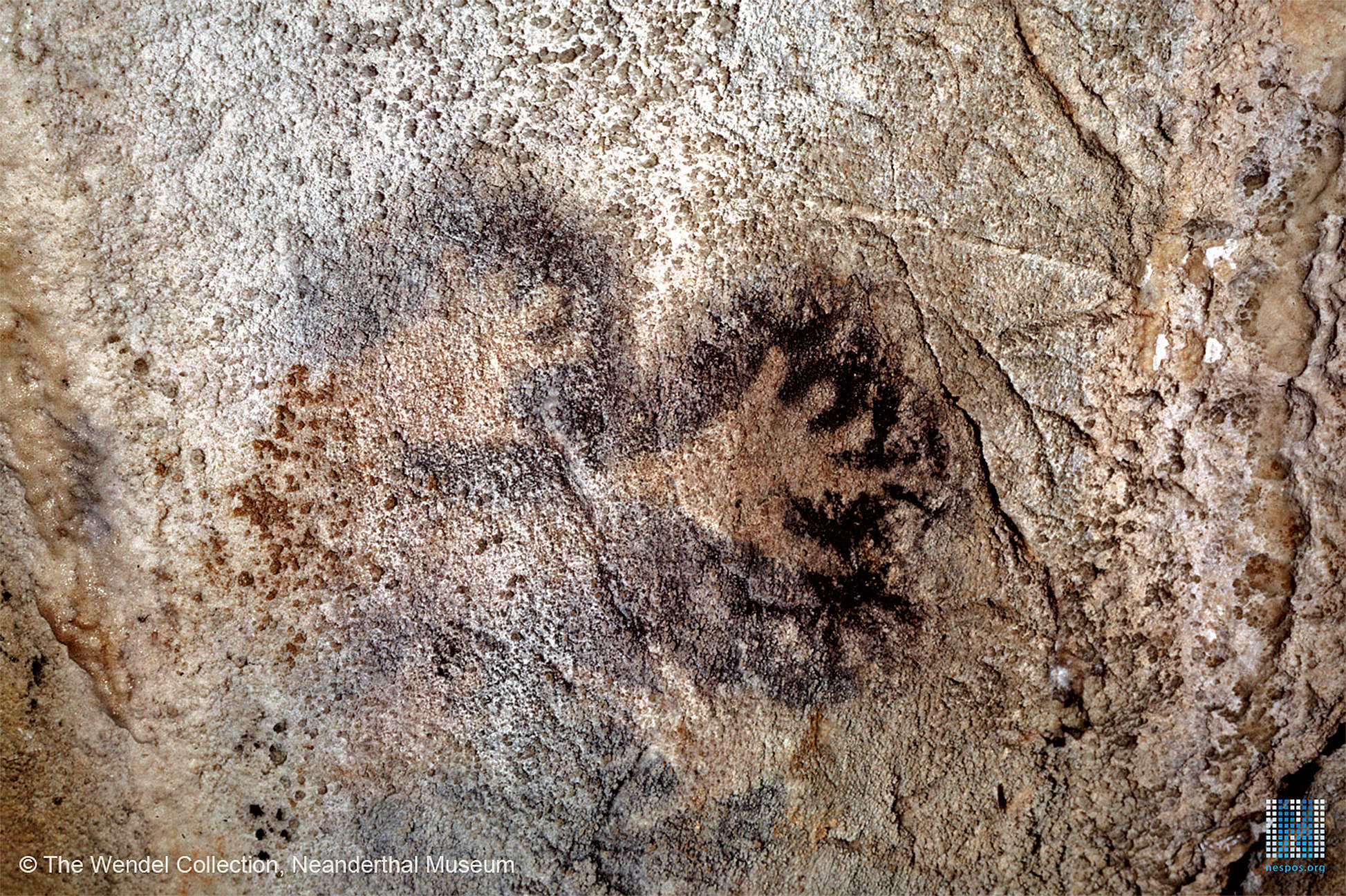
In this closeup of the images above, the mutilation of the hands in dark red is very apparent.
Photo: Heinrich Wendel (© The Wendel Collection, Neanderthal Museum)
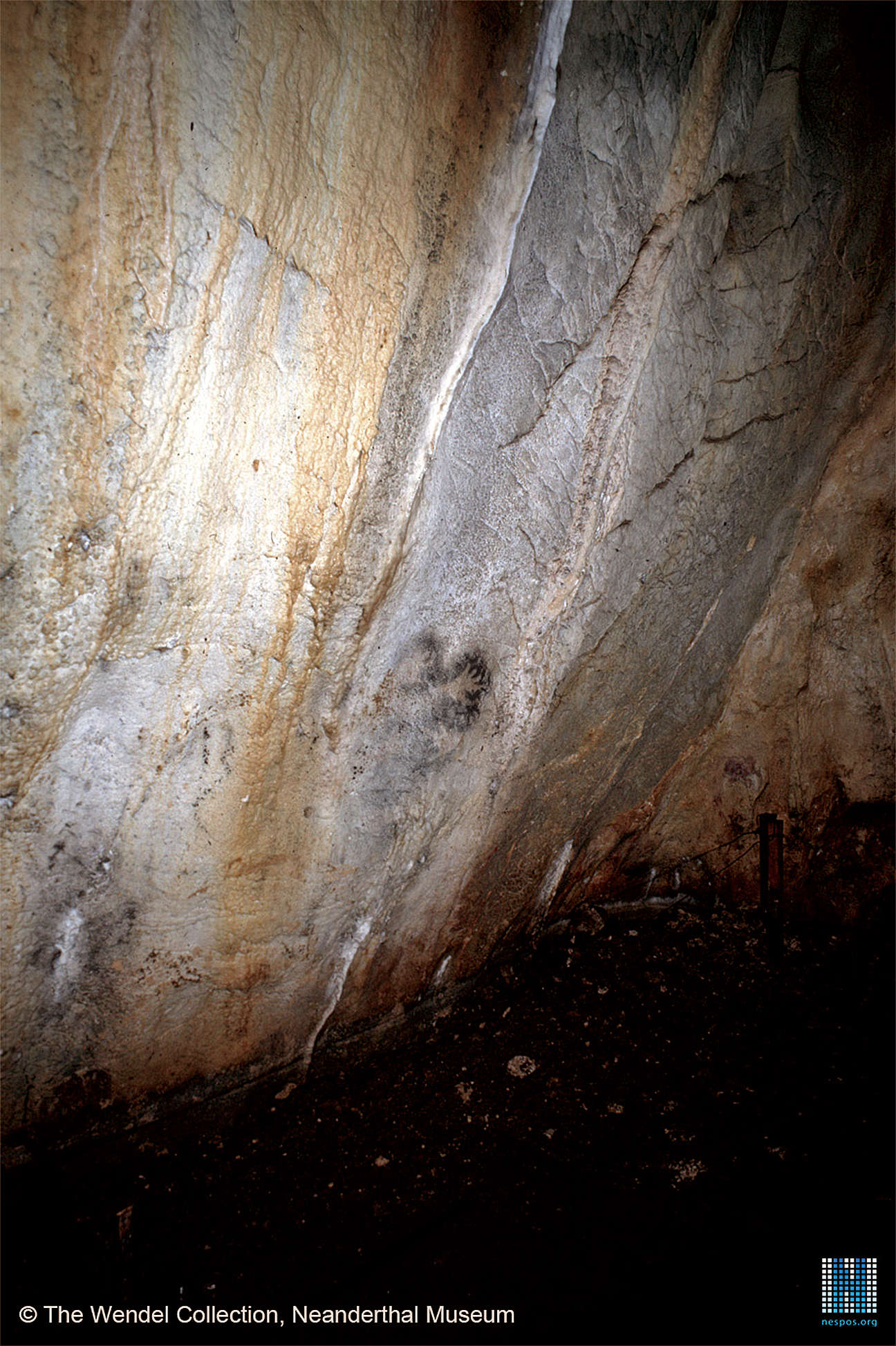
Grotte de Gargas Salle I
Two mutilated hand stencils in context (left) and in closeup (right).
Photo: Heinrich Wendel (© The Wendel Collection, Neanderthal Museum)
Another explanation for the shape of the hand stencils besides mutilation - Dupuytren's disease
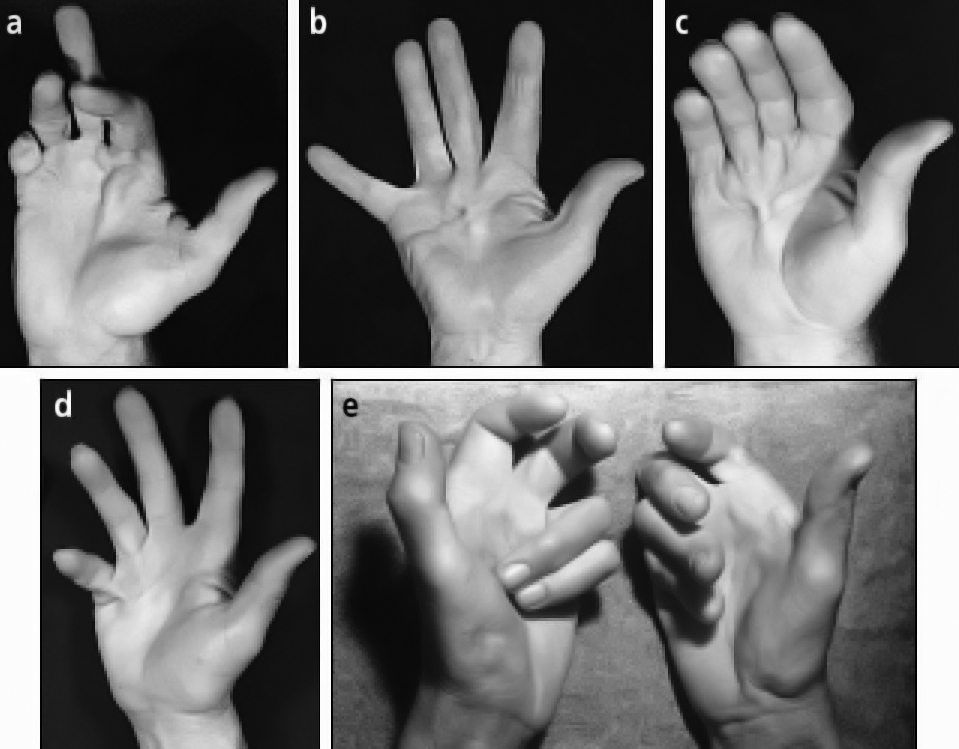
Dupuytren’s disease, also called Dupuytren's contracture or palmar fibromatosis, is a condition in which the connective tissue under the skin of the palm contracts and toughens over time.
The typical symptom is the presence of a nodule on the hand (a small knot or knob) followed by the formation of a ropelike growth on the palm (cord) and then permanent contracture of the fingers.
The prevalence of Dupuytren's disease defined as a self-reported physician diagnosis and/or surgical treatment was estimated as 1% (95% CI = 0.8–1.2), but the estimated prevalence is much higher (7.3%) when including self-reported symptoms of ropelike growth or hard bumps on the hand.
Photo: https://www.ncbi.nlm.nih.gov/pmc/articles/PMC1305903/
Text: DiBenedetti et al. (2011)
Dupuytren’s disease (DD) is an ancient affliction of unknown origin. It is defined as shortening, thickening, and fibrosis of the palmar fascia producing a flexion deformity of a finger. Tradition has it that the disease originated with the Vikings, who spread it throughout Northern Europe and beyond as they traveled and intermarried.
In a study in the French port of Toulon, 60% of the general population had brown eyes and 40% had blue eyes, but 80% of inhabitants with DD had blue eyes. The latter individuals were traced to the families of Breton and Norman sailors in the city’s history.
Text above: Flatt (2001)
( Thus the disease is, at least to some extent, hereditary, so it is no surprise that the inhabitants of Gargas Cave could have had so many members with the disease which gives the impression, in a negative hand print, of having mutilated hands. Note that it is not possible to complete a positive hand print (with the palm towards the wall) with this deformity, and in order to get a negative hand print, the back of the hand would have had to have been laid on the wall, and paint spattered over it to create the negative imprint. I was alerted to this possibility by an article by Ray Urbaniak in Pleistocene Coalition News, Urbaniak (2020) - Don )
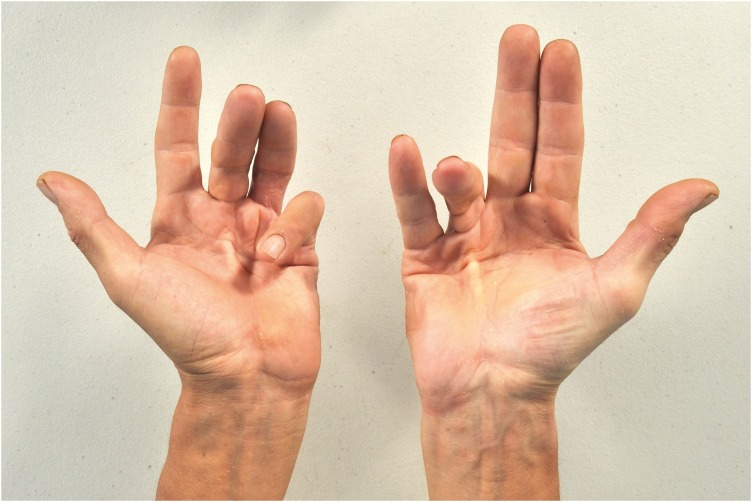
Dupuytren's disease in the long and small fingers of left right hand and in the ring finger of the right hand.
Photo and text: Hyun (2018)
Salle II

Grotte de Gargas Salle II
Engravings.
Photo: Heinrich Wendel (© The Wendel Collection, Neanderthal Museum)
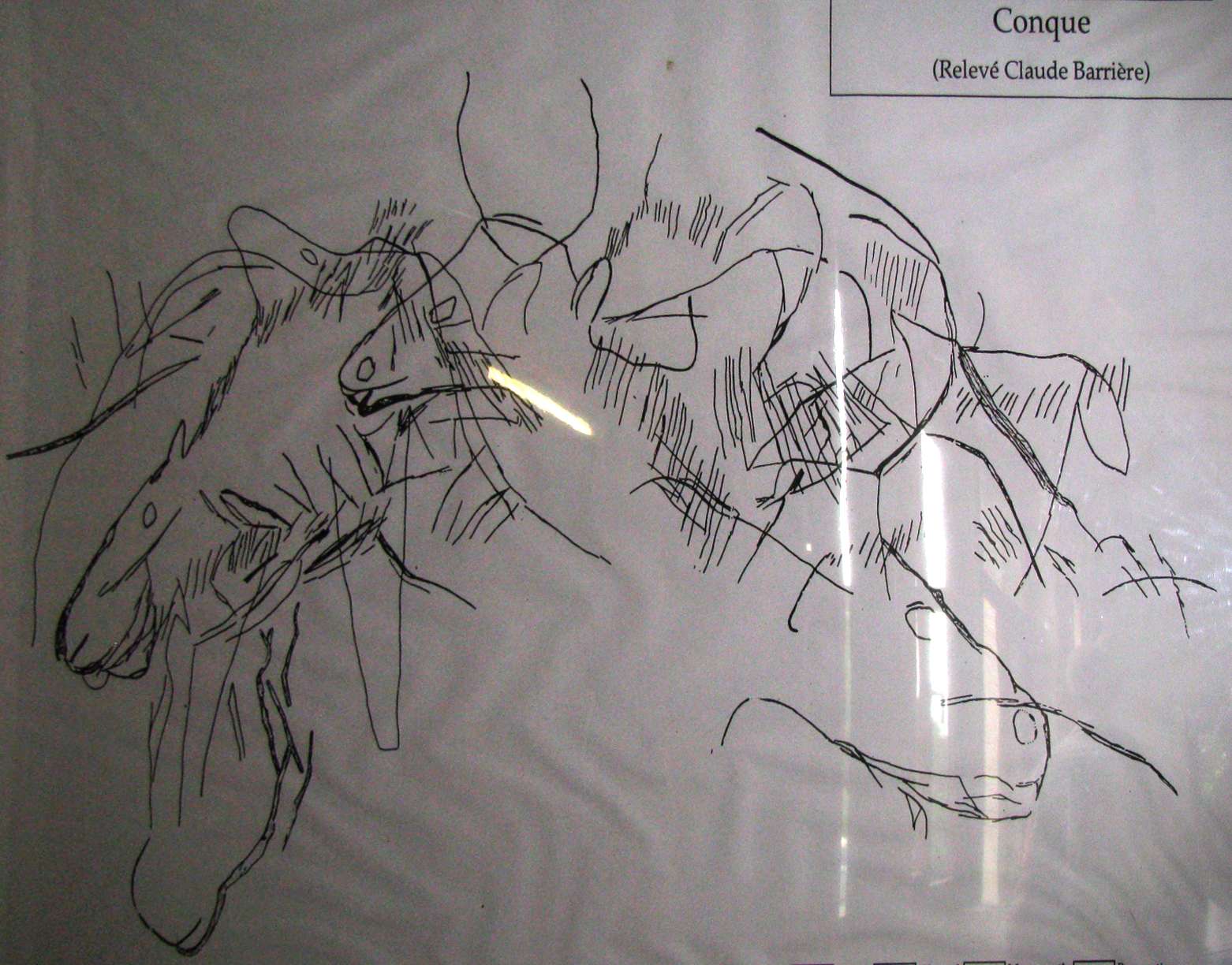
Drawings of the engravings above.
These are labelled as Conque by Barrière
Photo: Don Hitchcock 2008
Source: Display, Grotte de Gargas
Artist: Claude Barrière
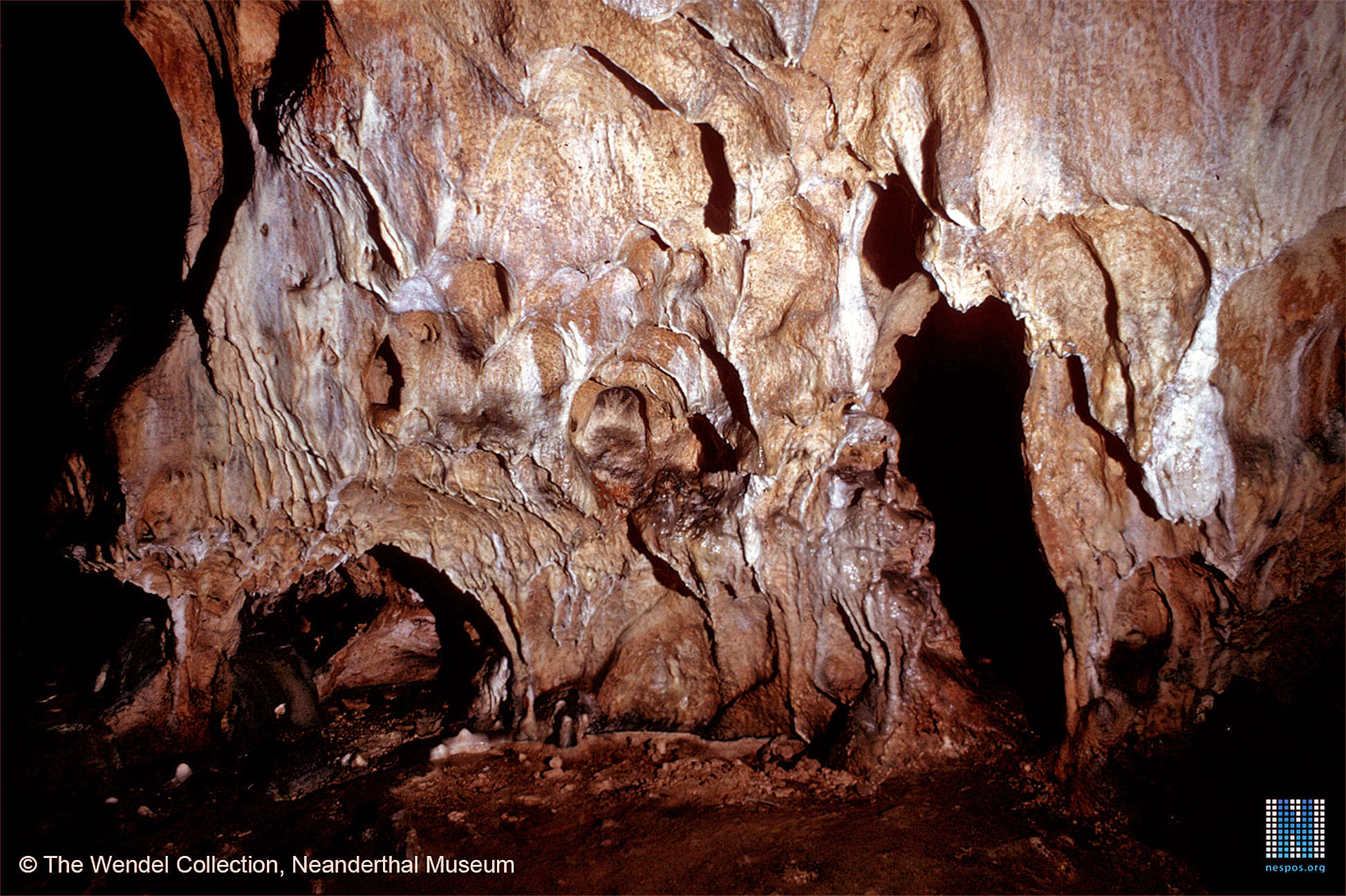
Grotte de Gargas Salle II
Hand stencils
Photo: Heinrich Wendel (© The Wendel Collection, Neanderthal Museum)

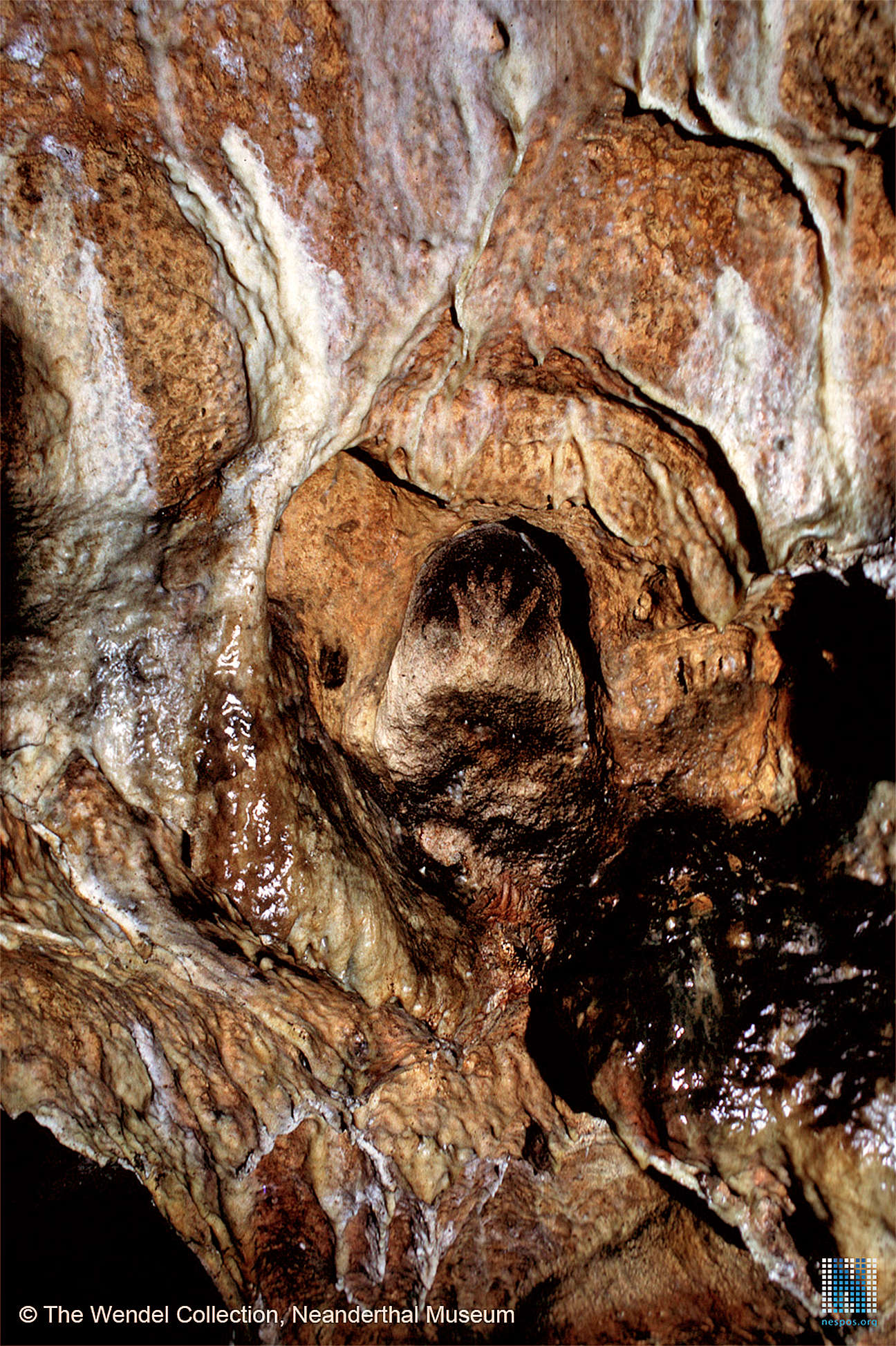
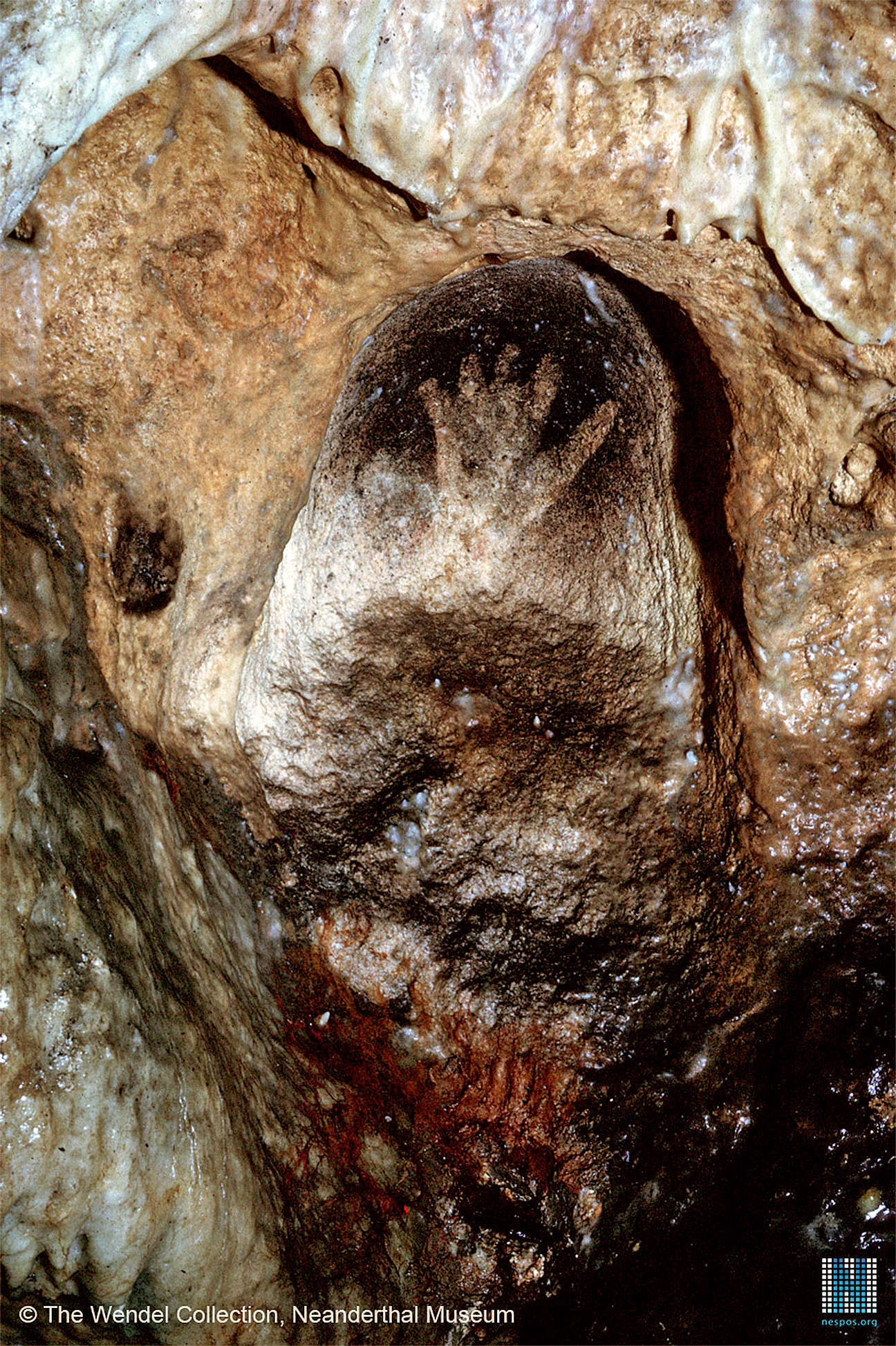
Grotte de Gargas Salle II
Hand stencil, in context and close up.
This is one of the most reproduced of the hand stencils at Gargas, since it is in an isolated position on a rock projection, is sharp and clear, and demonstrates mutilation of four fingers.
Photo: Heinrich Wendel (© The Wendel Collection, Neanderthal Museum)
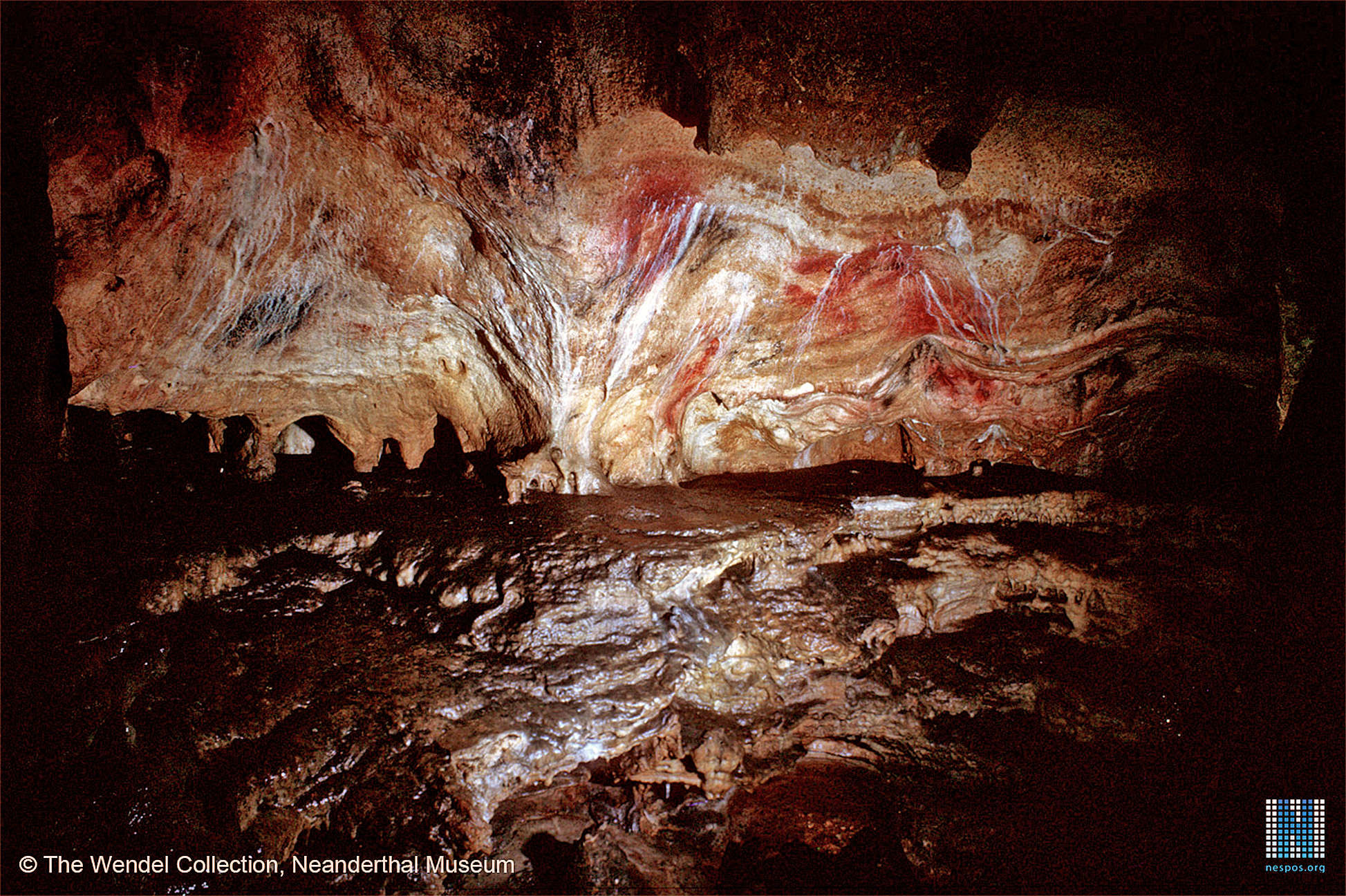
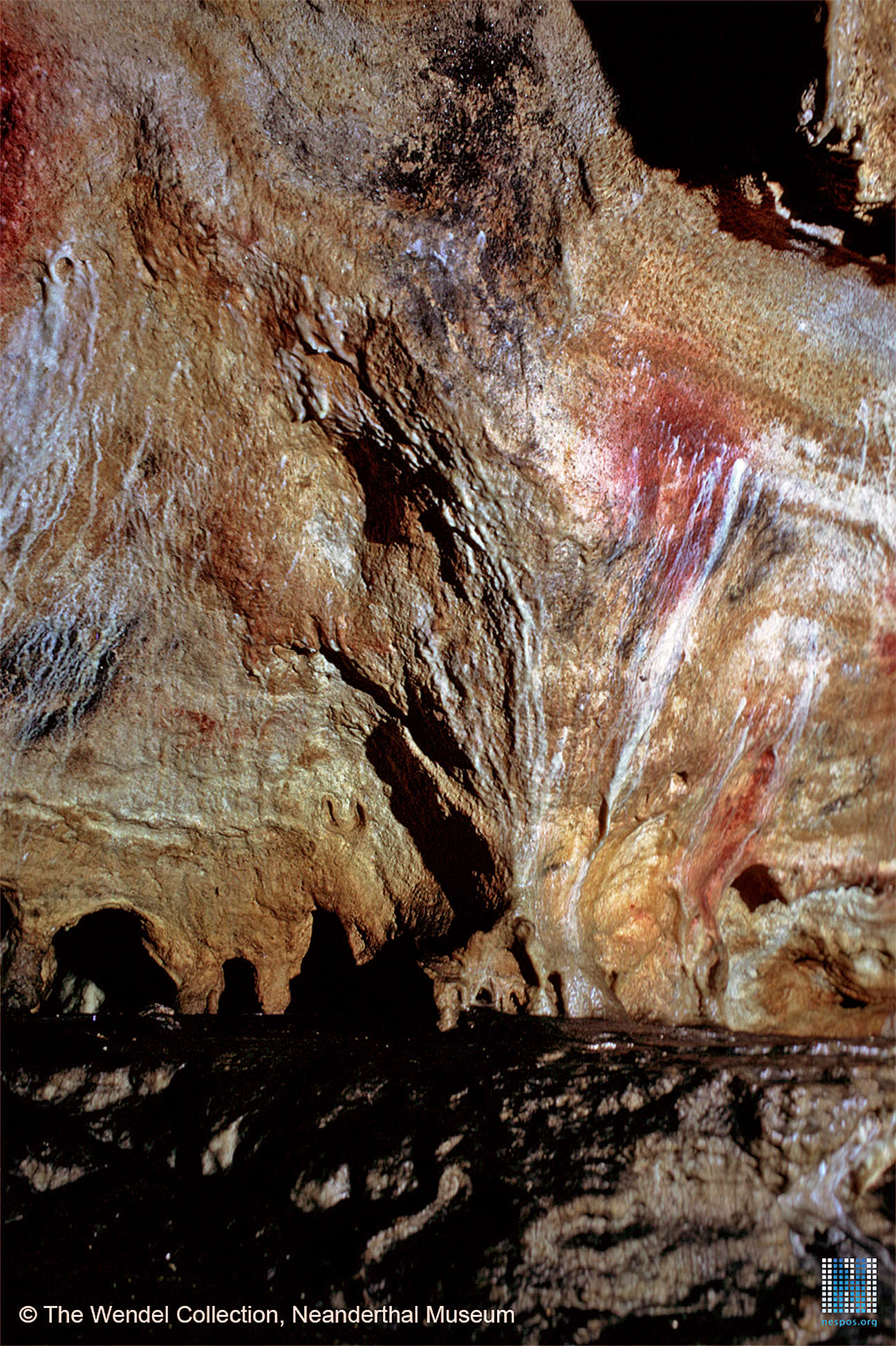
Grotte de Gargas Salle II
This part of the wall appears to have had a fair bit of pigment applied, but it is difficult to make out shapes.
A single black hand stencil can be seen to the right of the general shot of the wall, as well as a smudged red hand stencil below and to its right.
Both may be seen in more detail in the images below.
There appear to have once been some red hand stencils higher on the wall.
Photo: Heinrich Wendel (© The Wendel Collection, Neanderthal Museum)
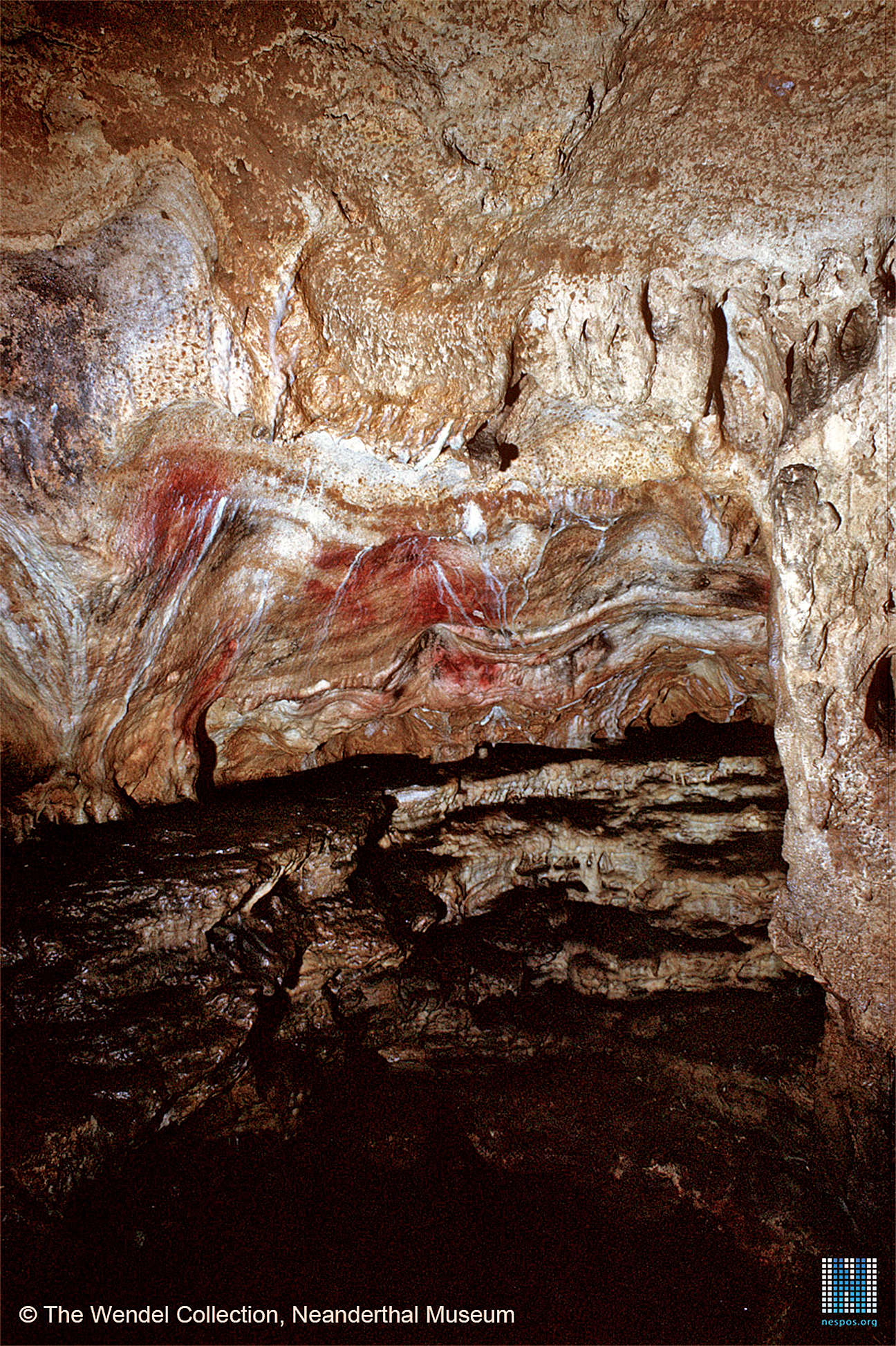

Grotte de Gargas Salle II
A black hand stencil, a smudged red hand stencil, and a smudged black hand stencil may be seen in the general (left) shot at the centre right.
In the image at the right, a close up of the leftmost black and smudged red stencils may be seen.
Photo: Heinrich Wendel (© The Wendel Collection, Neanderthal Museum)
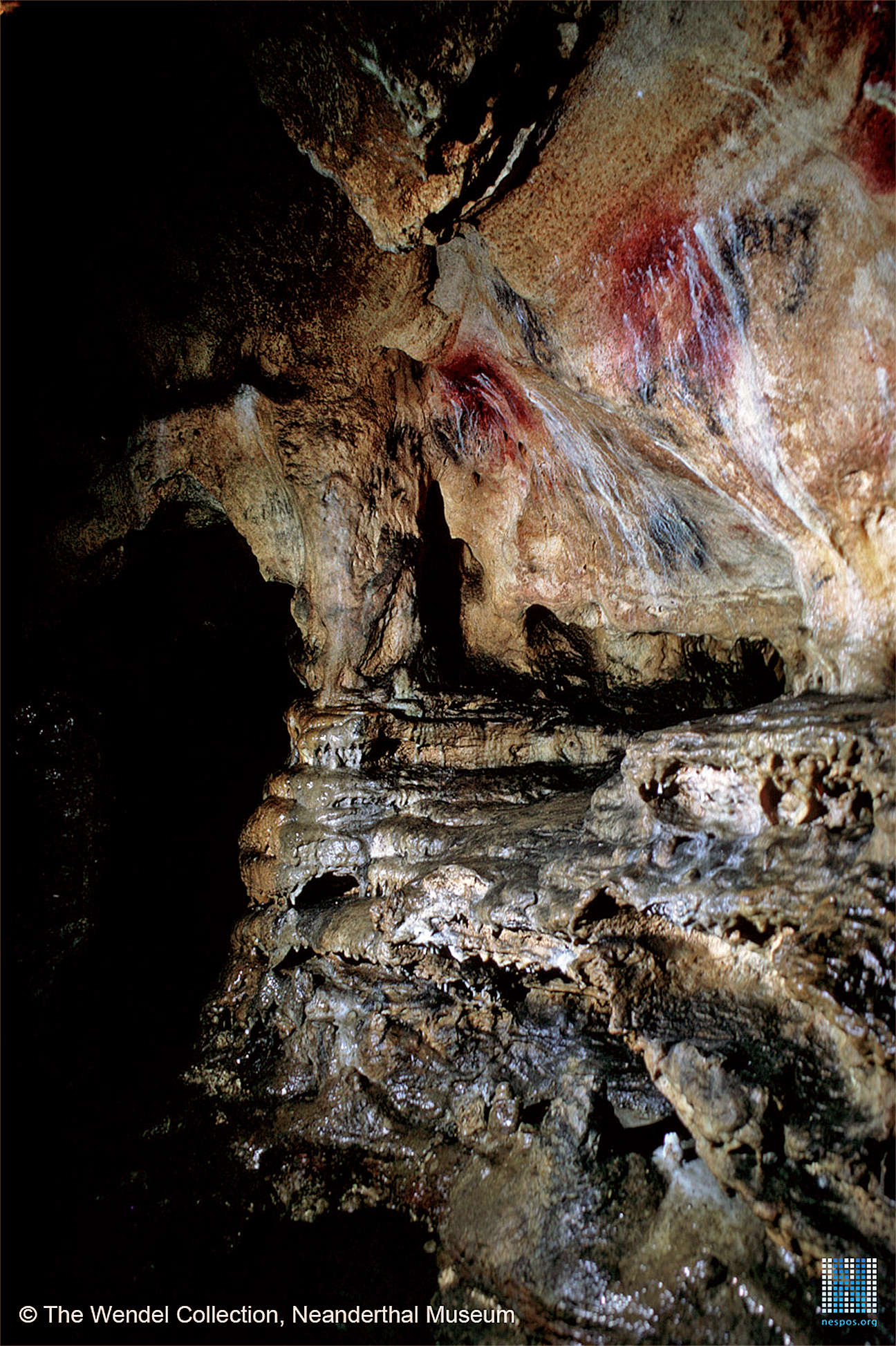
Grotte de Gargas Salle II
Two smudged red stencils and a fairly clear black hand stencil may be seen in this image.
Photo: Heinrich Wendel (© The Wendel Collection, Neanderthal Museum)

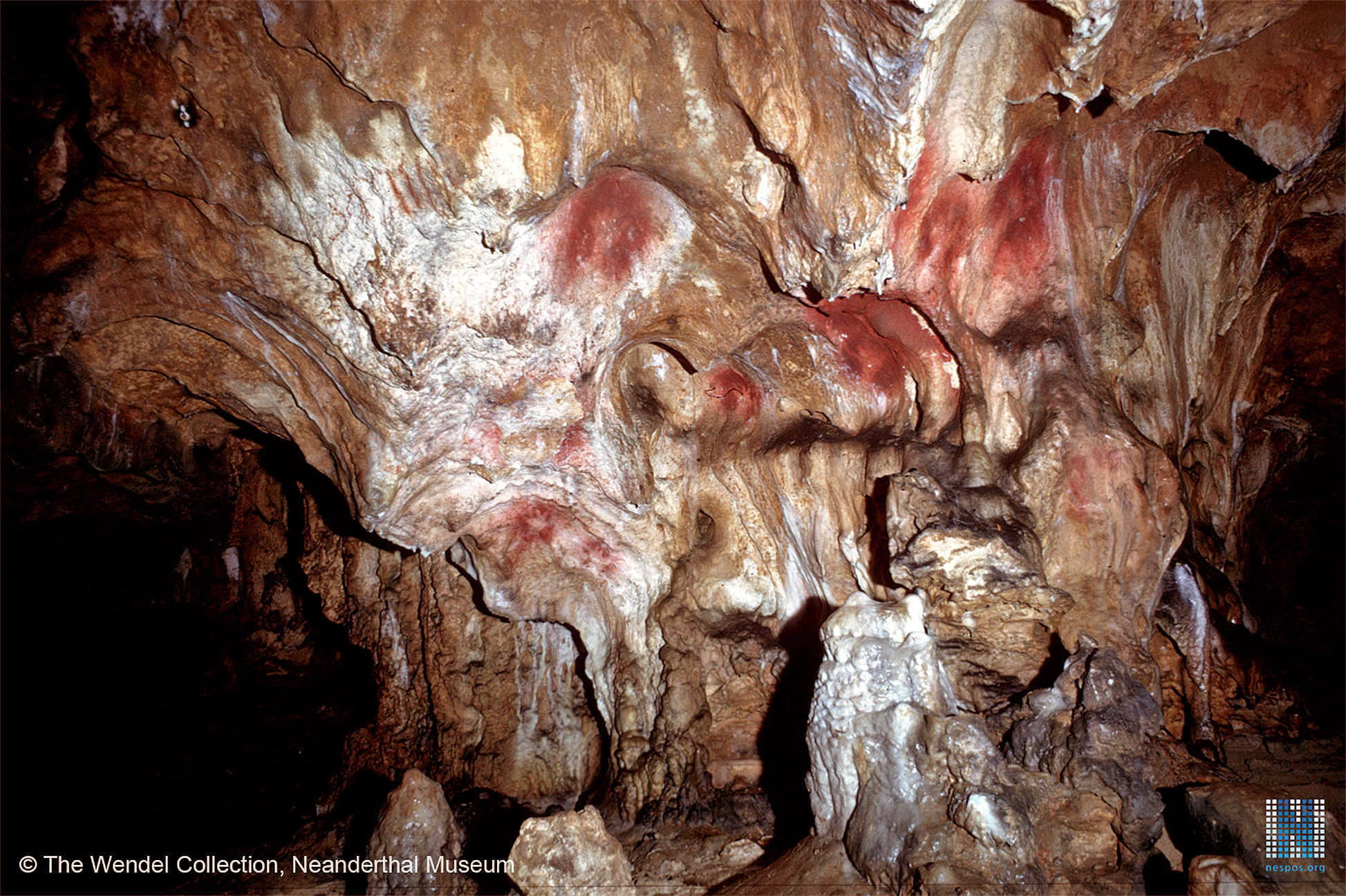
Grotte de Gargas Salle II
Several red hand stencils may be seen in this panel, as well as some quite small hand stencils, possibly of children, lower down on the wall, where they would logically be expected.
Photo: Heinrich Wendel (© The Wendel Collection, Neanderthal Museum)
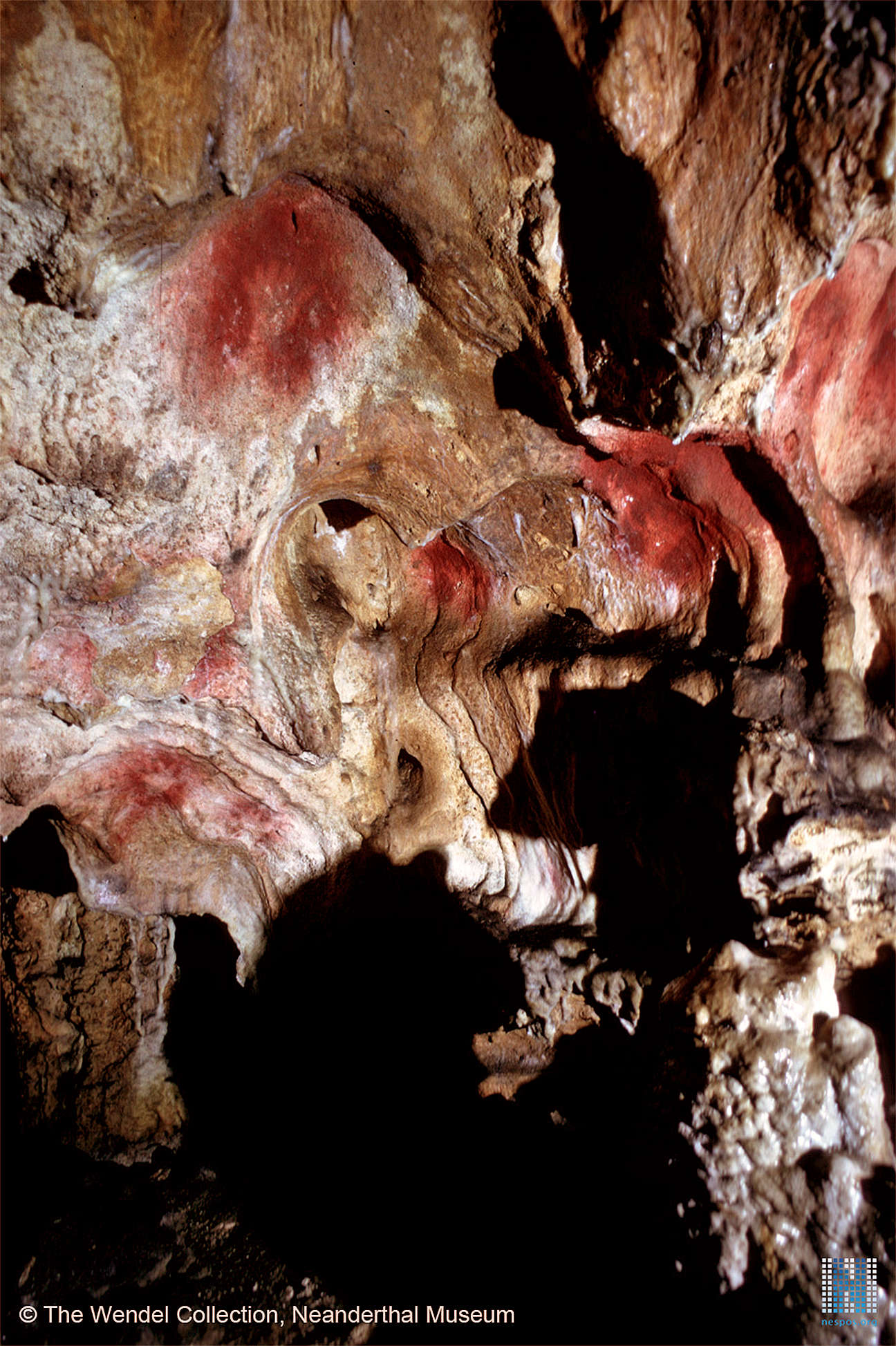
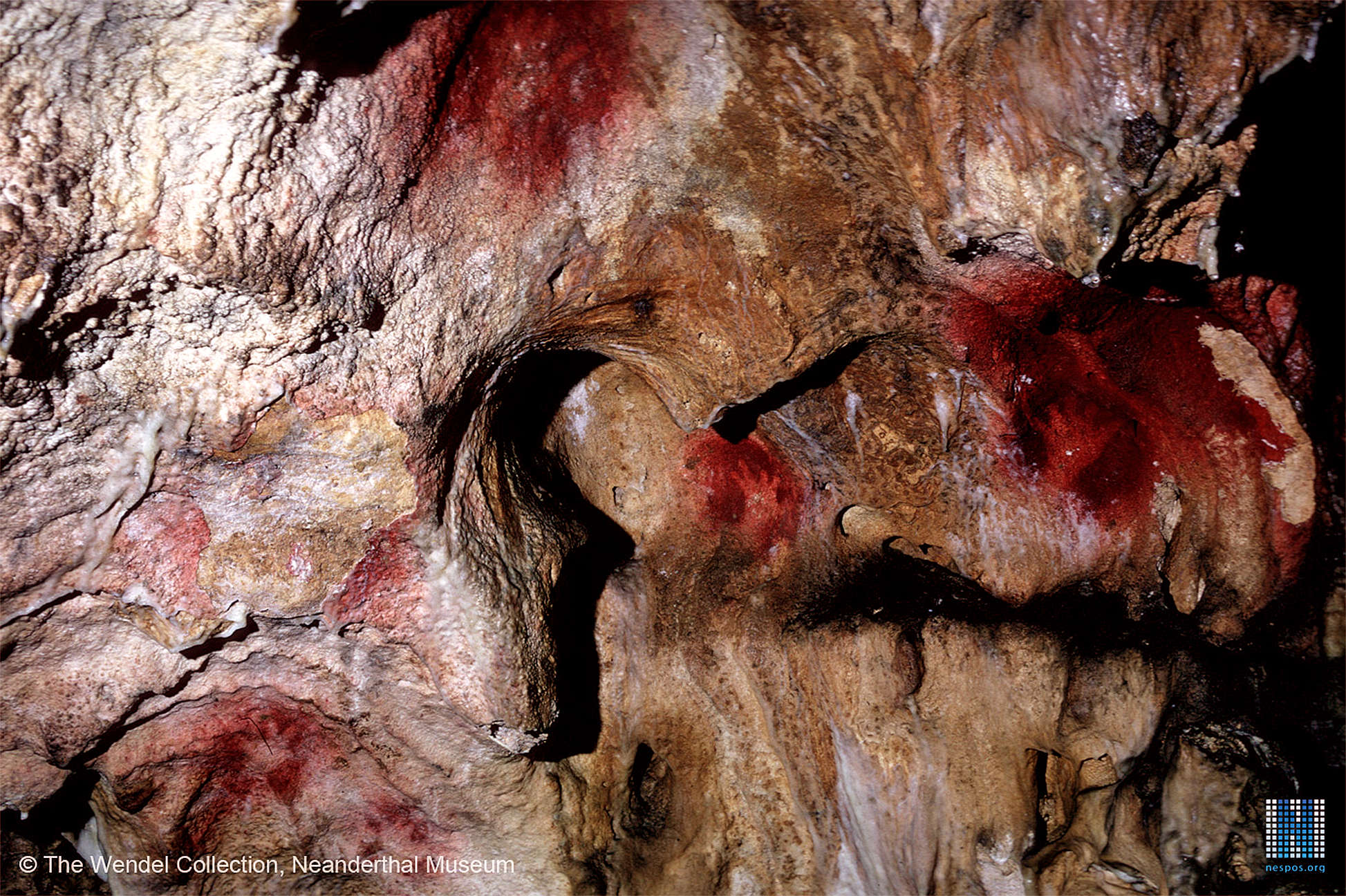
Grotte de Gargas Salle II
Close ups of the panel above.
Photo: Heinrich Wendel (© The Wendel Collection, Neanderthal Museum)
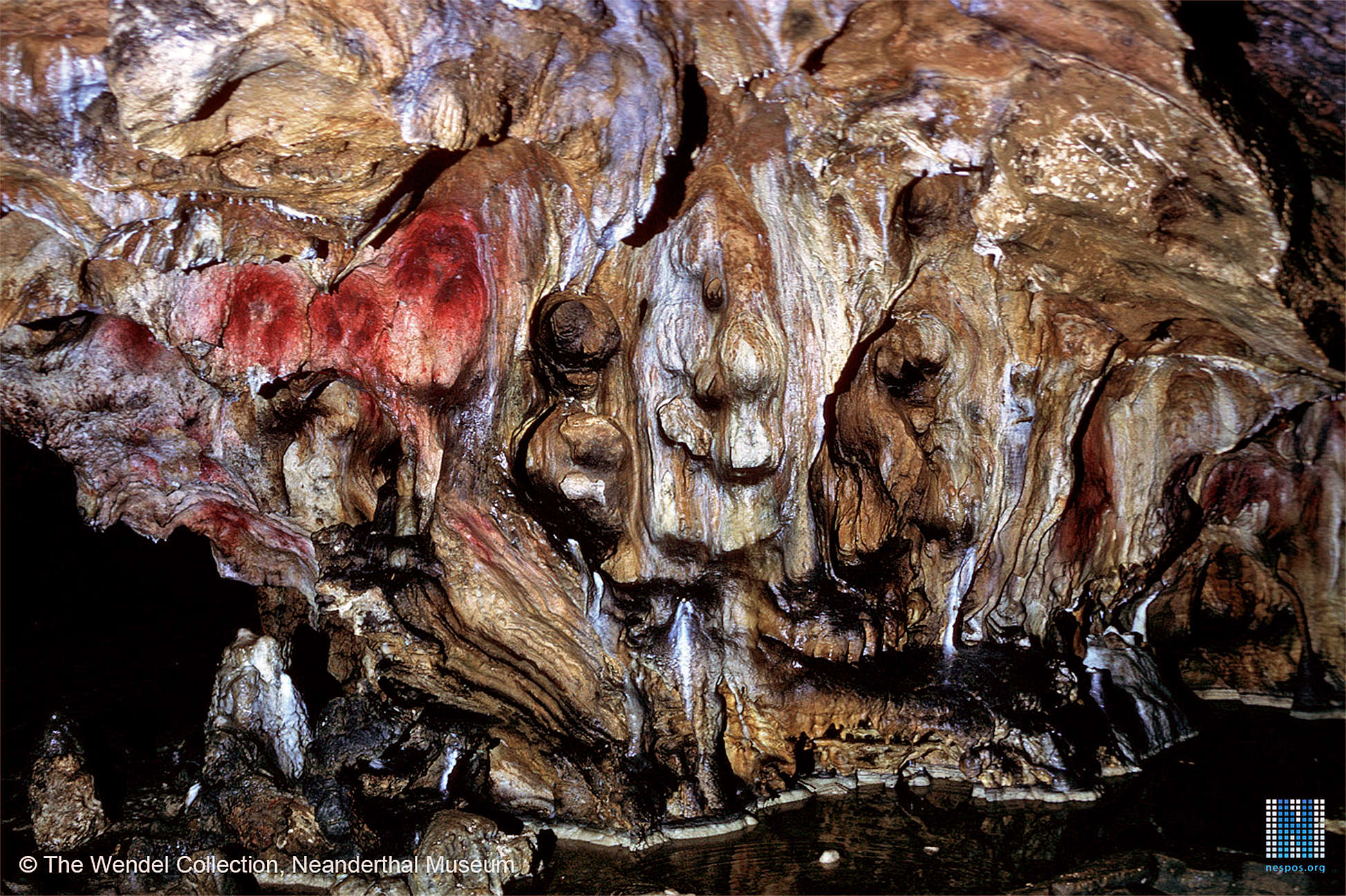
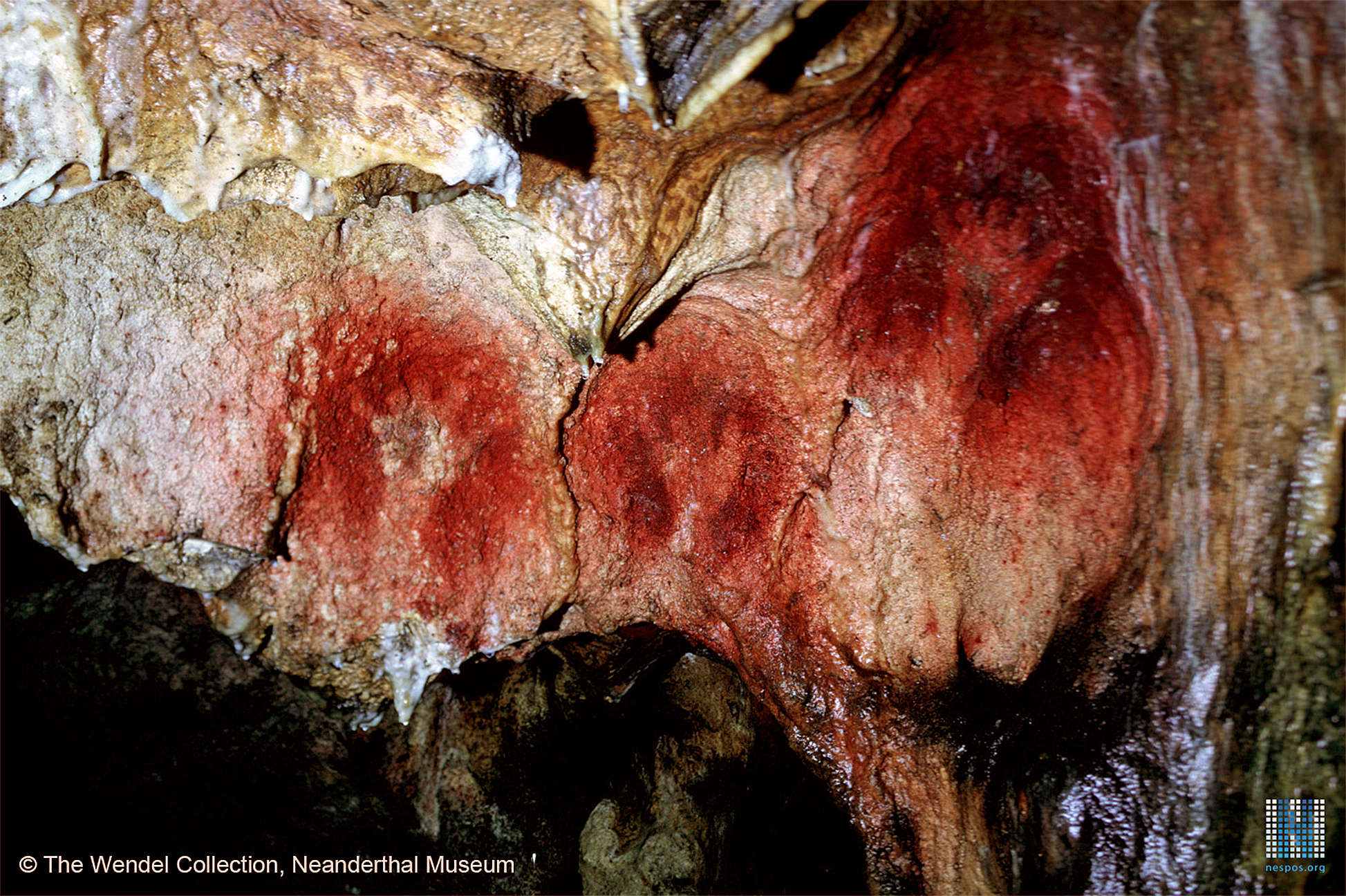
Grotte de Gargas Salle II
These hand stencils may be further along to the right of the panel above, although it is impossible to be certain.
The stencils show evidence of mutilation. There is standing water on the floor in this section of the cave.
Photo: Heinrich Wendel (© The Wendel Collection, Neanderthal Museum)
Chambre du Camarin
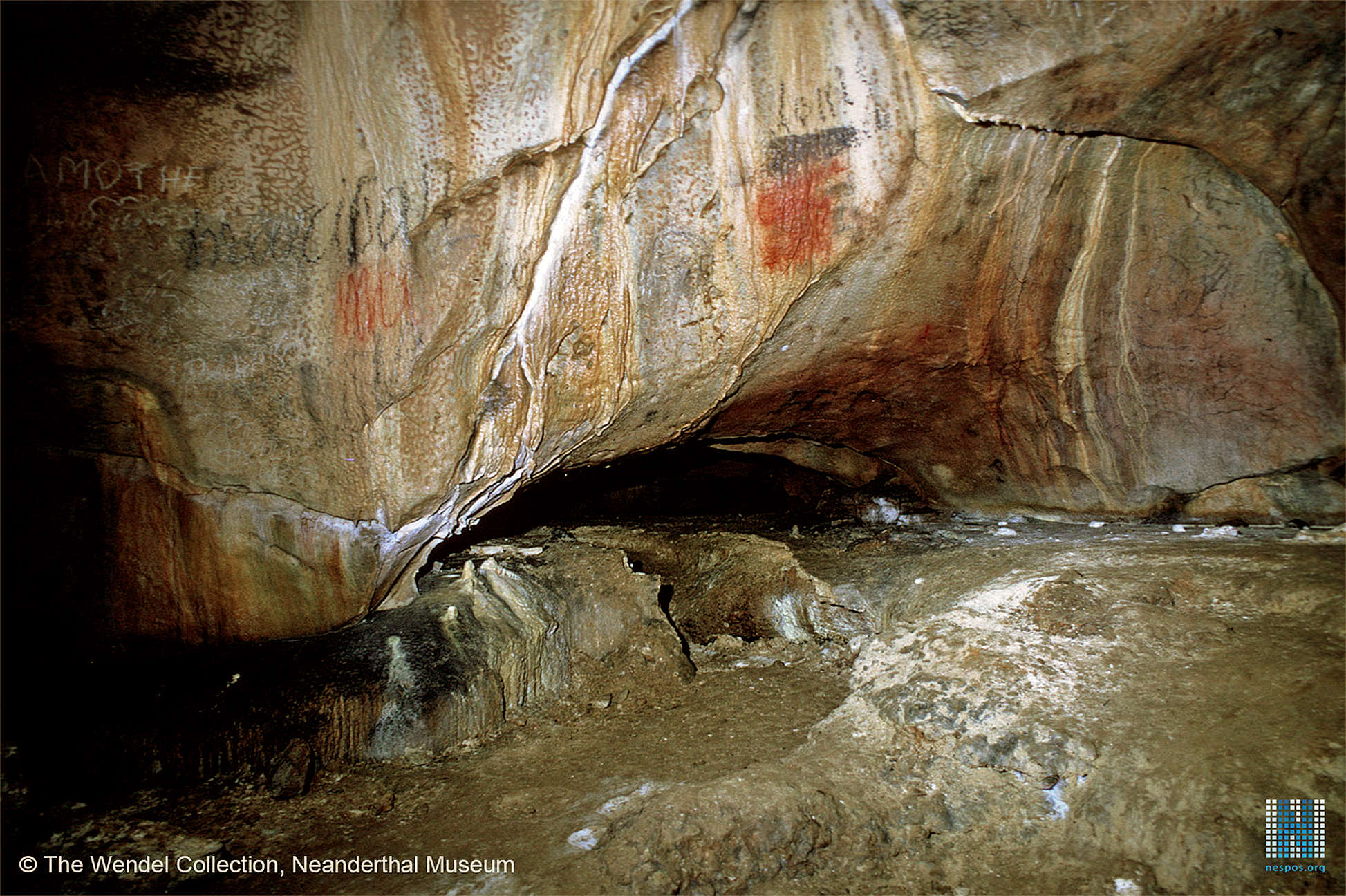
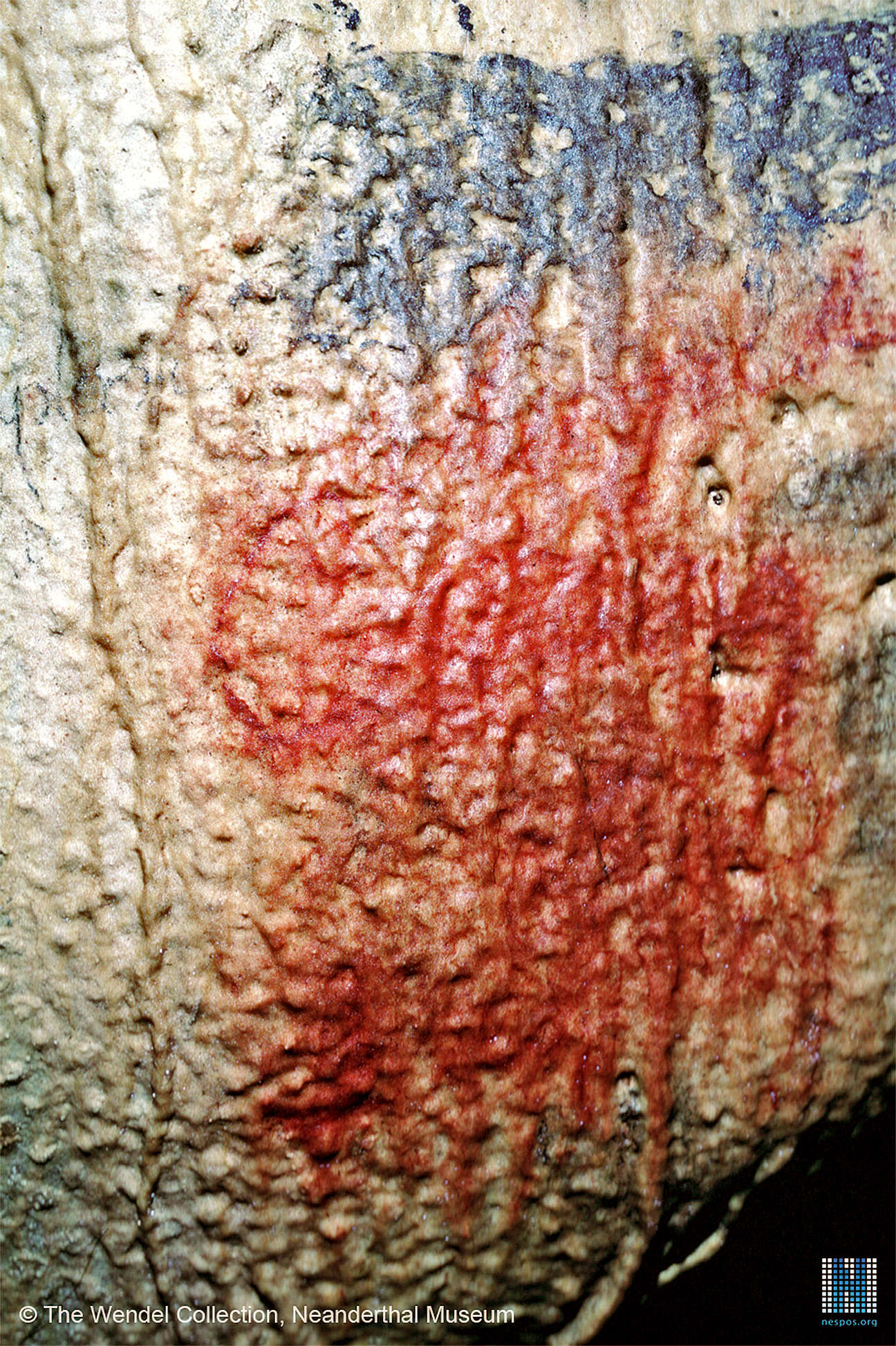
Large splash of colours on an archway at the Camarin.
The striking blue colour in the close up image is probably an artefact of the photographic process, and is almost certainly black when viewed in situ.
Photo: Heinrich Wendel (© The Wendel Collection, Neanderthal Museum)
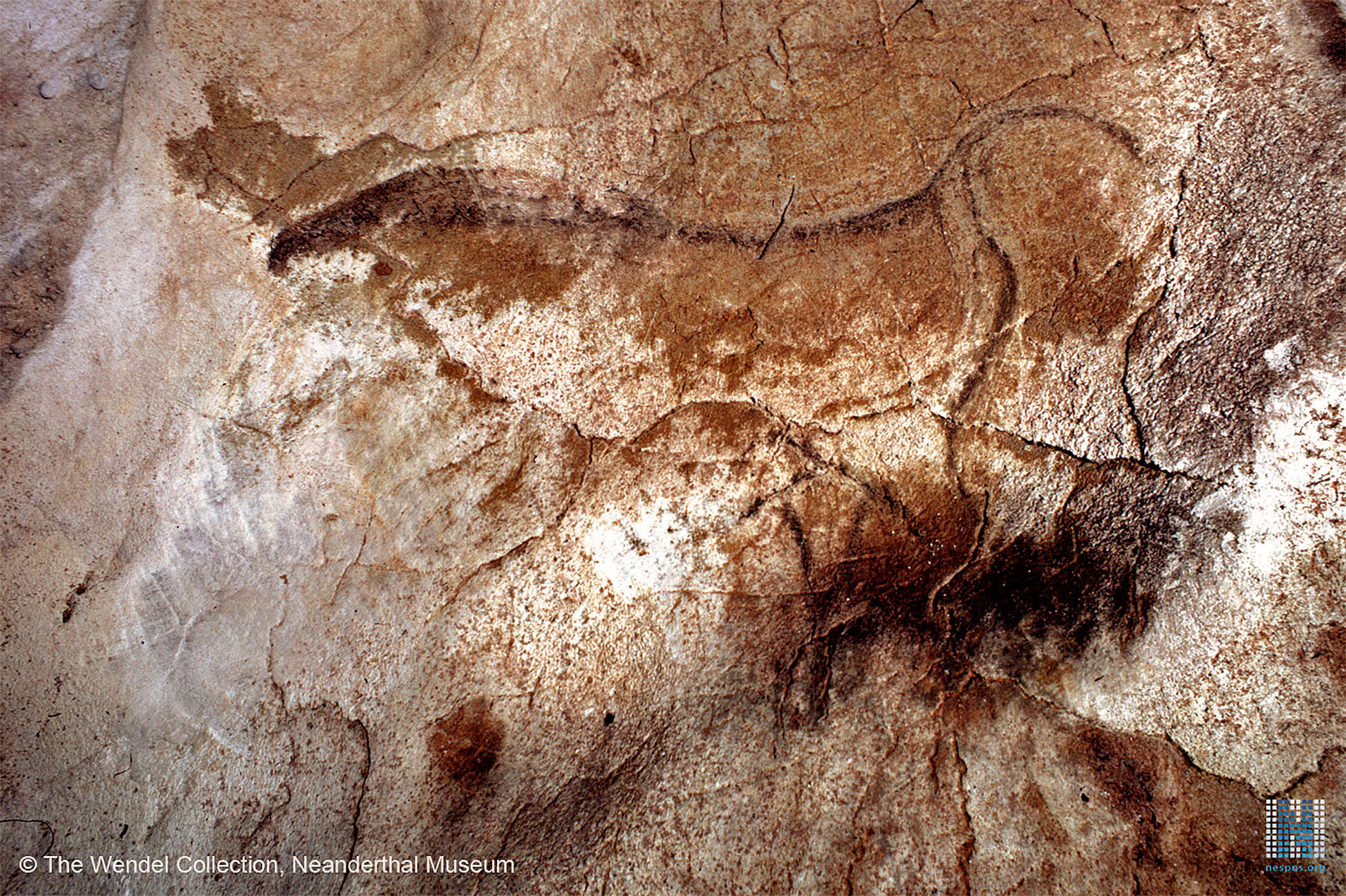
What appears to be the powerful hindquarters of a stallion, as well as the dorsal line, at the Camarin.
Photo: Heinrich Wendel (© The Wendel Collection, Neanderthal Museum)

Sadly, many of the walls are disfigured by graffiti. The large black graffiti were probably done using the soot from a burning brand.
It would appear that the centre of the passage at the Camarin has been artificially deepened to allow visitors to stand upright, and also to help to keep them away from the paintings and engravings.
Photo: Heinrich Wendel (© The Wendel Collection, Neanderthal Museum)
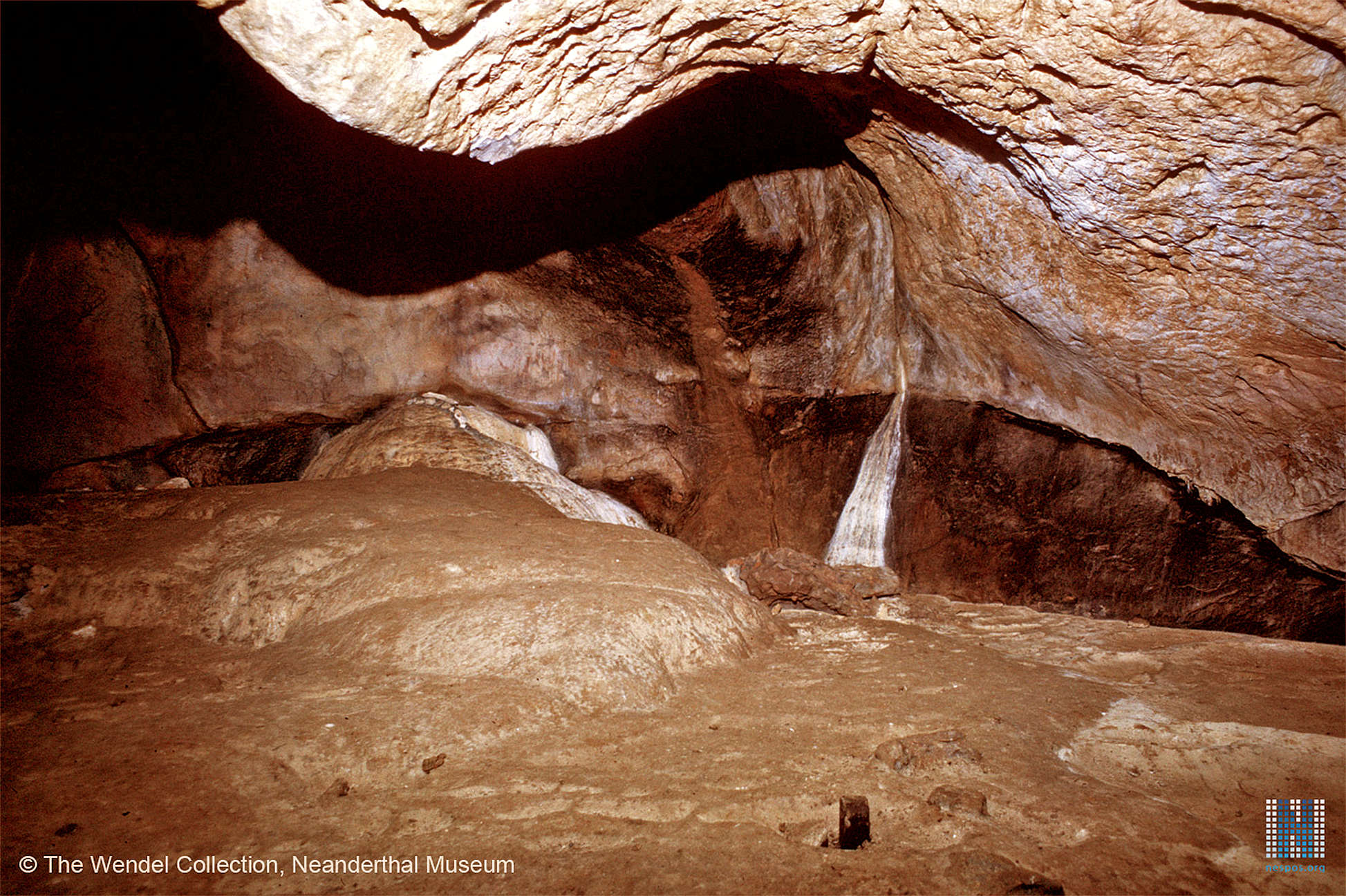
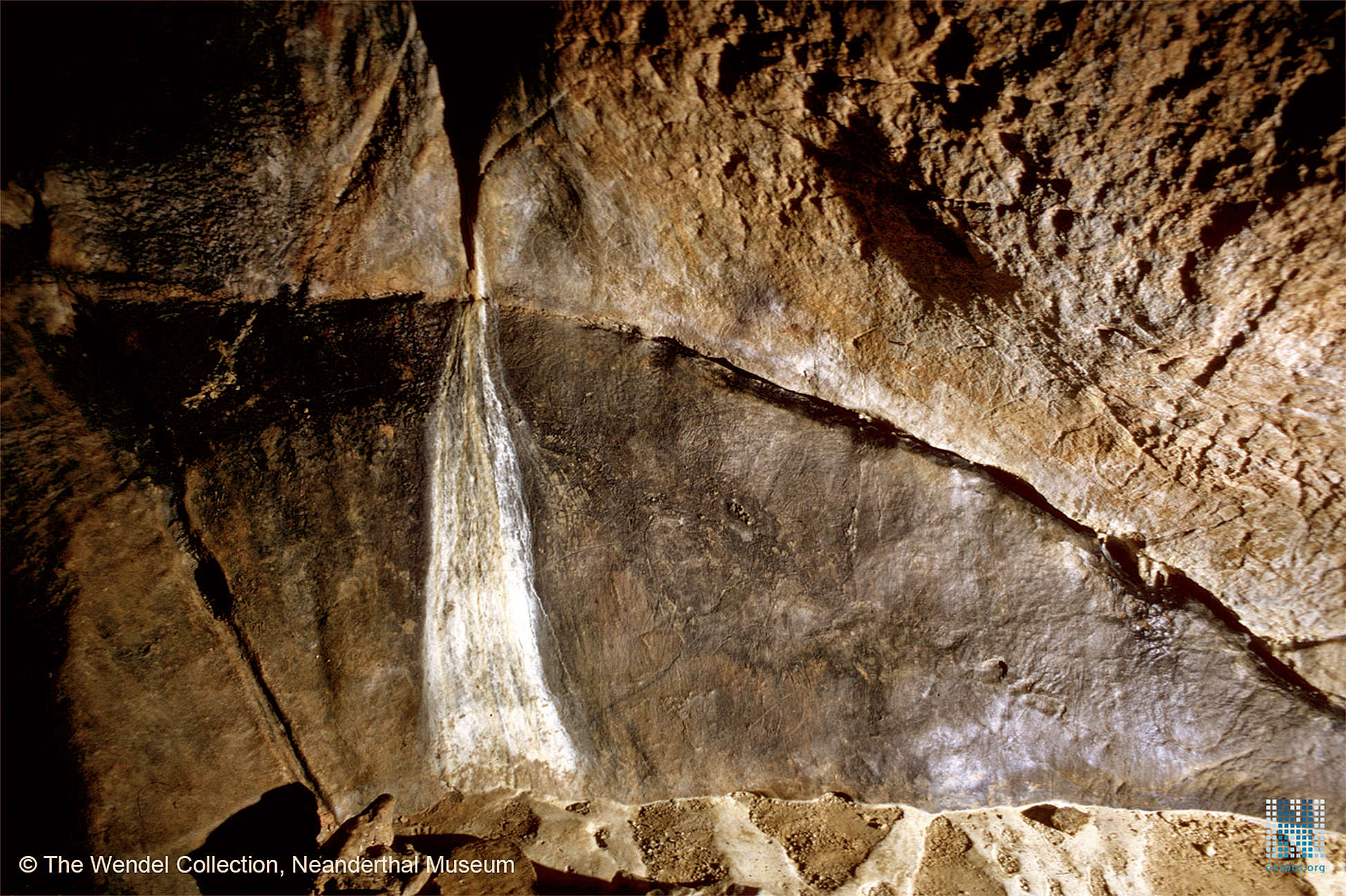
Two views of a wall in the Camarin with engravings on the dark area beside the white mark at the back of the salle.
Photo: Heinrich Wendel (© The Wendel Collection, Neanderthal Museum)
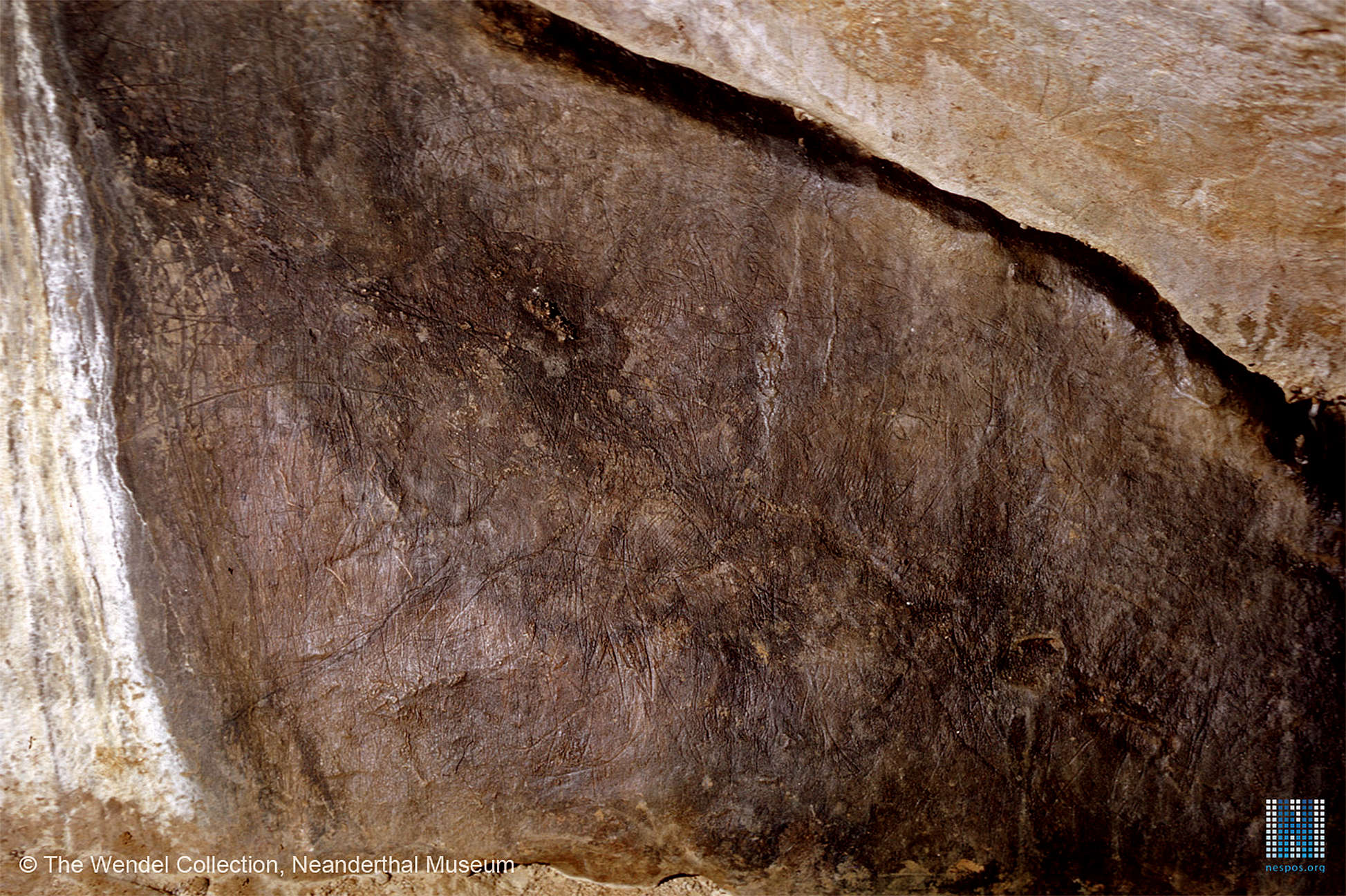
This is a closeup of the engravings in the Camarin.
It is very difficult to make out any shapes. It is possible that when they were made, the substrate was revealed, making them easy to see, but with the passage of time the entire surface is now just one colour. However, a number of animal heads can be discerned.
Photo: Heinrich Wendel (© The Wendel Collection, Neanderthal Museum)
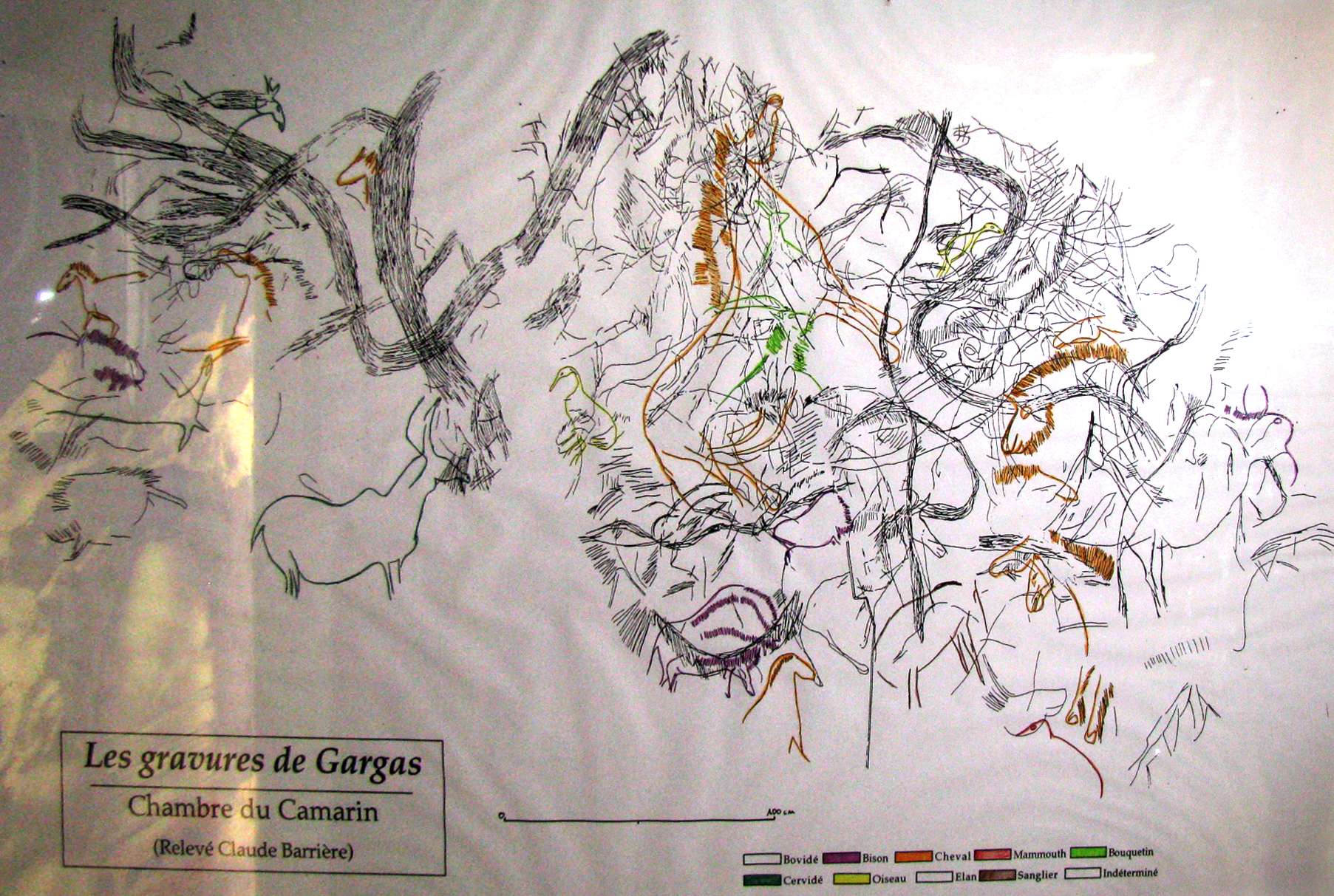
These are the engravings at the Chambre du Camarin as drawn by Claude Barrière. I have been unable to match any of them to the image above.
Photo: Don Hitchcock 2008
Source: Display, Grotte de Gargas
Artist: Claude Barrière
Bones and tools from Grotte de Gargas
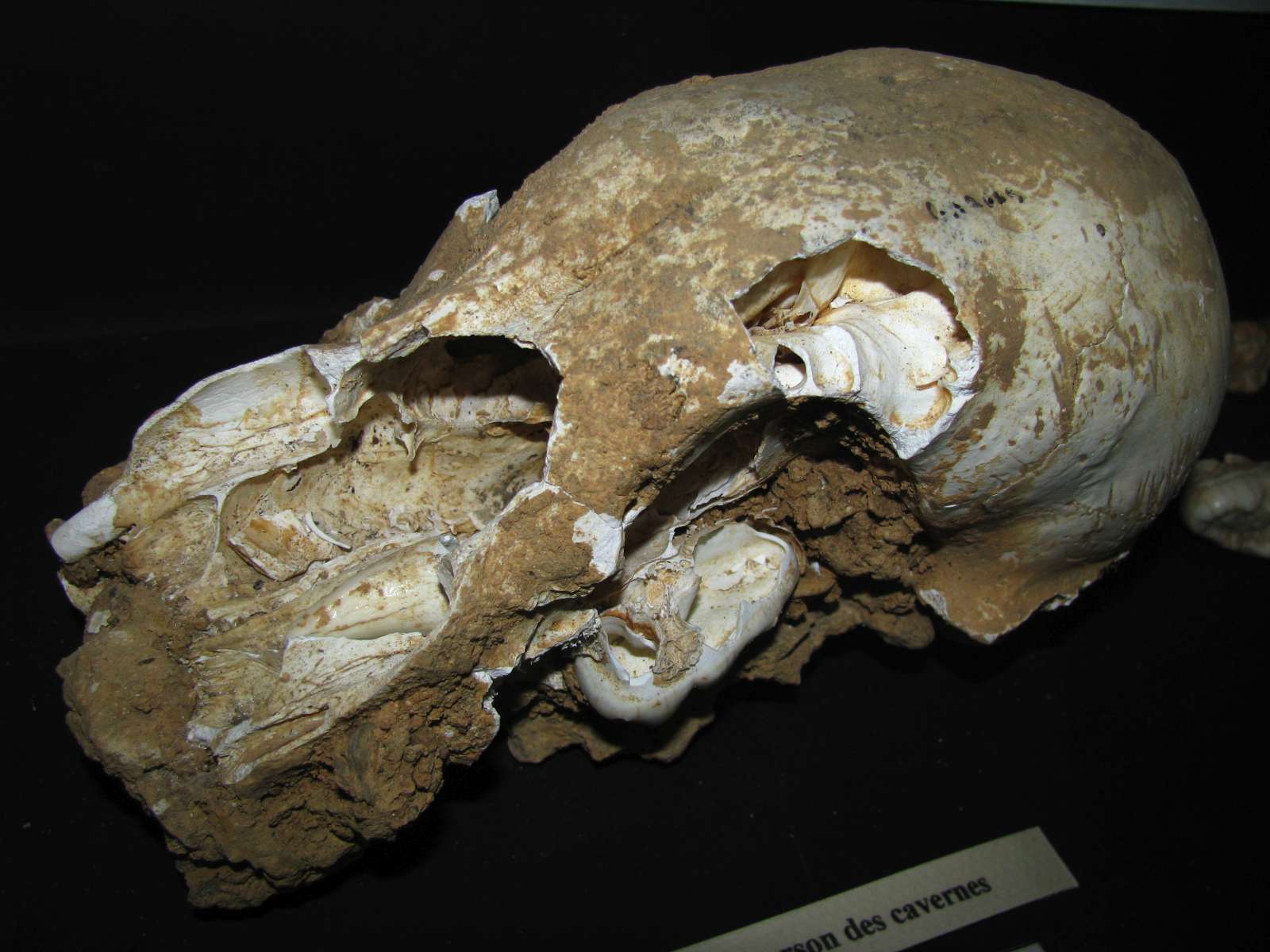
Skull of a cavebear from the Grotte de Gargas
Photo: Don Hitchcock 2008
Source: Original, display, Grotte de Gargas
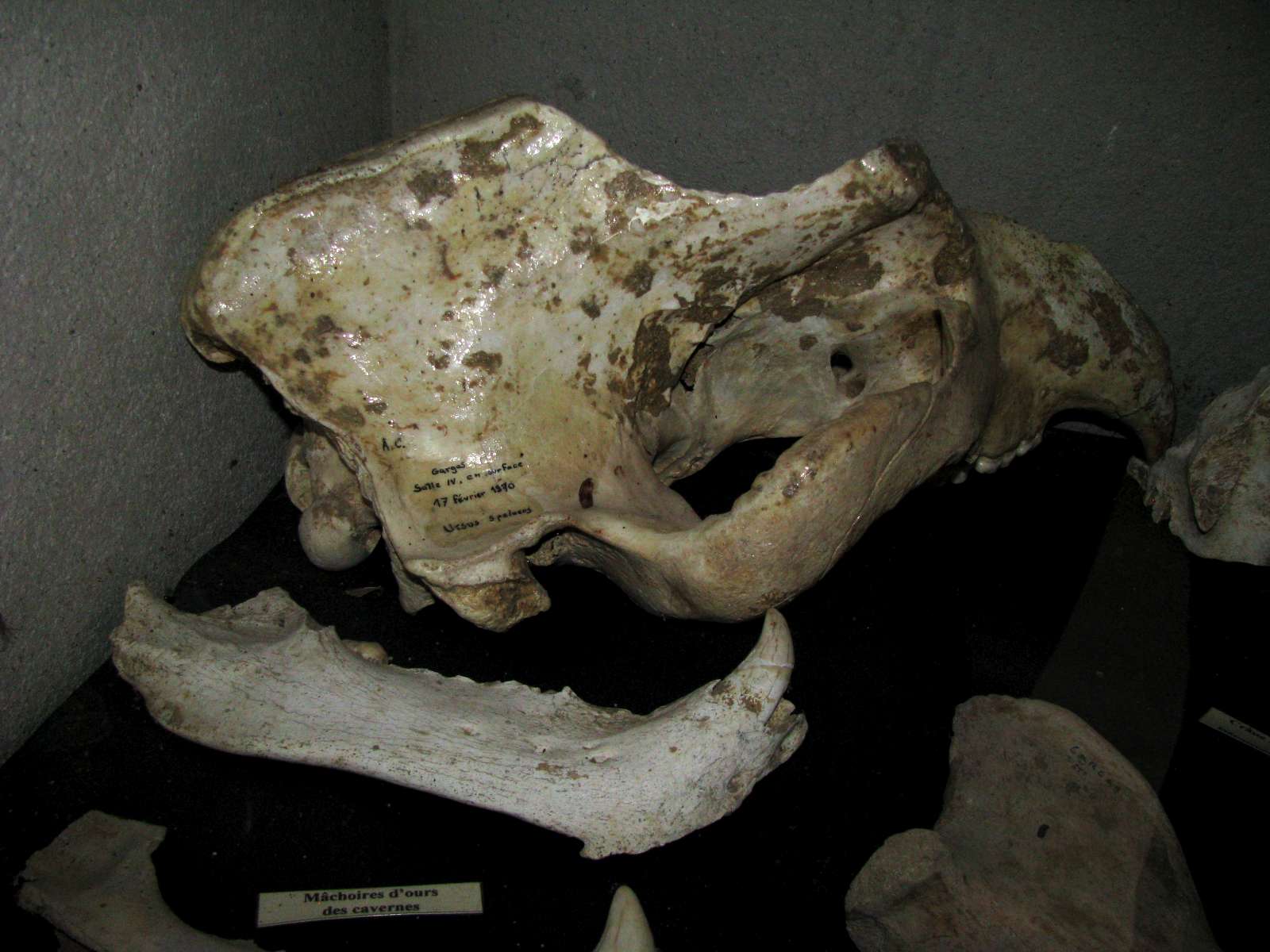
Jaw and skull of cave bear, Grotte de Gargas.
The inscription on the skull reads:
A.C.
Gargas
Salle IV, en surface
17 Février 1870
Ursus spelaeus
It is wonderful to have this sort of information recorded so completely. So often nothing is known about a particular artefact or fossil.
Photo: Don Hitchcock 2008
Source: Original, display, Grotte de Gargas

Skull of a Cave Bear, Grotte de Gargas. Found in 1870 by A. Clot.
The label reads:
Crâne d'ours des cavernes
adulte
Découverie au 1870 A. Clot.
Photo: Don Hitchcock 2008
Source: Original, display, Grotte de Gargas
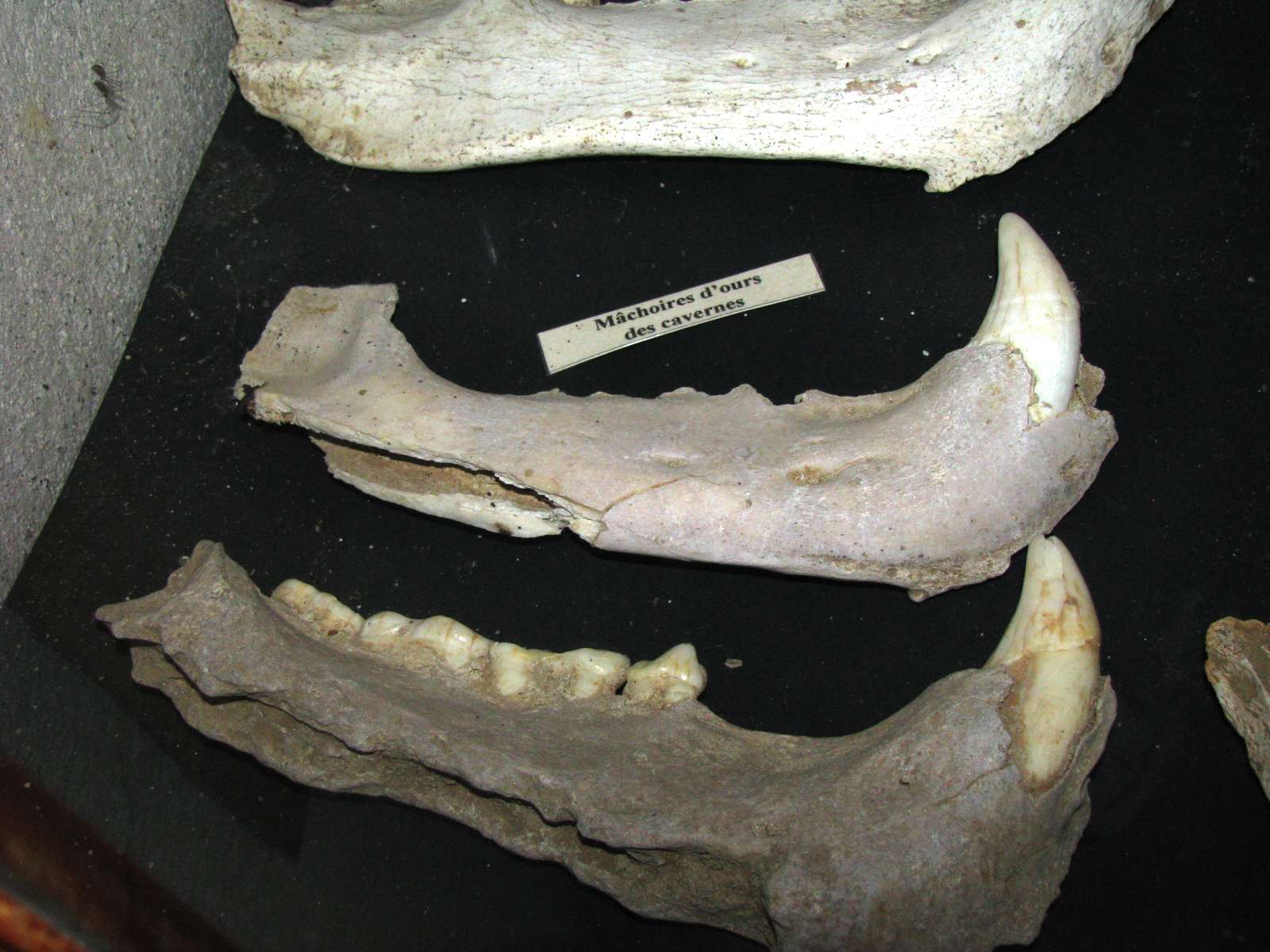

Jaws of Cave Bears, Grotte de Gargas.
Photo: Don Hitchcock 2008
Source: Original, display, Grotte de Gargas
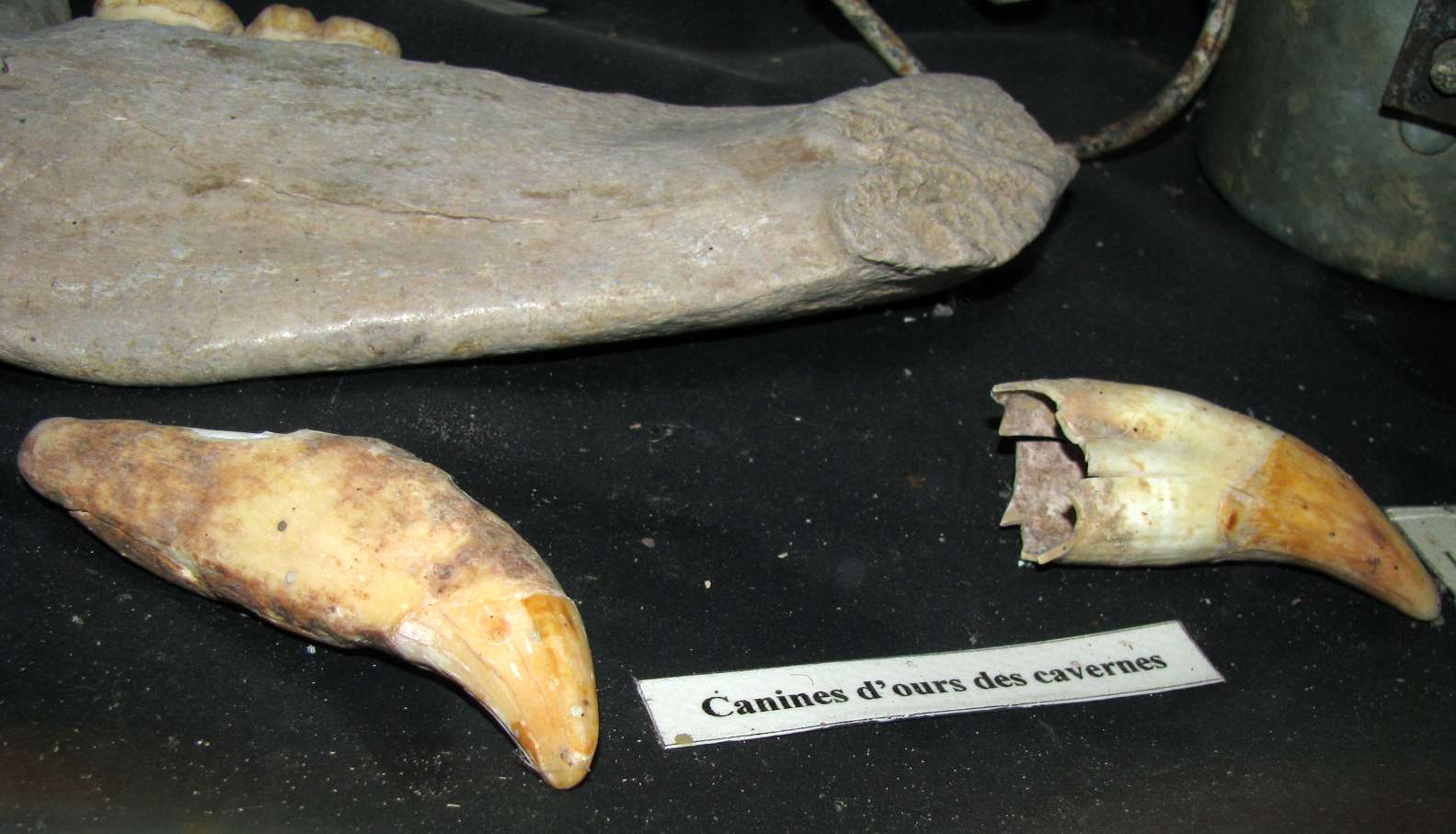
Canine teeth of cavebears from the Grotte de Gargas.
Photo: Don Hitchcock 2008
Source: Original, display, Grotte de Gargas
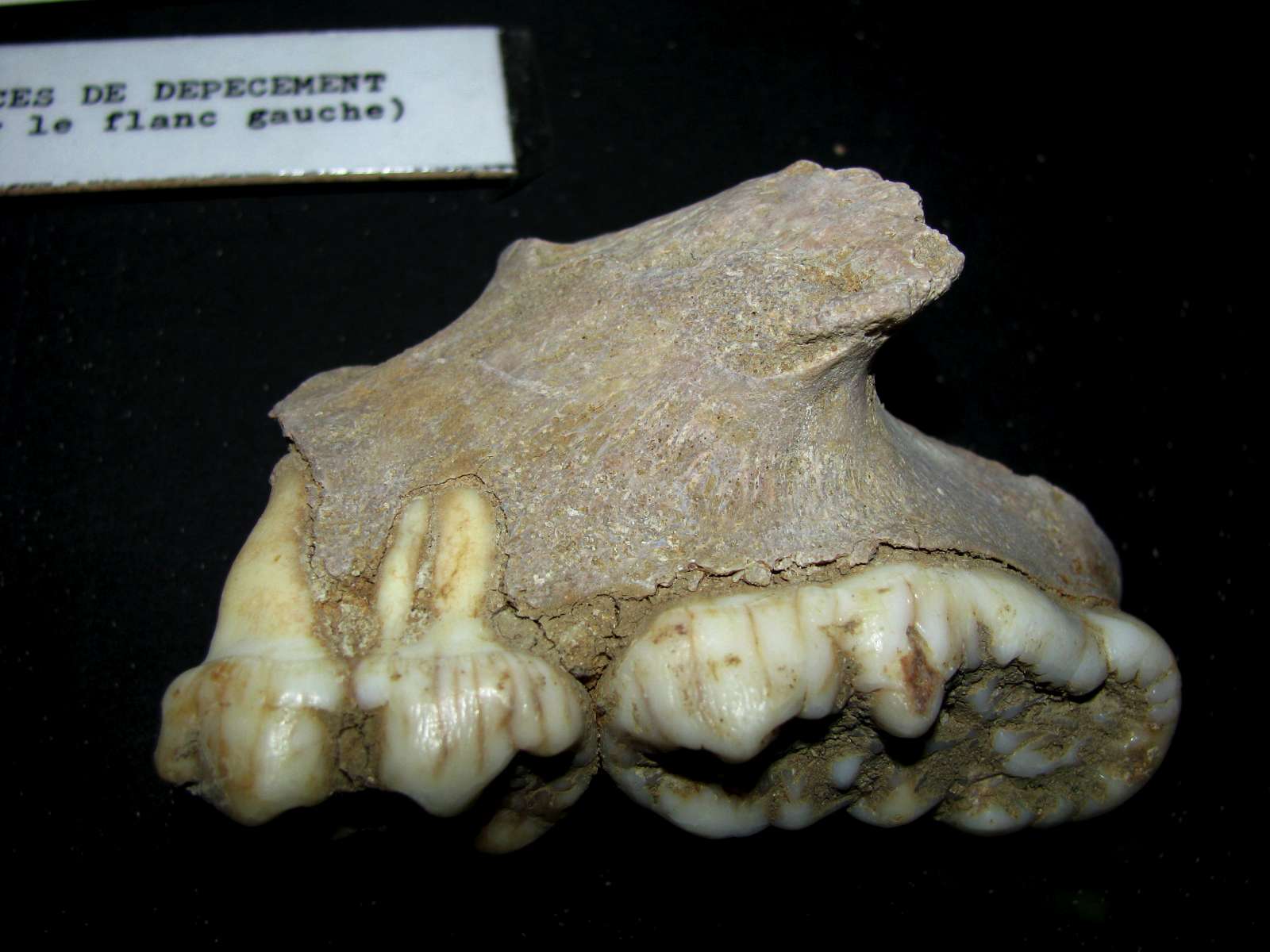
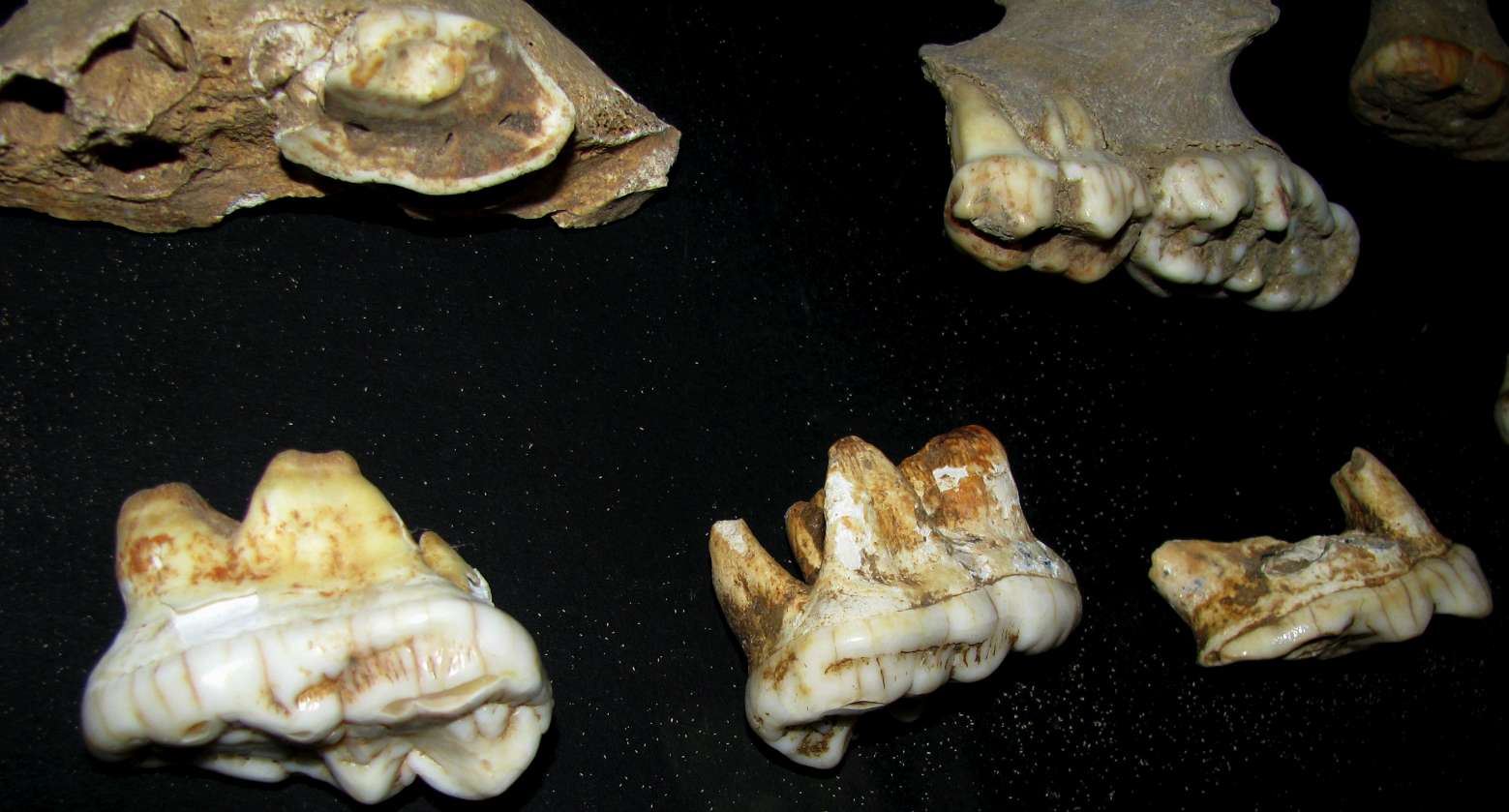
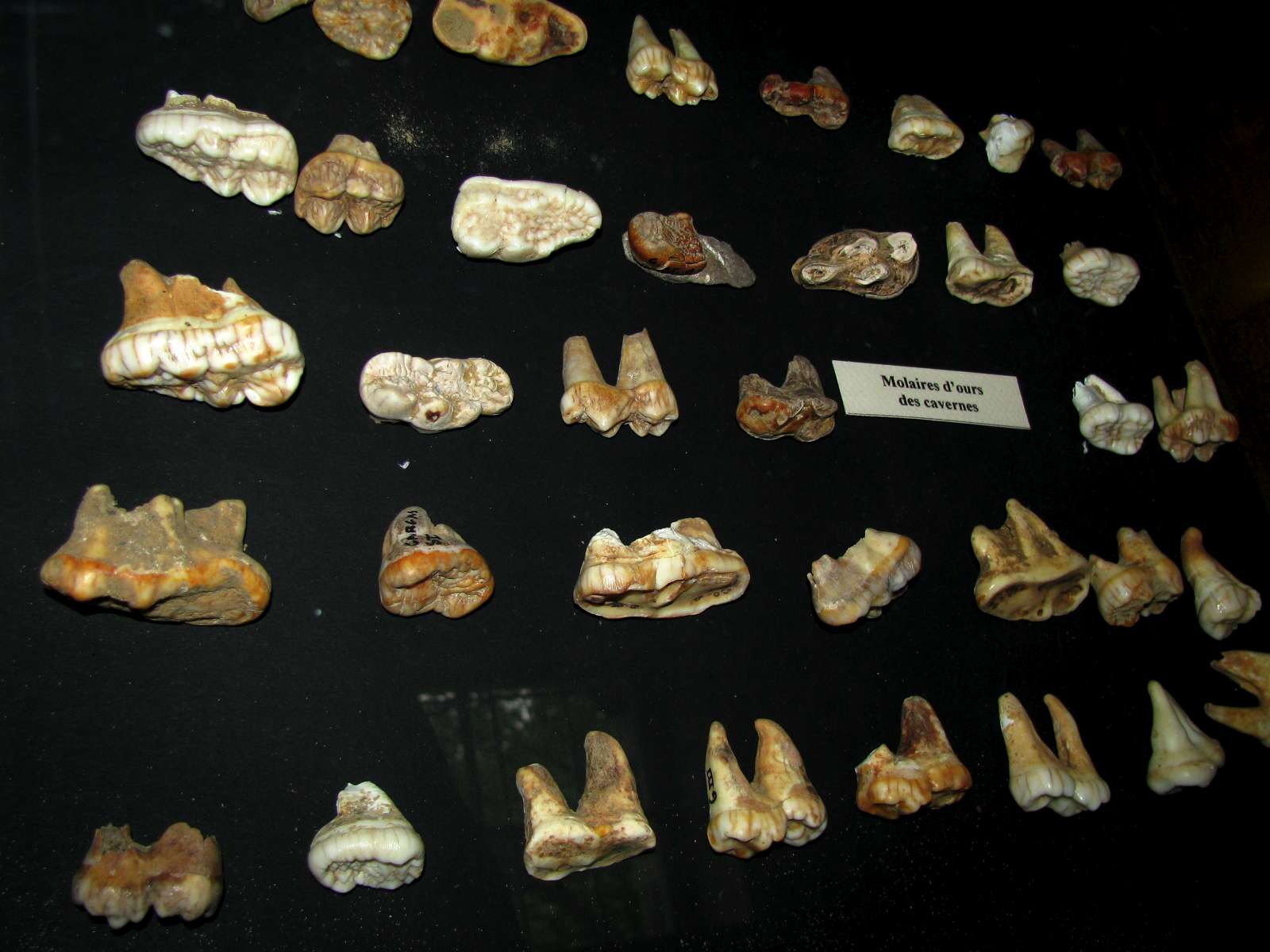
Teeth of cavebears from the Grotte de Gargas. Teeth are more often preserved than other bones.
Photo: Don Hitchcock 2008
Source: Original, display, Grotte de Gargas
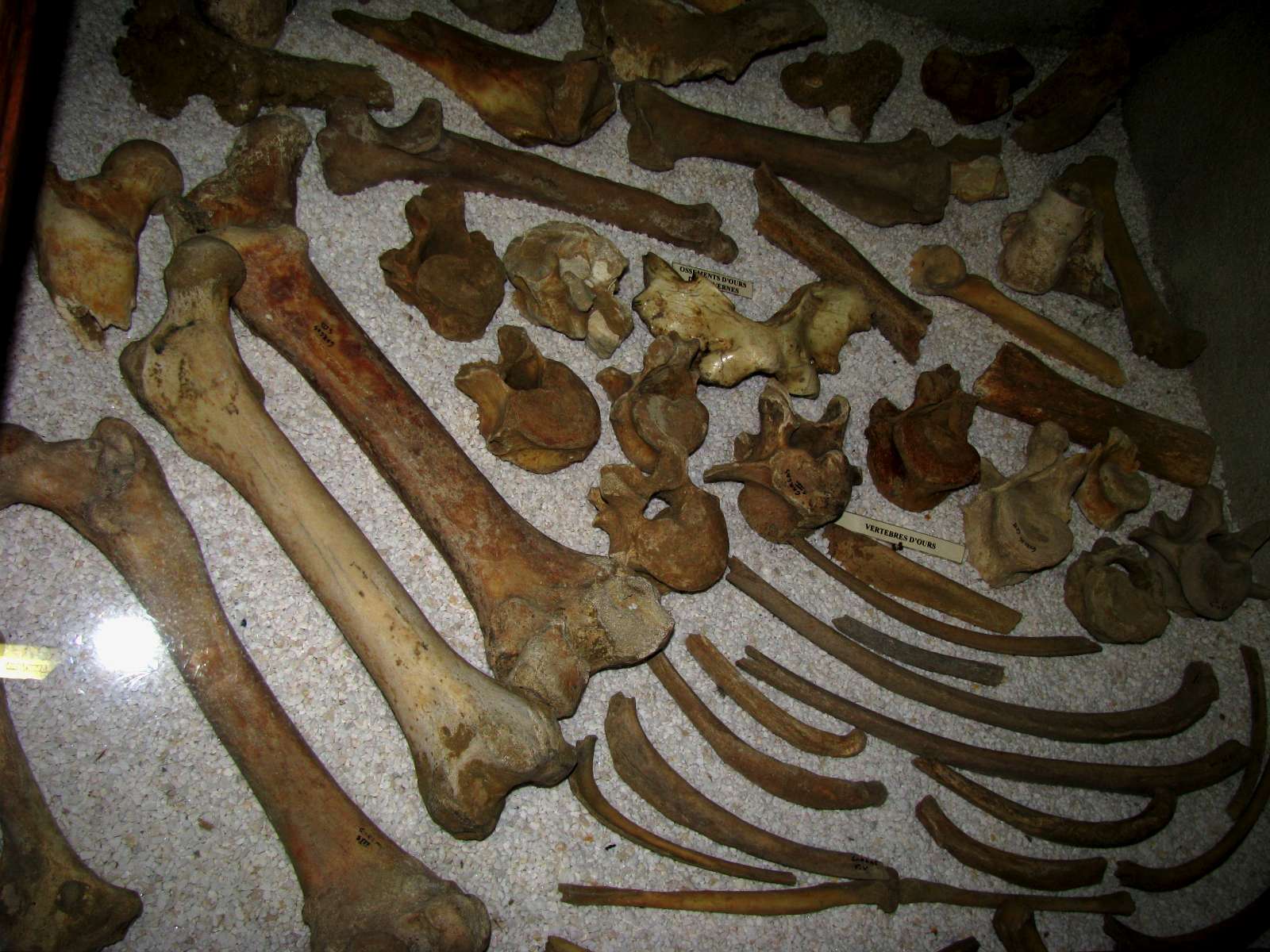
Cavebear leg, rib, vertebrae and other bones from the Grotte de Gargas.
Photo: Don Hitchcock 2008
Source: Original, display, Grotte de Gargas
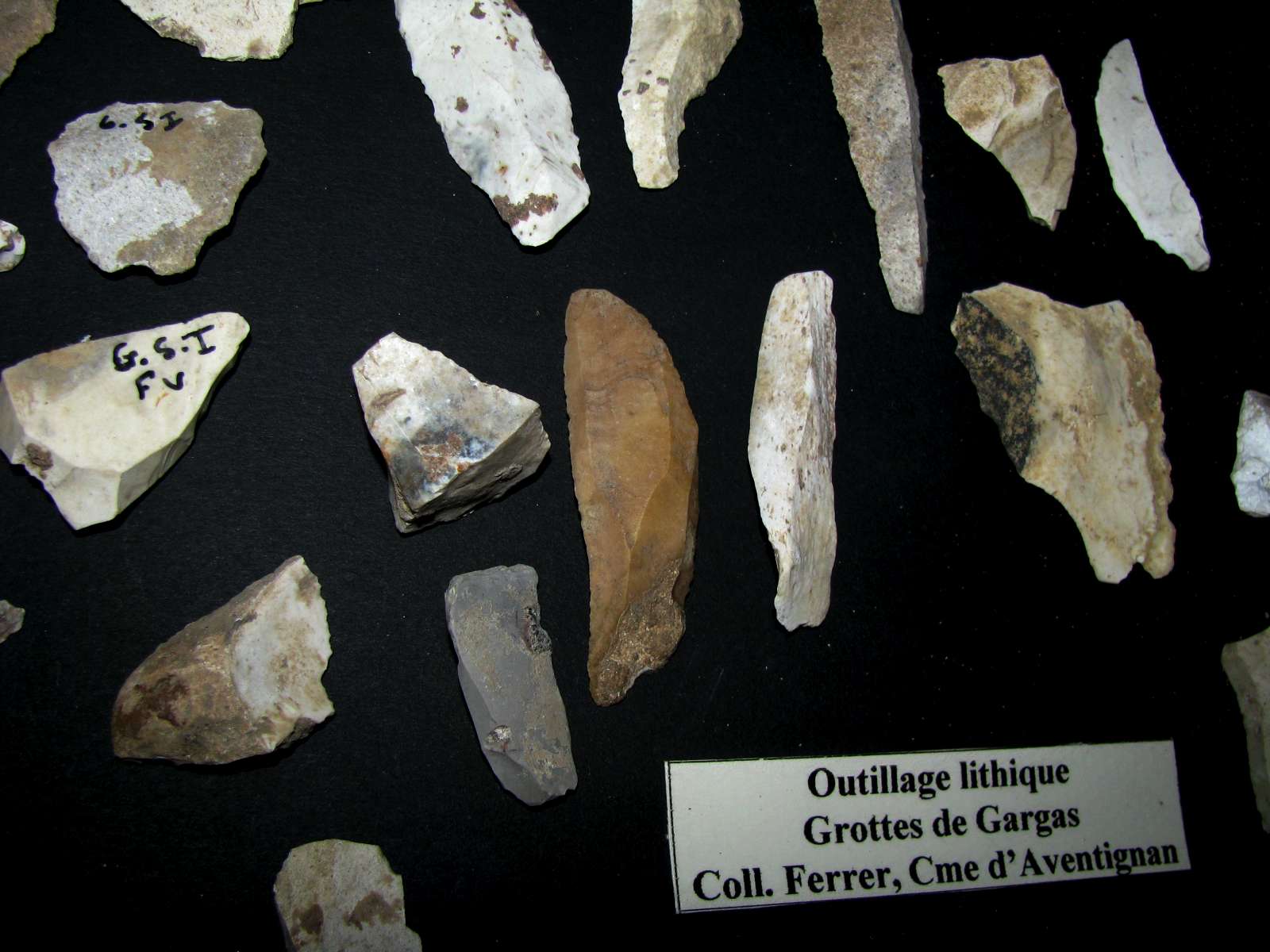

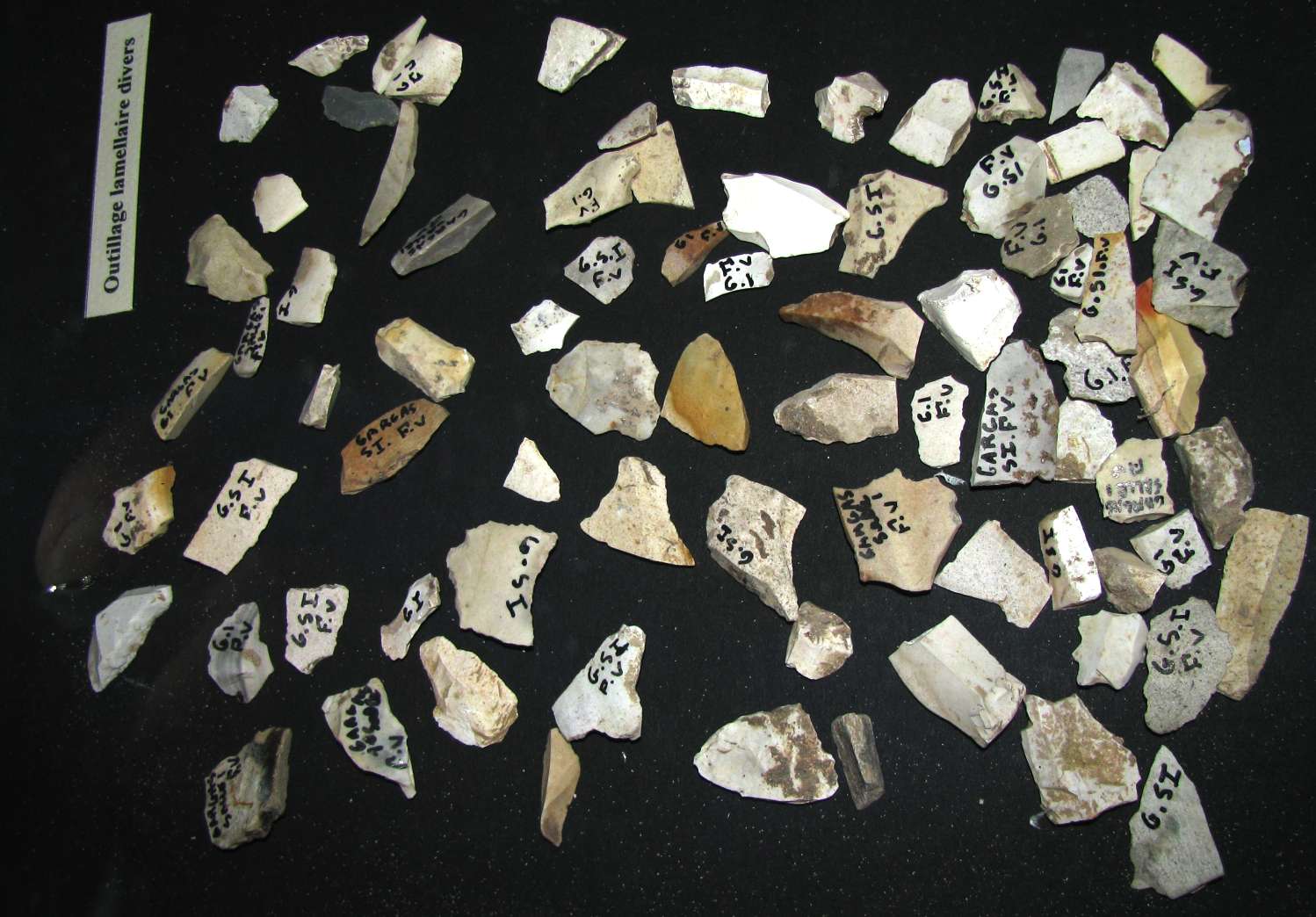
Lithic industries from Gargas.
The identification G.S.I indicates that a tool came from Gargas, Salle I.
Photo: Don Hitchcock 2008
Source: Originals, display, Grotte de Gargas
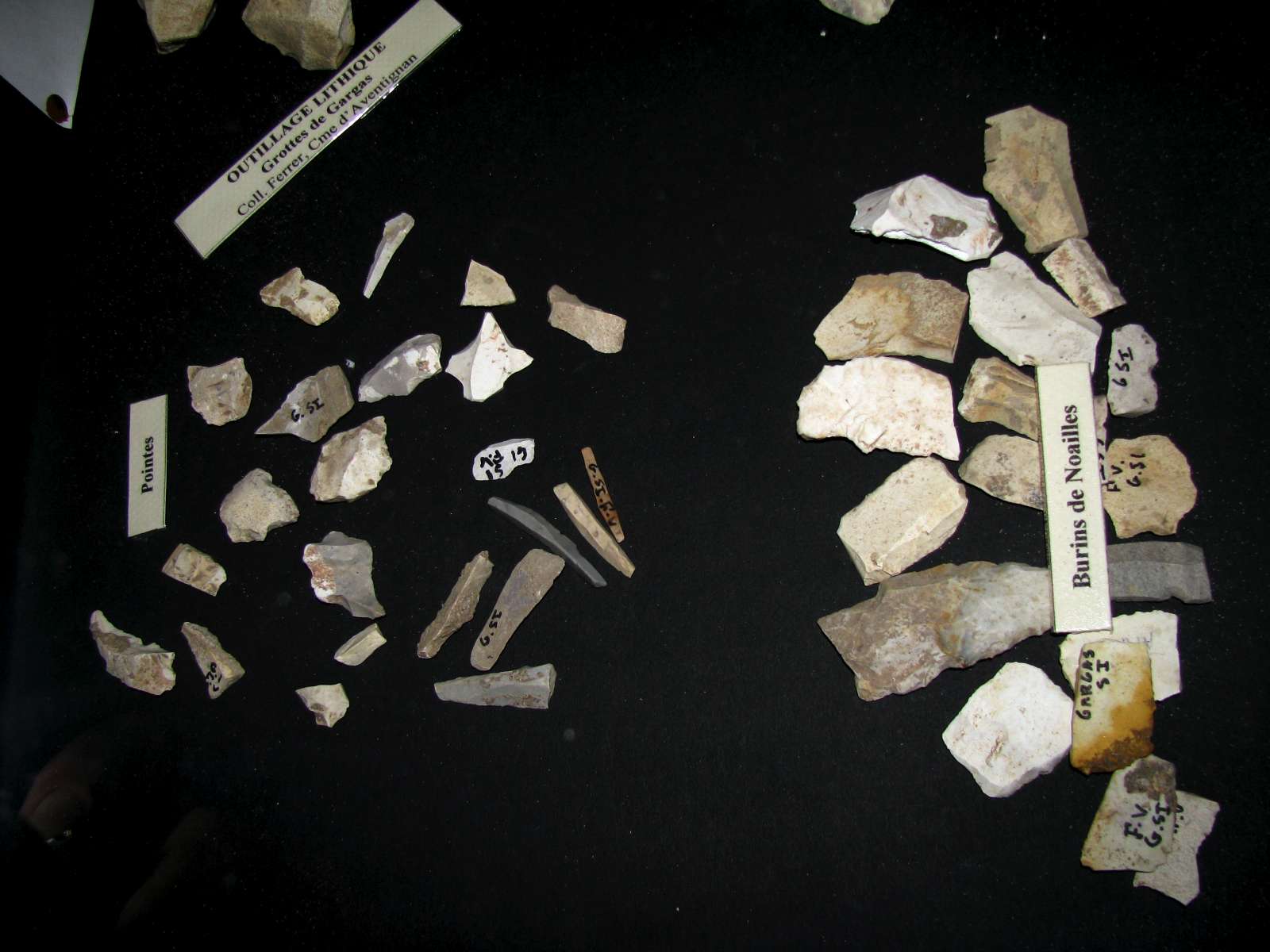
(left) various blade tools.
(right) points and burins de Noailles.
The identification G.S.I indicates that a tool came from Gargas, Salle I.
Photo: Don Hitchcock 2008
Source: Originals, display, Grotte de Gargas
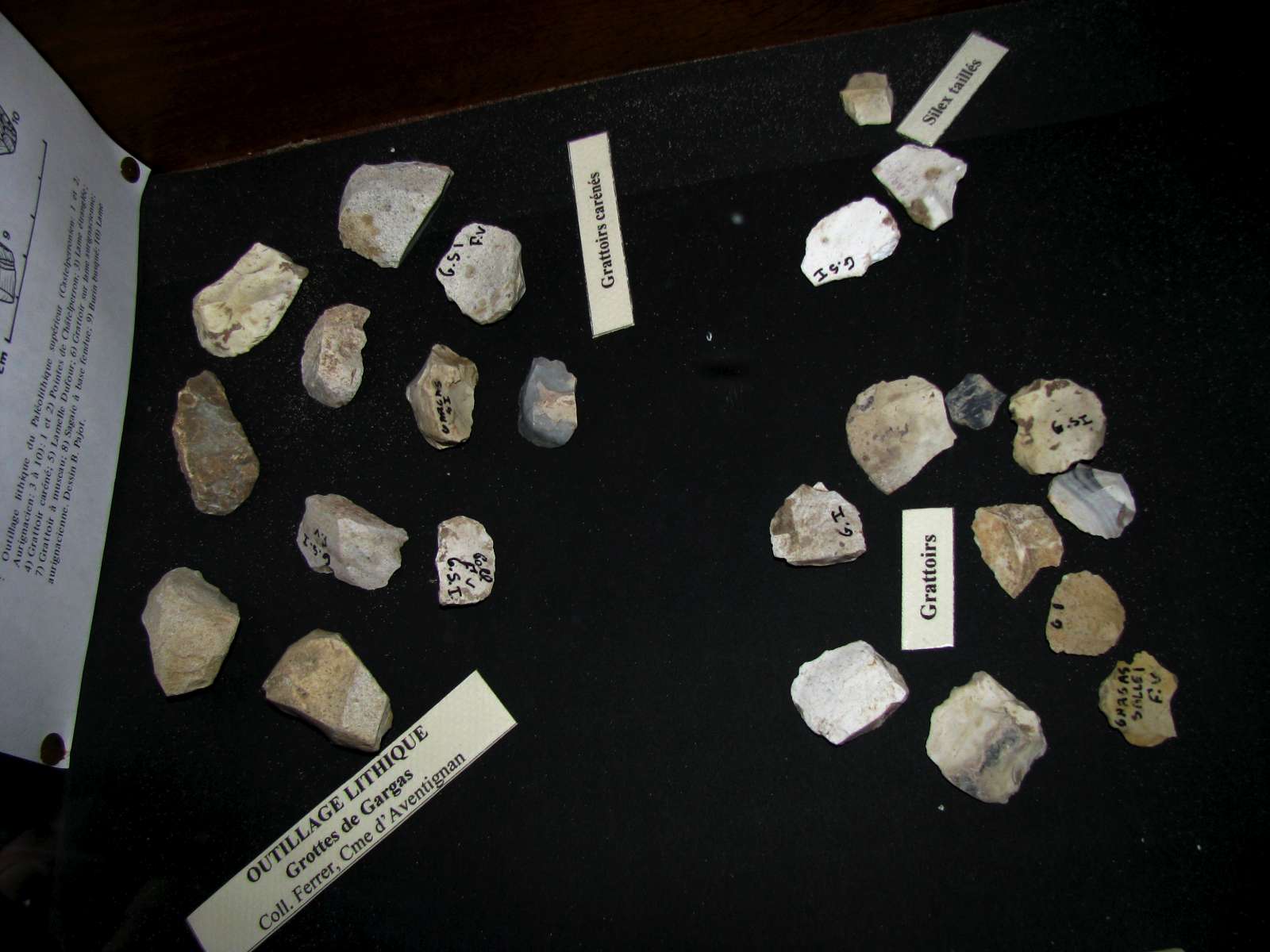
(left) Grattoirs, or scrapers from Grotte de Gargas.
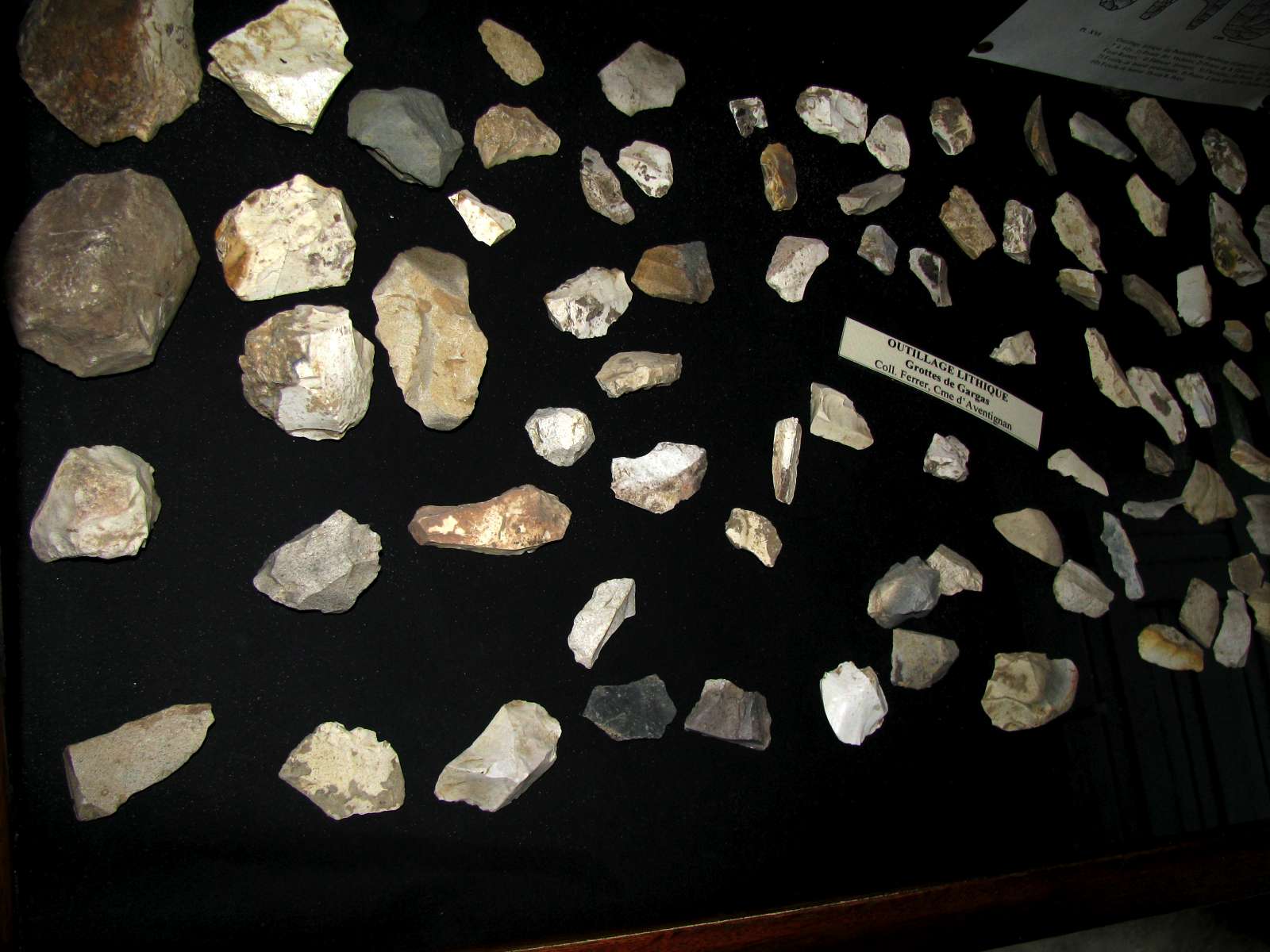
(right) Various stone tools from Grotte de Gargas.
The identification G.S.I indicates that a tool came from Gargas, Salle I.
Photo: Don Hitchcock 2008
Source: Originals, display, Grotte de Gargas

Various stone tools from Grotte de Gargas.
Photo: Don Hitchcock 2008
Source: Originals, display, Grotte de Gargas
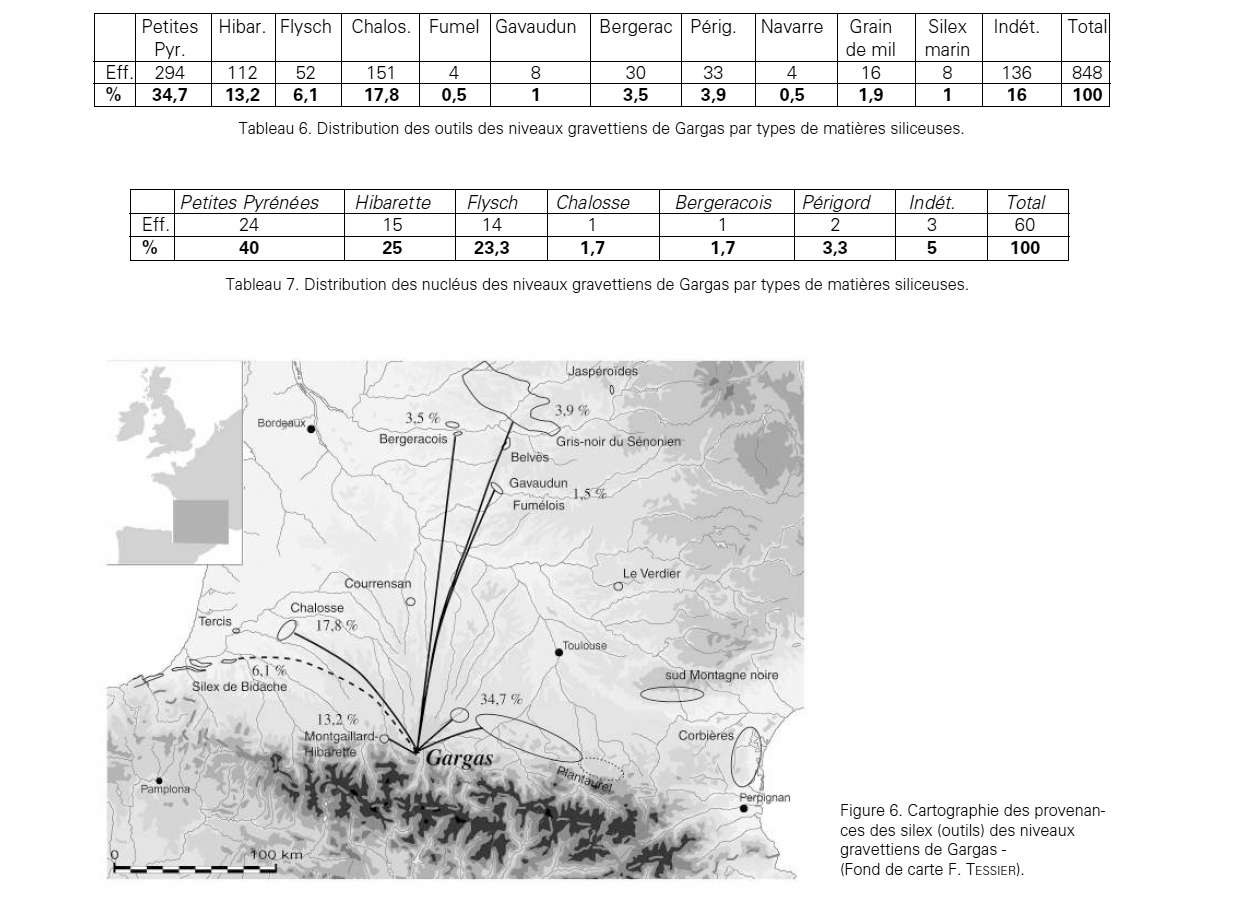
Sources of the tools of Grotte de Gargas. Most material came from a long way away from the area, and gaining lithic raw materials would have required long journeys or a lot of trading. It may be that the site of Gargas was never a year-round area, but was principally used during the summer months. I have not seen any evidence one way or the other on this question. More research, and in particular some modern techniques applied to a new dig is obviously required to resolve this and other questions. There may be other sites in the area which would repay solid archeological digs.
Photo: Foucher (2005)
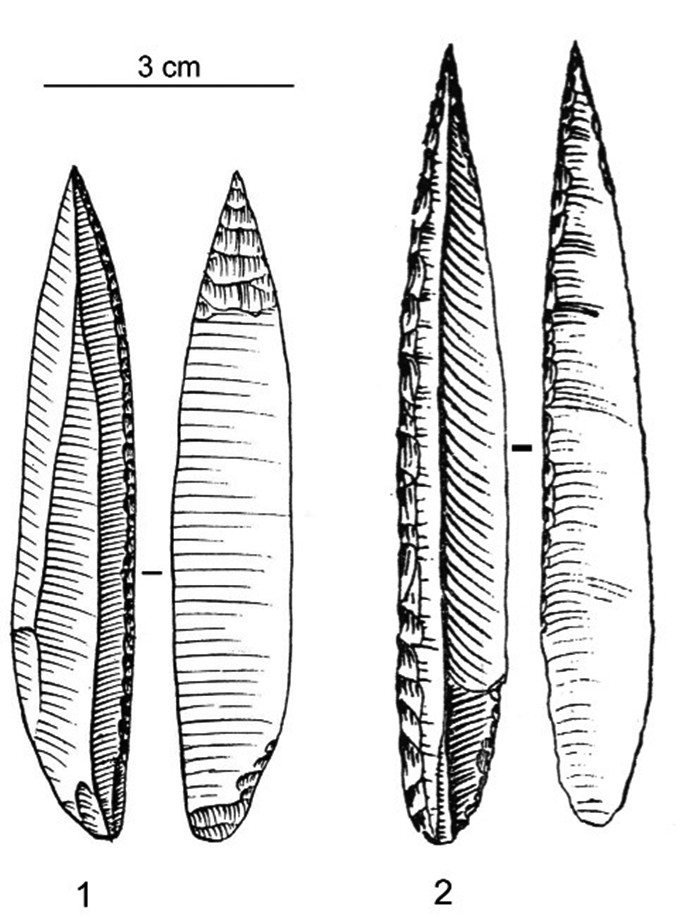
Pointe des Vachons
(left) Illustration of the definition from Sonneville-Bordes et Perrot (1956), Les Vachons, shelter 1, level 4. N° 2: example of Vachons point characteristic of a gravettian « moment » according to Cheynier.
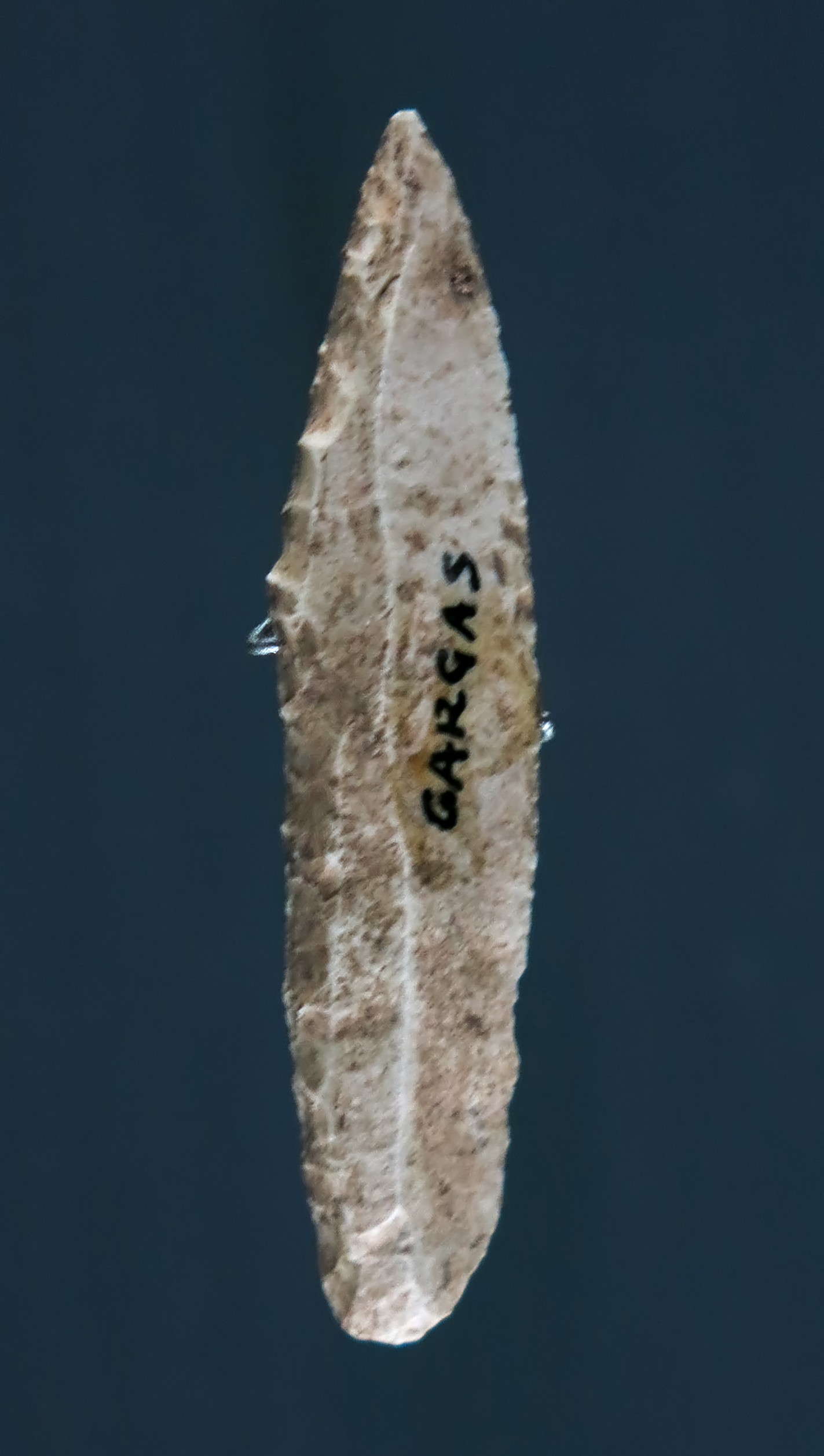
(right) Pointe des Vachons
Gargas, Gravettian.
The Pointe des Vachons forms a distinct group in the classical typology, No. 50 of the list of Sonneville-Bordes et Perrot (1956). 'N ° 50 - point of the Vachons: variant of the Gravette point, carrying flat retouches on the flat ( inner ) side at the distal and proximal ends'
Photo: (left): Simonet (2011)
Photo (right): Don Hitchcock 2015
Source: Original, Muséum de Toulouse, or Muséum d'Histoire Naturelle de la ville de Toulouse, MHNT
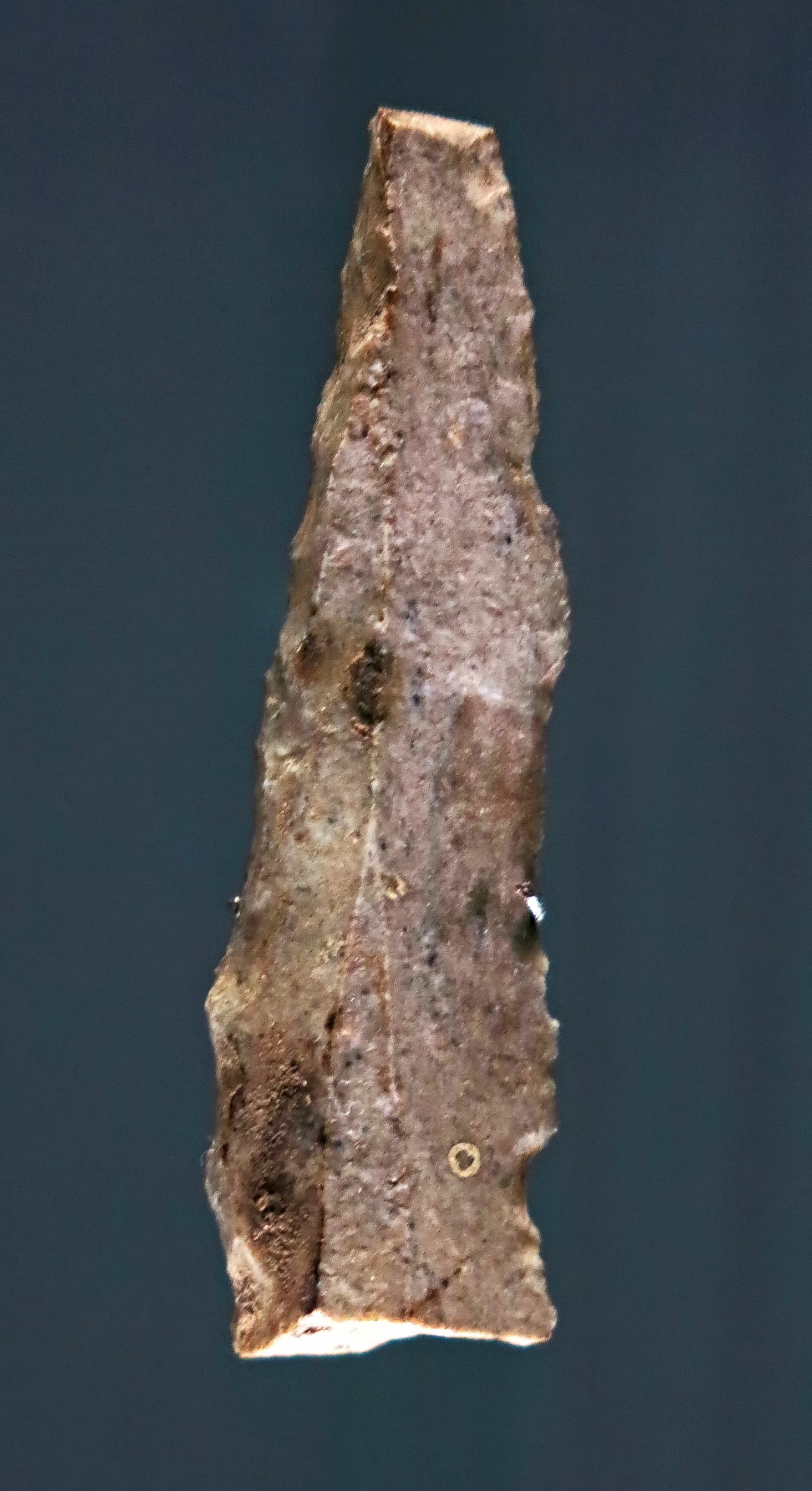
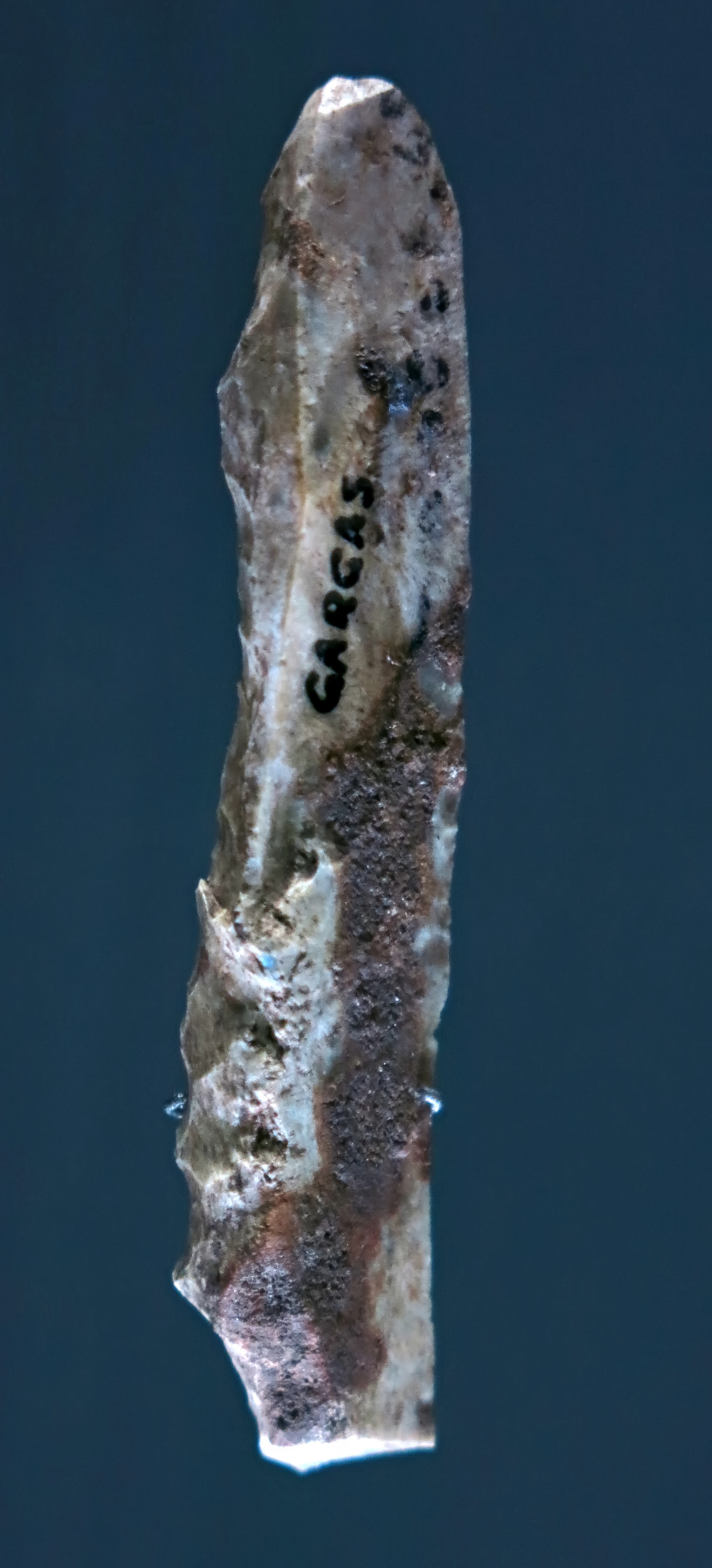
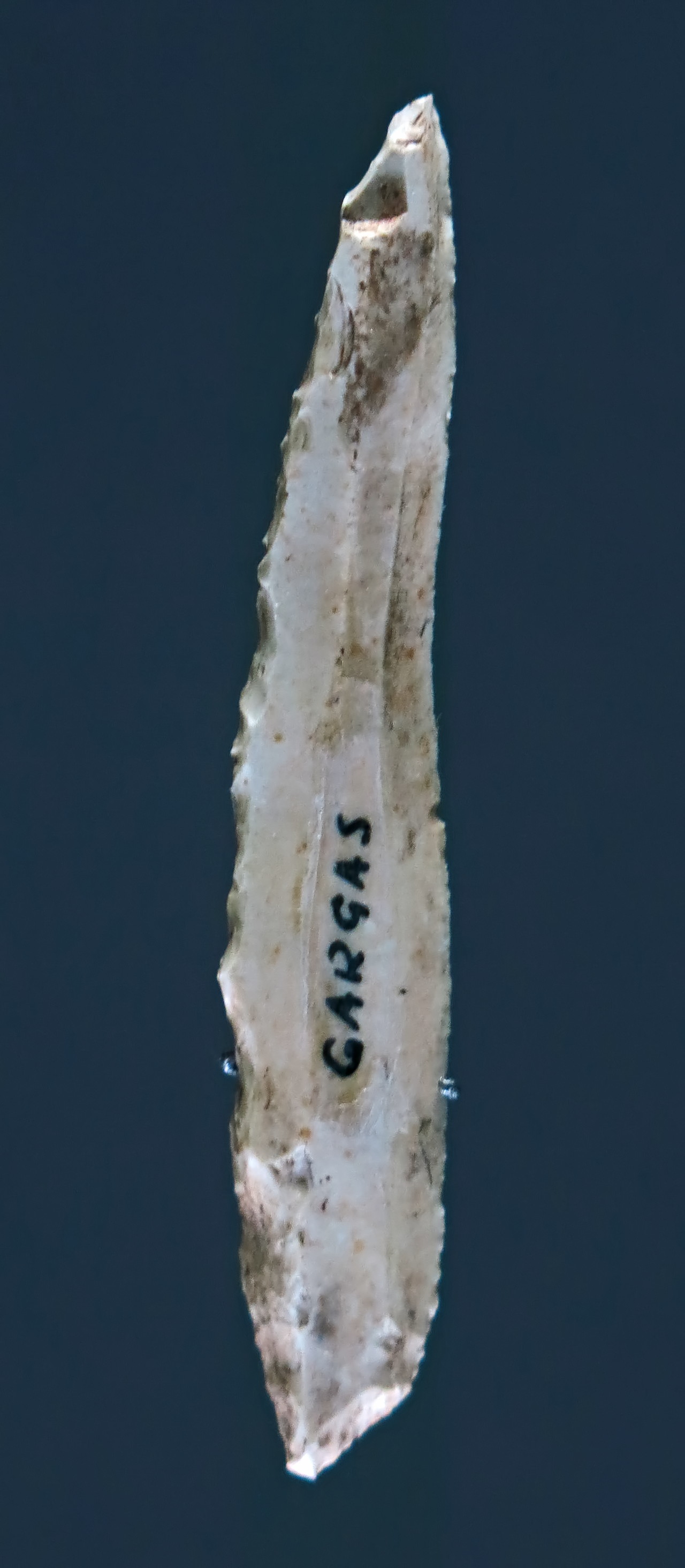
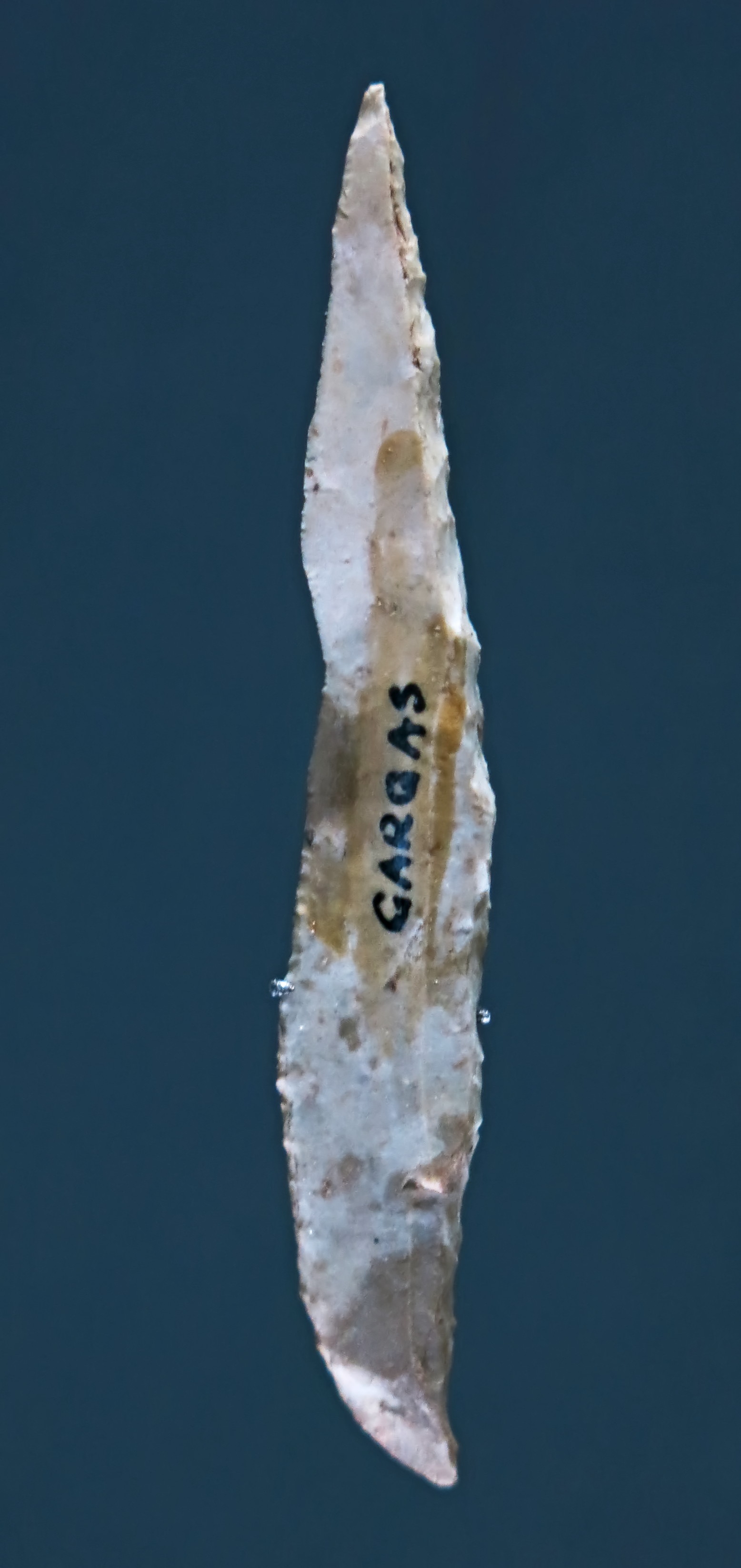
Gravettian points from Gargas.
Photo: Don Hitchcock 2015
Source: Original, Muséum de Toulouse, or Muséum d'Histoire Naturelle de la ville de Toulouse, MHNT
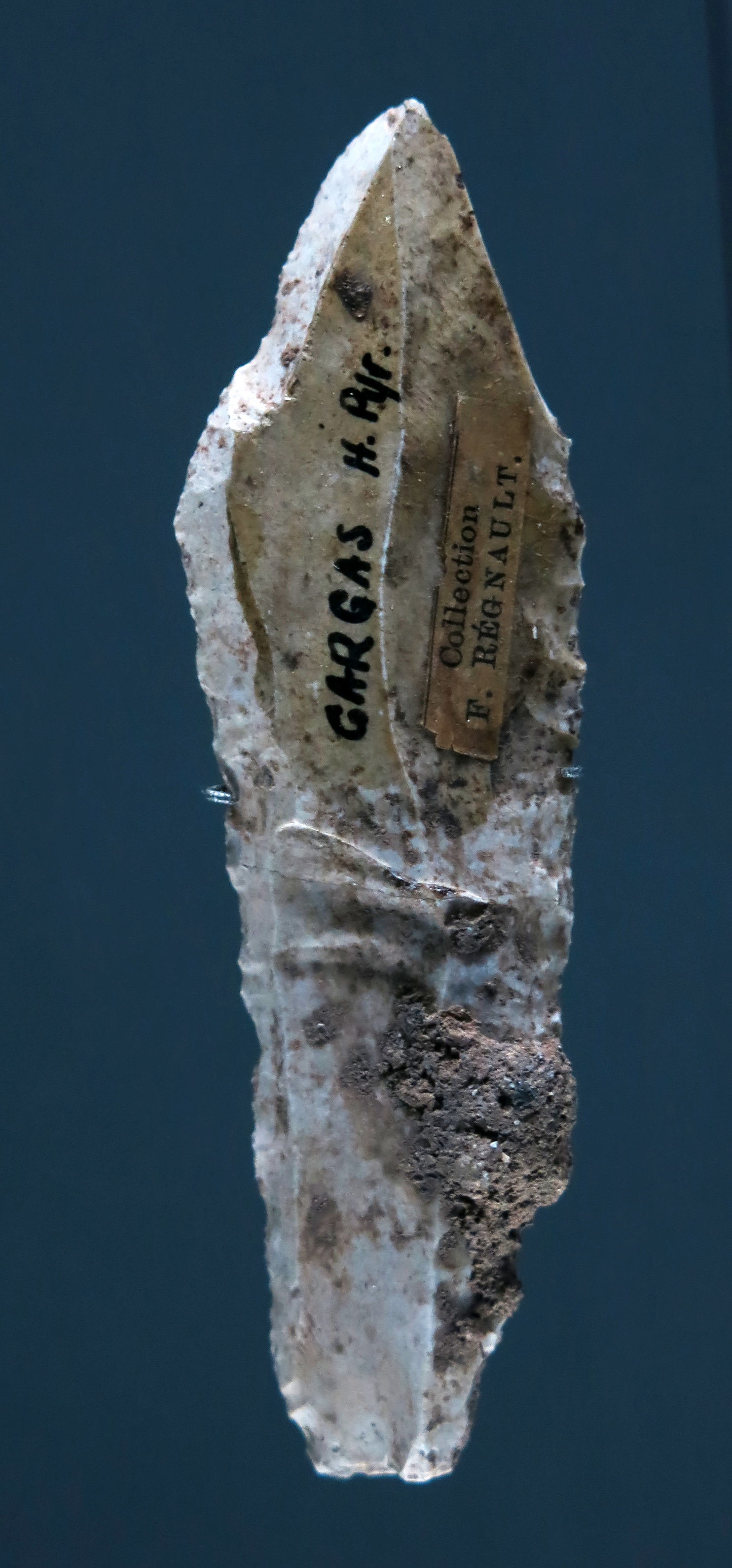
Dihedral burin.
Photo: Don Hitchcock 2015
Source: Original, Muséum de Toulouse, or Muséum d'Histoire Naturelle de la ville de Toulouse, MHNT
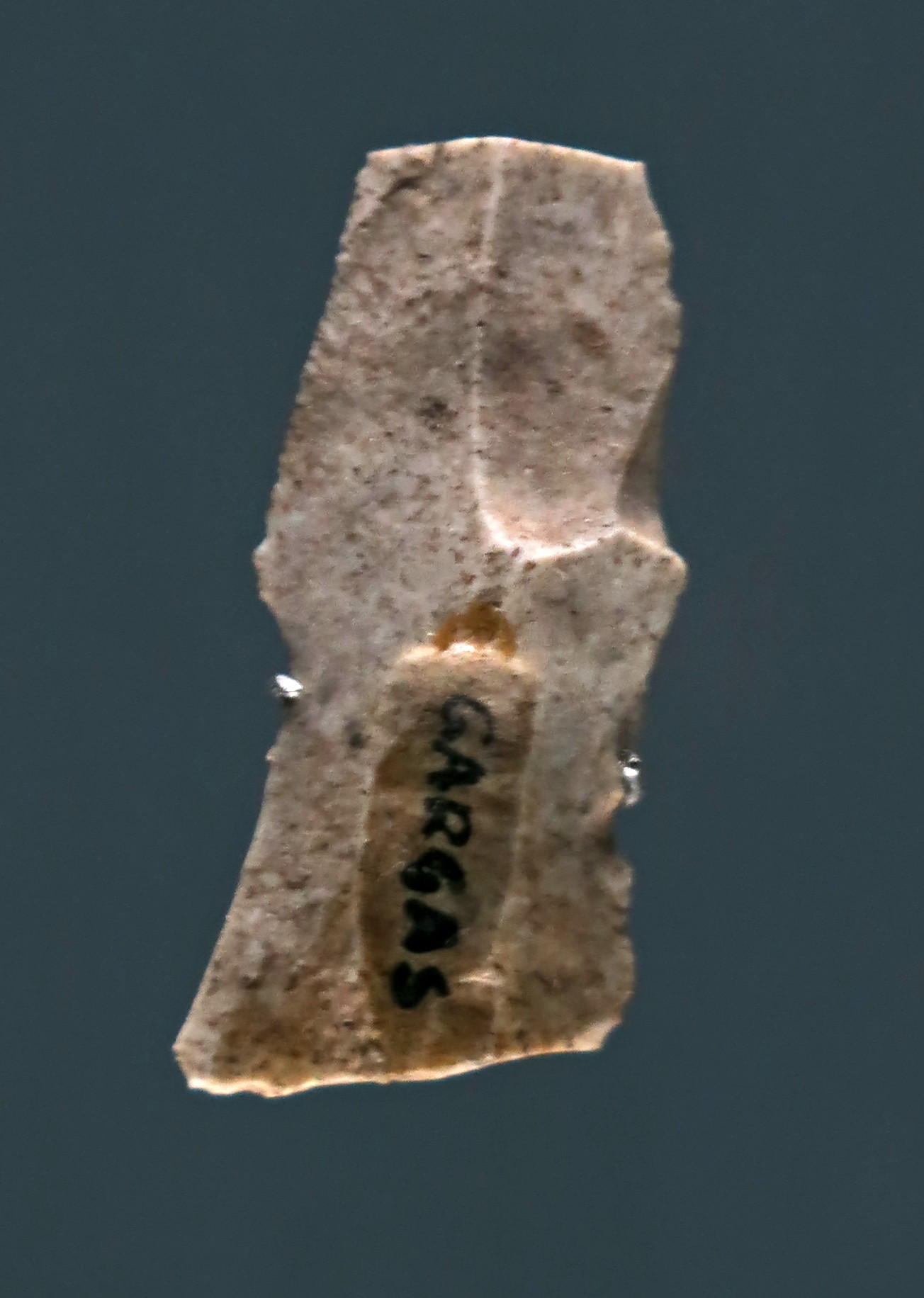
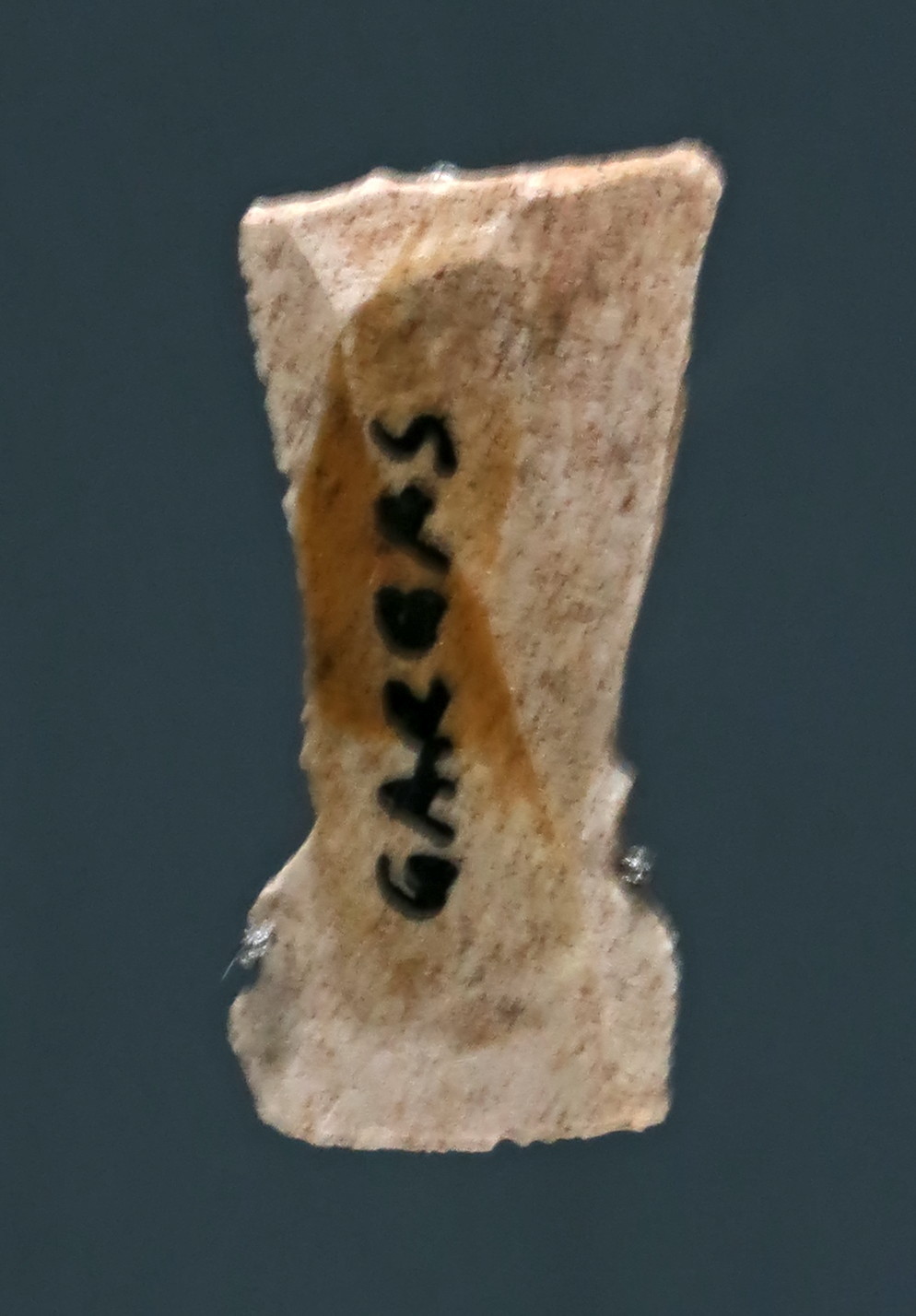
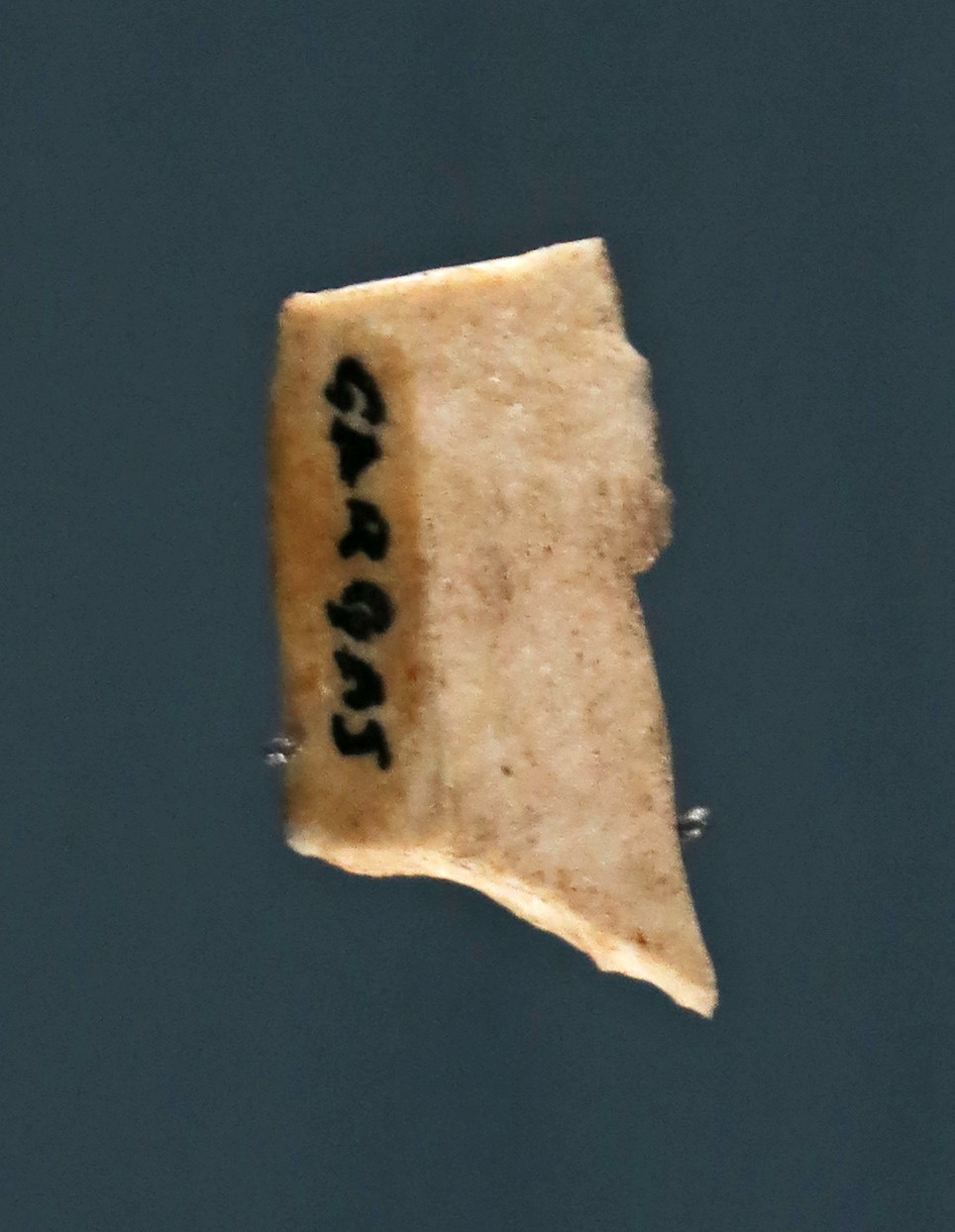
Noailles burins from Gargas.
Photo: Don Hitchcock 2015
Source: Original, Muséum de Toulouse, or Muséum d'Histoire Naturelle de la ville de Toulouse, MHNT
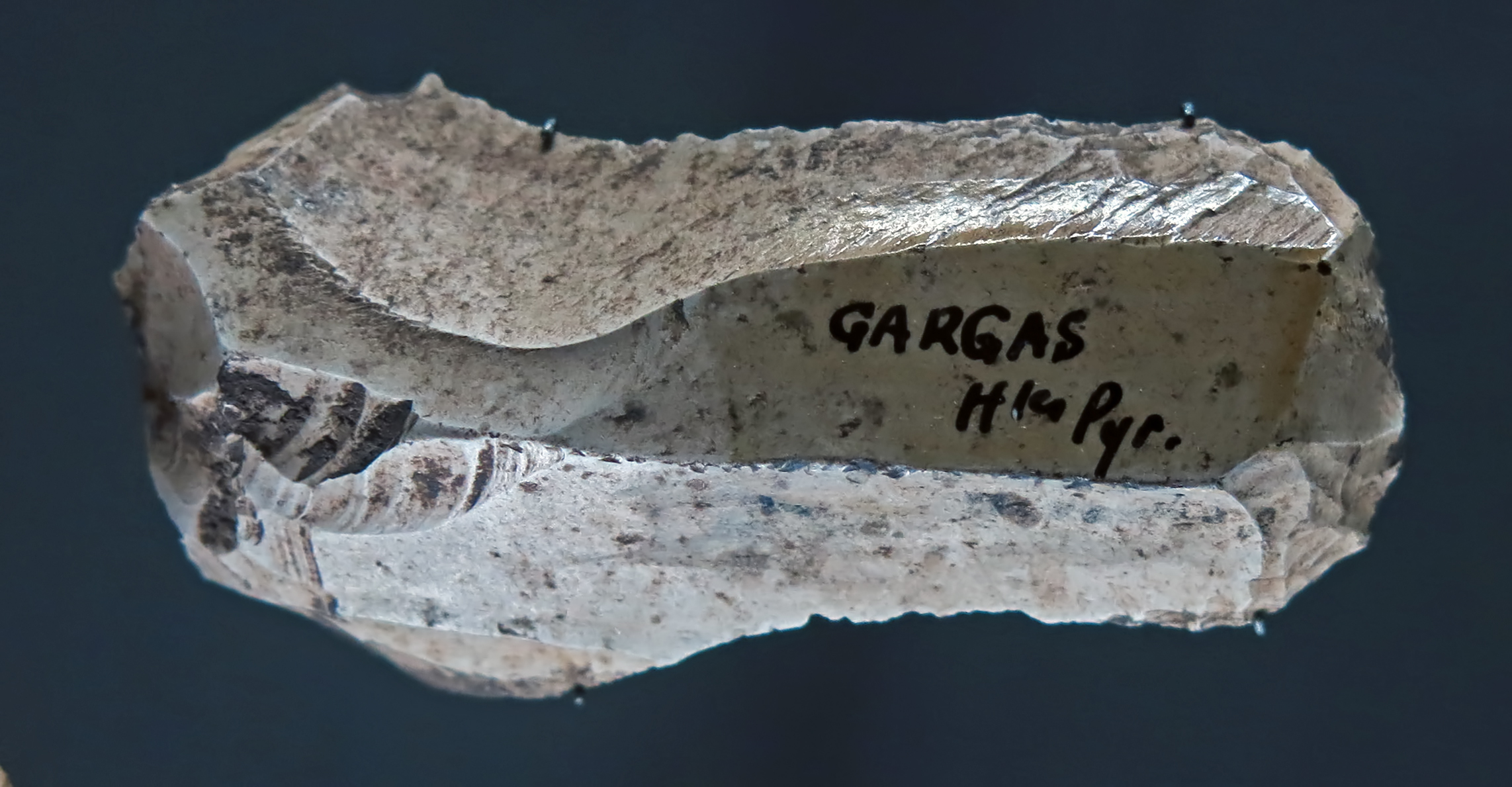
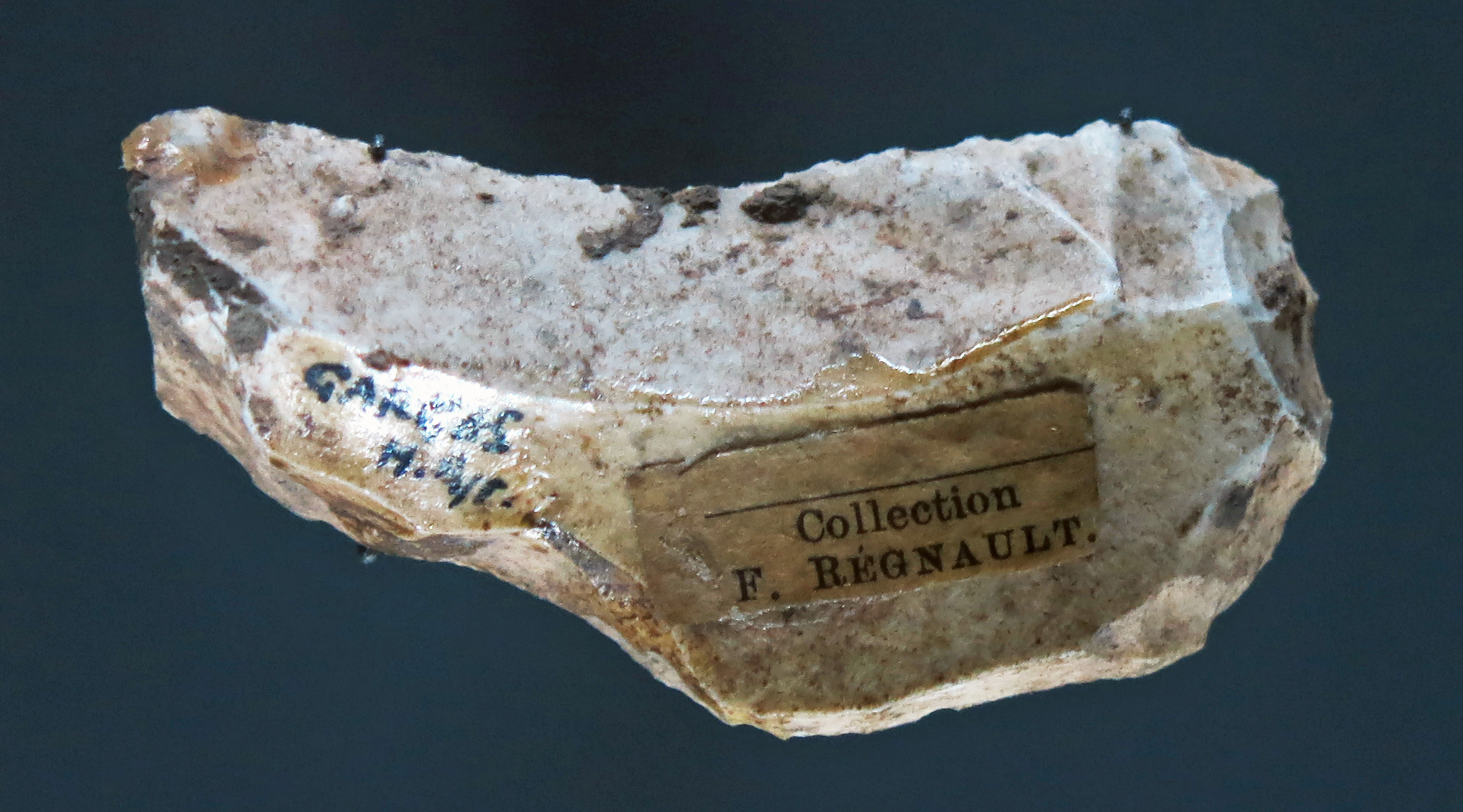
Grattoirs on flakes, Aurignacian, from Gargas.
Photo: Don Hitchcock 2015
Source: Original, Muséum de Toulouse, or Muséum d'Histoire Naturelle de la ville de Toulouse, MHNT
Collection: Félix Regnault
( Félix Regnault (17 June 1863 in Rennes – 4 October 1938) was a French physician, anthropologist and prehistorian. He served as president of the Société d'Anthropologie de Paris and the Société préhistorique française (1928) - Don )
Additional text: Wikipedia
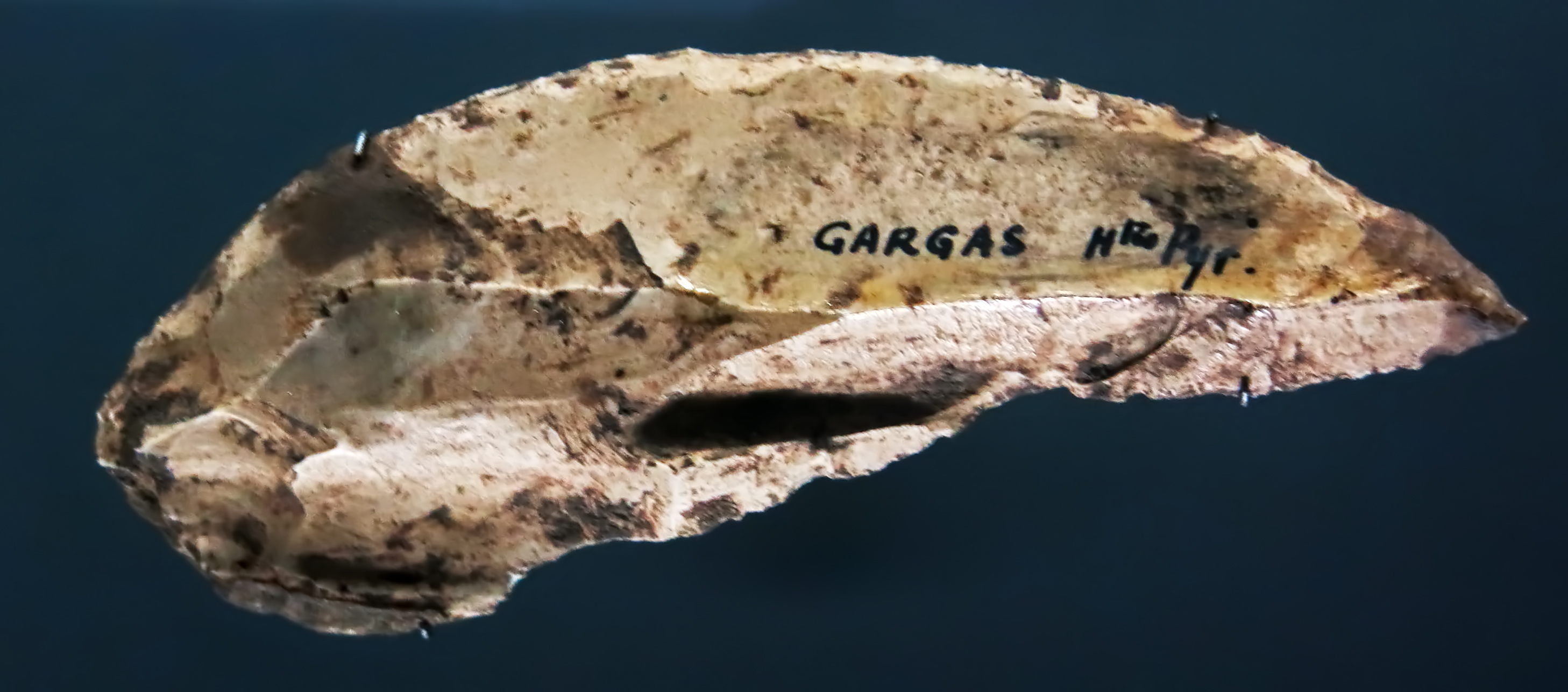
Aurignacian éclat laminaire
Aurignacian éclat laminaire retouché, a flake in the form of a blade, retouched.
( Note that this object closely resembles the shape of a Magdalenian parrot beak burin. However Gargas is almost entirely made up of Aurignacian and Gravettian deposits - Don )
Current location: Muséum de Toulouse, France
Photo: Don Hitchcock 2015
Source: Original, Muséum de Toulouse, France
Bone Industry of the Grotte de Gargas
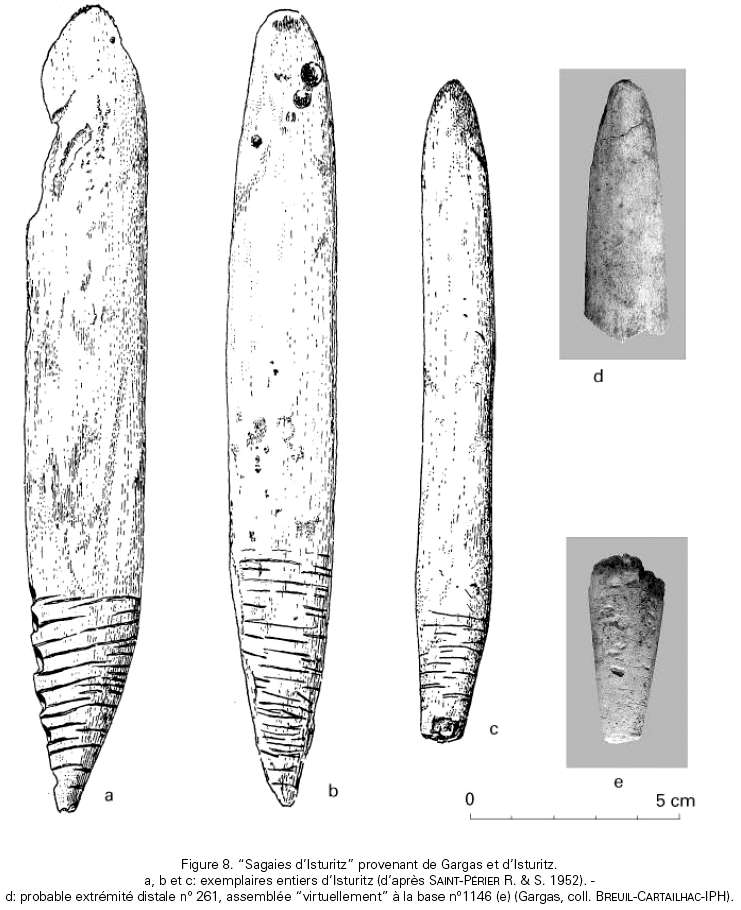
Figure 8. "Sagaies d’Isturitz" provenant de Gargas et d’Isturitz.
a, b et c: exemplaires entiers d’Isturitz (d’après SAINT-PÉRIERR. & S. 1952). -
d: probable extrémité distale n°261, assemblée “virtuellement” à la base n°1146 (e) (Gargas, coll.BREUIL-CARTAILHAC-IPH).
Original Source for the sketch: Saint-Périer (1952), reprinted in: Foucher (2005)
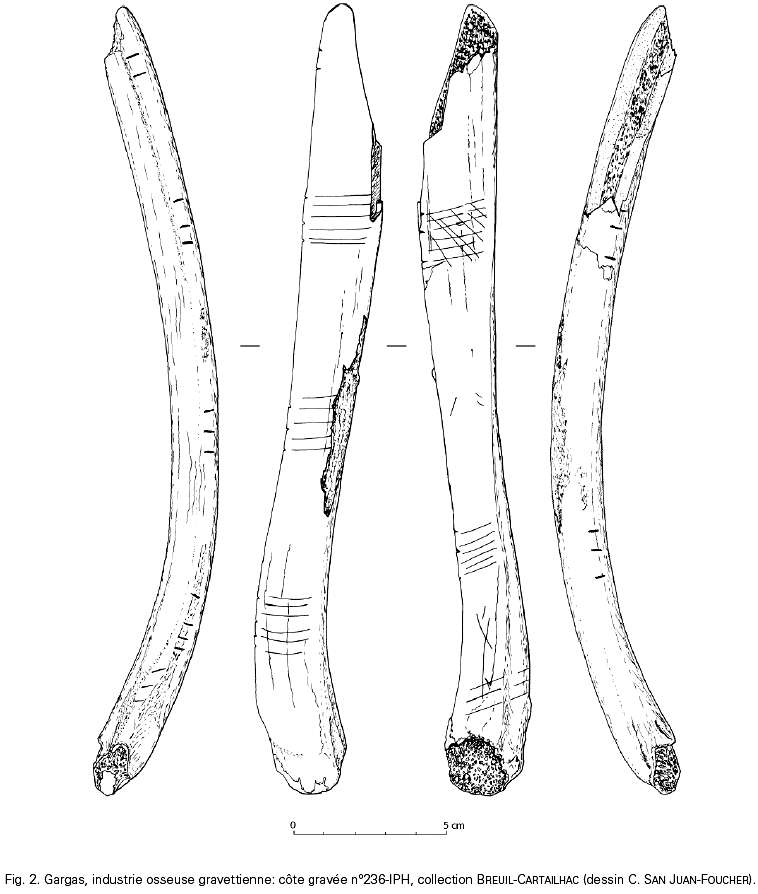
The caption reads:
Fig. 2. Gargas, industrie osseuse gravettienne: côte gravée n°236-IPH, collection BREUIL-CARTAILHAC (dessin C. SANJUAN-FOUCHER).
Gargas bone industry, a decorated rib.
It was described by Breuil & Cheynier (1958) as "a large curved piece, rounded at the end, which had been used as a retoucher. It is the left rear rib of either Aurochs or Bison"
Photo: San Juan-Foucher (2005)

Retoucher from Gargas.
Photo: Don Hitchcock 2015
Source: Original, Muséum de Toulouse, or Muséum d'Histoire Naturelle de la ville de Toulouse, MHNT
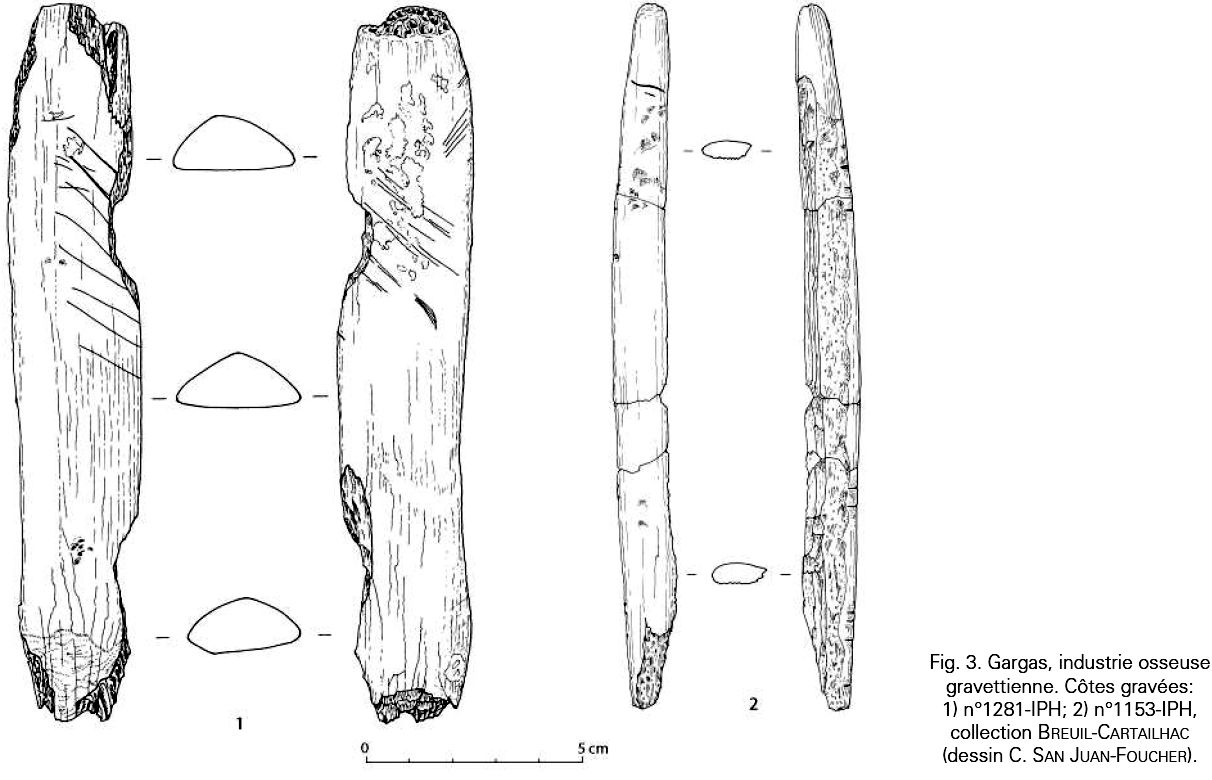
The caption reads:
Fig. 3. Gargas, industrie osseuse gravettienne: côte gravées
1) n°1281-IPH
2) n°1153-IPH
collection BREUIL-CARTAILHAC (dessin C. SANJUAN-FOUCHER).
Photo: San Juan-Foucher (2005)
Cave Bear Bones
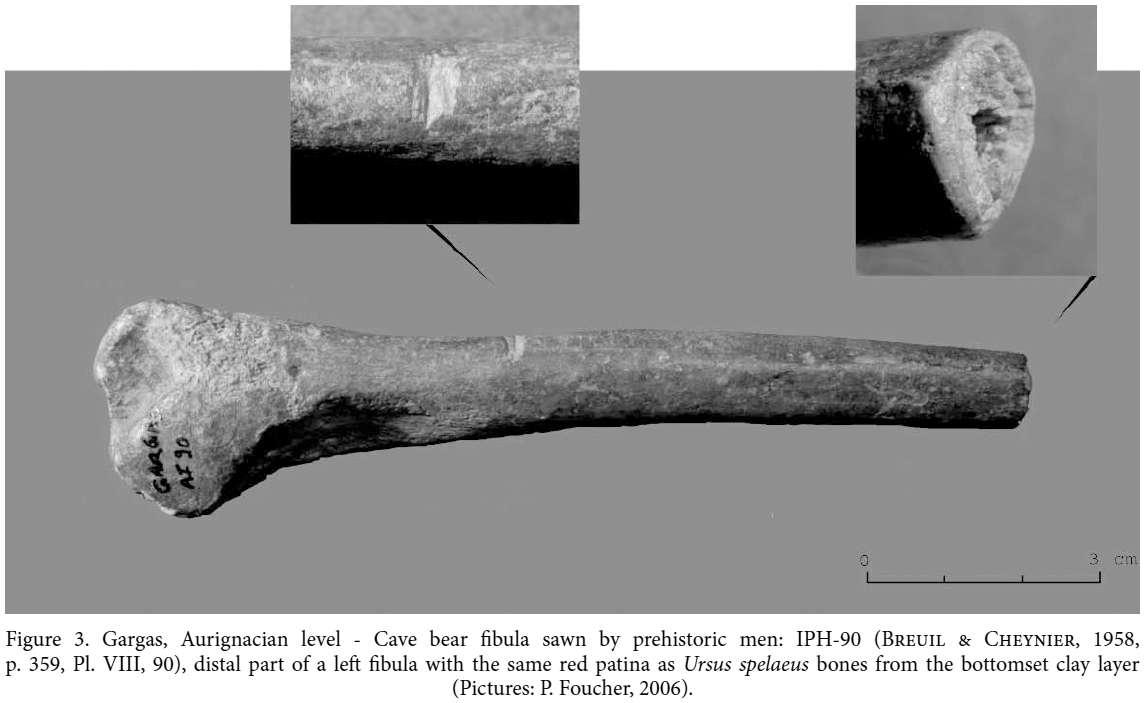
Gargas, Aurignacian level - Cave bear fibula sawn by prehistoric men: IPH-90 (Breuil & Cheynier, 1958, p. 359, Pl. VIII, 90), distal part of a left fibula with the same red patina as Ursus spelaeus bones from the bottomset clay layer
(Pictures: P. Foucher, 2006).
The sawn section may have provided blanks for tubes or tubular beads.
The fibula has the same
red patina as the Ursus spelaeus bones from the bottomset
clay layer, where it was probably picked up
by the Aurignacian before being modified (note that the
sawing marks have not the same red colour as the surface
of the bone).
Photo: Vercoutère et al (2006)
The bottomset clay bed of Gargas (older than the Mousterian level) is rich in cave bear remains. The cave was then a den for bears that came there to hibernate. Over the centuries, these carnivores left some traces: wallows, claw marks on the walls and polishing of certain narrow ways. During the Upper Palaeolithic, Man and carnivore have alternately lived in the cave. Sometimes, the former used the remains of the latter as raw material.
Moreover, there is a stalagmitic concretion in the lower part of the cave, the form of which takes on a bear, hence the name of the 'Salle de l’Ours'.
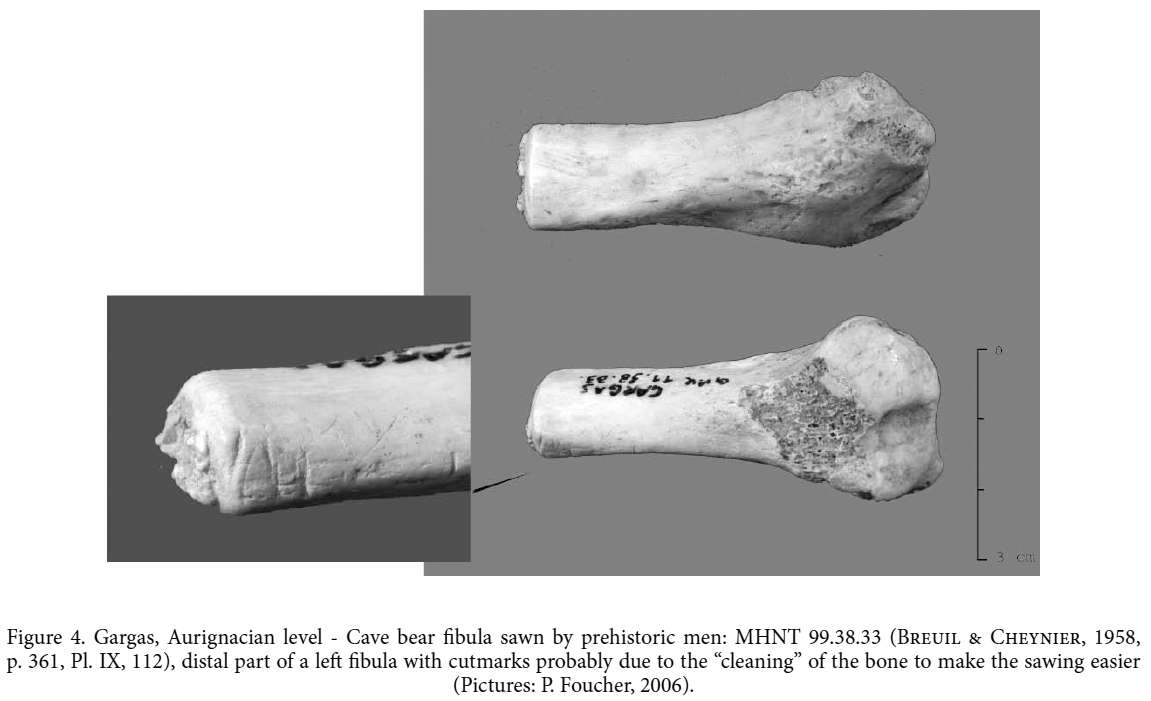
Gargas, Aurignacian level - Cave bear fibula sawn by prehistoric men: MHNT 99.38.33 (Breuil & Cheynier, 1958,
p. 361, Pl. IX, 112), distal part of a left fibula with cutmarks probably due to the 'cleaning' of the bone to make the sawing easier
(Pictures: P. Foucher, 2006).
Photo: Vercoutère et al (2006)
There is one radiocarbon (AMS) date for the Early Aurignacian level: 31 540 ± 720 BP got from a fragment of a Bos/Bison long bone. Also, two radiocarbon (AMS) dates are available for the Middle Gravettian level:
- 26 860 ± 460 BP obtained from a piece of bone pushed into a crack of the 'Panneau des Mains' in the main chamber;
- 25 050 ± 170 BP taken from a reindeer antler fragment.
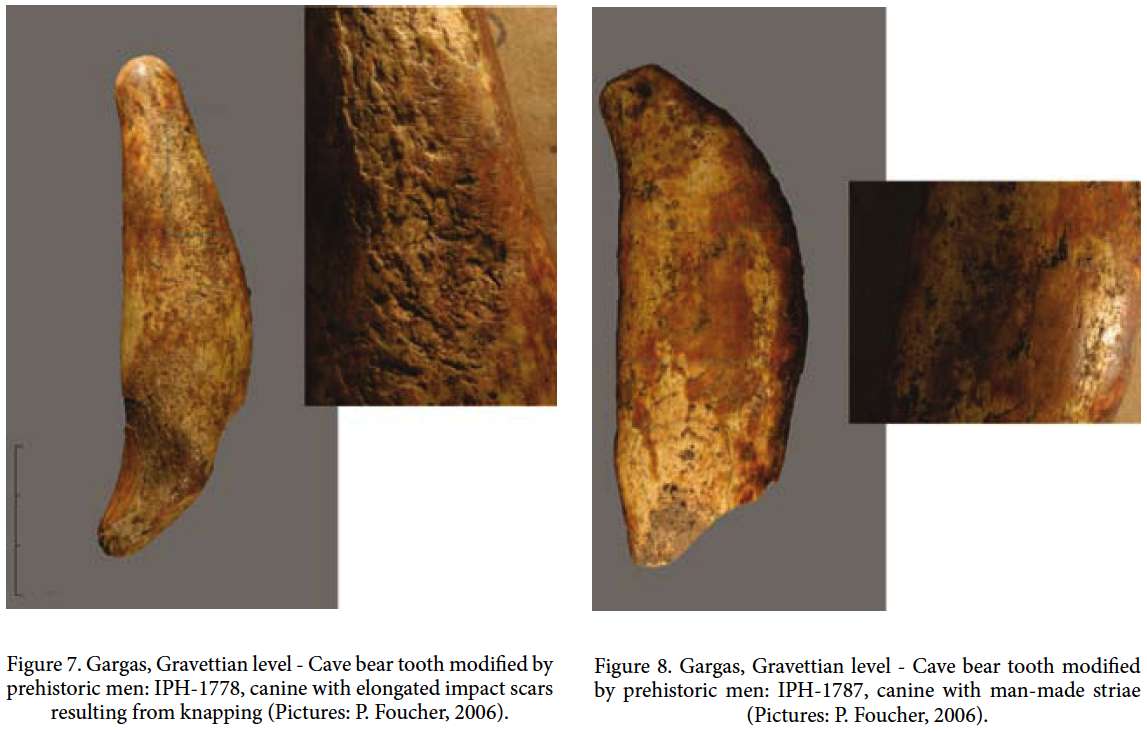
(left) Gargas, Gravettian level - Cave bear tooth modified by prehistoric men: IPH - 1778, canine with elongated impact scars resulting from knapping (Pictures: P. Foucher, 2006)
(right) Gargas, Gravettian level - Cave bear tooth modified by prehistoric men: IPH - 1787, canine with man-made striae (Pictures: P. Foucher, 2006)
Photo: Vercoutère et al (2006)

Gargas, Gravettian level - Cave bear tooth modified by prehistoric men: IPH-298 (Breuil & Cheynier, 1958; p. 378, Pl.
XVIII, 298), pierced lower left third incisor (Picture: P. Foucher, 2006).
This tooth appears to have served as a pendant.
Photo: Vercoutère et al (2006)
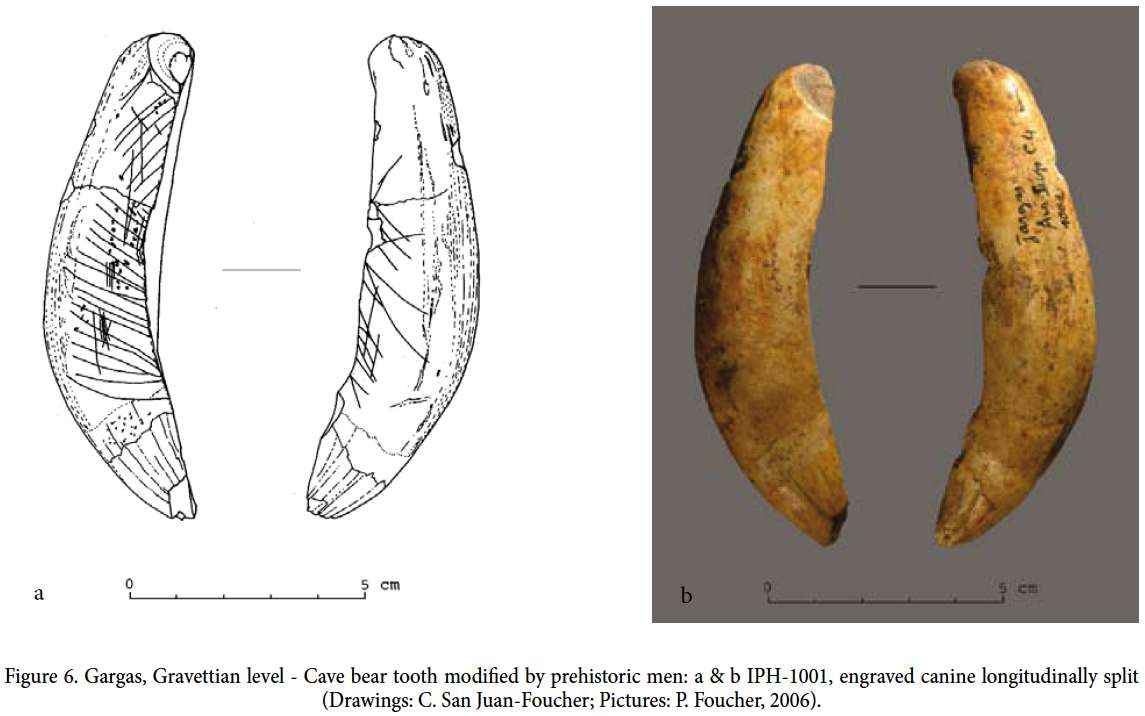
Gargas, Gravettian level - Cave bear tooth modified by prehistoric men: a & b IPH-1001, engraved canine longitudinally split
(Drawings: C. San Juan-Foucher; Pictures: P. Foucher, 2006).
Photo: Vercoutère et al (2006)
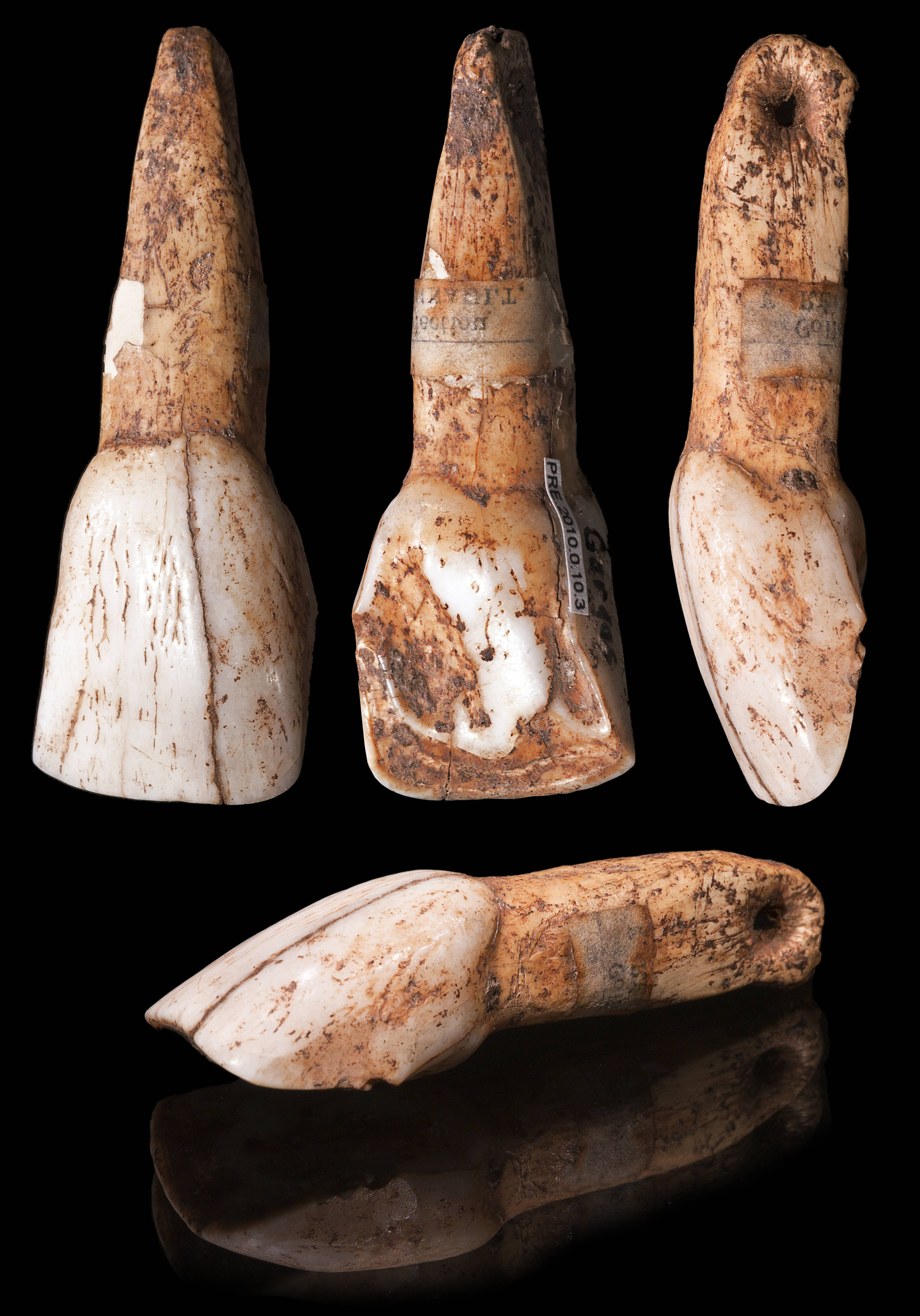
Pierced bovid incisor (either an aurochs or a bison), different views of the one specimen.
Age: 29 000 - 20 000 BP, Gravettian.
Dimensions in mm: 52 x 18 x 15 mm.
Source: Original, in the Muséum de Toulouse, found during excavations in the Grottes de Gargas, Hautes-Pyrénées, France, by Félix Régnault.
Photo: On Wikipedia, part of Wikimedia commons, photographer Didier Descouens, 13 octobre 2010
Licensing by the photographer:As the holder of copyright, I publish it under the following license:
Creative Commons, Attribution Share Alike. This file is available under the terms of the Creative Commons Attribution - Share Alike 3.0 Unported identical
Gargas Radiocarbon Dates
Translation from the French by Don Hitchcock
Gargas Cave is famous for its panels of stencilled hands and its fine wall engravings, these last attributed to the Gravettian by Abbe H. Breuil on the basis of a comparative analysis with the engraved pebbles found in the gisement (Breuil, 1953). The filling of the archaeological area of habitat, located in the old porch and filling the adjacent western area in Salle I, has been the subject of several archaeological surveys in the late nineteenth century (Garrigou, de Chasteigner 1870; Régnault 1900).
After the discovery of the first hand in 1906 (Regnault 1907), H E. Cartailhac and H. Breuil undertook the study of the decorated cave and decided to make excavations in Salle I. Two campaigns, in 1911 and 1913, enabled them to establish an archeological sequence including, from bottom to top, Mousterian, Châtelperronian, Aurignacian and Gravettian, the latter layer being sealed by a stalagmite floor. Their search was interrupted because of the 1914-18 War, and the material was removed to facilitate study at the Institute of Human Paleontology in Paris (except for a small sample preserved at the Museum d'Histoire Naturelle de Toulouse), but the monograph did not see the light of day. A publication was made later with the help of A. Cheynier (Breuil, Cheynier 1958) to present synthetically the results of the excavation and the most characteristic material.
More recent studies have been devoted exclusively to rock art (Barrière (1976 2 Vols), Groenen, 1987), until we decided to make the revision of the old Breuil-Cartailhac collection and undertake a planned excavation under a research project on the Gravettian and Solutrean Pyrenees (San Juan - Foucher 2003 and 2004). The objectives of this program are to provide an updated chrono-stratigraphic framework, for a better identification of the stone and bone tools and bone by incorporating still unpublished elements and to obtain information that might allow us to establish relationships between the parietal (wall) art and the occupation of the habitat.
We have two radiocarbon dates (AMS) to locate the occurrence of the Gravettian at Gargas, that of 26 860 ± 460 BP, made from a bone plug in a crack in the panel of Hands of Salle I (Clottes et al. 1992) and another more recent 25 050±170 BP (GrA-19506, Lyon 1625) obtained from a sample of reindeer antler (Foucher 2004: determination by M. Patou-Mathis). This chronological range of nearly 2000 years allows us to consider the possibility of several successive Gravettian occupations, but only the results of new excavations will help refine the palethnographic approach . The typological analysis of stone tools from this old collection confirms the membership of the horizon above the Gravettian (upper Perigordian) with Noailles burins prevalent as tools and Gravette/Vachon points less abundant. (Margerand, Desbrosses 1993; Margerand 1996). The study of the origin of the primary siliceous raw material traces a triangular area of travel and / or trade to the west and north, including the South-West France, from the Atlantic Pyrenees to the Dordogne (Foucher 2004).
Hand stencils, Paintings and Engravings from Grotte de Gargas
Text below adapted from Barrière (undated)The cave art of Gargas is made up of two different elements, but from the same period:
- painted hands
- animal paintings and engravings.
The hands are painted in black, red or less frequently in ochre, particularly visible at close sight, and often grouped in large numbers, the hands provide a spectacular sight for the visitor, and a horrible sight, when it becomes clear, on closer inspection, that many of them are amputated and severely deformed.
Photo: Two left hands, possibly from the same individual, with all fingers except the thumb shortened. From a brochure advertising the Grotte de Gargas.
The first hands were discovered in 1906 by Félix Régnault. Breuil and Cartailhac counted more than 150 of them. Dr Salhy recorded 217. Claude Barrière noted 231, although some of them previously reported have disappeared as a result of natural erosion and present-day vandalism.
The 231 hands can be grouped as follows:
- 143 black hands
- 80 red hands
- 2 bister (yellowish to dark-brown colour) hands
- 5 ochre hands
- 1 white hand
Many are poorly visible - visibility depends greatly on the degree of moisture in the air and on the rock - or incomplete. One can therefore count for certain only:
- 22 right hands
- 136 left hands
- 10 intact hands
- 144 mutilated or sick hands
The dimensions enable us to attribute these hands to male adults, women or adolescents, and to babies for two of them.
These hands were created by projecting a coloured liquid, blown from the mouth, on the hand flat against the rock. One often sees the fine mist of droplets making a halo around the hand.
They are in 10 groups in the first room of the lower cave. Panels 6 and 8 are the most important, panel 8 on the left wall alone contains 43 hands in black, red and bister. Another important group is found further on, in room III, inside and on the other side of the hollow rock mass, covered with stalagmite, for this reason called the 'hand sanctuary'. On the front facade to the left of the entrance you can see the attractive black left hand, with two phalanges missing on the four fingers, called the 'alcove hand'. Inside are 32 black and red hands.
Clinical studies by Dr A. Sahly have shown that the Gargas hands were either deformed by illness or amputated. This was confirmed by the discovery at Gargas of finger stumps thrust into the soft clay. In other caves, such as Lascaux, accidental prints of mutilated hands left in clay now hardened by calcite have been discovered.
Some of the hands are deformed as a result of diseases deformative rheumatism, chronic evolving polyarthritis, or pathologic deformations.
Many hands have had one or more fingers amputated, with the exception of the thumb, which always remains intact. That can be explained by the consequences of accidents, frostbites, and chilblain, which cause the loss of fingers through gangrene. The thumb, which is better supplied with blood vessels, is more resistant to this problem.
Various diseases can also be involved, such as Ainhum's disease, Raynaud's disease, or perhaps leprosy. An amputation rite may have existed, but it would not have been carried that far - a hand deprived of two phalanges on four fingers is too serious a handicap for a hunter for amputation to have been accepted voluntarily.
The negative hand impressions were the work of a small number of individuals.
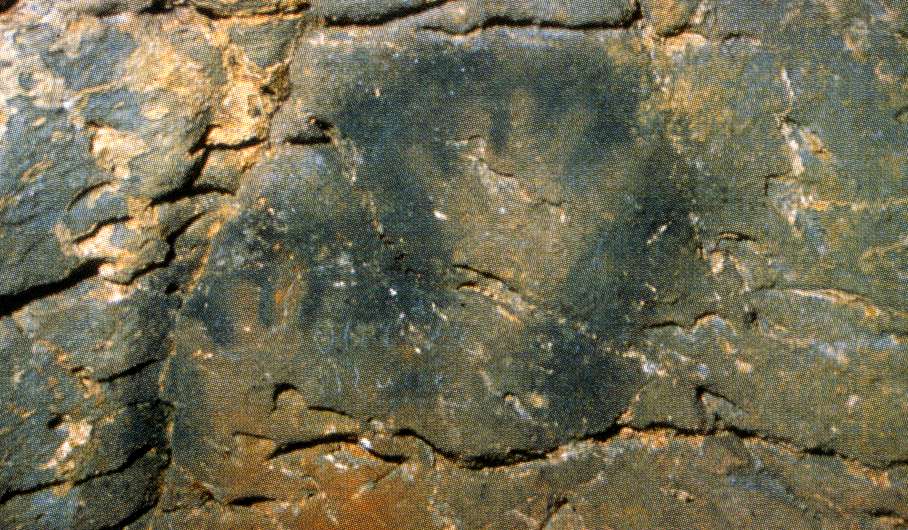
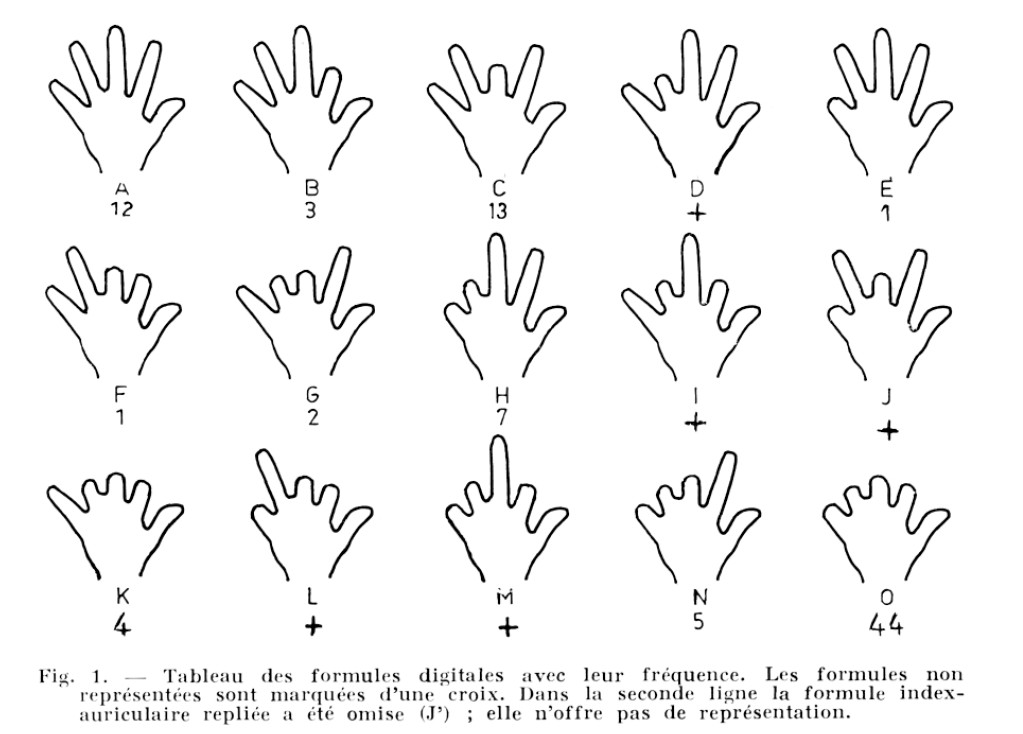
Table of digital possibilities with their frequency. The possibilities not represented at Gargas are shown with a cross.
(What stands out loud and clear is the overwhelming preponderance of the case of all fingers except the thumb being missing. To me, this is clear evidence for frostbite as the primary reason for the loss of finger joints. The thumb is better supplied with blood than the other digits.
Intentional mutilation of joints on this scale is ruled out in my opinion on the basis of the negative effect on the community of this maiming. It should be remembered that this community was in the foothills of the Pyrenees at a time of great cold, very close to huge glaciers. They hunted ibex, elk (moose) and mammoth in very difficult conditions - Don.)
Photo:
Leroi-Gourhan (1967)
The stylistic evolution of the animal carvings at Gargas
Present knowledge of prehistoric art shows a general evolution from a simple and even rudimentary expression, reducing the animal figure to an outline which is roughly correct, to figures which are called naturalistic, and attempt to give the most complete expression of reality. This evolution is not a continuous feature: the Aurignacian-Périgordian civilisations had their ways of doing things, the Solutrean-Magdalenian cultures had theirs, and these did not exactly follow those which preceded them.
The carvings on the cave walls and on artefacts at Gargas lend themselves to classification according to the logical line of general evolution, that is to say from the crudest forms to the most highly perfected, the former being the earliest work and the latter being the latest, in theory.
The superimposing of carvings was a very important marker for determining the evolution of style of the carvings. I have been able to record a certain number of cases involving superimposed carvings which are beyond doubt; some are in a sufficiently long series to enable one to establish a relative chronology for the majority of the carvings; this at least gives the order in which they were executed, which does not mean that there was necessarily a considerable lapse of time between each carving.
Stylistic comparison was made much easier by the the fact that Bovidae and Bison make up that set of stylistic examples having the greatest continuity, especially in the early stages, and are the species most frequently superimposed. It was thus possible to avoid from the start the problem of the differences between animals. The criteria established were then extended to the other species portrayed with the help of the superimposed figures and those which lent themselves to comparison.
As it was I was able on numerous occasions to establish that carvings showing the same stylistic features were superimposed, and that each time, the order in which they were superimposed is the same. These facts broadly confirm the most reasonable theory. One is then in a good position to prove a line of stylistic evolution whose stages I am about to reveal. These stages may be grouped into three main phases.
- Phase I
Use of the line drawn with a single finger, and carving in a simple line. In the beginning the animal figures are reduced to the head alone which may or may not be followed by the neck and withers. Horns and antlers are presented in twisted or semi-twisted perspective, and occasionally in full profile. The general posture is stiff and, on occasion, angular and is not anatomically true.
The animals portrayed are almost exclusively made up of Bison and Bovidae, between which it is sometimes difficult to distinguish. - Phase II
So far the figures were limited to the head, neck and withers. From this point, the outline is gradually completed by the forequarters followed by the hind-quarters.
There is increasing evidence of a pursuit of realism in the outline and above all in the details (eye, ears, hair, joints and even hooves).
However, some perceptible differences are noticeable: some figures remain stiff, and are somewhat schematic, while others show a concern for greater suppleness with more curvilinear drawing; some of these are very clumsy while others are more successful. This results in a sort of mixture, sometimes in the same figures, of archaic and more highly developed characteristics.
There are signs of an attempt to express movement by the arrangement of the legs which come close to and occasionally conform to normal perspective, by depicting the figure rearing up or other details such as the bison's raised tail. In certain cases the twisted perspective of the legs seems to be arrived at suggesting a three-quarters full face view of the animal. At any rate it seems fairly certain that it took at least two "hands" to execute the Phase II figures which make up the most important collection at Gargas.
- one seems to be responsible throughout Phase II, for the stilted, stiff figures, executed in simple strokes with angular abrupt lines e.g. horse no. 1 and the e member of the bovidae no. 2 in the apse of the Camarin.
- the other is fond of the continuous, curvilinear line ("fine wire" style) as if following on from the simple macaroni line traced in clay; the figures thus appear more "real" but are still clumsy e.g. horse no. 1 in the Oubliette Gallery, bison no. 8 in the Crevasses sector.
The animal portrayed are much more varied than before. They comprise Bovidae, Bison, Ibex, Horses, Mammoths, and perhaps birds.
During this phase it would seem that when a new species is drawn for the first time, a certain return to the archaic style occurs with the first drawings of the new species, which they contrast with contemporary figures of old species (the bovidae and the bison being the case in point). For example, ibex no 1 in the Vestibule of the Camarin, the first of this species, contrasts, apart from the two horns which are in almost normal perspective, with the bovidae and bison over which it is superimposed by its stilted style and absence of detail.
This phenomenon seems to affect all new species, horses, ibex, elk, and cervidae, mammoths which follow one another in quick succession in the life of the artists of Gargas.
The sequence of events seems to be that the artists who had become accustomed to reproducing from memory the outlines of bovidae and bison and were already expert in this, were taken aback by the new forms, and so returned to a clumsy and archaic technique. Then, once familiarised with the new animals, and with their visual memory accustomed to these forms, they returned very quickly to the more sophisticated level of style.
- Phase III
During this phase one can see, after a first period when species and forms are plentiful, a relative reduction in their number; finally all that remain are Bovidae, Bison, Ibex and Horses
They are, on the whole, larger; the largest figures belong to this phase e.g. the great horse and the great bull in the vestibule of the Camarin which are more than 1.50 m long.
The technique of hatching goes beyond the portrayal of those parts which are shaggy. Some figures are given this treatment all over: the ibex heads on the Pierre Noire, the panel of the Great Bull, and the left hand wall in the Camarin, and figures 3 and 4 on the right hand wall of the Camarin.
The Men of Gargas seem to have taken to this technique to such an extent that they drew bands of hatching, which seem to be simply manes, all over the walls in the Camarin.
Also, however, at the very end of the phase, (judging by the superimposed figures) the line itself becomes broad and scratched: a new technique appears which probably exploits the different colours of reliefs which is normal in carving. This technique is employed in the most recent figures such as the Great Bull in the Vestibule of the Camarin, the head of Horse no. 5 in the oubliette Gallery, and the long bands of scratching and scraping in the Camarin.
It would seem that this technique of scratching and scraping, which at the time created a play of contrasting colours more evident then than now (a bright scraped area against the darker rock) must be paralleled with the appearance of paint, especially since at Gargas, painting seems fairly closely associated with a preliminary scraping of the rock, as can be seen on the Bison in black in the rising passage linking the two parts of the cavern.
There seems to be a return to less complete figures, the hind-quarters are often sacrificed, neglected or missing: there are many heads on their own, as in the early phase, more or less complete, the mouth and nostrils being the most frequently detailed parts. However there were also entire figures, and it was even at this point in time that legs were executed complete with the feet in an attempt to obtain a certain amount of anatomical realism.
Certain drawings show a very clumsy outline, while others reveal great mastery of technique.
The impression is given of work done in a very short space of time by several artists, who were however, small in number, and fairly skilled, who put together their frequently uncompleted drawings.
Classification of species according to the stages in the stylistic evolution
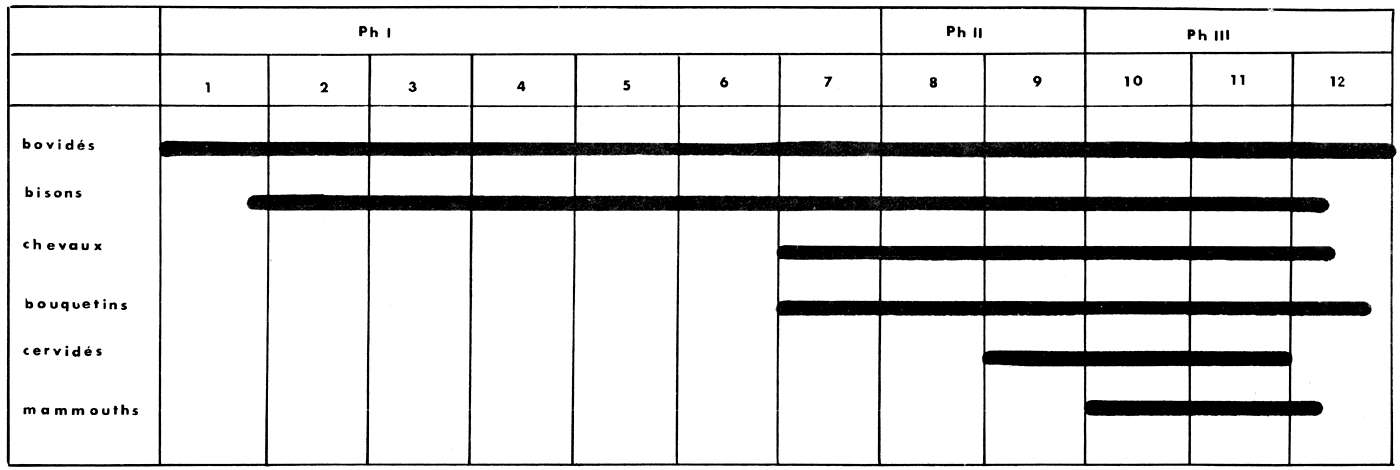
The classification of species according to the stages in the stylistic evolution of the cave art at Gargas gives us a much more interesting picture of the animal scene.
Bovidae are present at every stage, from 1 to 12
Bison commence a little later and finish a little earlier - from 2 to the beginning of 12
Horses and Ibex span a much later period - from 7 to 12
Cervidae last for a much shorter time - from 9 to 11
Mammoths are extremely short-lived - from 10 to the beginning of 12
All this indicates that the climate during the whole of the period under review was of the continental steppe type, with a short period of pronounced climatic deterioration during which we see the appearance of the Horse, which is more a creature of the steppes, followed by the Ibex, a mountain creature which probably came down on to the plain, and finally animals associated with a colder environment, Elk (Moose) and Mammoth which probably marked the climatic low.
Finally a rapid return to the previous situation probably left only the Bovidae, Bison and Horses surviving. The Ibex, now known, could be hunted in the mountains nearby which were accessible once again (a chamois was killed in the month of August).
The rapid and short deterioration in the climate which meant the appearance of the Elk, an animal of the taiga, and the mammoth, an animal of the tundra, may have thus been responsible for the disorders whose effects made themselves felt on the hands of the Men of Gargas and thus impelled them to execute the hand negatives in black and red. This was Dr. A. Sahly's hypothesis which if correct would allow the hands at Gargas to be dated as upper Périgordian.
This climatic graph as represented in the cave art is supported to a certain extent by what is known of climatic variations revealed by sedimentary and palynological studies, not from Gargas, where this work has never been done, but from strata in the Périgord region. Of course one must beware of jumping to conclusions: we are not dealing with conditions which are exactly identical; Gargas is at the foot of a high mountain chain which was a source of glacial action.
However, one cannot but be struck by the similarities revealed in the tale published by Henry Laville.
In it we can see that during the development of the Périgordian style at Noailles (which is the work found on those levels containing the carved plaquettes from Gargas which correspond to the middle period of the cave art at Gargas) the climate swung on two occasions to a cold and less damp or dry type.
Périgordian VI
a. less cold, less damp
b very cold, dry
c less cold, more damp
Périgordian VII
a mild, damp
b colder, less damp
c temperate, damp
The second period seems to have been very mild, but it could have been different at the foot of the Pyrenees. It remains to be seen what period Gargas corresponds to. The question should be taken up again by experts, but new excavations would be necessary.
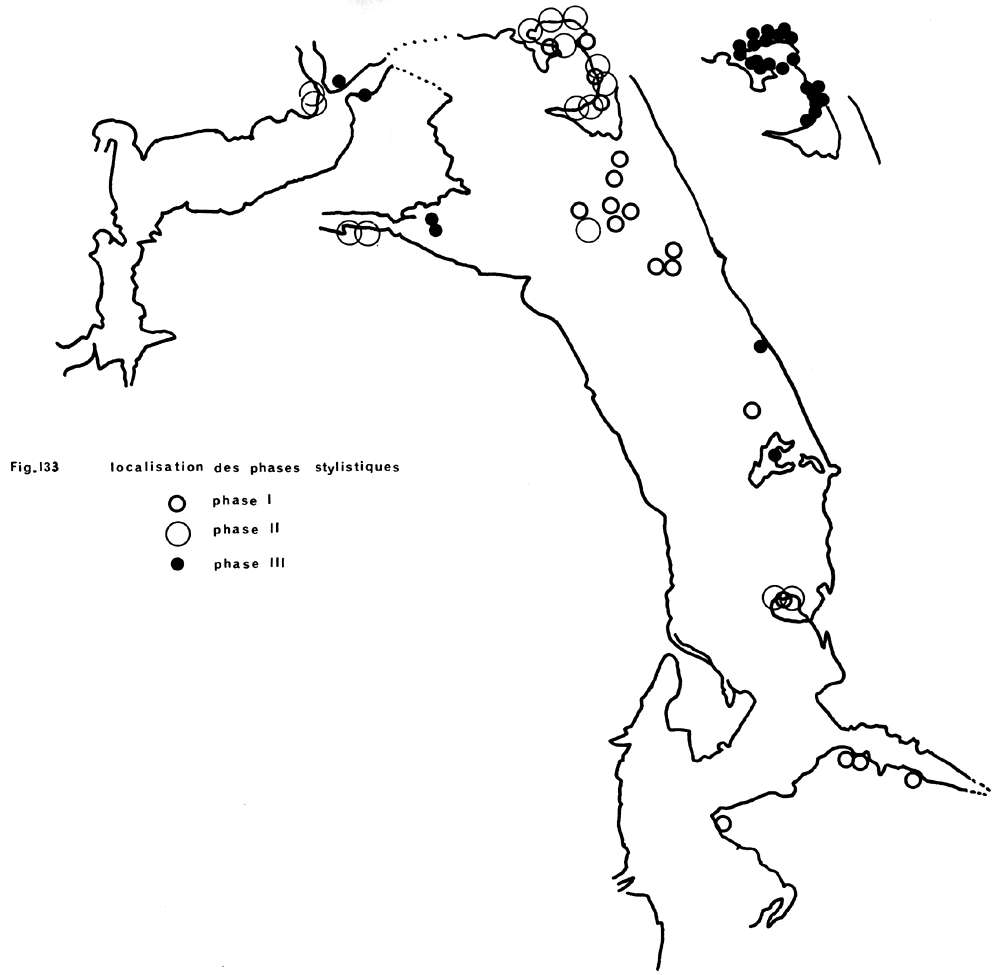
Map of the Grotte de Gargas, showing the location of the engravings with respect to the various phases of the styles of art.
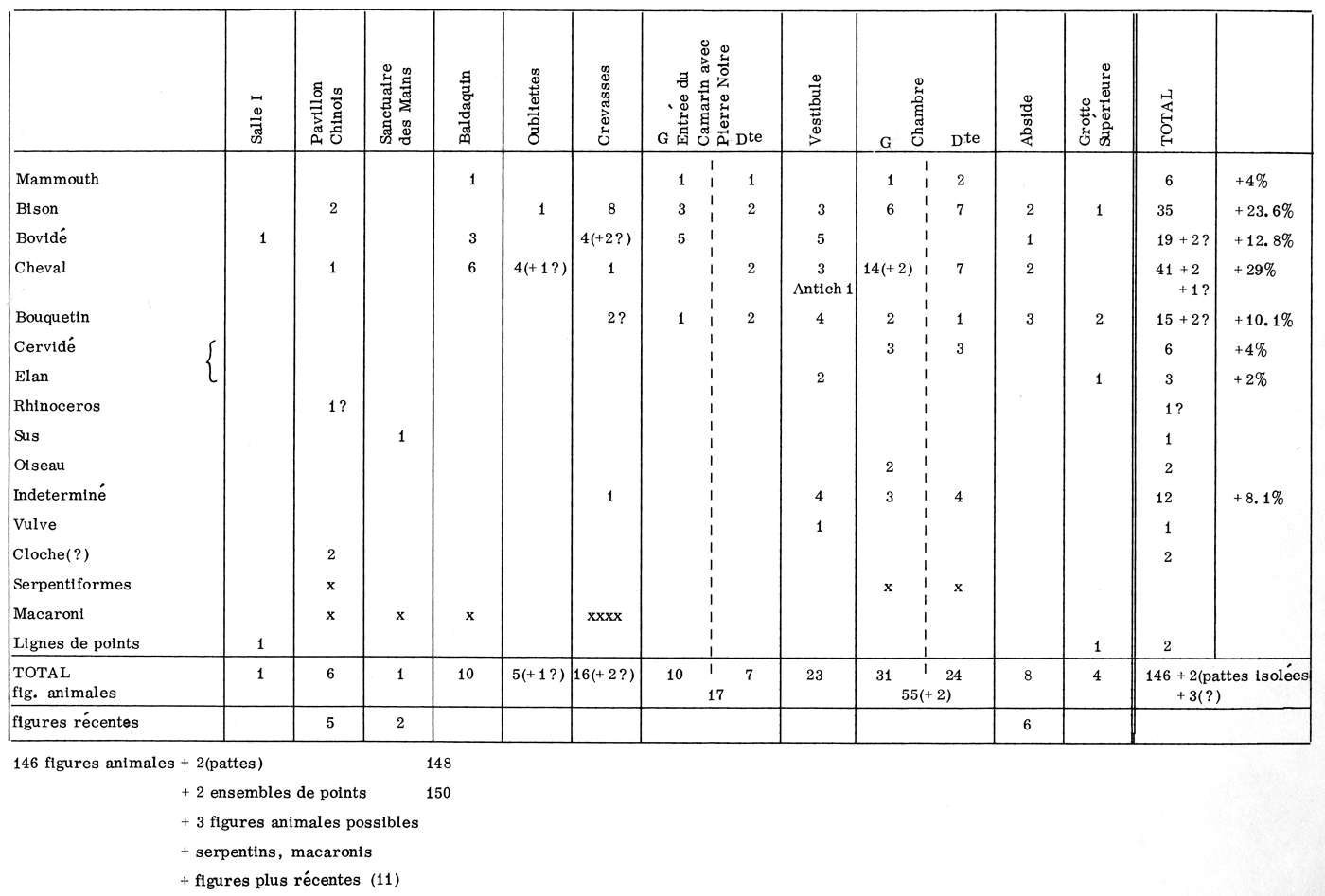
Table of all the art found at Grotte de Gargas, and its location.
Photo: Barrière (1976 ii )
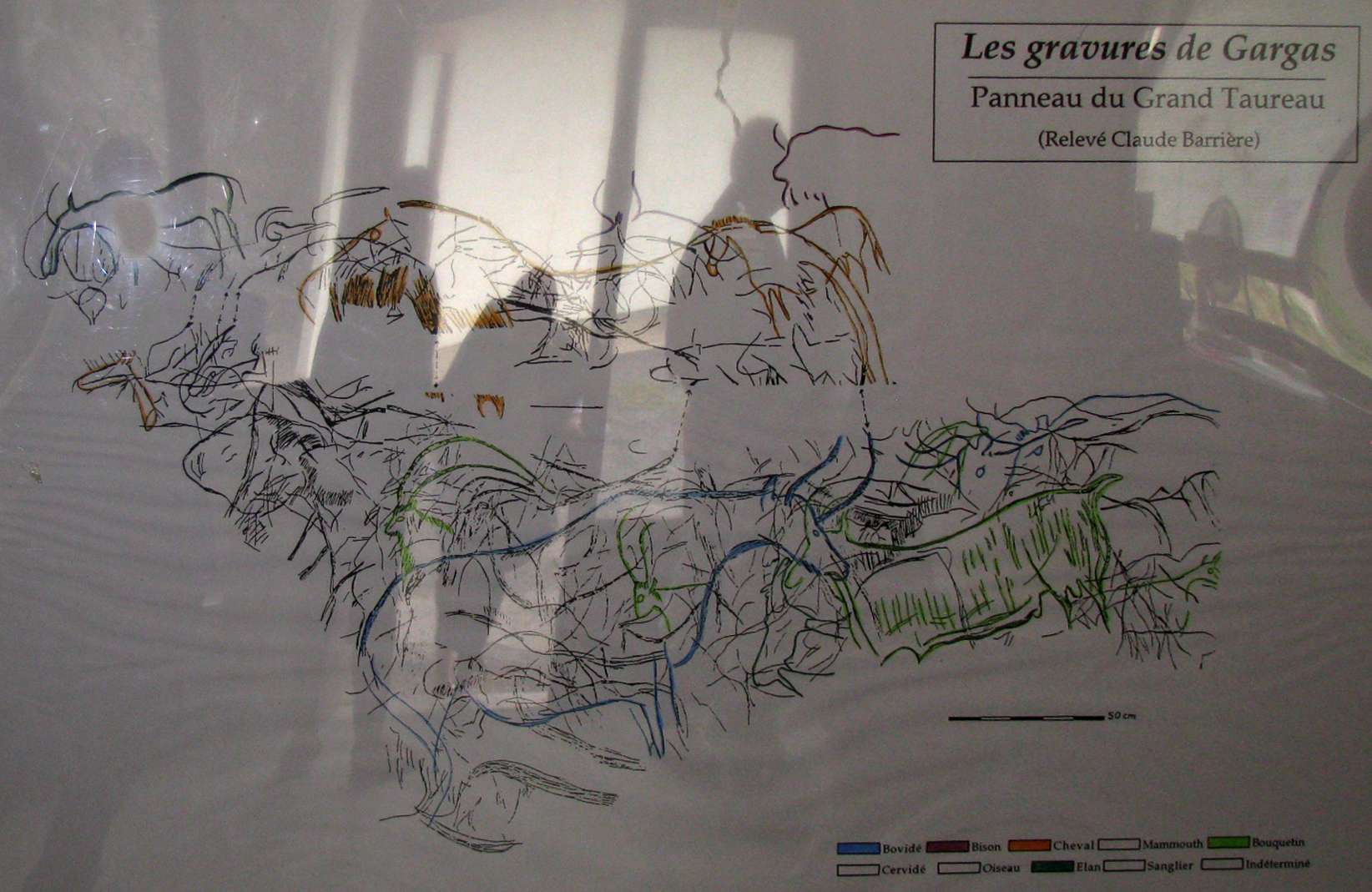
Engravings at the Grotte de Gargas.
Panneau du Grand Taureau
The Large Bull Panel.
Photo: Don Hitchcock 2008
Source: Display, Grotte de Gargas
Artist: Claude Barrière

Engravings at the Grotte de Gargas.
Pierre noire et panneau de Mammouth
Photo: Don Hitchcock 2008
Source: Display, Grotte de Gargas
Artist: Claude Barrière
Engravings at the Grotte de Gargas.
Chambre du Camarin
Photo: Don Hitchcock 2008
Source: Display, Grotte de Gargas
Artist: Claude Barrière
Engravings at the Grotte de Gargas.
Conque
Photo: Don Hitchcock 2008
Source: Display, Grotte de Gargas
Artist: Claude Barrière
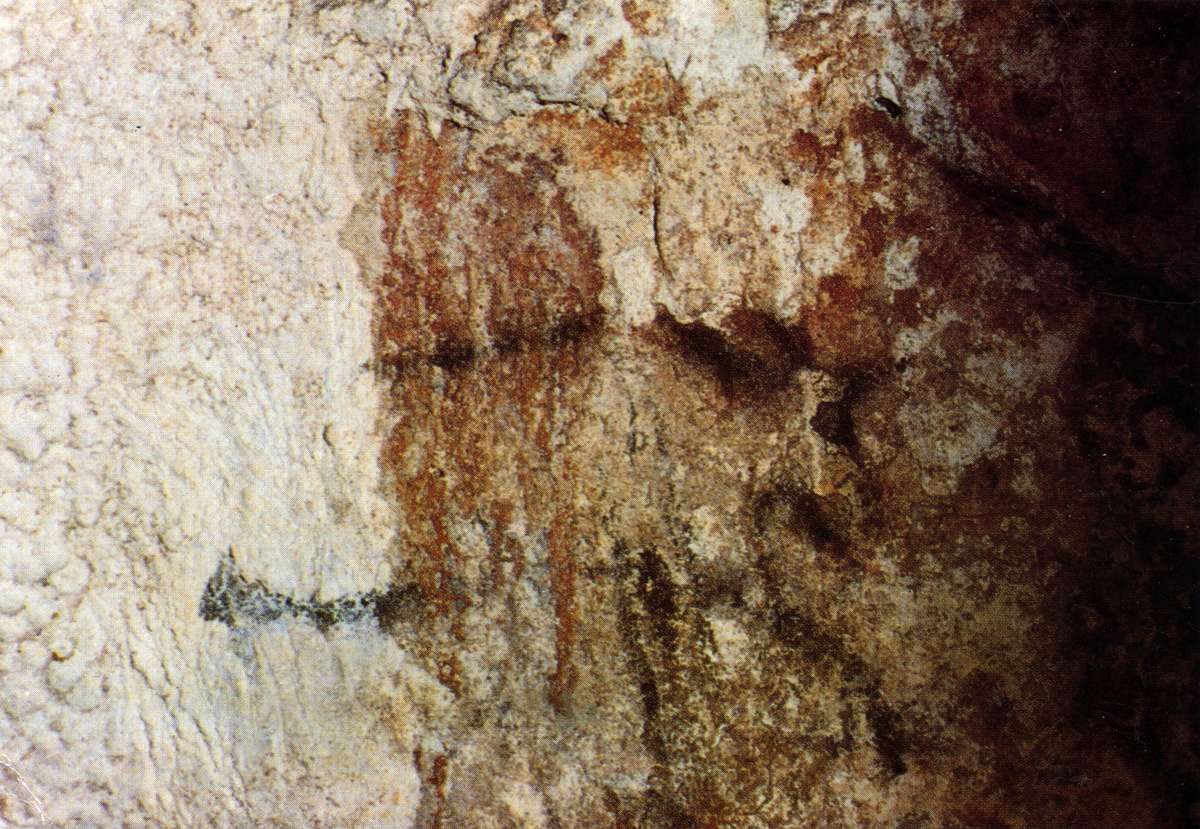
Bouquetin - Ibex.
Photo: Postcard, © Imprimerie Carret-Vene, Lourdes

Hand stencils at the Grotte de Gargas.
Grande paroi des mains, Panneau 4
Photo: R. Springinsfeld, at http://grottesdegargas.free.fr/
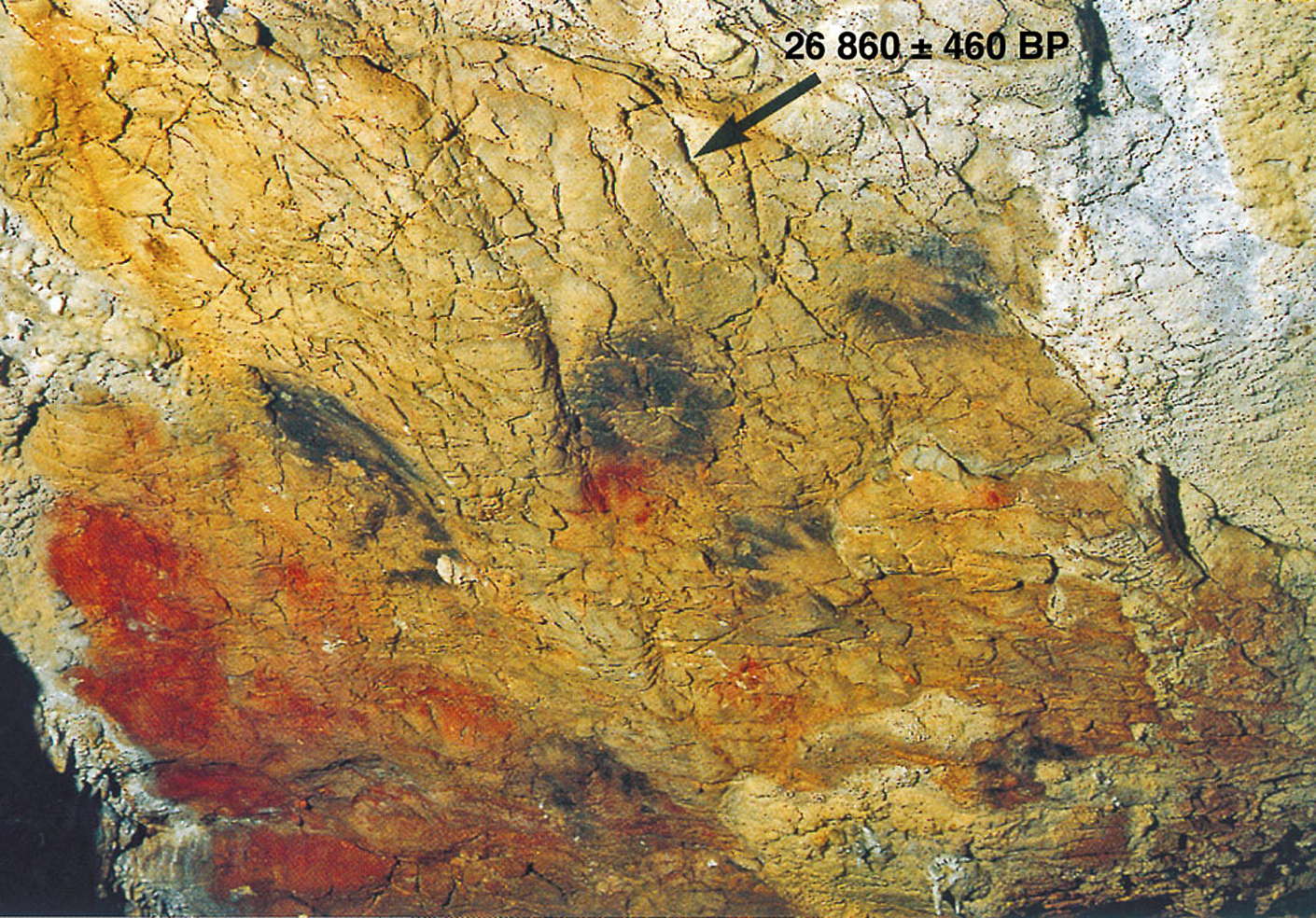
Gargas, lower cave, same panel as above.
Handprint stencils on the Great Wall with bedded bone dated to 26 860 ± 460 BP
Photo and text: Jaubert (2008)
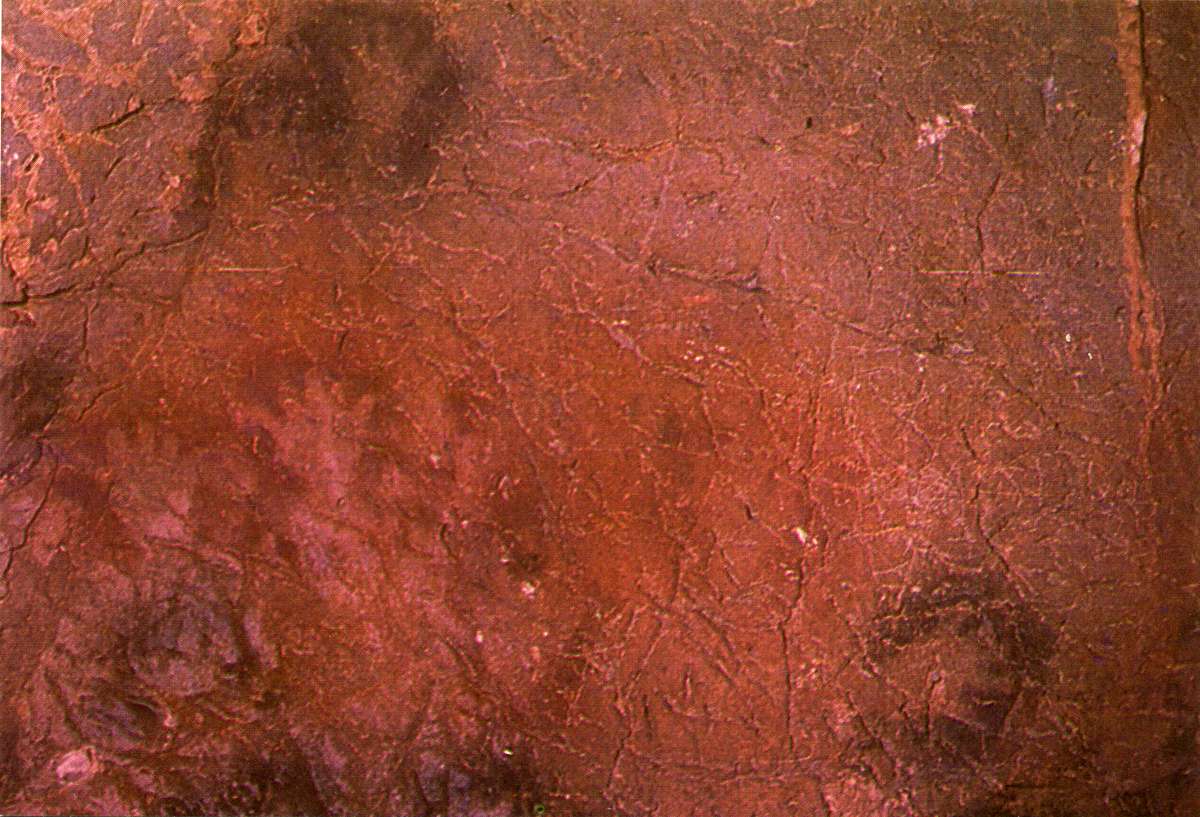
Children's hands Panneau entrée gauche
Photo: Postcard, © Editions Phoebus Izaourt
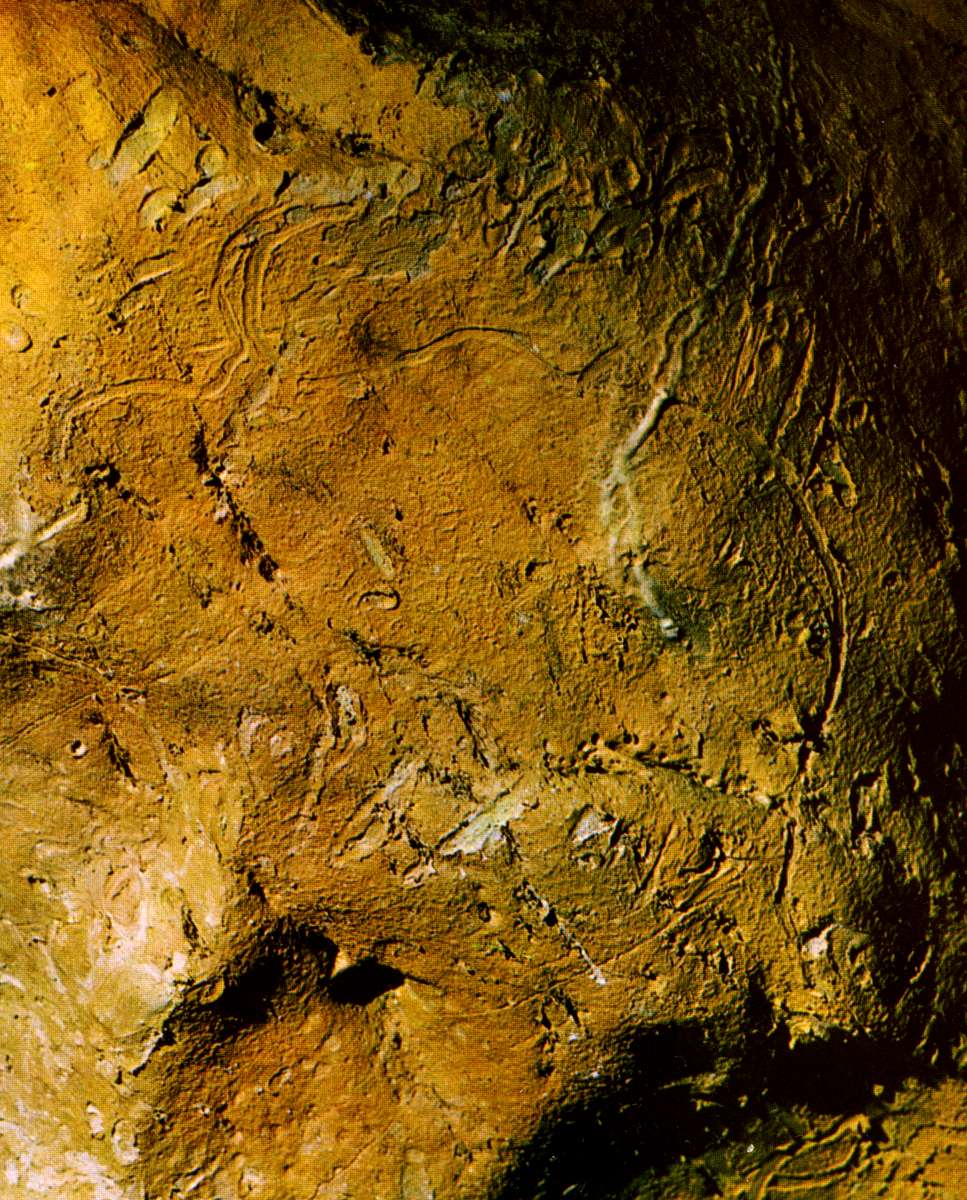
Bison on clay.
Photo: Postcard, © Photo Studio Jose, Spain
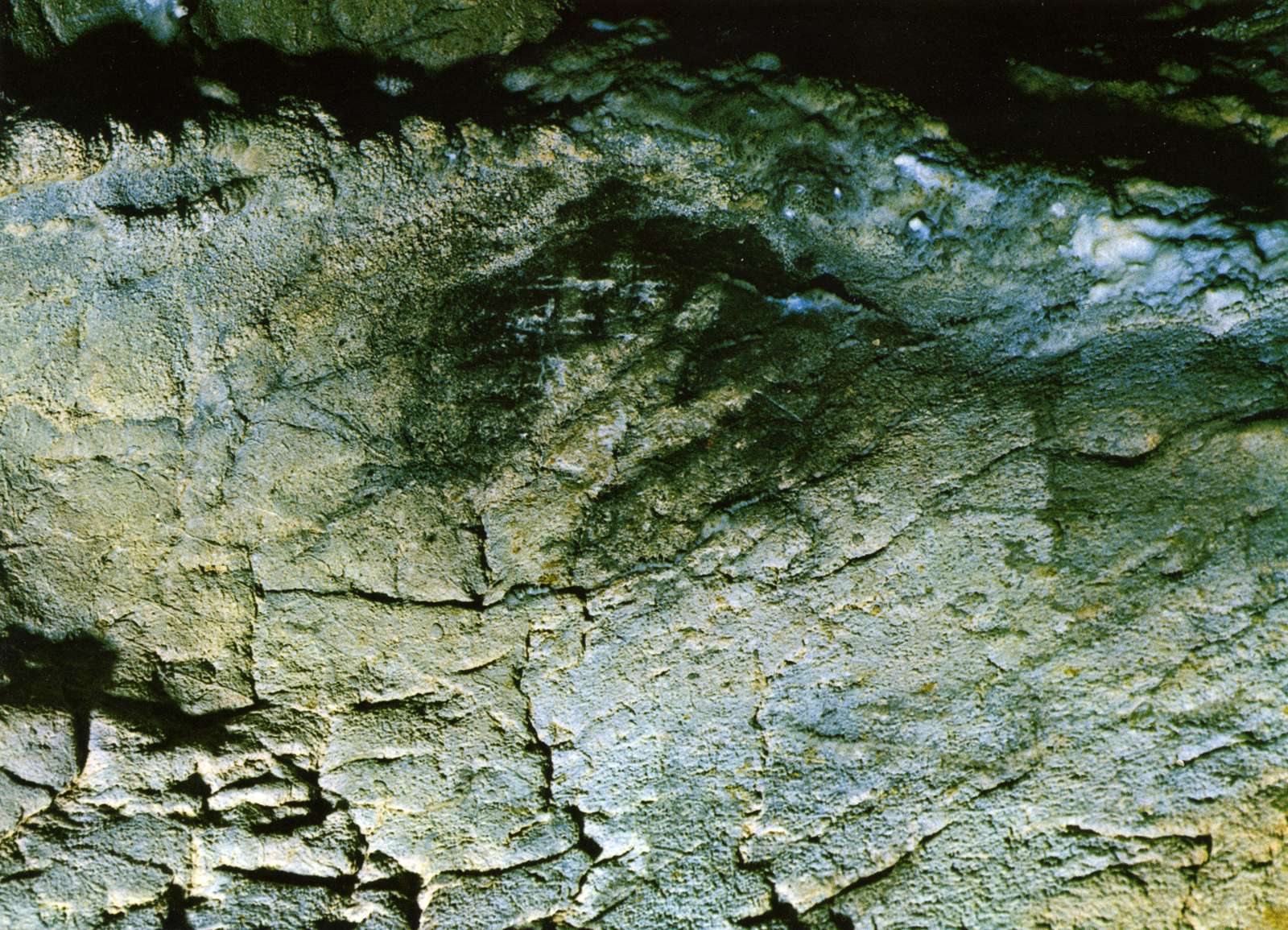
Black hand
Photo: Postcard, © Photo Studio Jose, Spain
-->
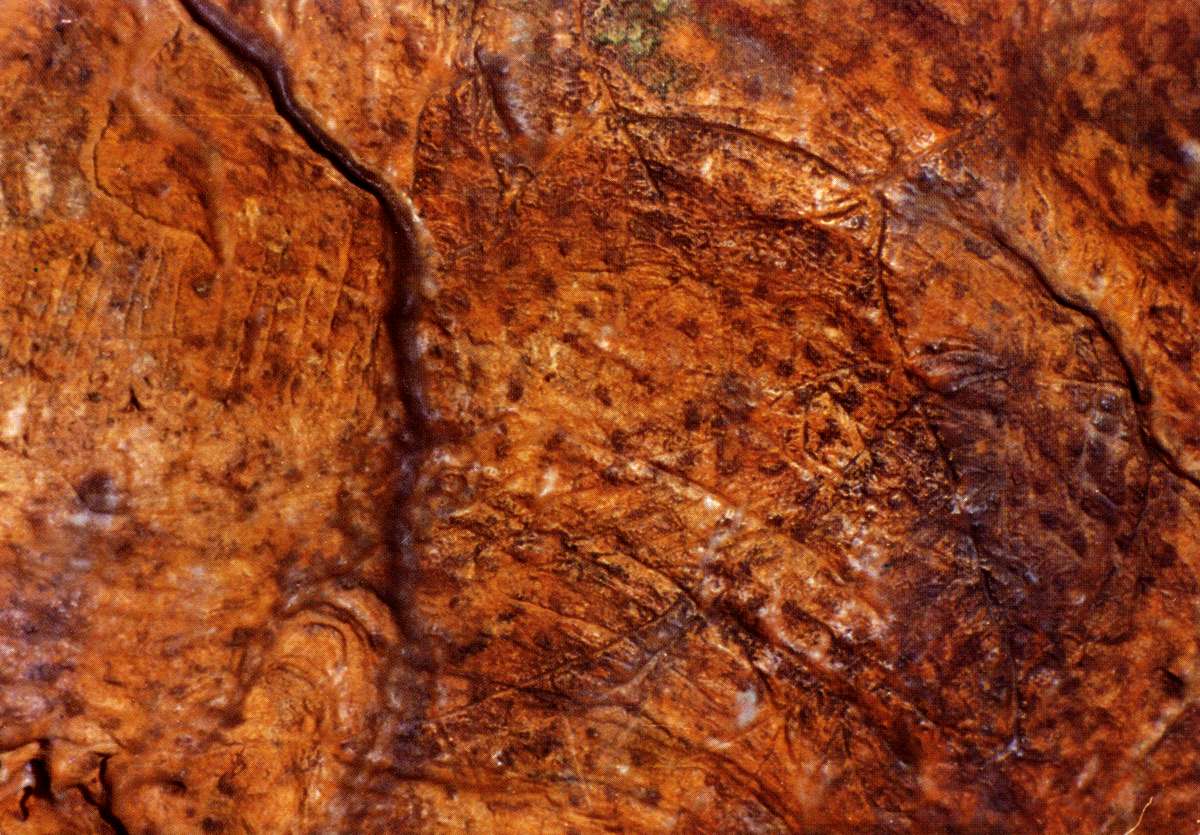
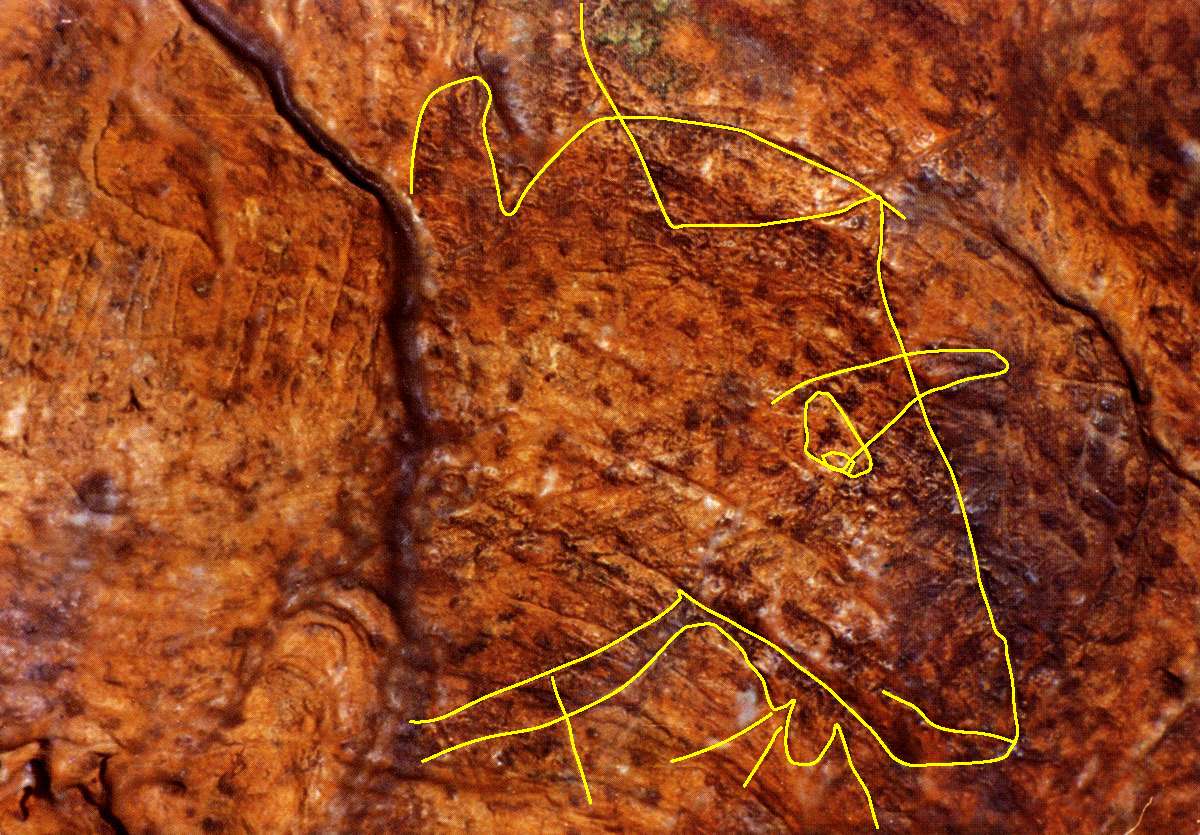
Bovid - Aurochs or Bison
You need the eye of faith to see the engraving in this photo!
I have added what seem like reasonable estimates of the lines, but no doubt there are other interpretations.
Photo: Postcard, © Imprimerie Carret-Vene, Lourdes
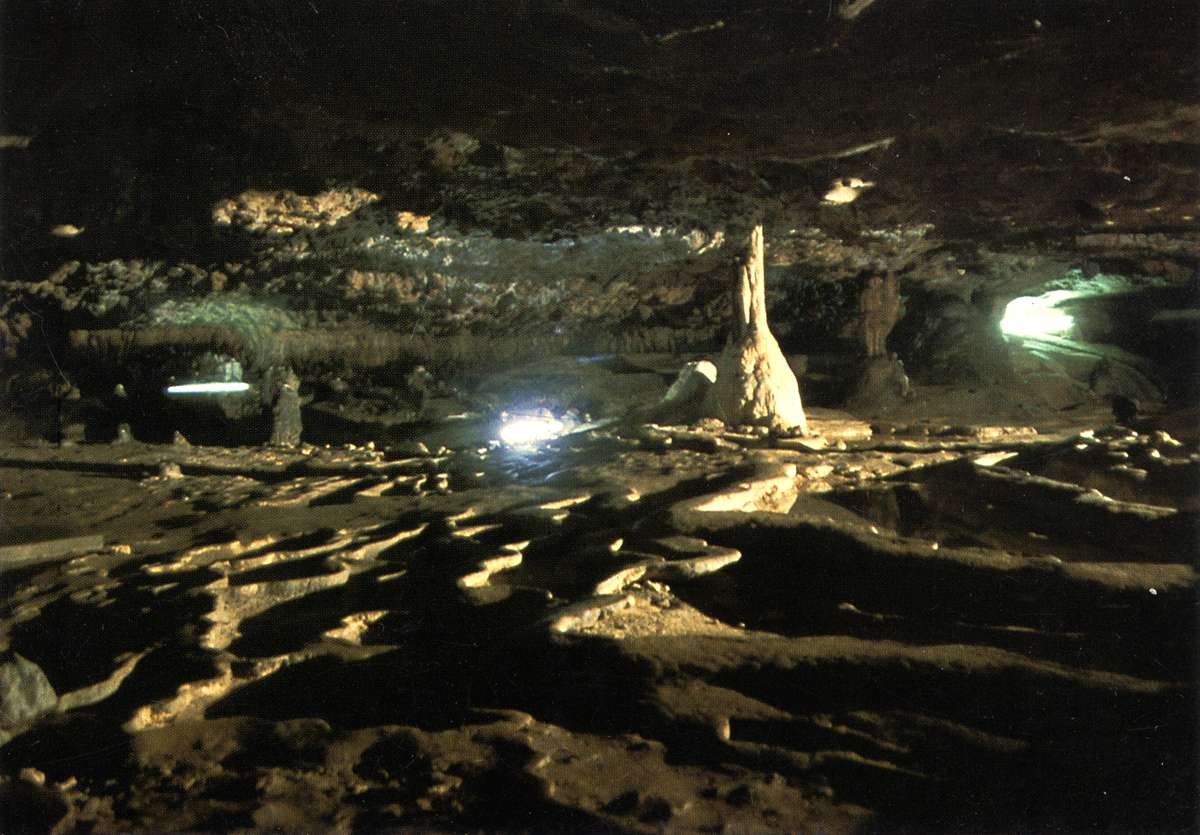
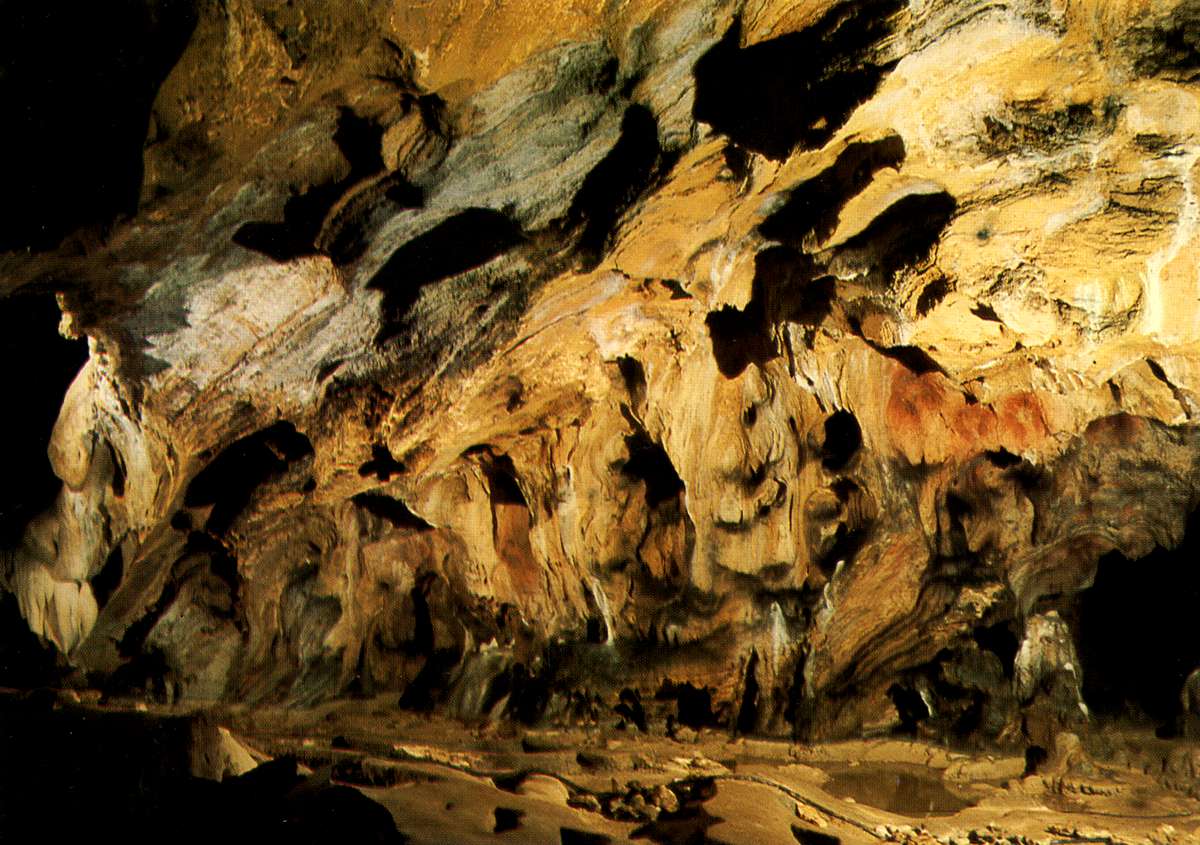
La grande salle de Gargas.
The large room in the Gargas cave.
Photo: Postcard, © Imprimerie Carret-Vene, Lourdes
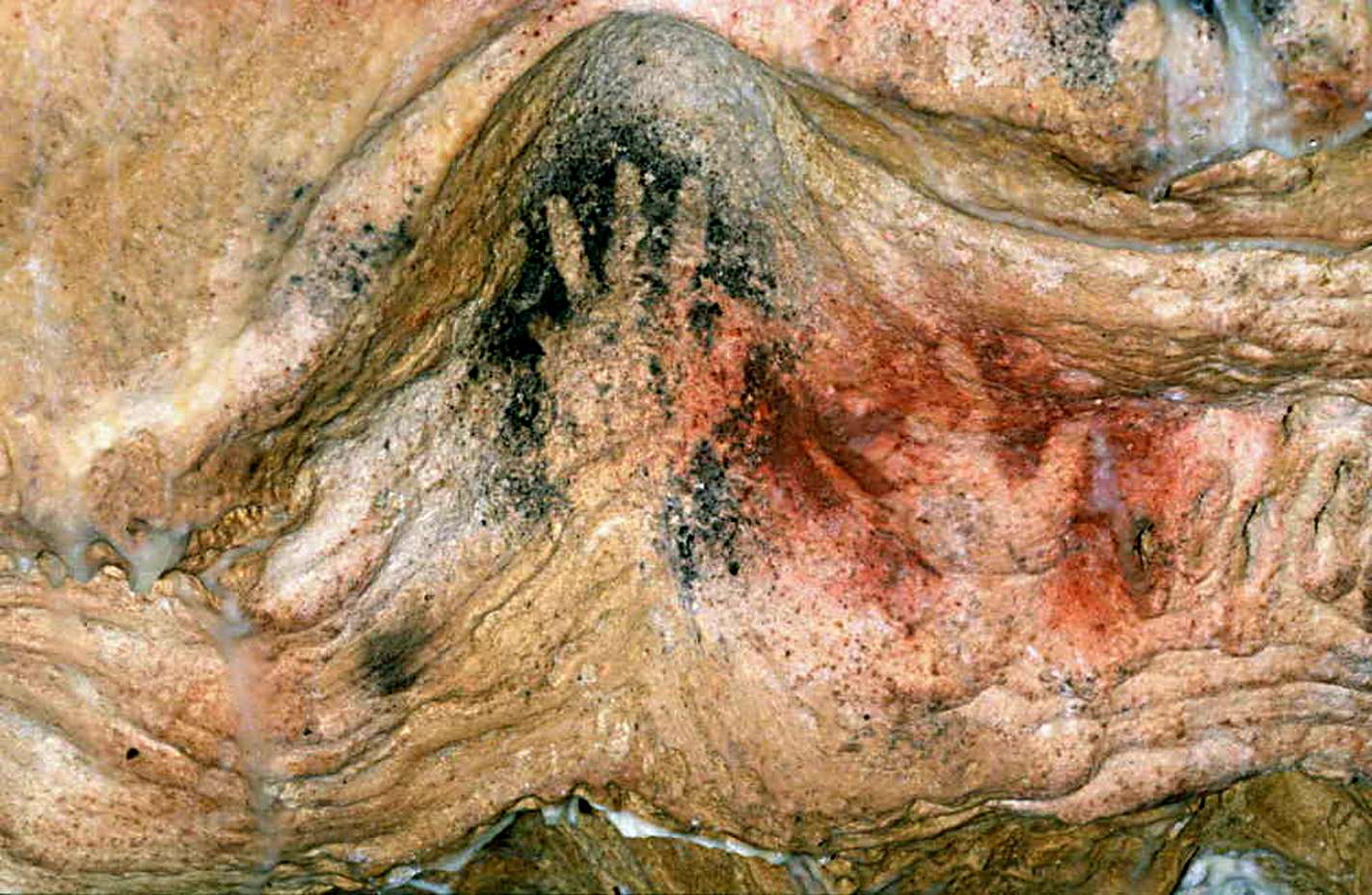
Negative hand stencils.
Photo: http://paleobox.forumactif.com/ou-voir-des-originaux-f12/musee-d-aurignac-et-sites-dans-les-pyrenees-et-ariege-t836.htm
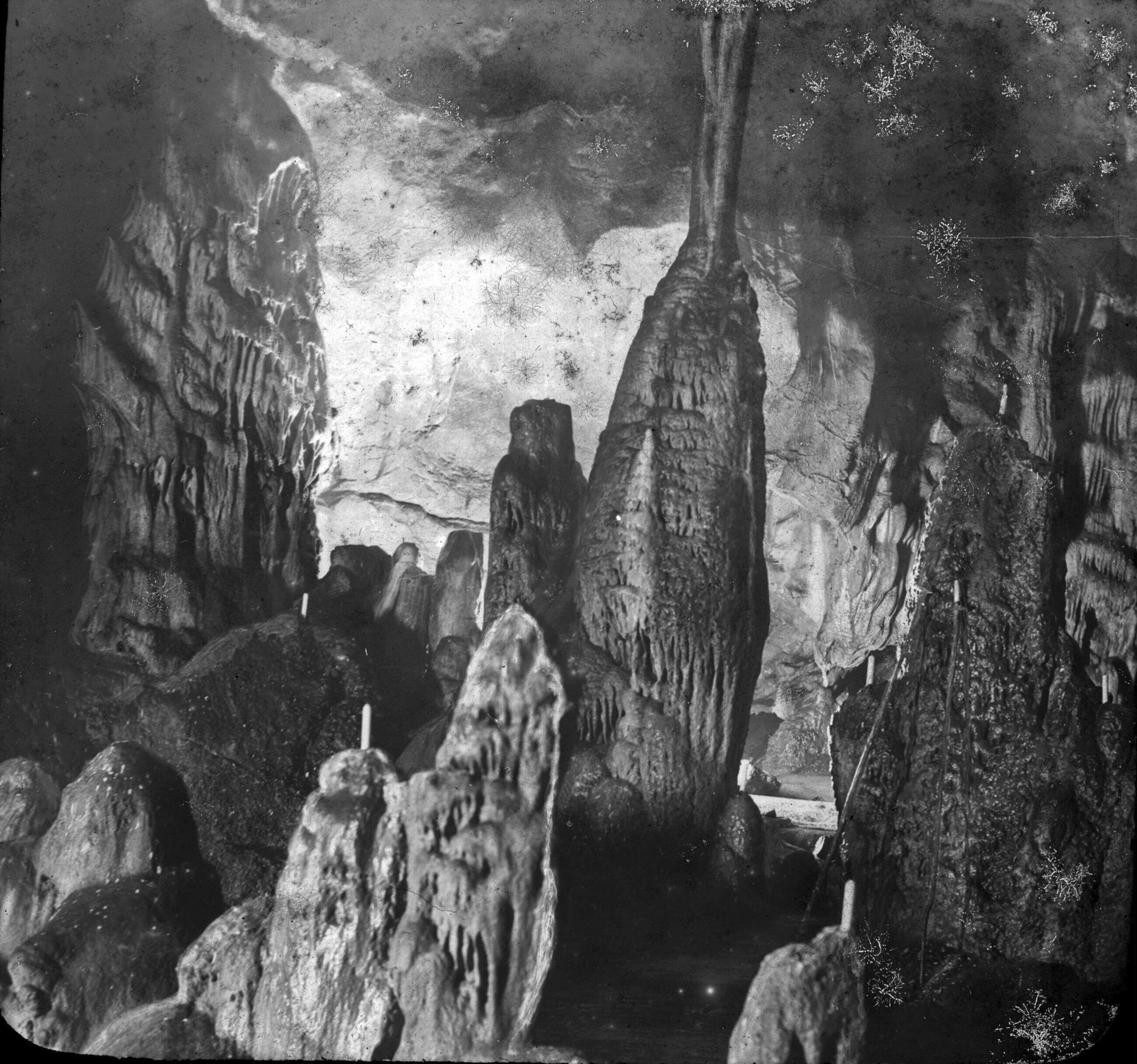
Old photograph of the Grotte de Gargas.
A bone fragment found stuck into a crack in the wall next to some hand stencils has been radiocarbon dated to 26 860 years ago, which may give an indication of the age of the stencils.
Photo: Original photo by Félix Régnault, ca 1859-1908
Permission: Public Domain
Text: http://www.britannica.com/EBchecked/topic/225967/Gargas
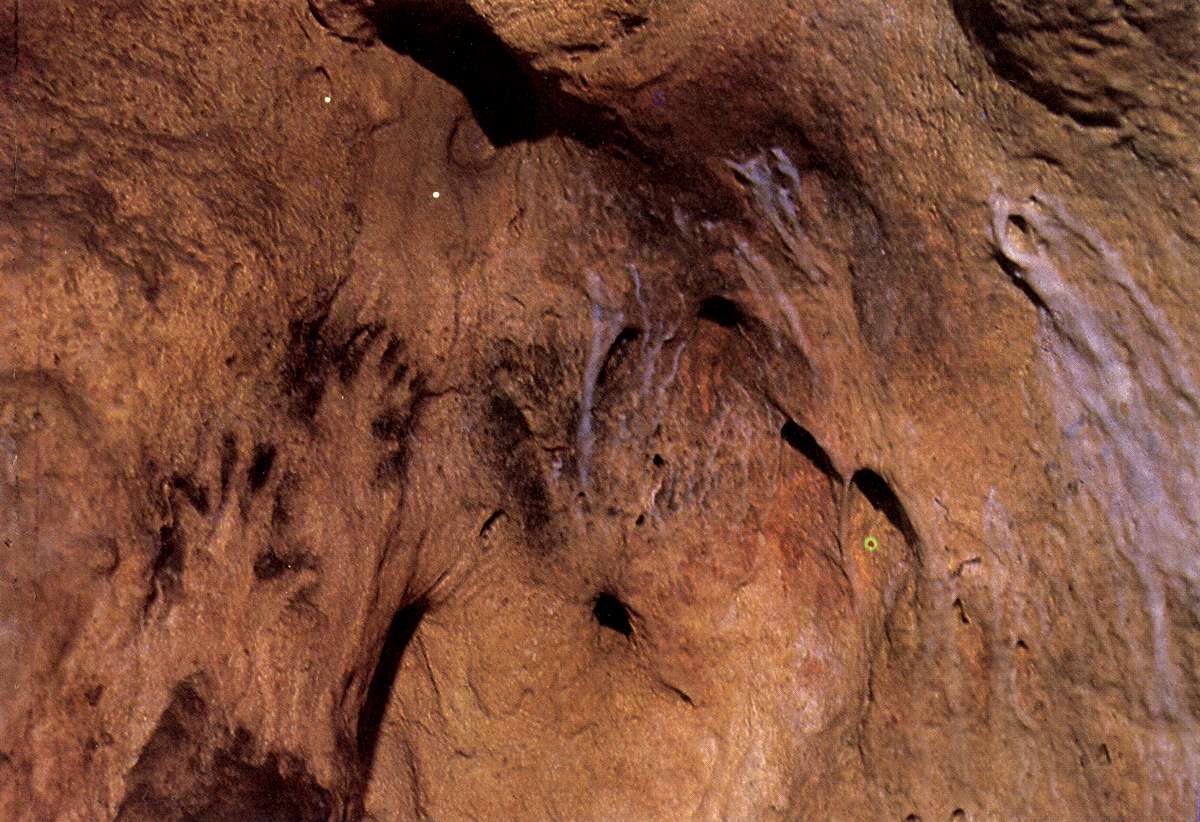
Mains (Entrée paroi droite)
Hands (entry, right wall)
Photo: Postcard, © Editions Phoebus Izaourt
Mains rouges (derrière sanctuaire)
Red Hands (behind the sanctuary)
Photo: Postcard, © Editions Phoebus Izaourt
Paroi derrière le sanctuaire.
Wall behind the sanctuary.
Photo: Postcard, © Imprimerie Carret-Vene, Lourdes
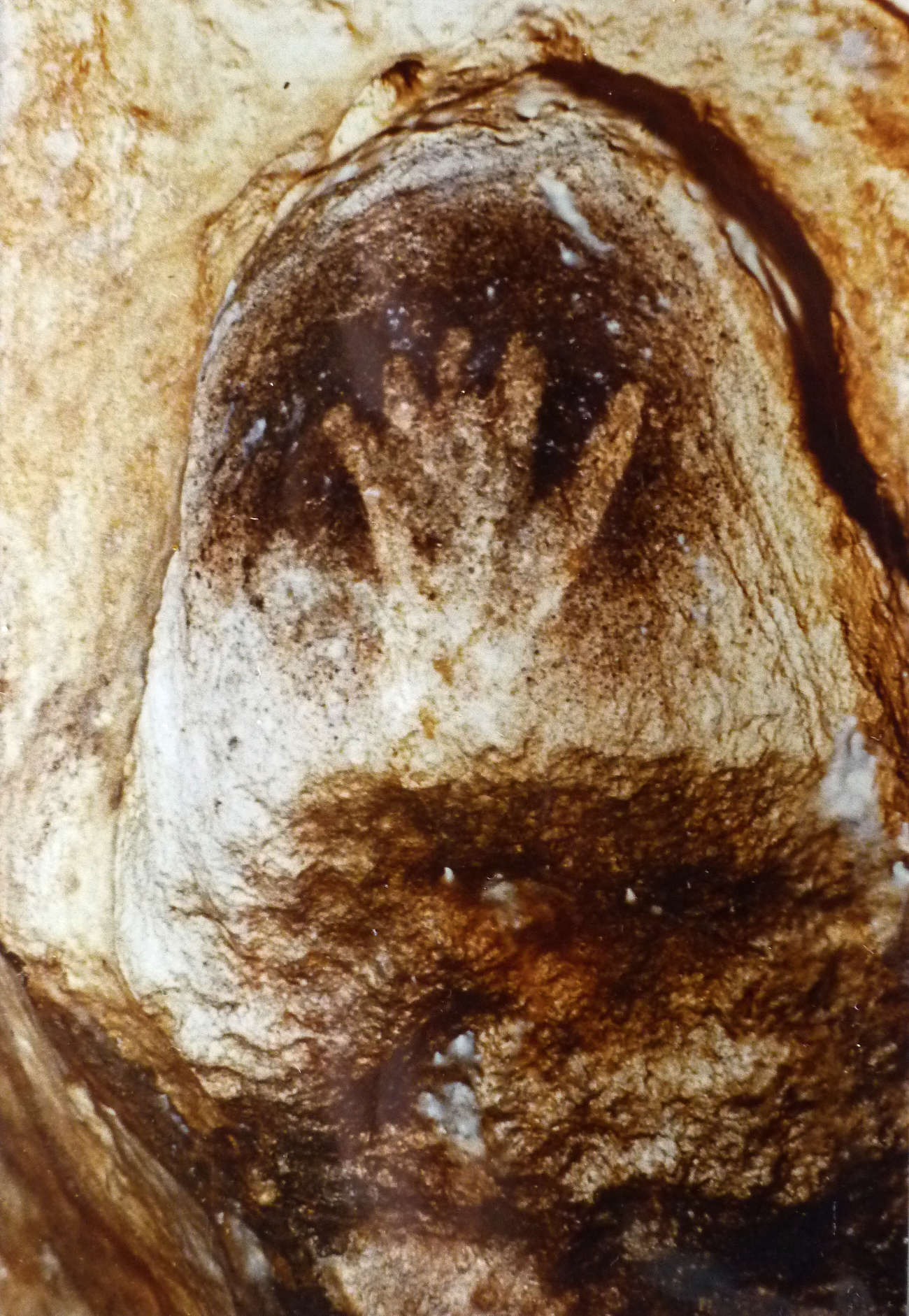
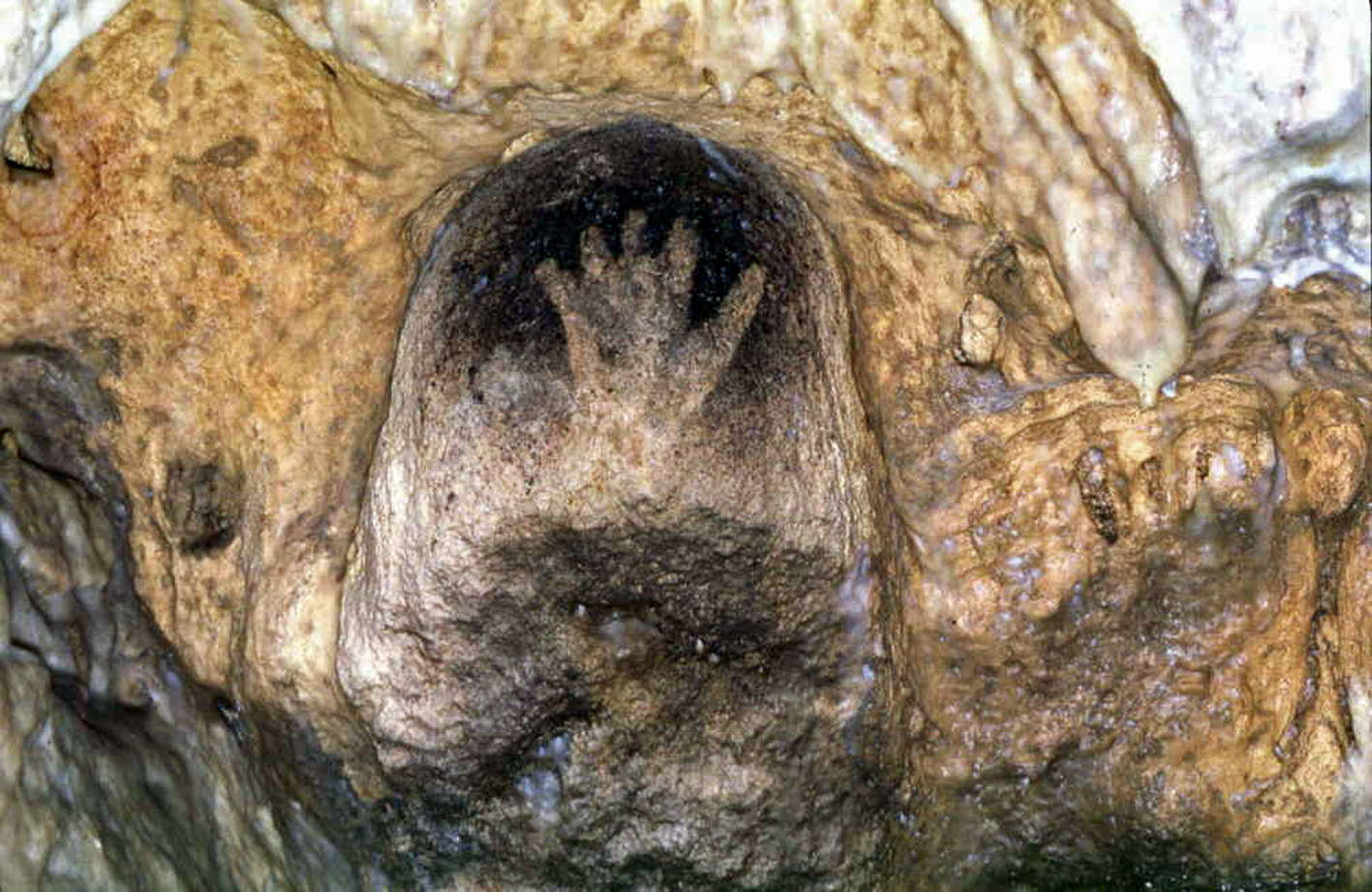
Another hand stencil.
Photo (left): old Postcard
Photo (right): http://www.nicolepeyrafitte.com/442/Gargas.jpg
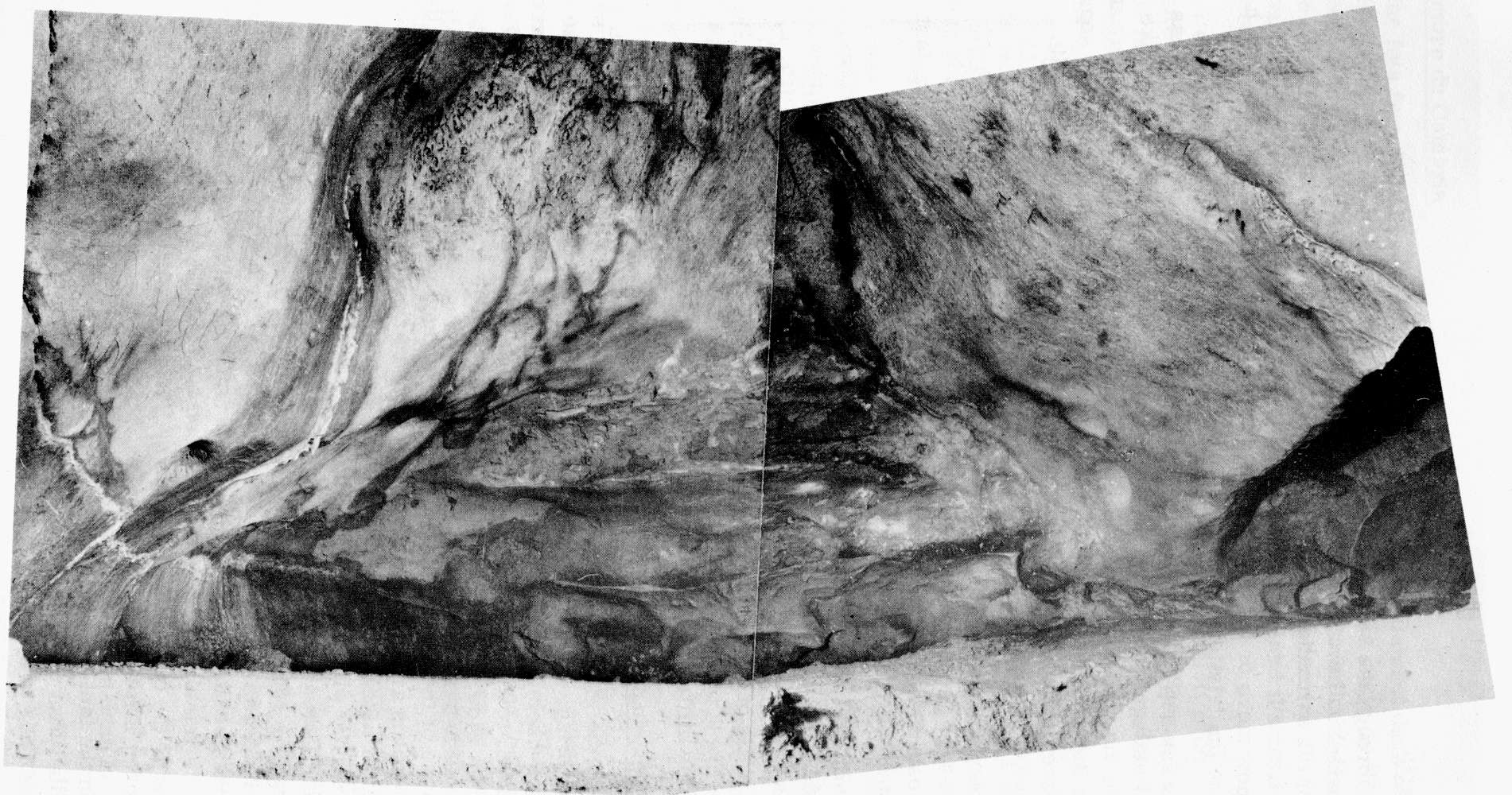
La Chambre du Camarin, the "Small Room".
View of the right-hand group (on the right of the picture is the entrance passage, and beyond is the antechamber and then the vestibule)
Once through the very low passage one enters laterally an elongated chamber which follows the line of a fissure running parallel to the clefts in the roof of the entrance and the vestibule, and the vestibule, and shaped like a gothic arch in cross section. It has been filled by silt topped by a thick stalagmite floor which is now more or less powdery and through which an artificial passage has been dug so that visitors can stand upright.
At the far end on the right, one can see as one enters two more or less horizontal stalagmite slabs, placed one on top of the other and covered like the base of the walls with red clay. Imprints have been made in this clay and numerous finger prints, many of which are deep, have been preserved: some of them have become stalagmitic and therefore look as they originally did, others have unfortunately suffered at the hands of visitors.
(Note: It may be imprints like this that have allowed researchers to determine that many of the people who visited the cave did in fact have amputated fingers - Don.)
Photo and text: Barrière (1976 ii )
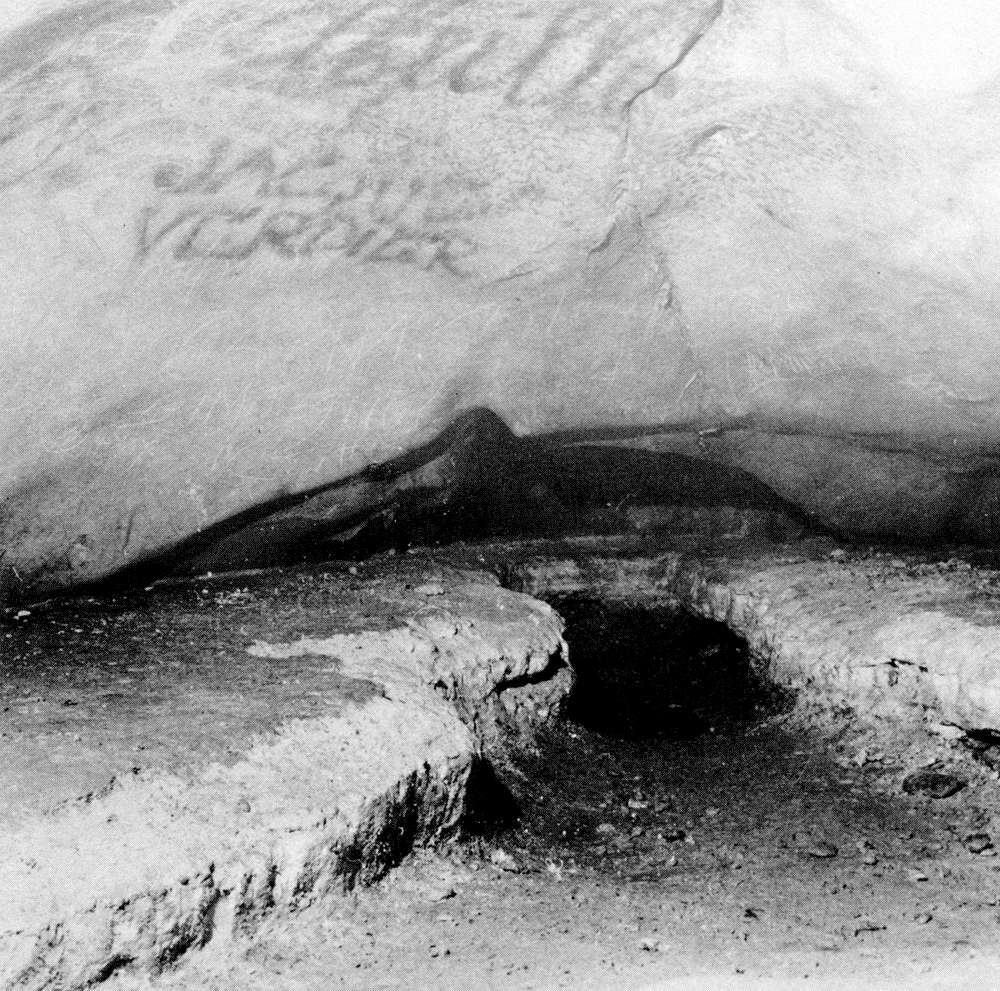
Chambre de Camarin, the Small Room.
Left side, and entrance to the apse. A cutting has been made in the stalagmitic floor and the deposit of clay to facilitate access to this part of the cave.
The Camarin was a favoured location, since it alone contains 105 definite figures out of the 148 in the cave, about 71%. There are two possible reasons for this:
1. Given the present state of the cave, which is perhaps not so different from that which existed during the early Palaeolithic period, walls suitable for carving are not readily available. The Camarin, however, offers good surfaces over almost all of its area.
2. The quiet, secluded character of the site, even though it was at that time more accessible than it is today, make it a suitable place for such images.
Photo and text: Barrière (1976 ii )

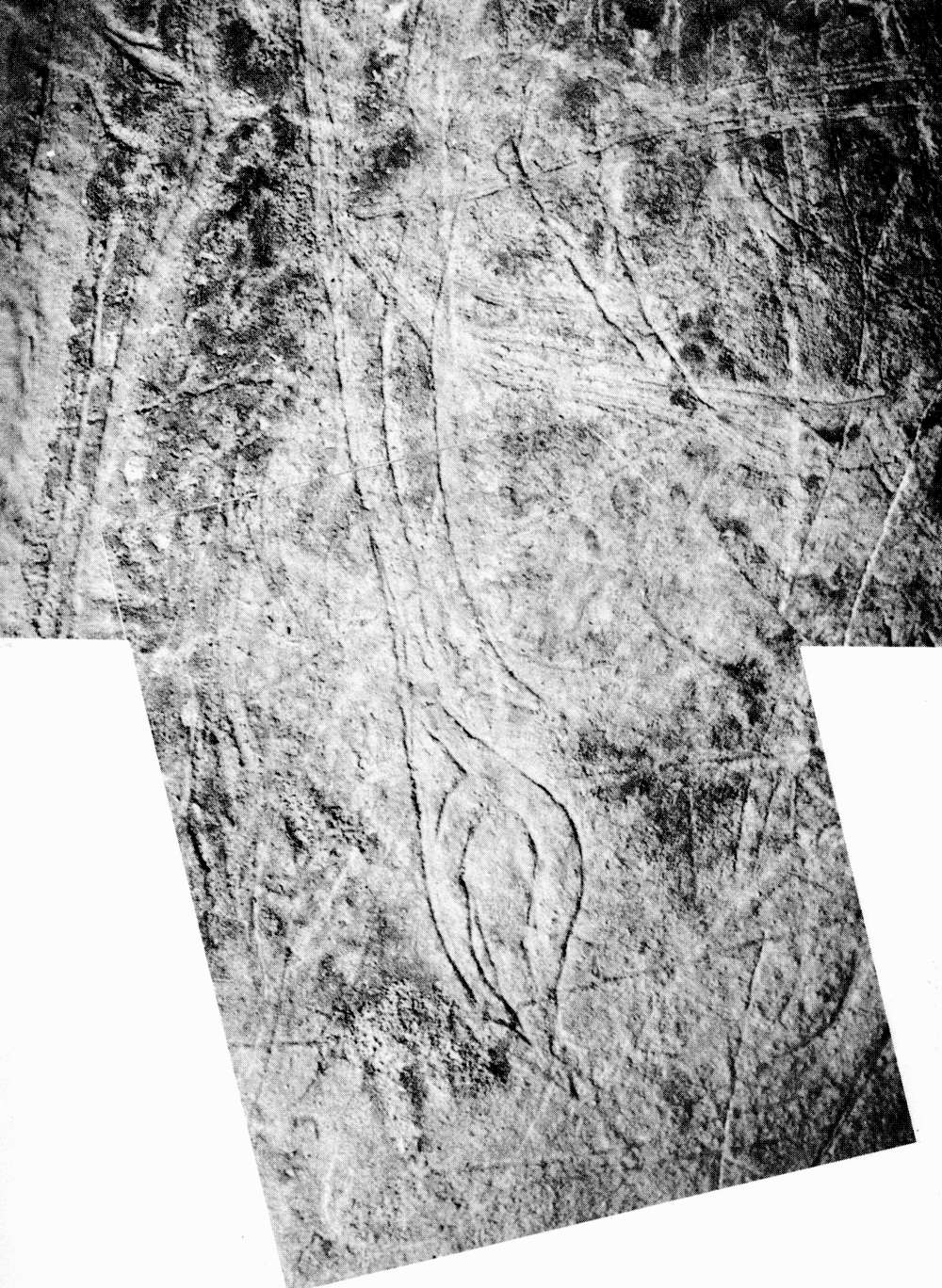
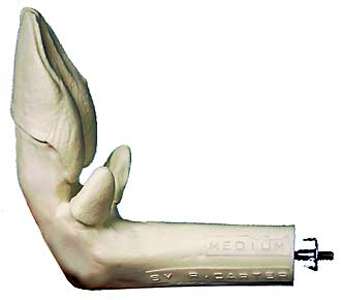
The Camarin. Right wall. Legs of a cervid No. 2.
A particularly interesting, detailed, and anatomically accurate depiction of a cervid foot. It should be noted that the foot is apparently shown as it would be after the animal has been killed, with the underside uppermost.
For comparison, I have included a deer foot cast used by taxidermists.
Apparently there is a fashion in the US to mount deer feet as gun racks.
Photo (left and centre): Barrière (1976 ii )
Photo (far right): http://www.taxidermy.com/cat/12/feet.html
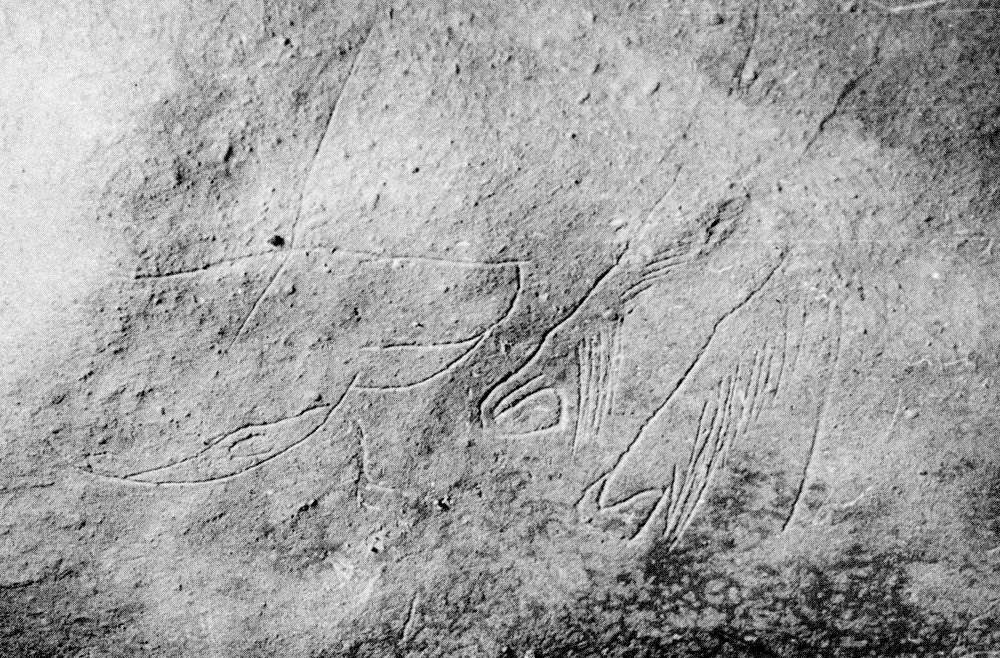
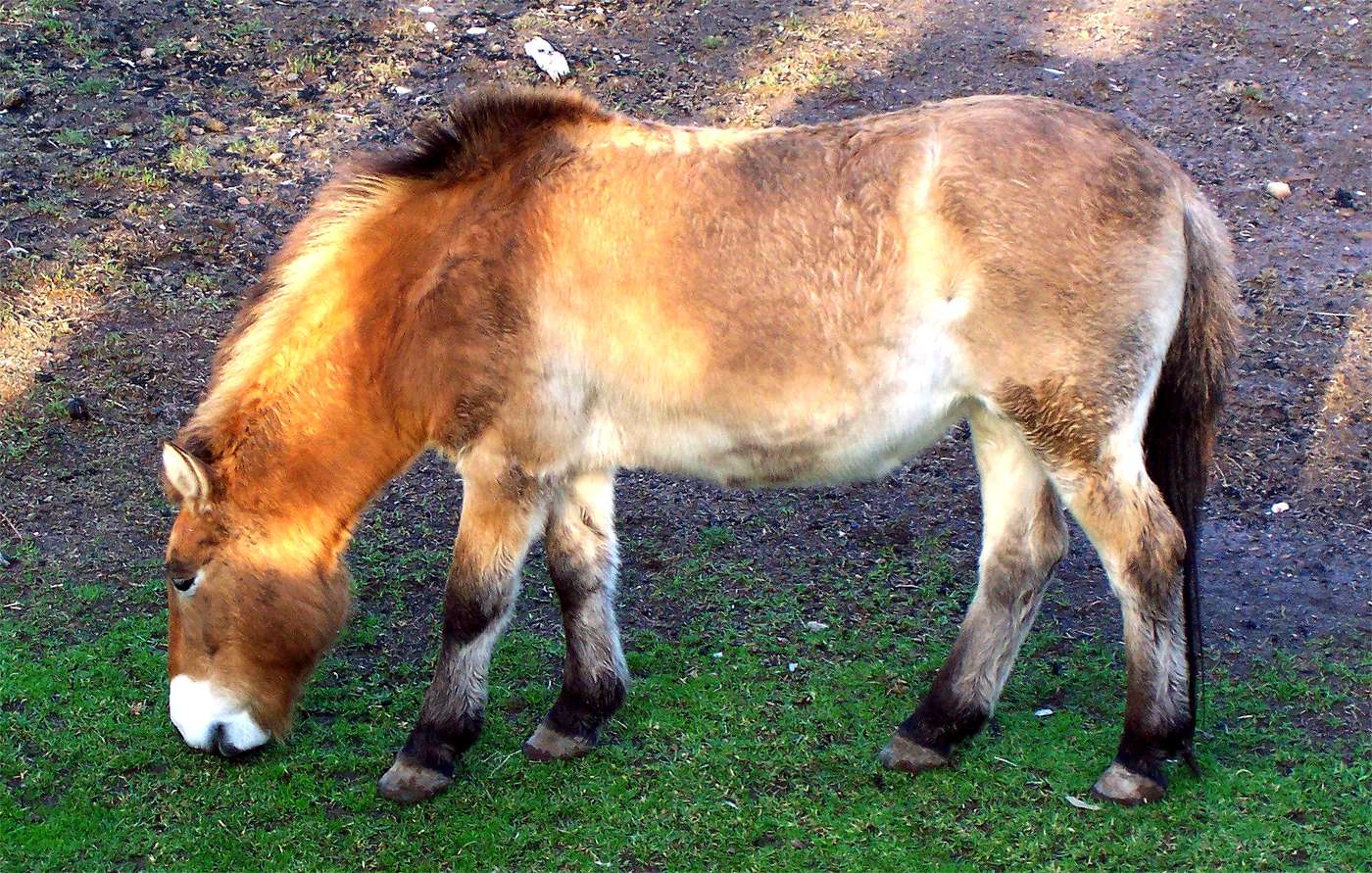
(left) The Camarin. Left wall. Forelegs of Horse No. 6.
This is a remarkably detailed drawing of the forelegs of a horse, including the long hairs of the legs.
(right) Przewalski's Horse, Dubbo Wild Plains Zoo June 2005
Photo: (left) Barrière (1976 ii )
Photo: (right) Wikimedia Commons
Source (right) Author: Salvosam
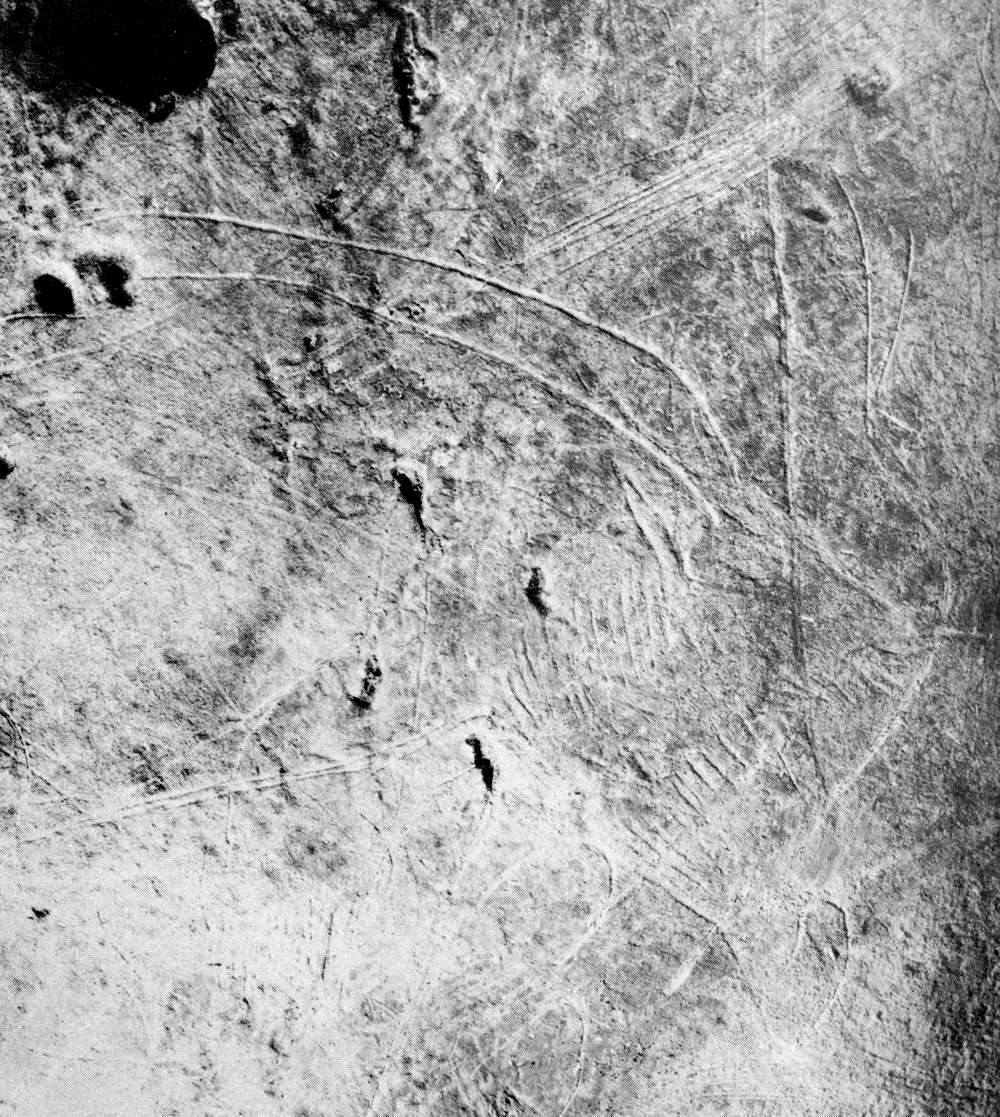
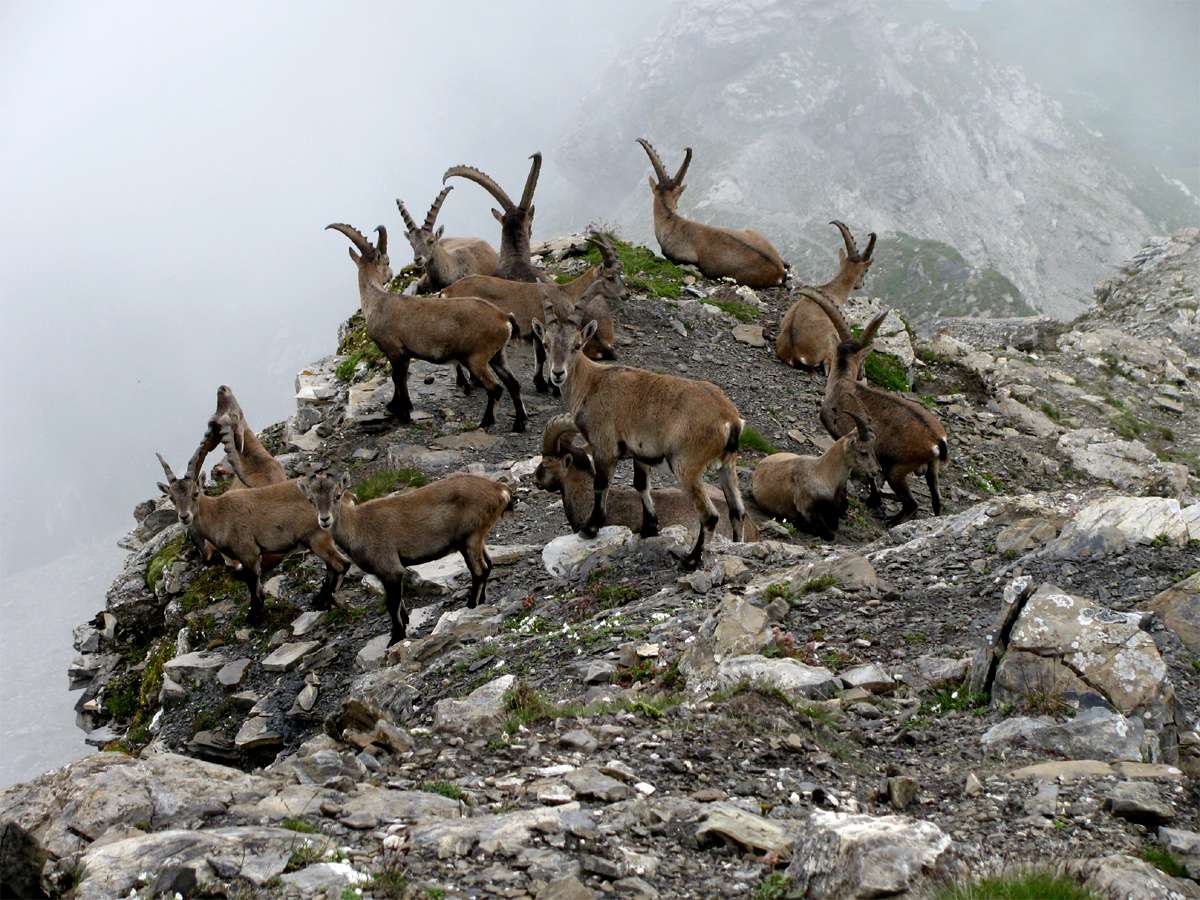
Chambre de Camarin, the Small Room.
(left) Ibex No. 2 from the left wall.
This is a particularly well drawn image.
(right) Ibex, border area Switzerland-Austria-Liechtenstein 11 August 2008
Photo: (left) Barrière (1976 ii )
Photo: (right) Wikimedia Author: Nudelbraut

Chambre de Camarin, the Small Room. Bison drawn in clay below the upper panel.
Photo: Barrière (1976 ii )
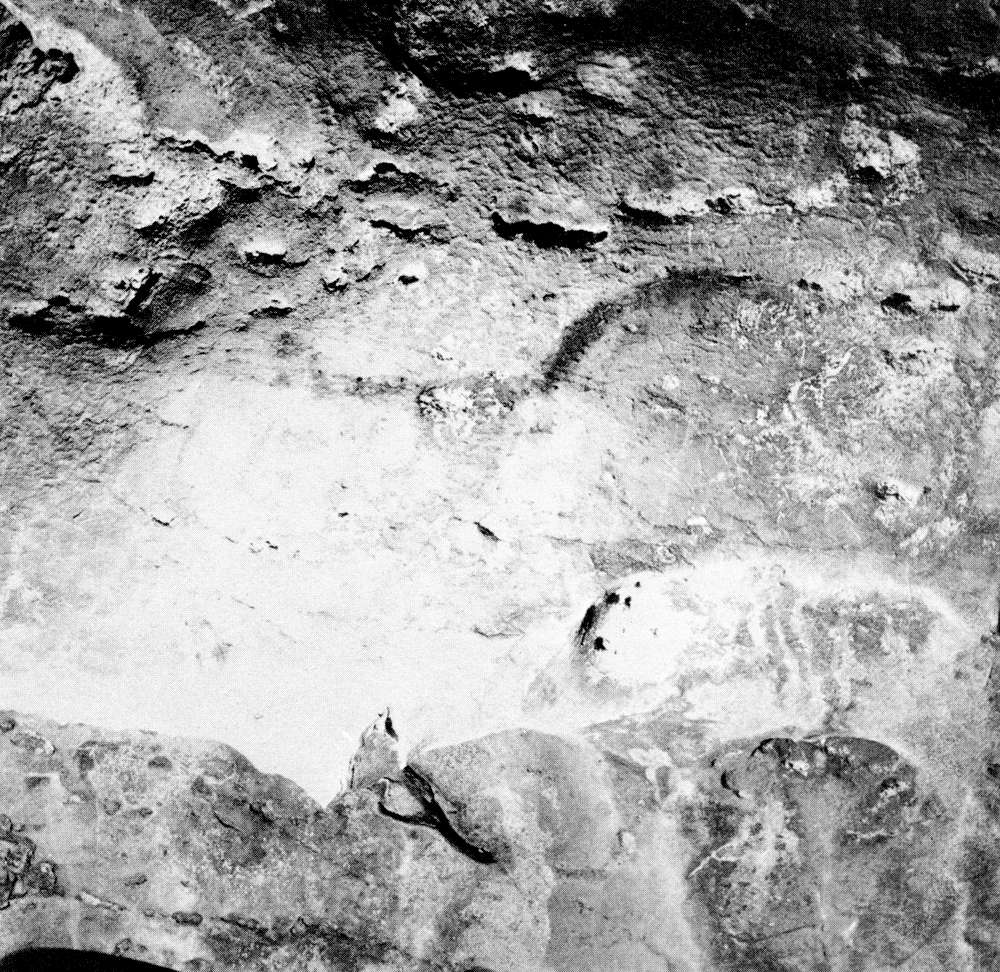
Room III, No. 25. Painting in black, spine and neck of a horse.
Although there is very little of the painting still visible, it is very reminiscent of paintings from Lascaux.
Photo: Barrière (1976 ii )
The Gargas mutilated hands.
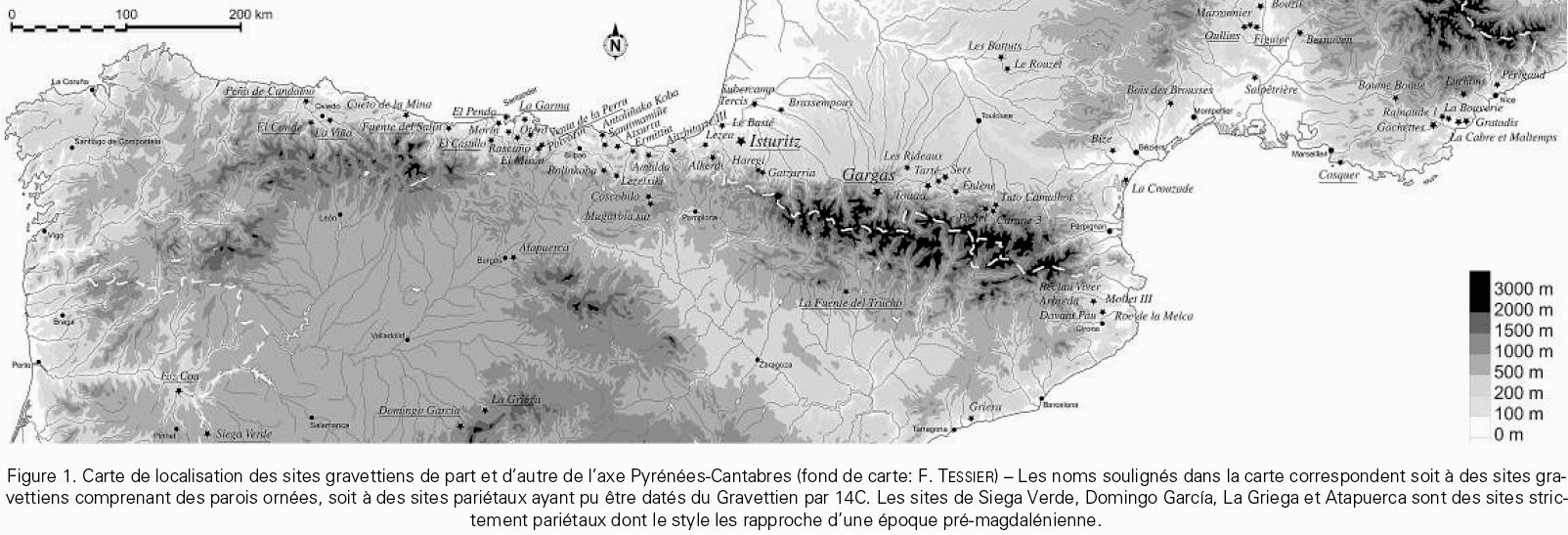
Photo: Gargas et l’Atlantique: les relations transpyrénéennes au cours du Gravettien, Munibe 57, 2005
by Pascal Foucher
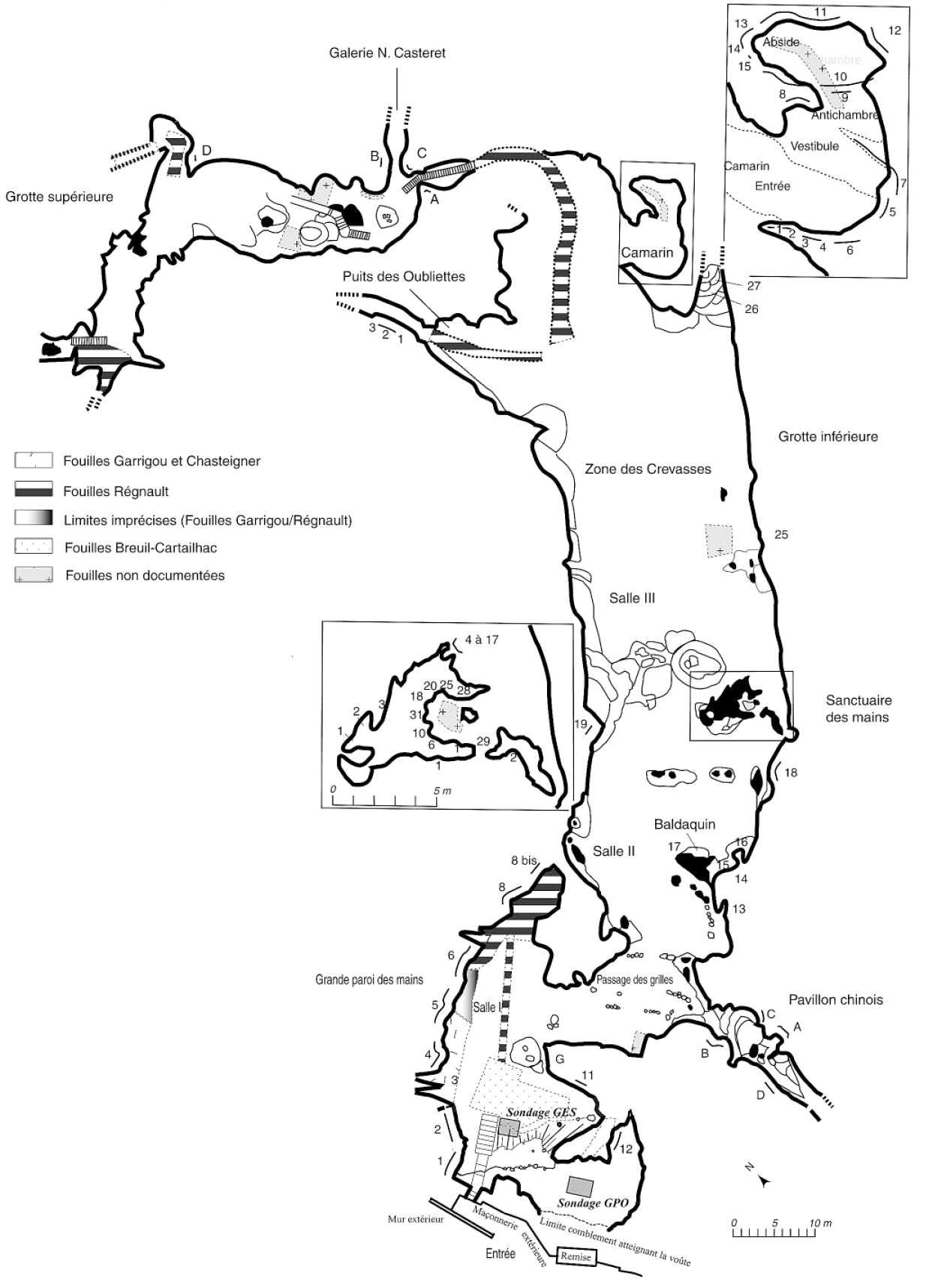
Map of Gargas Cave.
Photo: Gargas et l’Atlantique: les relations transpyrénéennes au cours du Gravettien, Munibe 57, 2005
by Pascal Foucher
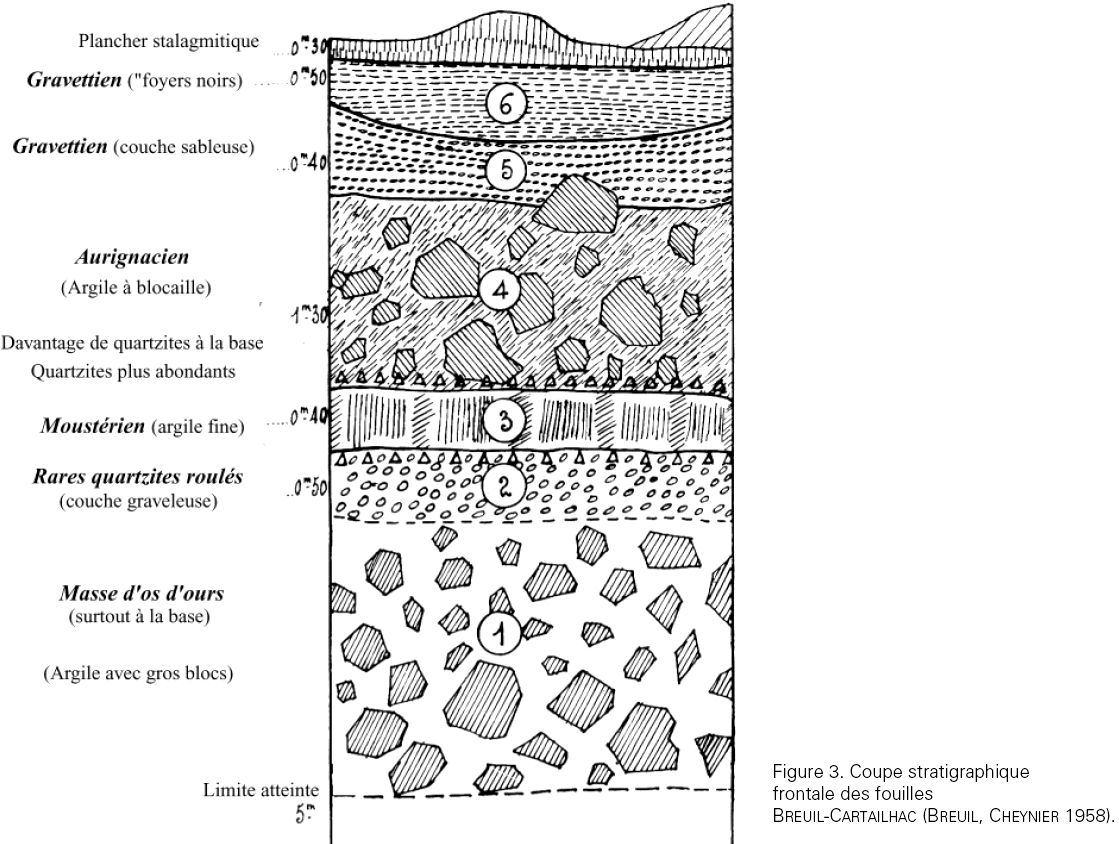
Profile of Gargas Cave.
Original Source for the sketch: Breuil, H. & Cheynier, A. 1958 Les Fouilles de Breuil et Cartailhac dans la grotte de Gargas en 1911 et 1913. Bulletin de la Société méridiona-
le de Spéléologie et de Préhistoire V, 1954-55, 341-382 (extrait du Bulletin de la Société d’Histoire naturelle de
Toulouse 93)
Reprinted in: Gargas et l’Atlantique: les relations transpyrénéennes au cours du Gravettien, Munibe 57, 2005
by Pascal Foucher
Les mains de Gargas
Essai pour une étude d'ensemble
Translation: Don Hitchcock
Since 1906 (the year in which Cartailhac wrote about the hands outlined in black or red in the cave of Gargas), several articles and numerous references have outlined the problem posed by some 160 hands placed in groups on the walls of cavity. In 1952, in 'Quatre cents siècles d'art pariétal', the Abbé Breuil devoted forty lines to them, summarising the views he had reached at that time: the hands outlined in black or red, sometimes white or yellow, are mostly left hands, there are more than 150, 'many seem mutilated, as if the fingers were cut down to one or more phalanges." It adds a very important detail and provoked his observation: 'It is certain that the same hand with the same mutilation, is found in multiple examples.'
Finally, he says: 'Gargas is so far the only European cave where these mutilations have appeared from among the twelve caves containing identified hands.' In 1958, in his book 'Quatre cents siècles d'art pariétal' in "J.-B. Noulet comments", he added a reference to identified mutilated hands in Tibiran cave, a few hundred metres from Gargas, hands which had recently been discovered.
Indeed, Gargas and Tibiran are, apart from the grotte de Maltravieso in Extremadura, the only cave where they had met with hands missing fingers. Gargas and Maltravieso have markedly different characters. In Maltravieso all hands show a uniform deficiency of the last two phalanges of the little finger, while in Gargas ten different patterns are found, out of the fifteen (seventeen, see below - Don ) combinations achievable by deducting fingers. This variety of 'mutilation', the grouping of hands in separate panels, the pairs of identical hands, and the distribution of red hands relative to black were not followed up by the authors.
In 1960, with the assistance of R.P Hours and M. Brézillon, we began to survey beyond all of the hands in their topographical context, a task which was completed in 1966. This first attempt is not intended to solve all the problems posed by the hands of Gargas, but to provide an overview of key aspects of the overall study.
Inventory of the hypotheses
The classical hypothesis, which was defended by the Abbé Breuil, is that the 'Aurignacians' of Gargas, like some current primitive peoples, cut off fingers for sacrificial purposes. Although plausible at first glance, this hypothesis has at least two weak points:
1) it does not reflect the variety of amputations of fingers. We must therefore assume that the author considered them anarchic because if he thought otherwise, he would have implied the existence of a true "code of mutilation', which he did not consider.
2) It is possible to have amputations up to and including deleting all the fingers (except the thumb), which is the case for nearly 50% of the hands represented, which, on reflection, seems extraordinary. This hypothesis of the reasons for the mutilated hands was nevertheless accepted by the majority of prehistorians, and it went into standard scientific literature as accepted fact, but without detailed verification.
The second hypothesis is that of the pathological origin of amputations, already raised by Obermaïer and Breuil, set out by Dr. Dekeyer in 1953 which Dr. Sahly has adopted and developed. According to his study, loss of fingers may have been determined by a 'thromboangiitis obliterans' (presenile gangrene), or Raynaud's disease. Raynaud's disease is probably caused by frostbite and/or food deprivation. This would explain the variety of losses of phalanges and the constant preservation of thumb, which is normal for this pathological process.
The arguments that can oppose this thesis are:
1) that at least 10% of legible hands are intact;
2) that several of them are placed in situations that do not explain the pathological case, like the whole hand at number 27, executed under a ledge about five metres high;
3) that, just as with the first assumption, it ignores the topographic distribution of the different mutilations, or in general that the distribution of hands could offer non-random motivations.
The third hypothesis is that of the folded fingers which we have suggested, and which will be developed here. It was G.-H Luquet, in 1926, in 'Art et religion des hommes fossiles', who seems to have made this proposition for the first time. M. Franck Bourdier was good enough to remind me that P. Saintyves in "La main dans la magie " had proposed this hypothesis which has not garnered the attention it deserves. It is, as has been said, quite possible, by folding the fingers, palm or back of the hand against the wall, to reproduce all the mutilations of Gargas.
Although spraying at a distance is not theoretically ruled out, the method best approaching the effect of the original is to place the hands on the wet wall, and outline them with the aid of a brush , a single tuft of bristles held together and aligned.
The operation can be done in three stages:
1) application to the base and around the edge of the thumb
2) application between the spread fingers
3) application to the outer edge.
The process takes no more than 30 seconds.
Whatever the method of execution, and even if we accept voluntary or pathological mutilation, two critical operations would normally be required. With the search for a possible reason for the groups of hands throughout the cavity, and the analysis of the digital patterns, nothing authorises an 'a priori' rejection of the hypothesis of a voluntary method.
The digital patterns
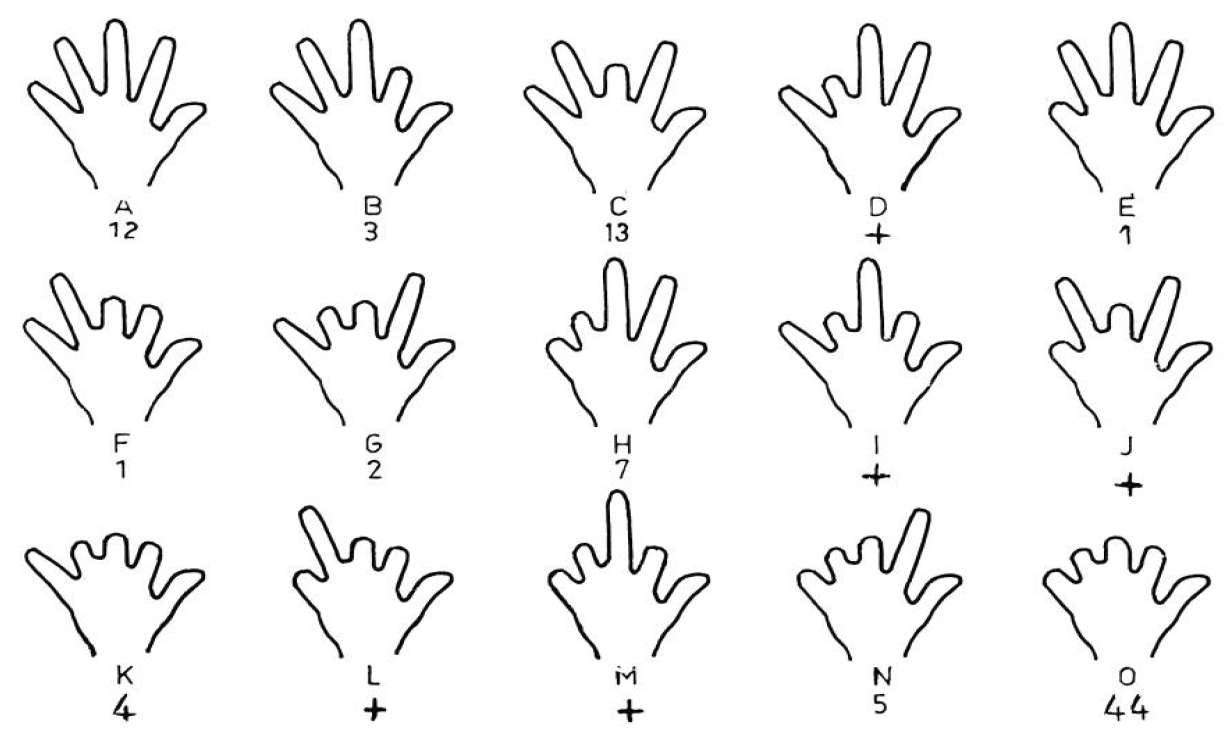
Table of digital patterns with their frequency. Patterns not represented are marked with a cross.
In the second row the folded index finger and fifth finger (pinky), J' was omitted from the table, and is not represented at Gargas.
(thus making a possible total of 17 different possibilities if we include the complete hand - Don )
Photo and text: Leroi-Gourhan (1967)
Given the acceptable legibility of about half of the figures, it seems that, with rare exceptions, the interesting subtraction is normally in the first two phalanges, and to establish a code for the combinations of fingers, it was only required to establish the results on the fingers. The thumb apparently was never the subject of removal, so there are the five basic combinations, from the whole hand to the hand devoid of four fingers.
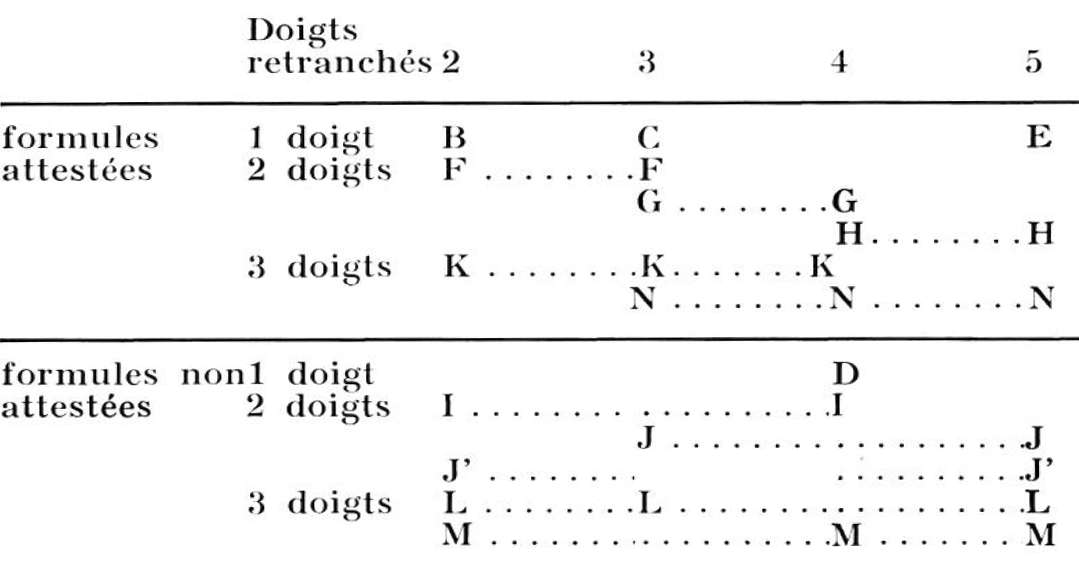
Not all are represented in the cave and order of frequency reveals an interesting feature: combinations O,A,C,H,N,K represented by a relatively large number of examples, are easier to make by folding the fingers. For the combinations В,Е,F,G, a few are still relatively easy to reproduce. The others, D,I,J,L,M are the most difficult. Regardless of the ease of making them, some figurative sense is apparent in the choice of digital patterns. There is a very strong preference rating for the series of adjacent fingers as shown in the table at left.
Neither 'ritual' amputation nor pathological decay agree at first sight with this distribution. It suggests, however, that these gestures of fingers could be sufficiently familiar to Paleolithic people of Gargas, for a selection to have occurred according to the ease of reproduction.
If it was simply a matter of forcing the folded fingers folded against the wall, all combinations are feasible.
The fact that those which are very difficult to make with the hand are apparently absent, allows us to think that the choice of positions of the fingers corresponded with a code of meaning, like that shown below still practiced by the Bushmen for hunting.
Photo and text: Leroi-Gourhan (1967)
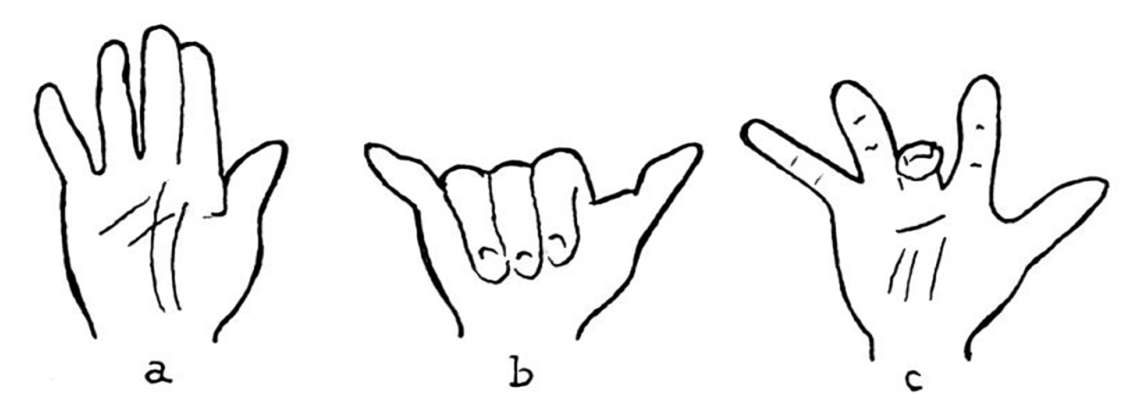
Gestures used while hunting or for later story telling by the Bushmen of the Kalahari:
a) monkey represented by his hand
b) warthog represented by its tusks
c) giraffe represented by its ears and horns.
Compare with formulas A, К, and С at Gargas.
Photo and text: Leroi-Gourhan (1967)

Analysis of the sets
Map of the cave of Gargas, the location of different groups of hands and signs in the sets I (left), II (right), and III (further in)
The groups of hands constitute three topographically well defined sets. Set I occupies a length of about 35 metres, the left wall of the first room. Set II occupies part of the right wall of the room. Set III is located in the second room and includes one hand isolated under a ledge on the left wall (number 27), and the right side, 38 hands arranged around a pillar or inside a small chamber carved into the pillar. Finally, under a very low ceiling in the direction of the 'oubliettes', two white hands (number 28) can be discerned.
Hands thus occupy well-defined areas: the two sides of the room from the entrance, and the pillar of the second room, into which is dug a small chamber with rounded walls. Single individuals are placed on a ceiling, one (number 27) opposite the pillar and at the entrance of a high passageway, the two others at the end of the series, in the area that follows the pillar.
The general organisation into separate groups, with figures at the entrance or at the end of passageways, is not unlike that of most caves with animal figures.
Photo and text: Leroi-Gourhan (1967)
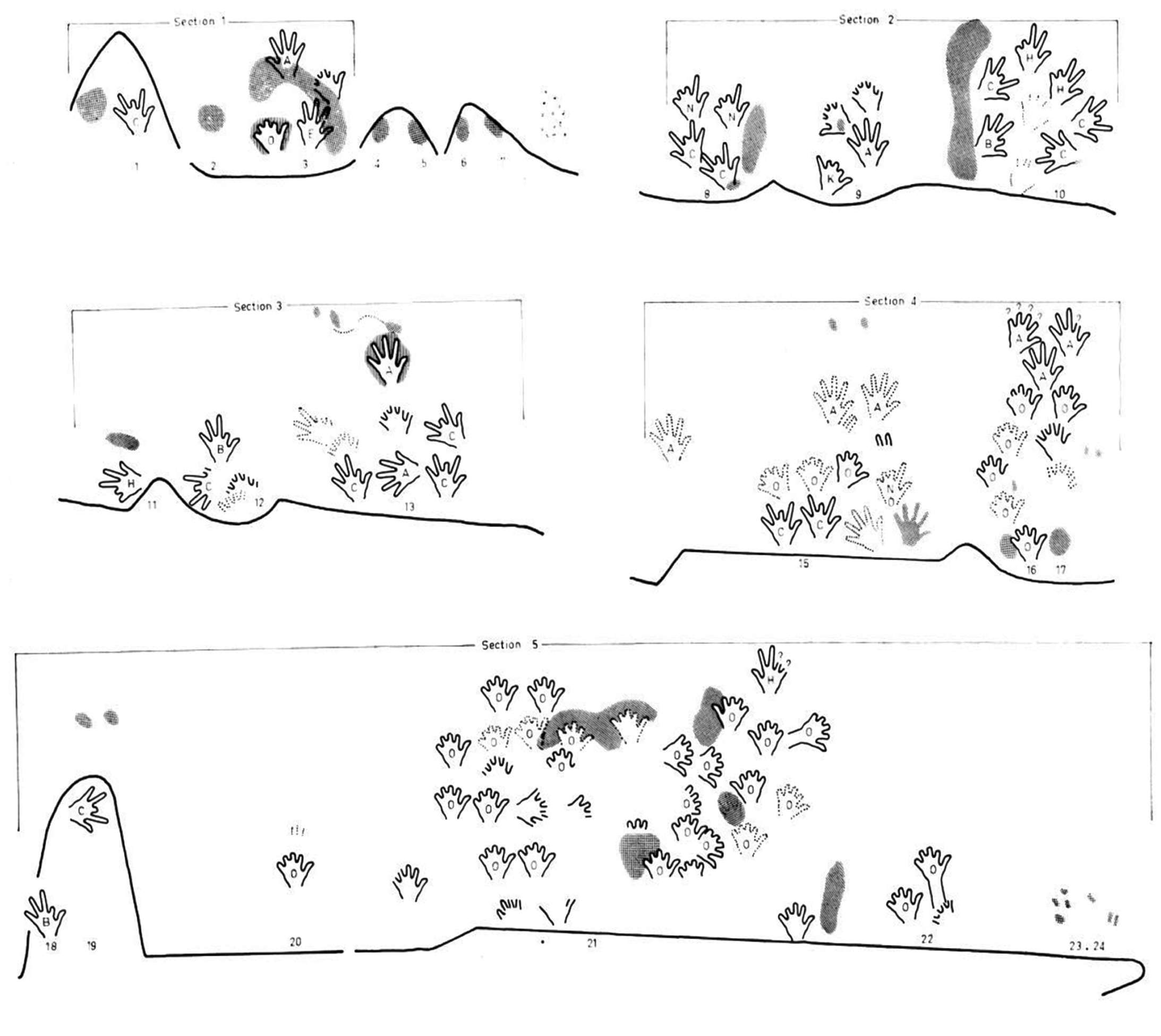
Distribution of the hands of set I, by sections.
Full line: black hands
Dashed line: red hands
Cross hatching: red spots
Parallel hatching: yellow stains.
(note that the last two are indistinguishable at the resolution of the only copy I have available - Don )
Photo and text: Leroi-Gourhan (1967)
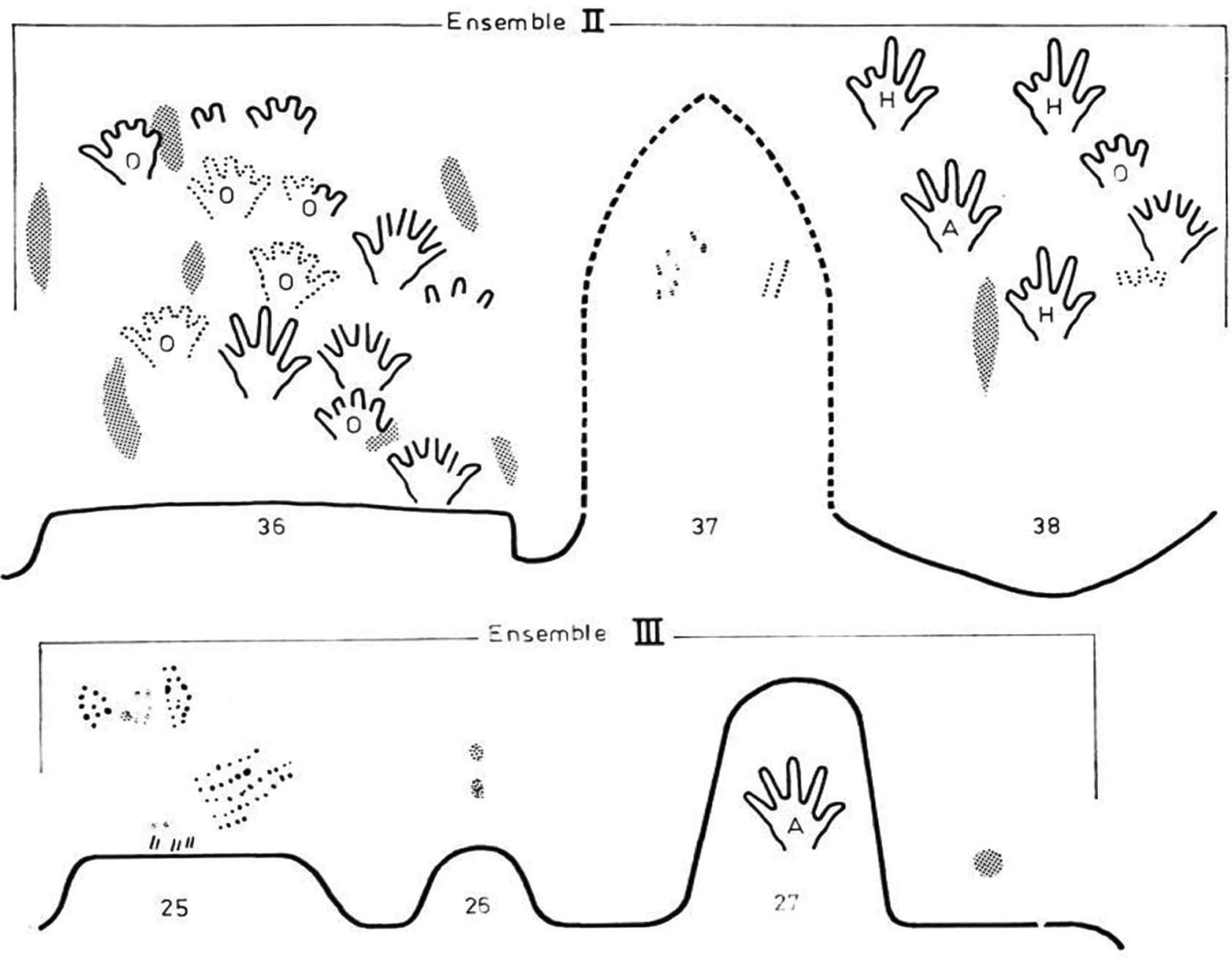
Distribution of hands on the right wall of set II and figures on the left wall of set III.
Photo and text: Leroi-Gourhan (1967)
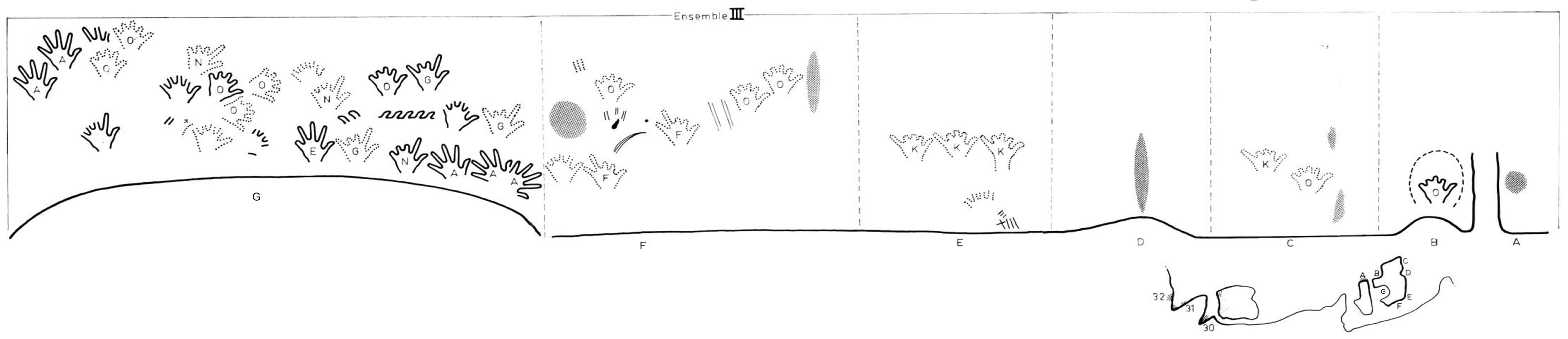
Disposition of the positions of the red spots and hands of the images around the pillar of set III, arranged as a complete panorama.
Photo (adapted) and text: Leroi-Gourhan (1967)

Set I may be divided into five sections according to the arrangement of the different groups of hands. The wall is punctuated by folds of varying depths (Fig. 4, 1, 4, 11, 14, 18) forming niches or projections between convex or flat panels. We used these accidents to determine the wall sections. Each section shows specific characters superimposed on those of other sections.
The general arrangement of Set I offers rather curious features, as shown in the table at left.
Photo and text: Leroi-Gourhan (1967)
The number of hands increases from the entrance to the end (from 5 examples to 41). The same phenomenon seems to occur in each section which begins with one or two hands placed in the concave parts and develops into two or three groups with increasing numbers. The same effect is repeated five times.
Set II comprises two sections arranged in a quite complex wall, into which opens a passageway (37) at the entrance to which are two pairs of red rods and a series of dots of the same colour. The first section from the entry (38) is formed by six black hands and one red, the second section includes nine black hands and 4 red. In each section you can see an oval depression coated with red ochre.
Again, here, from the entrance, the hands, from one section to the other, increase in numbers from 7 to 13.
Set III, besides the isolated hand, number 27, is arranged around and within a pillar (29).
If we make the tour around the pillar, we find the following groups of figures: a red stain ( A ), one black hand placed in a concavity ( B ) and two red hands ( C ), then an oval depression brushed with red ochre ( D ), followed by four red hands ( E ) and six red hands accompanied by another oval depression painted in red ochre ( F ).
Finally one enters the small chamber where 15 black and 10 red hands, and some outlines of fingers. The progression of examples, 1, 2, 4, 6, 25 is again upward.
The fact that in the eight sets of geographically separated figures, the increasing numbers from the start to the end, can hardly be accidental. The proportion of red hands over black follows a similar progression. We see that with one exception (section 5), the number of red hands follows the development of each series. In addition we see the overall proportion of red hands rise from 22% in set I and 25% in set II in the first room, to 58% in set III in the second room.
In summary, black or red hands are placed in ascending series in each set from the start to the finish. One should add that in five out of seven cases (sections 1, 2, 3 and 5 of set I and III together) the series begins with one or two black hands placed in a concavity. It is difficult to reject the hypothesis of conscious order to give an explanation for this observation.
There is indeed a certain affinity with other caves of many subjects arranged panel by panel with figures of transition from passages or at the entrances of diverticula, but no cave so far offers such a sequence in 'crescendo' or as, here, a clear-cut increase of red compared with black.
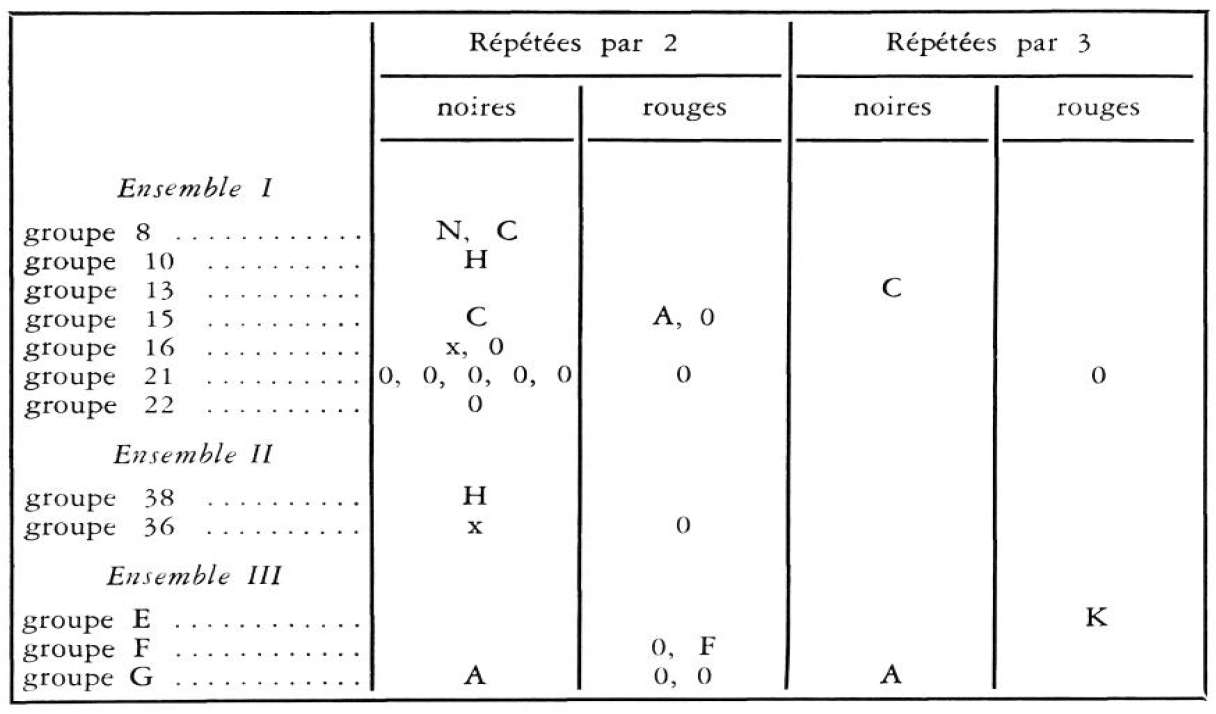
Repetitions and alternating colours.
Another curious fact, already reported by Abbé Breuil, is the repetition of the same hand in multiple copies. It is not always easy, given the conditions of application to the granular rock and the variable conditions of conservation, to establish the identity of the hands. The general outline is, however, discernible enough to assign without uncertainty the same origin to two hands placed close to each other and with very similar proportions.
The results are shown in the table at left.
There are at least 27 cases of repetitions of 2 or 3 times, and presumably we could find many others if the legibility of some of the images was greater. The repetitions combined with the increase in numbers from start to finish, were determined in several cases where there were a pair of black hands beside a pair of reds. (15, 16, 21, 36, 29-G) . It is difficult to determine whether these events are intentional or accidental.
Photo and text: Leroi-Gourhan (1967)
Horizontal hands
A number of hands are arranged horizontally.
Some are isolated in the hollows of the early sections (11, 19) or included in other groups (set I, 10, 13, 21, 29-G). Since this provision affects combinations of A,C,H,О, which are the patterns that are most represented in the cave, it is difficult to separate what might be intentional with what simply is the relative frequency of different formulas.
These horizontal hands evoke comparisons with some of the animals, mostly bison, vertically in groups of figures in some caves such as Niaux, Santimamine and Altxerri.
For many of them, the hands of Gargas are the small hands of teenagers and even children. The fact is significant because most of the footprints imprinted in the clay caves with Palaeolithic visitors correspond to young individuals (Pech-Merle, Niaux, Aldène, Le Tuc d'Audoubert).
It is easy to imagine explanations citing for example initiation rites, but it is much more difficult to support these explanations by direct evidence. In this case, it is certain that, as actors, young and very young subjects participated in the operations that took place in the cave.
At the end of the overall analysis, we find that the hands of Gargas are in groups of increasing density, groups in which the relative frequency of red hands also increases, from the start to the finish. The hands are frequently arranged in pairs of the same kind, which are distributed among hands, red or black, arranged horizontally.
The concept of the use of red in preference to black cannot be ascertained with clarity, but but the C,N,B,E combinations are not represented in red.
The 'Code'
If, as it seems, the hands are not randomly arranged but respond to a more or less clearly held plan, a first approximation is offered with all other caves: the figures are divided into a series of panels forming a string whose elements are linked by single figures, arranged themselves in the breaks between panels.
One such figurative skeleton is comparable to that of Lascaux or les Combarelles for example. Some hands, like 18-19 at the entrance of a large opening or like 27, are in the situation where normally there are animal figures such as deer and ibex.
Moreover, embayment G (in 29 of the plan) has a similar situation with niches or diverticula full of animals and signs encountered in the deeper parts, including les Trois-Frères, le Portel, and la Pasiega. The hypothesis that comes to mind is that of a possible homology between the hands and the animals or signs of other caves. In other words, the hands could have been the equivalent of animals or signs, the play of fingers making the expression of different themes. It is therefore necessary to test different finger combinations to see if this homology is admissable .
To write this paper, two visual surveys as well as photographs were used. When there was disagreement on one of the readings, the corresponding figures were considered merely probable, they appear on the table with a question mark.These represent 10% of the figures used.
58% of the total of 159 hands are decipherable with acceptable accuracy. There remain, however, 42% of hands, a defect of decryption due to inadequate record keeping.
Despite the uncertainty that marks nearly half of the figures, we are able, from the table of digital combinations, to reveal the following facts:
1) The large disproportion manifest between the different figures: the pattern 0 (four missing fingers) represents almost half (47%) of the total decipherable hands. A (all fingers present) and С (middle finger missing) share more a quarter (27% ) of the total, no other patterns reach one tenth.

2) The sets I, II and III have quite substantial differences, as shown in the table at left.
Photo and text: Leroi-Gourhan (1967)

The three sets have in common О and A patterns in about equivalent proportions to the front part of the cave (O = 52% and 50%, A = 10% and 12%), while the proportions towards the back show a decrease in О (39%) and an increase in A (19%).
С (middle finger subtracted) is very well represented in the set I and absent in the other two. H is common to I and II, N and E are found in I and III. Other formulas (K,G,F) are specific to set III .
We thus obtain the following basic patterns: I = O,A,C, II = О,A,H, III = О,А,N.
Photo and text: Leroi-Gourhan (1967)
If homology with animal figures is considered, the comparison of different digital patterns and zoological sets should reveal similar proportions. If one considers not the topographic sets but the totality of the identified hands, the parallels with the caves with animal paintings becomes very striking.
It is very interesting to note that the four subjects best represented all have the same general proportions. It is perhaps not entirely by chance that this is the case for caves of the Pyrenean area, since in other areas the first four subjects are different: Horse: 27% Bison: 16% Mammoth: 9% Ibex 7.5%. (see table below.)
| Gargas | Total for Pyrenees caves | Niaux | Santimamine | Altamira ceiling | Other Regions |
|---|---|---|---|---|---|
| O: 47% | Bison: 49% | 52% | 70% | 78% | Horse: 27% |
| A: 13% | Horse: 28% | 28% | 11% | 9% | Bison: 16% |
| C: 14% | Ibex: 6% | 17% | 11% | Doe: 9% | Mammoth: 9% |
| H: 7.5% | Cervid (Deer): 4% | 1.5% | 4% | Boar: 4% | Ibex: 7.5% |
So it seems, based on the numbers, that the groups of hands at Gargas offer the same figurative structure as the paintings in other decorated caves. The hands of Gargas, in summary, are represented by a grouping into three sets in which, from group to group, the quantities are increasing from the start of the cave to the end. The red figures are in the same ascending order. Hands in each panel often come in identical pairs and sometimes by threes.
Combinations of fingers do not conform to a purely random distribution: they seem to have meaning and allows us to establish parallelism between the sets of hands of Gargas and those of animal figures from other caves in the Pyrenees. This parallelism is responsive to both the relative density of each pattern and the location of one or other of crevices in the walls forming panels. However, while it is possible to see the hands of Gargas as comparable to animal symbols, this determination remains very speculative. It is only likely that the patterns О and A, which are the most constant, respectively conform to bison (or aurochs) and horse.
In this case, and it is probably limited to one ethnic group, we can propose the direct transfer of gestural symbols of the hunters' wall art. Some confirmation of this interpretation lies in the fact that combinations of folded fingers which are the most difficult to reproduce are not found on the walls of Gargas.
Even if one does not admit that there existed a certain order of composition in the caves, one can not avoid seeing that the disorder of the hands of Gargas curiously coincides with the disorder of animals in other Pyrenean caves. From the point where it is assumed that the Gargas hunters had not cut off any fingers, and they mixed the various 'mutilations' in the same proportions as others mixed bison and horses, the problem presents itself as a normal occurrence, and the myth of the 'mutilations of Gargas' loses much of its gloomy character.
That hunters cut off fingers for better luck in hunting, or that they cut off the fingers of their children who would become hunters does not constitute an economically defensible approach, even in, especially in, in primitive communities.
If they lost their fingers for pathological reasons is not impossible, but is hard to reconcile with the overall structure of the sets of paintings. That they knew, like many hunting peoples, finger signs to silently signal the presence of a particular game, is not beyond the limits of plausibility.
What is remarkable, if this hypothesis is correct, is that the transposition was carried out from the hunting signs to their representation on cave walls. Whatever the explanation given to the cave art, the proof of such a fact would open a new door into the thought of Palaeolithic man.
Sur les Hyènes de la grotte de Gargas, découverts par M. Félix Régnault
On the Hyenas of Gargas Cave, discovered by M. Félix Régnault
Translated and adapted by Don Hitchcock
I have the honour to present to the Academy a photograph of the skeleton of a Cave Hyena, Hyaena spelea, which has been able to be almost completely restored. It is the first time, to my knowledge, that it has been able to obtain an almost complete skeleton of a Hyena fossil. Hyenas were very common in the caves of France and England. They have been too common so far as palaeontolgists are concerned, because they have destroyed the bones of a large number of quaternary animals, sometimes eating them, sometimes damaging them so that they become unrecognisable.
There is, in the High Pyrenees a huge and beautiful cave, called the Grotte de Gargas. It was MM le Dr Garrigou et de Chastaigner who were the first to bring it to the attention of scholars. In recent times, M. Felix Regnault, already known for prehistoric research, has undertaken a detailed exploration. His excavations lasted the whole of one year. Towards the bottom of the cave, he found a well with vertical walls, which is at least 20 m deep. It is known by the name of Oubliettes de Gargas. No one has penetrated it before.
Showing his devotion to science, M. Regnault used a rope ladder to descend to the bottom of the well.
He was surprised to find there entire skeletons of large and small bears, wolves and hyenas. Did these animals arrive in the puits alive, or did they fall in there after their death? I am not able to say, but it appears to me reasonable that, if their skeletons are intact, it is because hyenas have not been able to eat the cadavers at the bottom of a hole 20 m deep.
Examination of skeletons of the Cave Hyena in many places including the Museum de Paris confirms the belief that the Cave Hyena is the same species as the Hyena found today living in southern Africa, Hyène Tachetée (Crocuta crocuta) - the Spotted Hyena.
.
The text and photograph below come from the excellent book 'Secrets of the Ice Age' 1980, by Evan Hadingham.
The Case of the Missing Fingers
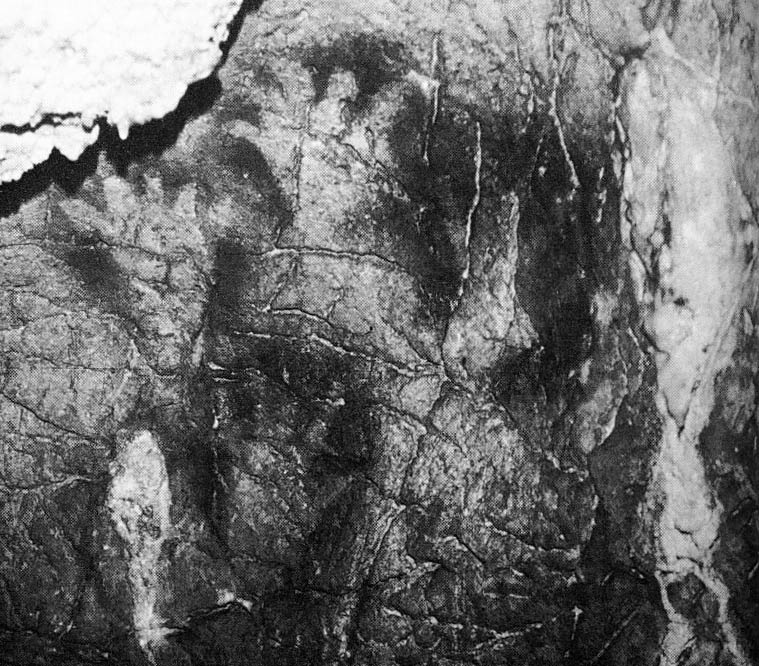 .......But the strangest ancient medical problem of all concerns hands, not heads. In well over twenty caves distributed throughout southwest France and northern Spain, there are dozens of painted hand impressions. These were created by pressing a real hand against the wall and applying colour around the edges: the result was a "negative" print like those that children still produce. In one or two small caves, these stencilled hands form the main works of art, but usually, they are relatively inconspicuous, and it is animal compositions that chiefly catch the eye of the casual visitor to the decorated caves.
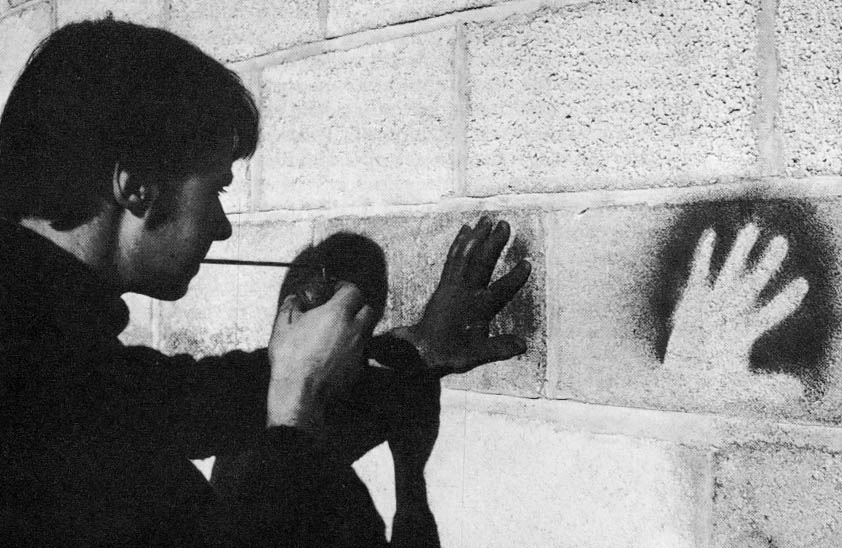 Several close studies of these hand impressions have helped to explain the techniques most commonly used in their execution. In most cases, a red or black water paint has been sprayed on, resulting in an even halo of coloured droplets of various sizes around the handprint. Because the red pigment (hematite or ochre) is entirely soluble in water and the black (manganese dioxide) is not, the rock soaks up the red colouring more easily. As a result the red hands are usually more fuzzy and less clear than the black ones. It is uncertain exactly how the colour was applied; it is usually supposed that the artist took a big mouthful of paint and blew it out between pursed lips to produce a fine mist of colour. In experiments supervised by the author, the effect closest to the original hand impressions was obtained by blowing down an elementary spraying device made from a perforated reed.
Here, we might conclude, was a quaint pastime that we might attribute to idle amusement or to magical or religious rituals. In three caves, however, the bizarre nature of the hand outlines lifts the entire problem to a complicated and mysterious level. One of the three caves is called Maltravieso in northern Spain and features about thirty negative prints of hands. Only about a dozen are clearly visible, and of these, only one hand actually possesses all the joints of the fingers and thumb intact. On the other hands, there are two cases of missing thumbs and joints of the little finger. Elsewhere, in the caves of Tibiran and Gargas situated on opposite sides of the same conical hill in the French Pyrenees, more of the extraordinary mutilated hands appear.
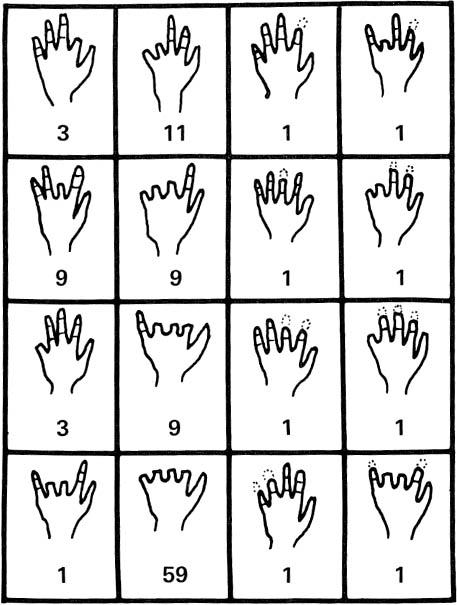
Gargas has the most astonishing collection of these battered handprints. It is not a prepossessing cave; there are broad and rather low-ceilinged chambers, but the limestone is dull, and there are few glistening stalactites to divert the tourist. Yet in places, the sloping walls are covered with clouds of red-and-black hands, beginning close to the floor and mounting, halo after halo, almost out of convenient reach. Unlike Maltravieso, there are no thumbs missing at Gargas, but the catalogue of incomplete finger joints is long and varied. Recent censuses of the hands have resulted in conflicting figures because some are faded and difficult to see. However, there are well over 200 of them, and at least three or four times as many left hands as right. Among these are several intact prints belonging to the undamaged hands of babies only a few months old. Perhaps the most notable fact about the Gargas hands is that over 50 percent display the total loss of the upper joints of all four fingers. While it is certainly possible that the hands were intentionally mutilated because of some strange rite or superstition, the fact that the practice reduced the hand almost to a useless stump is rather surprising.

Photo from: Agenda de la Préhistoire 2002 - 2003, a superb diary with excellent illustrations sent to me by Anya. My thanks as always.
Gargas (Aventignan, Hautes-Pyrénées). Main négative.
But were the mutilations genuine, or are they an illusion? For many years, one of the popular explanations for the painted hands was that the artists were indulging in visual trickery by folding back the joints on undamaged, healthy hands and blowing colour around these distorted outlines. Certain facts now make accusations of "cheating" rather unlikely. As far as anyone can tell, the very even spreads of sprayed-on colour do not appear to include patches where the handprints could have been retouched or altered after the initial outline was made. More importantly, it is physically impossible to bend down only the top finger joint, which is missing on many of the hands. Experiments also show that it is difficult to create images as sharp as some of those at Gargas using curled-up fingers. Finally, a few of the outlines display oddly flattened or pointed ends to the shortened fingers, and these do look like mutilations rather than concealed joints.
In any case, independent evidence has recently come to light of genuinely mutilated hands in Ice Age France. In 1963, medical expert Dr. Sahly, who was conducting a detailed study of the problem, discovered a handprint with a missing little finger in the soft clay of a small circular chamber not far from the main panels of hands at Gargas. The walls and ceiling of the same chamber also were covered by rows of holes where fingers had obviously been thrust into the clay. Sahly made casts of the insides of some of these holes and revealed the shapes not of rounded fingertips but of scarred stumps, with such details visible as the lips of skin where the injury had healed together. Subsequently, several mutilated handprints were noted in clay at Lascaux, several hundred kilometres north of the Pyrenees, despite the fact that no painted impressions of such hands were seen on the walls of the cave.
The existence of people with severely damaged hands seems to be more or less proven. The key question that remains is whether these injuries were the result of intentional acts or of a crippling disease. There are no clear answers, but certainly, the restricted appearance of the mutilations, concentrated in large numbers only at Gargas, is very puzzling. If it was a cultural practice, it is odd that so distinctive a custom as chopping off fingers should be confined mainly to a single site and so, presumably, to a single group of hunters. The widespread stencilling of undamaged hands at so many other caves could indicate that the cultural ideas that motivated the hand paintings were not particularly exceptional but that the physical state of the Gargas subjects was. Incidentally, there are at least twenty cases of repetition at Gargas; the same hand with the same mutilation is obviously present, so that the number of people involved in making these prints may have been quite small. All these arguments tend to favour the explanation of some disease that affected only a tiny proportion of the prehistoric population, perhaps because it was shortlived or hereditary in character. Additional support for this idea may lie in the strange, twisted outlines of so many of the stumps, which perhaps indicate the remnants not of healthy but of terribly deformed fingers.
When a full list is drawn up, there are an alarming number of illnesses (most of them fortunately rare) that have the unpleasant effect of making the fingers wither or drop off. None of the specific, hereditary ailments precisely corresponds to the condition of the painted hands. Among these, Ainhum's disease, which causes the loss of the little finger through degeneration of the bone, seems to fit the case of Maltravieso, except that. the disease leaves behind a stump midway up the joints and not between them, as the majority of the painted outlines seem to show.
A similar hereditary condition, Raynaud's disease, mainly attacks young women in their twenties or earlier, may be promoted by cold and damp, and is a promising explanation for the Gargas hands. This illness afflicts any of the fingers and causes them to wither through gangrene, while the thumb is not affected because of its better circulation. Once again, however, the effects do not strike neatly between each finger joint so that if either of these two infections are responsible it is necessary to imagine the prehistoric victims deliberately having the wasted portion chopped off, perhaps to discourage the spread of the gangrene. The symptoms of many of the other suggested ailments make equally unpleasant reading, and we cannot easily decide which, if any, were responsible for the mutilations. Frostbite, leprosy, and severe arthritis are among the most popular theories.
What sort of "affluent society" can it have been for these unfortunate people at Gargas, if it is true that they really were cripples, able to do little but grasp clumsily with their ravaged hands? Sahlins' ideal vision of hunting and gathering was intended mainly as a criticism of present-day values. Clearly, it provides an inadequate basis for a deep understanding of the ancient past, although it has inspired many recent romanticised accounts of life in prehistoric times. Indeed, we may feet that most moral judgements of hunters, ranging from the aggressive monster to the noble savage, have been subject to the swings of intellectual fashion, and at the moment, no universal model of the hunting past is entirely satisfactory. As the accumulation of material evidence grows in volume and detail, we have to look beyond simple preconceptions and come to terms with a past more complex and unfamiliar than was ever imagined by the philosophers of Turgot's era, two centuries ago.
Hand mutilation still occurs in at least one hunter gatherer society, the Dani of New Guinea.The text below comes from:
http://www.uic.edu/classes/osci/osci590/6_1TheCulturalModificationOfTeeth.htm
Hand Mutilation by the modern Dani of New Guinea
This practice, seen in cave art, reaches back into the Stone Age. In cave art, hand prints in outline are a widespread occurrence. The hands are frequently missing one or all of the fingers; sometimes just a single digit. Was hand mutilation intentional? It indeed may be. The modern Dani of New Guinea offer crucial insight.
When the Dani avenge the death of one of their own, they kill one of the enemy. They also sever the tip of a finger of a young female relative of the victim. Some undergo this ritual for more than one dead relative. The mutilation is performed by a ritual specialist, who first ties a string tightly around the upper arm of the chosen girl. He numbs the finger by striking it hard against a rock. Then he severs one or two fingers at the first joint with a blow from a stone axe. The wound is quickly bound with leaves; she sits quietly for the rest of the day holding the hand upright so healing can begin. Many Dani women are so mutilated, but they go through life with little handicap, able to knit and weave with skill.
References
- Barrière, C. , 1976 (Vol. i): L’art pariétal de la Grotte de Gargas / Palaeolithic Art in the Grotte de Gargas avec la collaboration de Ali Sahly et des élèves de l’Institut d’art préhistorique de Toulouse. Translated into English by W.A. Drapkin. Bilingual edition. Toulouse: Mémoires de l’Institut d’Art Préhistorique No. 3, and Oxford: British Archaeological Reports, Supplementary Series 14 (ii), Institute of Prehistoric Art of Touluse
- Barrière, C. , 1976 (Vol. ii): L’art pariétal de la Grotte de Gargas / Palaeolithic Art in the Grotte de Gargas avec la collaboration de Ali Sahly et des élèves de l’Institut d’art préhistorique de Toulouse. Translated into English by W.A. Drapkin. Bilingual edition. Toulouse: Mémoires de l’Institut d’Art Préhistorique No. 3, and Oxford: British Archaeological Reports, Supplementary Series 14 (ii), Institute of Prehistoric Art of Touluse
- Barrière, C. , undated: The prehistoric cave of Gargas, Institute of Prehistoric Art of Touluse
- Breuil, H., 1953: Gravures sur schiste périgordien, Les Vachons (Charente), L'Anthropologie 52, 1-2, 1-42, 15 fig.
- Breuil, H. & Cheynier, A., 1958: Les fouilles de Breuil et Cartailhac dans la grotte de Gargas en 1911 et 1913, Bulletin de la Société méridionale de Spéléologie et de Préhistoire V, 1954-55, 341-382 (extrait du Bulletin de la Société d’Histoire naturelle de Toulouse 93).
- Davis, W. and Quinn, R. , 1996: Replications: archaeology, art history, psychoanalysis Pennsylvania State University Press, ISBN13: 9780271015248
- DiBenedetti D. et al., 2011: Prevalence, incidence, and treatments of Dupuytren’s disease in the United States: results from a population-based study, Hand, (N Y). 2011 Jun; 6(2): 149–158, Published online 2010 Nov 16, doi: 10.1007/s11552-010-9306-4, https://www.ncbi.nlm.nih.gov/pmc/articles/PMC3092891/
- Flatt A., 2001: The Vikings and Baron Dupuytren's disease, Proc Bayl Univ Med Cent., 2001;14(4):378–384.
- Foucher P., 2005: Gargas et l’Atlantique: les relations transpyrénéennes au cours du GravettienMunibe (Antropologia-Arkeologia) 57, 2005 · Homenaje a Jesús Altuna
- Gaudry, A., 1885: Sur les Hyènes de la grotte de Gargas, découverts par M. Félix Régnault. Note de M. A. Gaudry, Comptes Rendus des Séances de l'Académie des Sciences, Janvier-Juin 1885
- Hyun, S., 2018: Dupuytren's Disease: the Vikings Disease in Koreans, J Korean Med Sci., Jul 30; 33(31): e206. Published online 2018 Jun 20. doi: 10.3346/jkms.2018.33.e206, PMCID: PMC6062435, PMID: 30069171
- Jaubert, J., 2008: L'art pariétal gravettien en France : éléments pour un bilan chronologique », Paléo, 20 | 2008, 439-474.
- Leroi-Gourhan, A., 1967: Les mains de Gargas. Essai pour une étude d'ensemble Bulletin de la Société préhistorique française Année 1967, Volume 64, Numéro 1 p. 107 - 122
- Leroi-Gourhan A., 1984: L'Art des cavernes : Atlas des grottes ornées paléolithiques françaises, Relié – 1 décembre 1984
- Saint-Périer, R. & S., 1952: La grotte d’Isturitz: les Solutréens, les Aurignaciens et les Moustériens. Paris : Masson, 264 p., 135 fig., XI pl. h.-t. (Archives de l’Institut de Paléontologie humaine: mémoire n°25)
- San Juan-Foucher, C., 2005: Industrie osseuse décorée du Gravettien des PyrénéesMunibe (Antropologia-Arkeologia) 57, Homenaje a Jesús Altuna 95-111 San Sebastian 2005 ISSN 1132-2217
- Simonet, A., 2011: Nouvelles approches d’un fossile directeur controversé du Gravettien à partir des exemplaires du niveau IV de la grotte d’Isturitz (Pyrénées-Atlantiques, France) et des niveaux 4 des abris 1 et 2 des Vachons (Charente, France), Paleo, 22 | 2011
- Sonneville-Bordes, D. et Perrot J., 1956: Lexique typologique du Paléolithique Supérieur, Bulletin de la Société Préhistorique française, 53, fascicule 9, p. 547-560, fig.
- Urbaniak, R., 2020: Lexique typologique du Paléolithique Supérieur, Another possibility regarding hand stencils in France, Vol 12, March-April 2020
- Vercoutère, C., San Juan-Foucher, C., Foucher P., 2006: Human modifications on cave bear bones from the Gargas Cave (Hautes-Pyrénées, France) Scientific Annals, School of Geology Aristotle University of Thessaloniki (AUTH), Special volume 98, 257-261, Thessaloniki, 2006
Back to Don's Maps
 Back to Archaeological Sites