Back to Don's Maps
Back to Venus figures from the Stone Age
The Venus of Laussel - La Femme à la Corne
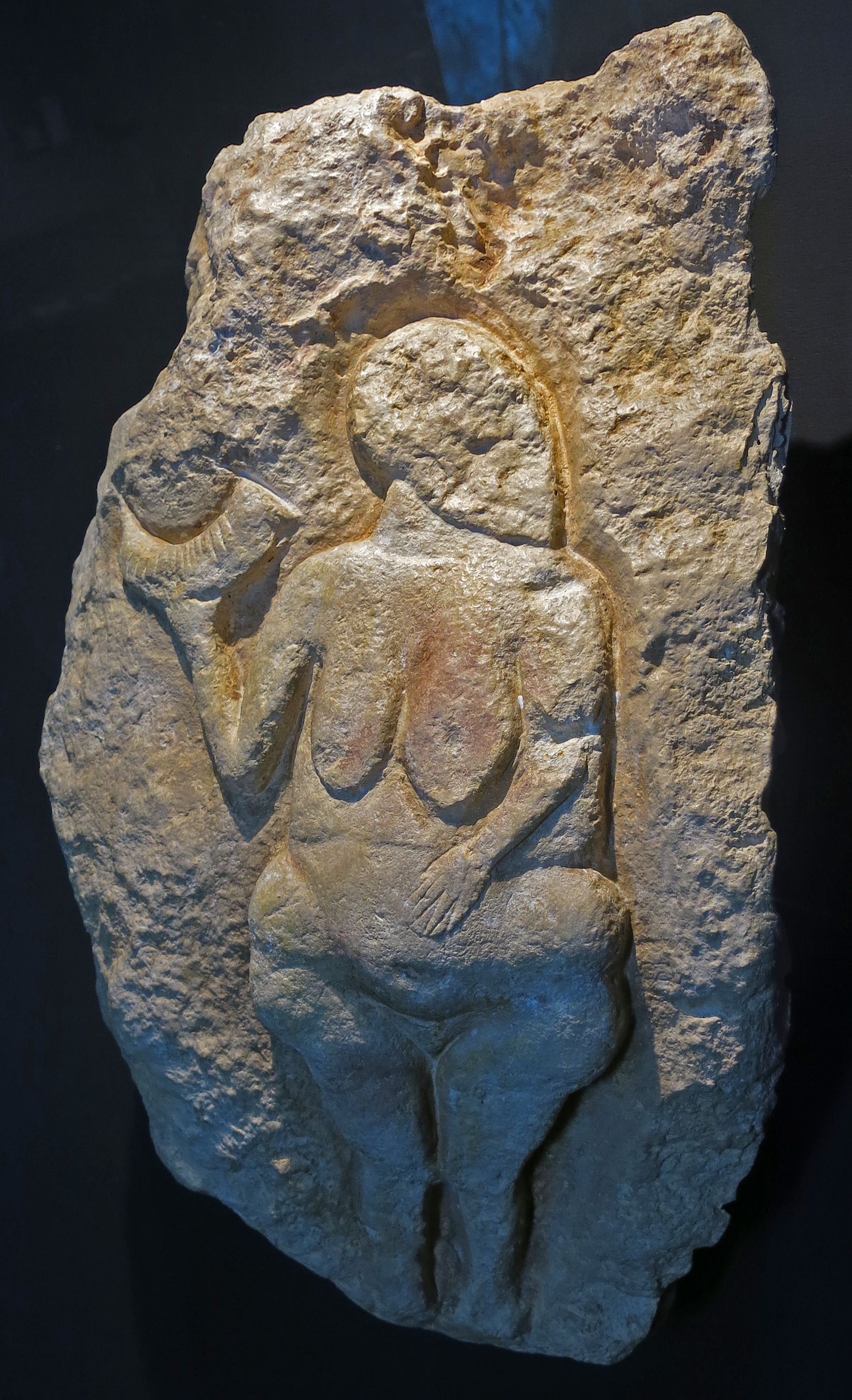
The Venus of Laussel is a limestone bas-relief of a nude female figure, 46 cm high, painted with red ochre. It was carved into a large block of fallen limestone in a rock shelter (Abri de Laussel) in the commune of Marquay, in the Dordogne department of southwestern France. The carving is associated with the Gravettian Upper Paleolithic culture (approximately 25 000 years old). It is currently displayed in the Musée d'Aquitaine in Bordeaux, France.
The figure holds a bison horn, or possibly a cornucopia, in one hand, which has 13 notches. According to some researchers, this may symbolise the number of moons or the number of menstrual cycles in one year. Alexander Marshack said about the Venus of Laussel that 'One cannot conjecture on the basis of one engraved sequence any meaning to the marks, but that the unusually clean horn was notated with storied marks is clear.'
She has her hand on her abdomen (or womb), with large breasts and vulva. There is a "Y" on her thigh and her faceless head is turned toward the horn. The figure was discovered in 1911 by Jean-Gaston Lalanne, a physician.
Material: Limestone
Age: Gravettian
Photo: Don Hitchcock 2015
Source: Original, Musée d'Aquitaine à Bordeaux. Text: Display card at Musée d'Aquitaine à Bordeaux
Text: Adapted from Wikipedia
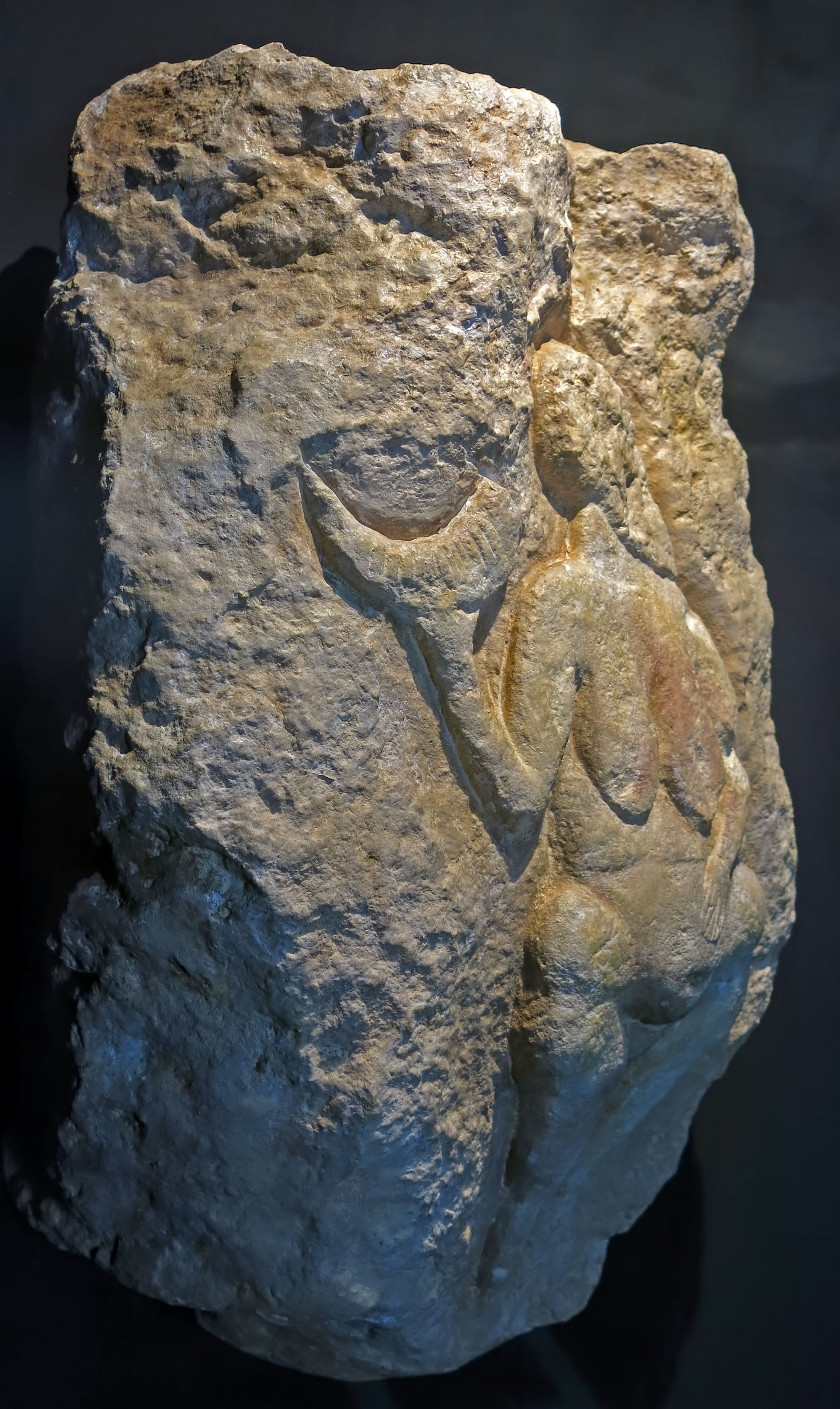
The sculpture has been carved in bas-relief into a section of the wall with a swelling at the region of the sculpture's abdomen.
The bas relief was discovered in 1911 by Dr. Jean-Gaston Lalanne. A psychiatrist interested in archaeology, he conducted excavations in the area beginning in 1908. Along with the Venus, other carved blocks were found, some with similar female figures, and one a male, now called 'the hunter'. The Venus was first preserved in a small private museum of Lalanne's. In 1960 Lalanne's family generously donated all of his collection to the new archaeological museum in Bordeaux, which became the Museum of Aquitaine.
Photo: Don Hitchcock 2015
Text: Adapted from https://leseyzies-tourist.info/venus-of-laussel/
Source: Original, Musée d'Aquitaine à Bordeaux. Text: Display card at Musée d'Aquitaine à Bordeaux

Venus of Laussel, detail.
Photo: Don Hitchcock 2015
Source: Original, Musée d'Aquitaine à Bordeaux.
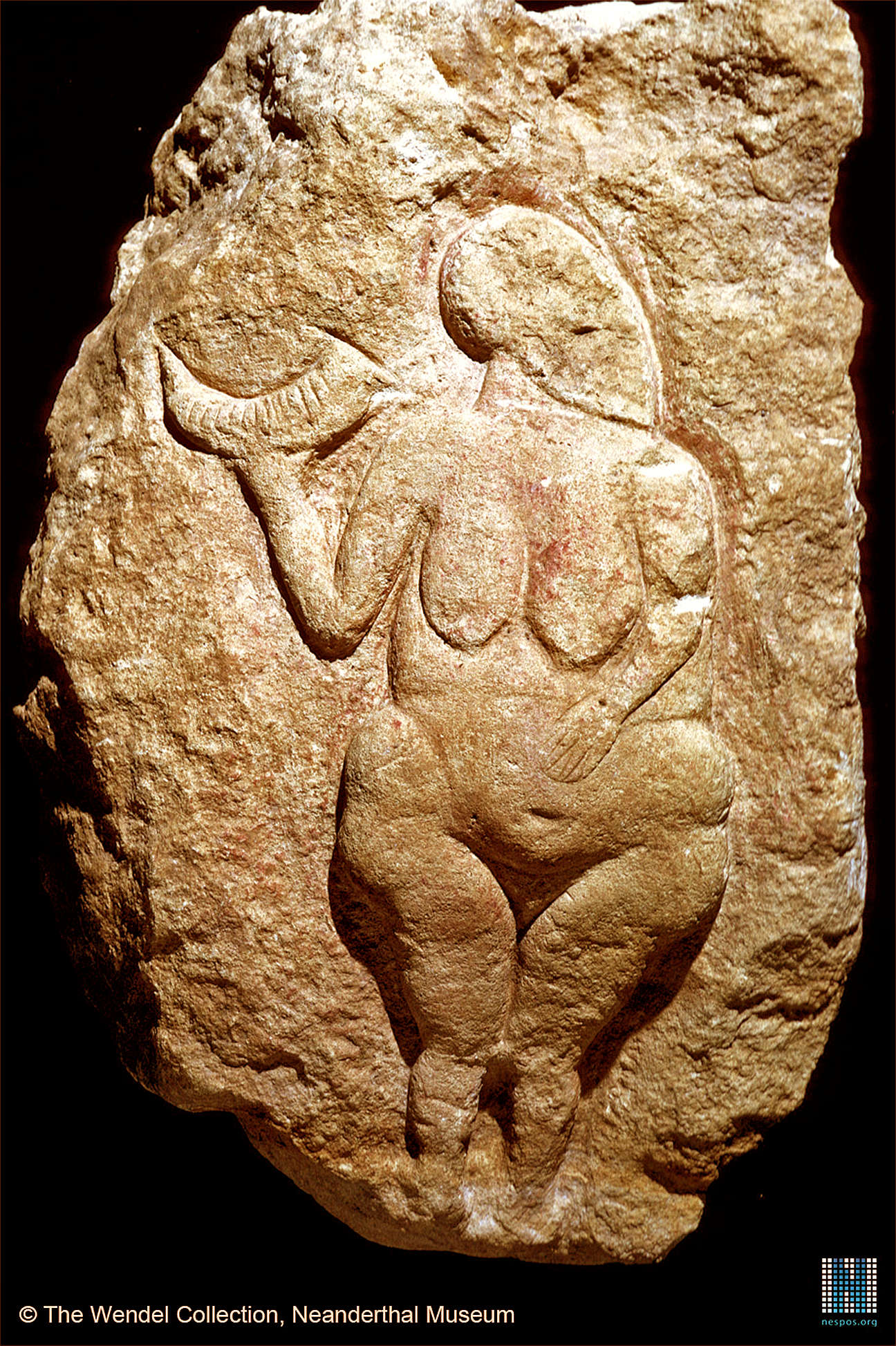
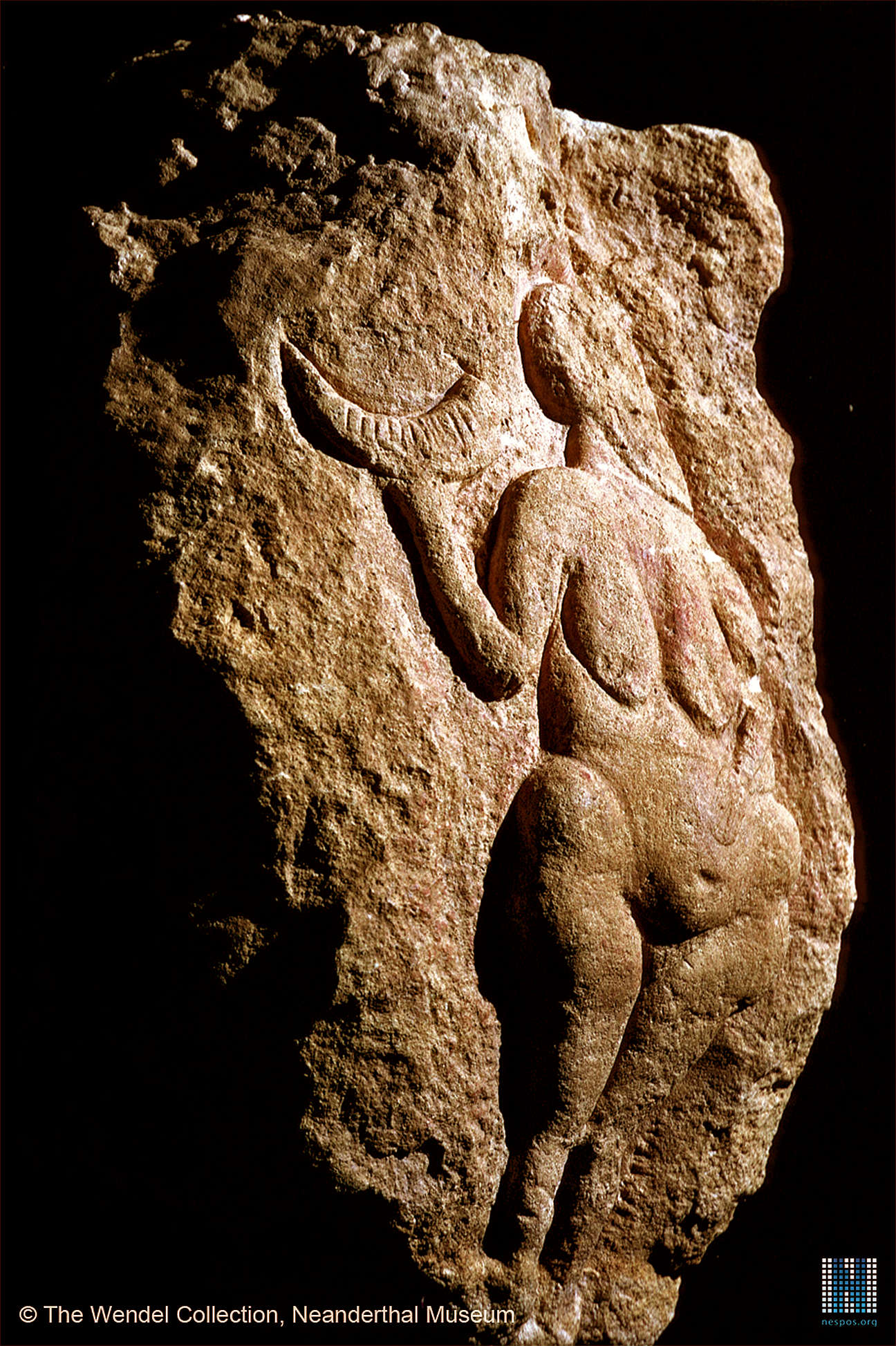
Venus de Laussel, original.
Photo: Heinrich Wendel (© The Wendel Collection, Neanderthal Museum)
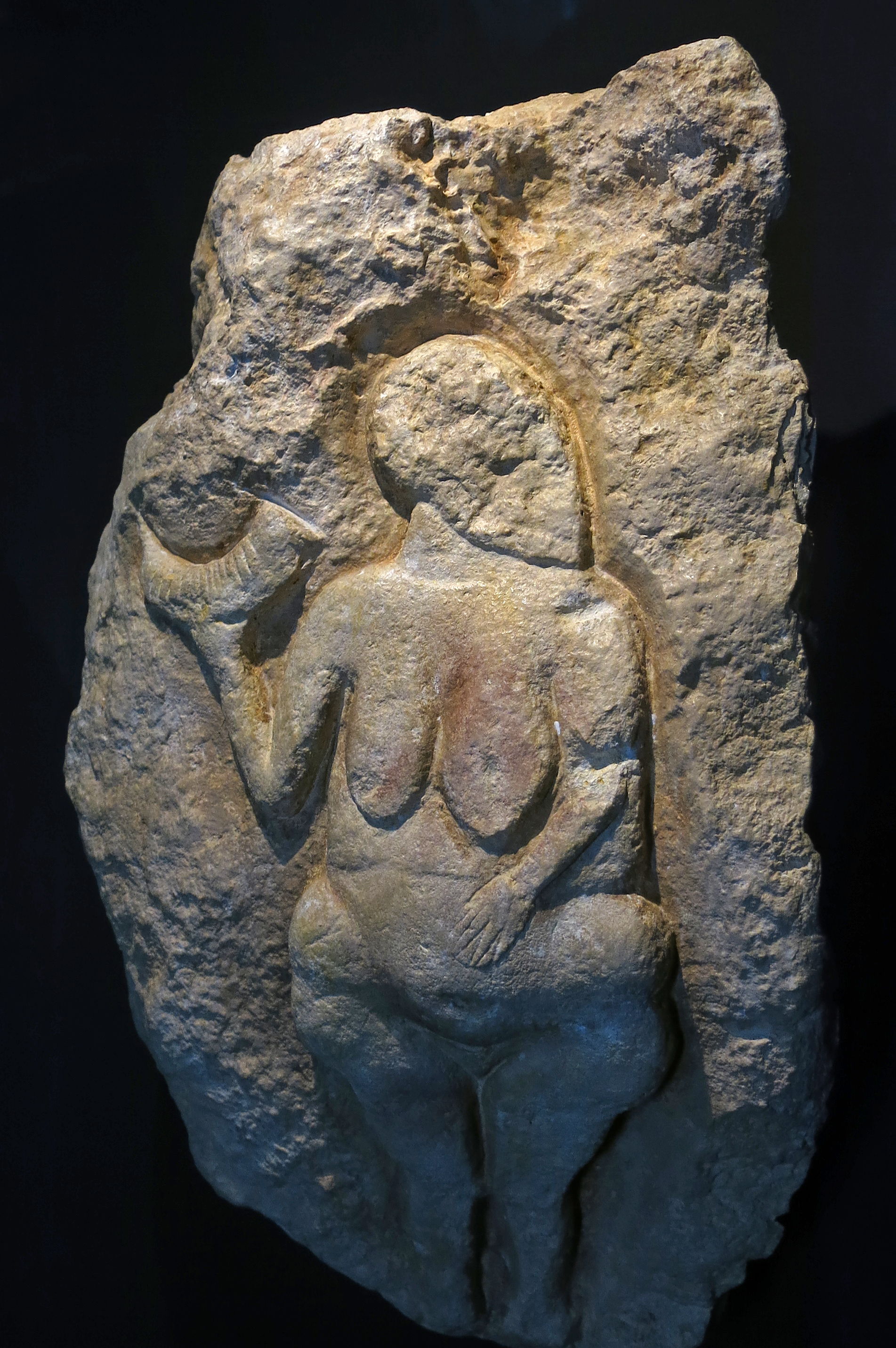
The base of the limestone block (estimated at 4 m3) on which la Femme à la Corne was carved was found in a Gravettian layer. The sculpture was cut away from the cliff wall to be sent to Bordeaux, to Dr. Gaston Lalanne, sponsor of the excavations of the Grand Abri de Laussel in 1911.
This bas relief represents a woman holding in her right hand a horn. Her face was never delineated, and her hair lies on the left shoulder. The right arm is folded, as for the Venus à tête quadrillée.
The breasts are sagging. The left arm shows two deep marks, probably resulting from the blows of picks made during its discovery. The hand, at first a simple rounded form, was later delineated by further engraving. It rests on the abdomen, located on the most convex part of the bloc, strengthening its bulky appearance. The hips are very large, as are the thighs. The feet are missing. The contours are very strongly shown, which accentuates the play of shadow and light.
Material: Limestone
Age: Gravettian
Photo: Don Hitchcock 2015
Source: Original, Musée d'Aquitaine à Bordeaux. Text: Display card at Musée d'Aquitaine à Bordeaux
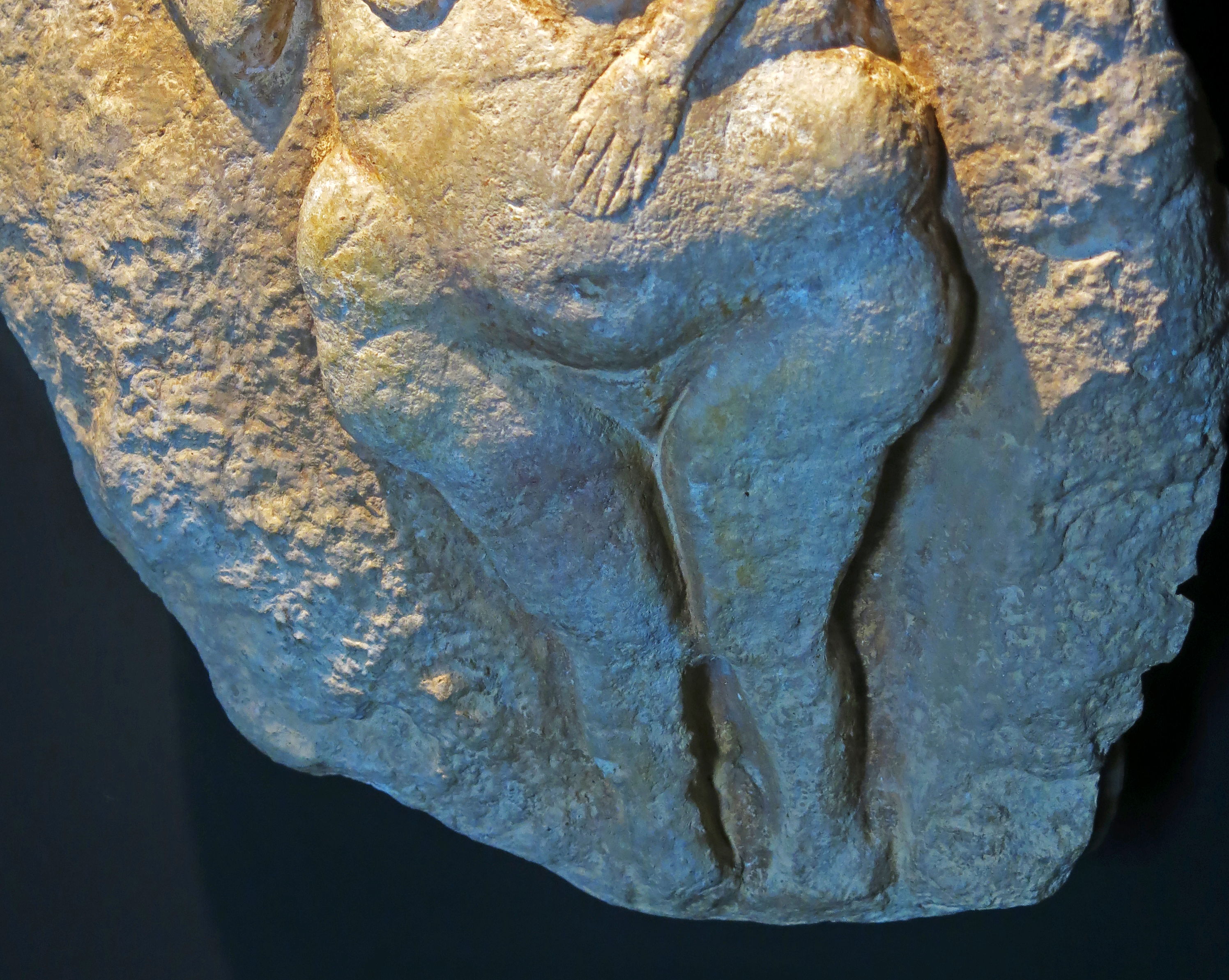
Lower half of the body.
The proportions of this figure are unusual, and the proportions of the head to the body are inaccurate. The limbs (especially the left arm) are shortened compared to the abdomen and hips. These characters show that the artist highlighted the markers of pregnancy and this woman had probably given birth several times. It is by no means certain, but the feminine representations from Laussel may indicate the existence of a cult for the enhancement of fertility.
Material: Limestone
Age: Gravettian
Photo: Don Hitchcock 2015
Source: Original, Musée d'Aquitaine à Bordeaux. Text: Display card at Musée d'Aquitaine à Bordeaux
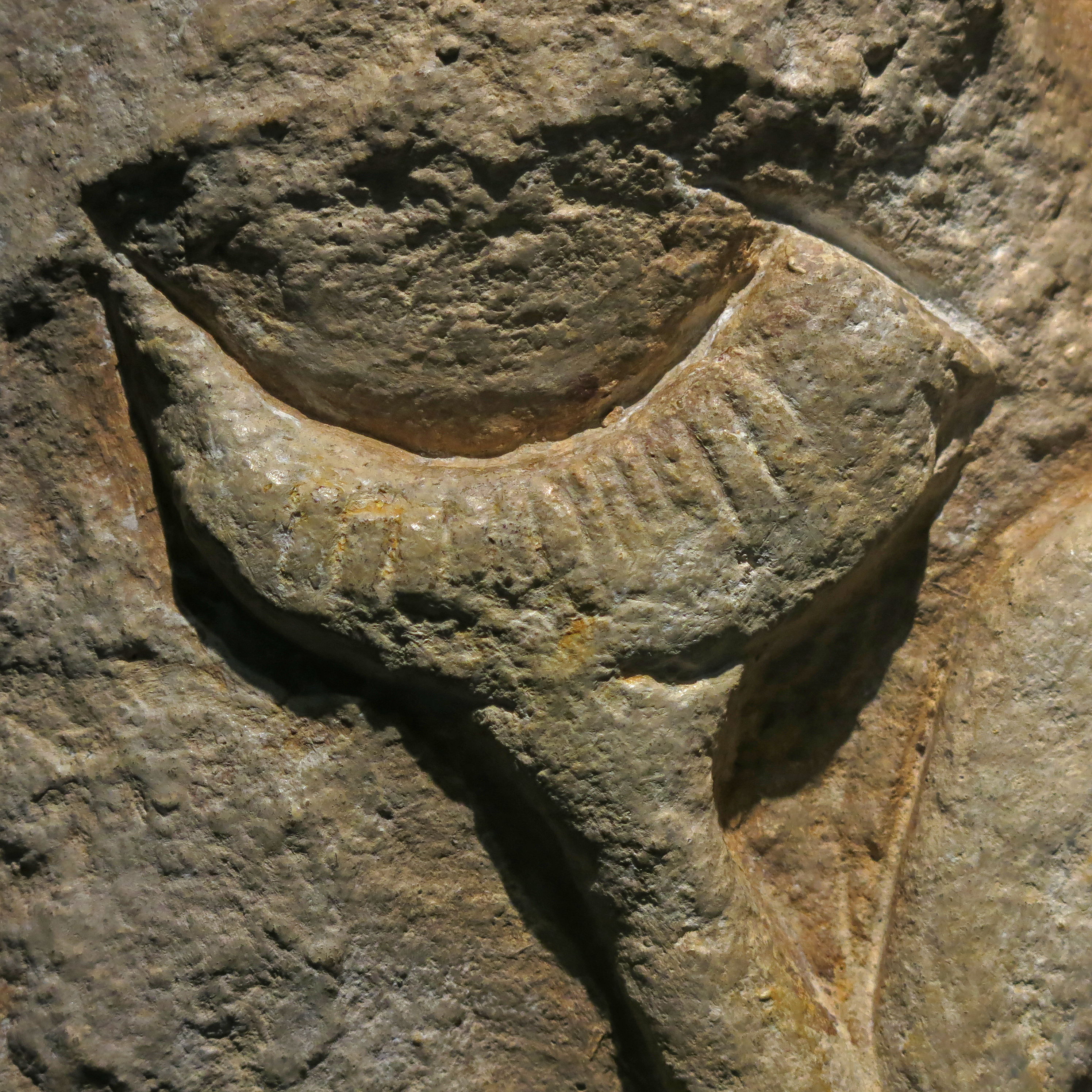
The horn, probably bovine, with its thirteen incisions, has been the cause of much discussion: was it a cornucopia, an obstetrical lunar calendar, a drinking horn, a musical instrument, or something else?
Material: Limestone
Age: Gravettian
Photo: Don Hitchcock 2015
Source: Original, Musée d'Aquitaine à Bordeaux. Text: Display card at Musée d'Aquitaine à Bordeaux
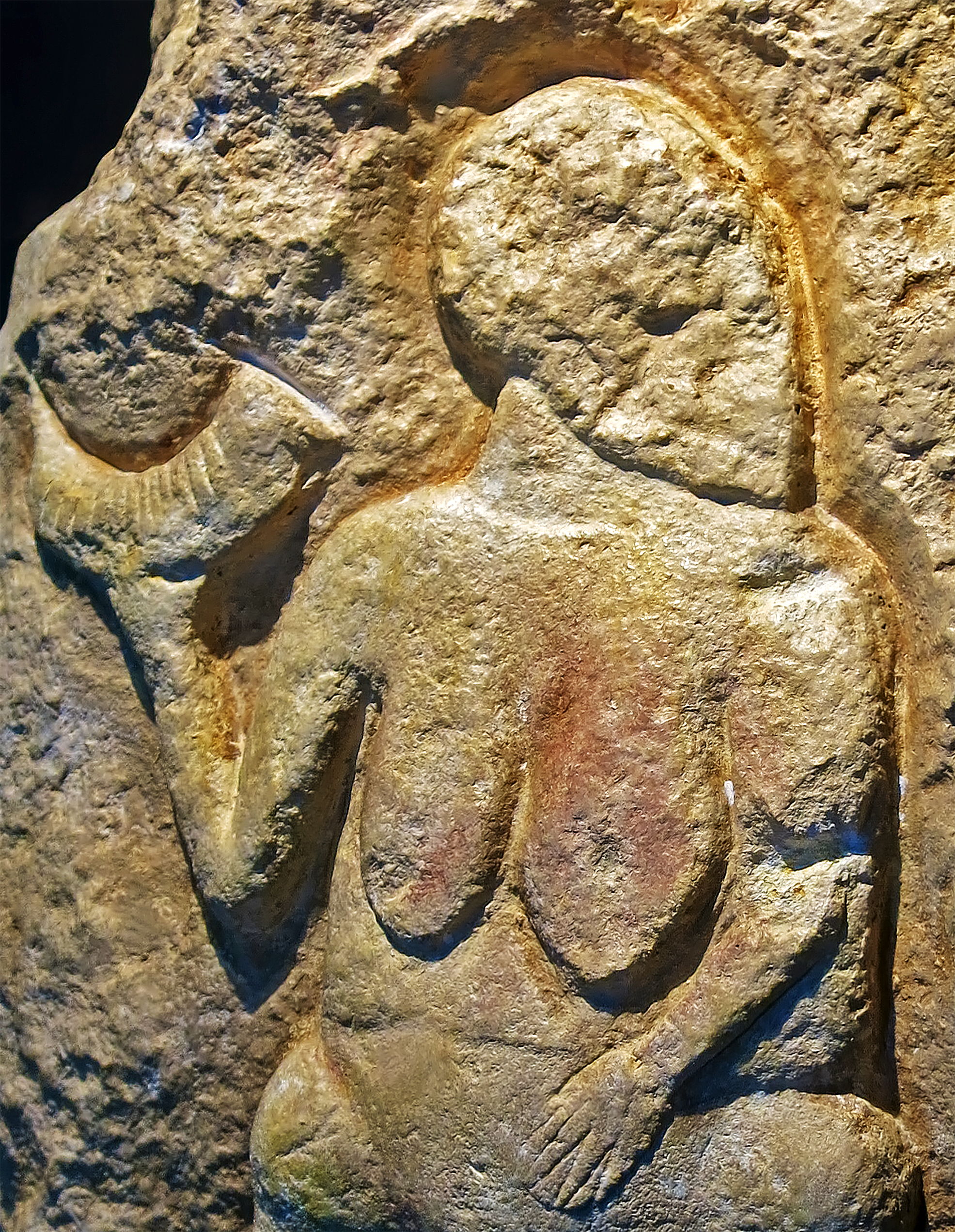
It seems that the head was never carved with a human likeness, but left intentionally blank. This is a common feature of such depictions of a venus.
Photo: Don Hitchcock 2015
Source: Original, Musée d'Aquitaine à Bordeaux.
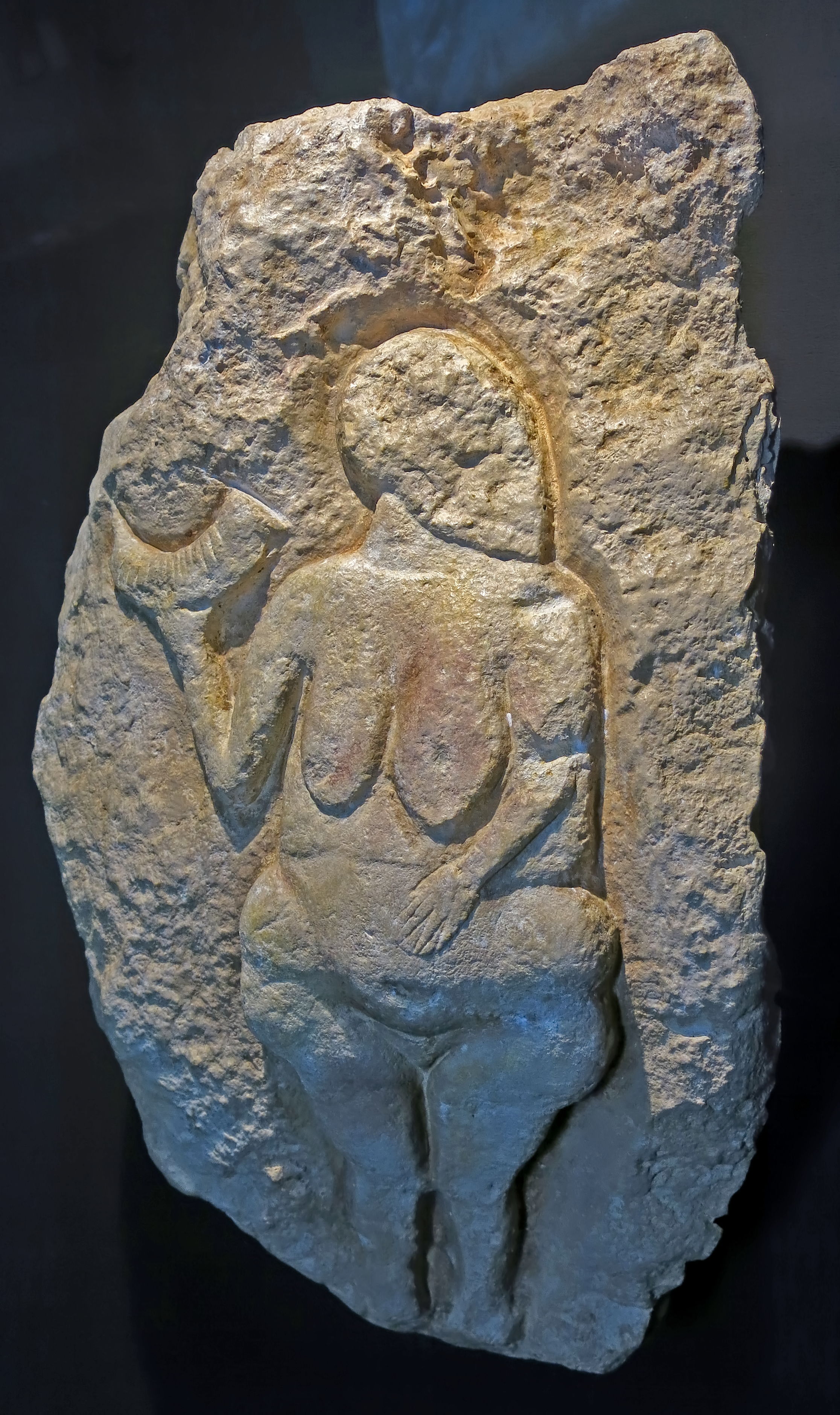
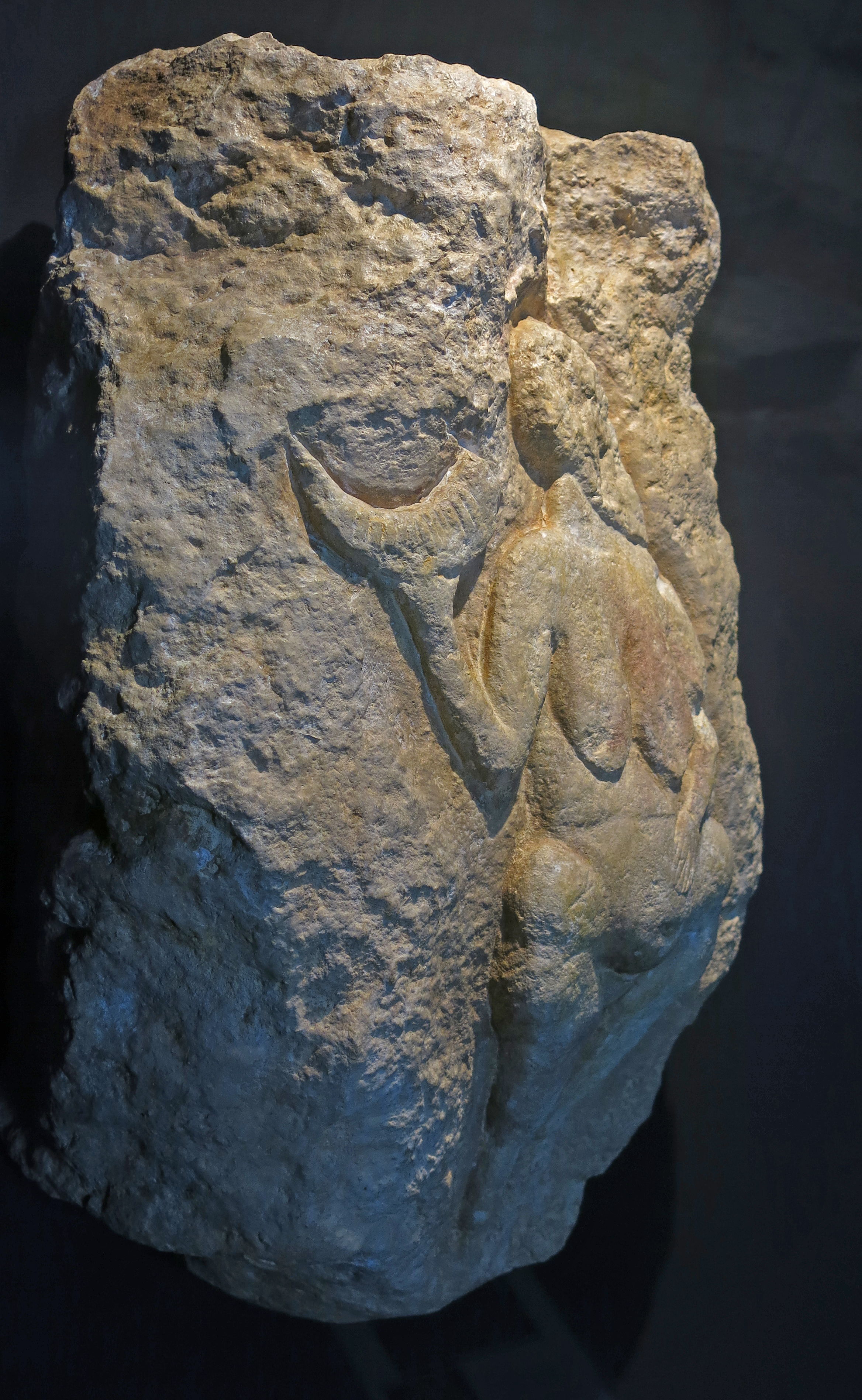
Photo: Don Hitchcock 2015
Source: Original, Musée d'Aquitaine à Bordeaux.
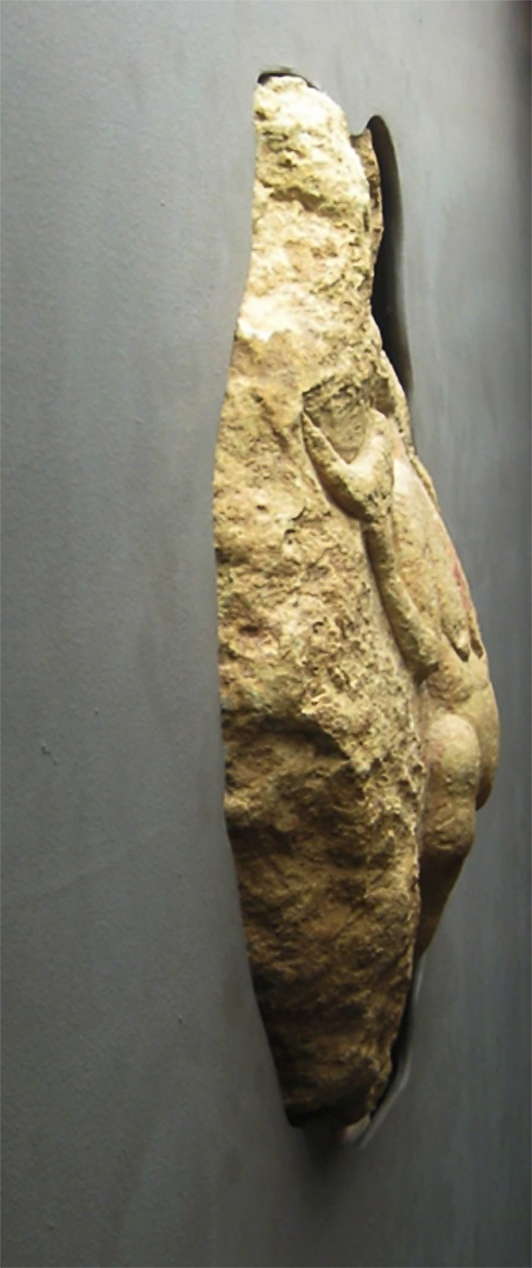
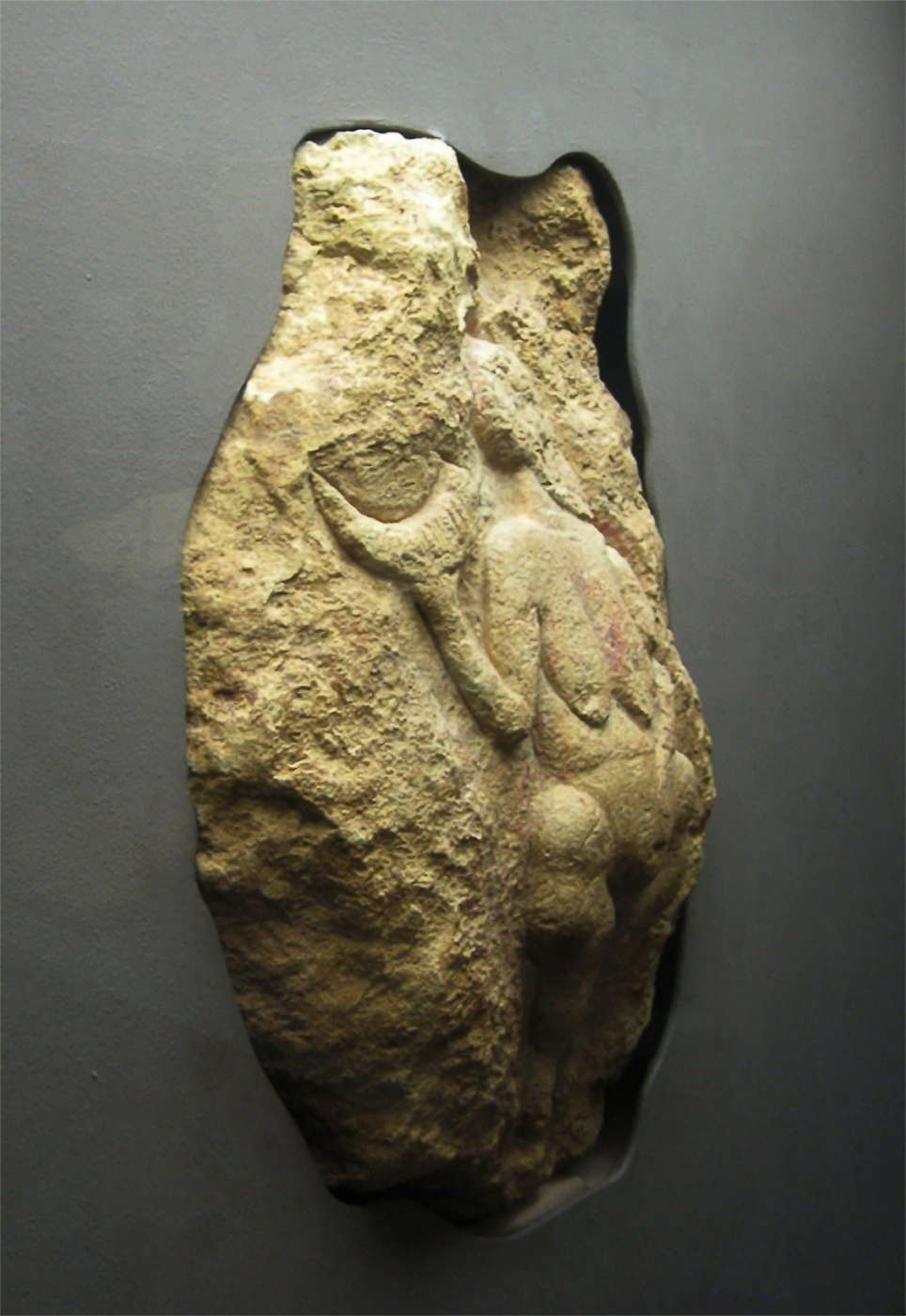
La Femme à la Corne seen from an interesting perspective, showing the amount of modelling in the bas relief.
Photo: http://www.jacquesvlemaire.be/blog/tag/venus-a-la-corne
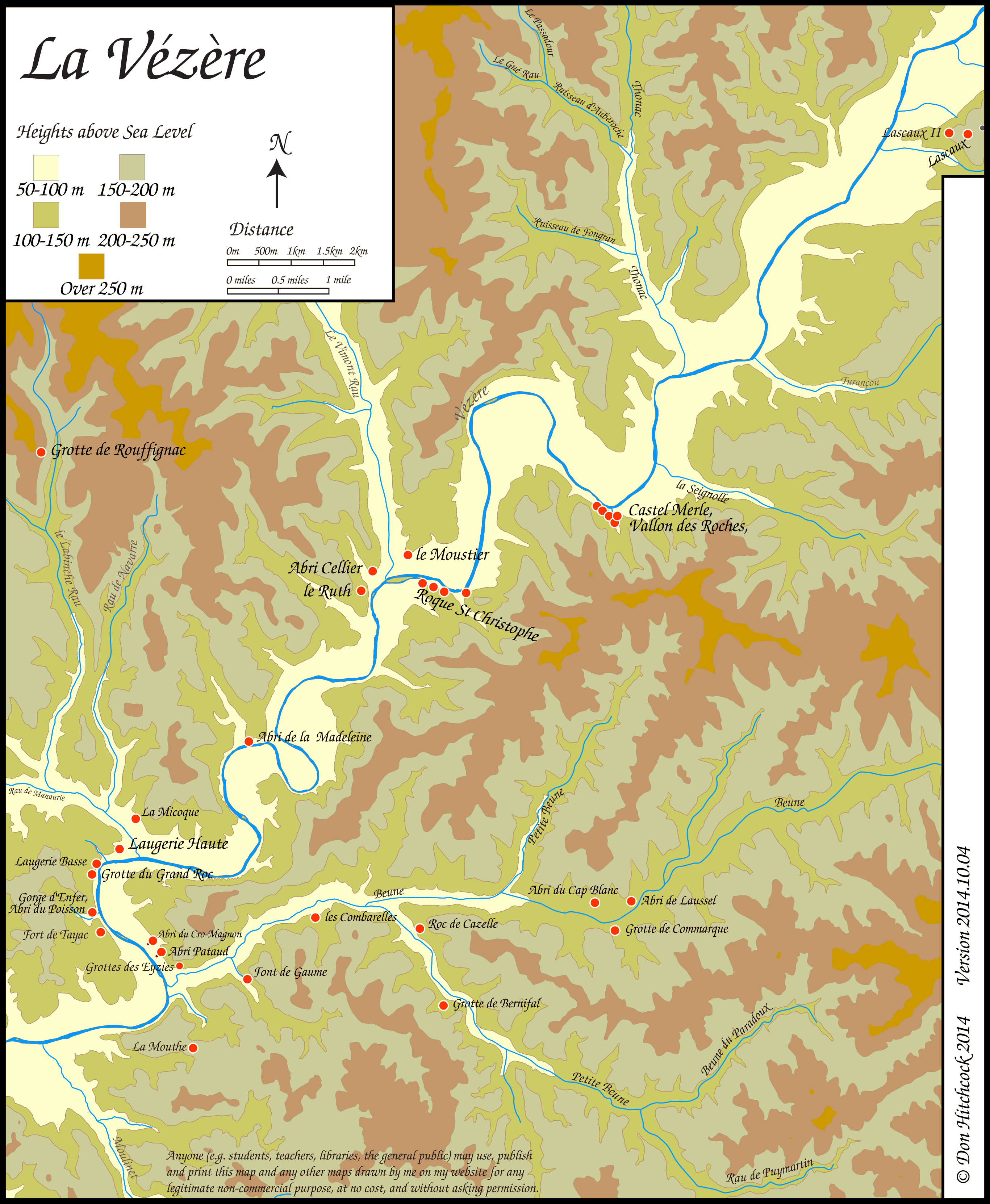
Map of sites in the Vézère Valley of France, including l'abri de Laussel.
If you click on the map you will see a larger map with the ability to click on the marked sites and get further information.
Photo: Don Hitchcock
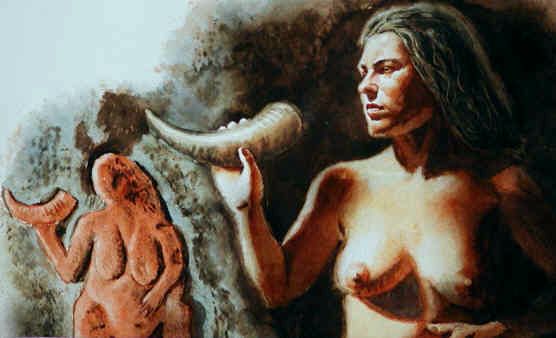
This is a reconstruction of what the original Femme à la Corne may have looked like.
It shows a woman with long hair, and drinking from a horn.
Artist: Illustration © Libor Balák
Photo: http://www.iabrno.cz/agalerie/gravett.htm

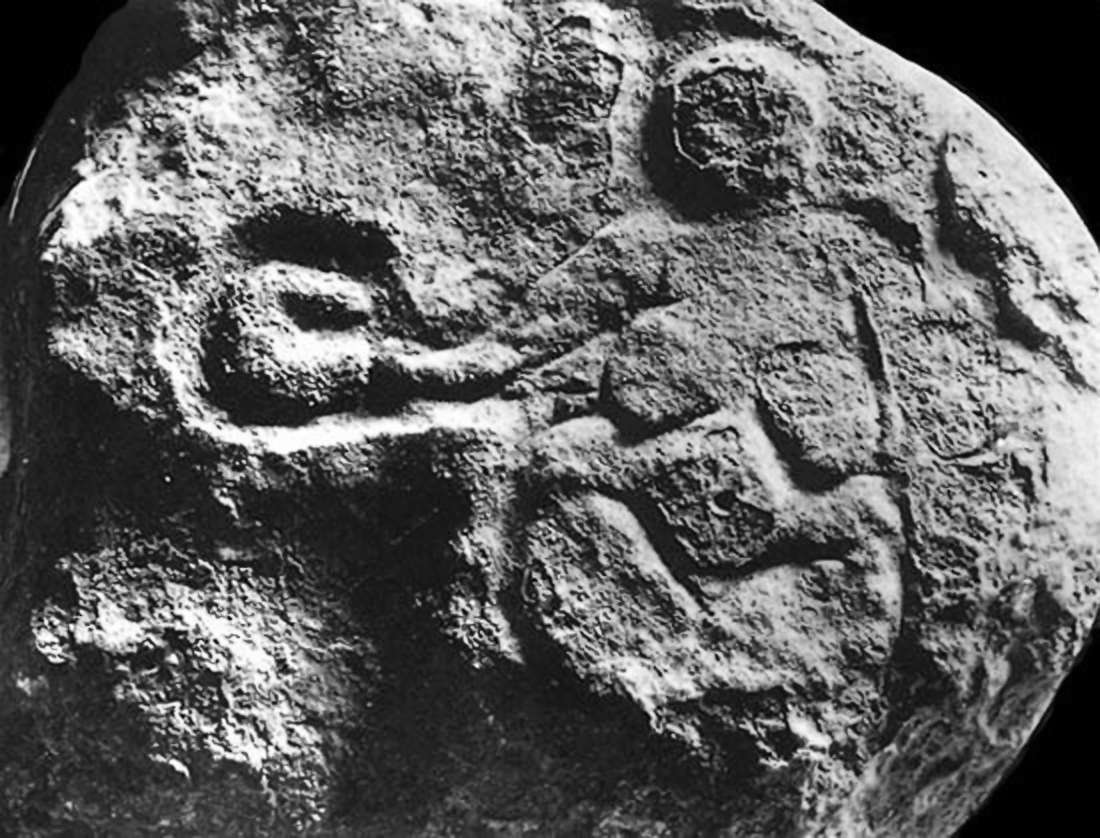
A second, less well known version of the Femme à la Corne, sometimes called the 'Venus Dehanchee'.
Dimensions: 43cm x 38cm
Photo: Unknown
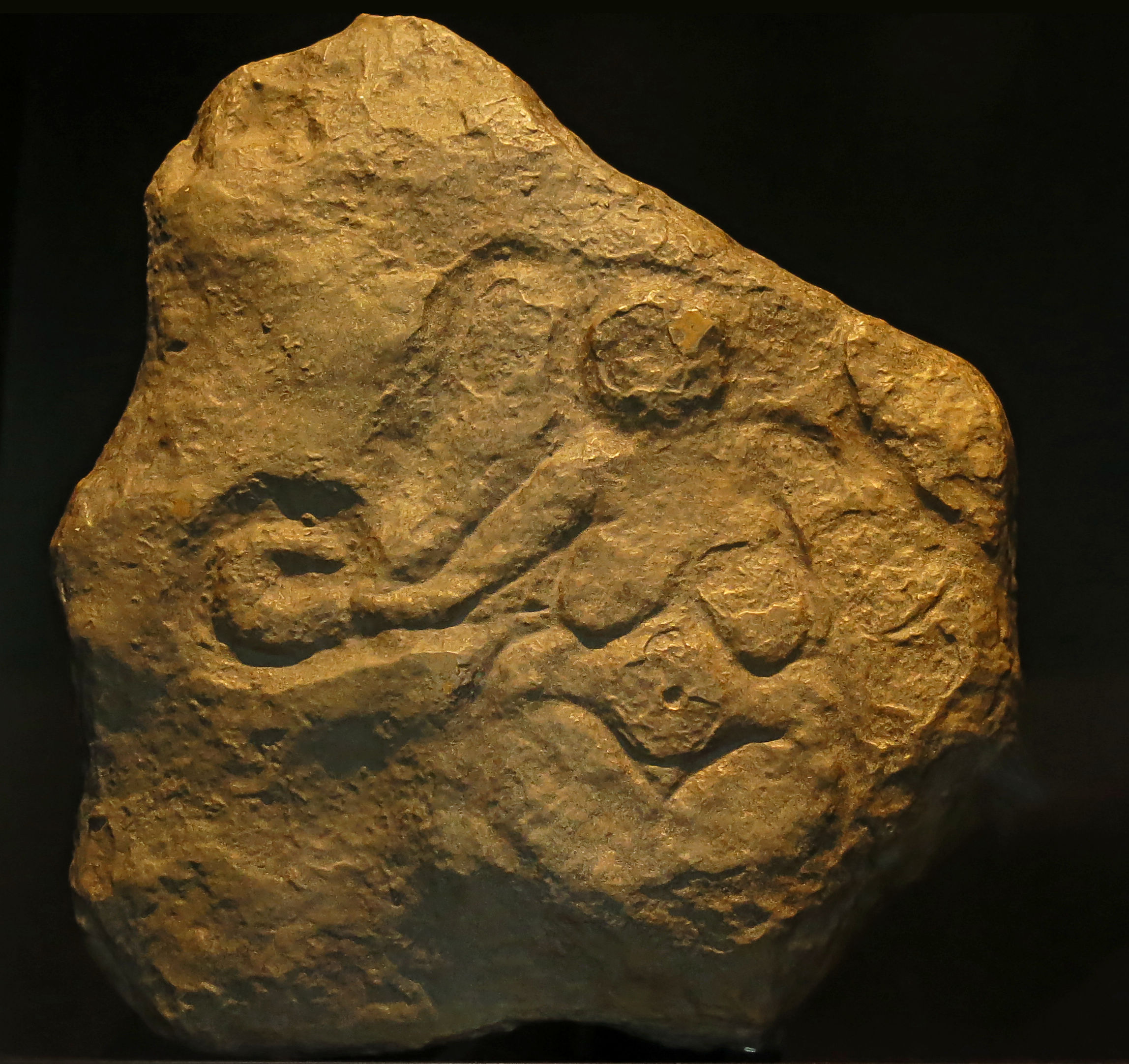
This photo is of a facsimile of the second Femme à la Corne, in the Berlin Museum.
The original has been reported as being taken as spoils of war to Russia. If so, is probably in storage at the Hermitage Museum in Saint Petersburg, but I have been unable to confirm this location.
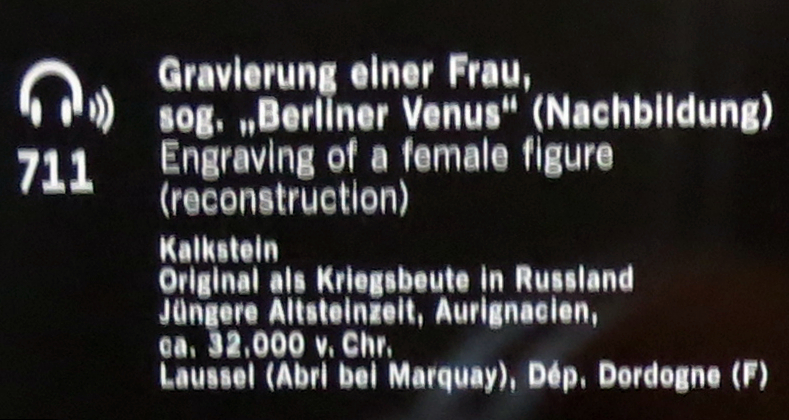
The card with the exhibit reads:
Gravierung einer Frau, sog. 'Berliner Venus' (Nachbildung) Engraving of a female figure (reconstruction) Kalkstein Original als Kriegsbeute in Russland Jüngere Altsteinzeit, Aurignacien, ca. 32.000 v. Chr. Laussel (Abri bei Marquay), Dép. Dordogne (F)
Note that many sources, such as Delporte (1979), Lesure (2011), and Roussot (2000) assert that this venus was destroyed in WWII. My thanks to archaeologist Laurent Klaric (p.c.) for pointing this out.
Photo: Don Hitchcock 2015
Source: Facsimile, Staatliche Museen zu Berlin, Neues Museum, Germany
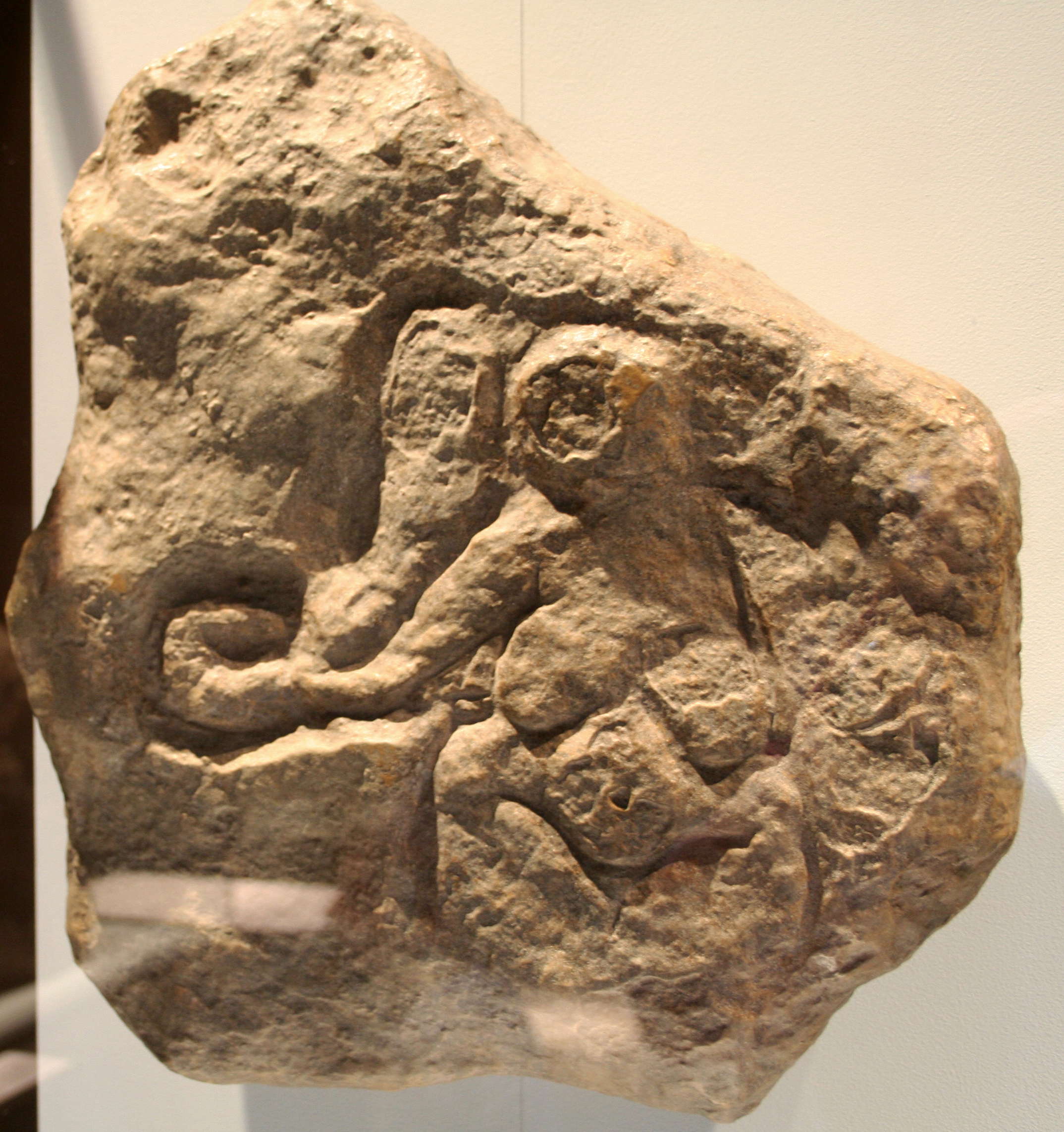
Another image of the second Femme à la Corne, lit in a way which shows the relief more clearly. It is also known as the Berlin Venus, since in 1912 it was sold to the Museum für Völkerkunde in Berlin.
This is a facsimile in the Museum für Vor- und Frühgeschichte, Berlin, the Berlin Museum of Prehistory and Early History.
Photo: Einsamer Schütze, Lone Shooter
Permission: GNU Free Documentation License , Version 1.2 or any later version
Date: 2011.06.28
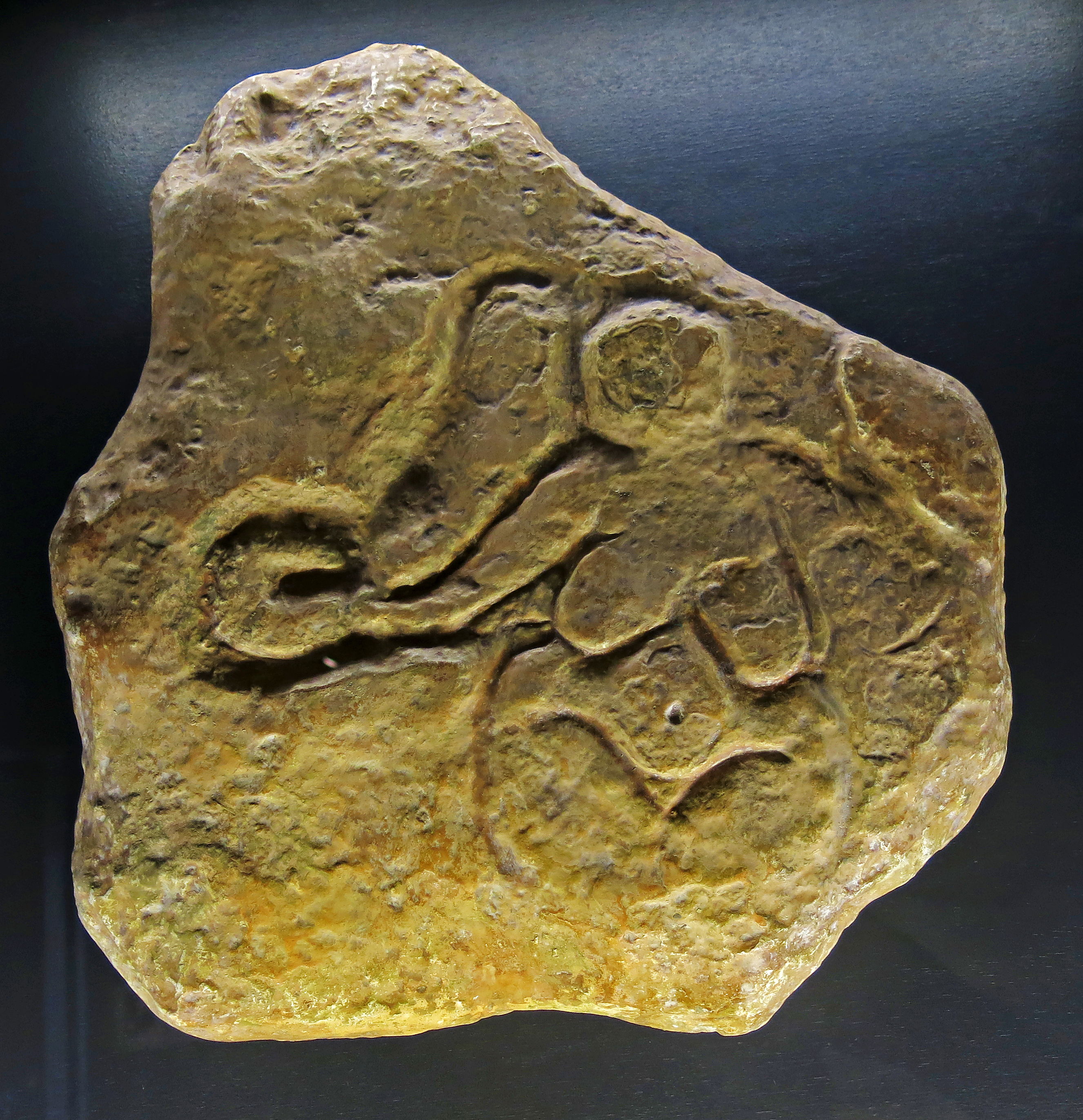
Berlin Venus.
The second Femme à la Corne, is in this case a replica in the Musée d'Aquitaine à Bordeaux.
This limestone bas-relief is of a woman with a horn in her hand, which is often interpreted as a cornucopia, thus bestowing fertility. From the Abri Laussel site come five reliefs of human figures, a spear throwing man and four women.
Photo: Don Hitchcock 2015
Source: Facsimile, Musée d'Aquitaine à Bordeaux
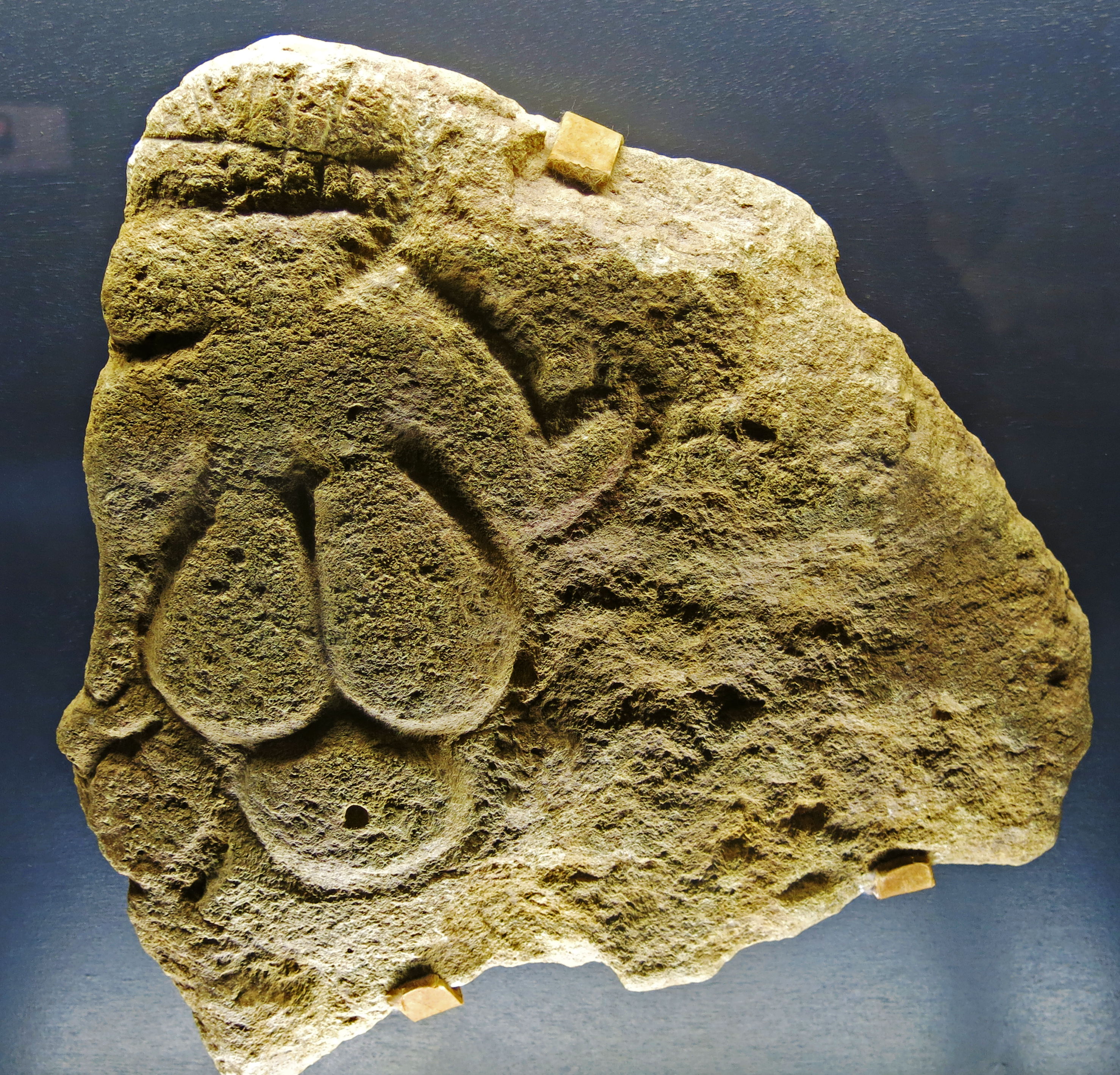
Femme à la tête quadrillée, from Laussel.
This is a little known piece, which is also completed on a piece of sandstone found at Laussel. The net or grid on the head is especially interesting.
(Given the existence of the second Femme à la Corne just above, it is tempting to see this Femme à la tête quadrillée as another version of the Femme à la Corne, with the arm holding the horn broken off - Don )
Photo: Don Hitchcock 2015
Source: Original, Musée d'Aquitaine à Bordeaux

Femme à la tête quadrillée, from Laussel.
Close up of the head.
Photo: Don Hitchcock 2015
Source: Original, Musée d'Aquitaine à Bordeaux

Femme à la tête quadrillée, from Laussel.
Photo: Mussi (2010)
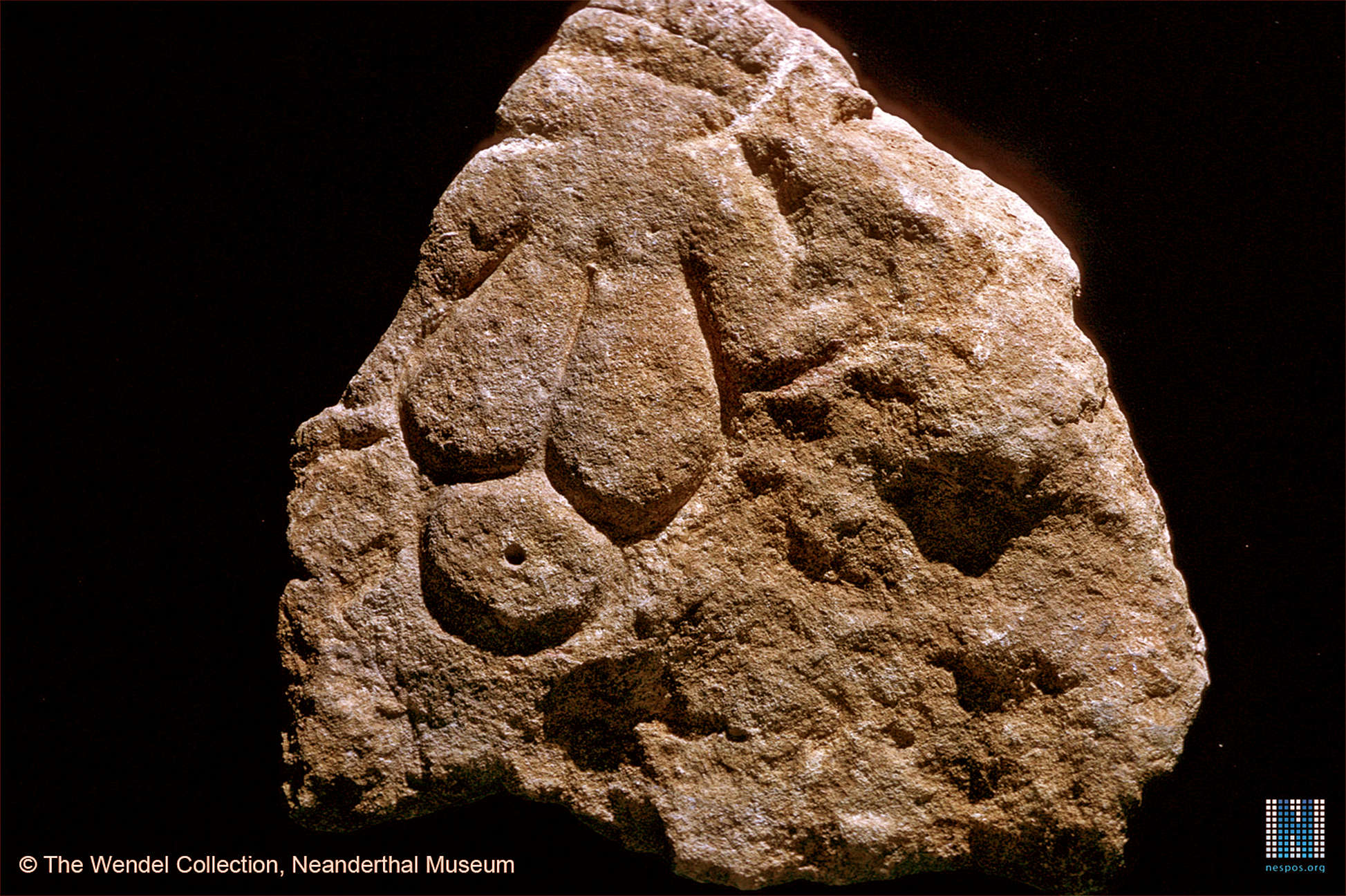
Femme à la tête quadrillée, original, from Laussel.
Photo: Heinrich Wendel (© The Wendel Collection, Neanderthal Museum)
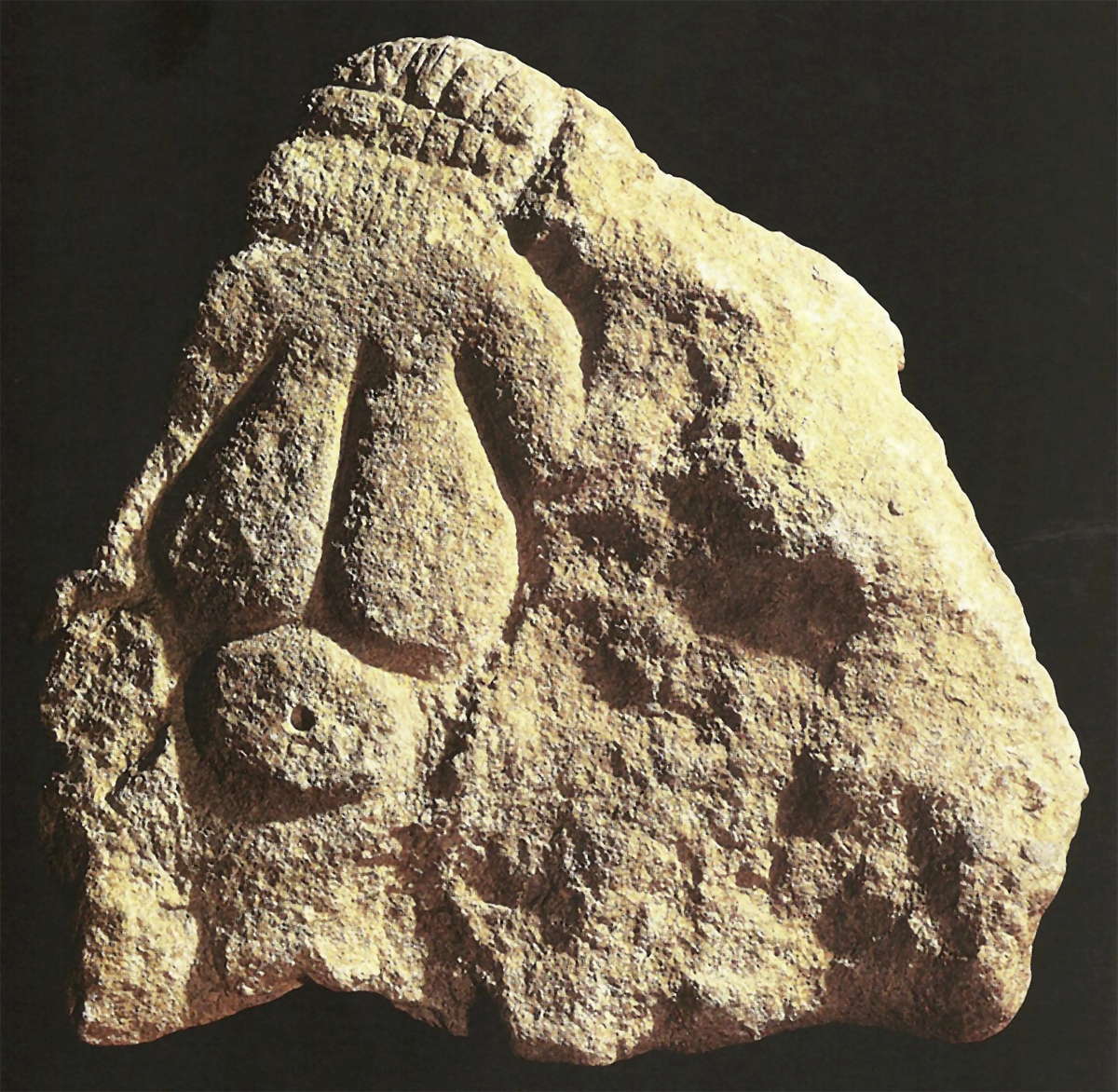
Femme à la tête quadrillée, from Laussel.
Photo: Cohen (2003)
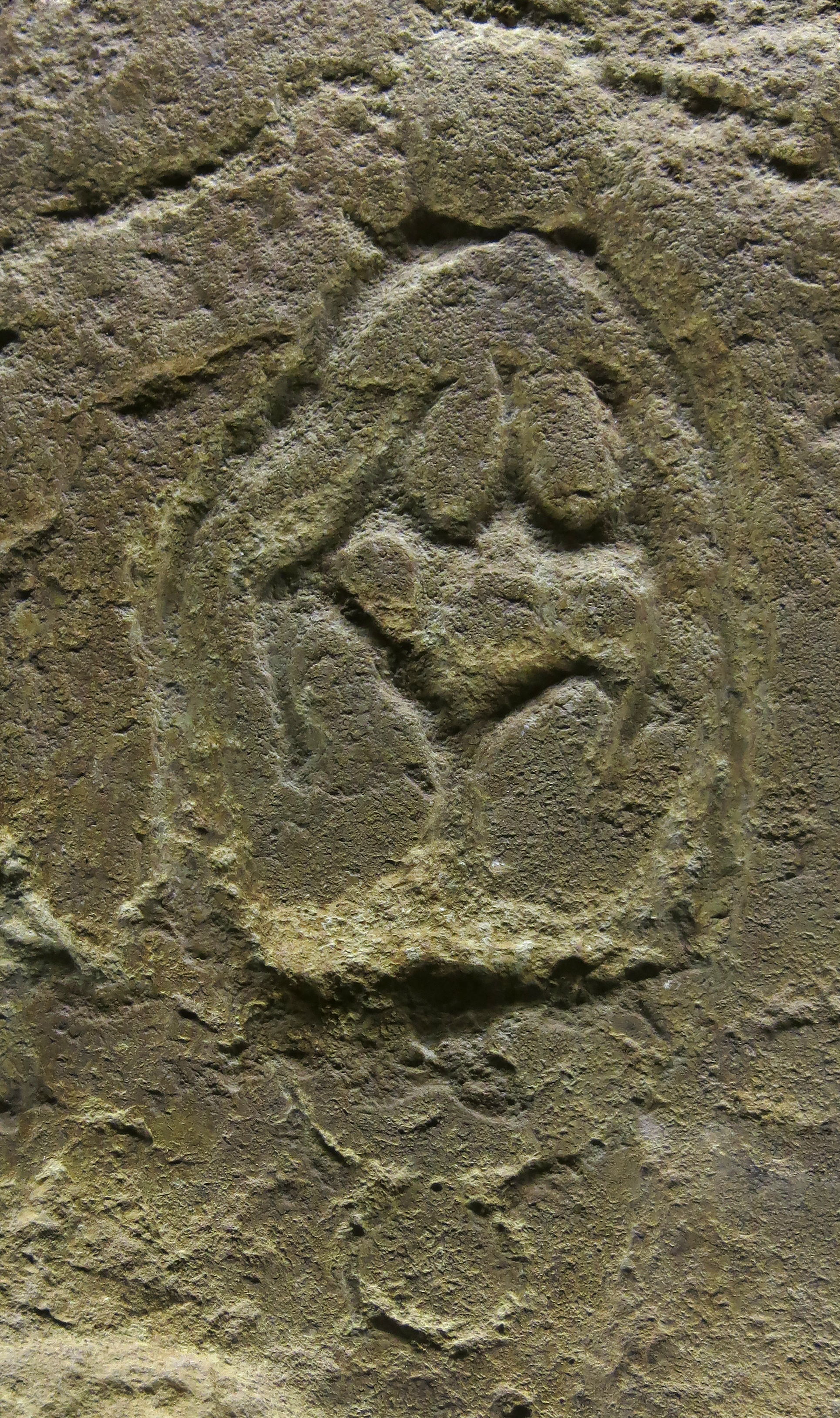

This engraving from Laussel, dated from 32 000 BP to 20 000 BP has been identified as a male-female copulation scene, a birthing scene, or most recently as a Double Goddess in mirror reflection. Perhaps as a 'Playing Card' image of two women, it represents the changing of the seasons from winter to summer, and the resulting dark and light cycle that occurs.
It was discovered in 1911 at almost the same time as the Femme à la Corne, and was created by pecking the stone. It is engraved on a sandstone block, probably originally attached to the wall.
It was discovered 'in the rubble', and may have been completed on the stone after it had detached from the wall. The photo on the left is the traditional way to look at the sculpture, but if we rotate it through 180° a second venus appears, shown at right, with the head at the top, a neck, and breasts.
Photo: Don Hitchcock 2015
Text adapted from: Noble (2003) and http://www.jacquesvlemaire.be/blog/tag/venus-a-la-corne
Source: Original, Musée d'Aquitaine à Bordeaux
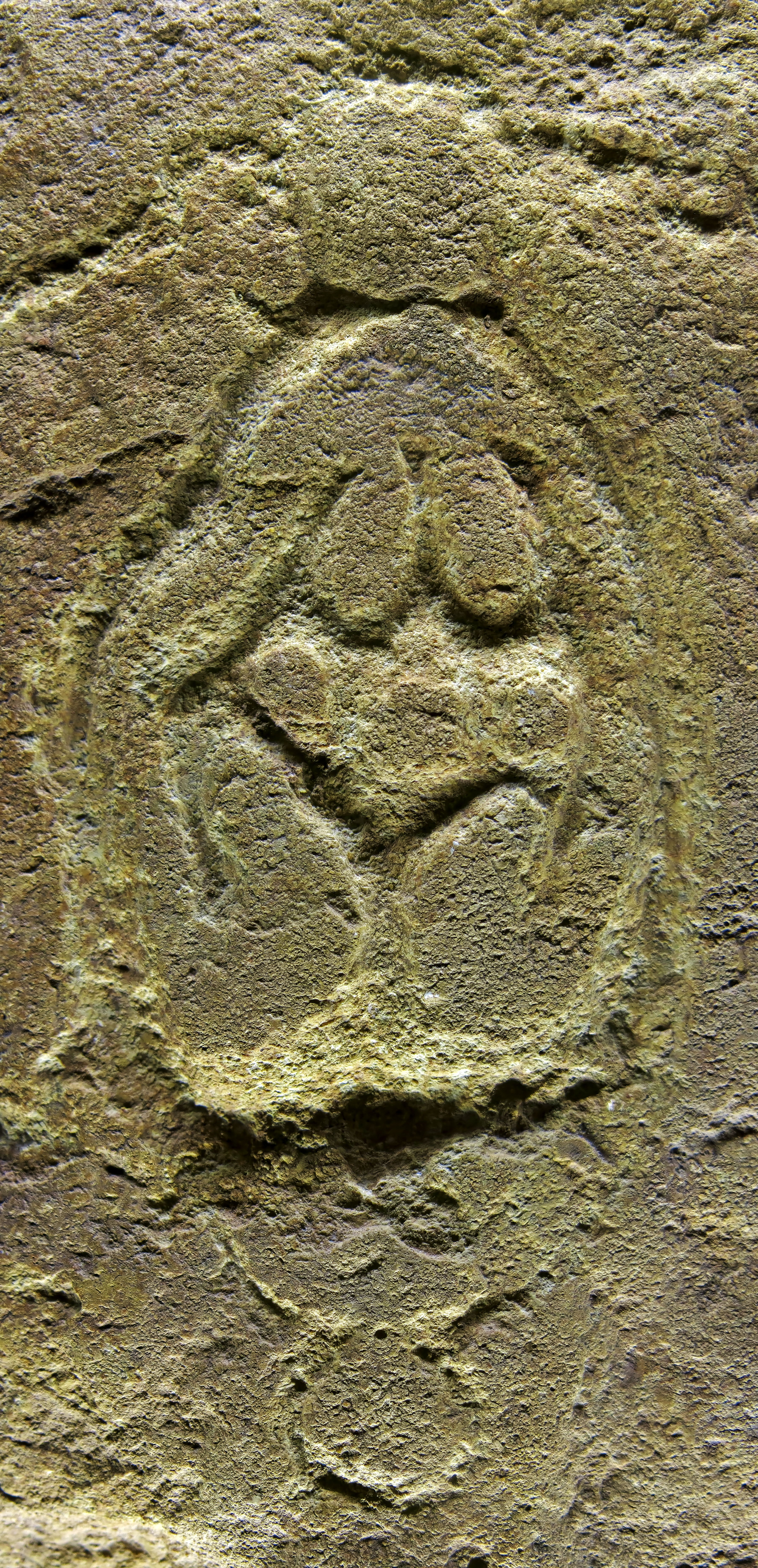
Another version.
Photo: Don Hitchcock 2015
Source: Original, Musée d'Aquitaine à Bordeaux
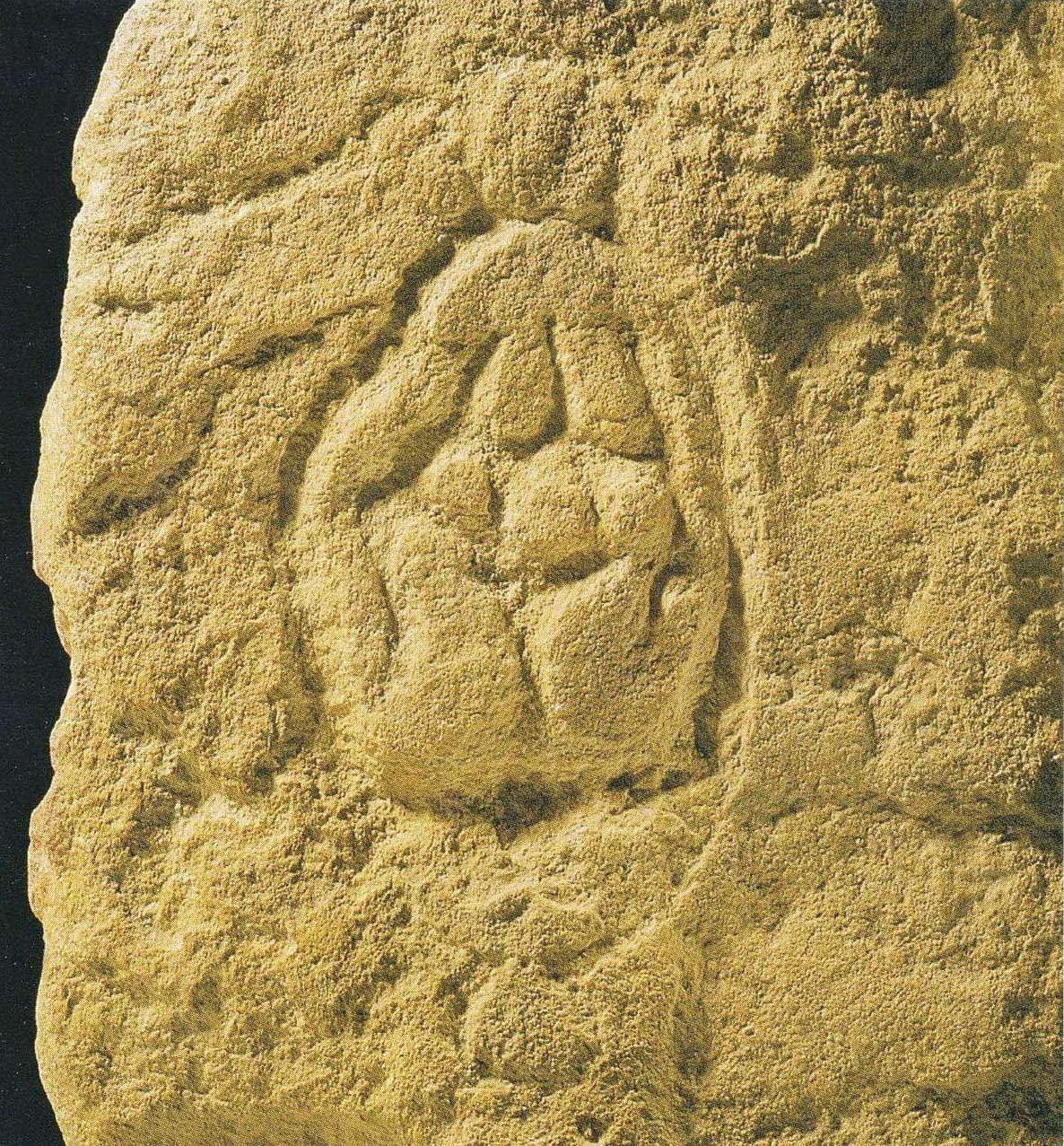
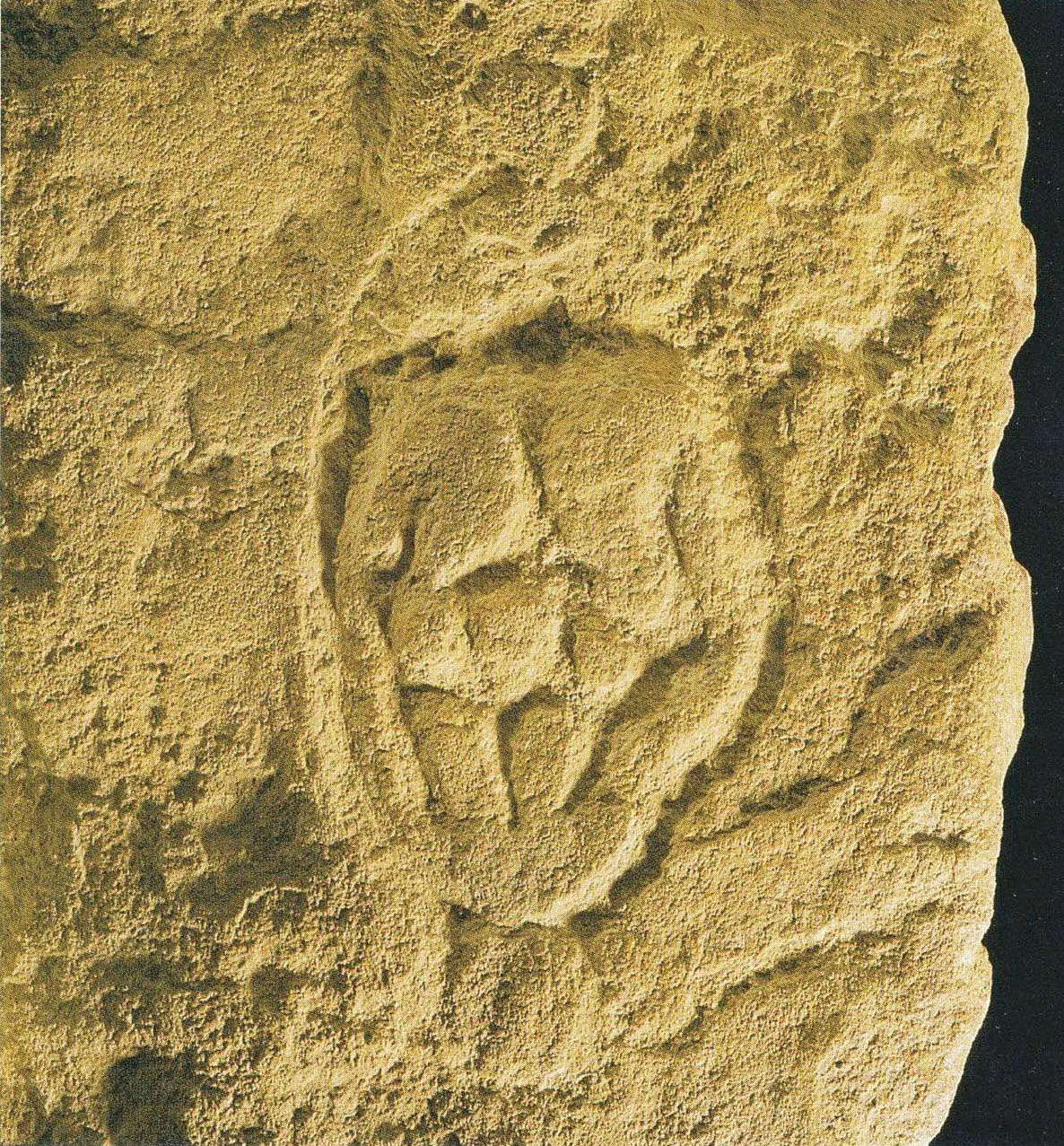
Another version of the image above.
Photo: http://www.jacquesvlemaire.be/blog/tag/venus-a-la-corne
Source: Musée d'Aquitaine à Bordeaux
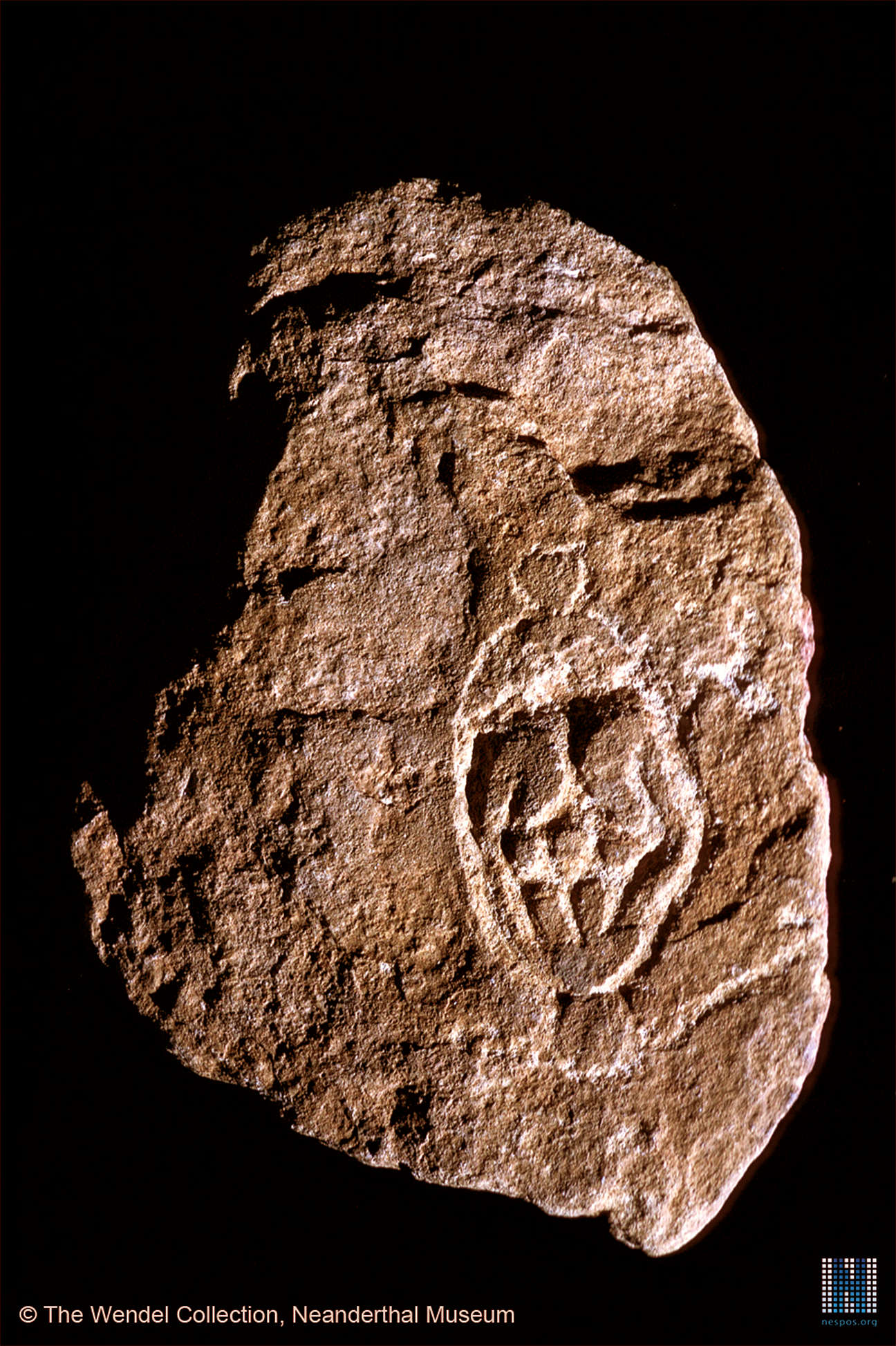
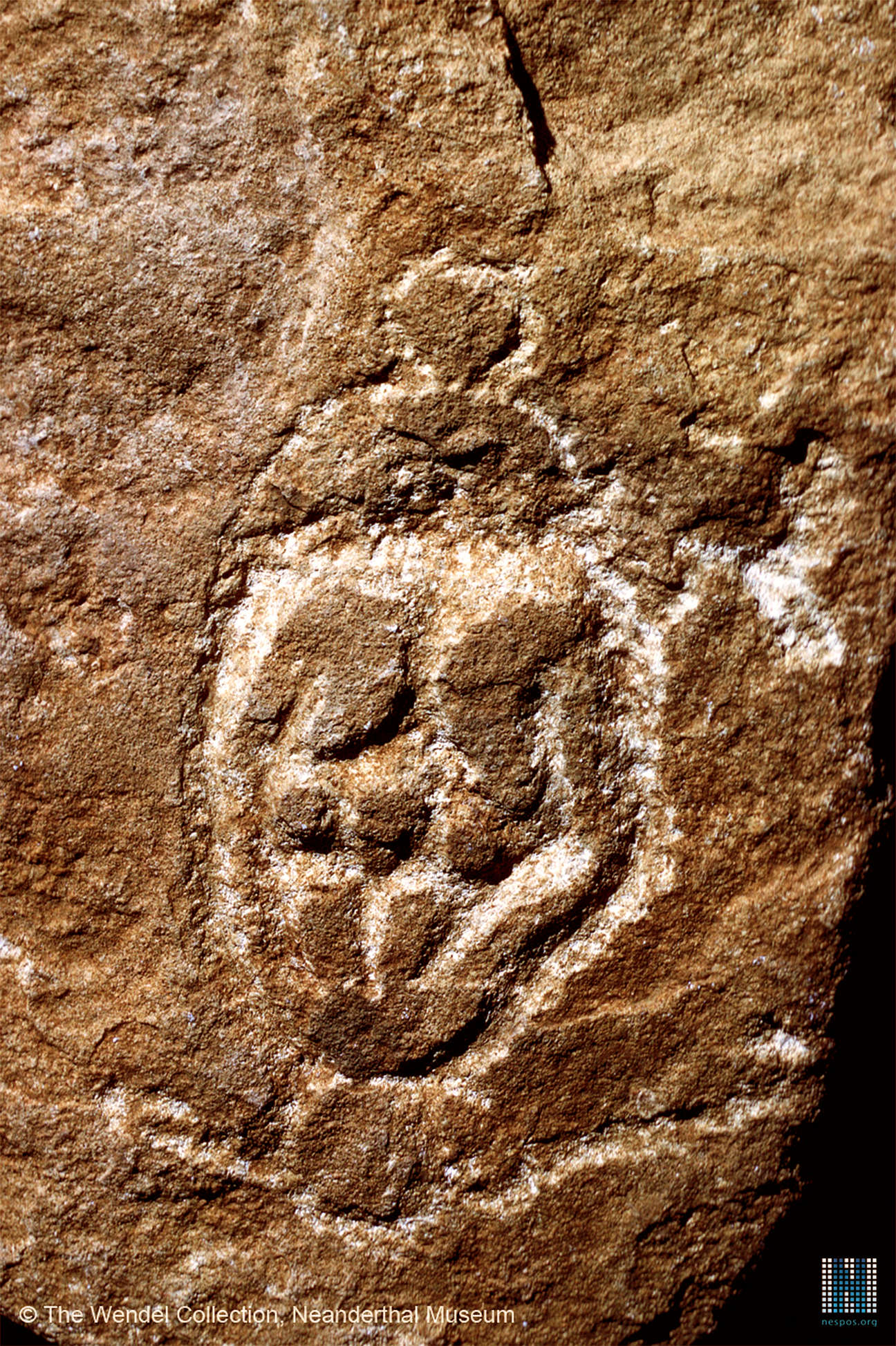
The 'playing card' Venus, original.
Photo: Heinrich Wendel (© The Wendel Collection, Neanderthal Museum)
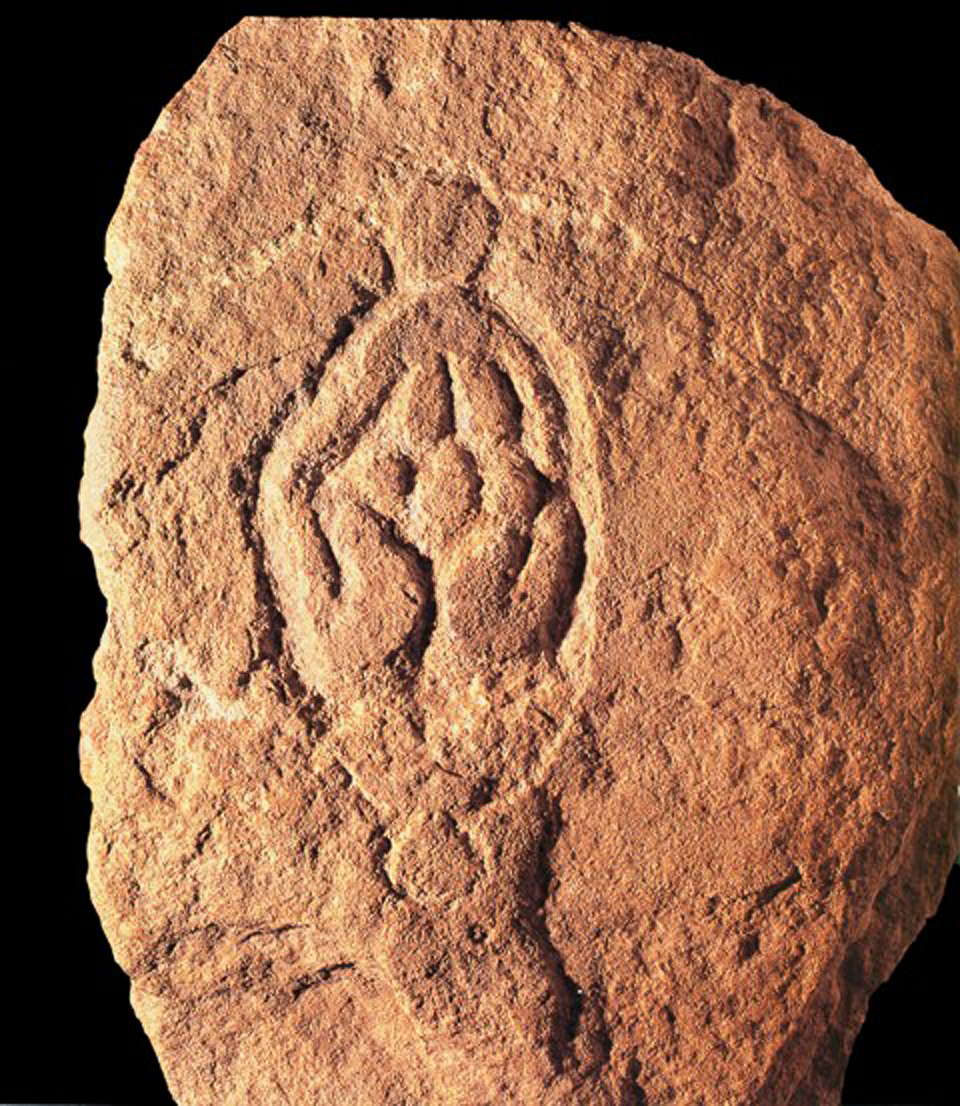
The playing card venus, another version.
Photo: http://www.istmira.com/foto-i-video-pervobytnoe-obschestvo/3924-iskusstvo-predystorii-pervobytnost-2.html
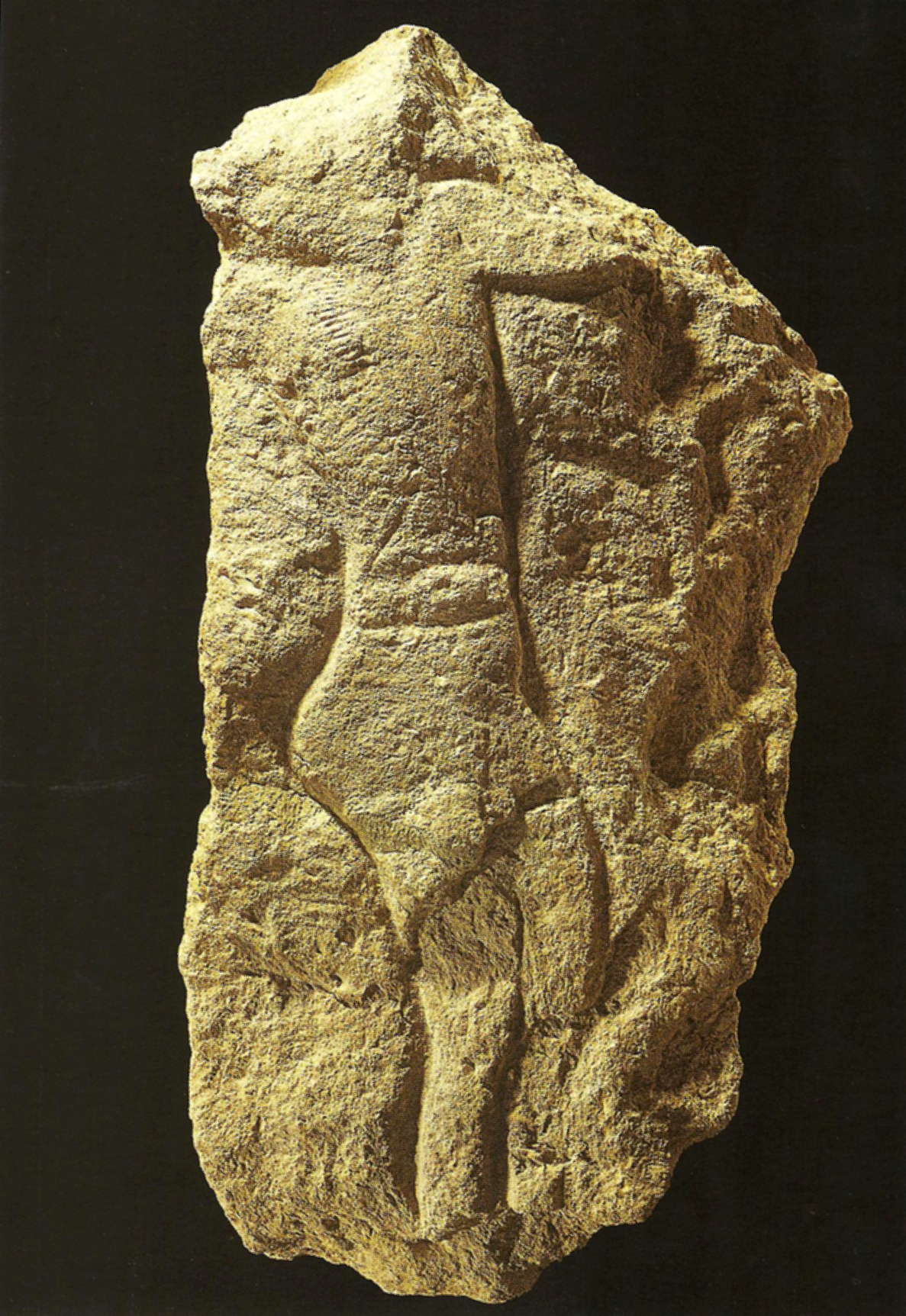
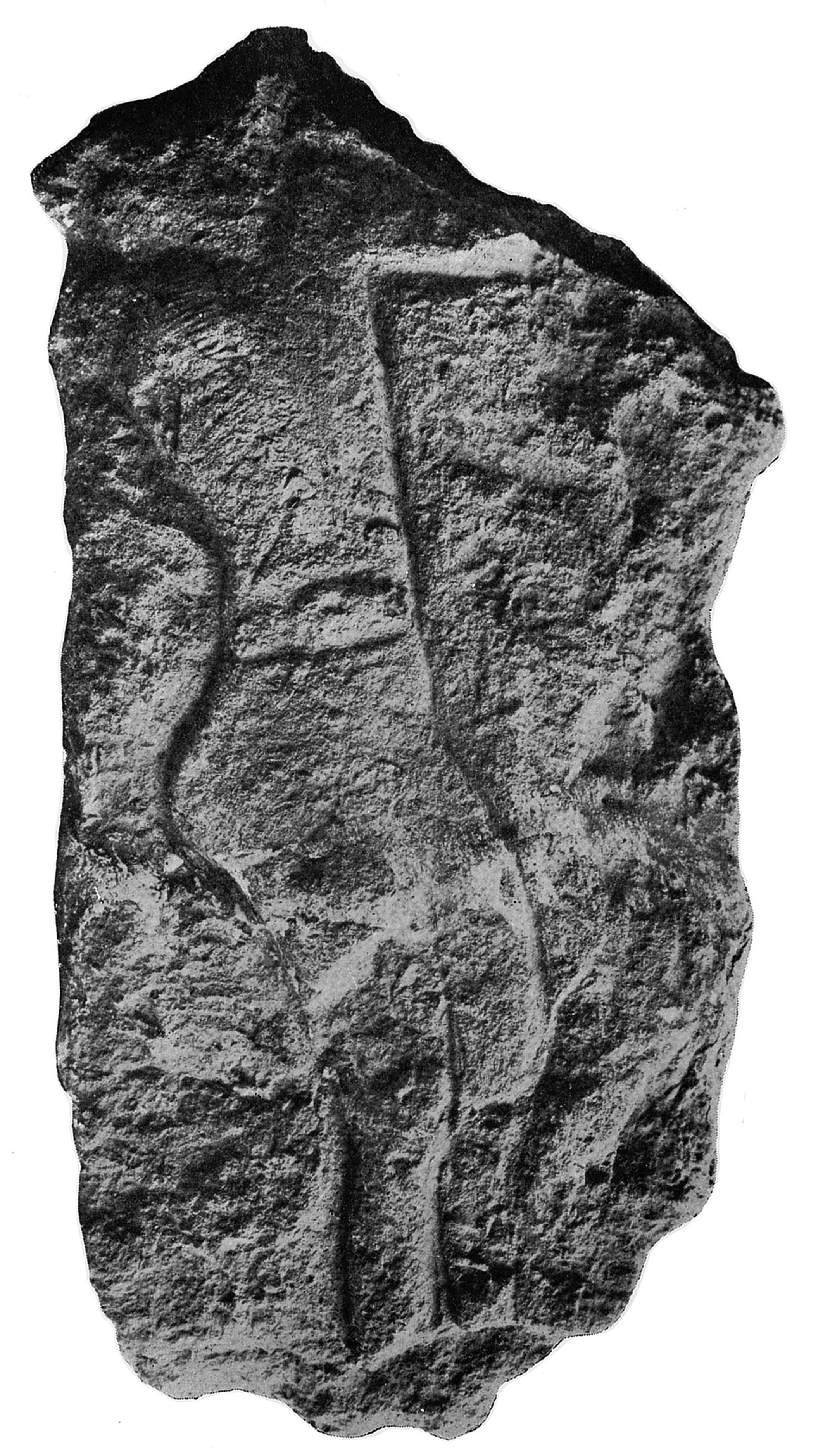
This is a male figure on a limestone block from Laussel, now called 'The Hunter'.
This has the most naturalistic depiction from the Palaeolithic of the human torso and lower body including the pelvis and upper legs that I have ever seen.
It was not on display when I was at the Musée d'Aquitaine à Bordeaux in 2015.
Photo: (left) Cohen (2003)
Photo: (right) © Wellcome Library, London, after a photograph by Lalanne, Creative Commons by-nc 2.0 UK: England & Wales


This is known as the Laussel priapus, found in a Gravettian layer aged 22 000 BP.
In Greek mythology, Priapus was a minor rustic fertility god, protector of livestock, fruit plants, gardens and male genitalia. Priapus is marked by his absurdly oversized, permanent erection, which gave rise to the medical term priapism. He became a popular figure in Roman erotic art and Latin literature, and is the subject of the often humorously obscene collection of verse called the Priapeia.
In archaeology, priapus is a term commonly given to a figure which is phallus like, or has a large phallus.
(left) Photo: http://www.actasurologicas.info/v30/n03/ESP/3003OR02.htm
Source: J.P. Duhard tracing
(right) Photo: Rau et al. (2009)
Text: adapted from Wikipedia.
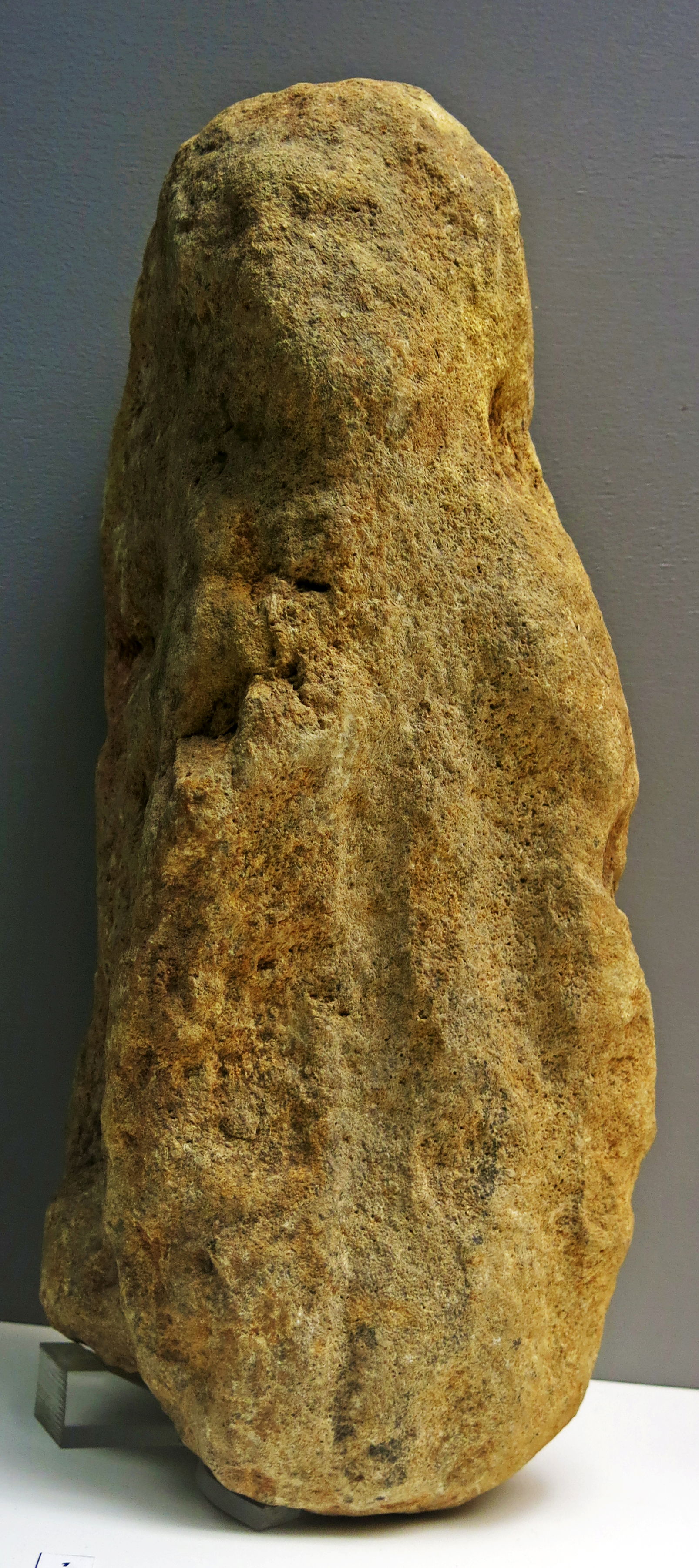

The Laussel priapus.
Material: Limestone
Age: Gravettian
Photo: Don Hitchcock 2015
Source: Original, Musée d'Aquitaine à Bordeaux
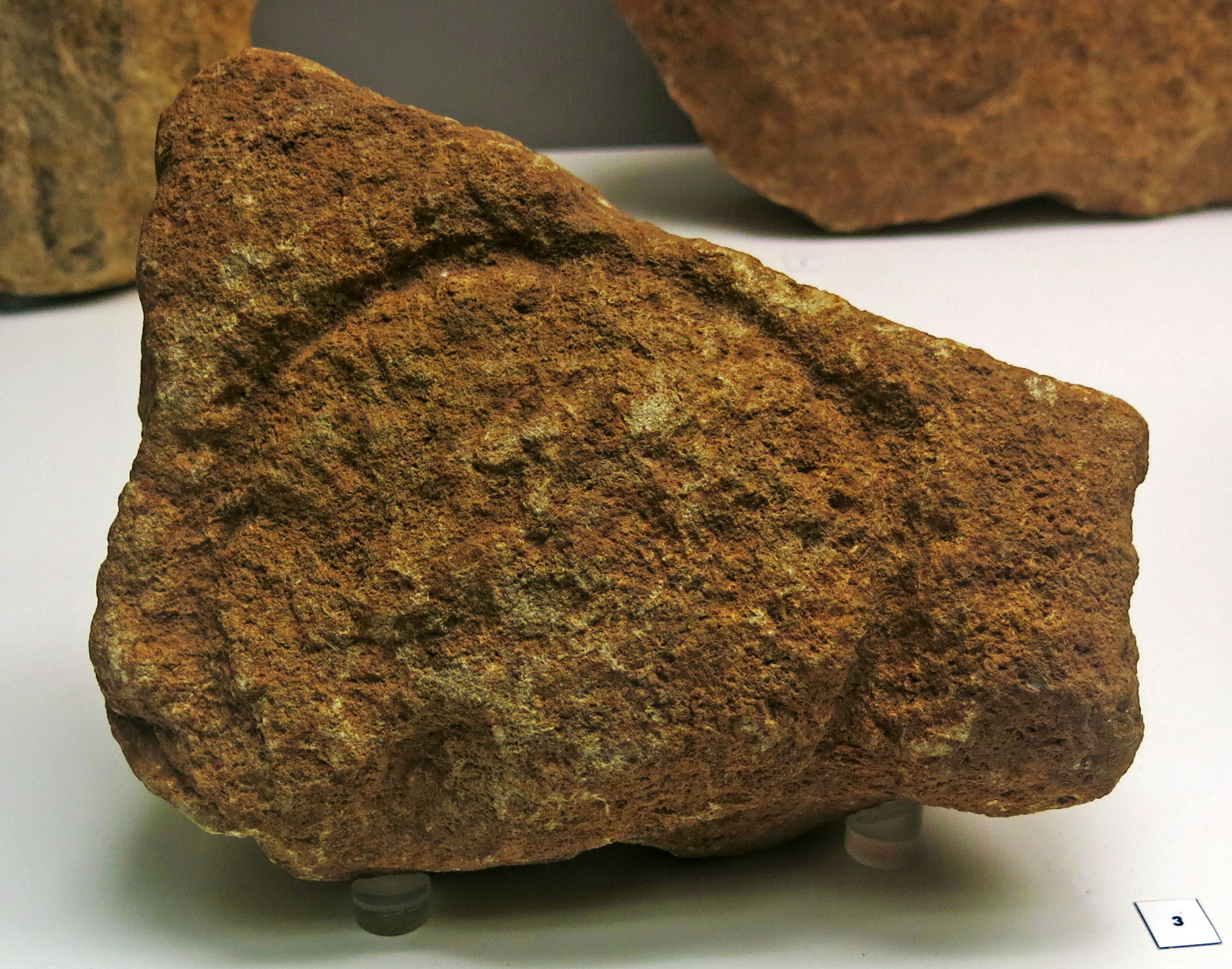
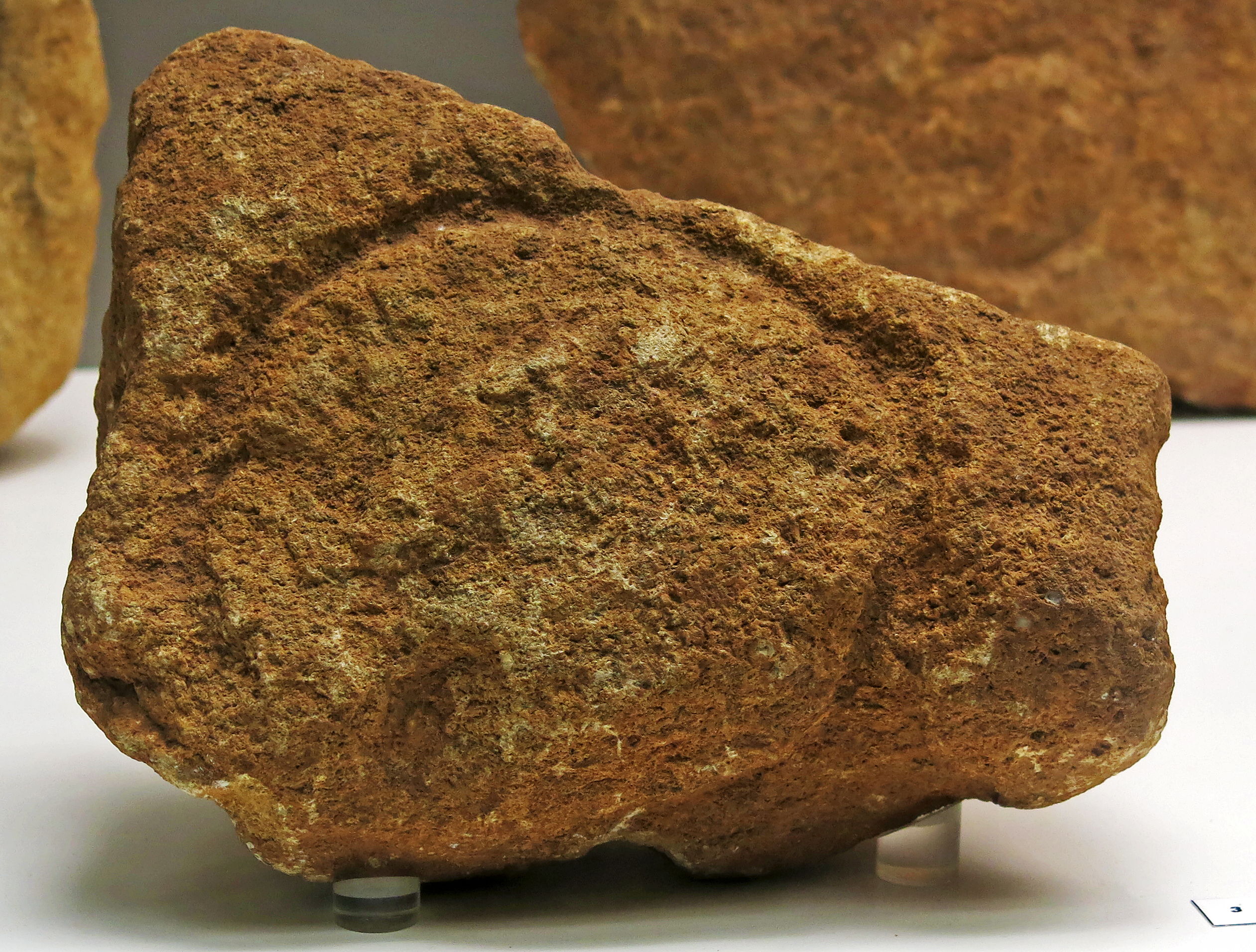
Vulva from Laussel.
Material: Limestone
Age: Aurignacian
Photo: Don Hitchcock 2015
Source: Original, Musée d'Aquitaine à Bordeaux
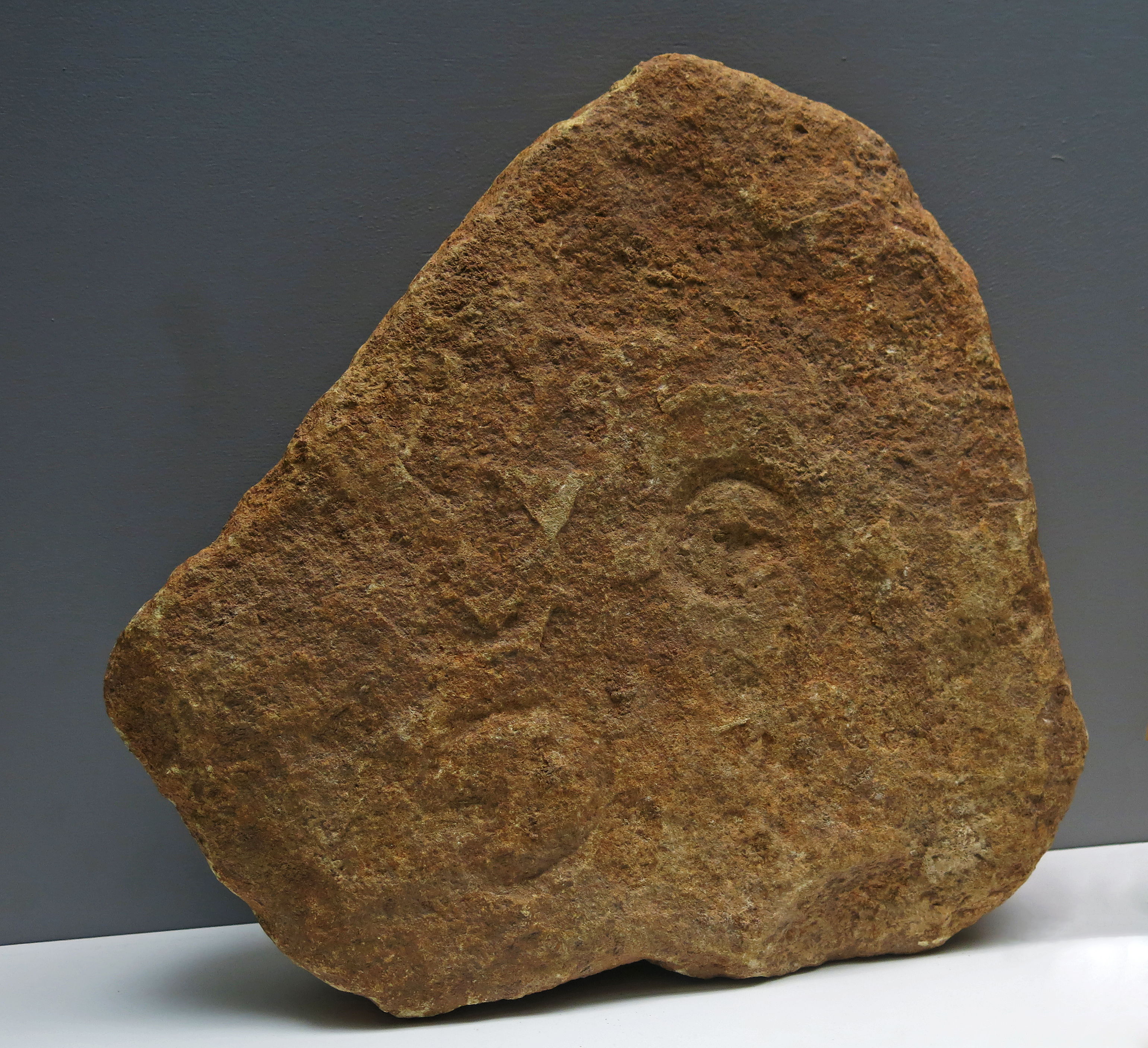
Engraved vulvas from Laussel.
Material: Limestone
Age: Aurignacian
Photo: Don Hitchcock 2015
Source: Original, Musée d'Aquitaine à Bordeaux
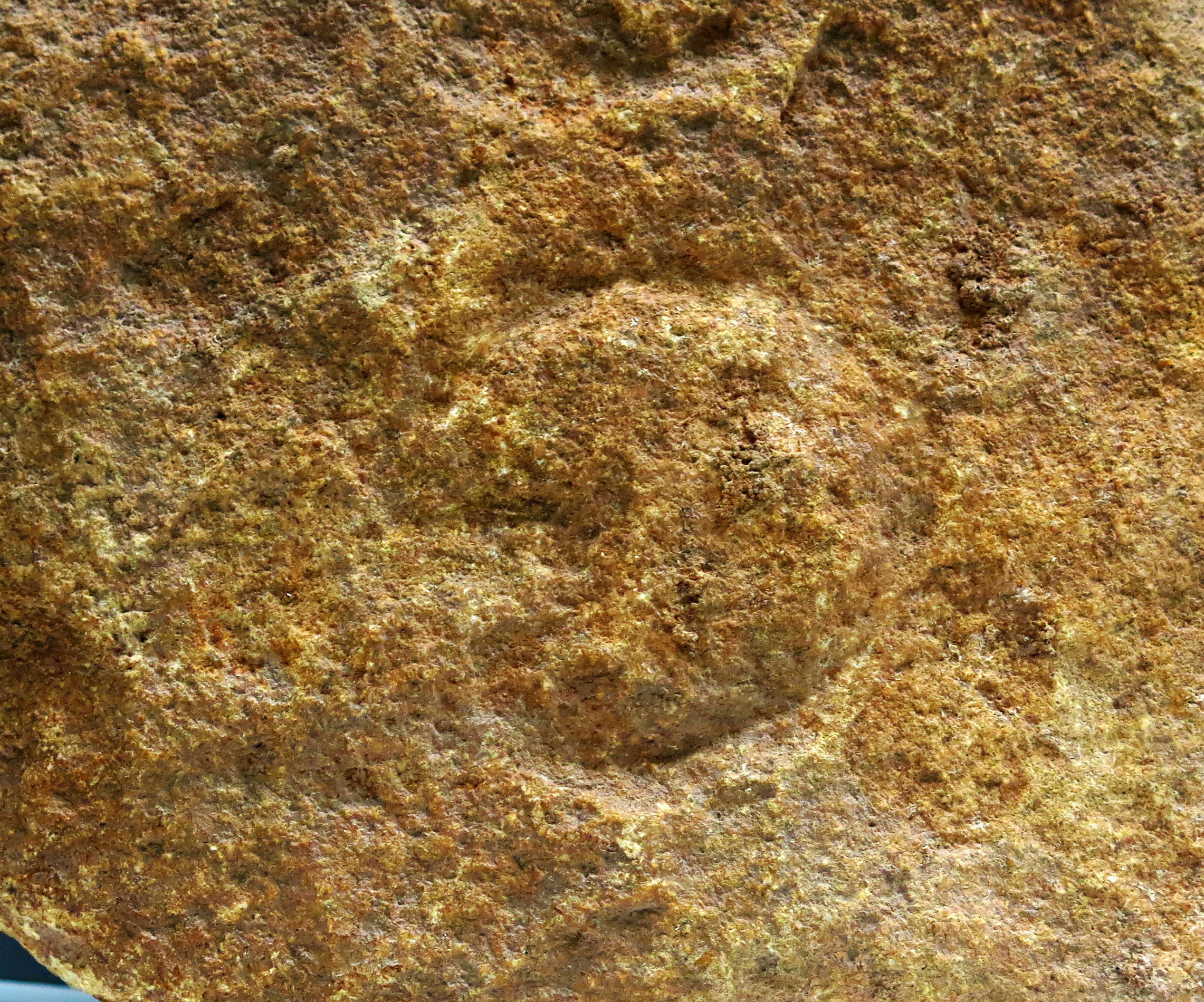
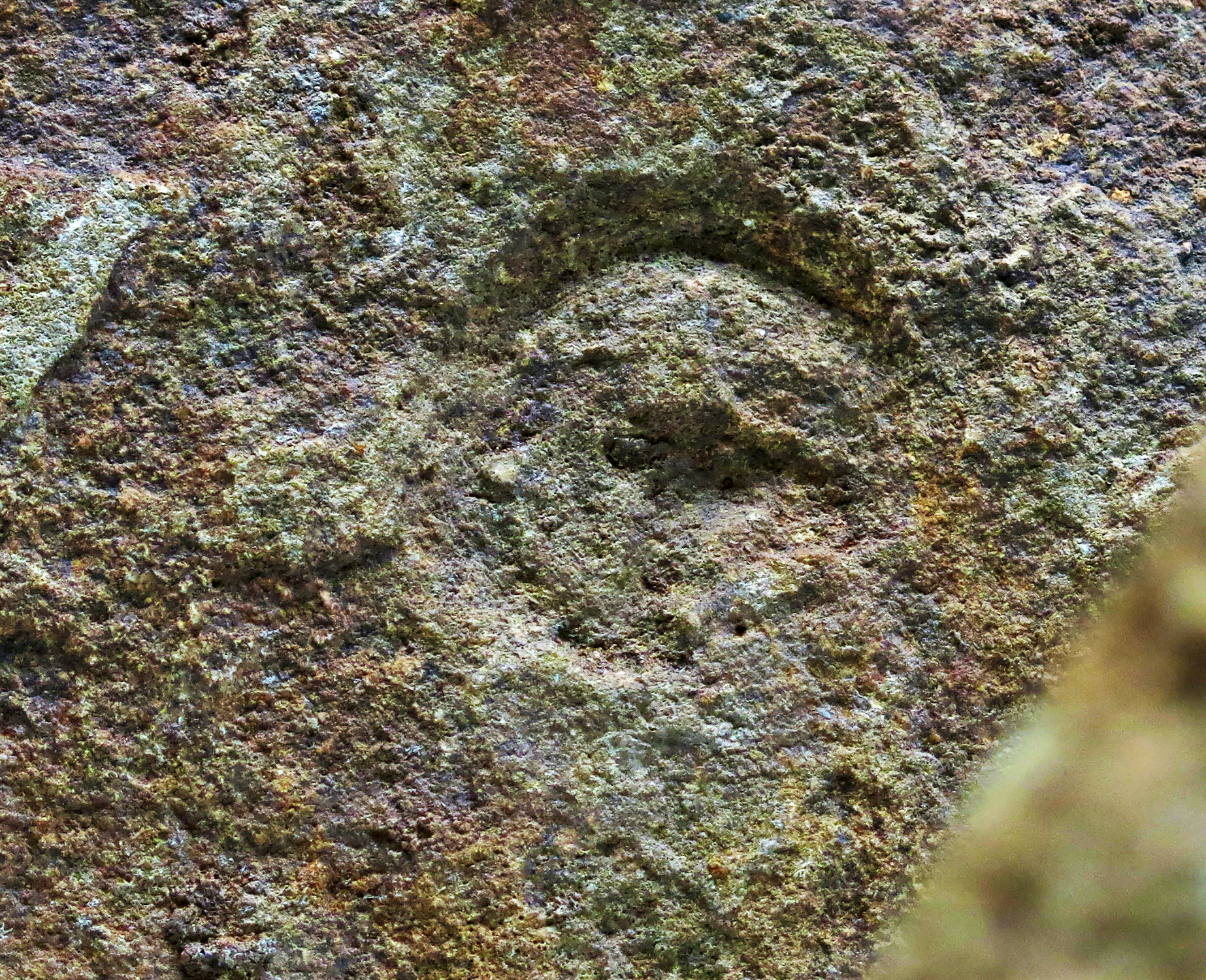
Engraved vulvas from Laussel, closeups of the above.
Material: Limestone
Age: Aurignacian
Photo: Don Hitchcock 2015
Source: Original, Musée d'Aquitaine à Bordeaux
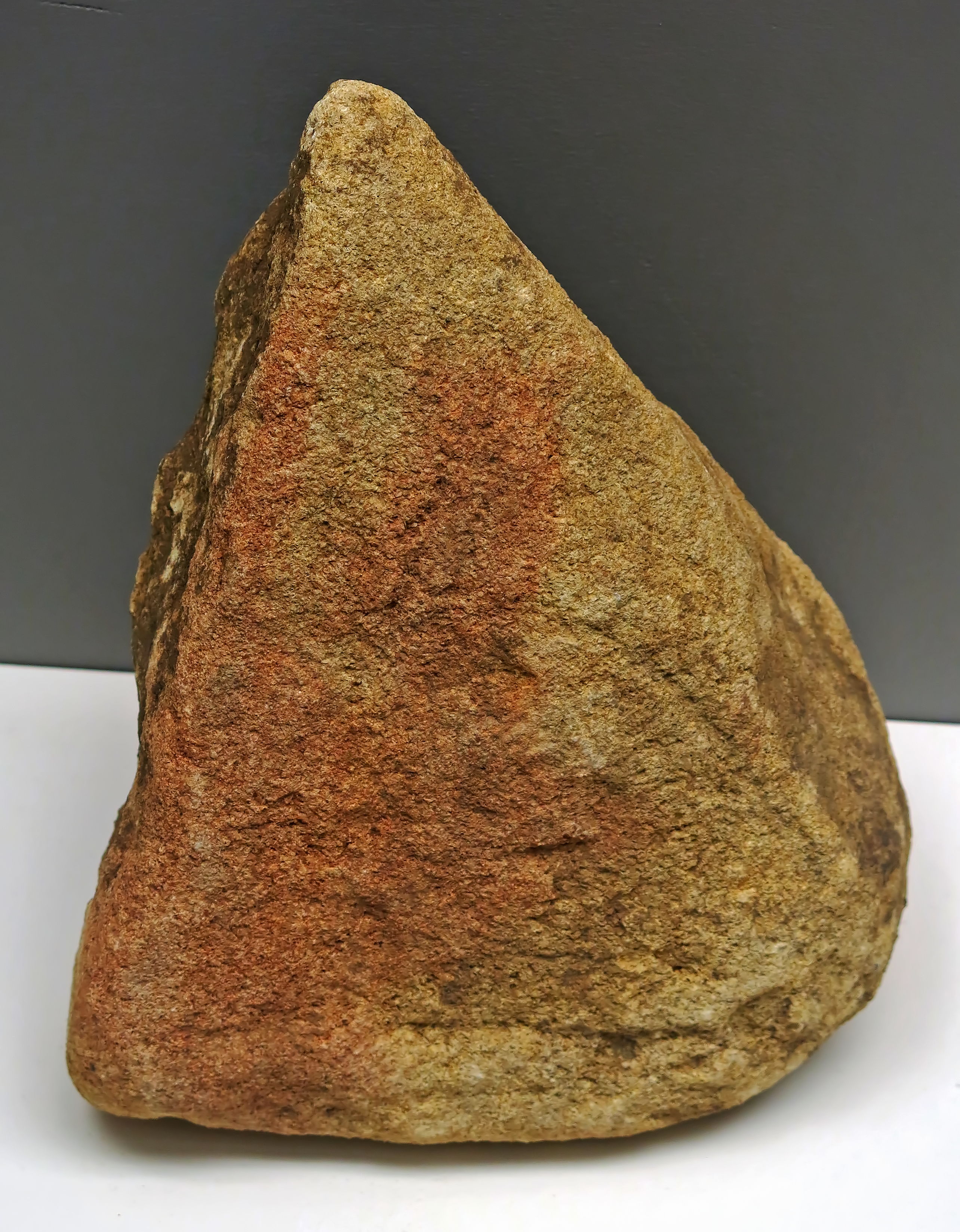
Animal representation from Laussel.
Material: Limestone
Age: Gravettian
Photo: Don Hitchcock 2015
Source: Original, Musée d'Aquitaine à Bordeaux
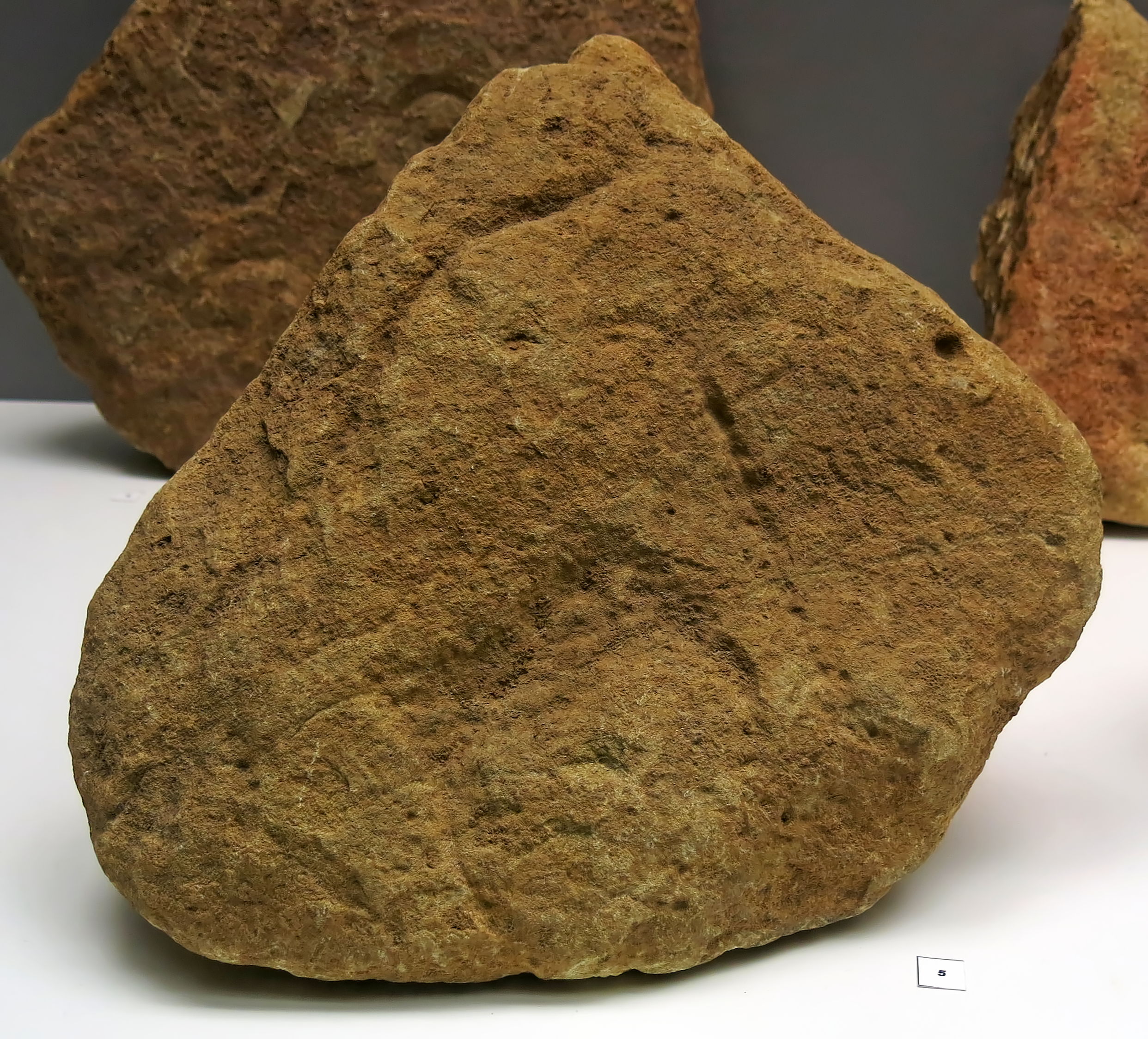
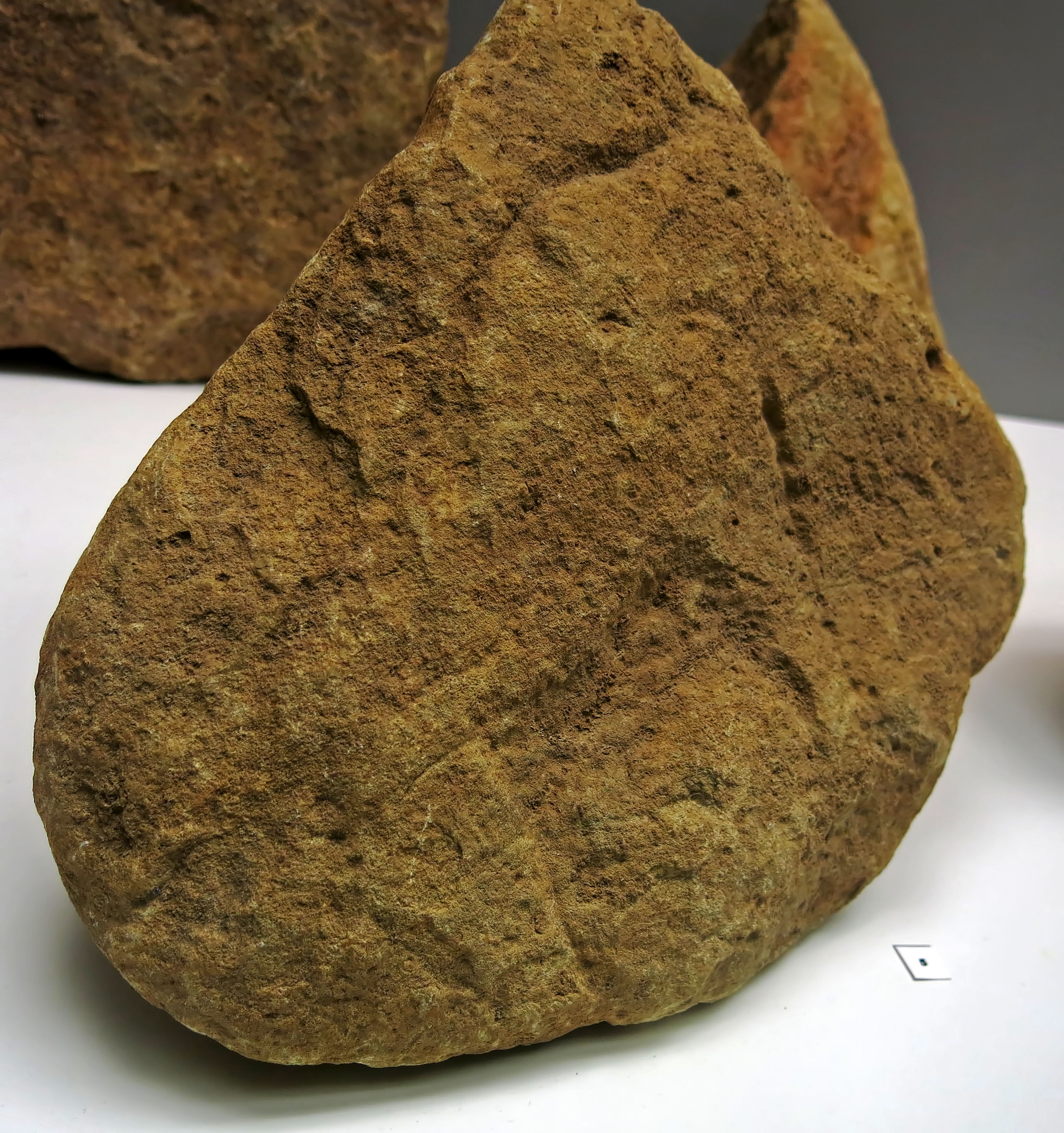
Animal representation from Laussel.
Material: Limestone
Age: Gravettian
Photo: Don Hitchcock 2015
Source: Original, Musée d'Aquitaine à Bordeaux

Glans penis, Laussel, kept in the Musée d'Aquitaine.
This has been carved from a fairly coarse sandy limestone. The object is broken at the former
level of the preputial sulcus, the fold between the glans and the foreskin.
The total length of the fragment is 64 mm, that of the glans itself 50 mm, with a maximum width of 43 mm. The diameter of the penis, substantially oval, varies from 46 to 39 mm. This piece comes from the upper Aurignacian level (i.e. Upper Perigordian), although the workers placed it in a box of the Aurignacian (i.e. Périgordien). The Laussel excavations were carried out by a team of workers under the direction of R. Peyrille, who regularly shipped material to Bordeaux by train.
No serious scientific surveillance was exercised, and the stratigraphic position of many finds remains unclear. However, the assignment of the object to the Upper Perigordian is very probable.
Photo and text: Duhard et Roussot (1988)
Representation of a glans penis and vulva, Laussel.
Photo: Duhard et Roussot (1988)

Representation of a glans penis and vulva, Laussel.
Material: Limestone
Age: Gravettian
Photo: Don Hitchcock 2015
Source: Original, Musée d'Aquitaine à Bordeaux

Lissoir from Laussel, in bone. This bears eroded images of vulvas in the typical Laussel form.
Photo: Don Hitchcock 2015
Source: Original, catalog 61.3.184, Musée d'Aquitaine à Bordeaux
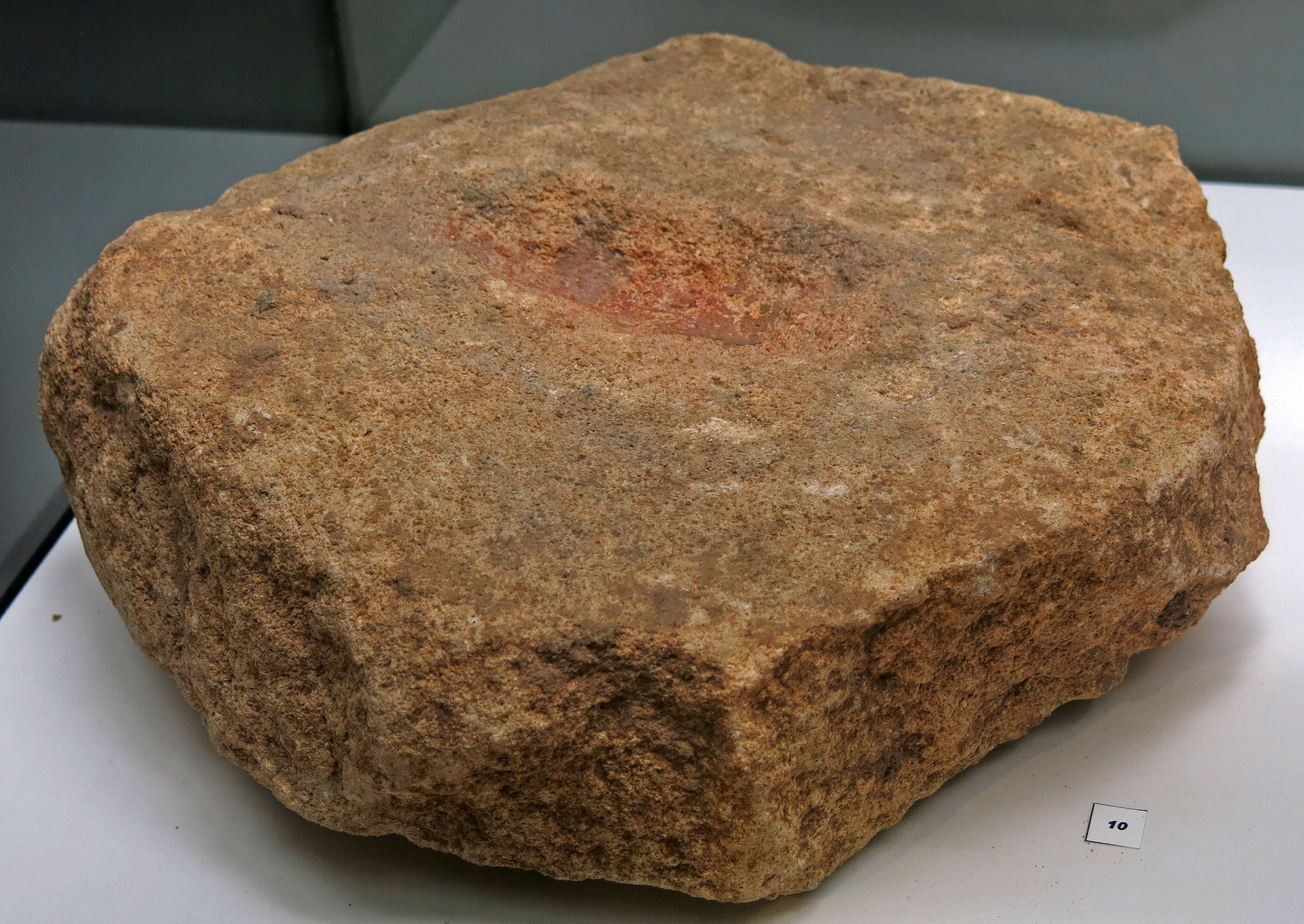
Limestone slab from Laussel with a cupule for the preparation of ochre.
Material: Limestone
Age: Gravettian
Photo: Don Hitchcock 2015
Source: Original, Musée d'Aquitaine à Bordeaux
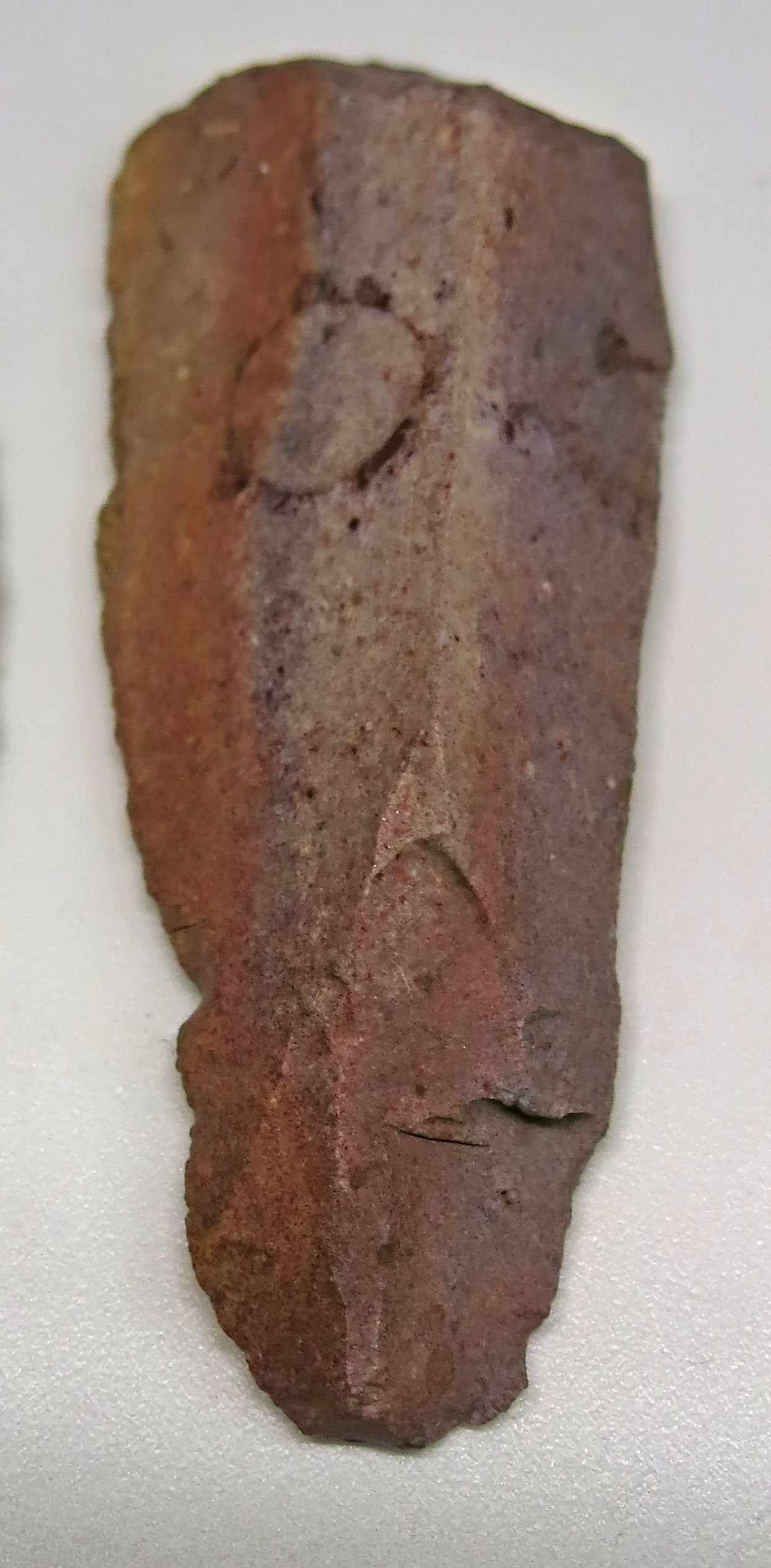
Gravettian grattoir from Laussel.
Catalog: 61.3.27
Photo: Don Hitchcock 2015
Source: Original, Musée d'Aquitaine à Bordeaux

Gravettian perçoir or drill from Laussel.
The outline of the point of this flint drill is indistinguishable from that of a modern steel bit for an electrical drill. It would have been a quite efficient way to make a hole in bone or antler, and the result of a lot of thought and experimentation, as well as mastery of knapping.
This particular drill appears to have been designed to be hand held rather than being attached to a small shaft of wood or bone or antler for twirling between the hands.
Catalog: 61.3.24
Photo: Don Hitchcock 2015
Source: Original, Musée d'Aquitaine à Bordeaux
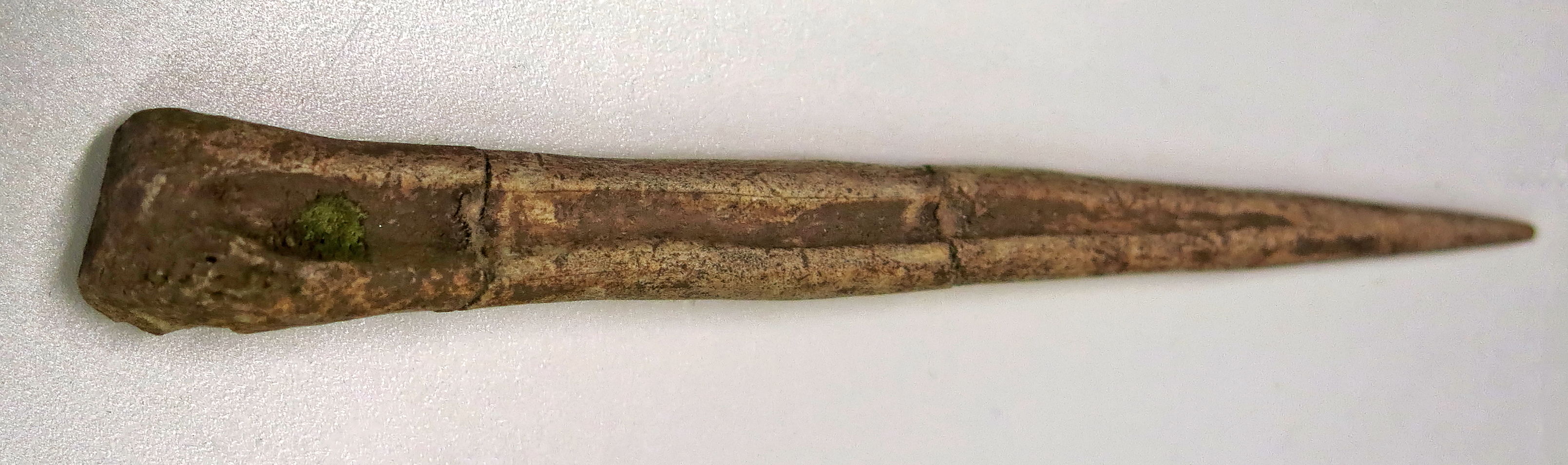
Gravettian poinçon or awl, from Laussel, in bone.
Catalog: 61.3.216
Photo: Don Hitchcock 2015
Source: Original, Musée d'Aquitaine à Bordeaux
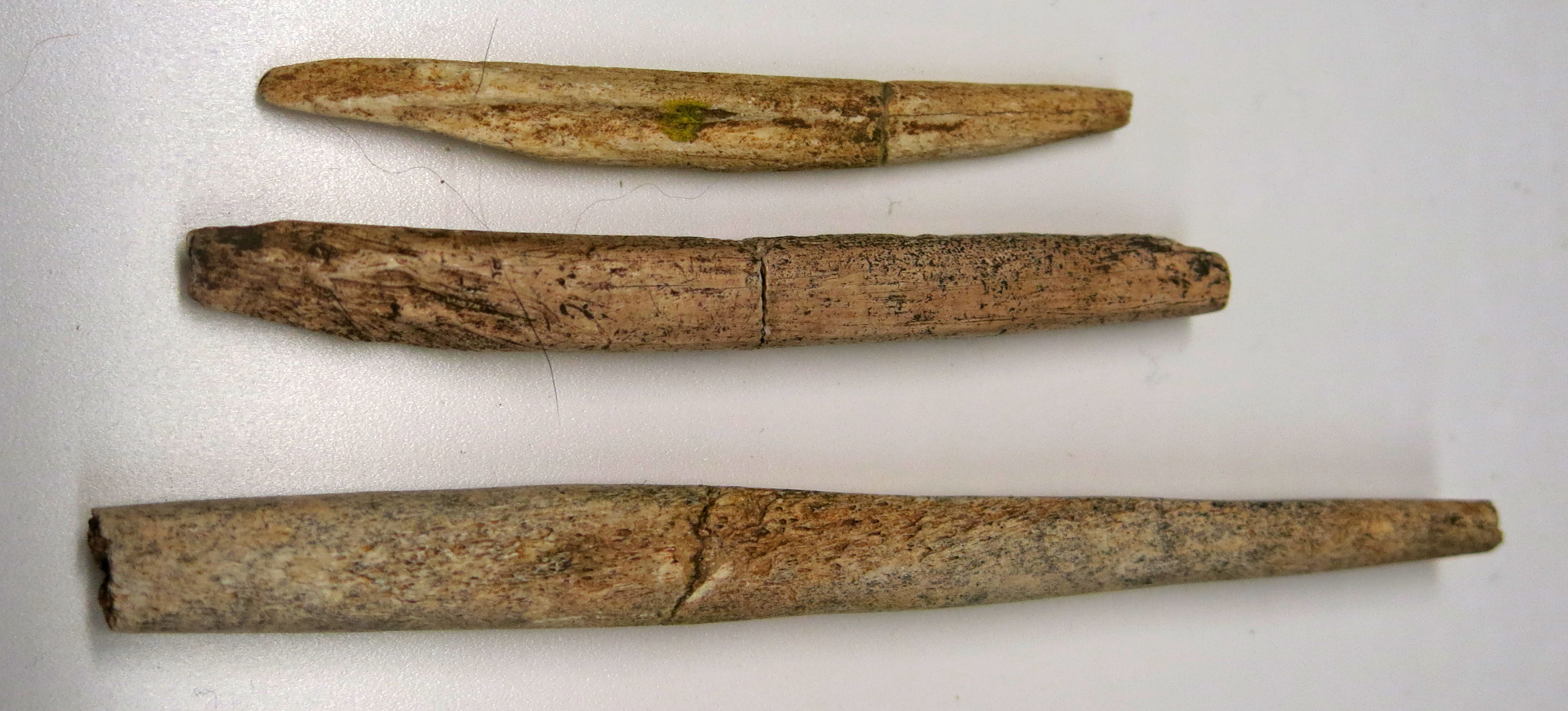
Gravettian sagaies, spear points, from Laussel.
Catalog: 61.3.212, 61.3.218, 61.3.219
Photo: Don Hitchcock 2015
Source: Original, Musée d'Aquitaine à Bordeaux
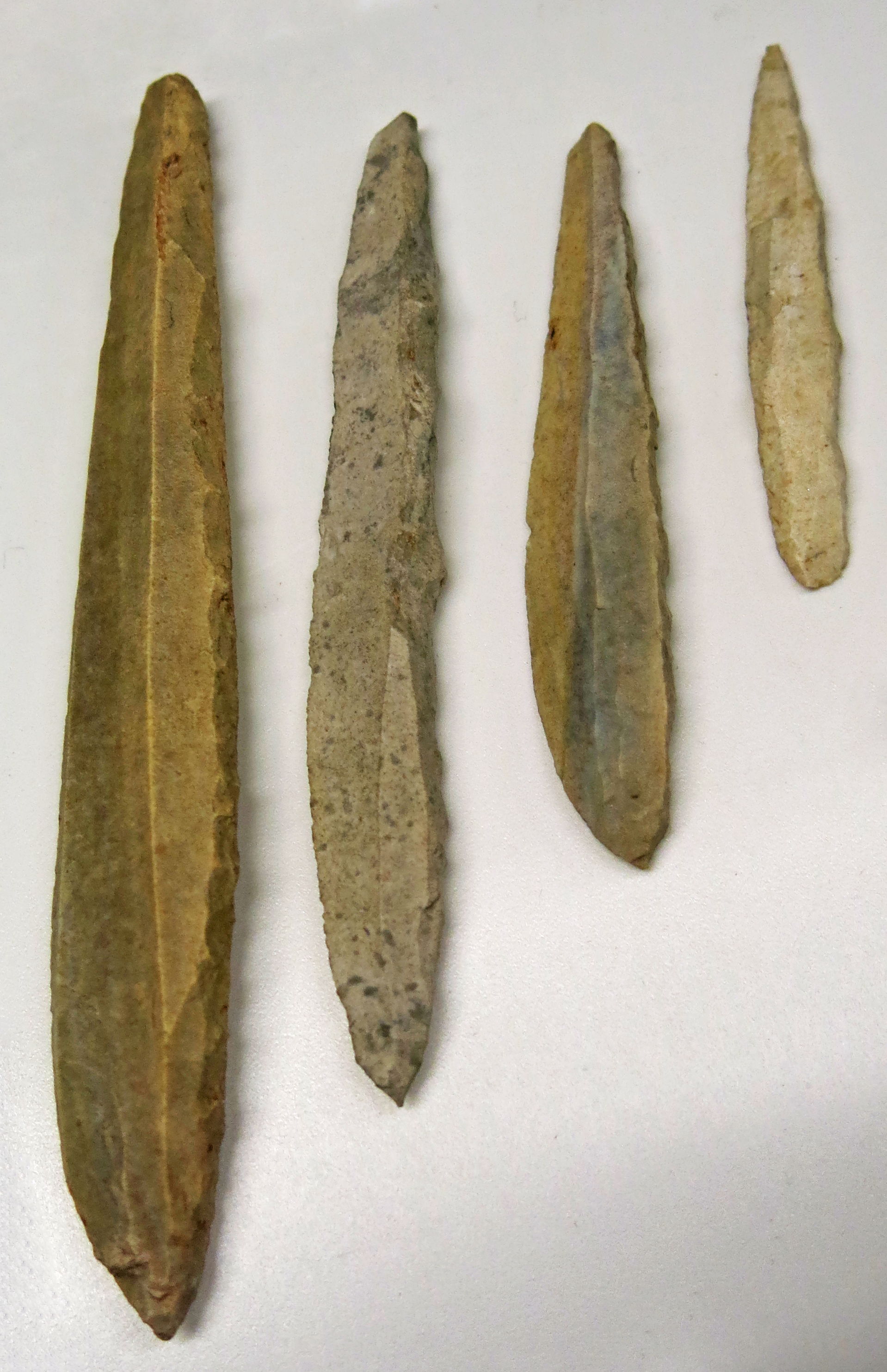
Gravettian points, from Laussel and la Gravette.
Catalog: 16, 23, 60.1057.1 and 61.3.23
Photo: Don Hitchcock 2015
Source: Original, Musée d'Aquitaine à Bordeaux
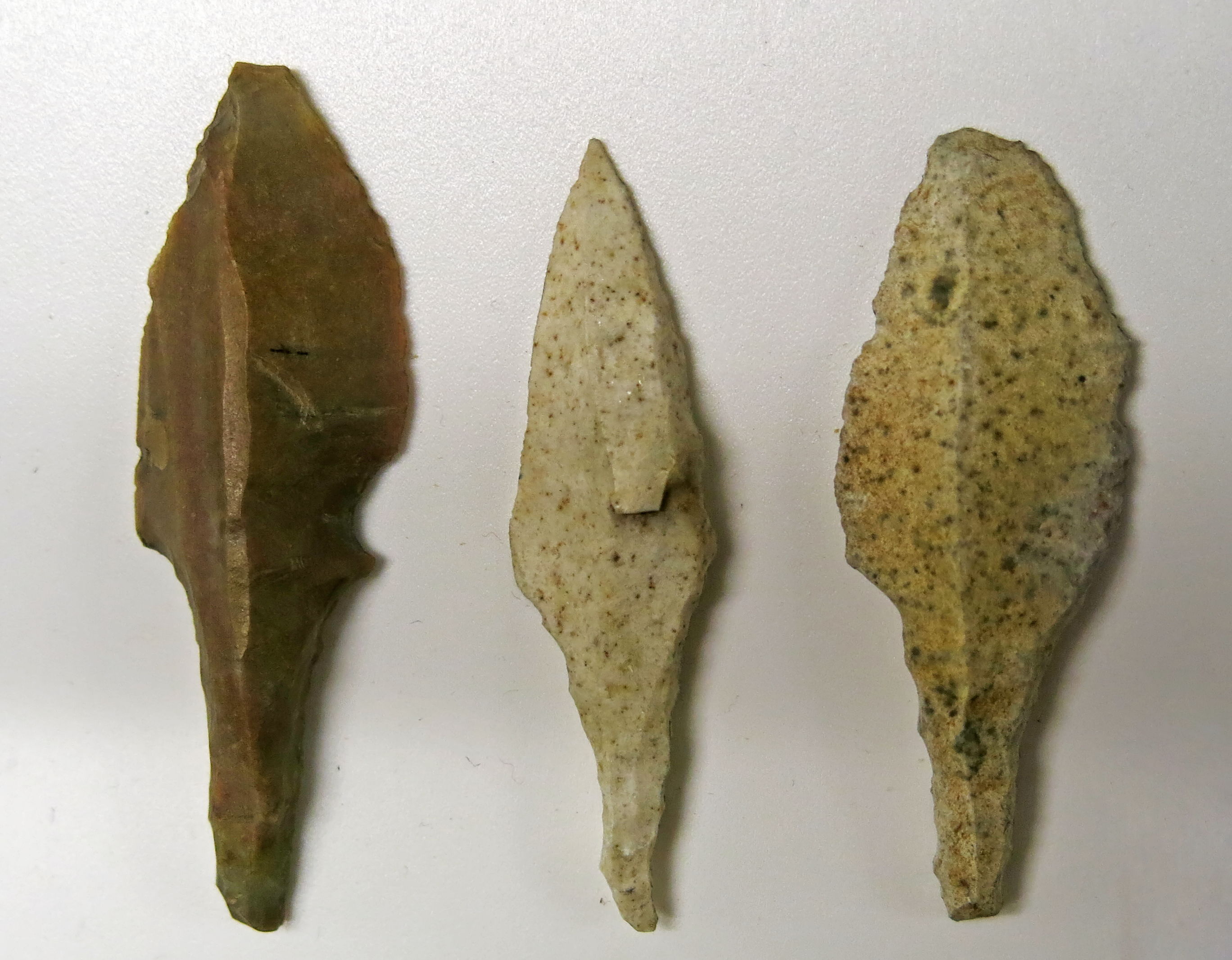
Gravettian Font-Robert type points from Les Bertranoux (Creysse) and Laussel.
Catalog: 60.351.1, 61.3.22, 61.3.28
Photo: Don Hitchcock 2015
Source: Original, Musée d'Aquitaine à Bordeaux
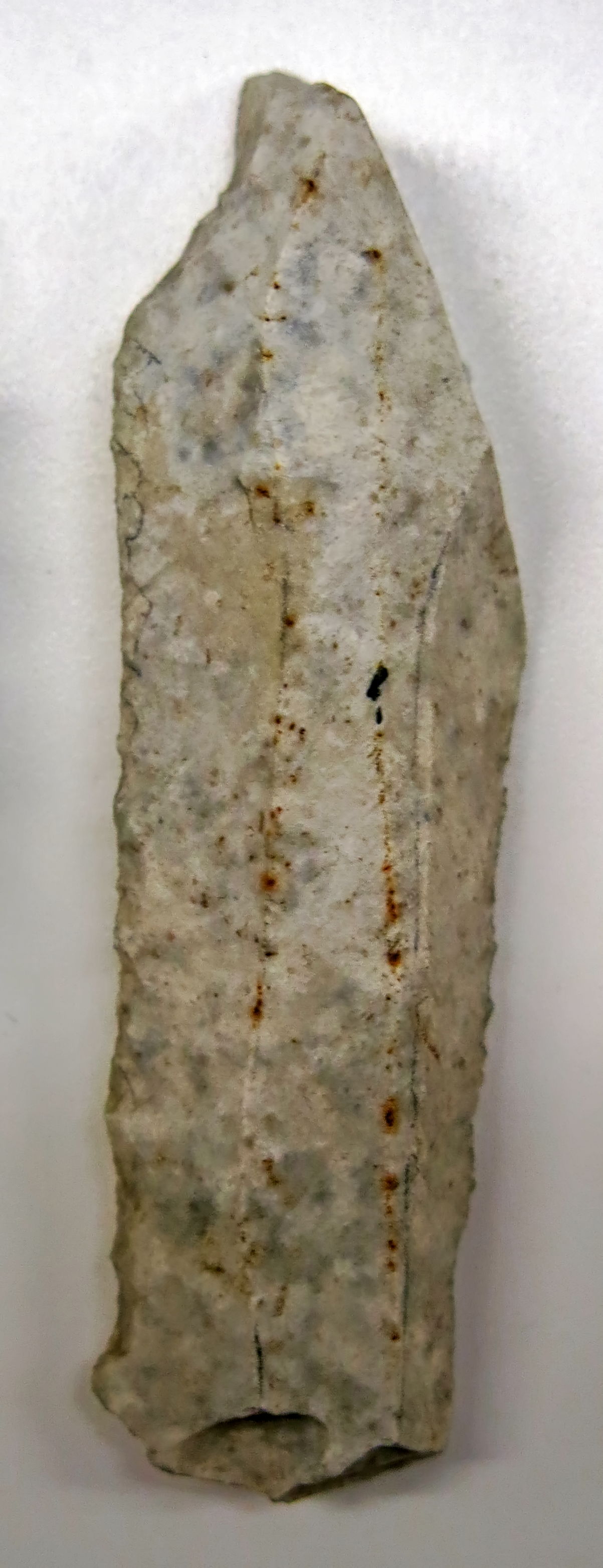
Burin from Laussel
Photo: Don Hitchcock 2015
Catalog: 61.3.85
Source: Original, Musée d'Aquitaine à Bordeaux
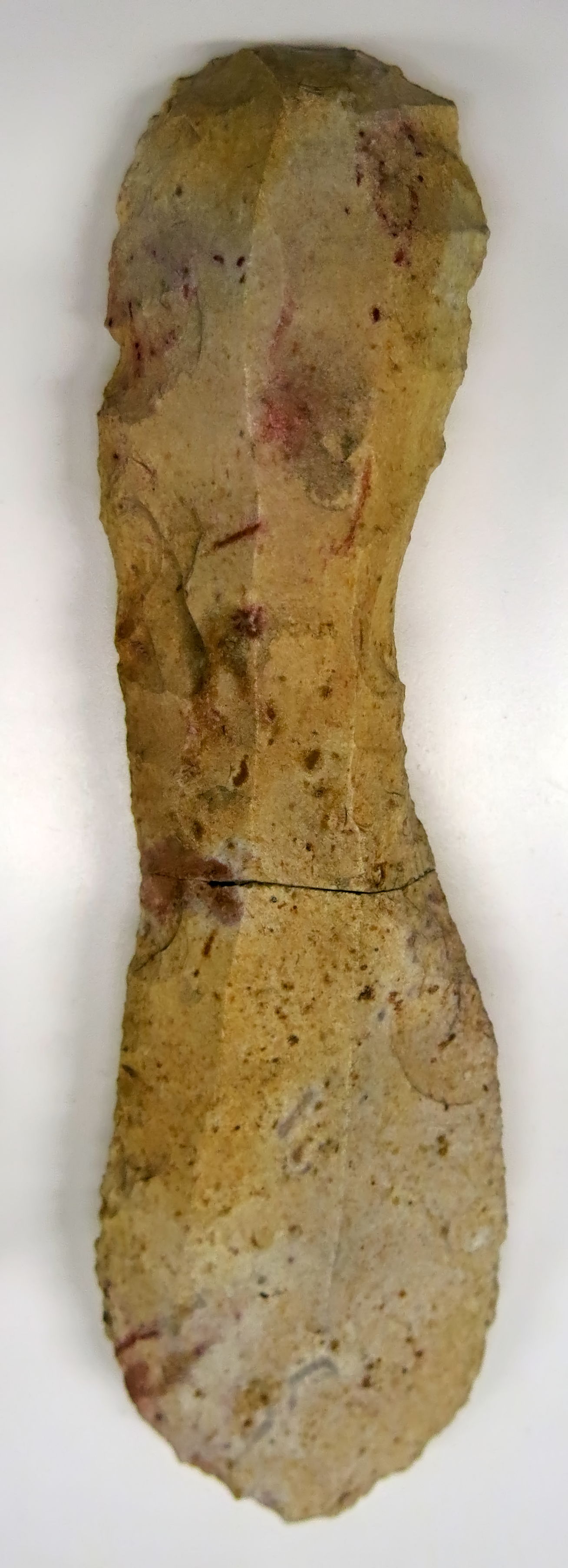
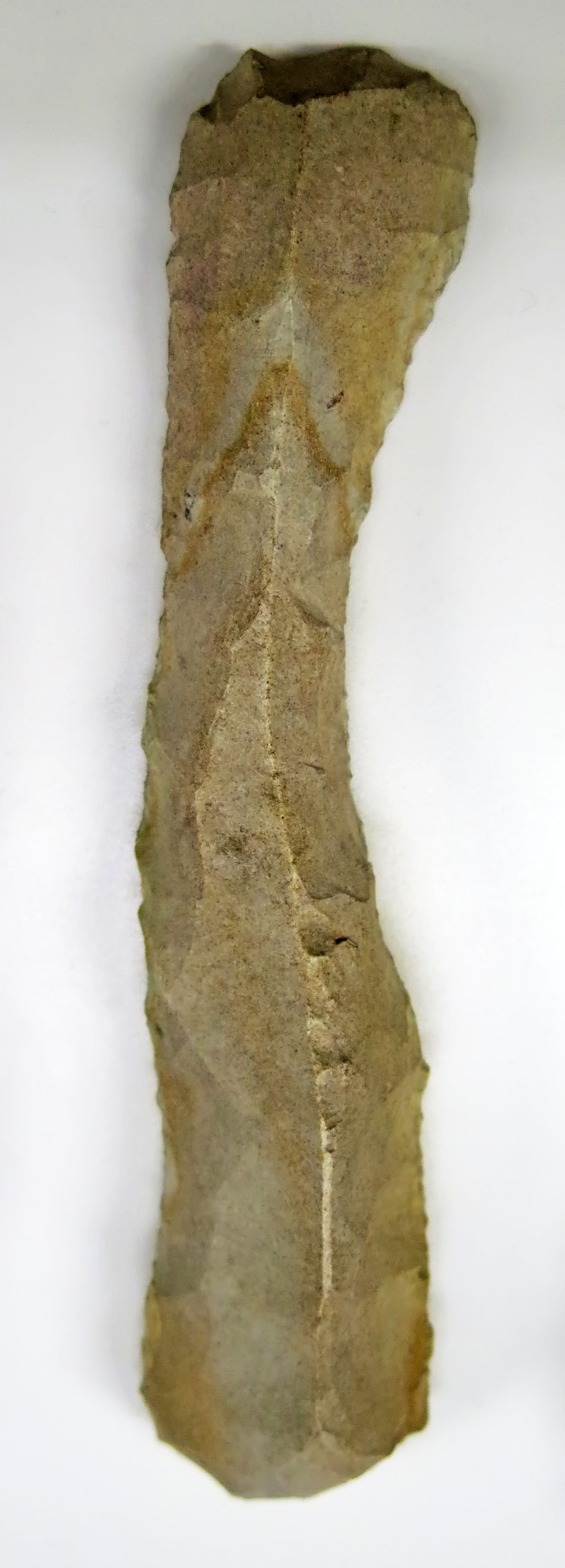
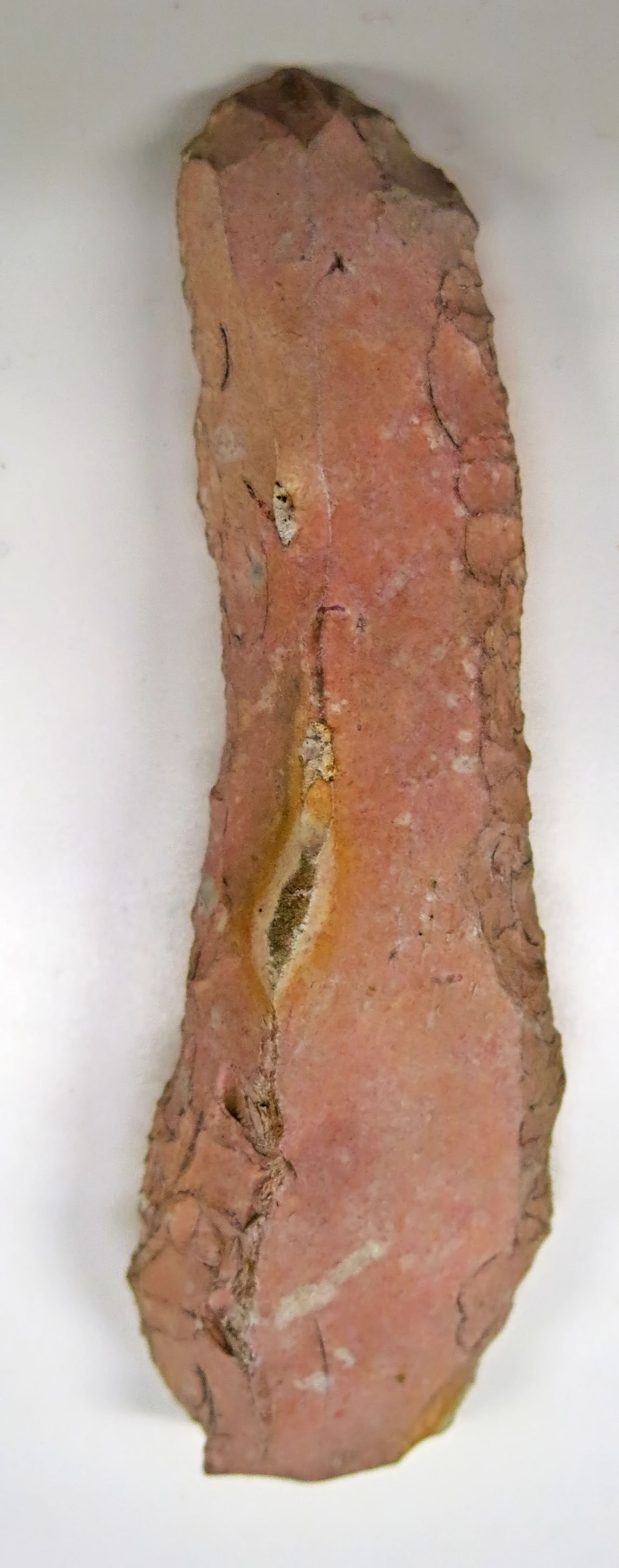
These three tools are labelled as being Aurignacian blades, and coming from Grotte de Jolias, Prignac-et-Marcamps and Laussel, Marquay.
Judging from the catalog numbers, it is possible that the left hand tool is from Grotte de Jolias, and the other two are from Laussel.
They are large thick Aurignacian blades, retouched bilaterally and of the type known as waisted blades, or in French, 'strangled' blades, a very appropriate term.
Photo: Don Hitchcock 2015
Catalog: 60.913.3, 61.3.80, 61.3.91
Source: Original, Musée d'Aquitaine à Bordeaux

Aurignacian grattoir-burin, a combination scraper and burin or engraver, from Laussel.
Photo: Don Hitchcock 2015
Catalog: 61.3.87
Source: Original, Musée d'Aquitaine à Bordeaux
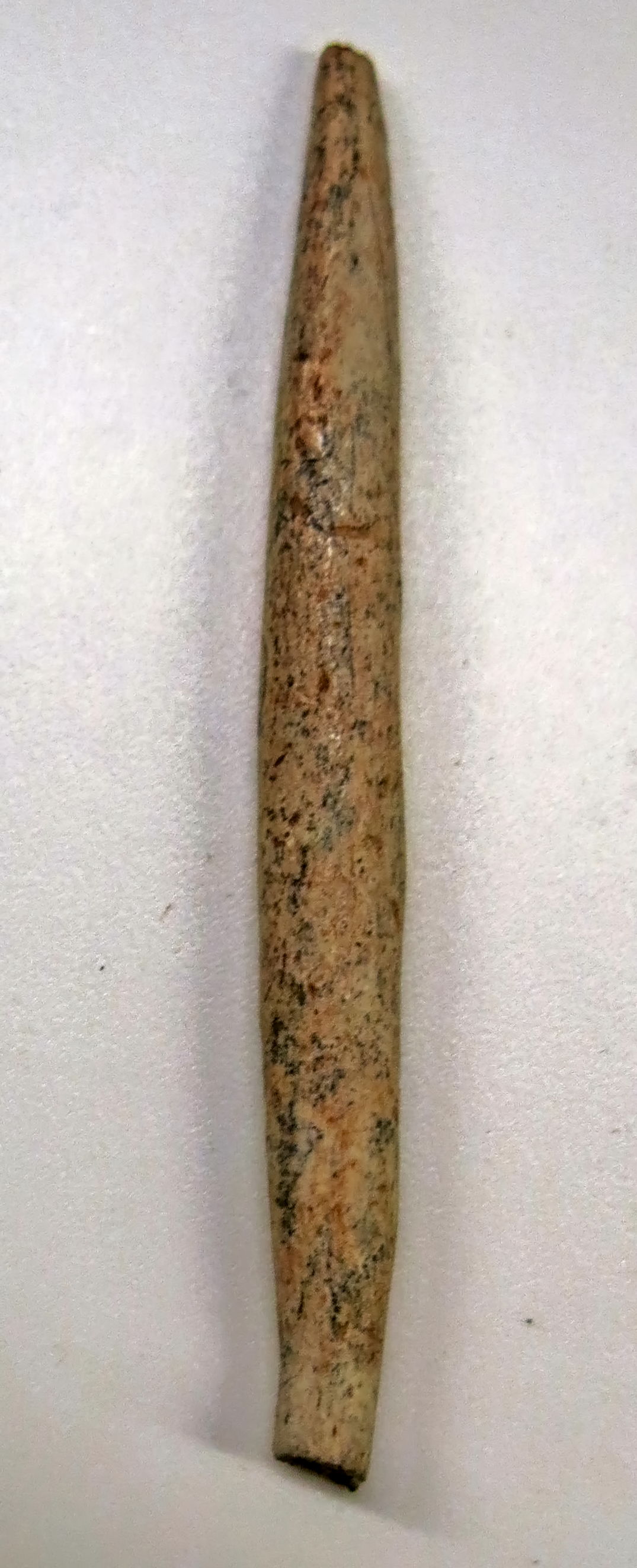
Aurignacian poinçon, an awl, from Laussel.
Photo: Don Hitchcock 2015
Catalog: 61.3.113
Source: Original, Musée d'Aquitaine à Bordeaux
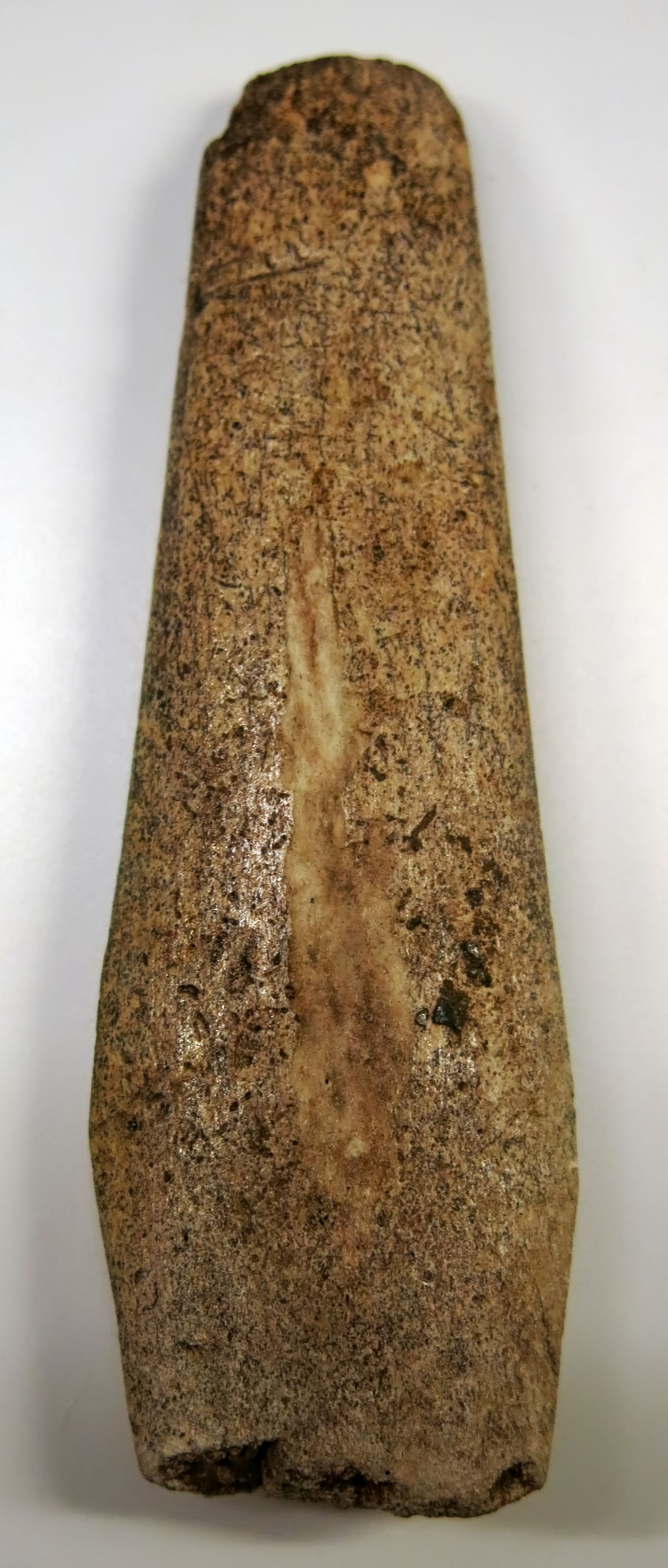
Aurignacian ciseau à biseau simple, from Laussel, literally a 'chisel with a simple bevel'.
These tools may have been used for flensing, i.e. removing the skin of an animal, or for stretching the hide as a lissoir is used, or it could have been used like a chisel to split wood.
Similar tools have been reported as being used by the Inuit of North America for preparing hides for use, by stretching or rubbing.
Material: Reindeer antler.
Photo: Don Hitchcock 2015
Catalog: 61.3.137
Source: Original, Musée d'Aquitaine à Bordeaux
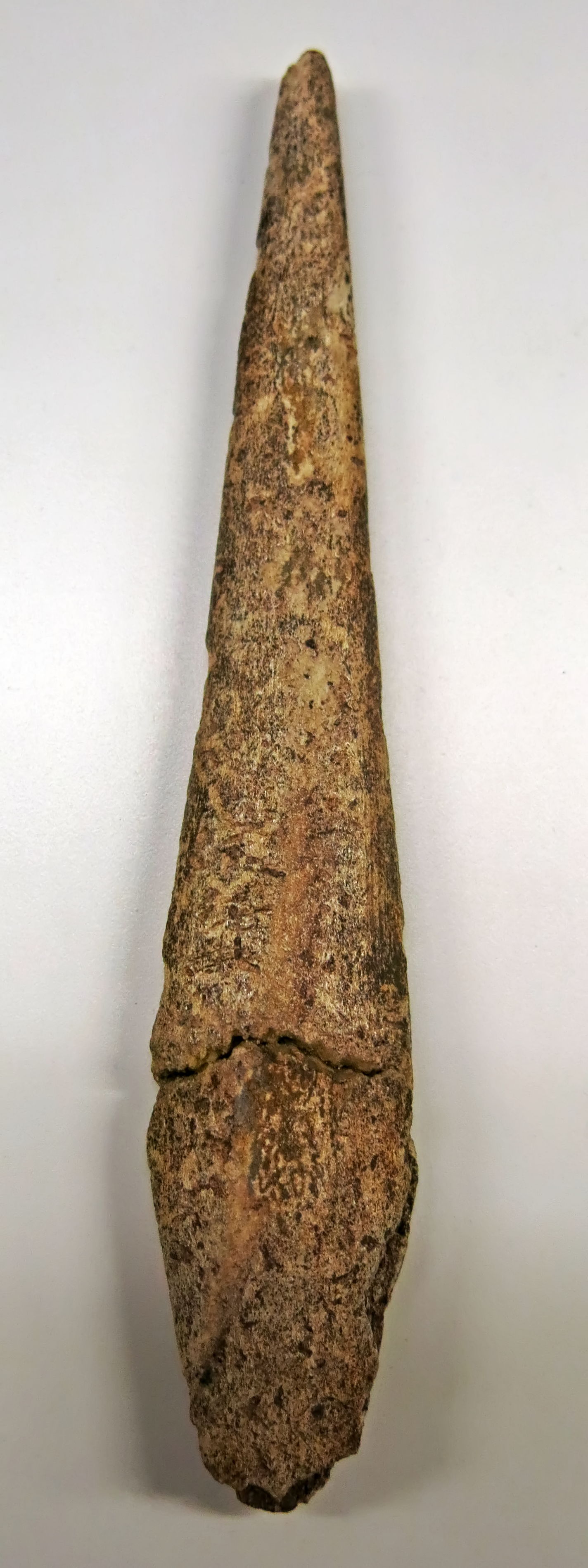
Aurignacian spear point with a split base.
Material: Reindeer antler.
Photo: Don Hitchcock 2015
Catalog: 61.3.89
Source: Original, Musée d'Aquitaine à Bordeaux
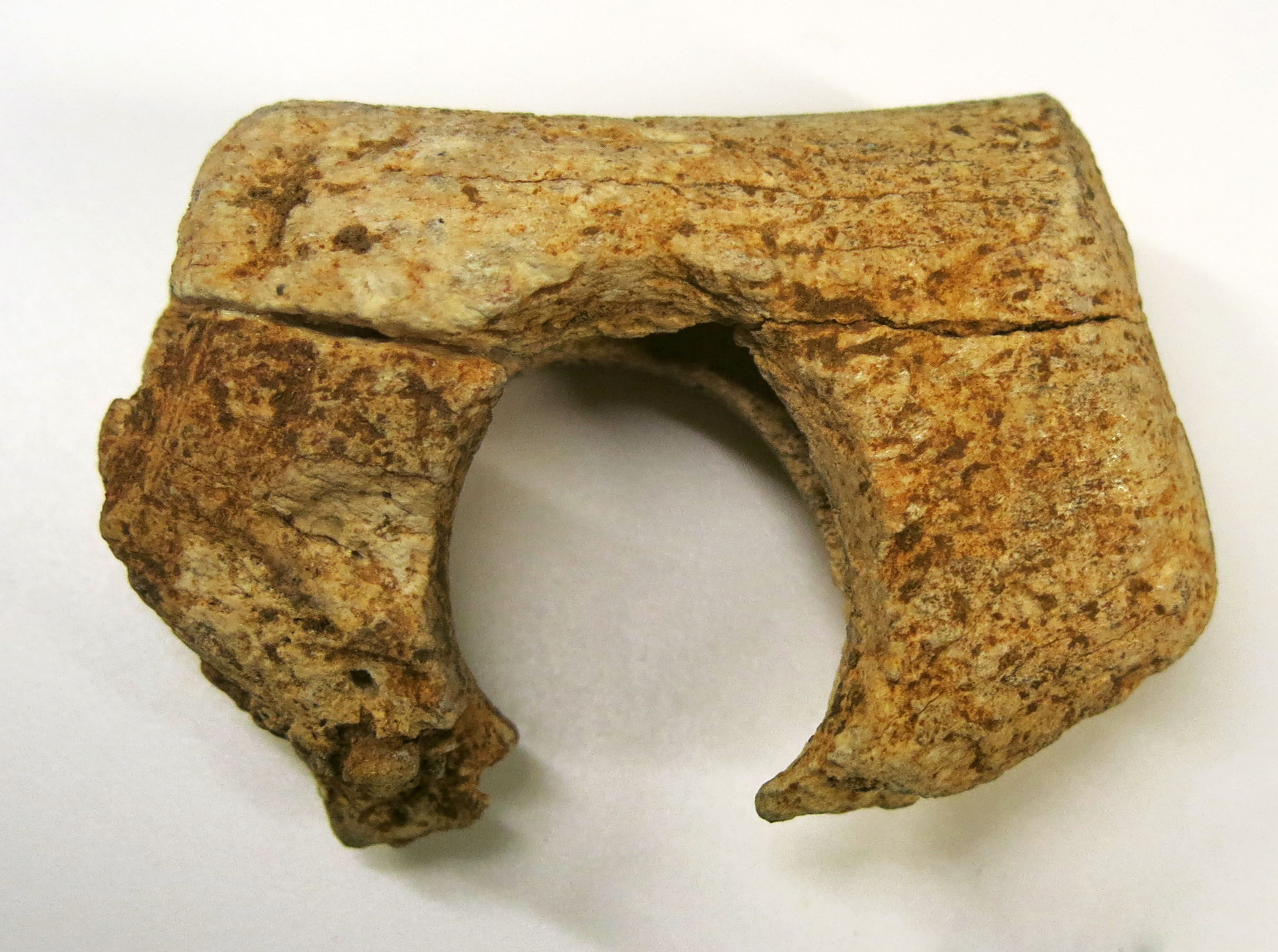
Fragment of an Aurignacian pierced baton from Laussel.
Material: Reindeer antler.
Photo: Don Hitchcock 2015
Catalog: 61.3.140
Source: Original, Musée d'Aquitaine à Bordeaux

Aurignacian bone pendant from Laussel.
Photo: Don Hitchcock 2015
Catalog: 61.3.138
Source: Original, Musée d'Aquitaine à Bordeaux
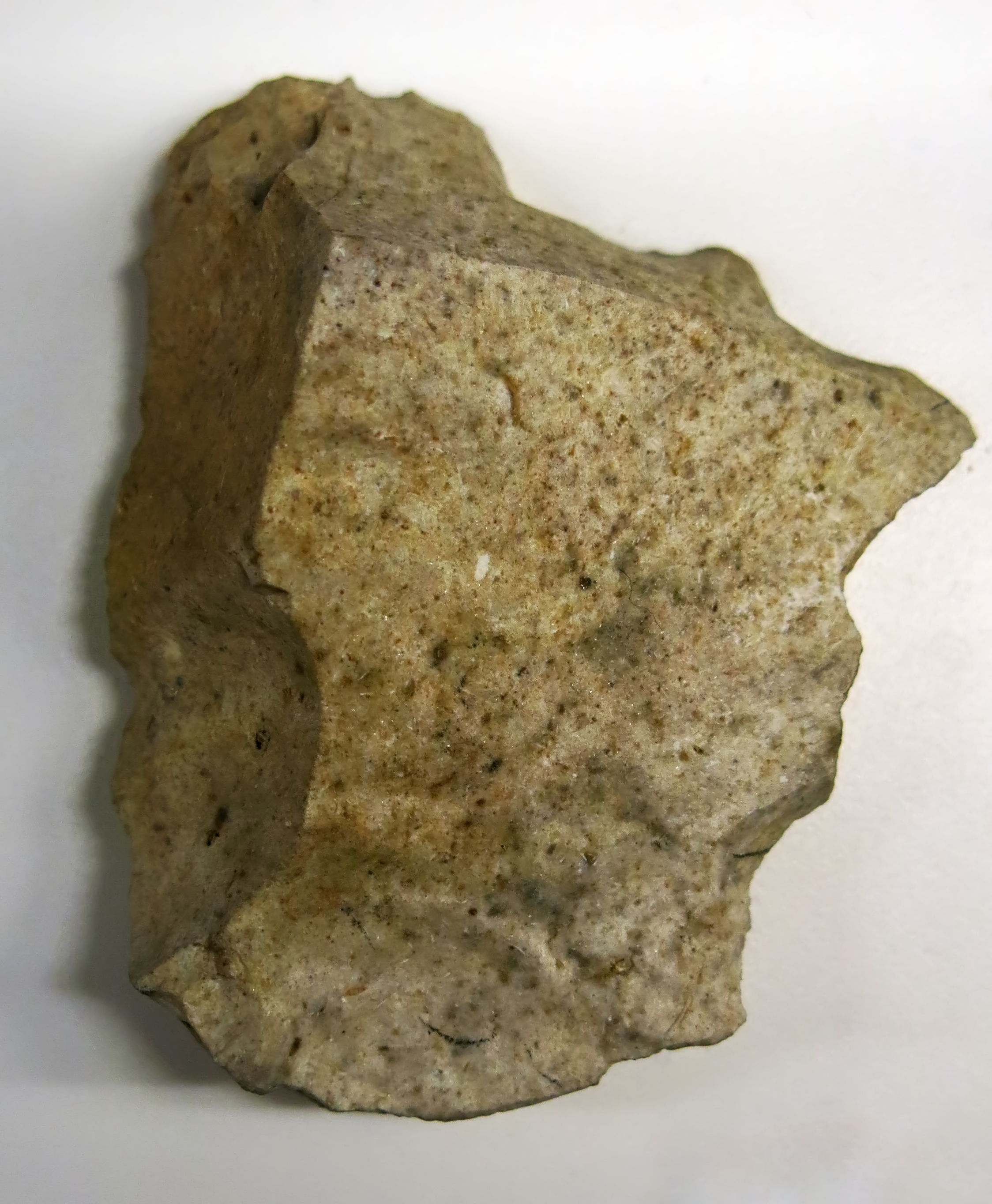
Notched piece from Laussel, Marquay (24).
Photo: Don Hitchcock 2015
Catalog: 61.3.163
Source: Original, Musée d'Aquitaine à Bordeaux
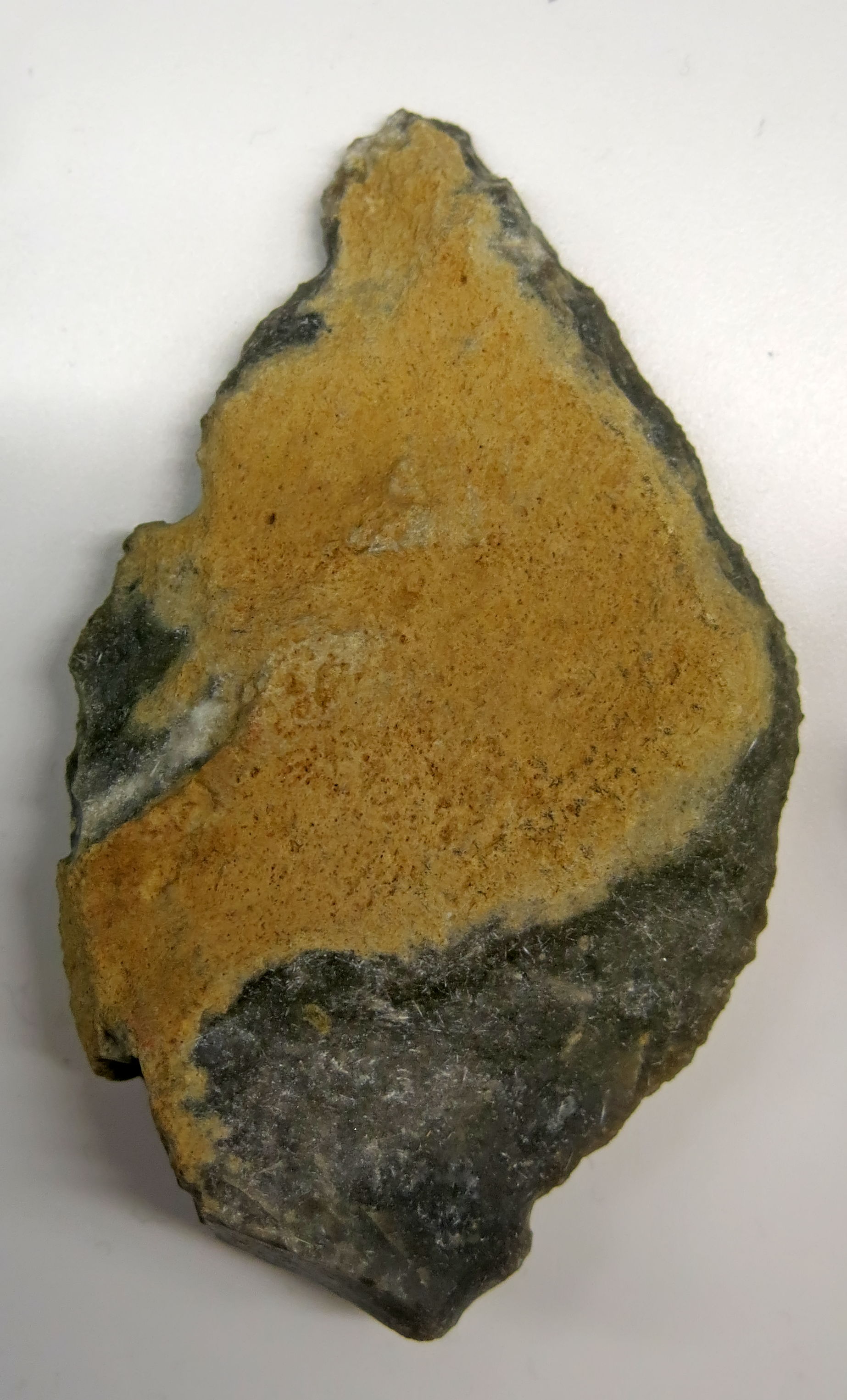
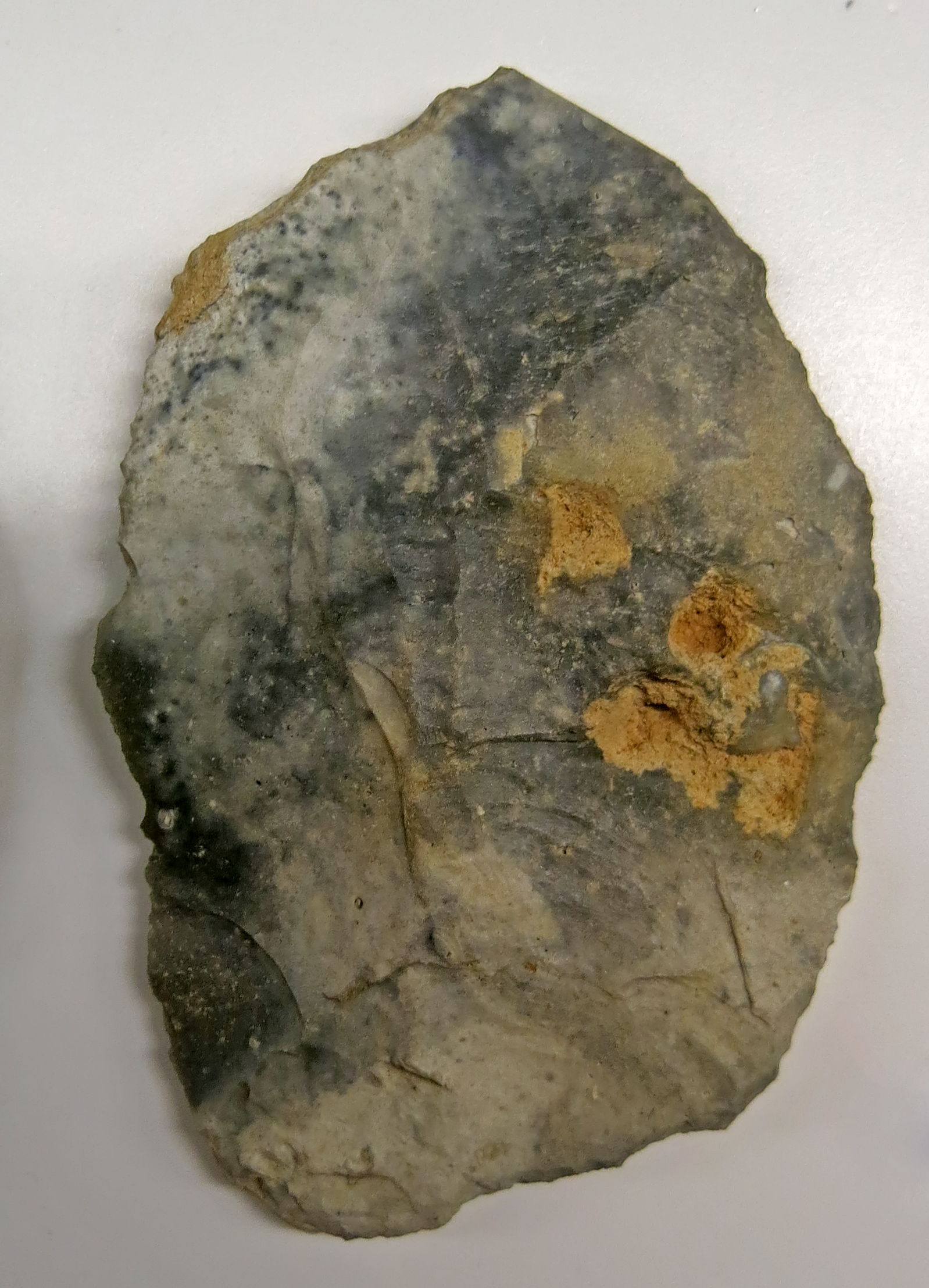
Racloirs, side scrapers, from Laussel, Marquay (24).
Photo: Don Hitchcock 2015
Catalog: 61.3.164, 61.3.166
Source: Original, Musée d'Aquitaine à Bordeaux

Mousterian racloir, side scraper, from Laussel.
Photo: Don Hitchcock 2015
Catalog: 61.3.65
Source: Original, Musée d'Aquitaine à Bordeaux
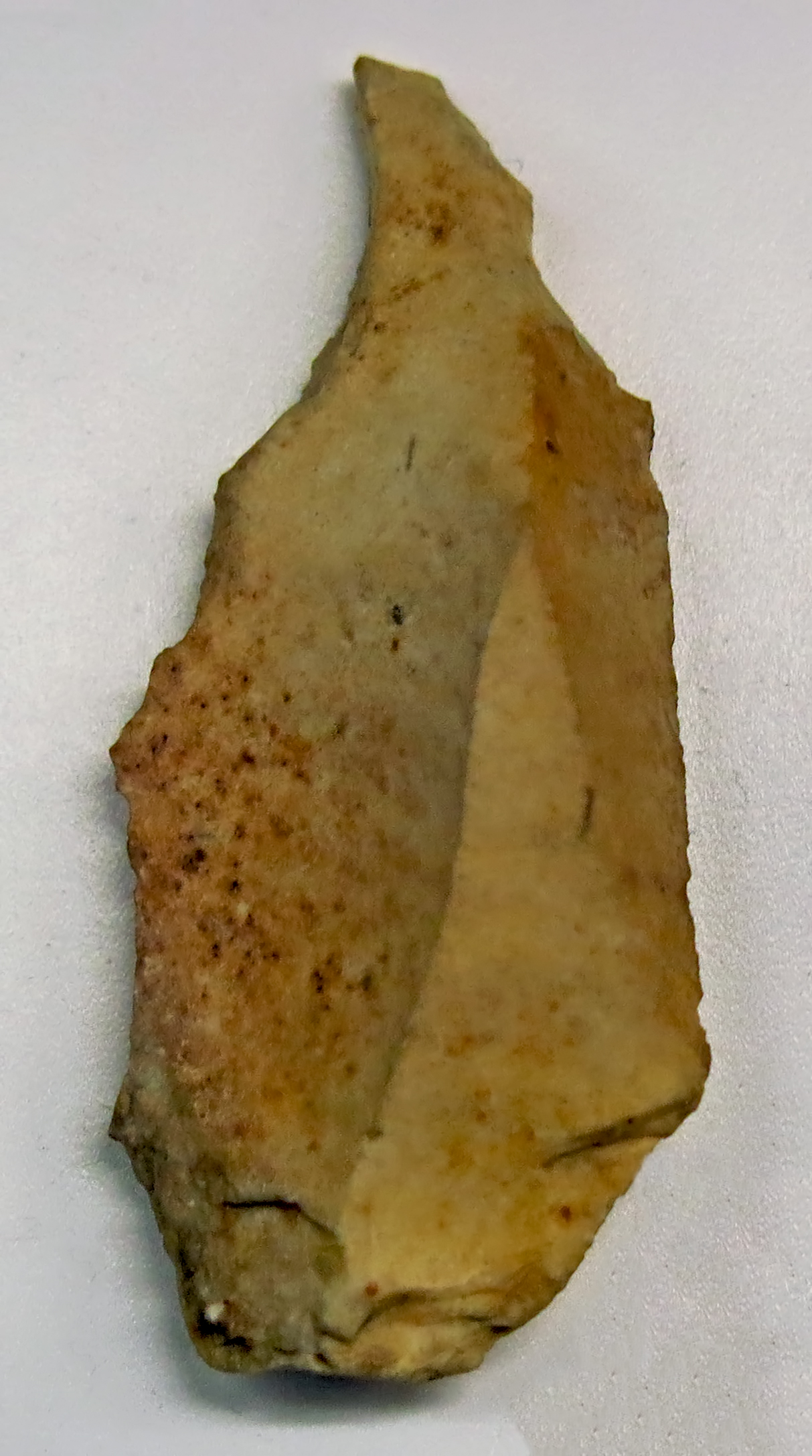
Perçoir, Drill, from Laussel, Marquay (24).
Photo: Don Hitchcock 2015
Catalog: FLint, 61.3.165
Source: Original, Musée d'Aquitaine à Bordeaux
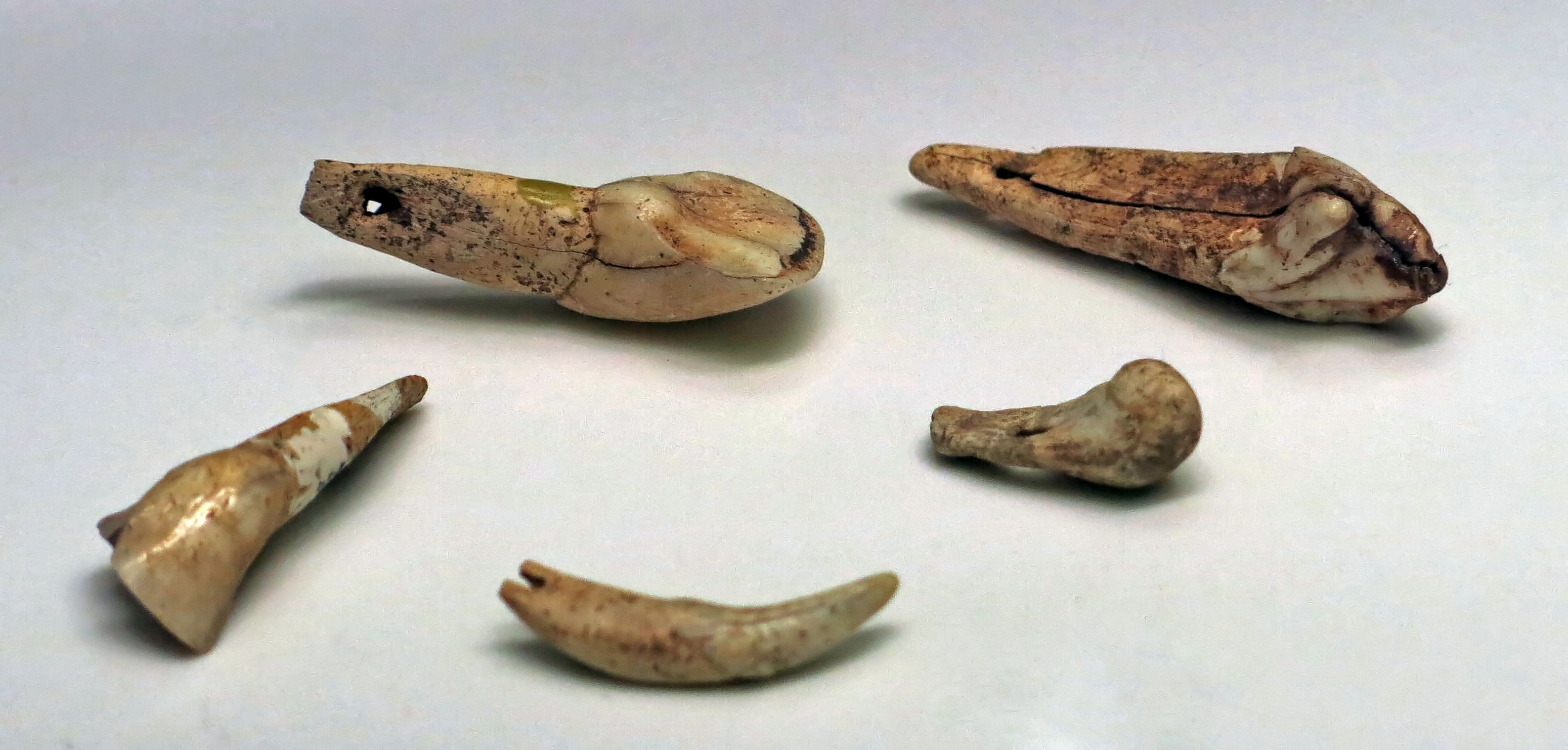
Pierced reindeer and deer canines from Laussel.
Photo: Don Hitchcock 2015
Catalog: 61.3.202 to 61.3.206
Source: Original, Musée d'Aquitaine à Bordeaux
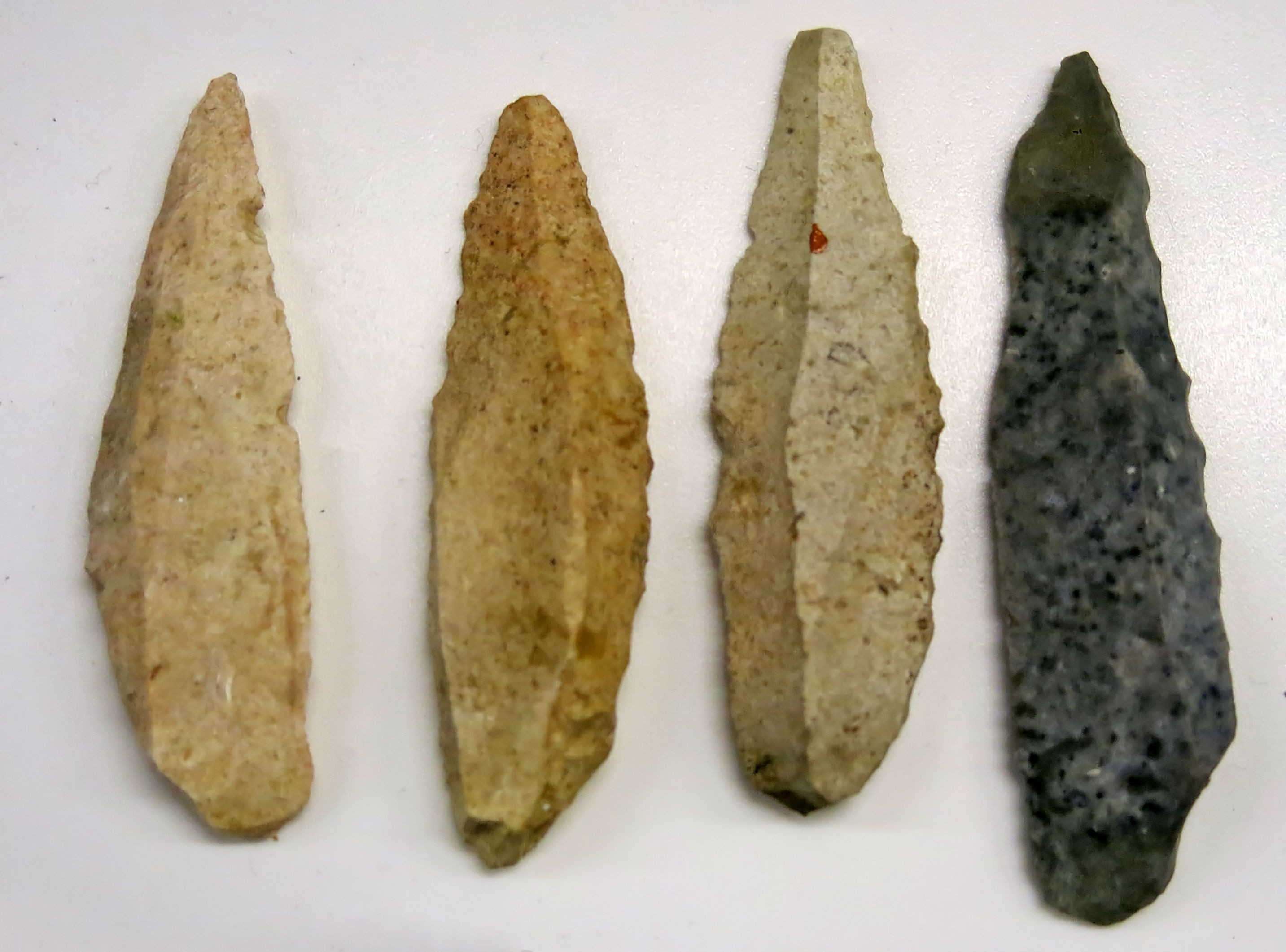
Chatelperronian points from Laussel.
Photo: Don Hitchcock 2015
Catalog: 61.3.148, 61.3.150, 61.3.151, 61.3.153
Source: Original, Musée d'Aquitaine à Bordeaux
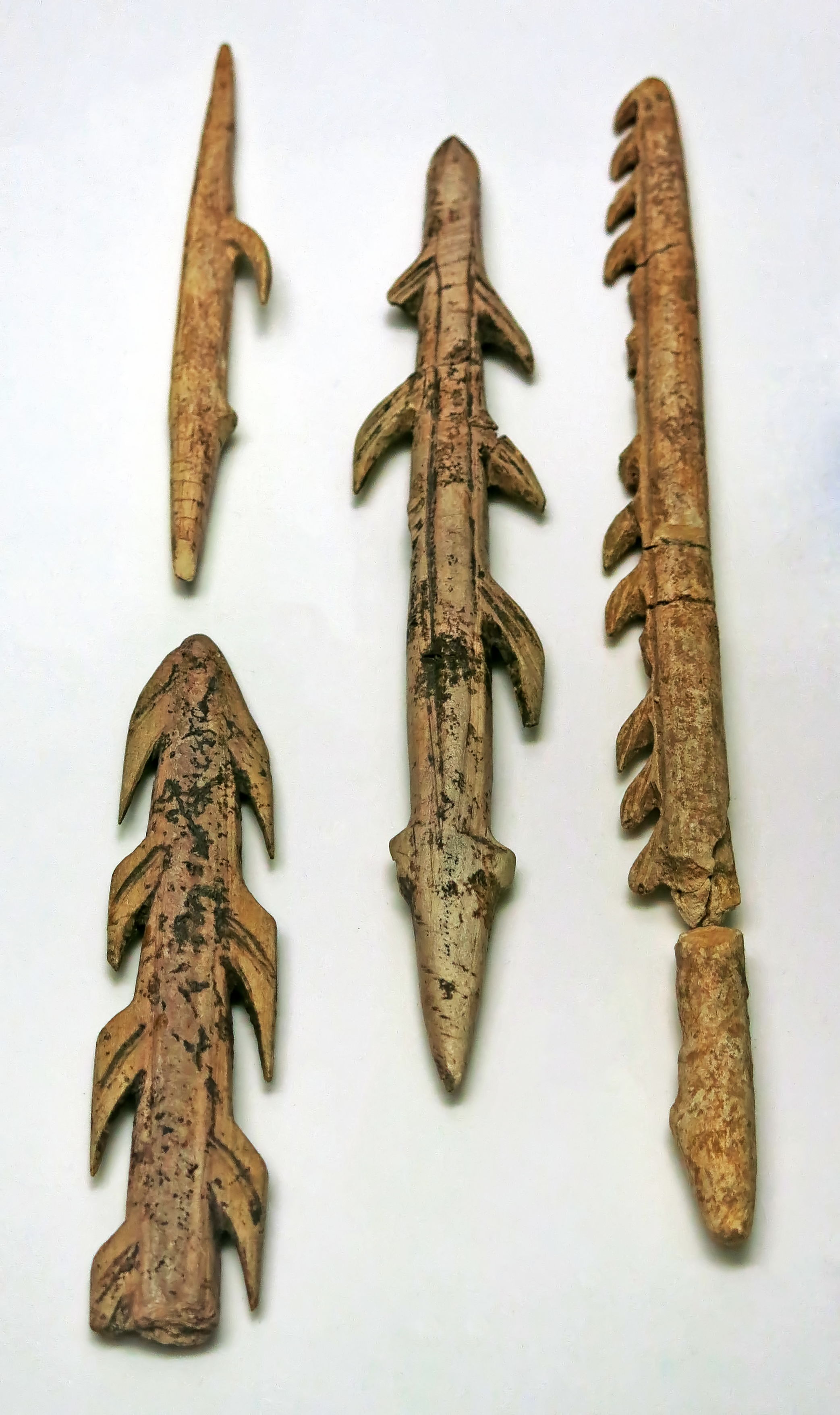
Harpoons with one or two rows of barbs, from Laugerie Haute, Laussel and from Le Morin.
Upper Magdalenian, in reindeer antler.
Top left: Harpoon with one row of barbs, Magdalenian V-VI, length 12 cm, Laugerie Haute, Catalog 61.3.54.
Right: Harpoon with one row of barbs, Magdalenian V, length 225 mm, Laussel, Catalog 61.3.55.
Photo: Don Hitchcock 2015
Catalog: 61.3.54, 61.3.55, 88.47.389, 88.47.395.
Source and text: Original, Musée d'Aquitaine à Bordeaux
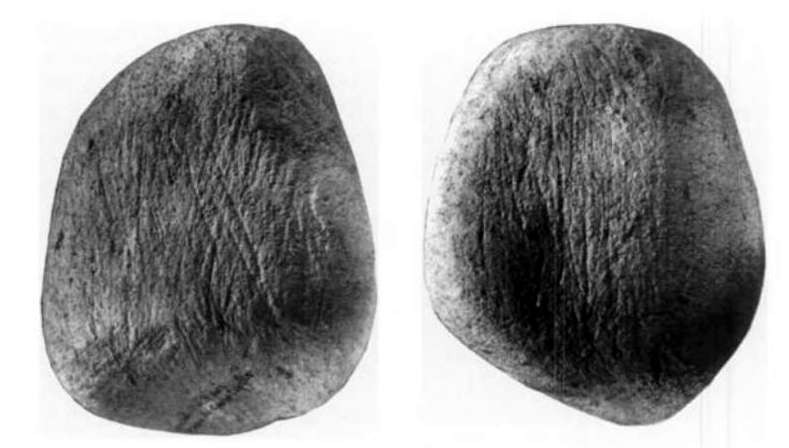
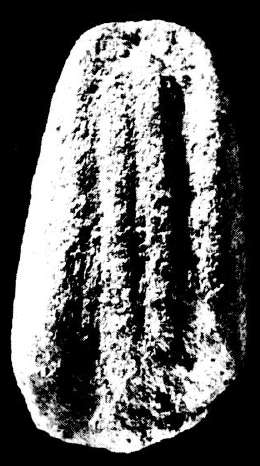
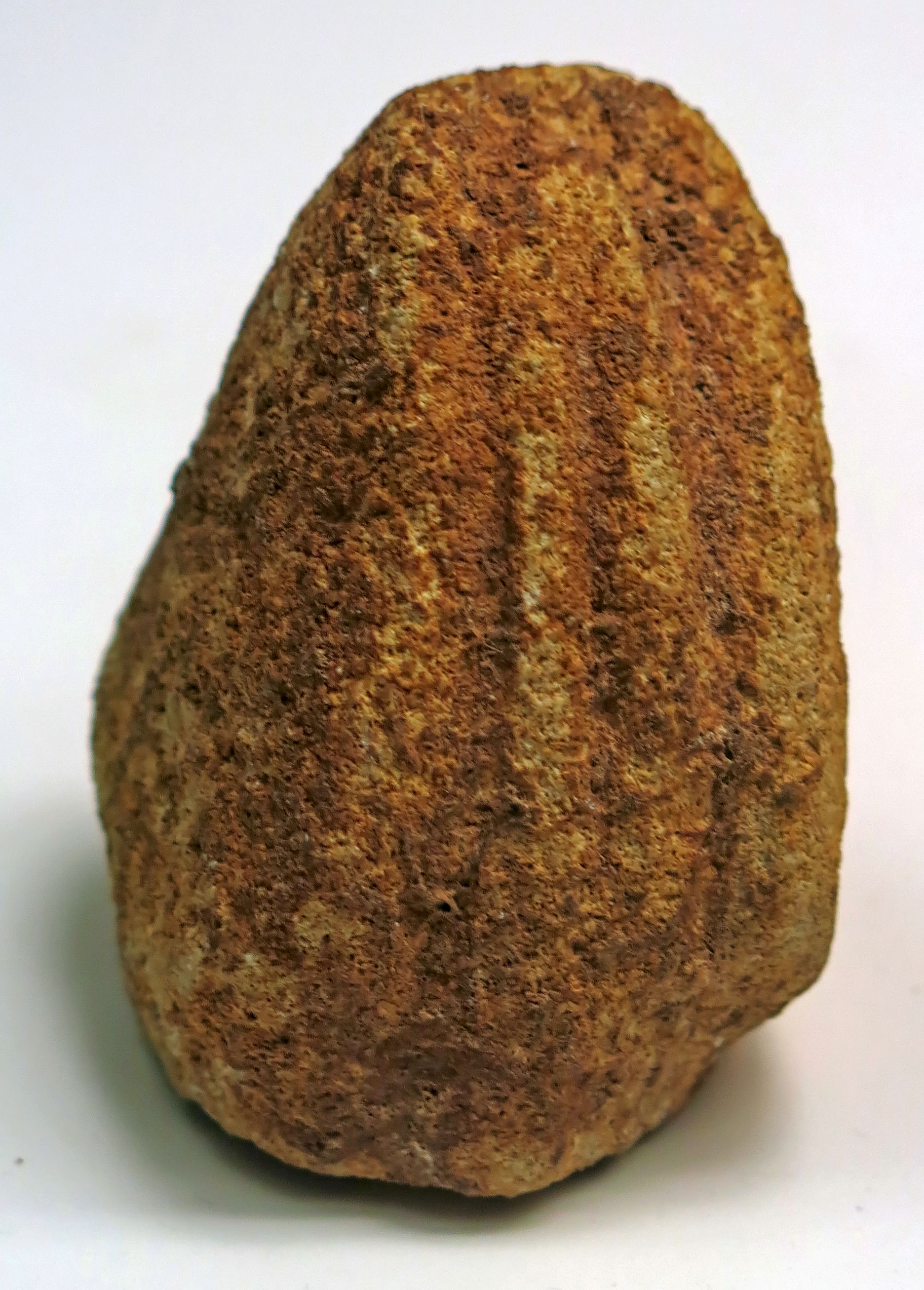
Mousterian mill: two sides of a volcanic rock pebble covered with ridges (75 mm x 55 mm x 55 mm). Petit abri de Laussel, Dordogne. Typical Mousterian. Musee d'Aquitaine, coll. Lalanne.
Neanderthal man already used crude tools to crush various substances, as evidenced by the presence of rudimentary mills at the end of the Mousterian (ca. 50 000 years).
Photo and text translated from: de Beaune (2002)
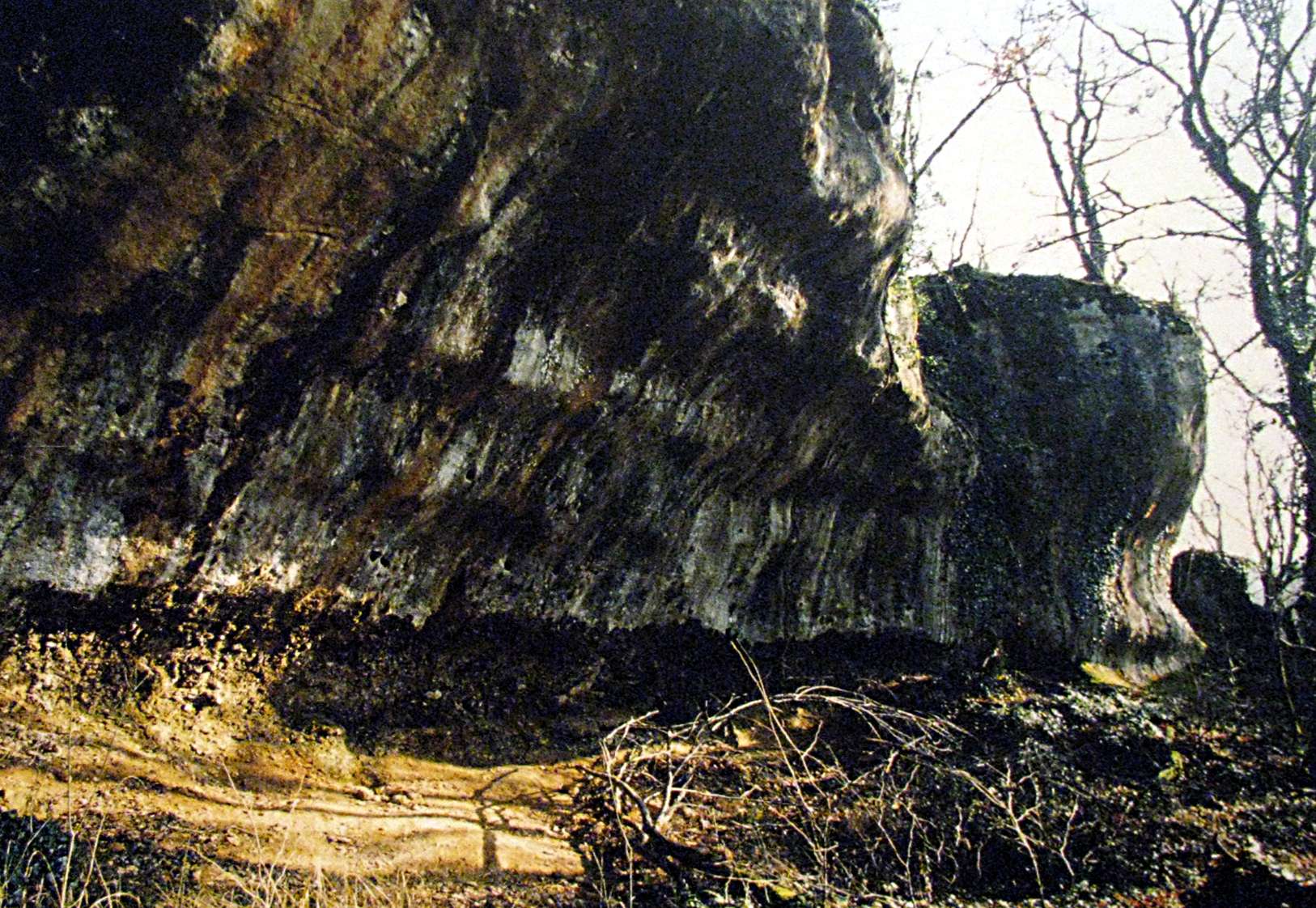
The Abri du moulin de Laussel
Photo: A. Roussot, from the display at Cap Blanc.

The Abri du moulin de Laussel in the 1970s.
Photo: Heinrich Wendel (© The Wendel Collection, Neanderthal Museum)
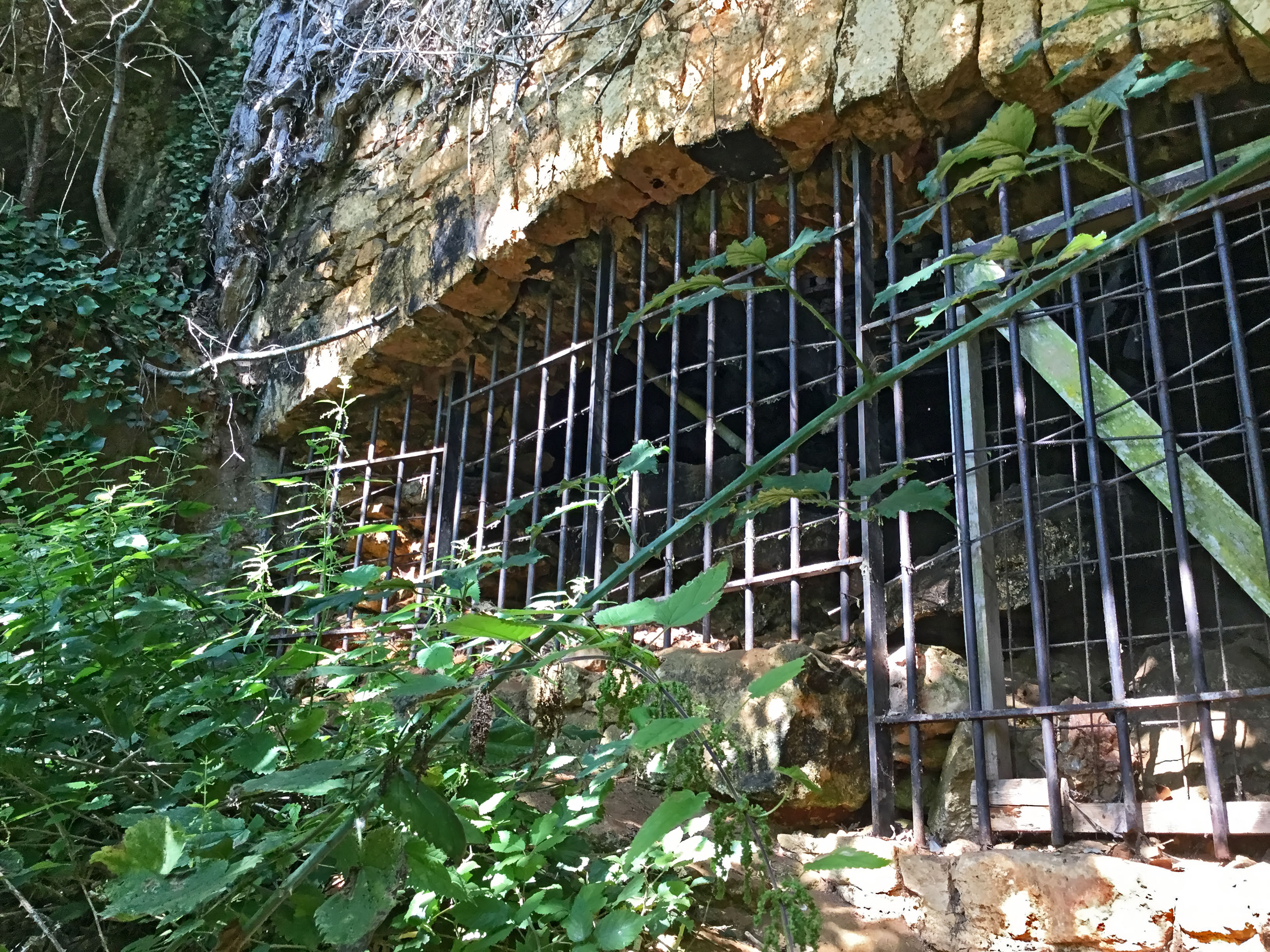
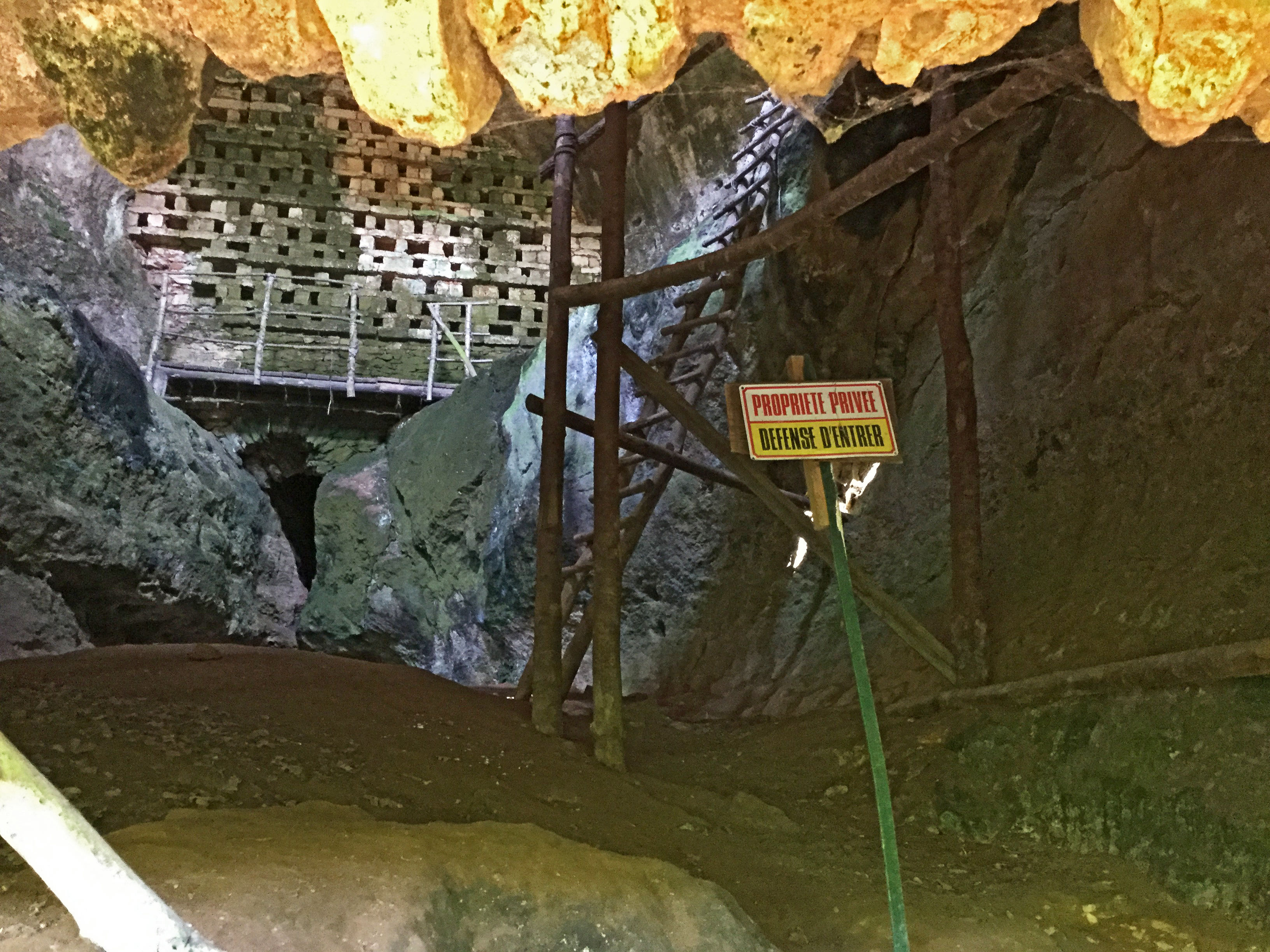
These photos were taken in 2016 of the area around l'abri du moulin de Laussel.
The site has been protected from vandals and treasure seekers, a necessary precaution. Note the hand made ladder in the photo on the right.
Photo: Courtesy Anna Delprato


There are a number of smaller caves and abris in the area.
Photo: Courtesy Anna Delprato
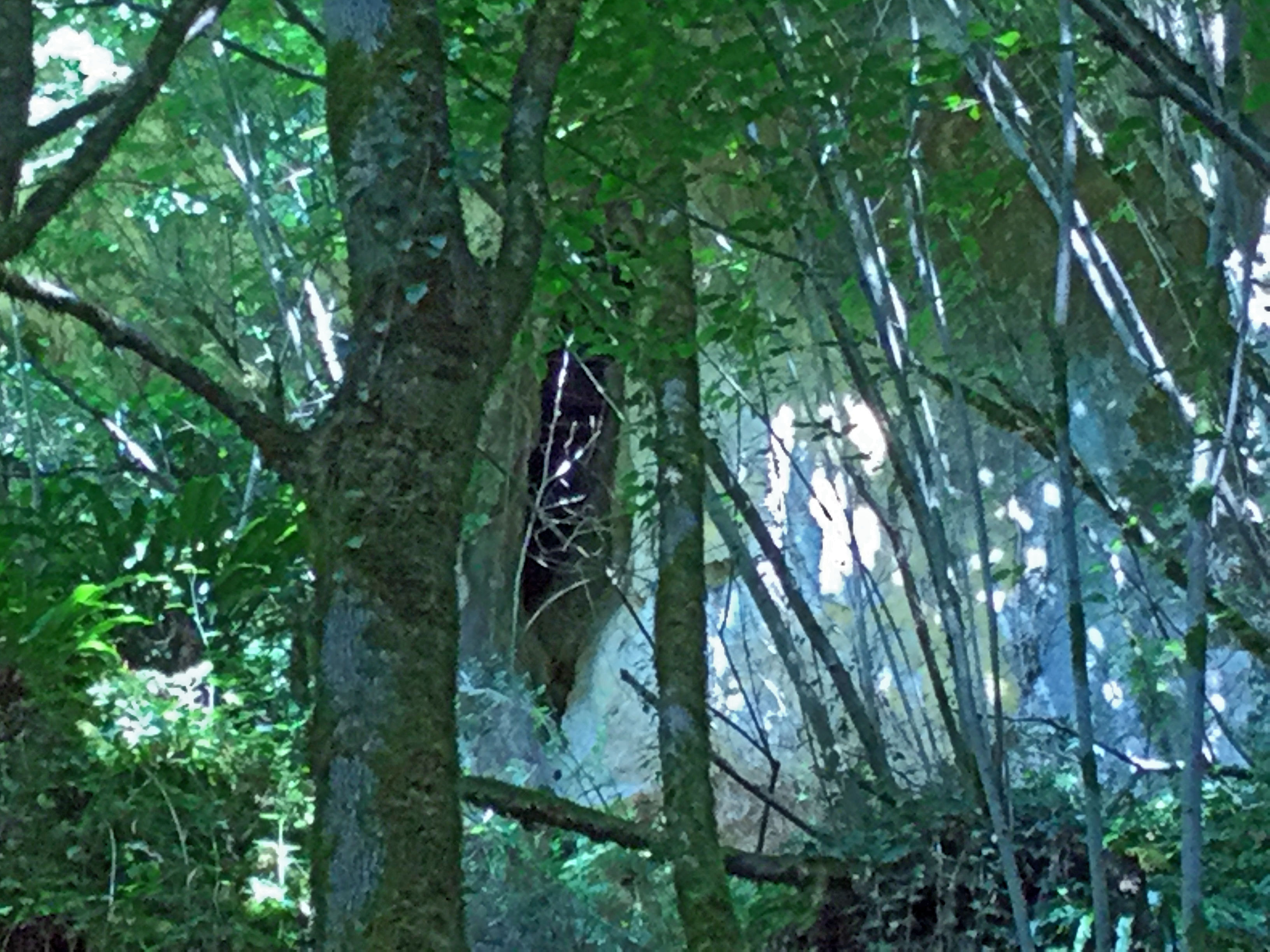
The area is now quite overgrown when compared to the photos taken at the time of its excavation.
Photo: Courtesy Anna Delprato
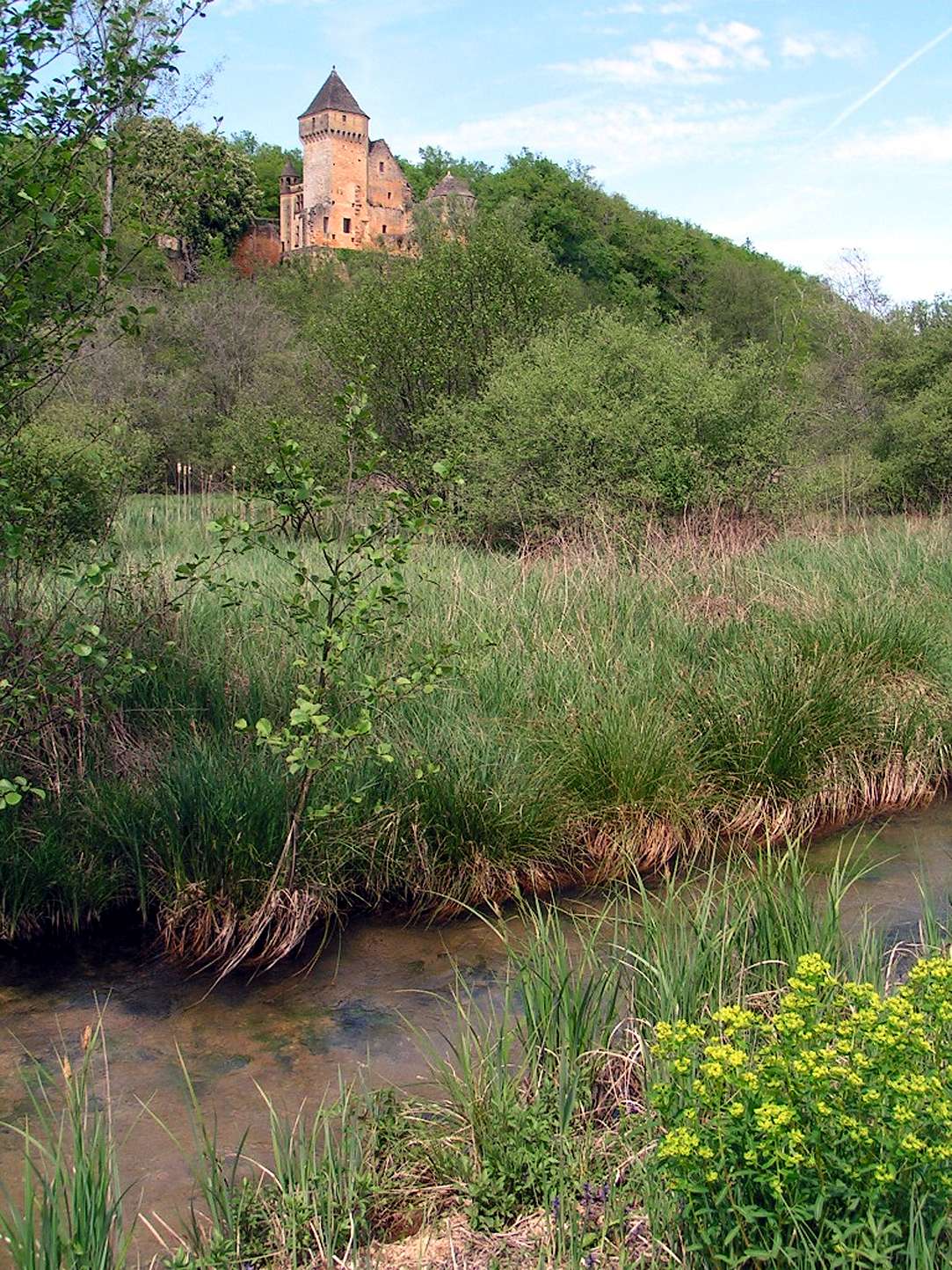
Rich meadow near Cap Blanc, between Chateau Laussel (pictured) and Chateau Commarque.
Photo: Hans Briaire, Panoramio
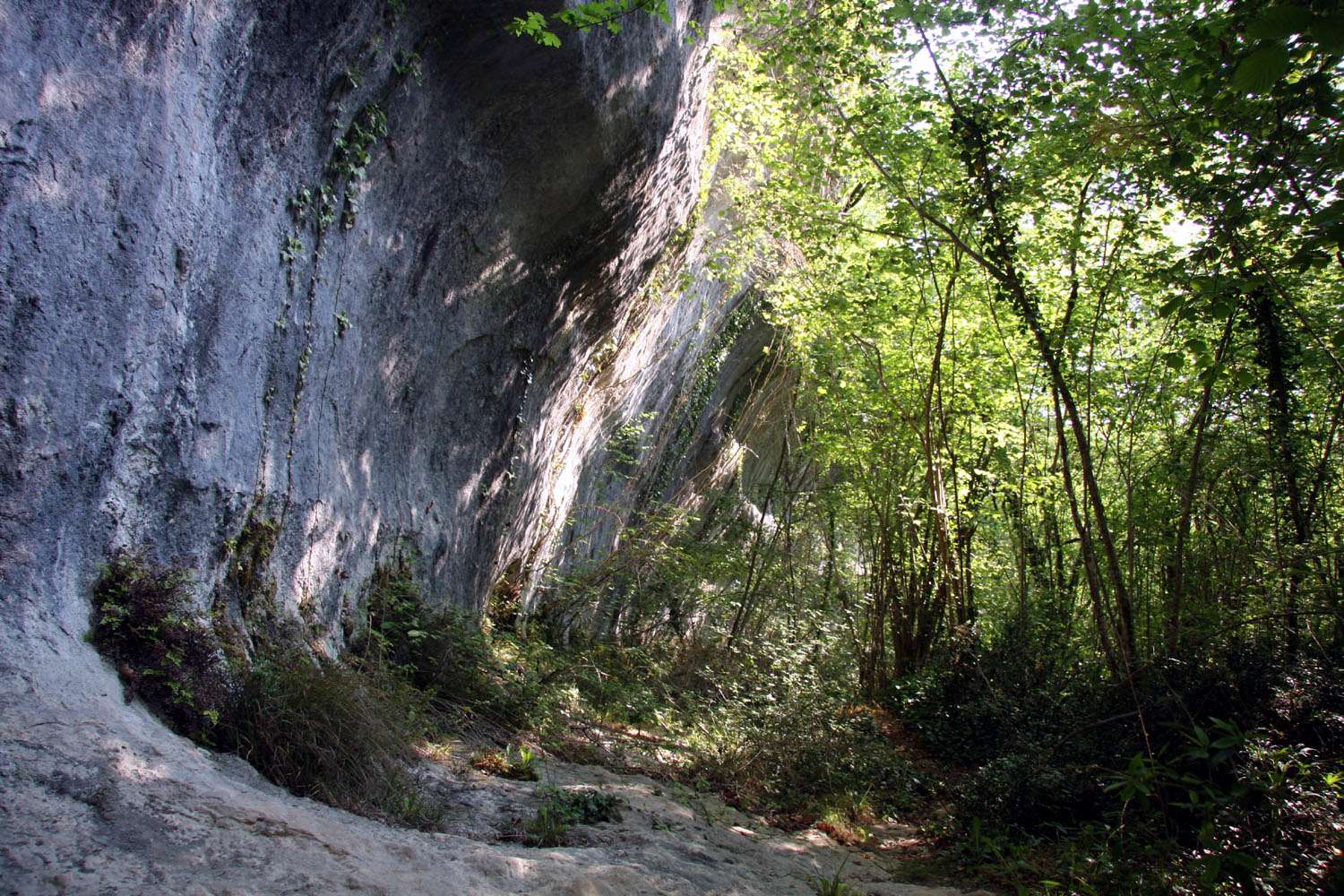
Laussel Grand Abri, upstream on the Beune from Cap Blanc.
Photo: © Yvan Lemeur, http://www.flickr.com/photos/lemeur/5719351234/
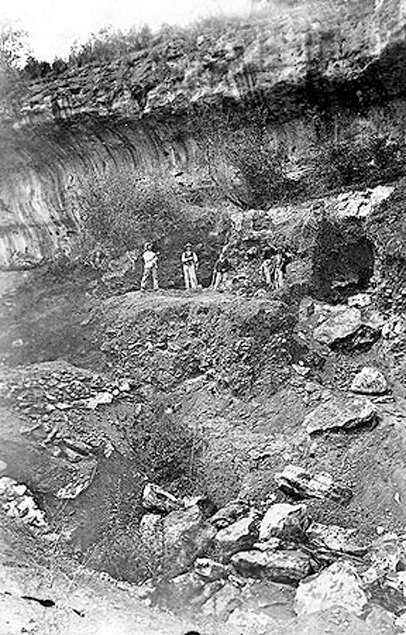
Laussel Grand Abri, view of the site at the moment of discovery of the Laussel Venus.
Photo de la collection Lalanne dans A. Roussot, 1990, p. 10, http://www.europreart.net/
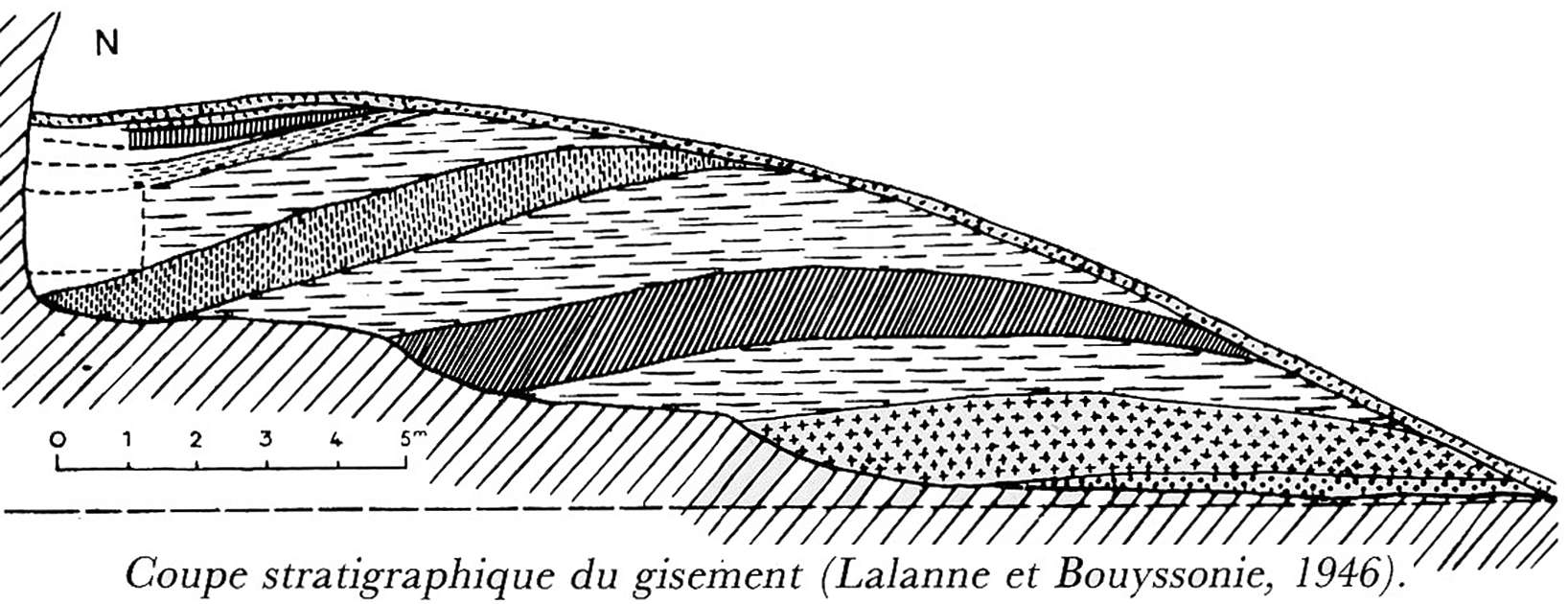
Cross Section of the gisement.
Photo: Lalanne et Bouyssonie (1946)
L'abri sous-roche du moulin de Laussel (Dordogne)
The Rock Shelter of the Laussel Mill, Dordogne.
When, starting from Les Eyzies, one goes up the valley of the Beune (which flows into the Vézère just downstream of Les Eyzies), and after having seen on the right, first, Font de Gaume, then les Combarelles then leaving on the right also the small tributary valley where lies Bernifal (all caves with carvings and paintings), the valley becomes a little wider, rugged, very picturesque, but with a wild aspect.
At 9 kilometres from Les Eyzies the valley narrows. To the right stands the imposing ruins of the beautiful medieval castle of Comarque and just across the other side of the valley the little 17th Century castle of Laussel, still inhabited, and where M. E. Rivière excavated and reported to l'Association francaise à Montauban in 1902.
At 300 metres upstream, we find the Laussel mill, located on the right bank of the Beune. Just above the mill, there are some large shelters, raised about 12 metres above the valley bottom and having an average height of 12-15 metres and a depth of 5 to 8 metres, covered by a rock overhang like the classic type along the Vézère Valley. These shelters extend for 150 metres. The part above the mill has been completely cleared for use as a barn.
There still exists an oven and a little farther on a little masonry hut for livestock or poultry. But a little further upstream the floor of the shelter is formed by prehistoric hearths measuring from 50 cm to 100 cm thick. Their top was more or less disturbed, perhaps a part had been removed, but underneath they are intact.
Some preliminary explorations have allowed us to collect artefacts with the characteristic features of the Solutrean. The 30 pieces that I present here, chosen from a much larger number, form, as can be seen, a systematic series where all types of the Solutrean are well represented.
These are, first, nuclei, cleverly knapped, which have provided blades measuring up to 13 cm in length. The edges of the nuclei are carefully re-worked so as to give backed blades and of which we have found some good specimens with a large number of thin blades, although less fine and less narrow than those of the pure Magdalenian.
Some of these blades are fairly broad, which have been carefully retouched on one edge or both edges, they are usually worked to a point. It is one of the Solutrean types showing the general shape of the Mousterian point, but thinner and notably less triangular.
A large scraper made from a wide blade 13 cm long by 5 cm wide, and a very well retouched small disc also very well retouched were equally characteristic.
Single burins, sometimes double, are larger and less skilfully made than those of the full Magdalenian. They are sometimes retouched on the edges.
Awls are quite plentiful and usually very well retouched. Some are elongated and fairly sharp, other wider ones were used as reamers retouched on opposite sides of the tip. Some were fashioned at the end of a large flake, fairly thick, giving a good hand grip.
Scrapers are abundant, some are re-worked at the end of a thin blade, but the largest number were quite large, well retouched, the retouches going a fair way along the back of the blade. There were a few scraper/burins and some double ended scrapers. There were also some small scrapers completely discoidal in shape.
Also note the square type scraper and a curious scraper 15 cm long made with the remains of a nucleus and which is a type of thick scraper (pente abrupte Salmon) pointed out long ago by Piette, in his excavations of the Solutrean industry.
As for tips, they are of the most pure Solutrean type, very fine laurel leaf, thin, beautifully retouched. We have collected broken parts of tips measuring 8 to 10 cm.
Tanged points are frequent. We have a whole series from the notch barely indicated to specimens whose back is completely retouched with extreme skill and the notch carefully reworked. Sometimes the alterations are only on one side, the other being flat, sometimes both sides are beautifully reworked. Unfortunately most of these pieces, as usual, are more or less broken. Some almost intact specimens have a size of 5 to 8 cm.
We see the industry of this interesting gisement as quite remarkable and very pure. Nowhere did we find any trace of Magdalenian deposits, nor of Acheulean or Mousterian levels.
As for fauna, this was poorly represented, we found only bones from a fairly large horse and some reindeer remains. These researches were conducted during August and September last.
References
- Capitan L., Peyrony D., 1903 L'abri sous-roche du moulin de Laussel (Dordogne), Bulletins et Mémoires de la Société d'anthropologie de Paris, V° Série, tome 4, 1903. pp. 558-560.
- Cohen C., 2003: La femme des origines. Images de la femme dans la préhistoire occidentale,, Paris, Belin-Herscher, 2003, 191 pages.
- de Beaune, S., 2002 Origine du matériel du mouture: innovation et continuité du Paléolithique au Néolithique, Meules à Grains, Actes du Colloque International de la Ferté-Sous-Jouarre 16 - 19 Mai 2002
- Delporte, H., 1979 L’Image de la Femme dans l’Art Prehistorique, Picard, Paris, France, 1979.
- Duhard J., Roussot A., 1988 Le gland pénien sculpté de Laussel (Dordogne), Bulletin de la Société préhistorique française 1988, tome 85, N. 2. pp. 41-44.
- Jaubert, J., 2008: L'art pariétal gravettien en France : éléments pour un bilan chronologique, Paléo, 20 | 2008, 439-474.
- Lalanne, J., Bouyssonie J., 1946: Le gisement paléolithique de Laussel. Fouilles du Dr Lalanne, L'Anthropologie, t. 50, pp 1-163, 123 fig., 1 pl.
- Lesure, G., 2011 Interpreting Ancient Figurines: Context, Comparison, and Prehistoric Art, Cambridge University Press, 21 Feb 2011 - Social Science
- Mussi M. et al., 2010: "Les « vénus » du Gravettien et de l’Épigravettien italien, témoignages de rapports sur longues distances au travers de l’Europe et de l’Eurasie" IFRAO Congress, IFRAO Congress, September 2010 – Symposium: Pleistocene art in Europe (Pre-Acts)
- Noble V., 2003: The double goddess: women sharing power, Inner Traditions / Bear & Co, 31/07/2003
- Rau, S., Naumann D., Barth M., Mühleis Y., Bleckmann C., 2009: Eiszeit: Kunst und Kultur, Thorbecke, 2009, 396p. ISBN: 978-3-7995-0833-9
- Roussot, A., 2000: La Venus a la corne et Laussel, Bordeaux: Editions SudOuest