Back to Don's Maps
Back to Archaeological Sites
Sungir - Sunghir
Click on the photos to see an enlarged version
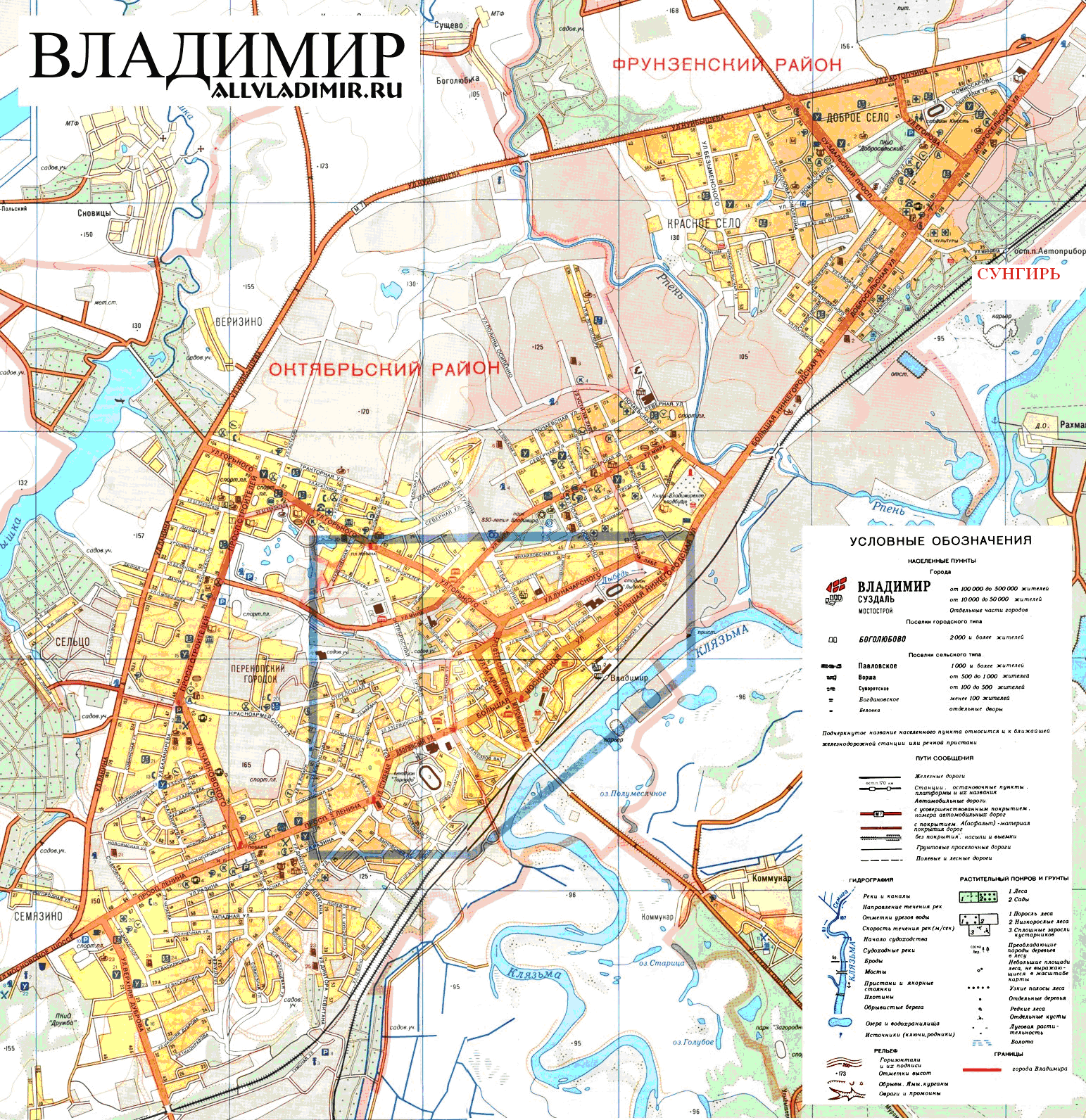
Sungir / Sunghir is a very large early Upper Paleolithic living site located on the outskirts of the city of Vladimir, 192 km from Moscow at 56°08" N 40°24" E in the Russian Republic. It is a mid Upper Palaeolithic (Eastern Gravettian) cultural accumulation on the left bank of the Kliazma river, of which some 1500 sq. m was excavated in several seasons between 1957 and 1964 (Bader 1965; 1967; 1978; 1998).
The first burial (Grave 1 / Sungir 1) was excavated in 1964. It is that of an adult male in extended, supine position, with his head oriented to the northeast and hands placed over his pubis.
Half a century ago in the village of Добрым, Dobrym, (now part of Vladimir), the right of the highway, during the digging of the clay pits traces of ancient human settlements of the Stone Age were found. Under the guidance of renowned archaeologist Otto Nikolaevich Bader (Institute of Archaeology of the USSR), for 20 years field and desk work was carried out. In the laboratories of the Geological Institute of RAS, Gronningena universities, Oxford and Arizona the findings have been investigated, including radiocarbon analysis, the results of which indicate that the settlement Sungir existed sometime between 20 thousand to 29 thousand years ago. Scientists believe that there was an archaeological site regularly visited by people for 2 to 3 thousand years.
Photo and text: http://www.trinitas.ru/rus/doc/0211/008a/02111056.htm
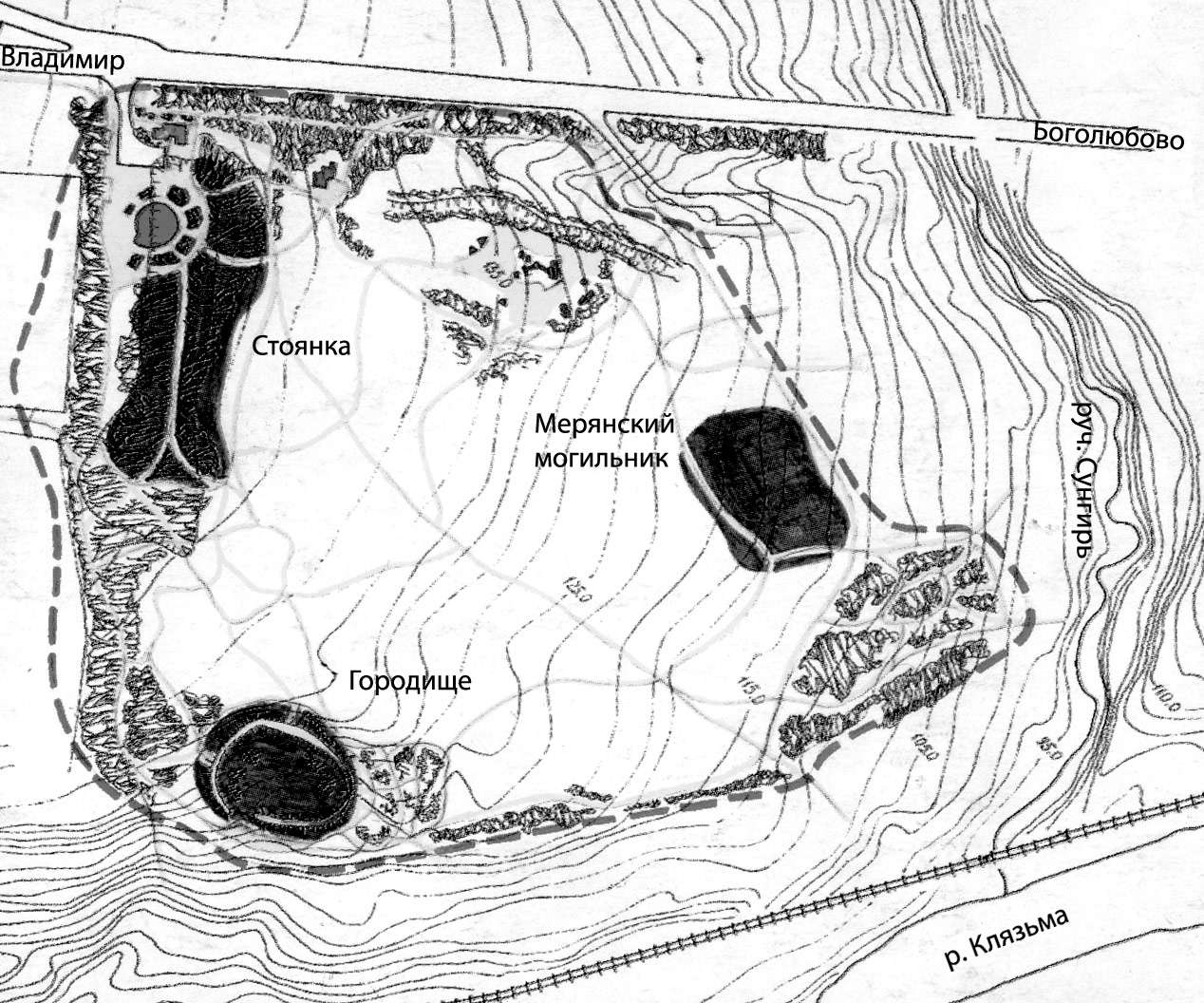
Map of the Sungir site.
Photo: A. Sekirin , http://www.vladimir-city.ru/city/likecity/press/pdf/june1_07.pdf via wikipedia.
Permission: Permission is granted to copy, distribute and/or modify this document under the terms of the GNU Free Documentation License, Version 1.2
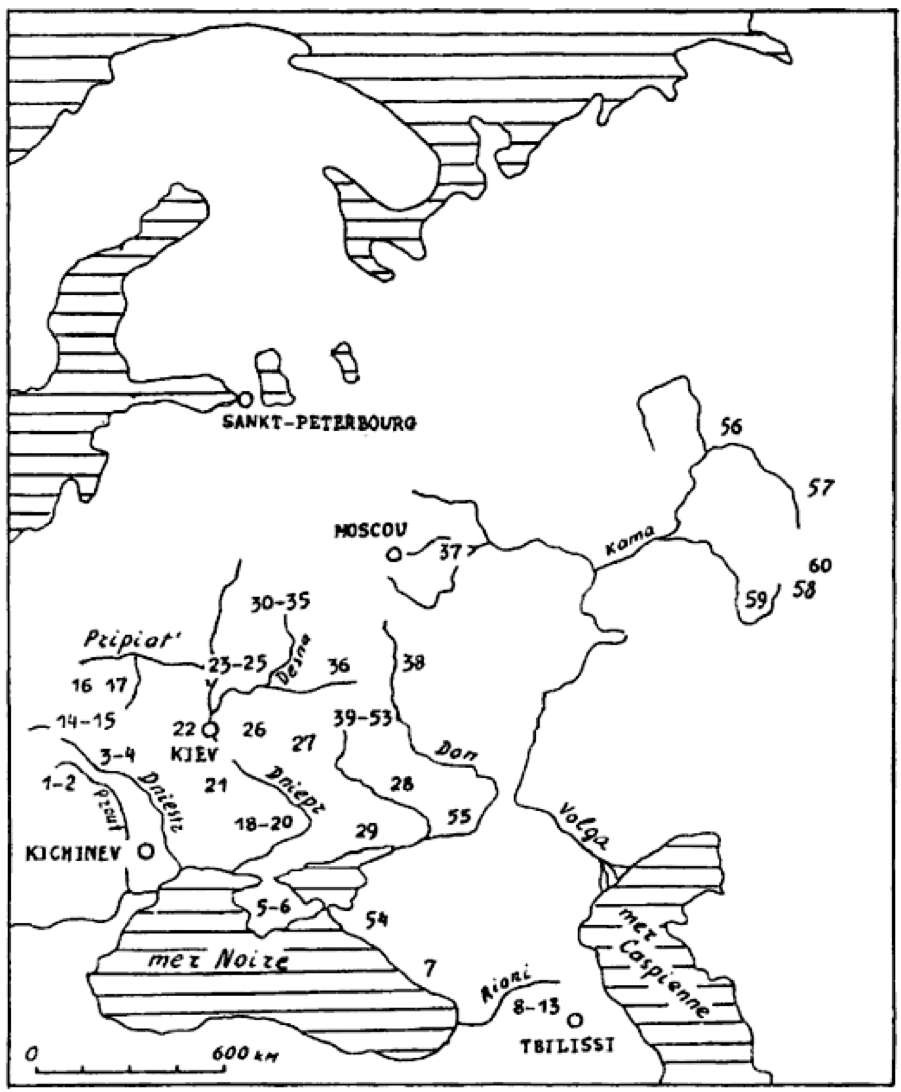
Distribution of mobile art in Eastern Europe.
1 Staryé Duruitory, 2 Brynzeny, 3 Kosseoutzy, 4 Klimaoutzy, 5 Suren' 1, 6 Chan-Koba, 7 Apiantcha, 8 grotte d'Uvarov, 9 Sakagia, 10 Sagvardgilé, 11 Gvardgilas-Kldé, 12 Devis-Khvreli, 13 Taro-Kldé, 14 Molodova V, 15 Lissitchniki, 16 Lipa VI, 17 Klinetz, 18 Ossokorovka, 19 Dubovaya Balka, 20 Kaïstrovaya Balka, 21 Mejiritch (Mezhirich), 22 Kievo-Kirillovskaya, 23 Mézine (Mezin), 24 Novgorod Severskyi, 25 Puchkari I, 26 Dobranitchevka, 27 Gontzy, 28, Rogalik, 29 Amvrossievka, 30 Eliseevitchi I, 31 Eliseevitchi II, 32 Yudinovo, 33 Khoylevo II, 34 Timonovka, 35 Suponevo, 36 Avdeevo, 37 Sungir', 38 Gagarino, 39 Kostienki 19, 40 Kostienki 21, 41 Kostienki 13, 42 Kostienki 1, 43 Kostienki 14, 44 Kostienki 12, 45 Kostienki 17, 46 Kostienki 2, 47 Kostienki 11, 48 Kostienki 4, 49 Kostienki 15, 50 Kostienki 9, 51 Kostienki 8, 52 Borchtchevo 1, 53 Borchtchevo 2, 54 Ilskaya, 55 Murakovka, 56 Ostrovskaya, 57 Bez'imyannyi, 58 Smelobskaya, 59 Kapova, 60 Ignatievskaya.
Photo: Abramova (1995)
The Sunghir archaeological site
The paper is from the International Seminar "Upper Paleolithic People from Sunghir, Russia" was hosted by the Department of Archaeology, University of Durham, UK at 10th of August 2004.
The DNA of S1, S2, and S3 were examined.
The obtained data suggests that adult S1 and adolescent S2, buried on Sunghir station, are males.
The individual S3 was probably a young female.
(Note that these were the genders already ascribed to the individuals concerned, this is corroborating evidence - Don)
Note that the site called Sungaea in Jean Auel's book, The Mammoth Hunters, is many kilometres south of the real site. According to the map in her book, the actual Sungir site was under hundreds or thousands of metres of snow and ice.
When reading the following notes about the burials at Sungir, it should be realised also that most researchers estimate that each ivory bead took an hour to make.
Text below from the site http://www.insticeagestudies.com/library/Ivory/ivory4.html which appears to have disappeared.
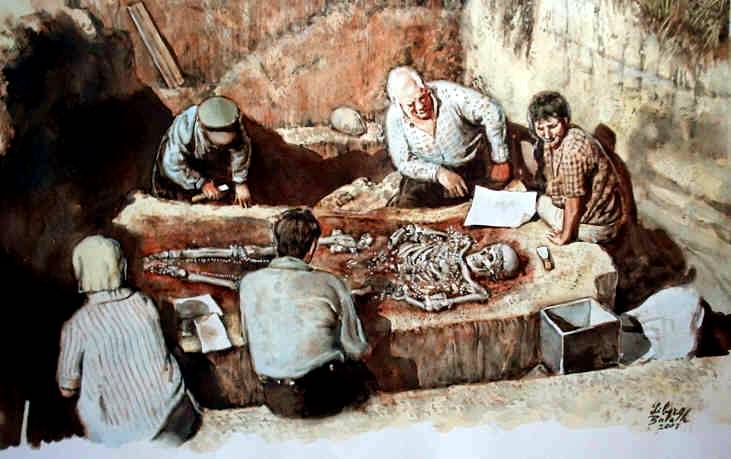
The site of Sungir (Bader 1978; USSR Academy of Sciences 1984), discovered during clay extraction operations in 1956, was excavated by Otto Bader from 1956 to 1977. Excavations were re-opened by Bader's assistant Ludmilla Mikhailova and Bader's son Nicolai in 1986, and continue today. Sungir is an enormous early Upper Paleolithic living site located on the outskirts of the city of Vladimir, 192 km from Moscow at 56°11" N 40°30" E in the Russian Republic.
Artist: Illustration of S1 © Libor Balák
Photo: http://www.iabrno.cz/agalerie/gravett.htm
Text: http://www.insticeagestudies.com/library/Ivory/ivory4.html
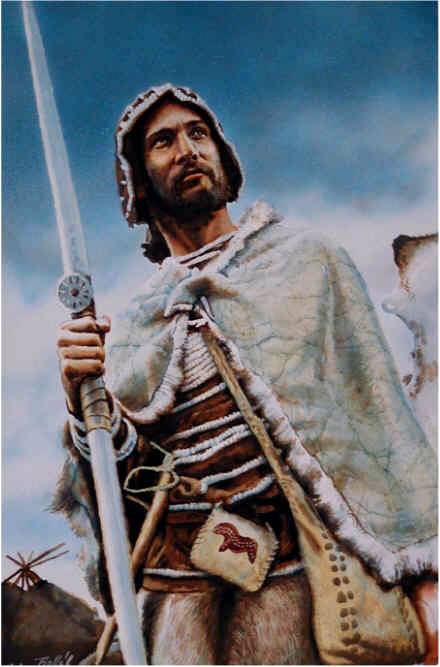
While inhabiting Sungir, at least five of the site's occupants perished. According to Russian physical anthropologists (USSR Academy of Sciences 1984), these consisted of a 60 year-old man (S1), a 13 year-old boy (S2), a 7 to 9 year-old girl (S3), an unsexed (male?) headless adult (S4) and an adult female skull (S5). From my reading of the evidence, the often represented adult burial is clearly an older male. However, I am not convinced that it is possible to sex the adolescents.
The two adolescents and the adult male were buried in two shallow graves three metres apart, dug into the permafrost beneath the living surface of the site. All three of the corpses were laid on their backs with their hands folded across their pelvises. The fourth individual was represented by an isolated poorly preserved female skull placed beside a stone slab in an area stained with red ochre, and was found overlying the relatively well known man's burial. The fifth skeleton, that of a headless adult, was so poorly preserved as to be practically unrecoverable. It was found immediately on top of the two adolescents, who were buried together in a head-to-head fashion in the middle of an apparently abandoned circular dwelling structure.
Artist: Illustration © Libor Balák
Photo: http://www.iabrno.cz/agalerie/gravett.htm
Text: http://www.insticeagestudies.com/library/Ivory/ivory4.html
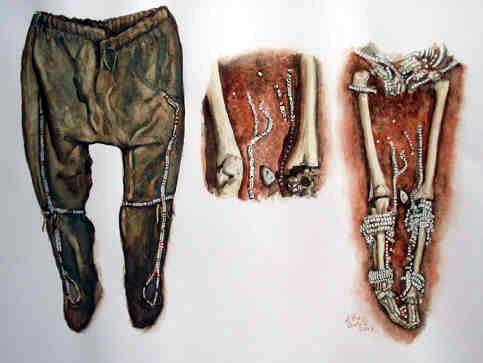
Each of the three intact individuals was lavishly decorated with thousands of painstakingly prepared ivory beads arranged in dozens of strands, perhaps basted to their clothing. Although it is almost certain that the three individuals buried intact at Sungir were members of the same social group, there are remarkable differences among them in details of body decoration and grave offerings. The man was adorned with 2 936 beads and fragments arranged in strands found on all parts of his body including his head, which was apparently covered with a beaded cap that also bore several fox teeth.
Text: http://www.insticeagestudies.com/library/Ivory/ivory4.html
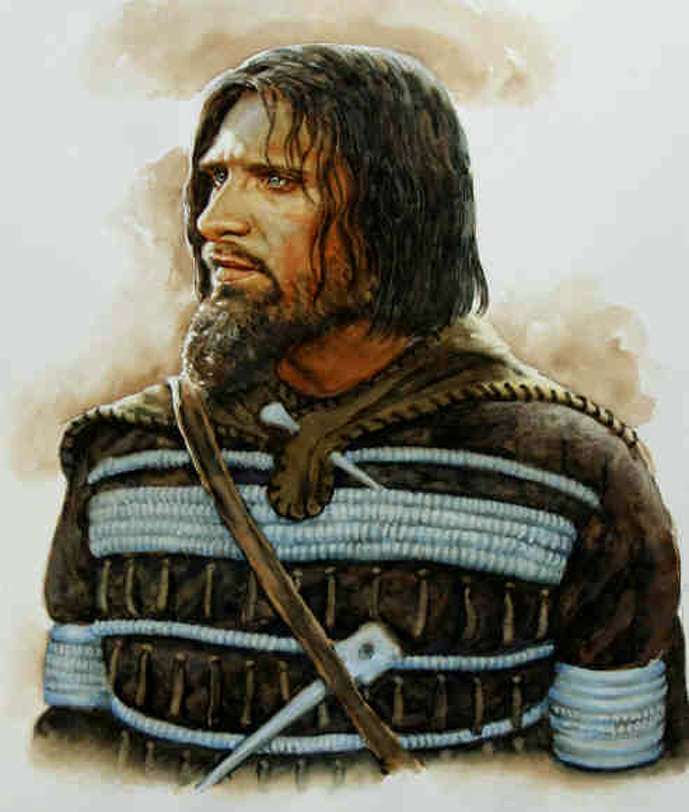
His forearms and biceps were each decorated with a series of polished mammoth-ivory bracelets (25 in all), some showing traces of black paint. They were thin, flat strips of mammoth-ivory, cut longitudinally along the tusk. They were pierced at each end, some with one hole, others with two, apparently to keep the ivory bent into a circle. What appear to be brush strokes from the application of pigment are visible on at least one specimen. Around the man's neck, he wore a small, flat schist pendant, painted red, but with a small black dot on one side.
Artist: Illustration © Libor Balák
Photo: http://www.iabrno.cz/agalerie/gravett.htm
Text: http://www.insticeagestudies.com/library/Ivory/ivory4.html
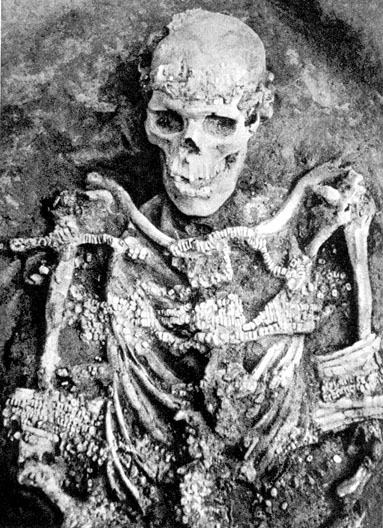
A burial at Sunghir, USSR (S1). The head and chest were decorated with many ivory beads, originally sewn onto cloth. Notice the mammoth-ivory bracelets on his arms, and the remains of the beaded cap on his head.
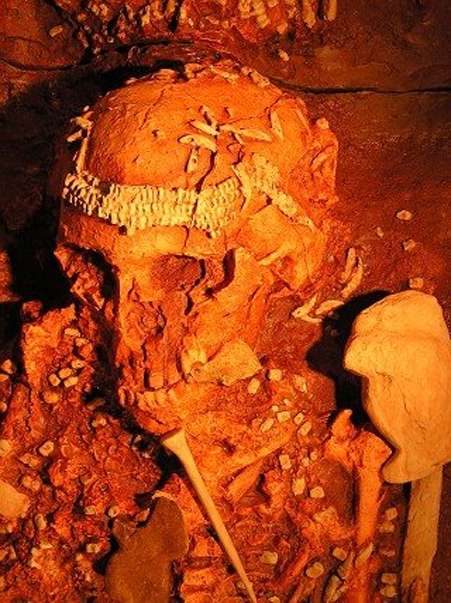
Sunghir head. (S1)
Photo: http://remotecentral.blogspot.com/2007_06_01_archive.html

Sunghir burial (S1).
Man in an Upper Paleolithic burial in Sunghir, Russia. The site is approximately 28 000 to 30 000 years old
Photo: José-Manuel Benito Álvarez
Permission: Public domain
The double child burial from Sunghir (Russia) is a spectacular Mid Upper Palaeolithic funerary example dated to about 24 000 BP. A boy (Sunghir 2) and a girl (Sunghir 3), about 12-13 and 9-10 years old, respectively, were buried at the same time, head to head, covered by red ochre and ornamented with extraordinarily rich grave goods.Text above from Formicola et al. (2004).
Examination of the two skeletons reveals that the Sunghir 3 femora are short and exhibit marked antero-posterior bowing. The two femora do not show any asymmetry in the degree of shortening and bowing. Bowing affects the whole diaphysis and shows a regularly incurved profile, with the highest point at midshaft. Pathology is confined to the femora, and no other part of this well-preserved specimen shows abnormality.
The isolated nature of the Sunghir 3 anomalies points to cases reported in the medical literature under the label of 'congenital bowing of long bones' (CBLB). These are a group of rare conditions exhibiting localised, sometimes bilateral, bowing and shortening which are nonspecific and may result from different causes, including abnormalities of the primary cartilaginous anlage (i.e., the aggregation of cells representing the first trace of an organ).
Localised ossification disturbances, possibly linked to a diabetic maternal condition, might explain the shortening and the coincidence of maximum midshaft curvature with the position of the primary ossification centre, as well as the lack of involvement of other skeletal parts. This scenario, rather than other possibilities (early bilateral midshaft fracture, acute plastic bowing deformities, or faulty fetal posture), provides the most likely explanation for the Sunghir 3 femoral deformities.
The intriguing combination of a pathological condition apparent since birth with a spectacular burial of unusually positioned young individuals of different sexes recalls significant aspects of the triple burial from the contemporary site of Dolní Vestonice (Moravia), evoking a patterned relationship between physical abnormality and extraordinary Upper Paleolithic funerary behavior.
Text below by Laura Geggel, https://www.livescience.com/61743-rich-paleolithic-burials.html
About 24 000 years ago, a group of hunters and gatherers buried their dead - including two boys with physical conditions - using the utmost care. However, these dead were buried in fairly different ways, a new study finds.
The roughly 10 and 12 year-old boys were buried head to head in a long, slender grave filled with riches, including more than 10 000 mammoth ivory beads, more than 20 armbands, about 300 pierced fox teeth, 16 ivory mammoth spears, carved artwork, deer antlers and two human fibulas (calf bones) laid across the boys' chests, the researchers said.
In contrast, the remains of a roughly 40-year-old man, an individual who would have had more time and physical ability to contribute to the group, had far fewer treasures: about 3 000 mammoth ivory beads, 12 pierced fox canines, 25 mammoth ivory arm bands and a stone pendant.
'From the point of view of the mortuary behaviour, the burial of the adult is, in fact, very different from the burial of the children,' study co-lead researcher Erik Trinkaus, a professor of anthropology at Washington University in St. Louis, told Live Science.
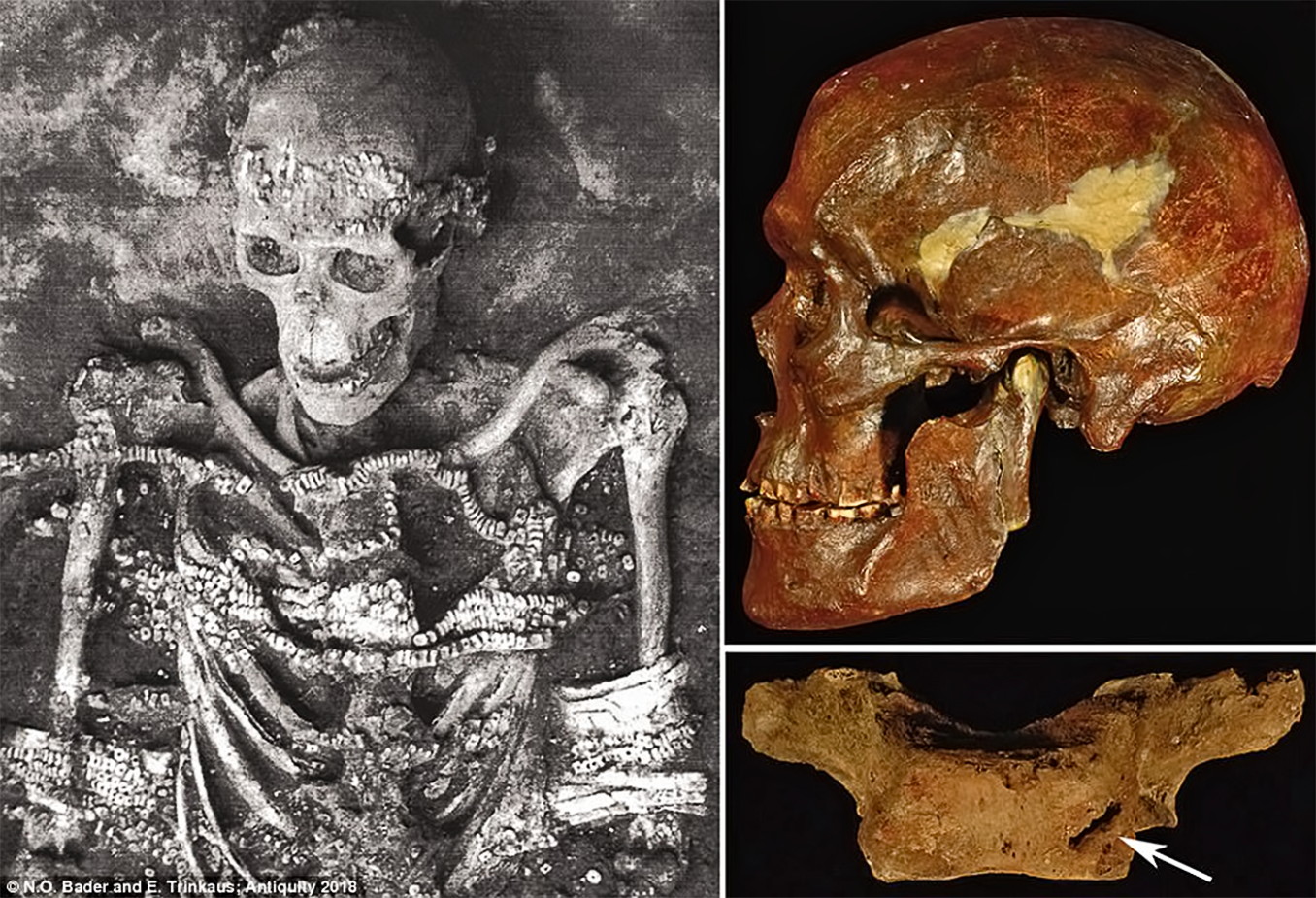
Sunghir burial
Photo: © N.O. Bader and E. Trinkaus, Antiquity 2018
Proximal source: http://www.dailymail.co.uk/sciencetech/article-5397451/Ancient-graves-reveal-disabled-people-treated.html
When these hunters and gatherers lived, about 34 000 years ago, the region was going through a slightly warmer period than the ice ages before and after it, the researchers noted. The warmer weather explains, in part, how these ancient people were able to dig graves in what would have otherwise been frozen ground, the researchers added.
In total, there are 10 men and women buried at Sunghir, but the two boys have, by far, the most spectacular riches of the lot, the researchers said. The boys also have physical conditions that likely limited the individuals during their short lives.
Both boys experienced repeated periods of extreme stress, according to an analysis of their dental enamel, the study said. What's more, the 10-year-old boy's thighbones are 'exceptionally bowed and short,' Trinkaus and co-lead researcher Alexandra Buzhilova, an anthropologist at Lomonosov Moscow State University, in Russia, wrote in the study. But otherwise, the young boy was physically active, an analysis of his skeleton showed.
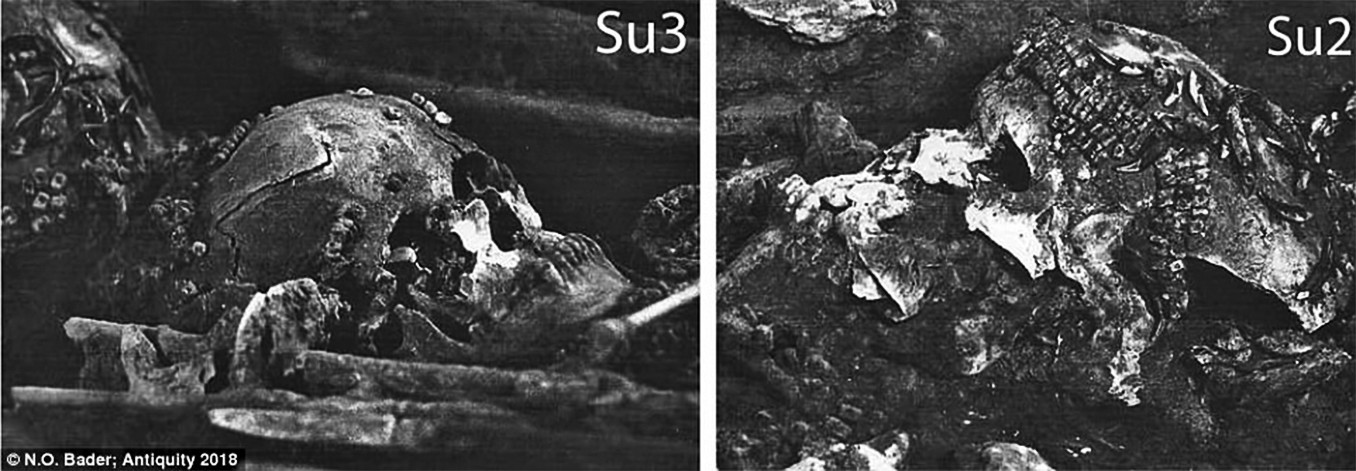
Sunghir burial
Photo: © N.O. Bader, Antiquity 2018
Proximal source: http://www.dailymail.co.uk/sciencetech/article-5397451/Ancient-graves-reveal-disabled-people-treated.html
Meanwhile, the 12-year-old boy's teeth had almost no wear, 'which, to us, doesn't sound like much, but people from this time wore their teeth down quickly,' Trinkaus said. Analyses of his skeleton indicate that the boy was bedridden, Trinkaus added.
It's possible the group was feeding the 12-year-old boy soft foods, such as porridge, but 'it is really bizarre to have an individual who looks like he was bedridden in a group of hunters and gatherers who were extremely mobile,' Trinkaus said.

Sunghir skull
Photo: © E. Trinkaus, Antiquity 2018
Proximal source: http://www.dailymail.co.uk/sciencetech/article-5397451/Ancient-graves-reveal-disabled-people-treated.html
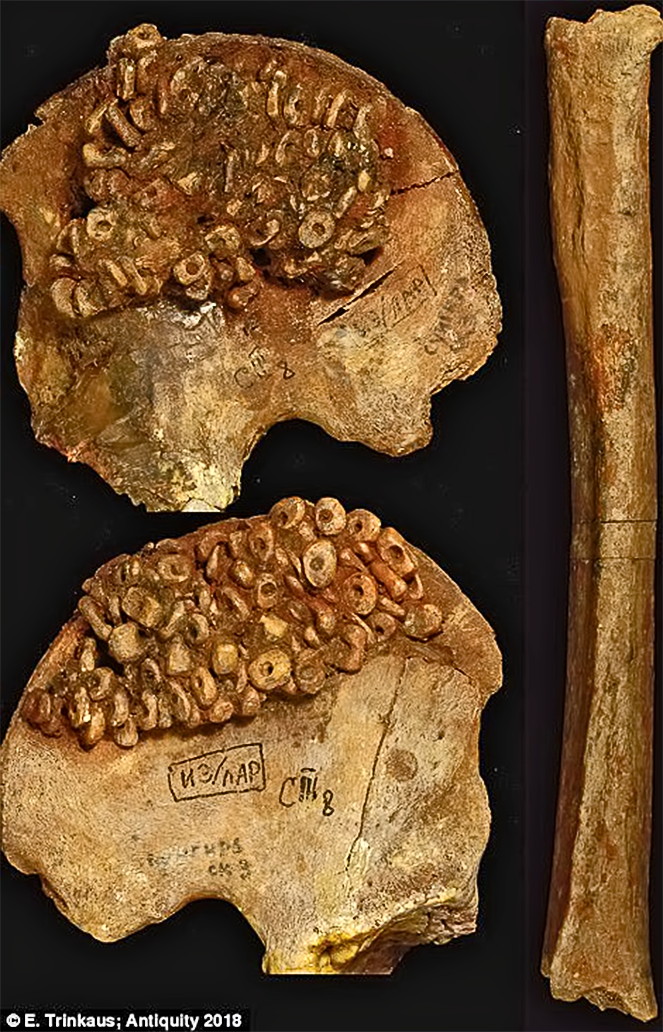
The Sunghir burials were accompanied by huge numbers of carefully made ivory beads.
Photo: © E. Trinkaus, Antiquity 2018
Proximal source: http://www.dailymail.co.uk/sciencetech/article-5397451/Ancient-graves-reveal-disabled-people-treated.html
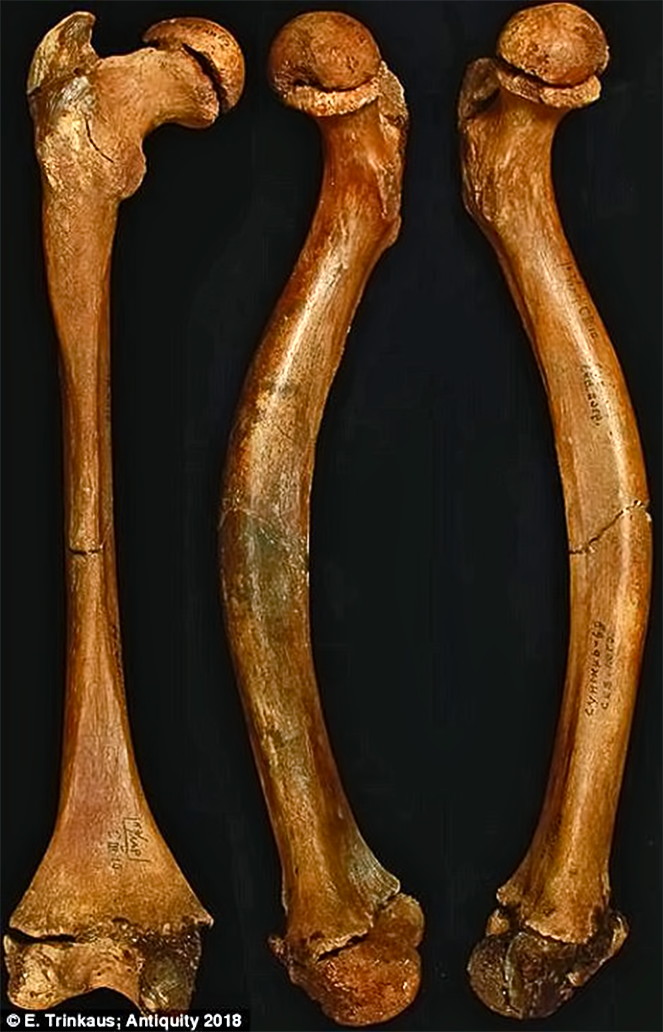
The long bones had a lot to tell about the children buried. The bones (and teeth) revealed much about the way disabled people were treated at the time, scientists have said. Researchers studied the remains of two boys and determined that even though the children were physically disabled they were cared for and received extravagant burials.
Photo: © E. Trinkaus, Antiquity 2018
Proximal source: http://www.dailymail.co.uk/sciencetech/article-5397451/Ancient-graves-reveal-disabled-people-treated.html
Respectful burials
These two boys aren't the only people with disabilities known to have received burials during this time period. 'Indeed, in the Mid Upper Paleolithic, individuals with marked developmental or degenerative abnormalities are relatively common in the burial record, accounting for a third of the sufficiently well-preserved individuals,' the researchers wrote in the study.
However, it was slightly less common for youngsters to receive such a burial during this period, the researchers said.
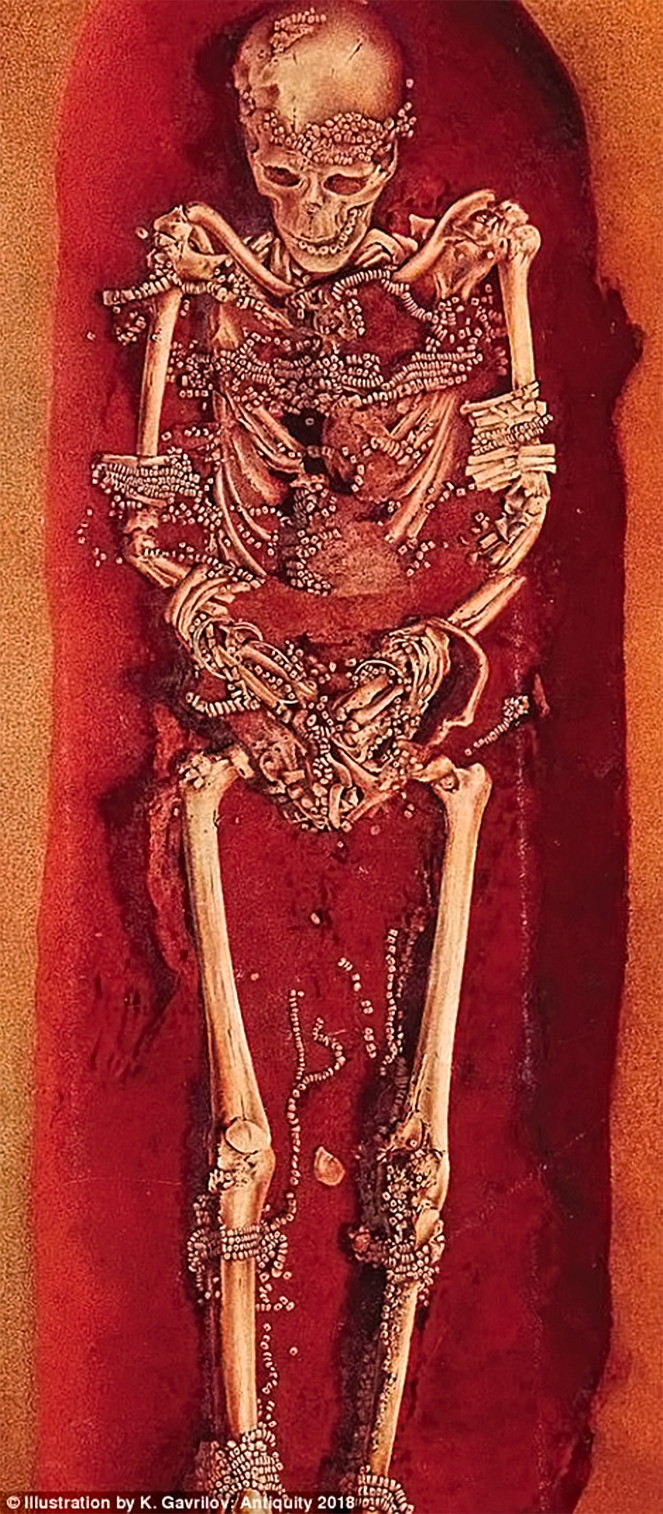
Sungir burial
Photo: © K. Gavrilov, Antiquity 2018
Proximal source: http://www.dailymail.co.uk/sciencetech/article-5397451/Ancient-graves-reveal-disabled-people-treated.html
What really caught the researchers' attention was the diversity of the burial artefacts. Some people had only a few fox canines and mammoth ivory beads, while other individuals didn't have anything. This indicates social complexity, because it shows that people were treated differently in death, and probably in life, too, Trinkaus said.
The finding shows that you didn't have to be a 'big, adult male hunter' to get an extravagant burial during the Mid Upper Palaeolithic, said Lawrence Straus, a distinguished professor emeritus of anthropology at the University of New Mexico, who wasn't involved with the study.
'In this case, adolescents - people with disabilities or pathologies that would have limited their full functioning - are getting some amazing treatment,' Straus told Live Science.
The study was published online in the journal Antiquity, Trinkaus and Buzhilova (2018)
Text above by Laura Geggel, https://www.livescience.com/61743-rich-paleolithic-burials.html
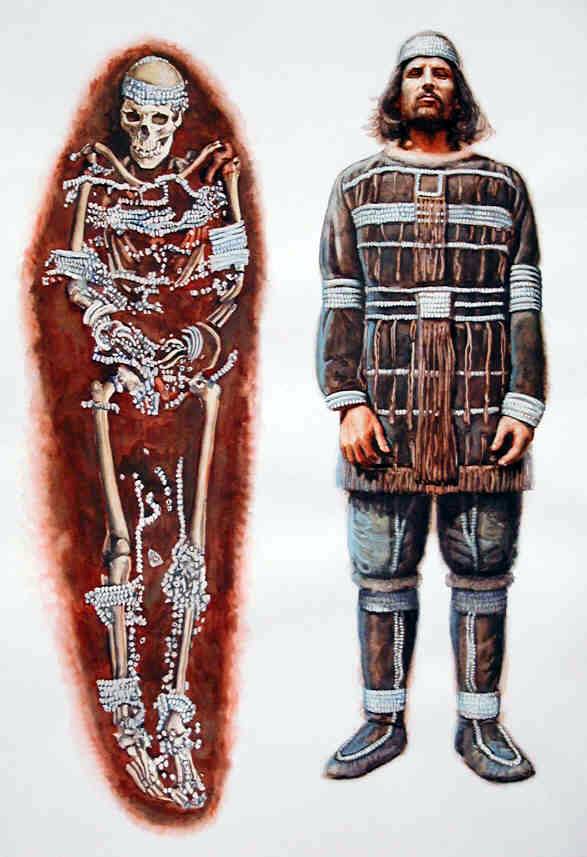
Sungir burial
This is a superb recreation of the Sungir burial above, from a Czech site. The illustration is © Libor Balák
Notice that the artist has drawn a leather tunic, beaded as indicated in the original discovery, combined with beaded leather leggings and high topped moccasins. The fact that the tunic and other items are so copiously beaded bespeaks a rich heritage and a wealthy man. The beads would have taken hundreds of hours to make.
Notice also that in this illustration the mammoth ivory bracelets are shown on top of the sleeves of the tunic. It is more likely, I believe, that they would have been on his arm, below his clothes.
Artist: Illustration © Libor Balák
Photo: http://www.iabrno.cz/agalerie/gravett.htm
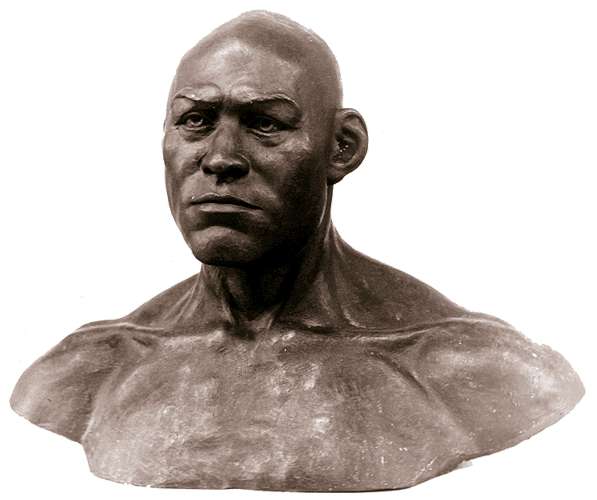
A sculptural reconstruction based on a male skull from the grave 1 (Sunghir 1) was performed by M.M. Gerassimov in 1968.
Photo: http://www.rc.ru/~ladygin/sungir/looked/index.php

Paired right clavicles (cranial view) and humeri (anterior view) for Late Pleistocene humans.
Neandertals: La Ferrassie 1 (Ferr1) and Regourdou 1 (Reg1).
Upper Paleolithic modern humans: Dolní Věstonice 13 (DV13), Pataud 5 (Pat5), and Sunghir 1 (Su1).
Note that for all clavicle–humerus pairs except Regourdou 1, both bone images derive from the same original photograph, and hence there is no issue of scaling distortion.
Photo and text: Trinkaus et al. (2014)

Unmodified single–image photographs of the Sunghir 1 right humerus (anterior view) and clavicle (cranial view) (left), and of the right and left clavicles in cranial view (right), showing the length of the clavicles relative to the humerus.
Note that the proximal and distal ends of the left clavicle are partially reconstructed in wax, whereas the right one only has minor restoration of the distodorsal corner.
Photo and text: Trinkaus et al. (2014)
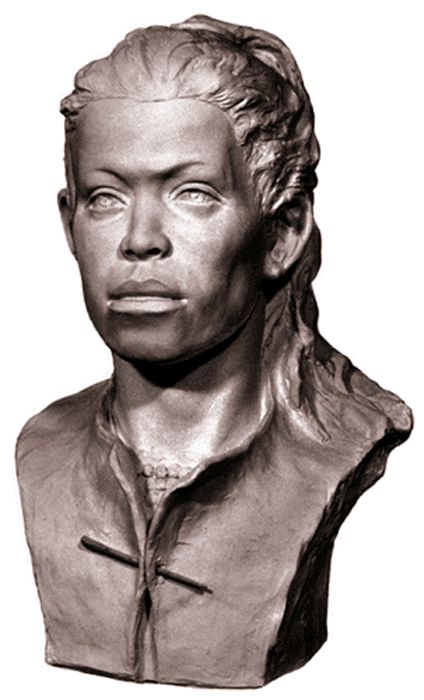
In 1974 the reconstruction of physical appearance of the boy (Sunghir 2) was performed by G.V. Lebedinskaya
Photo: http://www.rc.ru/~ladygin/sungir/looked/index.php

In 1974 the reconstruction of physical appearance of the girl Sunghir 3 was done by T.S. Surnina.
Photo: http://www.rc.ru/~ladygin/sungir/looked/index.php
(Sunghir 4 was headless - Don)
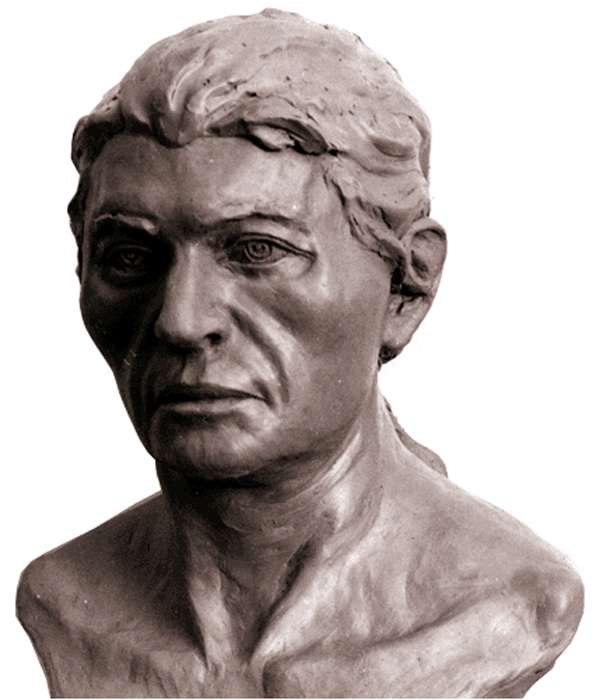
The reconstruction of the appearance of the Sunghir 5 female was proposed by G.V.Lebedinskaya in 1998.
Photo: http://www.rc.ru/~ladygin/sungir/looked/index.php
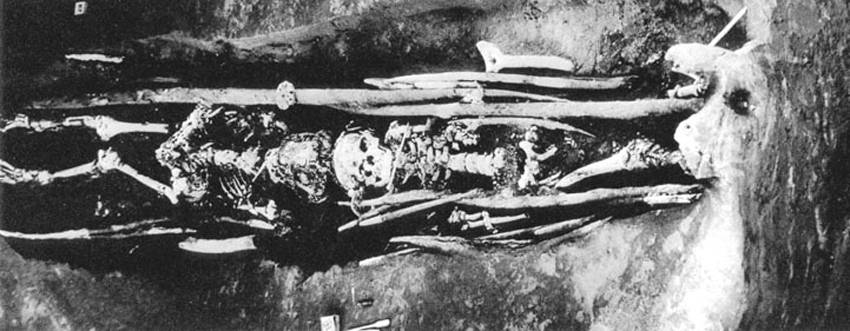 A burial at Sunghir, USSR. Two children, aged 8 and 13, buried head to head with elaborately decorated clothes and other jewellery.
Photo: T.Prideaux, 'Cro-Magnon Man'

Sungir burial
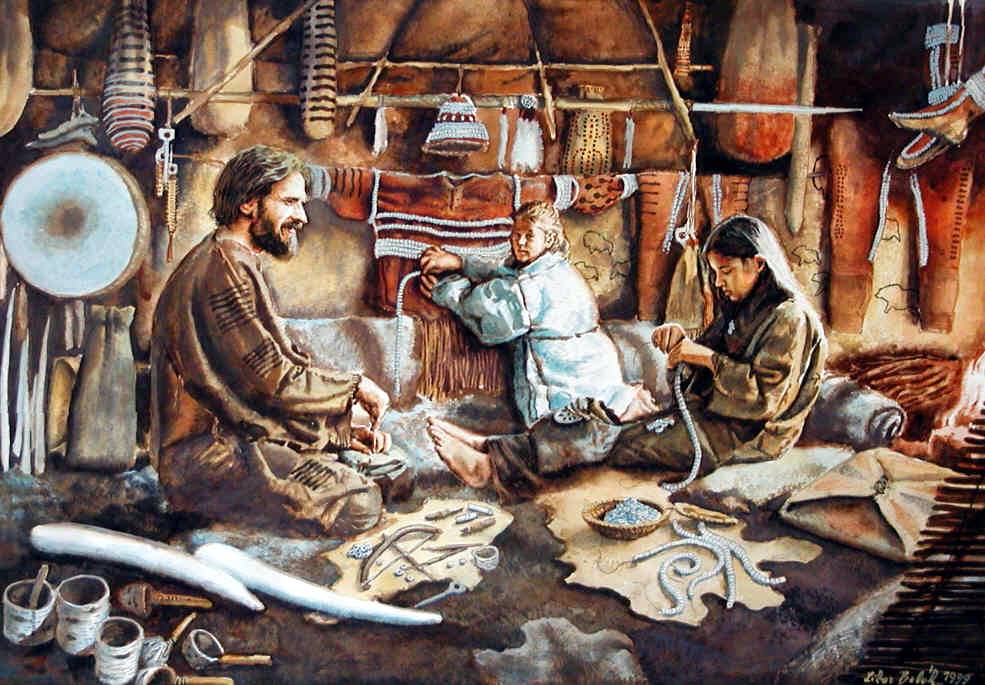
This is another superb recreation of the Sungir burial above, from a Czech site. The illustration is © Libor Balák
Two children, aged 8 and 13, buried head to head with elaborately decorated clothes and other jewellery. Notice that the perforated disc is shown here as being atop a wooden lance. (S2, the 13 year old boy, on the left. S3, the 8 year old girl, on the right.)
Artist: Illustration © Libor Balák
Photo: http://www.iabrno.cz/agalerie/gravett.htm

Ivory wheel from Sungir, possibly originally mounted on a spear. It may have had feathers or other decorations attached using the beautifully carved holes in the disk.
Photo: http://www.istmira.com/foto-i-video-pervobytnoe-obschestvo/3924-iskusstvo-predystorii-pervobytnost-2.html
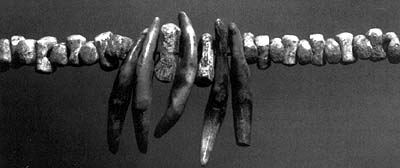
Interlocking Beads of a necklace, from http://www.insticeagestudies.com/library/Ivory/ivory4.html
Photo: Professor Randall White, NYU.
The supposed small boy was covered with strands of beads - 4 903 of them - that were roughly 2/3 the size of the man's beads although of exactly the same form. He also had a beaded cap with some fox teeth. Unlike the man however, he had around his waist - apparently the remains of a decorated belt - more than 250 canine teeth of the polar fox. On his chest was a carved ivory pendant in the form of an animal. At his throat was an ivory pin, apparently the closure of a cloak of some sort. Under his left shoulder was a large ivory sculpture of a mammoth. At his left side lay a medial segment of a highly polished, very robust human femur, the medullary cavity of which was packed full of red ochre. At his right side, and continuing partially alongside the girl was a massive ivory lance, made from a straightened woolly mammoth tusk. It is 2 metres, 40 cm in length, and weighs more than 20 kg. (Given the weight of these objects, I doubt very much if they were functional lances). Near it is a carved ivory disk (Figure 17d) with a central perforation, which sits upright in the soil. As we shall see in the case of the supposed girl's burial, this had apparently been mounted over the tip of a no longer preserved (wooden?) "lance," up to a point a few centimetres from the tip.
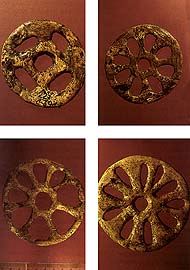
Ivory disks possibly mounted on wooden lances, from http://www.insticeagestudies.com/library/Ivory/ivory4.html
Photo: Professor Randall White, NYU. The supposed girl had 5,274 beads and fragments (also roughly 2/3 the size of the man's beads) covering her body. She also wore a beaded cap and an ivory pin at her throat, but her burial contains no fox teeth whatsoever. Nor does she have a pendant on her chest. However, placed at each of her sides there were a number of small ivory "lances," more appropriate to her body size than that accompanying the boy. Also at her side are two pierced antler batons, one of them decorated with rows of drilled dots. Finally, she was accompanied by a series of three ivory disks with a central hole and carved latticework, like that adjacent to the supposed boy's burial. One of these the size of a quarter, was found on the left side of her head. The other two, much larger, were at her sides accompanying the pointed ivory shafts. One of the pointed ends of the ivory shafts was actually inserted some six inches into the central perforation of one of the disks, a bit like the basket on a ski pole. A linear arrangement of microflakes extending from the disk distally to the point of the lance suggested to Bader (1978) that this had been a lance armed with flint barbs.
Text below from the site http://www.insticeagestudies.com/library/Ivory/ivory4.html which appears to have disappeared.
About 28 000 years ago, the residents of the Russian site of Sungir produced thousands of personal ornaments and a number of ivory carvings in geometric and animal forms. Sungir is one of the oldest known cases in which ornaments are actually found on human skeletons. While inhabiting Sungir, at least nine of the site's occupants perished. According to Russian physical anthropologists the best preserved of these consisted of a 60 year-old man, a 7 to 9 year-old girl, a 13 year-old boy, an unsexed (male?), headless adult and an adult female skull. From my reading of the evidence, the adult burial is clearly an older male. The sex of the adolescents remains ambiguous.
In total, the three most intact burials were lavishly decorated with more than 13,000 painstakingly prepared ivory beads arranged in dozens of strands, perhaps basted to their clothing. Although it is almost certain that the three individuals buried intact at Sungir were members of the same social group, there are remarkable differences among them in details of body decoration and grave offerings. For example, the man's forearms and biceps were each decorated with a series of polished mammoth-ivory bracelets (25 in all), some showing traces of black paint. Around his neck, he wore a small, flat schist pendant painted red, but with a small black dot on one side.
Artist: Illustration © Libor Balák
Photo: http://www.iabrno.cz/agalerie/gravett.htm
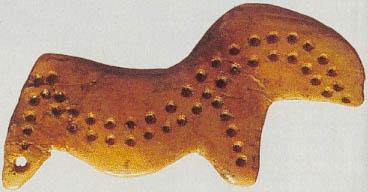
Click on the image to see a close up
The technology of the dominant form of bead production at Sungir was clearly a variation on the Aurignacian assembly-line approach to ivory bead manufacture discussed earlier. However, at Sungir the blanks were scored across the width of each face before the hole was drilled. This caused the beads to fall into a visually impressive interlocking pattern when strung. In other words, the desired esthetic effect was deeply embedded in even the earliest stages of production.
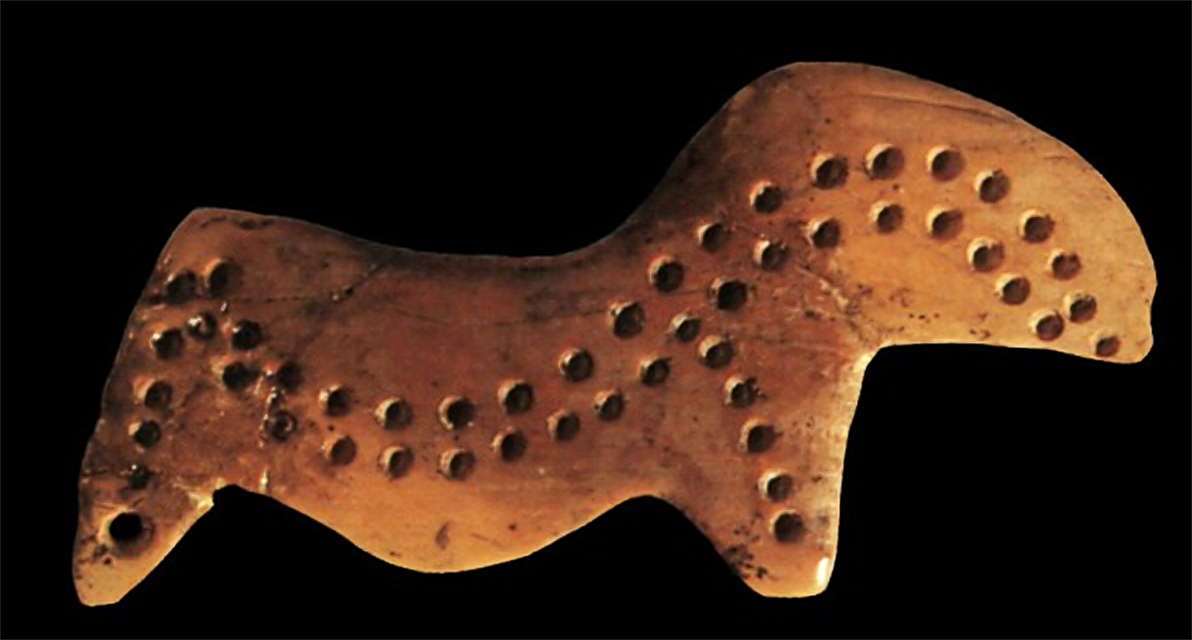
Another version of the horse.
Photo: http://www.istmira.com/foto-i-video-pervobytnoe-obschestvo/3924-iskusstvo-predystorii-pervobytnost-2.html

This animal pendant has marked similarities to the horse figurine above. It appears not to have been finished, or perhaps the artist wanted just an outline, since there appears to be a hole drilled, ready for a cord to be threaded.
Photo: http://www.istmira.com/foto-i-video-pervobytnoe-obschestvo/3924-iskusstvo-predystorii-pervobytnost-2.html
Experiments reveal that each of the ivory beads at Sungir took more than an hour to fabricate. Hence, the man's beadwork took more than 3,000 hours, while that of each child took more than 5,000. Considering additional objects placed on and alongside the corpses, it is clear that each of the childrens' burials had substantially more labor invested in it than that of the man. Based on the differences in grave offerings and labor investment revealed among these burials, we might be justified in inferring that the social system represented at Sungir was an internally differentiated one in which social position was inherited rather than achieved; suggesting that complex social systems arose prior to and independent from economic systems based on agricultural production.
BADER (O.). - Sungir Upper Paleolithic site. Moscow, NAUKA, 1978.
- The boys of Sungir. The Illustrated London News. March 7, 1970, p.24-26.
The next is from a site that no longer exists, originally at http://www.jfegypt.demon.co.uk/bio/new/russia.htm
The glacial period is the time of Homo sapiens origin. Now world science is acquainted with only a few dozen of the Upper Palaeolithic Period archaeological sites. Sungir, discovered by the famous Russian archaeologist O.N. Bader in 1956, is one of the most well known Upper Palaeolithic settlements in Eastern Europe. This site, situated to the north-east of Moscow near the town of Vladimir, is one of the northernmost late glacial settlements of Eastern Europe.
Sungir is one of the earliest human settlements at high latitude; radiocarbon data determined this site age to be approximately 30,000 BP. Some patterns of ground geomorphology and the cultural layers content give us information about a cold arid climate and steppe forest- steppe landscape. Judging by mammoth, deer, and horse bone finds, Sungir humans were hunters. They also hunted reindeer and polar fox.
This settlement has gained world popularity due to the opening of unique individual burials. In the graves are splendidly preserved assemblages of people, hunting weapons, including a spear from a straightened tusk of a mammoth (2.4m), animal figures and thousands of beads from mammoth tusks which decorated cloth. The bead position gives some clue about the garment's cut. These ancient people may have had some knowledge of counting and the lunar calendar.
The Institute of Archaeology, Russian Academy of Sciences conducted more than thirty years of field studies. The settlement has been excavated to a total area of 4500 square metres. The Sungir findings have become famous in different publications as one of the earliest examples of the custom of preparing rich, time consuming burials.
Human skeletal remains from Sungir are of unique importance. Without these materials it is difficult to understand the world of Palaeolithic humans in Europe. Complex palaeoanthropological and archaeological investigations can highlight some patterns of lifestyle as well as the type of physical activity, occupation, diet and health.
At the moment five skeletons are kept in the Institute of Ethnology and Anthropology, Moscow. Some aspects of anthropological investigations have already been made but a complete description of every individual has been absent until now.
http://www.geocities.com/Athens/Acropolis/5579/week9archrecordsocialstructure.html
Sungir - This site dates to 28,000 years ago and is located in Russia. In addition to occupation evidence, the site contains several burials dug into the living surface of the site. All of the bodies were laid on their backs with their hands crossed over their pelvises.
One pit contained the skeleton of a 60-year-old man. He was buried with 2,936 ivory beads in strands all over his body, including what appears to be a bead cap on his head. The "cap" also contained 6 fox teeth. A series of bone bracelets was found on his arms. The bracelets were painted both red and black. Around his neck, he wore a small stone smeared with red ocher. (Ocher is a naturally occurring pigment that is often found in burials.)
Two other burials were found placed head to head in one trench. Researchers estimate these children were 13 and 8 years old. The 13-year-old was buried with 4,900 ivory beads, including a bead cap with fox teeth. This individual, which is often thought to be a boy, also wore a belt with 250 fox canine teeth. On the chest was an ivory pendant carved in the shape of a mammoth, and on its left shoulder was a sculpture of a mammoth. Next to the skeleton was a full-sized lance made from a mammoth tusk.
The 8-year-old, which is thought by many to be a girl, was buried with over 5,200 beads and a bead cap without any fox teeth. This burial also lacked any pendant or necklace. It does, however, have several miniature lances and a pierced object made from antler and decorated with drilled holes. This grave also contained four ivory disks that have a latticework pattern carved into them and a hole drilled into their centers.
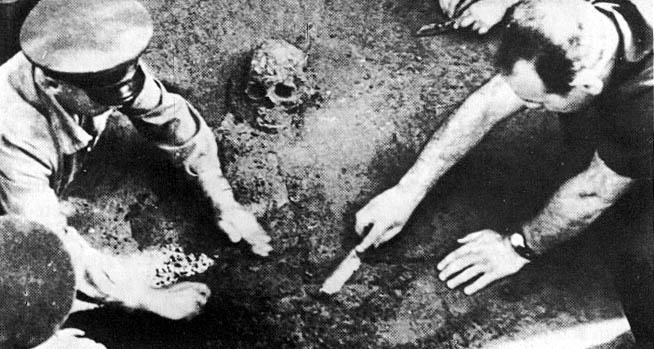
The first of the Sungir burials as it was unearthed in 1964, preserved below the permafrost in a grave stained bright red with ocher. The burial was of an elderly man clad in lavishly beaded fur clothing dating to at least 23 000 BC
Photo and text: Secrets of the Ice Age by Evan Hadingham, 1980

View of the most spectacular discovery at Sungir in 1969, the burial of two boys laid head-to-head with a rich array of beaded clothing, ornaments and weapons.
One of the most remarkable recent finds took place in the suburbs of Vladimir near Moscow, at a site known as Sungir. It consisted of a large Upper Paleolithic settlement and a cemetery with a number of well-preserved burials, dating to about 23 000 BC. The most spectacular grave, revealed in 1969, contained the bodies of two boys, one aged seven to nine, the other twelve to thirteen, laid head-to-head in the trench. This burial was removed from the ground in one great block weighing several tons and was taken to a Moscow laboratory, where it was painstakingly examined. The skeletons of the boys were covered with thousands of pierced mammoth ivory beads, which were once sewn onto their clothing as ornaments. The boys wore headdresses decorated with these beads, together with the canine teeth of polar foxes. There were embellishments in the form of bracelets, rings, chest plaques, and other objects, all of bone, while the boys were equipped with a formidable armory of sixteen spears, darts, and daggers. Several of these spears were heavy objects, magnificently worked from mammoth ivory to a length of over two meters.
Photo and text: Secrets of the Ice Age by Evan Hadingham, 1980
Text below adapted from:
http://anthropik.com/2006/03/exceptions-that-prove-the-rule-3-paleolithic-royalty/
The archaeological dig at Sungir in Russia has yielded evidence which would seem to belie the claim that rulers are a new and anomolous development for human societies. Specifically, two children - a male and a female - found decorated with thousands of ivory beads; as Richard Klein writes, "Experimentation suggests that the beads alone required thousands of hours to manufacture." Yet these were children. They did not have such time in their short lives; neither did they have time to earn a reputation on their own merits. For such a lavish burial for two people so young, we are obviously looking at evidence of inherited power and prestige from the Upper Paleolithic, 26 - 22 thousand years ago.
Klein describes the site thus:
The Sungir grave was dug into permanently frozen subsoil (permafrost) more than 22 thousand years ago and contained the extended skeletons of two children, one arguably male and the other female, placed head-to-head. The putative male was covered with 4903 beads whose arrangement suggests they were fitted to closely fitting clothing. In addition, there were 250 perforated fox canines placed as if they had been attached to a belt at the waist....The putative female was covered and surrounded by 5374 beads or bead fragments that were also probably attached to clothing.....Experimentation suggests that the beads alone required thousands of hours to manufacture.
Archaeologically, the signs of royalty could not be clearer. A fairly slanted site called, "Man's Conquest of Nature" offers the usual interpretation of Sungir:
These children must have had a special social status or role. Either they belonged to something very like a royal family or they must have been chosen to be buried (perhaps sacrificed) as part of an important communal rite - nothing else could justify the labour entailed in the grave clothes. Either way, we are now looking at a human society much more like those of historical time - a community including many individuals (perhaps thousands) who were not closely related to one another, yet felt they belonged to a common social unit with a hierarchical structure. The larger social unit must have made possible a much greater division of labour than had previously existed.
In The Mind in the Cave, David Lewis-Williams cites Sungir as evidence that humanity's natural state is subject to a ruler. He cites this as one of the cognitive "advantages" we enjoyed over Neanderthals, leading to our success and their failure. But if the human condition is so amenable to rulership, why is the royal burial at Sungir so exceptional? Why have we not found more burials like it?
Lewis-Williams himself unwittingly offers us the reason why. Sungir was situated along the mammoth migratory routes. There was such a glut of mammoth meat once a year that these foragers could afford to remain stationary. They developed a complex society, including royalty.
Straightening of mammoth tusks:
Text below from the site http://www.insticeagestudies.com/library/Ivory/ivory2d.html which appears to have disappeared.
In my experience, there is no archaeological evidence before Sungir (dating to ca. 28-25,000 BP or earlier) for the preparation of whole tusks by softening (heating, boiling), which would have allowed the ivory to have been more easily worked. Even at Sungir however, the operational chain for bead production (White 1993) seems not to have employed thoroughly softened ivory. Simple soaking of tusks in water has only superficial effects. However, once the tusk is reduced to much thinner fragments, such soaking can penetrate the entire thickness, making drilling, scraping and gouging much easier. This soaking also works well on subfossil tusk fragments. Comparison of our experimental sample with actual Aurignacian production debris indicates clearly the use of water in the final stages of bead production.
Professor Randall White, NYU.
References
- Abramova Z., 1995: L'Art paléolithique d'Europe orientale et de Sibérie., Grenoble: Jérôme Millon.
- Formicola V., Buzhilova AP., 2004: Double child burial from Sunghir (Russia): pathology and inferences for upper paleolithic funerary practices, Am. J. Phys. Anthropol., 2004 Jul;124(3):189-98.
- Trinkaus, E., Holliday T., Auerbach B., 2014: Neandertal clavicle length PNAS, 2014 ; published ahead of print March 10, 2014
- Trinkaus, E., Buzhilova A., 2018: Diversity and differential disposal of the dead at Sunghir, Antiquity, Volume 92, Issue 361 February 2018 , pp. 7-21, https://doi.org/10.15184/aqy.2017.223 Published online: 09 February 2018