Back to Don's Maps
Back to Dolni Vestonice main page
Dolni Vestonice Jewellery, Pottery, Tools and other artifacts
 Venus figures from Dolní Věstonice
Jewellery

Necklace of pierced Arctic Fox teeth.
Photo: Don Hitchcock 2008
Source: Apparently originals, display, Dolní Věstonice Museum
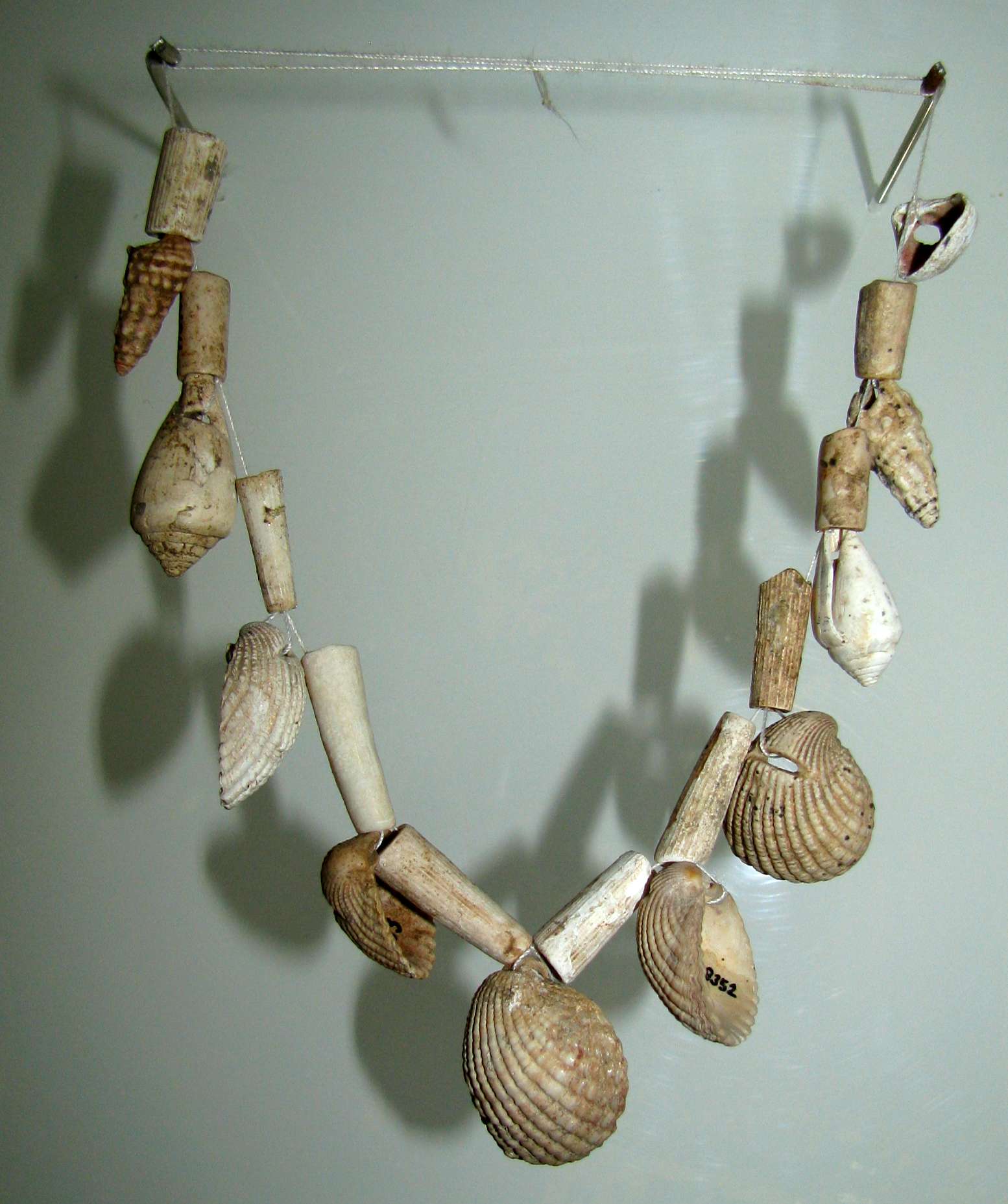
Necklace of shells. Some appear to be from the nearby Jurassic limestone hills, dug from the ground at the time of completion of the necklace, and are typically a dull or white colour.
I have marked with a red spot some others which may be contemporaneous with the original construction of the necklace, taken from the far distant seashore some 27 000 years ago. If that is the case, they would have been very valuable at the time.
If you click on the image you may see the necklace in a larger format, without the red spots. Most images on this page have a high definition version, obtained by clicking on the thumbnail.
Photo: Don Hitchcock 2008
Source: Apparently originals, display, Dolní Věstonice Museum
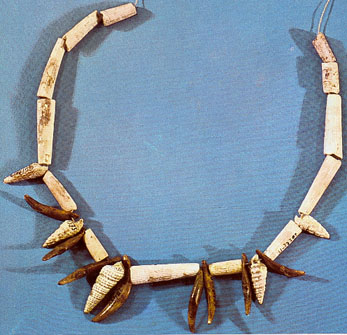
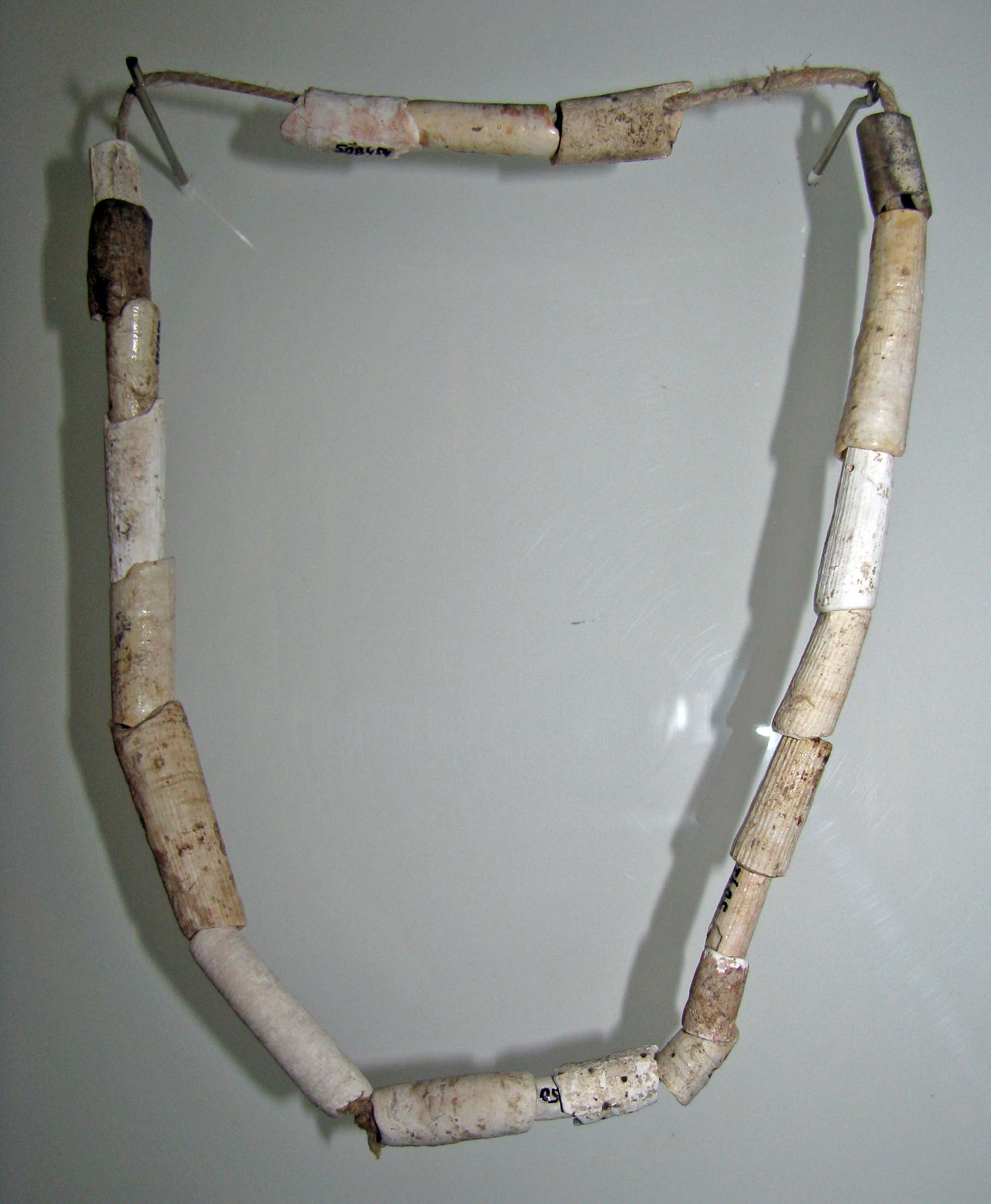
(left) Necklace made of fossil Dentalium badense shells and teeth of the arctic fox, Dolní Věstonice.
Photo: Jelinek (1975)
(right) Necklace of fossil Dentalium badense shells. These would have come from the large deposits of Jurassic Limestone which form the peaks just behind the Dolní Věstonice / Pavlov deposits.
Photo: Don Hitchcock 2008
Source: Apparently originals, display, Dolní Věstonice Museum
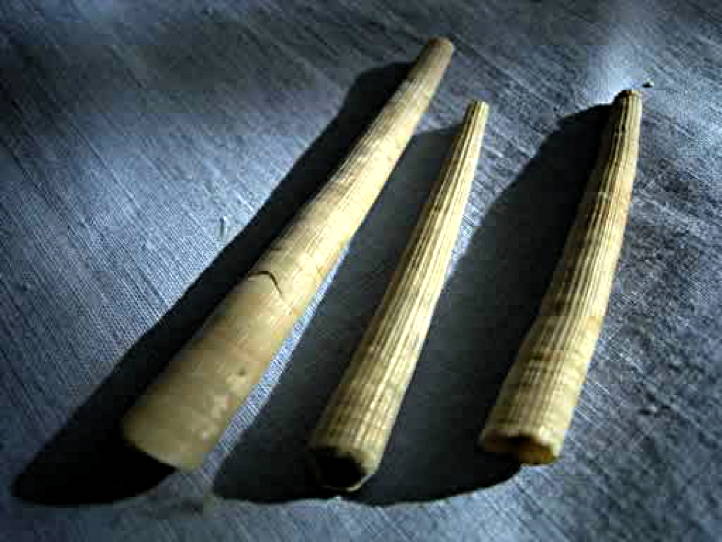
Dentalium badense fossil shells.
Their modern descendants are still highly prized as jewellery, and are commonly used by Native North American artists. They are often referred to as tusk shells or tooth shells, and are used in indigenous jewellery and personal decoration in Western Canada and the United States.
Photo: http://www.oocities.org/fossil_sharks_from_transylvania/Other_fossils_html/Dentalium_badense.htm
The modern equivalent is Antalis pretiosum, which occurs from Alaska to Baja California, but were mostly harvested, because of (only just!) suitable local tidal and sea conditions, off the coast of Vancouver Island. They were regarded as very precious, and were widely traded. These tusk shells are a kind of seashell, specifically the shells of scaphopod mollusks. The name 'dentalium' is based on the scientific name for the genus Dentalium, but because the taxonomy has changed over time, not all of the species used are still placed in that genus, however all of the species are certainly in the family Dentaliidae.
This 'Indian Money Shell', Antalis pretiosum, was formerly Dentalium pretiosum. It has a smooth shell, and lacks the longitudinal linear sculpture of a true Dentalium, and for this reason amongst others was transferred to the Antalis genus (Ron Shimek, pers. comm).
'Dentalium' shells in the trade now are mostly Asian, and of inferior quality.
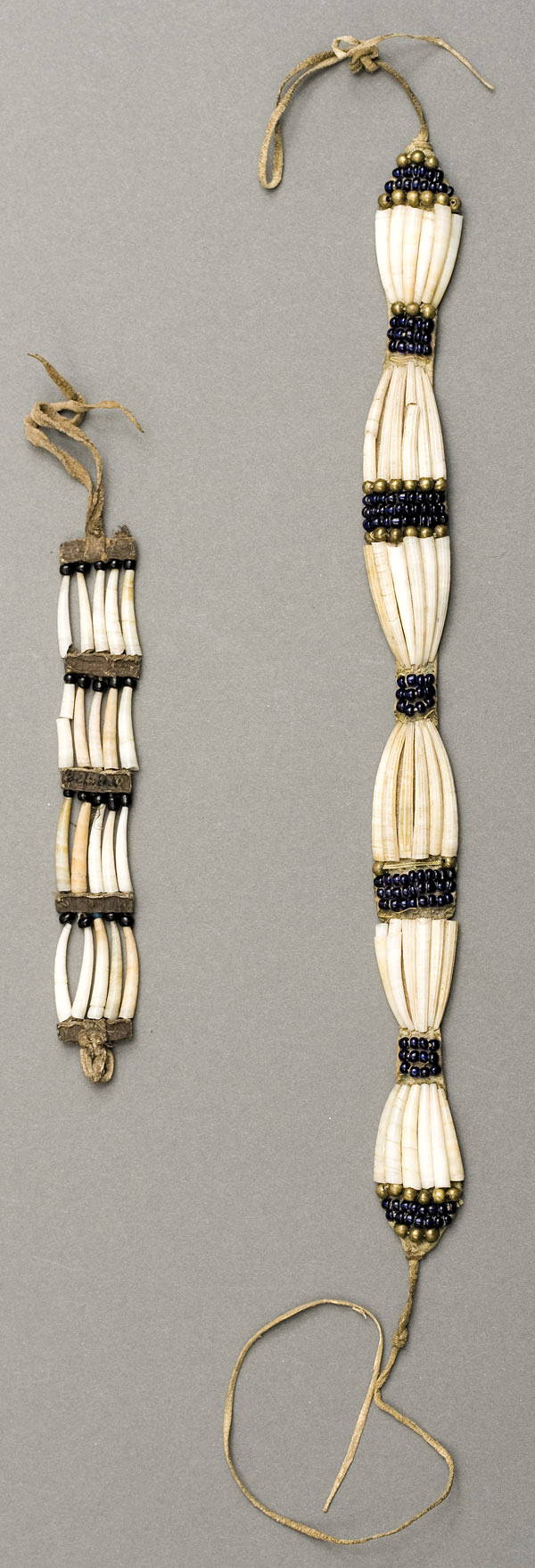
In the Pacific Northwest, 'dentalium' shells were only available from the Pacific coast of Vancouver Island. They were an indicator of wealth and were highly prized. 'dentalium' shells were used as decorative elements on clothing accessories and for personal adornment. This wawáq’aqt or choker is from the Rydryck Collection, and combines 'dentalium' shells, blue glass beads and brass beads sewn onto a single piece of leather with buckskin ties. The bracelet on the left is from the Spalding-Allen Collection and combines 'dentalium shells,' black pony beads and leather spacers with buckskin ties. It is assembled with sinew.
Choker Plateau c 1875-1900 Shell (Antalis pretiosum, glass beads, sinew, brass beads. L 33 cm. Nez Perce National Historical Park, NEPE 2194
Bracelet 1830s Shell (Antalis pretiosum), glass beads, leather. L 26 cm.
Nez Perce National Historical Park, NEPE 8762
Date: 1875-1900
Photo: Nez Perce National Historical Park, NEPE 8762
Permission: This work is in the public domain in the United States because it is a work of the United States Federal Government.
Text: Partly adapted from Wikipedia.
The following is an edited personal communication from Ron Shimek, a leading researcher in scaphopod research, when I asked him about the grooves on some of the shells in the wikipedia image of the traditional native american choker and bracelet above. My thanks for his clear explanations and vast specific and general knowledge on this topic.

Dentalium dentale.
Photo: http://www.thais.it/conchiglie/mediterraneo/schede/sc_00339_uk.htm
The Wikipedia image is of an item made rather late in period of the use of these shells. I suspect, by the type of trade beads used, that it was made in the late 1800s. The shells with grooves are not Antalis pretiosum (which is always smooth). By the end of the nineteenth century most of the tribes that used the dentalium shells as decoration were being settled on what were called 'reservations', and the trade in the shells from the west coast of North America was largely over. However, there still was a demand for the shells, and there still were a lot of shells in circulation.Text on scaphopods above: Ron Shimek
By this time traders were bringing in dentalium shells from Europe or New England. Most of the shells the traders brought in were Antalis entale from the North Atlantic. These are effectively indistinguishable from Antalis pretiosum. The two species are probably descendant from an ancestor that lived in the Arctic Ocean prior to the ice ages, perhaps a couple of million years ago. However, not all of the shells that the white traders imported were Antalis entale, some were the European species Dentalium dentale as shown in the image above, with distinct grooves/ridges.
The reason the name change occurred from Dentalium pretiosum to Antalis pretiosum was due to a re-examination of the various scaphopod species by some taxonomists in the late 1980s.
The first scaphopod to be given a scientific name was Dentalium dentale, named by the original taxonomist, Carl Linnaeus in 1766. In doing so, he defined the genus 'Dentalium' as having longitudinal ribs or ridges. That definition meant that all species given the name Dentalium should bear ridges. Later some other taxonomists, (H. Adams & A. Adams, 1854) realizing that many scaphopods didn't have ridges, created (or defined) the genus Antalis in 1854. Antalis differed from Dentalium primarily in that it lacked the 'characteristic' ridges found on Dentalium. The Adams' description used as the 'type', or the formal example of the 'typical' species, a species that had been called Dentalium entale, which henceforth was to be called Antalis entale.
The Adams' changes in the names were reasonable and valid, and should have been immediately accepted, but because no specialists were working with the group, the use of names in the group remained static and incorrect.
In 1983 I and several other researchers started some research on scaphopods. I worked mostly on the natural history and ecological interactions of the scaphopods in the NE Pacific, Gerhard Steiner worked on anatomy and taxonomy, and mostly worked on European animals, Pat Reynolds worked on physiology also mostly on the NE Pacific critters, and there were some others as well.
Steiner re-evaluated the taxonomy and revised most of the European and Atlantic species giving them the proper names (in this case, Antalis instead of Dentalium). I did the same for the NE Pacific.
Those interested in the scaphopods may like to follow these links to obtain references to published articles :
Patrick Reynolds http://academics.hamilton.edu/biology/preynold/default.html
Gerhard Steiner http://pubget.com/search?q=authors%3A%22Gerhard%20Steiner%22
Ron Shimek http://ronshimek.com/scaphopod.html
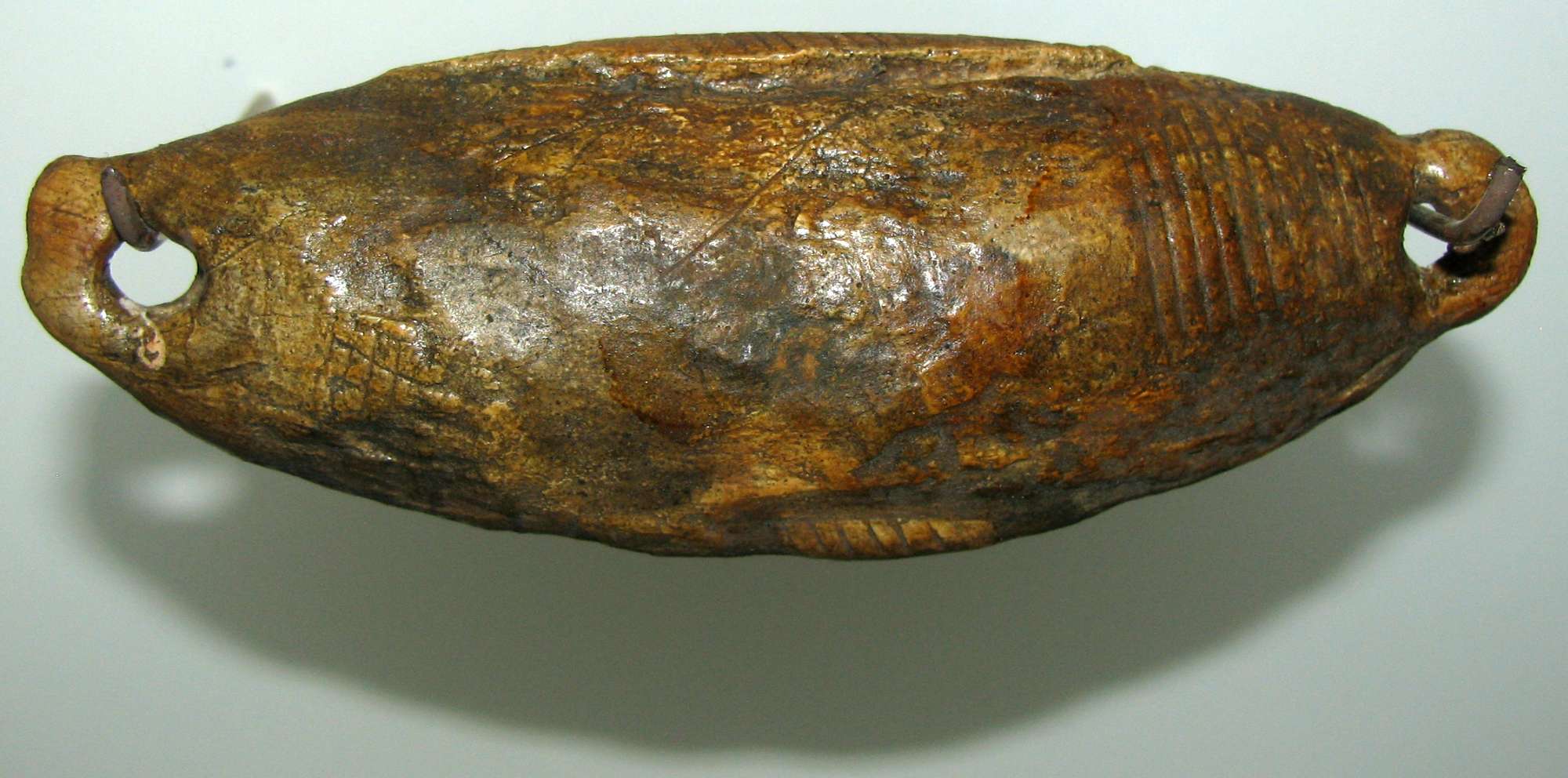
Carved ornament, possibly for the neck or forehead.
Photo: Don Hitchcock 2008
Source: Facsimile, display, Dolní Věstonice Museum

Predmost bone pendant, 28 000 BP - 29 000 BP.
Photo: Don Hitchcock 2015
Source and text: Facsimile, Monrepos Archäologisches Forschungszentrum und Museum, Neuwied, Germany
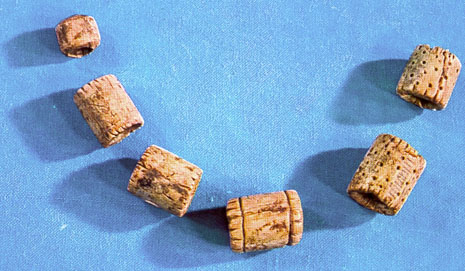
Necklace made of small perforated and decorated cylinders of mammoth ivory, Dolní Věstonice.
Photo: Jelinek (1975)
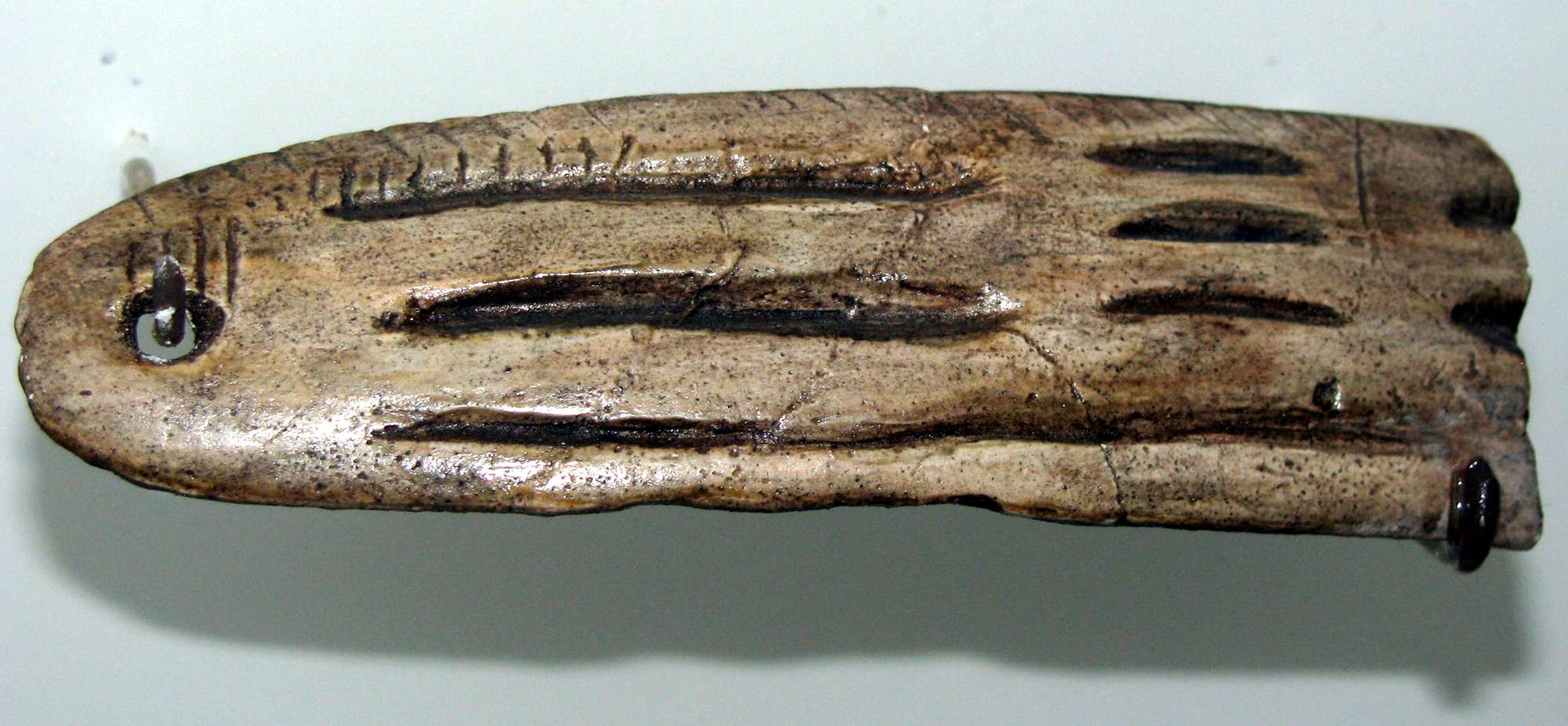
Carved pendant.
Photo: Don Hitchcock 2008
Source: Facsimile, display, Dolní Věstonice Museum
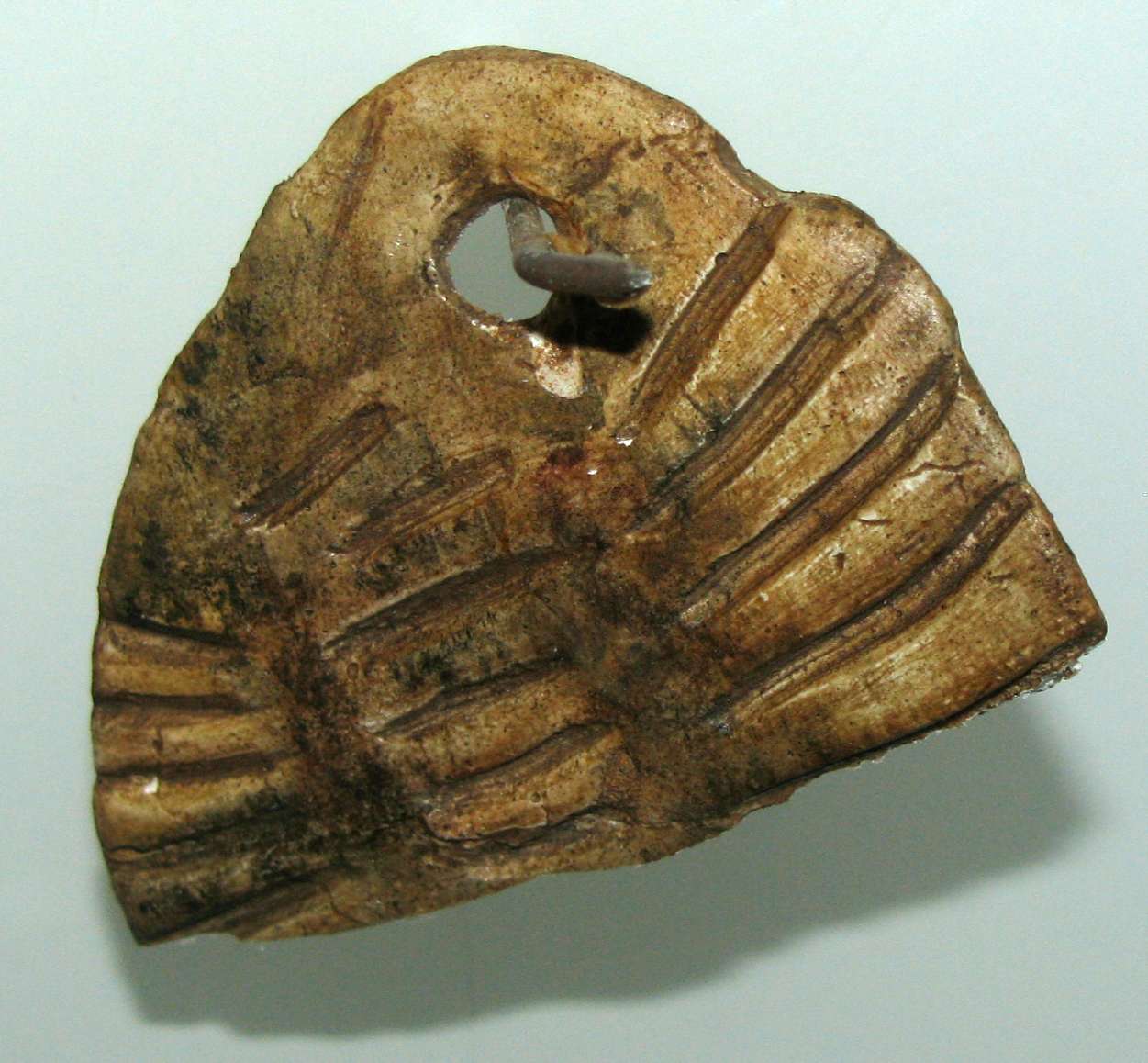
Fragment of what may have been an item worn around the neck, or a decoration on the head or forehead. From the shape, I would expect it would have been worn horizontally, with a hole for a thread at each end.
Body ornaments of this type are believed by some researchers to confer protection of some kind, depending on the particular design.
But perhaps they were worn for adornment only, as is the case today.
Photo: Don Hitchcock 2008
Source: Facsimile, display, Dolní Věstonice Museum

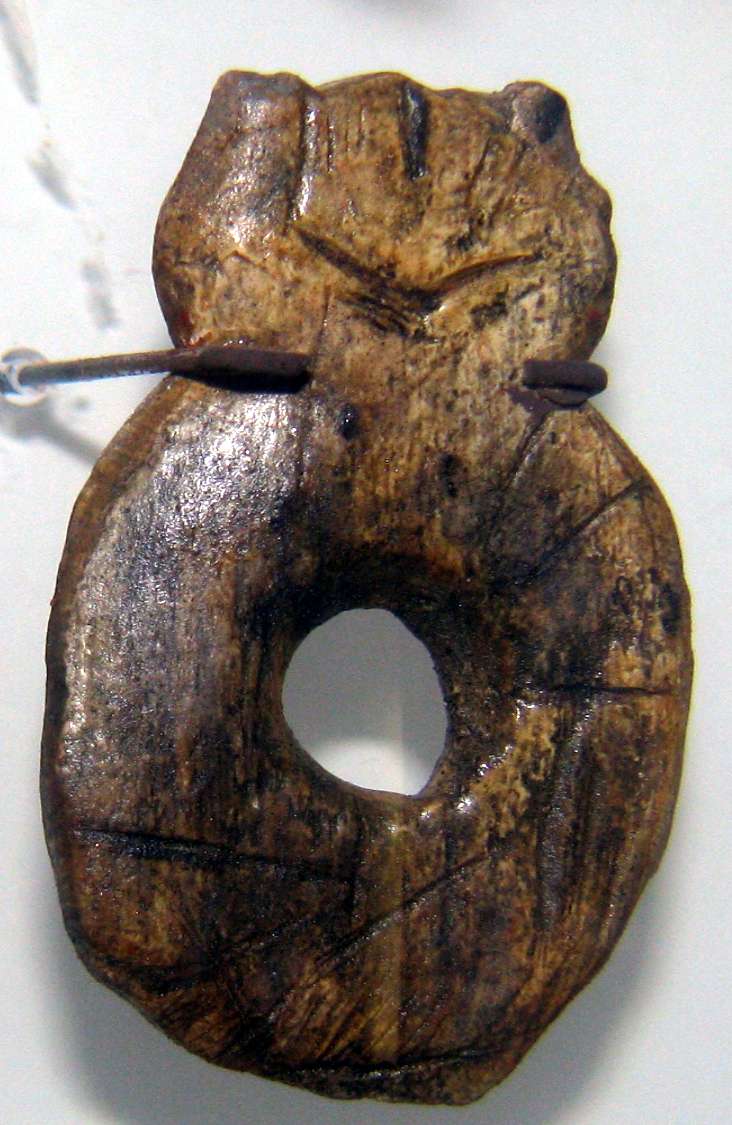
Pendant representing an owl.
Photo: Don Hitchcock 2008
Source: Facsimile, display, Dolní Věstonice Museum
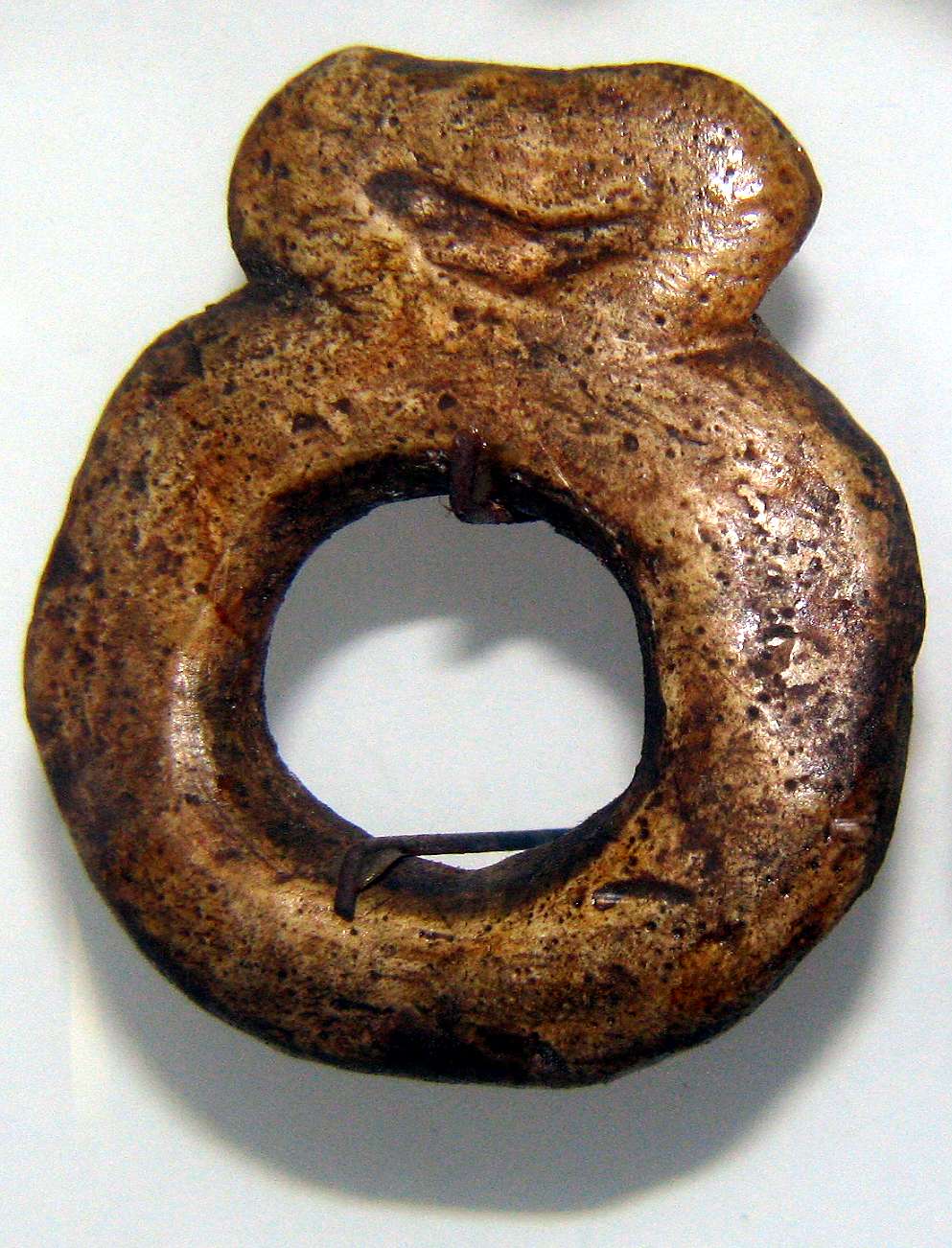
Close beside the first owl, and under the same magnifying glass, was this very similar owl pendant, I believe by the same sculptor.
These are fascinating objects. In some societies, such as British and Japanese, the owl is seen as wise. In others, such as the Romanian society, seeing an owl is a foretelling of a death in the family.
In the 1967 novel by Margaret Craven, "I Heard the Owl Call My Name" about a young missionary in a remote area of British Columbia, hearing an owl "call your name" is a foretelling of your own imminent death to the indigenous Canadian people.
I can't help but wonder how the owl was perceived in the Dolni Vestonice / Pavlov area, 27 000 years ago.
Was the owl seen as wise, perhaps? And if so, was the amulet worn in order to distinguish a wise person, or in order to confer wisdom?
Or did it have some other significance entirely? Did it confer protection of some kind? Surely we shall never know.
Photo: Don Hitchcock 2008
Source: Facsimile, display, Dolní Věstonice Museum

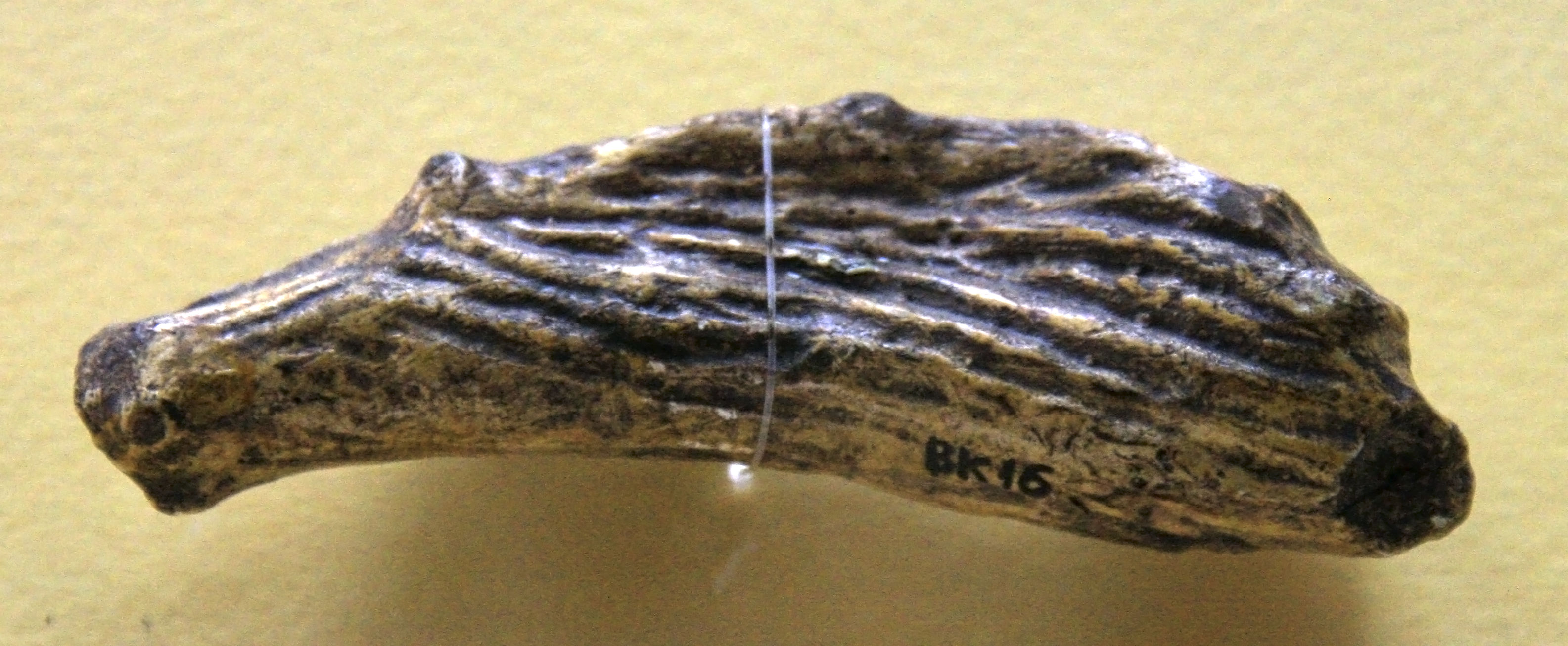
This relatively large carved object may have been worn on the chest, or, given its curvature, as a headpiece.
Photo: Don Hitchcock 2008
Source: Facsimile, display, Dolní Věstonice Museum
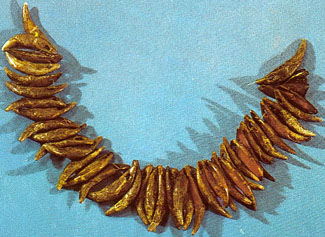
Necklace made of teeth from arctic foxes, Dolní Věstonice.
Photo: Jelinek (1975)

Necklace of spiral shells.
These facsimile shells are of Zebrina varnensis, a terrestrial species found in dry shrub, weed, and steppe vegetation, often on and around limestone rocks.
I am very grateful to Professor Dr. Matthijs Vos, Universität Bochum, Fakultät für Biologie und Biotechnologie, Lehrstuhl für Evolutionsökologie und Biodiversität der Tiere and Professor Dr. Menno Schilthuizen, Senior researcher, 'Endless Forms' group, Naturalis Biodiversity Center and Leiden University for this authoritative identification.
These specimens displayed for the most part on orange or black leather are functional replicas made for the "Úsvit géniů" documentary. (Personal Communication from Filip Brichta, actor-experimenter and consultant for the film - Don)
Photo: Don Hitchcock 2008
Source: Facsimiles, Dolní Věstonice Museum
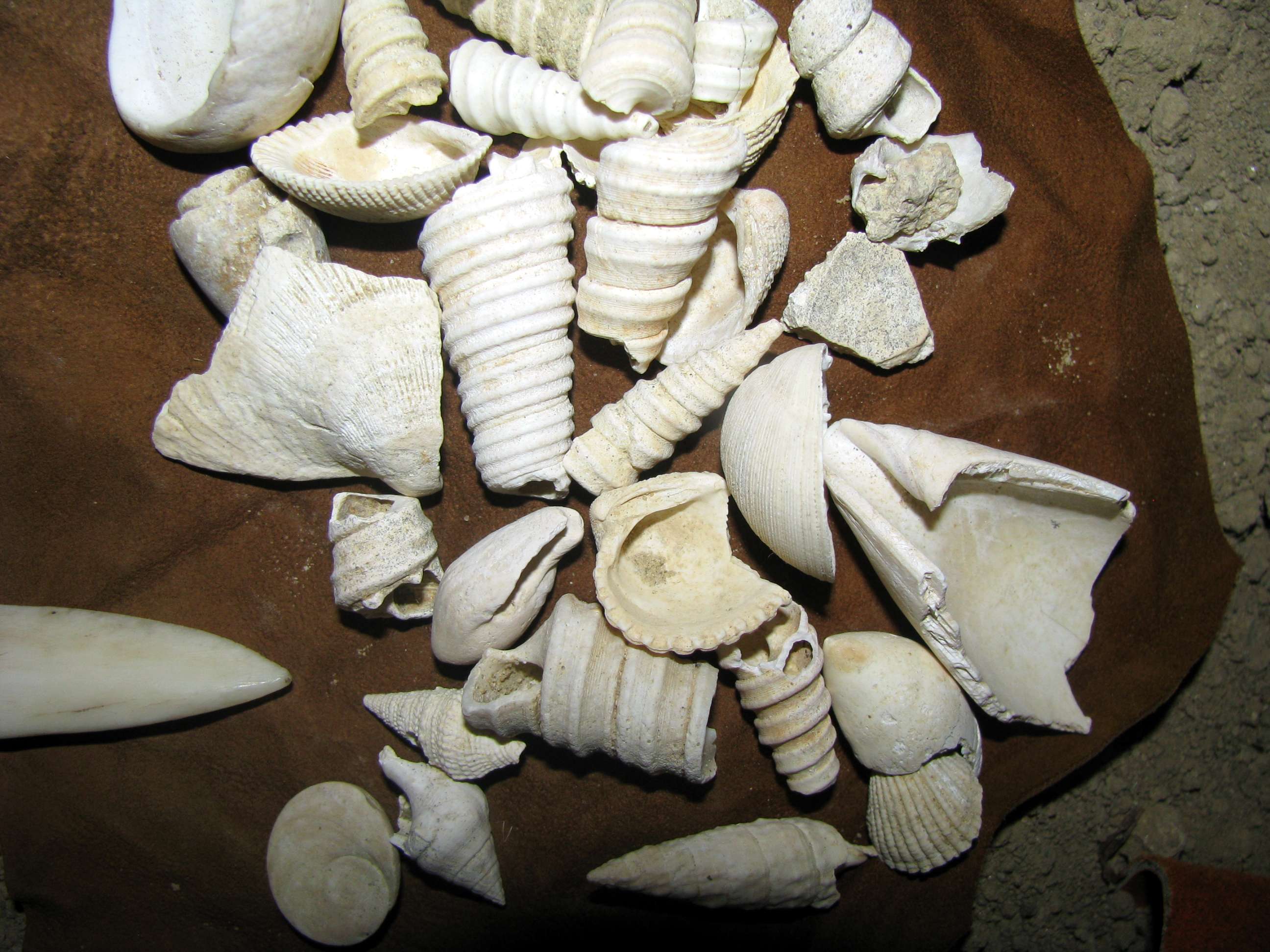
Presumably fossil shells extracted from the Jurassic limestone deposit nearby.
These specimens displayed for the most part on orange or black leather are functional replicas made for the "Úsvit géniů" documentary. (Personal Communication from Filip Brichta, actor-experimenter and consultant for the film - Don)
It would be interesting to know how the shells were extracted from the limestone with minimal damage by the original inhabitants. They may have been extracted naturally by acid water lying on the limestone in swamps, and then been available for the taking, although the documentary makers who produced these particular shells for the film would have had access to modern methods, of course.
Photo: Don Hitchcock 2008
Source: Facsimiles, display, Dolní Věstonice Museum
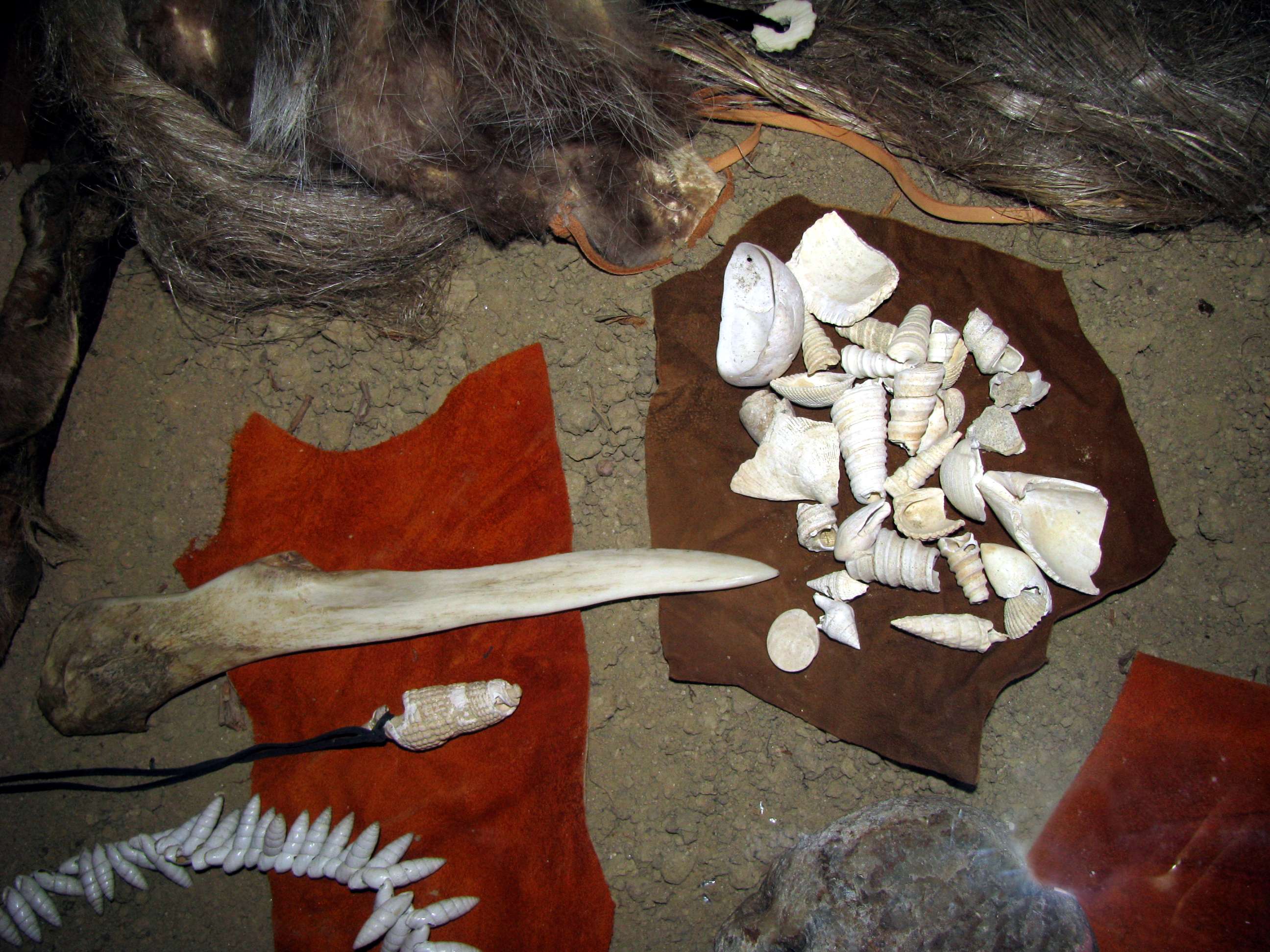
The display was beautifully put together, with a combination of modern materials such as hair and wood and leather and feathers, mixed with the recovered artefacts.
Photo: Don Hitchcock 2008
Source: Facsimiles, mixed with modern materials, display, Dolní Věstonice Museum, put together for the "Úsvit géniů" documentary.
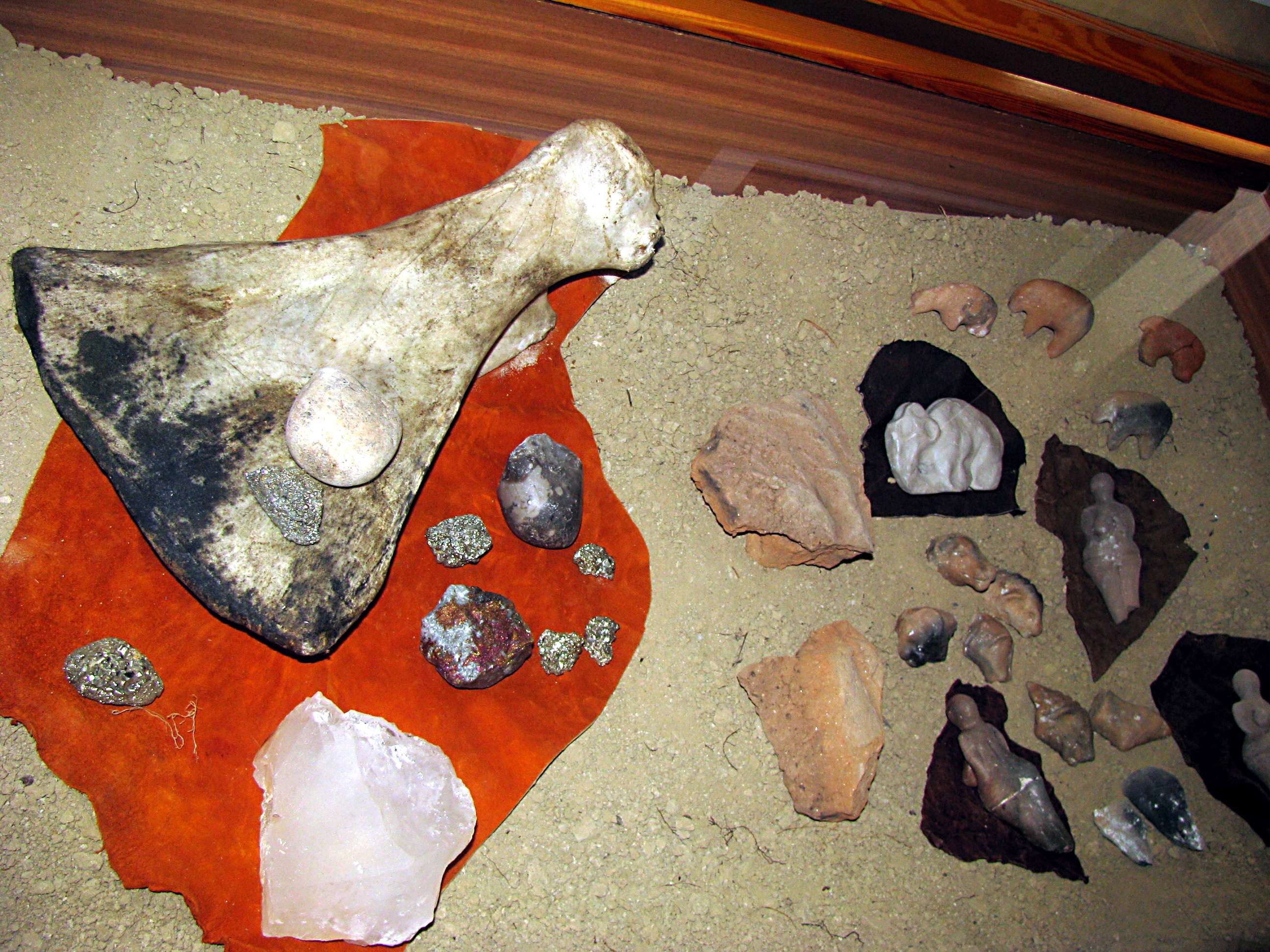
This display, though lacking an interpretation card, shows some of the materials used by the inhabitants of Pavlov and Dolni Vestonice, as well as some of the artefacts they created.
On the mammoth scapula we can see a hammer stone beside a piece of what may be iron pyrites, FeS2 which when struck by the stone would produce a spark sufficient to start a fire in specially prepared dry tinder.
There is also a brightly coloured iridescent specimen of the much less common Peacock ore, which may be either chalcopyrites CuFeS2 or the true peacock ore, Bornite, Cu5FeS4. Marcasite has the same chemical formula as Iron Pyrites, but occurs in a different crystalline structure, and may be better in some cases to create fire.
These specimens displayed for the most part on orange or black leather are functional replicas made for the "Úsvit géniů" documentary. (Personal Communication from Filip Brichta, actor-experimenter and consultant for the film - Don)
Photo: Don Hitchcock 2008
Source: Facsimiles, mixed with modern materials, display, Dolní Věstonice Museum
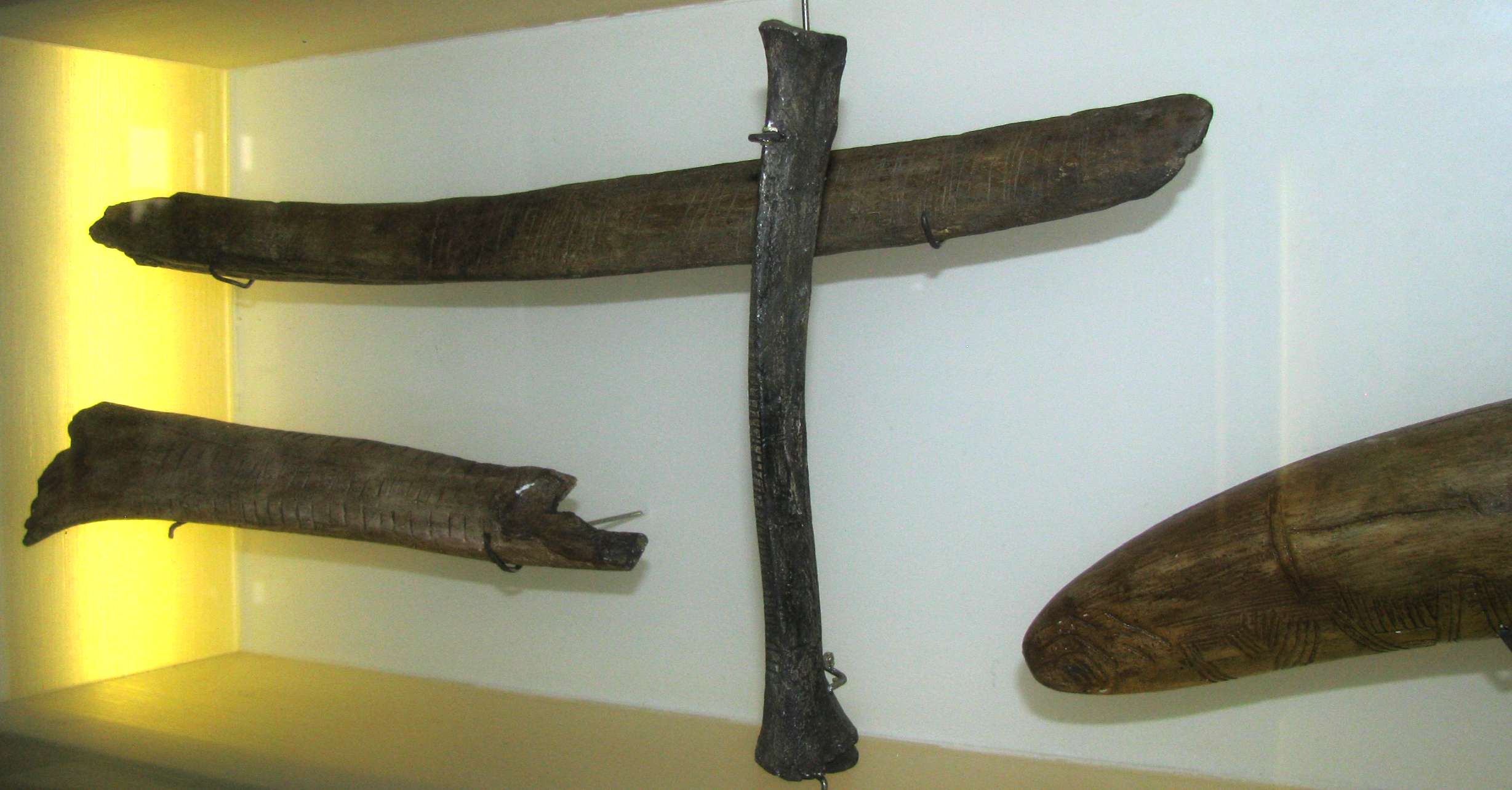
Carved bones. The object on the right is part of the oldest recorded map, shown in more detail below. It shows the Dyje river and the slopes of the Dolni Vestonice hills.
Photo: Don Hitchcock 2008
Source: Facsimiles, display, Dolní Věstonice Museum
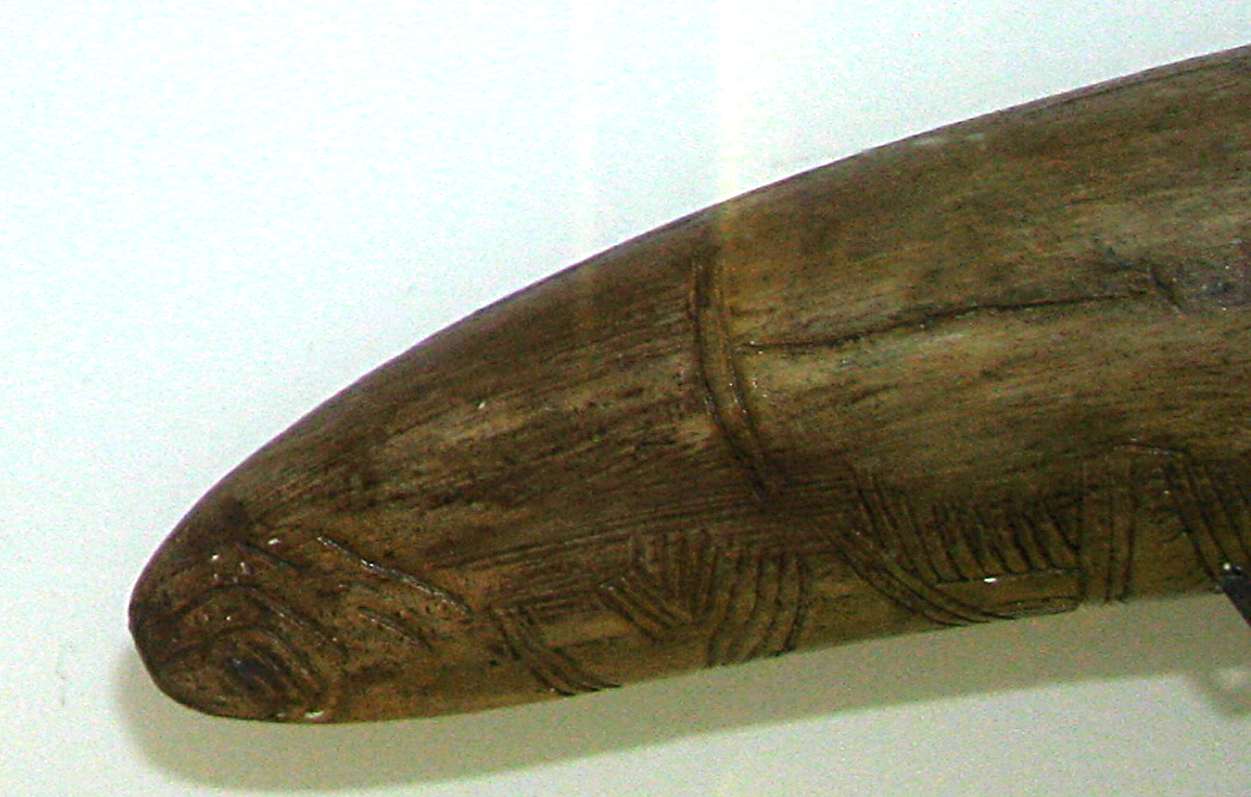
Enlargement of the part shown of the mammoth tusk on the right of the photograph above.
Photo: Don Hitchcock 2008
Source: Facsimiles, display, Dolní Věstonice Museum
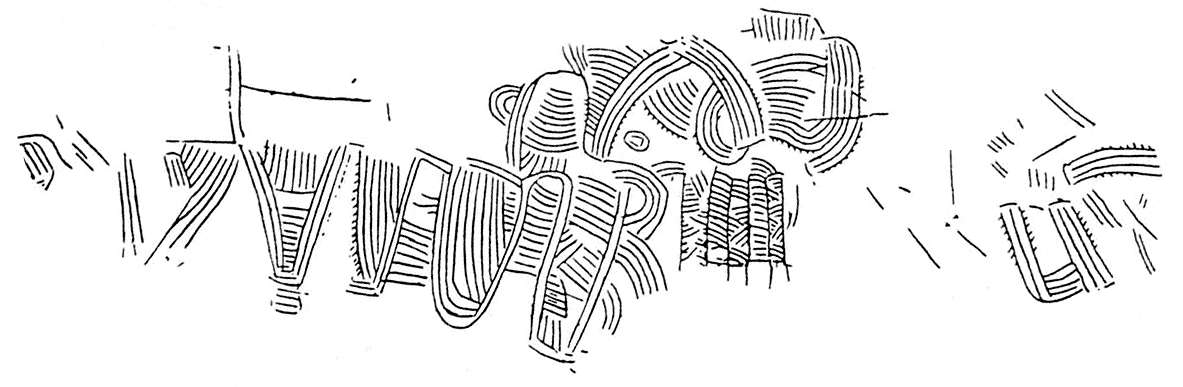
This may be the earliest map ever found. It is a drawing of an engraving on a mammoth tusk. The mammoth tusk was found in 1962 at Pavlov, near Dolni Vestonice.
The map is printed in a leaflet kindly sent to me by Fritz Lange, obtained from the "Weinviertel-Museumsdorf", in the building called "Suedmaehrerhof", where there was in 2008 a replica of the Venus von Unterwisternitz (or Dolni Vestonice) and an exhibition about the finding of the Venus. The drawing is probably taken from a book by the eminent Austrian scientist Irenäus Eibl-Eibesfeld, founder of the field of human ethology, and former student of Konrad Lorenz.
Source: Leaflet from the "Weinviertel-Museumsdorf"
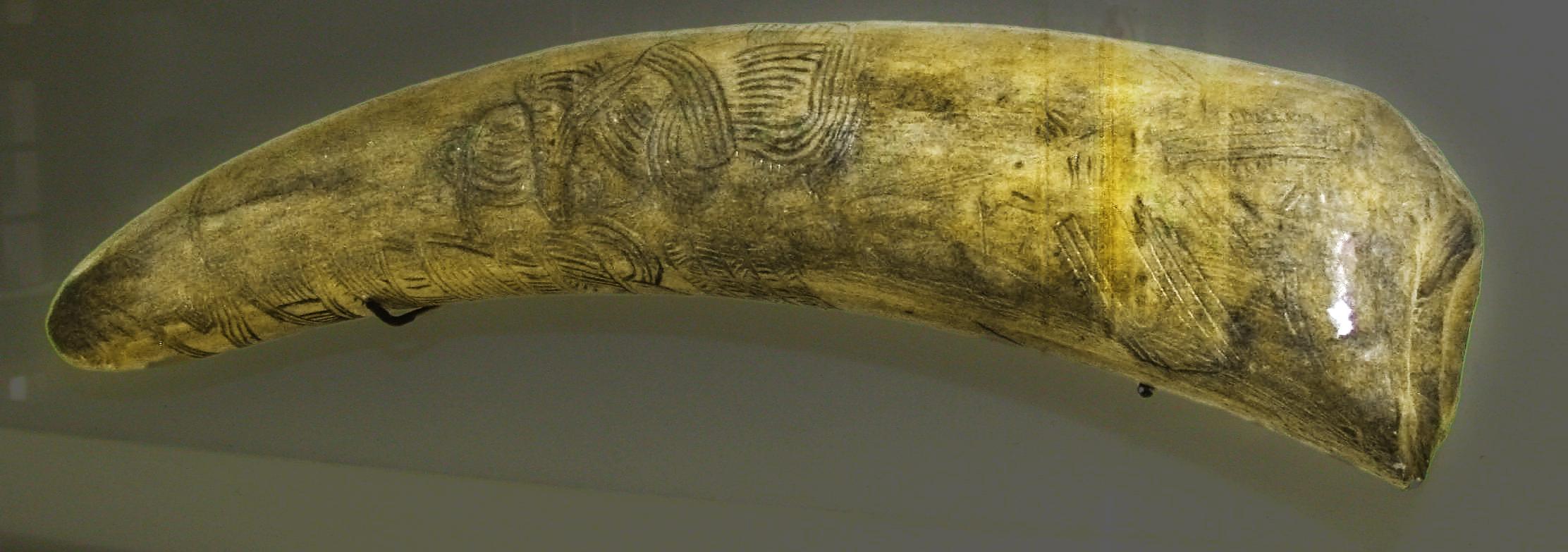
This mammoth tusk in the Dolní Věstonice Museum appears to be a replica of the original, on which the map was engraved, and
(translated from the leaflet):
After conservation in the laboratory it was recognised as the oldest map of the Pavlovian/Dolni Vestonice landscape, with the Dyja river interpreted with meanders, the ridges and erosion gullies of the loess slopes, and the rocky peaks all shown. Amidst this is a double motif of a complete circle and a half-circle. It is assumed that this marks the home of the hunters.
The engravings show a striking agreement with the landscape formation (view from the north, looking south).
Photo: Don Hitchcock 2008, expertly enhanced by Fritz Lange 2010.
Source: Facsimile, Dolní Věstonice Museum
The plaque which accompanies this display may be translated as:
Moravia, which includes the Dolni Vestonice/Pavlov sites, is one of the major centres of the oldest art. In light of the new discovery, it seems as if the first art was suddenly created and "ready" at a time when people of a modern type first colonised Europe. Undoubtedly this is related to underlying changes in thinking, including consciousness of space and time.
Another carved mammoth tusk
This is known as the Venus of Predmost
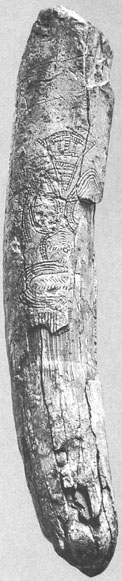 Photo: G. Clark, 'The Stone Age Hunters' |
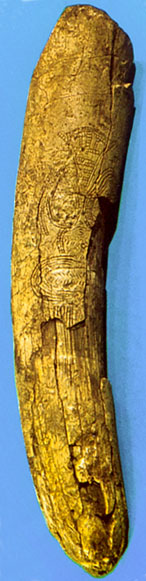 Photo: Jelinek (1975) |
Stylised figure of a woman engraved on a mammoth tusk from Predmost, an area close to Dolní Věstonice. Height 15.5 cm
From the book 'Plains of Passage' by Jean Auel, p537:
Attaroa's speaking staff
The staff itself was quite unusual. It was not newly carved, that much was obvious. The color of the mammoth ivory had begun to turn creamy, and the area where it was usually held was gray and shiny, caused by the accumulated dirt and oils of the many hands that had held it. It had been used by many generations.
The design carved into the straightened tusk was a geometric abstraction of the Great Earth Mother, formed by concentric ovals to shape the pendulous breasts, rounded belly, and voluptuous thighs. The circle was the symbol for all, everything, the totality of the known and unknown worlds, and symbolized the Great Mother of All. The concentric circles, especially the way they were used to suggest the important motherly elements, reinforced the symbolism.
The head was an inverted triangle, with the point forming the chin, and the base, curved slightly into a domelike shape, at the top. The downward pointing triangle was the universal symbol for Woman; it was the outward shape of her generative organ and therefore also symbolized motherhood and the Great Mother of All. The area of the face contained a horizontal series of double parallel bars, joined by laterally incised lines going from the pointed chin up to the position of the eyes. The larger space between the top set of double horizontal lines and the rounded lines that paralleled the curved top was filled in with three sets of double lines that were perpendicular, joining where eyes would usually be.
But the geometric designs were not a face. Except that the inverted triangle was placed in the position of a head, the carved markings would not even have suggested a face. The awesome countenance of the Great Mother was too much for an ordinary human to behold. Her powers were so great that Her look alone could overwhelm. The abstract symbolism of the figure on Attaroa's Speaking Staff conveyed that sense of power with subtlety and elegance.

This appears to be a museum facsimile of the venus known as the Venus of Predmost.
It is wonderful to have such a high quality photograph of this important work.
Photo: Themis
Source: picasaweb.google.com/byThemis/idolies
Date: Sep 2, 2007
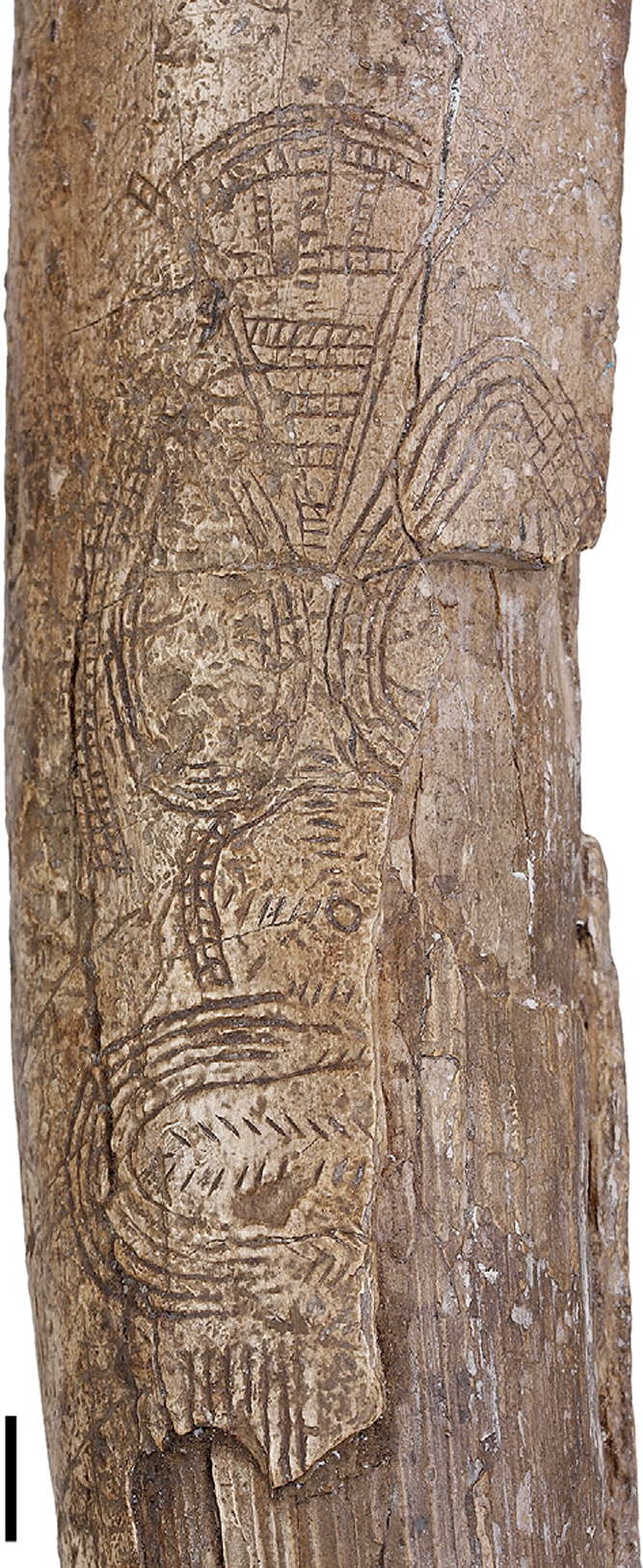
This appears to be a facsimile of the Predmost tusk, but it has been very well done, and is by far the clearest image of the carving I have seen.
Photo: d’Errico et al. (2010)
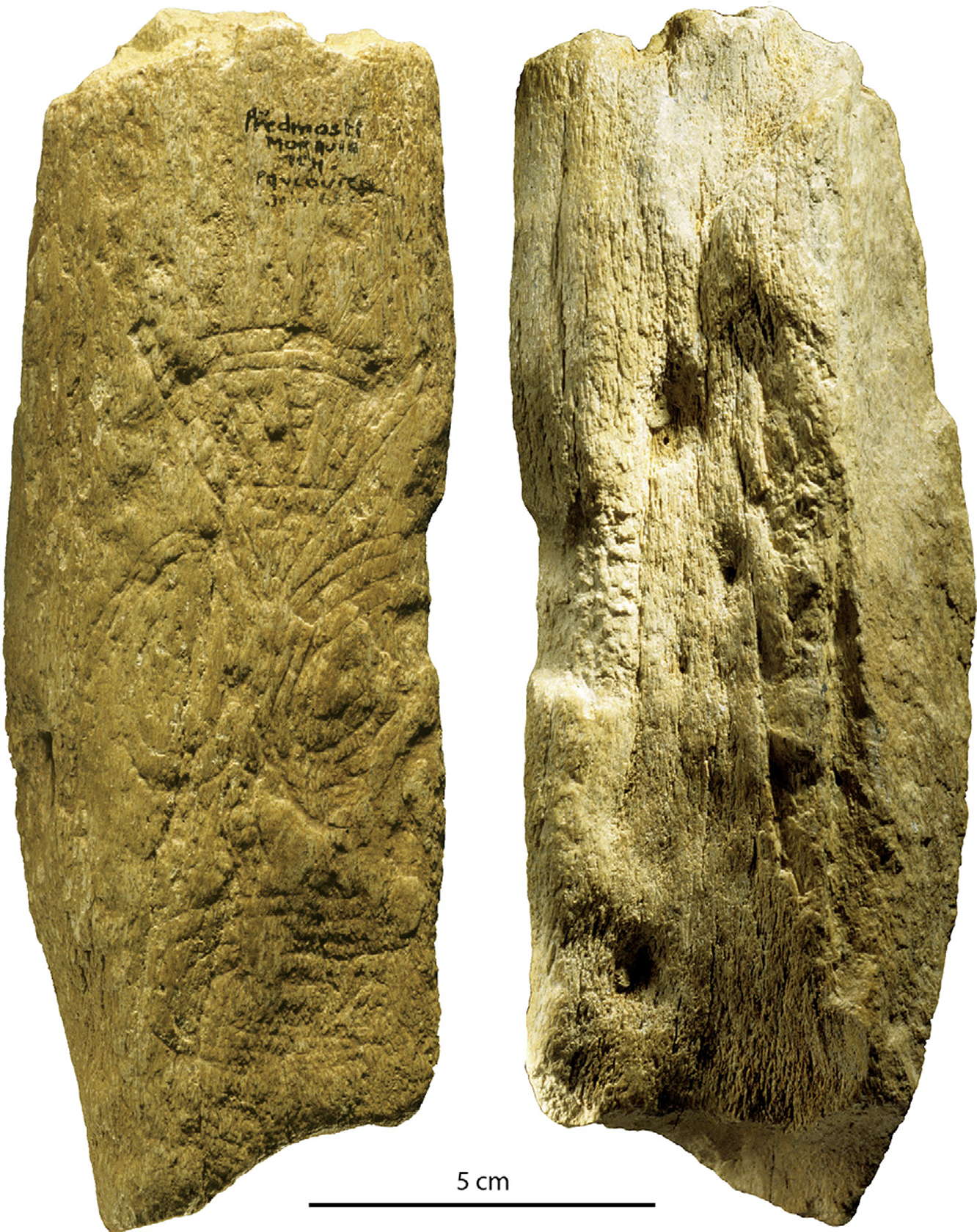
This is another artefact from Predmost, with a design almost identical to that carved on the tusk above.
From the abstract to d’Errico et al. (2010):
One Gravettian feminine representation - the schematic Venus of Predmostí - is so different from all the others that it has always been regarded as unique. The engraving, which was closely examined for the purpose of comparison in this study, represents a woman composed of geometric shapes, including a triangular head with interior lattice-work, concentric ellipses for the breasts, belly and pelvis, a double ladder for the remaining arm, hatch marks, and a thigh made up of parallel vertical lines.
This article presents the discovery and discusses the authenticity of a second, feminine anthropomorph engraved on a bone shaft fragment, which is labelled as coming from the same site and is highly similar to the one described at the end of the nineteenth century. The modern history of Predmostí reveals that the site was used as a quarry for the extraction of loess and limestone, and that tons of mammoth bones were extracted to produce spodium (burned bone usually used for medical purposes - Don ). Remarkable objects that were found both during early archaeological excavations and the site’s commercial exploitation went towards private collections. The history of the piece under study traces it back through a succession of owners to the collection of René de Poilloüe de Saint-Périer (b.1877 - d.1950) and Raymonde-Suzanne de Saint-Périer (b.1890 - d.1978).
The engraving is on the periosteal (outside) surface of a limb bone from a very large mammal, probably a proboscidian. Microscopic analysis of the bone surface and engravings identify the chronology of the grooves and their relations to the stages of the bone’s alteration and fracturing, starting with:
1) heavy weathering of the bone surface that produced longitudinal cracks, which probably led to its breakage,
2) engraving of the feminine representation,
3) intense mechanical and chemical attacks that smoothed all of the bone’s surfaces and wore down the engravings,
4) covering with a consolidation agent, and, most recently,
5) some abrasion, which resulted in the creation of a few straight lines.
Since no evidence is found to suggest that the highly worn appearance of the engravings composing the feminine representation resulted from modi!cations that were meant to arti!cially age the periosteal surface of the bone, we conclude that the engraving can be plausibly attributed to the Gravettian and that further analyses are warranted.
Photo and text: d’Errico et al. (2010)
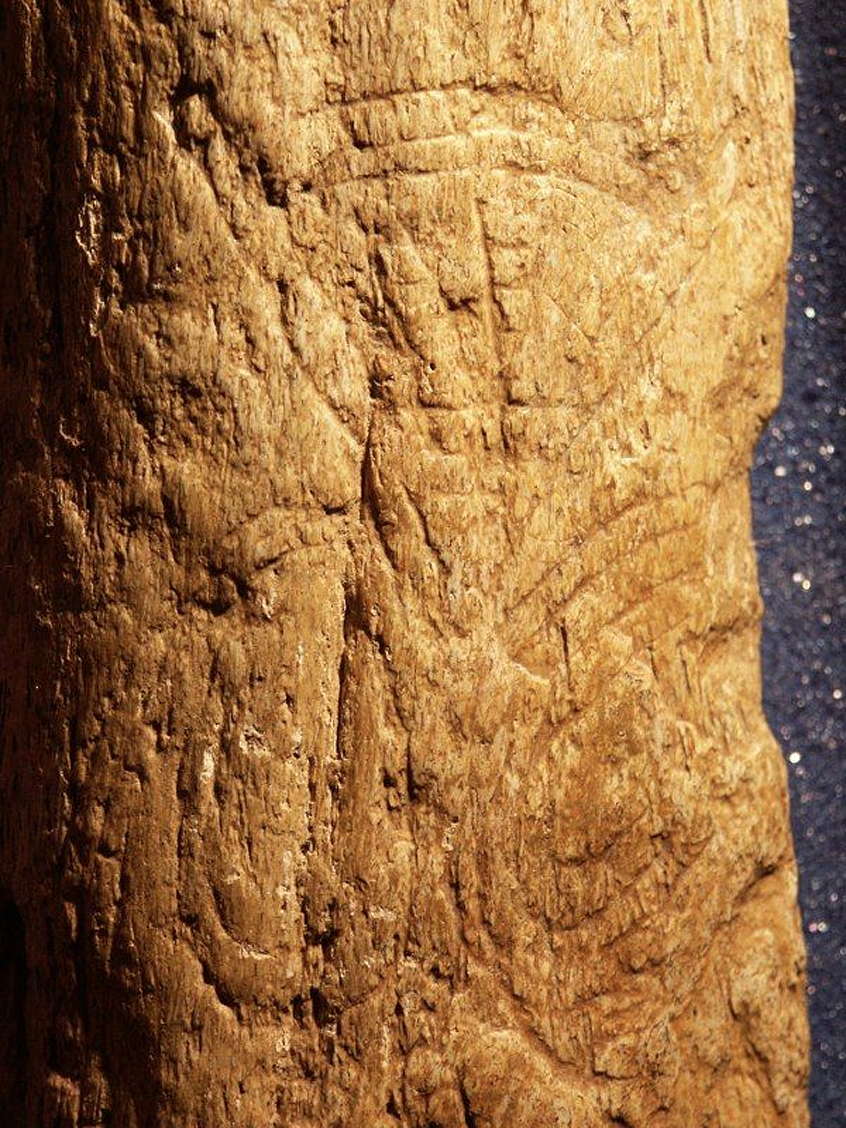
Close up of the bone above. This photo appears to be of the original.
The support on which the engraving was made is 174 mm long, 70 mm wide, and 30.7 mm deep. It is a fragment of a long bone from an extremely large, class 5 mammal. Because of the thickness of the compact bone (approx. 30 mm), its fibrous aspect, and remnants of spongy bone in a diaphyseal zone, we attribute the fragment to a proboscidian. The morphology and, in particular, the cross - section of the periosteal surface indicates that it is probably a femoral fragment. The compact texture of the bone on the periosteal face seems to indicate that it came from an adult animal.
Text adapted from d’Errico et al. (2010)
Photo: Themis
Source: picasaweb.google.com/byThemis/idolies
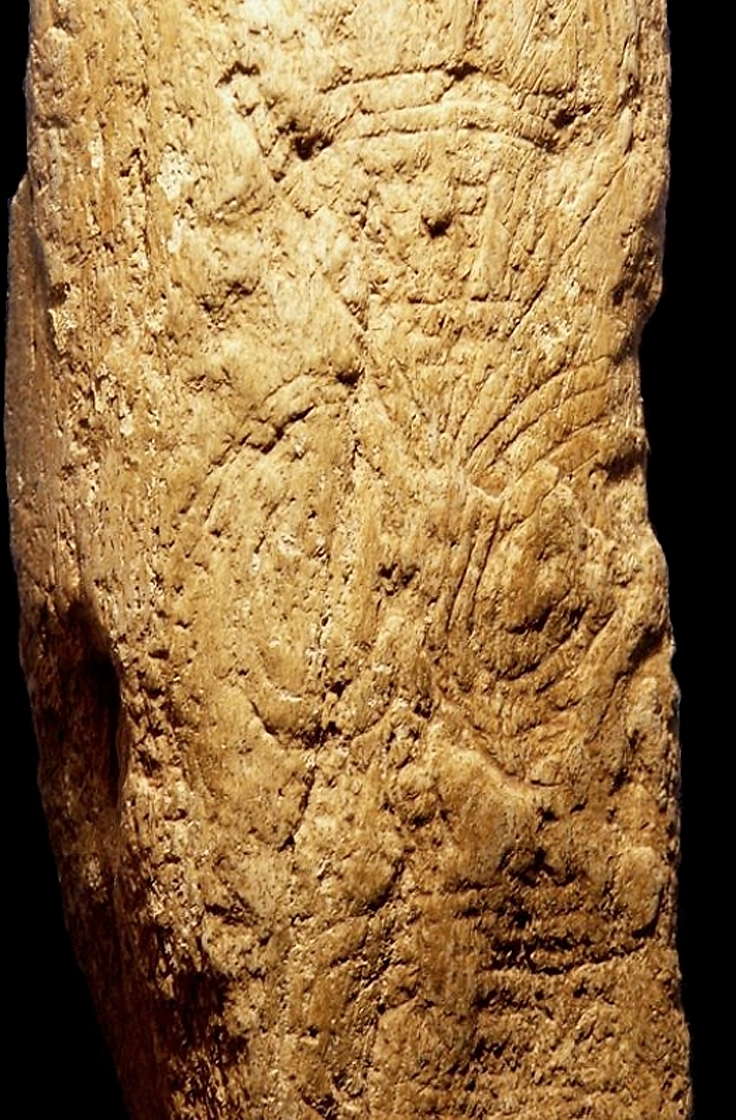

(left) Close up of the design on the bone.
(right) Tracing of the design on the bone. The two designs are so similar, they may well be by the same artist. The possible 'twin sister' of the 'Venus of Predmosti' is owned by U.S. art collector Duncan Caldwell.
Photo (left): Duncan Caldwell "Supernatural Pregnancies. Common Features and New Ideas concerning Upper Paleolithic Feminine Imagery" Barbier-Mueller Museums Geneva and Barcelona in Arts & Cultures (2010)
Photo (right): d’Errico et al. (2010)
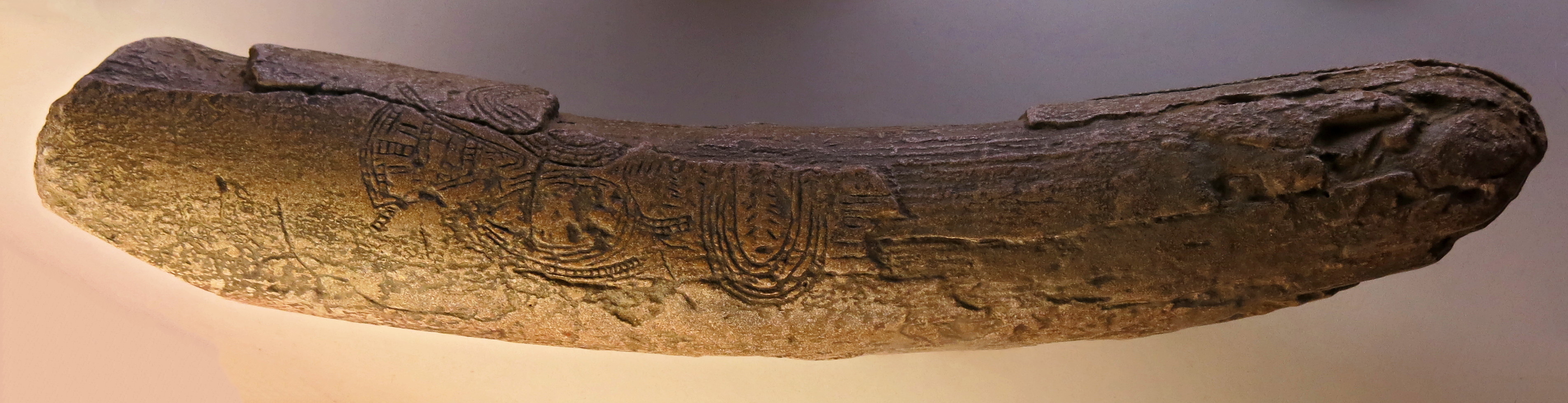
Another version of the Venus of Predmost.
Photo: Don Hitchcock 2015
Source: Facsimile, Monrepos Archäologisches Forschungszentrum und Museum, Neuwied, Germany
Tools and Carved Bones, Antlers and Tusks
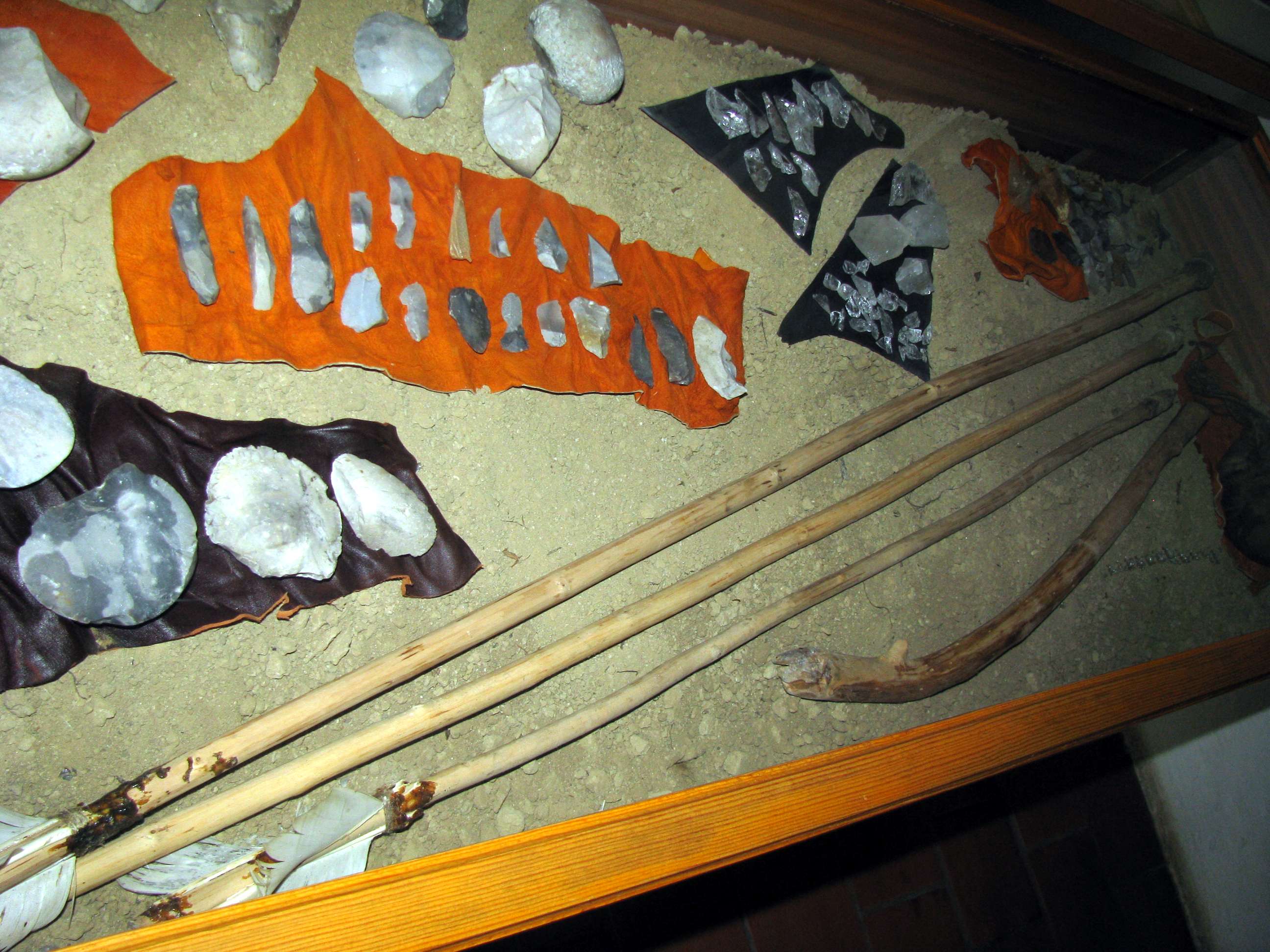
The flints and quartz tools were re-created originals, and were certainly not facsimiles.
These specimens displayed for the most part on orange or black leather are functional replicas made for the "Úsvit géniů" documentary. (Personal Communication from Filip Brichta, actor-experimenter and consultant for the film - Don)
The reproduction spears, meant for throwing, given the fletching of feathers, are much thicker than I would have expected.
If they were to be thrown using a spear thrower or atlatl, they would normally be much thinner and lighter than this.
Photo: Don Hitchcock 2008
Source: Facsimiles, mixed with modern materials, display, Dolní Věstonice Museum
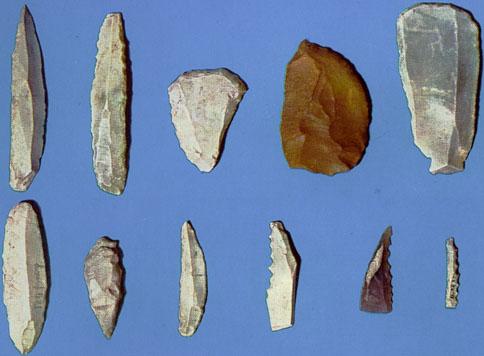
Flint tools from Dolní Věstonice
Photo: Jelinek (1975)

Hammer stones, hand axes, and blades, made of flint.
Photo: Don Hitchcock 2008
Source: Recreated originals for the "Úsvit géniů" documentary, display, Dolní Věstonice Museum

These crystal clear quartz tools would have been highly prized for their workability and beauty. They are extremely difficult to photograph.
Later flint knappers were able to make exquisite tools from this material, as techniques improved.
Photo: Don Hitchcock 2008
Source: Recreated originals for the "Úsvit géniů" documentary, display, Dolní Věstonice Museum
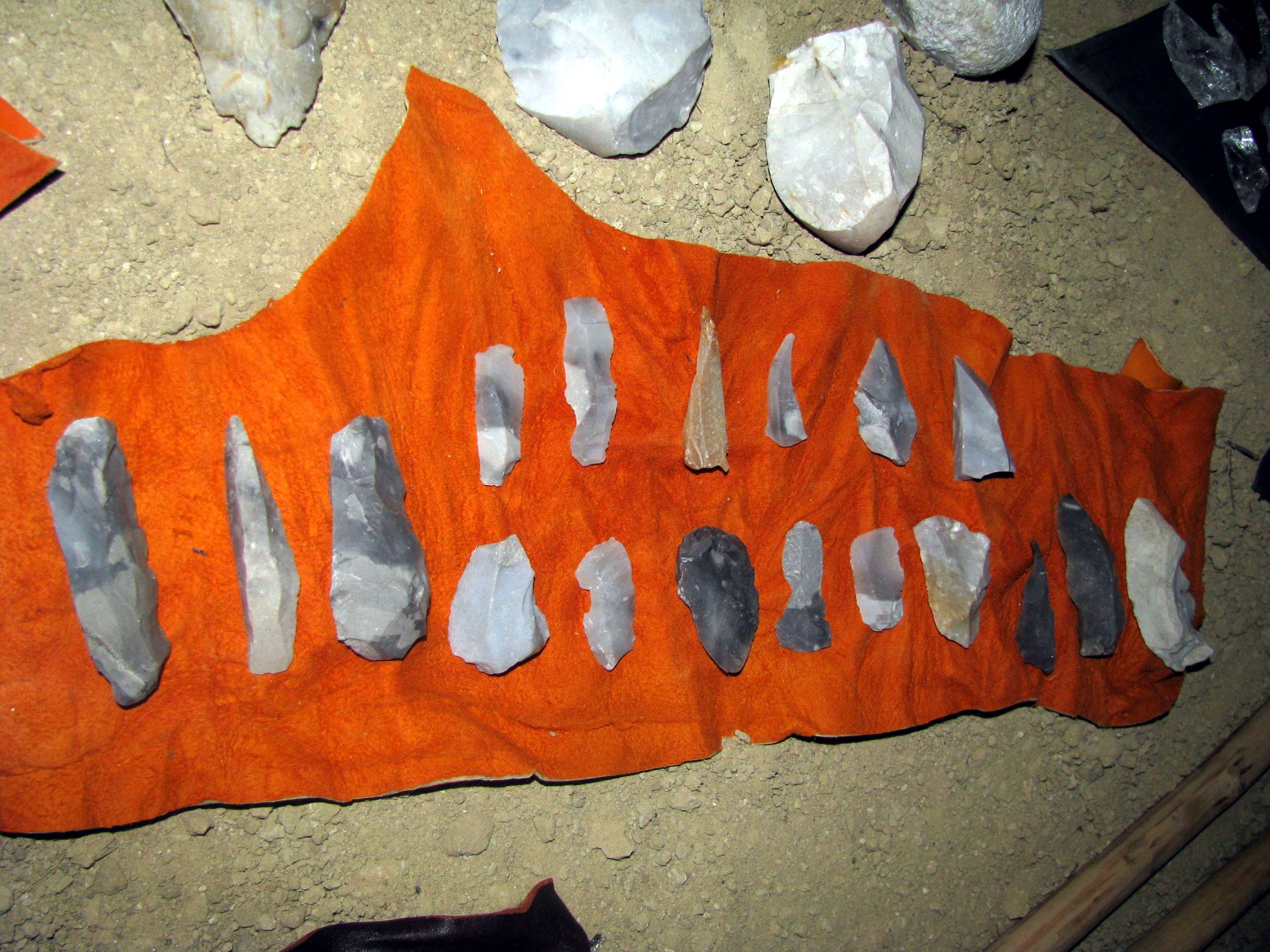
A fine array of Gravettian flint blades, very well made.
Photo: Don Hitchcock 2008
Source: Recreated originals for the "Úsvit géniů" documentary, display, Dolní Věstonice Museum
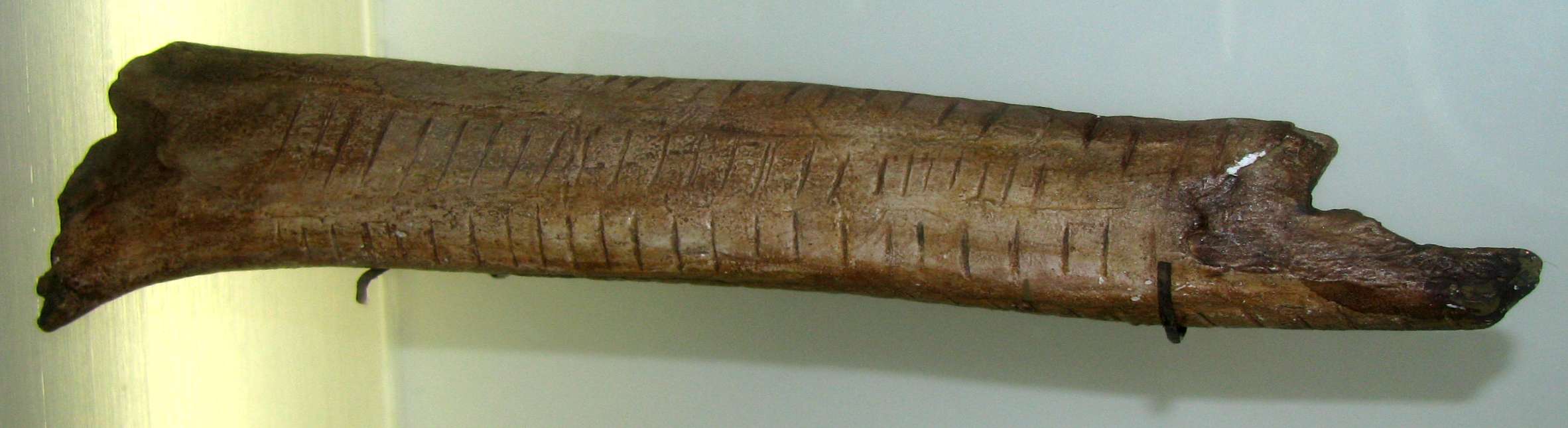
Carved antler.
I am uncertain of the purpose of this large object. The simplicity and regularity of the incisions make me think that it may have been a record of something, perhaps days of a cycle such as the moon. There are 24 incisions in the bottom row, 24 (some appear doubled) in the middle row, and 17 visible in the top row of this photograph.
Photo: Don Hitchcock 2008
Source: Facsimile, display, Dolní Věstonice Museum
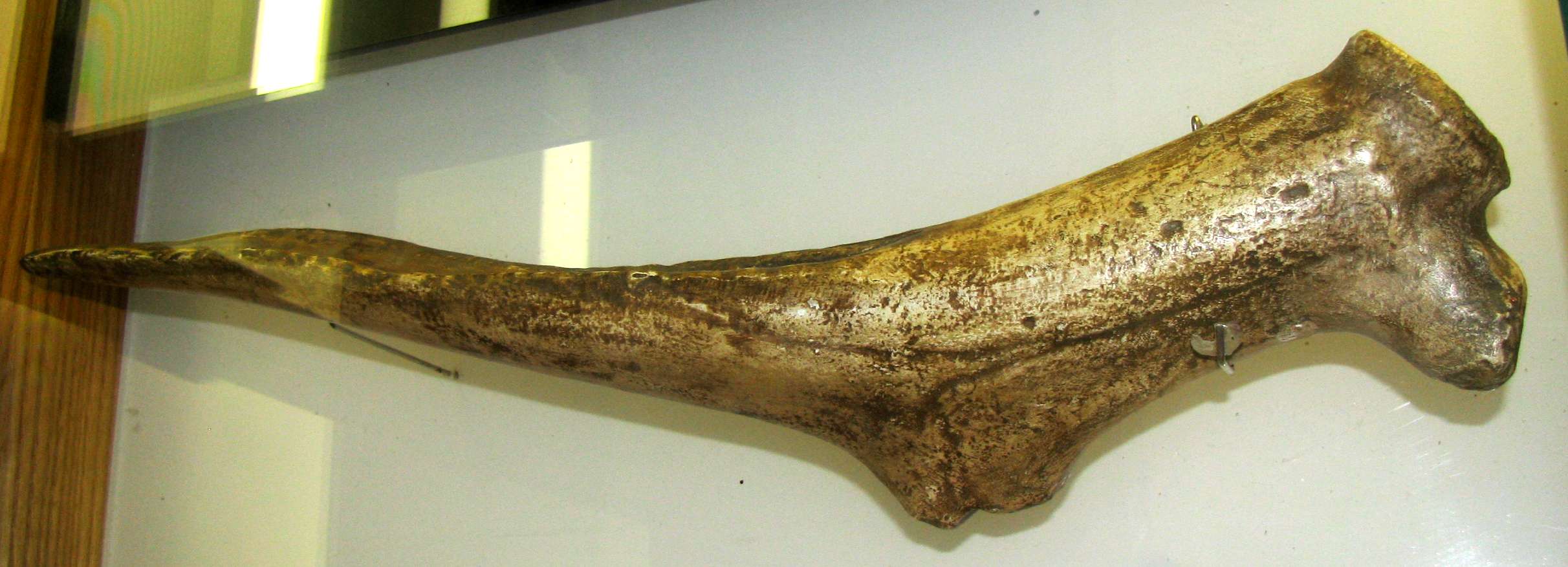
Carved antler.
This antler seems to have some minimalist carvings on it, and has been sharpened to a flat point at one end. It may have been used to dig post holes for huts.
Photo: Don Hitchcock 2008
Source: Facsimile, display, Dolní Věstonice Museum
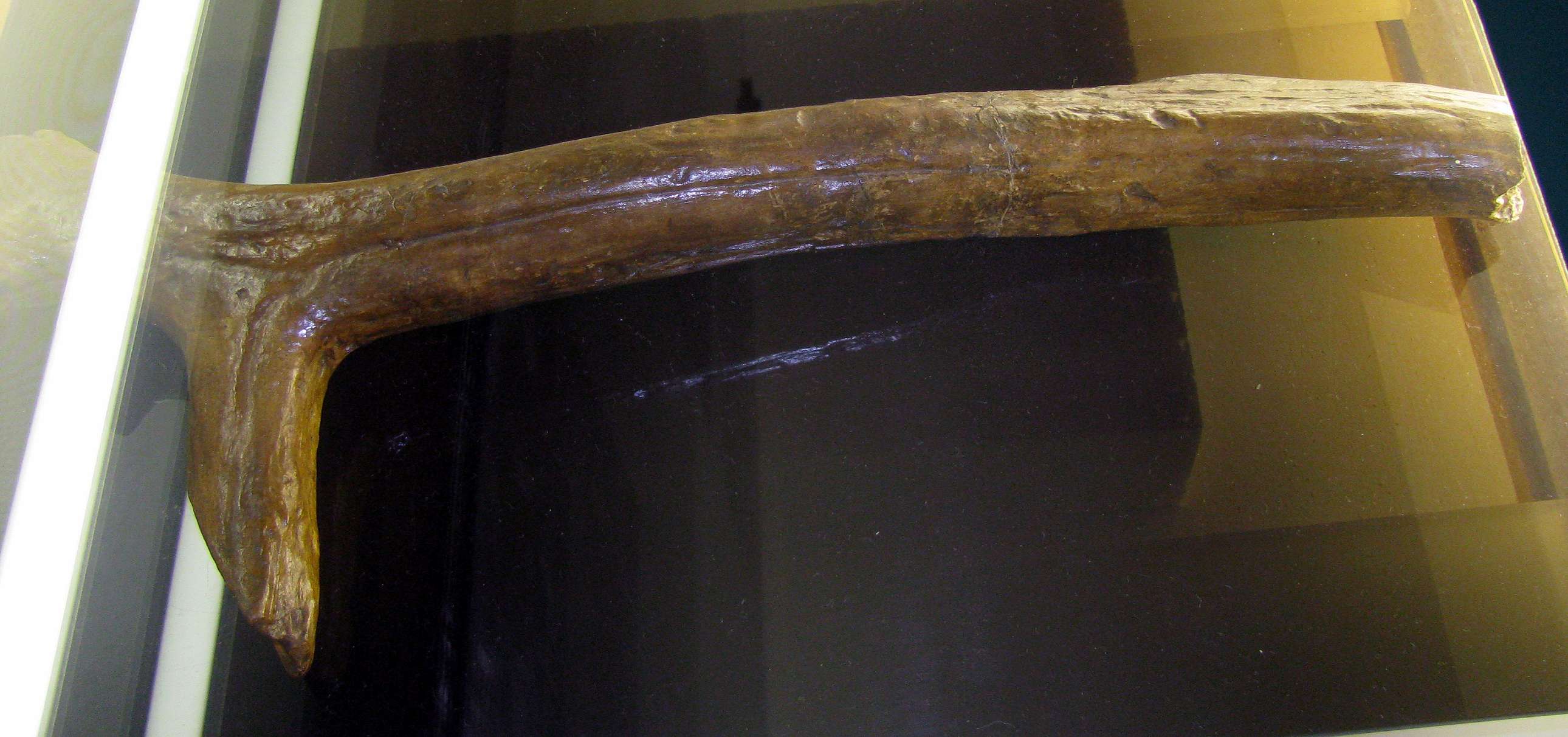
Carved antler.
This antler also seems to have some minimalist carvings on it, and has been sharpened to make it suitable as a pick for digging in the earth.
Photo: Don Hitchcock 2008
Source: Facsimile, display, Dolní Věstonice Museum

These two bones or pieces of antler appear to have been carefully shaped for some purpose. The right hand end of the larger has had a U shape carved out of it, which I find puzzling, but it is like a modern spade handle without the cross piece for the hand.
Certainly the larger bone has been shaped like a spade at one end.
However the juxtaposition of the smaller piece of bone/antler in the display case makes it appear that it is perhaps a mallet for hitting the larger at the U shaped depression, possibly to hammer the spade into hard earth.
Photo: Don Hitchcock 2008
Source: Facsimile, display, Dolní Věstonice Museum

This spade has had a large number of chevrons carved into its surface as decoration.
Photo: Don Hitchcock 2018
Source: Facsimile, Anthropos Pavilion/Moravian Museum, Brno, Czech Republic
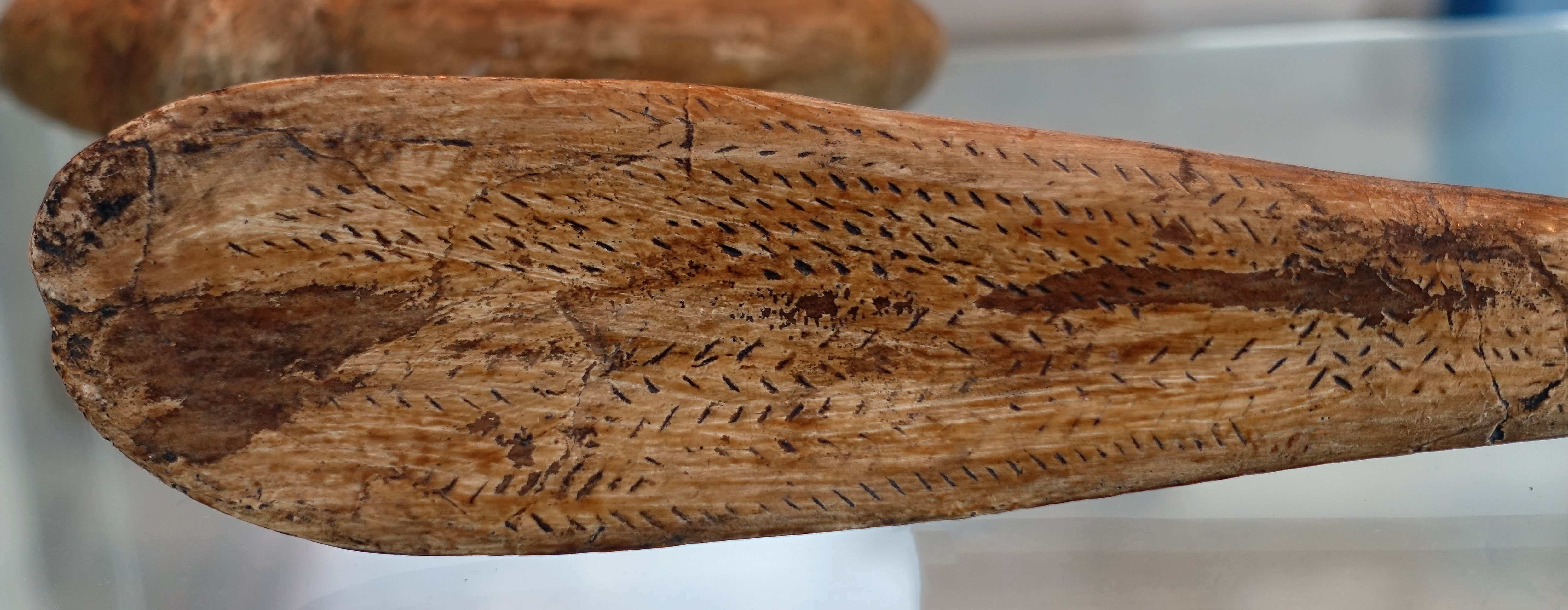
Closeup of the head of the spade above.
Photo: Don Hitchcock 2018
Source: Facsimile, Anthropos Pavilion/Moravian Museum, Brno, Czech Republic
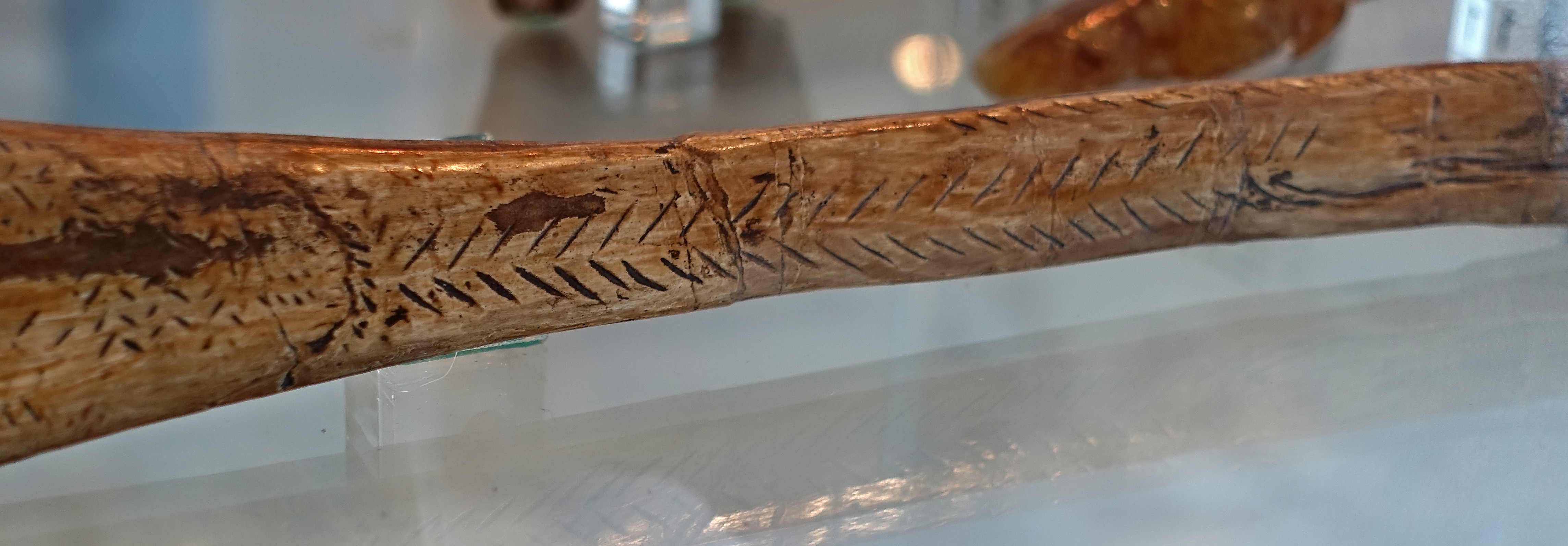
Closeup of the handle of the spade above.
Photo: Don Hitchcock 2018
Source: Facsimile, Anthropos Pavilion/Moravian Museum, Brno, Czech Republic
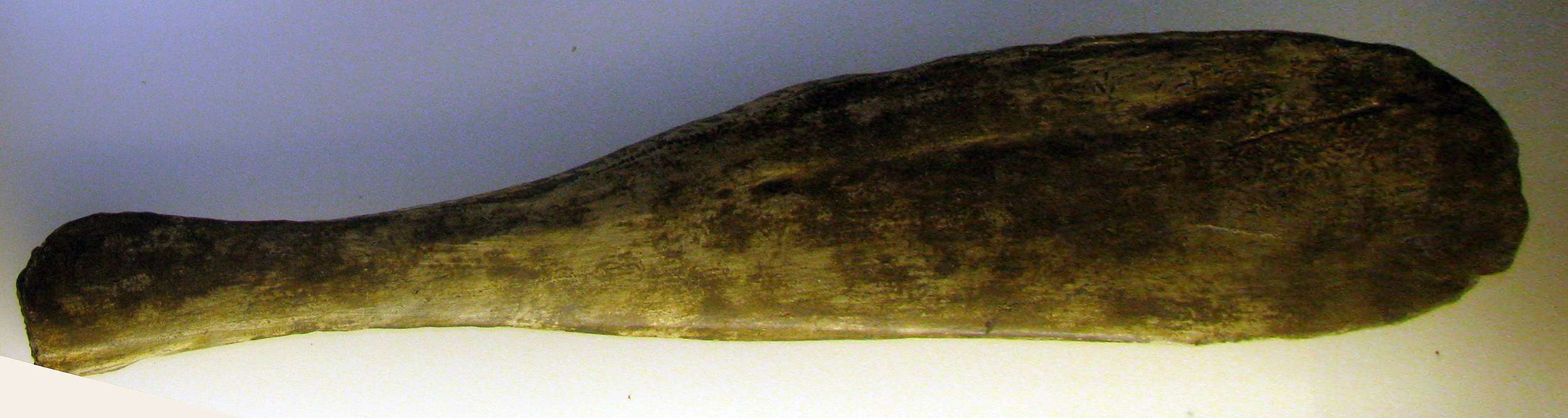
This spade seems to have been strictly utilitarian, although there are traces of what may have been a decoration on the right hand end. Perhaps it was originally decorated, but has seen hard use.
Photo: Don Hitchcock 2008
Source: Facsimile, display, Dolní Věstonice Museum
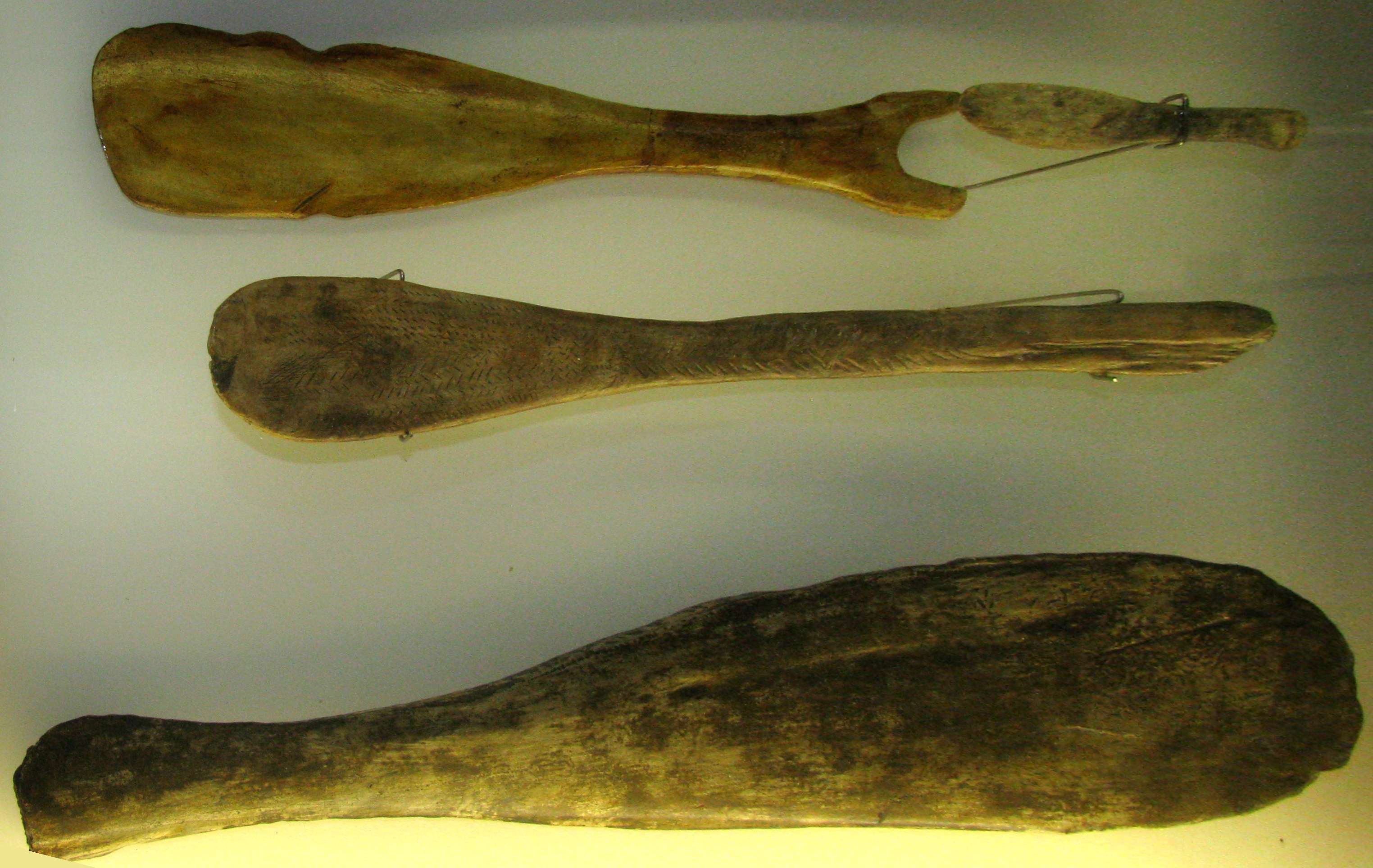
All four tools in the display case, to give some idea of relative sizes.
Photo: Don Hitchcock 2008
Source: Facsimile, display, Dolní Věstonice Museum

Bone awls. Some of these appear to be originals.
Photo: Don Hitchcock 2008
Source: Some may be originals, display, Dolní Věstonice Museum
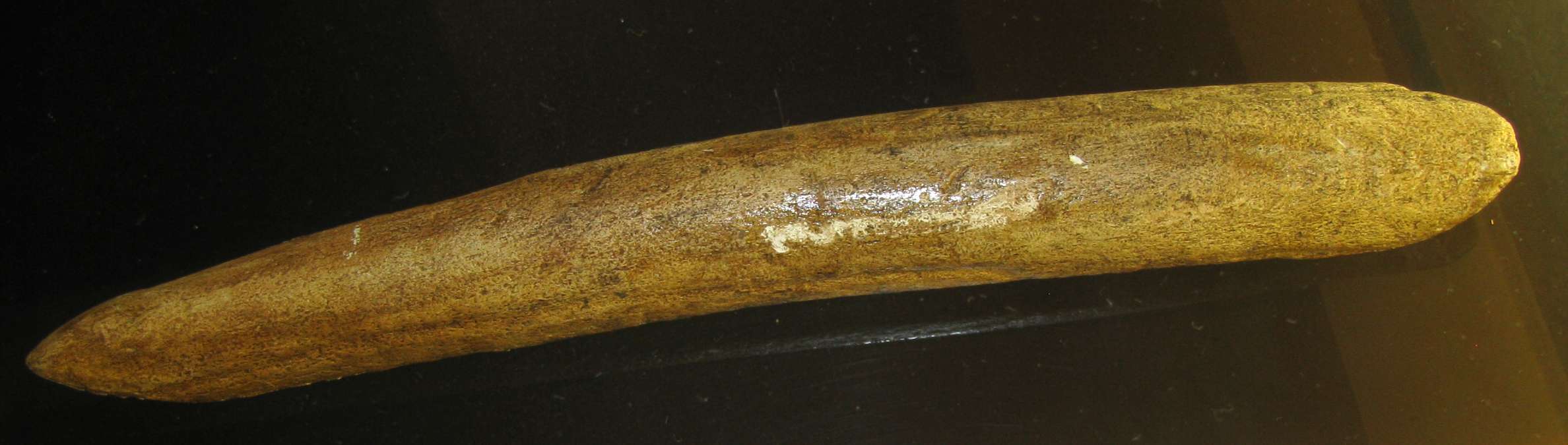
Apparently a spike carved from a mammoth tusk. It may have formed the end of a killing spear for mammoths, when trapped against the rock wall of the neighbouring limestone cliffs.
Photo: Don Hitchcock 2008
Source: Facsimile, display, Dolní Věstonice Museum
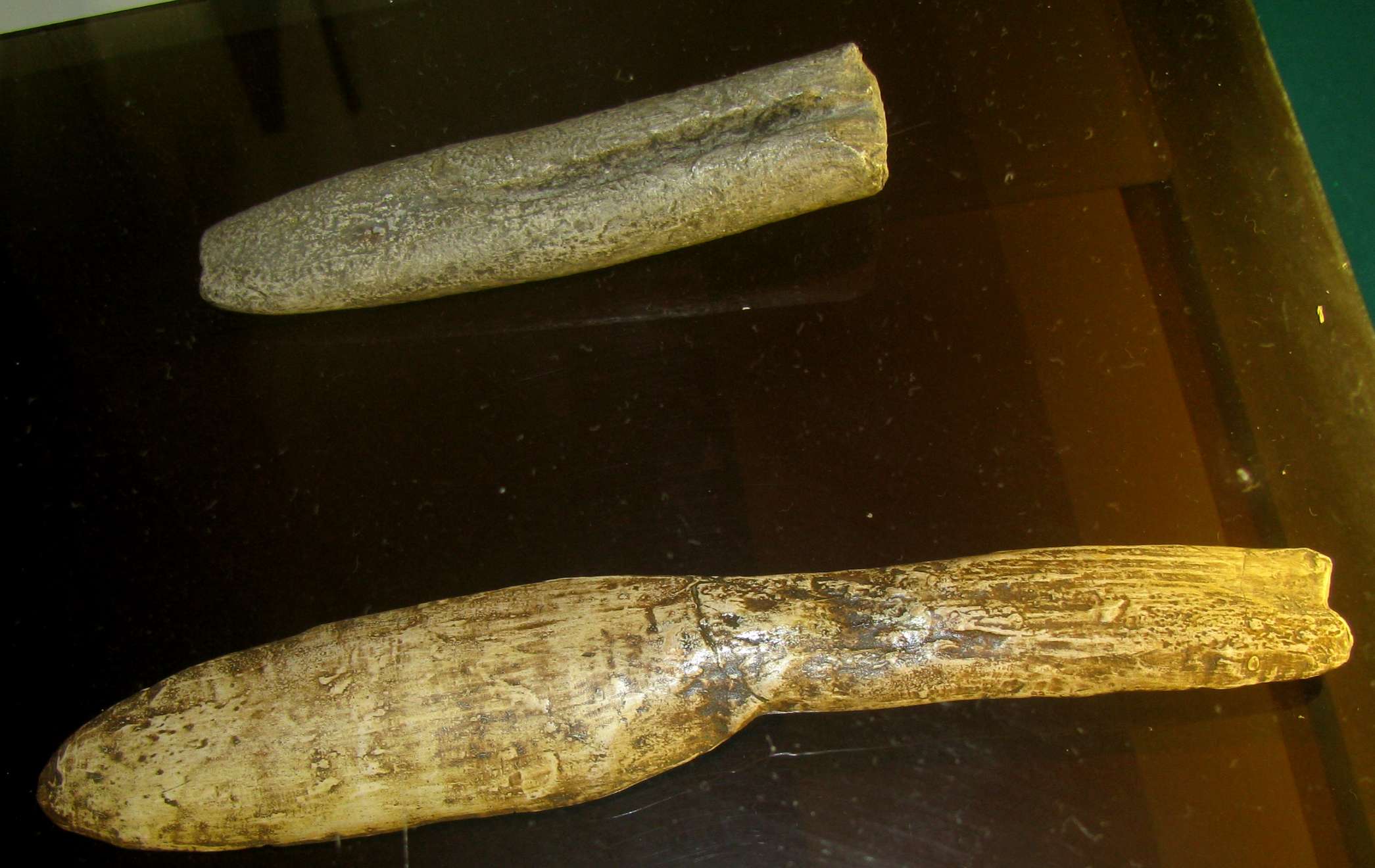
Two tools, one of enigmatic use, the other apparently a trowel like object.
Photo: Don Hitchcock 2008
Source: Facsimile, display, Dolní Věstonice Museum
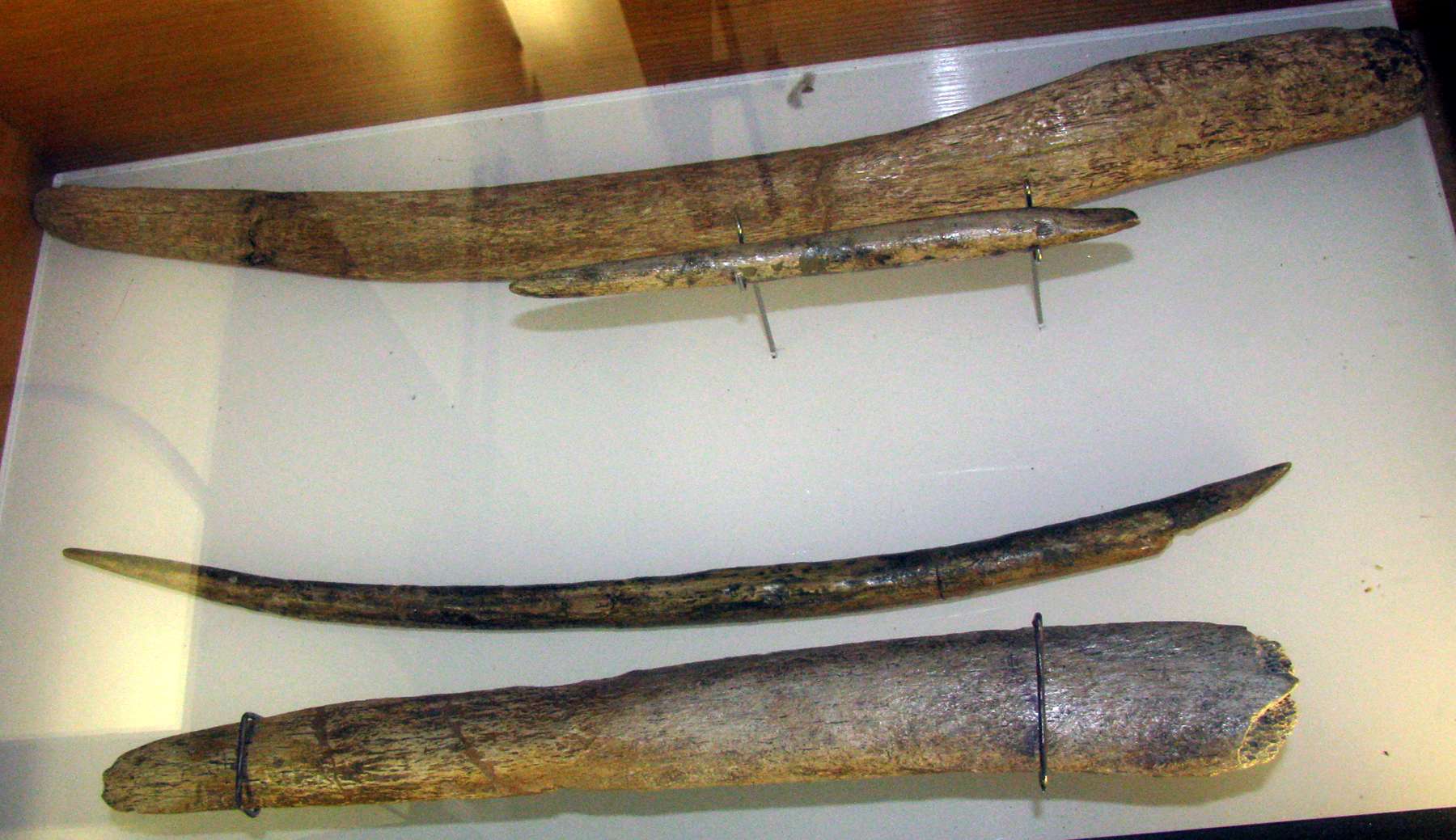
Tools of mammoth tusk. The thinner ones may be spear points
Photo: Don Hitchcock 2008
Source: Facsimile, display, Dolní Věstonice Museum
Other Objects
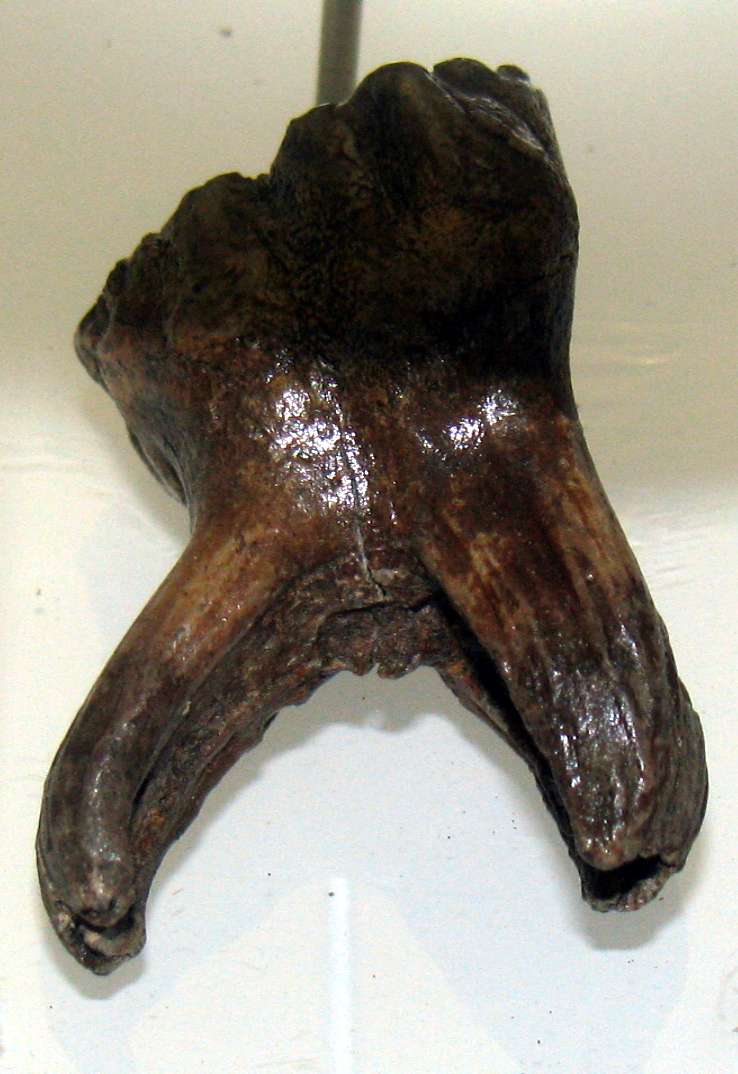
Young Mammoth tooth. This is graphic evidence that the people of Dolni Vestonice were opportunistic hunters, and chose this juvenile mammoth presumably for its tender flesh and ease of capture.
Photo: Don Hitchcock 2008
Source: Probably a facsimile, given the lustre of the piece, but extremely well done, display, Dolní Věstonice Museum

Mollusc shells. I am unsure of the reason for these shells being in the deposits, but perhaps they were for jewellery. They may be fresh water specimens obtained from the nearby Dyje River.
Photo: Don Hitchcock 2008
Source: Possibly originals, display, Dolní Věstonice Museum
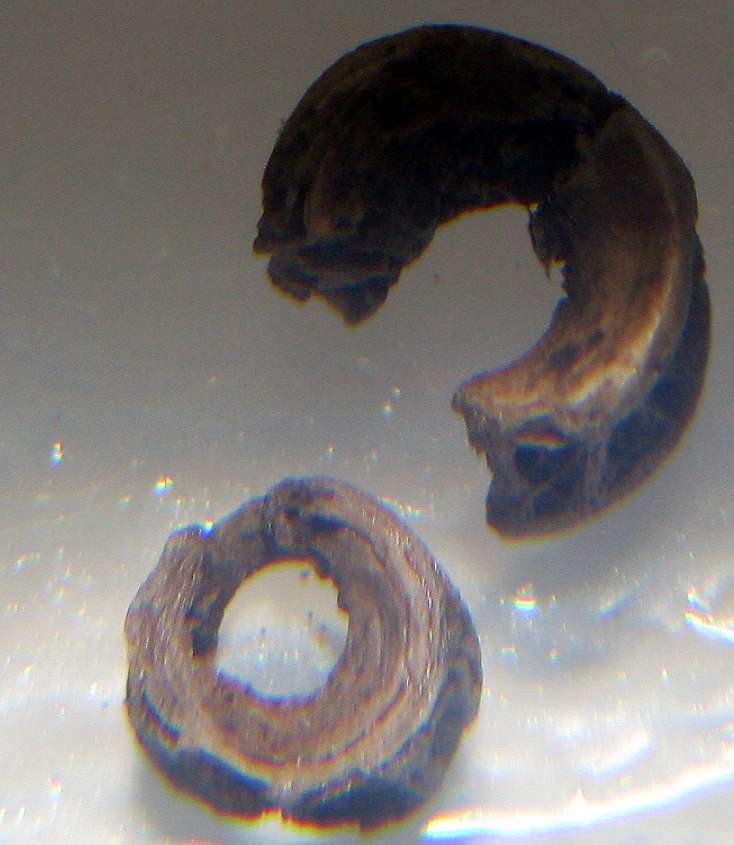
Fish vertebrae. The hunters must have had traps or harpoons to catch the fish in the Dyje River.
Photo: Don Hitchcock 2008
Source: Possibly originals, display, Dolní Věstonice Museum
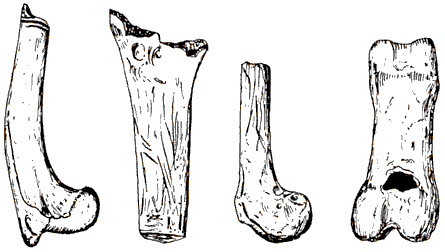
Four musical instruments made by the mammoth hunters at Dolní Věstonice. On the left are three transversely cut and smoothed hollow bones which are thought to be flutes, and on the right a pipe made from the toe bone of a reindeer, ca 25 - 27 000 BP
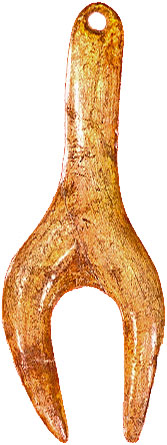
More than 2 000 shards of burnt clay, ceramic figures and fragments have been found during the excavations conducted in Dolní Věstonice. The extant ceramic figures are mostly zoomorphic: bear (75 mm), bear head (47 mm), rhinoceros head (42 mm), lioness head (45 mm), horse head (80 mm), reindeer head (38 mm) and two miniature mammoth figures. (Jelinek 1975)
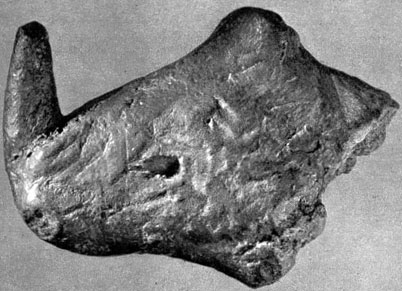
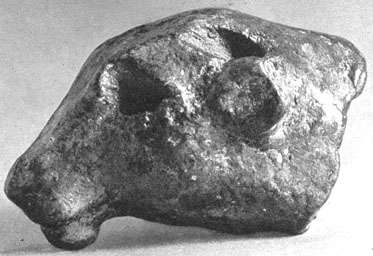
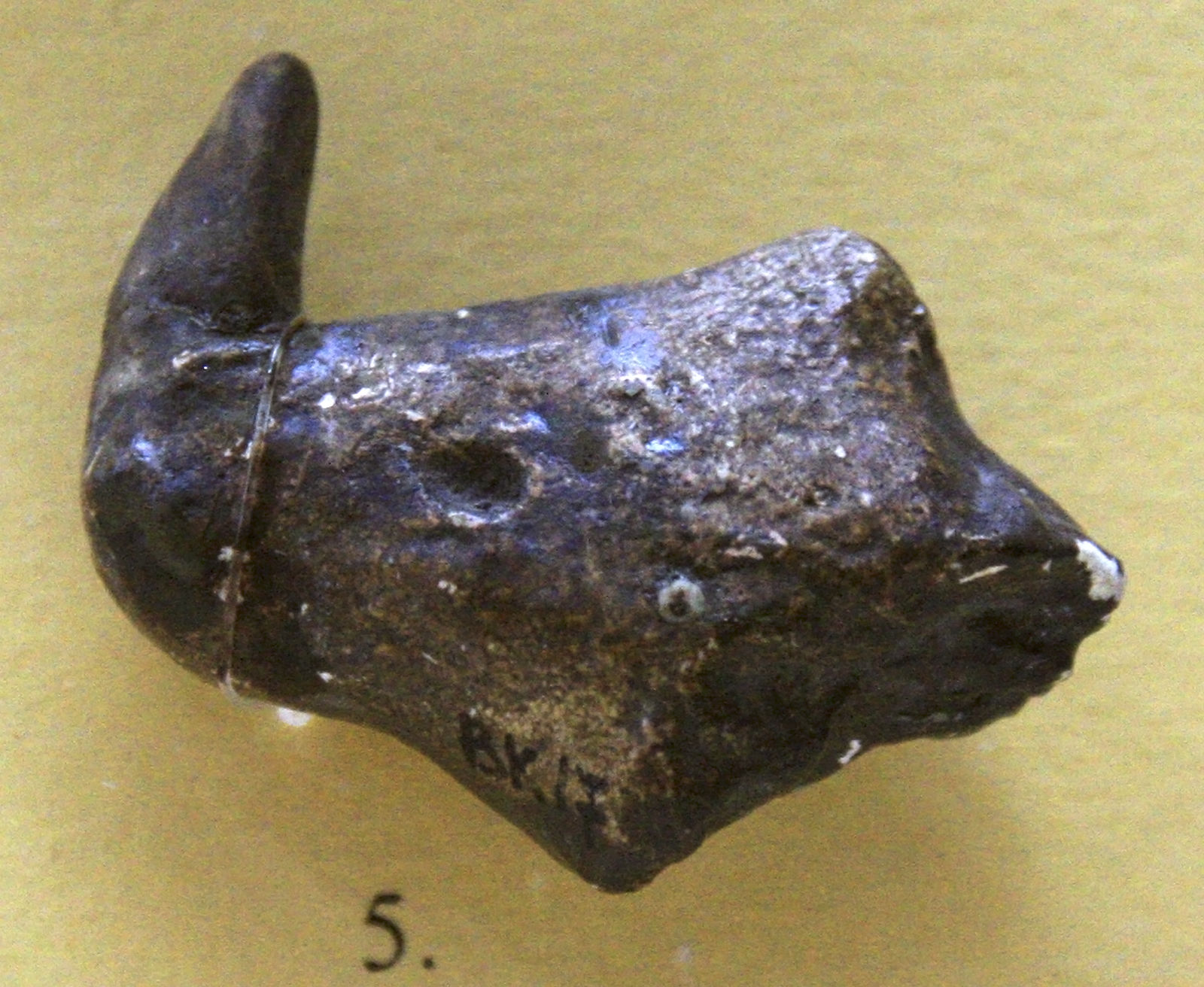
Rhino head from Dolni Vestonice.
Photo: Vladimir Gorodnjanski 2014
Source: Facsimile, Kostenki Museum
Originals and museum quality facsimiles of pottery figurines, and other artefacts found in the Dolní Věstonice / Pavlov area

A beautifully realised image by the artist Zdeněk Burian. The potter is making some of the zoomorphic figures also found at the site outside the small, simply constructed tent found near the ceramic figurines.
Close inspection of the painting shows that this image depicts a male as the potter, whereas it is now believed that the woman who created the Dolní Věstonice venus also created the figurines.
Photo: http://neat-stuff-blog.blogspot.com/2011/06/prehistoric-man.html
Entry to the Dolní Věstonice Museum, Archeologický Ústav Av ČR, Dolní Vestonice 49
691 29 Dolní Vestonice, Česká republika
519 517 637
Dolní Věstonice, called Unterwisternitz at the time of the Austro-Hungarian Empire, and during WWII when it was incorporated into Nazi Germany, has an excellent museum with high quality reproductions of many of the famous objects found at Dolní Věstonice or at nearby Pavlov (called Pollau in German) and other sites in the area.
Photo by Aleš Soldán, at Panoramio from Google Earth.
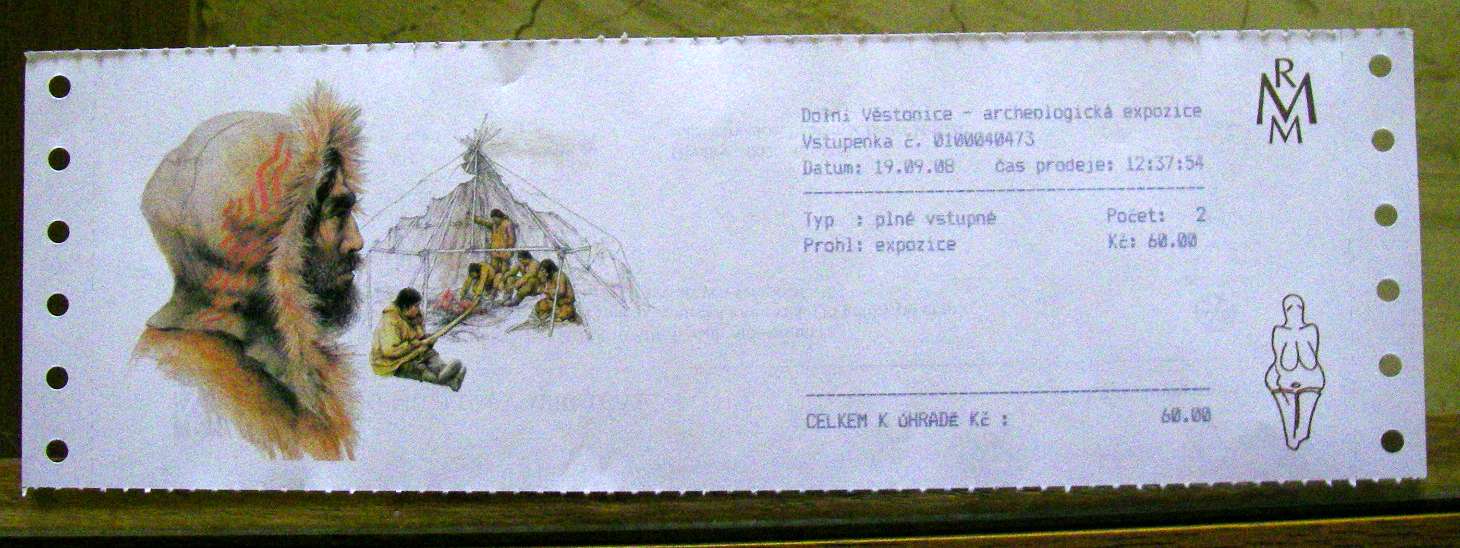
The ticket to the museum is no ordinary ticket! It is a work of art all by itself.
Photo: Don Hitchcock 2008
The sign on the exhibit in the Dolni Vestonice Museum says:
Puvodni keramicka produkce paleolitickych lidi z Donich Vestonic
Which translates into English as:
The original pottery of the Palaeolithic people from Dolní Věstonice
However, I believe that those on display at the Dolni Vestonice Museum are museum quality casts, superbly crafted and hand coloured, apart from the posters of what look like originals, with a red background, as shown in the first four photographs.
I found some originals, however, in the Vienna Natural History Museum, which appear below.
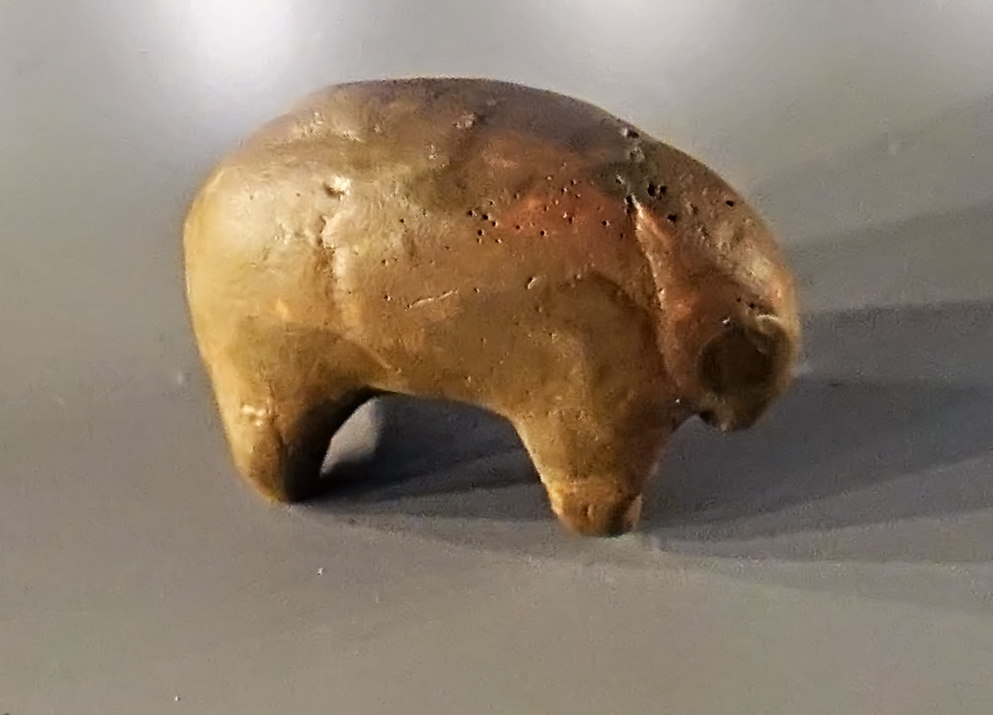
Mammoth figurine
Ceramic, Pavlov (near Dolní Věstonice), Czech Republic / Czechia, Gravettian, circa 32 000 BP.
Photo: Don Hitchcock 2018 ( this looks like a facsimile - Don )
Source and text: Natural History Museum of Vienna
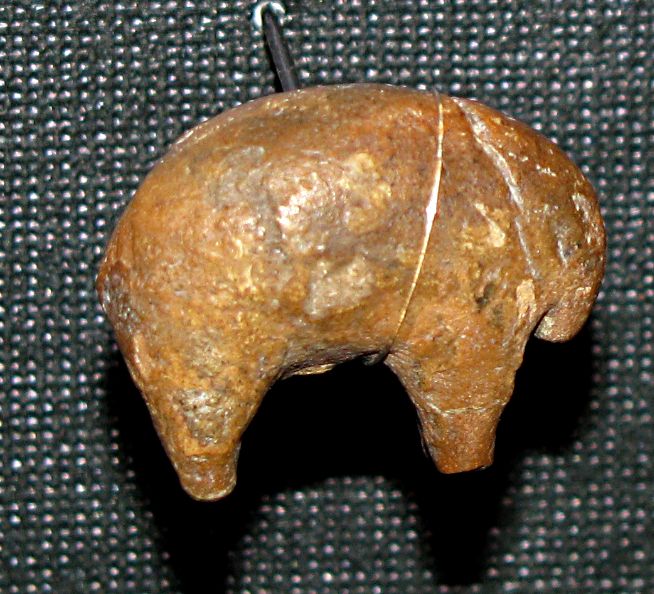
Mammut
Pavlov, Mähren
25 - 27 000 Jahre
Ton
Original, Naturhistorisches Museum
Which translates as: Mammoth from Pavlov in Moravia, 25 - 27 000 BP, ceramic, original held in the collections of the Vienna Natural History Museum.
Photo: Don Hitchcock 2008
Source: Original, display, Vienna Natural History Museum

Mammoth, the other side of the mammoth pottery figure above.
This is the find that led to the discovery of the world famous site of Dolni Vestonice.
Height 21 mm.
Photo and text: Cook (2013)
Source: Moravaské Museum, Brno
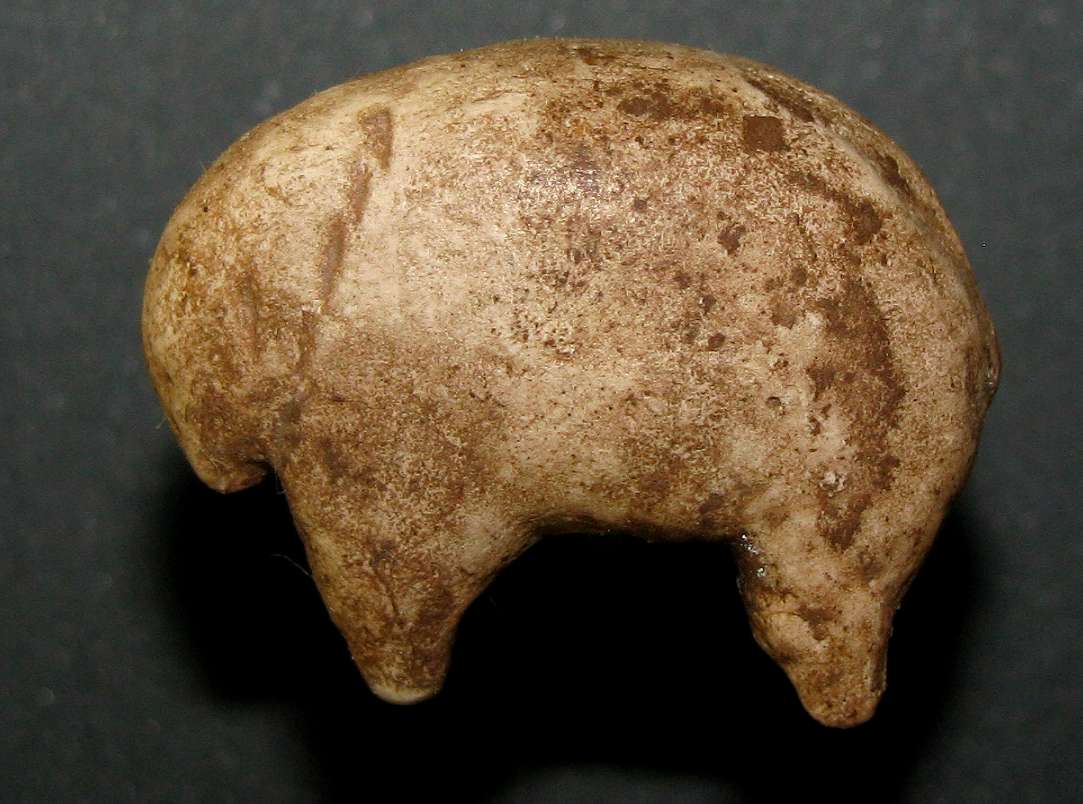

Zoomorphic pottery figurine, possibly a mammoth. Two different facsimiles of the original above.
Photo: Don Hitchcock 2008
Source: Display, Dolní Věstonice Museum
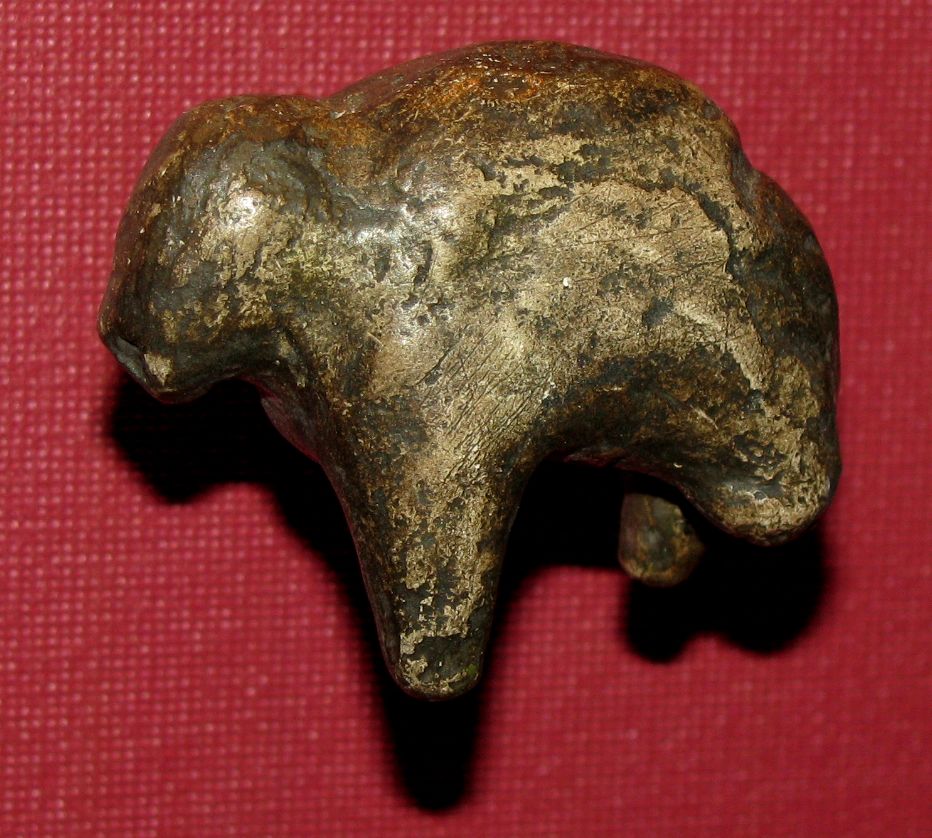
Mammut
Dolní Věstonice, Mähren
25 - 27 000 Jahre
Ton
Kopie, Leihgabe: Archäologisches Institut der Akademie der Wissenschaften, Dolní Věstonice
Which translates as: Mammoth from Dolní Věstonice in Moravia, 25 - 27 000 BP, ceramic, facsimile on loan from the Archaeological Institute of the Academy of Sciences, Dolní Věstonice.
Photo: Don Hitchcock 2008
Source: Facsimile, display, Vienna Natural History Museum
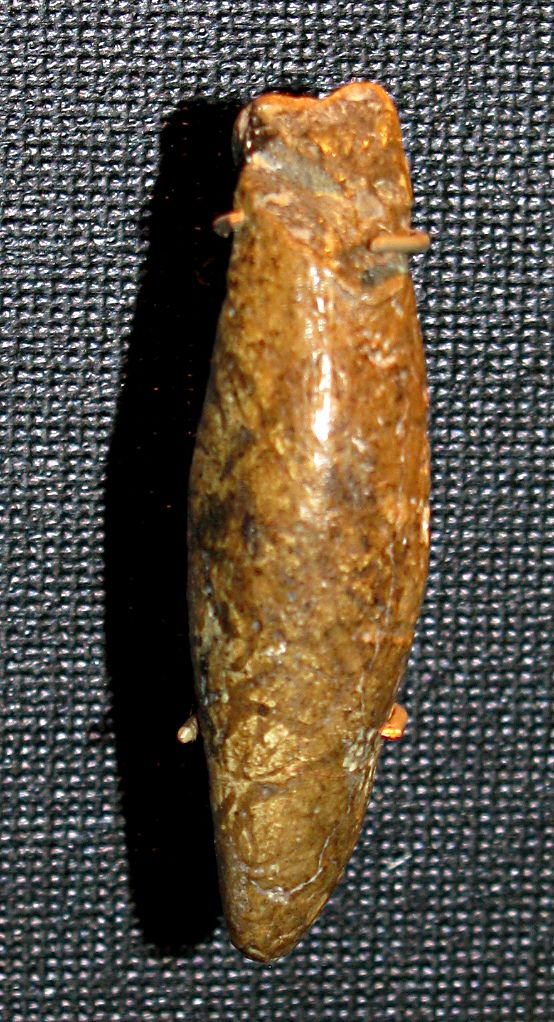
Eule
Pavlov, Mähren
25 - 27 000 Jahre
Ton
Original, Naturhistorisches Museum
Which translates as: Owl from Pavlov in Moravia, 25 - 27 000 BP, ceramic, original held in the collections of the Vienna Natural History Museum.
Photo: Don Hitchcock 2008
Source: Original, display, Vienna Natural History Museum
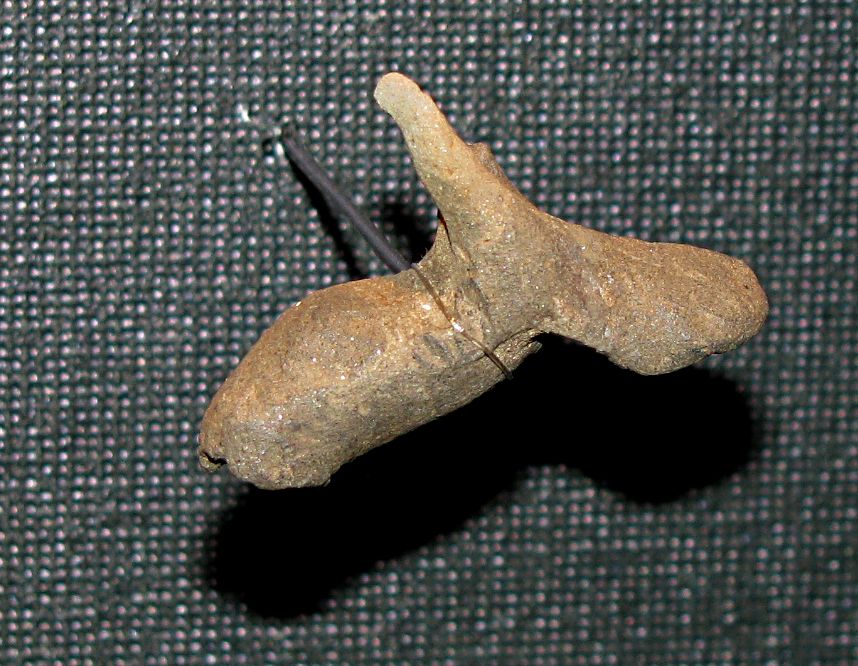
Saigaantilope
Wachtberg bei Krems, NÖ
27 000 Jahre
Ton
Original, Leihgabe: Akademie der Wissenschaften, Wien
Which translates as: Saiga Antelope from Wachtberg bei Krems in lower Austria, 27 000 BP, ceramic, original, on loan from the Academy of Sciences, Vienna.
This is a very important piece, as it shows that the pottery created in Dolni Vestonice was carried or traded at least 100 kilometres from where it was made.
Photo: Don Hitchcock 2008
Source: Original, display, Vienna Natural History Museum

Rhinoceros head.
Nashornkopf
Dolní Věstonice, Mähren
25 - 27 000 Jahre
Ton
Kopie, Leihgabe: Archäologisches Institut der Akademie der Wissenschaften, Dolní Věstonice
Which translates as: Rhinoceros head from Dolní Věstonice in Moravia, 25 - 27 000 BP, ceramic, facsimile on loan from the Archaeological Institute of the Academy of Sciences, Dolní Věstonice.
Photo: Don Hitchcock 2008
Source: Facsimile, display, Vienna Natural History Museum

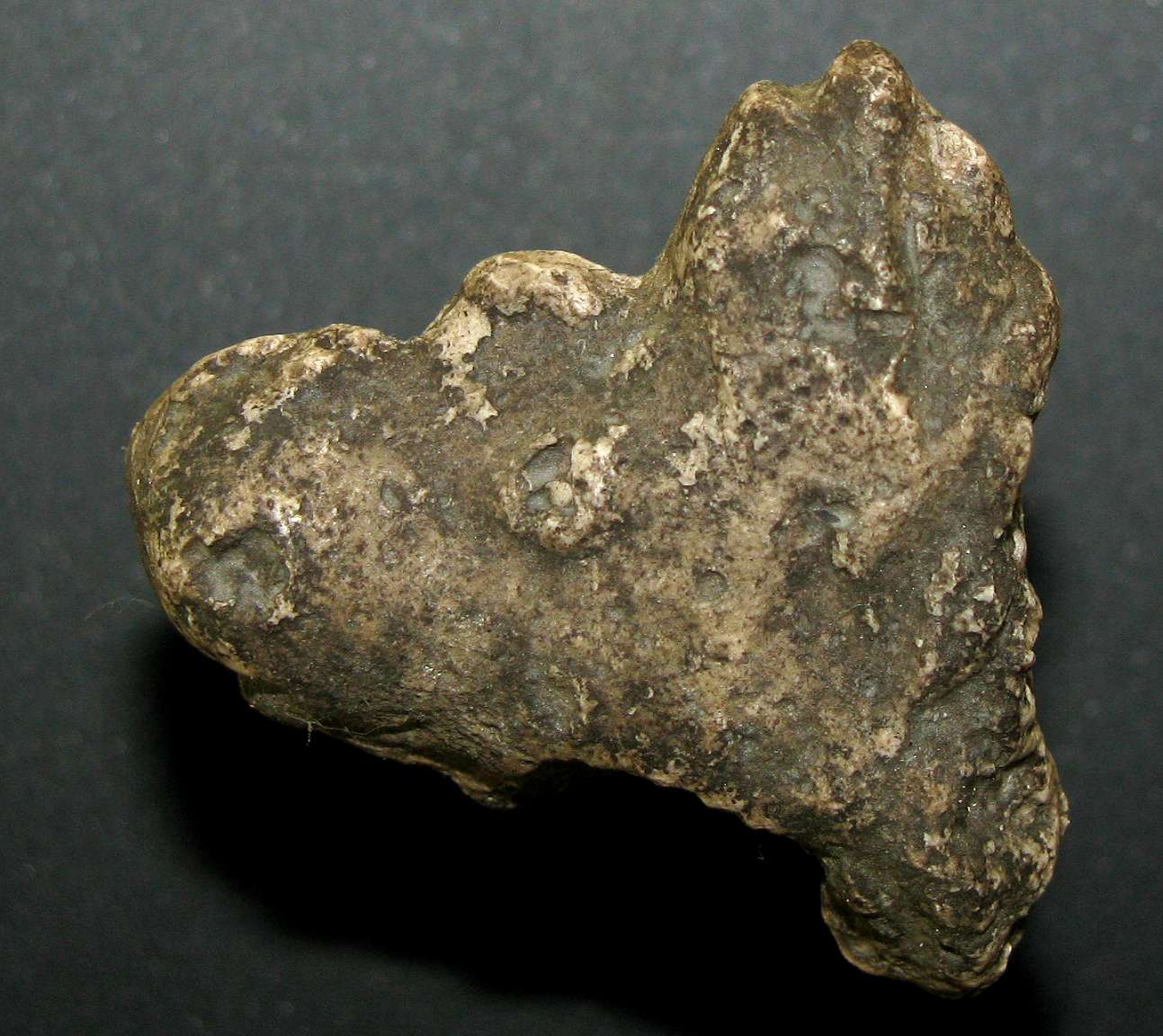
Rhinoceros head.
Copies, left from the Vienna Natural History Museum, right from the display at the Dolní Věstonice museum, of the same original.
Nashornkopf
Dolní Věstonice, Mähren
25 - 27 000 Jahre
Ton
Kopie, Leihgabe: Archäologisches Institut der Akademie der Wissenschaften, Dolní Věstonice
Which translates as: Rhinoceros head from Dolní Věstonice in Moravia, 25 - 27 000 BP, ceramic, facsimile on loan from the Archaeological Institute of the Academy of Sciences, Dolní Věstonice.
Photo: Don Hitchcock 2008
Source: Facsimile, display, Vienna Natural History Museum
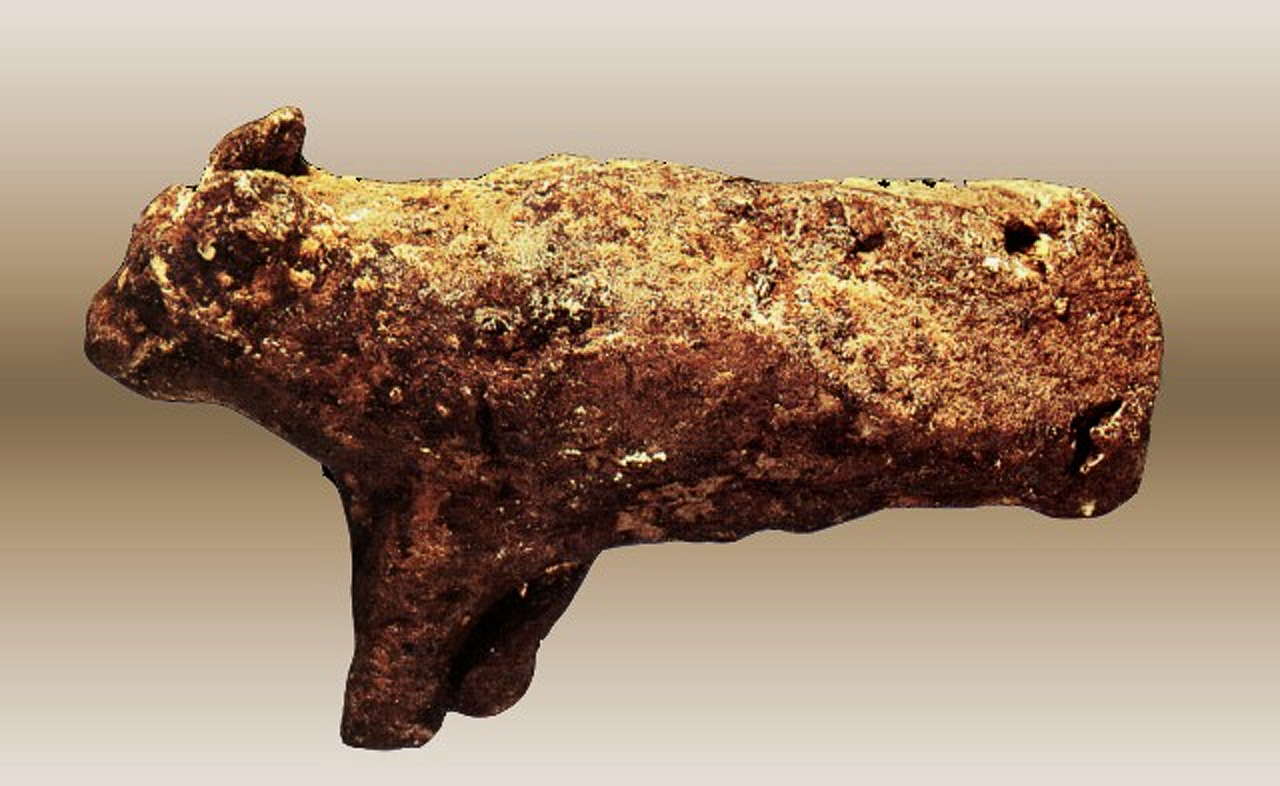
Young bovid in fired clay.
Photo: http://www.istmira.com/foto-i-video-pervobytnoe-obschestvo/3924-iskusstvo-predystorii-pervobytnost-2.html
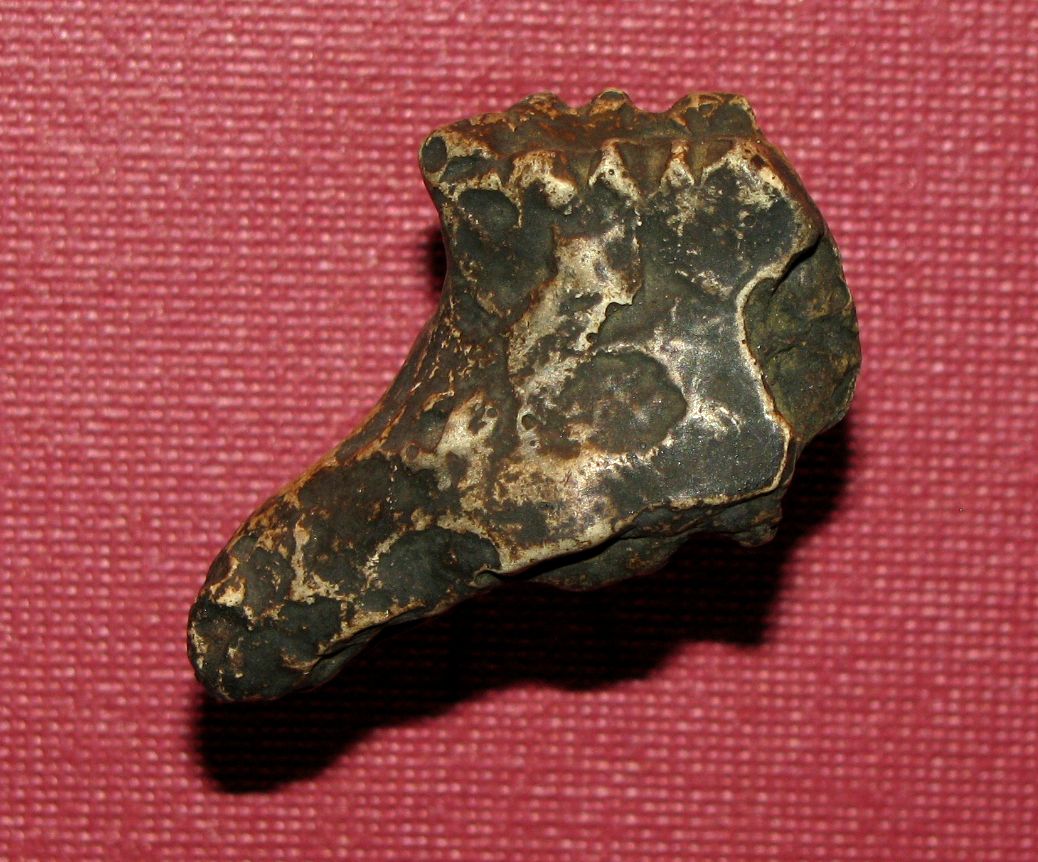
Rentierkopf
Dolní Věstonice, Mähren
25 - 27 000 Jahre
Ton
Kopie, Leihgabe: Archäologisches Institut der Akademie der Wissenschaften, Dolní Věstonice
Which translates as: Reindeer head from Dolní Věstonice in Moravia, 25 - 27 000 BP, ceramic, facsimile on loan from the Archaeological Institute of the Academy of Sciences, Dolní Věstonice.
Photo: Don Hitchcock 2008
Source: Facsimile, display, Vienna Natural History Museum

The Reindeer head above seems to be of the same original as this copy in the Dolní Věstonice Museum.
Reindeer head.
Photo: Don Hitchcock 2008
Source: Facsimile, Display, Dolní Věstonice Museum
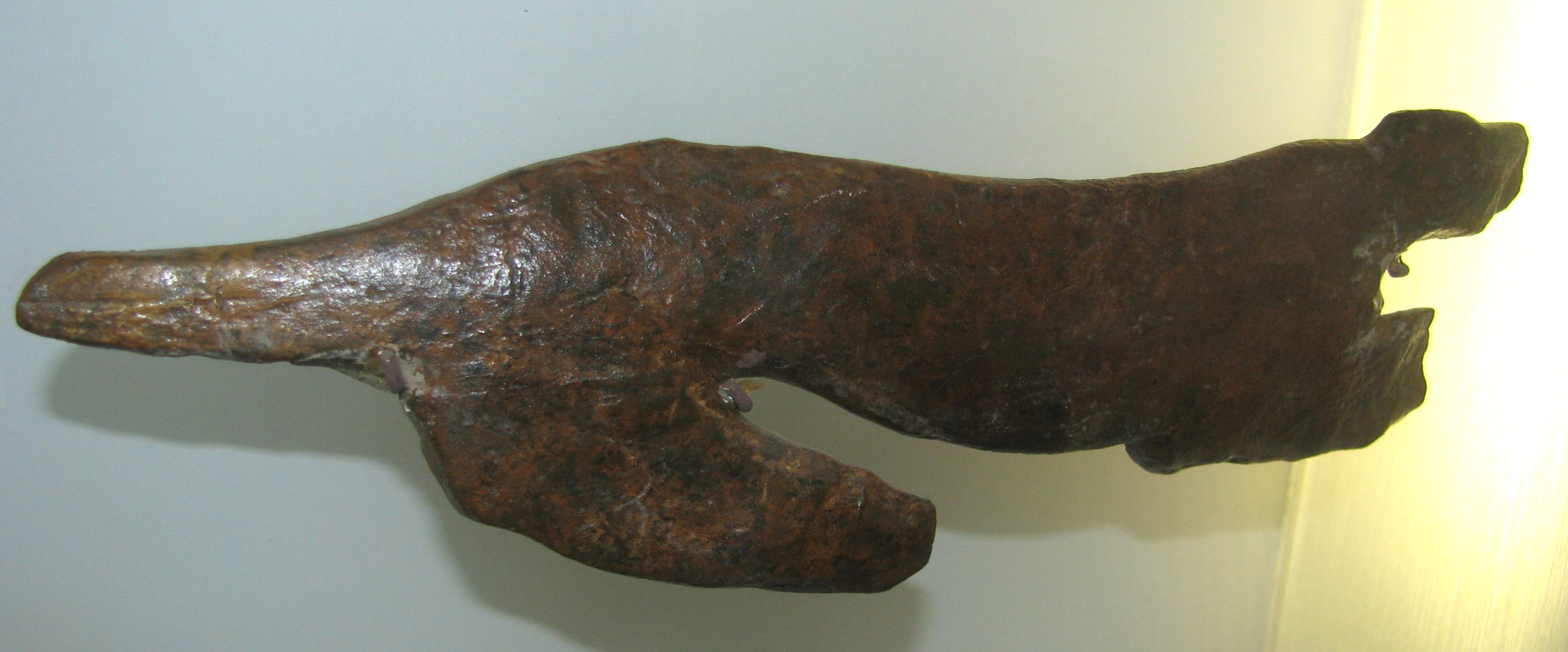
This appears to be a member of the weasel family, possibly a mink.
Photo: Don Hitchcock 2008
Source: Facsimile, Display, Dolní Věstonice Museum
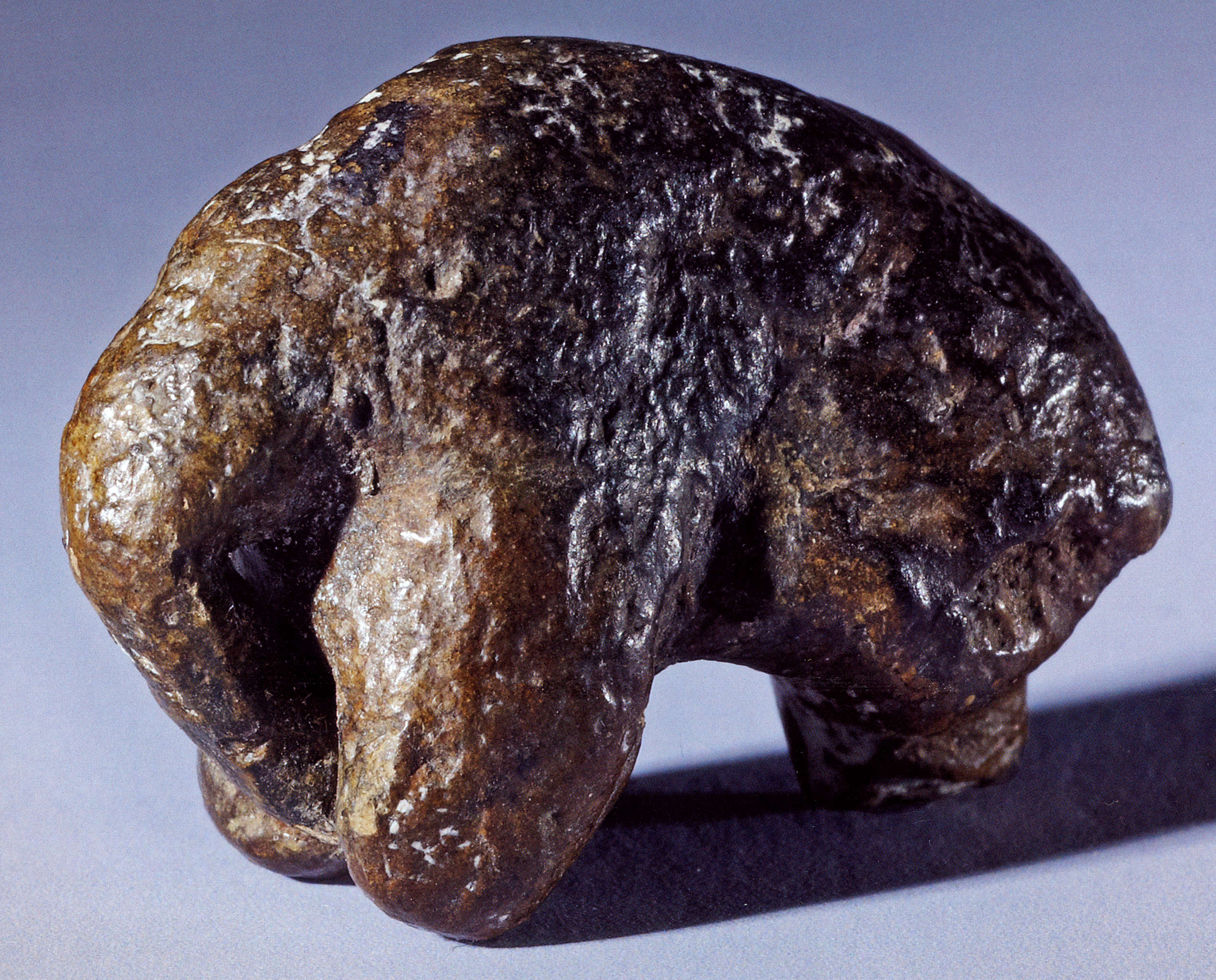
Young mammoth, baked clay. From Dolni Vestonice.
Length 32 mm.
Moravaské Museum, Brno
Photo and text: Cook (2013)
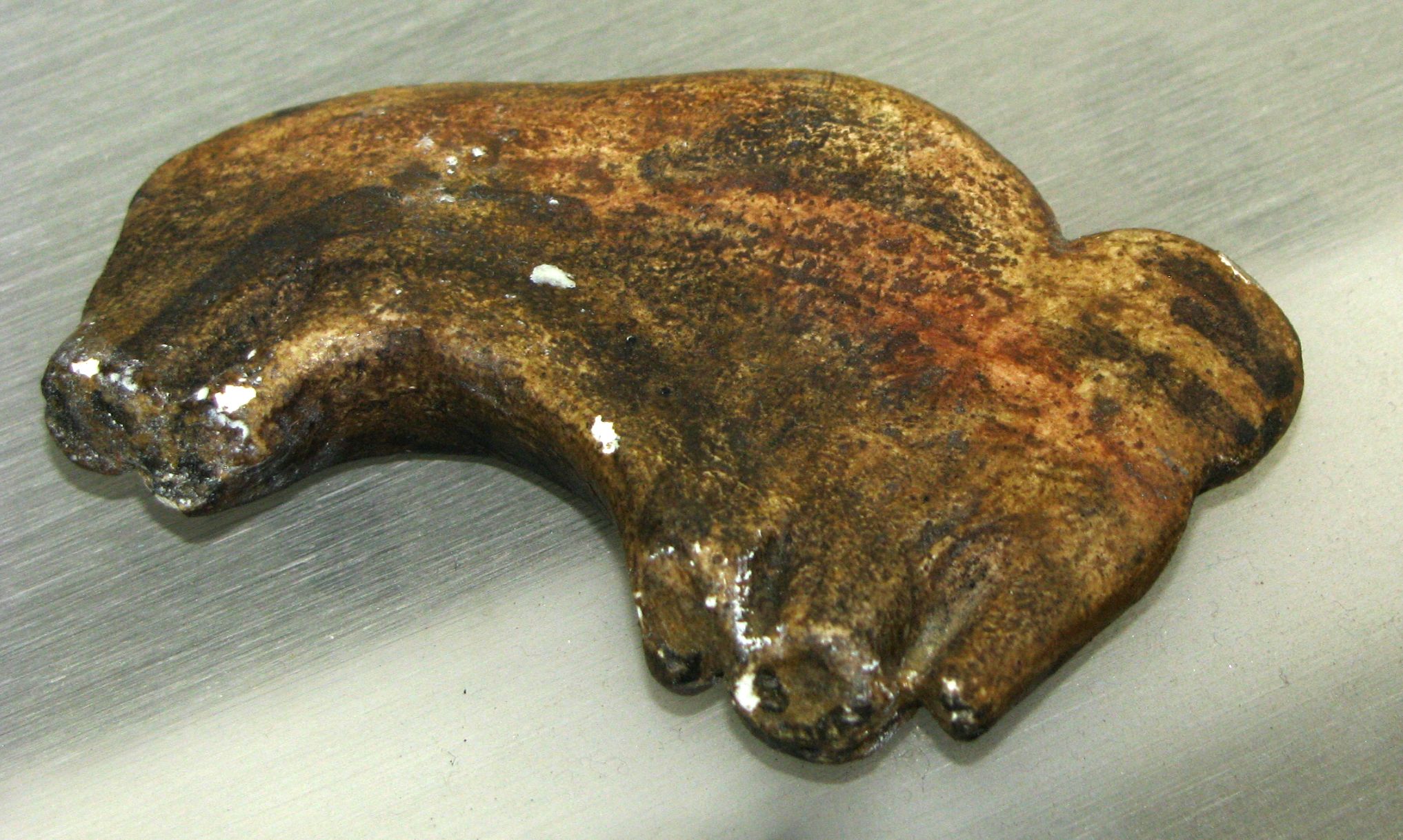
Mammoth. This figure has been created as a bas relief sculpture, rather than as a full three dimensional representation.
The body, the legs, the trunk and distinctive head have been shown, but not tusks.
Photo: Don Hitchcock 2008
Source: Facsimile, Display, Dolní Věstonice Museum
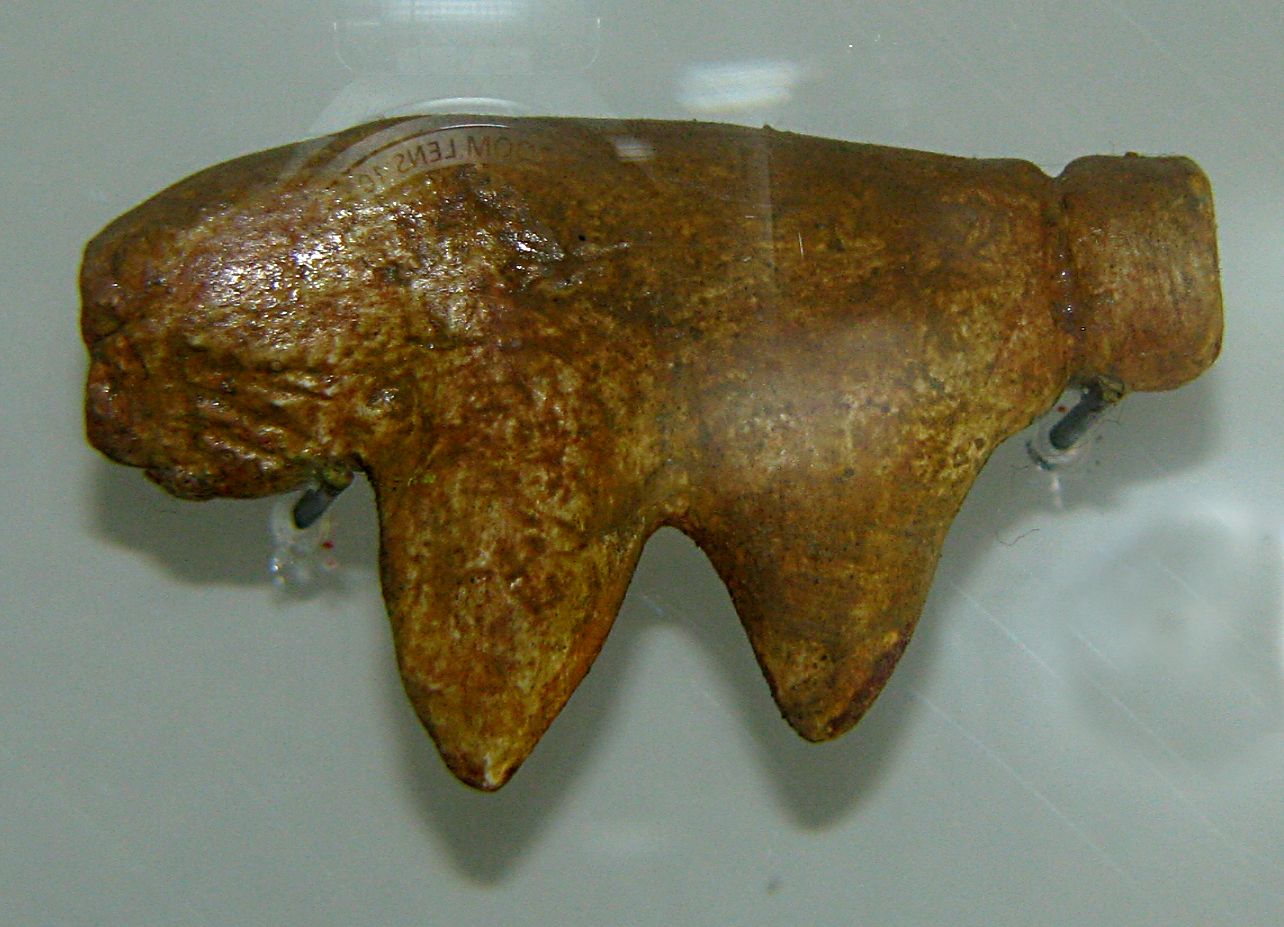
This enigmatic figure, possible a feline, seems to have been made so that it could be worn as a pendant, with an artificial groove at one end for attaching a cord.
Photo: Don Hitchcock 2008
Source: Facsimile, Display, Dolní Věstonice Museum
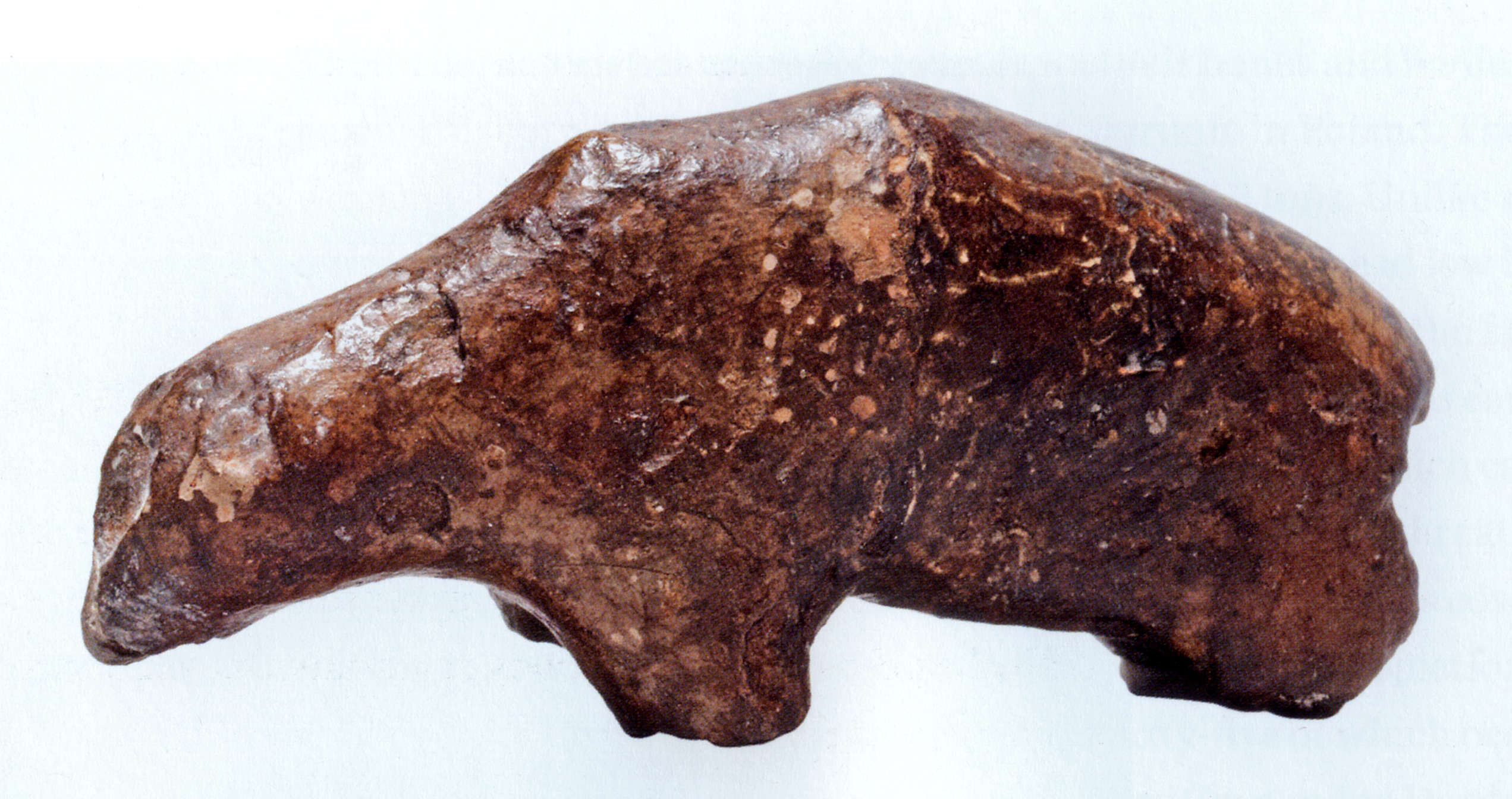
Bear from Dolni Vestonice. Ceramic.
Height 32 mm, length 75 mm.
Moravaské Museum, Brno
Photo and text: Cook (2013)
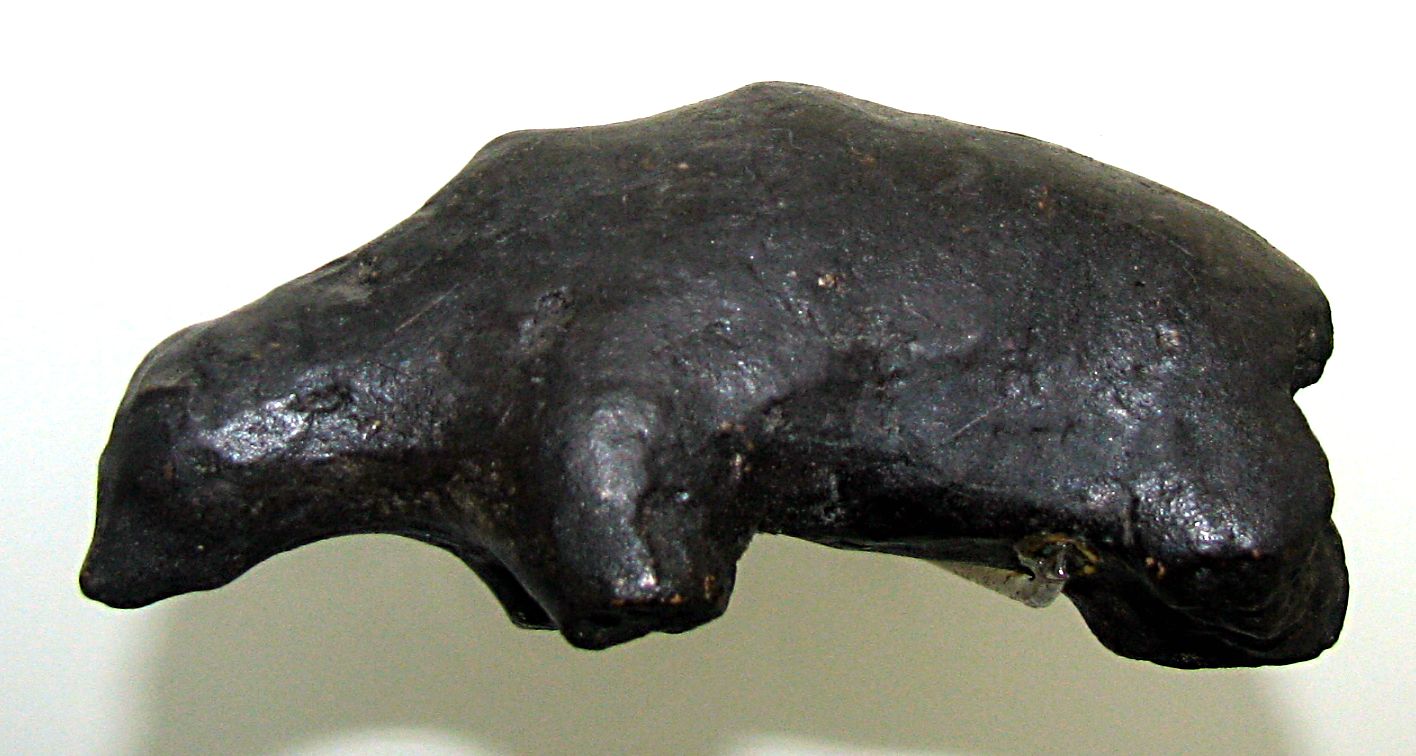
Bear, facsimile of the original above.
Photo: Don Hitchcock 2008
Source: Facsimile, display, Dolní Věstonice Museum
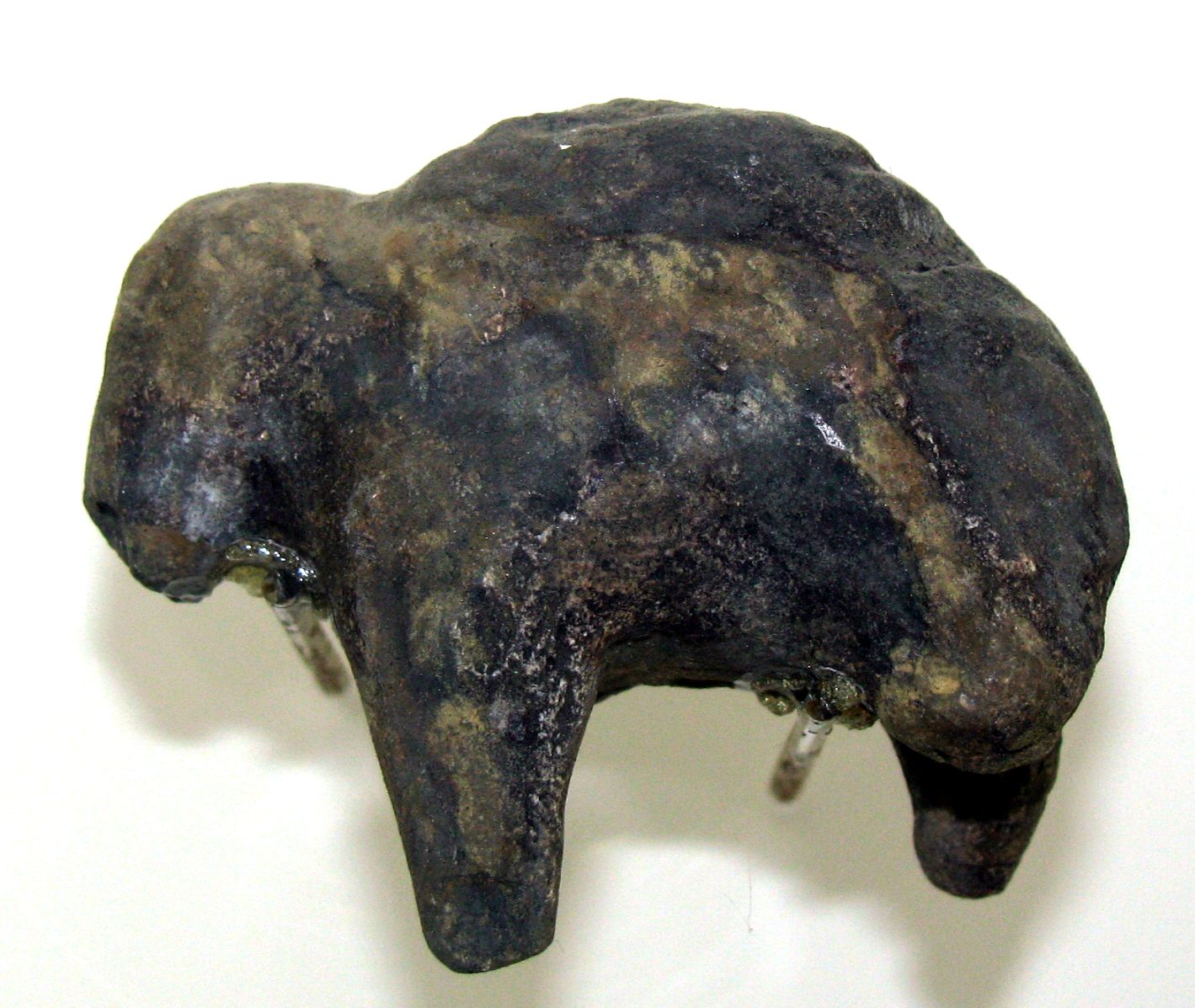
Most likely a mammoth with the trunk broken off either during firing or later.
Photo: Don Hitchcock 2008
Source: Facsimile, Display, Dolní Věstonice Museum
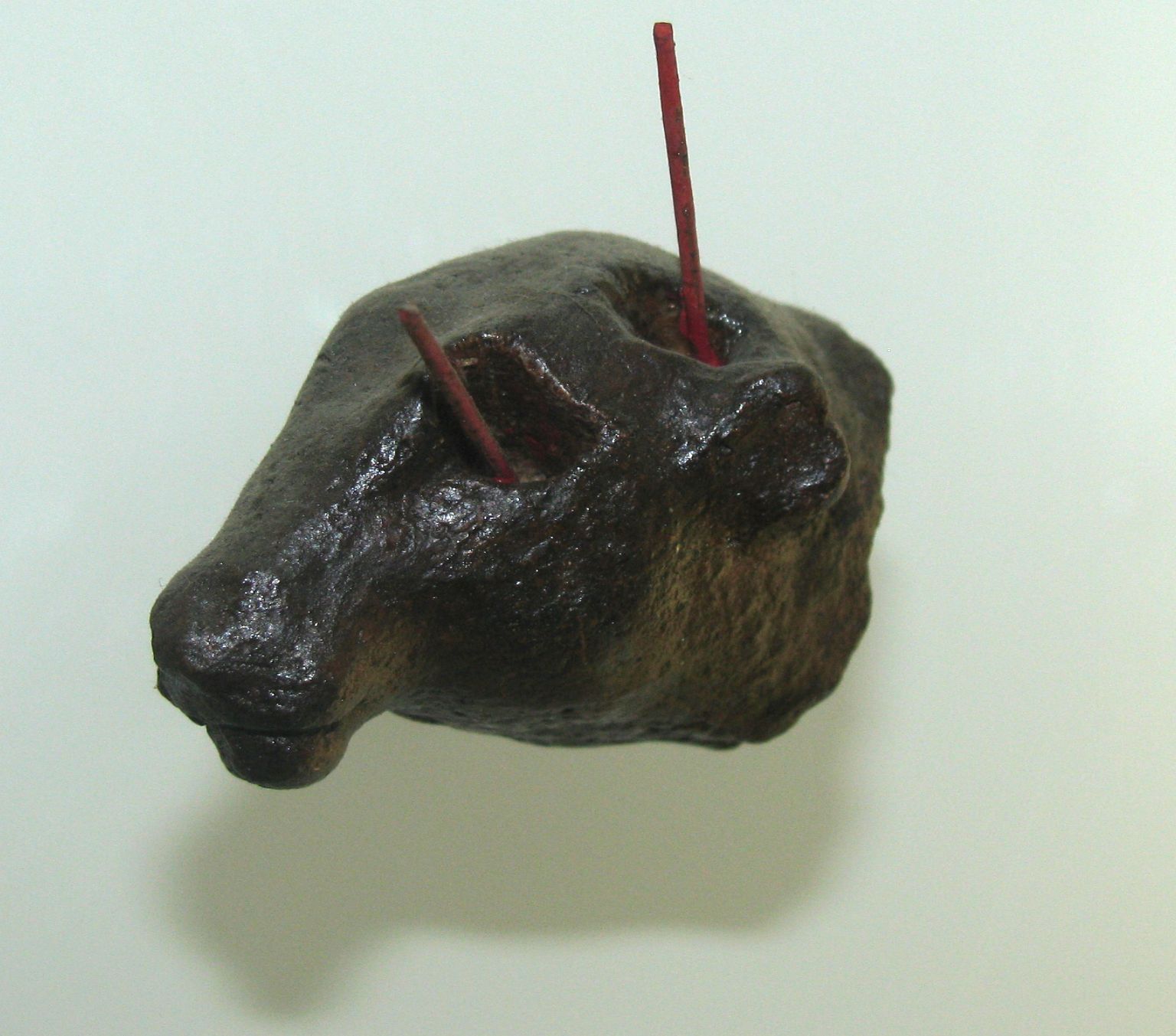
Pottery head of a lioness. This is a famous piece, 4.5 cm long.
The facsimile on the right has been mounted using oversized red rods to show that there is a hole right through the figure at two places, at the eye, and just above the ear.
Photo: (left) Jelinek (1975), (right) Don Hitchcock 2008
Source: Facsimile, Display, Dolní Věstonice Museum
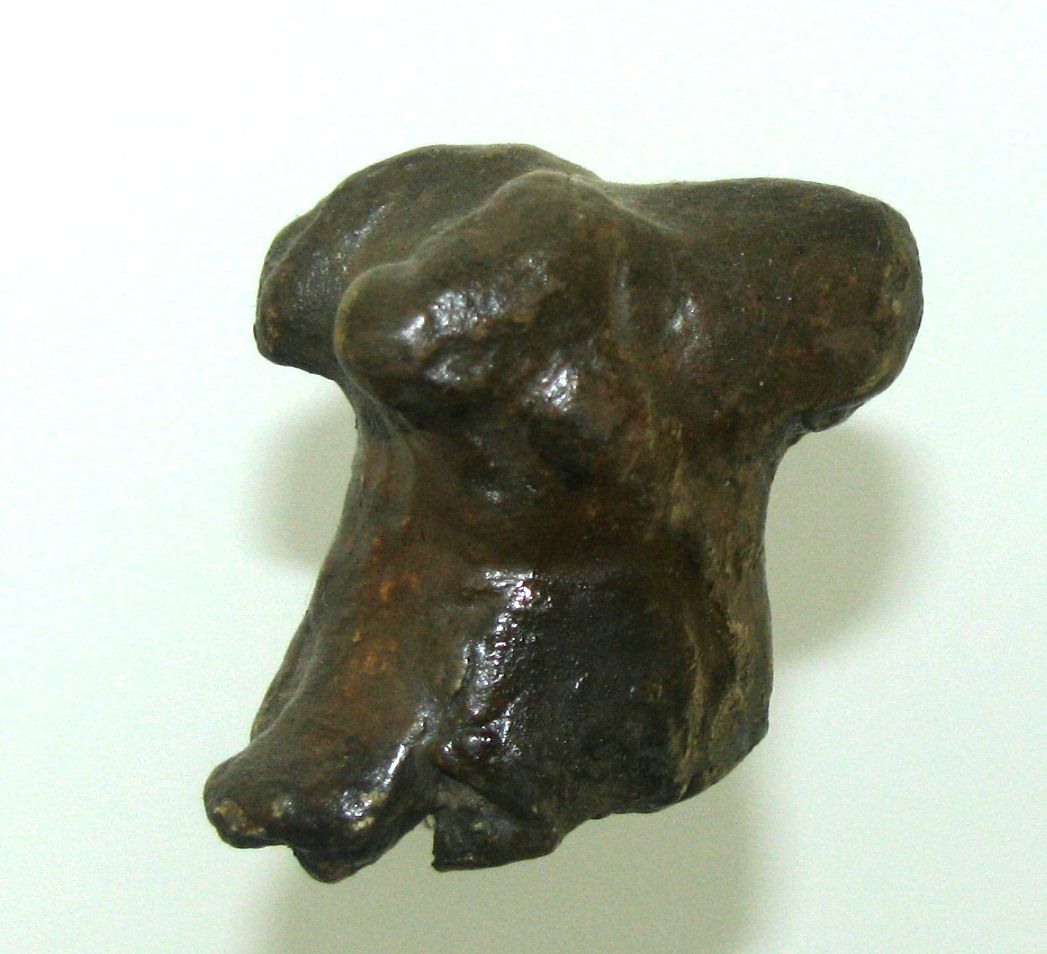

Zoomorphic pottery figurine, possibly an Ibex.
These were different facsimiles in the Dolní Věstonice Museum, but apparently of the same original.
Photo: Don Hitchcock 2008
Source: Facsimile, Display, Dolní Věstonice Museum


Lion heads from Dolni Vestonice. Ceramic.
Height (left) 28 mm, height (right) 20 mm.
Moravaské Museum, Brno
Photo and text: Cook (2013)
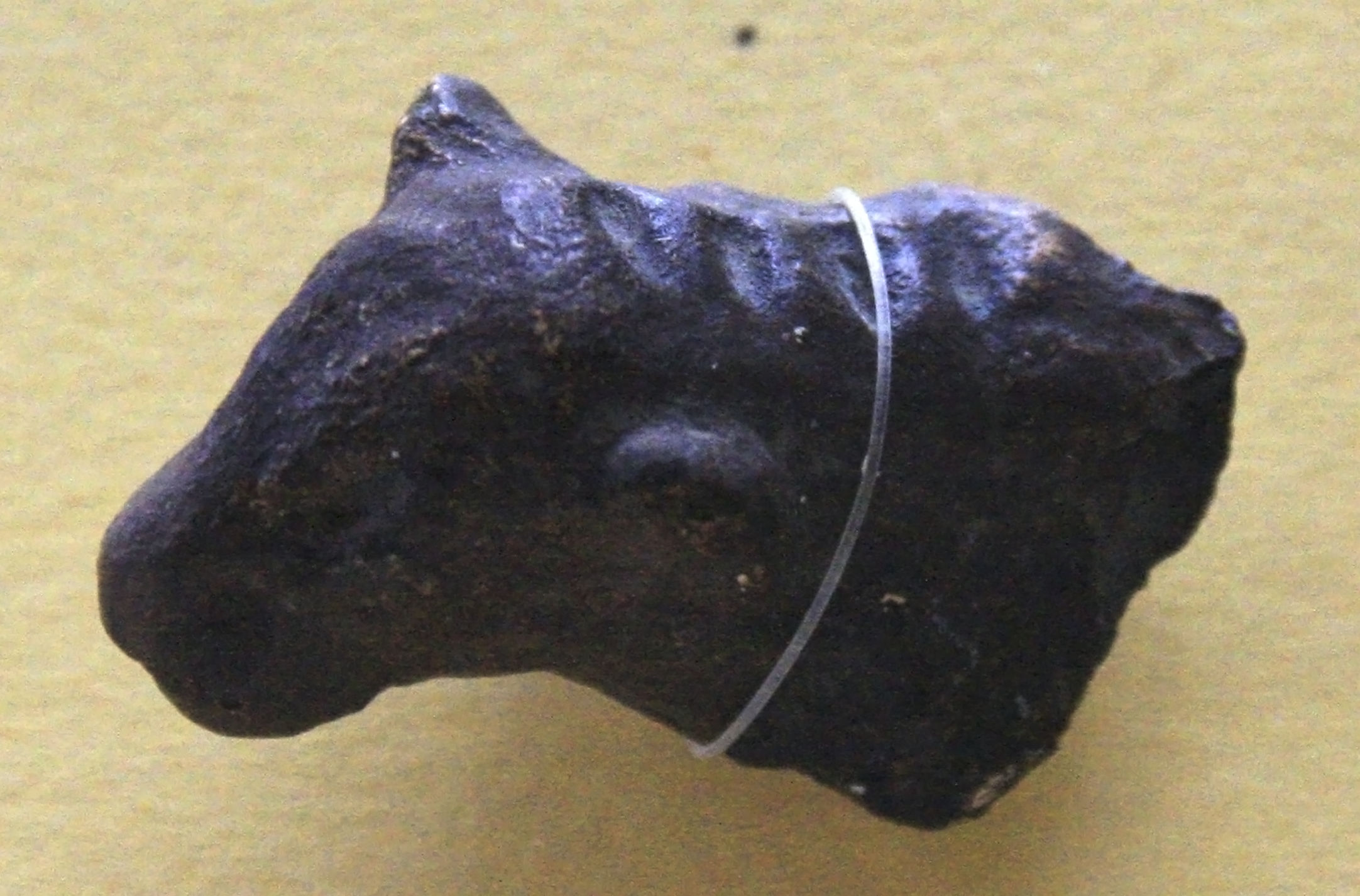

Lion heads from Dolni Vestonice.
Photo: Vladimir Gorodnjanski 2014
Source: Facsimile, Kostenki Museum
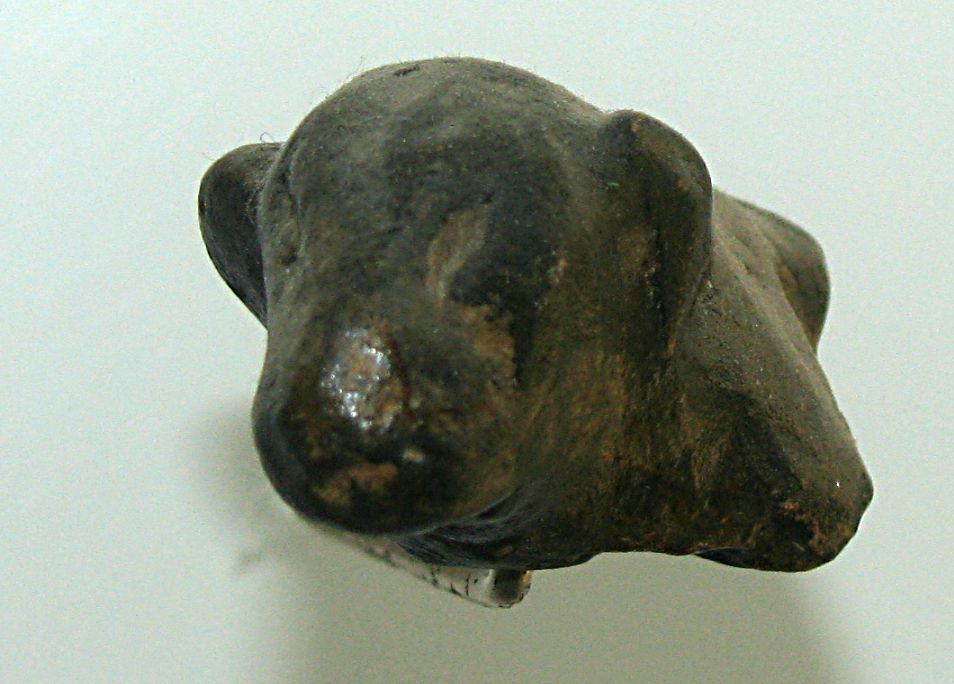
This looks for all the world like the head of a bear cub.
Photo: Don Hitchcock 2008
Source: Facsimile, Display, Dolní Věstonice Museum
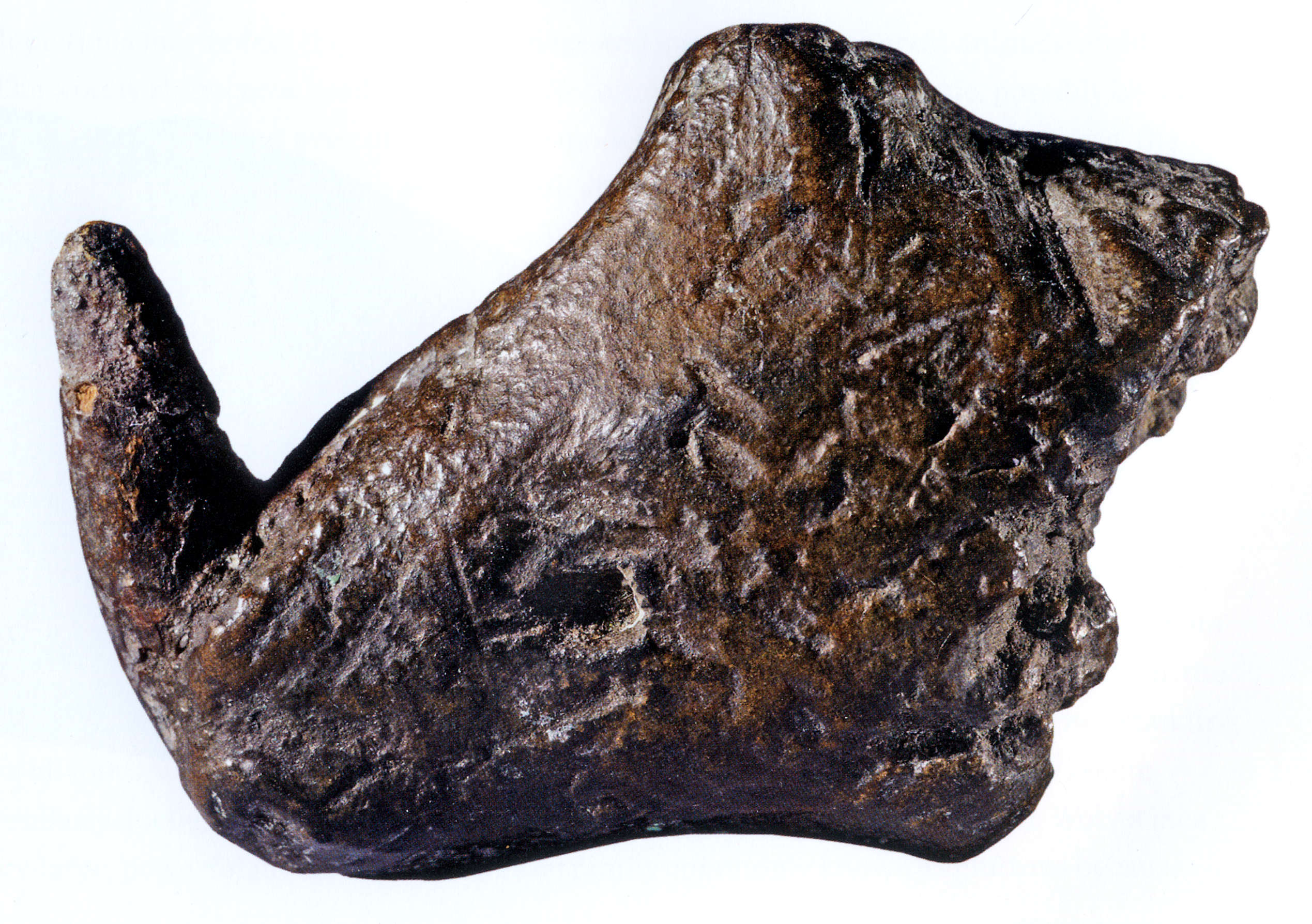

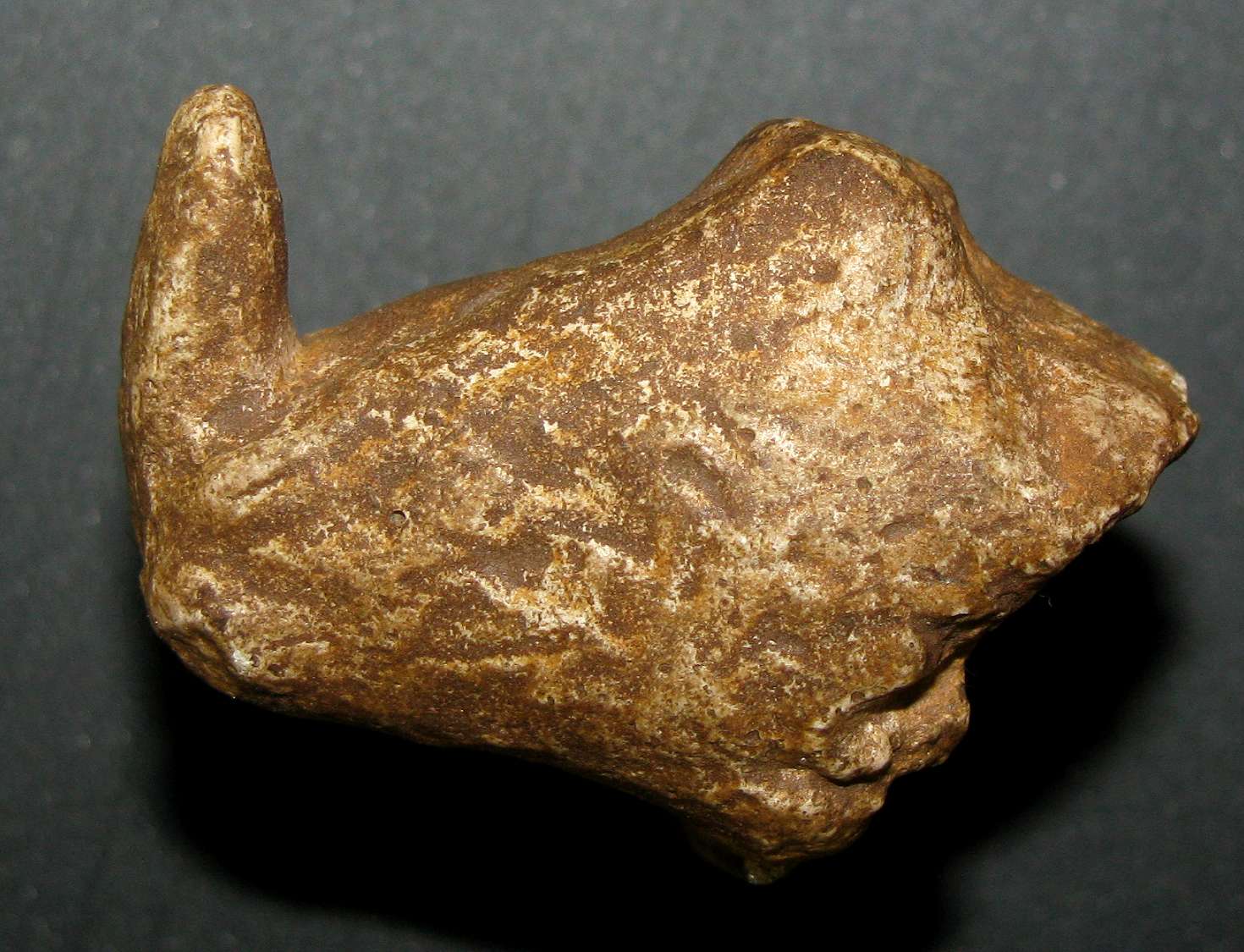
Rhinoceros head, 42 mm. This is a very well known piece.
Photo: (above left) Jelinek (1975), (above right, original) Cook (2013)
Photo: (below left and right) Don Hitchcock 2008, facsimiles, Display, Dolní Věstonice Museum
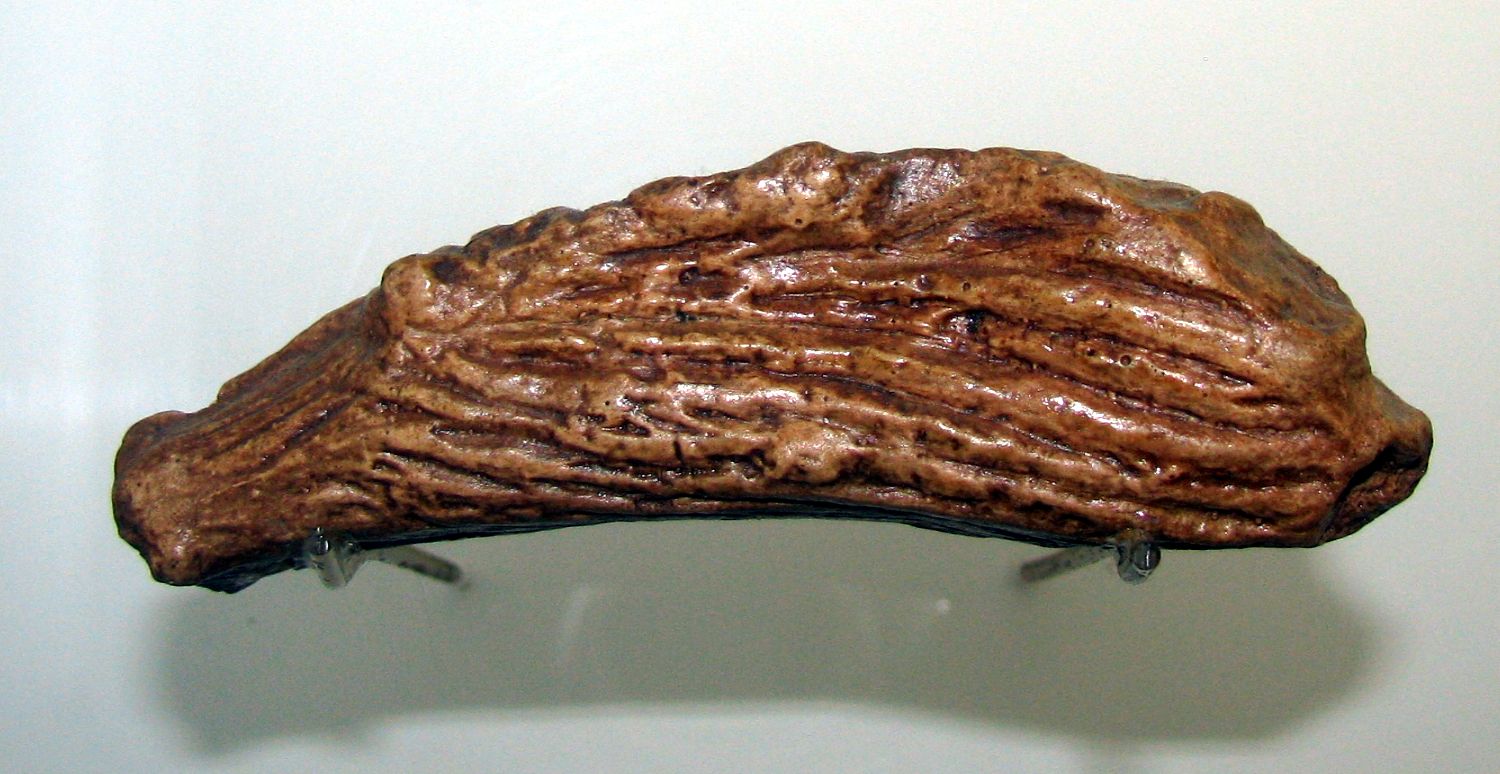
This is identified as a horse's head.
Photo: Don Hitchcock 2008
Source: Facsimile, display, Dolní Věstonice Museum
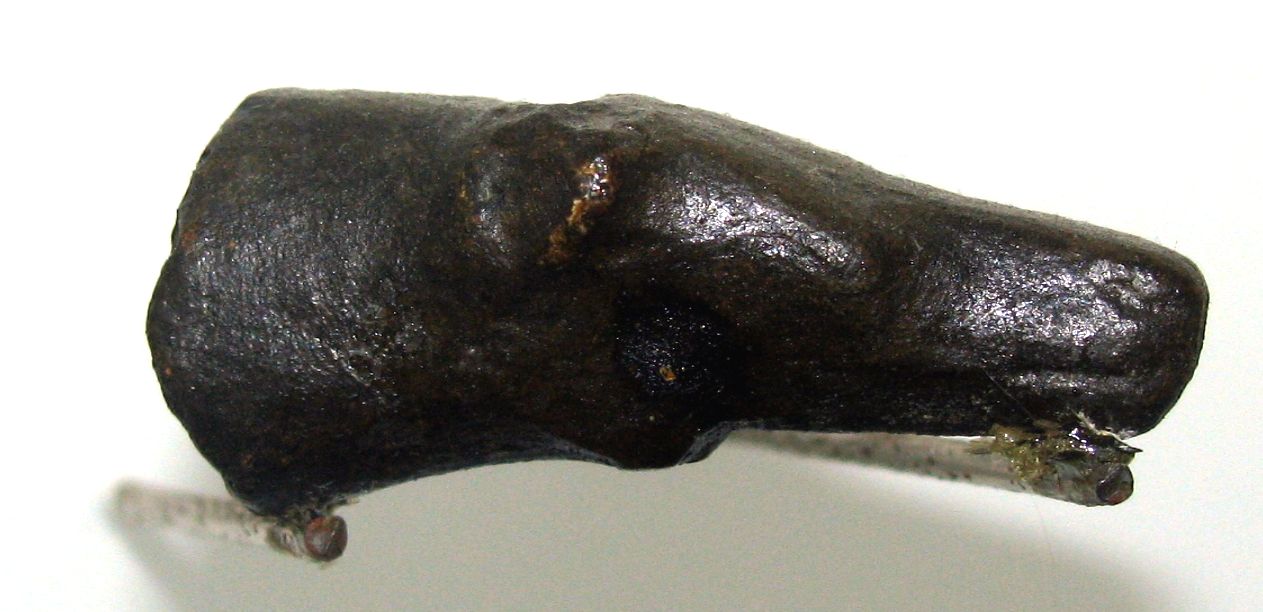
Horse head from Dolni Vestonice.
Photo: Vladimir Gorodnjanski 2014
Source: Facsimile, Kostenki Museum
This is identified as a reindeer on the display.
The black, circular depression just above what appear to be prominent jaw bones beneath the head puzzles me, unless it was another hole to indicate where to strike the animal when hunting, or to indicate some other purpose entirely.
Photo: Don Hitchcock 2008
Source: Facsimile, display, Dolní Věstonice Museum
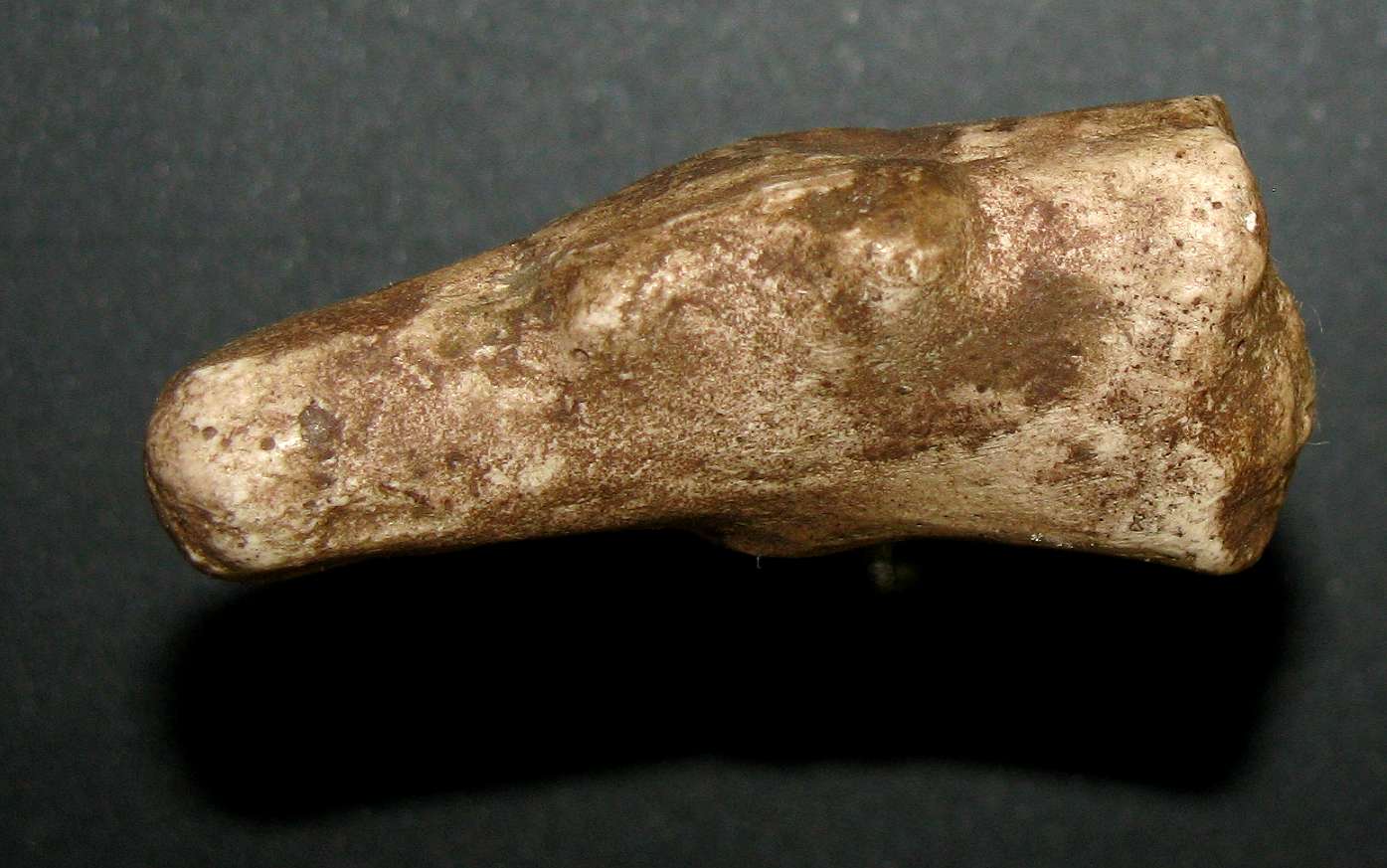
Zoomorphic pottery figurine, apparently the other side of the reindeer head above, cast from the same original.
Photo: Don Hitchcock 2008
Source: Facsimile, display, Dolní Věstonice Museum
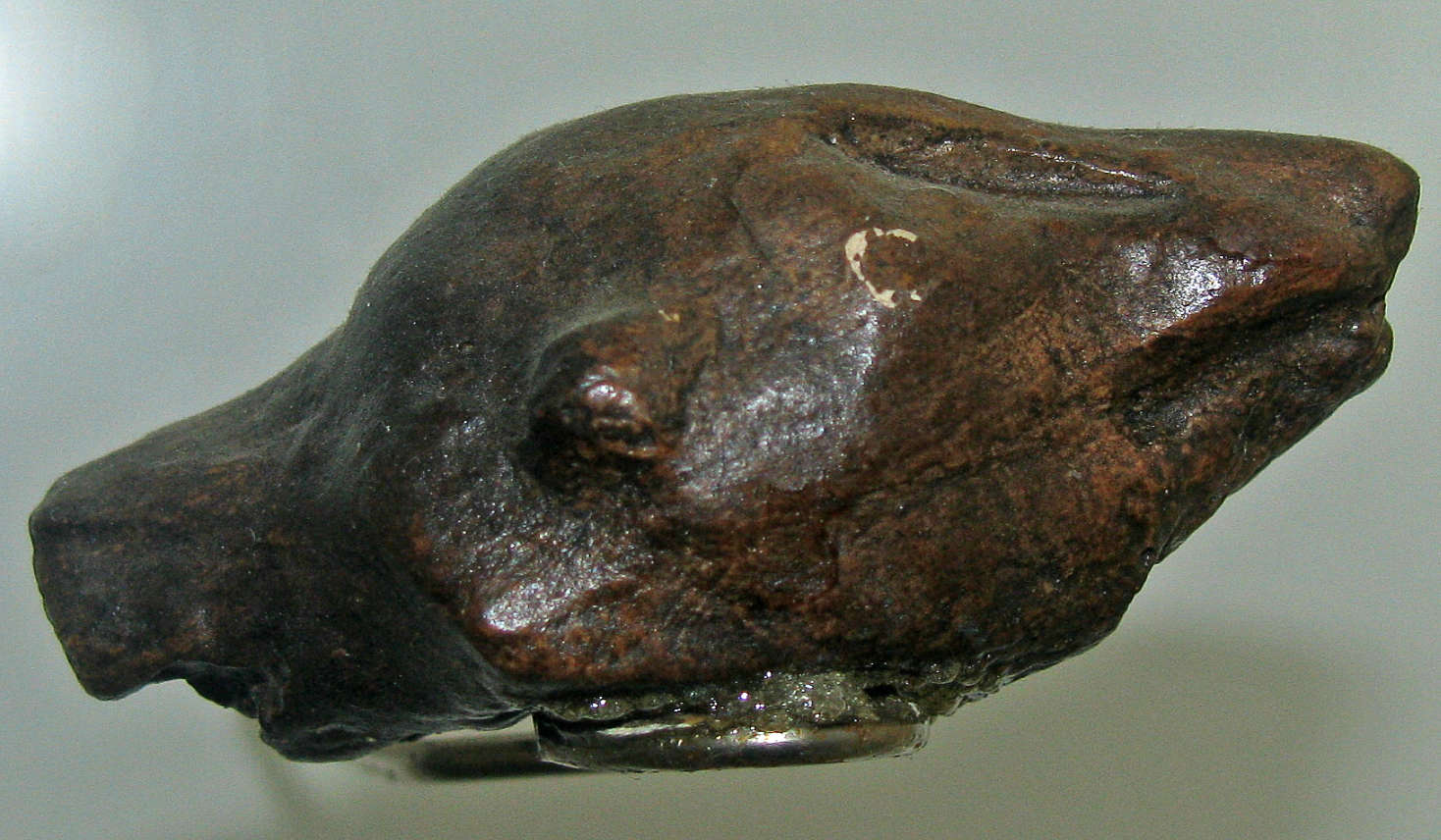
Head of a bear, with the mouth pointing to the right.
Once again there is a large circular depression, this time on the top of the head, possibly to indicate a stab wound.
Photo: Don Hitchcock 2008
Source: Facsimile, display, Dolní Věstonice Museum
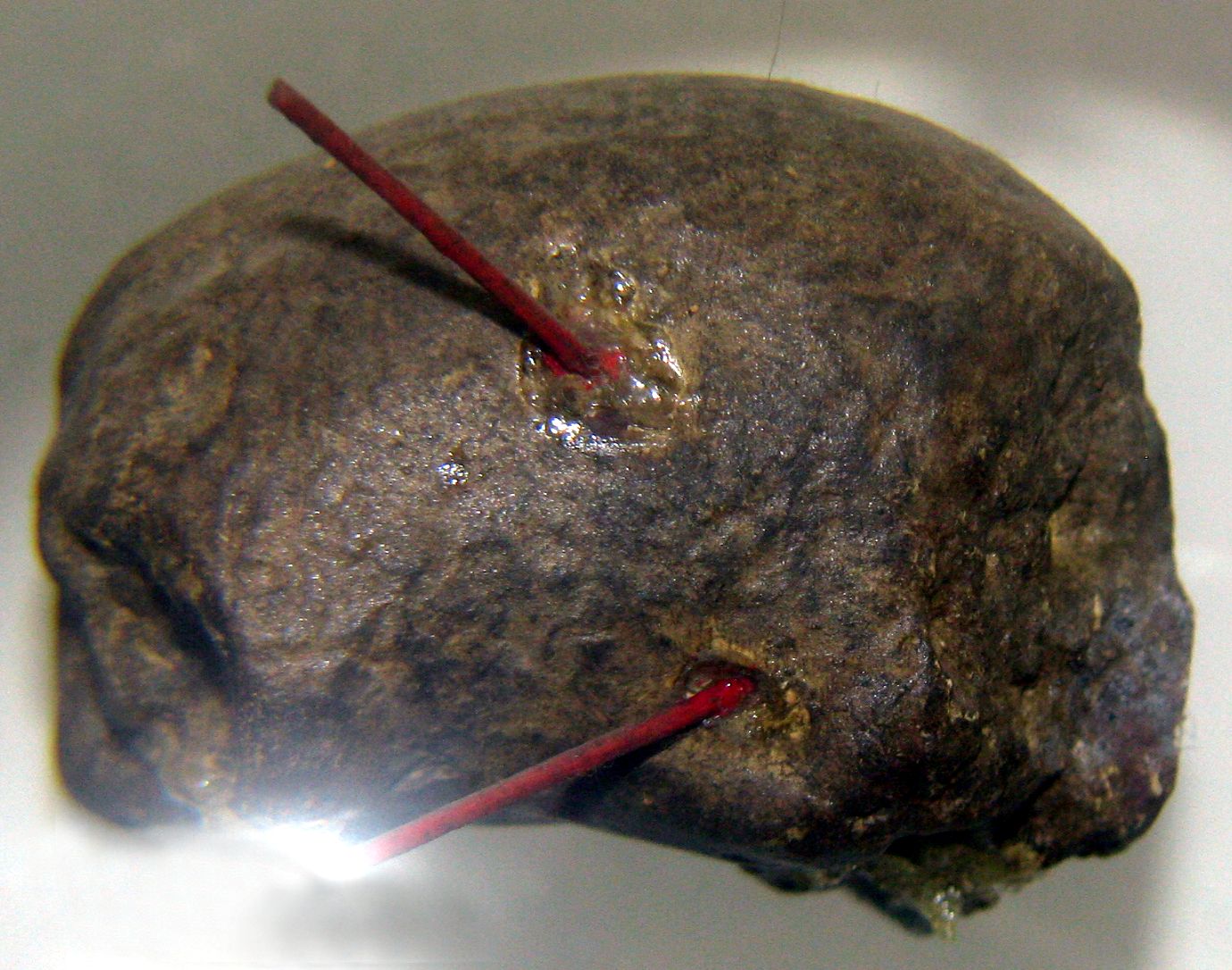
This is identified on the display as a bear's body with stab wounds. It is a very small object under a large magnifying glass.
Photo: Don Hitchcock 2008
Source: Facsimile, display, Dolní Věstonice Museum
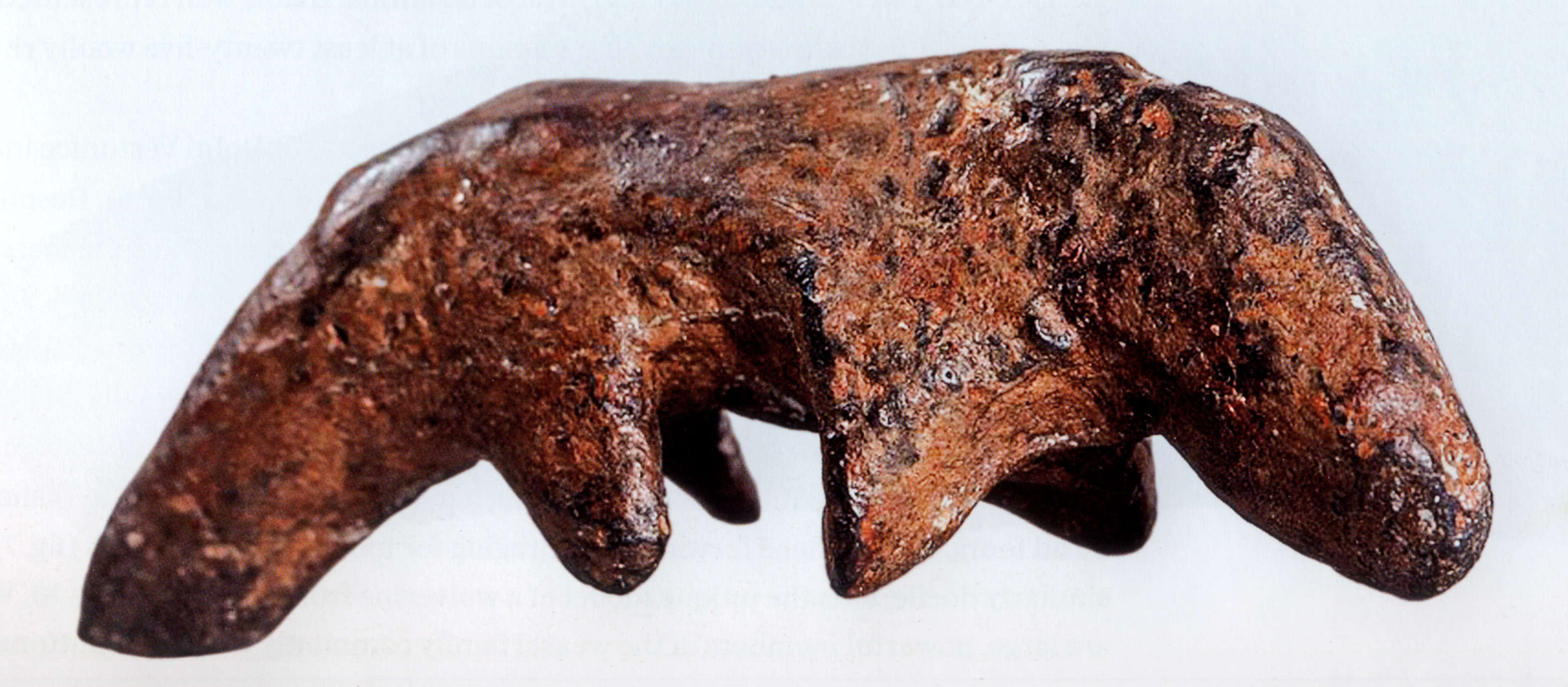
Wolverine from Predmosti. Ceramic.
Length 46 mm.
Moravaské Museum, Brno
Photo and text: Cook (2013)
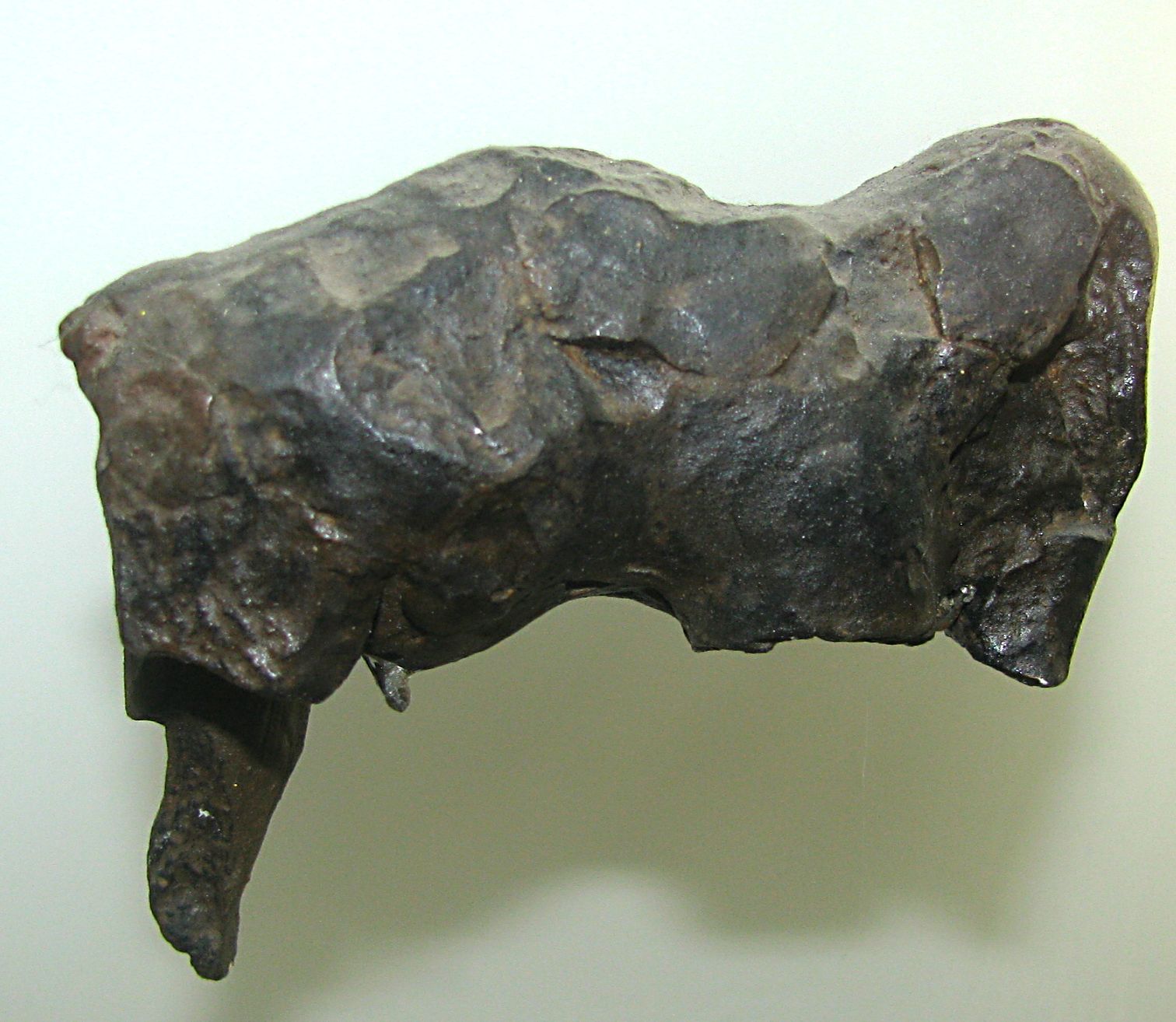
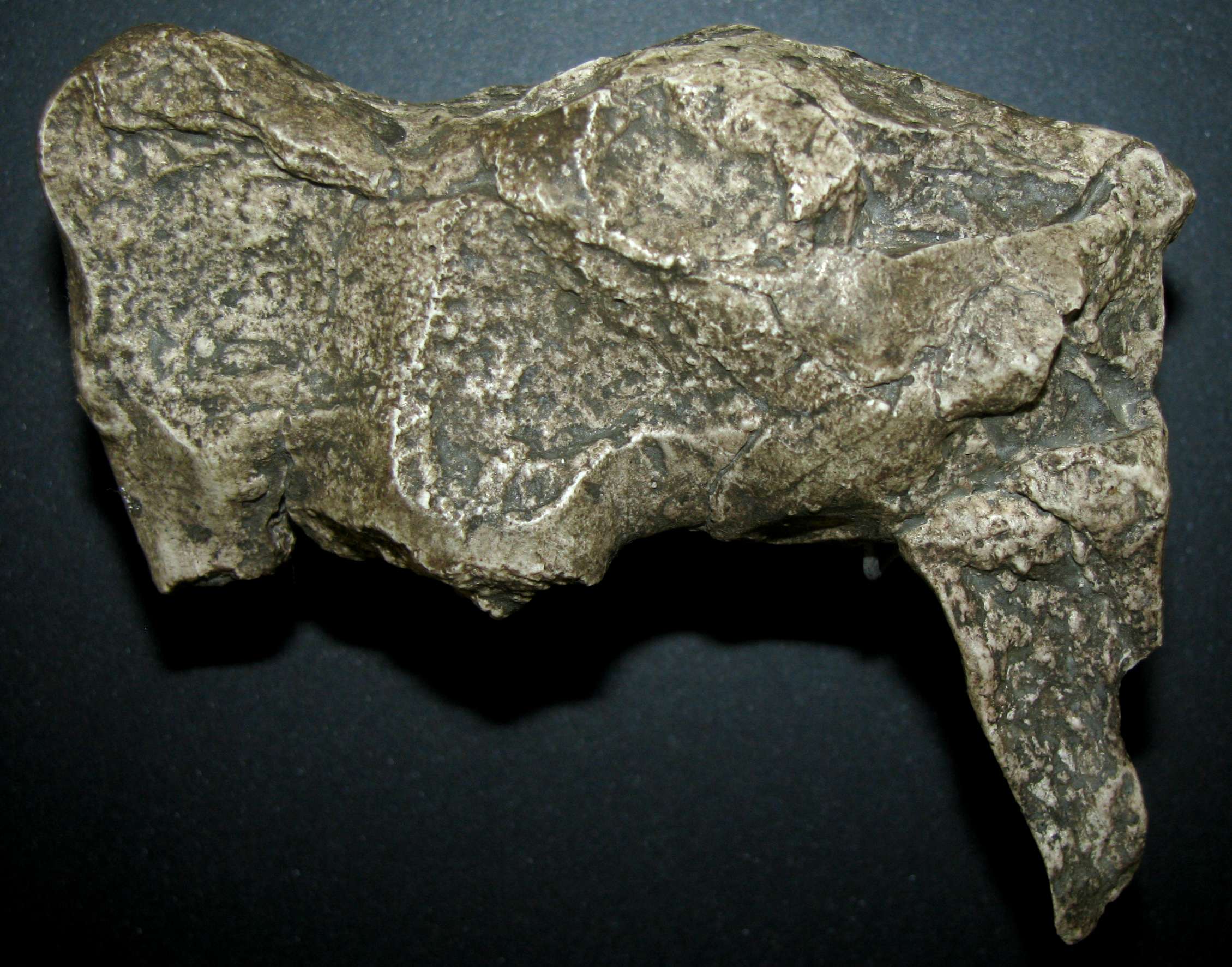
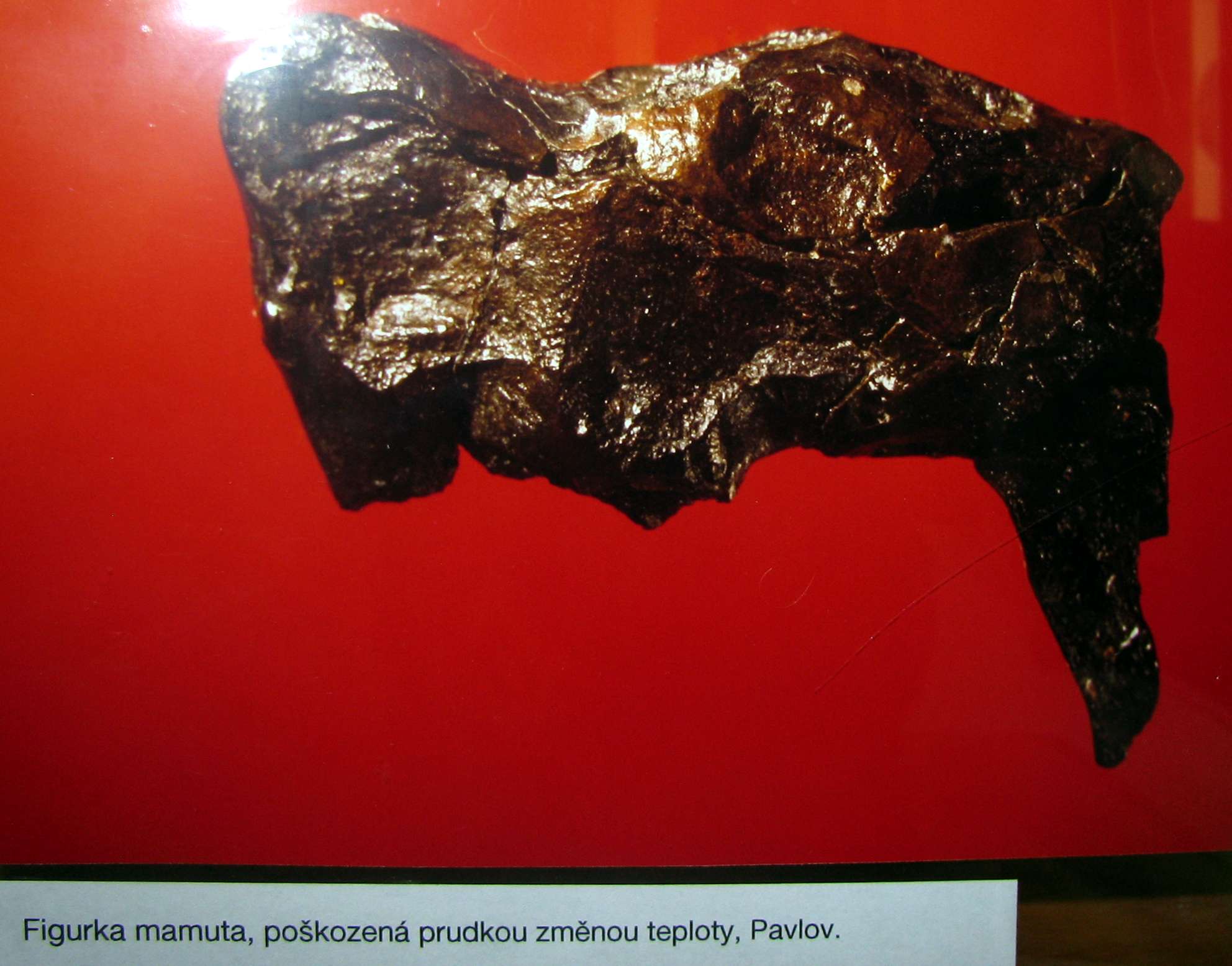
Facsimiles of a zoomorphic pottery figurine, a mammoth, and a poster of the original. The mammoth was damaged in the kiln because of sudden temperature changes. Some have speculated that this was sometimes deliberate, for spiritual or magical purposes.
Photo: Don Hitchcock 2008
Source: Facsimile, display, Dolní Věstonice Museum
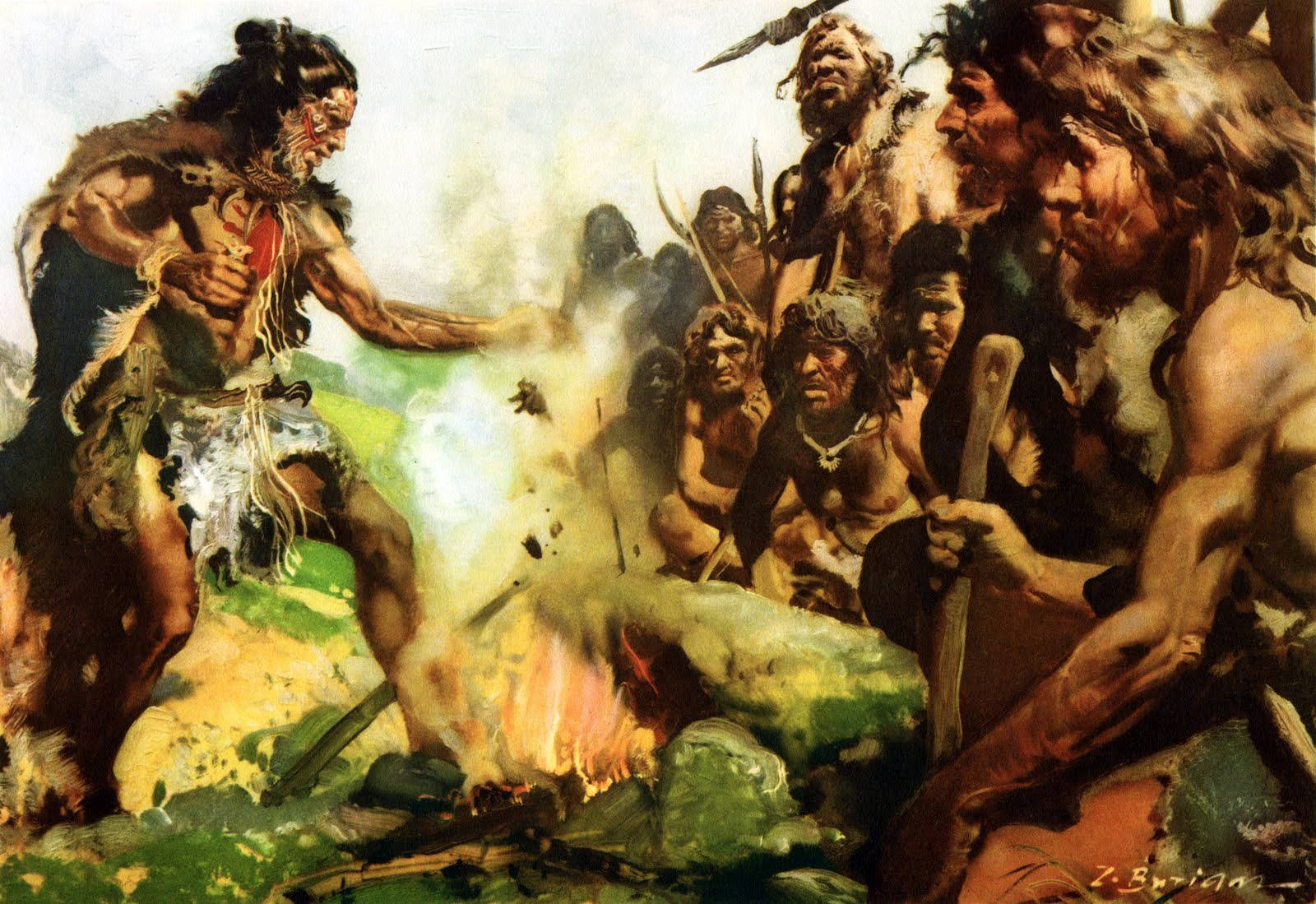
Another superb image by the artist Zdeněk Burian. Here the completed but undried figures are being flung into a fire by a shaman so that they explode, for ritualistic purposes. This is a wonderfully realised scene of the planned destruction of the images for a particular magic purpose.
Photo: http://neat-stuff-blog.blogspot.com/2011/06/prehistoric-man.html

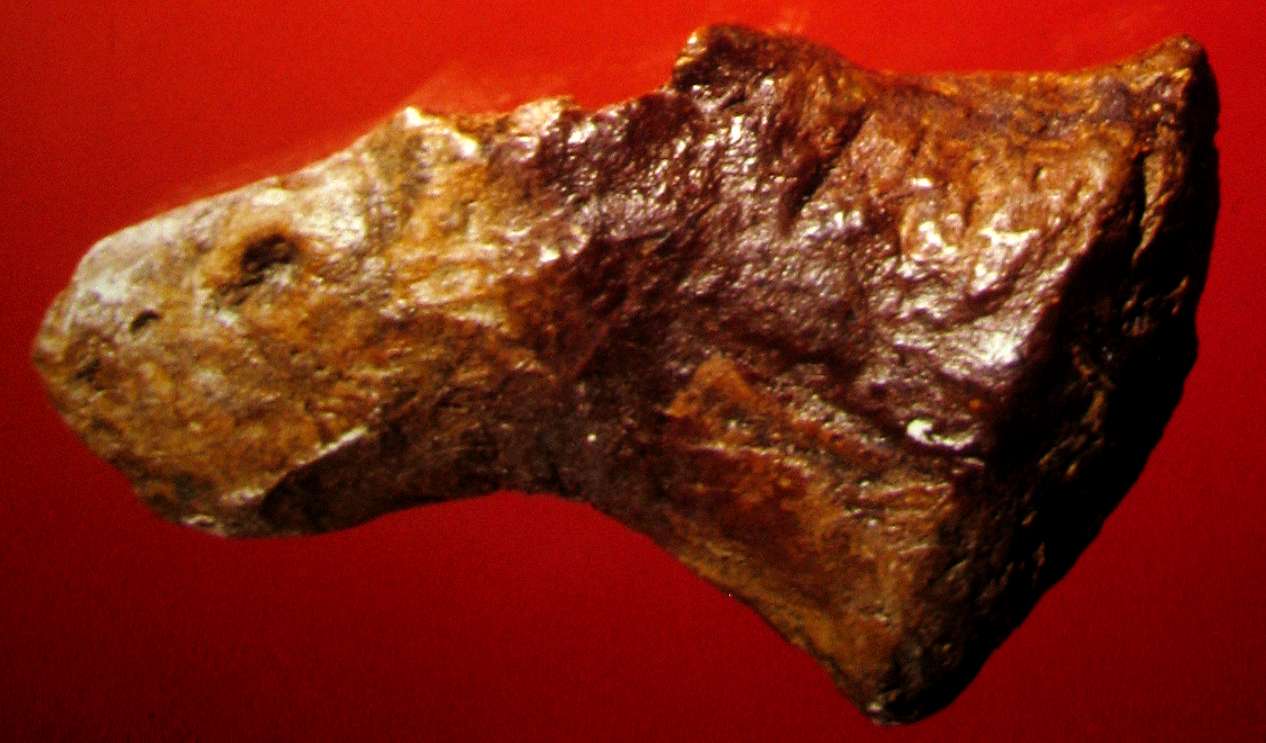
Posters of zoomorphic pottery figurines.
Photo: Don Hitchcock 2008
Source: Display, Dolní Věstonice Museum
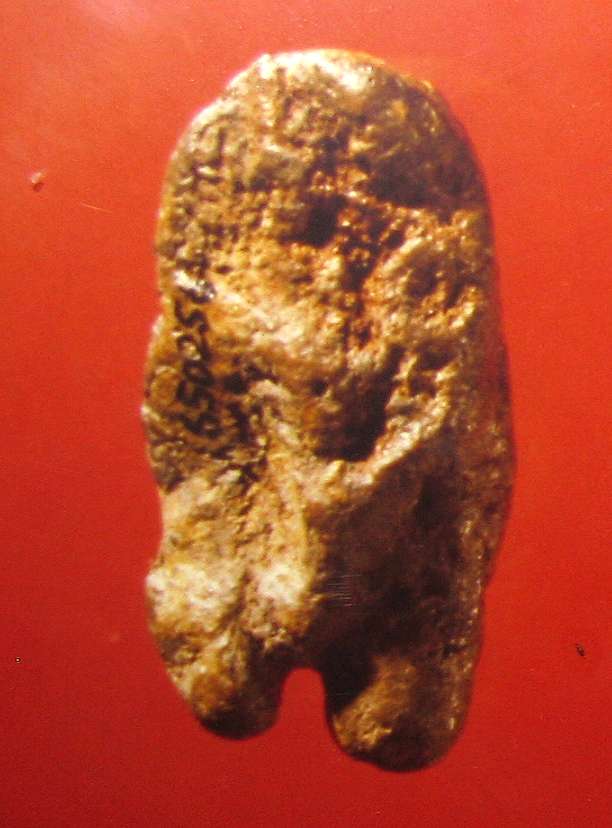
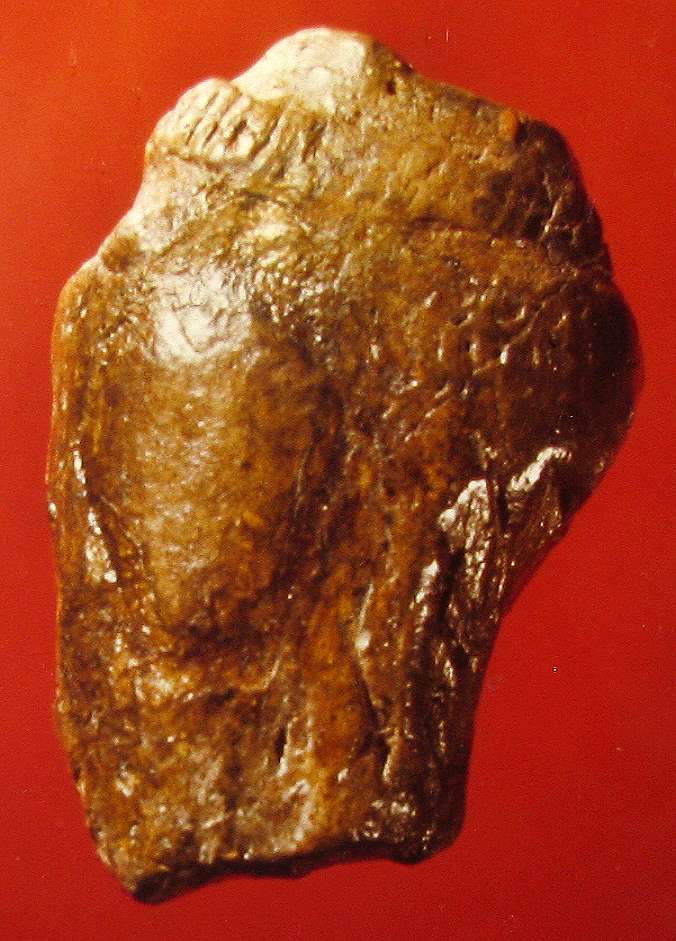
Posters of anthropomorphic pottery figurines.
Photo: Don Hitchcock 2008
Source: Display, Dolní Věstonice Museum
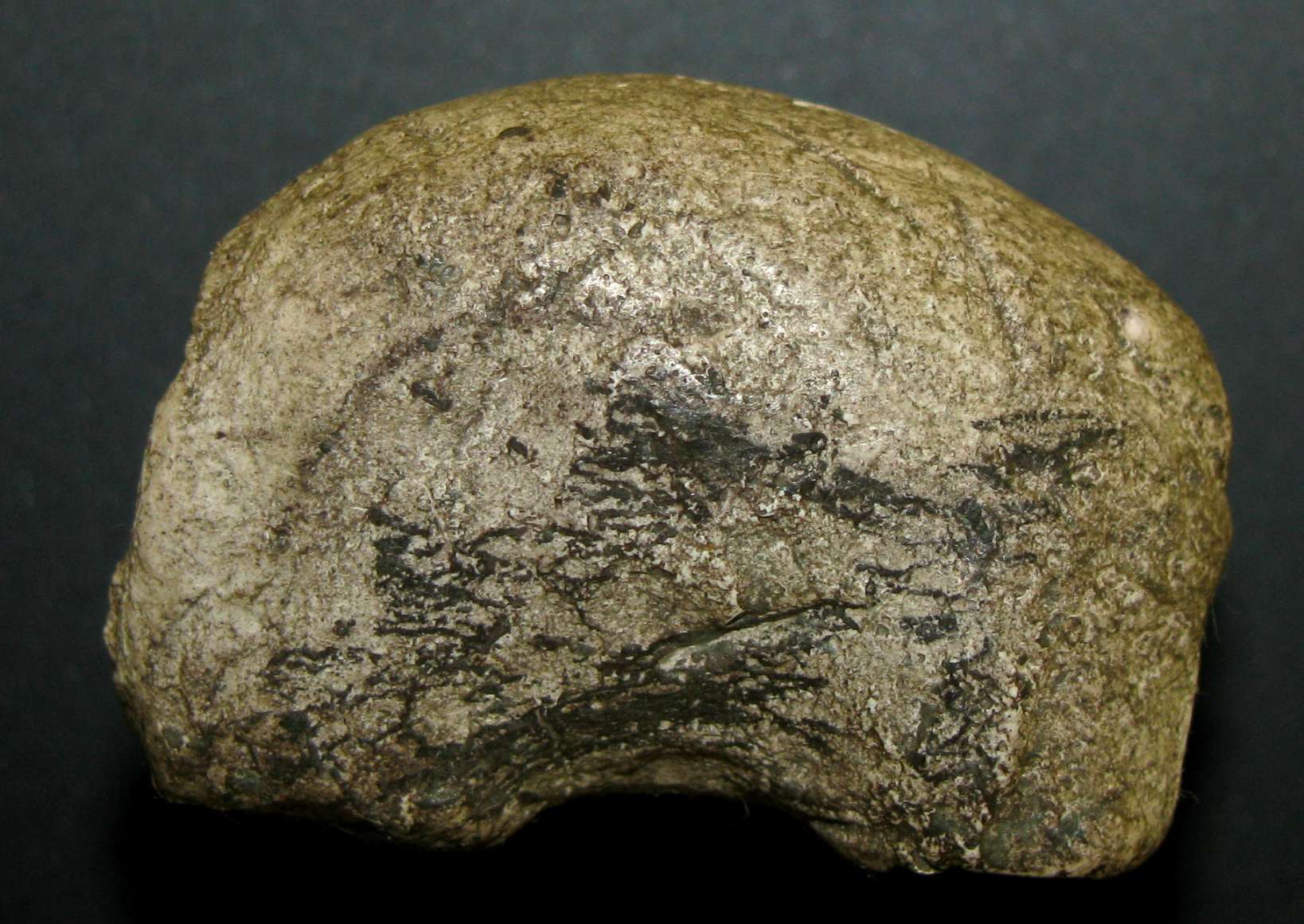
Zoomorphic pottery figurine, possibly a mammoth.
Photo: Don Hitchcock 2008
Source: Display, Dolní Věstonice Museum

Mammoths were very important in the life of the people of Dolni Vestonice. It is believed that he hunters used the rugged terrain at the foot of the Pavlov Hills, which formed a sort of natural trap.
The hunters separated the mammoth from the herd, and forced it against the steep slope, where the hunters were able to charge at it with spears, and bring it down.
Text: Translated and adapted from the display, Dolní Věstonice Museum
Photo: Display, Dolní Věstonice Museum
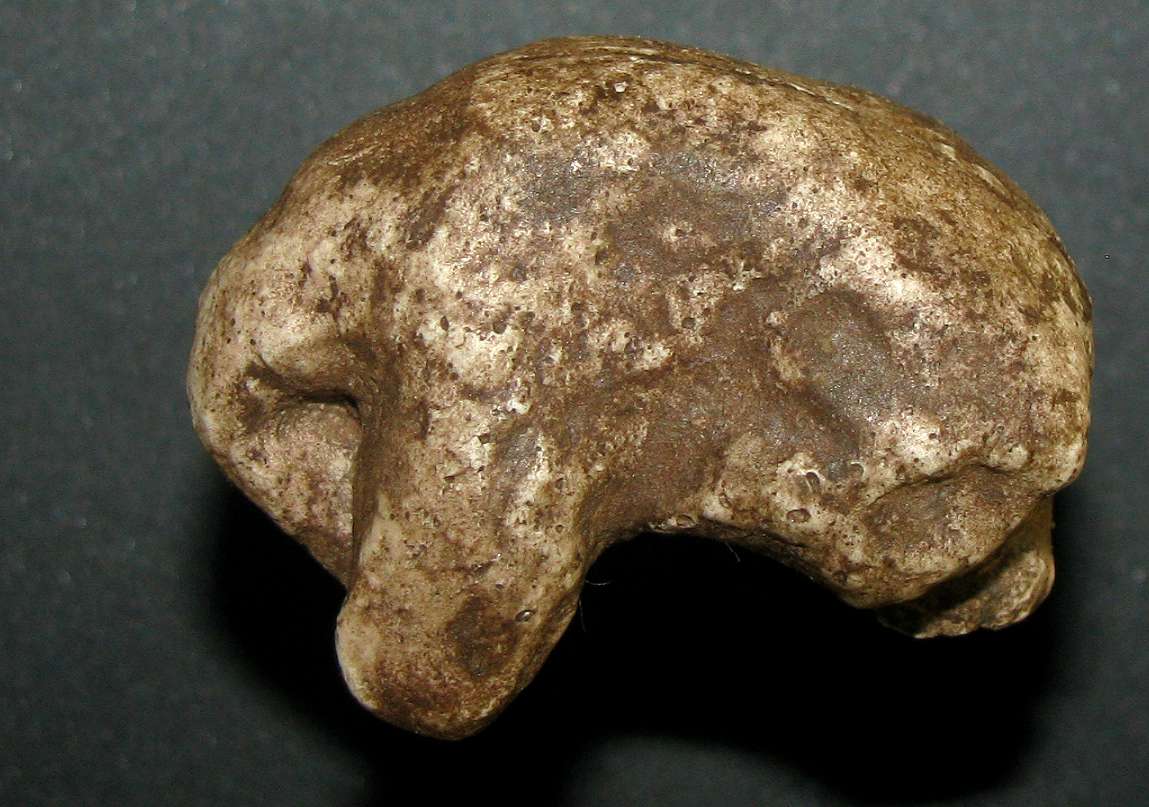
Zoomorphic pottery figurine.
Photo: Don Hitchcock 2008
Source: Display, Dolní Věstonice Museum
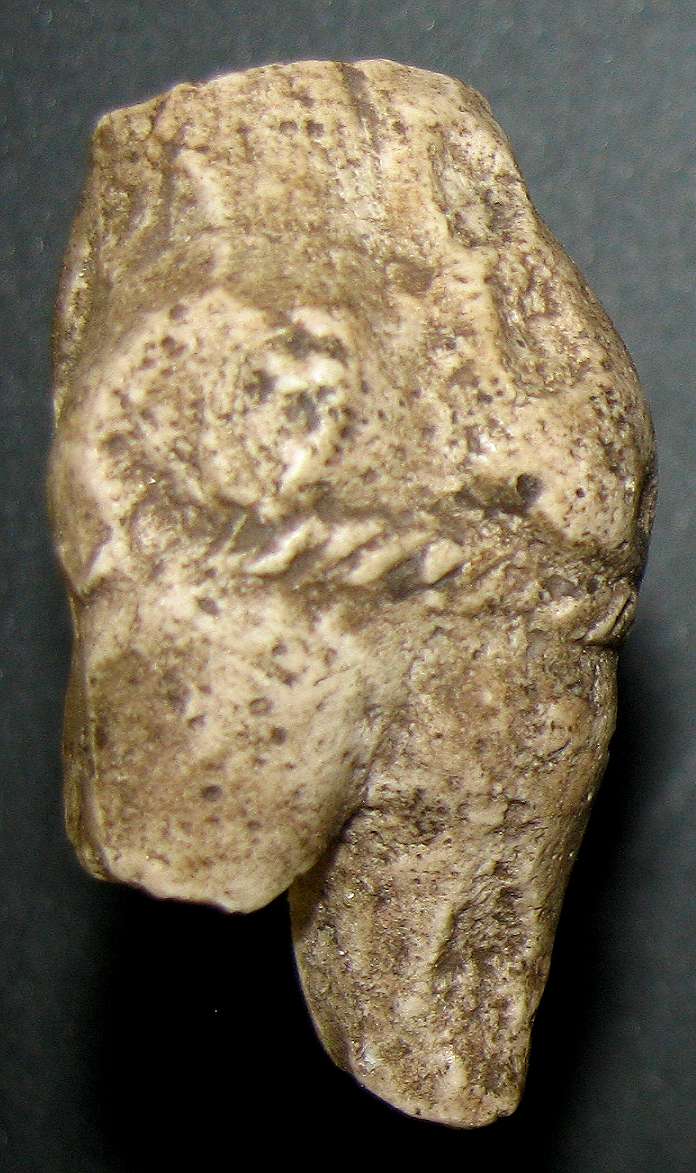
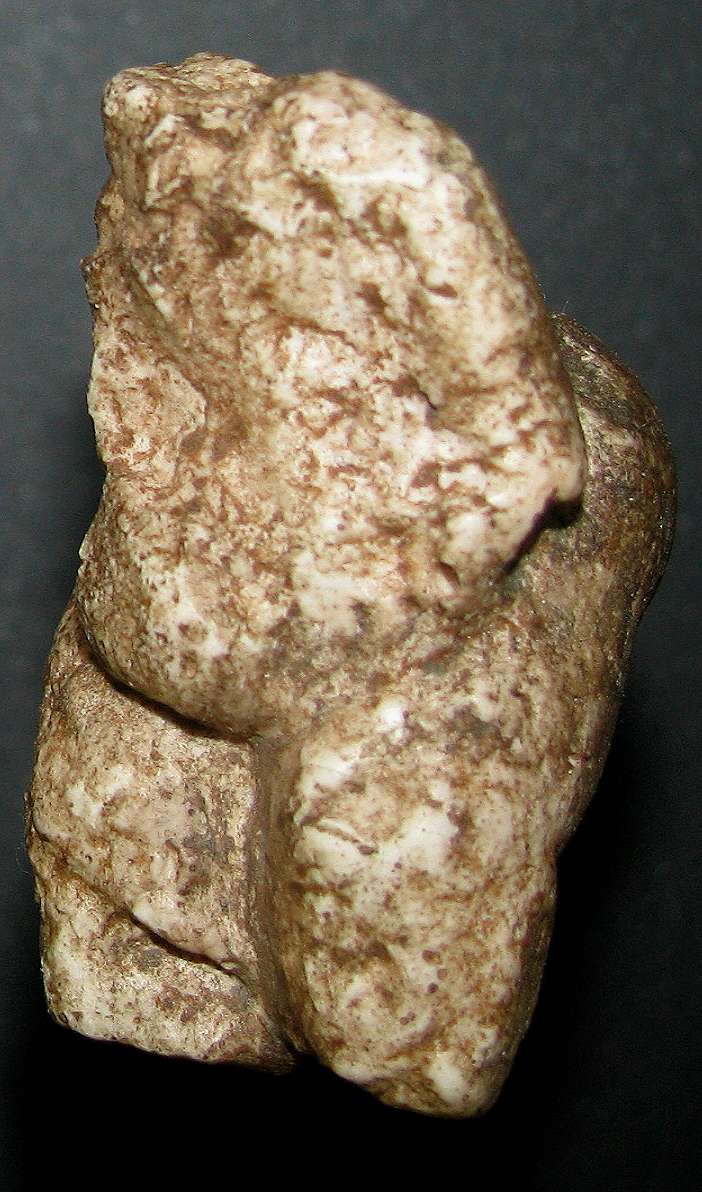
Anthropomorphic pottery figurines. The one on the left appears to have a twisted cord or cloth around the waist or buttocks.
Photo: Don Hitchcock 2008
Source: Display, Dolní Věstonice Museum
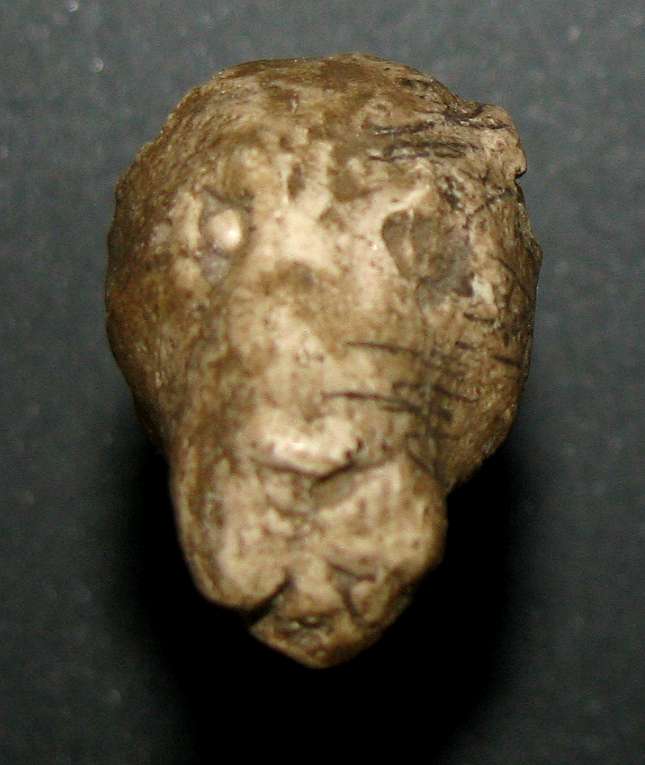

Zoomorphic pottery figurine. Possibly a feline.
Photo: Don Hitchcock 2008
Source: Display, Dolní Věstonice Museum
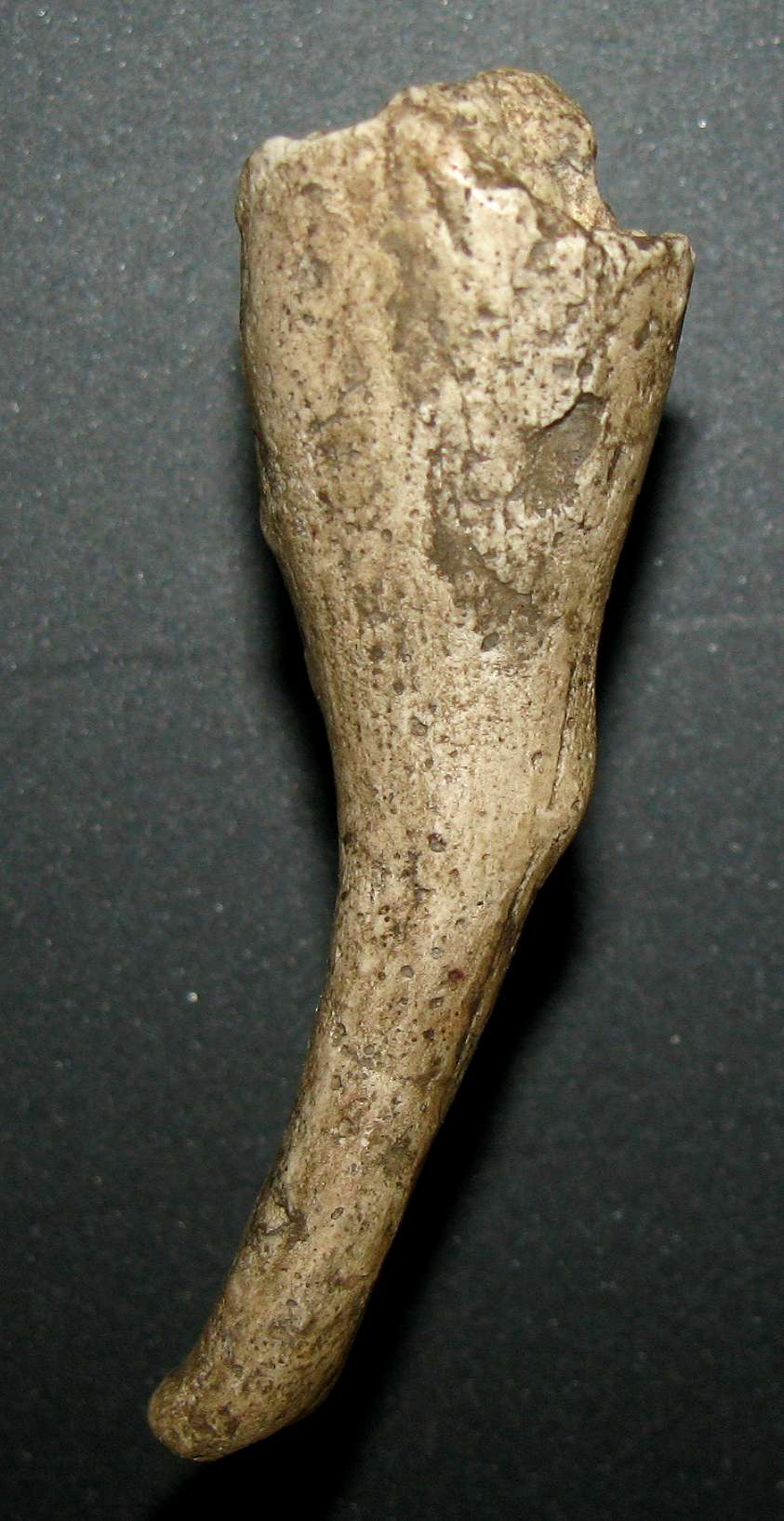
Zoomorphic pottery figurine. Leg broken off a larger figure.
Photo: Don Hitchcock 2008
Source: Display, Dolní Věstonice Museum
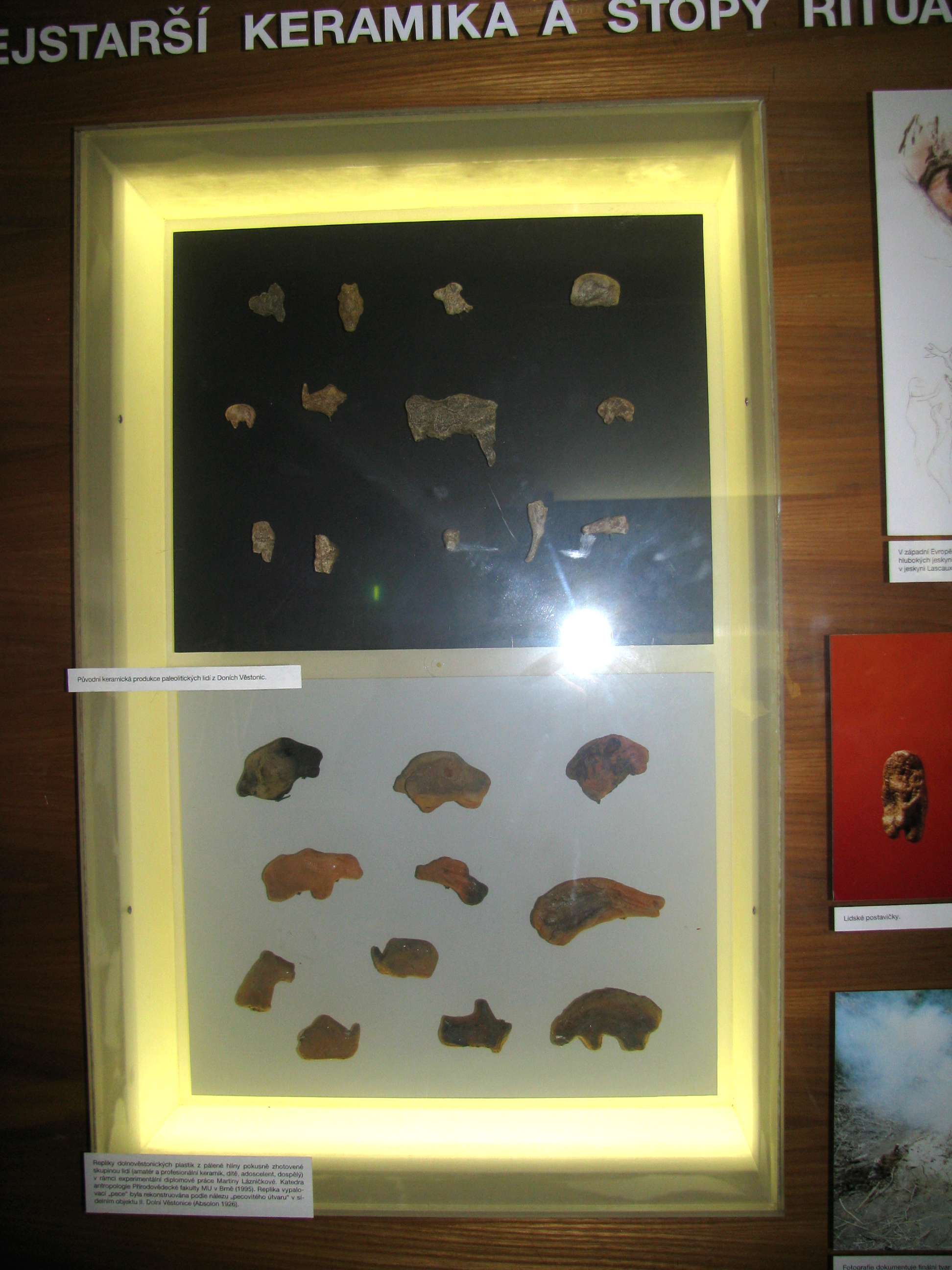
Display case.
Photo: Don Hitchcock 2008
Source: Display, Dolní Věstonice Museum
Recreations
When I first saw these I could not believe my luck. So far as I could tell they were originals, not replicas.As I stated above,
"Modern museum quality facsimiles are staggeringly good. In particular the casts are hand coloured to exactly match the original, and the casting itself is absolutely superb. I would love to have those skills. The only thing that gives them away is the fairly uniform surface texture and patina, and the way they reflect light, as well as the lack of extremely fine detail such as hair line fractures and similar "flaws" inherent in an object tens of thousands of years old. "
These had the marks of originals, the lack of uniformity of material, cracks impossible to duplicate by casting. Later, at home in Australia, I looked at my photographs again very carefully at maximum magnification and concluded that they were original ceramics - but they were unlikely to be the originals from Dolní Věstonice in a building supervised by one woman seated at the computer in a small ticket office just inside the front door of the museum.
I decided then that they were recreations, real pottery figurines made as close as possible to the originals, and fired in the same way. This would explain the incredible detail in the figurines, and the superb surface texture, quite different to even a museum quality casting.
Then, I came to this notice in Czech in my photograph of the display case, and translated it. It was much as I had suspected. What a wonderful project by Martina Lázníčková!
Repliky dolnovestonickych plastik z pálené hliny pokusně zhotovené skupinou lidi (amatér a profesionální keramik, dite, adoscelent, dospělý) v rámci experimentaini diplomové práce Martiny Lázničkove. Katedra antropologie Plirodovedecke MY fakulty v Brně (1995). Replika vypalovaci "pece" byla rekonstruována podle nálezu "pecovitého útvaru" v sidelnim objectu II. Dolní Věstonice (Absolon 1926)
This translates as:
Replicas of Dolní Věstonice fired clay sculptures made by an experimental group of people (amateur and professional ceramicists, children, adolescents, adults) in the experimental thesis of Martina Lázničkové, Department of Anthropology Plirodovedecke MY faculty in Brno (1995).
A replica pottery kiln was reconstructed by using the dimensions and similar materials to the original kiln found at Dolní Věstonice by Absolon in 1926.
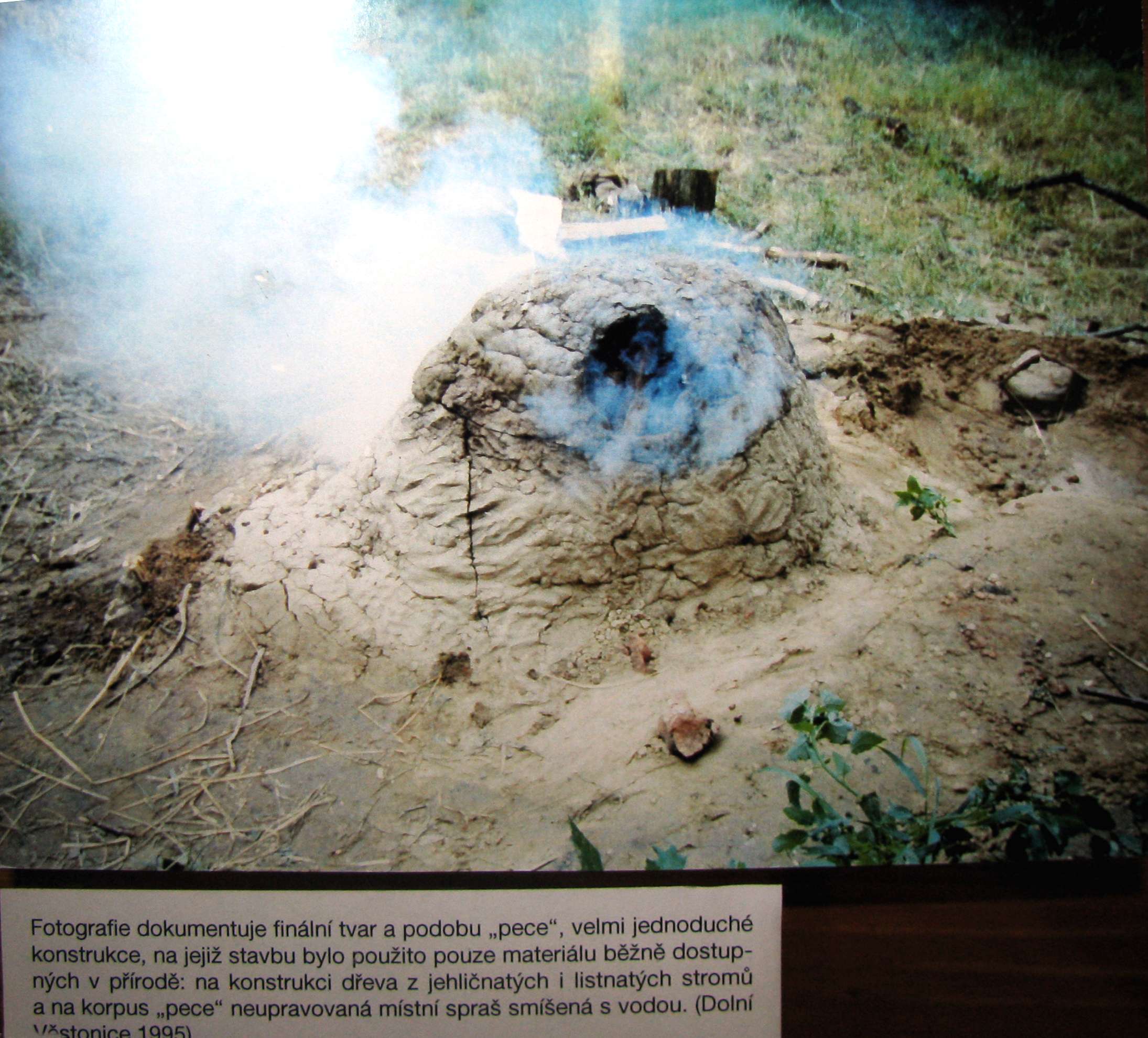
Photograph of the kiln in use, firing the pottery figurines shown below. This documents its final shape and form.
It was a very simple structure, which was fired with wood gathered locally from coniferous and deciduous trees. The kiln was made from locally sourced loess clay mixed with water.
(Dolní Věstonice 1995)
Source: Poster, Dolní Věstonice Museum

Zoomorphic pottery figurine.
Photo: Don Hitchcock 2008
Source: Display, Dolní Věstonice Museum
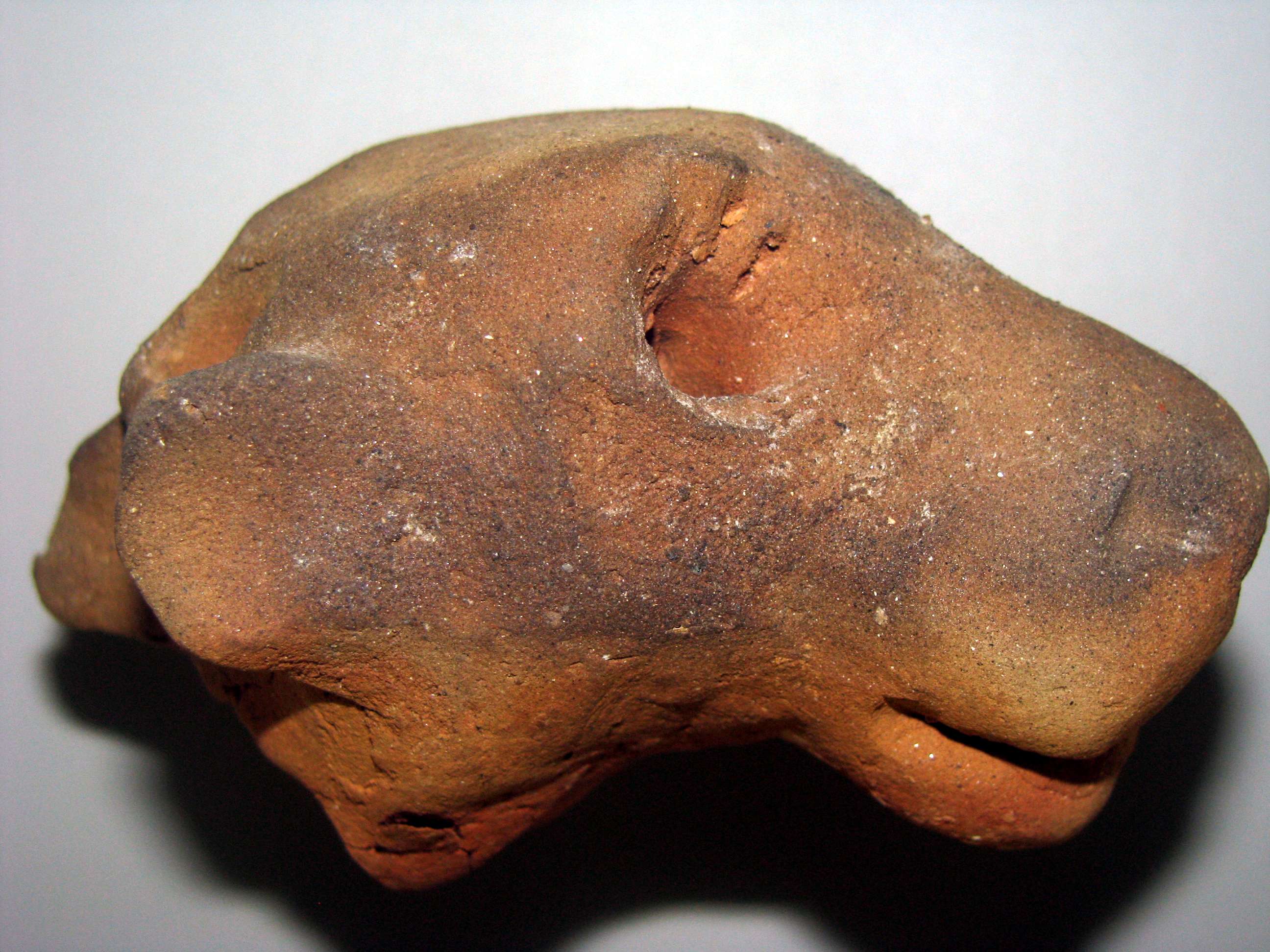
Zoomorphic pottery figurine.
Photo: Don Hitchcock 2008
Source: Display, Dolní Věstonice Museum
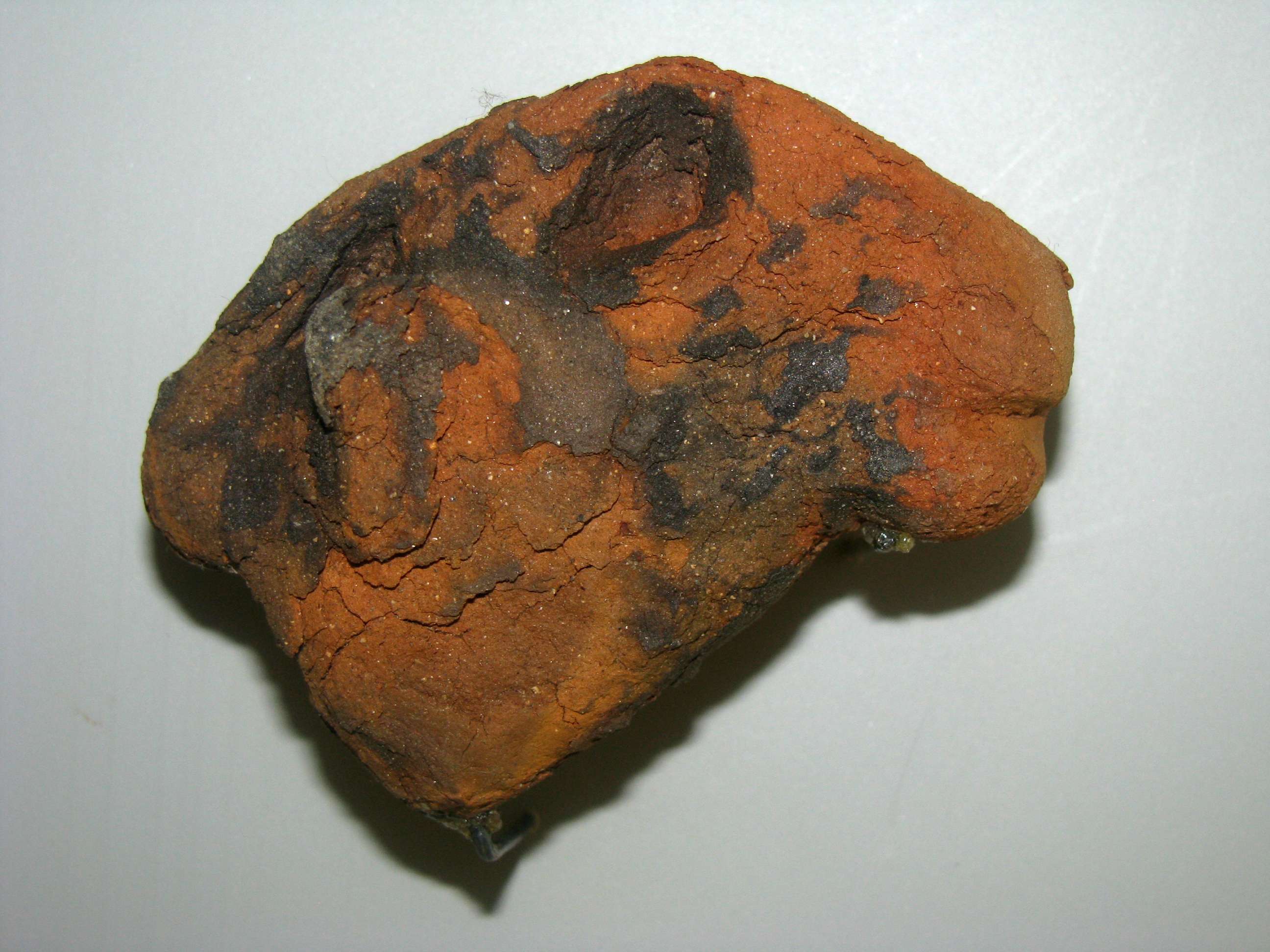 Zoomorphic pottery figurine. Possibly a feline.
Photo: Don Hitchcock 2008
Source: Display, Dolní Věstonice Museum
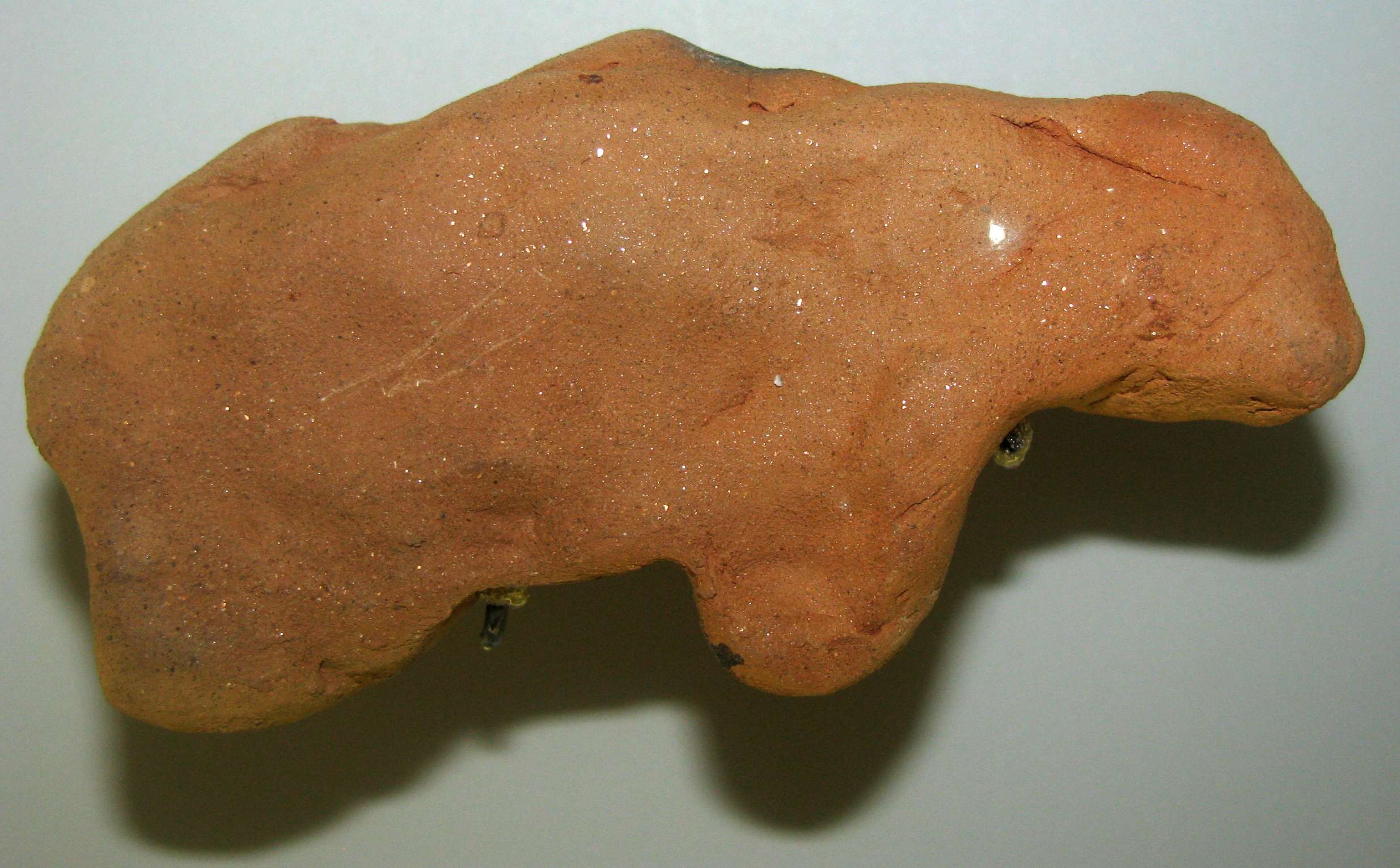
Zoomorphic pottery figurine. Possibly a bear.
Photo: Don Hitchcock 2008
Source: Display, Dolní Věstonice Museum
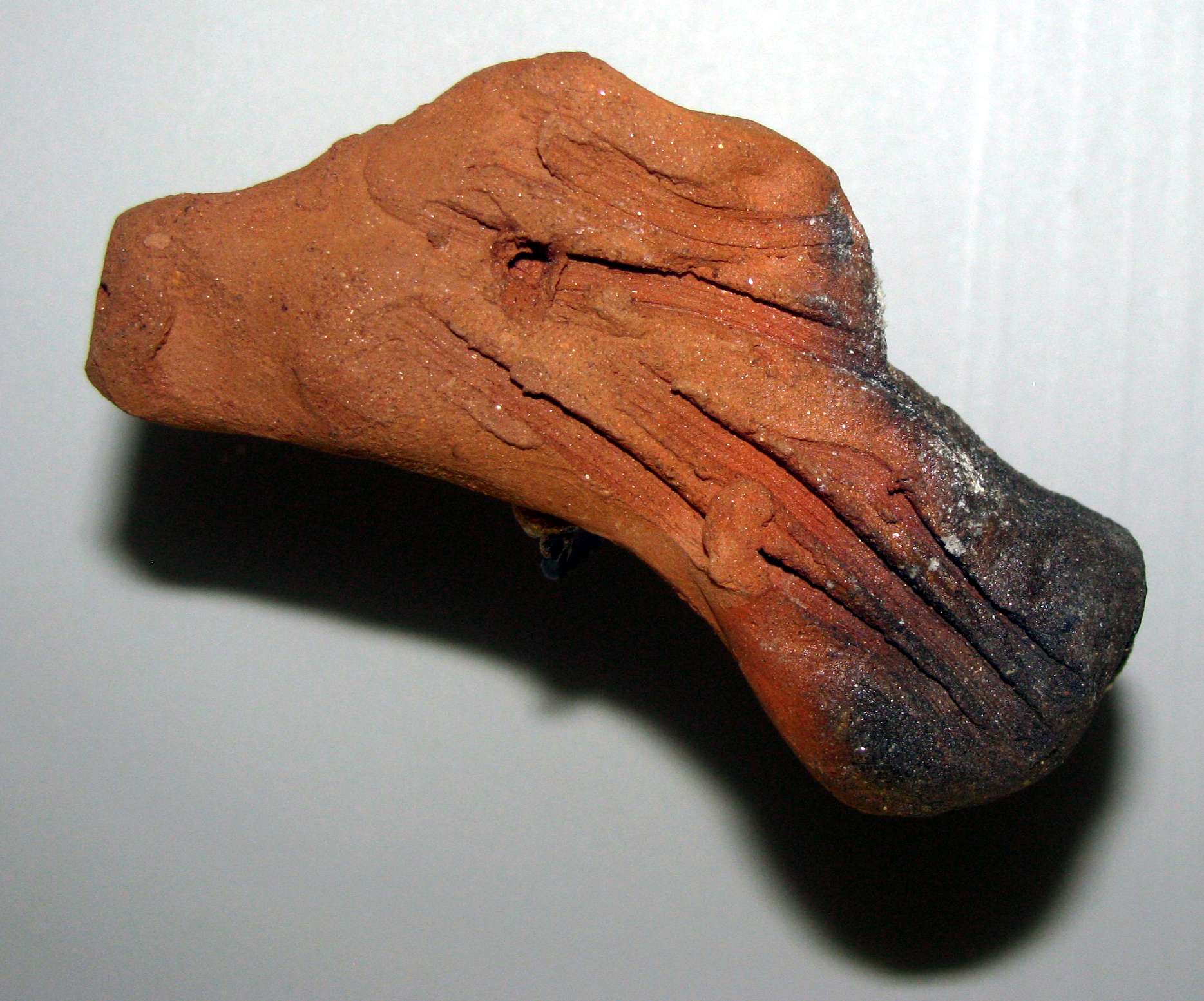
Zoomorphic pottery figurine.
Photo: Don Hitchcock 2008
Source: Display, Dolní Věstonice Museum
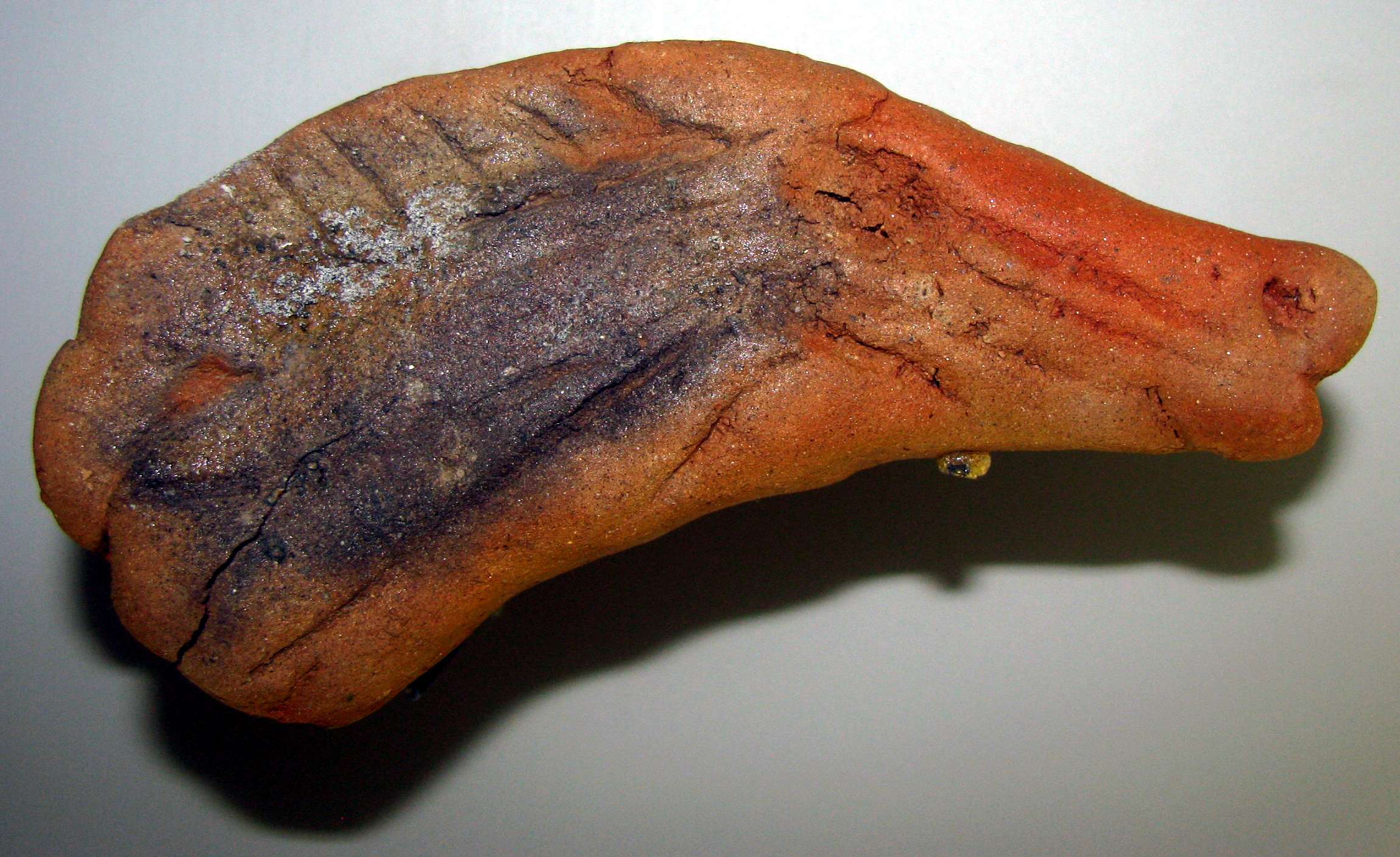
Zoomorphic pottery figurine of a horse head.
Photo: Don Hitchcock 2008
Source: Display, Dolní Věstonice Museum
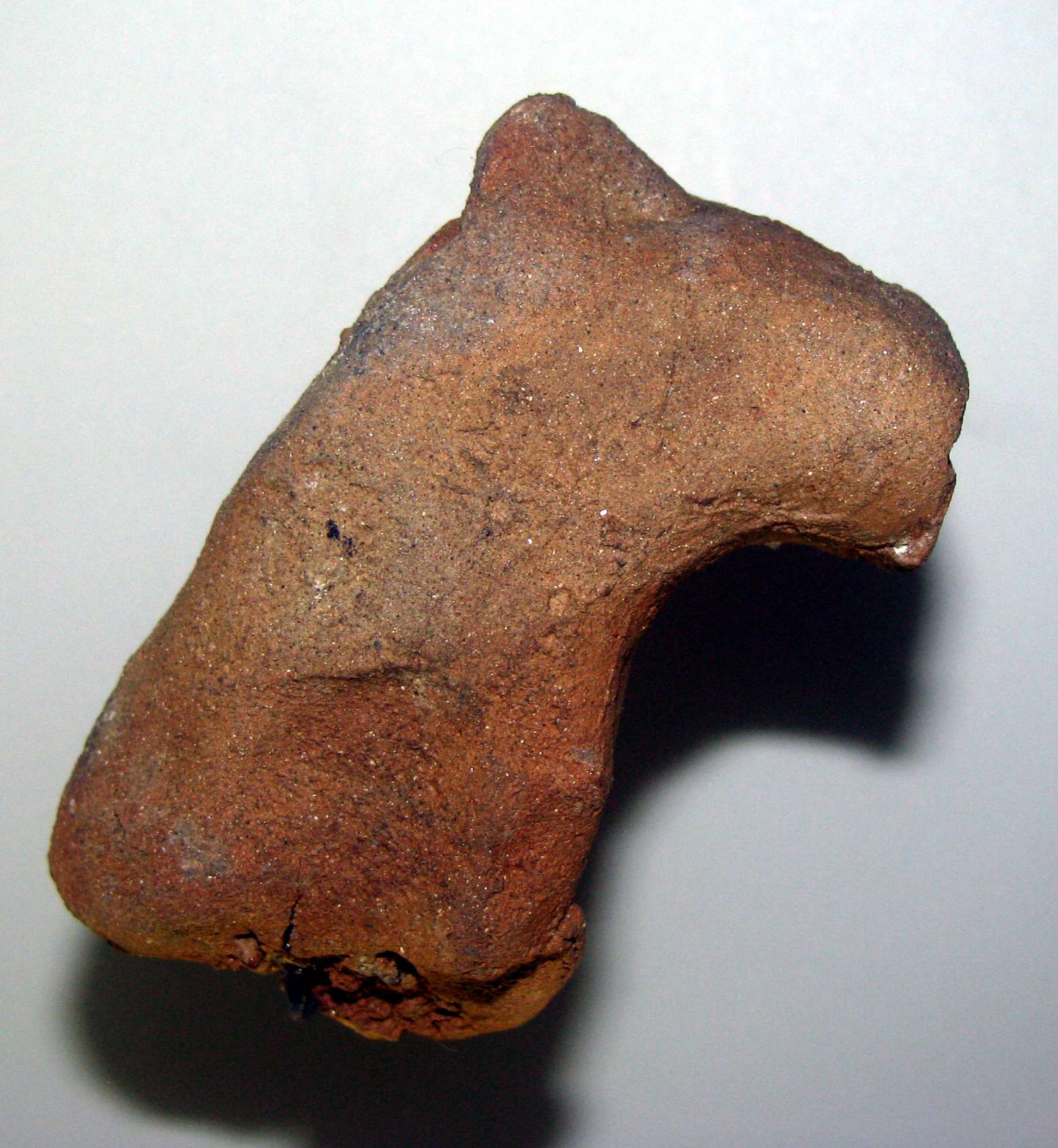
Zoomorphic pottery figurine, possibly of a feline.
Photo: Don Hitchcock 2008
Source: Display, Dolní Věstonice Museum
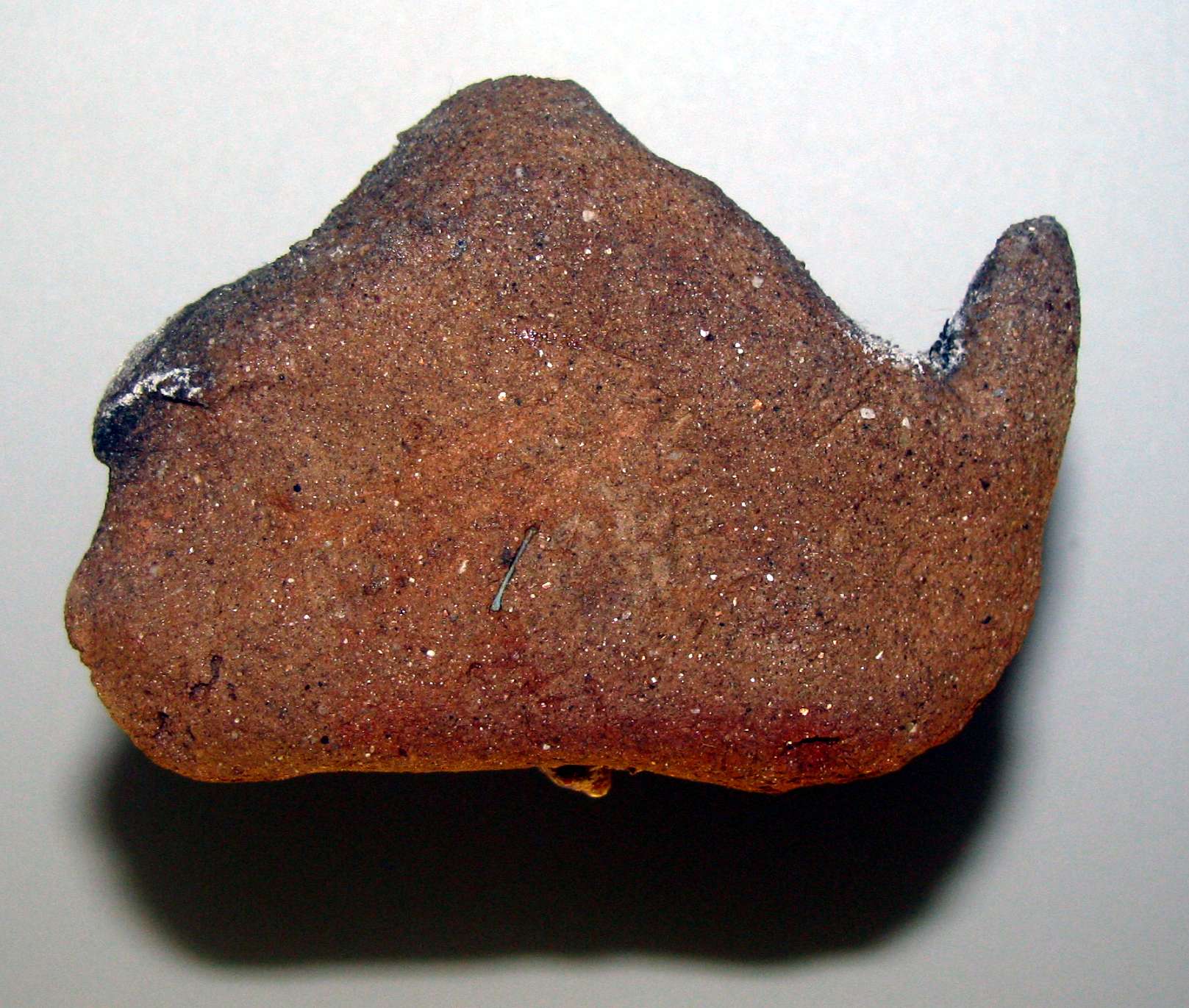
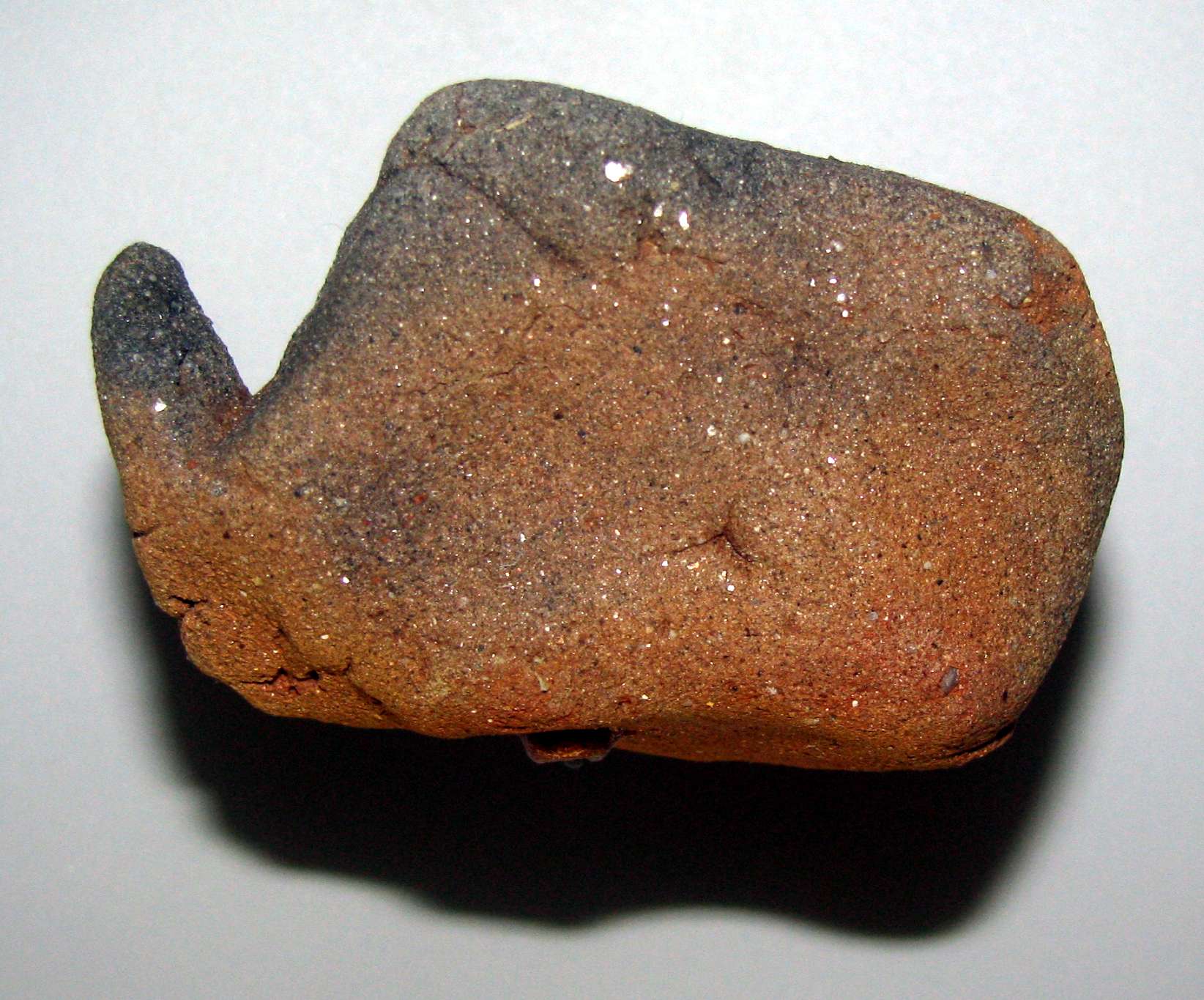
Zoomorphic pottery figurines of rhinoceros.
Photo: Don Hitchcock 2008
Source: Display, Dolní Věstonice Museum
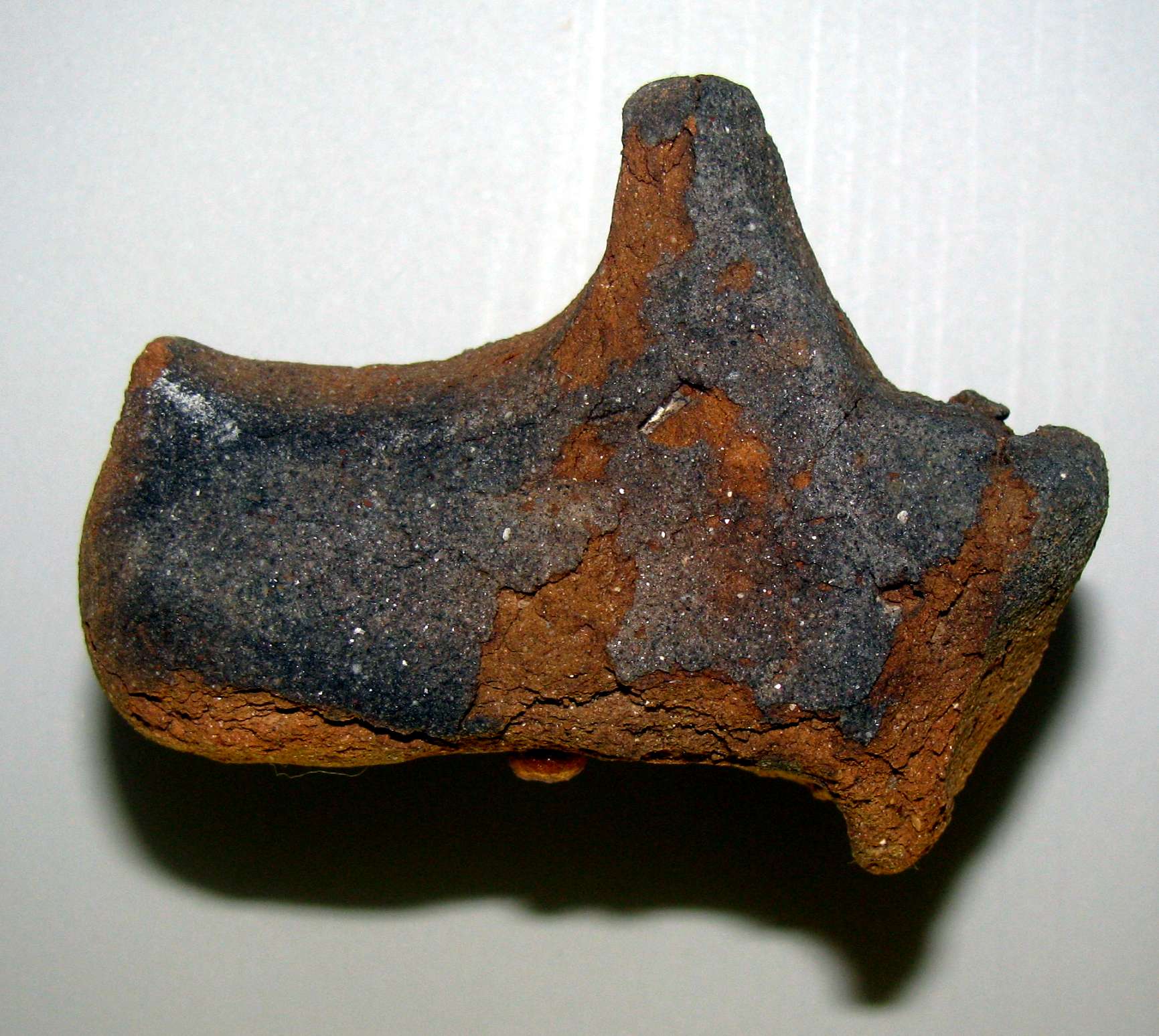
Zoomorphic pottery figurine of a rhinoceros.
Photo: Don Hitchcock 2008
Source: Display, Dolní Věstonice Museum
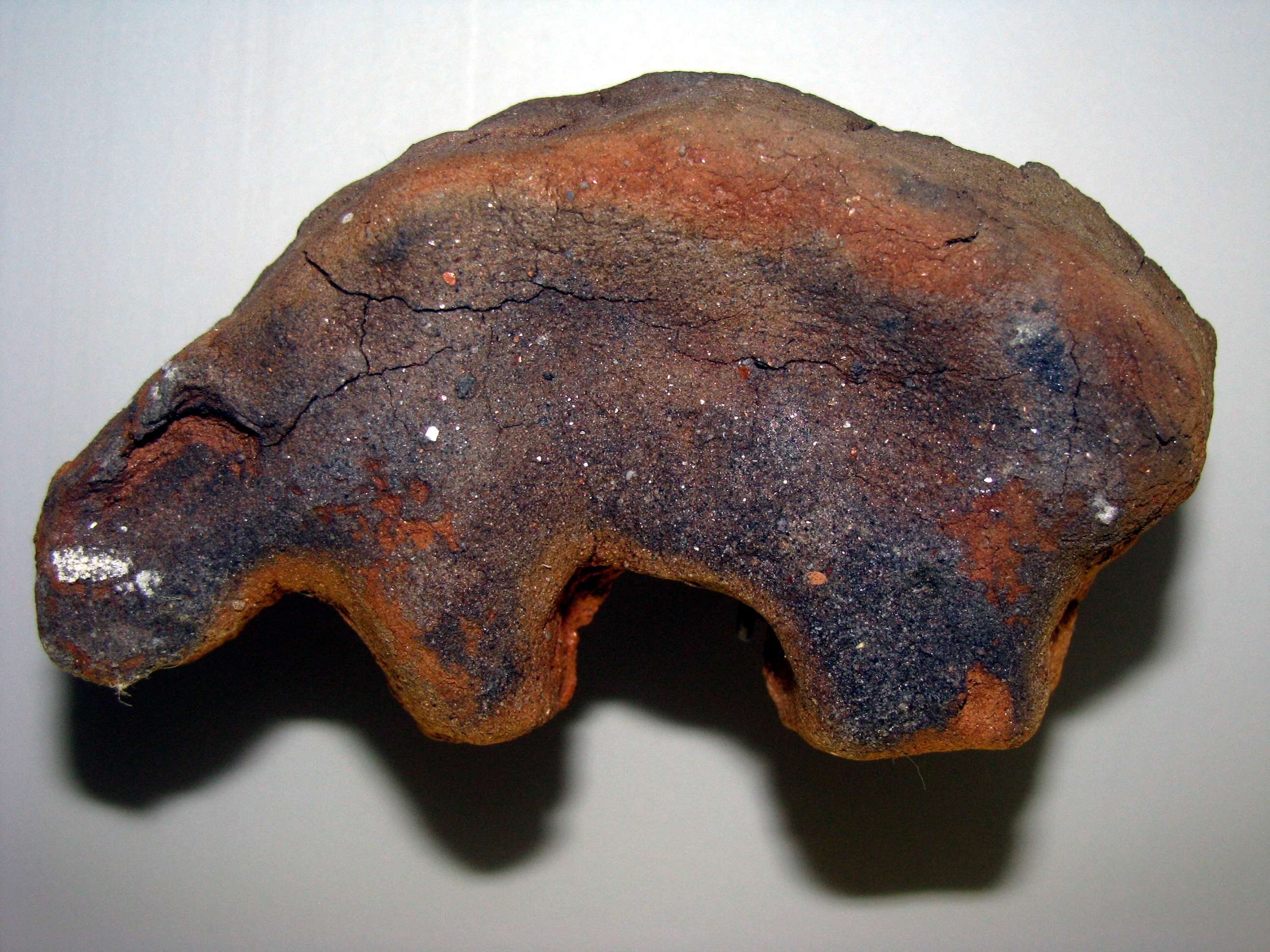
Zoomorphic pottery figurine of a bear.
Photo: Don Hitchcock 2008
Source: Display, Dolní Věstonice Museum
Other finds
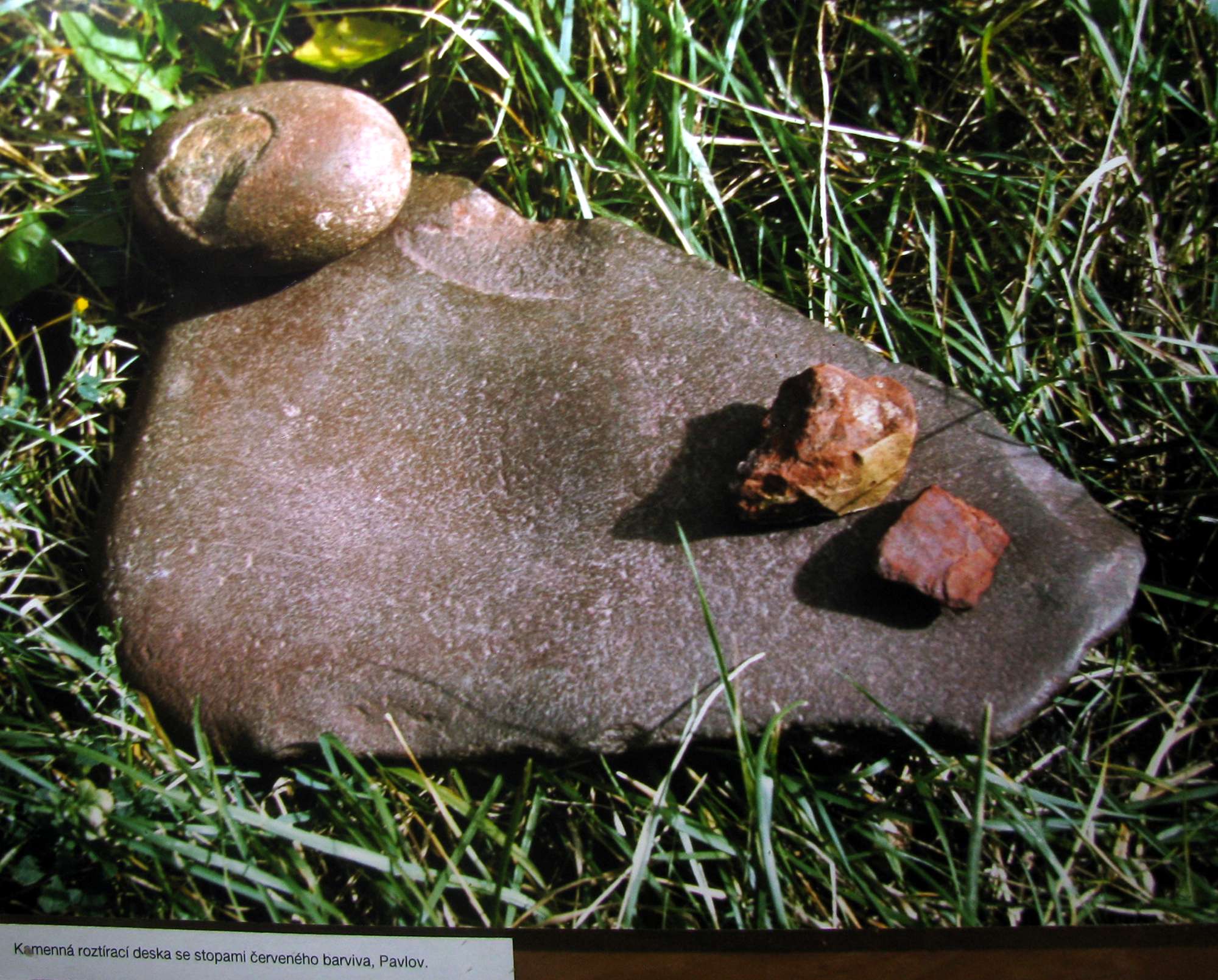
Mill stone or pestle or muller, as well as mortars used to grind ochre, with traces of red ochre, Pavlov
Source: Poster, Dolní Věstonice Museum
In Dolní Věstonice I, II, and in Pavlov I there are places where there there are many lumps of red and yellow ochres with stone slabs and stones to grind up the ochre. A flat stone with traces of ochre lay in the grave and in close proximity to the man DV XVI. (This may well be the flat stone buried with DV XVI - Don.)
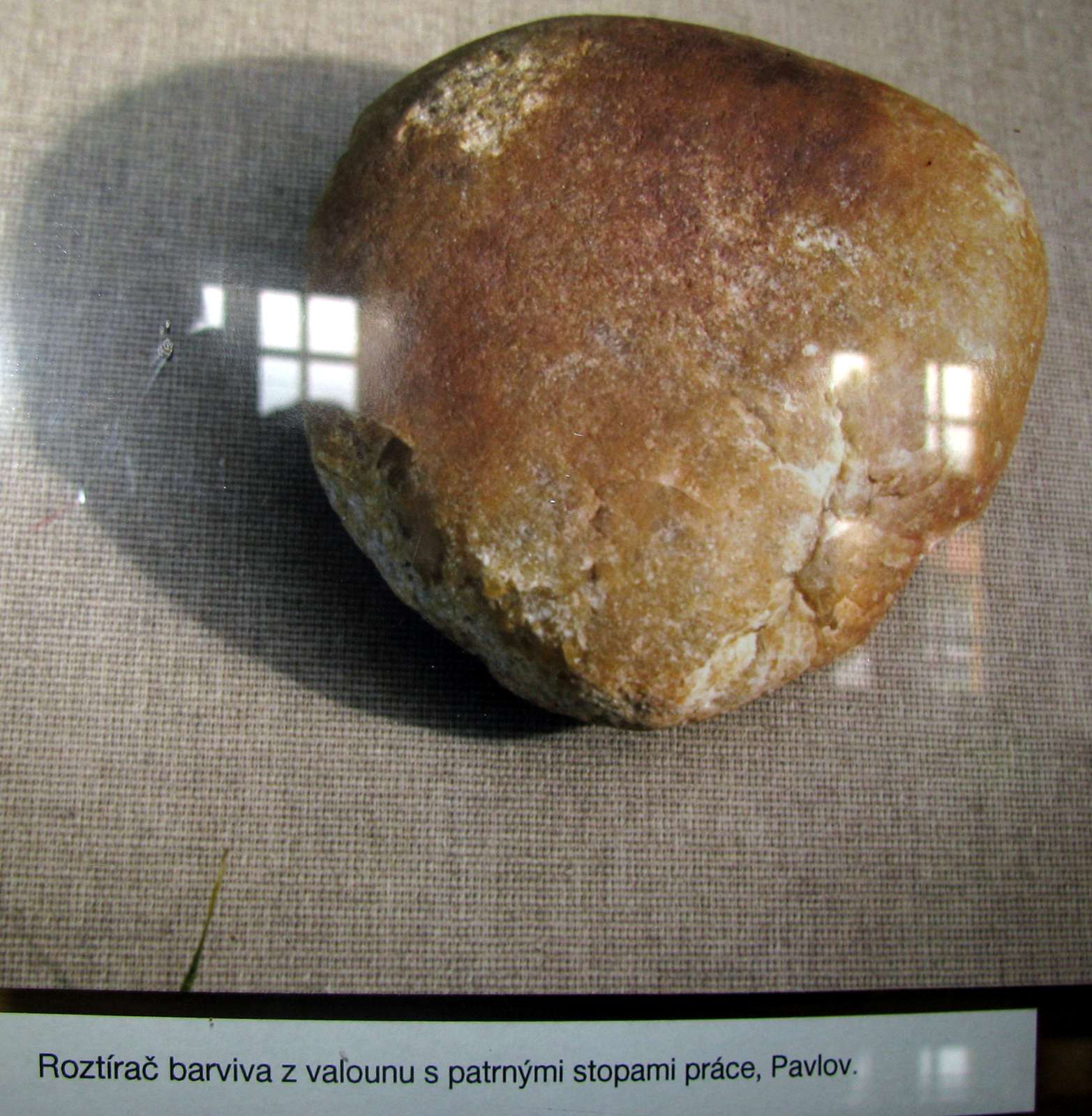
Cobblestone mortar with evident traces of use for grinding ochre, Pavlov.
Source: Poster, Dolní Věstonice Museum
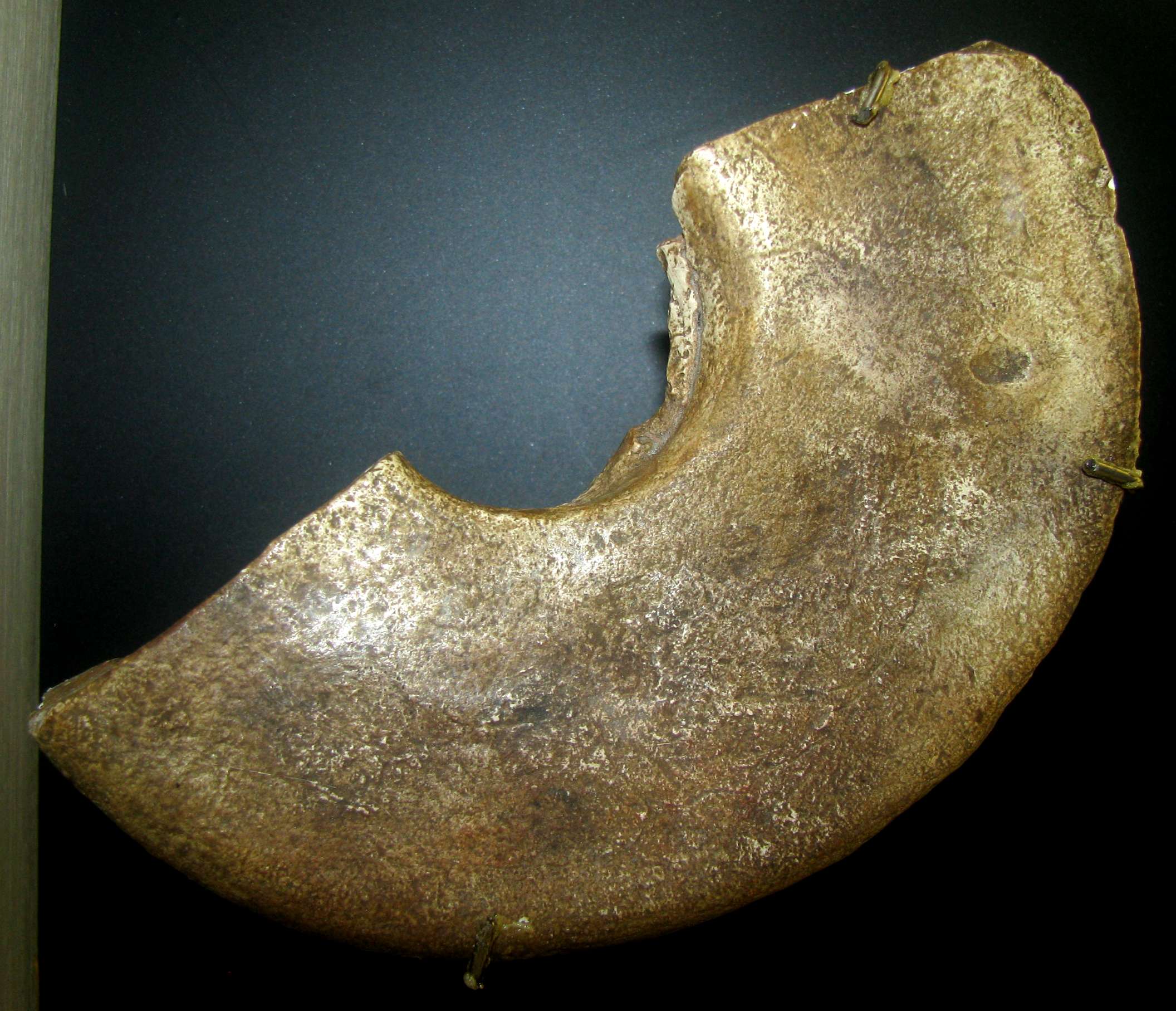
Well turned and finished stone disk, unknown purpose, Pavlov.
Photo: Don Hitchcock 2008
Source: Facsimile, display, Dolní Věstonice Museum
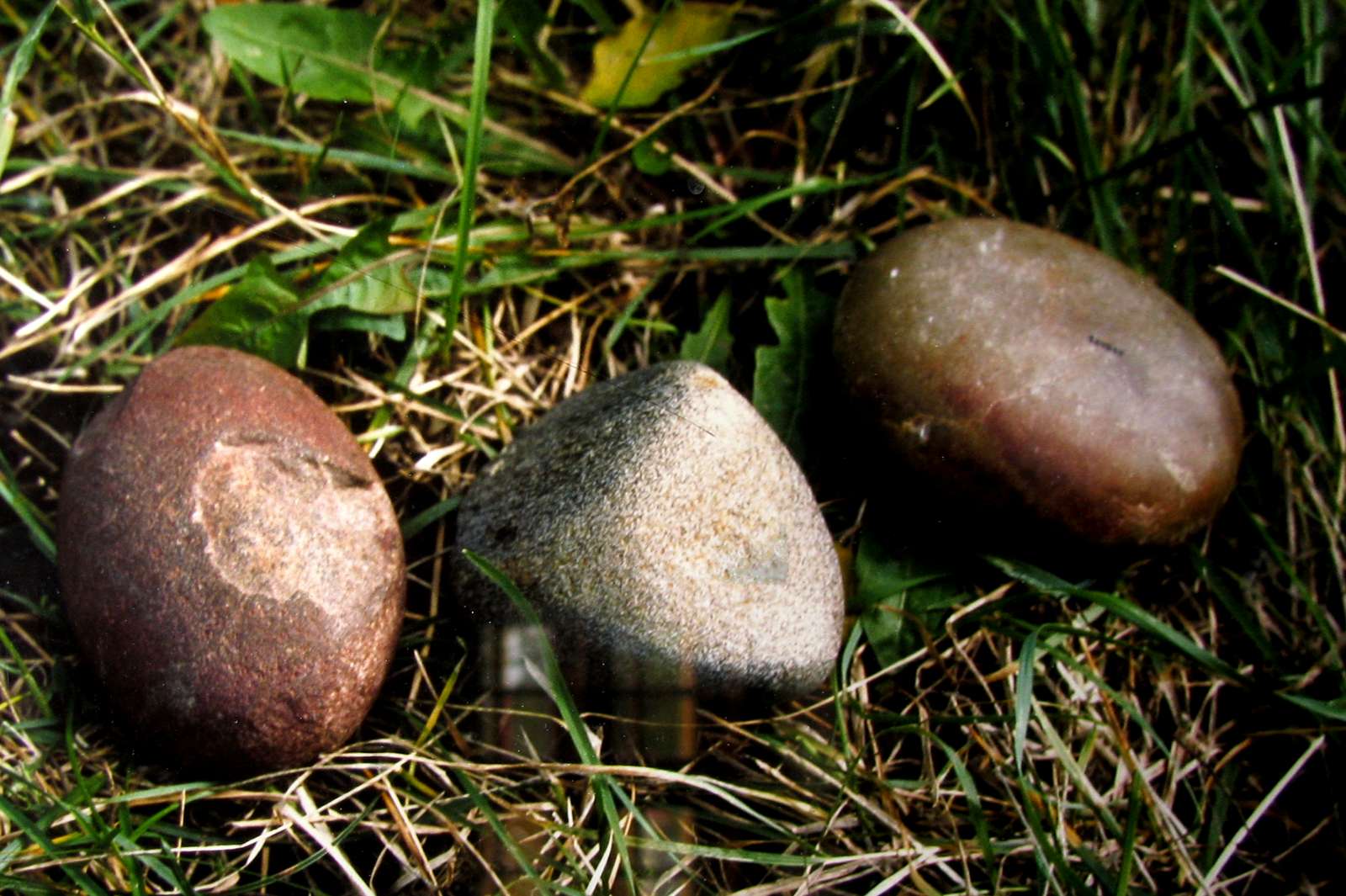
Grindstones and mullers made from river cobbles, Pavlov.
Source: Poster, Dolní Věstonice Museum
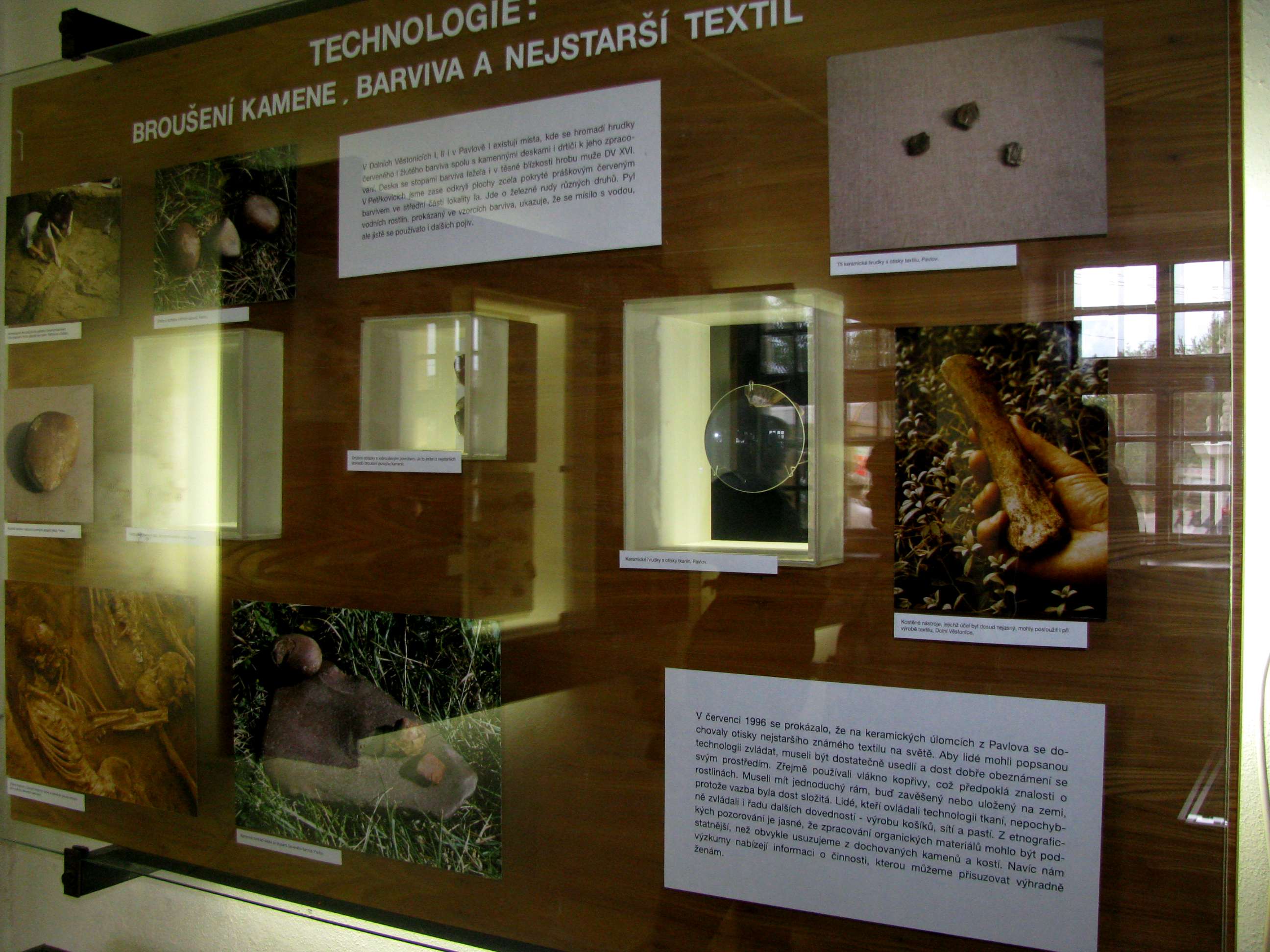
Display
Display, Dolní Věstonice Museum

Stones showing traces of use.
Photo: Don Hitchcock 2008
Source: Display, Dolní Věstonice Museum
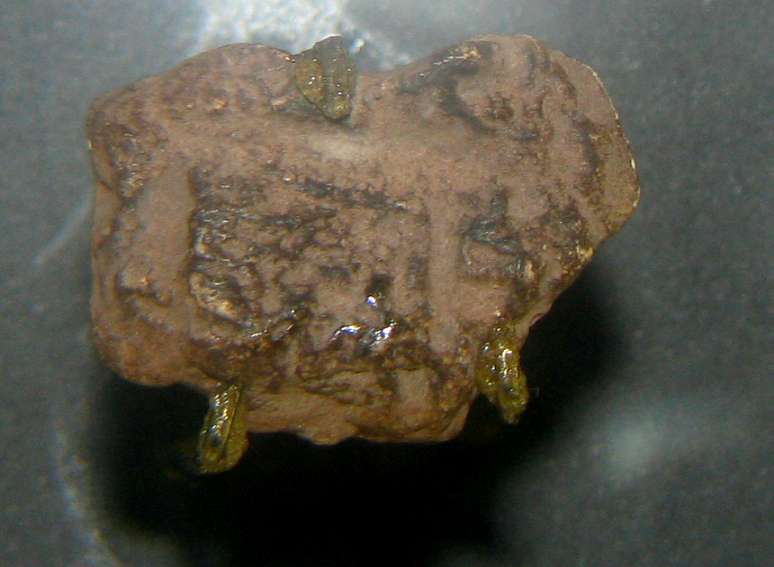
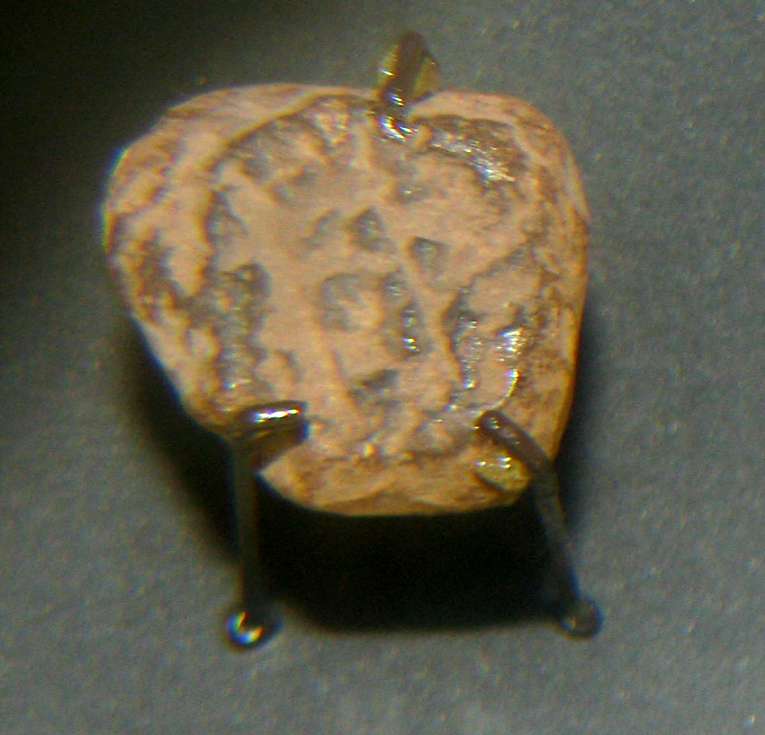

Ceramic pellets with textile impressions.
Photo: Don Hitchcock 2008
Source: Display, Dolní Věstonice Museum

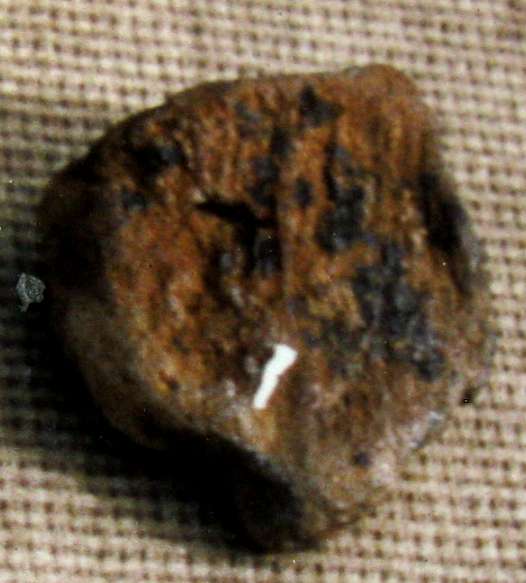
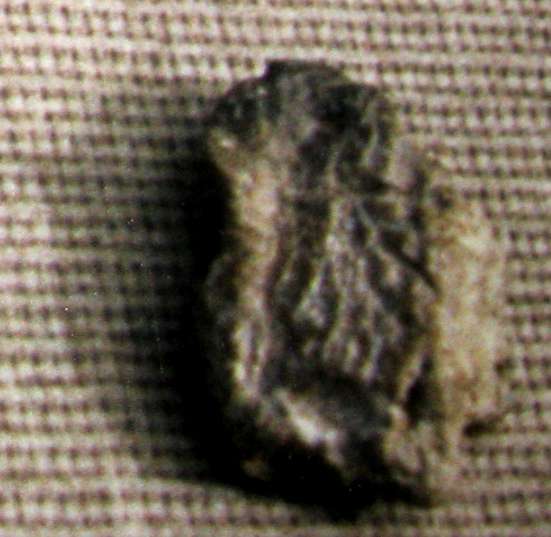
Ceramic pellets with textile impressions.
Photo: Don Hitchcock 2008
Source: Display, Dolní Věstonice Museum
Text below translated from the display:
In July 1996 it was shown that the ceramic fragments from Pavlov had preserved the oldest known preserved imprints of textiles in the world. To enable people to use this technology, there had to be a sufficiently stable living area, and they needed to be very familiar with their surroundings.
They probably used nettles for thread fibres, and if they were able to spin and weave thread and textiles, they undoubtedly had related skills such as basket weaving, making fish and animal nets, and traps.
The ethnographic observation is clear that the treatment of organic materials could well be more important in their daily life than we usually conclude from the better preserved stone and bone. Additionally, it provides information about an activity probably attributable exclusively to women.
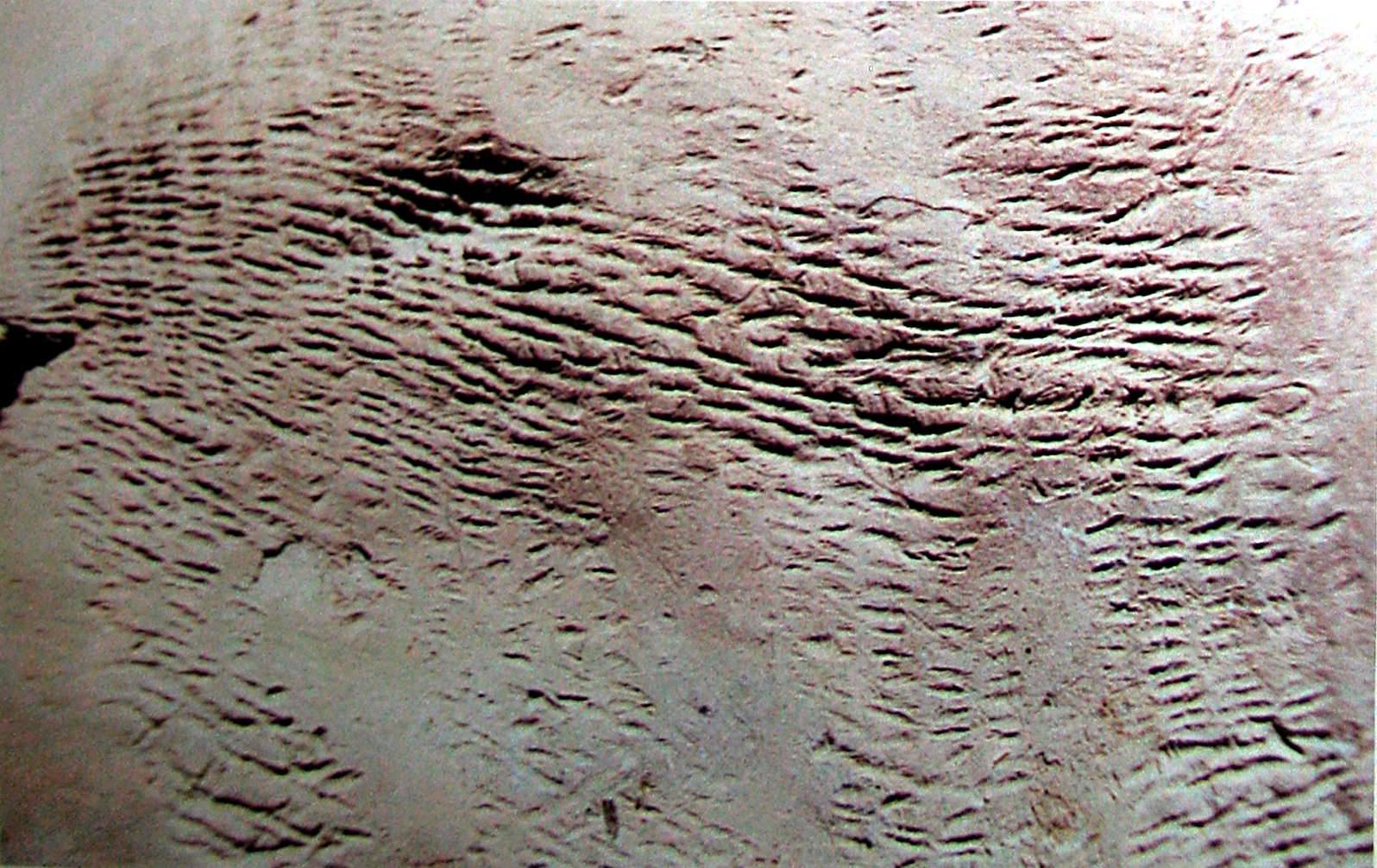
Dexterity of the First Weavers
A decade ago, experts did not dare to think about people living in the last ice age making textiles.
However, on a lump of fired clay from the Dolní Věstonice / Pavlov area were found the impressions of substances from plant fibres. The whole process of picking nettles, crushing the dried stem, preparation of tow, spinning the thread and then weaving was tested and shown to be possible using tools of the time by M. Bunatova. Urbanová (ca 1999)
Source: Display, Dolní Věstonice Museum
From Buňatová (1999) and Sosna (2000):
The new and surprising discovery of textile imprints at Pavlov I and Dolní Věstonice I,II attracted attention and opened discussions. As was the case with ceramics, the textile technologies were also tested experimentally.
Soffer et al. (2000) note the following:
The weavers of Upper Paleolithic Moravia were not only manufacturing a variety of cordage types but, more important, also producing plaited basketry and twined and plain woven cloth which approach levels of technical sophistication heretofore associated exclusively with the Neolithic and later time periods
Unfortunately, much of this technology is evident only to those who have considerable experience with perishable material culture and have examined the original evidence firsthand. Regrettably, most Paleolithic archaeologists have not been trained to do so or have lacked access to the original specimens.
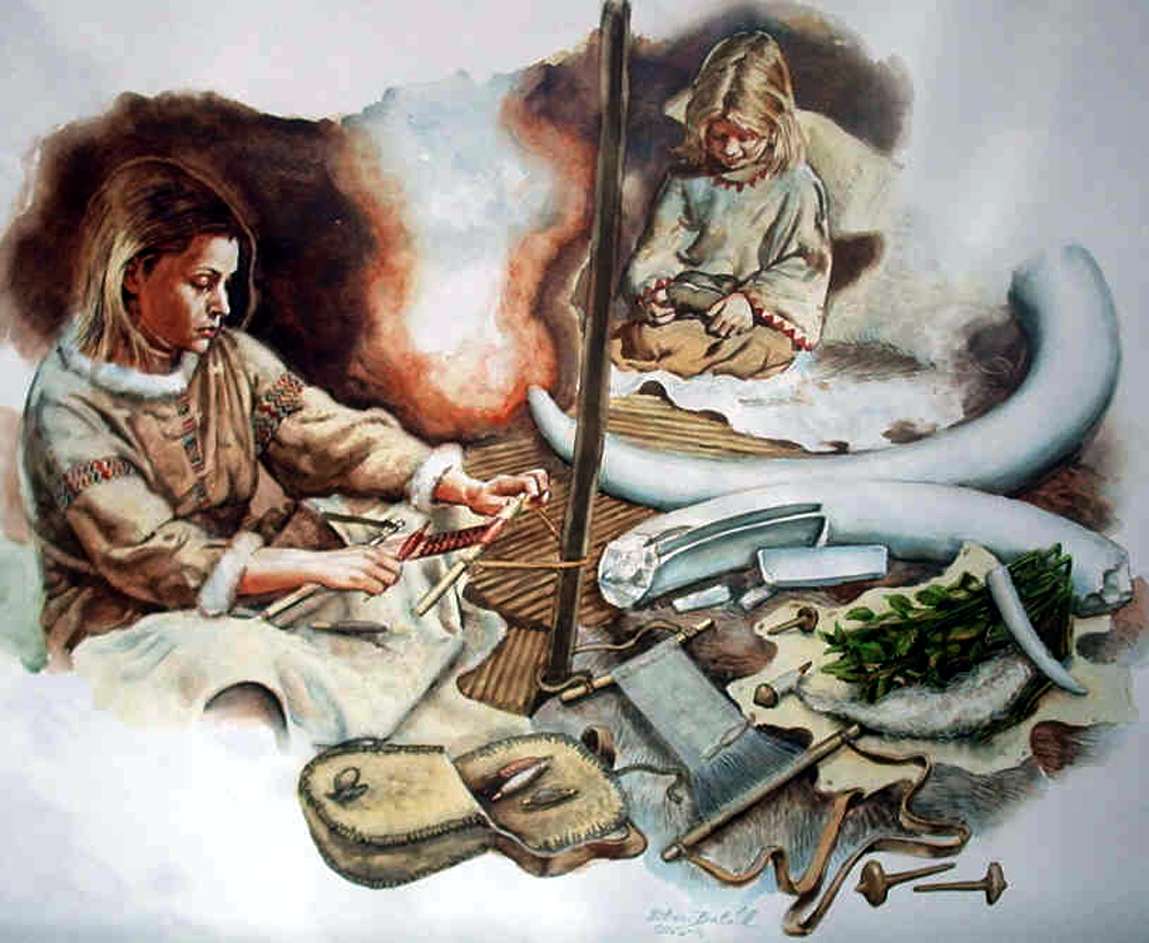
Artist L. Balak's recreation of textile production in the Palaeolithic.
Source: Urbanová (ca 1999)
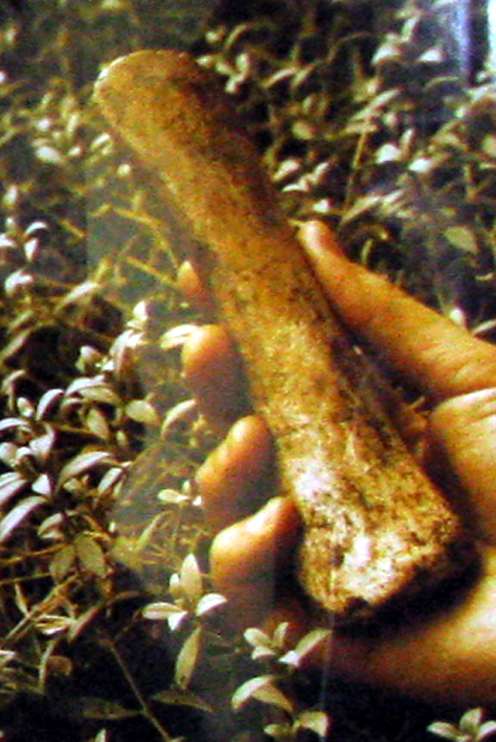
Many bone tools were found at Dolní Věstonice with no obvious purpose, but which could yet serve as part of textile production.
Source: Display, Dolní Věstonice Museum
Text: Translated from the display.

Reconstruction of a settlement in Dolní Věstonice, from the film 'Návraty bohyně' (Return of the Goddess) 1996
Source: Display, Dolní Věstonice Museum
Text: Translated from the display.
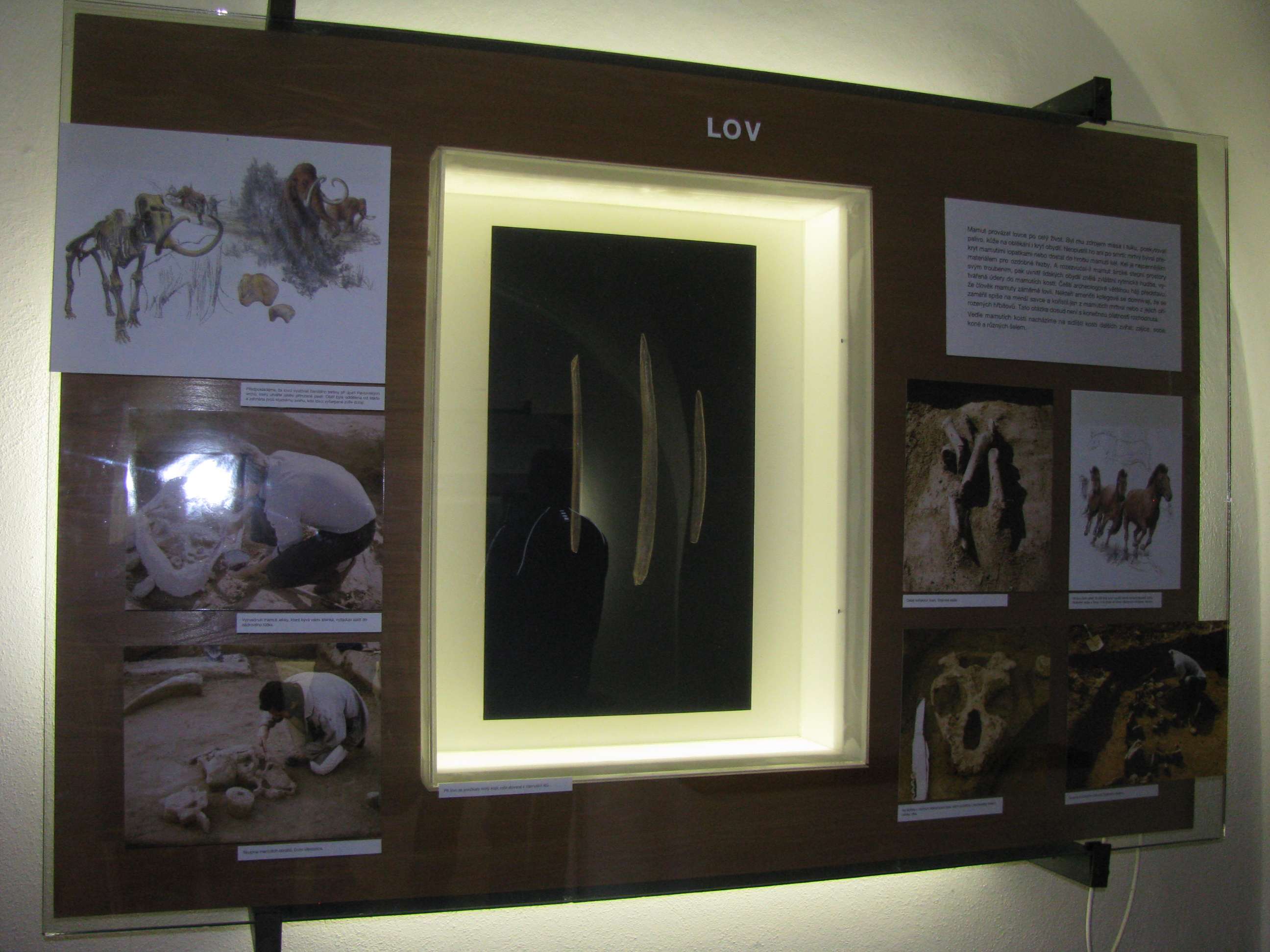
The heading on this display is "LOV" which means Hunting.
Source: Display, Dolní Věstonice Museum
Photo: Don Hitchcock 2008
Text: Translated from the display.
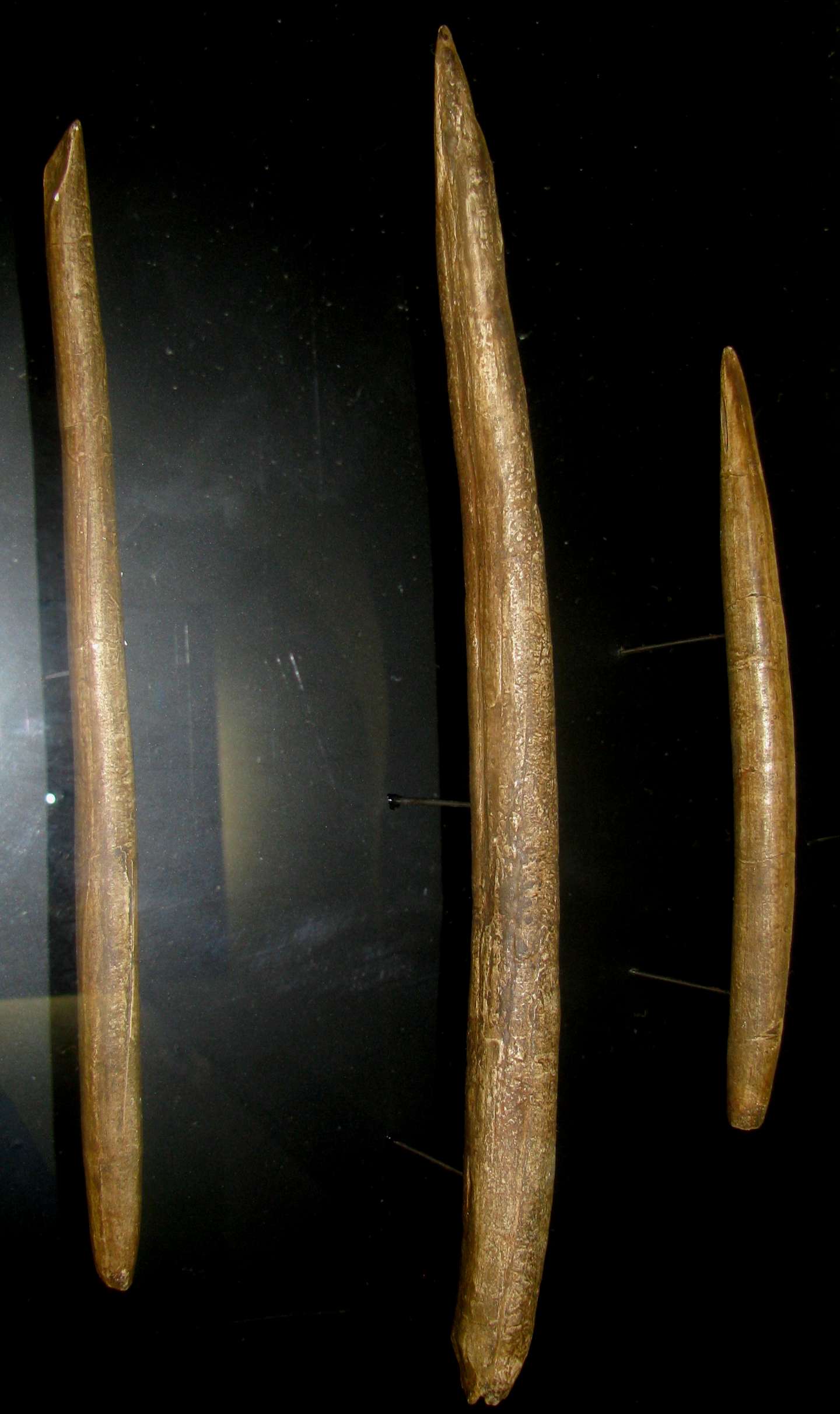
Facsimiles of spear points made of mammoth ivory.
Mammoths were part of their lives. Mammoths were a source of meat, the fat provided fuel, and the skin served as a cover for their dwellings. Mammoths even provided material for decorative carvings.
The question of whether hunters actually killed the mammoths, or scavenged their carcasses after death has not been finally resolved.
Source: Facsimiles, display, Dolní Věstonice Museum
Photo: Don Hitchcock 2008
Text: Translated and adapted from the display.

Reconstruction of one possible method of hut construction, using wooden poles in a circular floor pattern. The framework would have been covered with mammoth hides. These may well have been insulated in winter with grass and mud and water, and allowed to freeze, in multiple self supporting layers.
Source: Display, Dolní Věstonice Museum
Photo: Don Hitchcock 2008
References
- Buňatová, M., 1999: Textilní produkce v mladém paleolitu, experiment pro dokumentární film "Úsvit géniů", in: AR LI, Praha, 104 - 111.
- Cook, J., 2013: Ice Age art: arrival of the modern mind, The British Museum, 18 Feb 2013, ISBN-10: 0714123331, ISBN-13: 978-0714123332
- d’Errico, F., et al., 2010: Identi!cation of a possible engraved Venus from P!redmostí, Czech Republic, Journal of Archaeological Science (2010), doi:10.1016/j.jas.2010.10.019
- Jelinek, J., 1975: The Pictorial Encyclopedia of the Evolution of Man, Hamlyn (1975), 552p
- Musil, R., 1968: Stranska Skala: Its Meaning for Pleistocene Studies, Current Anthropology, Vol. 9, No. 5, Part 2 (Dec., 1968), pp. 534-539
- Neustupný, E. and Neustupný, J., 1960: Czechoslovakia before the Slavs. In: Ancient Peoples and Places. Thames and Hudson, London.
- Soffer, O., Adovasio, J., Hyland, D, 2000: Reply, Current Anthropology; Aug-Oct2000, Vol. 41 Issue 4, p531-537, 7p
- Sosna, D., 2000: Počátky textilnictví. PhD. Dissertation, Department of Anthropology, Masaryk University, Brno.
-
Svoboda J., 2001. Gravettian mammoth bone deposits in Moravia The World of Elephants - International Congress, Rome 2001
http://en.sovraintendenzaroma.it/content/download/4819/62548/file/359_362.pdf - Urbanová , K., ca 1999: Textilnictví v prehistorii, http://uprav.ff.cuni.cz/pages/semi/3.prednaska.pdf