Back to Don's Maps
 Back to Lake Mungo index
Mungo Man
Text above: Adapted from Wikipedia

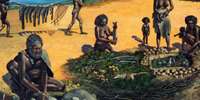
Photo and artwork: Giovanni Caselli, by permission.

Photo: Don Hitchcock 2005
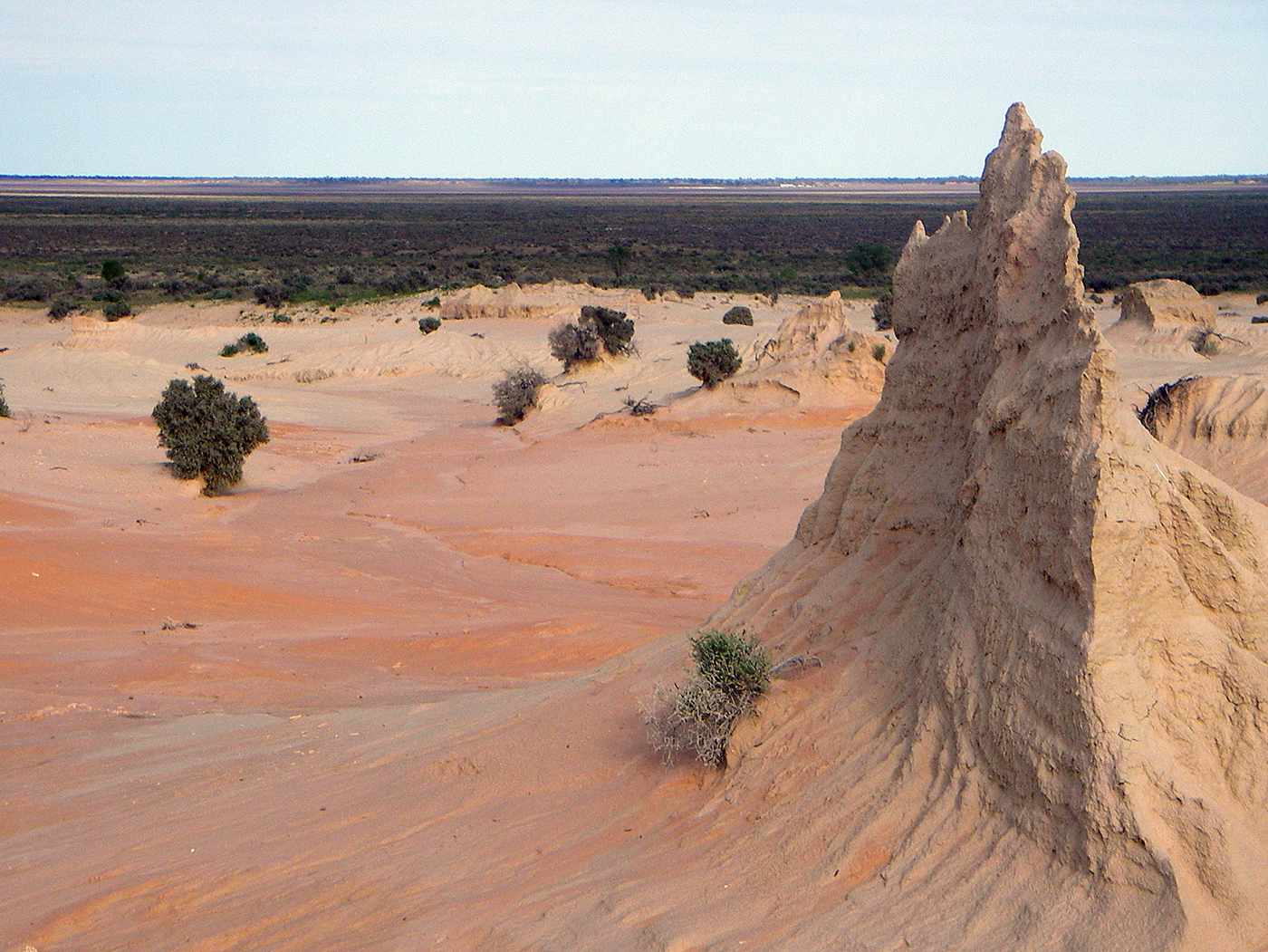
One of the many erosional features at the area known as "The Walls of China". These unique features are ephemeral, and are continually in the process of being formed and destroyed by the action of wind and especially rain.
Photo: Don Hitchcock 2005
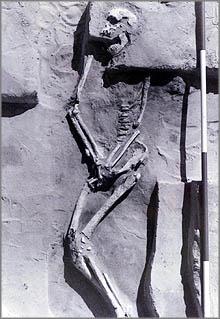
Mungo Man
Photo: Sydney Morning Herald
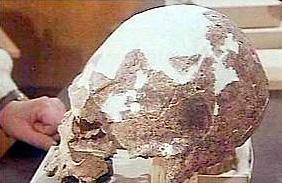
Mungo Man Skull
http://news.bbc.co.uk/hi/english/sci/tech/newsid_1108000/1108413.stm
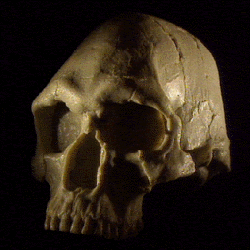
Mungo Man Skull reconstruction
Photo: http://www.abc.net.au/science/slab/mungoman/default.htm
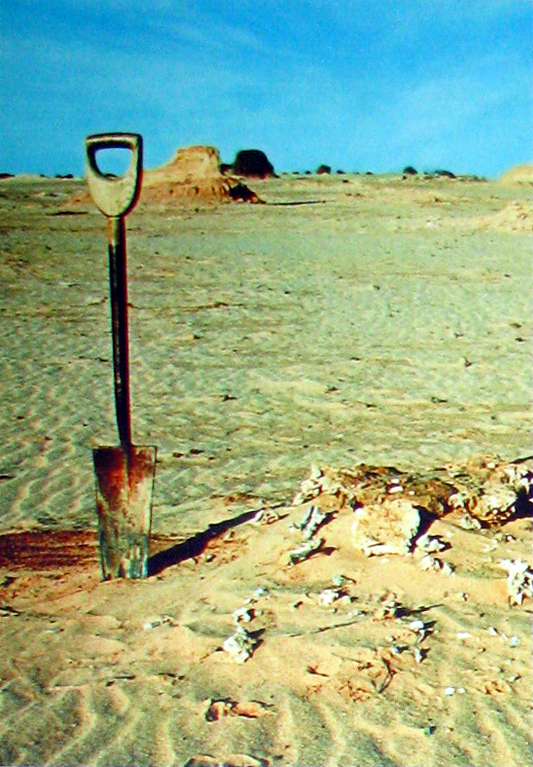
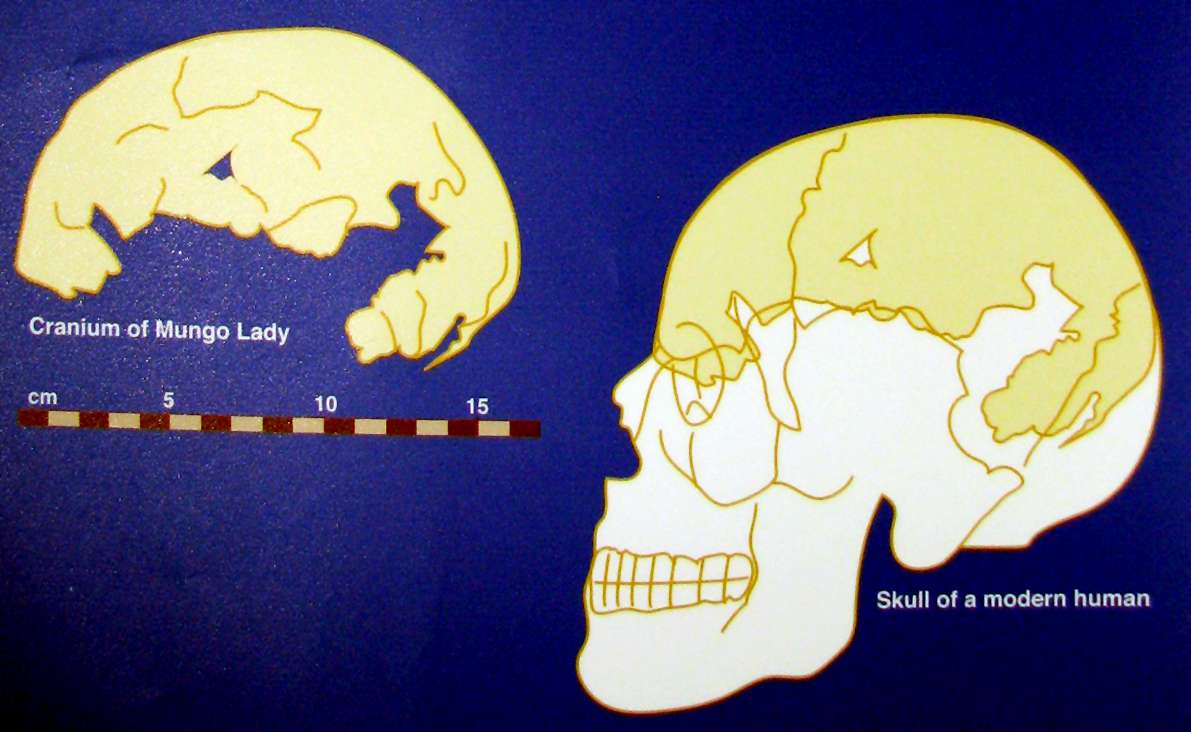
The cremated remains (left) of Mungo Lady were found in blocks of soil carbonate.
A comparison between the cranium of Mungo Lady and a fully modern human (right) shows we are the same.
The remains of Mungo Lady were found by the University of Melbourne geologist Professor Jim Bowler in 1969. He was searching for ancient lakes and came across the charred remains of Mungo Lady, who had been cremated.
In 1974, he found the second complete skeleton of Mungo Man, buried 400 metres away.
Source: Display, Lake Mungo NPWS interpretation centre

In 1969, while mapping evidence of ancient shorelines in the dry basins of western New South Wales, Jim Bowler discovered some burnt human bones buried in the beach sands of an ancient lake. This discovery sparked a major archaeological program. Bowler named this previously unknown lake as Lake Mungo.
Lake Mungo is one of a series of lake basins formed by a channel of the ancient Lachlan River, known as Willandra Creek. The bones proved to be the cremated remains of a young woman, now known as Mungo Lady. Five years later and just 400 metres away on the same beach sands where Mungo Lady was found, Bowler noticed the tip of a cranium being uncovered by natural erosion. Excavation by archaeologists revealed this to be the fully articulated skeleton of a human male, now known as Mungo Man.
Photo and text: Bowler (2005)

Aerial photo of the site.
Photo: Bowler (2005)
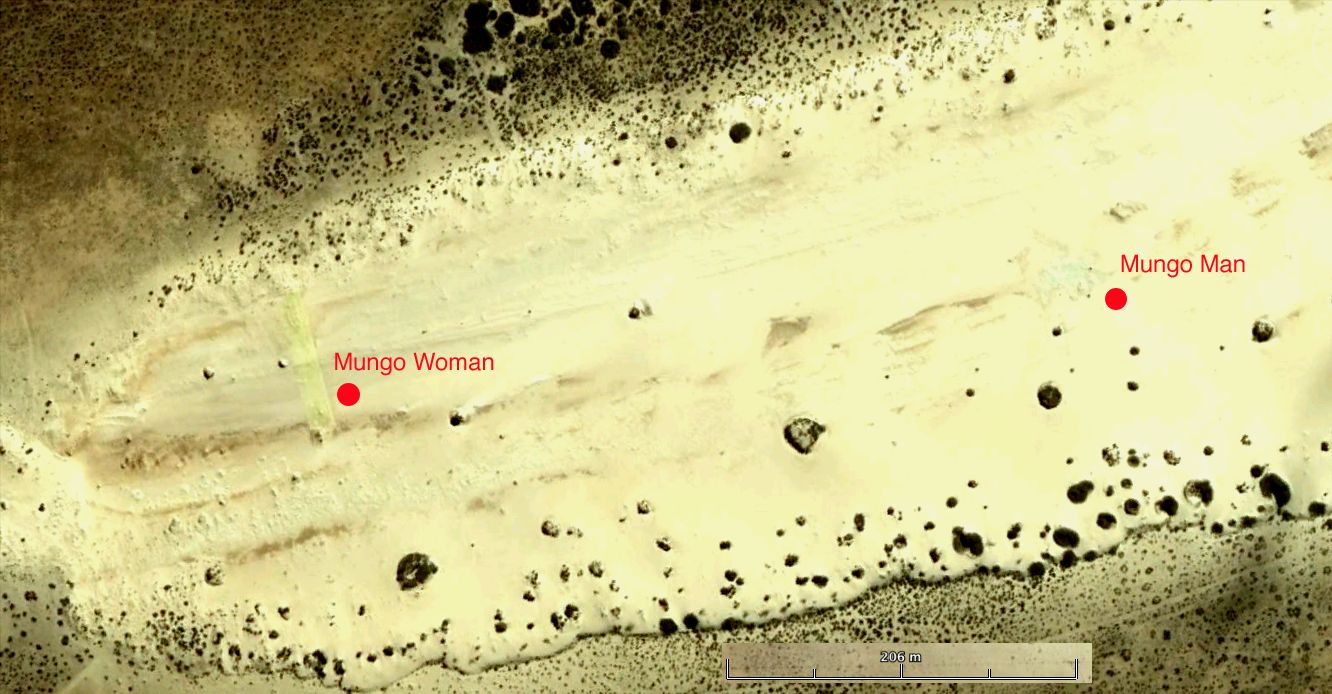
Google earth image of the site.
Note the trench in the area of the discovery of Mungo Lady, and the disturbed area where Mungo Man was found.
Photo: Google Earth
Origin of Mungo Man
This extract from a 2009 paper shows two things:- Humans were certainly at Lake Mungo a little less than 50 000 BP.
- There is mtDNA evidence to suggest that they came from south Asia.

The coalescence time estimate 55.2 ± 10.8 kyBP of the average sequence
divergence of the Indian and Australian M42 coding-region sequences from the root is
consistent with the first evidence of human occupation provided by 11 silcrete flakes with
plain and relatively thick striking platforms recovered from below the lowest gravels in
the barrier sands of the Mungo B trench, bracketed by ages of 50.1 ± 2.4 and 45.7 ±
2.3 kyBP.
The similar or slightly older ages for the initial human arrival in northern
and western Australia [41-43] also seem to be in agreement. The underlying deposits at
Mungo B trench, dated to 52.4 ± 3.1 kyBP, appear to be culturally sterile [8] suggesting
colonization of continental Australia some time after 50 kyBP from south Asia.
The shared lineage provides direct genetic evidence to the long suggested ancient
link between India and Australia. However the deep divergence (i.e. 55.2 ±
10.8 kyBP) of the Indian and Australian branches within M42, coupled with the evidence
of the earliest and most pronounced population expansion outside Africa in Southern
Asia estimated to ~52 kyBP using Bayesian Skyline analysis followed by high mtDNA diversity in Indian populations, strongly suggest that Australia
perhaps along with East/Southeast Eurasia and Papua New Guinea was populated
from Southern Asia plausibly slightly before or in the beginning of the population
expansion that has given rise to a large number of mtDNA lineages within
macrohaplogroup 'M' in India.
Conclusions
Our results showing a shared mtDNA lineage between Indians and Australian First Nations people provides direct genetic evidence that Australia was populated by modern humans through
south Asia following the 'Southern Route'. The divergence of the Indian and Australian
M42 coding-region sequences suggests an early colonization of Australia, ~ 60 to 50
kyBP, quite in agreement with archaeological evidences.
Text and Figure: Kumar et al (2009)
From http://www.theaustralian.news.com.au/
Peter Wilson, Europe correspondent | July 23, 2009
Article from: The Australian
Genetic research has found links between Australian First Nations peoples and the earliest settlers of the Indian subcontinent, supporting the belief humans reached Australia via south Asia.
The findings indicate that a group of hunter-gatherers moved from the Horn of Africa, across the mouth of the Red Sea into Arabia and southern Asia at least 50 000 years ago.
The so-called "Southern Route" theory of how humans reached Australia was backed by the discovery that modern Indian populations have telltale genetic mutations exclusively shared by First Nations peoples.
Members of 26 Indian "relic" tribes or communities known to have very early roots in the region were found to have seven DNA genomes that share traits specific to Australian First Nations peoples.
Raghavendra Rao and other researchers from the Anthropological Survey of India carried out the research, which has been reported in the BMC Evolutionary Biology journal.
"Mitochondrial DNA is inherited only from the mother and so allows us to accurately trace ancestry," he said.
"We found certain mutations in the DNA sequences of the Indian tribes we sampled that are specific to Australian First Nations peoples. This shared ancestry suggests that the First Nations people population migrated to Australia via the so-called 'Southern Route'."
The genetic evidence that modern human populations expanded rapidly along the coastlines of southern Asia, southeastern Asia and Indonesia to arrive in Australia at least 45 000 years ago is backed by archeological evidence of human occupation in the Lake Mungo area dated to roughly the same period.
"Human evolution is usually understood in terms of millions of years," Dr Rao said.
"This direct DNA evidence indicates that the emergence of 'anatomically modern' humans in Africa and the spread of these humans to other parts of the world happened only 50 000 or so years ago.
"In this respect, populations in the Indian subcontinent harbour DNA footprints of the earliest expansion out of Africa. Understanding human evolution helps us to understand the biological and cultural expressions of these people, with far-reaching implications for human welfare."
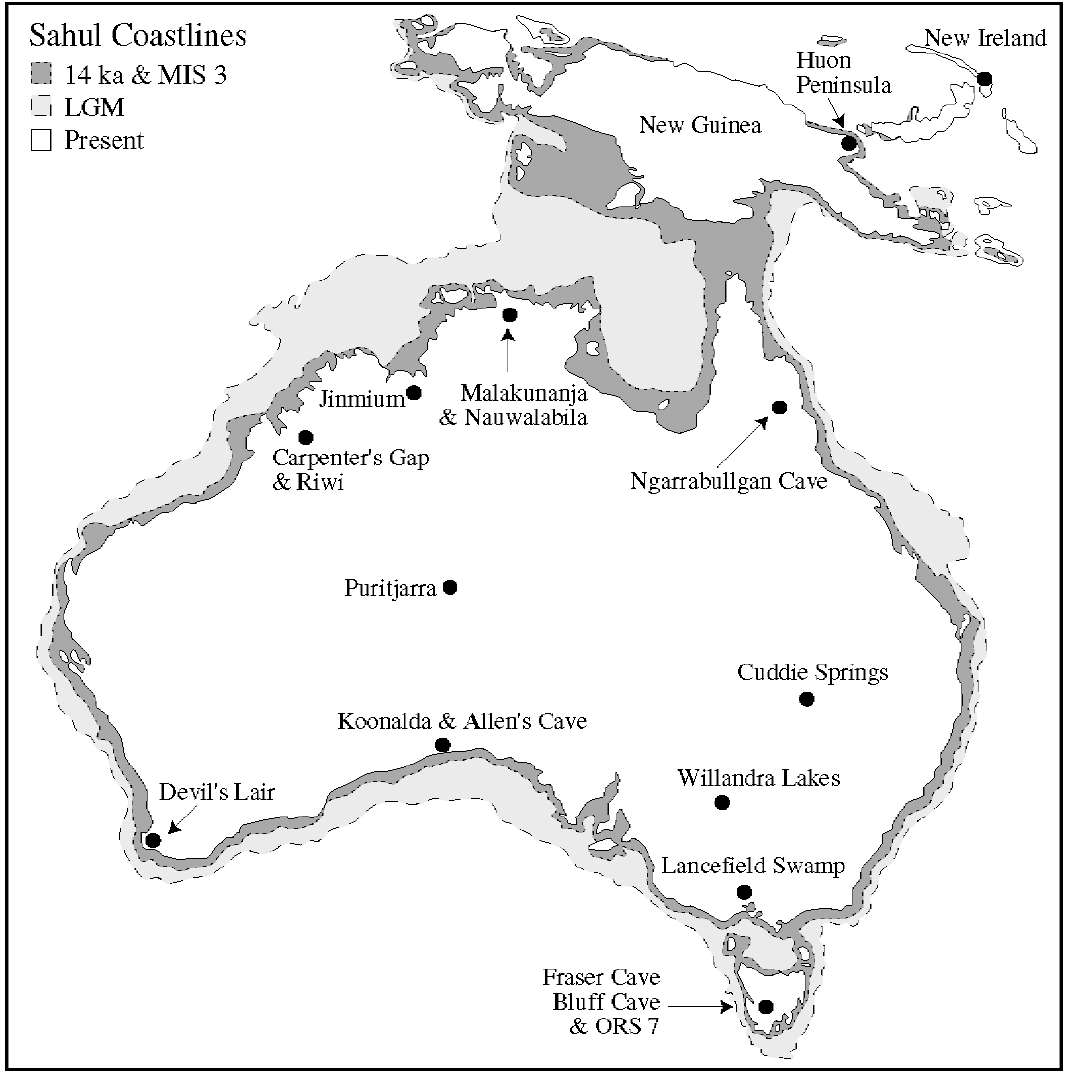
Map of the Australian region showing the extended Sahul landmass at
Last Glacial Maximum (20 000–24 000 BP) and 14 000 BP (as proxy for Marine Isotope Stage 3), modified after Smith (1998).
Photo and caption: Gillespie (2002)
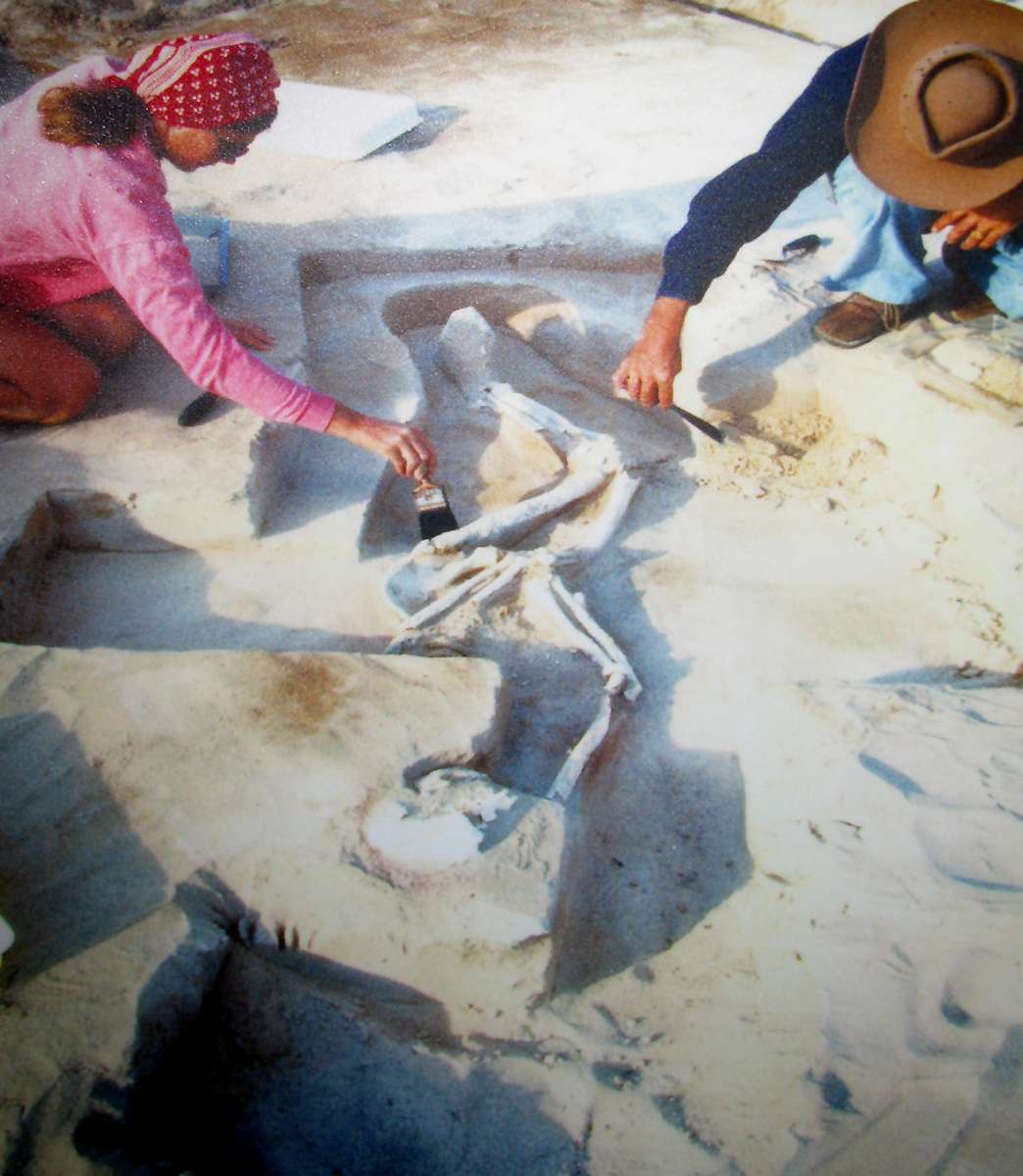
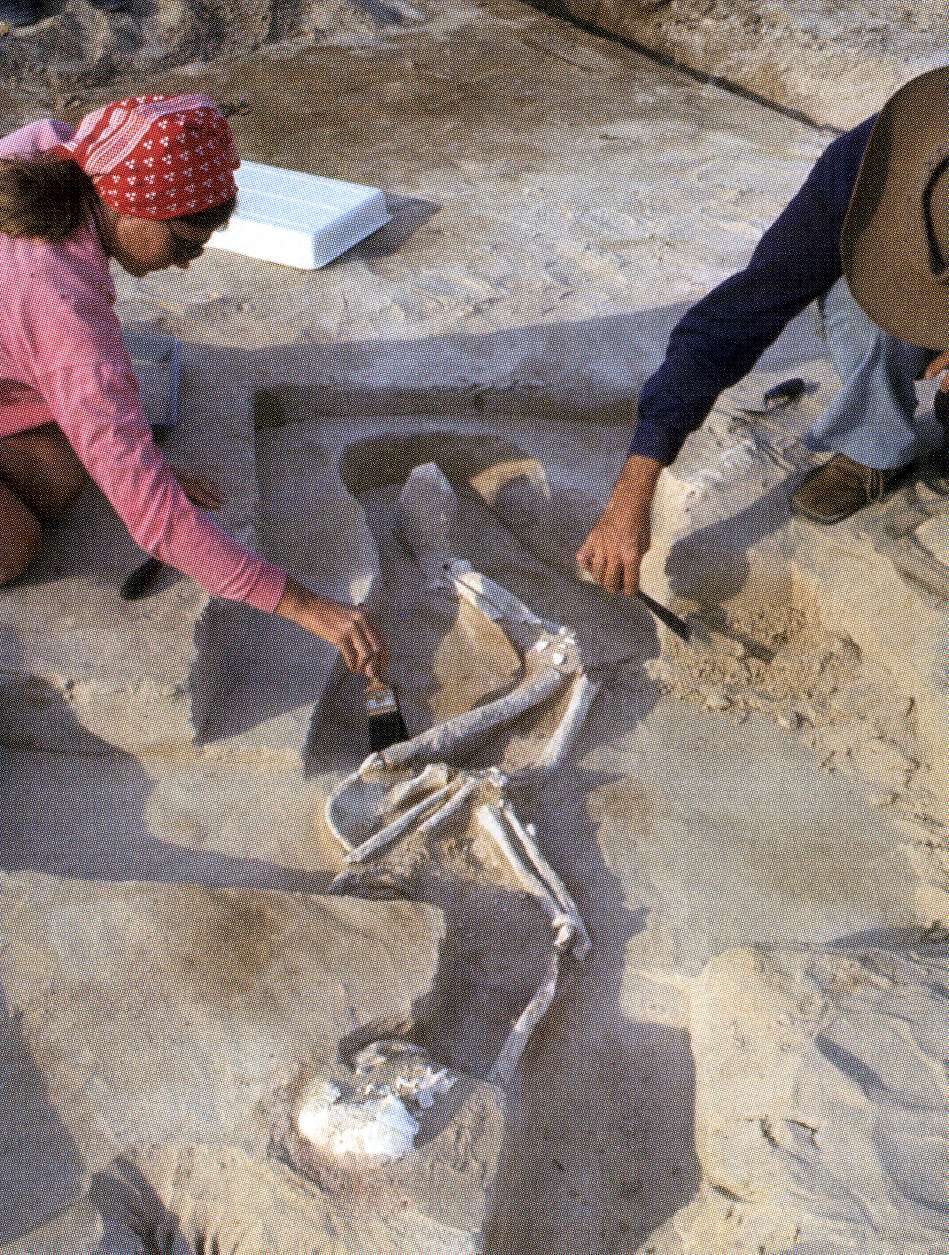
Mungo Man being carefully uncovered from the sands of the Lake Mungo Lunette in 1974.
Source: (left) Display, Lake Mungo NPWS interpretation centre
Source: (right) Bowler (2005)
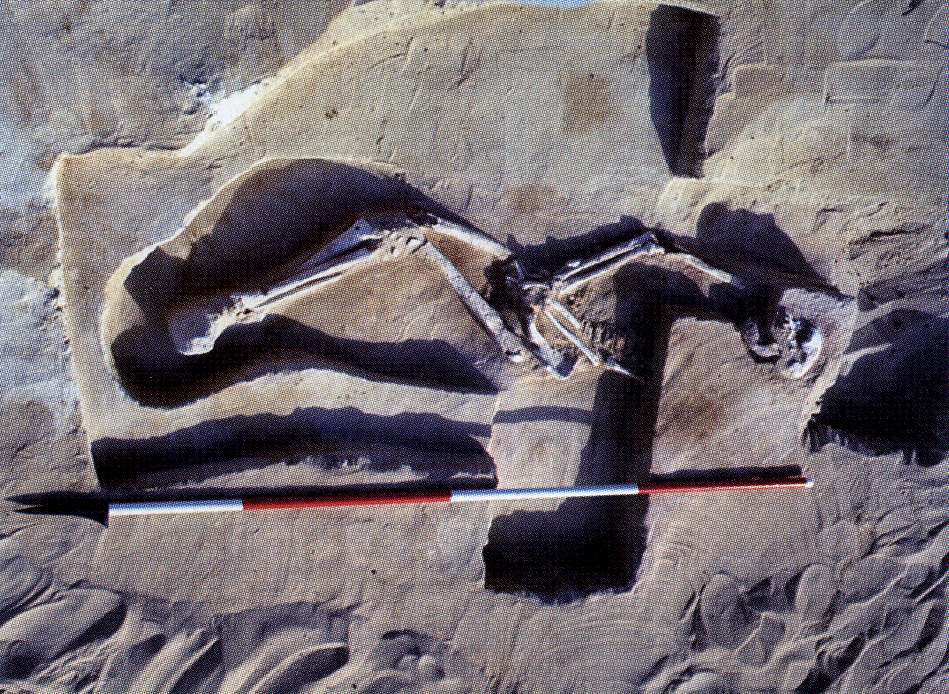
The skeleton was fully articulated when unearthed, 44 000 years after his death.
Photo: Bowler (2005)
Text below from http://www.visitmungo.com.au/who-was-mungo-man
When he was young Mungo Man lost his two lower canine teeth, possibly knocked out in a ritual. He grew into a man nearly 1.7m in height. Over the years his molar teeth became worn and scratched, possibly from eating a gritty diet or stripping the long leaves of water reeds with his teeth to make twine. As Mungo Man grew older his bones ached with arthritis, especially his right elbow, which was so damaged that bits of bone were completely worn out or broken away. Such wear and tear is typical of people who have used a woomera (spear thrower, atlatl - Don) to throw spears over many years.
Mungo Man reached a good age for the hard life of a hunter-gatherer, and died when he was about 50. His family mourned for him, and carefully buried him in the lunette, on his back with his hands crossed in his lap, and sprinkled with red ochre. Mungo Man is the oldest known example in the world of such a ritual.

Time line for the occupation of the Lake Mungo area.
Source: Display, Lake Mungo NPWS interpretation centre
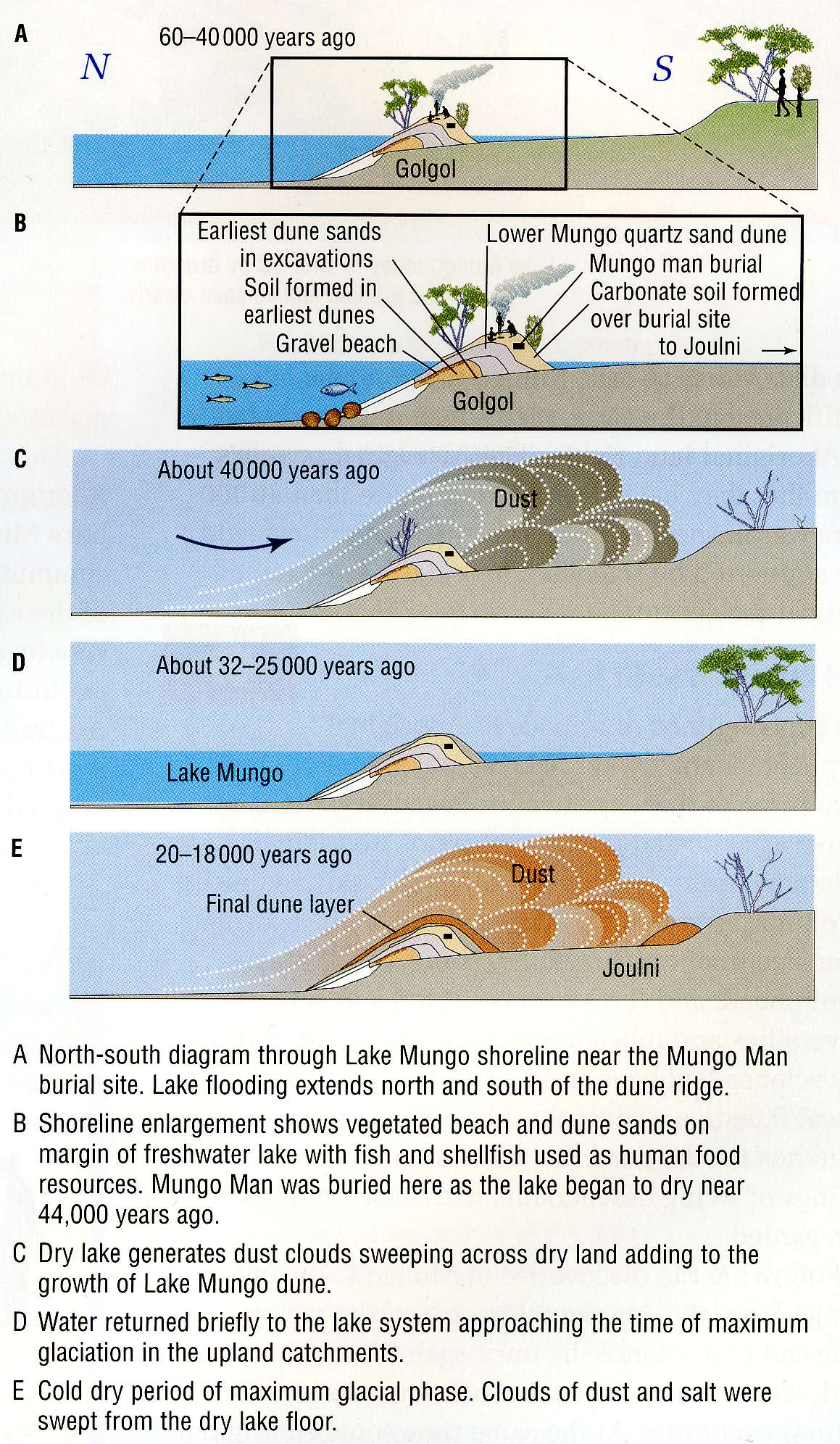
Diagram for the time sequence for mungo man burial and subsequent deposition.
Photo: Bowler (2005)
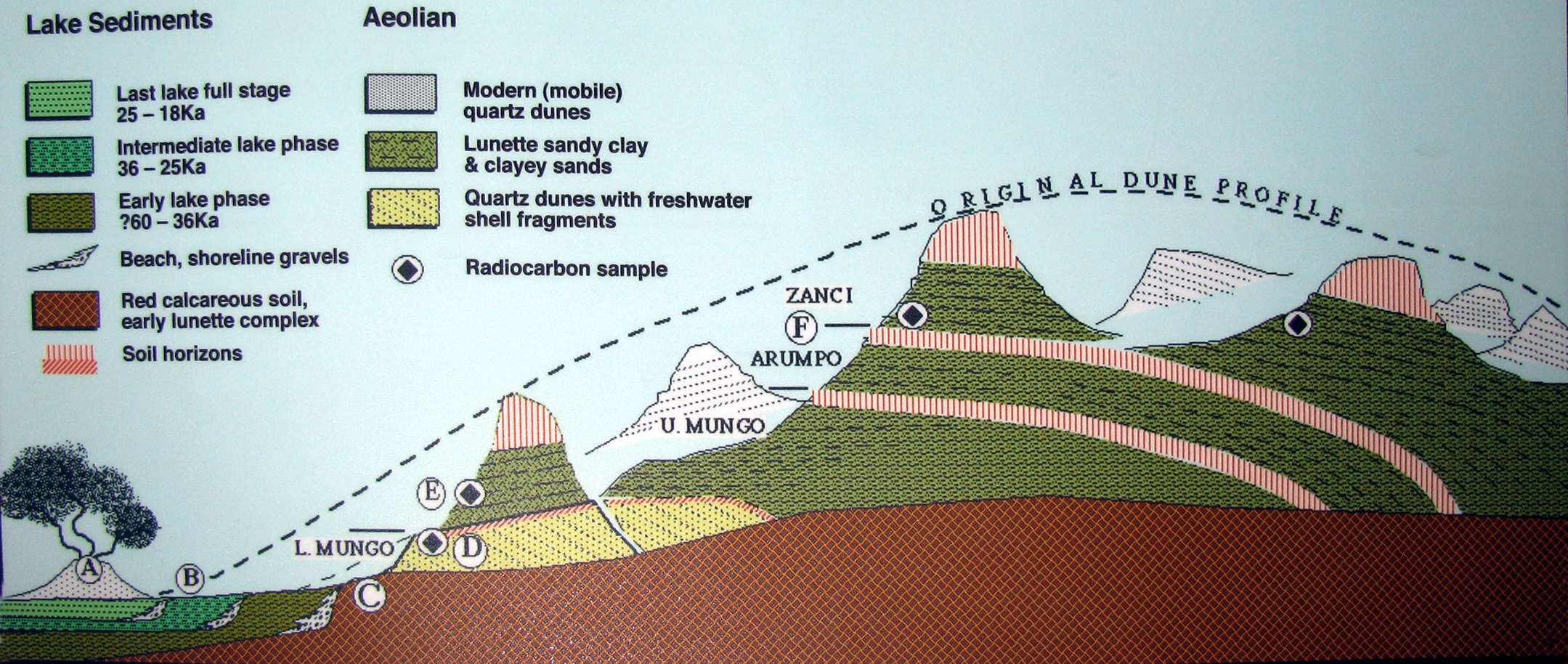
Depositional sequence at Lake Mungo
Source: Display at Lake Mungo Interpretation Centre
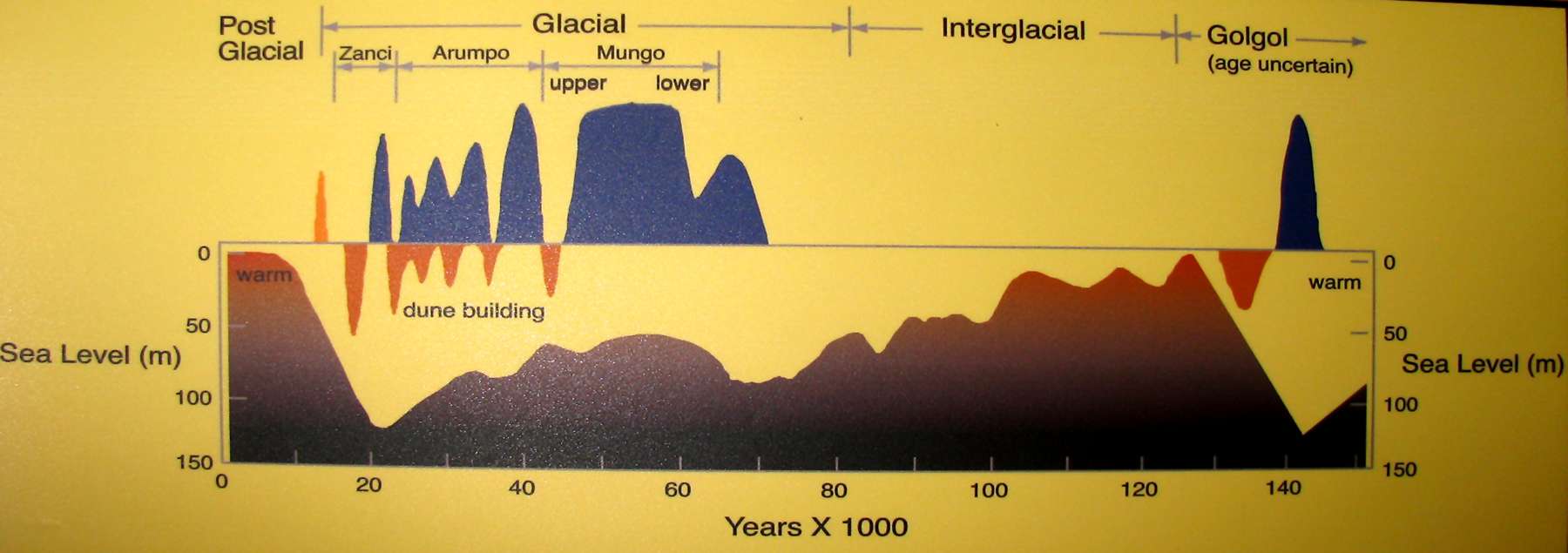
History of climatic conditions at Lake Mungo
Source: Display at Lake Mungo Interpretation Centre
Article below from:
http://www.smh.com.au/articles/2003/02/22/1045638497431.html
Dawn in our Garden of Eden
February 22 2003. Photo: SMH
 The latest research suggests Australia's Adam and Eve are not as old as we thought - and lived much richer lives than we suspected. Deborah Smith reports.
Fifty thousand years ago, a lush landscape greeted the first Australians making their way towards the south-east of the continent. Temperatures were cooler than now. Megafauna - giant prehistoric animals such as marsupial lions, goannas and the rhinoceros-sized diprotodon - were abundant. And the freshwater lakes of the Willandra district in western NSW were brimming with fish. But change was coming. By the time the people living at Lake Mungo ceremoniously buried two of their dead, 40,000 years ago, water levels had begun to drop.
A study of the sediments and graves at Lake Mungo, published this week in Nature, uncovers the muddy layers deposited as the lake began to dry up. Twenty thousand years ago Lake Mungo had become the dry dusty hole we know today, but 20,000 years before that it had been a refuge from the encroaching desert, the study shows. Families clustered around the lake left artefacts, 775 of which researchers used to determine that the number of people living there peaked between 43,000 and 44,000 years ago, with the first wanderers arriving between 46,000 and 50,000 years ago.
This treasure-trove of history was found by the University of Melbourne geologist Professor Jim Bowler in 1969. He was searching for ancient lakes and came across the charred remains of Mungo Lady, who had been cremated. In 1974, he found a second complete skeleton, Mungo Man, buried 300 metres away.
The comprehensive study of 25 different sediment layers at Mungo - a collaboration between four universities, the CSIRO, and NSW National Parks and Wildlife and led by Bowler - concludes that both graves are 40,000 years old.
This is much younger than the 62,000 years Mungo Man was attributed with in 1999 by a team led by Professor Alan Thorne, of the Australian National University. Because Thorne is the country's leading opponent of the Out of Africa theory - that modern humans evolved in Africa about 100,000 years ago and then spread around the globe - the revision of Mungo Man's age has refocused
attention on academic disputes about mankind's origins.
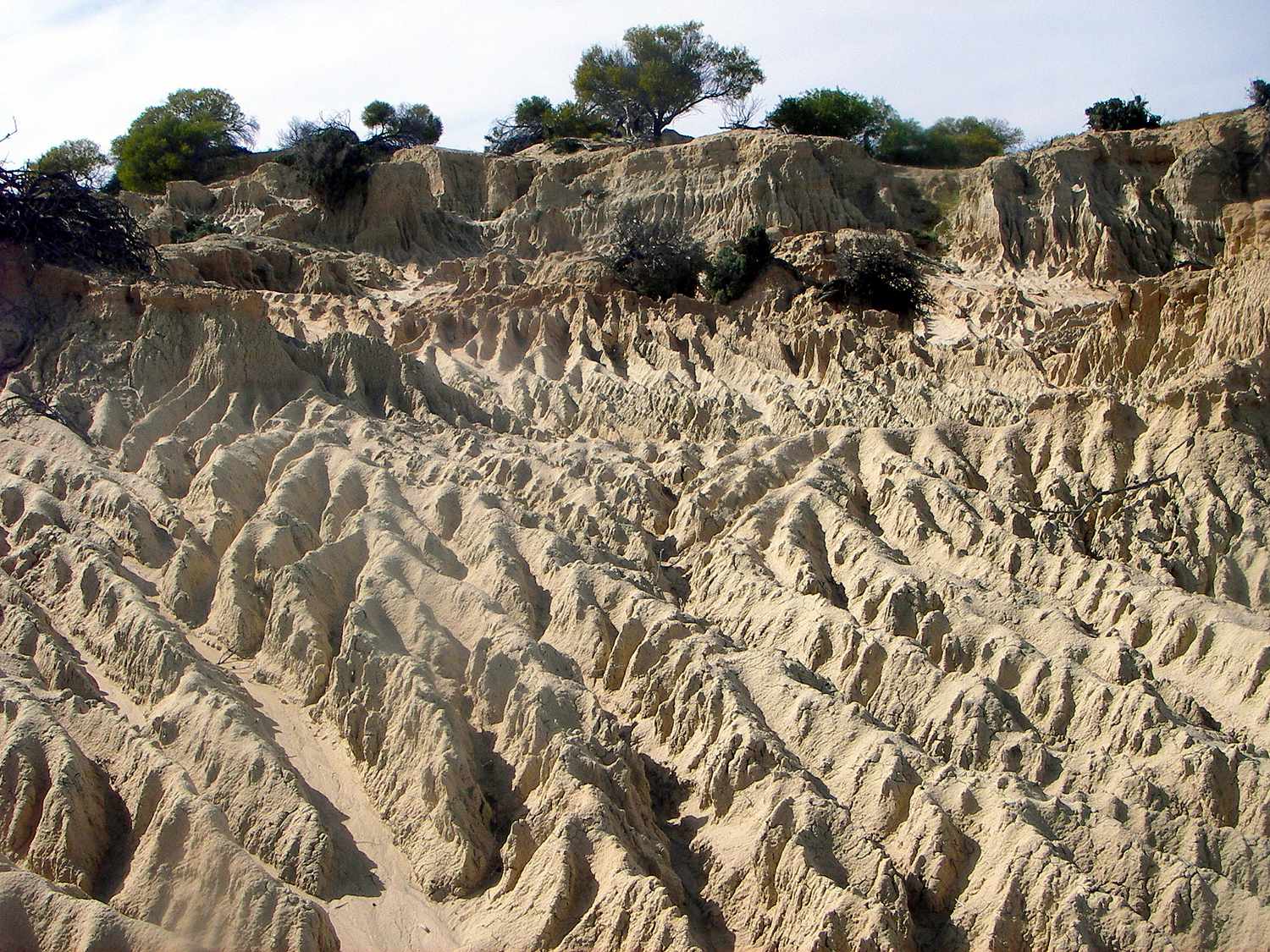 Badlands topography on the lunette to the south of the road across the lake to the "Walls of China"
Photo: Don Hitchcock 2005
Dr Tim Flannery, a proponent of the controversial theory that Australia's megafauna was wiped out 46,000 years ago in a "blitzkrieg" of hunting by the arriving people, also claims the new Mungo dates support this view.
For Bowler, however, these debates are irritating speculative distractions from the study's main findings. At 40,000 years old, Mungo Man and Mungo Lady remain Australia's oldest human burials and the earliest evidence on Earth of cultural sophistication, he says. Modern humans had not even reached North America by this time. In Europe, they were just starting to live alongside the Neanderthals.
"At Lake Mungo we have a cameo of people reacting to environmental change. It is one of the great stories of the peoples of the world."
The modern day story of the science of Mungo also has its fair share of rivalry. In its 1999 study, Thorne's team used three techniques to date Mungo Man at 62,000 years old, and it stands by its figure. It dated bone, teeth enamel and some sand.
Bowler has strongly challenged the results ever since. Dating human bones is "notoriously unreliable", he says. As well, the sand sample Thorne's group dated was taken hundreds of metres from the burial site. "You don't have to be a gravedigger ... to realise the age of the sand is not the same as the age of the grave," says Bowler. He says his team's results are based on careful geological field work that was crosschecked between four laboratories, while Thorne's team was "locked in a laboratory in Canberra and virtually misinterpreted the field evidence".
Thorne counters that Bowler's team used one dating technique, while his used three. Best practice is to have at least two methods produce the same result. A Thorne team member, Professor Rainer Grun, says the fact that the latest results were consistent between laboratories doesn't mean they are absolutely correct. "We now have two data sets that are contradictory. I do not have a plausible explanation."
Two years ago Thorne made world headlines with a study of Mungo Man's DNA that he claimed supported his idea that modern humans evolved from archaic humans in several places around the world, rather than striding out of Africa a relatively short time ago.
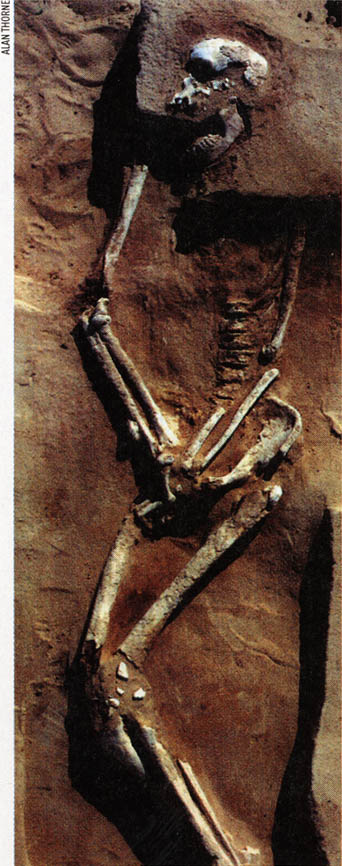 Photo: Alan Thorne, New Scientist 22 Feb 2003
Other scientists have expressed scepticism. But Thorne's old age for Mungo Man was also regarded as evidence for his theory. Homo sapiens would have had to move pretty fast to get from Africa to NSW by 62,000 years ago.
Now, however, Thorne says the age of Mungo Man is irrelevant to this origins debate. Recent fossils finds show modern humans were in China 110 000 years ago. "So he has got a long time to turn up in Australia. It doesn't matter if he is 40 000 or 60 000 years old."
In 2001 a member of Bowler's team, Dr Richard Roberts of Wollongong University, along with Flannery, director of the South Australian Museum, published research on their blitzkreig theory. They dated 28 sites across the continent, arguing their analysis showed the megafauna died out suddenly 46 600 years ago.
The conclusion has been challenged by other scientists, including Dr Judith Field of the University of Sydney and Dr Richard Fullager of the Australian Museum, who point to the presence of megafauna fossils at the 36 000-year-old Cuddie Springs site in NSW.
Flannery praises the Bowler team's research on Mungo Man as "the most thorough and rigorous dating" of ancient human remains. He says the finding that humans arrived at Lake Mungo between 46,000 and 50 000 years ago supports the idea that 47,000 years ago was a critical time in Australia's history. There is no evidence of a dramatic climatic change then, he says. "It's my view that humans arrived and extinction took place in almost the same geological instant."
Bowler, however, is sceptical of Flannery's theory and says the Mungo study provides no definitive new evidence to support it. He argues that climate change at 40 000 years ago was more intense than had been previously realised and could have played a role in the megafauna's demise. "To blame the earliest Australians for their complete extinction is drawing a long bow."

Burin of silcrete from Lake Mungo, about 7 cm across.
All silcrete on the "Walls of China" was carried there by First Nations peoples from the western side of the lake. There is no silcrete available on the eastern side of Lake Mungo.
This tool would originally have had a sharp point for making holes in leather, which has broken off, and the tool was then thrown away.
The tools are elegantly made, with the minimum of flakes being removed, and no evidence of retouching. They have been made by master craftsmen with total control of the material.
Photo: Don Hitchcock 2005
Old bones
Date: 13/01/2001
The Mungo Man mystery. Penny Fannin reports.
For thousands of years First Nations peoples wandered among the Walls of China, a line of ancient sand and clay landforms stretching for almost 30 kilometres along the western (Ed: wrong, should be eastern) edge of Lake Mungo. When the lake, part of the Willandra Lakes region in far south-west NSW, dried up about 10,000 years ago, the bones and relics of the people who once lived on its shores were swallowed up by the desert sands. But 30 years ago, the wind exposed a fragment of history.
In 1969, Australian archaeologists unearthed more than 175 bone fragments. Reassembled, they formed the frame of a young adult female, who became known as Mungo Woman. Radiocarbon dating showed she had died between 24,500 and 26,500 years ago.
Then, five years later, 500 metres from where Mungo Woman was discovered, the burial site of another ancient human was found. Jim Bowler, now a professor of earth sciences at Melbourne University, noticed a tip of bone protruding from the desert sand. The bone turned out to be the top of a human skull at least 25,000 years old. The skeleton uncovered was dubbed Mungo Man.
Almost from the moment of his exhumation, Mungo Man has challenged scientific beliefs and divided anthropologists.
After 25 years, there is still no agreement on the age of Mungo Man. Some say 30,000 years, others 60,000. Even the skeleton's sex is disputed, although it is generally considered to be male.
Yet those debates have paled in comparison with the controversy that now surrounds Mungo Man. An article about to be published by three Australian scientists argues that the Mungo Man skeleton proves the prevailing view of where modern humans came from is wrong.
For more than a decade, two theories have competed to explain the origins of Homo sapiens, or modern humans. The more accepted of these is the Out of Africa theory, proposed by Allan Wilson and Rebecca Cann from the University of California, Berkeley, in 1988. This has modern humans originating in Africa about 200,000 to 250,000 years ago and spreading around the world. During this period they wiped out Neanderthals and became the dominant species. Wilson and Cann also argue that an "archaic" human species, Homo erectus, had left Africa up to
2 million years ago and it was this species' descendants, including Neanderthals, who were replaced.
But the Out of Africa idea has long been disputed by Dr Alan Thorne, a visiting fellow at the Australian National University's research school of Pacific and Asian studies. Thorne, along with Professor Milford Wolpoff of the University of Michigan, has championed what is known as the "multi-region" theory.
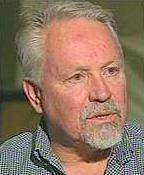
Dr Alan Thorne
Photo: http://www.abc.net.au/science/slab/mungoman/default.htm
The two scientists agree with the Out of Africa theory that Homo erectus began in Africa about 2 million years ago, and emigrated. But from here their theory differs. They think Homo sapiens did not evolve solely in Africa but simultaneously in Africa, Europe, North Asia and South-East Asia.
"There are only two theories, and one of them has to be wrong," says Thorne, who was interviewed by more than 100 journalists this week. In a study soon to be published in the Proceedings of the National Academy of Sciences USA, he and his two co-authors argue that a new anatomical and genetic examination of Mungo Man shows the multi-region theory must be right.
Although acrimony between supporters of the different evolutionary views may appear to be little more than an inflated difference of opinion, it goes much deeper. For centuries it has been argued that differences between "races" of humans mean some are inferior, some superior. According to the multi-region theory, the long process of evolution in different regions explains the "differences" between Asians, Africans, Europeans and First Nations peoples. But if the Out of Africa theory prevails, there can be no genetic basis for racism. Why? Its premise is that modern humans evolved so recently that we are effectively genetically identical, however different we may appear.
So from a pile of old bones rises the question: are our differences only skin deep? Or are they programmed into our genes?
Thorne's argument hinges in part on the DNA that scientists were able to extract from Mungo Man. Dr Simon Easteal, an evolutionary geneticist at the ANU's John Curtin School of Medical Research, found that the skeleton's genetic material contained a small section of mitochondrial DNA. He also analysed genetic material from nearly 3,500 people, including Neanderthals, ancient First Nations peoples whose remains are about 30,000 years old, and present-day First Nations peoples. Easteal found that Mungo Man's DNA bore no similarity to the DNA taken from any of the other samples.
To Thorne, this is dramatic evidence that the Out of Africa theory is wrong. Out of Africa argues that Homo sapiens had a single place of origin. But if Mungo Man was descended from a person who had left Africa in the past 200,000 years, Thorne argues, then his mitochondrial DNA should have looked like that of the other samples.
Out of Africa distinguishes between Homo erectus who, because he was "primitive", was overpowered by "modern" Homo sapiens. Thorne thinks the distinction is pointless, because it is impossible to define a time or place where the evolutionary transition between them occurred. Out of Africa thinks this time and place was Africa, about 200,000 years ago.
But Thorne's critics are not persuaded by what he says the DNA shows. Some anthropologists argue that the reason none of Mungo Man's genetic material showed up elsewhere may be that he didn't have any descendants. But until researchers can figure out how to collect nuclear DNA (from the nucleus of human cells) from ancient bones, there is no way of establishing that Mungo Man did not pass on his genes. Mitochondrial DNA is passed only through the female line.
Thorne says the fact that modern First Nations peoples have the same skeleton and teeth as Mungo Man's shows that while his mitochondrial DNA disappeared, the rest of his genes did not.
But University of Sydney prehistorian Peter White says the debate over Mungo Man's mitochondrial DNA is essentially irrelevant to the big picture of evolution. "We're looking at one of those lines of mitochondrial DNA that has disappeared. The fact that it is not known in Australia is meaningless in a larger evolutionary sense."
Even without the genetic analysis, Thorne argues Mungo Man's anatomy is evidence enough for the multi-region theory. "The problem is that no living Australian looks like anyone in Africa," he says. "If people got out of Africa 100,000 years ago, as the Out of Africa theory suggests, they would not have had time to change their appearance so dramatically."
But White says Thorne is overstating the anatomical differences between modern humans. "The difference between African, European and Aboriginal skeletons is really pretty small and there's an enormous amount of overlap between them. To pick out one individual and say he is not like an African is way beyond the evidence."
How long it takes for a species to evolve is still debated among biologists. But if they ever agree on a minimum time for the process, the age of Mungo Man could prove critical.
Thorne thinks Mungo Man is about 60,000 years old (an age that would substantially increase the length of time Australia was known to have been inhabited).
But Bowler, who discovered the skeleton, thinks Mungo Man's age is closer to 45,000 years.
He claims Thorne's ANU dating team "largely ignored" field evidence that showed Mungo Man couldn't have been as old as 60,000 years.
Clay pellets in the grave indicate it was dug from a higher, and therefore younger, level of sand, he says. "They did not realise there was much more clay associated with the burial site than they thought.
In an article in Australasian Science last year, Thorne suggested the clay had been sprinkled on Mungo Man's body as part of the burial ceremony. Bowler is sceptical. "It's a landscape of clay dunes. To infer clay was sprinkled over the grave of the Aboriginal is absolute nonsense."
Dr Peter Brown, a senior lecturer in archaeology and paleoanthropology at the University of New England, is also sceptical about Thorne's conclusions over the age of the Mungo skeleton. What's more, he doubts that genetic material was extracted from it at all.
Brown says the oldest specimens from which genetic material have been extracted are about 30,000 years old, and these had been preserved in ideal conditions - a cool and dry environment.
The Willandra Lakes, where Mungo Man was unearthed, are hot, with a fluctuating climate, making it unlikely, Brown thinks, that genetic material could be preserved there for any length of time.
Brown also challenges Thorne's claim that early humans remained on the same evolutionary path by interbreeding. The geographical distances involved were too great, he says. "In the multi-regional model, it's unlikely gene flow could have been maintained. It's much more likely that modern humans came out of Africa."
Bowler agrees. "I would be very surprised if one bit of DNA changes these theories. There seems to be an inverse relationship between the amount of data and the degree of debate."
The carbon dating and DNA testing of Mungo Man has challenged the accepted version of how humans developed and spread around the world. Scientists have believed that all modern humans are descended from an original Eve who lived in the gardens of Ethiopia some 150,000 years ago.
Not an Eve in the Biblical sense, but a form of human being called homo sapiens who was a sparkling, new, improved version of one of the many types of humans descended from chimpanzees, a process that began 3.5 million years before.
Until now the accepted theory was that earlier offshoots from the chimps such as the half-ape homo erectus and Neanderthal Man, that thick-looking, 28,000-year-old caveman bloke found in Germany, were steadily replaced by the homo sapiens mob as they started spreading out of Africa some 100,000 years ago.
They thought the evidence was clear: DNA taken from people around the globe showed they were all from the same stem. Therefore all humans must come from the same source.
The oldest known genes of modern humans were in Africa. That must be the source.
But Mungo Man looks just like us and he is far older. The DNA findings were even more astounding. Scientists examined DNA from a tiny bit of bone that had flaked off the skeleton.
It took five years, but they were able to retrieve two micrograms of mitochondrial DNA, a common human gene that was enough to establish Mungo was a modern human but he also had certain genes that were now extinct.
Australian National University anthropologist Alan Thorne, who led the research team examining Mungo Man, explained the significance of that extinct gene.
'There are people who live in the same area today who would look exactly like Mungo,' Thorne said from his Canberra office where he has been besieged since revealing his findings during the week.
'Mungo could not have come from Africa as, just like Aboriginal Australians don't look like anybody from Africa, Mungo Man's skeleton doesn't look like anybody from Africa.
'These were completely modern people. First Nations peoples of today are certainly descended from Mungo Man. Their skeletal make-up is the same. All his genes, but for a few, were passed on.'
The extinct DNA means Mungo was one version of modern man who developed from more primitive human forms independent from those in Africa.
Thorne is not afraid to buck the accepted anthropological thinking. He is dead against the Out of Africa-ites. He is one of the leaders of the new theory of regional continuity.
He believes modern man did not spread out from Africa, wiping out all other human versions to emerge supreme, seeing modern man more as a lover than a killer.
He believes modern man emerged in several parts of the world by inter-breeding with other versions of humans, rather than being a supreme conquering single species.
'Human beings were in three continents - Europe, Asia and Africa. Modern humans began to appear from about 200,000 years onwards. We say they started appearing everywhere, not just in one place such as Africa.
'Just as people today from different parts of the world are mixing and mating and having perfectly normal babies, so they did then.'
Thorne said Mungo and his people probably came to Australia by bamboo raft from what is now Indonesia.
Other scientists dispute his conclusions. La Trobe University geneticist John Mitchell suggested the results may prove that some versions of modern man left Africa much earlier and Mungo Man simply reached Australia first.
But later arrivals from Africa killed off Mungo's version of modern man just as we continue to kill each other today.
So what does Thorne think Mungo would make of all this?
'I think he would just smile, and then go for a swim in the lake.'
The Sun-Herald
**********************************************************
http://www.abc.net.au/7.30/s231690.htm
7.30 Report, ABC Australia.
Transcript
9/01/01
Scientists question the theory of human evolution
GEORGE NEGUS: Out of Africa or out of Australia - it's the discovery that could turn the accepted theory of human evolution on its head.
It all revolves around the so-called 'Mungo Man' - a skeleton discovered in 1974 at Lake Mungo in south-western New South Wales and believed to be 60,000 years old.
A new DNA study of the remains by an Australian research team suggests rather than originating in Africa, modern humans may have evolved in different parts of the world.
But some scientists are sceptical about this conclusion, which has sparked intense academic interest around the world.
Nick Grimm reports.
DR ALAN THORNE, AUSTRALIAN NATIONAL UNIVERSITY: Human evolution is not a simple matter.
It's a very complex species in all sorts of different ways.
I think this fossil evidence for our genes is beginning to show that.
NICK GRIMM: The dust of the Australian outback may have yielded one of the most important clues to human origins.
The fossilised skeleton of a man who, if new research is accurate, lived 60,000 years ago.
DR PAUL TACON, AUSTRALIAN MUSEUM: This opens up a new door into the investigation of the great jigsaw puzzle that is the human past.
NICK GRIMM: In 1974, Mungo Man was discovered at Lake Mungo in south-western NSW.
It appears this ancient Australian may have been the original colonial upstart.
Long after his death, he's upsetting conventions, bruising egos and threatening reputations.
DR ALAN THORNE: It's already causing fear and loathing in some quarters.
That's what science is about - it's about new ideas, new data and new ways of analysing material, throwing out old ideas and moving on.
NICK GRIMM: Anthropologist Alan Thorne was today swamped with media attention from around the world.
After all, his research team may have overturned one of conventional wisdoms of human evolutionary science.
DR ALAN THORNE: The principal discovery really is that one of the 10 people of the past that we've recovered DNA from is not only the oldest evidence for human occupation of Australia but his DNA is currently the oldest known DNA from my human anywhere in the world.
NICK GRIMM: Dr Thorne's team believe Mungo Man died around 60,000 years ago, at least 20,000 earlier than Australia was thought to be occupied by humans.
But even more remarkable is the fact that Mungo Man, while undoubtedly ancient, was otherwise quite contemporary.
SIMON EASTEAL, ANU GENETICIST: The individual concerned is fully modern.
They have an appearance that wouldn't stand out in a crowd nowadays.
NICK GRIMM: The consequences of that discovery are set to revolutionise our understanding of our origins.
The widely accepted hypothesis of human evolution contends that homo erectus left Africa 2 million years ago, along the way becoming the so-called Neanderthals who inhabited Europe.
Modern humans, Homo sapiens, supposedly then evolved in Africa 100,000 to 150,000 years ago, moving out across the globe while the Neanderthals became extinct.
The study of Mungo Man apparently supports the more complex "Regional Continuity" theory.
Its advocates argue that Homo erectus indeed left Africa two million years ago, occupying large parts of the world and evolved into modern man in a variety of separate locations.
That explains why Mungo Man is unique.
SIMON EASTEAL: It opens up for serious investigation the idea that our origins are much more complex than what's been presented by this very simple story of "Out of Africa".
NICK GRIMM: Dr Thorne's colleague, geneticist Simon Easteal studied bone flakes from Mungo Man's skeleton and found the DNA contained in them was similar but fundamentally different to Australia's later occupants.
SIMON EASTEAL: It has important bearings on our perceptions of where we came from as human beings.
But it's also important in the sense that general area of investigation is important in understanding how genetic variation is important in disease in contemporary human populations.
NICK GRIMM: It's believed that some groups evolved into modern humans and then became extinct which explains why Mungo Man's DNA does not match that of the more recent First Nations peoples.
But other scientists are raising questions about the methodology of the breakthrough.
PROFESSOR JIM BOWLER, MELBOURNE UNIVERSITY: The day in which I came across those remains, I immediately realised that here we were looking at amazing evidence of past human occupation in Australia.
NICK GRIMM: Mungo Man was discovered by geomorphologist Professor Jim Bowler.
While he's pleased to see new life breathed into Mungo Man's dry bones, he's adamant Dr Thorne's team have got their dates wrong.
PROFESSOR JIM BOWLER: If you're looking out the laboratory window and trying to reconstruct nature, in that context, nature is much more complex than our simple models, our reductionist models constructed in the laboratory.
So the dates, although wonderful set of numbers in themselves, when they relate to the actual burial, are seriously flawed.
NICK GRIMM: Professor Bowler believes Mungo Man is much younger, a mere 45,000-years-old.
He says the new research erred by testing the age of the sand around the skeleton.
PROFESSOR JIM BOWLER: It's obvious that the age of the earth is quite different from the age of the grave.
That is fundamental.
That's a serious error.
DR ALAN THORNE: There will always be people who don't agree with everything.
But that's not our problem.
We're perfectly happy with the date of 60,000.
NICK GRIMM: Paul Tacon from the Australian Museum is watching the debate over Mungo Man with interest.
He believes the new research has not yet discredited the "Out of Africa" theory but he says the pendulum is swinging towards the new theory.
DR PAUL TACON: With all of science, there are large egos involved and scientists have a lot at stake.
So when results are thrust into the public arena such as they have been today, it can be a very emotional roller coaster for people on both sides.
And there are some people who would never be persuaded one way or another whatever evidence we turn up.
From:
http://www.theage.com.au/daily/990521/news/news20.html
Mungo Man older than thought
By Janine MacDonald
Canberra
Fresh analysis of the skeletal remains found at Lake Mungo in NSW 25 years ago indicate he may be up to 68,000 years old - making him 28,000 years older than earlier scientific estimates.
The revised dating of the remains by scientists at the Australian National University rewrites the history of Australia's occupation and has profound implications for worldwide debate over the origins of modern man.
Cross-matching a range of recent dating tests puts the minimum date of the burial of the remains at 56,000 to 68,000 years ago. The research, to be published today in the Journal of Human Evolution, came up with almost identical dates.
But the researchers add that the location of the Mungo skeleton, deep in Australia's south-east, suggests Homo sapiens arrived in the north-east much earlier, taking time to migrate inland and adapt to desert conditions before travelling down the continent.
The previous accepted estimate was that humans had roamed the country for 40,000 to 60,000 years.
The redating was carried out using three different methods - uranium series, electron spin resonance and optically stimulated luminescence. The researchers say they date the remains at 62,000 years, plus or minus 6000 years.
The findings strengthen the theory that two forms of man - the delicate people first and the robust people later - came to the outer reaches of the continent from two different parts of Asia tens of thousands of years ago.
These groups, along with others that came later, are then said to have merged to form modern First Nations peoples and Melanesians.
``The research has important implications for the global debate over the development of modern human variation, the beginning of human sea travel and the settlement by the ancestors of Aboriginal Australians of the semi-arid areas of the continent,'' said archaeologist Dr Alan Thorne.
The finding is certain to spark renewed debate between the multi-regionalists, who believe different people migrated from different parts of Asia, and those who support the ``out of Africa'' model that dates all human origin to Africa.
The discovery began more than a quarter of a century ago, when on 26February 1974, the shifting sands of a lunette around Lake Mungo in the Willandra Lakes World Heritage area revealed an eroding gravesite.
It was a human skeleton - known as Lake Mungo 3 - that had been covered in red ochre during a burial ritual. The hands were interlocked and positioned over the penis.
Five years earlier the cremated remains of a female skeleton, known by local First Nations peoples as Mungo Lady, were found in the same area.
Using carbon-dating, a technique only reliable to around 40,000 years old, the skeleton was first estimated at 28,000 to 32,000 years old.
The figures were later revised upwards to about 40,000 years old.
Dr Thorne said the new research also provided new minimum ages for human cremation and the use of ochre in burials. The burial of Mungo Man involved the spreading of red ochre over the body during the burial ceremony. This is the earliest known use of pigment for artistic, philosophical or religious purposes.
http://news.bbc.co.uk/hi/english/sci/tech/newsid_1108000/1108413.stm
Mungo Man
Discovered at Lake Mungo in far west NSW in 1974, Mungo Man had been covered in red ochre during a burial ritual. The hands were interlocked and positioned over the penis. Mungo Man was found in the same area as the cremated remains of a female skeleton known by local First Nations peoples as Mungo Lady. Recent lab studies of this type have suggested that our most recent common ancestor lived less than 200,000 years ago in Africa.
Tuesday, 9 January, 2001, 16:35 GMT
Fossil challenge to Africa theory
Bone fragments were examined for ancient DNA
Australian scientists say analysis of the oldest DNA ever taken from skeletal remains challenges the theory that all modern humans can trace their recent ancestry to Africa.
Dr Alan Thorne, Australian National University The study is based on the 60,000-year-old so-called Mungo Man skeleton, which was unearthed in New South Wales in 1974, and nine other anatomically modern Australian individuals who lived 8-15,000 years ago.
The Australian National University team looked at the DNA found in the mitochondria of these ancient people's cells. mtDNA, as it is known, is inherited only from females and also mutates - errors appear - at a steady rate, meaning it can be used as a "molecular clock" to investigate human history.
But the Australian researchers contend that the DNA sequences isolated from Mungo Man's bones show him to have a genetic lineage that is both older and distinct from this line.
Given the undoubted modern appearance of Mungo Man, they argue, major doubt must now be cast on the so-called "Out of Africa" hypothesis in which all living people are said to be descended from a group of modern humans who left their African homeland no earlier than about 120,000 years ago.
Alternative explanation
"What our evidence shows is that the situation is much more complicated than any of these supporters of Out of Africa would have imagined," lead researcher Dr Alan Thorne said.
Dating has put the age of the Mungo Man remains at between 56,000 and 68,000 years
"They were arguing that because the earliest forms of this particular genetic sequence in living people was found in Africa, that meant that all people must have come from Africa.
"Well, logically, that's not true anymore because we now have an older form of indisputably modern human that comes out of Australia."
Dr Thorne, whose team have published their research in the Proceedings of the National Academy of Sciences, is a proponent of the alternative, multi-regional explanation for the emergence of modern humans.
This suggests that modern humans arose simultaneously in Africa, Europe and Asia from one of our predecessors, Homo erectus, who left Africa more that 1.5 million years ago.
"Modern humans didn't just come from one area, they came from all areas," Dr Thorne said. "We assert that when people began to leave Africa about two million years ago, they were the ancestors of all modern people and we don't think modern humanity emerged from one place later on.
European studies
"We simply say that here we have a form much older than anything found in Africa and there's no evidence that it, or the skeletal anatomy of the fossil that it comes from, ever had anything to do with Africa. In fact, the skeleton looks very much like slightly earlier fossils that we know were in China."
Dr Alan Thorne supports the multi-regional explanation for the emergence of modern humans
But Out of Africa supporters are not about to let go of their beliefs because of the Australian research. Professor Chris Stringer, from the Natural History Museum in London, UK, said that, given experience with European fossils, there was some doubt over whether DNA analysis of such old samples was reliable. And he said the research community would want to see the work repeated in other labs before major conclusions were drawn from the Australian research.
But even assuming the DNA sequences were correct, Professor Stringer said it could just mean that there was much more genetic diversity in the past than was previously realised.
There is no evidence here that the ancestry of these Australian fossils goes back a million or two million years
Prof Chris Stringer, Natural History Museum "What it says is that some of that genetic diversity has been lost today," he told BBC News Online. "This sequence could have been in Australia and in Africa. In other words, it might have been in Africa 200,000 years ago, [it] came out with some of the African people and then got lost.
"There is no evidence here that the ancestry of these Australian fossils goes back a million or two million years, which is the multi-regional prediction."
**********************************************The Bulletin, January 16, 2001
Ground-breaking DNA analysis of an ancient human skeleton threatens to shatter conventional theories of human origin. And, as Graeme O'Neill reports, lend weight to the controversial theory that Australia was populated, by not one, but two stone-age peoples.
Dead men do tell tales, none more intriguing than that of an ancient Australian whose bones lay for 60,000 years beneath the dunes fringing the southern part of Lake Mungo in south-western NSW. His tale has emerged from the oldest human DNA recovered anywhere in the world. And it represents the most serious challenge yet to the theory of an African "Eve", the idea that each of the 6 billion human beings on Earth is descended from one ancestor (seepage 30).
The online edition of the prestigious USbased research journal Proceedings of the National Academy of Science this week publishes the -results of a joint study by a team of Australian National University and CSIRO researchers, headed by a young ANU molecular geneticist, Dr Gregory Adcock.
In a breathtaking technological feat, Adcock and his colleagues have reconstructed the mitochondrial DNA - or mtDNA "fingerprint" of the ancient, but anatomically modern, human known as LM3, whose perfectly preserved skeleton was discovered in the dunes of Lake Mungo in 1974.
LM3's mtDNA signature is no longer found in humans, but the Australian team made a stunning discovery: it pre-dates Eve's.
"Eve", unlike her famous progenitor, the 3.5 million-year-old australopithecine "Lucy", left no fossil - she exists only as a genetic signature, reconstructed from a comparative analysis of mtDNA from modern humans.
Mitochondria are akin to batteries: they are microscopic structures that supply cells with biochemical fuel and carry their own small set of genes on a tiny loop of DNA, separate from the central repository of genes in the cell nucleus. Children inherit only their mother's mtDNA, unchanged except for occasional, random mutations. In the family tree of modern humans, all mtDNA branches were believed to stretch back, an estimated 100,000 years, to Eve.
Although LM3's age is still in dispute, three advanced dating techniques - uranium/thorium, electron-spin resonance and optically stimulated luminescence dating - have indicated an age between 52,000 and 68,000 years, with a likely age of 62,000 years.
Adcock and his PhD supervisor, ANU anthropologist Dr Alan Thorne, worked with two colleagues, Professor Simon Easteal and Dr Gavin Hutfley, and with CSIRO Plant Industry molecular geneticists DrJim Peacock and Dr Liz Dennis, and Dr Lars Jermiin of the Australian Genomic Information Centre at Sydney University.
They isolated the DNA of 10 human skeletons - four from the Willandra Lakes World Heritage Area near Balranald in south-western NSW, which incorporates Lake Mungo, and six from Kow Swamp, near Cohuna in northern Victoria.
The Eve theory, which has been in vogue for 14 years, implied that no modern human outside Africa, alive or dead, would have an older mtDNA signature than Eve herself. What odds, then, that one of the first mtDNA signatures to be recovered from an ancient Australian skeleton would be older than Eve's?
LM3 is at least 40,000 years younger than Eve. Desiccated blood cells from his bone marrow yielded overlapping, fragmented mtDNA that, when digitally reassembled with a Silicon Graphics supercomputer, revealed a signature both unique, yet oddly familiar.
Part of LM3's ancient mtDNA signature survives in a small minority of living human beings - not in their mitochondria, but inserted in one of their chromosomes.
Ever since humans and chimpanzees diverged from a common ancestor at least 5 million years ago, replication accidents have seen segments of mtDNA copied and inserted randomly into chromosomal DNAin the cell nucleus, the central repository of the human genetic blueprint.
MtDNA is more prone to replication errors than nuclear DNA, so it mutates much more rapidly. But when a copied mtDNA segment inserts into slow-mutating nuclear DNA, its rate of evolution slows to a crawl. Meanwhile, the mtDNA from which it was copied continues evolving at its original, frenetic rate. From these ancient mtDNA inserts, effectively genetic fossils, geneticists can reconstruct long-extinct mtDNA lineages.
In 1995, Professor Svante Pddbo and a colleague Hans Zischler, working at the Max Planck Institute for Molecular Genetics in Berlin, announced in the journal Nature they had discovered an mtDNA insert on chromosome 11. The insert is quite rare, but widespread in living humans around the globe, including Africans. Minor variations on the original theme revealed it is less than a million years old. Improbably, the extinct mtDNA lineage from which the insert was derived has now turned up in the skeleton of an anatomically modern Australian. After 60,000 years, LM3's bones have yielded up their astonishing secret to modern science.
In a time far beyond human memory or Dreamtime myth, LM3 had a real name and he was revered in death. His kinsmen had dusted or painted his body with red ochre before carefully burying him in the pale golden sand.
A small patch of pink-hued bone, recently exposed by heavy rain, caught DrJim Bowler's eye as he was 'I just tagging along an old horizon " in layered sediments at Lake Mungo in 1974, looking for extinct marsupial bones.
A stratigrapher, Bowler reconstructs and dates past environments from clues in layered sediments. Although he is not a paleontologist, he immediately recognised the ochre stained bone as the top of a human cranium.
Five years earlier, in 1969, the Melbourne University researcher had found a fragmented female skeleton in the Mungo dunes. The bones of the celebrated "Mungo Lady" yielded a radiocarbon age of around 24,000 years, nearly doubling the estimated time of earliest human occupation of the continent.
LM3's remains were found below the layer in which Bowler found Mungo Lady, making them more than 24,000 years old - but their real age would remain an open question for almost 25 years.
Radiocarbon dating is increasingly unreliable for dating materials older than about 30,000 years and effectively useless beyond 40,000 years. Contamination by younger carbon can make samples seem much younger than they really are.
The task of excavating the LM3 skeleton fell to a young ANU paleontologist, Alan Thorne, the senior author of the new paper. Thorne recalls his surprise on excavating the skeleton. Though clearly male, LM3 was like the Mungo Lady: he was hypergracile, that is, of an extremely slender build and his cranial vault had thin bones. A high, domed forehead, descending to a small, near-vertical face, imparted a strikingly modern appearance.
Physically, Mungo Lady and LM3 contrasted strikingly with six ancient skeletons Thorne had found several years earlier in sandy sediments at Kow Swamp. In these, the cranial vault was almost twice as thick as in any living human and a low sloping forehead with heavy brow ridges surmounted a jutting lower face. With their massive skulls and strikingly robust build, they appeared more primitive than the Mungo remains - yet they are much younger, with radiocarbon ages between 8000 and 15,000 years.
The Mungo and Kow Swamp skulls represent opposite extremes in a spectrum of variation visible in today's First Nations peoples - the differences between them, says Thorne, are greater than those that separate Europe's Neanderthals and the Cro-Magnon ancestors of modern Europeans.
After comparing the Australian skeletons with ancient human fossils from China and Indonesia, Thorne concluded that two physically distinct peoples - a "gracile" race from ancient China, and a "robust" race from Indonesia - had colonised Australia by sea in prehistoric times. The gracile skulls bore an uncanny resemblance to 30,000-year-old skulls found in two sites in north-eastern China, LiuJiang and the Beijing Upper Cave.
To Thorne, the robust race, represented by finds at Kow Swamp, Cossack in Western Australia and the WLH50 skull from Willandra Lakes, carry what his former anatomy teacher at the University of Sydney, Professor Neil Macintosh, called "the mark of ancient java". And Macintosh was referring not just to fossils, but to all living First Nations peoples.
Although more modern and less massive, the "robust" skulls resembled the 750,000year-old 'Java Man" skull found at Sangiran, Java. They were also strikingly similar to the skulls of the later Solo people of Java, his direct descendants, who are in turn the presumed ancestors of the Kow Swamp people.
Whoever reached Australia first, the "gracile" and "robust" races had somehow coexisted for millennia, just as Neanderthals and CroMagnons did in Europe some 40,000 to 28,000 years ago. By the end of the last glacial period, 10,000 years ago, Australia's populations had fused. If Thorne is right, today's First Nations peoples are their hybrid progeny.
The new study also isolated mtDNA from the Kow Swamp skeletons - remarkably, despite their archaic appearance, they carry the young signature of Eve's descendants.
Thorne challenges his opponents to explain why, when everywhere else in the world, there was an evolutionary trend from a robust to a more gracile skull and skeleton, the reverse could have occurred in Australia. In his view, a more likely explanation is that the Mungo and Kow Swamp skeletons represent different migrations of physically distinct people to Australia.
Even in Australia, Thorne's "two race" hypothesis remains controversial. His ANU colleague Dr Colin Groves and other Australian prehistorians contend that the "robust" crania are normal Aboriginal skulls artificially deformed by ritual binding, a common practice among many cultures around the world, even into the 20th century.
In 1977, at a major international conference on human evolution in the Kenyan capital, Nairobi, Thorne found a kindred spirit in US paleontologist Professor Milford Wolpoff of the University of Michigan.
Wolpoff was intrigued by Thorne's Centre and Edge paper, describing a process of continual, long-distance gene flow that may have allowed widespread early human populations to evolve modern features simultaneously.
Wolpoff's own comparative study of ancient Neanderthal skulls from western and central Europe had convinced him that certain Neanderthal traits persisted in living Europeans. One is the prominent, flared "de Gaulle" nose found in some French and Spanish people. This is believed to have been an adaptation by Neanderthals for warming and humidifying the frigid, dry air of a glaciated Europe. A narrow aperture in the side of the skull in some Europeans may also be a Neanderthal trait.
Wolpoff's conclusions accorded with Thorne's own radical idea that "archaic" human lineages from Asia left ripples that are still visible in the gene pool of today's First Nations peoples.
In 1981, Thorne and Wolpoff published a synthesis of their ideas, drawing upon comparisons of modern and ancient bones.
The "multi-region" hypothesis - now amended by Thorne to a more descriptive "regional continuity" hypothesis - proposes that modern human beings evolved simultaneously in different regions of the world and that they all contributed to the gene pool of modern humans. Despite their geographic spread, there was always some gene flow at the margins, a process that accelerated in the modern world.
There was particularly intense selection pressure favouring genes that influenced brain size and cranial capacity. Improved intelligence or memory underpin quintessentially human traits such as language, culture, social cohesion and behavioural flexibility. Even as regional populations developed unique physical characteristics in response to their environments, they were driven inexorably towards modernity.
But in 1987, a paper in Nature seemed to bury regional continuity. A radical new archaeology, relying on genes, not bones, offered a very different account of the evolution of modern human beings - and launched African Eve into international headlines.
The Eve theory, with its conclusion that no archaic human populations outside Africa contributed to the gene pool of modern human beings, is still the dominant paradigm, despite the methodology of the original study being fundamentally flawed.
Wilson's team began its analysis by rooting its hypothetical human mtDNA family tree in Africa, an assumption that permitted no other conclusion.
In 1997, Pddbo's research group recovered a mtDNA fingerprint from the Feldholer Neanderthal skeleton uncovered in Germany in 1865 - the first Neanderthal remains ever found. It was clearly older than that of Eve, as were other mtDNA signatures recovered from Neanderthal skeletons in Croatia and Russia.
Pddbo and Dr Chris Stringer of the British Museum of Natural History, a leading proponent of the Eve hypothesis, said the results supported the idea that Neanderthals did not contribute to the gene pool of modern humans.
The Australian researchers say this interpretation may not be justified: 'MtDNA is a small component of the total genome, and the failure of a mitochondrial lineage to survive to the present does not imply a similar failure for the remainder of the genome."
Thorne believes the major weakness of the Eve theory is that mtDNA signatures, which are transmitted only through the female line, can easily be lost - while ancient nuclear genes continue travelling through time.
"One of the things 1 have argued all along is that morphology and genes don't necessarily go together," says Thorne. "All males are mitochondrially extinct, yet our opponents argue that mtDNA and nuclear genes must go together."
If LM3 left any descendants, they would have inherited his mate's mtDNA signature, but his nuclear genes would survive. But, in the hypothetical case, his mate carried a new wave Eve mtDNA. Paadbo and Stringer would conclude that LM3 had not contributed to the gene pool of modern First Nations peoples.
As Thorne points out, unlike the situation in Europe, the consensus among Australian researchers is that all early humans represented in the Australian fossil record contributed to the gene pool of modern First Nations peoples.
A find in a cave in Portugal in 1999 offers tangible evidence that Pddbo and Stringer are wrong: a 27,000-year-old skeleton of a child that was clearly a hybrid between a Neanderthal and a Cro-Magnon.
But Colin Groves, an Eve proponent, counters: "I can't see for the life of me how this offers support for regional continuity."
Groves agrees with Simon Easteal that the most likely explanation is that a selective sweep late in human evolution saw Eve's superior mtDNA prevail, over all other ancient mtDNA lineages, because it provided more fuel for a big, energy-hungry brain.
"Here, we evidently have the survival of one of the more ancient lineages, which subsequently died out," says Groves. "It means the selective sweep was not yet complete [in Australia] and I wouldn't expect it to be."
Groves says it's "not improbable, just extremely interesting" that rare, ancient mtDNA lineages would persist for some time after Eve's signature began its sweep across the world.
LM3's mtDNA signature, he says, is not nearly as distinctive as the Neanderthal-signatures~ natures from Europe. "If a Neanderthal lineage turned up in a homo sapiens, that would be very unexpected."
Despite his scepticism about the conclusions of the new research, Groves is impressed with his colleagues' technical feat of recovering 60,000-year-old DNA, and the meticulous manner in which they ensured contamination by modern DNA would not produce a spurious signature. -
He believes the prospects are "very good" for recovering DNA from other, well-preserved ancient bones - including those of extinct animals. That prospect also excites Thorne, who believes Adcock has opened a new window on prehistory.
"Everyone thought there must be something special about cold wet caves in Europe, because the first three fossils found there all yielded DNA. But Lake Mungo is not a cold wet cave - it's open, dry and hot, and it's been that way for a long time.
"People who want to look at these sorts of issues, right across the biological spectrum, but especially in vertebrates, should go out and start to sample. It's possible they will be able to get DNA out of giant ground sloths, mammoths and other extinct megafauna - including things like Diprotodon [giant wombats] -here in Australia."
Aboriginal use of Lake Mungo in historical times
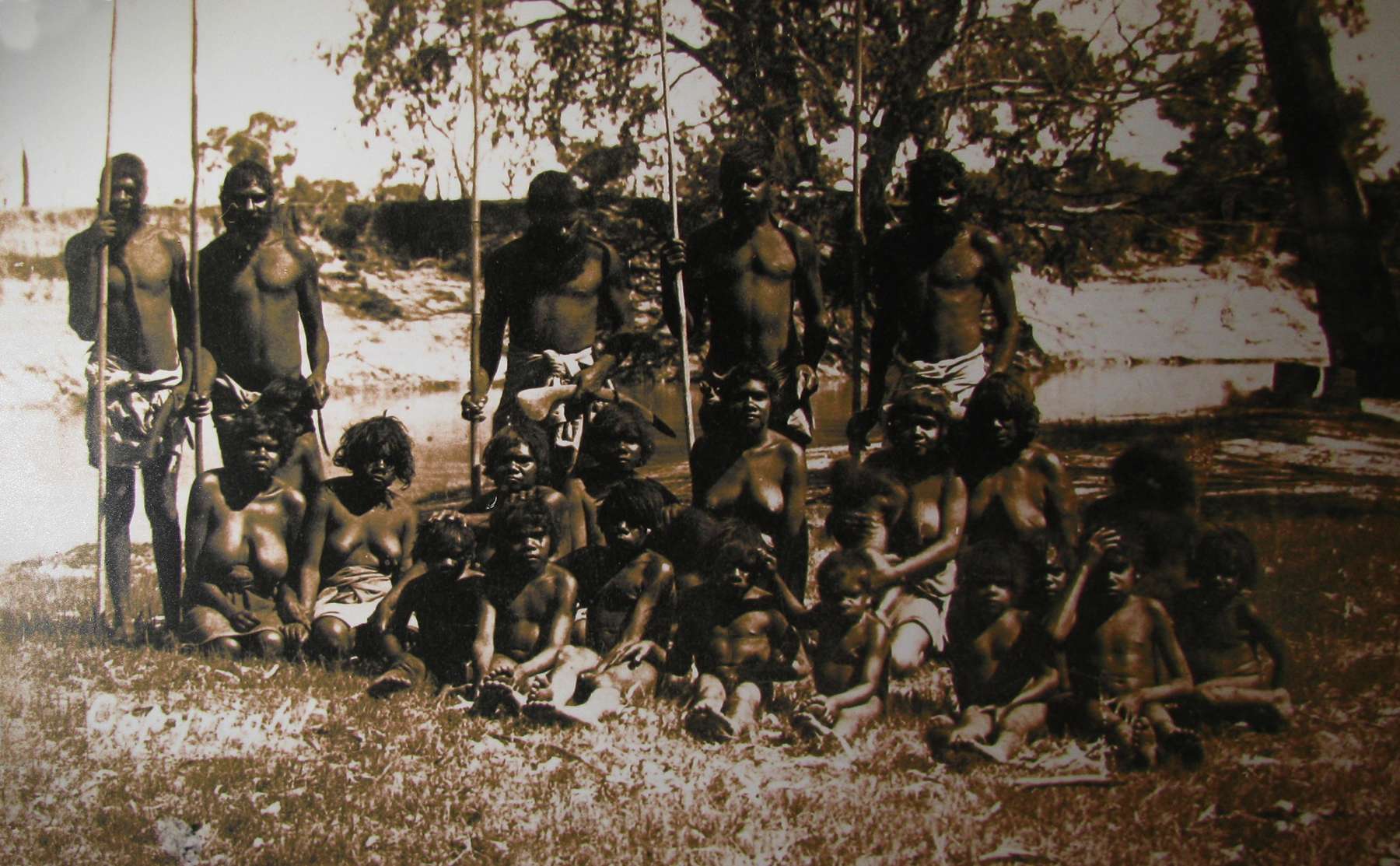
The Nanya Family
The Nanya family or tribe lived in the general area of Lake Mungo in the second half of the 19th Century.
Harry Nanya (c.1835-1895), founder of one of the last New South Wales Aboriginal families to live by traditional hunting techniques, was a Maraura of the lower Darling. His childhood coincided with incursions in 1839-46 of European explorers, aggressive overlanders and punitive expeditions which killed most of his people, notably in the 1841 Rufus River massacre by South Australian police led by Thomas O'Halloran.
About 1860 Nanya left his camp at Popiltah station, forty miles (64 km) north of Pooncarie. With two women and a steel axe, he went into the waterless mallee country between the Great Anabranch and the South Australian border, known as the 'Scotia blocks', where he lived for over thirty years. Records compiled in 1897-1908 by amateur ethnographers suggest causes for Nanya's self-imposed exile; possibly he had eloped with a woman of his own Makwarra moiety, an offence considered incestuous and meriting death.
Nanya's people kept themselves closely concealed: there were some reports of tracks and piles of freshly cut mallee roots, but very few sightings, although Aboriginal stockmen were well aware of their movements. By the early 1890s the press reported more frequent sightings of the 'wild tribe'. Station-workers found that Nanya's people were obtaining water by operating tank machinery on Cuthero station, and noticed from tracks that Nanya's family was steadily increasing. White settlers, previously indifferent, became anxious for the family's, and their own, welfare.
In 1893 Aboriginal stockmen Harry Mitchell, Dan McGregor and Fred Williams tracked down the family and persuaded them to return to the river. This 'capture' was perhaps encouraged by a false rumour of a £50 government reward, but the rescuers' descendants recall that the family was brought in lest they be shot by settlers. The twelve men, eight women and ten children, all in good physical condition, reached Popiltah station on 11 August. Nanya still had his steel axe, now worn wafer-thin.
The station-owner described the dwellings, tools and food-gathering skills of Nanya's group, noting that they initially refused to eat bread, tea or sugar. Yet a photograph taken at the Adelaide exhibition of 1895 of Nanya with two daughters shows that the graceful women of 1893 had become stout on a flour and sugar diet. The Aborigines Protection Board selected a site at Travellers Lake, near Wentworth, but Nanya's people preferred hunting-camps in the vicinity of Pooncarie.
Nanya's case is of interest to demographers as an example of population growth in arid regions. He died in 1895 and was buried near the Great Anabranch. Many of his children, with no acquired resistance to introduced disease, died soon after their isolation ended. In 1905 his son Billy, educated for a time in Adelaide, was being transferred by the paddle-steamer Gem to Point McLeay mission, on Lake Alexandrina. Tormented to desperation by crew-members, Billy jumped into the steamer's engine and was cut to pieces.
Text: The Australian Dictionary of Biography, online edition: http://adbonline.anu.edu.au/biogs/A100643b.htm
Photo: Don Hitchcock 2009
Source: Display, Lake Mungo Information Centre
References
- Bowler, J., 2005: Putting flesh on old bones: Archaeology and Australia today, Science Focus 4, Pearson Education Australia, pp. 255-259
- Gillespie, R., 2002: Dating the first Australians, Radiocarbon, Vol 44, Nr 2, 2002, p 455 - 472
- Satish Kumar, Rajasekhara REDDY Ravuri, Padmaja Koneru, B P Urade, B N Sarkar, A Chandrasekar and V R Rao, 2009: Reconstructing Indian-Australian phylogenetic link BMC Evolutionary Biology