Back to Don's Maps
The bear and cavebear in fact, myth and legend
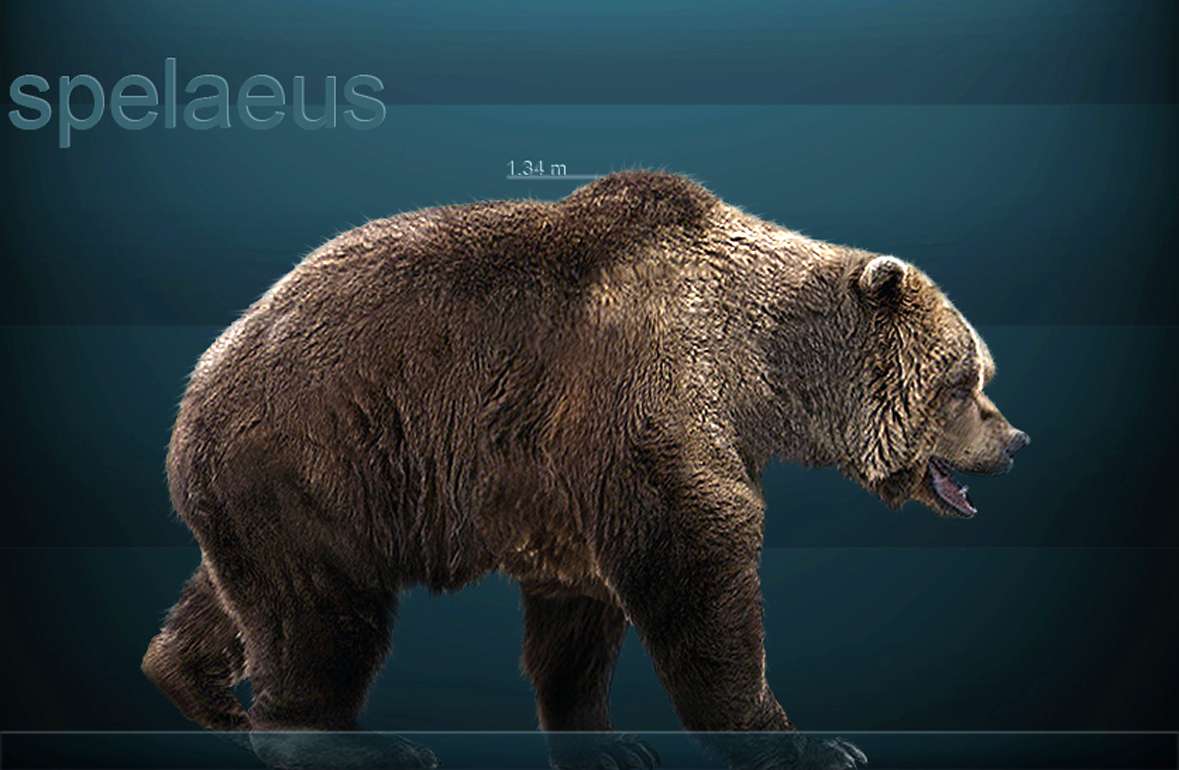
A superb Cave Bear restoration.
Photo: Sergiodlarosa
Permission: GNU Free Documentation License, Version 1.2 or later
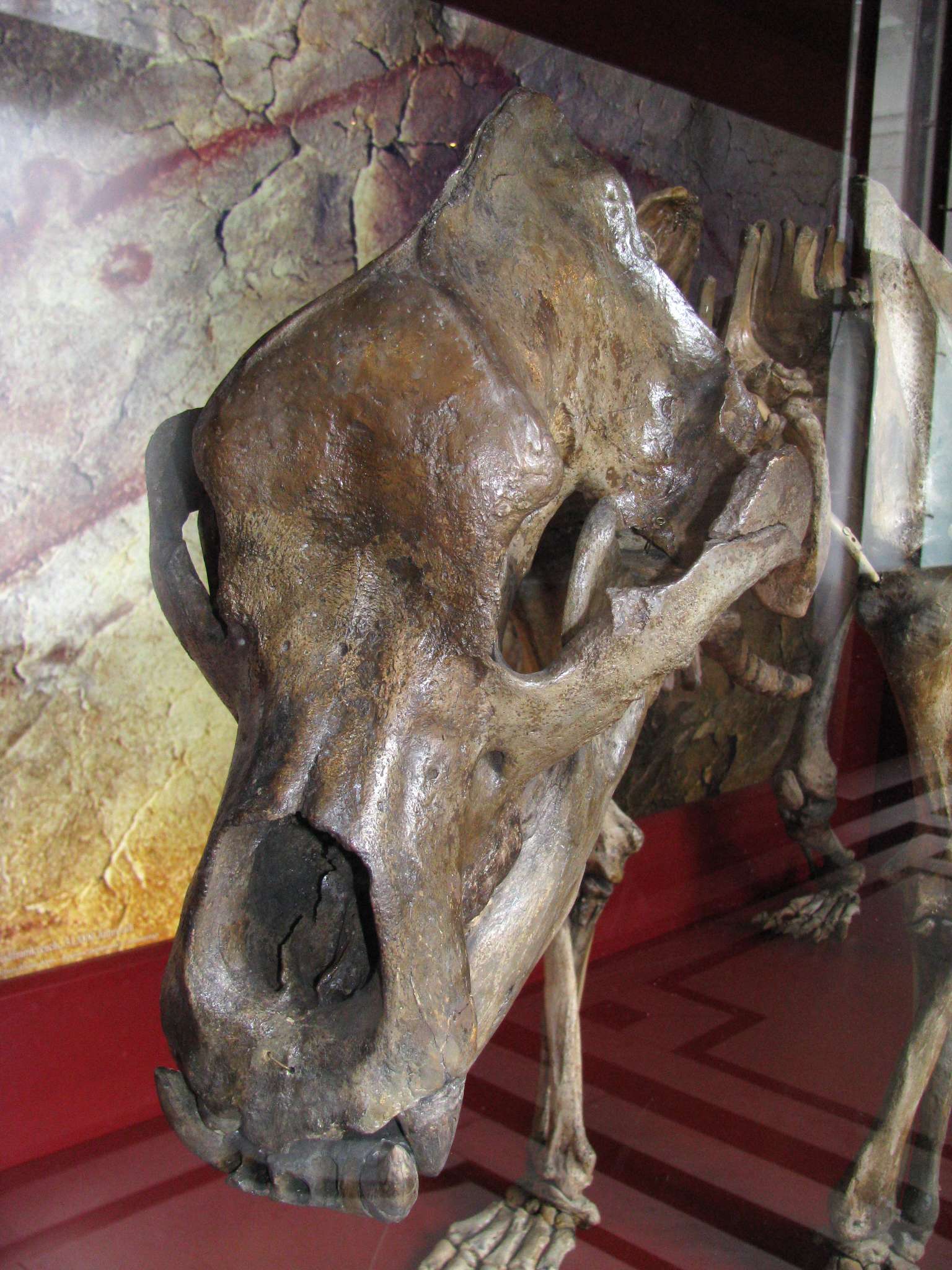
Cave Bear skeleton in the Vienna Natural History Museum.
Note the ridge down the top centre of the skull which is there to attach the large muscles of the jaws and the neck. It was a powerful animal, and could eat both animal and vegetable materials, though it was apparently mostly vegetarian.
Photo: Don Hitchock 2008
Text: Adapted from Wikipedia
Source: apparently original, Vienna Natural History Museum

The skeleton on display at the Vienna Natural History museum included a baby cavebear as well as a juvenile.
The cave bear had a very broad, domed skull with a steep forehead. Its stout body had long thighs, massive shins and in-turning feet, making it similar in skeletal structure to the brown bear. Cave bears were comparable in size to the largest modern day bears. The average weight for males was 400-500 kilograms (880-1102 pounds), while females weighed 225–250 kg (496-551 lbs).[4] Of cave bear skeletons in museums, 90% are male due to a misconception that the female skeletons were merely "dwarfs". Cave bears grew larger during glaciations and smaller during interglacials, probably to adjust heat loss rate.
Photo: Don Hitchock 2008
Text: Adapted from Wikipedia
Source: apparently original, Vienna Natural History Museum

Cave bear juvenile.
Cave bears of the last ice age lacked the usual 2-3 premolars present in other bears; to compensate, the last molar is very elongated, with supplementary cusps. The humerus of the cave bear was similar in size to that of the polar bear, as were the femora of females. The femora of male cave bears, however, bore more similarities in size to those of kodiak bears.
Photo: Don Hitchock 2008
Text: Adapted from Wikipedia
Source: apparently original, Vienna Natural History Museum
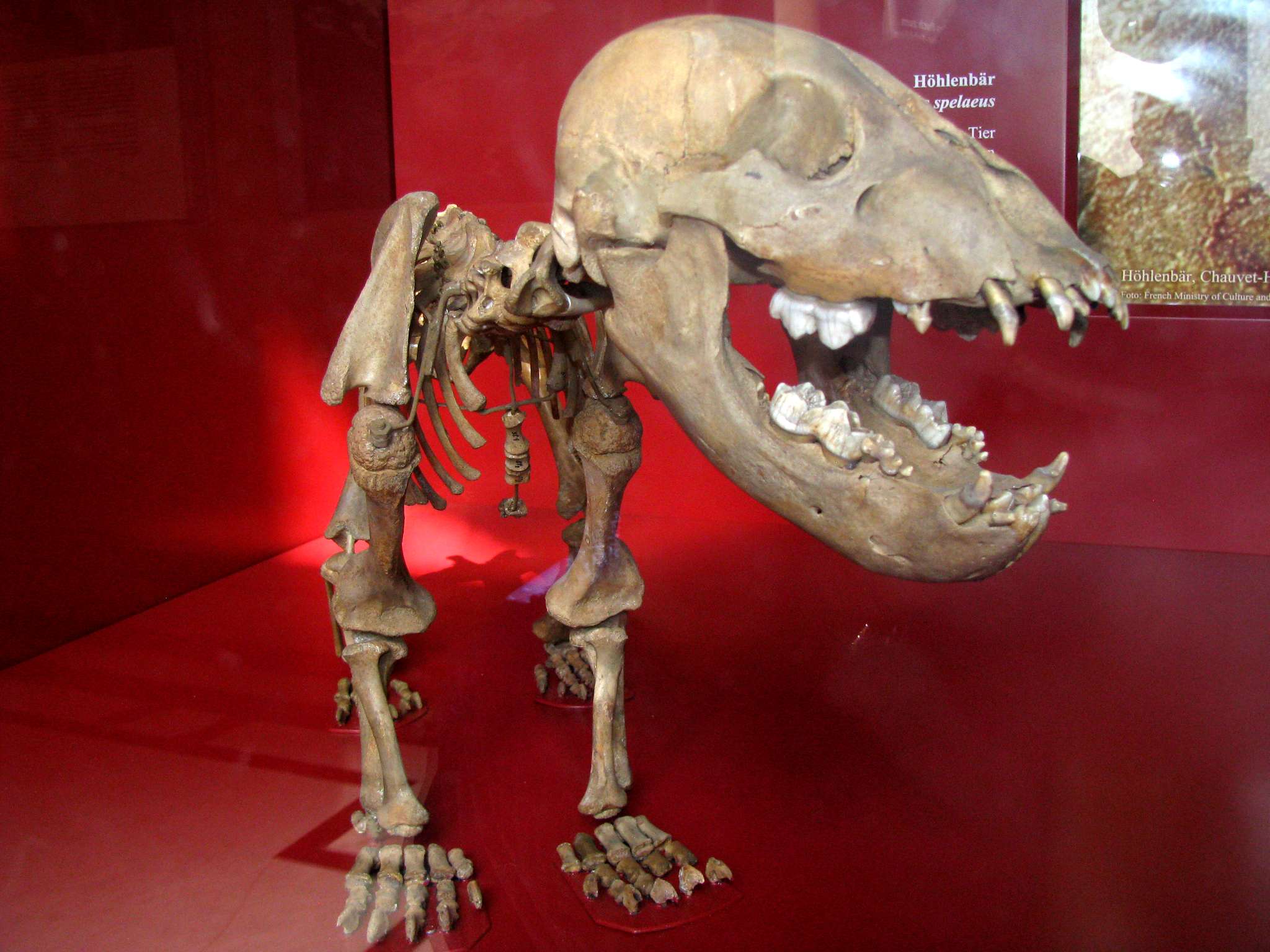
Cave bear juvenile.
There is some evidence that the cave bear only used caves for hibernation and was not inclined to use other locations, such as thickets, for this purpose, in contrast to the more versatile Brown Bear. This specialized hibernation behavior would have caused a high winter mortality rate for Cave Bears that failed to find available caves.
Therefore, as human populations slowly increased, the Cave Bear faced a shrinking pool of suitable caves, and slowly faded away to extinction, as both Neanderthals and anatomically modern humans sought out caves as living quarters, depriving the cave bear of vital habitat. This hypothesis is being researched at this time.
Photo: Don Hitchock 2008
Text: Adapted from Wikipedia
Source: apparently original, Vienna Natural History Museum
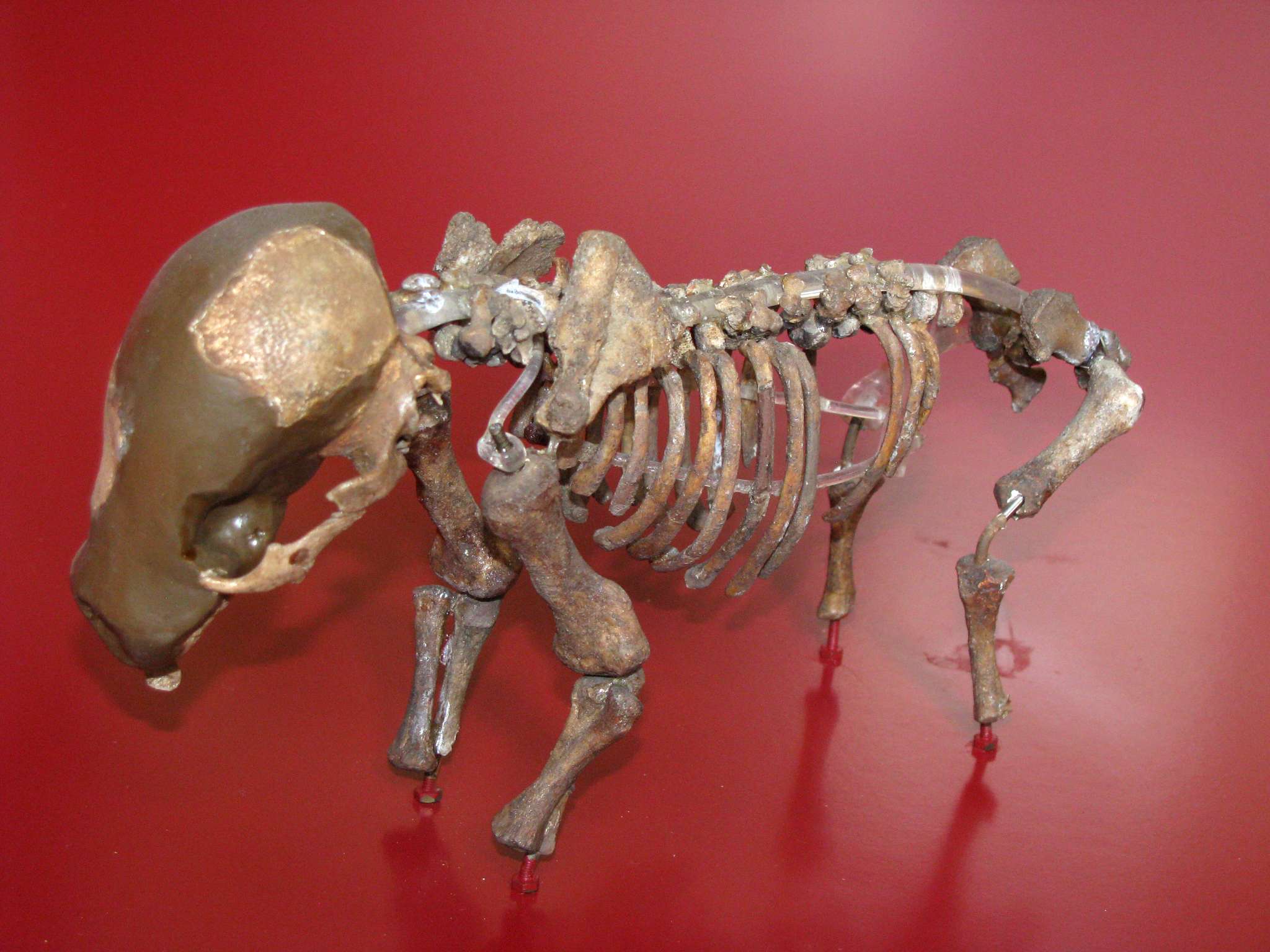
A cave bear baby.
Cave bears (Ursus spelaeus) probably gave birth to cubs during dormancy. Bear cubs lactated their mothers during their first and second winters, but were fed solid food together with lactation during their first summer.
Photo: Don Hitchock 2008
Text: Adapted from Liden et al. (1985)
Source: apparently original, Vienna Natural History Museum
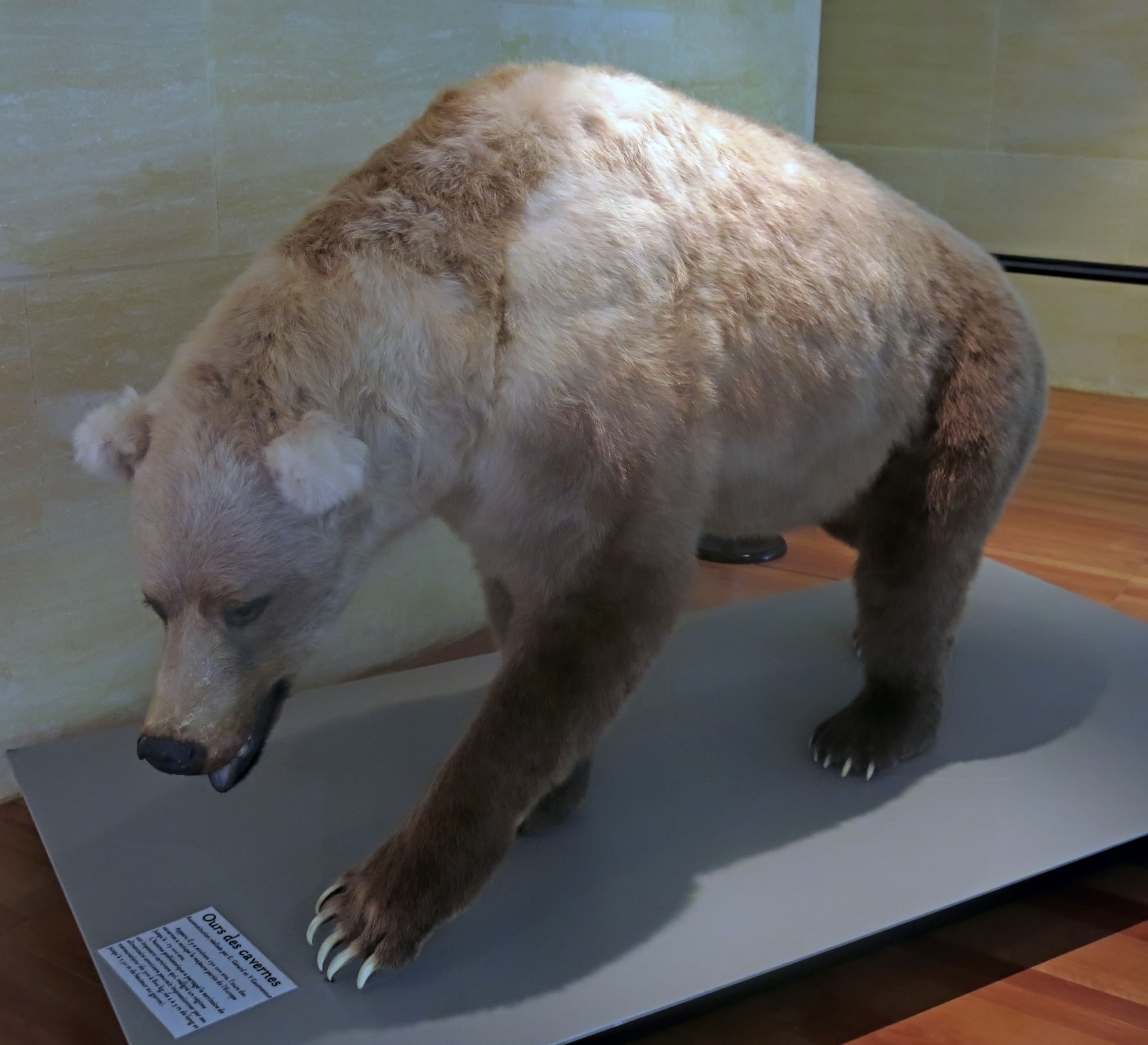
Recreation of a cave bear.
I suspect this is meant to depict the cave bear in summer, with shorter hair than most other restorations.
Photo: Don Hitchcock 2014
Source: Original on display at Le Musée National de Préhistoire, Les Eyzies-de-Tayac
Many of the photographs below and much of the text are from the excellent book by Ivar Lissner, translated into English by J. Maxwell Brownjohn called 'Man, God and Magic', published in 1961.
In 1939, at the beginning of the Second World War, he wanted to enter the uncharted area of the Amur Bend, in Manchuria, at that time controlled by the Japanese.
He spent a whole year assembling permits, passports and papers, surmounting one obstacle after another. Then he travelled the entire length of the Amur, 2750 miles, a distance from England to Newfoundland, three times the length of the Rhine. The Amur drains all of the swampland of the Siberian taiga. The water is as clear as crystal, and was called by the Chinese the Black River, to distinguish it from the silt laden yellow rivers which drain China. He reached the northernmost point of Manchuria safely, lived in the trackless taiga and got to know the people living there. He remained in the forests of Manchuria and the steppes of Mongolia for some years. These photographs are a testimony to his endurance and strength of character.
Another excellent book for those interested particularly in the cave bear is 'The Cave Bear Story' by Bjorn Kurten, published in 1976.
The Bear
The bear possesses a soul just as the human being does. The Orochi are as steadfastly convinced of this as they are of the idea that there is a girl carrying a pail of water on the moon. No Tungus ever kills this largest and most powerful predator in the Siberian forests without a compelling reason. Yet it is not the bear's strength which fills the Tungus with such awe and respect nor the elemental power of the mighty beast which makes them tremble. There are deeper reasons for their dread of the bear's soul. A bear's facial expression can be extraordinarily human at times. A bear can walk upright on two legs and when skinned bears a gruesome resemblance to a man. Finally, there is an ancient belief that the bear is in communication with the Lord of the Mountains and with the sky, and certainly he has from time immemorial been surrounded by an aura which enjoins caution and respect.
Very large numbers of brown bear live in the North Manchurian taiga. There is Ursus arctos, which inhabits the densest forests of central and northern Asia, Eurasian Russia and the coasts of the Sea of Okhotsk. I also saw the massive gray bear, the largest surviving predator on earth, which resembles the grizzly or giant bear of Alaska or Ursus arctos horribilis, the Kodiak bear. This animal has been described as bulky, clumsy and awkward, but sharp, curved claws, immensely powerful masticatory equipment and bunches of neck and shoulder muscle make even the heaviest bear an agile climber and allow him to haul his massive body up trees by the brute force of his arms and legs.
|
Bears are found on every continent except Australia and Antarctica. The eight species of bears are: the spectacled bear, the Asiatic black bear, the American black bear, the brown bear (including grizzlies), the polar bear, the sun bear, the sloth bear, and the giant panda. |
 |
 Life restoration of Ursavus, the earliest bear, by Margaret Lambert.
Photo: Bjorn Kurten, 1976, 'The Cave Bear Story'
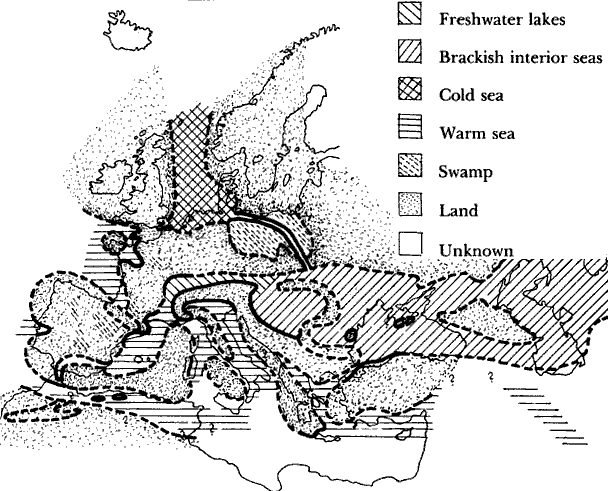 Paleogeographic map of Europe in mid-Miocene times, about 20 million years ago, shows a continent still partitioned by great interior seas and lakes.
Photo: Bjorn Kurten, 1976, 'The Cave Bear Story'
Bjorn Kurten, 1976, 'The Cave Bear Story' writes:
Our story may well begin about 20 million years ago, in the early part of the Miocene epoch of earth history. The place is what is now called Wintershof-West in the Bavarian mountains of southern Germany. In those very distant times, Europe was a subtropical land. Moisture-laden monsoons blew in from an Atlantic that was narrower and a Mediterranean that was broader than their counterparts today. Much of the continent was clothed in luxuriant forests in which grew palms, camphor trees, and many other warmth-loving species. The rivers teemed with crocodilians, and many strange and ungainly looking creatures inhabited the land. The time when man was to arise was still in the very distant future, and his ancestors were small, apelike creatures that were confined to the African continent.
In the limestone areas of Miocene Europe fissures and caves riddled the rocks, providing shelter for many mammals, birds, and reptiles. The fissure at Wintershof-West was a favored den for small carnivores, who left their bones and teeth in profusion in the earth that gradually filled the cavity. True, there are also the remains of some big bear-dogs -or dog-bears-that seem to have inhabited the cave from time to time. But the majority of the remains are those of small weasel- or skunklike animals, cats, and viverrids - early relatives of the mongooses and genets of today.
Among the small carnivores we also find remains of a creature about the size of a fox terrier, but which is neither dog, cat, or weasel. Latter-day scientists have given it the name Ursavus elmensis. It is with this small creature that the true bear line of evolution may be said to start. Actually, we can go still further back in time; we know the ancestor of Ursavus, but it is more doglike than bearlike, and so many scholars place it in the dog family. With Ursavus we come to the first animal definitely reckoned to be a bear, though indeed a very small and primitive one.
According to its remains, little Ursavus still had all its premolars, and they were slicing teeth of a truly carnivorous cast, just as in a dog. Its carnassials, on the other hand, were already taking on a bearlike look, and the molars show the beginning of the expansion of chewing surface that was to characterize the bear teeth of later times.
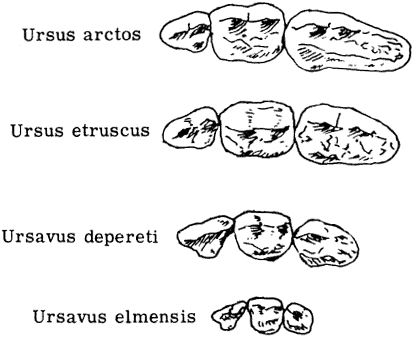 Upper cheek teeth of various bears, showing the progressive lengthening of the molars and the increase in size from the early Ursavus elmensis. Ursavus depereti was the last and largest of the Ursavus line. The Etruscan bear, Ursus etruscus, gave rise to the brown bear, Ursus arctos, and the cave bear, Ursus spelaeus. After Kurten.
Photo: Bjorn Kurten, 1976, 'The Cave Bear Story'
 Shortness and plumpness distinguish the cave bear foot bone (right) when compared to that of the brown bear. These are first metatarsals, or middlefoot bones of the inner toe in the hind foot. The cave bear bone comes from Odessa, USSR; the brown bear bone belonged to an animal that lived during the penultimate glaciation (the Saalian) in Devon, England, and was found in Tornewton Cave.
Photo: Bjorn Kurten, 1976, 'The Cave Bear Story'
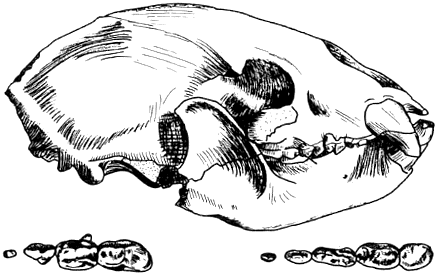 The small ancestral bear, Ursus minimus, from the Pliocene of southern France. The drawing shows the skull and jaw as preserved, and details of the upper (bottom left) and lower (bottom right) cheek teeth. After Viret.
Photo: Bjorn Kurten, 1976, 'The Cave Bear Story'
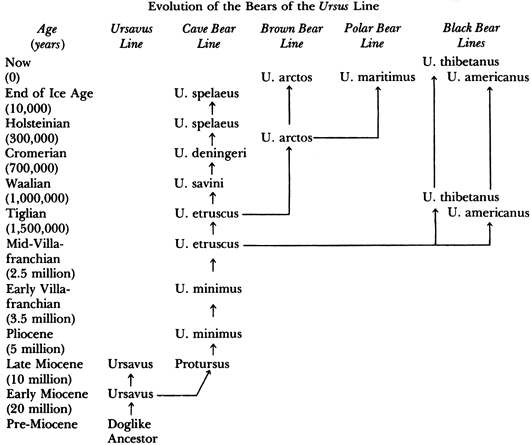
We are now in the Pliocene epoch of earth history, starting some 5 or 6 million years ago. Our stage moves to Roussillon and Perpignan in the south of France (and a contemporary site in Hungary), where we find the first member of the genus Ursus. He bears the name Ursus minimus, and he is indeed the smallest known member of his genus and the most primitive too. He probably reached about the size of the living sun bear or Malay bear, which is the smallest of the living bears.
Except for size, the resemblance between Ursus minimus and the Malay bear is not very close. For example, if you look closely at a Malay bear, you may note its remarkably stout eyeteeth. In contrast, the Pliocene Ursus minimus has slender, gracile canines. It also has a complete set of premolars, retaining their sharp, slicing character, although they are much less prominent than in the ancient ursavi.
The grinders, on the other hand, have become more enlarged. So we can see how the trends initiated so many millions of years earlier are still going on, very slowly and gradually, towards the condition of the true bears.
At the time of Ursus minimus, the world was already on the threshold of the Ice Age. The climate was cooler than in the Miocene epoch and, as centuries and millennia passed, there was a slow swing between cooler and warmer conditions. In the high mountains and in the far north, ice caps waxed and waned with this secular climatic rhythm.
The forests where the first Ursus lived were quite different from the subtropical world of the Miocene ursavi. They were of the temperate type, containing deciduous trees and conifers. Palms were now unknown north of the Pyrenees and Alps, and crocodilians were gone from the streams. With the Pliocene epoch, the long Tertiary period finally came to an end. And far to the south, in Africa, small bands of a remarkable, new sort of biped were already moving about on the ground, using stones and sticks to hunt small game. But the first encounter between man and bear was still in the distant future.
As the Ice Age drew nearer, it was as if the tempo of world events were accelerating. About 4 million years ago, large oxlike animals made their first appearance on the scene: they later gave rise to bison, buffalo, and wild oxen. Somewhat later, a new breed of trunk-bearing animals migrated from Africa into Eurasia-the elephants and mammoths. A new chapter of earth history was indeed being written. We call it the Villafranchian age, the prelude to the Ice Age.
In the early Villafranchian age we still see Ursus minimus around, although he has changed a bit. He is somewhat larger than in the old times, and there have also been small, all but imperceptible, changes in his teeth. Bears of this kind were widely distributed in the Old World, and recent finds in North America show that this species, or a very closely related one, was present there too. The two living species of black bear, the American (Ursus americanus) and the Himalayan (Ursus thibetanus) are probably descended from Ursus minimus.
During the early Villafranchian age, about 3 million years ago, one-toed horses spread from America into the Old World, and rapidly penetrated Eurasia and Africa. The old hipparions lingered for some time but were gradually ousted, and eventually they vanished.
By mid-Villafranchian times, some 2.5 million years ago, changes had proceeded far enough for Ursus minimus to give rise to a new species: the Etruscan bear, Ursus etruscus, the typical bear of the later Villafranchian. This species, whose characters are known through numerous remains in Spain, France, and Italy, was also present in China. In the flesh it probably resembled living black bears, though of course its color is unknown to us. Through the Villafranchian age this trend towards large size continued in the Etruscan bear; late Villafranchian forms are larger than mid-Villafranchian ones.
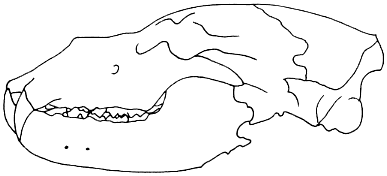 |
Skull of the Etruscan bear, Ursus etruscus, from the Val d'Arno in northern Italy. Closely related to the living brown bears, it had a somewhat more primitive dentition. Original in the Natural History Museum, Basle.
Photo: Bjorn Kurten, 1976, 'The Cave Bear Story' |
The world of the Etruscan bear was already one in which continental icefields developed from time to time, only to melt again as the climate ameliorated. The Ice Age was nigh, and the pendulum swung between fully glacial conditions on one hand and interglacial conditions on the other, when the climate was as warm as now, or warmer. And it is in one of the early interglacials, about 1.5 million years ago, that we meet the last of the Etruscan bears.
This interglacial is called the Tiglian, after the old Roman name for Tegelen, a site in the Netherlands where rich deposits from this age have been found. The Etruscan bear is now as big as the living European brown bear, but it still carries the full complement of premolars (albeit very small ones) as an inheritance from the ancient ursavi and their doglike predecessors.
With the Tiglian interglacial, the Villafranchian age may be said to have come to an end: the prelude is over, and we are in the true Ice Age, the Pleistocene epoch of earth history.
The Tiglian comes to a close. In the Alps mountain glaciers grow larger, coalesce, and send icy tongues down along the valleys. They grow ever greater and finally engulf the mountain range, with only a few bare peaks protruding out of the frozen waste. Glaciation is upon the world again, and this glaciation is called the Donau (Danube).
Many thousands of years pass with great tracts of the earth's surface as if immobilized in icy stillness. Then, once more, comes the swing. Glaciers melt and retreat, and areas recently under ice emerge to be conquered by plants and animals.
Among those animals who return to the lands of their Tiglian ancestors we find the descendant of the Etruscan bear. Again, evolution has taken a step forward, for he has changed. The anterior premolars, already very small in the Etruscan bear, are now almost gone; in some individuals all are lacking, but many retain one or more of these vestigial structures.
Accompanying this change there is a tendency to a doming of the forehead, foreshadowing the cave bear condition. This new species of bear is called Savin's bear, Ursus savini, and it lived about I million years ago in the interglacial termed the Waalian. Its remains have been found in various sites, for example Bacton in East Anglia, England, and the Hundsheim fissure in Austria. Although large and impressive enough, these early cave bears were still much smaller, on average, than the true cave bear.
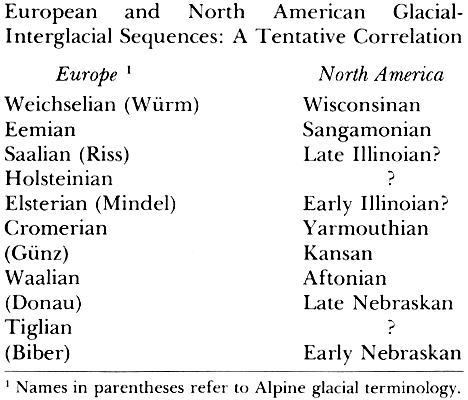
Photo: Bjorn Kurten, 1976, 'The Cave Bear Story'
The pendulum swings again: cold conditions are back. The Gunz glaciation reached its culmination some 800,000 to 900,000 years before the present. There is some evidence that in one of the cold phases that make up the Gunz, longer-limbed bears, perhaps from the East, pressed into Europe to supplant temporarily the stocky-legged Savin's bear, but the problem of whether this intruder was a distinct species or just a steppe race of the early cave bear has not been settled. The latter alternative appears perhaps the most likely one.
The ice melts and the world is green once more as the wind of the Cromerian interglacial blows over the European scene. And man meets bear.
That encounter is only one of the remarkable things that happened in the Cromerian interglacial, which takes its name from the Cromer Forest Bed in East Anglia. It is a layer very rich in organic remains, including tree trunks, fossil beaver dams, and a copious number of bones.
From a chronological point of view, perhaps the most interesting event of the Cromerian interglacial is the reversal of the earth's magnetic field. Such reversals have happened at many times in the history of the earth, with intervals between lasting about a million years. Evidence of these reversals is found in the magnetic properties of the rocks that formed during a given interval. For instance, all of the rocks that form now carry the imprint of the "normal" polarity, while rocks formed in other times may have "reversed" polarity - north is south and south is north. The latest such reversal is known to have occurred 700,000 years ago in the age of the Cromerian.
There is evidence of Cromerian man in Europe at Mauer near Heidelberg, Germany, where a rich interglacial fauna quite similar to that of the Cromer Forest Bed has been discovered. During the 1960s, in a cave by Petralona in Greece, the same association of human fossils and Cromerian mammals was found. At both sites, bear remains are very common indeed. Mauer and Petralona contain the earliest finds of human fossils together with bear remains.
The bones of Cromerian man reveal a type of human still very primitive in many respects, yet closely related to us and probably our direct ancestor. He resembles the contemporary and better-known men of east and southeast Asia called Homo erectus (formerly Pithecanthropus), but also bears a certain resemblance to the late Pleistocene Neandertal men of Europe, to whom he presumably was ancestral. Of what happened between man and bear in the Cromerian we have no evidence.
The bear of the Cromerian may well be regarded as a full-fledged cave bear. True, it is still a little smaller, although clearly larger and longer jawed than its ancestor the Savin's bear. Also, the vaulting of its forehead is less prominent and its grinders are not quite as expanded as in the late Pleistocene animal. And so it has been given a species name of its own, and is known as Deninger's bear, Ursus deningeri. But there is much to say for just regarding it as an early, primitive race of Ursus spelaeus. We may compromise by calling it Deninger's cave bear.
But there is no rest for the pendulum of climate. Again there is a swing to cold conditions - the Elster glaciation - and then back to warm - the Holsteinian interglacial. We are now roughly 300,000 years before the present, and the bear in existence is Ursus spelaeus without any doubt. His remains have been found in caves in Germany and France, and especially interesting is the find of a good skull in the river gravels at Swanscombe outside London, England, which have also yielded a skull of early man.
The recounting of the long evolutionary history of the cave bear line may seem tedious, but it should give some understanding of how complete the evidence of its evolution really is. From the early Ursus minimus of 5 million years ago to the late Pleistocene cave bear, which became extinct only a few thousand years ago, there is a perfectly complete evolutionary sequence without any real gaps. The transition is slow and gradual throughout, and it is quite difficult to say where one species ends and the next begins. Where should we draw the boundary between Ursus minimus and Ursus etruscus, or between Ursus savini and Ursus spelaeus? The history of the cave bear becomes a demonstration of evolution, not as a hypothesis or theory but as a simple fact of record.
 Geography of Europe in Weichselian times shows the northern parts of the continent covered by great icefields; smaller glaciations have formed on the mountain ranges further south. A large area is tundra; the southern peninsulas are partly forested. The sea has receded, exposing the bottom of the North Sea and the English Channel; the Caspian is much enlarged, flooding the plains of southern Russia. Data from Konigsson.
Photo: Bjorn Kurten, 1976, 'The Cave Bear Story'
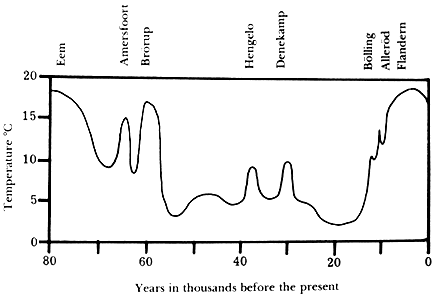
Mean July temperatures for western Europe during the last 80,000 years of earth history. Names of warm oscillations are indicated, beginning with the Eemian interglacial and ending with the Flandrian interglacial, which is still going on. Intervening warm phases are termed interstadials. Data from van der Hammen.
Photo: Bjorn Kurten, 1976, 'The Cave Bear Story'
 British river scene in the Eemian interglacial, with cave hyenas, hippopotami, bison and (in the distance) straight-tusked elephant. The skull of fallow deer may be seen at the entrance of the cave, left foreground. Restoration by Margaret Lambert; after Sutcliffe.
Photo: Bjorn Kurten, 1976, 'The Cave Bear Story'
( note that below we have two different interpretations of the diet of Cave Bears, one postulating that they were totally vegetarian, the other that they were omnivorous - Don )
Cave Bears were vegans
Senckenberg scientists have studied the feeding habits of the extinct Cave Bear. Based on the isotope composition in the collagen of the bears' bones, they were able to show that the large mammals subsisted on a purely vegan diet. In the study, recently published in the scientific publication Journal of Quaternary Science, the international team proposes that it was this inflexible diet that led to the Cave Bear's extinction approximately 25 000 years ago.Today's Brown Bears are omnivores. Depending on the time of year, they devour plants, mushrooms, berries and small to larger mammals, but they will also take fish and insects. 'The Cave Bear is a very different story,' says Professor Dr. Hervé Bocherens of the Senckenberg Center for Human Evolution and Palaeoenvironment (HEP) at the University of Tübingen, and he continues to explain, 'According to our newest findings, these extinct relatives of the Brown Bear lived on a strictly vegan diet.'
Cave Bears (Ursus spelaeus) lived in Europe during the most recent glacial period, approximately 400 000 years ago, until they became extinct about 25 000 years ago. With a length of 3.5 meters and a height of 1.7 meters at the shoulder, these bears, which ranged from Northern Spain to the Urals, were noticeably larger than their modern-day relatives. Despite their name, they did not actually live in caves but only used them for hibernation. Nevertheless, the occasional death of animals in various European caves over several tens of thousands of years eventually led to enormous accumulations of bones and teeth from these large fur-bearing animals.
Several of these bones from the 'Goyet Cave' in Belgium have now been examined by the international team around Prof. Bocherens, with a special focus on the Cave Bear's diet. 'We were particularly interested in what exactly the Cave Bears ate, and whether there is a connection between their diet and their extinction,' explains the biogeologist from Tübingen.
To this end, scientists from Japan, Canada, Belgium and Germany conducted isotope studies on the collagen from the bears' bones. Collagen is an essential organic component of the connective tissue in bones, teeth, cartilage, tendons, ligaments and the skin. The examination of the isotope composition of individual amino acids in the collagen shows that the bears lived on a strictly vegan diet. 'Similar to today's Giant Panda, the Cave Bears were therefore extremely inflexible in regard to their food,' adds Bocherens, and he continues, 'We assume that this unbalanced diet, in combination with the reduced supply of plants during the last ice age, ultimately led to the Cave Bear's extinction.'
Previously, there had been much speculation as to the cause of the large bears' disappearance. Was it due to increasing hunting pressure from humans? The changing temperatures, or the lack of food? 'We believe that the reliance on a purely vegan diet was a crucial reason for the Cave Bear's extinction,' explains Bocherens.
During the investigation, another interesting aspect came to light. Even the collagen of two Cave Bear cubs indicated a vegan diet -- despite the fact that they were suckled by their mother. The scientists interpret this finding as a reflection of the nursing female's diet.
'We now intend to examine additional Cave Bear bones from various European locations with this new method, as well as conducting controlled feeding experiments with modern bears, in order to further solidify our proposition,' adds Bocherens by way of a preview.
Text above from: https://www.sciencedaily.com/releases/2016/08/160823083557.htm
Primary Source: Yuichi et al. (2016)
Below an excellent post (as always, the man is phenomenal for his vast knowledge and the ability to communicate) from the John Hawks Weblog:
http://johnhawks.net/weblog/reviews/neandertals
January 2008
How carnivorous were cave bears?
Charles Q. Choi reports on a new paper by Michael Richards and colleagues:
For the past 30 years, studies of their skulls, jaws and teeth suggested cave bears might have been largely herbivorous. In addition, the bones of central and western European cave bears matched those of vegetarians in having low levels of nitrogen-15, whose atomic nucleus has one more neutron than common nitrogen-14 does. Animals accumulate nitrogen-15 in their bodies, and animals that eat animals -- that is, carnivores -- build up more nitrogen-15 than herbivores do.
Still, black bears and brown bears are omnivores. This suggested that although some cave bears were largely vegetarian, others might have been more carnivorous.
New data from the Pestera cu Oase ("Cave with Bones") in the southwestern tip of the Carpathian mountains in Romania now hints most of its cave bears were significantly carnivorous, due to their high nitrogen-15 levels.
It's PNAS, so we won't see the paper for a while. I'll comment more fully here when it is available. Nitrogen-15 is the primary evidence for Neandertal carnivory also, although as I've noted (here and here), those interpretations face some complications.
A large source of nitrogen-15 is fish, which seems a likely source for the cave bears.
UPDATE (2008/01/08): I got the paper. The results show that the Oase cave bears have nitrogen-15 values ranging from a low overlapping with red deer up to a high midway through the wolves -- where higher means more carnivorous. There was one outlier with a very low nitrogen-15 ratio. The impressive thing is the range of values, which apparently exceeds the ranges in other species.
In comparison with other European cave bear samples, the Oase specimens are not alone in showing evidence of carnivory, but the vast majority of specimens from other sites (n=105) have values in the red deer range or lower.
Axes of variation
The paper suggests that the high nitrogen-15 in the Oase cave bears could not have come from the local ungulates (red deer and ibex) because their carbon-13 ratios are extremely different from those species. I think that's a fair speculation, but really there are too many dietary parameters to get an estimate from these two ratios. For example, a primarily vegetarian diet that included a significant amount of fish might explain both ratios (and the wide variation in nitrogen-15, since bears compete for fishing access).
But there are other possible axes of variation. Life history and behavioral variation can affect the isotope ratios. Some of the cave bears across Europe have very low (lower than ungulate) nitrogen-15 values. Hibernation has been suggested previously to explain the correlation of nitrogen-15 values with estimates of temperature, the idea being that bears facing colder winters are dormant for longer periods.
The hibernation story raises the question of the impact of long-term climate change on isotope ratios. The channel through which climate changes may affect the uptake of different isotopes into plants and animals is unclear -- it seems to involve temperature and rainfall as they modulate diet availability.
None of this casts any doubt on the paper's results -- the Oase cave bears simply seem to have been higher on the food chain than most other cave bears sampled across Europe. I just raise them to note the demands that paleoecologists are placing on these isotope ratios. Especially when the species in question has substantial dietary flexibility, like bears, we should probably figure that diet choices are the largest component of variation. That means that we should probably be skeptical about the impact of smaller-scale variations, such as climate, unless there is very strong evidence for dietary stability over the relevant time scales.
Since many large European mammals were undergoing large range contractions or extinctions during this time period, we should expect that the surviving species may have undergone substantial changes in niche partitioning and dietary choices. Humans -- whose isotope ratios are in many ways the most interesting -- would be included in this number.
Bear paleoecology
I think the best passage from the paper is the end of the discussion, where the authors compare the dietary and ecological flexibility of extant ursids as a way of contextualizing the cave bears.
As a consequence of these 15N values, the dietary ecology of modern, higher-latitude bears (excluding polar bears) is relevant for that of cave bears, especially the North American brown bears (U. arctos, including the Kodiak and grizzly bears) given their high-latitude range, body-size variation, occupation of regions with less human ecological impact than most of Eurasia, and extensive database. Brown bear diets range from almost completely vegetarian, including ones with substantial amounts of fruit/berries, to ones containing a substantial amount of fish and/or ungulate meat (19-21, 29, 30, 44, 45). All aspects of their omnivorous diets have limitations in availability, potential feeding rates, and nutritional value in any given environment; adequate weight gain for survival, reproduction, and hibernation therefore depends on a mix of as many food resources as are available (19, 21). Meat consumption, in particular, varies widely among and within brown bear populations, due, among non-maritime bears, to the availability of ungulate fauna (29, 30, 44, 45). Large adult males also appear to be more carnivorous than females or subadult bears (28, 29). North American black bears (U. americanus) appear to have similar plant/meat dietary proportions as brown bears (29), except that the larger brown bears are frequently more carnivorous when the prime meat is maritime (e.g., salmon) (46). This ecological flexibility of modern brown bears therefore makes an appropriate model to understand the range of isotopic values now available for European cave bears, both within and between site-specific samples (Richards et al. 2008:4).
Europe presents a problem of bear competition similar in many ways to the current North American case, in that different ecologically flexible species are differentiated by size. In North America, the larger brown bears exclude access to salmon fishing sites from the smaller black bears.
But in Europe, the brown bears were the smaller species. That helps to make sense of the isotope results on Pleistocene European brown bears, which have even lower nitrogen-15 values than the cave bears (Bocherens et al. 2004).
A genetic afterthought
There is also this:
Genetic Affinities. To provide additional confirmation of the morphological evidence, mitochondrial DNA (mtDNA) was extracted, amplified, and sequenced from 19 ursid samples (SI Table 2). All 19 individual sequences of the Peçstera cu Oase ursids show clear affinity to central European cave bear sequences (35) rather than to brown bears. They do not form a monophyletic group within cave bear mtDNA variation, and the range of the Oase bear haplotypes is spread throughout most of the variability known for central European cave bear populations from southern Germany, Austria, Croatia, and Slovakia (35-37).
If we expect to have any hope of working out the phylogeography of ancient humans (like Neandertals), then we have to be able to work out the movements of many ancient mammals. That's the only chance of cross-The cave bears look a bit like the Neandertal pattern -- probably not surprising since they are both medium-bodied omnivorous mammals. That's encouraging.
References:
Bocherens et al. (2004)
Hedges et al. (2004)
Richards et al. (2008)
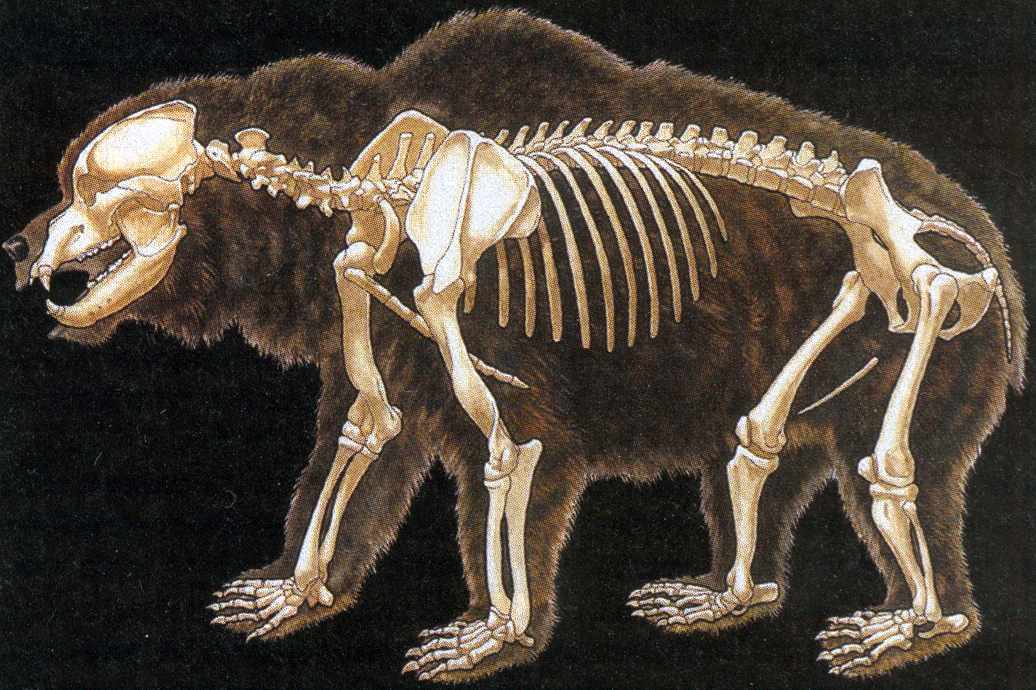 Two cave bears that died in Austria more than 40 000 years ago have had their nuclear DNA sequenced. The technique used to recover sequences from a tooth and a bone has more than doubled the age at which this kind of DNA can be recovered - and could mean Neanderthals are next.
Recovering genetic material from ancient remains is fraught with difficulty because DNA degrades rapidly and is easily contaminated. Most successful studies have focused on the more abundant mitochondrial DNA, but this is much less useful. In exceptional cases nuclear DNA has been extracted from remains less than 20 000 years old if preserved in permafrost or desert environments.
Now Eddy Rubin of the US Department of Energy's Joint Genome Institute in Walnut Creek, California, and his team have turned to computers for help. They sequenced everything in the sample, contamination and all, then picked out sequences averaging 70 base pairs that matched parts of the dog genome - chosen because it is the closest relative of bears to have a fully sequenced genome.
They recovered nearly 27 000 base pairs of nuclear DNA from the cave bears, which became extinct around 15 000 years ago (Science, DOI: 10.11261science.1113485). "it is a significant advance to show that so much nuclear DNA is actually being preserved," says Beth Shapiro, who studies ancient DNA extraction at the University of Oxford.
"This is very much a proof of principle," says Rubin. "We're not interested in cave bears - we're interested in Neanderthals."
Text and Photo from the weekly science magazine New Scientist 11 June 2005
From:
http://news.nationalgeographic.com/news/2005/06/0606_050606_alpsbears.html
Ancient Bear DNA Mapped -- A First for Extinct Species
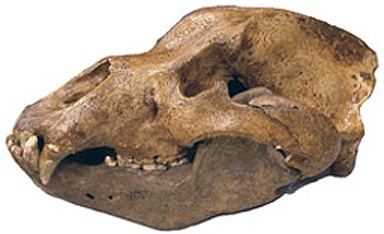
Photograph copyright Gernot Rabeder, Institute of Paleontology, University
of Vienna, Vienna, Austria
Stefan Lovgren
for National Geographic News
June 6, 2005
Scientists have sequenced the DNA of two cave bears that roamed the Austrian Alps some 40 000 years ago. It marks the first time researchers have been able to completely sequence the DNA of a species that has long been extinct.
The research opens the door to sequencing the DNA genome of other extinct species, including the Neandertals (often spelled "Neanderthals").
"We have shown that it is possible to sequence the genome of a long-extinct organism, something previously considered to be in the realm of science fiction," said James Noonan, a geneticist and postdoctoral fellow in the genomics division at the Lawrence Berkeley National Laboratory in California.
Noonan is the lead author of the study, which appeared in the June 2 online edition of the journal Science.
DNA Nucleus
Until now scientists have been unable to extract pure DNA from the cell nuclei of ancient animals. Not only does DNA start to degrade at death, but the microbes that eat away at dead animals contaminate genomic DNA, which is found in cell nucei. Other contaminants may include human DNA left through contact, such as when a scientist handles the bones.
Rather than use genomic DNA, most studies of ancient DNA have used mitochondrial DNA. A sort of cellular power plant, mitochondria have their own type of DNA and are believed to have evolved separately from genomic DNA.
Only genomic DNA, however, can help scientists understand the functional differences between extinct and living species.
Because unbroken strands of ancient DNA are so hard to come by, previous ancient-DNA studies have used a biochemical amplification method to create a string of DNA. In effect, they take an unbroken fragment of DNA and copy it over and over to create a complete strand. But this only works for mitochondrial DNA, not genomic DNA.
Needle in a Haystack
This time the scientists took a different approach. First they extracted genomic DNA from two 40,000-year-old cave bear bones from Austria.
Extinct for more than 10,000 years, cave bears (Ursus spelaeus) were related to the ancestors of modern brown bears and polar bears. Cave paintings show that ancient humans encountered cave bears.
The researchers sequenced all of the genomic DNA they could get out of the cave bear bones. Without amplifying any of it, they then identified each sequence by comparing it to the complete dog-genome sequence that is publicly available. Dogs and bears, which diverged some 50 million years ago, are 92 percent similar on the sequence level.
"[It was] sort of like looking for a needle in a haystack," said Eddy Rubin, the director of the U.S. Department of Energy's Joint Genome Institute in Walnut Creek, California, where the work was done. "Fortunately the computer was a great magnet for finding the needles we were interested in."
About 6 percent of the sample that was sequenced yielded undamaged cave bear DNA, while the rest was a hodgepodge of microbial contaminants. Within those fractions of cave bear DNA were bits of genes.
Comparing the ancient bear sequences with those of modern bears, the scientists showed that cave bears were more closely related to brown bears than to black bears.
"It shows that we got enough ancient genomic DNA to learn something biologically relevant about the cave bear," Noonan said.
Human Evolution
The cave bear DNA sequencing opens the door to the testing of other extinct species, including our nearest prehistoric relatives, the Neandertals. The scientists say they plan to sequence the Neandertal genome over the next several years.
Another possibility is to apply these techniques to the remains of Homo floresiensis, found recently in Indonesia. Researchers nicknamed this human ancestor "the hobbit" because of its tiny stature.
H. floresiensis is believed to have diverged from modern humans two million years ago. Neandertals may have diverged from humans 500 000 years ago.
The successful DNA sequencing of the two human-ancestor species could help scientists describe the evolutionary events that led to modern humans.
What about sequencing the DNA from dinosaur fossils?
"Unfortunately, we don't think [that] will ever be possible," Noonan said. "DNA does not survive beyond a hundred thousand years under the environmental conditions in which we found our cave bear remains. And of course, dinosaur fossils are at least 65 million years old."
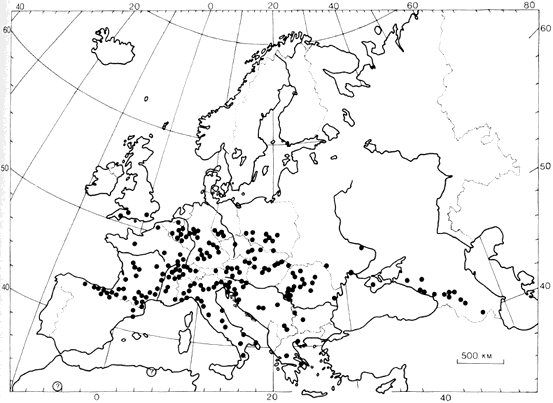 Distribution of the cave bear, Ursus spelaeus, in the Pleistocene. Each dot represents one or more sites with fossils of the species; two North African records are uncertain. Only Holsteinian and later records are included. The actual number of sites is many times greater than the dots, and some sites may contain the remains of hundreds or thousands of bears.
Photo: Bjorn Kurten, 1976, 'The Cave Bear Story'
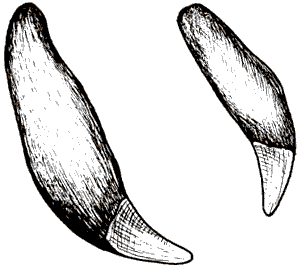
Upper canines of male and female cave bears, both drawn to the same scale to show sexual dimorphism in size. Most canine teeth of the cave bear are easily identified as to sex.
Photo: Bjorn Kurten, 1976, 'The Cave Bear Story'
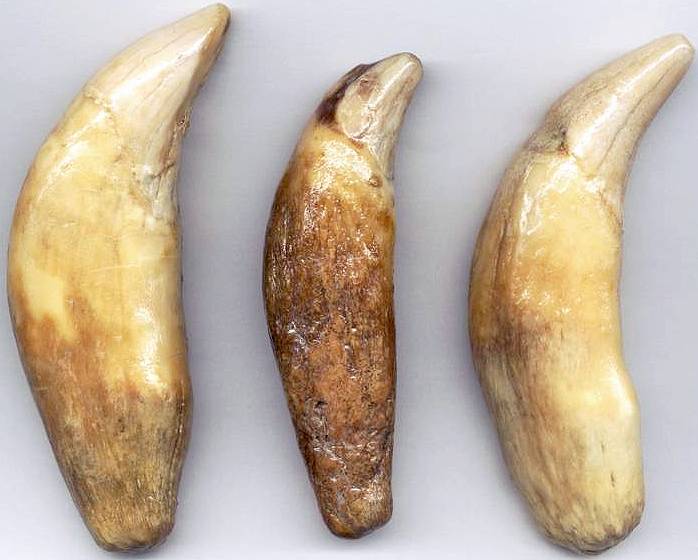 Cave Bear canine teeth
Photo: http://www.rotondarock.com/RR-00682
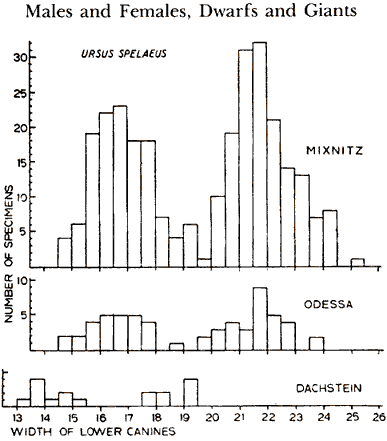
Width of lower canines in samples of cave bear shows distribution into two size groups, representing male and female individuals respectively. In the large Weichselian bears from Mixnitz and Odessa, male canines average about 22 millimeters in width (see scale at bottom), female less than 17 millimeters. In the smaller Eemian cave bears from the Dachstein cave, male canines average 18-19 millimeters in width, female canines about 14 millimeters. After Kurten.
Photo: Bjorn Kurten, 1976, 'The Cave Bear Story'
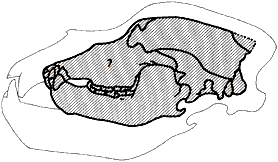
Skull of a small, probably Holsteinian-age cave bear from Krasnodar, USSR, compared with that of a large Weichselian cave bear (light outline). After Borissiak.
Photo: Bjorn Kurten, 1976, 'The Cave Bear Story'
What happens when man meets bear? Half a century ago, an amazing answer came from the Swiss Alps.
During the years 1917 to 1921 Emil Bachler, of the museum in St. Gallen, Switzerland, dug the Drachenloch Cave - one of the "Dragon's Lairs" - near Vattis in the Tamina Valley. The cave, at an altitude of 7,335 feet (2,240 metres) above sea level, forms a deep tunnel running more than 200 feet (70 metres) into the cliff. The deposit in the cave turned out to contain an immense number of cave bear remains, including several well-preserved skulls and complete limb bones. At that elevation, the site would have been inaccessible during the glaciation; thus the bears must date from the interglacial, the time of early Neandertal man in Europe.
To his surprise, Bachler came to realize that the skulls and bones were by no means scattered haphazardly. On the contrary, they seemed to be oriented rigidly in certain preferred directions. Could they have been deliberately placed by man? Soon there were further discoveries that made Bachler sure.
The finds in the Drachenloch were reported by Bachler in 1923 and in another report that he published seventeen years later. The most remarkable find was that of a large stone coffin or chest, containing a group of cave bear skulls and covered by a large stone slab. All of the skulls were pointing the same way. The coffin was about three feet (I metre) high; the sides consisted of limestone slabs, which, like the cover, had originally fallen down from the ceiling of the cave. Unfortunately, in the course of the excavation, workmen destroyed the chests, and no photographs were taken.
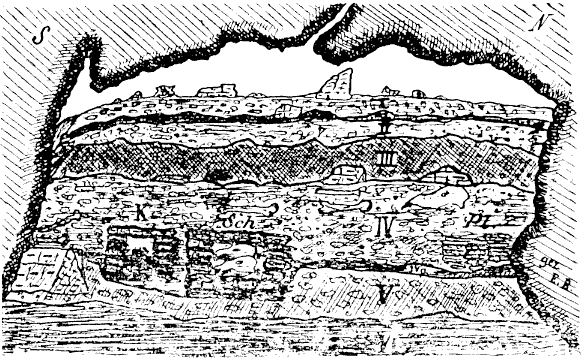 Cross section of the Drachenloch Cave as published by Bachler in 1923, showing stratigraphy of the deposits in the cave and the position of stone chests containing skulls and bones.
Photo: Bjorn Kurten, 1976, 'The Cave Bear Story'
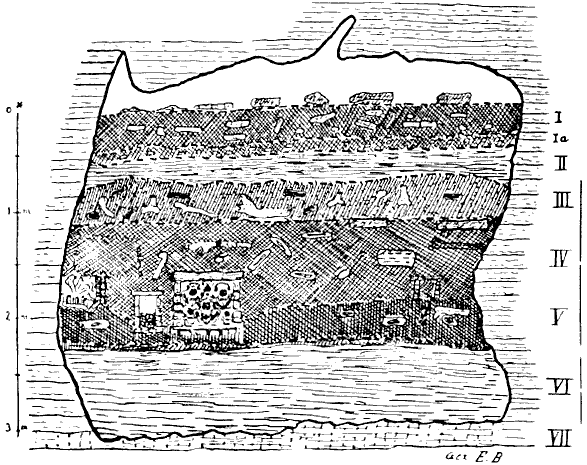 Cross section of Drachenloch Cave as given by Bachler in 1940.
Photo: Bjorn Kurten, 1976, 'The Cave Bear Story'
It is even more unfortunate that Bachler's two sketches, published in 1923 and 1940 and purporting to show the chests and their situation within the cave, are quite contradictory. They agree in showing the chest resting upon layer V in the sequence of strata in the cave (the layers were numbered from top to bottom). They also agree in the outline of the cave walls and ceiling, showing that both pictures are supposed to represent a north - south cross section. Otherwise, however, hardly anything is the same.
In the figure of 1923, for instance, a large chest is shown with two skulls seen in profile, facing south. Layer IV, which rests on top of the chest, contains various long bones and a skull facing the same way. Beside it is another, slightly smaller chest containing long bones. The walls of the chests are made of small, horizontal, even slabs resembling bricks.
In the 1940 picture, the big stone chest is still there, but this time it contains six or seven skulls, all of which face east (presumably a more orthodox direction, comments Koby). The second chest with the long bones is now much smaller, and, in addition, a sort of wall has appeared at the southern end, enclosing more bones. The walls of the chest are now built of vertical slabs, and the skull in layer IV has vanished. "Le myth est définitivement cristallisé," remarked Koby.
These are not, of course, the only finds at Drachenloch Cave that suggested to Bachler the ordering hand of Paleolithic man. There was, for instance, a bear skull with the thigh bone of another bear stuck through its cheek in such a way that it could only have been got in by twisting it around. In 1940, Bachler noted the find of a skull resting upon two parallel shin bones (tibiae). It is the same skull, but in 1921 the thighbone was stuck through the left cheek, and in 1940, through the right. Also, Bachler's description does not agree with the picture, for the sketch shows the whole arrangement of bones resting upon a flat slab of rock, while the description states that "curiously enough, this small deposit of bones did not have a stone slab for a base." Actually, Bachler was not present when the find was made.
Is there, then, any other evidence of the presence of man, apart from this 'curious arranging of the bones? In fact they are precious few. There are no flint implements. There are no burnt bones. There are no butchering cuts on the bones. All there is are some hearths, indicating that an occasional visitor or group made a brief stop. Any prolonged stay would certainly have been reflected in the sprinkling of numerous flints.
But how could such elaborate structures as the suggested stone coffins have come about if not erected by man? And the alignment of the bones? There is no question of a hoax. Bachler was known as an honorable, ardently patriotic man, and he certainly believed in the existence of the stone chests that he described.
To understand this situation we must go into how bear skulls and bones are actually preserved in caves. And the story begins with a hibernating cave bear dying in the cave (just why it died does not concern us for the moment).
It would sometimes happen that after death the great bear cadaver remained unnoticed by scavengers such as hyenas, wolves, and gluttons and was left to moulder away. (The glutton is a relation of the martens and sables. Having also somewhat nomadic habits, it is constantly migrating within its enormous hunting territory, reaching sometimes 1,000 square miles. In appearance this animal resembles rather a small bear than the marten, being of heavy build with round ears and long brownish shaggy fur. It is about two and one half feet long and can weigh about 37-40 pounds. It inhabits the tundra and taiga regions of both Eurasia and North America)
As the soft parts disintegrated, great amounts of phosphate were produced. Now, the deposit in a bear cave is often very rich in this substance, which may make up as much as 50 to 55 percent of the total, and often is mined commercially. Bat guano, which is found in some bear caves, also contains phosphate, but the content is much lower, less than 10 percent. So the main part of the phosphate found in bear caves came from rotting bear flesh.
Skin and flesh gone, the cadaver winds up as a skeleton lying on the cave floor where the bear died. But this is only the beginning of its story; more about it presently.
It could also happen that scavengers did come across the body; they would eat the soft parts and pull the skeleton to pieces. Hyenas might smash some of the bones. Hyenas are known to swallow quite large pieces of bone, which are regurgitated. after some time, more or less affected by bowel juices and movements. The result may be curiously suggestive of human interference: perfectly round holes may appear in the bones, pieces of bone may become wedged together as if intentionally, and so on. Also, the hyena-bitten bones splinter into sharp edges and so may take on the appearance of implements fashioned by man.
The end result of the scavengers' work is now a disarticulated skeleton scattered over the floor of the cave, the individual bones in varying states of disrepair.
In time the cave will get a new inhabitant, most likely another cave bear, which will enter it in the autumn to prepare for hibernation. The bones and fragments on the floor will be in the bear's way and will be trampled to pieces.
The larger objects, for instance such skulls and long bones that have not been broken into fragments, will be pushed to the side. Typically, they will finish up somewhere by the walls; as every bear cave explorer knows, most of the wellpreserved skulls are found by the walls of the cave. The chance of surviving is particularly good if they get pushed into a niche that protects them from rockfall and other damage.
"In the Petershohle in Germany a rock niche, situated like a cupboard in the rock, contained five Cave Bear skulls, two thigh bones, and one brachial bone," stated Professor Abel in 1935. He went on to say, "All these pieces must have been put into this niche by Ice Age Man, as a deposit formed by water is quite out of the question."
Of course it does not have to be a niche in the wall. Any kind of protecting rock will do. Such protecting niches may be produced at any place in the cave by rockfall from the ceiling. Percolating and freezing water gradually widens the cracks in the limestone that forms the bedrock of the cave. The cracks often form in the bedding plane of the limestone. In time, pieces of rock, some of them flattish slabs, are dislodged and fall down on the floor.
If there is already rubble on the floor, the rock may be left in a more or less vertical position and will be likely to protect the bones that get pushed in beside it. Further rockfall from the roof may occur in the same place, and in many cases will result in slabs being left in standing or semierect positions if they hit obstructions already present on the floor.
Meanwhile, the cave deposit is slowly built up by the dust brought in by animals, by the guano dropped by bats, which often roost in great numbers in caves, and by the products of the disintegration of the various animals that die in the cave. In time, the cave earth will also fill the interstices in the niches or "chests," and we arrive at a final situation that, with some moderate stretching of the imagination, may well be ascribed to deliberate burials.
It is evident that repeated pushing of such elongate objects as skulls, jaws, and long bones into niches or along walls will inevitably tend to align them in the same direction, suggesting that they were positioned by intent. In fact, all of the pushing, trampling, gnawing, biting, swallowing and regurgitating, pounding by falling rocks, and so on, which the bones undergo in a well-frequented cave-and which Koby comprises , under the single term "dry transport" ("charriage a sec")-is likely to produce, from time to time, the most peculiar results.
And we must remember that such freaks or oddities are precisely the ones that tend to be selected for survival by natural agencies. For instance, skulls in niches are likely to be preserved, while skulls in the middle of the cave floor will be trampled to fragments and survive only as isolated teeth and pieces of bone pushed down into the earth. It is estimated that some 30,000 to 50,000 bears died in the Dragon Cave near Mixnitz, but only some 76 good skulls were found. One skull out of 500 or thereabouts! No wonder skulls in bear caves look as if somebody had put them in a safe place.
Taking this possibility into account, it now seems impossible to accept the evidence for deliberate burials of bear skulls and other bones in the Drachenloch Cave near Vattis. The same goes for other sites, such as the Petershohle in southern Germany, the Dragon Cave near Mixnitz in Austria, and the Wildenmannisloch in Switzerland, where deliberate positioning of skulls and bones has been claimed though not in actual "chests."
In the Petershohle, for example, 'a great accumulation of skulls was found together with a lot of rocks; one skull was close to a hearth, but the bone showed no trace of burning. Of course the rock rubble would tend to protect those skulls that came to rest among the stones, so that the whole arrangement may perfectly well be due to natural causes. In the Mixnitz cave there is a lateral passage called the Abel Gallery, which was found to contain no less than forty-two bear skulls and many long bones. Here, too, man was supposed to have intervened, but Joseph Schadler considered natural causes sufficient to account for the accumulation.
In the Wildenmannisloch, Bachler found bear skulls with slabs of limestone resting on top, "making the impression of having been intentionally placed in a horizontal position," an impression that is rather weakened by the reflection that most flat slabs of rock will naturally come to rest in a horizontal position.
Enthusiasm for the "bear cult" is naturally contagious. Secondhand and third hand quotations from the original works often tend to glorious embellishment - to be found even in the writings of such a sober prehistorian as the Abbe Breuil himself, who once referred to the Petershohle as a Paleolithic "tabernacle." In Abel's description of the Drachenloch there were "several stone chests," each containing four to five bear skulls, and there also were "numerous stone and bone artifacts" together with the bear remains, although in fact no flints at all were found. All this, according to Abel, proves that "during the Mousterian period in Central Europe, the killing of bears was accompanied by skull and long bone sacrifices."
The most trivial occurrences have been cited as evidence for the cult of the cave bear. It is known, for instance, that certain Siberian tribes reverence the bear and, among other things, extract certain teeth from the skulls. Thus the find of a cave bear skull without incisor and canine teeth may well bring to a mind sufficiently prepared by ardent belief the conviction that this is a Neandertal parallel to the modern practice. If you come with such an argument to a museum curator, the best you can hope for is a sad smile; he will have profound knowledge of the ease with which certain teeth tend to drop out of drying skulls.
The bear feast of the Lapps, often mentioned in discussions of bear cults, was a hunting rite, not a sacrifice. After the ceremonial eating of the bear, the bones were buried, generally with at least the skull and some other bones in approximately correct position. Many such bear graves have been found, but they show no resemblance to the Alpine bear caves.
I believe that we must conclude, with Koby, that there is no real evidence for a cave bear cult among the Neandertal men who inhabited Europe in the last interglaical and the earlier part of the last glaciation. There may have been a bear cult-but we have no proof. It is the more to be regretted that the Drachenloch structures, whatever they were, were not properly documented, by means of photography, detailed plans, and so on.
When we come to the time of modern man in Europe - from about 35,000 B.P. to the end of the Ice Age some 10,000 B.P. - the evidence is somewhat better. And yet it does not tell us as much as we might hope, or as much as some students have claimed.
The art of Paleolithic man is often thought to have religious significance. It is generally agreed that this art dates from the latter half of the last glaciation, when Europe was inhabited by men of modern type Cro-Magnon man and his successors. We find the remains of such peoples associated with a sequence of Late Paleolithic cultures, many of which excel in the arts of painting, engraving, and sculpture. Most of the pictures represent animals, and the majority are game animals of the type that would have been important in the economy of those hunting tribes-the bison, the wild ox, the ibex, the red deer, the reindeer, the horse, the mammoth, and so on.
A few large carnivores are also shown - they were probably seen as rivals or enemies rather than as game. The relationship between these two categories in the famous painted cave of Lascaux in Dordogne, France, is typical: there are more than 200 figures showing game animals, but only 6 or 7 lions and I bear. Altogether, there are about 100 bear representations in Paleolithic art.
Moreover, when we look in detail at the bear pictures, it seems that most of them probably represent the living species Ursus arctos -the brown bear- and not the cave bear at all. To be sure, it is not easy to tell which species is meant, when they are so closely related as the brown bear and the cave bear, and moreover we do not know exactly what the cave bear looked like in life. In addition, we have no guarantee that the cave artists were concerned with exact realism (on the contrary, there is even one case of what seems to be a bear with the tail of a wolf).
One of the finest bear pictures comes from the cave of Teyjat in Dordogne. The animal certainly looks very like a brown bear. Although the head is well rounded, the limbs are relatively long and slim. The same species probably is represented by a very peculiar engraving in the cave of Trois-Freres in Ariege, France. This bear, according to Count Begouen and the Abbe Breuil, seems to be vomiting its blood, and there are various signs on its body, some of them perhaps representing spears or other projectiles. The bear's flat and low head profile apparently proclaim it a brown bear and not a cave bear.
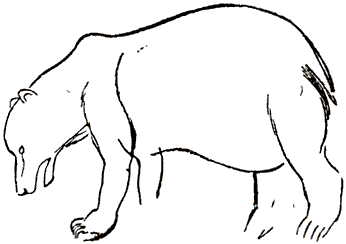
Paleolithic engraving of a bear, probably Ursus arctos, from the cave of Teyjat in Dordogne, France. After Koby.
Photo: Bjorn Kurten, 1976, 'The Cave Bear Story'
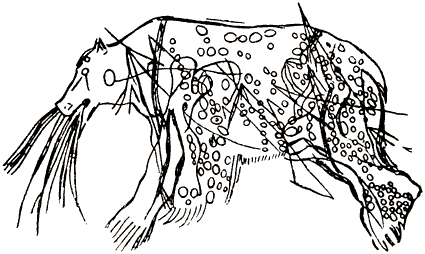
Another engraving, probably of the brown bear (Ursus arctos), from Trois Freres cave, in Ariege, France. It has been regarded as a bear wounded by spears and vomiting blood. After Koby.
Photo: Bjorn Kurten, 1976, 'The Cave Bear Story'
Similar characters are seen in various other bear pictures, such as a painting in black pigment from a cave by Santimamifie near Santander in northern Spain; two profile heads, one from Lascaux and one from La Madeleine, Dordogne; and a figurine from the Isturits Cave in the Pyrenees. There is no reason to regard any of these as anything else than brown bear.
Two loose slabs from the cave La Colombiere in Ain, France, have engravings showing bears. One of them shows only the head, which has a rounded profile and an almost piglike snout. This may be a cave bear, as Abel suggests, but the evidence is hardly conclusive. The other slab shows the entire animal; the head is rather similar, but the limbs are fairly long and slender. Another creature of about the same type was depicted on a rock slab from Massat in Ariege. The chances are that all of these, too, are brown bears.
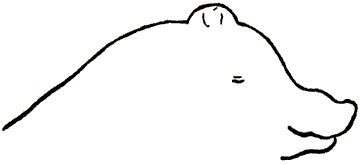
Head of a bear, engraved on a slab found in the cave La Colombiere, in Ain, France. The shape of the muzzle and forehead suggested to Abel that it might be a cave bear. After Abel.
Photo: Bjorn Kurten, 1976, 'The Cave Bear Story'
Finally, there is a remarkable engraving from the Combarelles Cave in Dordogne. It shows a very stocky, heavily built bear with short, powerful limbs, a hanging, vaulted head - all of these being characters that apparently distinguished the cave bear. The bear's snout is well developed and does not exhibit the pug-dog type ascribed by some students to this species, but, as was noted in chapter 1, we do not have to assume such a trait. And so the bear from Les Combarelles may, perhaps, be an eyewitness portrait of the extinct cave bear. On the other hand, we can not be absolutely sure that it does not represent a very large, fat, brown bear!
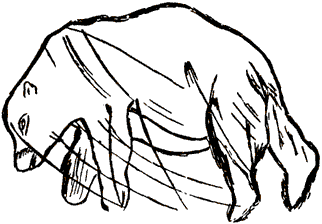
Engraving from Les Combarelles, in Dordogne, France, possibly showing a cave bear (Ursus spelaeus). After Koby.
Photo: Bjorn Kurten, 1976, 'The Cave Bear Story'
The Les Combarelles bear is shown moving slowly ahead, or possibly lying dead on its right side. There are curving lines over the body which may, or may not, represent spears. The cave paintings were long interpreted as works of so-called sympathetic magic: by drawing an animal, especially one with a spear in it, a hunter gained influence over the real animal and ensured a successful hunt. It is still being done. You take a photograph of some one you hate, stick needles in it, and expect the victim to die.
But, as has been pointed out by Peter J. Ucko and André Rosenfeld, for example, this is only one of numerous possible interpretations of cave art, and there is little reason to prefer it, especially since very few animals are actually' shown- wounded or in association with spears and the like. Alexander Marshack has found that many of the cave engravings were remade numerous times, apparently by different people. A ritual is indeed suggested, but its meaning is still unknown.
Probably the most remarkable art object in this connection is a headless clay sculpture of a bear found in 1923 by the intrepid speleologist Norbert Casteret in the cave of Montespan in the French Pyrenees. This is a life-size model, some two feet high (0.6 meters) and almost four feet long (1.2 meters) representing a massively proportioned bear, lying down on its belly. It is thought to have been originally covered by the skin of a bear, with the head fixed in its proper place by a wooden stick. The sculpture is riddled by spear marks, so it presumably was used for a ritual, perhaps of the sympathetic-magic type. M. Casteret and his assistant Henri Godin found the skull of a young bear between the forepaws of the sculpture. They knew that examination of the skull by a specialist would reveal which species was the object of this ritual.
|
An amazing similarity exists between bear ceremonies performed some 20,000 years ago during the Madelanian, and the Gilyak festivals from our own era. Deep in the interior of the Montespan cave (Houte-Garronne) Count Begouen discovered the headless clay figure of a bear. Between its forepaws lay the fallen skull of a real bear which had once been attached to the figure itself. Thirty or so deep circular holes visible on the sculpture are assumed to be traces of spears or arrows used in the bear ceremony of 20,000 years ago. A bear skull found nearby has unfortunately been lost.
|
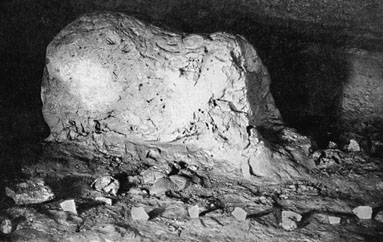 |
In a letter of August 17, 1974, M. Casteret tells of the fate of this skull, discovered more than fifty years earlier. He left it in place to be viewed by the experts (the Abbe Breuil, Dr. Capitan, Count Begouen, and Miss Garrod) who were immediately summoned to the Montespan cave. In the intervening two days, a small channel was dug to drain the inner part of the cave, which was flooded. But on returning to the statue, M. Casteret and the invited experts were startled to find the skull gone - stolen! So this skull, seen only by Casteret and Godin, was lost to science, and we shall probably never know which kind of bear was involved in the ritual of Montespan.
Although there is no confirmation of a cave bear cult, at least we may assume that the species was well known to early men - Neandertal men and, after them, Cro-Magnon men-who lived at the same time. We know that the brown bear and the grizzly bear have been assiduously hunted in modern times, even to their extermination in many areas. Did early man hunt the cave bear too?
The idea that there were tribes specialized in the hunting of cave bears, and that they were responsible for at least some of the accumulations of bear remains in caves, crops up from time to time. Professor Lothar F. Zotz even speaks of a bear-hunting phase in the economy of early man. An amibitious attempt to characterize such man-made assemblages was made by Heinz Bachler, the son of Emil Bachler. On the basis of a careful analysis of isolated teeth, he was able to show certain differences in the age structures of the bear populations of different caves. In some caves, the number of cubs and young animals was especially high, and these he interpreted as bear-hunting stations; for, no doubt, early man would have found the immature bears easier to kill than the adult.
There are several reasons to reject the suggestion of specialized bear-hunting tribes. In the first place, the high phosphate content of the bear cave earth proves that many of the animals were left to rot on the spot and were not eaten. Phosphate is also formed in caves settled by man, but the content is much lower. As to the large number of young found in most caves, this is only to be expected from natural mortality, which strikes most heavily at the immature and the aged.
Then, there are very few, if any, stone implements in most bear caves. Any prolonged settlement by Paleolithic man tends to be marked by the sprinkling of innumerable flint flakes. The skinning and cutting up of a killed bear is quite an undertaking, and in the process more than one flint implement is likely to be damaged and discarded. There should also be butchering cuts on the bones. But the marks that are actually found, are either haphazard breaks due evidently to "dry transport" and the like, or marks left by scavengers and gnawing animals. Broken - up long bones have been thought to show that man broke them to get the marrow out, but the long bones of a bear do not have an easily extracted marrow like those of an ox or sheep. The hyena can utilize the nutriment concealed in the bone of a bear, by smashing it and eating it as such, but this is beyond man.
In the typical bear cave, there are also lots of shed milk teeth, in which the roots have been resorbed. This proves that young bears were hibernating peacefully in the cave at the time, for such teeth came from living bears, not from dead.
Many caves also show other mementos of the presence of bears. Scratch marks and footprints occasionally. occur, but of course do not necessarily prove that the cave was visited more than a few times. The so - called Barenschliffe ('Bearpolish') tell a very different story. They are found in narrow passages, on the ceiling or the walls, and sometimes on loose slabs that are now found embedded in the cave earth but which once formed part of the ceiling or wall. They are surfaces polished to a mirror like sheen by the passage of innumerable bears during hundreds or thousands of years. Few things speak more eloquently of the vastness of geological time and the cumulative numbers of living beings that have trodden one and the same path than these bear - polished limestones.
The big bones of the cave bear may well have been useful to man as implements. A thighbone would have made a splendid club, and a mandible with the canine tooth remaining could have been used as a scraping or digging tool. But there is little evidence of the actual use of cave bear bones. The wear marks found on the cave bear teeth are natural ones, brought about by the bear itself when it was still alive. Sometimes, pieces of bone show a polish of the same type as the Barenschliffe and very likely due to similar causes: partly embedded in matrix, the exposed part of the bone was worn by animals swishing by.
Some of the big canine teeth of the cave bear actually wore down in such a peculiar manner that unwary students have been led completely astray. One type of wear tends finally to weaken the tooth so much that its outer part breaks off and is lost. That discarded tooth fragment looks so much like a knife blade, well polished by use, that it was once described as the "Kiskevely knife" (after a Hungarian site of that name), supposedly of human manufacture. It was Koby who presented the true explanation of this odd pseudoimplement.
In stories about the Ice Age, the cave bear is generally depicted as a comparatively easy prey, in spite of its great size. In contrast, the brown bear is thought to have been much respected and avoided. There are various restorations and accounts of the supposed methods of cave bear hunting.
Perhaps the most vivid account is that given by Othenio Abel, who speculated about the manner in which Ice Age man might have hunted the bear of the Mixnitz Dragon Cave. He suggested that the hunters might have found it advantageous to arrange an ambush inside the cave, while the bear was away. When the bear finally appeared, it was killed or stunned by a rapid hit over the nose. The important thing (averred Bachofen-Echt) was to damage certain nerves, thus producing instant paralysis. As a medical man Koby immediately branded this a tall story: damage to t olfactory nerves, which are the only important nerves in the area, will produce neither paralysis nor instant death.
The hunter being right-handed, the ensuing damage to the skull of the clubbed bear should be found on the left side. Other accounts of cave bear hunting also stress damage to the left side of the skulls of wounded bears. However, of the skulls from the Mixnitz cave, six are damaged on the left side, sixteen on both sides, and one on the right; incidentally, all of the skulls probably were damaged after death. Two skulls show partially healed lesions that were caused during life, but whether they were caused by a weapon wielded by man, by rockfall from the ceiling of the cave, or by some other agency, would be difficult to decide.
A celebrated find from the Sloup Cave in Moravia, Czechoslovakia, was published by Jindrich Wankel in 1892. Wankel found the top part of a skull (probably, but not certainly, that of a cave bear), with a partially healed lesion. Some hours after the finding of the skull, two workmen discovered a flint piece in the same part of the cave. Could this have been part of the weapon that caused the lesion and then stuck in the head of the bear, finally to be dislodged after the bear had died and its flesh disintegrated? Unfortunately, the flint piece does not look much like any sort of projectile point, least of all like the Solutrean laurel point shown in Wankel's figure.
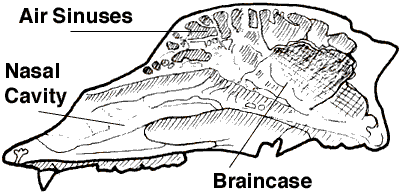
It is not uncommon to find a bear skull with peculiar lesions on top of the head. Are we to assume that Neandertal man when wishing to kill a bear, habitually took a swipe at the top of its head? Let us not underestimate the intelligence and professional knowledge of these early men, who lived by hunting and assuredly knew all there was to know about the effects of their arms. You can kill a man by hitting him over the head, but to kill a bear that way, and particularly a cave bear with its immense sinus cavities, would call for more than superhuman strength. In fact, some of the lesions found on cave bear skulls are probably due to rockfall, while others point to inflammations with resulting osteolysis - the bone is "eaten away".
|
Sectioned cave bear skull, showing the nasal cavity, the large air sinuses in the upper part of the skull, and the comparatively small braincase well down in the hind part of the skull. Redrawn after Koby and Schaefer.
|
 |
So the various accounts showing holes in the tops of bear skulls and the attempts to fit flint weapons or bone clubs into these holes, seem somewhat futile. Neandertal man, who did not know the bow and arrow, would perforce have to choose between the bludgeon and the spear. Not much deliberation was needed to make the right choice when a bear hunt was in the offing.
There are, of course, other methods of hunting that may have been known to Neandertal man. Camouflaged pit traps were probably used to catch large game, which could then be killed with spears or by throwing rocks. Such traps are, however, difficult to make in the hilly or mountainous regions inhabited by the cave bear, and we have found no evidence of them there.
Broadly, three types of caves containing cave bear remains can be distinguished. The first is the exclusive bear cave, like most of those discussed here-the Drachenloch, the Wildenmannisloch, the Mixnitz cave, and so on - where most or all fossils are remains of the cave bear, and only a few traces of man are found. Such caves are known from the Pyrenees, the Alps, and further east into the Caucasus.
A second group consists of the caves that were settled intermittently by man and by bears in the intervals between human occupancy. There are numerous examples of these, too, a good one being the Akhshtyrskaya Cave in the Caucasus, on the right bank of the Mzymta River. Located about 330 feet (one hundred meters) above the present-day river bed, it was intermittently inhabited by man over several millennia, beginning with early Mousterian times and going on to historical times. But there were also long intervals when the cave was forgotten by man and was used by bears and bats. There are many caves of this type, for instance the Veternica Cave not far from the city of Zagreb in Croatia, Yugoslavia, and the classical cave of Gailenreuth by Muggendorf in Franconia, Germany.
The third type of bear cave is the true hunter station, in which most or all of the bones present were brought in by man. Cave bear bones may be found in these caves too, but they are very rare and are completely overshadowed by the bones of characteristic game animals. Again, the history of the Caucasus as set forth by the paleontologist N. K. Vereshchagin, gives us a typical example of the hunter - station cave in the Sakazhia Cave in western Transcaucasia. This cave was inhabited by Upper Paleolithic men who left behind thousands of flint tools and fragments belonging to the Solutrean culture tradition.
Among the animal bones found in the cave, those of bison predominate greatly; there are 1,488 bison bones, and they must represent at least 32 individuals. The number of cave bear bones, in contrast, is only 35, and no more than 5 individuals are represented. These bones may, perhaps, be spoils of the hunt and the same may be true for the remains of at least 3 brown bears found at the same site.
A site that does not quite fit into any one of these categories is Erd, in Hungary, which is an open - air Mousterian hunting station. As in typical bear caves, some 90 percent of the bones are from the cave bear. There are also horse, woolly rhino, and other game animals, but of the latter animals almost only skull and limb bones were found, while the bear skeletons are represented in their entirety. This indicates that the bears died, or were killed, on the spot, while the other animals had been killed elsewhere, and selected parts brought in.
|
Reconstructed skeletons of a female (white) and a male (black silhouette) Florida cave bear, Tremarctos floridanus. The sexual dimorphism in size is somewhat enhanced by the fact that the female is smaller than average, while the male is a particularly large specimen. After Kurten.
|
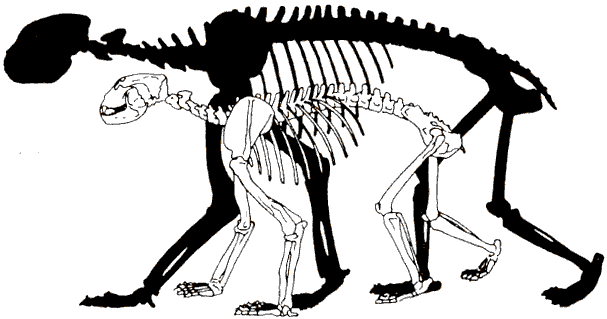 |
The Andean bear of South America, Tremarctos ornatus, is the last survivor of a great tribe of bears that ranged widely through the Americas in Pleistocene times. A closely related species was the Florida cave bear, Tremarctosfloridanus, whose remains have been found in Mexico and the southern United State s-California, New Mexico, Texas, Tennessee, Georgia, and especially Florida. Although many of the finds come from caves, there are no mass occurrences like those of the European cave bear, or even the Cumberland black bears, and so the name might seem ill chosen. But there is a point to it. The bodily resemblance of this American species to the European cave bear is almost uncanny.
Of course there are differences. Anatomical details make it clear that the Florida cave bear was closely related to the living Andean bear, and their connection with the Ursus bears is certainly rather distant. Yet evolution, working with such different raw materials, brought forth a creature mirroring the European form in some of its most conspicuous features.
The Florida cave bear was a big animal. The weight of a large male has been estimated at some 650 pounds (upwards of 300 kilograms), while the much smaller female weighed about half as much. It was very heavily built, with a barrellike rib cage, short, broad paws and elongated upper arm and thigh bones. The anterior premolars were reduced, the back teeth enlarged, and the jaw articulation shifted well above the plane of the teeth. The profile of the forehead shows a distinct step. The neck was lengthened, the back sloping, and the hindquarters were relatively weak.
|
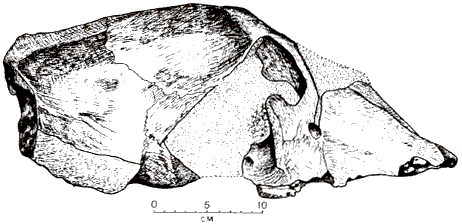
Skull of a brown bear, Ursus arctos, from the Peking Man site of Choukoutien, China. The enormous size of the skull led to its erroneous identification as that of a cave bear. After Pei.
|
 |
In North America, except Alaska, the grizzly bear - which is the local form of the species Ursus arctos - is a rather late immigrant. During the last glaciation, the way south from Alaska was barred by an enormous ice field extending all the way from ocean to ocean. Towards the end of the glaciation, the ice melted and an ice-free corridor was formed through which animals (including man and the bear) could migrate south. But although the grizzly appears at various open-air sites in North America, including the famous tar pits of Rancho La Brea in Los Angeles, California, it is not present in caves.
The black bears, to judge from their fossil record, are somewhat more prone to cave-denning than the brown and grizzly bears.
The American black bear, Ursus americanus, resembles its Asiatic cousin in its selection of hibernation places. Fossils of this species are often found in caves, and there may even be mass occurrences that almost bring the European bear cave to mind. The great collection from Cumberland Cave, in Maryland, represents at least thirty or forty individuals, but the actual number probably was much greater. Bears of all age groups are found there, showing that the animals actually inhabited the cave. Other American caves with large numbers of black bear fossils are Conard Fissure near Buffalo River, Arkansas, and Potter Creek Cave in Shasta County, California. The last-mentioned dates from the last glaciation, while the Cumberland and Conard bears lived in mid-Pleistocene times.
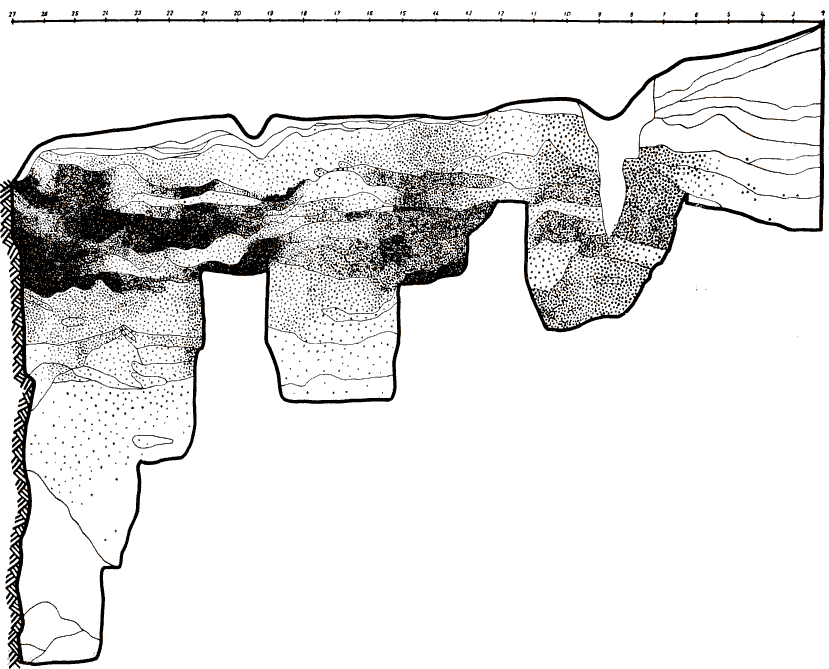
Profile of deposits in the Pod hradem bear cave, Moravia, Czechoslovakia, with the distribution of cave bear bones in the cave earth; each dot represents one specimen(!) Cave bear bones were found at all levels in the Pleistocene deposits of the cave; only those deposits formed after the Ice Age (upper-most layers) lack the cave bear. After Musil.
Life Table for the Cave Bear (Ursus spelaeus)
Population from Odessa
| x Age Interval | dx Deaths During Interval | lx Living at Beginning of Interval | I000 qx Rate of Mortality | ex Expectation of Life |
| 0-0.5 | 191 | 1000 | 191 | 3.47 |
| 0.5-1.5 | 309 | 809 | 382 | |
| 1.5-2.5 | 113 | 500 | 227 | |
| 2.5-3.5 | 76 | 387 | 198 | |
| 3.5-4.5 | 59 | 311 | 189 | |
| 4.5-5.5 | 39 | 252 | 155 | 5.1 |
| 5.5-6.5 | 30 | 213 | 141 | |
| 6.5-7.5 | 25 | 183 | 136 | |
| 7.5-8.5 | 21 | 158 | 134 | |
| 8.5-9.5 | 18 | 137 | 131 | |
| 9.5-10.5 | 18 | 119 | 151 | 4.2 |
| 10.5-11.5 | 16 | 101 | 158 | |
| 11.5-12.5 | 18 | 85 | 212 | |
| 12.5-13.5 | 18 | 67 | 269 | |
| 13.5-14.5 | 17 | 49 | 347 | |
| 14.5-15.5 | 13 | 32 | 407 | 1.5 |
| 15.5-16.5 | 9 | 19 | 474 | |
| 16.5-17.5 | 6 | 10 | 600 | |
| 17.5-18.5 | 4 | 4 | 1000 |
The life table above (see Deevey, 1947) summarizes the fate of a "cohort" of individuals who start life together. For regular intervals of age, it gives the number of deaths, the number of survivors, the rate of mortality, and the expectation of life (or mean remaining lifetime). These columns are headed x, dx, I., q, and ex, respectively (1000 qx indicates that the rate of mortality is given on a per mil basis).
The life table for the cave bear is given with one-year intervals, except for the first interval which is only 0.5 year. It was constructed by calculating, for each age interval, the ratio qx = a/(a + b), in which a is the total number of teeth belonging to the given interval, and b the sum total of all older teeth. Original values of qx for the intervals between 4.5 and 15.5 years were somewhat irregular and have been smoothed by the use of sliding means for three consecutive years. The expectation of life was only calculated for every fifth year. Age determinations over 5.5 years are approximate and preliminary. The table is an emended version of one published in Kurten (1958).
The table shows that rates of mortality are high in the first few years of life, and that only about one cub in 4 survived to adult age. The rate of mortality is gradually reduced and tends to fluctuate somewhat below 15 percent annually in middle life.
After about 12 years of age the rates again increase as senility sets in (probably mainly due to wearing out of the dentition). The expectation of life at birth is only about 3.5 years but rises to over 5 years in the young adult, then gradually to diminish with increasing age.
The age structure of the cave bear population may be compared with that of the Yellowstone grizzly bear, for which Craighead et al (1974) have constructed a 9-year average. The comparison is made in the second table. As may be noted, the sets of figures for the two populations run closely parallel to each other, but the relative number of adults is lower in the cave bear population. This is probably, in part at least, a real difference, and due to a difference in the potential longevity of the two species. Of course, it may also reflect a certain bias in the cave bear sample from Odessa. Such a bias could arise if adult skulls and jaws were used for exchange or as gifts.
Age structures of cave bear (Ursus spelaeus, Odessa) and grizzly bear (Ursus arctos, Yellowstone Park)
(Data for ursus arctos from Craighead et al., 1974)
| Percentages of: | Cave Bear | Grizzly Bear |
| Cubs | 23.5 | 18.6 |
| Yearlings | 14.5 | 13 |
| 2-year-olds | 11.3 | 10.2 |
| 3-4 year-olds | 16.4 | 14.7 |
| Adults | 34.2 | 43.7 |
Diseases and other causes of death for Cave Bears
Many cave bears clearly suffered from osteoarthritis. This disease often produced arthritic outgrowths of bone, so-called exostoses, sometimes of fantastic appearance. Vertebrae,or limb bones often fused together into a single mass of bone that must have made its b earer more or less lame.
Rickets was another common malady, which was related to the feeding habits of the bears and probably also to their long sojourns in dark caves without sunshine. As Ehrenberg noted, evidence of this disease is particularly common in high Alpine caves such as the Dachstein cave at 7,200 feet (2,200 meters above sea level); it is less common in the Mixnitz cave, 3,300 feet (1,000 meters above sea level); and almost unknown in the Winden bear cave at an elevation of only about 520 feet (160 meters). The length of hibernation, he suggested, is directly related to the altitude of the site: the higher the cave, the shorter the summer season.
Other infirmities seem to be due to the heavy use of various organs. Ehrenberg noted many cases of exostoses on the forearm bones due to inflammations in ruptured muscles, tendons, or periosteum (the lining of the bone); these cases show the entire scale from healthy specimens to severely damaged ones. Heavy wear of the teeth led to exposure of the roots and pulp cavities with resulting festering. Caries has been observed in some cave bear teeth.
Koby has noted that the great frontal sinuses of the cave bear skull were prone to infections resulting in osteolysis-an eating away of the bone that produces perforations; such perforations have irregularly rounded, smooth borders and so are easy to distinguish from lesions brought about by mechanical damage. Koby thought they might have resulted from an attack of parasitic worms, as is the case in ferrets and some other members of the weasel family.
Still another group of diseases arose from mechanical damage due to accidents, blows, bites, and the like. Healed fractures are often found among cave bear fossils, for instance broken limb bones that have reknit at odd angles; bears thus afflicted were permanently crippled. There are even several instances of the os penis, or baculum, having been broken and reknit. In bears, a fracture of the penis bone is not necessarily fatal for the urethra is not encased in the bone as it is in dogs.
Broken teeth, especially canines, are a common sight.
It should be noted that most bears spent the winter in caves, but did not use them much at other times, except for those bears which were sick or defenseless. The bears which died in the caves usually did so in winter because of injuries or disease which prevented them from laying down sufficient fat stores in their bodies in the summer to carry them through the winter. In the case of bear cubs, they died if their mother succumbed while they were still feeding from her, or she died while they were dependent in other ways on her to find them food or to offer protection from predators.
Ivar Lissner continues: It is true, of course, that the struggle for existence cannot be maintained indefinitely by brute force alone, and that is probably the reason for the dying out of the cave bear, a gigantic and excessively heavy creature which ultimately found itself with no enemies save man and may have become extinct because of a lack of natural selection. Some day the brown bear and the grizzly will also roam the burial grounds of the taiga for the last time, lay themselves down in some lonely cave and send their souls winging to the stars.
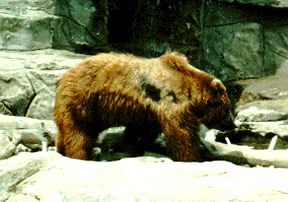 |
|
Generally speaking, bears do not attack human beings unless their own lives are in danger. They can scent man from so far that it is almost impossible to stalk and intercept them. One can come across fresh tracks or find heaps of dung still steaming in the cool gray light of dawn, but the bear's unrivalled sense of smell will have warned him of one's approach in ample time. By nature cautious and wary, he generally regards discretion as the, better part of valour. Oration women going unarmed into the depths of the bush to collect bilberries often hear the snorting and grunting of a bear enjoying a snack of the same forest fruit. Tungus girls seldom show any alarm at the approach of a bear, well knowing that his sole motive is to steal the fruit which they have already gathered. Accordingly, they either gather up their things and move on or shout at the animal to scare him away.
Mother bears with young, on the other hand, are aggressive and nervous, constantly on their guard and easily aroused. In my experience, they are more dangerous when they sense a danger which they cannot recognise than when they can hear and see it distinctly. Bear cubs are blind and remarkably tiny when they arrive in the world. They are usually born in January, after a gestation period of seven months, and by spring are able to accompany their mother on journeys in quest of food. Even at this stage if a she - bear is attacked or one of her cubs wounded or killed she will try to come to grips with her adversary.
When Tungus are not actually hunting bear and only want to drive them away, they wave their spears, bang guns or pieces of wood against a tree, and shout at the top of their voices. Even females generally pay attention to this warning and retreat without attacking.
It is extraordinarily difficult to kill bear, for they will often stop several bullets with scarcely a blink. I heard of one bear in the taiga who took thirteen bullets in the body and still showed fight. A bear is truly vulnerable, especially to primitive weapons, only when he rears. As a rule, however, he only rises to his feet at the last moment, when he gets to close quarters in order to strike with his forepaws, so the Orochi encourage him to rear prematurely by jumping and waving their arms in the air.
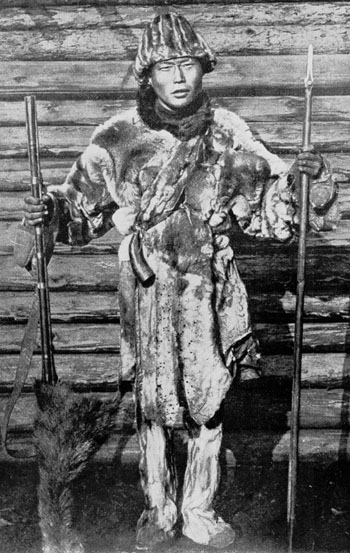 |
An Orochon in hunting garb. The Orochon are breeders and hunters of reindeer whose nomadic culture and economy are based entirely on that animal. Even their name reflects this. On the left is an old musket, on the right a palma, the wooden shaft surmounted by a blade with which the Orochon formerly hunted bear. |
In former times, the Orochi used to hunt bear with the palma, an extremely dangerous undertaking because the spear had to be thrust into the animal's heart from close quarters. The procedure was to induce the bear to rear and, when he came to grips, level the spear at his heart so that he ran onto it. What made things even more difficult was that the palma had to be kept out of sight until the decisive blow was struck because a bear was always capable of brushing it aside with his forepaw at the last moment.
Some Siberian tribes used to tackle bear with knives. The hunter's left arm and hand were thickly swathed, while his right hand held the weapon, a long blade. This method resembled that used by gladiators in Roman arenas. Lastly, bear were also hunted with the axe, though to lay one of these primeval giants low with such a weapon was an art in which the chances of survival were never more than fifty-fifty. Even when the Orochi did possess firearms they were so old and unreliable that many men never returned from bear hunts.
The bear senses everything, hears everything, knows the activities and intentions of human beings and, above all, remembers everything. All Tungus, believe him to possess uncannily fine instincts. In fact, the bear's scent and hearing are much more highly developed than his eyesight, which is why, when the Tungus are asked how a bear knows when he has met you once before, they answer: 'He smells it.' It is quite astonishing how surely the bear can scent things from a great distance. He can spot the presence of an enemy or the slightest change in his hunting preserves, which he knows down to the last detail. His scent and hearing endow him with powers of observation so acute that he invariably reacts quickly to human intentions. When he is hunted he only shows himself at night and always keeps close to cover. When he is well treated, as in the United States' national parks, he becomes extraordinarily trustful.
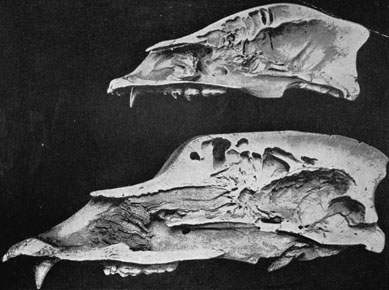 |
Two bisected skulls, one of the brown bear (above) and the other of the extinct cave bear (below). Comparison shows how powerful the cave bear was, how impressive his olfactory equipment and how acute his sense of smell. Seventy thousand years old but complete in every detail, this skull has aroused the admiration of many zoologists. Photo: Lissner - Man, God and Magic |
When a bear dies the soul leaves its body and is then capable of harming the soul of a man just as any liberated soul can. A bear's soul must therefore be treated in a proper manner and its meat eaten in a strictly prescribed fashion - above all, not in the presence of women. It is exceedingly important to keep the bones to one side so that the bear's skeleton can be deposited in a tree or laid out on a platform high above the ground.
No bones must be missing, or the bear's soul will never rest. The head is cut off and either laid on a slab of wood supported by posts or hung up in a tree. Many Tungus, though not the Orochi, hang the whole skin up in the forest. Since the bear's soul is carefully watching all this, it is advisable to talk loudly of its maltreatment by some distant tribe so as to delude it and ensure that it will not persecute its real murderers. Live bears are especially dangerous because they can hear and scent everything. Consequently, the Orochi never speak openly of a particular animal which they have seen or whose hiding place they have discovered. As a general rule, all talk about a bear which one intends to kill should be avoided, and if a Tungus finds a cave or lair in the rocks he does his best to indicate it to the others by means of gestures alone.
I never heard the Orochi describe bear in any but circumlocutionary terms such as 'the black one,' 'the ugly one ... .. the honourable one,' 'grandfather,' 'grandmother' or 'big baby.' When they see a bear emerge suddenly from the undergrowth, they call: 'Go back where you came from. We shall do you no harm.' The Tungus believe that 'the honourable one' thinks like a man, and when one sees this morose and incalculable creature with its half - open jaws and lolling tongue sitting manlike on a fallen trunk and calmly regarding its foe, one is tempted to agree.
More legends and anecdotes are told about the bear than about any other animal in the Siberian forests. No other animal has so much power, even when it is dead and its soul has left its body. Its paws, claws and teeth are all regarded as talismans with tutelary properties. The people of eastern Asia are familiar with countless medicaments made from various parts of the bear's body, and anyone who visits an apothecary in the Far East will discover how expensive these exotic remedies can be.
Page 159
We discovered that, even in the snow-covered tundras of Northern Siberia and Northern Canada and on the most inhospitable coasts of the Arctic Ocean, an avowedly monotheistic religion was embraced with reverential faith and a warm heart by the peoples who had been there longest. Especially prominent among the sacrifices offered to the Supreme Being are the skulls and bones of slaughtered game, because they thereby acknowledged God as absolute master of their sustenance and, with it, of life and death.
P. W. SCHMIDT, Der Ursprung der Gottesidee, Vol. III, P. 563
WHY is bear medicine of such great value? All the Tungus of Northern Asia, the Manchurian Chinese, the Buryats, the Mongols, the Koreans and all the inhabitants of China set great store by medicaments which have been prepared from various parts or organs of the bear's body. The only things held in comparable esteem are the tiger, the young antlers of the isyubr deer, known as panty, and the root of the ginseng plant. The idea that curative effects can be derived from the strength of a bear or tiger or the vitality of a deer's antlers is something which originated in a hunter's world such as that of the Tungus. That is why the shamans of some Tungus tribes wear a head-dress of stag's antlers when performing rituals, while others model their clothing on the bear's external appearance. Whether dried bear's gall ground into a powder and mixed with water is a genuinely effective remedy for inflammation of the eyes, and whether it originated in the Chinese or Tungus' store of medical experience is something I was unable to establish conclusively.
The roots of the ginseng plant which grows in the forests of the Russian province of Primor'ye, North Korea and Manchuria, bears a remarkable resemblance to a human being. As we have already seen, a skinned bear is also reminiscent of a human being, so it is evident that the Tungus regard both plant and animal as possessing a soul very like that of a man. In fact, they speak to both of them as though they were addressing human beings.
The Tungus talk to all animals, plants and natural phenomena, it is true, but their relationship to the ginseng plant and the bear is more personal, stronger and more active. It is a mixture of sometimes genuine and sometimes feigned affection and solicitude, respect and awe.
The ancient Finns believed that a human soul resided in the bear. Professor Kaarle Krohn of Helsinki writes of the songs which the Finns sang when feasting off a bear's head and ceremonially depositing its skull in a sacred tree. 'O God, thou who has given what is not to be eaten without song and whose head must be laid in a tree.' The most valuable and efficacious parts of a bear are its head, skull and leg bones. Since a bear's skull contains the most tasty part of the animal -its brains- and since the leg bones contain the delicious marrow, the Tungus have always, from very early times, sacrificed them to their god. When I questioned some Orochi and Manega about this, they said that they always buried a bear's skeleton to pacify the animal's soul but that it was an age-old tradition to place the skull of a slaughtered bear in a tree as a sacrifice to the supreme god. The practice of laying out the skeleton on a platform above ground was a form of burial, but the exposure of the head must have been a form of sacrifice. The Tungus are quite explicit about this, even today, when they owe allegiance less to a supreme god than to a 'lord of the forest and mountain.'
This was not always so. The lord of the forest only gained in importance as the age-old faith in a single supreme god declined. The fact that the ancient custom of sacrificing a bear's head, skull and leg bones is no longer observed and is even sinking slowly into oblivion is just one of the many symptoms of a dying race. First, the ancient faith vanishes, and with the waning of a belief in God, which among the Tungus was a belief in a single supreme deity, comes the disappearance of the conviction that Heaven sustains and protects its own. Waning faith is linked with the decline of a culture and ultimately of the men who sustained it.
The Tungus call God 'Boa.' At least, that is how the ancient name sounds when pronounced by the Orochon, though Shirokogorov also writes 'Buga.' The Orochi call the Spirit of Heaven 'Dagachan.' It is hard to ascertain from them whether Dagachan and Boa are one and the same, but all the Tungus who I met during my travels on the Manchurian side of the Amur Bend still had an inherent knowledge or idea of the supreme being, the great God of the Sky. This god remains eternally invisible and is aware of all that goes on in the world and the universe. The Tungus have no conception of a God of Wrath. God has no Hell at his disposal and could never banish a man to a place of purgatory or damnation. God is always kind, always beneficent, and never punishes by dispensing evil. I even doubt whether the Tungus would accept the suggestion that God sometimes takes away their luck at hunting, though many authorities -Shirokogorov among them- assume them to believe that God punishes by withholding His gifts.
Neither the Orochi nor the Manega have ever tried to portray their invisible supreme god in visible terms. The strange little wooden figures which the Orochi and Manega carve on trees or occasionally display on wooden altars are effigies of a forest spirit whom they call Bainaca. Bainaca is lord of wild animals and holds the destinies of hunters in his hand, from which it follows that God is not responsible for dispensing good or ill fortune where hunting is concerned. The Tungus of the North Manchurian taiga offer small quantities of all kinds of food to the spirit of the forest, putting aside a little of what they have prepared for a meal on a small pedestal or framework of planks. There is a practical side to these offerings, too, for the lonely traveller may use them to still his hunger in an emergency provided that he replaces them at the next opportunity. This, at least, is how it was in northern Manchuria. The spirit of the forest is a subordinate being and has no connection with the Tungus' high god, who is invisible because he is one with the weather, the sky, the sun and the whole universe, and because he alone stands above the mysteries of infinite space and infinite time, not subject to these powers and therefore incapable of suffering harm or destruction by their agency. Although Shirokogorov speaks of the Tungus' supreme god, Buyam, Boya or Boga, he mentions nothing about the sacrifices made to him and refers only to the modest offerings set aside for Bainaca: horsehairs, scraps of food and small birch twigs. The Orochi and Manega both told me, however,that their fathers still practised the custom of sacrificing bears' heads to the supreme god, wrapping them in birchbark and putting them high up in a tree or on a wooden scaffold. This corresponds exactly with what the explorer T. W. Atkinson observed in about 1860 on his journeys through the country surrounding the Upper and Lower Amur, and also with descriptions given by the Russian ethnologist Miss M. A. Czaplicka, although in her version the bear's bones were placed in a sack and hung up in a tree. As usual, the Tungus were careful to see that no bones were missing.
The practice of sacrificing head, skull and leg bones was transmitted by the Samoyeds in the west, via the northern Tungus, to the central Eskimos of North America. Apart from the concept of sacrifice and of a single god, these races had three more things in common: they were all reindeer breeders (or, in the case of the Eskimos, reindeer hunters); they all lived, as some of them still do, in conical tents covered with reindeer hides or sheets of birchbark; and they all, as Professor A. Gahs of Zagreb, an Austrian ethnologist, has stressed, used the bow and arrow. The Danish ethnologist Birket-Smith writes:
'The cultural link between Northern Eurasia and North America is so close that the two parts should be regarded as a single circumpolar cultural district in which a similar environment forms the basis of common development. The test of human intelligence throughout the Arctic and boreal regions is winter, and the vital problem in these regions is how winter can be overcome.'
Professor Gahs has drawn an extremely interesting picture of divine worship in the Arctic cultural area by compiling references to sacrifice from numerous different sources. We learn, for instance that the Yurak Samoyeds built sacrificial mounds out of sticks, antlers, bear and reindeer bones and, in particular, bear skulls on the Northern Siberian coast between Pechora and Yenisei east of the southern tip of Novaya Zemlya and on the sacred island of Vaygach and the Yamal Peninsula, which are formed by the Obskaya Guba and the Kara Sea. The Swedish explorer Nils A. E. Nordenskjold discovered on the northwest coast of the Yamal Peninsula an altar built of reindeer bones and about fifty bear skulls, some of which were hung on sticks. Close by was a hearth containing the ashes of a recently extinguished fire, and near it Nordenskjold saw numerous reindeer bones, clear evidence of a sacrificial feast, as he noted in the report on his expedition to Novaya Zemlya and the Yeniseyskiy Gulf.
The Russian scholar B. Zitkov, describing a journey to the Yamal Peninsula in 1913, refers to a sacrificial mound composed of polar bears' skulls. He learned that the Samoyeds had been accumulating bears' skulls on this spot for over a hundred years. The Samoyeds' supreme being is called 'Num,' and it was to this single deity that the skull sacrifices had been offered. Like Boa, the god of the Orochi and the Tungus in general, the Samoyeds' high god is all embracing. He is earth, sky, the whole of nature and the universe in its entirety. The fact that the Samoyeds also recognise numerous spirits does not change their conception of Num as an invisible being of unequalled sublimity who loves men and gives them good hunting by dispatching spirits whom he has entrusted with its bestowal.
The Samoyeds are a fast dying race of whom little is known today. Let us take a last look at these people who have for so long believed so implicitly in a single, supreme deity, who have sacrificed to him, trusted him, relied on his omnipotence and, confident of his good will, have carried their culture from one age to the next on swift sleighs which skim through the northern forests and across the wintry grandeur of the wide tundra.
The Samoyeds' own name for themselves is Nyentsi, or 'men,' which is what the Russians call them today. In Russian, Samoyedi means 'self-eater.' The Samoyeds have never been cannibals, however, and it is very doubtful whether the name is Russian at all. It is more probably of Finnish derivation and may be connected with the indigenous term for Lapland, Sameandna, or that for Finland itself, Suomi.
The Samoyeds spend the whole of their life on the move and take all their possessions with them: tents, sledges, boats and dogs. They harness three or four reindeer to each sledge, the lead animal a little in front and the remainder behind in an oblique formation which looks superb when the team is travelling at speed. Guided in this way, they traverse the gleaming surface of the snow as lightly, swiftly and weightlessly as birds on the wing.
The sledges are small but as stoutly constructed as only the Eskimos, with their ancient store of experience, can make them. Dogs are never harnessed to sledges but run alongside, pale yellow, incredibly hardy animals who bark unceasingly and snap greedily at the raw fish which forms their staple diet.
The Samoyeds themselves live on reindeer meat, although they never drink reindeer milk. A Samoyed is really herdsman, hunter and fisherman all in one. Reindeer are the principal form of capital, and the more head a man owns the happier he is. The northern herdsmen are constantly preoccupied with a quest for better pasture, and this makes their life a wearisome and arduous one. In spring and summer they move northward, in autumn and winter southward, their whole existence spent in avoiding flies and finding the best grazing land, keeping their herds together, counting them, cutting out sick animals and, last but not least, protecting them from wolves, which are as much a menace in the tundra as in the taiga. So the Samoyed skims along on his smooth gliding sled, controlling his herd with dogs, changing their direction, catching animals with his sixty foot lasso and training them in the difficult art of sledge pulling.
It is no simple matter to be herdsman, fisherman and hunter all at once. The Samoyed must be able to construct tents, sledges, boats and fishing tackle; he must know a multitude of hunting secrets, have countless tricks at his command, meet the perpetual severity of nature with a degree of patience quite alien to Western cultures, possess superhuman powers of endurance and be capable of withstanding plagues of insects and the harshest climate in the world. All this presupposes a great, very ancient and time tested culture, and we can tell by studying these people that the men who preceded Ur and Babylon and the beginning of our recorded history were far from savages. Accustomed to the unceasing vicissitudes of fate, the Samoyed never complains, never expects too much of life and is convinced that he must master it on his own.
Page 167
He asks for help only in an emergency, repays a loan at the first opportunity, and has never learned how to beg or steal.
We owe a great deal of what we know about this almost extinct race to the outstanding work of the Finnish scholar T. Lehtisalo, who conducted an expedition to the Yurak Samoyeds of northern Russia and northwest Siberia in the years 1911-1912. He travelled by water to the estuary of the remote rivers Tass and Pur, accompanied reindeer breeders on a trip to the Sjoida, carried out scientific research at Oksino in the Pechora Delta and spent days, weeks and months with impoverished Samoyeds who, having already been robbed of their nomadic liberty, were living in small villages. Then, in the year 1914, once more sponsored by the Finno-Ugrian Society, he explored the domain of the Forest Yuraks on the Irtish. Lehtisalo amassed a great deal of invaluable information about these Arctic people, and all that has since come to light, even in very recent times, is merely a repetition of what he has already told us.
The famous explorer De Dobbeler, who carried out exhaustive research into the Samoyeds in about 1885, wrote:
'The Samoyeds believe in a Supreme God, the sky. He is good and, as such, will not do them any harm. Since God is the sky and the sky is God, both are known by the same name: Num. God is worshipped on sacred mountains. When the Samoyeds climb such a mountain after a long journey they slaughter a reindeer, eat it and hang the animal's head either in a tree or on a stake driven into the ground. Before throttling it, they look up at the sky and say: 'God, we have led it hither,' and, when they have put the noose round its neck: 'Do you see, God, what we are doing?' During the killing, they cry: 'O-ho-o-o-ho' and 'U-hu-u-u-u,' and after it they say: 'God, take this.'G. M. Vasilevich wrote in 1956 that the Yenisei Tungus look on the bear as a hero who sacrificed himself in order to provide mankind with reindeer. In the extreme east of Siberia, fragments have survived of a myth which tells how a girl gave birth to a bear cub and a baby. It seems that when the brothers grew up they engaged in mortal combat, and the man was defeated.
The mere existence of such a legend indicates how deep and time-honoured is the reverence accorded to the bear.
The Evenki have more than fifty different names for the animal. When one has been killed it must always be skinned and gutted by a member of another tribe so that its soul will not know who the real hunter was. Vasilevich records that the eastern Tungus used to preserve the head and other bones of a slaughtered bear carefully. The head was then hung from a tree and the bones deposited nearby, either high up on a broad branch or on a wooden platform in the taiga. lot
P. G. Pallas, who undertook a journey through various Russian provinces between 1768 and 1773, told how the Karagasses used to lay the head and heart of a slaughtered bear on a sheet of bark, raise it to heaven and pray for a continuance of good hunting. Uno Harva's reference to the fact that the Karagasses do not eat the brain is extremely interesting. Apparently, they are reluctant to break the animal's skull. Since, as mentioned before, the brain is considered the most valuable and tasty part of a bear, we may regard their abstinence as a sacrifice intended for the high god.
A belief in a single supreme deity and creator prevails among all the ancient peoples whom we are presumptuous enough to call primitive. Waldemar Jochelson says that he has established this in the case of the Tungus, Yakuts, Koryaks, Yukaghirs, Kamchadals and Aleuts.
Even as late as the last century, Western science credited humanity with an upward trend in religion, an evolutionary chain which began with dark superstition, sorcery and magic and ended in monotheism. The more man developed, so the theory ran, the more clearly he recognised the falsity of magic until he eventually reached the highest religious level, monotheism, or a belief in one god.
Yet magic and monotheism have always existed side by side and still do today. And most students of ethnology are now convinced that the earliest religious concept was a belief in one god, and that this 'primitive' monotheism deteriorated as animistic -ideas clouded its purity. It was only later that magic gained a hold. The weaker the faith in a high god became, the more magical formulae were called in to supply the deficiency.
Jochelson conducted research into the Yukaghirs in the years 1895 and 1896 and later in 1901 and 1902. And in his writings refers to the high god, known as Pon, to which the Yukaghirs sacrificed reindeer. In ancient times their offerings used to include dogs and, so tradition has it, an occasional human being. Human sacrifice was not, however, destined for Pon but for the spirit of the elk. It was the custom to sacrifice a girl who had set eyes on the head of a slaughtered elk - an act which signed her death warrant - together with two puppies, a male and a bitch.
Uno Harva supplies some really startling information. He learned that in the Turuchansk district the Tungus used to keep not only the skin of bears' heads but also the scalps of enemies whom they had killed. It is known that the Ostyaks (who are related to the Finns) and, of course, many American Indian tribes made a habit of scalping their enemies, so that it is not surprising that the same custom existed in Siberia. When the chieftain of a Yukaghir tribe died, the flesh was stripped from his corpse with bone knives and dried in the sun. To avoid physical contact with the dead man, the Yukaghirs wore gloves and masked their faces. The flesh was put into a sack and hung on stakes or deposited in a tree some feet above the ground. The Yukaghirs then distributed the dead chief's bones among his relatives, who wore them as amulets and consulted them whenever an important problem came up for discussion. The head itself passed into the possession of the tribe's oldest member.
It is evident that the skulls of dead men once played at least as great a role in religion as bears' skulls. If we go back three or four hundred thousand years in time to the human skulls which were found at Chou-k'ou-tien near Peking, we must consider whether they fulfilled the same purpose as the bear skulls of Siberia - whether, in fact, the human skulls of Chou-k'ou-tien may not have been intended as a form of sacrifice.
In earlier times, the Yukaghirs inhabited a huge area which extended from the Lena to the Kolyma and the Arctic Ocean to the Verkhoyansk Mountains. They now live eastward of the lower reaches of the Indagirka and are in grave danger of extinction. Their environment is ruled by the harshest climate in all Siberia and they are continuously exposed, usually without shelters adequate to the sharpest of the North winds.
The Cavebear
|
Wildkirchli, Wildenmannlisloch and Drachenloch are three Swiss caves which have yielded the most interesting discoveries of cave bears' bones yet made. Traces of fire were found at all three sites. According to Heinz Bachler, the charcoal in the Drachenloch is the oldest legacy from Stone-Age man ever to be dated by the radiocarbon method, and goes back at least fifty thousand years. The cave bears' skulls and marrowbone sacrifices in the Drachenloch indicate that as early as seventy thousand years ago man believed in a single god. The Drachenloch also contained stone chests or kists which are the earliest man-made structures yet found. |
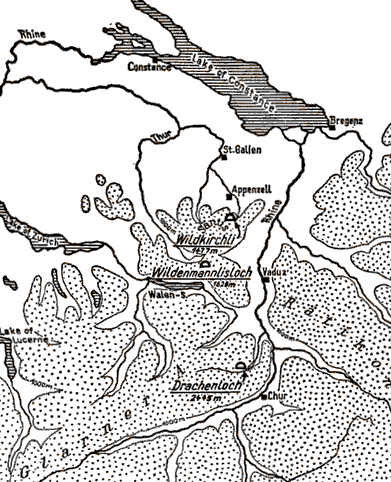
|
Page 183
In the rocky fastnesses of the Alps, we once more pick up the trail of Neanderthal man. High in the majestic mountainscape of Switzerland, in the cantons of Saint Gallen and Appenzell, are three caves which have yielded some amazing discoveries: the Wildkirchli. the Wildenmannlisloch and the Drachenloch.
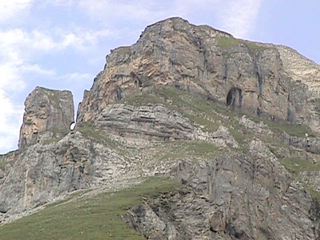 |
The approach to the Drachenloch cave Photo: Christian Mettler http://www.drachenloch.ch/ |
|
The Drachenloch cave extends into the rock for 230 feet and comprises six chambers. Near the entrance the cave walls are clothed with cave mosses and lichen, a beautiful glowing green which reaches far into the fading twilight of the vaulted interior, where the light of day scarcely penetrates. Fighting a desperate battle for survival, plants suck greedily at the faint rays of light which help them to manufacture the chlorophyll that gives them colour. |
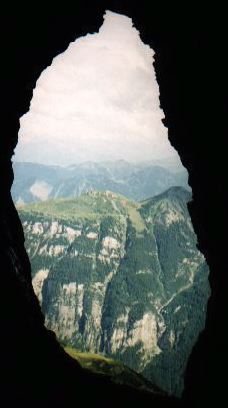
|
(N.B. Some researchers have questioned this interpretation of the stone chests. When slabs of rock fall from the ceiling of a cave, they very often simulate this sort of structure, with some coming to rest on their edges after sliding off other debris, and others landing flat, making it look as though the stone was purposely placed as a lid. There are at least two versions of the diagram of how the cave bear skulls and the stone chests were arranged, which contradict each other. Don)
The stone kists found in the Drachenloch are probably the earliest man-made constructions in the world. All three caves yielded large numbers of bear skulls, some of them scattered about but others carefully arranged in piles. Portions of cave bears' skeletons were also found neatly laid out in layers, sometimes side by side and sometimes superimposed. Thirty broken fibulas were found stored on top of a large slab of rock, their jointed ends all facing one way and their broken ends the other. In another place, a bear's skull was found ringed by small slabs of stone, each about the size of a man's hand, which followed the outline of the skull precisely.
In the Drachenloch, small stone walls had been erected about eighteen inches from the wall of the cave itself. Here, too, fragments of cave bears' skeletons were discovered together with complete or partial skulls, some of them pierced by holes. Several skulls lay in niche-like recesses in the rock walls or between fallen boulders.
Apart from this, many extremely diverse types of tool were found, most of them flake tools like flat shells or broad, roughly fashioned blades. I have examined these tools very closely for myself. Although they are generally quite small, many of them being only an inch long, they reveal the formative intervention of the human hand and eye. Many of them, too, are handsomely coloured. There are flakes Of jasper, brownish red like coagulated blood, other flakes of green quartzite, chips of green flint, and the cores from which the blades were originally detached. It is evident that the stone blades were chipped by means of a hard quartzite hammer. Their cutting edges are crude and irregular, and almost all the blades show signs of heavy wear. The inhabitants of these caves did not worry about the aesthetic appearance of their tools, probably because they were birds of passage and only used such raw material as was available, whatever its inadequacies, in order to manufacture enough tools for their immediate requirements. Moreover, they apparently only needed simple tools, probably because they possessed other implements with which they were more familiar and which seemed more appropriate to their purposes.
These were the bones of the cave bear. Almost all the unbroken cave bear skulls found lacked a lower jaw, and this lower jaw was used as a percussive implement, one of the canines being retained for splitting purposes. Hip joint sockets were used for scraping hides, as one can deduce from the pronounced signs of wear apparent on their edges. It is clear that tanning was practised here, and we thus know that men were wearing skin garments about eighty thousand years ago. Weigh one of these hip joint sockets in- your hand, and you will at once realise that it could have served other purposes. For instance, its concave shape would have made it an excellent drinking vessel. I cannot personally imagine what other cups Neanderthal man would have drunk from, if not these natural bone vessels.
|
The cave bear was Europe's largest Ice Age predator. It penetrated the Alps and was hunted by the people of the Mousterian and Aurignacian periods. Neanderthal man used to sacrifice the skull and marrowbones of the cave bear to his god. The reasons for its eventual extinction are unknown. |
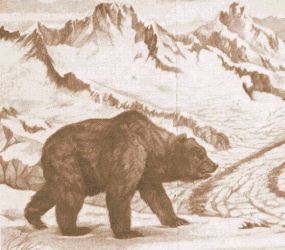
|
The depths of his cave dwellings were dark, and hip joint sockets may also have solved the lighting problem. At any rate, they would have made extremely practical bowls for oil lamps. Every conceivable kind of tool was manufactured out of the bones of the cave bear - possibly arrowheads, too, though this is very dubious. In general, we can only wonder that men succeeded in hunting this dangerous creature at all. Perhaps they used only the corpses of animals which had died from natural causes - though the haut-gout would have deterred the average modern!
Many bones displayed cutting marks which Emil Bacher, discoverer of the cave, mentioned but did not illustrate in his published works. Being aware that some authorities have leapt to the conclusion that no signs of damage were evident on them at all, I consulted Bachler's son. Heinz Bachler wrote me the following reply: -
I examined a large proportion of the material the year before last and found a number of cutting marks which are definitely distinguishable from more recent damage, principally on the articular protuberances of the occipital bone, the first two cervical vertebrae and on the shoulder and hip joints. By no means all the well preserved bones bore these scratches and cuts, but, judging from my own practical tests conducted on fresh cow bones with original stone tools, this is understandable, for considerable pressure must be exerted before one damages the tough and slippery periosteum, and with a little practice one can sever the muscles and sinews of a joint without scratching the bone at all.
It may also be conjectured that Neanderthal man purposely avoided damaging skeletons because he wanted to commit them to eternity intact.
The weapons of the contemporary hunter were very primitive. He may either have driven his quarry into the interior of a cave, held it at bay there and attempted to kill it with heavy wooden clubs, or ambushed it on a game path and hurled his spear from a vantage point such as a rock or tree. Some bears' skulls found in the Drachenloch exhibited half healed fractures which suggest that man was not always successful in his dangerous pursuit.
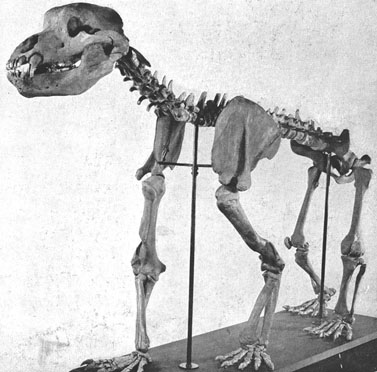 |
The only complete cave bear's skeleton in existence (Ursus spelaeus Blum) was unearthed nearly five thousand feet up in the Wildkirchli cave in Switzerland and now reposes in the Heimatmuseaum at Saint Gallen. The cave bear probably carried its head lower than this reconstruction suggests. It was the skull and marrowbones of such mighty creatures (this one is nine feet long) which men sacrificed to their supreme god 70,000 years ago. Photo: Lissner - Man, God and Magic |
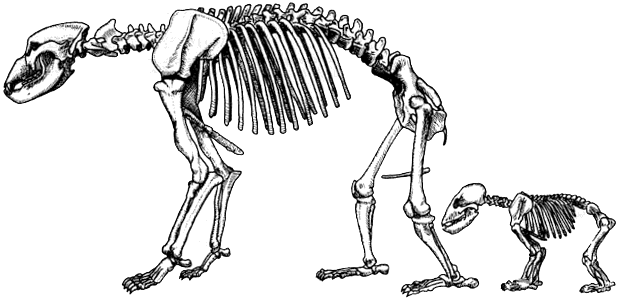
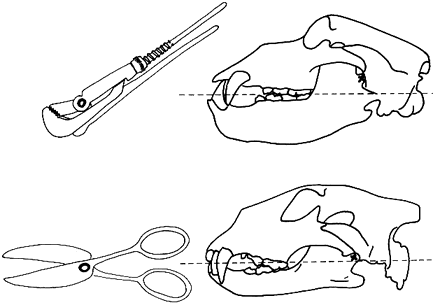 |
The jaw mechanics of the cave bear may be compared to that of a spanner, with the pivot of the jaw joint (cross) raised above the occlusal plane of the cheek teeth. In contrast, the pivot of the cat skull (as exemplified by a lion, below) is in the same plane as the teeth and the action resembles that of a pair of scissors.
|
The following explanation of the diagram above comes from Bjorn Kurten, 1976, 'The Cave Bear Story'
In a meat-eating carnivore like the cat, the cheek teeth of the upper and lowerjaws move past one another like the blades of a pair of scissors. If you draw a line along the bases of the cheek teeth, you will find the pivot of the jaw joint in the line's elongation. But if you draw a similar line for the cave bear, you will find that the jaw joint is raised well above the line, and this is the condition that induces the strong curvature of the lower border of the jaw
In a scissor motion, the two blades act against each other only at one point at a time, and this point moves forward as the scissors close. But if a nutcrackerlike action is needed, in which the whole set of teeth acts at the same time, the pivot must be located well above or below the level of the teeth. This is the type of action suitable to omnivores and especially to vegetarians, and it is found not only in the cave bear but also in all the hoofed grazing animals, horses, antelope, buffalo, etc. Not to mention ourselves!
Lissner continues:
In each of the three caves which have been mentioned, the Wildkirchli, Drachenloch and Wildenmannlisloch, the skeletal remains of some thousand bears were found. Bachler assumed that all the bones discovered in the Drachenloch and Wildenmannlisloch had been brought there by Stone-Age hunters, for bears do not appear to have used them voluntarily as places of refuge.
On the other hand, Wildkirchli may occasionally have been used for hibernation, but it certainly was also frequented by human beings from time to time. No animal could have accumulated these hoards of hunting trophies, nor could they be a freak of nature. Only a deliberate act on the part of early man can account for them. One of the jawless skulls in the Drachenloch, for instance, posed an almost insoluble problem. Another bear's femur had been driven through its tight cheekbone in such a way that it could only be removed by means of a fairly complicated maneuver. Only a human intelligence could have been responsible for this. Nature does not build rectangular chests out of flat slabs of stone, nor does she spirit seven bears' skulls into them.
No one would have guessed that traces of Neanderthal man would be found at such an altitude. Wildkirchli lies at a height of nearly 5,000 feet, Wildenmannlisloch in the Churfirsten is more than 5,300 feet up, and Drachenloch above Vattis in the Tamina Valley no less than 8,000.
How did Neanderthal man reach these altitudes, what induced him to brave the hardships and dangers involved in such an ascent, and why did he transport such large quantities of bears' bones into the solitude of the mountains? Why were fragments of cave bears' skulls piled so neatly on top of one another, and why were the outer edges of the bone cups so highly polished, as though they had been worn away by generation after generation of human hands? Were they Neanderthal man's drinking vessels? What was he looking for so far above the tree line, when he could only have visited these caves in spring or used them as a hunting base in summer?
In the Drachenloch, beneath the entrance leading from the first chamber into the second, Bachler came upon a layer of coal black material containing ash and the remains of burnt wood. In the center of this hearth he found a quantity of small bones and stone fragments, some charred and others only scorched. The earth beneath the fireplace had been reduced to red, powdery dust. Examination of the carbonised remains revealed that Neanderthal man had used pinewood as kindling. Apart from this open hearth, a fire pit was discovered in the entrance leading from Cave 11 to Cave 111. This was covered by a flat stone slab about eighteen inches square.
Perhaps seventy thousand years old, the hearthstone's reverse side was stained with smoke, and the fire pit beneath it contained ash, the remains of charred wood, and burnt bones. Having explored different possibilities of making fire in the Drachenloch, Bachler established that smoke was carried away most effectively when fires were kindled beneath the entrances to the various chambers.
Close by the fire pit was the 'bone altar' on which lay the cave bear's skull with the femur through the aperture in its cheekbone. Emil Bachler explicitly used the term 'bone altar,' and it would appear that fire pit and place of sacrifice were in some way connected.
The Drachenloch cave is the most interesting and perhaps the most important cult site in the entire history of mankind, a place where, more than seventy thousand years ago, thank offerings were being made to the supreme creative being. They were thank offerings for the bestowal of game, but they may have had an even more important significance, for the Drachenloch cave contains the oldest stone structure of religious significance in the world; indeed, it is the earliest stone monument to the human past and the earliest visible expression of man's regard for an invisible god.
Some scientists are hard to convince, however. The Swiss palaeontologist F. E. Koby, for instance, has questioned whether the bears' bones display any signs of human workmanship at all and disputes that the caves reveal any traces of Palaeolithic man. He suggests that bears were considered too dangerous to hunt at the time and describes the dry stone wall, upright stone slabs, bears' skulls and marrowbones in the Drachenloch as 'fortuitous,' attributing the signs of wear on the tools found there to the trampling of bears' feet.
Most of the objects found in the Drachenloch, Wildkirchli and Wildenmannlisloch caves are now in Saint Gallen's regional museum. I have devoted a great deal of time to these finds, have examined them closely, and cannot agree that Koby is correct. No one has yet disproved Bachler's dating of his finds, and it seems that the Drachenloch must have been inhabited by Neanderthal man during the last interglacial, that is to say, in the warm period which preceded the last Ice Age when temperatures may have approximated those of our own day.
Certainly neither beast nor man could have existed at or even reached such an altitude during the height of the Ice Age. The primitive stone and bone tools found in the Drachenloch best lend themselves to classification in the Mousterian, i.e. in the Neanderthalian culture. The primitive substage of the Mousterian, the preMousterian, represented by the Drachenloch finds discloses every aspect of Neanderthal man's tenacious struggle for self-preservation, yet it must have had its lighter moments, for the Wildenmannlisloch yielded thirty small, white, almost circular quartzite pebbles which were geologically alien to the cave and must have been brought there by Palaeolithic man. We do not know what they were meant to be or what purpose they fulfilled, but it is probable that they were accumulated simply because of their aesthetically pleasing shape, possibly even as pieces for some form of game.
No human bones were found, although human fossils would have have survived quite as well as animals'. One explanation of this may be that man disliked living so close to his dead and was afraid of them. Fear of the dead was not uncommon at this period, as the bound corpses found in other parts of the world prove. Again, burial places have been identified in caves situated at lower altitudes. Perhaps this is an individual case in which the absence of human fossils can be attributed to man's unwillingness to turn his living quarters into a burial place, or to the fact that he never remained here for long and the probability of death during residence was thus correspondingly less.
All in all, the caves remain an unsolved mystery, as Bachler himself admitted. How, for instance, can we explain the discovery, in a carefully protected niche in one of the chambers of the Wildenmannlisloch, of a small figure resembling a female sculpture? Made out of the lower jaw of a cave bear, it may be either an artefact or a freak of nature. One thing is certain: the flattened planes of its 'head' were rubbed smooth by some human agency; perhaps, as Emil Bachler suggests, because the bone was originally used as an instrument for smoothing animal skins. This may also be the reason why certain portions of the so-called 'pseudo Venus' appear to have been polished.
Wildkirchli, Wildenmannlisloch and Drachenloch are three Swiss caves which have yielded the most interesting discoveries of cave bears' bones yet made. Traces of fire were found at all three sites. According to Heinz Bachler, the charcoal in the Drachenloch is the oldest legacy from Stone-Age man ever to be dated by the radiocarbon method, and goes back at least fifty thousand years. The cave bears' skulls and Marrowbone sacrifices in the Drachenloch indicate that as early as seventy thousand years ago man believed in a single god. The Drachenloch also contained stone chests or kists which are the earliest man-Made structures yet found.
Bachler is of the opinion that the figure came into being accidentally, as a result of continual friction due to use, not as a deliberate attempt to reproduce the shape of a human head. I have examined the figure closely. The closed eyes, delicate mouth, small forehead, slim,neck and back all convey an impression of careful workmanship. A second 'Venus' discovered in the same hiding place has smooth patches but no recognisable head.
Even if the pseudo Venus was not actually made by Stone-Age man, the cave dweller must have noticed its resemblance to the first of a girl. Why else would he have put it to one side and preserved it so carefully? The prehistorian Friedrich Behn, in his book Vorgeschichte Europas, asserts that the people of the Neanderthalian race were lacking in any form of artistic impulse. The celebrated Venus statuettes of the Stone Age belong to the Aurignacian, a far later period. The pseudo Venus may, therefore, be unique in its period, the earliest portrayal of the human figure known to have been made, or at least recognised as such, by man. It is probably the most remarkable evidence of prehistoric activity or comprehension in the world. Between four and five inches tall, the Venus was found on October 21, 1926, and reposes today in the Heimatmuseum at Saint Gallen, a Palaeolithic Sleeping Beauty waiting to rejoice the eye of the occasional visitor.
Evidences of Palaeolithic bear sacrifices have also been found outside Switzerland - so far afield, in fact, that the idea of sacrifice appears to have been common to numerous Middle Palaeolithic people and not merely the prerogative of a few individual magicians or priests. Traces of ritual burial or sacrifice were discovered in the Petershohle near Velden (Central Franconia in Germany), in the Teufelshohle near Pottenstein (French Switzerland), in the Kitzelberghohle in the Bober-Katzbach Mountains, in Cabrerets; (in the Department of Lot in France), in the Caverne des Furtins (Saone-et-Loire, France), and in alpine and subalpine cave sites in Yugoslavia. Cave bear skulls, other bones and Mousterian tools were 'found in such a peculiar position that they are quite irreconcilable with natural precedents.' In the Salzofenhohle, more than six thousand feet up in the Totes Gebirge not far from Aussee in Austria, the palaeontologist and palaeobiologist Kurt Ehrenberg found three cave bears' skulls which had been accurately ringed with stones. In all three cases, charcoal remains were discovered beside or beneath the skulls. In the Petershohle, bears' skulls had been carefully deposited in small holes and niches. In a cupboard - like recess in the rock wall, four feet above the floor of the cave, five skulls, two femurs and a humerus were found, all belonging to cave bears. The skulls fell to pieces in the diggers' hands/ during removal. The man responsible for exploring the Petershohle, K. Hormann, declared: 'These skeletal remains could not have got up there or in there by any natural means.' It seems probable therefore that they were a conscious committal to eternity and a deliberate sacrifice, not a fortuitous act but a calculated gesture, toward an exalted and timeless power.
A large quantity of bear fossils were found near Mixnitz in Styria, Austria, in a cave known as the Drachenhohle. Man had taken refuge there from time to time and cave bears had also lived deep in the interior, though it is improbable that man and bear occupied the cave simultaneously.
Near a spring two hundred yards or so from the entrance to the cave, living quarters and a fireplace were identified, together with artificially arranged stones, bones displaying traces of fire and large numbers of utensils. The large eye-teeth of cave bears had been fashioned into tools, weapons and scrapers, the latter having been used principally to remove sinews from fat.
The discoveries made in this cave surpass one's wildest imaginings. The remains of no less than fifty thousand bears have been counted there, although the place was frequented by these animals for such an immense span of time that this works out at only a few bears per annum! Far in the depths of the cave are a number of very narrow passages formed by huge blocks of stone which had fallen from the walls and roof, and on the sides of these passages can be seen the marks of bears' paws, so distinct in places that the five furrows made by one set of claws can easily be counted. It is immediately apparent that the animals were in dire straits, probably because they had been trapped and were exerting every ounce of energy in a desperate attempt to escape.
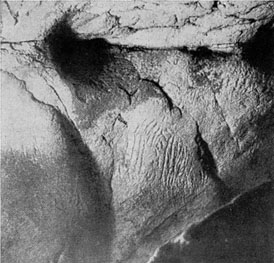 |
Scratch marks of this type were identified at several points in the cave's interior, but always where the walls narrowed. Sometimes vertical and sometimes horizontal, they are visible evidence of a dramatic fight for freedom, escape and survival. Adolf Bachofen von Echt, Austrian palaeontologist, surmised that snares had been laid in these defiles, a laborious task, considering that the everlasting gloom of the cave's interior could have been only sparingly illumined by oil lamps. When a bear was trapped, man would creep up and try to kill it with his primitive stone weapons. The snares were probably made out of bear's sinew, which meant that the animals fell prey to the unyielding strength of their own tough fibres.
|
Man must have laid his traps before a bear entered the cave to hibernate. Then, perhaps carrying a flaring pine torch in one hand, he slipped into the cave in the animal's wake. It must have been an exhausting and dangerous business, following the great beast as it retreated ever farther into the depths, clambering up steep walls of shelving rock until it reached the defile and was caught. Then came the animal's struggle to break loose, the hunter's wary approach, his darting attacks and withdrawals as he tried to deliver the coup de grace. The only way to club a bear to death was to aim for the base of its snout, no easy matter with an animal of the cave bear's elemental strength. Healed fractures in some of the skulls found testify that the hunter occasionally missed his mark during these life-and-death encounters, allowing the bear to break away. One skull, dug up at Brno in Czechoslovakia, had a complete flint embedded in it, which indicates that man used his primitive weapons on the awesome predator at quite close quarters.
Many types of bear were found in the various layers in the Mixnitz cave, among them truly gigantic beasts with skulls two feet long. Skulls of other specimens varied in width from very broad to very narrow. The cave was occupied for a remarkable length of time, perhaps a hundred thousand years, which would explain the enormous quantities and wide variety of remains discovered there.
And in one fairly secluded side passage were found seventeen bears' skulls, all placed carefully in an upright position. We are again reminded of the Swiss and Franconian cave sacrifices.
All sacrifice presupposes a deity. If I had not been told repeatedly by the Tungus of the North Manchurian taiga that the time-honoured practice of offering the skull and marrowbones of their quarry was a sacrifice to the supreme god, I should be doubtful about this, but the sacrifices of the Siberian peoples in the Arctic cultural zone are definitely directed toward an invisible being who is the sky and light and universe - in a word, God.
Cave Bears may have been Carnivorous
Adapted from:http://www.biologynews.net/archives/2008/01/07/cave_bears_from_the_carpathians_as_omnivorous_as_modern_bears.html
Rather than being gentle giants, new research reveals that Pleistocene cave bears ate both plants and animals and competed for food with the other contemporary large carnivores of the time: hyaenas, lions, wolves, and our own human ancestors.
The study, conducted by an international group of researchers, including Erik Trinkaus, Ph.D., professor of anthropology at Washington University in St. Louis, will appear the week of Jan. 7 in the online version of the Proceedings of the National Academy of Sciences.
Cave bears (Ursus spelaeus) have long fascinated paleontologists and anthropologists, given the abundance of their large skeletal remains in Pleistocene hibernation caves across western Eurasia. For the past 30 years, studies of their bones and teeth, and especially the nitrogen isotopes in their bone protein, have concluded that they were largely vegetarian.
The interpretation of them as vegetarian has evoked an image of gentle giants, feeding on berries and roots. However, new nitrogen isotope data from the Peştera cu Oase in southwestern Romania shows otherwise. Although many of these cave bears appear to have been largely vegetarian, the Oase bears and scattered individuals from other cave sites show that they were sometimes as omnivorous as modern brown bears, including North American Kodiak and grizzly bears.
Nitrogen 15 has one more neutron than the more common nitrogen 14. Animals accumulate Nitrogen 15 in their bodies, and carnivores accumulate more of it than vegetarians do. The cave bears in Pestera cu Oase have high Nitrogen 15 levels, suggesting that they were carnivorous, or possibly cannibalistic. It may be that they got the extra Nitrogen 15 from fish, also.
Source : Washington University in St. Louis
The Bear Festival
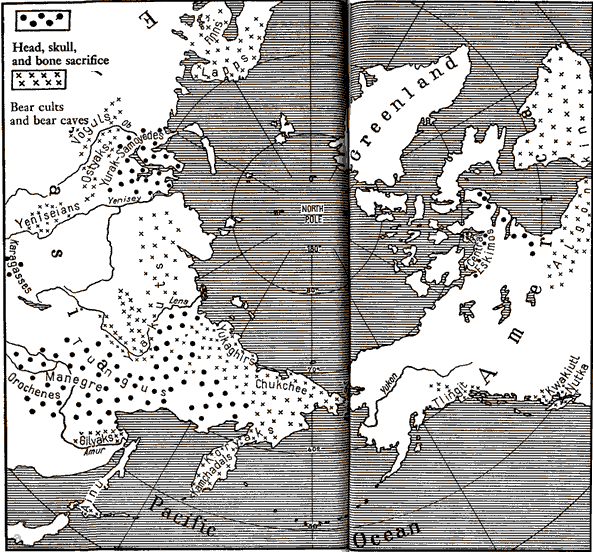 |
The people who since the Stone Age have believed in a supreme being and have sacrificed bones and skulls live on the arctic coast nearest the North Pole. Bear cults, however, originated in a younger, subarctic culture and are found in regions farther south, for example Lapland and Hudson Bay.
|
The Ainus consider that there is One God towering above all, who is the Maker of all others, and to whom all are responsible, for they are His servants and deputies.
J. Batchelor, The Ainu of Japan, London, 1892, P 248
The Orochi on killing the bear say: 'Go fast; go to your master; put a new fur on, and come again next year that I may look at you.'
Sternberg, Gilyaks, P. 439
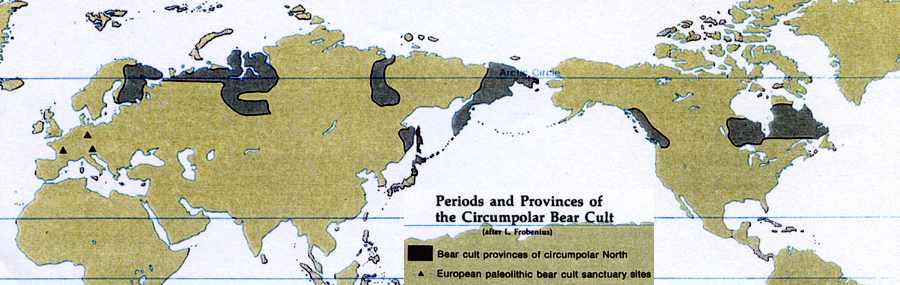 Map of the distribution of bear cults and the text which immediately follows from:
Campbell, Joseph: The way of the Animal Powers (Historical Atlas of World Mythology vol 1) Alfred van der Marck editions, Dist by Harper and Row, SF CA 1983
The earliest evidence anywhere on earth of the veneration of a divine being is in the Alpine bear-skull sanctuaries of Neanderthal Man. A second period and stage is represented in the figures of bears deliberately stabbed in the Magdalenian temple caves of Montespan and Les Trois Frères, and a third in the Epipaleolithic finds of Norway and Denmark.
Across the Eurasian North, the period from 6000 to 2500 BC was an era of climatic optimum, warmer than today, with vegetation zones extending north of their present limits. The bear cult spread northeastward with the advancing populations and is represented in myths and customs from Finland to Labrador.
My thanks to John Saul for leading me to this source.
Page 232
Science has not yet explained the hominid's transition from concrete to abstract thought. If man did not, in Albright's phrase, 'raise himself by his own bootstraps,' some other force must have been instrumental.
I am convinced that the oldest races in the world, food gatherers and hunters, originally believed in a supreme being. This is a fact which many leading modern students of ethnology no longer dispute, and one which brings us very close to the oldest races' traditional belief that man's knowledge of God stems from the Creation itself.
If Western culture has not yet fully accepted the modern scientific realisation that monotheism came at the beginning of human existence, this is due to the general confusion which prevails in humanity's third religious era, the era of idolatry. We are living in the very middle of that era, at the height of an age that corresponds to,the lekan-chaitan ideas of the primitive Siberian peoples. This is not to say that the quest for God has been abandoned. On the contrary, it is very much alive, mainly because faith in God has so largely been destroyed by the onset of all conquering science.
As the knowledge or conviction of a single supreme god gradually waned, so the notion of a lord of the mountains, forests and seas came into being. And the further the supreme god retreated from man's world of ideas and beliefs the nearer to him man wanted to be, in accordance with the age-old belief which has it that absence makes the heart grow fonder.
In consequence, he either summoned the effigy of the primordial god of his recollection down from the skies to the mountaintops or attempted to approach the supreme being via a lord of the mountains. But even this was not enough. Man sought a direct relationship with his lost god, a relationship which no abstract lord of the mountains, forests and seas could supply. In search of a mediator, some of the oldest circumpolar races selected a being who could form the desired link, and this being was the bear. The bear has fulfilled this intermediary function for twenty or even thirty thousand years, and still does among certain circumpolar tribes today.
I was able to explore the vestiges of the bear cult at a time when those who believed in the bear's intermediary function were at the point of extinction. Like all facts that are obliterated by the passage of time, customs, cults and ideas are here today, hearsay tomorrow and lost in the limbo of legend and tradition the day after tomorrow. That is how man's knowledge of God became transformed into faith, and why man's faith has declined with each step he has taken down the ladder of religious development. A little while longer, and the bear cult, too, will be legend, but when I knew them the peoples of the North still had a mediator whom they entrusted with a task in the belief that he would fulfil it.
How to build a bridge between the earth and the lord of the mountains? A live bear cannot be sent to the sacred heights, but a dead bear's soul can wing its way to the place where the fate of the Gilyaks is decided. The bear is not, therefore, sacrificed - as he was in the days of Neanderthal man - but dispatched on a mission. He is only the conveyor of sacrifice, not its victim.
This may explain why the bear is so important in the life of the Gilyaks, and why the prehistoric relationship between man and bear played a role whose significance can scarcely be assessed today and is unknown to the majority of our contemporaries.
Capturing a young bear, the Gilyaks take him back to their settlement and keep him in a cage for two or three years. All the members of the clan know that the little bear is destined for the bear festival, so they treat him as an honoured guest, feed him with all manner of titbits, take him for walks on his chain, bathe him, and generally take an interest in his welfare.
When the day of the bear festival draws near, large quantities of food and drink are prepared for the clansmen and their guests. Every family in the clan shares in the preparations, arranging the place of execution and making the inao or symbolic effigies of mediators between the Gilyaks and the lord of the mountains which are hung on the end of poles in pairs, each pair representing man and wife.
Then comes the festival itself. The bear is taken out of his cage and led from yurt to yurt, being greeted by universal laughter and rejoicing as each family tries to demonstrate the measure of its respect for the animal. However, it is the custom for individuals to tease the growling creature and arouse its fury. A favourite piece of bravado is to grasp the animal's head, kiss it and jump back out of range. If the bear lashes out and scores a Gilyak's shoulder, the wound is regarded as a mark of honour. Finally, the bear is led out onto the frozen surface of the sea or local river to visit the holes where the Gilyaks fish in winter. This guarantees good fishing for the rest of the year.
The bear is led three times around the house of the family which has reared it, after which the master of the house leads it inside, alternately tormenting it with a long stick and addressing it in the friendliest terms.
I assume that this mixture of cruelty and respect is based on the belief that while the animal's flesh has to be tortured and killed its spirit should be treated in a kind and friendly fashion before it sets off on its long journey, because a soul is more easily liberated by torment and agony.
The unfortunate bear is then tied to two posts adorned with inao and left on his own while the Gilyaks go to their yurts to celebrate and the narch-en prepare the bows and arrows which are shortly to send the animal on his way.
Who are these narch-en? The bear festival is known by the Gilyaks as 'bear play.' Alexander Slawik, Austrian ethnologist, records that the participants in a bear festival consist of three clans, each related to the other by a prescribed form of intermarriage.
Clan A draws its wives principally from Clan B and gives its marriageable girls exclusively to Clan C. In this instance, the men of Clan C supply the narch-en. Assuming that Clan A has reared the bear, the festival will be given by Clan A, and Clan C will be the guests of honour. Among the Gilyaks, the bear is always killed by the guests, never by the animal's guardians. Similarly, it is the guests who actually eat the bear and take the greater part of its meat home with them.
Clans A and B represent the bear clans in the ceremony, play or drama, while Clan C represents the human clan. The A and B groups play the part of bears and the C group the hunters. Leo Sternberg also confirms that the actual killing is left to the guests, while the hosts deliberately aim wide of the mark. Alexander Slawik concludes that the ceremonial killing is a dramatisation of the bear hunt in which the hosts represent the bear clans and the guests personify the hunters. This seems highly plausible, but why the sharp division of roles? I believe that it springs from the fear which all northern tribes have of the soul of a slaughtered bear. The division of roles is thus a diversionary maneuver in which the hosts are Gilyaks who, having reared a bear, would never do it any harm, and the guests play the part of strangers. Thus, a bear is sent on its way still well disposed toward its hosts and gives the spirit of the mountain and forest a good report of the Gilyaks, believing itself to have been killed by quite another tribe. The Gilyaks feed a bear extremely well before killing it and entreat it to take the coup de grace in good part. They also wish it a good journey to its master and express the hope that it will gain the mountain heights for the Gilyak clan.
Only then is the animal led to the appointed place, attended by all the male members of the various clans but none of the womenfolk. The best marksmen fire a few preliminary shots at a chosen target while small boys pelt the bear with stones. Suddenly, silence falls. The oldest narch-en, who must also be the best shot, bends his bow, waits until the beast presents its heart to him, and then lets fly. Immediately, several men step forward and shake the bear roughly. Hallowell suggests that this is to accelerate death, but the Gilyaks told me that this shaking is supposed to free the soul from the body.
|
In exactly the same way, the Gilyaks and Ainus tie a bear to a stake and then shoot it with blunt arrows until, finally, the best marksman among them dispatches the beast with a spear thrust or arrow shot in the breast. This image depicts the Gilyak bear ceremony.
|
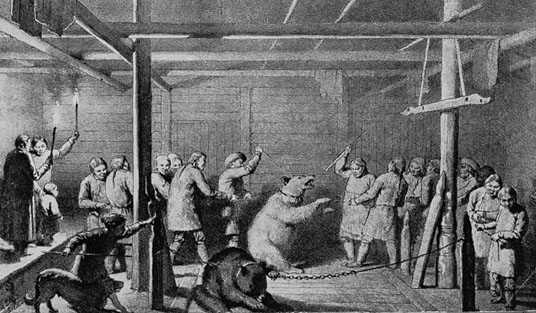 |
The dead bear is then laid in the snow with its head pointing westward, so that it will not be awakened by the rising sun before it sees the lord of the mountains. The Gilyaks proceed to eat small pouches of food which have previously been hung around the bear's body. There ensues the skinning and dismemberment of the carcass according to a strictly prescribed ritual.
|
In the course of the bear festival, the bear is killed and its soul soars to the lord of the forests and mountains. Although the Gilyaks never portray the supreme god in whom they believe, they do make effigies of Pal Nibach, the lord of forest and mountain, and even wear them as a form of amulet.
|
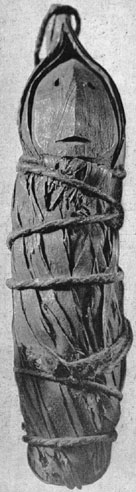 |
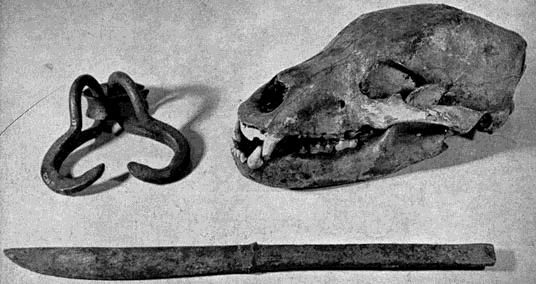 |
After the bear ceremony, the Gilyaks put the animal's skull on the end of a pole and display it at the ceremonial site, preserving it to ensure the bear's reincarnation. The two hooks on the left are used for hoisting the bear's carcass. In the foreground, a Gilyak bear-spear blade, which, like the Orochon's palma, was fastened to a wooden shaft.
|
|
Carved ladle used for serving meat at the bear festival.
|
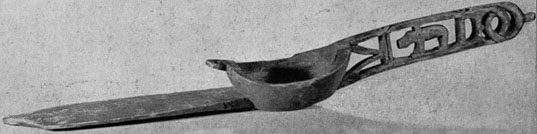 |
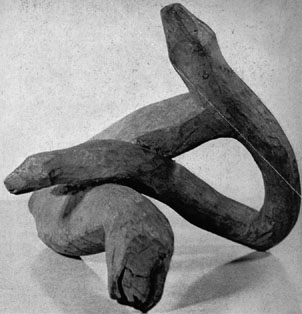 |
Fragment of root, ending in three bear's heads, used for dividing bear's meat. The Gilyaks call this implement a takhai.
|
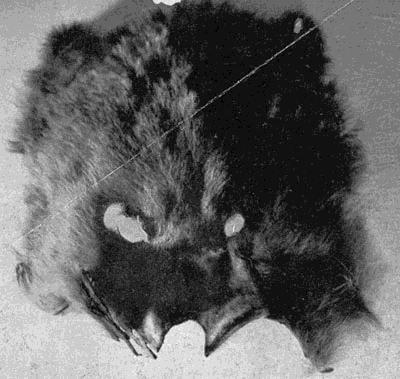 |
|
The Ainu Bear Ceremony
Since I met only relatively few Gilyak men who could give me detailed information about the bear cult, I also visited the Ainus. Torii, the famous Japanese expert on the Tungus, believes that the Ainus of prehistoric times were unfamiliar with the bear cult and only adopted it later from the Gilyaks.
The Ainus live in the north of Japan on the island of Hokkaido, but they used also to live on the now Russian island of Sakhalin and in the Kuriles. Their origins are still unidentified, but they are probably an isolated racial group of Caucasian stock, a very ancient human type related to the present inhabitants of western Europe in build, shape of skull and pigmentation.
I have talked with the Ainus on the island of Hokkaido and visited them in their bleak clusters of squat, thatched and wooden huts, villages and townships with names like Horobetsu, Piratori, Nieptani, Chitose, Yurappo, Oshamamu, Shiraoi and Shadai. Looking into their eyes, which are straight and lack the slanting lids of the Mongol, one might almost take them for Europeans, yet there is something Asiatic or even Polynesian about them, particularly the women.
When I say Polynesian I am not referring to the tattooing which Ainu girls have to undergo at a very tender age. This takes the form of a broad stripe above the upper lip which tapers to a point on either side like a moustache. It is not, however, intended to simulate a strong growth of hair on the upper lip, but is merely a form of personal adornment.
Leo Sternberg espoused the view that the Ainus migrated to Japan from the South Seas, basing his theory on various features of their material culture which are common to the Micronesians and other Pacific races as well. The weaver's loom, the outrigger, the bow formerly used by the Ainu, an ancient type of wooden club, the cradle and various forms of ornamentation - all these are enlisted as evidence of the Ainus' Oceanic origins. However, the Ainu race has lived on the Japanese islands for a very long time and seems to have been installed long before any Polynesians or Mongols ever landed there. Indeed, since it once dominated the whole of the Japanese area, cultural elements such as bow and outrigger may well have been adopted, not transmitted, by the peoples of the Pacific. The Japanese scholar K. Koya assumes, probably with justification, that the Ainus were the exiled offshoot of some main European stock. Attention may be drawn in this connection to strange wooden batons which are peculiar to the Ainus and probably hail from the Palaeolithic period of the Eurasian mainland. These small sticks are about a foot long and are engraved with double circles (perhaps eyes), wavy lines, stylised symbols reminiscent of animals' heads and intricate patterns. The only things of comparable appearance are the horn batons of the Aurignacian and Mousterian. The Ainus' small pointed sticks, which are objects of great reverence, have been called 'beard raisers,' but this description is misleading. The Ainus dip one into a drinking bowl when sacrificing and allow a few drops to fall from it as a libation to the deity. Later, when raising the bowl to their lips, they sometimes use the same small stick to hold their beards away from the rim. Georges Montadon has aptly christened the sticks baguettes de libation or 'libation wands.'
In the seventh century, the Ainus' domain extended as far south as Tokyo, but today they number barely fifteen thousand, all on Hokkaido and most of them intermarried with Japanese. They were still waging a desperate struggle against the Japanese invaders as recently as A.D 720, but were eventually compelled to withdraw into the colder northern regions of Hokkaido, Sakhalin and the Kuriles.
The former masters of all Japan now spend their time carving small wooden bears, stitching the atush, a garment made of elm bark, for foreign tourists, and awaiting their final extinction in wretched huts which have been turned into museums for the benefit of ethnologists. The Ainu language is a rich one, and many Japanese words are derived from it, not least the name of their most sacred mountain, the extinct volcano Fuji-no-yama. A large world of ideas, recollections and ancient rites link the Ainus with the bear, to which they attribute their whole existence, their creation and origin. Their name for the bear is kimum-kamui the word kamui being almost certainly an ancient form of kami, the Japanese expression for divinity. A bear is therefore the 'superior being that dwells amid the mountains,' and he represents the mediator between this world and the next. No animal could fulfil this function better, for none, in the Ainus' opinion, looks more like man or has a more 'human' soul. Consequently,, the Ainus' most important festival is the iomante or 'sending home of the soul.'
Like the Gilyaks, the Ainus capture and rear a bear cub carefully. John Batchelor, the greatest authority on the Ainus, said that he at first refused to believe the story that Ainu women suckled young bears but was later forced to reverse his opinion. Writing at the turn of the century, he declared that he had often seen women giving cubs their breasts. On one occasion, he found himself preaching at one end of a hut while five women sat in a circle at the other, passing a bear cub from lap to lap and each giving it a little milk.
At first, the little bear is kept indoors and taken into bed when it cries at night. When it gets bigger, the Ainus put it in a cage until the day comes for its soul to be 'sent home.' All the inhabitants of the Ainu village and guests from neighbouring settlements assemble for the occasion in ceremonial dress. The invitation runs as follows 'I intend to sacrifice the dear little divine animal that dwells in the mountains. Honoured friends, come to the feast. Let us unite in the great joy of sending home its soul.'
The guests assemble around the fire, drinking in moderation, laughing, dancing and clapping their hands. One of the Ainus then informs the bear that its soul is to be sent to its ancestors.
He begs the bear's pardon and utters the hope that, far from being annoyed, it will ensure that a good bear comes back to be dispatched once more.
'Thou wast brought into the world for us to hunt. We have reared thee with great love. Now that thou are grown, we send thee to thy father and mother. When thou reachest them, tell them how good we were to thee. And come again, we pray thee, that we may sacrifice thee once more.'
After this prayer, the bear is pinioned with ropes and led into the midst of the guests, who sit around in a circle. It is then tied to a stake and shot with blunt arrows or thrashed with a rod called the takusa so that it becomes thoroughly enraged. This torment at the stake continues until the animal's strength begins to wane.
This is the signal for the best marksman present to dispatch the bear with an arrow in the breast, making sure that no drop of blood touches the earth. It is then laid on the ground with its neck between two beams and throttled for good measure. The dead beast is skinned and its meat boiled and ceremonially eaten amid prayers. The head is severed from the skin and impaled on a stake known as the keomandemi or 'stake of dispatch.' Meanwhile, its blood is drunk by the men, who thereby assimilate the animal's strength and virtues and participate in its dispatch.
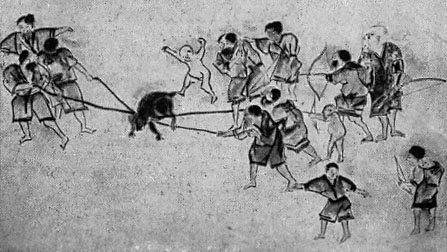 |
The Ainu were still celebrating the bear ceremony in the 20th Century. This picture shows a roped bear being shot with arrows.
|
When, in December, January or February, the bear's soul set off on its journey to the lord of the mountains and forests and the greatest festival in the year had been duly celebrated, the Udehe could look up at the clear image of Pole Star and hope that they had a good advocate in heaven who would guarantee their hunting and their existence in general. Alas, the bear must have failed in his mission, for the Udehe are dying out.
Harva reports that among the Ostyaks and Voguls the bear festival is followed by dancing and dramatic performances in which the Ostyak women run about making fluttering motions with their arms and the Voguls dress up as birds of prey. As Harva says, 'This symptom of primitive hunter's culture, which undoubtedly goes back to the far-off Stone Age, casts light on the prehistory of human histrionics.' We are here confronted by what are probably relics of the earliest form of dramatic art in the world. After feasting off a bear, the hunters place the animal's bones on a raised platform and fire a last shot at the resting place before returning home.
Only about a hundred members of the Olcha, a small tribe which fished and hunted the lower reaches of the Amur between Aofiysk and Bogorodsk, still survive. Both the Olcha and Golds believe that the taiga is inhabited by forest men whom they call duanteni. These forest men are lords of the taiga and of animals. The Russian scholar A. M. Zolotarev surmises that the Gilyaks, Ainus, Orochi, Negidals and Olcha all connect the bear festival with commemoration of their dead kinsmen. The Olcha consider the killing of the bear an act of reincarnation, an act which causes the bear, killed in the festival, to go to his parents, the forest men, and bring them the sacrifices of common men.
The ancient Finns used to bid the slaughtered bear: 'Tell them, when thou comest to thy forest home, that thou hast not been ill treated here but fed on honey and plied with mead.' This and many other passages reminiscent of an erstwhile bear cult are to be found in the ancient Finnish bear songs compiled by Kaarle Krohn.
North American tribes such as the Tlingits, the Kwakiutl, and, above all, the Algonkin celebrate bear festivals much like those of North Asian tribes and are equally careful to adhere to prescribed rituals. This is one of the surest indications that the Tungusic peoples were once linked with the Indian tribes of North America, for the primeval home of all bear cults must undoubtedly have been not North America but Eurasia. There is abundant evidence to suggest that the Algonkin's ancestors were of Siberian origin, and no serious scholar now disputes that the various pre-Columbian migrations to America had their point of departure in Asia. The Wenner-Gren Institute of Anthropological Research in New York has already brought to light interesting information about the transpacific cultural relationships between Asia, Oceania and America, and the Austrian ethnologist Robert Heine-Geldern has demonstrated that the problem of these relationships cannot be solved by rough-and-ready methods like those employed by Thor Heyerdahl of Kon Tiki fame. One cannot talk of America and Polynesia in vacuo and leave the fact of Asia entirely out of the picture.
As we have seen, the same bear cult can be identified at many points around the Pole, though somewhat inland. Some remarkably interesting comparisons can be drawn between various different peoples. For instance, the inland races of Siberia send a mediator to the exalted being who, as lord of the mountains, stands immediately below God. Not only do we find the same bear cult among the ancient tribes of North America, but we catch echoes of it in the Stone Age.
The Ainus and Gilyaks kill a bear by shooting it through the heart or lungs with an arrow. The wounded bear depicted in the cave of Trois-Freres is spewing blood from its snout and muzzle. The Gilyaks stone a bear before killing it. Small ovals on the bear picture in the Trois-Freres cave show where stones are striking its body.
The Ainus shoots a bear with blunt arrows before putting it out of its misery. The bear sculpture of Montespan exhibits indentations made by arrows of this type or other weapons. The Gilyaks hang the skin of a dead bear on a framework. The same applies to the bear sculpture of Montespan.
It must be regarded as one of the greatest marvels elicited by the modern study of prehistory that both customs - the sacrificing of bears' skulls seventy thousand years ago and the bear cult of about thirty thousand years ago have been rediscovered in the Stone Age. We have proved that the skull and marrowbones of the bear were sacrificed during the Mousterian. At that time, some seventy thousand years ago, man - probably Neanderthal man - was apparently sacrificing to a supreme god, and sacrificing just as the people of the Arctic coastal cultures still do today, so long afterward.
And in the Aurignacian and Magdalenian, thirty or twenty thousand years ago, bear cult rites were being performed much like those which I have seen at the great bear festivals of the Gilyaks, Ainus and other representatives of the so-called inland cultures. It cannot be mere chance that the bear cult of our own day and that which we have identified in French caves bear so striking a resemblance to one another. Three hundred thousand years ago in Peking, seventy thousand years ago in the Alps and thirty thousand years ago in southern France (and probably eastern Asia) man believed in a supreme god. There may still be room for doubt where Peking man is concerned, but in the case of Neanderthal man and Cro-Magnon man this faith stands proved, even if the god of twenty or thirty thousand years ago was looked upon only as a lord of the mountains, beasts and water.
Thus, animals were not painted solely in order to encompass their destruction. At least, not all of them were portrayed for the purpose of gaining power over them, for they were proteges of a father of animals and hunting, of a universal father of nature behind whom, invisible to us and unportrayable by the men of the Stone Age, stood God. This was the idea upon which the cave painter drew for inspiration. Man did not raise art to the remarkable heights represented by Altamira and Lascaux out of selfish and petty motives alone.
If we find it hard to grasp that the hunters of so long ago had more in mind than edible game, we must remember that mankind's spiritual striving has waned as his acquisitiveness has grown. We are far away from Creation, but the men of five hundred thousand years ago were near it. Believing in a single god, they were impelled to build an artistic bridge to him twenty thousand years ago. Today, we are so far from our erstwhile link with the creative force that no bridge can span the gulf.
That the caves were sites not of magical activity but of religious or cult observance is demonstrated by two amazing works ascribed to Magdalenian man. The Montespan cave in Haute-Garonne contains the clay figure of a bear. It is not a particularly beautiful piece of sculpture. The discoverer of the Trois-Freres cave, Count Begouen, famous French prehistorian, compared it with the sort of shapes children make in the snow. The Magdalenian artist had not displayed any great virtuosity, nor had he produced anything as realistic as the splendid pair of bison at Tuc d'Audoubert. Nevertheless, 170 yards from the mouth of the Montespan cave in the small low-roofed chamber at its far end, Stone-Age man must have had something special in mind. His bear had no head, yet there is absolutely no doubt that figure was planned and executed as such from the beginning. There it lay on the floor of the cave like an unwieldy sphinx with its thick forepaws stretched out in front of it - and between them Count Begouen found the skull of a real bear.
|
An amazing similarity exists between bear ceremonies performed some 20,000 years ago during the Madelanian, and the Gilyak festivals from our own era. Deep in the interior of the Montespan cave (Houte-Garronne) Count Begouen discovered the headless clay figure of a bear. Between its forepaws lay the fallen skull of a real bear which had once been attached to the figure itself. Thirty or so deep circular holes visible on the sculpture are assumed to be traces of spears or arrows used in the bear ceremony of 20,000 years ago.
|
|
But this is not all. The sculpture was pockmarked all over with round, deep holes which looked as though they had been made by fingers or sticks. These thirty indentations suggest that the figure had been ritually speared or shot with arrows.
The Trois-Freres cave (Montesquicu-Avantes, Ariege) was discovered in 1914 by Count Begouin and his three sons, after whom it was named. This cave contains a great wealth of rock paintings situated more than five hundred yards from its mouth. Among them is one of a bear with a thick stream of blood flowing from its muzzle. The animal is obviously in extremis. Its body is dotted with small circles and ovals to represent the stones which have struck it, and it has also been wounded by arrows. One of these must have penetrated a lung, for only this would explain the stream of blood gushing from its snout and muzzle.
The Austrian palaeontologist Othenio Abel includes two further portrayals of mortally wounded bears in a group which he ascribes to a single cult, and it is interesting to note that only bears and no other animals figure in this sanguinary type of picture.
From:
http://www.archive.org/stream/worldofcaves027512mbp/worldofcaves027512mbp_djvu.txt
Pages 118 - 125 from the book "The World of Caves" by Anton Liibke, translated from the German by Michael Rullock COWARD-McCANN, INC. NEW YORK.
First American Edition 1958, first published in Germany under the title GEHEIMNISSE DBS UNTERIRDISCHEN by Kurt Schroeder Verlag, Bonn
English translation 1958 by George Weidenfeld and Nicolson Ltd, Library of Congress Catalog Card Number 58-10,074
The Home of the Cave Bear
Skeletons of the prehistoric great cave bear are almost never missing from amongst the faunal remains in European caves. The cave bear seems to have been distributed all over Europe, for its remains have been found in German and British caves as well as in the Pyrenees and the south-east. To judge by the frequency with which its skeleton occurs, the cave bear must have existed in stupendous numbers during the Ice Age. Just as the hyaena of today is allied to the prehistoric cave hyaena, so the modern brown bear (Ursus aretos) is descended from the great cave bear (Ursus spelaeus). Unlike the brown bear, however, the cave bear was a beast of prey. It is also clear from the skeletons that the cave bear was considerably larger than the brown bear. It was, in fact, a gigantic beast, as large as a bull, but with bones far more ponderous than those of an ox, and huge muscles. Many of the skulls found show canine teeth the size of bananas. When full-grown it reached a length of ten feet and stood five feet at the shoulder. With its long, shaggy hair and five strong, non-retractile claws on each paw it must have presented a truly terrifying sight. Norbert Casteret, who has devoted much study to reconstructing the habits of these formidable beasts from their remains, points out that, secure in their great strength, they had no need to drag their prey into caves like most animals, but devoured it in the open air. This is evident from the fact that no food debris ever accompanies the cave bear skeletons in caves.
One of the most noteworthy bear caverns in Europe is the Karlshohle at Erpfingen in the Swabian Alps, discovered in 1834 by a school-teacher named Fauth. One particular cavern of the Karlshohle was given the name 'Bears' Cave' because of the quantity of bears' skeletons obtained from it. This cavern, a continuation of the Karlshohle, was not discovered until 1949. The old Karlshohle is a stalactite cave; for many decades it was pillaged both of stalactite formations and of remains of cave bear. The Bears' Cave escaped this fate, so that bear skulls and skeletons may still be seen there in situ in great numbers. The Karlshohle comprises seven great chambers, of which the first is twenty to thirty feet high and thirty to sixty feet wide, while Hall VI, the finest of the lot and containing the greatest number of bear skele- tons, is fifty feet high and seventy feet wide. Hall I, which is lit from above by the so-called Fauth's Hole, is notable for the fact that a fifteen-feet-high pile of rubble underneath this hole was found to contain no less than fifty human skeletons, believed to be those of plague victims thrown down the shaft. They are accompanied by the bones of a quantity of domestic animals. It looks as though the shaft had once been used by a knacker. Hall II contains an ancient hearth with wood charcoal and the charred bones of deer and pig, evidence of human occupation at some period.
The Karlshohle is a good example of a stalactite cave with splendid cascades, curtains, organ pipes, embossments, cones, and lacework, many of them in bright colours. Hall VII is geologically remarkable. In it stands a beetling crag which is not, like the rest of the cave, white Jurassic lime- stone, but thick calcite interspersed with layers of biggish calcite crystals, some of which are transparent or snow- white, while others are clouded and coloured by iron com- pounds.
The Bears' Cave, which opens out of the Karlshohle and is reached by ascending a slope of flowstone, was the true abode of the cave bear. A large number of bear skeletons lie beneath a covering of flowstone (layers of calcite, which is crystalline calcium carbonate deposited from thin films of saturated calcium carbonate solution, set hard after loss of carbon dioxide and evaporation of water) at the entrance to the cavern. A three-feet-high hollow stalagmite of calcite has formed on one pelvic bone. One of the finest and most impressive parts of the cavern is the 'Great Half, measuring thirty-three feet in height and a hundred in width and filled with stalactites and stalagmites, particularly the latter. A multitude of small straw stalactites cover the ceiling, and at one point a row of longer stalactites betray a crack in the rock through which the water perpetually seeps. The present floor of the cave is covered over with flowstone, in which are embedded a large number of bear bones skulls, jawbones, shoulder blades, spines, three pelvises, and thighbones. The complete skeleton of a bear assembled by Professor von Huene of Tubingen University, from bones found on the spot, stands in the centre of the cavern and adds to its impressiveness.
In the niche of the Great Hall, six bears' skulls were found one on top of the other. It is thought that the bears used this cave to hibernate in. This is probably where their young were born, and here they found their last resting-place. Amongst the chambers of the Bears' Cave, in addition to the Great Hall, the 'Great Sinter Dome' is especially remark- able. A fifty-foot vertical shaft leads into this cavern. In the course of the years, the water that poured down this shaft, whirling sand and shingle along with it, has carved corkscrew forms in its walls. Today this chimney issues in the topmost peak of the mountain.
The multitude of stalactite formations and the manifold shapes moulded by the deposition of calcite, coupled with the wealth of cave bear remains, render the Erpfingen Bears' Cave an unparalleled natural monument. It affords a direct and magnificent impression of the abode of the most widely distributed of cave creatures, the cave bear, and of its physical structure. Comparison of the mass-finds of cave bear in the Bears' Cave and other caverns in Europe as far as the Caucasus, and in North Africa, with the finds of other greater or lesser beasts of prey among its contemporaries, strongly suggests that the cave bear unlike modern beasts of prey or the generally solitary bears of today was gregarious. It is clear that the cave was a living-place, for among the bones of full-grown bears were many skeletons of half-grown cubs or sucklings. This assumption is confirmed by finds in other caves, for example the Nikolaushohle at Veringstadt, the cavern of Hohefels near Schelklingen, the Hepenloch at Gutenburg, and the cave at Velburg in the Upper Palatinate. Many caves contained prodigious quantities of bears' bones. The bone- and dung-impregnated cave earth of the Drachenhohle, or Dragon's Cave, at Mixnitz in Styria, yielded so much high-grade phosphatic fertilizer that sixty goods trains of fifty wagons each were needed to take it away.
Another region once inhabited by the cave bear, and still the haunt of its descendant the brown bear, is the Pyrenees. Every major palaeontological collection in France contains a complete skeleton of the cave bear, from which its great size may be seen. In the caverns of the Pyrenees bear skeletons are found in clay, not, as at Balve, under flowstone. The wide distribution of the finds and the depths to which the animal penetrated indicate that the bears explored every corner of the cave systems. Norbert Casteret reports finding the mark of bears claws on walls and floors covered with clay or delicate stalagmite deep in the heart of the mountain and even in narrow vertical passages, or chimneys.
'In the caverns of Planque (Haute-Garonne),' writes Gasteret, 'two hundred and thirty feet below ground, I found the skeletons of two bears which had fallen into one of the lower pits with vertical walls, and which died of hunger after violently scratching the rock in attempts to climb out.'
Similar clear traces have been found in many Pyrenean caves, including the famous Trois-Frres and the 'oubliettes' of the caverns of Gargas and Montespan. The marks of bears' paws in the clay, which has set hard with the passage of time, have been observed at many points. In the cavern of the Tuc d'Audoubert, which was a favourite resort of the cave bear, Count Begouen discovered what he has christened 'the bears' toboggan slide' a clay slope plunging into what used to be a small pond, though it is now dry. There is every sign that the bears used to go sliding down this slope and land in the muddy water. The marks of the hair of the bears' fur are still visible in the once plastic clay. Arctic explorers have watched polar bears indulging in this sport, to which seals are also addicted, on slopes of ice. Where opportunity offers, they may be seen amusing themselves in this way in zoos.
Gasteret also reports that cave bear found diversion in the bear dance, as the modern bear does today when bored by solitude or captivity. The bear dance consists in a perpetual rocking to and fro with the head swaying in unison. Signs of this dance are visible in the cave of Pene-Blanque (Haute-Garonne), 3,250 feet up in the Massif d'Arbas, in the shape of innumerable overlapping prints of its four paws in the clay, made as it shifted restlessly from side to side for hours on end during its long hibernation.
The number of artistic representations of the cave bear are surprisingly few in relation to its obvious numbers and ubiquity. This is attributed by Casteret to the existence of some magical taboo due to fear of the animal. He believes that 'the few depictions of cave bears which do exist were plainly the work of witch-doctors specially authorized to draw the accursed creature' .
The first representation of a cave bear was discovered by Dr. Garrigou in the Pyrenean Grotte de Massat (Ariege), where a large number of bear skeletons were also found. It is an engraving on a pebble of a bear rising on its hind legs in a menacing attitude, which is enhanced by an expression of ferocity on the face.
Several other portrayals of bears have come to light. The cavern of Marsoulas contains a full-face engraving, and a similar drawing engraved on a reindeer antler was found by the well-known speleologist fidouard Lartet in the Grotte de Massat. It is now in the Toulouse Museum. The cavern of Les Trois Freres, so often referred to already, also contains a drawing of three bears on the rock wall. They have all been disfigured, probably in the course of some obscure magic rite, and one of them is shown with a bison's tail and the spots of a leopard or hyaena.
The cave bear must have been an almost invincible opponent to prehistoric man, with his primitive weapons. When he succeeded in slaying one of these formidable monsters it meant not only a welcome source of meat and clothing, but also the accomplishment of a truly heroic deed. As an aid to the incantations designed to give them power over their adversary, the ancient hunters did not content them- selves with engraving the bear on the walls, but also made three-dimensional or high relief representations of him carved in rock or modelled in clay. Thus a small bear's head carved in rock has been found in the grotto of Isturitz (Basses-Pyrenees), while a clay statue of a cave bear has been obtained from the cavern of Montespan. The latter, which is headless and riddled with spear-holes, has evidently been mutilated in the course of prehistoric magic rites.
There remains the question of how the cave bear died out. It is not likely to have been exterminated by prehistoric man with his primitive weapons. Plenty of evidence points to its extinction having been due to degenerative disease. A large number of diseased bones and the remains of strikingly under-sized bears were found in the Drachenhohle at Mixnitz in Styria. The prehistorian O. Abel concluded from this that the whole species of Ursus spelaeus underwent a process of degeneration. 'Ursus spelaeus seems to have succumbed to a disease, for no migration can be traced' confirms Norbert Casteret. He surmises that the cave bear fell victim to a wave of extreme cold that swept across his habitat and brought with it degenerative disease and malformation of the bones.
The Museum of Natural History at Toulouse possesses a unique collection of diseased bear bones, in the shape of deformed jaws, joined vertebrae, shoulder blades encrusted with bony tumours, and limb bones distorted by arthritis.
Just when this crippling malady developed and how long it took to wipe out the species cannot be said for certain. It was probably a rapid process which took place when a period of intense cold forced the bears to shelter for long periods in damp caves, where they contracted rheumatism and gout.
The number of caves containing quantities of bear skulls, but no complete bear skeletons, suggests human handiwork. The absence of any trace of man in these caves is not conclusive evidence to the contrary. The drawings and models in the Pyrenean caves demonstrate that man once used the caverns, in which bear remains have been found, for ritual purposes. In many bear caverns the skulls of bears lie side by side on plinths or in niches in the cave walls. This is the case in the Karlshohle Bears' Gave at Erpfingen, the well known caverns of the northern Harz Mountains, and else- where. In the Drachenloch near Vattis, the Wildmannlisloch on the Selun (Switzerland), and the Petershohle near Velden in central Franconia bear skulls have even been found packed in a kind of box of stone slabs or piled up in niches in the rock. These are certainly not hunting trophies, which would have been displayed outside the cave. 'They are more likely to be evidence of a fully developed cult of this animal, which was so useful to man, a totemistic cult in which the bear appears both as a creature to be hunted and an object of veneration. Corresponding practices still live today among modern hunting peoples in Northern Asia. It may therefore be assumed that many bear caves were not places to which the bears went to give birth or die, but the sites of a cult that approaches the earliest forms of religious thinking. (Professor Friedrich Behn in Die Umschau, No. 22, 1950.)
We do not have to look as far back as the Ice Age to see the position occupied by the cave bear. The ancient Greeks considered the bear the strongest animal of the forest and held it sacred to the goddess Artemis. In ancient Nordic, Slav and Finnish popular belief the bear was regarded as holy. As a symbol of strength it was sacred to Thor, who himself bore the name of the beast : Bjorn. It was believed that the strength of the bear could be acquired from bear's blood. In olden days curative powers were attributed to the teeth, fat, gall and claws of bears. In the Middle Ages, bear hunting was still looked upon as a knightly exercise, and the heraldic bears in the arms of the cities of Berlin, Bern and Bernburg no doubt date from that time.
References
- Bocherens, H. et al., 2004: Diet reconstruction of ancient brown bears (Ursus arctos) from Mont Ventoux (France) using bone collagen stable isotope biogeochemistry (13C, 15N), Can J Zool, 82:576-586.
- Hedges R., Stevens R., Richards M., 2004: Bone as a stable isotope archive for local climatic information, Quatern Sci Rev, 23:959-965. doi:doi:10.1016/j.quascirev.2003.06.022
- Liden, A., Angerbjörn A., 1985: Dietary change and stable isotopes: a model of growth and dormancy in cave bears, Proc. R. Soc. Lond. B, 7 September 1999 vol. 266 no. 1430
- Richards M. et al., 2008: Isotopic evidence for omnivory among European cave bears: Late Pleistocene Ursus spelaeus from the Peçstera cu Oase, Romania, Proc Nat Acad Sci USA, doi:10.1073/pnas.0711063105
- Yuichi et al., 2016: Evidence for herbivorous cave bears (Ursus spelaeus) in Goyet Cave, Belgium: implications for palaeodietary reconstruction of fossil bears using amino acid δ15N approaches, Journal of Quaternary Science, 2016; DOI: 10.1002/jqs.2883