 Back to Archaeological Sites
 Back to the review of hominins
Mousterian (Neanderthal) Sites
Neanderthals, Homo neanderthalensis, were the dominant hominid inhabiting most of what is now Europe and western Asia. Remains have been found as far south as Iraq and as far north as Great Britain. Fossil skulls reveal the distinctively prominent brows and missing chins that set them apart from later humans. An exhibition of neanderthal skeletons at Les Eyzies, with many important skeletons brought together for the first time, included the Ferrassie, Kebara, Moustier, Roc de Marsal, Regourdou, Saint Césaire and Combe-Grenal original skeletons.
 Central European sites, including many Neanderthal sites
 Neanderthals went diving for shells to turn into tools, according to new research, suggesting our big-browed cousins made more use of the sea than previously thought. Dating of animal teeth found within layers alongside the shell tools suggest they are from about 90 000 to 100 000 years ago - a time when only Neanderthals are thought to have been present in western Europe. The tools had previously been thought to have been formed from shells collected by Neanderthals from the beach where they had been tossed by waves. But now experts have peered at the shell tools through microscopes, revealing many do not show the wear and tear that would be expected from such a fate, such as the presence of barnacles or marks on the shells.
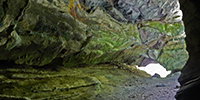 Gudenushöhle (Gudenus cave) is a very important Neanderthal site situated 20 km northwest of the city of Krems, and has been dated to around 90 000 BP. The site is close to the River Danube. The cave is 22 m long with a width of 2 to 3 m. The archaeological deposit has yielded bones of numerous animals, including Woolly mammoth, Woolly rhinoceros, Aurochs, Chamois, Reindeer, and Red deer. Human artefacts include numerous flint implements beginning with the Mousterian (i.e. Neanderthals) of the Middle Palaeolithic. There is also an Upper Palaeolithic, Magdalenian, assemblage including an engraved reindeer bone, and a fragment of a bone flute dated to about 18 000 – 12 000 BP.
 When Neandertals were first described on the basis of skeletons found in the Neander Valley in Germany, they were presented as not quite human. Steadily, evidence has grown that Neandertals had most of the cultural abilities of anatomically modern humans. What has been missing up until now is evidence of their artistic ability, in particular art on the walls of caves, such as is much in evidence for anatomically modern humans, such as those from the Magdalenian. Finally this lack has been rectified, with discoveries of Neandertal paintings in three separate caves in Spain.
 The premolar, unerupted tooth of a Neanderthal child, Wezmeh 1, has been identified from Wezmeh Cave, Iran. The child is estimated to have been between 6-10 years old, and the tooth is believed to be from a child taken as prey by a hyena elsewhere, and consumed in the cave.
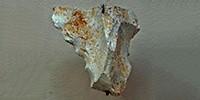 The Mousterian of Eastern Europe - Mousterian hand axes were found at Kadova u Mor, Krumlov, Určic u Prostějov and Lubná u Kroměříže in the Czech Republic, and Kůlna Cave in the Moravian Karst is an important site. The full range of Mousterian tools are found in this area, including tools with notches and teeth, of the type known as the Denticulate Mousterian.
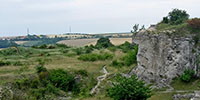 The Bohunician is an Initial Upper Palaeolithic culture, incorporating elements of the Mousterian with the lower Aurignacian. The term 'Bohunician' is derived from the word Bohunice, the name of a suburb in the western part of the city of Brno, where this specific industry was first investigated. The stone tools often were produced from Levallois blade cores with hard-hammer percussion and include many forms considered typical of Upper Paleolithic industries associated with modern humans (that is, end scrapers and simple burins), as well as Levallois points and side scrapers. Some assemblages also contain bifacial leaf-shaped points (more common in the northern sites).
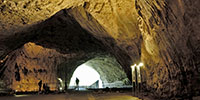 Kůlna Cave forms a massive tunnel on the eastern slope of the Sloupské Valley. The researches of the Anthropos Institute brought not only extensive collections of Middle Palaeolithic tools and at the same time the oldest evidence of the settlement of the Moravian Karst, but also the most numerous remains of Neanderthal man in the Czech Republic.
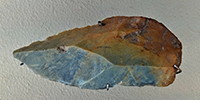 The Szeletian culture is an outgrowth of the Mousterian, similar to the Châtelperronian, an industry with elements of both the Mousterian and the Aurignacian. The Szeletian culture was widespread in what is now Hungary, Czechoslovakia, and southwestern Poland, and its influence can also be seen at a number of places in Romania and Bulgaria. Named after the Szeleta cave in the Bükk mountain massif in northern Hungary, the Szeletian culture developed mainly from the local Mousterian culture and for a time was contemporaneous with the Aurignacian culture. It was succeeded by the Gravettian cultures. The Szeletian culture is characterized by leaf-shaped, bifacially flaked flint spearheads, Mousterian side-scrapers, and vestiges of the Levalloisian flaking technique.
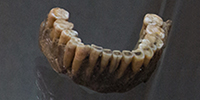 Švédův Stůl Cave is a short 'through cave' in a rock block (hence the name Swede's Table). Besides cave bears, hyenas and other animals inhabited the cave as well as Neanderthals 100 000 years ago. In the portal cave Švédův Stůl in the valley of the Hádacky brook, Karl Kubásek discovered part of the mandible of an adult Neanderthal a well as a few Mousterian artefacts in 1905. In 1953-55, when the soil was cleared from the entire front hall, B. Klíma finally found the mid-Palaeolithic artefacts.
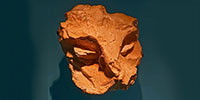 Other Mousterian (Neanderthal) Sites, including la Roche-Cotard, Biache-Saint-Vaast, Grotte de loup, Les Pradelles/Marillac, Gorham's Cave, Arcy-sur-Cure, Grotte du Lazaret, and Molodova.
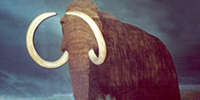 La Cotte de St Brelade is a Neandertal site in St Brelade, Jersey. Neanderthals lived there from around 250 000 years ago until between 100 000 and 47 000 years ago - making it he earliest known the occupation of the Channel Islands by a hominin species, and also possibly one of the last Neanderthal sites in northwestern Europe. At that time, with sea levels below those at present, Jersey was part of Normandy, a peninsula jutting out from the coast. After the last Ice Age the sea rose again, separating Jersey from the mainland.
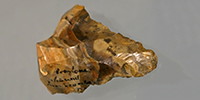
It is sometimes forgotten that Britain has had a long history of hominin occupation, reaching back to possibly one million years BP or earlier.
This page shows a few of these Mousterian and pre-Mousterian tools and sites from Britain.
Last updated Thursday 04 January 2024
 The original Neanderthal skeleton found in 1856 in the Neander Valley in Germany consisted of a skull cap, two femora, three bones from the right arm, two from the left arm, part of the left ilium, fragments of a scapula, and ribs. The workers who recovered this material originally thought it to be the remains of a bear. This discovery is now considered the beginning of paleoanthropology. These and other discoveries led to the idea these remains were from ancient Europeans who had played an important role in modern human origins. The bones of over 400 Neanderthals have been found since.

Roc de Marsal, a Neanderthal site in the Dordogne. The three year old child discovered in 1961 here was well preserved, and with a date of around 70 000 years BP it is one of the oldest burials of the Perigord.
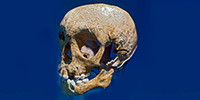
The Pech-de-l'Azé I skull and mandible are included in the juvenile Neandertal remains from Europe. However, some preserved features in the cranial skeleton seem to distinguish the specimen from other Neandertal children. The Pech-de-l'Azé I Neandertal child was discovered at the bottom of layer 6, attributed to the Mousterian of Acheulean tradition type B. This skull and mandible are the first diagnostic human remains (aside from an isolated tooth) attributed to the Mousterian of Acheulian tradition (MTA) type B.
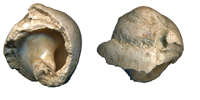 A fossil marine shell, Aspa marginata, was discovered in a Mousterian layer of Fumane Cave, northern Italy, and was dated to 47 600 cal BP. Analysis shows that this fossil gastropod was collected by Neandertals, at a Miocene or Pliocene fossil outcrop, the closest of which is located more than one hundred kilometres from the site. The shell was smeared with a pure, finely ground, hematite powder, probably mixed with a liquid. It was perhaps perforated and used as a personal ornament before being discarded, lost or intentionally left at Fumane Cave, some 47 600 - 45 000 cal BP. The minimum age of the Fumane unit in which the Aspa marginata was found predates the oldest available dates for the arrival of anatomically modern humans (AMH) in Europe, thus supporting the hypothesis that deliberate transport and colouring of exotic objects, and perhaps their use as pendants, was a component of Neandertal cultures.
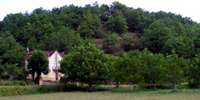
Combe-Capelle, a Neanderthal site in Southern France
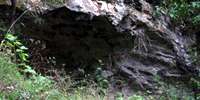
Combe Grenal - a Neanderthal site in the Dordogne valley, France
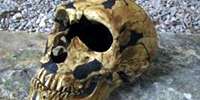
La Ferrassie Neanderthal skeletons and Rock Shelter
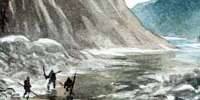 La Quina is a Neanderthal site located in the Charente region of south-western France. The artisans of the La Quina Mousterian industry type (thick asymmetric tools transformed many times) had a particular way of life: they were hunters specializing in the hunt for Reindeer or Bison, and they moved following the herds. Their prey was generally transported, either all or in part, back to their base camps, caves or shelters.
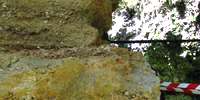
La Micoque open air Neanderthal site
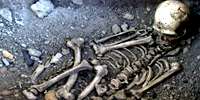
The Neandertal skeleton from La Chapelle-aux-Saints
 Le Moustier Neanderthal skeletons - Neanderthal man lived in these rock shelters overlooking the small town of Le Moustier in the Dordogne, and gave its name to a characteristic Neanderthal tool set and culture, the Mousterian. Le Moustier is on the right bank of the Vezere at its confluence with the Vimont valley. Village houses rise in tiers on the rocky steps of the limestone outcrops at the angle formed by the two valleys.
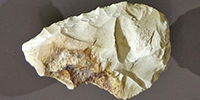 Le Moustier is the type site for the Mousterian suite of tools and artefacts, and is a Neanderthal site. This is the pick of the collections of tools there by Peyrony. It is of interest primarily to those specialising in le Moustier and the lithic industry of the Mousterian.
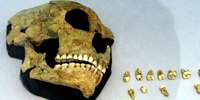
St Césaire Neanderthal Skeleton
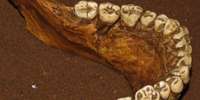
Le Regourdou is one of the most important Neanderthal sites in France. Excavated by Georges Laplace and Eugene Bonifay, the bones of Le Regourdou 1 are the remains of a young Neanderthal adult, of undetermined sex, from the beginning of the last glaciation, about 90 000 years ago. The archeological site of Regourdou is located on the same hilltop as Lascaux, 800 metres from the famous caves.
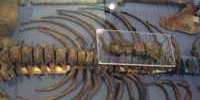 The neanderthal skeleton from Kebara in Israel
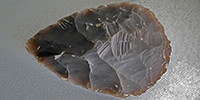 The earliest evidence of human life in Schleswig-Holstein occurred 120 000 years ago. At Drelsdorf in the district of Nordfriesland, the stone tools of a group of Neanderthals, who camped here 120 000 years ago, were discovered. In the subsequent ice age, the site was located in front of the ice sheet edge. The extremely cold climatic conditions have changed the surface of the artefacts in a characteristic way, giving them a patina they would not otherwise have.
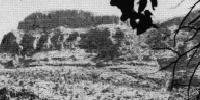
Neandertal skeletons at Shanidar Cave in Iraq
Spy Cave is the site of an important discovery of Neanderthal remains, in particular the skeleton of Spy 2, a young male. They are the youngest Neanderthal remains in Europe, at around 40 000 BP.
The premolar, unerupted tooth of a Neanderthal child, Wezmeh 1, has been identified from Wezmeh Cave, Iran. The child is estimated to have been between 6-10 years old, and the tooth is believed to be from a child taken as prey by a hyena elsewhere, and consumed in the cave.

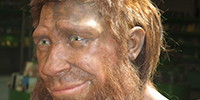
Models of Neandertals in Museums
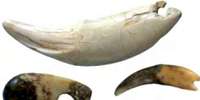
Neanderthal Symbolism - this is a translation of an excellent article discussing artefacts from many Neanderthal sites