Back to Don's Maps
Back to Venus figures from the Stone Age
Avdeevo - a Paleolithic site with strong links to Kostenki
The Avdeevo venus figures are quite variable, but most depict mature women in various stages of the reproductive cycle. Avdeevo is located on the Sejm River near the city of Kursk, Russia. Two oval living areas surrounded by semisubterranean lodges and pits have been identified at Avdeevo. Both were occupied between 21 000 and 20 000 BP. The tool inventory consists of Kostenki knives, shouldered points, and leaf points on blades.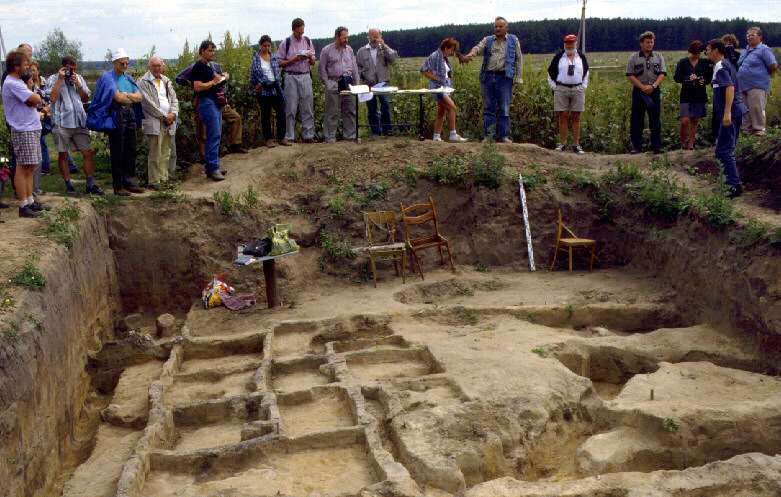
Photo: www.ccma.csic.es/dpts/suelos/hidro/glocoph/newsletterno2.pdf
The Palaeolithic site of Avdeevo, on the left bank of the Rogozna River (23-22 ka BP) is worthy of special attention because of its links between the Paleolithic sites of Eastern and Central Europe. On the Russian Plain it is possible to distinguish sites belonging to the Kostenki-Avdeevo archaeological culture, and among them to distinguish sites definitely belonging to the same stage. The absolute similarity of all their components - type of settlement, flint and worked-bone tools, art objects - argues more for total identity than simply for typological affinities. Research at the site was conducted from 1946-1949 and from 1972 on. Two oval living areas surrounded by semisubterranean lodges and pits have been identified at Avdeevo. Both were occupied between 21 000 and 20 000 BP. The tool inventory consists of Kostenki knives, shouldered points, and leaf points on blades. There is a well preserved series of worked bone objects which differ in details from those found at Central European sites assigned to the Kostenki-Willendorf cultural unity. They include numerous bone awls and points of various types, burnishers and shovels, diadems and bracelets, as well as beads and decorated points. Non-repetitive or unique objects are relatively rare.
Much of the information on this page, including the text below, is adapted from the excellent monograph 'Art of the Mammoth Hunters: The finds from Avdeevo' by Professor Mariana Gvozdover, Oxbow Monograph 49, 1995.
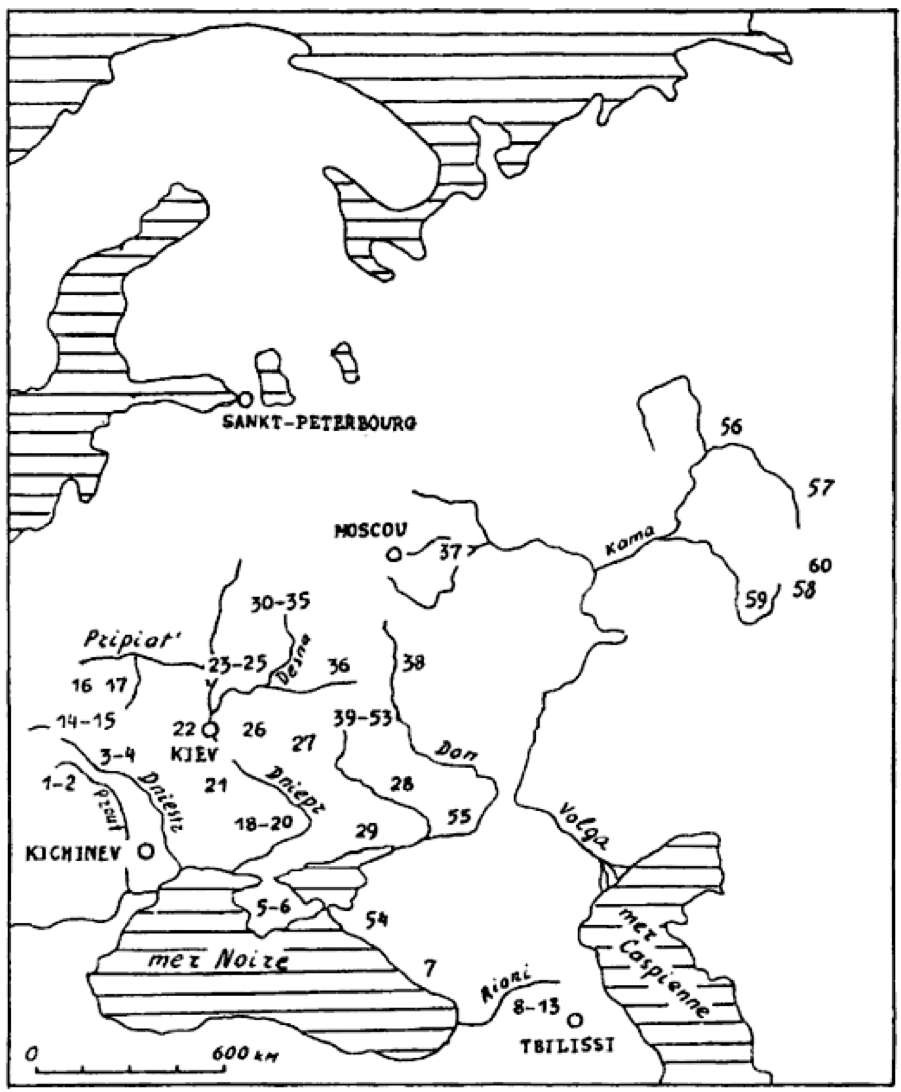
Distribution of mobile art in Eastern Europe.
1 Staryé Duruitory, 2 Brynzeny, 3 Kosseoutzy, 4 Klimaoutzy, 5 Suren' 1, 6 Chan-Koba, 7 Apiantcha, 8 grotte d'Uvarov, 9 Sakagia, 10 Sagvardgilé, 11 Gvardgilas-Kldé, 12 Devis-Khvreli, 13 Taro-Kldé, 14 Molodova V, 15 Lissitchniki, 16 Lipa VI, 17 Klinetz, 18 Ossokorovka, 19 Dubovaya Balka, 20 Kaïstrovaya Balka, 21 Mejiritch (Mezhirich), 22 Kievo-Kirillovskaya, 23 Mézine (Mizyn), 24 Novgorod Severskyi, 25 Puchkari I, 26 Dobranitchevka, 27 Gontzy, 28, Rogalik, 29 Amvrossievka, 30 Eliseevitchi I, 31 Eliseevitchi II, 32 Yudinovo, 33 Khoylevo II, 34 Timonovka, 35 Suponevo, 36 Avdeevo, 37 Sungir', 38 Gagarino, 39 Kostienki 19, 40 Kostienki 21, 41 Kostienki 13, 42 Kostienki 1, 43 Kostienki 14, 44 Kostienki 12, 45 Kostienki 17, 46 Kostienki 2, 47 Kostienki 11, 48 Kostienki 4, 49 Kostienki 15, 50 Kostienki 9, 51 Kostienki 8, 52 Borchtchevo 1, 53 Borchtchevo 2, 54 Ilskaya, 55 Murakovka, 56 Ostrovskaya, 57 Bez'imyannyi, 58 Smelobskaya, 59 Kapova, 60 Ignatievskaya.
Photo: Abramova (1995)
Introduction
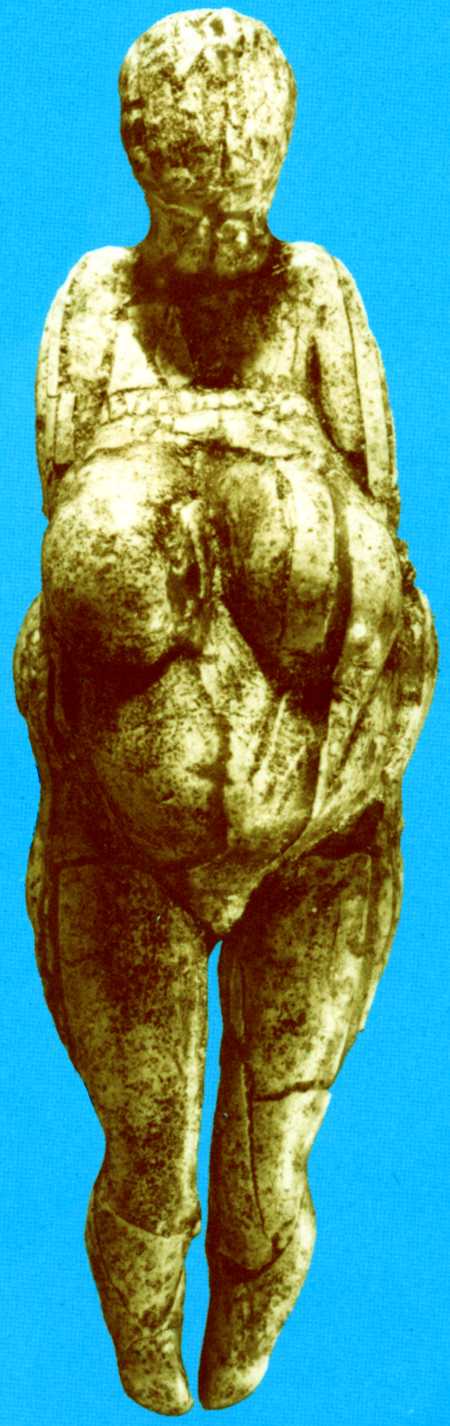
Photo: Female figurine No. 6, Professor Mariana Gvozdover, Gvozdover (1995)
The Avdeevo site is worthy of special attention because its abundant and picturesque material can be used to show the peculiarities of, and links between, the Paleolithic sites of Eastern and Central Europe.
On the Russian Plain it is possible to distinguish sites belonging to the Kostenki-Avdeevo archaeological culture, and among them to distinguish sites definitely belonging to the same stage. These are two sites at Avdeevo (Avdeevo-Old, Avd-I, and Avdeevo-New, Avd-II; it is not yet clear how they correlate in time), and both sites at Kostenki 1, the upper layer (near Voronezh).
The absolute similarity of all their components - type of settlement, flint and worked-bone tools, art objects - argues more for total identity than simply for typological affinities.
The analysis of the series of objects makes it possible to use the material of both the Avdeevo and Kostenki I sites as a unity, stating only the particular differences between the sites.
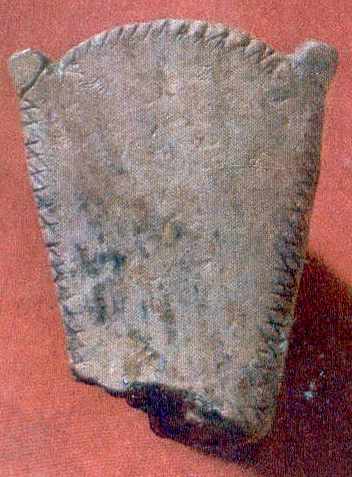
The decorated head of a spade from Kostenki 1.
Photo: Archaeology of the USSR - The Palaeolithic of the USSR.
My thanks to Vladimir Gorodnjanski for access to this resource.
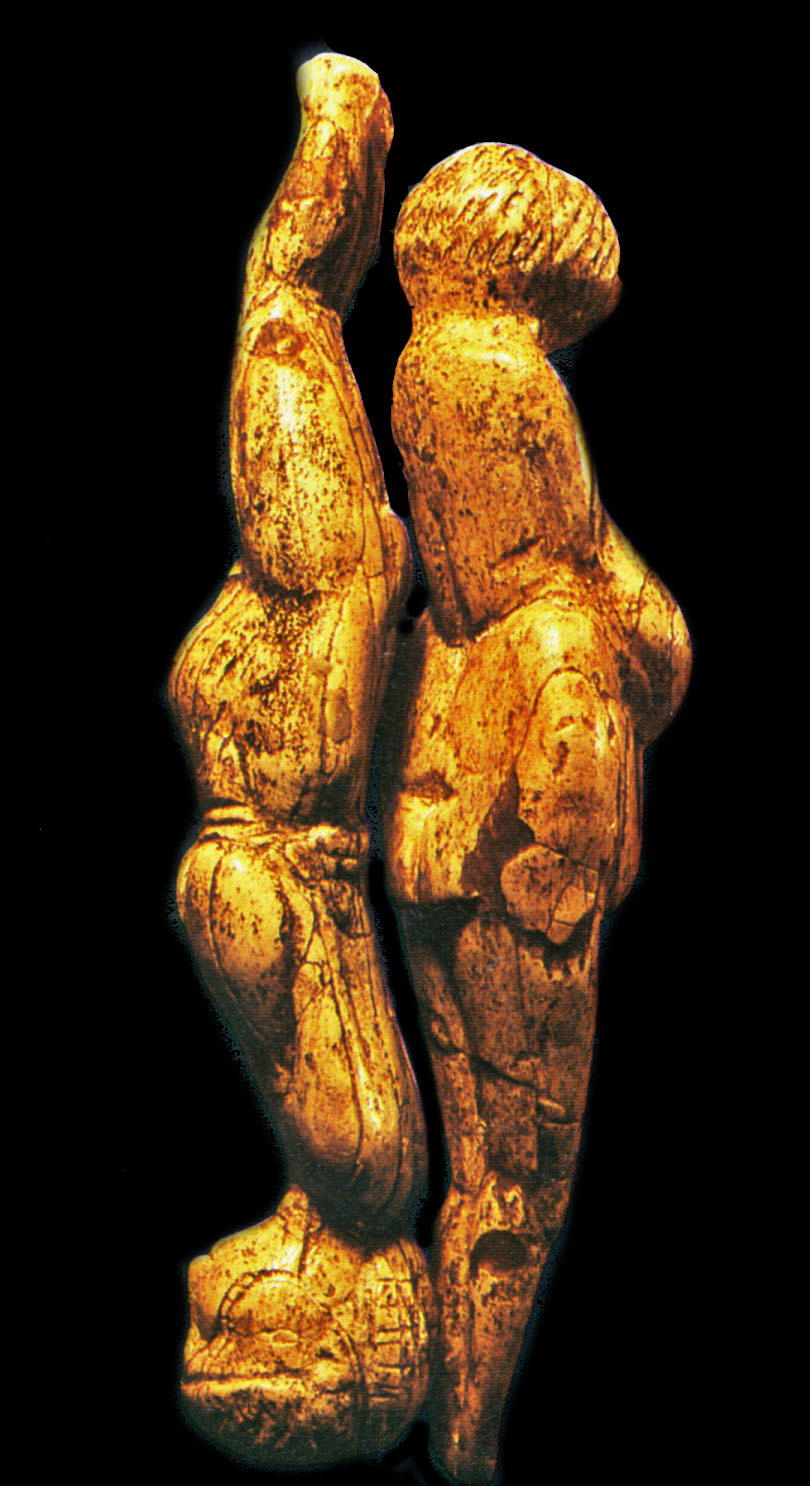
The Avdeevo 'double venus', figurines No. 7 (left) and No. 8 (right)
Figurine No. 7 was lying on its side, while figurine No. 8 was lying horizontally with its face down. The figurines were so close together that we made an assumption that they were placed together, but in a position different from the one in which they were found. We tried to reconstruct the initial position. As a result we have chosen the most probable variant: the figurines lay on each other, backs pressed to each other, heads facing in opposite directions. Figurine No. 7 later slid over onto its side.
( Note, as in the quote above from Gvozdover (1995) that these venus figures are not joined, though they were found lying near each other in the same pit.
They were placed in this position by the team led by Gvozdover who discovered them. They are shown here in the position the Gvozdover team decided looked best.
My thanks to Nancy Young for her input on this matter - Don )
Photo: http://www.arretetonchar.fr/
Text: Gvozdover (1995)
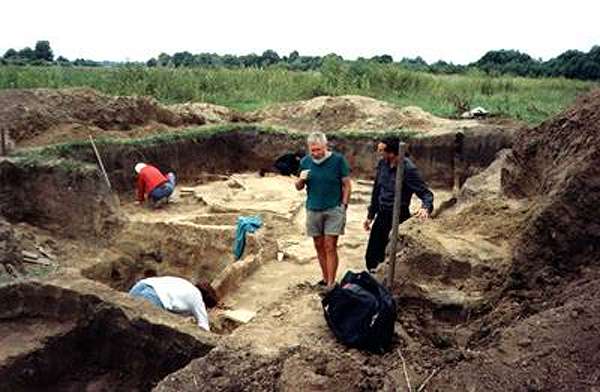
Photo: www.rkursk.ru/.../main.html
Avdeevo is located on the Sejm River near the city of Kursk. Research at the site was conducted from 1946-1949 (old complex - old Avdeevo) by Voevodskij and Rogachev, and from 1972 on (new complex - new Avdeevo) by Gvozdover and Grigor'ev.
Two oval living areas surrounded by semisubterranean lodges and pits have been identified at Avdeevo. Both were occupied between 21 000 and 20 000 BP
The sites are identical in their artefacts and similar to Kostenki 1, layer 1. They may also be connected with Kostenki XIII and XVII and with Berdyzh, located on the Sozh River.
The tool inventory consists of Kostenki knives, shouldered points, and leaf points on blades. There is a well preserved series of worked bone objects which differ in details from those found at Central European sites assigned to the Kostenki-Willendorf cultural unity. They include numerous bone awls and points of various types, burnishers and shovels, diadems and bracelets, as well as beads and decorated points. Non-repetitive or unique objects are relatively rare.
The Kostenki-Avdeevo figurines are quite variable. Most of the figurines depict mature women in various stages of the reproductive cycle: non-pregnant as well as women in the various stages of pregnancy. The beginning and final stages of the reproductive cycle are represented in singular figurines: in the crouching 'presentation' pose at Avdeevo (figurine N14) as well as in the post-partum pose at Kostenki XIII.
The Avdeevo inventory also contains a series of utilitarian objects fashioned with anthropomorphic or zoomorphic 'heads', shaped metapodia and phalanges, as well as subtriangular pieces. All of these, to various degrees, are associated with the schematic and realistic depiction of animals and females.
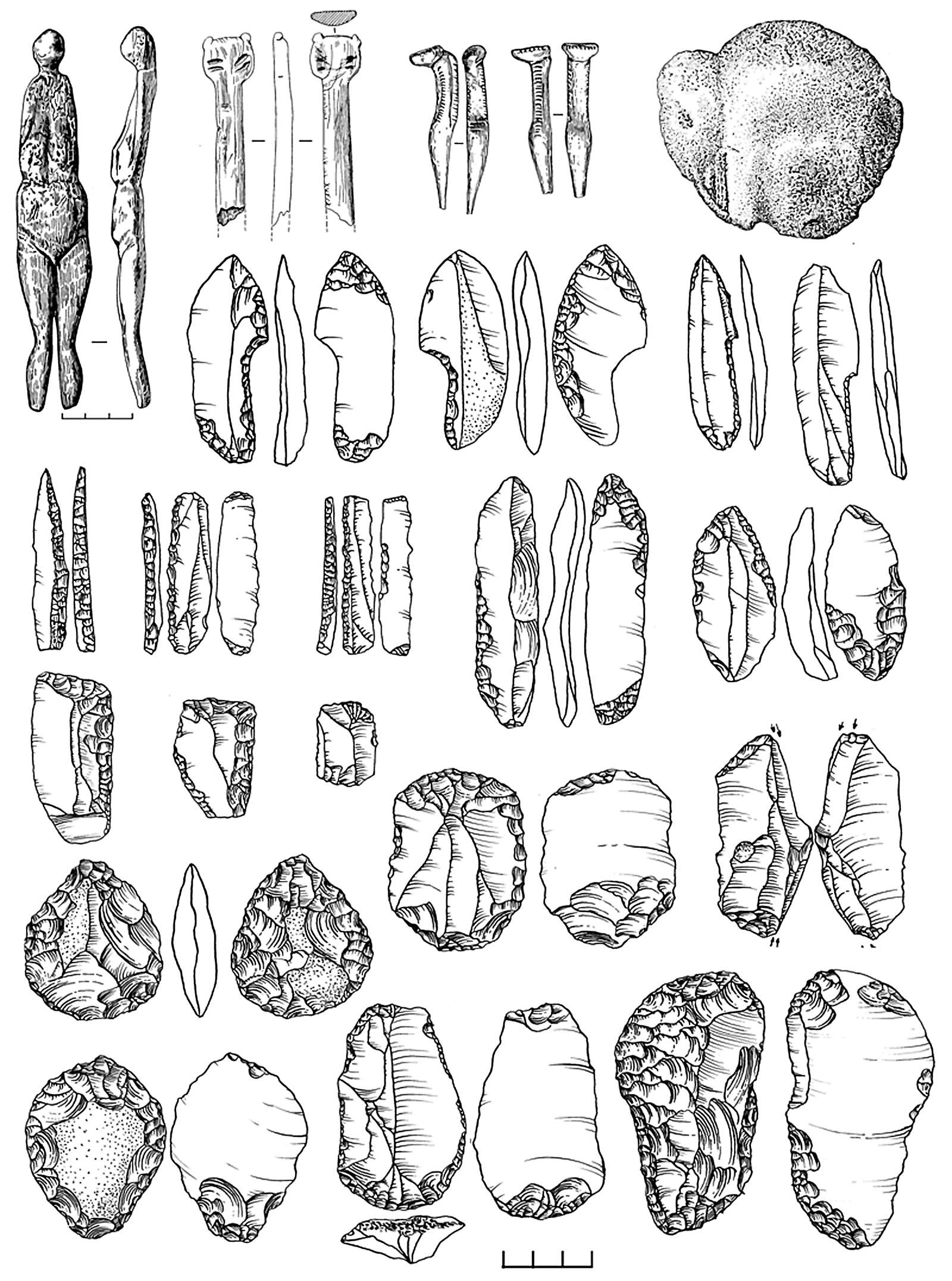
The Avdeevo site is almost identical to Kostienki 1, with all the signature markers: organisation of the habitat, lithic and bone assemblages, figurative art and items of adornment.
Dates given for Avdeevo are 22 800 ± 160, 23 140 ± 430, and 23 400 ± 700.
Photo and text: Sinitsyn (2007)
General characteristics of the site
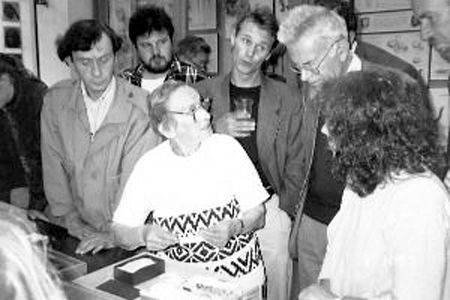
Professor Gvozdover at a conference for experts on the Russian Palaeolithic held in 1997 at the important site of Zaraysk.
Photo: www.primtech.net/zaraysk/zaraysk97.html
The Avdeevo Palaeolithic site is located in the western part of the Middle-Russian Hills 40 km from Kursk city, on the right bank of the river Sejm, where it meets its tributary the Rogozna. The geomorphology of the site is not clear. Most likely it is situated on the first terrace of the flood-lands. The cultural layer lies 1.0-1.5 m beneath the current surface.
The site was discovered in 1941. In 1946-1948 it was investigated by M. V. Voevodskij and in 1949 by A. N. Rogachev. In 1974 the excavations were renewed by an expedition from the scientific-research institute and the Museum of Anthropology of Moscow State University conducted by M. D. Gvozdover and the Leningrad department of the Institute of Archeology AN SSSR conducted by G.P. Grigor'ev.
The cultural layer, which is a greenish loam, measures from 0.2 to 0.4 m in depth. In some places it is intensively coloured red by ochre and charcoal. The cultural layer is followed by flaky loams, up to 40-60 cm thick. These are followed by sand and argillaceous (clay based) deposits. The lower surface of the cultural layer (the floor) bears signs of artificial hollows - that is, pits and "Pit-houses". Beginning from the sand-layer, which covers the cultural one, there are some natural depressions, which look like cryoturbations and involutions. These phenomena could have appeared in the process of repeated freezing and thawing.
The palynological data and the faunal analysis reveal that, during the human presence here, there existed a cold periglacial steppe. The fauna is represented by mammoth, hare, rhinoceros, horse, reindeer, bison, cave lion, brown bear, wolf, glutton, arctic fox; and also by hare, steppe marmot and others. In addition, there are bones of big birds (swans, geese, crane, silver seagull, raven, eagle, steppe eagle and others). The large quantity of arctic fox and wolf bones and the degree of their conservation make it possible to suggest the existence of fur-hunting.
The radiocarbon dates from bone charcoal received by different laboratories vary within the limits of 20-22 thousand years; the dates from mammoth teeth vary from 14 to 16 thousand years.
An area of the cultural layer covering about 950 m2 was opened in Avdeevo at the old site. This area covers both the main part of the settlement and its periphery. One third of the northwestern part of the settlement has been destroyed by the river Rogozna. On the site an oval living floor was opened, edged with pits and semi-subterranean "pit-houses". The area of the living floor is about 800 m2. It is 45 m long, and 19-20 m wide. Eight preserved storage-pits near the edge and seven semi-subterranean "pithouses" have been investigated there. The seven semi-subterranean "pithouses" are 4 to 8 m2 in area, and measure 0.6-1 m in depth. Judging by the supposed boundaries of the oval, there existed more semi-pithouses and peripheral pits.
The cultural layer of the living floor was irregularly coloured red by ochre and contained a large quantity of cultural remains: animal bone fragments, flints, charcoal. One well-preserved hearth and several small patches of ash (possible hearths?) have been discovered there. We traced a series of rather small (up to 1 m2 in area, 1 m deep from the floor) storage pits. Outside the oval, behind the line of semi-"pithouses" the layer loses its coloration and contains only fragmentary (separate) finds.
The new site (Avd-N, Avd II) is located some 20 m to the east of the old one (Avd-St, Avd I)
To date, an area of more than 800 m2 has been opened here. An oval living floor covering an area of some 40O m2 has been discovered. Its long axis is 28 m and the width is about 15 m. This living floor is edged by a line of pits and semi-pithouses. There are 10 such pits in all. Five large hearths, separated from each other by almost equal intervals, were discovered along the long axis of this feature (settlement). Several small hearths were also found. There seems to be no system in their location. More than three hundred small pits up to 1 m2 in diameter were opened on this site. Judging by the intact worked-bone pieces, which were often found in them, they might be storage-pits.
The cultural layer was very often coloured black by charcoal and very seldom red by ochre. The concentration of cultural articles in 1 square metre is higher than that at Avd-St. it is at its highest along the hearth line. Just as at Avd-St, whole big mammoth bones were mostly found in the edge-pits and semi-pithouses. Similar living dwellings were discovered at Kostenki I (the first living complex and the second living complex).
As to the type of the living-complex features at the site, we can say nothing definite, since it is not clear whether they had a common ceiling. We are not very certain about the functions and the construction of the pits and semi-pithouses either.
Though the two living floors and their stratigraphic location are similar, we cannot say whether these two dwellings existed simultaneously and formed one settlement, or are the remnants of a two-fold occupation of the same place by the same kinfolk.
Flint assemblage
A high quality chalky (cretaceous) flint was used to manufacture the stone tools at Avdeevo. Usually it is transparent, brown-yellow or black-coloured. When it is covered by patina, the flint changes colour and becomes bluish or white. Separate nodules are differentiated by their crust and insertions. Flagstone flint, usually striped and of a poorer quality, as well as compact (thick), fine-grained quartzite, were also used to produce tools.
A total of 24 100 flint finds was collected at Avd-St, and 39 496 pieces at Avd-N up to 1986.1 A total of 33 437 items of knapped flint were gathered at K-I. It is interesting to note that in a cultural layer from 10 cm up to 40 cm thick, the flint density per 1 m2 is rather low.
At Avd-N, within the living floor the average concentration is 40-50 pieces per 1 m2. But there are some isolated squares where it exceeds 100 items. Behind the line of the pithouses, at the periphery, the quantity of flint seldom reaches 10 pieces.
At Avd-N the flint concentration is higher than at Avd-St; in the living floor the average number is 100 pieces, while in some squares it reaches 300 pieces. The zone of high concentration occupies almost the whole area of the living floor. The density is especially high near the hearths. At the periphery, as in Avd-St, the flint concentration declines sharply, and is usually not higher than 30 pieces per square metre.
The presence of cores, and of the products of their reshaping and of striking flakes, indicates that the knapping was done in the living floor area. All sites of the Kostenki-Avdeevo culture have certain features in common, namely: a low flint concentration, a small quantity of cores (Avd-St: 0.39% of the inventory; Avd-N: 0.8%; K-I 0.4%), a large number of reshaping flakes (Avd-St: 13.34%; Avd-N: 11.9%; K-I 12.9%) and finally a large quantity of tools in the inventory (AvdSt: 11.29%; Avd-N: 12.5%; K-I 10.9% of flint). At Avdeevo and Kostenki, among the reshaping spalls there is a special type of edge spalls, which are very rare at other sites. They remind one of scraper spalls, but their cross-section is different (Figure 1: 1-5). The spalls were cut from the tool edge, and in the process a narrow part of the ventral surface was cut off. Very often the dorsal surface bore negative scars of several similar spalls removed previously.
Thus, we may argue that the usage of flint was economical: large blades were used almost completely for tool manufacturing, broken tools were reshaped and there existed a multiple reshaping of tools in general.
Blades as well as flakes were used to produce tools. Both large (10-16 cm long) and small specimens (1.3-4.5 cm) are found in the tool inventory.
Different techniques were used in tool manufacturing:
- a widespread burin technique;
- edge retouch, steep and semi-steep, producing edges of different sharpness;
- partial flat retouch on the ventral surface;
- trimming;
- écaille.
Worked bone
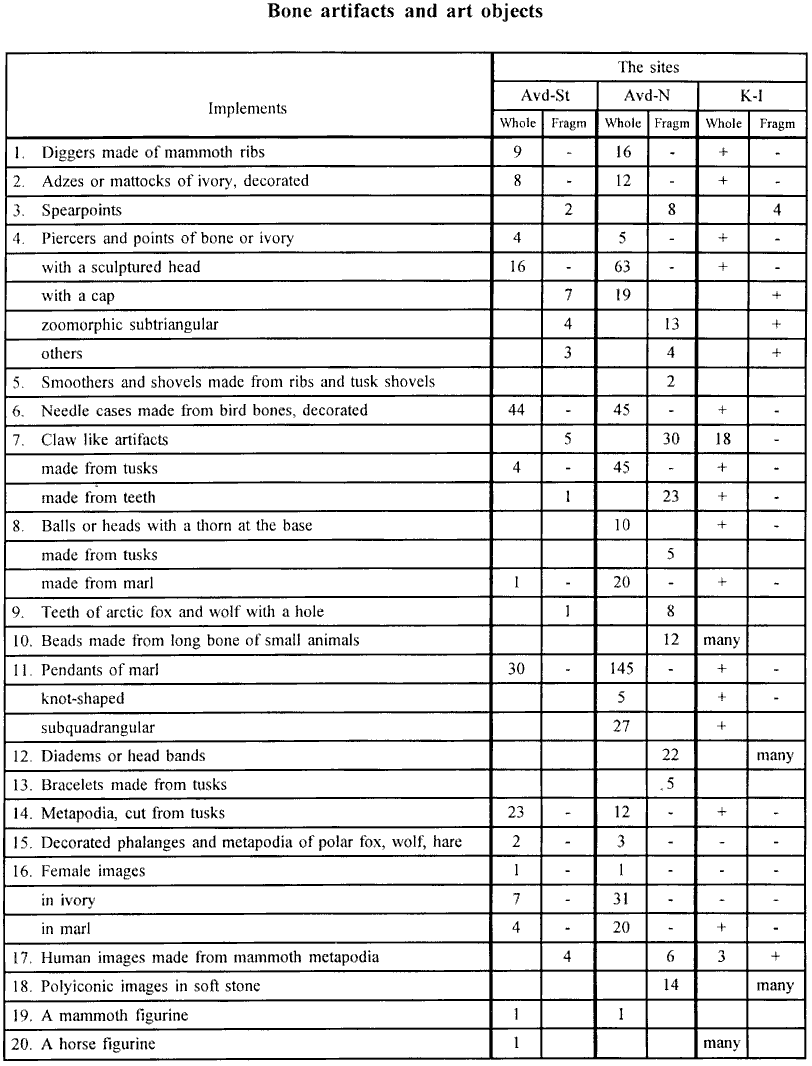
The good preservation of the bone material at the site of Avdeevo made it possible for us to collect a large quantity of worked bones and their fragments, preparation pieces, and bone debris with various traces of usage, especially traces of meat processing. To produce such articles tusks, antlers and bones of different animals were used. The collection of bones with use - traces at Old Avdeevo consists of approximately 600 items, while the collection from New Avdeevo exceeds 2000 items. Such an abundance of well preserved material gives us an opportunity to follow some methods of the manufacturing of worked bone.
Most of the artifacts were produced from mammoth tusks, and animal bones and horns (antlers), though we also take into consideration some scarce artifacts made from soft kinds of rock (marl, shale, sandstone). Nearly all artifacts were made almost faultlessly.
Bone pressure-flaking tools
On hundreds of bone fragments, tusk flakes and artifacts from the sites discussed, there are characteristic groups of dents testifying to the usage of these objects as bone pressure-flaking tools. Sometimes there are several such groups of dents: they are retouch traces.
Shovels
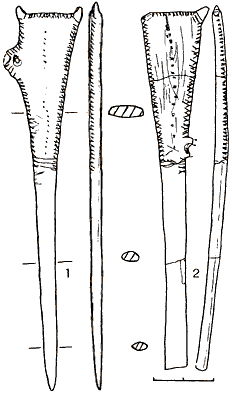
These were made of fragments of mammoth ribs. Usually their point is heavily worn, and the traces show that they were used as mattocks.
Sometimes with the help of a flat flake the points were sharpened at the end of the inner (concave) part of the rib.
Adzes/mattocks
A rather large and massive tool preserving the curve of the tusk. The upper end of the tool is cylindrical. A relatively sharp point, triangular in cross-section and bow-shaped, is distinguished at the lower end due to the treatment of both surfaces. The tool was thus worked from approximately the middle of the preparation piece (Figure 17). The tool was made out of the scrap at the lower part of a young mammoth's tusk.
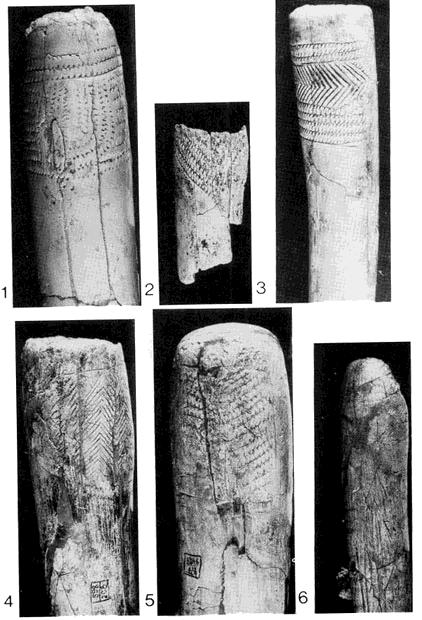
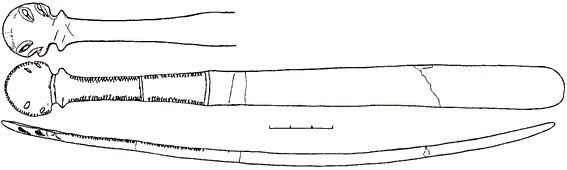
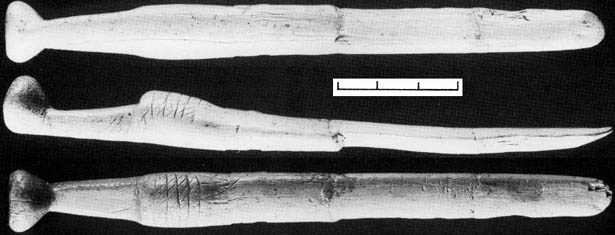
Decorated adze handles 1 - 4, 6 from New Avdeevo, 5 from Old Avdeevo
Photo: 'Art of the Mammoth Hunters: The Finds from Avdeevo' by Professor Mariana Gvozdover
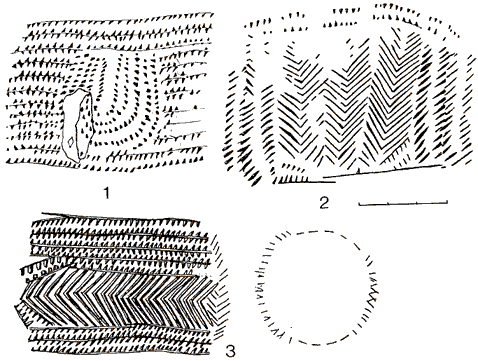
Decorated adze handles (drawn) 1 - 4, 6 from New Avdeevo, 5 from Old Avdeevo
Photo: 'Art of the Mammoth Hunters: The Finds from Avdeevo' by Professor Mariana Gvozdover
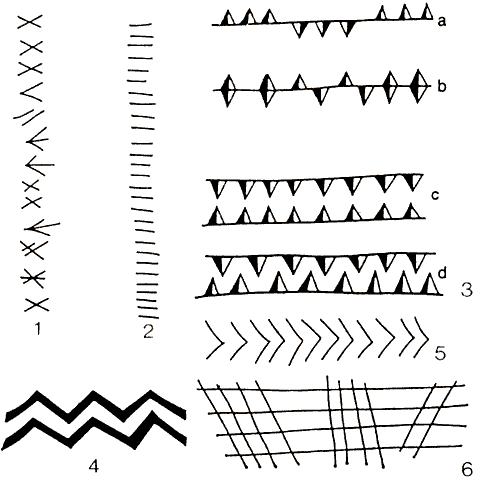
1. slanting cross and its variants;
2. short transverse line or stroke;
3. variants of wedge-shaped notching;
3d. with staggered interval, zigzag in background;
4. zigzag;
5. herringbone;
6. slanting checkwork.
Spearpoints made of ivory
This group is relatively scarce and consists mostly of fragments.
Awls and piercers
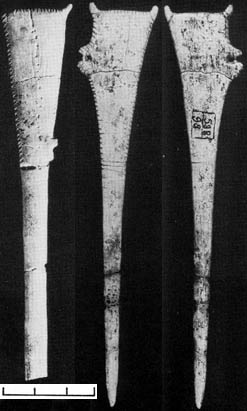
In this category we grouped tools, made from bones and tusk, that are distinguished by the form of the sharp portion and of the butt end.
Needle cases, beads and miscellaneous
A series of so-called needle cases is present at Avdeevo. They are made from the long (tubular) bones of large waterfowl. A joint is carefully cut. The length of the artifacts varies from 117 to 360 mm. The average length is 200 mm. The surface is smoothed and has numerous decorations. Seven of the fourteen intact needle cases are decorated
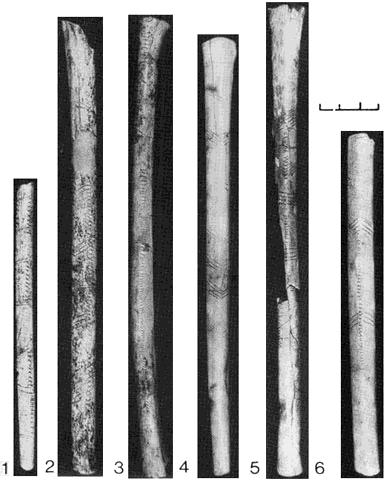
Decorated needlecases 1- 5 from New Avdeevo, 6 from Old Avdeevo
Photo: 'Art of the Mammoth Hunters: The Finds from Avdeevo' by Professor Mariana Gvozdover
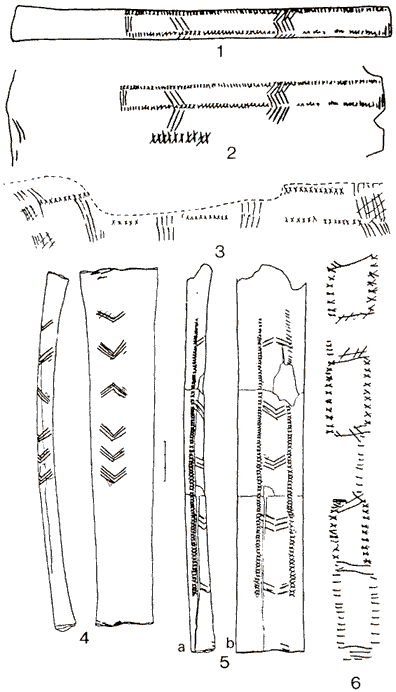
Decorated needlecases (drawn) 1- 5 from New Avdeevo, 6 from Old Avdeevo
Photo: 'Art of the Mammoth Hunters: The Finds from Avdeevo' by Professor Mariana Gvozdover
There is an abundant collection of beads made from sectioned teeth of wolf and polar fox. Cylindrical beads made from long bones of small animals were found besides the beads made from sectioned teeth of polar fox and wolf.
'The spoon': This artifact resembles an alder-tree leaf with a handle. 'The spoon' is 32 mm long, 52 mm wide. The preserved part of the handle is 30 mm in length, but it is only 1-2 mm thick. 'The spoon' is almost plano-concave in cross-section; the straight part is an external fragment of tusk. The slightly raised edges are sharpened. The external part of the artifact is almost untreated, while the internal part is hatched with small criss-cross scratches (Figures 44, 45).
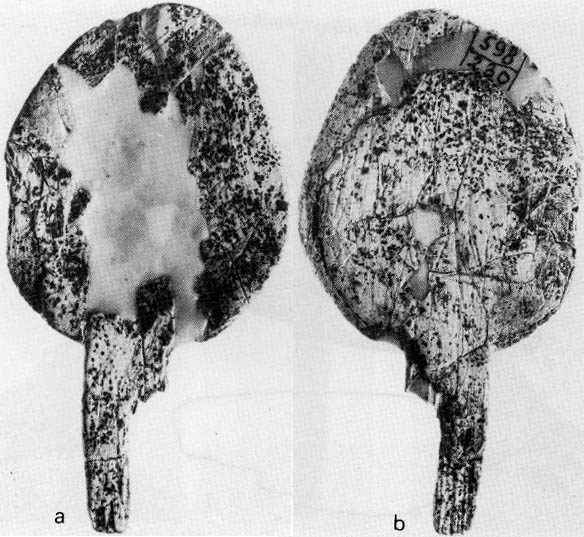
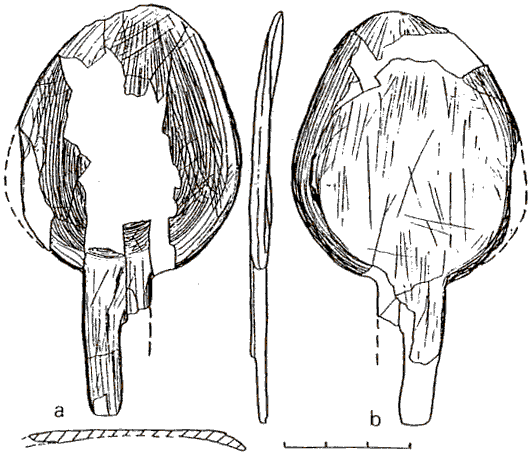
Click on the image to see a close up
Click on the top image to see a close up
Click on the image to see a close up
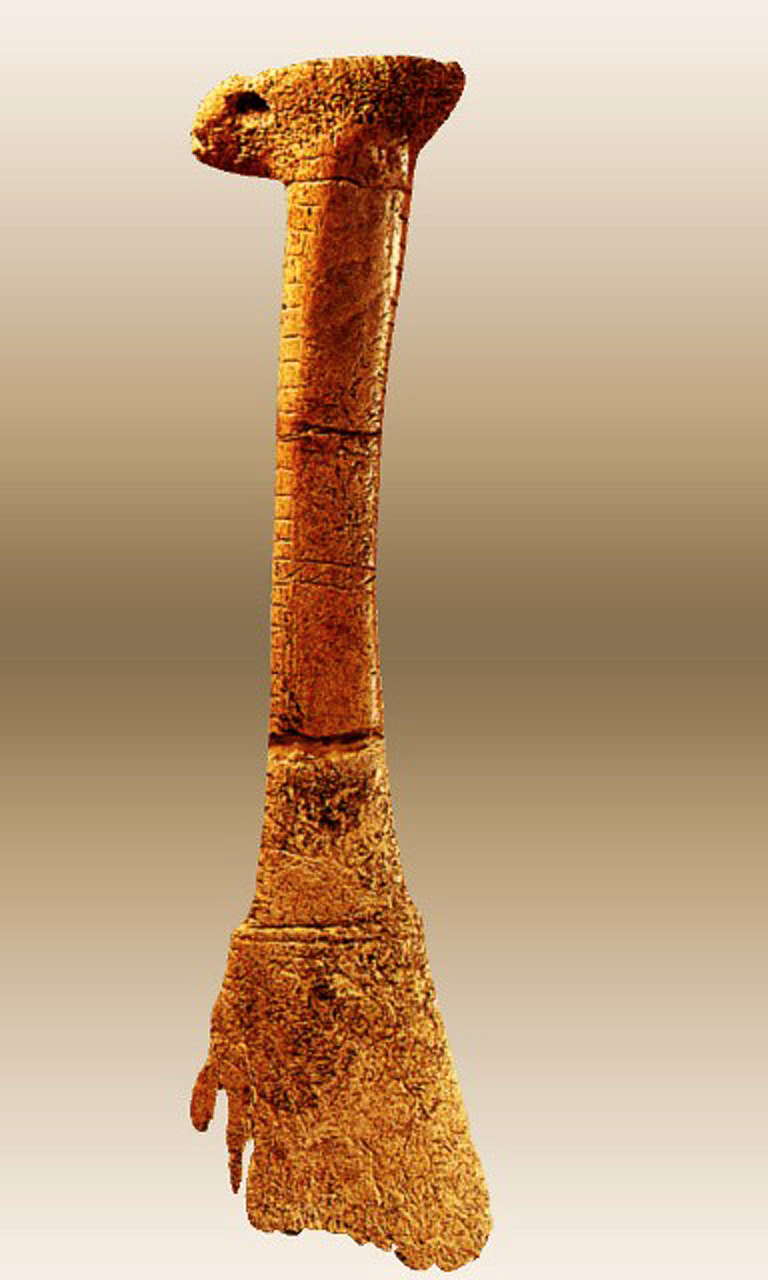
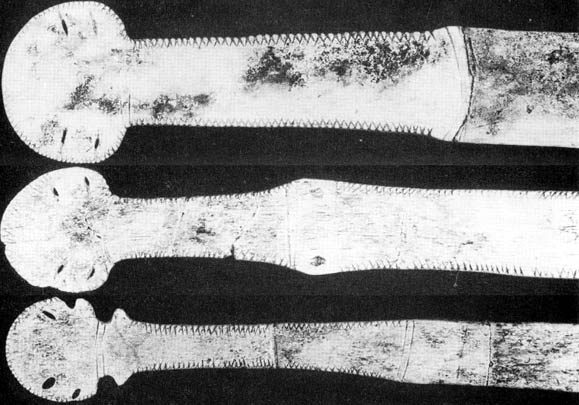
A decorated, 'hatted top' tool handle from the Kostenki-Avdeevo culture.
Photo: http://www.istmira.com/foto-i-video-pervobytnoe-obschestvo/3924-iskusstvo-predystorii-pervobytnost-2.html
Click on the images to see a close up
Click on the image to see a close up
Flint tools of the Kostenki-Avdeevo culture
| Site | Avd1-I | Avd1-I | Avd2-1I | Avd2-1I | K-1 3 | K-1 3 | |
| Category | Quantity | % | Quantity | % | Quantity | % | |
| 1. Backed scaled knives | 744 | 27.4 | 505 | 10.3 | 603 | 16.5 | |
| 2. Shouldered points | 174 | 6.4 | 353 | 7.2 | 465 | 12.7 | |
| 3. Leaf points | 23 | 0.8 | 76 | 1.5 | 91 | 2.5 | |
| 4. Backed blades | 288 | 8.47 | 469 | 9.5 | 368 | 10 | |
| 5. Scaled pieces | 18 | 0.6 | - | - | - | - | |
| 6. Burins | 622 | 22.9 | 879 | 17.9 | 969 | 26.4 | |
| 7. Scrapers | 54 | 1.9 | 56 | 1.3 | 230 | 6 | |
| 8. Variant points | 35 | 1.2 | 224 | 4.5 | 61 | 1.6 | |
| 9. Truncated flakes and blades | 22 | 0.8 | 58 | 1.2 | 96 | 2.6 | |
| 10. Borers and drills | 19 | 0.7 | 54 | 1.1 | 41 | 1.1 | |
| 11. Denticulate and notched pieces | 21 | 0.7 | 133 | 2.7 | 90 | 2.4 | |
| 12. Sidescraper-like pieces | 30 | 1.1 | 42 | 0.9 | 10 | 0.3 | |
| 13. Pieces and flakes with retouch | 550 | 20.7 | 1546 | 31.4 | 540 | 14.7 | |
| 14. (Combined) pieces | 157 | 5.7 | 363 | 7.4 | 100 | 3 | |
| 15. Variant tools | 23 | 0.8 | 164 | 3.3 | - | - | |
| 16. TOTAL | 2720 | 100 | 4922 | 100 | 3664 | 100 |
Note: 1. 1946-1949 collection; 2. 1979-86 collection, the excavations are still in progress; 3. V.I. Belyaeva's data, 1979; 4. The data are not cited.
Figurines from the site
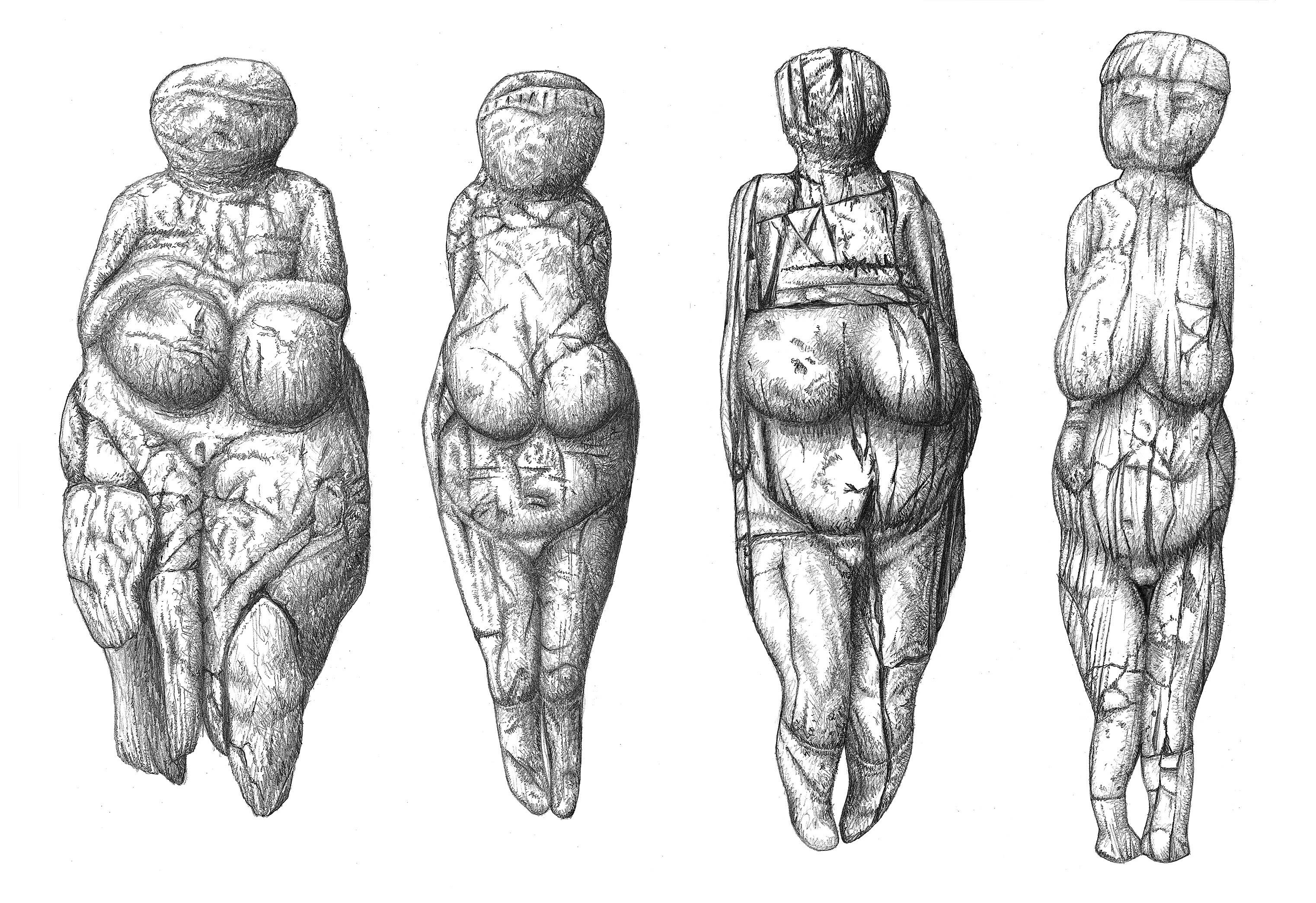
I was fortunate to obtain these drawings from Jeppe Boel Jepsen, an archaeologist.
He writes:
A colleague of mine was so fortunate to spend a season digging on the Audevo-site in Russia some 20 years ago.
He managed to photograph four of the classic earlier finds of ivory figurines. He asked me to draw the figurines from his photos. They are to scale individually.
Photo: Courtesy Jeppe Boel Jepsen

Click on the image to see a close up
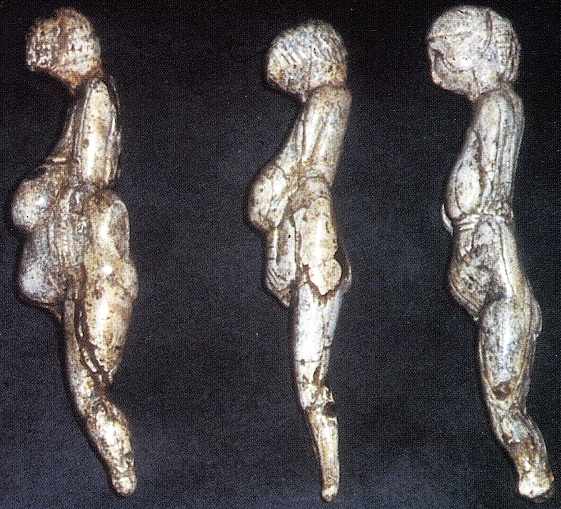
Statuettes féminines de Avdeevo, vues de profil. Collection du musée
d'Anthropologie de l'Université de Moscou. Photo L. Iakovleva.
Female statuettes from Avdeevo, viewed in profile. Collection of the Museum of Anthropology of the University of Moscow. Photo L Iakovleva.
Photo and French text: "les mammouths - Dossiers
Archéologie - n° 291 - Mars 2004"
Photograph L Iakovleva.
My thanks to Anya for access to this resource.
Text and photos below are from the excellent monograph by Professor Mariana Gvozdover, 'Art of the Mammoth Hunters' 1995, unless otherwise noted.
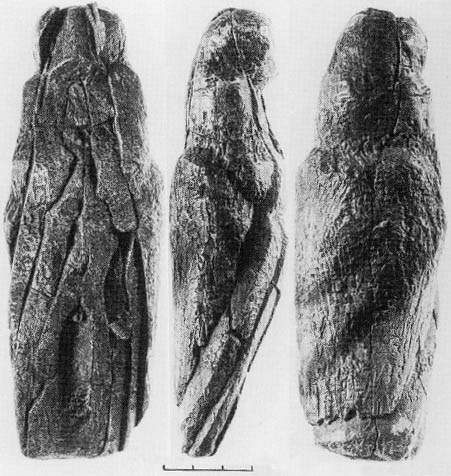
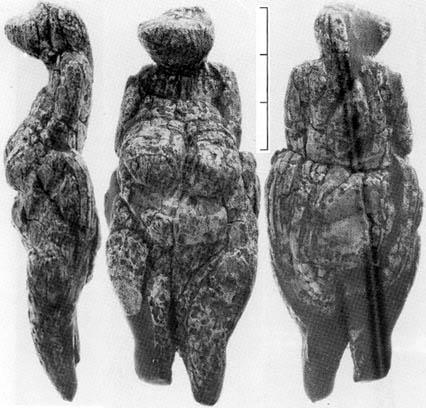
Figurine No.1 (Old Avdeevo, Avd-St 48, N 2). It is 145 mm long, and its maximum width is 50 mm. It is made from the end of a small tusk. The upper part and the front part of the head are damaged. On the front part of the figurine the ivory has split and the blades have moved slightly, but the traces of working show that the surface has remained completely intact. The figurine is not smoothed and bears the traces of working.
The basic volumes of the body are emphasised and are easily recognised: the head, slightly tilted forward, turns into the shoulders; prominent arms, slightly bent forward, are shown up to the elbow. The most prominent part - that is, the abdomen/breast area - is designed as a single unit.
A slightly corrected curve of the ivory shows the sinciput (forehead) and the occiput (back of the head); the soft slope of a short back at the waist turns into slightly protruding buttocks and steep sides. Legs and buttocks are not depicted. From the upper region of the pelvis the figurine begins to taper into an elongated triangle. In profile below the abdomen/breast area the figurine is also triangular.
This is a woman with rather narrow shoulders and wide pelvis, shortened back, without excessive fatty pads. It was found at the bottom of a pit, together with figurine No. 2, which was lying face-down. There was a decorated mattock nearby.
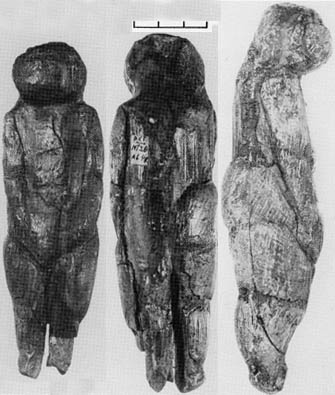
Figurine No. 2 (Old Avdeevo, Avd-St 48, N 3). It is 125 mm long, 36 mm wide, and 32 mm thick. The occiput (back of the head), back, left buttock and leg are damaged. The toe on the right leg is missing. The surface of the figurine is only partially smoothed.
The head is large, the occiput is flat, and the face is shown by two planes at an angle to each other. It is slightly tilted forward; the shoulders are slightly drooping, and the arms prominent, bent at the elbow, as though stretched alongside the body; the hands are placed on the lower part of the abdomen. The breasts are not shown.
The abdomen is relatively flat with the greatest protuberance at the bottom. The legs are arranged on the central long axis of the body; they are pressed together, divided from both sides by a deep cutmark; the toes probably met. The stout legs - particularly the shins - are shortened; the knee is indicated, but there is no bending of the axis of the legs at the knee. The heel is emphasized, and the sole is prominent. The legs are made X shaped by two curves on their outer contour.
The buttocks are depicted realistically. The width of the figurine remains almost unchanged along its whole length and almost equals its thickness. Sexual characteristics are absent, but the general shape of the figurine, the slightly tilted head, the short, flat and wide pubic triangle, the outer leg contour, and the typical placement of the arms all suggest that it is semantically close to other female images of the Kostenki culture.
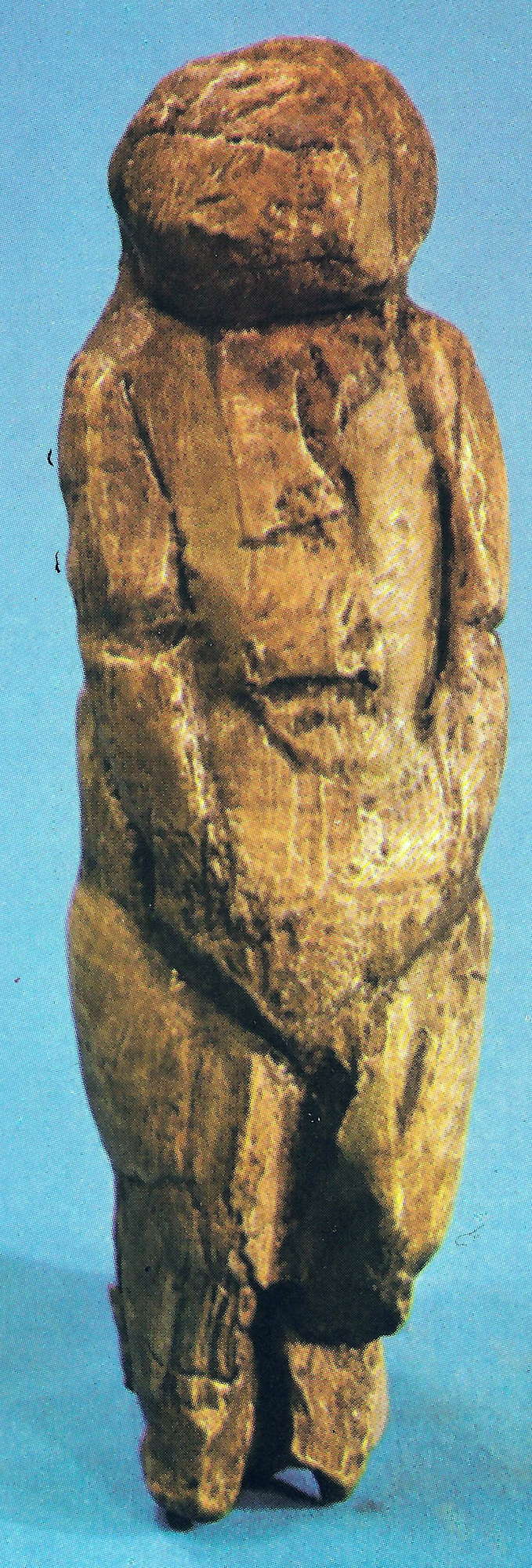
Figurine No. 2
Photo: Jelinek (1972)
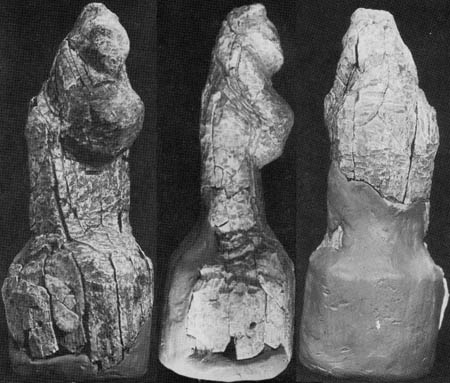
Figurine No. 3 (Old Avdeevo Avd-St 81). In 1981, while cleaning the walls of the old excavation site (1949), another figurine was found in the cultural layer. It is 81 mm long, 43 mm wide and 35 mm thick.
It is unfinished, and not even separated from the tusk fragment, 50 mm in diameter, from which it was made. The whole surface bears the traces of working with various tools. But the the basic volumes are rather clearly shown.
The head is large, slightly drawn into the shoulders, almost flat from behind and protruding forward at an angle. At the top it ends in a narrow projection, which is ivory broken by several blows and cannot be interpreted as a coiffure or a "cap". The breast/abdomen area is rendered as a single unit; the arms are prominent at the shoulders, bent forward and then lost in the upper breast/abdomen, i.e. the most protruding part of the figurine.
As for the rear surface, the drooping shoulders begin almost at the very top of the head. A short, slightly prominent back with waist and steep hips makes up the widest part of the figurine. From the hips downwards the figurine narrows, so that the legs are shown in a trapezoid plane. The figurine is somewhat asymmetrical in relation to the central, vertical axis. The area of the breast/abdomen is slightly raised on the left side, while on the right it is lowered and slightly set aside.
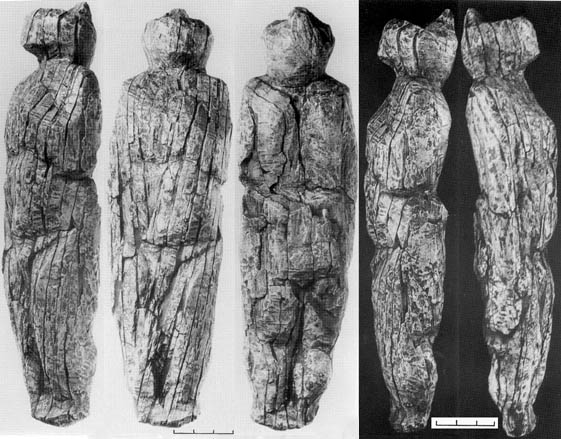
The male figurine No. 4 (New Avdeevo Avd-N 75) was found at the bottom of a pit with accompanying flint blades, adzes and other artifacts. Almost all the outer surface of the figurine, except for some small fragments, is intact. The upper portion of the head is the negative of a fracture. The character of the negative shows that the blow was delivered while separating the figurine from the initial tusk.
The thorn on the occiput (back of the head) is also the result of this fracture The figurine's surface bears marks of working: as A. K. Filipov has stated, these are the marks of splitting, shaping with an axe, single blows with a cone-like chisel, gouging and, finally, planing or shaving. This is a large figurine - its length is 215 mm, the widest part is 60 mm, and its thickness is 40 mm. The width of the shoulders and hips almost coincide, while the length of the body nearly equals that of the legs.
The head is rounded, slightly flattened from behind; the face is not defined, but the facial region is definitely set forward. The shoulders are almost straight and not drooping, the back is slightly bent backwards. The shoulder-blade area, divided by a groove, is shown in relief. The location of the arms is not symmetrical: they are prominent in the shoulder-area in proportion to the thickness of the body.
The right arm is stretched along the body and is pressed to it; the left one, bent at the elbow, is on the chest, where it becomes one with the whole body. From below it is separated by fluting that goes upwards at an angle from the elbow, and from above it is set off from the chest by a volume. The breasts are undefined; the pulled-in abdomen, slightly prominent, turns into a long, prominent, elongated pubic triangle.
The sacral area (at the back of the pelvis) is rather flat, with the greatest prominence in the lower part, where small buttocks are marked. The legs, pressed together, are separated by deep, but not cut through, grooves. The full hips and somewhat shortened shins are well shown. The knee is defined, but there is no bending of the leg axis. The feet are shortened and presented as a single, slightly prominent base of the figurine.
Thus we can see that the figurine represents a person standing straight, with legs together, holding the head erect, with one hand stretched along the body and the other lying across the chest.
All lines represent a well-developed musculature of the back, chest and legs, not softened by fatty deposits. Though the sexual characteristics are not defined, the general posture, somewhat different from the bent female figurines, the unusual arrangement of the arms, and the way in which the pubic area is shown, all suggest that this is a male image.

Figurine No. 5 (Old Avdeevo Avd-St 49) was found in fragments in the wall of a pit. It is 160 mm long, 30 mm wide, and only 11 mm thick. The buttocks and the lower portion of the legs are missing. The figurine is completely smoothed and finished.
It is very flat and all volumes are rendered in low relief. The upper torso is very elongated. A rounded head with a protruding facial area is disproportionately small. Narrow drooping shoulders and arms are shown only by a cut in both shoulders. Sagging, teardrop-shaped breasts descend to a rounded, flat abdomen, which turns into the pubic triangle.
The maximum width of the figurine occurs at the upper portion of the pelvis. Long slender legs are rendered separately above the knee. The outer leg contour is X-shaped. The feet were probably rendered separately. The slope of the back is slightly convex. The figurine represents a tall, slender, mature, but not pregnant woman.
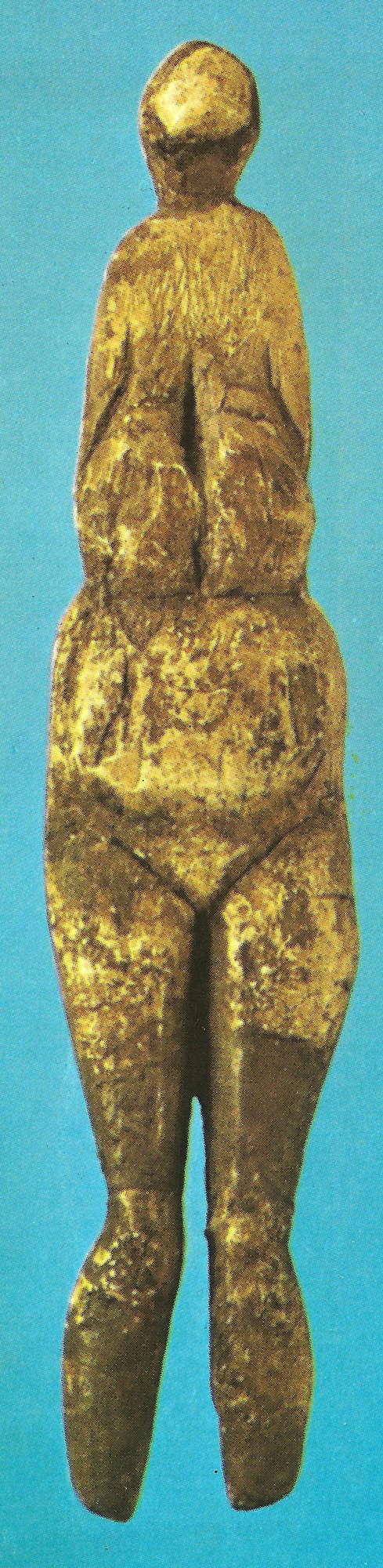
Figurine No. 5 (Old Avdeevo Avd-St 49)
Photo: Jelinek (1972)


Figurine No. 6 (New Avdeevo Avd-N 76) was found lying horizontally, face-down at the bottom of the pit. It is 95 mm long; the maximum width is in the upper third of the pelvis and equals 30 mm. Only insignificant fragments of the outer surface are damaged: parts of the face, neck, the lower side of the calves, back and buttocks. The scale on the photos appears to represent 2 x 10 cm.
The head is almost round; the face is not defined, but gives the impression of being turned forward. The head and part of the face area are decorated with a wedge-shaped notching. The shoulders are narrow, the chest is flattened and elongated, and teardrop-shaped breasts descend to the abdomen from it. A band, girdling the body, is shown in the upper portion of the chest. It is decorated by a wedge-shaped notching with a staggered interval. The arms are rendered prominent in the shoulder area, while below the elbow they are almost graphic.
The location of the forearms is asymmetrical - the right forearm holds the abdomen from the side. There are three bands - bracelets - on the hand with four (?) fingers. The second forearm emerges from beneath the breasts and turns slightly to the centre so that the hand with fingers is on the lower, keel-shaped, protruding portion of the abdomen.
Fingers and a bracelet are also shown on the left hand. The keel-shaped abdomen protrudes forward and down. The greatest prominence is in its lower portion. The pubic triangle is short and flat. The hips are brought together, while the shins below the knee are separated by a cutthrough slot. The legs are slightly bent at the knee, and the shins are slightly bent backwards. The toes are together, the heels are apart. The outer leg contour is X-shaped.
There are prominent fatty deposits at the base of the hips, producing a typical female contour. The maximum width occurs in the upper portion of the pelvis, thus rendering the greatest thickness of soft tissues. From the largely flattened sacrum (lower back) area the fatty pads extend sideways. The buttocks are small and placed somewhat low. They are set off by lines from above and below. The back is slightly protruding and bent backwards at a sharp angle to the body.
Thus we can see that the figurine represents a mature (probably pregnant) woman with a typical contrast between a slim torso and legs and massive breasts and protruding abdomen.
Photos and text: Gvozdover (1995)

Gravettian bracelet dated to 29 000 - 22 000 BP, Avdeevo
Photo: http://www.arretetonchar.fr/
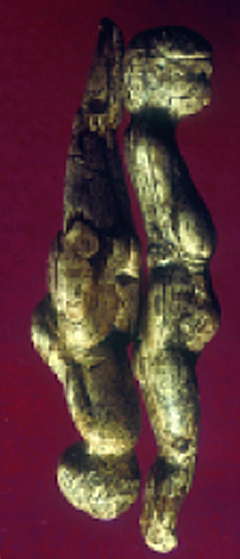
Avdeevo double venus back to back, figurines No. 7 (left) and No. 8 (right)
Photo: R. White
Source: White (2002)
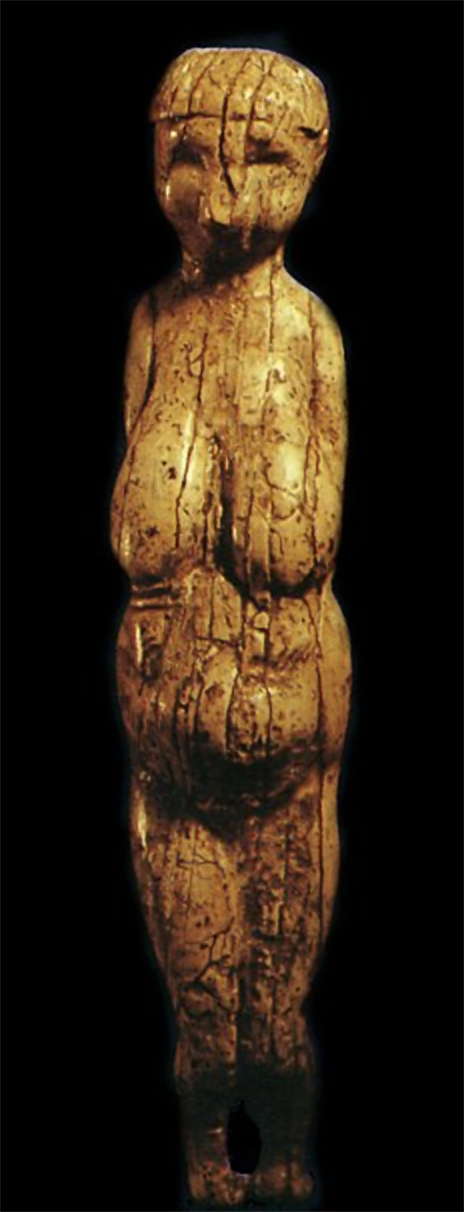
Avdeevo venus, the front view of one of the double venuses above, figurine No. 7. Note the distinctive double groove under the right breast.
Photo: http://www.istmira.com/foto-i-video-pervobytnoe-obschestvo/3924-iskusstvo-predystorii-pervobytnost-2.html
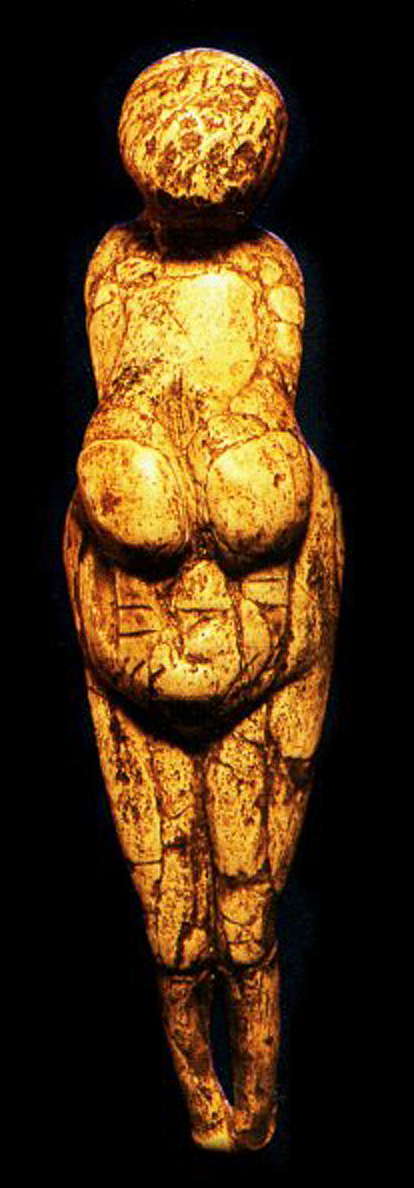
Avdeevo venus, the front view of the other member, figurine No. 8 of the 'double venus'.
Photo: http://www.istmira.com/foto-i-video-pervobytnoe-obschestvo/3924-iskusstvo-predystorii-pervobytnost-2.html


Figurine No. 7 (New Avdeevo Avd-N 77, N 1) was found in the pit together with figurines Nos. 6 and 8. Figurines 7 and 8 were lying together, so that the legs of the first almost touched the head of the second Gvozdover (1995).
Figurine No. 7 was lying on its side, while figurine No. 8 was lying horizontally with its face down. The figurines were so close together that we made an assumption that they were placed together, but in a position different from the one in which they were found. We tried to reconstruct the initial position. As a result we have chosen the most probable variant: the figurines lay on each other, backs pressed to each other, heads facing in opposite directions. Figurine No. 7 later slid over onto its side.
Scale: 3 x 10 mm
Photo and text: Gvozdover (1995)
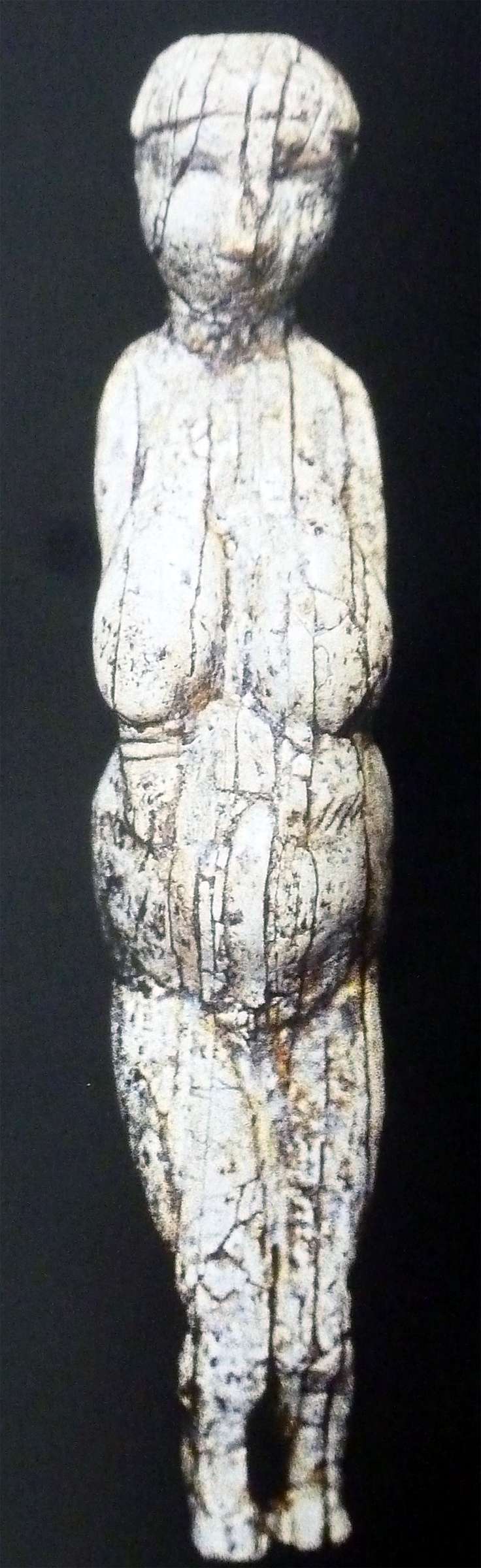
The figurine is well preserved, except for small damaged spots on the outer surface. It is 100 mm long; the widest part, the upper third of the pelvis, is 20 mm; and the thickness of the upper torso and that of the hips almost coincide (Figure 101). The head is erect; the sculptured face looks forwards and is contoured by a complex coiffure (Figures 102; 117: 3). The shoulders are narrow and drooping. The chest is flattened, and the drop-shaped breasts, slightly apart, lie on the abdomen. The arms and the shoulders are slightly bent forwards, and the forearms are placed beneath the breasts, under which the hands are holding the upper part of the abdomen. Fingers are emphasised on the hands, one of which wears a bracelet.
The abdomen is slightly prominent, with the greatest protuberance at the centre. ne legs are a little bent at the knees, and the shortened shins are bent slightly backwards. Below the knees, the legs are separated by a cut-through slot; the toes are brought together, the heels are apart. A slightly prominent back is bent backwards. A small curve represents the base of the neck, and a small depression in the shoulder-blade area depicts the spine (?). On the waist there is a band in relief decorated by a wedge-shaped notching. The rump is shown in the traditional manner: a flattened area around the sacrum emphasizes the absence of fatty deposits. The buttocks, set off from above and from below, seem to be placed very low.
The unique peculiarity of this figurine, new not only to Avdeevo but also to all sites of the Kostenki culture, is the rendering of the features of the face and of a rather complicated coiffure (or a cap?) The face looks forward; the small slightly prominent forehead is modelled as well as the asymmetrical oval of the face with rounded cheekbones and cheeks with a chin slightly bevelled backwards. A small straight nose is rendered in relief; the eye-sockets are marked by deepened semi-circles; there is an almost invisible projection instead of the mouth (Figure 102). On the forehead there is prominent hair, not reaching the ears, shown in relief. The hair is decorated by short vertical strokes. The hair descends in a semi-circle almost to the shoulders. The line of the coiffure is somewhat asymmetrical: it is almost vertical behind the left ear, and rounded behind the right one.
In 1983 at Kostenki 1, in the second complex, a figurine with a modelled face was also found. But in that case only the eyes were rendered by deep semi-circles (Praslov 1986).
Photo and text: Cohen (2003)

Figurine No. 8 (New Avdeevo Avd-N 77, N 2). It is 95 mm long, the maximum width is 23 mm, and the thickness of the torso and hips is 10 mm. The head is tilted, its front part represents a bevelled plane. The shoulders are narrow and drooping. At the shoulders the arms are in relief and jut slightly forwards; the forearms and hands emerge from beneath the teardrop-shaped breasts and lie below a keel-shaped abdomen. The fingers are turned as if holding the small projection at the lower part of the abdomen; there are bracelets on the hands.
The legs are slightly bent, the shins are bent backwards. There is a cut-through slot below the knees. The feet are very much shortened, the toes are brought together, and the base of the legs is prominent. A curve at the base of the neck is shown on a prominent back; below the shoulder-blade area there is a fluting that shows the spine.
Scale: 3 x 10 mm
Photo and text: Gvozdover (1995)
Two short symmetrical lines are cut near the sides above the waist (fatty folds?). The rump is rendered in a traditional way. In contrast to the two figurines from this pit described above, figurine No. 8 has no band-bandages. The head has a decoration, depicting hair (?). It is formed by concentric rows of short slanting strokes (Figures 103; 117: 1).
One should note some peculiarities of the figurines, probably connected not with their manufacture but with their usage. Thus, for example, figurine No. 8 has a rather deep and large cut in the shape of an angle with slightly rounded sides ('the bird') on the top of its head, and two transverse cuts at the upper part of the abdomen. Finally, in the facial area, above the smoothed surface one can see small shallow dents of irregular oval shape. The same kind of dents are found on the face of figurine No. 6. It would appear that these are not traces of damage caused to the surface of the figurines by natural factors. No such damage to the surface is found on other ivory artifacts at Avdeevo. We believe that all these traces may testify to certain magical procedures performed on the figurines (Figure 117: 1).
A collection of selected items (accompanying tools?) were found along with figurines Nos. 6,7, 8 at the bottom of the pit. Among them there were two shovels, a large quadrangular wand of ivory, an imitation of a wolf metapodial in ivory, and a large flint blade. The microstratigraphic observation of the pit enabled us to come to the conclusion that this pit was not a simple storage place for valuable artifacts, but was rather a place connected with ritual-magical operations.
Scale: 3 x 10 mm
Photo and text: Gvozdover (1995)

Another ivory figurine, No. 9 (Avd-I 78), was found in the cultural layer in 1978. The length of the body is 90 mm, and the width is 30 mm. The legs below the knees and some other parts of the surface are missing. The rump area is damaged.
The posture and details of this figurine do not deviate from the Kostenki canons. It is a bit wider in the hips than other figurines from Avdeevo. The shoulders are narrow. The arms in the shoulder area are prominent, but the location of the forearms is unclear because of poor preservation. Traces of decorated bands are left on the breasts. The head is rendered in a peculiar fashion, probably showing an unfinished or unknown type of coiffure or face; the occiput (back of the head) is slightly flattened. There is a ridge-projection with traces of fracture on the top of the head. The projection has cutmarks on it (decoration?). Below the ridge the head is flattened in its upper part and strongly protrudes forward. The front part of the head (face? muzzle?) is asymmetrical and bevelled to the right.
Scale: 3 x 10 mm
Photo and text: Gvozdover (1995)

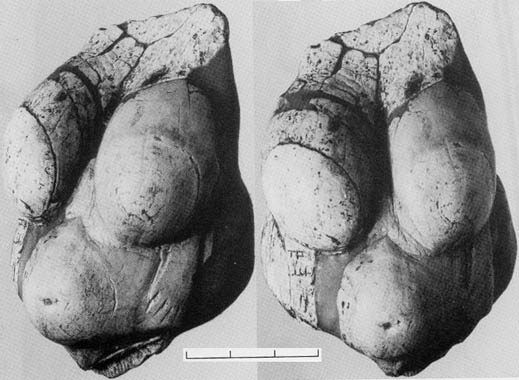
Figurine No. 10 (New Avdeevo Avd-N 87-88). In 1987 and 1988 two ivory fragments were found at Avdeevo (Figure 105). Both fragments represent massive flakes, which are the result of a strong vertical blow rather than the products of natural splitting of ivory. One fragment was found at the bottom of a pithouse, the second was found in the fill of a pit. The distance between these two elements of the layer was about 14 cm. It turned out that both fragments were pieces of one and the same figurine. All that remains of it is the front side, from the shoulders to the public triangle.
The length of the fragment is 80 mm, and the greatest width is 88 mm. Judging by the size of the details, and bearing in mind the proportions typical of the Kostenki type of figurine, we may suggest that the whole figure measured 200-210 mm.
Teardrop-shaped, asymmetrical breasts, slightly apart, descend to the upper part of the abdomen from the flattened upper torso. Forearms with hands emerge from beneath the breasts. Fingers and bracelets are cut out on the hands. One of the bracelets is decorated with a wedge-shaped notching with a staggered interval. The hands reach the bottom of the abdomen. The rounded abdomen protrudes forward. The greatest protuberance is at the centre and it coincides with a navel, marked by a small shallow dent.
This seems to be the largest of all the figurines found at Avdeevo, and probably the most artistic in terms of its execution. The figurine appears to belong to the Kostenki type of figurine. It depicts a mature woman with massive breasts and a rounded abdomen.
Scale: 3 x 10 mm
Photo and text: Gvozdover (1995)
At Avd-II, as well as at K-1, female figurines made from marl and chalk were also found. At Avd-I marl was not used for the manufacture of artifacts. At Avd-II the marl figurines are only represented by fragments: heads, and bits and pieces of legs or torso. All of them are small. The marl fragments were found in the cultural layer at all levels or in the upper portion of the fill in the pits. We shall now describe the most interesting marl figurines.


Figurine No. 11 (New Avdeevo Avd-N, 87, N 1). The head and the lower portion of the shins are missing. The length is 27 mm, while the width and thickness are 11 mm each. Despite the miniature proportions, all the details are thoroughly worked.
The shoulders are narrow, the breasts are small. The prominent arms are slightly bent forwards. They are bent at the elbow and meet each other on the most protruding part of the rounded abdomen. A small projection is shown above the arms where they meet (a navel?).
The hips are rendered as a unit; the shins are apart and turned backwards. The back is prominent, and the buttocks are small and rounded. In general the figurine might belong to the Kostenki type.
Scale: 2 x 10 mm
Photo and text: Gvozdover (1995)
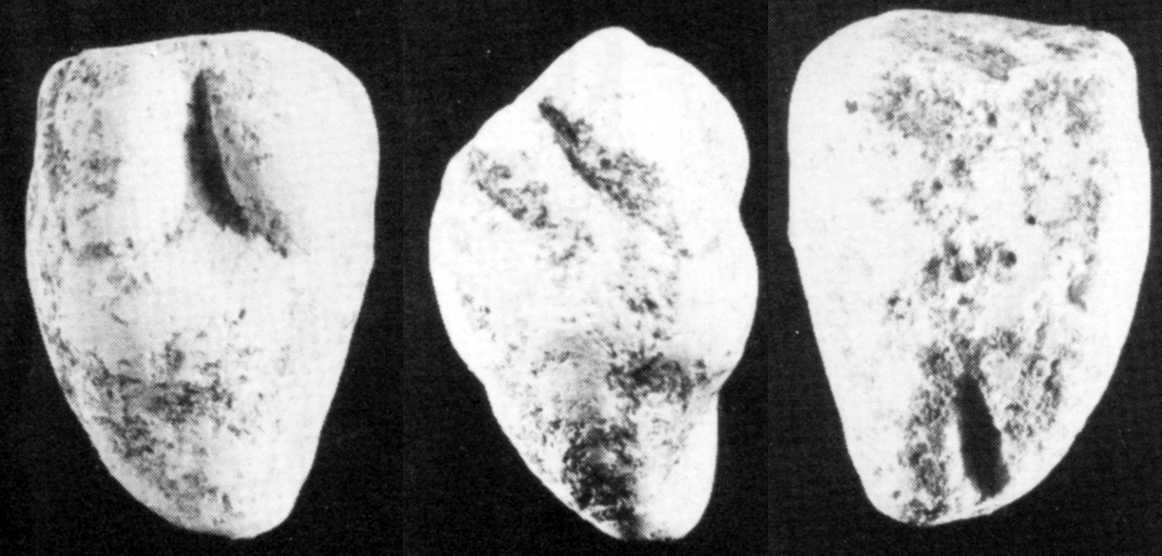
Figurine No. 12 (New Avdeevo Avd-N 87, N 2) also represents a fragment of a miniature figurine. Its length is only 27 mm. The head and shoulders are missing. The surface of the back has been strongly rubbed. The arms are shown only in the shoulder area. Large breasts lie on a prominent abdomen. The legs taper into a cone and are shown as a unit. Of the back, only a horizontal dent at the transition to the rump area is left, as well as the vertical notch separating the lower portion of the legs. It is quite possible that the cone-like shape of the legs is not original and is a result of the fracture of the leg above the knees, and that the cone is formed by the hip remnants after the fracture. Afterwards the fractured area was smoothed.
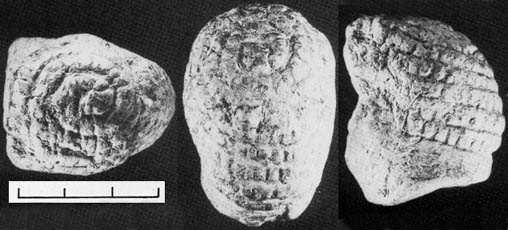
Figurine No. 13 (Old Avdeevo Avd-St 88) represents a fragment of the head of a large marl figurine. Its height is 38 mm, and the lengthwise diameter is 35 mm. The head is broken along the base of the neck. The front part of the face is cut off. The modelled cheekbones show that the face was not turned downwards. The lengthwise diameter is greater than the transverse one, thus making the head somewhat elongated. A cap (?) or a coiffure (?) is shown on the head by concentric horizontal bands, ending on the top of the head in a spiral. The bands are decorated by deep transverse straight notches, making up a row of irregular quadrangles. As a result the general view of the ornamental decoration on the cap can be defined as a net or checkwork (Figure 110).
This head from Avd-II shows a striking similarity with the head of a large marl figurine from the second complex of K-I. The only difference between them is in the location of the rows of decoration on the head (Rogachev et al. 1982: 59, figure 21) and the slightly bent position of the face of the Kostenki figurine.
Note also the similarity of the head decoration with the Venus of Willendorf

Figurine No. 14 (New Avdeevo Avd-N 87, N 3) is quite unique. We have glued it together from several fragments of marl. About two thirds of the body, forming its lower part, are preserved. The length of the fragment is 41 mm. The front side of the figurine is almost flat; only a slightly slanting plane renders the transition from the abdomen to the pubic triangle.
There are several cutmarks which are not very clear. The back is prominent, with small asymmetrical buttocks. Judging by the fragment's proportions, the breasts and shoulders were not shown. The legs are especially carefully worked. They are wide apart at the hips, and sharply bent at the knee. The shins are turned backwards and pressed against the bottom of the buttocks. The feet, in contrast to the Kostenki figurines, are large, maybe even enlarged out of proportion. The buttock area is somewhat damaged and rubbed, which makes it impossible to define the exact location of the feet - they either have the toes together, or the right sole lies above the left one (Figures I 11, 112).
The genitalia are shown very realistically at the perineum. A small, relatively deep, coneshaped dent is cut in the left groin. It is possible that this dent was made for a thin pin, about 2 mm in diameter, which determined the spatial position of the figurine. Judging by the inclination of the dent, the perineum of the figurine might have been turned upwards.
The pose of this figurine and some of its peculiarities are unique, and not typical of the Kostenki figurines of the Upper Paleolithic. For example, legs bent at the knee and with thighs apart are not typical. No other figurines from the Russian Plain have such an indication of gender. The pose of this figurine is only somewhat similar to the pose of the figurine from Kostenki 13 ("The woman in labour", Rogachev et al. 1982: 144, figure 45) and has been interpreted as a woman presenting in childbirth.
Other Sculptures
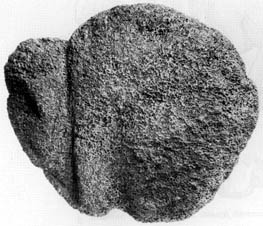

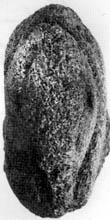
Mammoth figurine no.1, bone, from New Avdeevo
Photo: Gvozdover (1995)
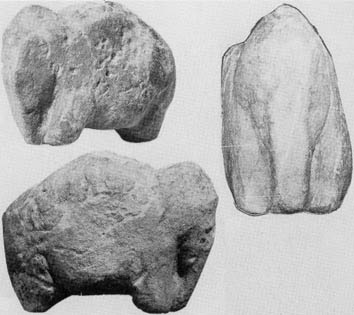
Mammoth figurine no.2, sandstone, from New Avdeevo
Photo: Gvozdover (1995)

Mammoth figurine no.2, sandstone, from New Avdeevo
Photo: http://www.istmira.com/foto-i-video-pervobytnoe-obschestvo/3924-iskusstvo-predystorii-pervobytnost-2.html
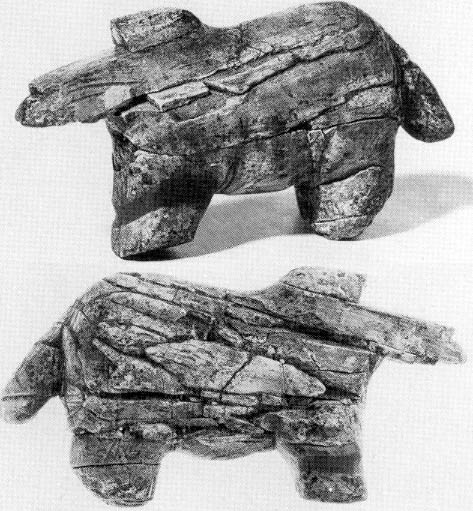
Horse figurine, mammoth ivory, from New Avdeevo, used as a propulseur or atlatl.
Photo: Gvozdover (1995)
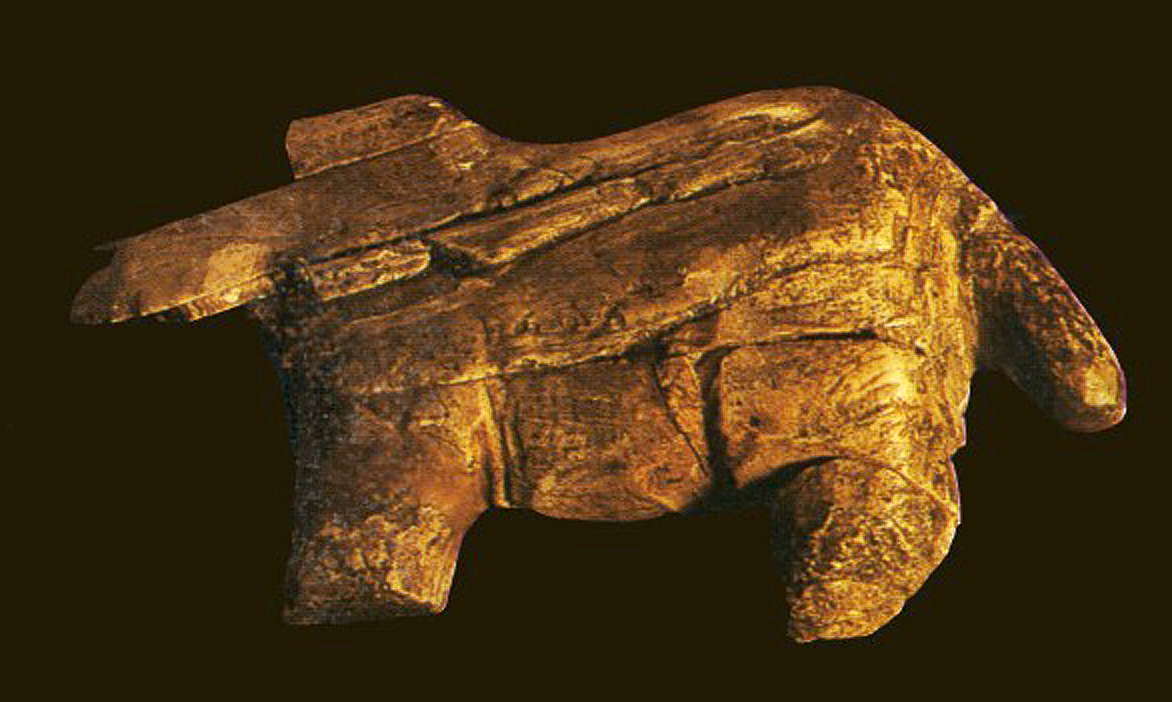
Propulseur or spear thrower in the form of a horse, New Avdeevo as in the photo above.
Photo: http://www.istmira.com/foto-i-video-pervobytnoe-obschestvo/3924-iskusstvo-predystorii-pervobytnost-2.html

What seems to be a handle with the image of an owl, Avdeevo
Photo: http://www.istmira.com/foto-i-video-pervobytnoe-obschestvo/3924-iskusstvo-predystorii-pervobytnost-2.html
Click on the images to see a close up
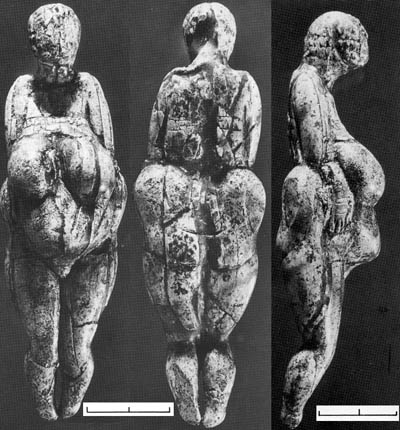
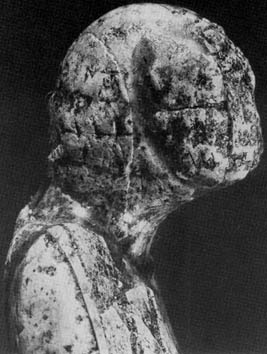


Click on the images to see a close up
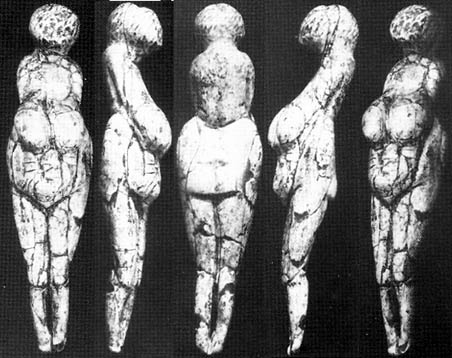
Click on the images to see a close up
Click on the image to see a close up
Note the similarity of the head decoration with the Venus of Willendorf
Click on the image to see a close up
This has been interpreted as a woman presenting in childbirth.

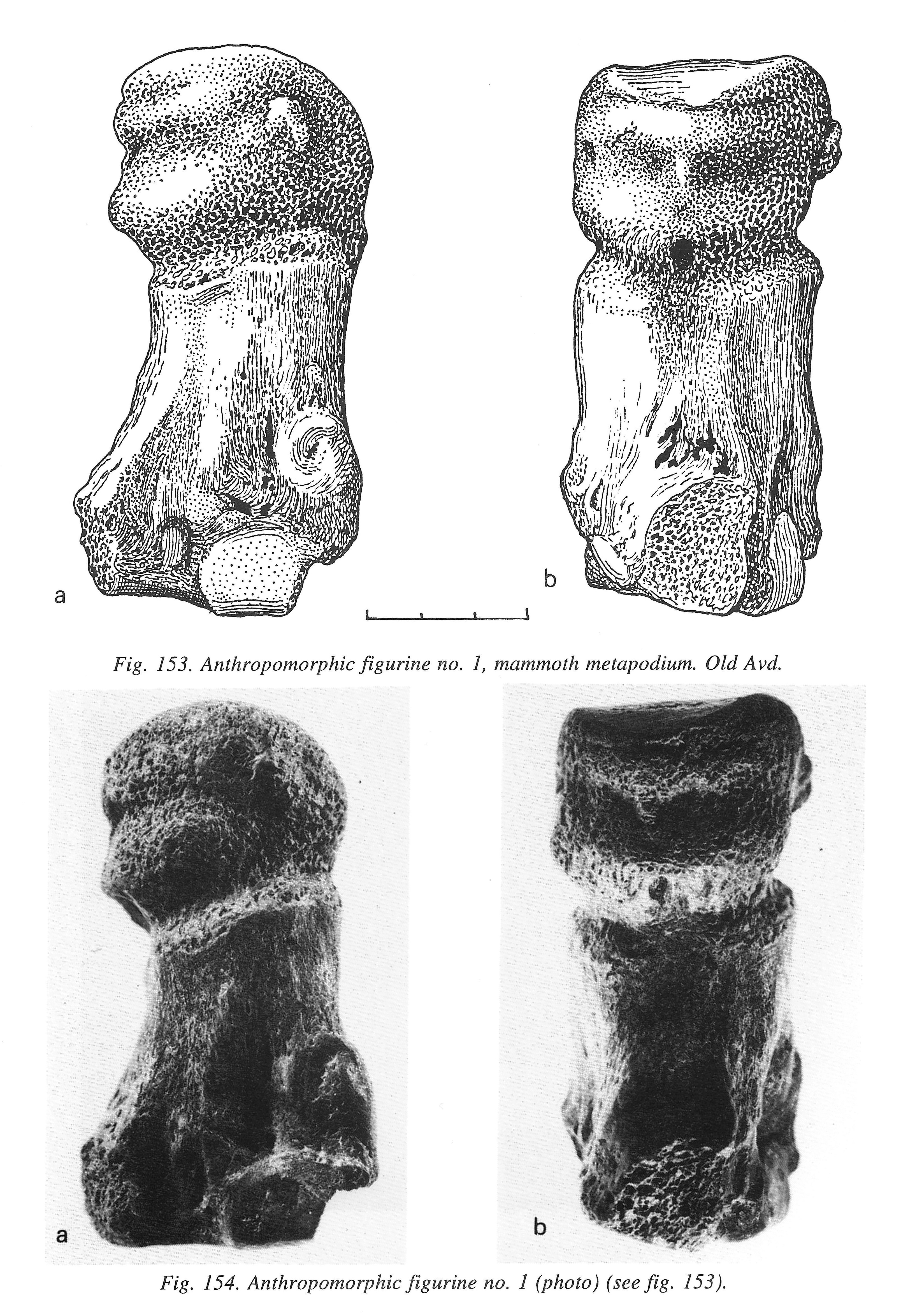
Anthropomorphic figurines, mammoth metapodia, Old Avdeevo.
Photo and text: Gvozdover (1995)
(My thanks to Vladimir Gorodnjanski for this translation - Don)
From: http://news.kursk.biz/news/683942.html
Kursk, news line
A monument of national value near Kursk is destroyed for revenge
10 teenagers have destroyed a palaeolithic site in Avdeevo village, 40 kilometres from Kursk, our correspondent in the Office of the Public Prosecutor for the Kursk region has been informed.
On the night of 25th July, at an archeological excavation site in the village of Avdeevo a unique monument of archeology of national value was destroyed. For 50 years scientists from Kursk, Moscow and St. Petersburg conducted scientific work there.
Each season brought invaluable finds at this site of ancient people, who lived there about 23 thousand years ago. Some of the first examples of ancient art were found there - a palaeolithic Venus, a skeleton of a mammoth, and many other things.
Scientists told the inspectors, that some days prior to tragedy at the excavation site a young man was employed. He was a poor worker, and the archaeologists asked him to leave. The unfortunate would-be archaeologist insisted that scientists had offended him and gave up his job with bad grace. During the investigation it was established that the young man had decided to take revenge on the scientists. He collected about 10 local teenagers and at night they destroyed a skeleton of a mammoth on whose excavation leading archeologists this summer were engaged, filled up the site with earth and trampled a cultural layer, and broke the necessary equipment of the scientists.
The Public Prosecutor has noted that for similar acts, a prison term of five years can be given.
Курск, лента новостей
Памятник федерального значения под Курском уничтожен из мести
10 подростков уничтожили стоянку древнего человека в селе Авдеево в 40 километрах от Курска, сообщили корреспонденту ИА REGNUM в прокуратуре Октябрьского района Курской области.
Напомним, что в ночь на 25 июля на месте археологических раскопок в селе Авдеево был уничтожен уникальный памятник археологии федерального значения. Около 50 лет ученые Курска, Москвы, Санкт-Петербурга вели здесь научную работу. Каждый сезон приносил бесценные находки: стоянка древнего человека, которой предположительно около 23 тысяч лет, первые образцы древнего искусства - палеолитические Венеры, скелет мамонта, многое другое.
РИА Новости
Ученые рассказали октябрьским следователям, что за несколько дней до трагедии на работы на раскопках нанялся молодой человек. Работал он откровенно плохо, и археологи попросили его уйти. Сам неудавшийся археолог настаивает на том, что ученые его оскорбили и отказали в грубой форме. В ходе расследования было установлено, что молодой человек решил отомстить ученым. Он собрал около 10 местных подростков и ночью они уничтожили скелет мамонта, раскопками которого этим летом занимались столичные археологи, засыпали землей и затоптали культурный слой, разбили инвентарь, необходимый для работы ученых.
Как отметили в прокуратуре района, за подобный поступок правонарушителям может грозить срок до 5 лет, пока же следствие продолжается.
References
- Abramova Z., 1995: L'Art paléolithique d'Europe orientale et de Sibérie., Grenoble: Jérôme Millon.
- Cohen C., 2003: La femme des origines. Images de la femme dans la préhistoire occidentale, Paris, Belin-Herscher, 2003, 191 pages.
- Gvozdover M., 1995: Art of the mammoth hunters : the finds from Avdeevo, Oxbow Books, 1995
- Jelinek J., 1972: Das grosse Bilderlexikon des Menschen in der Vorzeit, Gütersloh. Bertelsmann-Lexikon-Verlag, P. 333
- Sinitsyn A., 2007: Variability of the Gravettian of Kostienki (Bassin moyen du Don)Paleo, No. 19, December 2007, pp 181-202, http://paleo.revues.org/599
- Sklenar, Karel, 1988: Hunters of the Stone Age, illustrated by Pavel Dvorsky and Eliska Sklenarova, Heinemann Publishers Australia, 1988
- White, R. , 2002: Une nouvelle statuette phallo-féminine paléolithique: 'La venus des Milandes' (commune de Castelnaud-la-Chapelle, Dordogne), Paleo N° 14 Décembre 2002 – Pages 177 à 198