La Grotte du Sorcier - la Grotte du Roc Saint-Cirq
The Grotte du Sorcier, or the Roc Saint-Cirq, is one of the sites classified as a World Heritage site by UNESCO among the prehistoric painted caves in the Vézère valley. It was discovered in late 1951. This site contains prehistoric engravings dating from the Magdalenian. There are engravings of humans, including the famous sorcerer, as well as animals (bison, horses and ibex), and linear signs.
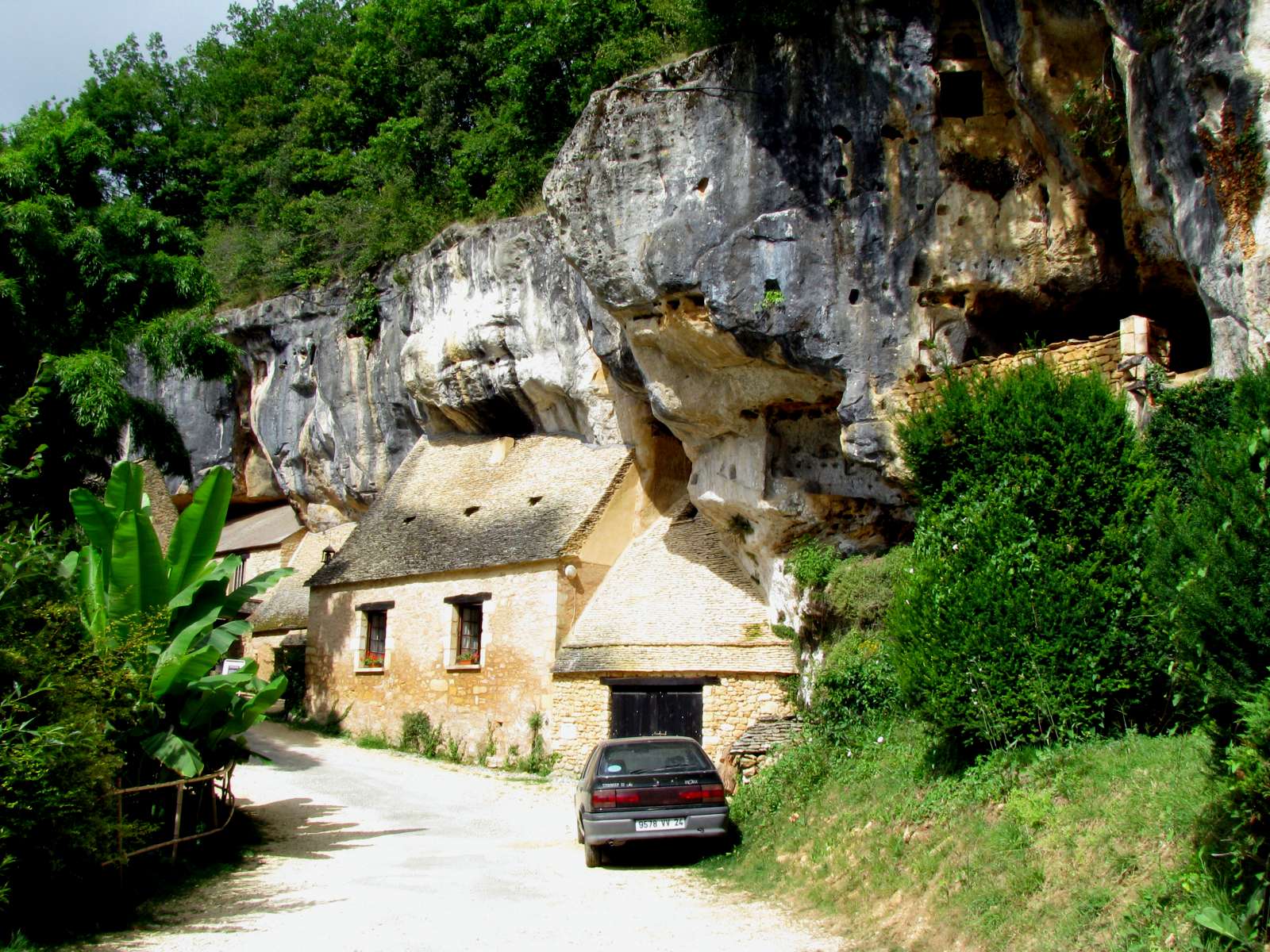
Parking is often a problem at sites in the Les Eyzies area because of the steep nature of the valley walls. In this case there is good parking a little further on where the road widens again past the museum and grotte entry.
Photo: Don Hitchcock 2008
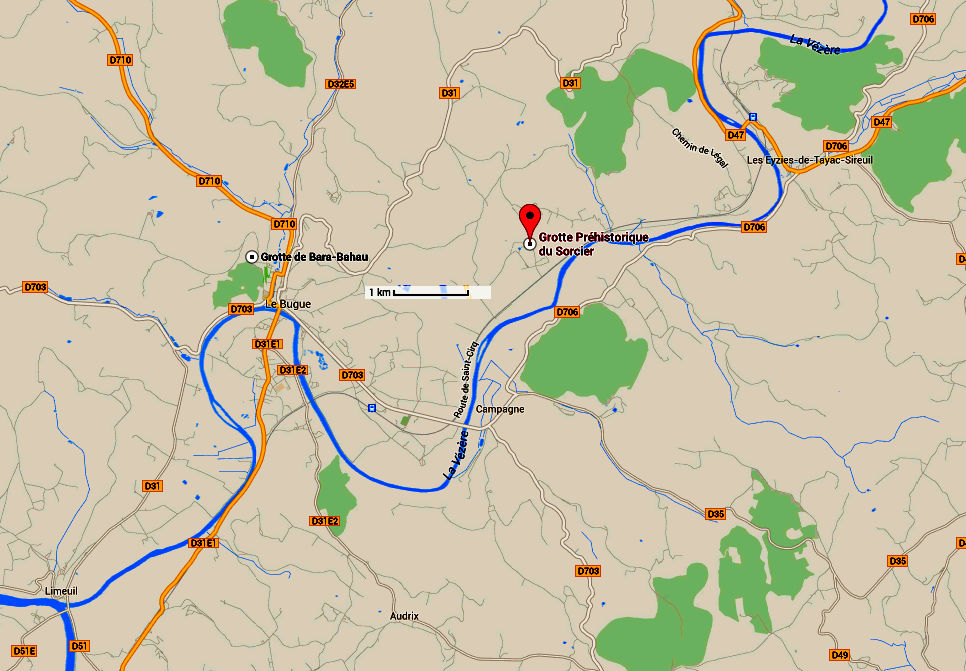
Map showing la Grotte du Sorcier.
Photo: Google Maps
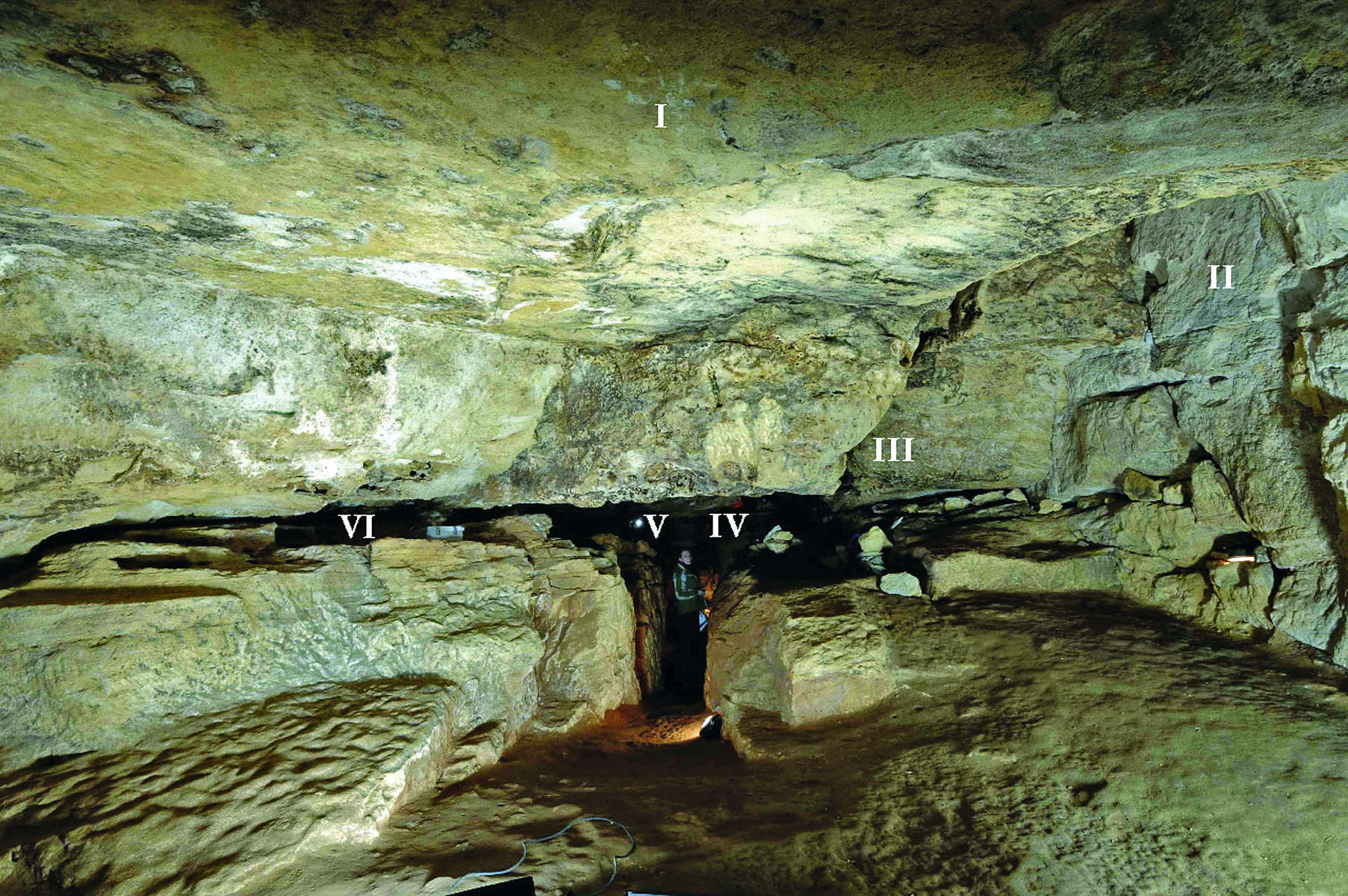
General view of the cave and sectorisation.
Photo: H. Paitier 2009
Source and text: Pigeaud et al (2012)
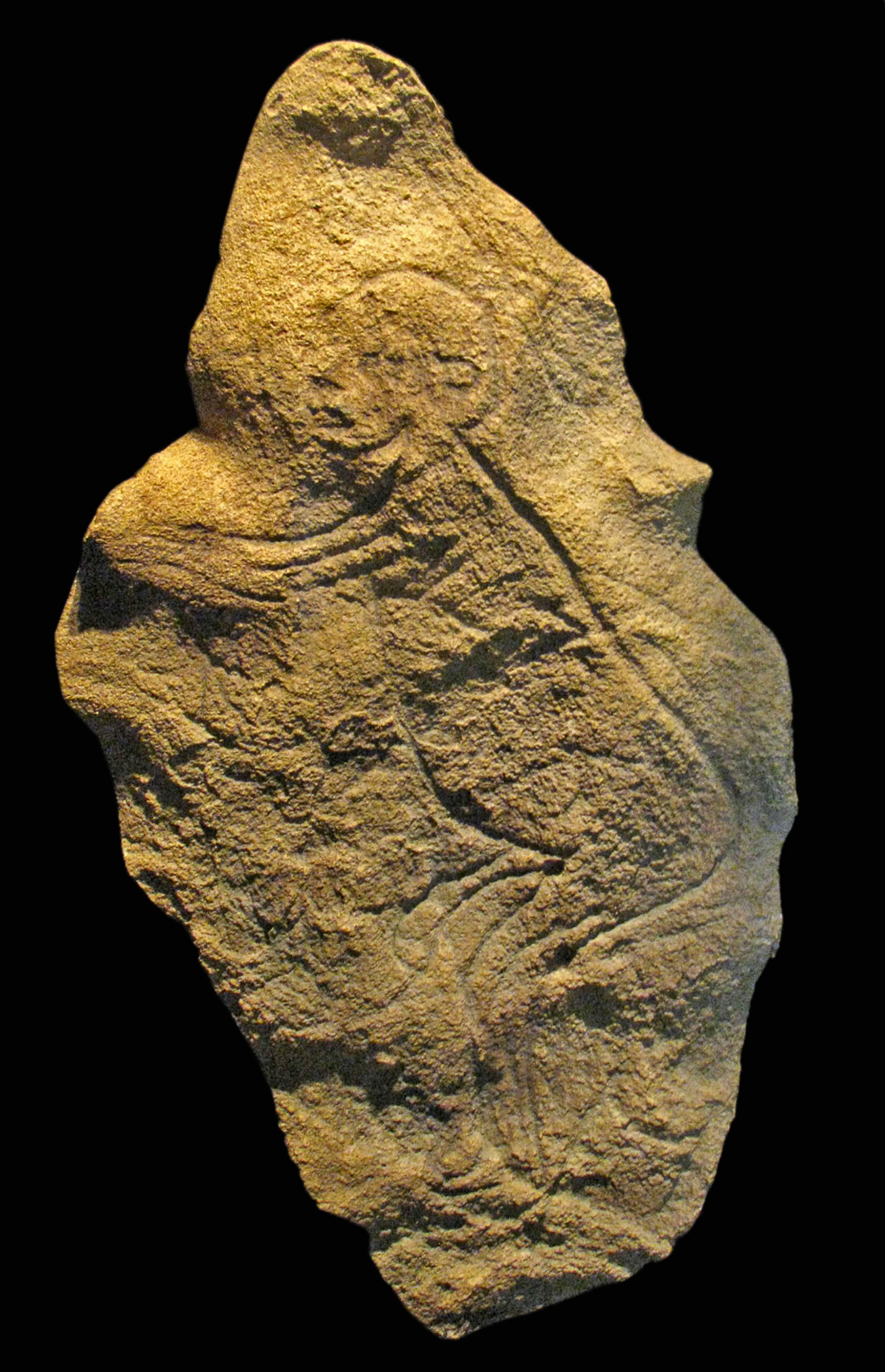
Facsimile of the Sorcerer, from the display at Grotte du Sorcier
Photo: Don Hitchcock 2008
Source: Facsimile, display at Grotte du Sorcier
Almost certainly a cast from the mould of 1966 made by Abbé Glory

Facsimile of the Sorcerer, from the display at Grotte du Sorcier
Photo: Jebulon
Permission: Creative Commons CC0 1.0 Universal Public Domain Dedication.
Source: Facsimile, display at Grotte du Sorcier
Almost certainly a cast from the mold of 1966 made by Abbé Glory
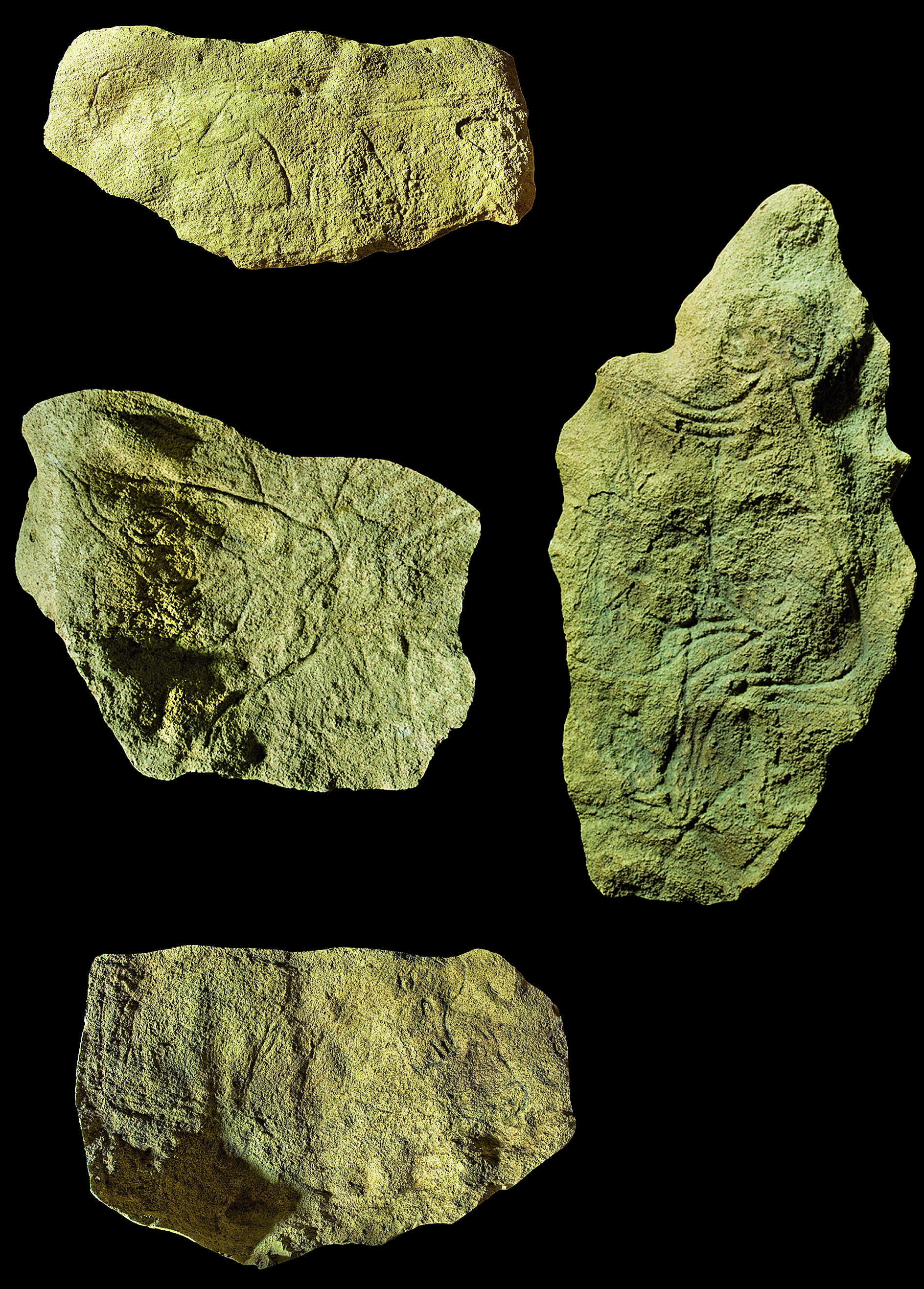
Casts of representations 25 to 27 (top left), of Bison 15 (middle left), of representations 23 and 24 (bottom left), of the 'Sorcerer' 18 (on the right in the middle), made by R. David from Glory’s 1966 casts.
Photo: H. Paitier 2009
Source and text: Pigeaud et al (2012)
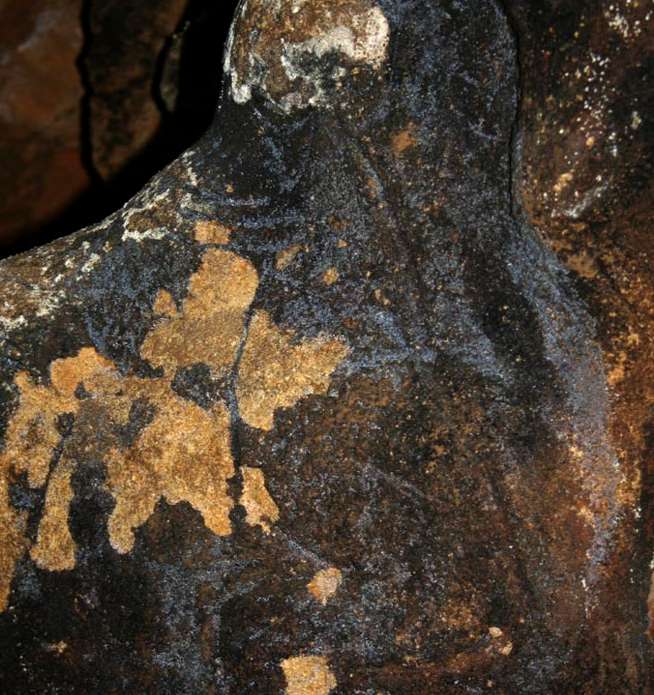
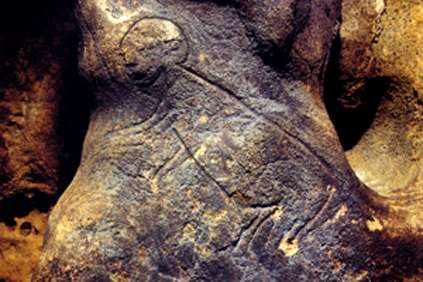
This is image No. 37 (according to Dams (1980)), or No. 18 (according to Delluc et al (1987)), known as the Sorcerer.
( Note: If one compares even modern colour photographs as shown here, the deterioration in recent times is very obvious. When flakes of rock fall away, they remove the grey patina and expose the yellowish rock beneath. In addition, the white fungal growth around the head seems to be increasing in area and thickness - Don )
Photo: (left) http://www.grottedusorcier.com/main.html, Source: Original, Grotte du Sorcier
Photo: (right) http://www.perigorddecouverte.com/perigord_pages.php?menu=3&rubrique=11&id_pays=
Source: Original, Grotte du Sorcier
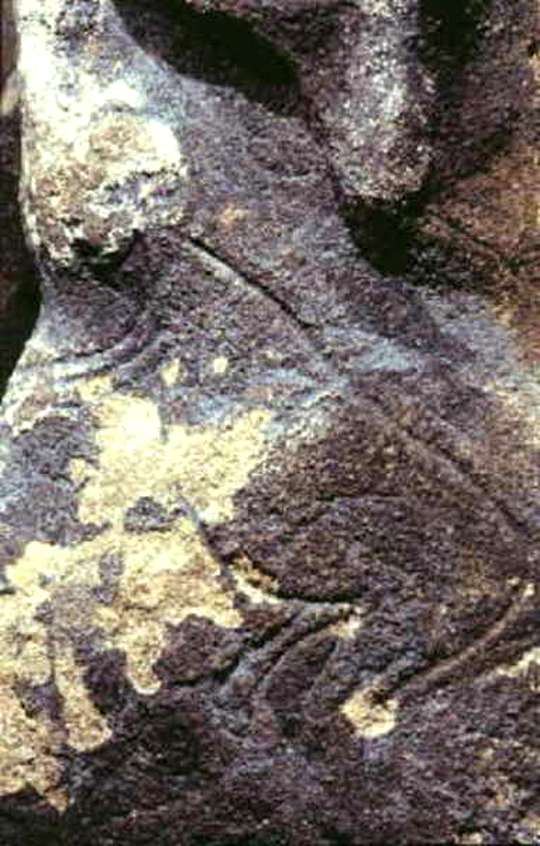
Another image
Representation of a human with an erect phallus, located on the roof in the deepest part of the cave. The man has a narrow thorax, distended abdomen, extended upper limbs, and the head is round. The engraving is on limestone, the surface of the rock is affected by falling flakes primarily in the ventral part. The cave was closed for twenty years. This helped to stop the proliferation of microorganisms associated with various parameters, including light and heat. The superficial flaking of the limestone seems to have been naturally stabilised for twenty years and is one of the positive effects of the management of the cave.
Photo, and text translated from the French at: http://www.culture.gouv.fr/culture/conservation/fr/grottes/Pageshtm/cirq1.htm
My adaption and translation of Delluc et al (1987) with respect to this figure follows:
Man in profile
The figure is about 50 cm high and 22 cm wide, and is turned to the left. It is carved towards the top of the vault, on a support almost at the top, inclined at an angle of 10° to the horizontal. The surface texture has been used to give relief to the figure: the line of the head has been sited on a small rounded boss. The chest is drawn on a concave area, the arms on a surface slightly convex, as also the stomach and legs. The axis of the figure is at an oblique angle to the axis of the joints, the head being directed to the floor of the cave and the feet away from the axis of the joints.
The surface is very dark and grainy, affected by the falling of flakes from the surface, exposing the yellowish rock. Some flakes appear to have fallen before or contemporaneous with the discovery, if one refers to old photos. Others have appeared between that date and 1959, at which date the photographs of J. Vertut and A. Leroi-Gourhan were prepared for la Préhistoire de l'art occidental and may be related to the first cast of the engraving from which very accurate information was obtained.
Bluish traces mark the location (including scars of flakes) of a cast carried out on the 12th and 13th April, 1966 under the direction of Abbé Glory and kept in l'institut de Paleontologie humaine in Paris, but no one seems to have imputed the damage done to him.
Finally, the location of the head is the seat of the development of white blooms of fungus that appear to have proliferated recently, which we particularly noticed during a visit with M. Lorblanchet on 23/12/1986.
The figure is carved throughout with fairly broad strokes, 2 to 10 mm wide, and 1 to 5 mm deep.
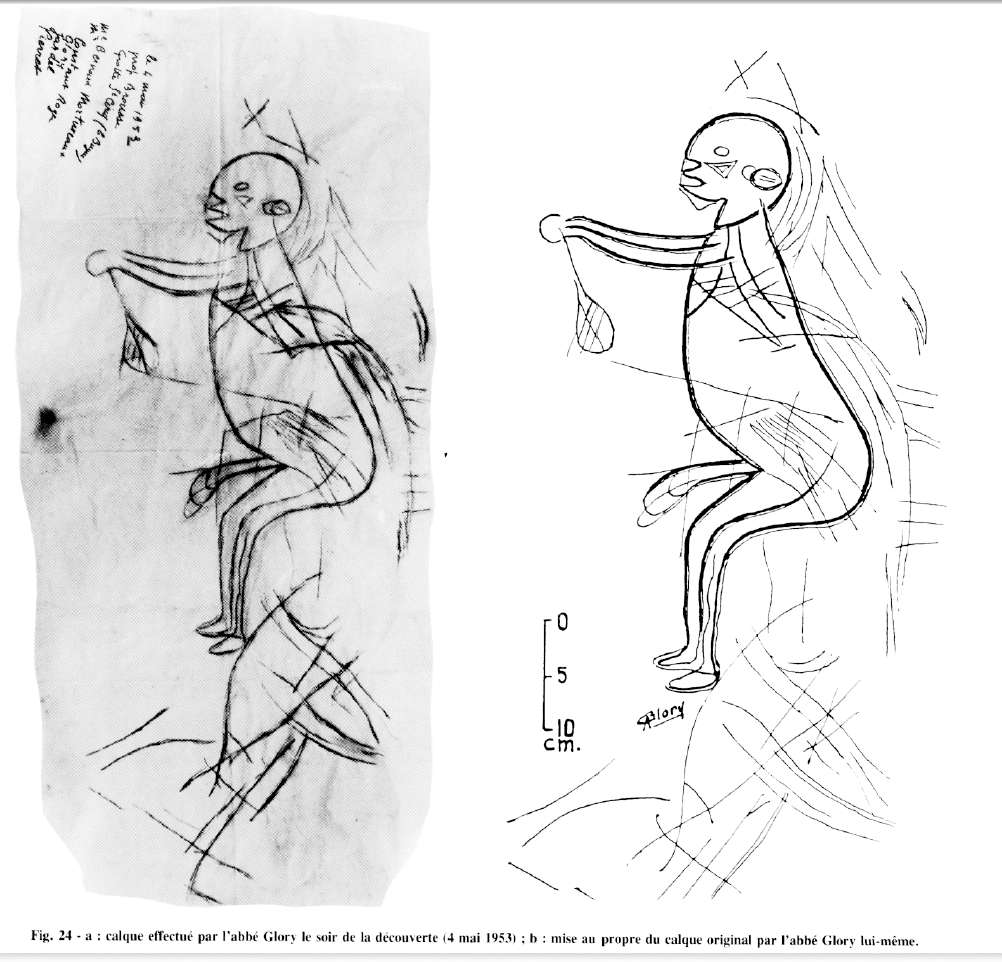
Tracing by Abbé Glory at the time of discovery, 4th May 1953, of the Sorcier, and a clean version of the tracing, also by Abbé Glory.
Photo: Delluc et al (1987)
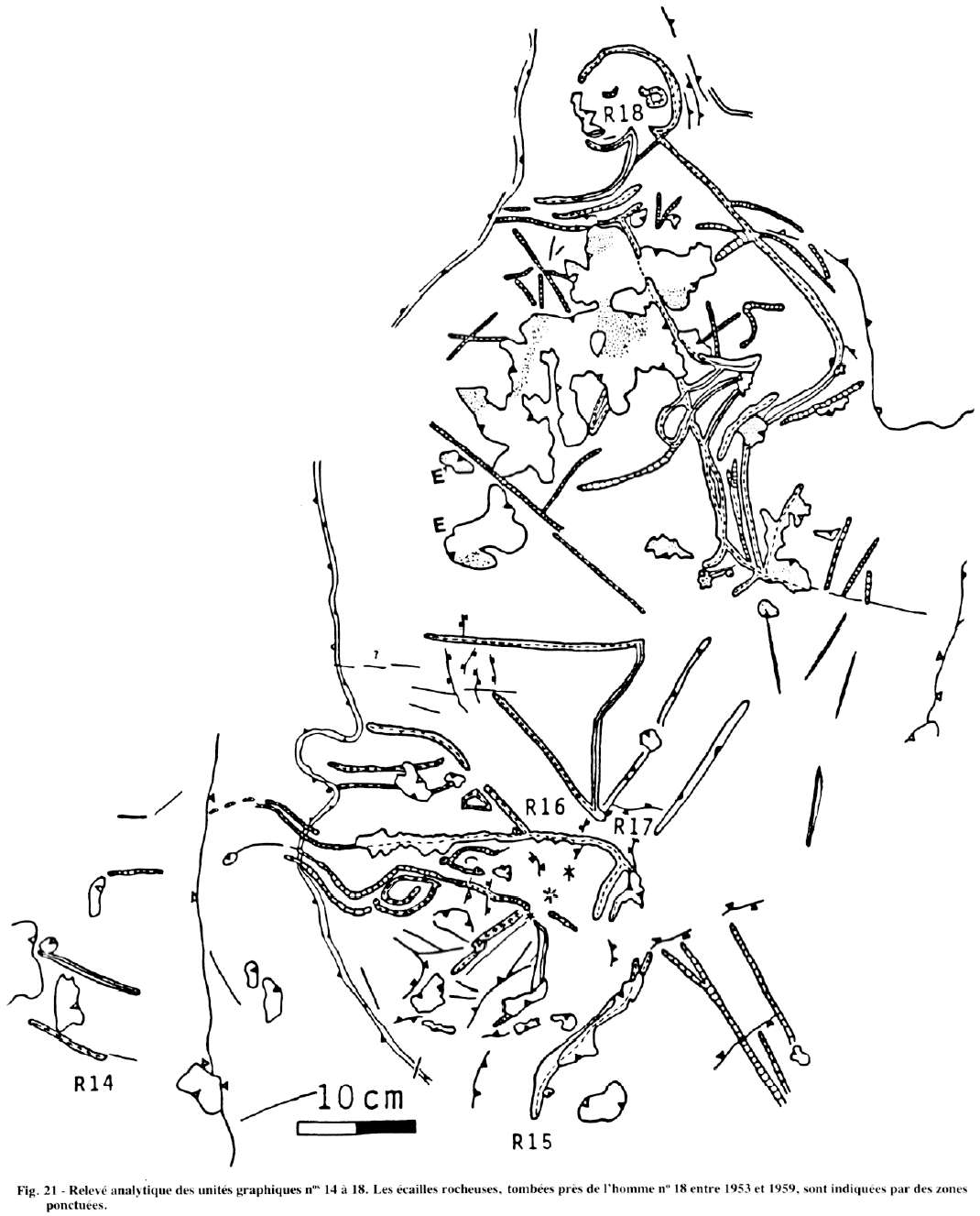
Drawing of the section surrounding the Sorcier. The flakes of rock which fell from the area between 1953 and 1959 are indicated by the dotted areas.
Photo: Delluc et al (1987)
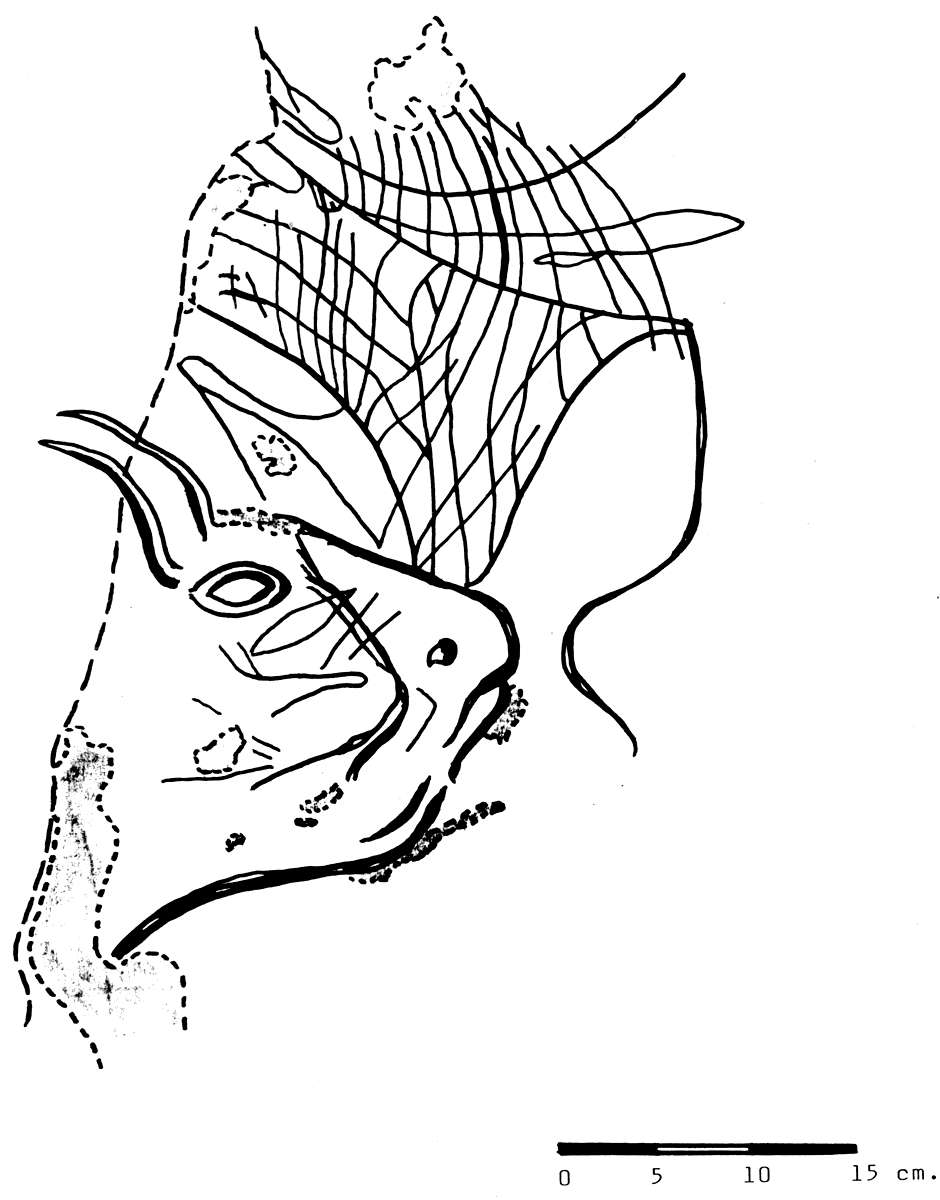
A head with a bestial face

A head with a bestial face, turned to the right, 10.5 cm by 9.5 cm, and 6.5 cm from the ear to the front. R24 is 113 cm above the bedrock floor. The background is a broad and deep concave rectangular depression, 42 cm wide and 32 cm high. The average planar surface is at 45 °. It looks a little towards the entrance of the cave, that is towards the centre of the dome. Currently, the surface of the rock is clean. The superficial, fragile blackish crust has disappeared, apparently during the removal of the mold of April 1966 under the direction of A. Glory.
The traces of the figure which remain are fine lines, but perfectly recognisable, with a width of 2 to 4 mm, and a depth of 1 to 2 mm. However the figure is very clear on the negative molding kept in the Institute of human palaeontology.
The head is rounded at the front, engraved in the top right of the panel of drawings, near the top of the wall, without any indication of the skull. The face is projected forward, which bestialises it, with two features to represent the nose and mouth. The chin is sharp and the angle of the jaw is marked.
The oval shaped eye and the ear are deeply engraved.
Two small marks on the top of the head may suggest hair. The head is tilted forward, tilted about 50 deg to the vertical, almost looking down. For Leroi-Gourhan, it is "a buffalo or a bestialised human face. This panel consisted for A. Glory as several figures: an "ibex" (for us: the No. 24 head itself), a horse, one deer, two animal heads and maybe a third, as indicated on his tracing.
The remains preserved on the wall are too degraded to allow discussion of all these interpretations. However, observation of the cast leads us to identify with certainty that for the bestialised human head No. 24, neither of the animal identifications (buffalo for Leroi-Gourhan and ibex for Glory) can be justified. For us, this drawing must be a human face, similar to those of the Middle Magdalenian, in particular those of La Marche, la Madeleine and Comarque.
With the death of A. Glory, this drawing, now barely legible on the wall had been completely forgotten. It was the discovery of the mold, as well as casts of three panels of the more well known Saint-Cirq figures (No. 15, 18, 25 to 27) which helped us link them with the grotte of St. Cirq and rediscover the remains of the drawing on the wall. The rest of the panel is covered by some straight lines, more or less vertical, apparently of little significance.
Text: translated from the French of Delluc et al (1987) by Don Hitchcock.
Photo: Don Hitchcock 2008
Source: Facsimile, display at Grotte du Sorcier
Almost certainly a cast from the mold of 1966 made by Abbé Glory

Tracing by Abbé Glory of the panel carrying the combined graphics of R23 and R24.
Photo: Delluc et al (1987)
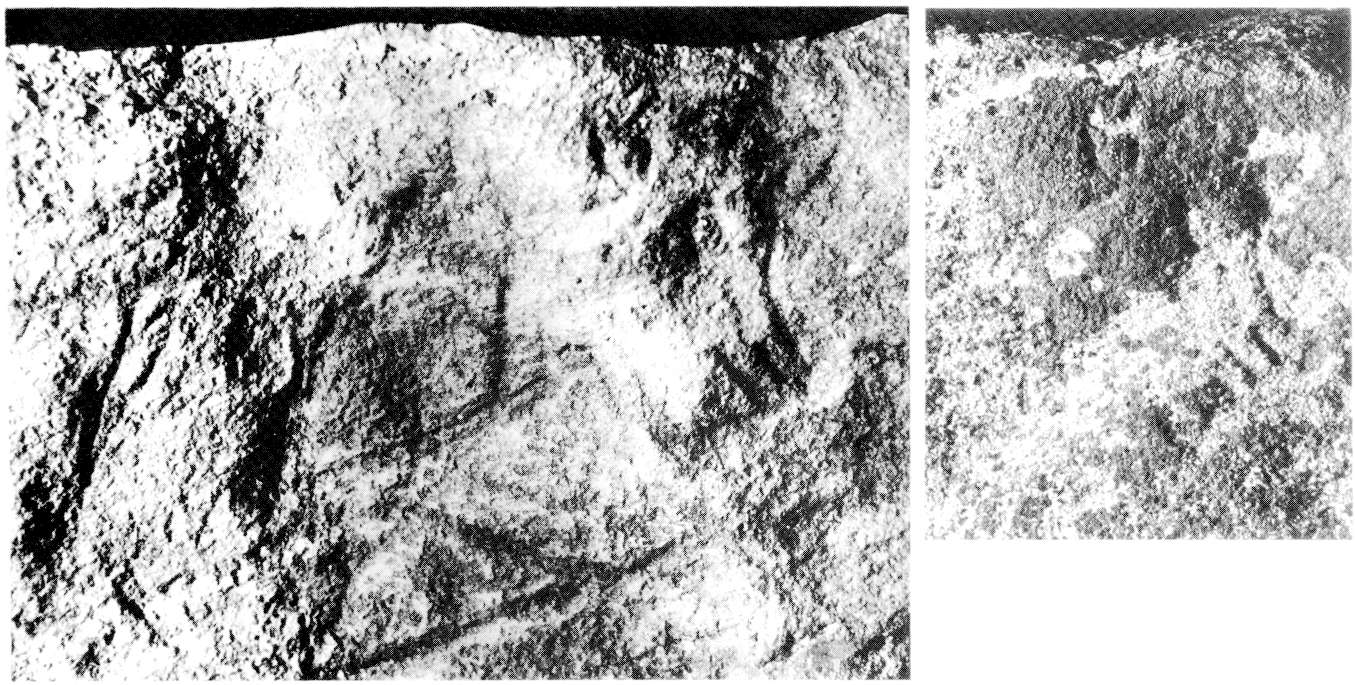
Left, a photograph of the 1966 cast of the bestial face, and right, a photograph of the actual panel in 1987.
Photo: Delluc et al (1987)
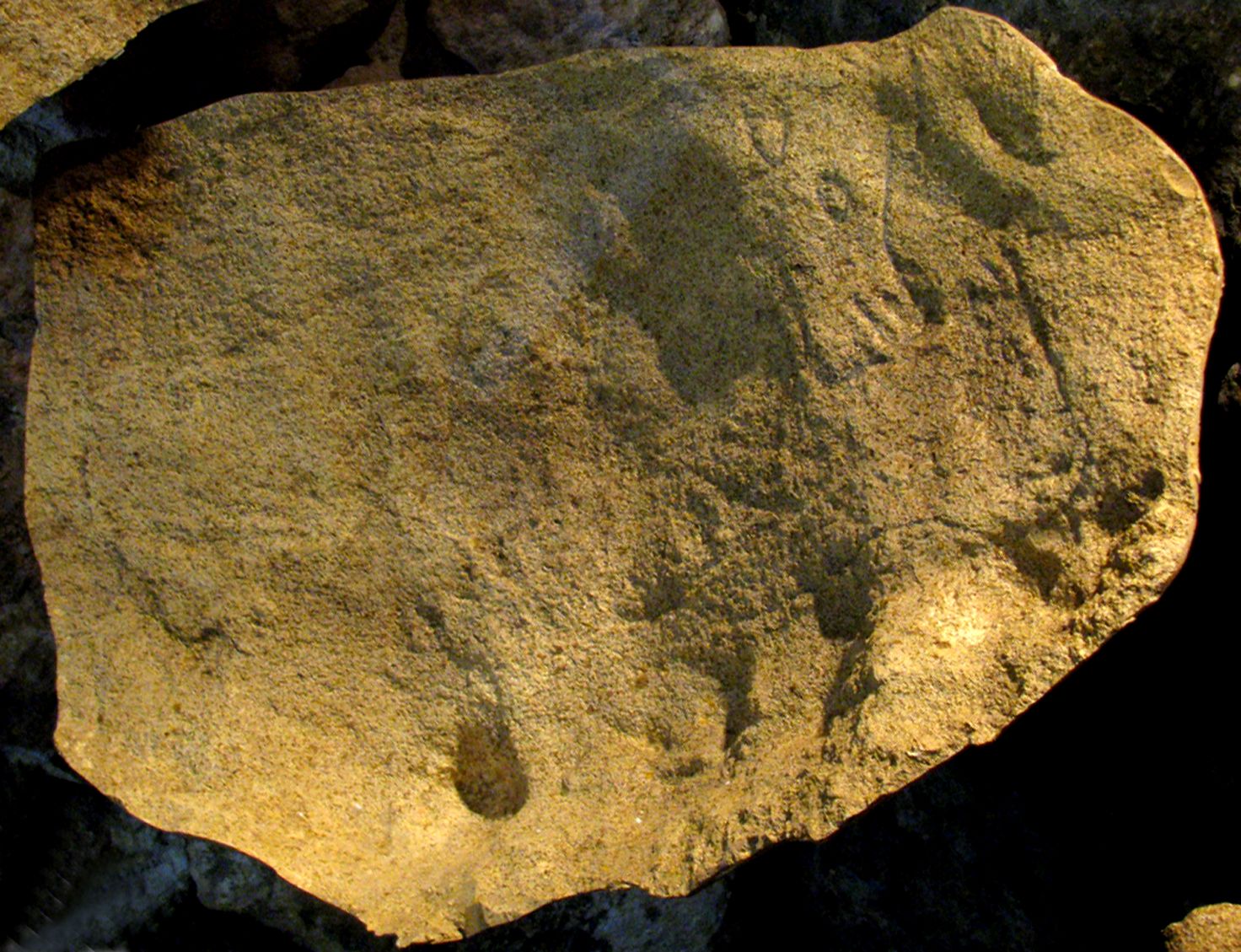

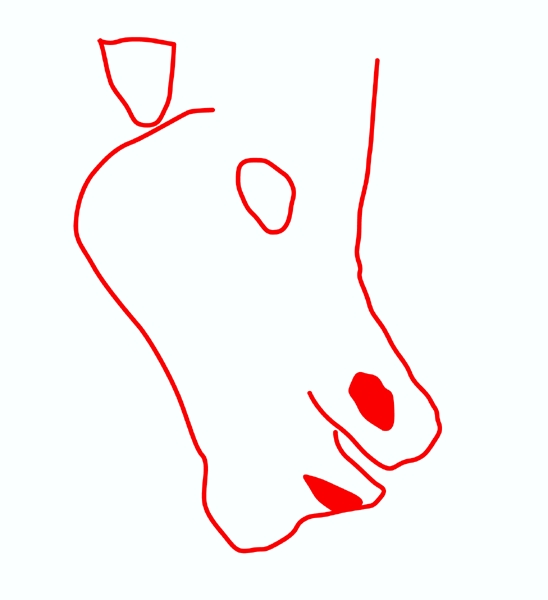
I derived this outline of the bestial face from a photograph of a cast of the 1966 mold, after correcting for the distortion caused by the angle at which the photograph was taken, by carefully rotating, stretching and aligning it with the black and white photograph by Delluc et al (1987) above.
Photo and drawing: Don Hitchcock 2008, 2009
Source: Facsimile, display at Grotte du Sorcier
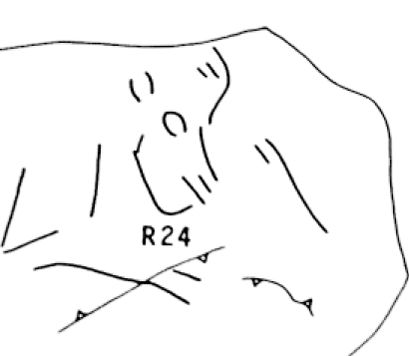
This outline of the bestial face also using the 1966 facsimile is from Delluc et al (1987)
Photo: Delluc et al (1987)
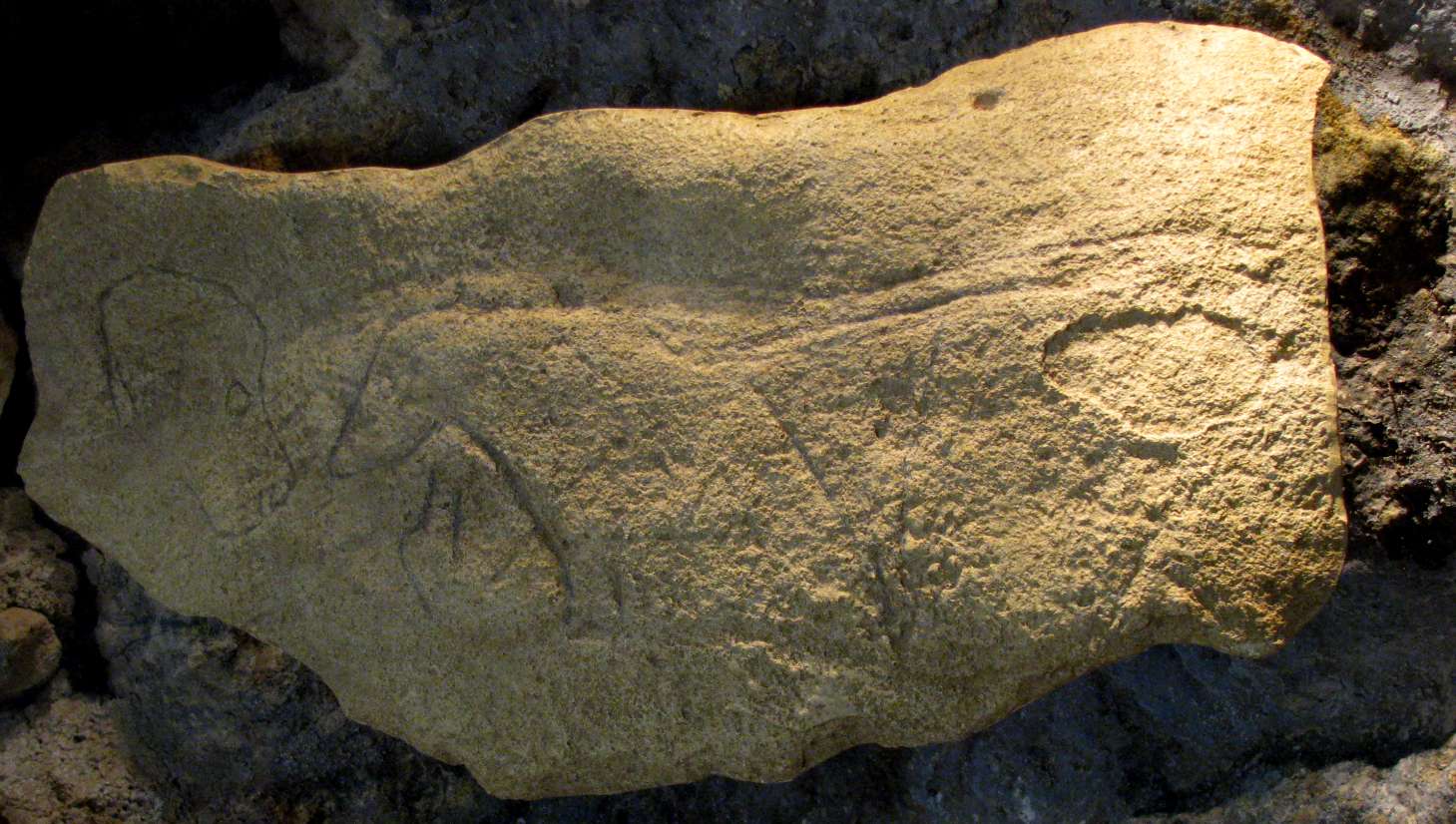
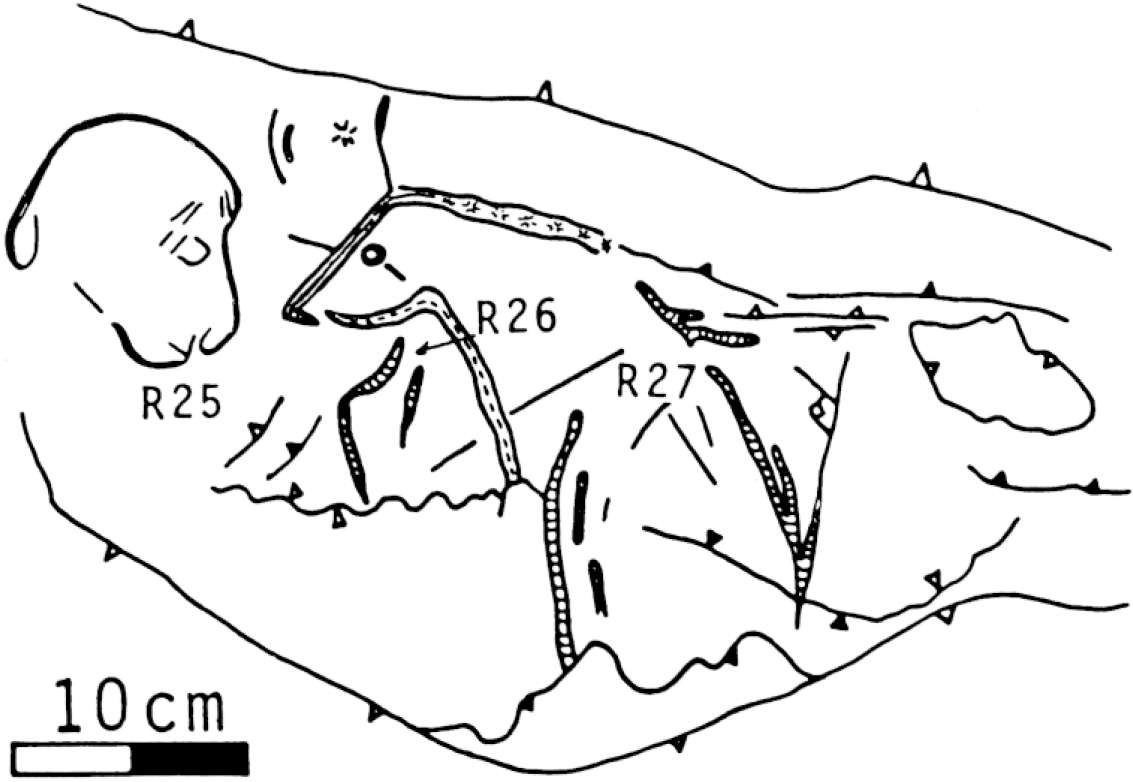
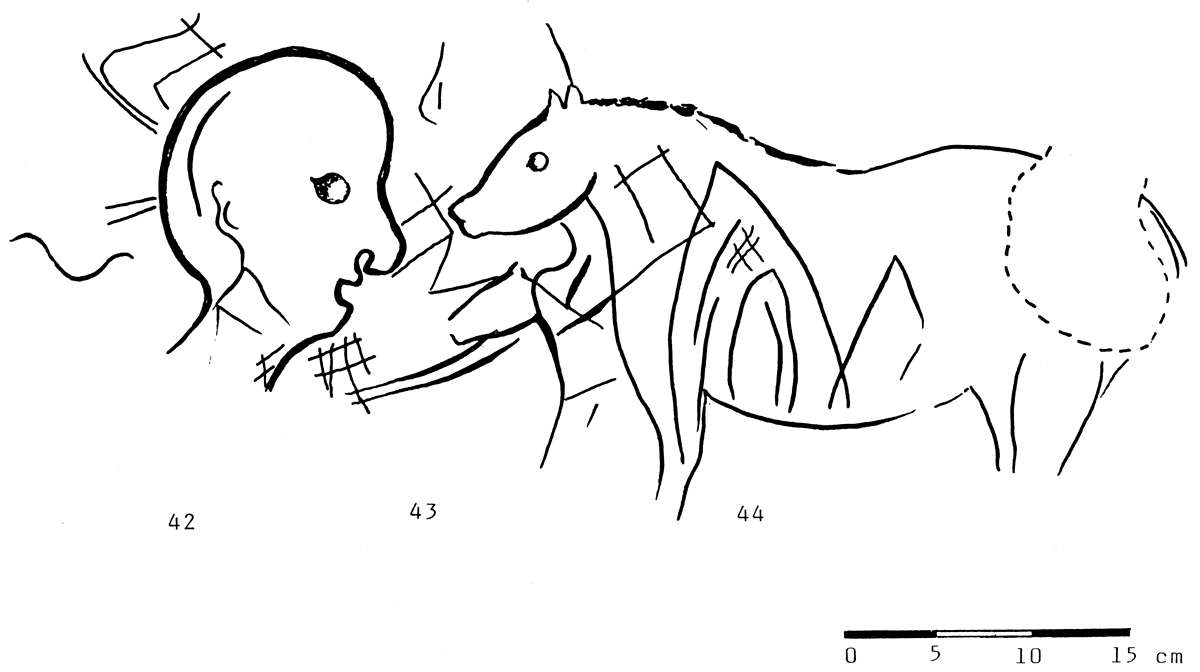
At a distance of 60 cm to the right of the No. 37 man, continuing towards the bottom, there is a very interesting panel.
At the left is the head of a man, No. 42, (R25 according to Delluc et al (1987)) which is on a degraded area, with traces of scraping. The top of the skull is high, with no indication of hair, the forehead is high and convex. The nose is heavy and convex and continues with a meandering line indicating the nostril and an open mouth. The ear is formed by two lines of which one extends to the thin neck. The eye is shaped with an elliptical shape, with an extension to the left. The inner surface also seems to have been pecked out by dots.
The head of the man faces a horse, from which it is separated by a group of lines. It seems that a vague outline of a horse head emerges from these features, but it is not certain.
Text: translated from the French of Dams (1980) by Don Hitchcock.
Drawings (left to right): Delluc et al (1987), Dams (1980)
Photo: Don Hitchcock 2008
Source: Facsimile, display at Grotte du Sorcier
Almost certainly a cast from the mold of 1966 made by Abbé Glory

Black and white photo by Dams (1980)
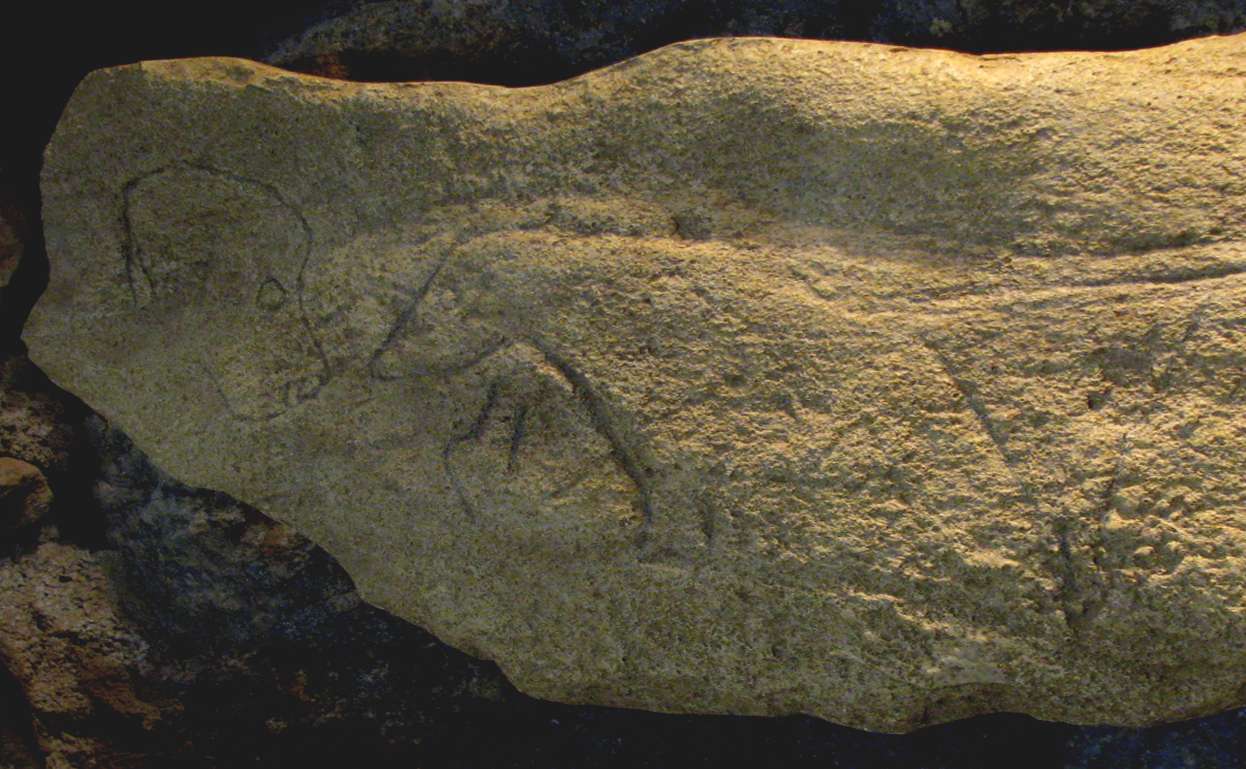
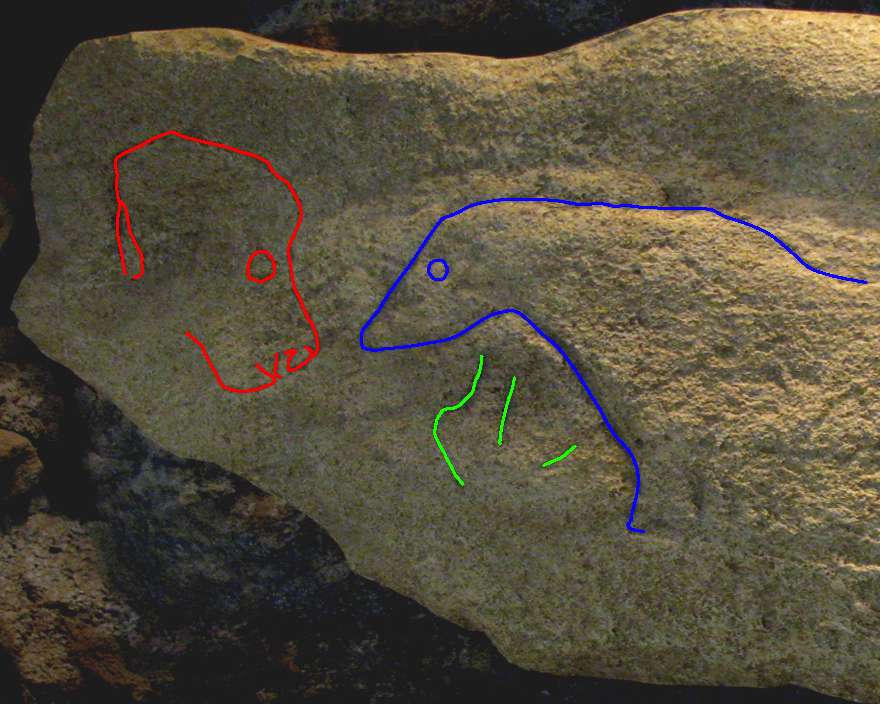

Above - my original photo stretched to match the black and white photo by Dams (1980), and two images delineating the carvings. Head in red, vulva in green, horse in blue.
Photo and drawings: Don Hitchcock 2008, 2009
Head with a bestialised human face called a bear by A. Glory (10.5cm by 9.5 cm) engraved on a rock surface forming the left wall of the corner immediately beyond the dome. It occupies the left panel of Figures 25 to 27 (46.4 cm wide by 19 cm high).
The wall is tilted at 45°. It looks down toward the line of the corner and very slightly towards the entrance of the cave. The wall is very dark, with blooms of white calcite in the lower panel. There are some scratches parallel to each other passing through the head.
Traces of blue delimit the surface which was cast in 1966. At certain times, there was significant condensation at the molded edges, as though molding byproducts had waterproofed the rock.
The R25 drawing is realised with a stroke of extreme delicacy of the order of a millimetre in width and depth around the contour of the head, and a half a millimetre to delimit the eye. The head, skull fully rounded ends with a sort of bun, the face projects forward, bestialised in the terminology of A. Leroi-Gourhan, but is certainly that of a human because of the very peculiar shape of the skull.
A hooked line outlines a nasal appendage. The eye is rhombic. The ear is not represented. The chin is receding. An important concavity crosses the cheek, while the rest of the face is on a flat surface. Despite these few details, the head is exactly the same type as the head R24. They both have dimensions of about 10 cm by 10 cm as does the sorcerer's head, of R18. The head 25 is etched face to face with the horse R27. This association is indisputable, which supports the existence of a relationship between the human head and the horse emphasised by A. Leroi-Gourhan. However, this Saint-Cirq tête à tête does not support the hypothesis of an identification of the horse as a male symbol.
One can, indeed, imagine that in the 25-27 group, the protagonists are synergic (one is male and one female), or they are both complementary to the small vulva of R26, in which case both would be male.
Text: Translated from the French of Delluc et al (1987)
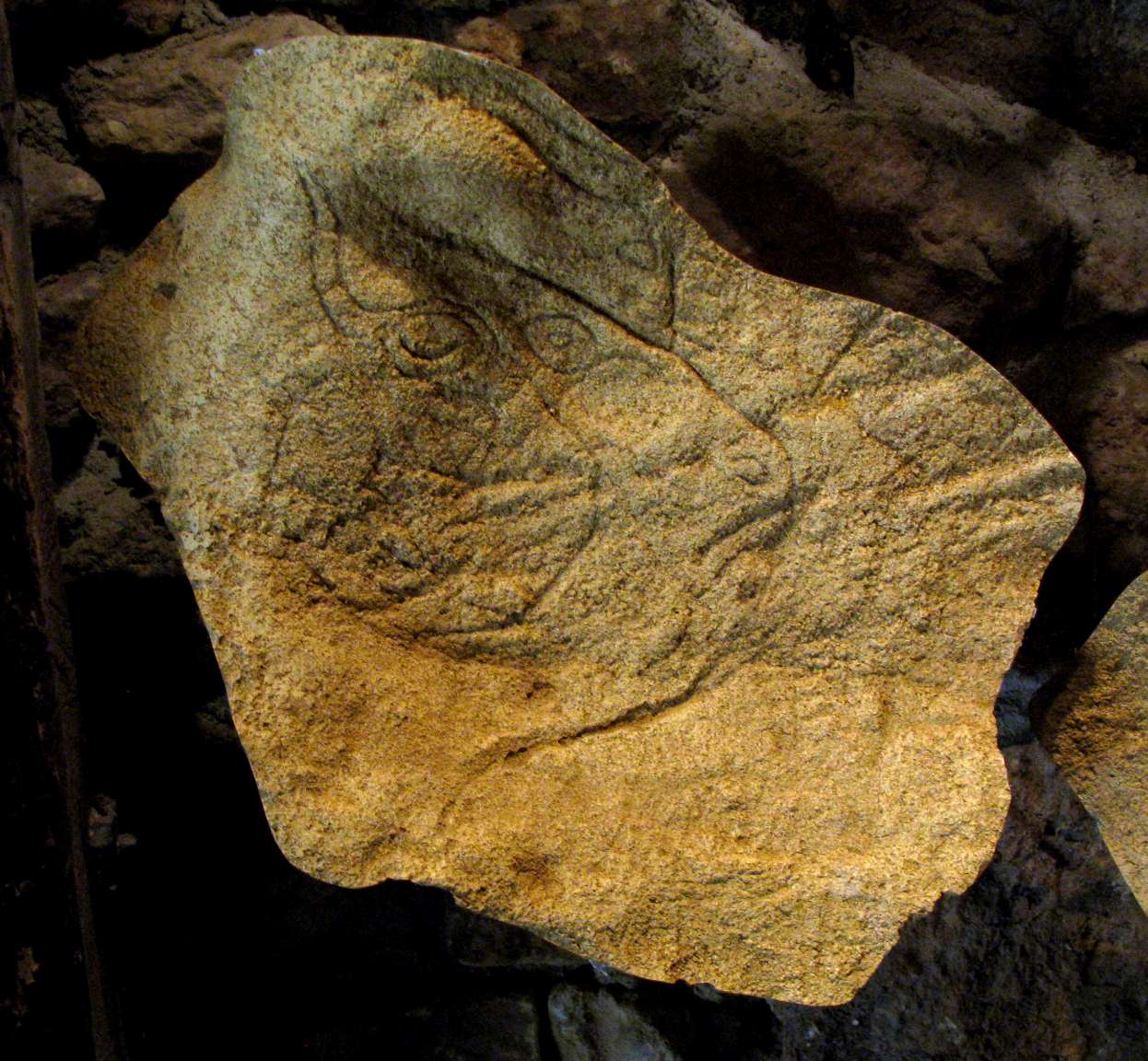
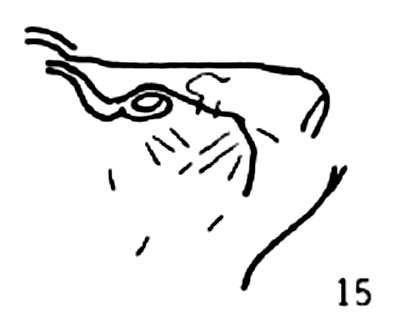
This is a cast of images No. 33 and 34 (according to Dams (1980)) or no. 15 (according to Delluc et al (1987)), of bisons, as well as the respective drawings by these authors of the two bisons.
In neither case, however, do the authors put in their drawings all the features visible in the cast, and in particular the eye of the second bison and the snout of the first bison.
Photo: Don Hitchcock 2008
Source: Facsimile, display at Grotte du Sorcier
Almost certainly a cast from the mold of 1966 made by Abbé Glory
Drawings: (left) Dams (1980) (right) Delluc et al (1987)
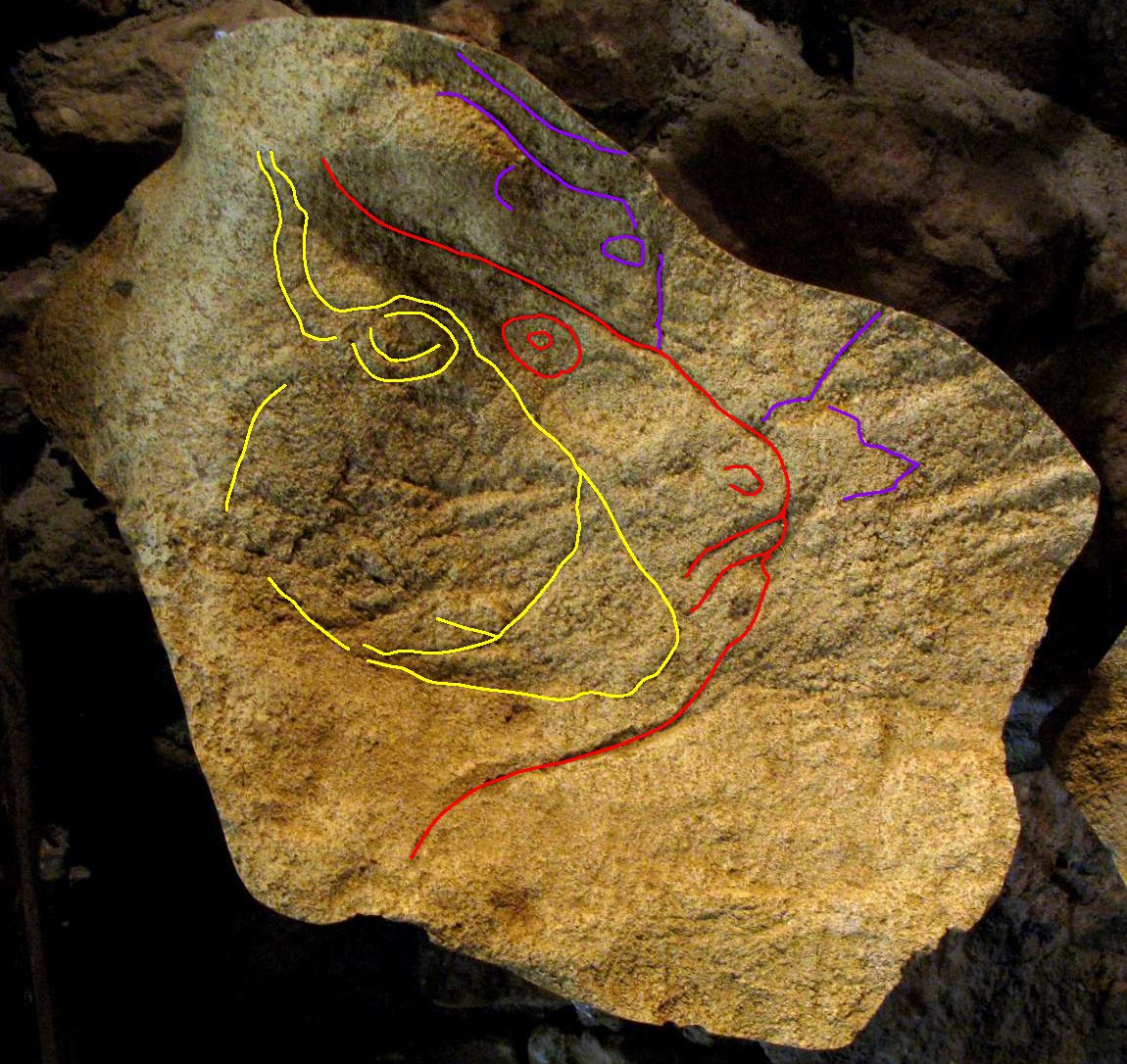
Here are my interpretations of the carvings.
First bison in yellow, later bison in red, apparently unrelated carvings in purple.
Photo and drawings: Don Hitchcock 2008, 2009
Source: Facsimile, display at Grotte du Sorcier
Almost certainly a cast from the mold of 1966 made by Abbé Glory
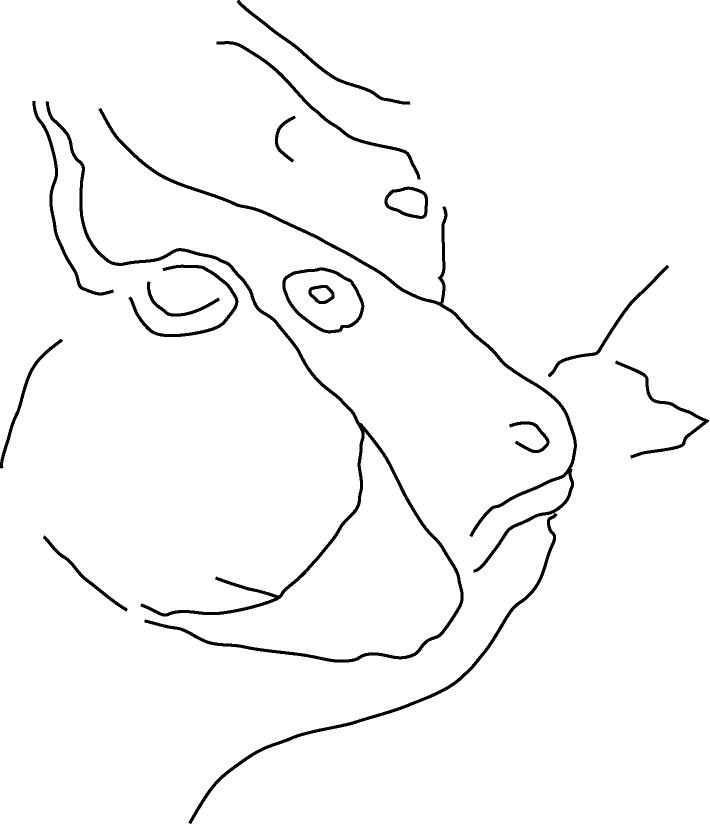
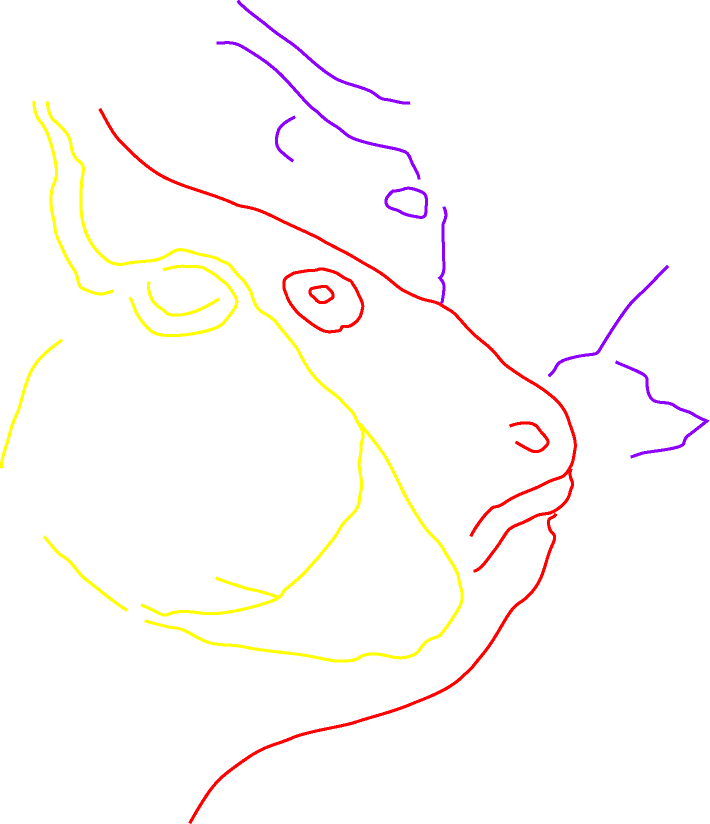
Here are my interpretations of the carvings.
First bison in yellow, later bison in red, apparently unrelated carvings in purple.
Drawings: Don Hitchcock 2009
Source: Facsimile, display at Grotte du Sorcier
Almost certainly a cast from the mold of 1966 made by Abbé Glory
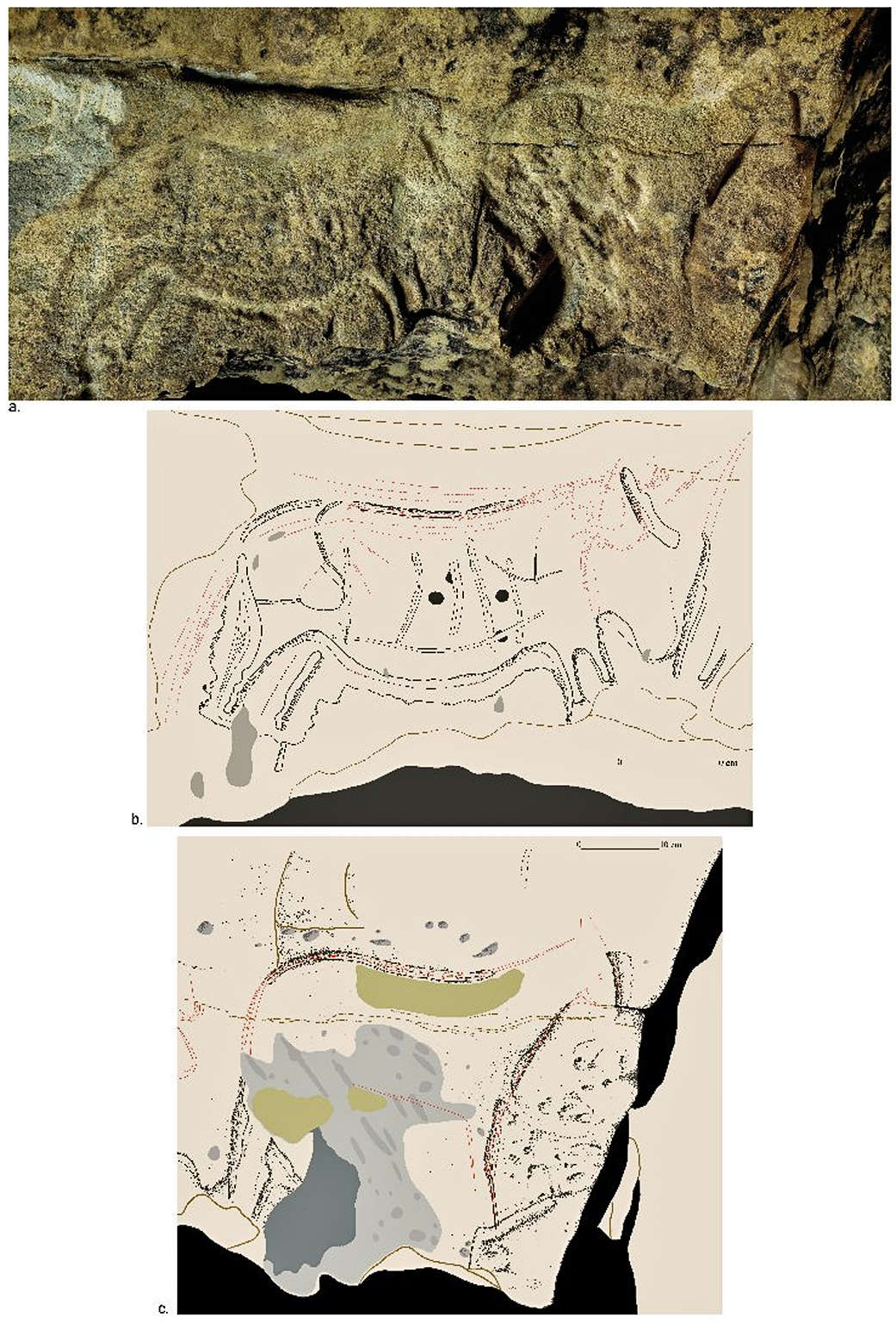
a. Photograph of horse 8 (on the left) and animal 9 (on the right) (photo H. Paitier).
b. Horse 8. Analytic tracing. The red lines indicate modern transformations (rounded abrasion as if a brush was used to clean the rock surface or erase traces, or linear abrasion or engraving, to trace a new head with its tuft and neck) (tracing E. Bougard).
c. Undetermined animal 9. Analytic tracing. In grey: removals of material from undetermined time period.
Brown lines: grain of the stone.
Red lines: modern tracings. In yellow: recent torn-off areas (tracing by E. Bougard, CAD R. Pigeaud).
Photo and text: Pigeaud et al (2012)

The notice outside the cave reads:
The prehistoric Grotte du Sorcier has been classified as a UNESCO World Heritage site. The objects and works of art here are extremely rare records and witnesses of lost civilisations. This archeological site is invaluable for the knowledge of the most remote periods of human history and for the study of cave art dating from the Paleolithic, 19 000 years ago. The prehistoric works you will see here are classified as historic monuments, they do not belong only to France, the country that looks after them, but to all the world.
Photo: Don Hitchcock 2008
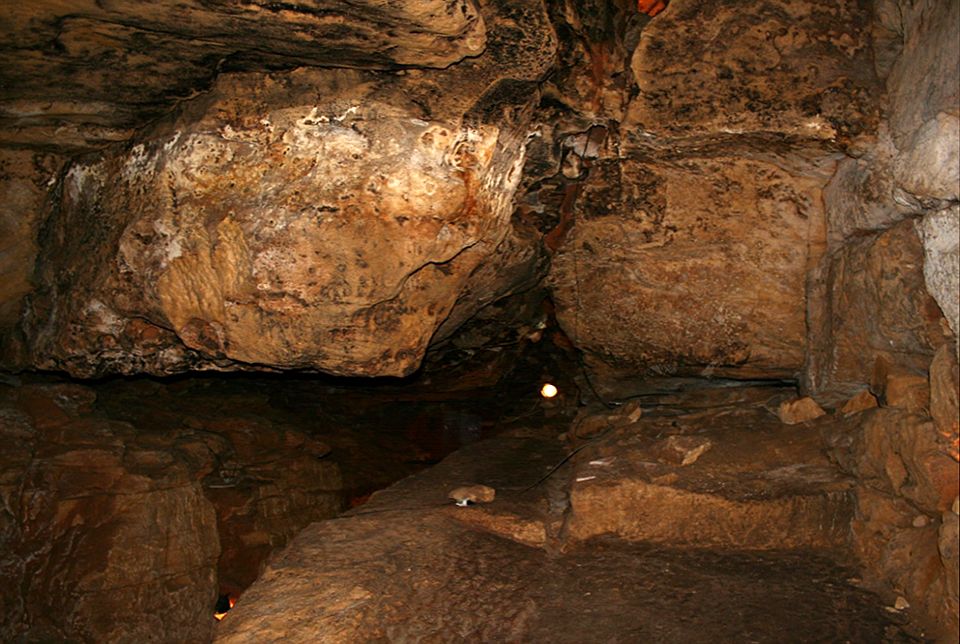
Interior of Grotte du Sorcier
Photo: http://www.grottedusorcier.com/main.html
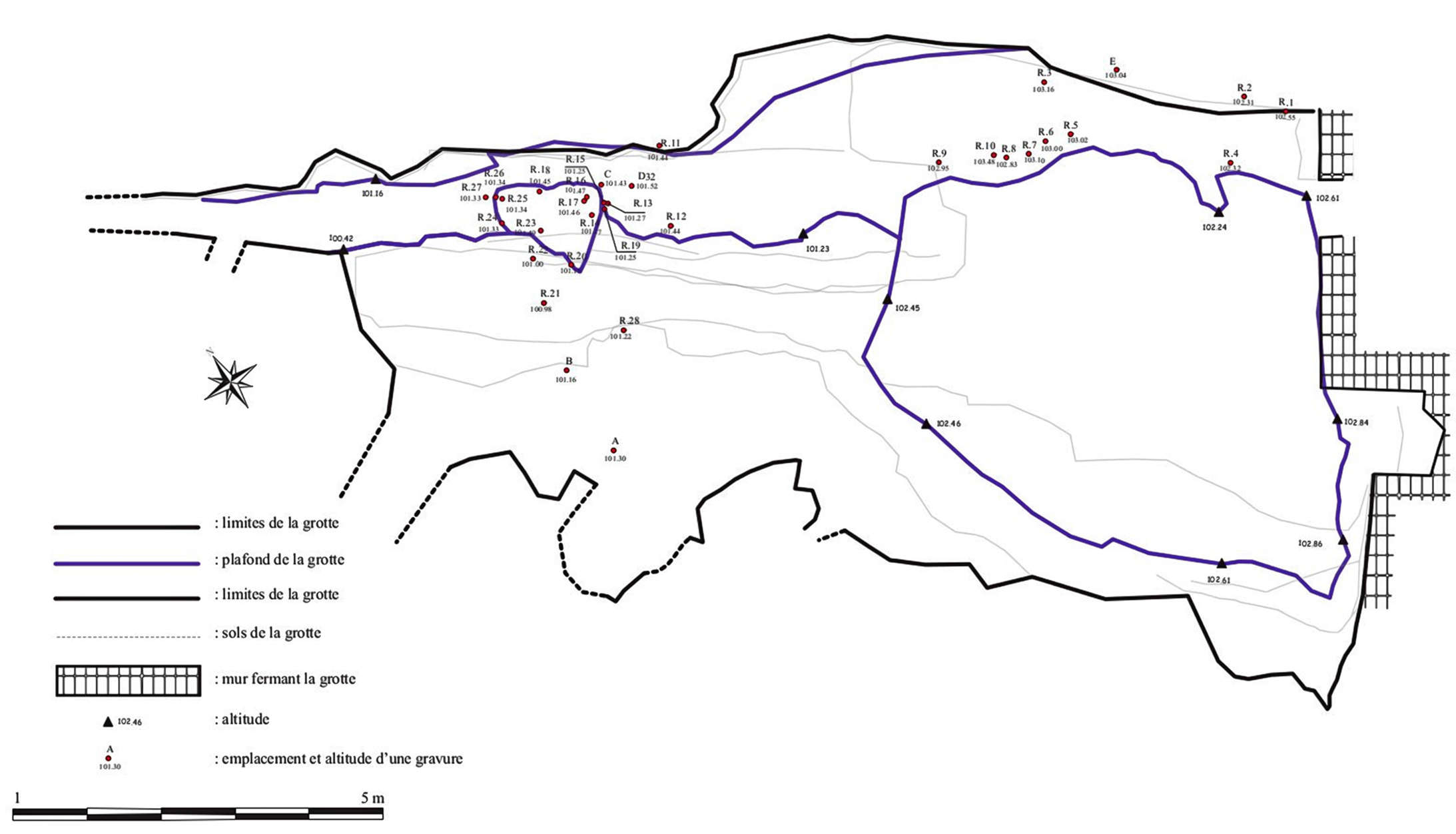
Position and altitude of the representations of the Sorcerer’s cave (survey V. Pommier and M.-D. Pinel).
(this is a valuable plan of the cave with the positions of the art works - Don )
Photo and text: Pigeaud et al (2012)
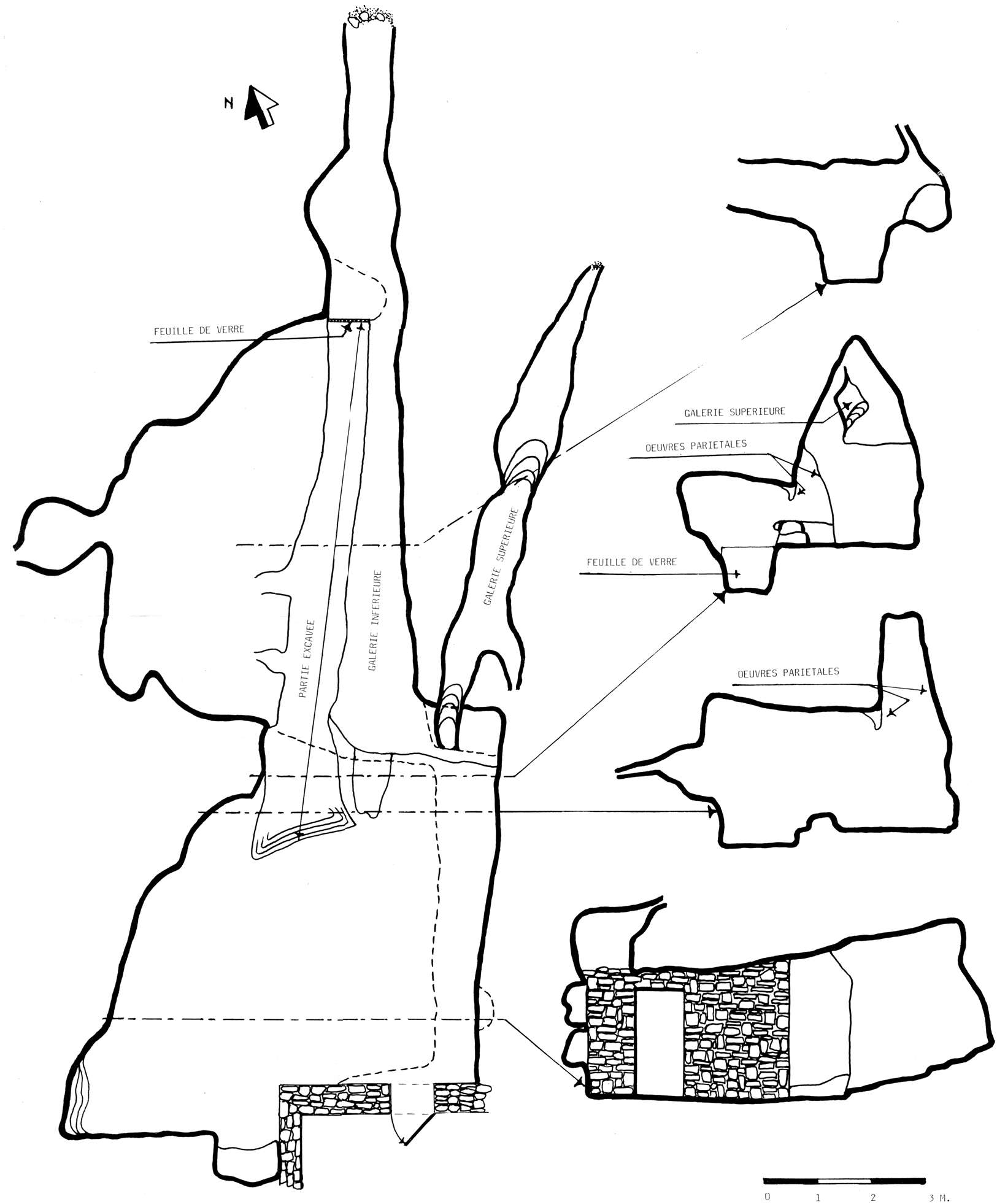
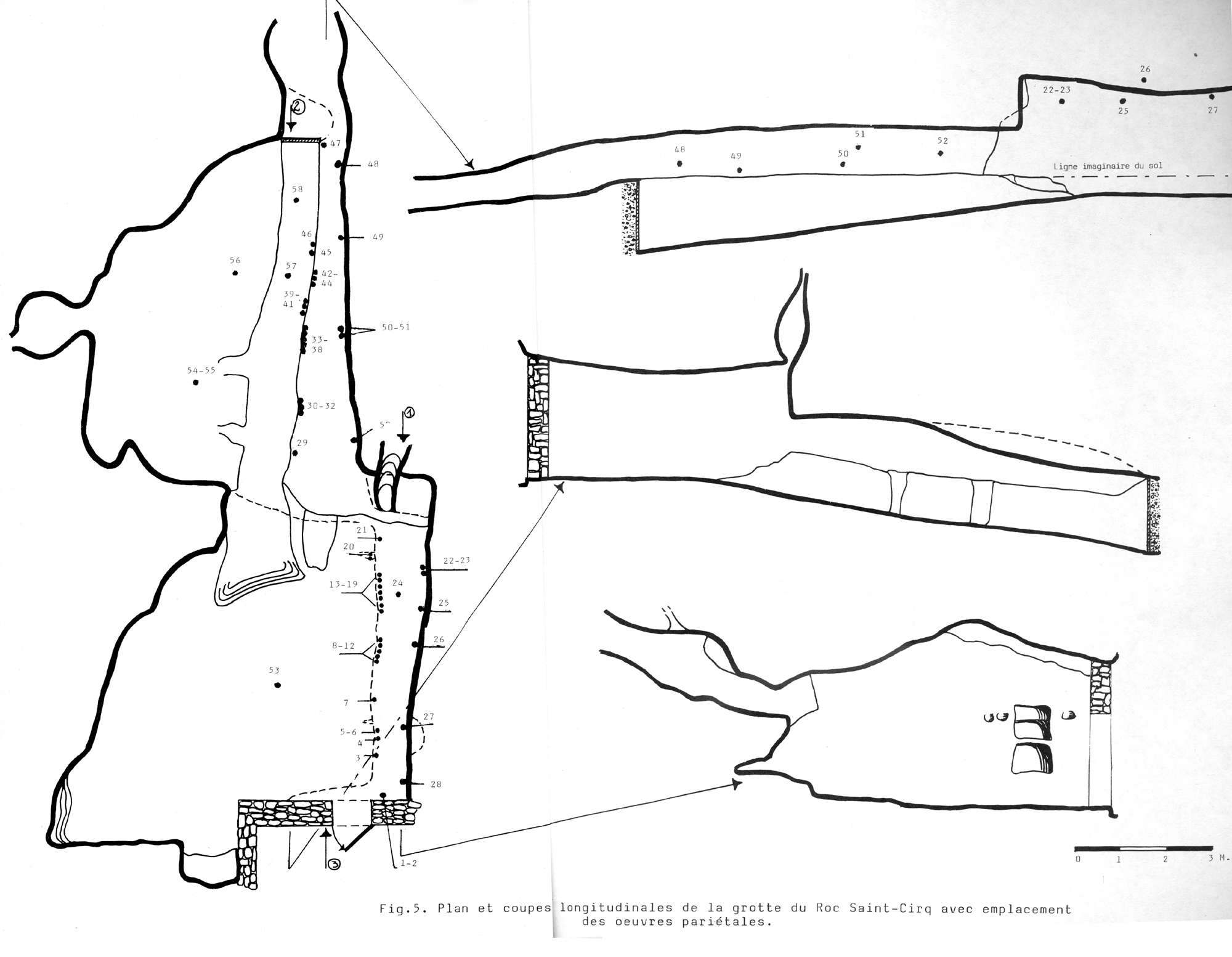
Plan of the Grotte du Roc Saint-Cirq, as well as the position of all the parietal art within the grotte.
Photo: Dams (1980)
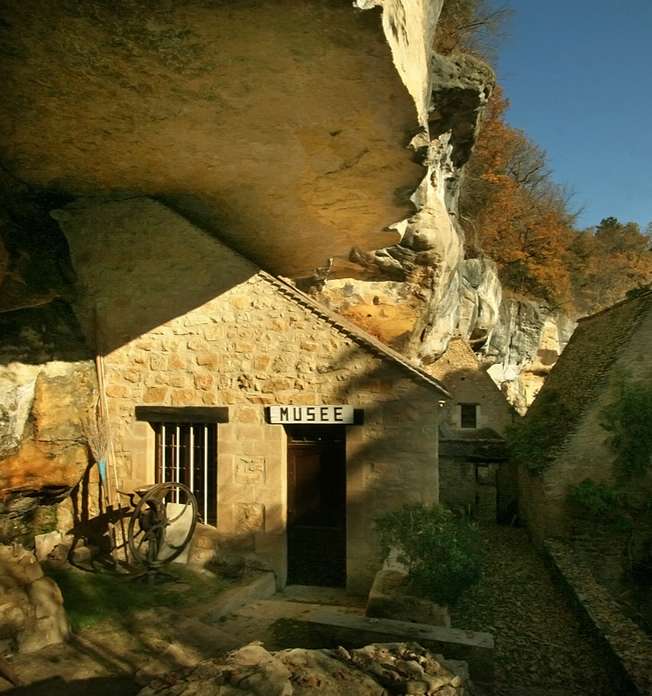
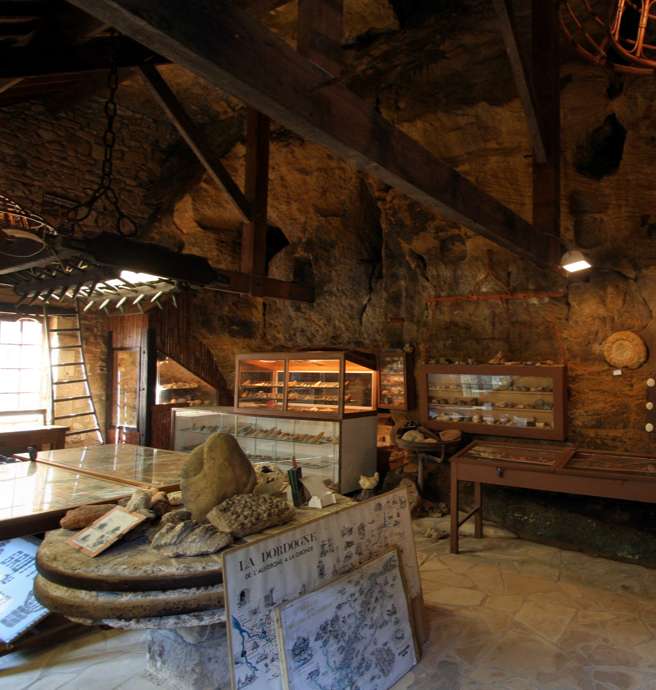
The Museum at Grotte du Sorcier has an excellent display, very well put together.
Photo: http://www.grottedusorcier.com/main.html
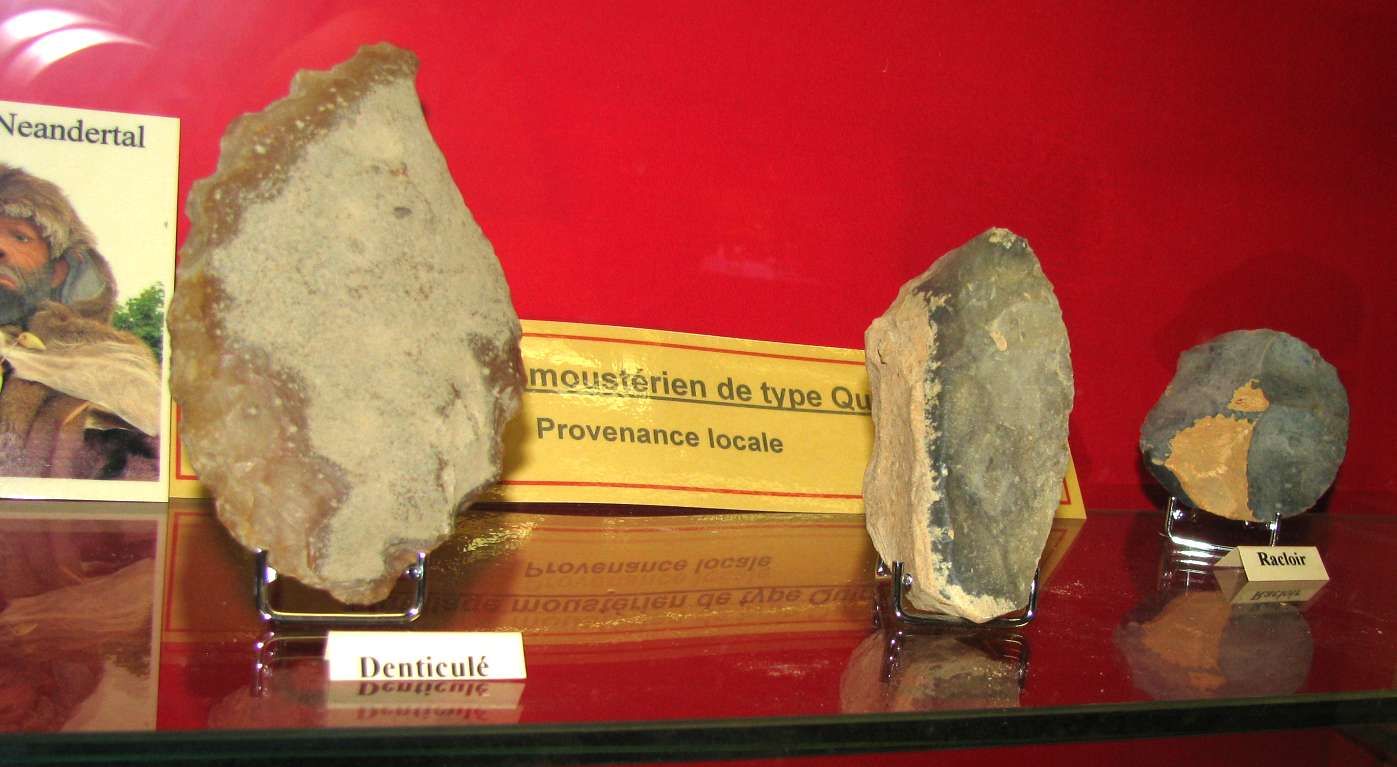
La Quina type mousterian tools from the local area. These are thick, asymmetrical tools.
The denticulate (or toothed edge) tool on the left of this photograph is particularly interesting.
Photo: Don Hitchcock 2008
Source: Originals, display at Grotte du Sorcier
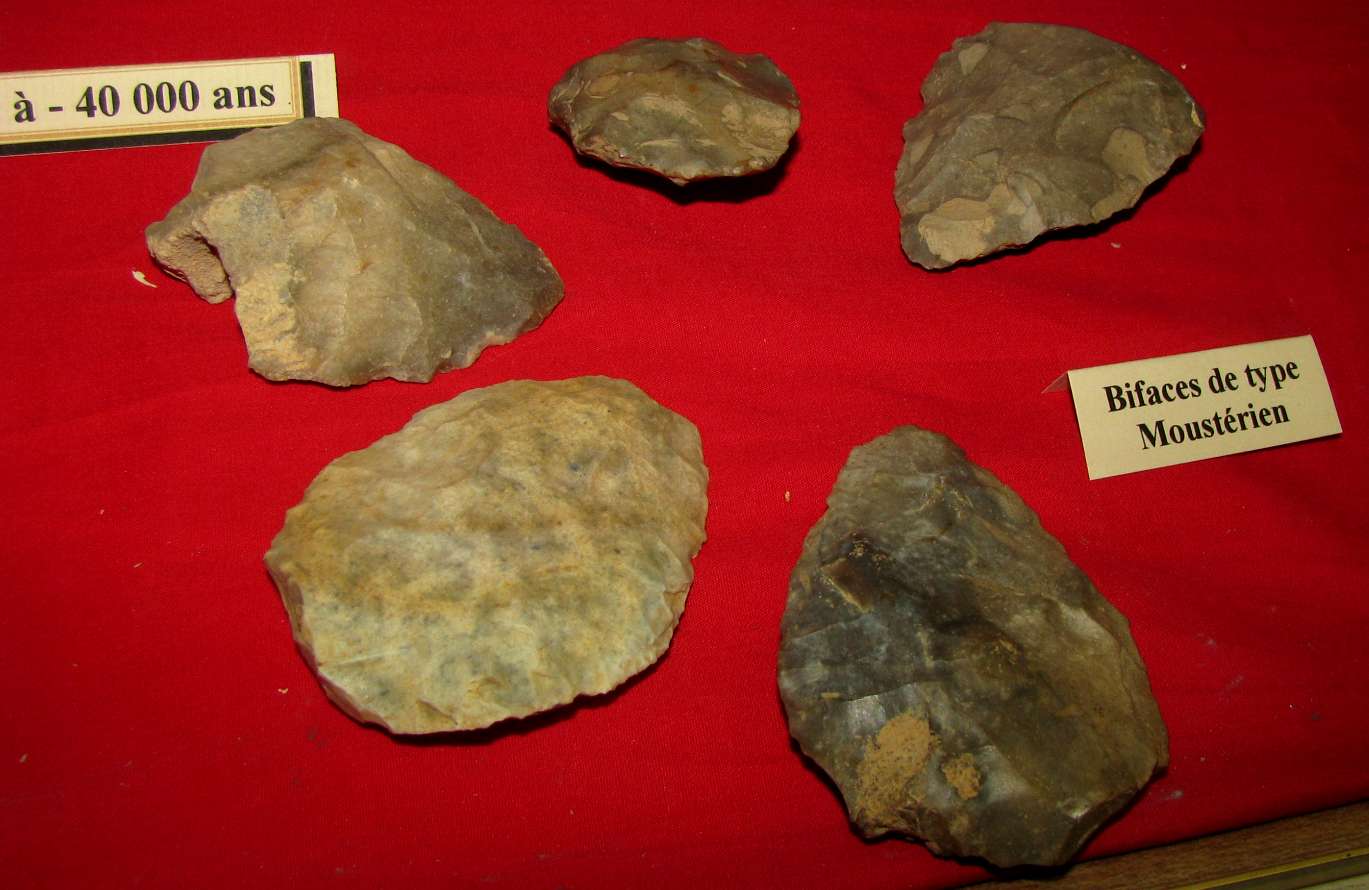
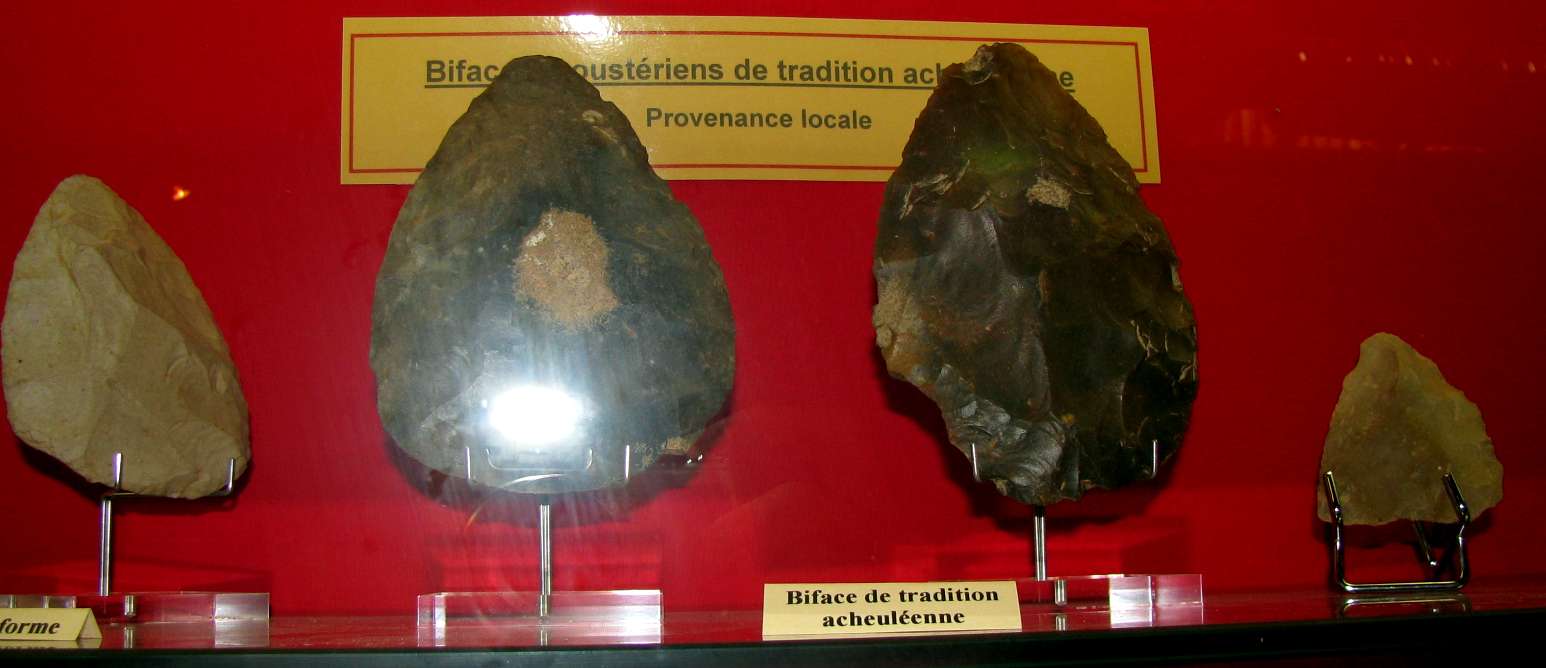


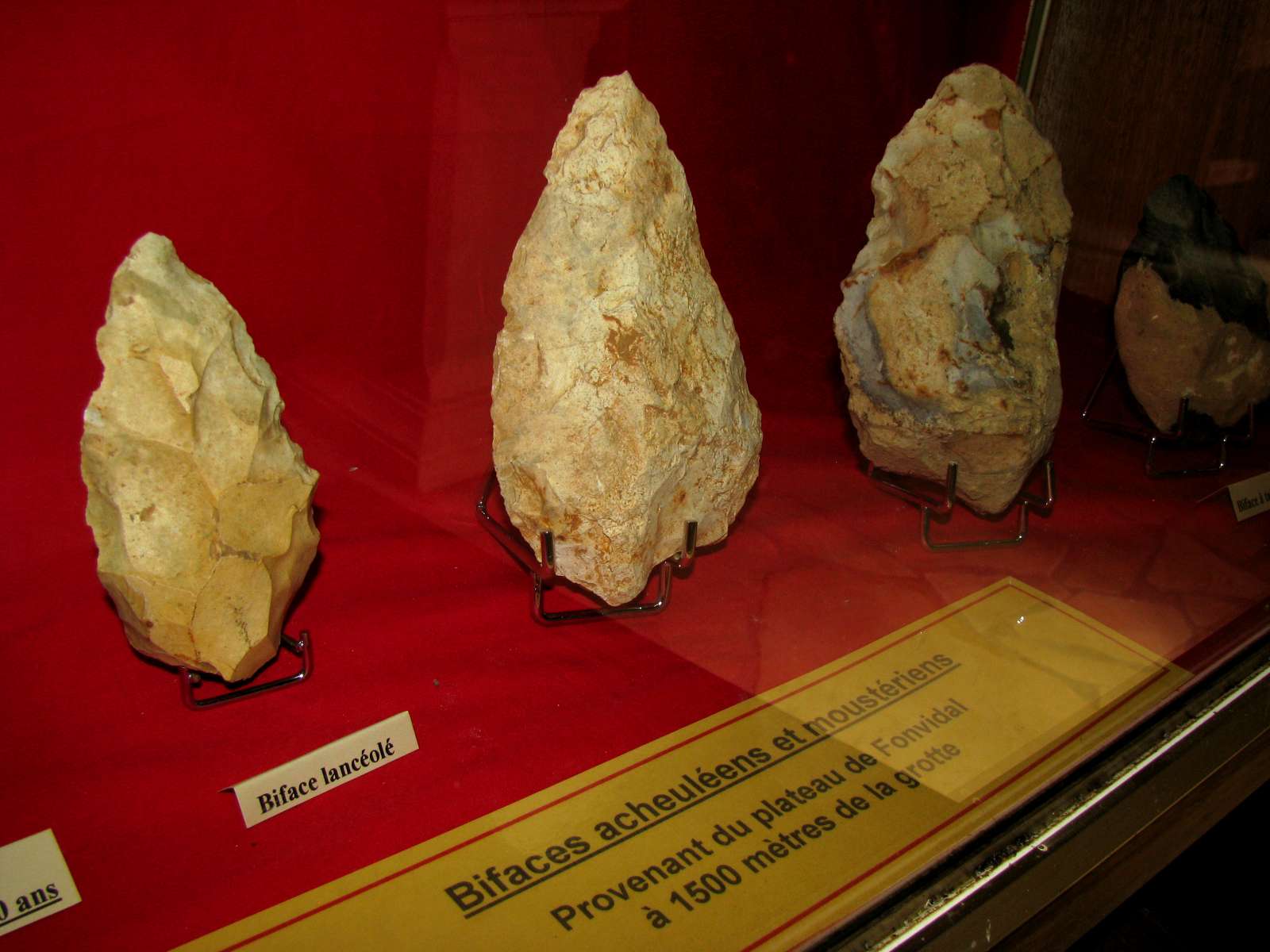
Mousterian biface axes of the Acheulian tradition, made by neanderthals, found in the local area. It is always good to get accurate signage like this of the origin of the materials on display, it happens far too rarely.
These Acheulian and Mousterian bifaces come from the plateau of Fonvidal, about 1500 metres from the Grotte du Sorcier.
Note the remains on some of the specimens of the white, weathered outer layer or rind on the original flint nodule, known as cortex.
Photo: Don Hitchcock 2008
Source: Originals, display at Grotte du Sorcier
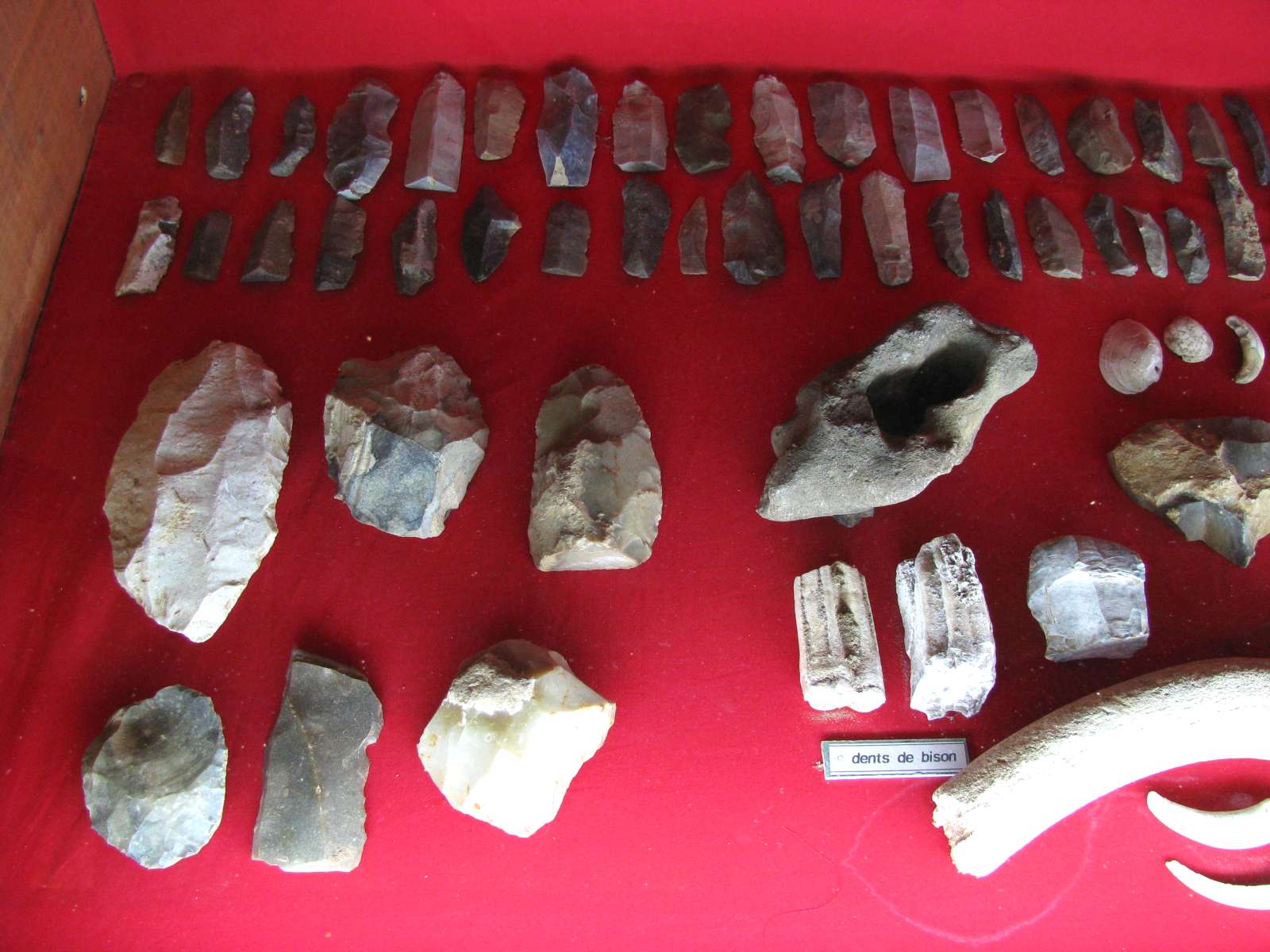
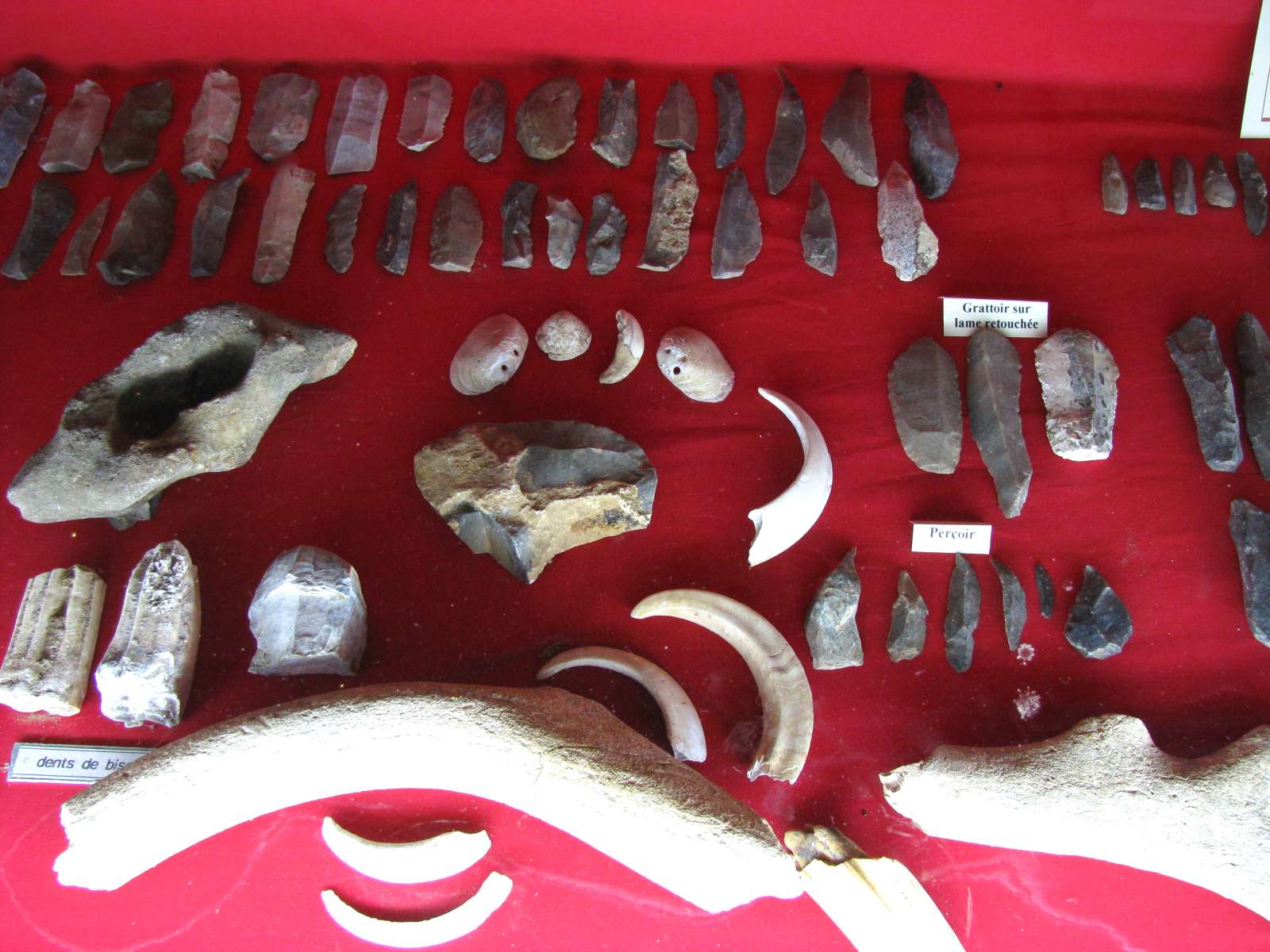
Blades, bison teeth, sea shells, and what appears to be a stone lamp, scrapers on a retouched blade (Grattoir sur lame retouchée), awls (Perçoir) and what appear to be boar's teeth.
Photo: Don Hitchcock 2008
Source: Originals, display at Grotte du Sorcier
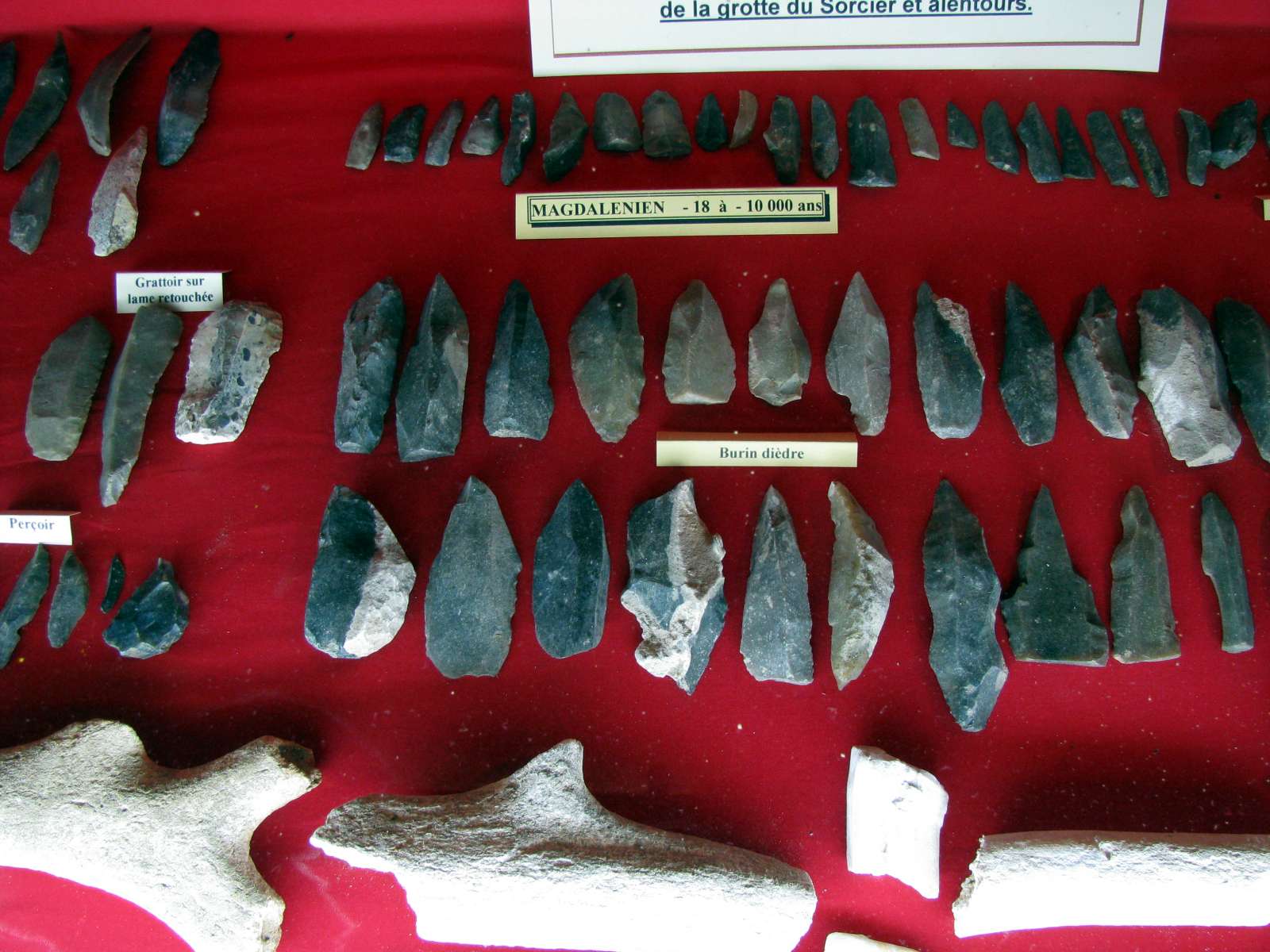
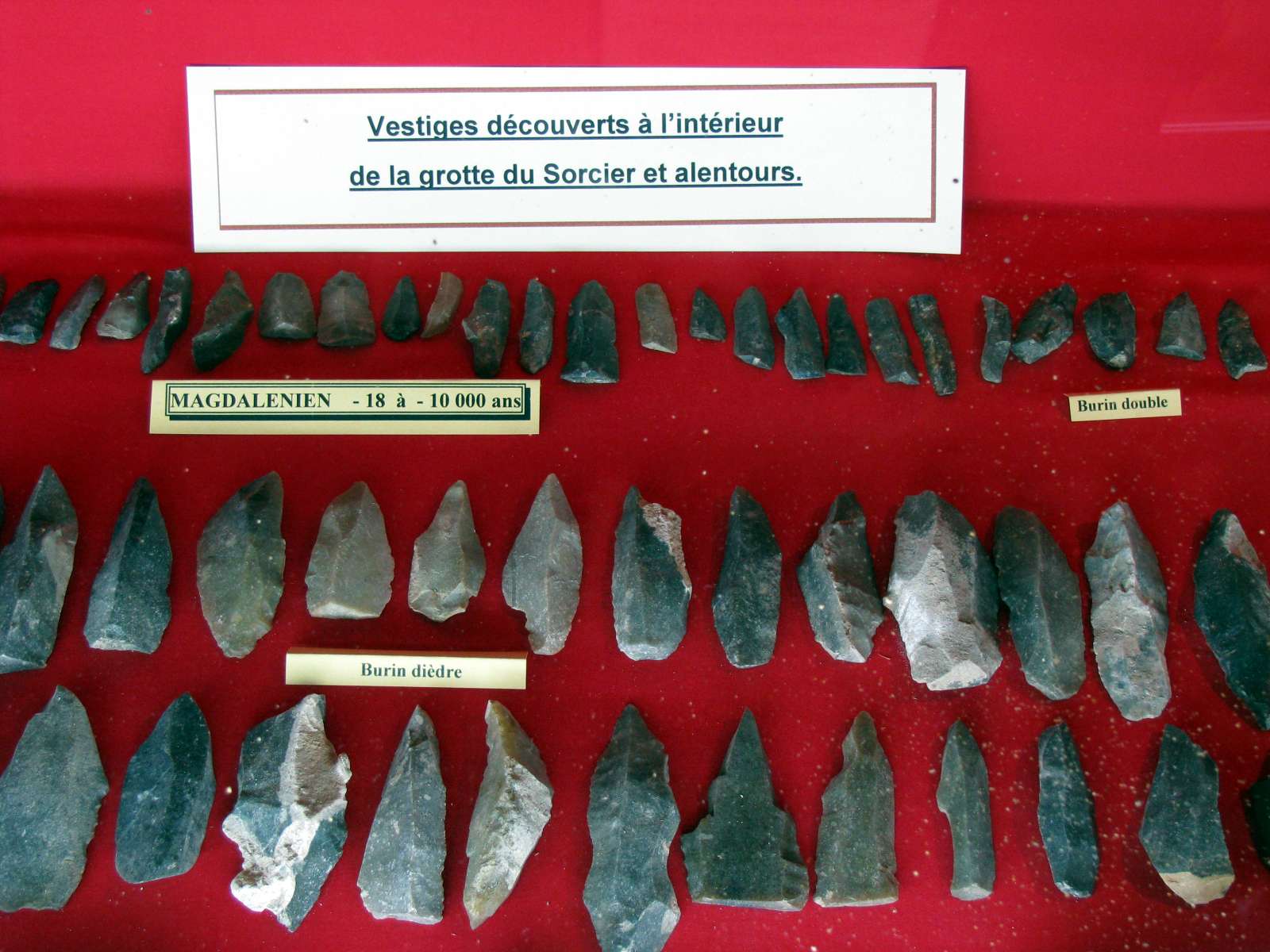
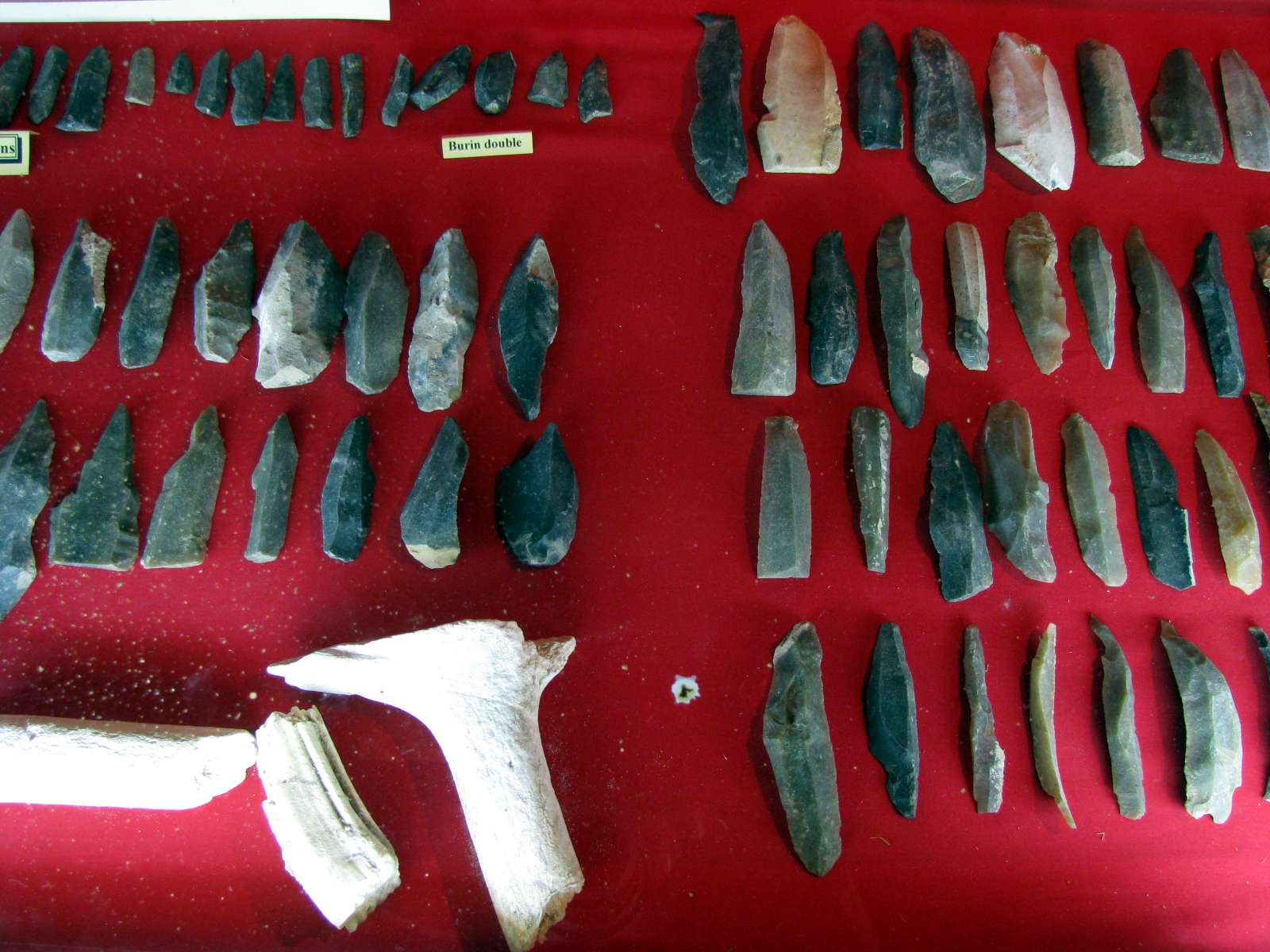
Magdalénien tools, 18 to 10 000 years BP found at the grotte du Sorcier
In particular we should note the dihedral burins and the double burins, which have a burin at each end of the tool.
Photo: Don Hitchcock 2008
Source: Originals, display at Grotte du Sorcier
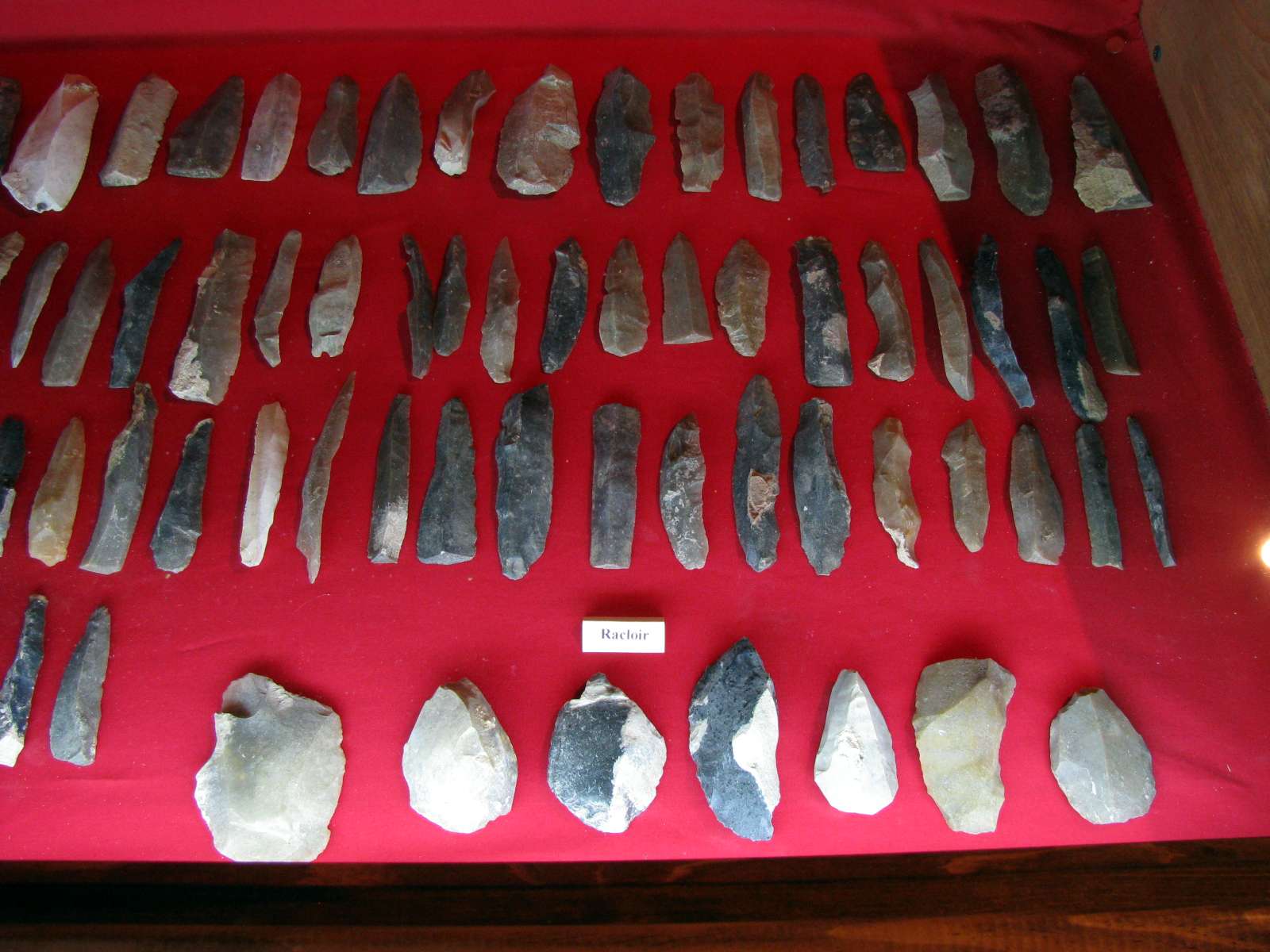
Racloirs are the wider tools at the base of this photo.
Racloirs, like grattoirs, are scrapers. They are created from a flint flake and look like a large scraper. As well as being used for scraping hides, they may also have been used as a knife.
Photo: Don Hitchcock 2008
Source: Originals, display at Grotte du Sorcier

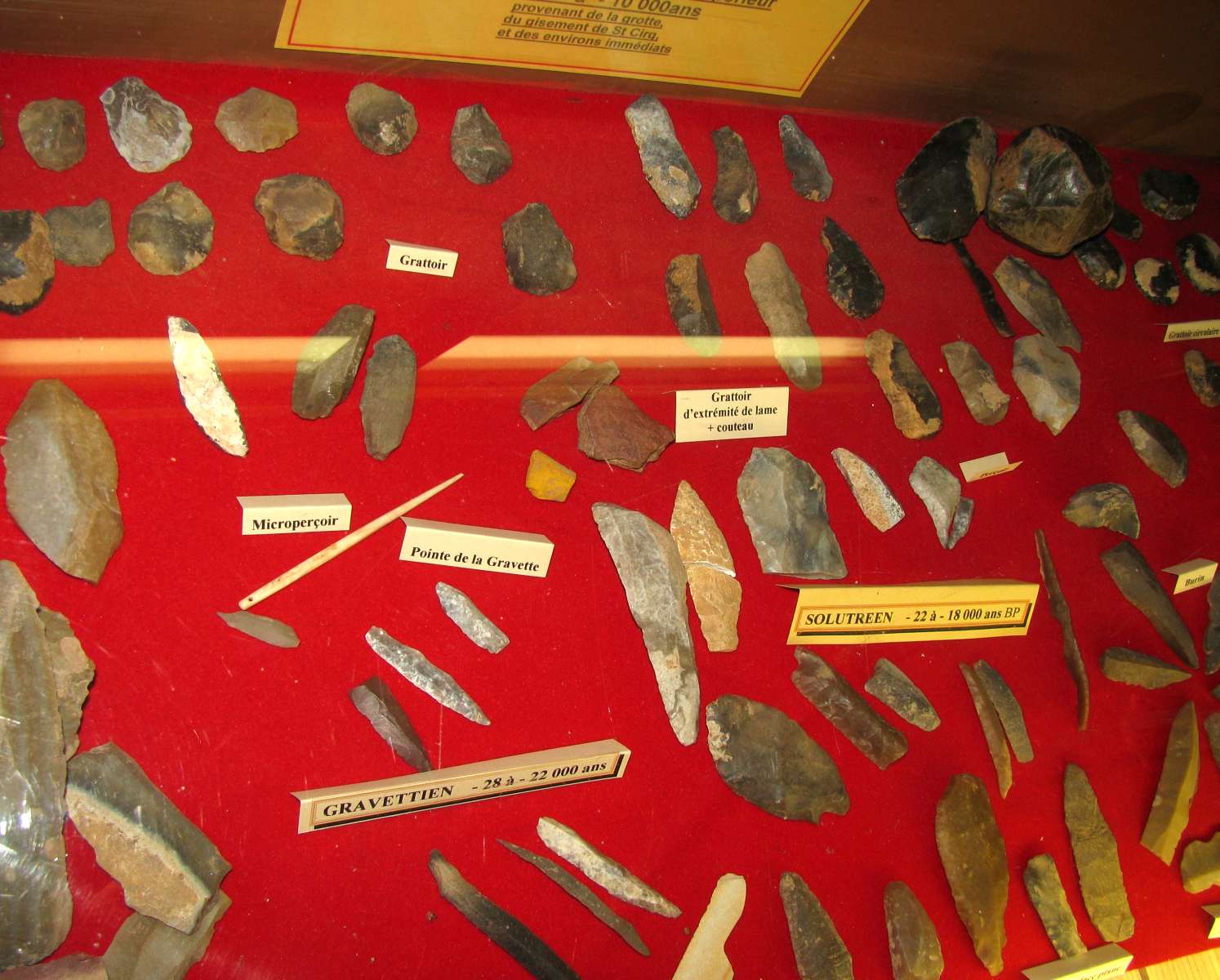
These upper Paleolithic tools all come from the Grotte de Saint Cirq (Grotte du Sorcier) or from the immediate environs.
Notice especially in the photo on the right, the classic Gravettian points, the microawl (microperçoir), and the bone needle, used for sewing leather garments, with a hole for the thread or sinew used, which is the reason for the tiny, delicate awl.
Photo: Don Hitchcock 2008
Source: Originals, display at Grotte du Sorcier
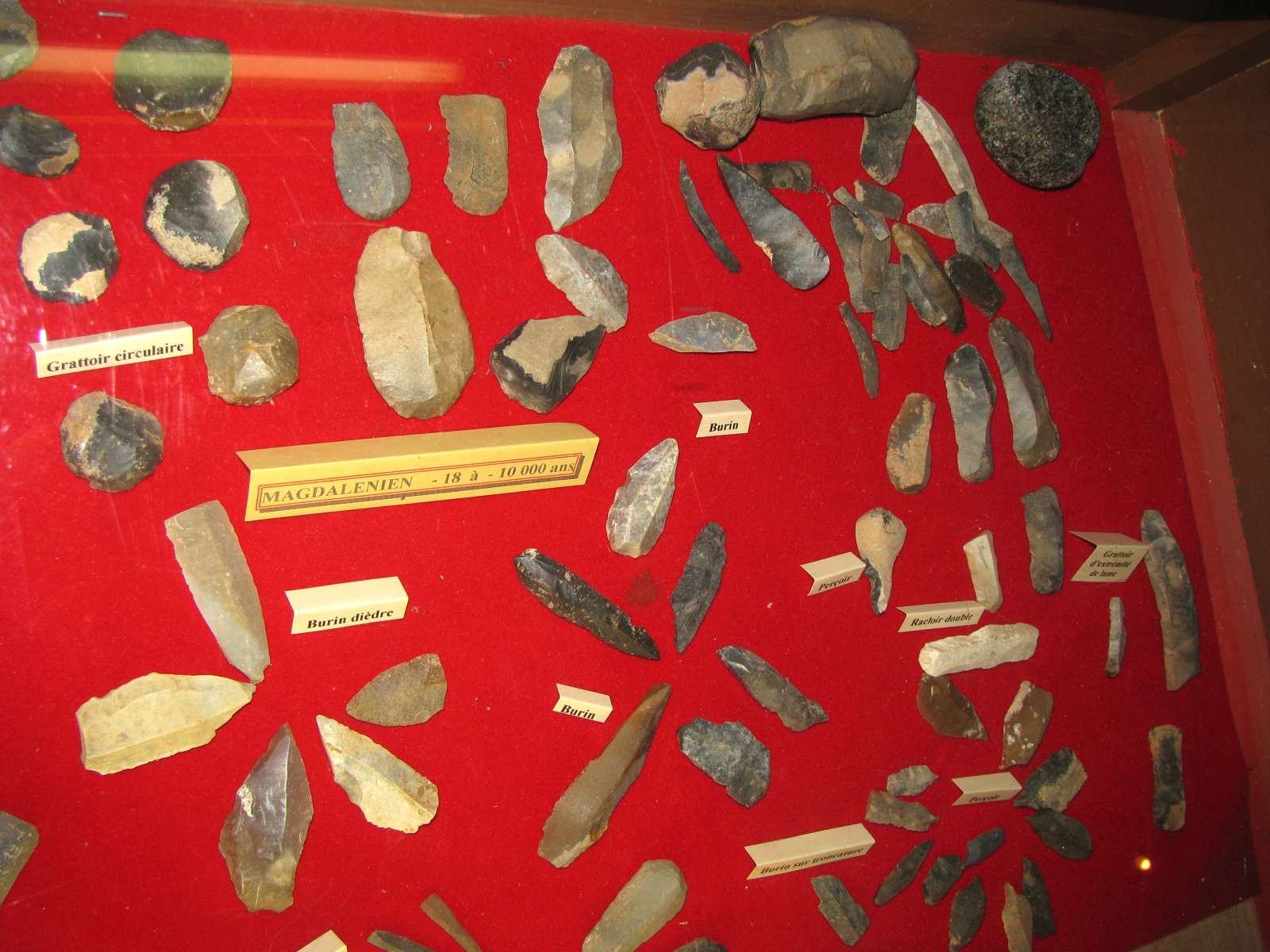
These are Magdalenian tools, from the period 18 000 BP to 10 000 BP.
Burins, or engravers, were very important tools for creating bone points and other bone tools. Notice especially the group of dihedral burins (Burin dièdre) and the group of circular scrapers.
Photo: Don Hitchcock 2008
Source: Originals, display at Grotte du Sorcier
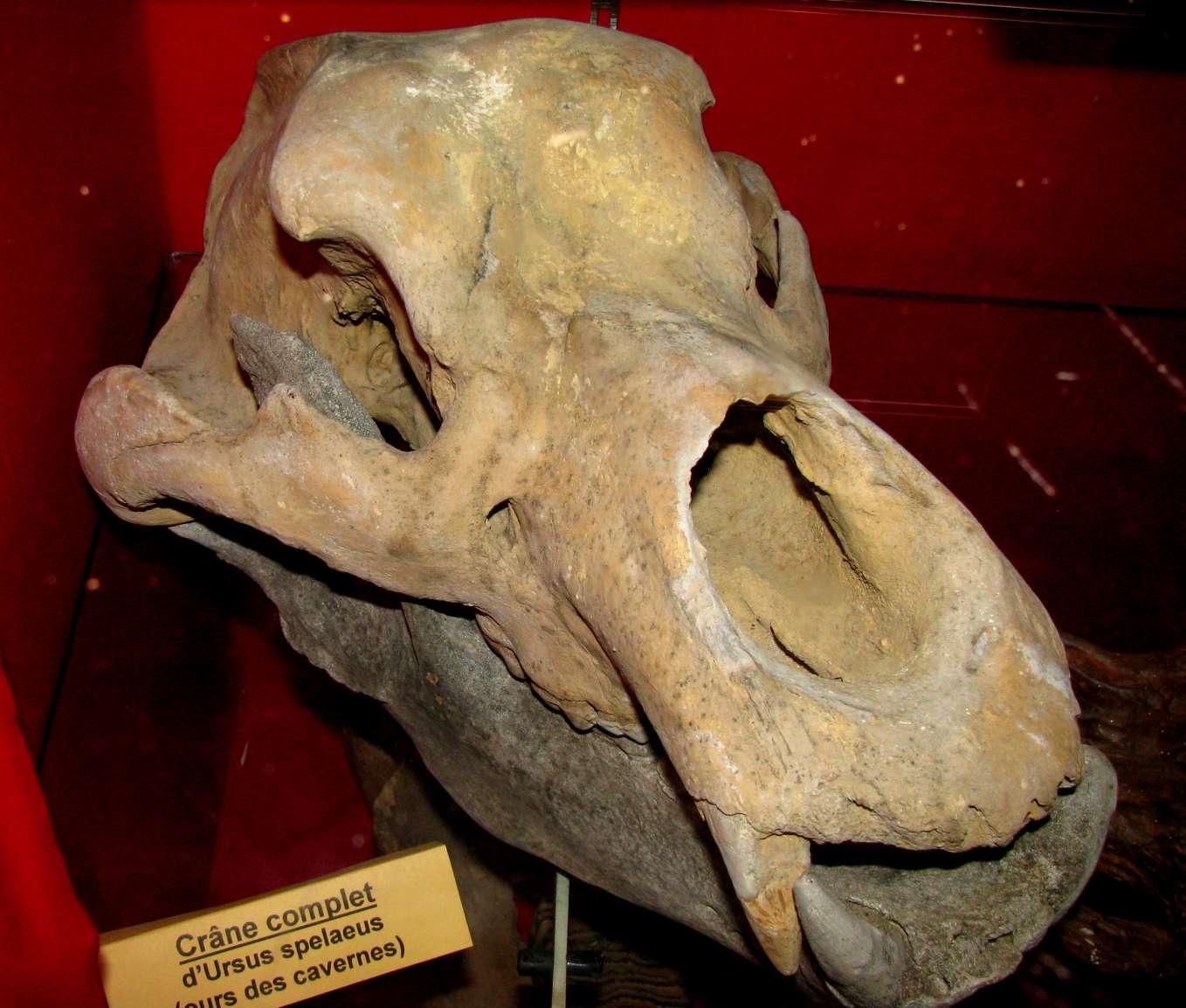
Crâne complet d'Ursus spelaeus (ours des cavernes)
Complete skull of a cave bear, Ursus spelaeus. Although it looks genuine, not a facsimile, it would appear to be made up of a skull and lower jaws found in different layers or locations, judging on the colouring.
Photo: Don Hitchcock 2008
Source: Originals, display at Grotte du Sorcier
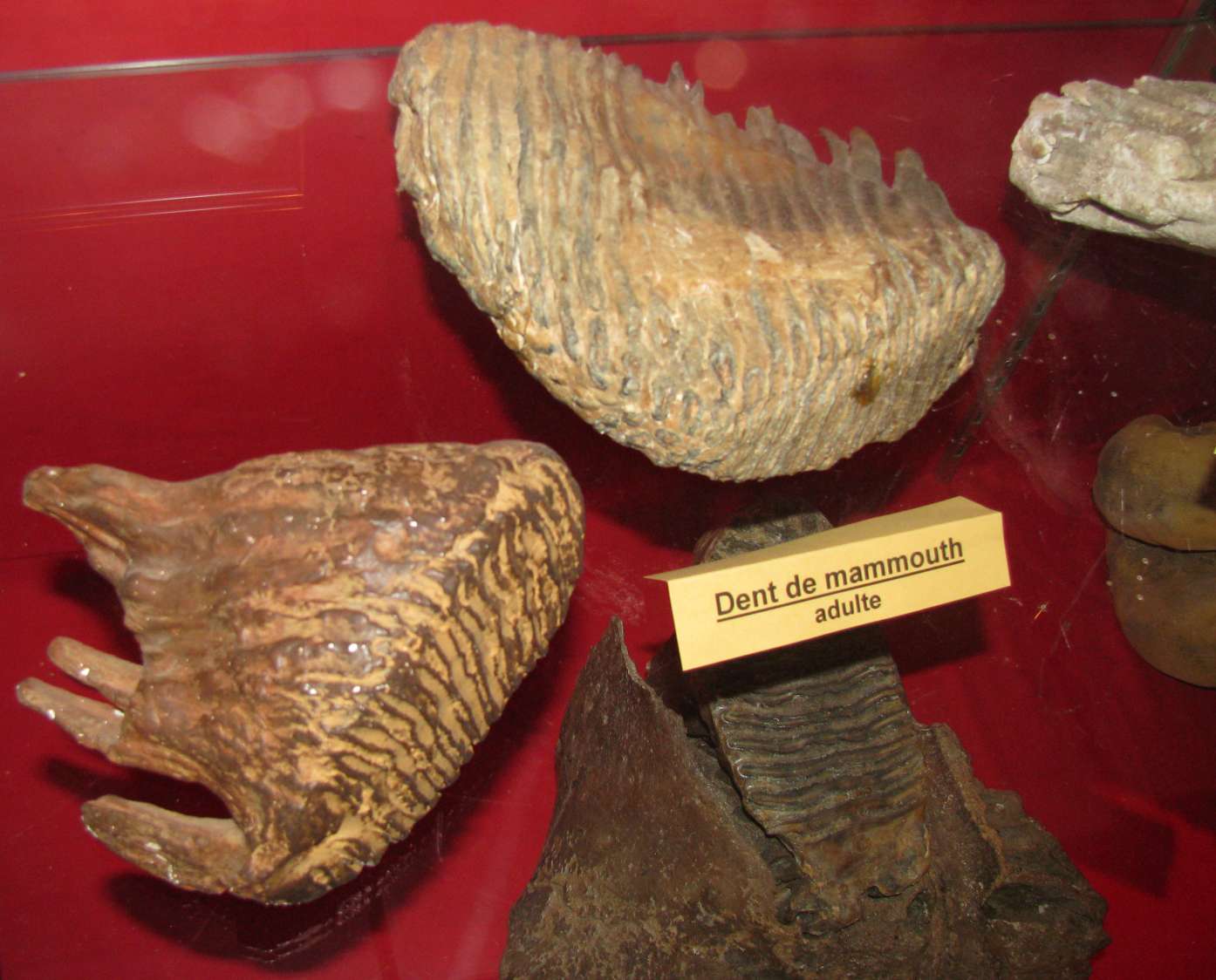
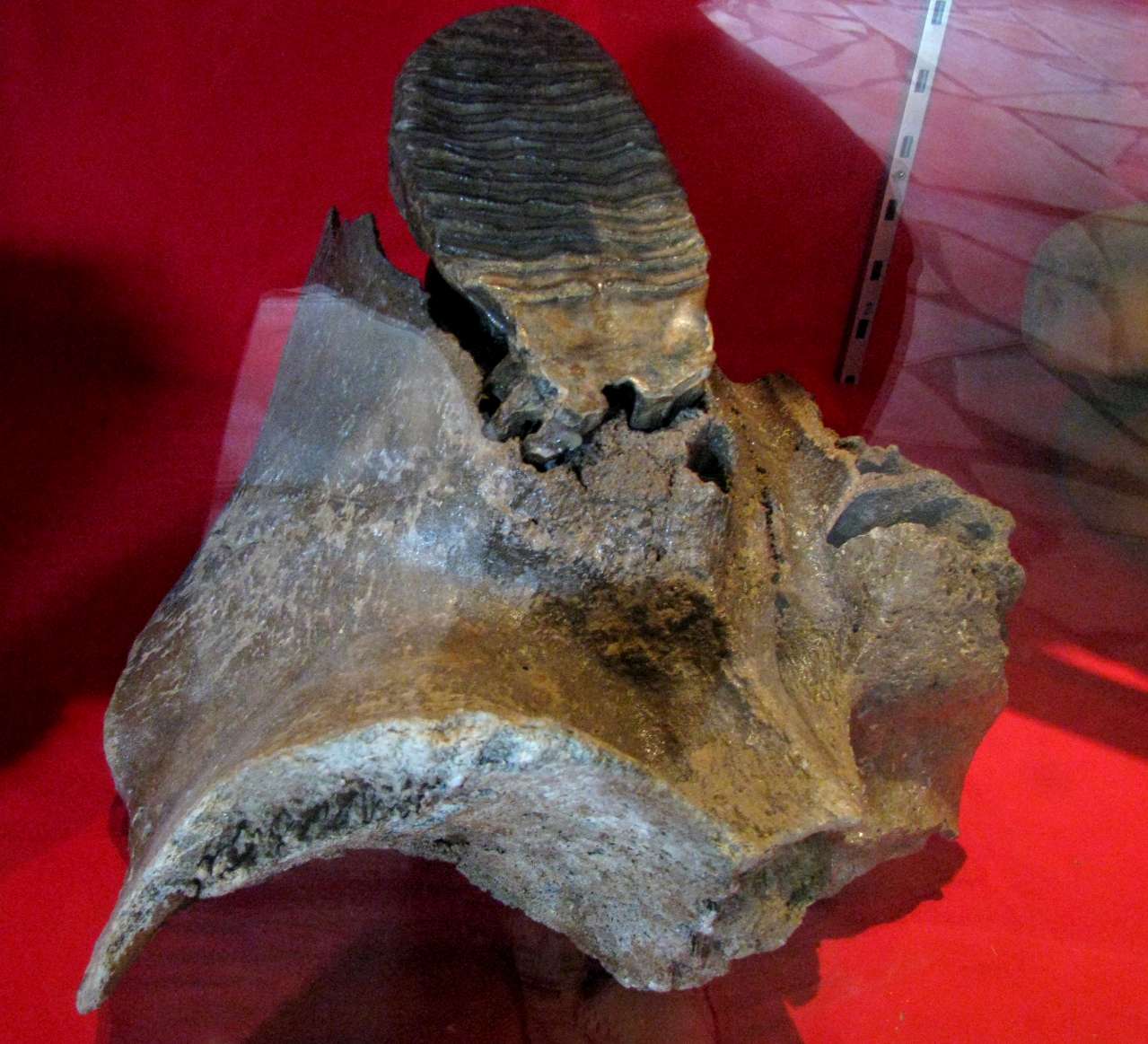
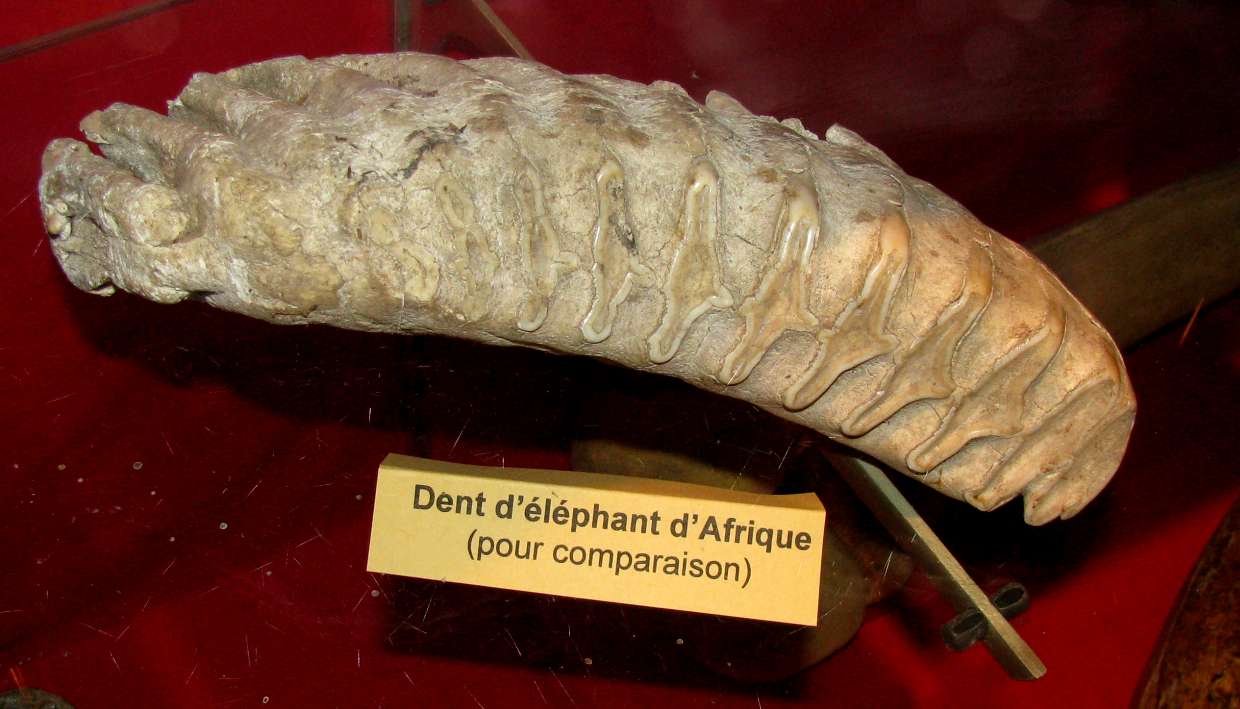
Mammoth teeth, left and centre, with a modern African elephant tooth for comparison, right.
Photo: Don Hitchcock 2008
Source: Originals, display at Grotte du Sorcier
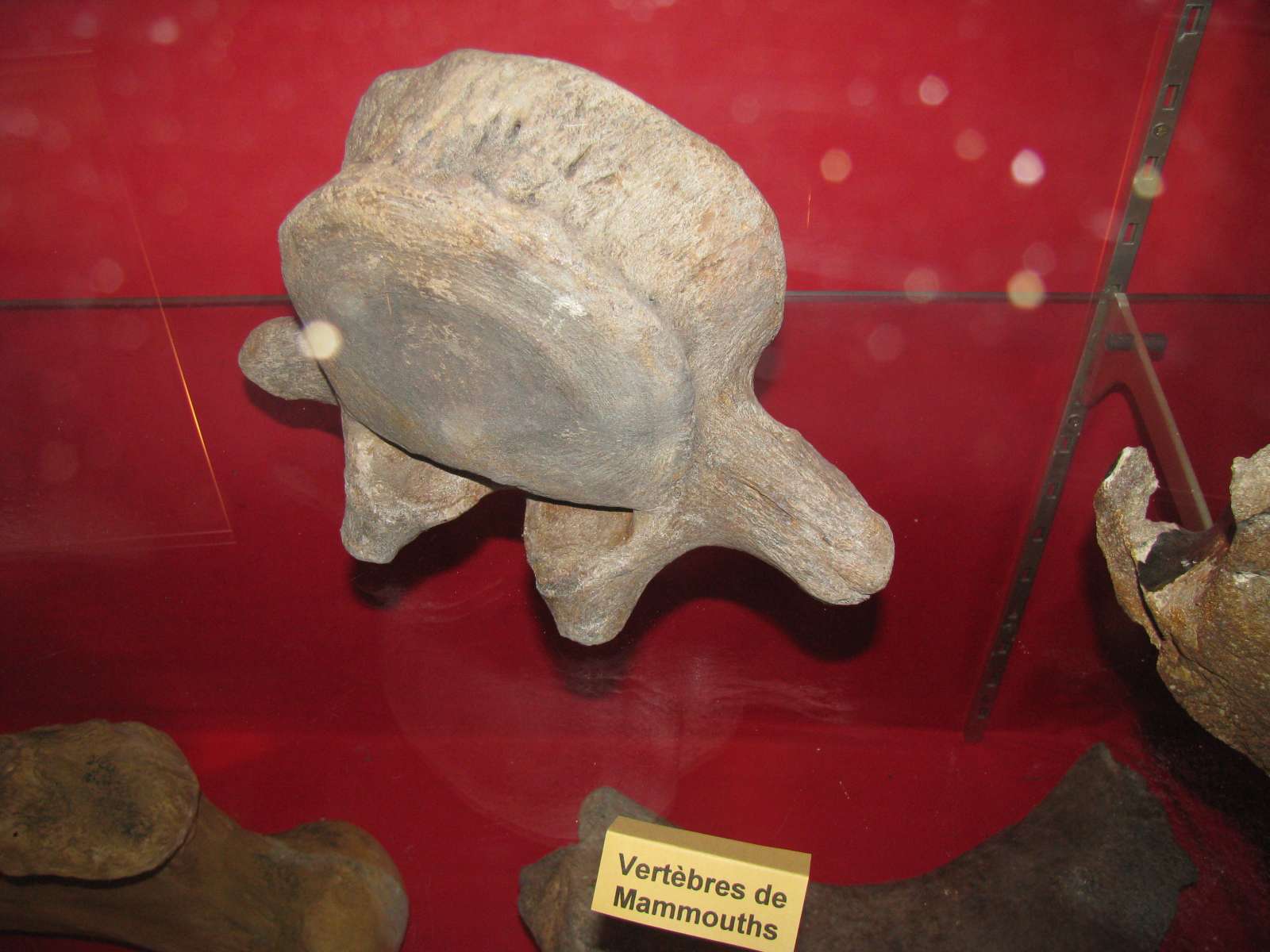
Mammoth vertebra.
Photo: Don Hitchcock 2008
Source: Originals, display at Grotte du Sorcier
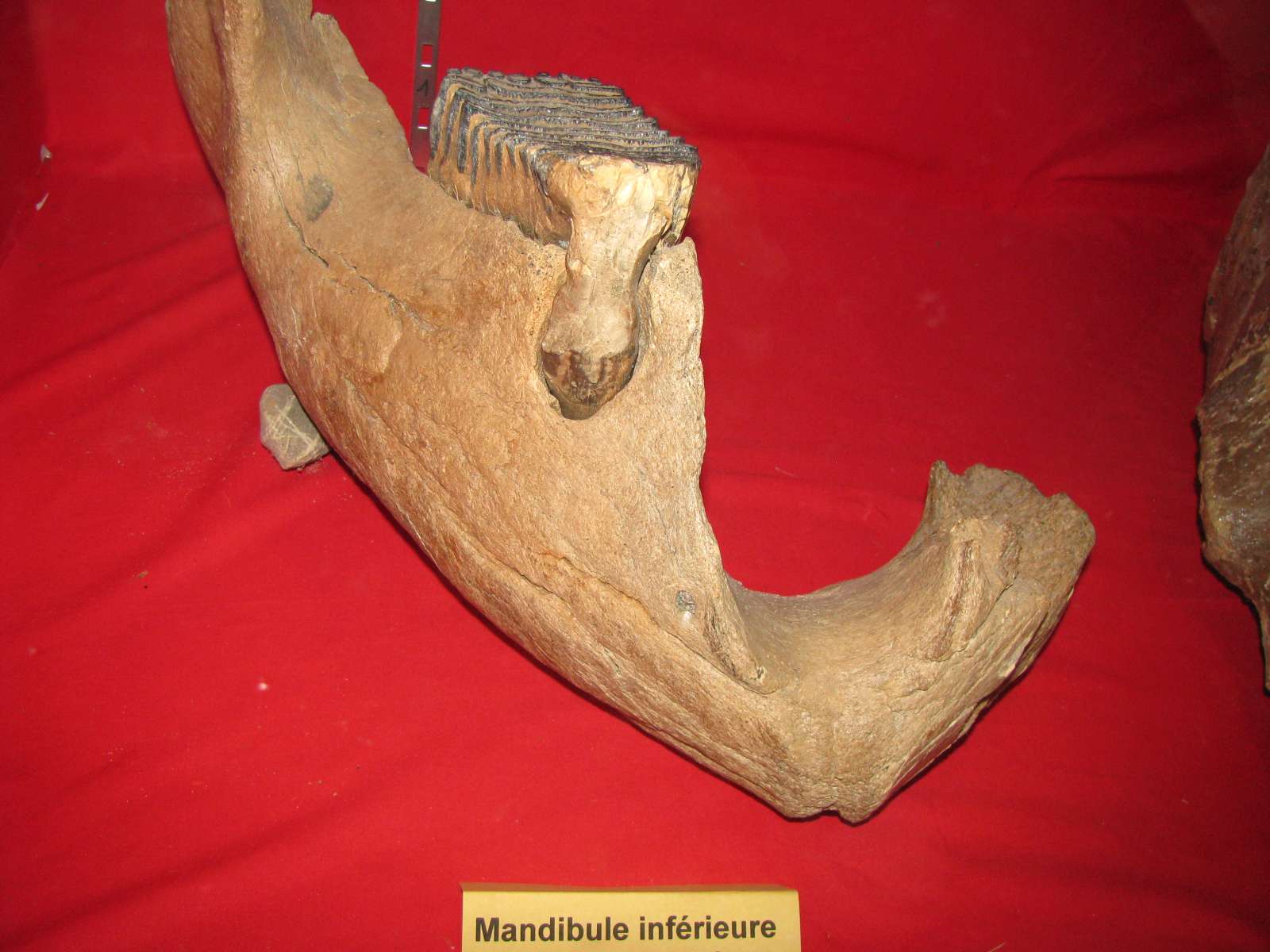
Mammoth lower jaw.
Photo: Don Hitchcock 2008
Source: Original, display at Grotte du Sorcier
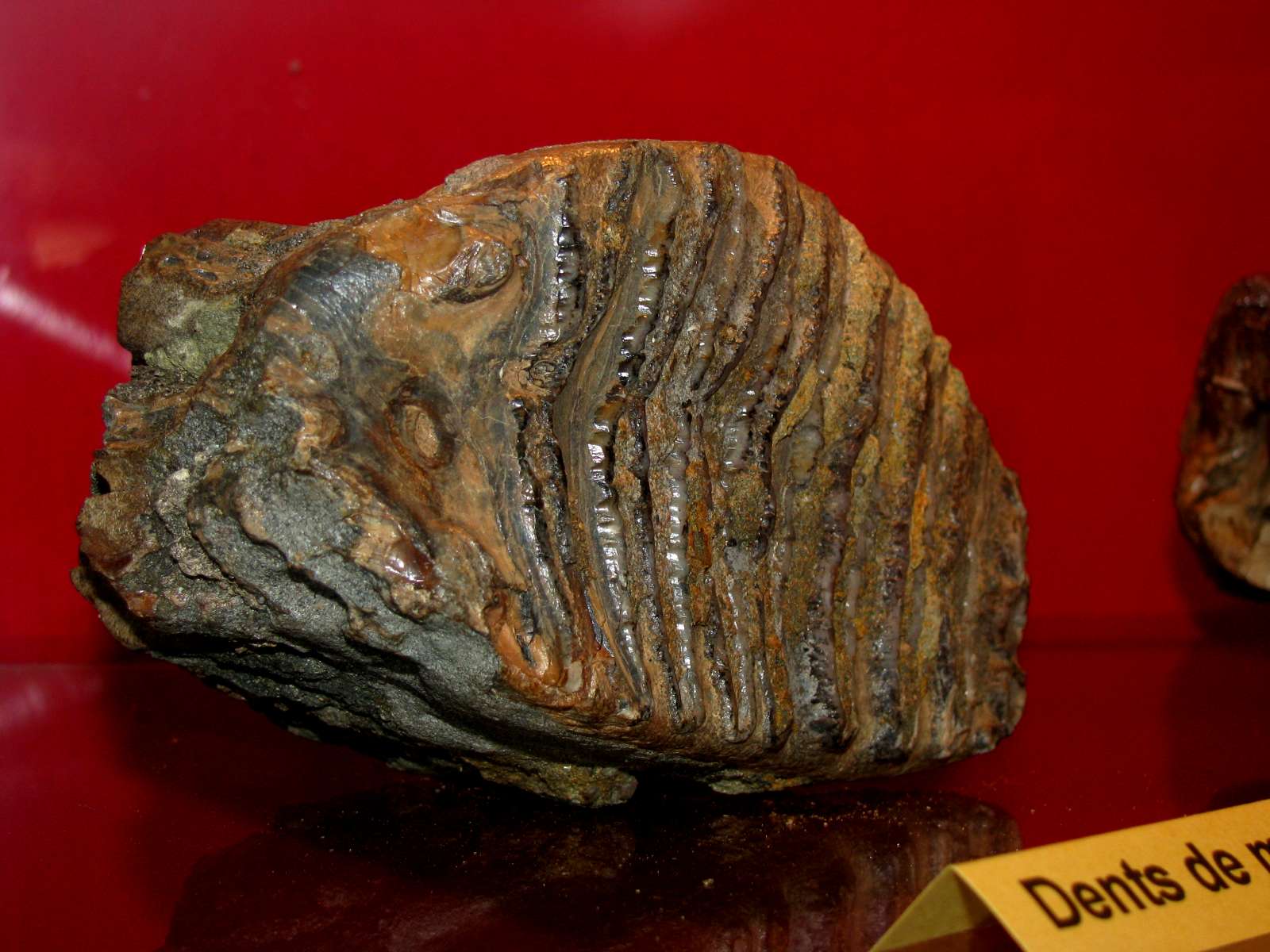
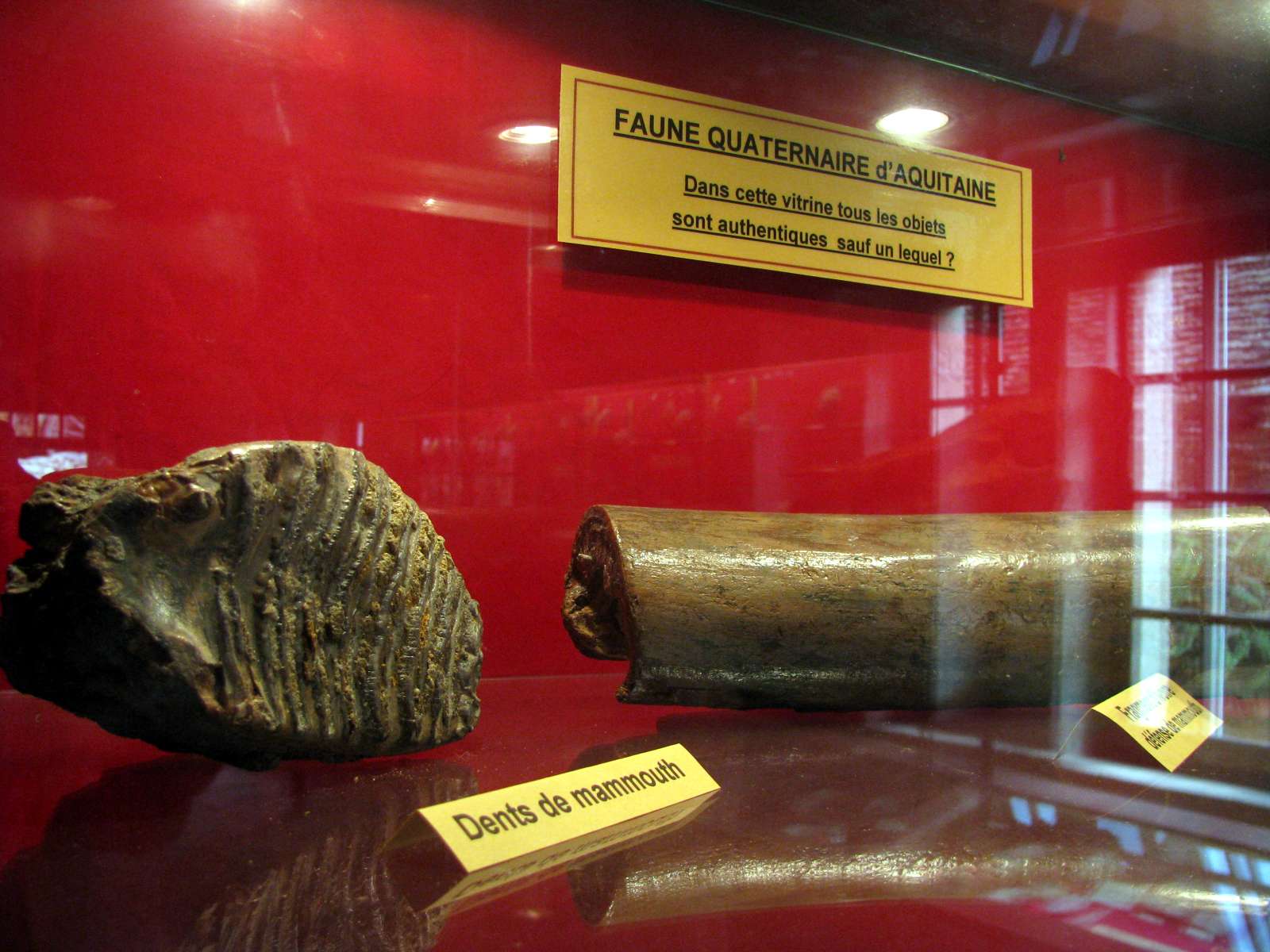
Mammoth tooth and part of a Mammoth tusk.
Photo: Don Hitchcock 2008
Source: Originals (?), display at Grotte du Sorcier

Sabre tooth tiger skull and jaw.
Photo: Don Hitchcock 2008
Source: This appears to be a facsimile, display at Grotte du Sorcier
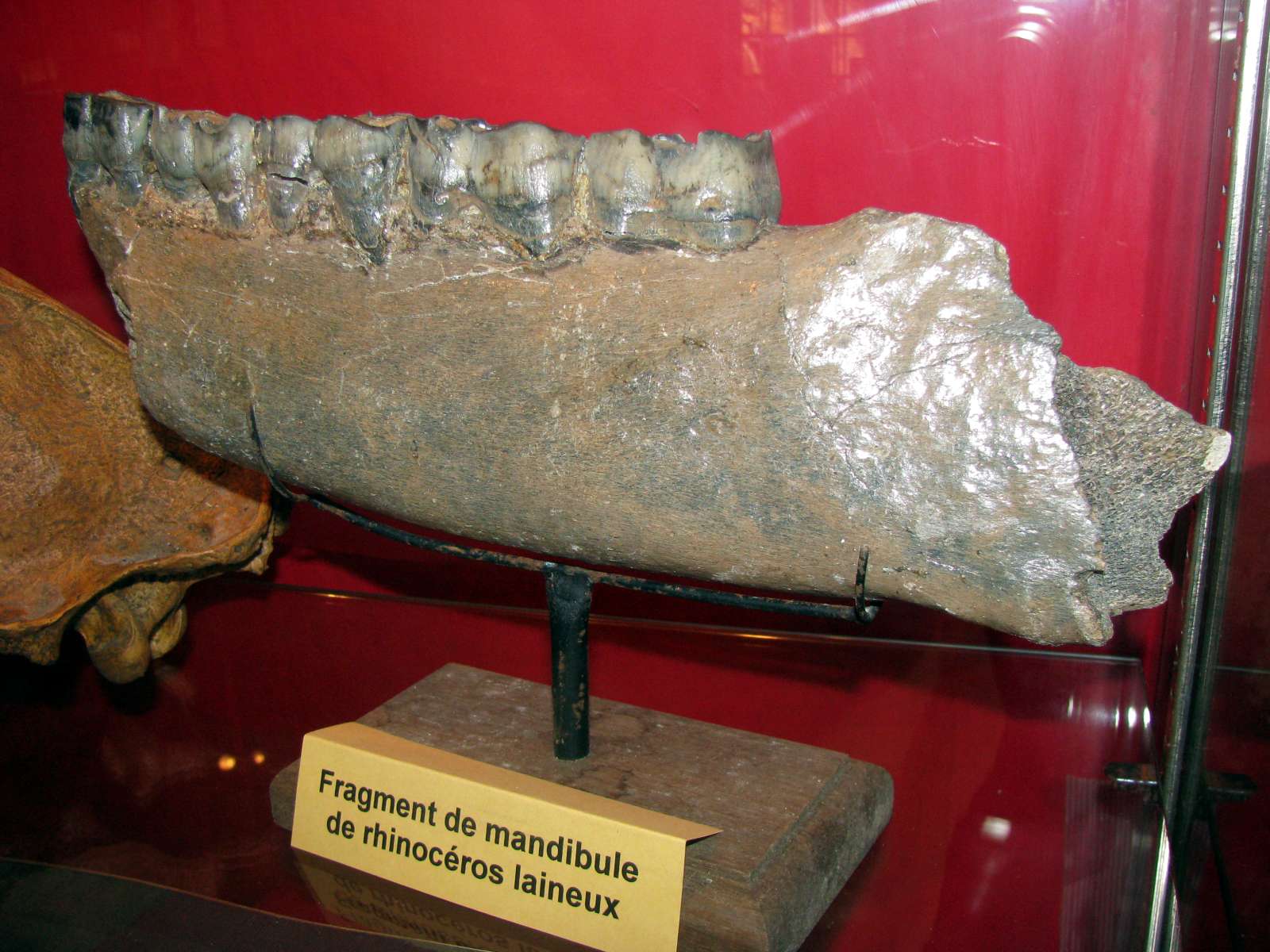
Part of the jaw of a hairy rhinoceros.
Photo: Don Hitchcock 2008
Source: Original (?), display at Grotte du Sorcier
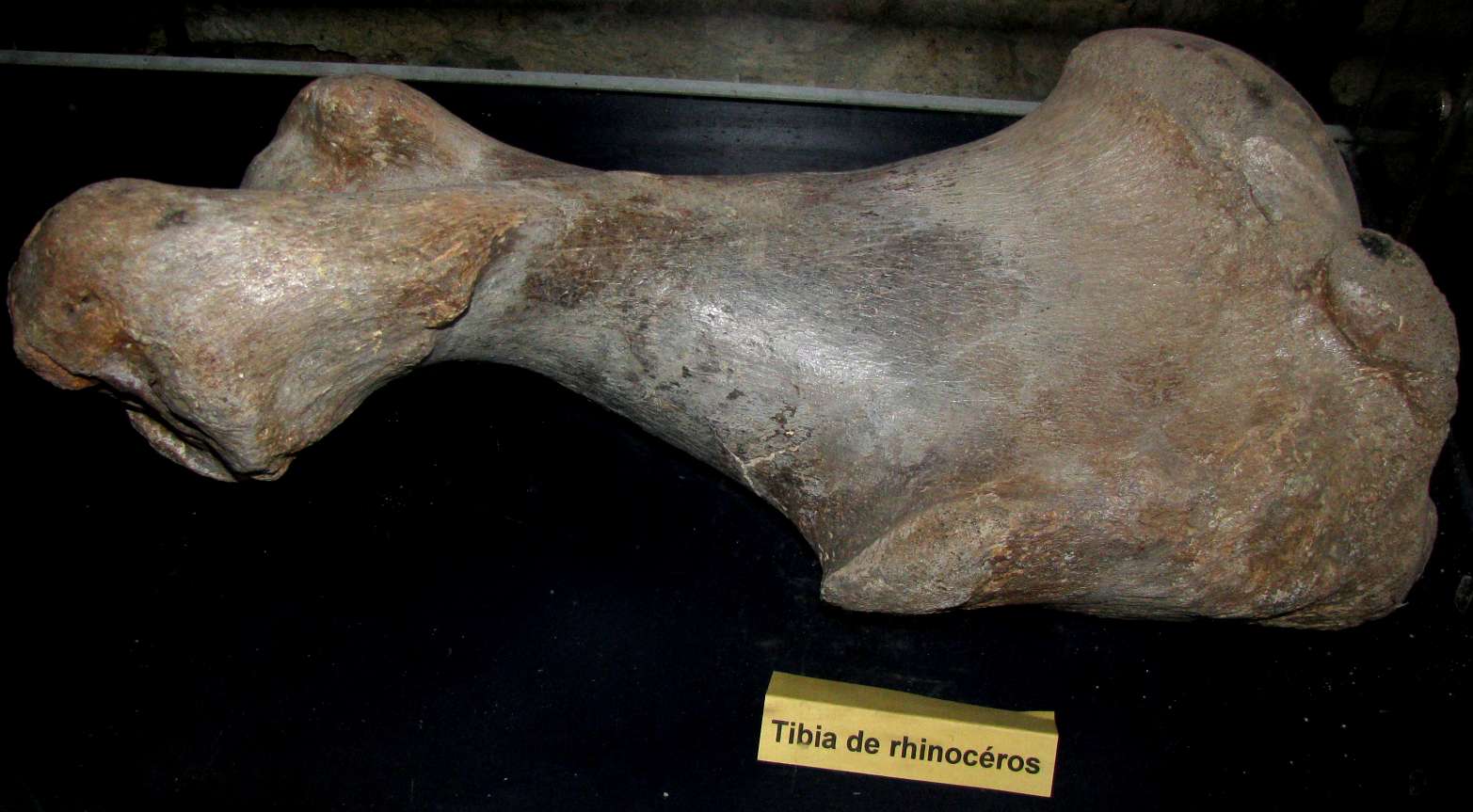
Tibia of a wooly Rhinoceros.
Photo: Don Hitchcock 2008
Source: Original (?), display at Grotte du Sorcier
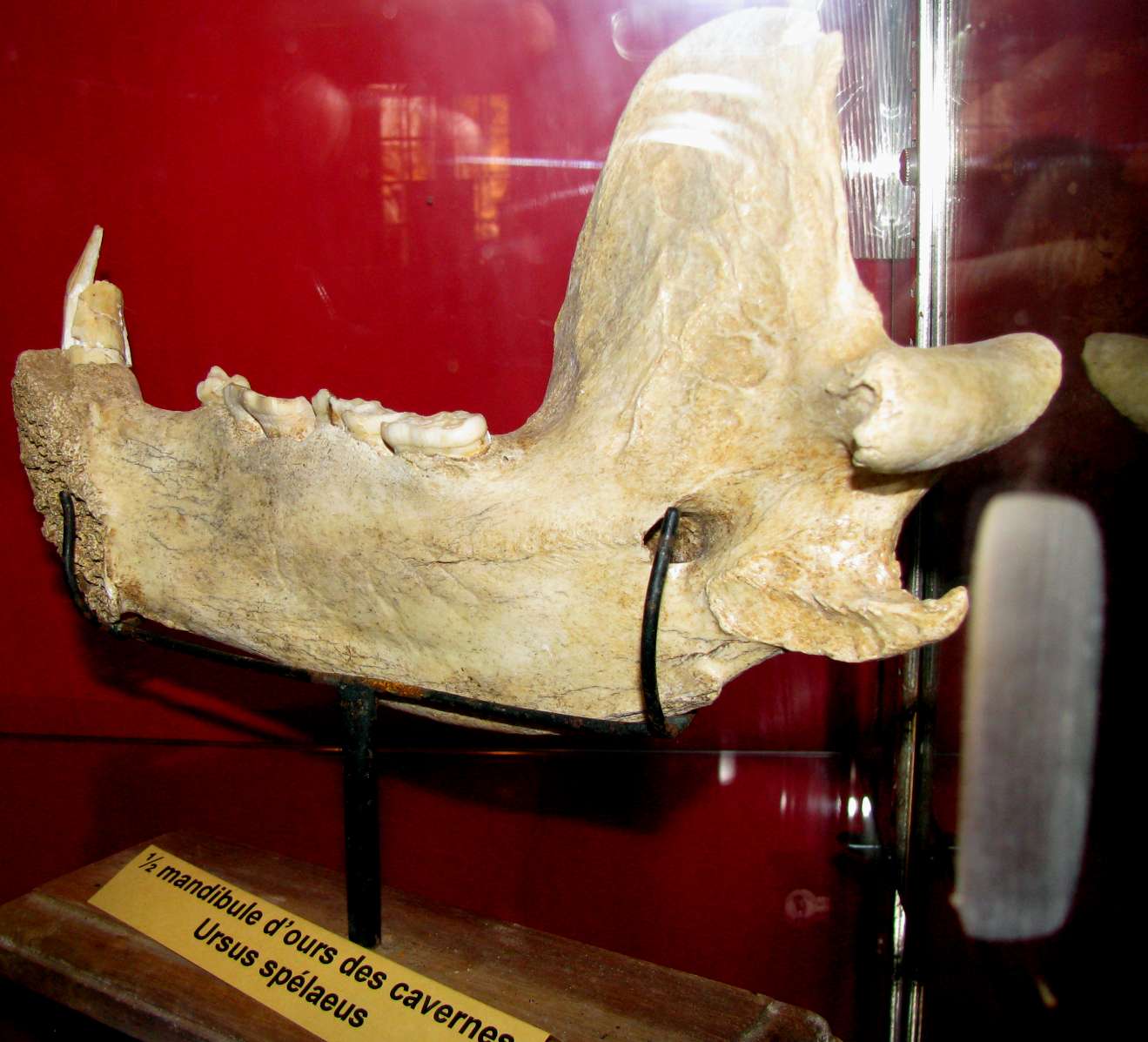
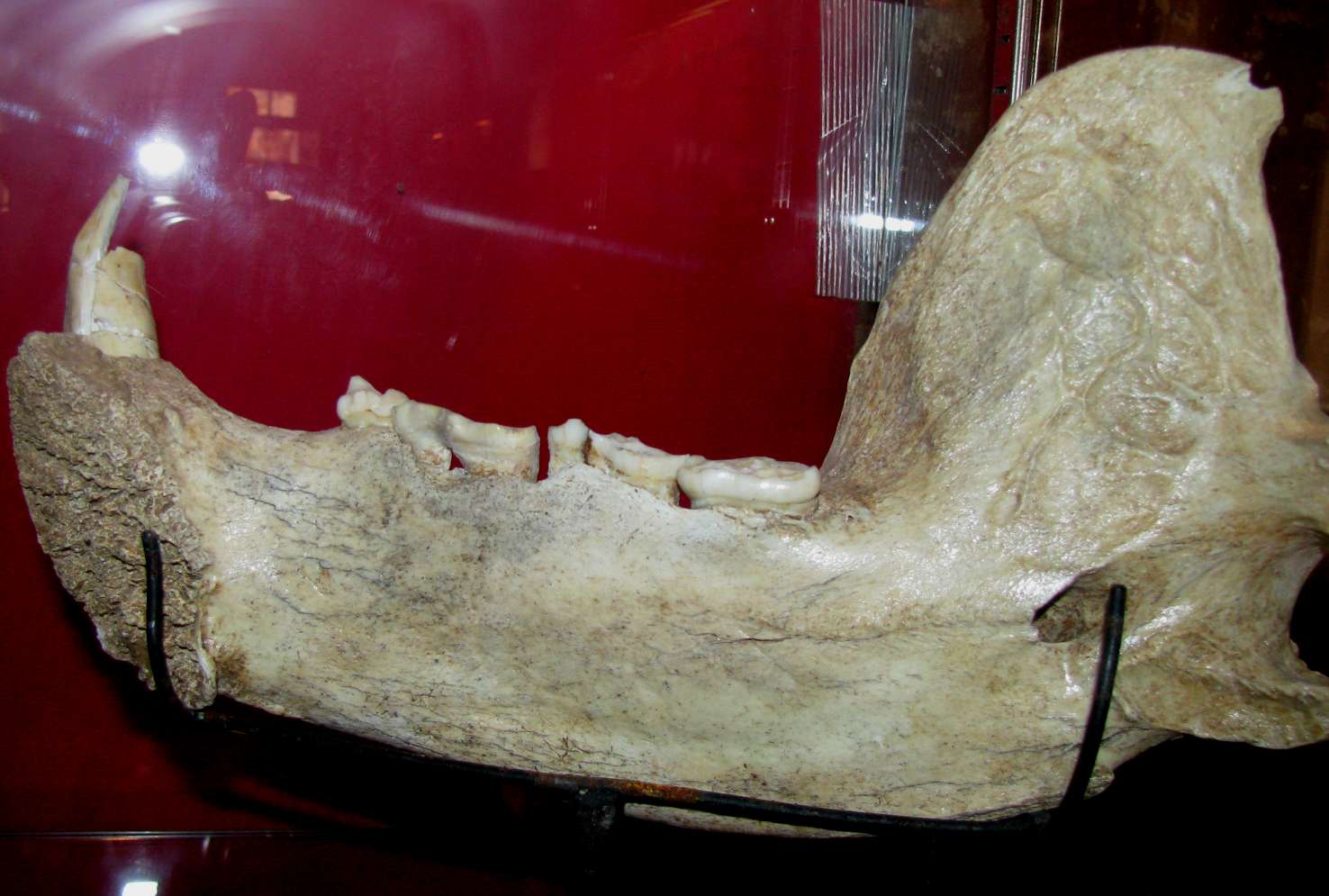
Half of the jaw of a Cave Bear.
Photo: Don Hitchcock 2008
Source: Original (?), display at Grotte du Sorcier
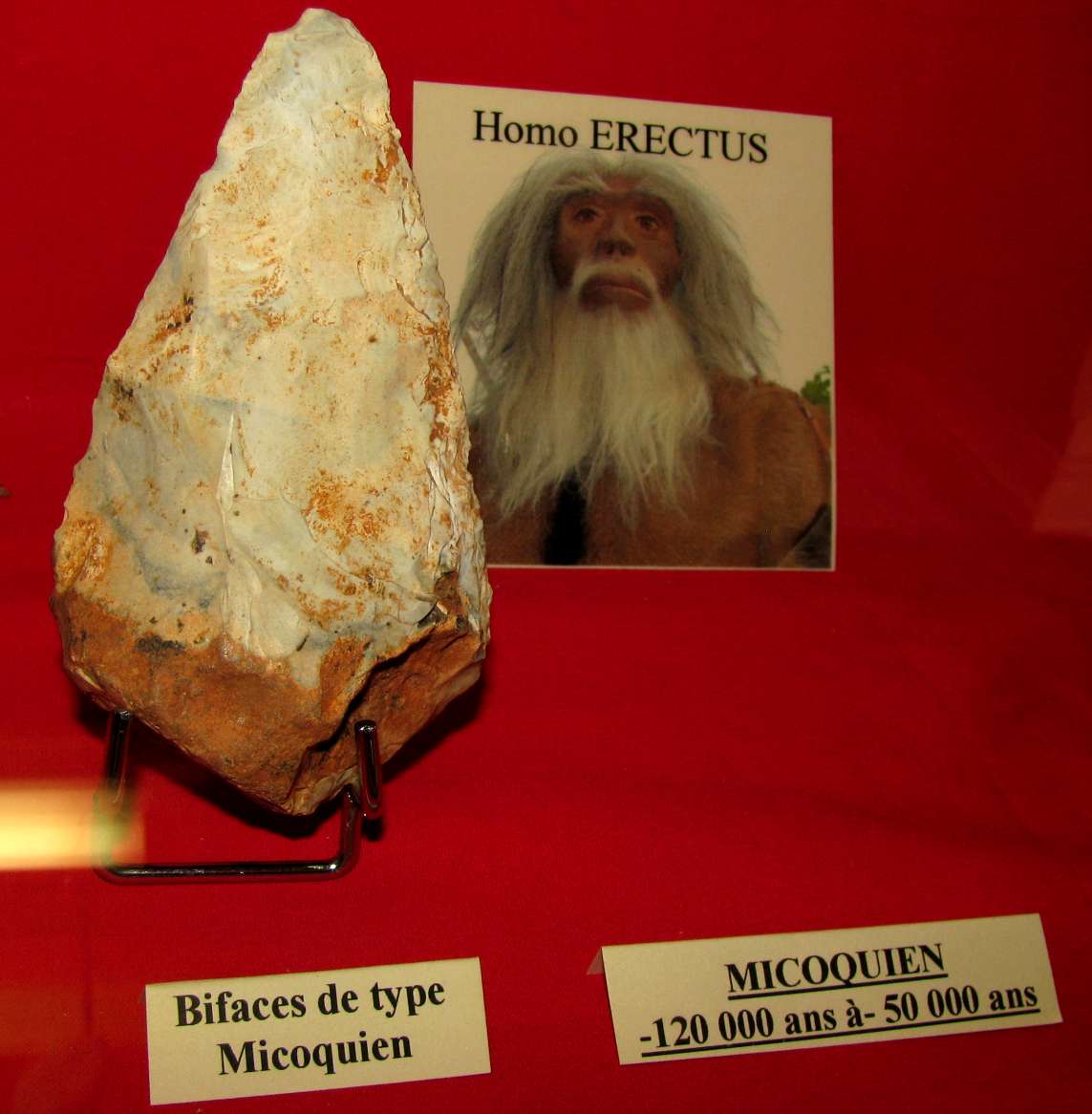
Biface of the Micoquien type. The type site is La Micoque, not far away from Roc du Sorcier. The deposits at La Micoque are from the ancient Palaeolithic, dating from 400 000 BP to 130 000 BP. One set of horse teeth at La Micoque gave ages of between 241 000 ± 15 000 and 288 000 ± 10 000 BP.
I know of no evidence that there were any Homo erectus in this vicinity, however, despite the implication in the display photo here.
Photo: Don Hitchcock 2008
Source: Originals, display at Grotte du Sorcier
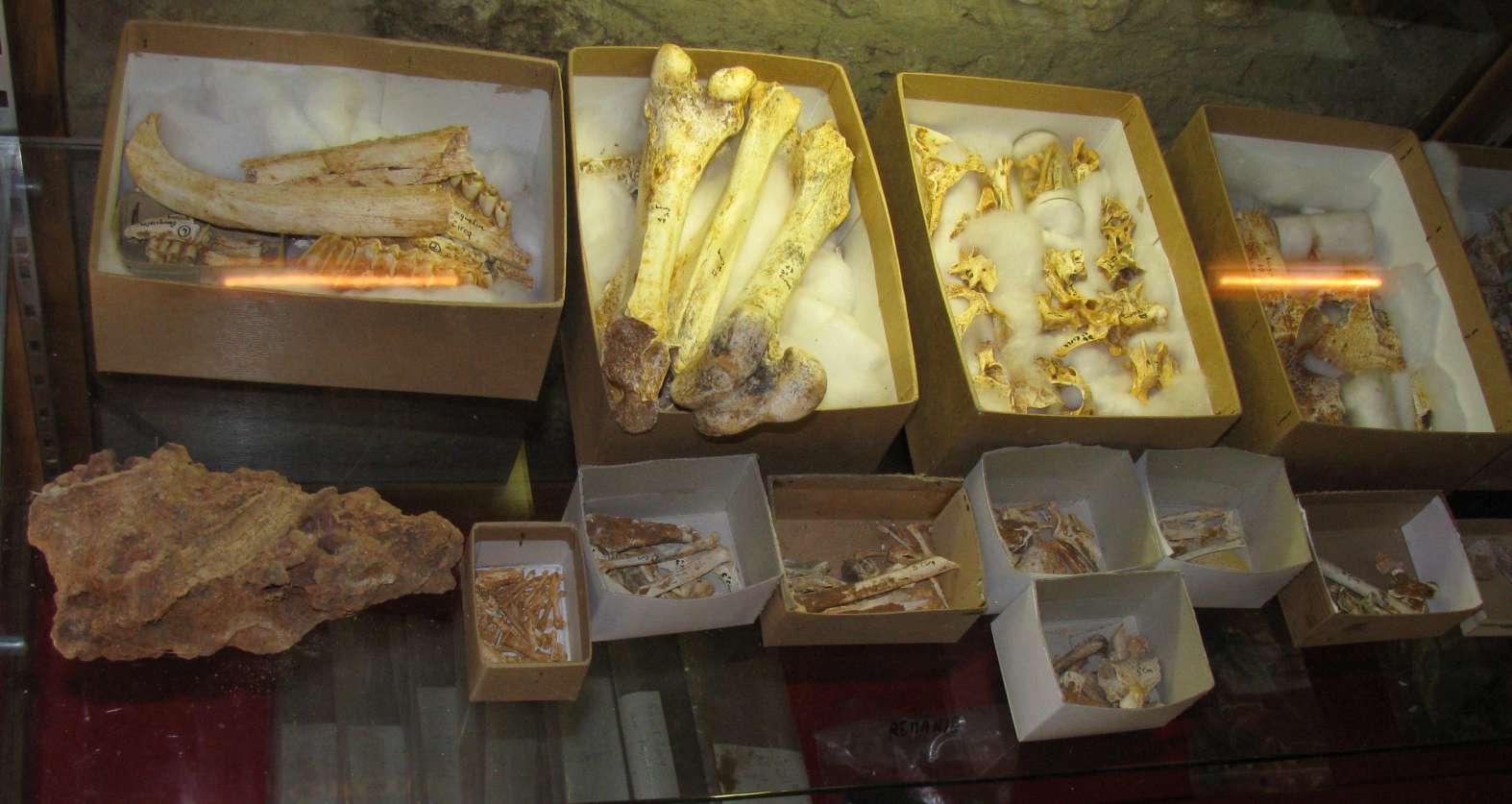
Boxes of various bones found during digs in the area. Sometimes huge quantities of these are discovered, and it is a real problem to find something useful to do with them. They cannot be just thrown away, but it is expensive to catalogue and store them, let alone display them to best advantage.
Photo: Don Hitchcock 2008
Source: Originals, display at Grotte du Sorcier
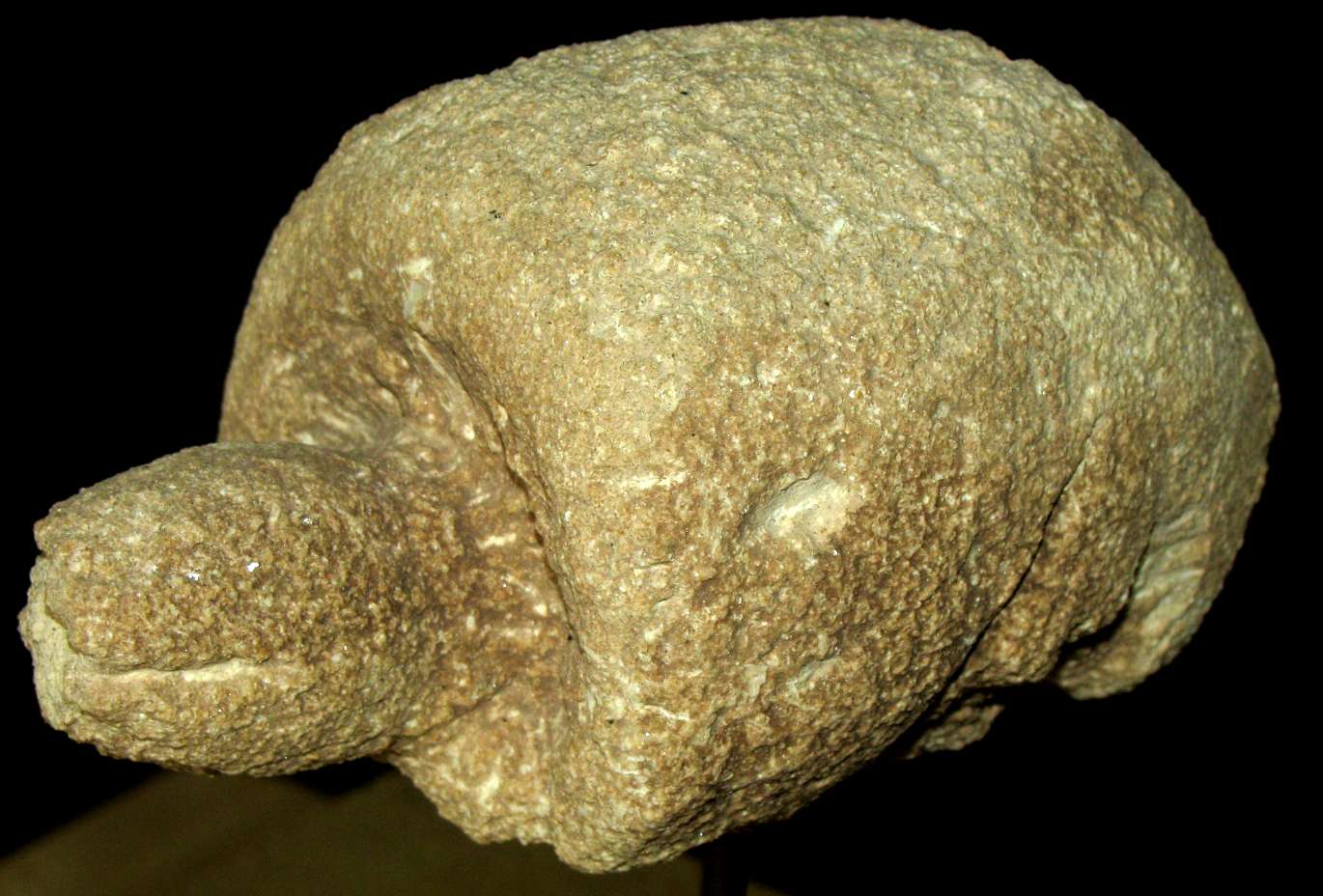
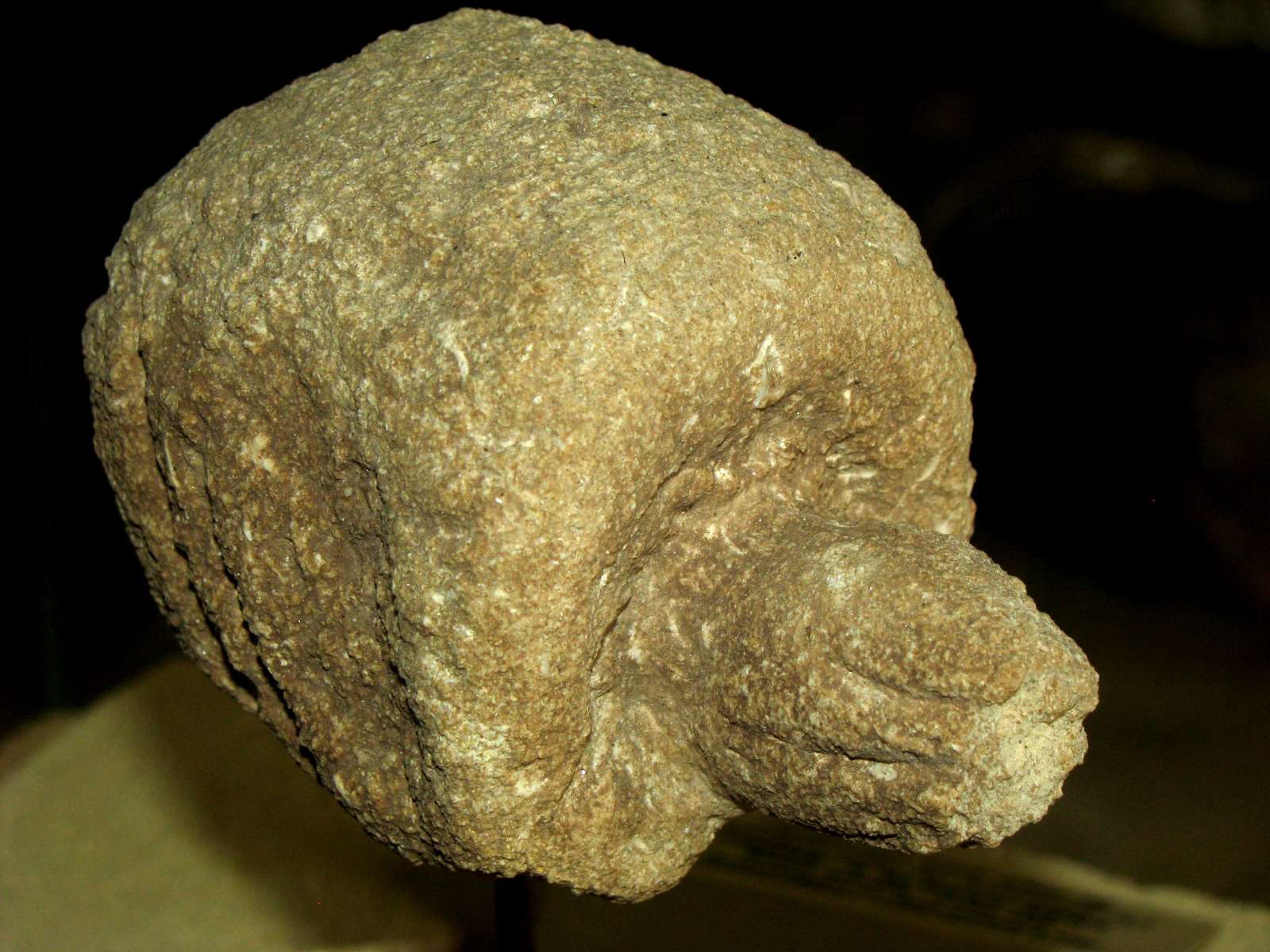
Sculpture of a tortoise.
Photo: Don Hitchcock 2008
Source: A superb, museum quality facsimile, from the display at Grotte du Sorcier.

Tortoise from la Grotte du Sorcier.
Photo: Don Hitchcock 2014
Source: Original, le Musée National de Préhistoire, Les Eyzies-de-Tayac
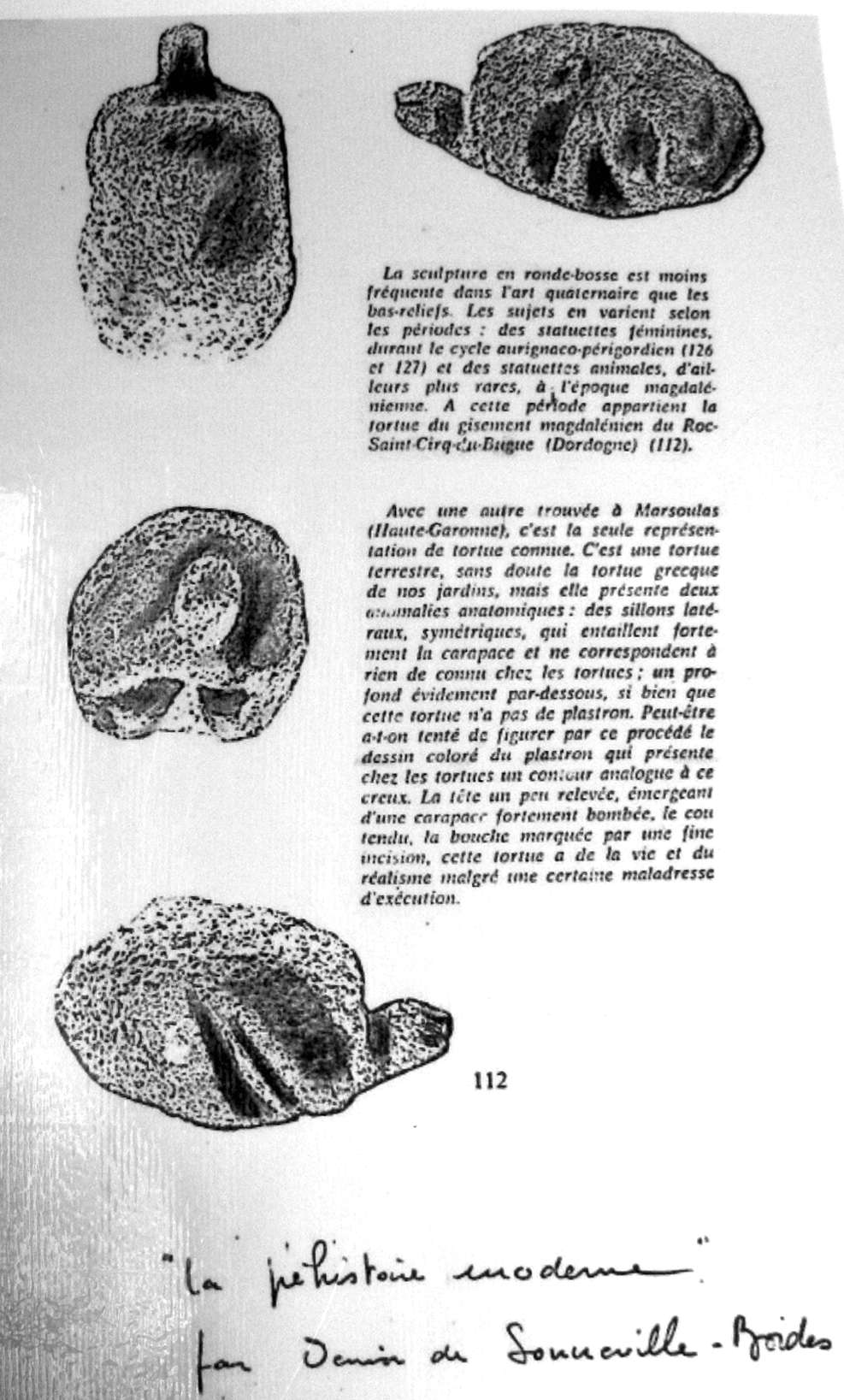
Sculpture in the round is less common in Quaternary art than bas-reliefs. The subjects vary over time - feminine statuettes during the cycle Aurignaco-Perigordian and animal figurines, however more rare, in the Magdalenian period. To this period belongs the tortoise of the Magdalenian gisement of Roc-Saint-cirq-du-Bugue, Dordogne.
With another found at Marsoulas (Haute-Garonne), this is the only known representation of a tortoise. It is a terrestrial tortoise, no doubt the Greek tortoise of our gardens, but it presents two anatomical anomalies:
the symmetrical lateral grooves which greatly cut into the shell correspond to nothing known in turtles;
Below, the turtle has no plastron, the shield in a tortoise that corresponds to our sternum.
The head is slightly raised, emerging from a highly domed carapace, neck outstretched, mouth marked by a fine incision, this tortoise has life and realism despite some maladroits of execution.
Photo: Don Hitchcock 2008
Source: display at Grotte du Sorcier, text translated from "La Préhistoire Moderne" by Denise de Sonneville-Bordes.
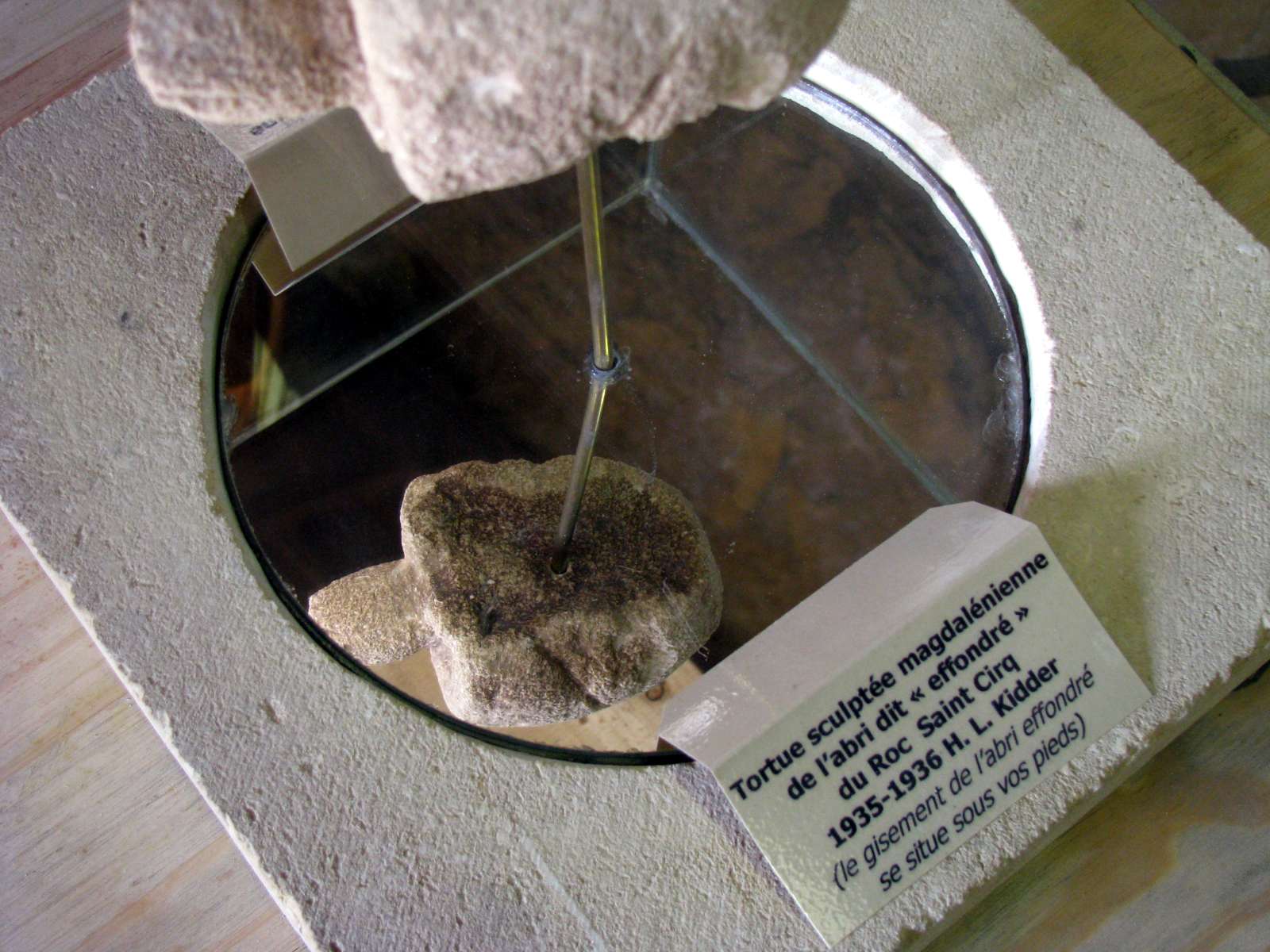
Carved Magdalenian Tortoise from the collapsed shelter of Roc Saint-Cirq.
Found in the excavations of 1935-1936 by H. L. Kidder.
The collapsed abri is beneath your feet in this museum.
The mirror allows the visitor to see the base of the tortoise.
Photo: Don Hitchcock 2008
Source: museum quality facsimile, from the display at Grotte du Sorcier.
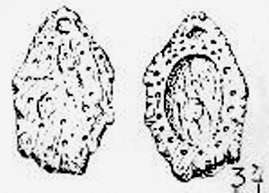
At Marsoulas, there is a carved turtle pendant on a small oval with a carved hole for a string. It is unique because it was the first time that this animal was reported in prehistoric art.
This is one of many objects found during excavations by Abbé Cau-Durban from 1883. However many successive excavations have helped to disperse these objects into various private collections and several museums.
They are usually fragments of animal bones such as rib fragments engraved with a buffalo, pierced teeth, and so on.
Photo, and text adapted and translated from:
http://membres.lycos.fr/jeff31/tortue.jpg
La Tortue Magdalénienne du Roc-Saint-Cirq (Dordogne)
Translated from the French by Don Hitchcock.
The original paper by Elie Peyrony and Denise de Sonneville-Bordes may be found at:
lithos-perigord.org/plugins/fckeditor/userfiles/file/Saint Cirq Tortue Anthropologie1960.pdf
The gisement of Roc-Saint-Cirq, commune of Saint-Cirq-of-Bugue (Dordogne), was excavated in 1935-1936 by H. and L. Kidder, who deposited a wealth of material at the Musée des Eyzies.
Besides a lithic and bone series recently published from the Magdalenian III-IV, the collection includes a small work of art that is the subject of this note.
It is a lump of hard yellow calcareous sandstone, sculpted in the shape of a Tortoise.
The conditions of the discovery of this object are not known, nor the exact location where it was found in this site where H. and L. Kidder had identified three main levels, but which previous excavations had partially disrupted.
It was in any case, considered as Paleolithic by H. Kidder and D. Peyrony, along with H. Breuil, who wrote to us about this site: "I know that Kidder had made some excavations, I suppose the collections are at the Museum of Eyzies. He showed them to me and I retained the impression of a Magdalenian III art object. A lump of limestone carved in the shape of a Tortoise, comparable to one other unpublished object from Marsoulas also from the Magdalenian III. " (from a letter of the 28th November 1957.) Some crumbling or old natural damage had mutilated the front of the mouth, the posterior superior part of the carapace and a little of the left side, behind the incision.
The dimensions of the object are as follows.
- Maximum Total Length: 93 mm.
- Total length of carapace: 72 mm.
- Maximum width of carapace, taking into account the incisions in the rear side: 55 mm.
- maximum thickness of the object: 50 mm.
The animal is represented with the head slightly tilted, emerging from the carapace, neck outstretched.
The head, slightly flattened, has a very fine incision which marks the mouth. Viewed from the front, the carapace appears strongly convex, rising steeply above the neck. From the side, there is the same abrupt rise, while the outline is rounded to the back.
Two deep oblique grooves are arranged symmetrically on each side, just before a slight lateral swelling. On the left side, former damage has partially destroyed the groove. From overhead, the shell has a roughly rectangular plan, narrowed towards the front, bulging towards the back with lateral symmetry, the tail of the carapace is slightly flared.
Seen from below, the object has a deep recess in the shape of a cross, forming a slightly asymmetrical cavity that limits a slightly marked bulge, the lateral grooves and the medial cavity isolate an enlarged portion of the whole.
Viewed anatomically, this Turtle sculpture presents two anomalies. The lateral grooves which cut deeply and symmetrically into the shell do not correspond to anything known in turtles. Perhaps the artist wanted to suggest by this method the movement of the front legs, but the direction of the incised lines is the opposite to that of the legs of a running turtle. On the other hand, this turtle, very deeply recessed from below, seems to have no plastron (the nearly flat part of the shell structure underneath a turtle or tortoise). Depending on the species and the sex, the plastron presents several variations, slightly concave or convex depending on the particular species or sex, but in no case is there a depression so strongly marked. Is there a process to try to represent the front and rear legs of the animal, seen from below, the rear legs longer than the front?
Or an attempt to show by the cross the design of the plastron which, in the present garden turtle, for example, has roughly the same perimeter? Or it may be a section not completed during the course of the creation of the sculpture.
What turtle is it? Not the freshwater turtle, genus Emys, which has an elongated oval carapace, slightly convex dorsally, but a land turtle of the genus Testudo, because of the very quadrangular shape of the shell. The scales are not depicted on the sculpture, the general shape of the shell alone can be used as a differentiating factor between the two species currently known in France, Testudo graeca L. and Testudo hermanni Gmelin.
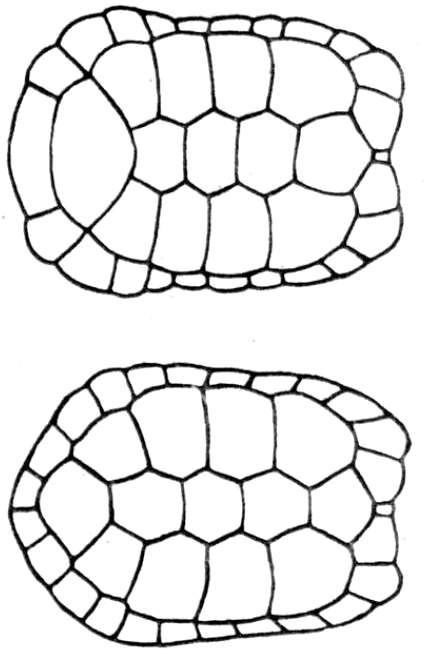
Shell plate patterns of Testudo graeca top, and Testudo hermanni bottom.
Photo: Peyrony et al (1960)
The Turtle from Roc-Saint-Cirq more closely resembles the pattern of Testudo graeca than that of Testudo hermanni, because of the bulging rear sides and the curvature of its wider tail section, but a clear distinction on this subject and gender remains highly uncertain.

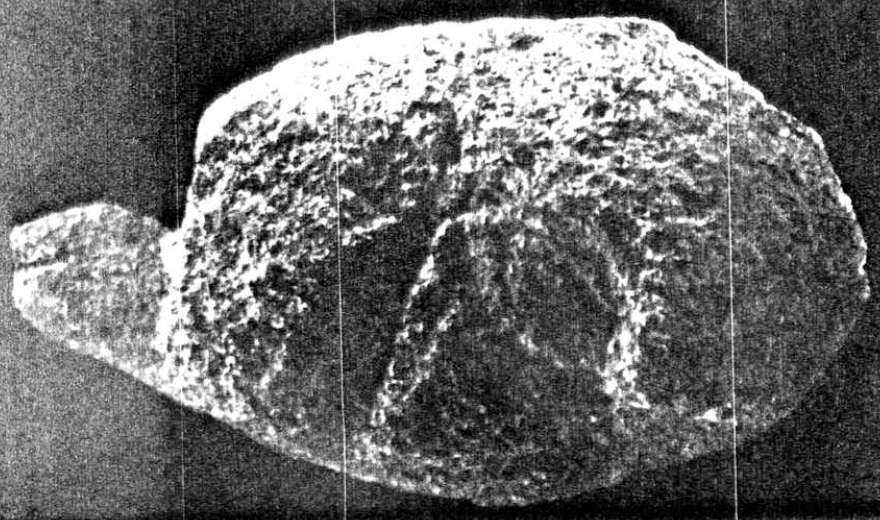
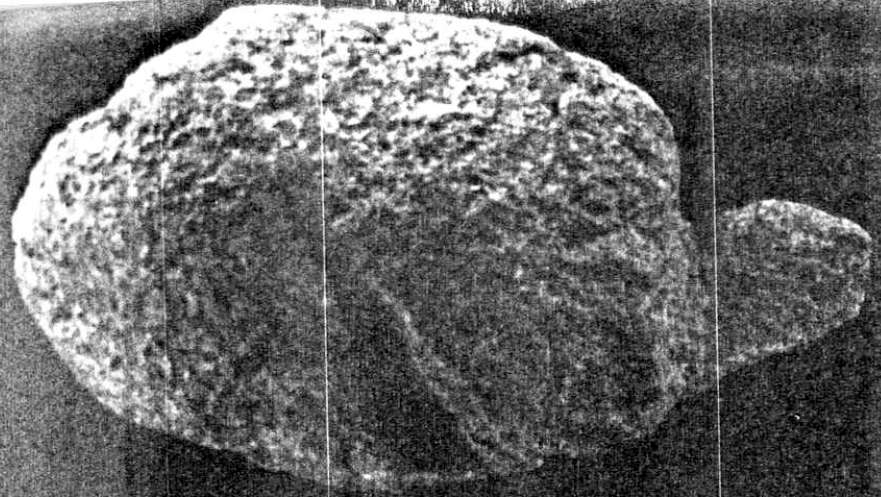
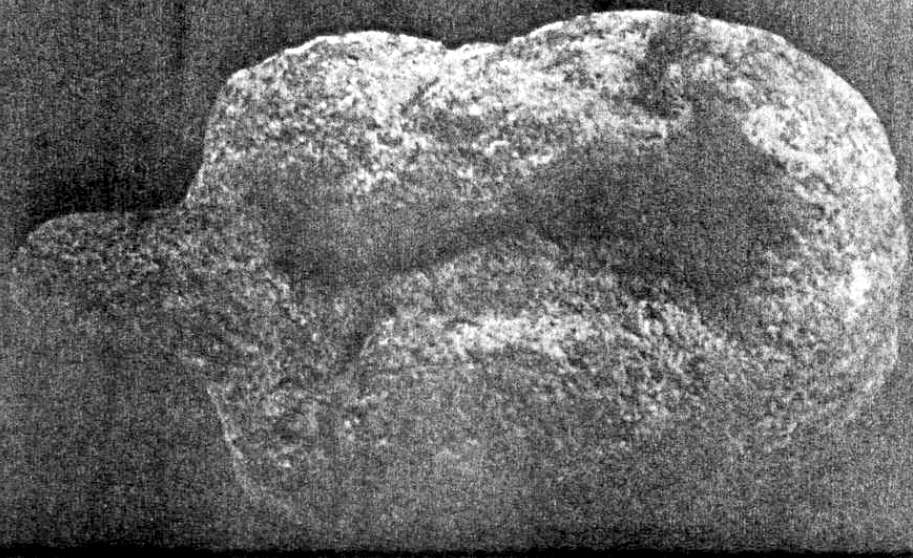

In order, top, left, right, underneath, frontal photographs.
(I have included these photos because they show the general shape of the sculpture, and the depth of the hole in the base of the object. I wonder if the hole was there in the original roughly shaped piece of sandstone that the artist turned into a sculpture after noting its rough resemblance to a turtle or tortoise, and then added the features such as the head, the grooves on the side, and the specific shape of the sculpture - Don)
Photo: Peyrony et al (1960)
There are also closely related species originating in southern Europe, naturalised in our regions. Remains of land turtles were seldom reported in Paleolithic levels. M. Ball described the remains of a Land Tortoise - Testudo Ibera rather than Testudo graeca, he thinks - in hearth C of the grotte du Prince à Grimaldi.
G. Henri-Martin found Testudo graeca (identified by R.P. Bergouignioux) in the level E, Tayacian beds of the grotte de Fontéchevade (Charente).
C. Arambourg considers this certain evidence of a Mediterranean climate at that time.
While this is a piece of art and not the remains of animals, the sculpture from Roc-Saint-Corq certifies the existence of the terrestrial turtle (tortoise) in the Magdalenian III-IV.
This period corresponds in this region to the end of the interstadial period Würm III-IV and to the start of the resumption of the cold that will worsen until the Magdalenian VI. This must therefore cast considerable doubt on the concept of a warm climate being necessary for the presence of this animal, but which, it must be remembered, is indeed rarely found in Paleolithic sediments or archeological sites. (However it is not beyond the bounds of possibility for travellers to have journeyed to the warmer climes of the French Mediterranean coast and seen the tortoise, and brought home at least the dried shell. We know that high quality flint, for example, was carried considerable distances - Don).
While fish, amphibians and reptiles have been depicted in quaternary art, no other representation of the turtles and tortoises is known to us, except for those reported by H. Breuil at Marsoulas, being unpublished to date, to our knowledge. Like other objects of carved sandstone, particularly from the Magdalenian IV levels of Isturitz, the natural shape of a nodule was used as a starting point for a work of art rather clumsily executed, perhaps because of the hardness of the material used. Rather than reproducing fine details, the artist has sought to make the general shape of the tortoise and its overall look, and perhaps it is to this attitude of the sculptor that we can assign the anatomic abnormalities noted above.
Nevertheless, the relative proportions of the carapace, the shape of the head, and the movement of the neck are expressed with a realism that gives life to this small object and to the student the dignity of a work of art.

Silica Gogotte
Gogottes are normal and attractive formations and were first discovered many years ago inside a sand quarry near Chartres, France. They are composed of tiny grains of quartz cemented together by carbonate minerals, forming a type of sandstone. These formations or concretions are fairly common and can occur in specific rounded and mammillary forms, but they are rarely as aesthetically pleasing as this one.
This nodular form was found in the shelter where you now are, beneath the floor.
Its outer layer is very polished, displaying the effects of repeated rubbing by human hands.
Is the top of the stone natural or sculpted by man?
From its shape which is suggestive of an idol, it was very likely the object of veneration or formed part of a fertility rite.
Photo: Don Hitchcock 2008
Source: Original, display at Grotte du Sorcier
L'art Parietal De La Grotte Du Roc Saint-cirq
Abstract
This book is the only reference book I have been able to find for the parietal art of the Grotte Du Roc Saint-cirq, the Grotte du Sorcier. It is a wonderful resource, and essential reading for those interested in the art of the Vézère Valley. The extract below is the abstract in English at the back of the book.
The cave of Roc Saint-Cirq is located on the right bank of the river Vézère, about halfway between the villages of Les Eyzies and Le Bugue, in the department of Dordogne. It is oriented south-east and its opening is set in a cliff overlooking the hamlet of Saint-Cirq-du-Bugue. When looking at the cave-mouth, at about 50 metres to the right, one can see the rock-shelter of Roc Saint-Cirq, which has been repeatedly excavated and where Magdalenian deposits have been found. There is a magnificent view of the Vézère valley from the opening of the cave.
Like many other caves and rock-shelters in the area all around Les Eyzies, the cave of Roc Saint-Cirq has been used as a dwelling-place up to the present time. When the first carvings were discovered, in 1952, the porch, the flat area in front of the shelter, was used as a store-room and partly closed by a stone wall. The inner walls of the abri had been flattened with picks, which had removed part of the walls and damaged the carvings. The rear gallery was blocked by boulders, some of large size, as well as clay and sand deposits.
The first figures to be recognised in 1952 were the sculpted bison (no. 28) and the carved horse (no. 27), which was presumed by Abbé Breuil to be a reindeer figure. After his visit, part of the low rear gallery was excavated by a local group of speleologists and made more easily accessible. In 1953, the cave was visited by Abbé Glory, who saw the first horses (no.18 and no.19) as well as the engraved male figure no. 37 in the rear gallery; this last figure has since become known as "the sorcerer of Saint-Cirq".
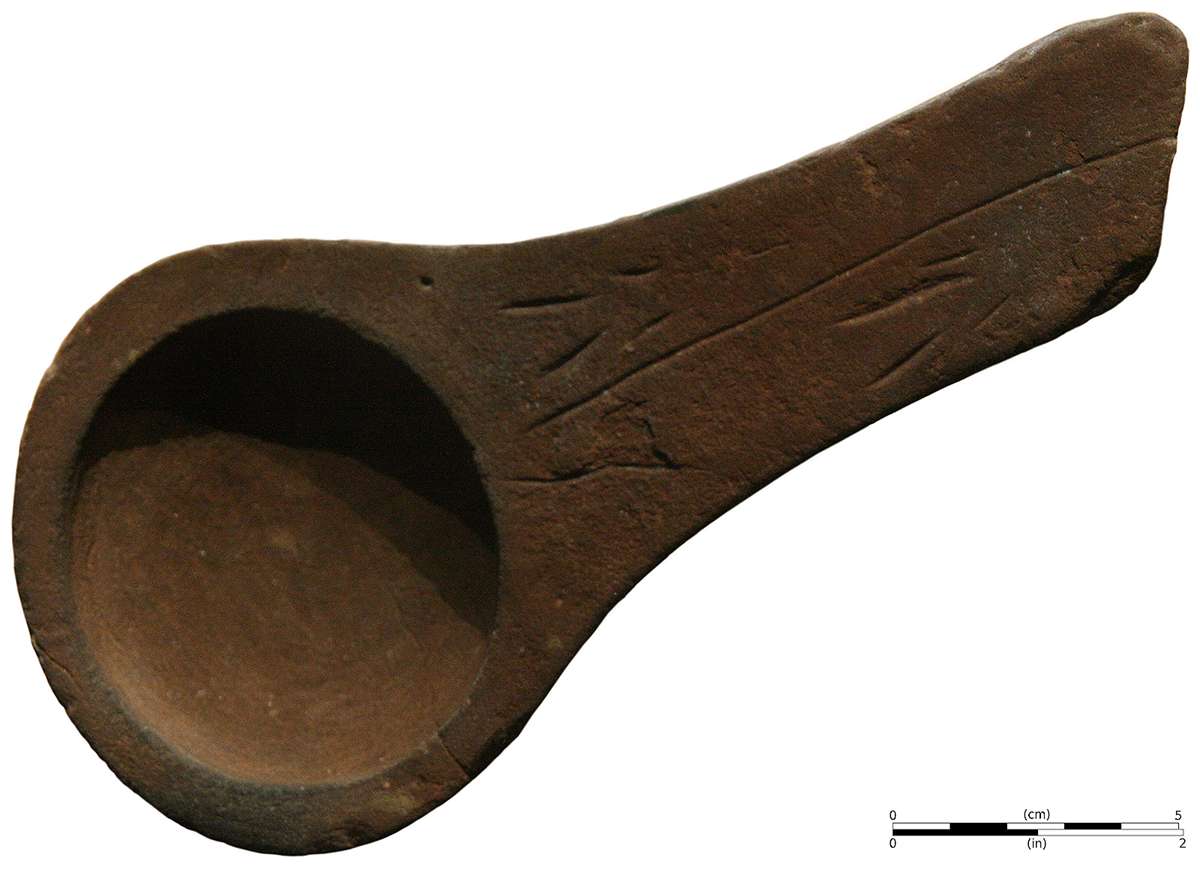
An oil lamp (a deer fat lamp), found in Lascaux cave in Montignac, Dordogne, Aquitaine, France. Magdalenian culture, 17 000 BP. It can be viewed in the National Prehistory Museum in Les Eyzies-de-Tayac.
The red sandstone lamp was found by Abbé André Glory at Lascaux. André Leroi-Gourhan, said in 1982 that Abbé Glory was the man who best knew Lascaux.
Photo: Wikipedia Creative Commons license, photographer Sémhur, 25 September 2009
Source: Original on display at Le Musée National de Préhistoire, Les Eyzies-de-Tayac
The cave was first mentioned by S.Blanc in 1953, where the discovery of the bison and the supposed reindeer was made known. There was then no other mention of Roc Saint-Cirq until 1965: at that time, Prof.Leroi-Gourhan published his monumental study of prehistoric art where the cave was described for the first time. His inventory listed one bison, one deer (the reindeer of Abbé Breuil) and the remains of 4 horses in the first room or porch, and one head of an ibex, one head of a bison, one human male figure, one triangle, one horse with an oval sign and one indeterminate profile in the rear gallery.
At the present time, the cave has become the property of Mr. Paluzzano, who has made several improvements: the cave is now closed by a masonry wall with an iron door and there are steps leading to it and a platform in front.
Mr.Jean Vertut has told us that since his first visit to the cave, in 1957, there does not seem to be any new damage or further alteration of the various carvings and engravings, either in the first room or in the rear gallery.
The first room or porch is very badly damaged by pickwork, smoke, layers of soot as well as blackish lichen, which obliterate some of the engravings. This was the original rockshelter, and its total surface should be about 60 sq.m. while the average height is of 3 m. The porch was excavated or emptied long ago and we do not know the height of the original level of the ground. However, it could not have exceeded 40 to 50 cm. more than the present level, because it would otherwise have blocked the entrance of the low gallery at the rear.
The rock-art of this first room is mainly on the right aide, on the right-hand wall and on the left face of a limestone pendant or overhang. A few badly preserved engravings are located on the ceiling, at the left.
At the end of the porch, there is an upper gallery which can be reached by a narrow chimney; it is blocked by sand after a length of 8 m and contains no rock-art.
The lower gallery, located just below, has two levels at the present time. The deeper part, on the left, is the result of the 1952 excavation, which has been closed at the end with a sheet of plateglass, in order to preserve the deposits for further research. On the right side, there is a narrow ledge of an average height of 90 cm. which is accessible only by crawling. On this ledge, the right-hand wall, the ceiling and the limestone overhang on the left, have been ornamented with engravings. In fact, it seems to reproduce the decorated areas of the porch on a smaller scale. At the end of the excavated areas, one can crawl along the ledge for a further distance of 10 m., but then the passage becomes blocked by sand and clay deposits.
We shall now briefly describe the rock-art of Roc Saint-Cirq.
-No. 1 is a finely engraved horse located above the present iron door at an approximate height of 3 m. A cross-hatched sign, no. 2, is engraved above the horse. Even in Palaeolithic times when there was no wall, this area must have been in shadow.
We are now following the left face of the limestone pendant, going from the left to the right. -Horse no. 3, at a height of 260 cm. from the present ground level, has an eroded appearance and is barely visible; the trunk follows the natural curve of the hollowing of the rock surface.
-At the right of horse no. 3, there is another horse, no. 4, located at a height of 230 cm; it is deeply engraved with a wide line with blunted edges; it may be that a pecking technique was used for parts of the outline, but the figure is too badly preserved for definite ascertainment. It is also damaged by holes which supported former beams, as well as other various blows and accidental strokes. The head has practically disappeared, but the outline of the abdomen and forelegs with their respective hoofs is still visible.
-More to the right and at 315 cm. height, horse no. 6 also shows a bad state of preservation, due mainly to erosion; some finely engraved lines on its hind quarters are numbered no.5.
-Another group of finely engraved lines, sign no. 7, can be seen to the right of horse no.5.
-At a height of 280 cm.from the ground, horse no. 9 is so deeply carved as to look like low relief; unfortunately a large beam-hole has torn the front part off. A few cupules are visible on its trunk. The finely engraved lines numbered no. 8 are barely visible, while the only recognisable part of the indeterminate animal no. 10 is the dorsal outline.
-Below this indeterminate animal figure, horse no. 11 has a lightly engraved outline: part of it has been torn away by the large beam-hole mentioned above.
-A deep horizontal cleft can be seen above these figures; above the cleft, the outline of horse no. 12 is almost invisible. This particular figure seems to have been left unfinished.
-To the right of horse no. 12 there is a group of engraved lines of various depth and width; they are undecipherable in their present state and are numbered 13 and 14.
-Still more to the right, there is a group of 3 horses: no. 15, 16 and 17. The whole area is blackened by lichen and fossilised soot. The engraving technique of these horses is dissimilar, inasmuch as no. 15 has a finely engraved outline, the outline of no.16 is wide and rather shallow, while no. 17 is deeply carved.
Below the cleft, horses no. 18 and no. 19 are carved in low relief. Both are of massive and heavy build, the legs being rather short and of a clumsy appearance. Though both figures have been battered by pickblows and other accidental holes, several engraved lines as well as cupules can be seen on both their trunks.
The limestone pendant with its frieze of horses ends with a narrow crevice; on both sides of this, some faintly engraved lines can be seen, they are numbered no. 20.
-Beyond the crevice, at a height of 380 cm. and near the ceiling, horse no. 21 is very deeply engraved, with a few cupule markings on its trunk.
Turning to the facing wall, which is the right-hand wall from the entrance, there are some deeply incised lines as well as remnants of animal outlines coated with a limestone flow; they are numbered 22 and 23.
-On the ceiling, at a distance of 4 m. from the entrance door, horse no. 24 is deeply engraved and partly hidden by limestone concretions.
-Below, on the blackened and eroded wall, engraving no. 23 seems to depict a small indeterminate animal, presumably a rodent.
-Above this and to the right, no. 26 is a group of deeply incised, as well as finely hatched lines. One small triangle has a circular pecked surface inside its outline and may represent the eye of a long-necked animal.
-We are now in front of the large low relief carving no. 27 which Abbé Breuil identified as a reindeer, while Prof.Leroi-Gourhan thinks might be a deer. In our opinion, it is a large horse of 120 cm. length, with deeply carved lines on its trunk as well as various cupules. The head is covered by a limestone flow.
-More to the right and near the entrance door, the sculpted bison no. 28 is a powerful figure, notwithstanding its relatively small size of 40 cm. A natural rock formation has been partly used for the hump, while the lowered head has not been worked out in detail. The hind legs are magnificently carved to stress the marching posture.
We now turn to the rear part of the cave, where most of the engravings are concentrated on the narrow rocky ledge overhanging the excavated zone.
-At 1 m. from the entrance of the low gallery, on the left wall, no. 29 consists of remnants of various finely engraved lines, all are badly damaged by the erosion of the rock-surface.
-At their right, no. 30 and no. 31 are the deeply engraved remains of several animals, no.30 being a horse. These engravings are located at a height of 80 cm.from the ground and partly cover the ceiling.
-No. 32 is the incomplete figure of an ibex with long and curving horns.
-The following panel, numbered from no. 33 to no. 38, is located on the underside and various protuberances of the overhang. It is damaged by the disappearance of the calcite layer which adhered to the rock surface and on which the figures were engraved.
The bison head no. 33 is engraved inside the outline of the bison head no.34, using the same single eye and pair of horns for both figures. In our opinion, the outline of the bison head no.34 is the older of the two. Various lines and signs have been grouped under no.35.
Above, the reticulated sign no. 36 is a very complicated symbol, and certainly not a vulva, as has been suggested. Immediately above, the male human figure no. 37 has no anthropomorphic traits. The posture is of a seated individual with a very protuberant belly and a huge disproportionate penis. The finely hatched signs above the head are grouped under no. 38.
-Below, and at the right of the male figure, horse no. 39 is very deeply engraved and shows some possible arrows. The ibex no. 40 is also deeply engraved, as well as the sign no. 41 which probably represents a schematic vulva.
-On another overhang and more to the right, there is the human profile no. 42 facing a group of signs, no. 43 and horse no. 44; this has various deeply incised symbols in the shape of an inverted V on its trunk.
-Just above, a finely engraved group of lines, no. 45, is a probable figure of a horse, for part of which a natural rock formation was used.
-Quite near, an indeterminate animal figure, no. 46, is only partly visible under a limestone flow.
-Horse no. 47 is located at the end of the accessible part of the ledge, and at a height of 40 cm.from the ground. Here again a natural rocky protuberance was used for the dorsal outline.
On the facing wall, the figures are fewer; we start from the left, going toward the entrance door.
-No. 48 and no. 49 are deeply incised lines, probably remains of engraved signs; no. 48 may be a possible animal outline.
-At the right and quite near to the ground, sign no. 50 is almost invisible, while horse no.51 located above is partly hidden by a limestone flow; the line piercing the neck may represent a spear or an arrow.
The last figure of the ledge is horse no. 52, with deeply incised hind-quarters; it has symbols in the shape of an inverted V on its trunk and a finely hatched sign on the rump.
A few more badly preserved engravings are located on the ceiling.
-Horse no. 53 is engraved on the ceiling of the porch, on the left side, and completely covered by limestone concretions.
-On the same side, but on the ceiling of the excavated part of the rear gallery, horse no. 54 is barely visible; the outline of no. 55 seems to represent a long-necked bird, and may be a wild goose.
-Also on the ceiling of the left side, the head of horse no. 56 seems to have been engraved twice; here again, the line crossing the trunk may represent a spear or arrow.
-Deeper inside the excavated part of the rear gallery, and on the ceiling, horse no.57 is very badly preserved; it may also have a spear crossing the body.
Finally, on the ceiling near the plate-glass sheet, horse no. 58 is deeply engraved; the two lines piercing the neck may again indicate spears or arrows.
We do not know why the Palaeolithic artists elected to work mainly on the left overhang of the porch and on the pendant or overhang of the left side of the ledge, inasmuch as both rock surfaces are uneven, with various deep hollows, bosses and fissures. The right-hand wall, both inside the porch and on the ledge of the rear gallery, has a comparatively better surface; notwithstanding, these walls have respectively less figures than the uneven and convoluted left side.
The engravings inside the rear gallery were undoubtedly carried out by men working while lying on their back, because there is no other way to work in the narrow and cramped space available. As for the porch, even if we allow for a ground level 40 to 50 cm. higher than the present, that is, the level of the bedrock of the rear gallery ledge, there is still a height from 170 cm to almost 300 cm. from the ground to the carvings. They may have been carried out by means of a scaffolding or platform, or by erecting large flat stones to form some kind of steps. There are traces at Lascaux of a wooden scaffolding, but due to the extremely bad state of preservation of the walls at Roc Saint-Cirq, no such traces can be observed.
The porch or first room may have had more carvings than those which are seen to-day; if they existed, they have disappeared due to the erosion resulting from exposure the the open air, as well as to the flattening of the walls by picks.
We can assume that two distinct sanctuaries existed at Roc Saint-Cirq: the open-air rock-shelter, visible from a distance, where a certain number of individuals could congregate and which was probably a living site; and the narrow and uncomfortable rear gallery, where the visibility of the engravings is limited, and which was probably visited by only a few individuals at a time.
This particular adjustment of the cave-art to the topography of the cave is reminiscent of other similarly decorated sanctuaries, such as for instance, Oullins (dept.Ardèche). This has a vast rock-shelter containing carvings, and a low and narrow "chatière" leading to the low and unpleasant cave at the rear, where the paintings are.
This raises the problem of the caves with open-air art, which can be divided into 3 types:
a) Caves like Roc Saint-Cirq, where a decorated rock-shelter is followed by a cave at the rear, also containing paintings or engravings.
b) Open-air sites without caves at the rear, like Cap-Blanc (dept.Dordogne).
c) Caves where the decoration is restricted to the rock-shelter, while the cave at the rear, even if it should be large and airy, is left empty, like Chabot (dept.Ardèche) or La Magdelaine (dept. Tarn-et-Garonne).
All 3 series have in common the use of sculpture and engraving for the open-air rock-shelter, while the decorated cave at the rear may be said to have no sculpture, with the exception of a few natural formations used to stress the outline of a painted or engraved figure. As the more difficult technique of sculpture was reserved for the open-air sites, the question arises whether this follows as a natural consequence of daylight conditions, allowing for better visibility, or whether it was characteristic of the living site, since these are mainly located at the mouth of the caves.
The carvings at Roc Saint-Cirq can be divided into three groups based on their technique:
* the finely outlined engravings
* the deeply outlined engravings, which are the majority
* the low reliefs or sculptures, which are the exception
The low reliefs or sculptures occur only in the porch, where they could be seen by daylight; horse no.1, which is in shadow, is a finely outlined engraving.
Keeping in mind the bad condition of the walls, it is extremely difficult to determine, wherever a superposition occurs, which technique is the oldest. We believe that the bison head no. 34 is older than the bison head no. 33 because the appearance of the engraved line is shallower and more worn. This implies that at some later time than the engraving of bison no. 34, the eye and horns caught the attention of an artist who decided to reuse them for the bison head no. 33. Some engravings like horses no. 3 or no. 52 have both finely engraved and deeply incised outlines. The arrows piercing the horse no. 39 are very deeply cut, as if the same line had been incised again and again.
Some of the cross-hatched symbols are very finely engraved and seem to be more recent than the other engravings they are superimposed on. It has been our experience in other caves that this type of symbol is very often the most recent of a series containing also other paintings or engravings. This symbol might eventually be related to a new visit to the cave; on this occasion, older engravings may have been retouched or refreshed, to renew their appearance, and new engravings may have been carried out.
Our inventory of the figures at Roc Saint-Cirq totals 58 figures, that is:
| animal figures | 38 | 66% |
| symbols | 18 | 31% |
| human figures | 2 | 3% |
The most frequently portrayed animal is the horse, with 27 figures and a proportion of 71% of the depicted animals; this is a high percentage for a Palaeolithic cave-art site.
Both human figures of Roc Saint-Cirq have no anthropomorphic traits. The male no. 37 may be a cult figure, because of the lack of individual characteristics of the face, an abdomen as voluminous as that of a pregnant woman, and an abnormally large and erect penis. These last attributes, pregnant belly for the female, erect penis for the male, may indicate a preoccupation with a fertility rite.
On the other hand, the male head no. 42 looks like a real-life portrait, such as the exceptional engraved slabs of the cave of La Marche, which are dated to the Middle Magdalenian.
While the panel of the man no. 37 seems to have been carried out by successive stages, starting with the bison head no. 34 and ending with the light cross-hatchings, the panel of the male head no.42 has the aspect of a singly conceived group: man, horse and inverted V symbols.
The significance of each group and the relationship between man, animal and symbols, remains obscure for the modern mind; notwithstanding that, their importance must have been great. This is stressed by the cramped position from which they can be viewed, panel no. 37 being best seen when lying flat on the back. The location of both panels is such, that one could crawl all along the length of the ledge without becoming aware of their existence.
We have at various times underlined the fact that Palaeolithic cave-art must have fulfilled particularly urgent needs and motivations, and that the respective positioning of the figures is often related to their importance. The figures located in narrow crevices, at the top of steep limestone flows or inside deep pits, were not meant to be seen by many people; the act of painting, engraving or carving was more important than the effect obtained.
Like the complex signs in the small recess of the cave of Castillo, or the hinds in the low terminal chamber at Altamira, some cave-art is meant to be secret and hidden, and is secreted in hidden places.
The reticulated symbol no. 36 has no analogy with other signs or symbols of the Eyzies area. It can only be compared to the complex fringed and reticulated signs engraved in the spanish cave of El Buxù, where this type of sign forms the majority of the depicted symbols.
We would like to stress the fact that some caves may contain a very specialised type of symbol, not to be encountered in other sites. Such are the latticed signs (scutiforms) of Lascaux, the spirals and "corrals" of La Pileta, the ladder-like symbols of the small recess on the left side of the cave of Altamira. We are presently working in the cave of Nerja (prov.Malaga) where the most ubiquitous signs are formed by various combinations of wave-lines and dots, not to be found elsewhere. This may enforce the hypothesis of a specialised sanctuary, reserved for a particular human group, and corresponding to the group motivations and mental processes. The specialised signs may have been inintelligible to another group, used to a different type of symbol.
Symbol no. 41 may represent a schematised vulva, similar to those of the cave of Les Combarelles, which is in the neighbourhood of Roc Saint-Cirq.
The bison no. 28 displays an exceptional and powerful marching posture, the hind legs being wide open. To our knowledge, only two cave-art bison show this particular open-legged posture, and neither is as clear and explicit as the bison from Roc Saint-Cirq; both are engraved, one at Gargas, the other in the rear corridor of Altamira.
Most of the Roc Saint-Cirq horses are not very elaborate; none shows any of the typical Palaeolithic deformations like for instance the so-called 'duck-bill'. Some have no visible tail or mane, but this may be also due to poor preservation. One horse only has visible sexual organs.
The average length of the more or less complete 24 horses is 50 cm.; only one horse, no. 27, has a length of more than 1 m. Whenever the eye is displayed, it has an oval outline. Though some of the horses may evoke similar figures from Montespan, Isturitz or the engraved slabs of Limeuil, most of their stylistic affinities are with the horses from the cave of Les Combarelles, where the art is attributed to the Middle Magdalenian.
The horses no. 44 and 52 have inverted V symbols, also comparable to a pointed arch, superimposed on their trunks. We believe the symbols to have been engraved at the same time as the respective horse. Very few Palaeolithic horses would seem to be associated with this type of sign, and the nearest specimens are in the caves of Les Combarelles and Commarque; the art of Commarque is believed to be of the Middle Magdalenian period.
The horses no. 4, 9, 18 and 19 have been compared to some of the Lascaux ponies, with short legs and heavy bellies. Prof.Leroi-Gourhan dated the Roc Saint-Cirq horses in the Perigordian period, on the basis of this analogy.
As for the horses with small cup-marks punctured on their trunks, they are by no means exceptional. The Perigordian cave-art of Gargas has finger-drawings on clay of animal figures with little punctured holes, the Upper Aurignacian figurines from Vogelherd show small punctures and the tradition continues up to the Magdalenian of Montespan, with the horses finger-drawn on clay of the "Hunters' Gallery", which are literally covered with pierced holes.
At Roc Saint-Cirq, the horses with punched holes are deeply engraved or in low relief, that is horses no. 9, 18, 19, 21 and 27. Even though some variations may be observed in their general aspect, they probably date from the same period. Paradoxically, the horses pierced by arrows or spears, like no. 39, have no such markings.
Notwithstanding, we believe that this type of marking may be related to the concept of a wounded animal. At the cave of Niaux, for instance, the engraved bison with natural cupules has some signs, engraved on clay, in the form of arrows, and the signs start from the cupules; the cupules may thus represent the wounds.
Chronologically, from the stylistic point of view, the opinion of Prof.Leroi-Gourhan that the art of the first room or porch goes back to the Perigordian, while that of the rear gallery is more recent and dates from the Middle Magdalenian is basically justified. But we believe that some Middle Magdalenian figures, such as horse no. 1 for instance, are also located in the porch. We also believe that further visits to the cave during the Final Magdalenian were at the origin of the fine cross-hatchings, which are more recent than the other figures.
The rock-shelter of Roc Saint-Cirq, located near the entrance of the cave, has been excavated at various times, the last being from 1935 to 1936 by Mr.and Mrs. Kidder. The two archaeological levels are dated respectively as being from the Early Magdalenian II-III, and the beginning of Middle Magdalenian III. It also seems that the rock-shelter was used during the Late Magdalenian.
We presume therefore that the rock-shelter was not used as a living-site during the Perigordian, when the first figures of the cave were carved, and that the archaeological levels of the Early and Middle Magdalenian correspond to the engravings in the rear gallery. The Late Magdalenian occupation of the rock-shelter may correspond to the fine cross-hatched signs.
A very charming little sculpture in-the-round portraying a turtle was also found during the excavation of the rock-shelter .
No new figures can be expected to appear in the porch, where the radical flattening of the walls may have destroyed several important carvings. But if the excavation of the rear gallery should continue, new figures may come to light and give the whole rock-art complex of Roc Saint-Cirq a new dimension and an enlarged meaning.
Roc Saint-Cirq is only a small sample of the enormous and exceptional group of ornamented caves found at Les Eyzies and in the immediate vicinity: 6 major caves with numerous figures, 51 lesser caves of which Roc Saint-Cirq is only one, and at least 60 caves or rock-shelters with ornamented blocks fallen from the ceiling, or portable art, or living sites. Almost every year there is a new discovery in the area and maybe another Lascaux is still waiting for discovery.
In the present state of our knowledge, there is no explanation for this extreme density of cave-art in a relatively limited area. The environment must have been favourable, there was plentiful water and an abundance of caves of every possible size as well as natural rock-shelters. Still, a very prolonged stay of several groups of nomadic hunters would very rapidly have depleted the surrounding forests of their game. Perhaps the Les Eyzies area was a compulsory stop on the migration routes. We could imagine the area as a cult centre of great importance, consecrated to annual or seasonal gatherings, which might have served many functions: exchanges of techniques, of information, selection of new partners, etc.
The total of, for instance, Late Magdalenian sites in the Eyzies area is so high that it does not seem possible to consider long-term settlements without a depletion of the natural resources.
On the other hand, some sites, such as for instance, Laugerie Basse have occupation levels from the Perigordian to the Late Magdalenian. This may imply the return of various groups and a pattern of short-term settlements, throughout a period of several thousands of years, and can only be caused by the primordial importance of the site, perhaps cultic, transmitted by oral tradition.

This curious stone known as the "gynécomorphe" comes from the Sorcerer's Cave.
Robert Colle wrote: "In the sorcerer's cave of la Roche Courbon, we found a stone carved in the shape of a woman's vulva, covered with flint tools (offerings?)."
The stone, which shows that there was a Magdalenian fertility cult, may be seen in the Musée de Préhistoire du Château de La Roche Courbon.
Photo: « Pierre gynécomorphe » découverte dans la « Grotte du Sorcier ».
(Musée de Préhistoire du Château de La Roche Courbon)
© TLR / Musée de Préhistoire de La Roche Courbon
Source: http://www.cavernes-saintonge.info/rchist.htm
References
- Dams, L., 1980: L'art Parietal De La Grotte Du Roc Saint-cirq BAR International Series 79: 1980. ISBN: 0860540928 ISBN-13: 9780860540922
- Delluc, B., Delluc G., Guichard F., 1987: La grotte ornée de Saint-Cirq (Dordogne) Bulletin de la Société préhistorique française, Année 1987, Volume 84, Numéro 10 p. 364 - 393
- Eshleman, C. , 2003: Juniper fuse: upper paleolithic imagination & the construction of the underworld Wesleyan University Press, paperback, 356pp, ISBN-13: 9780819566058, ISBN: 0819566055
- Pigeaud, R., Berrouet F., Bougard E., Paitier H., Pommier V., Pascal B., 2012: The Sorcerer’s cave in Saint-Cirq-du-Bugue (Dordogne, France): new readings. Report of the 2010 and 2011 campaigns , Paléo 23 | 2012, 223-248.
- Peyrony E., Sonneville-Bordes D., 1960: La Tortue Magdalénienne du Roc-Saint-Cirq (Dordogne) L'Anthropologie 1960
Back to Don's Maps
 Back to Archaeological Sites