Back to Don's Maps
Back to Venus figures from the Stone Age
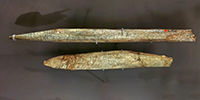 Abri Pataud Tools
The Venus of Abri Pataud, and the archeological site of Abri Pataud at Les Eyzies
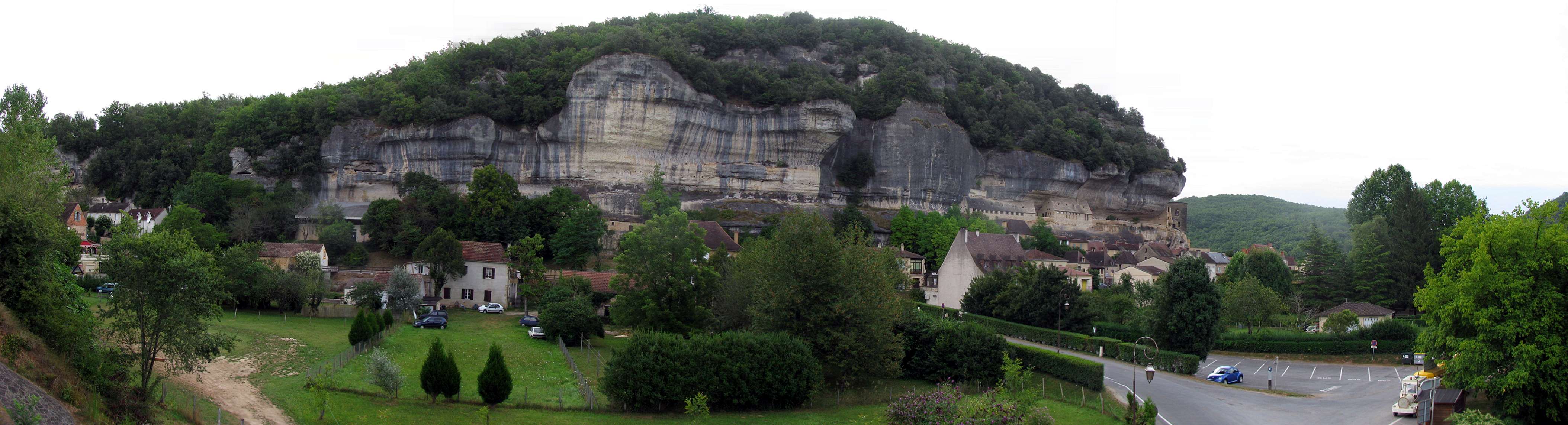
Les Eyzies
General panoramic view of l'Abri Pataud (centre left) and la Grotte des Eyzies (right).
Photo taken in August 2008 from near the railway bridge over the Vézère River, a position which gives a wonderful vista of this important archeological area
Photo: Don Hitchcock 2008
The Venus of Abri Pataud
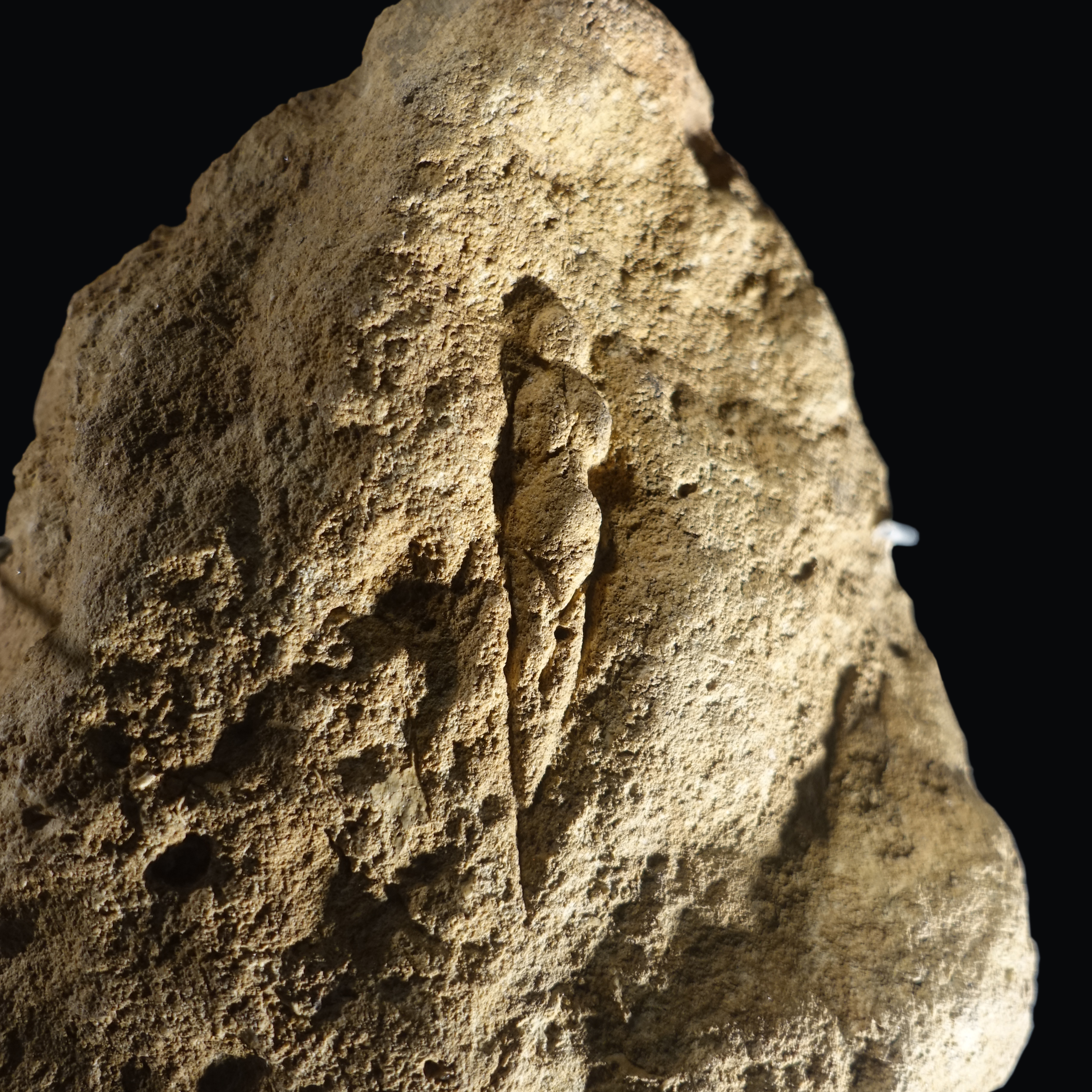
Photo: Don Hitchcock 2018
Source: Original, Musée de l'Homme, Paris
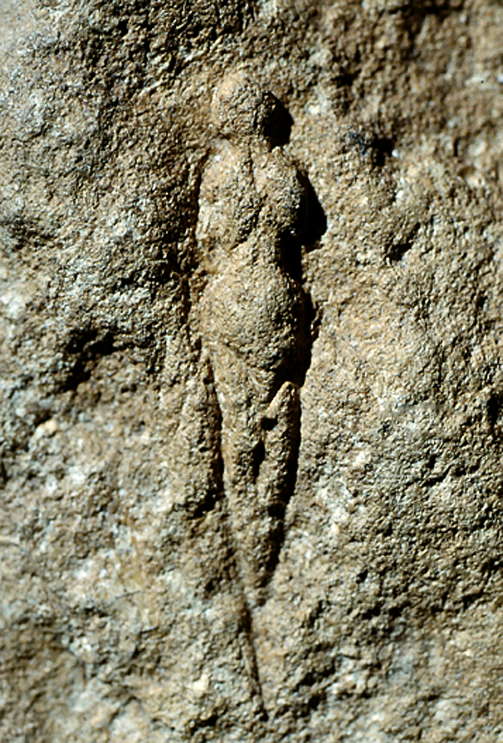
This venus is known as the 'Venus of Abri Pataud'. Abri Pataud is a well researched archaeological site within the village of Les Eyzies.
Photo: Delluc (2006)

Venus of Abri Pataud.
Photo: Don Hitchcock 2014
Source: Apparently original, display at Abri Pataud Museum.

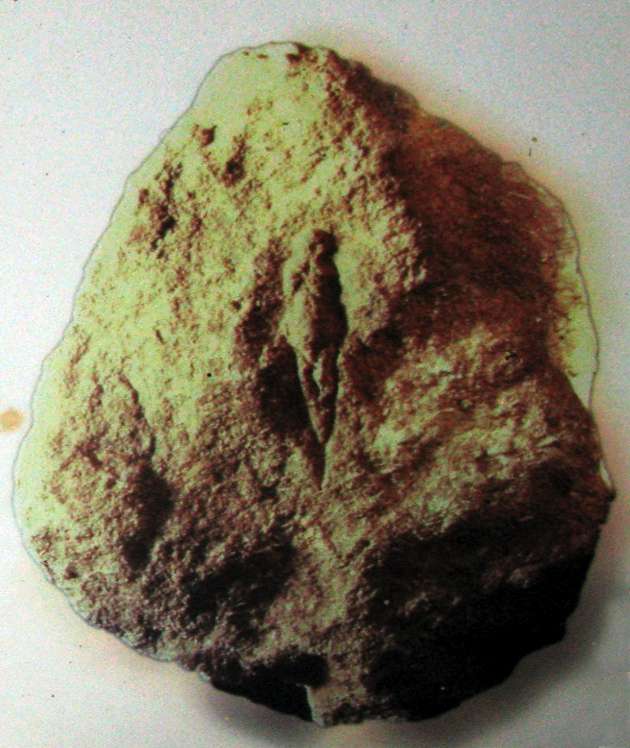

Venus of Abri Pataud.
Photo:
(left) from:'Discovering Perigord Prehistory' by B & G Delluc, A Roussot & J Roussot-Larroque.
(centre and right) Photograph by Don Hitchcock 2008 of displays at the site.
(The story I heard from the guide at Abri Pataud was that a student worker had put down her field notes, and when they started blowing away, she put a rock lying nearby on them, which on closer examination turned out to be the venus. It is a very small figure carved into the surface of a rock. It was confirmed as genuine by no less than the Abbé Breuil when he visited the site - Don)
From Movius (1977) we may obtain a more detailed account of its discovery:
A most significant find from this layer is a small bas-relief carving of a female figure. At the outset it should be stated that there is no incontrovertible proof that this piece, which is certainly the most significant art object discovered at the Abri Pataud, actually comes from the Périgordian VI (Level 3) horizon at the site, although such is definitely believed to be the case. Unless the piece should happen to be a forgery, a possibility which cannot be proved one way or another by objective analysis and which, in any case, is regarded as highly improbable, there is no valid reason to doubt the claim that it was found in an area ca. 75 cm square in the northeast corner of Trench II, Square F, but the precise find-spot and the exact depth with respect to the datum are unknown. The circumstances of the discovery are as follows:
At approximately four o'clock on the afternoon of Thursday, 21st August 1958, three days after a very violent and destructive storm on Monday, 18th August, Miss Joan T. Bamberger, then of Radcliffe College, excavating in Trench II, square F, of the Périgordian VI level, picked up a small limestone block that had been weighting down a piece of cardboard protecting an engraved rock in the immediately adjacent Square G of Trench II. Although Miss Bamberger did not recall placing this particular stone on the cardboard in question, she did concede that three days previously during the storm she might well have picked it up in the vicinity of Square F, when she was placing stones and weights on various labels and other markers in Trench II in order to prevent them being blown away in the high wind.
In any case, turning the block on the afternoon of 21st August, she at once recognised on it a carved female figure in bas-relief, which she in turn showed to various members of the expedition staff, including Dr. H. V. Vallois (who was visiting the excavation) and the writer. When the latter first examined the object, patches of earth similar to that found in the main culture layer (designated Lens 2 herein) were still adhering to it. After having been washed, the carved surface was carefully examined with a hand lens, and it was agreed that there was no doubt that this area showed the effects of dissolution.
Subsequent and even more detailed examination by the geologists, Drs Judson and Miller, with a 20x binocular microscope failed to reveal any features that could conceivably be interpreted as proof that the carving was not a genuine art object of Upper Palaeolithic antiquity. The stone is local and the degree of secondary alteration of the surface due to weathering can be matched with countless other stones of assorted sizes from the excavated area.
The figure, which appears to represent a comparatively young female, is more slender and gracile than is normally the case. Executed on an unprepared, roughly tabular limestone block that is 194 mm long, 140 mm wide, and 50 mm thick, the figure, which is shown in bas-relief, is almost exactly 60 mm long and 11 mm wide at the point of greatest width, in the region of the hips. While somewhat more carefully finished and smooth than the rough and uneven natural surface of the stone, the actual carving itself is nonetheless rather rough, due in large measure to irregularities in the limestone block selected in the first instance by the artist.
The head, shown in profile, is turned at an angle of 90° over the right shoulder, and whereas the features of the face are not indicated, the line of the hair is clearly depicted. Although in the occipital region the back of the neck is only vaguely suggested, the chin and throat area in front are very precisely defined. The shoulders are developed, pendulous breasts, which in large measure cover the entire area of the thorax. Representation of the arms is considered doubtful. The slender and well-proportioned waist is clearly delimited between the pronounced outline of the breasts above and the markedly pear-shaped and rather conspicuous abdomen below, which continues the outline of the lower portion of the body, and it appears to have been rendered in order to indicate pregnancy.
The pubic triangle is clearly depicted; approximately 4 mm. above the point of intersection of the two deeply incised lines that define the groins, there is a small horizontal line which delimits the region of the genital organs from the main area of the abdomen. Two long, convergent furrows indicate the outline of the legs, but neither the knees nor the feet are shown. Just below the region of the knees the roughly incised median line, which divides the legs, comes to an end. The left leg is very slightly shorter than the right, and a certain degree of asymmetry may also be noted in the case of the breasts.
Notwithstanding these slightly disharmonic features, the overall proportions of the figure are both pleasing and, at first glance, symmetrical. Indeed, from a stylistic point of view, this figure has been rendered in the finest tradition of Upper Palaeolithic art as represented by the well-known series of carvings and statuettes, collectively known as Venuses, from various Upper Périgordian and Noaillian sites in western Europe.
The following text is from 'Discovering Perigord Prehistory', by B & G Delluc, A Roussot & J Roussot-Larroque.
Abri Pataud consists of an immense balcony of a hundred metres length where Cro-Magnon man lived, hunted and gathered. They were seminomads.My thanks to Sharon Rogers/walkhound who alerted me to the existence of this excellent book.
It was excavated between 1953 and 1964. 14 archaeological layers with altogether forty successive camps of hunters of reindeer, who settled on 20 000 year old sites under the cliffs of Les Eyzies were discovered. The site and museum is in the village of Les Eyzies.
A small block bearing the engraved silhouette (58 mm high) of a woman with atypical proportions was found. According to H. Movius, it came from level 3 (Perigordian VQ - a period which, approximately 21 000 years ago, corresponded to the coldest period of the Würm glaciation). The occupants built a veritable house between the cliff and the blocks of fallen rock. Or at least, this is the interpretation from the numerous artefacts left behind on their living floors which included hearths, the remains of prey, flint tools, objects of adornment, numerous art objects, and even debris from the painted decoration of the rock-shelter (Musee de l'Homme; copy at the Musée de Abri Pataud).
The Abri Pataud site
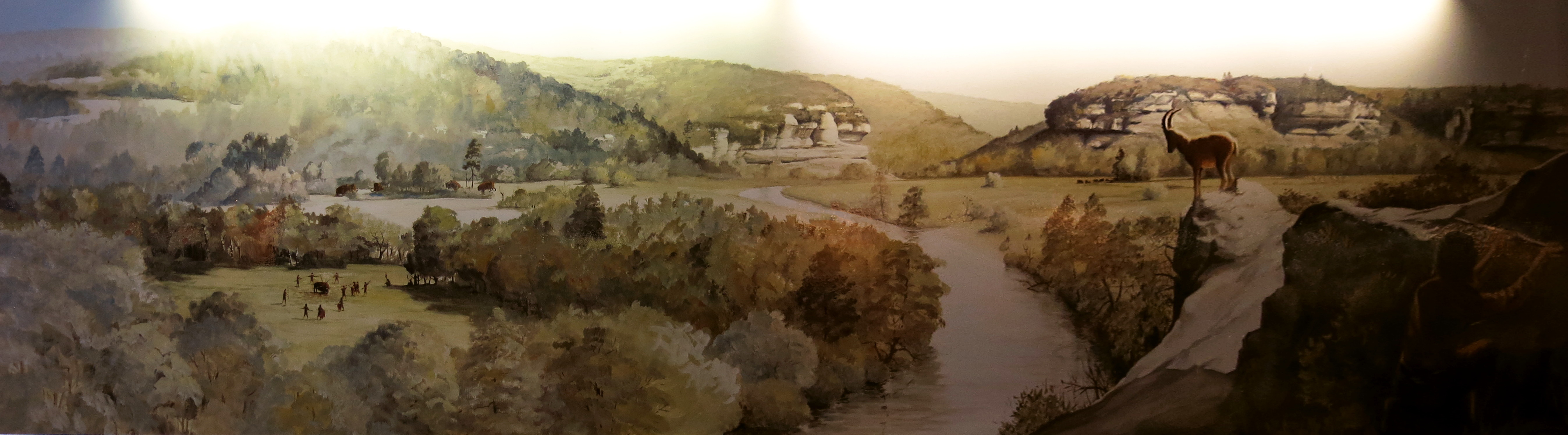
during the Upper Gravettian, 24 000 BP - 22 500 BP.
The warming at this time allowed the forest to gain in importance.
Alders, hazel, elm and lime trees grew next to pines, oaks, and birches.
Artist: Unknown
Rephotography: Don Hitchcock 2014
Source: Display at the Abri Pataud Museum.
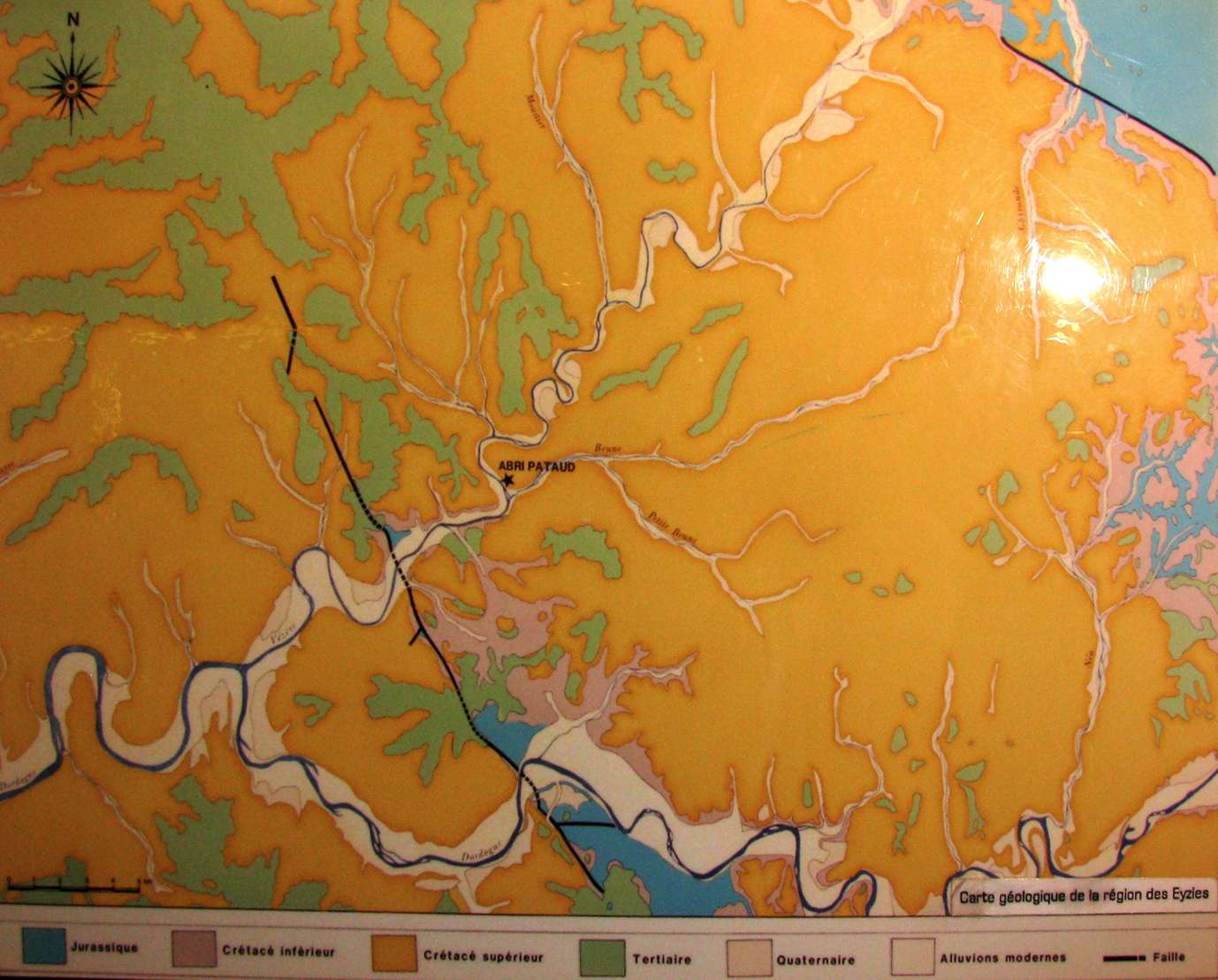
Map of the Abri Pataud position, in the middle of Les Eyzies.
Photo: Don Hitchcock 2008
Source: Display at the Abri Pataud Museum.
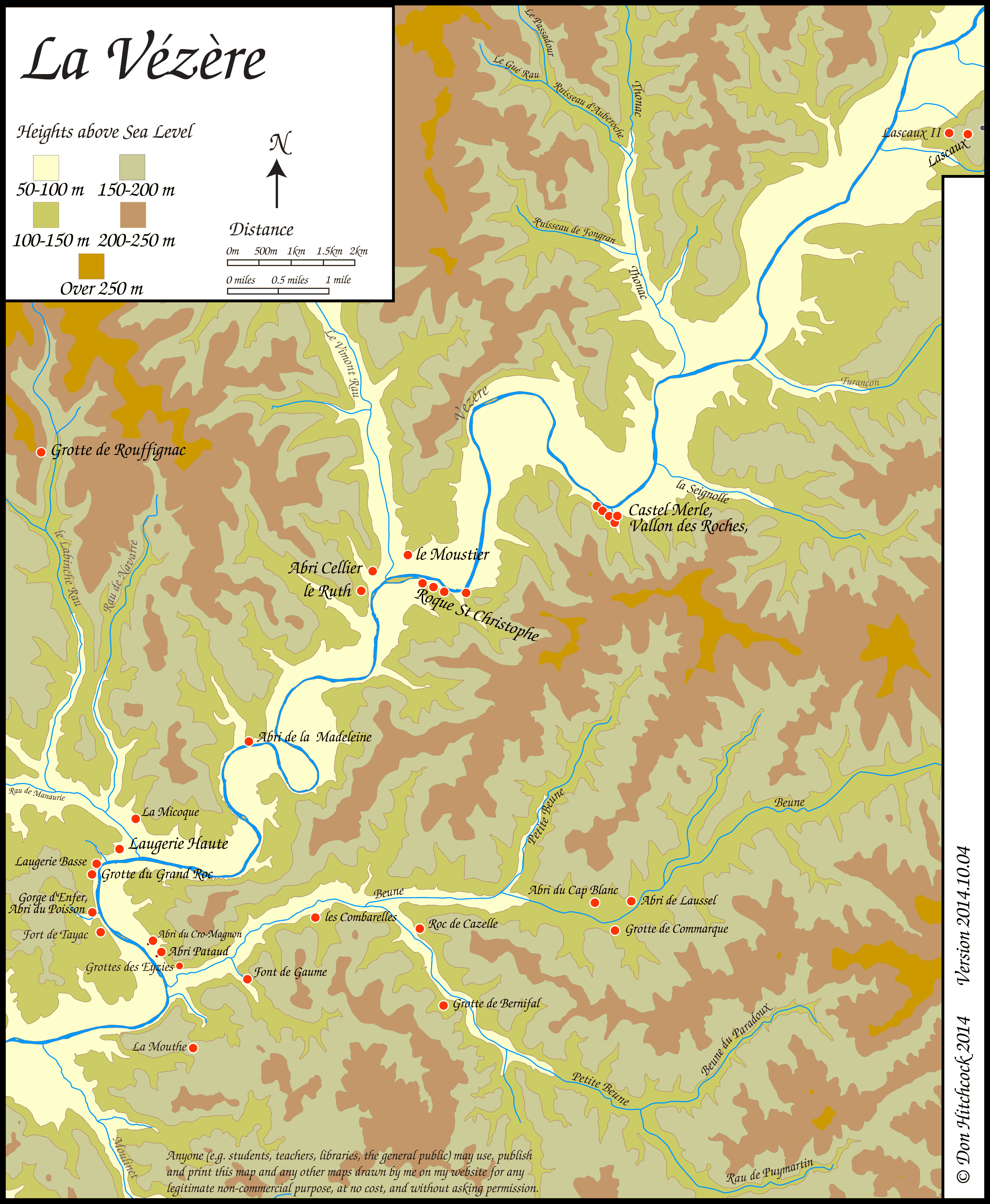
Map of sites in the Vézère Valley of France, including Abri Pataud.
If you click on the map you will see a larger map with the ability to click on the marked sites and get further information.
Photo: Don Hitchcock
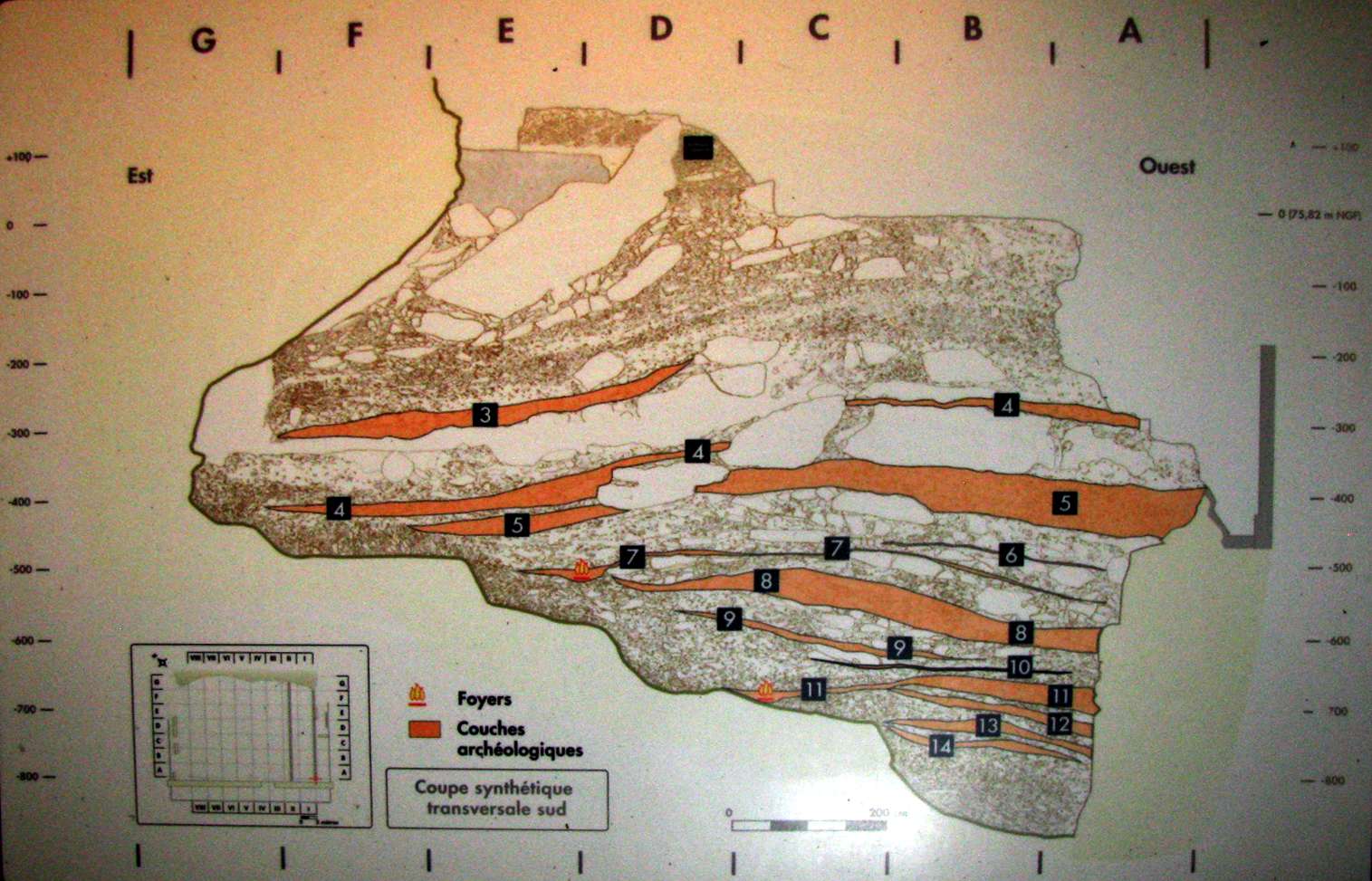

Profiles of the dig looking south (left diagram, cliff to the left of the diagram) and north (right diagram, cliff to the right of the diagram) at the respective remaining walls of the dig.
Photo: Don Hitchcock 2008
Source: Abri Pataud excavation site
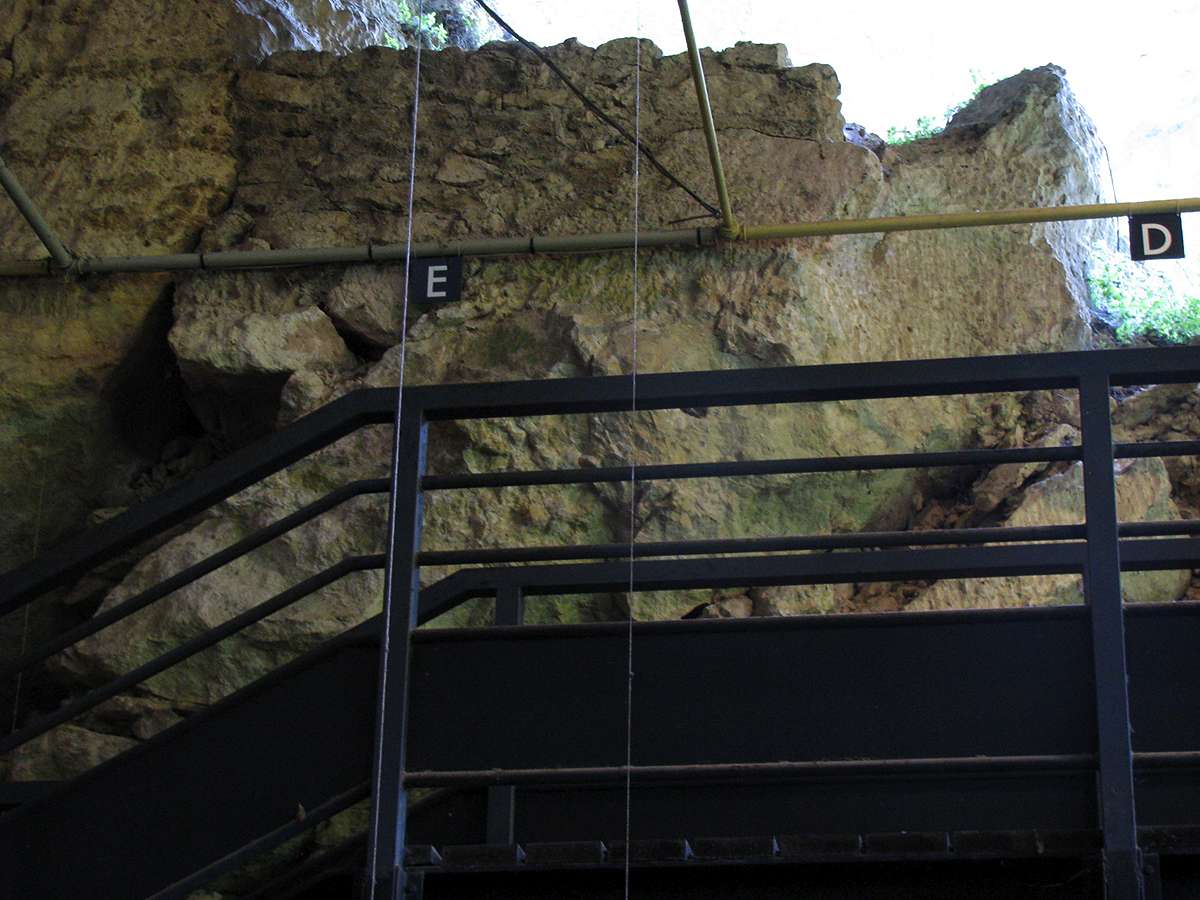
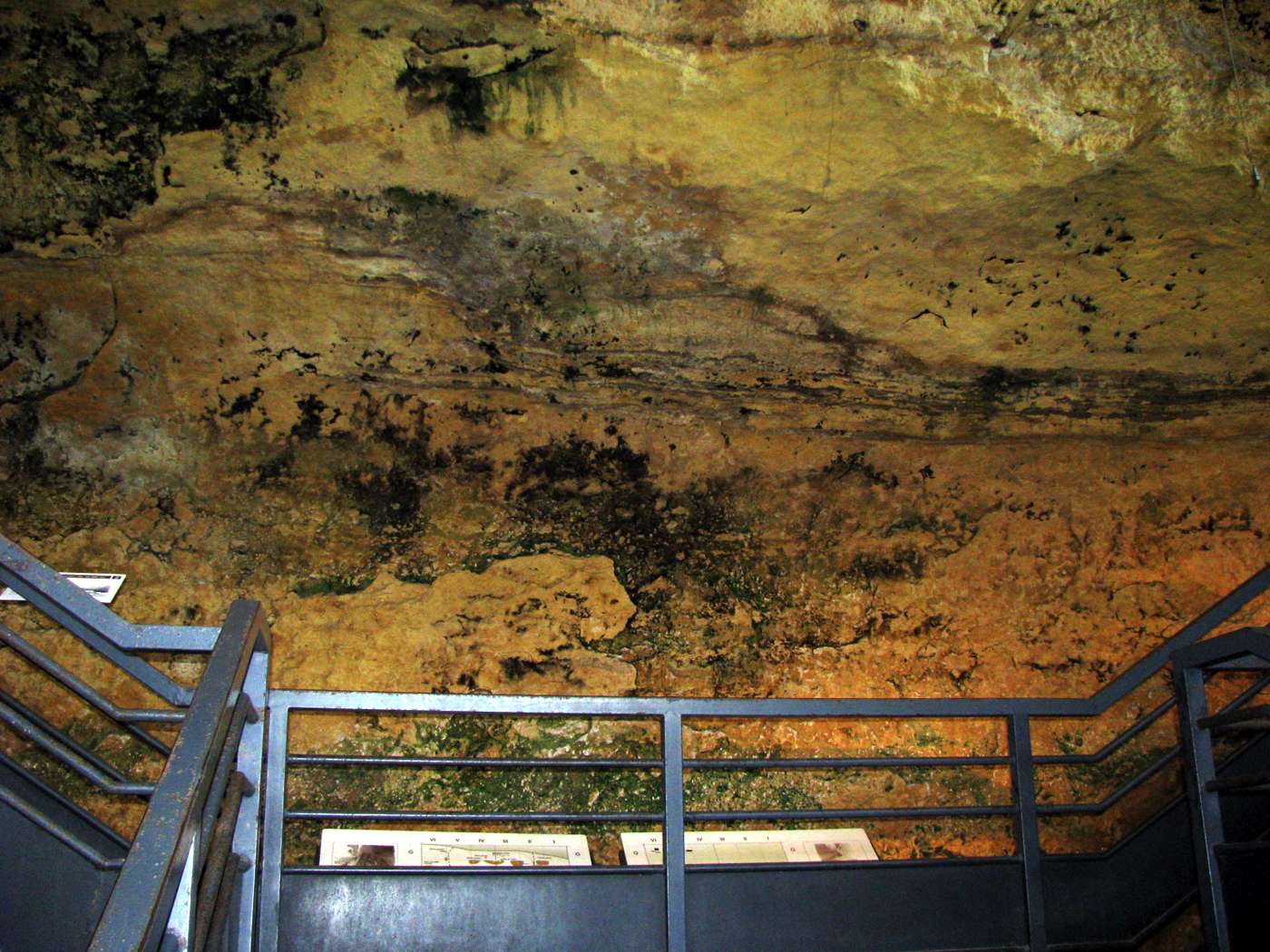

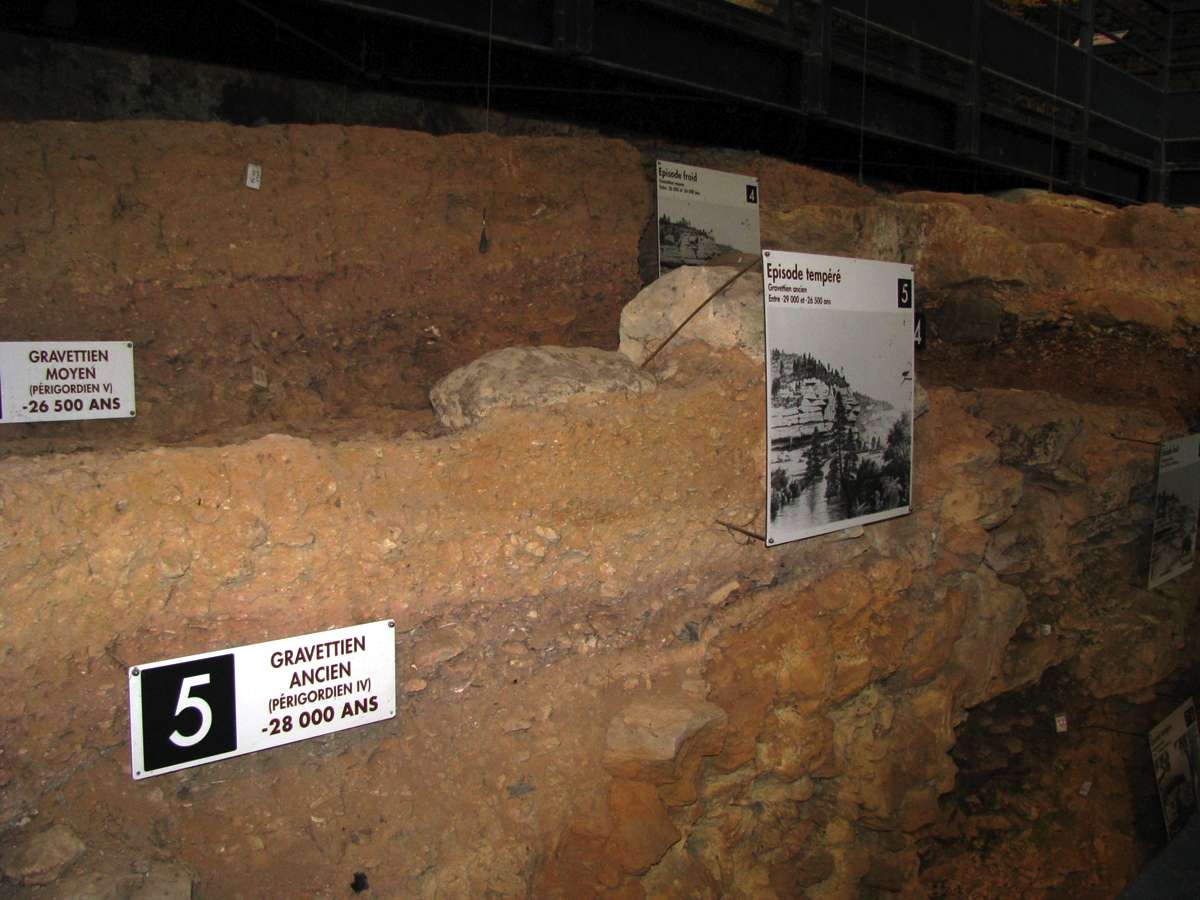
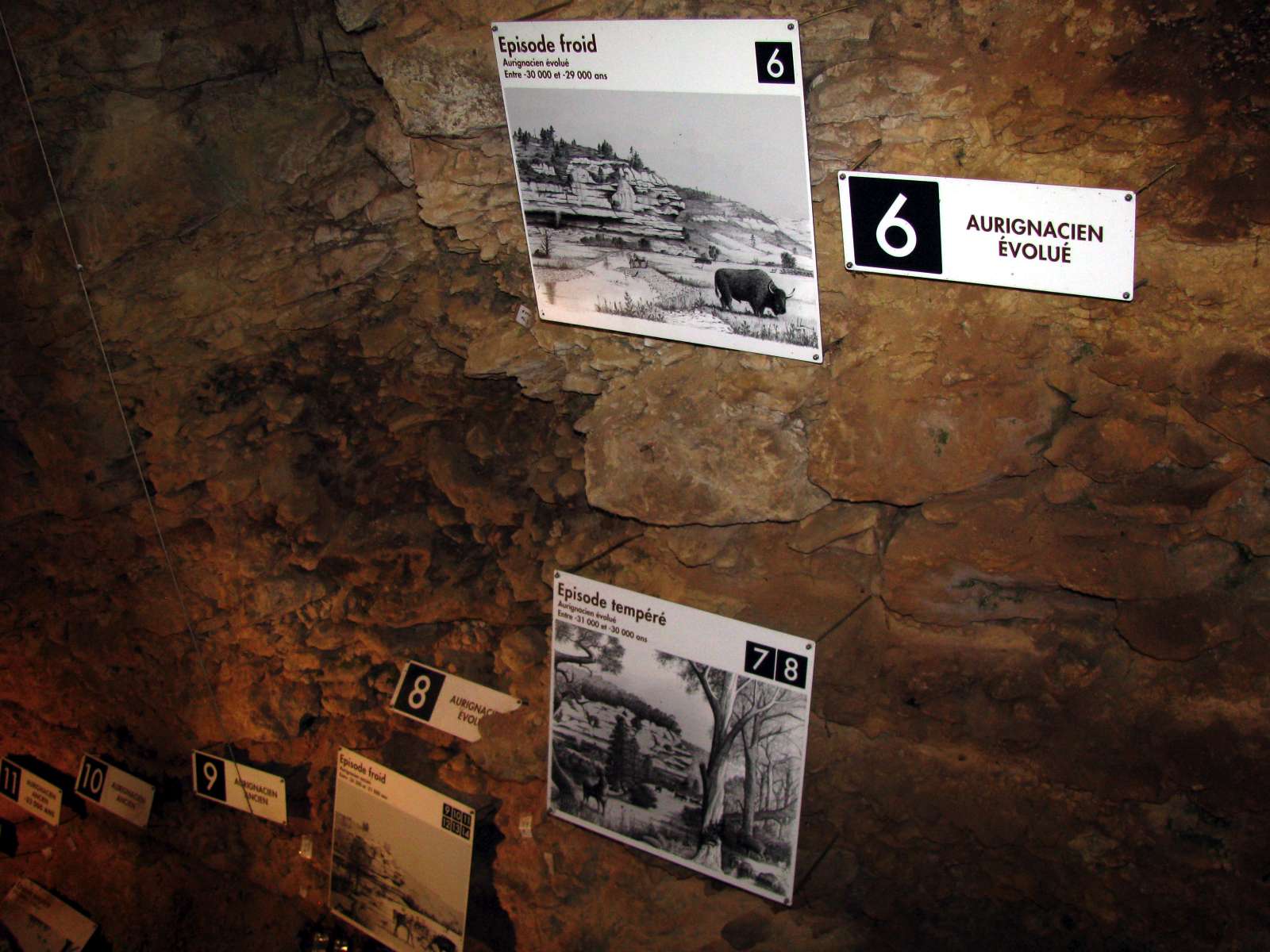
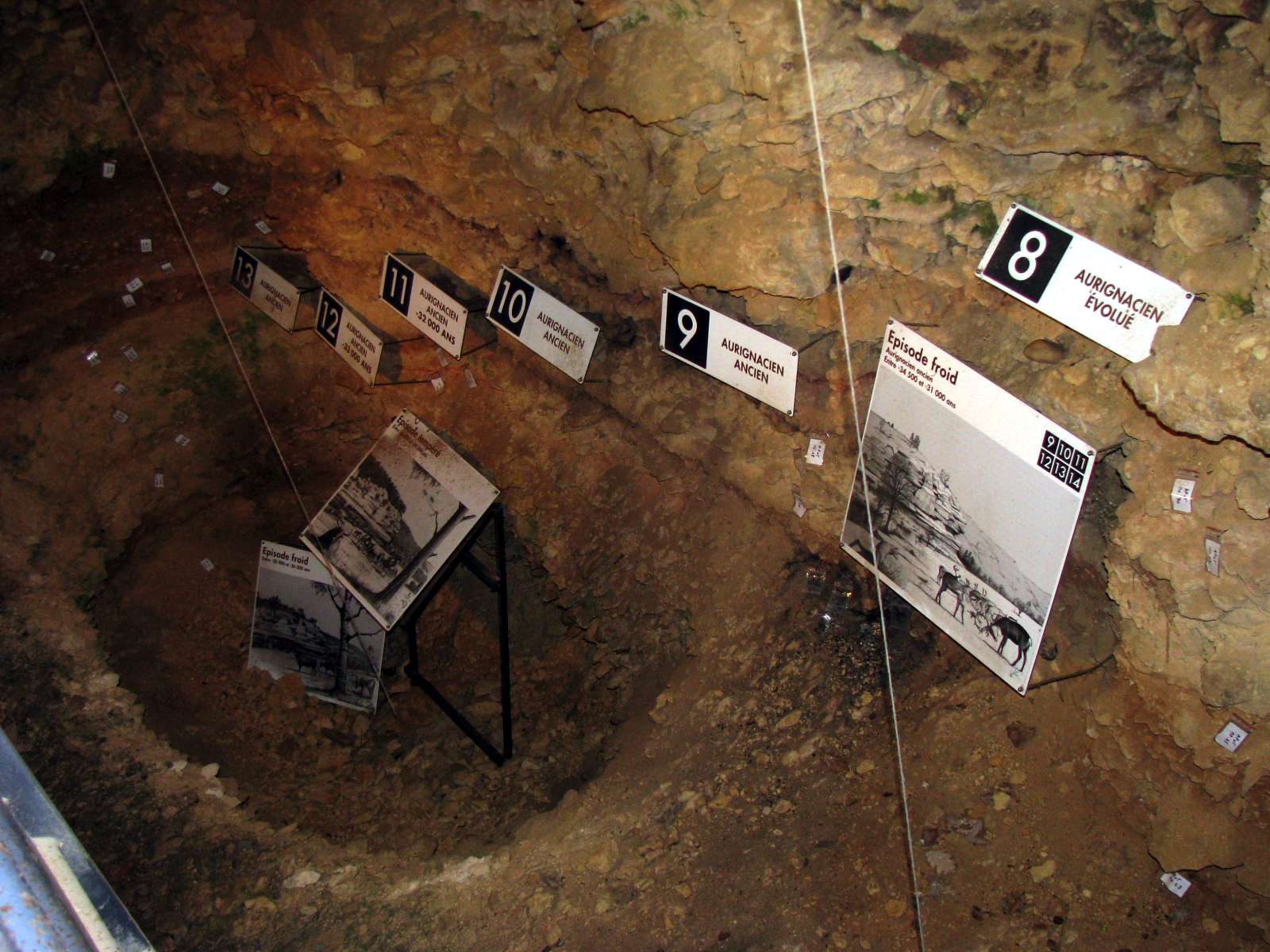
The site has been well signed, with enough information that visitors can get some idea of the change in occupation and the changing climates.
Photo: Don Hitchcock 2008
| Stratigraphy of l'Abri Pataud | ||||
|---|---|---|---|---|
| Age in years Before Present |
Layer | Culture | Sample Artefacts | Photo |
| 20 450 BP | 1 | Lower Solutrean | 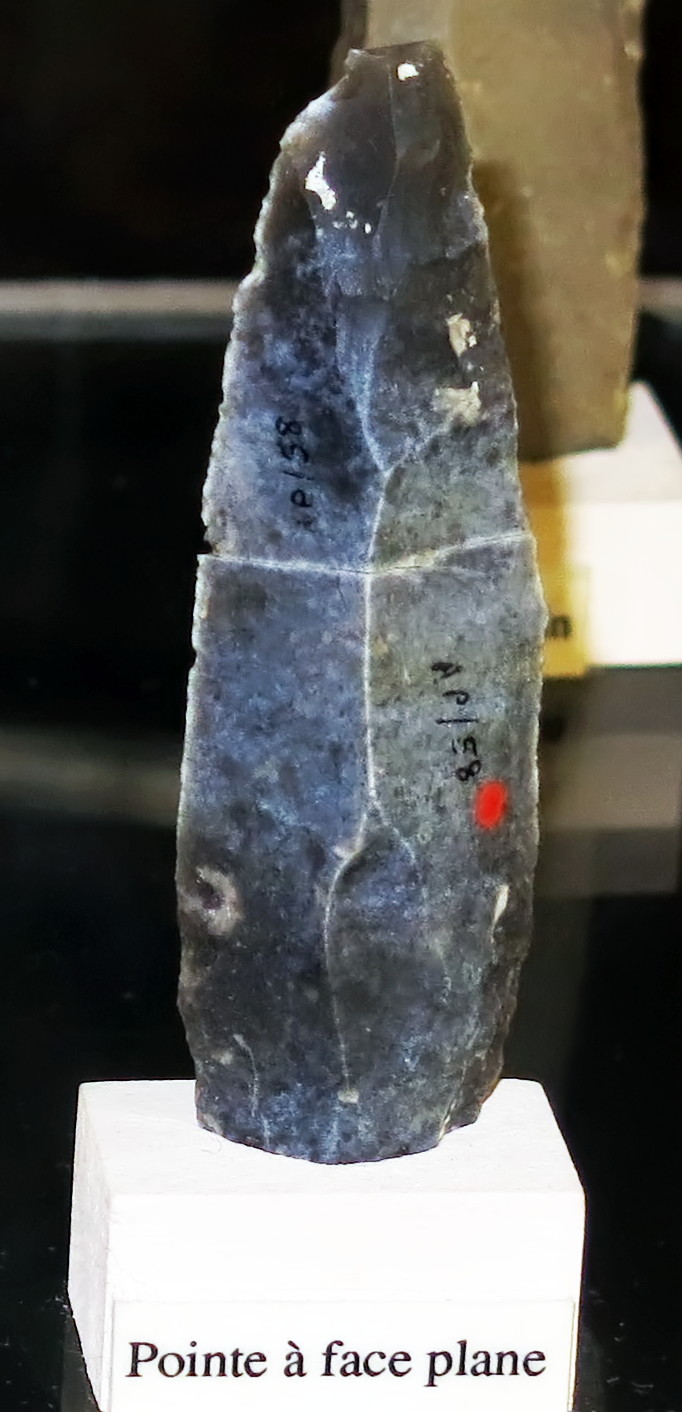 |
Flat Face Point. Photo: Don Hitchcock 2014 Display at Abri Pataud Museum |
| 20 600 BP | 2 | ProtoMagdalenian (Perigordian VII) |  |
Bone Beads. Photo: Don Hitchcock 2008 Display at Abri Pataud Museum |
| 22 490 BP | 3 | Perigordian VI | 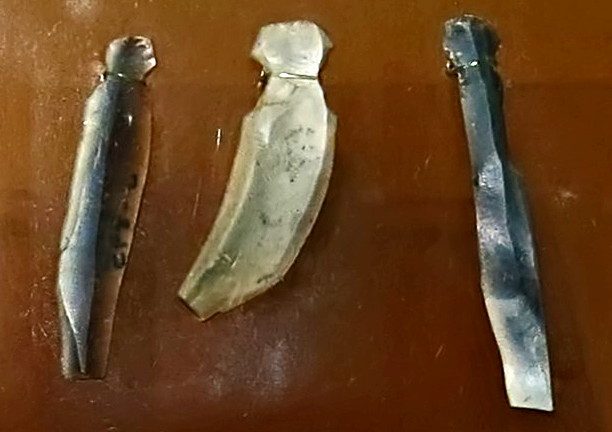 |
Pendants of flint, perhaps worn by master knappers. Photo: Don Hitchcock 2014 Display at Abri Pataud Museum |
| 27 110 BP | 4 | Perigordian V (Noallian) | 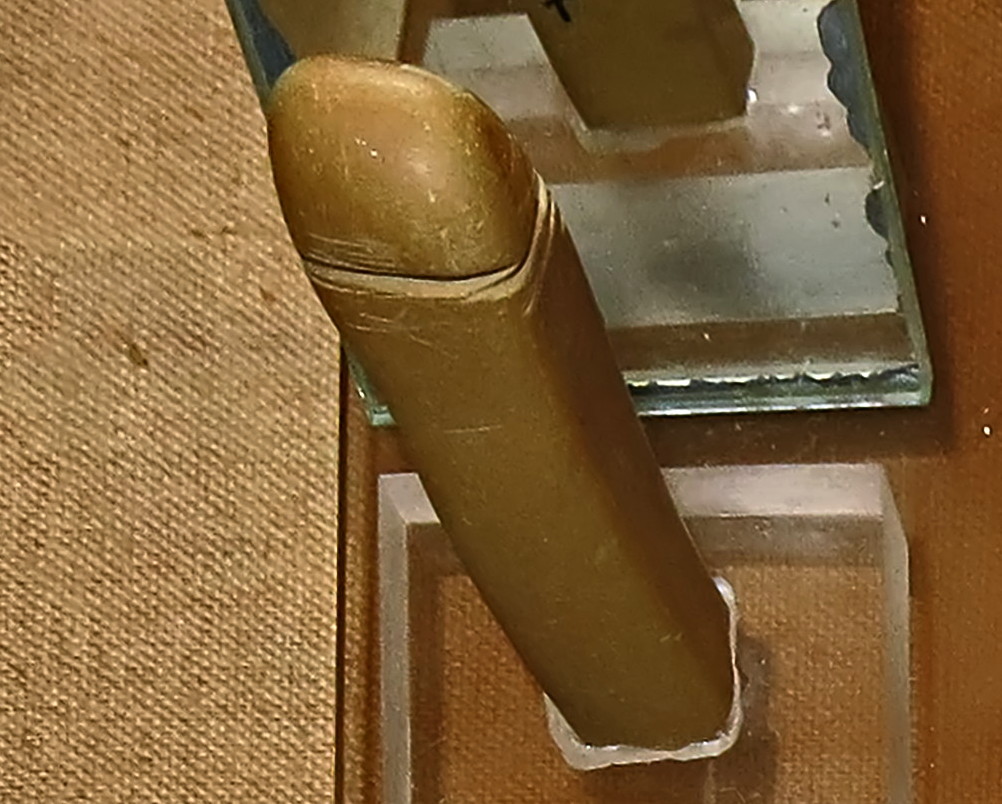 |
Pendant made from a pebble in the shape of a phallus, with a rainure (groove) carved in it for suspension as a pendant. Photo: Don Hitchcock 2014 Display at Abri Pataud Museum |
| 27 170 BP | 5 | Perigordian IV (Gravettian) | 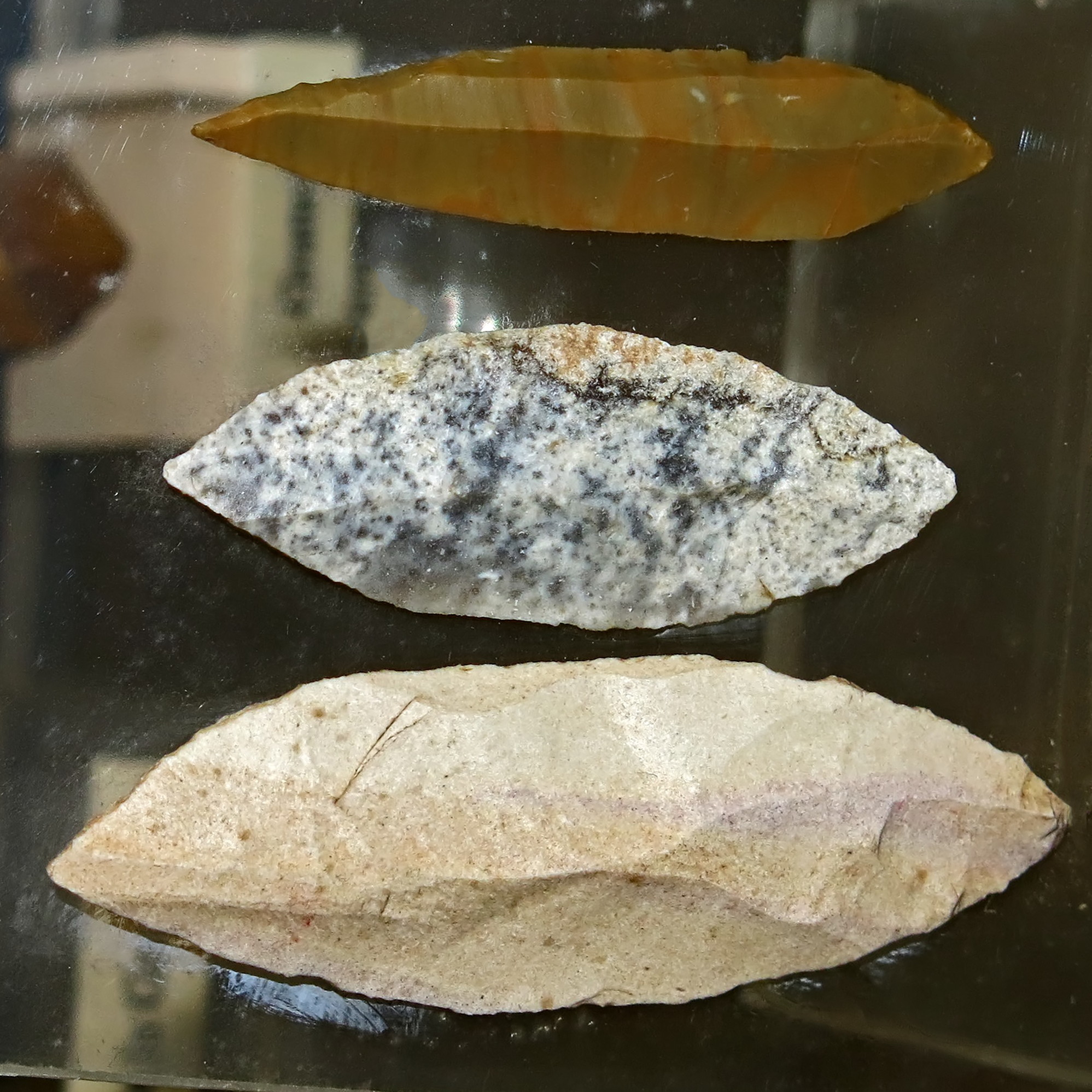 |
Fléchettes are leaf-shaped points characterised by short, semi-abrupt retouch, sometimes inverse, at one or both extremities of the blade blank, extending sometimes along one or both margins. Photo: Don Hitchcock 2014 Display at Abri Pataud Museum |
| 31 750 BP - 32 180 BP |
6, 7, 8, 9, 10 | Middle Aurignacian |  |
The beaked burin is a characteristic Middle Aurignacian tool. Photo: Don Hitchcock 2014 Display at Abri Pataud Museum |
| 32 350 BP - 33 680 BP |
11, 12, 13, 14 | Ancient Aurignacian |  |
Pierced carnivore tooth from the Ancient Aurignacian. Photo: Don Hitchcock 2014 Display at Abri Pataud Museum |
Dates, layers and cultures above from the Vegetation table displayed at Abri Pataud Museum |
||||
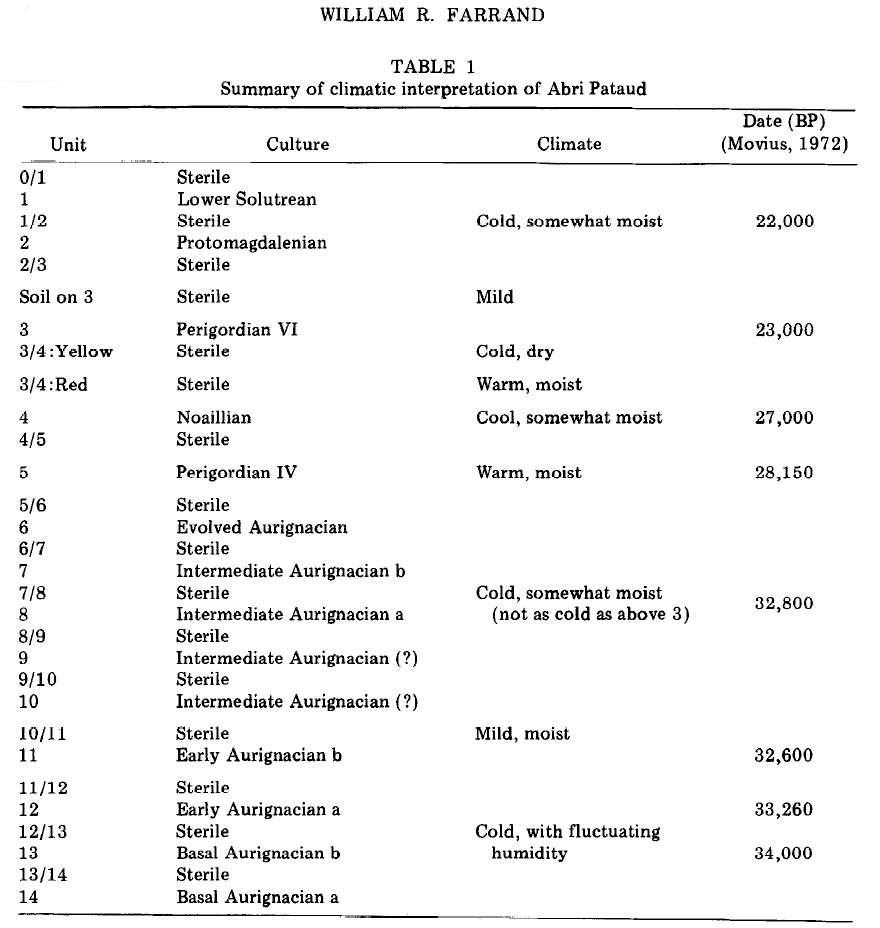
Climate at Abri Pataud during twenty thousand years.
Photo: Farrand (1975)
Throughout all the occupation of the Abri Pataud, the biological environment of the Perigord was an open forest where mixed pines, birches, oaks and some other trees such as elms, maples, limes, ashes, alders, beeches, fir trees, walnut trees, hazel trees, and willows also grew.
Abri in English means shelter, or rock shelter, and Pataud refers to a previous owner of the site.
At the time of occupation, the area had large areas of grassland, and was populated by animals from the far north such as reindeer, musk ox, arctic fox; by animals from the steppes of Central Asia such as saiga antelope and the whistling hare; and by animals from the mountains such as ibex and chamois.
All these mammals mixed with bison, horses and, less frequently, with aurochs, deer, mammoths, and the woolly rhinoceros. Among the carnivores, there are the brown bear, and the cave hyena. Reindeer constituted their principal game. They also practised fishing and gathering. The animals, in addition to their meat, provided them with the raw materials of their craft industry: skin, tendons, furs for clothing; wood and bone for clothes, tools and weapons.
Text: translated and adapted from http://www.ac-bordeaux.fr/Pedagogie/SVT/pataud97.htm (this site has since disappeared)
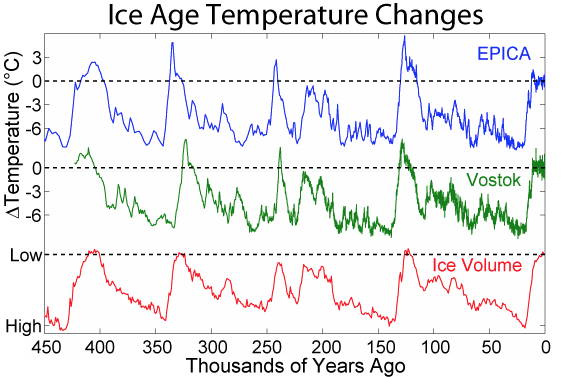
Temperatures and ice volume (plotted upside down for easy comparison with the temperatures) over the last 450 000 years.
Photo: Robert A. Rohde from publicly available data
Permission: GNU Free Documentation License, Version 1.2
Climate during the ice ages at Abri Pataud
Note that in the following, the numbers refer to levels at the Abri Pataud site only.
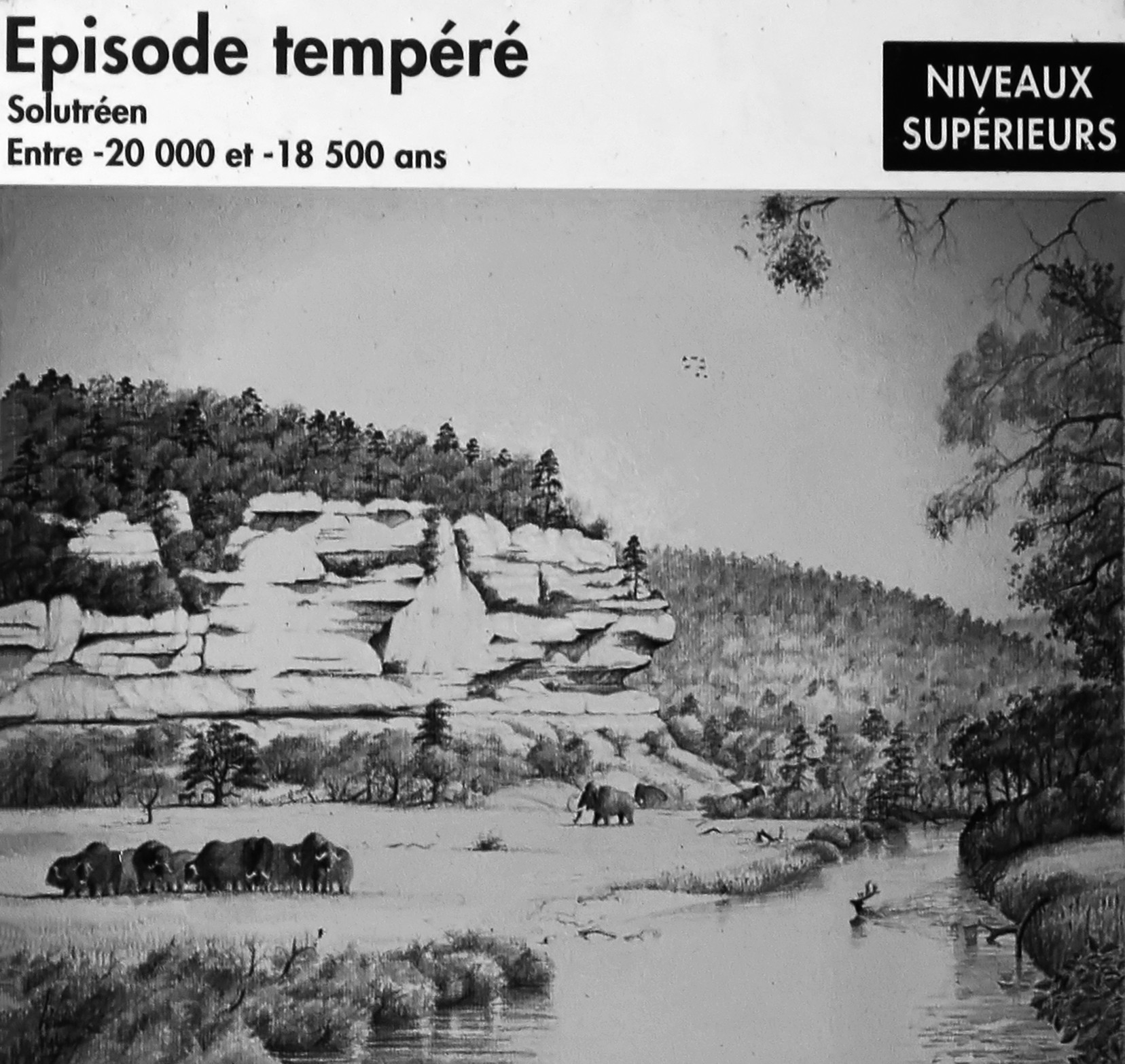

The Ice Age ended about 12 000 years ago, but it had started to warm up after the glacial maximum of 22 500 - 20 000 years ago.
At the time of maximum cold, and maximum advance of the ice sheet, the Vézère had shrunk to a small creek you could step over, and there was little vegetation, and what there was was stunted.
The Vézère became a reasonable brook after the ice started to retreat, and there was more rain after temperatures increased.
However at no time during the ice ages was it as large as today. The climate was drier during the ice ages, since lower temperatures meant less evaporation from the seas and land.
Photo: Don Hitchcock 2008
Source: A display at the excavation site.
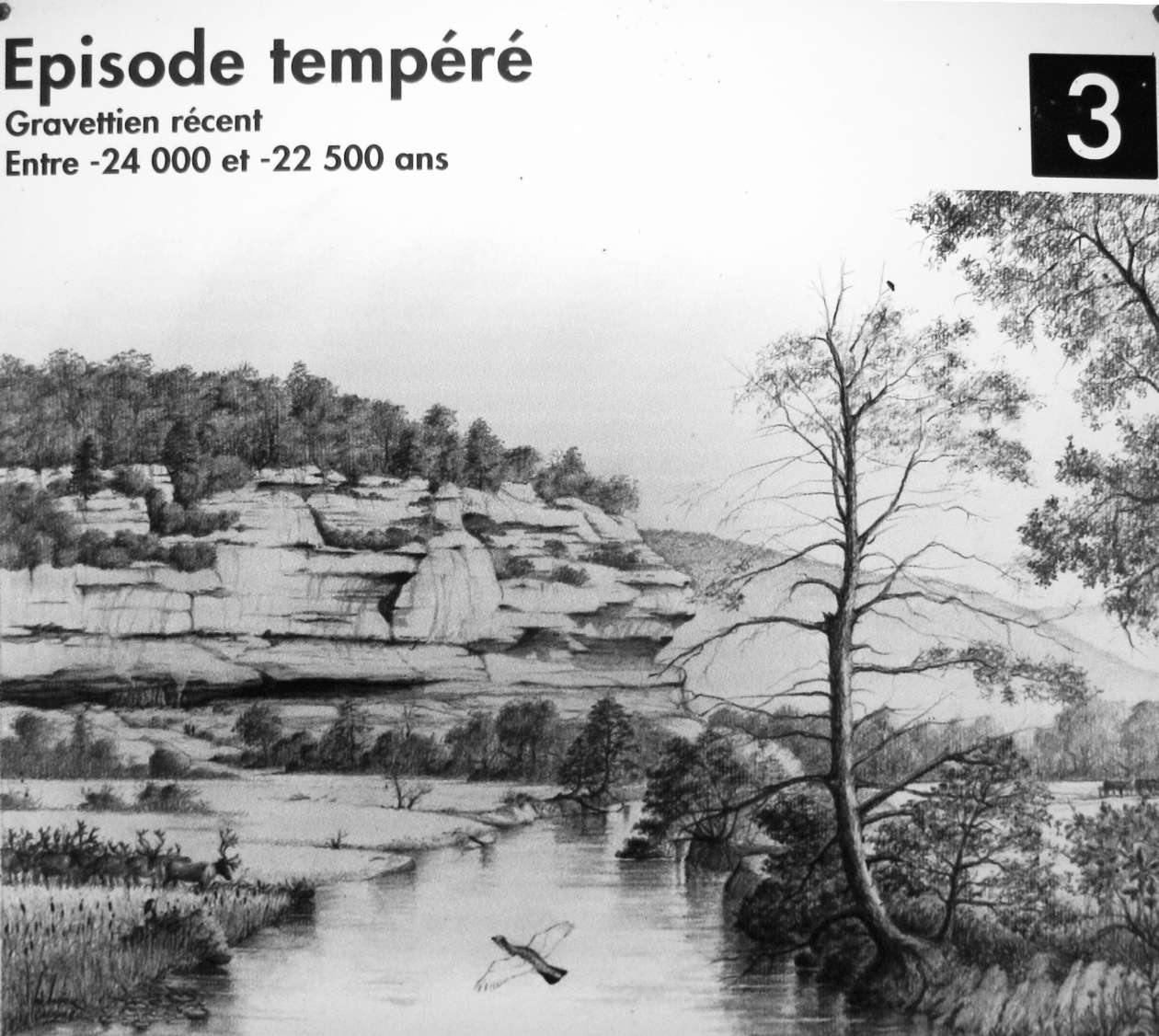

Going backwards in time, the upper Gravettian (24 000 - 22 500 BP) was a time of temperate climate, with plenty of vegetation and wild life.
This was preceded in the middle Gravettian (26 500 - 24 000 BP) by a cold period, when little grew, and temperatures were much colder.
Photo: Don Hitchcock 2008
Source: A display at the excavation site.
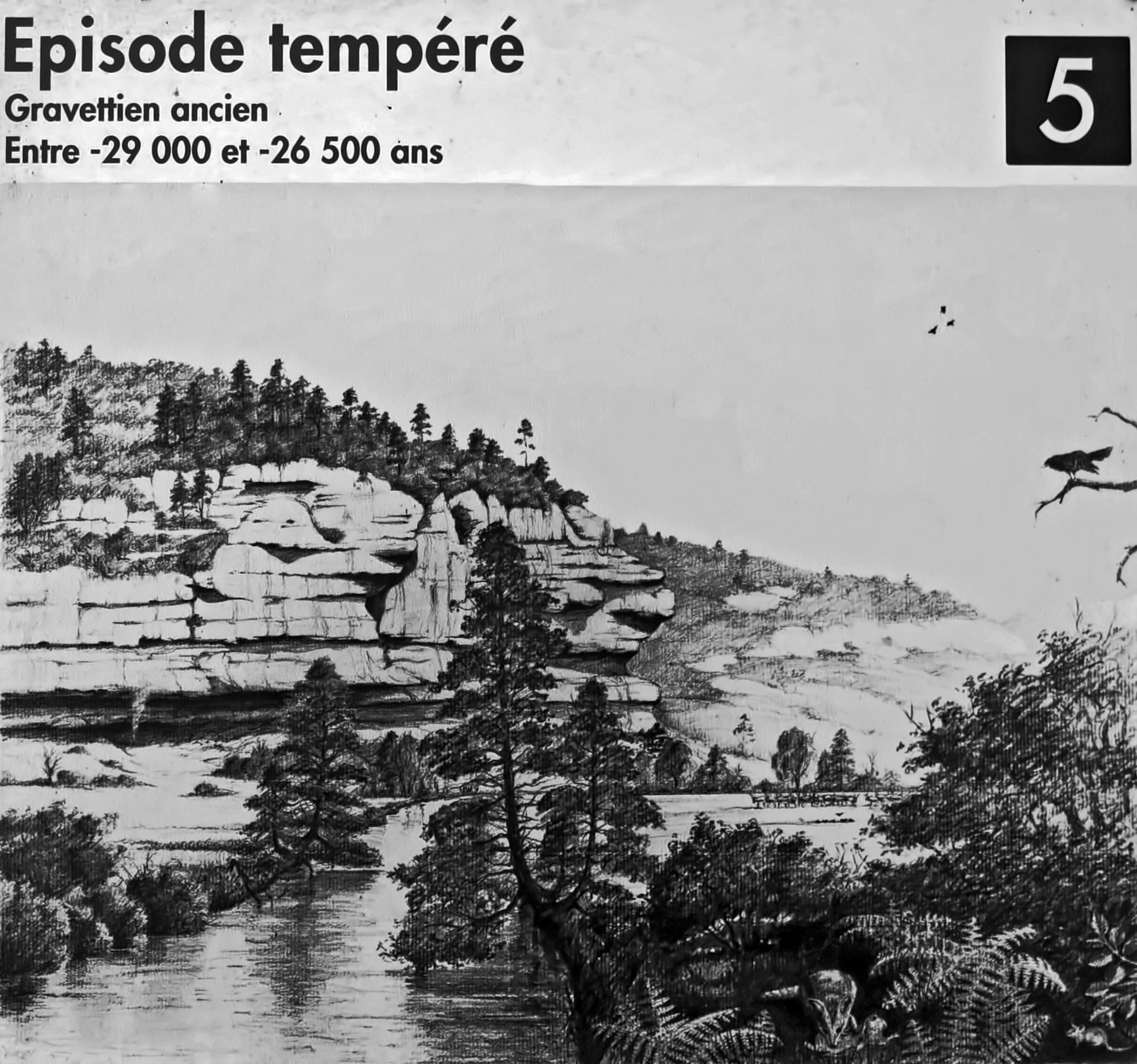
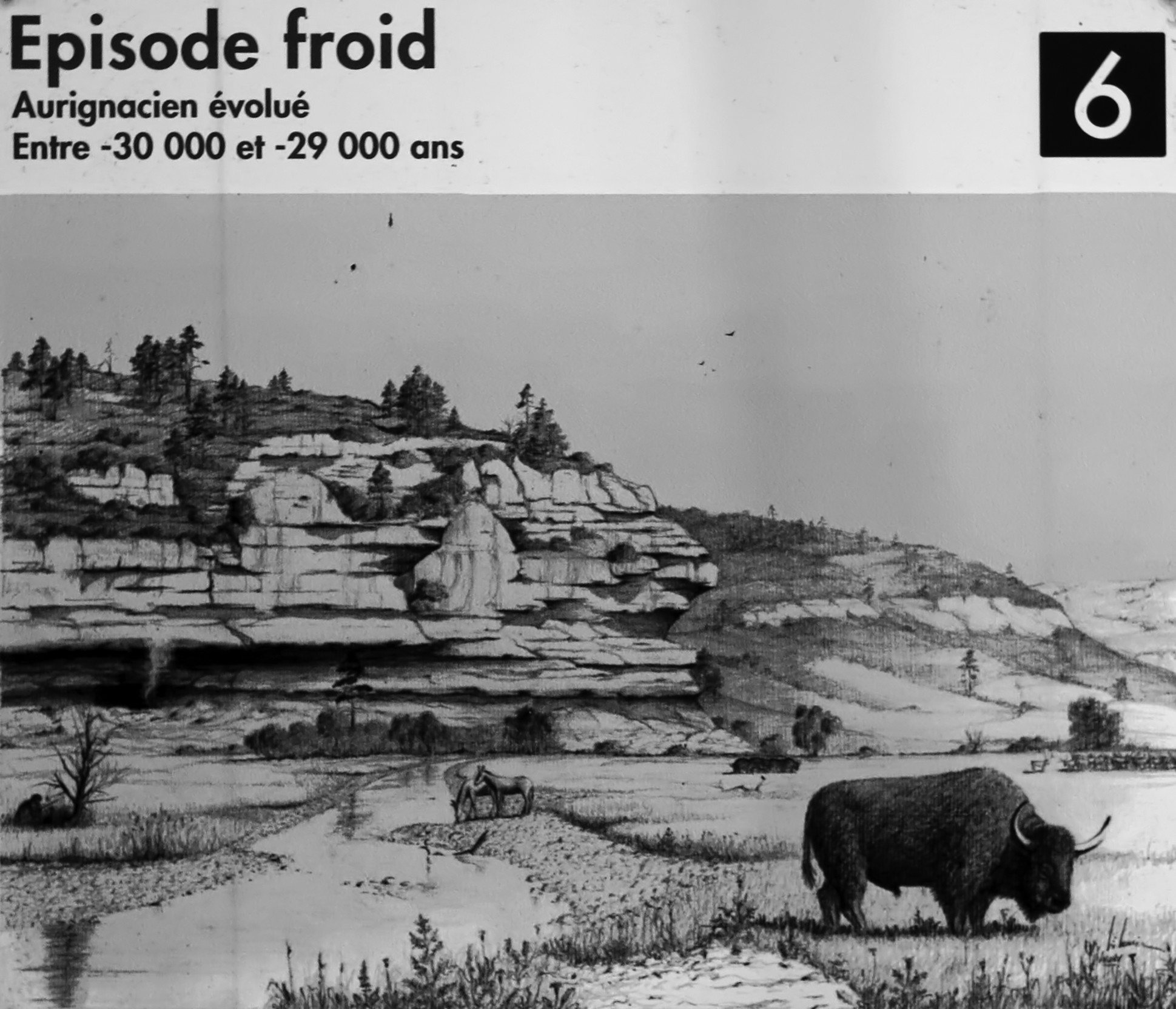
The lower Gravettian (29 000 - 26 500 BP) was again a time of temperate climate, with plenty of vegetation and wild life.
This was preceded in the upper Aurignacian (30 000 - 29 000 BP) by a cold period, when little grew, and temperatures were much colder. Grasses were the dominant plant life, which fed vast herds of animals such as horses and bison.
Photo: Don Hitchcock 2008
Source: A display at the excavation site.
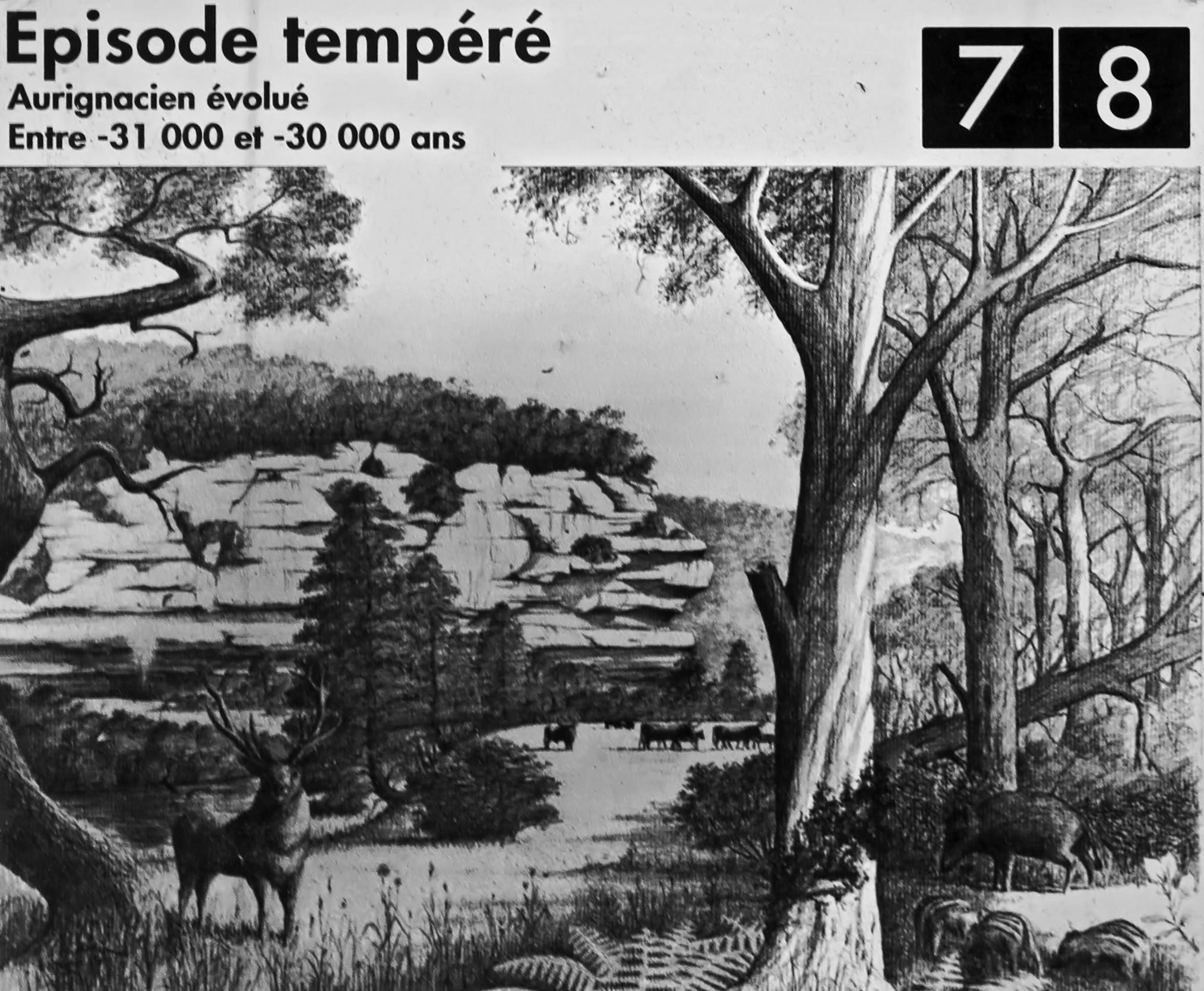
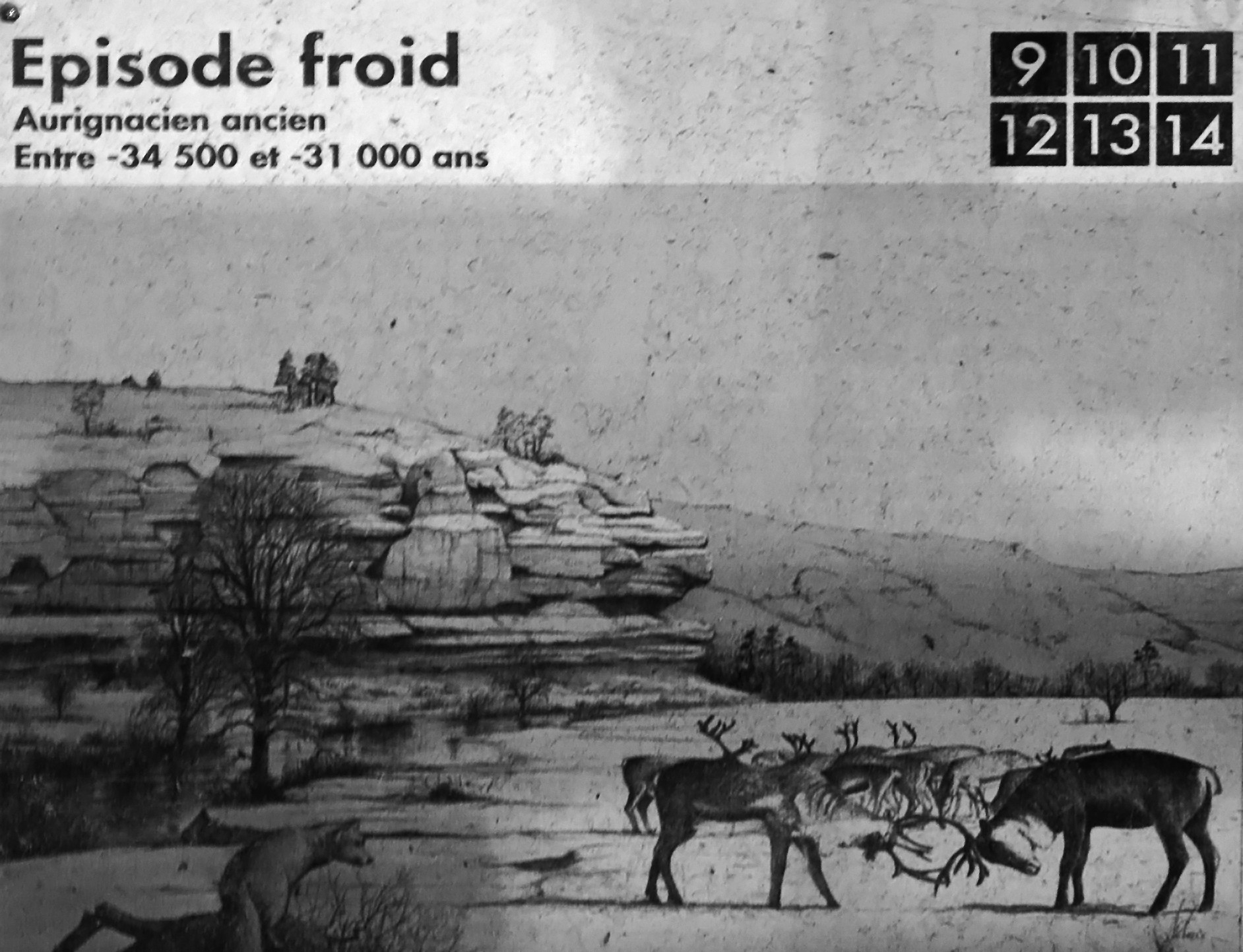
Still earlier in the upper Aurignacian, (31 000 - 30 000 BP) forests grew thick, and animals such as deer were able to find sustenance in the area.
In the lower Aurignacian, (34 500 - 31 000 BP) a long cold spell meant that animals such as wolves and reindeer used the area, and again trees were few and far between.
Photo: Don Hitchcock 2008
Source: A display at the excavation site.

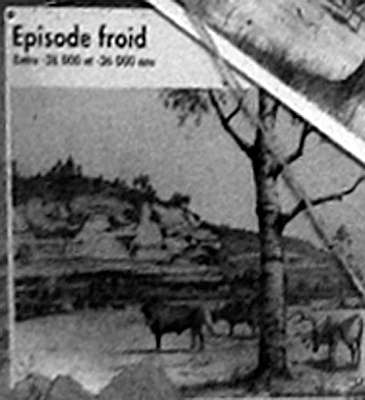
In the lowest levels of Abri Pataud, a temperate period (36 000 - 34 000 BP) was preceded by a cold period, 38 000 - 36 000 BP)
Photo: Don Hitchcock 2008
Source: A display at the excavation site.
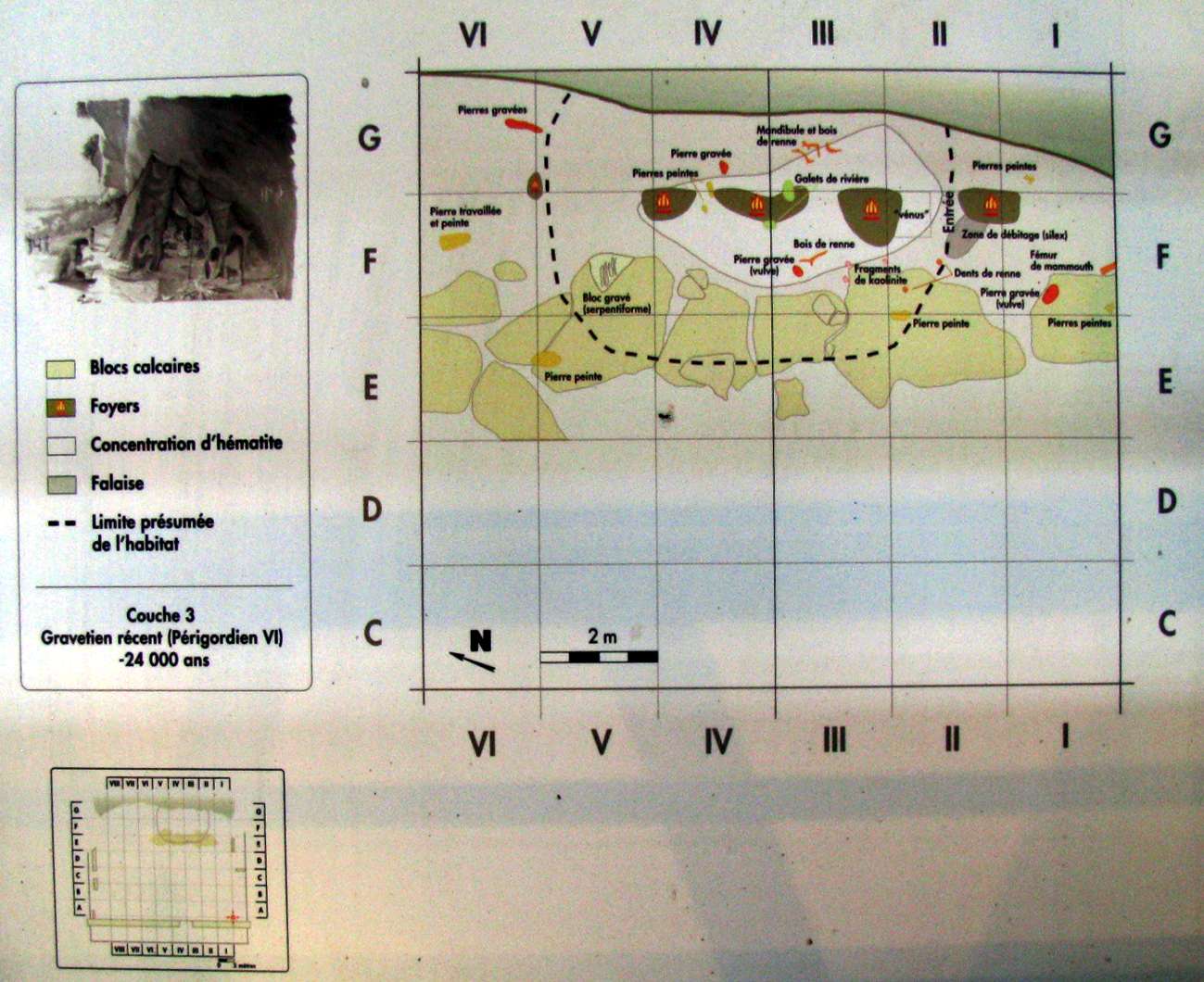
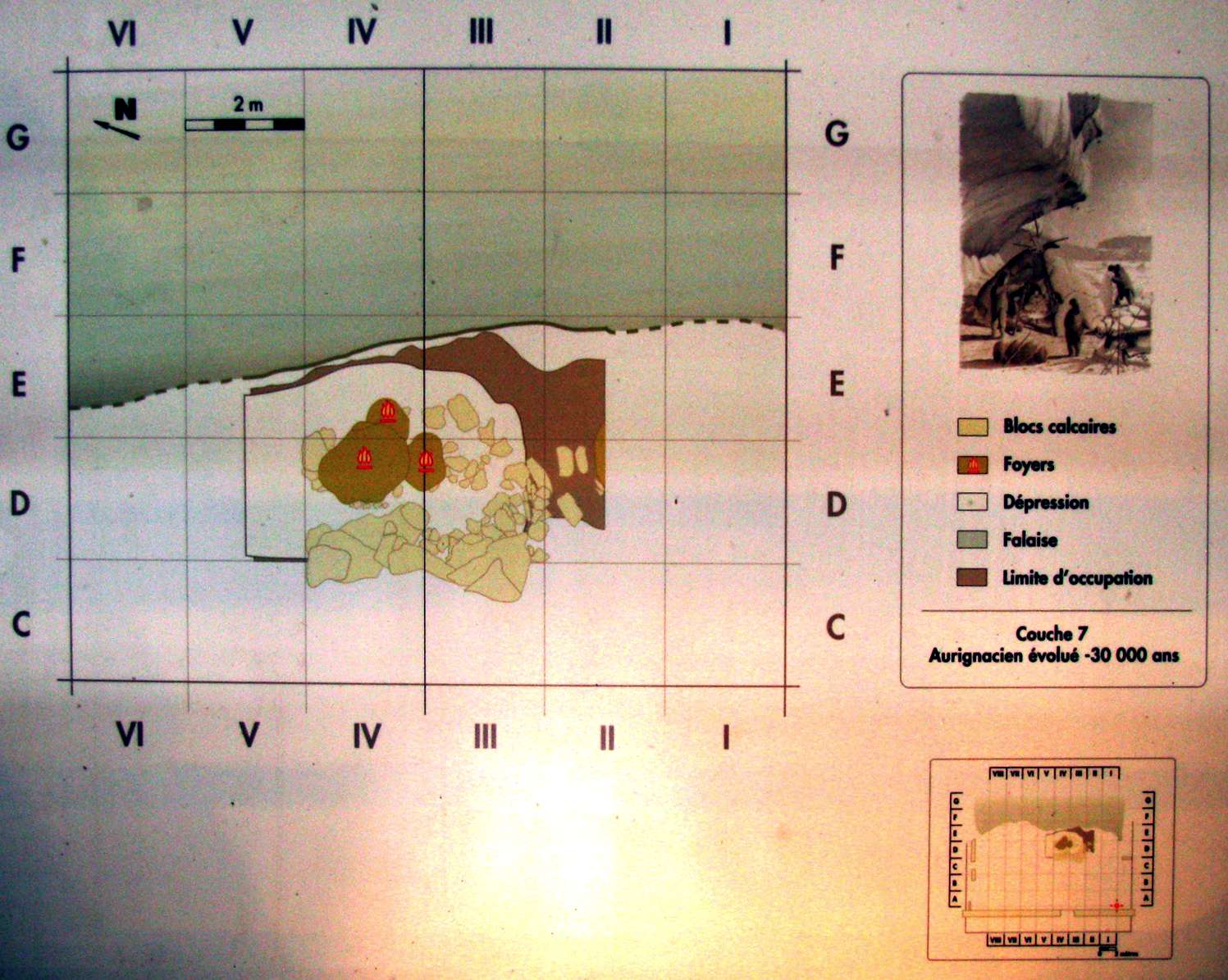
(Left) diagram of Level 3, about 24 000 BP, showing the position of the venus of Abri Pataud, engraved stones, fireplaces, bones of animals, and painted surfaces.
(Right) Diagram of Level 7, about 30 000 BP, showing the position of fireplaces and of fallen limestone blocks.
Photo: Don Hitchcock 2008
Source: A display at the excavation site.

(Left) Abri Pataud Profile
The site consists of two separate areas, separated by about fifty metres:
- An excavation site (1958 - 1964) under the direction of Hallam L. Movius (1907-1987), with a surface area of 12m x 12 m and a depth of nine metres.
- A museum under the same rock shelter containing many artefacts obtained from the dig.
The excavation site is beneath an abri of limestone, at the site of a former barn. The shelter was formed by the action of water infiltrating porous limestone, and undergoing successive actions of freeze and thaw, with the dust and rocks falling from the overhang onto the surface below over a period of tens of thousands of years.
The archaeological remains are thus sealed by fine or coarse material which has fallen from the roof of the shelter.
The average rate of deposition was 55 cm per 1000 years, or an average of half a millimetre per year.
Photo: Farrand (1975)
Text: translated and adapted from http://www.ac-bordeaux.fr/Pedagogie/SVT/pataud97.htm (this site has since disappeared)
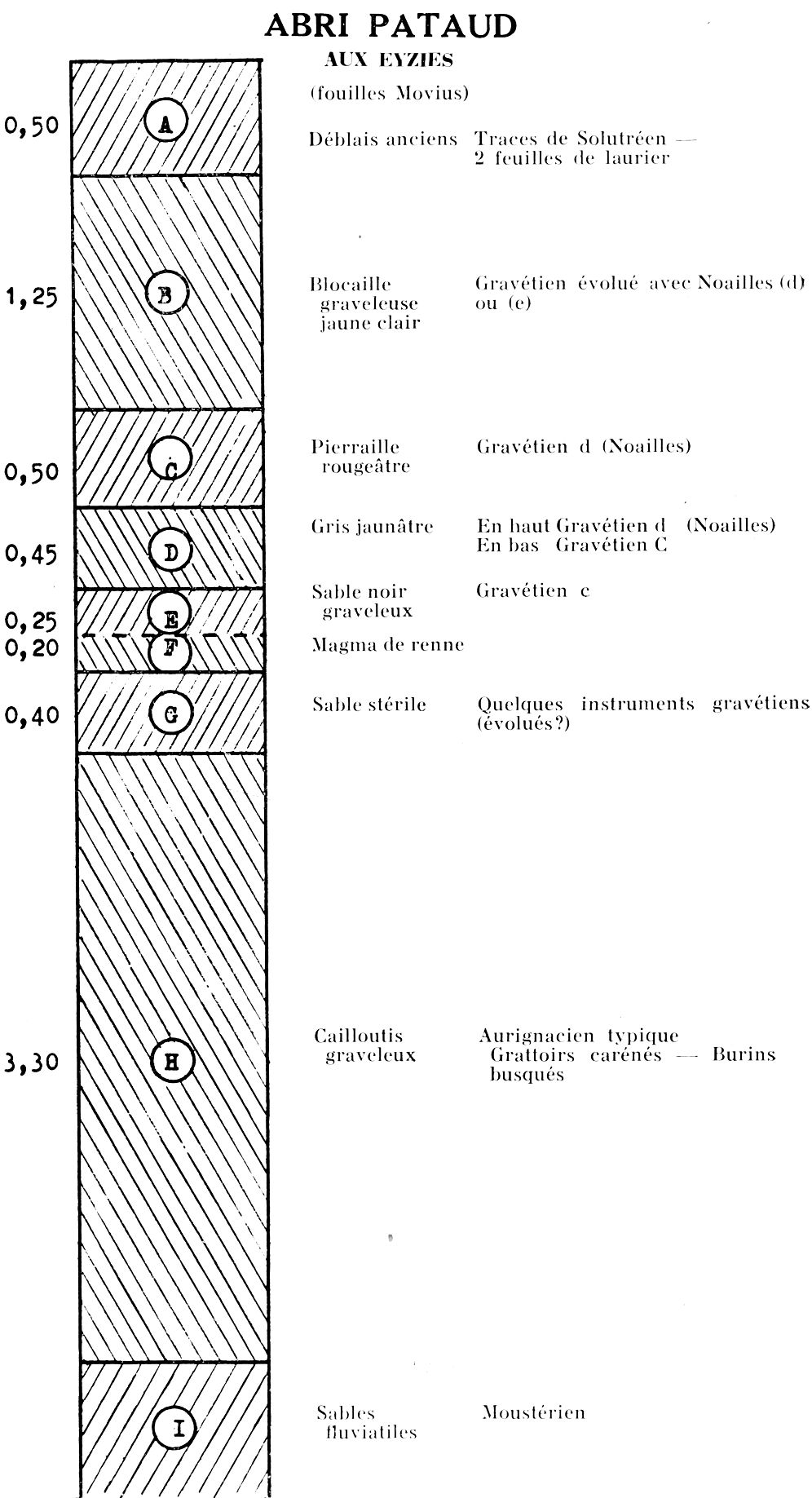
Complete cross section of the deposits at l'abri Pataud, from the excavations by Movius.
Depths of the beds are in metres. Commas are used in the European convention where English speakers use decimal points. Thus 0,50 means 0.50 metres, or 50 centimetres, and 3,30 means 3.30 metres, or 330 centimetres.
Photo: Cheynier (1960)
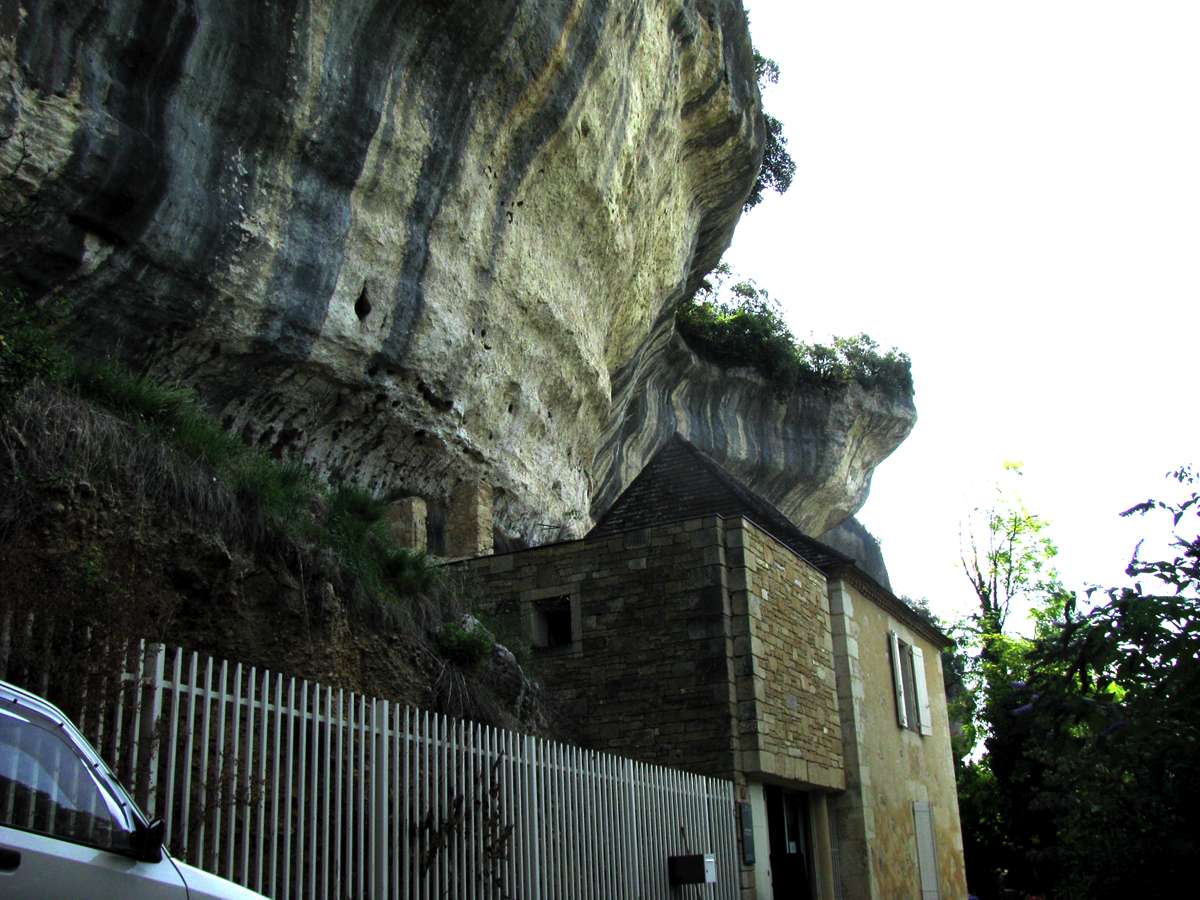
(left) The Abri Pataud Museum
The limestone is a marl (limestone and clay mixed) at the base, but there is a harder limestone bioclastic which overhangs the shelter.
The Abri Pataud rock shelter was occupied by the Cro Magnon man (Homo sapiens sapiens) for a period of 15 000 years, from 35 000 BP to 20 000 BP, which corresponds to the recent Wurm period, and the cultures of the Aurignacian, Gravettian and Solutrian. The average temperature was at that time approximately 5°C cooler than the current average temperature.
Over the nine metres depth of the dig, 14 archaeological levels may be observed, corresponding to 40 successive occupations. The old grounds are well marked by grey layers containing the ashes from the hearths. Some are easily definable.
The archaeological layers contain many vestiges of occupation, including the hearths, flint tools, and bones broken to extract the marrow.
Towards the top of the excavation, in layer two, where the shelter had been reduced to only one metre in height and two metres depth, were found the remains of three burials, of three adults and a baby.
Occupation of the shelter ceased in the Magdalanian period.
Photo: Don Hitchcock 2008
Text: translated and adapted from http://www.ac-bordeaux.fr/Pedagogie/SVT/pataud97.htm (this site has since disappeared)

The cliff of Abri Pataud, looking downhill away from the Museum.
Photo: Don Hitchcock 2008
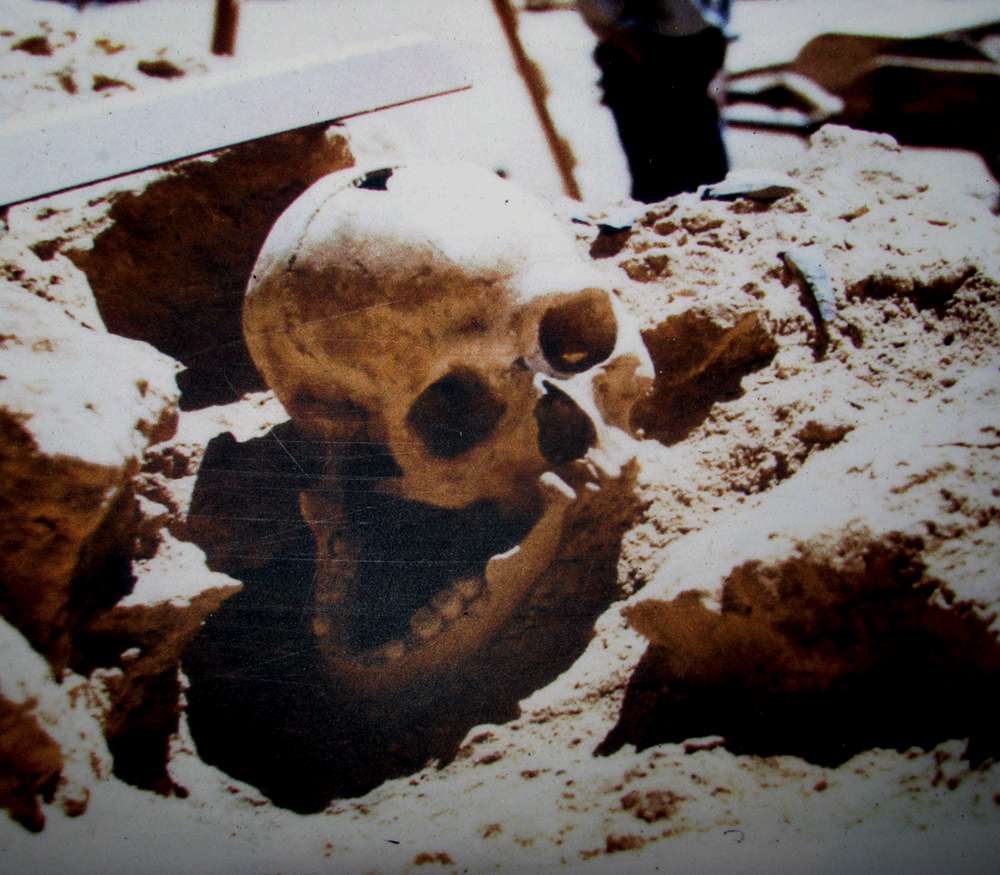
Au fond de l'abri, dans une espace bas de plafond, avait été deposé le corps d'une jeune femme d'environ 16 ans, accompagnée d'un enfant nouveau-né. Le crâne de la jeune femme avait été récupéré par la suite et déposé à 4 mètres de distance, protégé entre des pierres.
At the back of the shelter in a space with a low ceiling had been deposited the body of a young woman about 16 years old, with a newborn child. The skull of the young woman was recovered later four metres away, lying protected between stones. It has been placed on top of the mandible, which is still in situ, for the photo.
Text: Translated and adapted from a display at the excavation site.
Photo: Don Hitchcock 2008
Source: A display at the excavation site.

This skeleton of one of the finds at the site may be a facsimile.
Photo: Don Hitchcock 2008
Source: Display, Abri Pataud Museum, Les Eyzies
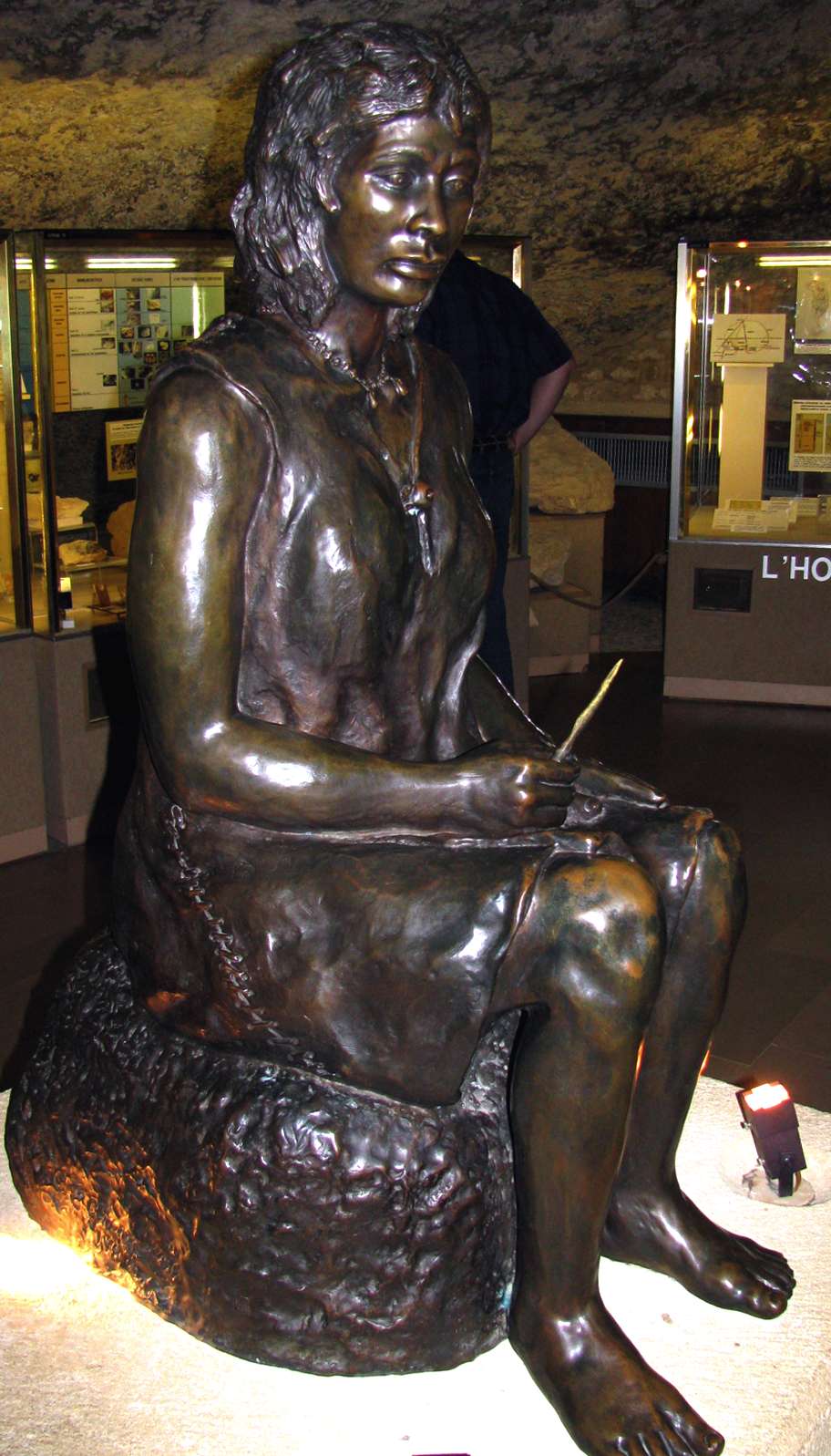
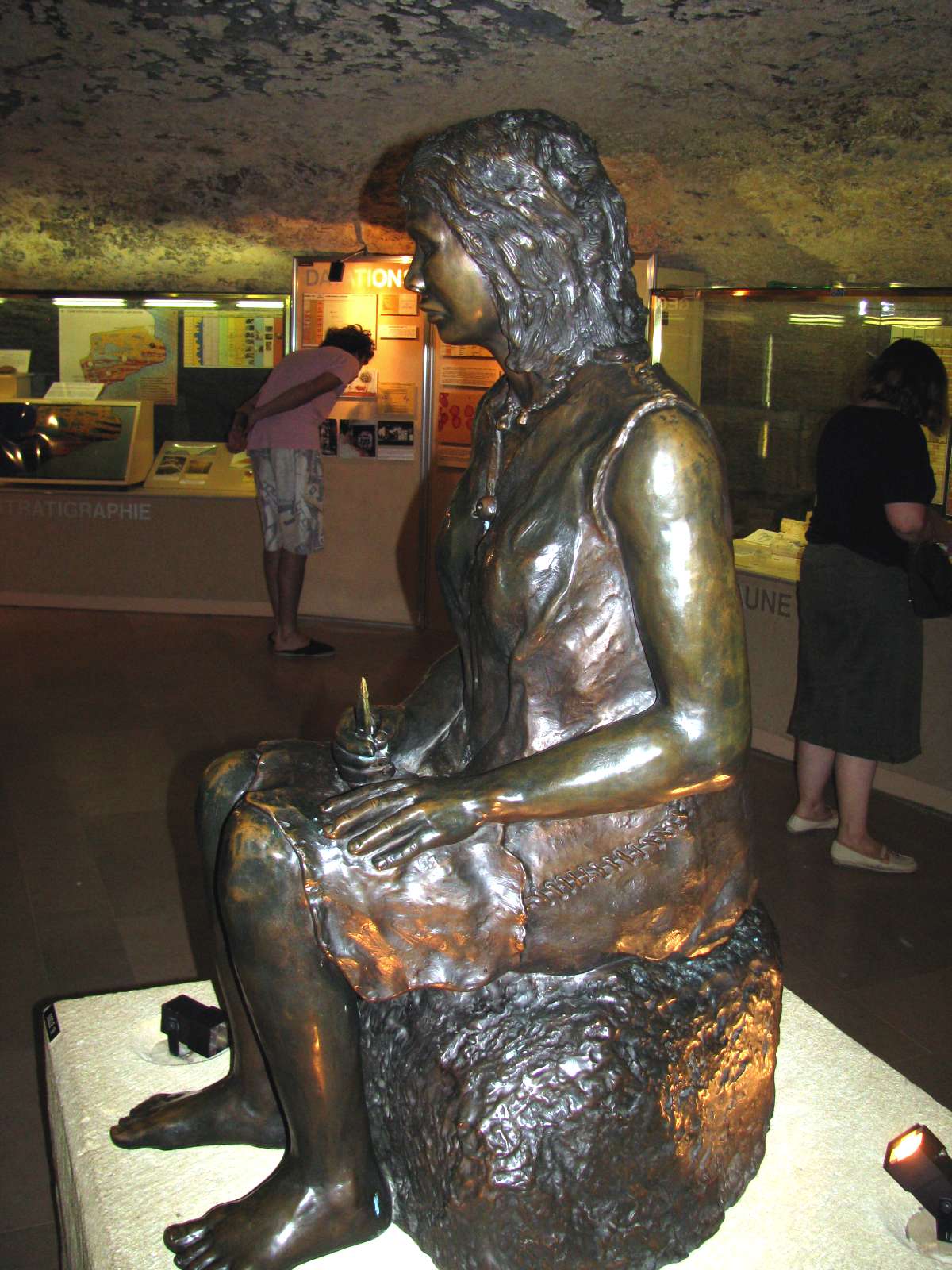
The famous statue of the woman found at Abri Pataud, holding a bone needle which is one of the artefacts found at the site, created by Eirik Granqvist.
As can be seen, the girl has been depicted with fairly heavy eyebrow ridges. At the time the statue was conceived, it was thought that the skeleton had Neanderthal aspects, but this is not now seen to be the case.
The roof of the Abri can be clearly seen forming the ceiling of the Museum.
Artist and sculptor: Eirik Granqvist
Photo: Don Hitchcock 2008
Source: Display, Abri Pataud Museum, Les Eyzies
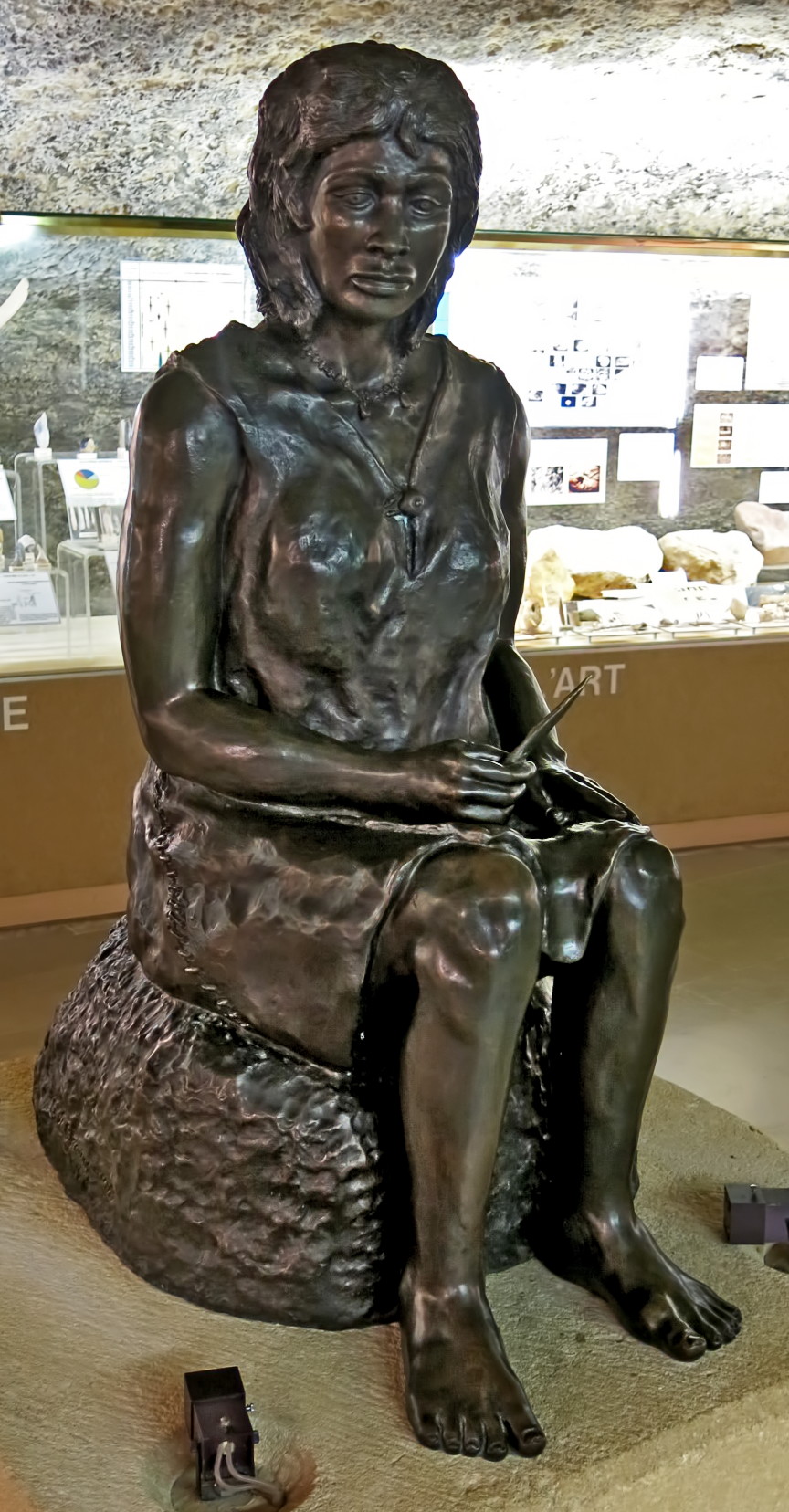
Another photo of the statue of the woman found at Abri Pataud, created by Eirik Granqvist.
Artist and sculptor: Eirik Granqvist
Photo: Don Hitchcock 2014
Source: Display, Abri Pataud Museum, Les Eyzies
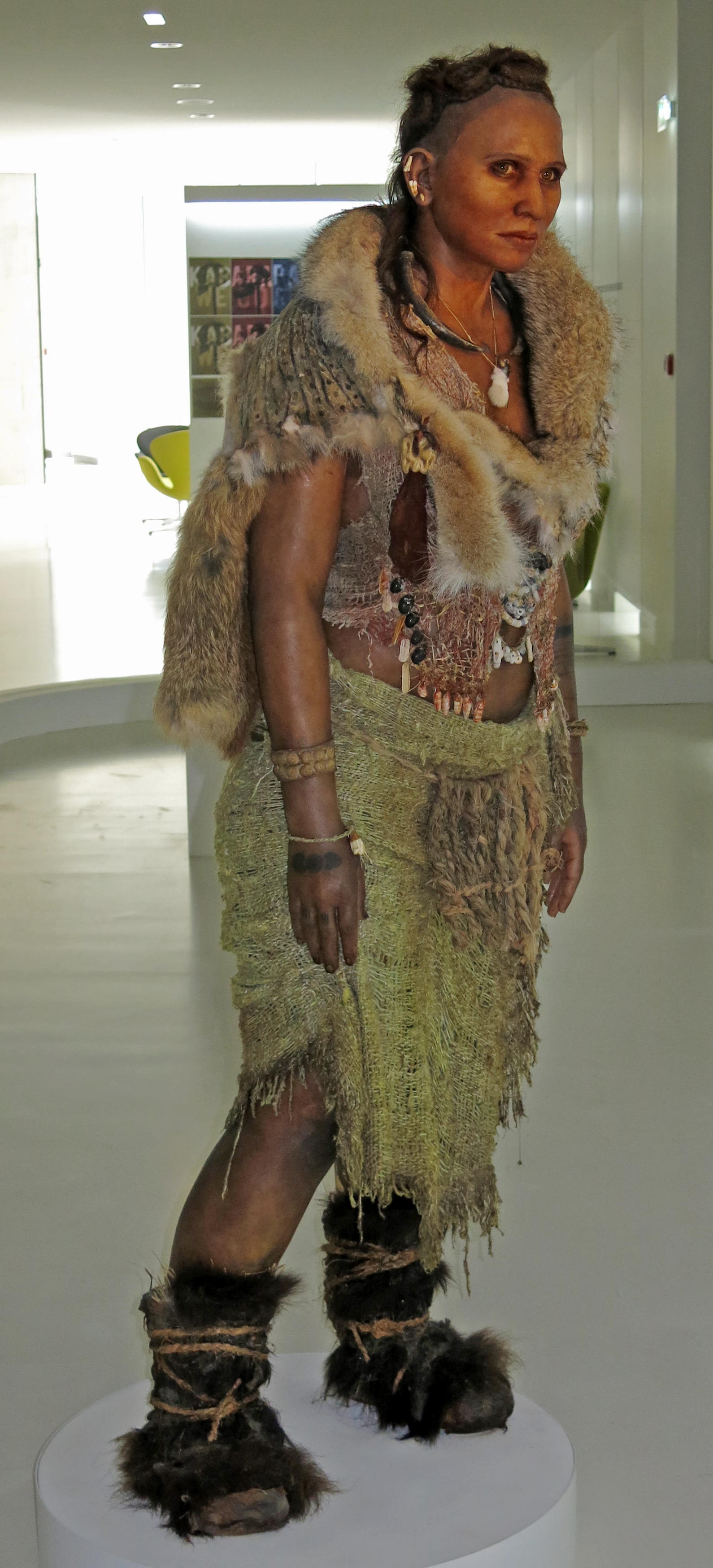
Ms Élisabeth Daynès, an internationally acclaimed sculptor, has created a female prehistoric human based on the skeleton of the woman found at Abri Pataud. The silicone model shows a woman, who is thought to have died aged 20, with brown eyes and a rounded face.
The coyote-skin stole worn by the female model is also a close representation of what a pre-historic woman would have worn, although she admits the dreadlocks and skin markings are her artistic impressions.
She explained: 'My art is a synthesis between scientific observation and imagination.'
Ms Daynès, who creates her models in her Paris apartment, also said: 'My work is done just like a forensic investigation from casts of skulls, which are reconstituted exactly as composite sketches by police. 'These anthropometric surveys deliver a wealth of information such as age and sex.'
Photo: Don Hitchcock 2014
Source: Pôle International de la Préhistoire, Les Eyzies
Text: http://www.dailymail.co.uk/news/article-2832042/How-ancestors-really-looked-dressed-Exhibition-reveals-face-pre-historic-man.html
Layer 1 and the layers above it
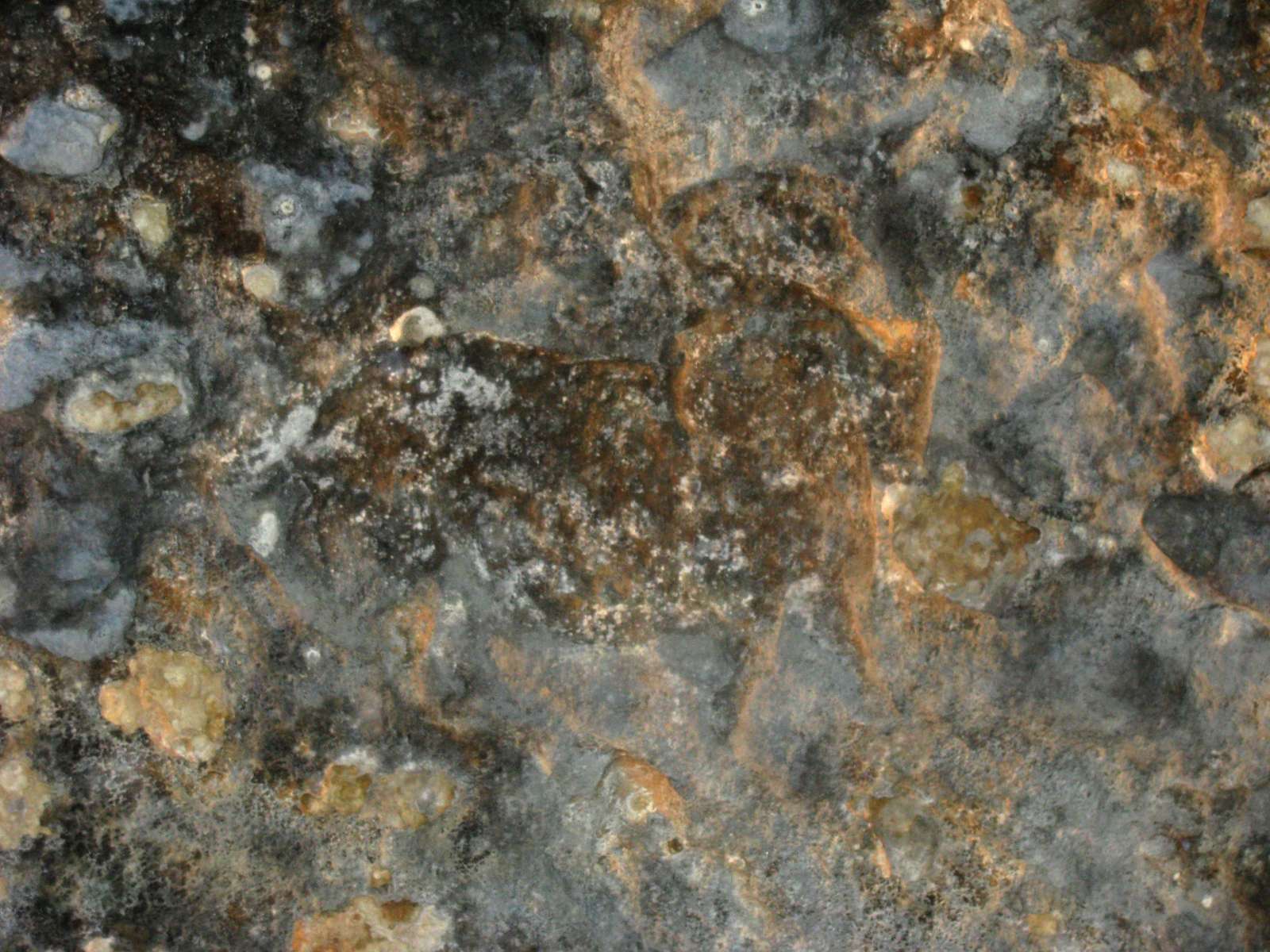
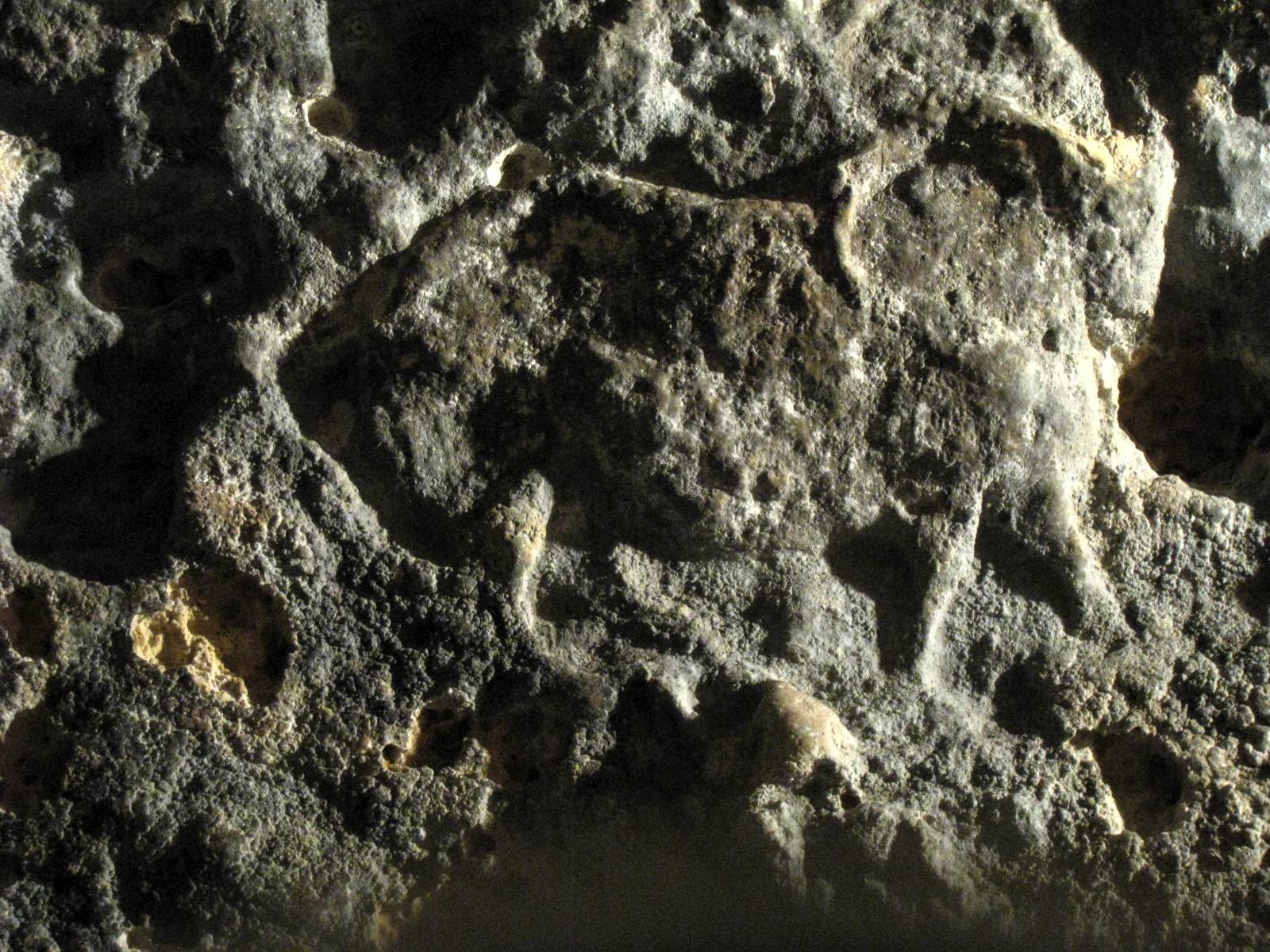
The Abri Pataud Museum is situated in the only section of the Abri Pataud shelter which did not collapse. On the ceiling, which is in its natural state as a rock face, there is the bas-relief of an ibex, estimated to have been carved about 19 000 years ago. The features are only just discernible in flat lighting, but come into sharp relief when the light is allowed to come in from a sharp angle.
Photo: Don Hitchcock 2008
Source: The roof of the Abri Pataud Museum. The carving is in an awkward place for easy viewing, but the designers of the museum have organised the display really well, arranging a mirror and lighting so that the ibex can be easily seen.

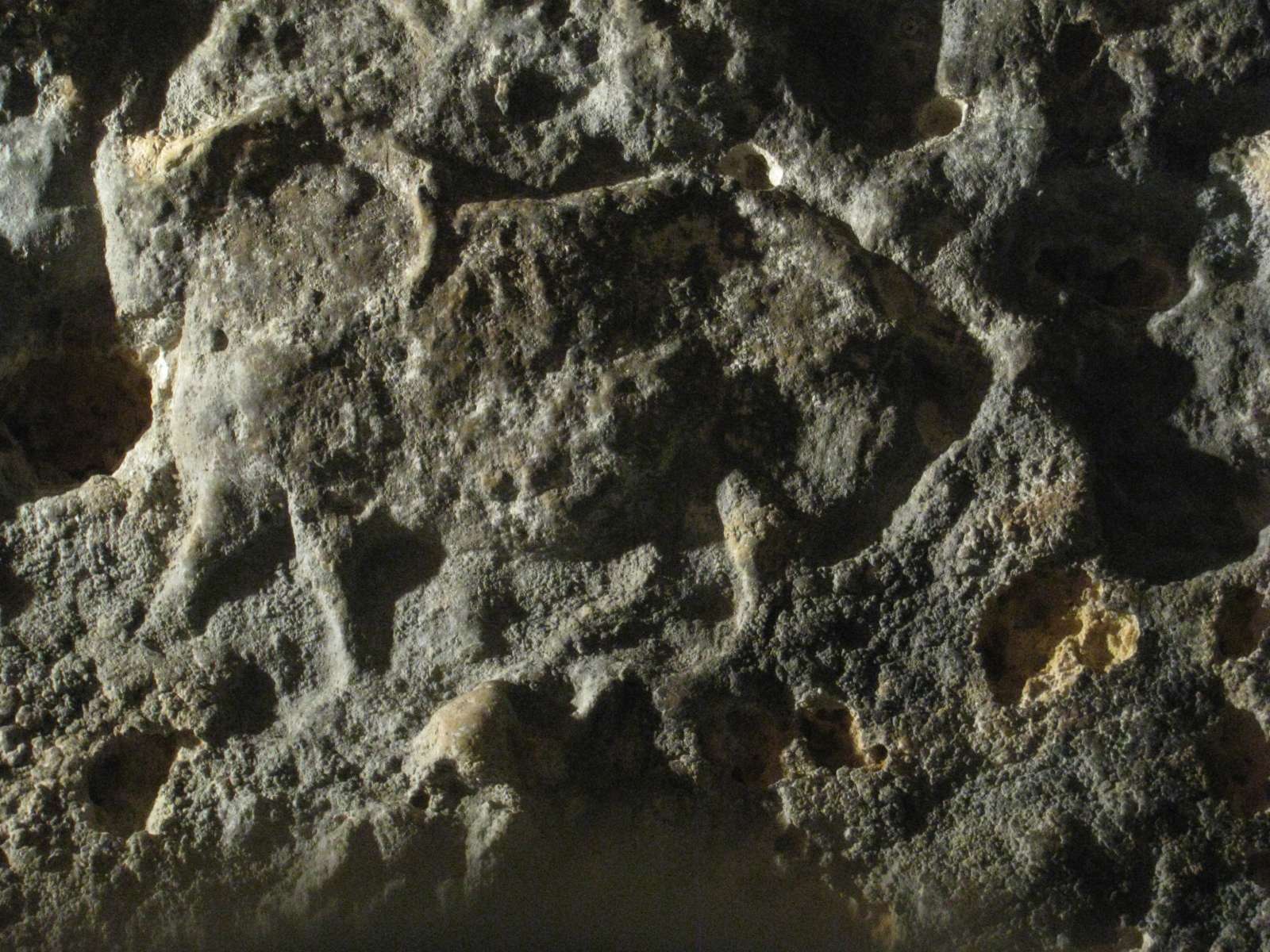
The same images of the ibex, flipped so that the image displays what the ibex looks like in real "life", not reflected in a mirror.
Photo: Don Hitchcock 2008
Source: The roof of the Abri Pataud Museum.

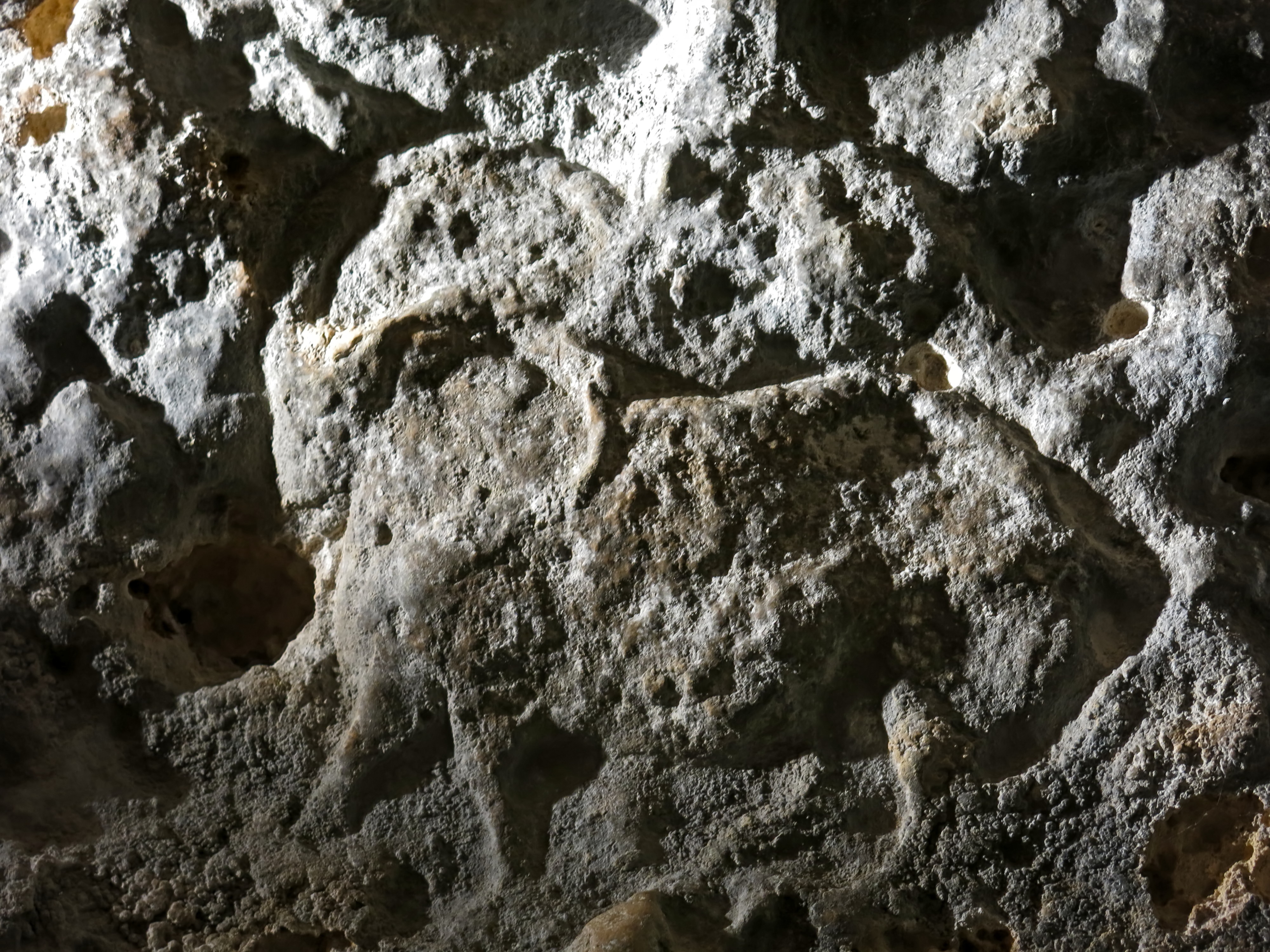
Another photo of the ibex, as in the mirror and in real life.
Photo: Don Hitchcock 2014
Source: The roof of the Abri Pataud Museum.
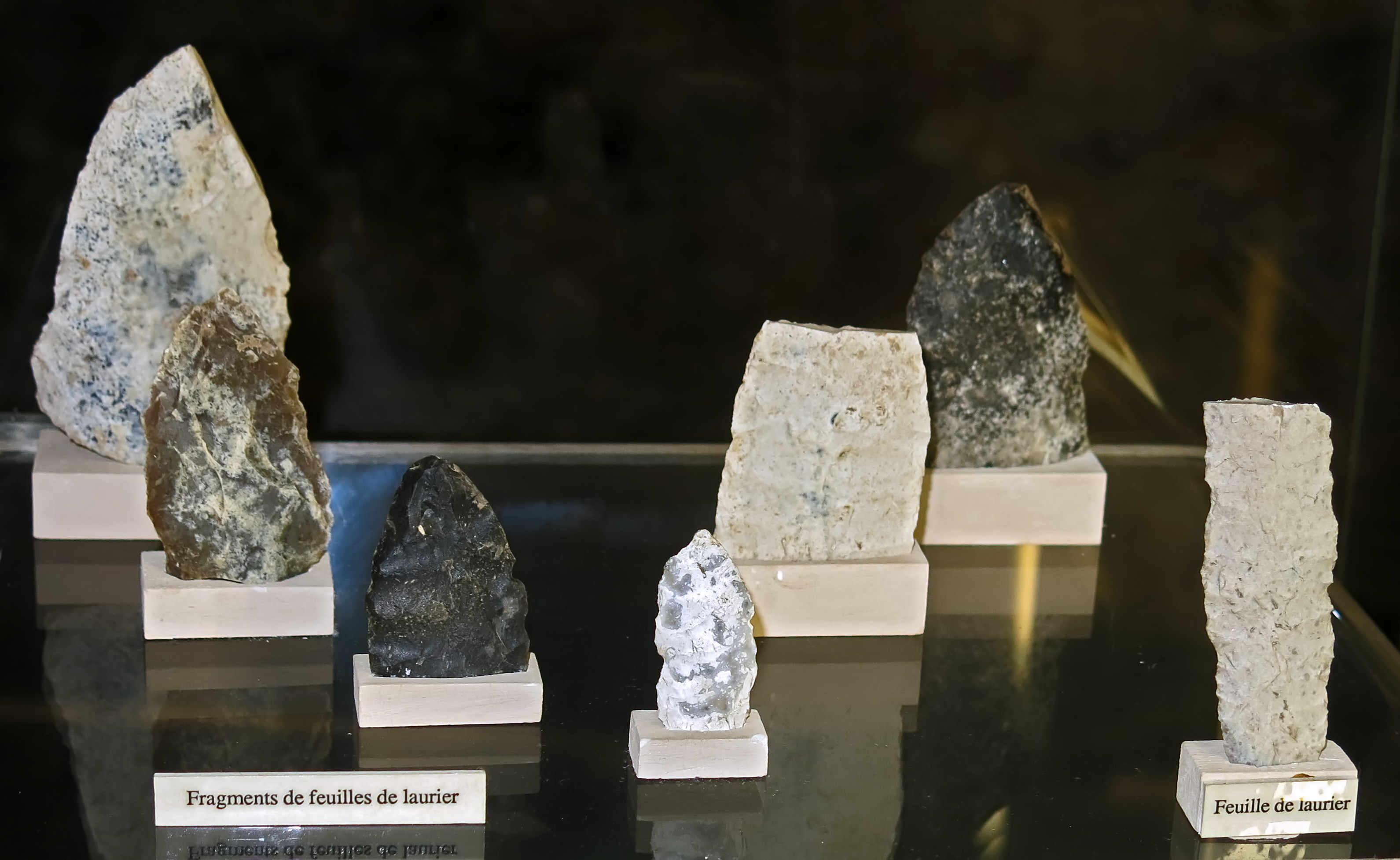
The Middle Solutrean - upper layers
The higher levels of the Abri Pataud have been destroyed, but the presence of the Middle Solutrean is known from a few pieces, gathered around the site.
The bifacial laurel leaved shaped points characterise the middle Solutrean.
This deposit has Grattoirs 22%, Burins 7%, specifically Solutrean tools 22.5%, and other tools 48.5%.
Photo: Don Hitchcock 2014
Source: Display at Abri Pataud Museum, apparently original.

The Middle Solutrean - upper layers
Incised bone, with a mirror showing the other side.
Photo: Don Hitchcock 2014
Source: Display at Abri Pataud Museum. This appeared to be original.

The lower Solutrean - Layer 1
Although the Solutreans stayed at the Abri Pataud, there are few remaining traces of their passage.
This period is characterised by a great mastery of shaping of stone, using pressure retouching, and are manifested at l'Abri Pataud by the presence of some tools called 'Flat Face Points' which are leaf-shaped uniface points with one plain face and the other retouched, which is characteristic of the lower Solutrean.
Photo: Don Hitchcock 2014
Source: Display at Abri Pataud Museum. These appeared to be originals.
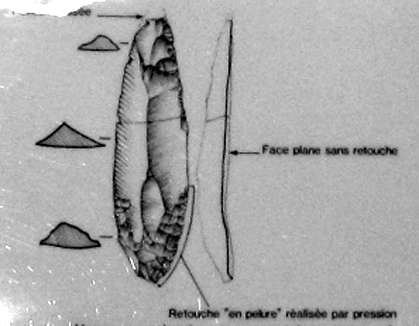
The lower Solutrean - Layer 1
A characteristic of the lower Solutréen - The Flat Face Point.
Photo: Don Hitchcock 2008, 2014
Source: Display at Abri Pataud Museum. This appeared to be an original.
Layer 2
Layer 2: Protomagdalenian, Périgordian VII
Layer 2 has delivered an abundant lithic industry, mainly pieces with abrupt retouches. (39%). Chisels (burins) are quite numerous. One should also note the presence of large reworked blades.
This industry was first discovered in Laugerie Haute attributed to the Protomagdalénien.
The presence of Gravettian points and microgravettes has allowed certain prehistorians to define this industry as belonging to the Perigordien VII.
A characteristic tool of the Protomagdelénien is the dihedral burin with edge retouch.
This type of chisel was generally used in the working of bone and reindeer antlers.
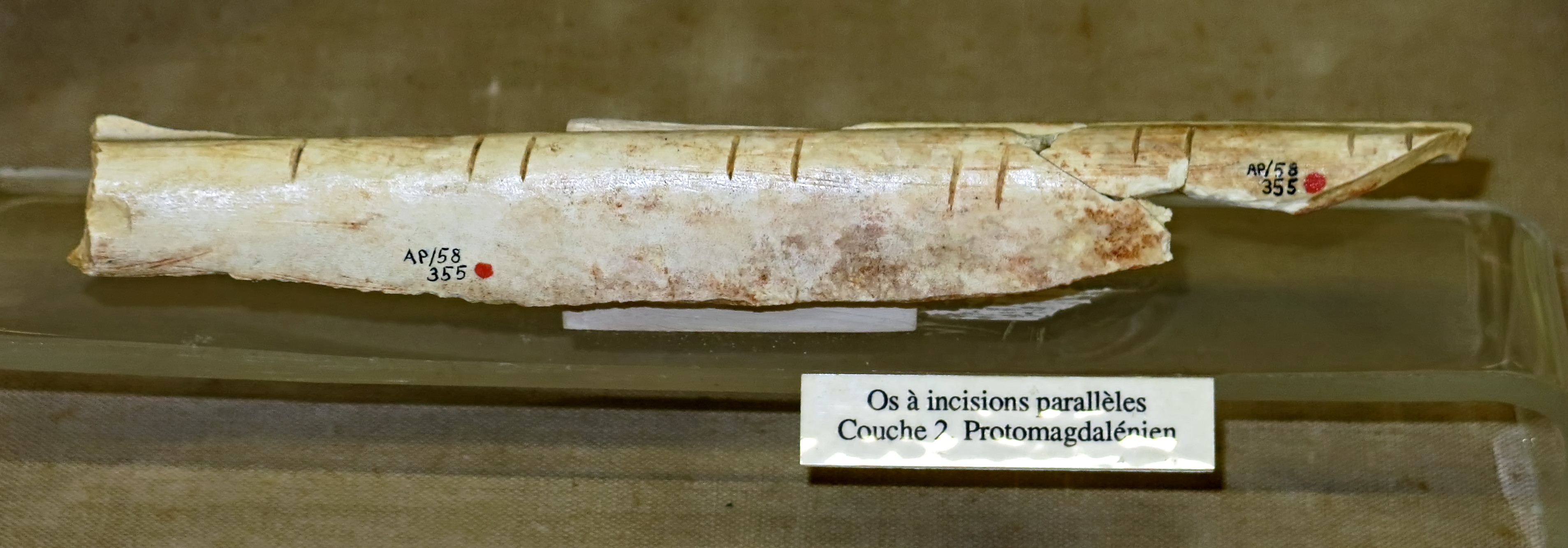
Layer 2: Protomagdalenian, Périgordian VII
Bone with parallel incisions.
Layer 2, Protomagdalenian. ( note that the Protomagdalenian precedes the Solutrean, not the Magdalenian as you might expect. It was named for a particular layer in Laugerie Haute by Peyrony - Don )
Photo: Don Hitchcock 2014
Source: Display at Abri Pataud Museum. These appeared to be originals.

Layer 2: Protomagdalenian, Périgordian VII
Left to right:
Front row: Bone awl, Dihedral burin.
Middle row: Burin on a truncation, Dihedral burin, Grattoir or scraper on a blade, and a notched blade, used for smoothing such things as spear shafts.
Back row: The lower part of a pierced piece of antler, an awl, and a drill.
Photo: Don Hitchcock 2014
Source: Display at Abri Pataud Museum. These appeared to be originals.
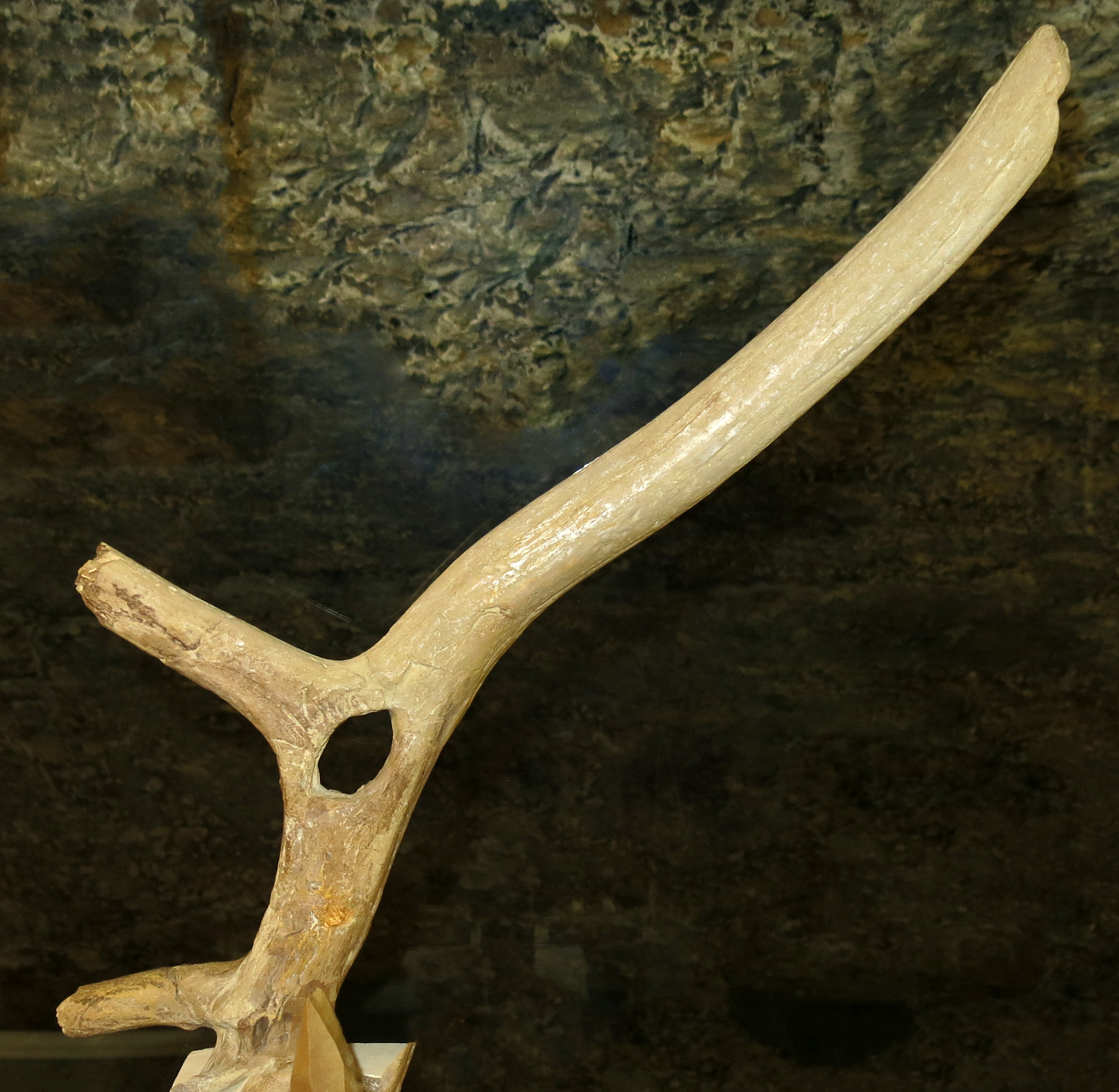
Layer 2: Protomagdalenian, Périgordian VII
This is a most unusual pierced baton - normally they are furnished with a regular and well finished circular or oval hole, whereas this one is quite irregular.
In addition, the antler has not been trimmed of superfluous material, as is normal.
It may have been a work in progress, though it is difficult to see why the hole is not circular, even so - it was normal to drill a small circular hole, then enlarge it by successively larger drill bits or even blades, until it was the right size.
Photo: Don Hitchcock 2014
Source: Display at Abri Pataud Museum. This may be a facsimile.
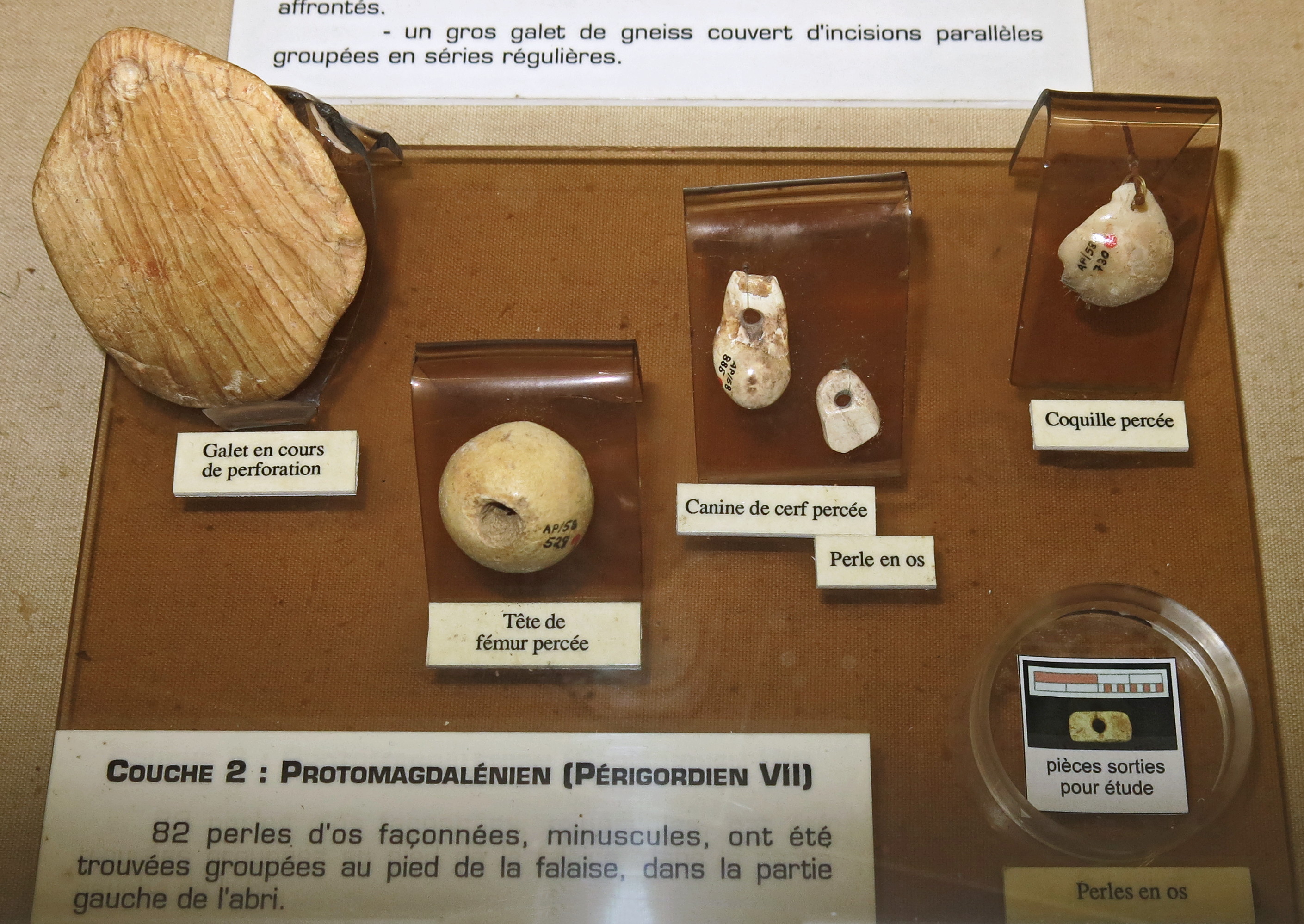
Layer 2: Protomagdalenian, Périgordian VII
Included in this cabinet are a large pebble in the course of being pierced by a hole for use as a pendant, the head of a femur pierced by a hole, a pierced deer canine tooth, a bone bead, and a pierced small pebble. The beads removed for study may be seen in the image below from 2008.
( It is not stated, but it would be interesting to know if the head of the femur shown here was from a human - Don )
Photo: Don Hitchcock 2014
Source: Display at Abri Pataud Museum. These appeared to be originals.
Layer 2: Protomagdalenian, Périgordian VII
82 tiny bone beads were found in a group at the foot of the cliff, on the left of the abri, in Layer 2.
( Beads represent wealth, in terms of the time and skill taken to make them. They indicate that the people were so successful that they were able to spend time on things of beauty rather than just hand to mouth living, and were status objects for this reason - Don )
Photo: Don Hitchcock 2008
Source: Display at Abri Pataud Museum. These appeared to be originals.
Layer 2: Protomagdalenian, Périgordian VII
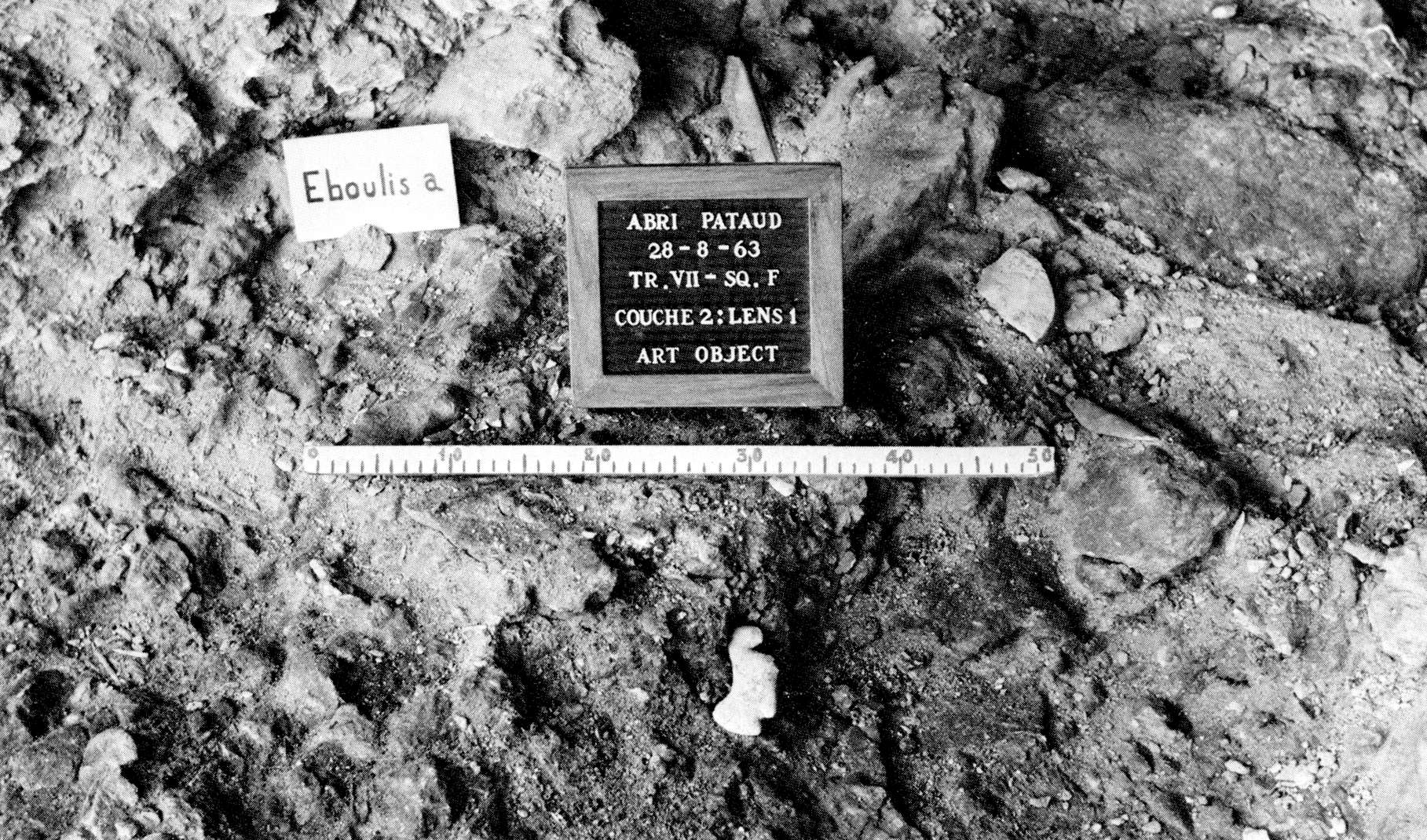
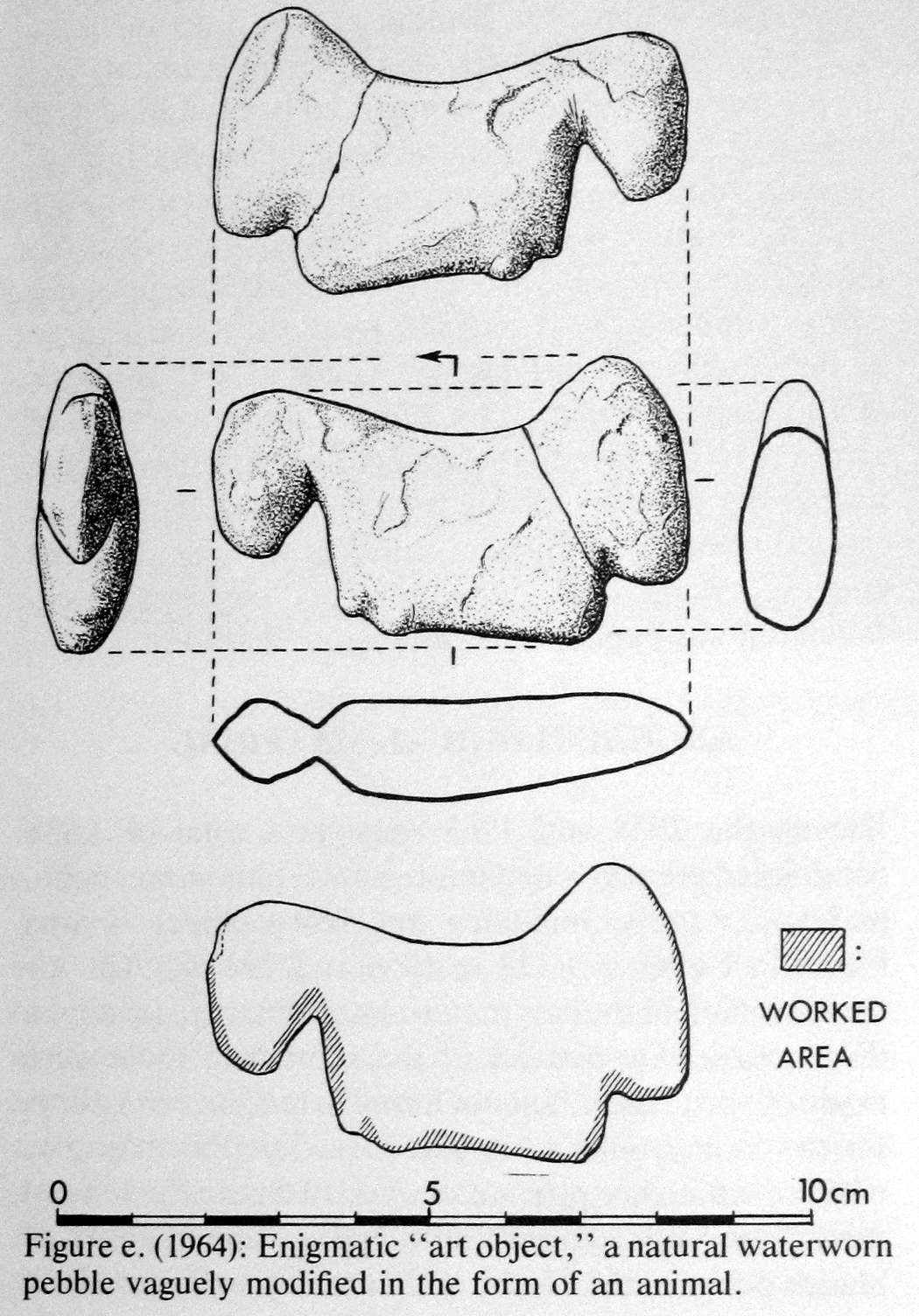
(right) Enigmatic "art object" (cat. no. 1964), a natural waterworn pebble vaguely modified in the form of an animal.
(left) As it was found in Lens 1 of Level 2 in Trench VII, Square F. View looking northeast showing the object in situ.
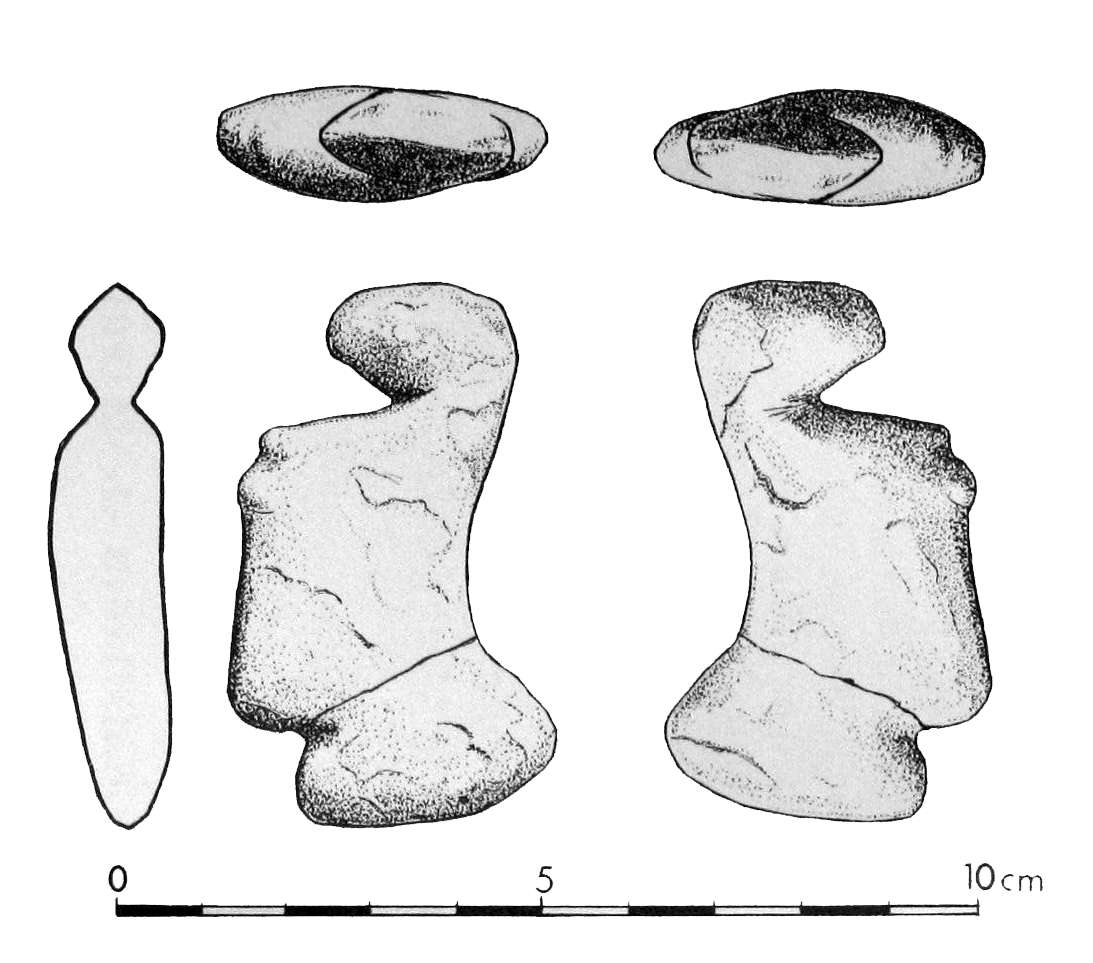
(Note that this object may also be seen as a venus figure, as Prof. Randall White has noted. This is especially noticeable in the photo at left with the object in situ. )
Photo and text: Movius (1977)
Layer 2: Protomagdalenian, Périgordian VII
Here is the same image, rotated to show the interpretation as a venus.
Photo: Adapted by Don Hitchcock from Movius (1977)
Layer 3
Layer 3: Upper Gravettian, Périgordian VI

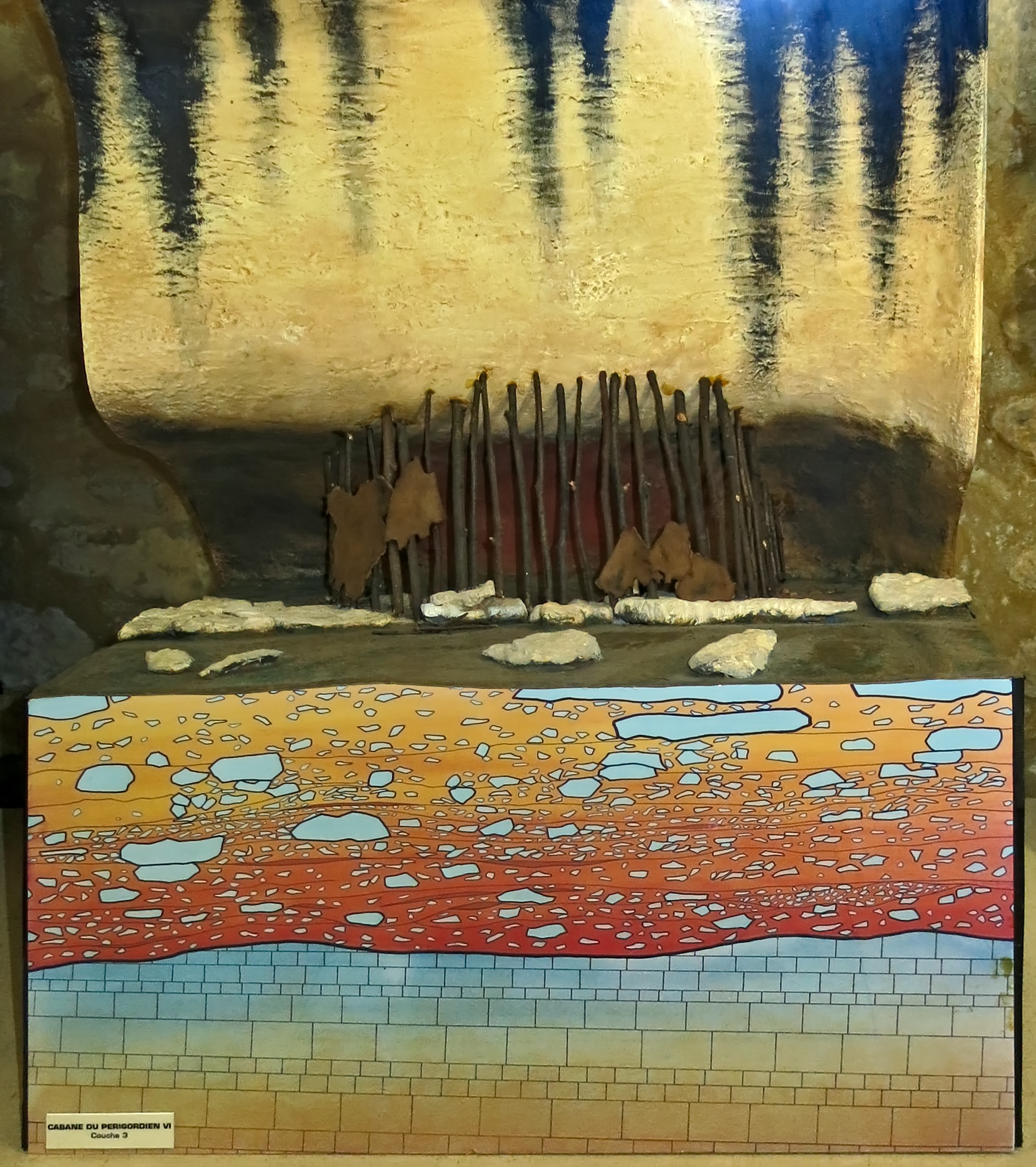
Layer 3: Upper Gravettian, Périgordian VI
Plan and diorama of the living quarters of the inhabitants of Abri Pataud during the Upper Gravettian, circa 22 490 BP.
Located on the banks of the Vézère, facing a plain, dry, well lit and enjoying the setting sun, l'Abri Pataud, a significant, deep shelter in a high cliiff, was not chosen at random. It offered at one and the same time a comfortable habitat and a wide range of activities.
Photo: Don Hitchcock 2014
Source: A display at the excavation site.
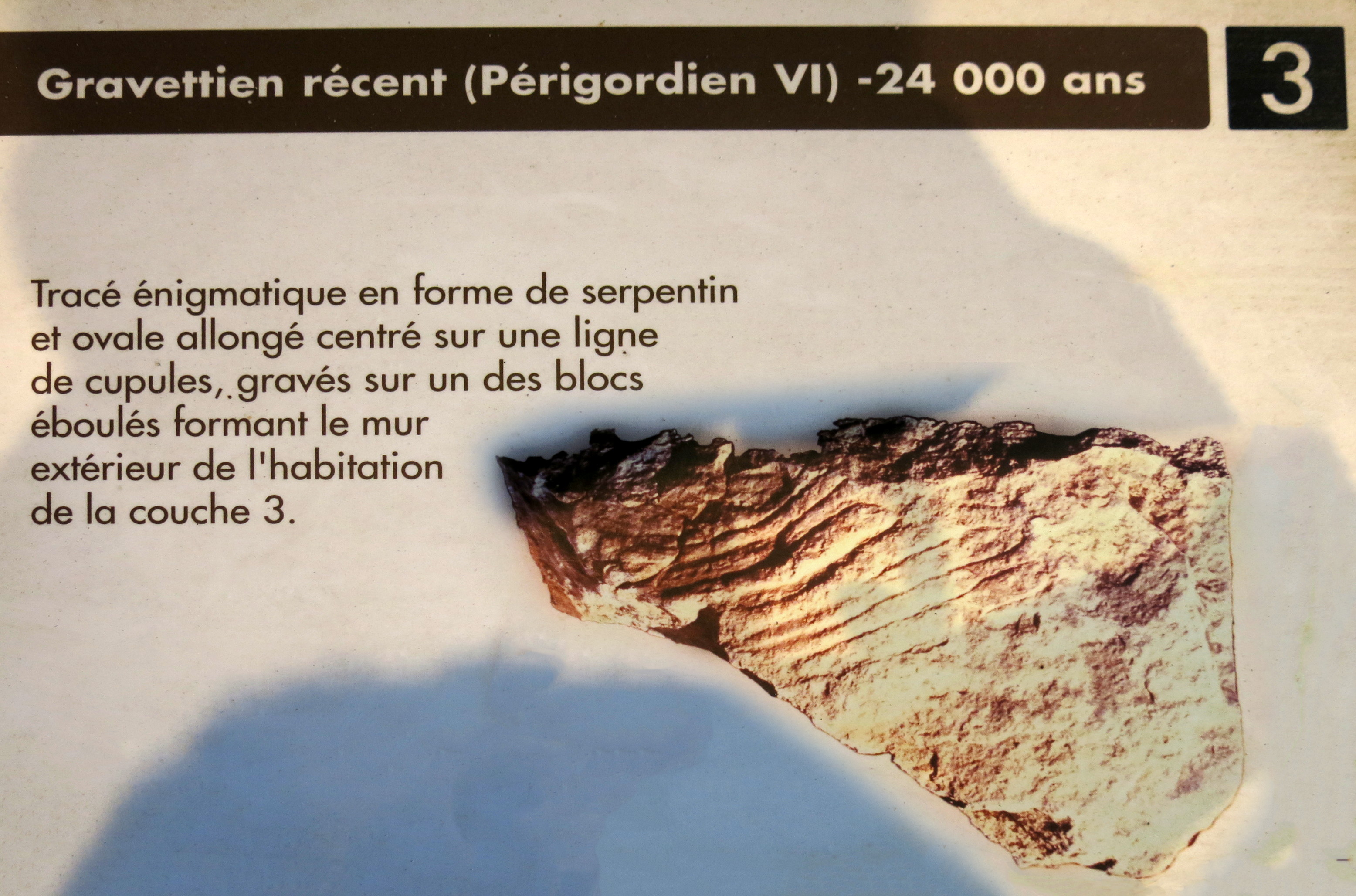
Layer 3: Upper Gravettian, Périgordian VI
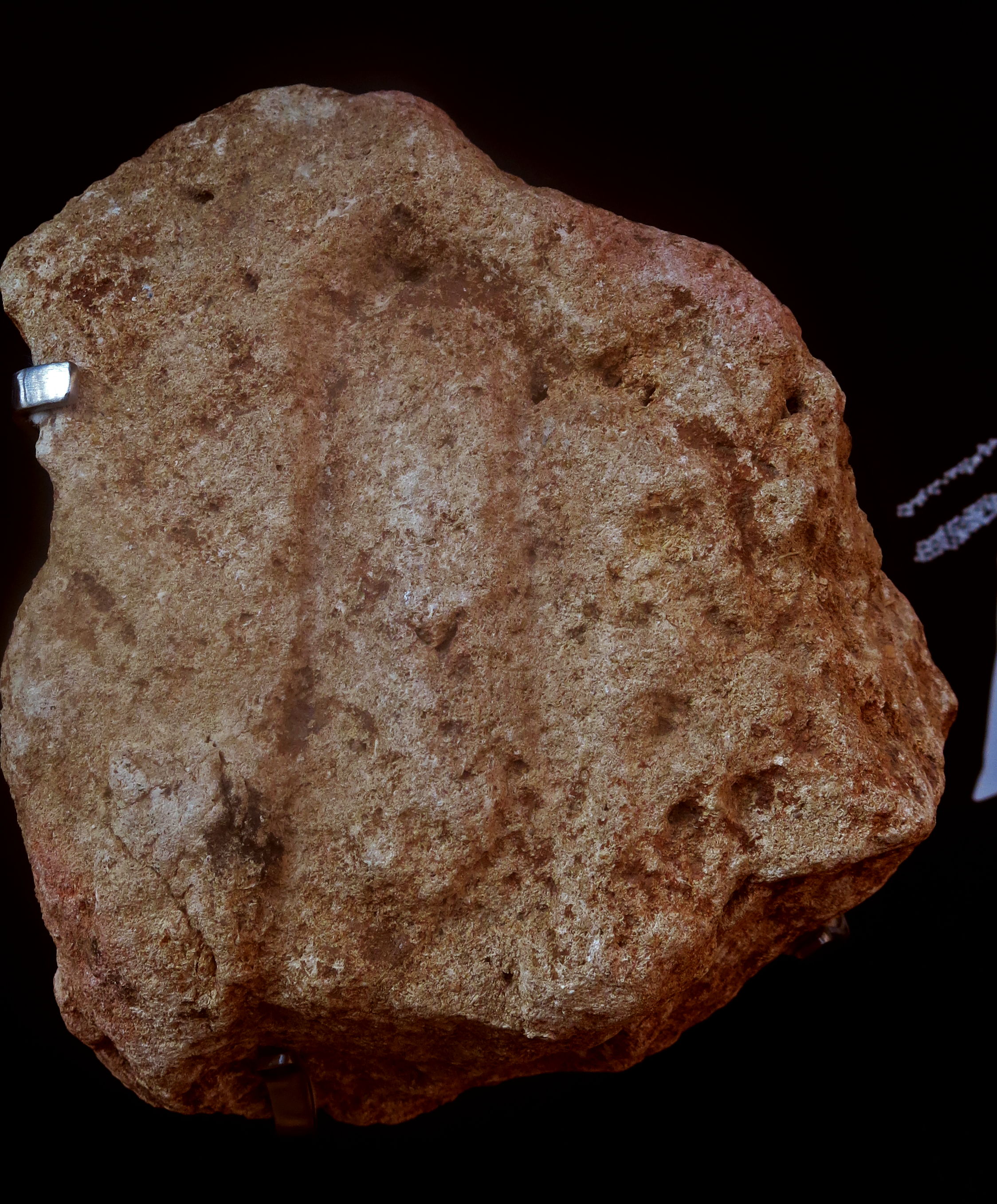
Enigmatic serpentine-shaped and elongated oval engraving centred on a line of cupules, engraved on loose blocks forming the outer wall of the dwelling of layer 3.
(Note that I have rotated this image 180° and flipped it horizontally to agree with the Movius orientation below, which is in situ. This sort of misorientation, upside down and back to front was common when images were recorded on film - Don )
Rephotography: Don Hitchcock 2014
Source: A display at the excavation site.
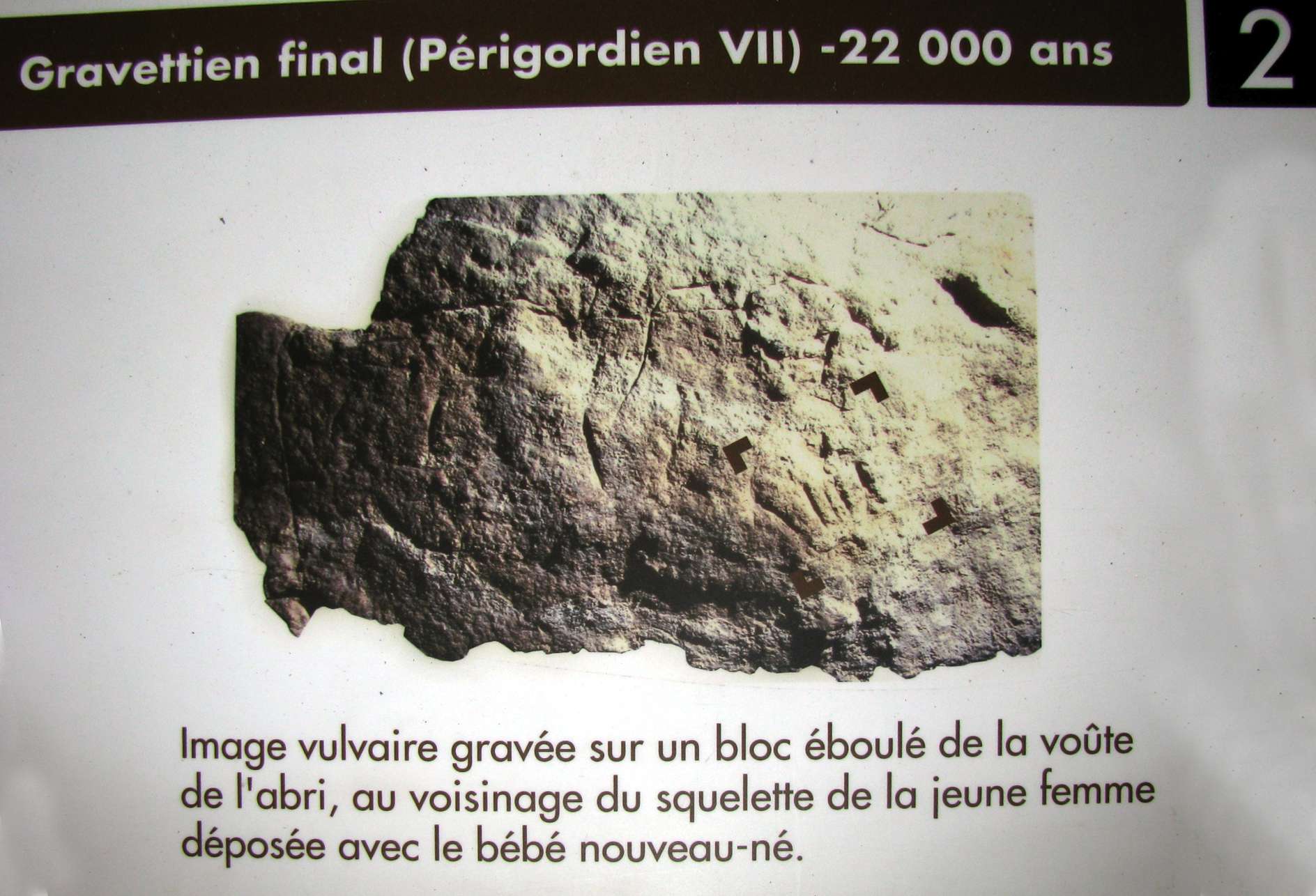
Layer 3: Upper Gravettian, Périgordian VI
A depiction of a vulva engraved on a block fallen from the roof of the abri, near the skeleton of the young woman buried with a newborn baby.
Text: Translated and adapted from a display at the excavation site.
Photo: Don Hitchcock 2008
Source: A display at the excavation site.
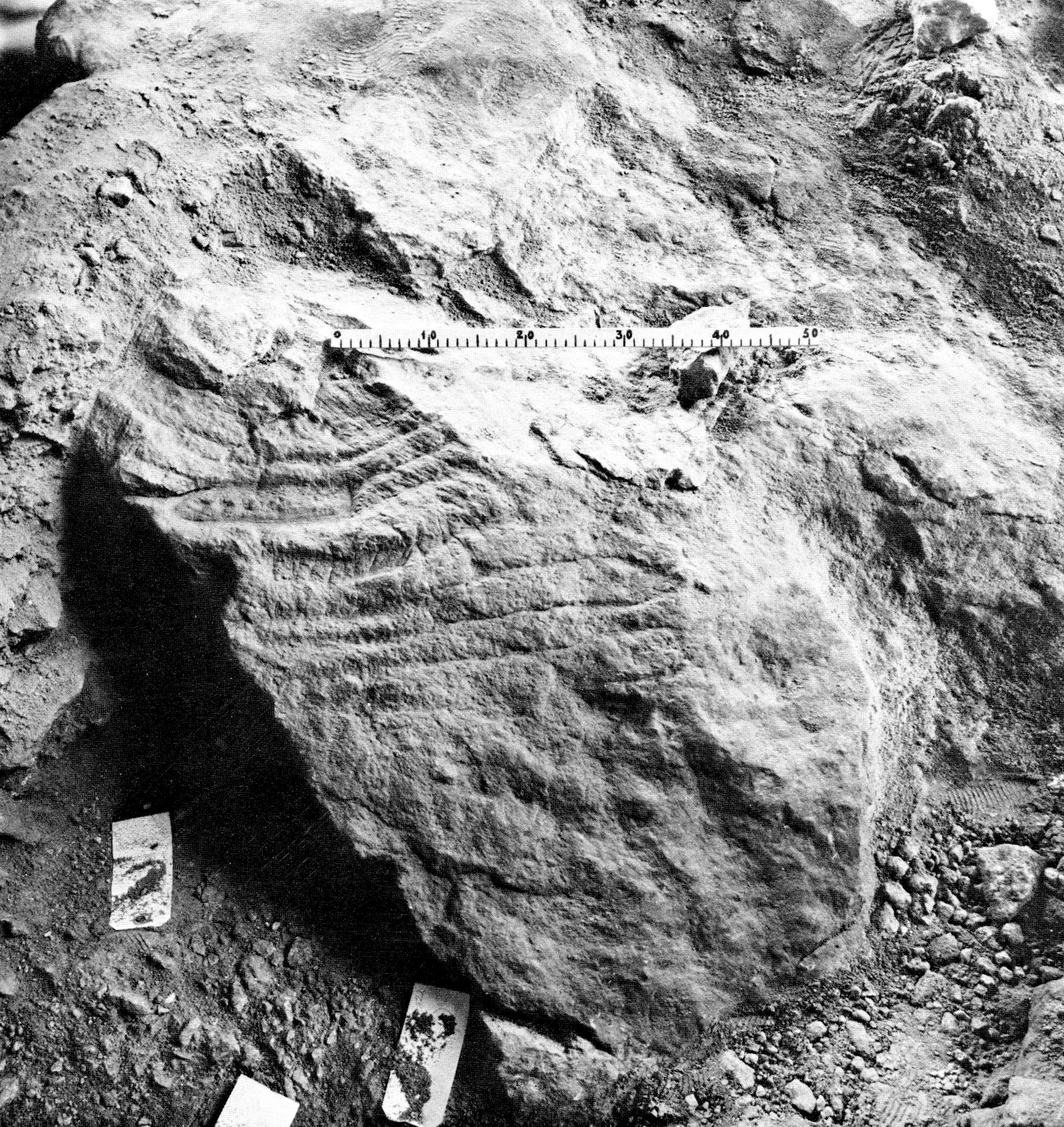
Layer 3: Upper Gravettian, Périgordian VI
Large engraved rock (as in the colour photo above) with "serpentine" decoration.
Rock X-8 (cf section Fig 14, and top plan, fig. 12) which constituted the western limit of Level 3 in Trench V, exhibited a very interesting and enigmatic 'serpentine' engraving on the eastern, or inner, surface that had been completely buried by the Lens 2 deposit. A photograph of this rock in situ is reproduced in plate 33. (as shown) Near the uppermost limits of the serpentine pattern, a cigar shaped depression with four dots running down the centre of its flat base may be discerned.
Photo and text: Movius (1977)
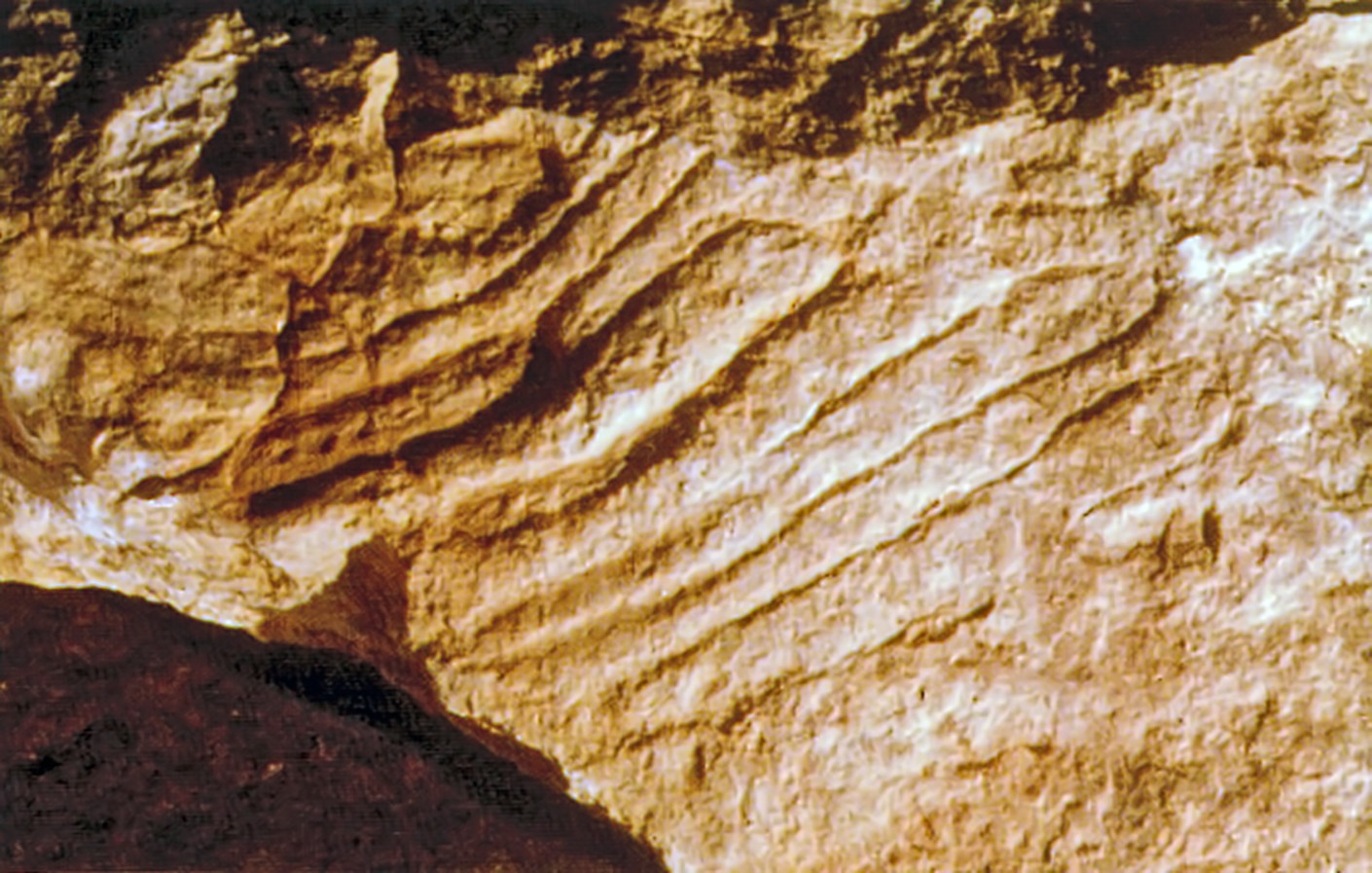
Layer 3: Upper Gravettian, Périgordian VI
Large engraved rock (as in the photo above) with 'serpentine' decoration, as well as cupules.
( Note that I have rotated this image 180° to more closely agree with the Movius orientation above, which is in situ - Don )
Photo: Delluc et Delluc (2004)
Proximal Source: Jaubert (2008)
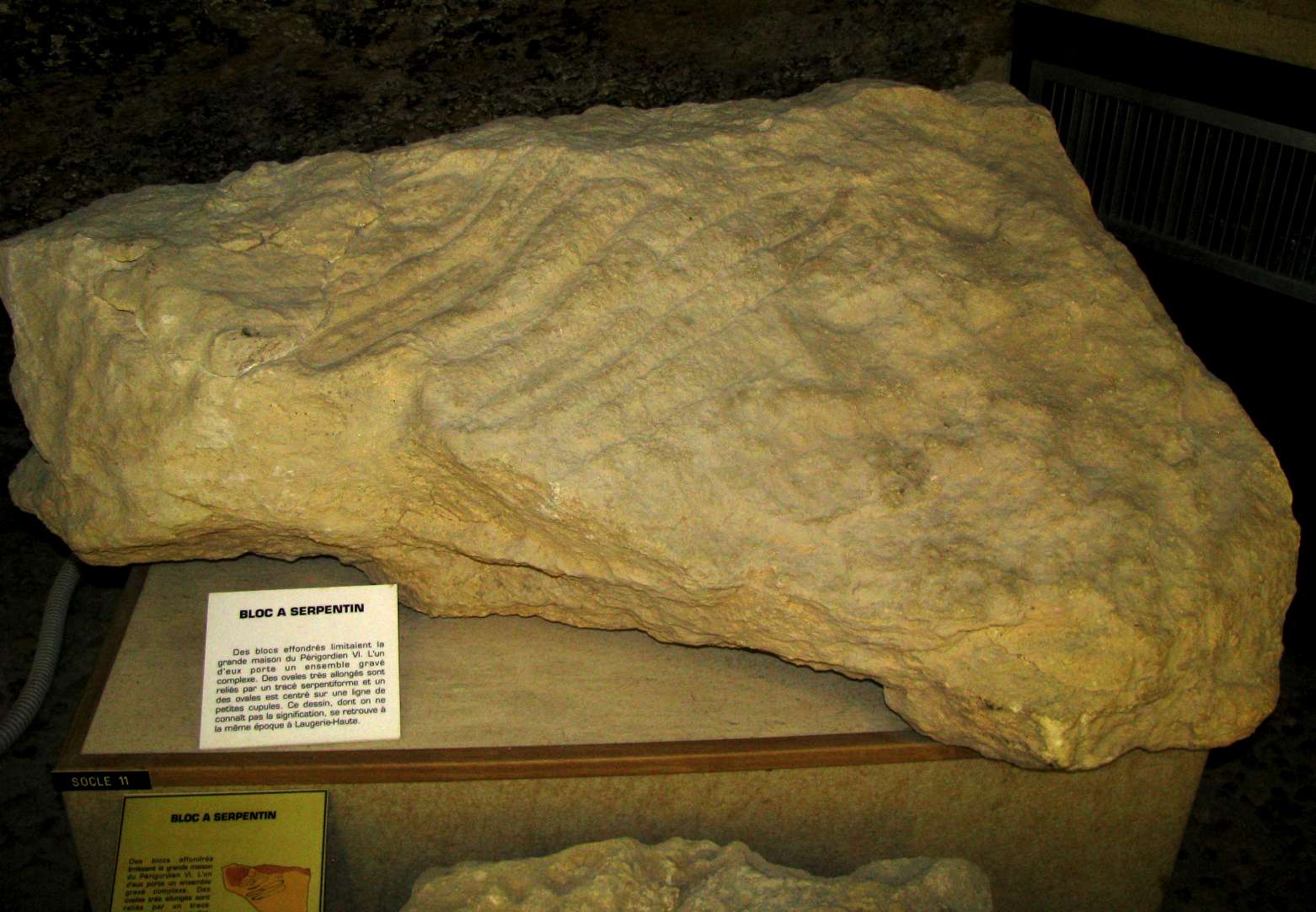
Layer 3: Upper Gravettian, Périgordian VI
Block with serpentine marks
Fallen blocks delineated the perimeter of the living area of the Périgordien VI. One of these fallen blocks has a whole complex of engravings. Very elongated ovals are connected by a serpentine line and one of the ovals is centred on a line of small cupules. This design with unknown meaning has also been found at Laugerie Haute.
Photo: Don Hitchcock 2008
Source: Display at the Abri Pataud Museum. This appeared to be an original specimen.
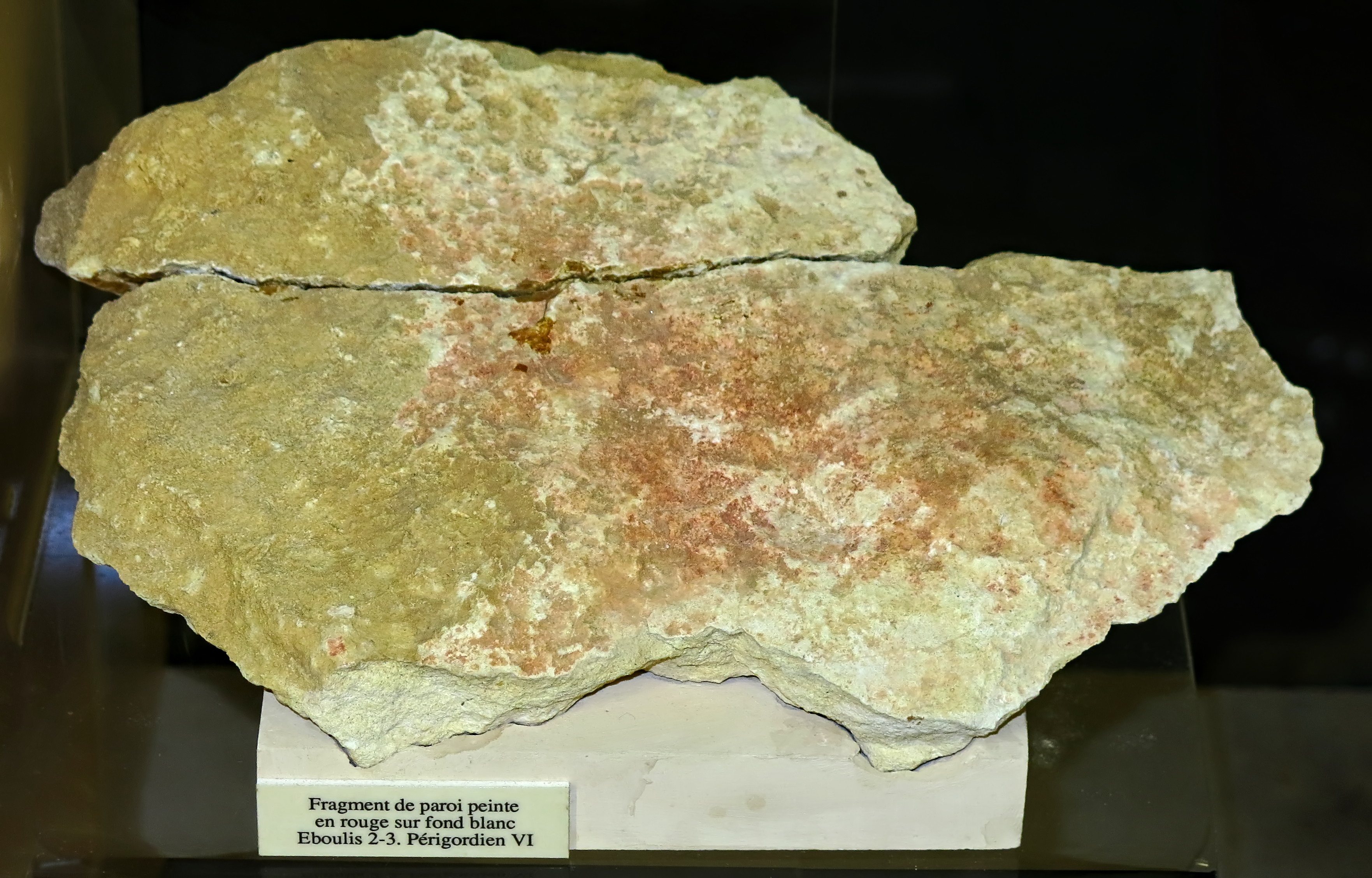
Layer 3: Upper Gravettian, Périgordian VI
Fragment of wall painted with red ochre on a white background.
Fallen stones 2-3, Périgordian VI
Photo: Don Hitchcock 2014
Source: Apparently original, Abri Pataud Museum, Les Eyzies


Layer 3: Upper Gravettian, Périgordian VI
Engraved ovals in Layer 3, Périgordien VI.
Photo: Don Hitchcock 2008
Source: Display at the Abri Pataud Museum. This appeared to be an original.
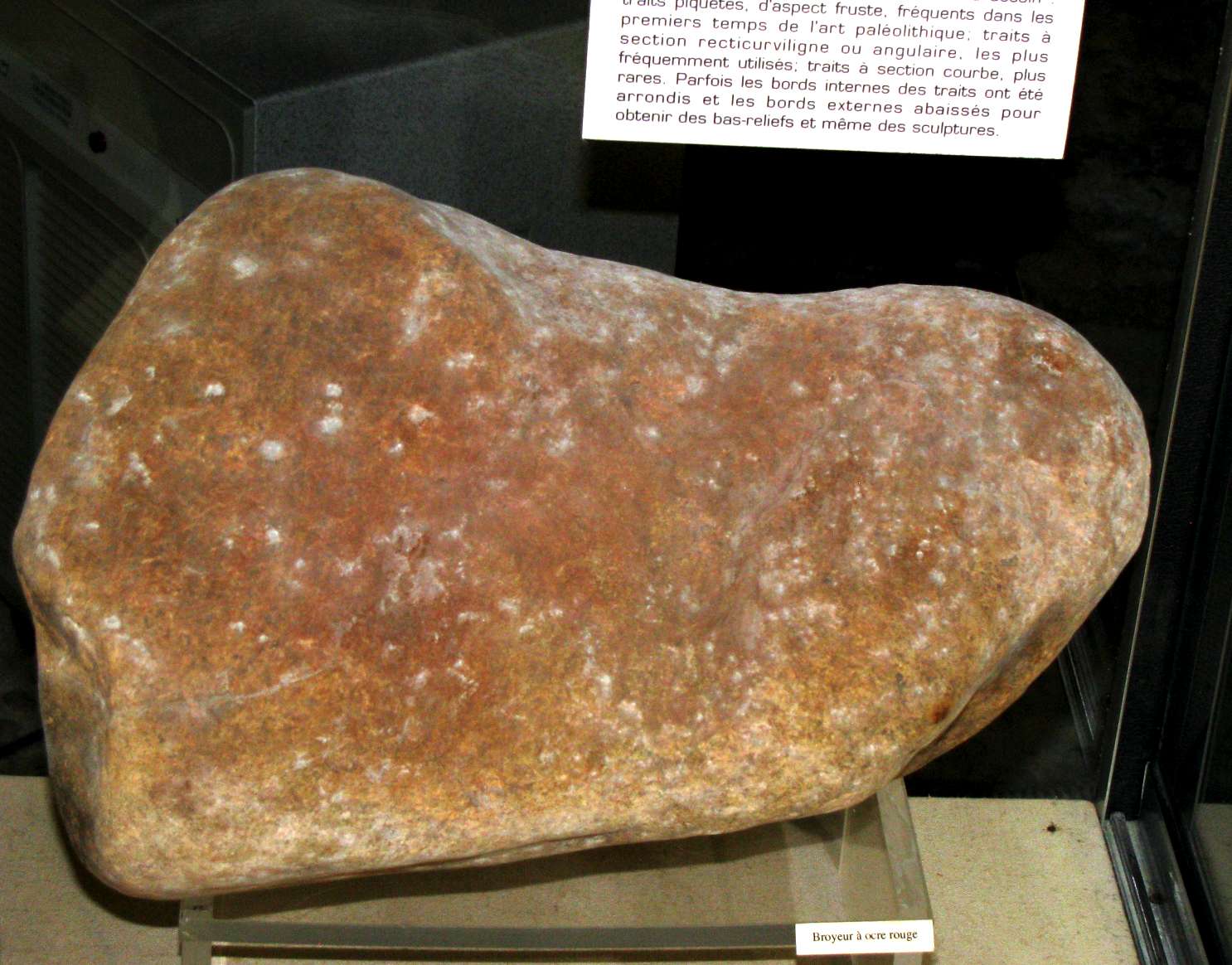
Layer 3: Upper Gravettian, Périgordian VI
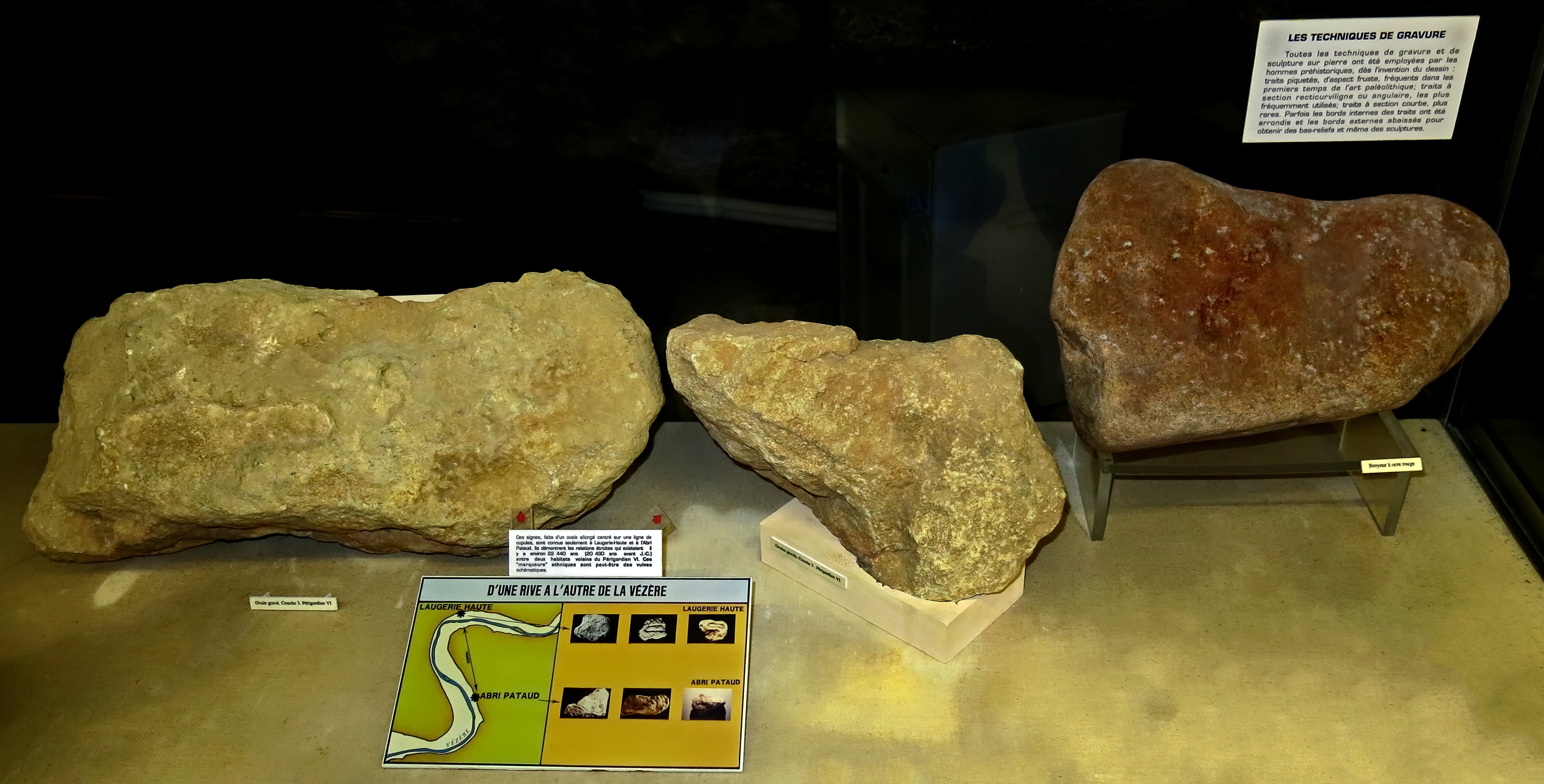
Broyeur à ocre rouge
Grindstone for red ochre.
Photo: Don Hitchcock 2008
Source: Display at the Abri Pataud Museum.
Layer 3: Upper Gravettian, Périgordian VI
These signs on the left two stones from Layer 3 are each made up of an oval centred on a line of cupules, and the signs are known only from Laugerie Haute and l'Abri Pataud. They demonstrate the close relationship that existed around 22 490 BP between these two neighbouring habitats from the Perigordian VI. These ethnic markers may be schematic vulvae.
On the right, a boulder used as a grindstone for red ochre.
Photo: Don Hitchcock 2014
Source and text: Display at Abri Pataud Museum. These appeared to be originals.

Laugerie Haute East, Perigordian engraving (vulva?).
This shows the oval signs used at Laugerie Haute Est, similar to those above at l'Abri Pataud.
Photo: Don Hitchcock 2014
Source: Original, display at Musée National de Préhistoire, Les Eyzies
Layer 3: Upper Gravettian, Périgordian VI
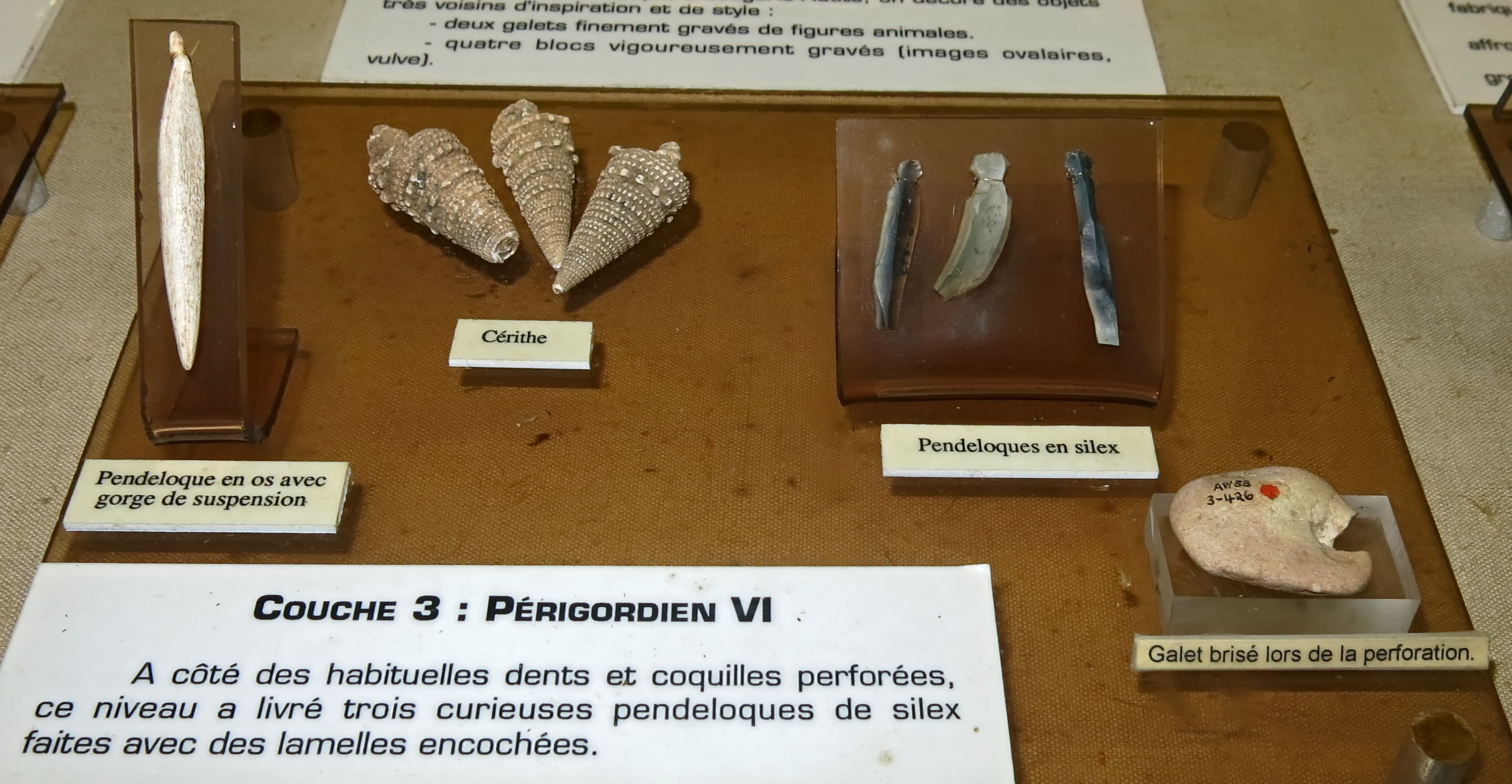
As well as the normal teeth and perforated shells, this level provided three curious flint pendants made by working notches around one end as a point of attachment.
Also included in this cabinet are a bone pendant with a very small neck worked at one end to provide a point of suspension, three fossil Cerithium shells similar to Cerithium crenatum, and a pebble with the perforation broken out from prolonged wear.
( I can't help but wonder if the flint pendants were made and worn by the master knappers at the site, as a symbol of their skills and main occupation. It seems certain that although all hunters would have had to have some proficiency in making useable tools, there would have been masters of the art who traded their superior works for other desirable items - Don )
Photo: Don Hitchcock 2014
Source: Display at Abri Pataud Museum. These appeared to be originals.
Layer 3: Upper Gravettian, Périgordian VI
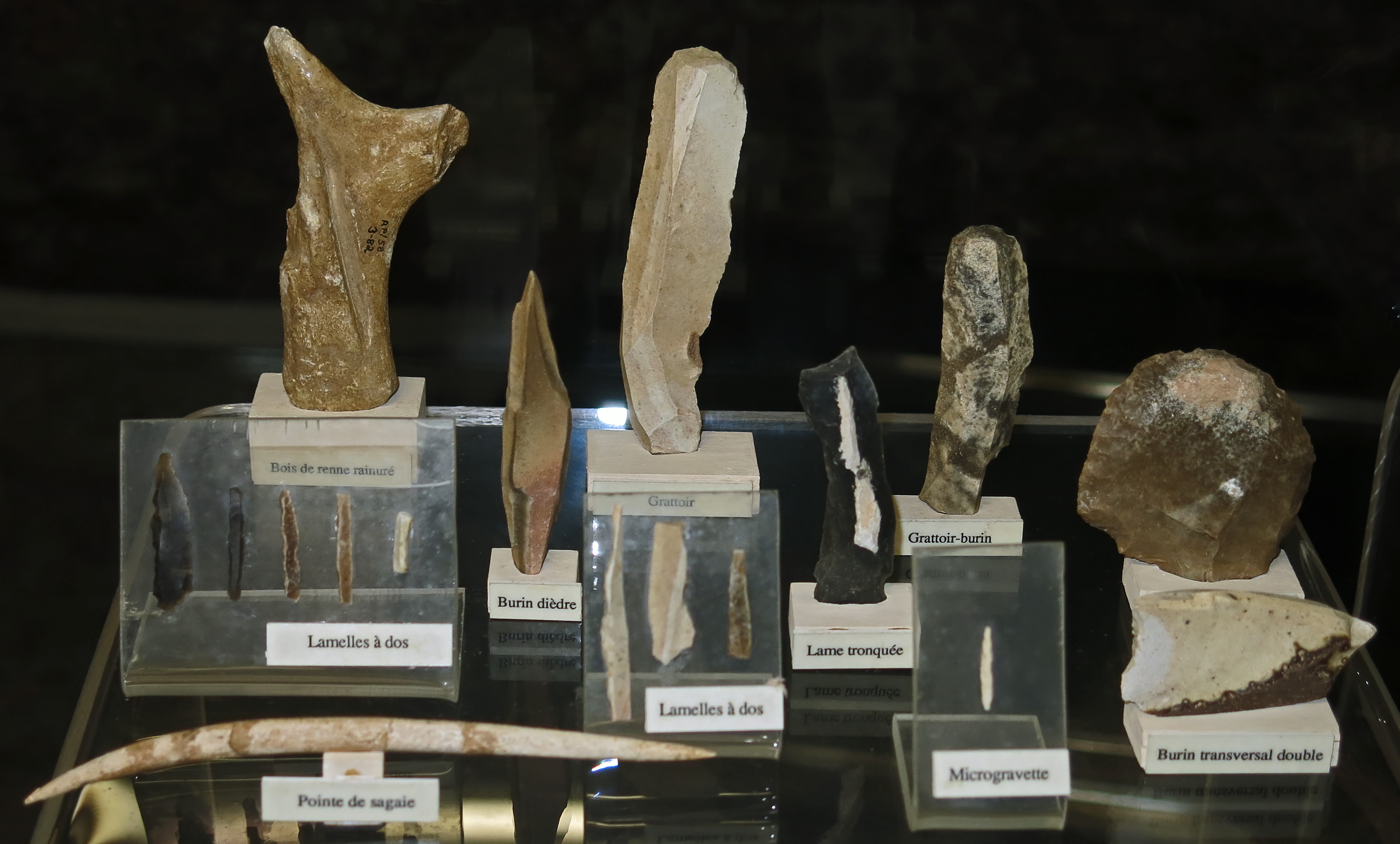
The industry of layer 3, attributed to the Périgordien VI, is characterised by an abundance of tools with abrupt retouches (31%): all the Gravettian points, but especially their miniature form, the microgravettes, constitute 20% of the stone tools. Chisels or burins are finished off with many forms of truncation.
Among scrapers, circular scrapers on flakes are well represented. The presence of small blades also characterise the industry.
Shown here are, front to back and left to right:
1. A double ended spear point, backed blades, and a grooved reindeer antler.
2. A dihedral burin.
3. Backed blades and a large end scraper.
4. A truncated blade, forming a burin.
5. A microgravette and a grattoir/burin.
6. A transverse double burin, and a large, rounded scraper.
Photo: Don Hitchcock 2014
Source and text: Display at Abri Pataud Museum.
Layer 3: Upper Gravettian, Périgordian VI
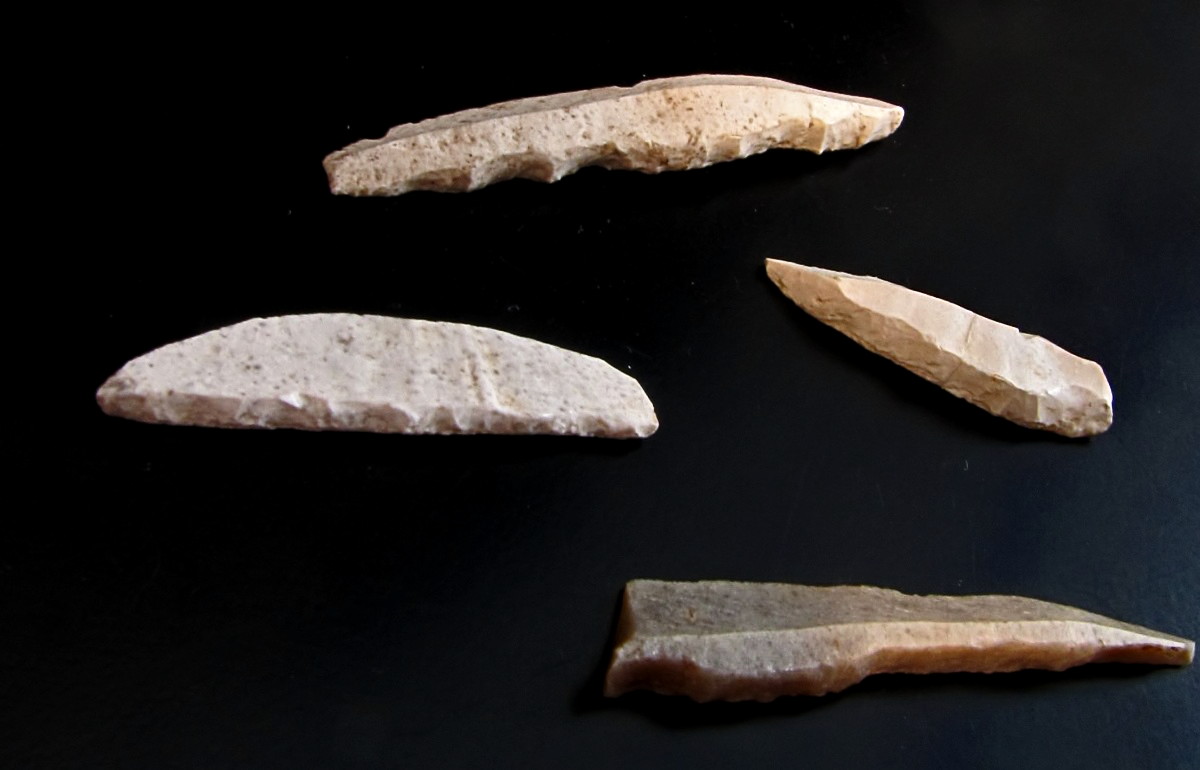
The microgravette was a characteristic tool of the Périgordien VI. It is a reduced version of the Gravettian point with a pointed tip and a straight back made with small steep or abrupt retouches.
These are some Microgravettes from the Early Gravettian at Abri Pataud.
Microgravette points are by far the most common lithic projectile points in the European Upper Paleolithic, both in time and space. They are a constitutive part of Gravettian industries from Iberia to the Urals and of the Epigravettian of South and Eastern Europe. Microgravettes in Europe are more or less continuously present over a time interval of roughly 20 000 years. Isolated findings occur during the Levantine Epipaleolithic and the Epipaleolithic of the Maghreb.
Photo and text: © Katzman
Source: http://www.aggsbach.de/2014/04/microgravettes-the-most-successful-projectile-points-of-the-paleolithic-old-world/
Layer 3: Upper Gravettian, Périgordian VI
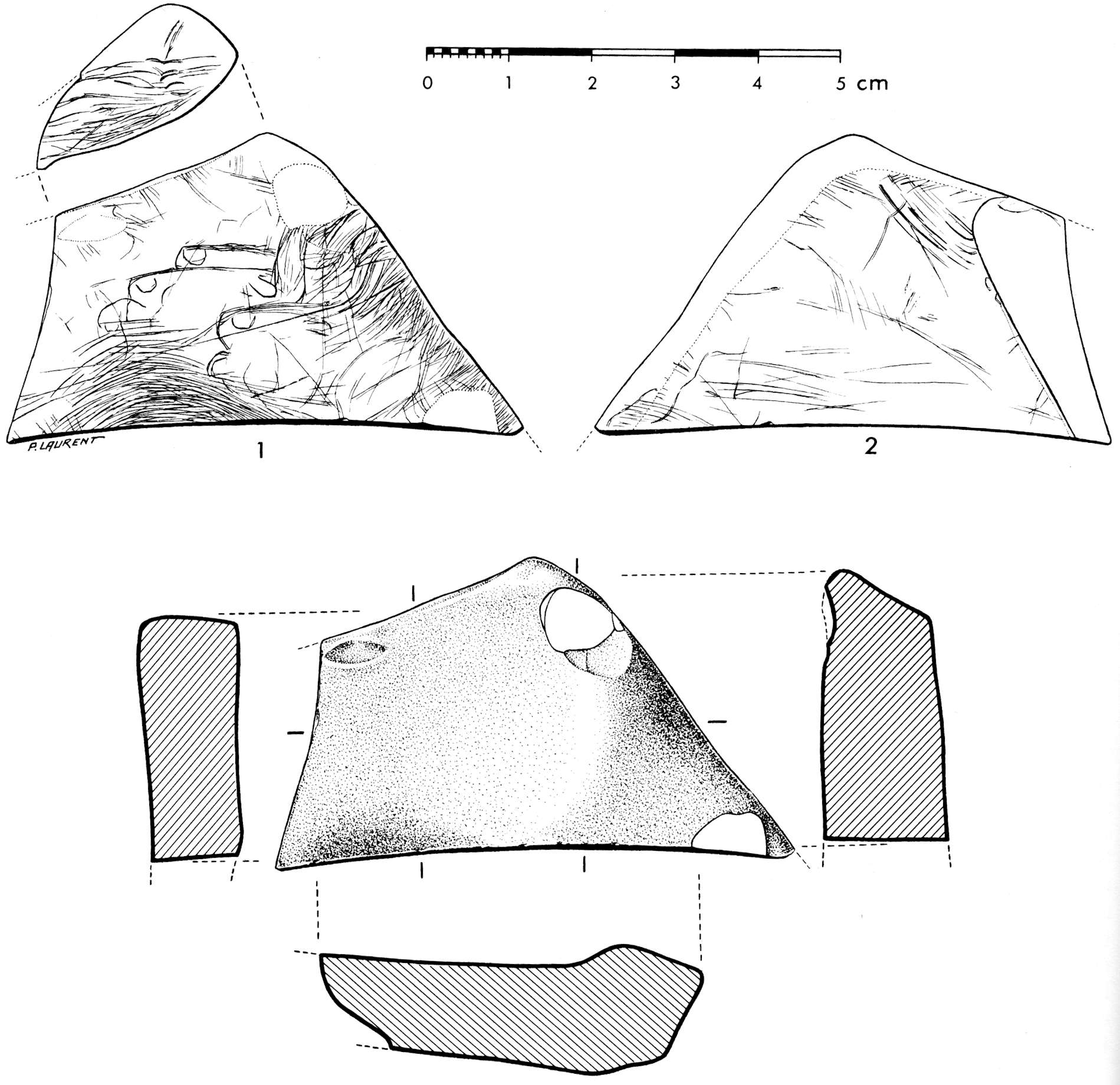
Art object, Layer 3 (1150)
1. Dolomitic limestone fragment with engravings of three bison heads - obverse (top) surface.
2. reverse (bottom) surface.
3. obverse surface showing relief and sections through the piece.
Photo and text: Movius (1977)
Layer 3: Upper Gravettian, Périgordian VI
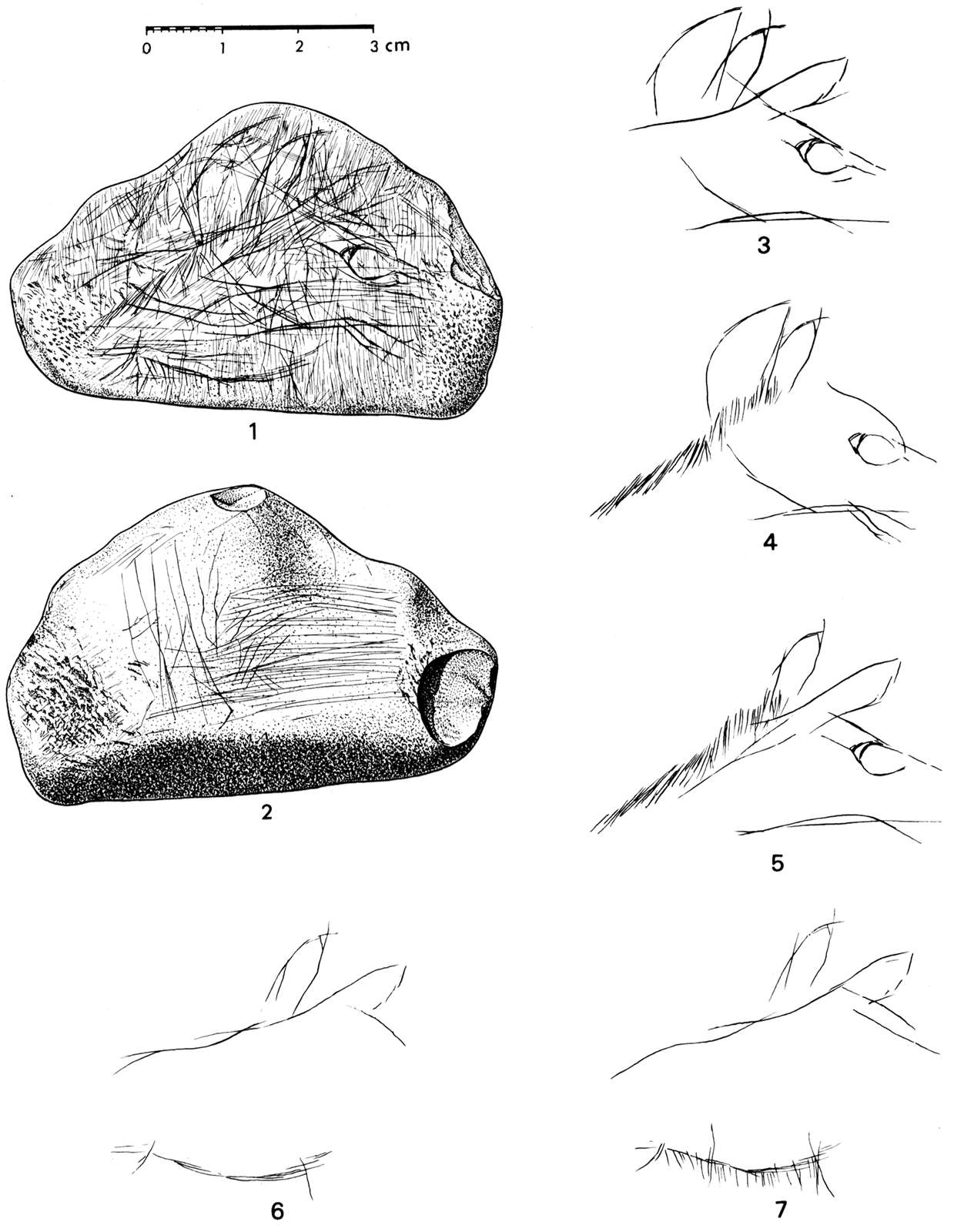
Art object, Layer 3, Cat. No. 3224, engraved limestone pebble compresseur or flaking tool.
1. obverse (top) surface of object.
2. reverse (bottom) surface of object.
A variety of interpretations (as shown on the photo) can be made of the lines engraved on this stone.
It should be noted that there were a number of slabs with painted or engraved surfaces, and in the majority of cases the slabs were found lying with the treated surface downward, close by the rear wall, amongst an almost continuous layer of slabs which had spalled off the rear wall. Thus many of the decorated slabs had originally been a part of the rear wall of the abri.
Photo and text: Movius (1977)
Layer 4
Layer 4: Middle Gravettian - Noaillian, Périgordian V

Layer 4: Middle Gravettian - Noaillian, Périgordian V
L'abri Vignaud. Slab of limestone broken off the ceiling with a 'red deer' head painted in black.
The prolongation of l'abri Pataud towards the south is called l'abri Vignaud.
Photo: Don Hitchcock 2014
Source: Apparently original, Abri Pataud Museum, Les Eyzies
Layer 4: Middle Gravettian - Noaillian, Périgordian V
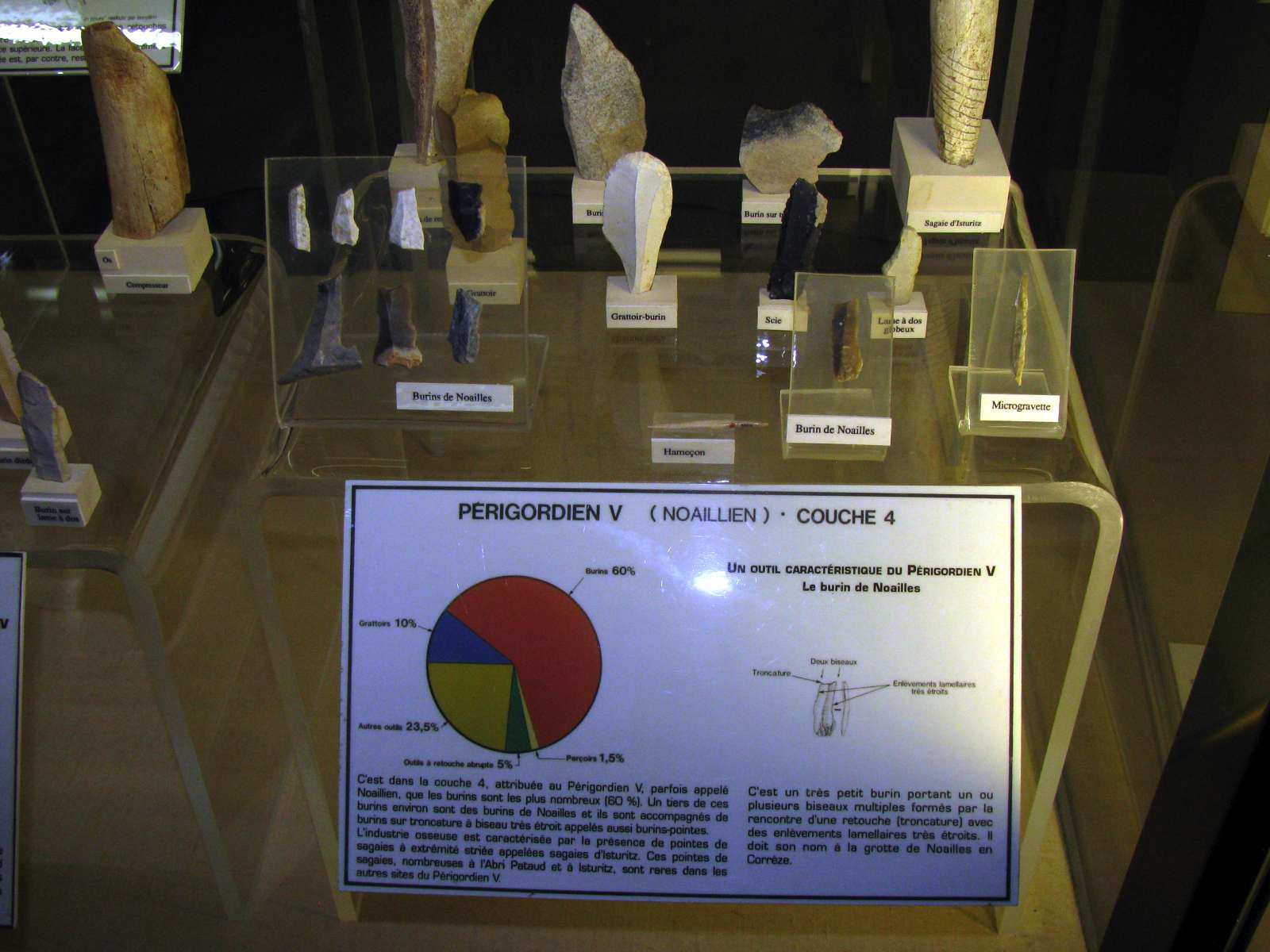
It is in layer 4 that chisels are the most numerous (60%). About one third of these chisels are chisels of the Noailles type and include chisels truncated on a very narrow bevel, also called spikes. The bone industry is characterised by the presence of spear points with grooved ends called Isturitz spears. These spear points, although numerous at l'Abri Pataud and at Isturitz are rare in other Périgordien V sites.
Photo: Don Hitchcock 2008
Source: Display at Abri Pataud Museum. These appeared to be originals.
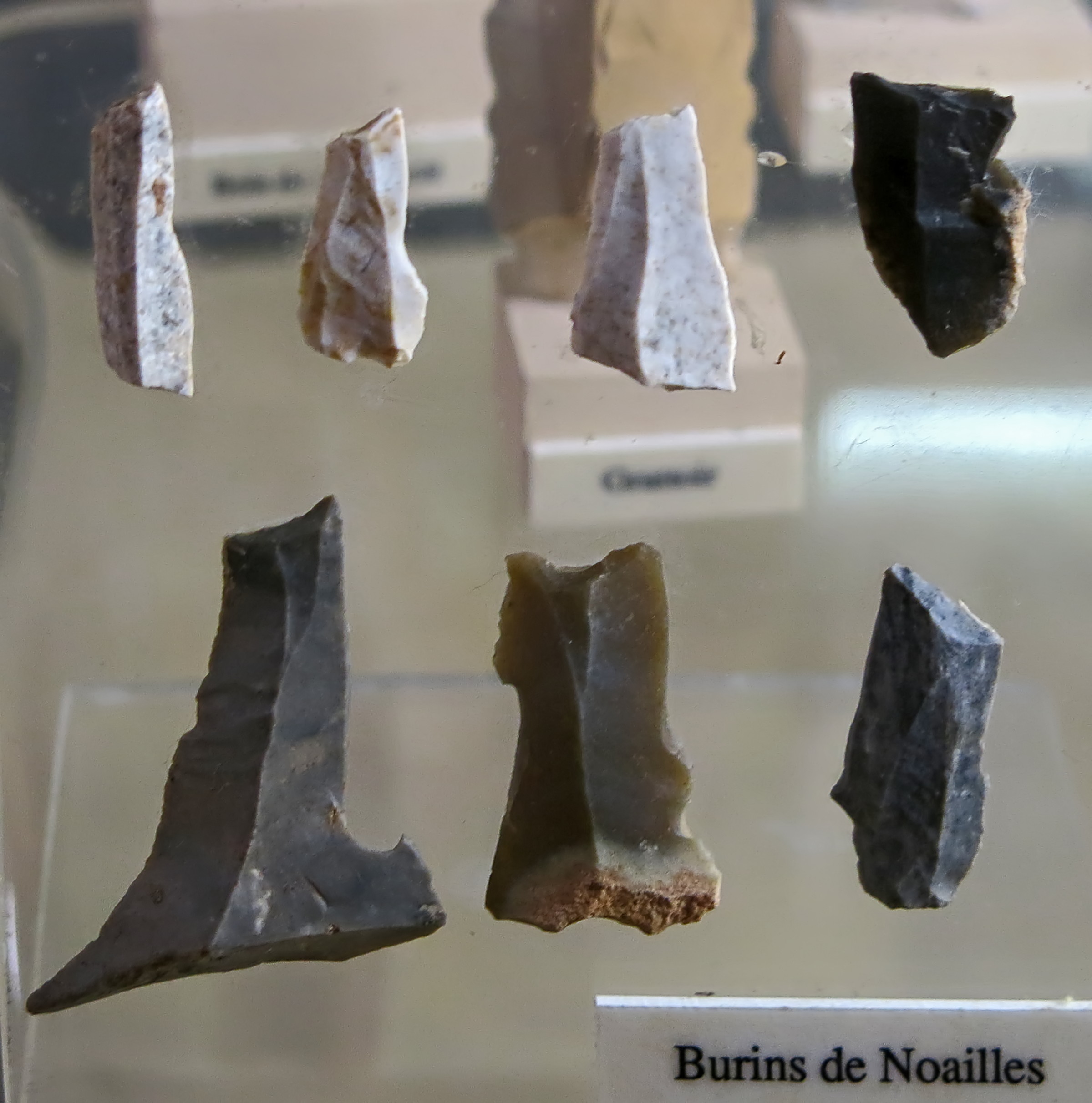
Layer 4: Middle Gravettian - Noaillian, Périgordian V
A characteristic and distinguishing tool of the Périgordien V is the Noailles burin. It is a very small burin with multiple bevels. It is a flake tool retouched to give several chisel-like edges. It owes its name to the Grotte de Noailles in the commune of Brive-la-Gaillarde, Corrèze, in southwestern France.
The Noailles burin is characteristic of the Gravettian, circa 28 000 BP - 23 000 BP. These tools have been retouched to give several chisel like edges and a blunt, grippable rear edge.
Photo: Don Hitchcock 2014
Source: Display at Abri Pataud Museum, apparently original.
Additional text: Wikipedia
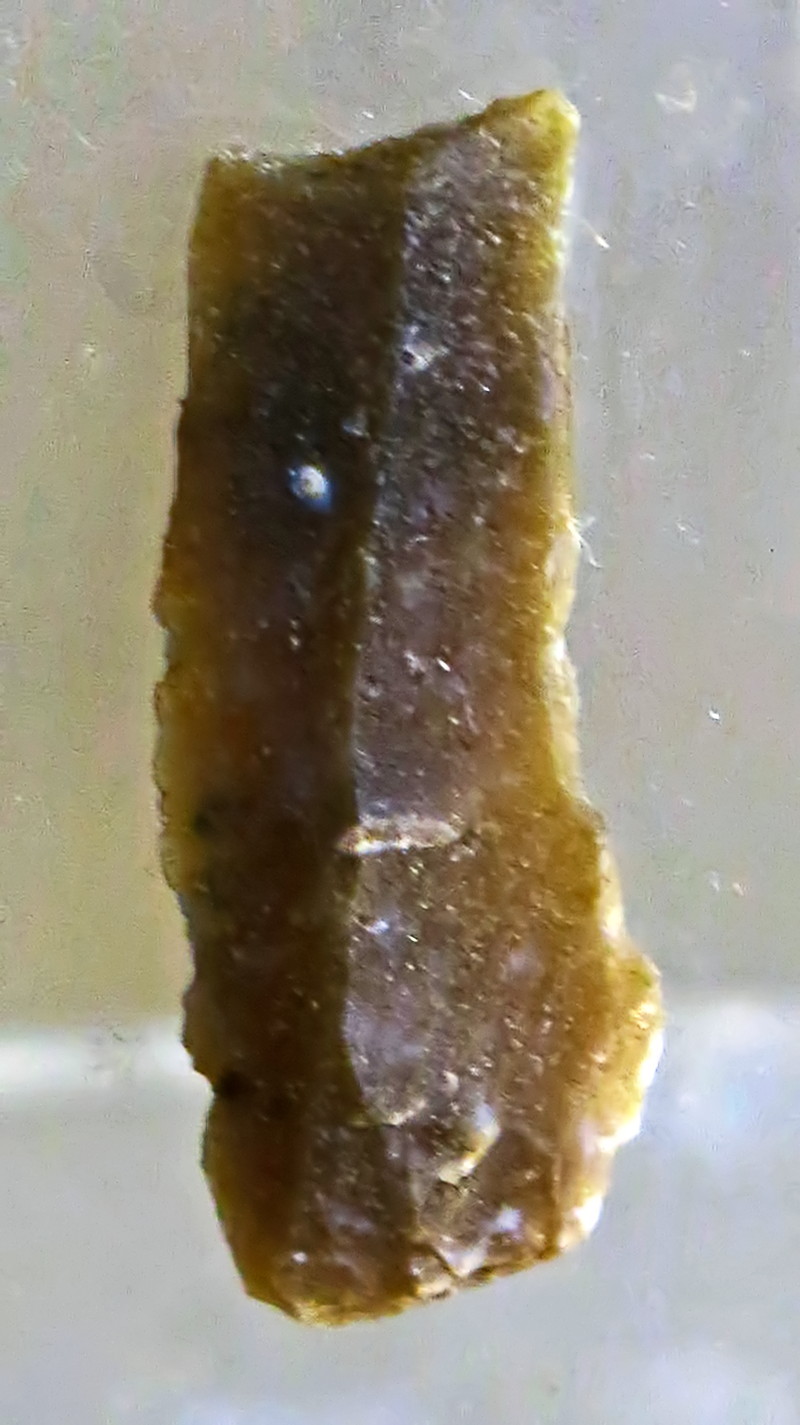
Layer 4: Middle Gravettian - Noaillian, Périgordian V
Noailles burin.
Photo: Don Hitchcock 2014
Source: Display at Abri Pataud Museum, apparently original.
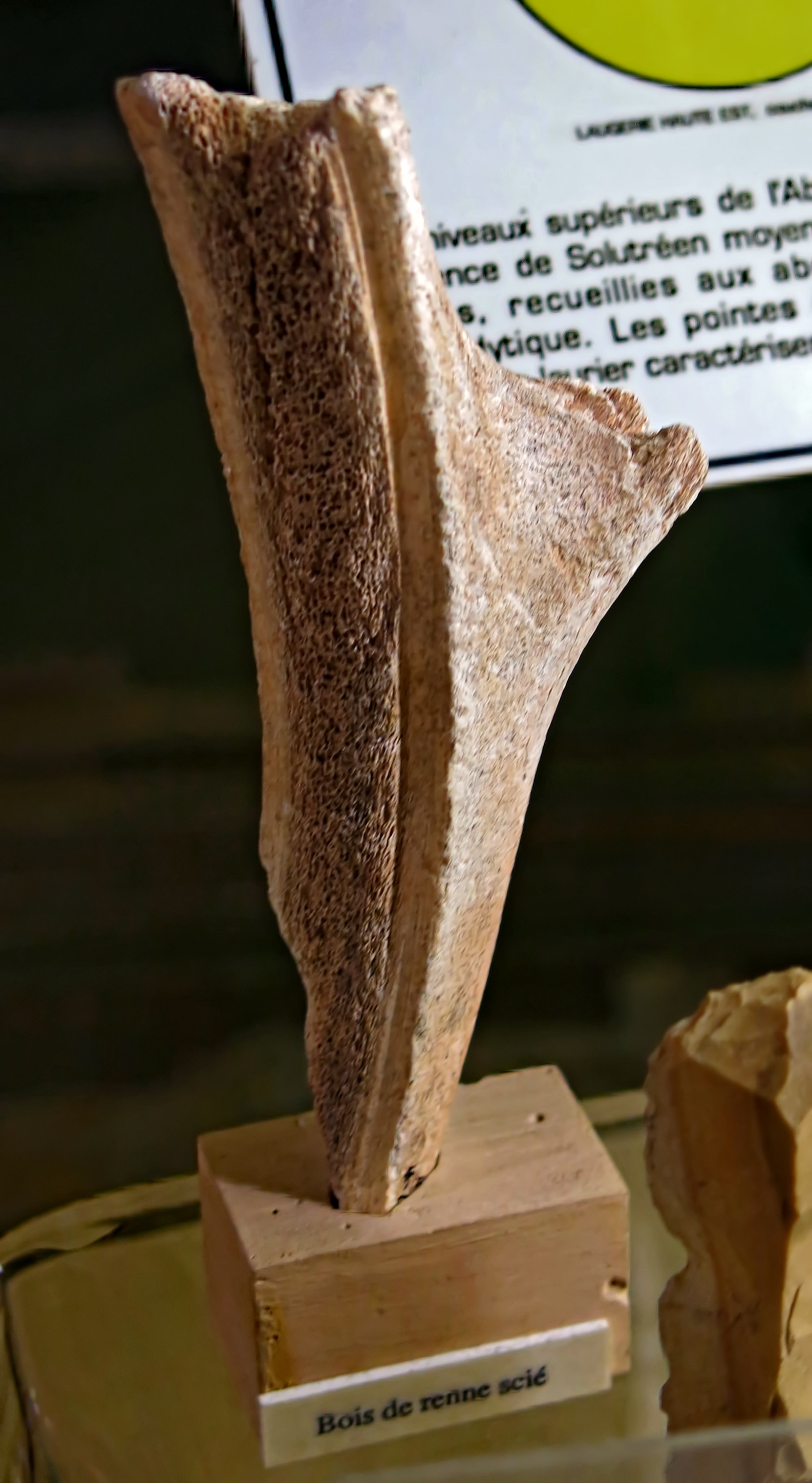
Layer 4: Middle Gravettian - Noaillian, Périgordian V
Although labelled as sawn, this reindeer antler appears to have had a long strip of antler removed from it by a thin burin.
The burin was used to create two grooves set at an angle, resulting in a 'v' shaped, thin rod of antler removed from the main substrate.
Photo: Don Hitchcock 2014
Source: Display at Abri Pataud Museum, apparently original.

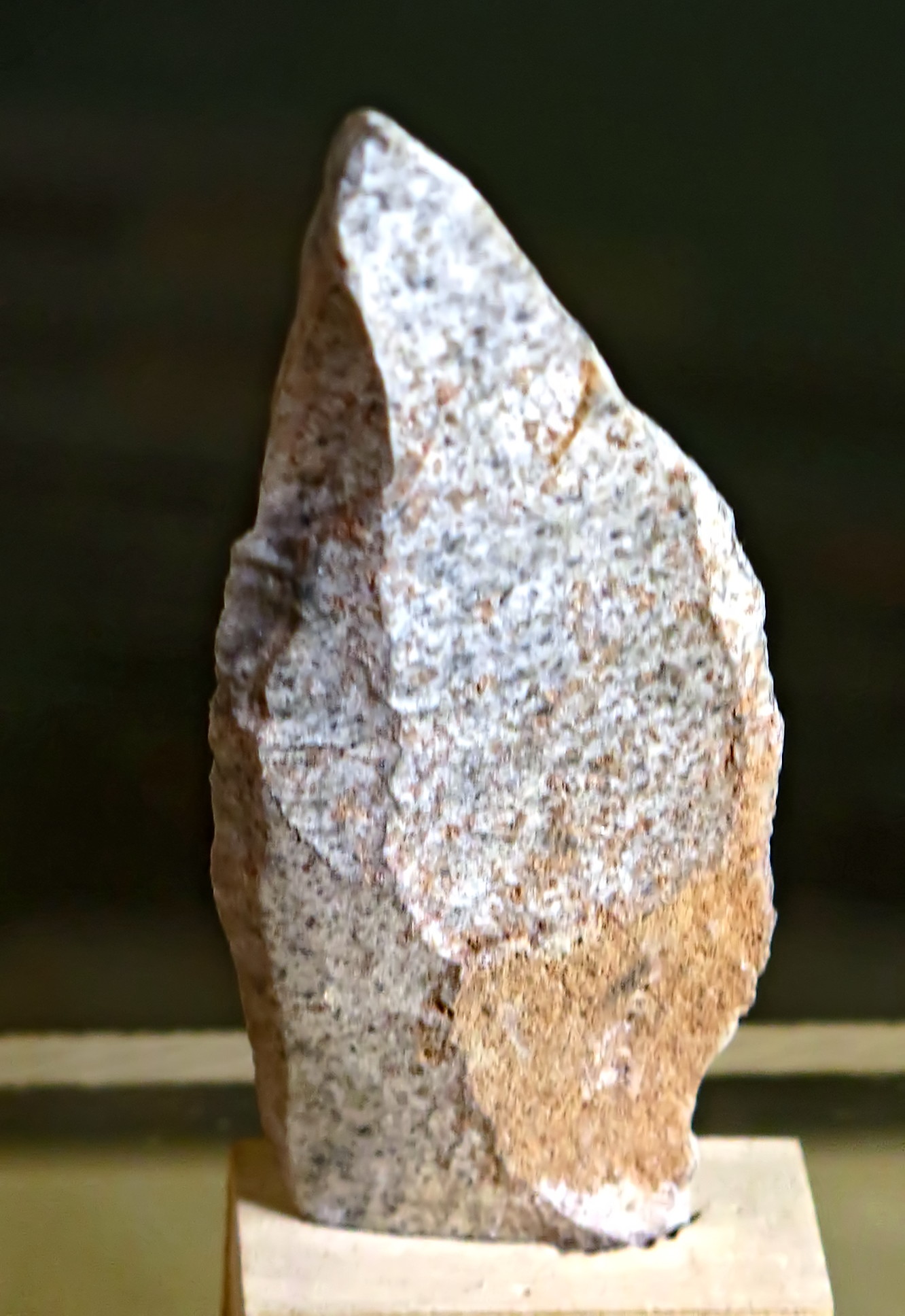
Layer 4: Middle Gravettian - Noaillian, Périgordian V
(left) Burin on a truncation.
(right) Dihedral burin.
Photo: Don Hitchcock 2014
Source: Display at Abri Pataud Museum, apparently original.
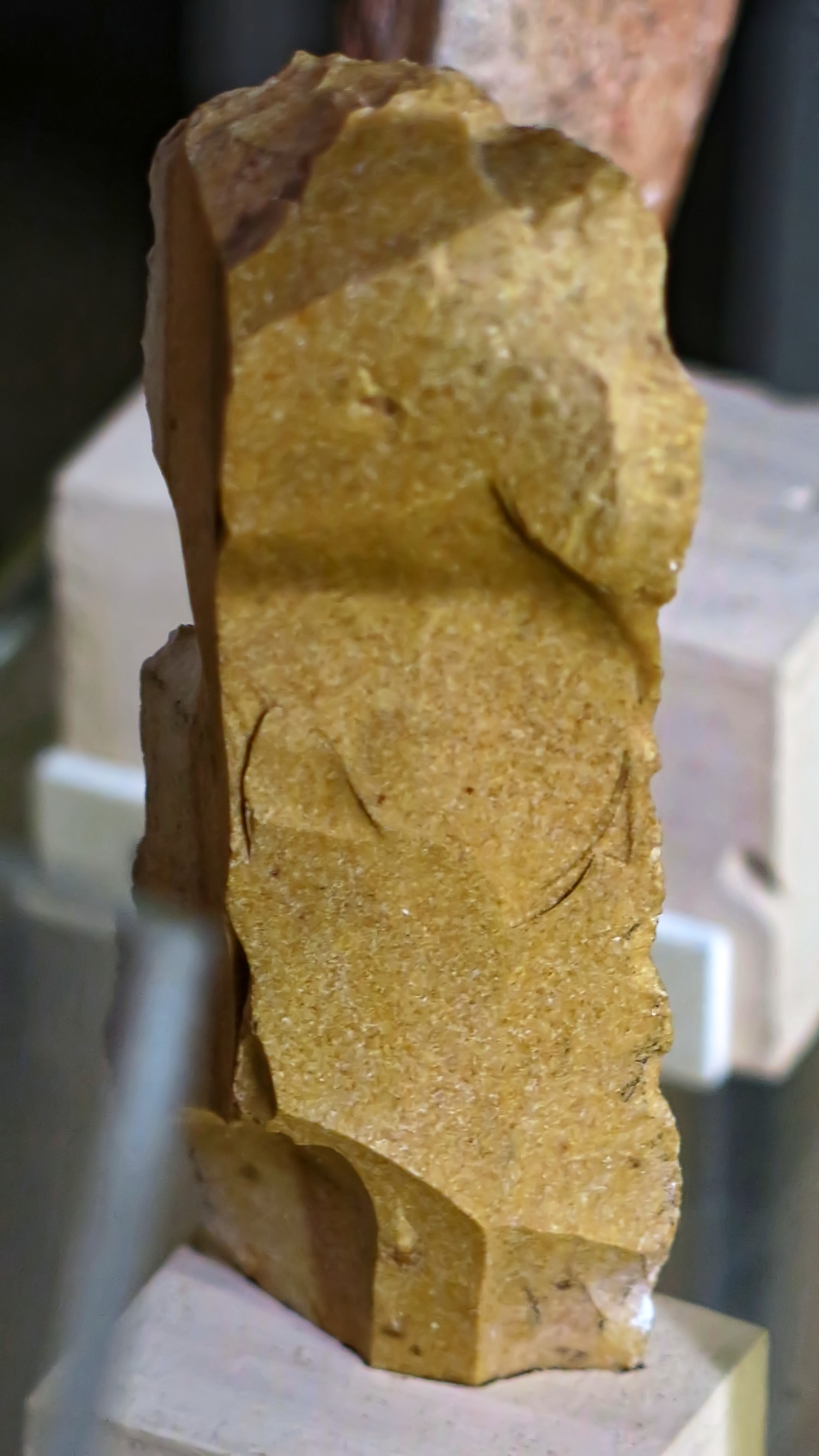
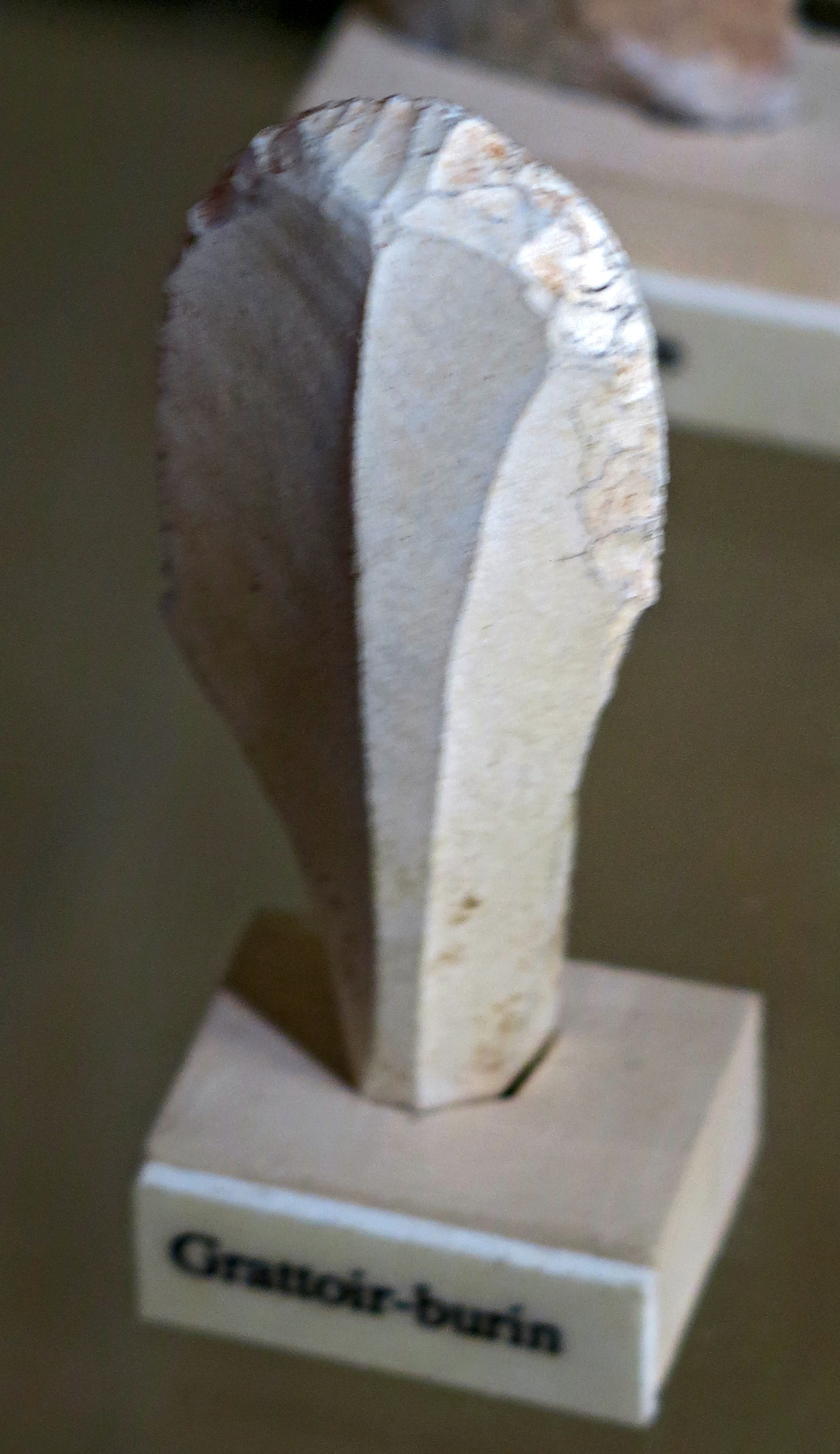
Layer 4: Middle Gravettian - Noaillian, Périgordian V
(left) Grattoir.
(right) Grattoir-burin. ( note that the burin part of this multiple tool is hidden in the base used by the museum - Don )
Photo: Don Hitchcock 2014
Source: Display at Abri Pataud Museum, apparently original.

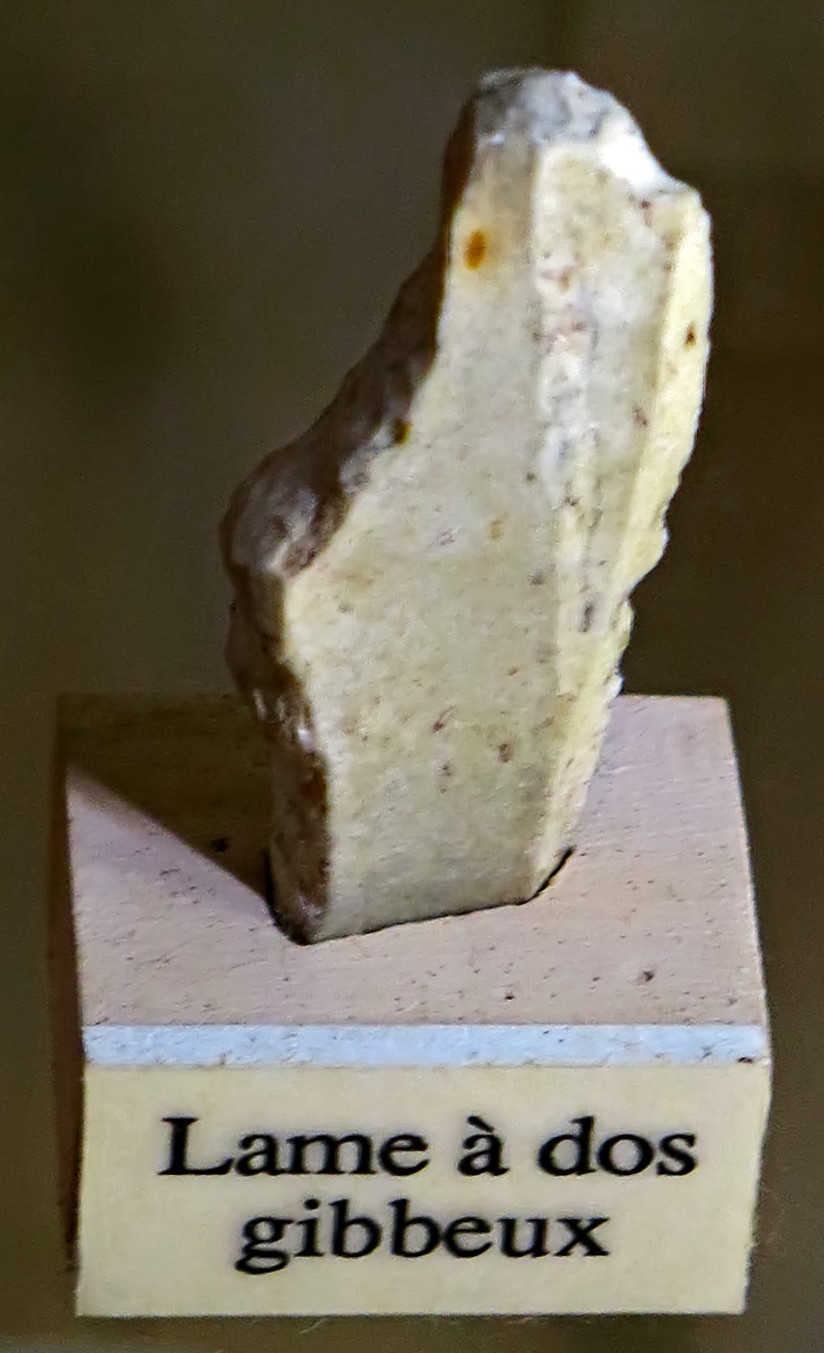
Layer 4: Middle Gravettian - Noaillian, Périgordian V
(left) Saw. ( note that saws are rare in the lists of common tools of the Palaeolithic - Don )
(right) Gibbous or hunchbacked blade.
Photo: Don Hitchcock 2014
Source: Display at Abri Pataud Museum, apparently original.
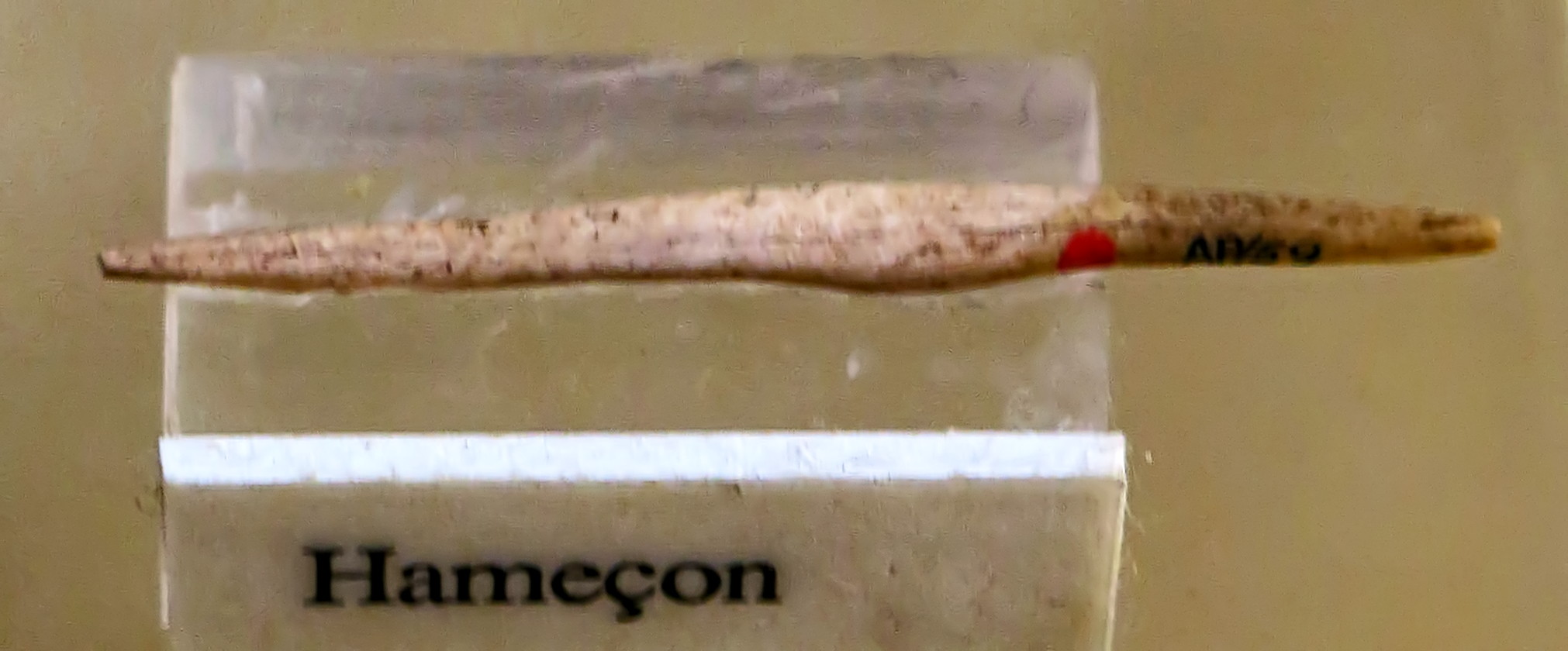
Layer 4: Middle Gravettian - Noaillian, Périgordian V
While this is labelled as a fish hook, it looks more like a gorge.
The fishing line would have been attached tightly on either side of the bulge in the middle, and bait put on one or both ends. When the angler pulls on the line, after the fish has swallowed the bait, the gorge turns sideways, and sticks in the throat of the fish.
Gorges work fairly well, are much easier to make, can be of inferior materials such as thin wood, yet are inherently stronger than fish hooks.
Photo: Don Hitchcock 2014
Source: Display at Abri Pataud Museum, apparently original.
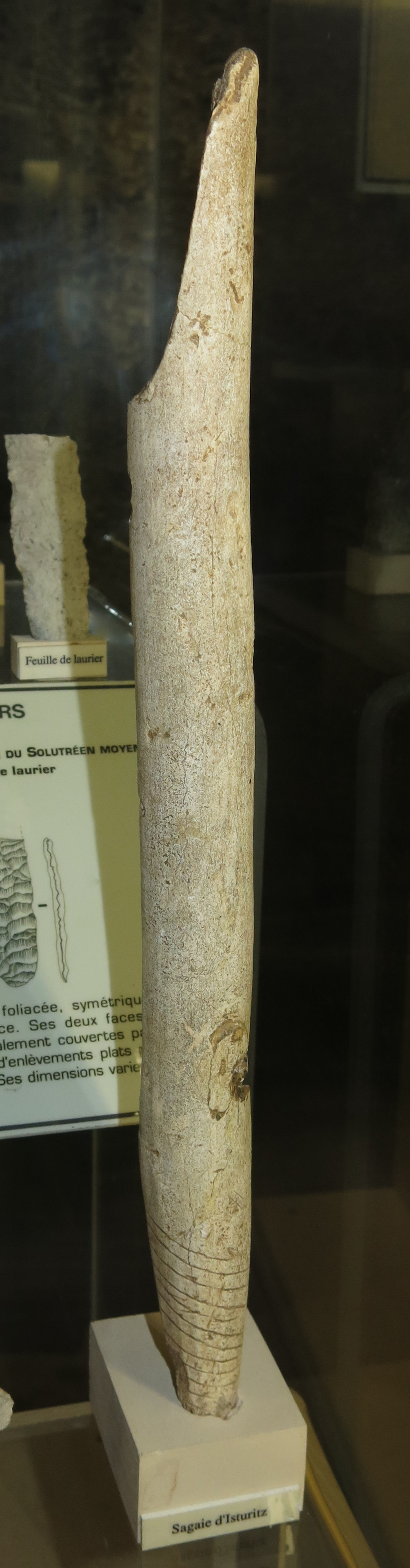
Layer 4: Middle Gravettian - Noaillian, Périgordian V
'Isturitz' spear.
The engraved lines on the base of the spear were presumably to secure it with glue into a shaft. This spear appears to have been made for large game.
The point has been broken off. Broken points like this are common in dwelling sites, since they are broken when used on a hunt, often when the spear misses its mark, and the shaft and now useless spear point are brought home for the spear point to be removed and a new one put in its place on the valuable shaft when time and opportunity allows.
Photo: Don Hitchcock 2014
Source: Display at Abri Pataud Museum. This appeared to be an original.
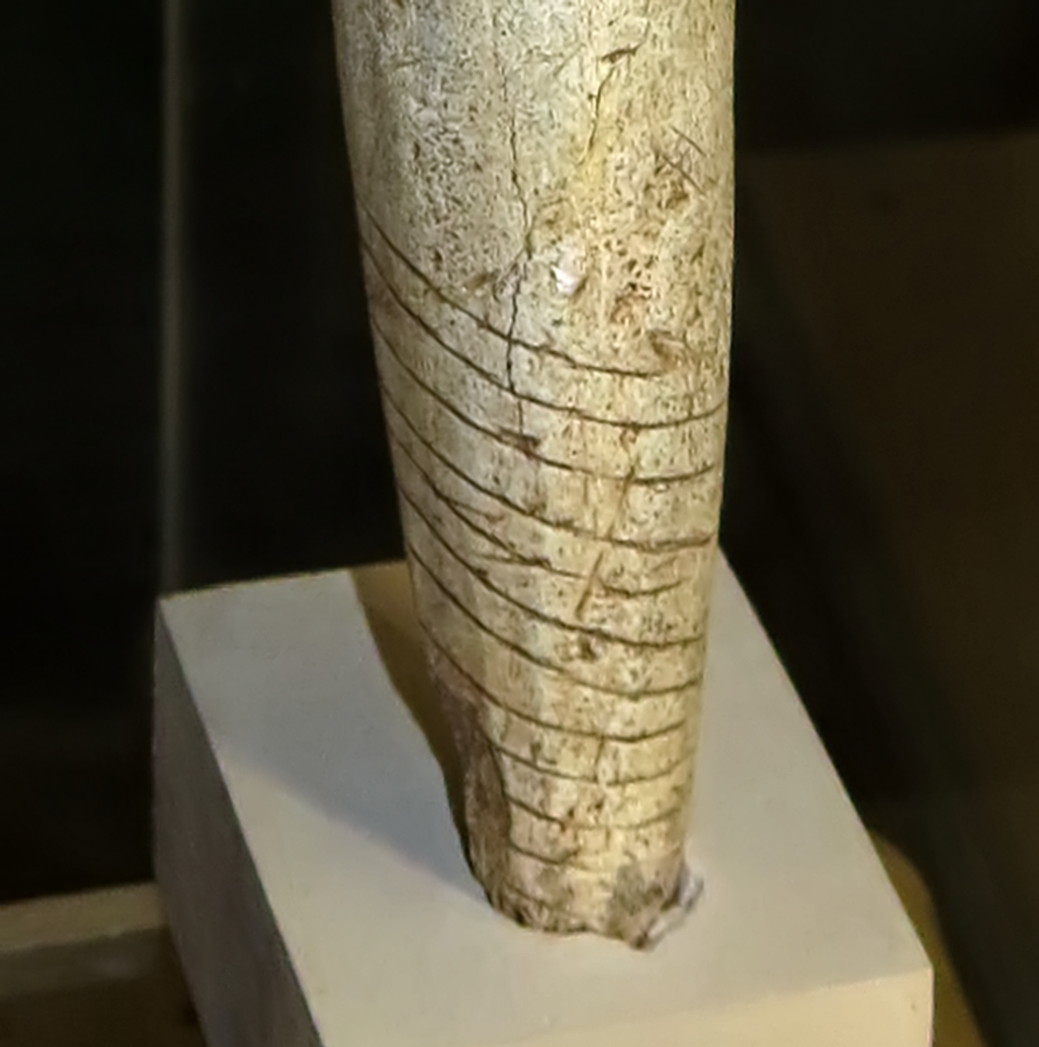
Layer 4: Middle Gravettian - Noaillian, Périgordian V
Close up of the Sagaie d'Isturitz or Isturitz spear, showing the semi-helical grooves roughly cut into the base of the spear, presumably to aid adhesion of birch bark glue when the spear head was glued and tied into a socket on a wooden spear shaft, using animal sinew.
Photo: Don Hitchcock 2014
Source: Display at Abri Pataud Museum. This appeared to be an original.
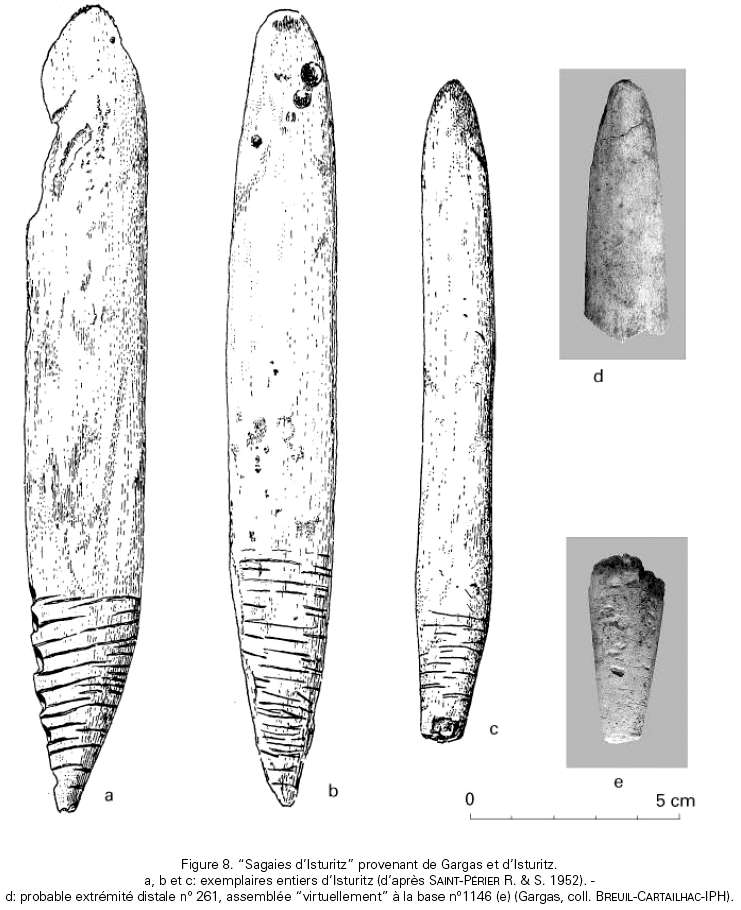
'Isturitz' spears from Gargas and Isturitz.
a, b and c are examples from Isturitz, after SAINT-PÉRIER R.&S., 1952
d is the distal end of No. 261 assembled with the base of No. 1146 from Gargas, coll.BREUIL-CARTAILHAC-IPH.
Original Source for the sketch:
SAINT-PÉRIER, R. & S. de 1952 La grotte d’Isturitz: les Solutréens, les Aurignaciens et les
Moustériens. Paris : Masson, 264 p., 135 fig., XI pl. h.-t.
(Archives de l’Institut de Paléontologie humaine: mémoire n°25)
Reprinted in: Gargas et l’Atlantique: les relations transpyrénéennes au cours du Gravettien, Munibe 57, 2005
by Pascal Foucher
( note: these objects, "Sagaies d’Isturitz", could only have been used on a thrusting spear, one which was not thrown but used in close up work, possibly with an animal which had been wounded, not on a lightweight 'dart' which was thrown with an atlatl. Some smaller versions, without the semi-helical attachment grooves, may however have been retouchers - Don )
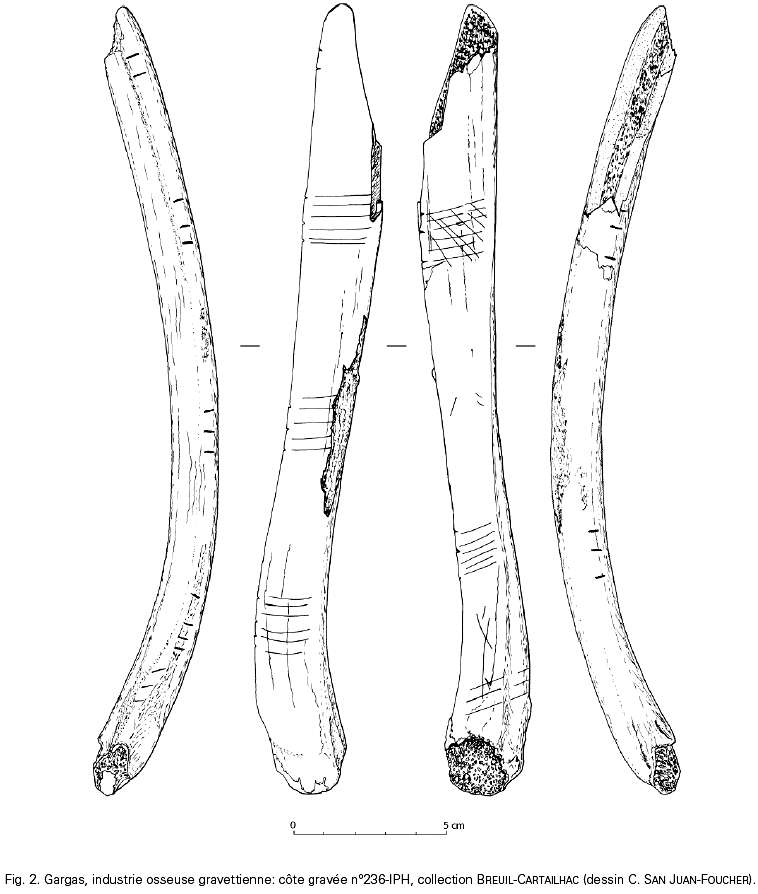
The caption reads:
Fig. 2. Gargas, industrie osseuse gravettienne: côte gravée n°236-IPH, collection BREUIL-CARTAILHAC (dessin C. SANJUAN-FOUCHER).
Gargas bone industry, a decorated rib.
It was described by Breuil & Cheynier (1958) as "a large curved piece, rounded at the end, which had been used as a retoucher. It is the left rear rib of either Aurochs or Bison"
Photo: San Juan-Foucher (2005)

Layer 4: Middle Gravettian - Noaillian, Périgordian V
This layer was particularly rich in beads and pendants of all kinds.
A small elongated pebble has been worked with an annular groove for suspension from a cord. It is phallus shaped. This group includes the elongated pebble, the pierced premolar of a wolf, an engraved pebble, a perforated fox canine tooth, perforated fossil ammonite shells, and the incisor of a bovid, engraved and perforated.
( Also included here are some polished pebbles. These have been polished by humans rather than just in a stream bed, possibly using very fine quartz sand followed by red ochre or even pure haematite, now known as jeweller's rouge. What is uncertain is the method used to complete the polishing. Were they polished by hand, or were they, perhaps, simply put in a leather bag with haematite on the waist band of the hunters and collectors, and polished by their movement as they went about their daily tasks over many months? - Don )
Photo: Don Hitchcock 2014
Source: Display at Abri Pataud Museum. These appeared to be originals.

Layer 4: Middle Gravettian - Noaillian, Périgordian V
and Layer 5: Lower Gravettian, Périgordian IV
Colouring materials such as ochre and kaolin (white clay) and black manganese dioxide were used for wall paintings (though none have been found at l'abri Pataud) and, it is thought, personal markings on the skin.
In addition, manganese dioxide is a fire accelerant, either as a catalyst or an oxidant, and was a useful aid to getting a fire started when the powder was sprinkled on tinder.
Photo: Don Hitchcock 2014
Source and text: Display at the Abri Pataud Museum.
Layer 5
Layer 5: Lower Gravettian, Périgordian IV
Layer 5: Lower Gravettian, Périgordian IV
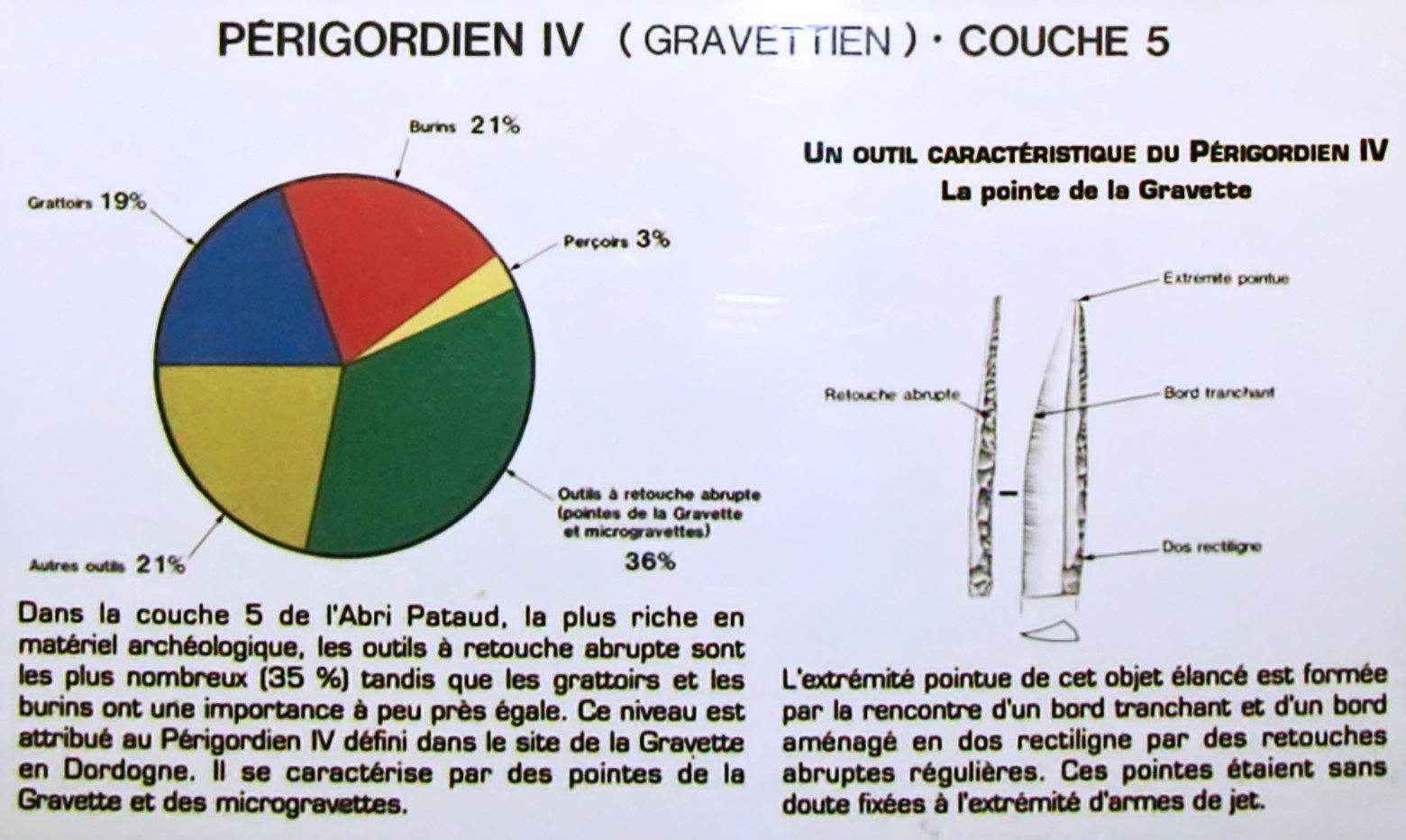
In layer 5 of the Shelter Pataud, the richest in archaeological material at Abri Pataud, abruptly retouched tools are most numerous (35%) while scrapers and chisels are of roughly equal importance in numbers. This level is attributed to the Périgordien IV with the type site the La Gravette site of the Dordogne, dating from between 28 000 and 22 000 BP. It succeeded the Aurignacian.
It is characterised by Gravettian points and microgravettes.
Photo: Don Hitchcock 2014
Source: Display at Abri Pataud Museum. .
Layer 5: Lower Gravettian, Périgordian IV
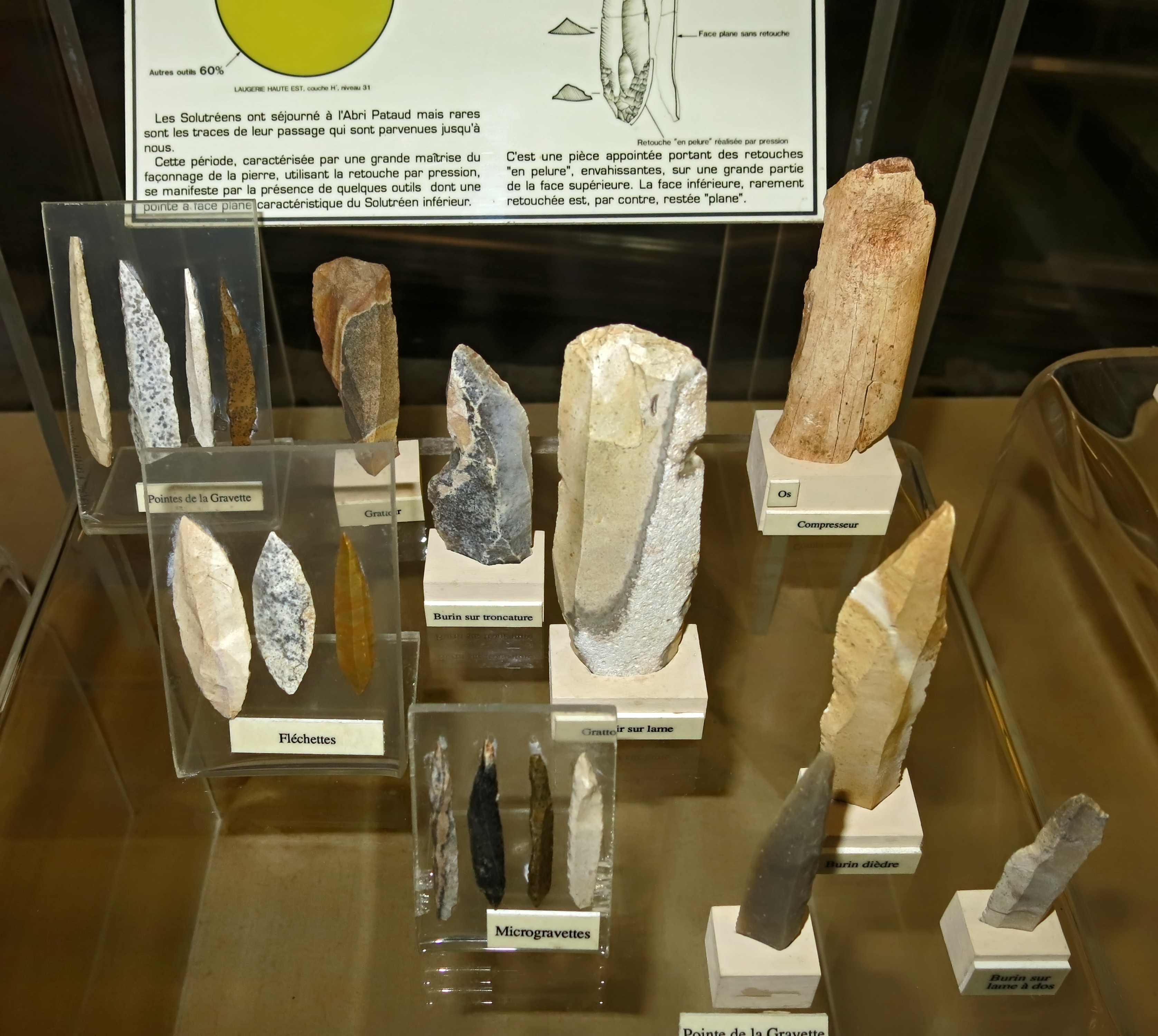
These tools are from the Gravettian, which followed the Aurignacian.
The Perigordian IV corresponds to the Gravettian.
Photo: Don Hitchcock 2014
Source: Display at Abri Pataud Museum. These appeared to be original.

Layer 5: Lower Gravettian, Périgordian IV
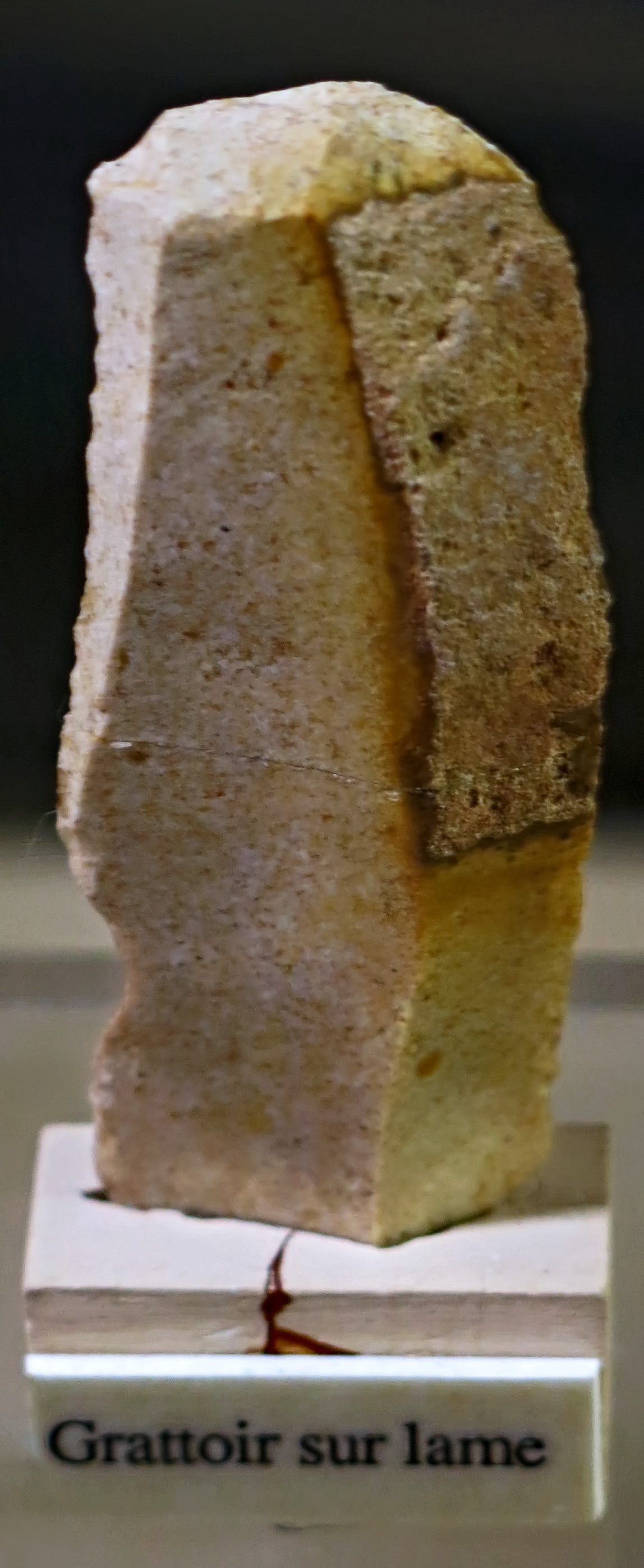
(left and right) Grattoirs sur Lames - scrapers on blades.
Photo: Don Hitchcock 2014
Source: Display at Abri Pataud Museum. These appeared to be original.
Layer 5: Lower Gravettian, Périgordian IV
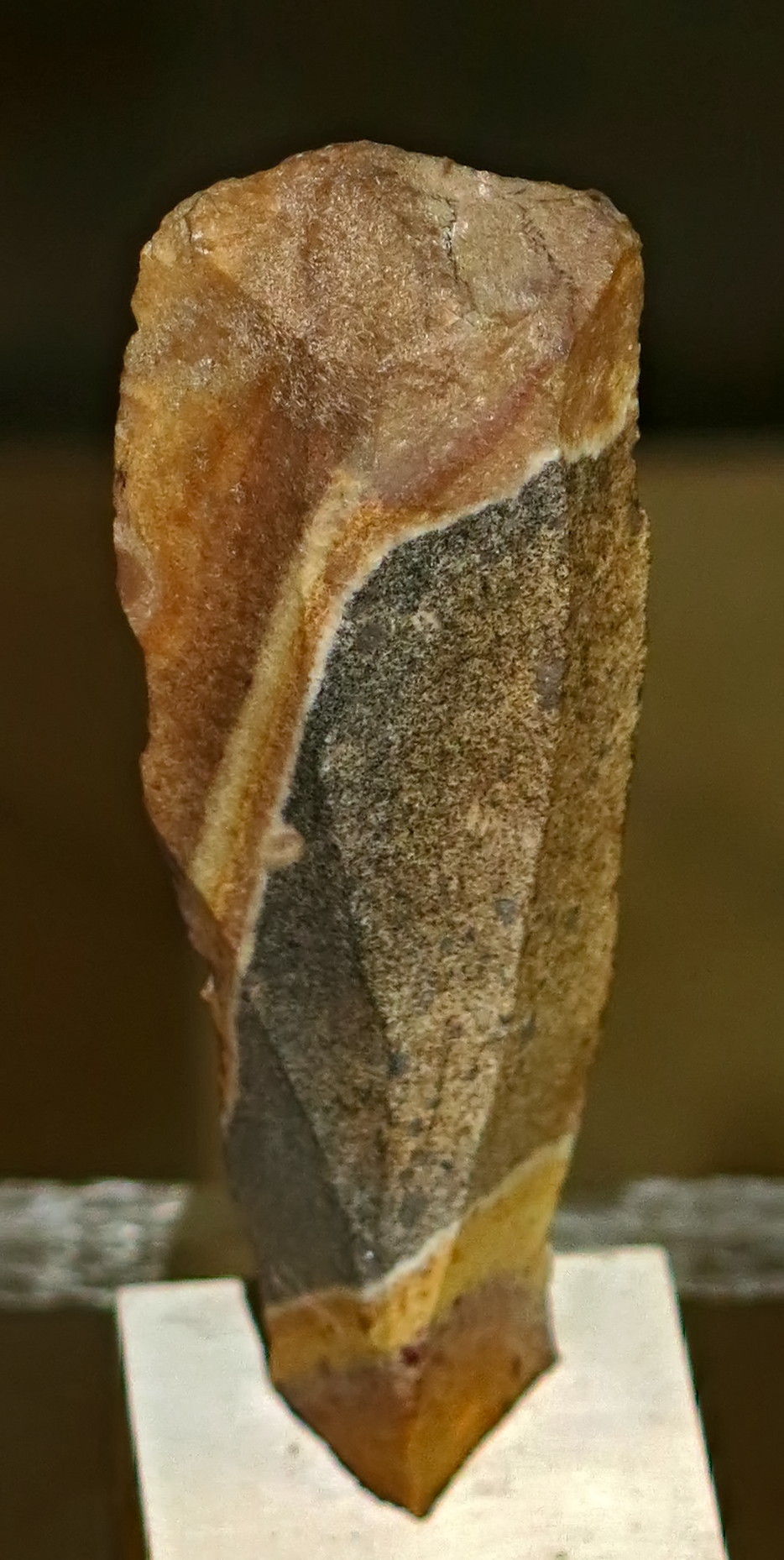
Grattoir on a rather thick flake, but with particularly attractive colour variations.
Photo: Don Hitchcock 2014
Source: Display at Abri Pataud Museum. This appeared to be original.
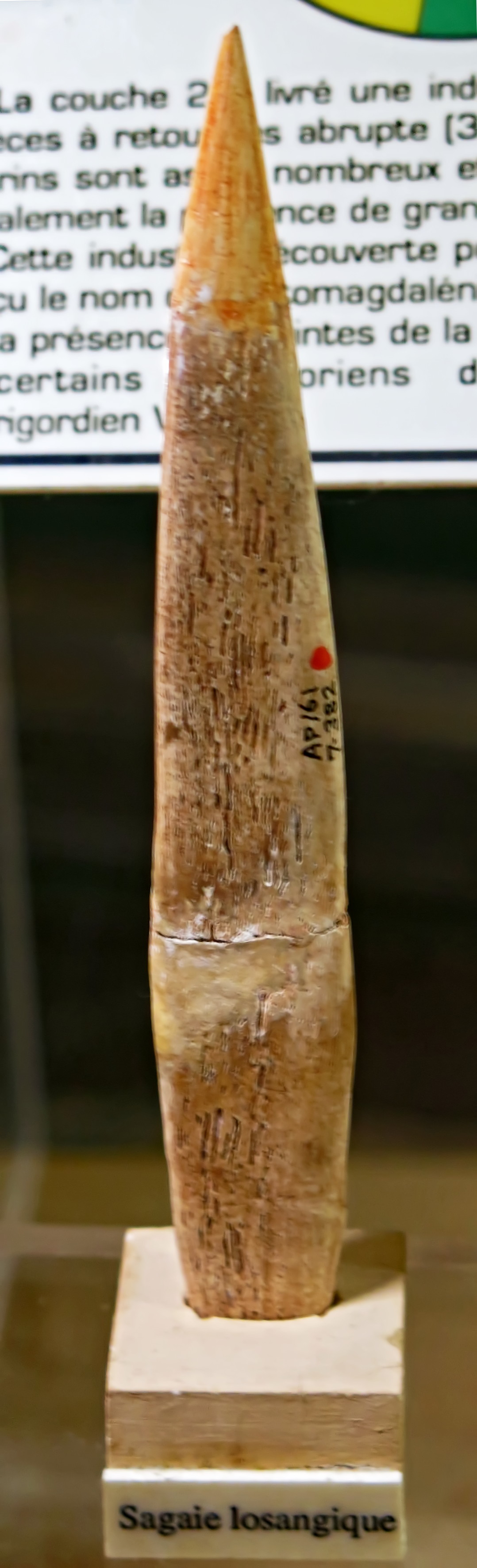
Layer 5: Lower Gravettian, Périgordian IV
Lozenge or diamond shaped spear point.
While this appeared to be, for the most part, original, it had been broken in antiquity, and has been repaired.
As is usual and standard practice in museum displays, the repairs are in a different texture and colour to the original in order to clearly distinguish the original and the repair. In this case, the point appears to have been lost as well, and has been refabricated, as shown by the smooth texture and different colour.
Photo: Don Hitchcock 2014
Source: Display at Abri Pataud Museum.
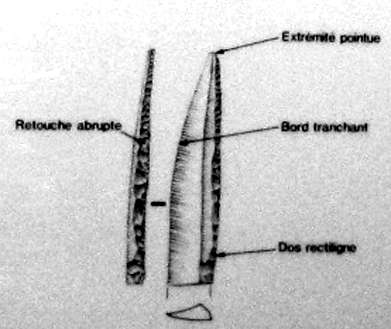
Layer 5: Lower Gravettian, Périgordian IV
A characteristic tool of the Perigordian IV - the Gravettian point. The pointed tip of this slender object is formed by the meeting of two edges with steep retouches on the back edge. It is a small pointed blade with a blunt but straight back. These points were probably set at the end of spears.
Photo: Don Hitchcock 2008
Source: Display at Abri Pataud Museum.
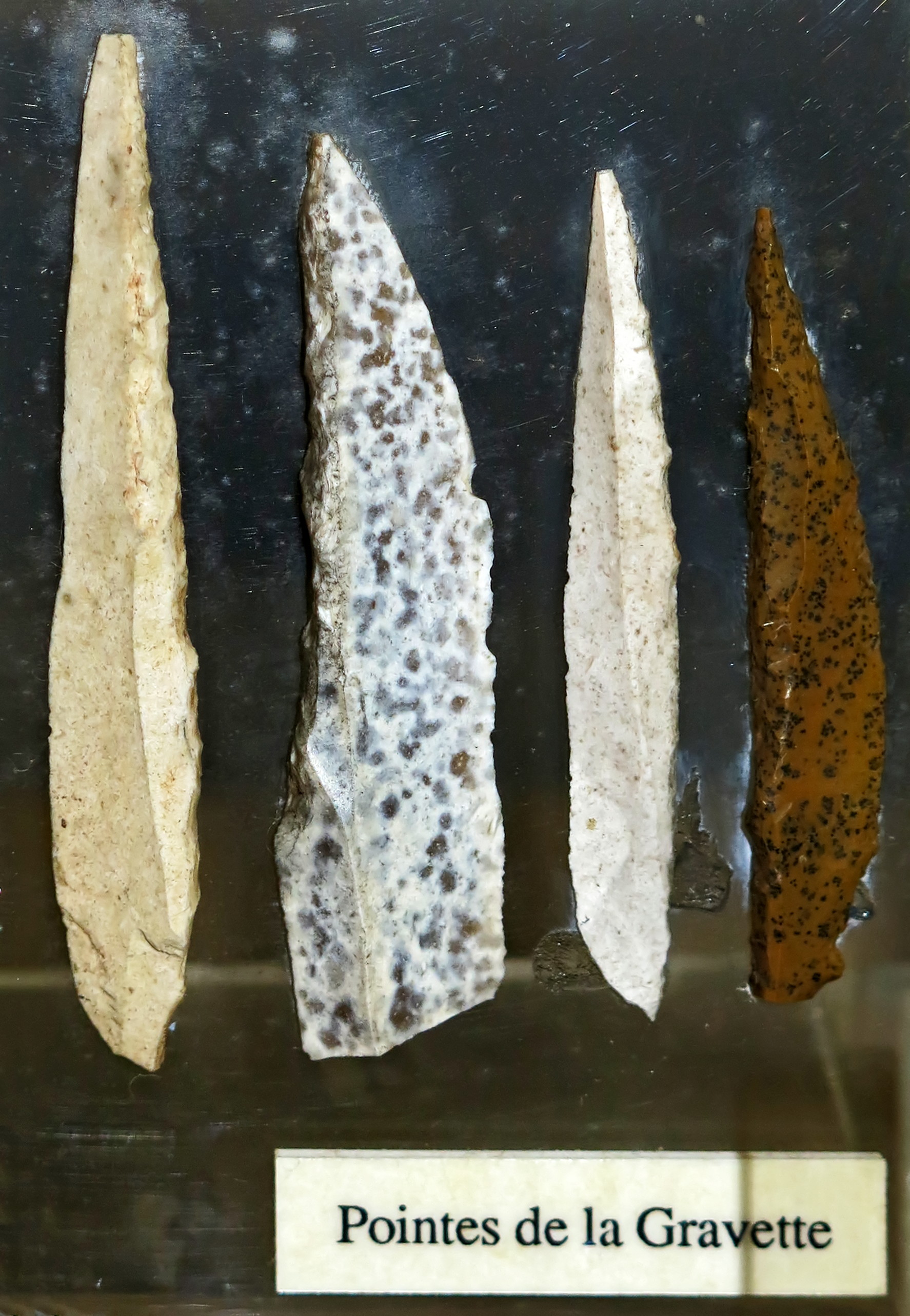
Layer 5: Lower Gravettian, Périgordian IV
Gravettian points.
Photo: Don Hitchcock 2014
Source: Display at Abri Pataud Museum.
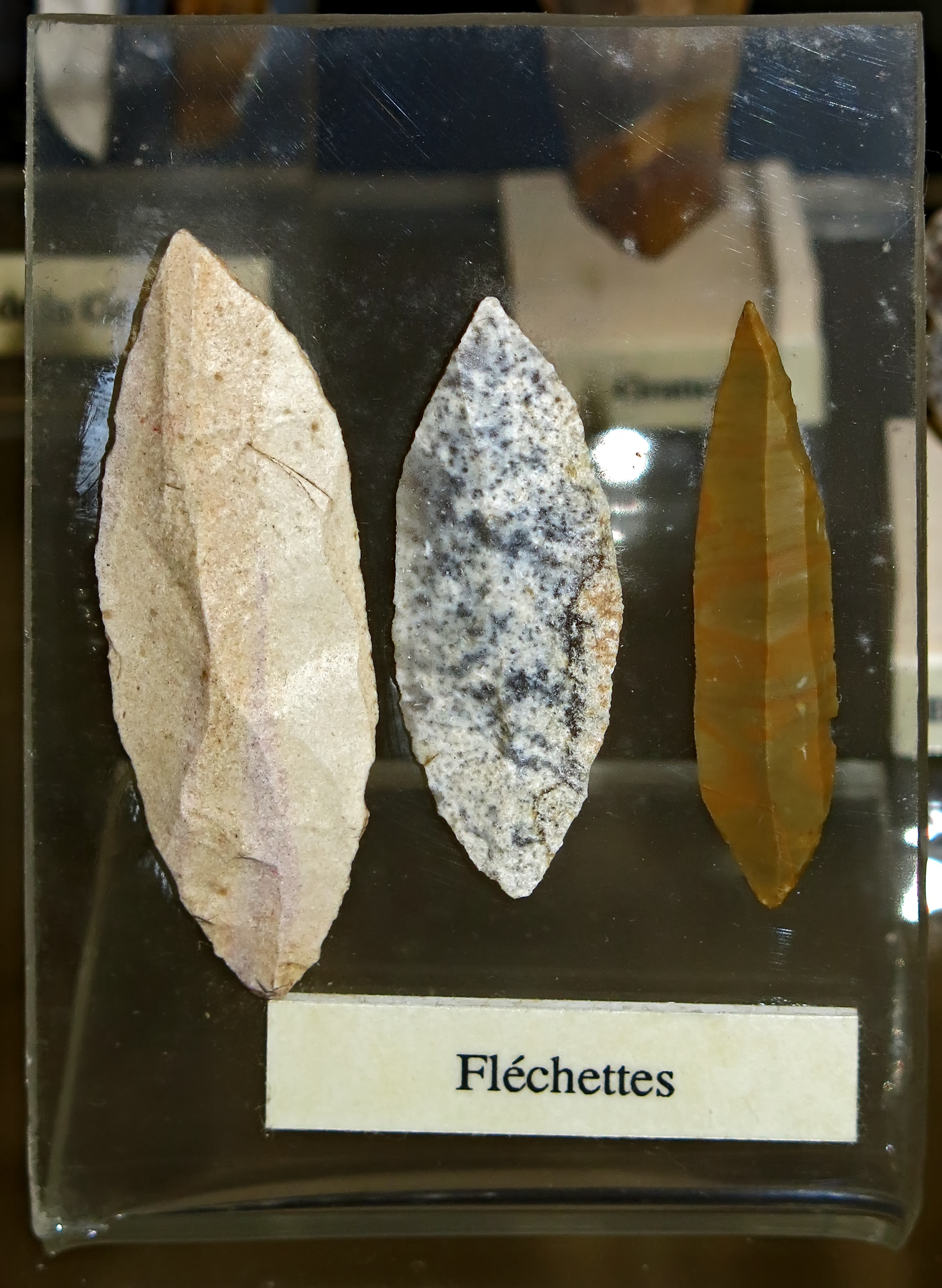
Layer 5: Lower Gravettian, Périgordian IV
Fléchettes are leaf-shaped points characterised by short, semi-abrupt retouch, sometimes inverse, at one or both extremities of the blade blank, extending sometimes along one or both margins.
Photo: Don Hitchcock 2014
Source: Display at Abri Pataud Museum, apparently original.
Text: Musée d'Archeologie Nationale et Domaine, St-Germain-en-Laye

Layer 5: Lower Gravettian, Périgordian IV
Microgravettes.
Photo: Don Hitchcock 2014
Source: Display at Abri Pataud Museum, apparently original.
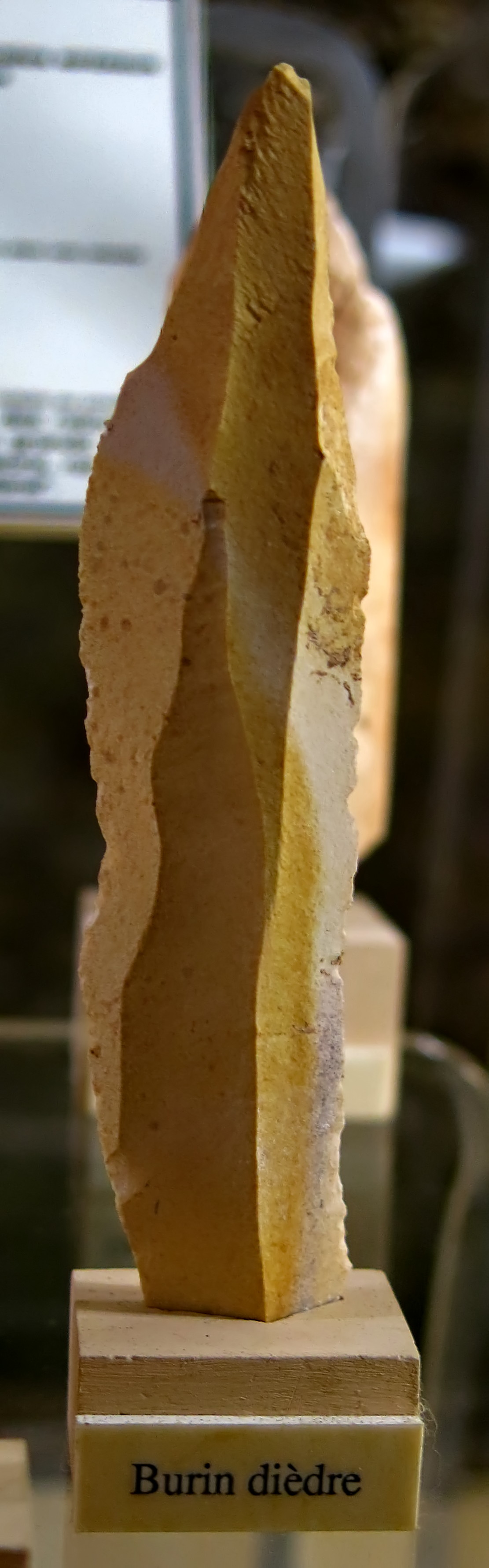
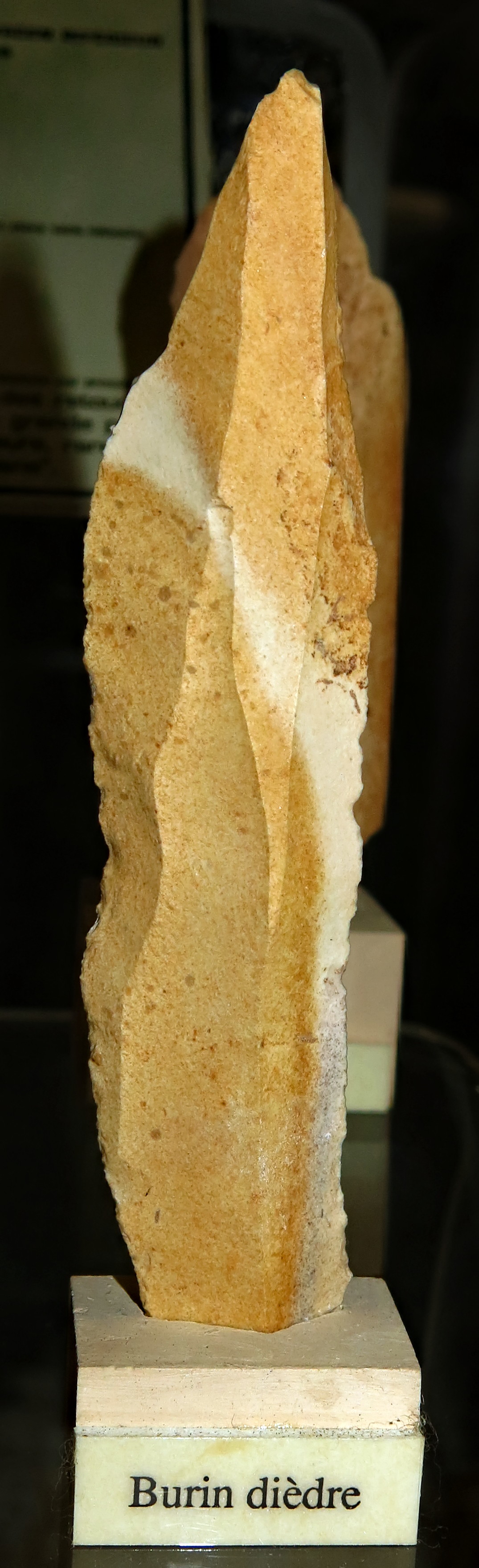
Layer 5: Lower Gravettian, Périgordian IV
Dihedral Burin.
A dihedral burin is made by two (or more) intersecting burin facets, often on a blade, which create a chisel suitable for engraving.
Photo: Don Hitchcock 2014
Source: Display at Abri Pataud Museum, apparently original.
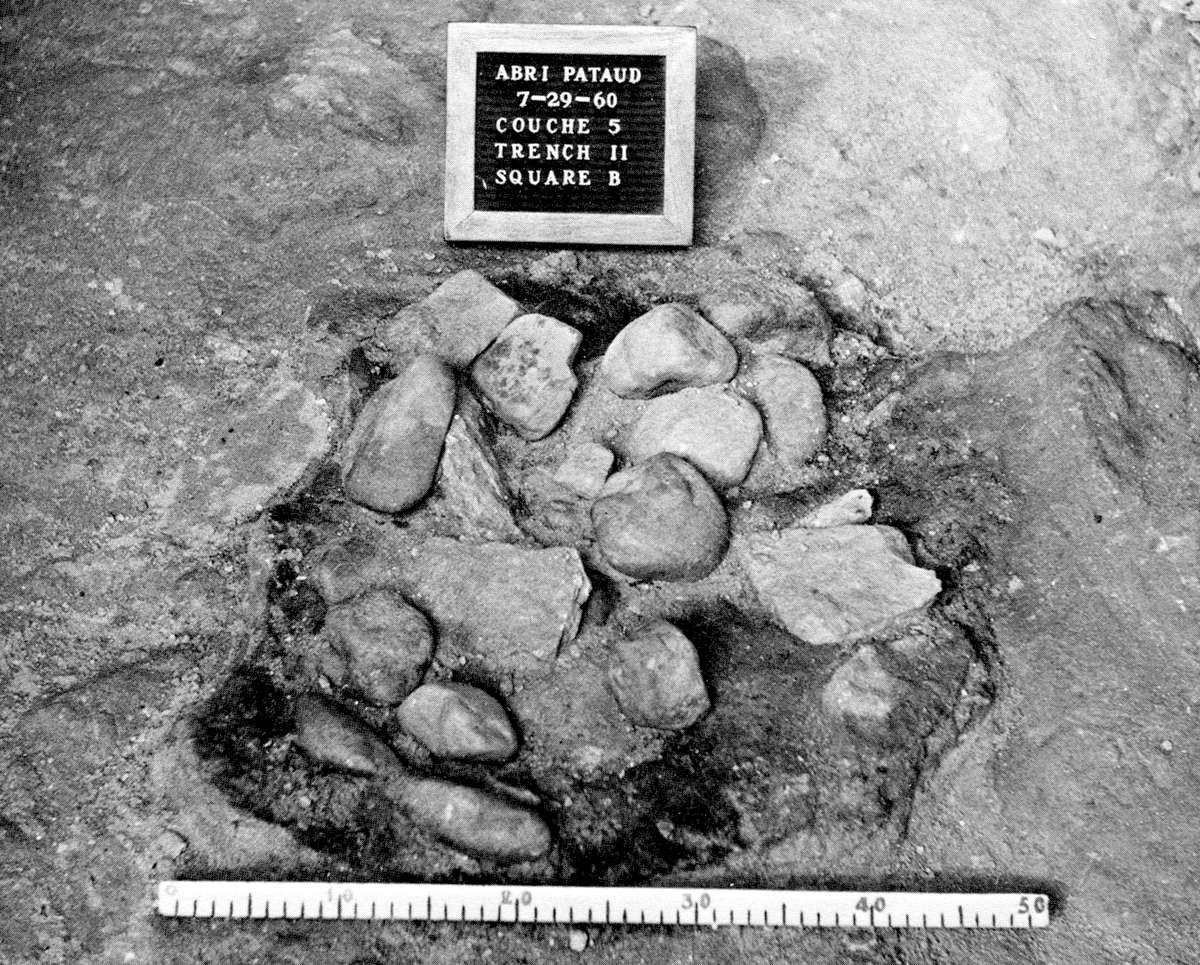
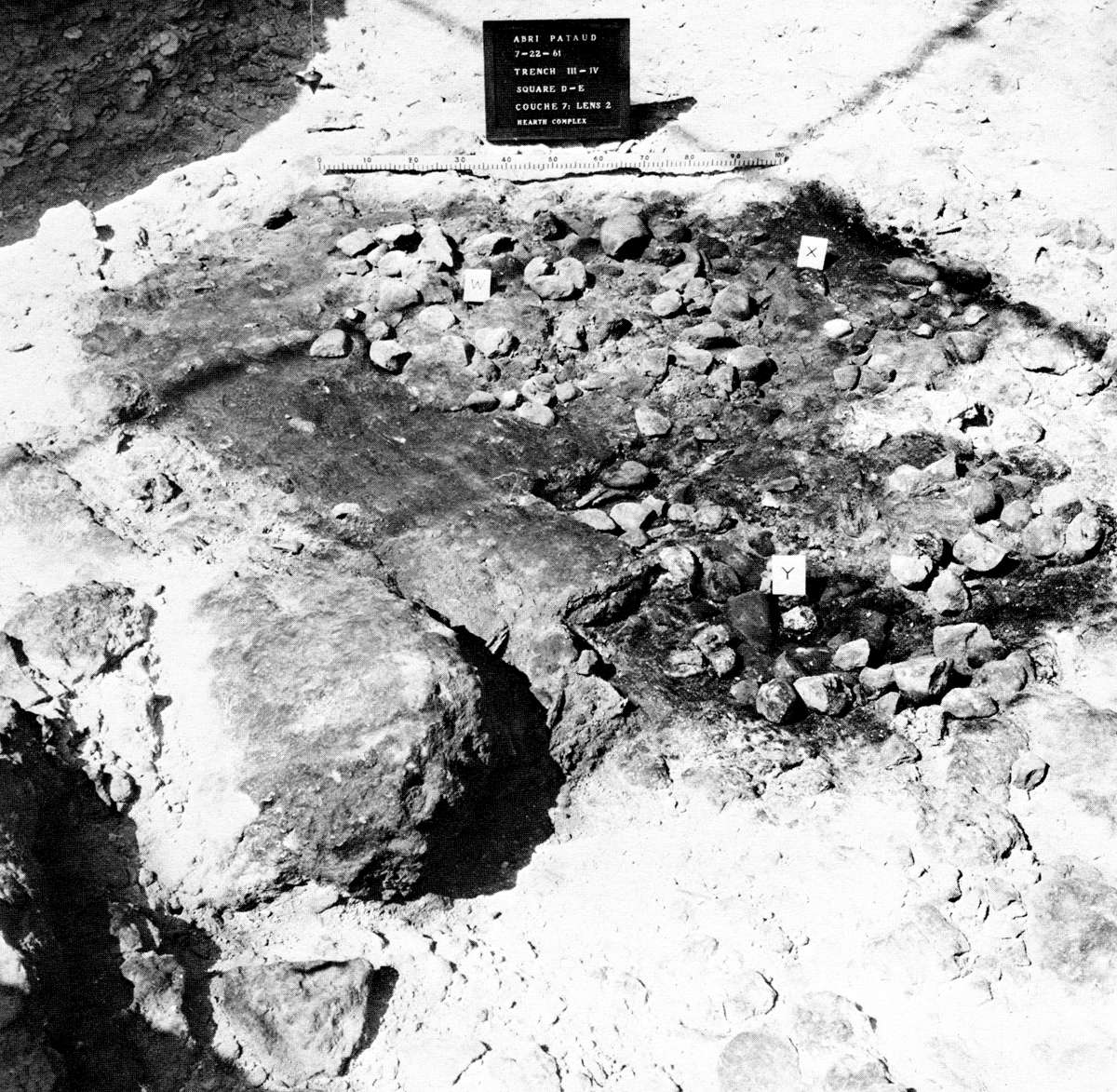
Layer 5: Lower Gravettian, Périgordian IV
Hearth
(left) At the base of Layer 5 (Périgordian IV) in Trench II, Square B, in the front of the site, this group of river stones was found in Lens W. Normally features of this type are associated with hearths.
(right) Surface of the hearth complex (Hearths W, X, and Y) found in Level 7: Lower (Intermediate Aurignacian-b). The two smallest, Hearths X and Y, were truncated when the large basin for Hearth W was prepared. An ash sample from Hearth W gave a C-14 date of ca 30 850 BC.
Photo and text: Movius (1977)

Layer 5: Lower Gravettian, Périgordian IV
Burin on a backed blade.
( note the classic burin spall on this tool. The right side in this view has been steeply retouched (backed) to allow it to be safely pressed with the finger during use. Blades usually come off the nucleus with a razor sharp edge on both sides - Don )
Photo: Don Hitchcock 2014
Source: Display at Abri Pataud Museum, apparently original.
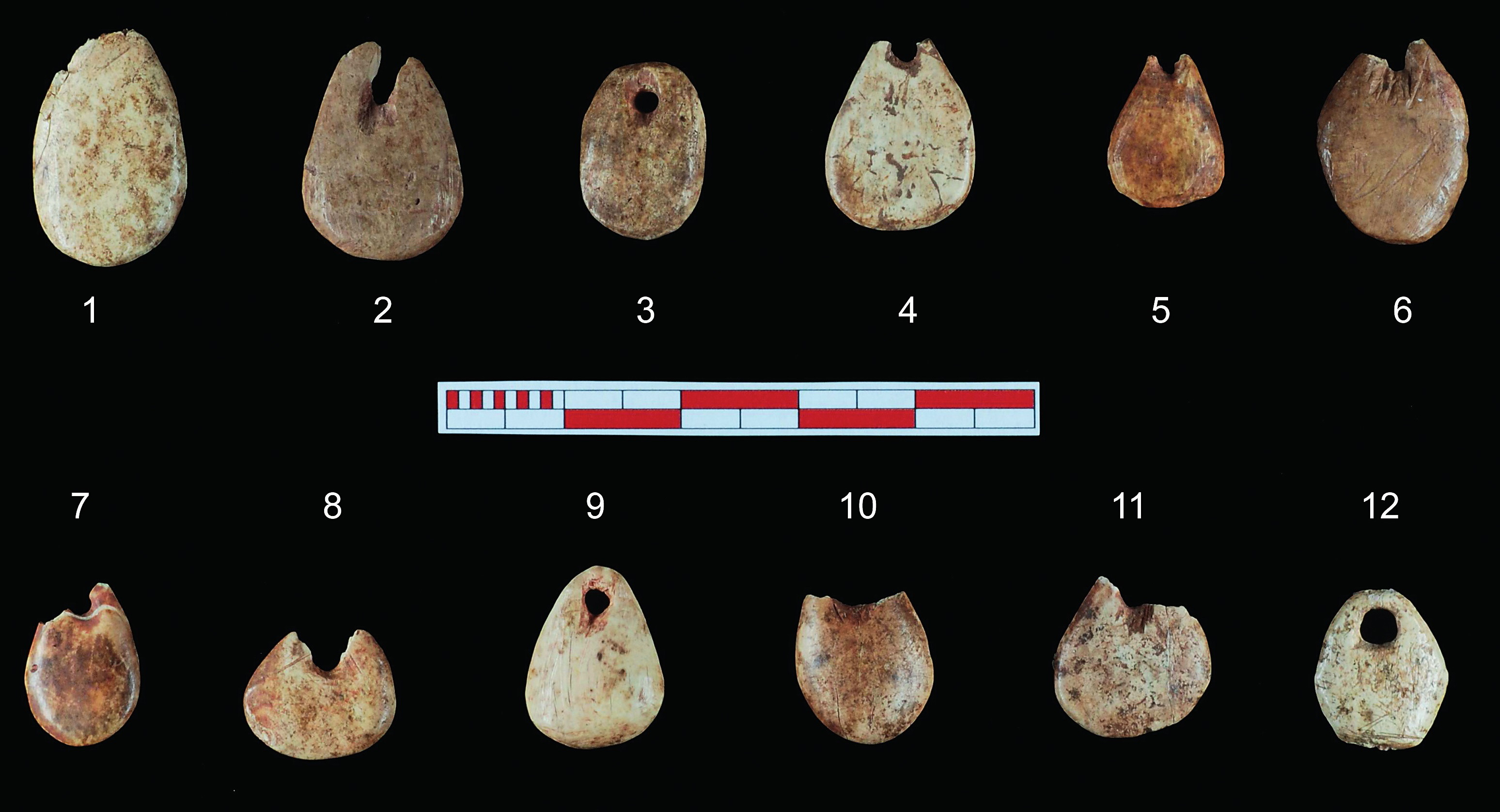

Layer 5: Lower Gravettian, Périgordian IV
Twelve ivory pendants were found in Level 5 of the Pataud shelter, discovered between 1959 and 1961 by H.L. Movius.
Four are intact, eight are damaged in the proximal region. One is not yet perforated. They have been described as 'pumpkin seed' pendants, nevertheless their dimensions and shapes vary. Their common feature is a relatively small thickness, so none can be considered as a facsimile of deer tooth.
The top image is designated the front face, the bottom showing the back face.
Photo: L. Chiotti, collection MNHN
Source and text: Henry-Gambier et al. (2013)
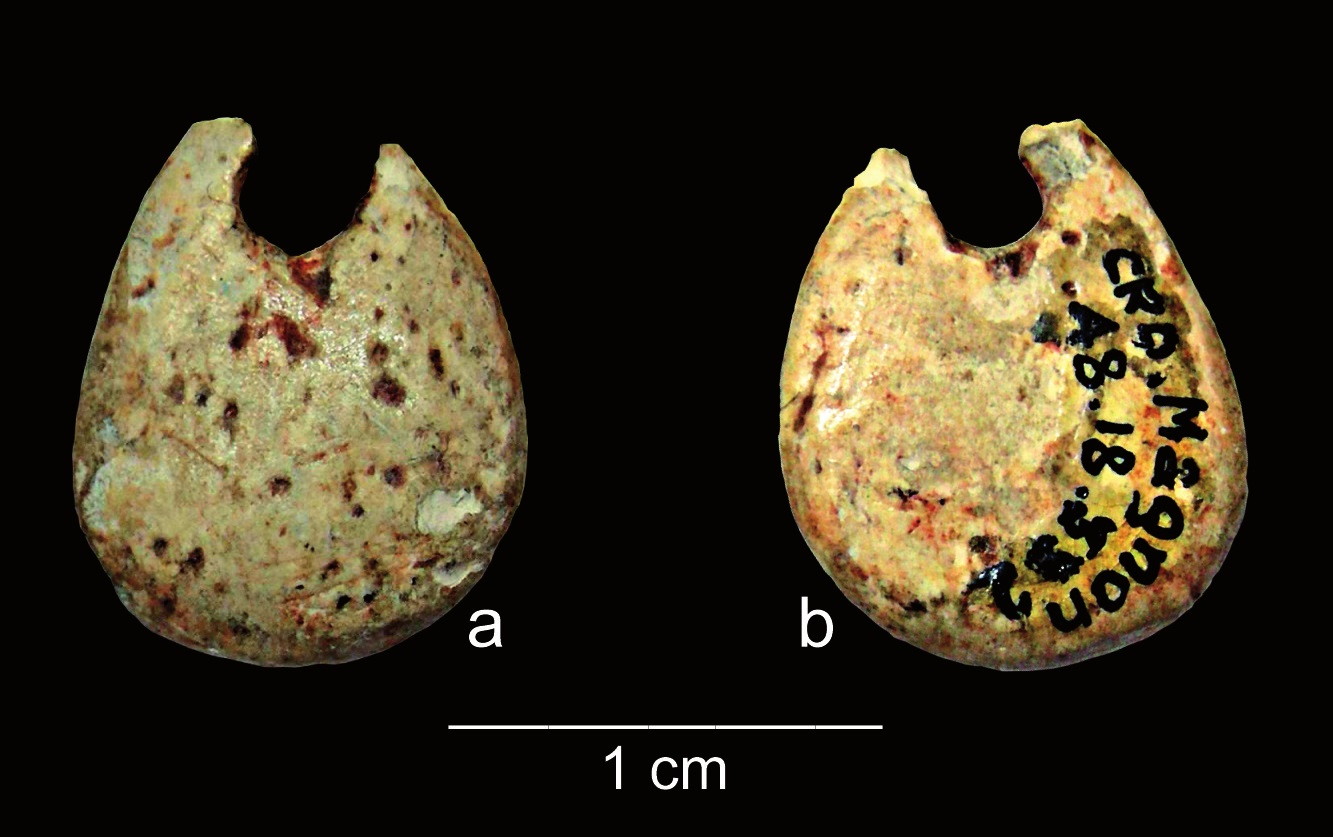
Layer 5: Lower Gravettian, Périgordian IV
This image shows the two faces of a similar 'pumpkin seed' pendant found at l'abri Cro-Magnon, only a few hundred metres from l'abri Pataud.
Abri Cro-Magnon: pendeloque n° 48-18-582, faces 1 (a) and 2 (b).
Photo: D. Henry-Gambier, collection MNHN, Muséum National d’Histoire Naturelle
Source and text: Henry-Gambier et al. (2013)
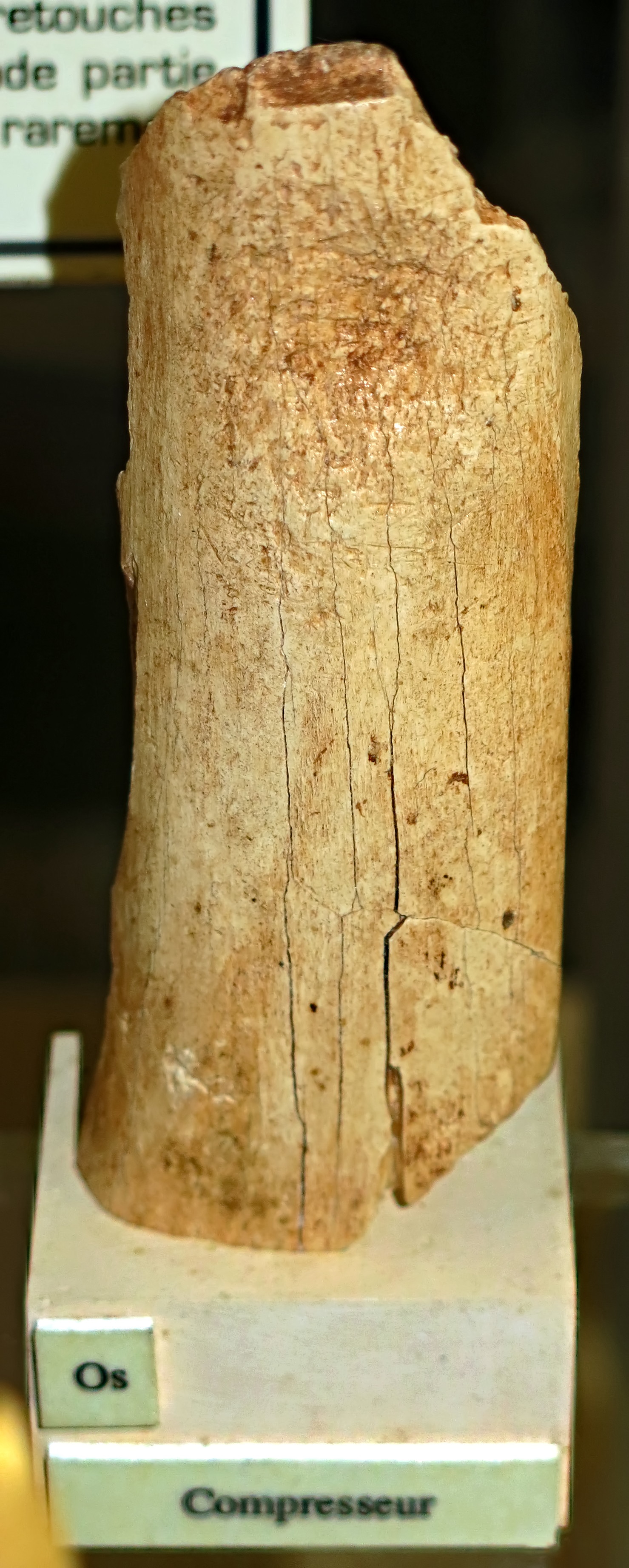
Layer 5: Lower Gravettian, Périgordian IV
This tool has been labelled a 'compresseur', which translates into English directly as 'compressor', and a 'compressor' is now, in English, defined as a tool used for pressure flaking, as in the Solutrean tradition, a tool which needs to be small and with a thin working end, typically thin tines from deer antlers, held in the closed hand, used for the delicate work of pressure flaking.
Indeed, modern knappers often use a small piece of copper rod inserted into a wooden or antler handle for this delicate task.
However it would appear that in French, 'compresseur' is the term for a baton of bone or antler used as a percuteur or hammer, either for flake production or for indirect percussion in the production of blades.
This tool has been used for a great deal of indirect percussion, as a percuteur or hammer baton, where it was used to strike a 'punch' carefully placed on a flint nucleus, in order to strike off blades, see the image below.
The evidence for this analysis may be seen in a close up of the end of the percuteur, (click on the image once (or twice) for a large high definition view), which displays a distinct hollow and abrasions created by the process by which the knapper strikes repeatedly in the same area in order to transmit the force to the punch, and thus to the nucleus or core, to create many blades.
Note also that part of the base of the 'compresseur' appears to have been sawn off in modern times, presumably because the rest of the tool was not worth restoring.
Photo: Don Hitchcock 2014
Source: Display at Abri Pataud Museum.
Text: Don Hitchcock
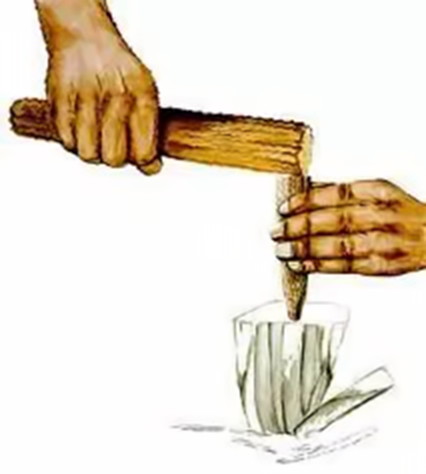
This diagram shows clearly the method of indirect percussion used to make long and thin blades.
This technique creates huge quantities of sharp blades useful for many purposes from a relatively small nucleus or core of flint, a big advantage if the flint is of superior quality, but must be obtained at a great distance from the home area.
Photo: https://technolithiks.wordpress.com/2014/01/29/les-percuteurs/
Layers 6, 7, 8, 9, 10
Layers 6, 7, 8, 9, 10: Middle Aurignacian
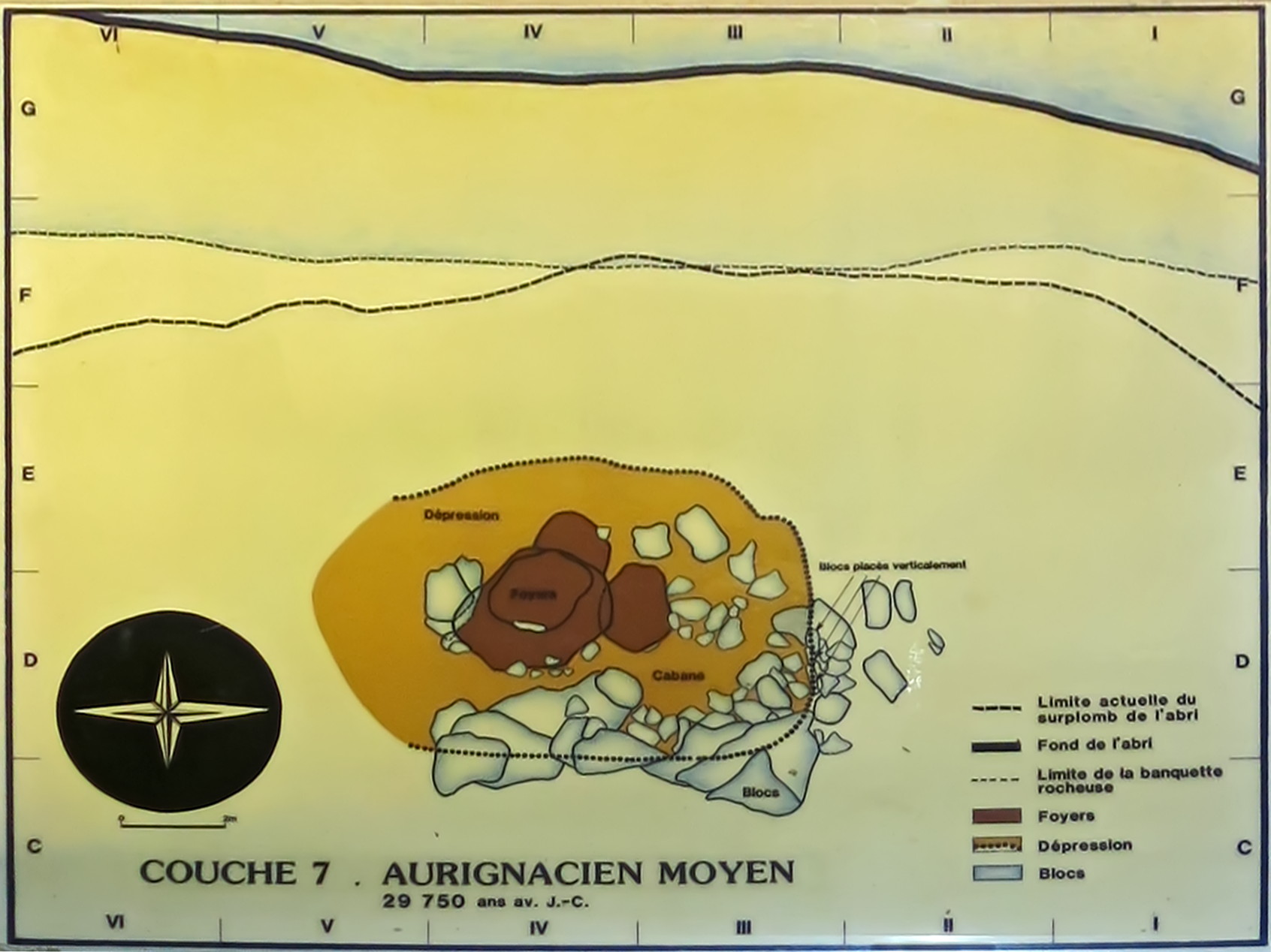

Layers 6, 7, 8, 9, 10: Middle Aurignacian
Layer 7, corresponding to the Middle Aurignacian, has revealed a very interesting dwelling. Three hearths to the south, suggesting a temporary, short-term stay, burned within a large oval depression, located in front of the shelter. The digging of the depression has partially damaged the underlying layer.
The southern part of this depression was bordered by large flat limestone slabs placed vertically. It was probably a structure intended to host a family group around the hearth.
The hearths were filled with river pebbles, which were damaged by heat. They were put in the fire to store heat and worked as radiators. Their role was different from that which they were to have in the Perigordian levels.
Photo: Don Hitchcock 2014
Source: Display at Abri Pataud Museum.

Layers 6, 7, 8, 9, 10: Middle Aurignacian
Layers 6, 7, and 8 contained typical tools of the Aurignacian with keeled (i.e. carinate, or ridged) scrapers as well as beaked burins, Dufour bladelets, pièces esquillées (splintered pieces, see below), and bone spears in an elongated diamond or lozenge shape.
Each layer has some special features: layer 8 includes a high proportion of ridged scrapers and muzzle/nose shaped scrapers (26%). Layer 7 includes many beaked chisels (14%) and bone spears in an elongated diamond or lozenge shape. These two layers are attributed to the middle Aurignacian . Layer 6 is low in Aurignacian scrapers and beaked chisels; the stratigraphic position could allow us to assign an Aurignacian period (Aurignacien évolué) to these layers. Layers 9 and 10, which are poor in artefacts, may be assigned to the middle Aurignacian .
Photo: Don Hitchcock 2014
Source: Display at Abri Pataud Museum. These appeared to be originals.
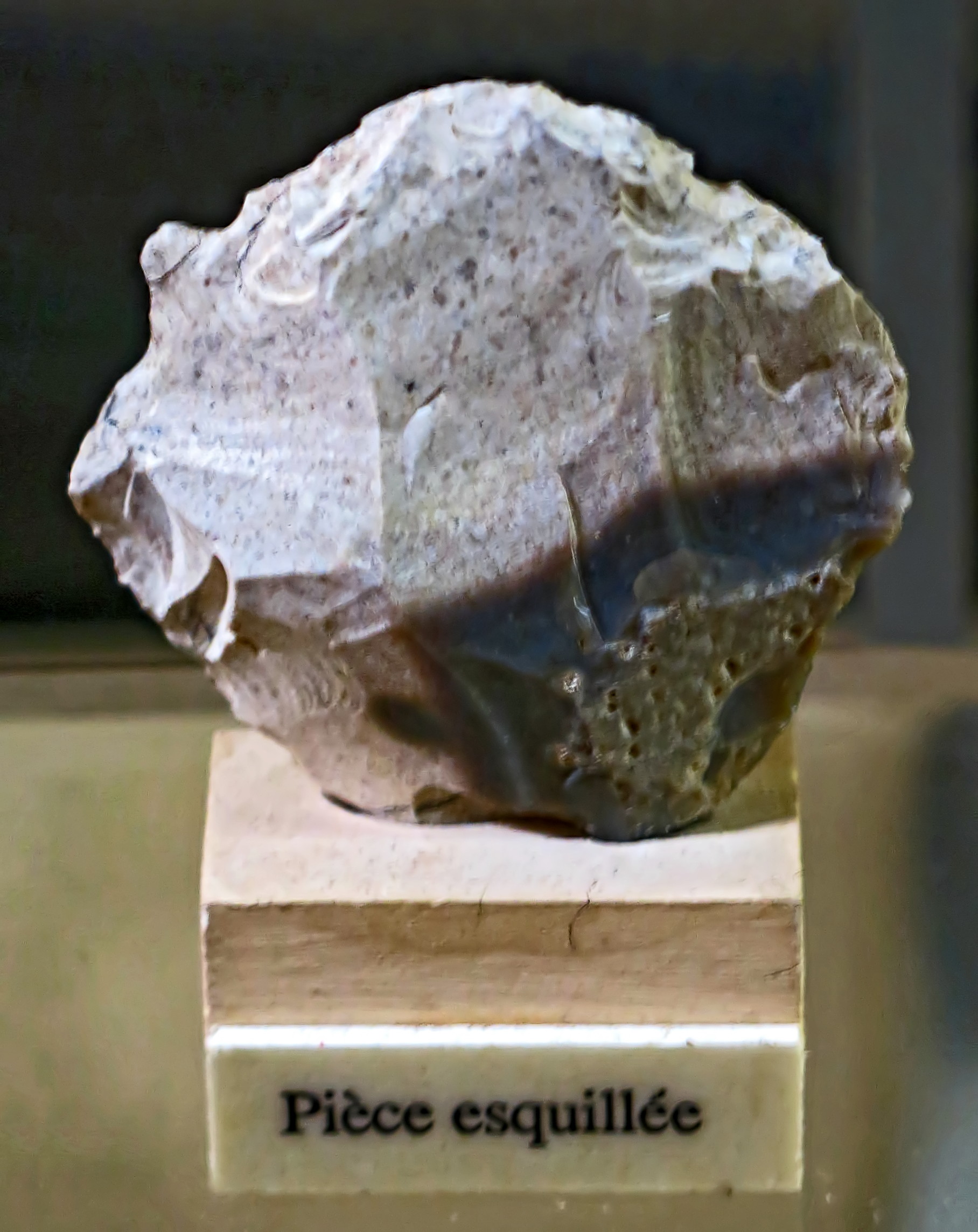
Layers 6, 7, 8, 9, 10: Middle Aurignacian
Pièce Esquillée - this type of artefact, literally a 'splintered piece' has been translated in a number of ways, including fragmented piece, cut-and-flake tool, chisel, gouge, wedge, chipped flake, scaled and splintered flake, bifacial lozenge, and wedge.
They were apparently used for the shaping of perishable hard materials (wood, bone, antler, ivory, etc.), an hypothesis which is confirmed by the few available traceological (use-wear analysis) data.
Photo: Don Hitchcock 2014
Source: Display at Abri Pataud Museum. This appeared to be original.
Text: Le Brun-Ricalens (2006)
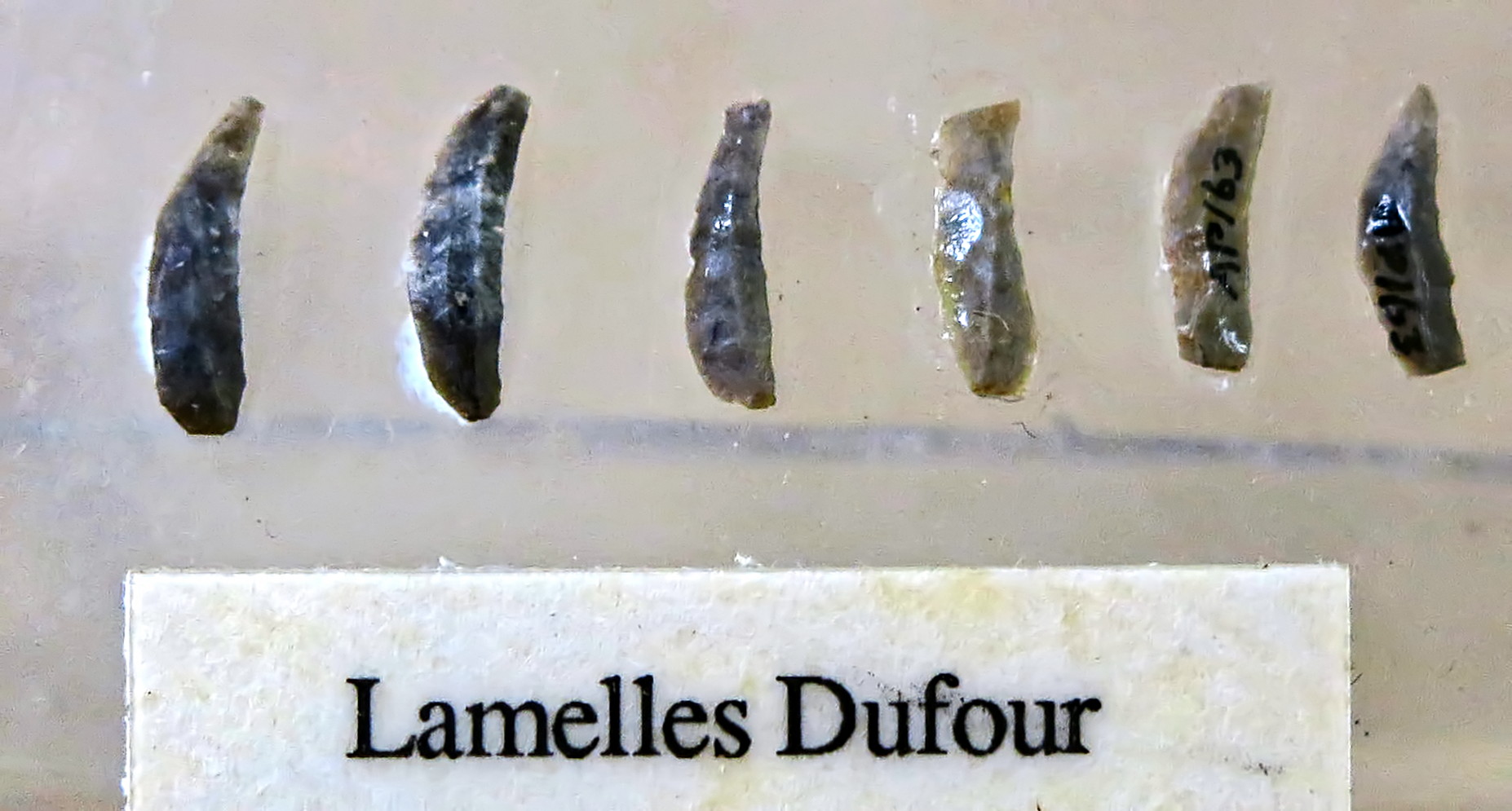
Layers 6, 7, 8, 9, 10: Middle Aurignacian
Lamelles Dufour - Dufour bladelets.
Lamelles Dufour were produced as a byproduct of the knapping of carinated and nosed scrapers, and were used as points on spears/darts and as hafted small knives for meat and soft vegetable matter.
Photo: Don Hitchcock 2014
Source: Display at Abri Pataud Museum, apparently original.
Text: Adapted from information from Katzman (PC). My thanks as always.
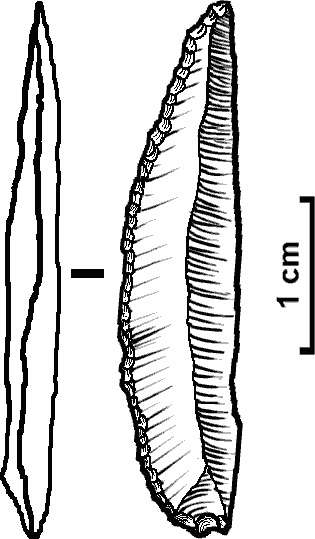
This is an illustration of a Lamelle Dufour, a characteristic bladelet (i.e. a small blade, in this case less than four centimetres long) of the Aurignacian.
This particular piece, originally produced as a byproduct of the knapping of carinated and nosed scrapers, has been further modified by extensive retouching along one edge, possibly a steep retouch to blunt the back of the piece so that it could be more easily used as a small knife without a handle.
Photo: Wikipedia
Layers 6, 7, 8, 9, 10: Middle Aurignacian
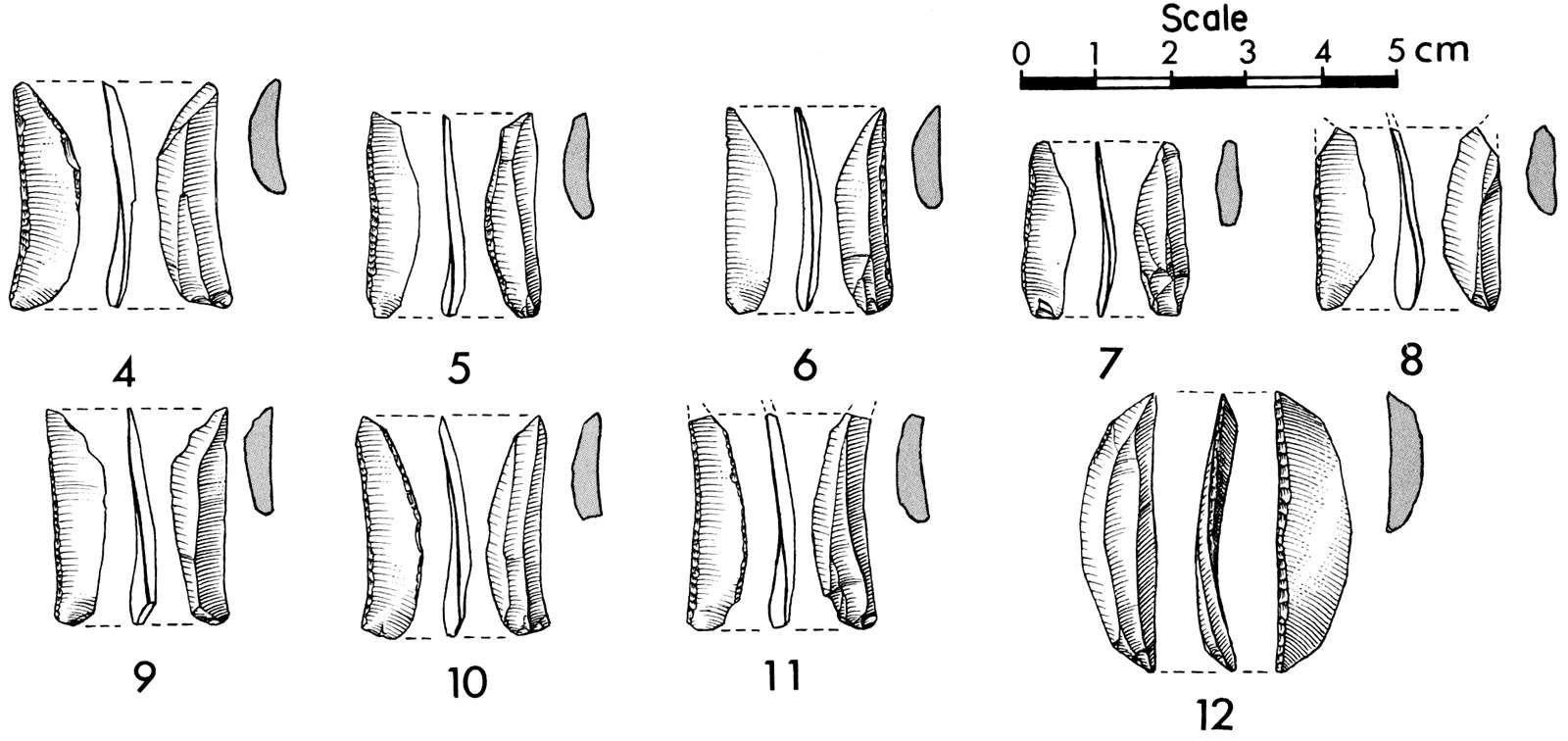
Dufour bladelets, (Lamelles Dufour) from Abri Pataud Level 8: Intermediate Aurignacian-a.
Photo and text: Movius (1977)
Layers 6, 7, 8, 9, 10: Middle Aurignacian
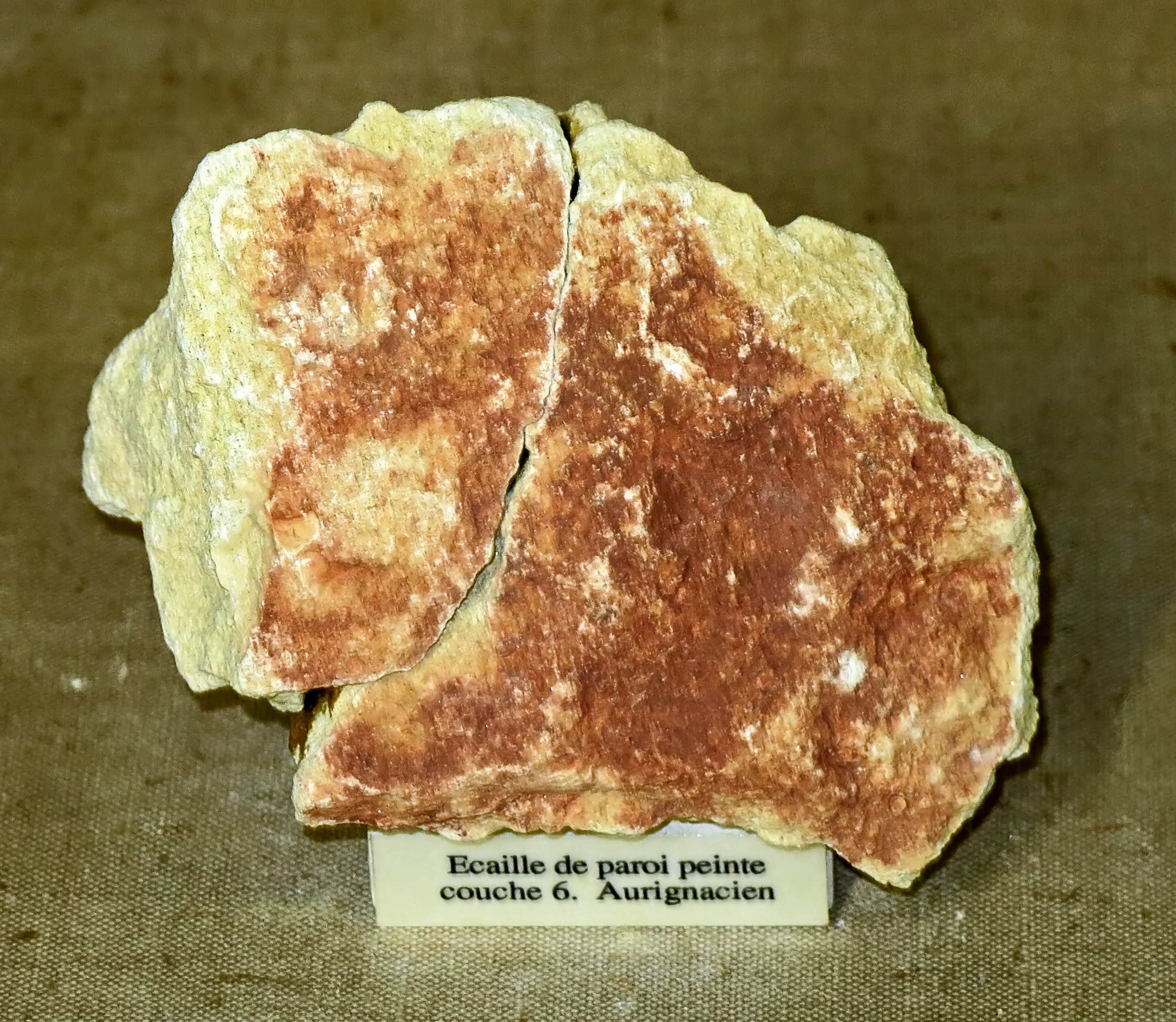
Rock flaked from the wall, painted with red ochre, found in layer 6.
Photo: Don Hitchcock 2014
Source: Apparently original, display at Abri Pataud Museum.

Layers 6, 7, 8, 9, 10: Middle Aurignacian
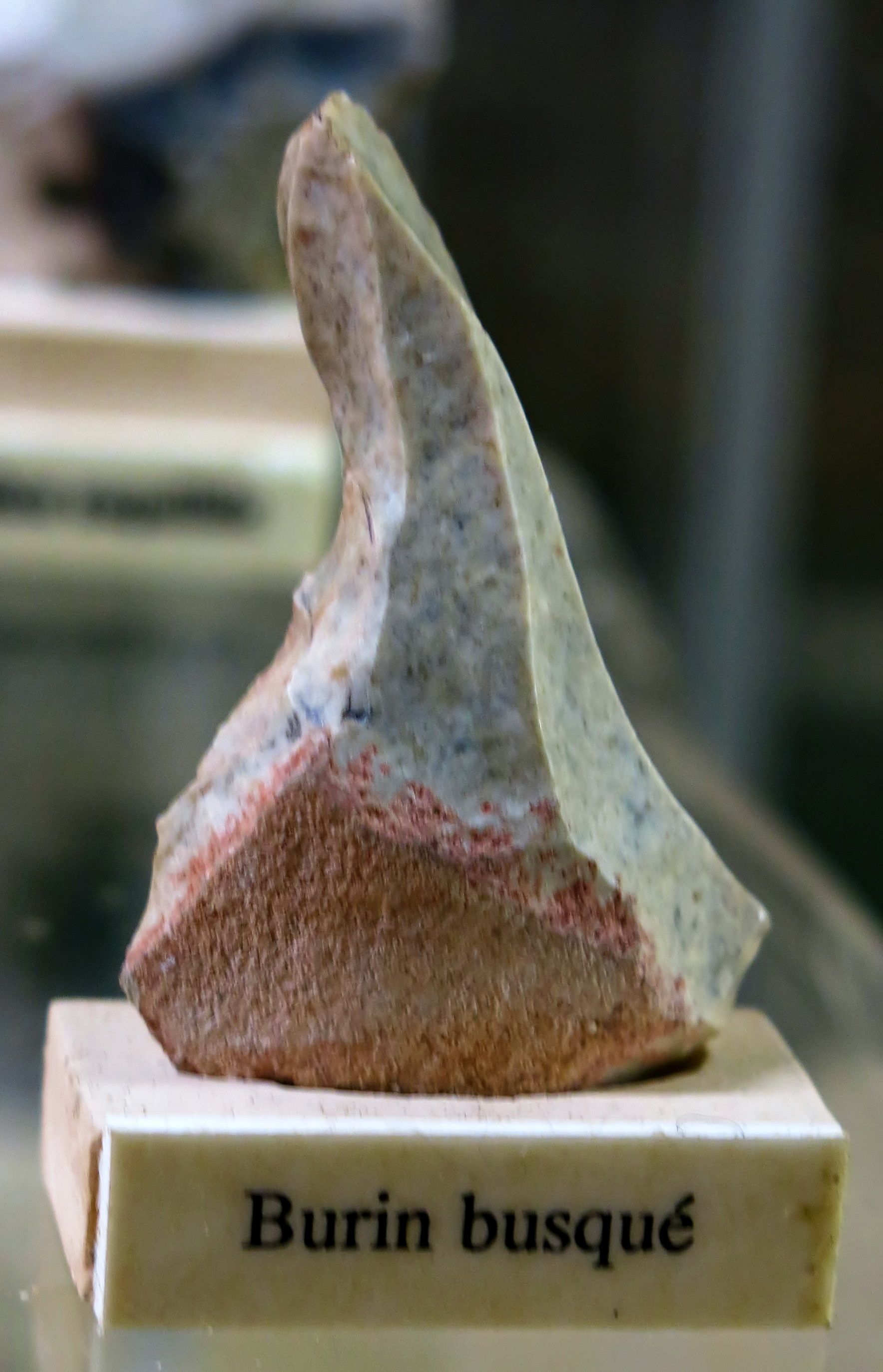
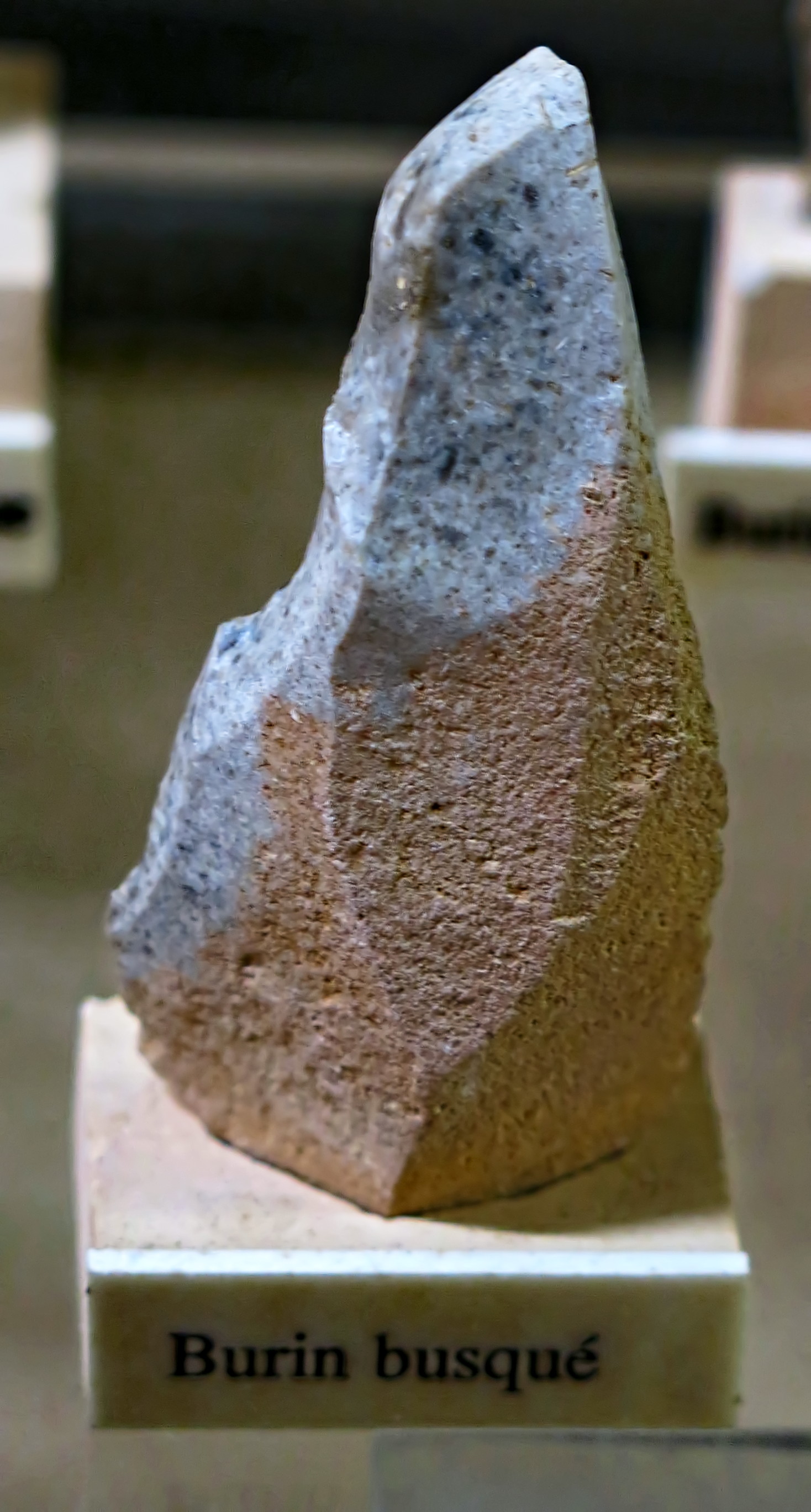
These are characteristic Middle Aurignacian tools - beaked chisels or burins.
They are a solid, heavily constructed tool whose bevel is formed by a large reduction of diameter from a wide base to a relatively small point.
Photo: Don Hitchcock 2014
Source: Display at Abri Pataud Museum. These appeared to be originals.
(The beaked burin is especially common in the Middle Aurignacian. In appearance it rather resembles the prow of a ship turned upside down; the working edge is convex, being formed by a flat graver facet on one side, and a series of convex graver facets up the prow; this produces a keeled scraper made on the breadth of a blade. There are two sub-varieties, one with a notch to prevent the little convex graver facets from going too far down the blade, and the other without.) Burkitt (1925)
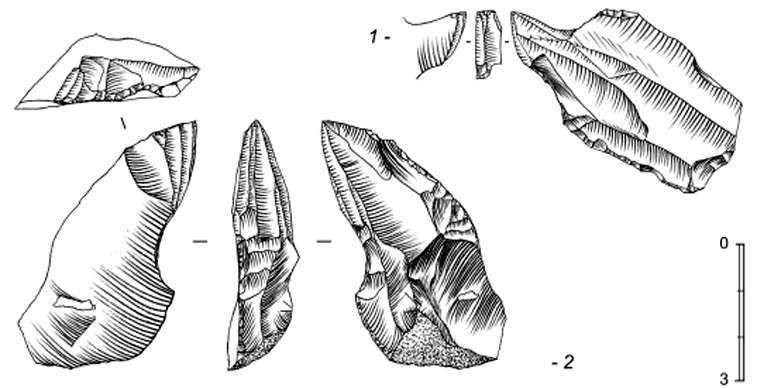
Burin busqué - the Beaked Burin
Figure 6 - Burin busqué, n°1 : Abri 2, couche 2, et burin busqué à tendance Vachons, n°2 : Abri 1, couche 2 (dessins D. Pesesse).
Figure 6 - Burin busqué, n°1 : shelter 2, layer 2 and burin busqué near of the Vachon’s type, n°2 : shelter 1, layer 2 (drawings D. Pesesse).
Photo and text: http://paleo.revues.org/index184.html
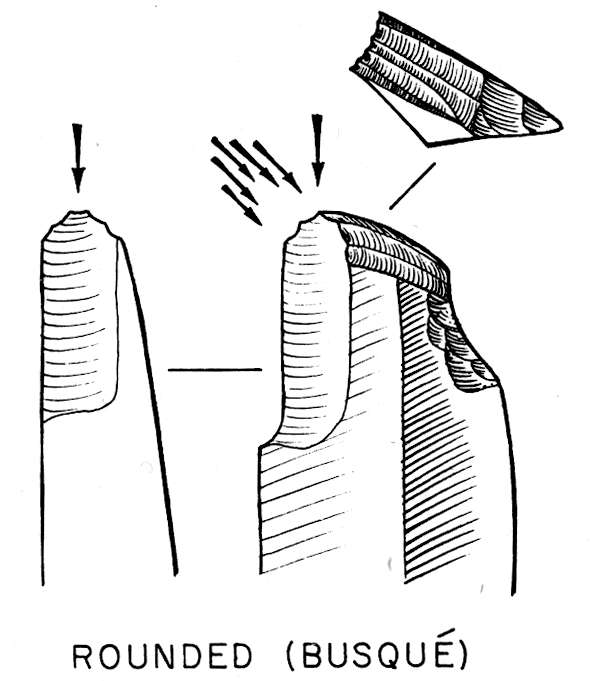
Burin busqué - the Beaked Burin
Three or more fairly regular spalls, often removed from a Spall Removal Surface (SRS) of dihedral type, approximate a semicircle. An edge of this shape is sometimes described as the "gouge" or "busqué" type.
(This is an excellent diagram of what I think of as a "classic" beaked burin, as described by Burkitt (1925) above. Note the front vertical spall, and the notch taken out of the rear of the burin to make sharpening easier, so that a spall comes off easily when retouching. - Don)
Photo and text: Movius et al (1968)
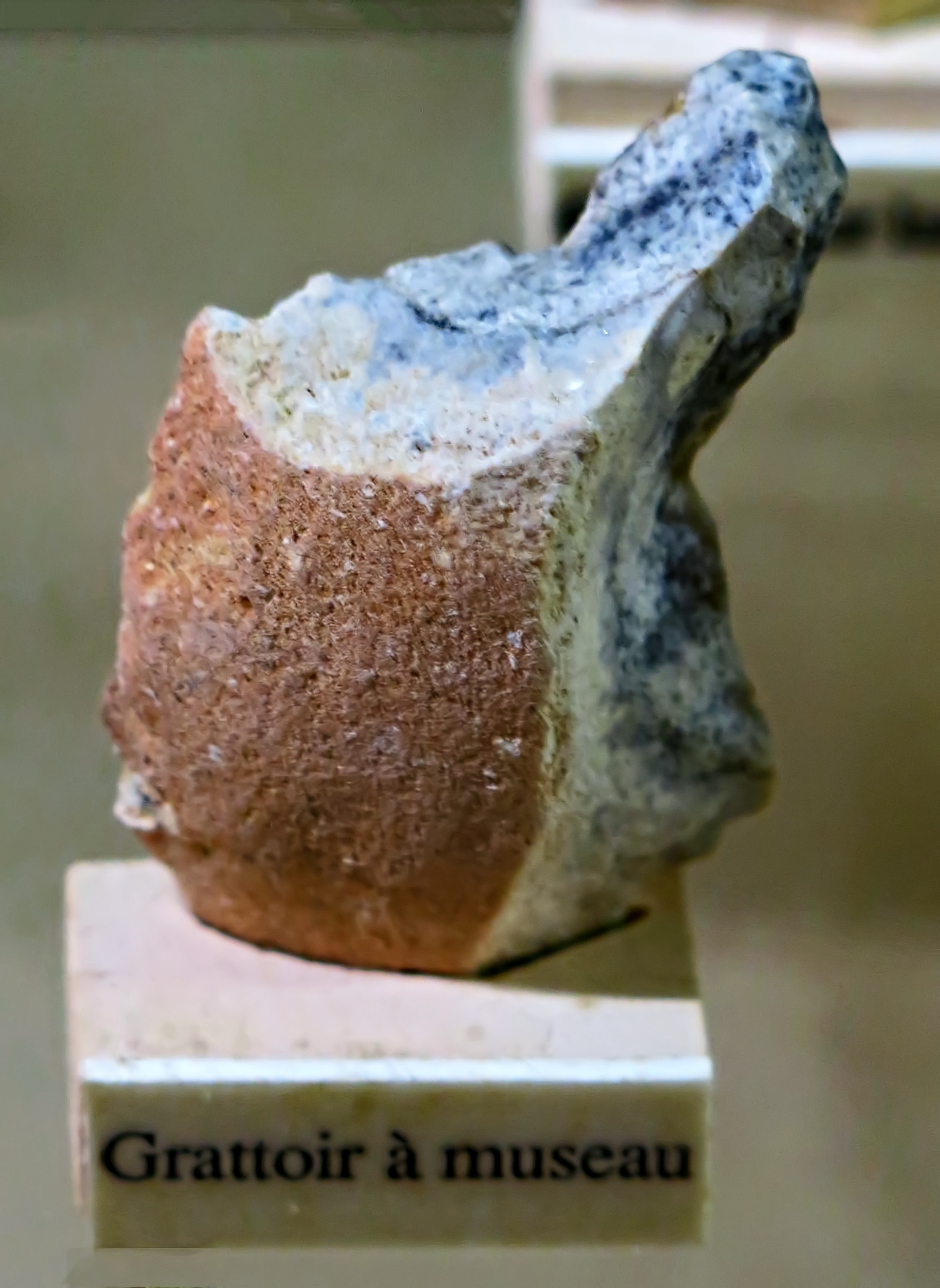
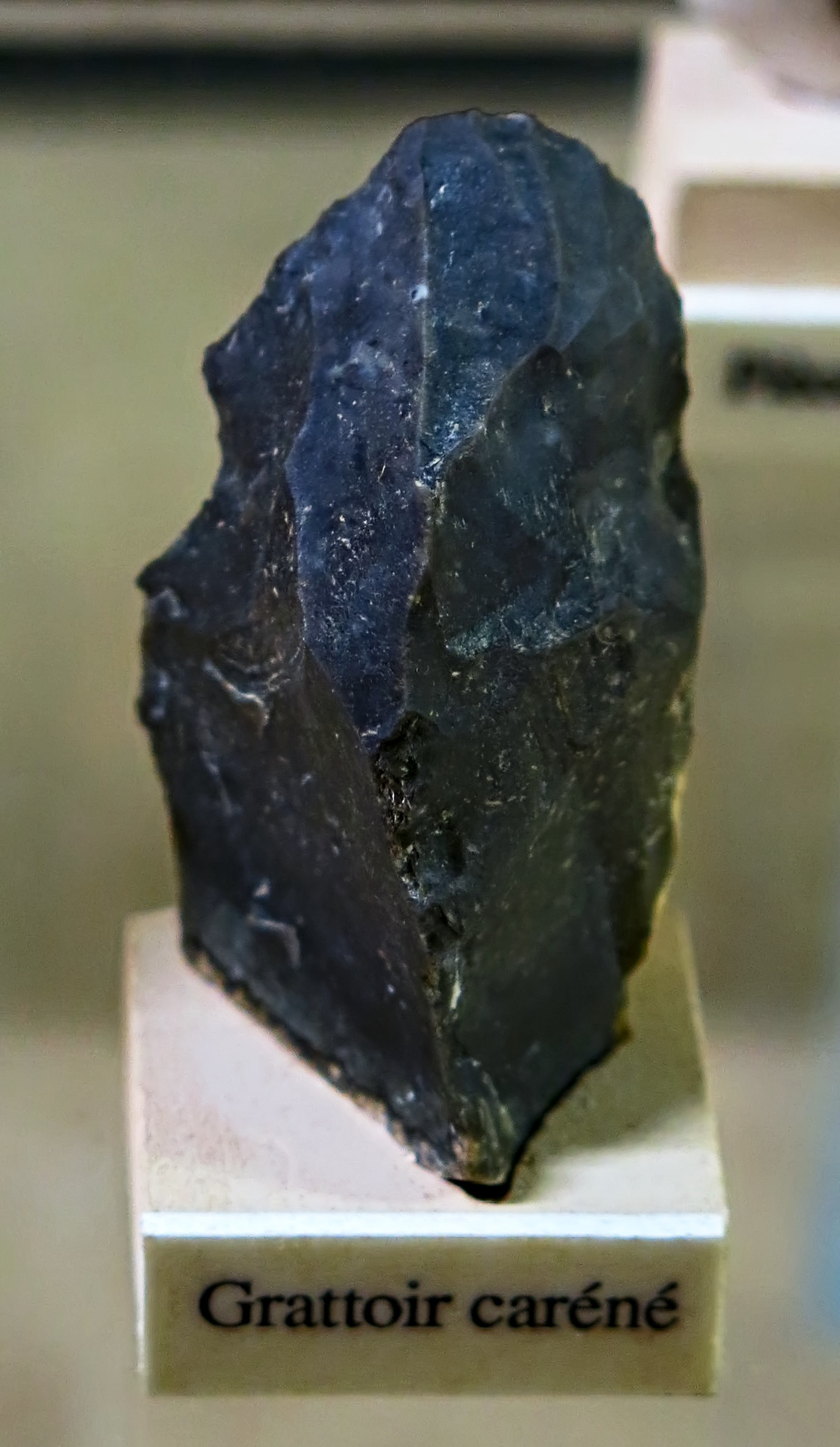
Layers 6, 7, 8, 9, 10: Middle Aurignacian
(left) Grattoir à Museau - nosed scraper.
(right) Grattoir Caréné - keeled scraper.
Photo: Don Hitchcock 2014
Source: Display at Abri Pataud Museum. These appeared to be original.
Layers 11, 12, 13 and 14: Ancient Aurignacian

Layers 11, 12, 13 and 14: Ancient Aurignacian
Grattoirs (scrapers) 36%, Retouched blades 31%, Burins 1%, other tools 32%.
The deepest levels of the Abri Pataud Aurignacian belong to the 'ancient' Aurignacian, characterised by an abundance of scrapers on blades, retouched on the blade ends and on the sides. The particular scrapers of the Aurignacian such as carinate (keeled, ridged) and nosed scrapers are also present. Layer 11a delivered a few fragments of bone points with split bases, regarded as characteristic of the Aurignacian 1.
( note that the carinate or keeled scraper shown here at top left is seemingly indistinguishable from the Mousterian rabots, heavy push-plane scrapers made on blocks or thick flakes - Don )
Artefacts displayed include:
Back row: Carinated (keeled) grattoir (scraper), Racloir (side scraper), pointed blade, wedge, often referred to as a pièces esquillé, or splinter piece, a pic (a large tool used to dig holes or cupules in wood or stone), Grattoir à Museau (nosed scraper).
Front row: Tanged (or tongued) piece of bone or antler, spear points with split bases for attachment, scrapers on blades, Aurignacian.
Photo: Don Hitchcock 2014
Source: Display at Abri Pataud Museum. These appeared to be originals.
Layers 11, 12, 13 and 14: Ancient Aurignacian
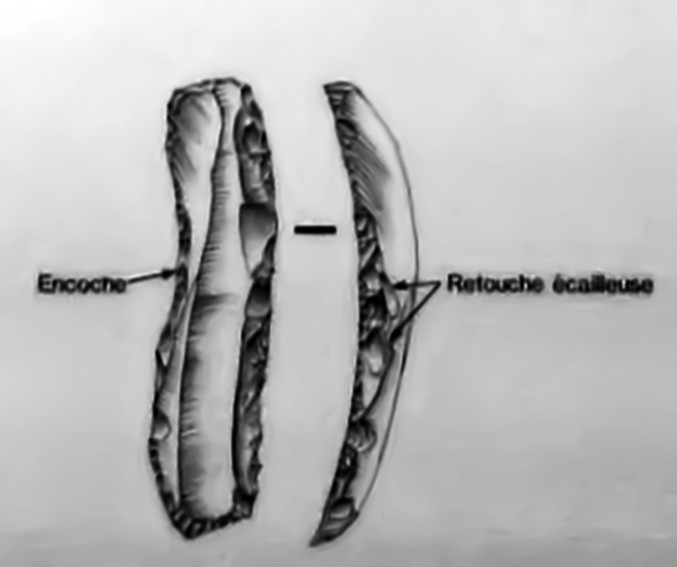
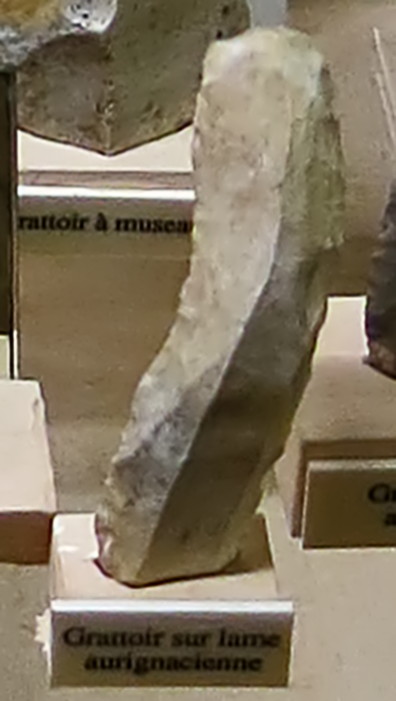
A characteristic tool of the 'ancient' Aurignacian - a scraper on an Aurignacian blade.
It is a scraper formed on a large blade with the edges having deeply concave retouches, often giving in silhouette a waisted appearance when they appear on both sides, as here.
(the drawing is of a tool similar but not identical to that in the image - Don)
Photo: Don Hitchcock 2014
Source: Display at Abri Pataud Museum.

This is an illustration, for reference and explanation, from another site, of a particularly good Grattoir à museau, or muzzle/nose shaped scraper.
Photo: http://che70.blog4ever.com/blog/lesphotos-13327-8270.html

Layers 11, 12, 13 and 14: Ancient Aurignacian
The evidence suggests that l'abri Pataud was only used for occupations of short duration. However, nearby, less than ten kilometres away, at la Ferrassie, l'abri Blanchard, at l'abri Castanet, at l'abri Labattut and at l'abri du Poisson, humans had created engravings on stone, painting and engraving the walls and ceilings of their shelters.
Layer 11, dated to the ancient Aurignacian, has yielded many pendants of bone and pierced teeth. One mammoth ivory plaque is perforated with a large circular hole.
Note also the amazingly small hole in the right hand tooth.
Photo: Don Hitchcock 2014
Source: Display at Abri Pataud Museum. These appeared to be originals.

Layers 11, 12, 13 and 14: Ancient Aurignacian
This Pierre à Anneau was found in the boulders of Layers 11 and 12, having broken from the wall of the abri.
As shown here, it is speculated that they were used to thread a rope or leather thong through to hold items off the floor of the abri.
Photo: Don Hitchcock 2014
Source: Display at Abri Pataud Museum. These appeared to be originals.
Mousterian Tools
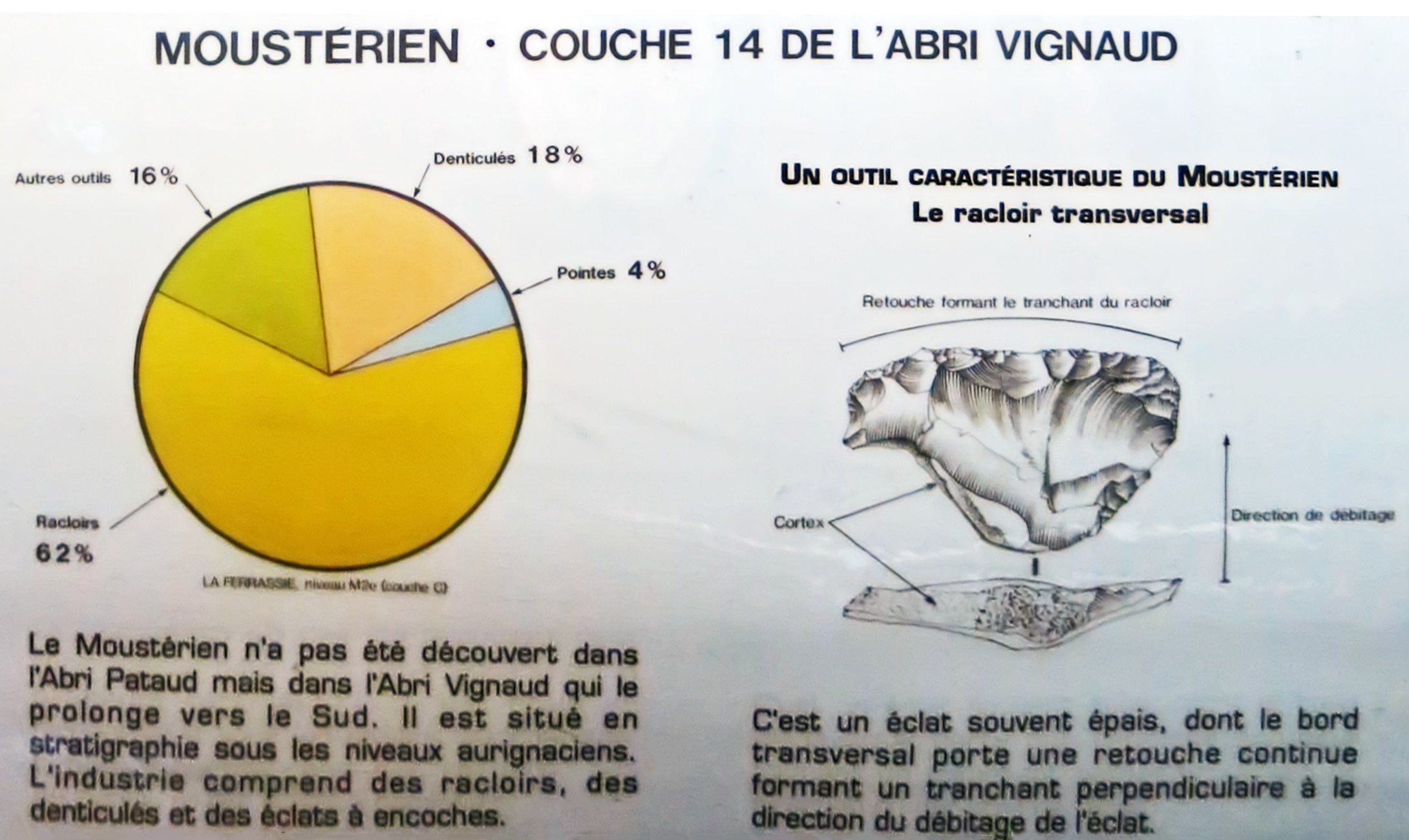
There is no Mousterian at l'abri Pataud proper. However the prolongation of l'abri Pataud towards the south is called l'abri Vignaud, which does contain Mousterian artefacts.
To avoid any confusion between l'abri Pataud proper and l'abri Vignaud (Mousterian and Upper Palaeolithic deposits), Brigitte and Gilles Delluc propose the term 'Movius shelter'.
A characteristic tool of the Mousterian is the side scraper. It is a flake which is often quite thick, for which the the transversal edge carries a retouch forming an edge perpendicular to the direction of the knapping of the flake, as shown in the diagram.
Photo: Don Hitchcock 2014
Source: Display, Abri Pataud Museum, Les Eyzies
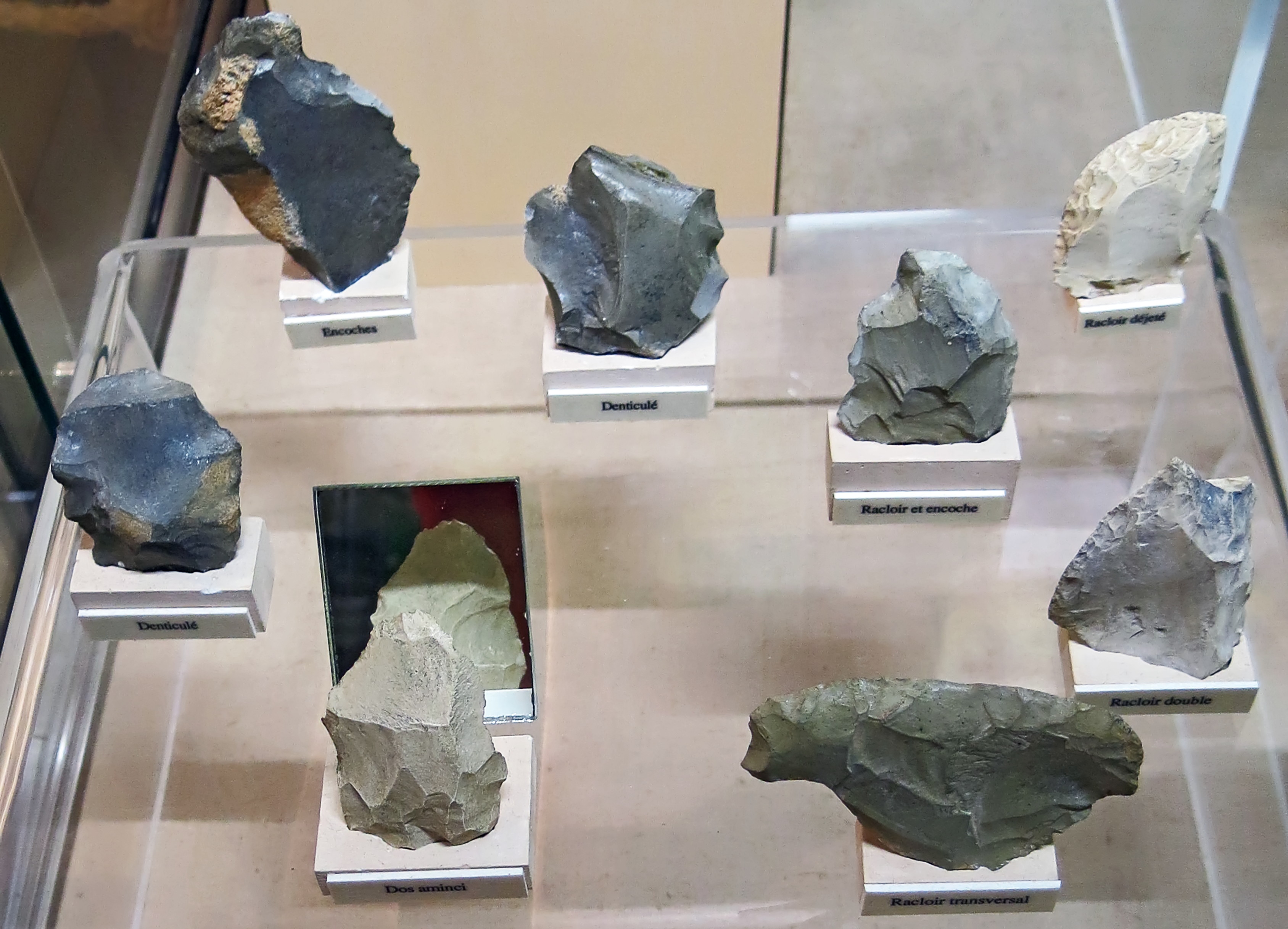
Mousterian tools.
Back row, left to right:
Notched tool for smoothing spear shafts, toothed tool ditto, scraper with one notched side, and a lopsided scraper.
Front row, left to right:
Toothed scraper for smoothing spear shafts, scraper with a thinned back (thinned on both the dorsal and ventral surfaces), racloir transversal (side scraper), double racloir, with a scraping surface on two sides of the tool.
Photo: Don Hitchcock 2014
Source: Apparently facsimiles, Abri Pataud Museum, Les Eyzies
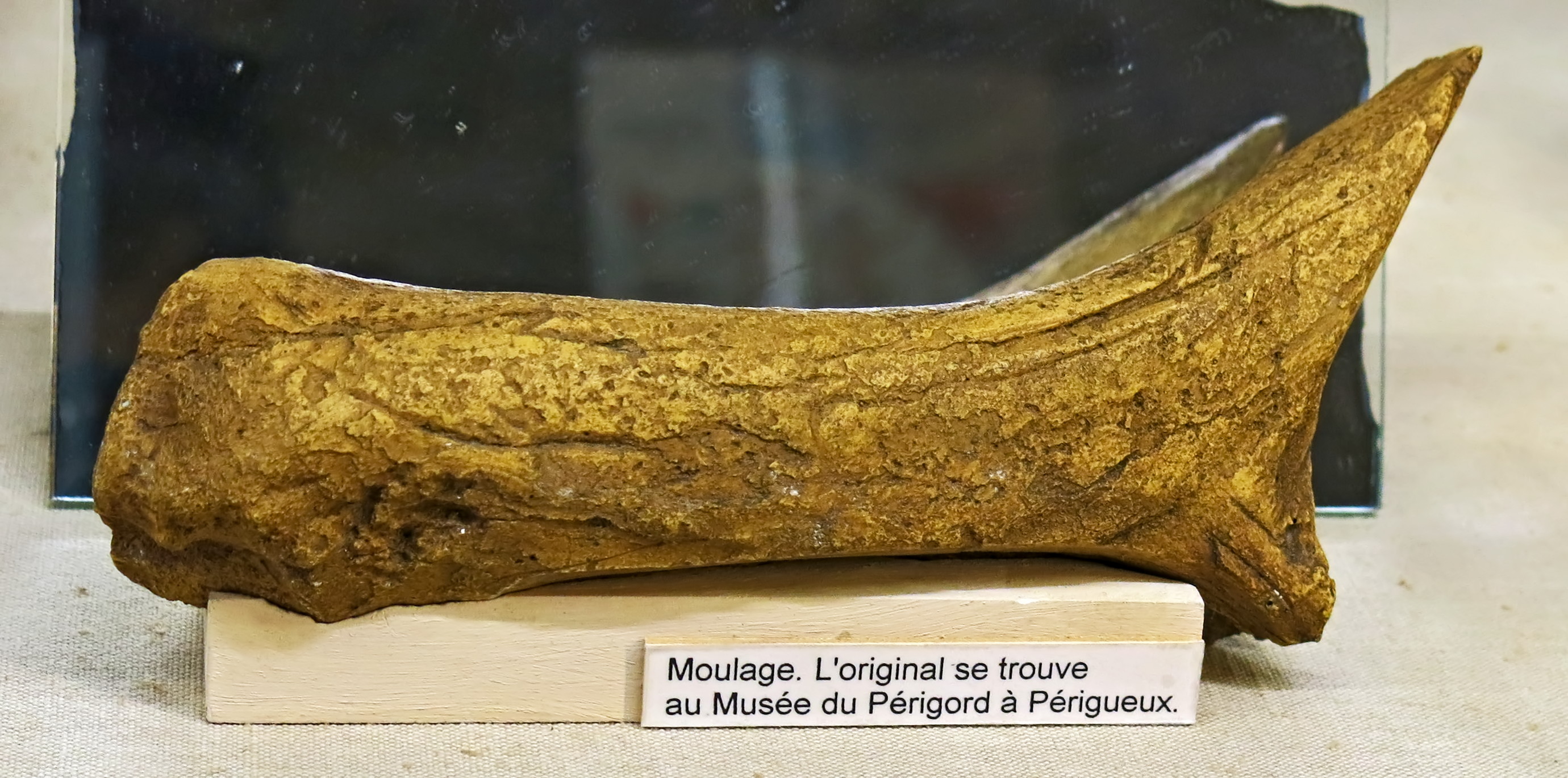
Fish carved in reindeer antler on both sides of the piece.
It was discovered along the path that runs beside l'abri Pataud, during excavations.

The top photograph was focused on the facing side, the lower photograph was focused on the reflection in the mirror.
Photo: Don Hitchcock 2014
Source and text: Facsimile, display at the Abri Pataud Museum.
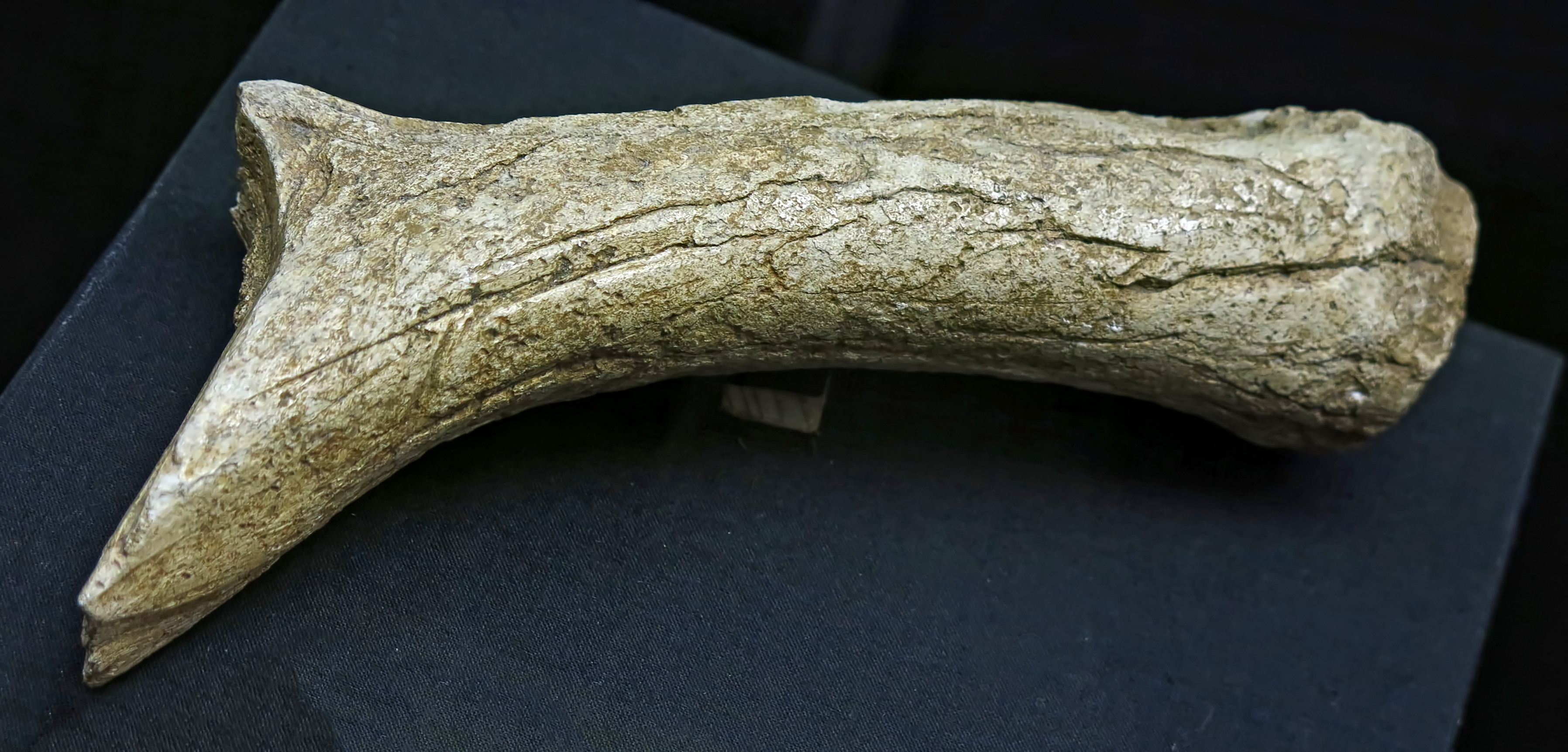
This is the original of the fish carved in reindeer antler from Abri Pataud.
It is rotated through 180° compared with the image above.
Photo: Don Hitchcock 2014
Source: Original, Musée d’art et d’archéologie du Périgord, Périgueux
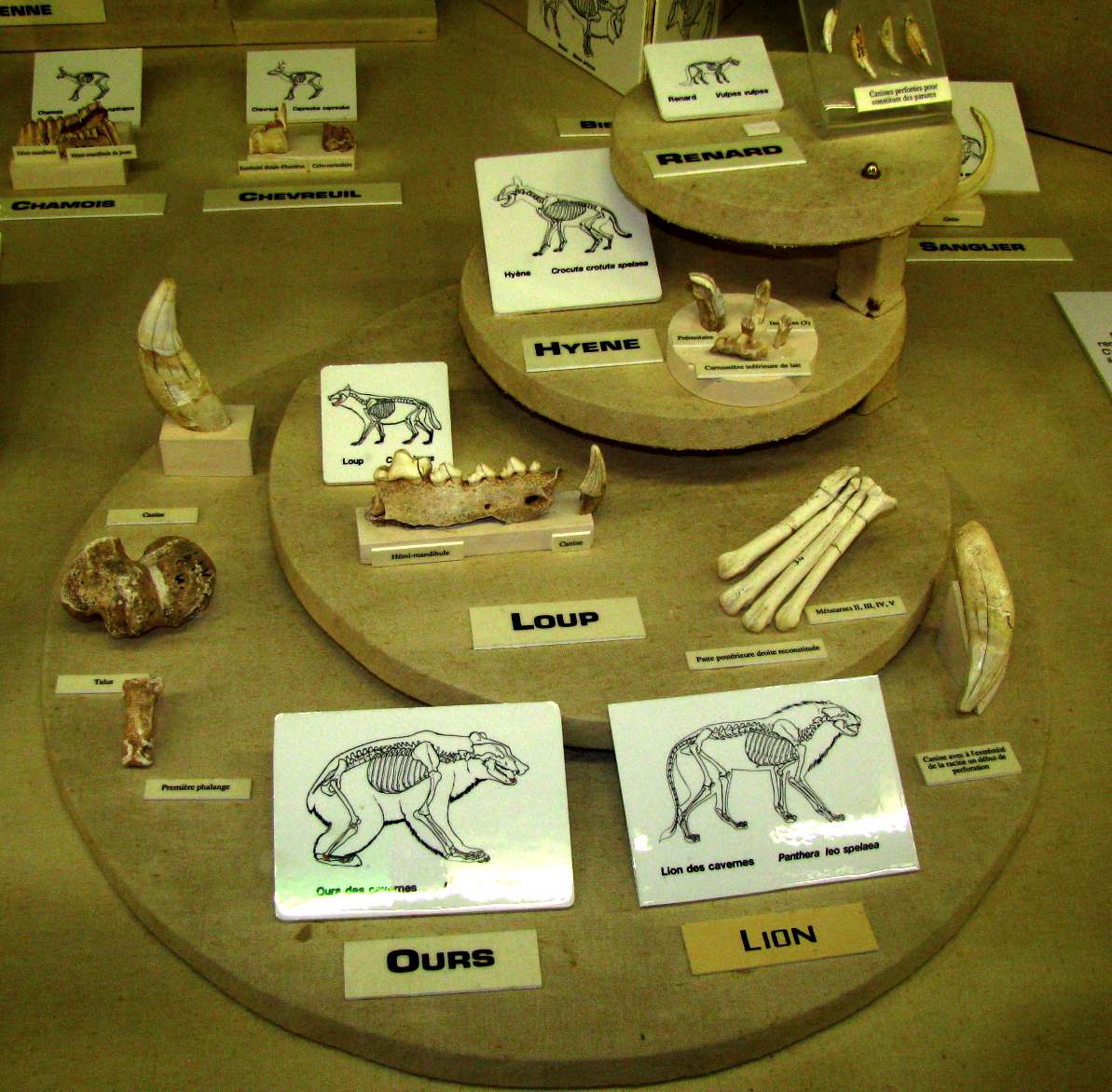
There were many animal bones found in the Abri. Shown here are bones from bear, wolf, hyena and fox.
Photo: Don Hitchcock 2008
Source: Display at the Abri Pataud Museum.
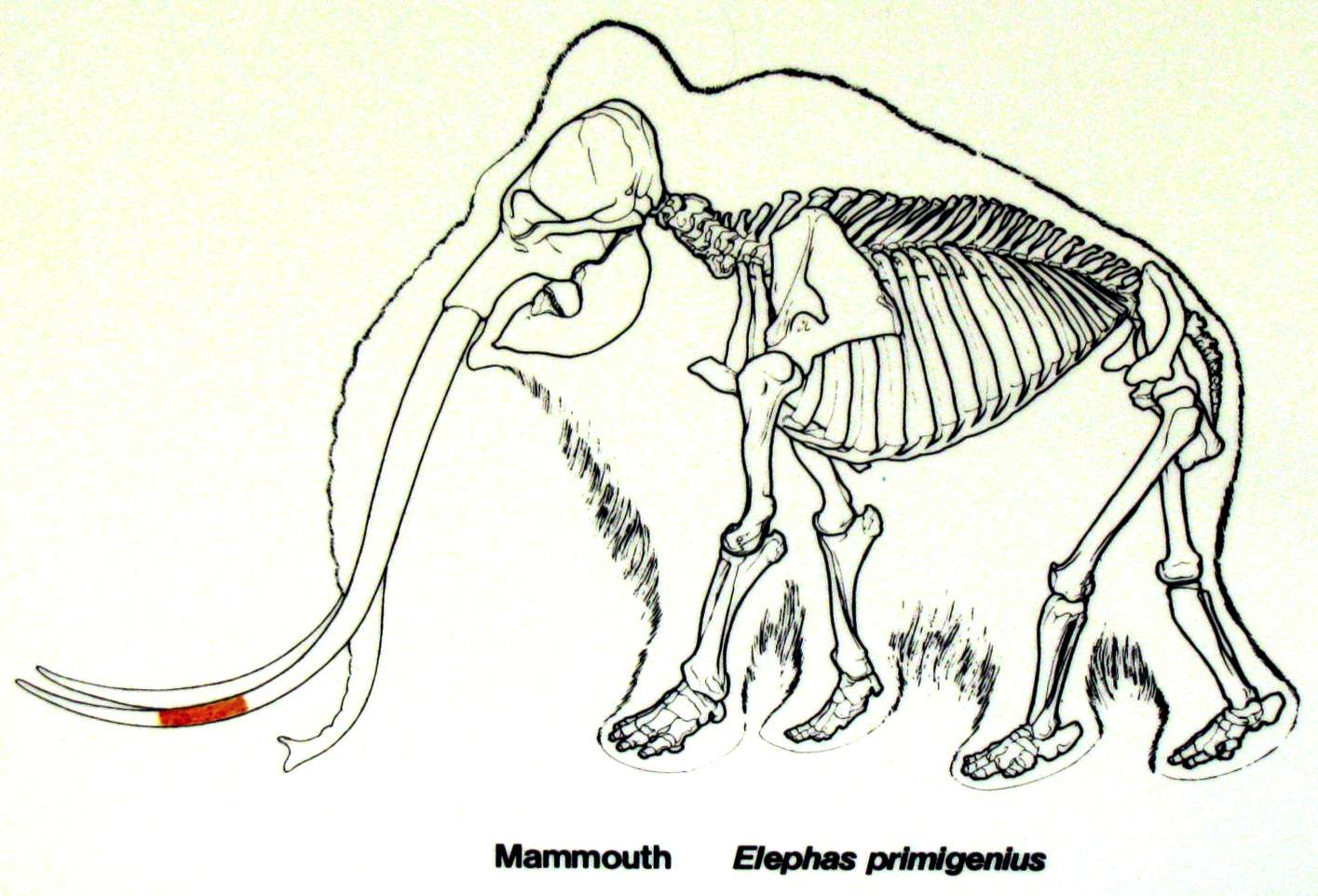
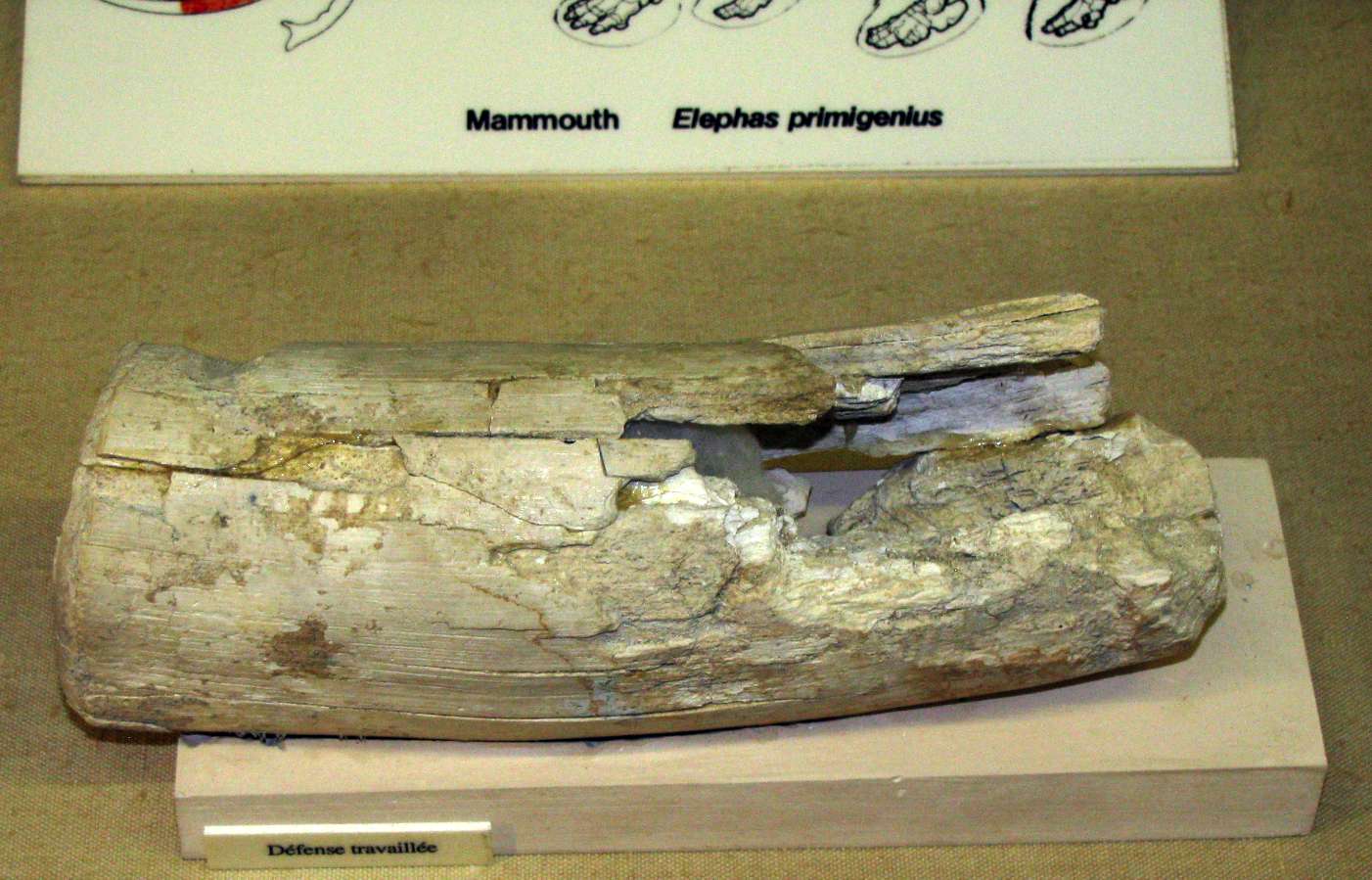
This is an excellent drawing of a mammoth showing both the skeleton and the original physical outline of the animal, scientific name Elephas Primigenius, as well as a section of the tusk found at Abri Pataud and noting where it came from on the original animal, in red on the drawing.
Photo: Don Hitchcock 2008
Source: Display at Abri Pataud Museum.

Display to illustrate that a flint core or nucleus can be made to give both lames (blades, flakes that are twice or more as long as they are wide) and éclats (flakes).
Photo: Don Hitchcock 2014
Source: Apparently originals, display at Abri Pataud Museum.
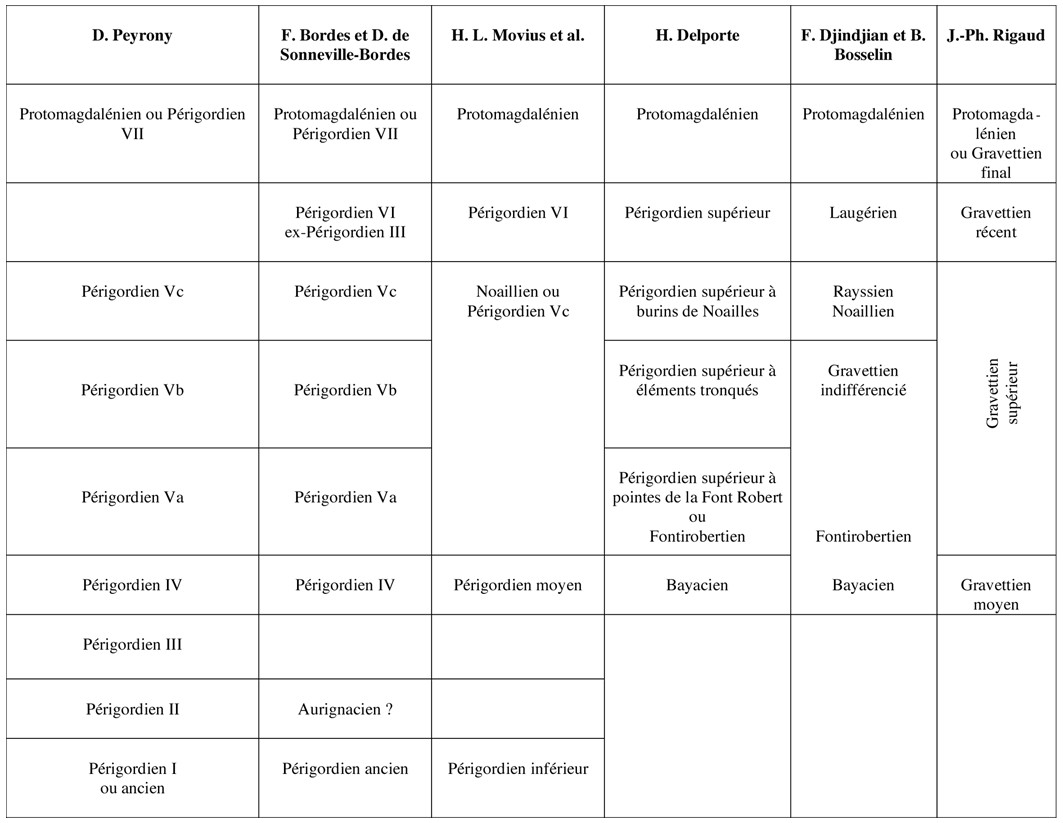
Table of the Perigordian.
Photo: after L. Pradel in: Sonneville-Bordes (1960)
Proximal Source: Rigaud (2008)

Vegetation at Abri Pataud.
This table provides a much better idea of the ages of the various periods designated as Perigordian.
Photo: Don Hitchcock 2014
Source: Display at Abri Pataud Museum.
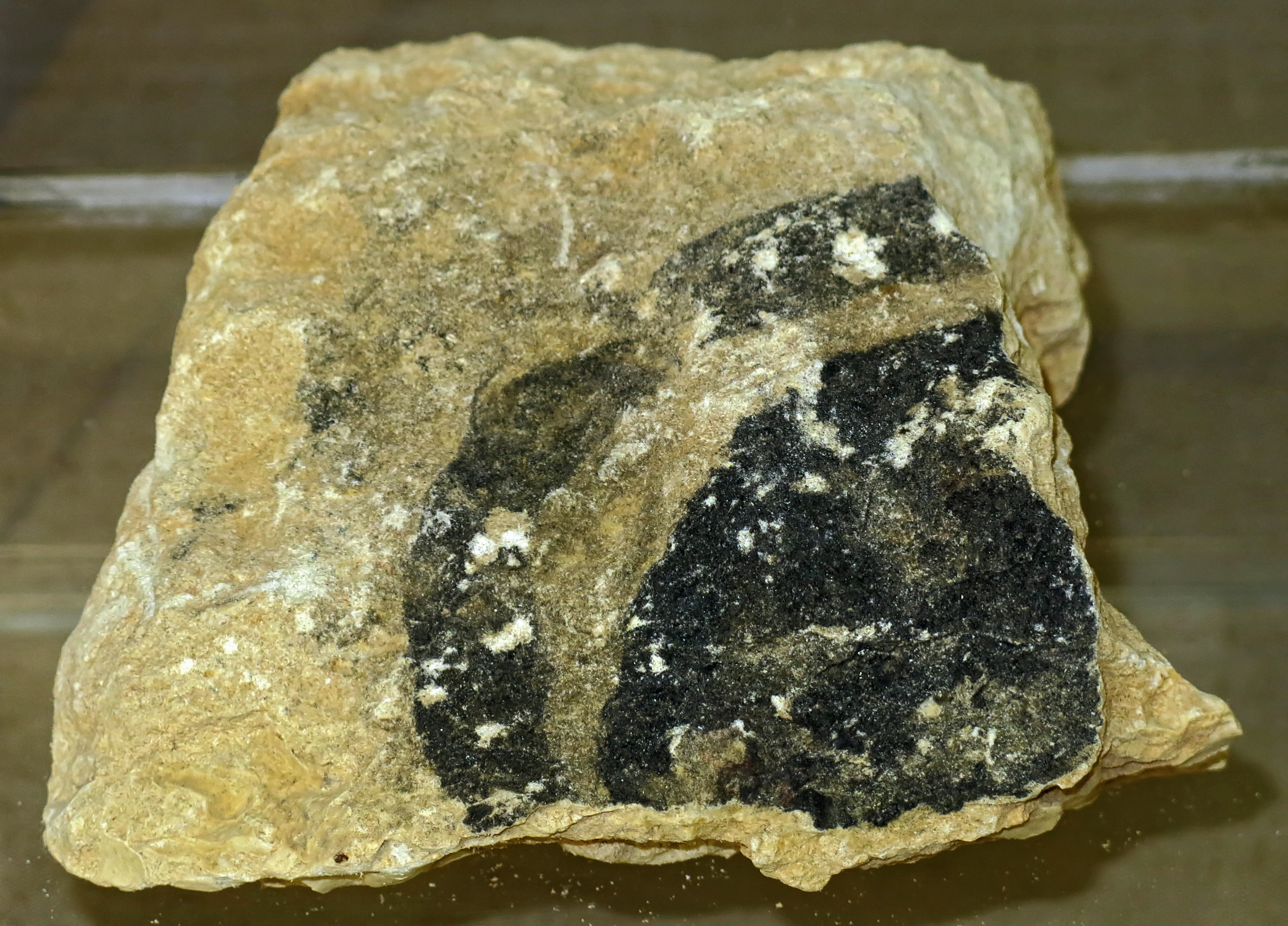
Partial black design on limestone. Probably completed in Manganese dioxide pigment, which was also important for fire lighting.
Photo: Don Hitchcock 2014
Source: Apparently original, display at Abri Pataud Museum.
In this excellent video on pressure flaking, archaeologist Jason Roe shows the process of pressure flaking to make a biface, using a white-tailed deer tine, and of making notches using a piece of cut antler on black obsidian.
The video is part of a series of educational videos on flintknapping for ANTH 3201 Lithic Analysis taught by Dr. Julie Cormack at Mount Royal University. These videos were produced by the Media Production Team at MRU. The conceptual idea and project organization came from Julie Cormack.
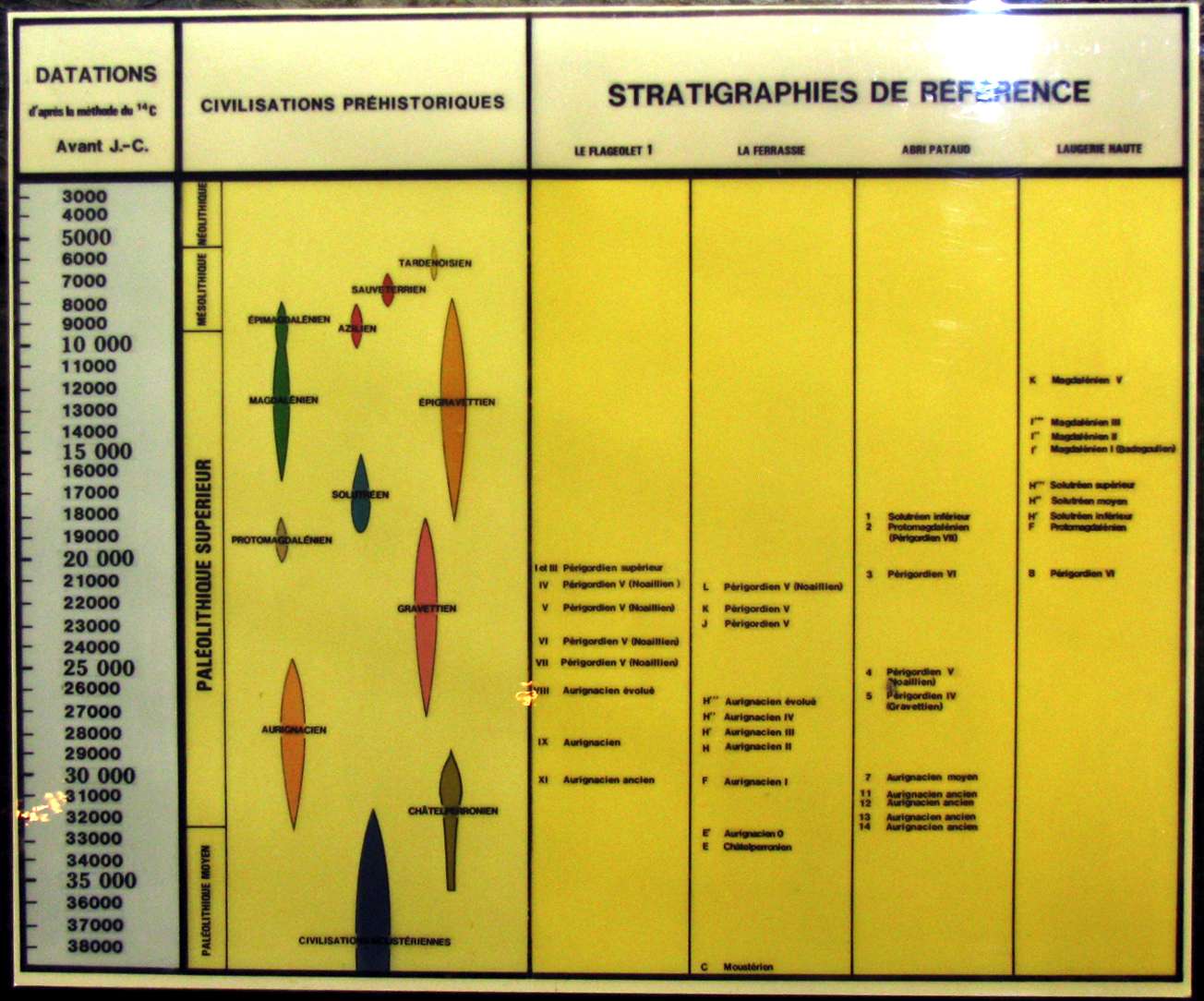
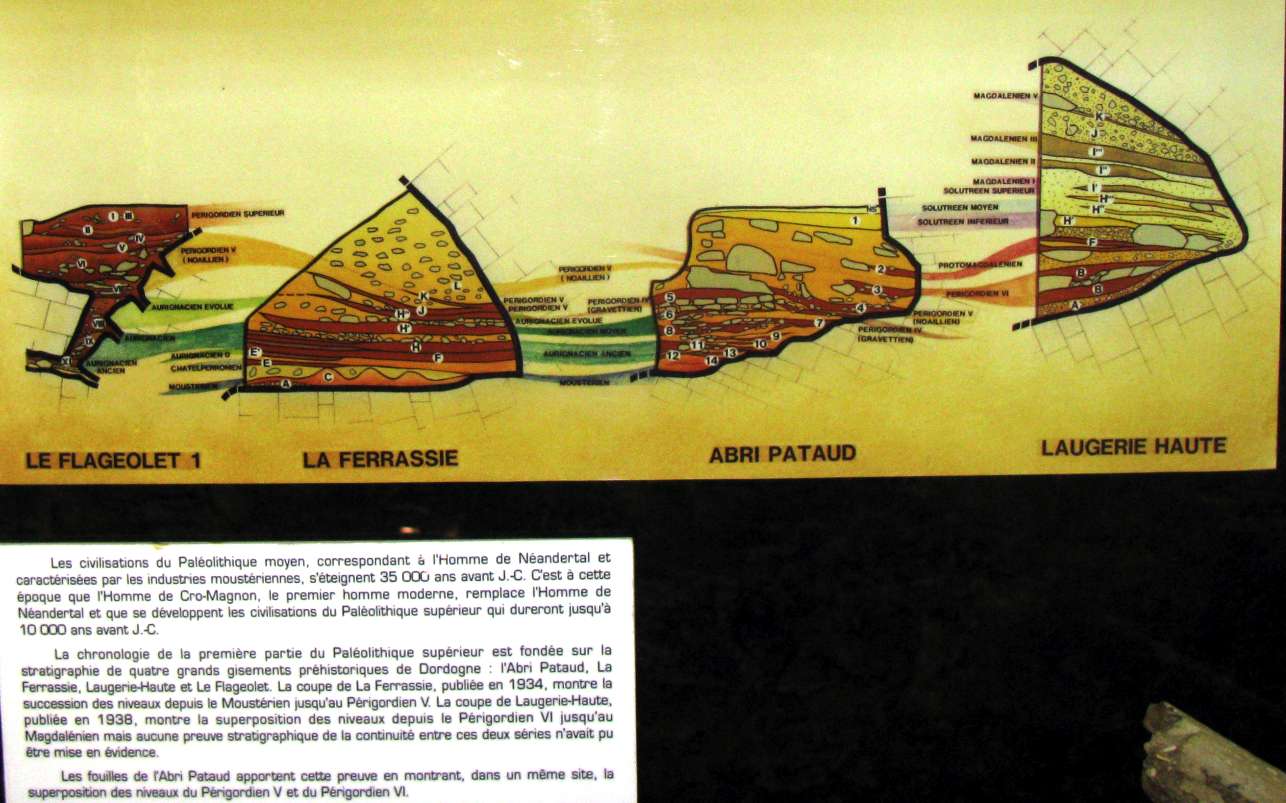
This is an excellent summary of the prehistoric cultures from Le Flageolet 1, La Ferrassie, Abri Pataud and Laugerie Haute.
Photo: Don Hitchcock 2008
Source: Display at Abri Pataud Museum.

Hallam L. Movius Jr, born in Newton, Massachusetts, on November 28, 1907, was a Palaeolithic archaeologist, a specialist in the interpretation of human behaviour and its environmental context during the latter part of the Old Stone Age, toward the end of the Pleistocene Epoch. With broad training and varied field experience in Europe, the Near East, and Southeast Asia, he became in the years after World War II the pre-eminent spokesman for Palaeolithic archaeology in the United States.
In his classes at Harvard and on his excavations in France, he was instrumental in training a generation of American and European archaeologists. His decades-long investigation of the Abri Pataud, a large Upper Palaeolithic rock shelter in southwestern France, formed the basis for what is today a French government museum and research centre at the site.
In the summer of 1949, already a respected archaeologist, Movius spent several months in France, mostly in the Dordogne region of the southwest, talking with local prehistorians and looking for a good Upper Palaeolithic site at which to start a major new excavation. The site he chose was a large collapsed rockshelter overlooking the Vézère Valley in the town of Les Eyzies. It was this site, the Abri Pataud, that would be Movius’s primary professional concern from then until the end of his career.
He did a test excavation in 1953 on the part of the site then accessible to him. The property was, however, part of a working farm, and a barn stood on the main portion of the site. In 1957 Harvard purchased the property and immediately transferred ownership to the French government, which in turn granted what became known as the Harvard Dordogne Project the excavation rights for a 20-year period. Six seasons of excavation were conducted at the Abri Pataud between 1958 and 1964. The old farmhouse and its ancillary structures (located, in fact, in a second walled-up rockshelter) were converted into laboratory and storage areas so that on-site analysis of the excavated materials could continue throughout the year.
Early in the project, Hallam and his wife Nancy acquired a property, Roque Veyral, just a few kilometers distant from the Abri Pataud and renovated it into a combination residence and laboratory. At the site or at Roque Veyral, or both, research and writing about the Abri Pataud continued for at least part of every year for nearly two decades. Hallam Movius’s Abri Pataud project made several kinds of contributions to Palaeolithic archaeology and European prehistory. First, and most obviously, it answered substantive technical questions about the sequence and radiocarbon dating of Upper Palaeolithic archaeological cultures in southwestern France, a classic region for the understanding of human behaviour at the end of the Ice Age. The site was, in fact, occupied repeatedly between about 34 000 and 20 000 radiocarbon years ago, by people representing the Aurignacian, Gravettian, Noaillian, and Solutrean archaeological cultures.
Second, it provided for U.S. archaeologists a model of the sort of broadly interdisciplinary approach to an archaeological site that was becoming standard operating procedure for Old World prehistory after World War II. The breadth of Movius’s research plan can be seen from the contributors to the introductory volume of the multivolume site report (1975): these included two archaeologists, two geologists, a vertebrate paleontologist, a malacologist, two human paleontologists, a palynologist, and two ecological biologists.
In 1970, still in his early sixties and at the height of his career, Movius suffered a stroke while working at the Abri Pataud. He recovered almost fully, with only a lingering weakness on one side that required him to walk with a cane. For several years he continued to teach and to spend part of every year in Dordogne pursuing his research and writing. The site report on the Abri Pataud was planned as a multivolume monograph series to be published by Harvard’s Peabody Museum as bulletins of the American School of Prehistoric Research. Movius saw the first two volumes through to publication, in 1975 and 1977, but a series of increasingly debilitating health problems made it more and more difficult for him to take an active part in the publication program. He retired from teaching in 1974 and from his curatorship at the Peabody Museum in 1976.
Two more site report monographs were published in 1984 and 1985, but the Peabody Museum had already confirmed its inability to proceed with the final three volumes planned for the series. In view of the great importance of the site to the profession, the director of antiquities for southwestern France proposed that a one-volume, French-language summary report on the entire Abri Pataud operation be compiled and published at French government expense. Movius enthusiastically endorsed this plan, and the volume in question was published in Paris in 1995, some years after Movius’s death. Movius's Avant propos to this volume, dated December 1985, was the last thing he wrote about the great site that was the capstone of his career.
Hallam Movius died in Cambridge, Massachusetts, on May 30, 1987.
Text and Photo: http://books.nap.edu/html/biomems/hmovius.pdf
The contribution to excavation methodology of Hallam L. Movius at l'abri Pataud
Abstract
The methodological contribution of the abri Pataud excavation in the fifties and sixties was innovative in many ways. The critical analysis of original documents shows how the excavation was exemplary and allows understanding in detail the reading of the site by Hallam L. Movius and his multidisciplinary team. This analysis, that we propose to present with some concrete examples, is the essential basis of all re-examination of the archaeological assemblage from the Hallam L. Movius excavation: the installation of a grid system as a permanent structure appears as one of the innovative methods used at the abri Pataud. It allowed the coordination in three dimensions of the remarkable artefacts and the collection of the rest of the archaeological material with a good planimetric precision. Many topographical measurements (surface and base of the levels) allowed a better understanding of the stratigraphy; Hallam L. Movius was one of the first researchers to systematically use the radiocarbon dating method.
As a whole, the results for abri Pataud levels are very coherent; hand-written or typed cards, with the excavation data, were created for each coordinated artefact; in the first years, the levels were exposed on all the grid surfaces (12 by 12 metres). Afterwards, huge collapsed blocks caused Hallam L. Movius to reduce the excavation zone to 6 by 12 metres. Two lateral trenches excavated before the central trenches allowed the anticipation of the reading of an often very complex stratigraphy; spatial distributions on graph paper were realised for all of the excavation from the artefacts' coordinates: these documents (plans and sections) have remained unpublished.
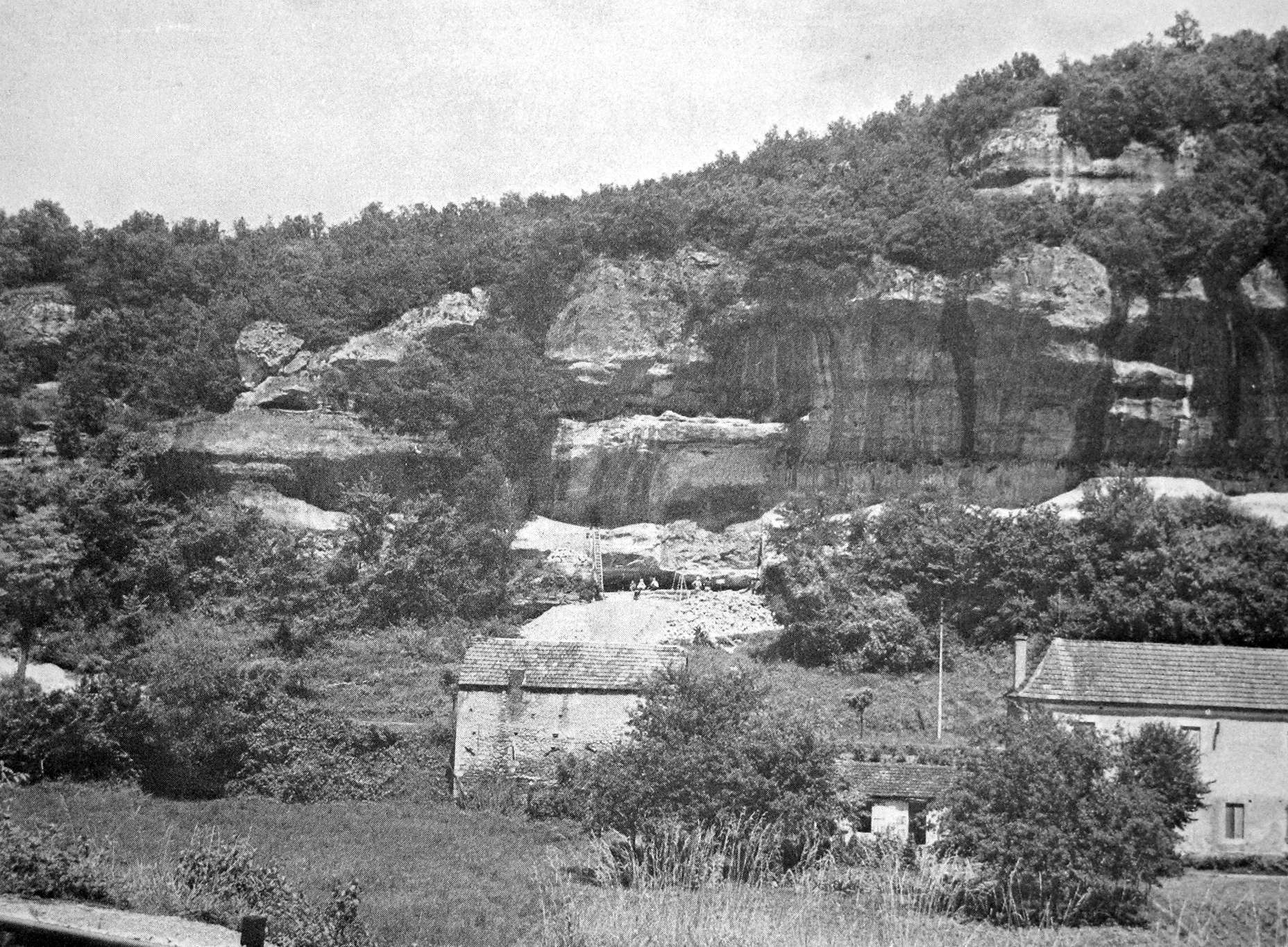
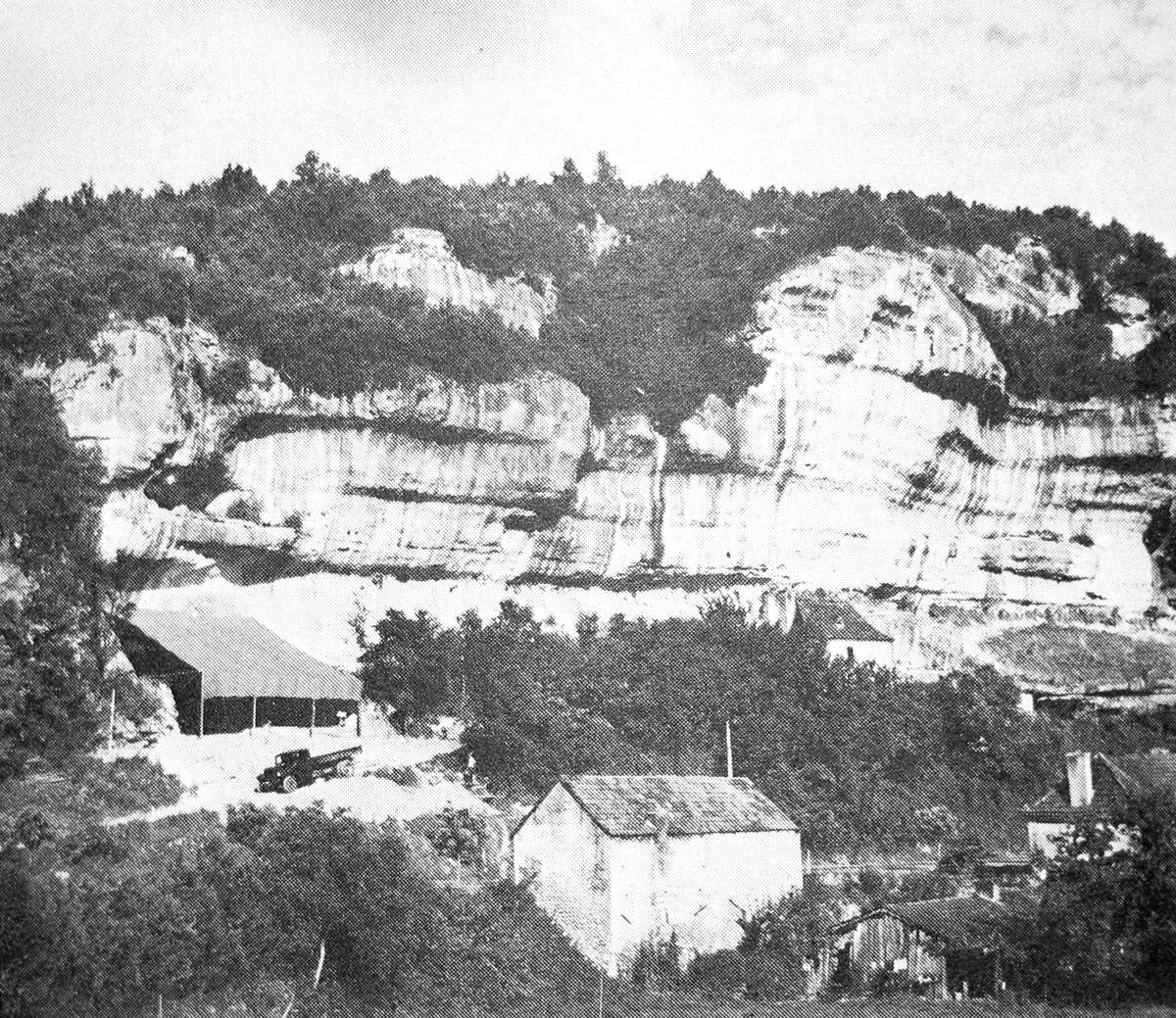
General view of the Abri Pataud, Les Eyzies (Dordogne). Photograph taken in July 1958 from near the railway bridge over the Vézère River.
Photo: Movius (1977)
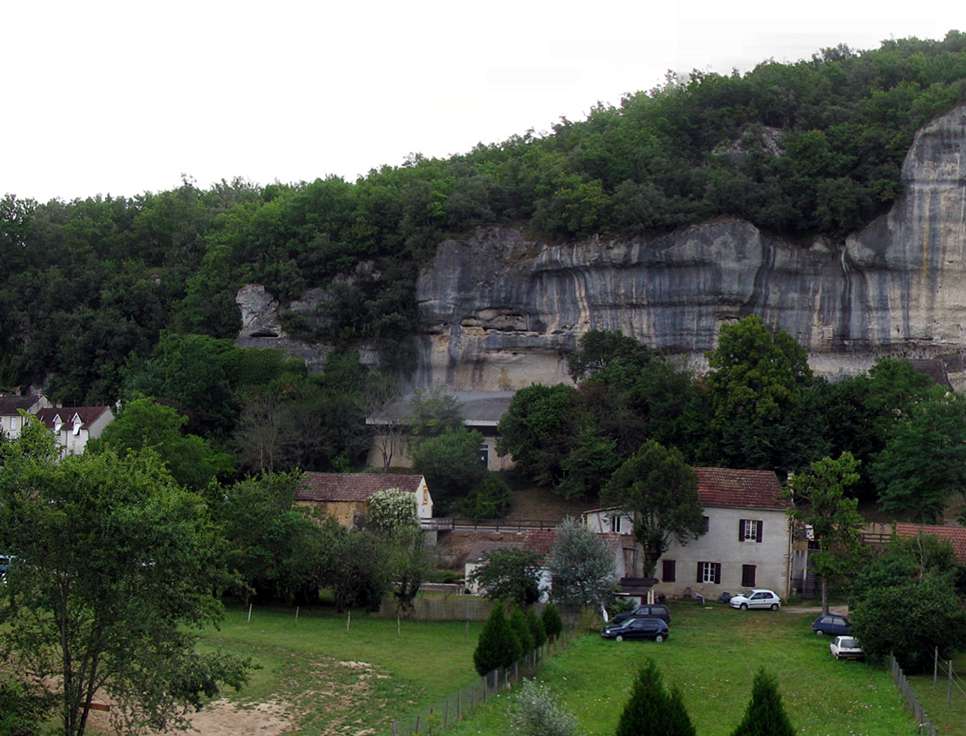
General view of the Abri Pataud, Les Eyzies (Dordogne). Photograph taken in August 2008 from near the railway bridge over the Vézère River, a little more to the right than the previous photograph.
It is interesting to compare the two photographs to note the changes in both houses and vegetation during the passage of fifty years.
In particular, we can see the wall and roof which now protects the gisement of l'abri Pataud from the weather.
Photo: Don Hitchcock 2008
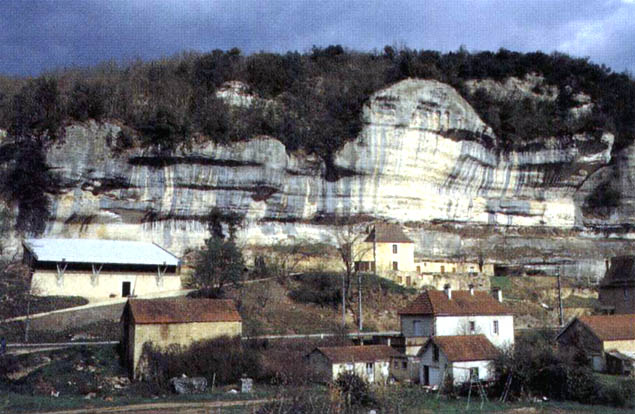
Abri Pataud at a time intermediate between the first excavations and my photo from 2008. The wall and roof protecting the site are clearly visible in this shot, as is the Abri Pataud museum at the top of the small road leading to the right. Vegetation has grown significantly in the meantime, and now obscures this view.
Photo: 'Discovering Perigord Prehistory' by B & G Delluc, A Roussot & J Roussot-Larroque.
Les Eyzies
General panoramic view of the Abri Pataud and Les Eyzies (Dordogne). Photo taken in August 2008, fifty years after the general view of 1958 above, and also from near the railway bridge over the Vézère River, a position which gives a wonderful vista of this important archeological area.
Photo: Don Hitchcock 2008
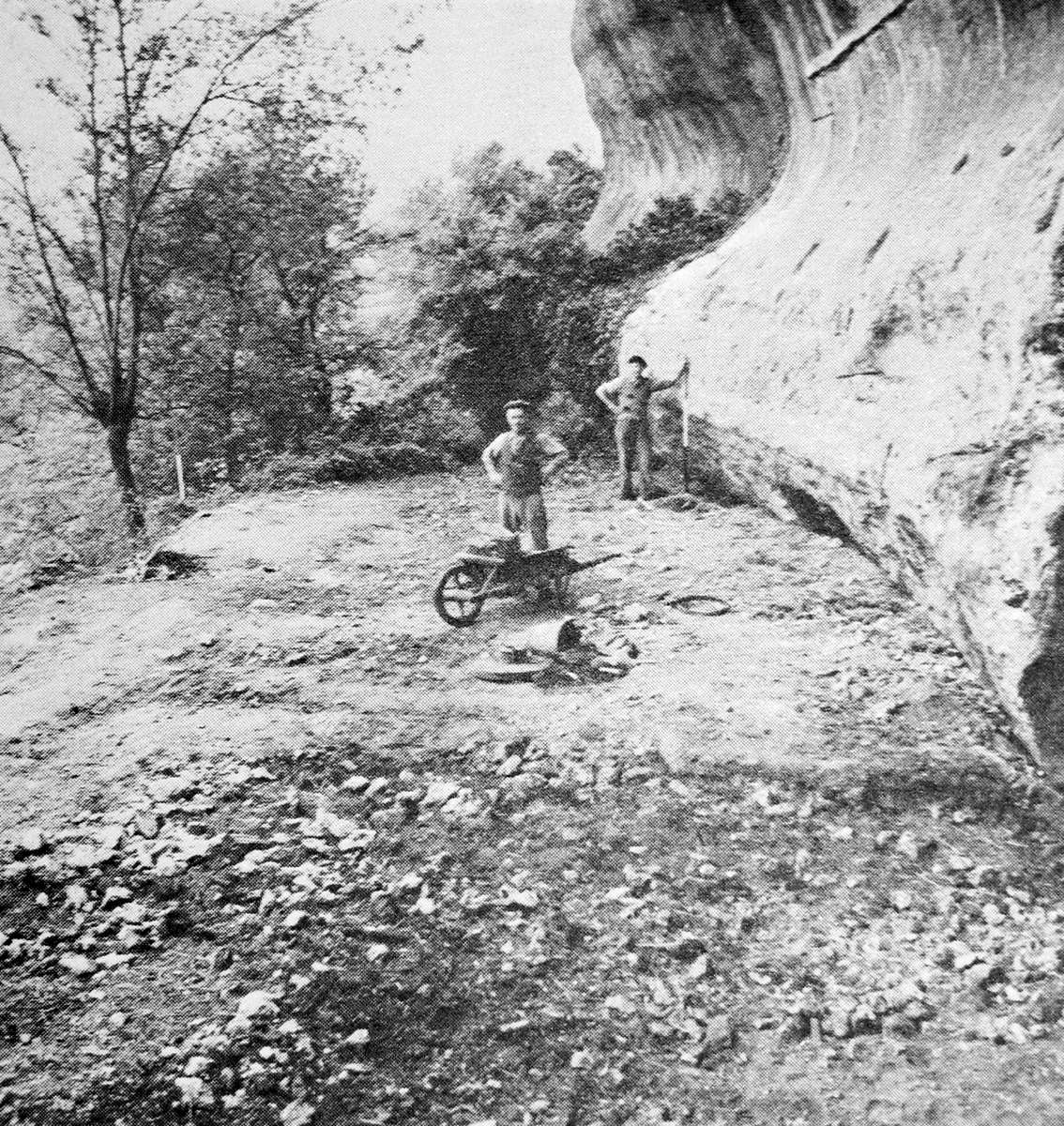
Cleaning the site prior to excavation. The area in the foreground is where the barn originally stood.
Photo and text: Movius (1977)
General view of the site with awning fully installed.
Photo and text: Movius (1977)
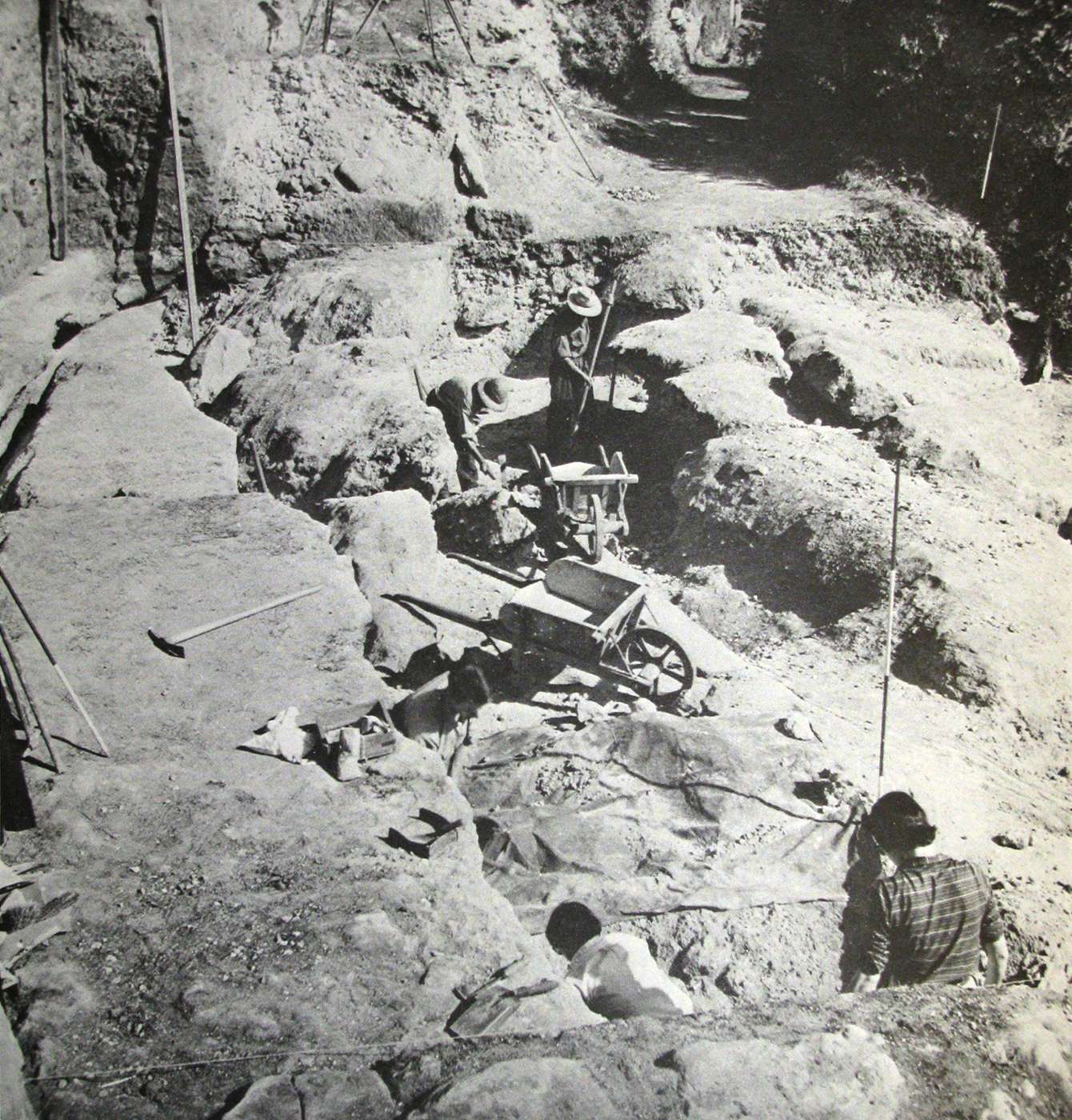
A series of huge fallen blocks (the collapsed former vault of the rock shelter) was encountered in the first metre of the excavation.
Photo and text: Movius (1977)
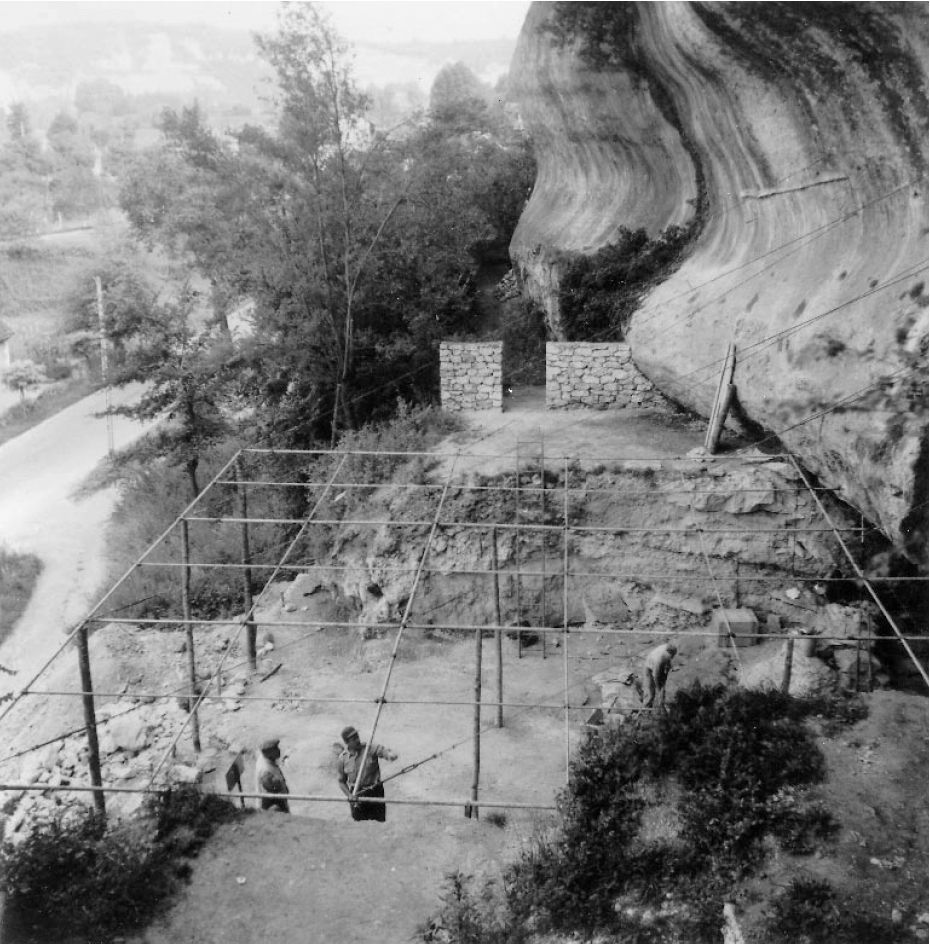
1958, general view of the excavation showing the grid system.
Photo: H.L. Movius in Chiotti & Nespoulet (2004)

1959, excavation view of éboulis 3/4 showing the walls along
the boundaries of each square.
Photo: H.L. Movius in Chiotti & Nespoulet (2004)
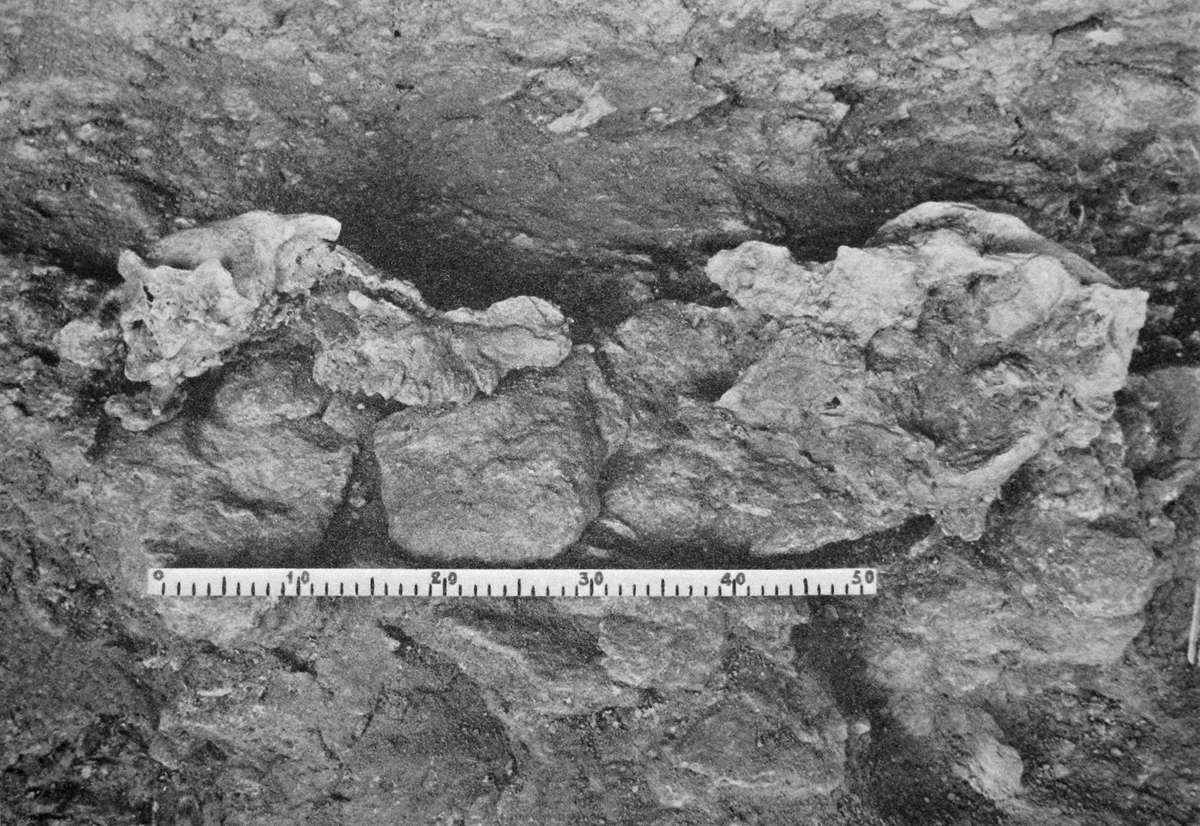
Skulls of large deer (Cervus elaphasus) placed facing each other against the rear wall of the site in Trench III, Square G.
Photo and text: Movius (1977)
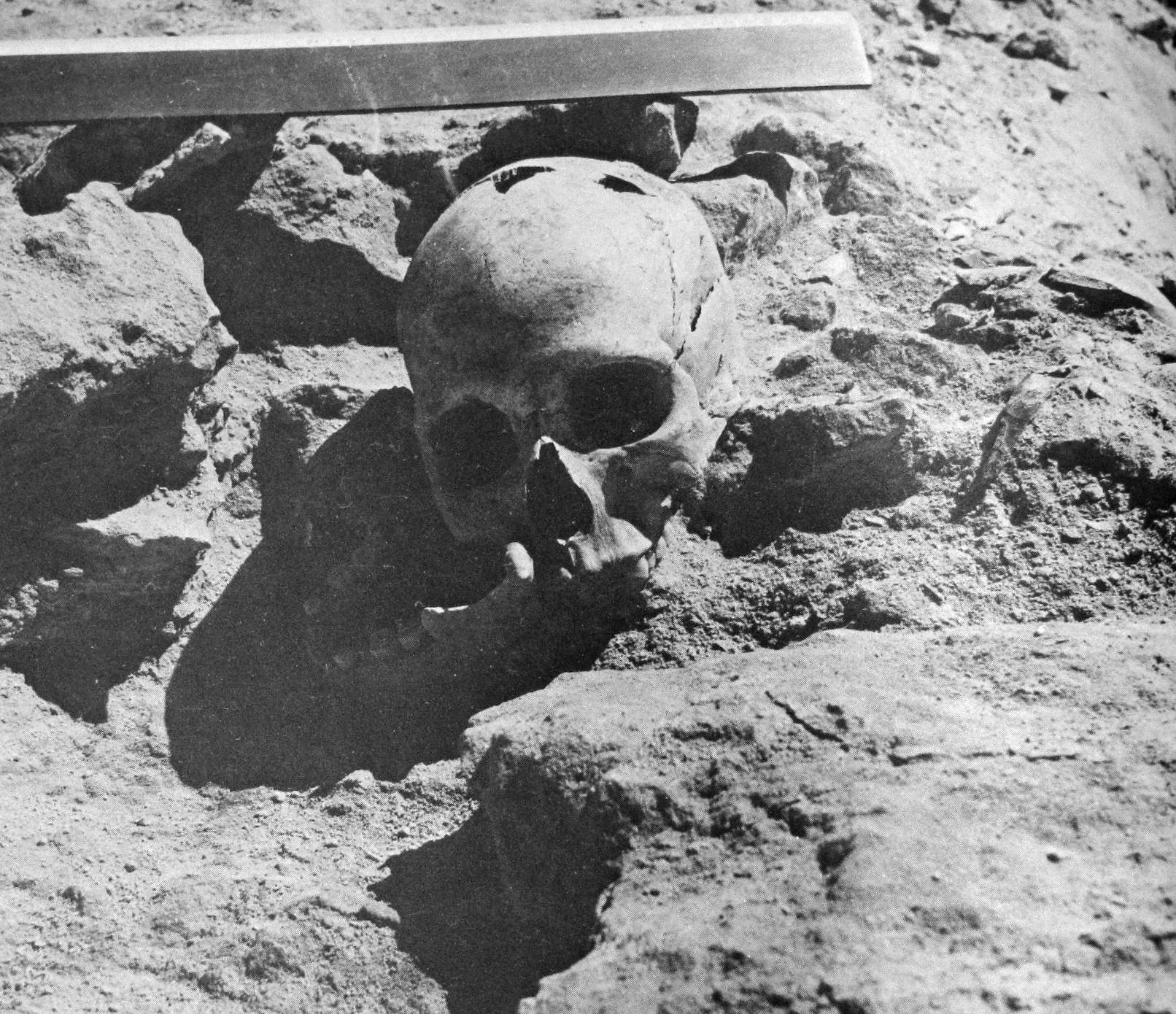
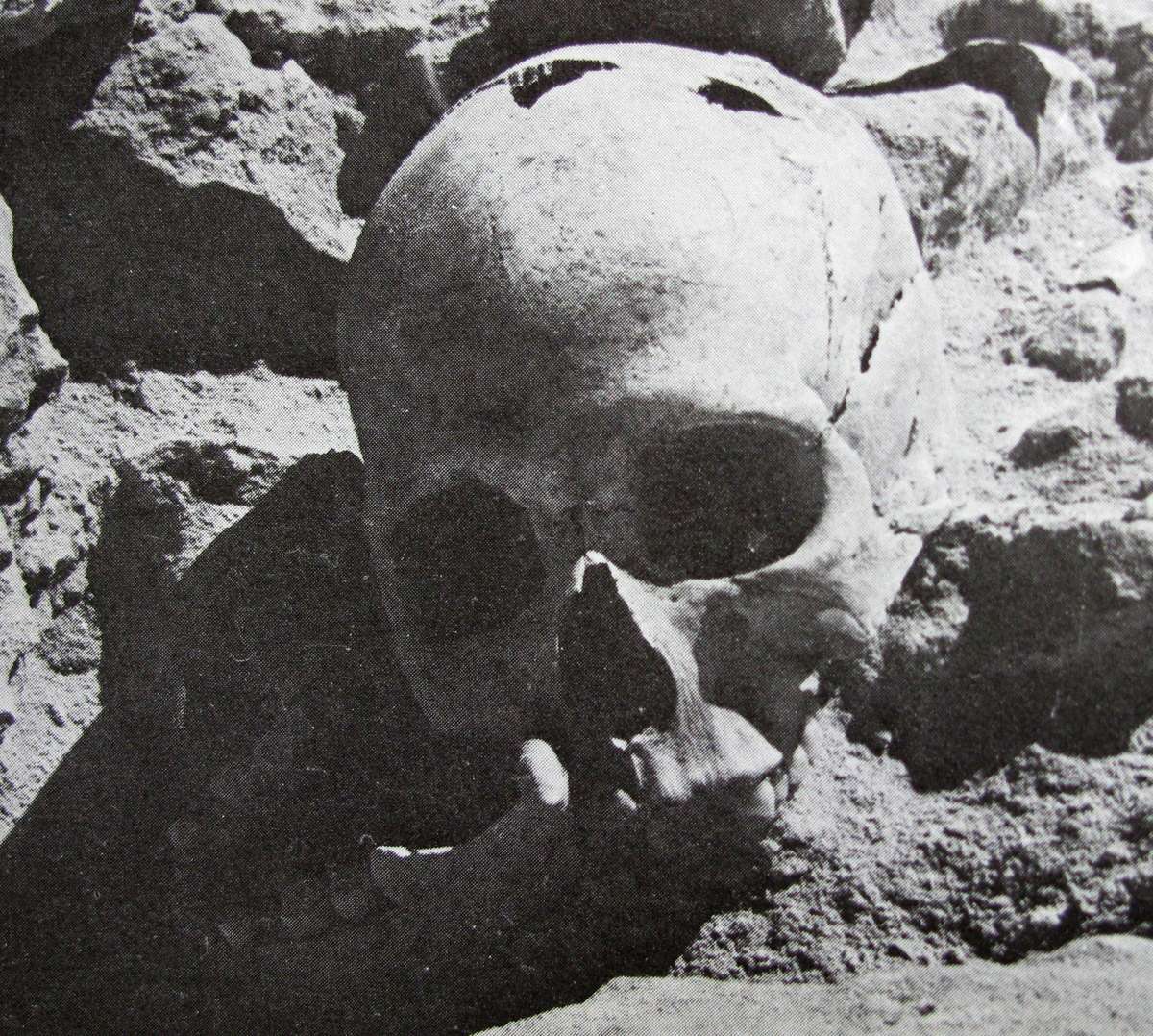
Skull and mandible of adolescent female in situ and in close up. These remains were found directly below a large fallen limestone block on 2nd July 1958. No traces of any of the vertebrae came to light.
The female skull and mandible had apparently been positioned and protected by three medium sized rocks arranged in a roughly triangular manner, near the front of the abri and the Eboulis-a stratum immediately above the main Level 2 deposits. Therefore, this find should not be considered as contained within the actual cultural layer itself, but as immediately subsequent to it, representing one of the last cultural acts at the site prior to the collapse of the immediately overlying blocks.
Photo and text: Movius (1977)
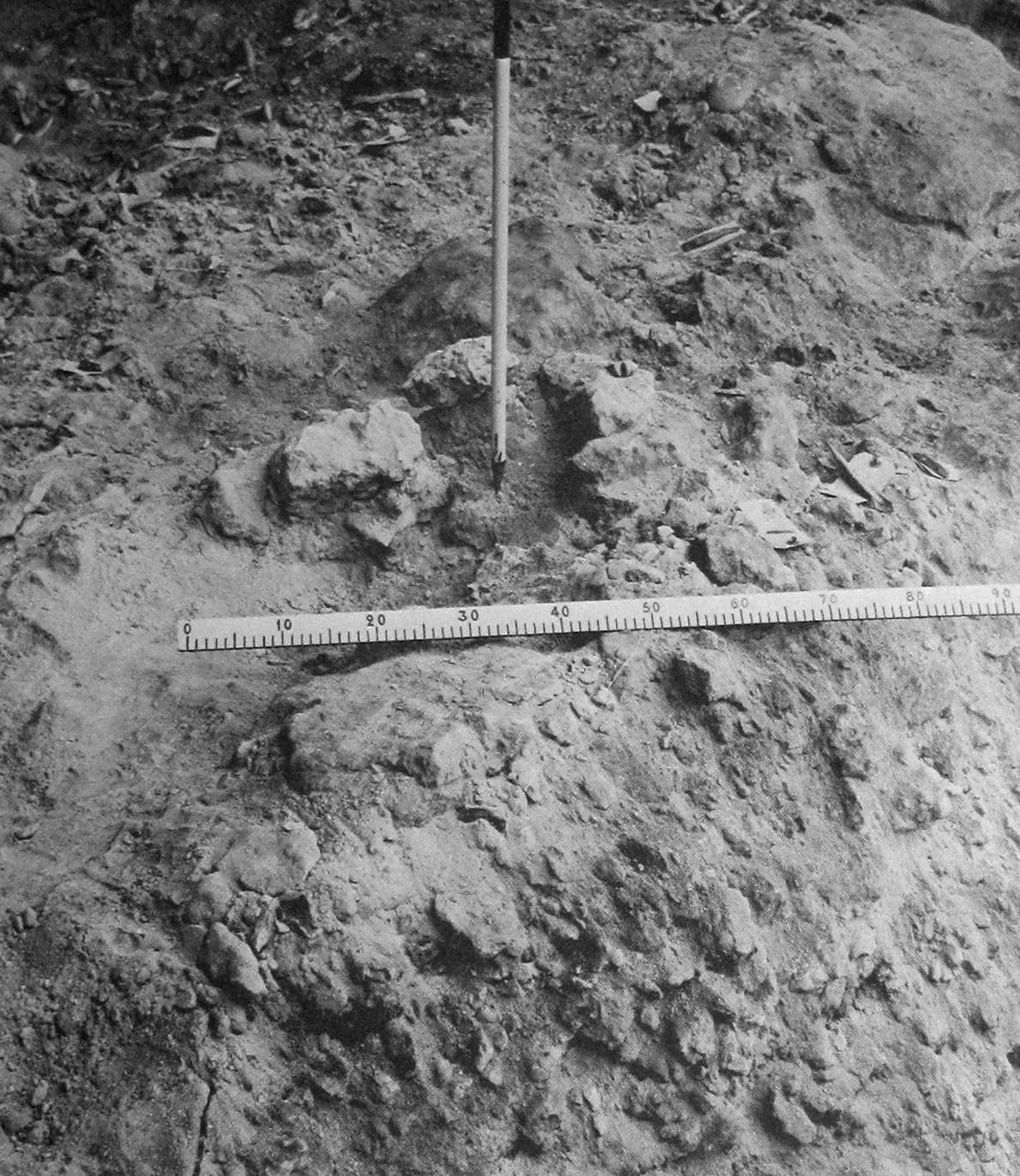
View showing emplacement of skull with surrounding rocks in situ.
The skull was found with its lower mandible only slightly dislocated. Although immediately covered over by a considerable rockfall, it had been protected by a series of medium sized rocks around it. It is apparent that it was covered over soon after its deposition,and this fact, rather than its displacement, has preserved it. Therefore, the Proto-Magdalenian occupation of the site may have been terminated by the collapse of the roof, during or shortly after the final occupation. In any case, there is absolutely no direct evidence to suggest that the death of any of the individuals was traumatically caused.
Photo and text: Movius (1977)
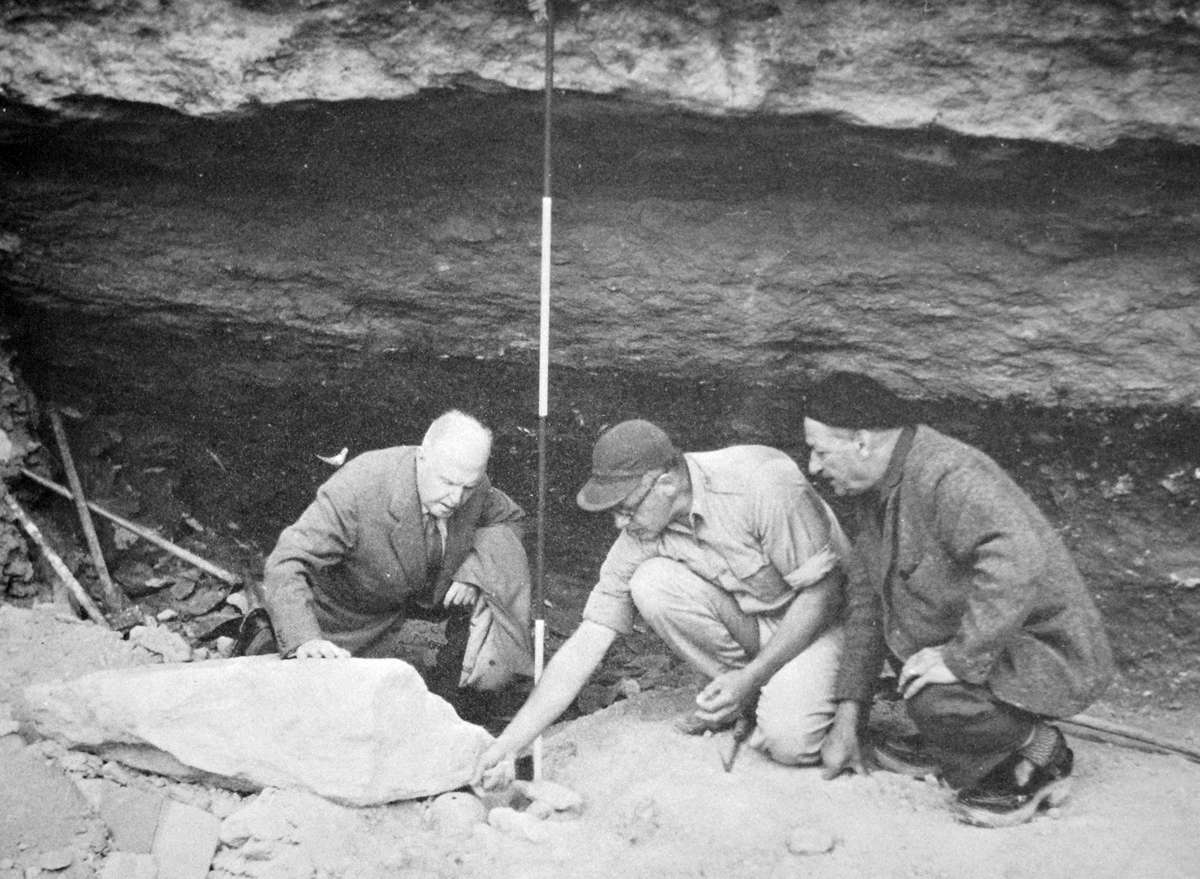
The female skull shortly after discovery being shown to MM. René Sordes and Séverin Blanc by Professor Movius.
Photo and text: Movius (1977)
From Movius (1977):
Found at the site were the remains of at least three adults or sub-adults and two children, one newborn. Of the adults, the age and sex of the intact cranium indicate a female between 15 and 20 years old.
A pelvic fragment and certain long bones suggest either a second female of approximately the same age, or the same individual. One male is indicated by fragments of long bones, a frontal, and some vertebrae. Finally, a newborn child is represented with the arm of another young female.
Important among these remains are the skull and mandible of the adolescent female in 10.00 west-east line between Trenches V and VI, the pelvic fragment in Trench VI near the rear wall of the shelter, the foetus and female arm in Trench II, and the distal portion of a male humerus near the front of the same Trench. Some of these occurred in the Eboulis-a deposit, but others were found in various of the underlying lenses.
Some important results follow:
The female skull and mandible had apparently been positioned and protected by three medium sized rocks arranged in a roughly triangular manner, near the front of the abri and the Eboulis-a stratum immediately above the main Level 2 deposits. Therefore, this find should not be considered as contained within the actual cultural layer itself, but as immediately subsequent to it, representing one of the last cultural acts at the site prior to the collapse of the immediately overlying blocks.
The left arm of an adult and the fragmentary skeleton of an infant complex came to light in Lens 2. There were two humeri, one ulna, one radius, a nearly complete series of wrist and hand bones, one clavicle, and one incomplete scapula. With the exception of the fragmentary skull, which was associated with the adult's arm bones, the remains of the infant or fetus were randomly dispersed to the south of the adult arm complex with one definite concentration of fragmentary remains lying ca. 55 cm to the south-southwest of the centre of the main concentration.
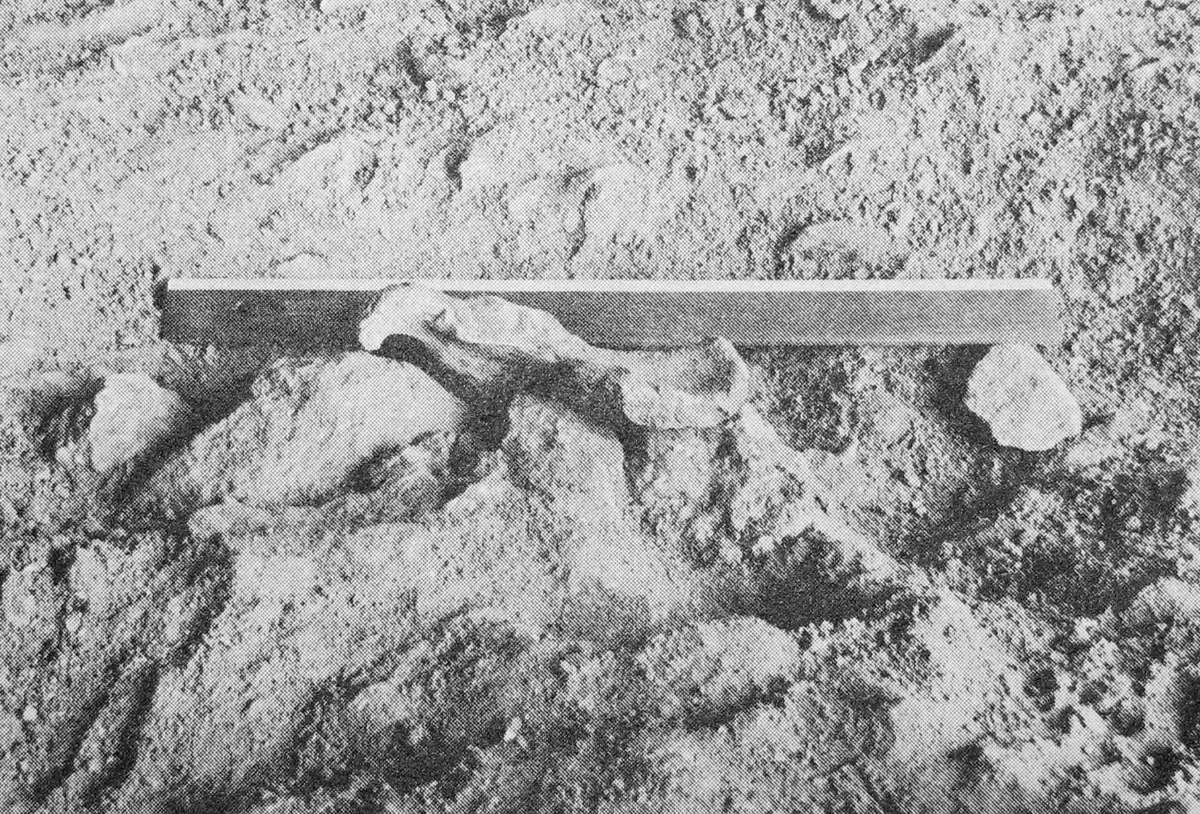
Left portion of the pelvis in situ in Trench V.
Photo and text: Movius (1977)
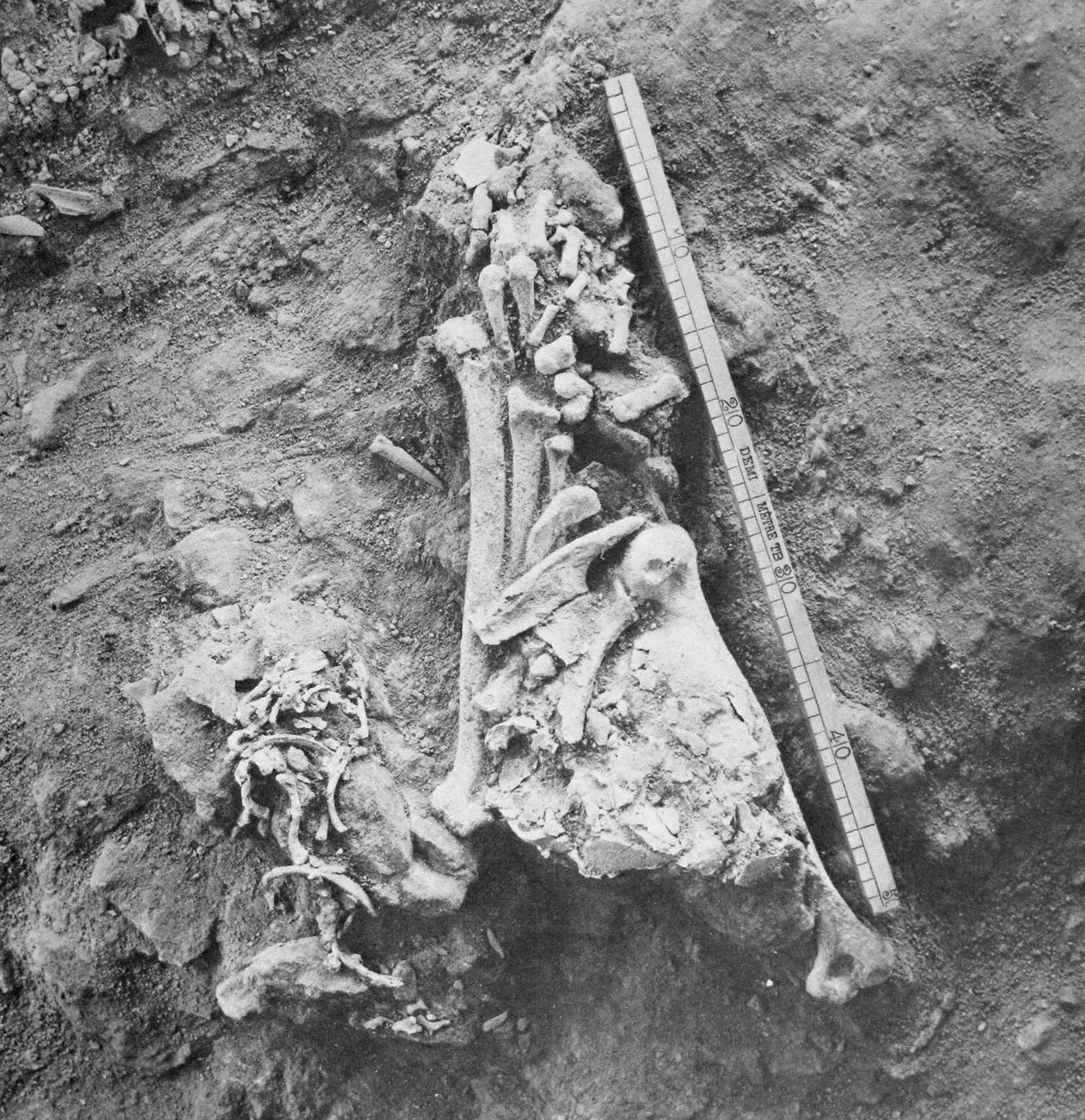
Detail of right arm/child's skull complex after cleaning.
(note that the caption to this photo says it is a right arm, but the text calls it a left arm. I am unable to sort this out, but I would presume that the text is the correct version - Don)
Photo and text: Movius (1977)
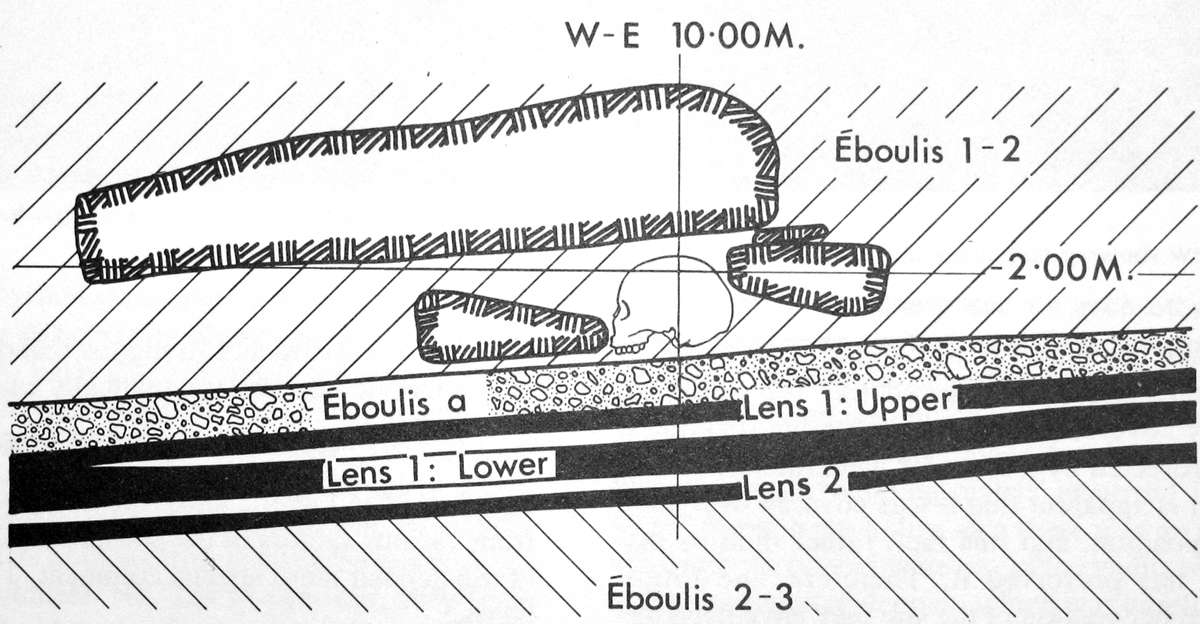
Diagram showing the position of the human skull, found in Eboulis 1-2.
Photo and text: Movius (1977)
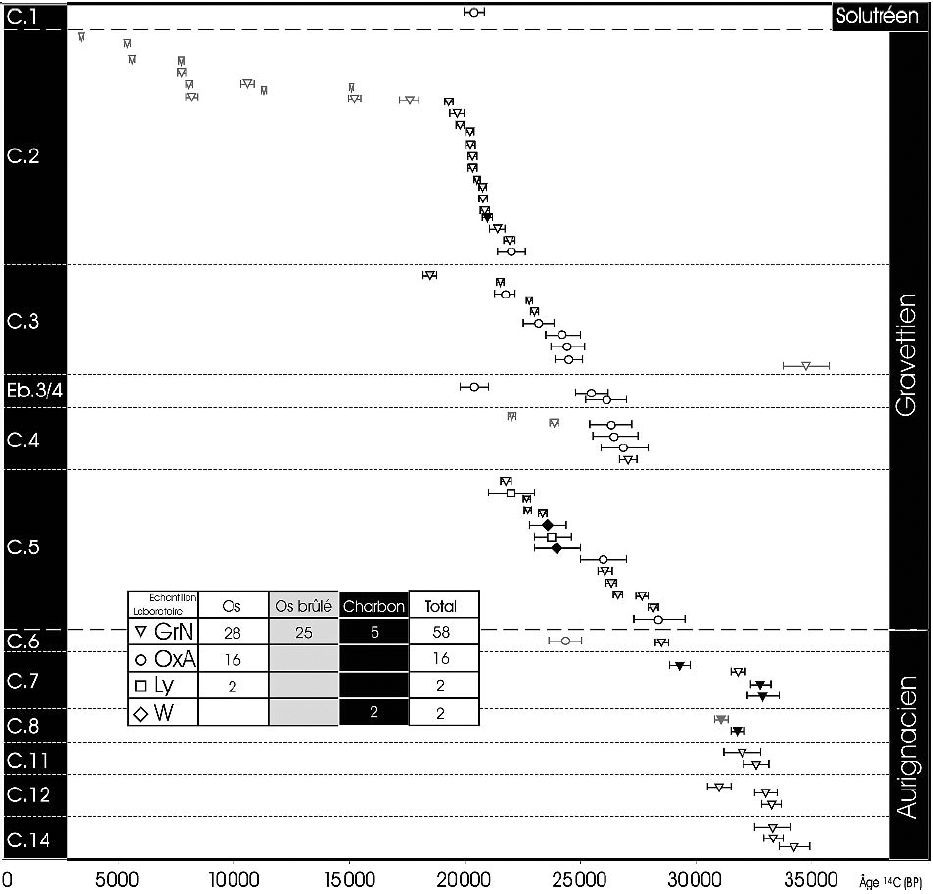
Graph of l'abri Pataud radiocarbon dates. Not all the dates shown here were kept by the authors (Movius 1977, Bricker 1995)
The non kept dates appear in clear lines. The great number of aberrant dates in level 2 is due to the samples' contamination by proximity to the surface.
Photo: Chiotti & Nespoulet (2004)
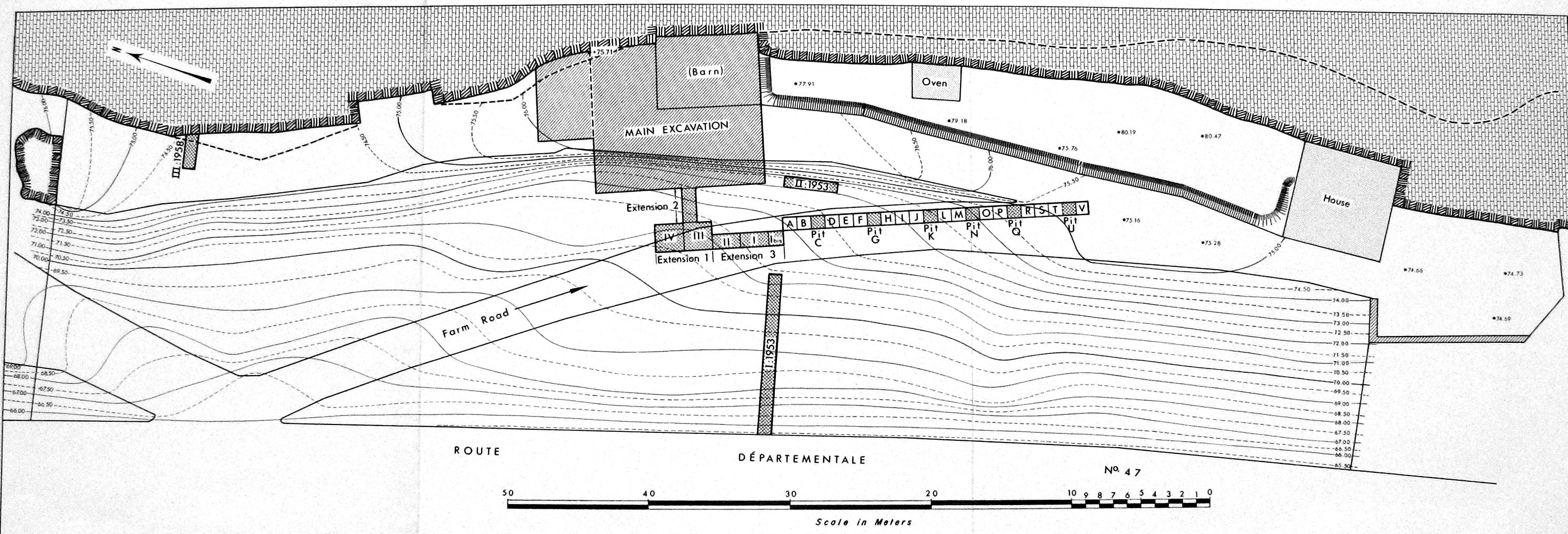
Pataud property plan.
Photo: Movius (1977)

Extract from a field notebook showing a level 5 layer.
Photo: Chiotti & Nespoulet (2004)
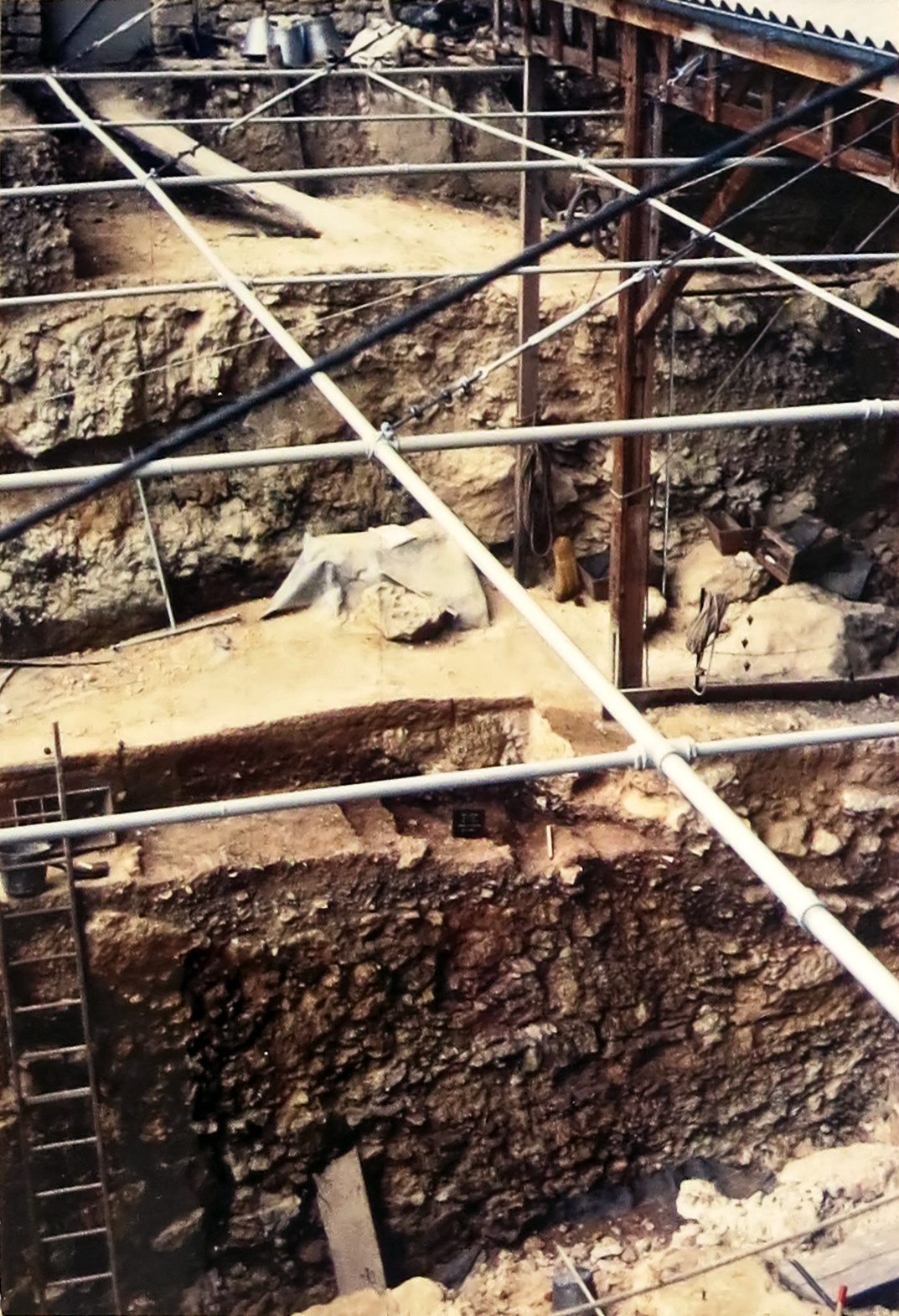
The excavation site in 1963. The upper section, in the background, corresponds to layers 1 (Lower Solutrean) and 2 (Protomagdalenian). The middle section corresponds to layer 4 (Perigordian V), while the lower section in the foreground, corresponds to layers 7 and 8 (middle Aurignacian).
Photo: Don Hitchcock 2014
Source: Display at Abri Pataud Museum.
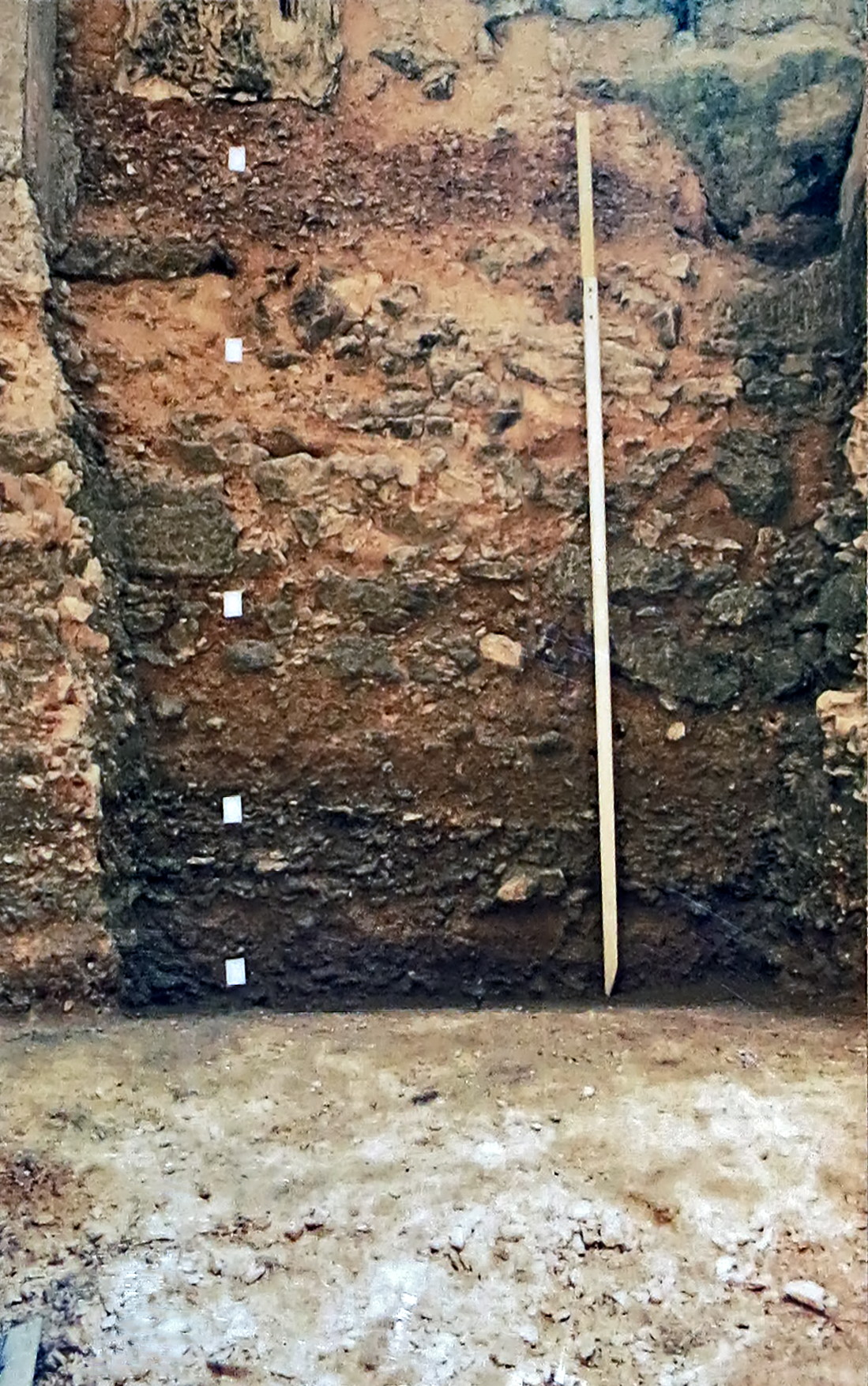
The Aurignacian levels 6 to 14. The floor corresponds to the rocks of the base.
Cross section north-south at metre 0, the datum point.
Photo: Don Hitchcock 2014
Source: Display at Abri Pataud Museum.

A 1964 drawing on graph paper, a plan and two sections, of a surface feature - Hearth R of level 12.
Photo: Chiotti & Nespoulet (2004)
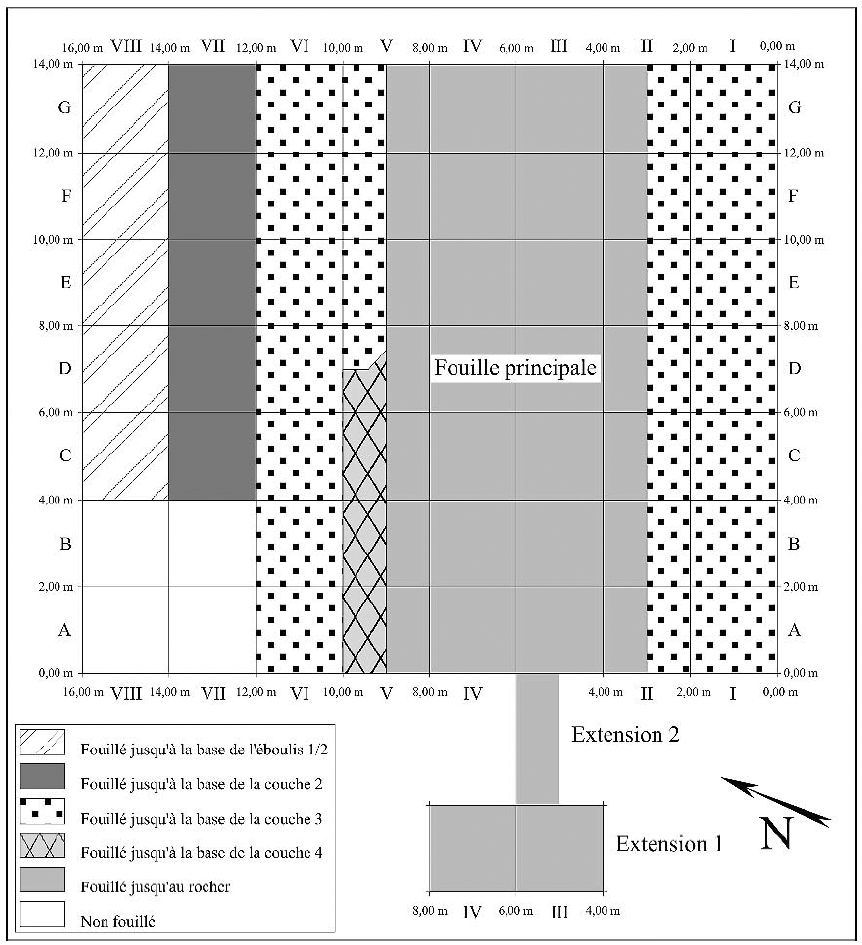
Detailed plan of the excavated area, after Movius (1977)
Photo: Chiotti & Nespoulet (2004)
References
- Breuil, H. & Cheynier, A., 1958: Les fouilles de Breuil et Cartailhac dans la grotte de Gargas en 1911 et 1913, Bulletin de la Société méridionale de Spéléologie et de Préhistoire V, 1954-55, 341-382 (extrait du Bulletin de la Société d’Histoire naturelle de Toulouse 93).
- Bricker H.M., 1995: Le Paléolithique supérieur de l’abri Pataud (Dordogne) : les fouilles de H.L. Movius Jr., Cambridge, Cambridge University Press. 1925, Second Edition. Documents d’Archéologie française, 50, éd. Maison des sciences de l’Homme, Paris, 328 p.
- Burkitt M., 1925: Prehistory: a study of early cultures in Europe and the Mediterranean basin, Cambridge, Cambridge University Press. 1925, Second Edition.
- Cheynier A., 1960: Place pour le Gravétien, Bulletin de la Société préhistorique française , Année 1960, Volume 57, Numéro 7 p. 389 - 412
- Chiotti L., Nespoulet R., 2004: L’apport méthodologique des fouilles de Hallam L. Movius à l’abri Pataud (Les Eyzies-de-Tayac, Dordogne), XXVIe congrès préhistorique de France – Avignon, 21-25 septembre 2004 p. 185-195
- Delluc B., Delluc G., 2004: L’art à l’abri Pataud (Les Eyzies, Dordogne). In M. Lejeune et A.-C. Welté (dir.), L’Art pariétal paléolithique dans son contexte naturel, Actes du colloque 8.2, Congrès de l’UISPP, Liège 2-8 sept. 2001, p. 87-94 (ERAUL, 107).
- Delluc G., 2006: Le sexe au temps des Cro-magnons, Pilote 24 edition (January 2006)
- Farrand, William R., 1975: Sediment analysis of a prehistoric rockshelter: The Abri Pataud., Quaternary Research 5(1): 1-26. http://hdl.handle.net/2027.42/22104
- Henry-Gambier D., Nespoulet R., Chiotti L., 2013: Attribution culturelle au Gravettien ancien des fossiles humains de l’abri Cro-Magnon (Les Eyzies-de-Tayac, Dordogne, France), Paléo, 24 | 2013, 121-138.
- Jaubert, J., 2008: L'art pariétal gravettien en France : éléments pour un bilan chronologique », Paléo, 20 | 2008, 439-474.
- Le Brun-Ricalens F., 2006: Les pièces esquillées : état des connaissances après un siècle de reconnaissance, Paléo, 18, 2006, 95-11
- Lacorre F., 1960: La Gravette, le Gravettien et le Bayacien, Laval, 1960, 369 pp., 26 fig, 78 planches
- Movius H.L. Jr, David N., Bricker H., Clay B., 1968: The analysis of certain major classes of upper palaeolithic tools: Stratigraphy, American School of Prehistoric Research, Peabody Museum, Harvard University, Cambridge, Massachusetts
- Movius H.L. Jr, 1977: Excavation of the abri Pataud, Les Eyzies (Dordogne): Stratigraphy, American School of Prehistoric Research, bull. 31, Peabody Museum, Harvard University, Cambridge, Massachusetts, 167 p., planches h. t.
- Pesesse, D., Michel A., 2008: Le burin des Vachons : apports d’une relecture technologique à la compréhension de l’aurignacien récent du nord de l’Aquitaine et des Charentes, Paléo, 18, 2008, 143-160
- Pesesse, D., Michel A., 2008: Le burin des Vachons : apports d’une relecture technologique à la compréhension de l’aurignacien récent du nord de l’Aquitaine et des Charentes, Paléo, 18, 2008, 143-160
- Rigaud J., 2008: Les industries lithiques du Gravettien du nord de l’Aquitaine dans leur cadre chronologique, Le Gravettien : entités régionales d’une paléoculture européenne, Les Eyzies, juillet 2004, pp 381-398
-
San Juan-Foucher, C., 2005: Industrie osseuse décorée du Gravettien des Pyrénées Munibe (Antropologia-Arkeologia) 57 San Sebastian 2005
-
Sonneville-Bordes D. (de), 1960: Le Paléolithique supérieur en Périgord, Delmas, Bordeaux 1960.
- White, R. , 2002: Une nouvelle statuette phallo-féminine paléolithique: 'La venus des Milandes' (commune de Castelnaud-la-Chapelle, Dordogne), Paleo N° 14 Décembre 2002 – Pages 177 à 198