Back to Don's Maps
 Back to Archaeological Sites
 Back to Pacific NW Coast index
Canoes of the First Nations of the Pacific Northwest

Photo: Don Hitchcock 2012
The First Nations people of the Northwest Coast are renowned for their elegantly engineered canoes. Ranging in length from three to twenty metres, canoes were essential for travel, transport, hunting, and trade. Different coastal communities developed distinctive styles to suit their particular needs. Each canoe is made from a single cedar log, carved and steamed into shape.
Haida canoes were exquisite craft hewn from the gigantic red cedar that grows on Haida Gwaii and were highly prized by chiefs of other nations throughout the coast. The combination of beautiful lines that pleased the most demanding navigator with the fine craftsmanship and the superior quality of the cedar available on Haida Gwaii literally made Haida canoes the Cadillacs of the coast.
Canoemakers in each village worked on their new craft throughout the autumn at sites where the very best red cedars stood. After an appropriate snowfall that facilitated sledding, the roughed-out canoes were moved from the woods to the nearest beach and towed to the home village, where they were finished over the winter. In the spring, lightly manned flotillas of new canoes left Skidegate Inlet, Masset and Rose Spit on the north coast, braving the seasonal storms to head for the mainland. If these vessels could withstand a crossing of the treacherous Hecate Strait, they could withstand any weather the coast could provide. At the Nass River, the canoes were traded to coastal tribes assembled to take advantage of the spring eulachon fishery. Old canoes were taken in trade by the Haida for their return journey home.
Text above adapted from http://www.civilization.ca/cmc/exhibitions/aborig/haida/havct01e.shtml
Gelwa (Canoe)
Haisla
Carved and painted by David Shaw and assistants, ca 1934
Over-painted by Bill Reid, 1967
Kitamaat, BC
Red Cedar, paint
Gift of Major G.G.E. Raley, 1948
A1535
In the 1930s, when this canoe was made, Native and non-Native fishers alike continued to engineer seaworthy vessels, adapting their skills to building wooden-hulled seine boats or carving and steaming cedar dugout canoes for new purposes.
This canoe was made by Haisla members of the Kitamaat Athletic Club. It was sent as a wedding gift to their patron, the son of local missionary Rev. G.H. Raley.
Photo: Don Hitchcock 2012
Source: Display, Museum of Anthropology, University of British Columbia

Gelwa (Canoe)
(name) Hunclee-quilas
Haisla
A1535
Wooden northern style canoe with a Haida design painted on the outside. The canoe is painted black with Northwest Coast stylised designs on the ends in red, white and black. Depicted on each side is a Killer whale with its head and dorsal fin on the prow and the body and tailfins on the stern. There is a red border around the upper edges. The ends sweep upwards. The prow is grooved to hold a harpoon or mast and has a vertical fin to cut through waves. The interior is also painted black and has three rectangular bench seats.
Canoes were used for fishing and hunting, trading, voyaging and war. Important canoes were carved or painted with family crest figures on the prow. The boat was made in Kitamaat, by members of the Kitamaat Athletic Club, and was presented to G. G. E. Raley (Captain Emsley) as a wedding present in 1941. The canoe was given the name Hunclee-quilas, or Han-Tli-Kwe-Lough, in honour of the Chief who first established Kitamaat Village. Raley donated the canoe to the Museum of Anthropology in 1948 to give it a permanent home in British Columbia. In 1967 it was repainted at the Museum of Anthropology by Bill Reid, in a Haida design.
Made by Bill Reid (Technician), Stanley Shaw (Technician), Phillip McKay (Technician), Sampson Ross (Technician), Nelson Grant (Technician), Joe Gray (Technician), Solomon McKay (Technician), Eli Grant (Technician), David Shaw (Maker) and Johnathon Morrison (Technician) in Kitamaat, British Columbia, Canada during 1934
Height 82 cm, length 545 cm, width 95 cm
Condition: good
Accession number: 2002/1
Photo and text: http://www.rrnpilot.org/items/17345
Source: Display, Museum of Anthropology, University of British Columbia
Yaalth Tluu, the Raven Canoe, by Reg Davidson
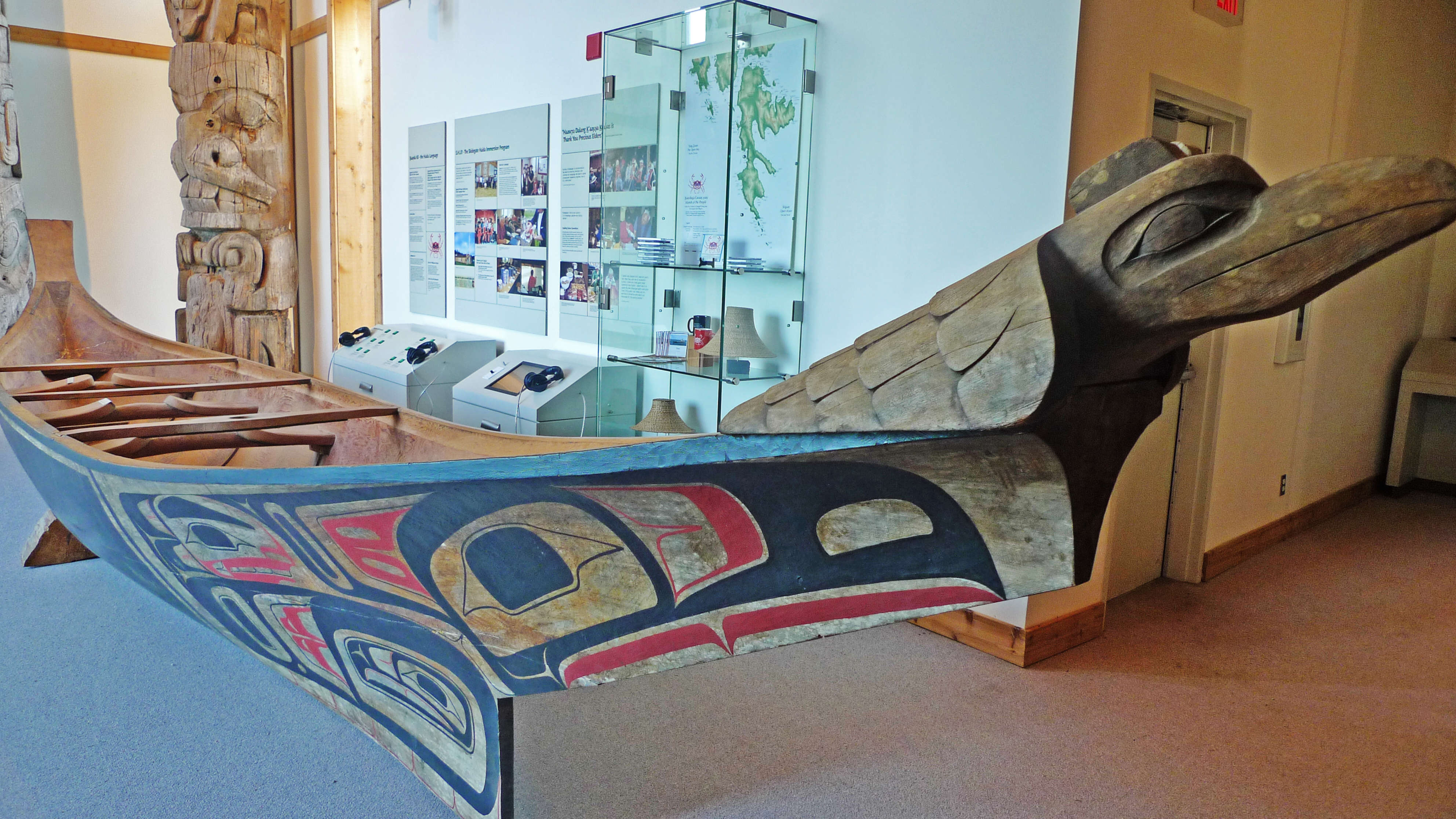
Close-up of the prow of Yaalth Tluu (Raven Canoe), carved in 1990, shown here at the Haida Gwaii Museum at Kaay Llnagaay, 2012.
Yaalth-Tluu, Raven Canoe, was made in 1990 by Haida carver, Reg Davidson, of Old Massett. The 30 foot canoe was commissioned by a private arts organization in San Francisco as part of a six month public demonstration of traditional Haida arts in San Francisco. After the project, Yaalth-Tluu returned to Haida Gwaii, where it is now used for ceremonial occasions and special events.
Born in Masset, August 29, 1954, Reg Davidson is from the Eagle Clan. He began carving in 1972. His influences include: brother Robert Davidson, father Claude Davidson, grandmother Florence Davidson, great grandfather Charles Edenshaw.
Photo: ©Damara Jacobs-Morris
Source: http://moa.ubc.ca/voicesofthecanoe/history/reg-davidson-yaalth-tluu-raven-canoe/
Text: adapted from http://www.museevirtuel-virtualmuseum.ca/edu/
and http://moa.ubc.ca/voicesofthecanoe/history/reg-davidson-yaalth-tluu-raven-canoe/
and http://www.regdavidson.com/Biography.htm

Close-up of the inside of Yaalth Tluu (Raven Canoe), carved in 1990, shown here at the Haida Gwaii Museum at Kaay Llnagaay, 2012.
This photograph allows us to see the superb attention to detail given to every part of the canoe. It is a masterwork.
Reg Davidson's many published and widely exhibited works include: limited edition prints, silver and gold jewellery, masks, helmets, large poles, rattles, argillite sculptures and drums. Reg is also an accomplished singer and dancer with the Rainbow Creek Dancers, a Haida Dance group formed in 1980 by Reg and Robert. Among his many interesting commissions was a major totem pole project that was ordered by the successful British artist, Damien Hirst, in 2006.
Photo: © Damara Jacobs-Morris
Source: http://moa.ubc.ca/voicesofthecanoe/history/reg-davidson-yaalth-tluu-raven-canoe/
Text: adapted from http://www.regdavidson.com/Biography.htm
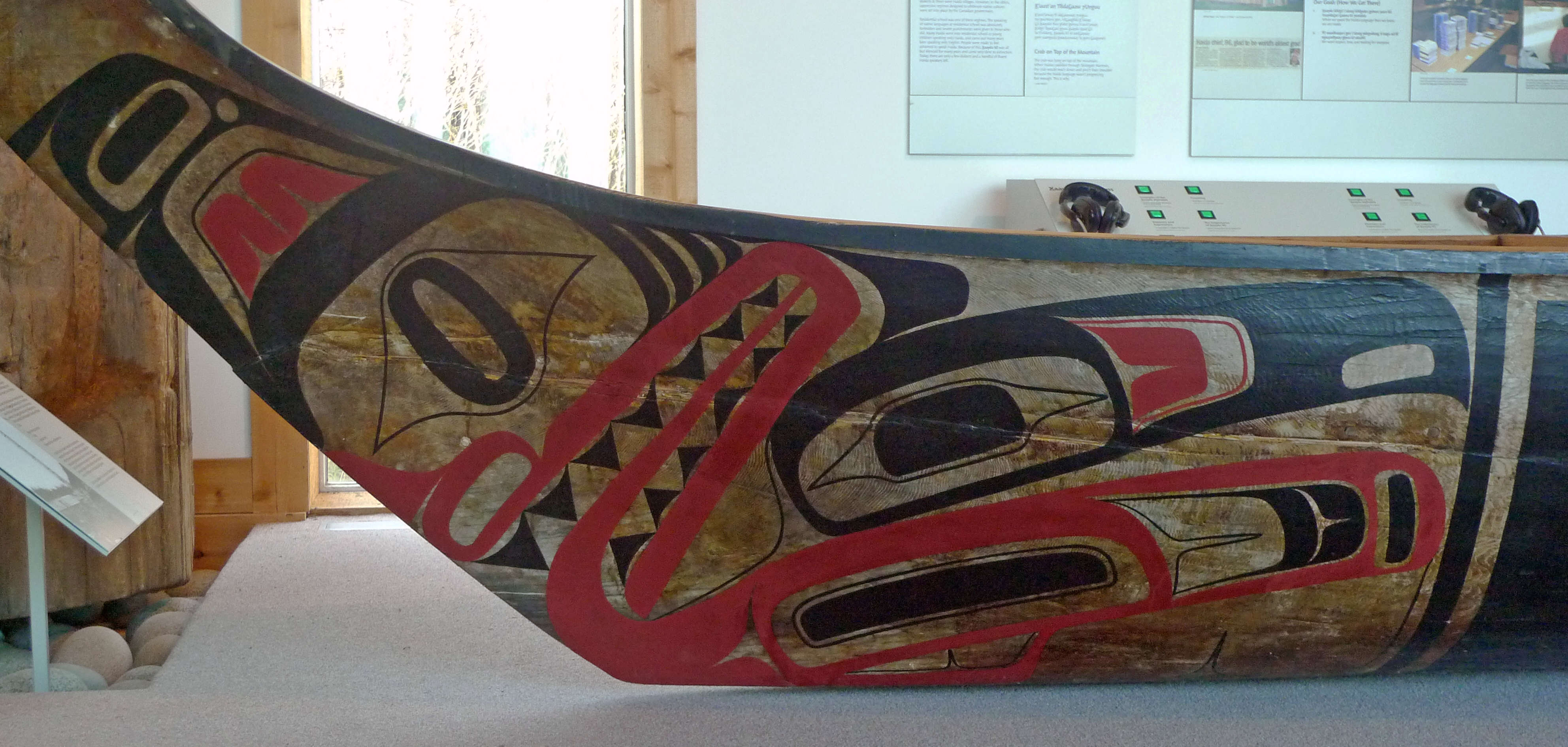
Stern of Yaalth Tluu (Raven Canoe), carved in 1990, shown here at the Haida Gwaii Museum at Kaay Llnagaay, 2012.
With regard to the designs painted on the canoe, Reg Davidson (Strauss, 2010) said:
Because this was the first canoe I'd made, I first wanted to paint an Eagle design on it, because that is my crest. But a month after we started carving in San Francisco, my father was diagnosed with cancer and they gave him weeks to live, so I decided to dedicate the canoe to him and to choose his crest.
Projecting out from the prow of the canoe is a carved Raven, and a Raven is also painted underneath on the bow, but the wing of the Raven there is also a Killer Whale, with big teeth. On the stern is a Shark and the pectoral fin of the Shark is also a Raven's head. Coming out of the Shark's mouth is its tongue, which also becomes the Dogfish's tail, which is also the wing of the Raven. I chose these designs because they are my Dad's crests, and the canoe is dedicated to him.
Photo: © Damara Jacobs-Morris
Source: http://moa.ubc.ca/voicesofthecanoe/history/reg-davidson-yaalth-tluu-raven-canoe/
Text: adapted from http://www.regdavidson.com/Biography.htm

Log of red cedar used for the canoe, 4 and a half feet in diameter, 35 feet in length which was used for the canoe.
Photo: https://www.youtube.com/watch?v=0QAO2qBLBVI
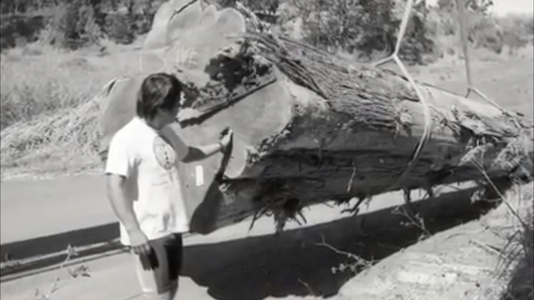
The log came from old growth forest at Coquitlam, outside of Vancouver. The log was then transported to San Francisco, where the canoe was carved.
Photo: https://www.youtube.com/watch?v=0QAO2qBLBVI

Reg Davidson had decided on a 10 metre canoe, so he needed a log of at least this length. He then made a one tenth model of the canoe, carving just half of its length to the shape he wanted, and this gave all the measurements needed for the full size canoe.
Photo: https://www.youtube.com/watch?v=p5lRhPIWBRU
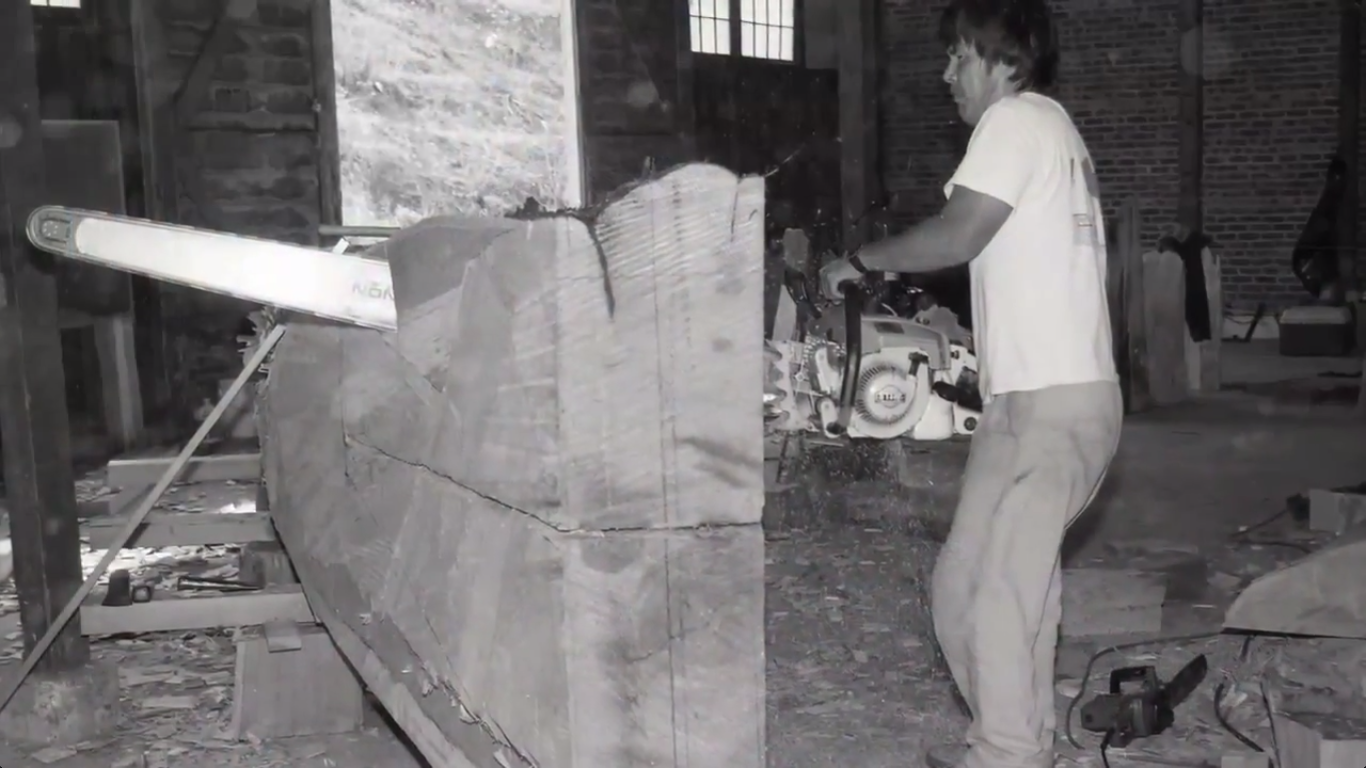
A very large chainsaw is required to cut the log to the dimensions needed before carving commences with hand tools.
Photo: https://www.youtube.com/watch?v=p5lRhPIWBRU
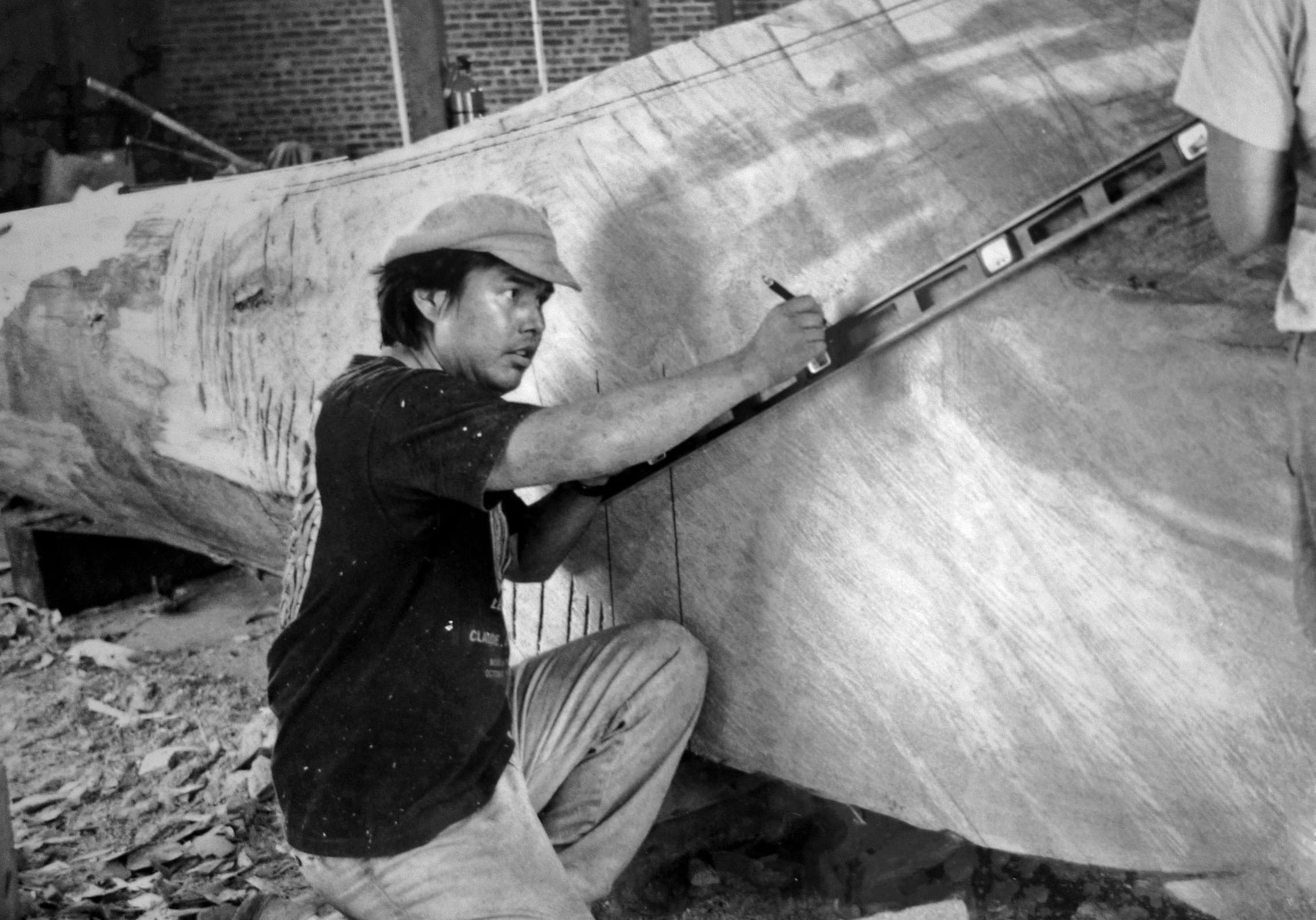
Carving the canoe according to the measurements taken from the one tenth size half model.
Photo: http://moa.ubc.ca/voicesofthecanoe/history/reg-davidson-yaalth-tluu-raven-canoe/
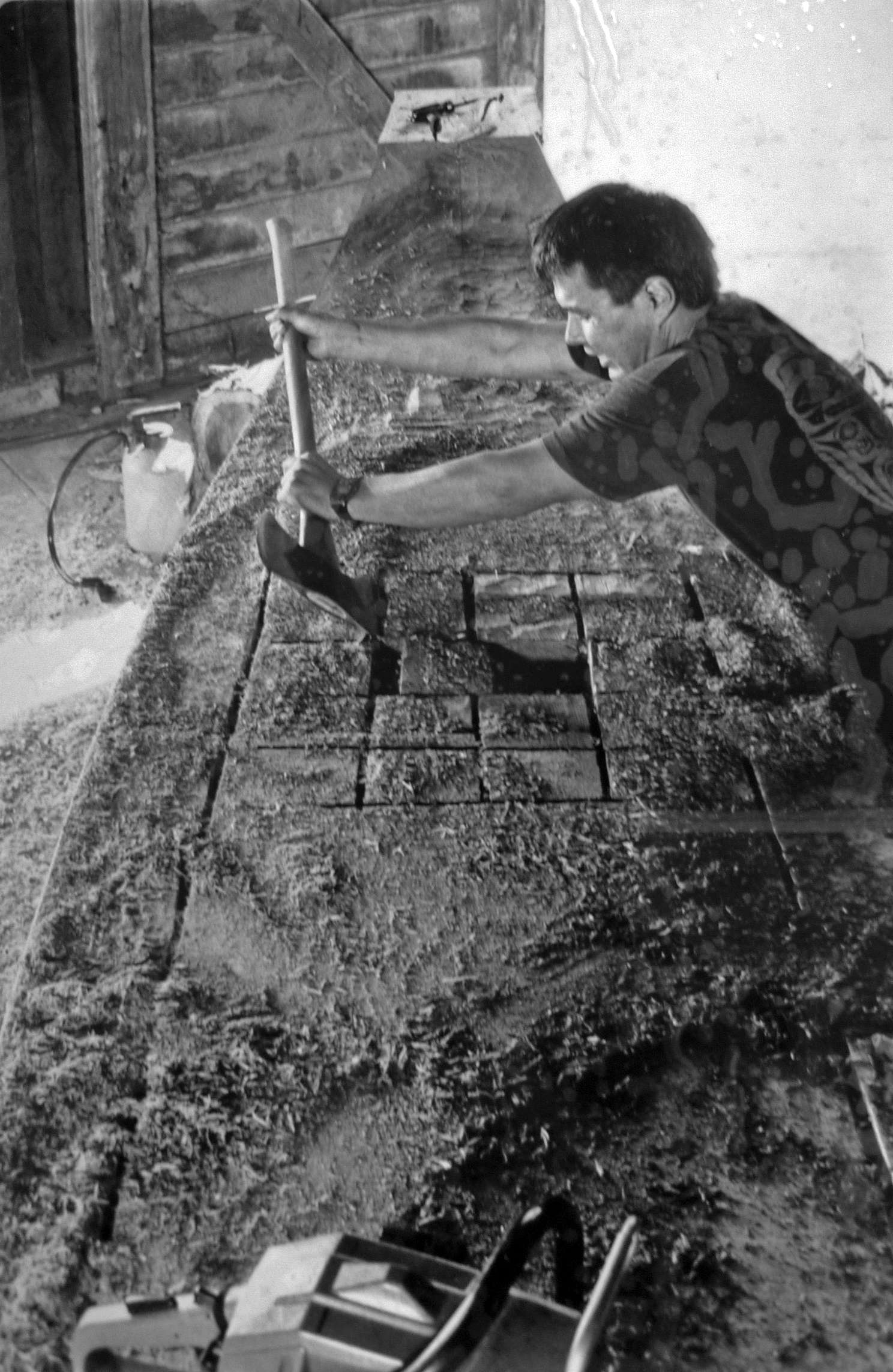
Modern electric or gasoline driven tools are used to aid the work, but most of the carving and removal of wood is still done by hand.
Reg was told that you don't use wood from the middle of the log, but he kept all the large blocks carved out of the canoe, and was able to use them for the seats of the canoe. Red cedar is not easy to get in San Francisco!
Photo: http://moa.ubc.ca/voicesofthecanoe/history/reg-davidson-yaalth-tluu-raven-canoe/
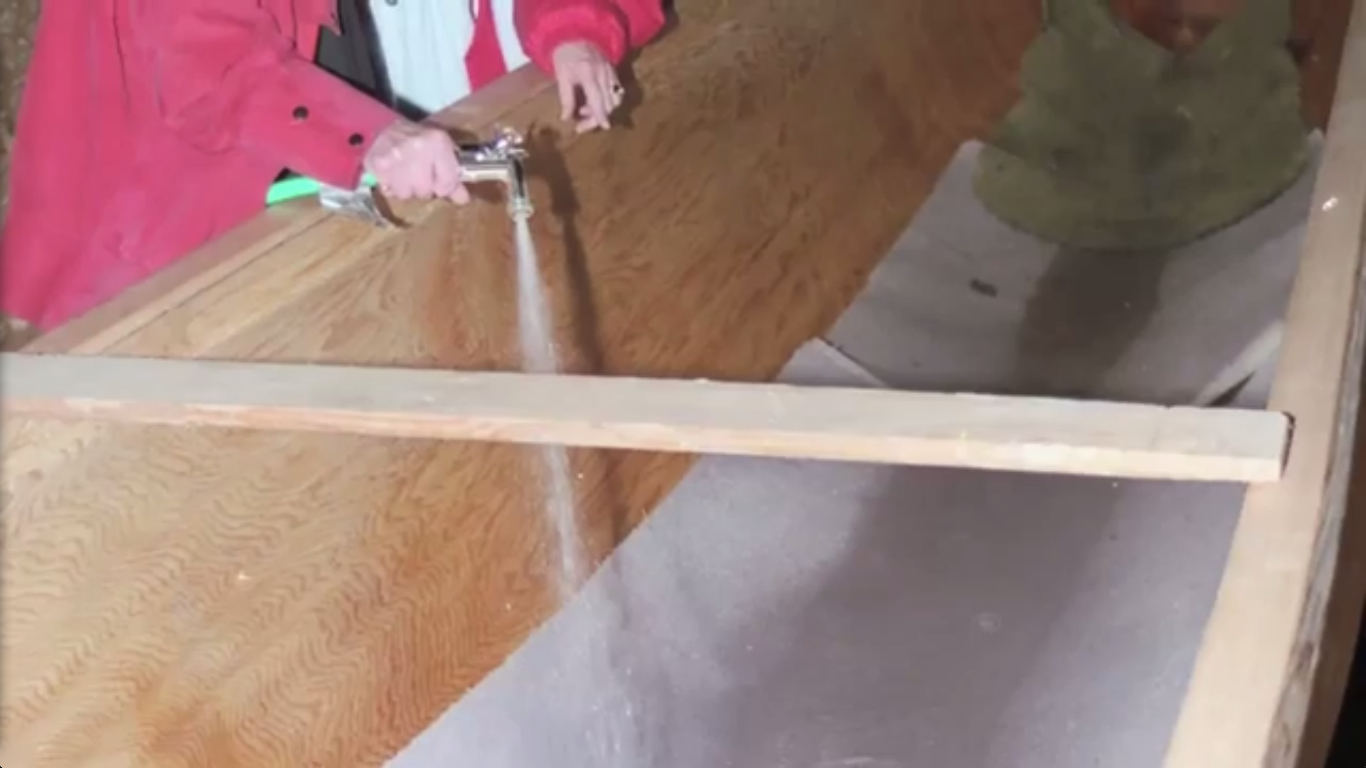
It was decided to use old carpet to protect the base of the canoe from damage from the hot rocks during the steaming process.
It is traditional to use red cedar twigs and small boughs for this purpose, but in San Francisco these are in short supply!
Photo: https://www.youtube.com/watch?v=0QAO2qBLBVI
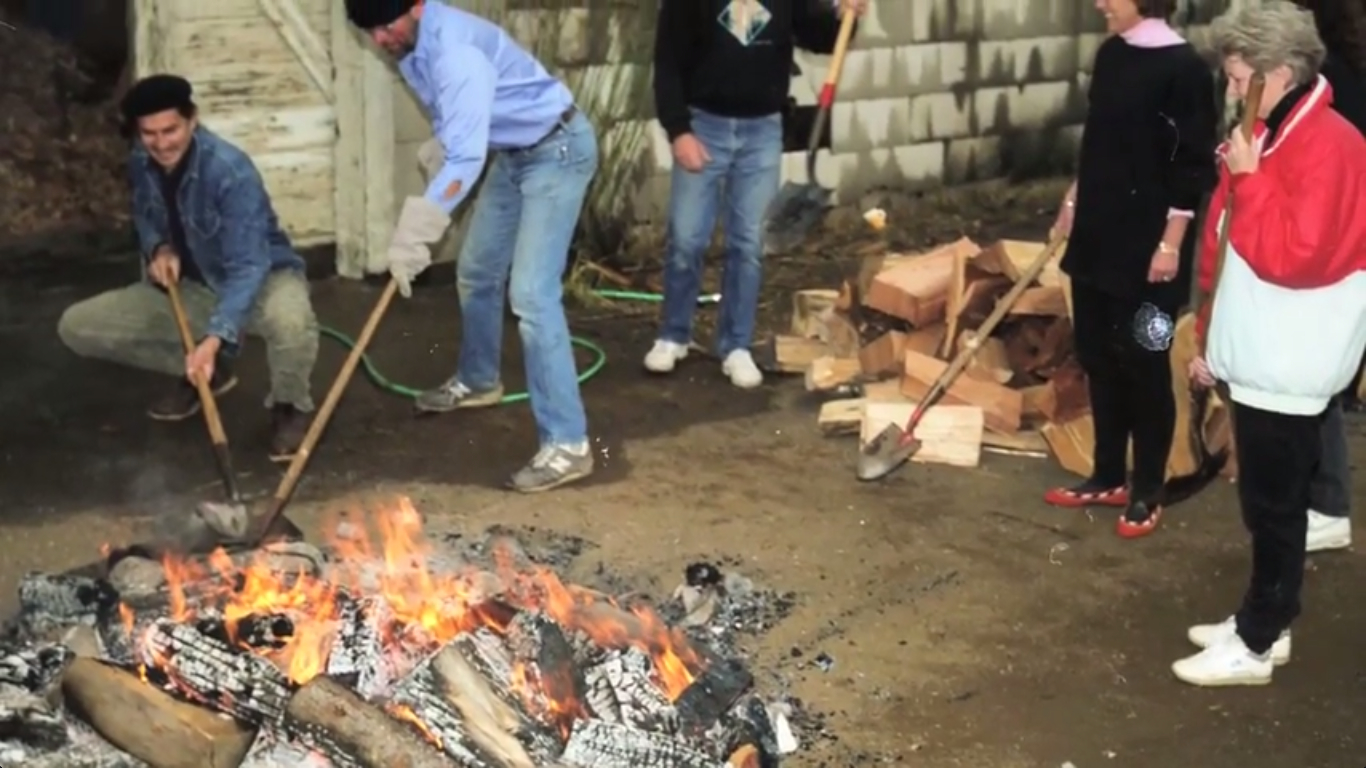
Rocks were heated in an open fire in the usual way to a red heat before being shovelled into the water in the canoe.
Photo: https://www.youtube.com/watch?v=0QAO2qBLBVI

The boiling water softens the wood, and the weight of the water helps to spread the canoe, helped along by adding pairs of wooden spreaders.
The boiling water in the canoe is covered with a tarpaulin or plastic sheet to keep the heat of the steam inside the canoe and stop it cooling too quickly. The process usually takes a couple of hours.
Photo: https://www.youtube.com/watch?v=0QAO2qBLBVI
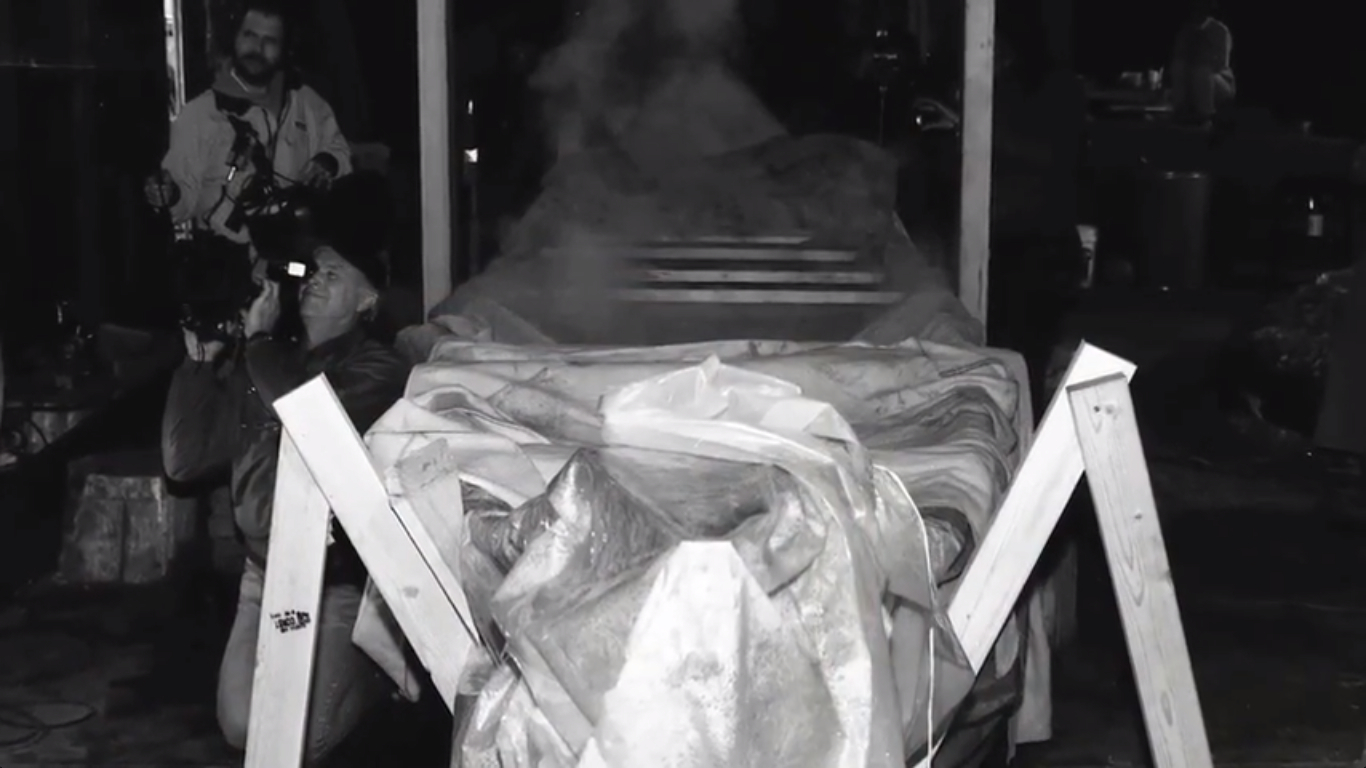
The spreaders are made in pairs, each pair one inch longer than the other. As one pair is moved away from the centre, a longer pair is inserted, gradually widening the canoe until it is the desired width throughout its length. Eventually the sides of the canoe are almost floppy with the heat and humidity.
Eventually the canoe cools down, and the water and rocks may be removed. The makeshift spreaders are left in until the final spreaders are carved and inserted.
Photo: https://www.youtube.com/watch?v=0QAO2qBLBVI
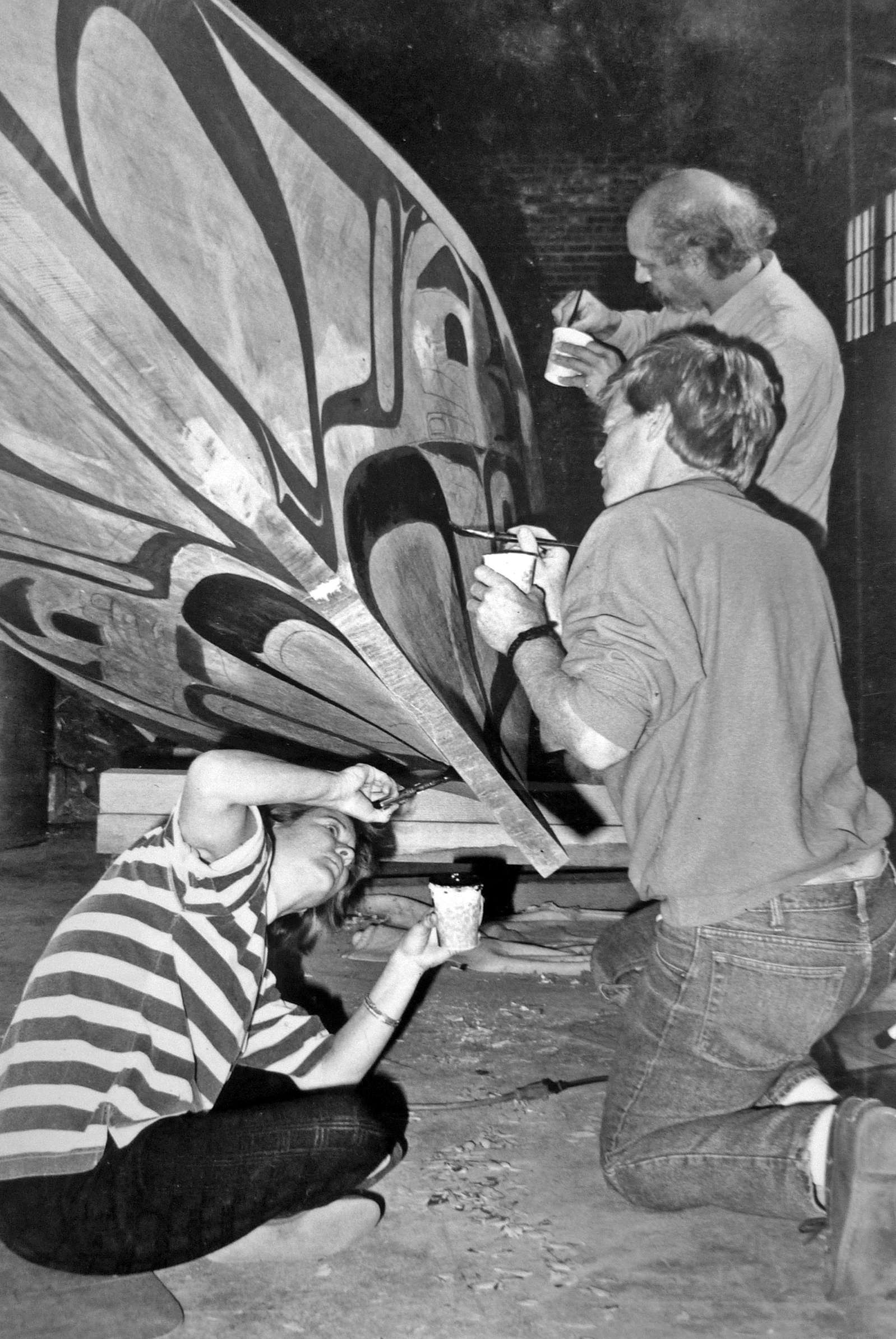
It is not often realised that a work of this size is at least partly a team effort, with many helpers under the direction of the master carver.
Photo: http://moa.ubc.ca/voicesofthecanoe/history/reg-davidson-yaalth-tluu-raven-canoe/
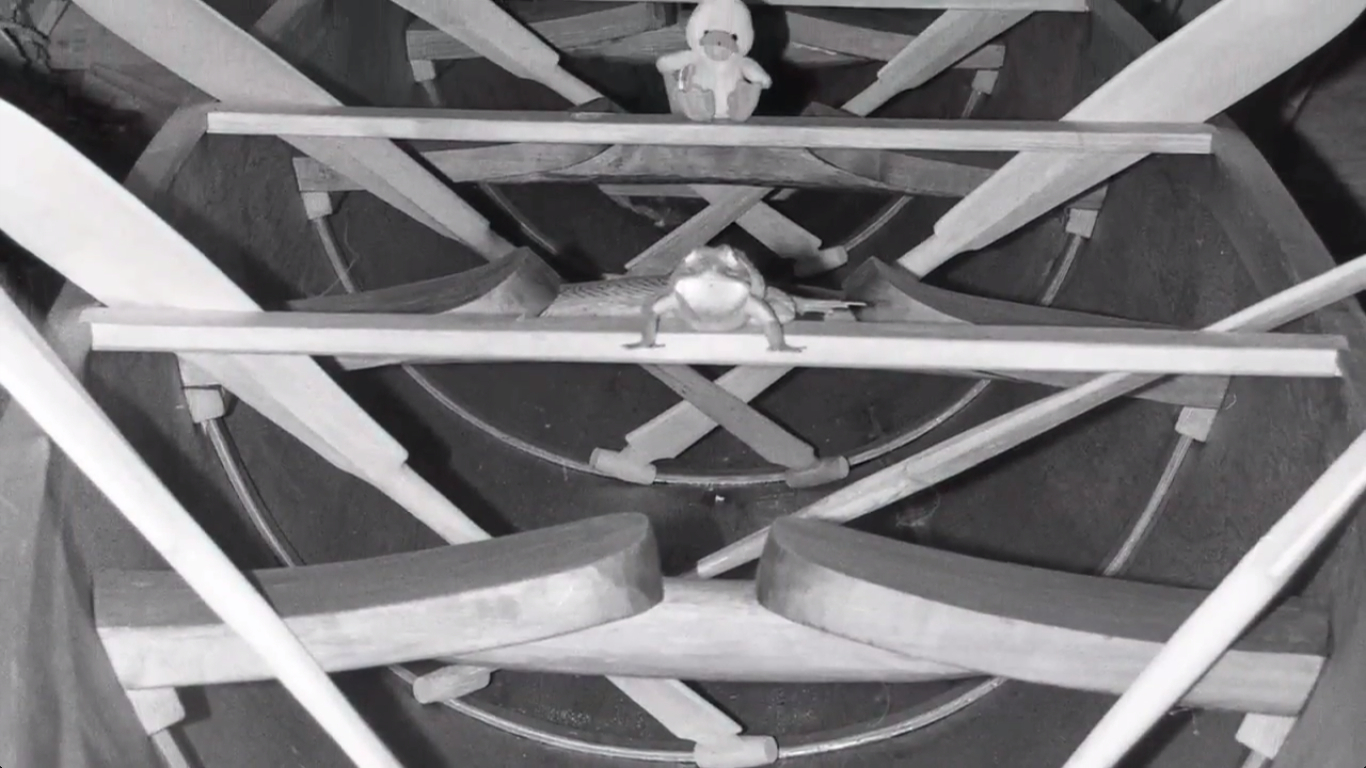
The seats were fashioned after some seats which Reg had seen on a model canoe at the Museum of Anthropology, UBC.
The seats work extremely well, since when paddling a big canoe like this, and leaning over the side, the cheeks of the paddlers' buttocks next to the side usually get numb, but this design removes that problem.
Photo: https://www.youtube.com/watch?v=p5lRhPIWBRU
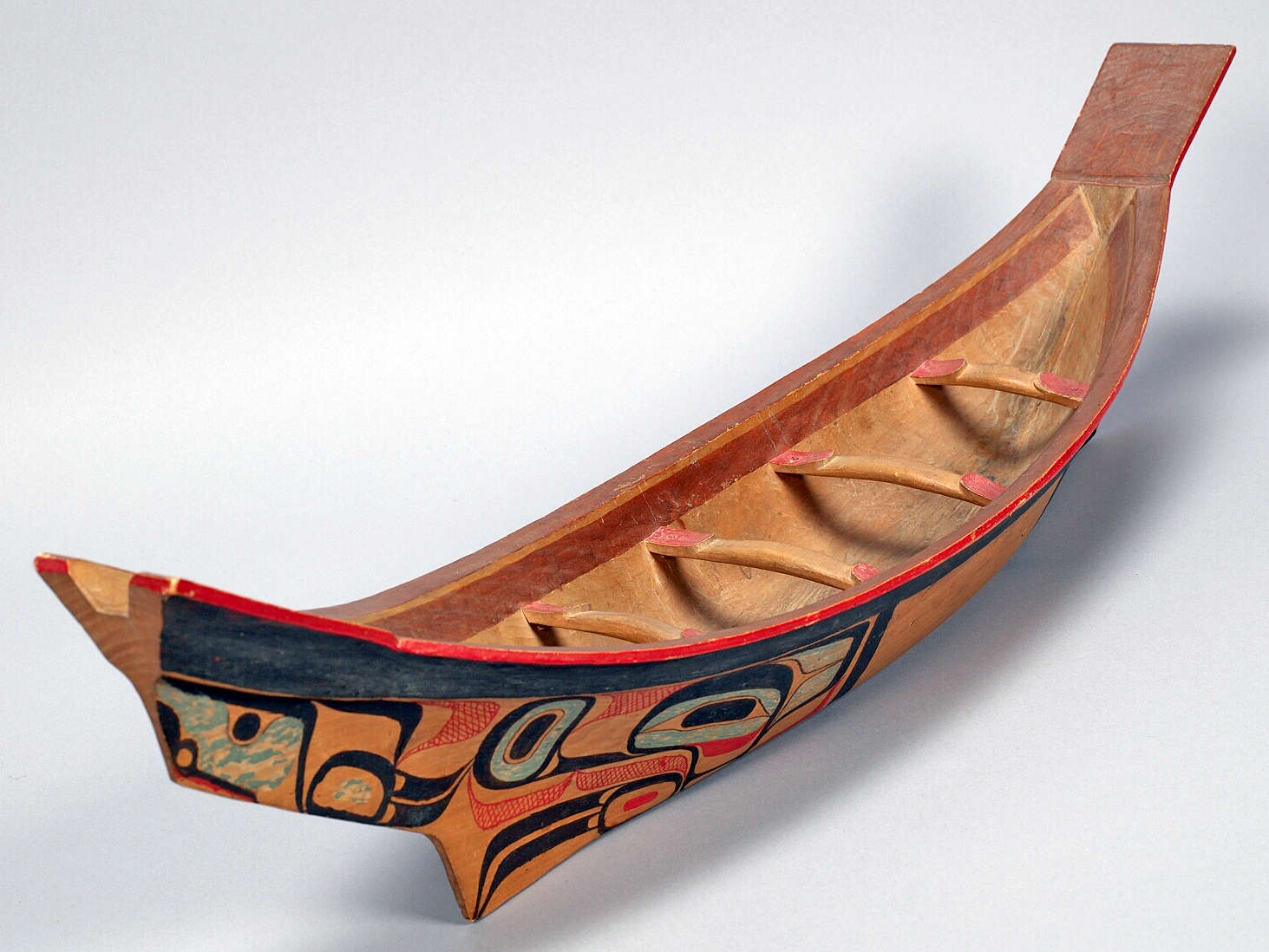
In the video in which Reg Davidson describes where he got the idea for the special and unusual seats, he shows part of this model. It took some time to find on the MOA website, I looked at page after page after page of model canoes, looking for the canoe, until I hit paydirt.
The canoe is listed at http://www.rrncommunity.org/items/34887
However the really interesting thing to me is that the model was made by Charles Edenshaw in Haida Gwaii, British Columbia, Canada between 1853 and 1920. Charles Edenshaw is Reg Davidson's great grandfather. The seats which are such a beautiful feature of this superb canoe were first designed by his great grandfather, and history has come full circle.
Photo: http://www.rrncommunity.org/items/34887
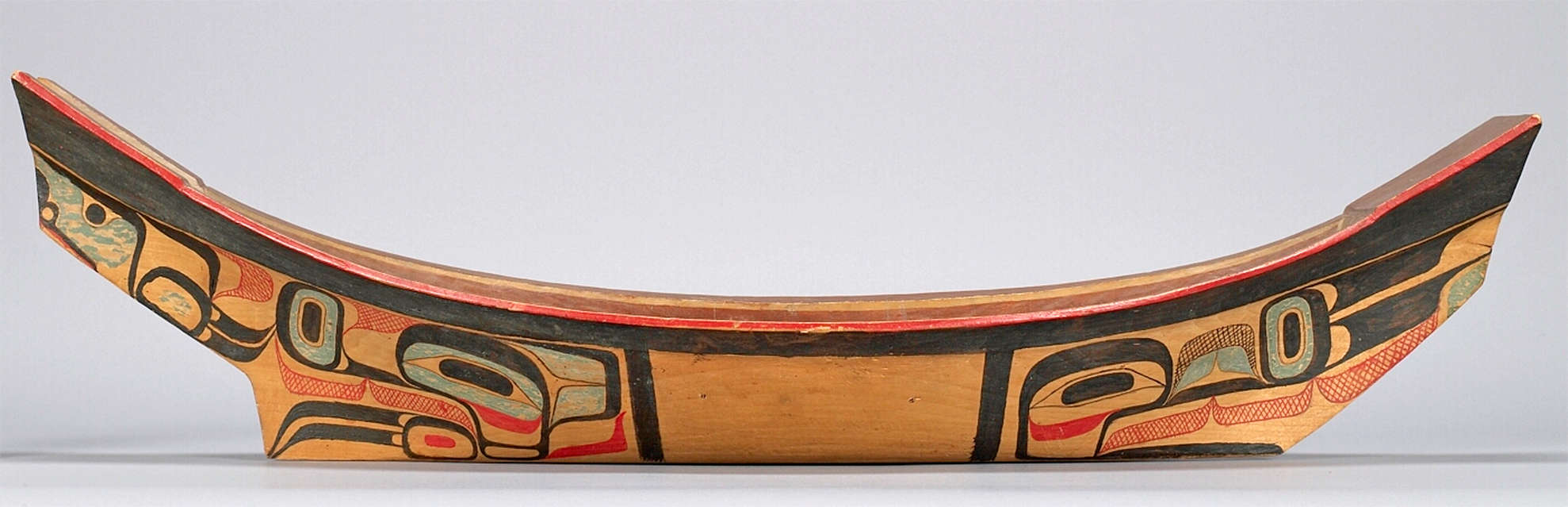
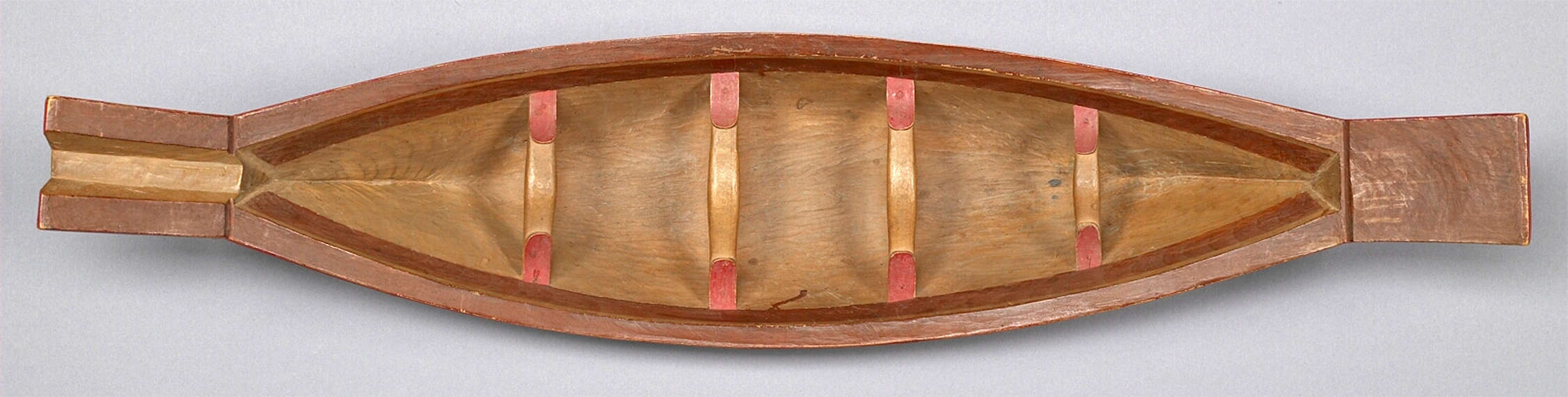
Other views of the model canoe with the unusual seats.
Model canoes are an important part of learning about the history of canoes in the Pacific North West. Sometimes they are the only record we have of particular sorts of design and construction.
Photo: http://www.rrncommunity.org/items/34887
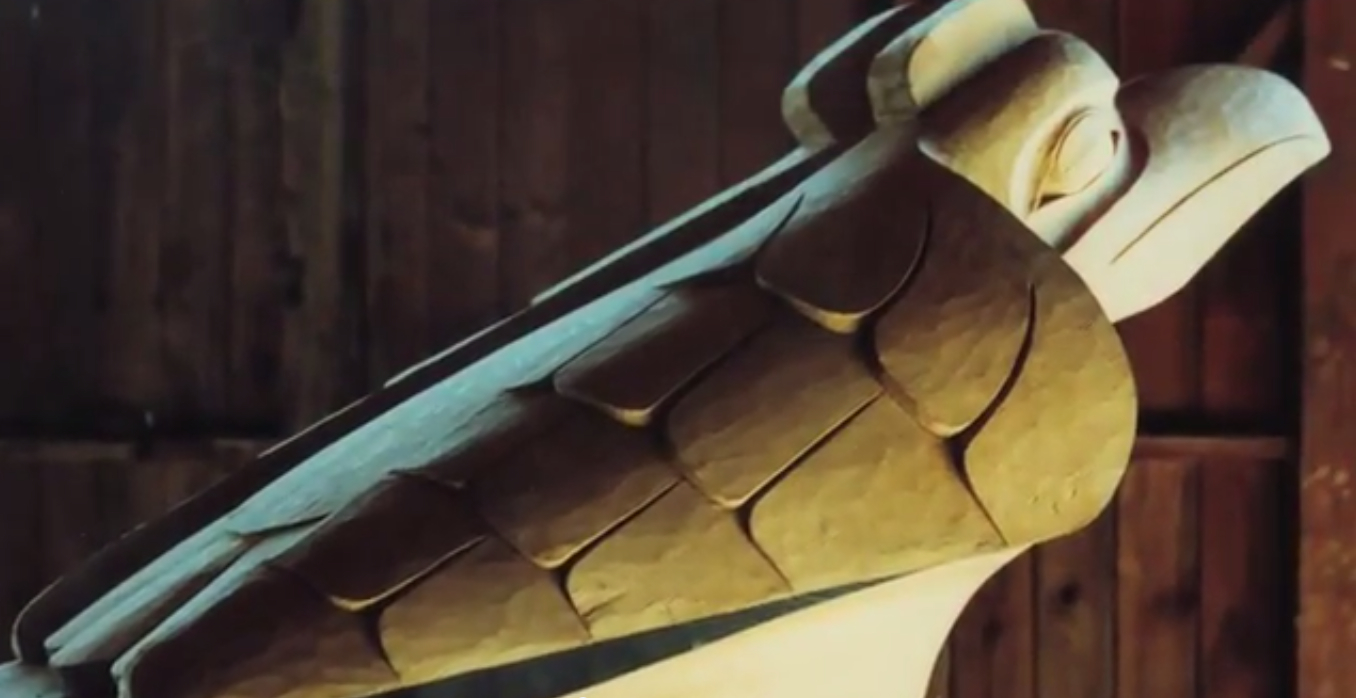
When Reg Davidson first started making the canoe, he decided to replace the normal groove for a harpoon on the prow of the canoe with a sculpture. Since his crest is the Eagle, all the symbols were going to be from that culture.
However, his father died during the making of the canoe, so he decided to make it a memorial for his father, whose crest was the Raven. Thus all the symbols on the canoe, as in this sculpture, are of the raven.
Photo: https://www.youtube.com/watch?v=WjlrIfHL_o4
Crafting a canoe
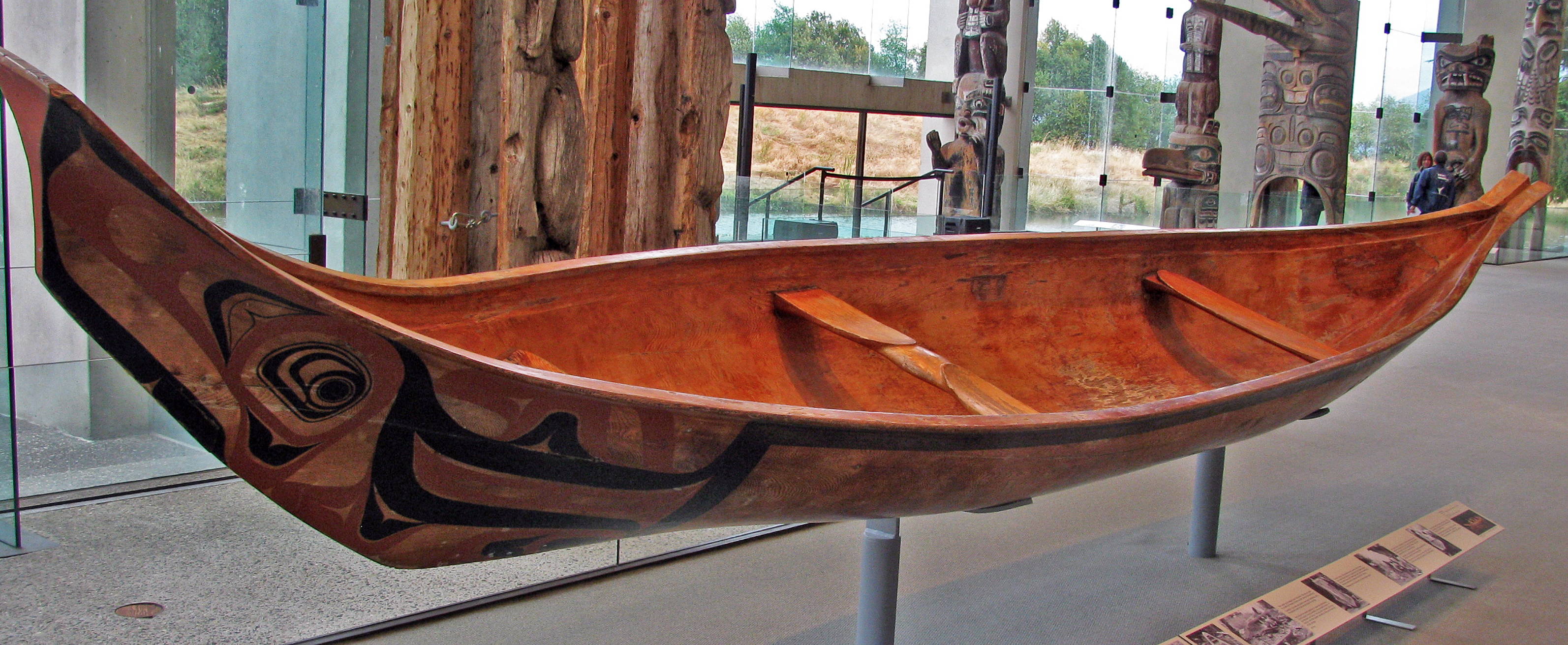
In 1984, Haida artist Bill Reid set out to create the 7.5-metre inshore canoe displayed here. Assisted by Haida carver Guujaaw and Kwakwakjl'wakw carvers Simon and Beau Dick, Reid hoped to gain personal experience and knowledge about northern canoe technologies. Haida canoe making had waned by the early 1900s as seine boats and other types of fishing vessels became common, and as builders transferred their skills to new economies.
Photo: Don Hitchcock 2012
Source: Display, Museum of Anthropology, University of British Columbia
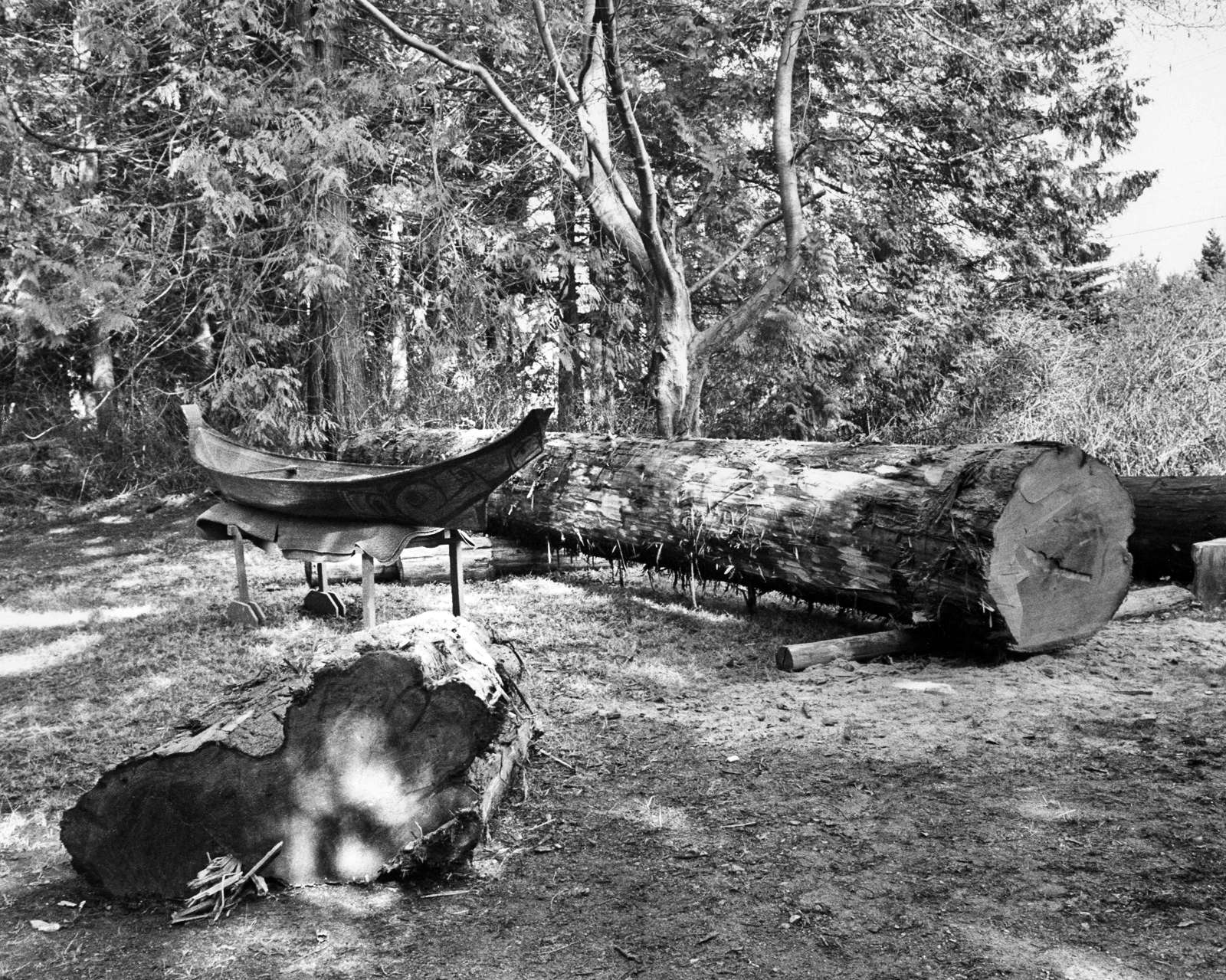
The red-cedar tog lies ready for carving at Totem Park, on the UBC campus. Beside it is a 19th century, four metre canoe, loaned by the Canadian Museum of Civilization, which the carvers used as a reference.
Photo: Bill McLennan, UBC Museum of Anthropology
Text: Display, Museum of Anthropology, University of British Columbia
Source: http://moa.ubc.ca/voicesofthecanoe/history/haida-canoe-being-carved-and-steamed-at-moa/
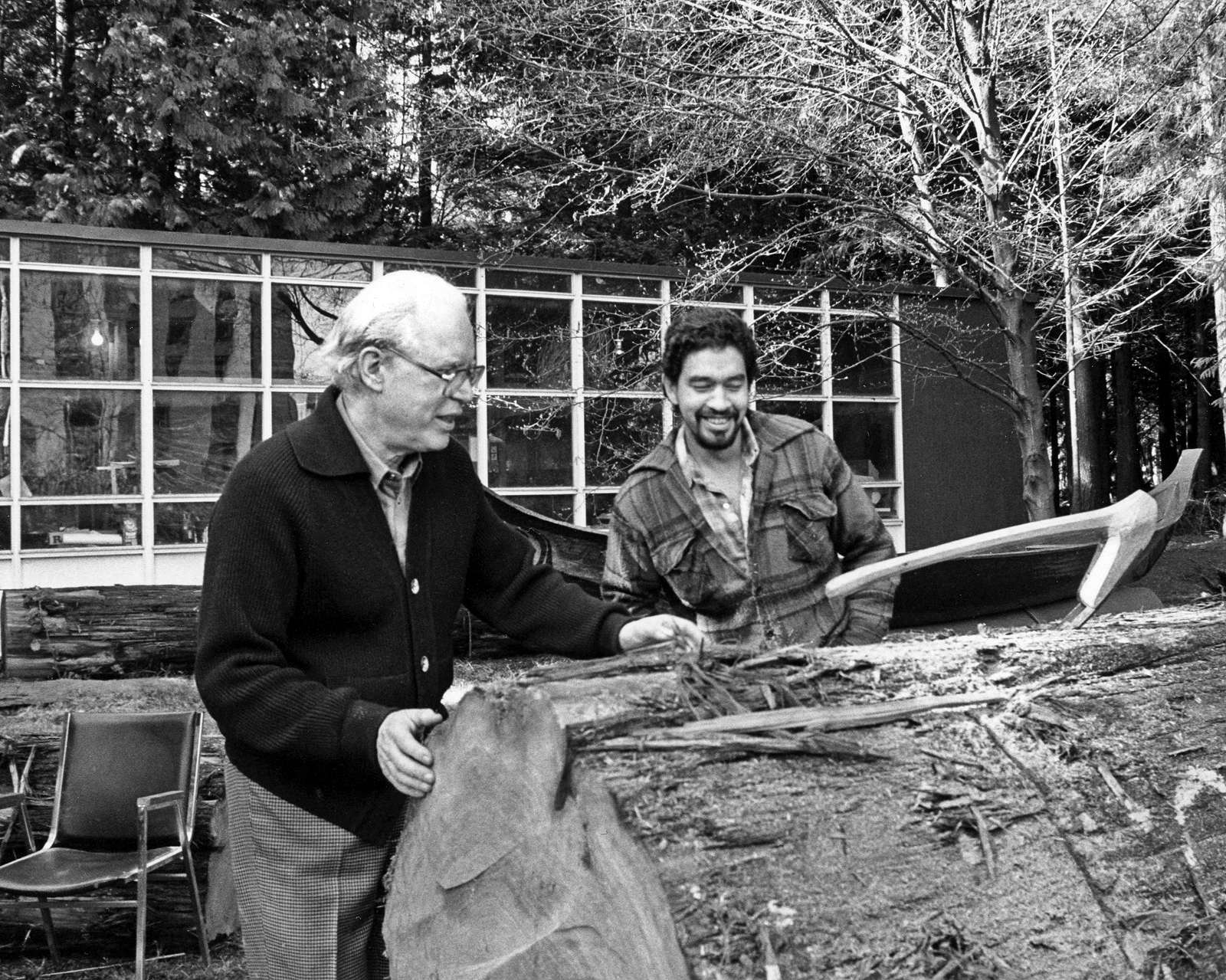
The best logs for large canoes have a fine grain, few knots, no twist, and are 400 to 800 years old. Cedars of this quality are becoming harder to find as old growth forests dwindle.
Bill Reid (left) and Guujaaw begin the project with a 'first cut' ceremony, using an elbow adze.
Photo: Bill McLennan, UBC Museum of Anthropology
Text: Display, Museum of Anthropology, University of British Columbia
Source: http://moa.ubc.ca/voicesofthecanoe/history/haida-canoe-being-carved-and-steamed-at-moa/

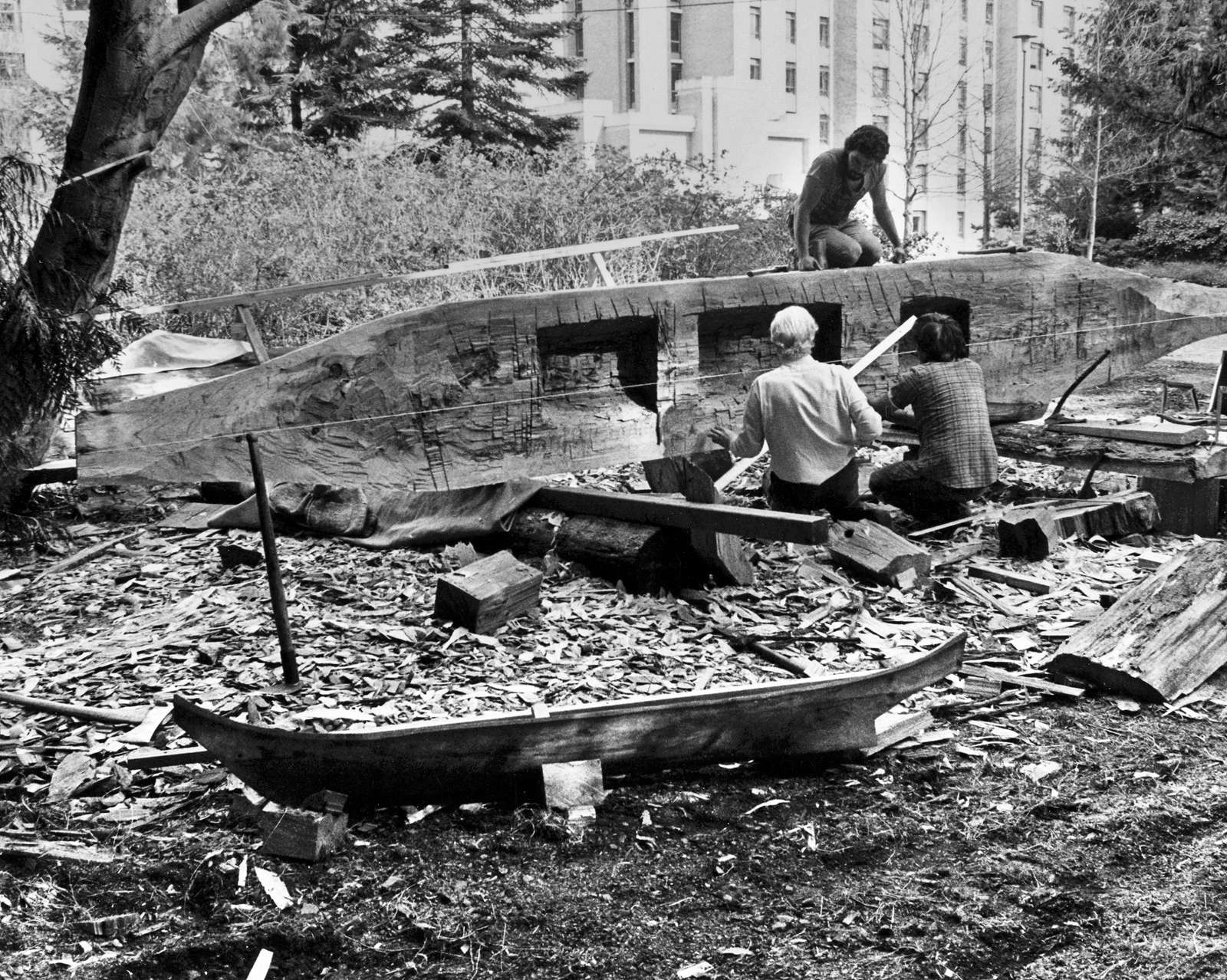
The cedar log is shaped and hollowed. The carvers refer to a half-hull model to work out the canoe's proportions. Carefully, the sides are adzed to an even thickness, and the graceful lines of the canoe begin to emerge.
Two resources came together to make the Northwest Coast dugout canoe possible: the wonderful fabric of the Western red cedar - strong, light, flexible and long lasting-and the equally marvelous skills and ingenuity of the people.
Bill Reid
Photo: Bill McLennan, UBC Museum of Anthropology
Text: Display, Museum of Anthropology, University of British Columbia
Source: http://moa.ubc.ca/voicesofthecanoe/history/haida-canoe-being-carved-and-steamed-at-moa/
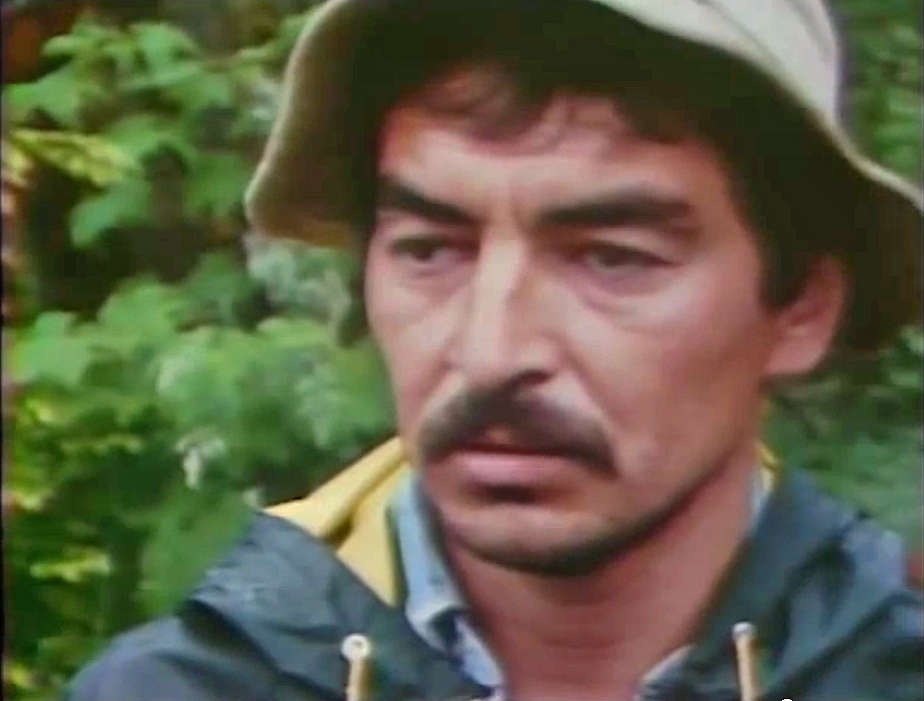
Simon Dick was one of the three carvers of the canoe, along with Beau Dick, his brother, and Guujaaw (Gary Edenshaw). Simon is shown here (left) after the steaming of the canoe was complete.
Simon Dick is a Kwakwaka’wakw (Kwagiulth). He was born in 1951, in Alert Bay on the northern tip of Vancouver Island and raised in the nearby community of Kingcome Inlet. He is the grandson of hereditary chiefs from both sides of the family and he was taught the language, arts, and culture from an early age. He has been a Kwakwaka’wakw chief since 1983. In 1986 he designed and constructed a massive Thunderbird carving, measuring 40 feet high and 30 feet wide that cradled the amphitheater for the Canadian pavilion at the Worlds Fair Exposition in Vancouver, BC. Now residing in Vancouver, Simon Dick has a well-established reputation as a mastercarver in many media. He works primarily in cedar, carving a variety of masks and totem poles. He is equally skilled as a jeweller working in silver.
Photo: https://www.youtube.com/watch?v=RvVk9RD3c6w and http://www.quintanagalleries.com/htmls/artists/artists/dick_simon.jpg
Text: http://www.coastalpeoples.com/index.php?mpage=artist&aid=21 and http://www.spiritwrestler.com/catalog/index.php?artists_id=322 and http://www.alcheringa-gallery.com/artists.html/v1/view/v3/107

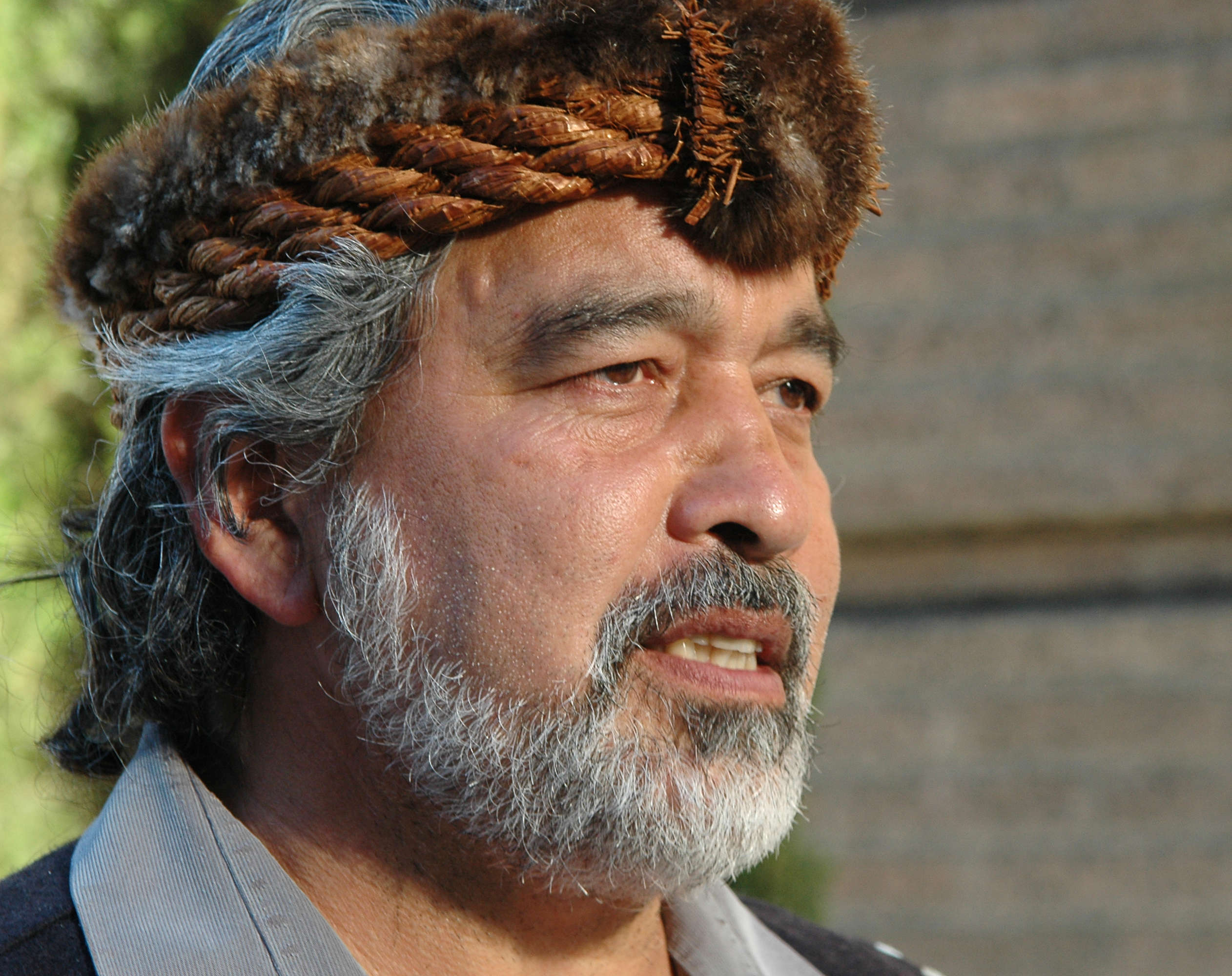
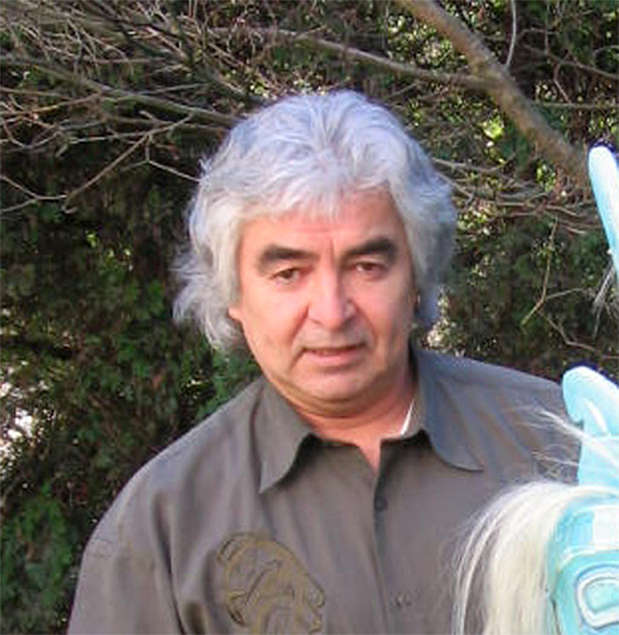
Guujaaw (left) at the time of the steaming of the canoe in 1984, and (right) in 2006. He was the highly respected President of the Haida Nation for thirteen years, stepping aside in 2012. He is now the Skidegate representative on the Council of the Haida Nation.
Giindajin Haawasti Guujaaw is of the Raven clan of the Haida Nation. He was born in Masset on the northern part of Haida Gwaii. He is born of the Gakyaals Kiiqawaay Skedans Ravens like his mother. His father, Chiits Gitnaii, is an Eagle from the Yakoun River.
Guujaaw means drum, a name formally given him at a potlatch at Kiusta.
Photo (left): https://www.youtube.com/watch?v=RvVk9RD3c6w
Photo (right): http://www.ecotrust.org/indigenousleaders/2006/guujaaw.htm
Text: http://www.qcislands.net/guujaaw/Bio.html
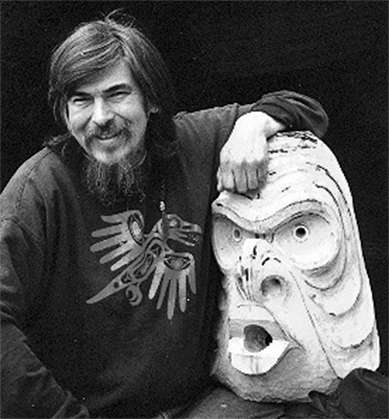
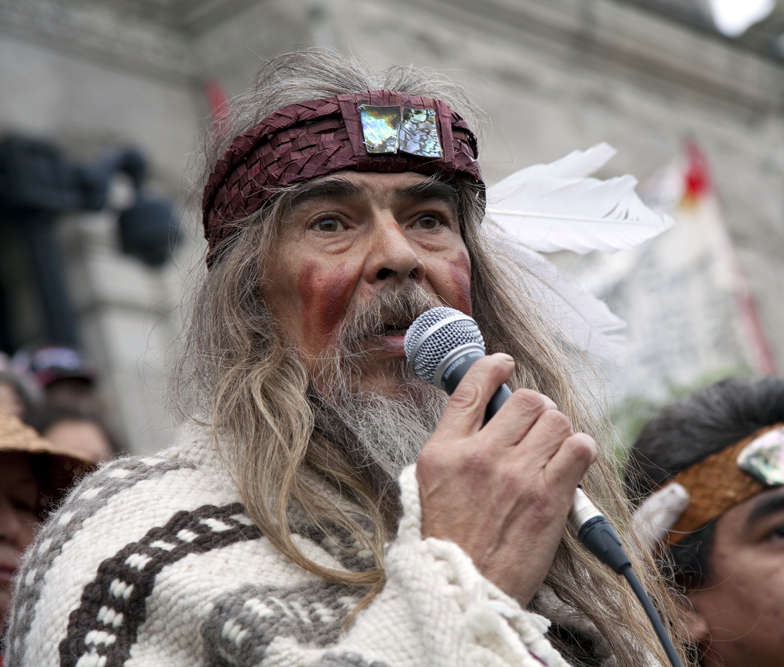
Beau Dick, the third carver of the canoe. Beau Dick was born in 1955 at Alert Bay, a Kwag-guluth community 300 km north of Vancouver. After spending the first six years of his life in Kingcome Village, speaking only his native language Kwakwala, Beau moved with his family to Vancouver to attend school.
As a teenager, Dick demonstrated an interest in carving, after watching his grandfather, Jimmy Dick, and assisted him and his father in the carving and painting of the World's Tallest Totem raised in Alert Bay.
Dick first attempted to sell clam shells on which he had painted designs to tourists visiting Alert Bay. Tony Hunt understood Beau's desire to become a carver and asked the seventeen year old to move to Victoria and become his apprentice.
Once Dick moved back to Vancouver, he became influenced by the work of Doug Cranmer, whom he credits with helping him understand the importance of patience and pride in one's work. Beau Dick also assisted Bill Reid in his Haida canoe project at UBC. Later, he worked with Robert Davidson on the Edenshaw Memorial House Front at Masset.
Photo (left) and text: http://projects.vanartgallery.bc.ca/
Photo (right): http://ravenredbone.wordpress.com/tag/chief-beau-dick/
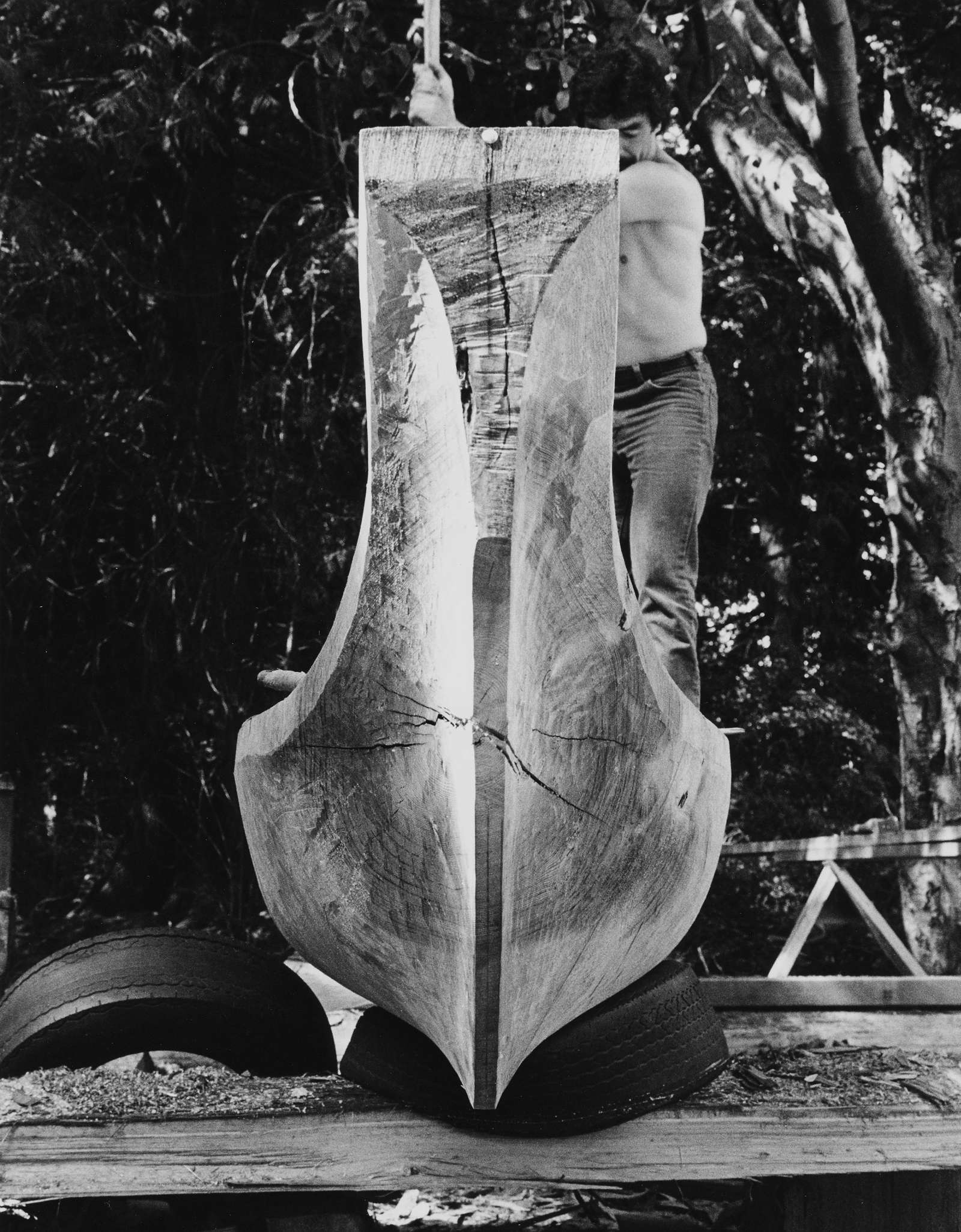
Carvers today, like generations of carvers before them, use large elbow adzes for roughing out the basic shape of a canoe. Axes and chain saws are useful for removing excess wood and to prepare the log for carving. Finishing work is done with smaller-bladed adzes. This canoe took three and a half months to carve.
(This looks like Simon Dick standing in the canoe adzing the interior. Note also the car tyres used to protect the keel of the boat from damage after it has been carved, and the boat stood upright - Don )
Photo: Bill McLennan, UBC Museum of Anthropology
Text: Display, Museum of Anthropology, University of British Columbia
Source: http://moa.ubc.ca/voicesofthecanoe/history/haida-canoe-being-carved-and-steamed-at-moa/
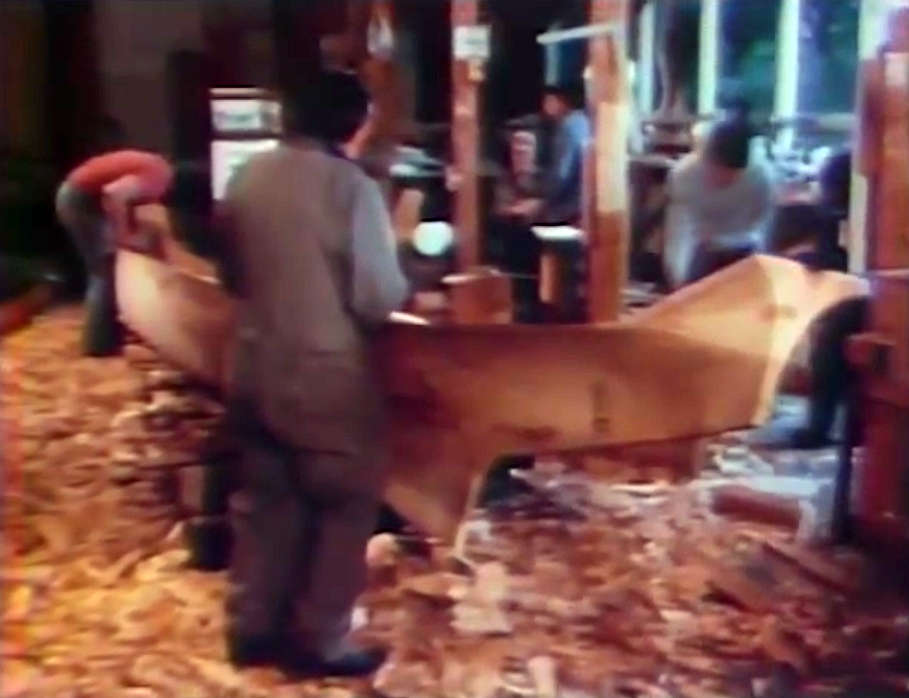
Much of the final carving was done under cover in a large workshop. Some modern tools were used, but 90% of the carving was completed using hand tools.
Photo: https://www.youtube.com/watch?v=RvVk9RD3c6w
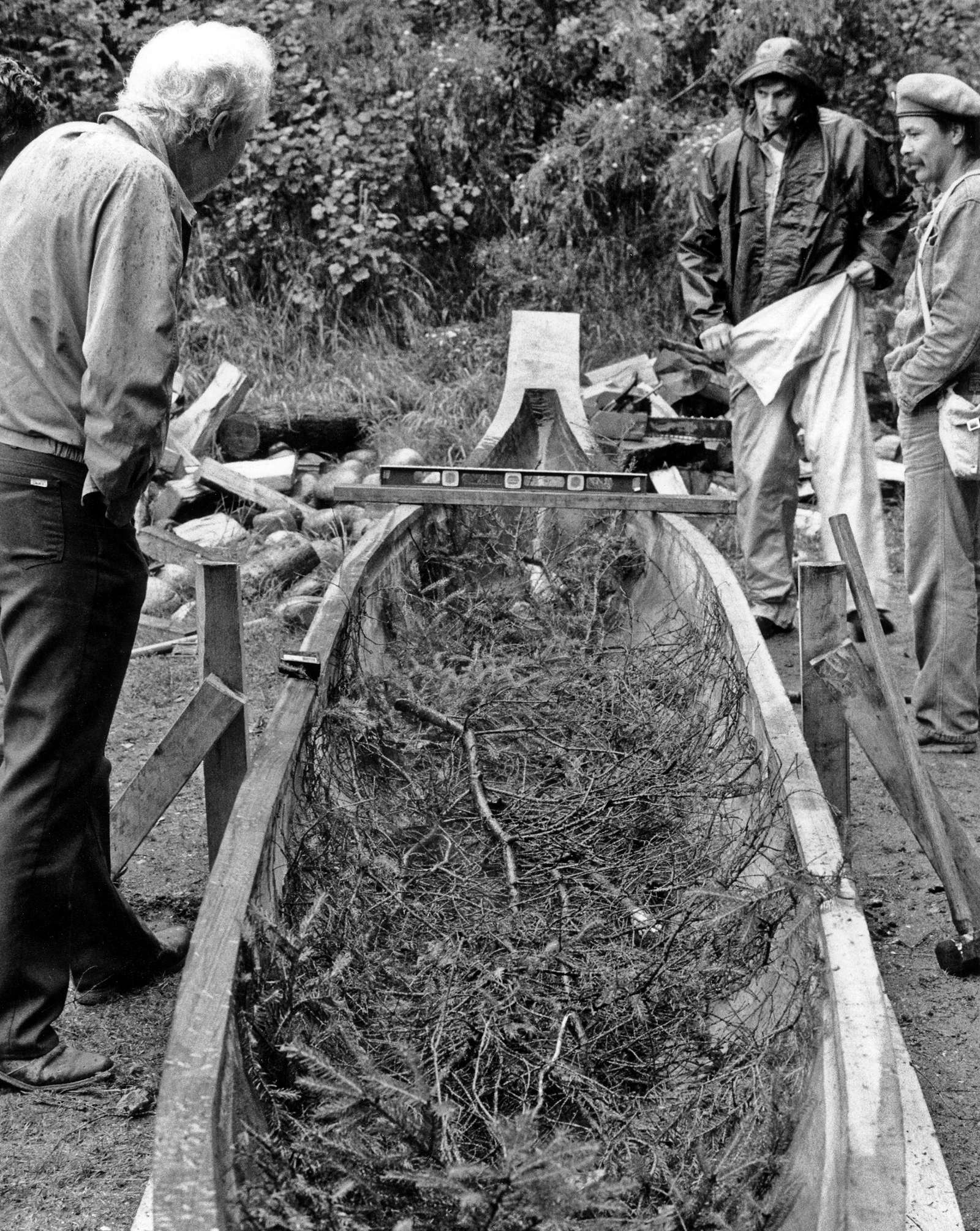
(At this point, the canoe is ready for final steaming and spreading, and is moved by six men (and a proud young boy!) to a site close to a pre-prepared firepit. The canoe is carefully supported by strong wooden posts with supports, since the whole canoe will become very heavy once the water and hot stones are added.
Note also the level so that the water inside will reach evenly across the canoe, and the small chainsaw used to cut up the wood ready for heating the stones to a white hot heat.
The floor and sides of the canoe have been first covered with brush, so that the hot stones put into the water do not actually touch the wood of the canoe and warp it - Don )
Photo: Bill McLennan, UBC Museum of Anthropology
Text: Display, Museum of Anthropology, University of British Columbia
Source: http://moa.ubc.ca/voicesofthecanoe/history/haida-canoe-being-carved-and-steamed-at-moa/
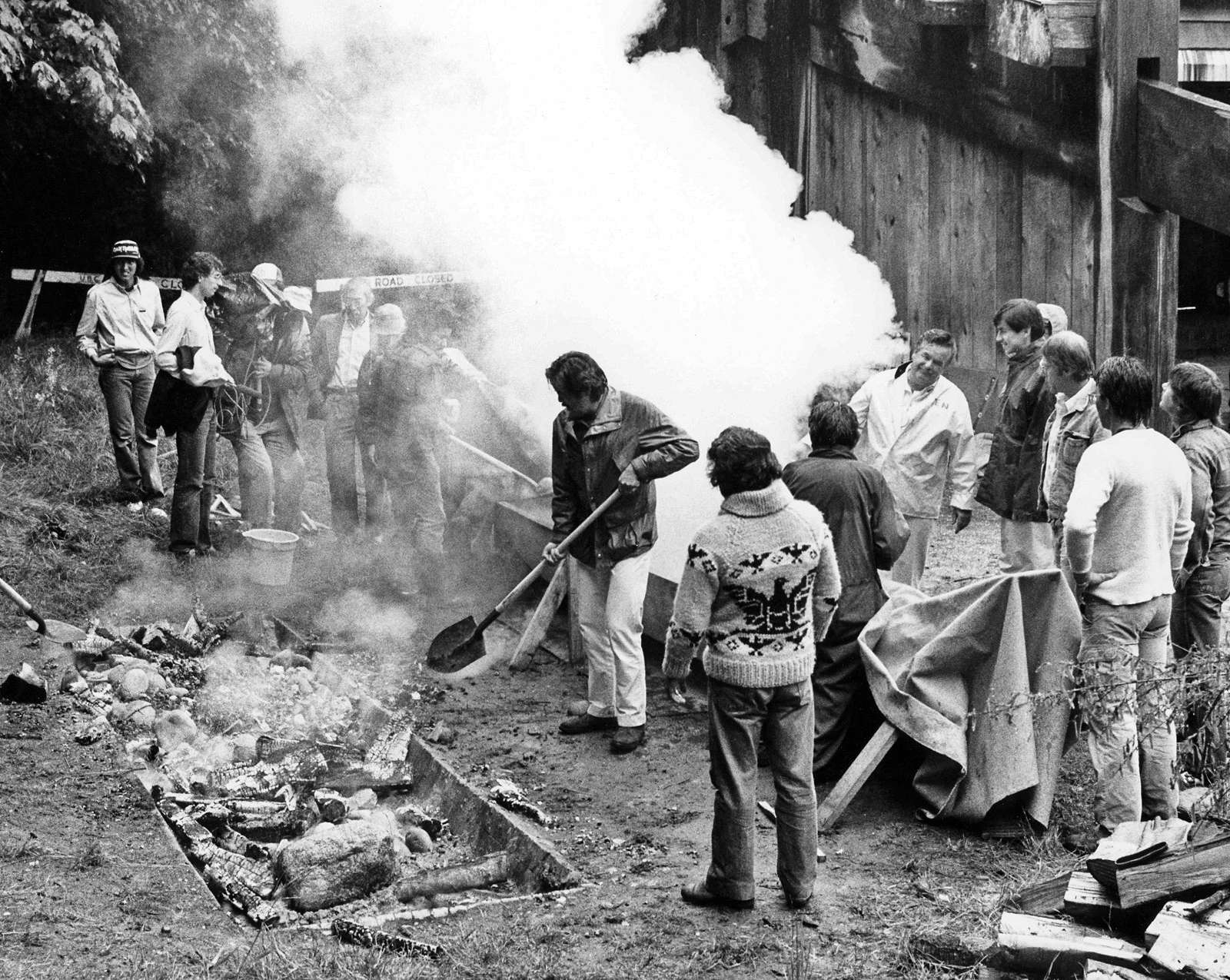
The carved canoe is prepared for steaming while rocks are heated in a nearby fire pit. The canoe is partially filled with water and white-hot rocks are placed inside. The hull is covered with a tarp to retain the steam. Women cannot see the steaming, since that is regarded as unlucky.
(It would appear that this is not the first time this fire pit has been used. It has been carefully made, and tiled inside, and is ideal for the purpose - Don )
The fire burns for a few hours, then volunteers throw rocks onto the fire to heat. The rocks are handled with two long pieces of wood used like giant chopsticks. Songs are sung to the accompaniment of a traditional hide drum. An hour later, the first batch of rocks, many of which are shattered, is taken out. Then a second and final batch of rocks are put in.
Photo: Bill McLennan, UBC Museum of Anthropology
Text: Display, Museum of Anthropology, University of British Columbia
Source: http://moa.ubc.ca/voicesofthecanoe/history/haida-canoe-being-carved-and-steamed-at-moa/
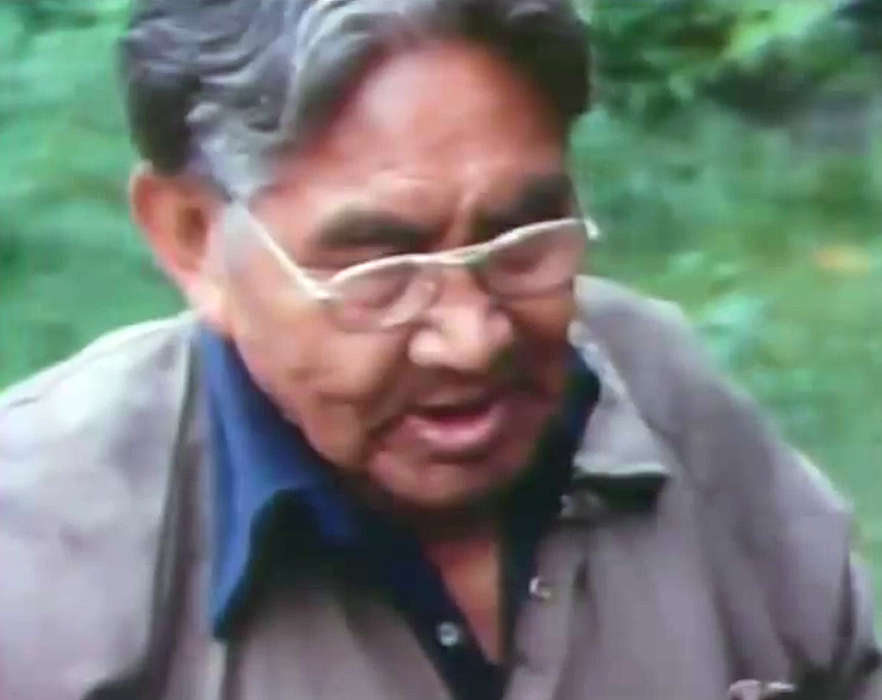
Simon Dick's great uncle, William Robertson, 80 years old, helps with the rocks, as he has done before a long time ago.
Photo: https://www.youtube.com/watch?v=RvVk9RD3c6w

(The hot stones are laid carefully on the cedar boughs covering and protecting the inside of the canoe. The aim is to heat the water in the canoe, without any hotspots on the wood of the canoe itself, and to make sure that any sharp stones dropped in, or the smooth river stones which are usually used, which sometimes shatter on contact with the water, do not damage the inside surface.
Note the unusual Cowichan sweater in this shot. Early Cowichan sweaters were closed with buttons, later ones with zippers. When I was in Canada in 1966 - 1969 I had one specially made by the Cowichan knitters with no closure at the front, which was the fashion in Australia. This is the first time I have seen an example like mine - Don )
Photo: Bill McLennan, UBC Museum of Anthropology
Source: http://moa.ubc.ca/voicesofthecanoe/history/haida-canoe-being-carved-and-steamed-at-moa/
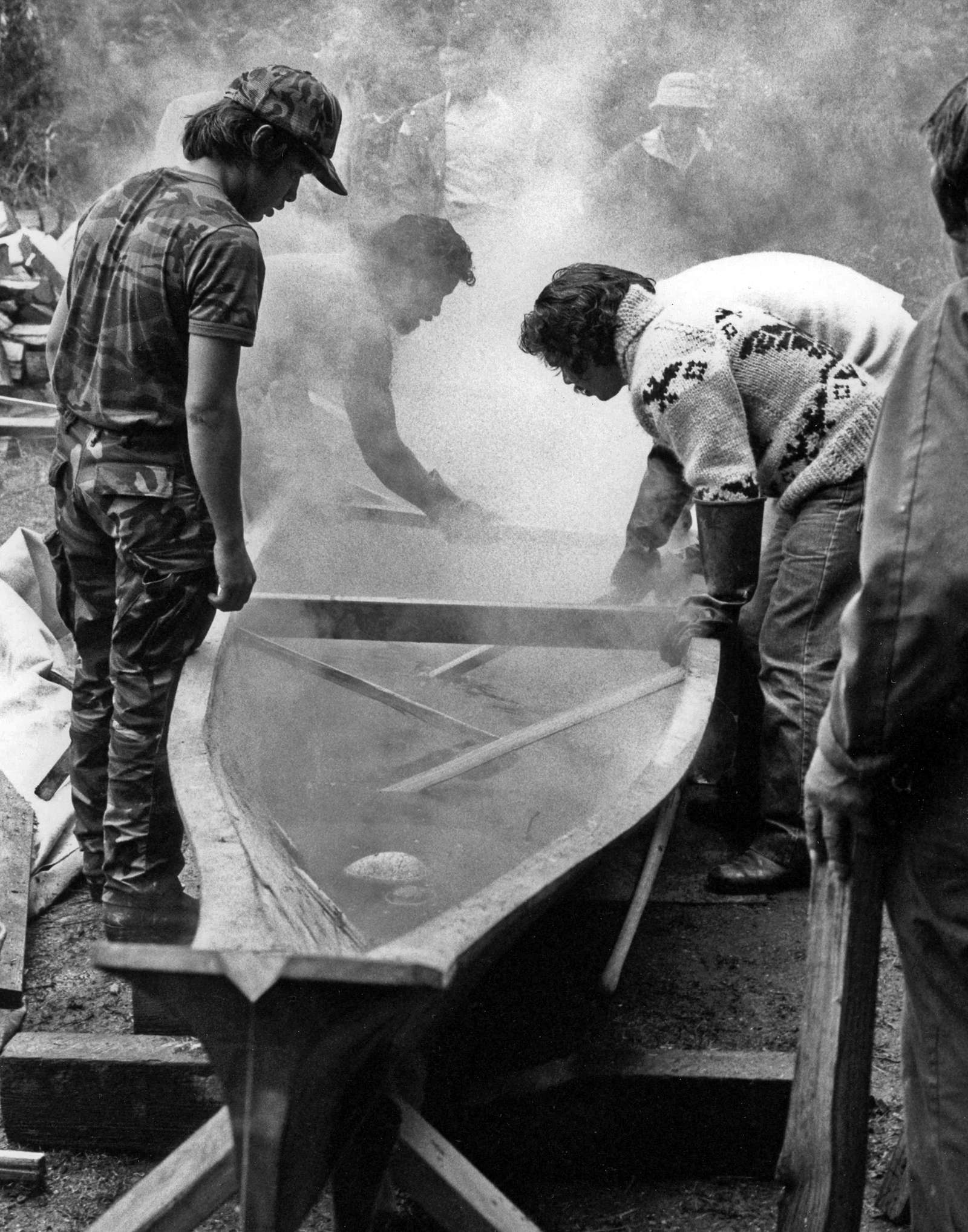
Gradually, the cedar hull softens. Spreaders are inserted to stretch the canoe to its necessary width. As the sides of the canoe flare outward, its ends rise. The process adds strength and stability to the finished vessel. Originally 35 inches wide, the canoe is now 45 inches wide.
Spreading sticks are tapped into place between the gunwales, and are gradually moved towards the ends as the wood softens. The replacement spreaders in the centre increase in length an inch at a time as the sides flare outward. When the planned beam and form are reached, the canoe is allowed to cool. The sides of the hull must be thin, about three quarters of an inch in most cases, so that this spreading can take place without cracking.
All along the Pacific northwest coast, canoe making is enjoying a resurgence. Tribal canoe journeys have become an annual event. New generations of carvers are building on ancient traditions, learning from elders, researchers, historical documents, old canoes, and one another.
(At this point, diagonal spreaders have already been jammed into the canoe to help spreading, and thicker, measured lengths of timber are now inserted to bring the canoe to the required dimensions along the full length of the canoe - Don )
The steaming has also strengthened the boat, and made it into a more seaworthy shape.
Photo: Bill McLennan, UBC Museum of Anthropology
Text: Display, Museum of Anthropology, University of British Columbia, http://www.historymuseum.ca/cmc/exhibitions/aborig/nwca/nwcah11e.shtml
Source: http://moa.ubc.ca/voicesofthecanoe/history/haida-canoe-being-carved-and-steamed-at-moa/
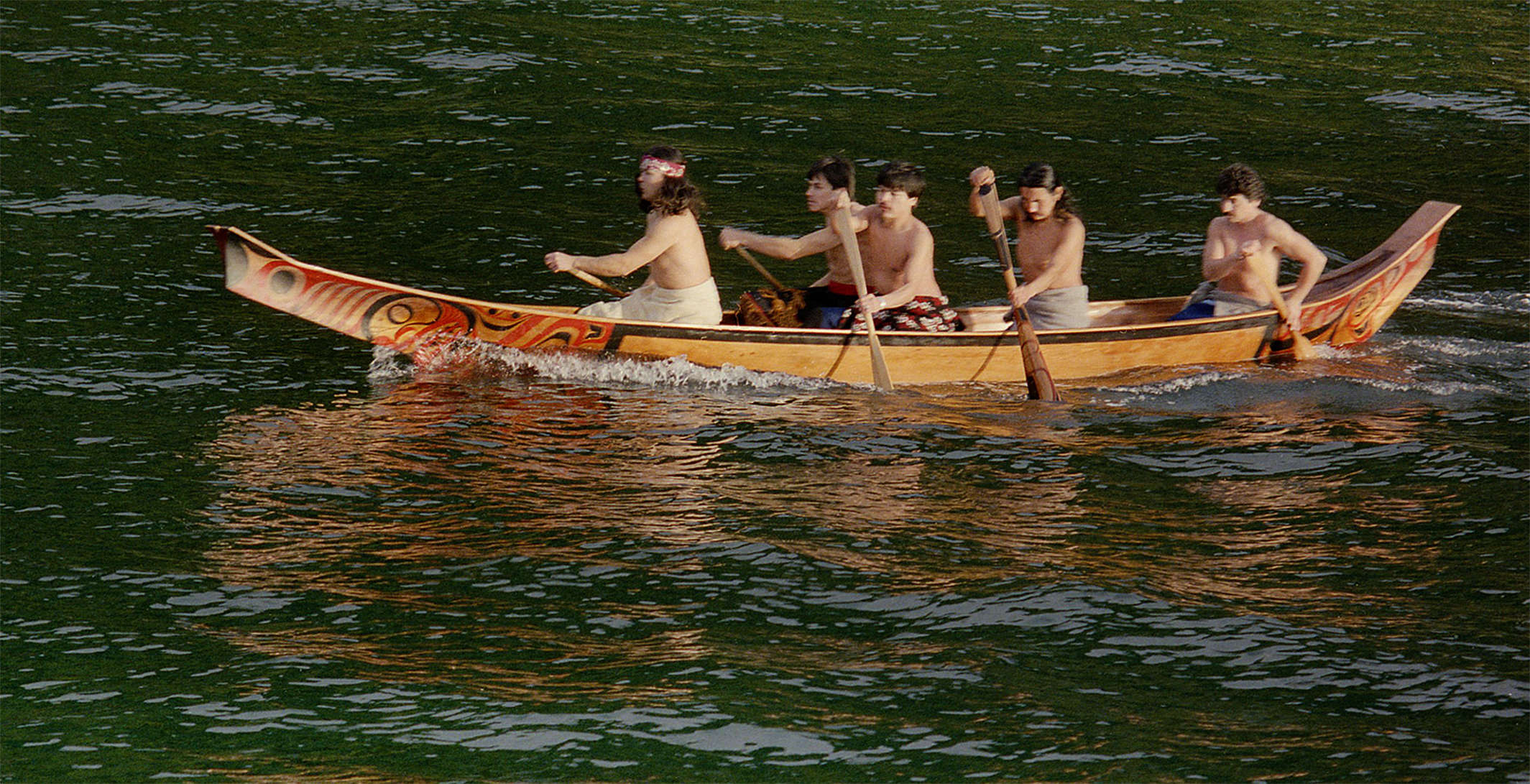
Richard Baker, Jim Hart, Glen Wood, Joe David, and Simon Dick paddle this canoe in Howe Sound, 1985.
(Note that Simon Dick is trailing his paddle in the water at the rear, using it as a rudder to steer the canoe - Don )
Photo: Bill McLennan, UBC Museum of Anthropology
Text: Display, Museum of Anthropology, University of British Columbia
Source: http://moa.ubc.ca/voicesofthecanoe/history/haida-men-paddling-the-lootaas/
Caulking
In cases where the wood shows defects, caulking may become necessary. This is generally done by driving shredded yellow-cedar bark into the crack, sewing it together with cedar withes, and then covering it with gum. When there is a knot-hole in the side of a canoe, it is filled as tight as possible with rushes, the inner bark of the spruce-tree, or cedar twigs. Then pegs made of red cedar, about 15 cm. long and pointed at. one end, are driven in from both sides until the hole is completely filled. This is an efficient temporary closing of a knot-hole. For a permanent closing, new pieces are sewed into the sides of the canoe. In caulking canoes, rotten pitch-wood is used, which is gathered in bags. This is rubbed until it becomes quite fine and sticky, and is put over the yellow-cedar bark which is inserted in cracks; or when the cracks are very narrow, the rotten wood is simply rubbed into them until they are entirely filled up. This renders the canoes perfectly water-tight.
Text above: Boas (1909)

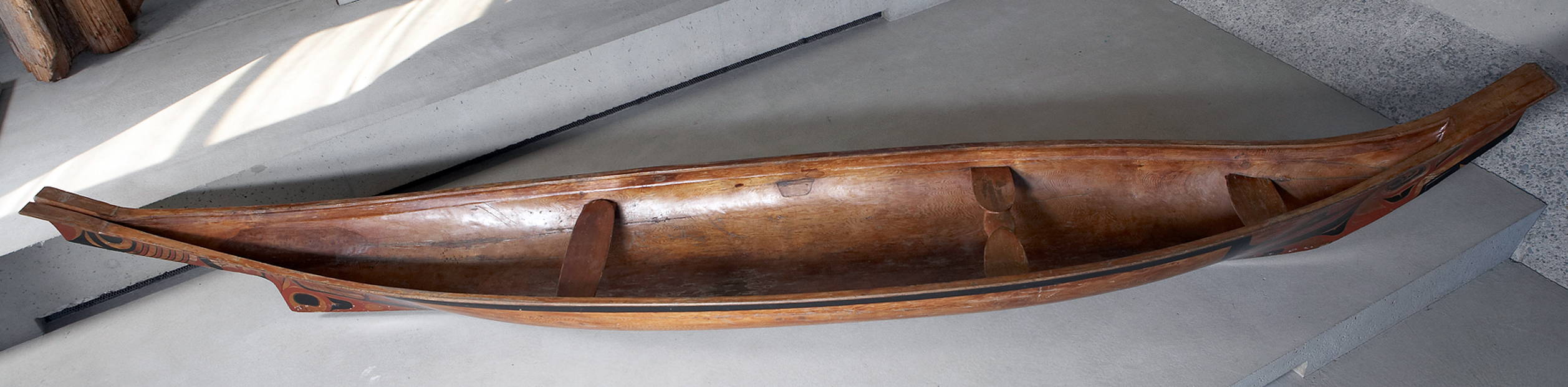
Tluu (Canoe)
Photo: http://www.rrnpilot.org/items/27797
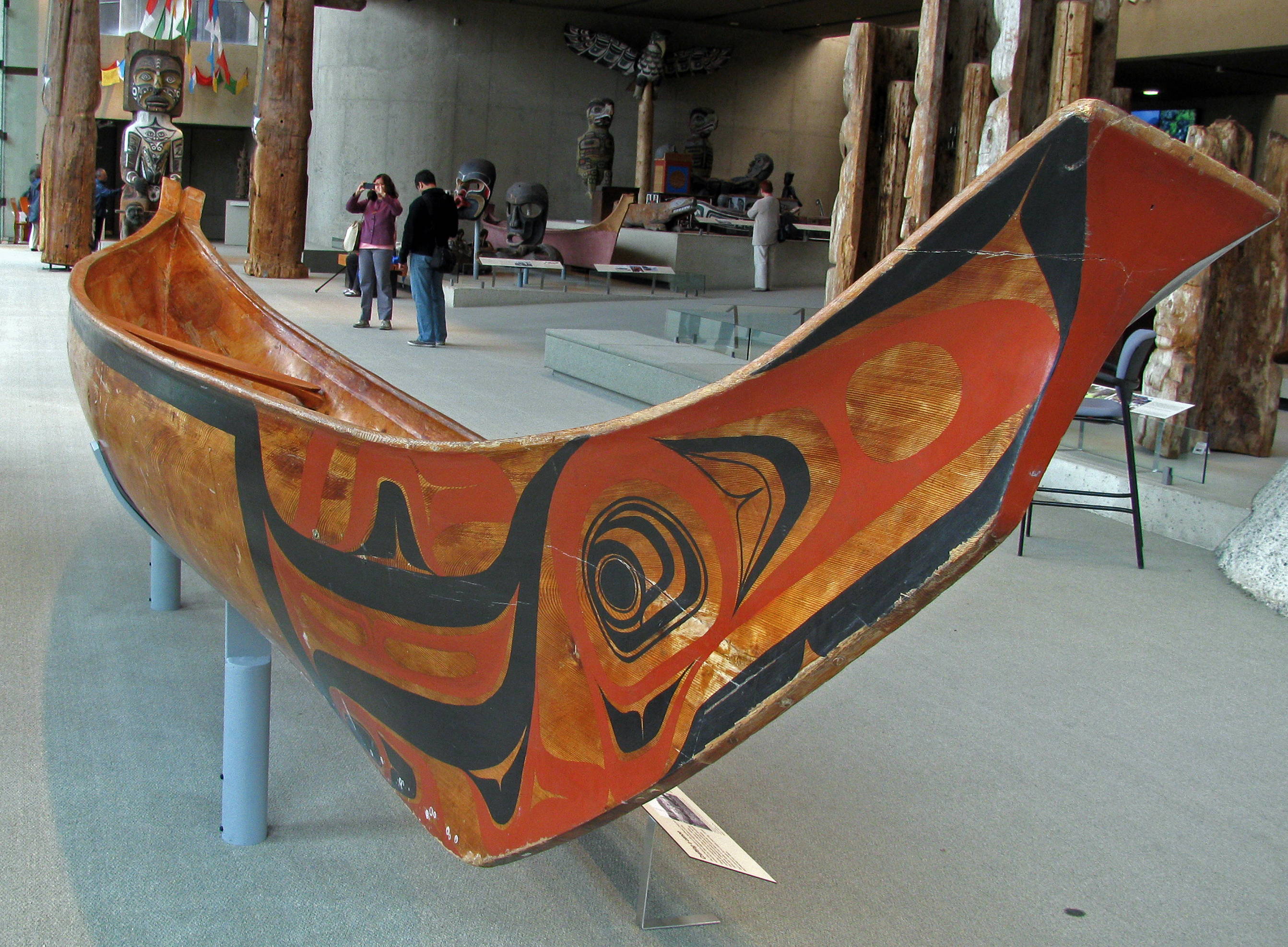

Tluu (Canoe)
Full size northern style dugout canoe with a high, rectangular shaped prow and stern; prow has deep groove carved in the middle. The outside is painted black and red with Northwest Coast stylised designs; the front depicts a dogfish. A black line runs along the upper edges, connecting the end designs. The rest of the canoe is plain varnished wood. The interior has three rounded bench seats, secured with nails.
Photo (left): Don Hitchcock 2012
Photo (right) and text: http://www.rrnpilot.org/items/27797
Source: Display, Museum of Anthropology, University of British Columbia
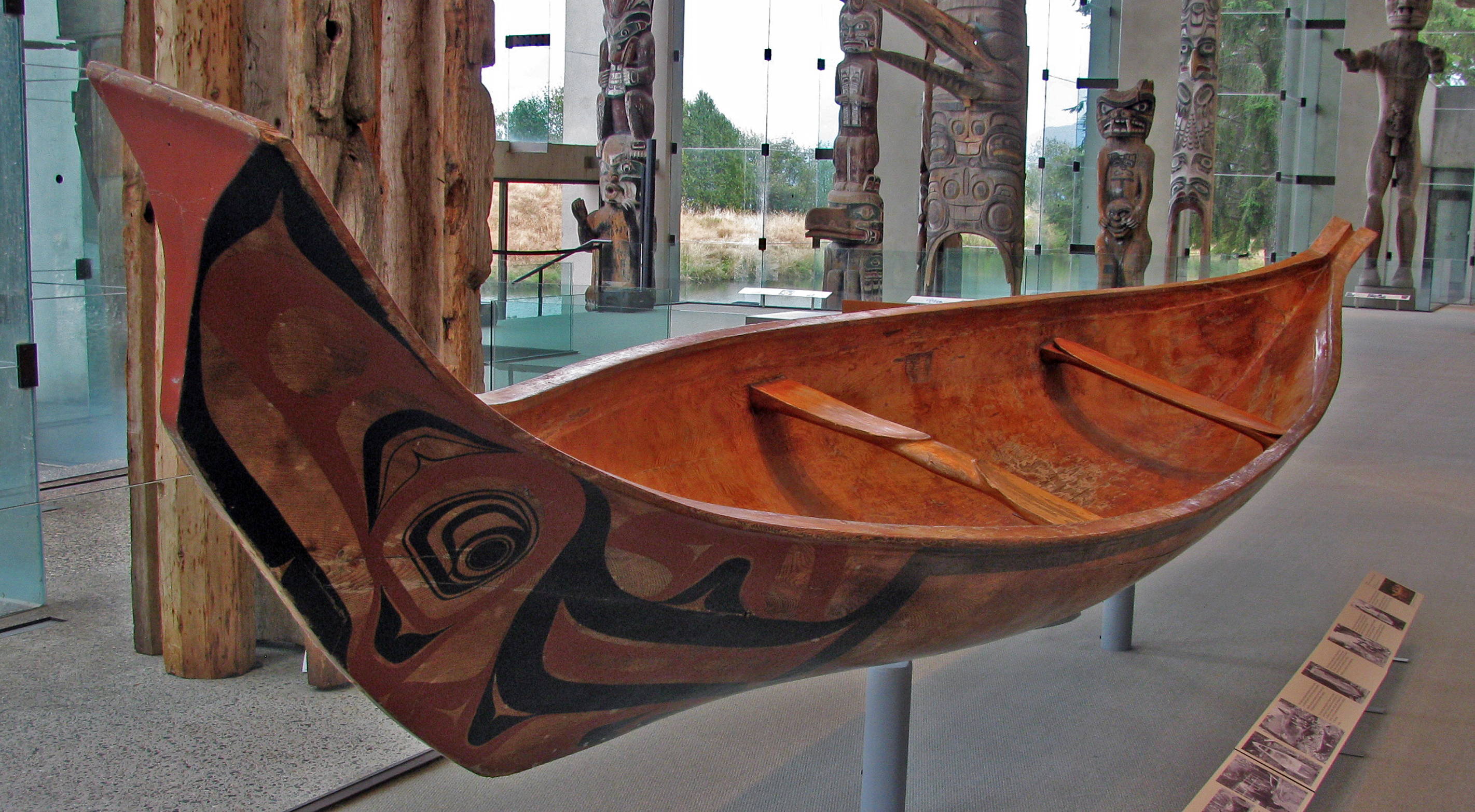
Made by Bill Reid (Maker), Beau Dick (Technician), Simon Dick (Technician) and Gary Edenshaw (Technician) in Vancouver, British Columbia, Canada during 1984
Identification Number Nb1.737
Cedar wood, paint, metal and glaze
Height 1.0 m, length 7.25 m, beam 1.08 m
Made in Vancouver, British Columbia, Canada
Condition: fair
Accession number: 1741/1
Culture: Haida
Acquisition Date: July 18, 1984
Funding: Expo 86
Photo: Don Hitchcock 2012
Text: http://www.rrnpilot.org/items/27797
Source: Display, Museum of Anthropology, University of British Columbia
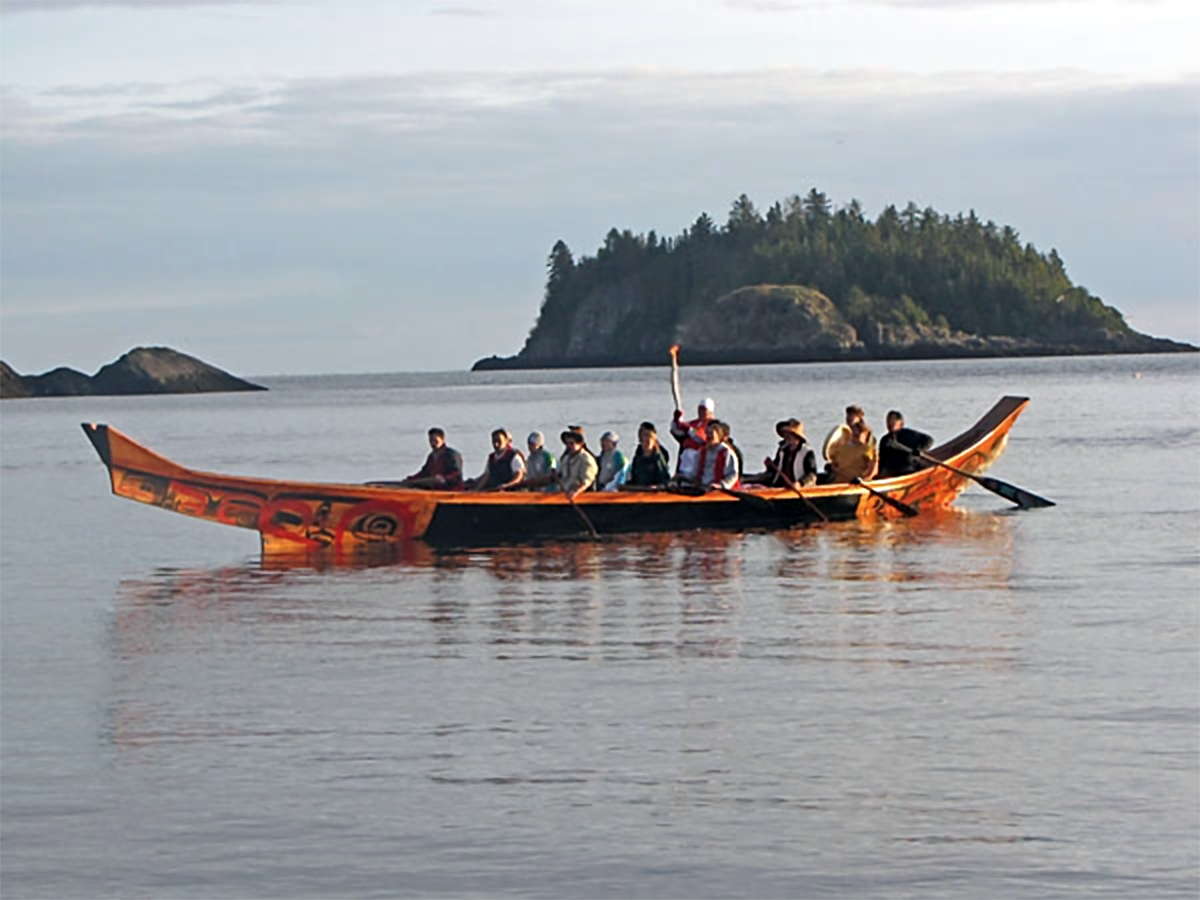
2010 Olympic torch relay in the Loo Taas ('water eater'), made by Bill Reid.
Expo 86 in Vancouver coincided with the obsession Bill Reid had developed for understanding the Haida canoe as a paradigm of Haida culture. Reid was commissioned to carve and paint a 15 metre war canoe from a red cedar log for the world's fair. He later agreed to recreate this canoe, which he named Lootaas, for the Canadian Museum of Civilization in fibreglass (to combat fluctuations in climactic conditions). Each new canoe was to be the alter ego of the other: one was to have primary formlines in black, the other in red. Consequently, one canoe became known as Black Eagle while the other was known as Red Raven.
Photo: http://asweweresaying.blogspot.com.au/2011/10/haida-canoe-living-icon-of-10000-year.html
Text: http://www.historymuseum.ca/cmc/exhibitions/aborig/reid/reid10e.shtml

Lootaas at Kaay Llnagaay
The Haida Heritage Centre at Kaay Llnagaay in Skidegate on Haida Gwaii (Queen Charlotte Islands), opened in July, 2007. The Centre, located at the site of the old Haida seaside village of Kaay Llnagaay, or 'Sea Lion Town', showcases the living culture of the Haida, dating back over 12 000 years.
Photo: http://moa.ubc.ca/voicesofthecanoe/history/lootaas-at-kaay-llnagaay/
Text: Adapted from http://www.hellobc.com/activitylisting/4542170/haida-heritage-centre-at-kaay-llnagaay.aspx
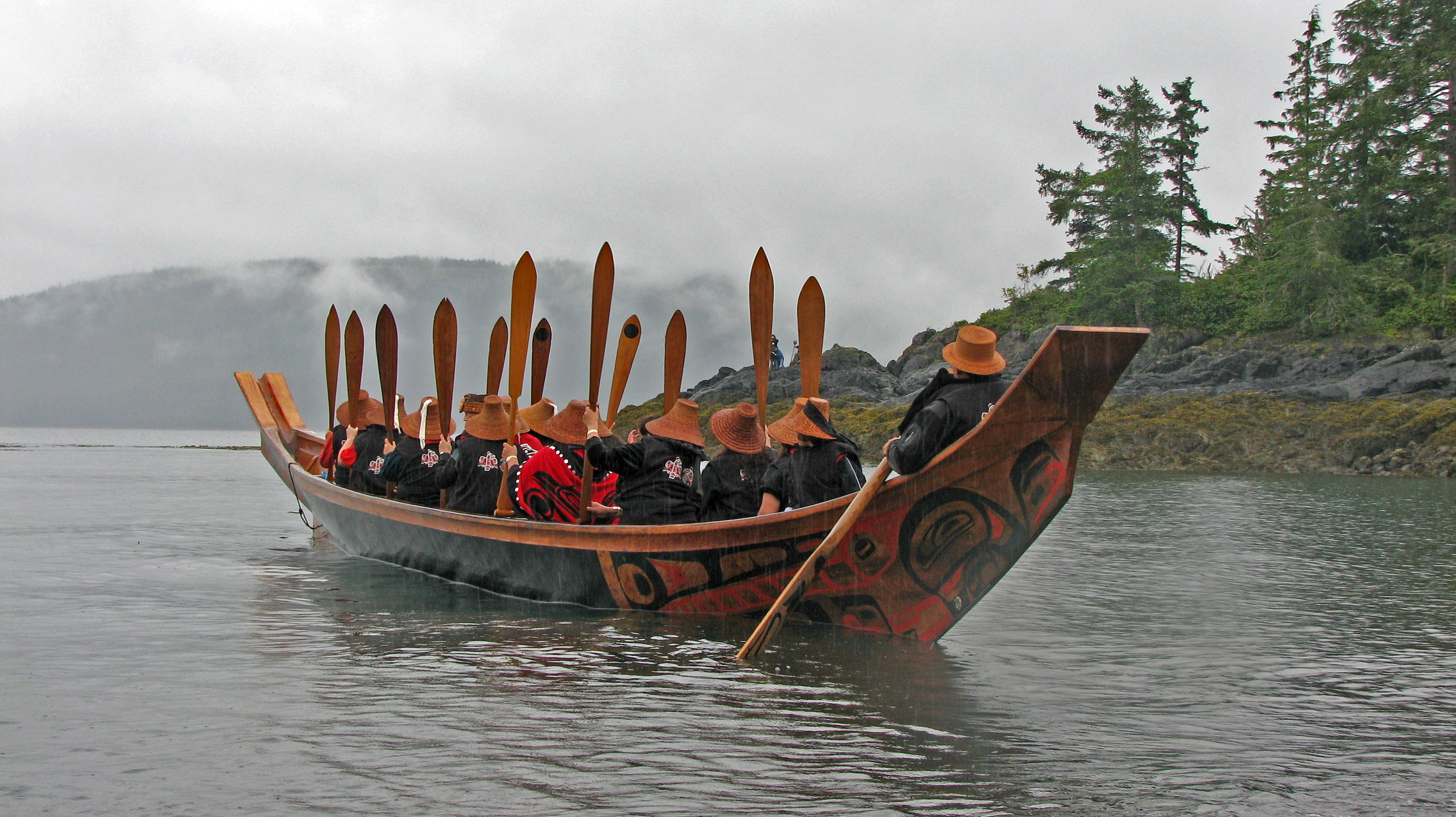
Lootaas in the rain. The woven cedar bark hats make good rain gear!
Black Eagle (see below) is a replica of Loo Taas.
Photo: http://moa.ubc.ca/voicesofthecanoe/history/lootaas-at-kaay-llnagaay/

Black Eagle is a 15.5 metre, 4000 lbs. fibre glass Haida canoe created by famed artist Bill Reid under commission from the Museum of Civilization in Ottawa. It was later acquired by the Bill Reid Gallery in Vancouver who have given it to VanDusen Botanical Garden on a long-term loan. Black Eagle arrived at VanDusen on May 26, 2011 and will sit on the south bank of Heron lake amidst the stand of old-growth Douglas firs.
Black Eagle Canoe and Haida paddlers in English Bay, 2006.
Photo: © R.A. Badger
Source and text: VanDusen Botanical Garden Official Photostream, via http://www.flickr.com/photos/vandusenbotanicalgarden/sets/72157626687822017/
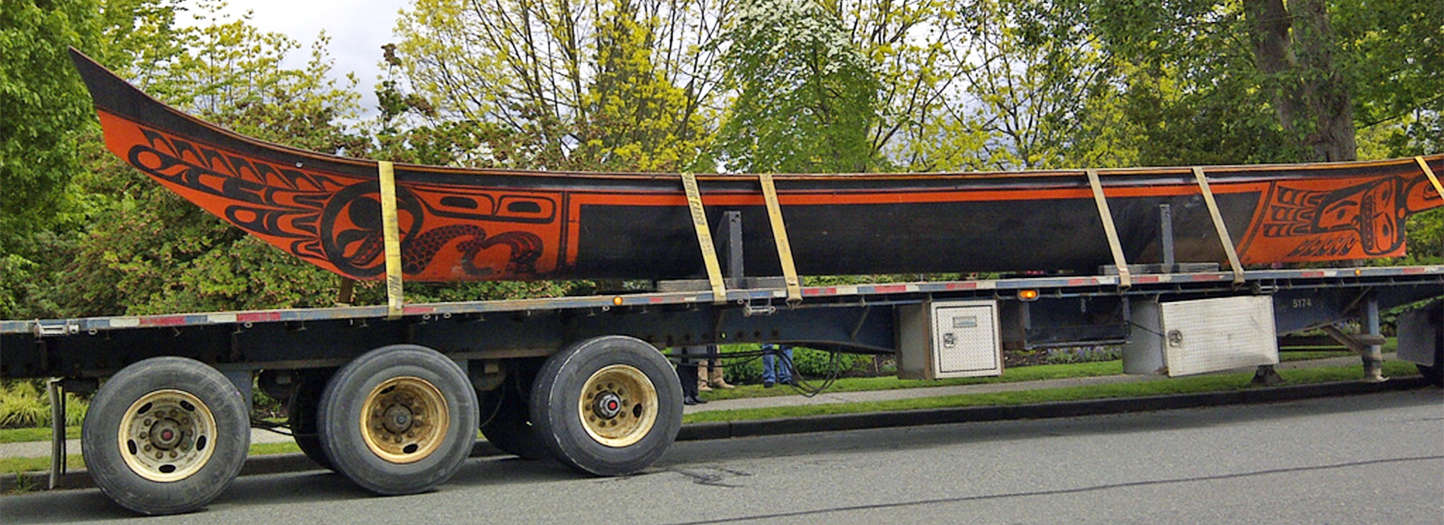
Black Eagle arriving on a truck trailer at the Botanical Gardens.
Photo: VanDusen Botanical Garden Official Photostream, via http://www.flickr.com/
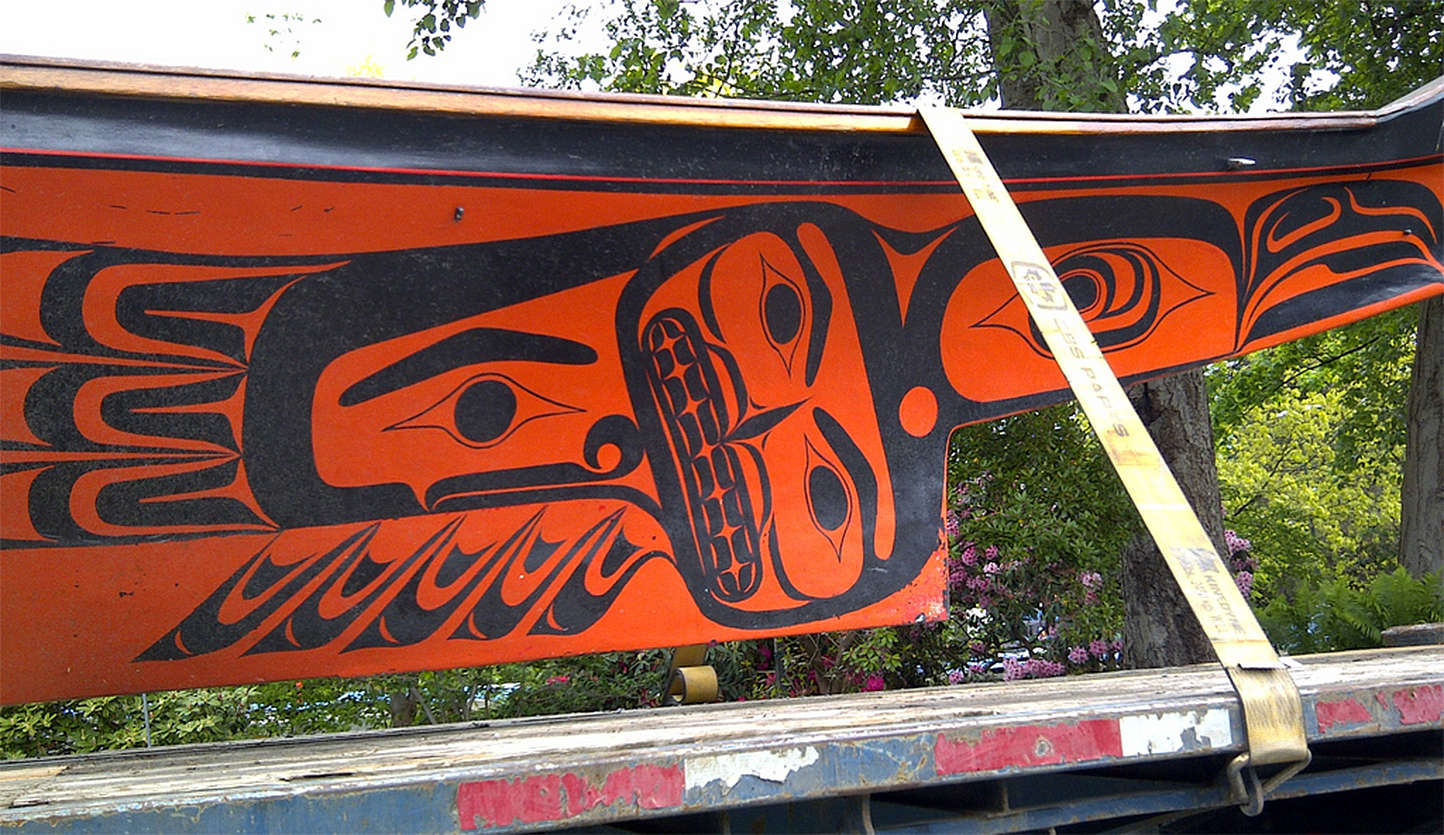
Black Eagle prow.
Photo: VanDusen Botanical Garden Official Photostream, via http://www.flickr.com/
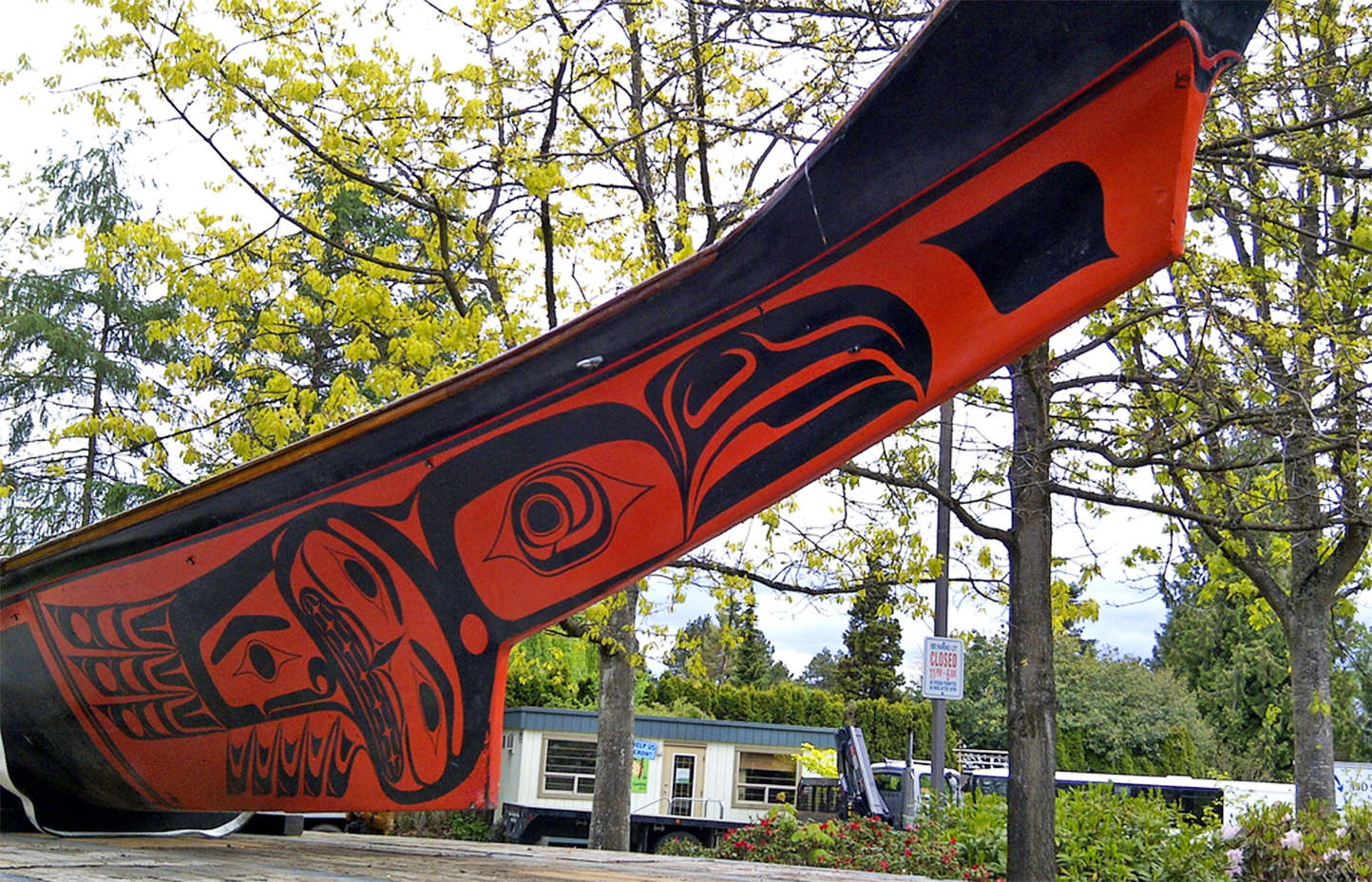
Black Eagle prow.
Photo: VanDusen Botanical Garden Official Photostream, via http://www.flickr.com/
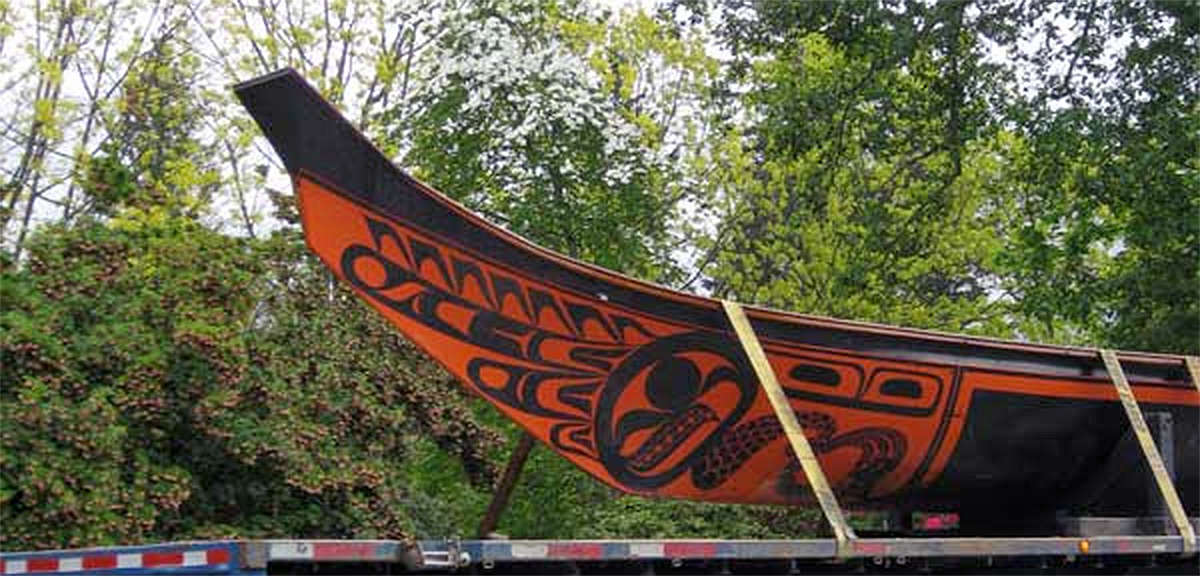
Black Eagle stern.
Photo:
Bill Reid Gallery Photostream, via
https://www.flickr.com/photos/billreidgallery/sets/72157626688598105/detail/
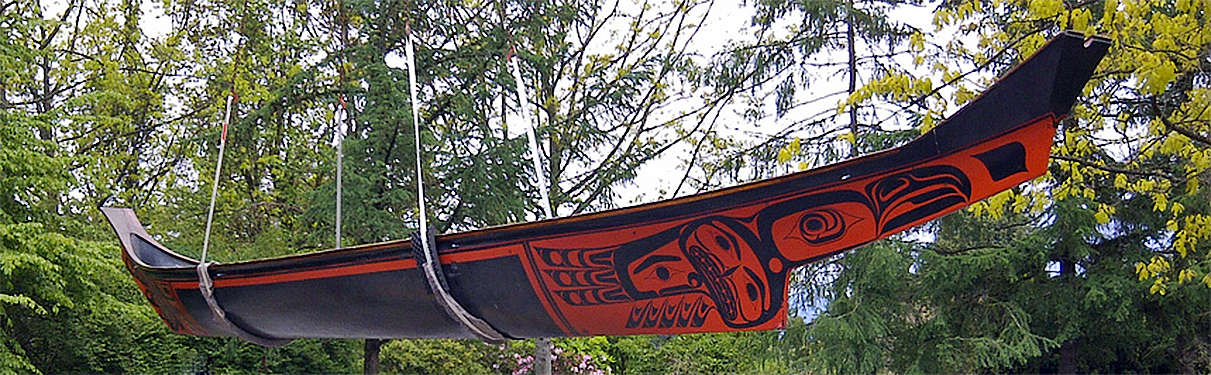
Black Eagle.
Photo: VanDusen Botanical Garden Official Photostream, via http://www.flickr.com/photos/vandusenbotanicalgarden/sets/72157626687822017/
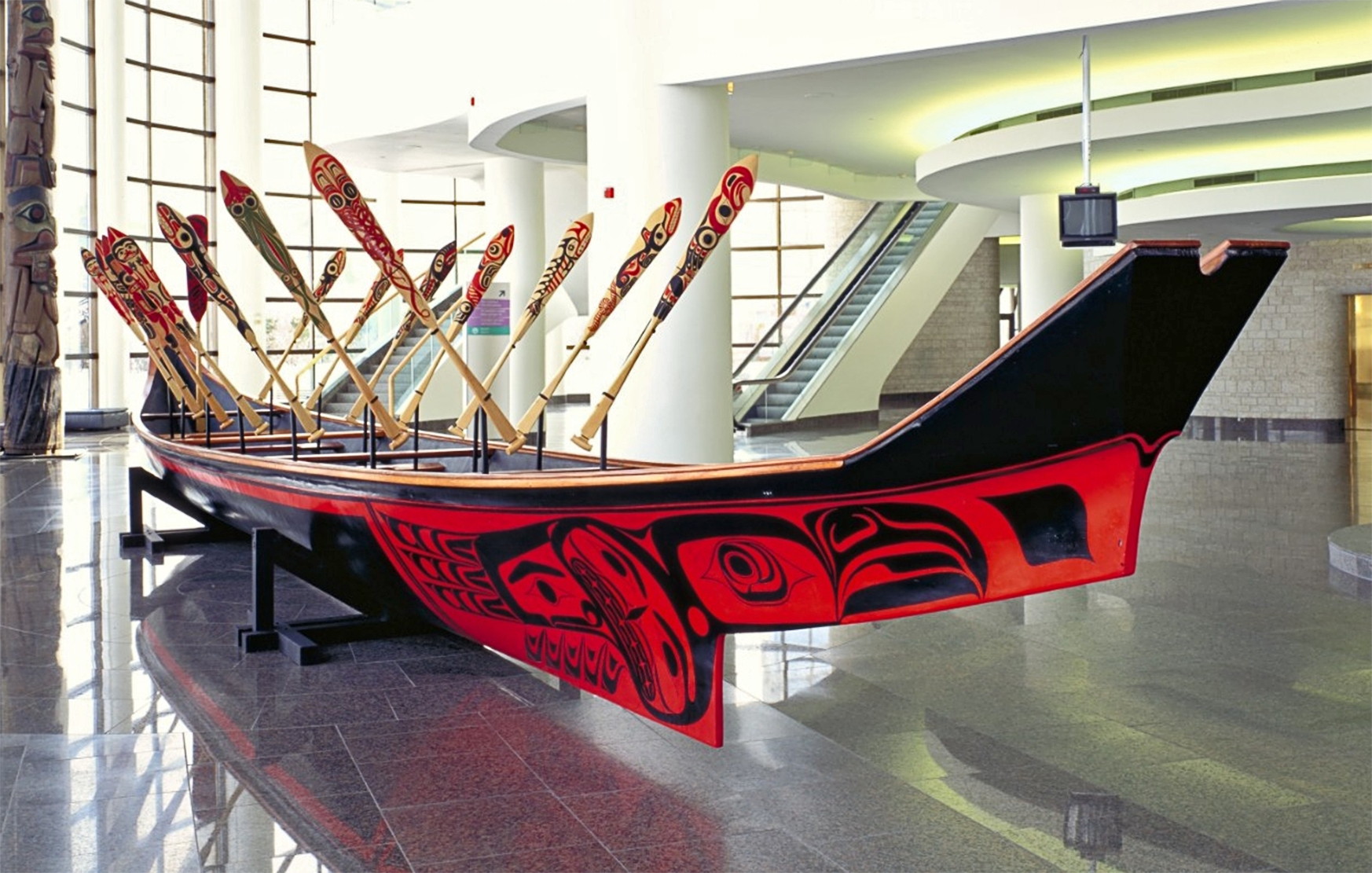
Black Eagle at the Canadian Museum of History, ca. 1988.
Photo: © Harry Foster
Source: https://www.sfu.ca/brc/imeshMobileApp/imesh-art-walk-/black-eagle.html
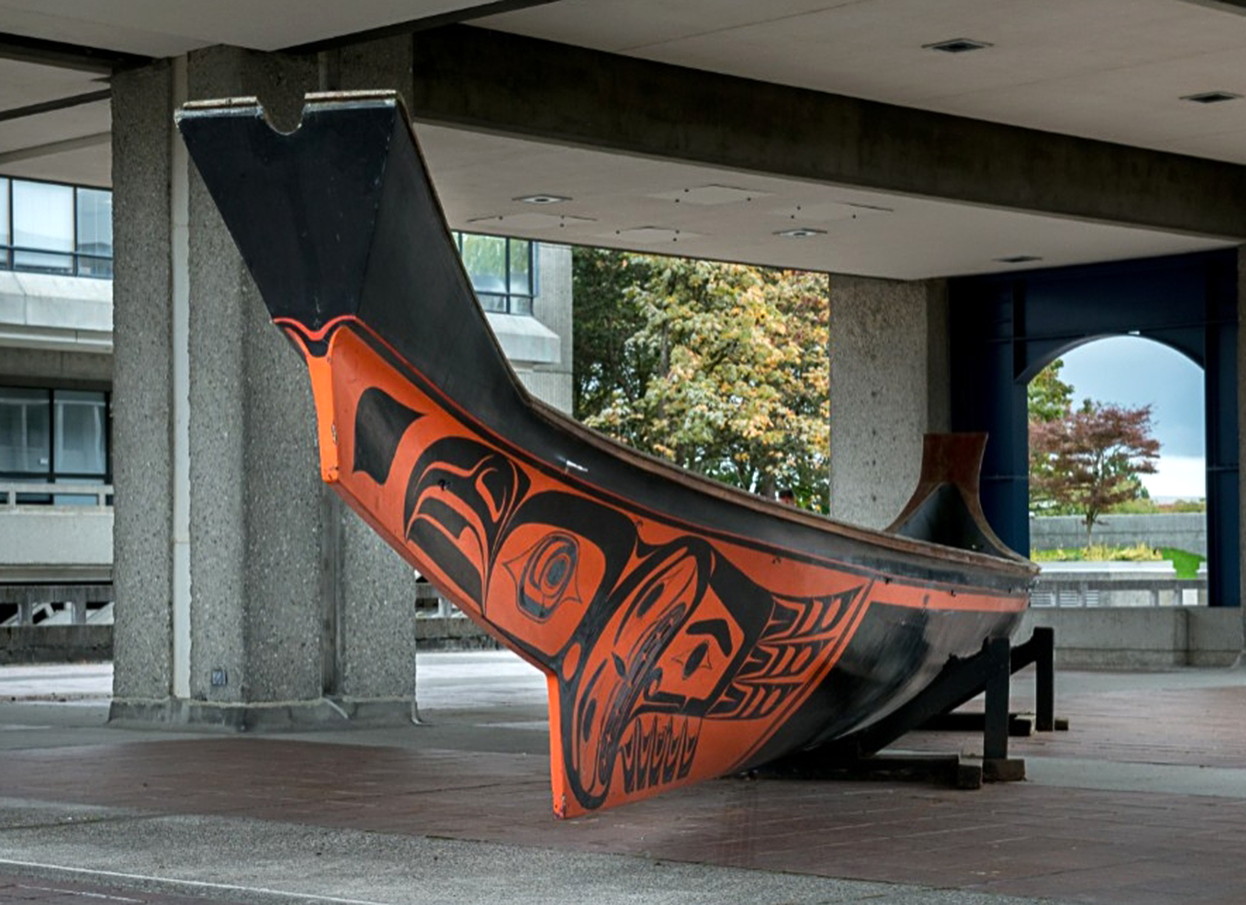
Black Eagle has been restored, and is now located outdoors at the north east corner of the Academic Quadrangle, on the 4000 level.
This photo shows the canoe shortly after it arrived at SFU Burnaby.
My thanks to John Gardiner, who advised me on its present position, and gave me access to many photographs of Black Eagle in its new home.
Photo: © SFU Creative Services
Source: https://www.sfu.ca/brc/imeshMobileApp/imesh-art-walk-/black-eagle.html

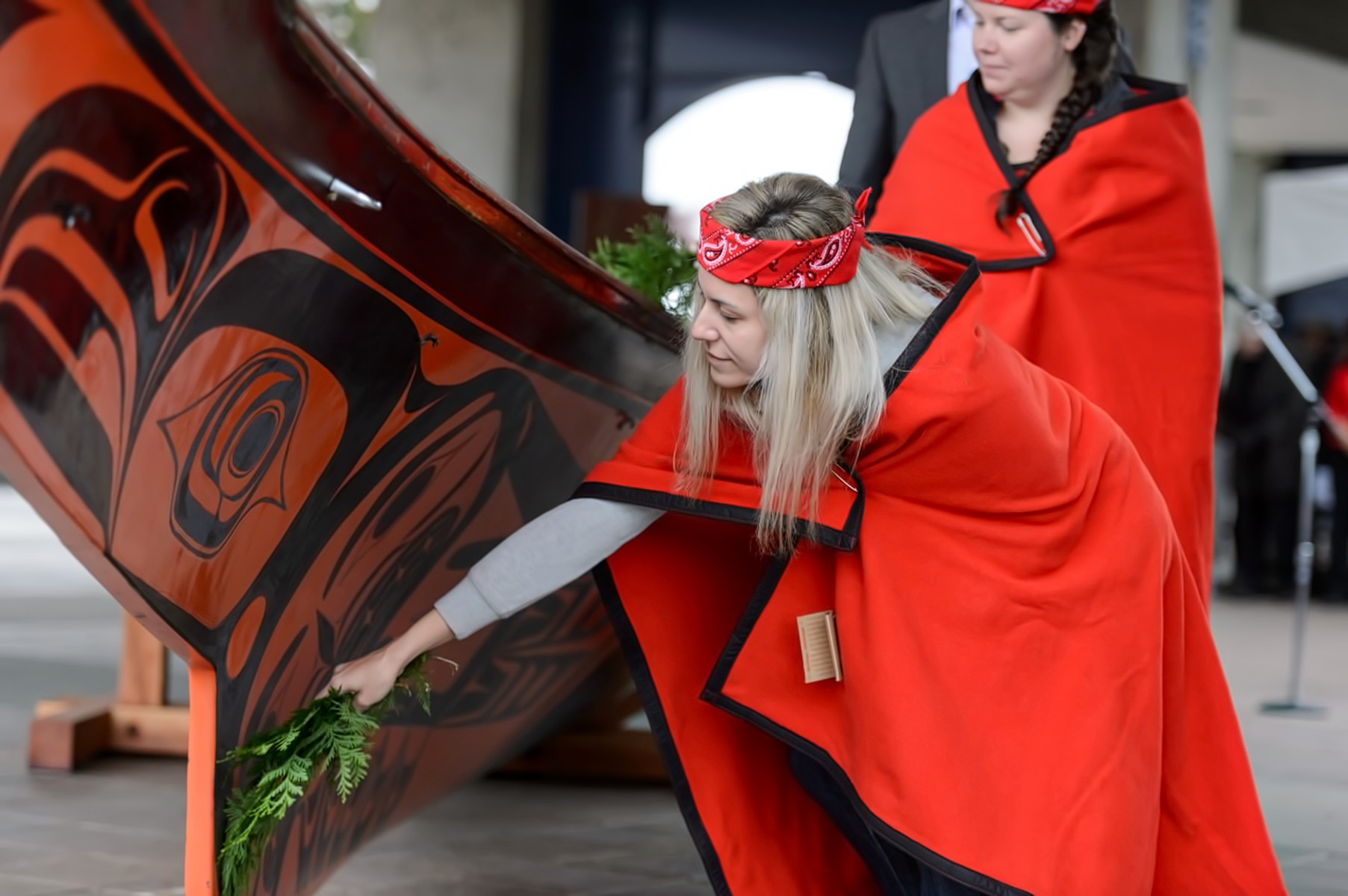
Haida artist Bill Reid’s Black Eagle canoe is a symbol of knowledge, community, and cultural regeneration, so it couldn’t be a more fitting tribute to SFU’s 50th Anniversary.
The fiberglass canoe is a replica of famed dugout canoe Loo Taas, which Reid and other First Nations artists carved from a 750-year-old cedar tree for Expo ’86. It was the first such canoe to be carved on the Northwest Coast in more than 100 years.
At a ceremony at SFU’s Burnaby campus on Oct. 21, 2015, the community gathered to witness the Black Eagle’s installation outside under the northeast corner of the Academic Quadrangle. The photographs show the canoe in its new home, and the blessing of the canoe with fresh cedar boughs and water during the Oct. 21 installation ceremony.
'The University has made it our commitment to honour the history, culture and presence of Aboriginal Peoples,' says President Andrew Petter.
'Bill Reid's Black Eagle canoe represents the resiliency, creativity and vitality of Northwest Coast canoe cultures. We are honoured to become stewards of this canoe and to share what it represents with our students and the communities we serve.'
The Black Eagle was previously on display at the VanDusen Botanical Garden in Vancouver. The canoe is part of a $10-million First Nations art collection donated to SFU in 2011 from the Bill Reid Foundation.
Photo and text: https://www.sfu.ca/sfunews/stories/2015/bill-reid_s-black-eagle-canoe-finds-new-home-at-sfu.html

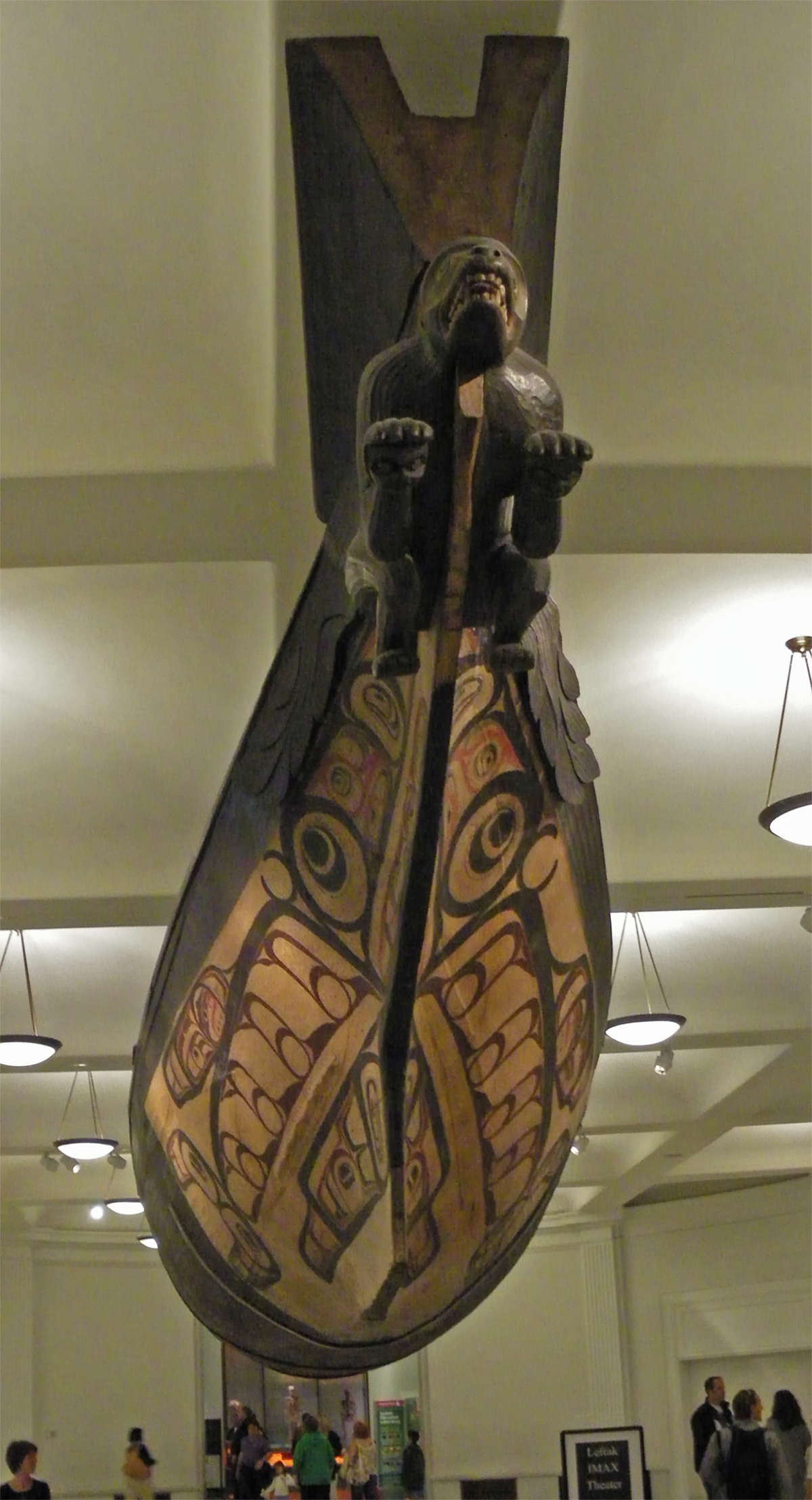
Haida War Canoe, American Museum of Natural History in New York.
This is an outstanding example of the exceptional canoe-building skills of the Indians of the Pacific Northwest. The 63 foot long, (19.2 metres) seaworthy canoe was built in 1878 by the Haida, who are native to the Queen Charlotte Islands off British Columbia. Canoes were an essential part of life for the Indians of this area, and were used for traveling to ceremonies, for trade, and for war. In this display, created in 1910 by George T. Emmons, who explored the Northwest Coast for the Museum, the Indians are depicted arriving at a potlatch -- a grand ceremonial feast. The two men with long poles at the front, as well as the paddlers on the sides, are captured slaves.
The Haida Canoe was carved from a single piece of wood, the trunk of a large cedar tree. Although the trunk was only eight feet in diameter, the shipwrights softened it with boiling water and widened it to make the canoe eight-and one-half feet wide. The front of the canoe is decorated with a carving of a wolf and a painting of a killer whale. The carved decoration is more typical of the Bella Bella Indians than the Haida, and implies that the canoe was sold to a Bella Bella chief, who added his own embellishments. No matter who is responsible for its individual components, the Haida Canoe is a masterpiece of artistry and virtuoso building, and remains one of the Museum's most popular exhibits.
Photo (left): twmnj, Jan 2, 2006, http://travel.webshots.com/photo/1534082874046209414fjYJwr
Photo (right): Luiyo, Attribution-NonCommercial-ShareAlike 2.0 Generic (CC BY-NC-SA 2.0)
Text: Adapted from http://american.naturalhistory.museum/exhibitions/expeditions/treasure_fossil/Treasures/Haida_Canoe/canoe.html?50
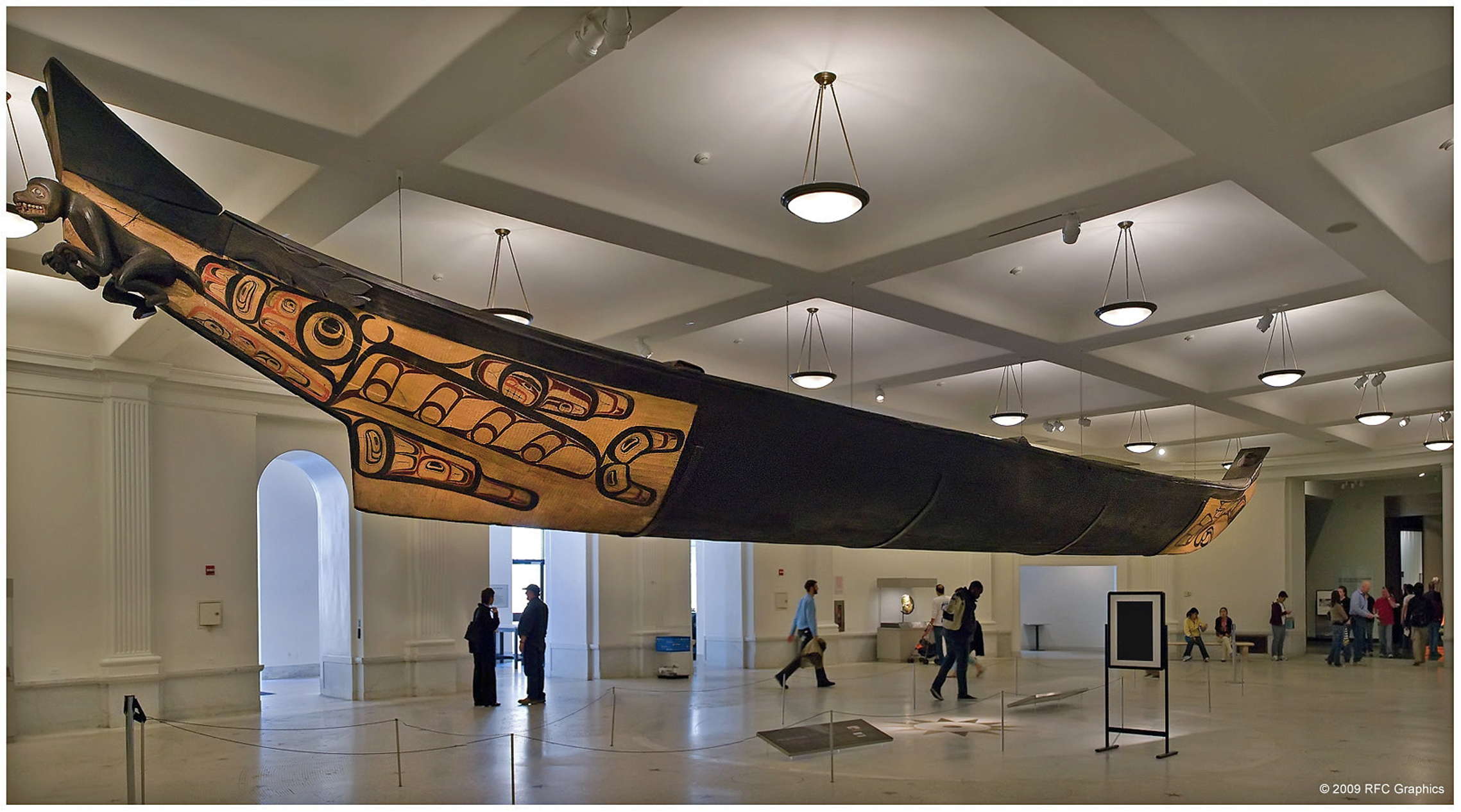
This is a superb photograph of the Haida War Canoe, which has now been suspended from the roof after refurbishment, in the American Museum of Natural History in New York.
Photo: © 2009 RFC Graphics
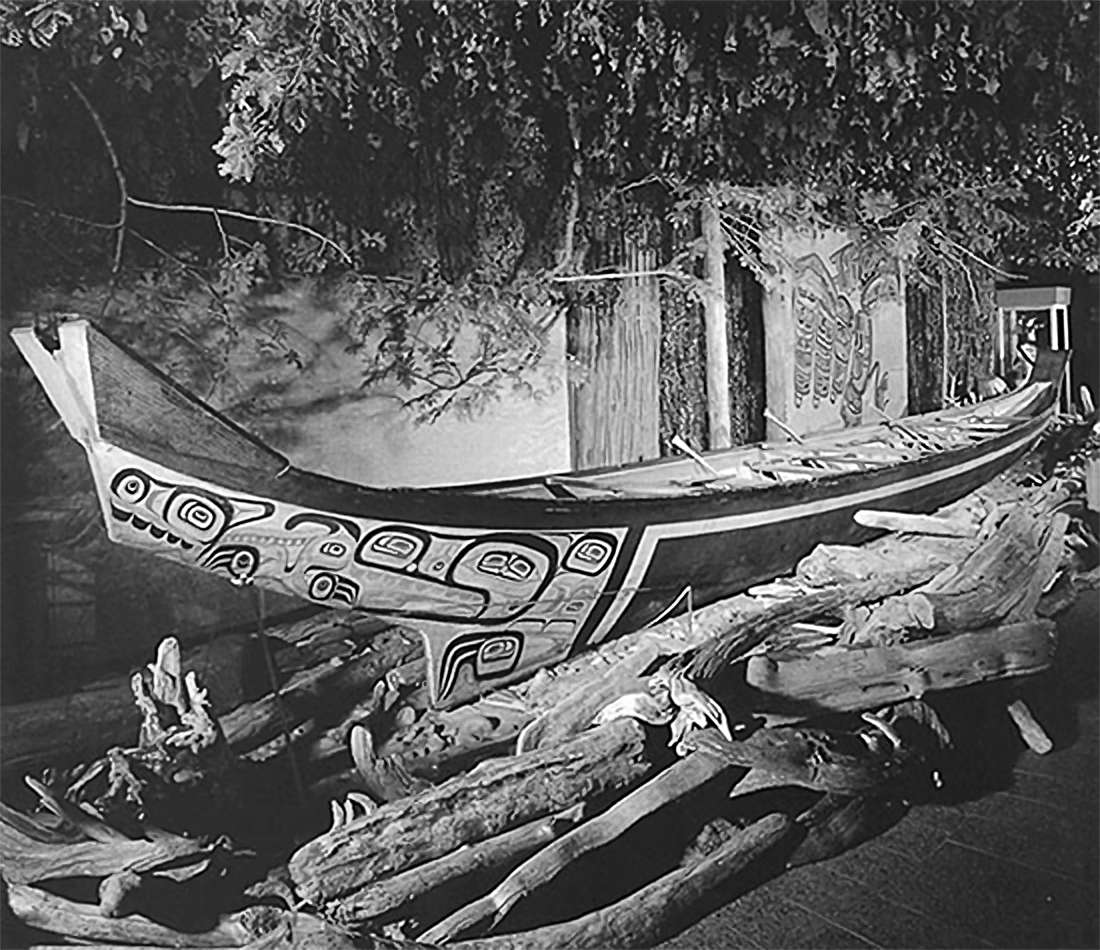
One of only two surviving Haida war canoes, 17 m (56 feet) in length with a beam of nearly 2 m (6 feet). It was commissioned for the 1904 Seattle world's fair from Alfred Davidson and other Masset carvers, including Robert Davidson Sr. The original paddles were lost en route to Ottawa, but Charles Edenshaw made a replacement set.
This photograph is of the canoe now on display at the Canadian Museum of Civilization.
Photo: http://www.civilization.ca/cmc/exhibitions/aborig/haida/havct01e.shtml
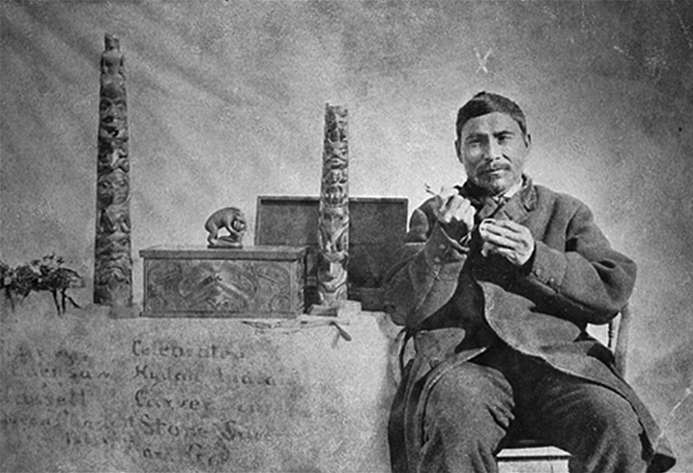
Charles Edenshaw (1839-1924)
Born in the Haida village of Skidegate, Charles Edenshaw (Tahayghen) was the hereditary chief of the Stelthdas Eagle lineage and one of several outstanding Haida carvers of the nineteenth century. His life spanned eight decades of profound political and social change on Haida Gwaii.
Working from the mid-1850s to 1920, he expressed Haida ideas on art and mythology through bentwood boxes, masks and rattles, argillite plates and chests, and gold and silver jewellery.
He carved for his family, for sale, and for museums. His work has been an inspiring legacy for the twentieth-century artists who revitalized Haida art, as well as for contemporary Haida artists.
Photo: Canadian Museum of Civilization, 2001-95, CD2001-330-009
Permission: Public Domain
Text: http://www.historymuseum.ca/cmc/exhibitions/aborig/fp/fpz2a19e.shtml
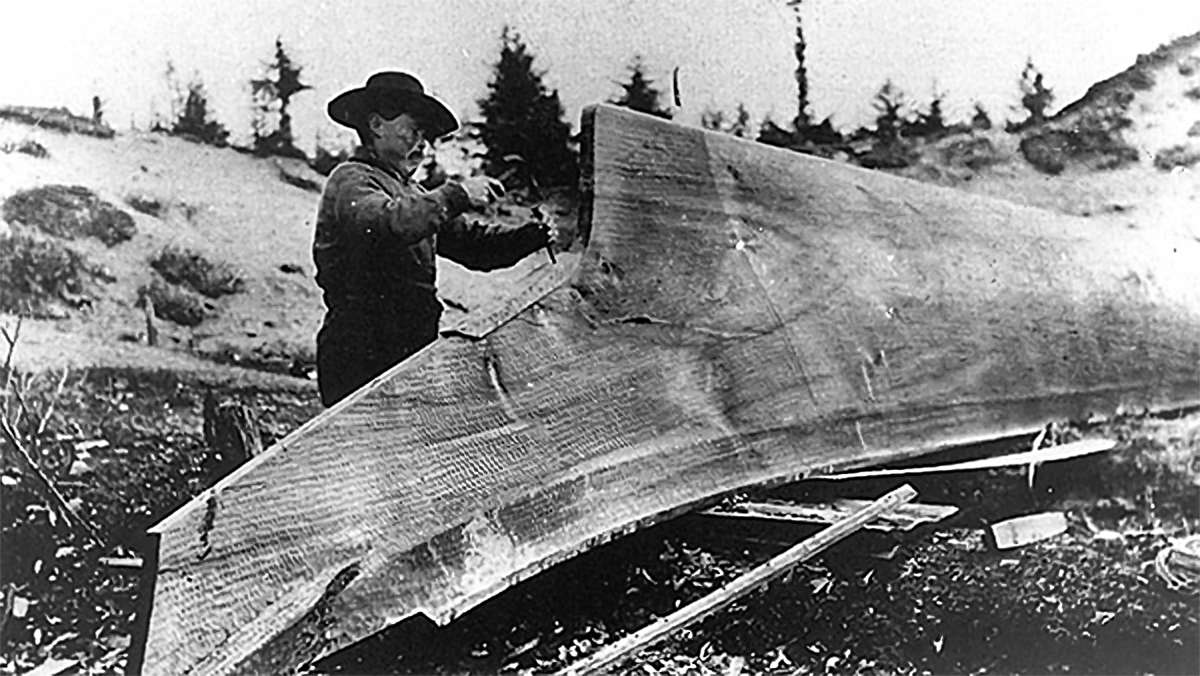
Alfred Davidson of Masset, shown carving the canoe that was commissioned for the 1904 Seattle world's fair. It was painted with Sea Wolf designs by Charles Edenshaw.
Photo: Edward Sapir, 1914 (?), CMC 26665
Source: http://www.civilization.ca/cmc/exhibitions/aborig/haida/havct01e.shtml
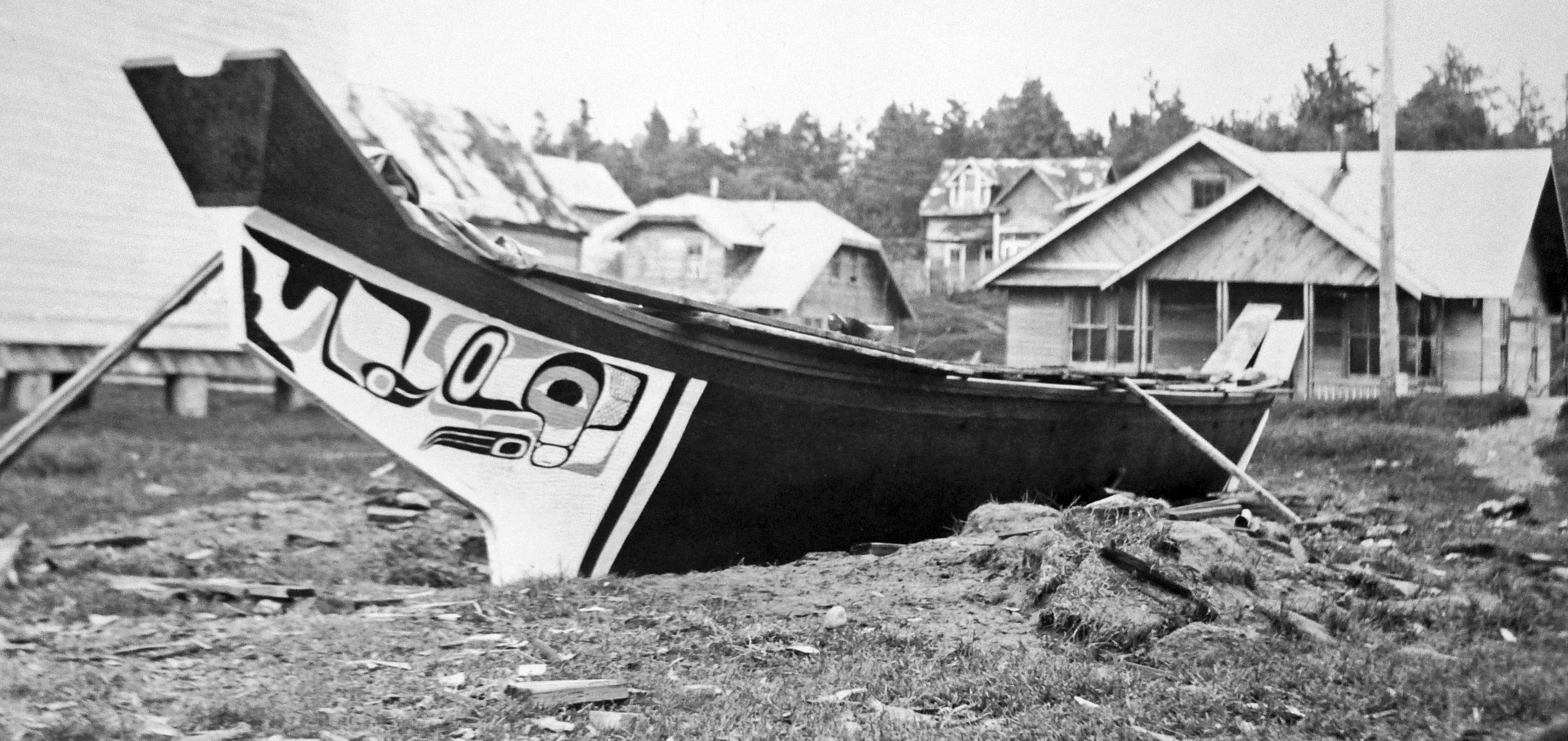
This 48 foot long canoe (14.6 metres) was carved by Alfred and Robert Davidson, Sr in 1938.
Photo: H.B. Phillips
Source: Haida Heritage Centre at Kaay Llnagaay, via http://moa.ubc.ca/voicesofthecanoe/history/48-foot-long-canoe-carved-by-alfred-and-robert-davidson/
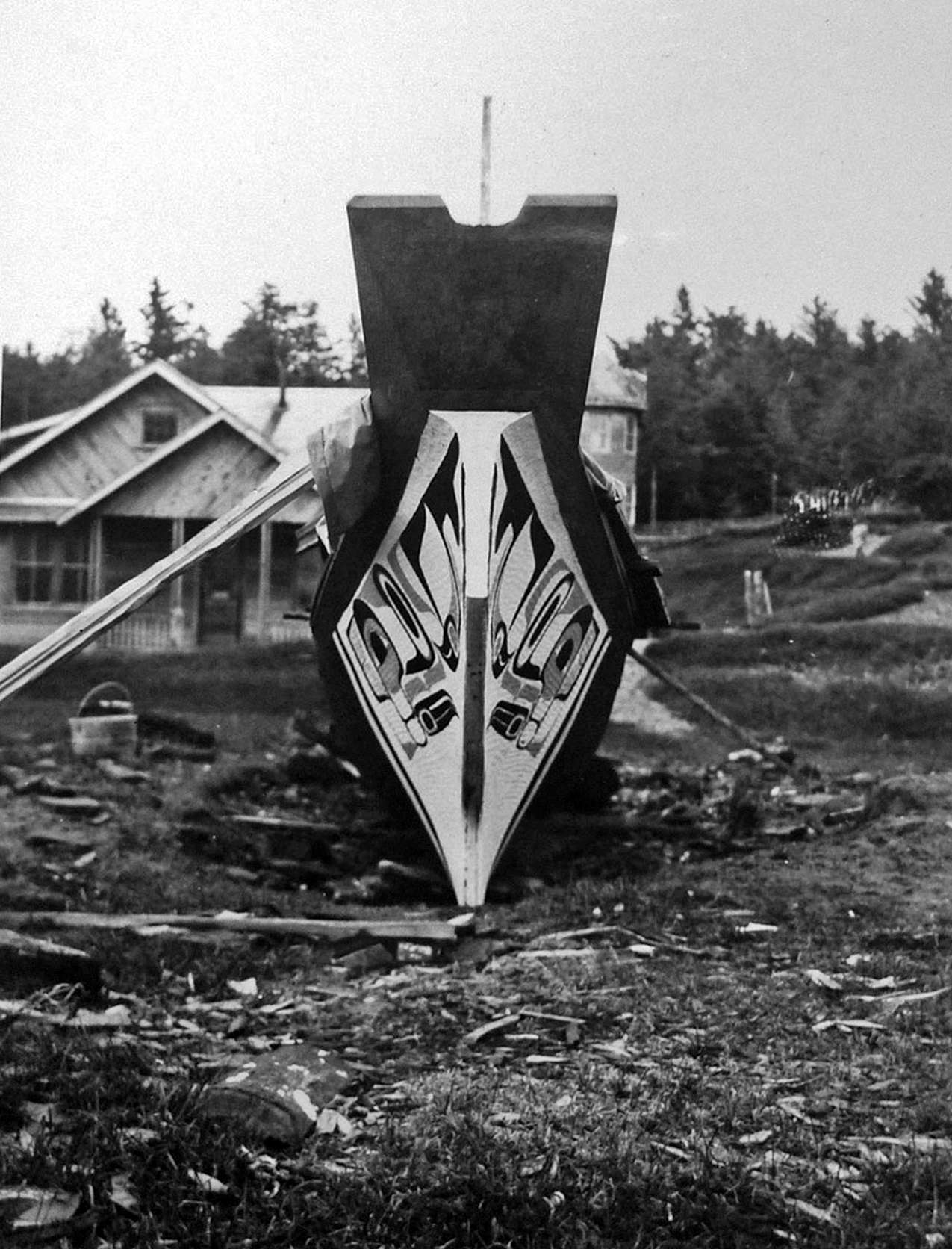
Prow of the canoe above.
Photo: H.B. Phillips
Source: Haida Heritage Centre at Kaay Llnagaay, via http://moa.ubc.ca/voicesofthecanoe/history/alfred-and-robert-davidson-canoe/
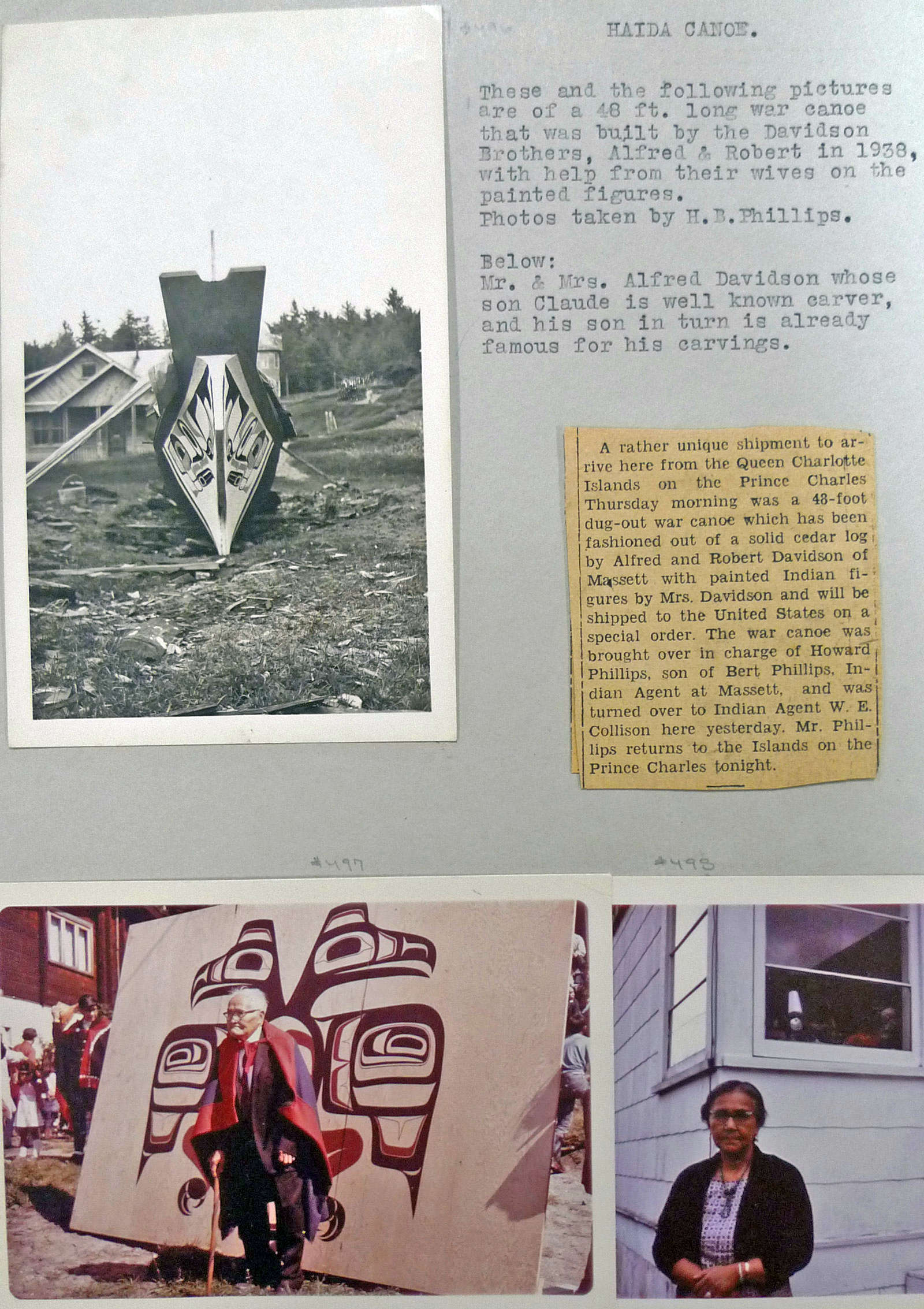
From a contemporary newspaper report, as shown in the reproduction of the family photograph album at left:
'A rather unique shipment to arrive here from the Queen Charlotte Islands on the Prince Charles Thursday morning was a 48 foot dug-out war canoe which has been fashioned out of a solid cedar log by Alfred and Robert Davidson of Massett with painted Indian figures by Mrs Davidson and will be shipped to the United States on a special order. The war canoe was brought over in charge of Howard Phillips, Indian Agent at Massett, and was turned over to Indian Agent W. E. Collison here yesterday. Mr Phillips returns to the Islands on the Prince Charles tonight.'
Note that the date given on the website ( http://moa.ubc.ca/voicesofthecanoe/history/alfred-and-robert-davidson-canoe/ ) of 1904 for this series of photos is a typo, it should read 1938, as shown in the typed caption of the photograph album shown here. Note also that both wives of the Davidsons contributed to the painting of the decorations on the canoe - Don
Photo: Haida Heritage Centre at Kaay Llnagaay, via http://moa.ubc.ca/voicesofthecanoe/history/alfred-and-robert-davidson-canoe/
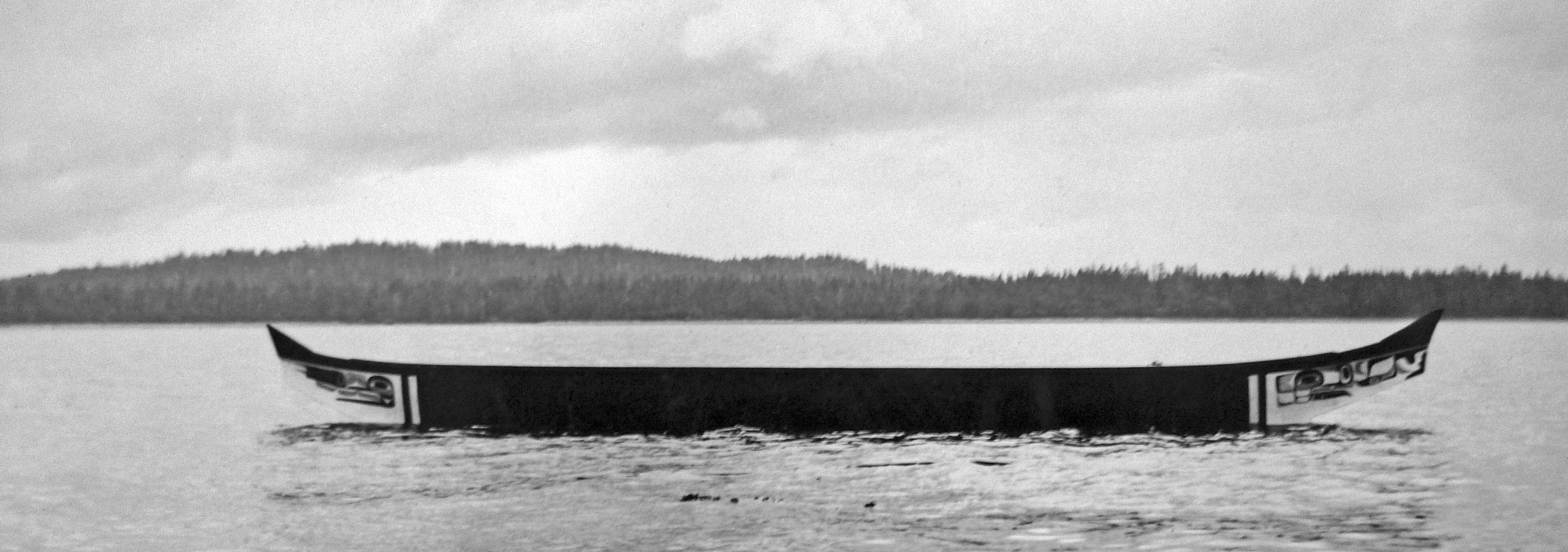
The 1938 canoe on the water.
Photo: H.B. Phillips
Source: Haida Heritage Centre at Kaay Llnagaay, via http://moa.ubc.ca/voicesofthecanoe/history/the-davidson-canoe-on-the-water/
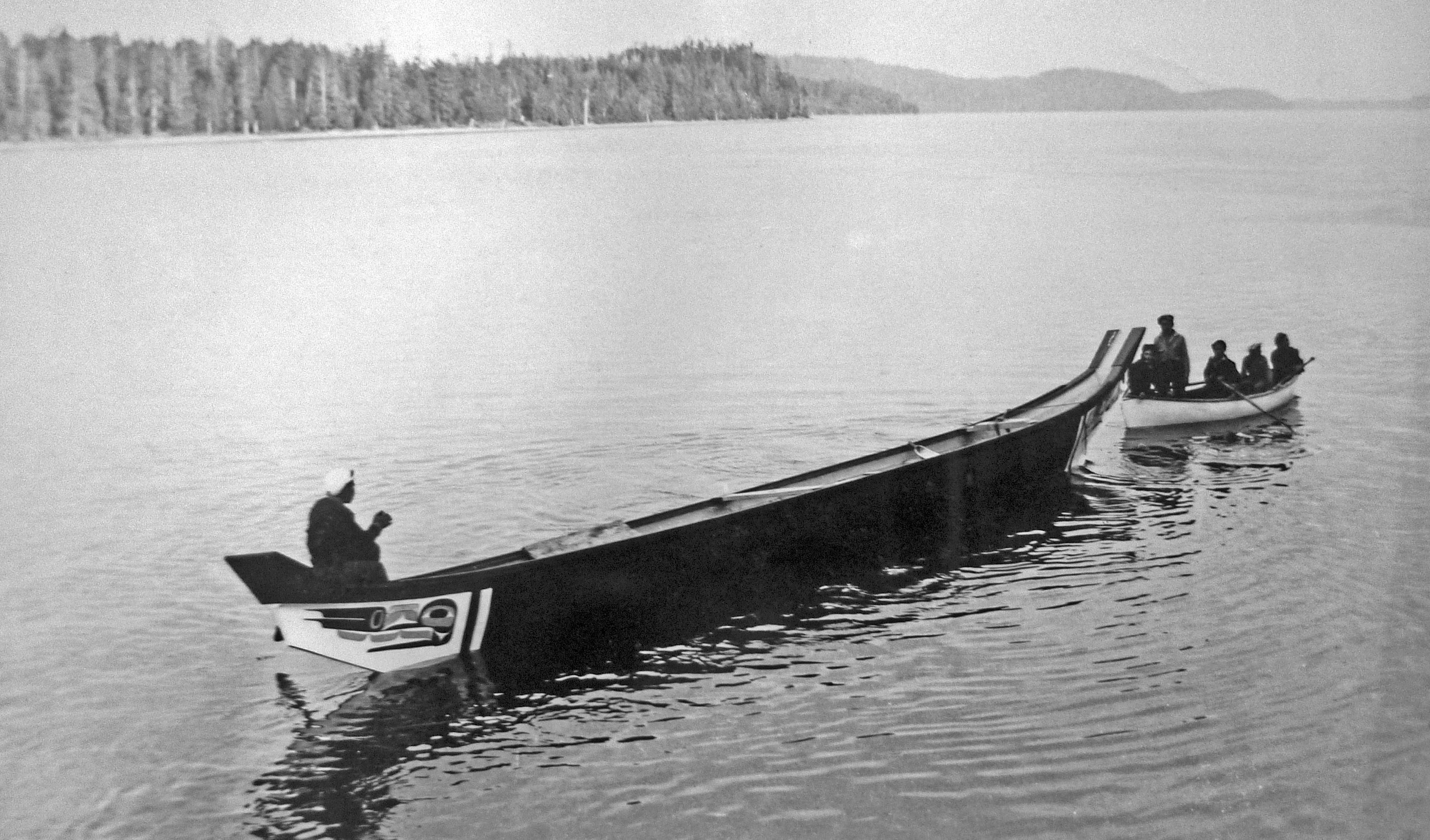
The 1938 canoe on the water, with a smaller boat nearby for scale.
Note that only one paddler was necessary to control and paddle the boat in this instance.
Photo: H.B. Phillips
Source: Haida Heritage Centre at Kaay Llnagaay, via http://moa.ubc.ca/voicesofthecanoe/history/paddling-beside-the-davidson-canoe/
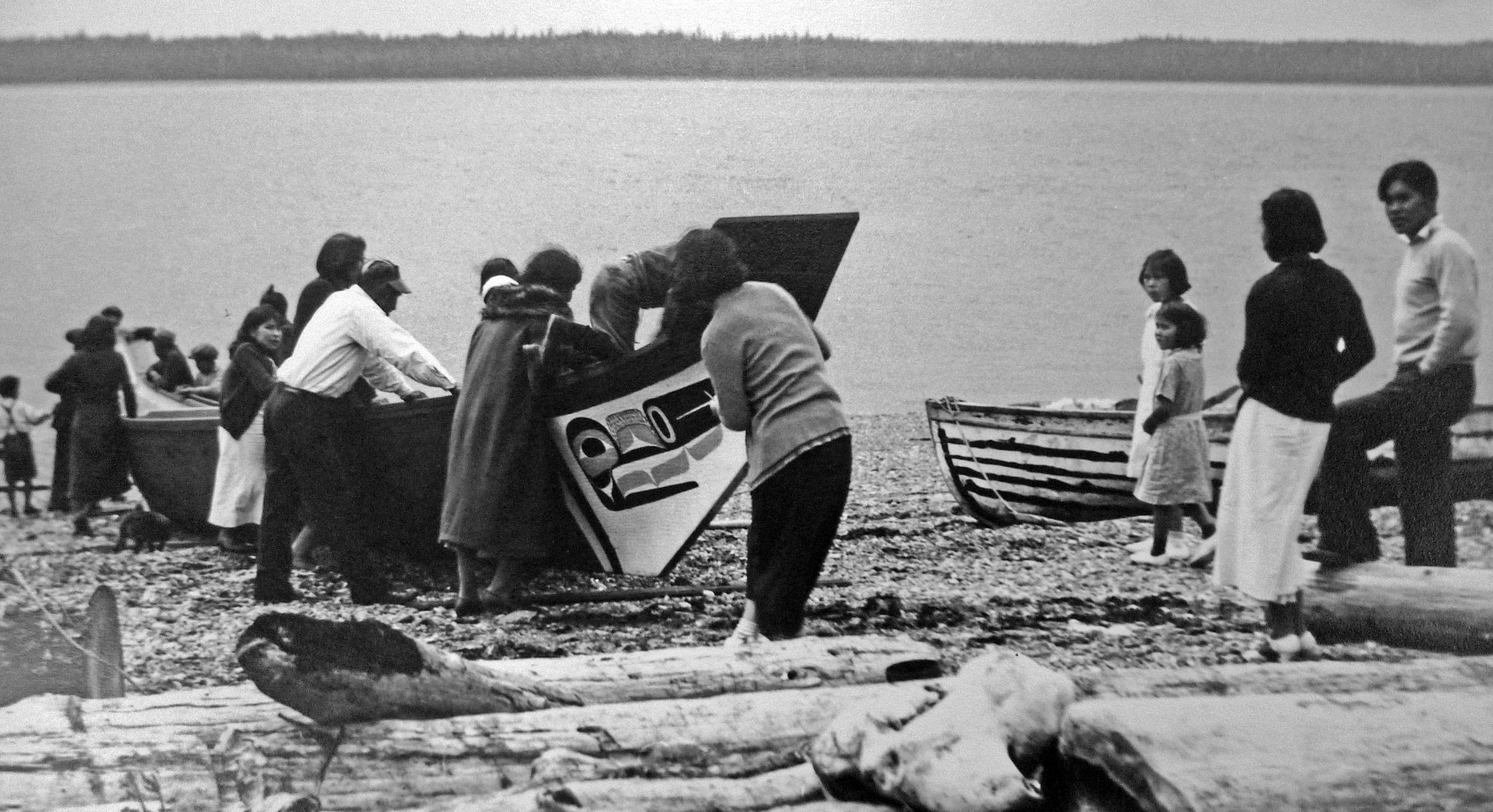
Members of the local community inspect the boat on its return to the shore. Judging from the fashionable shoes and clothing, this was a festive occasion. No doubt, earlier, many of those shown here had helped with the initial launching of the boat.
Photo: H.B. Phillips
Source: Haida Heritage Centre at Kaay Llnagaay, via http://moa.ubc.ca/voicesofthecanoe/history/alfred-and-robert-davidson-canoe/
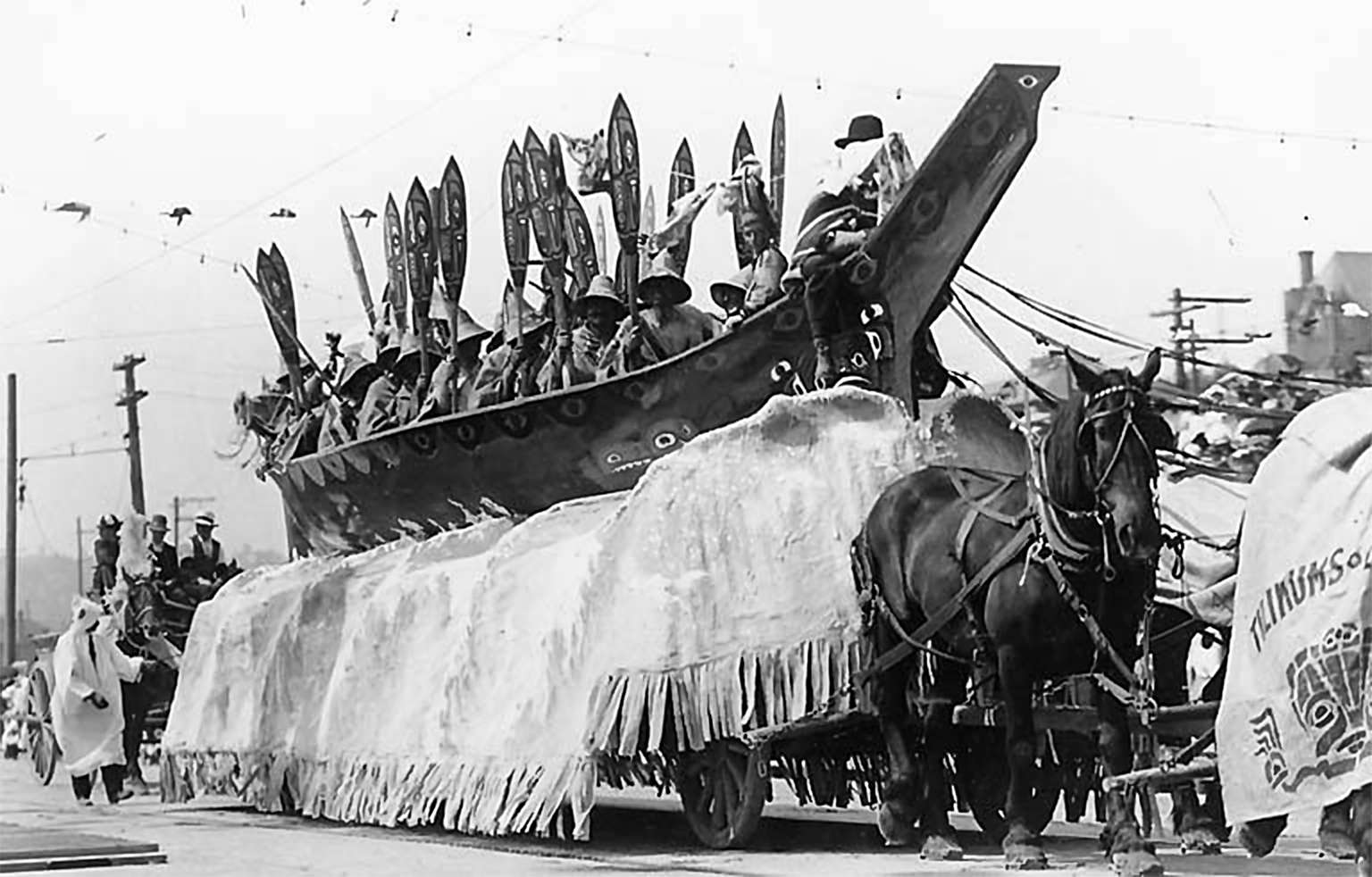
Painted canoe filled with people holding painted paddles in a parade, drawn by horses, Seattle, Washington, from the Second Golden Potlatch, July 15–20, 1912. The people wear hats and ponchos. Note the word 'Tillikums' on the float ahead of the canoe float.
( note that the canoe does not have the normal groove on the prow for a harpoon, and the painted designs on the canoe do not seem to be traditional - Don )
( My sincere thanks to Bob Kennedy, a very proud Haida, for corrections and extra information on this photograph and the event it celebrated - Don )
The second Golden Potlatch was held July 15–20, 1912. As in the first Golden Potlatch celebration, postcards were distributed as 'Official Invitation to Seattle's Golden Potlatch'. Other postcards provided views of commercial streets in Seattle. The Klondike image of D’Oro from the first celebration was succeeded by Hyas Tyee Kopa Konoway (the Big Bug). "The Golden Potlatch," was promoted as a 'free' feast spread for the whole world and its brother. On the water, Jean Romano's wingless hydroplane, which looked like a giant spider, thrilled spectators with a 30 M.P.H. exhibition run off Harbor Island.
Capitalizing on Seattle's borrowed Indian heritage, city leaders cranked up the marketing machine to promote their version of Progress. Local boosters called themselves 'Tillikums', the word for friends in Chinook jargon, and led a number of civic celebrations. The Golden Potlatch Parade provided the 'Tillikums' an opportunity to ride in decorated cars and to sponsor themed floats. Many of these are illustrated in Kopf postcards.
Negative Number NA1971
Digital Collection: American Indians of the Pacific Northwest Images
Collection: Native American Collection no. 275
Repository: University of Washington Libraries. Special Collections Division
Source: http://content.lib.washington.edu/
Additional text: Bob Kennedy and Wikipedia
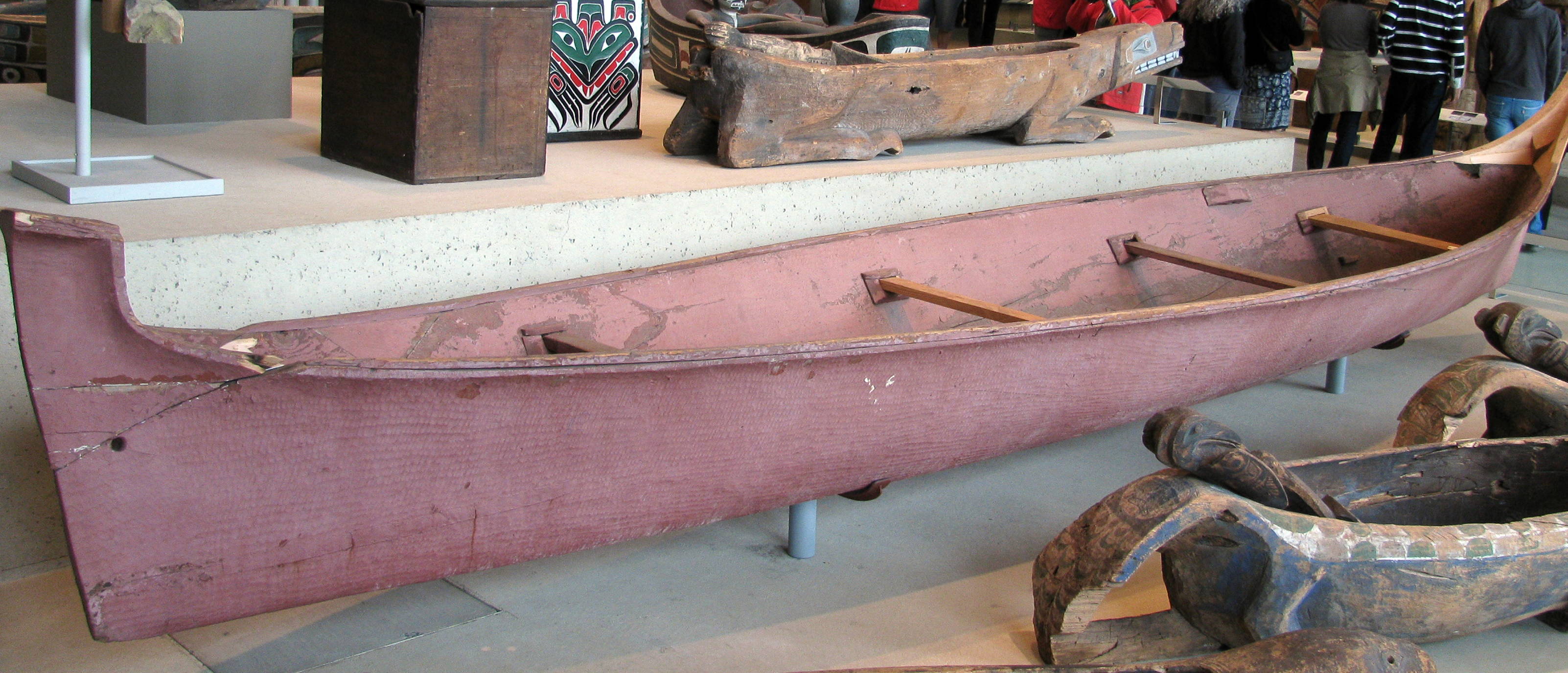 Yasmaqac (Sealing canoe)
Nuu-chah-nulth (Nootka)
Acquired in Tsaxis (Fort Rupert, BC)
Red cedar, red-lead paint, metal; ca 1930
Committee on Totem Poles purchase, 1947
Nb11.353 a-b
With its slender, arching prow and upright stern, this vessel is typical of the sealing canoes made by the Nuu-chah-nulth people from the west coast of Vancouver Island. The notch in the top of the prow was designed as a harpoon rest. The original prow was damaged in the 1960s while the canoe was outside on public display. Contemporary canoe maker, Joe Martin, added a new prow to restore the canoe to its earlier proportions.
Purchased in 1947 from a Kwagu't family at Fort Rupert, on the northeast side of Vancouver Island, the canoe is part of a long history of trade relations between these neighbouring peoples.
Photo: Don Hitchcock 2012
Source: Display, Museum of Anthropology, University of British Columbia
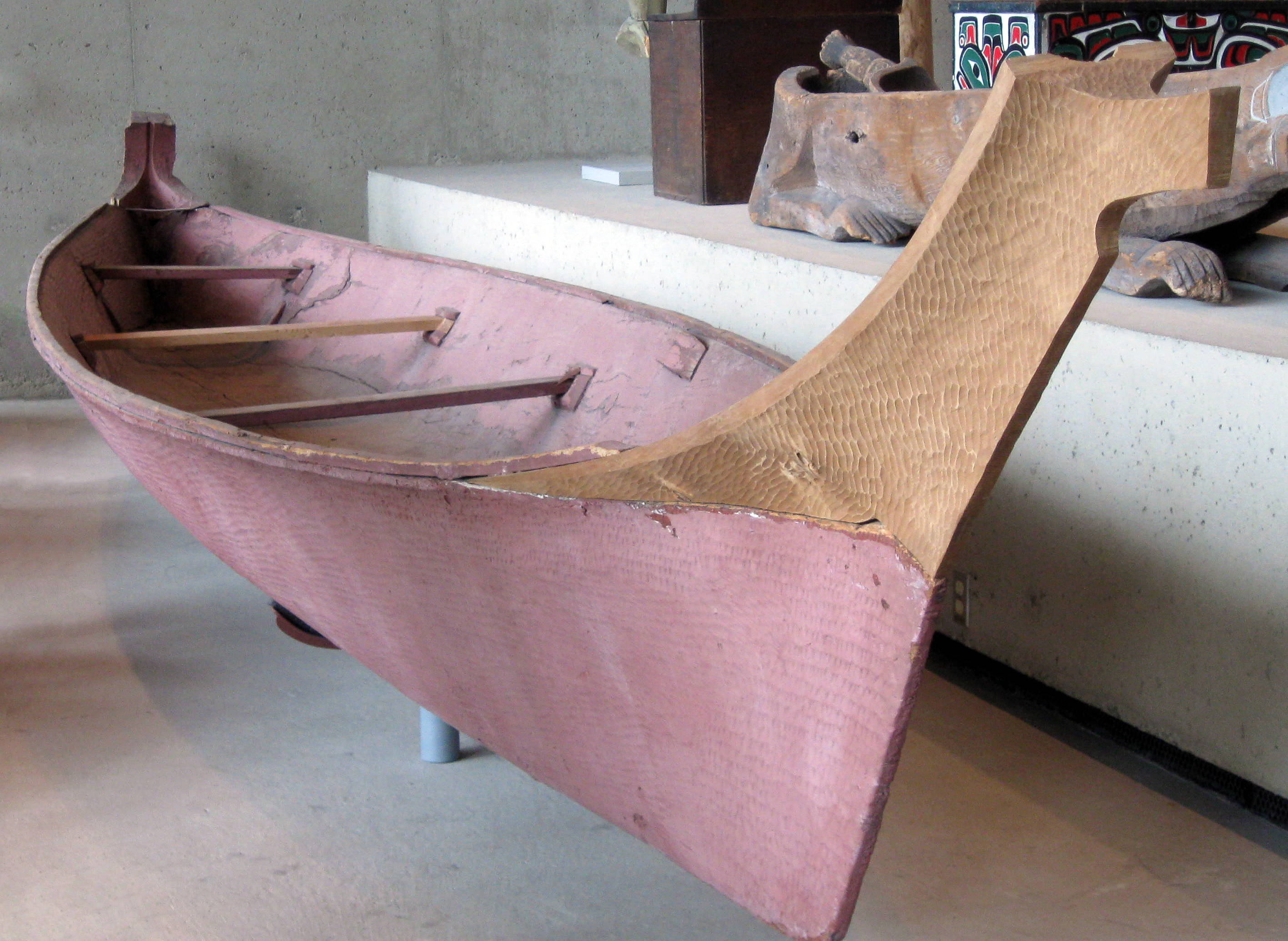
Nuu-chah-nulth (Nootka) style dugout canoe with fine overall adze work. Most of the canoe is covered in faded red paint except for the bottom interior of hull. Two original seats are still in place, two missing seats were replaced with new boards in 2006. Part b is the stern piece which was broken off but is still sitting loosely in place.
Obtained by Barbeau from the Cadwallader family. In spite of being collected in Fort Rupert, this canoe was almost certainly made by a Nuu-chah-nulth canoe maker. Notes refer to it having a prow in the shape of wolf's head; the original prow may have been broken off in 1951 when the canoe was on display outdoors. The new prow piece and 2 missing seats were made and installed October 4-7, 2006 by Joe Martin (Tla-o-qui-aht) and his assistant in a restoration project.
Collected by Marius Barbeau and Arthur Price in Fort Rupert (Tsaxis), British Columbia, Canada during 1947
Nb11.353 a-b
Part a: height 1119 mm, beam 1260 mm, length 7200 mm, part b: height 492 mm, width 353 mm, depth 478 mm
Condition: fair
Accession number: 2106/9 a-b
Kwakwaka'wakw: Kwagu'l
Photo: Leoboudv, May 7, 2009
Permission: licensed under the terms of the license Creative Commons Attribution-Share Alike 3.0 Unported
Source: Display, Museum of Anthropology, University of British Columbia
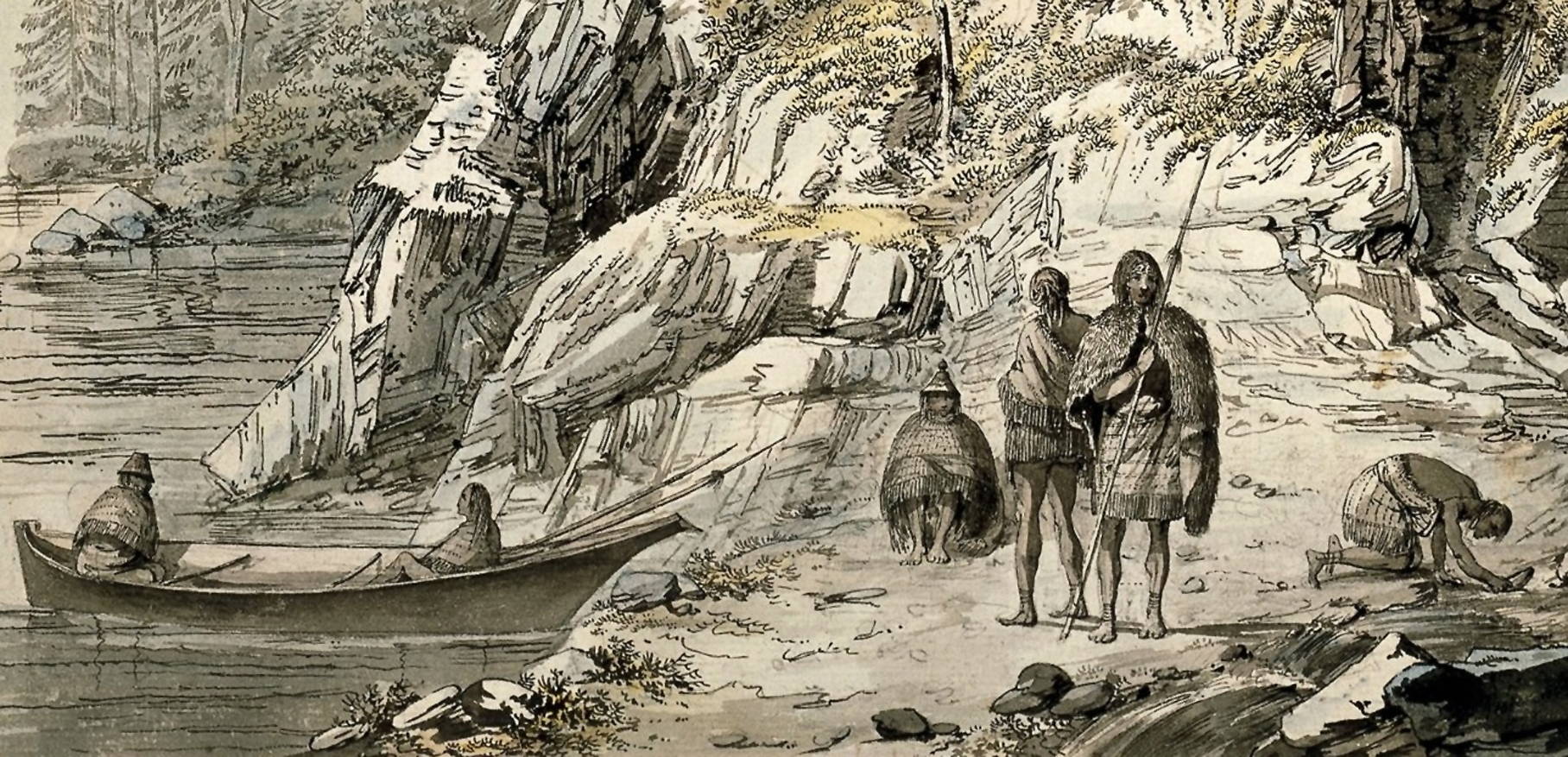
Detail of a Nootka Sound watercolour by John Webber, 1778.
Nootka Sound, on the Pacific coast of Vancouver Island in Canada, was discovered by Captain Cook in his two ships, Resolution and Discovery in 1778. This drawing records this bay and some of its inhabitants. It is drawn in ink, pencil and wash and watercolours. The artist, John Webber (1751-93), accompanied Captain Cook on his third voyage of exploration in the South Seas and Pacific Ocean, which lasted for four years from 1776 to 1780. Webber was one of several artists employed to record the peoples, animals birds, fishes, plants and landscapes of the newly discovered Pacific Islands.
The written descriptions of the location are confirmed by the drawing. It is severe and inhospitable. High cliffs, rocks that reach right down into the sea, and the jagged shore line gave it a ‘melancholy appearance’. The terrible weather, which left the trees ‘mutilated by rough gales’ contrasted greatly with the tropical scenes and palm trees enjoyed by the explorers in Tahiti.
Webber also drew the native people. Their clothing, basically the same for men as for women, consisted of a woven cloth, fastened at the shoulder or neck. According to Captain Cook, the cloth was the bark of the pine tree, beaten flat like a sort of rough felt. The head was covered with a conical hat made of matting. It is probable that Webber modified the drawing for the sake of decency and for public viewing. Cook described the men’s dress as generally bare in the ‘… Middles, nor are they ashamed to appear naked’.
(note the distinctive shape of the Nootka canoe, the harpoons resting at the prow of the canoe, and the clothing of the people, superbly adapted for the climate and their way of life - Don )
Photo: John Webber, 1778
Source and text: British Museum, via http://qmackie.wordpress.com/2010/03/20/webber-in-nootka-sound-1778/
When James Cook first encountered the villagers at Yuquot in 1778, they directed him to "come around" (Nuu-chah-nulth nuutkaa is "to circle around") with his ship to the harbour. Cook interpreted this as the native's name for the inlet - now called Nootka Sound - which came to be applied to the inhabitants of the area. In 1978 the term Nuu-chah-nulth (nuučaan̓uł, meaning "all along the mountains") was chosen as a collective term to describe the closely related nations of western Vancouver Island. This was the culmination of the 1967 alliance forged between the various nations in order to present a unified political voice. The Makah of Washington are closely related to the Nuu-chah-nulth.
Text in paragraph above: Wikipedia

The Nuu-Chah-Nulth canoe is possibly even more seaworthy than the more widely known Haida canoe (from the Queen Charlotte Islands) because the seas they faced were every bit as rough. The high upturned prow and stern of the Nuu Chah Nulth canoes are designed to enable these vessels to face forward on a beach so as to be able to back out through the breakers. Their flatter bottom allows for easy beaching and loading. But what is especially distinctive about these canoes is that their sides flare out about 30 degrees for much of their length, giving them exceptional stability as they pitch in oceanic swells.
The coast Indians excelled in seamanship. Reports by whites aboard schooners note meeting canoes as far as 40 miles offshore, sometimes with sealskin bladders to prevent foundering. Their range was extended greatly by the use of sails. Records show that the natives used sail power from earliest contact and with the wind on their tail, accomplished some formidable journeys even by today's standards. Nootka whalers paddled to open sea in 8-man cedar canoes to harpoon grey whales, used for their oil and meat.
Photo: unknown engraving
Source and text: http://www.blackfishwilderness.com/motherhistoryk.htm
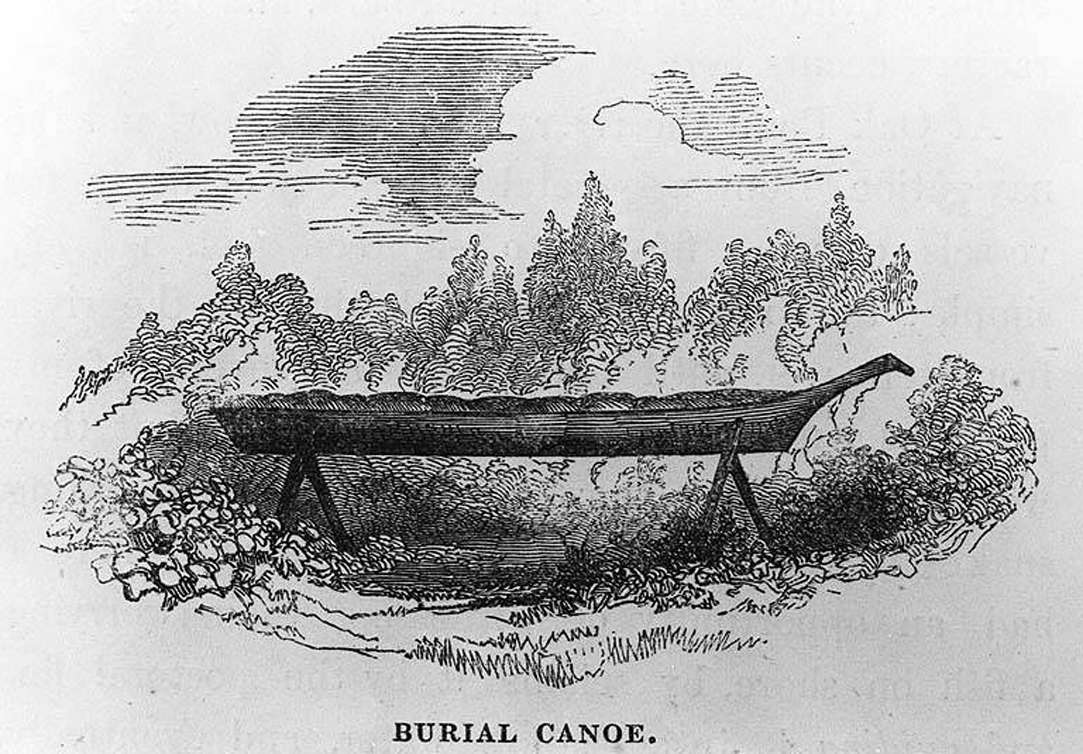
Chinook burial canoe, at the mouth of the Columbia River, in an engraving made in 1839.
( Note that this canoe could well have been made by the Chinook Nation, since they could have used the local small white cedar for such a small object.
However the style is of the Nootka or Nuu-Chah-Nulth type, the large canoes which they obtained by trade from the Nuu-Chah-Nulth on Vancouver Island. - Don )
Photo: from Edward Belcher's Narrative of a voyage round the world, 1843, v.1, p. 292
Negative Number: NA3888
Digital Collection: American Indians of the Pacific Northwest Images
Repository: University of Washington Libraries. Special Collections Division
Source: http://content.lib.washington.edu/
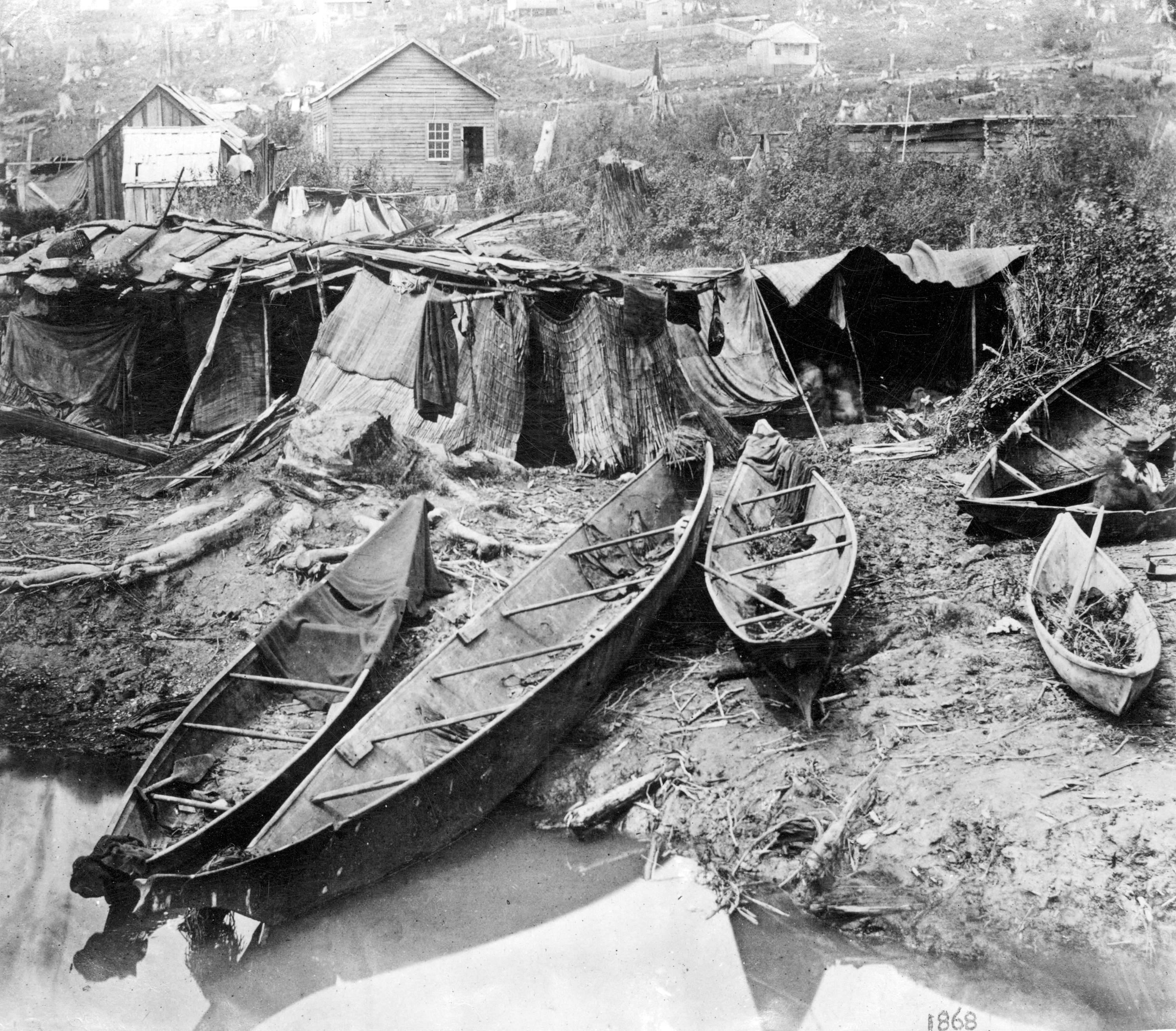
Canoes on the beach at Songees Reserve, 1868.
Copied from the original album of Lieutenant J.C. Eastcott in 1958.
(This is a superb photograph, especially given its date. It must have been a huge glass negative, and the camera had an excellent lens. The canoes are all of different sizes, each made with a particular purpose in mind. Note also the mats of local materials used as walls for the temporary structure.
The largest canoe is of the classic Nootka type, the smaller ones are more utilitarian. The smallest could easily be a child's canoe. - Don )
From 1844 until 1911 the Old Songhees Reserve, which included an extensive Lukwungen village, was located across Victoria harbour from the Thunderbird Park site. It was a gathering place for First Nations visitors from up and down the coast who came for many reasons: to participate in memorial, marriage, gift-giving and naming ceremonies; to trade goods; and to work for wages in the growing city of Victoria.
Text in the paragraph above from http://www.royalbcmuseum.bc.ca/exhibits/tbird-park/html/pre/oldsong.htm
Photo: Lieutenant J.C. Eastcott
Original photograph property of, and courtesy of, A.R. Eastcott, donor
Source: http://searcharchives.vancouver.ca/canoes-on-beach-at-songees-reserve;rad
Permission: Public Domain

Wood's Landing, Constance Cove, Esquimalt, 1868.
Esquimalt Indian camp - Chinook (Nootka) work canoes and herrings drying, rush hut, fish spears - Indian woman cooking. Esquimalt is at the southern tip of Vancouver Island.
( Note that the Chinook canoes in the Columbia River area were actually obtained from the Nootka, since the Chinook country produced white cedar too small for large canoes. Chinookan-speaking peoples lived along the lower and middle Columbia River in present-day Oregon and Washington.
Note also that the two far canoes do not have the normal prow of the classic Nootka canoe - Don )
Copied from the original album of Lieutenant J.C. Eastcott in 1958.
Photo: Lieutenant J.C. Eastcott
Original photograph property of, and courtesy of, A.R. Eastcott, donor
Source: http://searcharchives.vancouver.ca/canoes-on-beach-at-songees-reserve;rad
Permission: Public Domain
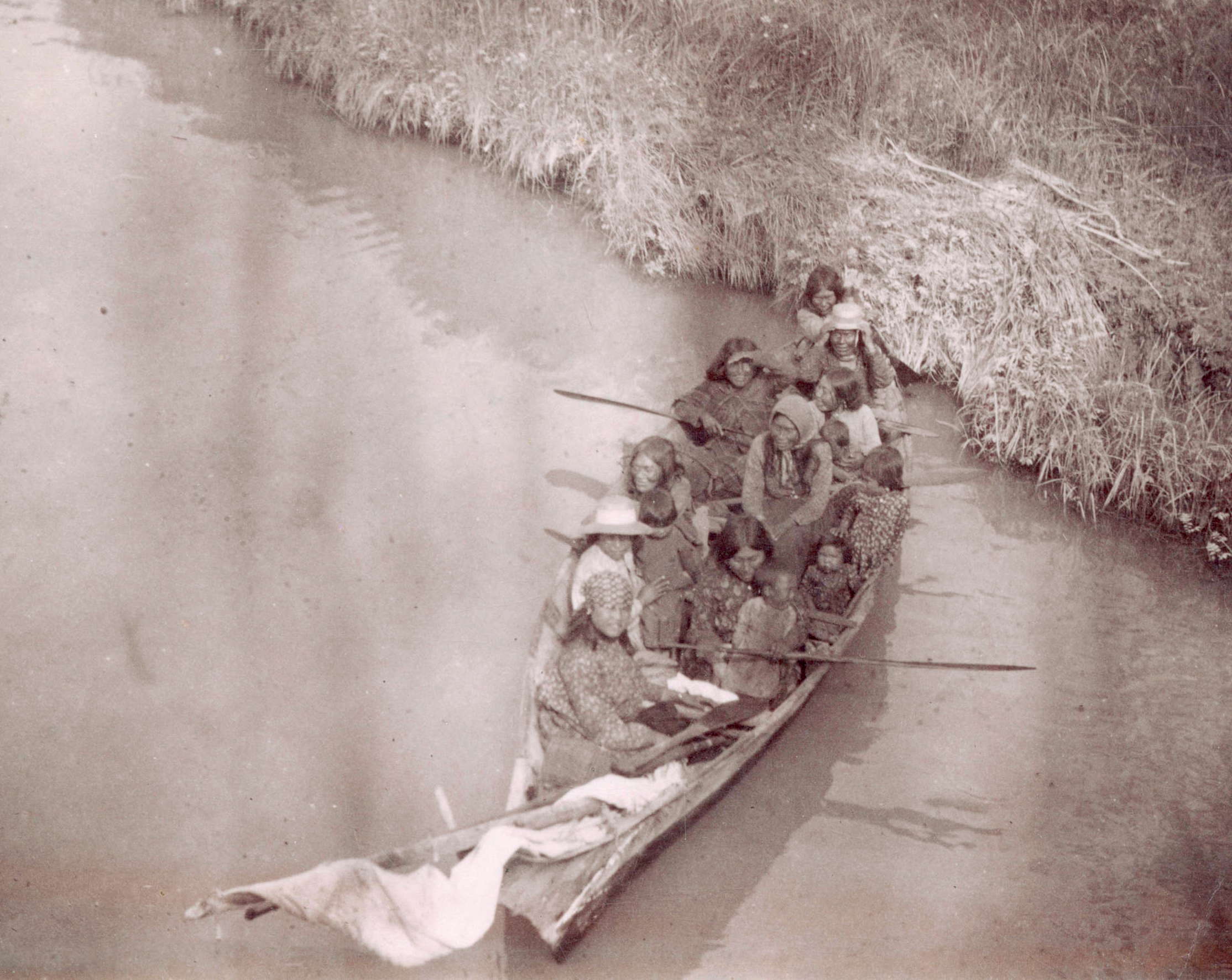
Women and children in dugout canoe on Fraser River, ca 1890.
(I count 14 people in this canoe, and only two paddles in use. It reminds me ineluctably of a modern children's playgroup, with the mothers and children all piling into a large people mover for an excursion. They look like they are off to have a lovely time, perhaps gathering berries, or perhaps going downriver to another village to visit with relatives. - Don )
Photo: Charles Trott Dunbar
Source: http://searcharchives.vancouver.ca/women-and-children-in-dugout-canoe-on-fraser-river;rad
Permission: Public Domain
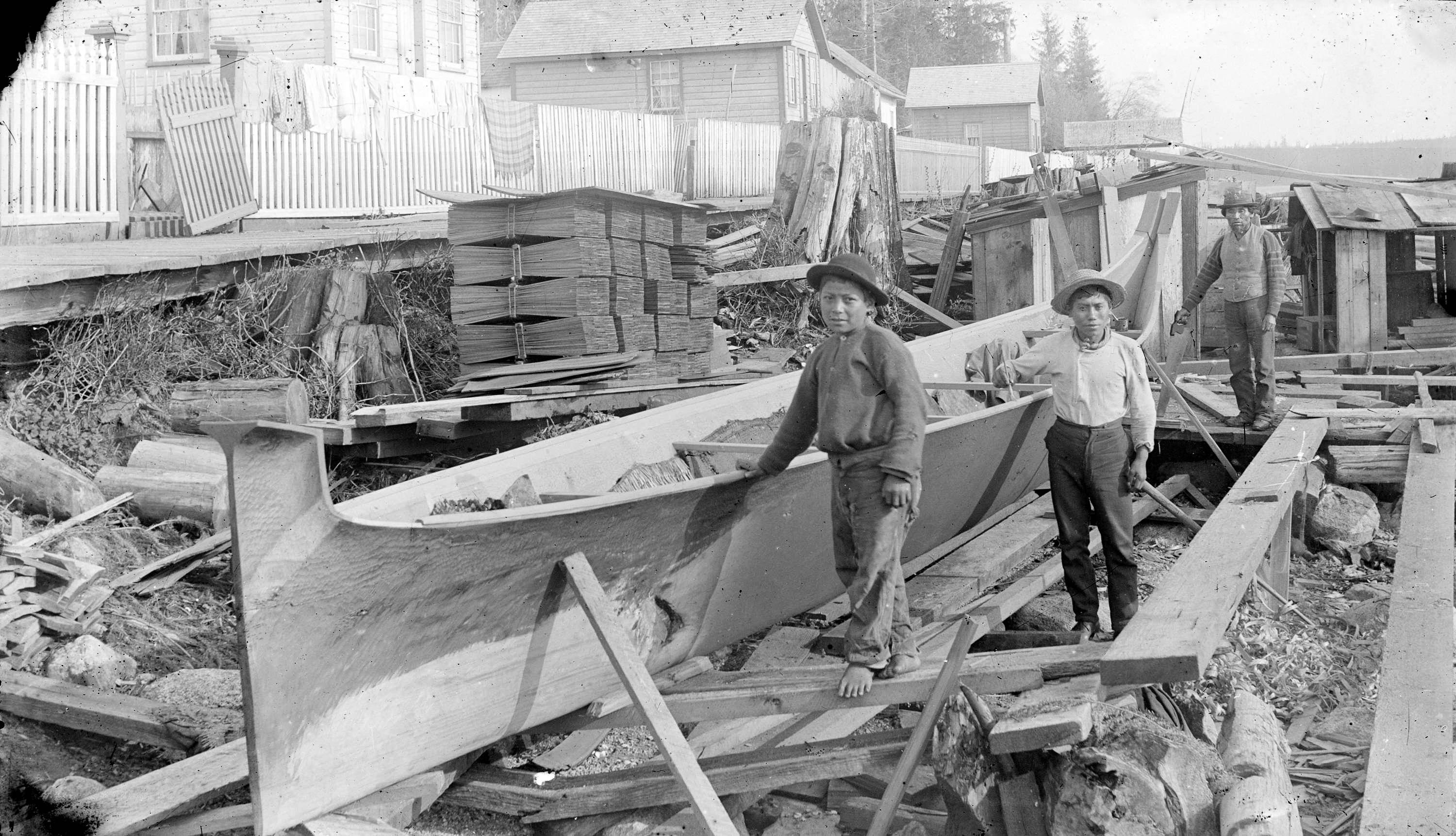
Indians making a Nootka style canoe from a tree trunk at the mission, Moodyville, opposite Vancouver, BC, ca 1893.
The lost sawmill community of Moodyville was the first significant non-Native settlement on Burrard Inlet, now the harbour of Vancouver. Surrounded by lush forest, it had easy access to seemingly never-ending supplies of raw material. The townsite was named after Sewell Prescott Moody, a dynamic entrepreneur originally from the United States who turned the mill into a success story. It soon became one of the biggest exporters in the new province of British Columbia, and the community achieved many firsts in the region, including the first wedding, school and electric lights. By the early 1890s, however, voracious logging and a worldwide depression had depleted its trees and fortunes. The mill closed in 1901 and the City of North Vancouver gradually absorbed the site. Curiously, almost no physical traces have survived - no buildings or landmarks, and only a few artefacts and photographs remain.
Photo: Norman Caple
Source: http://searcharchives.vancouver.ca/first-nations-men-in-canoe-on-skeena-river;rad
Permission: Public Domain
Additional text: http://www.mccord-museum.qc.ca/scripts/printtour.php?tourID=VQ_P2_15_EN
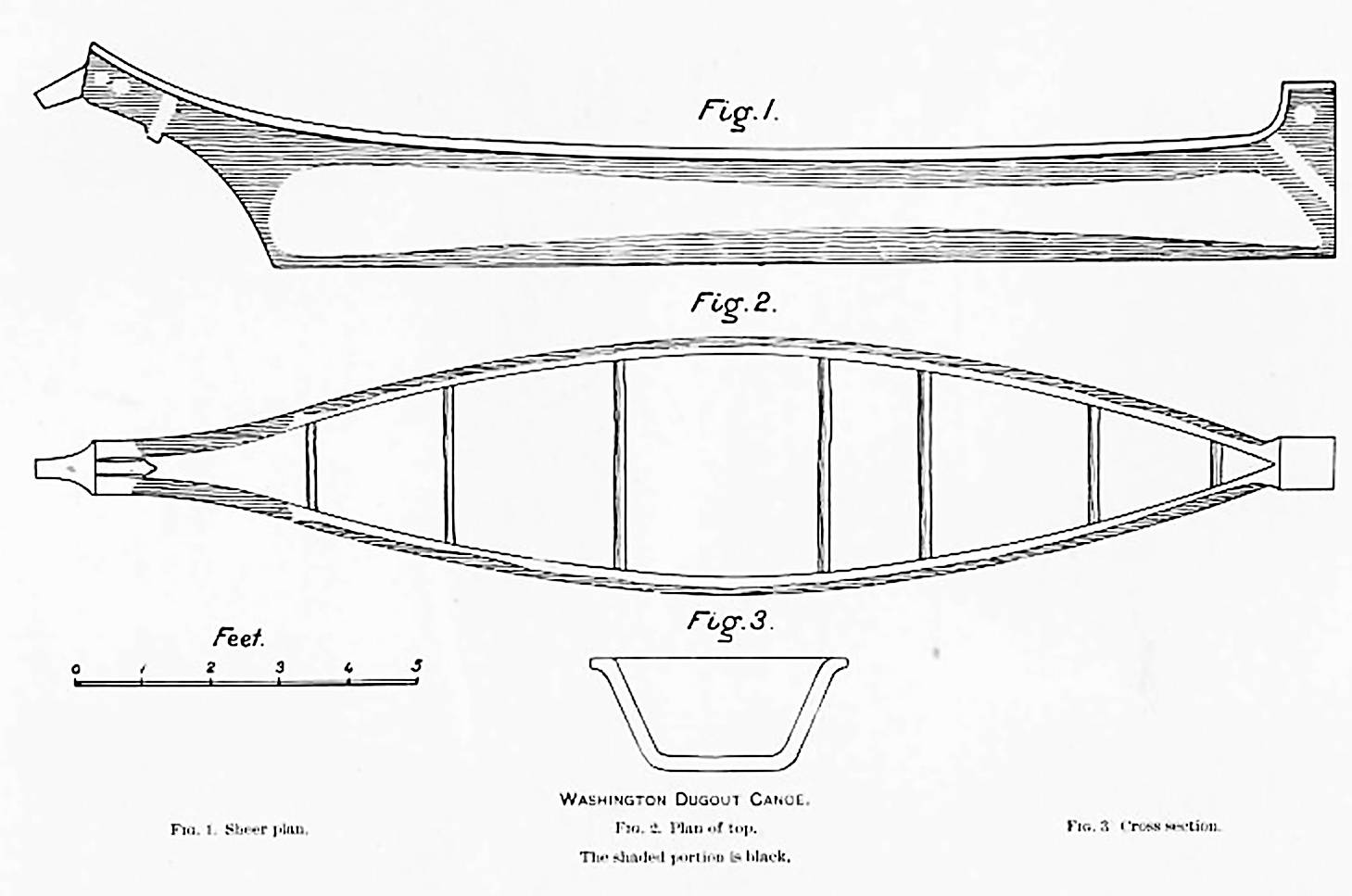
Washington Dugout Canoe, 1890.
(note that this design is identical to the Nootka canoes, with the same 'wolf head' prow and vertical stern. The Makah of Washington are closely related to the Nuu-chah-nulth - Don )
Photo: J.W. Collins
Permission: Public Domain
Source: Fishing Vessels and Boats of the Pacific Coast, Government Printing Office, 1892, Freshwater and Marine Image Bank
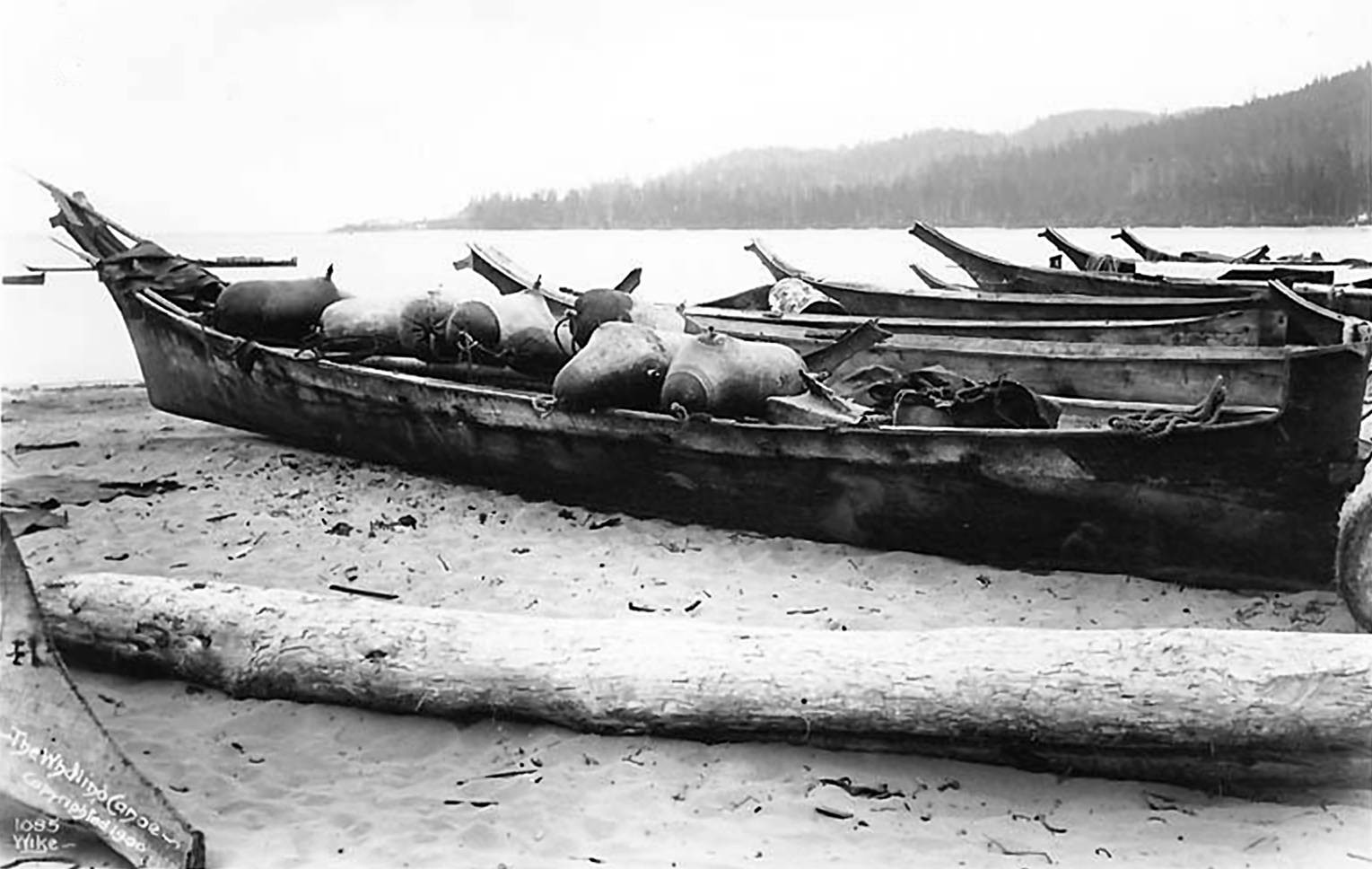
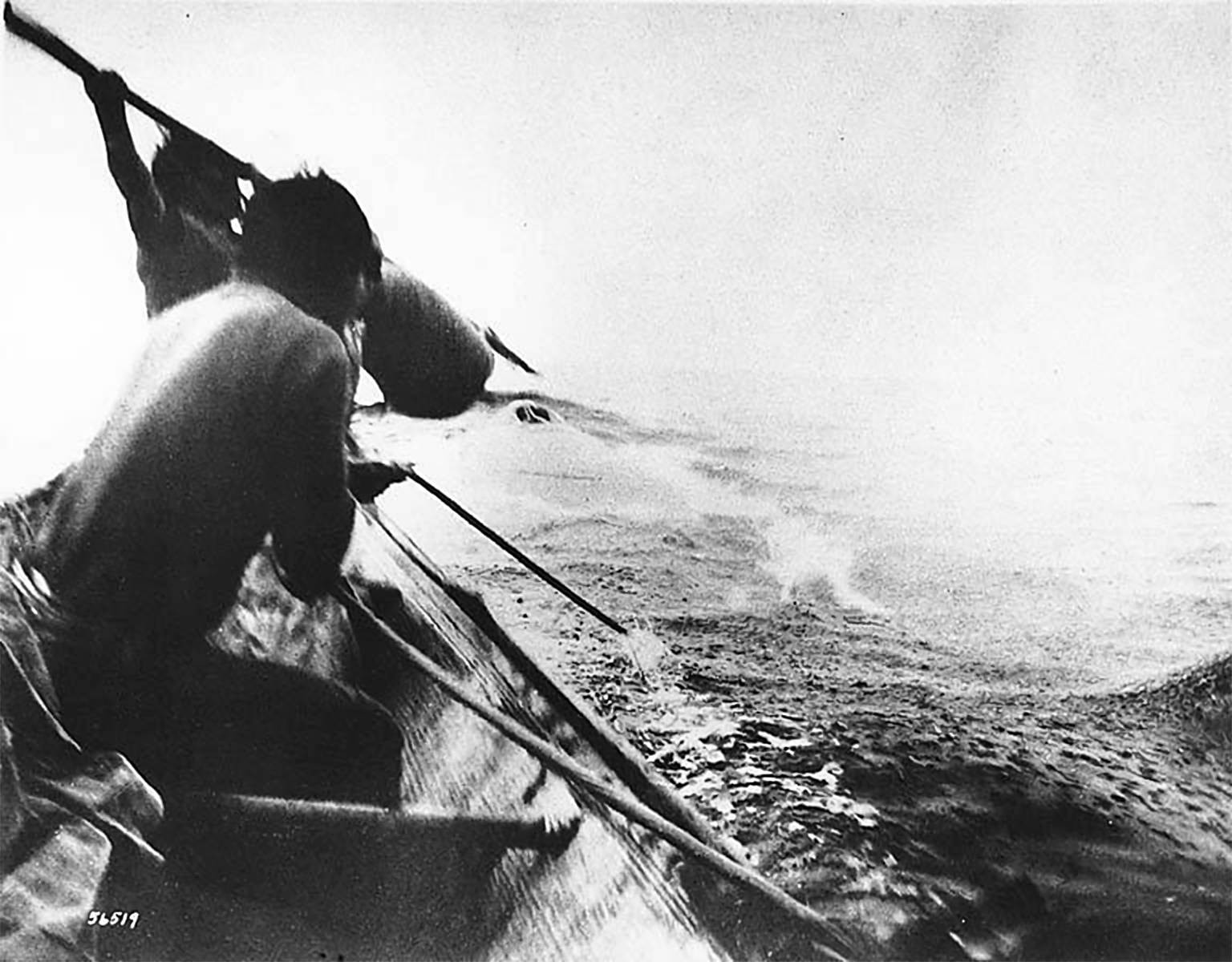
(left)
Whaling canoe at Neah Bay, 1900
The Makah people of Washington's Olympic Peninsula hunted whales and other sea mammals from large seagoing canoes. The hunters harpooned the animals and kept them from sinking by attaching floats made from sealskin filled with air. This photo, taken in 1900, shows a row of Makah canoes, probably at Neah Bay, Washington State. The canoe in the foreground is filled with sealskin floats. The Makah of Washington are closely related to the Nuu-chah-nulth, and their canoes are apparently identical.
Negative Number MOHAI 88.33.23
Digital Collection: American Indians of the Pacific Northwest Images
Collection: Wilse Collection
Repository: Museum of History and Industry, Seattle
Photo: Anders B. Wilse
Source: http://content.lib.washington.edu/cdm4/item_viewer.php?CISOROOT=/loc
(right)
Makah men in a canoe readying to harpoon a whale dragging a float; man in prow raises his harpoon with float attached, the man just behind him holds the rope in his hand as the canoe tips towards the whale.
(note that this is a unique and valuable photograph. Nowhere else in the world would it be likely that someone with a portable camera could have gone out in a canoe or whaling boat and taken a photograph of a whale being harpooned with a hand held and thrown harpoon. Elsewhere in the world the harpoon gun and steam powered ships had long taken over whaling - Don )
Men waited for favourable weather and ocean conditions and then paddled out, eight in a canoe. They timed their departure so that they would arrive on the whaling grounds at daybreak.
Paddling silently, whalers studied the breathing pattern of their quarry. As the whale finished spouting and returned underwater, the leader of the hunt directed the crew to where it would next surface. There the men waited.
When the whale rose, the paddlers held the canoe just to its left, their speed matched to the animal's. As the back broke the surface, the harpooner struck and the crew instantly paddled backward, putting all possible distance between the canoe and the wounded prey so as to avoid the thrashing tail flukes. A hit in the shoulder blade interfered with use of the flippers and slowed the whale. Floats of sealskin blown up like huge balloons and attached to the harpoon line slowed the whale. Harpoons weren't intended to kill the whale, but to secure the sealskin floats to them until they tired themselves and could be lanced fatally. Shafts of yew wood measured 12 to 18 feet long - heavy wood to add to the harpooner's thrust and help the blade pierce deeply. Splices in the shaft deadened the springiness and furthered the penetration. They also let the shaft break rather than hit the canoe repeatedly if the whale rolled. Furthermore, they allowed a clean break rather than a splintering. This aided repair.
Shafts fell away once the harpoon head had been set. In a whale, the head turned partly sideways. Barbs of elk antler helped to keep it from pulling out. They fit one on each side of the blade, which was mussel shell. Spruce pitch - at Ozette still pungent after 500 years within the earth - faired and smoothed the head. Whale sinew plied into rope and bound with wild cherry bark attached the harpoon head to as much as 40 fathoms of additional rope. This line, which was of twisted cedar boughs, was carried coiled within the baskets so that it would play out easily and wouldn't entangle the canoe's occupants.
A telltale float at the end of the line acted as a marker so that the whalers could follow their prey, setting additional harpoons and staying out over night if need be. Eventually the time came for the final kill which was done using a special lance.
The next step was to tow the whale home - a distance of only a few miles if its spirit had heeded prayers to swim for the beach, perhaps 10 miles or more if not. As a precaution against the whale's sinking, a diver generally laced the mouth shut. This kept water from flooding into the stomach, weighing the carcass down and complicating the tow.
Songs eased the paddling. Songs welcomed the whale to the village; welcomed the returning hunters and praised the power that made it all possible.
The relationship between Makah and whales is very old. Ozette (The Ozette Indian Village Archeological Site is the site of an archaeological excavation at Ozette on the Olympic Peninsula near La Push, Washington, USA. The site was a village occupied by the Makah people until a mudslide inundated the site around 500 ± 50 BP ) deposits dating from 2 000 years ago hold humpback and gray whale bones and barbs from harpoons. The relationship is also very recent. The Makah Tribe resumed whale hunting under international and domestic law, and on May 17, 1999, harvested their first whale in 70 years.
Text above from http://www.makah.com/whalingtradition.html
Negative Number NA740
Digital Collection: American Indians of the Pacific Northwest Images
Collection: Asahel Curtis Photographs of the Makah Indians. PH Coll 898
Repository: University of Washington Libraries. Special Collections Division
Photo: Asahel Curtis, 1874-1941
Source: http://content.lib.washington.edu/cdm4/item_viewer.php?CISOROOT=/loc
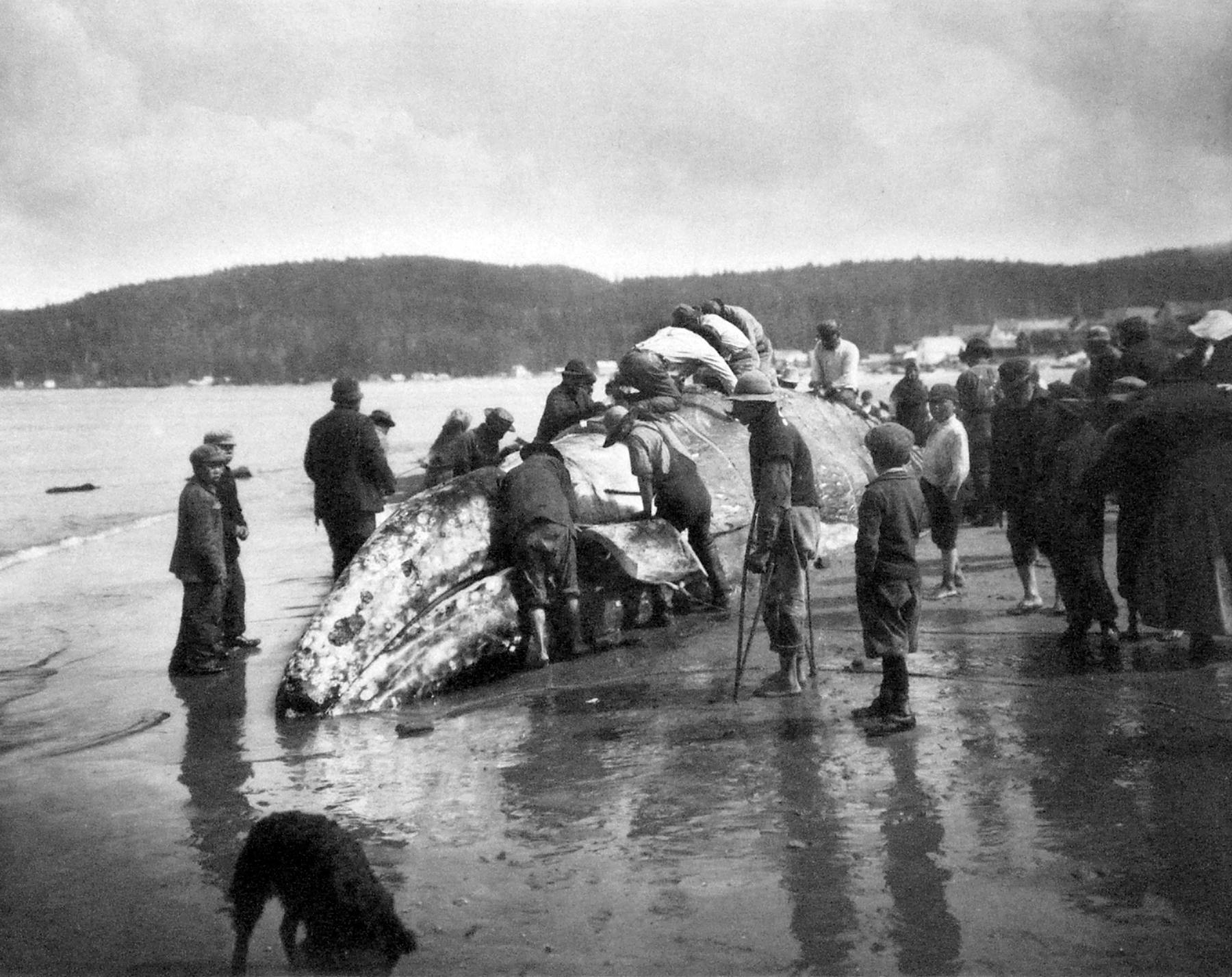
'The King of the Seas in the Hands of the Makahs', 1910.
Once a whale was landed, the long and difficult task of cutting it up and parcelling out the valuable resource was begun.
Photo: Asahel Curtis (1874–1941)
Source: Artwork of Seattle and Western Washington: Edition de luxe of Photogravures, 1910, W. D. Harney Photogravure Publisher, Racine, Wisconsin.
Permission: Public Domain
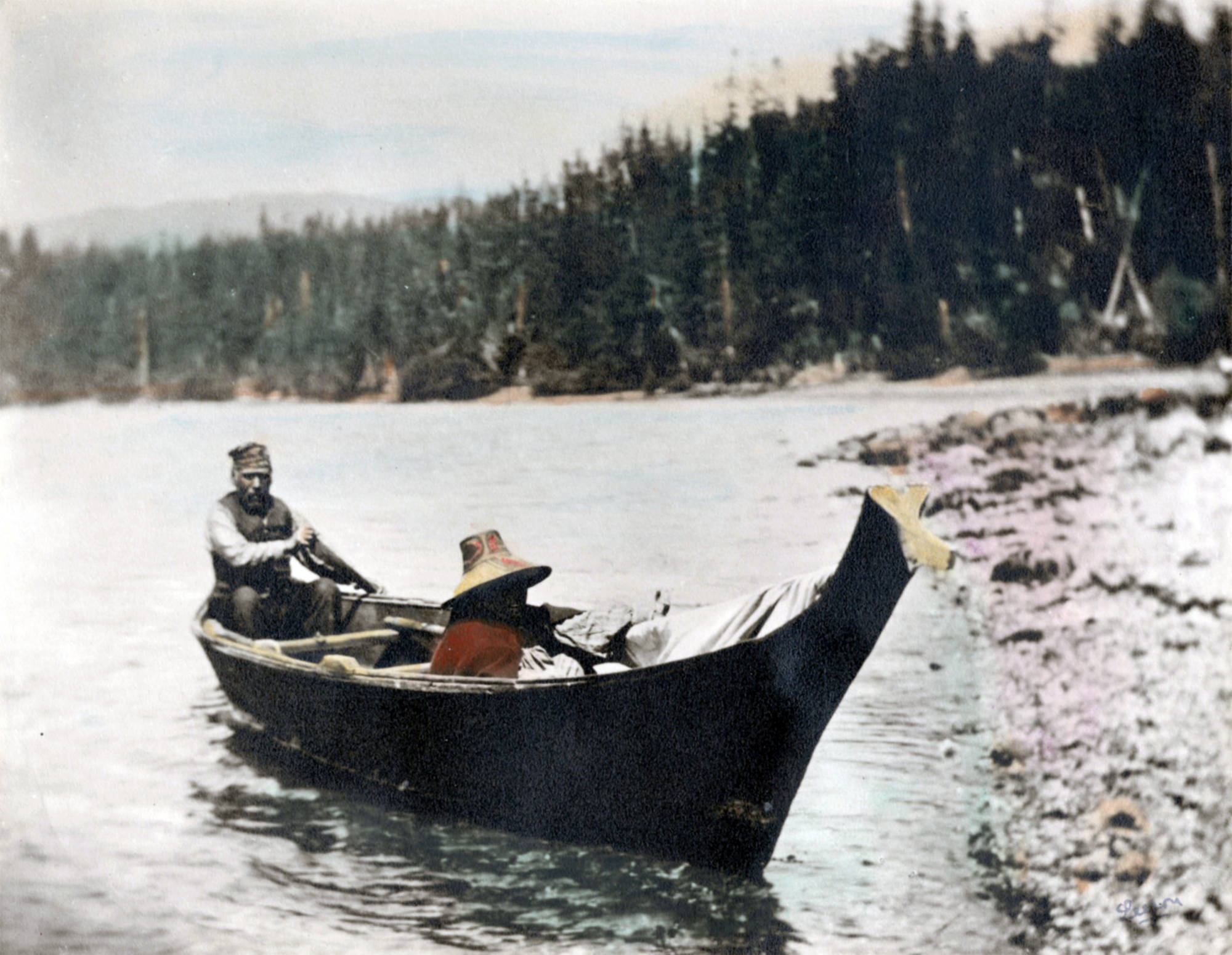
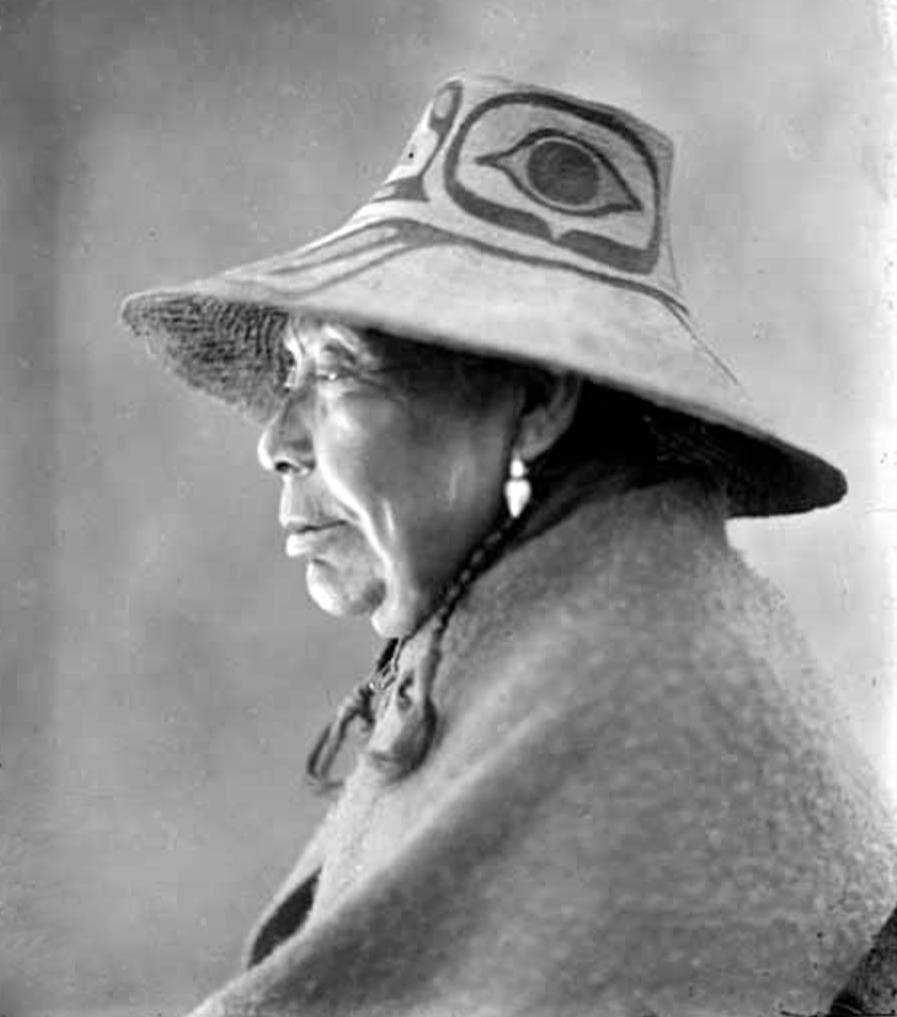
War-Cas (referred to elsewhere as Tyee Wa-He-No) and Wife, 190?.
The canoe is of the classic Nootka type.
His wife (right) is Ne-kow-se-sla, also known as 'Lady War-cas', 'the Legend Bearer', a Kwakiutl woman.
She is often photographed with a hat similar to this.
Photo: Benjamin W. Leeson
Source (left): http://searcharchives.vancouver.ca/first-nations-men-in-canoe-on-skeena-river;rad
Source (right): http://content.lib.sfu.ca/cdm/singleitem/collection/vpl/id/2683/rec/17
Permission: Public Domain

Map of the Kwakiutl region.
Photo: Jonaitis (1991)
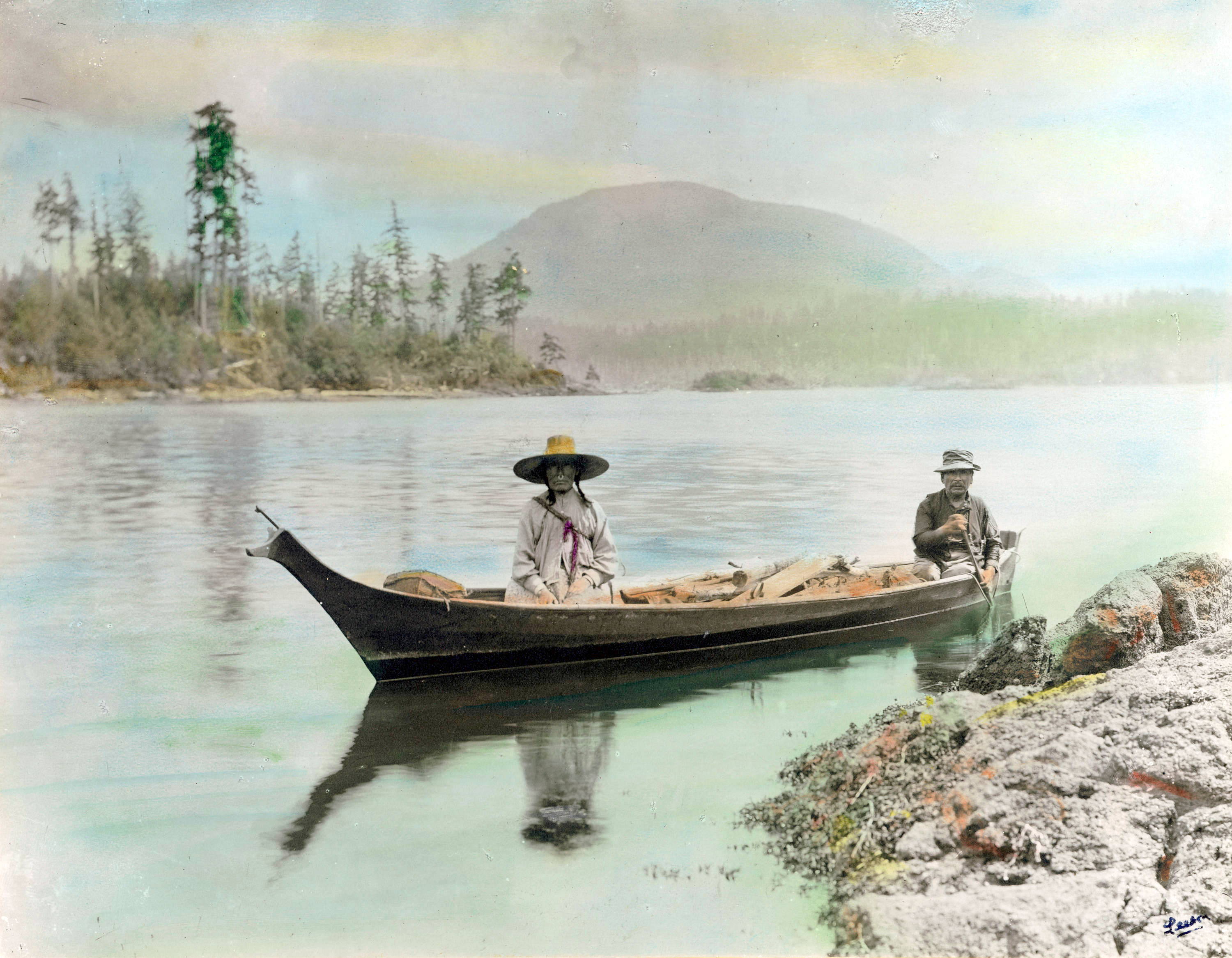
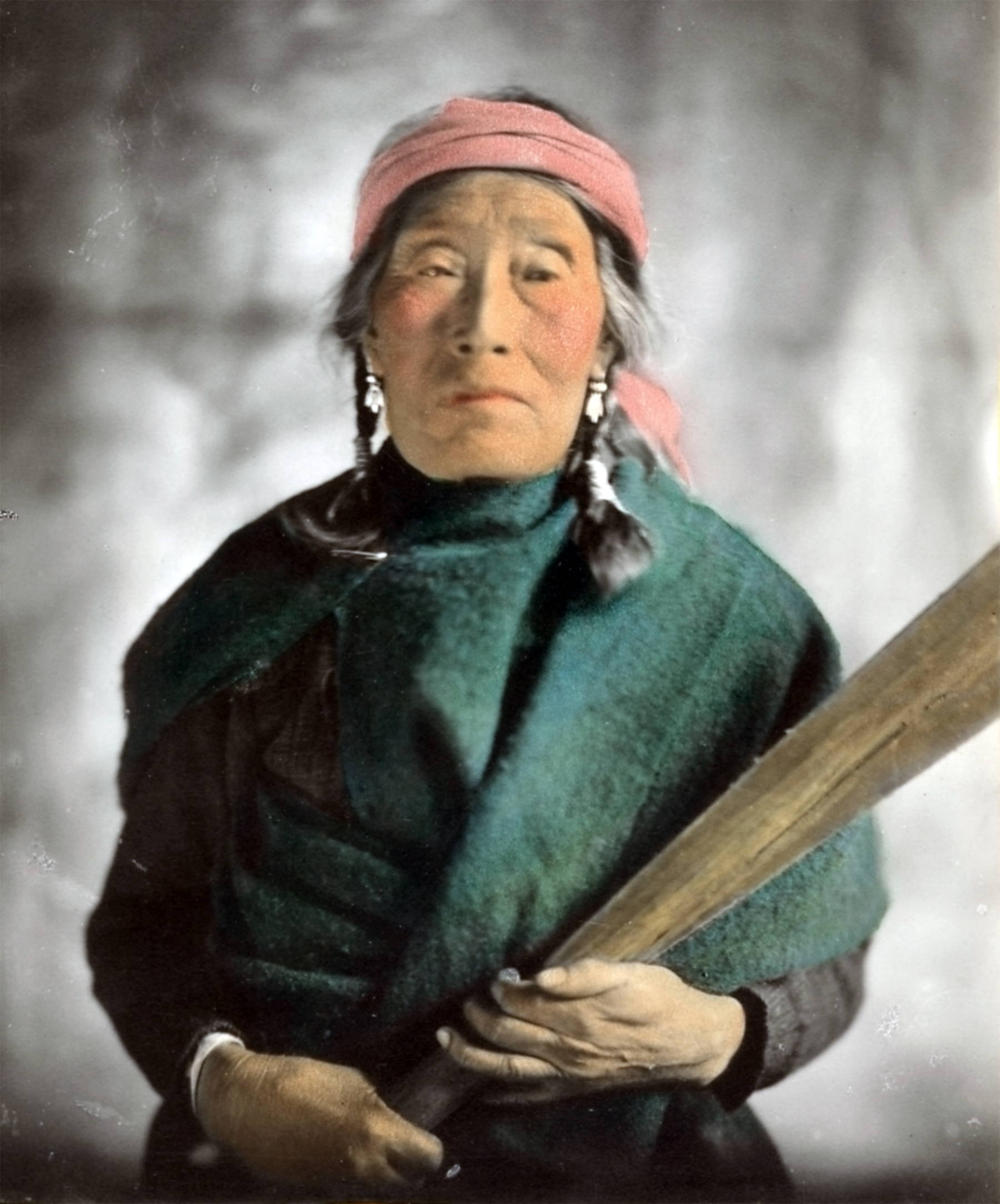
War-Ne-La, a shaman shown on the left with a ring in her nose, and her husband, 190?.
The canoe is of the classic Nootka type.
On the right, she is shown holding a paddle.
Photo: Benjamin W. Leeson
Source: http://searcharchives.vancouver.ca/war-ne-la-and-her-husband;rad
Permission: Public Domain
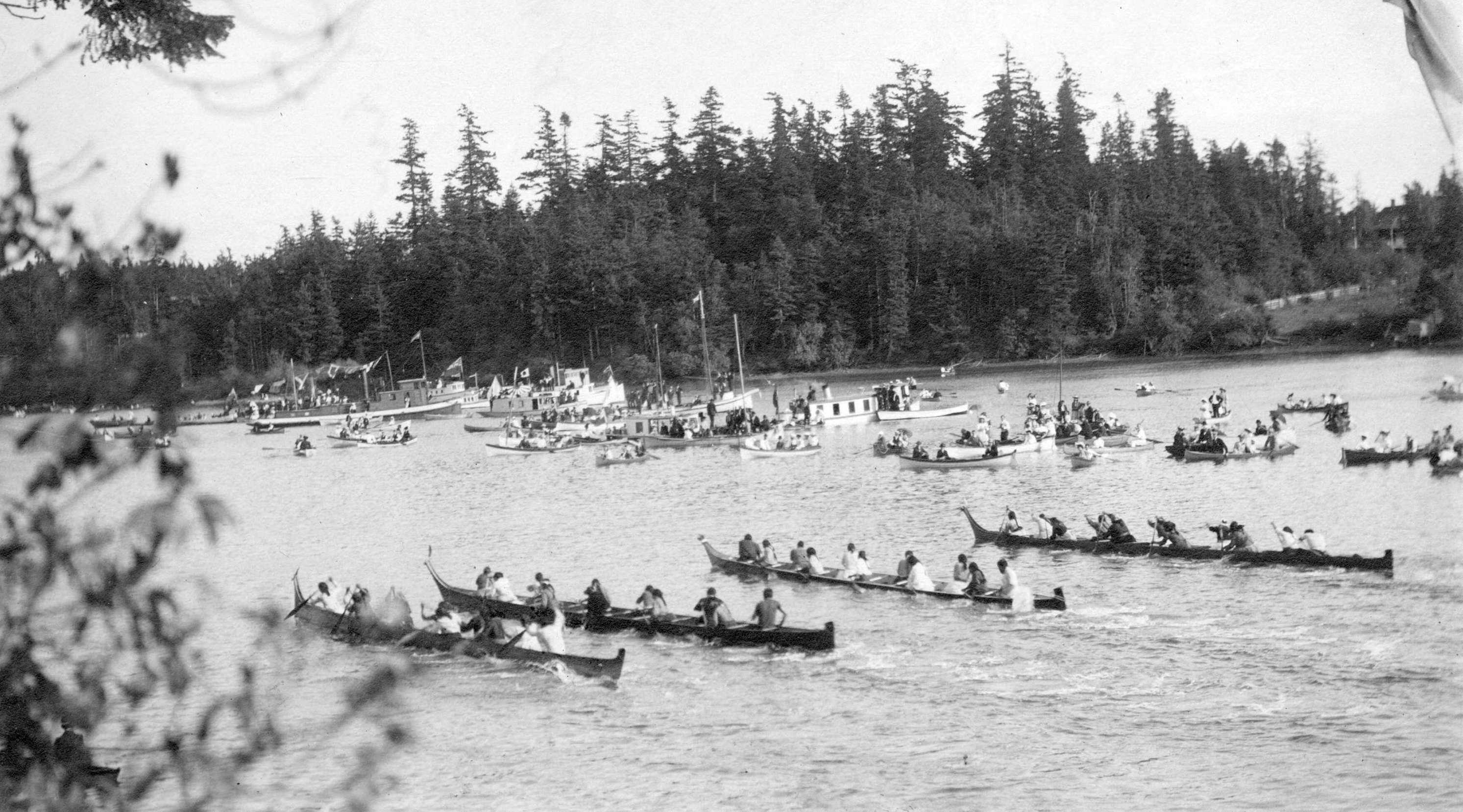
Indian war canoe race at The Gorge, 1903.
Photo: Major James Skitt Matthews (1878-1970)
Source (left): http://searcharchives.vancouver.ca/first-nations-men-in-canoe-on-skeena-river;rad
Source (right): http://searcharchives.vancouver.ca/war-ne-la-medicine-woman;dc
Permission: Public Domain
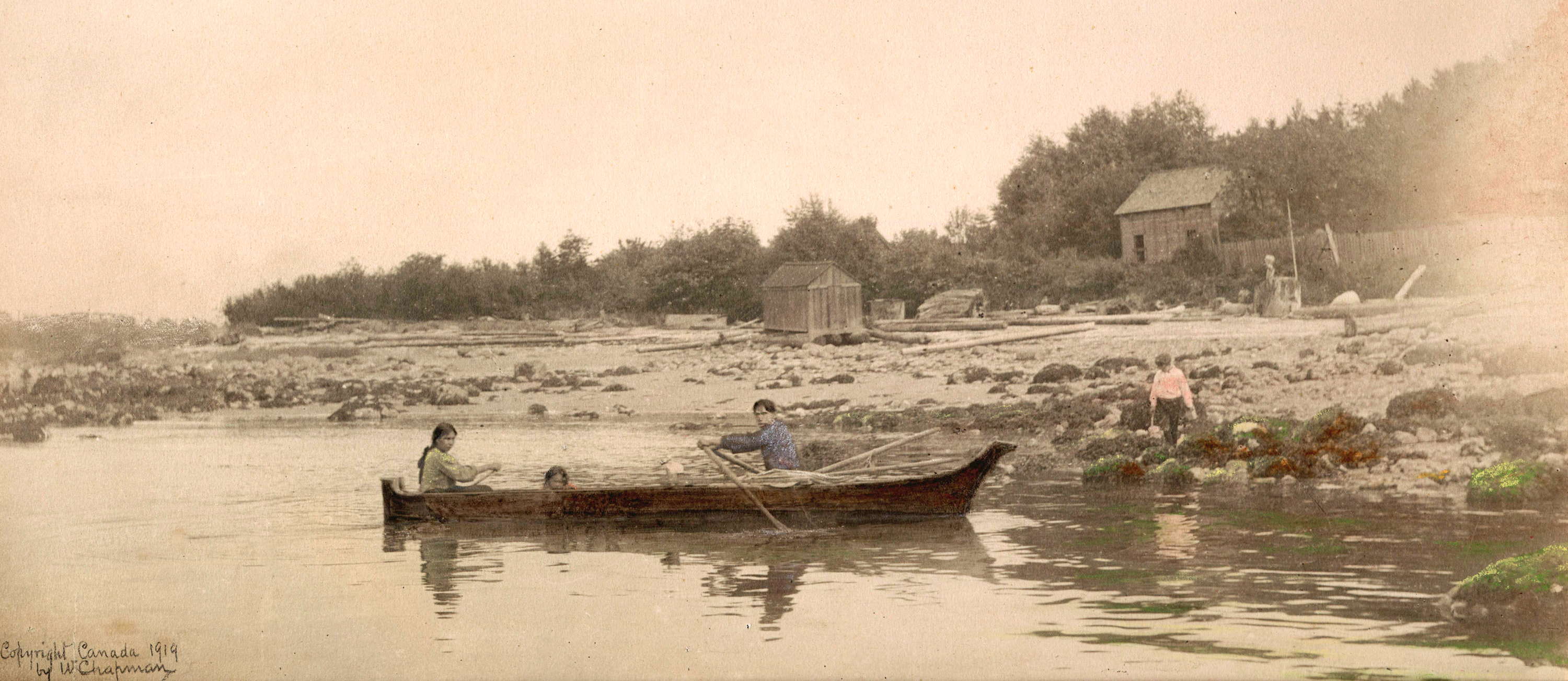
View of Kitsilano Indian Reserve looking east, ca 1907.
This important photograph shows August Jack Khahtsalano, or Xats'alanexw, a Squamish chief, his wife Swanamia (Marrian) and a child in a dugout canoe of the Nootka type.
The name 'Kitsilano' is derived from 'Xats'alanexw', the name of the Squamish chief pictured at left. The area has been home to the Squamish people since the 1800s when they moved into the area to work in saw mills and other industries started by early settlers. There is still a small amount of Indian reserve land at the foot of the Burrard Street Bridge, called senakw (usually spelled Snauq historically) in the Squamish language, where Xats'alanexw, also known as August Jack Khatsahlano, lived.
Text in the paragraph above from Wikipedia.
Photo: W. Chapman
Source: http://searcharchives.vancouver.ca/view-of-kitsilano-indian-reserve-looking-east;rad
Permission: Public Domain
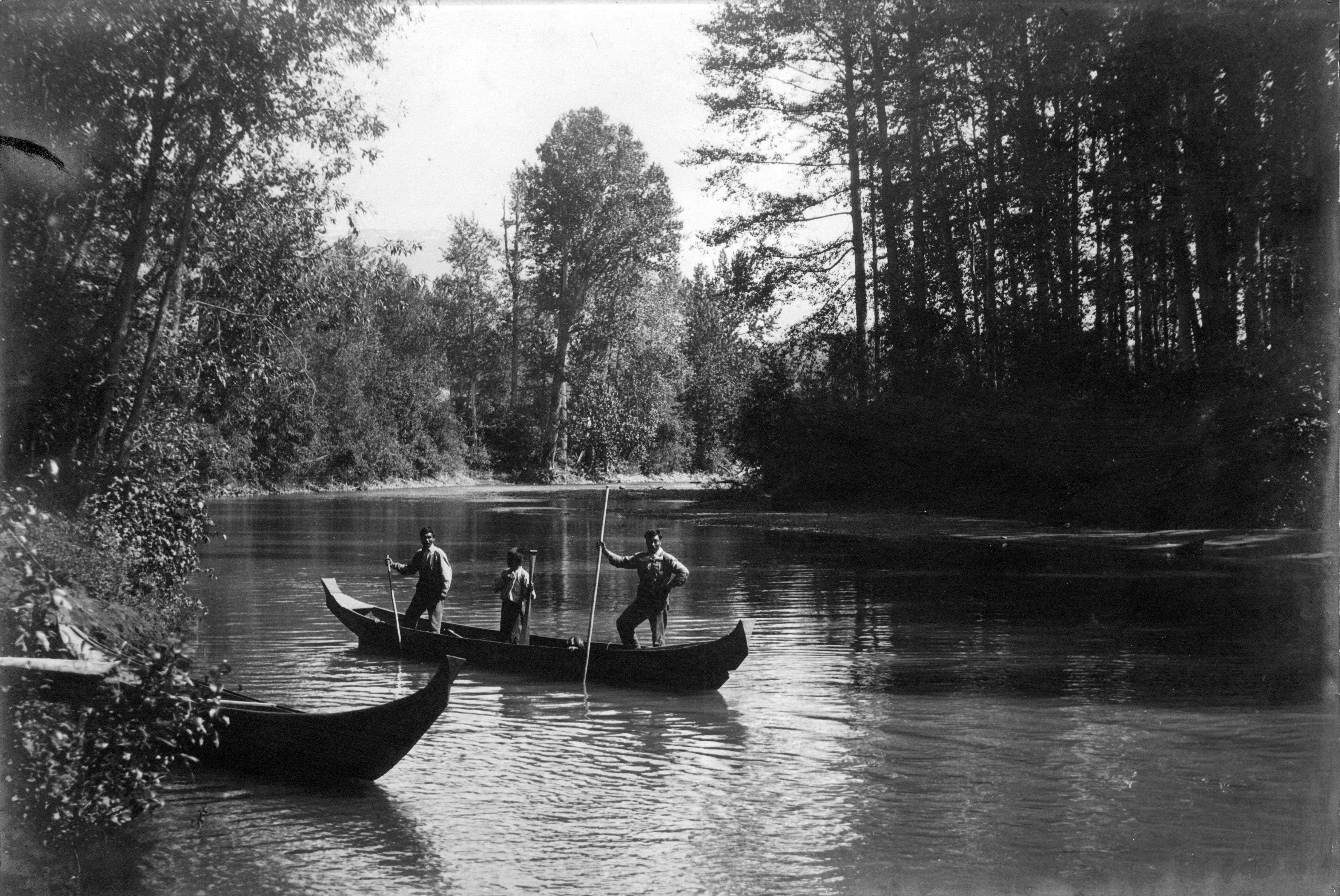
First Nations men in canoe on the Skeena River, 1912
Photo: Major James Skitt Matthews (1878-1970)
Source: http://searcharchives.vancouver.ca/first-nations-men-in-canoe-on-skeena-river;rad
Permission: Public Domain
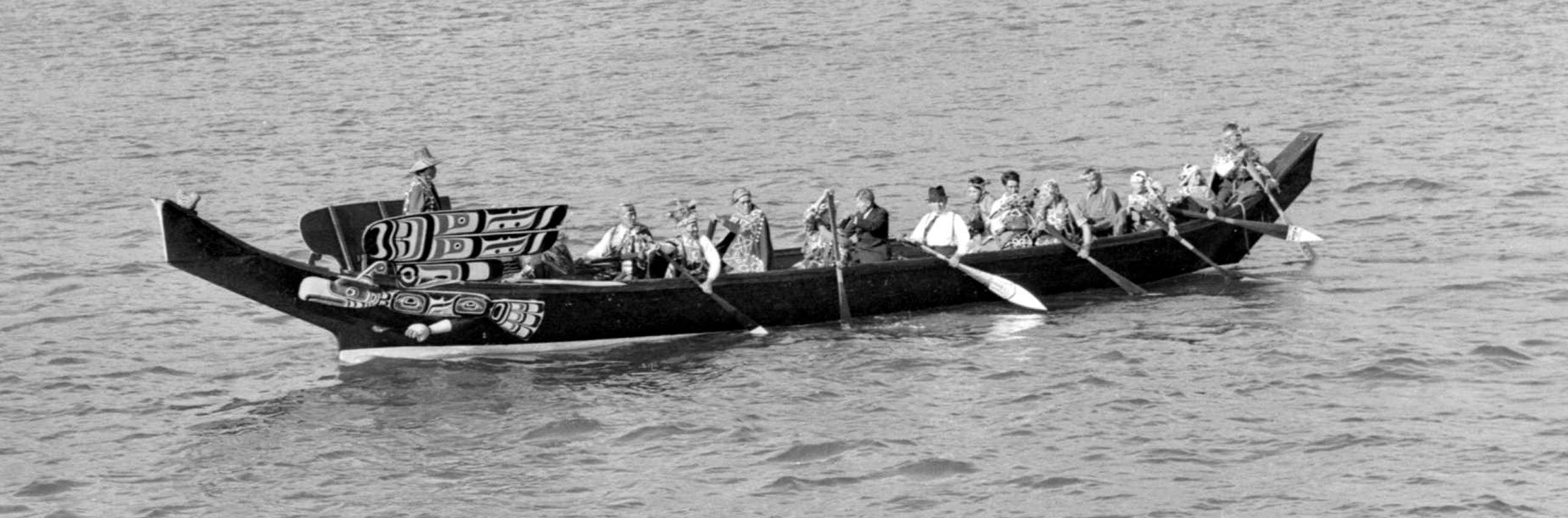
Indian war canoe in Vancouver Harbour during visit of King George VI and Queen Elizabeth, May 29, 1939.
(note that one of the paddlers in the canoe seems to have a replica royal crown and robes! - Don )
Photo: Major James Skitt Matthews (1878-1970)
Source: http://searcharchives.vancouver.ca/first-nations-men-in-canoe-on-skeena-river;rad
Permission: Public Domain
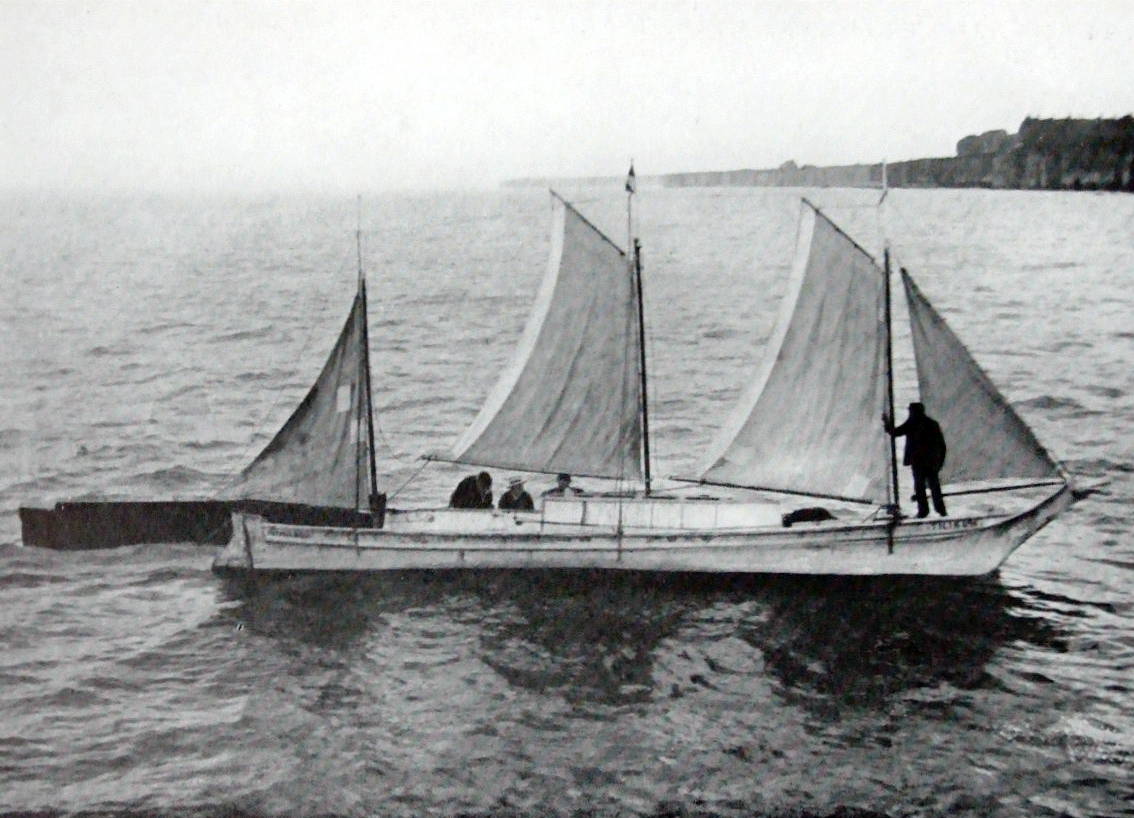
Tilikum at Margate with Captain John Voss standing at the bows.
The Tilikum was a 38-foot (12 m) dugout canoe that was used in an effort to circumnavigate the globe starting in 1901. The boat was a 'Nootkan' (Nuu-chah-nulth) canoe which was already old when it was obtained by captain John Voss in April 1901. The boat was built in the early 19th century as a dugout canoe made from a large red cedar log.
The Tilikum was purchased for $80 in silver from a native woman (Voss describes her as a 'siwash') in a transference ceremony allegedly sealed by a bottle of rye whiskey - the name Tilikum means 'friend' in Chinook jargon. Apparently, John Voss and his companion in this venture, Norman Luxton, were inspired by the voyage of Joshua Slocum, who sailed the 37-foot (11 m) sloop Spray around the world a few years earlier and wrote a best selling book about his adventures.
Photo: unknown
Permission: Public Domain
Text: wikipedia
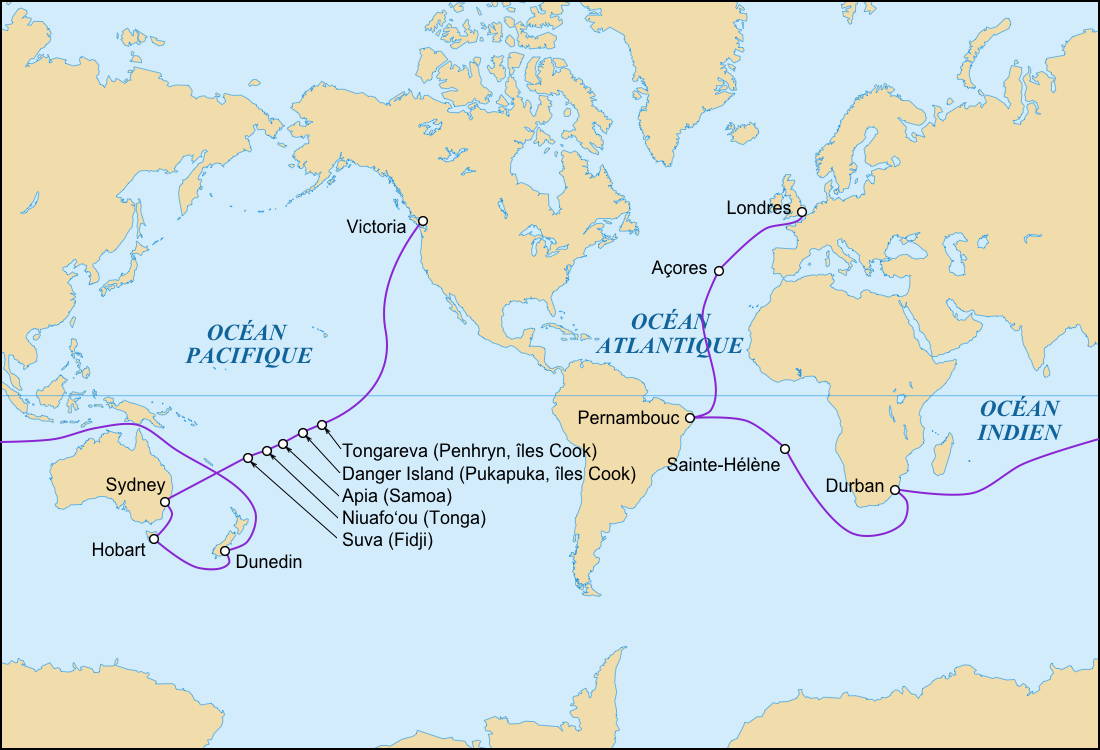
The boat was refitted - reinforced, covered and rigged with sail, 230 square feet (21 m2 in total, and readied for her voyage. The Tilikum was sailed out of Oak Bay harbour on May 20, 1901, captained by Voss and mated by Luxton. After 10 000 miles (about 16 000 km) and five months on the Pacific Ocean, the Tilikum struck a reef and Luxton was thrown from the boat. His whole body was badly cut by coral. The boat limped into harbour at Penrhyn Island in the Cook Islands on September 2, 1901, and Luxton was forced to abandon the trip in Suva, Fiji on October 17, 1901. The Tilikum was mated by 10 more men between that time and when she finally pulled into harbour on the Thames in London, England in September, 1904.
On 25 October 1901, after leaving Suva, the mate, binnacle and compass were lost in 'large breaking seas'. Voss was now alone without a compass, 1 200 miles (1 900 km) from Sydney. Tilikum is claimed to be the smallest deep-water ship to have ever entered Sydney Harbour until this time.
Tilikum arrived in Melbourne on 13 March 1902 and was exhibited in full rig in Collins Street. She was moved to another vantage point at the Exhibition Buildings, but during loading onto a 'wagon', the hook broke and she was damaged, with splits appearing in five different places. Voss repaired it himself using thin steel ribs.
She was then sailed on Lake Wendouree, Ballarat, and presented with a new set of sails by local yachtsmen, before travelling to Geelong to be returned to the sea.
Voss was elected a Fellow of the Royal Geographical Society in London after lecturing in Britain about the voyage.
Captain John Voss published his sailing memoir as 'The Venturesome Voyages of Captain Voss' in 1913. The Tilikum was placed on display in London and changed hands a number of times, losing her bowsprit and masts over time. In 1929, the Furness Shipping Line returned Tillikum to Victoria, British Columbia. She underwent restoration beginning in 1936 by the Thermopylae Club before she was moved into the Maritime Museum in 1965 and has remained on display there since.
Photo: Sardon
Permission: Public Domain
Text: wikipedia
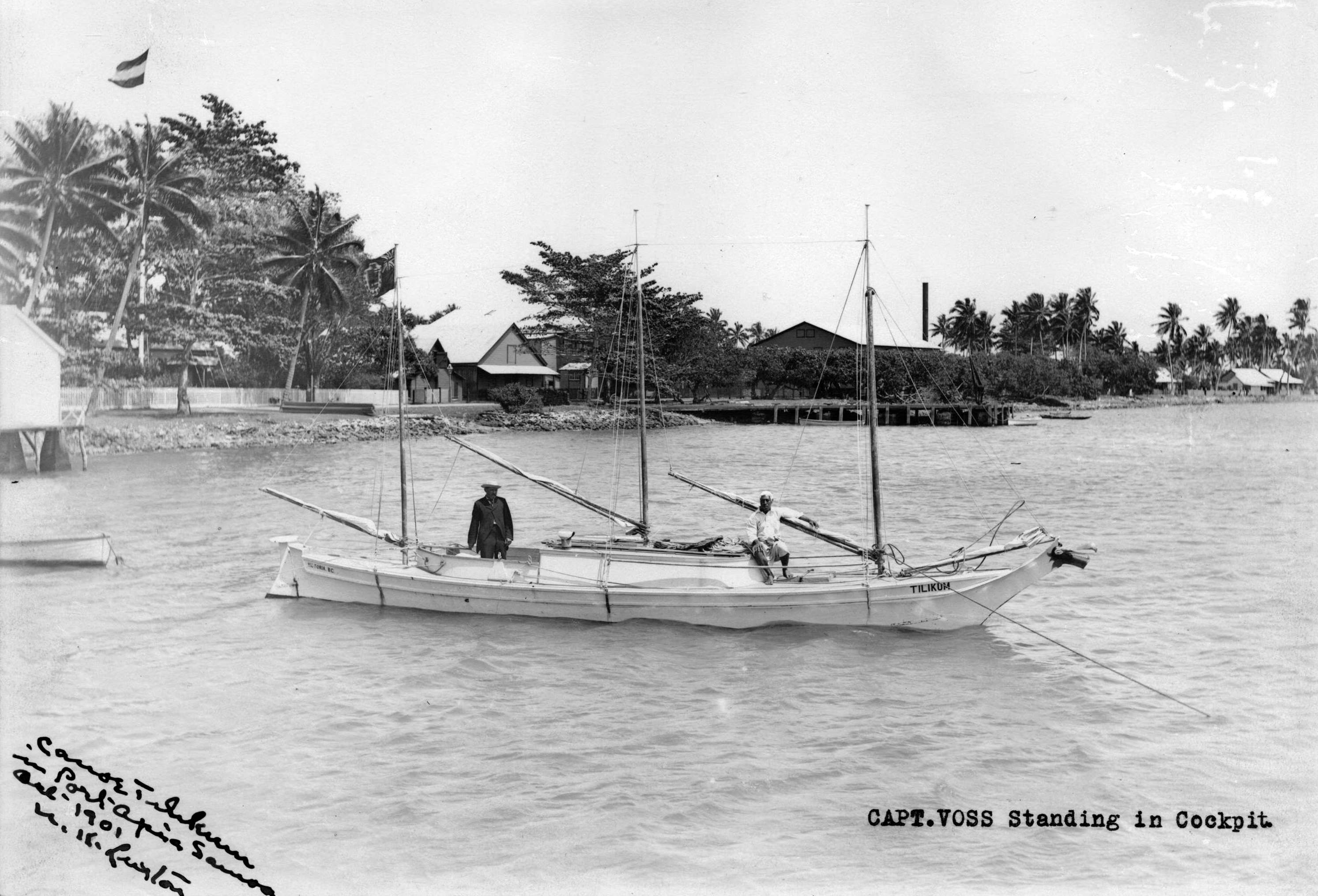
The 'Tilikum' at anchor, Port Apia, Samoa, October 1901.
Voss standing, Luxton sitting.
Photo: Major James Skitt Matthews (1878-1970)
Source: http://searcharchives.vancouver.ca/sailed-canoe-tilikum-at-anchor;rad
Permission: Public Domain
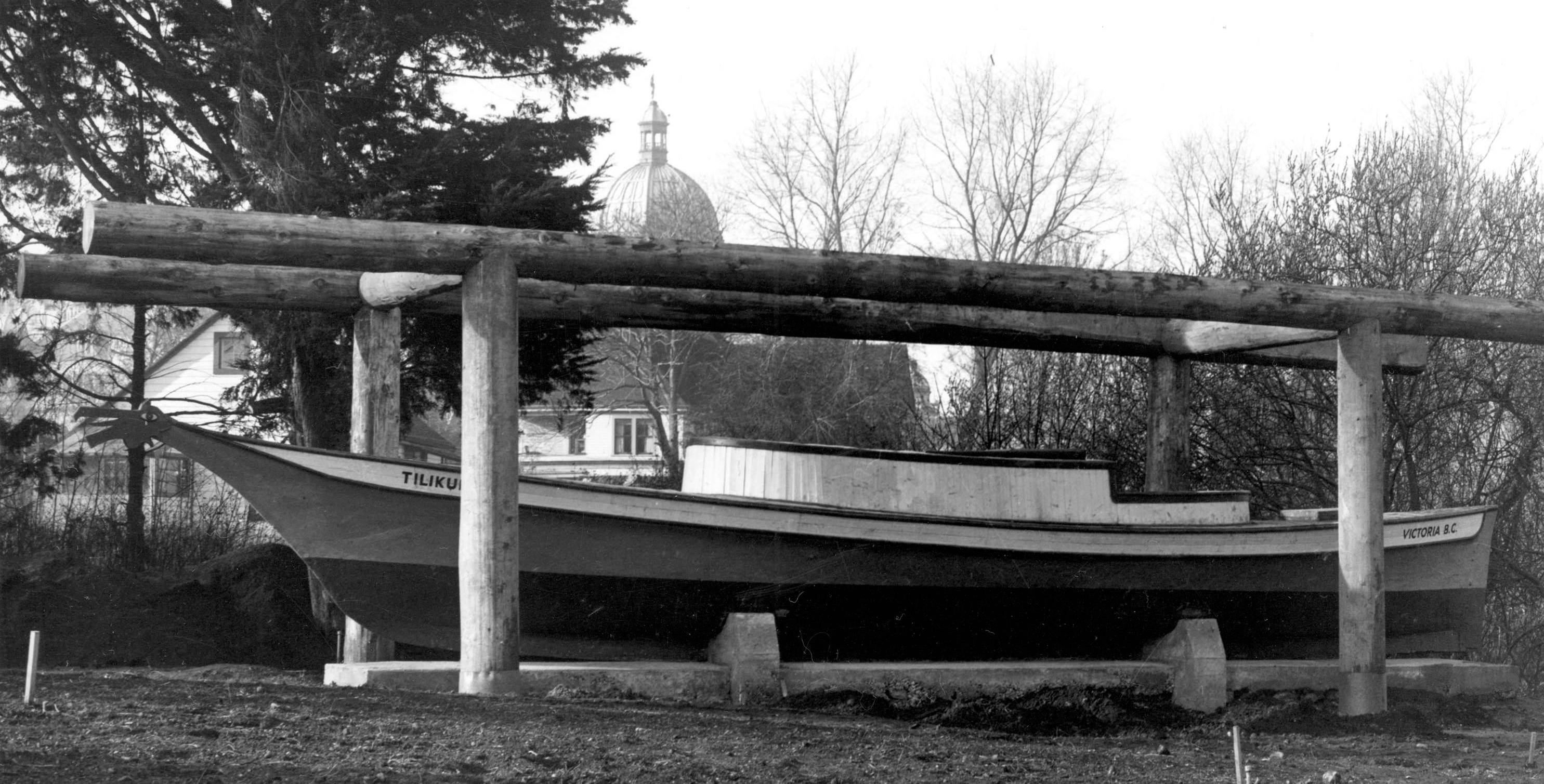
Cedar dugout canoe 'Tilikum' on display at Totem Park
The photo was taken sometime between 1940 and 1948.
Photo: Major James Skitt Matthews (1878-1970)
Source: http://searcharchives.vancouver.ca/cedar-dugout-canoe-tilikum-on-display-at-totem-park-2;rad
Permission: Public Domain


Photo: Don Hitchcock 2012
Source: Display, Museum of Anthropology, University of British Columbia
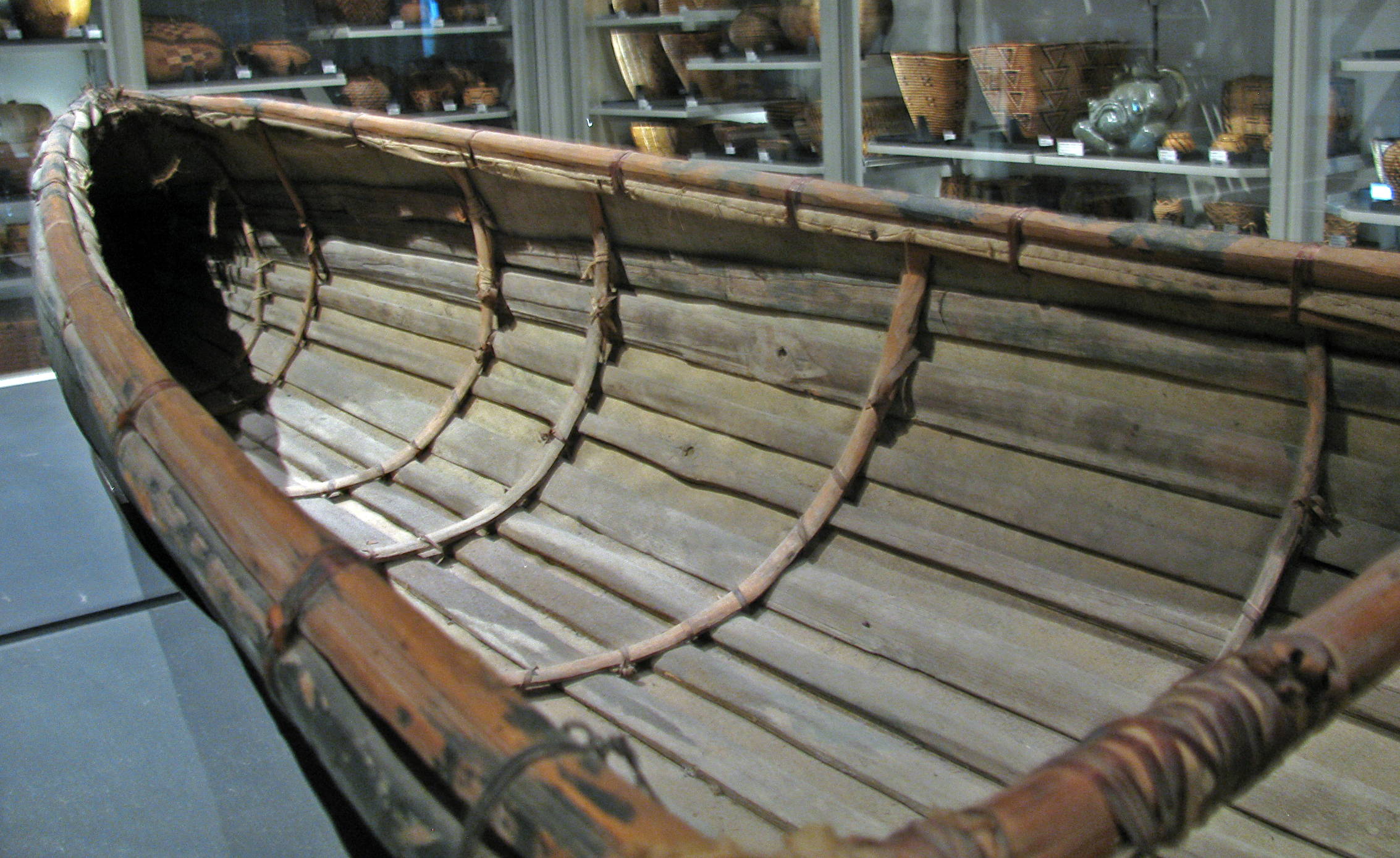
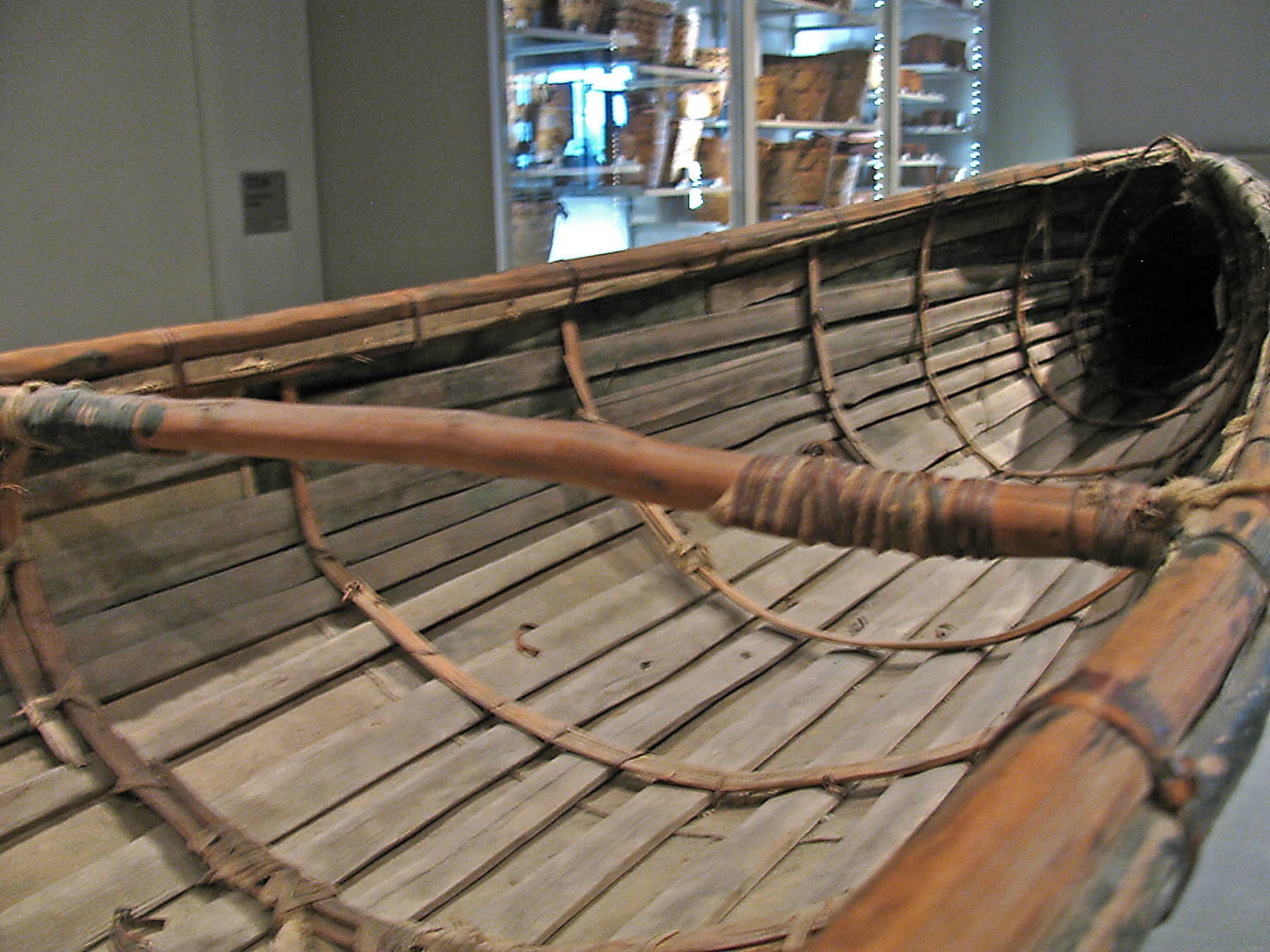
Ktunaxa people have inhabited the Kootenay and Columbia Rivers and the Arrow Lakes region of British Columbia for more than ten thousand years. They are renowned for their distinctive 'sturgeon-nosed canoes.' The boat's unique flat-bottom design tapers at both ends, creating a streamlined shape that cuts easily through the water. Sturgeon-nosed canoes were traditionally made from birch bark, western white pine bark, cedar wood, cedar roots, maple sap, and pitch. Their light construction made for easy transport on lakes and marshy wetlands. Today, sturgeon-nosed canoes are made primarily by the Yakan Nukiy people, also known as the Lower Kootenay Indian Band.
(note that this canoe has been covered with canvas rather than bark - Don )
Photo: Don Hitchcock 2012
Source: Display, Museum of Anthropology, University of British Columbia
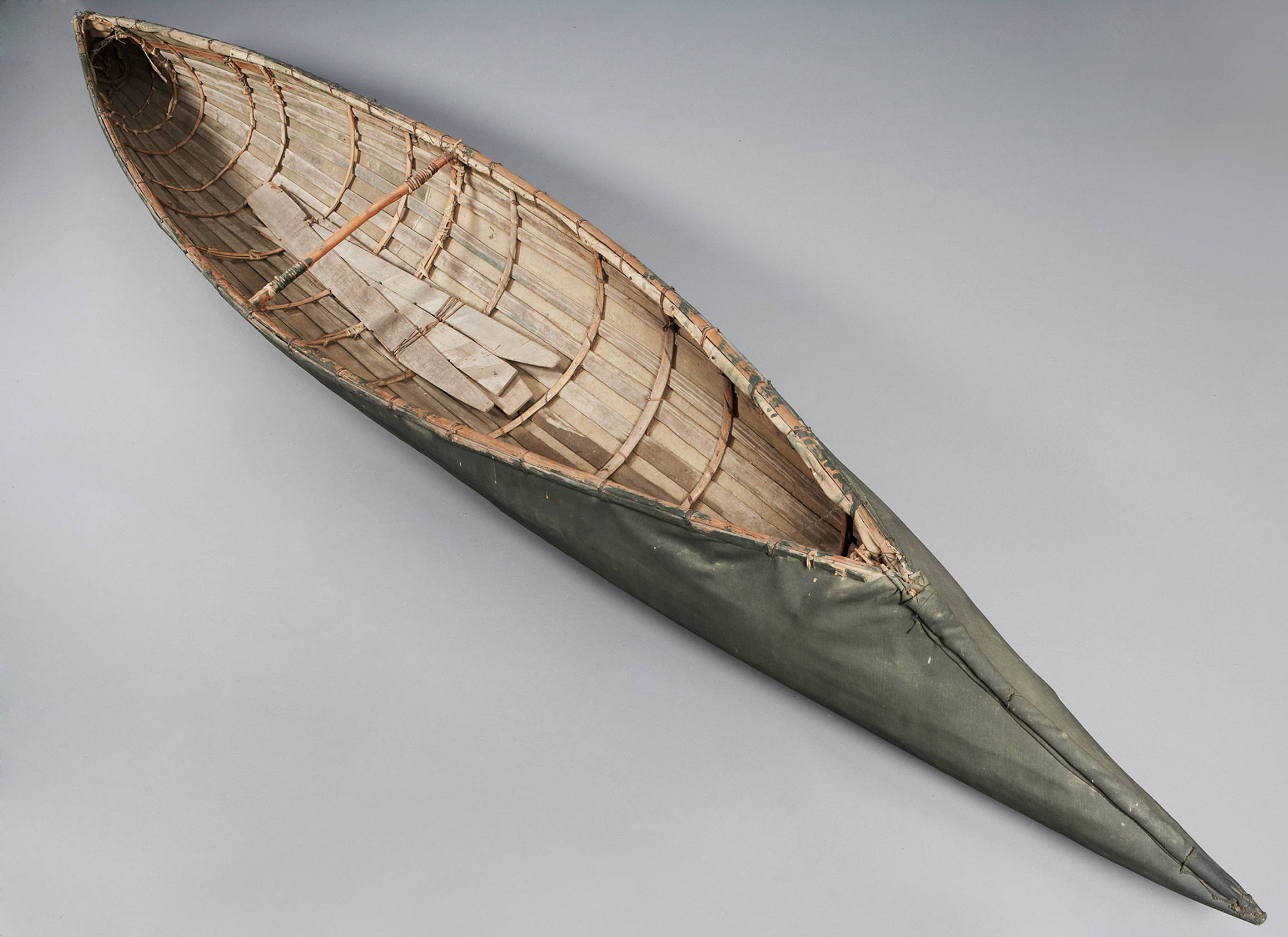
Ktunaxa (pronounced ‘k-too-nah-ha’) people traditionally occupied the lands adjacent to the Kootenay and Columbia Rivers and the Arrow Lakes of British Columbia, and are renowned for their distinctive yaksumit, or 'Sturgeon-nosed' canoe. The unique flat bottom design tapers on both ends resulting in a streamline shape that cuts easily through the water. Sturgeon-nosed canoes were traditionally made from birch bark, western white pine bark, cedar wood and roots, maple sap and pitch. The light construction made for easy transport on lakes and marshy wetlands. Cedar strips sewn together with sinew or hide strips would be placed on the bottom of the canoe for the area where the paddler sits; the canoes were not normally constructed with seats as the paddler knelt directly on a cedar mat at the bottom of the boat, his feet under him and his knees spread hard against the sides. Normally the thwart would have an O ring to hold the paddle when not in use. Today, sturgeon-nosed canoes are made primarily by the Yaqan Nukiy people (also known as the Lower Kootenay Indian Band).
The canoe hull has a long, pointed bow and stern, creating a sharp angle back up to the top rim (gunwale). Black painted canvas over rib and slat wood frame. Nails along inner top gunwale, metal wire at each end. Bark and cloth lashings used on frame. Middle stabilising bar (thwart), no seats.
(note that this photograph allows us to see the circular hoops or rings of willow used in the ends to strengthen and give shape to the prow and stern of the canoe - Don )
Information on file, which apparently came from the donor, says the canoe was collected from an elderly First Nations woman who said it was made 100 years earlier in the traditional style. The original covering of the canoe was said to have been bark from the wild cherry tree (prunus emarginata), sewn together. The bark was replaced with canvas at some point, and the frame work is all original.
Collected in Creston, British Columbia, Canada during 1950
Received from James Dunn (Donor) on August 9, 1972
Identification Number: Nd714
bark, cotton fibre, paint and metal
Height 40 cm, beam 70 cm, length 490 cm
Case 031
Accession number: 207/1
Photo and text: http://www.rrnpilot.org/items/21813
Scottish botanist David Douglas, the first scientific traveller to visit the Arrow Lakes wrote about the Sinixt People his 1827 journal: "The canoes of the natives here are different in form from any I have seen before … The under part is made of the fine bark of Pine (Pinus canadensis) and about one foot from the gunwale of birch-bark, sewed with the roots of Cedar (Thuya) and the seams neatly gummed with resin from the pine. They are 10 to 14 ft long, terminating at both ends sharply and bent inwards so much at the mouth that a man of middle size has some difficulty in placing himself in them. One that will carry six persons and their provisions may be carried on the shoulder with little trouble.
The Sturgeon-nosed Canoe was designed with a reversed prow to be most suitable for travel through bulrushes, and manoeuverable in turbulent waters.
Author Eileen Delehanty Pearkes records in her book about the Sinixt, 'The Geography of Memory' that ethnographer William Elmendorf recorded the process of making a Sturgeon-nosed Canoe based on a description by Sinixt Nation elder Nancy Wynecoop:
The mature tree must be felled in spring, when the sap is running. The outer bark is scraped off, then the inner bark is split and peeled off the heartwood in one sheet. The outside shape of the canoe is marked on the ground with stakes. Poles used for the gunwales are fastened to these stakes. Next, willow ribs are fastened to the gunwales, using willow bark twine. The bark is then sewn onto the ribs, using cedar root. An additional layer of bark is fastened less securely on to the outer side of the craft. All seams are glues with warm pine pitch. On the bow and stern of the canoe, the bark is folded over rings of willow. Extra layers are added for strength, shaped into a point, and sewn. A frame of woven poles is placed in the bottom of the canoe and covered with loose grass to sit on.
Elmendorf also refers to a ceremony, including dancing, fasting and sweatbathing, held by Sinixt men prior to the building of a new canoe. The purpose of the ceremony was to make the group 'more agreeable with each other and focus their energy'.
The 'Sturgeon-nose' design is unique to North American canoes, but craft of similar design were discovered in the Amur River region of Siberia in the mid-19th century.
Text above: Wikipedia
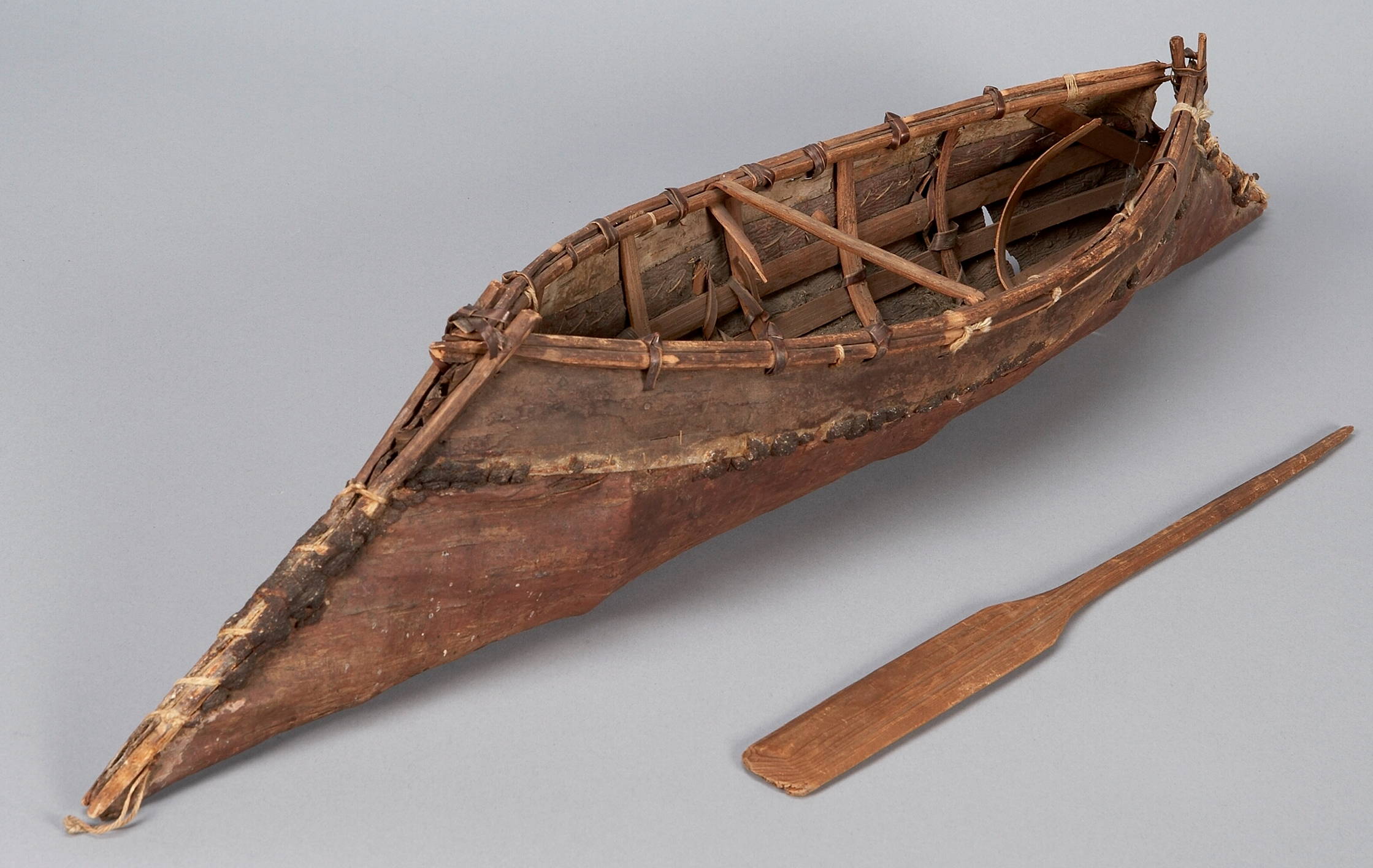
This is a model canoe of the Ktunaxa culture, collected in 1920. It is listed as a birch bark canoe with cedar frame, though the construction appears to follow the description of Douglas above, in that ' The under part is made of the fine bark of Pine (Pinus canadensis) and about one foot from the gunwale of birch-bark, sewed with the roots of Cedar…'
One thwart goes across the opening. Canoe has a longer base than the opening with bow and stern angled to form a point at the bottom.
(note that this model canoe is wide in proportion to its length, as is the case with most such canoe models. Perhaps, however, it is meant to be for a single occupant - Don )
Received from A. R. Ryckman (Donor) on July 9, 1996
Material: birch bark ?, wood resin ?, fibre, cedar wood ? and root ?
Height 155 mm, width 160 mm
Case 030
Accession number: 1713/5 a-b
Photo and text: http://www.rrnpilot.org/items/27051

Bella Coola River type Spoon Canoe
Dr. Doige poling a spoon canoe on the Bella Coola River. The old suspension bridge that connected the two communities is in the background.
A description of the use of these canoes by the Bella Coola First Nations:
The crew take their places at equal intervals between, each ready to work on the opposite side from the man in front. Each is provided with a ten-foot pole and also a paddle for use in spots where the river is too deep for poling. The rivers of central British Columbia are shallow, but swift, and their navigation requires considerable skill. Going upstream, the captain constantly seeks the smoothest water, where he knows the current will be least strong, and uses his pole to keep the craft headed in the right direction. Should it be caught in a violent eddy, he exerts his full strength, and it is his voice that rallies the crew for a final exertion to shove the canoe through. Coming downstream is more dangerous though less wearying. The water is so cold and the current so swift that a capsizing usually causes the drowning of one or more of the occupants, and the captain must never relax. Spoon canoes are very stable, and cannot be upset by a faulty distribution of weight. This is essential in view of the rapids, but they are heavy and cumbersome, unsuited to carrying large loads.
When a carpenter wishes to make a canoe, he fells a cedar of suitable size and trims off bark and branches to leave the central stem available. Slowly and laboriously he chips with his adze until he has hollowed out the trunk to the proper shape, and at the same time has smoothed away the outer surface. Sometimes a small fire is built on the trunk so that it will char the wood beneath and make it easier to remove, but the carpenter must be careful that the flames do not spread too far. Finally, as his work reaches completion, he becomes even more painstaking than before. The sides and bottom are whittled to a thickness of no more than three inches, and at this stage a faulty stroke may pierce the shell and ruin the toil of weeks.
When completed, it is necessary to widen and harden the canoe. A fire is built beside it and stones thrown into the flames to heat; then lifted out and dropped into the water with which the craft has been partly filled. Steam rises, and the carpenter confines it by covering the canoe with matting, at the same time endeavouring to pull and force the sides apart. Sometimes he can do so by mere muscular effort, more often it is necessary to lay transverse thwarts within and, by pounding them downwards, extend the sides. No great extension is possible, nor is it required, but the steaming process is considered to harden the wood as well as widen the canoe.
Photo: Cliff Kopas, 1933-1956
Accession#: 2002.002.017P
Source: Bella Coola Valley Museum BC Central Coast Archives, http://www.bellacoolamuseum.ca/en/photo_detail.php?id=178
Text: McIlwraith (1992)

Spoon canoe, with eulachon, taken on the Bella Coola River.
Photo: Iver Fougner
Source: British Columbia Central Coast Archives, via Moody (2008)
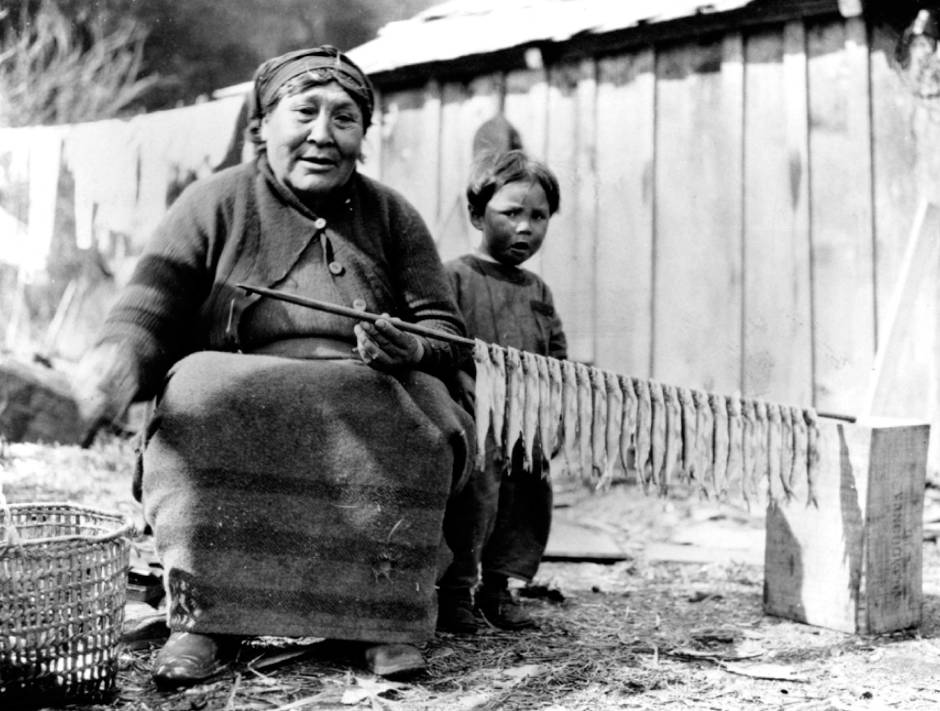
Stringing eulachons. (Young boy at right has been identified as Norman Johnson.)
From Wikipedia:
The eulachon or candlefish is a small anadromous (ascending rivers from the sea for breeding) ocean fish, Thaleichthys pacificus, a smelt found along the Pacific coast of North America from northern California to Alaska.
The common names of this fish have a somewhat confusing relationship. The name 'candlefish' derives from the fact that it is so fat during spawning, with up to 15% of total body weight in fat, that if caught, dried, and strung on a wick, it can be burned as a candle. This is the name most often used by early explorers. The name eulachon (occasionally seen as oolichan, oulachon, and uthlecan) is from the Chinookan language and the Chinook jargon based on that language.
Photo: C. MacKay, 1952, #2005.001.165, Archives, UBC Museum of Anthropology.
Source: Brown (2011)
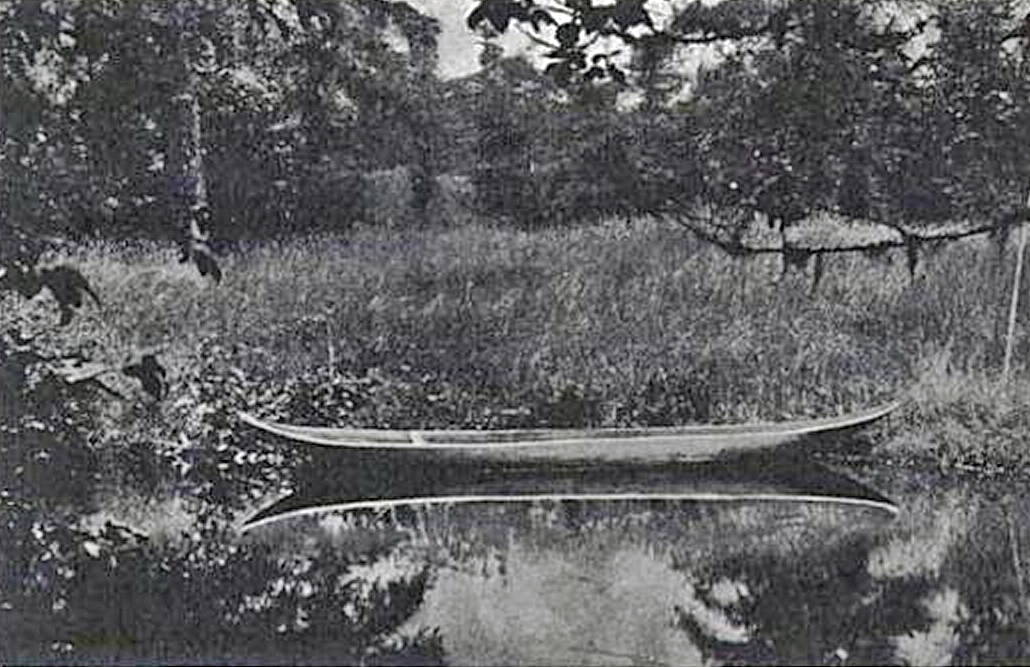
A small Bella Coola dugout, 'spoon' type, for river use.
Photo: Harlan I. Smith
Source: Jennes (1977)
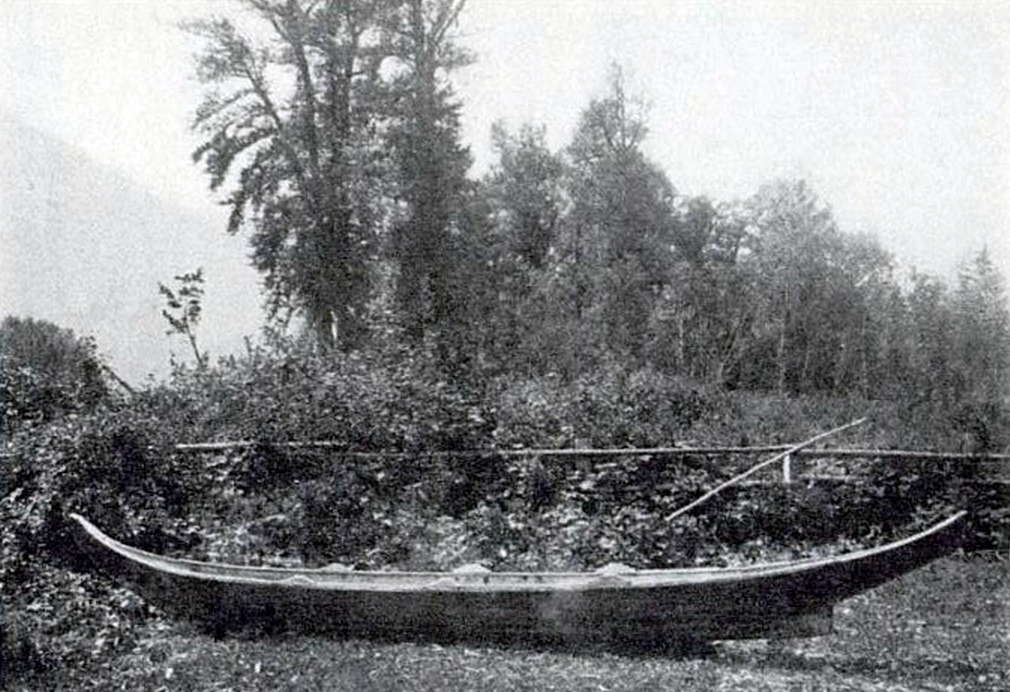
Bella Coola Ocean type Spoon Canoe
The Bella Coola made this type of canoe, äqna, for use on the ocean. A few examples of this style are still in existence. Though approximately the same length as river canoes, they are proportionately much deeper and narrower, and an extension downwards near the stem serves in place of a keel. These craft are sufficiently sea-worthy to weather any ordinary storm.
Photo: H.I. Smith, National Museum of Canada
Text: McIlwraith (1992)

Canadian Canoes
1 Alaskan Eskimo umiak, or open boat
2 Labrador Eskimo kayak
3 Dog-rib canoe
4 Malecite canoe
5 Algonquin canoe
6 Montagnais canoe.
Photo and text: Waugh (1919)
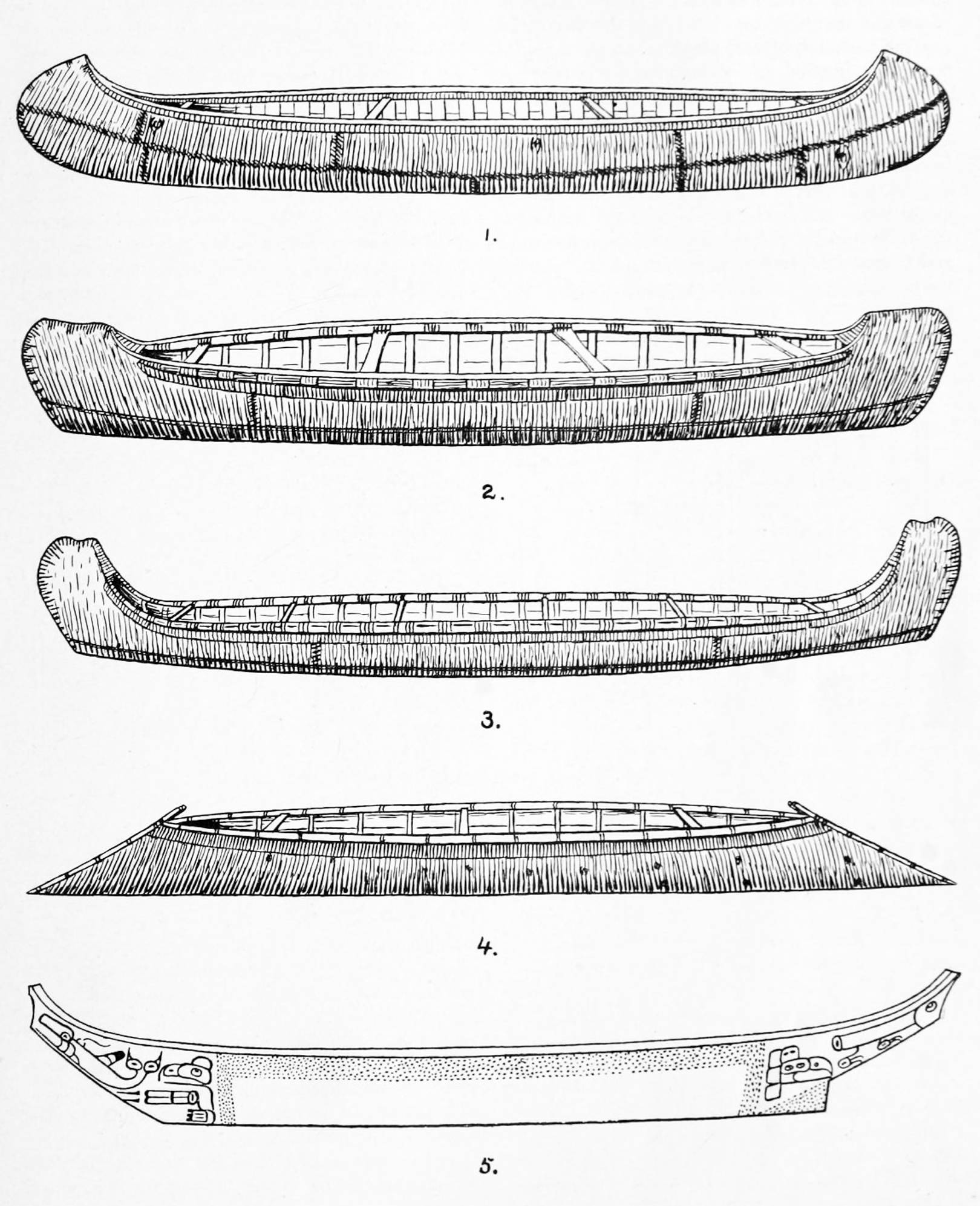
Canadian Canoes
1 Oijbwa canoe (Northern Ontario)
2 Chipewyan
3 Slave
4 Kootenay, Shuswap and other southern BC tribes
5 Haida
Photo and text: Waugh (1919)
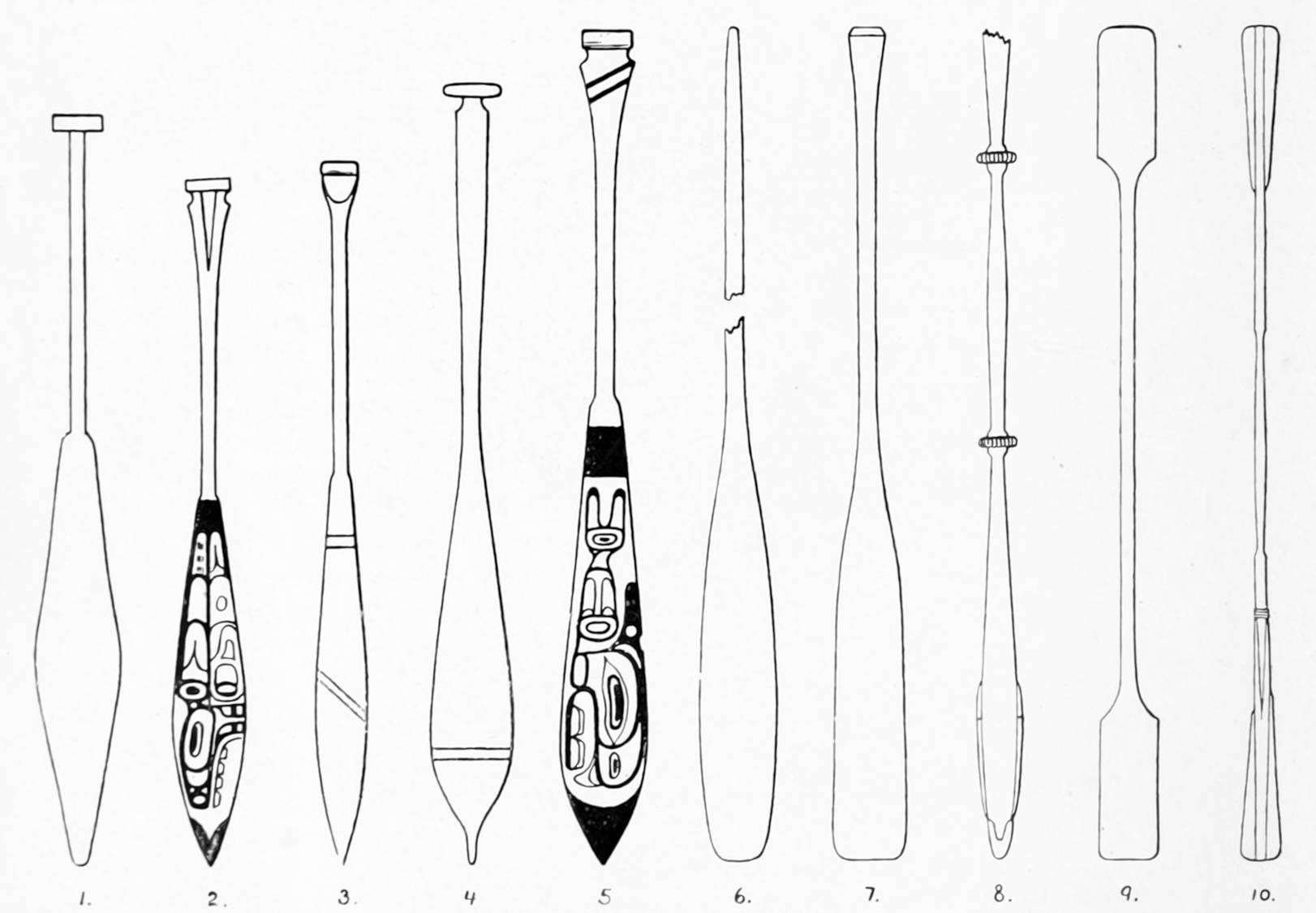
Some typical Canadian Paddles
1 and 4 West Coast paddles, exact locality unknown
2 and 3 Tlingit (northern BC)
5 probably Haida (Queen Charlotte Islands)
6 Kootenay (southern BC)
7 Ojibwa
9 Copper Eskimo
8 and 10 Central Eskimo. (The last three are neighbouring groups)
Photo and text: Waugh (1919)
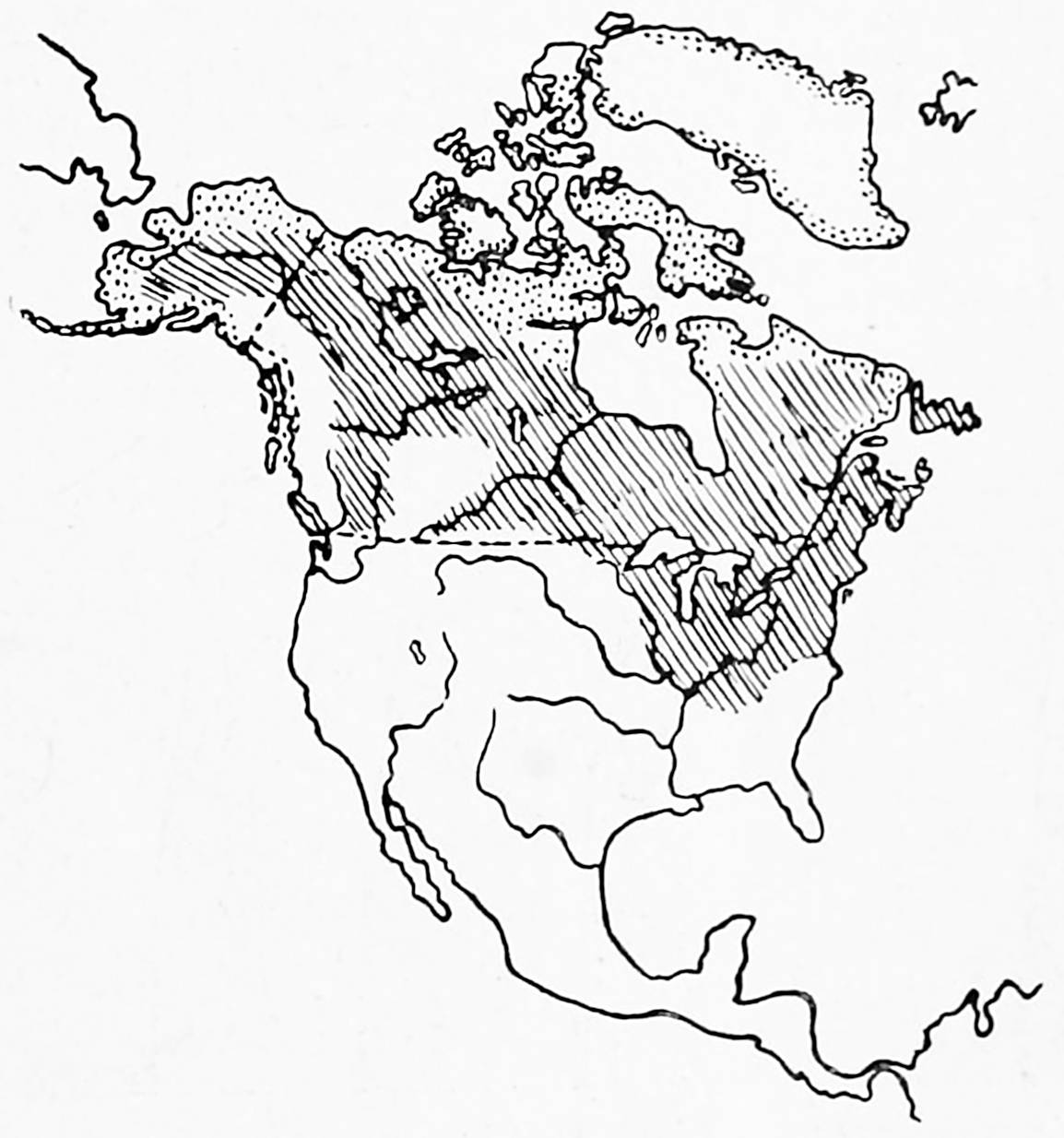
Distribution Map
The dotted portion shows the Eskimo kayak and umiak region, and the part covered by oblique lines, the birch-bark canoe region.
Photo and text: Waugh (1919)
Kayaks
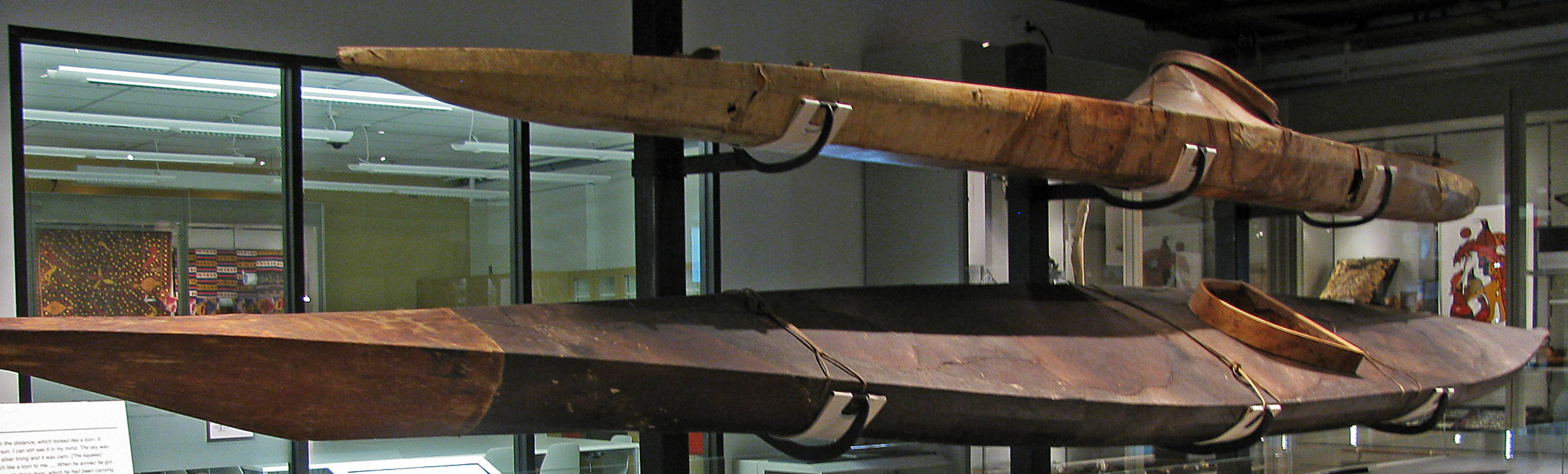
Two kayaks, made for different conditions. The lower kayak, made from sealskins was designed for use on the seawaters of northern Baffin Island. Its broad beam provides stability.
The upper kayak, made from caribou skins was designed for use on lakes and rivers. Its narrow beam makes it fast and maneuverable for hunting caribou.
Photo: Don Hitchcock 2012
Source: Display, Museum of Anthropology, University of British Columbia
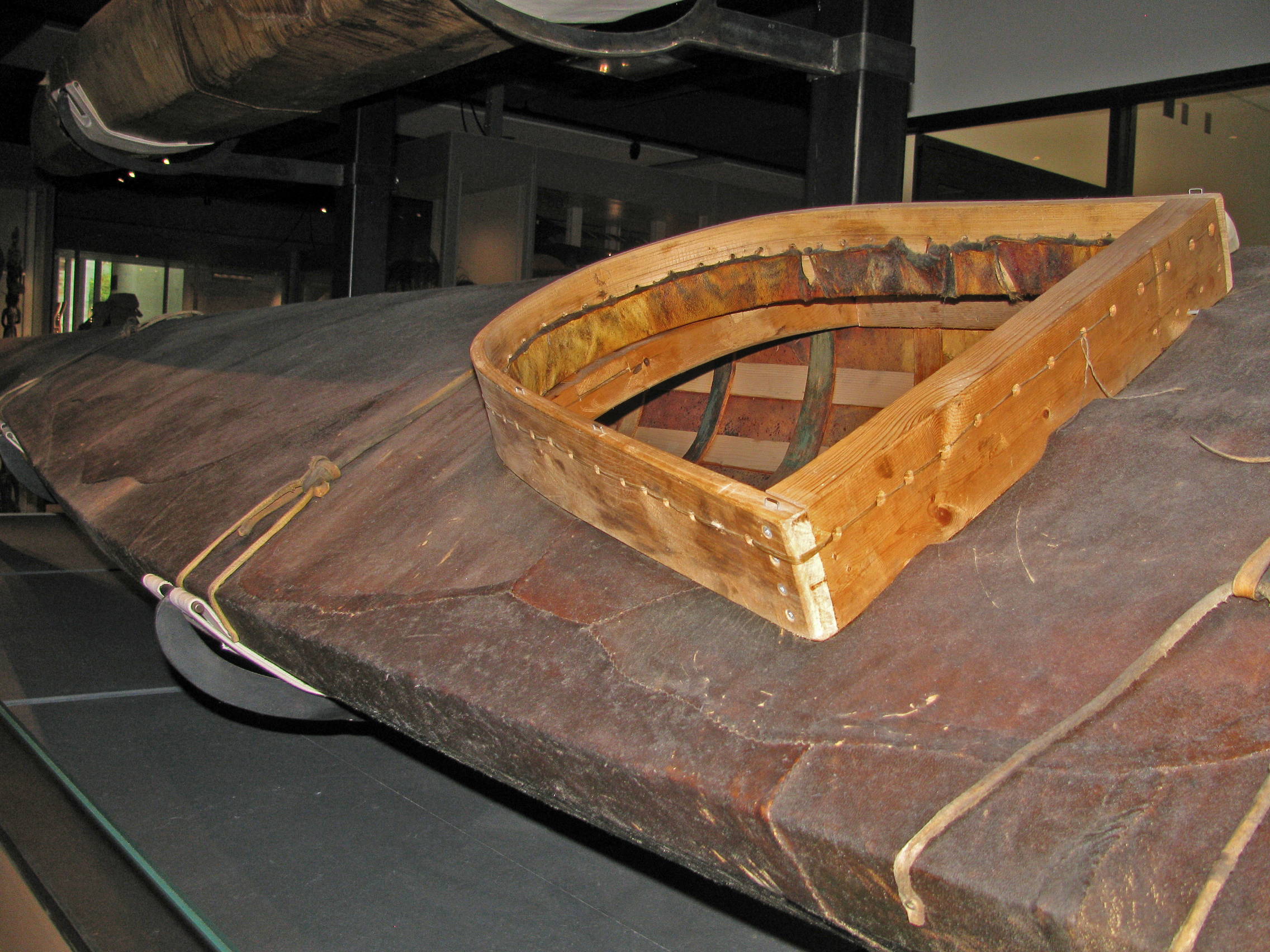
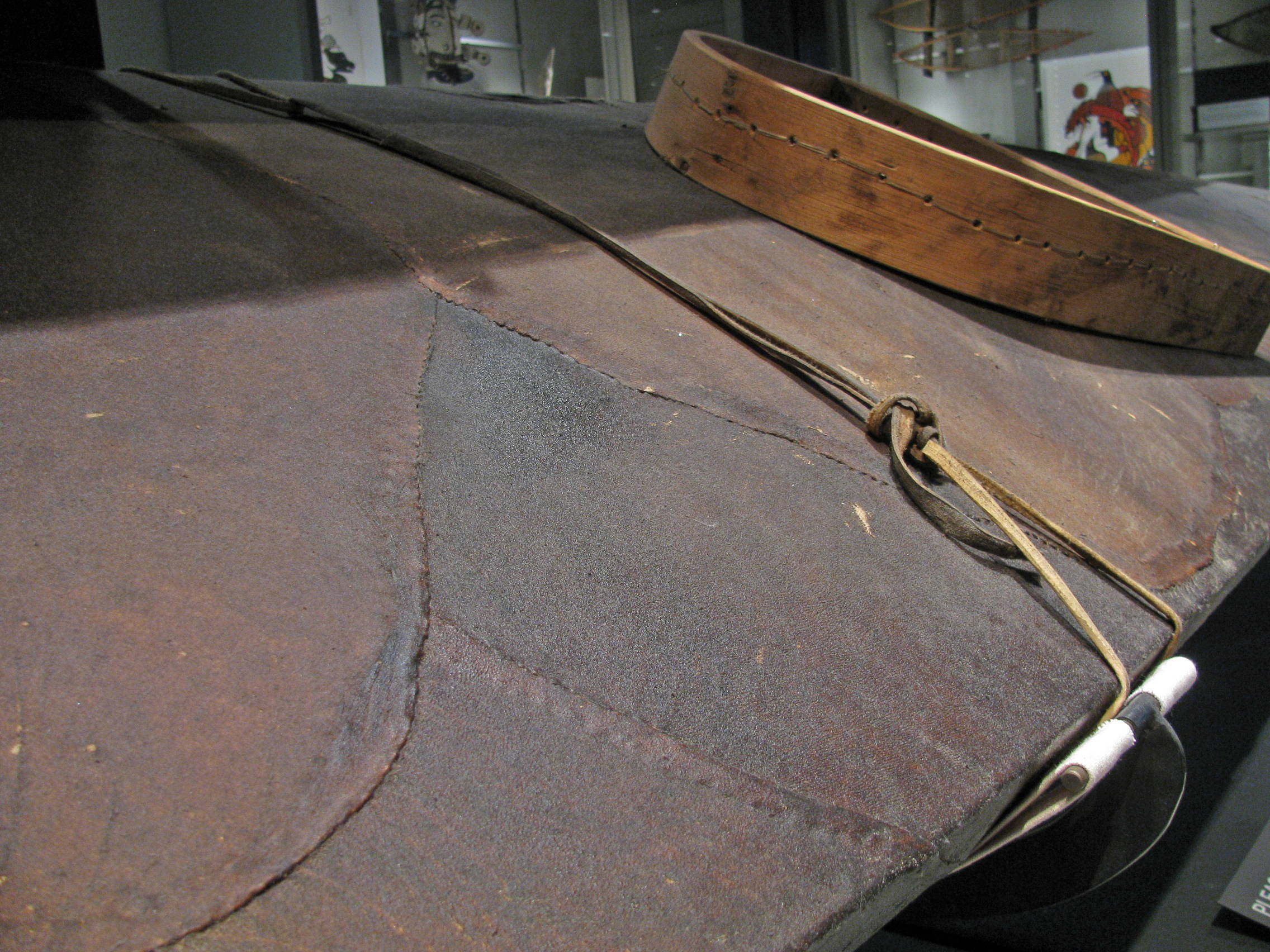
Close ups of the details of the sea kayak.
(Notice how carefully the cockpit of the kayak has been fashioned. On the inside, the skins of the outside covering of the kayak have been led up inside the wooden surround, and carefully laced to the wood to stop wave slop from coming into the kayak. In addition, the wooden surround provides a perfect ledge over which the waterproof paddling parka of the Inuinnait fisher can fit, acting as a skirt to keep out spray and rain. Hypothermia is an ever present danger in kayaks. - Don )
Dark brown skin kayak over wood frame. Prow has different coloured skin. Wood framed and screwed rim over cockpit. Skin on inside of cockpit is tied to sides of wooden frame with sinew. Skin straps across the deck in front and behind cockpit are screwed on. Short angled piece of antler (?) tied with skin to one side of wooden cockpit frame.
Made in Nunavut, Canada
Owned by Northwest Territories Pavilion before October 17, 1986
Received from Northwest Territories Pavilion (Donor) on October 17, 1986
Identification Number: 1158/1
Height 30 cm, beam 80 cm, length 640 cm
Condition: fair
Current location: Case 047
Accession number: 1158/1
Photo: Don Hitchcock 2012
Text: http://www.rrnpilot.org/items/21819
Source: Display, Museum of Anthropology, University of British Columbia
When herds start going into the rivers, or falling into the water to cross the river, kayaks are usually waiting in the water. The land sure gets noisy! The migrating caribou are endless just like a river to the end. So many caribou that the end is hard to see… A kayak usually moves along the current the caribou are making when they are swimming across.
George Kuptana, Inuinnait.
(The preferred term for the native peoples in Canada's Central Arctic is Inuinnait, and in the eastern Canadian Arctic the preferred term is Inuit. - Don )
Source: Display, Museum of Anthropology, University of British Columbia
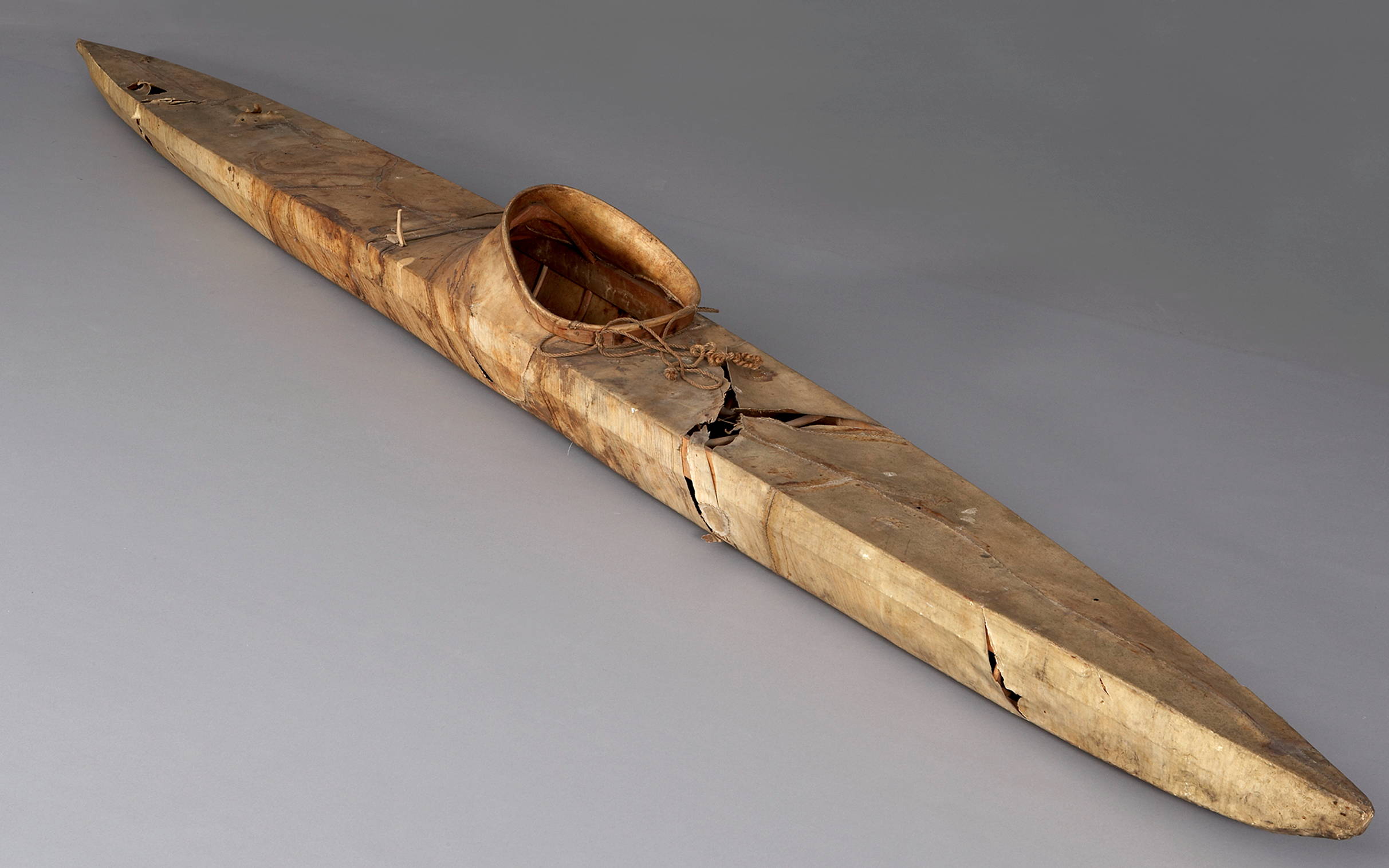
River and lake Kayak
Na1145
Skin covered (caribou on the museum card, sealskin on the website ) kayak with a single angled cockpit; relatively flat on top and keel; rounded bow tapers to a point and raises slightly from bottom; stern also tapers to a point and is raised from bottom. Series of evenly spaced (where visible) ribs attach to gunwales; ribs are flat on bottom and curve sharply at sides.
Three longitudinal keel supports and additional supports around and extending from cockpit. Numerous skins are sewn together, covering kayak; the skin is sewn to a bent wood rim at cockpit. In front of the cockpit is a bone support attached to the top side of the kayak by a leather thong which passes through two holes on base of the support and through two holes on either side of kayak. There is a rope attached to the back of the cockpit on both sides. The skin covering is pieced by stitching in numerous places.
Kayaks from the Copper area are used more for hunting in inland lakes and streams, than they are used for transportation. In general, they are larger and lighter than most sea going kayaks. A double bladed paddle is used with them.
After the frame of a traditional kayak is constructed, using an adze, crooked knife, drill, lashings and wooden pegs, then several wet seal skins are sewn with a waterproof stitch to cover the kayak. Several women sew quickly before the skins dry and shrink to form a taut covering.
According to the old Museum ledger, Ian M. Mackinnon presented Frank Burnett with this collection of Inuit objects. They were collected during his three years of residence in the Coppermine River area, probably 1921-24.
Made in Coppermine, Nunavut, Canada and Kugluktuk, Nunavut, Canada before 1925
Collected between 1920 and 1925
Owned by Ian M. Mackinnon
Owned by Frank Burnett before 1927
Received from Frank Burnett (Donor) on July 25, 1927
Material: bone, fibre, skin, seal skin and wood
Manufacturing Technique: adzed, carved, drilled, tied, sewn, stretched, pegged, bent and steamed
Height 47 cm, beam 44 cm, length 523 cm
Condition: poor
Case 047
Accession number: 2191/145
Inuit: Inuinnait
Photo and text: http://www.rrnpilot.org/items/15827

While doing some research, David Smith found this reference in Collison (1915):
'The late Admiral Prevost [James Charles Prevost RN 1810-1891] once remarked to me, when looking at a large Haida canoe, that it was as perfect in outline as an 'Atlantic greyhound' which is the term commonly used to describe the large and fast steamers now running between Europe and America. And yet the Haidas were able before the advent of the white men to turn out their canoes as perfectly with their stone tools as they do now with steel.'
David writes:
The sketch of the Haida Canoe was worked up from old photocopies in my old design files, doubled and married into full-hull underbodies with the computer. With the large original size and finer drafting lines, the canoe unfortunately does not take kindly to re-sizing, losing both sharpness and detail. However, a fair approximation can be seen to compare the hull lines.
Left to right:
The 1845, 50 metre Rainbow – considered by historian Howard Chapelle as the first American clipper ship, the Rainbow achieved fame for her fast passages. Fast passage speeds were obtained by her sharp entry and tapered fish-like torpedo shape - with the main beam well forward and her afterbody greatly tapered.
The 2007 Saaduuts-carved Haida Canoe was built to the traditional design. In some ways the high prow Haida designs are quite reminiscent of traditional Japanese small craft.
The 1902, 145 metre seven-masted schooner Thomas W. Lawson was arguably the world’s first 'Supertanker'. Designed for sheer cargo capacity, the Lawson was basically a tapered, wall-sided barge with sails: A true whale of a ship and a terrible sailer, the schooner was a disappointment to her designer (B.B. Crowninshield – a man renowned for his sleek yachts). Photographs of the great slab-sided ship under full sail and in ballast are awe inspiring - even today.
The 1902, 147 metre, five-masted nitrate carrier Preussen. A fast sailer and an able ship, the Preussen marked the apex of giant, sail-powered cargo carrier design and technology. One of the last of the great iron ships sailing under canvas, not surprisingly, the Preussen’s design served as the basis for the present day five-masted cruise ship, the 'Royal Clipper', launched in 2007.
Photo and text: © 2008 D. S. Smith
References
- Boas, F., 1909: The Kwakiutl of Vancouver Island, Stechert & Co, 1909
- Brown, P., 2011: We Are The Wuikinuxv Nation, UBC Museum of Anthropology Pacific Northwest sourcebook series © Wuikinuxv Nation UBC Museum of Anthropology, 2011 University of British Columbia 6393 N.W. Marine Drive Vancouver, B.C. V6T 1Z2
- Collison W., 1915: In the Wake of the War Canoe; A Stirring Record of Forty Years' Successful Labour, Peril & Adventure Amongst the Savage Indian Tribes of the Pacific Coast, and the Piratical Head-hunting Haidas of the Queen Charlotte Islands, B.C., Seeley, Service, 1915 - Indians of North America - 351 pages
- Jennes, D., 1977: The Indians of Canada,University of Toronto Press
- Jonaitis, A., 1991: Chiefly Feasts, Seattle : University of Washington Press; New York : American Museum of Natural History.
- McIlwraith, T., 1992: The Bella Coola Indians, 2 Volumes, University of Toronto Press
- Moody, M., 2008: Eulachon Past and Present, M.Sc Thesis, The University of Victoria, 2008
- Strauss, D., 2010: From Head to Hand: Art and the Manual, Oxford University Press, 10 Jan 2010 pp 224
- Waugh, F., 1919: Canadian Aboriginal Canoes, The Canadian Field-Naturalist, Vol. XXXIII May, 1919 No. 2
Back to Don's Maps
Back to Archaeological Sites
Back to Pacific NW Coast index